TV Monetizes Hurricane Irma

Weather reporters do a stand-up as the force of the winds caused by Hurricane Irma hit Miami. (Marcus Yam / Los Angeles Times)

Chicago Tribune on Sept. 11 published Swept away by TV coverage of Hurricane Irma by Dahleen Glanton, Contact Reporter.

It is a fine reflection piece by a media insider on how commercial media covers extreme weather events. She recounts her journey of discovery becoming critical and eventually repelled by the coverage from her own media colleagues. Excerpts below with my bolds.

I didn’t leave the house on Sunday. The hurricane story unfolding on my television set was too gripping to walk away for even a few minutes.

Television anchors kept warning us that much of Florida could be washed away by gigantic surges of ocean water in the aftermath of Hurricane Irma. The pictures coming out of Cuba and the Caribbean already had proved how devastating this storm could be. I was terrified for everyone in its path.

But that wasn’t the only reason I, and so many others, sat glued to the TV all day. Cable news television gave us a virtual front row seat to the developing storm, providing a riveting performance that was full of adventure, suspense and drama.

The show presented on the TV news was designed to be entertaining. It was meant to keep us captivated for hours, mesmerized by the “heroic” sacrifices of journalists who risked their lives to show us what it is like to stand outside in the midst of a deadly storm.

They described the predicted surge as “a killer water event” and the reporters vowed to run to safety before it occurred. But if we just kept watching — even through commercial breaks — they promised, we would see it for ourselves.

For many of us, this was an uneasy proposition. No one was excited about the possibility of people losing their homes and businesses, perhaps even lives, but the prospect of seeing a hurricane dance up close was too tempting to turn down.

Reporters went up to people who had ventured outside, including one man walking his three-legged dog, and warned them to go back inside before it was too late. The camera panned in on a bird as the reporter surmised that perhaps it had flown with the hurricane from as far away as Cuba. Birds follow hurricanes, he told us. These birds know when it’s safe to come out.

The reporters in their plastic rain slickers with the network’s logo on the back kept explaining that they were doing all this for us. Regardless of what the critics said about their reckless behavior, “We’re here so you don’t have to be,” they insisted.

The surge never happened Sunday, and we should be grateful for that. What we saw on TV was typical of a hurricane — howling winds, swaying trees and metal stop signs shaking in the distance. The anti-climatic ending left us confused.

How could a 10- to 15-foot surge hyped all day long for Florida’s west coast suddenly turn into one of about 3 feet? How could TV meteorologists presented on air as experts and reporters billed as experienced storm chasers get it so wrong?

I still don’t know the answers. But it didn’t take long to figure out that the cable news coverage from Florida on Sunday wasn’t about us at all. It was all about their ratings.

This was a new experience for me. For more than a decade, I covered hurricanes in the South for the Tribune. Hunkered down in Mississippi during Hurricane Katrina, I never had the chance to see how a big storm was covered on national TV.

What I saw on Sunday was both shocking and intriguing.

As a journalist who has covered many hurricanes and tornadoes, I know what it takes to tell a story. Standing in front of a water-splashed camera holding a limb from a fallen tree is not necessary to show the strength of a storm.

I understand that television relies on the power of optics. It is true that a TV camera can paint a picture much more vividly than I could by writing about it on a computer.

While I’m sure some people who have relatives and friends in Florida were grateful for the in-depth coverage, too much of what we saw on Sunday was manufactured drama. Networks took advantage of a heartbreaking situation and made a mockery of it.

Surfing through the channels, the visuals were all the same. Reporters, wobbling in the bristling wind, their words barely audible as they attempted to convince us that it was OK for them to do what they were warning others not to do.

In one scene, a reporter tried to convince us that the concrete wall he was standing in front of would protect him from the surge. He demonstrated how he could bend down and take refuge from the wind if he needed to.

In the same breath, he warned of flying debris — roof shingles and street signage that could transform into projectiles so fierce that they could knock you out.

On another channel, a well-known meteorologist swayed and stumbled on a sidewalk while the eye of the hurricane went through Naples, Fla. The wind nearly took his breath away and viewers could barely understand what he was saying.

When we did manage to hear a thing or two, it was nothing of importance.

“This is a mid-level Category 3. Imagine if it was a Category 4 or 5?” he boasted. “This is a story you can tell your children and grandchildren.”

The anchor watching from the studio in New York seemed somewhat embarrassed. He offered this explanation for the perilous acts.

“So we can see what this does to our natural bodies and our world,” he said.

There were no surprises, though. We saw exactly what we expected to see when someone is standing outside in a hurricane.

The irony is that the people who would perhaps benefit from such a display didn’t get to see it at all. Millions of people across Florida were without electricity during the height of the storm.

It’s probably safe to bet they weren’t using up their limited cell phone access watching a news anchor in New York explaining what was going on in their back yards.

This show wasn’t meant for them at all. It was for people like you and me who were sitting in our nice dry homes with a bag of popcorn in one hand and the TV remote control in the other.

All of us should be honest about that.

dglanton@chicagotribune.com

Conclusion:

This could be a tipping point.  We may be witnessing the dawning of skeptical awareness at the Chicago Tribune, bastion of political correctness regarding all things climate related. One of their own catches them “Jumping the Shark.”

“Jumping the shark” is attempting to draw attention to or create publicity for something that is perceived as not warranting the attention, especially something that is believed to be past its peak in quality or relevance. The phrase originated with the TV series “Happy Days” when an episode had Fonzie doing a water ski jump over a shark. The stunt was intended to perk up the ratings, but it marked the show’s low point ahead of its demise.


Arctic Ice Coasting Sept. 12

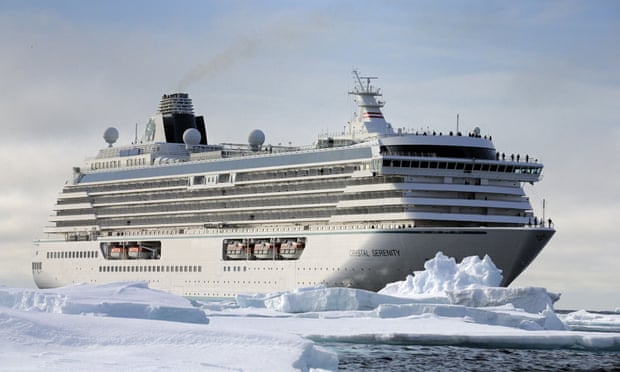
Crystal Serenity touring in the Arctic Northwest Passage 2016 and 2017.

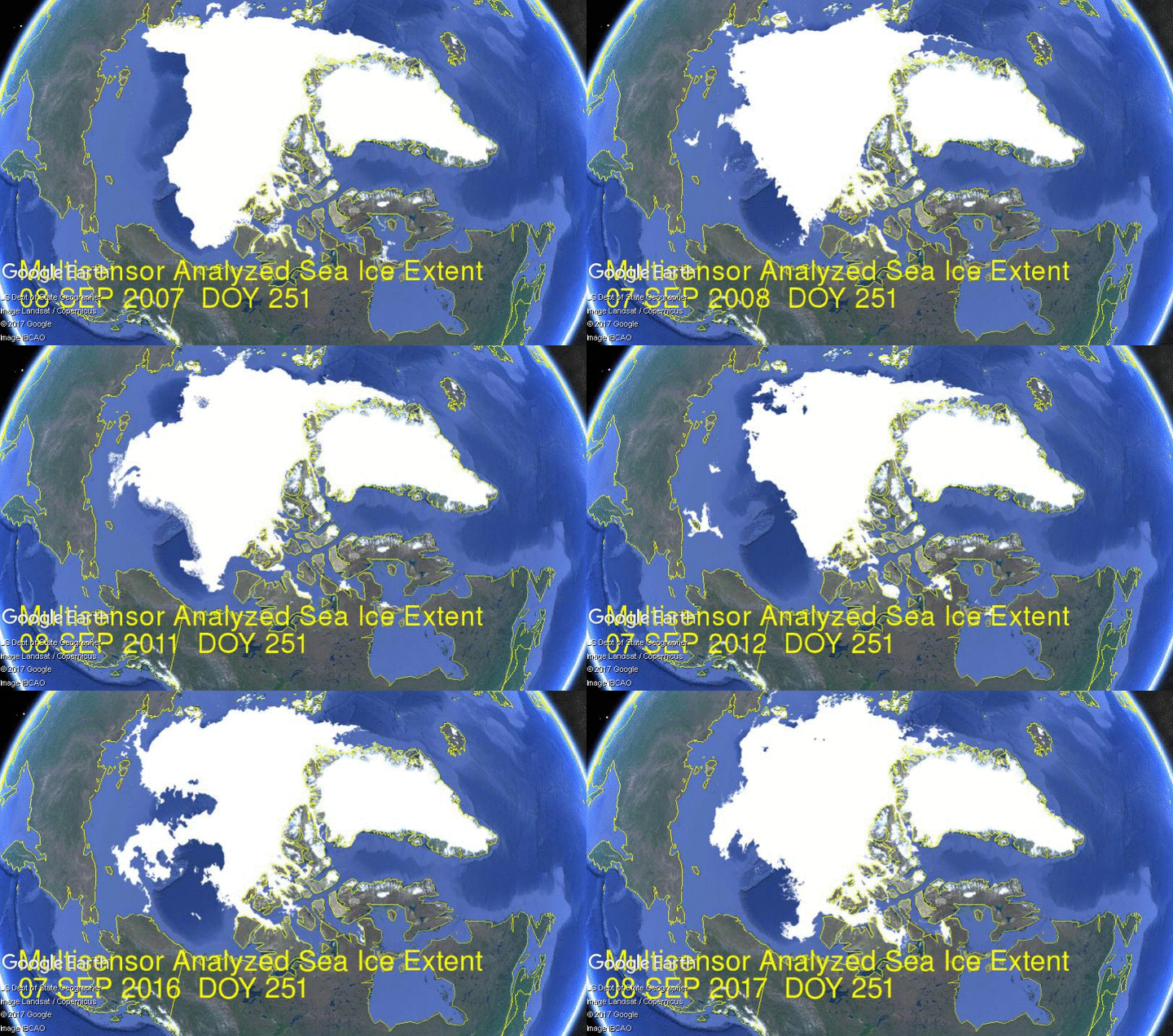
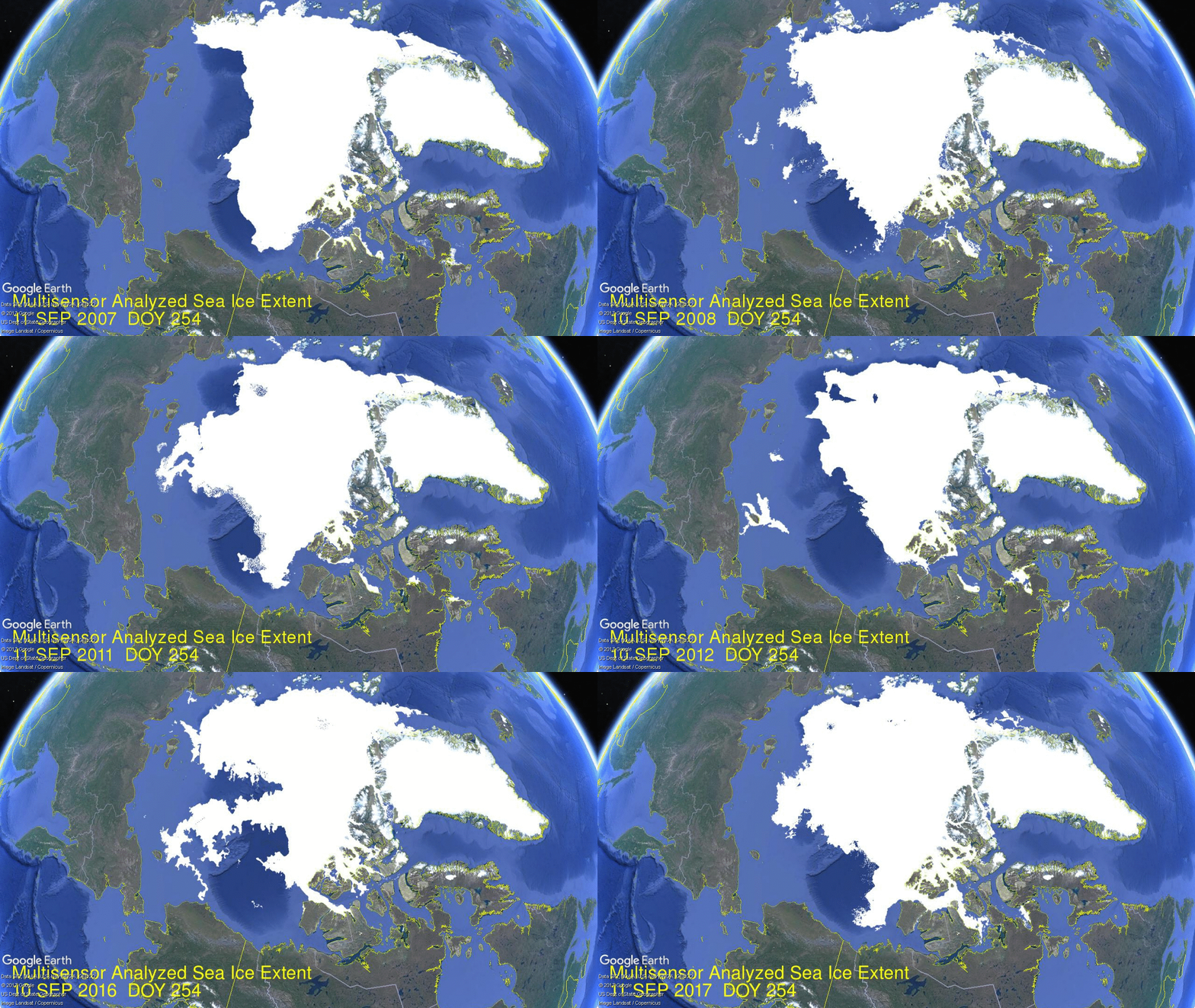
With the most typical day for annual minimum a week away, watching Arctic ice is like watching an ocean liner coasting to a halt before reversing engines.  A recent post reported that ice extents  are stabilizing around 4.7M km2 in recent days, and more importantly, some refreezing in the central seas.  As discussed in Arctic Heart Beat, the marginal shelf seas seldom have ice at annual minimum, typically on or about day 260.  The image below shows the progression of ice extents from 2007 to 2017 on day 254 with six days to go.

Click on image to enlarge.


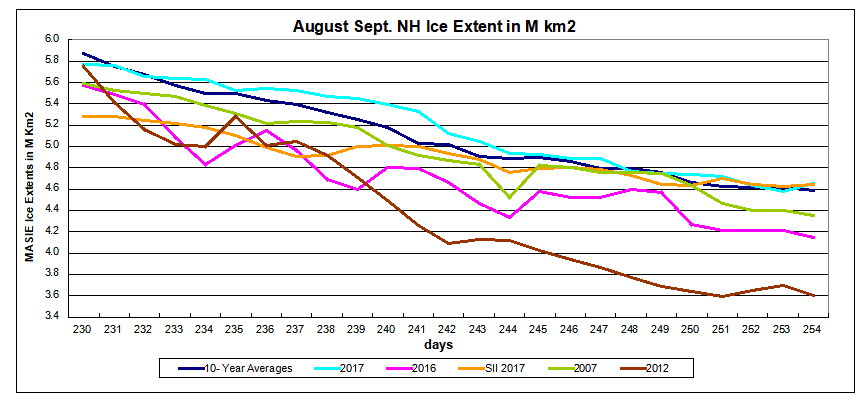
Yesterday was day 254 and the graph below shows 2017 compared with other years and the decadal average during the last 3 weeks.

For the last week MASIE and SII are showing the same extent, now about 70k km2 above the 10 year average.  Only four years in the decade had more ice on this day.  2007 is 300k km2 lower, 2016 500k km2 lower, and at the bottom is 2012 1.1M km2 below 2017.  A recent post on August storms discussed the dramatic impact on 2012 and 2016, which is evident as well in the chart.  The table compares 2017, decadal average and 2007 for the regions containing ice at this time.

Region 2017254 Day 254
Average
2017-Ave. 2007254 2017-2007
 (0) Northern_Hemisphere 4652293 4583359 68934 4349612 302681
 (1) Beaufort_Sea 393863 480306 -86443 599679 -205815
 (2) Chukchi_Sea 131705 173275 -41570 74733 56973
 (3) East_Siberian_Sea 279268 286737 -7468 311 278957
 (4) Laptev_Sea 205794 149612 56182 247496 -41702
 (5) Kara_Sea 18486 29190 -10705 62274 -43788
 (6) Barents_Sea 4313 25209 -20896 7384 -3071
 (7) Greenland_Sea 107969 211322 -103353 324789 -216820
 (8) Baffin_Bay_Gulf_of_St._Lawrence 45146 22235 22911 21406 23740
 (9) Canadian_Archipelago 370958 262283 108675 210083 160875
 (10) Hudson_Bay 1432 11057 -9625 16552 -15120
 (11) Central_Arctic 3092201 2931173 161028 2783651 308551

The deficits continue to be on the Pacific side, especially Beaufort, and also Greenland Sea is down this year.  These are more than offset by large surpluses in the Central Arctic and Canadian Archipelago, and also Laptev.  East Siberian sea also has surplus ice this year compared to 2007.

aer Atmospheric and Environmental Research

September 5, 2017 Dr. Judah Cohen of AER posted his monthly forecast for the Arctic and NH based on the Arctic Oscillation (AO) and North Atlantic Oscillation (NAO).  Excerpts below.

The AO is currently slightly negative (Figure 1), reflective of mostly positive geopotential height anomalies across the Arctic and mixed geopotential height anomalies across the mid-latitudes of the NH (Figure 2). Geopotential height anomalies are mostly negative across Greenland and Iceland (Figure 2), and therefore the NAO is slightly positive.
Figure 1. (a) The predicted daily-mean near-surface AO from the 00Z 5 September 2017 GFS ensemble. Gray lines indicate the AO index from each individual ensemble member, with the ensemble-mean AO index given by the red line with squares.

The AO is predicted to straddle neutral next week as geopotential height anomalies remain mixed across the Arctic. Similarly, with mixed geopotential height anomalies stretching across Greenland and Iceland, the NAO will likely be near neutral as well.  

(Note: AO and NAO are signed differently than one might expect; the reference point is outside the Arctic itself.  Thus negative phases of these indices mean higher pressures in the Arctic and lower outside, while positive phases indicate lower pressures in the Arctic.  Now that the Arctic sun is setting, the main issue for ice extent is storminess which requires low Arctic pressures.)

Impacts

It is the first week of fall, a season of transition from summer to winter. One important sign IMO of this seasonal transition is the return of the polar vortex in the stratosphere. The models predict the possible formation of the polar vortex sometime next week. Starting in October, I will be watching variability in the polar vortex for signs of pattern changes in the weather across the NH.

Another sign of the seasonal transition is the minimum in Arctic sea ice extent, which will be achieved in the coming days and/or weeks. The trajectory of sea ice melt has slowed since early August. In my last blog I suggested the possibility that the sea ice minimum could be similar to the years 2008 and 2010 and that is looking more likely but is difficult to predict. Over the coming months, I will be following Arctic sea ice variability for signs of the severity of the upcoming winter. Our understanding for how anomalies in sea ice extent influence the weather in the mid-latitudes is still immature IMO but I do think that important progress has been made recently.

Another sign of the transition from summer to winter is the return of snowfall to the NH. Snowfall over the sea ice in August probably helped retard the melt of sea ice and snowfall is now even occurring over Siberia and Alaska but is still very regionalized. Again I will be monitoring the advance of snow cover extent across the continents for signs of the strength of the polar vortex and the possible resultant weather.

Finally I find it interesting that while the atmospheric circulation has transitioned from the dominant summer pattern across Eurasia it has not across North America. The dominant summer pattern across Eurasia was ridging across Europe (with the exception of Northern Europe) and East Asia but with troughing in Western Asia. The forecast for the coming weeks is the opposite with troughs across Europe and East Asia but ridging in Western Asia. This is an overall cooler pattern than the dominant summer pattern. However across North America there are no similar signs of transition. The dominant summer pattern was strong ridging across western North America and troughing in eastern North America and at least for now that pattern looks to continue for much of the month of September. I don’t know the reason behind the persistent western ridge/eastern trough pattern across North America but how long this pattern can persist will obviously have important implications for the weather across North America in the coming months.

Summary

Bottom line, looks like September weather will be ordinary in the Arctic with seasonal cooling in the NH.  Dr. Cohen also thinks the annual ice extent minimum will be near average for the decade.  While the monthly average is final only at September end, this week will set the tone and likely result.


Autumnal Climate Change 2017


geese-in-v-formation

Seeing a lot more of this lately, along with hearing the geese  honking. And in the next month or so, we expect that trees around here will lose their leaves. It definitely is climate change of the seasonal variety.

Interestingly, the science on this is settled: It is all due to reduction of solar energy because of the shorter length of days (LOD). The trees drop their leaves and go dormant because of less sunlight, not because of lower temperatures. The latter is an effect, not the cause.

Of course, the farther north you go, the more remarkable the seasonal climate change. St. Petersburg, Russia has their balmy “White Nights” in June when twilight is as dark as it gets, followed by the cold, dark winter and a chance to see the Northern Lights.

And as we have been monitoring, the Arctic ice has been melting from sunlight in recent months, but will now begin to build again in the darkness to its maximum in March.

We can also expect in January and February for another migration of millions of Canadians (nicknamed “snowbirds”) to fly south in search of a summer-like climate to renew their memories and hopes. As was said to me by one man in Saskatchewan (part of the Canadian wheat breadbasket region): “Around here we have Triple-A farmers: April to August, and then Arizona.” Here’s what he was talking about: Quartzsite Arizona annually hosts 1.5M visitors, mostly between November and March.

Of course, this is just North America. Similar migrations occur in Europe, and in the Southern Hemisphere, the climates are changing in the opposite direction, Springtime currently. Since it is so obviously the sun causing this seasonal change, the question arises: Does the sunlight vary on longer than annual timescales?

The Solar-Climate Debate

And therein lies a great, enduring controversy between those (like the IPCC) who dismiss the sun as a driver of multi-Decadal climate change, and those who see a connection between solar cycles and Earth’s climate history. One side can be accused of ignoring the sun because of a prior commitment to CO2 as the climate “control knob”.

The other side is repeatedly denounced as “cyclomaniacs” in search of curve-fitting patterns to prove one or another thesis. It is also argued that a claim of 60-year cycles can not be validated with only 150 years or so of reliable data. That point has weight, but it is usually made by those on the CO2 bandwagon despite temperature and CO2 trends correlating for only 2 decades during the last century.

One scientist in this field is Nicola Scafetta, who presents the basic concept this way:

“The theory is very simple in words. The solar system is characterized by a set of specific gravitational oscillations due to the fact that the planets are moving around the sun. Everything in the solar system tends to synchronize to these frequencies beginning with the sun itself. The oscillating sun then causes equivalent cycles in the climate system. Also the moon acts on the climate system with its own harmonics. In conclusion we have a climate system that is mostly made of a set of complex cycles that mirror astronomical cycles. Consequently it is possible to use these harmonics to both approximately hindcast and forecast the harmonic component of the climate, at least on a global scale. This theory is supported by strong empirical evidences using the available solar and climatic data.”

He goes on to say:

“The global surface temperature record appears to be made of natural specific oscillations with a likely solar/astronomical origin plus a noncyclical anthropogenic contribution during the last decades. Indeed, because the boundary condition of the climate system is regulated also by astronomical harmonic forcings, the astronomical frequencies need to be part of the climate signal in the same way the tidal oscillations are regulated by soli-lunar harmonics.”

He has concluded that “at least 60% of the warming of the Earth observed since 1970 appears to be induced by natural cycles which are present in the solar system.” For the near future he predicts a stabilization of global temperature and cooling until 2030-2040.


For more see Scafetta vs. IPCC: Dueling Climate Theories

A Deeper, but Accessible Presentation of Solar-Climate Theory

I have found this presentation by Ian Wilson to be persuasive while honestly considering all of the complexities involved.

The author raises the question: What if there is a third factor that not only drives the variations in solar activity that we see on the Sun but also drives the changes that we see in climate here on the Earth?

The linked article is quite readable by a general audience, and comes to a similar conclusion as Scafetta above: There is a connection, but it is not simple cause and effect. And yes, length of day (LOD) is a factor beyond the annual cycle.

Click to access IanwilsonForum2008.pdf

It is fair to say that we are still at the theorizing stage of understanding a solar connection to earth’s climate. And at this stage, investigators look for correlations in the data and propose theories (explanations) for what mechanisms are at work. Interestingly, despite the lack of interest from the IPCC, solar and climate variability is a very active research field these days.

A summary of recent studies is provided at NoTricksZone: Since 2014, 400 Scientific Papers Affirm A Strong Sun-Climate Link

Ian Wilson has much more to say at his blog: http://astroclimateconnection.blogspot.com.au/

Once again, it appears that the world is more complicated than a simple cause and effect model suggests.

Fluctuations in observed global temperatures can be explained by a combination of oceanic and solar cycles.  See engineering analysis from first principles Quantifying Natural Climate Change.

For everything there is a season, a time for every purpose under heaven.

What has been will be again, what has been done will be done again;
there is nothing new under the sun.
(Ecclesiastes 3:1 and 1:9)

Original post in 2015 included this commentary with Dr. Arnd Bernaerts

ArndB comments:

Fine writing, Ron, well done!
No doubt the sun is the by far the most important factor for not living on a globe with temperatures down to minus 200°C. That makes me hesitating to comment on „solar and climate variability” or “the sun drives climate” (currently at NTZ – link above), but today merely requesting humbly that the claimed correlation should be based at least on some evidence showing that the sun has ever caused a significant climatic shift during the last one million years, which was not only a bit air temperature variability due to solar cycles that necessarily occur in correlation with the intake and release of solar-radiation by the oceans and seas.

Interestingly the UK MetOffice just released a report (Sept.2015, pages 21) titled:
“Big Changes Underway in the Climate System?” by attributing the most possible and likely changes to the current status of El Niño, PDO, and AMO, and – of course – carbon dioxide -, and a bit speculation on less sun-energy (see following excerpt at link)

Click to access Changes_In_The_Climate_System.pdf

From p. 13: “It is well established that trace gases such as carbon dioxide warm our planet through the “greenhouse effect”. These gases are relatively transparent to incoming sunlight, but trap some of the longer-wavelength radiation emitted by the Earth. However, other factors, both natural and man-made, can also change global temperatures. For example, a cooling could be caused by a downturn of the amount of energy received from the sun, or an increase in the sunlight reflected back to space by aerosol particles in the atmosphere. Aerosols increase temporarily after volcanic eruptions, but are also generated by pollution such as sulphur dioxide from factories.
These “external” factors are imposed on the climate system and may also affect the ENSO, PDO and AMO variations……

My Reply:

Thanks Arnd for engaging in this topic.

My view is that the ocean makes the climate by means of its huge storage of solar energy, and the fluctuations, oscillations in the processes of distributing that energy globally and to the poles. In addition, the ocean is the most affected by any variation in the incoming solar energy, both by the sun outputting more or less, and also by clouds and aerosols blocking incoming radiation more or less (albedo or brightness variability).  See Nature’s Sunscreen

The oscillations you mention, including the present El Nino (and Blob) phenomenon, show natural oceanic variability over years and decades. Other ocean cycles occur over multi-decadal and centennial scales, and are still being analyzed.

At the other end of the scale, I am persuaded that the earth switches between the “hot house” and the “ice house” mainly due to orbital cycles, which are an astronomical phenomenon. These are strong enough to overwhelm the moderating effect of the ocean thermal flywheel.

The debate centers on the extent to which solar activity has contributed to climate change over the last 3000 years of our current interglacial period, including current solar cycles.


Lomborg Warns: Don’t Be Distracted by Climate Change

A woman stands in the flood water in Sariakandi, Bangladesh, on Aug. 20.PHOTO: TURJOY CHOWDHURY/ZUMA PRESS

Lomborg lucidity is again on display in his recent WSJ article The Climate-Change Distraction
It’s confusing, causally incorrect and diverts resources from real solutions to real problems. By Bjorn Lomborg  Sept. 7, 2017. Full text with my bolds

Climate change has been blamed for a dizzying array of absurd woes, from the dwindling number of customers at Bulgarian brothels to the death of the Loch Ness monster. Most of us can see through these silly headlines, but it’s far harder to parse the more serious claims when they’re repeated in good faith by well-meaning campaigners.

Consider the recent assertion by Unicef’s Bangladesh head of mission that climate change leads to an increase in child marriages. Between 2011 and 2020 globally, more than 140 million girls under the age of 18 will become brides, leading to curtailed education and reduced lifetime earnings, more domestic violence, more deaths from complications due to pregnancy and increased mortality for the young brides’ children. By all accounts, child marriage must be taken seriously.

In Bangladesh, nearly 75% of women between the ages of 20 and 49 reported that they were married before they turned 18, giving the country the second-highest rate of child marriage in the world. As the Unicef head tells it, climate change has been a major cause, as warmer weather has worsened the flooding, pushing people to the cities, leading to more child marriages.

This entire string of logic is wrong. The frequency of extreme floods in Bangladesh has increased, it’s true, but studies show their magnitude and duration have in fact decreased. And Bangladesh is far better at adapting today than it was a generation ago. In 1974, a flood killed 29,000 people and cost 7.5% of the country’s gross domestic product. A slightly larger flood in 2004 killed 761 people and cost 3.3% of GDP.

Nor is Unicef right to claim a connection between flooding and urbanization. A study published in the Journal of Biosocial Science found that living in cities doesn’t increase the likelihood of child marriages in Bangladesh. Rather, it was “significantly higher among rural women.” According to another study, published in the Chinese Journal of Population Resources and Environment, the average age of marriage in cities is 16.15 years, compared to 15.08 years in rural areas.

This isn’t surprising. Across the world, there’s a convergence between low urbanization rates and higher child-marriage rates. In Africa, the three worst countries for child marriage—Chad, Mali and Niger—also have the lowest levels of urbanization.

Given the weak links between warming, flooding, urbanization and the contrary link between urbanization and child marriage, climate policies would be the least effective in addressing the problem. Copenhagen Consensus research shows that we need to focus instead on nutrition and education, political opportunities for girls and women, and improving women’s rights to inherit and start a business.

A program in southern Bangladesh run by Save the Children, for example, has demonstrated the significant effects of even a modest financial incentive: The program regularly gave cooking oil to parents of unmarried girls between the ages of 15 and 17, conditional upon confirmation that the girls remained unmarried. The program found that these girls were up to 30% less likely to marry before the age of 16 and up to 22% more likely to remain in school. Each dollar spent on such conditional transfer programs does about $4 of social good.

It’s these kinds of efforts that make it more likely girls will continue in school and engage in productive jobs, reducing child marriage. Talking about climate is confusing, causally incorrect and diverts important resources away from more effective interventions.

A similar argument can be made for another challenge often linked to global warming: malaria. In this case, the science is unambiguous. Rising temperatures mean that malaria-carrying mosquitoes can become endemic in more places.

But looking mainly to global-warming policies means missing the most important levers of tackling malaria. Malaria is a consequence of poverty: The worst affected are those poorer households in rural areas with less ability to purchase mosquito nets and treatment. Focusing on what we could achieve in the future through global-warming policies takes our attention away from what we could accomplish today.

Over the past 15 years, more than six million lives have been saved from malaria. This didn’t happen because we cut CO 2 and managed to marginally change temperatures.

If climate policies like the Kyoto Protocol had been fully enacted, temperature reductions would have saved just 1,400 lives from malaria each year, at a price tag of about $180 billion a year. By contrast, just $500 million spent in one year on direct antimalaria measures such as mosquito nets, sprays and treatment could save 300,000 lives.

None of this means that we should ignore climate change. But to respond properly we need to stick to the facts and maintain a sense of perspective, avoiding tenuous connections and ineffective solutions that ultimately divert resources away from fixing the real problems.

Mr. Lomborg is the president of the Copenhagen Consensus Center and the author of “The Skeptical Environmentalist” and “Cool It.”

See more at Lomborg Lucidity

Bjorn Lomborg knows what works to alleviate and address actual human suffering rather than modelled future disasters.  With his focus on the here and now, and realistic assessment of relief programs, he should be the UN spokesperson, not Dicaprio.

More from Bjorn Lomborg and the Copenhagen Consensus Center at Watching a UN Train Wreck

Cavemen Climate Comics for Sunday


This storm season is frightening and has climatists freaking out.  Perhaps some comic relief is in order. This post is a collection of cartoons that put modern awarenesses into cavemen conversations. It was inspired by a great cartoon from Rick McKee of the Augusta Chronicle which appears near the end.  H/T  WUWT.

As we shall see, some modern ideas aren’t far removed from stone age thinking.  For example, the cartoon above portrays the invention of environmentalism to repudiate technology advances

Then we have the inevitable social pressure to put down backward people.

Virtue signaling provides a way for the unevolved to fit in.

Eventually, social media overwhelms scientific progress.

Of course climate social discourse depends on magical thinking.

Rick McKee of the Augusta Chronicle H/T  WUWT.

Footnote:

Postmodern social media also have unfortunate side effects.

Postscript

On a more serious note, these events remind me what Michael Crichton wrote in State of Fear (2004).

Our planet is five billion years old, and it has been changing constantly all during that time. […] Our atmosphere is as violent as the land beneath it. At any moment there are one thousand five hundred electrical storms across the planet. Eleven lightning bolts strike the ground each second. A tornado tears across the surface every six hours. And every four days, a giant cyclonic storm, hundreds of miles in diameter, spins over the ocean and wreaks havoc on the land.

The nasty little apes that call themselves human beings can do nothing except run and hide. For these same apes to imagine they can stabilize this atmosphere is arrogant beyond belief. They can’t control the climate.

The reality is, they run from the storms.

More at In Praise of Michael Crichton

Early Arctic Minimum?

It is a few days earlier than usual, but MASIE shows ice extents  stabilizing near 4.7M km2 in recent days, and more importantly, some refreezing in the central seas.  As discussed in Arctic Heart Beat, the marginal shelf seas seldom have ice at annual minimum, typically on or about day 260.  The image below shows the progression of ice extents from 2007 to 2017.

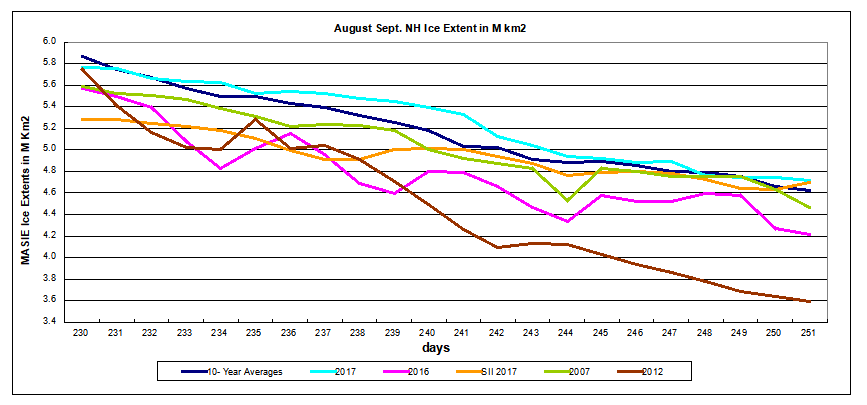
Yesterday was day 251 and the graph below shows 2017 compared with other years and the decadal average during the last 3 weeks.

At this point MASIE and SII are showing the same extent, about 100k km2 above the 10 year average.  2007 is 250k km2 lower, 2016 500k km2 lower, and at the bottom is 2012 1.1M km2 below 2017.  The table compares 2017, decadal average and 2007 for the regions containing ice at this time.

Region 2017251 Day 251
Average
2017-Ave. 2007251 2017-2007
 (0) Northern_Hemisphere 4716948 4619900 97048 4467771 249177
 (1) Beaufort_Sea 409067 492365 -83298 643868 -234801
 (2) Chukchi_Sea 133345 185601 -52257 95240 38105
 (3) East_Siberian_Sea 279966 301146 -21180 311 279655
 (4) Laptev_Sea 196236 152840 43396 252479 -56243
 (5) Kara_Sea 22449 30277 -7828 59593 -37144
 (6) Barents_Sea 23123 20028 3095 5882 17240
 (7) Greenland_Sea 116132 196719 -80586 315125 -198993
 (8) Baffin_Bay_Gulf_of_St._Lawrence 46799 21575 25224 17173 29626
 (9) Canadian_Archipelago 374084 268736 105348 236583 137501
 (10) Hudson_Bay 1191 11933 -10743 22646 -21455
 (11) Central_Arctic 3113399 2937746 175653 2817614 295785

The deficits continue to be on the Pacific side, especially Beaufort, and also Greenland Sea is down this year.  These are more than offset by large surpluses in the Central Arctic and Canadian Archipelago, and also Laptev.  East Siberian sea also has surplus ice this year compared to 2007.

aer Atmospheric and Environmental Research

September 5, 2017 Dr. Judah Cohen of AER posted his monthly forecast for the Arctic and NH based on the Arctic Oscillation (AO) and North Atlantic Oscillation (NAO).  Excerpts below.

The AO is currently slightly negative (Figure 1), reflective of mostly positive geopotential height anomalies across the Arctic and mixed geopotential height anomalies across the mid-latitudes of the NH (Figure 2). Geopotential height anomalies are mostly negative across Greenland and Iceland (Figure 2), and therefore the NAO is slightly positive.
Figure 1. (a) The predicted daily-mean near-surface AO from the 00Z 5 September 2017 GFS ensemble. Gray lines indicate the AO index from each individual ensemble member, with the ensemble-mean AO index given by the red line with squares.
The AO is predicted to straddle neutral next week as geopotential height anomalies remain mixed across the Arctic. Similarly, with mixed geopotential height anomalies stretching across Greenland and Iceland, the NAO will likely be near neutral as well.  

(Note: AO and NAO are signed differently than one might expect; the reference point is outside the Arctic itself.  Thus negative phases of these indices mean higher pressures in the Arctic and lower outside, while positive phases indicate lower pressures in the Arctic.  Now that the Arctic sun is setting, the main issue for ice extent is storminess which requires low Arctic pressures.)

Impacts

It is the first week of fall, a season of transition from summer to winter. One important sign IMO of this seasonal transition is the return of the polar vortex in the stratosphere. The models predict the possible formation of the polar vortex sometime next week. Starting in October, I will be watching variability in the polar vortex for signs of pattern changes in the weather across the NH.

Another sign of the seasonal transition is the minimum in Arctic sea ice extent, which will be achieved in the coming days and/or weeks. The trajectory of sea ice melt has slowed since early August. In my last blog I suggested the possibility that the sea ice minimum could be similar to the years 2008 and 2010 and that is looking more likely but is difficult to predict. Over the coming months, I will be following Arctic sea ice variability for signs of the severity of the upcoming winter. Our understanding for how anomalies in sea ice extent influence the weather in the mid-latitudes is still immature IMO but I do think that important progress has been made recently.

Another sign of the transition from summer to winter is the return of snowfall to the NH. Snowfall over the sea ice in August probably helped retard the melt of sea ice and snowfall is now even occurring over Siberia and Alaska but is still very regionalized. Again I will be monitoring the advance of snow cover extent across the continents for signs of the strength of the polar vortex and the possible resultant weather.

Finally I find it interesting that while the atmospheric circulation has transitioned from the dominant summer pattern across Eurasia it has not across North America. The dominant summer pattern across Eurasia was ridging across Europe (with the exception of Northern Europe) and East Asia but with troughing in Western Asia. The forecast for the coming weeks is the opposite with troughs across Europe and East Asia but ridging in Western Asia. This is an overall cooler pattern than the dominant summer pattern. However across North America there are no similar signs of transition. The dominant summer pattern was strong ridging across western North America and troughing in eastern North America and at least for now that pattern looks to continue for much of the month of September. I don’t know the reason behind the persistent western ridge/eastern trough pattern across North America but how long this pattern can persist will obviously have important implications for the weather across North America in the coming months.

Summary

Bottom line, looks like September weather will be ordinary in the Arctic with seasonal cooling in the NH.  Dr. Cohen also thinks the annual ice extent minimum will be near average for the decade.  While the monthly average is final only at September end, the next week will set the tone and likely result.


Warming from CO2 Unlikely

Figure 5. Simplification of IPCC AR5 shown above in Fig. 4. The colored lines represent the range of results for the models and observations. The trends here represent trends at different levels of the tropical atmosphere from the surface up to 50,000 ft. The gray lines are the bounds for the range of observations, the blue for the range of IPCC model results without extra GHGs and the red for IPCC model results with extra GHGs.The key point displayed is the lack of overlap between the GHG model results (red) and the observations (gray). The nonGHG model runs (blue) overlap the observations almost completely. 

A recent post at Friends of Science alerted me to an important proof against the CO2 global warming claim. It was included in John Christy’s testimony 29 Mar 2017 at the House Committee on Science, Space and Technology. The text below is from that document which can be accessed here. (My bolds)

Main Point: IPCC Assessment Reports show that the IPCC climate models performed best versus observations when they did not include extra GHGs and this result can be demonstrated with a statistical model as well.

(5)  A simple statistical model that passed the same “scientific-method” test

The IPCC climate models performed best versus observations when they did not include extra GHGs and this result can be demonstrated with a statistical model as well. I was coauthor of a report which produced such an analysis (Wallace, J., J. Christy, and J. D’Aleo, “On the existence of a ‘Tropical Hot Spot’ & the validity of the EPA’s CO2 Endangerment Finding – Abridged Research Report”, August 2016 (Available here ).

In this report we examine annual estimates from many sources of global and tropical deep-layer temperatures since 1959 and since 1979 utilizing explanatory variables that did not include rising CO2 concentrations. We applied the model to estimates of global and tropical temperature from the satellite and balloon sources, individually, shown in Fig. 2 above. The explanatory variables are those that have been known for decades such as indices of El Nino-Southern Oscillation (ENSO), volcanic activity, and a solar activity (e.g. see Christy and McNider, 1994, “Satellite greenhouse signal”, Nature, 367, 27Jan). [One of the ENSO explanatory variables was the accumulated MEI (Multivariate ENSO Index, see https://www.esrl.noaa.gov/psd/enso/mei/) in which the index was summed through time to provide an indication of its accumulated impact. This “accumulated-MEI” was shown to be a potential factor in global temperatures by Spencer and Braswell, 2014 (“The role of ENSO in global ocean temperature changes during 1955-2011 simulated with a 1D climate model”, APJ.Atmos.Sci. 50(2), 229-237, DOI:10.1007/s13143-014- 001-z.) Interestingly, later work has shown that this “accumulated-MEI” has virtually the same impact as the accumulated solar index, both of which generally paralleled the rise in temperatures through the 1980s and 1990s and the slowdown in the 21st century. Thus our report would have the same conclusion with or without the “accumulated-MEI.”]

The basic result of this report is that the temperature trend of several datasets since 1979 can be explained by variations in the components that naturally affect the climate, just as the IPCC inadvertently indicated in Fig. 5 above. The advantage of the simple statistical treatment is that the complicated processes such as clouds, ocean-atmosphere interaction, aerosols, etc., are implicitly incorporated by the statistical relationships discovered from the actual data. Climate models attempt to calculate these highly non-linear processes from imperfect parameterizations (estimates) whereas the statistical model directly accounts for them since the bulk atmospheric temperature is the response-variable these processes impact. It is true that the statistical model does not know what each sub-process is or how each might interact with other processes. But it also must be made clear: it is an understatement to say that no IPCC climate model accurately incorporates all of the non-linear processes that affect the system. I simply point out that because the model is constrained by the ultimate response variable (bulk temperature), these highly complex processes are included.

The fact that this statistical model explains 75-90 percent of the real annual temperature variability, depending on dataset, using these influences (ENSO, volcanoes, solar) is an indication the statistical model is useful. In addition, the trends produced from this statistical model are not statistically different from the actual data (i.e. passing the “scientific-method” trend test which assumes the natural factors are not influenced by increasing GHGs). This result promotes the conclusion that this approach achieves greater scientific (and policy) utility than results from elaborate climate models which on average fail to reproduce the real world’s global average bulk temperature trend since 1979.

The over-warming of the atmosphere by the IPCC models relates to a problem the IPCC AR5 encountered elsewhere. In trying to determine the climate sensitivity, which is how sensitive the global temperature is relative to increases in GHGs, the IPCC authors chose not to give a best estimate. [A high climate sensitivity is a foundational component of the last Administration’s Social Cost of Carbon.] The reason? … climate models were showing about twice the sensitivity to GHGs than calculations based on real, empirical data. I would encourage this committee, and our government in general, to consider empirical data, not climate model output, when dealing with environmental regulations.

Summary

Planning requires assumptions because no one has knowledge of the future, only informed opinions.  Christy makes the case that our assumptions should be based on empirical data rather than models that are driven by theoretical assumptions.  When the CO2 sensitivity assumption is removed from climate models they come much closer to observed temperature measurements.  Statistical analysis shows that at least 75% of observed warming comes from factors other than CO2.  That analysis also correlates with the accumulated effects of oceanic circulations, principally the ENSO index.

Canada  Ends Probe Against Climate Change Doubters

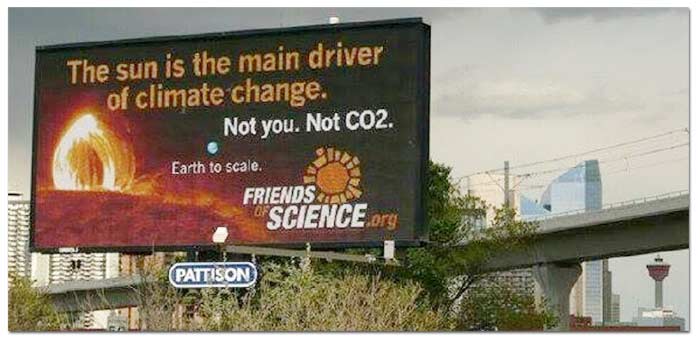
Billboard in Calgary Alberta gives rise to complaint to Canada’s Competition Bureau.

The vigilantes report on their setback in this National Observer article Feds halt probe of climate doubters.  Some excerpts give the flavor of their perspective.

After more than a year of investigating, the Competition Bureau abruptly dropped its inquiry earlier this summer into three groups that had displayed information in public raising doubts about the international scientific consensus on climate change.

The groups put up websites and billboards that promoted statements like, “the sun is the main driver of climate change,” and “carbon dioxide is not a pollutant,” according to an application filed with the bureau, a Canadian independent law enforcement agency.

Those views are contrary to mainstream climate science and the government of Canada itself, which states that “changes in solar irradiance have contributed to climate trends over the past century but since the industrial revolution, the effect of additions of greenhouse gases to the atmosphere has been over 50 times that of changes in the sun’s output.”

From the Bureau letter to the Complainant:

The inquiry concerned allegations that Friends of Science Society, International Climate
Science Coalition and Heartland Institute made misleading representations regarding climate change on their respective websites and, in the case of Friends of Science Society, on billboards.

At this time, considering the available evidence, the assessment of the facts in this case, and
to ensure the effective allocation of limited resources, the Commissioner has discontinued the
inquiry. 

A statement was provided to National Observer by Tom Harris, executive director of the International Climate Science Coalition, but was incompletely quoted in the article. The full statement posted at International Science Coalition is below:

“The complainants apparently think that they know the truth about the causes and consequences of climate change. But this makes no sense. This is not just because the science is enormously complicated with scientists holding at times radically different points of view. It is also because scientific hypotheses, and even scientific theories, are not truth; they can be, and often are, wrong. Truth applies to things like mathematics or chess in which we write the rules. But truth never applies to our findings about nature, which are merely educated opinions based on scientists’ interpretations of observations.”

“When authorities promote truth about science, progress stops. I am glad the Competition Bureau did not fall into this trap. Its time to open up, not shut down, the debate about climate change, one of the most complex and costly issues of our age.”

More complete account of this encounter from Friends of Science:  Responding to the National Observer Article on the Competition Bureau/Ecojustice Call for Inquiry

Key Points:

  • First, Ecojustice asked for an honest debate. We provided one.[1] They never responded.
  • Secondly, presently there is no such thing as a ‘low-carbon economy’ because everything in the modern world is made from or powered by fossil fuels – even hydro dams, nuclear facilities and geothermal require fossil fuels to create the power plant.
  • Thirdly, climate change is mostly driven by natural factors and might only be marginally mitigated by the Paris Agreement.
  • Fourthly, despite claiming humans caused most of the recent warming, the IPCC, perhaps inadvertently, revealed in its 2013 AR5 report that climate change was mostly due to natural factors. (This point is more fully explained in post Warming from CO2 Unlikely
  • Finally, the Paris Agreement targets are unattainable and if attempted, would lead to the complete destruction of the Canadian economy. This is contrary to the UN Charter’s explicit principles. 

These are our opinions, protected by the Charter of Rights.

For examples of proven false advertising by climate activists, see Truth in Climate Advertising

Summary

The complaint was filed by an “ecojustice” lawyer. Free speech about a matter of opinion is attacked as false advertising. Sad. We are still waiting for the evidence supporting global warming claims. Keep on firing away, Tom Harris and Friends of Science.


CO2 Also Explains Fair Weather?

Typical weather on Miami Beach

Ross McKitrick raises some interesting questions in his Washington Examiner article Despite Hurricanes Harvey and Irma, science has no idea if climate change is causing more (or fewer) powerful hurricanes  h/t GWPF

Why is global warming/climate change invoked only to explain bad weather (storms)? What about crediting CO2 for storms that didn’t happen? And how is a storm that could not be predicted proof of something after the fact? Do storms in 2017 fulfill predictions made every year since Katrina in 2005?  Excerpts below (my bolds)

After Hurricane Harvey hit Texas, it didn’t take long for climate alarmists to claim they knew all along it would happen. Politico’s Eric Holthaus declared “We knew this would happen, decades ago.” Naomi Klein stated “these events have long been predicted by climate scientists.” Joe Romm at ThinkProgress wrote, “the fact is that Harvey is exactly the kind of off-the-charts hurricane we can expect to see more often because of climate change.”

According to these and other authors, rising greenhouse gas levels are at least partly to blame for the occurrence and severity of Harvey, and probably for Hurricane Irma as well. But after-the-fact guesswork is not science. If any would-be expert really knew long ago that Harvey was on its way, let him or her prove it by predicting what next year’s hurricane season will bring.

Don’t hold your breath: Even the best meteorologists in the world weren’t able to predict the development and track of Hurricane Harvey until a few days before it hit.

This is why the idea of climate science being “settled” is so ludicrous, at least as regards the connection between global warming and tropical cyclones. A settled theory makes specific predictions that can, in principle, be tested against observed data. A theory that only yields vague, untestable predictions is, at best, a work in progress.

The climate alarmists offer a vague prediction: Hurricanes may or may not happen in any particular year, but when they do, they will be more intense than they would have been if GHG levels were lower. This is a convenient prediction to make because we can never test it. It requires observing the behaviour of imaginary storms in an unobservable world. Good luck collecting the data.

Climate scientists instead use computer models to simulate the alternative world. But the models project hundreds of possible worlds, and predict every conceivable outcome, so whatever happens it is consistent with at least one model run. After Hurricane Katrina hit New Orleans in 2005, some climate modelers predicted such storms would be more frequent in a warmer world, while others predicted the opposite, and still others said there was no connection between warming and hurricanes.

What ensued was an historically unprecedented 12-year absence of major (category 3 or higher) hurricanes making landfall in the United States, until Harvey, which ties for 14th-most intense hurricane since 1851. The events after 2005 were “consistent with” some projections, but any other events would have been as well.

The long absence of landfalling hurricanes also points to another problem when opinion writers connect GHGs to extreme weather. Science needs to be concerned not only with conspicuous things that happened, but with things that conspicuously didn’t happen. Like the famous dog in the Sherlock Holmes story, the bark that doesn’t happen can be the most important of all.

It is natural to consider a hurricane a disruptive event that demands an explanation. It is much more difficult to imagine nice weather as a disruption to bad weather that somehow never happened.

Suppose a hurricane would have hit Florida in August 2009, but GHG emissions prevented it and the weather was mild instead. The “event,” pleasant weather, came and went unnoticed and nobody felt the need to explain why it happened. It is a mistake to think that only bad events call for an explanation, and only to raise the warming conjecture when bad weather happens. If we are going to tie weather events to GHGs, we have to be consistent about it. We should not assume that any time we have pleasant weather, we were going to have it anyway, but a storm is unusual and proves GHG’s control the climate.

I am grateful to the scientists who work at understanding hurricane and typhoon events, and whose ability to forecast them days in advance has saved countless lives. But when opinion writers tacitly assume all good weather is natural and GHGs only cause bad weather, or claim to be able to predict future storms, but only after they have already occurred, I reserve the right to call their science unsettled.

Ross McKitrick is a professor of economics at the University of Guelph and an adjunct scholar of the Cato Institute.

Another claim people are making: Several major storms in a row for sure proves global warming/climate change.  Well, no.  Not according to Gerry Bell, the lead seasonal hurricane forecaster with the Climate Prediction Center, a part of the National Oceanic and Atmospheric Administration.  He explains in a NYT article First Harvey, Then Irma and Jose. Why? It’s the Season. h/t GWPF Excerpts below.

Hurricane experts say that the formation of several storms in rapid succession is not uncommon, especially in August, September and October, the most active months of the six-month hurricane season.

“This is the peak,” said Gerry Bell, the lead seasonal hurricane forecaster with the Climate Prediction Center, a part of the National Oceanic and Atmospheric Administration. “This is when 95 percent of hurricanes and major hurricanes form.”

Dr. Bell and his team at NOAA had forecast that this season would be a busy one, and that is how it is playing out, he said.

“With above normal seasons, you have even more activity mainly in August through October,” he said. “We’re seeing the activity we predicted.”

Dr. Bell said that in the late summer and early fall, conditions in the tropical Atlantic off Africa become just right for cyclonic storms to form. Among those conditions, he said, are warming waters, which fuel the growth of storms, and a relative lack of abrupt wind shifts, called wind shear, that tend to disrupt storm formation.

“There’s a whole combination of conditions that come together,” he said.

Storms that form in the Gulf of Mexico, as Katia did this week, are also not uncommon, Dr. Bell said.

Dr. Bell said his group does not consider climate change in developing its forecasts.

Instead, he said, they consider longer-term cycles of hurricane activity based on a naturally occurring climate pattern called the Atlantic multidecadal oscillation, which affects ocean surface temperatures over 25 to 40 years.

Footnote

boat-climate-change

Pleasure craft spotted in a marina near Miami.

Sept. Weather Forecast Arctic & NH

aer Atmospheric and Environmental Research

September 5, 2017 Dr. Judah Cohen of AER posted his monthly forecast for the Arctic and NH based on the Arctic Oscillation (AO) and North Atlantic Oscillation (NAO).  Excerpts below.

The AO is currently slightly negative (Figure 1), reflective of mostly positive geopotential height anomalies across the Arctic and mixed geopotential height anomalies across the mid-latitudes of the NH (Figure 2). Geopotential height anomalies are mostly negative across Greenland and Iceland (Figure 2), and therefore the NAO is slightly positive.
Figure 1. (a) The predicted daily-mean near-surface AO from the 00Z 5 September 2017 GFS ensemble. Gray lines indicate the AO index from each individual ensemble member, with the ensemble-mean AO index given by the red line with squares.

The AO is predicted to straddle neutral next week as geopotential height anomalies remain mixed across the Arctic. Similarly, with mixed geopotential height anomalies stretching across Greenland and Iceland, the NAO will likely be near neutral as well.  

(Note: AO and NAO are signed differently than one might expect; the reference point is outside the Arctic itself.  Thus negative phases of these indices mean higher pressures in the Arctic and lower outside, while positive phases indicate lower pressures in the Arctic.  Now that the Arctic sun is setting, the main issue for ice extent is storminess which requires low Arctic pressures.)

Impacts

It is the first week of fall, a season of transition from summer to winter. One important sign IMO of this seasonal transition is the return of the polar vortex in the stratosphere. The models predict the possible formation of the polar vortex sometime next week. Starting in October, I will be watching variability in the polar vortex for signs of pattern changes in the weather across the NH.

Another sign of the seasonal transition is the minimum in Arctic sea ice extent, which will be achieved in the coming days and/or weeks. The trajectory of sea ice melt has slowed since early August. In my last blog I suggested the possibility that the sea ice minimum could be similar to the years 2008 and 2010 and that is looking more likely but is difficult to predict. Over the coming months, I will be following Arctic sea ice variability for signs of the severity of the upcoming winter. Our understanding for how anomalies in sea ice extent influence the weather in the mid-latitudes is still immature IMO but I do think that important progress has been made recently.

Another sign of the transition from summer to winter is the return of snowfall to the NH. Snowfall over the sea ice in August probably helped retard the melt of sea ice and snowfall is now even occurring over Siberia and Alaska but is still very regionalized. Again I will be monitoring the advance of snow cover extent across the continents for signs of the strength of the polar vortex and the possible resultant weather.

Finally I find it interesting that while the atmospheric circulation has transitioned from the dominant summer pattern across Eurasia it has not across North America. The dominant summer pattern across Eurasia was ridging across Europe (with the exception of Northern Europe) and East Asia but with troughing in Western Asia. The forecast for the coming weeks is the opposite with troughs across Europe and East Asia but ridging in Western Asia. This is an overall cooler pattern than the dominant summer pattern. However across North America there are no similar signs of transition. The dominant summer pattern was strong ridging across western North America and troughing in eastern North America and at least for now that pattern looks to continue for much of the month of September. I don’t know the reason behind the persistent western ridge/eastern trough pattern across North America but how long this pattern can persist will obviously have important implications for the weather across North America in the coming months.

Summary

Bottom line, looks like September weather will be ordinary in the Arctic with seasonal cooling in the NH.  Dr. Cohen also thinks the annual ice extent minimum will be near average for the decade.