Arctic Ice on the Up and Up


Despite what you may be hearing, Arctic ice is not presently declining, a big disappointment to fear mongers. Something happened to cause a rapid decline in the decade 1998 to 2007, but since then the ice has been stable or slightly rising.

The analysis below comes from the MASIE dataset, whose managers have no stated position on global warming, climate change, or the future of Arctic ice. They simply report daily ice conditions for the safety of ships operating in Arctic seas. It is the highest resolution, most accurate report of daily ice conditions. MASIE historical records became available once NSIDC confirmed that the records have reasonable consistency starting with 2006.

Big Picture Shows Recovery from 2007 Low

Arctic ice extents are cyclical with maximums occurring in March and the annual minimums in September. Autumn snowfall and winter weather affect the March ice, and September varies with warm and salty water circulations, cloudiness affecting brightness, and stormy weather breaking and compressing ice. The annual average of ice extent factors in fluctuations over the entire cycle.

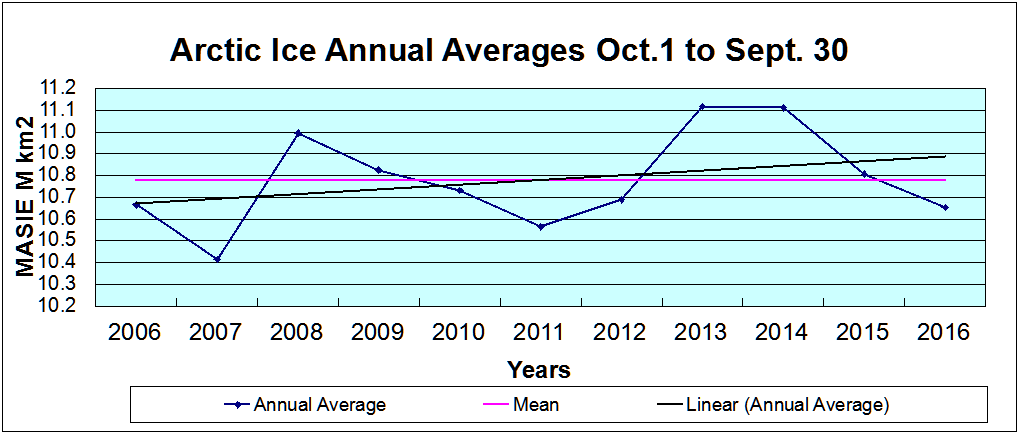
Since we are at the end of the melt season, the chart below takes 12 month averages starting Oct. 1 to display average annual ice extents for the last 11 years.

arctic-annual-sept-2016

The minimum occurred in 2007 at ~10.4 M km2 and all years have been higher than that, including 2006, 2012 and 2016 virtually tied at ~10.7 M km2. The trendline is descriptive, not predictive; that is, the line serves only to show the pattern in this brief history, the future could go higher or lower with equal uncertainty.

It should be noted that the variability is quite constrained within +/- 0.4 M km2, or +/- 3% of the annual average. Also 5 years are above average, and 6 years are below.

September Ice Minimums

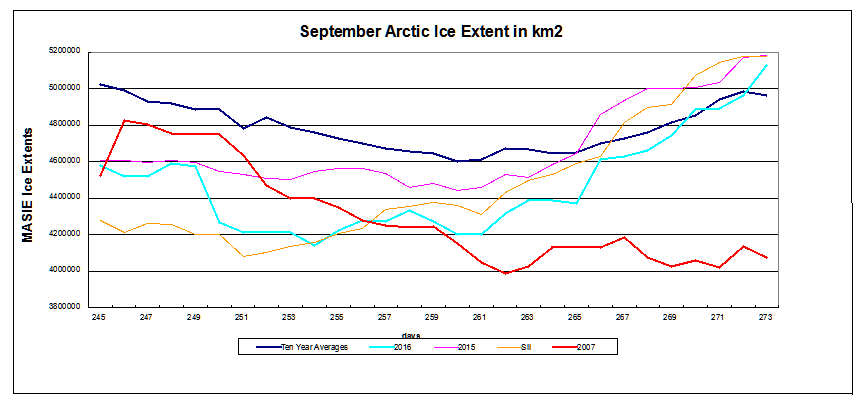
The chart below shows comparative measures of September ice extents.

masie-2016-day273

The red line is September 2007, which was the lowest in the last 10 years, except for 2012 which was hit by the great Arctic Cyclone.  More importantly, 2007 had the smallest annual average ice extent in the MASIE record (since 2006).  The blue line is the ten-year average for days in September (2006 to 2015 inclusive).  MASIE 2015 is in purple, MASIE 2016 in green, and 2016 NOAA SII (Sea Ice Index) is in yellow.

While the minimums all occurred days 260 to 262, 2007 extents were already trending lower, and presently the other measures are converging above average.  With SII virtually tied with MASIE, that index will also be showing a September average ~ 4.5 M km2.

2016 is now slightly above average, having gone below the average annual minimum (4.6 M km2 on Sept. 16) for 17 days before regaining the lost ice.

The table below shows the locations of ice among the various seas making up the Arctic Ocean. Day 273 is Sept. 30 most years; 2016 being a leap year is one day later. So the official 2016 results will benefit from an additional day of ice extent exceeding 5M km2.

Region 2016273 Day 273 Average 2016-Ave. 2015273 2016-2015
 (0) Northern_Hemisphere 5128960 5014059 114901 5183385 -54426
 (1) Beaufort_Sea 376071 574043 -197972 530396 -154325
 (2) Chukchi_Sea 427460 212714 214746 329362 98098
 (3) East_Siberian_Sea 323001 329489 -6488 265744 57257
 (4) Laptev_Sea 295732 162254 133477 165663 130069
 (5) Kara_Sea 163 43464 -43301 45328 -45166
 (6) Barents_Sea 271 24142 -23871 1445 -1174
 (7) Greenland_Sea 194462 256519 -62057 256733 -62271
 (8) Baffin_Bay_Gulf_of_St._Lawrence 50141 49107 1034 71775 -21635
 (9) Canadian_Archipelago 347668 356314 -8646 352788 -5120
 (10) Hudson_Bay 0 4953 -4953 15485 -15485
 (11) Central_Arctic 3112850 2999948 112902 3147524 -34674

2016 is above average with deficits mainly in Beaufort, Kara, and Greenland seas, offset by surpluses in Chukchi, Laptev and Central Arctic.

Summary

Those claiming global warming is proved by declining Arctic ice are losing that line of evidence. Not only has it stopped declining, the evidence is growing that it varies over quasi-60 year cycles because of changes in water circulations, wind and weather. And some researchers think that the ice may continue to grow up and up in the near future.

For more on Arctic Ice Datasets:

A Tale of Two Indices

Ice House of Mirrors

Footnote:

Crystal Serenity is planning for more future Arctic cruises, while Russia is planning for more icebreakers.

Arctic Ice Resurgent Sept. 27

MASIE: “high-resolution, accurate charts of ice conditions”
Walt Meier, NSIDC, October 2015 article in Annals of Glaciology.

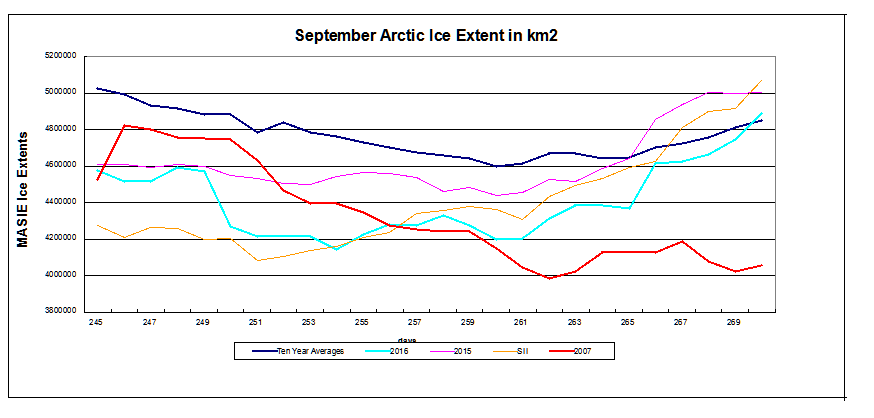
I’ve been waiting for September 30 results to compare the monthly average for this year with previous ones.  But the remarkable rate of refreezing in the Arctic needs reporting.  MASIE counts ice extent using 40% coverage of 4k km2 grid cells, making it the highest resolution dataset.  As well, it incorporates estimates from satellite passive microwave sensors, supplemented with satellite imagery and reports from buoys and ships.

masie-2016-day270

The red line is September 2007, which was the lowest in the last 10 years, except for 2012 which was hit by the great Arctic Cyclone.  More importantly, 2007 had the smallest annual average ice extent in the MASIE record (since 2006).  The blue line is the ten-year average for days in September (2006 to 2015 inclusive).  MASIE 2015 is in purple, MASIE 2016 in green, and 2016 NOAA SII (Sea Ice Index) is in yellow.

While the minimums all occurred days 260 to 262, 2007 extents were already trending lower, and presently the other four measures are converging.  Since the September rate of regaining ice was at a decadal high in 2015, it is remarkable for 2016 to be improving on that.  Since 2007 will end the month close to where it is now, we can project that 2016 monthly average will be considerably higher, likely to exceed also 2008.  With SII virtually tied with MASIE, that index will also be showing a September average well over 4.4M km2.

Summary

With 2016 ice extents surging, we can project that Arctic ice has continued on a flat or slightly increasing trendline with no evidence of a decline since 2007.


Why the Discrepancy between SII and MASIE?

The issue also concerns Walter Meier who is in charge of SII, and as a true scientist, he is looking to get the best measurements possible. He and several colleagues compared SII and MASIE and published their findings last October. The purpose of the analysis was stated thus:

Our comparison is not meant to be an extensive validation of either product, but to illustrate as guidance for future use how the two products behave in different regimes.

The Abstract says:
Passive microwave sensors have produced a 35 year record of sea-ice concentration variability and change. Operational analyses combine a variety of remote-sensing inputs and other sources via manual integration to create high-resolution, accurate charts of ice conditions in support of navigation and operational forecast models. One such product is the daily Multisensor Analyzed Sea Ice Extent (MASIE). The higher spatial resolution along with multiple input data and manual analysis potentially provide more precise mapping of the ice edge than passive microwave estimates. However, since MASIE is based on an operational product, estimates may be inconsistent over time due to variations in input data quality and availability. Comparisons indicate that MASIE shows higher Arctic-wide extent values throughout most of the year, largely because of the limitations of passive microwave sensors in some conditions (e.g. surface melt). However, during some parts of the year, MASIE tends to indicate less ice than estimated by passive microwave sensors. These comparisons yield a better understanding of operational and research sea-ice data products; this in turn has important implications for their use in climate and weather models.

http://www.igsoc.org/annals/56/69/a69a694.pdf

The whole document is informative and worth the read.
For instance MASIE is described thus:

Human analysis of all available input imagery, including visible/infrared, SAR, scatterometer and passive microwave, yields a daily map of sea-ice extent at a 4 km gridded resolution, with a 40% concentration threshold for the presence of sea ice. In other words, if a gridcell is judged by an analyst to have >40% of its area covered with ice, it is classified as ice; if a cell has <40% ice, it is classified as open water.

The fact that MASIE employs human judgment is discomforting to climatologists as a potential source of error, so Meier and others prefer that the analysis be done by computer algorithms. Yet, as we shall see, the computer programs are themselves human inventions and when applied uncritically by machines produce errors of their own.

The passive microwave sea-ice algorithms are capable of distinguishing three surface types (one water and two ice), and the standard algorithms are calibrated for thick first-year and multi-year ice (Cavalieri, 1994). When thin ice is present, the algorithms underestimate the concentration of new and thin ice, and when such ice is present in lower concentrations they may detect only open water. The underestimation of concentration and extent of thin-ice regions has been noted in several evaluation studies. . .Melt is another well-known cause of underestimation of sea ice by passive microwave sensors.

The paper by Meier et al. is a good analysis, as far as it goes. In a post NOAA is Losing Arctic Ice I showed the gory details and brought the comparison up to date.

seal-of-approval-seal

Arctic Plateau Continues

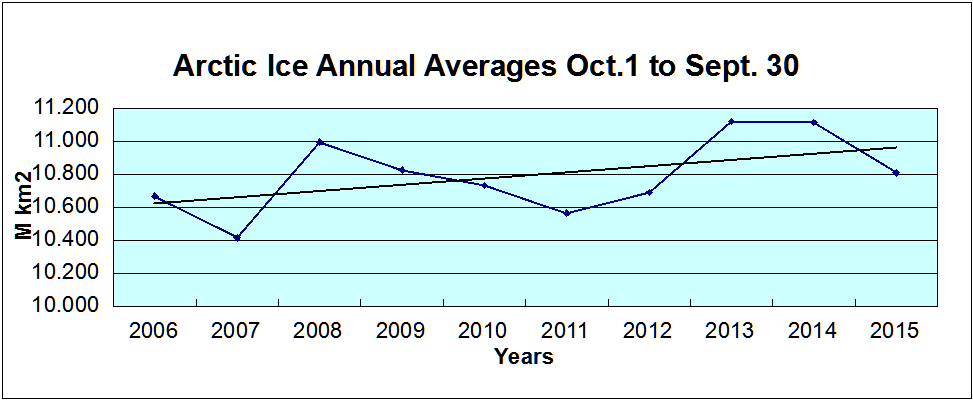
A year ago MASIE results showed clearly that the decline of ice prior to 2007 had stabilized and increased a bit.  The graph below displays the plateau of annual average ice extents based on October 1 to September 30.  In 2 weeks we can add 2016 and see how the trend changes.

arctic-ice-ann-to-sept30

The monthly average extent for September is the climate statistic, since daily reports vary greatly due to weather, ice movements and darkening conditions, just some of the factors making it difficult to measure anything in the Arctic.

Halfway through September, we can compare extents for day 260, the average day for annual minimums. The table below shows MASIE extents in M km2 on day 260 for significant years in the last decade.

Arctic Regions 2007 2012 2014 2015 2016
Central Arctic Sea 2.67 2.64 2.98 2.93 2.92
BCE 0.5 0.31 1.38 0.89 0.52
Greenland & CAA 0.56 0.41 0.55 0.46 0.45
Bits & Pieces 0.32 0.04 0.22 0.15 0.31
NH Total 4.05 3.4 5.13 4.44 4.20

The main difference between 2007 and 2016 is more ice in Central Arctic. 2015 is slightly higher because of BCE (Beaufort, Chukchi, E. Siberian combined), though the Bits and Pieces are higher now, most of it in Laptev this year.

The rate of refreezing in the next 2 weeks should keep 2016 well ahead of 2007. The average gain of ice from now to Sept. 30 is 32k km2 per day, or 412k km2 added to the day 260 extent. In 2007 the rate was the decade’s lowest: only 3k per day for 41k km2 added by end of Sept. Last year 2015 was one of the fastest recoveries, almost twice the average.

Conclusion

It looks likely that 2016 September extent average will finish higher than 2007 and close to 2008 and 2011.  It is unlikely to catch 2015.  But who knows?

No one knows what will happen to Arctic ice.

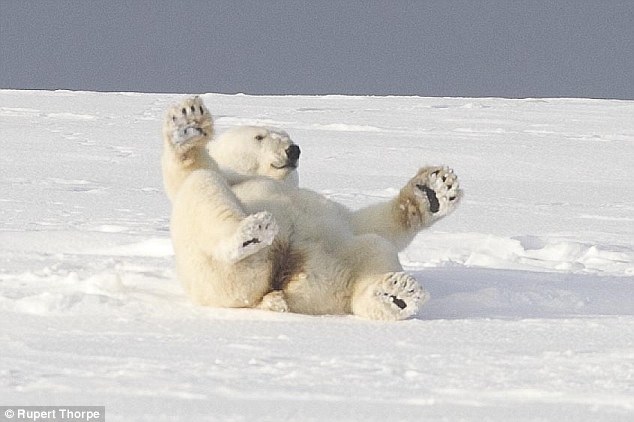
Except maybe the polar bears.

And they are not talking.

Except, of course, to the admen from Coca-Cola

Arctic Ice Minimum?


20160912google1

Imargery date refers to Google Earth capture of land forms. Ice extents are for Sept. 11, 2016 from MASIE. Click on image to zoom in.

Northabout picked her way through drift ice in the channel and is now at the mouth of Baffin Bay.  The Nunavut gauntlet is behind them, but they will seek a port soon with a storm forecasted in coming days.  Serenity exited some days ago, did some sight-seeing in Baffin Bay and is visiting ports in Greenland.

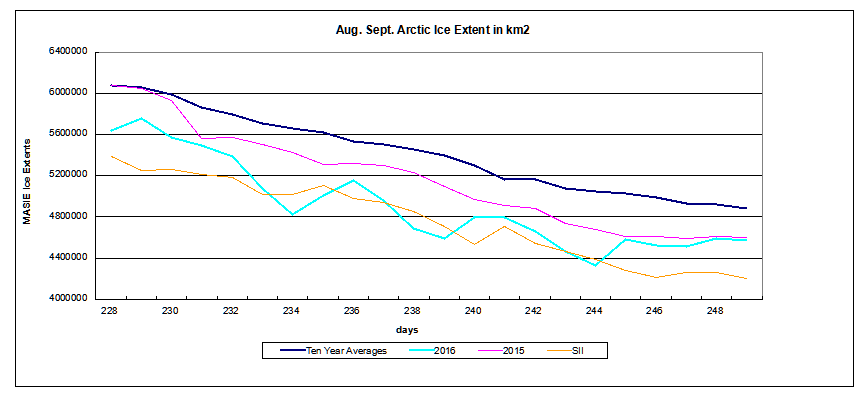
MASIE images of Arctic ice show a plateau in extent for the first 5 days of September, then a drop to ~4.2M where it has remained except for a further one-day dip on day 254. On average the lowest extent shows on day 260, but it varies a lot, from day 254 in 2009 to day 270 in 2007. So weather makes a difference each year. 2016 is uncertain because a storm is forecast in the days ahead (according to Northabout crew) and the effect on ice extent is unknown.

The decline of ice extent is shown below since August 15 (August being the month of greatest loss of ice).

masie-2016-day255

It is too early to say the annual minimum occurred on Sept. 10, but all the sensitive seas are showing increases yesterday.  Ice extents this month are 340k km2 less than last year.  SII is showing ~200k km2 less ice than MASIE in Sept. The table below shows ice extents in the regions for day 255:

Region 2016255 2015255 Difference
 (0) Northern_Hemisphere 4224212 4563954 -339742
 (1) Beaufort_Sea 184884 484260 -299376
 (2) Chukchi_Sea 273471 173544 99927
 (3) East_Siberian_Sea 159549 263598 -104049
 (4) Laptev_Sea 310839 69273 241566
 (5) Kara_Sea 1723 1869 -146
 (6) Barents_Sea 0 18 -18
 (7) Greenland_Sea 161931 222061 -60131
 (8) Baffin_Bay_Gulf_of_St._Lawrence 18475 57705 -39230
 (9) Canadian_Archipelago 232146 267573 -35427
 (10) Hudson_Bay 0 56252 -56252
 (11) Central_Arctic 2880143 2966659 -86516

Surpluses in Chukchi and Laptev somewhat offset deficits in Beaufort and E. Siberian seas.  Baffin and Hudson Bays are much lower this year, but they have little left to lose compared to 2015.  The most significant issue is Central Arctic being lower than last year, which may yet produce a lower September monthly minimum.  Time will tell.

Summary of Year To Date

Someone asked how the annual average ice extent was coming along this year, so I crunched the numbers.

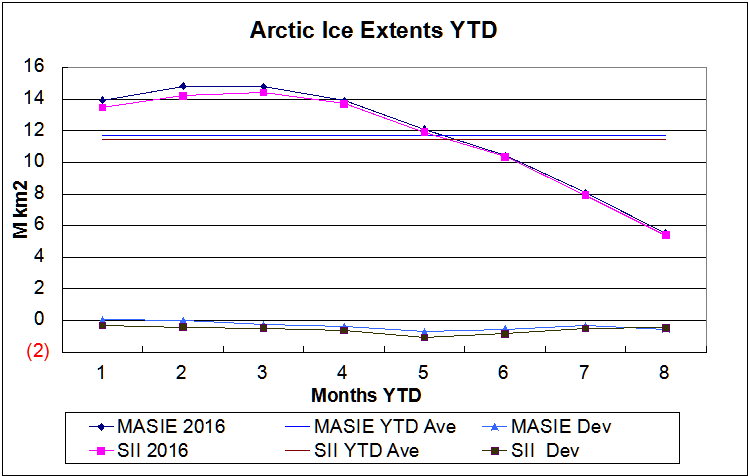
The graph summarizes the changing extents of Arctic ice as measured by two primary datasets: MASIE (Multi-sensor Analyzed Sea Ice Extent) and SII (Sea Ice Index -solely from satellite passive microwave sensors).

Arctic ice YTD Aug

Measured in M km2, the two highest lines are the monthly average extents reported for the first 8 months of 2016. The two horizontal lines show the YTD average from the 8 months. At the bottom are the deviations from 10 yr. Averages for each month (from each dataset).

It is clear that MASIE was reporting slightly more ice early on, and then the two estimates have been close together since. The deviation below average grew up through May, with SII reporting 1M km2 deficit. As of August, both MASIE and SII are showing ice extent down about 0.5M km2.

The 10 yr. Averages of extents for the YTD (8 months) are exactly 12M km2 in both datasets. So Masie YTD is ~3% below average and SII YTD is ~5% down.

Summary

There will be much to do about Arctic ice death spirals in the weeks ahead as 2016 continues to show lower extents. Most likely the September average will be lower than last year, an event lasting perhaps 2-3 weeks before refreezing brings it back over last year’s minimum. Only someone pushing an agenda would claim such a short phenomenon contained within a single month of the year shows the climate is changing.

For more on making sense of Arctic Ice graphs see Ice House of Mirrors

For those who want to see numbers, the table is below.

Monthly 2006-2015 2016 2006-2015 2016 2016 2016-10yr Ave 2016-10yr Ave
Averages MASIE MASIE SII SII SII Deficit MASIE SII
Jan 13.872 13.922 13.780 13.472 -0.450 0.049 -0.308
Feb 14.785 14.804 14.632 14.210 -0.593 0.019 -0.422
Mar 15.008 14.769 14.886 14.405 -0.364 -0.239 -0.481
Apr 14.308 13.917 14.307 13.694 -0.223 -0.391 -0.613
May 12.767 12.086 12.960 11.900 -0.186 -0.681 -1.060
June 10.952 10.419 11.192 10.353 -0.066 -0.533 -0.839
July 8.401 8.067 8.421 7.920 -0.147 -0.334 -0.501
Aug 6.066 5.531 5.838 5.390 -0.141 -0.535 -0.448
YTD Ave. 12.020 11.689 12.002 11.418 -0.271 -0.331 -0.584

September Minimum Outlook

Historically, where will ice be remaining when Arctic melting stops? Over the last 10 years, on average MASIE shows the annual minimum occurring about day 260. Of course in a given year, the daily minimum varies slightly a few days +/- from that.

For comparison, here are sea ice extents reported from 2007, 2012, 2014 and 2015 for day 260:

Arctic Regions 2007 2012 2014 2015
Central Arctic Sea 2.67 2.64 2.98 2.93
BCE 0.50 0.31 1.38 0.89
Greenland & CAA 0.56 0.41 0.55 0.46
Bits & Pieces 0.32 0.04 0.22 0.15
NH Total 4.05 3.40 5.13 4.44

Notes: Extents are in M km2.  BCE region includes Beaufort, Chukchi and Eastern Siberian seas. Greenland Sea (not the ice sheet). Canadian Arctic Archipelago (CAA).  Locations of the Bits and Pieces vary.

As the table shows, low NH minimums come mainly from ice losses in Central Arctic and BCE.  The great 2012 cyclone hit both in order to set the recent record. The recovery since 2012 shows in 2014, with some dropoff last year, mostly in BCE.

Summary

We are nearing the end of the melt season, and the resulting minimum will depend upon the vagaries of weather between now and September 16 or so.  Early on, 2016 was slightly higher than 2015 in March, lower in May and narrowing the gap late June and late July. Note: 2016 melt season is starting without the Blob, with El Nino over, and a cold blob in the North Atlantic.  The AO has been hovering around neutral, now possibly indicating cloud cover reducing the pace of melting.

Meanwhile we can watch and appreciate the beauty of the changing ice conditions.

Arctic sea ice in summer 2015. This photo was made during an expedition of the German research icebreaker Polarstern into the central Arctic Ocean. Credit: Stefan Hendricks

Footnote:  Regarding the colder than normal water in the North Atlantic

A 2016 article for EOS is entitled Atlantic Sea Ice Could Grow in the Next Decade

Changing ocean circulation in the North Atlantic could lead to winter sea ice coverage remaining steady and even growing in select regions.

The researchers analyzed simulations from the Community Earth System Model, modeling both atmosphere and ocean circulation. They found that decadal-scale trends in Arctic winter sea ice extent are largely explained by changes in ocean circulation rather than by large-scale external factors like anthropogenic warming. (my bold)

From the Abstract of Yeager et al.

We present evidence that the extreme negative trends in Arctic winter sea-ice extent in the late 1990s were a predictable consequence of the preceding decade of persistent positive winter North Atlantic Oscillation (NAO) conditions and associated spin-up of the thermohaline circulation (THC). Initialized forecasts made with the Community Earth System Model decadal prediction system indicate that relatively low rates of North Atlantic Deep Water formation in recent years will result in a continuation of a THC spin-down that began more than a decade ago. Consequently, projected 10-year trends in winter Arctic winter sea-ice extent seem likely to be much more positive than has recently been observed, with the possibility of actual decadal growth in Atlantic sea-ice in the near future. (my bold)

Northabout Racing Against Refreezing

20160909google1

Imagery dat refers to Google Earth capture of land forms. Ice extents are for Sept. 8, 2016 from MASIE. Click on image to zoom in.

As I have said before, I wish the sailors safe passage even though they have been misled by climate alarmists.  Their adventure is life-threatening, though not unprecedented.  More than 200 NWP crossings are recorded since 1906, but who knows whether 2017 or beyond will have as much open water as this year.

From the ship’s log:

N69 02 W 101 30 pressure 1006, water1.7C, Air 2C 0500 UTC 9 Sept local time 22.00 8 Sept, Queen Maud Gulf

A winters start. Low cloud base and dark skies. We slowly edged our way past Cambridge Bay into Queen Maud Gulf, surely named by Amundsen.

Cambridge Bay is the last place we could really over winter the boat so I hope we don’t have to retrace our steps.

We knew Polar Bound was coming our way, many months ago. Skippered by a legend in High Latitude Sailing, David Scott Cowper. He has forgotten what we haven’t even learnt yet. Firstly, he was shown up on our AIS, as we got closer to each other, it was a surreal moment. Two Englishmen chatting away over the radio waves, in the North West Passage. No other boat or Nationality around.

Mad dogs and Englishmen came into my thoughts.

What a shame, David was heading to Cambridge Bay for breakfast and invited us to join him, very unfortunately we are in a race against time before the freeze . Also, we need to get to Baffin Bay before a big storm, don’t tell the ladies that ! Hopefully, we will be in harbour by then.

So, the rest of the day was skirting Islands with big cliffs, until this evening. Now making our way up Victoria Strait, water temps plummeted but the skies have cleared to give beautiful stars. A really clear sky, I can’t think of another night like it. Our Ice Charts show 1/10 ice. As Steve pointed out so sagely, doesn’t sound much, but if you have one large chunk in your way in the dark, it’s going to dent your boat !

I have started to twitch at the thought. The last Ice in the sea at night was the Chukchi sea before Point Barrow, we have all had nightmares ever since.

David

Background on the Polar Ocean Challenge

Update August 14, 2016

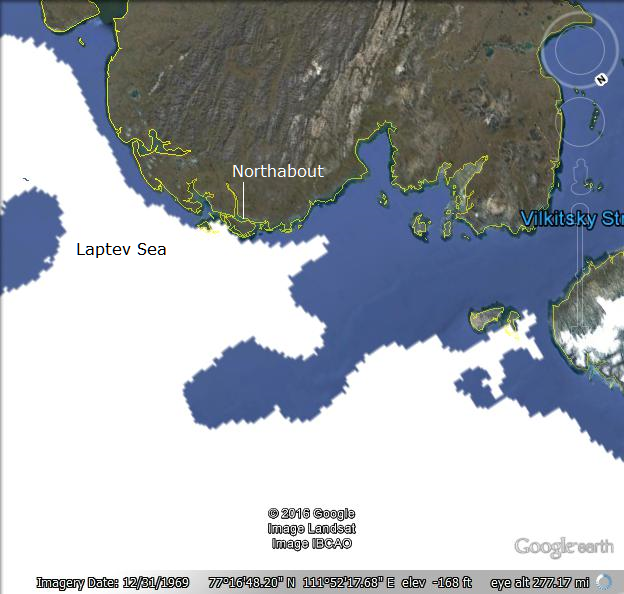
It appears that Northabout has found a way around the Laptev wall, and is close to finding open water.  Below the Google Earth image of ice edges from NIC shows how the strait has opened up along with navigable shore lines.

Aug13googleRev

Imagery date refers to Google Earth capture of land forms. Ice edges are provided by MASIE for August 13, 2016.

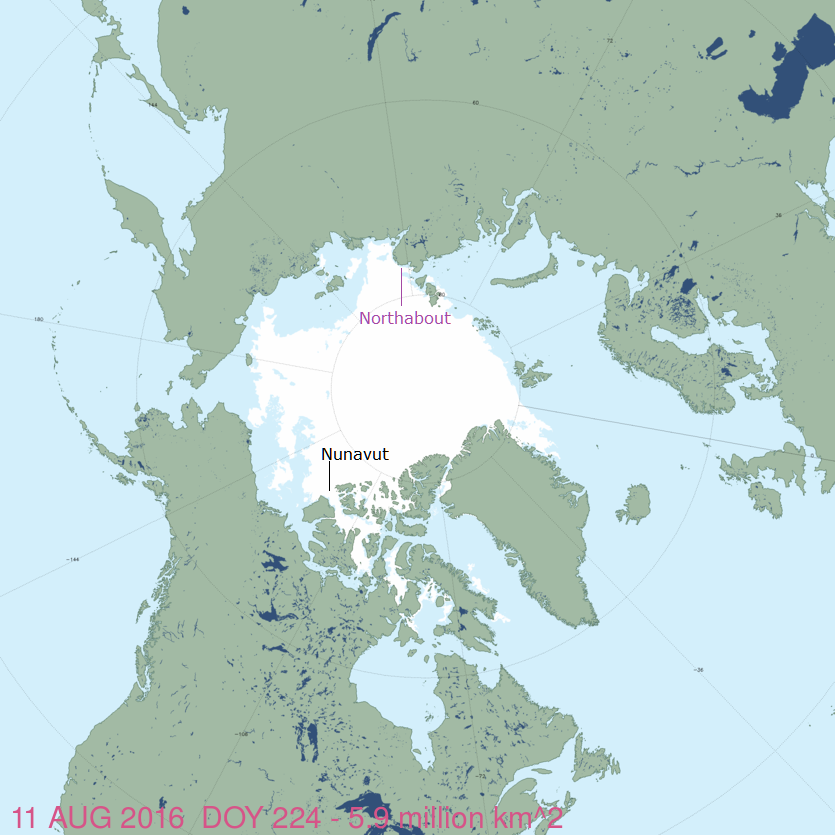
The Big Picture from August 11, 2016.

masie_August 11rev

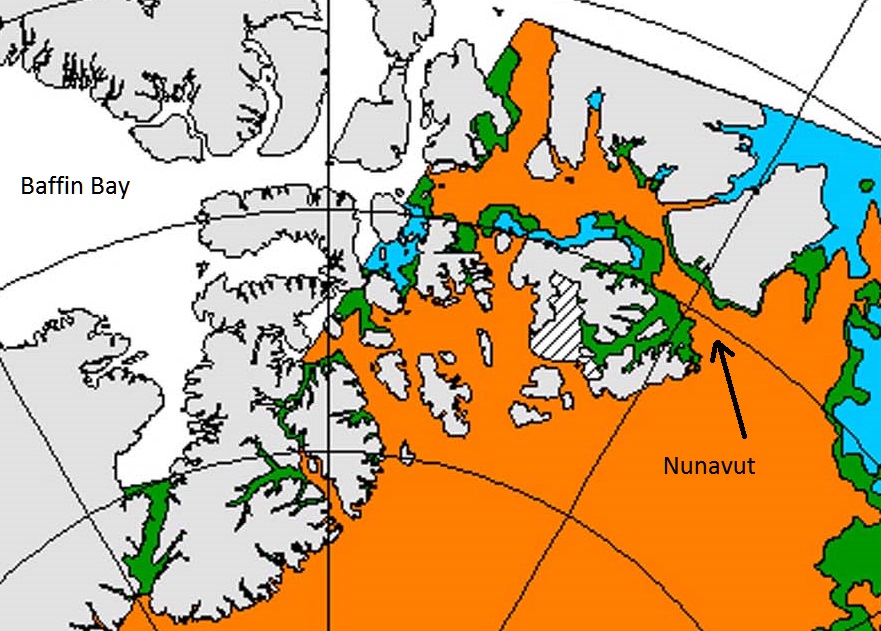
The Polar Ocean Challenge involves the sailing ship Northabout circumnavigating the North Pole counterclockwise starting from Bristol UK. The chart above from MASIE shows the two choke points in the itinerary: The Laptev Wall of ice at the beginning and the Nunavut Gauntlet of ice at the end. The image shows If Northabout can get past Laptev, it is relatively clear sailing all the way to Beaufort where Nunavut awaits.

20160809en

The above chart from AARI shows how Northabout has passed through the strait from Kara into Laptev and is in a holding pattern up against the wall.  Caleb has some great photos (here) of the views from the deck, along with some comments respecting the explorers despite their being misled by global warming theorists.

20160809enBaffin

Above is the latest chart from AARI showing the present ice situation at the other end of the trip, the Nunavut Gauntlet.  The white part is without data since the Russians are focused on their side of the ocean, but it does show heavy ice in Beaufort Sea on the right,  Within Nunavut, Parry Channel is well blocked, but with some water around the edges.  If and when Northabout gets here, no one knows what they will face.  They are counting on the passage opening this year, unlike previous years.

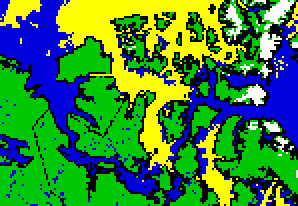
An image of the ice and snow extents from NOAA by way of National Ice Center (NIC)

A closeup of Nunavut from that chart shows they have a chance by using the southern route, skipping all but the eastern end of Parry Channel, provided the ice is better not worse than now when they approach.

cursnow_alaskaNOAAnunavut

Footnote:

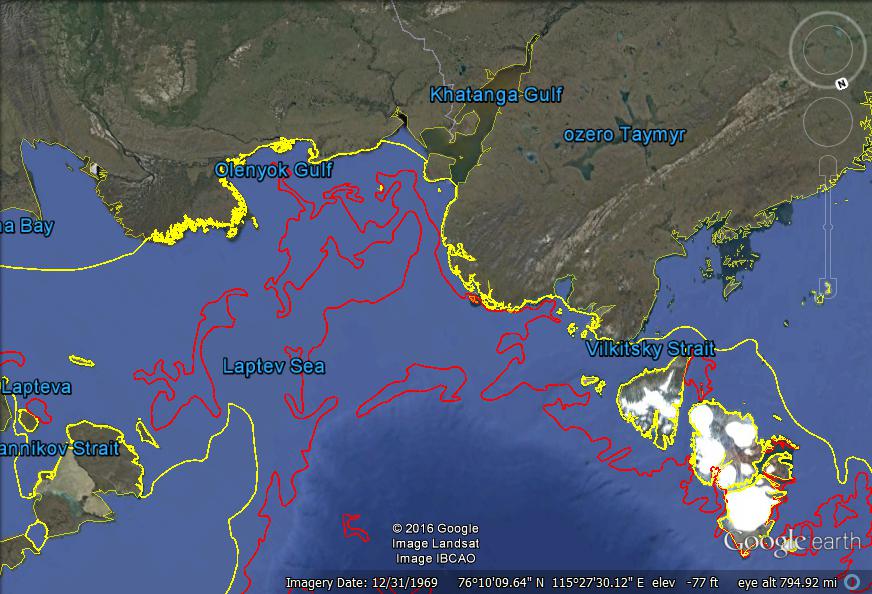
Another view of the Arctic is available from NIC using Google Earth.  The daily shapefile can be downloaded, and it then opens in Google Earth, which allows you to browse and zoom in on regions of interest.  Here is an image from this source:

20160812google

Note: Imagery date is Google Earth capture of land masses. Ice edges are 20160812 from NIC.


Arctic Ice Surprises


20160906google1

Imargery date refers to Google Earth capture of land forms. Ice extents are for Sept. 5, 2016 from MASIE. Click on image to zoom in.

Northabout is entering the North West Passage using the southern route, heading for Cambridge Bay.  As the image shows, the channels are ice-free.  Serenity exited some days ago, did some sight-seeing in Baffin Bay and is nearing her first Greenland port.

MASIE images of Arctic ice extent show a plateau in ice extent for the first 5 days of September, remaining steadily above 4.5M km2.  Day 249 is just 11 days short of the most frequent day of annual minimum.  So this is the crunch time in the annual battle between the ocean water and ice. The decline of ice extent is shown below since August 15 (August being the month of greatest loss of ice).

masie-2016-day249


It is too early to say the annual minimum occurred on Aug. 31 but that day is still standing five days into September.  Ice extents this month are virtually the same for last year and this.  SII is showing ~300k km2 less ice than MASIE in Sept. The table below shows ice extents in the regions for day 249:

Region 2016249 2015249 Difference
 (0) Northern_Hemisphere 4571635 4596740 -25105
 (1) Beaufort_Sea 283062 476314 -193253
 (2) Chukchi_Sea 447119 236111 211008
 (3) East_Siberian_Sea 171984 327884 -155900
 (4) Laptev_Sea 374930 56421 318509
 (5) Kara_Sea 2067 7760 -5694
 (6) Barents_Sea 217 18 199
 (7) Greenland_Sea 182352 179286 3066
 (8) Baffin_Bay_Gulf_of_St._Lawrence 17028 58674 -41647
 (9) Canadian_Archipelago 265112 247465 17647
 (10) Hudson_Bay 239 52934 -52695
 (11) Central_Arctic 2826476 2953039 -126563


Surpluses in Chukchi and Laptev more than offset deficits in Beaufort and E. Siberian seas.  Baffin and Hudson Bays are much lower this year, but they have little left to lose compared to 2015.  The most significant issue is Central Arctic being lower than last year, which may yet produce a lower September monthly minimum.  Time will tell.

Summary of Year To Date

Someone asked how the annual average ice extent was coming along this year, so I crunched the numbers.

The graph summarizes the changing extents of Arctic ice as measured by two primary datasets: MASIE (Multi-sensor Analyzed Sea Ice Extent) and SII (Sea Ice Index -solely from satellite passive microwave sensors).

Arctic ice YTD Aug

Measured in M km2, the two highest lines are the monthly average extents reported for the first 8 months of 2016. The two horizontal lines show the YTD average from the 8 months. At the bottom are the deviations from 10 yr. Averages for each month (from each dataset).

It is clear that MASIE was reporting slightly more ice early on, and then the two estimates have been close together since. The deviation below average grew up through May, with SII reporting 1M km2 deficit. As of August, both MASIE and SII are showing ice extent down about 0.5M km2.

The 10 yr. Averages of extents for the YTD (8 months) are exactly 12M km2 in both datasets. So Masie YTD is ~3% below average and SII YTD is ~5% down.

Summary

There will be much to do about Arctic ice death spirals in the weeks ahead as 2016 continues to show lower extents. Most likely the September average will be lower than last year, an event lasting perhaps 2-3 weeks before refreezing brings it back over last year’s minimum. Only someone pushing an agenda would claim such a short phenomenon contained within a single month of the year shows the climate is changing.

For more on making sense of Arctic Ice graphs see Ice House of Mirrors

For those who want to see numbers, the table is below.

Monthly 2006-2015 2016 2006-2015 2016 2016 2016-10yr Ave 2016-10yr Ave
Averages MASIE MASIE SII SII SII Deficit MASIE SII
Jan 13.872 13.922 13.780 13.472 -0.450 0.049 -0.308
Feb 14.785 14.804 14.632 14.210 -0.593 0.019 -0.422
Mar 15.008 14.769 14.886 14.405 -0.364 -0.239 -0.481
Apr 14.308 13.917 14.307 13.694 -0.223 -0.391 -0.613
May 12.767 12.086 12.960 11.900 -0.186 -0.681 -1.060
June 10.952 10.419 11.192 10.353 -0.066 -0.533 -0.839
July 8.401 8.067 8.421 7.920 -0.147 -0.334 -0.501
Aug 6.066 5.531 5.838 5.390 -0.141 -0.535 -0.448
YTD Ave. 12.020 11.689 12.002 11.418 -0.271 -0.331 -0.584

September Minimum Outlook

Historically, where will ice be remaining when Arctic melting stops? Over the last 10 years, on average MASIE shows the annual minimum occurring about day 260. Of course in a given year, the daily minimum varies slightly a few days +/- from that.

For comparison, here are sea ice extents reported from 2007, 2012, 2014 and 2015 for day 260:

Arctic Regions 2007 2012 2014 2015
Central Arctic Sea 2.67 2.64 2.98 2.93
BCE 0.50 0.31 1.38 0.89
Greenland & CAA 0.56 0.41 0.55 0.46
Bits & Pieces 0.32 0.04 0.22 0.15
NH Total 4.05 3.40 5.13 4.44

Notes: Extents are in M km2.  BCE region includes Beaufort, Chukchi and Eastern Siberian seas. Greenland Sea (not the ice sheet). Canadian Arctic Archipelago (CAA).  Locations of the Bits and Pieces vary.

As the table shows, low NH minimums come mainly from ice losses in Central Arctic and BCE.  The great 2012 cyclone hit both in order to set the recent record. The recovery since 2012 shows in 2014, with some dropoff last year, mostly in BCE.

Summary

We are nearing the end of the melt season, and the resulting minimum will depend upon the vagaries of weather between now and September 16 or so.  Early on, 2016 was slightly higher than 2015 in March, lower in May and narrowing the gap late June and late July. Note: 2016 melt season is starting without the Blob, with El Nino over, and a cold blob in the North Atlantic.  The AO has been hovering around neutral, now possibly indicating cloud cover reducing the pace of melting.

Meanwhile we can watch and appreciate the beauty of the changing ice conditions.

Arctic sea ice in summer 2015. This photo was made during an expedition of the German research icebreaker Polarstern into the central Arctic Ocean. Credit: Stefan Hendricks

Footnote:  Regarding the colder than normal water in the North Atlantic

A 2016 article for EOS is entitled Atlantic Sea Ice Could Grow in the Next Decade

Changing ocean circulation in the North Atlantic could lead to winter sea ice coverage remaining steady and even growing in select regions.

The researchers analyzed simulations from the Community Earth System Model, modeling both atmosphere and ocean circulation. They found that decadal-scale trends in Arctic winter sea ice extent are largely explained by changes in ocean circulation rather than by large-scale external factors like anthropogenic warming. (my bold)

From the Abstract of Yeager et al.

We present evidence that the extreme negative trends in Arctic winter sea-ice extent in the late 1990s were a predictable consequence of the preceding decade of persistent positive winter North Atlantic Oscillation (NAO) conditions and associated spin-up of the thermohaline circulation (THC). Initialized forecasts made with the Community Earth System Model decadal prediction system indicate that relatively low rates of North Atlantic Deep Water formation in recent years will result in a continuation of a THC spin-down that began more than a decade ago. Consequently, projected 10-year trends in winter Arctic winter sea-ice extent seem likely to be much more positive than has recently been observed, with the possibility of actual decadal growth in Atlantic sea-ice in the near future. (my bold)

Arctic Ice Crunch Time

The MASIE image of Arctic ice extent from yesterday shows 4.5M km2, which has persisted for the last 3 days.  Day 247 is just 13 days short of the most frequent day of annual minimum.  So this is the crunch time in the annual battle between the ocean water and ice.  The decline of ice extent is shown below since August 15 (August being the month of greatest loss of ice).

MASIE 2016 day247

It shows that 2016 extent dipped below 4.4M, but has been steady at 4.5 M for the first 3 days of Sept. and is close to 2015 at this point.  SII is showing ~300k km2 less ice than MASIE in Sept. The table below shows ice extents in the regions:

Region 2016247 2015247 Difference
 (0) Northern_Hemisphere 4517221 4594179 -76958
 (1) Beaufort_Sea 283557 493132 -209575
 (2) Chukchi_Sea 392413 236968 155445
 (3) East_Siberian_Sea 175341 331333 -155992
 (4) Laptev_Sea 383872 59062 324810
 (5) Kara_Sea 8023 8196 -174
 (6) Barents_Sea 217 126 90
 (7) Greenland_Sea 158466 151300 7166
 (8) Baffin_Bay_Gulf_of_St._Lawrence 13984 73188 -59205
 (9) Canadian_Archipelago 242154 247177 -5023
 (10) Hudson_Bay 239 51561 -51322
 (11) Central_Arctic 2858376 2941319 -82944

Note that Baffin and Hudson Bays are much lower this year, but they have little left to lose compared to 2016.  The rest of the seas have offsetting surpluses and deficits in different places.  The most significant issue is Central Arctic being lower than last year, which may foretell a lower September monthly minimum.  Time will tell.

Summary of Year To Date

Someone asked how the annual average ice extent was coming along this year, so I crunched the numbers.

The graph summarizes the changing extents of Arctic ice as measured by two primary datasets: MASIE (Multi-sensor Analyzed Sea Ice Extent) and SII (Sea Ice Index -solely from satellite passive microwave sensors).

Arctic ice YTD Aug

Measured in M km2, the two highest lines are the monthly average extents reported for the first 8 months of 2016. The two horizontal lines show the YTD average from the 8 months. At the bottom are the deviations from 10 yr. Averages for each month (from each dataset).

It is clear that MASIE was reporting slightly more ice early on, and then the two estimates have been close together since. The deviation below average grew up through May, with SII reporting 1M km2 deficit. As of August, both MASIE and SII are showing ice extent down about 0.5M km2.

The 10 yr. Averages of extents for the YTD (8 months) are exactly 12M km2 in both datasets. So Masie YTD is ~3% below average and SII YTD is ~5% down.

Summary

There will be much to do about Arctic ice death spirals in the weeks ahead as 2016 continues to show lower extents. Most likely the September average will be lower than last year, an event lasting perhaps 2-3 weeks before refreezing brings it back over last year’s minimum. Only someone pushing an agenda would claim such a short phenomenon contained within a single month of the year shows the climate is changing.

For more on making sense of Arctic Ice graphs see Ice House of Mirrors

For those who want to see numbers, the table is below.

Monthly 2006-2015 2016 2006-2015 2016 2016 2016-10yr Ave 2016-10yr Ave
Averages MASIE MASIE SII SII SII Deficit MASIE SII
Jan 13.872 13.922 13.780 13.472 -0.450 0.049 -0.308
Feb 14.785 14.804 14.632 14.210 -0.593 0.019 -0.422
Mar 15.008 14.769 14.886 14.405 -0.364 -0.239 -0.481
Apr 14.308 13.917 14.307 13.694 -0.223 -0.391 -0.613
May 12.767 12.086 12.960 11.900 -0.186 -0.681 -1.060
June 10.952 10.419 11.192 10.353 -0.066 -0.533 -0.839
July 8.401 8.067 8.421 7.920 -0.147 -0.334 -0.501
Aug 6.066 5.531 5.838 5.390 -0.141 -0.535 -0.448
YTD Ave. 12.020 11.689 12.002 11.418 -0.271 -0.331 -0.584

September Minimum Outlook

Historically, where will ice be remaining when Arctic melting stops? Over the last 10 years, on average MASIE shows the annual minimum occurring about day 260. Of course in a given year, the daily minimum varies slightly a few days +/- from that.

For comparison, here are sea ice extents reported from 2007, 2012, 2014 and 2015 for day 260:

Arctic Regions 2007 2012 2014 2015
Central Arctic Sea 2.67 2.64 2.98 2.93
BCE 0.50 0.31 1.38 0.89
Greenland & CAA 0.56 0.41 0.55 0.46
Bits & Pieces 0.32 0.04 0.22 0.15
NH Total 4.05 3.40 5.13 4.44

Notes: Extents are in M km2.  BCE region includes Beaufort, Chukchi and Eastern Siberian seas. Greenland Sea (not the ice sheet). Canadian Arctic Archipelago (CAA).  Locations of the Bits and Pieces vary.

As the table shows, low NH minimums come mainly from ice losses in Central Arctic and BCE.  The great 2012 cyclone hit both in order to set the recent record. The recovery since 2012 shows in 2014, with some dropoff last year, mostly in BCE.

Summary

We are nearing the end of the melt season, and the resulting minimum will depend upon the vagaries of weather between now and September 16 or so.  Early on, 2016 was slightly higher than 2015 in March, lower in May and narrowing the gap late June and late July. Note: 2016 melt season is starting without the Blob, with El Nino over, and a cold blob in the North Atlantic.  The AO has been hovering around neutral, now possibly indicating cloud cover reducing the pace of melting.

Meanwhile we can watch and appreciate the beauty of the changing ice conditions.

Arctic sea ice in summer 2015. This photo was made during an expedition of the German research icebreaker Polarstern into the central Arctic Ocean. Credit: Stefan Hendricks

Footnote:  Regarding the colder than normal water in the North Atlantic

A 2016 article for EOS is entitled Atlantic Sea Ice Could Grow in the Next Decade

Changing ocean circulation in the North Atlantic could lead to winter sea ice coverage remaining steady and even growing in select regions.

The researchers analyzed simulations from the Community Earth System Model, modeling both atmosphere and ocean circulation. They found that decadal-scale trends in Arctic winter sea ice extent are largely explained by changes in ocean circulation rather than by large-scale external factors like anthropogenic warming.

From the Abstract of Yeager et al.

We present evidence that the extreme negative trends in Arctic winter sea-ice extent in the late 1990s were a predictable consequence of the preceding decade of persistent positive winter North Atlantic Oscillation (NAO) conditions and associated spin-up of the thermohaline circulation (THC). Initialized forecasts made with the Community Earth System Model decadal prediction system indicate that relatively low rates of North Atlantic Deep Water formation in recent years will result in a continuation of a THC spin-down that began more than a decade ago. Consequently, projected 10-year trends in winter Arctic winter sea-ice extent seem likely to be much more positive than has recently been observed, with the possibility of actual decadal growth in Atlantic sea-ice in the near future.

Arctic Ice YTD Sept. 1

20160901google 3

Imagery date refers to Google Earth capture of land forms. Ice extents are for August 31, 2016 from MASIE. Click on image to zoom is.

Someone asked how the annual average ice extent was coming along this year, so I crunched the numbers.

The graph summarizes the changing extents of Arctic ice as measured by two primary datasets: MASIE (Multi-sensor Analyzed Sea Ice Extent) and SII (Sea Ice Index -solely from satellite passive microwave sensors).

Arctic ice YTD Aug

Measured in M km2, the two highest lines are the monthly average extents reported for the first 8 months of 2016. The two horizontal lines show the YTD average from the 8 months. At the bottom are the deviations from 10 yr. Averages for each month (from each dataset).

It is clear that MASIE was reporting slightly more ice early on, and then the two estimates have been close together since. The deviation below average grew up through May, with SII reporting 1M km2 deficit. As of August, both MASIE and SII are showing ice extent down about 0.5M km2.

The 10 yr. Averages of extents for the YTD (8 months) are exactly 12M km2 in both datasets. So Masie YTD is ~3% below average and SII YTD is ~5% down.

Summary

There will be much to do about Arctic ice death spirals in the weeks ahead as 2016 continues to show lower extents. Most likely the September average will be lower than last year, an event lasting perhaps 2-3 weeks before refreezing brings it back over last year’s minimum. Only someone pushing an agenda would claim such a short phenomenon contained within a single month of the year shows the climate is changing.

For more on making sense of Arctic Ice graphs see Ice House of Mirrors

For those who want to see numbers, the table is below.

Monthly 2006-2015 2016 2006-2015 2016 2016 2016-10yr Ave 2016-10yr Ave
Averages MASIE MASIE SII SII SII Deficit MASIE SII
Jan 13.872 13.922 13.780 13.472 -0.450 0.049 -0.308
Feb 14.785 14.804 14.632 14.210 -0.593 0.019 -0.422
Mar 15.008 14.769 14.886 14.405 -0.364 -0.239 -0.481
Apr 14.308 13.917 14.307 13.694 -0.223 -0.391 -0.613
May 12.767 12.086 12.960 11.900 -0.186 -0.681 -1.060
June 10.952 10.419 11.192 10.353 -0.066 -0.533 -0.839
July 8.401 8.067 8.421 7.920 -0.147 -0.334 -0.501
Aug 6.066 5.531 5.838 5.390 -0.141 -0.535 -0.448
YTD Ave. 12.020 11.689 12.002 11.418 -0.271 -0.331 -0.584

September Minimum Outlook

Historically, where will ice be remaining when Arctic melting stops? Over the last 10 years, on average MASIE shows the annual minimum occurring about day 260. Of course in a given year, the daily minimum varies slightly a few days +/- from that.

For comparison, here are sea ice extents reported from 2007, 2012, 2014 and 2015 for day 260:

Arctic Regions 2007 2012 2014 2015
Central Arctic Sea 2.67 2.64 2.98 2.93
BCE 0.50 0.31 1.38 0.89
Greenland & CAA 0.56 0.41 0.55 0.46
Bits & Pieces 0.32 0.04 0.22 0.15
NH Total 4.05 3.40 5.13 4.44

Notes: Extents are in M km2.  BCE region includes Beaufort, Chukchi and Eastern Siberian seas. Greenland Sea (not the ice sheet). Canadian Arctic Archipelago (CAA).  Locations of the Bits and Pieces vary.

As the table shows, low NH minimums come mainly from ice losses in Central Arctic and BCE.  The great 2012 cyclone hit both in order to set the recent record. The recovery since 2012 shows in 2014, with some dropoff last year, mostly in BCE.

Summary

We are nearing the end of the melt season, and the resulting minimum will depend upon the vagaries of weather between now and September 16 or so.  Early on, 2016 was slightly higher than 2015 in March, lower in May and narrowing the gap late June and late July. Note: 2016 melt season is starting without the Blob, with El Nino over, and a cold blob in the North Atlantic.  The AO has been hovering around neutral, now possibly indicating cloud cover reducing the pace of melting.

Meanwhile we can watch and appreciate the beauty of the changing ice conditions.

Arctic sea ice in summer 2015. This photo was made during an expedition of the German research icebreaker Polarstern into the central Arctic Ocean. Credit: Stefan Hendricks

Footnote:  Regarding the colder than normal water in the North Atlantic

A 2016 article for EOS is entitled Atlantic Sea Ice Could Grow in the Next Decade

Changing ocean circulation in the North Atlantic could lead to winter sea ice coverage remaining steady and even growing in select regions.

The researchers analyzed simulations from the Community Earth System Model, modeling both atmosphere and ocean circulation. They found that decadal-scale trends in Arctic winter sea ice extent are largely explained by changes in ocean circulation rather than by large-scale external factors like anthropogenic warming.

From the Abstract of Yeager et al.

We present evidence that the extreme negative trends in Arctic winter sea-ice extent in the late 1990s were a predictable consequence of the preceding decade of persistent positive winter North Atlantic Oscillation (NAO) conditions and associated spin-up of the thermohaline circulation (THC). Initialized forecasts made with the Community Earth System Model decadal prediction system indicate that relatively low rates of North Atlantic Deep Water formation in recent years will result in a continuation of a THC spin-down that began more than a decade ago. Consequently, projected 10-year trends in winter Arctic winter sea-ice extent seem likely to be much more positive than has recently been observed, with the possibility of actual decadal growth in Atlantic sea-ice in the near future.

Mars in the Arctic Sept. 1

This is another post in a series that has become a kind of remote travelogue, seeing from afar some of what the passengers and crew of Crystal Serenity are experiencing in their voyage through the North West Passage. Consistent with the theme of this blog, today again we note a place of unusual scientific interest.

Of course, all these places were originally discovered by intrepid explorers over more than a century since Amundsen first recorded his transit 1903 to 1906. All told, there have been officially 236 successful crossings, which count excludes the many who lost their lives failed attempts.

20160901google1

Imagery date refers to Google Earth capture of land forms. Ice extent is for August 31, 2016 from MASIE. Click to zoom in.

The image shows that Northabout continues slowly toward her next port of Tuktoyaktuk NWT Canada. Unless something unforeseen occurs, she should be able to pass through the open waters in the southern channels.

Meanwhile, Serenity is positioned at Dundas Harbour just east of Croker Bay of Devon Island. The ship is located near the mouth of Baffin Bay, the body of water between Greenland and Nunavut.

Devon Island Nunavut Largest Uninhabited Island in the World

Croker Bay Devon Island Nunavut Canada Sept. 2008

An outpost was established at Dundas Harbour in August 1924 as part of a government presence intended to curb foreign whaling and other activity. Hudson’s Bay Company leased the outpost in 1933. The following year, 52 Inuit were relocated from Cape Dorset to Dundas Harbour but they returned to the mainland 13 years later.

Dundas Harbour was populated again in the late 1940s to maintain a patrol presence, but it was closed again in 1951 due to ice difficulties. The Royal Canadian Mounted Police detachment was moved to Craig Harbour on southern Ellesmere Island.

Only the ruins of a few buildings remain, along with one of the northernmost cemeteries in the world.

Haughton Crater Devon Island Mars Analog

A team of scientists led by MARS project scientist Dr. Pascal Lee of NASA Ames Research Center identified a new Mars analog site of high promise: the 20 km-diameter Haughton Meteorite Impact Crater and its surroundings on Devon Island, in the Canadian High Arctic. Haughton is a site of much interest because it appears to present not just one or a few potential Mars analog features, but an astonishing variety of these.

From where on earth are NASA’s rovers sending satellite messages? Devon Island.

More information at Mars Arctic Research Station

August 31 Commentary
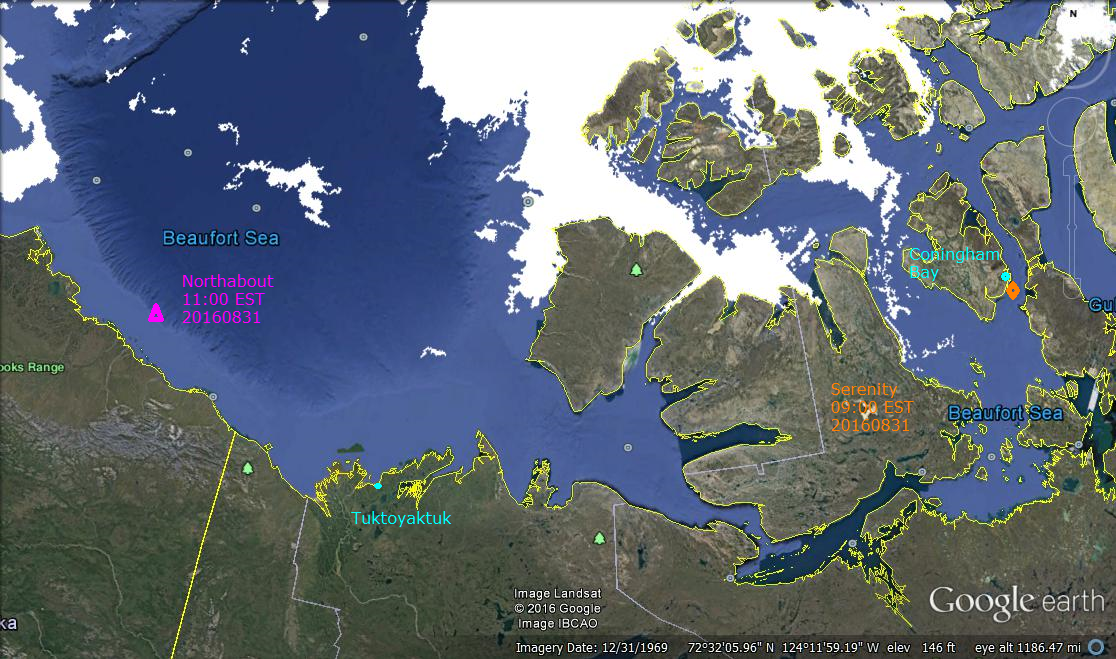
20160831google1

Imagery date refers to Google Earth capture of land forms. Ice extent is for August 30, 2016 from MASIE. Click to zoom in.

The tracking shows Northabout is struggling with some heavy seas and making slow progress toward her next port Tuktoyaktuk NWT Canada.

Today Serenity has been stationed for some hours off an obscure bay of Prince of Wales Island. Coningham Bay has nothing at all to recommend it except:

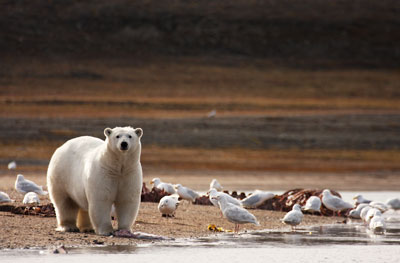
Polar Bear, Coningham Bay, Nunavut, Canada

And in 2013, an explorer created these images and commentary:
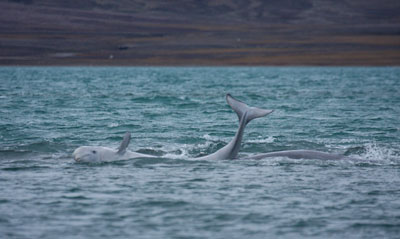
Beluga whales rolling on a sandbar — Coningham Bay.

This was the scene at Coningham Bay, a shallow, broad bay with a shoal or sandbar extending across much of the entrance, protecting the waters inside. We were anchored just outside of the sheltered sub-bay.

From the very start, we had occasionally been seeing polar bears in the water, on shore and wandering the low hills. Polar bears are typically solitary, so during the summer months the only occasion on which you are likely to see more than one at a time is when there are a mother and cub.

Bears also typically hunt from the ice edge, so their being there on a quiet bay with no ice in sight was unusual, too. Something very special was going on.
Pregnant polar bear at Coningham Bay

Thanks to Mark Grantham for Belugas and bears in the far north

Aug 30 Report Below
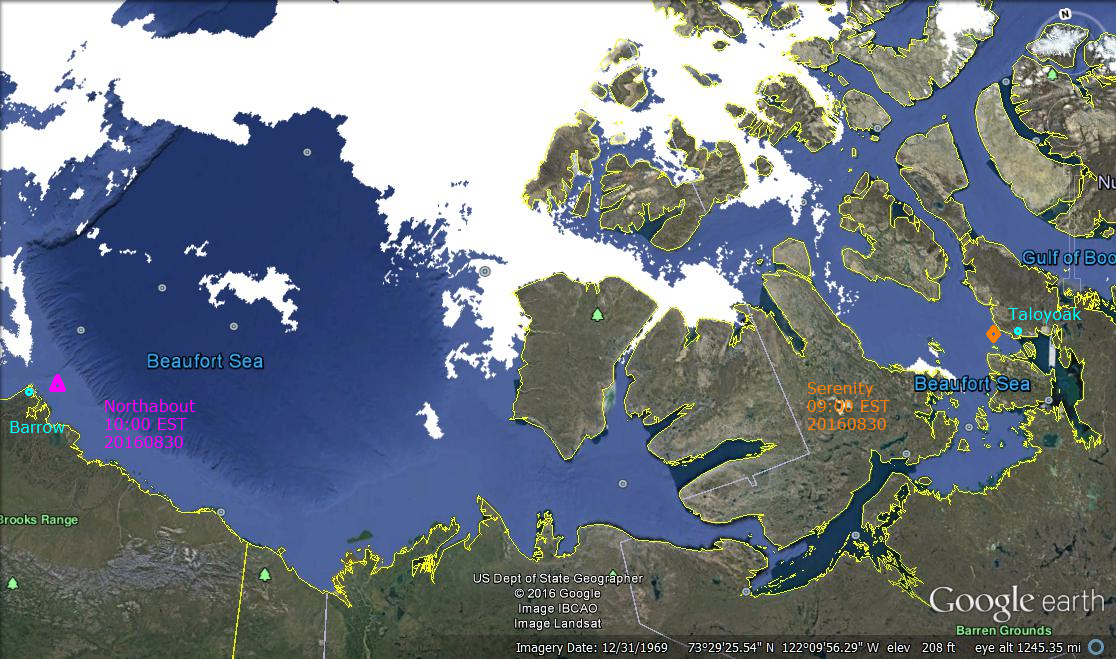
20160830google1

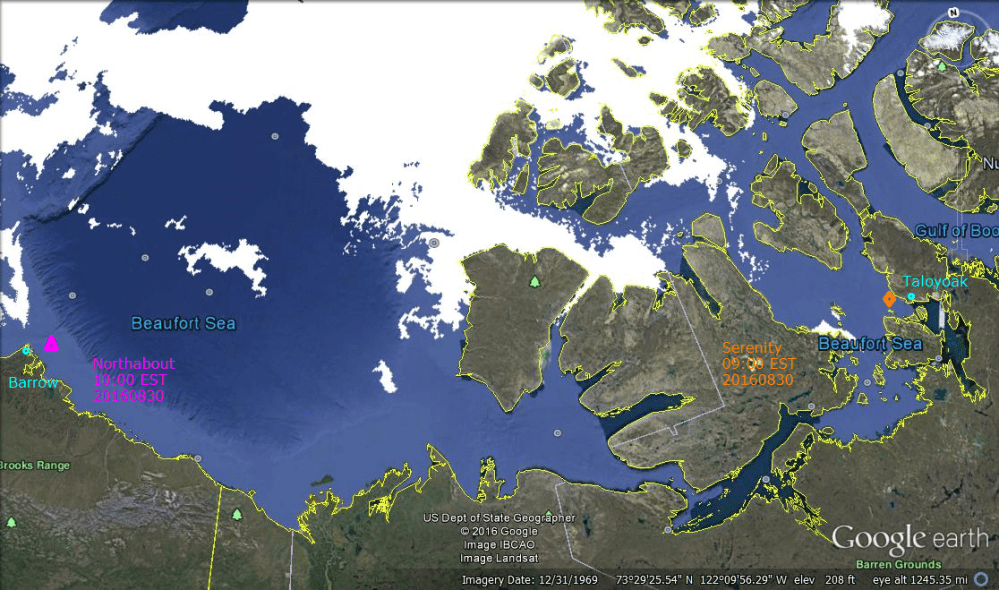
Imagery date refers to Google Earth capture of land forms. Ice extent is for August 29, 2016 from MASIE. Click to zoom in.

Today the tracking shows Northabout is east of Barrow Alaska, having completed the North East Passage, and heading for NWP. Serenity is ahead of them, having left port at Cambridge Bay Nunavut and presently in the Victoria Strait.  The cruise tracker has 3 passenger ships in that area. Given that Serenity’s next scheduled port is Pond Inlet in Baffin Bay on Sept. 4, I’m guessing Serenity is the one in McClintock channel positioned for a visit to nearby Taloyoak.

Taloyoak – ᑕᓗᕐᔪᐊᕐᒃ – ‘Large caribou hunting blind’

Taloyoak village on Spence bay

Taloyoak (population 850) is located on the southwestern coast of Boothia Peninsula at the Northwest Passage. It is the northernmost community on Canada’s mainland. Taloyoak enjoys constant 24-hour sunshine from May 17 to July 27. The sea ice usually breaks up in June. Summer temperatures range from 5°C to 20°C. The snow begins to fall in late September or early October. Winter days have four hours of daylight and temperatures that range from -15°C to -35°C. With winter wind chill it can feel like -50°C.

The local people are Netsilik Inuit descendants of the ancient Thule culture. The hamlet name of ‘Taloyoak’ means ‘large caribou hunting blind’ in Inuktitut. These screens were built with piled stones along the caribou migration routes. Muskoxen are also found near here and the fishing is some of the best in Nunavut. The Netsilingmiut women of Taloyoak have distinctive clothing. Their amautiit (traditional parkas) are often brilliantly coloured, fringed and beaded, plus they are famous for their handmade ‘packing dolls,’ which are very popular. Artistically unique Taloyoak carvings made from stone, whalebone, caribou antler and walrus ivory frequently depict mystical subjects of ancient Inuit legend.


Taloyoak soapstone carving

Background on North West Passage

The man in charge of Serenity, Capt. Birger Vorland, has spent 38 years at sea. Vorland, who is originally from Norway, says the Northwest Passage has special meaning.

“My countryman, Roald Amundsen, did the first transit here between 1903 and 1906,” Vorland says. “We’re going to do it in 32 days and in a lot more comfort.”

The official record of transits through the North West Passage is kept at the Scott Polar Research Institute (here).  The listing begins with that first transit by Amundsen and provides details of the 236 crossings recorded through 2015.  13 ships passed through the NWP last year, and the highest number was 29 in 2013.

Cambridge Bay is partway through the NWP and will be home for the new Canadian High Arctic Research Station, pictured in the foreground above. The CHARS campus is expected to be operational in July of 2017 and fully complete by March of 2018.

The image also shows that the southern route through the Archipelago is mostly open water at this time, and the outlook is good for both Serenity and Northabout to achieve their itineraries. The most interesting section of the Nunavut gauntlet lies in Victoria Strait and McClintock channel.

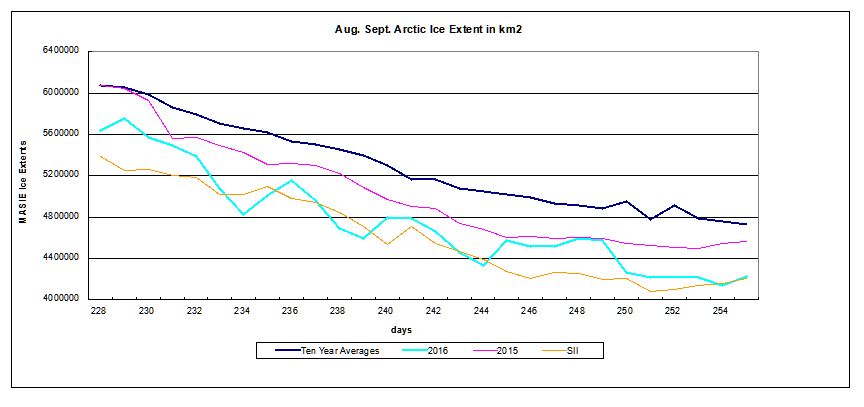
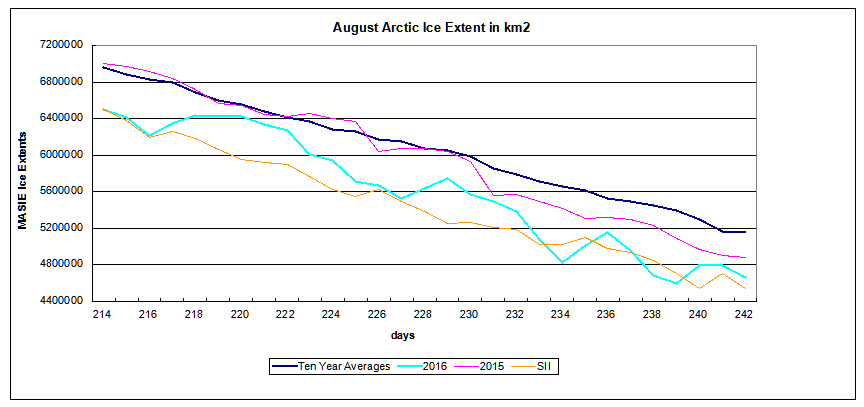
Arctic ice extents are declining as usual approaching the last 2-3 weeks of the annual melt season.  Estimates are fluctuating a lot due both to drift ice moving around, and also the difficulty of measuring under cloudy and darkening conditions.  The after effects of the recent sizable Arctic cyclone appear in the chart below.
MASIE 2016 day242


The table below compares 2015 and 2016 at day 240.  This year is slightly lower, largely due to Beaufort Sea.  Losses elsewhere in Baffin Bay, Greenland Sea, Hudson Bay and E. Siberian are more than offset by surpluses in Chukchi, Laptev and Central Arctic.  Note that several seas that are down provide more open water for the ships exploring NWP this year.

Presently 2016 ice decline is running 3 days ahead of 2015.

Region 2016240 2015240 Difference
 (0) Northern_Hemisphere 4799401 4972160 -172759
 (1) Beaufort_Sea 325257 597329 -272072
 (2) Chukchi_Sea 418423 289433 128991
 (3) East_Siberian_Sea 237311 332785 -95474
 (4) Laptev_Sea 405208 81071 324137
 (5) Kara_Sea 28704 10133 18571
 (6) Barents_Sea 0 701 -701
 (7) Greenland_Sea 120256 207476 -87220
 (8) Baffin_Bay_Gulf_of_St._Lawrence 20965 140815 -119850
 (9) Canadian_Archipelago 258978 301788 -42810
 (10) Hudson_Bay 7308 67369 -60061
 (11) Central_Arctic 2976412 2942427 33984

For more context on Arctic ice extent see Arctic Ice Watch July 31.  For background on Polar Ocean Challenge see Laptev Wall and Nunavut Gauntlet.  For those who wish to browse Arctic ice in Google Earth, the procedure is simple.  Go to MASIE homepage and download the kmz file.  Clicking on the file should open it in Google Earth (presuming it is on your computer.) Then you can browse, zoom in and out, and take images.

Crystal Serenity

I was once told by a fellow cruise passenger not to call our ship a boat.  He said in the Navy they knew if you were in a boat it meant something awful had happened to your ship.

The Good Ship Northabout



Aug. 31 Arctic Whales and Bears

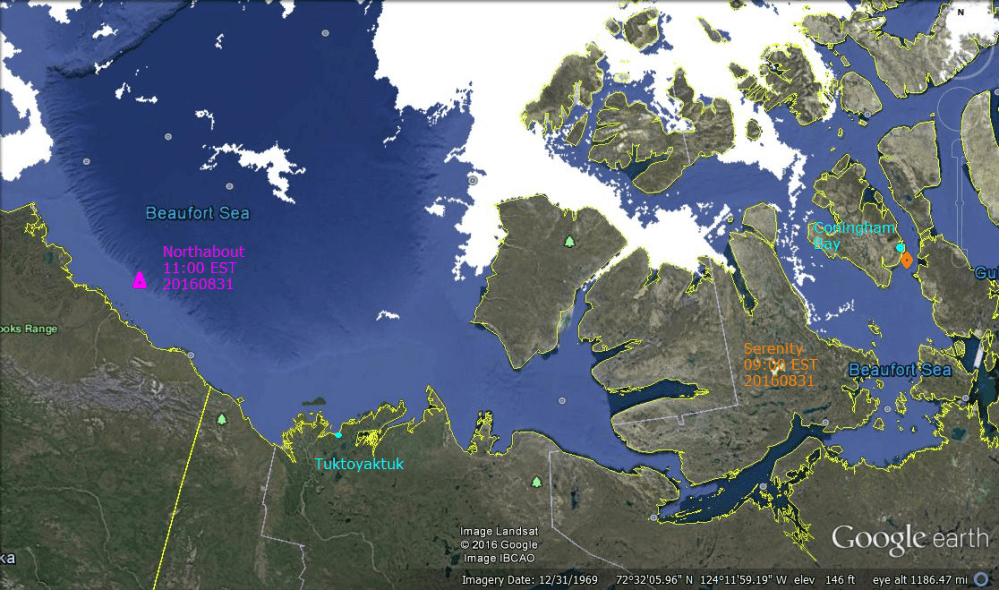
20160831google1

Imagery date refers to Google Earth capture of land forms. Ice extent is for August 30, 2016 from MASIE. Click to zoom in.

The tracking shows Northabout is struggling with some heavy seas and making slow progress toward her next port Tuktoyaktuk NWT Canada.

Today Serenity has been stationed for some hours off an obscure bay of Prince of Wales Island. Coningham Bay has nothing at all to recommend it except:

Polar Bear, Coningham Bay, Nunavut, Canada

And in 2013, an explorer created these images and commentary:

Beluga whales rolling on a sandbar — Coningham Bay.

This was the scene at Coningham Bay, a shallow, broad bay with a shoal or sandbar extending across much of the entrance, protecting the waters inside. We were anchored just outside of the sheltered sub-bay.

From the very start, we had occasionally been seeing polar bears in the water, on shore and wandering the low hills. Polar bears are typically solitary, so during the summer months the only occasion on which you are likely to see more than one at a time is when there are a mother and cub.

Bears also typically hunt from the ice edge, so their being there on a quiet bay with no ice in sight was unusual, too. Something very special was going on.

Pregnant polar bear at Coningham Bay

Thanks to Mark Grantham for Belugas and bears in the far north

Aug 30 Report Below

20160830google1

Imagery date refers to Google Earth capture of land forms. Ice extent is for August 29, 2016 from MASIE. Click to zoom in.

Today the tracking shows Northabout is east of Barrow Alaska, having completed the North East Passage, and heading for NWP. Serenity is ahead of them, having left port at Cambridge Bay Nunavut and presently in the Victoria Strait.  The cruise tracker has 3 passenger ships in that area. Given that Serenity’s next scheduled port is Pond Inlet in Baffin Bay on Sept. 4, I’m guessing Serenity is the one in McClintock channel positioned for a visit to nearby Taloyoak.

Taloyoak – ᑕᓗᕐᔪᐊᕐᒃ – ‘Large caribou hunting blind’

Taloyoak village on Spence bay

Taloyoak (population 850) is located on the southwestern coast of Boothia Peninsula at the Northwest Passage. It is the northernmost community on Canada’s mainland. Taloyoak enjoys constant 24-hour sunshine from May 17 to July 27. The sea ice usually breaks up in June. Summer temperatures range from 5°C to 20°C. The snow begins to fall in late September or early October. Winter days have four hours of daylight and temperatures that range from -15°C to -35°C. With winter wind chill it can feel like -50°C.

The local people are Netsilik Inuit descendants of the ancient Thule culture. The hamlet name of ‘Taloyoak’ means ‘large caribou hunting blind’ in Inuktitut. These screens were built with piled stones along the caribou migration routes. Muskoxen are also found near here and the fishing is some of the best in Nunavut. The Netsilingmiut women of Taloyoak have distinctive clothing. Their amautiit (traditional parkas) are often brilliantly coloured, fringed and beaded, plus they are famous for their handmade ‘packing dolls,’ which are very popular. Artistically unique Taloyoak carvings made from stone, whalebone, caribou antler and walrus ivory frequently depict mystical subjects of ancient Inuit legend.


Taloyoak soapstone carving

Background on North West Passage

The man in charge of Serenity, Capt. Birger Vorland, has spent 38 years at sea. Vorland, who is originally from Norway, says the Northwest Passage has special meaning.

“My countryman, Roald Amundsen, did the first transit here between 1903 and 1906,” Vorland says. “We’re going to do it in 32 days and in a lot more comfort.”

The official record of transits through the North West Passage is kept at the Scott Polar Research Institute (here).  The listing begins with that first transit by Amundsen and provides details of the 236 crossings recorded through 2015.  13 ships passed through the NWP last year, and the highest number was 29 in 2013.

Cambridge Bay is partway through the NWP and will be home for the new Canadian High Arctic Research Station, pictured in the foreground above. The CHARS campus is expected to be operational in July of 2017 and fully complete by March of 2018.

The image also shows that the southern route through the Archipelago is mostly open water at this time, and the outlook is good for both Serenity and Northabout to achieve their itineraries. The most interesting section of the Nunavut gauntlet lies in Victoria Strait and McClintock channel.

Arctic ice extents are declining as usual approaching the last 2-3 weeks of the annual melt season.  Estimates are fluctuating a lot due both to drift ice moving around, and also the difficulty of measuring under cloudy and darkening conditions.  The after effects of the recent sizable Arctic cyclone appear in the chart below.

MASIE 2016 day242


The table below compares 2015 and 2016 at day 240.  This year is slightly lower, largely due to Beaufort Sea.  Losses elsewhere in Baffin Bay, Greenland Sea, Hudson Bay and E. Siberian are more than offset by surpluses in Chukchi, Laptev and Central Arctic.  Note that several seas that are down provide more open water for the ships exploring NWP this year.

Presently 2016 ice decline is running 3 days ahead of 2015.

Region 2016240 2015240 Difference
 (0) Northern_Hemisphere 4799401 4972160 -172759
 (1) Beaufort_Sea 325257 597329 -272072
 (2) Chukchi_Sea 418423 289433 128991
 (3) East_Siberian_Sea 237311 332785 -95474
 (4) Laptev_Sea 405208 81071 324137
 (5) Kara_Sea 28704 10133 18571
 (6) Barents_Sea 0 701 -701
 (7) Greenland_Sea 120256 207476 -87220
 (8) Baffin_Bay_Gulf_of_St._Lawrence 20965 140815 -119850
 (9) Canadian_Archipelago 258978 301788 -42810
 (10) Hudson_Bay 7308 67369 -60061
 (11) Central_Arctic 2976412 2942427 33984

For more context on Arctic ice extent see Arctic Ice Watch July 31.  For background on Polar Ocean Challenge see Laptev Wall and Nunavut Gauntlet.  For those who wish to browse Arctic ice in Google Earth, the procedure is simple.  Go to MASIE homepage and download the kmz file.  Clicking on the file should open it in Google Earth (presuming it is on your computer.) Then you can browse, zoom in and out, and take images.

Crystal Serenity

I was once told by a fellow cruise passenger not to call our ship a boat.  He said in the Navy they knew if you were in a boat it meant something awful had happened to your ship.

The Good Ship Northabout