Arctic Ice Watch Mid-July

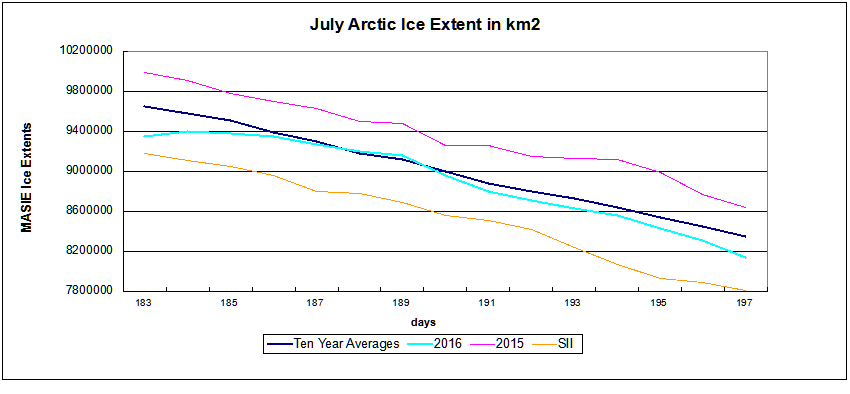
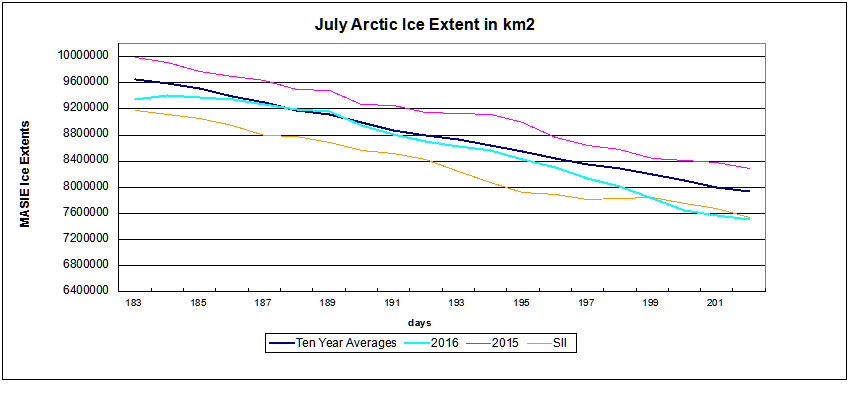
In the chart below MASIE shows 2016 Mid-July  Arctic ice extent has slipped below average and 2015. SII is back on line and was reporting similar extents during June (as it has in the past).  But in July SII is showing ~400k km2 less ice most days. (SII and MASIE comparison is here.)

MASIE 2016 day197

Looking into the details, some marginal seas are melting earlier than last year, while the central, enduring ice pack is relatively unaffected.  Despite greater losses in Okhotsk, 2016 ice extent in June is fairly ordinary with slight differences across the regions.  At the present pace of declining ice extents, 2016 is running three days ahead of the ten-year average, and seven days ahead of 2015.

US Navy predicts summer ice free Arctic by 2016 Greenpeace icebreaking ship, Arctic Sunrise, among broken floes of Arctic sea ice, photographed from the air. This image was taken in the Fram Strait. Good to see Greenpeace doing their bit to create more open water.

US Navy predicts summer ice free Arctic by 2016. Greenpeace icebreaking ship, Arctic Sunrise, among broken floes of Arctic sea ice, photographed from the air. This image was taken in the Fram Strait. Greenpeace doing their bit to create more open water.

As the chart below shows, the seas most down from average this year are Kara, Barents, Greenland Sea and Baffin Bay.  Meanwhile higher extents are showing in Chukchi, Laptev, and Hudson Bay, resulting in 2016 slightly below average. Beaufort Sea has returned to average after a weather event in June reduced ice by more than 150k km2.

Region 2016197 Day 197 Average 2016-Ave.
 (0) Northern_Hemisphere 8139126 8345952 -206826
 (1) Beaufort_Sea 844302 839527 4775
 (2) Chukchi_Sea 698967 632572 66395
 (3) East_Siberian_Sea 940706 944437 -3731
 (4) Laptev_Sea 838590 592558 246032
 (5) Kara_Sea 155252 371043 -215791
 (6) Barents_Sea 35 54678 -54642
 (7) Greenland_Sea 228393 428257 -199865
 (8) Baffin_Bay_Gulf_of_St._Lawrence 201400 272271 -70872
 (9) Canadian_Archipelago 684418 709717 -25299
 (10) Hudson_Bay 445064 316953 128111
 (11) Central_Arctic 3100876 3178016 -77140
 (12) Bering_Sea 0 1600 -1600
 (13) Baltic_Sea 0 2 -2
 (14) Sea_of_Okhotsk 0 3125 -3125

.

Comparing the Arctic ice extents with their maximums shows the melting is occurring mostly in the marginal seas, now including Kara Sea as expected in July.

2016197 NH Max Loss % Loss Sea Max % Total Loss
 (0) Northern_Hemisphere 6938473 46.02% 100%
 (1) Beaufort_Sea 226143 21.13% 3%
 (2) Chukchi_Sea 267022 27.64% 4%
 (3) East_Siberian_Sea 146414 13.47% 2%
 (4) Laptev_Sea 59220 6.60% 1%
 (5) Kara_Sea 779736 83.40% 11%
 (6) Barents_Sea 599344 99.99% 8%
 (7) Greenland_Sea 431320 65.38% 6%
 (8) Baffin_Bay_Gulf_of_St._Lawrence 1443182 87.75% 20%
 (9) Canadian_Archipelago 168760 19.78% 2%
 (10) Hudson_Bay 815807 64.70% 11%
 (11) Central_Arctic 145834 4.49% 2%
 (12) Bering_Sea 768232 100.00% 11%
 (13) Baltic_Sea 97582 100.00% 1%
 (14) Sea_of_Okhotsk 1308697 100.00% 18%

It is clear from the above that the bulk of ice losses are coming from Okhotsk, Barents and Bering Seas (100% melted),along with Kara Sea, Hudson Bay and Baffin Bay-St. Lawrence (65+% melted).  All of them are marginal seas that will go down close to zero by September.  Note: Some seas are not at max on the NH max day.  Thus, totals from adding losses will vary from NH daily total.

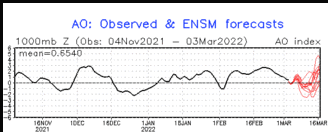
CPC shows the Arctic Oscillation waffling between positive and negative values, recently positive and forecasted to near neutral. Generally, positive AO signifies lower pressures over Arctic ice, with more cloud, lower insolation and less melting.  The outlook at this point is mixed.

September Minimum Outlook

Historically, where will ice be remaining when Arctic melting stops? Over the last 10 years, on average MASIE shows the annual minimum occurring about day 260. Of course in a given year, the daily minimum varies slightly a few days +/- from that.

For comparison, here are sea ice extents reported from 2007, 2012, 2014 and 2015 for day 260:

Arctic Regions 2007 2012 2014 2015
Central Arctic Sea 2.67 2.64 2.98 2.93
BCE 0.50 0.31 1.38 0.89
Greenland & CAA 0.56 0.41 0.55 0.46
Bits & Pieces 0.32 0.04 0.22 0.15
NH Total 4.05 3.40 5.13 4.44

Notes: Extents are in M km2.  BCE region includes Beaufort, Chukchi and Eastern Siberian seas. Greenland Sea (not the ice sheet). Canadian Arctic Archipelago (CAA).  Locations of the Bits and Pieces vary.

As the table shows, low NH minimums come mainly from ice losses in Central Arctic and BCE.  The great 2012 cyclone hit both in order to set the recent record. The recovery since 2012 shows in 2014, with some dropoff last year, mostly in BCE.

Summary

We are well into the melt season, and the resulting minimum will depend upon the vagaries of weather between now and September.  Early on, 2016 was slightly higher than 2015 in March, lower in May and now closing the gap. Note: 2016 melt season is starting without the Blob, with El Nino over, and a cold blob in the North Atlantic.  The AO has been hovering around neutral, now possibly indicating cloud cover reducing the pace of melting.

Meanwhile we can watch and appreciate the beauty of the changing ice conditions.


Arctic Reflection: Clouds replace snow and ice as solar reflector NASA photo

Footnote:  Regarding the colder than normal water in the North Atlantic

A 2016 article for EOS is entitled Atlantic Sea Ice Could Grow in the Next Decade

Changing ocean circulation in the North Atlantic could lead to winter sea ice coverage remaining steady and even growing in select regions.

The researchers analyzed simulations from the Community Earth System Model, modeling both atmosphere and ocean circulation. They found that decadal-scale trends in Arctic winter sea ice extent are largely explained by changes in ocean circulation rather than by large-scale external factors like anthropogenic warming.

From the Abstract of Yeager et al.

We present evidence that the extreme negative trends in Arctic winter sea-ice extent in the late 1990s were a predictable consequence of the preceding decade of persistent positive winter North Atlantic Oscillation (NAO) conditions and associated spin-up of the thermohaline circulation (THC). Initialized forecasts made with the Community Earth System Model decadal prediction system indicate that relatively low rates of North Atlantic Deep Water formation in recent years will result in a continuation of a THC spin-down that began more than a decade ago. Consequently, projected 10-year trends in winter Arctic winter sea-ice extent seem likely to be much more positive than has recently been observed, with the possibility of actual decadal growth in Atlantic sea-ice in the near future.

Radiation Myopia

A recent thread comment illustrates how the global warming PR campaign has installed a bogus climate paradigm in public awareness: The Supremacy of Infrared Radiation. In a discussion about clouds and the Arctic, this comment appeared:

I disagree with the comments that clouds at the poles should cause cooling.
In general the earth absorbs heat from the sun near the equator and expels it near the poles via up welling radiation. A low humidity clear sky near the poles allows most gray body radiation from the ice/oceans/land to emit directly to space. Clouds at the poles would interfere with that process and the poles would warm thus melting the ice faster. And in a general sense, that is what we’ve seen over the last 40 years. (linked to a graph of declining ice extent since 1979).

Heat Transfer Mechanisms

It takes some work to untangle the problems with this statement. Because it is true that earth’s climate system takes in solar energy mostly at the equator, which is then transported and expelled mostly at the poles. The myopia is in the notion that this is a purely radiative heat transfer. The misconception arises from confusing the view from the top of the atmosphere (TOA) with the view at the surface where we live. The TOA energy balance is purely radiative.  Incoming: Short Wave (SW) in, minus Outgoing: (SW) reflected/scattered out, and minus Long Wave (LW, mostly Infrared) emitted out.

Nearer the surface, the movement of energy is dominated by other more powerful heat transfers: Conduction (from warm to cool by direct contact), Convection (air moving from warm to cool objects) and Latent Heat (water changing phases from ice to liquid to gas and back again). These processes move massive amounts of energy upward from the surface toward the nearly absolute cold of space. IR active gases, mainly H2O and the minor trace gas CO2, do absorb and re-emit some LW energy, but at a scale orders of magnitude less.

Polar Heat Exchanges

The comment above attributes warming in the Arctic to the radiative properties of H20 in clouds. There is no claim that CO2 is a factor, since it acknowledges that clear dry skies offer no significant impediment to the cooling processes. But do water vapor and clouds delay cooling in the Arctic?

While it is true that moist air in the tropics makes for mild evenings after sundown, the Arctic situation differs. There is a short season when the summer sun shines, and most of the year is dark and extremely cold.

Most people fail to appreciate the huge heat losses at the Arctic pole. Mark Brandon has an excellent post on this at his wonderful blog, Mallemaroking.

By his calculations the sensible heat loss in Arctic winter ranges 200-400 Wm2.

The annual cycle of sensible heat flux from the ocean to the atmosphere for 4 different wind speeds.

As the diagram clearly shows, except for a short time in high summer, the energy flow is from the water heating the air. Transfers by latent heat are in addition to the above.

For a long time I misinterpreted the meaning of charts like the current one below from DMI:

meanT_2016DMI

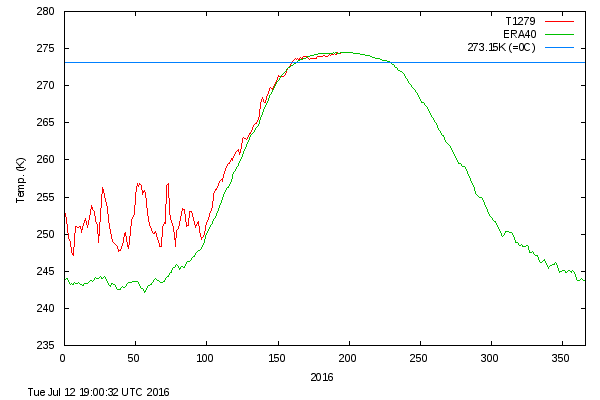
Those are air temperatures, and if they are above average, it means that the water is losing more heat than past normals. It’s not that warmer air causes ice melt, but the other way around: Oceans are always moving heat, and more open water means more heat loss into the air, resulting in higher air temperatures, though still way below zero most of the year.

For comparison, look at the same chart from 1977 when ice extent was much higher the entire year:

Summary

So if there is to be any warming effect on ice formation from clouds, it can only happen in peak summer, the precise time when their shading effect exceeds any radiative warming.  And the existence of clouds indicates moisture in the air which came from the ocean evaporating.

The myopic focus on radiation and air temperatures leads into a false analogy:  thinking the Arctic is a kind of refrigerator. I explained in some detail why this is not so:  Arctic Is Not a Refrigerator

If one wants to use the refrigerator analogy in relation to earth’s climate, at least do it correctly as Dr. Salby does:

From Physics of the Atmosphere and Climate, pg.82

A closed system that performs work through a conversion of heat that is absorbed by it is a heat engine. Conversely, a system that rejects heat through a conversion of work that is performed on it is a refrigerator.

In Chap. 6, we will see that individual air parcels comprising the circulation of the troposphere behave as a heat engine. By absorbing heat at the Earth’s surface, through transfers of radiative, sensible, and latent heat, individual parcels perform net work as they evolve through a thermodynamic cycle (2.13). Ultimately realized as kinetic energy, the heat absorbed maintains the circulation against frictional dissipation. It makes the circulation of the troposphere thermally driven.

In contrast, the circulation of the stratosphere behaves as a radiative refrigerator. For motion to occur, individual air parcels must have work performed on them. The kinetic energy produced is eventually converted to heat and rejected to space through LW cooling. It makes the circulation of the stratosphere mechanically driven. Gravity waves and planetary waves that propagate upward from the troposphere are dissipated in the stratosphere. Their absorption exerts an influence on the stratosphere analogous to paddle work. By forcing motion that rearranges air, it drives the stratospheric circulation out of radiative equilibrium, which results in net LW cooling to space.

Troposphere=Heat Engine

Stratosphere = Refrigerator


Average Arctic Melt July 7

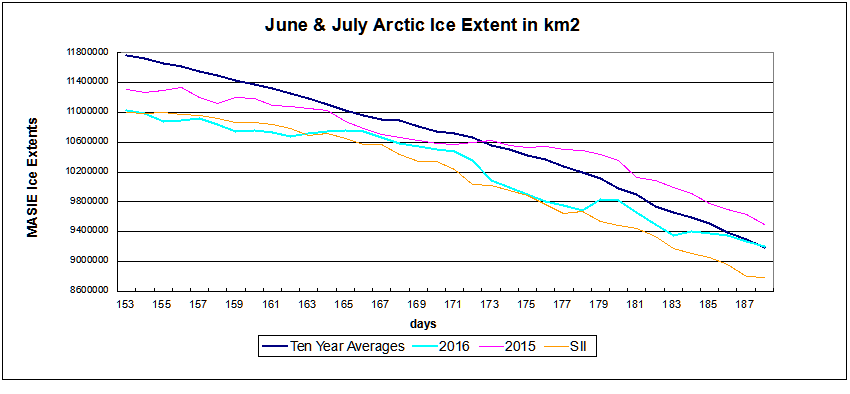
In the chart below MASIE shows 2016 Mid-June  Arctic ice extent drew near to average and close to 2015, then dropped lower before again converging on average by the end.  Now in July 2016 is matching the average extent measured over the last ten years, 2006-2015.  With SII back on line, it was reporting similar extents during June (as it has in the past).  Recently it is starting to underestimate again, ~400k km2 lower. (SII and MASIE comparison is here.)

MASIE 2016 day188

Looking into the details, some marginal seas are melting earlier than last year, while the central, enduring ice pack is relatively unaffected.  In fact, a large difference between 2016 and 2015 comes from the losses from maximums in a single place: Sea of Okhotsk.  To date 1303k km2 of ice was lost this year vs. 753k km2 lost in 2015 in that sea at the same date.

Despite greater losses in Okhotsk, 2016 ice extent in July is fairly ordinary with slight differences across the regions.  At the present pace of declining ice extents, the last three days 2016 matches the ten-year average, and is four days ahead of 2015.

Comparing the Arctic ice extents with their maximums shows the melting is occurring mostly in the marginal seas, now including Kara Sea as expected in June.  Most of the additional ice loss in July comes from Baffin and Hudson Bays.

2016188 NH Max Loss % Loss Sea Max % Total Loss
 (0) Northern_Hemisphere 5880825 39.00% 100%
 (1) Beaufort_Sea 243265 22.73% 4%
 (2) Chukchi_Sea 214347 22.19% 3%
 (3) East_Siberian_Sea 26723 2.46% 0%
 (4) Laptev_Sea 35559 3.96% 1%
 (5) Kara_Sea 648206 69.33% 10%
 (6) Barents_Sea 589137 98.29% 10%
 (7) Greenland_Sea 300055 45.48% 5%
 (8) Baffin_Bay_Gulf_of_St._Lawrence 1266759 77.03% 20%
 (9) Canadian_Archipelago 88793 10.41% 1%
 (10) Hudson_Bay 533623 42.32% 9%
 (11) Central_Arctic 80724 2.49% 1%
 (12) Bering_Sea 768232 100.00% 12%
 (13) Baltic_Sea 97582 100.00% 2%
 (14) Sea_of_Okhotsk 1306657 99.84% 21%

It is clear from the above that the bulk of ice losses are coming from Okhotsk, Barents and Bering Seas (95+% melted), along with Kara Sea and Baffin Bay-St. Lawrence (70+% melted).  Hudson  Bay has lost 42% of max extent.  All of them are marginal seas that will go down close to zero by September.  Note: Some seas are not at max on the NH max day.  Thus, totals from adding losses will vary from NH daily total.
For additional context on Arctic melt see last Arctic Ice Watch June 30


Arctic Ice Watch June 30

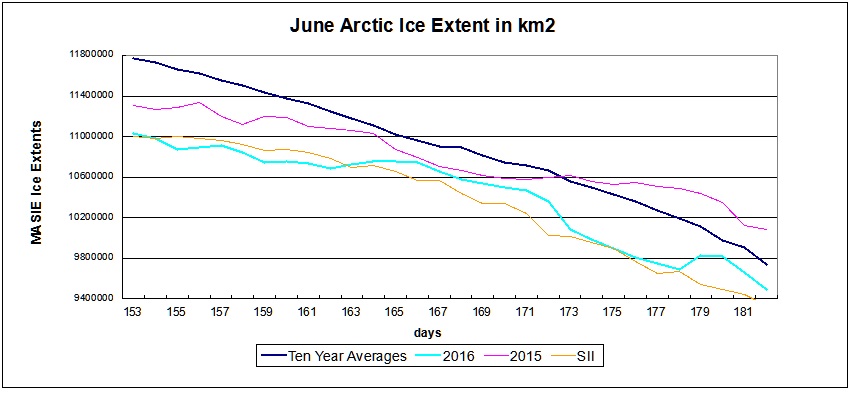
In the chart below MASIE shows 2016 Mid-June  Arctic ice extent drew near to average and close to 2015, then dropped lower before again converging on average by the end.  With SII back on line, it is reporting similar extents during June (as it has in the past), though it appears to start underestimating again. (SII and MASIE comparison is here.)

MASIE 2016 day182
This year and last had the same average extents until May when a gap opened up associated with the Beaufort gyre high winds breaking up and moving ice to create 150 k km2 open water in that sea. The difference in Beaufort Sea had reduced to ~45 k below average, but the gap has reopened the last 2 days to ~125 k.

Looking into the details, some marginal seas are melting earlier than last year, while the central, enduring ice pack is relatively unaffected.  In fact, a large difference between 2016 and 2015 comes from the losses from maximums in a single place: Sea of Okhotsk.  To date 1303k km2 of ice was lost this year vs. 753k km2 lost in 2015 in that sea at the same date.

Despite greater losses in Okhotsk, 2016 ice extent in June is fairly ordinary with slight differences across the regions.  At the present pace of declining ice extents, 2016 is running three days ahead of the ten-year average, and six days ahead of 2015.

US Navy predicts summer ice free Arctic by 2016 Greenpeace icebreaking ship, Arctic Sunrise, among broken floes of Arctic sea ice, photographed from the air. This image was taken in the Fram Strait. Good to see Greenpeace doing their bit to create more open water.

US Navy predicts summer ice free Arctic by 2016. Greenpeace icebreaking ship, Arctic Sunrise, among broken floes of Arctic sea ice, photographed from the air. This image was taken in the Fram Strait. Greenpeace doing their bit to create more open water.

As the chart below shows, the seas most down from average this year are Beaufort, Kara, Barents, and Greenland Sea.  Meanwhile higher extents are showing in Chukchi, East Siberian, Laptev, and Hudson Bay, resulting in 2016 below average.

Region 2016182 Day 182
Average
2016-Ave.
 (0) Northern_Hemisphere 9496516 9736362 -239846
 (1) Beaufort_Sea 792915 920245 -127329
 (2) Chukchi_Sea 775436 734342 41094
 (3) East_Siberian_Sea 1065714 1023242 42472
 (4) Laptev_Sea 863015 713555 149460
 (5) Kara_Sea 362414 561945 -199531
 (6) Barents_Sea 25988 110950 -84962
 (7) Greenland_Sea 367846 518951 -151105
 (8) Baffin_Bay_Gulf_of_St._Lawrence 465379 483472 -18093
 (9) Canadian_Archipelago 791274 774241 17033
 (10) Hudson_Bay 803437 658144 145293
 (11) Central_Arctic 3176041 3211595 -35554
 (12) Bering_Sea 0 6730 -6730
 (13) Baltic_Sea 0 6 -6
 (14) Sea_of_Okhotsk 5914 17526 -11612

Comparing the Arctic ice extents with their maximums shows the melting is occurring mostly in the marginal seas, now including Kara Sea as expected in June.

2016182 NH Max Loss % Loss Sea Max % Total Loss
 (0) Northern_Hemisphere 5581083 37.02% 100%
 (1) Beaufort_Sea 277530 25.93% 5%
 (2) Chukchi_Sea 190553 19.73% 3%
 (3) East_Siberian_Sea 21406 1.97% 0%
 (4) Laptev_Sea 34794 3.88% 1%
 (5) Kara_Sea 572574 61.24% 10%
 (6) Barents_Sea 573391 95.66% 10%
 (7) Greenland_Sea 291866 44.24% 5%
 (8) Baffin_Bay_Gulf_of_St._Lawrence 1179203 71.70% 20%
 (9) Canadian_Archipelago 61904 7.26% 1%
 (10) Hudson_Bay 457434 36.28% 8%
 (11) Central_Arctic 70669 2.18% 1%
 (12) Bering_Sea 768232 100.00% 13%
 (13) Baltic_Sea 97582 100.00% 2%
 (14) Sea_of_Okhotsk 1302782 99.55% 22%

It is clear from the above that the bulk of ice losses are coming from Okhotsk, Barents and Bering Seas (95+% melted),along with Kara Sea and Baffin Bay-St. Lawrence (60+% melted).  All of them are marginal seas that will go down close to zero by September.  Note: Some seas are not at max on the NH max day.  Thus, totals from adding losses will vary from NH daily total.

CPC shows the Arctic Oscillation waffling between positive and negative values, recently positive and forecasted to near neutral. Generally, positive AO signifies lower pressures over Arctic ice, with more cloud, lower insolation and less melting.  The outlook at this point is mixed.

September Minimum Outlook

Historically, where will ice be remaining when Arctic melting stops? Over the last 10 years, on average MASIE shows the annual minimum occurring about day 260. Of course in a given year, the daily minimum varies slightly a few days +/- from that.

For comparison, here are sea ice extents reported from 2007, 2012, 2014 and 2015 for day 260:

Arctic Regions 2007 2012 2014 2015
Central Arctic Sea 2.67 2.64 2.98 2.93
BCE 0.50 0.31 1.38 0.89
Greenland & CAA 0.56 0.41 0.55 0.46
Bits & Pieces 0.32 0.04 0.22 0.15
NH Total 4.05 3.40 5.13 4.44

Notes: Extents are in M km2.  BCE region includes Beaufort, Chukchi and Eastern Siberian seas. Greenland Sea (not the ice sheet). Canadian Arctic Archipelago (CAA).  Locations of the Bits and Pieces vary.

As the table shows, low NH minimums come mainly from ice losses in Central Arctic and BCE.  The great 2012 cyclone hit both in order to set the recent record. The recovery since 2012 shows in 2014, with some dropoff last year, mostly in BCE.

Summary

We are well into the melt season, and the resulting minimum will depend upon the vagaries of weather between now and September.  Early on, 2016 was slightly higher than 2015 in March, lower in May and now closing the gap. Note: 2016 melt season is starting without the Blob, with El Nino over, and a cold blob in the North Atlantic.  The AO has been hovering around neutral, now possibly indicating cloud cover reducing the pace of melting.

Meanwhile we can watch and appreciate the beauty of the changing ice conditions.


Arctic Reflection: Clouds replace snow and ice as solar reflector NASA photo

Footnote:  Regarding the colder than normal water in the North Atlantic

A 2016 article for EOS is entitled Atlantic Sea Ice Could Grow in the Next Decade

Changing ocean circulation in the North Atlantic could lead to winter sea ice coverage remaining steady and even growing in select regions.

The researchers analyzed simulations from the Community Earth System Model, modeling both atmosphere and ocean circulation. They found that decadal-scale trends in Arctic winter sea ice extent are largely explained by changes in ocean circulation rather than by large-scale external factors like anthropogenic warming.

From the Abstract of Yeager et al.

We present evidence that the extreme negative trends in Arctic winter sea-ice extent in the late 1990s were a predictable consequence of the preceding decade of persistent positive winter North Atlantic Oscillation (NAO) conditions and associated spin-up of the thermohaline circulation (THC). Initialized forecasts made with the Community Earth System Model decadal prediction system indicate that relatively low rates of North Atlantic Deep Water formation in recent years will result in a continuation of a THC spin-down that began more than a decade ago. Consequently, projected 10-year trends in winter Arctic winter sea-ice extent seem likely to be much more positive than has recently been observed, with the possibility of actual decadal growth in Atlantic sea-ice in the near future.

Typical Arctic Melting June 15

US Navy predicts summer ice free Arctic by 2016 Greenpeace icebreaking ship, Arctic Sunrise, among broken floes of Arctic sea ice, photographed from the air. This image was taken in the Fram Strait. Good to see Greenpeace doing their bit to create more open water.

US Navy predicts summer ice free Arctic by 2016. Greenpeace icebreaking ship, Arctic Sunrise, among broken floes of Arctic sea ice, photographed from the air. This image was taken in the Fram Strait. Greenpeace doing their bit to create more open water.

In the chart below MASIE shows June  Arctic ice extent has drawn nearer average and close to 2015 at this point in the year.

MASIE 2016 day166
This year and last had the same average extents until May when a gap opened up associated with the Beaufort gyre high winds breaking up and moving ice to create 150k km2 open water in that sea. The difference in Beaufort Sea is now ~40k km2 between 2016 and 2015.

Looking into the details, some marginal seas are melting earlier than last year, while the central, enduring ice pack is relatively unaffected.  In fact, a large difference between 2016 and 2015 comes from the losses from maximums in a single place: Sea of Okhotsk:  To date 1275k km2 of ice lost this year vs. 740k km2 lost in 2015 in that sea at the same date.

Despite greater losses in Okhotsk, 2016 ice extent in June is nearly typical with slight differences across the regions.  At the present pace of declining ice extents, 2016 is virtually tied with 2015 and running four days ahead of the ten-year average.

As the chart below shows, the seas down most this year include Beaufort, Barents, Greenland Sea, and Baffin Bay.  Meanwhile higher extents are showing in Chukchi, Kara, Laptev and Hudson Bay, resulting in 2016 only slightly below 2015 overall.  The Central Arctic Sea is slightly above 2015.

Ice Extents Ice Extent
Region 2015166 2016166 km2 Diff.
 (0) Northern_Hemisphere 10791329 10749626 -41703
 (1) Beaufort_Sea 948114 906972 -41142
 (2) Chukchi_Sea 747954 836166 88212
 (3) East_Siberian_Sea 1084037 1084831 794
 (4) Laptev_Sea 825271 890792 65522
 (5) Kara_Sea 602369 674328 71959
 (6) Barents_Sea 170125 76864 -93261
 (7) Greenland_Sea 613376 532214 -81162
 (8) Baffin_Bay_Gulf_of_St._Lawrence 776625 649408 -127218
 (9) Canadian_Archipelago 790324 803589 13265
 (10) Hudson_Bay 988976 1029192 40216
 (11) Central_Arctic 3200053 3221196 21144
 (12) Bering_Sea 3875 9080 5205
 (13) Baltic_Sea 0 33 33
 (14) Sea_of_Okhotsk 39088 33819 -5269

Comparing the Arctic ice extents with their maximums shows the melting is occurring mostly in the marginal seas, as expected in June.

2016166 NH Max Loss % Loss Sea Max % Total Loss
 (0) Northern_Hemisphere 4327974 28.70% 100%
 (1) Beaufort_Sea 163473 15.27% 3%
 (2) Chukchi_Sea 129823 13.44% 3%
 (3) East_Siberian_Sea 2289 0.21% 0%
 (4) Laptev_Sea 7017 0.78% 0%
 (5) Kara_Sea 260660 27.88% 6%
 (6) Barents_Sea 522515 87.18% 11%
 (7) Greenland_Sea 127498 19.33% 3%
 (8) Baffin_Bay_Gulf_of_St._Lawrence 995175 60.51% 21%
 (9) Canadian_Archipelago 49590 5.81% 1%
 (10) Hudson_Bay 231679 18.37% 5%
 (11) Central_Arctic 25514 0.79% 1%
 (12) Bering_Sea 759152 98.82% 16%
 (13) Baltic_Sea 97549 99.97% 2%
 (14) Sea_of_Okhotsk 1274877 97.42% 27%

Note: Some seas are not at max on the NH max day.  Thus, totals from adding losses will vary from NH daily total.

It is clear from the above that the bulk of ice losses are coming from Okhotsk, Barents and Bering Seas, along with Baffin Bay-St. Lawrence; all of them are marginal seas that will go down close to zero by September, and only Baffin has more than 12% of its ice left.

CPC shows the Arctic Oscillation waffling between positive and negative values, now forecasted to go positive. Generally, positive AO signifies lower pressures over Arctic ice, with more cloud, lower insolation and less melting.  The outlook at this point is mixed.

September Minimum Outlook

Historically, where will ice be remaining when Arctic melting stops? Over the last 10 years, on average MASIE shows the annual minimum occurring about day 260. Of course in a given year, the daily minimum varies slightly a few days +/- from that.

For comparison, here are sea ice extents reported from 2007, 2012, 2014 and 2015 for day 260:

Arctic Regions 2007 2012 2014 2015
Central Arctic Sea 2.67 2.64 2.98 2.93
BCE 0.50 0.31 1.38 0.89
Greenland & CAA 0.56 0.41 0.55 0.46
Bits & Pieces 0.32 0.04 0.22 0.15
NH Total 4.05 3.40 5.13 4.44

Notes: Extents are in M km2.  BCE region includes Beaufort, Chukchi and Eastern Siberian seas. Greenland Sea (not the ice sheet). Canadian Arctic Archipelago (CAA).  Locations of the Bits and Pieces vary.

As the table shows, low NH minimums come mainly from ice losses in Central Arctic and BCE.  The great 2012 cyclone hit both in order to set the recent record. The recovery since 2012 shows in 2014, with some dropoff last year, mostly in BCE.

Summary

We are well into the melt season, and the resulting minimum will depend upon the vagaries of weather between now and September.  Early on, 2016 was slightly higher than 2015 in March, lower in May and now closing the gap. Note: 2016 melt season is starting without the Blob, with El Nino over, and a cold blob in the North Atlantic.  The AO has been hovering around neutral, now possibly indicating cloud cover reducing the pace of melting.

Meanwhile we can watch and appreciate the beauty of the changing ice conditions.


Arctic Reflection: Clouds replace snow and ice as solar reflector NASA photo

Footnote:  Regarding the colder than normal water in the North Atlantic

A 2016 article for EOS is entitled Atlantic Sea Ice Could Grow in the Next Decade

Changing ocean circulation in the North Atlantic could lead to winter sea ice coverage remaining steady and even growing in select regions.

The researchers analyzed simulations from the Community Earth System Model, modeling both atmosphere and ocean circulation. They found that decadal-scale trends in Arctic winter sea ice extent are largely explained by changes in ocean circulation rather than by large-scale external factors like anthropogenic warming.

From the Abstract of Yeager et al.

We present evidence that the extreme negative trends in Arctic winter sea-ice extent in the late 1990s were a predictable consequence of the preceding decade of persistent positive winter North Atlantic Oscillation (NAO) conditions and associated spin-up of the thermohaline circulation (THC). Initialized forecasts made with the Community Earth System Model decadal prediction system indicate that relatively low rates of North Atlantic Deep Water formation in recent years will result in a continuation of a THC spin-down that began more than a decade ago. Consequently, projected 10-year trends in winter Arctic winter sea-ice extent seem likely to be much more positive than has recently been observed, with the possibility of actual decadal growth in Atlantic sea-ice in the near future.
So-So Arctic Melting May 31


Arctic scientists examining sea ice and melt ponds in the Chukchi Sea in high north. NASA photo.

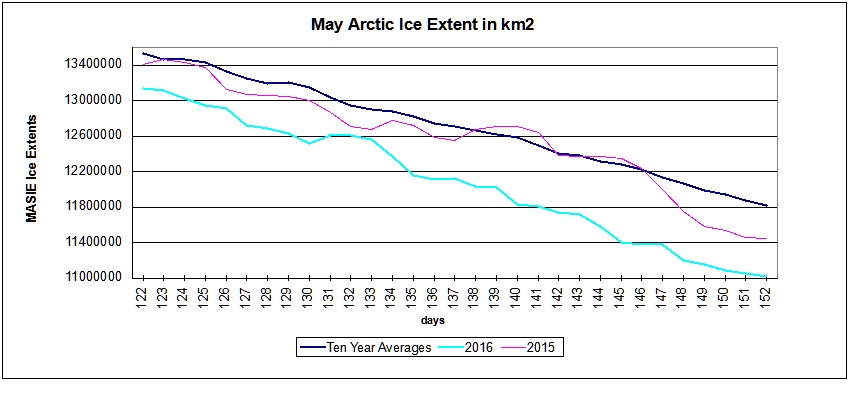
In the chart below MASIE shows May Arctic ice extent is below average and lower than 2015 at this point in the year.

MASIE 2016 day152

Comparing the first 5 months of the melt season shows why 2016 so far is a so-so melt season, meaning not very good, not very bad; or same old, same old if you prefer.

Monthly 2016 2015 2016-2015
Averages MASIE MASIE MASIE
Jan 13.922 13.941 -0.019
Feb 14.804 14.683 0.121
Mar 14.769 14.668 0.101
Apr 13.917 14.121 -0.204
May 12.086 12.646 -0.560
YTD Ave. 13.900 14.012 -0.112

Until May, the two years had the same average extents.

Looking into the details, the difference arises from some marginal seas melting earlier than last year, while the central, enduring ice pack is relatively unaffected.  In fact, the overall difference between 2016 and 2015 is similar to comparable losses from maximums in a single place: Sea of Okhotsk:  To date 1231k km2 of ice lost this year vs. 696k km2 lost in 2015 in that sea at the same date.

Ice Extents Ice Extent
Region 2015152 2016152 km2 Diff.
 (0) Northern_Hemisphere 11451596 11019134 -432462
 (1) Beaufort_Sea 964315 826699 -137616
 (2) Chukchi_Sea 842142 851939 9797
 (3) East_Siberian_Sea 1079340 1067698 -11641
 (4) Laptev_Sea 866996 879446 12450
 (5) Kara_Sea 765985 805737 39752
 (6) Barents_Sea 249999 79548 -170451
 (7) Greenland_Sea 536081 515701 -20380
 (8) Baffin_Bay_Gulf_of_St._Lawrence 1015753 863421 -152333
 (9) Canadian_Archipelago 806783 814863 8080
 (10) Hudson_Bay 1005981 1040263 34282
 (11) Central_Arctic 3219508 3131102 -88406
 (12) Bering_Sea 14523 61632 47108
 (13) Baltic_Sea 0 1441 1441
 (14) Sea_of_Okhotsk 82806 78103 -4703

Of interest this year is the Beaufort Gyre cranking up ten days into May, compacting ice and reducing extent by about 150k km2, and putting the loss there ahead of last year.  As Susan Crockford points out (here), this is not melting but ice breaking up and moving. Of course, warmists predict that will result in more melting later on, which remains to be seen. In any case, Beaufort extent is down 23% from its max, which amounts to 5% of losses from all Arctic seas so far.

Comparing the Arctic ice extents with their maximums shows the melting is occurring mostly in the marginal seas, as expected in May.

2016152 NH Max Loss % Loss Sea Max % Total Loss
 (0) Northern_Hemisphere 4058466 26.92% 100%
 (1) Beaufort_Sea 243746 22.77% 5%
 (2) Chukchi_Sea 114050 11.81% 3%
 (3) East_Siberian_Sea 19422 1.79% 0%
 (4) Laptev_Sea 18363 2.05% 0%
 (5) Kara_Sea 129252 13.82% 3%
 (6) Barents_Sea 519831 86.73% 12%
 (7) Greenland_Sea 144011 21.83% 3%
 (8) Baffin_Bay_Gulf_of_St._Lawrence 781161 47.50% 18%
 (9) Canadian_Archipelago 38316 4.49% 1%
 (10) Hudson_Bay 220608 17.50% 5%
 (11) Central_Arctic 115608 3.56% 3%
 (12) Bering_Sea 706600 91.98% 16%
 (13) Baltic_Sea 96141 98.52% 2%
 (14) Sea_of_Okhotsk 1230594 94.03% 28%

Note: Some seas are not at max on the NH max day.  Thus, totals from adding losses will vary from NH daily total.

It is clear from the above that the bulk of ice losses are coming from Okhotsk, Barents and Bering Seas, along with Baffin Bay-St. Lawrence; all of them are marginal seas that will go down close to zero by September, and only Baffin has more than 15% of its ice left. The entire difference between 2016 and 2015 arises from Okhotsk starting with about 500k km2 more ice this year, and arriving at this date virtually tied with 2015.

CPC shows the Arctic Oscillation waffling between positive and negative values, recently negative and forecasted to rise back toward neutral. Generally, negative AO signifies higher pressures over Arctic ice, with less cloud, higher insolation and more melting.  The outlook at this point is mixed.

ao-fcst

The first panel shows the observed AO index (black line) plus forecasted AO indices from each of the 11 GFS ensemble members starting from the last day of the observations (red lines). From NOAA Climate Prediction Center

September Minimum Outlook

Historically, where will ice be remaining when Arctic melting stops? Over the last 10 years, on average MASIE shows the annual minimum occurring about day 260. Of course in a given year, the daily minimum varies slightly a few days +/- from that.

For comparison, here are sea ice extents reported from 2007, 2012, 2014 and 2015 for day 260:

Arctic Regions 2007 2012 2014 2015
Central Arctic Sea 2.67 2.64 2.98 2.93
BCE 0.50 0.31 1.38 0.89
Greenland & CAA 0.56 0.41 0.55 0.46
Bits & Pieces 0.32 0.04 0.22 0.15
NH Total 4.05 3.40 5.13 4.44

Notes: Extents are in M km2.  BCE region includes Beaufort, Chukchi and Eastern Siberian seas. Greenland Sea (not the ice sheet). Canadian Arctic Archipelago (CAA).  Locations of the Bits and Pieces vary.

As the table shows, low NH minimums come mainly from ice losses in Central Arctic and BCE.  The great 2012 cyclone hit both in order to set the recent record. The recovery since 2012 shows in 2014, with some dropoff last year, mostly in BCE.

Summary

We are only beginning the melt season, and the resulting minimum will depend upon the vagaries of weather between now and September.  At the moment, 2016 was slightly higher than 2015 in March, and is now trending toward a lower May extent.  OTOH 2016 melt season is starting without the Blob, with a declining El Nino, and a cold blob in the North Atlantic.  The AO hovering around neutral, giving no direction whether cloud cover will reduce the pace of melting or not.

A so-so year is like a glass half full or half empty.  If you are hoping for an Arctic ice decline, 2016 so far is good, but not very.  If you want Arctic ice to hold steady, the year is bad, but not very.

Meanwhile we can watch and appreciate the beauty of the changing ice conditions.

8068809257_23359afc39_z

Arctic Sunset Chukchi Sea Ice Wrangel Island UNESCO World Heritage Site Russia

Arctic Marginal Ice Melting May 15

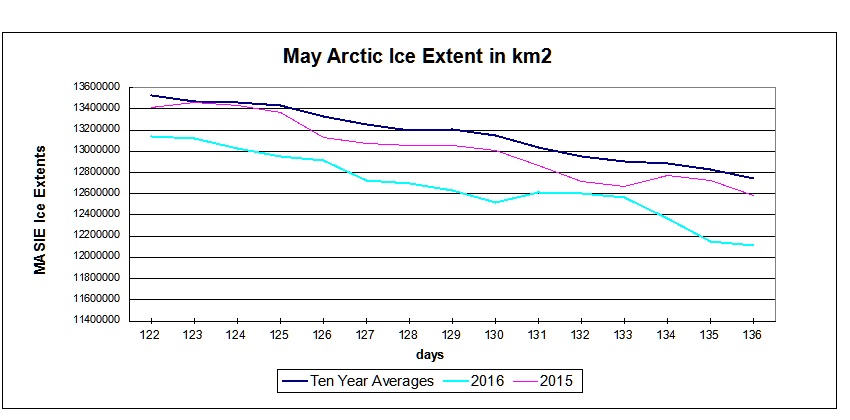
In the chart below MASIE shows Arctic ice extent is below average and lower than 2015 at this point in the year.

MASIE 2016 day136

Looking into the details, it is clear that the marginal seas are melting earlier than last year, while the central ice pack is holding steady.

Ice Extents Ice Extent
Region 2015136 2016136 km2 Diff.
 (0) Northern_Hemisphere 12585032 12116610 -468423
 (1) Beaufort_Sea 1033428 942536 -90892
 (2) Chukchi_Sea 930045 933354 3309
 (3) East_Siberian_Sea 1087137 1087120 -17
 (4) Laptev_Sea 897845 897809 -36
 (5) Kara_Sea 899673 864423 -35250
 (6) Barents_Sea 337707 222091 -115616
 (7) Greenland_Sea 615714 575320 -40395
 (8) Baffin_Bay_Gulf_of_St._Lawrence 1201099 1015356 -185743
 (9) Canadian_Archipelago 833900 830174 -3726
 (10) Hudson_Bay 1175953 1185893 9940
 (11) Central_Arctic 3237268 3198923 -38345
 (12) Bering_Sea 153646 160277 6630
 (13) Baltic_Sea 66 2839 2774
 (14) Sea_of_Okhotsk 180119 198519 18400

Another difference this year is the Beaufort Gyre cranking up ten days ago, compacting ice and reducing extent by about 150k km2, and putting the loss ahead of last year.  As Susan Crockford points out (here), this is not melting but ice breaking up and moving. Of course, warmists predict that will result in more melting later on, which remains to be seen. In any case, Beaufort extent is down 12% from max, which amounts to 1% of the NH ice loss so far.

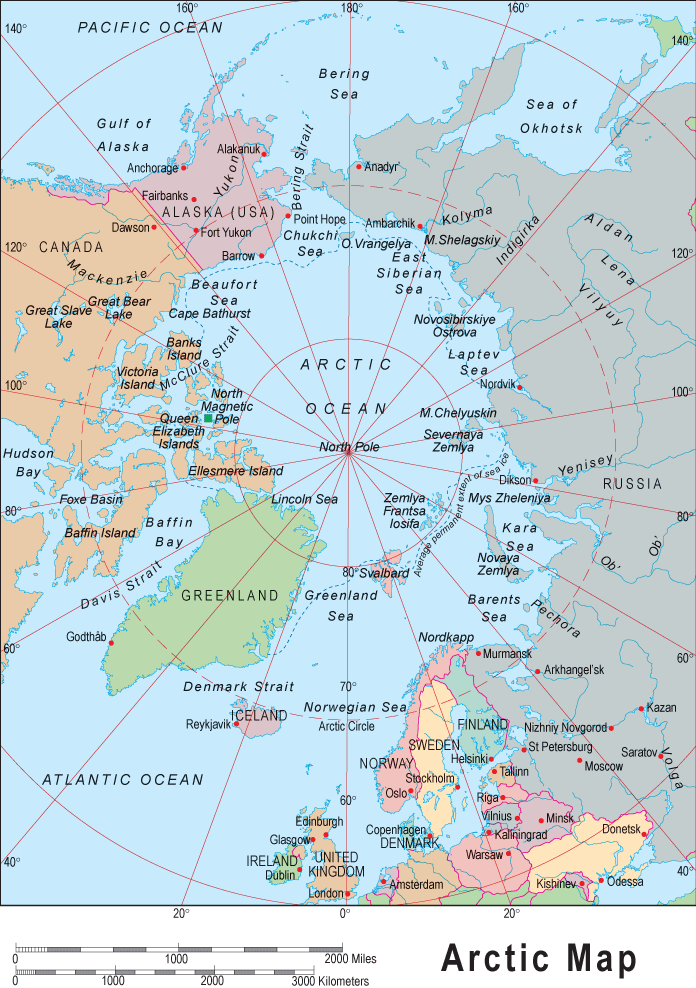
arctic-map

Comparing the Arctic seas extents with their maximums shows the melting at the margins:

2016136 NH Max Loss % Loss Sea Max % NH Loss
 (0) Northern_Hemisphere 2960990 19.64%
 (1) Beaufort_Sea 127909 11.95% 1%
 (2) Chukchi_Sea 32636 3.38% 0%
 (3) East_Siberian_Sea 0 0.00% 0%
 (4) Laptev_Sea 0 0.00% 0%
 (5) Kara_Sea 70565 7.55% 0%
 (6) Barents_Sea 377288 62.95% 3%
 (7) Greenland_Sea 84393 12.79% 1%
 (8) Baffin_Bay_Gulf_of_St._Lawrence 629226 38.26% 4%
 (9) Canadian_Archipelago 23004 2.70% 0%
 (10) Hudson_Bay 74977 5.95% 1%
 (11) Central_Arctic 47787 1.47% 0%
 (12) Bering_Sea 607955 79.14% 4%
 (13) Baltic_Sea 94743 97.09% 1%
 (14) Sea_of_Okhotsk 1110178 84.83% 8%

It is clear from the above that the bulk of ice losses are coming from Okhotsk, Barents and Bering Seas, along with Baffin Bay-St. Lawrence; all of them are marginal seas that will go down close to zero by September.  The entire difference between 2016 and 2015 arises from Okhotsk starting with about 500k km2 more ice this year, and arriving at this date virtually tied with 2015.

Note: Some seas are not at max on the NH max day.  Thus, totals from adding losses will vary from NH daily total.

AER says this about the Arctic Oscillation (AO):

Currently, the AO is negative and is predicted to slowly trend towards neutral (Figure 1). The current negative AO is reflective of positive geopotential height anomalies across much of the Arctic, especially the North Atlantic side and mostly negative geopotential height anomalies across the mid-latitudes.

September Minimum Outlook

Historically, where will ice be remaining when Arctic melting stops? Over the last 10 years, on average MASIE shows the annual minimum occurring about day 260. Of course in a given year, the daily minimum varies slightly a few days +/- from that.

For comparison, here are sea ice extents reported from 2007, 2012, 2014 and 2015 for day 260:

Arctic Regions 2007 2012 2014 2015
Central Arctic Sea 2.67 2.64 2.98 2.93
BCE 0.50 0.31 1.38 0.89
Greenland & CAA 0.56 0.41 0.55 0.46
Bits & Pieces 0.32 0.04 0.22 0.15
NH Total 4.05 3.40 5.13 4.44

Notes: Extents are in M km2.  BCE region includes Beaufort, Chukchi and Eastern Siberian seas. Greenland Sea (not the ice sheet). Canadian Arctic Archipelago (CAA).  Locations of the Bits and Pieces vary.

As the table shows, low NH minimums come mainly from ice losses in Central Arctic and BCE.  The great 2012 cyclone hit both in order to set the recent record. The recovery since 2012 shows in 2014, with some dropoff last year, mostly in BCE.

Summary

We are only beginning the melt season, and the resulting minimum will depend upon the vagaries of weather between now and September.  At the moment, 2016 was slightly higher than 2015 in March, and is now trending toward a lower May extent.  OTOH 2016 melt season is starting without the Blob, with a declining El Nino, and a cold blob in the North Atlantic.  The AO is presently neutral, giving no direction whether cloud cover will reduce the pace of melting or not.  Meanwhile we can watch and appreciate the beauty of the changing ice conditions.

Waves and sea ice in the Arctic marginal zone.


Arctic Warming Unalarming

Locations of arctic stations examined in this study

Locations of arctic stations examined in this study

An recent extensive analysis of Northern surface temperature records gives no support for Arctic “amplification” fears.

The Arctic has warmed at the same rate as Europe over the past two centuries. Heretofore, it has been supposed that any global warming would be amplified in the Arctic. This may still be true if urban heat island effects are responsible for part of the observed temperature increase at European stations. However, European and Arctic temperatures have remained closely synchronized for over 200 years during the rapid growth of urban centres.

And the warming pattern in Europe and the Arctic is familiar and unalarming.

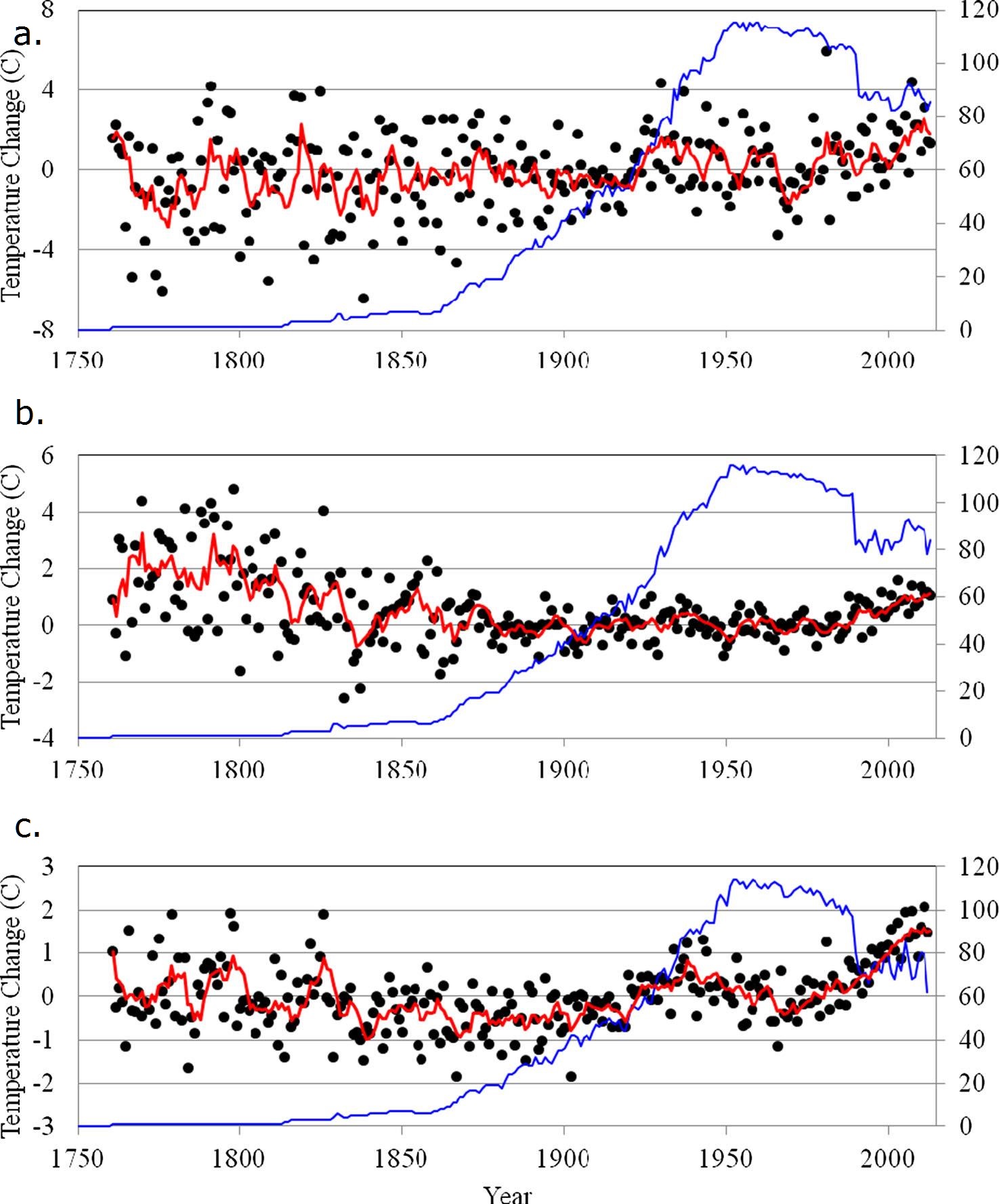
Arctic temperatures have increased during the period 1820– 2014. The warming has been larger in January than in July. Siberia, Alaska and Western Canada appear to have warmed slightly more than Eastern Canada, Greenland, Iceland and Northern Europe. The warming has not occurred at a steady rate. Much of the warming trends found during 1820 to 2014 occurred in the late 1990s, and the data show temperatures levelled off after 2000. The July temperature trend is even slightly negative for the period 1820–1990. The time series exhibit multidecadal temperature fluctuations which have also been found by other temperature reconstructions.

The paper is:

Arctic temperature trends from the early nineteenth century to the present W. A. van Wijngaarden, Theoretical & Applied Climatology (2015) here

Temperatures were examined at 118 stations located in the Arctic and compared to observations at 50 European stations whose records averaged 200 years and in a few cases extend to the early 1700s.

Fig. 3 Temperature change for a January, b July and c annual relative to the temperature during 1961 to 1990 for Arctic stations. The red curve is the moving 5-year average while the blue curve is the number of stations

Fig. 3 Temperature change for a January, b July and c annual relative to the temperature during 1961 to 1990 for Arctic stations. The red curve is the moving 5-year average while the blue curve is the number of stations

Summary

The data and results for all stations are provided in detail, and the findings are inescapable.

The Arctic has warmed at the same rate as Europe over the past two centuries. . . The warming has not occurred at a steady rate. . .During the 1900s, all four (Arctic) regions experienced increasing temperatures until about 1940. Temperatures then decreased by about 1 °C over the next 50 years until rising in the 1990s.

For the period 1820–2014, the trends for the January, July and annual temperatures are 1.0, 0.0 and 0.7 °C per century, respectively. . . Much of the warming trends found during 1820 to 2014 occurred in the late 1990s, and the data show temperatures levelled off after 2000.

Once again conclusions based on observations are ignored while projections from models are broadcast and circulated like gossip. The only amplification going on is the promotion of global warming alarms.

megaphone

Footnote: I did a study last year of 25 World Class surface temperature records (all European) and found the same patterns (here).

Arctic Mayday? Not

On May1, we have the complete Arctic ice extent record for April 2016.  So we can look at how the melt season is progressing. As you can see, the ice is down a little, but no reason to put out a distress signal.

These are results from MASIE, the most accurate dataset. SII from NOAA is shown with the data available as of today. Clearly, SII is having unresolved technical difficulties, and April stats are NA.

MASIE shows 2016 less than the ten-year average and slightly less than last year at end of April. 2016 average for April is about 200k km2 less than 2015, exactly offsetting the surpluses of ice in February and March.

Here is how the melting is occurring in the various Arctic seas.

April 30, 2016 day 121 km2 loss % loss
 (0) Northern_Hemisphere 1774019 11.77%
 (6) Barents_Sea 250990 41.87%
 (8) Baffin_Bay_Gulf_of_St._Lawrence 461154 28.04%
 (12) Bering_Sea 432513 56.30%
 (13) Baltic_Sea 76897 78.80%
 (14) Sea_of_Okhotsk 800810 61.19%

The losses are the difference from the recorded maximums. All other seas are at or more than 96% of max.

Since some seas are not at max on the day of NH max, adding losses from individual seas will vary from the NH total.

So May starts with this year and last in similar overall positions. However, the details are different. Here is the two Day 121 extents compared.

Ice Extents 2015 2016 Ice Extent
Region 2015121 2016121 km2 Diff.
 (0) Northern_Hemisphere 13369057 13303581  -65476
 (1) Beaufort_Sea 1070445 1070445 0
 (2) Chukchi_Sea 965922 965989 67
 (3) East_Siberian_Sea 1086657 1087120 463
 (4) Laptev_Sea 897845 897809 -36
 (5) Kara_Sea 934122 904700 -29422
 (6) Barents_Sea 441590 348389 -93201
 (7) Greenland_Sea 583660 633443 49783
 (8) Baffin_Bay_Gulf_of_St._Lawrence 1329843 1183429 -146415
 (9) Canadian_Archipelago 853214 853178 -36
 (10) Hudson_Bay 1230587 1254066 23479
 (11) Central_Arctic 3240913 3238746 -2167
 (12) Bering_Sea 401377 335719 -65658
 (13) Baltic_Sea 4407 20686 16279
 (14) Sea_of_Okhotsk 326536 507886 181351

The table shows a small overall difference of 65k km2. The losses are principally in Bering, Barents and Baffin bay, offset by surpluses in Okhotsk and Greenland Seas. So far the main locations of persistent ice are showing no signs of melting: BCE, Central Arctic and CAA (Canadian Arctic Archipelago).

Summary

Arctic ice is melting as it normally does in April, and no one knows what will happen in May and afterwards.  Stay tuned.

Premature Reports of Ice Death

“The reports of my death are greatly exaggerated.” Mark Twain

Lots of stories predicting (hoping) that Arctic ice will go lower than 2012 and resuscitate the  Arctic “death spiral”.  And we can surely predict that Peter Wadhams will predict a September Arctic minimum of 1M km2, as he does every year.

But there’s a long way to go before then, and some historical context is in order.

September Minimum Outlook
Historically, where will ice be remaining when Arctic melting stops? Over the last 10 years, on average MASIE shows the annual minimum occurring about day 260. Of course in a given year, the daily minimum varies slightly a few days +/- from that.

For comparison, here are sea ice extents reported from 2007, 2012, 2014 and 2015 for day 260:

Arctic Regions 2007 2012 2014 2015
Central Arctic Sea 2.67 2.64 2.98 2.93
BCE 0.50 0.31 1.38 0.89
Greenland & CAA 0.56 0.41 0.55 0.46
Bits & Pieces 0.32 0.04 0.22 0.15
NH Total 4.05 3.40 5.13 4.44

Notes: Extents are in M km2.  BCE region includes Beaufort, Chukchi and Eastern Siberian seas. Greenland Sea (not the ice sheet). Canadian Arctic Archipelago (CAA).  Locations of the Bits and Pieces vary.

As the table shows, low NH extents come mainly from ice losses in Central Arctic and BCE.  The great 2012 cyclone hit both in order to set the recent record. The recovery since 2012 shows in 2014, with some dropoff last year, mostly in BCE.

Summary

We are only beginning the melt season, and the resulting minimum will depend upon the vagaries of weather between now and September.  At the moment, 2016 was slightly higher than 2015 in March and is trending toward a similar April extent.  Also 2016 melt season is starting without the Blob, with a declining El Nino, and a cold blob in the North Atlantic.  It is too early to put Arctic Ice on life support. Meanwhile we can watch and appreciate the beauty of the changing ice conditions.