So-So Arctic Melting May 31


Arctic scientists examining sea ice and melt ponds in the Chukchi Sea in high north. NASA photo.

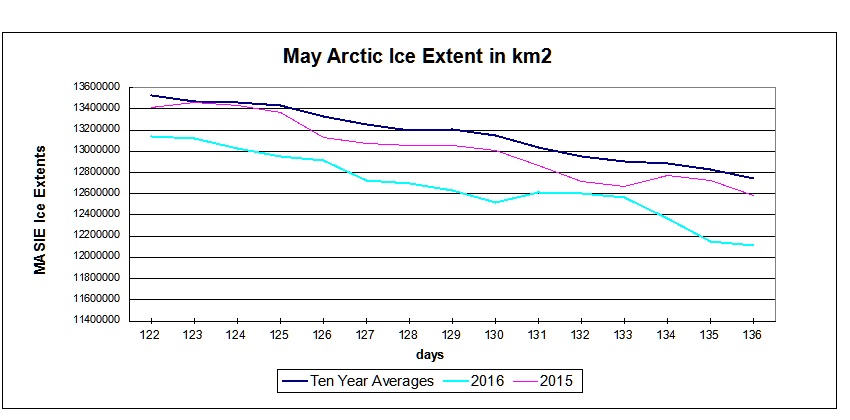
In the chart below MASIE shows May Arctic ice extent is below average and lower than 2015 at this point in the year.
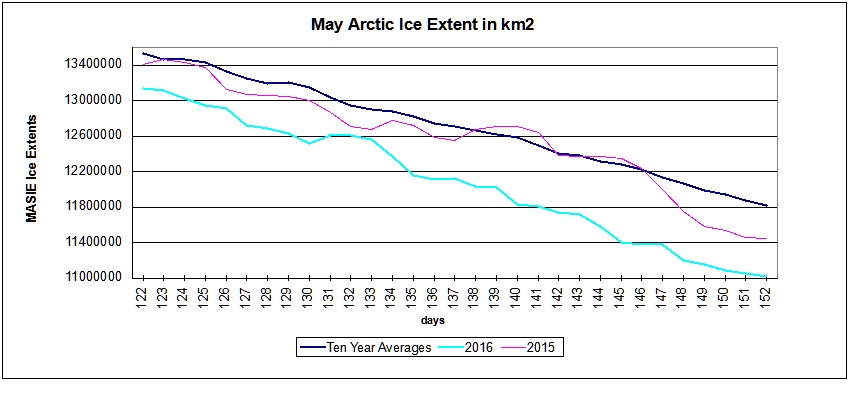
MASIE 2016 day152

Comparing the first 5 months of the melt season shows why 2016 so far is a so-so melt season, meaning not very good, not very bad; or same old, same old if you prefer.

Monthly 2016 2015 2016-2015
Averages MASIE MASIE MASIE
Jan 13.922 13.941 -0.019
Feb 14.804 14.683 0.121
Mar 14.769 14.668 0.101
Apr 13.917 14.121 -0.204
May 12.086 12.646 -0.560
YTD Ave. 13.900 14.012 -0.112

Until May, the two years had the same average extents.

Looking into the details, the difference arises from some marginal seas melting earlier than last year, while the central, enduring ice pack is relatively unaffected.  In fact, the overall difference between 2016 and 2015 is similar to comparable losses from maximums in a single place: Sea of Okhotsk:  To date 1231k km2 of ice lost this year vs. 696k km2 lost in 2015 in that sea at the same date.

Ice Extents Ice Extent
Region 2015152 2016152 km2 Diff.
 (0) Northern_Hemisphere 11451596 11019134 -432462
 (1) Beaufort_Sea 964315 826699 -137616
 (2) Chukchi_Sea 842142 851939 9797
 (3) East_Siberian_Sea 1079340 1067698 -11641
 (4) Laptev_Sea 866996 879446 12450
 (5) Kara_Sea 765985 805737 39752
 (6) Barents_Sea 249999 79548 -170451
 (7) Greenland_Sea 536081 515701 -20380
 (8) Baffin_Bay_Gulf_of_St._Lawrence 1015753 863421 -152333
 (9) Canadian_Archipelago 806783 814863 8080
 (10) Hudson_Bay 1005981 1040263 34282
 (11) Central_Arctic 3219508 3131102 -88406
 (12) Bering_Sea 14523 61632 47108
 (13) Baltic_Sea 0 1441 1441
 (14) Sea_of_Okhotsk 82806 78103 -4703

Of interest this year is the Beaufort Gyre cranking up ten days into May, compacting ice and reducing extent by about 150k km2, and putting the loss there ahead of last year.  As Susan Crockford points out (here), this is not melting but ice breaking up and moving. Of course, warmists predict that will result in more melting later on, which remains to be seen. In any case, Beaufort extent is down 23% from its max, which amounts to 5% of losses from all Arctic seas so far.

Comparing the Arctic ice extents with their maximums shows the melting is occurring mostly in the marginal seas, as expected in May.

2016152 NH Max Loss % Loss Sea Max % Total Loss
 (0) Northern_Hemisphere 4058466 26.92% 100%
 (1) Beaufort_Sea 243746 22.77% 5%
 (2) Chukchi_Sea 114050 11.81% 3%
 (3) East_Siberian_Sea 19422 1.79% 0%
 (4) Laptev_Sea 18363 2.05% 0%
 (5) Kara_Sea 129252 13.82% 3%
 (6) Barents_Sea 519831 86.73% 12%
 (7) Greenland_Sea 144011 21.83% 3%
 (8) Baffin_Bay_Gulf_of_St._Lawrence 781161 47.50% 18%
 (9) Canadian_Archipelago 38316 4.49% 1%
 (10) Hudson_Bay 220608 17.50% 5%
 (11) Central_Arctic 115608 3.56% 3%
 (12) Bering_Sea 706600 91.98% 16%
 (13) Baltic_Sea 96141 98.52% 2%
 (14) Sea_of_Okhotsk 1230594 94.03% 28%

Note: Some seas are not at max on the NH max day.  Thus, totals from adding losses will vary from NH daily total.

It is clear from the above that the bulk of ice losses are coming from Okhotsk, Barents and Bering Seas, along with Baffin Bay-St. Lawrence; all of them are marginal seas that will go down close to zero by September, and only Baffin has more than 15% of its ice left. The entire difference between 2016 and 2015 arises from Okhotsk starting with about 500k km2 more ice this year, and arriving at this date virtually tied with 2015.

CPC shows the Arctic Oscillation waffling between positive and negative values, recently negative and forecasted to rise back toward neutral. Generally, negative AO signifies higher pressures over Arctic ice, with less cloud, higher insolation and more melting.  The outlook at this point is mixed.

ao-fcst

The first panel shows the observed AO index (black line) plus forecasted AO indices from each of the 11 GFS ensemble members starting from the last day of the observations (red lines). From NOAA Climate Prediction Center

September Minimum Outlook

Historically, where will ice be remaining when Arctic melting stops? Over the last 10 years, on average MASIE shows the annual minimum occurring about day 260. Of course in a given year, the daily minimum varies slightly a few days +/- from that.

For comparison, here are sea ice extents reported from 2007, 2012, 2014 and 2015 for day 260:

Arctic Regions 2007 2012 2014 2015
Central Arctic Sea 2.67 2.64 2.98 2.93
BCE 0.50 0.31 1.38 0.89
Greenland & CAA 0.56 0.41 0.55 0.46
Bits & Pieces 0.32 0.04 0.22 0.15
NH Total 4.05 3.40 5.13 4.44

Notes: Extents are in M km2.  BCE region includes Beaufort, Chukchi and Eastern Siberian seas. Greenland Sea (not the ice sheet). Canadian Arctic Archipelago (CAA).  Locations of the Bits and Pieces vary.

As the table shows, low NH minimums come mainly from ice losses in Central Arctic and BCE.  The great 2012 cyclone hit both in order to set the recent record. The recovery since 2012 shows in 2014, with some dropoff last year, mostly in BCE.

Summary

We are only beginning the melt season, and the resulting minimum will depend upon the vagaries of weather between now and September.  At the moment, 2016 was slightly higher than 2015 in March, and is now trending toward a lower May extent.  OTOH 2016 melt season is starting without the Blob, with a declining El Nino, and a cold blob in the North Atlantic.  The AO hovering around neutral, giving no direction whether cloud cover will reduce the pace of melting or not.

A so-so year is like a glass half full or half empty.  If you are hoping for an Arctic ice decline, 2016 so far is good, but not very.  If you want Arctic ice to hold steady, the year is bad, but not very.

Meanwhile we can watch and appreciate the beauty of the changing ice conditions.

8068809257_23359afc39_z

Arctic Sunset Chukchi Sea Ice Wrangel Island UNESCO World Heritage Site Russia

Arctic Marginal Ice Melting May 15

In the chart below MASIE shows Arctic ice extent is below average and lower than 2015 at this point in the year.

MASIE 2016 day136

Looking into the details, it is clear that the marginal seas are melting earlier than last year, while the central ice pack is holding steady.

Ice Extents Ice Extent
Region 2015136 2016136 km2 Diff.
 (0) Northern_Hemisphere 12585032 12116610 -468423
 (1) Beaufort_Sea 1033428 942536 -90892
 (2) Chukchi_Sea 930045 933354 3309
 (3) East_Siberian_Sea 1087137 1087120 -17
 (4) Laptev_Sea 897845 897809 -36
 (5) Kara_Sea 899673 864423 -35250
 (6) Barents_Sea 337707 222091 -115616
 (7) Greenland_Sea 615714 575320 -40395
 (8) Baffin_Bay_Gulf_of_St._Lawrence 1201099 1015356 -185743
 (9) Canadian_Archipelago 833900 830174 -3726
 (10) Hudson_Bay 1175953 1185893 9940
 (11) Central_Arctic 3237268 3198923 -38345
 (12) Bering_Sea 153646 160277 6630
 (13) Baltic_Sea 66 2839 2774
 (14) Sea_of_Okhotsk 180119 198519 18400

Another difference this year is the Beaufort Gyre cranking up ten days ago, compacting ice and reducing extent by about 150k km2, and putting the loss ahead of last year.  As Susan Crockford points out (here), this is not melting but ice breaking up and moving. Of course, warmists predict that will result in more melting later on, which remains to be seen. In any case, Beaufort extent is down 12% from max, which amounts to 1% of the NH ice loss so far.

arctic-map

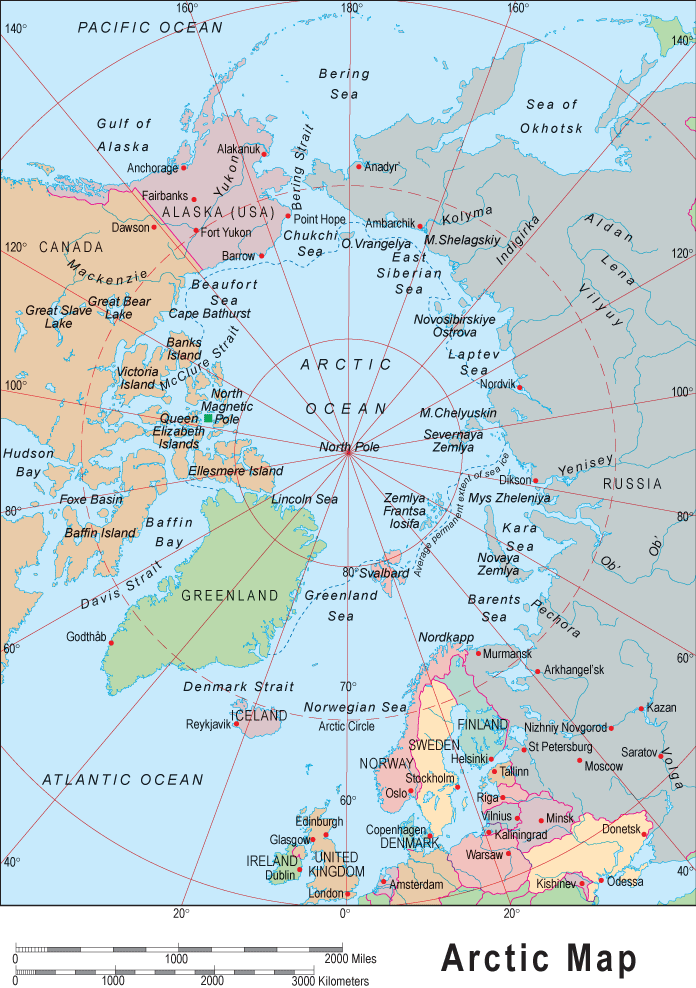
Comparing the Arctic seas extents with their maximums shows the melting at the margins:

2016136 NH Max Loss % Loss Sea Max % NH Loss
 (0) Northern_Hemisphere 2960990 19.64%
 (1) Beaufort_Sea 127909 11.95% 1%
 (2) Chukchi_Sea 32636 3.38% 0%
 (3) East_Siberian_Sea 0 0.00% 0%
 (4) Laptev_Sea 0 0.00% 0%
 (5) Kara_Sea 70565 7.55% 0%
 (6) Barents_Sea 377288 62.95% 3%
 (7) Greenland_Sea 84393 12.79% 1%
 (8) Baffin_Bay_Gulf_of_St._Lawrence 629226 38.26% 4%
 (9) Canadian_Archipelago 23004 2.70% 0%
 (10) Hudson_Bay 74977 5.95% 1%
 (11) Central_Arctic 47787 1.47% 0%
 (12) Bering_Sea 607955 79.14% 4%
 (13) Baltic_Sea 94743 97.09% 1%
 (14) Sea_of_Okhotsk 1110178 84.83% 8%

It is clear from the above that the bulk of ice losses are coming from Okhotsk, Barents and Bering Seas, along with Baffin Bay-St. Lawrence; all of them are marginal seas that will go down close to zero by September.  The entire difference between 2016 and 2015 arises from Okhotsk starting with about 500k km2 more ice this year, and arriving at this date virtually tied with 2015.

Note: Some seas are not at max on the NH max day.  Thus, totals from adding losses will vary from NH daily total.

AER says this about the Arctic Oscillation (AO):

Currently, the AO is negative and is predicted to slowly trend towards neutral (Figure 1). The current negative AO is reflective of positive geopotential height anomalies across much of the Arctic, especially the North Atlantic side and mostly negative geopotential height anomalies across the mid-latitudes.

September Minimum Outlook

Historically, where will ice be remaining when Arctic melting stops? Over the last 10 years, on average MASIE shows the annual minimum occurring about day 260. Of course in a given year, the daily minimum varies slightly a few days +/- from that.

For comparison, here are sea ice extents reported from 2007, 2012, 2014 and 2015 for day 260:

Arctic Regions 2007 2012 2014 2015
Central Arctic Sea 2.67 2.64 2.98 2.93
BCE 0.50 0.31 1.38 0.89
Greenland & CAA 0.56 0.41 0.55 0.46
Bits & Pieces 0.32 0.04 0.22 0.15
NH Total 4.05 3.40 5.13 4.44

Notes: Extents are in M km2.  BCE region includes Beaufort, Chukchi and Eastern Siberian seas. Greenland Sea (not the ice sheet). Canadian Arctic Archipelago (CAA).  Locations of the Bits and Pieces vary.

As the table shows, low NH minimums come mainly from ice losses in Central Arctic and BCE.  The great 2012 cyclone hit both in order to set the recent record. The recovery since 2012 shows in 2014, with some dropoff last year, mostly in BCE.

Summary

We are only beginning the melt season, and the resulting minimum will depend upon the vagaries of weather between now and September.  At the moment, 2016 was slightly higher than 2015 in March, and is now trending toward a lower May extent.  OTOH 2016 melt season is starting without the Blob, with a declining El Nino, and a cold blob in the North Atlantic.  The AO is presently neutral, giving no direction whether cloud cover will reduce the pace of melting or not.  Meanwhile we can watch and appreciate the beauty of the changing ice conditions.

Waves and sea ice in the Arctic marginal zone.


Arctic Warming Unalarming

Locations of arctic stations examined in this study

Locations of arctic stations examined in this study

An recent extensive analysis of Northern surface temperature records gives no support for Arctic “amplification” fears.

The Arctic has warmed at the same rate as Europe over the past two centuries. Heretofore, it has been supposed that any global warming would be amplified in the Arctic. This may still be true if urban heat island effects are responsible for part of the observed temperature increase at European stations. However, European and Arctic temperatures have remained closely synchronized for over 200 years during the rapid growth of urban centres.

And the warming pattern in Europe and the Arctic is familiar and unalarming.

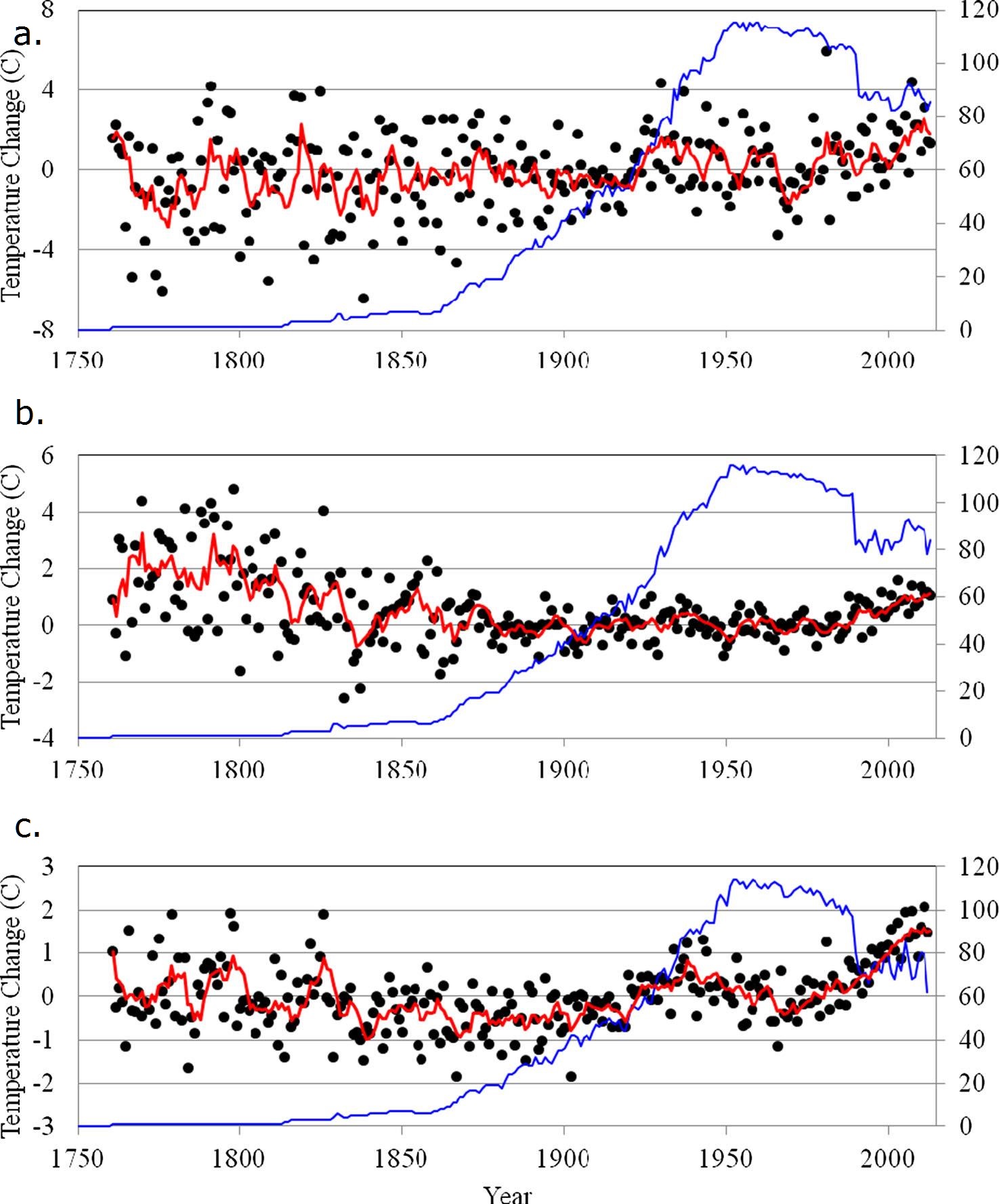
Arctic temperatures have increased during the period 1820– 2014. The warming has been larger in January than in July. Siberia, Alaska and Western Canada appear to have warmed slightly more than Eastern Canada, Greenland, Iceland and Northern Europe. The warming has not occurred at a steady rate. Much of the warming trends found during 1820 to 2014 occurred in the late 1990s, and the data show temperatures levelled off after 2000. The July temperature trend is even slightly negative for the period 1820–1990. The time series exhibit multidecadal temperature fluctuations which have also been found by other temperature reconstructions.

The paper is:

Arctic temperature trends from the early nineteenth century to the present W. A. van Wijngaarden, Theoretical & Applied Climatology (2015) here

Temperatures were examined at 118 stations located in the Arctic and compared to observations at 50 European stations whose records averaged 200 years and in a few cases extend to the early 1700s.

Fig. 3 Temperature change for a January, b July and c annual relative to the temperature during 1961 to 1990 for Arctic stations. The red curve is the moving 5-year average while the blue curve is the number of stations

Fig. 3 Temperature change for a January, b July and c annual relative to the temperature during 1961 to 1990 for Arctic stations. The red curve is the moving 5-year average while the blue curve is the number of stations

Summary

The data and results for all stations are provided in detail, and the findings are inescapable.

The Arctic has warmed at the same rate as Europe over the past two centuries. . . The warming has not occurred at a steady rate. . .During the 1900s, all four (Arctic) regions experienced increasing temperatures until about 1940. Temperatures then decreased by about 1 °C over the next 50 years until rising in the 1990s.

For the period 1820–2014, the trends for the January, July and annual temperatures are 1.0, 0.0 and 0.7 °C per century, respectively. . . Much of the warming trends found during 1820 to 2014 occurred in the late 1990s, and the data show temperatures levelled off after 2000.

Once again conclusions based on observations are ignored while projections from models are broadcast and circulated like gossip. The only amplification going on is the promotion of global warming alarms.

megaphone

Footnote: I did a study last year of 25 World Class surface temperature records (all European) and found the same patterns (here).

Arctic Mayday? Not

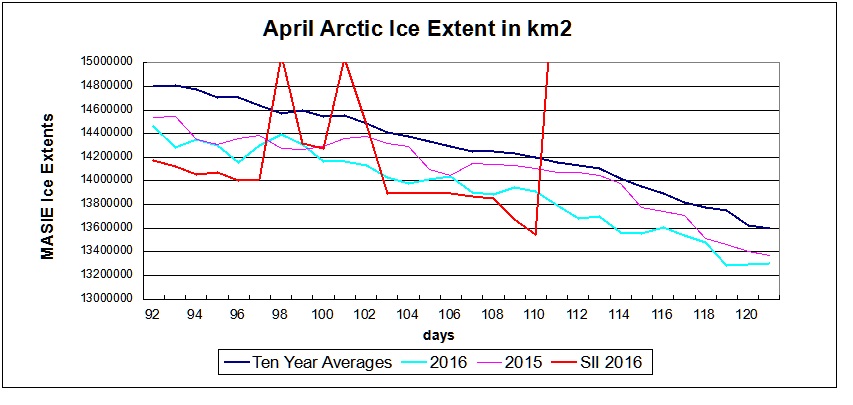
On May1, we have the complete Arctic ice extent record for April 2016.  So we can look at how the melt season is progressing. As you can see, the ice is down a little, but no reason to put out a distress signal.

These are results from MASIE, the most accurate dataset. SII from NOAA is shown with the data available as of today. Clearly, SII is having unresolved technical difficulties, and April stats are NA.

MASIE shows 2016 less than the ten-year average and slightly less than last year at end of April. 2016 average for April is about 200k km2 less than 2015, exactly offsetting the surpluses of ice in February and March.

Here is how the melting is occurring in the various Arctic seas.

April 30, 2016 day 121 km2 loss % loss
 (0) Northern_Hemisphere 1774019 11.77%
 (6) Barents_Sea 250990 41.87%
 (8) Baffin_Bay_Gulf_of_St._Lawrence 461154 28.04%
 (12) Bering_Sea 432513 56.30%
 (13) Baltic_Sea 76897 78.80%
 (14) Sea_of_Okhotsk 800810 61.19%

The losses are the difference from the recorded maximums. All other seas are at or more than 96% of max.

Since some seas are not at max on the day of NH max, adding losses from individual seas will vary from the NH total.

So May starts with this year and last in similar overall positions. However, the details are different. Here is the two Day 121 extents compared.

Ice Extents 2015 2016 Ice Extent
Region 2015121 2016121 km2 Diff.
 (0) Northern_Hemisphere 13369057 13303581  -65476
 (1) Beaufort_Sea 1070445 1070445 0
 (2) Chukchi_Sea 965922 965989 67
 (3) East_Siberian_Sea 1086657 1087120 463
 (4) Laptev_Sea 897845 897809 -36
 (5) Kara_Sea 934122 904700 -29422
 (6) Barents_Sea 441590 348389 -93201
 (7) Greenland_Sea 583660 633443 49783
 (8) Baffin_Bay_Gulf_of_St._Lawrence 1329843 1183429 -146415
 (9) Canadian_Archipelago 853214 853178 -36
 (10) Hudson_Bay 1230587 1254066 23479
 (11) Central_Arctic 3240913 3238746 -2167
 (12) Bering_Sea 401377 335719 -65658
 (13) Baltic_Sea 4407 20686 16279
 (14) Sea_of_Okhotsk 326536 507886 181351

The table shows a small overall difference of 65k km2. The losses are principally in Bering, Barents and Baffin bay, offset by surpluses in Okhotsk and Greenland Seas. So far the main locations of persistent ice are showing no signs of melting: BCE, Central Arctic and CAA (Canadian Arctic Archipelago).

Summary

Arctic ice is melting as it normally does in April, and no one knows what will happen in May and afterwards.  Stay tuned.

Premature Reports of Ice Death

“The reports of my death are greatly exaggerated.” Mark Twain

Lots of stories predicting (hoping) that Arctic ice will go lower than 2012 and resuscitate the  Arctic “death spiral”.  And we can surely predict that Peter Wadhams will predict a September Arctic minimum of 1M km2, as he does every year.

But there’s a long way to go before then, and some historical context is in order.

September Minimum Outlook
Historically, where will ice be remaining when Arctic melting stops? Over the last 10 years, on average MASIE shows the annual minimum occurring about day 260. Of course in a given year, the daily minimum varies slightly a few days +/- from that.

For comparison, here are sea ice extents reported from 2007, 2012, 2014 and 2015 for day 260:

Arctic Regions 2007 2012 2014 2015
Central Arctic Sea 2.67 2.64 2.98 2.93
BCE 0.50 0.31 1.38 0.89
Greenland & CAA 0.56 0.41 0.55 0.46
Bits & Pieces 0.32 0.04 0.22 0.15
NH Total 4.05 3.40 5.13 4.44

Notes: Extents are in M km2.  BCE region includes Beaufort, Chukchi and Eastern Siberian seas. Greenland Sea (not the ice sheet). Canadian Arctic Archipelago (CAA).  Locations of the Bits and Pieces vary.

As the table shows, low NH extents come mainly from ice losses in Central Arctic and BCE.  The great 2012 cyclone hit both in order to set the recent record. The recovery since 2012 shows in 2014, with some dropoff last year, mostly in BCE.

Summary

We are only beginning the melt season, and the resulting minimum will depend upon the vagaries of weather between now and September.  At the moment, 2016 was slightly higher than 2015 in March and is trending toward a similar April extent.  Also 2016 melt season is starting without the Blob, with a declining El Nino, and a cold blob in the North Atlantic.  It is too early to put Arctic Ice on life support. Meanwhile we can watch and appreciate the beauty of the changing ice conditions.

Usual Suspects in Arctic Melting April 15

The melt season is under way, and ice extents are shrinking in the usual places: Barents, Bering, Baffin Bay and Okhotsk. Nothing much is happening elsewhere.

As of day 2016  106 km2 max lost %  loss sea max
 (0) Northern_Hemisphere 1039707 6.9%
 (1) Beaufort_Sea 5246 0.5%
 (2) Chukchi_Sea 949 0.1%
 (3) East_Siberian_Sea 0 0.0%
 (4) Laptev_Sea 0 0.0%
 (5) Kara_Sea 9892 1.1%
 (6) Barents_Sea 141054 23.5%
 (7) Greenland_Sea 0 0.0%
 (8) Baffin_Bay_Gulf_of_St._Lawrence 370444 22.5%
 (9) Canadian_Archipelago 2532 0.3%
 (10) Hudson_Bay 2945 0.2%
 (11) Central_Arctic 8171 0.3%
 (12) Bering_Sea 144767 18.8%
 (13) Baltic_Sea 75572 77.4%
 (14) Sea_of_Okhotsk 596646 45.6%
 (15) Yellow_Sea 55182 100.0%
 (16) Cook_Inlet 5150 100.0%

It should be noted that Greenland Sea set a new max yesterday, and Central Arctic has risen lately near to its max on January 6.  Those seas are more likely to sustain ice extent through the September minimum.

OLYMPUS DIGITAL CAMERA

The graph of MASIE data shows 2016 is virtually tied with 2015 and both are below the ten-year average.  SII started to be unreliable after day 97.

Looking at specific seas comparing this year and last:

Ice Extents 2015 2016 Ice Extent
Region 2015106 2016106 km2 Diff.
 (0) Northern_Hemisphere 14049007 14037892 -11115
 (1) Beaufort_Sea 1070445 1065199 -5246
 (2) Chukchi_Sea 966006 965040 -966
 (3) East_Siberian_Sea 1087137 1087120 -17
 (4) Laptev_Sea 897845 897809 -36
 (5) Kara_Sea 918774 925096 6323
 (6) Barents_Sea 391374 458325 66951
 (7) Greenland_Sea 579909 659712 79804
 (8) Baffin_Bay_Gulf_of_St._Lawrence 1570273 1274139 -296134
 (9) Canadian_Archipelago 853214 850646 -2568
 (10) Hudson_Bay 1258284 1257926 -358
 (11) Central_Arctic 3219523 3237378 17855
 (12) Bering_Sea 649827 623466 -26361
 (13) Baltic_Sea 9568 22011 12443
 (14) Sea_of_Okhotsk 574873 712050 137177

Clearly the main difference in 2016 is more rapid melting in Baffin Bay, and Bering Sea down slightly.  Many seas are similar, and some are higher including Barents, Greenland and Okhotsk (a lot).

Summary:

Fasten your seat belts–Arctic melt season is underway.  Alarmists are rooting for more water, less ice, thinking that proves fossil fuels are warming the planet (it doesn’t).  Normal people figure some ice loss is a good thing, because it means the next ice age is another year further away.  Too much ice loss is bad because it may lead ignorant politicians to make stupid energy policies.

Anyway, the melt season is always entertaining and unpredictable, with unforeseen weather events overturning expected results.  Stay tuned.

Note:

On another thread I was asked about some recent scary reports about Greenland’s ice sheet. Since that is land ice, it is not included in sea ice measurements.  There is a balanced and informative article on DMI’s observations:
http://www.csmonitor.com/Science/2016/0414/Greenland-s-early-ice-melt-breaks-records.-What-s-behind-the-thaw

They refer to extent of 1 mm melting of the surface, and note an event in 2012 where 95% of the sheet had 1 mm or more melt water. Snow fall accumulates into ice, and also as the sheet grows, there is some calving of the surplus, also resulting in losses, but not in reducing the total ice.

I am skeptical of alarms about Greenland, as I posted in Greenland is Melting. Really?

The point is, Greenland ice sheet is also dynamic, meaning there is annually both ice melting and ice forming; the net is what matters.


A Tale of Two Indices


n_daily_extent

Sorry to be serious on April 1.  I am not a fan of ice charts restricted to one month, for reasons illustrated in the post Ice House of Mirrors (some humor there in honor of this day.) But March monthly average sets the baseline for the year’s melt season, and so there is considerable attention and significance attached to the month just concluded.

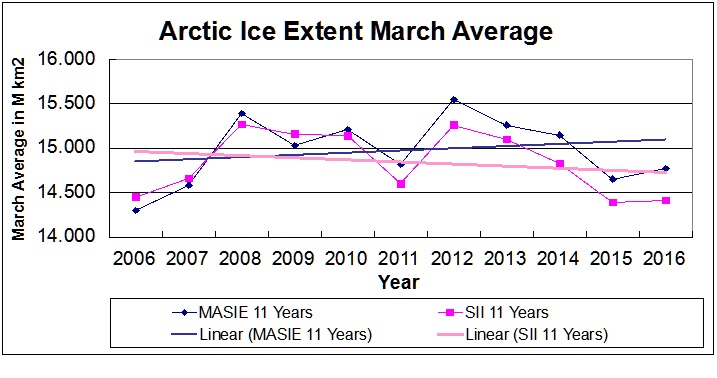
Here is a chart showing March 2016 compared to the previous ten Marches according to two different indices of Sea Ice Extent: MASIE (Multisensor Analyzed Sea Ice Extent) produced by the National Ice Center and SII (Sea Ice Index) produced by NOAA (both accessed at NSIDC).

MASIE and SII March

It is evident that the March annual maximum is trending slightly upward in MASIE and slightly downward in SII. Note that the indices were quite similar the first five years. Then since 2010, SII has declined quite strongly.

Note on Sea Ice Resolution:

Northern Hemisphere Spatial Coverage

Sea Ice Index from NOAA is based on 25 km cells and 15% ice coverage. That means if a grid cell 25X25, or 625 km2 is estimated to have at least 15% ice, then 625 km2 is added to the total extent. In the mapping details, grid cells vary between 382 to 664 km2 with latitudes.  And the satellites’ Field of View (FOV) is actually an ellipsoid ranging from 486 to 3330 km2 depending on the channel and frequency.  More info is here.

MASIE is based on 4 km cells and 40% ice coverage. Thus, for MASIE estimates, if a grid cell is deemed to have at least 40% ice, then 16 km2 is added to the total extent.

The significantly higher resolution in MASIE means that any error in detecting ice cover at the threshold level affects only 16 km2 in the MASIE total, versus at least 600 km2 variation in SII.  A few dozen SII cells falling below the 15% threshold is reported as a sizeable loss of ice in the Arctic.

Putting NOAA Reports in Context

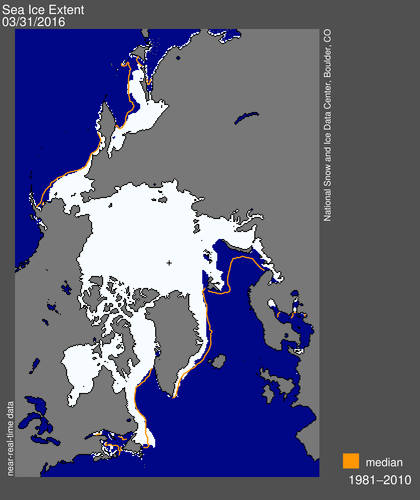
With the background above, we can interpret NOAA`s meaning when they report (here) that 2016 winter ice extent is the smallest on record. That refers to the annual maximum daily extent they observed on March 24. Climatology usually uses the March average to indicate the year’s maximum (given the volatility of daily readings). As we can see, 2016 March average was higher than 2015, virtually tied with 2006 and just below 2011. SII showed March ice to be 364k km2 less than MASIE.

NOAA: “The extent in 2016 was 431,000 square miles (1.12 million square kilometers) below the 1981–2010 average, which is like carving away an area of ice the combined size of Texas, Oklahoma, Arkansas, and most of Louisiana.”

In other words, 2016 is below average by about the size of 2000 grid cells in their system, or 1.5% out of 136,192.  

For more background on the two datasets see here.

2016 in Perspective

As an example, consider how this March compares in the two indices.

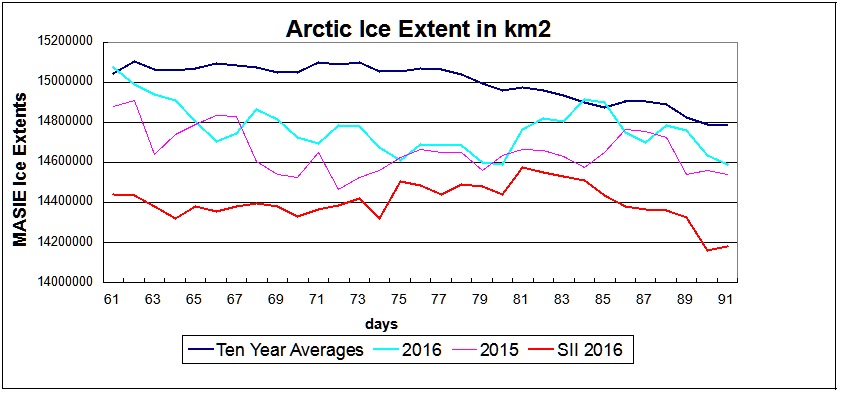
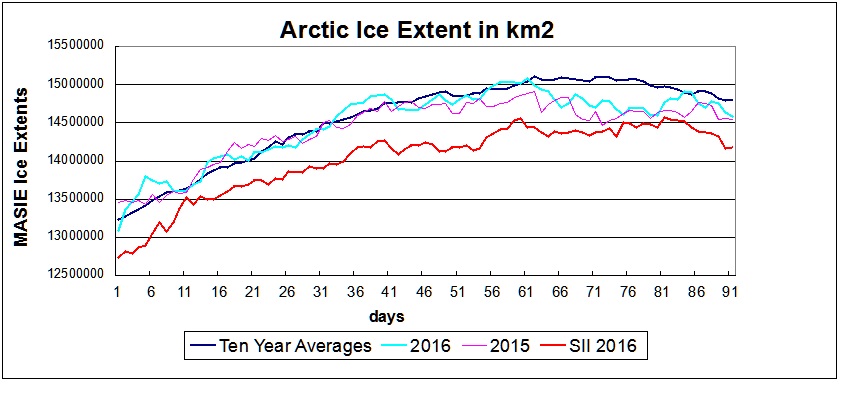
In the graph MASIE shows 2016 starting the month at average extent, then declining and then recovering.  2016 ended below average in extent and comparable to 2015.  Meanwhile SII showed much less extent, rising to a late maximum and then declining sharply to be 400k km2 less at day 91.

OLYMPUS DIGITAL CAMERA

Results for the first quarter of the year show the large differences between the two indices. SII portrays this winter as abnormally low, while MASIE shows an average year, slightly higher than 2015.

Looking at the extents in the various seas making up the NH Sea Ice, it is clear that all are typical, with three exceptions.  Compared to 2015, Barents and Baffin Bay are down (Barents lost 100k km2 in the last five days), while Okhotsk surplus more than offsets the losses elsewhere.

Summary:

As the divergence of SII increases, it becomes less clear what it is really measuring.

The tables below give the reported ice extents in M km2:

Month 2016 2016 MASIE SII SII Deficit
Averages MASIE SII 2016-2015 2016-2015 SII-MASIE
Jan 13.922 13.472 -0.019 -0.131 -0.450
Feb 14.804 14.210 0.121 -0.199 -0.593
Mar 14.769 14.405 0.101 0.038 -0.364

n_monthly_bm_extent_web

ns_Yamal

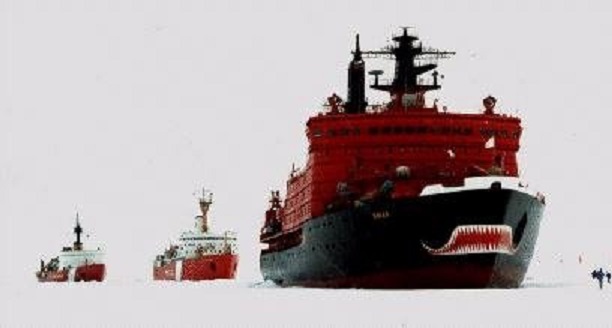
New Russian Nuclear Icebreaker “Yamal”, sharing the name of the infamous hockey stick tree.


Arctic Upset Alert March 25

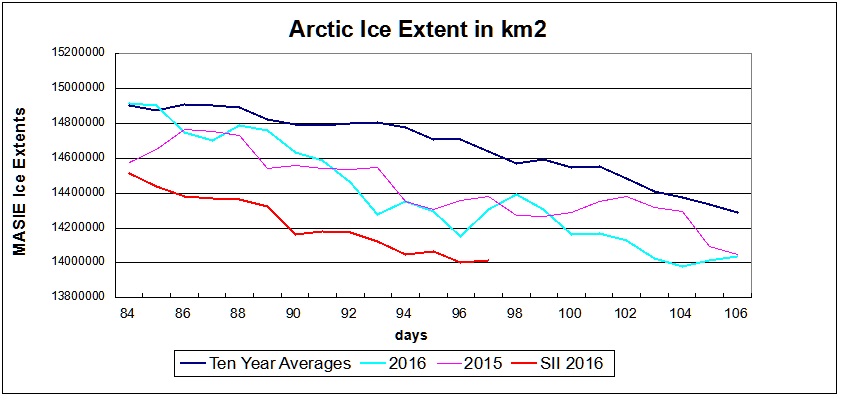
A stunning turnaround by Arctic Sea Ice. In March Madness terms we could say: “We have a ballgame!.” Those saying Arctic ice would be a big loser in 2016 may have to eat crow.

OLYMPUS DIGITAL CAMERA

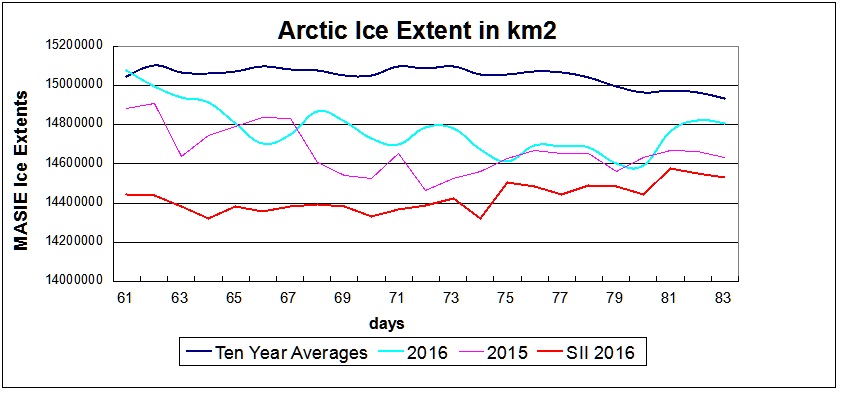
Yesterday NH ice extent grew dramatically to take a slight lead over the ten year average for day 84, and is 99% of 2016 maximum set on day 61. At 14.91 M km2 that is 330k km2 more than 2015 and 350k km2 more than SII is showing.

Yesterday MASIE showed a new high extent for 2016 in strategically located Barents Sea. Also the Central Arctic grew to a virtual tie with its maximum set early January 2016. All seas gained ice or held their maximums, except for a small loss in Okhotsk.


Earlier I compared this month in the Arctic to the March Madness of the NCAA basketball tournament, with intense competition and surprising results.  In the first half of March, the ocean water was scoring at will against the ice pack, and warnings of huge losses were announced.

In the second half, however, the ice is making a comeback, and the March outcome is still in doubt. This is important because March average extent sets the baseline for the melt season to come.

MASIE shows significant gains in the last week, while SII has grown to set a new maximum for the year on day 81. Notably, Barents has gained back 228k km2, Greenland Sea added 81k and Bering Sea 138k, and  the Central Arctic 90k. While Okhotsk has lost ice,  as readers already know, Okhotsk Sea is actually outside the Arctic Circle and will melt out completely. Barents and Greenland Seas are located at the nexus of the Arctic and the North Atlantic and impact greatly the Arctic ocean as a whole. Bering is also important positioned at the Pacific gateway into the Arctic.

For more on discrepancies between MASIE and SII see here.

Update March 26

Some have expressed concern that high pressure over the Arctic could accelerate the flow of ice out through the Fram Strait.  That is an important consideration.  In a recent post I pointed to work by Russian scientists showing that in fact the removal of ice bergs through Fram opens up area in the Central Arctic for more ice to form.  Their analysis says that after an acceleration of Fram ice loss, 4 to 6 years later there is an overall increase in ice extent, especially in the Siberian seas.

Guess what?  The massive cyclone in 2012 pushed out lots of ice, and here we are 4 years later with ice growth appearing.

More on this is here: https://rclutz.wordpress.com/2016/03/02/the-great-arctic-ice-exchange/

With the Arctic Oscillation (AO) expected to hover around neutral over the next two weeks, Arctic ice extent is unpredictable.

090913bucks-carl-sketch-master675


Arctic Panic Postponed

Earlier I compared this month in the Arctic to the March Madness of the NCAA basketball tournament, with intense competition and surprising results.  In the first half of March, the ocean water was scoring at will against the ice pack, and warnings of huge losses were announced.

OLYMPUS DIGITAL CAMERA

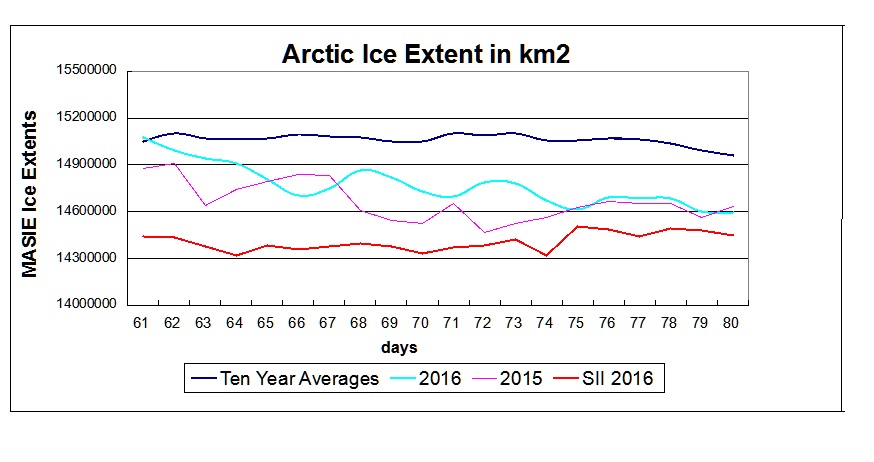
In the second half, however, the ice is making a comeback, and the March outcome is still in doubt. This is important because March average extent sets the baseline for the melt season to come. At this point, 3/4 through March, MASIE shows the average monthly extent below the ten-year average but higher than 2015.

MASIE shows significant gains in the last week, while SII has grown to set a new maximum for the year 2 days ago. Notably, Barents has gained back about 150k km2, Greenland Sea added 70k and Bering Sea 110k, while Okhotsk has lost 100k. As readers already know, Okhotsk Sea is actually outside the Arctic Circle and will melt out completely. While Barents and Greenland Seas are located at the nexus of the Arctic and the North Atlantic and impact greatly the Arctic ocean as a whole. Bering is also important positioned at the Pacific gateway into the Arctic.

For more on discrepancies between MASIE and SII see here.

With the Arctic Oscillation (AO) expected to hover around neutral over the next two weeks, Arctic ice extent is unpredictable.

090913bucks-carl-sketch-master675


Arctic Ice March Madness

Updating Arctic ice extents for the first 20 days of March the peak ice month. Lots of changes and surprises, just like the NCAA basketball tournament.

OLYMPUS DIGITAL CAMERA

MASIE shows March 2 as the daily annual maximum, both on average over ten years, and in 2015. March 1, 2016 was the daily max, and SII shows an extent that day lower by 635k km2.  (SII refers to Sea Ice Index produced by NOAA@NSIDC)

As March has progressed, this year and last MASIE shows ice has declined. Meanwhile MASIE ten year average held steady, and 2016 SII added extent in the last week. The gap between MASIE and SII is narrowing in 2016, though SII extents still average almost 400k km2 less for March.

Ice Extents 2015 2016 Ice Extent
Region 2015080 2016080 km2 Diff.
 (0) Northern_Hemisphere 14634556 14593011 -41545
 (1) Beaufort_Sea 1070445 1070445 0
 (2) Chukchi_Sea 966006 965989 -17
 (3) East_Siberian_Sea 1087137 1087120 -17
 (4) Laptev_Sea 897845 897809 -36
 (5) Kara_Sea 920392 916674 -3719
 (6) Barents_Sea 548675 396037 -152638
 (7) Greenland_Sea 666601 557940 -108661
 (8) Baffin_Bay_Gulf_of_St._Lawrence 1829904 1599833 -230072
 (9) Canadian_Archipelago 853214 853178 -36
 (10) Hudson_Bay 1260903 1260871 -33
 (11) Central_Arctic 3248013 3191707 -56306
 (12) Bering_Sea 657014 642235 -14779
 (13) Baltic_Sea 14462 42460 27998
 (14) Sea_of_Okhotsk 606552 1108734 502182

Comparing 2016 on day 80 with 2015 shows the important ice deficits are on the European and Canadian sides: Barents (even lower than last year), along with Greenland Sea, and Baffin Bay. In contrast to 2015, Okhotsk is much more normal this year and almost offsets the losses elsewhere.

With AER and CPC showing the Arctic Oscillation neutral presently, and 14-day forecasts for more of the same, no one knows what to expect. We can only watch and see.

http://www.cpc.ncep.noaa.gov/products/precip/CWlink/daily_ao_index/ao_index_ensm.shtml

For more on discrepancies between MASIE and SII see here.

OLYMPUS DIGITAL CAMERA