Arctic Ice Growing, No Surprises Dec. 15


Three weeks ago I reported that after 2007 Arctic ice extent was no longer declining, and that 2015 will add another year to that stabilization. With only half a month until year end, the recent MASIE measurements are showing the expected surplus of ice.

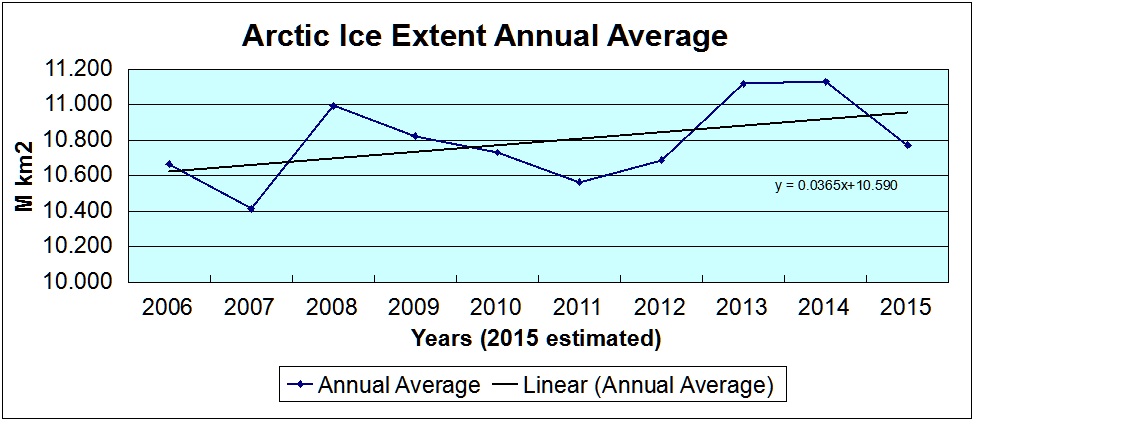
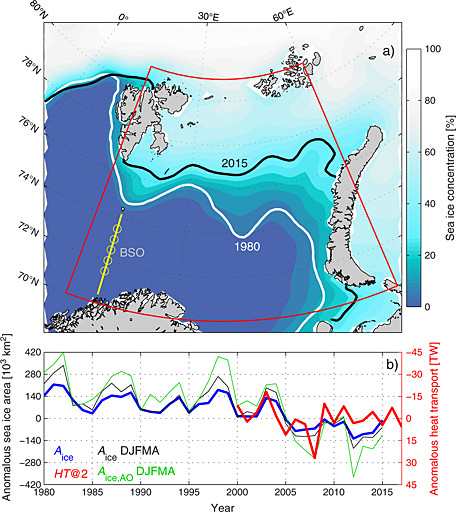
MASIE measurements show that 2007 ice extent was lower than any year since. It is now confirmed that 2015 average annual extent will exceed 2007 by at least 300,000 km2. That difference arises from comparing 2007 annual average of 10.414 M km2 with 2015 running average through day 349 of 10.717. In the 16 days remaining in 2015, we can expect the annual average to rise to about 10.774, or 360,000 km2 higher than 2007.

masie ann est

At this point in the annual cycle, it is possible to project the annual average for the calendar year. The daily average presently is well above the running average for the year, so the year-end average will be increasing each day to the end of December. In the last decade, a typical year added about 60k km2 to the annual average in the last 16 days.

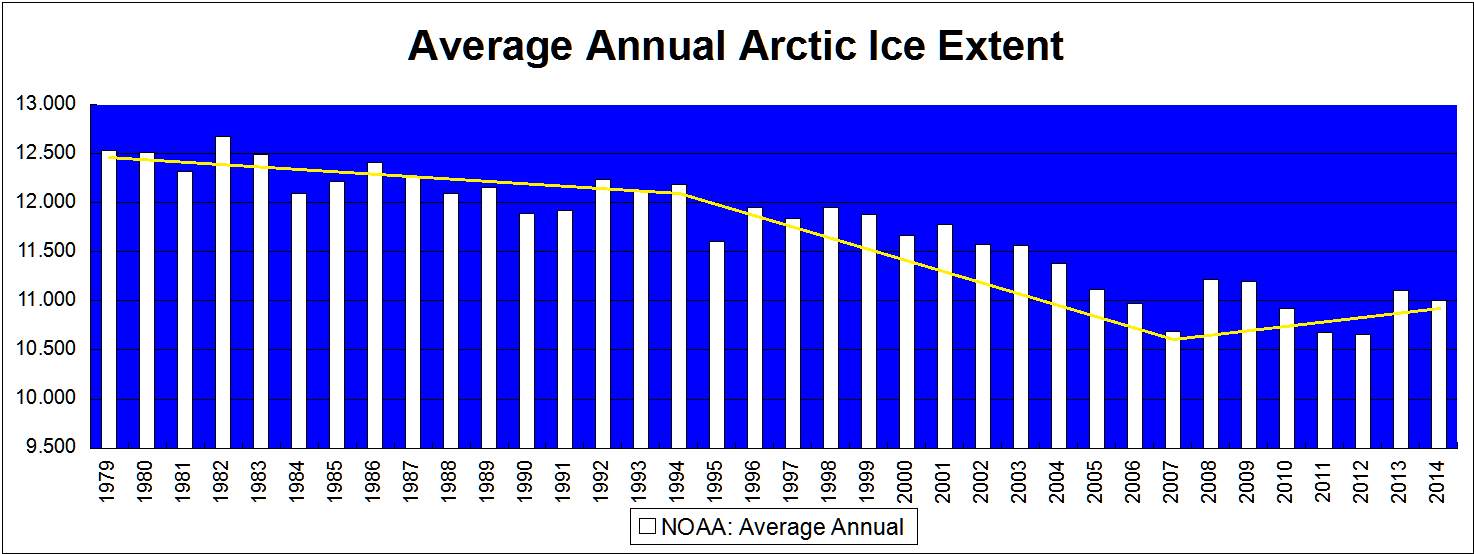
Disclaimer: Alarmists chafe at the words “growing” and “recovery”, and I use them poetically to counter “death spiral” terminology. What we have seen in the last decade is a plateau in Arctic ice extent, analogous to the plateau in surface temperatures. The rise since 2007 is slight and not statistically important, just as the loss of ice from 1979 to 1994 in the NOAA dataset was too slight to count as a decline.

Summary:

Arctic ice declined in the decade prior to 2007, but has not declined since.

masie day 349

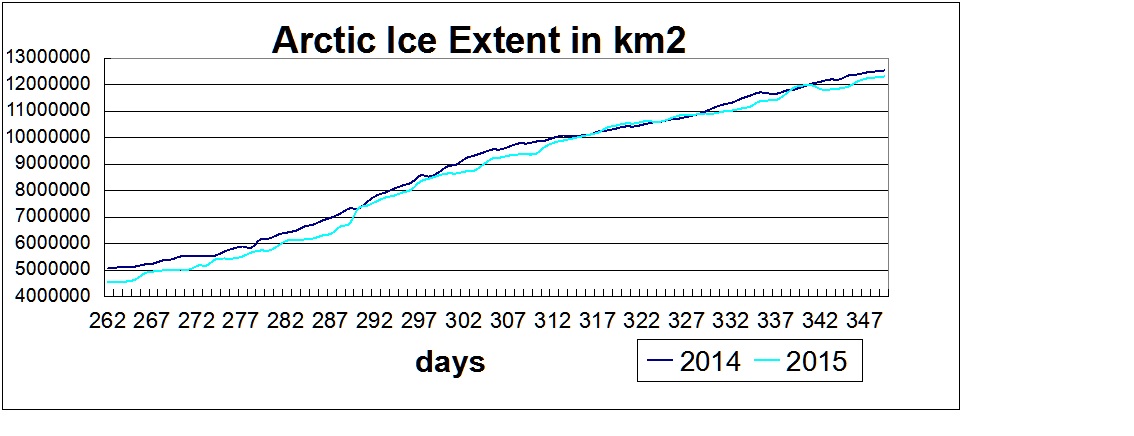
MASIE Comparison 2014 and 2015 Day 349

Ice Extents Ice Extent
Region 2014349 2015349 km2 Diff.
 (0) Northern_Hemisphere 12548113 12289626 -258486
 (1) Beaufort_Sea 1070445 1070445 0
 (2) Chukchi_Sea 966006 965989 -17
 (3) East_Siberian_Sea 1087137 1087120 -17
 (4) Laptev_Sea 897845 897809 -36
 (5) Kara_Sea 933096 874256 -58839
 (6) Barents_Sea 433080 286703 -146377
 (7) Greenland_Sea 511903 600822 88919
 (8) Baffin_Bay_Gulf_of_St._Lawrence 887832 989563 101731
 (9) Canadian_Archipelago 853214 853178 -36
 (10) Hudson_Bay 1253770 1013217 -240553
 (11) Central_Arctic 3235340 3206905 -28435
 (12) Bering_Sea 176250 292268 116018
 (13) Baltic_Sea 4594 2028 -2566
 (14) Sea_of_Okhotsk 228906 145623 -83283
 (15) Yellow_Sea 940 151 -789
 (16) Cook_Inlet 130 2407 2277

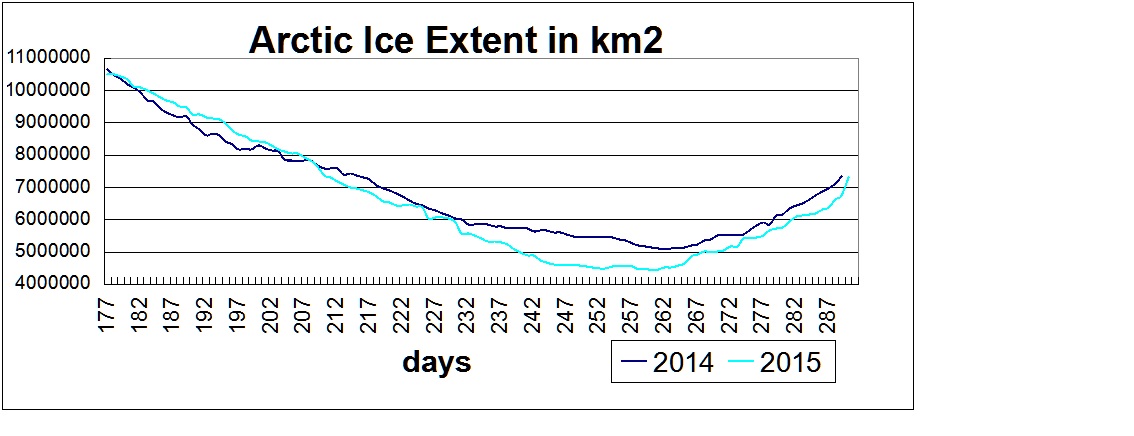
There is little difference between 2014 and 2015 at this point. The major basins have recovered: Central Arctic, BCE (Beaufort, Chuchi, East Siberian), Canadian Archipelago.  Bering Sea is freezing ahead of last year.  Barents, Kara and Okhotsk are behind while Greenland and Baffin are ahead.  The major difference is Hudson Bay.

Arctic Ice Recovery Confirmed

Update Nov. 23

I will be resuming the ice watch in mid-December to report how observations compared to the projection below. As of Nov.22, MASIE reports 10.845 while NOAA shows 10.042.

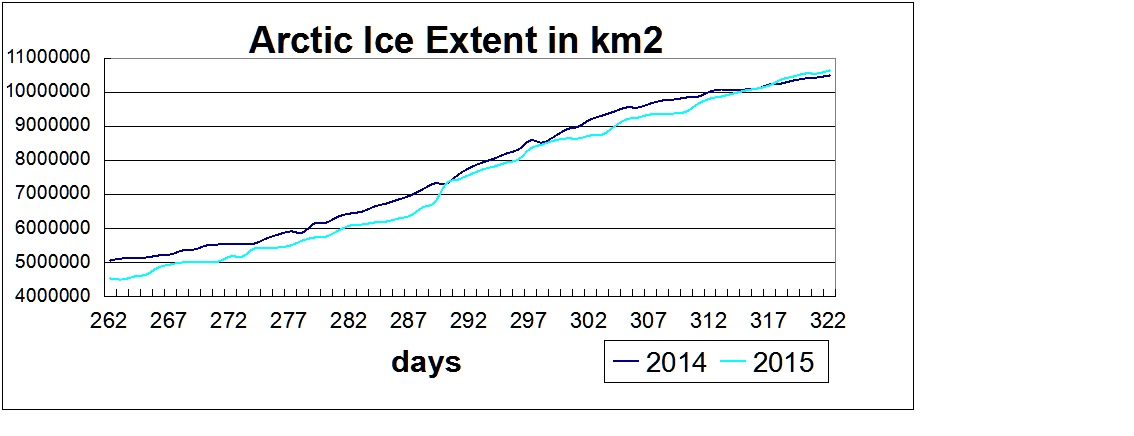
MASIE measurements show that 2007 ice extent was lower than any year since. It is now confirmed that 2015 average annual extent will exceed 2007 by at least 230,000 km2. That difference arises from comparing 2007 annual average of 10.414 M km2 with 2015 running average through day 322 of 10.644. In the 43 days remaining in 2015, we can expect the annual average to rise to about 10.774, or 360,000 km2 higher than 2007.

masie ann est

At this point in the annual cycle, it is possible to project the annual average for the calendar year. The daily average presently is matching the running average for the year, so the year-end average will be increasing each day to the end of December. In the last decade, a typical year added 130k km2 to the annual average in the last 43 days.

masie day 322

Disclaimer: Alarmists will chafe at the word “recovery” above, and I am using it poetically to counter “death spiral” terminology. What we have seen in the last decade is a plateau in Arctic ice extent, analogous to the plateau in surface temperatures. The rise since 2007 is slight and not statistically important, just as the loss of ice from 1979 to 1994 in the NOAA dataset was too slight to count as a decline.

Summary:

Arctic ice declined in the decade prior to 2007, but has not declined since.

MASIE Comparison 2014 and 2015 Day 322

Ice Extents 2014322 2015322 Ice Extent
Region km2 Diff.
 (0) Northern_Hemisphere 10495865 10627850 131985
 (1) Beaufort_Sea 1070445 1070445 0
 (2) Chukchi_Sea 615600 739357 123756
 (3) East_Siberian_Sea 1030145 1087120 56975
 (4) Laptev_Sea 897845 897809 -36
 (5) Kara_Sea 885074 759061 -126012
 (6) Barents_Sea 499164 112508 -386656
 (7) Greenland_Sea 520936 537003 16066
 (8) Baffin_Bay_Gulf_of_St._Lawrence 455426 778098 322672
 (9) Canadian_Archipelago 853214 853107 -107
 (10) Hudson_Bay 374004 502262 128258
 (11) Central_Arctic 3245207 3193274 -51933

As before, the measurements show that Barents and Kara Seas are the main difference between this year and last.  At this point, those lesser extents are more than offset by gains elsewhere, especially in Baffin and Hudson Bays as well as BCE.

Footnote: NOAA was reporting ice extents comparable to MASIE during September and October (~100k km2 less). In November NOAA is showing a less robust recovery, ~400k km2 less for the month so far, and ~ 500k km2 less in recent daily reports.

Inside Barents Ice Crystal Ball

On a previous post (here), I linked to a recent study positing that variations in Barents Sea ice extent are predictive of Arctic extent for at least 1-2 years later. In other words, they concluded based upon measurements of ice extent and ocean heat transfers: As winter ice extent goes in Barents Sea, so goes annual ice extent across the Arctic ocean. The physical cause is changing fluxes of warm North Atlantic water penetrating through the Barents Sea into the rest of the Arctic. They acknowledge that other factors, especially winds are also in play, but believe that the ocean influx (also affected by winds) makes the largest influence. The full study is here.

Arctic Ice Dynamics

Here’s how researchers are connecting the dots:
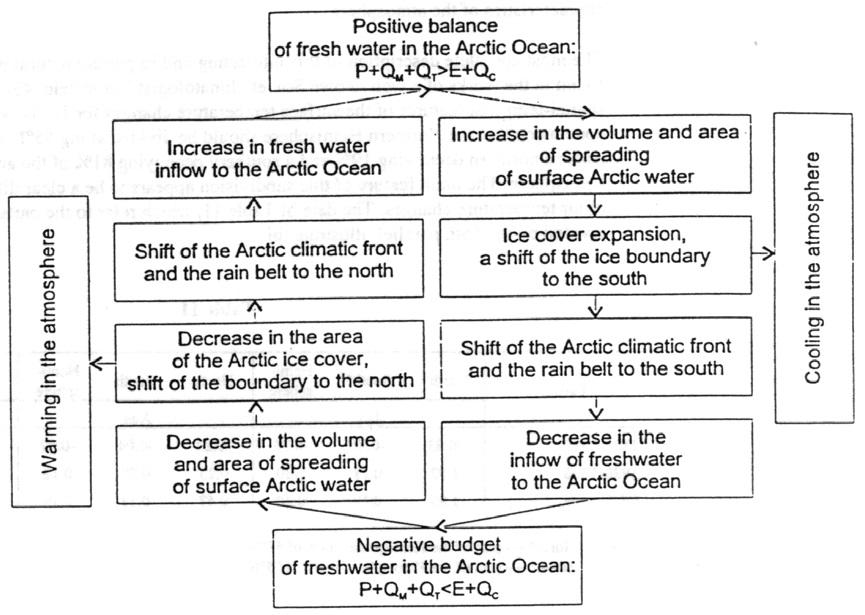
NAO (North Atlantic Oscillation)► BSO(Heat transport by Atlantic Water (AW) through Barents Sea Opening)► Winter ice extent in Barents Sea► Winter ice extent in Arctic Ocean► Annual ice extents in Barents and Arctic Ocean.

A key scientist in this work is Randi Ingvaldsen of Geophysical Institute, University of Bergen, Institute of Marine Research. Several of her published articles are part of her doctoral thesis available here.  It comprises an informative look into the extensive body of research in this area.

The Barents Sea climate fluctuates between warm and cold periods. By comparing decade by decade we found that although the 1990s had high temperatures, both the 1930s and the 1950s were warmer. This indicates that the warming of the 1990s may very well be related to natural variability rather than anthropogenic effects.

The above results indicate a positive correlation between the NAO winter index and the area occupied by AW, a result clearly evident when investigating the total area across the BSO occupied by AW (Figure 6d). Earlier investigations have shown a positive correlation between the NAO winter index and the mean AW temperature in the BSO (also evident in
Figure 6e). This means that both the temperature and the extent of AW increase with increasing NAO winter index (Figure 6 a and d-e), although with different lags.

In summary, this preliminary investigation has shown that both the mean temperature and lateral extent of AW in the BSO is positively correlated to the strength of the Icelandic low, although with lags.

The extensive bibliography in the linked studies shows that these results are built upon the efforts of many researchers over decades. There are many references to empirical research efforts in recent times (e.g. an array of moorings in the NE Barents Sea):

The pathway and transformation of water from the Norwegian Sea across the Barents Sea and through the St. Anna Trough are documented from hydrographic and current measurements of the 1990s. . .The westward flow originates in the Fram Strait branch of Atlantic Water at the Eurasian continental slope, while the eastward flow constitutes the Barents Sea branch, continuing from the western Barents Sea opening.

In earlier decades, the Atlantic Water advected from Fram Strait was colder by almost 1 K as compared to the 1990s, while the dense Barents Sea water was colder by up 1 K only in a thin layer at the bottom and the salinity varied significantly. However, also with the resulting higher densities, deep Eurasian Basin water properties were met only in the 1970s. The very low salinities of the Great Salinity Anomaly in 1980 were not discovered in the outflow data. We conclude that the thermal variability of inflowing Atlantic water is damped in the Barents Sea, while the salinity variation is strongly modified through the freshwater conditions and ice growth in the convective area off Novaya Zemlya.

http://www.sciencedirect.com/science/article/pii/S0967063702001255

The evidence says Arctic ice varies from a variety of natural factors:


Based on these observational data, Polyakov et al. (2003) concluded that the “examination of records of fast ice thickness and ice extent from four Arctic marginal seas (Kara, Laptev, East Siberian, and Chukchi) indicates that long-term trends are small and generally statistically insignificant, while trends for shorter records are not indicative of the long-term tendencies due to strong low-frequency variability in these time series, which places a strong limitation on our ability to resolve long-term trends”. “Correlation analysis shows that dynamical forcing (wind or surface currents) is at least of the same order of importance as thermodynamical forcing for the ice extent variability in the Laptev, East Siberian, and Chukchi Seas. Source: http://www.climate4you.com/

Conclusion:

As with everything else in the climate system, Arctic ice dynamics are complex and our understanding is growing but still incomplete. And like the rest of the climate system, the more we learn, the more evident it is that fossil fuel emissions have little to do with it. We should take seriously other ways humans impact the climate system, be it from our use of the seas, as Dr. Bernaerts points out, or from using the land, as Dr. Pielke has documented.

There’s no denying climate change. Climate is changing: Not much; Not quickly; And not lately. (Credit: David Siegel here)

Footnote November 16:  

Some additional reflections:

This line of Arctic ice research is interesting because it challenges typical thinking about northern climates such as Barents.

Firstly, it goes beyond simplistic, value-laden notions, such as “less Arctic ice is a bad thing” (popular), or “less Arctic ice is a good thing” (not popular). These researchers are not making those judgments but are asking a purely scientific question: Why? Why is there more ice some years and less ice other years? And they know that any explanation is tested by how well it predicts future ice extents.

Secondly, this line of research requires a shift in focus from the summer melts in August-September, to pay more attention to the action in the winter, especially December-April. The proposed mechanism of heat transfer by means of Atlantic water happens almost entirely in that time frame, when most people leave the Arctic alone in the dark.

Finally, there is humility in making the predictions, recognizing the complexity of the situation, and how effects lag in time.  Certainly, the lack of ice in Barents this last April is a basis for thinking extents there and across the Arctic will be down next April. But there happens to be a cold Blob of surface water in the North Atlantic presently, and that may affect the result. That is the way of science:  make predictions, make observations and adapt the theory accordingly.

Arctic Ice Home Stretch Nov.11

Meltponds and leads in the Arctic ice cap show evidence of refreezing

Day 315, November 11, 2015 produced several milestones for Arctic ice recovery.  2015 extent virtually caught up to 2014 for that same day. For the first time since July 1, ice extent is again 10M km2. MASIE shows 10.1M compared to NOAA at 9.7M.  This is the home stretch since annual averages in the last decade range between 10 to 11 M km2.

2015 has gained steadily averaging a daily rate of 107k km2.  As a result, this year and last are virtually tied at this point.

masie day 315

The BCE region (Beaufort, Chukchi, East Siberian) is now 103% of 2014 at this date, with Beaufort completely frozen and East Siberian nearly so. Most seas exceed 2014 at this date. The largest remaining differences are Barents and Kara, which melted early and have not yet recovered. CAA has recovered after the August 2015 storm and now matches last year, through the Central Arctic still lags behind.  Those shortfalls are offset by much greater ice extents in Baffin and Hudson Bays.

From MASIE

Ice Extents 2014315 2015315 Ice Extent
Region km2 Diff.
 (0) Northern_Hemisphere 10077460 10055179 -22281
 (1) Beaufort_Sea 1070445 1070445 0
 (2) Chukchi_Sea 609398 610670 1272
 (3) East_Siberian_Sea 970647 1045269 74622
 (4) Laptev_Sea 897845 897757 -88
 (5) Kara_Sea 817367 715936 -101431
 (6) Barents_Sea 397719 87660 -310059
 (7) Greenland_Sea 524605 527729 3124
 (8) Baffin_Bay_Gulf_of_St._Lawrence 397085 702650 305566
 (9) Canadian_Archipelago 853214 852724 -490
 (10) Hudson_Bay 250550 339763 89214
 (11) Central_Arctic 3236108 3185406 -50703

The comparison with 2014 informs us whether this year will “bend the trend” of recovering ice extent since 2007, and by how much.  The pace of refreezing this year is impressive and the end result remains to be seen.  It seems unlikely that the previous two years annual averages can be overtaken this late in the calendar.

Summary

My guess: 2015 Average Annual extent will finish as the 3rd highest in the last 10 years, ahead of the years before 2013.

Still a Bronze Medal is not bad for a year that started with a lower March maximum, had the Pacific Blob melt out Bering Sea a month early, saw a negative AO most of the summer ensuring higher insolation and melting, and finally underwent a strong storm late August when ice edges were most fragile.

OLYMPUS DIGITAL CAMERA

Barents Sea: Arctic Ice Predictor?

It looks likely that 2015 annual average ice extent will be lower than 2014, and some will claim this proves global warming is alive and well. But analysis of the details tells a different story.

Firstly, there were many factors working against Arctic ice this year:

  • Lower March maximum;
  • Warm Blob in the Pacific melting out both Okhotsk and Bering Sea earlier than usual;
  • Negative AO most of the summer, ensuring higher insolation and melting;
  • Strong storm in August when ice edges are most fragile.

Hidden in the measurements is perhaps the most important factor affecting Arctic ice extent year over year: Variability in Barents Sea ice due to ingress of warm water from the North Atlantic.

Back in April 2015, Dr. Arnd Bernaerts pointed out that this year’s ice was lagging mainly because of Barents and Okhotsk melting out early. (Here). And he also implicated various offshore marine operations: shipping, fishing, oil extraction, etc.

Presently Arctic ice is recovering as it always does this time of year, and again Barents is notably the difference between this year and others. But a recent analysis (here) shows that it is actually the Barents Sea winter extent that is predictive of the whole Arctic ice cover.

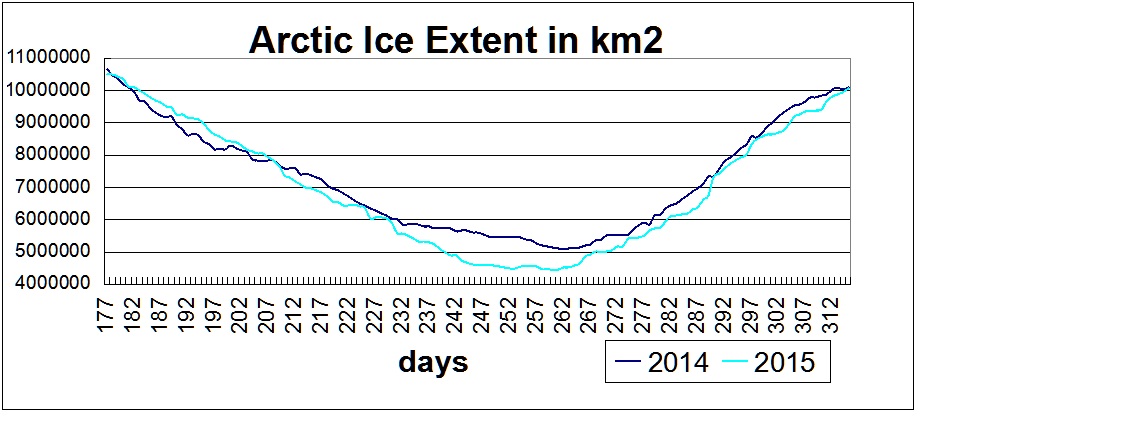
The aim of this study is to understand and assess the predictability of the annual mean, and, in particular, the winter Barents Sea ice cover (Figure 1). We develop a prognostic framework from first principles and, based on direct observations and a 60 year simulation, assess the role of the Atlantic inflow as a main source of Barents Sea ice predictability 1–2 years in advance. Moreover, the influence and predictive potential of meridional winds on the interannual sea ice variability are investigated. (My bold)

1

Figure 1.
(a) Satellite-derived (National Snow and Ice Data Center, NSIDC) mean sea ice concentration between 1980 and 2015. The ice edge (15% ice concentration) is indicated for 1980 (white line) and 2015 (black line). We confine the Barents Sea by the red line. The mooring array across the Barents Sea Opening (BSO, yellow line) is indicated by yellow circles. (b) Time series of interannual sea ice area. Annual (July–June, blue) sea ice variability is dominated by changes in winter (December–April, black) sea ice area. During winter variations in the anomalous Arctic Ocean (interior basins and surrounding shelf seas) sea ice area (green) mainly reflect the Barents Sea ice variability; the correlation between the winter sea ice area in the Barents Sea and the Arctic Ocean is 0.96, and the standard deviations are 131·103 km2 and 191·103 km2, respectively. Observed annual mean heat transport (red) shifted to the ice cover by 2 years is also shown (note reversed axis). (My bold)

Summary

Sorry to sound like a broken record, but the point is again confirmed: Oceans make the climate around the world, and in the Arctic as well. When Arctic ice varies, it is not due to fossil fuel emissions, and the proposed treaty in Paris will do nothing about it.

Footnote:

The authors of the study above project a lower ice extent in Barents Sea and Arctic Ocean in 2016.  But presently there is a cold Blob in the North Atlantic which could change that result if it persists and signals the onset of a colder phase in that ocean.

Arctic Ice Race Tied Oct. 25

Meltponds and leads in the Arctic ice cap show evidence of refreezing

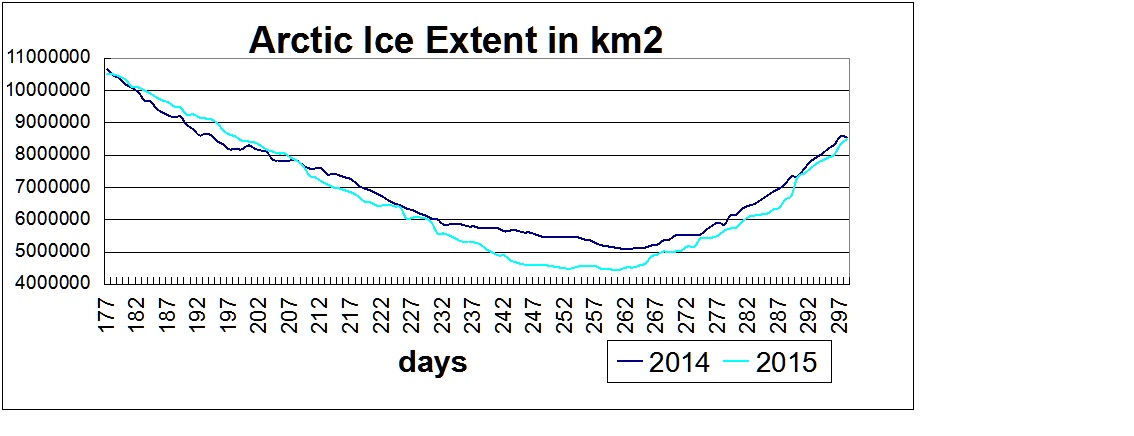
Day 298, October 25, 2015 Arctic ice extent virtually matched 2014 on the same day. For the first time in 100 days, July 17, ice extent is again 8.5M km2. MASIE shows 8.47M compared to NOAA at 8.11M.

2015 has gained steadily the last 10 days at a daily rate of 181k km2.  As a result, 2015 lhas reached a virtual tie, lagging behind only slightly.

masie day 298

The rate of ice recovery this year since minimum day 260 is 109k km2 per day, 11k greater than 2014, and the highest in the last decade, except for 2013 and 2008.

The BCE region (Beaufort, Chukchi, East Siberian) is now 105% of 2014 at this date. Most seas exceed 2014 at this date. The largest remaining differences are Barents and Kara, which melted early and have not yet recovered. CAA has recovered after the August 2015 storm and now exceeds last year, through the Central Arctic still lags behind.

From MASIE

Ice Extents 2014298 2015298 Ice Extent
Region km2 Diff.
 (0) Northern_Hemisphere 8531378 8470311 -61067
 (1) Beaufort_Sea 874812 1046413 171601
 (2) Chukchi_Sea 445204 436170 -9034
 (3) East_Siberian_Sea 746853 786087 39234
 (4) Laptev_Sea 817198 897757 80559
 (5) Kara_Sea 774019 567237 -206782
 (6) Barents_Sea 237519 13282 -224237
 (7) Greenland_Sea 390963 430467 39504
 (8) Baffin_Bay_Gulf_of_St._Lawrence 168991 257335 88344
 (9) Canadian_Archipelago 775255 823421 48166
 (10) Hudson_Bay 63494 73546 10052
 (11) Central_Arctic 3232620 3137455 -95165

Summary

The comparison with 2014 informs us whether this year will “bend the trend” of recovering ice extent since 2007, and by how much.  The pace of refreezing this year is impressive and the end result remains to be seen.  It seems unlikely that the previous two years can be overtaken this late in the calendar.

My guess: 2015 Average Annual extent will finish as the 3rd highest in the last 10 years, ahead of the years before 2013.

Still a Bronze Medal is not bad for a year that started with a lower March maximum, had the Pacific Blob melt out Bering Sea a month early, saw a negative AO most of the summer ensuring higher insolation and melting, and finally underwent a strong storm late August when ice edges were most fragile.

OLYMPUS DIGITAL CAMERA

Arctic Ice Great Leap Upward Oct. 17

Meltponds and leads in the Arctic ice cap show evidence of refreezing

Day 290, October 17, 2015 was a day with several significant events regarding Arctic ice recovery. For the first time since day 218, August 6, ice extent is again over 7M km2. MASIE shows 7.32M compared to NOAA at 7.15M.

The gain yesterday was 557k km2, twice the largest previous increases.  As a result, 2015 lags behind 2014 by a single day.

masie day 290r

The rate of ice recovery this year since minimum day 260 is 100k km2 per day, 10k greater than 2014, and the highest in the last decade, except for 2013.

The BCE region (Beaufort, Chukchi, East Siberian) is now 105% of 2014 at this date. Hudson and Baffin Bays combined exceed 2014; Kara and Laptev combined are also larger; Greenland Sea is slightly higher. The largest remaining difference is Barents, which melted early and has not recovered. CAA is slowly recovering after the August 2015 storm, and the Central Arctic is down in recent days.

From MASIE (2014 dataset is missing day 290):

Ice Extents 2014289 2015290 Ice Extent
Region km2 Diff.
 (0) Northern_Hemisphere 7328164 7321971 -6193
 (1) Beaufort_Sea 834187 887355 53169
 (2) Chukchi_Sea 401082 447166 46084
 (3) East_Siberian_Sea 591126 720793 129667
 (4) Laptev_Sea 365434 697481 332047
 (5) Kara_Sea 454119 265291 -188828
 (6) Barents_Sea 266907 1589 -265318
 (7) Greenland_Sea 394133 404860 10727
 (8) Baffin_Bay_Gulf_of_St._Lawrence 69086 113255 44168
 (9) Canadian_Archipelago 731010 655865 -75145
 (10) Hudson_Bay 30471 17006 -13465
 (11) Central_Arctic 3188655 3110169 -78486

Summary

The comparison with 2014 informs us whether this year will “bend the trend” of recovering ice extent since 2007, and by how much.  The pace of refreezing this year is impressive and the end result remains to be seen.  My guess: 2015 Average Annual extent will finish as the 3rd highest in the last 10 years, ahead of every year before 2013.

OLYMPUS DIGITAL CAMERA

Auspicious Day for Arctic Ice

Meltponds and leads in the Arctic ice cap show evidence of refreezing

Day 282, October 9, 2015 was a day with several significant events regarding Arctic ice recovery. For the first time since day 229, August 26, ice extent is again over 6M km2. Also, the BCE region (Beaufort, Chukchi, East Siberian) is now the same as 2014 at this date. Another happening is NOAA and MASIE showing exactly the same number for NH ice extent.

The rate of ice recovery this year since minimum day 260 is 72k km2 per day, 12k greater than 2014, and the highest in the last decade, except for 2013.

Hudson and Baffin Bays combined are the same both years; Kara and Laptev combined are the same both years; Greenland Sea is the same. The remaining difference is mainly Barents, which melted early and has not recovered, and CAA, slowly recovering after the August 2015 storm. From MASIE:

Ice Extents 2014282 2015282 Ice Extent
Region km2 Diff.
 (0) Northern_Hemisphere 6433593 6101239 -332354
 (1) Beaufort_Sea 760258 768857 8598
 (2) Chukchi_Sea 342532 420027 77495
 (3) East_Siberian_Sea 524382 444172 -80210
 (4) Laptev_Sea 161386 302302 140916
 (5) Kara_Sea 160370 52762 -107608
 (6) Barents_Sea 170701 1589 -169112
 (7) Greenland_Sea 346102 346143 41
 (8) Baffin_Bay_Gulf_of_St._Lawrence 65565 98692 33128
 (9) Canadian_Archipelago 687420 497592 -189828
 (10) Hudson_Bay 35404 3423 -31981
 (11) Central_Arctic 3178330 3164538 -13792

Summary

The comparison with 2014 informs us whether this year will “bend the trend” of recovering ice extent since 2007, and by how much.  The pace of refreezing this year is impressive and the end result remains to be seen.  My guess: 2015 Average Annual extent will finish in 3rd place, ahead of every year before 2013 in the last decade.

OLYMPUS DIGITAL CAMERA

Arctic Ice Made Simple

People are overthinking and over-analyzing Arctic Ice extents, and getting wrapped around the axle (or should I say axis).  So let’s keep it simple and we can all readily understand what is happening up North.

I will use the ever popular NOAA dataset derived from satellite passive microwave sensors.  It sometimes understates the ice extents, but everyone refers to it and it is complete from 1979 to 2014.  Here’s what NOAA reports (in M km2):

X-ray Ice Mirror5

If I were adding this to the Ice House of Mirrors, the name would be The X-Ray Ice Mirror, because it looks into the structure of the time series.   For even more clarity and simplicity, here is the table:

NOAA NH Annual Average Ice Extents (in M km2)

Year Average Change % Change
1979 12.532
1994 12.183 -0.348  -2.8%
2007 10.685 -1.498 -12.3%
2014 11.003   0.318    3.0%

The satellites involve rocket science, but this does not.  There was a small loss of ice extent over the first 15 years, then a dramatic downturn for 13 years, 4 times the rate as before. That was followed by a recovery almost offsetting the first period in half the time.  All the fuss is over that middle period, and we know what caused it.  A lot of multi-year ice was flushed out through the Fram Strait, leaving behind more easily melted younger ice. The effects from that natural occurrence bottomed out in 2007.

Kwok et al say this about the Variability of Fram Strait ice flux:

The average winter area flux over the 18-year record (1978–1996) is 670,000 km2, ;7% of the area of the Arctic Ocean. The winter area flux ranges from a minimum of 450,000 km2 in 1984 to a maximum of 906,000 km2 in 1995. . .The average winter volume flux over the winters of October 1990 through May 1995 is 1745 km3 ranging from a low of 1375 km3 in the 1990 flux to a high of 2791 km3 in 1994.

Click to access kwokJGR99.pdf

Conclusion:

Some complain it is too soon to say Arctic Ice is recovering, or that 2007 is a true change point.  The same people were quick to jump on a declining period after 1994 as evidence of a “Death Spiral.”

Footnote:

No one knows what will happen to Arctic ice.

Except maybe the polar bears.

And they are not talking.

Except, of course, to the admen from Coca-Cola

Ice House of Mirrors

In the fable of Snow White, the evil step-mother asked her hand mirror: “Who is the fairest in the land?” The mirror on the wall always flattered her, but this mirror did not. As we all know, the hand mirror told the truth, the queen was angry and people had to suffer.

We expect mirrors to tell the truth, to show us the objective reality. That is why it is amusing at the carnival sideshow to gaze into mirrors that make normal people look obese or like a beanpole, or otherwise distort one’s appearance.

This post is about what Arctic Ice Extent looks like in the mirrors available to the public.

Mirror #1

If you wonder what is happening with Arctic Ice, the first (and maybe only) depiction you encounter will look like this:

I call this The Incredibly Shrinking Ice Mirror, because it is certainly scary (Death Spiral comes to mind). Ice is obviously going to hell in a hand-basket. Once your fright abates, you might wonder about the scale or how much ice is measured. And you might notice this is about September; other months of the year are excluded from view.

You wouldn’t know from this chart that scary looking 2012 had one of the higher March maximums and on average was not so far out. But that wouldn’t be as exciting.

Mirror #2

Just for fun, let’s make a mirror from the same dataset, just one month later. I call this The Incredibly Persisting Ice Mirror.

october extents lrg2

You won’t find this one on the Internet because it is politically incorrect and pretty boring. But it is just as valid as Mirror #1. It is showing a very slow, unalarming decline with something unusual in 2007, but recovering after that.

Is it a distortion? Absolutely, it is incomplete in the same way as Mirror #1, but gives the opposite impression, just by choosing a different month. But at least this one informs your impression with the actual monthly average extents in M km2 (no anomalies or %s).

Mirror #3

There are more informative pictures of Arctic Ice dynamics if you look for them. For example, there is this presentation of the complete dataset:

NOAA NH Ice Extent

I call this The Bird’s Eye Ice Mirror because you can see the big picture from the satellite passive microwave sensors: the full range of annual variation, the actual measured extents and averages. Note the trend line looks much more like October than September. Is there a reason September is preferred?

Mirror #4

As I have pointed out there are other views of ice extent patterns, such as this:

masie annuallarge273

Let’s call it the The Navigator’s Eye Ice Mirror because it is the accumulation of the ice extents you could expect to observe at sea level from buoys or from the deck of a ship operating in the Arctic region (source: MASIE ice charts).

Of course, there are other mirrors trying in their own ways to tell us about Arctic Ice.

Here’s two Magnifying Ice Mirrors, giving you closeups of what is happening with the ice:

JAXA 2006 to 2015

Let’s not forget The Rear-view Ice Mirrors showing that there were ice observations long before the satellite record started in 1979.

Figure 16-3: Time series of April sea-ice extent in Nordic Sea (1864-1998) given by 2-year running mean and second-order polynomial curves. Top: Nordic Sea; middle: eastern area; bottom: western area (after Vinje, 2000). IPCC Third Assessment Report

Conclusion:

We know as a fact of life that any mirror contains some distortion or bias, even those trying to tell the truth. So it is wise to look at several of them, and pay attention to the frames, before concluding what is happening. Be sure to have a chuckle when you pass by Mirror #1. Although setting energy policies and investing billions of research dollars based on that distortion is not amusing.

Footnote:

Some commentators wondered whether the statistics are affected by icebreakers.  I don’t know, but there is evidence of a Norwegian icebreaker in operation: