Mid-Nov. 2023 Arctic Ice Grows to 10 Wadhams

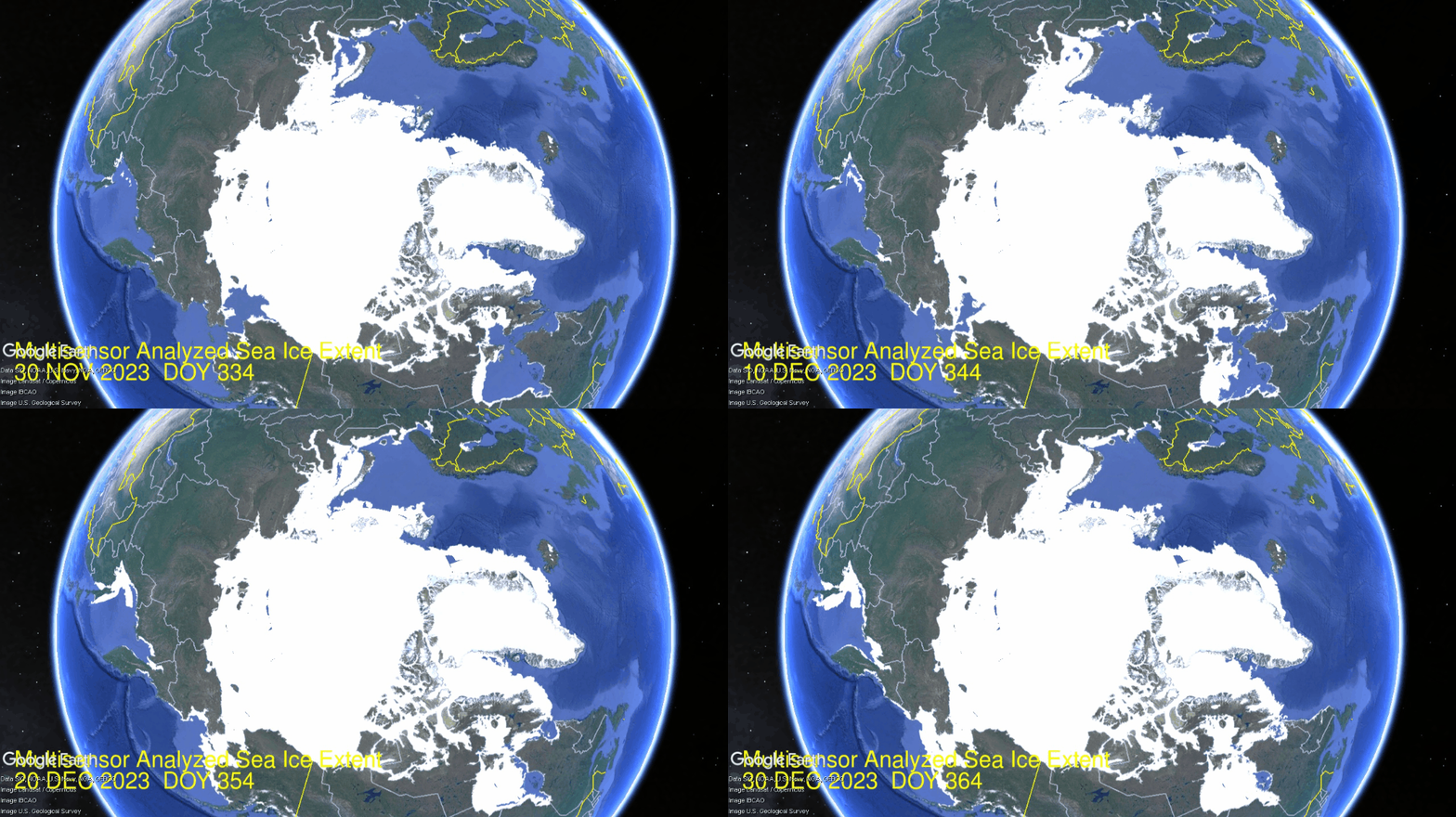
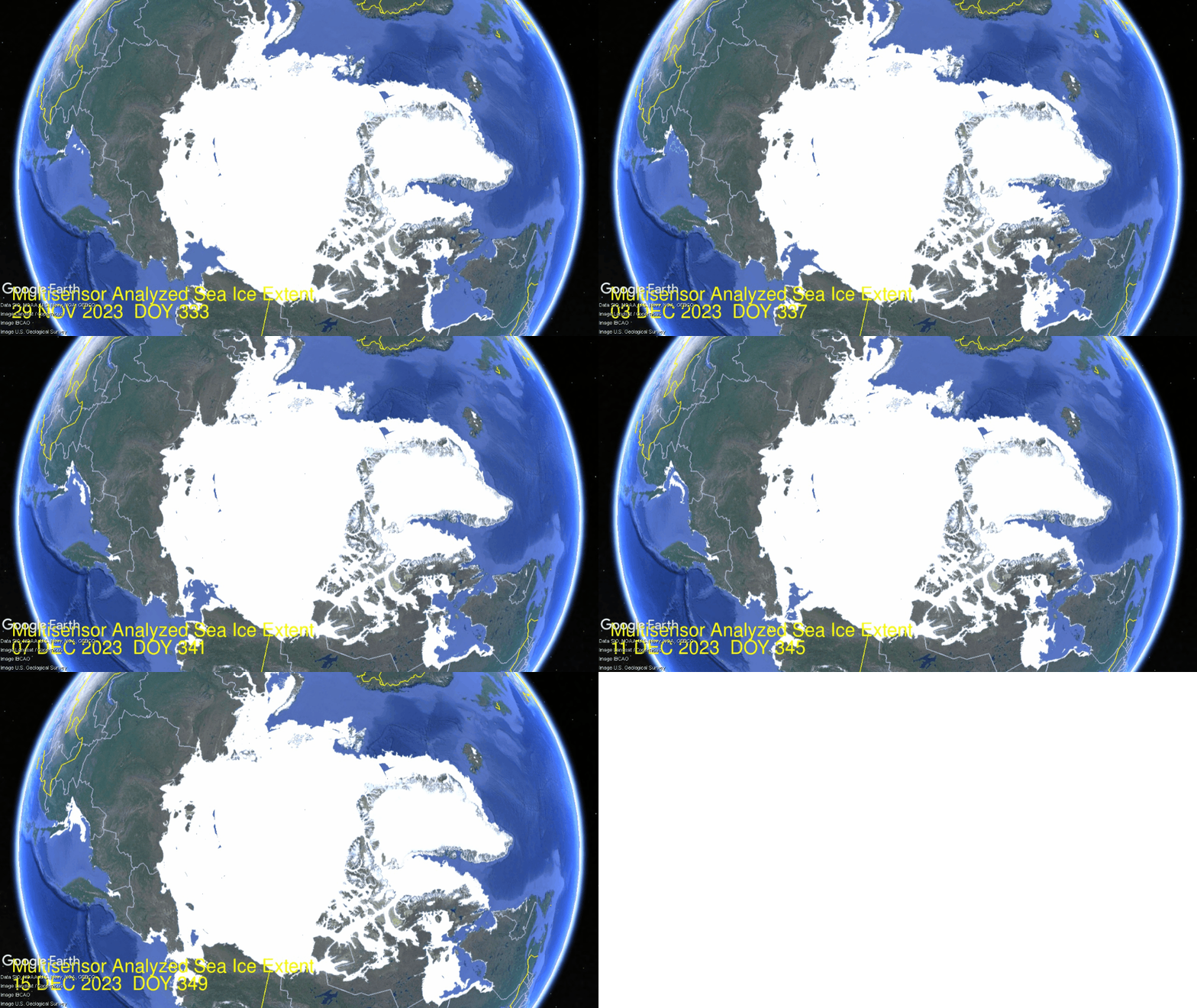
The animation shows the rapid growth of Arctic ice extent during November 2023, from day 304 to yesterday, day 319.  For all of the fuss over the September minimum, little is said about Arctic ice growing back rapidly; that’s 4 Wadhams in October, plus another 1.3M in Nov to total 10M km2, or 10 Wadhams.  The Russian side on the left froze over in October, and now at the center bottom you can see Beaufort sea and Canadian Archipelago icing up. Center right is Baffin Bay growing ice as well.

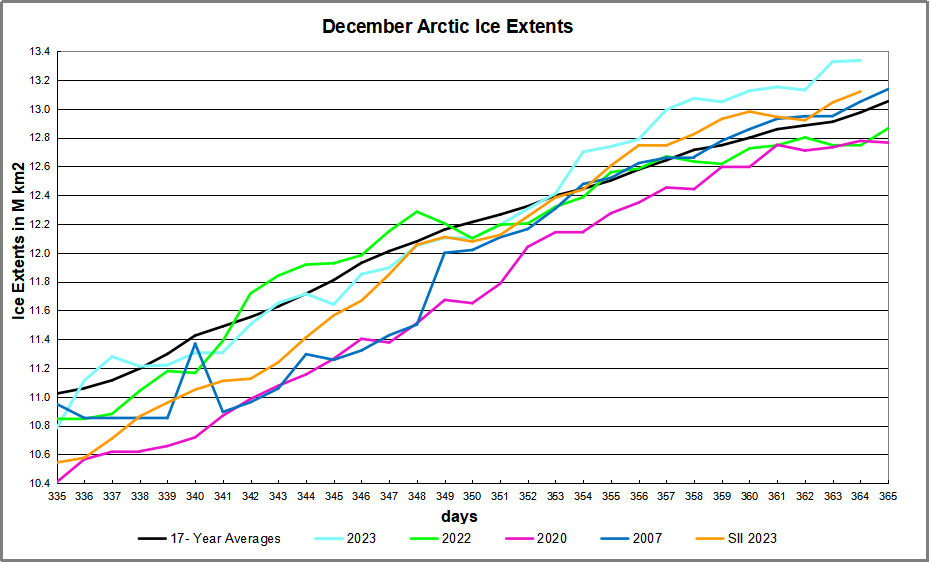
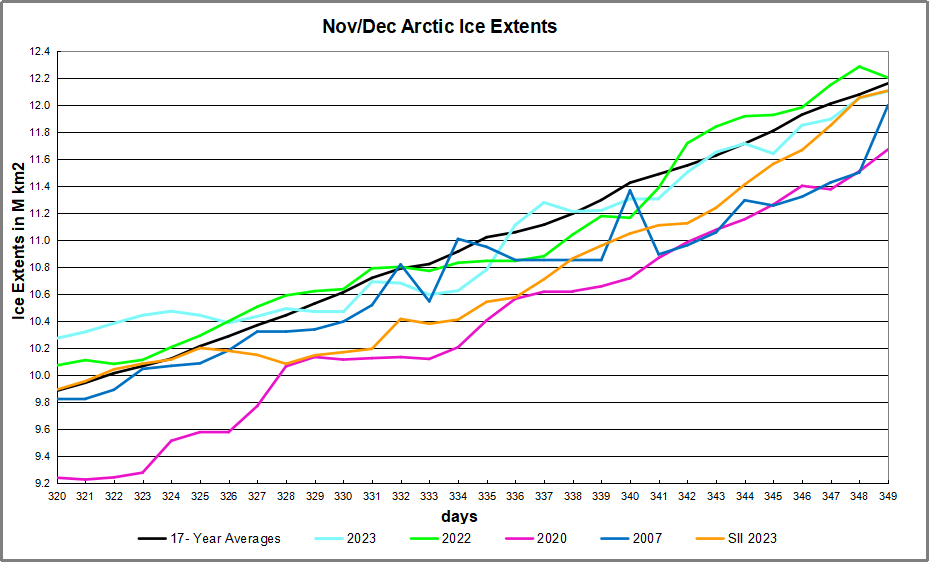
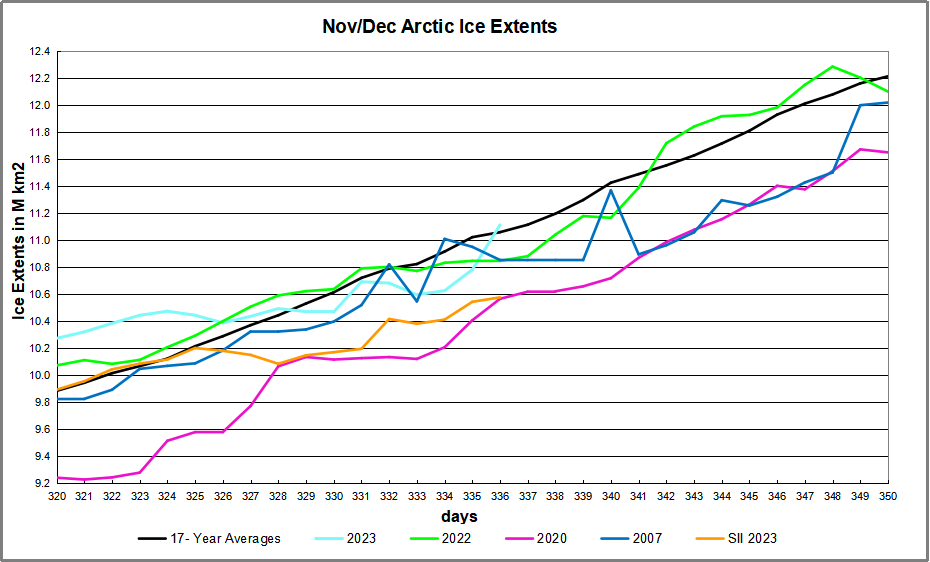
The graph below shows the last 30 days of 2023 compared to the 17 year average (2006 to 2022 inclusive), to SII (Sea Ice Index) and some notable years.


From Mid October to Mid November 2023, MASIE shows NH ice extent growing from 6.3 M km2 to 10M.  That matches 2022 and exceeds the 17 year average by more than 200K km2.   SII (Sea Ice Index) is only slightly lower.

The table below shows the distribution of ice in the Arctic Ocean basins.

Region 2023319 Day 319 Ave. 2023-Ave. 2007319 2023-2007
 (0) Northern_Hemisphere 9997068 9784253  212815  9737614 259454 
 (1) Beaufort_Sea 1051194 1063450  -12257  1053727 -2533 
 (2) Chukchi_Sea 596947 629695  -32748  503783 93164 
 (3) East_Siberian_Sea 1064913 1075985  -11072  1043952 20960 
 (4) Laptev_Sea 897845 897217  628  897845
 (5) Kara_Sea 696199 658489  37710  765376 -69177 
 (6) Barents_Sea 245998 154920  91078  145438 100560 
 (7) Greenland_Sea 613312 460620  152692  527575 85737 
 (8) Baffin_Bay_Gulf_of_St._Lawrence 536576 526706  9870  533931 2645 
 (9) Canadian_Archipelago 841536 850736  -9200  852539 -11003 
 (10) Hudson_Bay 161371 234076  -72704  231544 -70173 
 (11) Central_Arctic 3236821 3174741  62081  3156228 80594 

Overall ice extent has 212k km2 above average or 2%.  The only sizeable deficit is in Hudson Bay,  more than offset by surpluses elsewhere, especiallly in Greenland and Barents seas, along with the Central Arctic.


Greenland Ice Varies, Don’t Panic 2023 Update

With COP28 scheduled to start on November 30, 2023 in Dubai, Climate Crisis Central decided the Greenland Ice Sheet is the doomsday story this week.  For Example:

North Greenland ice shelves have lost 35% of their volume, with “dramatic consequences” for sea level rise, study says  CBS News 

Greenland’s ice shelves have shrunk by more than a THIRD since 1978 – and will cause global sea levels to rise by 6.8 FEET if they collapse entirely, study warns  Daily Mail

Alarming collapse of Greenland ice shelves sparks warning of sea level rise Live Science 

Greenland’s northern glaciers are in trouble, threatening ‘dramatic’ sea level rise, study shows CNN

Greenland glaciers melt five times faster than 20 years ago Reuters

Satellite data and 100-year-old images reveal quickening retreat of Greenland’s glaciers  Space.com

Etc., Etc., Etc.

The scare du jour is about Greenland Ice Sheet (GIS) and how it will melt out and flood us all.  It’s declared that GIS has passed its tipping point, and we are doomed. Typical is this report from phys.org Study finds Greenland’s glacier retreat rate has doubled over past two decades.  Excerpts in italics with my bolds.

Although glaciers in Greenland have experienced retreat throughout the last century, the rate of their retreat has rapidly accelerated over the last two decades. According to the multiyear collaborative effort between the United States and Denmark, the rate of glacial retreat during the 21st century is twice as fast as retreat during the 20th century. And, despite the range of climates and topographical characteristics across Greenland, the findings are ubiquitous, even among Earth’s northernmost glaciers.

The findings underscore the region’s sensitivity to rising temperatures due to human-caused climate change. The study is published in the journal Nature Climate Change.

“Our study places the recent retreat of peripheral glaciers across Greenland’s diverse climate zones into a century-long perspective and suggests that their rate of retreat in the 21st century is largely unprecedented on a century timescale,” said Laura Larocca, the study’s first author. “The only major possible exception are glaciers in northeast Greenland, where it looks like recent increases in snowfall might be slowing retreat.”

The study finds that climate change explains the accelerated glacier retreat and that glaciers across Greenland respond quickly to changing temperatures. This highlights the importance of slowing global warming.

“Our activities over the next couple decades will greatly affect these glaciers. Every bit of temperature increase really matters,” Larocca said.

Annual Greenland Fluctuations in Perspective

Panic is warranted only if you treat this as proof of an alarmist narrative and ignore the facts and context in which natural variation occurs. For starters, consider the last seven years of GIS fluctuations reported by DMI and summarized in the fourteen graphs below.  Note the noisy blue lines showing how the surface mass balance (SMB) changes its daily weight by 8 or 10 gigatonnes (Gt) around the baseline mean from 1981 to 2010.  Note also the summer decrease between May and August each year before recovering to match or exceed the mean.

The other seven graphs show the accumulation of SMB for each of the last seven years including 2023.  Tipping Point?  Note that in both 2017 and 2018, SMB ended about 500 Gt higher than the year began, and way higher than 2012, which added nothing.  Then came 2019 dropping below the mean, but still above 2012.  Finally, the last three years exceeded the 30-year average.  Note also that the charts do not integrate from previous years; i.e. each year starts at zero and shows the accumulation only for that year.  Thus the gains from 2017 and 2018 do not result in 2019 starting the year up 1000 Gt, but from zero.  Nor will the gains in 2021, 2022 and 2023 be added to the base.

And if you’re wondering, the current year is also above average.

The Truth about Sliding Greenland Ice

Researchers know that the small flows of water from surface melting are not the main way GIS loses ice in the summer.  Neil Humphrey explains in this article from last year Nate Maier and Neil Humphrey Lead Team Discovering Ice is Sliding Toward Edges Off Greenland Ice Sheet  Excerpts in italics with my bolds.

While they may appear solid, all ice sheets—which are essentially giant glaciers—experience movement: ice flows downslope either through the process of deformation or sliding. The latest results suggest that the movement of the ice on the GIS is dominated by sliding, not deformation. This process is moving ice to the marginal zones of the sheet, where melting occurs, at a much faster rate.

“The study was motivated by a major unknown in how the ice of Greenland moves from the cold interior, to the melting regions on the margins,” Neil Humphrey, a professor of geology from the University of Wyoming and author of the study, told Newsweek. “The ice is known to move both by sliding over the bedrock under the ice, and by oozing (deforming) like slowly flowing honey or molasses. What was unknown was the ratio between these two modes of motion—sliding or deforming.

“This lack of understanding makes predicting the future difficult, since we know how to calculate the flowing, but do not know much about sliding,” he said. “Although melt can occur anywhere in Greenland, the only place that significant melt can occur is in the low altitude margins. The center (high altitude) of the ice is too cold for the melt to contribute significant water to the oceans; that only occurs at the margins. Therefore ice has to get from where it snows in the interior to the margins.

“The implications for having high sliding along the margin of the ice sheet means that thinning or thickening along the margins due to changes in ice speed can occur much more rapidly than previously thought,” Maier said. “This is really important; as when the ice sheet thins or thickens it will either increase the rate of melting or alternatively become more resilient in a changing climate.

“There has been some debate as to whether ice flow along the edges of Greenland should be considered mostly deformation or mostly sliding,” Maier says. “This has to do with uncertainty of trying to calculate deformation motion using surface measurements alone. Our direct measurements of sliding- dominated motion, along with sliding measurements made by other research teams in Greenland, make a pretty compelling argument that no matter where you go along the edges of Greenland, you are likely to have a lot of sliding.”

The sliding ice does two things, Humphrey says. First, it allows the ice to slide into the ocean and make icebergs, which then float away. Two, the ice slides into lower, warmer climate, where it can melt faster.

While it may sound dire, Humphrey notes the entire Greenland Ice Sheet is 5,000 to 10,000 feet thick.

In a really big melt year, the ice sheet might melt a few feet. It means Greenland is going to be there another 10,000 years,” Humphrey says. “So, it’s not the catastrophe the media is overhyping.”

Humphrey has been working in Greenland for the past 30 years and says the Greenland Ice Sheet has only melted 10 feet during that time span.

Summary

The Greenland ice sheet is more than 1.2 miles thick in most regions. If all of its ice was to melt, global sea levels could be expected to rise by about 25 feet. However, this would take more than 10,000 years at the current rates of melting.

Background from Previous Post: Greenland Glaciers: History vs. Hysteria

The modern pattern of environmental scares started with Rachel Carson’s Silent Spring claiming chemicals are killing birds, only today it is windmills doing the carnage. That was followed by ever expanding doomsday scenarios, from DDT, to SST, to CFC, and now the most glorious of them all, CO2. In all cases the menace was placed in remote areas difficult for objective observers to verify or contradict. From the wilderness bird sanctuaries, the scares are now hiding in the stratosphere and more recently in the Arctic and Antarctic polar deserts. See Progressively Scaring the World (Lewin book synopsis)

The advantage of course is that no one can challenge the claims with facts on the ground, or on the ice. Correction: Scratch “no one”, because the climate faithful are the exception. Highly motivated to go to the ends of the earth, they will look through their alarmist glasses and bring back the news that we are indeed doomed for using fossil fuels.
A recent example is a team of researchers from Dubai (the hot and sandy petro kingdom) going to Greenland to report on the melting of Helheim glacier there.  The article is NYUAD team finds reasons behind Greenland’s glacier melt.  Excerpts in italics with my bolds.

First the study and findings:

For the first time, warm waters that originate in the tropics have been found at uniform depth, displacing the cold polar water at the Helheim calving front, causing an unusually high melt rate. Typically, ocean waters near the terminus of an outlet glacier like Helheim are at the freezing point and cause little melting.

NYUAD researchers, led by Professor of Mathematics at NYU’s Courant Institute of Mathematical Sciences and Principal Investigator for NYU Abu Dhabi’s Centre for Sea Level Change David Holland, on August 5, deployed a helicopter-borne ocean temperature probe into a pond-like opening, created by warm ocean waters, in the usually thick and frozen melange in front of the glacier terminus.

Normally, warm, salty waters from the tropics travel north with the Gulf Stream, where at Greenland they meet with cold, fresh water coming from the polar region. Because the tropical waters are so salty, they normally sink beneath the polar waters. But Holland and his team discovered that the temperature of the ocean water at the base of the glacier was a uniform 4 degrees Centigrade from top to bottom at depth to 800 metres. The finding was also recently confirmed by Nasa’s OMG (Oceans Melting Greenland) project.

“This is unsustainable from the point of view of glacier mass balance as the warm waters are melting the glacier much faster than they can be replenished,” said Holland.

Surface melt drains through the ice sheet and flows under the glacier and into the ocean. Such fresh waters input at the calving front at depth have enormous buoyancy and want to reach the surface of the ocean at the calving front. In doing so, they draw the deep warm tropical water up to the surface, as well.

All around Greenland, at depth, warm tropical waters can be found at many locations. Their presence over time changes depending on the behaviour of the Gulf Stream. Over the last two decades, the warm tropical waters at depth have been found in abundance. Greenland outlet glaciers like Helheim have been melting rapidly and retreating since the arrival of these warm waters.

Then the Hysteria and Pledge of Alligiance to Global Warming

“We are surprised to learn that increased surface glacier melt due to warming atmosphere can trigger increased ocean melting of the glacier,” added Holland. “Essentially, the warming air and warming ocean water are delivering a troubling ‘one-two punch’ that is rapidly accelerating glacier melt.”

My comment: Hold on. They studied effects from warmer ocean water gaining access underneath that glacier. Oceans have roughly 1000 times the heat capacity of the atmosphere, so the idea that the air is warming the water is far-fetched. And remember also that long wave radiation of the sort that CO2 can emit can not penetrate beyond the first millimeter or so of the water surface. So how did warmer ocean water get attributed to rising CO2? Don’t ask, don’t tell.  And the idea that air is melting Arctic glaciers is also unfounded.

Consider the basics of air parcels in the Arctic.

The central region of the Arctic is very dry. Why? Firstly because the water is frozen and releases very little water vapour into the atmosphere. And secondly because (according to the laws of physics) cold air can retain very little moisture.

Greenland has the only veritable polar ice cap in the Arctic, meaning that the climate is even harsher (10°C colder) than at the North Pole, except along the coast and in the southern part of the landmass where the Atlantic has a warming effect. The marked stability of Greenland’s climate is due to a layer of very cold air just above ground level, air that is always heavier than the upper layers of the troposphere. The result of this is a strong, gravity-driven air flow down the slopes (i.e. catabatic winds), generating gusts that can reach 200 kph at ground level.

Arctic air temperatures

Some history and scientific facts are needed to put these claims in context. Let’s start with what is known about Helheim Glacier.

Holocene history of the Helheim Glacier, southeast Greenland

Helheim Glacier ranks among the fastest flowing and most ice discharging outlets of the Greenland Ice Sheet (GrIS). After undergoing rapid speed-up in the early 2000s, understanding its long-term mass balance and dynamic has become increasingly important. Here, we present the first record of direct Holocene ice-marginal changes of the Helheim Glacier following the initial deglaciation. By analysing cores from lakes adjacent to the present ice margin, we pinpoint periods of advance and retreat. We target threshold lakes, which receive glacial meltwater only when the margin is at an advanced position, similar to the present. We show that, during the period from 10.5 to 9.6 cal ka BP, the extent of Helheim Glacier was similar to that of todays, after which it remained retracted for most of the Holocene until a re-advance caused it to reach its present extent at c. 0.3 cal ka BP, during the Little Ice Age (LIA). Thus, Helheim Glacier’s present extent is the largest since the last deglaciation, and its Holocene history shows that it is capable of recovering after several millennia of warming and retreat. Furthermore, the absence of advances beyond the present-day position during for example the 9.3 and 8.2 ka cold events as well as the early-Neoglacial suggest a substantial retreat during most of the Holocene.

Quaternary Science Reviews, Holocene history of the Helheim Glacier, southeast Greenland
A.A.Bjørk et. Al. 1 August 2018

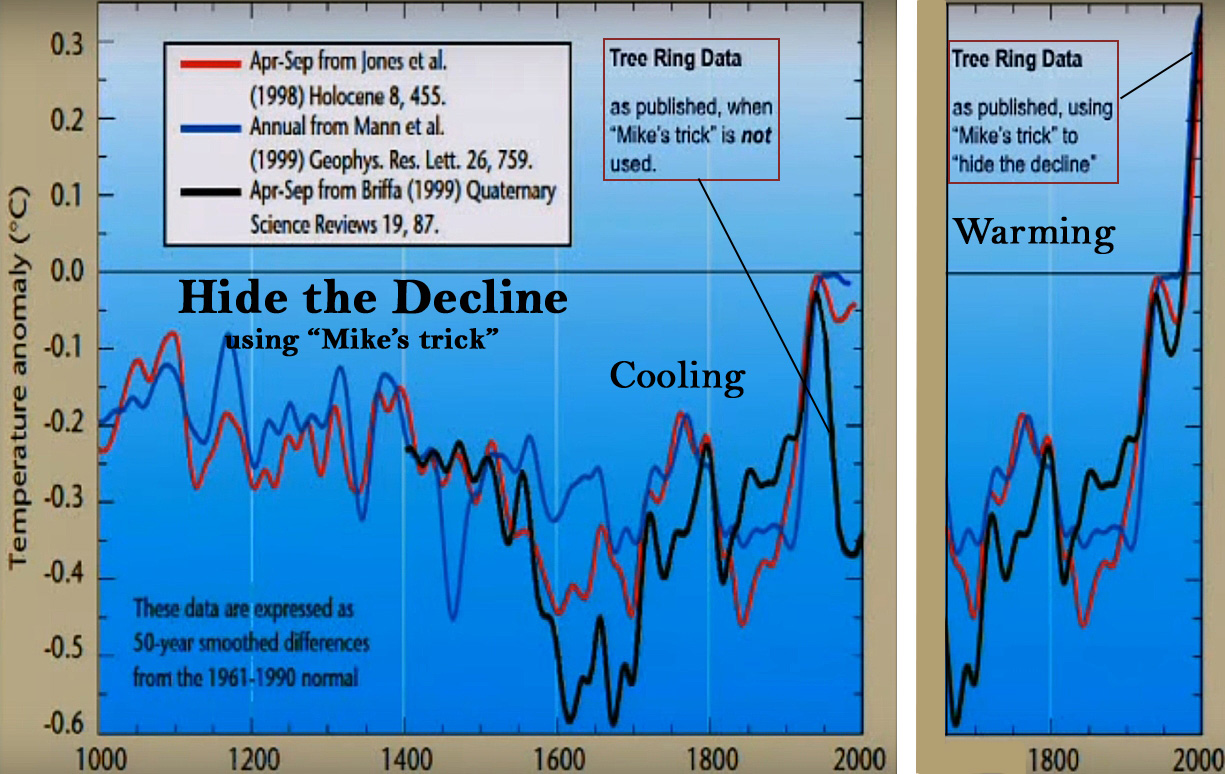
The topography of Greenland shows why its ice cap has persisted for millenia despite its southerly location.  It is a bowl surrounded by ridges except for a few outlets, Helheim being a major one.

And then, what do we know about the recent history of glacier changes. Two Decades of Changes in Helheim Glacier

Helheim Glacier is the fastest flowing glacier along the eastern edge of Greenland Ice Sheet and one of the island’s largest ocean-terminating rivers of ice. Named after the Vikings’ world of the dead, Helheim has kept scientists on their toes for the past two decades. Between 2000 and 2005, Helheim quickly increased the rate at which it dumped ice to the sea, while also rapidly retreating inland- a behavior also seen in other glaciers around Greenland. Since then, the ice loss has slowed down and the glacier’s front has partially recovered, readvancing by about 2 miles of the more than 4 miles it had initially ­retreated.

NASA has compiled a time series of airborne observations of Helheim’s changes into a new visualization that illustrates the complexity of studying Earth’s changing ice sheets. NASA uses satellites and airborne sensors to track variations in polar ice year after year to figure out what’s driving these changes and what impact they will have in the future on global concerns like sea level rise.

Since 1997, NASA has collected data over Helheim Glacier almost every year during annual airborne surveys of the Greenland Ice Sheet using an airborne laser altimeter called the Airborne Topographic Mapper (ATM). Since 2009 these surveys have continued as part of Operation IceBridge, NASA’s ongoing airborne survey of polar ice and its longest-running airborne mission. ATM measures the elevation of the glacier along a swath as the plane files along the middle of the glacier. By comparing the changes in the height of the glacier surface from year to year, scientists estimate how much ice the glacier has lost.

The animation begins by showing the NASA P-3 plane collecting elevation data in 1998. The laser instrument maps the glacier’s surface in a circular scanning pattern, firing laser shots that reflect off the ice and are recorded by the laser’s detectors aboard the airplane. The instrument measures the time it takes for the laser pulses to travel down to the ice and back to the aircraft, enabling scientists to measure the height of the ice surface. In the animation, the laser data is combined with three-dimensional images created from IceBridge’s high-resolution camera system. The animation then switches to data collected in 2013, showing how the surface elevation and position of the calving front (the edge of the glacier, from where it sheds ice) have changed over those 15 years.

Helheim’s calving front retreated about 2.5 miles between 1998 and 2013. It also thinned by around 330 feet during that period, one of the fastest thinning rates in Greenland.

“The calving front of the glacier most likely was perched on a ledge in the bedrock in 1998 and then something altered its equilibrium,” said Joe MacGregor, IceBridge deputy project scientist. “One of the most likely culprits is a change in ocean circulation or temperature, such that slightly warmer water entered into the fjord, melted a bit more ice and disturbed the glacier’s delicate balance of forces.”

In addition consider Greenland Ice Math

Prompted by comments from Gordon Walleville, let’s look at Greenland ice gains and losses in context.  The ongoing SMB (surface mass balance) estimates ice sheet mass net from melting and sublimation losses and precipitation gains.  Dynamic ice loss is a separate calculation of calving chunks of ice off the edges of the sheet, as discussed in the post above.  The two factors are combined in a paper Forty-six years of Greenland Ice Sheet mass balance from 1972 to 2018 by Mouginot et al. (2019) Excerpt in italics. (“D” refers to dynamic ice loss.)

Greenland’s SMB averaged 422 ± 10 Gt/y in 1961–1989 (SI Appendix, Fig. S1H). It decreased from 506 ± 18 Gt/y in the 1970s to 410 ± 17 Gt/y in the 1980s and 1990s, 251 ± 20 Gt/y in 2010–2018, and a minimum at 145 ± 55 Gt/y in 2012. In 2018, SMB was above equilibrium at 449 ± 55 Gt, but the ice sheet still lost 105 ± 55 Gt, because D is well above equilibrium and 15 Gt higher than in 2017. In 1972–2000, D averaged 456 ± 1 Gt/y, near balance, to peak at 555 ± 12 Gt/y in 2018. In total, the mass loss increased to 286 ± 20 Gt/y in 2010–2018 due to an 18 ± 1% increase in D and a 48 ± 9% decrease in SMB. The ice sheet gained 47 ± 21 Gt/y in 1972–1980, and lost 50 ± 17 Gt/y in the 1980s, 41 ± 17 Gt/y in the 1990s, 187 ± 17 Gt/y in the 2000s, and 286 ± 20 Gt/y in 2010–2018 (Fig. 2). Since 1972, the ice sheet lost 4,976 ± 400 Gt, or 13.7 ± 1.1 mm SLR.

Doing the numbers: Greenland area 2.1 10^6 km2 80% ice cover, 1500 m thick in average- That is 2.5 Million Gton. Simplified to 1 km3 = 1 Gton

The estimated loss since 1972 is 5000 Gt (rounded off), which is 110 Gt a year.  The more recent estimates are higher, in the 200 Gt range.

200 Gton is 0.008 % of the Greenland ice sheet mass.

Annual snowfall: From the Lost Squadron, we know at that particular spot, the ice increase since 1942 – 1990 was 1.5 m/year ( Planes were found 75 m below surface)
Assume that yearly precipitation is 100 mm / year over the entire surface.
That is 168000 Gton. Yes, Greenland is Big!
Inflow = 168,000Gton. Outflow is 168,200 Gton.

So if that 200 Gton rate continued, (assuming as models do, despite air photos showing fluctuations), that ice loss would result in a 1% loss of Greenland ice in 800 years. (H/t Bengt Abelsson)

Comment:

Once again, history is a better guide than hysteria.  Over time glaciers advance and retreat, and incursions of warm water are a key factor.  Greenland ice cap and glaciers are part of the Arctic self-oscillating climate system operating on a quasi-60 year cycle.

October 2023 Arctic Ice Grows by Leaps

The animation shows the rapid growth of Arctic ice extent during October 2023, from day 274 to day 304, yesterday.  For all of the fuss over the September minimum, little is said about Arctic ice growing 4M km2, that’s 4 Wadhams in one month!.  Look on the left (Russian side) at the complete closing of the Northern Sea Route for shipping.

The graph below show 2023 compared to the 17 year average (2006 to 2022 inclusive), to SII (Sea Ice Index) and some notable years.

This year October added 3.95M km2 from end of September compared to an average October increase of 3.45M km2.  As of yesterday NH ice extent is 368k km2 above average and nearly 600k km2 greater than 2007.

The table below shows the distribution of ice in the Arctic Ocean basins.

Region 2023304 Ave. Day 304 2023-Ave. 2007304 2023-2007
 (0) Northern_Hemisphere 8768573 8422636  345938  8175072 593501 
 (1) Beaufort_Sea 780946 957189  -176243  1038126 -257180 
 (2) Chukchi_Sea 535578 454974  80604  242685 292894 
 (3) East_Siberian_Sea 1078989 936944  142045  835071 243917 
 (4) Laptev_Sea 897845 842696  55149  887789 10055 
 (5) Kara_Sea 655623 473780  181843  311960 343664 
 (6) Barents_Sea 121748 83466  38282  52823 68925 
 (7) Greenland_Sea 528448 412774  115675  443559 84890 
 (8) Baffin_Bay_Gulf_of_St._Lawrence 243512 256243  -12731  289374 -45861 
 (9) Canadian_Archipelago 629955 762429  -132474  817220 -187265 
 (10) Hudson_Bay 82242 69487  12754  48845 33396 
 (11) Central_Arctic 3207724 3161034  46690  3206345 1379 

Overall ice extent has 346k km2 above average or 4%.  Sizeable deficits are in Beaufort Sea and Canadian Archipelago, more than offset by surpluses in Chukchi, East Siberian, Kara and Greenland seas.


Blinded by Antarctica Reports 2023

Special snow goggles for protection in polar landscapes.

Climate Crisis Central apparently triggered Antarctica for this week’s media alarm blitz.

Antarctic Ice Shelves Suffer Staggering Losses | Weather.com

‘Shrinking with no sign of recovery’: Scientists issue warning on Antarctic ice shelves
YAHOO!News

Scientists count huge melts in many protective Antarctic ice shelves. Trillions of tons of ice lost.
Associated Press

Antarctica’s Shrinking Sea Ice Hits a Record Low, Alarming Scientists Bloomberg

Melting Antarctic Ice Shelves Have Dumped More Than 7 Trillion Metric Tons of Water Into the Ocean  The Messenger

Etc., Etc. Etc.

Looks like it’s time yet again to play Climate Whack-A-Mole.  That means stepping back to get some perspective on the reports and the interpretations applied by those invested in alarmism.

Antarctic Basics

The Antarctic Ice Sheet extends almost 14 million square kilometers (5.4 million square miles), roughly the area of the contiguous United States and Mexico combined. The Antarctic Ice Sheet contains 30 million cubic kilometers (7.2 million cubic miles) of ice. (Source: NSIDC: Quick Facts Ice Sheets)

Highly active volcano Mt. Erebus, Ross Island, Antarctica

The Antarctic Ice Sheet covers an area larger than the U.S. and Mexico combined. This photo shows Mt. Erebus rising above the ice-covered continent. Credit: Ted Scambos & Rob Bauer, NSIDC

The study of ice sheet mass balance underwent two major advances, one during the early 1990s, and again early in the 2000s. At the beginning of the 1990s, scientists were unsure of the sign (positive or negative) of the mass balance of Greenland or Antarctica, and knew only that it could not be changing rapidly relative to the size of the ice sheet.

Advances in glacier ice flow mapping using repeat satellite images, and later using interferometric synthetic aperture radar SAR methods, facilitated the mass budget approach, although this still requires an estimate of snow input and a cross-section of the glacier as it flows out from the continent and becomes floating ice. Satellite radar altimetry mapping and change detection, developed in the early to mid-1990s allowed the research community to finally extract reliable quantitative information regarding the overall growth or reduction of the volume of the ice sheets.

By 2002, publications were able to report that both large ice sheets were losing mass (Rignot and Thomas 2002). Then in 2003 the launch of two new satellites, ICESat and GRACE, led to vast improvements in one of the methods for mass balance determination, volume change, and introduced the ability to conduct gravimetric measurements of ice sheet mass over time. The gravimetric method helped to resolve remaining questions about how and where the ice sheets were losing mass. With this third method, and with continued evolution of mass budget and geodetic methods it was shown that the ice sheets were in fact losing mass at an accelerating rate by the end of the 2000s (Veliconga 2009, Rignot et al. 2011b).

Fig. 1. Antarctic Ice Sheet Regions and Drainage Systems (DS). East Antarctica (EA) is divided into EA1 (DS2 to DS11) and EA2 (DS12 to DS17). The Antarctic Peninsula (AP) includes DS24 – 27. West Antarctica (WA) is divided into WA1 (Pine Island Glacier DS22, Thwaites and Smith Glaciers DS21, and the coastal DS20) and WA2 (inland DS1, DS18, and DS19 and coastal DS23). Includes grounded ice within ice shelves and contiguous islands.

Contradictory Findings

A 2021 paper by H. J. Zwally describes the waxing and waning of the Antarctic ice sheet NASA Study: Excess of Mass Gains of the Antarctic Ice Sheet over Mass Losses during 1992 to 2008 Eliminated by Increasing Dynamic Losses to 2016.  Excerpts in italics with my bolds.

A new NASA study [Antarctic Mass Balance] confirms that an increase in Antarctic snow accumulation [Siegert, 2003] that began 10,000 years ago in East Antarctica (EA) [Fig. 1] was adding enough ice to the continent during 1992 to 2008 to outweigh increased losses from its increasing glacier discharge into the ocean from West Antarctica (WA) as previously reported [2015 JOG paper]. Since most other studies reported that the Antarctic ice sheet was losing mass, those 2015 results on gaining mass were controversial. The new study derives consistent rates of mass changes over 24 years (1992 to 2016) using radar-altimetry data from ESA’s Envisat (2003-10) and gravimetry data from NASA’s GRACE (2003-16), in addition to the prior use of radar-altimetry data from ERS1/2 (1992-2001) of the European Space Agency (ESA) and laser-altimetry from NASA’s ICESat (2003-08).

However, the new study shows that beginning in 2009, the dynamic losses from the outlet glaciers in the WA1 part of WA strongly increased by 119 Gt a-1 (from 95 to 214 Gt a-1), which was further enhanced by an accumulation mass decrease of 39 Gt a-1 in the inland WA2 part of WA. Nevertheless, that total decrease of 158 Gt a-1 was not enough to bring the whole ice sheet into balance (input equals output), because there was a concurrent accumulation mass increase of 107 Gt a-1 in EA for three years (2009-11). While that temporary EA accumulation increase diminished, the loss from WA reduced by 71 Gt a-1 and the total ice sheet came into balance at -12 ± 46 Gt a-1 during 2012-16, thereby eliminating its effect on sea level rise.

Fig. 2. M(t) mass time series for West Antarctica (WA), East Antarctica (EA), Antarctica Peninsula (AP), and the total Antarctic Ice Sheet (AIS) from ICESat (blue) and GRACE (red) using the derived equalizing corrections (dBcor and GIAcor) for sub-glacial changes in volume and mass of the Earth’s fluid mantle.

Fig. 3. ICESat map of dM/dt total rate of mass change for 2003-2008 with adjusted correction for bedrock motion.

“We now have an accurate record of how the mass balance of the Antarctic ice sheet has changed over 24 years and the causes of those changes. Short-term changes for 3 to 8 years have been caused by fluctuations in snowfall and accumulation, but there is no significant trend during 1992 to 2016. Mass losses have increased from the dynamic thinning and faster ice discharge of outlet glaciers in West Antarctic, and the large long-term mass gain in East Antarctica has continued”, said lead author Jay Zwally. “However, our findings and those of others [e.g. Barletta and others, 2018] also include some good signs about the future stability of the West Antarctic ice sheet, about which there has been much concern and predictions of increasing mass loss”.

NASA aerial images record West Antarctica melting ice (2016)

Keeping Things in Perspective

Source: NASA

Such reports often include scary graphs like this one and the reader is usually provided no frame of reference or context to interpret the image. First, the chart is showing cumulative loss of mass arising from an average rate of 100 Gt lost per year since 2002. Many years had gains, including 2002, and the cumulative loss went below zero only in 2006.  Also, various methods of measuring and analyzing give different results, as indicated by the earlier section.

Most important is understanding the fluxes in proportion to the Antarctic Ice Sheet.  Let’s do the math.  Above it was stated Antarctica contains ~30 million cubic kilometers of ice volume.  One km3 of water is 1 billion cubic meters and weighs 1 billion tonnes, or 1 gigatonne.  So Antarctica has about 30,000,000 gigatonnes of ice.  Since ice is slightly less dense than water, the total should be adjusted by 0.92 for an estimate of 27.6 M Gts of ice comprising the Antarctic Ice Sheet.

So in the recent decade, an average year went from 27,600,100 Gt to 27,600,000, according to one analysis.  Other studies range from losing 200 Gt/yr to gaining 100 Gt/yr.

Even if Antarctica lost 200 Gt/yr. for the next 1000 years,
it would only approach 1% of the ice sheet.

If like Al Gore you are concerned about sea level rise, that calculation starts with the ocean area estimated to be 3.618 x 10^8 km2 (361,800,000 km2). To raise that area 1 mm requires 3.618×10^2 km3 or 361.8 km3 water (1 km3 water=1 Gt.) So 200 Gt./yr is about 0.55mm/yr or 6 mm a decade, or 6 cm/century.

By all means let’s pay attention to things changing in our world, but let’s also notice the scale of the reality and not make mountains out of molehills.

Let’s also respect the scientists who study glaciers and their subtle movements over time (“glacial pace”).  Below is an amazing video showing the challenges and the beauty of working on Greenland Glacier.

From Ice Alive: Uncovering the secrets of Earth’s Ice

For more on the Joys of Playing Climate Whack-A-Mole 


Arctic Ice Recovery Starts Sept. 2023

The animation above shows the minimum daily extent for 2023 occurred on September 15.  In the next six days ~450k km2 of ice extent was added (nearly half a Wadham). The Arctic ice extent yesterday was 4.53M km2 approaching the 17 year average for the day.

The graph for September shows the first two weeks 2023 was well below the average and tracking with 2007. After hitting bottom day 258, a sharp recovery lifted extents close to average and much higher than 2007.  (SII  has not yet posted a value for day 264).

Note that typically September ends the month slightly higher than it begins, though 2023 is already matching its Sept. 1 value.  If this year’s ice growth continued at the same rate of losses during the first two weeks of September (50k per day), the extent would reach  ~5M km2 at month end.  That would result in a 2023 September monthly average of 4.5M km2.  Such extent would be close to the median prediction, somewhat lower than 2022, but much higher than 2007 or 2020, and 800k km2 higher than 2012 (the year of the great August Cyclone.)

The table for day 264 shows how the ice extent is distributed across the Arctic regions, in comparison to 17 year average and 2007.

Region 2023264 264 Average 2023-Ave. 2007264 2023-2007
 (0) Northern_Hemisphere 4530862 4603044  -72183  4129308 401554 
 (1) Beaufort_Sea 353539 514036  -160497  507235 -153697 
 (2) Chukchi_Sea 135936 167774  -31839  30316 105620 
 (3) East_Siberian_Sea 48471 262691  -214220  311 48160 
 (4) Laptev_Sea 381662 127644  254018  223595 158067 
 (5) Kara_Sea 43989 34853  9136  27950 16038 
 (6) Barents_Sea 2394 14654  -12260  4851 -2457 
 (7) Greenland_Sea 273632 202253  71379  336388 -62756 
 (8) Baffin_Bay_Gulf_of_St._Lawrence 66853 34768  32085  31731 35122 
 (9) Canadian_Archipelago 177101 302976  -125875  237555 -60454 
 (10) Hudson_Bay 0 4119  -4119  2270 -2270 
 (11) Central_Arctic 3046145 2936249  109896  2725832 320313 

The table shows the main deficits are in Beaufort, East Siberian seas and CAA.  Offsetting surpluses are in Laptev, Greenland and Central Arctic seas. The total deficit on this day is 72k km2 or 1.6%.  Note that 2007 did not add more ice as September ended.

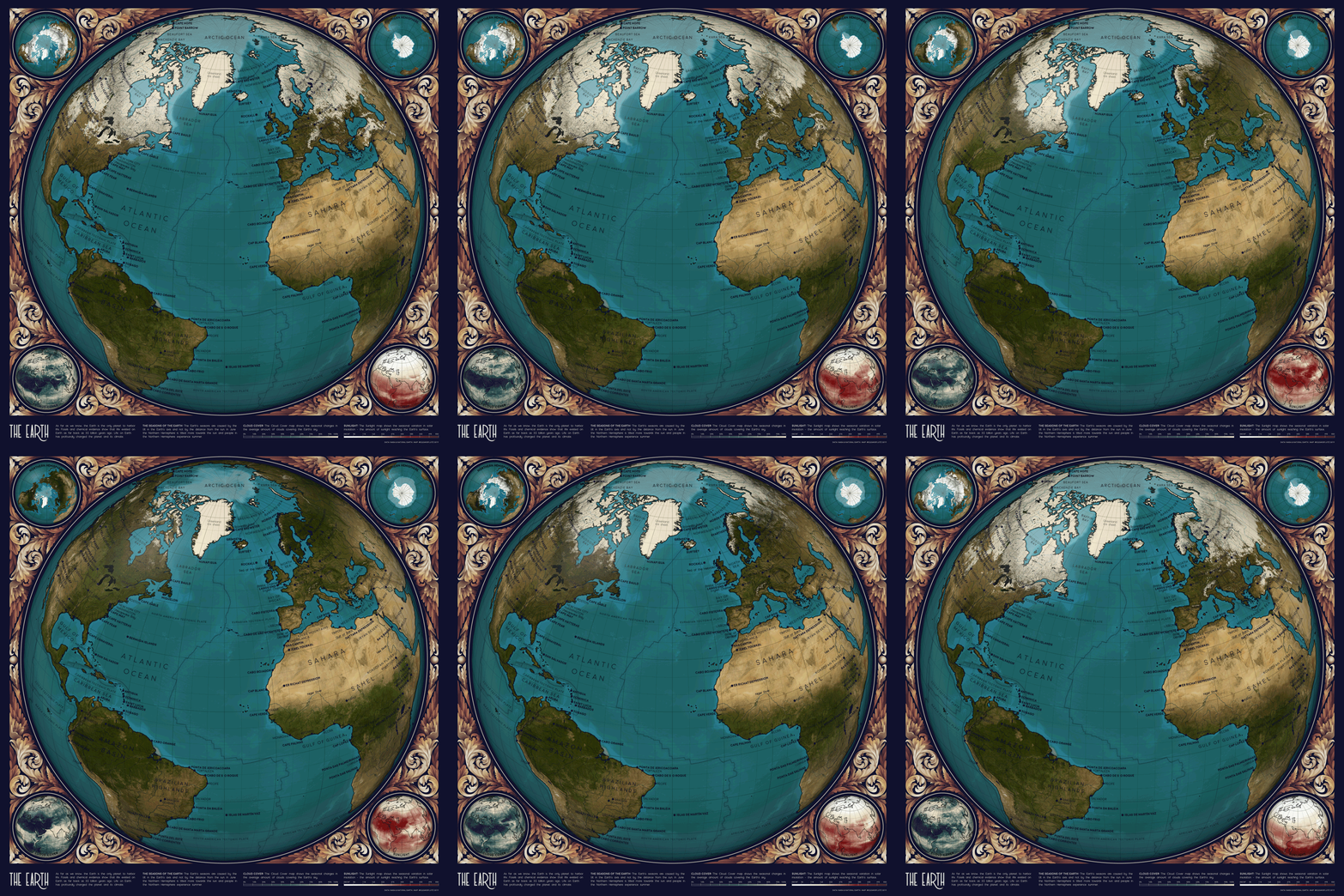
Illustration by Eleanor Lutz shows Earth’s seasonal climate changes. If played in full screen, the four corners present views from top, bottom and sides. It is a visual representation of scientific datasets measuring Arctic ice extents and snow cover.

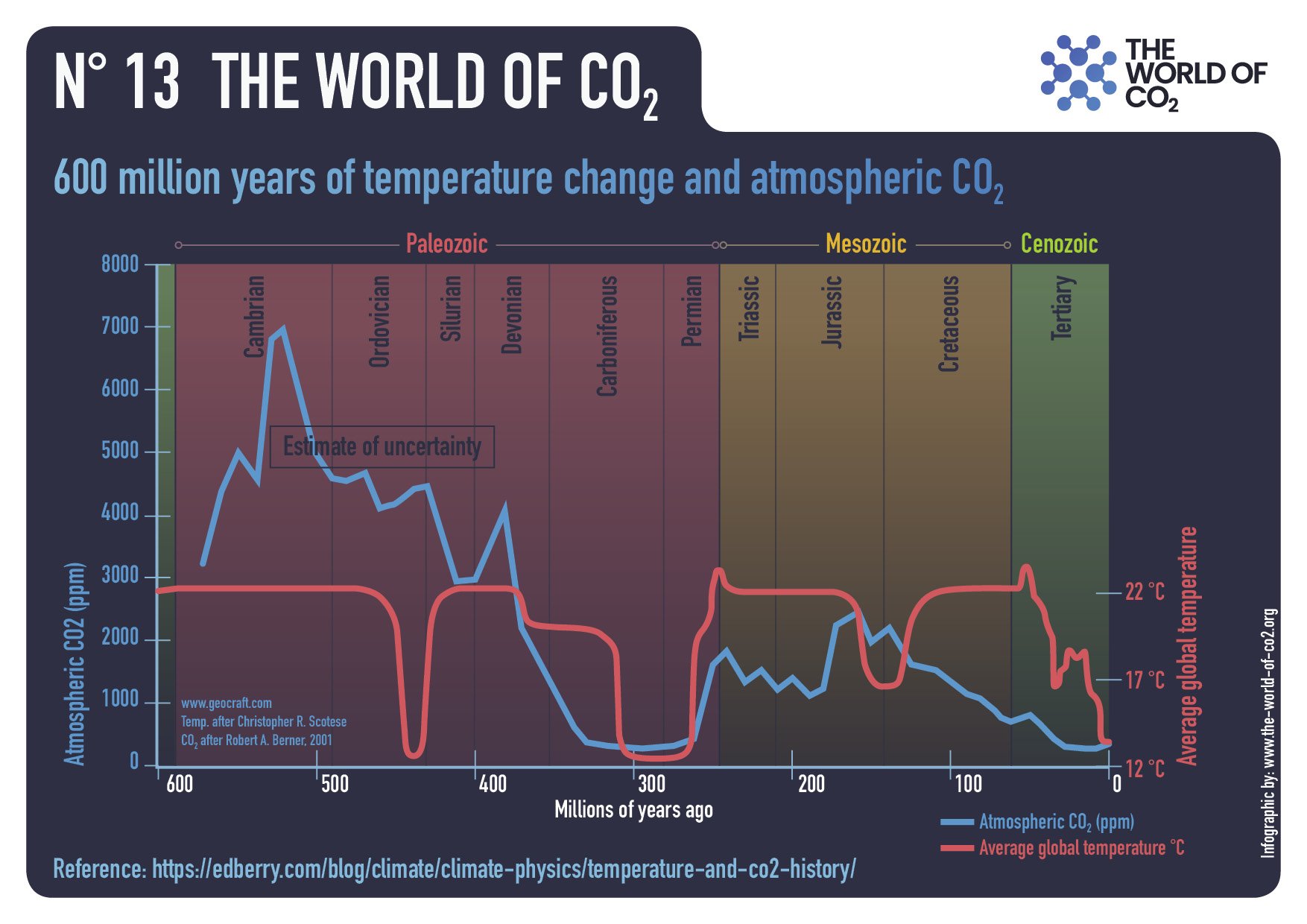
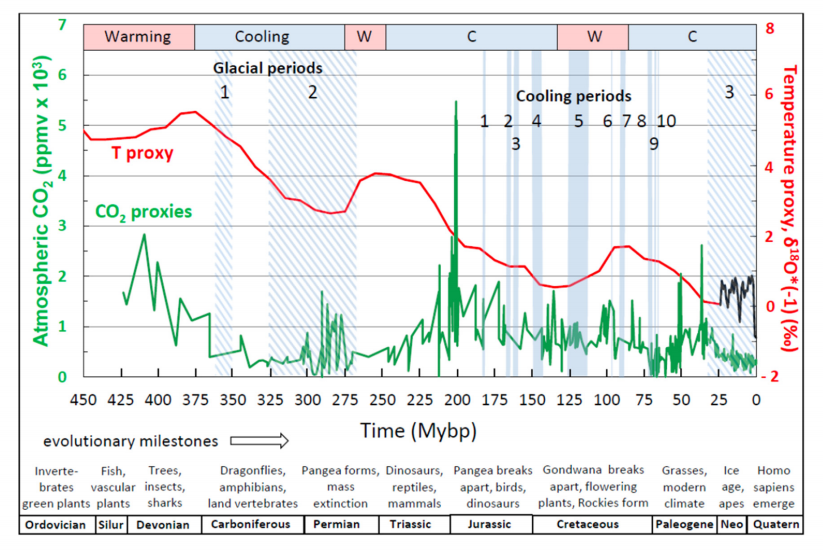
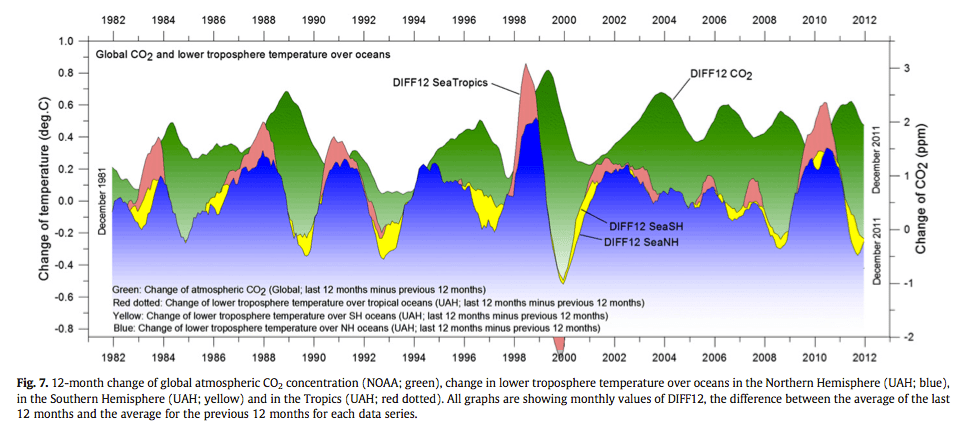
Confirmed: Temperature Drives CO2, not the Reverse

From notrickszone New Study: The Rising-CO2-Causes-Warming Perception Not Supported By Real-World Observation.  Excerpts in italics with my bolds.

One of the most basic concepts in physics is that causes precede effects and effects follow causes. Determining the directionality sequence is thus essential in any causality analysis.

The assumed CO₂→T causality direction cannot be scientifically supported

The assumption in climate models is that CO₂ causes changes in temperature, or T. More specifically, it is assumed modern global warming has been caused by increases in anthropogenic CO₂ emissions.

However, scientists (Koutsoyiannis et al., 2023) have now expanded upon last year’s 2-part study on stochastics-formulated causality published in The Royal Society (Koutsoyiannis et al., 2022 (1) and Koutsoyiannis et al., 2022 (2)) where they notably contend:

“Clearly the results […] suggest a (mono-directional) potentially causal system with T as the cause and [CO₂] as the effect. Hence the common perception that increasing [CO₂] causes increased T can be excluded as it violates the necessary condition for this causality direction.”

The analysis is in complete agreement with several posts here, especially:

Temps Cause CO2 Changes, Not the Reverse. 2023 Update

The paper is On Hens, Eggs, Temperatures and CO2: Causal Links in Earth’s Atmosphere by Demetris Koutsoyiannis et al.  Excerpts in italics with my bolds.

Abstract

The scientific and wider interest in the relationship between atmospheric temperature (T) and concentration of carbon dioxide ([CO2]) has been enormous. According to the commonly assumed causality link, increased [CO2] causes a rise in T. However, recent developments cast doubts on this assumption by showing that this relationship is of the hen-or-egg type, or even unidirectional but opposite in direction to the commonly assumed one. These developments include an advanced theoretical framework for testing causality based on the stochastic evaluation of a potentially causal link between two processes via the notion of the impulse response function. Using, on the one hand, this framework and further expanding it and, on the other hand, the longest available modern time series of globally averaged T and [CO2], we shed light on the potential causality between these two processes.

All evidence resulting from the analyses suggests a unidirectional,
potentially causal link with T as the cause and [CO2] as the effect.

That link is not represented in climate models, whose outputs are also examined using the same framework, resulting in a link opposite the one found when the real measurements are used.

Discussion and Further Results

The mainstream assumption of the causality direction [CO2] → T makes a compelling narrative, as everything is blamed on a single cause, the human CO2 emissions. Indeed, this has been the popular narrative for decades. However, popularity does not necessarily mean correctness, and here we have provided strong arguments against this assumption.

Since we have identified atmospheric temperature as the cause and atmospheric CO2 concentration as the effect, one may be tempted to ask the question: What is the cause of the modern increase in temperature? Apparently, this question is much more difficult to reply to, as we can no longer attribute everything to any single agent.

We do not claim to have the answer to this question, whose study is far beyond the article’s scope. Neither do we believe that mainstream climatic theory, which is focused upon human CO2 emissions as the main cause and regards everything else as feedback of the single main cause, can explain what happened on Earth for 4.5 billion years of changing climate.

The examined processes in the Appendices are internal to the climatic system. Other processes affecting T, not examined here, could also be external (e.g., solar and astronomical [43,44] and geological [45,46,47,48,49]). Generally, in complex systems, an identified causal link, even though it gives some explanation of a phenomenon, raises additional questions, e.g., what caused the change in the identified cause, etc. In turn, causal links in complex systems may form endless sequences.

For this reason, it is naïve to expect complete answers to problems related to complex systems or to assume that a complex system is in permanent equilibrium and that an external agent is needed to “kick” it out of the equilibrium and produce change. Yet the investigation of a single causal link between two processes, as is the focus of this paper, provides useful information, with possible significant scientific, technical, practical, epistemological and philosophical implications. These are not covered in this paper. 

As already clarified, the scope of our work is not to provide detailed modeling of the processes studied but to check causality conditions. We highlight the fact that the relationship we established explains only about 1/3 of the actual variance of Δln[CO2]. This is not negligible for investigating causality, but also leaves a margin for many other climatic factors to act.

Conclusions

With reference to points 1–7 of the Introduction setting the paper’s scope, the results of our analyses can be summarized as follows.

  1. All evidence resulting from the analyses of the longest available modern time series of atmospheric concentration of [CO2] at Mauna Loa, Hawaii, along with that of globally averaged T, suggests a unidirectional, potentially causal link with T as the cause and [CO2] as the effect. This direction of causality holds for the entire period covered by the observations (more than 60 years).
  2. Seasonality, as reflected in different phases of [CO2] time series at different latitudes, does not play any role in potential causality, as confirmed by replacing the Mauna Loa [CO2] time series with that in South Pole.
  3. The unidirectional 𝑇→ln[CO2] potential causal link applies to all timescales resolved by the available data, from monthly to about two decades.
  4. The proposed methodology is simple, flexible and effective in disambiguating cases where the type of causality, HOE or unidirectional, is not quite clear.
  5. Furthermore, the methodology defines a type of data analysis that, regardless of the detection of causality per se, assesses modeling performance by comparing observational data with model results. In particular, the analysis of climate model outputs reveals a misrepresentation of the causal link by these models, which suggest a causality direction opposite to the one found when the real measurements are used.
  6. Extensions of the scope of the methodology, i.e., from detecting possible causality to building a more detailed model of stochastic type, are possible, as illustrated by a toy model for the T-[CO2] system, with explained variance of [CO2] reaching an impressive 99.9%.
  7. While some of the findings of this study seem counterintuitive or contrary to mainstream opinions, they are logically and computationally supported by arguments and calculations given in the Appendices.


Don’t Buy “Planetary Boundaries” Hype

Latest diagram from Stockholm Resilience Centre

The usual suspects are beating on their “planetary boundaries” drum to scare up submission to Zero Carbon restrictions.  Remember these are the same climate justice warriors pushing the notion of a new geological era named “Anthropocene”.  For example, cue the following:

Six of nine planetary boundaries now exceeded–Phys.org

Humans Have Crossed 6 of 9 ‘Planetary Boundaries’–Scientific American

Earth is now outside most of the “planetary boundaries” under which human civilization emerged–TechSpot

Six out of 9 planetary boundaries breached, Earth increasingly becoming uninhabitable for humans–MSN.com

Humanity deep in the danger zone of planetary boundaries: study–YAHOO!News

Etc., Etc. Etc.

Background

In 2009, a group of 29 scholars published an article in Nature, advancing an approach to define a “safe operating space for humanity” (1). The group argued that we can identify a set of nine “planetary boundaries” that humanity must not cross at the cost of its own peril. Since this 2009 publication, the concept of planetary boundaries has been highly influential in generating academic debate and in shaping research projects and policy recommendations worldwide. At the same time, the concept has come under heavy scrutiny as well, and many critics have taken the floor contesting the broader framework as well as its implementation and interpretation. Partially because of this critique, the original proposition of nine planetary boundaries has undergone various reformulations and updates by their proponents and an emerging network of scholars specializing in planetary boundary research.

The original 2009 paper in Nature suggested nine boundary conditions in the earth system that could, if crossed, result in a major disruption in (parts of) the system and a transition to a different state, which is likely to be hostile to human prosperity. The proposed planetary boundaries included:

♦  climate change,
♦  biodiversity loss,
♦  the nitrogen cycle,
♦  the phosphorus cycle,
♦  stratospheric ozone depletion,
♦  ocean acidification,
♦  global freshwater use,
♦  land use change,
♦  atmospheric aerosol loading, and
♦  chemical pollution.

For each of these planetary boundaries, one or more control variables were identified (e.g., atmospheric carbon dioxide concentration), which in turn were assigned with numerical boundary values at a “safe” distance from dangerous levels, or where applicable, “tipping points” in earth system processes (1).

Eventually, the framework should allow for quantification of threshold parameters, as a guide also for political responses. For some planetary boundaries, the group in 2009 suggested that the current state of knowledge was too uncertain to allow for quantification. Yet, for other earth system processes, the group felt confident enough to suggest a specific boundary value. In this endeavor, they erred on the side of caution and a strict interpretation of the precautionary principle: Where they saw remaining uncertainties, the group suggested the lower values for the boundary that they identified.

They concluded that three planetary boundaries had been crossed already.

On climate change, for instance, the boundary value proposed was 350 ppm, which had been passed long ago in the second half of the twentieth century. Regarding biodiversity, the current extinction rate is more than 100 extinct species per million species per year, whereas the suggested boundary was 10 extinctions. As for the nitrogen cycle, humans remove today approximately 121 million tons of nitrogen per year from the atmosphere, whereas a safe rate would be a maximum of 35 million tons. In these three areas, therefore, this analysis suggested that humankind had pushed the earth system past planetary boundaries and possibly dangerous levels, into a new—and unknown—world.  Source: The Boundaries of the Planetary Boundary Framework: A Critical Appraisal of Approaches to Define a “Safe Operating Space” for Humanity.  Annual Review of Environment and Resources October 2020

We don’t know how long we can keep transgressing these key boundaries before combined pressures lead to irreversible change and harm.–Johan Rockström, co-author and Centre researcher

Critics of the Planetary Boundaries Framework

Leaving aside those who want the boundaries to be tighter and harder than presented, let’s hear from critics challenging the whole enterprise. Shortly after the invention of “planetary boundaries,” Breakthrough Institute published a thorough critique of the notion and the framework.  Planetary Boundaries: A Review of the Evidence.  Linus Blomqvist (2012)

The planetary boundaries hypothesis – embraced by United Nations bodies and leading nongovernmental organizations like Oxfam and WWF – has serious scientific flaws and is a misleading guide to global environmental management, according to a new report by the Breakthrough Institute. The hypothesis, which will be debated this month at the UN Earth Summit in Brazil, posits that there are nine global biophysical limits to human development. But after an extensive literature review and informal peer review by leading experts, the Breakthrough Institute has found the concept of “planetary boundaries” to be a poor basis for policy and for understanding local and global environmental challenges.

KEY FINDINGS

♦   Six of the “planetary boundaries” — land-use change, biodiversity loss, nitrogen levels, freshwater use, aerosol loading, and chemical pollution — do not have planetary biophysical boundaries in themselves.

♦   Aside from their impacts on the global climate, these non-threshold “boundaries” operate on local and regional, not global, levels.

♦   There is little evidence to support the claim that transgressing any of the six non-threshold boundaries would have a net negative effect on human material welfare.  The full report is linked below:

A new report from the Breakthrough Institute highlights scientific flaws
of the “planetary boundaries” hypothesis

Planetary Boundaries as Power Grab–Giving Political Decisions a Scientific Sheen–Roger Pielke Jr. (2013)

When the cover of the Economist famously announced Welcome to the anthropocene’ a couple of years ago, was it welcoming us to a new geological epoch, or a dangerous new world of undisputed scientific authority and anti-democratic politics?

The basis for the power grab by the experts – really old wine in new bottles – is the fashionable idea of planetary boundaries which holds that there are hard and fast ecological limits within which human activity must be constrained. The concept is much contested scientifically — such as in this excellent review by my colleagues at The Breakthrough Institute.

A real-world example of the implications of the planetary boundaries political philosophy is vividly seen through the issue of global energy access. Future global development, at least in the short term, necessarily will involve trade offs between expanded use of carbon-emitting fossil fuels and the expansion of energy access to the world’s poorest. The planetary boundaries advocates, consist with their hierarchical values framework, call for “universal clean energy” and recommend development targets focused not on measuring expanded energy access, but rather carbon dioxide emissions (here in PDF).

In other words, expanded energy access to the world’s poorest is deemed acceptable
only if it first satisfies the demands of planetary boundaries – in other words,
the political demands of the scientists couched in the inviolable authority of science.

An major recent critique was: Planetary Boundaries for Biodiversity:  Implausible Science, Pernicious Policies  by Montoya, Donohue and Pimm. Trends in Ecology and Evolution (2018)

The notion of a ‘safe operating space for biodiversity’ is vague and encourages harmful policies. Attempts to fix it strip it of all meaningful content. Ecology is rapidly gaining insights into the connections between biodiversity and ecosystem stability. We have no option but to understand ecological complexity and act accordingly.

How best should environmental science articulate its concerns, set research agendas, and advise policies?One solution embraces the notion of planetary boundaries [1] arguing that global environmental processes very generally have ‘tipping points’. These are catastrophes involving thresholds beyond which there will be rapid transitions to new states that are very much less favorable to human existence than current states. The associated notion is that humanity’s ‘business as usual’ can only continue so long as it remains within some ‘safe operating space’.

We show that notions of planetary boundaries add no insight into our understanding
of the threats to biodiversity and ecosystem functioning, have no evidence to support them,
are too vague for use by those who manage biodiversity, and promote pernicious policies.

Fatally, the boundaries framework lacks clear definitions, or it has too many conflicting definitions, does not specify units, and fails to define terms operationally, thus prohibiting application by those who set policy or manage natural resources. Moreover, recent reviews indicate that tipping points occur only rarely in
natural systems [6], while policies related to boundaries are unlikely to be evidence based. A need for operational definitions to aid managers is self-evident [7].

At the heart of the problem are terms such as ‘planetary boundaries’, but also ‘sustainability’, ‘health’, ‘harmony’, and others, that are emotionally appealing but rarely, if ever, defined. They all speak to the urgent need to understand how human impacts change ecosystems, when at best we aspire to protect only
half of it. We must set policies and establish management for the vast tracts of land and sea that we do not protect. Fatally, those who do so often use language that does not borrow from the existing knowledge about ecosystem processes, nor readily translates its aspirations to those who study them [7].

See Also:

Planetary Boundaries as Millenarian Prophesies  Malthusian Echoes

The identification of the planetary boundaries is dependent on the normative assumptions made, for example, concerning the value of biodiversity and the desirability of the Holocene. Rather than non-negotiables, humanity faces a system of trade-offs – not only economic, but moral and aesthetic as well. Deciding how to balance these trade-offs is a matter of political contestation (Blomqvist et al, 2012:37). What counts as “unacceptable environmental change” is not a matter of scientific fact, but involves judgments concerning the value of the things to be affected by the potential changes. The framing of planetary boundaries as being scientifically derived non-negotiable limits, obscures the inherent normativity of deciding how to react to environmental change. Presenting human values as facts of nature is an effective political strategy to shut down debate.

Beyond Planetary Boundaries by Michael Shellenberger, Ted Nordhaus, and Linus Blomqvist (2012)

There are useful implications for environmental change science that can be drawn from where planetary boundaries went wrong. First, any pragmatic framework on environmental change must look at benefits and costs. Some of the hypothesis’s authors have said that their motivation was to provide a useful framework for helping global leaders manage environmental change. We applaud and support this motivation. But for any environmental change framework to be useful, it must seek to understand not only the costs of change but also its benefits.

One of the implications of this is that simply measuring variance from Holocene baselines is a highly misleading metric of human sustainability. Since so much variance from the Holocene has been good for humans, future environmental change cannot be assumed, as planetary boundaries does, to be negative for our welfare.


History Shows Today’s Ocean at Cool End of Range

You may have heard claims recently that the ocean is now “boiling”.  Fortunately, a world expert in ocean heat uptake provides a deep dive into oceanic temperature history, thereby putting that fear to rest.

Geoffrey Gebbie of Woods Hole Oceanographic Institution has published an highly informative study Combining Modern and Paleoceanographic Perspectives on Ocean Heat Uptake in Annual Review of Marine Science (2021).  H/T Kenneth Richard.  Below are the main findings, along with some excerpts in italics with my bolds, explaining some oceanography for the rest of us.

The large climatic shifts that started with the melting of the great ice sheets have
involved significant ocean heat uptake that was sustained over centuries and millennia,
and modern-ocean heat content changes are small by comparison.

Abstract

Monitoring Earth’s energy imbalance requires monitoring changes in the heat content of the ocean. Recent observational estimates indicate that ocean heat uptake is accelerating in the twenty-first century. Examination of estimates of ocean heat uptake over the industrial era, the Common Era of the last 2,000 years, and the period since the Last Glacial Maximum, 20,000 years ago, permits a wide perspective on modern-day warming rates. In addition, this longer-term focus illustrates how the dynamics of the deep ocean and the cryosphere were active in the past and are still active today. The large climatic shifts that started with the melting of the great ice sheets have involved significant ocean heat uptake that was sustained over centuries and millennia, and modern-ocean heat content changes are small by comparison.

Objective

This review seeks to put the most recent ocean heat uptake estimates of 0.5–0.7 W m−2 into the context of longer (multidecadal to millennial) timescales. Such timescales put a wider perspective on present-day heat uptake. In addition, the dynamics of these longer timescales may still have some expression today. This research direction leads to the long temperature time series of paleoceanographic proxies that predate the instrumental record. Ocean heat uptake over the last deglaciation (∼20,000–10,000 years ago) and the Common Era (previous two millennia) will serve as examples to explore the longer-timescale dynamics of ocean heat uptake.

Common Era Evolution of Mean Ocean Temperature

The Ocean2k global-mean SST compilation is derived from 57 marine proxy records that, in aggregate, show a statistically significant cooling trend from 700 to 1700 CE over the MCA–LIA transition (Medieval Climate Anomaly, Little Ice Age). The data compilation contains a time series of 200-year averages that have been nondimensionalized. Here, we dimensionalize the values with the recommended values of McGregor et al. (2015) to obtain temperature anomalies, and the inferred global-mean surface cooling over the MCA–LIA transition is near the high end of the expected 0.4–0.6°C range (Figure 4a).

Figure 4  The Common Era. (a) The evolution of Ocean2k SST (blue circles, with σ/2 error bars) and mean ocean temperature, , as inferred from noble-gas measurements (red circles, with σ/2 error bars), the Gebbie & Huybers (2019) Common Era inversion (red line), and a power-law estimate (black line, with 2σ error shown in gray), referenced to global-mean SST in 1870. (b,c) Average ocean heat uptake over a running 50-year interval (panel b) and a 500-year interval (panel c) plotted from the Gebbie & Huybers (2019) inversion (red line) and a power-law estimate (black line, with 1σ error shown in gray). Heat uptake is expressed in terms of an equivalent planetary energy imbalance. Abbreviation: SST, sea-surface temperature.

One realization of the Common Era was produced by an inversion that attempted to reconstruct the three-dimensional evolution of oceanic temperature anomalies over the last 2,000 years (Gebbie & Huybers 2019). The inversion fits an empirical ocean circulation model to modern-day tracer observations, historical temperature observations from the HMS Challenger expedition of 1872–1876 (Murray 1895), and the global-mean Ocean2k SST. The resulting ocean temperature evolution is dominated by the propagation of surface climate anomalies from the MCA and LIA into the subsurface ocean, where the propagation is coherent for several centuries (red line in Figure 4a). Although the Gebbie & Huybers (2019) inversion was not constrained with oceanic power laws, the resulting mean ocean temperature is consistent with a power-law estimate over the Common Era.

Early-twenty-first-century SST may already be warmer than MCA SST, but it is
less likely that modern mean ocean temperature has surpassed MCA values.

From the Gebbie & Huybers (2019) inversion, it was inferred that the MCA ocean stored 1,000 ZJ more than the ocean of the year 2000, and that the ∼500 ZJ of heat uptake during the modern warming era is just one-third of what is required to reach MCA levels. Amplification of the high-latitude SST signal relative to the global mean can produce a greater MCA–LIA mean ocean cooling, which explains the greater MCA heat content relative to the present day. When considering the range of Common Era scenarios consistent with a power law, however, some cases are admitted where the MCA and the present day have similar oceanic heat content.

Deep-Ocean Heat Uptake During Modern Warming

Figure 6  Ocean heat uptake below 2,000-m depth, in terms of a planetary energy imbalance, for 50-year averages given by Zanna et al. (2019) (blue line), Gebbie & Huybers (2019) (red line), and the power-law estimate from this review (black line, with 2σ error in gray). An observational estimate (purple, with 2σ error bar) for 1990–2010 is also included (Purkey & Johnson 2010).

The confidence in upper-ocean heat content during the modern warming era starkly contrasts with the remaining uncertainties in heat content below 2,000-m depth (Figure 6). Observational estimates have indicated a deep-ocean heat uptake of 68 ± 61 mW m−2 (2σ) when differencing hydrographic sections between 1990 and 2010 (Purkey & Johnson 2010, Desbruyères et al. 2017). Estimation of deep-ocean heat uptake over the entire instrumental era relies to a greater extent on circulation models. Simulations of modern warming that are initialized from equilibrium in 1870 suggest that heat penetrates downward (Gregory 2000) and that average deep-ocean heat uptake is small over 50-year time intervals (Zanna et al. 2019). These estimates would not capture ongoing trends from the earlier Common Era, if any existed. An inversion that accounts for the LIA found a deep-ocean heat loss of 80 mW m−2 early in the modern warming era (Gebbie & Huybers 2019), and our power-law estimate suggests that an even greater cooling is possible, although the uncertainties are large. These discrepancies highlight the ongoing effect that Common Era variability could play in the modern-day ocean. Unfortunately, recent observations do not appear to be sufficient to distinguish between these scenarios, as they all suggest a weak deep-ocean heat uptake in the early twenty-first century.

Deep-ocean cooling could exist as the result of
disequilibrium between the upper and deep ocean.

Oceanic disequilibrium exists at a range of spatial and temporal scales, from local, short-term variability to longer-term changes that are anticipated to generally have greater spatial extent. Oceanic disequilibrium has been anticipated as a result of the 1815 Tambora (Stenchikov et al. 2009) and 1883 Krakatoa (Gleckler et al. 2006) volcanic eruptions and their lingering effects on energy imbalance. More generally, ocean disequilibrium can result from the differing adjustment times of the interior ocean to surface forcing, where the deep-ocean response may take longer than 1,000 years (e.g., Wunsch & Heimbach 2008). Accordingly, some influence of changes in surface climate over the last millennium is potentially present today. The most isolated waters of the mid-depth Pacific, for example, should still be adjusting to the MCA–LIA transition. In this scenario, these deep waters are cooling, but they are anomalously warm due to the residual influence of the MCA. 

The degree to which the ocean’s long memory affects today’s ocean is uncertain due to difficulties in integrating state-of-the-art circulation models over the entire Common Era. An accurate assessment may also require a model that can skillfully predict ocean circulation changes in both the past and the future. The climate history of the Common Era should also be better constrained by recovering additional observations, such as historical subsurface temperature observations and paleoceanographic data. Proper inference of climate sensitivity depends on the past oceanic heat uptake, which this review suggests is tied to the long timescale of deep-ocean dynamics.

Do notice the scale on the left axis. As though we can measure the whole ocean (71% of earth surface) to 0.05 C. It’s a formula converting zettajoules to temp change.


Climate Ambulance Chasers

Holman Jenkins reports at WSJ Maui Sees Off the Climate-Change Ambulance Chasers.  Excerpts in italics with my bolds and added images.  H/T  climate depot

Making climate policy the answer to weather risks
is a distraction & fraud on the public

It was modestly funny when Hurricane Sandy, after it came ashore in 2012, had to be hurriedly renamed Superstorm Sandy (a title with no formal meteorological meaning) because it was no longer a hurricane.

Local politicians blabbed in the aftermath about climate change to help unlock Obama disaster aid, and also to duck questions about inadequate preparation. But the storm itself was no different from many that had battered the Northeastern seaboard for centuries. The difference was how many people and structures were in its path.

Nothing is funny in the aftermath of the Maui wildfire, which swept through a town and killed at least 115. But it’s noteworthy that Joe Biden refrained from his usual clamor about a climate crisis. He didn’t even mention the word climate in his speech when visiting the island.

Perhaps Mr. Biden’s off-key anecdote about a kitchen fire at his Delaware home was his ad-lib substitution. Whatever the reason, his aides apparently understood that climate talk would come across as criminal and cowardly in the face of the true causes of the Maui disaster.

High winds are a common occurrence. Dry conditions are a common occurrence.
Invasive grasses taking over abandoned pineapple and sugar plantations
were a known menace, complicated by unhelpful land-use policy.

Emergency sirens weren’t sounded. Water wasn’t available due to political squabbles over allocation rights. The local utility was instructed by Hawaii’s Legislature to meet ambitious renewables targets rather than spend on reducing fire risk. Firefighters reportedly left the scene early believing they had extinguished the initial blaze.

Maui itself is an island surrounded by the Pacific Ocean, with vagaries
more immediate and potent than any caused by a 0.3% fluctuation
in the planet’s long-term energy balance due to atmospheric CO2.

Blue-green algae gave us oxygen to breathe and yet we don’t blame blue-green algae for everything oxygen-breathing organisms do. Likewise, nothing very useful comes from trying to explain every weather-related misfortune in terms of human-caused carbon dioxide in the atmosphere.

Weather is a product of climate, we should specify; our climate is currently influenced by atmospheric CO2 of 419 parts per million.

But hurricanes, fires, floods and heat waves also occurred when the concentration
was 280 parts per million, and tended to claim more lives than they do now.

Whatever man’s role in climate change, whatever the merits of regulating CO2, making climate policy the answer to weather risks is a distraction and fraud on the public. Nearly one-third of all greenhouse gases have been released since Al Gore won his 2007 Nobel Peace Prize for a climate movie. These emissions have an estimated half-life in the atmosphere of 120 years. Your electric car isn’t going to change that.

By now, though, activists and lobbyists have a picture on the wall, blown up to five times life-size, of a certain type of voter willing to believe anything, even that Joe Biden’s pork-ridden Inflation Reduction Act meaningfully addresses a warming planet.

Meanwhile, a Nobel Prize laureate in physics who decries the “application of scientific disinformation for opportunistic purposes” can expect to be disinvited from giving a speech to the International Monetary Fund, as the 2022 laureate John Clauser recently was. His offending words, which are hard to dispute in the dictionary sense: “I believe that climate change is not a crisis” (emphasis added).

A crisis, after all, usually calls for concerted, immediate action. Why is it that nothing is ever seriously proposed or enacted, including Mr. Biden’s bag of handouts for “green” energy interests, that would actually have a detectable effect on weather and climate now or in the future?

To stress something not usually emphasized, the science is still largely a science of computer simulations. For now, though, it suggests a relatively manageable human adaptation to a slowly warming planet, mainly through everyday decisions about where and how to live, build and work. Once again, a weather-related disaster is too important to cheapen for the sake of the ‘narrative.”

Australia Academy of Science Now a Woke Joke

The GBR is the largest reef system on Earth and runs for over 1,400 miles down the eastern side of Australia.

Peter Ridd explains at Spectator Australia The astonishingly woke Australian Academy of Science.  Excerpts in italics with my bolds and added images

The Australian Academy of Science (AAS) recently released a report Reef Futures Roundtable, which is ostensibly about the doomed Great Barrier Reef. However, the report only demonstrates that the AAS, Australia’s peak science body, has become not just unscientific, but anti-scientific. Perhaps unsurprisingly, it has also become astonishingly Woke.

The AAS report predictably concluded that the Great Barrier Reef
could already be ‘irreversibly’ damaged.

The fact that UNESCO has just declared it not endangered did not rate a mention, and neither did the latest two years of statistics showing the reef is at record high coral levels. Remarkably, the report does not contain a single fact or figure to support any of its claims about the reef – except the area of the reef is 340,000 square kilometres. There are no figures, no percentages.

The recovery in the northern GBR actually started around 2017. Last year the coral declined slightly from 36.5% to 35.7%, and was easily within the margin of error calculated by the AIMS. Typhoon Tiffany passed through at the end of the previous reporting season, and could have been responsible for some loss. Central and Sounthern sections of GBR showed similar gains.

Nowhere does it mention that coral grows 30 per cent faster for every degree increase in water temperatures. Or that there is 100 per cent more coral on the reef today than in 2012. Or that just 1 per cent of the reef has the potential to be impacted by farm sediment, fertiliser or pesticides, even in the slightest way. Or that the sea level has fallen by 1 metre in the last 5,000 years.

The problem with this completely unanalytical approach
is seen in the ‘interventions’ it recommends to fix the reef.

Their impracticality is breathtaking. For example, it suggests ‘solar radiation management’ – shading the reef from the sun with man-made fog and clouds to prevent the water heating up and causing coral bleaching. The only number cited in the entire report – the area of the reef, which is as big as Germany – should have given them a hint that this is crazy. How are you going to make a cloud as big as Germany and keep it anchored over the reef for the whole summer over the next few hundred years? And you will also have to stop hot water flowing into the reef from the Coral Sea at the same time. That would require a dam 2,000 kilometres long and 100 metres high.

While a simple calculation is all that is required to reveal the absurdity of this idea, modern science is full of people who are almost completely non-quantitative and, as such, impractical and virtually useless as scientists.

Next there is rubble stabilisation. The supposed experts worry that the Great Barrier Reef will break up from climate change. Each of the 3,000 reefs is an almost solid lump of calcium carbonate rock (fragments of coral glued together over eons) a few kilometres wide and 100 metres high. How this is going to be broken up by some climate change magic is unexplained. But even if that were to happen, are they seriously suggesting we can wire it back together with steel reinforcing and concrete? Just do the calculation on how much concrete and steel this would entail.

The unscientific nature of the AAS report is largely a result of its anti-scientific approach. The report is actually a parody of wokeness and romantic mythology. This starts with the way the roundtable committees of ‘experts’, whom they questioned about the reef, were formed. Each roundtable had two chairs, a non-Indigenous chair, and a specially selected Aboriginal and Torres Strait Islander chair. The romantic mythology about the special knowledge of any person with Indigenous heritage pervades the entire document, and starts in the foreword by the head of the AAS.

As the Academy approached the task of planning this project it became immediately obvious that there was no separating nature and culture when it comes to the GBR. Land and sea cannot be separated. No priority can be selected on an ecological basis alone. Having a Traditional Knowledges co-Chair in each roundtable allowed for different sources of knowledge to be shared and to form a basis for a number of the observations featured in this report.

Having a diversity of ideas and scientific thought would have gone some of the way to curing the AAS of the groupthink which renders its report risible. And the views and experience of people from the coral islands of the Torres Straits and northern Great Barrier Reef could have been used to great effect. These people tend to be deeply practical about the reef – like almost all seafaring people who live and work on the reef. And practical people know you cannot bolt the reef, which is the size of Germany, down to the seafloor.

But selecting people for their ‘roundtables’ on the basis of their ethnicity
rather than their scientific or real-world experience
is a fundamentally anti-scientific approach.

But it gets worse. The dearth of statistics about the reef are made up for by an abundance of data on the gender identification of all those who participated in the ‘roundtables’. There is also the Indigenous percentage. And not just of those who participated, but also of those who were invited to participate but did not. One could quibble and point out that those claiming to be male or female added up to exactly 100 per cent in all categories, indicating a terrifying lack of diversity on the LGBQTI+++ spectrum. But there is no question, on the important matters for the Woke brigade, that this report is brimming with instructive statistics.

The AAS ascribes such importance to facts and figures on gender and race,
but not to scientific facts.

This demonstrates it is anti-science. Science is about evidence and logic. It does not matter whether one is male or female or whatever else, it is still impossible to make clouds as big as Germany for the next hundred years. That is called a fact, and facts do not vary with race, gender, or any ideology.

I have been saying for some time that many of our science institutions have become totally untrustworthy. By its wilful abandonment of quantitative analysis, the AAS has destroyed its reputation as a source of useful scientific advice. The media loves a bad news story – they should focus on what has happened to a once-esteemed organisation.

The Australian Academy of Science is now a joke.

Peter Ridd is an Adjunct Fellow at the Institute of Public Affairs.

See Also Barrier Reef Great Again

Recently I watched an extraordinary netflix documentary which took us on a journey discovering the rich variety of reef life, including microscopic creatures not shown in videos before. It was highly educational and thoroughly delightful . . . until suddenly it wasn’t. Spoiler Alert: Puff returns as an adult to the reef where he was born after leaving it to mature in a mangrove marsh. Alas, he finds the coral dead and blackened, and the narrator warns us: Warming oceans killed the reef and we must change the way we live for the sake of Puff and the other reef creatures. There may have been more to the fire and brimstone ending, but I was so turned off that I turned it off.

Coral at the Great Barrier Reef (GBR) faces another year of exile from the climate scare headlines with news that the record levels reported in 2021-22 have been sustained in the latest annual period to May 2023. A small drop in the three main areas of the reef was well within margin of error territory, with the Australian Institute of Marine Science (AIMS) reporting that regional average hard coral cover in 2022-2023 was similar to last year at 35.7%. Most reefs underwent little change during the year.