NYT Does More Weird Science: Heat Waves

Ronald Bailey writes at Reason The New York Times Says Heat Waves Are Getting Worse. The National Climate Assessment Disagrees.  Excerpts in italics with my bolds.

Americans east of the Rockies are sweltering as daytime temperatures soar toward 100 degrees or more. It is now customary for journalists covering big weather events to speculate on how man-made climate change may be affecting them, and the current heat wave is no exception. Take this headline in The New York Times: “Heat Waves in the Age of Climate Change: Longer, More Frequent and More Dangerous.”

As evidence, the Times cites the U.S. Global Change Research Program, reporting that “since the 1960s the average number of heat waves—defined as two or more consecutive days where daily lows exceeded historical July and August temperatures—in 50 major American cities has tripled.” That is indeed what the numbers show. But it seems odd to highlight the trend in daily low temperatures rather than daily high temperatures.

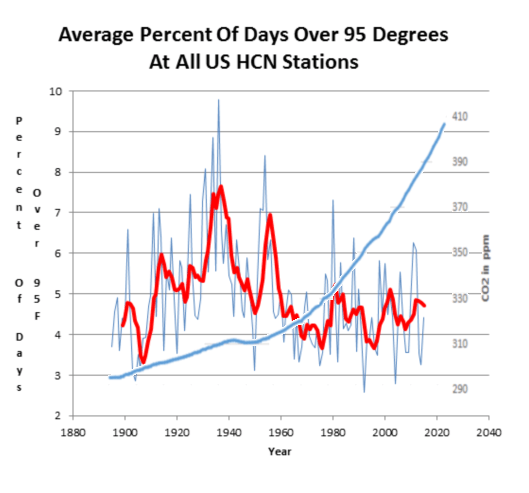
As it happens, chapter six of 2017’s Fourth National Climate Assessment reports that heat waves measured as high daily temperatures are becoming less common in the contiguous U.S., not more frequent.

Here, from the report, are the “observed changes in the coldest and warmest daily temperatures (°F) of the year for each National Climate Assessment region in the contiguous United States.” The “changes,” it explains, “are the difference between the average for present-day (1986–2016) and the average for the first half of the last century (1901–1960).”

And here is the Heat Wave Magnitude Index, which shows the maximum magnitude of a year’s heat waves. (The report defines a heat wave as a period of at least three consecutive days where the maximum temperature is above the appropriate threshold.)

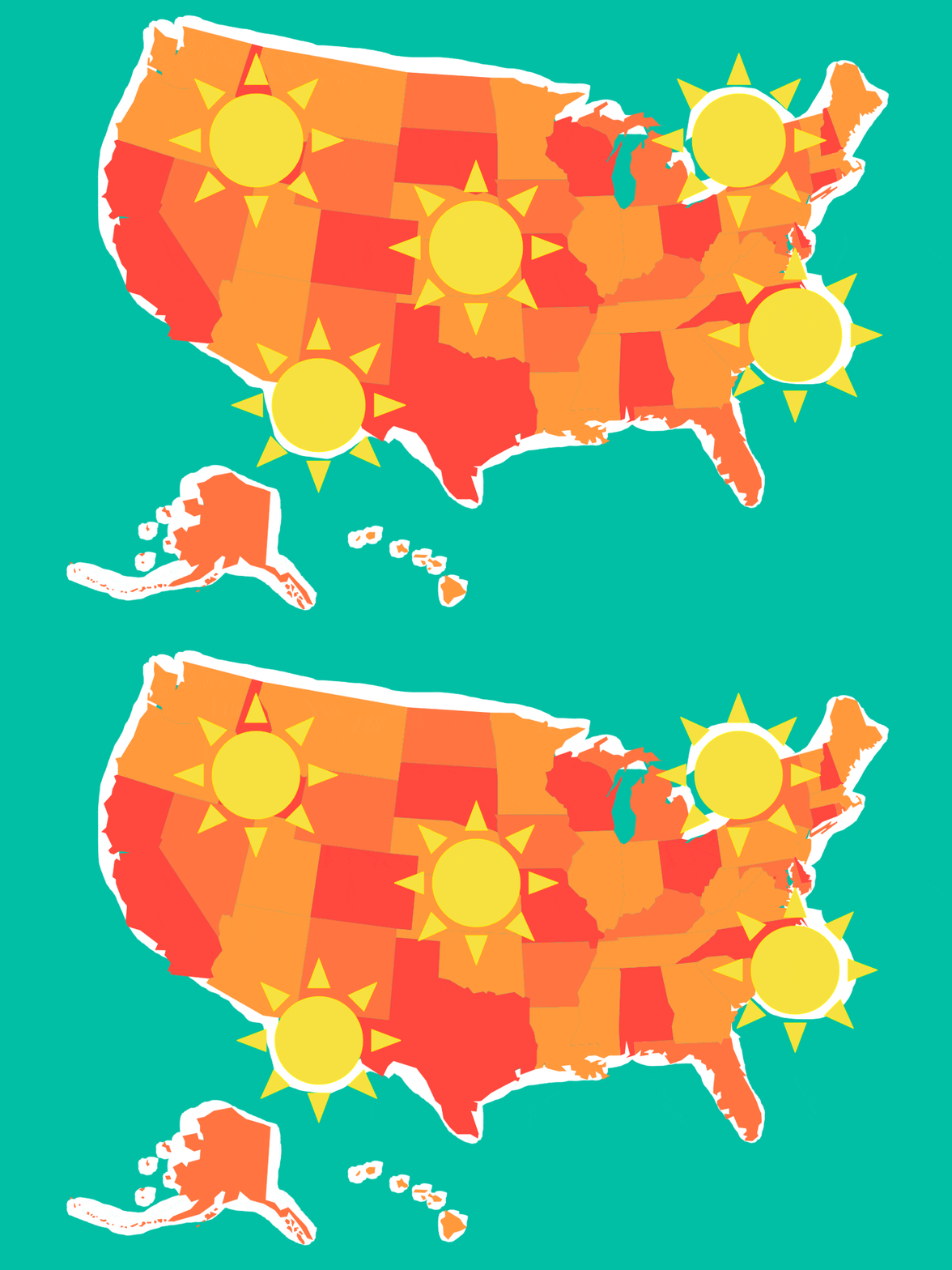
The maps below, from the Fourth Assessment, illustrate the trends in the warmest (generally daytime) and coldest (generally nighttime) temperatures in the contiguous U.S.:


According to the Intergovernmental Panel on Climate Change, climate models tend to significantly underestimate the decrease in the diurnal temperature range—that is, the difference between minimum and maximum daily temperatures—over the last 50 years. The panel’s latest report notes that there is “medium confidence” that “the length and frequency of warm spells, including heat waves, has increased since the middle of the 20th century” around the world. Medium confidence means there is about a 50 percent chance of the finding being correct. (The report does deem it “likely that heatwave frequency has increased during this period in large parts of Europe, Asia and Australia.”)

Big tip of the hat to the University of Colorado’s invaluable Roger Pielke Jr.

Footnote: Since June 2019 was only the 24th warmest in the US, alarmists will be playing catch up this summer.  A previous post explains how to mine the data to produce the bias you want from the billions of measurements recorded. Clear Thinking about Heat Records

Permafrost Scare (again)

The Permafrost Bogeyman is back!

This post is prompted by noticing that alarmists are again trying to leverage permafrost to frighten people into anti-fossil fuel compliance. I have pushed back against this previously, but the PR continues and is successful when people lack information and historical context to see through the claims.

Basically, the fear is that organic material underneath ice and frozen ground will decompose when permafrost melts, and the emissions of CO2 and CH4 will drive the planetary climate into runaway warming. First you should ask yourself how did those organisms get sequestered under the ice, and what has happened to frozen soil down through history. As you will see below, the evidence shows that warm climate periods in the past caused that terrain to be filled with plant life. And discovered remains prove that animals and even humans lived in those places between frozen periods.

Then ask yourself why was there not runaway warming when the land thawed previously. After all, the fear mongers are eager to inform us that permafrost is covering soil and vegetation that can produce amounts of GHGs several multiples larger than all the emissions from human activity. And as history shows, ice and permafrost have melted and refrozen several times during our current Holocene period. Yet no runaway warming occurred, or we would not be here to fret about it.

Europe, like North America, had four periods of glaciation. Successive ice caps reached limits that differed only slightly. The area covered by ice at any time is shown in white.

The Big Picture

From Encycopaedia Britannica

An Ice age, also called glacial age, is any geologic period during which thick ice sheets cover vast areas of land. Such periods of large-scale glaciation may last several million years and drastically reshape surface features of entire continents. A number of major ice ages have occurred throughout Earth history. The earliest known took place during Precambrian time dating back more than 570 million years. The most recent periods of widespread glaciation occurred during the Pleistocene Epoch (2.6 million to 11,700 years ago).

A lesser, recent glacial stage called the Little Ice Age began in the 16th century and advanced and receded intermittently over three centuries in Europe and many other regions. Its maximum development was reached about 1750, at which time glaciers were more widespread on Earth than at any time since the last major ice age ended about 11,700 years ago.

The colored areas are those that were covered by ice sheets in the past. The Kansan and Nebraskan sheets overlapped almost the same areas, and the Wisconsin and Illinoisan sheets covered approximately the same territory. In the high altitudes of the West are the Cordilleran ice sheets. An area at the junction of Wisconsin, Minnesota, Iowa, and Illinois was never entirely covered with ice. Encyclopaedia Brittannica

What was Covered by the Ice Sheets from UC Berkeley

This mammoth, found in deposits in Russia, was one of the largest land mammals of the Pleistocene, the time period that spanned from 1.8 million to ~10,000 years ago. Pleistocene biotas were extremely close to modern ones — many genera and even species of Pleistocene conifers, mosses, flowering plants, insects, mollusks, birds, mammals, and others survive to this day. Yet the Pleistocene was also characterized by the presence of distinctive large land mammals and birds. Mammoths and their cousins the mastodons, longhorned bison, sabre-toothed cats, giant ground sloths, and many other large mammals characterized Pleistocene habitats in North America, Asia, and Europe. Native horses and camels galloped across the plains of North America. Great teratorn birds with 25-foot wingspans stalked prey. Around the end of the Pleistocene, all these creatures went extinct (the horses living in North America today are all descendants of animals brought from Europe in historic times).

It was during the Pleistocene that the most recent episodes of global cooling, or ice ages, took place. Much of the world’s temperate zones were alternately covered by glaciers during cool periods and uncovered during the warmer interglacial periods when the glaciers retreated. Did this cause the Pleistocene extinctions? It doesn’t seem likely; the large mammals of the Pleistocene weathered several climate shifts.

The Holocene Glacial Retreat from Wikipedia

The Holocene glacial retreat is a geographical phenomenon that involved the global deglaciation of glaciers that previously had advanced during the Last Glacial Maximum. Ice sheet retreat initiated ca. 19,000 years ago and accelerated after ca. 15,000 years ago. The Holocene, starting with abrupt warming 11,700 years ago, resulted in rapid melting of the remaining ice sheets of North America and Europe.

During the various Ice Ages in the Pleistocene Epoch, the continent of North America was covered by a massive ice sheet, which advanced as far south as 37 degrees North latitude. Centered in the Hudson Bay region, it later combined with other glaciers and covered a maximum of 5 million square miles (“Ice Age”), as seen in Figure 1.1. In some places it was upwards 10 thousand feet thick (“Laurentide Ice Sheet”). This was the Laurentide Ice Sheet, responsible for much of the topography seen in Canada and the United States.

[Note that Alaska has always been an exception within the Arctic climate due to the influence of warm pulses of Pacific water.]

The Laurentide Ice sheet last reached its maximum extent during the Last Glacial Maximum, 21,000 years ago, just ahead of present-day Cape Cod. After achieving equilibrium global temperatures began to warm, triggering the ice sheet’s retreat around 18,000 years ago. By 5,000 years ago, most of the ice sheet had completely melted except for a small chunk near Baffin Island (Martin). Figure 1.2 shows the ice sheet in retreat, between 18,000 and 5,000 years ago. The retreat pockmarked the North American continent with numerous depositional features, many of which can still be seen and studied today.

What Happens to Permafrost During Warmer or Cooler Periods

From Mountains, Lowlands, and Coasts: the Physiography of Cold Landscapes
Tobias Bolch and Hanne H. Christiansen.  Excerpts in italics with my bolds.

The general characteristics of the physiography of the cold regions on Earth are important background information to understand the distribution of processes associated with the cryosphere, such as glacier or permafrost-related hazards. Glaciers and permafrost comprise an important part of the cryosphere.

FIGURE 7.4 The distribution of the different permafrost types on the Northern Hemisphere as compiled by the International Permafrost Association, IPA. Source: AMAP (2011) based on Brown et al. (1997).

Permafrost is soil, rock, sediment, or other earth material that remains at or below 0 C for two or more consecutive years (van Everdingen, 1998). Thus, it is solely defined on the basis of temperature and duration. 

Typically, permafrost does not occur beneath glaciers, as they isolate the ground from the necessary atmospheric cooling, but permafrost can exist under thin cold-based glaciers or along the margins of polythermal glaciers.

Terrestrial permafrost thickness ranges from a few decimeters at the southern limit of the permafrost zone to about 1,500 m in the north of the Arctic region (Figure 7.7). The thickest permafrost is found in areas that have not recently been covered by glaciers, such as Siberia, where ground cooling for a longer time has allowed for >1,000-m-thick permafrost to develop. Areas that have been glacier covered during the last glaciation typically do not have >200- to 500-m-thick permafrost (French, 2007).

Permafrost is controlled by climate and also by a combination of several local factors (Streletskiy et al., 2014). Thus, the permafrost thermal regime is controlled by the exchanges of heat and moisture between the atmosphere and the Earth’s surface, and by the thermal properties of the underlying ground (Williams and Smith, 1989). The existence of permafrost depends on past and present states of energy fluxes through the active layer. This layer experiences seasonal variations in ice/water content, thermal conductivity, density, mechanical properties, and solute redistribution. Other important factors include snow cover, vegetation, soil organic layer thickness, soil moisture, ice content, and drainage conditions controlled by the local geomorphology.

Figure 7.7

The upper parts of permafrost can experience freezing and thawing at centennial to millennial scales. French and Shur (2010) conclude that permafrost can be stable under fluctuating climatic conditions if the ground is protected by a high ground-ice content during warm periods. Such stability of the permafrost toward climatic fluctuations is a consequence of a layer of the ground that, although a part of the active layer during warm summers, under normal climatic conditions is the upper part of the permafrost. If this layer has a high ice content, it provides thermal inertia. The net result is that permafrost can have a relatively low sensitivity to atmospheric temperature rise, or anthropogenic disturbance, when the top permafrost is ice-rich (Shur et al., 2005). This is called the transient layer (Shur et al., 2005). The transient layer experiences high and quasi-uniform ice content and undergoes freezing/thawing at decadal to century scales. Obviously, the most important condition in the permafrost is its temperature. This is typically monitored in boreholes to varying depths in the ground in different landforms. Permafrost temperatures vary from being very close to 0 C at the southern extent of permafrost, to being down to 15 C in the high Arctic (Romanovsky et al., 2010).

Summary from Hugh M French

The permafrost history of the high northern latitudes over the last two million years indicates that perennially frozen ground formed and thawed repeatedly, probably in close synchronicity with the climate changes that led to the expansion and subsequent shrinkage of continental ice sheets.

There is convincing evidence to suggest that much of today’s permafrost probably originated during the fluctuating climate of the Pleistocene. Some of the most striking evidence includes the remains of woolly mammoths and other Pleistocene animals found preserved in permafrost in Siberia, Alaska and north-western Arctic Canada. Another line of evidence is cryostratigraphic: in some areas, the upper boundary of permafrost lies below the depth of modern seasonal freezing and the temperature of permafrost sometimes decreases with increasing depth. Both phenomena indicate residual (i.e. relict) cold. Another clue lies in the fact that the thickest permafrost occurs in areas which escaped glaciation and which were not protected from cold subaerial conditions by a thick ice cover.

June 30 Arctic Ice Update

The image above, supported by the table later on shows that in June water has opened up as usual this time of year.  On the North American side, Bering and Okhotsk (bottom left) were already ice-free, so that Chukchi and Beaufort opened (bottom center).  Meanwhile, in Baffin Bay and Hudson Bay (bottom right) ice has retreated, and given the shallow depth of Hudson Bay it will go ice-free soon.

The picture is more mixed on the Euro-Russian side.  East Siberian (left) is nearly normal, with Laptev and Kara down (upper left) below the 12 year average.  Barents (upper center) has more ice than usual, and is still hanging onto Svalbard.

The graph below shows the surprising discrepancy between MASIE and SII  continued in June, but disappeared by month end.

Note that the  NH ice extent 12 year average declined from 11.8M km2 to 9.8M km2 during in the last 30 days.  MASIE 2019 shows a slower decline from 10.9M km2 to 9.3M km2.  Thus the current deficit to average has reduced during June from 778k km2 to 506k km2, or 5.2% of average. That track is close to 2010 and below other years. 

Region 2019181 Day 181 Average 2019-Ave. 2010181 2019-2010
 (0) Northern_Hemisphere 9318729 9824939  -506210  9245692 73037 
 (1) Beaufort_Sea 766793 910839  -144047  861079 -94286 
 (2) Chukchi_Sea 614737 721838  -107101  705357 -90619 
 (3) East_Siberian_Sea 1000185 1022188  -22003  1040103 -39918 
 (4) Laptev_Sea 600733 726543  -125810  693533 -92800 
 (5) Kara_Sea 494380 571373  -76993  623806 -129427 
 (6) Barents_Sea 188963 116290  72674  82722 106242 
 (7) Greenland_Sea 487331 509216  -21885  464399 22932 
 (8) Baffin_Bay_Gulf_of_St._Lawrence 431660 512914  -81254  416820 14840 
 (9) Canadian_Archipelago 777670 778719  -1049  735649 42020 
 (10) Hudson_Bay 754193 729807  24386  401862 352331 
 (11) Central_Arctic 3196694 3203485  -6791  3191924 4770 
 (12) Bering_Sea 1129 5122  -3994  594 535 
 (13) Baltic_Sea 0 -4  0
 (14) Sea_of_Okhotsk 3248 17144  -13897  26683 -23435 

The table shows where the ice is distributed to make the 5.2% defict to average.  Beaufort Chukchi and Laptev Seas make up most of the NH deficit to average, while Kara and Baffin contribute the rest.

Illustration by Eleanor Lutz shows Earth’s seasonal climate changes. If played in full screen, the four corners present views from top, bottom and sides.

Arctic Ice In Perspective

With Arctic ice melting season underway, warmists are again stoking fears about ice disappearing in the North.  In fact, the pattern of Arctic ice seen in historical perspective is not alarming. People are over-thinking and over-analyzing Arctic Ice extents, and getting wrapped around the axle (or should I say axis).  So let’s keep it simple and we can all readily understand what is happening up North.

I will use the ever popular NOAA dataset derived from satellite passive microwave sensors.  It sometimes understates the ice extents, but everyone refers to it and it is complete from 1979 to 2018.  Here’s what NOAA reports (in M km2):

We are frequently told that only the March maximums and the September minimums matter, since the other months are only transitional between the two.  So the graph above shows the mean ice extent, averaging the two months March and September.

If I were adding this to the Ice House of Mirrors, the name would be The X-Ray Ice Mirror, because it looks into the structure of the time series.   For even more clarity and simplicity, here is the table:

NOAA NH Annual Average Ice Extents (in M km2).  Sea Ice Index v3.0 (here)

Year Average Change Rate of Change
1979 11.697
1996 11.353 -0.344 -0.020 per year
2007 9.405 -1.949 -0.177 per year
2018 9.506  +0.102 +0.009 per year

The satellites involve rocket science, but this does not.  There was a small loss of ice extent over the first 17 years, then a dramatic downturn for 11 years, 9 times the rate as before. That was followed by the current plateau with no further loss of ice extent.  All the fuss is over that middle period, and we know what caused it.  A lot of multi-year ice was flushed out through the Fram Strait, leaving behind more easily melted younger ice. The effects from that natural occurrence bottomed out in 2007.

Kwok et al say this about the Variability of Fram Strait ice flux:

The average winter area flux over the 18-year record (1978–1996) is 670,000 km2, ;7% of the area of the Arctic Ocean. The winter area flux ranges from a minimum of 450,000 km2 in 1984 to a maximum of 906,000 km2 in 1995. . .The average winter volume flux over the winters of October 1990 through May 1995 is 1745 km3 ranging from a low of 1375 km3 in the 1990 flux to a high of 2791 km3 in 1994.

https://www.researchgate.net/publication/261010602/download

Conclusion:

Some complain it is too soon to say Arctic Ice is recovering, or that 2007 is a true change point.  The same people were quick to jump on a declining period after 1996 as evidence of a “Death Spiral.”

Footnote:

No one knows what will happen to Arctic ice.

Except maybe the polar bears.

And they are not talking.

Except, of course, to the admen from Coca-Cola

Climate Models on Fire!

They are at it again: Our future will be filled with death and destruction according to climate models. The latest doomsday scenario is that every summer in the future will be hotter than the one before, brought to you by CNN: “All the Fear All the Time.”

Future summers will ‘smash’ temperature records every year says CNN. Excerpts in italics with my bolds.

If you think it’s hot now, you haven’t seen anything yet. A new study predicts that parts of the world will “smash” temperature records every year in the coming century due to climate change, “pushing ecosystems and communities beyond their ability to cope.”

The scientists who authored the study, published in the journal Nature Climate Change on Monday, used 22 climate models to game out exactly how hot these summer temperatures would be. They determined that by the end of the 21st century, future temperature events “will be so extreme that they will not have been experienced previously.”

The temperature increase is directly tied to rising global greenhouse gas emissions, the authors say.

The world is already seeing record setting temperatures and while warming hasn’t been uniform, earlier studies have shown that the planet has been in a warming trend, generally.

Heat waves will be deadly. Heat stroke, breathing issues, heart attacks, asthma attacks, kidney problems are all a big concern for people when the temperatures increase, according to the US Centers for Disease Control and Prevention.

Higher temperatures can also make air pollution worse, make water scarce and cause crops to fail, leading to malnutrition and starvation.

In 2014, the World Health Organization predicted 250,000 more people will die annually between 2030 and 2050 due to climate change. More recent studies predict that this is a “conservative estimate.”

If, however, countries meet goals of limiting global temperature rise less than 2 degrees Celsius, as set out in the Paris agreement, that scenario would be much less likely.

Footnote: A second separate heat wave alarm study was published and trumpeted in the Seattle Times. (H/T kakatoa, comment below) Cliff Mass does his usual thorough review pointing out problems both in the estimating of future temperatures and in calculating projected deaths from heat waves.

The article by Mass is The Seattle Times Story on Massive Heat Wave Deaths in Seattle: Does it Make Sense?


Mid June Arctic Ice Lopsided

In the first half of June 2019, the shift from ice to water is unusually lop-sided in two respects. The image above, supported by the table later on shows that in the last two weeks water has opened up faster on the Pacific side, and much slower on the Atlantic side, with the exception of Baffin Bay.  The other surprise is that MASIE shows much less ice than does SII, a reversal of the typical situation.

The graph below shows the surprising discrepancy between MASIE and SII appearing in May and continuing in June.

Note that the  NH ice extent 12 year average declined from 12.7M km2 to 10.9M km2 during in the last 30 days.  MASIE 2019 shows about the same decline from 11.9M km2 to 10.3M km2.  That track matched 2016 in May, but is now closest to 2010 and below other years.  Interestingly SII showed a much slower rate of ice extent loss, starting nearly the same as MASIE, but ended this period 400k km2 higher. and close to average and 2018.

I have no explanation for the differential between MASIE and SII.  Note that ice extents in both datasets are levelling off mid-June.

Region 2019166 Day 166 Average 2019-Ave. 2010166 2019-2010
 (0) Northern_Hemisphere 10340833 10933549 -592716 10534077 -193244
 (1) Beaufort_Sea 761369 968193 -206823 933194 -171824
 (2) Chukchi_Sea 680432 799211 -118778 839873 -159441
 (3) East_Siberian_Sea 1049046 1054090 -5045 1068901 -19856
 (4) Laptev_Sea 750164 778536 -28372 772185 -22021
 (5) Kara_Sea 671900 722641 -50741 717539 -45640
 (6) Barents_Sea 261587 215180 46408 138264 123324
 (7) Greenland_Sea 549038 568045 -19007 524612 24426
 (8) Baffin_Bay_
Gulf_of_St._Lawrence
558105 733399 -175294 667457 -109352
 (9) Canadian_Archipelago 787036 798742 -11706 766642 20394
 (10) Hudson_Bay 1014530 1004832 9698 826781 187749
 (11) Central_Arctic 3229461 3221030 8431 3206453 23008
 (12) Bering_Sea 17768 33002 -15234 21317 -3550
 (13) Baltic_Sea 0 7 -7 0 0
 (14) Sea_of_Okhotsk 9381 35292 -25911 83076 -73695

The table shows where the ice is distributed to make the 5.4% defict to average.  Beaufort and Chukchi Seas are more than half of the NH deficit to average, while Baffin has lost 175k km2 to average.

Illustration by Eleanor Lutz shows Earth’s seasonal climate changes. If played in full screen, the four corners present views from top, bottom and sides.

Al Gore Serial Science Denier

Everett Piper writes in the Washington Post Times The party of science deniers. Excerpts In italics with my bolds.

This past Wednesday, May 29, former Vice President Al Gore spoke to the graduating seniors at Harvard University. A summary of his talk? There is an “assault on science” that threatens “the capacity of the human species to endure” on planet Earth.

Mr. Gore proceeded to warn both students and faculty at Wednesday’s annual Class Day convocation, stressing that “reason” and “rational debate” were under threat from what he called “ideology of authoritarianism” by those who disagree with him and his political agenda.

Science “is now being slandered as a conspiracy based on a hoax,” Mr. Gore said. “The subordination of the best scientific evidence is yet another strategy for controlling policy by distorting and suppressing the best available information.”

This is the man who told us in 2006 that we had “ten years to save the planet” and that the Arctic would be ice-free by summer of 2014. In case you haven’t checked lately, that has not happened, nor are we even close.

This is the man who, at the same time, said the gulf stream would slow down and cause untold climate devastation as the result. News flash: Current scientific data actually shows the gulf stream has had zero decrease and may actually be speeding up.

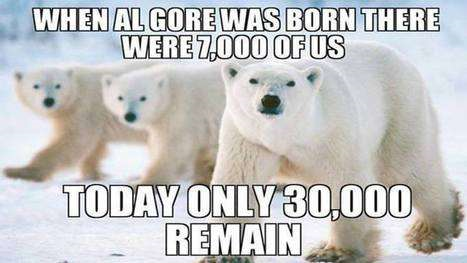
This is the man who warned polar bears would become extinct in just a handful of years because of their loss of habitat. Update: The facts show polar bear numbers are now at an all-time high.

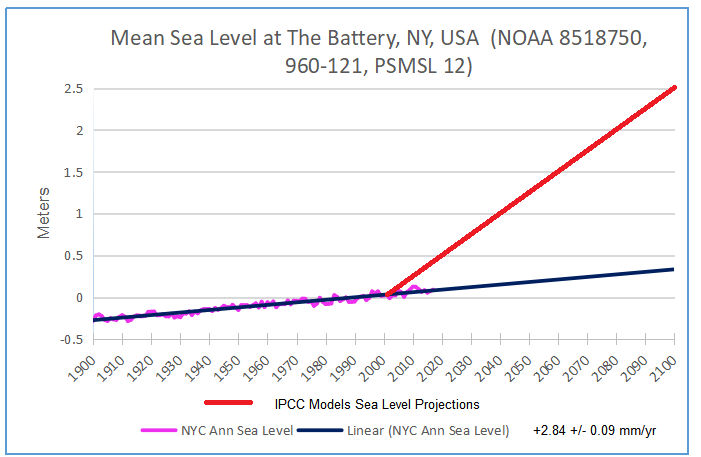
This is the same man who told all of us “sea levels could rise by as much as 20 feet in the near future” when, in fact, current data shows that for decades the pace has been about 3mm per year and has not changed. That’s about the height of two dimes.

This is the same guy who prophesied the rise of CO2 levels would devastate the planet and cause untold human suffering, when in reality, the modest rise in CO2 we actually have experienced has resulted in a global greening that has relieved human poverty around the world.

This is a man who predicted the devastation of low-lying Pacific Island nations such as Tuvalu because of rising sea-levels when in fact Tuvalu and some other island nations have actually grown in landmass since Mr. Gore’s doom and gloom pronouncements.

Al Gore is the man who has not only ignored the scientific facts of all the above, but who also is aligned with the party that now has the temerity to deny the biological fact of a female, and thereby pretend that any male can become a female just because he “feels” like it.

This is the same guy who, for decades, has turned a blind eye to the CDC data on sexually transmitted diseases and who promotes a political agenda that has resulted in over 25 percent of our nation’s millennial-aged women now carrying an STD.

This is the same guy who pretends to be pro-woman while denying the fact that women are real and not merely the imagination of dysphoric men who want to pretend and play make-believe.

This is a man who apparently doesn’t understand that it is logically and scientifically impossible to be a feminist if you persist in denying the empirical fact of the feminine.

Mr. Gore’s pseudo-science doesn’t stop with his ignorance of climatology, physiology, sexuality and biology. He demonstrates his ignorance in matters of economics as well. By ignoring the empirical proof that socialism has never, ever, resulted in anything other than the loss of human freedom and human flourishing, he seems oblivious to the fact that if there ever was a political and economic model that smacks of the “ideological authoritarianism” of which he now warns, it is his own.

In testimony before Congress this past year, Judith Curry, former chairman of the School of Earth and Atmospheric Sciences at the Georgia Institute of Technology, said this of Mr. Gore’s political agenda and that of his blind followers: “This behavior risks destroying science’s reputation for honesty. It is this objectivity and honesty which gives science a privileged seat at the table. Without this objectivity and honesty, scientists become regarded as another lobbyist group.”

Ms. Curry’s comment is spot on. Science dies at the hands of its supposed champions when they prove themselves more interested in political power than simply telling the truth.

If Aesop taught us anything, it is this: Crying “wolf” over and over again always proves one simple fact in the end — Truth “is being slandered as a conspiracy based on a hoax.”

• Everett Piper, the former president of Oklahoma Wesleyan University, is a columnist for The Washington Times and author of “Not A Day Care: The Devastating Consequences of Abandoning Truth” (Regnery 2017).


May Arctic Ice Mixed Signals

The image above shows that ice began to disappear in earnest during May.  On day 120 (April 30), Bering and Okhotsk Seas (left bottom and far left) were already mostly water.  Elsewhere the first 10 days added some water, and then more rapidly in the last 20 days. The Central Arctic core is intact, including East Siberian and Laptev Sea on the Russian side (left) and Canadian Archipelago (center right) and Hudson Bay (far right).

Meanwhile Beaufort and Chukchi (bottom center) are opening up, along with Baffin (center below Greenland).

The graph below shows a surprising discrepancy between MASIE and SII appearing in May.

Note that the  NH ice extent 12 year average declined from 13.6M km2 to 11.8M km2 during May.  MASIE 2019 shows about the same decline from 12.7M km2 to 10.9M km2.  That track matches 2016, but well below other years.  Interestingly SII showed a much slower rate of ice extent loss, starting nearly the same as MASIE, but ended the month 600k km2 higher. and matching 2018. Some thoughts later on why the discrepancy and the below average extent this year.

Region 2019151 Day 151 
Average
2019-Ave. 2007151 2019-2007
 (0) Northern_Hemisphere 10939662 11844796 -905134 11846659 -906997
 (1) Beaufort_Sea 848114 1000716 -152602 1059461 -211347
 (2) Chukchi_Sea 738661 872393 -133732 894617 -155956
 (3) East_Siberian_Sea 1059805 1069104 -9299 1069198 -9393
 (4) Laptev_Sea 820403 831752 -11349 754651 65752
 (5) Kara_Sea 760439 849220 -88780 895678 -135239
 (6) Barents_Sea 268245 330718 -62473 323801 -55556
 (7) Greenland_Sea 500951 575983 -75031 591919 -90968
 (8) Baffin_Bay_Gulf_of_St._Lawrence 756455 931604 -175149 934257 -177802
 (9) Canadian_Archipelago 789111 748381 40730 818055 -28944
 (10) Hudson_Bay 1103650 1104185 -535 1077744 25906
 (11) Central_Arctic 3224969 3218320 6649 3230109 -5141
 (12) Bering_Sea 27192 135798 -108606 112353 -85161
 (13) Baltic_Sea 0 188 -188 0 0
 (14) Sea_of_Okhotsk 40429 105988 -65559 83076 -42647

The table shows where the ice is distributed to make the 7.6% defict to average.  The Pacific Basins of Bering and Okhotsk are ~170k km2 of the difference.  Baffin is 175k km2 below average. Chukchi and Beaufort are the other two large contributors to the 905k km2 deficit.

What’s Going on with Arctic Ice in May?

From Susan Crockford at Polar Bear Science

This is the time year when declining sea ice gets some people all worked up. However, declining ice is normal at this time of year and there is always variation in where the most open water appears first. At this time of year, there isn’t much ice ‘melt’ going on. Rather, what we are seeing is the opening up of shore leads and polynyas by winds.


A polynya (po·lyn·ya) is an area of year-round open water surrounded by heavier, thicker sea ice cover. Polynyas are marine oases in the Arctic, their nutrient-rich waters providing a place to feed, mate and overwinter for a wide range of species.

The North Water Polynya is fed by freshwater from melting ice caps in Greenland and Canada that mix with Pacific water columns snaking through underwater channels in the Northwest Passage and Lancaster Sound. These icy waters merge with a warmer Atlantic current and are carried up the west coast of Greenland.

Dr. Judah Cohen AER Arctic Oscillation and Polar Vortex Analysis and Forecasts
May 24, 2019 says:

Last year at this time, the Arctic was dominated by below normal geopotential height anomalies and this year the Arctic is dominated by above normal geopotential height anomalies. High heights/blocking in the Arctic favors troughing and cooler temperatures in the mid-latitudes and in that regard the high heights in the Arctic, especially on the North Atlantic side, favor troughing and relatively cool temperatures in Europe. If high heights/blocking in the Arctic especially near Greenland, can persist for much of the summer then parts of Europe could experience below normal temperatures this summer.

All forecasts predict a relatively warm summer for East Asia. Again, I think the trend is your friend in East Asia as well and the warm forecast is likely to verify. However as in Europe, persistent high heights/blocking to the north could flip the summer from hot to cool at least regionally.

Finally, if polar cap geopotential height anomalies remain on the warm/positive side for much of the summer, this could result in accelerated sea ice loss relative to recent summers.

Climate Out of Control

Coors Baseball Field, Denver, Colorado, April 29, 2019

Frank Miele writes at Real Clear Politics Climate Is Unpredictable, Weather You Like It or Not!
Excerpts in italics with my bolds.

They say all politics is local; so is all weather.

So on behalf of my fellow Westerners, I have to ask: What’s up with all this cold weather? It may not be a crisis yet, but in the two weeks leading up to Memorial Day — the traditional start of summer activities — much of the country has been donning sweaters and turning up the heat.

I know, I know. Weather is not climate, and you can’t generalize from anecdotal evidence of localized weather conditions to a unified theory of thermal dynamics, but isn’t that exactly what the climate alarmists have done, on a larger scale, for the past 25 years?

Getting Coors Field ready for Colorado Rockies to play baseball.

Haven’t we been brainwashed by political scientists (oops! I mean climate scientists!) to believe that the Earth is on the verge of turning into “Venus: The Sequel.” You know, catastrophic overheating from greenhouse gases, rising oceans, death and mayhem — oh, yeah, and the world ending in 12 years if we don’t ban carbon or something.

But despite the best fake climate data and the scariest computer simulations, Mother Nature doesn’t seem to be cooperating with the global-warming scare scenario. Sure, there is warm weather in other parts of the country, but here in Montana we have been desperately seeking spring. Instead of enjoying our beautiful outdoors, we are stuck in perennial chill mode, shivering under our blankets and wondering if it will snow in late May.

Cars pile up in the snow, Denver, May 21, 2019

In Denver, they didn’t have to wonder. Last Tuesday that area got more than three inches of the white stuff, the most at this late date since 1975. They also matched the record low of 31 degrees. Snow also hit Minnesota, Arizona and California. Yosemite had as much as two feet of snow fall.

Should we start to panic? Roll out computer models to explain why our tootsie toes are turning blue? Maybe we could get rich by promoting the end of the world — even if it’s by ice instead of fire. But let’s face it, intelligent people already know that climate changes on a regular basis and that mankind deals with it just as other species do — by adapting. Technically, we are currently between ice ages, so if it gets a little cold, here’s some advice — get used to it! And if it gets a little warmer? Be grateful! Ice ages are much more deadly than any old heat wave.

Fact of the matter is that for the past few years, real scientists have been warning us that sunspot activity is currently at an unusually low level. In February, there was not even one sunspot recorded, and history tells us that fewer sunspots means colder weather. That’s why current predictions call for cooling weather for the next 20-30 years till the sunspot cycle ticks upward again.

OK, the climate terrorists tell us, you may be right about the next 30 years but that doesn’t mean global warming won’t resume a few years after that. Well, no, but what they won’t tell you is that during the period of increased warming in the late 20th century, sunspot activity was at an 8,000-year high. That was the conclusion of a study in 2004 led by Sami Solanki of the Max Planck Institute in Germany.

So let me get this straight. When sunspot activity is at millennially high levels, Earth gets warmer. When sunspot activity drops to negligible levels, Earth gets cooler. Sounds like a pattern, doesn’t it? In fact, it sounds like something that would interest real scientists.

So why don’t climate scientists just admit that humans don’t control climate, and get on with the business of recording data and analyzing it? That’s easy to explain. Because you can’t mandate massive changes in human behavior if the sun dictates terrestrial temperature variations. The sun doesn’t care what Democratic propagandists say, and all the carbon in the world won’t put one little ol’ sunspot on the surface of our nearest star, so you can expect the sun to be dismissed as irrelevant. Carbon is king.

After all, who ya gonna believe? Al Gore or your own lying thermometer?


NYT Maple Syrup Story Not Fit to Print

Journalists are finally exposing the rot inside the news mass media. Sharyl Attkisson resigned as an investigative corespondent from CBS News and wrote at Epoch Times How Media Narratives Became More Important Than Facts. Excerpt in italics with my bolds.

I was among the first to really pay attention to the increasingly effective operations to shape and censor news—the movements to establish narratives rather than follow facts—and to see the growing influence of smear operations, political interests, and corporate interests on the news.

We agree there is terrific journalism being committed on a daily basis at organizations from The New York Times to local news stations. However, we agree that national media has also largely become co-opted by powerful interests who understand how to direct the news landscape in a way that services certain narratives and agendas.

Case in Point Global Warming vs. Maple Syrup

Eric Felten describes how this works in his article at Real Clear Investigations Why This NY Times Maple Syrup Story Tastes Odd. His exquisite takedown of a recent NYT essay linking AGW to maple syrup should be gracing a page in the NY Times, except for narrative being the mission, not truth. Excerpt below in italics with my bolds.

Climate change is at it again, ruining everything good. This time around it’s maple syrup that is at risk, according to the New York Times, which on Saturday had the alarming headline, “Warming Climate May Slow the Flow of Maple.” Or at least it would be alarming if it weren’t for the tell-tale word “may.” If a warming climate were actually slowing the flow of the sap that makes for syrup, you can be sure the Times would declare it clearly. To say it “may” slow the flow suggests that it isn’t actually happening, at least not yet.

King Philippe and Queen Mathilde of Belgium sample maple syrup in Ottawa last year.

But one would hate to be unfair to Kendra Pierre-Louis, the reporter who typed up the doom and gloom for the Times. Perhaps she has evidence supporting her warning of dire syrup consequences—statistics, even. Let’s see how she marshals her facts and makes her case.

“In fact, climate change is already making things more volatile for syrup producers,” Pierre-Louis laments in her front-page article. “[M]aple production fell by 54 percent in Ontario and by 12.5 percent in Canada over all.” The cause was “an unusually warm spring.” Well that’s some pretty compelling data, or would be if it were from 2018, or perhaps 2017 or even 2016. But no, that’s not even close. To find a year in which there was unseasonably warm weather that affected the maple crop, Pierre-Louis had to go all the way back to 2012, which is the year the Times cites as the “fact” for climate change’s impact on syrup producers. The Times finds room to return to that year again later in the article.

Isn’t it a bit odd that the New York Times cites 2012 for its evidence of climate change? After all, were the paper looking for a bad production year, the most recent one would be a perfect example: 2018 was an off year for maple syrup production in Quebec, the province that produces the vast majority of Canadian syrup. In 2016 Canada produced a record 12.16 million gallons of maple products; 2017 was another banner year, with Canada delivering a new record of 12.51 million gallons. But last year was a relatively bad one, with maple production falling in Canada to 9.8 million gallons, a significant drop — indeed, a drop more substantial than that in 2012. And yet for some perplexing reason, the Times fails to mention the drop in 2018, let alone the statistics showing record production in the previous years.

If we’re worried about maple syrup production, wouldn’t you think that the recent decline would be more newsworthy, or at the very least worth including in the article, if not making it the lede?

It doesn’t take much digging to find what’s wrong with 2018 as an example of climate change hobbling the syrup trade. Yes, weather was to blame for 2018’s bad results. It just wasn’t the right sort of weather. Here’s how Halifax Today reported on last year’s maple results: “Quebec — which produces about 72 per cent of the world’s maple syrup — produced 40.4 million litres, down 22.4 percent from 2017 due to unusually late snow and cold.”

Unusual cold? That’s right. As the official government Statistics Canada explains in its report on “Maple products, 2018,” in “Quebec, production was hurt by unusually late snow and cold, while the decrease in New Brunswick was the result of a long and severe winter followed by a short spring.” This year could prove to be another disappointment for Canadian maple farmers. In late February Canada’s CBC reported, “Local syrup farms say the recent cold temperatures are leaving taps dry.” Could it be that the New York Times neglected to mention the maple syrup decline of 2018 and the slow start to 2019 because the reductions were caused by abnormal cold rather than warming?

One should find that hard to believe. Because for that to be true, one would have to believe that the Times is willing to cherry-pick data in an effort to mislead its readers. Surely the newspaper of record has more respect for itself than to play such a cheap trick on its customers. RealClearInvestigations reached out to the Times’s reporter via her website for comment but received no response.

The evidence piles up that the Times is playing fast and loose with the facts. Take the suggestion by the Times that climate change is limiting the number of days when maple trees can be successfully tapped. “More Narrow Window for Syrup Production,” reads the newspaper’s sub-headline. The weather determines the sap flow, after all, and University of Vermont “sugar maple expert” Mark Isselhardt told the Times that “[e]very day that you don’t get sap flow has the potential to really impact the total yield for that operation.”

But is the production window actually narrowing?

Surely the sugar maple expert at the University of Vermont, in telling the Times about the window when sap is ripe for collecting, had at his fingertips the latest data, which are readily available. The USDA’s National Agricultural Statistics Service keeps figures — helpfully broken down by state — on maple syrup production in the United States. Among the information collected are data on the “Maple Syrup Season,” that elusive window. The figures for the last four years are readily available. In 2015, the season for the U.S. as a whole was 26 days. In 2016 it was 33 days. In 2017 it was 37 days and in 2018 the window expanded again, this time to 42 days. The figures for Vermont — which we can assume our University of Vermont maple expert is particularly familiar with — show the state’s maple syrup season widening: 26 days in 2015; 44 days in 2016; 46 days in 2017; and 52 days in 2018.

What about the suggestion in the New York Times that the production window is not only shrinking, but moving, as climate change causes “season creep”? The newspaper quotes the executive director of the New York Maple Producers Association, who says that when she was a kid, 50 years ago, the start of the tapping season was mid-March. “This year,” according to the Times, “they were tapping in late January.”

Were they really? In upstate New York, the last week in January this year was marked by brutally cold temperatures. A normal high temperature for late January in Buffalo is 31 degrees. Though there were days in that ballpark during the month — and one mid-month day actually made it to 47 degrees — late January was for the most part frigid. The high temperature in Buffalo Jan. 30 was 11 degrees. On the 31st the thermometer peaked at 7 degrees.

This last winter’s extreme cold persisted well into February in Canada, where the deep freeze kept the maple sap from flowing. It wasn’t until the middle of March that sap started to trickle from the trees north of the border.

How did the New York Times get things so wrong? Is it carelessness? Or is there an ideological agenda at play, one that requires the reporting and writing to lead to a preestablished conclusion? On Twitter, the NYT reporter calls herself Kendra “Gloom is My Beat” Pierre-Louis. That is no doubt a gesture at self-aware humor. But it also suggests that her reporting is skewed: If you see gloom as your beat, by definition you ignore information that doesn’t advance the narrative of impending doom. And then there is the larger institutional bias. Pierre-Louis is officially a “climate reporter” for the Times; she leads NYT-branded “student journeys” to places such as Iceland (cost: $8,190 per high-schooler for 15 days) to teach the risks of a warming planet. In other words, the Times has a business built in part around Pierre-Louis that depends on her being a warning voice on warming.

Those sounding the alarm about climate change do a lot of fretting over what may happen 50 to 100 years from now. Fair enough — or at least it would be if those delivering the warnings were in more of a habit of playing it straight. It would be much easier to credit their predictions of future catastrophes if they were more honest about what is actually, observably, happening right now.

Footnote:

It should be noted that the NY Times has a long history of botching science stories, including but not limited to climate change. Bernie Lewin gives several examples in his book on environmental scares, and of course it was NYT who headlined the global warming claims of Jim Hansen.  When objective historians look back on these fear-mongering days, NY Times will be seen as a leading traitor against the public interest.

See Progressively Scaring the World (Lewin book synopsis)

Rise and Fall of CAGW