US Federal Court Rules Against Social Cost of Carbon
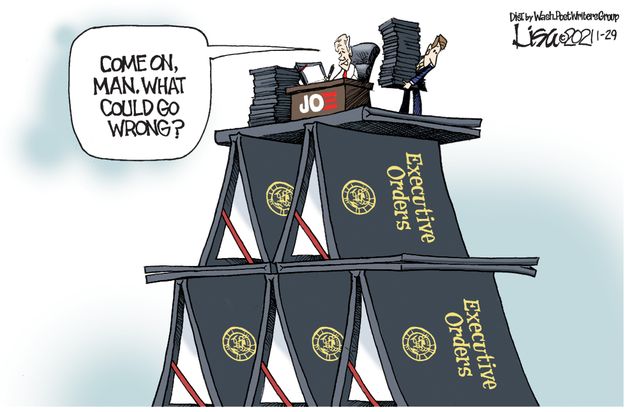
Following a Biden Executive Order, in April 2021 several states went to Louisiana District Court to stop implementation of Social Cost of Carbon with respect to federal regulations.  The Memorandum Ruling regarding that case is State of Louisiana et al Versus Joseph R. Biden Jr. et al.  The Plaintiff States are Louisiana, Alabama, Florida, Georgia, Kentucky, Mississippi, South Dakota, Texas, West Virginia, and Wyoming. Excerpts in italics with my bolds.  H/T Francis Menton

The Issues

The Plaintiff States seek injunctive and declaratory relief on three grounds. First, they assert that the SC-GHG Estimates violate the procedural requirements of the Administrative Procedure Act (“APA”) as a substantive rule that did not undergo the requisite notice-and-comment process. See 5 U.S.C. § 553.

Second, the Plaintiff States claim that President Biden, through EO 13990, and the IWG lack the authority to enforce the estimates as they are substantively unlawful under the APA and contravene existing law. See 5 U.S.C. § 706(2)(A)–(C).

Third, the Plaintiff States maintain that the Government Defendants acted beyond any congressional authority by basing regulatory policy upon global considerations.

The Plaintiff States request a preliminary injunction:
(1) ordering Defendants to disregard the SC-GHG Estimates and prohibiting them from adopting, employing, treating as binding, or relying upon the work product of the Interagency Working Group (“IWG”);
(2) enjoining Defendants from independently relying upon the IWG’s methodology considering global effects, discount rates, and time horizons; and
(3) ordering Defendants to return to the guidance of Circular A-4, explained infra, in conducting regulatory analysis.

To be clear, the Court is ruling only on the actions of the federal agencies and whether the agencies, by implementing the estimates and considering global effects— violate the APA and whether President Biden upon signing EO 13990, violated the separations of powers clause of the United States Constitution. The Court has the authority to enjoin federal agencies from implementing a rule—mandated by an executive order or not—that violates the APA or violates the separation of powers clause. Importantly, the Court is not opining as to the scientific issues regarding greenhouse gas emissions, their effects on the environment, or whether they contribute to global warming.

The Findings

The Court is persuaded that the Biden Administration’s agencies are using the SCGHG. The Court finds that the Plaintiff States have established injury-in-fact.

Plaintiff States argue that the SC-GHG Estimates “affect[] the states’ ‘quasi-sovereign’ interests by imposing substantial pressure on them to change their” practices and laws to remain in compliance with federal standards. Id. at 153. The Court finds that the Plaintiff States also have standing as they are entitled to special solicitude in the standing inquiry.

The Court finds that EO 13990 contradicts Congress’ intent regarding legislative rulemaking by mandating consideration of the global effects. The Court further finds that the President lacks power to promulgate fundamentally transformative legislative rules in Case 2:21-cv-01074-JDC-KK Document 98 Filed 02/11/22 Page 33 of 44 PageID #: 4175 Page 34 of 44 areas of vast political, social, and economic importance, thus, the issuance of EO 13990 violates the major questions doctrine.

The Court finds that EO 13990 was promulgated without complying with the APA’s notice and comment requirements.

The Plaintiff States thus argue that they have demonstrated multiple independently sufficient grounds to vacate the SC-GHG Estimate and therefore have shown a strong likelihood of success on the merits. The Court agrees and finds that the Plaintiff States have shown a strong likelihood of success on the merits.

Plaintiff States have sufficiently identified the kinds of harms to support injunctive relief. Moreover, the Court finds that the Plaintiff States have made a clear showing of an injury-in-fact, and that such injury “cannot be undone through monetary remedies,” Louisiana v. Biden, 2021 WL 2446010, at *21 (W.D. La. June 15, 2021), such that they need immediate relief now, lest they be unable to ever obtain meaningful judicial relief in the future.

The Court finds that the balance of the injuries weighs substantially in favor of the Plaintiff States.

The Court agrees that the public interest and balance of equities weigh heavily in favor of granting a preliminary injunction.

CONCLUSION For the reasons set forth herein above, the Motion for Preliminary Injunction will be granted in its entirety.

Comment from Manhattan Contrarian

On taking office, the Trump administration took steps to neutralize the SCC, so that not much has been heard from it for a while. But Biden’s EO 13990 caused the Obama-era version to get re-instated. The Biden people claim that they are working on further tweaks to the regulations, but meanwhile a large group of Republican-led states went ahead and commenced litigation.

With a regulatory initiative obviously intended to force a gigantic transformation of the economy without statutory basis, the Biden people defended against the Complaint using every shuck and jive and technicality known to man. The SCC rules were not “final” because the administration was still working on a few more tweaks (and then a few more, and then a few more); the state plaintiffs lacked “standing” because the harm was to citizens rather than the state itself; and so forth. The court was having none of it.

The heart of the court’s decision is its determination that the SCC falls under the Supreme Court’s “major questions doctrine,” under which the bureaucracy cannot on its own authority impose “new obligations of vast economic and political significance” unless Congress “speaks clearly.” The states had identified some 83 pending projects involving something in the range of $447 and $561 billion dollars as affected by the SCC rule. That impressed the court as easily within the concept of “major questions.”

We are at the beginning of what could be a very long battle. The bureaucracy has many ways to wear down its opponents. For example, a permit can simply be delayed indefinitely, without any reason being stated, as occurred for example with the Keystone XL pipeline. But at least here battle lines have finally been drawn.
New England Energy Inflation Self-Imposed

LNG tanker in Boston harbor. Pipelines from Pennsylvania would fix this. MEDIANEWS GROUP VIA GETTY IMAGES

Christopher Helman writes at Forbes  Why Is New England Paying The Equivalent Of $180 Oil For Natural Gas? Excerpts in italics with my  bolds and some added images.

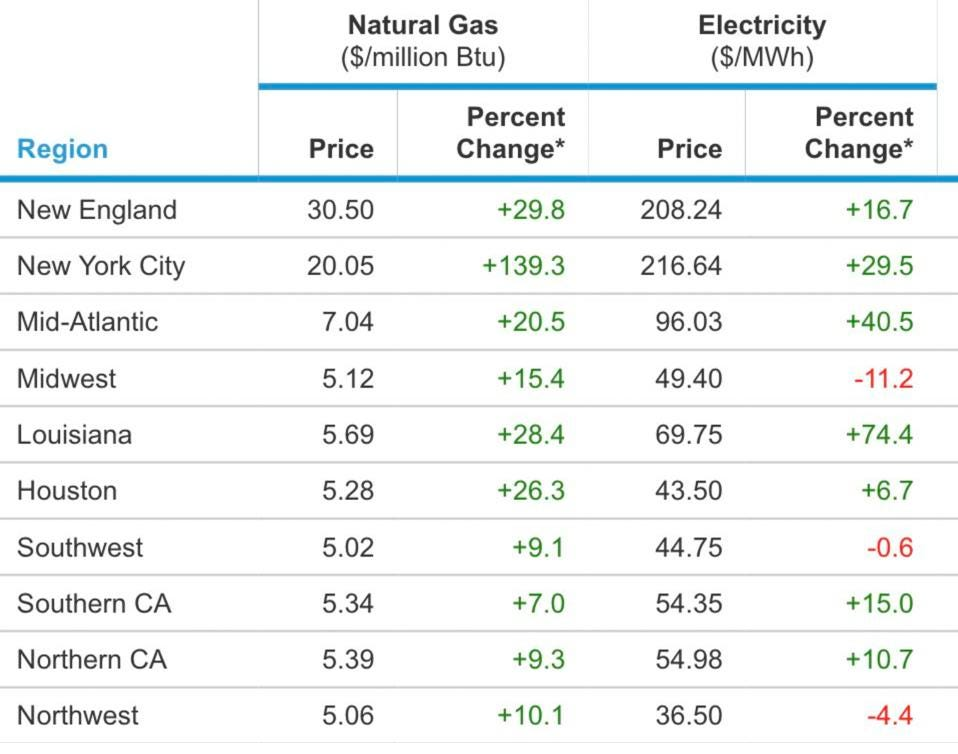
Yesterday New Englanders had reason to feel a little more … European than usual. that’s because according to Department of Energy data they were paying a spot price of $30.5 per million British thermal units for natural gas.

This is an absurd price, in line with what Europeans, facing their worst energy crisis in a generation, have been suffering in recent months. To put it in context, $30.5 per mmBtu is the equivalent of paying $180 for a barrel of oil (double what it is today), or 20 cents per kilowatt-hour for electricity. In other words: nuts.

Project abandoned in 2017 after New York blocked planning and permit processes.

How much are Bostonians getting shafted on natural gas? By comparison, the spot price of gas on the Gulf Coast of Texas and Louisiana yesterday was $5.50 per mmBtu (the energy equivalent of about $33/bbl oil). This price spread is exceptionally wide, nearly unprecedented.

But it’s easily explained — by the perennially misguided energy policy in New England.

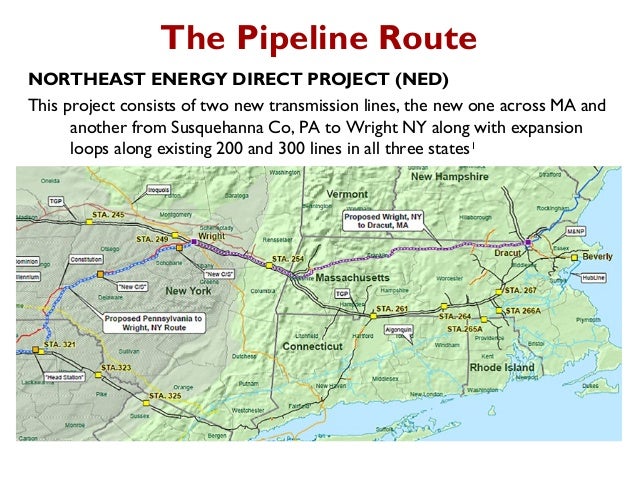
Just 200 miles to the south, beneath western Pennsylvania, lay the nation’s biggest gas field — the Marcellus shale. From practically nothing 15 years ago, the Marcellus now provides roughly a third of America’s gas supply, more than 30 billion cubic feet per day. America’s shale gas fracking boom is the primary reason why the nation has been able to dramatically switch away from dirtier coal, and cut overall carbon dioxide emissions by nearly 20% — more than any other leading economy.

Project abandoned in April 2016

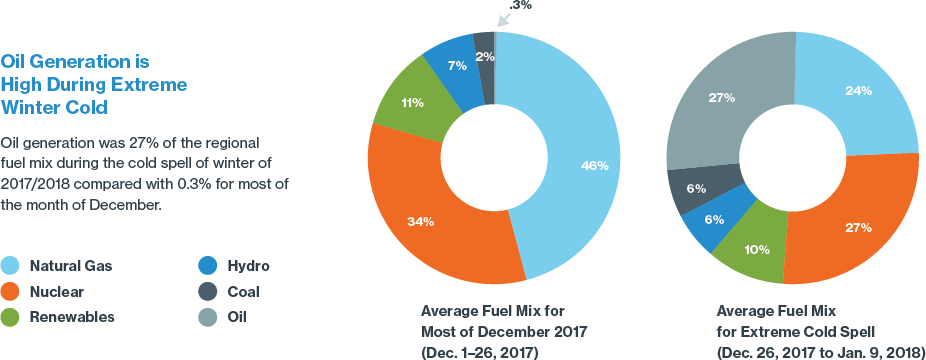
But very little Marcellus gas flows to New England, because NIMBYs and their politicians have blocked construction of pipelines. Yet the region still relies on cleaner-burning gas to fuel power plants. Over the weekend, when New England was walloped by snow, its power grid was running 37% natural gas, 22% oil, 22% nuclear, 11% renewables, 6% hydro power, and less than 1% coal. (See current mix here.)

Electrical power resource mix from ISO-New England

And yet how does New England get its gas? Nearly all of it comes by ship, in giant insulated tankers carrying -260 degree condensed liquefied natural gas, most of which dock at the Everett LNG regasification terminal in Boston harbor, owned by Exelon Generation.

Where’s that gas come from? Despite more than $50 billion of recent investment into LNG liquefaction plants in Texas and Louisiana, you won’t find any American freedom gas being delivered into Boston. Instead, because of a law called the Jones Act (which requires ships carrying goods from one U.S. port to another to be U.S. owned and flagged), the gas that lands in Boston has historically been sourced from fields in Trinidad & Tobago, Norway, and Russia.

Which is why New England is now paying through the nose for gas. Or rather, they are paying the international price — in line with LNG spot prices in Tokyo, Shanghai, and Europe.

Is it reasonable that New England’s natural gas price depends on decisions made in Europe to shut down nuclear power plants, turn off the flows from giant fields like Holland’s Groningen, and rely on Gazprom to maintain flows from Russia? Of course not. But without more pipelines from the Marcellus (or solar panels and wind turbines covering every hillside), this is the reality, this is how New England ends up burning oil to generate a fifth of its wintertime electricity.

If you live in the northeast how can you personally arbitrage this market madness? Make sure you fill up heating oil tanks in the off-season, chop your own firewood, and buy shares in natural gas producers and exporters. 

See also Payback Upon Climate Grasshoppers


It’s Energy Will Make or Break the World Now

Ayaan Hirsi Ali explains how Energy has become the first and foremost world public concern in her Spectator article Energy is the most important issue in the world.  Excerpts in italics with my bolds and added images.

Gas prices are climbing, Russia is building pipelines, yet we’re focused instead on appeasing climate activists

One issue more than any other will dominate airtime and influence policy in 2022: energy. Americans are seeing the highest prices at the pump in seven years. Since Biden took office, average gas prices are up by more than $1 a gallon. In November, gas prices in Mono County, California hit more than $6 per gallon, forcing some residents to drive to Nevada (where gas taxes are lower) to buy fuel.

The price of natural gas in the US is at its highest in seven years, and up more than 180 percent in the last year alone. In Europe, the situation is even worse.

Europe’s gas reserves are at record lows. In Germany, which already had the EU’s highest energy prices, bills are up 30 percent in a year. If the European winter is harsh, supplies for heating homes and businesses may have to be rationed.

Domestic energy is a foreign policy issue. The threat of a Russian attack on Ukraine was one of the factors driving gas prices up in late 2021. In December, Annalena Baerbock, Germany’s foreign minister, warned that if Russia invaded Ukraine, the Nord Stream 2 natural gas pipeline from Russia to Germany “could not come into service.” That would mean serious shortfalls in Germany’s energy supply this winter, as Germany is dependent on Russian natural gas. Germany’s economic affairs minister, Robert Habeck, now calls Germany’s assent to Nord Stream 2 a “geopolitical mistake.” Days before Christmas, Russia reversed flows on Yamal, another pipeline to Germany. European energy prices reached new peaks. Russia claimed the reversal had no “political implications.”

Europe is splitting over nuclear power as the answer to secure supplies of green energy. France pushed to classify nuclear energy as “sustainable,” a move that would unlock billions of euros in state aid and private investment, earmarked for green energy. An EU proposal was recently put forward to do just that — despite opposition from Germany, which threw its lot in with Nord Stream 2 and Putin’s natural gas under Angela Merkel.

And don’t forget Iran. Its march toward acquiring nuclear arms creates severe vulnerabilities for the US and its allies — especially Israel, but also the oil-rich Gulf states. China continues to underwrite the regime in Tehran by purchasing Iranian oil and evading and ignoring US sanctions.

Energy will determine elections in Europe and the US in 2022 and beyond. It will determine foreign policy decisions. It will be an overarching and enduring theme for years to come. But energy has always been part of the conversation. What makes this year different? Wasn’t there an even bigger energy crisis in the 1970s?

The answer to both those questions is this: unlike in the past, our current energy crisis derives from our own mistakes. We’ve put all of our eggs into the basket of renewable energy, but its promise has been oversold. The costs of solar and wind power generation may have fallen, but they cannot provide stable energy sources because of fluctuations in the weather. That tends to reduce the overall efficiency of power grids.

The green movement also underestimates the true costs of renewable energy. As Michael Shellenberger explains, a wind farm requires 370 times more land than a nuclear plant does. If we shift away from nuclear energy and toward renewables as Joe Biden’s climate plan proposes, the impact on America’s natural environments would be devastating. Yet the Biden administration remains committed to renewables as a “green” solution.

After Angela Merkel phased out nuclear plants almost entirely, Germans now pay the highest energy costs in Europe, not least because a renewables surcharge of 20 percent is added to their bills. The various European and British decisions to ban fracking have had similar effects on the cost of heating a home. The effect of opposition in the US will be no different.

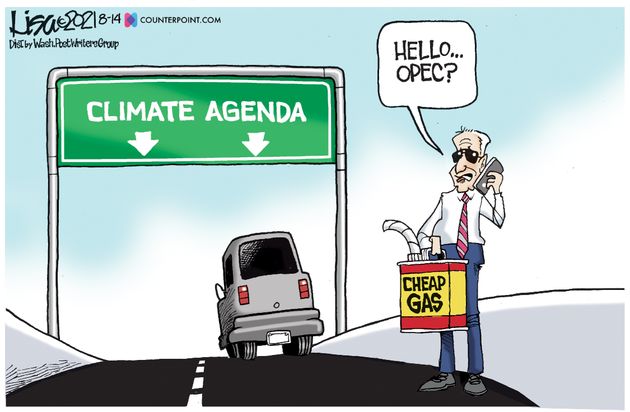
Fracking played a key part in the US’s transition from coal to natural gas, which led to significant reductions in American emissions of carbon dioxide. But some Democratic-run states are attempting to ban fracking entirely through legislation and, as in California, denying permits. Shale oil production barely grew in 2021, and we are unlikely to see a fracking revival in the near future. A return to energy dependence on other countries is becoming unavoidable. We’ve seen this already: in November, Biden appealed to OPEC to increase production.

Americans and Europeans have become so focused on appeasing climate activists that they’ve forgotten the importance of power — in the sense of geopolitics, not kilowatts. While the West was debating ways to reduce emissions at the UN’s COP26 summit in Glasgow, Russia and China didn’t even bother to show up. While we fall over ourselves to acclaim Greta Thunberg, Russia builds strategic gas pipelines and China builds coal-burning power stations.

The politics of energy will impact the lives of everyone this year, the poor especially. To avoid a new self-inflicted energy crisis, unlike in the 1970s — the West must reassess the costs of the “green transition.” We need a strategy that generates power efficiently, and without handing geopolitical power to our strategic rivals.


Green Electricity Facts on the Ground

Francis Menton writes at Manhattan Contrarian How About A Pilot Project To Demonstrate The Feasibility Of Fully Wind/Solar/Battery Electricity Generation?  Excerpts in italics with my bolds.H\T John Ray

At this current crazy moment, most of the “Western” world (Europe, the U.S., Canada, Australia) is hell bent on achieving a “net zero” energy system. As I understand this concept, it means that, within two or three decades, all electricity production will be converted from the current mostly-fossil-fuel generation mix to almost entirely wind, solar and storage. On top of that, all or nearly all energy consumption that is not currently electricity (e.g., transportation, industry, heat, agriculture) must be converted to electricity, so that the energy for these things can also be supplied solely by the wind, sun, and batteries. Since electricity is currently only about a quarter of final energy consumption, that means that we are soon to have an all-electric energy generation and consumption system producing around four times the output of our current electricity system, all from wind and solar, backed up as necessary only by batteries or other storage.

A reasonable question is, has anybody thought to construct a small-to-moderate scale pilot project to demonstrate that this is feasible? Before embarking on “net zero” for a billion people, how about trying it out in a place with, say, 10,000, or 50,000, or 100,000 people. See if it can actually work, and how much it will cost. Then, if it works at reasonable cost, start expanding it.

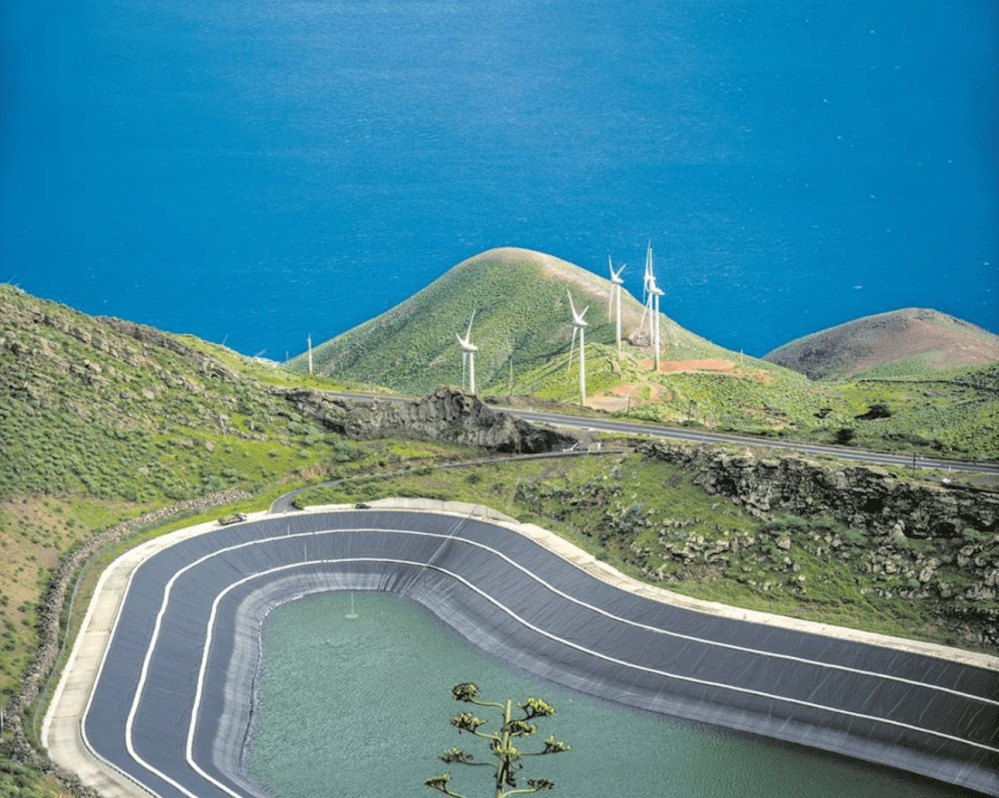
As far as I can determine, that has never been done anywhere. However, there is something somewhat close. An island called El Hierro, which is one of the Canary Islands and is part of Spain, embarked more than a decade ago on constructing an electricity system consisting only of wind turbines and a pumped-storage water reservoir. El Hierro has a population of about 11,000. It is a very mountainous volcanic island, so it provided a fortuitous location for construction of a large pumped-storage hydro project, with an upper reservoir in an old volcanic crater right up a near-cliff from a lower reservoir just above sea level. The difference in elevation of the two reservoirs is about 660 meters, or more than 2000 feet. Here is a picture of the upper reservoir, looking down to the ocean, to give you an idea of just how favorable a location for pumped-storage hydro this is:

The El Hierro wind/storage system began operations in 2015. How has it done? I would say that it is at best a huge disappointment, really bordering on disaster. It has never come close to realizing the dream of 100% wind/storage electricity for El Hierro, instead averaging 50% or less when averaged over a full year (although it has had some substantial periods over 50%). Moreover, since only about one-quarter of El HIerro’s final energy consumption is electricity, the project has replaced barely 10% of El Hierro’s fossil fuel consumption.

Over at the website page for production statistics, it’s still more excitement about tons of carbon emissions avoided (15,484 in 2020!) and hours of 100% renewable generation (1293 in 2020!). I think that they’re hoping you don’t know that there are 8784 hours in a 366 day year like 2020.

So why don’t they just build the system a little bigger? After all, if this system can provide around 50% +/- of El Hierro’s electricity, can’t you just double it in size to get to 100%? The answer is, absolutely not. The 50% can be achieved only with those diesel generators always present to provide full backup when needed. Without that, you need massively more storage to get you through what could be weeks of wind drought, let alone through wind seasonality that means that you likely need 30 days’ or more full storage.

Then take a look at the picture and see if you can figure out where or how El Hierro is going to build that 40 times bigger reservoir. Time to look into a few billions of dollars worth of lithium ion batteries — for 11,000 people.

And of course, for those of us here in the rest of the world, we don’t have massive volcanic craters sitting 2000 feet right up a cliff from the sea. For us, it’s batteries or nothing. Or maybe just stick with the fossil fuels for now.

So the closest thing we have to a “demonstration project” of the fully wind/storage electricity has come up woefully short, and really has only proved that the whole concept will necessarily fail on the necessity of far more storage than is remotely practical or affordable. The idea that our political betters plow forward toward “net zero” without any demonstration of feasibility I find completely incomprehensible.

See also Green Electrical Shocks


Net Zero Makes Zero Sense

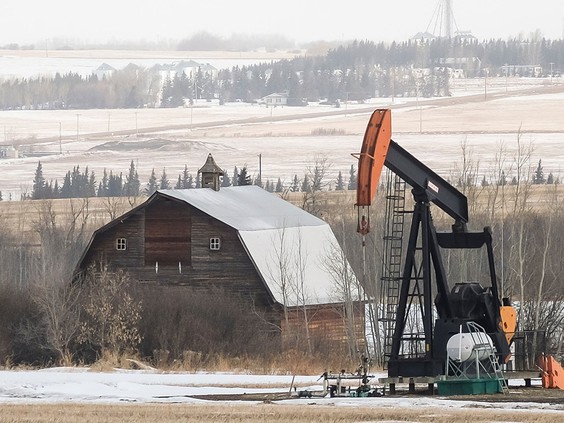
A pumpjack works just south of Cutbank Lake, near Wembley, Alta. Canada should withdraw from all international agreements on global warming, writes Rex Murphy. PHOTO BY RANDY VANDERVEEN/POSTMEDIA NEWS

Rex Murphy writes at National Post: Why is it Canada’s ‘duty’ to destroy its economy and Confederation in the pursuit of net zero? Excerpts in italics with my bolds and added images.

The Liberals’ obsession with global warming is the most absurd fixation of any government since Sir John A. set us up as a country

Sometimes the best questions are the ones not being asked.  In the Canadian political arena there are a couple or more in that category.

I’ll go to the biggest one right off the bat: Why and how has the “goal” of getting to net-zero emissions become such a doctrine?

Another way of phrasing the same question is: What’s so wrong, what’s so defective in our current energy system that the Liberal government has pledged, as its absolute priority, to replace it?

Having a secure and tested energy system is a very big deal for any nation, but having a secure and tested energy supply is the quintessential necessity for a vast northern country — really vast — that is also the home of a wealthy, modern economy.

A subsidiary question is: Does the government of a Confederation have the right, the legislative competence to declare the central industry of one of the provinces within that Confederation outmoded? And on that premise make it a national policy to destroy the economic well-being of that province?

And on that question, if one steps back just a minute, is it not amazing, incredible even, that shutting down the industrial base of an entire province is declared as the Number one priority, one laden with moral as well as political content by those in Ottawa who have elevated it to national policy — and this is accepted as normal or acceptable or yes, even noble in the context of “our fight against global warming?”

Is it really acceptable in our Confederation to single out one province to bear the majority weight and economic devastation of this “fight?”

The real and overriding question, however, is why does Canada, or more accurately, why does the government of Canada profess we have a “duty” to the world to work towards eradicating the energy supply and system that we already have, that has mostly served us well, that has brought fortune and security to the nation?

Why is the energy future of Canada under the ethos and edicts of the United Nations’ IPCC?

What is this world we have a “duty” towards? Should we ransack our current energy platform because we have a duty to — say, Russia? Or, more tellingly, does Canada have a moral obligation to shut down the oilsands, antagonize all of Alberta (and jeopardize the national economy with its futuristic visions of a “great transition”), because we have a “duty” towards China? Were we to ask the leaders of the great country of India, who are very much not on side with this same IPCC, whether Canada has an obligation, a “duty” to Delhi to shut down Fort McMurray, they would probably throw up their hands in astonishment that the question is even being put to them.

This “duty” that I insist on keeping in quotation marks, as far as I can tell is one self-declared and self-imposed by Prime Minister Justin Trudeau, and flows from his obsessive conviction that he — along with previous adviser Gerry Butts, climate crusader/previous environment minister Catherine McKenna, and previous Greenpeace activist/current environment minister Steven Guilbeault — must be a “leader” in the holy war against global warming.

On substance, Canada can do nothing substantial about global warming. Cancelling the economy of Calgary will not stop the disappearance of the glaciers, lower the sea levels off the Maldives, or rescue one skinny polar bear off a well-photographed ice-floe.

You may have noticed Canada has stalled its economy for over two years and has likely seen the immiseration of thousands of small businesses, restaurants and services. We have also piled on gargantuan deficits and debt — they are both at historic levels. We are seeing wealth-destroying inflation at levels unseen since the early ’90s.

We’re still in this mismanaged and liberty-choking COVID crisis playing havoc with the economy.

So there is another not-much-asked question: Is the current state of Canada one in which the government, by fiat, with the assent of every political party, should conduct the greatest re-engineering of the fundamentals of the nation’s most essential and fundamental industry?

The summary question is: Why are we on this useless, damaging crusade?

I know it’s very much in opposition to the current liturgy to put the question, but why does Canada have any special or even routine obligation to the “world” — or more precisely the mandarins who gather in Paris and Rio and Glasgow — to wreck our working economy in pursuit of some wild notion that this country can function on a forest of windmills (parts from China) and glazed hectares of solar panels?

The global-warming obsession of this current government is the most absurd and senseless fixation of any government since Sir John A. set us up as a country.

The greatest part of that absurdity is how easily all bend to it, all speak the pious words of “net zero” as if they were summoning a genie, as our deluded leaders prate in foreign capitals about the brave new world they are about to call into being.

The same leaders who can’t manage a payroll system, dig a few wells and provide clean water, who shut down Parliament but party abroad with maskless faces laughing at jokes — of which I suspect we are the butt.

They do not have the intellectual competence to engineer this “transition.” As a minority government they do not have the mandate either.

Yet witness the ease with which the press, academia and all who might be regarded as “thought leaders” — a dubious category at the best of times, but dismal at the present — are all abundantly, fervidly on board.

Canada has no “duty” to the world in this farcical pursuit of “net zero” and we will gravely injure our county if we don’t desist. And, once again I caution, we will drive a wedge in Confederation if a policy that treats Alberta as a scapegoat and forces it to carry the burden of an Ottawa obsession, is not abandoned.

Conclusion: Canada should take itself out of all international agreements on global warming.


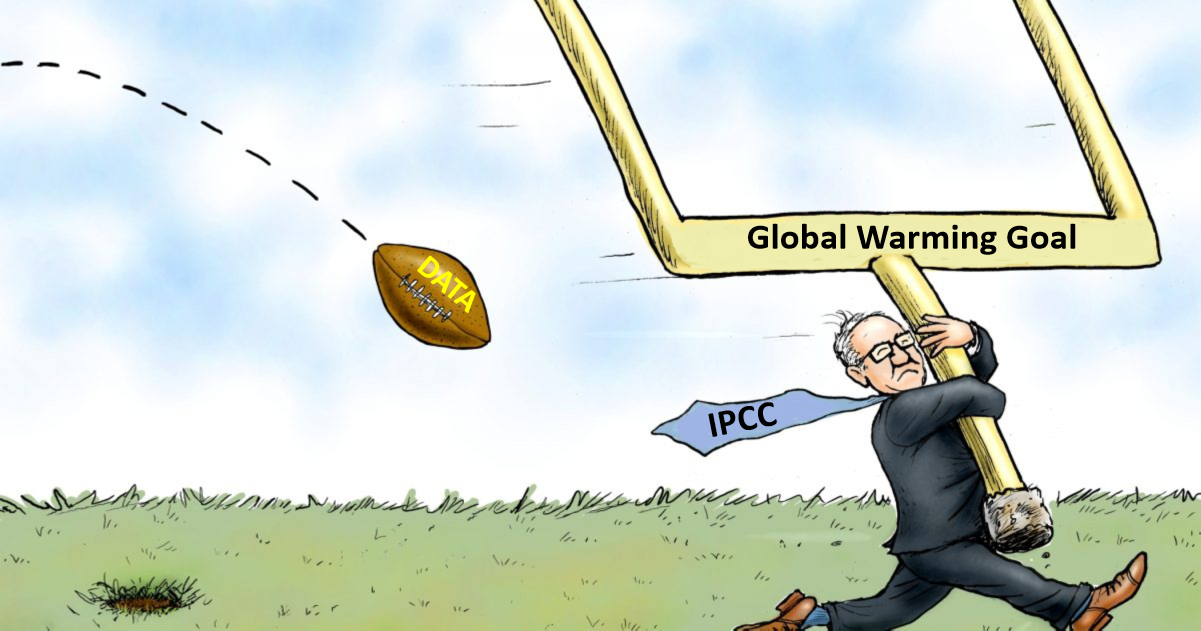
Beware Moving Climate Goalposts

Benjamin Zycher sounds the warning in his Real Clear Energy article Will the Climate Industry Move the Goalposts Again? Excerpts in italics with my bolds and added images.

Global temperature was on course to meet the 2-degree target without any emissions cuts.

The international climate alarmist industry comprises a number of special interests. There are the activists, fundamentally anti-human and deeply disingenuous, demanding that billions of the global poor suffer and die in order that the planet be “saved.” There are the “experts” in pursuit of bigger budgets and “research” grants. There are the editors of the peer-reviewed journals, transforming “science” into a propaganda exercise. There are the bureaucrats massively expanding their budgets and powers, the politicians seeking to transfer ever more wealth, and the journalists desperate to produce clickbait even as they remain invincible in their ignorance.

There are the official “environmental” groups whose business model is the use of political, regulatory, and judicial processes to steal other people’s property. There are the foundation officials writing checks in hot pursuit of invitations to the right cocktail parties. There are the Hollywood airheads addicted to thunderous applause on the red carpets. Don’t forget the corporate gasbags myopic, ignorant, incapable of ideological battle, and so naïve as actually to believe that they can placate the environmental Left. There are the international organizations striving toward utopia through ever-greater coercion. And – of course – there are the innumerable useful idiots engaged in virtue-signaling.

Yes, it is a diverse group indeed, but its members share two habits. The first is a common (but not universal) reluctance to confront the evidence on the nonexistent climate problem emergency crisis catastrophe apocalypse. Many scientists and policy scholars have discussed the fundamental inconsistency between the mainstream climate “existential threat” narrative and the actual evidence on climate phenomena. Even the Intergovernmental Panel on Climate Change, in its 5th (page 12-78) and 6th (page 12-115) assessment reports, is deeply dubious about the various severe effects – the horror stories – often asserted to be looming as impacts of anthropogenic (man-made) warming, particularly over the course of this century, the maximum time horizon that plausibly can be described as foreseeable.

The second is the purported limit on warming asserted to be necessary for global “safety,” a parameter that has been driven almost wholly by the political needs of the climate industry, and virtually not at all by “science.” Put aside the fact that the official “safety” limit shunts aside the distinction between natural and anthropogenic temperature trends; the climate industry simply asserts that all warming is anthropogenic. That is why it has not attempted to explain – for example – the sharp warming that occurred from 1910 to 1945, which could not have been caused by increasing atmospheric concentrations of greenhouse gases (GHG), principally carbon dioxide, which changed only from about 300 ppm to 310 ppm over that period. It is clear that some of the recent warming is anthropogenic, some is natural, and no one knows the respective magnitudes.

Recall from 2009 the official safe limit on warming: 2°C above pre-industrial levels, as decreed by the United Nations Framework Convention on Climate Change at the 15th Conference of the Parties in Copenhagen. That limit was repeated endlessly by all of the usual suspects; and the “pre-industrial” base period has been defined, reasonably, as the 1850–1900 time frame, that is, the decades immediately following the end of the little ice age. Can it surprise anyone that some warming would follow that period?

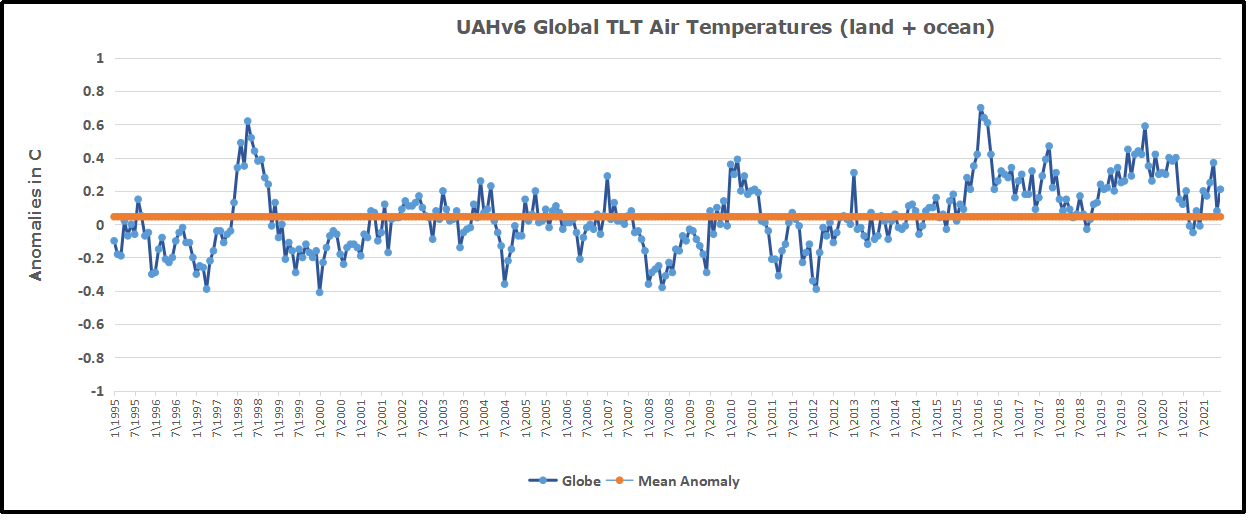
Unfortunately for the climate alarmists, the satellite temperature data are not cooperating with the “science.”

On average the climate models underlying the most recent (6th) IPCC assessment report predict 0.4°C of warming per decade for the period 1979–2019, and 0.5°C of warming per decade for 2019–2050, or, crudely, about 4–5°C of warming over the course of a century. The actual warming record as measured by the satellites for 1979–2019: 0.16°C per decade, or about 1.6°C per century. (The weather balloon measurements are virtually identical.)

Figure 8: Warming in the tropical troposphere according to the CMIP6 models. Trends 1979–2014 (except the rightmost model, which is to 2007), for 20°N–20°S, 300–200 hPa. John Christy (2019)

Accordingly, the actual data have created a massive problem for the climate industry: They suggest strongly that the 2°C “safety” limit will be achieved without any climate change/GHG policies at all. Unless the satellite data can be shown to be wrong – a task essentially impossible – the only option available to rescue the climate industry and its massive funding, perquisites, and powers is a change to the asserted “safety” limit.

Which is precisely what the climate industry has done. As of 2015, the safety limit now is 1.5°C, as the UNFCCC made clear:

“The universal agreement’s main aim is to keep a global temperature rise this century well below 2 degrees Celsius and to drive efforts to limit temperature increase even further to 1.5 degrees Celsius above pre-industrial levels. The 1.5 degree Celsius limit is a significantly safer defense line against the worst impacts of a changing climate.”

Yes, the IPCC, in a deeply dubious study, has moved the goalposts. The supreme silliness of that report is illustrated by its assertion (page 18) that as of 2018, “pathways that limit global warming to 1.5°C … show clear emission reductions by 2030.” In other words, we – the developed and the less-developed economies – had better get moving on serious reductions in GHG emissions over the next eight years, and this time we mean it. Note that for 1990–2019, annual global GHG emissions (Table B.1) grew by over 58 percent, and almost 13 percent for 2010–2019.

Let us consider now the latest satellite temperature data through December 2021: Since 1979, the average increase (“anomaly”) in the land/ocean temperature trend has been 0.14°C per decade, or about 1.4°C over the course of a century. Accordingly, the latest data remain inconsistent with the average of the climate models, and in particular continue to suggest that over the course of this century even the new, lower “safety” limit on global temperature increases might be achieved if there occurs a substantial cooling period, a phenomenon that is very far from implausible.

And so the climate alarmists cannot rest: They cannot risk an outcome in which even the new “safety” limit might be achieved without (forced) reductions in international GHG emissions. Because they obviously cannot wait until there is a cooling period, it is wholly reasonable to hypothesize that the “safety” limit will be reduced yet again. How this will be justified politically is far from clear – first the 2°C and then the 1.5°C safety limits received enormous publicity – and deep public skepticism about yet another movement of the goalposts would be a certainty. And so the justifications – the horror stories, the imminent arrival of the apocalypse, the mass die-offs purportedly already in process, the need for immediate capitulation to the demands of the climate industry, the denunciations of dissenters, etc. – will increase exponentially in decibel level, shrillness, and utter irrationality.

The admonitions and hysteria already are becoming ever louder. This reality is illustrated by the recent decision by Google to demonetize the most important science website reporting the monthly satellite temperature data – no, I am not kidding – because of “unreliable and harmful claims.” That is the Google characterization of two scientists – John R. Christy and Roy W. Spencer – and a website that has simply reported the satellite temperature record since 1979! In short, Google now is censoring the actual science in an effort to prop up the climate industry.

In its own way this process will be supremely amusing. But what else can the climate industry do to save the planet, and its own interests, and not necessarily in that order?

Footnote on Carbon Budgeting

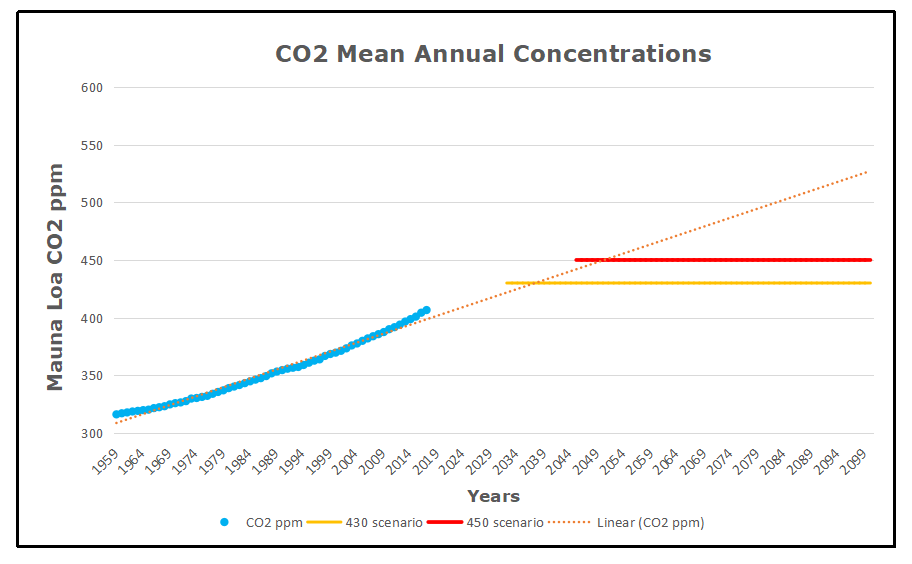
People who take to the streets with signs forecasting doom in 11 or 12 years have fallen victim to IPCC 450 and 430 scenarios. For years activists asserted that warming from pre industrial can be contained to 2C if CO2 concentrations peak at 450 ppm. Last year, the SR1.5 lowered the threshold to 430 ppm, thus the shortened timetable for the end of life as we know it.  Fuller explanation at posts I Want You Not to Panic.  and Greta’s Spurious “Carbon Budget”


Sane vs. Stupid Energy Policies

Gene Yaw writes at Real Clear Energy What Critics Get Wrong About Energy Choice.  Excerpts in italics with my bolds and added images.

Last month, seven environmental groups wrote a misguided letter to Philadelphia officials bashing legislation that I sponsored as counterintuitive to the city’s decarbonization goals.

In October, six Democrats, including two from the southeast corner of the state, joined all 28 Republicans and our chamber’s lone Independent to approve Senate Bill 275. That’s a veto proof majority, for those counting.

Why? Because the bill’s purpose is simple: it prevents Pennsylvania’s 2,500-plus municipalities from banning access to certain utilities, like natural gas or heating oil. This will preserve consumer access to affordable electricity, no matter where they live, and prevent a chaotic patchwork of regulations that ultimately undermine statewide environmental and energy policies.

It also reaffirms what many local and statewide officials, including the Pennsylvania Public Utility Commission, already understand to be true: municipalities do not have the authority to restrict energy sources.

What the bill does not do is prevent Philadelphia City Council from pursuing its goal to retrofit all publicly owned buildings to reduce emissions 50% over the next decade. It’s not just about ripping out gas lines and oil tanks and installing heat pumps instead. Reducing electricity usage – through upgraded windows, roofs and insulation – is also a crucial piece of the puzzle.

The aforementioned environmental groups said that SB 275 will eliminate any hope of Philadelphia reaching carbon neutrality by 2050. Which begs the question, if the only way to achieve decarbonization is by indiscriminatingly banning utilities deemed “dirty” and “bad,” is that even a good plan? Isn’t there an old adage forewarning the danger of putting all your eggs in one basket?

Banning specific fuel sources in pursuit of “clean energy” makes zero sense in Philadelphia and beyond. First, clean energy is a misnomer. There’s simply no such thing. Even if we shuttered every coal and gas plant across the world tomorrow and began a frantic campaign to install wind and solar farms in their place, we’d need to cover about 1.8 million square kilometers of land and coastline to replace the lost capacity.

And we would need fossil fuels to produce all of those solar panels and wind turbines. Just like we need oil and gas to create and distribute nearly every product we use every single day, from the medications we take to the clothes we wear to the packaging we use to preserve our food. To assume that banning fossil fuels will only impact emissions and electricity prices is to ignore the intricate web that is our economy.

Besides, the city doesn’t exist in a vacuum. It’s connected to a vast, 13-state power grid called PJM, that manages the safe and reliable flow of electricity for 65 million people from Chicago to Washington D.C. and many places in between.

PJM’s operators ensure that its network of transmission lines and generation facilities work in tandem every minute of the day, preventing system overloads that could trigger massive utility failures and inflict untold suffering on millions in its territory. So, if electricity demand spikes in Philadelphia, but environmental policies have forced fossil fuel plants into nonexistence, there are fewer reliable energy sources to shoulder the burden.


A similar story unfolded in Texas in February when an unprecedented winter storm froze generators and rendered solar and wind farms useless, leaving more than 4 million residents without power or water for days. More than 200 people died amid the chaos. The Electric Reliability Council of Texas, the state’s grid operator, promised to winterize its system to harden it against future storms, but the damage was done. The rest of the nation should take note: a diversified and robust grid is key to preventing systemwide catastrophes.

Which brings me back to the idea of banning access to fossil fuels. If we are willing to sacrifice our food, clothing, shelter and transportation, doing so might eliminate some carbon emissions in the United States. Globally, U.S. emissions equal about half of what China produces on an annual basis, according to 2018 figures. The annual combined emissions from the other three top polluting nations – India, Russia and Japan – would likewise take our place.

Then there’s the emissions from sources we can’t always control: volcanic eruptions, livestock, forest fires. Or the damage caused by human activity like deforestation and degenerative agriculture. Even if the United States found a solution to every single unsustainable practice that critics say contributes to climate change, the rest of the world’s leading nations aren’t following suit.

So what do these groups really want from the city? They want officials to take a sledgehammer to our carefully planned and managed power grid, collapse our economy and leave Pennsylvanians with higher electric bills, fewer jobs and unreliable utilities. All for the sake of reducing carbon emissions that will be offset by the rest of world, in perpetuity.

Protecting energy choices for consumers means that residents can pursue “cleaner” electricity sources if they want to or can afford to, while not punishing those who don’t have the option. SB 275 isn’t about protecting special interests – what does a senator from Williamsport owe to Philadelphia’s gas utility?

What I do care about is promoting sound energy policy that doesn’t leave others behind for the constant pursuit of ideological purity, no matter how impractical or impossible or harmful it is for the very people such policies purport to help.

Senator Gene Yaw was elected to represent the 23rd Senatorial District consisting of Bradford, Lycoming, Sullivan, Union Counties and a portion of Susquehanna County. He serves as Chairman of the Senate Environmental Resources and Energy Committee.

Pushback on Corrosive Energy Idiocy

Congressman Byron Donalds excoriates the House Oversight and Reform Committee for biting the hands that energize the nation in the five minutes allowed him in video below.  (The settings button on the video allows you to turn on subtitles). For those who prefer reading, my transcript (lightly edited) follows in italics with my bolds and added images.

Chair: The gentleman from Florida Mr. Donalds is recognized for five minutes.

Donalds: Thank you Madam Chair and first of all to the witnesses, the the leaders of Exxon, Chevron, BP, Shell, I know that the climate activists are in twitter world which Dave Chappelle says doesn’t exist. And he’s right because it’s just people who have nothing better to do but type on their keyboards. And we do it too here in congress.

But let’s be very clear. You deserve an apology, because what I witnessed today was just rank intimidation by the chair of this committee, trying to get you to pledge on what you’re going to spend your money, is a gross violation of the first amendment. Just because we’re members of congress, and we’ve got microphones and we passed laws, does not mean that we also have the ability to infringe on your ability to organize, whether it’s API or anybody else, or what you choose to spend your money on. It is disgusting, absolutely disgusting. Somebody needs to go call Merrick Garland to tell them to get in here and watch the intimidation that came from this very panel today.

Because this is not about defending big oil or defending big anything; it’s about defending the ability of people in our country to be free to say what they want, think what they want, spend their money how they choose. And if we’re not going to be any better than the Chinese, how do we ever expect to beat them on the world stage? When we’re cutting our neck when it comes to energy production, while they are burning more coal, burning more oil. They’re increasing their emissions and they’re not showing up in Scotland. And why not?

Because they’re interested in building an economy; they’re interested in becoming the dominant economic player across the globe, in becoming the dominant military player across the globe.

Meanwhile we joke around and mess around intimidating you guys who frankly heat our homes, you cool our fridges and keep our cars going. This is insane. So I’m sorry for you and I’m sorry for the people in our country who have to witness shenanigans like this and witness circuses like this.

One show on HBO or whatever it is, is called the circus because that’s exactly what this is. Madam Chair, I’m requesting that a letter be entered into the record. This is a letter written by ranking member Comer and the other ranking members on this committee that actually speaks to the chilling effect that has come from you Madam Chair, asking you to stop intimidating companies, requesting information that is their first amendment right to have. I ask that letter be admitted into the record under unanimous consent

Chair: Without objection.

Donalds: Thank you Madam Chair.

I have a question for Mr. Sommers, now that we’re done with that. Mr. Sommers, it was asked of the executives if they believe in electronic vehicles. And it’s a noble goal to have, but Mr. Sommers: Where does the energy for electricity production actually come from?

Mike Sommers, President, American Petroleum Institute: Thank you congressman. Before I address that question, I do want to clear up one thing. Having a difference of views on electric vehicles is not climate disinformation. We as an organization support all forms of energy. We support the rapid advancement of electronic vehicles as well. But at the same time we don’t agree that the federal government should be the ones funding the build out of that infrastructure. As we built out service stations across the country, those service stations have been developed not by the federal government but by private industry. And members on this panel themselves are investing in building out that infrastructure, as is appropriate for the private sector.

First of all your question is very very important, which is: Where does that energy come from? In the United States most of the energy comes from natural gas. It has replaced coal as the primary source of energy in this country.

Donalds: Let me ask you this question as a follow-up. So if we don’t have natural gas, and obviously the democrats are against coal, where would we actually get the electricity to power all of these electric cars?

Sommers: Well congressman for most countries, and certainly for the United States, there would be likely be a fuel switch back from natural gas to coal.

Donalds: So real quick Mr. Sommers, I don’t mean to cut you off, because you make a great point, but I have 30 seconds. It is important for the American people to understand that if you follow the idiocy that’s in the bipartisan infrastructure agreement, it is going to make natural gas harder to procure. We’re actually not going to have lower emissions we’re going to have higher emissions because you’re going to have to switch back to coal fire plants.

And just for the record let’s also say the world will always demand energy. if you’re not getting it from us, where we actually do it more safely and more cleanly, you’ll get it from Russia or from China. And they don’t care what the climate activists have to say on twitter.

I yield the floor.


Leftist Energy Ignorance Abounds

Leftists are recognized by having three personality traits:  Know-it-alls, Drama Queens and Control Freaks.  The latest example is Liz Warren blaming rising fuel prices on energy producers rather than on her favored restrictive energy policies.  An article schooling the senator and her constituents is published at the Delaware Valley Journal PA Energy Pros Dismiss Liz Warren’s Complaints: ‘It’s Econ 101, Not Rocket Science’.  H/T Tyler Durden Excerpts in italics with my bolds.

Sen. Elizabeth Warren’s latest attempt to “turn up the heat” on the energy sector sparked a backlash from industry leaders who say the real problem comes from policies the Massachusetts’ Democrat has endorsed.

In recent letters to natural gas producers, Warren blasted what she called their “corporate greed” and demanded an explanation for the record exports of natural gas at the same time prices are rising in the U.S.

Warren wants the industry to respond to questions about “the extent to which these price increases are being driven by energy companies’ corporate greed and profiteering as they moved record amounts of U.S. gas out of the country,” she wrote.

She got a response, but not the one she demanded.

Leaders in the natural gas sector responded with a letter of their own, dismissing Warren’s comments as a diversion, one intended to distract consumers from the impact of the energy policies she’s championed.

“This a misguided and headline-grabbing ploy,” says David E. Callahan, president of the Marcellus Shale Coalition (MSC).

“If she knows anything about these highly complex energy markets, she must know what’s really going on here,” added Callahan, who co-authored a response letter alongside the leaders of the Gas & Oil Association of West Virginia (GO-WV), and Ohio Oil & Gas Association (OOGA). “It’s a commodity market, prices ebb and flow, and the market is responding to those signals.

Warren is an aggressive supporter of the Green New Deal, which would drastically restrict the production of oil and natural gas. In her state of Massachusetts, policies blocking the expansion of natural gas pipelines have resulted in Russian LNG tankers in Boston Harbor bringing fuel to the Bay State.

“She has her constituents to represent and her political affiliation to support,” said Charlie Burd, executive director of GO-WV. “But to be perfectly honest, I just think those comments almost show a complete lack of understanding on how energy is explored for, produced, and transported in this country.”

And those constituents are paying the price, according to Callahan.

“Number one, her region has very high energy costs, and her region is severely capacity-constrained when it comes to pipeline infrastructure,” Callahan said. “A Carnegie Mellon study from within the year pointed out that due to those pipeline constraints, customers in the New England region paid upwards of $1.8 billion in excess energy costs during just one month in 2014.”

“It’s really supply and demand 101,” added Burd. “It’s not rocket science.”

Republican National Committee spokesperson Allie Carroll said Warren’s latest attempt to blame energy companies for the results of Biden and Democrats’ war on energy is an insult to hardworking Pennsylvanians.

“From canceling the Keystone XL pipeline to stripping away our energy independence, Democrats’ reckless anti-energy policies are crippling our country, and turn after turn, Pennsylvania families are paying the price.”

Pennsylvania is the nation’s second-largest producer of natural gas, and attacks on the industry have an impact on the state’s economy.

“Hostility toward the fossil fuel industry ill-serves the American people, including Pennsylvanians who sit atop huge natural gas and coal deposits that provide plentiful and affordable energy to millions of people,” said Gordon Tomb, a senior fellow at Commonwealth Foundation. “The benefits of these resources can hardly be overstated: well-paying jobs and prosperity as well as a foundation for all kinds of business activity and energy security.”

Republican U.S. Senate candidate Dr. Mehmet Oz also pushed back on Warren’s approach.

“The ground under Pennsylvania and surrounding states has almost as much natural gas as Saudi Arabia that is readily accessible through fracking,” Oz said. “We should be using this to make our nation safer, create jobs, and less dependent on China. As the Senator for Pennsylvania, I will fight against any effort to destroy Pennsylvania’s energy leadership and the jobs it supports.”

Meanwhile, Europe is facing fuel scarcity as winter approaches and some of the nations are turning back to coal to meet immediate demands. American exports are vital, experts say.

“Our friends and allies in Europe and Asia, they need natural gas and for a whole host of reasons including over-reliant policies on intermittent renewables,” says Callahan. “The wind is not blowing as hard as they expected it to this year, they find themselves in need of natural gas, and so we’ve been shipping some gas overseas to supply those markets and help our friends.”

Frank Macchiarola, American Petroleum Institute (API) Senior Vice President of Policy, Economics and Regulatory Affairs, also has a message for U.S. policymakers.

“They play a critical role in spurring long-term investment in U.S. natural gas supplies as well as expanded pipeline capacity to deliver the energy America and the world needs while driving down emissions,” says Macchiarola. “Rising natural gas costs reflect an imbalance between supply and demand that is exacerbated in regions like the northeast due to added state-level policy restrictions on building much-needed gas infrastructure that has made the region more reliant on foreign imports.”

Callahan believes Warren should “support infrastructure expansion” to get product where it is needed, domestically and globally.

“We felt the need to set the record straight, that the rhetoric is dangerous,” said Callahan.


Covid/Climate Prigs Are Out to Spoil Your Days

Christopher Gage writes at Oxford Sour Bay of Prigs.  Excerpts in italics with my bolds.

Enamoured by lockdown, the puritans wish for a perma-pandemic in which no-one, nowhere, will be happy.

Not content with dying their hair green and punching steel through their nostrils, progressives here in Great Britain have proposed something rather more exquisitely demented than their usual fare.

The Independent, a kind of Guardian for actors manqué and Cluster B personalities, those who suffer from fictitious ailments of which ‘the doctor doesn’t know what’s wrong,’ asks, ‘Should Everyone Have a Personal Carbon Quota?’

Helpfully, the newspaper lays out exactly what a Carbon Quota would entail.

It begins: “Your home, sometime in the next decade. You click the heating on and receive an app notification telling you how much of your carbon allowance you’ve used today.

“Outside in the drive, your car’s fuel is linked to the same account. In the fridge, the New Zealand lamb you’ve bought has cost not just pounds and pence but a chunk of this monthly emissions budget too.

“Welcome to the world of personal carbon allowances – a concept that is increasingly gaining traction among experts as a possible response to the climate crisis.”

Curiously, this all sounds like one’s entire life would be recorded and regulated and monitored and meddled with by politicians who’ll punish or praise, all in pursuit of a vague utopia. Sounds familiar.

According to my Carbon Quota, I could live happily and healthily, provided I die next Tuesday at noon.

If I were to stay on this planet and offend Mother Nature with my presence, I’d have to limit myself to half a cigarette per day, a slither of ribeye per week, and one soupçon of red wine per month. Such a paltry regimen would dissolve around 90% of my personality.

Besides, Tuesday is no day to die. Especially before the 4 p.m. happy hour.

Perhaps, I could time it just right. I’ll prop up a stool in my favourite dive bar, and impart everything I’d like to say but avoid saying in fear of social ostracization.

I could say that there is a biological reason why women aren’t funny. I could say that, on balance, the British Empire was a good thing, and that anyone whinging about ‘cultural appropriation’ seldom has any culture worth appropriating. I could say, with conviction, that the Jews obviously don’t secretly run the world because if they did, the world would be far closer to utopia than it is now. I could suggest that those who play music on public transport, indeed—in public—should be hung, drawn, and quartered for the benefit of the gene pool. I could say all this before shuffling off into the light.

(If my girlfriend—whose people have won a fifth of all Nobel Prizes despite being 0.2% of the world population—objects, then I’m sorry… I’m saving the planet, darling.)

You can define the confidence of a culture by the pettiness of its laws.

I’d rather shuffle off than live in a world in which one’s social status is tied to one’s ability to pretend falafel is edible, to one’s withering body. I’d rather that than live in a world in which the prigs and puritans, those weird kids from school with ‘Free Da Weed’ Sharpied on their hemp rucksacks, have won the final victory over everyone else. A world in which every consideration is now suffixed with ‘to save the planet.’

We shouldn’t feign surprise. A stubborn one-third of any population harbours latent authoritarian tendencies. All they need is a little nudge and a wink from someone in a lab coat or a pinstripe suit.

Over the last twenty months, we’ve given them plenty to chew on. We’ve sacralised Crab Mentality—that depressingly human tendency to pull down others into the soup of conformity. For many, this pandemic has been the time of their lives. They’ve enjoyed grassing on neighbours, posting their vaccine statuses, their three-mask chic. Don’t mention that sensible Sweden got it right. Don’t mention that lockdown only delays the inevitable, to great human cost. Don’t mention the fatal link between obesity and Covid deaths.

They’d love life in Austria, where the government has mandated a Western first—forcible vaccination for every citizen.

What a time to be alive. This pandemic has valorised negative personality traits. Back in the Old Normal, high neuroticism combined with high agreeableness meant you’d spend your days siphoning your biography for ‘trauma’ to weaponize against the world. Now, it’s a plus. Like Woke intellectuals, the neurotics mistake their personal problems for societal problems.

I assumed a majority of Britons would, like me, rather chew on a glass vial labelled ‘Wuhan Institute of Virology,’ than consider medical apartheid. Nope.

According to YouGov, six in ten Britons support the introduction of a ‘papers, please’ society—vaccine passports.

That’s despite vaccines blunting Covid’s ability to hospitalise and kill, but not its ability to spread—rendering vaccine passports both pointless and poisonous.

Of course, the usual disclaimer applies just in case anyone of a progressive bent is reading: I’m not saying it’s Nazi Germany, but it’s quite clear how totalitarian regimes slip into power with little resistance.

A recent survey in The Economist made for terrifying reading: forty percent wanted masks forever; a quarter wanted to shut down nightclubs and casinos; another third wanted socially-distanced pubs and clubs and theatres; a hefty rump wanted a 10 p.m. curfew, and one-third said anyone coming into this country should be quarantined, like a dog, for ten days. And they wanted all this lunacy indefinitely, Covid or not.

Perhaps that explains why the eco-loons can air with confidence the drudgery they wish to impose upon everyone else. Not a day goes by without some middle-class Insulate Britain bobo blocking the motorway or making ‘demands’ upon the government to act on the ‘climate crisis’.

What nobody asks is how any of this nonsense would make any difference given that Great Britain contributes less than one percent of global carbon emissions. Those who follow The Science don’t cotton on when last week’s gospel morphs into this week’s heresy.

What happens when we reach Net Zero and the weather doesn’t change? I can only guess… ‘That wasn’t real Net-Zero. Real Net-Zero has never been tried.’

They don’t ask such obvious questions because the answer is obvious: they don’t care about all that. As Mencken wrote, they’re governed by the haunting fear that someone, somewhere, may be happy.

That’s the problem with do-gooding. There’s always more good to do.