Update: At Last A Climate Policy with Teeth

Update August 7 2019:

Tired of all the tokenism in proposals to “fight climate change”?  Like this one from Singapore today: Want to do more to fight climate change? Cut down on driving, buying stuff and eating meat
Or What will it take to kick Singapore’s growing multimillion-dollar addiction to bottled water?

Once again the UK is at the forefront showing how to get serious in fighting climate change. Euan Mearns has the story UK Government to Announce New Energy Policies Excerpts in italics with my bolds.

Amidst Brexit chaos, the Prime Minister will today introduce a white paper to Parliament detailing the Government’s new energy strategy. Stunned by criticism that she has failed to listen, the new policies will take full cognisance of the concerns recently raised by striking school children. The new policy has 4 main strands. The Downing Street press release is below the fold.

[BEGINS] In view of the grave concerns raised by 5 to 17 year old children on the impact of CO2 on Earth’s climate, Her Majesty’s government will today introduce legislation that will address the most pressing issue of our times, namely CO2 emissions and the ensuing climate mayhem that they cause (Exhibit 1, Appendix 1). CO2 has risen to record levels from 0.0280% (pre-industrial) to 0.0405% today (see endnote 1). The new energy policy has four main strands:

1. Adult only flights

As of 1 January 2020 juveniles below the age of 18 will no longer be allowed to fly on commercial flights within the UK and between the UK and foreign destinations. A reciprocal arrangement will apply to incoming flights that will not be allowed to land on British soil if there are juveniles on board. The government appreciates this will have a major impact on family holidays and tourism. But that is the policy goal. We can no longer countenance families flying all over the place simply for the sake of seeking some sunshine. Tourism is one of the most useless and resource wasteful activities known to Mankind. What is the point in wrecking Earth’s climate to go and gaze at the Eiffel Tower or to go visit Euro Disney when an equally enjoyable time can be had at our home grown attractions of the Blackpool Tower and Center Parcs (Figures 1 and 2).

The government appreciates this is going to have a catastrophic impact on the airline and airport industries. That is the whole point of the policy. We can longer countenance giving shelter to evil polluting companies on these islands. The UK will press our allies throughout the OECD to follow suit. Given time this should also have a catastrophic impact on the airliner manufacturing sectors where we expect Rolls Royce (engines) and BAE systems (wings) to be hardest hit. We point to the troubled Jaguar Landrover, caused by government policy, as a shining example of government aptitude at wrecking British industry.

2. An end to North Sea Ferries

The government is often accused of lacking foresight and we wish to stress that we are smart enough to recognise that selfish polluting families may simply try to avoid the adult only flight policy by using car ferries instead. The government sees no way of tackling this problem other than to close down all ferry services between the UK and mainland Europe, the Island of Ireland and all other destinations. Car ferries travelling between Scottish Islands comes under the jurisdiction of the Scottish Parliament.

The activity of transporting a two tonne SUV on board a ship running on filthy dirty bunker fuel needs to be consigned to history. The idea of families boarding a ship to simply drive around Europe looking at stuff, while wrecking Earth’s climate, needs to be stopped.

The government is aware that these policies may seem to be anti-tourism. Nothing could be further from the truth. We remain committed to a robust, albeit crippled, tourist industry. British children will simply need to learn how to enjoy beach holidays at home (Figure 3). And to prove this point, children will still be allowed to travel to Europe on all electric Eurostar trains. And really rich families will even be allowed to take cars with them, so long as they are all-electric vehicles.

3. An end to driving to School

With immediate effect, the UK Government is to introduce a ban on children being driven to school by their parents in petrol or diesel cars. We will continue to allow children of very wealthy families to be driven to school in all-electric vehicles. Hybrid plugin electric vehicles will not face an immediate ban but will be phased out over three years.

To enforce this ban children will be encouraged to spy on their friends (or enemies) by taking pictures of children covertly being dropped off just around the corner and sharing these images on social media. This should create a deterrent to illegal child dropping.

4. Phasing out of gas or oil heating systems in schools

In keeping with the recently announced policy of the Dutch Government to phase out natural gas all together and the allied UK policy of ceasing to build homes with gas central heating, the government will bring forward a bill to phase out gas or oil heating systems in all our schools by 2022. Schools will instead by obliged to install all-electric heating that runs exclusively on in-situ, off-grid, renewable energy systems. Using the latest SMART technology it is anticipated that this should be simple and straightforward to achieve.

Here’s the clever part. Children of all ages (5 to 17) will be allowed to participate in designing these SMART heating systems. The Government does not have spare funds to support this initiative so schools will have to pay for it out of existing budgets. However, since renewable energy prices have tumbled, paying for this should not be a problem. If schools struggle to meet this bill, they will be encouraged to either lay-off staff or ask parents to pay for this vital flagship policy. [ENDS]

Thank you Euan.  There is no fool like a Climate Fool today or all year round.

Legal Calamity: Climate Nuisance Lawsuits

I am suing you

It has come to this:  Sue anyone doing anything you don’t like for profit as a “Public Nuisance.”  Further on is reprinted a previous post explaining why it is legally wrongheaded to claim damages against purveyors of fossil fuels because of global warming/climate change.  What is news today is a federal judge making exactly that mistake.

Michael I. Krauss writes at Forbes Federal Judge Allows Misuse Of Public Nuisance Doctrine. Excerpts in italics with my bolds.

I have written, in this column and elsewhere, about the threat to the Rule of Law created by the misuse and abuse of Public Nuisance doctrine. Now I write to bemoan a federal judge’s tolerance of a particularly egregious effort by a state to invoke this ancient tort (typically used to sanction those who blocked the public roads) to judicially create legislative policy.

In State of Rhode Island v Chevron Corp. et al, [decided July 22, 2019], Chief Judge William Smith of the United States District Court in Rhode Island (appointed by President Bush) was presented with a suit launched by the Ocean State against energy companies it says are “partly responsible for our once and future climate crisis.” Rhode Island isn’t claiming that Defendants broke its laws, but that its behavior is “greedy” and suboptimal for the future of the Rhode Island. Of course the same might be said about Rhode Island farmers (who “greedily” raise beef for profit, and contribute methane to the environment) and about Rhode Island car dealers (who “greedily” market expellers of CO2), but I digress.

It is true that, eleven years ago, the Rhode Island Supreme Court unanimously rejected a similar public nuisance suit by the state against three former manufacturers of lead paint. That suit, the court held in 2008, represented an abuse of the public nuisance doctrine. But of course, that was eleven years ago. Times (and the judicial composition of many state courts) have changed. The defendants in this petrochemicals case, understandably wary about being sued in Rhode Island courts in front of state-appointed judges, in a suit launched by the state and aiming to transfer billions into the state, removed the case to federal court on the grounds that federal issues totally pre-empted Rhode Island’s claim. In his July 22, 2019 ruling, Judge Smith decided that the case should be returned to state court and there decided under state law. Here is the remarkable language the judge used to describe what he called the “background” of Rhode Island’s lawsuit — language the judge admitted he cribbed directly from Rhode Island’s complaint!

“…Defendants in this case… have extracted, advertised, and sold a substantial percentage of the fossil fuels burned globally since the 1960s. This activity has released an immense amount of greenhouse gas into the Earth’s atmosphere, changing its climate and leading to all kinds of displacement, death (extinctions, even), and destruction. … Defendants understood the consequences of their activity decades ago, when transitioning from fossil fuels to renewable sources of energy would have saved a world of trouble. But instead of sounding the alarm, Defendants went out of their way to becloud the emerging scientific consensus and further delay changes — however existentially necessary — that would in any way interfere with their multi-billion-dollar profits.”

Judge Smith may believe that his ruling is an example of judicial restraint. But to refuse to recognize the basic constitutional structure of the country is not laudable restraint, but rather timidity. As Justice Felix Frankfurter once explained in a different context: “The easy but timid way out for a trial judge is to leave all cases … for jury determination. A timid judge, like a biased judge, is intrinsically a lawless judge.”

In a virtually identical case to Rhode Island’s, City of New York v BP et al, decided on July 18 2018, Judge John F. Keenan of the United States District Court for the Southern District of New York (appointed by President Reagan) ruled on the city’s public nuisance suit against petrochemical manufacturers:

“The Court agrees that the City’s claims are governed by federal common law…. Where “the interstate or international nature of the controversy makes it inappropriate for state law to control . . . our federal system does not permit the controversy to be resolved under state law.” [citing Banco Nacional de Cuba v. Sabbatino, 376 U.S. 398, 426 (1964)).

“To the extent that the City brings [public] nuisance and trespass claims against Defendants for domestic greenhouse gas emissions, the Clean Air Act displaces such federal common law claims under American Electric Power Co. v. Connecticut, 564 U.S. 410 (2011).

And two weeks before the New York case, United States District Court Judge William Alsup of the Northern District of California (appointed by President Clinton) used the following language in dismissing San Francisco’s and Oakland’s climate liability lawsuits against the top five investor-owned fossil fuel producers:

“With respect to balancing the social utility against the gravity of the anticipated harm, it is true that carbon dioxide released from fossil fuels has caused (and will continue to cause) global warming. But against that negative, we must weigh this positive: our industrial revolution and the development of our modern world has literally been fueled by oil and coal. Without those fuels, virtually all of our monumental progress would have been impossible. All of us have benefitted. Having reaped the benefit of that historic progress, would it really be fair to now ignore our own responsibility in the use of fossil fuels and place the blame for global warming on those who supplied what we demanded? Is it really fair, in light of those benefits, to say that the sale of fossil fuels was unreasonable?… In our industrialized and modern society, we need (and still need) oil and gas to fuel power plants, vehicles, planes, trains, ships, equipment, homes and factories.”

As Judge Alsup impliedly states, it is absurd to allow a state jury to decide questions of national and international energy policy that the Constitution has clearly left to other branches of government. Rhode Island profits enormously from the products of the very same petrochemical industry that it now claims constitutes a nuisance.

Their suit is an invitation to legislate from the bench, or perhaps from the jury room.

The District of Columbia has recently solicited bids for a contingent fee public nuisance lawsuit against petroleum companies (despite the fact that DC itself has purchased millions of gallons of fuel from these same companies). This kind of “lawfare” can only survive if rulings like that of judge Smith prevail over those of judges Keenan and Alsup. It may be time for the Supreme Court to reiterate the holding of American Electric Power Co. v. Connecticut and to end this abuse.

Is Global Warming A Public Nuisance?

Several posts have discussed activist attempts to use legal actions to press their agenda.  Now we have a fine article by Richard A. Epstein of Hoover Institution, published January 15, 2018
Is Global Warming A Public Nuisance?  
Text below in italics with my bolds and images.
H/T Jeffrey Taylor

New York City and a number of California municipalities, including San Francisco and Oakland, have filed law suits against five major oil companies—BP, Chevron, ConocoPhillips, Exxon Mobil, and Royal Dutch Shell—for contributing to the increased risk of global warming. These complaints cite recent scientific reports that project that sea levels will rise from 0.2 meters to 2.0 meters (or 0.66 to 6.6 feet) by 2100, with a major loss of land surface area and serious climate disruptions. They further allege that the “Defendants had full knowledge that the fossil fuels would cause catastrophic harm.” The complaints rely chiefly upon public nuisance law, which prohibits unreasonably interfering with public rights in air and water through discharges of dangerous substances—in this instance, carbon dioxide and other greenhouse gases. These cities are demanding that each oil company named in the complaint contribute to an abatement fund to counteract the perceived future threats to the environment from global warming.

In this essay, I confine my attention to the soundness of the public nuisance theory offered by San Francisco and New York in order to explain why private lawsuits are the wrong instrument for dealing with the global warming threat. In full disclosure, in this essay, I provide my own independent legal analysis of these complaints, which I prepared for the Manufacturer’s Accountability Project, an organization that focuses on the impact of litigation on the manufacturing industry.

The basic law of nuisance is divided into two parts, public and private, which complement each other. Private nuisances require at a minimum “an invasion of another’s interest in the private use and enjoyment of land.” The defendant must release, emit, or discharge the offensive materials—such as filth, odors, or noise—onto the plaintiff’s property. The relevant causal connection has to be so tight that there are no intervening forces between the discharge and the ensuing physical invasion of the plaintiff’s property. So, for example, the supplier of various materials and chemicals is not responsible for the waste that a manufacturer emits from their use.

The typical private nuisance dispute usually involves one party (or a very few) who either makes the discharges or suffers consequences from them. The basic intuition behind this limitation on private suits is that administrative costs balloon out of control when the number of parties who suffer some degree of harm increases, as happens when pollution is discharged into a public waterway used by hundreds of different people. Yet it is a mistake to ignore large pollution discharges simply because private law suits are an ineffective instrument to secure damages, an injunction, or both. As early as 1536, the English judges filled this gap by developing the law of public nuisances that rested, both then and now, on the key distinction between general and special damages. Thus, if the defendant erected an obstruction along a public road, none of the parties delayed by the blockage had a private right of action. But any individual who ran into the obstacle and suffered physical injuries or property damage could recover in tort. Now, the shortfall in deterrence attributable from not compensating the delayed travelers was offset by a fine against the wrongdoer, the money from which could be used to remove the obstacle or placed in the public treasury.

Woman on a ducking stool. Historical punishment for ‘common scold’ – woman considered a public nuisance. (Welsh/English heritage)

It is important to understand the enormous stretch in moving from traditional public nuisances to the modern global warming cases. The first point of difference is that only five companies—but no other carbon-dioxide-emitting polluter in the world—are joined as defendants. That is to say, the cities are apparently seeking to recover virtually all of their alleged abatement costs from the five named oil companies, instead of holding each only for its pro rata share of total emissions from all sources. But just what fraction of total carbon dioxide emissions can be traced to the named defendants? Note first that any release of carbon dioxide into the atmosphere has the same impact on global warming regardless of its source.

These five oil companies are responsible at most for a tiny fraction of the global total of carbon dioxide emissions. First, just looking at the American scene, some good chunk of the carbon dioxide releases are from other oil companies not named in the complaint. Another, probably larger, chunk comes from burning coal, making cement, and human and animal respiration. Carbon dioxide is also released in large quantities by forest fires, including those that recently overwhelmed Northern and Southern California. And that’s just in America; vast amounts of carbon dioxide are released from a similar range of human activities all across the globe.

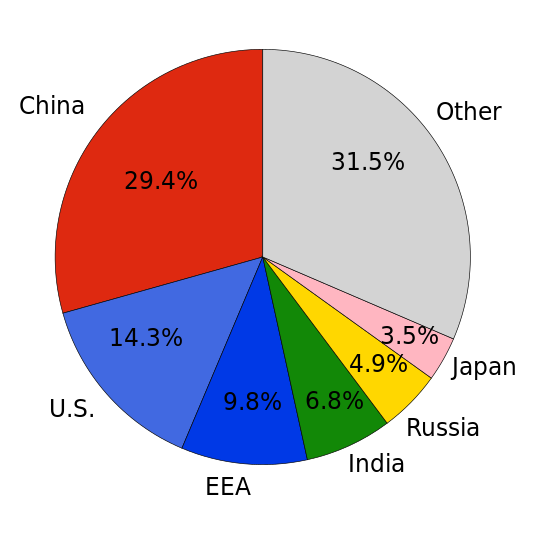
Global Greenhouse Gas Emissions by Source 2013

Here are some numbers: As of 2015, all carbon dioxide emissions from the United States comprised 14.34 percent of the global total, while China’s emissions stood at 29.51 percent. Even if the five oil companies were somehow responsible for, say, 10 percent of the United States’ carbon dioxide emissions, that would be less than one percent of the total human releases. Under standard tort rules, the liability of each defendant must be limited to its own pro rata share of the total harm given that under Section 433A of the Restatement of Torts, there is a “reasonable basis for determining the contribution of each cause to a single harm,” in this instance measured by market shares.
Indeed, these public nuisance lawsuits are especially dubious, given that the oil companies did not by their sales emit any carbon dioxide into the atmosphere. The dangerous releases came from many different parties, both private and public, including the municipalities bringing these lawsuits. These numerous parties used these products in countless different ways, with as much knowledge of their asserted effects on global warming as these five defendants. How could the oil companies have known about the anticipated course of global warming forty years ago when key government studies done today are uncertain about the magnitude of the effects of emissions on sea levels and the economic consequences?

The first paragraph of the New York City complaint ducks these factual complexities by insisting, falsely, that crude oil was “a product causing severe harm when used exactly as intended.” But the end uses of crude oil are so varied (including, for example, the creation of various plastics in common use today) that the effective control of emissions is best done through the regulation of these end users and not the oil companies. Indeed, even for gasoline, the level of carbon dioxide emissions critically depends on the operation and maintenance of the many different types of facilities, equipment, and vehicles, all of which are beyond the direct control of the oil companies. Yet all these end users are already subject to extensive emissions controls under the Clean Air Act and countless other environmental directives, both at the state and federal level.

This sensible distribution of regulatory authority rests on the superior ability of government agencies (at least compared to the courts), often in cooperation with each other, to formulate and maintain coherent policies to regulate the emissions of carbon dioxide, as well as methane, nitrous oxide, and fluorinated gases, which the EPA calculates account for 18 percent of greenhouse gas emissions.

The issues here are especially complex for many technical and logistical reasons. One critical task is to decide the optimal level of emissions. The implicit assumption of the New York and San Francisco lawsuits is that the world would become a better place if all emissions of carbon dioxide were stopped. But that position ignores the enormous benefits that come from the use of fossil fuels, which continue to supply over 80 percent of the nation’s energy needs. No other fuel source could keep manufacturing, transportation, and commerce alive. And it is just exaggeration to claim, as the city plaintiffs do, that these oil companies “have done nearly all they could to create [the] existential threat” of global warming when in fact energy efficiency in the United States has consistently improved, particularly in generating electrical power.

No public nuisance suits for global warming can solve a problem that must be addressed by a coherent regulatory program. Instead, chaos will follow if hundreds of different states, counties, and cities are allowed to bring separate actions under state law. It bears emphasis that in 2011, a unanimous Supreme Court decision in American Electric Power Co. v. Connecticut held that the combination of the Clean Air Act and actions by the Environmental Protection Agency “against carbon-dioxide emitters . . . displace the claims that the plaintiffs seek to pursue” under a public nuisance theory brought under federal law. The Court left open the question of whether the federal regulation at the time preempted any state law cause of action for public nuisance.

Summary

But, as I argued at the time, the only viable solution was for the federal government and the EPA to “orchestrate” the effort to control emissions. The point is doubly true against these remote, upstream defendants who have not emitted anything themselves. The standard analysis of federal preemption has long held that states may not engage in their own remedial efforts, even by actions in tort, when extensive federal regulation occupies the field, or when state activity either frustrates federal action or is in conflict with it. If anything, the scope of federal oversight, actual and prospective, is far more comprehensive than it was when American Electric Power was decided. And so federal preemption alone should block a set of dubious public nuisance claims that should never have been brought in the first place.

Background:  Critical Climate Intelligence for Jurists (and others)

Can Institutions Impose Climate Beliefs on Stakeholders?

Update July 31, 2019 at end

Stanley Kurtz writes at New Republic Fossil Fuel Divestment versus Institutional Neutrality: A North Carolina Test Case. Excerpts in italics with my bolds.

An important test of “institutional neutrality” — a pillar of campus free speech — is now playing out in North Carolina, where the University of North Carolina Asheville (UNCA) recently chose to divest a portion of its endowment from companies selling “fossil fuels” (coal, oil, and natural gas).

Institutional neutrality means that universities should avoid taking official political stands at the institutional level, such as divestment from fossil fuels, since such actions tend to pressure faculty and students holding contrary views into silence. This is particularly true for public universities such as UNCA, for they belong to every citizen of the state.

What makes the UNCA test case especially important is that two years ago North Carolina passed HB 527, one of the first comprehensive campus free-speech laws in the country. HB 527 not only affirms institutional neutrality as a foundational principle of campus free speech at UNC schools, it mandates that an annual report by a committee of the UNC Board of Governors (which oversees the entire state university system) weigh in on any “difficulties, controversies, or successes in maintaining a posture of administrative and institutional neutrality with regard to political or social issues.”

The question now is how the annual report, due in September, will handle this decision by a public university to throw in its lot with the fossil-fuel-divestment movement. More broadly, the question is whether the UNC Board of Governors will act to halt and reverse this clear violation of institutional neutrality by UNC Asheville. Students and administrators at UNCA intend their move to pressure the entire UNC system to divest. That means the UNC Board of Governors’ response to UNCA’s divestment bandwagon will have an enormous impact on the survival of institutional neutrality at every public campus in the state.

Students and faculty at public universities have every right to take whatever stand they like on issues like fossil-fuel divestment, climate change, and the Green New Deal. It is precisely the neutrality of public universities at the official institutional level that supports and guarantees the ability of individual faculty and students to freely speak their minds on these issues. Public universities shouldn’t have an official political line. We wouldn’t tolerate a public university endorsing Bernie Sanders, Kamala Harris, or Donald Trump for president. Nor should a public university throw its official institutional weight behind a thoroughly political movement whose aims are the subject of active, widespread, and unresolved public debate, particularly when state law cites the principle of institutional neutrality as an essential component of campus free speech.

True, UNC Asheville is known to lean heavily to the left, but that does not matter. After all, there are conservative students there as well; there is no political litmus test required and UNCA must remain open to all points of view. An institutional decision to divest from fossil fuels is like a neon sign flashing: “Conservatives need not apply.” Divestment purports to settle a political argument that students ought to be having with each other.

Determining whether a particular policy stand violates institutional neutrality always entails a degree of judgement. HB527 doesn’t ban institutional policy stands outright, because complete neutrality is impossible. Universities have to be able to advocate for a tuition increase, for example. That’s why North Carolina’s campus free speech law leaves it up to the system’s Board of Governors to weigh in on potential violations of neutrality. Nonetheless, it’s tough to see how a state that has enshrined the principle of institutional neutrality in law can fail to condemn fossil fuel divestment by a public university.

HB 527 begins by citing the University of Chicago’s famous 1967 Kalven Report as the classic articulation of the neutrality principle. While the Kalven Report acknowledges that there may be rare exceptions, it establishes a “heavy presumption against the university taking collective action or expressing opinions on the political and social issues of the day.” Such a stand, the report says, comes “at the price of censuring any minority who do not agree with the view adopted.” The Kalven Report emphasizes that the university “is not a lobby,” but instead must “maintain an independence from political fashions, passions, and pressures.” And universities do this precisely because they are obligated “to provide a forum for the most searching and candid discussion of political issues.” In other words, neutrality at the official institutional level encourages and makes possible free debate by members of the campus community. Or, as the Kalven Report puts it, “the instrument of dissent and criticism” is not the university but “the individual faculty member or the individual student.”

In 2015, President Robert Zimmer of the University of Chicago, renowned for his support of campus free speech, invoked the Kalven Report to explain why his school would not divest from fossil fuels. When student advocates of divestment pointed out that even the Kalven Report allows for exceptions in certain circumstances, Zimmer said fossil fuel divestment was not such a case.

“We should … be very wary of steps intended to instrumentalize our endowment in ways that would appear to position the University as a political actor rather than an academic institution. Conceiving of the endowment not as an economic resource, but as a tool to inject the University into the political process or as a lever to exert economic pressure for social purposes, can entail serious risks to the independence of the academic enterprise. The endowment is a resource, not an instrument to impel social or political change.”

UNC Asheville, in contrast, touts its decision to divest from fossil fuels as a “groundbreaking” move designed to lend “momentum” to a “movement” that it hopes will sweep the entire UNC system. UNCA Chancellor Nancy J. Cable called the decision “a defining moment” for the university. That’s the problem. Fossil-fuel divestment sends out a message that identifies the university on the official institutional level with a political movement that excludes — and is even directly at odds with — roughly half the taxpayers and potential students in North Carolina.

UNC Asheville is open about the fact that its decision was a direct response to student pressure for divestment.

And the political nature of the UNCA student fossil fuel divestment movement is evident. An opinion piece by leaders of UNCA Divest three months before the school’s final divestment decision, for example, positioned divestment as a repudiation of President Trump. Meanwhile, the UNCA school paper reports that many conservatives “feel like outcasts on campus.” How can UNC Asheville’s divestment decision fail to intensify and confirm that feeling, further chilling conservative speech? If anything, the school ought to be making of point of welcoming a wide range of student views on political issues.

Has UNC Asheville even thought about how its divestment decision might endanger free speech by creating an official university ideological line? Has it contemplated its decision in light of the new state law? Is the very concept of institutional neutrality and its importance for free speech even on the UNCA administration’s radar? Apparently not. In an excellent account of the UNCA neutrality controversy, Jay Schalin of North Carolina’s James G. Martin Center for Academic Renewal reports that when asked whether divestment was at odds with the principle of institutional neutrality, UNCA issued a bland statement that failed even to address the question.

It’s evident that UNC Asheville’s decision to divest from fossil fuels was taken without any regard for the neutrality issue in general, or for the new state law in particular.

At this point, it’s tough to see how the forthcoming annual report mandated by HB 527 can fail to condemn UNC Asheville’s decision to divest from fossil fuels. The committee of the UNC Board of Governors charged with issuing the report is legally obligated to address controversies over institutional neutrality, and this is certainly such a controversy. On the face of it, fossil fuel divestment violates the principles of neutrality set forth in the University of Chicago’s Kalven Report, which is cited as authoritative by the new law. After all, the University of Chicago itself currently cites the Kalven Report to explain why it won’t divest from fossil fuels, and Harvard has made effectively the same argument. How much more is it vital for a public university to uphold institutional neutrality, given that the UNC system serves citizens in a state where the full range of American political views is robustly represented? Why should the taxpayers of North Carolina support institutions that turn themselves into political actors? It’s also perfectly clear that UNCA’s divestment decision was taken without any serious regard to the neutrality issue, much less the new law. In short, to allow UNC Asheville’s divestment decision to pass without condemnation in the annual oversight report would be to violate the fundamental intent of HB 527.

North Carolina must prevent the thoroughgoing politicization of an important state university system by upholding institutional neutrality — one of the central pillars of campus free speech and a principle now enshrined in North Carolina state law. If UNC Asheville’s fossil fuel divestment decision holds — or worse, spreads as planned through the entire UNC system — the clear intent of HB 527 will have been violated, and the system’s Board of Governors will have failed to protect the state’s students from unwanted, unneeded, and thoroughly inappropriate ideological pressure. If, on the other hand, the UNC system reverses Asheville’s divestment decision and literally lays down the law on institutional neutrality, it will confirm North Carolina’s reputation as a leader of the movement to restore free speech at America’s public colleges and universities. We should know more by September, when the Board of Governors’ committee report is due.

Footnote Update July 31, 2019

Reuters provides additional evidence that climate opinions are divided along political lines.  H/T GWPF

Climate Discussion Nexus explains: (in italics with my bolds)

Reuters reports that a poll it did with Ipsos shows “Democrats are far more likely to believe droughts, floods, wildfires, hurricanes and tropical storms have become more frequent or intense where they live in the last decade”. And of course polls are likely to show wide disagreement on all manner of subjects, especially among political partisans. But even in these broad-minded times, there’s one thing we should all agree on: If two people argue about whether, say, hurricanes have become more frequent or intense where they live, they can’t both be right and it is possible to check.

Reuters agrees, rejecting fashionable relativism on this topic at least. Nevertheless you can guess which side it thinks is right: it sides with the Democrats. “U.S. government researchers have concluded that tropical cyclone activity, rainfall, and the frequency of intense single-day storms have been on the rise, according to data compiled by the Environmental Protection Agency.”

Really? Where? When? We have pretty good data on tropical cyclones in particular and they aren’t increasing.

Neither are US floods.  Well, what about the other stuff including droughts?

People who bother to check will thereafter doubt claims that these things are all increasing, so if Republicans are doubters, maybe it just means they looked up the numbers. And you don’t win the argument by appealing to the speculative future. “’We do expect to see more intense storms,’ said David Easterling, a spokesman for the National Oceanographic and Atmospheric Administration’s National Centers for Environmental Information.” Expect to see? Wasn’t the topic what we’d already seen?

Silly Republicans. “An overwhelming majority of scientists believe human consumption of fossil fuels is driving sweeping changes in the global climate by ramping up the concentration of heat-trapping gases in the atmosphere. But it is impossible to draw a direct link between the changes in U.S. weather in the recent past to the larger trend of warming.” Whereas an innuendo about the indirect links, followed by a snide reference to Donald Trump, should do the trick. “President Donald Trump has cast doubt on the science of climate change… Still, a majority of Republicans believe the United States should take “aggressive action” to combat global warming, Reuters polling shows.”

Good old Reuters polling. The story goes on to note that “Liberals are more likely to expose themselves to news outlets and people who believe climate change is an urgent threat that affects current weather patterns.” Like Reuters, for instance.


LA Times Misreports Mexican Energy Realism


Emily Green writes at LA Times Alternative energy efforts in Mexico slow as Lopez Obrador prioritizes oil. Excerpts in italics with my bolds.

The title of the article is not wrong, as we shall see below. But as usual climatists leave out the reality so obvious in the pie chart above. Seeing which energy sources are driving his nation’s prosperity provides the missing context for understanding the priorities of Mexican President Andres Lopez Obrador

The alarmist/activist hand-wringing is in full display:

With its windy valleys and wide swaths of desert, Mexico has some of the best natural terrain to produce wind and solar energy. And, in recent years, the country has attracted alternative energy investors from across the globe.

An aerial view of the Villanueva photovoltaic power plant in the municipality of Viesca, Coahuila state, Mexico. The plant covers an area the size of 40 football fields making it the largest solar plant in the Americas. (Alfredo Estrella / AFP/Getty Images)

But the market has taken a step back under Mexico’s new president, who has made clear his priority is returning Mexico’s oil company to its former dominance.

Since taking office Dec. 1, President Andres Manuel Lopez Obrador has canceled a highly anticipated electricity auction, as well as two major transmission-line projects that would have transported power generated by renewable energy plants around the country. He has also called for more investment in coal, and stood by as his director of Mexico’s electric utility dismissed wind and solar energy as unreliable and expensive.

It’s too soon to forecast the long-term consequences, but business leaders and energy consultants are seeing a trend: a chilling in the country’s up-and-coming renewable energy market.

Further on we get the usual distortions and misdirection: Renewables capacities and low prices are cited ignoring the low actual production and intermittancy mismatch with actual needs.

Energy and oil remain sensitive topics in Mexico, where people still recall the glory days of state-owned oil company Pemex, when it was the country’s economic lifeblood. There’s even a day commemorating Mexico’s 1938 nationalization of its oil and mineral wealth.

In recent years, however, Mexico’s energy market has undergone a transformation and reached out to investors. In 2014, Lopez Obrador’s predecessor, Enrique Peña Nieto, fully opened up the country’s oil, gas and electricity sector to private investment for the first time in 70 years.

The effects were immediate. In the oil sector, companies such as ExxonMobil and Chevron clamored to explore large deposits that had once been the sole purview of Pemex.

On the electricity side, the reform led to billions of dollars in private investment in Mexico’s power sector, both in renewable energy and traditional sources such as natural gas.

Through a series of auctions, Mexico’s state-owned utility awarded long-term power contracts to private developers. Although the auctions were open to all energy technologies, wind and solar companies won the bulk of the contracts because they offered among the lowest prices in the world. Solar developers won contracts to generate electricity in Mexico at around $20 per megawatt-hour, according to the government. Industry sources said that is about half the going price for coal and gas.

The country’s wind generation capacity jumped from 2,360 megawatts at the end of 2014 to 5,382 megawatts this April, according to the Mexican wind energy association. The numbers were even more stark in solar, which soared from 166 megawatts of capacity in 2014 to 2,900 megawatts in April, according to the Mexican solar energy association.

Virtue Signalling is an Expensive Way to Run an Economy

The electricity auctions were also seen as the main vehicle for Mexico to reach its clean energy commitments made as part of the Paris climate accord to produce 35% of its electricity from clean energy sources by 2024, and 50% by 2050. Under Mexico’s definition, clean energy sources include solar and wind generation, as well as sources that some critics say aren’t environmentally friendly — such as hydroelectric dams, nuclear energy and efficient natural gas plants. Currently, 24% of Mexico’s electricity comes from clean energy sources.

Summary

Note that for true believers, no energy is “clean” except wind and solar. And Mexico is another example of how renewables cannibalize your electrical grid while claiming to be cheaper than FF sources and saving the planet from the plant food gas CO2. Meanwhile those two “zero carbon” sources provide only 2% of the energy consumed, despite the billions invested.

I get the impression that ALO is much smarter than AOC.
See Also

Exaggerating Green Energy Supply

Cutting Through the Fog of Renewable Power Costs

Superhuman Renewables Targets


The End of Wind and Solar Parasites

Norman Rogers writes at American Thinker What It Will Take for the Wind and Solar Industries to Collapse. Excerpts in italics with my bolds.

The solar electricity industry is dependent on federal government subsidies for building new capacity. The subsidy consists of a 30% tax credit and the use of a tax scheme called tax equity finance. These subsidies are delivered during the first five years.

For wind, there is subsidy during the first five to ten years resulting from tax equity finance. There is also a production subsidy that lasts for the first ten years.

The other subsidy for wind and solar, not often characterized as a subsidy, is state renewable portfolio laws, or quotas, that require that an increasing portion of a state’s electricity come from renewable sources. Those state mandates result in wind and solar electricity being sold via profitable 25-year power purchase contracts. The buyer is generally a utility with good credit. The utilities are forced to offer these terms in order to cause sufficient supply to emerge to satisfy the renewable energy quotas.

The rate of return from a wind or solar investment can be low and credit terms favorable because the investors see the 25-year contract by a creditworthy utility as a guarantee of a low risk of default. If the risk were to be perceived as higher, then a higher rate of return and a higher interest rate on loans would be demanded. That in turn would increase the price of the electricity generated.

The bankruptcy of PG&E, the largest California utility, has created some cracks in the façade. A bankruptcy judge has ruled that cancellation of up to $40 billion in long-term energy contracts is a possibility. These contracts are not essential or needed to preserve the supply of electricity because they are mostly for wind or solar electricity supply that varies with the weather and can’t be counted on. As a consequence, there has to exist and does exist the necessary infrastructure to supply the electricity needs without the wind or solar energy.

Probably the judge will be overruled for political reasons, or the state will step in with a bailout. Utilities have to keep operating, no matter what. Ditching wind and solar contracts would make California politicians look foolish because they have long touted wind and solar as the future of energy.

PG&E is in bankruptcy because California applies strict liability for damages from forest fires started by electric lines, no matter who is really at fault. Almost certainly the government is at fault for not anticipating the danger of massive fires and for not enforcing strict fire prevention and protection. Massive fire damage should be protected by insurance, not by the utility, even if the fire was started by a power line. The fire in question could just as well have been started by lightning or a homeless person. PG&E previously filed bankruptcy in 2001, also a consequence of abuse of the utility by the state government.

By far the most important subsidy is the renewable portfolio laws. Even if the federal subsidies are reduced, the quota for renewable energy will force price increases to keep the renewable energy industry in business, because it has to stay in business to supply energy to meet the quota. Other plausible methods of meeting the quota have been outlawed by the industry’s friends in the state governments. Nuclear and hydro, neither of which generates CO2 emissions, are not allowed. Hydro is not strictly prohibited — only hydro that involves dams and diversions. That is very close to all hydro. Another reason hydro is banned is that environmental groups don’t like dams.

For technical reasons, an electrical grid cannot run on wind or solar much more than 50% of the time. The fleet of backup plants must be online to provide adjustable output to compensate for erratic variations in wind or solar. Output has to be ramped up to meet early-evening peaks. Wind suffers from a cube power law, meaning that if the wind drops by 10%, the electricity drops by 30%. Solar suffers from too much generation in the middle of the day and not enough generation to meet early evening peaks in consumption.

When a “too much generation” situation happens, the wind or solar has to be curtailed. That means that the operators are told to stop delivering electricity. In many cases, they are not paid for the electricity they could have delivered. Some contracts require that they be paid according to a model that figures out how much they could have generated according to the recorded weather conditions. The more wind and solar, the more curtailments as the amount of erratic electricity approaches the allowable limits. Curtailment is an increasing threat, as quotas increase, to the financial health of wind and solar.

There is a movement to include batteries with solar installations to move excessive middle-of-the-day generation to the early evening. This is a palliative to extend the time before solar runs into the curtailment wall. The batteries are extremely expensive and wear out every five years.

Neither wind nor solar is competitive without subsidies. If the subsidies and quotas were taken away, no wind or solar operation outside very special situations would be built. Further, the existing installations would continue only as long as their contracts are honored and they are cash flow–positive. In order to be competitive, without subsidies, wind or solar would have to supply electricity for less than $20 per megawatt-hour, the marginal cost of generating the electricity with gas or coal. Only the marginal cost counts, because the fossil fuel plants have to be there whether or not there is wind or solar. Without the subsidies, quotas, and 25-year contracts, wind or solar would have to get about $100 per megawatt-hour for its electricity. That gap, between $100 and $20, is a wide chasm only bridged by subsidies and mandates.

The cost of using wind and solar for reducing CO2 emissions is very high. The most authoritative and sincere promoters of global warming loudly advocate using nuclear, a source that is not erratic, does not emit CO2 or pollution, and uses the cheapest fuel. One can buy carbon offsets for 10 or 20 times less than the cost of reducing CO2 emissions with wind or solar. A carbon offset is a scheme where the buyer pays the seller to reduce world emissions of CO2. This is done in a variety of ways by the sellers.

The special situations where wind and solar can be competitive are remote locations using imported oil to generate electricity. In those situations, the marginal cost of the electricity may be $200 per megawatt-hour or more. Newfoundland comes to mind — for wind, not solar.

Maintenance costs for solar are low. For wind, maintenance costs are high, and major components, such as propeller blades and gearboxes, may fail, especially as the turbines age. These heavy and awkward objects are located hundreds of feet above ground. There exists a danger that wind farms will fail once the inflation-protected subsidy of $24 per megawatt-hour runs out after ten years. At that point, turbines that need expensive repairs may be abandoned. Wind turbine graveyards from the first wind fad in the 1970s can be seen near Palm Springs, California. Wind farms can’t receive the production subsidy unless they can sell the electricity. That has resulted paying customers to “buy” the electricity.

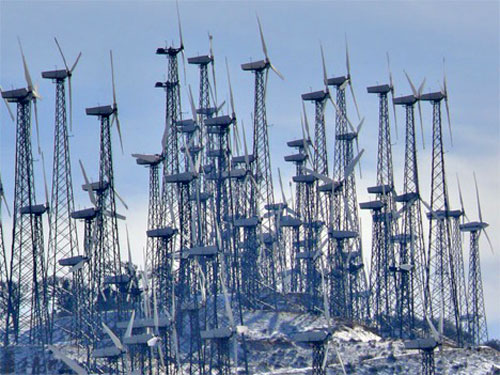
Tehachapi’s dead turbines.

A significant financial risk is that the global warming narrative may collapse. If belief in the reality of the global warming threat collapses, then the major intellectual support for renewable energy will collapse. It is ironic that the promoters of global warming are campaigning to require companies to take into account the threat of global warming in their financial projections. If the companies do this in an honest manner, they also have to take into account the possibility that the threat will evaporate. My own best guess, after considerable technical study, is that it is near a sure thing that the threat of global warming is imaginary and largely invented by the people who benefit. Adding CO2 to the atmosphere has well understood positive effects for the growth of crops and the greening of deserts.

The conservative investors who make long-term investments in wind or solar may be underestimating the risks involved. For example, an article in Chief Investment Officer magazine stated that CalPERS, the giant California public employees retirement fund, is planning to expand investments in renewable energy, characterized as “stable cash flowing assets.” That article was written before the bankruptcy of PG&E. The article also stated that competition among institutional investors for top yielding investments in the alternative energy space is fierce.

Wind and solar are not competitive and never will be. They have been pumped up into supposedly solid investments by means of ill advised subsidies and mandates. At some point, the governments will wake up to the waste and foolishness involved. At that point, the value of these investments will collapse. It won’t be the first time that investment experts made bad investments because they don’t really understand what is going on.

Footnote:  There is also a report from GWPF on environmental degradation from industrial scale wind and solar:

Class Zero Grad Speeches: Fail

Once upon a time at secondary school graduation ceremonies students who finished with the best grades (Valedictorians and Salutatorians) took to the podium to deliver a speech each one wrote expressing his or her personal thoughts on that life passage. Not any more. In progressive, post-modern places, these speeches are now a canned performance: Now apparently accomplished scholars choose not to express themselves, not to speak out as individuals having earned the right to heard. Instead they read out words written by others to proselytize for a cause.

This Spring We’re Taking Over Commencements Everywhere to Demand a Zero Emissions Future

According to Class of 0000: Starting in may, hundreds of Valedictorians and Salutatorians will deliver the same message in their commencement speeches.  The Speech in italics with my bolds:

Today, we celebrate our achievements from the last 4 years. But I want to focus on what we need to achieve in the next 11.

That’s how long climate scientists have given us; 11 years to avoid catastrophic climate change. It’s already damaging our homes, our health, our safety and our happiness. We won’t let it take our futures too.

Our diplomas may say Class of 2019, but marked in history, we are the Class of Zero.
Zero emissions.
Zero excuses.
Zero time to waste.

Across the country, our class stands 7.5 million strong.

And in unity, we’re giving 2020 political candidates a choice:

Have a plan to get to zero emissions, or get zero of our votes.

Together, we have the power to solve the climate crisis.

Every student. Every parent. Every teacher. Every leader.

The future is in our hands.

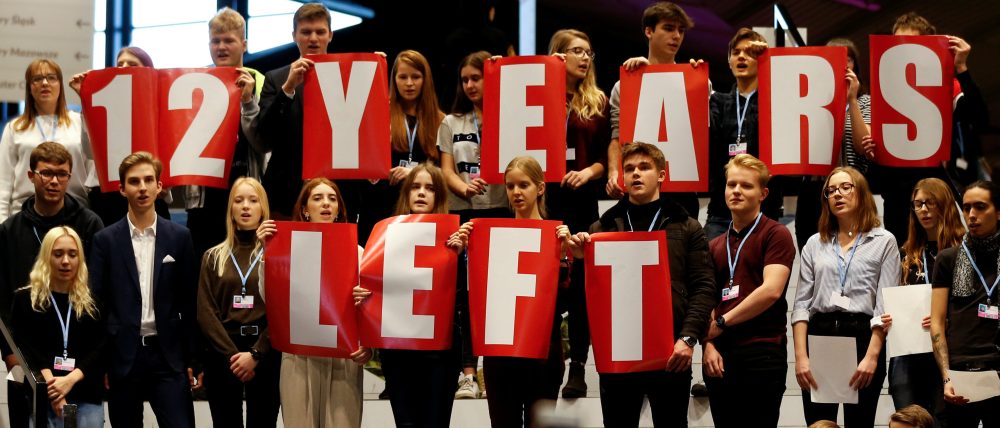
Local school children join Greta Thunberg's initiative on climate strike during the COP24 UN Climate Change Conference 2018 in Katowice

But it didn’t go off everywhere as planned by the movement.

As Lathan Watts reported at Town Hall, many of these performances were stopped by educators.

Kriya Naidu was the valedictorian of her Florida high school, but she was recently prohibited by school officials from giving her graduation speech because of its content.

Cait Christenson was one of six valedictorians at her Wisconsin high school, but again, school administrators found the content of her graduation speech too controversial and prohibited her from addressing her fellow graduates.

Lulabel Seitz was the valedictorian at her California high school. And, you guessed it, her graduation speech was also censored by school administrators – in fact, her mic was turned off in the midst of her address.

For Lathan Watts, this is a problem. I would agree if they were expressing something other than a call for political and social action. This is the most striking example yet of young people subsuming into an social group and losing individual identity. I don’t know whether to call this Artificial Intelligence or Artificial Stupidity; but it is certainly not genuine, not authentic. Maybe this is what we have to endure in the Age of Greta.

The graduates would have been better served if Robert Curry were at the podium:

As we all know, acquiring common sense can be a matter of life and death. I’m thinking, for example, of the teenage boy who swallowed a garden slug on a dare, became paralyzed, and died recently. Because children lack common sense, parents must do what they have always done, trying to instill common sense in their children while at the same time using their own common sense to encompass the growing child.

Becoming a person of common sense has always been a life-defining challenge, but acquiring common sense has gotten a lot more difficult for young people in our time, especially if they have spent some time in our institutions of higher learning. My witty friend Robert Godwin has this to say about that: “Say what you want about the liberal arts, but they’ve found a cure for common sense.”

When I headed off to college, my high school teacher who was my mentor offered me two commonsense rules to follow“Take care to stay well, and choose professors, not courses.” Because of my high regard for him, I took his words to heart. Later, when I saw the problems my fellow students brought on themselves by not getting enough sleep and generally being careless about their health, I understood the practical wisdom of what he had told me. And the second rule helped me more quickly understand the value of navigating my way through college by who was teaching the course rather than by the course title.

For years, I handed on the same commonsense wisdom to young folks I knew when they headed off to college. But I have not offered that advice for some years now. Here is what I tell them now: “They are going to try to knock common sense out of you; don’t let them.”

Say what you want about the liberal arts, but they’ve found a cure for common sense.

By Robert Curry writes at American Thinker Making Sense of Common Sense. Excerpts in italics with my bolds.

Greens Are Nuclear Power Deniers

Interesting Engineering reports news about the power of Nuclear energy in the Arctic Russia Gives the Green Light to Its Floating Nuclear Power Plant to Begin Work.  Excerpts in italics with my bolds.

Imagine a massive nuclear power plant. Now picture that massive power plant floating out at sea. And then you have the Akademik Lomonosov.

The Akademik Lomonosov is precisely that, a floating nuclear power plant, run by the Russian State Nuclear Energy Corporation, or Rosatom, as it is more easily abbreviated.

The Akademik Lomonosov is not the first of its kind to start work offshore. Back in the 1960s, the US converted WWII war ship, originally the Liberty ship, was converted into a nuclear power plant, renamed the Sturgis. The Sturgis ended its working days in 1976.

Today, the Akademik Lomonosov has quite some power behind it.

Equipped with two KLT-40S reactor units, each able to generate 35 megawatt of power, it has some power behind it. With this power wattage it could essentially provide enough electricity to power a town of up to 100,000 people.

This is especially useful for a massive country such as Russia, with some extremely off-the-beaten-track towns in the North and Far East, as well as offshore oil and gas platforms owned by the country.

With this nuclear power plant, these far-to-reach spots could finally have electricity.

Rosatom’s subsidiary stated in a press release: “Rosenergoatom (Rosatom’s electric power division) has been authorized to use the nuclear facility of floating nuclear power plant Akademik Lomonosov for 10 years, until 2029.”

Allegedly, the floating power plant’s life span is up to 40 years, which could be prolonged to 50 years. 10 years hardly seems a stretch at this stage.

CNN picks up the story and spins it with help from Greenpeace (still mad at Russia for jailing their eco-terrorists).Russia plans to tow a nuclear power station to the Arctic. Critics dub it a ‘floating Chernobyl’ Excerpts in italics with my bolds

The Admiral Lomonosov will be the northernmost operating nuclear plant in the world, and it’s key to plans to develop the region economically. About 2 million Russians reside near the Arctic coast in villages and towns similar to Pevek, settlements that are often reachable only by plane or ship, if the weather permits. But they generate as much as 20% of country’s GDP and are key for Russian plans to tap into the hidden Arctic riches of oil and gas as Siberian reserves diminish.

The Lomonosov platform was dubbed “Chernobyl on Ice” or “floating Chernobyl” by Greenpeace even before the public’s revived interest in the 1986 catastrophe thanks in large part to the HBO TV series of the same name.

Rosatom, the state company in charge of Russia’s nuclear projects, has been fighting against this nickname, saying such criticism is ill founded.

“It’s totally not justified to compare these two projects. These are baseless claims, just the way the reactors themselves operate work is different,” said Vladimir Iriminku, Lomonosov’s chief engineer for environmental protection. “Of course, what happened in Chernobyl cannot happen again…. And as it’s going to be stationed in the Arctic waters, it will be cooling down constantly, and there is no lack of cold water.”

The idea itself is not new — the US Army used a small nuclear reactor installed on a ship in the Panama Canal for almost a decade in the 1960s. For civil purposes, an American energy company PSE&G commissioned a floating plant to be stationed off the coast of New Jersey, but the project was halted in the 1970s due to public opposition and environmental concerns.

At Real Clear Science Ross Pomeroy’s discusses the main distortions told by Greens The 3 Biggest Myths About Nuclear Power.  Excerpts in italics with my bolds.

Earlier this year, an enormous confinement structure was completed and commissioned to seal away the highly radioactive ruins of Chernobyl’s number four nuclear reactor, a permanent reminder of the awesome – and potentially terrible – power of nuclear energy. More recently, Home Box Office (HBO) broadcast an even more penetrating reminder – the network’s television show Chernobyl garnered rave reviews and enthralled a wide audience. Nuclear power has once again been thrust to the forefront of society’s collective thoughts.

That makes this a great opportunity to shine the light of evidence on an issue clouded by confusion. For its rare, yet resonating disasters, nuclear energy prompts fear. But is that fear warranted?

Here are three common myths about nuclear power:

Myth #1. Nuclear is dangerous. In the minds of many, the examples of Three Mile Island, Fukushima-Daiichi, and Chernobyl, are enough to cement this statement as fact. But a full and rational examination of nuclear’s operational history swiftly dispels this common myth. As a variety of different analyses have shown, even when you factor in nuclear’s memorable accidents, it is vastly safer than any fossil fuel energy source. A NASA study in 2013 reported that “nuclear power prevented an average of over 1.8 million net deaths worldwide between 1971-2009” by displacing fossil fuel-based power stations and their associated dangers for miners, workers, and the general public. Nuclear may even be safer than renewable energy sources like wind and solar, as it reduces the need for hazardous mining.

All over the world, for decades, nuclear power has been producing emission-free energy quietly and consistently with vastly fewer ill effects compared to conventional power sources like coal and natural gas.

Myth #2. Nuclear waste is an unsolvable problem. Nuclear energy results in radioactive waste in the form of spent fuel rods – a big drawback. But did you know that coal plants actually produce more radioactive waste during their operation? Currently, more than 90,000 metric tons of nuclear waste (which would fill a football field twenty meters deep) are stored at more than a hundred sites around the United States, a workable but undesirable situation. However, that waste could be safely locked away in Yucca Mountain, a remote site in the Nevada desert situated on federal land. Political maneuvering has kept the site in limbo for decades, however. In the meantime, startups with high-profile backers like Bill Gates are racing to develop new forms of nuclear power that can actually recycle that waste, and there’s no technical reason to think that they won’t eventually succeed.

With a half-life as long as 24,000 years, nuclear waste may seem like a permanent problem, but it’s nothing that we can’t handle.

Myth #3. Nuclear is prohibitively expensive. No doubt you’ve heard or read numerous accounts about nuclear power plants shutting down or even being canceled in the process of construction for being too expensive. It’s true, in some locations, the landscape of electricity generation makes nuclear unprofitable, but in most locations, nuclear power is doing just fine.

Though renewable energy proponents insist that wind and solar are all that is needed to power the future, current reality does not back that assertion. While cheap and growing cheaper, wind and solar are intermittent and thus require some sort of grid storage in order to provide power all the time. Gigantic batteries are the most likely option. But this technology is nowhere near ready yet, presents its own environmental hazards, and will likely be very costly.

On the other hand, nuclear could readily provide the baseload power our grid needs to provide electricity around the clock.

Footnote: See also Greens Killing Electricity, Nuclear In Decline


Climate Faith ≠ Climate Works

Protestors march to raise awareness of climate change and ecological issues on the second day of the Glastonbury Festival at Worthy Farm, Somerset, England, Thursday, June 27, 2019. (Photo by Grant Pollard/Invision/AP) GRANT POLLARD/INVISION/AP

Michael Lynch writes at Forbes Is The Climate Change Debate A Replay Of The Reformation? Excerpts in italics with my bolds.

During the Reformation, there was an intense debate over whether Christians could enter paradise by doing good works, or whether faith alone allowed such a benefit. (See Fatal Discord: Erasmus, Luther and the Fight for the Western Mind by Michael Massing) This reminds me of the current attitude many have towards climate change policy, where some appear to think that faith alone is sufficient to solve the problem.

In the early days of the global warming debate, I read an English writer praising his country’s example of recognizing climate change compared to American skepticism, although he did admit the British hadn’t actually taken steps to address the problem. Similarly, the U.S. has reduced greenhouse gas emissions more than most countries in the past few years, but incidentally, mostly due to cheap natural gas, and it remains the climate villain in the eyes of many because the president is a denier.

Additionally, a lot of energy, well, effort, goes into demonizing actors or actions that have no practical impact on climate. For example, opposing the construction of oil and gas pipelines does not reduce consumption of oil and gas, and usually increases emissions. Suing the oil or auto industries for blocking climate policies or misleading the public about climate science appeals to many, but with no measurable environmental impact. The same with demanding divestment in fossil fuel company stocks.

Some of the new proposals to address climate change put me mind of the debate between faith and works, especially when they seem more for demonstration purpose than actually reducing emissions. Numerous governments have suggested phasing out all carbon-based electricity generation or all petroleum-fueled vehicles by a point decades into the future, and these tend to be hailed by activists as representing, if not solutions, then great strides forward. New York state, for example, just proposed phasing out carbon-based electricity by 2050; France wants to ban conventional vehicles by 2040, the U.K. by 2050. But as Michael Coren notes, “So far, it’s just words.”

Which reminds me of comedian Billy West who, in the persona of a radio personality, bragged to someone about his fund-raising, adding, “…but mostly it’s just pledges.” Governments have been great at setting goals, but implementation has been seriously lacking. The setting of goals seems more an act of faith than a carrying out of works.

And we have been here before. Many other national and sub-national environmental programs were later abandoned; the 1990s saw California enact mandates for electric vehicle sales—requiring 10% of sales in 2003 be zero emission vehicles—which was adopted by a number of other states, primarily in New England. Ultimately, it was abandoned after wasting billions of dollars. Numerous locales in the U.S. signed on to requirements for oxygenated gasoline, only to back out at the last minute when the cost became apparent.

Technology mandates are a mix of demonizing the producers and demonstrations of faith: telling utilities to buy a certain portion of carbon-free electricity is calling on someone else to act, while hiding the cost of the action. Those who believe in works would do better to buy their own renewable power, either producing it directly or from an independent power producer.

Automobile efficiency standards arguably fall into this category as well, that is, making it seem as if the manufacturers are to blame for consumers’ desire to purchase large, powerful vehicles. There are very fuel-efficient vehicles for sale in the United States, and they are much cheaper than the sauropods dominating American highways, so addressing manufacturer behavior is not the issue. Mandating vehicle efficiency is rather like demanding that a portion of butchers’ sales be veggie burgers; Beyond Meat has shown that success for veggie burgers comes from satisfying consumers, not lecturing them on environmental ethics.

This is where a carbon tax comes in: it is designed to change consumer preferences, reducing carbon emissions in favor of other consumables. It would also motivate producers to meet the demand for products that require less carbon emissions, either in their production or operation. Although the impact would grow over time, it would begin immediately upon implementation, and while it could theoretically be reversed, taxes on consumption tend to be extremely persistent.

Comment:

I like the author’s comparing of the climate faithful marching in processions to the religious faithful marching on Holy Days. He is right to point out the hypocrisy of of those obsessed over CO2 demonstrating their belief, while still enjoying fossil fuel benefits. And he ridicules the symbolic but ineffectual policies proposed, noting they are merely another form of showing faith rather than taking action that works.

But he ends up accepting the warmist unproven premise: We are sinners because we burn fossil fuels. Moreover, he seems to suggest that imposing a carbon indulgence tax overcomes the moral shortcoming. In fact Reformers strongly opposed the Catholic Church practice of taking money for future promises they could not deliver. Now this scam returns with governments taking the opportunity to fill their coffers. Further, as Bill Gates explained, the tax has a faulty premise: There is presently no substitute for fossil fuels powering modern societies.

The good news is, today’s weather and climate are within ordinary bounds.  The bad news:  If they actually turn climate faith into works, it is the end of life as you know it.

Warmists Make Bad Investors

Terence Corcoran explains at the Financial Post: The world needs more of what Exxon is selling (and will for decades). Excerpts in italics with my bolds.

World demand for Exxon’s products, fossil fuels, is expected to increase and remain steady over the coming decade

It’s the kind of story that lights up headlines: one of Britain’s biggest fund managers started selling shares in Exxon Mobil Corp. because the global oil giant wasn’t doing enough to address climate change.

The investment fund manager, Legal & General Investment Management (LGIM), oversees $1.3 trillion, making it the 11th largest money manager in the world. Legal and General (as it is called) is also one of scores of investment management firms, activists and hand-wringing organizations that are part of the burgeoning global sustainable and environmental social finance and governance effort to promote collaborative engagement and foster responsible investment and divestment. The goal is to enhance disclosure target-setting within corporations so that they can become leaders and builders of business models that will help the planet achieve a prosperous and sustainable future and overcome the climate emergency/crisis/disaster now faced by humanity if fossil fuels are not reduced to near-zero in the not-too-distant future.

As part of this movement, LGIM is a member of an organization called Climate Action 100+: Global Investors Driving Business Decisions, a collection of meddling institutional investors around the world, mostly government-run pension plans — although Quebec’s state pension fund, the Caisse de dépôt et placement du Québec, is the only obvious Canadian member of Climate Action 100+.

Exxon was one of five companies LGIM said it had placed on the divestment list as it steps up pressure on companies to address climate change: ExxonMobil Corporation, Hormel Foods, Korean Electric Power Corporation, Kroger and Metlife. “These names,” said LGIM, “are in addition to China Construction Bank, Rosneft Oil, Japan Post Holdings, Subaru, Loblaw and Sysco Corporation, all of whom remain engaged but who have yet to take the substantive actions to warrant re-instatement.”

Meryam OImi, head of Sustainability and Responsible Investment Strategy at LGIM, said the investment firm “will continue to push companies to build business models fit for a prosperous, sustainable future.” LGIM’s name-and-shame strategy was enthusiastically endorsed last week in Forbes magazine for maintaining “a sophisticated approach to climate change.”

One has to wonder, however, about the wisdom of divesting Exxon Mobil, one of the world’s most successful fossil-fuel producers, at a time when world energy forecasters project continuing expansion of fossil fuel demand well into …

Whoa. Hold on a second. Let me go back a few paragraphs. Loblaw? Is that our Canadian Loblaw, national champion virtue-signalling food industry giant, master of green product marketing, installer of solar panels on supermarket roofs, and most recently recipient of government funding to help upgrade the company’s refrigeration units to make them more green?

By gosh, it is our Loblaw. In a release, LGIM said “Loblaw, the Canadian grocery chain,” will continue as an “exclusion candidate.” According to Angeli Behham, a corporate governance manger who leads LGIM’s “pledge engagements with the food sector,” Canada’s leading food company “has made improvements in its governance, appointing a Lead Independent Director to ensure a counter-balancing voice to the Chair/CEO role. But we believe there are still a number of necessary steps for companies of such scale, and look forward to continuing engagement and support for substantive changes in the future.” Only then, it seems, will Loblaw be removed from the “divested” list and “reinstated.”

A colleague here at FP Comment, Peter Foster, sent an email to a public affairs person at Loblaw’s head office in Toronto about LGIM’s listing of Loblaw as a climate laggard. “Did they tell you where you are falling short? Are you taking steps to regain their approval? Does this mean they don’t invest in you at all, or just in one of their funds?” There has been no reply as of deadline.

Meanwhile, back to Exxon Mobil, from which LGIM has commenced divesting. Presumably the objective is to use slow trickle-down divestiture as a form of blackmail: change your ways, Exxon, or we will take away our investment, publicly announce our intent and drive your share price down.

This may be terrific green headline-grabbing investment politics, but in the stock market world the plan seems a little naive. According to the latest forecasts — from the International Energy Agency, BP’s Energy Outlook, and McKinsey — world demand for Exxon’s products, fossil fuels, is expected to increase and remain steady over the coming decades.

Natural gas demand, for example, surged last year, and McKinsey reports that gas demand will continue to increase from about 3,500 billion cubic feet (bcf) today to a peak of about 4,200 bcf in 2035 before declining slightly back to today’s level by 2050. Over the next 30 years, oil will also gain from 100 million barrels a day (MMBD) a year today to 108 MMBD a year in 2033 before falling back down to 100 MMBD by 2050.

That means that Exxon and other fossil-fuel companies are forecast to produce a total of 3,000 MMBD of oil over the next 30 years and 120,000 billion cubic feet of gas.

By most investment standards, this is no time to be divesting fossil-fuel stocks. If LGIM and other dumb fund management clucks agitating for sustainable investment and divestment want no part of it, then let them have their political fun. Sell, baby, sell. As they do their bit to keep the fossil-fuel stocks low, they are creating buying opportunities for smarter investors. In future, it seems, the world will need more Exxon.

Comment:  How is it that so-called professional wealth managers can be so crippled with wish dreams and political correctness?  Do they think that everyone with disposable income lives in their progressive, post-modern bubble?  I hope they lose their shirts.  (Except for Quebec pension fund who need to send me a check every month.)

Climate Zealots Throw Sand into Energy Supply

Roger Conrad reports on how the US energy infrastructure is hobbled by climate activists empowered by funds and lawyers. His article at Forbes is Best Bets On Pipeline Politics. Excerpts in italics with my bolds.

It seems like a long, long time ago in a galaxy far, far away. But barely two years back, permits for new US oil and especially natural gas pipelines were basically a formality.

Back then, the only US pipeline facing significant regulatory hurdles was TC Energy Corp’s (TRP) proposed Keystone XL pipeline to bring Alberta oil sands to US markets. And on the day the Obama Administration rejected that project for the final time, officials actually approved two oil pipelines elsewhere.

Everything changed following the November 2016 presidential election. Congress’ failure in 2016 to fill empty seats on the five-member Federal Energy Regulatory Commission led to the lack of quorum in early 2017.

New approvals ground to a halt for nearly six months. That gave “keep it in the ground” advocates precious time to tap into record fundraising, fueled by a groundswell of opposition to Trump Administration policies.

One result has been legal challenges to projects on an unprecedented scale at multiple venues. Work on Enbridge Inc’s (ENB, ENB) Line 3 pipeline expansion, for example, is now completed in Canada as well as North Dakota and Wisconsin.

Project suspended in June 2017.

Courts, however, have overturned Minnesota regulators’ prior approval of the project’s Environmental Impact Statement. That’s forced officials to go through the process again, delaying completion at least until the second half of 2020.

We’ve also seen a decided shift to more restrictive energy politics in several states, notably Colorado. Others like New York have dug in further in refusing to grant water permits from long-delayed projects like the Constitution Pipeline. That’s triggered warnings of prospective natural gas shortages from New York City’s distribution utility Consolidated Edison ED +0% (ED), which is restricting new customer additions.

Time equals money when it comes to multi-year, multi-billion dollar projects. Bloomberg Intelligence estimates a $2.75 million cost increase per mile of planned pipeline for every one-quarter delay in construction. The projected final cost of the Line 3 expansion, for example, is already billions higher than initial estimates.

Consequently, the game being played by pipeline opponents is to delay. That means mounting enough challenges to ramp up costs and ultimately convince developers to walk away. And for the first time, they have the funds to do the job.

Project abandoned in April 2016.

Opponents have been particularly successful quashing projects in New England and the Northeast US. To date, they’ve failed in Texas, where several giant pipelines are under construction. Kinder Morgan KMI +0% Inc (KMI) has one major gas pipeline from the Permian Basin coming on full stream later this year. It has another next year and a third in early stages of development.

Ground zero now in pipeline politics is the struggle of two projects in the Middle Atlantic/Southeast US to cross the Appalachian Trail: The Atlantic Coast Pipeline and the Mountain Valley Pipeline.

These projects’ ultimate success or failure will have a huge impact on the long-term profitability of Appalachia-based gas and oil producers, which are sitting on huge reserves in the Marcellus and Utica shale. Ironically, the longer they’re delayed, the greater demand will be for Texas energy and by extension new pipelines in the state.

That will benefit Texas developers like Kinder Morgan and Plains All-American Pipeline (PAA), which is focused on oil. And it will hit pipeline companies in the East like EQM Midstream Partners LP (EQM), which faces a massive writeoff if the Mountain Valley Pipeline can’t win through.

To be sure, natural gas development especially still has plenty of support in the US. Replacing older coal-fired facilities with gas, for example, reduces operating costs and electricity rates. New plants increase utilities’ rate base, spurring earnings and dividend growth. And the prospective environmental benefits are enormous, cutting future legal liabilities.

Gas emits none of coal’s particulate matter, which is blamed for a host of respiratory woes. It emits no acid rain gases that have caused billions in property damage and creates no toxic ash.

As for carbon dioxide, equivalent sized gas power plants emit less than half what coal does. In fact, gas adoption is the single biggest reason America is still meeting greenhouse gas commitments under the Paris Accords. Finally, surging US energy production has dramatically shifted global energy politics, demonstrated by the relative lack of reaction in oil prices to elevated tensions in the Persian Gulf.

During the Obama years, those facts were more than enough to hold together a consensus for US natural gas development. And the result was a relatively easy path for pipeline approvals.

These days, that’s not enough for pipelines to succeed. The silver lining is the more difficult it becomes to build, the more valuable existing infrastructure and ultimately successful projects will be.

In the days when pipeline approvals were swift, any company raising funds economically could get projects built. These days, would-be developers need to be financially and operationally strong enough to handle legal challenges wherever they occur.

Footnote:  The Climatist Manifesto

Mission: Deindustrialize Civilization

Goal: Drive industrial corporations into Bankruptcy

Strategy: Cut off the Supply of Cheap, Reliable Energy

Tactics:

  • Raise the price of fossil fuels
  • Force the power grid to use expensive, unreliable renewables
  • Demonize Nuclear energy
  • Spread fear of extraction technologies such as fracking
  • Increase regulatory costs on energy production
  • Scare investors away from carbon energy companies
  • Stop pipelines because they are too safe and efficient
  • Force all companies to account for carbon usage and risk

See Also Why People Rely on Pipelines

Payback Upon Climate Grasshoppers