Investor/Activists Repelled

Climate Activists storm the bastion of Exxon Mobil, here seen without their shareholder disguises.

But their latest weapon of mass corporate destruction was defused by the SEC.  European energy companies were not so fortunate.  The story comes from CNN, who disapprove of the result. SEC sides with Exxon by blocking major climate vote.  Excerpts in italics with my bolds.

New York (CNN Business)ExxonMobil has dodged a climate change shareholder vote — with some help from the SEC.

The agency granted Exxon’s request to block a shareholder resolution that would have urged the oil behemoth to adopt and disclose greenhouse gas emissions targets on its business and products in line with the Paris climate accord.

The SEC ruled that the nonbinding proposal, which was backed by investors with $9.5 trillion in assets, would “micromanage” Exxon (XOM) by seeking to impose “specific methods for implementing complex policies” in place of managerial judgment.

The decision deals a blow to momentum in the investment community to coax force fossil fuel companies to come to terms with the realities conform to alarmists’ views of climate change. Exxon’s European rivals have already agreed caved in to adopt similar emissions targets.

But backers of the proposal, including the New York State pension, vowed to keep fighting for change at Exxon and other oil companies.

“We’re not going away,” New York State Comptroller Thomas DiNapoli, who runs the state’s pension fund, told CNN Business. “Don’t take a minor setback as defeat. It’s part of a longer process.”

The New York State Common Retirement Fund, which owned 10.5 million shares of Exxon as of the end of last year, led the Exxon shareholder proposal along with the Church of England’s endowment fund. DiNapoli suggested the SEC’s position was “influenced” by the Trump administration’s climate change skepticism.  “We’ve had a national administration spend a lot of time denying that climate change is a reality,” DiNapoli said.

Exxon declined to comment on the SEC ruling.

Exxon fought ‘vague’ resolution

The Exxon battle comes after DiNapoli’s office and the Church of England won a landmark victory against the world’s largest publicly traded oil company two years ago.

More than 60% of Exxon shareholders in May 2017 backed a separate proposal urging the company to do more to disclose the risk it faces from efforts to regulate carbon emissions. Six months after the rare rebuke, Exxon stopped resisting and agreed to reveal these climate risks.

Shareholder activism is on the rise, but companies are fighting back

But Exxon fought hard against this latest resolution. In letters to the agency, Exxon strongly urged SEC staff members to confirm they would not recommend punishing the company for leaving the proposal out of its annual proxy vote.

Exxon argued that the proposal is “vague and indefinite,” seeks to “micromanage the company” and has already been “substantially implemented.”

Exxon pointed to the company’s 2018 Energy and Carbon Summary as evidence that it is already doing its part to address the risks of climate change. Exxon pointed to other climate-related steps, including promises to cut emissions, research into fuel cells and biofuels and purchases of wind and solar energy.
And Exxon warned that “unilateral action” disconnected to government policy changes and consumer demand “could harm ExxonMobil’s business” and prevent the company from meeting the world’s energy needs,

European oil majors take different approach

The Exxon victory comes as major corporations are fighting to impose constraints on proxy advisory firms and what they view as “political” resolutions from activist shareholders.

In sharp contrast to US oil giants, European oil companies Royal Dutch Shell (RDSA), BP and Total (TOT) have either agreed to set emissions goals or are in the process of doing so. BP (BP) recently agreed to link the bonuses of 36,000 of its workers to climate change targets. Shell announced this week that it will quit a major US oil lobby because it disagrees with the group’s climate change policies.

The divergent approaches reflect the more urgent climate change concerns among European governments, shareholders and citizens.

At Last A Climate Policy with Teeth

Once again the UK is at the forefront in fighting climate change. Euan Mearns has the story UK Government to Announce New Energy Policies Excerpts in italics with my bolds.

Amidst Brexit chaos, the Prime Minister will today introduce a white paper to Parliament detailing the Government’s new energy strategy. Stunned by criticism that she has failed to listen, the new policies will take full cognisance of the concerns recently raised by striking school children. The new policy has 4 main strands. The Downing Street press release is below the fold.

[BEGINS] In view of the grave concerns raised by 5 to 17 year old children on the impact of CO2 on Earth’s climate, Her Majesty’s government will today introduce legislation that will address the most pressing issue of our times, namely CO2 emissions and the ensuing climate mayhem that they cause (Exhibit 1, Appendix 1). CO2 has risen to record levels from 0.0280% (pre-industrial) to 0.0405% today (see endnote 1). The new energy policy has four main strands:

1. Adult only flights

As of 1 January 2020 juveniles below the age of 18 will no longer be allowed to fly on commercial flights within the UK and between the UK and foreign destinations. A reciprocal arrangement will apply to incoming flights that will not be allowed to land on British soil if there are juveniles on board. The government appreciates this will have a major impact on family holidays and tourism. But that is the policy goal. We can no longer countenance families flying all over the place simply for the sake of seeking some sunshine. Tourism is one of the most useless and resource wasteful activities known to Mankind. What is the point in wrecking Earth’s climate to go and gaze at the Eiffel Tower or to go visit Euro Disney when an equally enjoyable time can be had at our home grown attractions of the Blackpool Tower and Center Parcs (Figures 1 and 2).

The government appreciates this is going to have a catastrophic impact on the airline and airport industries. That is the whole point of the policy. We can longer countenance giving shelter to evil polluting companies on these islands. The UK will press our allies throughout the OECD to follow suit. Given time this should also have a catastrophic impact on the airliner manufacturing sectors where we expect Rolls Royce (engines) and BAE systems (wings) to be hardest hit. We point to the troubled Jaguar Landrover, caused by government policy, as a shining example of government aptitude at wrecking British industry.

2. An end to North Sea Ferries

The government is often accused of lacking foresight and we wish to stress that we are smart enough to recognise that selfish polluting families may simply try to avoid the adult only flight policy by using car ferries instead. The government sees no way of tackling this problem other than to close down all ferry services between the UK and mainland Europe, the Island of Ireland and all other destinations. Car ferries travelling between Scottish Islands comes under the jurisdiction of the Scottish Parliament.

The activity of transporting a two tonne SUV on board a ship running on filthy dirty bunker fuel needs to be consigned to history. The idea of families boarding a ship to simply drive around Europe looking at stuff, while wrecking Earth’s climate, needs to be stopped.

The government is aware that these policies may seem to be anti-tourism. Nothing could be further from the truth. We remain committed to a robust, albeit crippled, tourist industry. British children will simply need to learn how to enjoy beach holidays at home (Figure 3). And to prove this point, children will still be allowed to travel to Europe on all electric Eurostar trains. And really rich families will even be allowed to take cars with them, so long as they are all-electric vehicles.

3. An end to driving to School

With immediate effect, the UK Government is to introduce a ban on children being driven to school by their parents in petrol or diesel cars. We will continue to allow children of very wealthy families to be driven to school in all-electric vehicles. Hybrid plugin electric vehicles will not face an immediate ban but will be phased out over three years.

To enforce this ban children will be encouraged to spy on their friends (or enemies) by taking pictures of children covertly being dropped off just around the corner and sharing these images on social media. This should create a deterrent to illegal child dropping.

4. Phasing out of gas or oil heating systems in schools

In keeping with the recently announced policy of the Dutch Government to phase out natural gas all together and the allied UK policy of ceasing to build homes with gas central heating, the government will bring forward a bill to phase out gas or oil heating systems in all our schools by 2022. Schools will instead by obliged to install all-electric heating that runs exclusively on in-situ, off-grid, renewable energy systems. Using the latest SMART technology it is anticipated that this should be simple and straightforward to achieve.

Here’s the clever part. Children of all ages (5 to 17) will be allowed to participate in designing these SMART heating systems. The Government does not have spare funds to support this initiative so schools will have to pay for it out of existing budgets. However, since renewable energy prices have tumbled, paying for this should not be a problem. If schools struggle to meet this bill, they will be encouraged to either lay-off staff or ask parents to pay for this vital flagship policy. [ENDS]

Thank you Euan.  There is no fool like a Climate Fool today or all year round.


Nudging a Climate Illiterate

Mark Hendrickson writes at The Epoch Times March 28, 2019 Open Letter to a Journalist About His Paper’s Position on Climate Change Mark patiently lays out information and context for someone to think more deeply about superficial opinions on global warming/climate change. Excerpts in italics with my bolds and added images.

Commentary

Mark Trumbull, Staff Reporter
The Christian Science Monitor
Boston, MA 02115

Dear Mr. Trumbull,

Last month, in your introductory remarks to The Christian Science Monitor Daily online news stories, you addressed the issue of the Monitor’s coverage of climate change. Your challenge is how to report when you and your Monitor colleagues believe that “human emissions of CO2 are triggering dangerous climatic conditions” while some of your readers do not.

You wrote, “Part of good journalism is to seek out a range of viewpoints rather than just present a story through one lens. But a corollary journalistic responsibility is to weigh the credibility and relevance of viewpoints.” I agree wholeheartedly, and I hope you will follow through in fairly reporting opinions with which you may personally disagree.

Climate change science does not lend itself to facile conclusions. The science itself is complex, many relationships are imperfectly understood, and then there is the daunting challenge of predicting the future. As I have written elsewhere, in fields like economics and climate change, there is no such thing as expertise about the future. In the words of a report from the Inter-governmental Panel on Climate Change (IPCC)—which your paper accepts as arguably the most credible authority that espouses the catastrophist position—“The climate system is a coupled nonlinear chaotic system, and therefore the long-term prediction of future climate states is not possible.”

Your statement that there is a “strong consensus within the climate science profession that human emissions are now the leading factor affecting changes in Earth’s climate” is almost correct, but not quite. Some climate skeptics object to the use of the word “consensus.” They state (correctly, I believe) that “consensus” is more appropriate in politics, where majorities shape reality, than in science, where what a majority may believe to be true today may be disproven tomorrow. You, however, used the word “consensus” correctly, because your supporting hyperlink takes the reader to a story about the political consensus that has been forged at the U.N. through the reports of the IPCC.

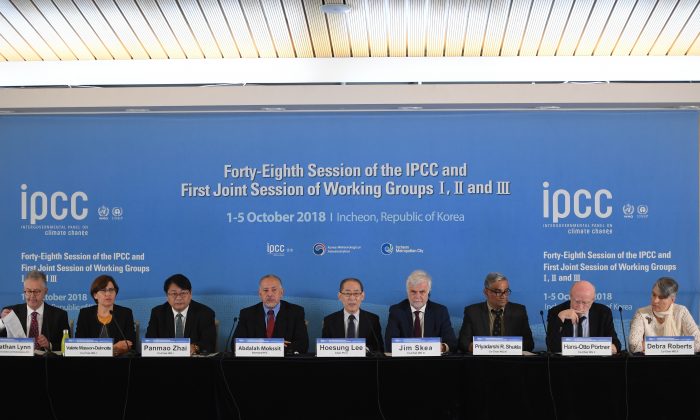
It is important to understand that the IPCC is a political organization (after all, it is the Inter-governmental Panel), not a scientific body. I can cite a number of quotes from scientists who have done work for the IPCC, but disagreed with the published “consensus.” The political nature of the IPCC and its reports is underscored by Appendix A of the Principles Governing IPCC work. It authorizes the few dozen political appointees who actually write the Summary for Policymakers to alter what scientists have written in order to conform to what the Summary states.

Hundreds of peer-reviewed articles every year differ from the official pronouncements of the IPCC. There is not so much a “strong consensus within the climate science profession” in general that human activity is causing a dangerous climate as there is a “strong consensus” within the extensive but not all-encompassing government-employed climate science clique.

Journalists often ask those who dissent from the official position of the IPCC if they receive or have received remuneration from fossil fuel companies. The ugly insinuation, of course, is that a person receiving compensation from a conventional energy company is automatically suspected of being a paid propagandist. Is it not equally as plausible that a scientist funded by government grants might tailor his findings so as not to risk losing a valuable source of income? There should be symmetry here, treating people on both sides of the issue with equal respect, instead of proceeding from the unfounded assumption that those receiving money from nongovernmental sources are not trustworthy while those receiving government funds are.

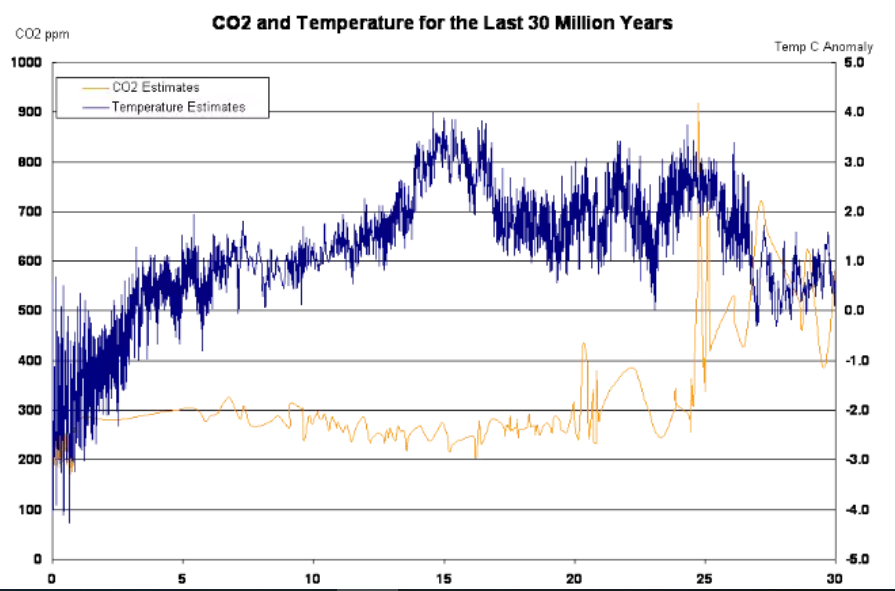
Regarding your assertion that “human emissions are now the leading factor affecting changes in Earth’s climate.” That assertion would have more credibility if it were proven that carbon dioxide is, in fact, the principal driver of global temperatures. However, when one looks at the historical record, one encounters a couple of inconvenient facts: 1) over hundreds of millions of years, graphs plotting global temperatures and atmospheric CO2 show no fixed relation or meaningful correlation; 2) the Vostok ice core graph shows the two variables following similar paths over the past several hundred thousand years, but with changes in CO2 lagging behind changes in temperature by 800 to 1,000 years, and effect cannot precede cause in a temporal universe.

Space prevents me from discussing other unresolved issues—the numerous measuring limitations and errors; the logarithmic scale of how much heat CO2 can “trap”; the fact that CO2 concentrations before the modern increase were dangerously low (plant life would cease to exist if the concentration fell much below 150–170 ppm, whereas it will flourish optimally nearer 1,000 ppm); whether warmer temperatures, on the whole, are better or worse for humans than cold.

I would urge the Monitor’s reporters to not rely so heavily on the scientists employed by the IPCC. Very subtly, the dangerous perception has set in that these are “the best scientists in the world.” I am not saying that there aren’t many fine scientists employed by Uncle Sam and contracted for by the IPCC, but to assume that if the government employs them, that stamps them as the best is unfounded. Politicians have no special power to identify which scientists’ output comes closest to the truth, but they are shrewd enough to pick scientists whose work can be used in support of pre-determined political agendas.

I hope none of your reporters is allied with the Society of Environmental Journalists—a group dedicated to censoring dissent. It does appear that your principal environmental reporter has become over-reliant on the eminently quotable Dr. Katherine Hayhoe, director of the Climate Science Center at Texas Tech University, and a lead author for the IPCC.

Dr. Hayhoe is very, very skilled at verbal manipulation. Take, for example, this cleverly constructed straw man: “[Climate] science is so old and so basic that to deny that science, we would have to be denying basic thermodynamics … and basic fluid dynamics that explains how airplanes fly. And there’s not a lot of politicians and pundits claiming that airplanes don’t fly.”

Brilliant! Unfortunately, it is also disingenuous. Skeptics about the catastrophist scenario aren’t rejecting the basic laws of physics; they don’t deny that Earth’s climate is volatile; they don’t deny that CO2 is a greenhouse gas or that human consumption of fossil fuels is increasing its concentration in the atmosphere.

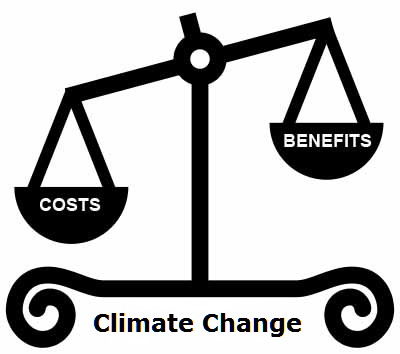
There remain important disagreements about the degree of climate change, the impact those changes will have, whether any benefits that can be gained by retooling our lives would exceed the costs of making those changes, and other issues with public policy implications that need to be studied and discussed. I hope that the Monitor will contribute to these needed discussions by reporting today’s minority positions as well as the most popular ones.

Mark Hendrickson is an adjunct professor of economics and sociology at Grove City College. He is the author of several books, including “The Big Picture: The Science, Politics, and Economics of Climate Change.”

See Also:  Climate Reductionism

Transferring Wealth to Tesla Owners

Why governments should not subsidize the purchase of electric cars.  Montreal Economic Institute explains at the Newswire  Over $220 million in subsidies… for very little impact on the environment. Excerpts in italics with my bolds

Since 2012, Quebec has spent more than $220 million in subsidies to “encourage” the purchase of electric vehicles. This spending will continue, since the government has extended this program for two more years. Yet as the MEI has been saying for some time, not only is such a public policy very expensive, it also has very little impact on greenhouse gas (GHG) emissions.

Indeed, even if Quebec were to achieve its objective of having a million fully electric vehicles on its roads by 2030—which is twenty times more than it has now—this would only reduce our GHG emissions by 3.6% compared to the current level.

“It’s a pure waste!” argues Germain Belzile, Senior Associate Researcher at the MEI. “And that’s not including the $300 million in purchase subsidies that the federal government just announced, plus the hundreds of millions that Quebec and Ottawa are going to spend to develop the network of charging stations. All of this for a minimal result in terms of emission reductions.”

Up until now, the $8,600 subsidy granted by Quebec cost taxpayers a little under $300 per tonne of GHGs not emitted. With the new $5,000 federal subsidy, the cost per tonne of GHGs not emitted jumps to over $450, namely 23 times the carbon market price or the federal tax amount.

“The cost of the subsidy is very high when you consider that in Quebec, with the carbon market, the cost to avoid emitting one tonne of GHGs is actually around $20,” explains Mr. Belzile. “Think about it: You can choose between a cost of $450 or $20, for two policies that have the same objective.”

Moreover, it must be noted that these funds largely benefit people who would have bought an electric car even without subsidies, and that these same buyers are part of the richest one fifth of society. Also, a non-negligible portion of subsidies are captured by automobile manufacturers in the form of higher prices, as shown in the United States by Tesla’s recent price cut following the reduction of the federal credit.

All of these public expenditures are a pure loss: Studies predict that the prices of electric cars will be competitive with those of gas-powered cars as of 2024—without subsidies—and that they will then continue to decrease, achieving parity before the end of the decade, with the cost of batteries continuing to fall.

“Our governments should eliminate the subsidy programs without delay, since Quebec and Canada have already set a price for carbon. And as argued by the latest economist to win the Nobel Prize, William Nordhaus, such a price mechanism should replace all subsidies that have the same goal. It’s just common sense,” concludes Mr. Belize.

The MEI is an independent public policy think tank. Through its publications and media appearances, the MEI stimulates debate on public policies in Quebec and across Canada by proposing reforms based on market principles and entrepreneurship.

SOURCE Montreal Economic Institute

Get a Second Opinion Before Climate Surgery


Myron Ebell writes March 28, 2019 in the Sacramento Bee PRO: Climate Science Needs a Critical Review by Skeptical Experts Excerpts in italics with my bolds.

Is global warming a looming catastrophe? President Donald Trump has often said he doesn’t think so even while his administration continues to release official reports warning that it is.

The president will soon find out who is right by convening a high-level commission to do a critical review of the fourth National Climate Assessment issued last November and other government reports.

Surprisingly, most of the climate science funded by the federal government has never been subjected to the kind of rigorous and exhaustive review that is common practice for other important scientific issues and major engineering projects.

For example, when NASA was putting men on the moon, every piece of equipment and every calculation were scrutinized from every possible angle simply because if anything went wrong the mission would fail.

Serious problems and shortcomings with official climate science have been raised repeatedly in the past by highly qualified scientists such as Princeton’s brilliant physics professor William Happer only to be ignored or dismissed by the federal agencies in charge of producing the reports.

Yet the conclusions and predictions made in these official climate science reports are the basis for proposed energy policies that could cost trillions of dollars in less than a decade and tens of trillions of dollars over several decades.

Given the magnitude of the potential costs involved, taking on trust the bureaucratic processes that have led to official consensus is simply foolish. Thus the review to be undertaken by the proposed President’s Commission on Climate Security is long overdue.

To mention only three major issues among many that need to be scrutinized:

First, the computer models used have predicted far more warming than has occurred over the past 40 years. Why have such models failed and why are they still used are important questions.

Second, predictions of the various negative impacts of warming, such as sea level rise, are derived from highly unrealistic scenarios; and positive impacts, such as less ferocious winter storms, are minimized or ignored. What would a more honest accounting of all the possible impacts of climate change look like?

Third, surface temperature data sets appear to have been manipulated to show more warming in the past century than has occurred. The new commission should insist that the debate be based on scrupulously reliable data.

Since news of the proposed review leaked out in February, a furious campaign to stop it has been mounted by the federal climate bureaucracy and their allies in the climate industrial complex.

On the surface, this seems puzzling. If the alarmists are confident that the science contained in the official reports is spot on, they should welcome a review that would finally put to rest the doubts that have been raised.

On the other hand, their opposition suggests that the science behind the climate consensus is highly suspect and cannot withstand critical review. In other words, they’ve been peddling junk and are about to be found out.

A press release from one alarmist pressure group was headlined: “58 Senior Military and National Security Leaders Denounce NSC Climate Panel.”

Denouncing an expert review seems a most inappropriate response, and especially to one that is designed to be open and subject to further review by other experts, such as the National Academies of Science.

I wonder if environmental pressure groups have ever denounced doing another environmental review of projects – for example, the Keystone XL pipeline – they are trying to stop.

Two prominent promoters of global warming alarmism recently published an op-ed in which they accused the Trump administration of using “Stalinist tactics” to try to discredit the climate science consensus.

Let’s hope that they’re not as ignorant about science as they are about history. It’s the enforcers of climate orthodoxy and opponents of open debate who are using Stalinist tactics.

Senator Lee Mocks GND

Sen. Mike Lee mocks Green New Deal in speech featuring tauntauns, giant sea horses and babies is an article at KSL.com.  A video clip is above to appreciate his standup delivery.  Text from the speech is reprinted below in italics with my bolds.

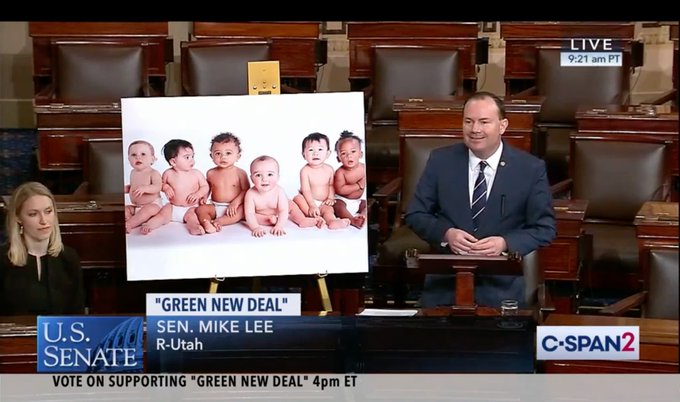
Sen. Mike Lee offered what he considers a serious solution to climate change Tuesday in an often flippant speech about the Green New Deal on the Senate floor: babies.

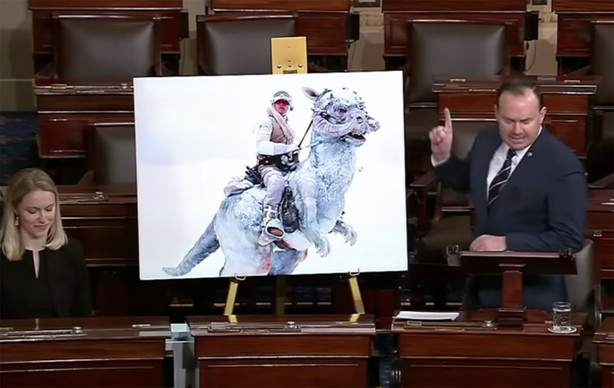
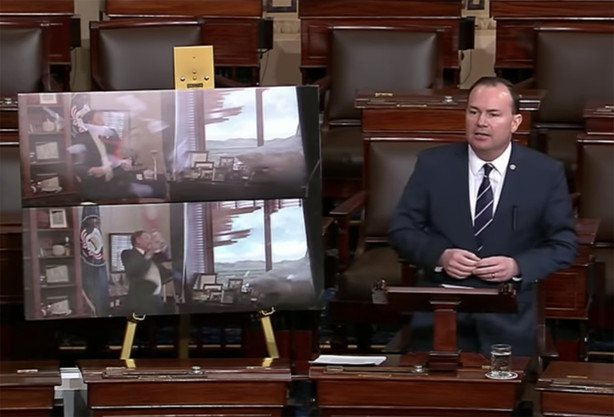
The Utah Republican mocked the Democratic proposal with images of a machine-gun wielding Ronald Reagan riding a dinosaur, tauntauns from “Star Wars,” Gov. Gary Herbert fending off sharks with a tennis racket, and Hawaiians on giant sea horses — not to mention some bad puns.

“The solution to climate change is not this unserious resolution that we’re considering this week in the Senate, but the serious business of human flourishing — the solution to so many of our problems, at all times and in all places, is to fall in love, get married and have some kids,” Lee said.

His speech came ahead of a failed vote in the Senate to begin debate on a sweeping resolution to combat climate change called the Green New Deal. Freshman Rep. Alexandria Ocasio-Cortez,-D, N.Y., and Sen. Ed Markey, D-Mass., introduced the legislation.

Lee said problems of human imagination are not solved by more laws, but by more humans.

“More babies will mean more forward-looking adults, the sort we need to tackle long-term, large-scale problems,” he said. “American babies, in particular, are likely going to be wealthier, better educated, and more conservation-minded than children raised in still-industrializing countries.”

Lee said the plan essentially calls for the elimination of all airplanes and all cows.

Sen. Mike Lee speaks on Senate floor Tuesday, March 26, 2019. (Photo: Sen. Mike Lee, YouTube)

Without airplanes, how would people get around the vast expanses of Alaska?  Tauntauns, Lee said, showing a picture of Luke Skywalker aboard one of the fictional snow lizards found roaming the wintry, windswept plains of Hoth.

“Not only are tauntauns carbon-neutral, but according to one report ‘a long time ago’ and ‘far, far away,’ they may even be fully recyclable for their warmth on especially cold nights,” Lee said, referencing a scene in “Star Wars: The Empire Strikes Back” where Han Solo slices open the beast with his lightsaber so a hypothermic Luke Skywalker can crawl inside.

Unable to fly, Hawaiians, Lee said, would have to ride giant sea horses to reach the mainland. “Under the Green New Deal, this is probably Hawaii’s best bet,” he said.

“But honestly, I think you’ve got to remember if they think the cows smell bad, just wait ’til they get a whiff of the sea horses,” he said.

Reducing the nation’s 94 million cows to zero means no more milk, cheese, steak or hamburgers, he said.

“Over the state work period last week, I visited some farms to find out for myself what Utah’s own bovine community thinks of the Green New Deal,” Lee said.

“Every cow I talked to said the same thing: ‘Boo.'”

Sen. Mike Lee speaks on the Senate floor Tuesday, March 26, 2019. (Photo: Sen. Mike Lee, YouTube)

Climate change hit home in Utah when sharks crashed through the window in Herbert’s state Capitol office in the made-for-TV flick “Sharknado: The 4th Awakens,” Lee said.

Displaying a painting depicting the climactic battle of the Cold War with Reagan packing a machine gun and a rocket launcher while riding atop a dinosaur with the American flag in the background, Lee said there was no such fight. The Cold War, he said, was won without firing a shot.

The image has as much to do with overcoming Soviet communism in the 20th century as the Green New Deal has to do with overcoming climate change in the 21st century, he said.

“The aspirations of the proposal have been called radical and extreme,” Lee said. “But mostly they are ridiculous.”

Going Dutch: How Not to Cut Emissions

Everyone knows the Dutch are serious and determined people.  Their saying: “God created the earth, but the Dutch created the Netherlands.”  A relative of mine had some run-ins with Dutch neighbors, and his saying about them:  “Wooden shoes, wooden heads, wouldn’t listen.”  Well, now the Dutch have another saying:  “Whatever you do, don’t try to cut carbon emissions the way we did.”

You see, being Dutch they took on the challenge of “fighting climate change,” and are now living to regret their actions.  Karel Beckman writes in Natural Gas World  The Flaws in Dutch Climate Policy Mar 20, 2019.  H/T GWPF  Excerpts in italics with my bolds.

Why should the wisdom of Dutch climate policy be of concern to anyone besides Dutch taxpayers? At this moment all developed countries are entering a new phase in their climate policies. They are moving beyond broad reduction targets and temperature goals to the nitty-gritty of real climate measures and tough choices. The debate is not anymore about whether to reduce greenhouse gas emissions, or even by how much, but how.

From this point on there are still many different roads into the future. The Dutch example is instructive because we are talking about a wealthy, urban, industrialised country – a self-proclaimed climate leader within the European Union. A country moreover that has decided to phase out the use of “unabated” natural gas for the sake of the climate. Yet its climate policies for cutting greenhouse gas emissions are full of flaws.

The Climate Accord, the result of months of negotiations between labour unions, non-governmental organisations, business associations, local authorities and other civil society groups, which will serve as the basis for the Dutch National Energy and Climate Plan (NECP) that all EU member states have to submit to the European Commission at the end of this year, contains a large number of more or less concrete proposals to reduce greenhouse gas emissions.

PBL and CPB have analysed the effect these proposals are likely to have on emission reductions and at what likely cost. The PBL report and the CPB report are therefore key inputs in the political decision-making process, turning the Climate Accord into law.

What the two reports show – even though their authors don’t say so explicitly and even if the general media did not notice anything amiss – is that Dutch climate policies are full of contradictions, inefficiencies and question-marks that should serve as a warning to energy policy-makers and stakeholders everywhere.

Here are my own seven Troubling Takeaways from the PBL and CPB reports.

1. The cost of climate policies: anyone’s guess

Robert Koelemeijer, researcher at PBL and one of the authors of the new report, says in a telephone interview: “It has proved to be very difficult to distinguish between the costs of the energy system as such, and the additional costs as a result of past climate and energy policies. But it is a question we get more often and one that we do want to take a look at this year.”

Earlier this year, a group of critics – Theo Wolters, Stijn Santen, Hans Keuken, Evert van der Pol and Marcel Crok – published a report, “De kosten van het Energieakkoord” (“The costs of the Energy Accord”), which attempts to calculate the costs of the measures decided on in an earlier piece of climate legislation, called the Energy Accord, in 2013.

Wolters, one of the authors, tells me it is reasonable to assume that this Energy Accord, which was actually adopted by the government and is being implemented, represents the major part of the “reference scenario” that PBL refers to.

According to Wolters et al., the Energy Accord will cost Dutch society over €100bn, measured over a period of 35 years, to which the costs of the Climate Accord must now be added. Their report has been criticised by various experts. Koelemeijer says: “There are some aspects about it that we don’t agree with. We are planning to analyse it in more detail.”

On the other hand, €100bn, over 35 years, does not seem so incredible. Thus, for example, the Dutch General Accounting Office (“Algemene Rekenkamer”), again an official government institution, calculated in April 2015 that the costs of renewable energy subsidies alone could amount to some €80bn by 2030. (You can find the GAO report by following this link, click on the download, see page 15-16. Again, all in Dutch, I’m afraid.)

Renewable energy subsidies are of course only part of the total costs of climate policy – according to the critics roughly half of the total.

2. The poor will pay

More important perhaps is that CPB concludes that lower income groups (especially lower middle income groups) have to pay relatively more as a result of current climate policies than higher income groups. Welfare recipients and pensioners, says CPB, are hit hardest of all.

On average, households will see their income reduced by 1.3% as a result of all climate measures together, notes CPB, ranging from 0.8% for the highest income groups to 1.8% for the lowest income groups. To this should be added another 0.4% income loss on average as a result of climate policies in other EU countries and of companies charging their climate costs to consumers.

3. The built environment: minimal results

One of the most complex and controversial elements in Dutch climate policy is the goal to disconnect all houses and buildings from the gas grid by 2050. Currently 98% of all buildings are connected to the gas grid. . . Of the more than 7mn buildings that will be affected, 1.5mn should be “off gas” by 2030, according to the Climate Accord. As noted above, CPB does not calculate the costs of this gigantic operation. PBL does this however and concludes (on p. 67) that with the measures in the Climate Accord some 250,000 to 1,070,000 buildings could be made “gas-free” (rather than 1.5mn). The net “national costs” of this operation would only be €75mn to €90mn, according to PB.

Theo Wolters, one of the authors of the critical report, notes that according to a 2018 study of the independent think tank EIB (“Economisch Instituut voor de Bouw” – Economic Institute for the Building Sector), the average cost of going off gas will be €32,638/house. This will save on average €623/yr in gas use. That adds up to much higher national costs.

Troubling me much more, the PBL study shows that the measures taken in the built environment do only very little to reduce CO2 emissions. The Climate Accord is split up into five sectors: electricity generation, industry, transport, agriculture and environment. If it is carried out, PBL calculates, total emissions will go down between 31 and 52 megatons (Mt). Of this total, the electricity sector will contribute 18.3-21.0 Mt, industry between 6 and 13.9 Mt, mobility 4.2-8.0 Mt, agriculture 1.8-4.6 Mt and the built environment a paltry 0.8-3.7 Mt.

In other words, the Netherlands is contemplating a complete overhaul of the existing building stock with only a modest effect on its greenhouse gas emissions.

4. Waterbed effects: cutting carbon emissions in one place means they can rise elsewhere, unless the cap comes down.

Wolters and his co-authors, in their critical report, provide a withering analysis of the waterbed effects of Dutch climate policy. They calculate that of 32 Mt of emission reductions which the Netherlands wants to achieve by 2020, 79% fall under the ETS system. The non-ETS part is almost all based on the use of biomass, a questionable method (see below). Just 0.6 Mt of the 32 Mt falls outside of the ETS and is not related to biomass.

Wolters notes that CPB and the University of Groningen have long ago warned about the waterbed effect of the ETS, with the recommendation to “put off building expensive offshore wind parks in the North Sea” as long as their emission reductions would benefit coal power producers in Poland and elsewhere. “The same ton of CO2 that we don’t emit and which costs us on average €88, can be bought by a coal power producer in eastern Europe for €5 to €25”, they write.The ETS carbon price is now much higher but nowhere near €88/mt.

5. Biomass: what is it good for?

This table shows that biomass is the single most expensive measure – yet as PBL itself notes, its effectiveness is surrounded by “many uncertainties”.

By the way, in the Netherlands burning wood in wood stoves and fireplaces also counts as “renewable energy”. The Netherlands has a 14% renewable energy target for 2020, of which almost 1 percentage point will be reached by people using their wood stoves and fireplaces!

6. Jobs: no effect

Renewable energy is often credited for providing jobs – a questionable defence in itself, since “providing jobs” is not the same thing as “contributing to economic growth”. On the contrary, if switching to renewable energy leads to many more people being employed in energy generation, this is a net economic loss to society, not a gain.

But not to worry: CPB concludes (on p. 11) that climate and energy policy in the Netherlands has “transition effects”, but “in the longer term the net effects on employment are marginal”. The renewable energy job machine simply does not exist.

7. In the end: coming up short

After all is said and done, and ignoring waterbed effects, biomass doubts and the like, what is also striking is that the measures in the Climate Accord don’t even deliver the official target of 48.7 Mt of reductions in 2030. PBL concludes (p. 9) that if all the proposed measures are carried out, emissions will be reduced by between 31 Mt and 52 Mt, adding that “the target of 48.7 Mt will most likely not be met”.

Indeed, there are other “uncertainties” which could even result in emission reductions outside of the 31-52 Mt range, notes PBL, for example, unexpected deviations in “economic growth, energy prices, technology developments and developments in other countries.”

Conclusions

The most important one I think is that climate policy – any climate policy – is not a done deal. On the contrary, the real hard choices have only just arrived on our doorstep. There are many questions, such as, what are the most cost-effective and efficient measures. Not only in the Netherlands – other countries will face the same issues.

Two key issues that need to receive a lot more attention are the effects of EU climate policy, which right now are an afterthought in the Netherlands and in other EU member states, whereas they clearly should be a starting point; and the wisdom of using renewable energy targets alongside CO2-targets. Wolters and the other critics of Dutch climate policy observe that the Dutch government initially wisely focused on CO2-targets, but then enthusiastically endorsed a new renewable energy target agreed upon by the EU of 32% in 2030. This, they say, means that CO2-reduction will be achieved “through relatively expensive options”.

The climate policy debate? It has only just started.

The Dutch also invented a word: Poppycock, (ˈpäpēˌkäk/) informal noun meaning nonsense.
Synonyms: nonsense, rubbish, claptrap, balderdash, blather, moonshine, garbage;
Origin: mid 19th century: from Dutch dialect pappekak, from pap ‘soft’ + kak ‘dung.’

Reprinted below is a previous post Green Electrical Shocks providing a Dutch analysis with a dash of humor.

One year ago, a weekly Sunday news program aired in the Netherlands on the titled subject. H/T Climate Scepticism. The video clip is below with English subtitles. For those who prefer reading, I provide the substantial excerpts from the program with my bolds.

How many of you have Green Electricity? I will estimate 69%
And how much nationally? Oh, 69%!
So we are very average, and in a good way, because the climate is very important.

Let me ask: Green electricity comes from . . .?
Yes, electricity produced from windmills and solar panels.
Nearly 2/3 of the Dutch are using it. That’s the image.

Well I have green news and bad news.
The green news: Well done!
The bad news: It is all one big lie.
Time for the Green Electrical Shocks.

Shock #1: The green electricity from your socket is not green.
When I switched to green electricity I was very proud.
I thought, Yes, well done! The climate is getting warmer, but not any more thanks to me.

Well, that turned out to be untrue.
All producers deliver to one communal grid. Green and grey electricity all mix.
The electricity you use is always a mix of various sources.
OK. It actually makes sense not to have separate green and grey cables for every house.
So it means that of all electricity, 69% is produced in a sustainable way. But then:

Shock #2: Green Electricity is mostly fake.
Most of the green electricity we think we use comes from abroad.
You may think: So what. Green is green.

But that electricity doesn’t come from abroad, it stays abroad.
If you have green electricity at home, it may mean nothing more than that your supplier has bought “green electricity certificates”.

In Europe green electricity gets an official certificate,
Instead of selling on the electricity, they sell on those certificates.
Norway, with its hydro power, has a surplus of certificates.
Dutch suppliers buy them on a massive scale, while the electricity stays in Norway.

The idea was: if countries can sell those certificates, they can make money by producing more green electricity.
But the Norwegians don’t produce more green electricity.
But they do sell certificates.

The Dutch suppliers wave with those certificates, and say Look! Our grey electricity is green.
Only one country has produced green electricity: Norway.
But two countries take the credit.
Norway, because they produce green electricity, and the Netherlands because, on paper, we have green electricity. Get it? That’s a nice deal.

More and more countries sell those certificates. Italy is now the top supplier.
We buy fake green electricity from Italy, like some kind of Karma ham.

Now, let’s look again at the green electricity we all think we use.
So the real picture isn’t 69%. If you cancel the certificates, only 21% of electricity is really green.
Nowadays you can even order it separately if you don’t want to be part of that Norway certificates scam.
You may think: 21% green is still quite a lot. But it is time for:

Shock #3: Not all energy is electricity.
If you talk about the climate, you shouldn’t just consider electricity but all energy.
When you look at all energy, like factories, cars, trains, gas fires, then the share of consumer electricity is virtually nothing.
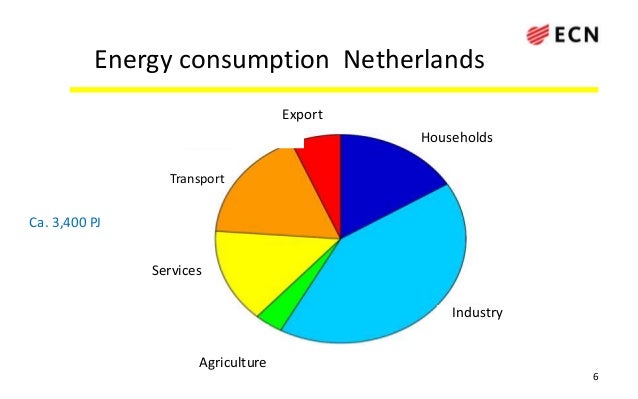
If you include everything in your calculation, it turns out that only 6% of all the energy we use in the Netherlands is green. It is a comedy, but wait:

Trees converted into pellets by means of petroleum powered machinery.

Shock #4: Most green energy doesn’t come from sun or wind, like you might think.
Even the 6%, our last green hope, is fake. According to the CBS we are using more sun and wind energy, but most of the green energy is produced by the burning of biomass.
Ah, more than half of the 6% green energy is biomass.

Ridiculous. What is biomass really? It is organic materials that we encounter every day.
Like the content of a compost heap. How about maize leaves or hay?
The idea behind burning organic materials is that it will grow up again.
So CO2 is released when you burn it, but it will be absorbed again by new trees.

However, there is one problem. The forest grows very slowly and our power plants burn very fast.
This is the fatal flaw in the thinking about biomass. Power plants burn trees too fast, so my solution: slow fire. Disadvantage: it doesn’t exist. So this is our next shock.

Shock#5: Biomass isn’t all that sustainable.
It’s getting worse. There aren’t enough trees in the Netherlands for biomass.
We can’t do it on our own. We don’t have enough wood, so we get it from America.

In the USA forests are cut at a high rate, Trees are shredded and compressed into pellets.
These are shipped to the Netherlands and end up in the ovens of the coal plants.
It’s a disaster for the American forests, according to environmental groups.

So we transport American forests on diesel ships to Europe.
Then throw them in the oven because it officially counts as green energy.
Only because the CO2 released this way doesn’t count for our total emissions.

In reality biomass emits more CO2 than natural gas and coal.
These are laws of nature, no matter what European laws say.
At the bottom line, how much sustainable energy do we really have in the Netherlands?
Well, the only real green energy from windmills, solar panels etc. Is only 2.2%. of all the energy we use.
In Conclusion
So the fact that 2/3 of the audience and of all Dutch people use green electricity means absolutely nothing. It’s only 2.2%, and crazier still, the government says it should be at 14% by 2020.
They promised: to us, to Europe, to planet Earth: 14 instead of 2.2.

Instead of making a serious attempt to save the climate, they are only working on accounting tricks, like buying pieces of paper in Norway and burning American forests.
They are only saving the climate on paper.

Summary Comment

As the stool above shows, the climate change package sits on three premises. The first is the science bit, consisting of an unproven claim that observed warming is caused by humans burning fossil fuels. The second part rests on impact studies from billions of research dollars spent uncovering any and all possible negatives from warming. And the third leg is climate policies showing how governments can “fight climate change.”

It is refreshing to see more and more articles by people reasoning about climate change/global warming and expressing rational positions. Increasingly, analysts are unbundling the package and questioning not only the science, but also pointing out positives from CO2 and warming.  And as the Dutch telecast shows, ineffective government policies are also fair game.

More on flawed climate policies at Reasoning About Climate

Behind the Curtain: Oil Supply and Prices

John Tamny writes March 21, 2019 at Real Clear Energy In His Saudi Arabia Documentary, Fareed Zakaria Omitted How Powerless the Country Is

The 1973 embargo “did not imply that we could reduce imports to the United States…[T]he world is really just one market. So the embargo was more symbolic than anything else.” Those were the words of Saudi oil minister Sheik Yamani, in response to the impact of the 1973 Arab (“Arab” is mentioned because non-Arab countries like Iran did not participate) oil embargo on the United States. The U.S. imported every bit as much (in truth, more) oil after the embargo was announced as before; the only difference being that Americans purchased the “Arab oil” from those not embargoed. It’s a basic economic truth that there’s no accounting for the final destination of any good.

So what happened in 1973? Why did oil prices spike? The better question would be one of why did commodities across the board spike? The simple truth is that there were no “oil shocks” in the early ‘70s as much as President Nixon’s fateful decision to sever the dollar’s historical link to gold resulted in the greenback plummeting in value. Wheat, meat, soybeans, oil, and every other commodity priced in dollars spiked. Notable here is that per Robert Bartley’s brilliant 1992 book, The Seven Fat Years, OPEC officials sent out an early ‘70s communique that signaled their inability to control the price of oil; their implicit point that a change in the value of the dollar would by definition have a profound impact on a commodity once again priced in dollars. In short, the “oil shocks” of the early ‘70s were not. They were dollar shocks. Nothing more, nothing less.

All of this rates mention in consideration of a recent CNN special hosted by Fareed Zakaria, Saudi Arabia: Kingdom of Secrets. Up front, it’s fascinating to look at as the footage unearthed by Zakaria’s production team is more than impressive. Zakaria’s production was spellbinding all the while exasperating for the simple economics of exchange and currency not factoring into his analysis, nor history. What was more than interesting could have been great had Zakaria sourced commentators with a better understanding of trade. Instead, viewers had to suffer Thomas Friedman’s often wrong but never in doubt certitude from the left versus the unserious rants of the 45th president on the alleged right. Neither Friedman nor Trump comprehends what’s simple; that embargoes are utterly toothless in an economic or real world sense.

As a result, Zakaria promoted the mistaken view that the ’73 embargo caused soaring prices, gasoline lines and recession in the United States, and there was no commentary to question what Zakaria must know not to be true. The reality is that the flow of Arab oil didn’t decline, and rising prices were dollar related. The gas lines were a logical effect of price controls imposed by federal officials, while the economic slowdown was the expected result of reduced investment that always rears its head when currencies are losing value. Investment is what powers growth simply because it boosts productivity, yet the falling dollar worked as a tax on investment. The malaise-filled ‘70s were a consequence of U.S. policy error, not what happened in Riyadh.

That’s what was so nauseating about Friedman’s assertion that our relationship with Saudi Arabia amounts to (a slight paraphrase here) “keep the oil flowing, and we’ll avert our eyes to what’s happening out back.” Implicit there is that there’s some kind of scenario whereby the Saudis would cease bringing oil to market. Except that there isn’t, and we know this based on the history presented to us by Zakaria himself. As he points out, in 1938 a rather poor Saudi Arabia (per Zakaria) desperately needed money, and with an eye on enhancing the Kingdom’s finances, the royals allowed in western know-how and investment. Soon enough the country was awash in oil, and the riches that come with being a size exporter of the world’s primary energy source.

All of the above in mind, there’s yet again no reasonable scenario whereby the Saudis would cease pumping out the oil. They need the money. Realistically there would be a revolution in the country absent the constant outflow of oil in consideration of how much the citizenry, the state and an ever-growing royal family rely on the Kingdom’s oil wealth. Here Zakaria noted how very much a decline in oil prices in 2014 forced difficult cutbacks in Saudi, but didn’t tie the previous truth to how ridiculous was Friedman’s oft-repeated point that the U.S.’s only rule is that the country pump its oil. Well, of course it will. No rules needed. No matter what happens, Saudi oil will flow. Friedman’s alleged insight into U.S./Saudi relations is more than empty.

And then there’s President Trump. Zakaria seems to think Trump has a point in justifying his desire to maintain warm relations with the repressive country. As Trump puts it (not directly to Zakaria, but in a video clip sourced by him), “you want $150 oil?” Trump’s equally empty argument, one not corrected by Zakaria, is that Saudi Arabia could cut us off on the way to nosebleed oil prices stateside. Except that it couldn’t.

Not only is oil a globally priced commodity, not only is it a certainty that the Saudis will never cease selling what produces abundant dollars for the Kingdom, but the dirty little secret is that neither Saudi Arabia nor OPEC controls the price of oil. Zakaria plainly disagrees, but what’s unfortunate is that he didn’t at least give the opposing viewpoint airtime in a documentary presumably produced with an eye on forcing deep thought and conversation about what is in many ways a mysterious country. Instead, viewers were fed what’s easily disprovable.

Indeed, if the Saudis and OPEC truly control the price of oil as Zakaria attests, why was it so cheap in the 1960s when OPEC formed, but nosebleed expensive in the ’70s? Mood swings? Better yet, if they control the oil price are we to assume the Saudis and OPEC were simply feeling generous in the ‘80s and ‘90s when oil fell as low as $10 barrel? Conversely, were the alleged price setters of a global commodity suddenly overtaken by immense greed in the 21st century such that they jacked up the oil price, only to lower it in 2014 in such a way that Saudi Arabia itself was forced to endure difficult cutbacks? Or is there something else at work?

Very basic logic tells us that something not Saudi and something not OPEC dictate oil’s price. Readers can rest assured that it’s not fracking. Missed by cheerleaders of the latter is that before it was much of a thing, meaning the ‘80s and ‘90s once again, the price of oil was four times lower than it is now. Fracking excites mercantilistic conservatives who don’t understand simple economics.

So what’s the biggest factor when it comes to oil? The answer came up early in this piece. It’s the U.S. dollar. It’s very simple, really. When the dollar is strong and stable as it was during the Reagan and Clinton years, oil is cheap. When the greenback is declining as it was during the Nixon/Carter ‘70s, and the Bush/Obama ‘00s, the price of oil (and other commodities) is soaring. Considering fracking, it’s only economic insofar as the dollar is cheap. Considering Saudi power, it’s most evident when the dollar is cheap.

Frustratingly, none of this came up in Zakaria’s analysis. Fascinating as his attempt to make sense of Saudi Arabia was, it was deprived of greatness by an embrace of all too easy-to-discredit economic fallacy. Contrary to what Zakaria reported, there’s nothing that will stop the flow of Saudi sourced oil, there’s no way the Saudis can keep their oil from being consumed stateside, and their supposed ability to control the price of oil is easily belied by history. None of the previous truths made it into the documentary, and that’s unfortunate.

Fareed Zakaria must know better. And if he doesn’t, he should.


Climate Kids Spurious Lawsuit Claims

Robert W. Endlich provides the back story on the flimsy complaints from kids suing the US government for the right to a stable climate. He writes at Master Resource Sixty Minutes on the Kiddie Climate Lawsuit: Hypocrisy Squared. Some excerpts in italics wth my bolds to encourage you to go read the whole article.

Plaintiff #1: Kelsey Cascadia Rose Juliana, Oregon

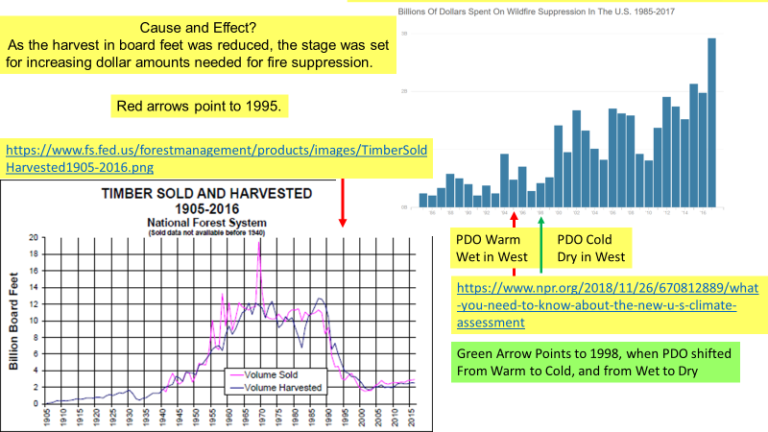
Her activist parents stopped government from managing the forests. Now she blames wildfires on “climate change.”

Figure 1. Left line graph: timber sold and harvested 1905-2016. Right bar graph: dollars spent on firefighting. The red arrows represent the year 1995. The green arrow shows when the Pacific Decadal Oscillation shifted from its warm and wet period in the US West, to its cold and dry period.

Now a college student, Kelsey Cascadia Rose Juliana tells us that the often-severe forest fires that plague the Pacific Northwest are a result of “Climate Change,” because, “that’s what the scientists tell us.” That this might have been a result of the fuel buildups when logging was stopped in the Spotted Owl case has not entered her head; nor the thought processes of Sixty Minutes’ producers; nor the thinking of scientists, teachers, professors and politicians who “taught” her and Sixty Minutes about fires and climate change.

Although many other scientists could have explained the clear link between fuel buildups and massive conflagrations in forests where timber thinning and cutting are prohibited, they were not consulted.

Juliana says, “We have everything to lose if we don’t act on climate change.”

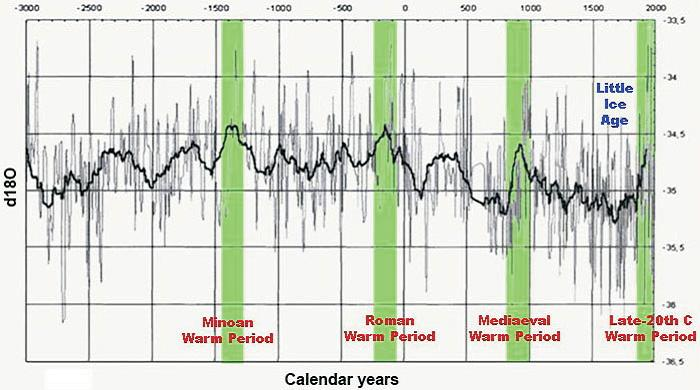
Evidently, no one ever told Juliana it is just as impossible to “stop climate change” as it is to “stop continental drift,” stop the progression of tides, or stop sea level changes and land subsidence. All of these are a result of natural environmental processes that are (or once were) taught in basic Earth Science courses – processes that were carelessly or deliberately left out of the reporting by CBS reporter Steve Croft and CBS Producer Dragon Mihaljevic.

Figure 2. Temperature time series from the GISP2 ice core, showing the past 5,000 years of temperatures with Minoan, Roman, Medieval and Late 20th Century warm periods highlighted [Source]. The likelihood that humans can “stop climate change” that is a natural aspect of Earth’s environment should be obvious.

Plaintiff #2: Levi Draheim, Florida

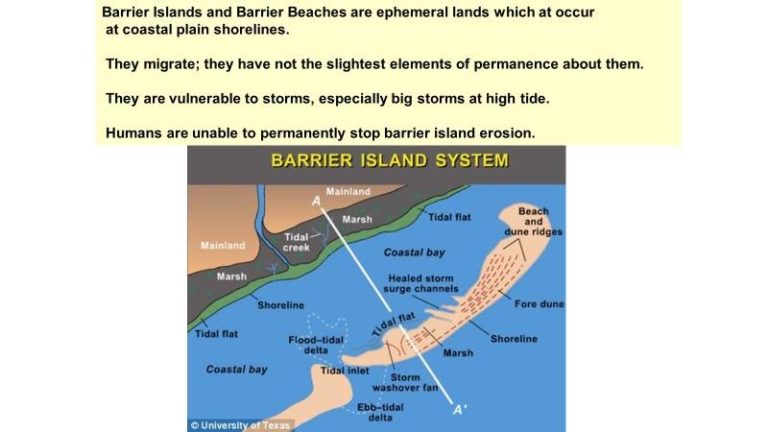
He lives on a barrier island off the hurricane-prone Atlantic coast. The government is supposed to protect him from storms and rising sea level that have always eroded coastal islands.

Figure 4. Graphic showing the features of Barrier Island Systems from the University of Texas showing they are characteristic of flat coastal plains. That Sixty Minutes should not recognize the peril of exposing permanent resident children to life on barrier islands seems studied ignorance of obvious environmental hazards.

Plaintiff #3: Jayden Foytlin, Louisiana

Her home was flooded in Rayne, LA, about 20 miles from the Gulf Coast and a mere 20 feet above sea level. She claims a right against rainstorms, even though her home is called the “Frog Capital of the World,” with numerous houses elevated on blocks.

Climate Kid 15-year-old Jayden Foytlin, from southern Louisiana, found her home flooded in August 2016. Mr. Mihaljevic speaks of flooding rains in southern Louisiana as somehow an unexpected new phenomenon that young Jayden suddenly experienced when she woke up and “put her foot into climate change.” Not into a frequent weather event on the Louisiana Coast, but into “climate change.” It’s not very subtle propaganda, but most viewers must be prepared, or they will miss it.

She lives in Rayne, LA, about 20 miles from the Gulf Coast and a mere 20 feet above sea level. This is very flat outer coastal plain with poor drainage. That she has no clue that flat-lying land adjacent to the Gulf Coast would be subject to flooding when a hurricane strikes and some 16 inches of rain can occur within two days – is an artifact of inadequate education, and lack of self-awareness that might be attributable to her tender years.

That a fifteen-year old student would have no knowledge of even the possibility of flooding during a hurricane (or spring melts after heavy snows in the Upper Mississippi Basin) strains credulity. But perhaps her expectations were shaped by the 12-year absence of any Category 3-5 hurricane making US landfall between Wilma (2005) and Harvey (2017) – virtually her entire perceptive lifetime.

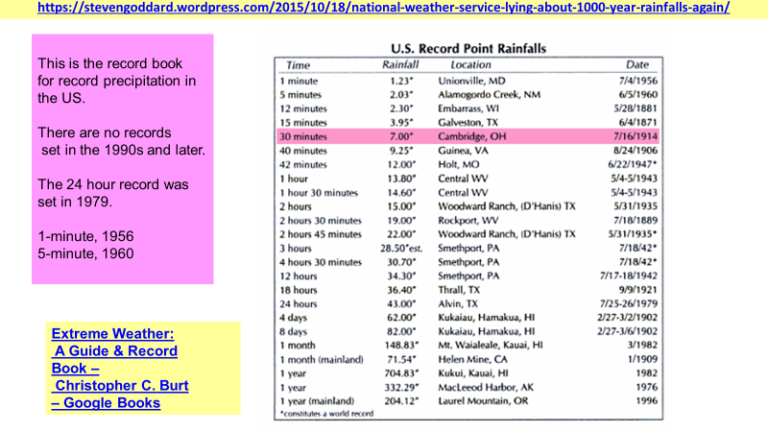
That the Sixty Minutes report makes it seem as if sixteen inches of rain within two days is somehow related to climate change, rather than a result of the climate and weather we have today, and have had for decades and centuries, is yet another willful study in ignorance by the talking heads seen on MSM and CBS.

Just a few minutes of internet searching will uncover substantial data on extreme rainfall events in the USA. Some are displayed below in Figure 5.
Ironies of History, Concerns for America’s Future

The irony here is too rich not to discuss. Juliana’s parents and environmentalists, along with politicians and courts teamed up a few decades ago to file lawsuits that blocked timber sales and cutting, thereby causing a gradually enormous buildup of diseased, dying and dead trees, brush and other highly inflammable materials.

Huge, deadly conflagrations inevitably ensued – and now the same parties blame climate change for the infernos, enlist their (indoctrinated) children as sympathetic plaintiffs, focus on the kids’ deep fears, and sue fossil fuel producers for damages. Is there such a thing as criminal hypocrisy?

I have no great hopes that lawyers and courts will come up with the right answer.

We need only look at the results of the Massachusetts vs. EPA lawsuit, which was filed by Massachusetts based on the notion that sea level rise is caused by or accelerated by our use of fossil fuels. For “authority,” the U.S. Supreme Court accepted a political document, the IPCC Working Group I report, which considers only human factors in climate change and now asserts that only humans are causing climate change, with natural factors relegated to the sidelines as essentially irrelevant.

That such ignorance, stupidity and anti-science are now central elements of our legal system is simply breathtaking.

Indeed, had EPA attorneys been competent, and had they presented appropriate sea level data and other real-world evidence during trial and on appeal, the Supreme Court could have examined data like that from National Oceanic and Atmospheric Administration’s (NOAA’s) tide gage in Boston harbor. As Figure 8 illustrates, the rate of sea level rise is essentially unchanged over the past century and longer, even as CO2 levels climbed, then accelerated, in their rate of increase, especially since the 1960s.

Carbon dioxide from burning hydrocarbon fuels and human exhalations is the same colorless, odorless gas that plants use, in combination with energy from sunlight, to create carbohydrates. It is not a pollutant, but the elixir of life. Humans, animals and plant life are all carbon-based life forms.

The Supreme Court was just as wrong in its 2007 Massachusetts vs. EPA decision as it was in its infamous 1857 Dred Scott decision – which held that no “negro whose ancestors were imported into [the United States] and sold as slaves” could be an American citizen, and therefore had no standing to sue in federal court. Dred Scott, it can be argued, eventually led to the Civil War.

I have no great hope that today’s Supreme Court or lower courts can be depended on to arrive at the right answer when it comes to science in this case. I just hope cases like the “climate kids” Juliana vs the USA will not cause such energy, economic, societal and political disruption that our nation becomes embroiled in another civil war over our energy, livelihoods, living standards, and whether courts and bureaucrats will have the right to dictate Americans’ rights and choices in these matters.

Robert W. Endlich served as Weather Officer in the USAF for 21 Years. From 1984 to 1993, he provided toxic corridor and laser propagation support to the High Energy Laser Systems Test Facility at White Sands Missile Range. He has published in the technical literature and worked as software test engineer at New Mexico State University. Endlich was elected to Chi Epsilon Pi, the national Meteorology Honor Society, while an Air Force Basic Meteorology student at Texas A&M University. He has a bachelor’s degree in Geology from Rutgers University and a master’s in Meteorology from the Pennsylvania State University.

Footnote: For more on Pacific Northwest forest fires see Why the Left Coast is Burning

For background on the Kids Lawsuit see Supremes Look at Kids Lawsuit

Good News: Outbreak of New Energy Realism

Out of the darkness and gloom from climate doomsters shines a declaration of energy abundance, and positive prospects for future well being.  Robert Bradley Jr. writes March 14, 2019 at Master Resource  Perry’s “New Energy Realism” (freedom and fossil fuels are essential, moral, unstoppable) Excerpts in itallcs with my bolds and images.

“The lesson is clear. We don’t have to choose between growing our economy and caring for our environment. By embracing innovation over regulation, we can benefit both. And THAT is the heart of our New Energy Realism.”

At yesterday’s CERA conference, DOE Secretary Rick Perry did not quite come out and say it. But it’s a fossil-fuel world. Some bones were thrown out for the politically correct, economically incorrect energies (grid wind and solar, as well as batteries/electric vehicles), but make no mistake. The philosophy of the US Department of Energy is let the US-led global boom in oil, natural gas, and coal continue.

Oil, gas, and coal? Yes …. Ethanol? Not mentioned…. Domestic production? Yes…. Domestic usage? Yes…. Exports? Yes….. Regulation? No …. Sacrifice? No…. Pessimism? No.

Climate change? No mention….

Read between the lines. The fossil fuel boom is great for America and the world. Peak Oil and “the limits to growth” are refuted. Energy reliability (versus intermittency) is key. Heavy regulation of oil and gas is failure. New regulation and pain are unnecessary.

And you don’t even need to mention the Green New Deal.

The Obama era’s creeping radicalism to “keep fossil fuels in the ground” is being reversed. The CO2 mitigation window for the activists is closing rapidly, with the world energy market leaving the Paris accord in shambles. It’s a fossil-fuel world.

Excerpts from his speech follow:

“Just the other day the Meridian Spirit embarked from Sabine Pass with an LNG shipment to India. And just last week a LNG tanker left Cove Point, Maryland with its first shipment. These shipments underscore the Trump Administration’s desire to export more natural resources and innovation technologies to the world.

“DOE [recently] met with producers and midstream developers to identify the next generation of technologies to unlock more of our nation’s resources. Whether carbon capture, developing new solar technology or stepping up efforts on storage, there is a tremendous amount of optimism in the energy sector and for obvious reasons.”

The Meridian Spirit loading a cargo for India’s Gail at Sabine Pass LNG. (Cheniere)

“Energy security is a roadmap to economic prosperity.”

“But today, we have the opportunity to reaffirm a new direction which I call the New Energy Realism. This ‘new energy realism’ rests on the fact that America is in the midst of incredible energy progress.”

“Due to a cascade of technological breakthroughs driven by innovation, America is producing abundant, affordable energy from a wider range of sources than we ever thought possible … and we are using this energy more cleanly and more efficiently as well.”

“… our successes refute old myths, debunk false choices, and transcend limitations, pointing the way to global energy security and shared prosperity. This dramatic progress is a decisive break from the 1970s, when America began pursuing a fundamentally flawed energy policy for which we paid dearly.”

“Those who believed in it claimed that the days of energy abundance were over. It was said we had a permanent energy shortage. It was said that even if we discovered new reserves, they would be too costly to produce or impossible to use without harming the environment. And the solution proposed was a bleak one — draconian regulation of energy.”

“Truth be told, we had no shortage of energy. What we had was a shortage of imagination and a loss of confidence in our ability to innovate. Clearly, the naysayers weren’t realists at all… they were pessimists blinded to the reality of America’s innovative capabilities. And unfortunately, this blindness ruled in one of the least innovative places on earth….Washington, D.C.”

“In a place that so obviously favored regulation over innovation, it was no surprise when the government used one thumb to promote a favorite technology and the other hand to regulate those they didn’t like.”

“In states like Texas, taxes were cut and regulations kept simple and transparent, giving people both the freedom and the incentive to innovate. And with innovation came a revolution in energy technology.”

“As a former Texas governor, I’m proud that the major breakthroughs in hydraulic fracturing and horizontal drilling – leading to our historic natural gas boom — began right here in this state.

“From fossil fuels to renewables…supply rose…costs fell…efficiencies increased…and diversity blossomed. And something else happened as well. Our environment did not become worse. By nearly any measure, it became better, even as our economy expanded and energy development reached new heights.”

“The lesson is clear. We don’t have to choose between growing our economy and caring for our environment. By embracing innovation over regulation, we can benefit both. And THAT is the heart of our New Energy Realism.”

“Over the past year, President Trump and his Administration have brought this realistic view to Washington… and we are seeing its benefits. He has cut taxes and reduced regulations by historic numbers, putting Washington squarely on the side of innovators and investors.”

“… this can only help the President’s plan to spur the construction of more infrastructure. Tax reductions will cut a major cost of doing business, while his proposal to reduce the permitting process to just two years will give investors the confidence to provide the necessary capital and communities visibility on project completion.”

“The President has also signed off on critical new pipelines. He has removed draconian oil-and-gas restrictions on responsible exploration, supported clean coal technologies, and seeks to reinvigorate civilian nuclear energy.

“America is now on the cusp of energy independence, but the President would like to go farther. He would like to share our energy bounty with the world and let the spirit of competition benefit consumers by providing more choices in the marketplace. Already, we are sharing our natural gas.”

“Last year, we became a net natural gas exporter. Today, we export LNG to 27 nations on five continents.”

“We are increasing our coal exports substantially. These exports rose by an estimated 61 percent last year over 2016, according to the Energy Information Administration (EIA). Last August, the first shipment of Pennsylvania thermal coal bound for Ukraine left the Port of Baltimore. In the coming years, we will be exporting multiple fuels.”

“And not only that. We will export the same technologies that made us a clean, abundant, and diverse energy producer in the first place. By exporting our energy, we can free our friends and allies from fuel dependence on unfriendly nations.

“And by exporting our energy technology and know-how, we can help developing countries in Latin America, Africa, and Asia create their own energy renaissance and harness more energy to improve the lives of their citizens.”

“And that includes access to electricity. Over a billion people live without it. We want to reduce that number substantially in the coming years.”

“Now some aren’t happy with us exporting this technology because they oppose most energy production, specifically that of fossil fuels, which comprise 80 percent of world energy usage and continue to produce carbon emissions. I fear that this is the mindset of the Paris Agreement.”

“And while studies show that even by the year 2040, fossil fuels will still comprise 77 percent of world energy use, I believe that continued technological breakthroughs will help us defy this prediction.”

“What are the people without electricity supposed to do? Remember what we have done through technology…..we have not only produced more fossil energy with it; we’ve made that energy cleaner.”

“Since we’re making coal cleaner and since our technology can affordably extract massive amounts of lower-emissions natural gas, we’re likely to continue to reduce the overall emissions of our fossil fuels. That, again, is the New Energy Realism.”

“Thanks to the amazing power of human ingenuity and innovation, we don’t have to tolerate the intolerable…we don’t have to accept hideous sacrifices that harm the poorest among us.”

“And so let us reject the old energy pessimism – and embrace the New Energy Realism…. We would welcome – and help lead – a global alliance of countries willing to help make fossil fuels cleaner, rather than abandoning them. This will help nations diversify their energy supply…a key to achieving energy security.”

“And from that energy security… comes prosperity: affordability, economic growth…rising opportunities…optimism…and, most importantly, the freedom for each individual to pursue and achieve their dreams.”

“Combining opportunity with the freedom to design your own energy future, will enable the production of more energy from more sources, more affordably, and in a cleaner way than it ever could have in freedom’s absence.”

“It is by embracing this New Energy Realism that we will all move toward greater energy security and a brighter, more prosperous future. Let all nations embrace it – and the spirit of imagination and innovation that drives it – for their own sake and for the sake of the world.”