Climate Models Argue from False Premises

Roger Pielke Jr. Explains at Forbes If Climate Scenarios Are Wrong For 2020, Can They Get 2100 Right? Excerpts in italics with my bolds.

How we think and talk about climate policy is profoundly shaped by 31 different computer models which produce a wide range of scenarios of the future, starting from a base year of 2005. With 2020 right around the corner, we now have enough experience to ask how well these models are doing. Based on my preliminary analysis reported below, the answer appears to be not so well.

Background

Climate policy discussions are framed by the assessment reports of the Intergovernmental Panel on Climate Change (IPCC). There are of course discussions that occur outside the boundaries of the IPCC, but the IPCC analyses carry enormous influence. At the center of the IPCC approach to climate policy analyses are scenarios of the future. The IPCC reports that its database contains 1,184 scenarios from 31 models.

Some of these scenarios are the basis for projecting future changes in climate (typically using what are called Global Climate Models or GCMs). Scenarios are also the basis for projecting future impacts of climate change, as well as the consequences of climate policy for the economy and environment (often using what are called Integrated Assessment Models or IAMs).

Chain of suppositions comprising Integrated Assessment Models.

Here I focus on two key metrics directly relevant to climate policy that come from the scenarios of fifth assessment report (AR5) of the IPCC: economic growth and atmospheric carbon dioxide concentrations. The scenarios of the AR5 begin in 2005 and most project futures to 2100, with some looking only to 2050. We now have almost 15 years of data to compare against projections, allowing us to assess how they are doing.

Economic Growth Scenarios Way Too High

Economic growth is important because it is one of the elements of the so-called Kaya Identity, the basis for projecting future carbon dioxide emissions, and a key input to GCMs that produce projections of future climate change. Economic growth, in the context of climate change is a double-edged sword. On the one hand, high rates of growth can mean more individual and societal wealth, which is generally viewed to be a good thing. On the other hand, high rates of economic growth, all else equal, means greater amounts of carbon dioxide emitted into the atmosphere, decidedly not a good thing.

The vast majority of scenarios reported by the IPCC AR5 include rates of economic growth (measured as GDP per capita using market exchange rates) that are greater than what has been observed since 2010. Specifically, more than 99.5% of IPCC AR5 scenarios – all but 5 of about 1,100 — have GDP growth rates for the period 2010 to 2020 in excess of that which has been observed in the real world from 2010 to 2018. The International Monetary Fund recently lowered its expectations for global economic growth in 2019 and 2020 to below that of 2018. So it seems highly unlikely that the real-world will “catch up.”

What is clear is that, to date, the vast majority of IPCC scenarios are far more aggressive in their projections of economic growth than has been observed. For the scenarios to “catch up” would require growth rates in future years even more aggressive than those built into the scenarios. If the IPCC projections are indeed too aggressive, then this has implications for the results of analyses that depend upon such assumptions for projecting future climate changes, impacts and the costs and benefits of policy action.

Models Overstate CO2 Concentrations in 2020

We see a similar aggressiveness in scenarios when looking at the concentration of carbon dioxide in the atmosphere. Based on data from the National Oceanic and Atmospheric Administration, in 2020 global carbon dioxide concentrations will be at about 413 parts per million (ppm). To put this into context, the oft-cited 2 degree Celsius temperature target is sometimes associated with a carbon dioxide concentration level of 450 ppm, and concentration levels are currently increasing by about 2-3 ppm per year.

All of the scenarios in the IPCC database that assume no climate policy (called reference scenarios) have carbon dioxide concentrations above 413 ppm. Across all scenarios, including those that assume successful implementation of climate policies such as a globally harmonized carbon price, 86% have concentrations levels above 413 ppm.

There is little evidence to suggest that climate policies have accelerated rates of decarbonization, leading to lower carbon dioxide concentrations than previously expected. One reason for this is that the world has not actually adopted climate policies of the sort assumed in policy scenarios. Thus, the fact carbon dioxide concentrations in 2020 will be at the lower end of scenarios almost certainly says something about what is going on in the models rather than unexpected good news about climate policy success.

Flawed Scenarios Give False Projections

It seems obvious that we should ask hard questions of scenarios initiated in 2005 to project outcomes for 2050 or 2100 that fail to accurately describe what is observed in 2020. Individual scenarios are not predictions, but they can certainly be more or less consistent with how the world actually evolves. We should also ask questions when an entire set of scenarios collectively fails to encompass real-world observations – such as is the case with the reference scenarios of the IPCC AR5 database and actual atmospheric concentrations of carbon dioxide.

To the extent that flawed scenarios make their way into GCMs, we would be using misleading projections of climate futures and their probabilities, of possible future climate impacts and their likelihoods, and, crucially, of the costs and benefits of alternative approaches to climate policy. It is thus imperative that the forthcoming sixth IPCC assessment – or a separate group — ensures that its scenario database is consistent with real-world evidence, and that we understand why many scenarios have fared so poorly since 2005 with respect to key metrics.

More generally, it is important that the knowledge base that informs climate policy discussions be opened up to a broader diversity of methodologies and perspectives, and that all approaches are rigorously scrutinized. Climate policy is too important for anything less.

See also Models Wrong About the Past Produce Unbelievable Futures

And Unbelievable Climate Models

Beware getting sucked into any model, climate or otherwise.

SSTs Cooling in September

The best context for understanding decadal temperature changes comes from the world’s sea surface temperatures (SST), for several reasons:

  • The ocean covers 71% of the globe and drives average temperatures;
  • SSTs have a constant water content, (unlike air temperatures), so give a better reading of heat content variations;
  • A major El Nino was the dominant climate feature in recent years.

HadSST is generally regarded as the best of the global SST data sets, and so the temperature story here comes from that source, the latest version being HadSST3.  More on what distinguishes HadSST3 from other SST products at the end.

The Current Context

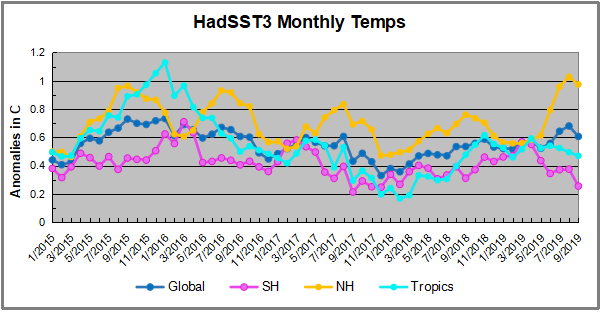
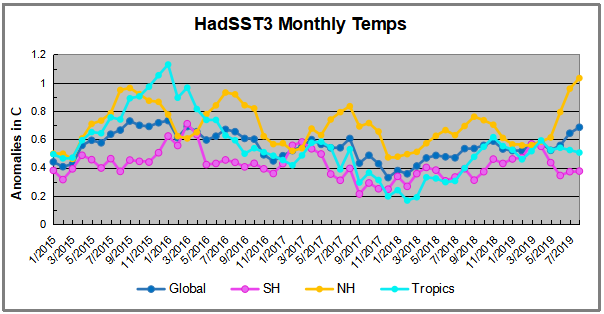
The chart below shows SST monthly anomalies as reported in HadSST3 starting in 2015 through September 2019.
A global cooling pattern is seen clearly in the Tropics since its peak in 2016, joined by NH and SH cycling downward since 2016.  In 2019 all regions had been converging to reach nearly the same value in April.

Then  NH rose exceptionally by almost 0.5C in the previous three months, exceeding previous summer peaks in NH since 2015.  Now that warm NH pulse has started to reverse.  Meanwhile the SH continues to cool sharply, and the Tropics are cooling gradually.  Despite the sharp jump in NH, the global anomaly dropped in September by almost 0.1C

Note that higher temps in 2015 and 2016 were first of all due to a sharp rise in Tropical SST, beginning in March 2015, peaking in January 2016, and steadily declining back below its beginning level. Secondly, the Northern Hemisphere added three bumps on the shoulders of Tropical warming, with peaks in August of each year.  A fourth NH bump was lower and peaked in September 2018.  As noted above, July 2019 is matching the first of these upward bumps.

And as before, note that the global release of heat was not dramatic, due to the Southern Hemisphere offsetting the Northern one.  The major difference between now and 2015-2016 is the absence of Tropical warming driving the SSTs.

The annual SSTs for the last five years are as follows:

Annual SSTs Global NH SH  Tropics
2014 0.477 0.617 0.335 0.451
2015 0.592 0.737 0.425 0.717
2016 0.613 0.746 0.486 0.708
2017 0.505 0.650 0.385 0.424
2018 0.480 0.620 0.362 0.369

2018 annual average SSTs across the regions are close to 2014, slightly higher in SH and much lower in the Tropics.  The SST rise from the global ocean was remarkable, peaking in 2016, higher than 2011 by 0.32C.

A longer view of SSTs

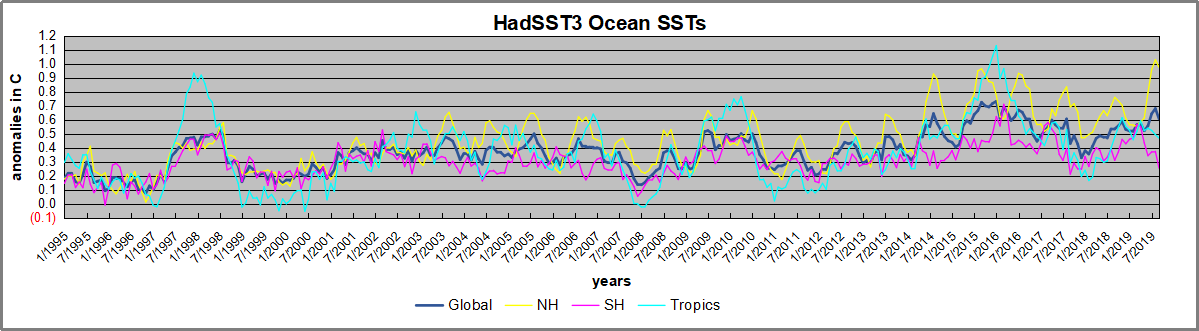
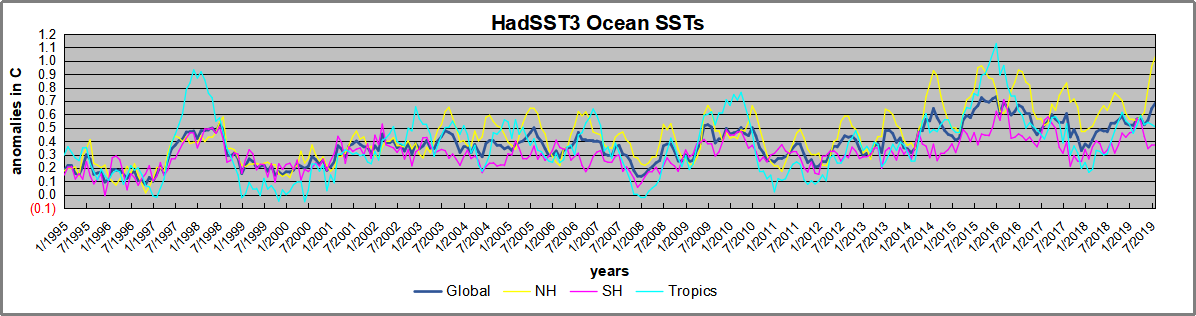
The graph below  is noisy, but the density is needed to see the seasonal patterns in the oceanic fluctuations.  Previous posts focused on the rise and fall of the last El Nino starting in 2015.  This post adds a longer view, encompassing the significant 1998 El Nino and since.  The color schemes are retained for Global, Tropics, NH and SH anomalies.  Despite the longer time frame, I have kept the monthly data (rather than yearly averages) because of interesting shifts between January and July.

Open image in new tab to enlarge.

1995 is a reasonable starting point prior to the first El Nino.  The sharp Tropical rise peaking in 1998 is dominant in the record, starting Jan. ’97 to pull up SSTs uniformly before returning to the same level Jan. ’99.  For the next 2 years, the Tropics stayed down, and the world’s oceans held steady around 0.2C above 1961 to 1990 average.

Then comes a steady rise over two years to a lesser peak Jan. 2003, but again uniformly pulling all oceans up around 0.4C.  Something changes at this point, with more hemispheric divergence than before. Over the 4 years until Jan 2007, the Tropics go through ups and downs, NH a series of ups and SH mostly downs.  As a result the Global average fluctuates around that same 0.4C, which also turns out to be the average for the entire record since 1995.

2007 stands out with a sharp drop in temperatures so that Jan.08 matches the low in Jan. ’99, but starting from a lower high. The oceans all decline as well, until temps build peaking in 2010.

Now again a different pattern appears.  The Tropics cool sharply to Jan 11, then rise steadily for 4 years to Jan 15, at which point the most recent major El Nino takes off.  But this time in contrast to ’97-’99, the Northern Hemisphere produces peaks every summer pulling up the Global average.  In fact, these NH peaks appear every July starting in 2003, growing stronger to produce 3 massive highs in 2014, 15 and 16.  NH July 2017 was only slightly lower, and a fifth NH peak still lower in Sept. 2018.  Note also that starting in 2014 SH plays a moderating role, offsetting the NH warming pulses. (Note: these are high anomalies on top of the highest absolute temps in the NH.)

What to make of all this? The patterns suggest that in addition to El Ninos in the Pacific driving the Tropic SSTs, something else is going on in the NH.  The obvious culprit is the North Atlantic, since I have seen this sort of pulsing before.  After reading some papers by David Dilley, I confirmed his observation of Atlantic pulses into the Arctic every 8 to 10 years.

But the peaks coming nearly every summer in HadSST require a different picture.  Let’s look at August, the hottest month in the North Atlantic from the Kaplan dataset.
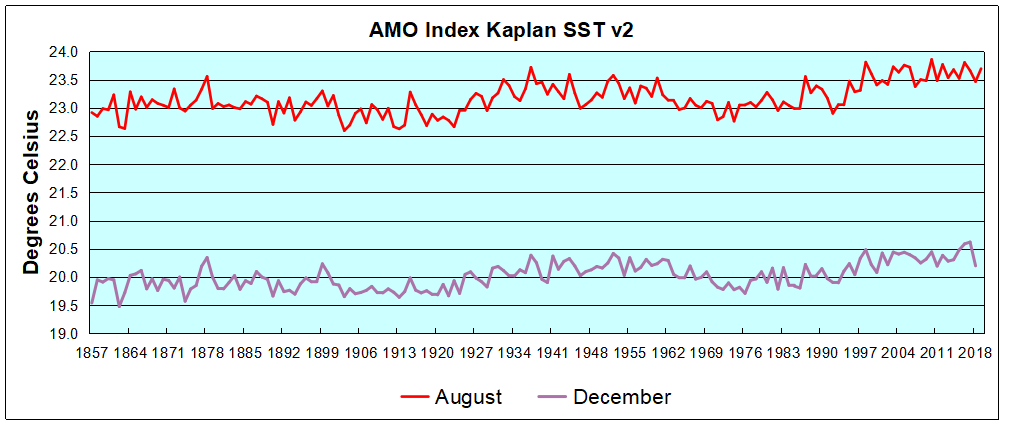
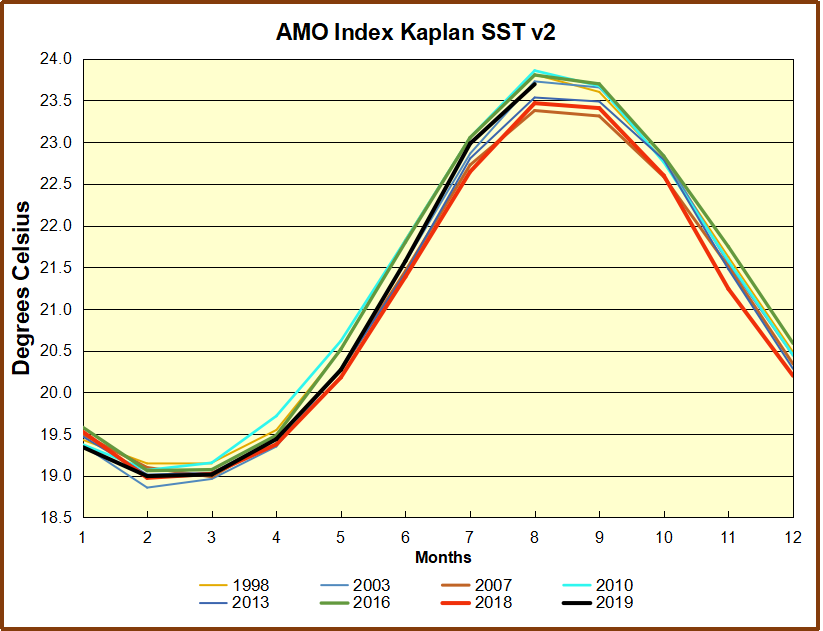
The AMO Index is from from Kaplan SST v2, the unaltered and not detrended dataset. By definition, the data are monthly average SSTs interpolated to a 5×5 grid over the North Atlantic basically 0 to 70N. The graph shows warming began after 1992 up to 1998, with a series of matching years since. Because the N. Atlantic has partnered with the Pacific ENSO recently, let’s take a closer look at some AMO years in the last 2 decades.
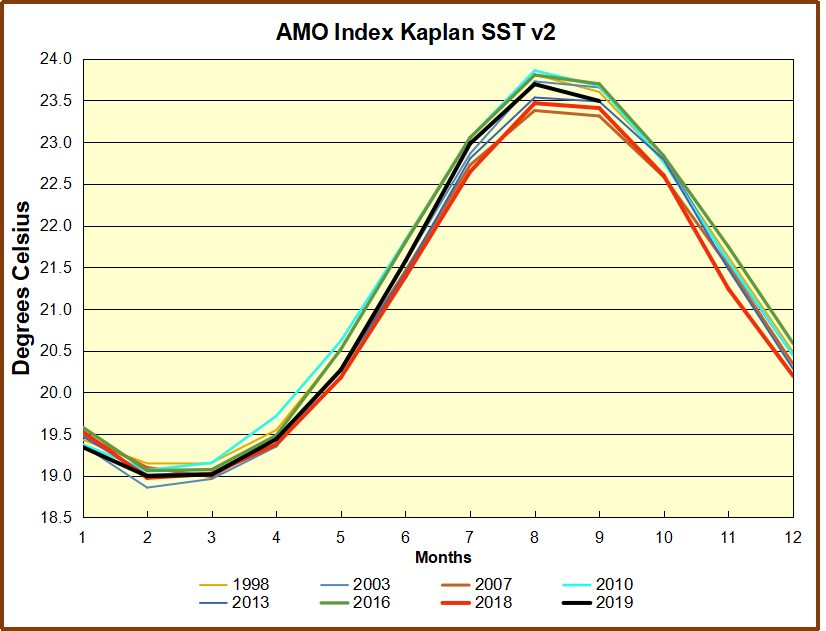
This graph shows monthly AMO temps for some important years. The Peak years were 1998, 2010 and 2016, with the latter emphasized as the most recent. The other years show lesser warming, with 2007 emphasized as the coolest in the last 20 years. Note the red 2018 line is at the bottom of all these tracks. The short black line shows that 2019 began slightly cooler, then tracked 2018, then rose to match previous summer pulses, before dropping down in September.

Summary

The oceans are driving the warming this century.  SSTs took a step up with the 1998 El Nino and have stayed there with help from the North Atlantic, and more recently the Pacific northern “Blob.”  The ocean surfaces are releasing a lot of energy, warming the air, but eventually will have a cooling effect.  The decline after 1937 was rapid by comparison, so one wonders: How long can the oceans keep this up? If the pattern of recent years continues, NH SST anomalies may rise slightly in coming months, but once again, ENSO which has weakened will probably determine the outcome.

Footnote: Why Rely on HadSST3

HadSST3 is distinguished from other SST products because HadCRU (Hadley Climatic Research Unit) does not engage in SST interpolation, i.e. infilling estimated anomalies into grid cells lacking sufficient sampling in a given month. From reading the documentation and from queries to Met Office, this is their procedure.

HadSST3 imports data from gridcells containing ocean, excluding land cells. From past records, they have calculated daily and monthly average readings for each grid cell for the period 1961 to 1990. Those temperatures form the baseline from which anomalies are calculated.

In a given month, each gridcell with sufficient sampling is averaged for the month and then the baseline value for that cell and that month is subtracted, resulting in the monthly anomaly for that cell. All cells with monthly anomalies are averaged to produce global, hemispheric and tropical anomalies for the month, based on the cells in those locations. For example, Tropics averages include ocean grid cells lying between latitudes 20N and 20S.

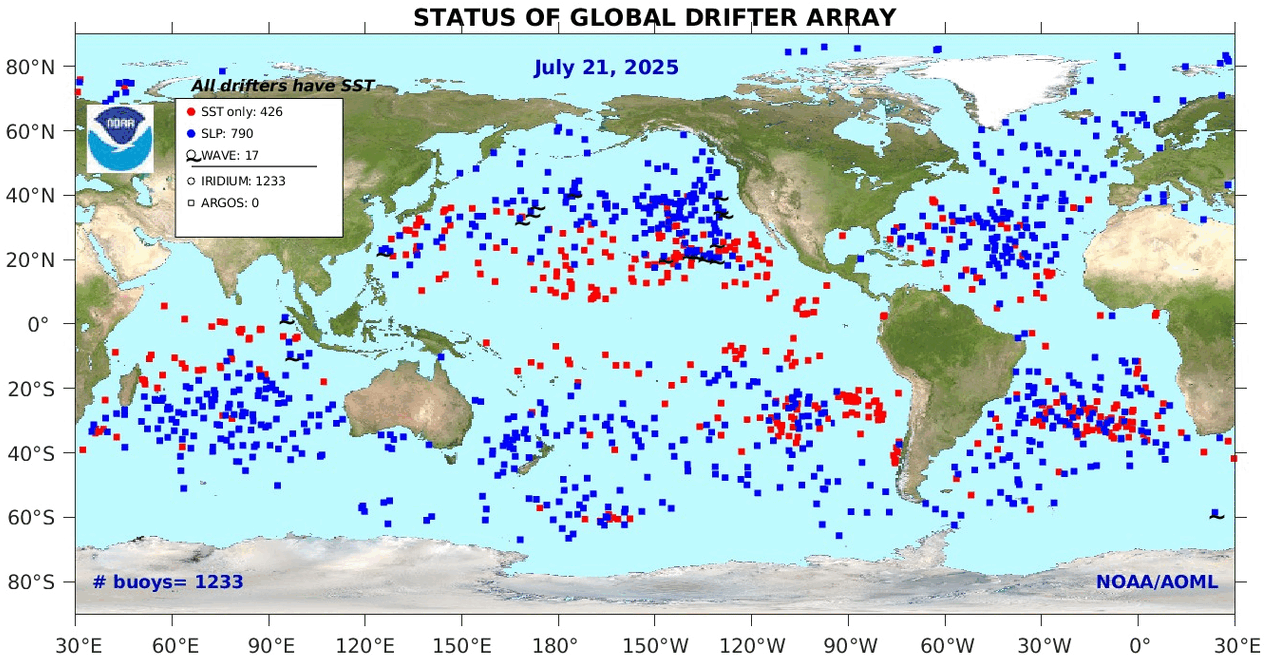
Gridcells lacking sufficient sampling that month are left out of the averaging, and the uncertainty from such missing data is estimated. IMO that is more reasonable than inventing data to infill. And it seems that the Global Drifter Array displayed in the top image is providing more uniform coverage of the oceans than in the past.

uss-pearl-harbor-deploys-global-drifter-buoys-in-pacific-ocean

USS Pearl Harbor deploys Global Drifter Buoys in Pacific Ocean

N. Atlantic Cooling Sept. 2019

RAPID Array measuring North Atlantic SSTs.

For the last few years, observers have been speculating about when the North Atlantic will start the next phase shift from warm to cold. Given the way 2018 went and 2019 is following, this may be the onset.  First some background.

. Source: Energy and Education Canada

An example is this report in May 2015 The Atlantic is entering a cool phase that will change the world’s weather by Gerald McCarthy and Evan Haigh of the RAPID Atlantic monitoring project. Excerpts in italics with my bolds.

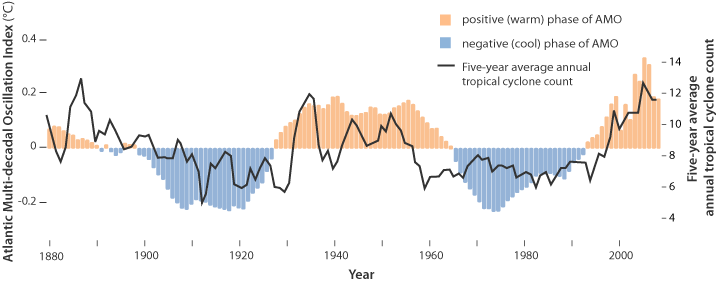
This is known as the Atlantic Multidecadal Oscillation (AMO), and the transition between its positive and negative phases can be very rapid. For example, Atlantic temperatures declined by 0.1ºC per decade from the 1940s to the 1970s. By comparison, global surface warming is estimated at 0.5ºC per century – a rate twice as slow.

In many parts of the world, the AMO has been linked with decade-long temperature and rainfall trends. Certainly – and perhaps obviously – the mean temperature of islands downwind of the Atlantic such as Britain and Ireland show almost exactly the same temperature fluctuations as the AMO.

Atlantic oscillations are associated with the frequency of hurricanes and droughts. When the AMO is in the warm phase, there are more hurricanes in the Atlantic and droughts in the US Midwest tend to be more frequent and prolonged. In the Pacific Northwest, a positive AMO leads to more rainfall.

A negative AMO (cooler ocean) is associated with reduced rainfall in the vulnerable Sahel region of Africa. The prolonged negative AMO was associated with the infamous Ethiopian famine in the mid-1980s. In the UK it tends to mean reduced summer rainfall – the mythical “barbeque summer”.Our results show that ocean circulation responds to the first mode of Atlantic atmospheric forcing, the North Atlantic Oscillation, through circulation changes between the subtropical and subpolar gyres – the intergyre region. This a major influence on the wind patterns and the heat transferred between the atmosphere and ocean.

The observations that we do have of the Atlantic overturning circulation over the past ten years show that it is declining. As a result, we expect the AMO is moving to a negative (colder surface waters) phase. This is consistent with observations of temperature in the North Atlantic.

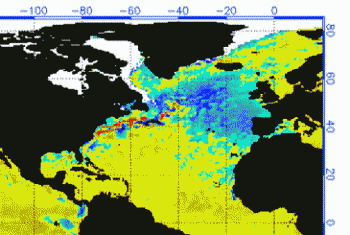
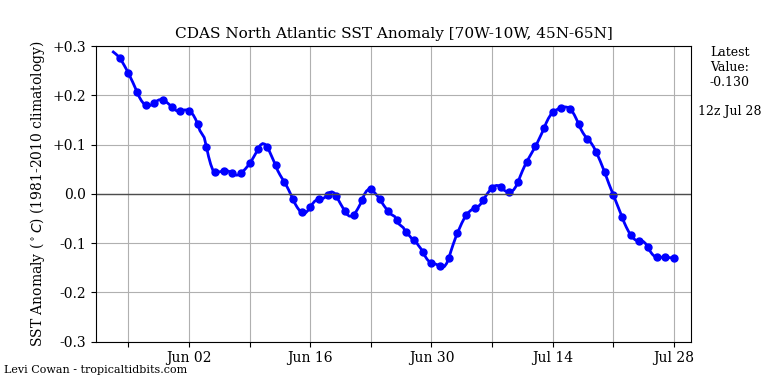
Cold “blobs” in North Atlantic have been reported, but they are usually winter phenomena. For example in April 2016, the sst anomalies looked like this

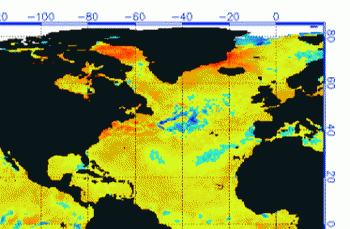
But by September, the picture changed to this

And we know from Kaplan AMO dataset, that 2016 summer SSTs were right up there with 1998 and 2010 as the highest recorded.

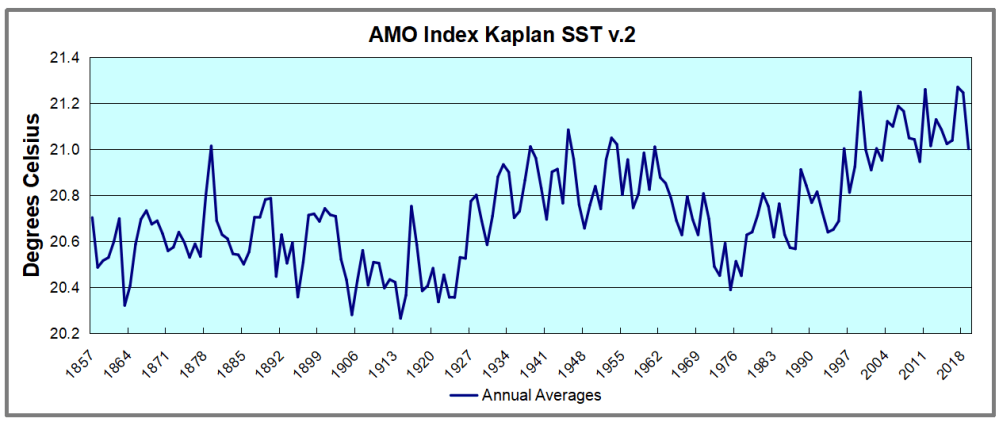
As the graph above suggests, this body of water is also important for tropical cyclones, since warmer water provides more energy.  But those are annual averages, and I am interested in the summer pulses of warm water into the Arctic. As I have noted in my monthly HadSST3 reports, most summers since 2003 there have been warm pulses in the north atlantic.


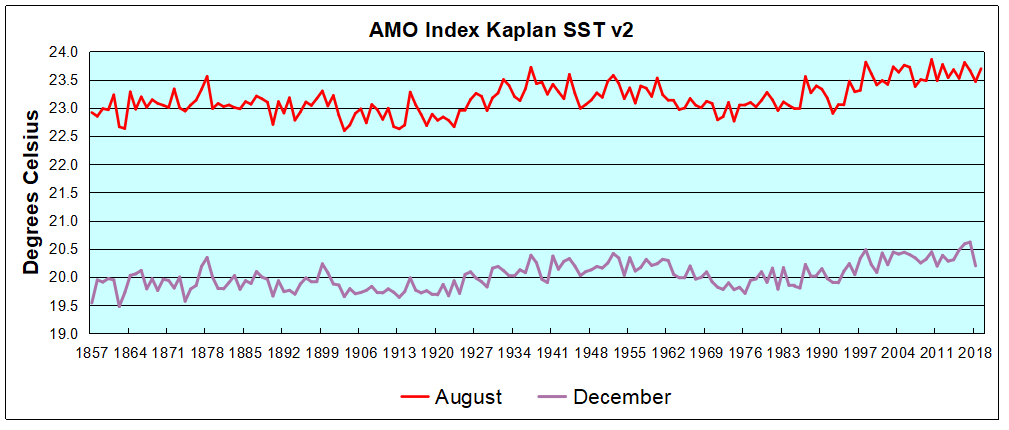
The AMO Index is from from Kaplan SST v2, the unaltered and not detrended dataset. By definition, the data are monthly average SSTs interpolated to a 5×5 grid over the North Atlantic basically 0 to 70N.  The graph shows the warmest month August beginning to rise after 1993 up to 1998, with a series of matching years since.  December 2016 set a record at 20.6C, but note the plunge down to 20.2C for  December 2018, matching 2011 as the coldest years  since 2000.
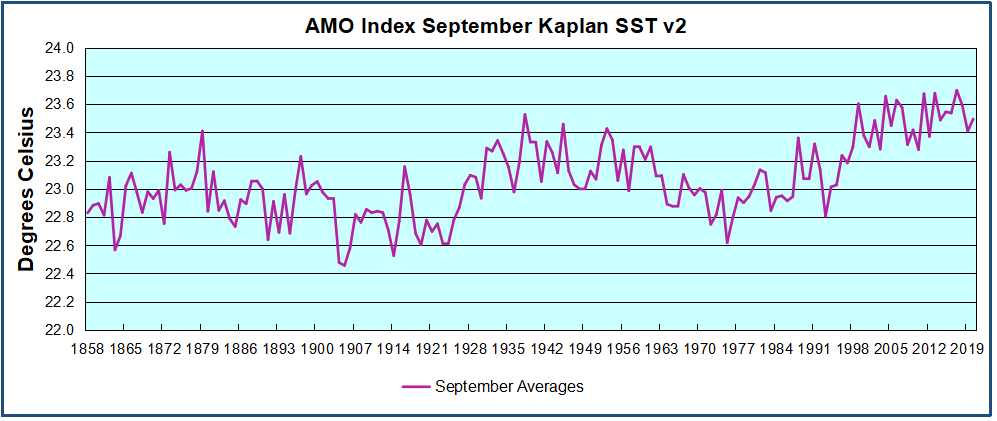
September 2019 shows the summer pulse weakening, higher than 2018 but well below other recent peak years since 2013.  Because McCarthy refers to hints of cooling to come in the N. Atlantic, let’s take a closer look at some AMO years in the last 2 decades.

This graph shows monthly AMO temps for some important years. The Peak years were 1998, 2010 and 2016, with the latter emphasized as the most recent. The other years show lesser warming, with 2007 emphasized as the coolest in the last 20 years. Note the red 2018 line was at the bottom of all these tracks.  The short black line shows that 2019 began slightly cooler than January 2018, then tracked closely before rising in the summer months, though still lower than the peak years. Now in September 2019 is dropping closer to cooler years.

amo annual122018

Climate for Dummies

Lubos Motl has a fine post explaining the basics of climate science for the mostly uninformed masses. His article at his blog is Worries about extinction in 10-15 years reveal deep scientific illiteracy of the young, urban masses. Excerpts in italics with my bolds.

A week ago, Scott Rasmussen published results of a poll. The percentage of the Americans willing to believe claims about the possible imminent extinction of the human race is between 1/2 and 1/3. The most shocking numbers say that 51% of the younger voters under 35 believe it is “somewhat likely for humanity to be wiped out [by anything] in a decade”. Similarly, 45% of urban residents think “humanity may be wiped out by climate change in 10-15 years”.

The stupidity of the underlying assertions is breathtaking and the percentage of the people willing to endorse them is terrifying. And the opposition to the cattle and fossil fuels – our most important source of energy – could be just the beginning. Once the staggering stupidity of the masses becomes normal, you may promote even crazier and more devastating superstitions. There seem to be no limits to the stupidity right now.

Some of the Friday kids in the streets are there simply because any excuse to skip the classes is wonderful news. They don’t really believe that the world may end anytime soon. The truly irresponsible people are the principals and other adults that allow these bastards to avoid the education process, of course.

But many of the people must genuinely believe these comments. And the percentage of such people may be between 10% and 51%, too, at least within some demographics. The lack of critical thinking that is needed for such a conclusion is terrifying and such brain-dead people – who still have the right to vote and other rights, despite their brain death – may be abused not only for the climate panic but for hypothetical policies that are even more devastating.

1. Uniformly distributed CO2 can’t possibly increase the frequency of tornadoes, hurricanes, and other things that depend on the non-uniformities of the temperature, pressure, and other things. All the claims that the CO2 causes local weather events are exactly on par with the medieval superstitions promoted during the medieval witch hunts.

2. So if CO2 causes something, it’s a uniform increase of temperature everywhere. The graphs show that the rate of warming is some 1.5 °C a century. It doesn’t make much sense to argue whether we expect 1 °C or 2 °C in the next century.

3. The climate models aren’t terribly trustworthy or useful for the predictions of the temperature trends. Their uncertainties are too high – and we have observed the temperature for many decades to see that the rate 1.5 °C per century is pretty much visible and somewhat constant according to the graphs.

4. The bulk of the insanity isn’t in whether the 1.5 °C per century is man-made; it’s about the question whether it’s dangerous. What can this 1.5 °C of warming per century do? Well, in the 10-15 years when the doomsday is supposed to occur, we will see some 0.15 °C or 0.20 °C, by the rules of proportionality. Can 0.20 °C of warming cause the extinction of the human race?

5. The weather is changing all the time. Several times a year, the temperature jumps or drops by 20 °C within a day – and that’s 100 times greater change than 0.20 °C. And it normally occurs within a day i.e. much faster – not after a decade. The change of the temperature by 0.20 °C is utterly negligible.

6. Even if you want to just measure this temperature and prove that it has changed in a century, you absolutely need all the following conditions to be met: precise thermometers, precision control over their position, averaging over most of the Earth, averaging over seasons as well as day-night cycles, solid statistical methods to average and to apply corrections.

7. The human race has existed throughout the Pleistocene. This species – like millions of others – survived 100 cycles in which the temperature went up and down by as much as 8 °C. The idea that 2 °C of temperature change means “extinction” is beyond silly. Again, recall that the warmer periods were generally the hospitable ones, not vice versa.

8. The idea that the observed recent warming is enough for extinction in 10-15 years is separated from reality by more than 2 orders of magnitude because it’s self-evident that even 20 °C of warming wouldn’t be enough to make humans extinct. You would really need 200 °C of warming (3 orders of magnitude higher than what we expect) to be sufficiently confident that it becomes hard for millions of people to survive.

There’s no way how climate change could kill many people, let alone all people, even in the next century.

August SSTs Offset NH Warming

The best context for understanding decadal temperature changes comes from the world’s sea surface temperatures (SST), for several reasons:

  • The ocean covers 71% of the globe and drives average temperatures;
  • SSTs have a constant water content, (unlike air temperatures), so give a better reading of heat content variations;
  • A major El Nino was the dominant climate feature in recent years.

HadSST is generally regarded as the best of the global SST data sets, and so the temperature story here comes from that source, the latest version being HadSST3.  More on what distinguishes HadSST3 from other SST products at the end.

The Current Context

The chart below shows SST monthly anomalies as reported in HadSST3 starting in 2015 through August 2019.

A global cooling pattern is seen clearly in the Tropics since its peak in 2016, joined by NH and SH cycling downward since 2016.  In 2019 all regions had been converging to reach nearly the same value in April.

Now something exceptional is happening in NH rising almost 0.5C in the last three months, now exceeding previous summer peaks in NH since 2015.  Meanwhile the SH remains relatively cooler, and the Tropics not changing much.  Despite the sharp jump in NH, the global anomaly rose only slightly.

Note that higher temps in 2015 and 2016 were first of all due to a sharp rise in Tropical SST, beginning in March 2015, peaking in January 2016, and steadily declining back below its beginning level. Secondly, the Northern Hemisphere added three bumps on the shoulders of Tropical warming, with peaks in August of each year.  A fourth NH bump was lower and peaked in September 2018.  As noted above, July 2019 is matching the first of these upward bumps.

And as before, note that the global release of heat was not dramatic, due to the Southern Hemisphere offsetting the Northern one.  The major difference between now and 2015-2016 is the absence of Tropical warming driving the SSTs.

Note: The NH spike is unexpected since UAH ocean air tempts dropped sharply in July 2019 and remained cooler in August.  The discrpency between the two datasets is surprising since previously they were quite similar.


The annual SSTs for the last five years are as follows:

Annual SSTs Global NH SH  Tropics
2014 0.477 0.617 0.335 0.451
2015 0.592 0.737 0.425 0.717
2016 0.613 0.746 0.486 0.708
2017 0.505 0.650 0.385 0.424
2018 0.480 0.620 0.362 0.369

2018 annual average SSTs across the regions are close to 2014, slightly higher in SH and much lower in the Tropics.  The SST rise from the global ocean was remarkable, peaking in 2016, higher than 2011 by 0.32C.

A longer view of SSTs

The graph below  is noisy, but the density is needed to see the seasonal patterns in the oceanic fluctuations.  Previous posts focused on the rise and fall of the last El Nino starting in 2015.  This post adds a longer view, encompassing the significant 1998 El Nino and since.  The color schemes are retained for Global, Tropics, NH and SH anomalies.  Despite the longer time frame, I have kept the monthly data (rather than yearly averages) because of interesting shifts between January and July.

Open image in new tab to enlarge.

1995 is a reasonable starting point prior to the first El Nino.  The sharp Tropical rise peaking in 1998 is dominant in the record, starting Jan. ’97 to pull up SSTs uniformly before returning to the same level Jan. ’99.  For the next 2 years, the Tropics stayed down, and the world’s oceans held steady around 0.2C above 1961 to 1990 average.

Then comes a steady rise over two years to a lesser peak Jan. 2003, but again uniformly pulling all oceans up around 0.4C.  Something changes at this point, with more hemispheric divergence than before. Over the 4 years until Jan 2007, the Tropics go through ups and downs, NH a series of ups and SH mostly downs.  As a result the Global average fluctuates around that same 0.4C, which also turns out to be the average for the entire record since 1995.

2007 stands out with a sharp drop in temperatures so that Jan.08 matches the low in Jan. ’99, but starting from a lower high. The oceans all decline as well, until temps build peaking in 2010.

Now again a different pattern appears.  The Tropics cool sharply to Jan 11, then rise steadily for 4 years to Jan 15, at which point the most recent major El Nino takes off.  But this time in contrast to ’97-’99, the Northern Hemisphere produces peaks every summer pulling up the Global average.  In fact, these NH peaks appear every July starting in 2003, growing stronger to produce 3 massive highs in 2014, 15 and 16.  NH July 2017 was only slightly lower, and a fifth NH peak still lower in Sept. 2018.  Note also that starting in 2014 SH plays a moderating role, offsetting the NH warming pulses. (Note: these are high anomalies on top of the highest absolute temps in the NH.)

What to make of all this? The patterns suggest that in addition to El Ninos in the Pacific driving the Tropic SSTs, something else is going on in the NH.  The obvious culprit is the North Atlantic, since I have seen this sort of pulsing before.  After reading some papers by David Dilley, I confirmed his observation of Atlantic pulses into the Arctic every 8 to 10 years.

But the peaks coming nearly every summer in HadSST require a different picture.  Let’s look at August, the hottest month in the North Atlantic from the Kaplan dataset.
The AMO Index is from from Kaplan SST v2, the unaltered and not detrended dataset. By definition, the data are monthly average SSTs interpolated to a 5×5 grid over the North Atlantic basically 0 to 70N. The graph shows warming began after 1992 up to 1998, with a series of matching years since. Because the N. Atlantic has partnered with the Pacific ENSO recently, let’s take a closer look at some AMO years in the last 2 decades.
This graph shows monthly AMO temps for some important years. The Peak years were 1998, 2010 and 2016, with the latter emphasized as the most recent. The other years show lesser warming, with 2007 emphasized as the coolest in the last 20 years. Note the red 2018 line is at the bottom of all these tracks. The short black line shows that 2019 began slightly cooler, then tracked 2018, but has now risen to match previous summer pulses.

Summary

The oceans are driving the warming this century.  SSTs took a step up with the 1998 El Nino and have stayed there with help from the North Atlantic, and more recently the Pacific northern “Blob.”  The ocean surfaces are releasing a lot of energy, warming the air, but eventually will have a cooling effect.  The decline after 1937 was rapid by comparison, so one wonders: How long can the oceans keep this up? If the pattern of recent years continues, NH SST anomalies may rise slightly in coming months, but once again, ENSO which has weakened will probably determine the outcome.

Footnote: Why Rely on HadSST3

HadSST3 is distinguished from other SST products because HadCRU (Hadley Climatic Research Unit) does not engage in SST interpolation, i.e. infilling estimated anomalies into grid cells lacking sufficient sampling in a given month. From reading the documentation and from queries to Met Office, this is their procedure.

HadSST3 imports data from gridcells containing ocean, excluding land cells. From past records, they have calculated daily and monthly average readings for each grid cell for the period 1961 to 1990. Those temperatures form the baseline from which anomalies are calculated.

In a given month, each gridcell with sufficient sampling is averaged for the month and then the baseline value for that cell and that month is subtracted, resulting in the monthly anomaly for that cell. All cells with monthly anomalies are averaged to produce global, hemispheric and tropical anomalies for the month, based on the cells in those locations. For example, Tropics averages include ocean grid cells lying between latitudes 20N and 20S.

Gridcells lacking sufficient sampling that month are left out of the averaging, and the uncertainty from such missing data is estimated. IMO that is more reasonable than inventing data to infill. And it seems that the Global Drifter Array displayed in the top image is providing more uniform coverage of the oceans than in the past.

uss-pearl-harbor-deploys-global-drifter-buoys-in-pacific-ocean

USS Pearl Harbor deploys Global Drifter Buoys in Pacific Ocean

Global Warming Theory and the Tests It Fails


Many people commenting both for and against reducing emissions from burning fossil fuels assume it has been proven that rising GHGs including CO2 cause higher atmospheric temperatures.  That premise has been tested and found wanting, as this post will describe.  First below is a summary of Global Warming Theory as presented in the scientific literature.  Then follows discussion of several unsuccessful attempts to find evidence of the hypothetical effects from GHGs in the relevant datasets.  Concluding is the alternative theory of climate change deriving from solar and oceanic fluctuations.

Scientific Theory of  Global Warming

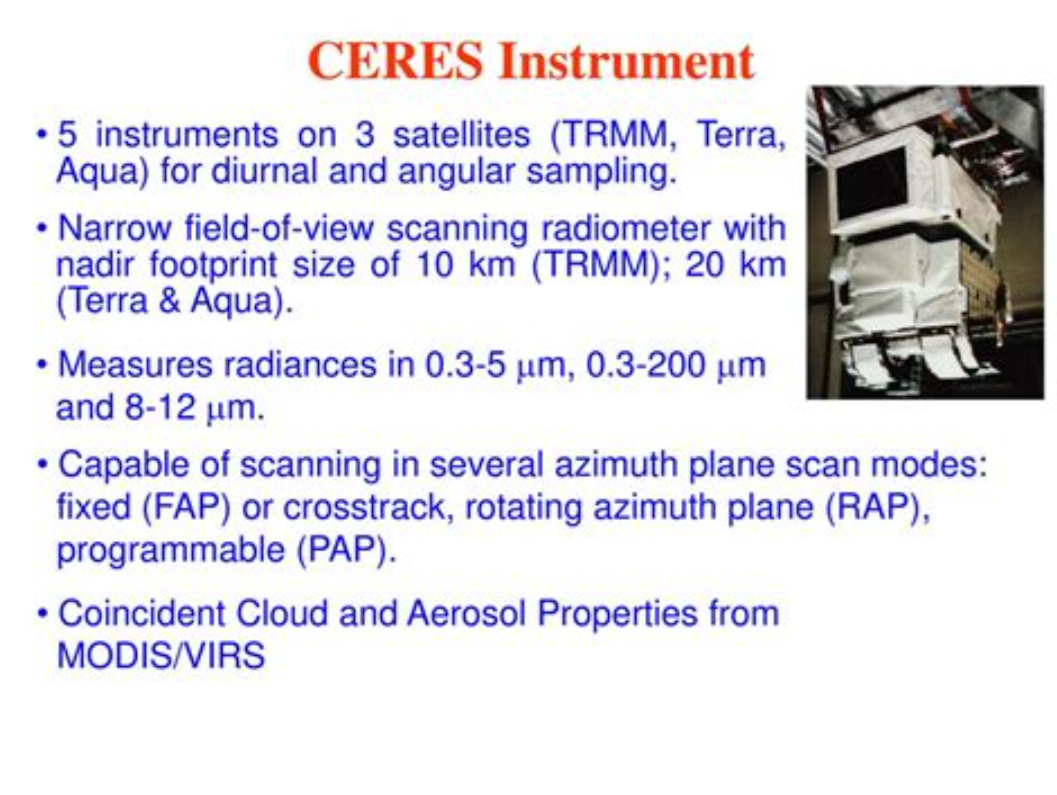
The theory is well described in an article by Kristian (okulaer) prefacing his analysis of  “AGW warming” fingerprints in the CERES satellite data.  How the CERES EBAF Ed4 data disconfirms “AGW” in 3 different ways  by okulaer November 11, 2018. Excerpts below with my bolds.  Kristian provides more detailed discussion at his blog (title in red is link).

Background: The AGW Hypothesis

For those of you who aren’t entirely up to date with the hypothetical idea of an “(anthropogenically) enhanced GHE” (the “AGW”) and its supposed mechanism for (CO2-driven) global warming, the general principle is fairly neatly summed up here.

I’ve modified this diagram below somewhat, so as to clarify even further the concept of “the raised ERL (Effective Radiating Level)” – referred to as Ze in the schematic – and how it is meant to ‘drive’ warming within the Earth system; to simply bring the message of this fundamental premise of “AGW” thinking more clearly across.
Then we have the “doubled CO2” (t1) scenario, where the ERL has been pushed higher up into cooler air layers closer to the tropopause:

So when the atmosphere’s IR opacity increases with the excess input of CO2, the ERL is pushed up, and, with that, the temperature at ALL ALTITUDE-SPECIFIC LEVELS of the Earth system, from the surface (Ts) up through the troposphere (Ttropo) to the tropopause, directly connected via the so-called environmental lapse rate, i.e. the negative temperature profile rising up through the tropospheric column, is forced to do the same.

The Expected GHG Fingerprints

How, then, is this mechanism supposed to manifest itself?

Well, as the ERL, basically the “effective atmospheric layer of OUTWARD (upward) radiation”, the one conceptually/mathematically responsible for the All-Sky OLR flux at the ToA, and from now on, in this post, dubbed rather the EALOR, is lifted higher, into cooler layers of air, the diametrically opposite level, the “effective atmospheric layer of INWARD (downward) radiation” (EALIR), the one conceptually and mathematically responsible for the All-Sky DWLWIR ‘flux’ (or “the atmospheric back radiation”) to the surface, is simultaneously – and for the same physical reason, only inversely so – pulled down, into warmer layers of air closer to the surface. This latter concept was explained already in 1938 by G.S. Callendar. Feldman et al., 2015, (as an example) confirm that this is still how “Mainstream Climate Science (MCS)” views this ‘phenomenon’:

The gist being that, when we make the atmosphere more opaque to IR by putting more CO2 into it, “the atmospheric back radiation” (all-sky DWLWIR at sfc) will naturally increase as a result, reducing the radiative heat loss (net LW) from the surface up. And do note, it will increase regardless of (and thus, on top of) any atmospheric rise in temperature, which would itself cause an increase. Which is to say that it will always distinctly increase also RELATIVE TO tropospheric temps (which are, by definition, altitude-specific (fixed at one particular level, like ‘the lower troposphere’ (LT))). That is, even when tropospheric temps do go up, the DWLWIR should be observed to increase systematically and significantly MORE than what we would expect from the temperature rise alone. Because the EALIR moves further down.

Conversely, at the other end, at the ToA, the EALOR moves the opposite way, up into colder layers of air, which means the all-sky OLR (the outward emission flux) should rather be observed to systematically and significantly decrease over time relative to tropospheric temps. If tropospheric temps were to go up, while the DWLWIR at the surface should be observed to go significantly more up, the OLR at the ToA should instead be observed to go significantly less up, because the warming of the troposphere would simply serve to offset the ‘cooling’ of the effective emission to space due to the rise of the EALOR into colder strata of air.

What we’re looking for, then, if indeed there is an “enhancement” of some “radiative GHE” going on in the Earth system, causing global warming, is ideally the following:

OLR stays flat, while TLT increases significantly and systematically over time;
TLT increases systematically over time, but DWLWIR increases significantly even more.
Effectively summed up in this simplified diagram.
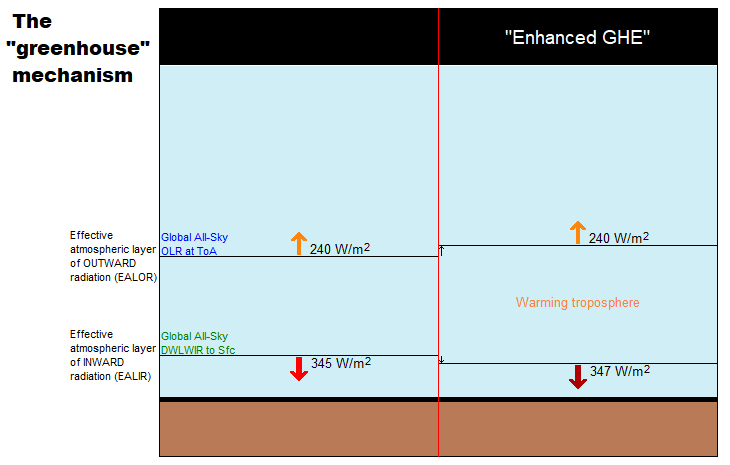
Figure 4. Note, this schematic disregards – for the sake of simplicity – any solar warming at work.

However, we also expect to observe one more “greenhouse” signature.

If we expect the OLR at the ToA to stay relatively flat, but the DWLWIR at the sfc to increase significantly over time, even relative to tropospheric temps, then, if we were to compare the two (OLR and DWLWIR) directly, we’d, after all, naturally expect to see a fairly remarkable systematic rise in the latter over the former (refer to Fig.4 above).

Which means we now have our three ways to test the reality of an hypothesized “enhanced GHE” as a ‘driver’ (cause) of global warming.
 

Three Tests for GHG Warming in the Sky

The null hypothesis in this case would claim or predict that, if there is NO strengthening “greenhouse mechanism” at work in the Earth system, we would observe:

1. The general evolution (beyond short-term, non-thermal noise (like ENSO-related humidity and cloud anomalies or volcanic aerosol anomalies))* of the All-Sky OLR flux at the ToA to track that of Ttropo (e.g. TLT) over time;
2. The general evolution of the All-Sky DWLWIR at the surface to track that of Ttropo (Ts + Ttropo, really) over time;
3. The general evolution of the All-Sky OLR at the ToA and the All-Sky DWLWIR at the surface to track each other over time, barring short-term, non-thermal noise.

* (We see how the curve of the all-sky OLR flux at the ToA differs quite noticeably from the TLT and DWLWIR curves, especially during some of the larger thermal fluctuations (up or down), normally associated with particularly strong ENSO events. This is because there are factors other than pure mean tropospheric temperatures that affect Earth’s final emission flux to space, like the concentration and distribution (equator→poles, surface→tropopause/stratosphere) of clouds, water vapour and aerosols. These may (and do) all vary strongly in the short term, significantly disrupting the normal temperature↔flux (Stefan-Boltzmann) connection, but in the longer term, they display a remarkable tendency to even out, leaving the tropospheric temperature signal as the only real factor to consider when comparing the OLR with Ttropo (TLT). Or not. The “AGW” idea specifically contends, resting on the premise, that these other factors (and crucially also including CO2, of course) do NOT even out over time, but rather accrue in a positive (‘warming’) direction.)
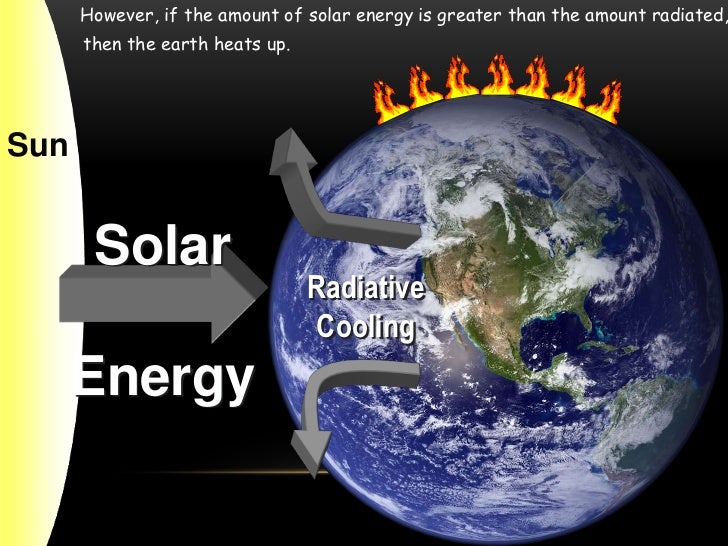
Missing Fingerprint #1

The first point above we have already covered extensively. The combined ERBS+CERES OLR record is seen to track the general progression of the UAHv6 TLT series tightly, both in the tropics and near-globally, all the way from 1985 till today (the last ~33 years), as discussed at length both here and here.

Since, however, in this post we’re specifically considering the CERES era alone, this is how the global OLR matches against the global TLT since 2000:
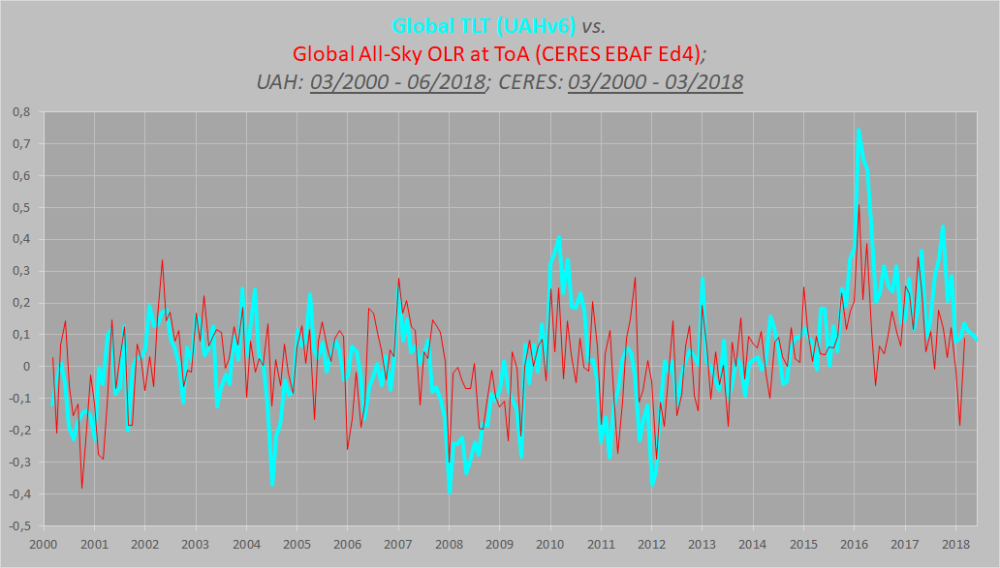
Figure 5.

This is simply the monthly CERES OLR flux data properly scaled (x0.266), enabling us to compare it more directly to temperatures (W/m2→K), and superimposed on the UAH TLT data. Watch how closely the two curves track each other, beyond the obvious noise. To highlight this striking state of relative congruity, we remove the main sources of visual bias in Fig.5 above. Notice, then, how the red OLR curve, after the 4-year period of fairly large ENSO-events (La Niña-El Niño-La Niña) between 2007/2008 and 2011/2012, when the cyan TLT curve goes both much lower (during the flanking La Niñas) and much higher (during the central El Niño), quickly reestablishes itself right back on top of the TLT curve, just where it used to be prior to that intermediate stretch of strong ENSO influence. And as a result, there is NO gradual divergence whatsoever to be spotted between the mean levels of these two curves, from the beginning of 2000 to the end of 2015.

Missing Fingerprint #2

The second point above is just as relevant as the first one, if we want to confirm (or disconfirm) the reality of an “enhanced GHE” at work in the Earth system. We compare the tropospheric temperatures with the DWLWIRsfc ‘flux’, that is, the apparent atmospheric thermal emission to the surface:

Figure 9. Note how the scaling of the flux (W/m2) values is different close to the surface than at the ToA. Here at the DWLWIR level, down low, we divide by 5 (x0.2), while at the OLR level, up high, we divide by 3.76 (x0.266).

We once again observe a rather close match overall. At the very least, we can safely say that there is no evidence whatsoever of any gradual, systematic rise in DWLWIR over the TLT, going from 2000 to 2018. If we plot the difference between the two curves in Fig.9 to obtain the “DWLWIR residual”, this fact becomes all the more evident:
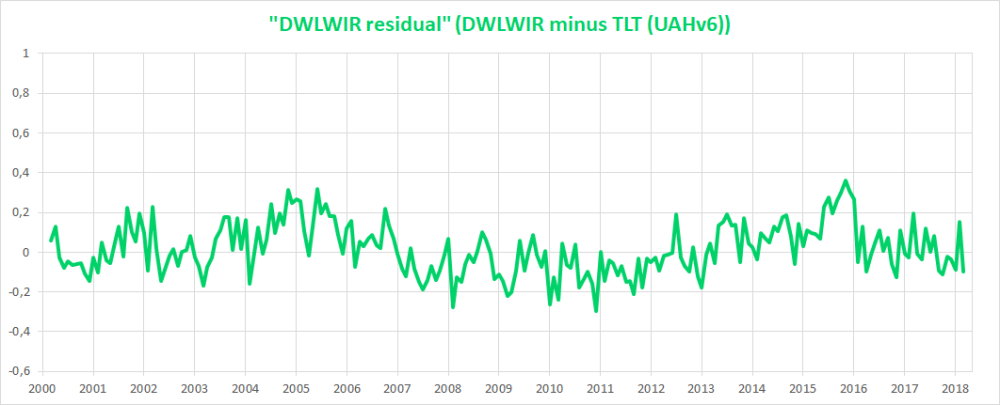
Figure 10.

Remember now how the idea of an “enhanced GHE” requires the DWLWIR to rise significantly more than Ttropo (TLT) over time, and that its “null hypothesis” therefore postulates that such a rise should NOT be seen. Well, do we see such a rise in the plot above? Nope. Not at all. Which fits in perfectly with the impression we got at the ToA, where the TLT-curve was supposed to rise systematically up and away from the OLR-curve over time, but didn’t – no observed evidence there either of any “enhanced GHE” at work.

Missing Fingerprint #3

Finally, the third point above is also pretty interesting. It is simply to verify whether or not the CERES EBAF Ed4 ‘radiation flux’ data products are indeed suggesting a strengthening of some radiatively defined “greenhouse mechanism”. We sort of know the answer to this already, though, from going through points 1 and 2 above. Since neither the OLR at the ToA nor the DWLWIR at the surface deviated meaningfully from the UAHv6 TLT series (the same one used to compare with both, after all), we expect rather by necessity that the two CERES ‘flux products’ also shouldn’t themselves deviate meaningfully overall from one another. And, unsurprisingly, they don’t:

Figure 14.  Difference plot (“DWLWIR residual”)

Again, it is so easy here to allow oneself to be fooled by the visual impact of that late – obviously ENSO-related – peak, and, in this case, also a definite ENSO-based trough right at the start (you’ll plainly recognise it in Fig.14); another perfect example of how one’s perception and interpretation of a plot is directly affected by “the end-point bias”. Don’t be fooled:

If we expect the OLR at the ToA to stay relatively flat, but the DWLWIR at the sfc to increase significantly over time, even relative to tropospheric temps, then, if we were to compare the two (OLR and DWLWIR) directly, we’d […] naturally expect to see a fairly remarkable systematic rise in the latter over the former (refer to Fig.4 above).

Looking at Fig.14, and taking into account the various ENSO states along the way, does such a “remarkable systematic rise” in DWLWIR over OLR manifest itself during the CERES era?

I’m afraid not …

Four Lines of Evidence Against GHG Warming Hypothesis

The lack of GHG warming in the CERES data is added to three previous atmospheric heat radiation studies.


  1.  In 2004 Ferenc MIskolczi studied the radiosonde datasets and found that the optical density at the top of the troposphere does not change with increasing CO2, since reducing H2O maintains optimal radiating efficiency.  His publication was suppressed by NASA, and he resigned from his job there. He has elaborated on his findings in publications as recently as 2014. See:  The Curious Case of Dr. Miskolczi

2.  Ronan and Michael Connolly  studied radiosonde data and concluded in 2014:

“It can be seen from the infra-red cooling model of Figure 19 that the greenhouse effect theory predicts a strong influence from the greenhouse gases on the barometric temperature profile. Moreover, the modeled net effect of the greenhouse gases on infra-red cooling varies substantially over the entire atmospheric profile.

However, when we analysed the barometric temperature profiles of the radiosondes in this paper, we were unable to detect any influence from greenhouse gases. Instead, the profiles were very well described by the thermodynamic properties of the main atmospheric gases, i.e., N 2 and O 2 , in a gravitational field.”

While water vapour is a greenhouse gas, the effects of water vapour on the temperature profile did not appear to be related to its radiative properties, but rather its different molecular structure and the latent heat released/gained by water in its gas/liquid/solid phase changes.

For this reason, our results suggest that the magnitude of the greenhouse effect is very small, perhaps negligible. At any rate, its magnitude appears to be too small to be detected from the archived radiosonde data.” Pg. 18 of referenced research paper

See:  The Physics Of The Earth’s Atmosphere I. Phase Change Associated With Tropopause

3.  An important proof against the CO2 global warming claim was included in John Christy’s testimony 29 March 2017 at the House Committee on Science, Space and Technology. The text and diagram below are from that document which can be accessed here.

IPCC Assessment Reports show that the IPCC climate models performed best versus observations when they did not include extra GHGs and this result can be demonstrated with a statistical model as well.

Figure 5. Simplification of IPCC AR5 shown above in Fig. 4. The colored lines represent the range of results for the models and observations. The trends here represent trends at different levels of the tropical atmosphere from the surface up to 50,000 ft. The gray lines are the bounds for the range of observations, the blue for the range of IPCC model results without extra GHGs and the red for IPCC model results with extra GHGs.The key point displayed is the lack of overlap between the GHG model results (red) and the observations (gray). The nonGHG model runs (blue) overlap the observations almost completely.


An Alternative Theory of Natural Climate Change

Dan Pangburn is a professional engineer who has synthesized the solar and oceanic factors into a mathematical model that correlates with Average Global Temperature (AGT). On his blog is posted a monograph Cause of Global Climate Change explaining clearly his thinking and the maths.  I provided a post with some excerpts and graphs as a synopsis of his analysis, in hopes others will also access and appreciate his work on this issue.  See  Quantifying Natural Climate Change

Footnote on the status of an hypothetical effect too small to be measured:  Bertrand Russell’s teapot
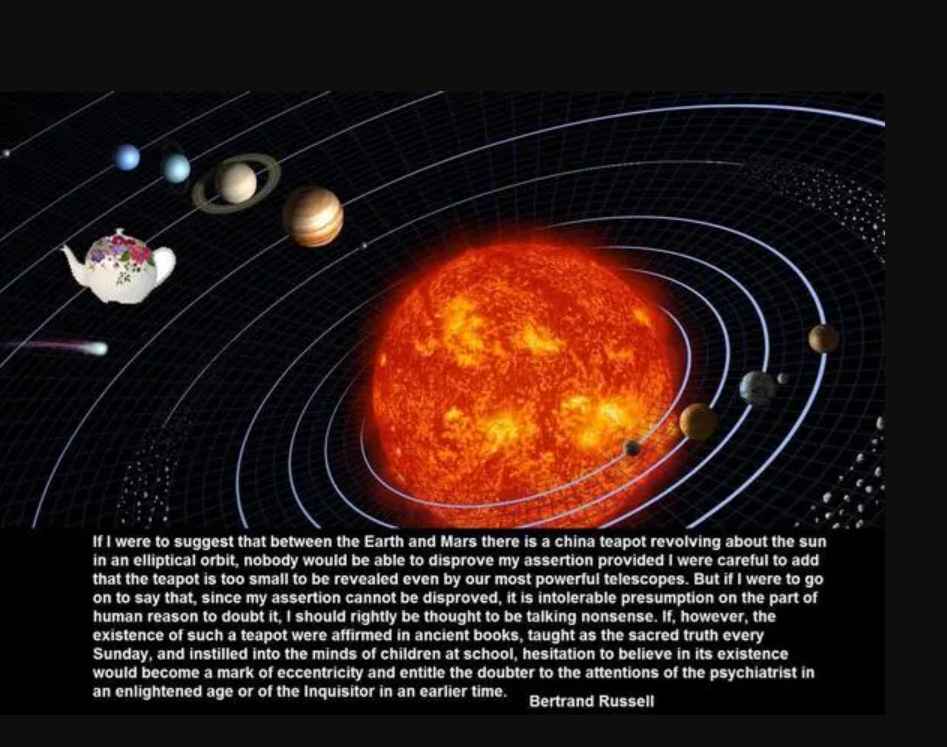
Postscript:  For an explanation why CO2 has negligible effect on thermal properties of the atmosphere, and why all W/m2 are not created equal, see: Light Bulbs Disprove Global Warming

N. Atlantic Weak August 2019 Pulse

RAPID Array measuring North Atlantic SSTs.

For the last few years, observers have been speculating about when the North Atlantic will start the next phase shift from warm to cold. Given the way 2018 went and 2019 is following, this may be the onset.  First some background.

. Source: Energy and Education Canada

An example is this report in May 2015 The Atlantic is entering a cool phase that will change the world’s weather by Gerald McCarthy and Evan Haigh of the RAPID Atlantic monitoring project. Excerpts in italics with my bolds.

This is known as the Atlantic Multidecadal Oscillation (AMO), and the transition between its positive and negative phases can be very rapid. For example, Atlantic temperatures declined by 0.1ºC per decade from the 1940s to the 1970s. By comparison, global surface warming is estimated at 0.5ºC per century – a rate twice as slow.

In many parts of the world, the AMO has been linked with decade-long temperature and rainfall trends. Certainly – and perhaps obviously – the mean temperature of islands downwind of the Atlantic such as Britain and Ireland show almost exactly the same temperature fluctuations as the AMO.

Atlantic oscillations are associated with the frequency of hurricanes and droughts. When the AMO is in the warm phase, there are more hurricanes in the Atlantic and droughts in the US Midwest tend to be more frequent and prolonged. In the Pacific Northwest, a positive AMO leads to more rainfall.

A negative AMO (cooler ocean) is associated with reduced rainfall in the vulnerable Sahel region of Africa. The prolonged negative AMO was associated with the infamous Ethiopian famine in the mid-1980s. In the UK it tends to mean reduced summer rainfall – the mythical “barbeque summer”.Our results show that ocean circulation responds to the first mode of Atlantic atmospheric forcing, the North Atlantic Oscillation, through circulation changes between the subtropical and subpolar gyres – the intergyre region. This a major influence on the wind patterns and the heat transferred between the atmosphere and ocean.

The observations that we do have of the Atlantic overturning circulation over the past ten years show that it is declining. As a result, we expect the AMO is moving to a negative (colder surface waters) phase. This is consistent with observations of temperature in the North Atlantic.

Cold “blobs” in North Atlantic have been reported, but they are usually winter phenomena. For example in April 2016, the sst anomalies looked like this

But by September, the picture changed to this

And we know from Kaplan AMO dataset, that 2016 summer SSTs were right up there with 1998 and 2010 as the highest recorded.

As the graph above suggests, this body of water is also important for tropical cyclones, since warmer water provides more energy.  But those are annual averages, and I am interested in the summer pulses of warm water into the Arctic. As I have noted in my monthly HadSST3 reports, most summers since 2003 there have been warm pulses in the north atlantic.

The AMO Index is from from Kaplan SST v2, the unaltered and not detrended dataset. By definition, the data are monthly average SSTs interpolated to a 5×5 grid over the North Atlantic basically 0 to 70N.  The graph shows the warmest month August beginning to rise after 1993 up to 1998, with a series of matching years since.  December 2016 set a record at 20.6C, but note the plunge down to 20.2C for  December 2018, matching 2011 as the coldest years  since 2000.  August 2019 is a weaker pulse matching 2017, lower than other peak years.  Because McCarthy refers to hints of cooling to come in the N. Atlantic, let’s take a closer look at some AMO years in the last 2 decades.

This graph shows monthly AMO temps for some important years. The Peak years were 1998, 2010 and 2016, with the latter emphasized as the most recent. The other years show lesser warming, with 2007 emphasized as the coolest in the last 20 years. Note the red 2018 line was at the bottom of all these tracks.  The short black line shows that 2019 began slightly cooler than January 2018, then tracked closely before rising in the last 3 months, though still lower than the peak years.

amo annual122018

Land and Sea Temps Keep Cool in August

banner-blog

With apologies to Paul Revere, this post is on the lookout for cooler weather with an eye on both the Land and the Sea.  UAH has updated their tlt (temperatures in lower troposphere) dataset for August.  Previously I have done posts on their reading of ocean air temps as a prelude to updated records from HADSST3. This month also has a separate graph of land air temps because the comparisons and contrasts are interesting as we contemplate possible cooling in coming months and years.

Presently sea surface temperatures (SST) are the best available indicator of heat content gained or lost from earth’s climate system.  Enthalpy is the thermodynamic term for total heat content in a system, and humidity differences in air parcels affect enthalpy.  Measuring water temperature directly avoids distorted impressions from air measurements.  In addition, ocean covers 71% of the planet surface and thus dominates surface temperature estimates.  Eventually we will likely have reliable means of recording water temperatures at depth.

Recently, Dr. Ole Humlum reported from his research that air temperatures lag 2-3 months behind changes in SST.  He also observed that changes in CO2 atmospheric concentrations lag behind SST by 11-12 months.  This latter point is addressed in a previous post Who to Blame for Rising CO2?

After a technical enhancement to HadSST3 delayed March and April updates, May was posted early in June, hopefully a signal the future months will also appear more promptly.  For comparison we can look at lower troposphere temperatures (TLT) from UAHv6 which are now posted for August. The temperature record is derived from microwave sounding units (MSU) on board satellites like the one pictured above. Recently there was a change in UAH processing of satellite drift corrections, including dropping one platform which can no longer be corrected. The graphs below are taken from the new and current dataset.

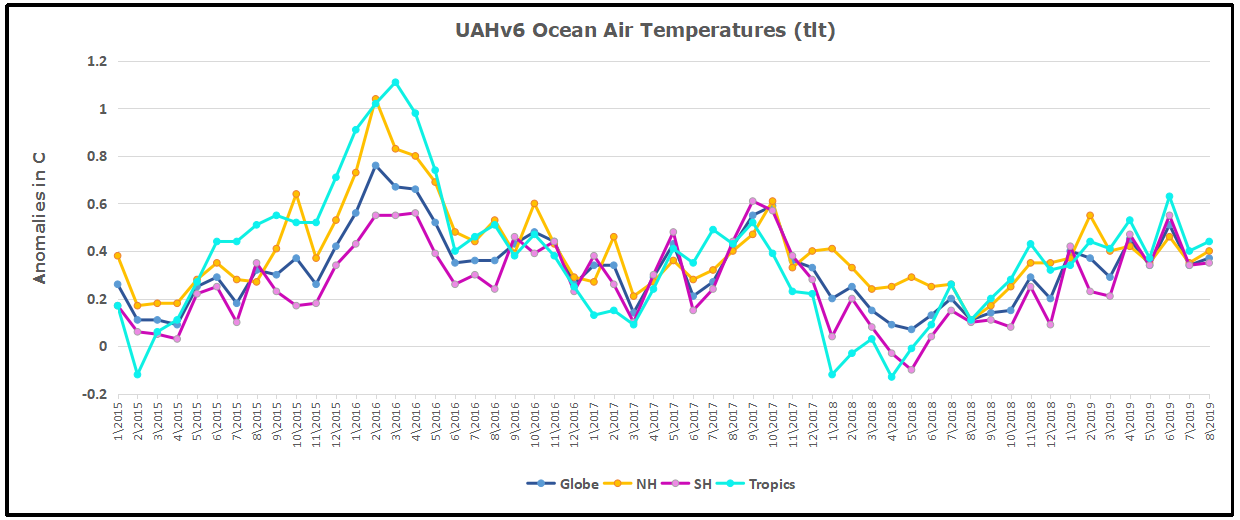
The UAH dataset includes temperature results for air above the oceans, and thus should be most comparable to the SSTs. There is the additional feature that ocean air temps avoid Urban Heat Islands (UHI).  The graph below shows monthly anomalies for ocean temps since January 2015.

June ocean air temps rose in all regions after May’s drop, resulting in the Global average back up matching June 2017.  All regions dropped back down to May levels in July and are little changed in August.  The temps this August are warmer than 2018 but cooler than earlier years, and also more synchronized across regions.

Land Air Temperatures Tracking Downward in Seesaw Pattern

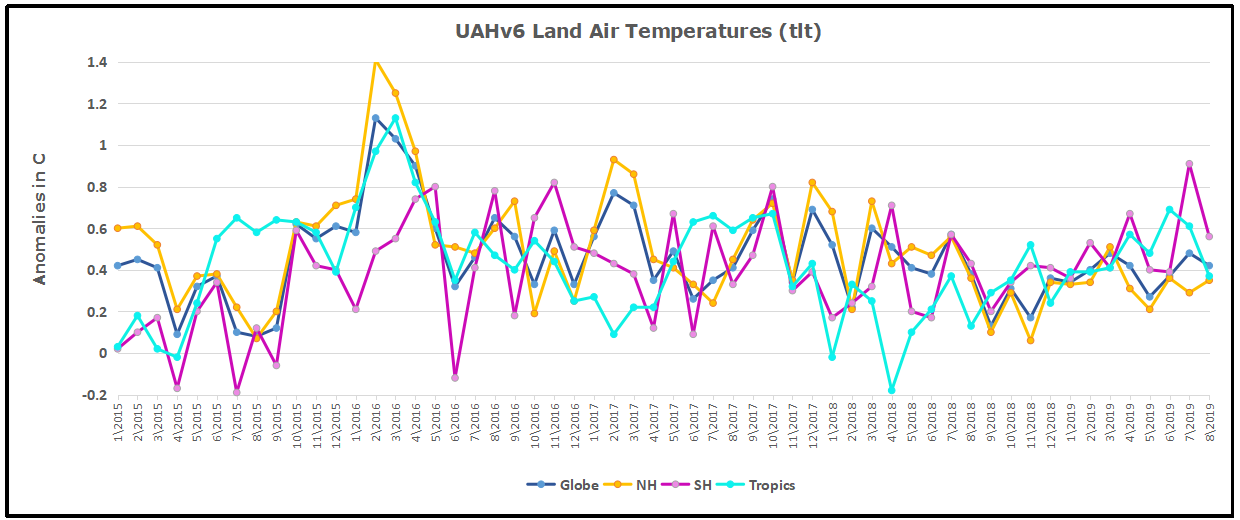
We sometimes overlook that in climate temperature records, while the oceans are measured directly with SSTs, land temps are measured only indirectly.  The land temperature records at surface stations record air temps at 2 meters above ground.  UAH gives tlt anomalies for air over land separately from ocean air temps.  The graph updated for August is below.

Here we have freash evidence of the greater volatility of the Land temperatures, along with an extraordincary departure by SH land.  Despite the small amount of SH land, it dropped so sharply along with the Tropics that it pulled the global average downward against slight warming in NH.  The overall pattern shows global land temps tend to follow NH temps.  Note how much lower are NH land temps now compared to peaks over previous years.

The longer term picture from UAH is a return to the mean for the period starting with 1995:

TLTs include mixing above the oceans and probably some influence from nearby more volatile land temps.  Clearly NH and Global land temps have been dropping in a seesaw pattern, now more than 1C lower than the peak in 2016.  TLT measures started the recent cooling later than SSTs from HadSST3, but are now showing the same pattern.  It seems obvious that despite the three El Ninos, their warming has not persisted, and without them it would probably have cooled since 1995.  Of course, the future has not yet been written.

Why Climate Journalism Sucks

At MondayNote, Frederic Filloux writes The Hazards of Covering Climate Change.  Without taking sides he describes why media coverage of global warming/climate change is so incompetent.  Excerpts in italics with my bolds.

Zeal, political agendas, all kinds of excesses, but above all the intrinsic complexity of the issue, make the climate crisis extremely challenging to cover. Newsrooms should tackle the problem decisively.

Spending a few weeks in California this summer, I talked to many fellow journalists about the issue of covering the climate crisis. What I found is a yawning gap in the way it is approached.

In broad strokes, the coverage of climate change in Europe — especially in France — is loaded with negativism and finger-pointing while the US conversation seems more focused on finding broad, tech-driven, solutions. Neither is exempt from caricatures.

European ecology yields a political agenda which questions the relevance of the free market economy in a way that reminds of the Marxism activism in the ’70s. To many eco-activists, responding to the climate crisis requires a Malthusian approach, with all sorts of constraints on the way we travel, commute, eat, and consume that will involve some curtailing of individual liberties (as a French socialist leader put it a few weeks ago).

The buzzword is now “degrowth”. Economic contraction is the only way, never mind the collateral damages. Europe has its icons like Greta Thunberg, the young Swedish activist who preaches her doomsday prophecy with more whimsy than facts or knowledge.

The current ideological hodgepodge does not foster nuances: you are either with or against. For instance, questioning the media circus around the Swedish girl, and denouncing the cynicism of her handlers who uses her autism as a marketing tool, even if you agree with her on the fundamentals, will leave you categorized as part of the white, privileged, sexist dominant caste climate deniers.

Suggesting that French president Macron’s move to give up research on fourth-generation nuclear energy is a terrible decision (The French nuclear program allows France to emit only one-tenth of Germany’s CO2 per kWh of electricity), will also put you in the “climate-negationists” league, an elegant term alluding to Holocaust deniers.

On the matter of nuclear energy, the French press is doing such a terrible job that 86 percent of the 18–24 years old believe that the cooling towers of a nuclear plant spit out CO2 (it’s vapor).

As an American fellow journalist told me last week, “Europe succumbs to a kind of withdrawal while the United States is looking for tech solutions”. The fact is, by and large, the coverage of the climate crisis in the American media, is more proactive and less whining than the one in Europe, despite Donald Trump’s compulsive anti-environment stance. The tech and business press always seem eager to report on breakthroughs that could contain the crisis. As I observed in Silicon Valley last month, an unprecedented number of startups are working in the field. They range from optimizing the global food supply-chain to developing ways to save water (while just 130 miles south of San Francisco farmers continue to irrigate in the worse possible way) to make buildings greener. Venture capital investors are injecting billions of dollars in Greentech. While many European ecologists blame capitalism for the degradation of the planet (ignoring that the worse polluters are still in the former USSR and in China), entrepreneurship is in full swing in the United States, even if it sometimes comes with a dose of naïveté and unrealistic expectations.

Let’s get back to journalism.

By and large, newsrooms are not currently up to the task. Despite highly publicized initiatives taken by large publishers and noteworthy initiatives such as the #CoveringClimateNow partnership, the bulk of the coverage is terrible.

For the most part, it oscillates between an ideological stance and an irrational exuberance for technological promises. Approximation and caricature are rampant. Periodically, haste leads to false information that is quickly exploited by true climate deniers.

When covering the climate crisis, mistakes carry way more consequences than for any other beat.

The complexity of the subject makes it incompatible with the brevity of social media. Elizabeth Kolbert’s seminal piece in the New Yorker, The Sixth Extinction, published in 2009, could not have been chopped down into a tweetstorm. Reporters should be encouraged to embrace complexity. Unfortunately, they don’t have the time nor the training. That is also the consequences of newsrooms trends that often considered science journalism as a genre mineur

It is time for decisive actions. Given what’s at stake, J-schools must create specific curriculum aimed at feeding much-needed news desks that are currently non-existent in most newsrooms. Addressing the issue requires a multidisciplinary approach: rethinking the relation to cities, transportation, public policies, macro-economy, and innovation. If specific expertise is needed in newsrooms, it is definitely to cover this beat (plus, it can be a highly beneficial sector: the first outlet to become a reference in the field will reap substantial profits).


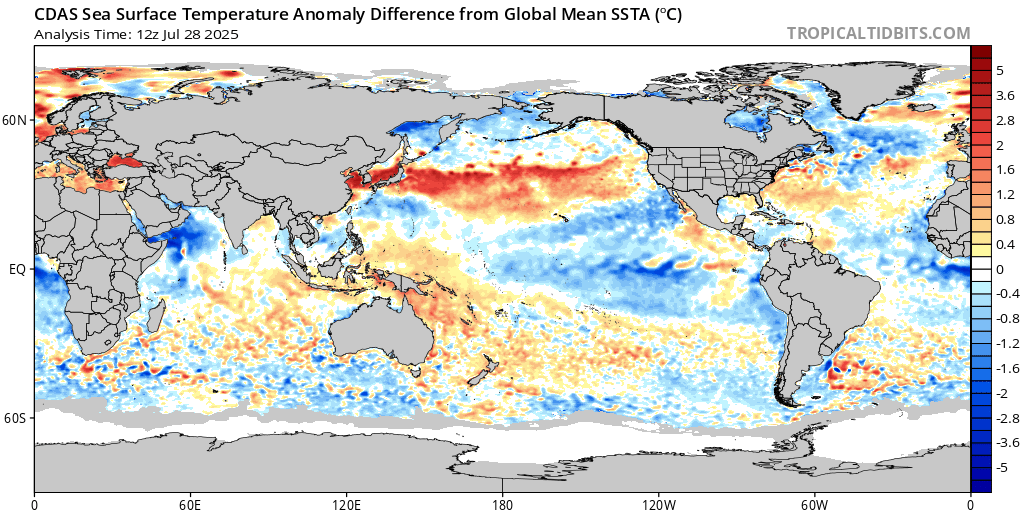
El Nino’s Cold Tongue Baffles Climate Models


This post is prompted by an article published by Richard Seager et al. at AMS Journal Is There a Role for Human-Induced Climate Change in the Precipitation Decline that Drove the California Drought? Excerpts in italics with my bolds.

Overview

The recent California drought was associated with a persistent ridge at the west coast of North America that has been associated with, in part, forcing from warm SST anomalies in the tropical west Pacific. Here it is considered whether there is a role for human-induced climate change in favoring such a west coast ridge. The models from phase 5 of the Coupled Model Intercomparison Project do not support such a case either in terms of a shift in the mean circulation or in variance that would favor increased intensity or frequency of ridges. The models also do not support shifts toward a drier mean climate or more frequent or intense dry winters or to tropical SST states that would favor west coast ridges. However, reanalyses do show that over the last century there has been a trend toward circulation anomalies over the Pacific–North American domain akin to those during the height of the California drought.

Position of the Warm Pool in the western Pacific under La Niña conditions, and the convergence zone where the Warm Pool meets nutrient-enriched waters of the eastern equatorial Pacific. Tuna and their prey are most abundant in this convergence zone 21,48 (source: HadISST) 109 .

First we plot together the history of California winter precipitation and Arctic sea ice anomaly in terms of area covered by ice at the annual minimum month of September and also as the November through April winter average (Fig. 9, top). While all three are of course negative during the drought years there is no year to year relationship between these quantities. Next we composite 200-mb height anomalies, U.S. precipitation, and sea ice concentration for, during the period covered by sea ice data, the driest 15% of California winters and subtract the climatological winter values (Fig. 9, bottom). As in Seager et al. (2015), the composites show that when California is dry the entire western third of the United States tends to be dry and that there is a high pressure ridge located immediately off the west coast, which does not appear to be connected to a tropically sourced wave train. There also tends to be a trough over the North Atlantic, similar to winter 2013/14. There are notable localized sea ice concentration anomalies with increased ice in the Sea of Okohtsk, reduced ice in the Bering Sea, and increased ice in Hudson Bay and Labrador Sea, though the anomalies are small. These ice anomalies are consistent with atmospheric forcing. The Sea of Okhotsk and Hudson Bay/Labrador Sea anomalies appear under northerly flow that would favor cold advection and increased ice. The Bering Sea anomaly appears under easterly flow that would drive ice offshore. As shown by Seager et al. (2015), the dry California winters are also associated with North Pacific SST anomalies forced by the atmospheric wave train and the sea ice anomalies appear part of this feature rather than as causal drivers of the atmospheric circulation anomalies.

These analyses do not support the idea that variations in sea ice extent influence the prevalence of west coast ridges or dry winters in California.

Source: NASA

On the basis of the above analysis we conclude that the occurrence of persistent ridges at the west coast is more connected to SST anomalies than it is to sea ice anomalies. The CMIP5 model ensemble lends no support to the idea that ridge-inducing SST patterns become more likely as a result of rising GHGs. However, the models could be wrong so we next examine whether trends in observed SSTs lend any support to this idea. Trends were computed by straightforward linear least squares regression.

A number of features stand out in these trends regardless of the time period used.

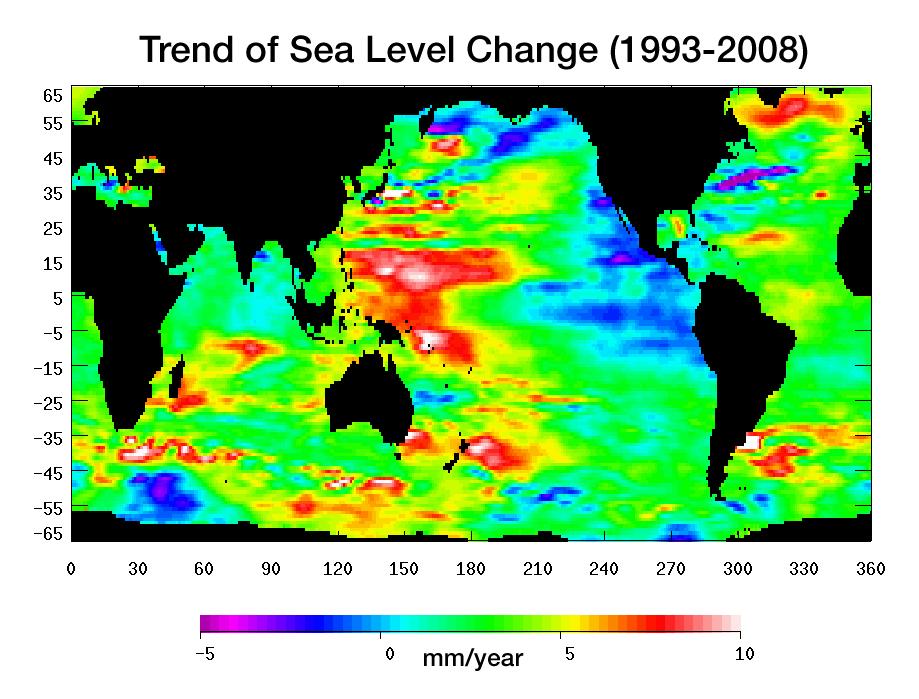
  • Amid near-ubiquitous warming of the oceans the central equatorial Pacific stands out as a place that has not warmed.
  • The west–east SST gradient across the tropical Pacific has strengthened as the west Pacific has warmed.
  • Increased reanalysis precipitation over the Indian Ocean–Maritime Continent–tropical west Pacific and reduced reanalysis precipitation over the central equatorial Pacific Ocean were found.
  • Tropical geopotential heights have increased at all longitudes.
  • A trend toward a localized high pressure ridge extending from the subtropics toward Alaska across western North America.

These associations in the trends—a strengthened west–east SST gradient across the tropical Pacific and localized high pressure at the North American west coast—are in line with every piece of evidence based on observations and SST-forced models presented so far that there is a connection between drought-inducing circulation anomalies and tropical Pacific SSTs. The mediating influence is seen in the precipitation trends that show enhanced zonal gradients of tropical Indo-Pacific precipitation and a marked increase centered over the Maritime Continent region.

Conclusions and discussion

We have examined whether there is any evidence, observational and/or model based, that the precipitation decline that drove the California drought was contributed to by human-driven climate change. Findings are as follows:

  • The CMIP5 model ensemble provides no evidence for mean drying or increased prevalence of dry winters for California or a shift toward a west coast ridge either in the mean or as a more common event. They also provide no evidence of a shift in tropical SSTs toward a state with an increased west–east SST gradient that has been invoked as capable of forcing a west coast ridge and drought.
  • Analysis of observations-based reanalyses shows that west coast ridges, akin to that in winter 2013/14, are related to an increased west–east SST gradient across the tropical Pacific Ocean and have repeatedly occurred over past decades though as imperfect analogs.
  • SST-forced models can reproduce such ridges and their connection to tropical SST anomalies.  Century-plus-long reanalyses and SST-forced models indicate a long-term trend toward circulation anomalies more akin to that of winter 2013/14.
  • The trends of heights and SSTs in the reanalyses also show both an increased west–east SST gradient and a 200-mb ridge over western North America that, in terms of association between ocean and atmospheric circulation, matches those found via the other analyses on interannual time scales.
  • However, SST-forced models when provided the trends in SSTs create a 200-mb ridge over the central North Pacific and, in general, a circulation pattern that cannot be said to truly match that in reanalyses.

So can a case be made that human-driven climate change contributed to the precipitation drop that drives the drought? Not from the simulations of historical climate and projections of future climate of the CMIP5 multimodel ensemble.

These simulations show no current or future increase in the likelihood or extremity of negative precipitation, precipitation minus evaporation, west coast ridges, or ridge-forcing tropical SST patterns. However, when examining the observational record a case can be made that the climate system has been moving in a direction that favors both a ridge over the west coast, which has a limited similarity to that observed in winter 2013/14, the driest winter of the drought, and a ridge-generating pattern of increased west–east SST gradient across the tropical Pacific Ocean with warm SSTs in the Indo–west Pacific region. This observations-based argument then gets tripped up by SST-forced models, which know about the trends in SST but fail to simulate a trend toward a west coast ridge. On the other hand, idealized modeling indicates that preferential warming in the Indo–west Pacific region does generate a west coast ridge.

To make the argument we outline above requires rejecting the CMIP5 ensemble as a guide to how tropical climate responds to increased radiative forcing since this tropical ocean response is at odds with what they do. To do so follows in the footsteps of Kohyama and Hartmann (2017, p. 4248), who correctly point out that “El Niño–like mean-state warming is only a ‘majority decision’ based on currently available GCMs, most of which exhibit unrealistic nonlinearity of the ENSO dynamics” (see also Kohyama et al. 2017). The implications of changing tropical SST gradients would extend far beyond just California and include most regions of the world sensitive to ENSO-generated climate anomalies.

We believe that the current state of observational information, analysis of it, and climate modeling does not allow a confident rejection of the CMIP5 model responses and/or a confident assertion of human role in the precipitation drop of the California drought. We also believe that for the same reasons a human role cannot be excluded.

Comment:

The researchers set out to prove man-made global warming contributes to droughts in California, but their findings put them in a quandry.  The models include CO2 forcings, yet do not predict the conditions resulting in west coast droughts,   They have to admit the models are wrong in this respect (what else do the models get wrong?).  They cling to the hope that global warming can be tied to droughts, but have to admit there is no evidence from the failed models.

Postscript:

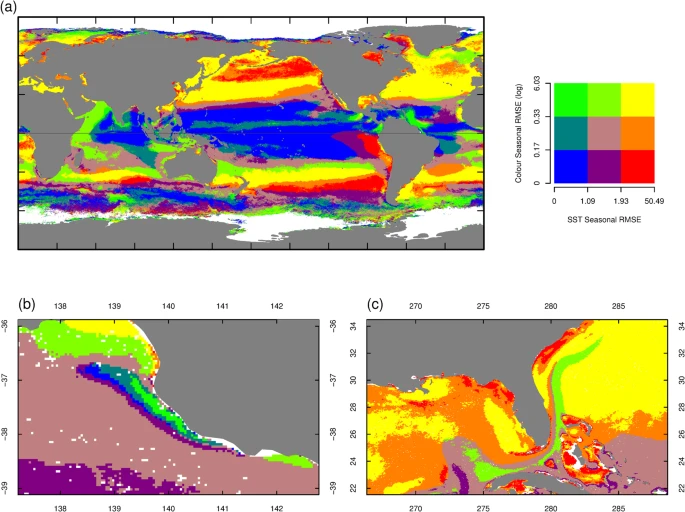
(a) Annual variation (Annual RMSE) of SST and Chl-a globally (units are °C/decade for SST and log(mg/m3/decade) for Chl-a). (b) The pattern of annual variation in the Bonney Upwelling, Southern Australia. (c) The pattern of annual variation in the the Florida Current, South East USA.


A separate study is Global patterns of change and variation in sea surface temperature and chlorophyll by Piers K. Dunstan et. al.

The blue tongue shows up as an equatorial pacific region that shows little variability over the 14 year period of study.  From the article:

The interaction between annual variation in SST and Chl-a provides insights into how and where linkages occur on annual time scales. Our analysis shows strong latitudinal bands associated with variation in seasonal warming (Fig. 4a). The equatorial Pacific, Indian and Atlantic Oceans are all characterised by very low annual RMSE for both SST and Chl-a. The mid latitudes of each ocean basin have higher variance in SST and/or Chl-a.