Climate Compilation Part I Temperatures

Background

When first investigating the global warming/climate change issue (beginning around the Copenhagen COP in 2008), my interest arose from reading various claims repeated ad nauseum without any other viewpoints expressed. Searching on the web revealed that indeed other researchers had different, sometimes nuanced and sometime outright contradictory findings.

In 2015 while signing up on WordPress to be able to comment on Climate Etc., I was surprised to find that the process left me with my own blogsite. So I began to put up posts of researches I had done, some were data analyses of my own, and others were discussions of analyses done by others. It has always been a niche project intending to provide information and a broader context related to climate science claims, for the sake of others who might be interested but lacked the time or energy to dig in the weeds for the all-important details.

Lately we have a sea change in the discourse around global warming/climate change. The Paris accord and the subsequent US withdrawal from it, along with the tumult around Trump’s presidency, Brexit, the broken electricity grid in Australia, have all shifted the focus from scientific discrepancies to policy questions.

It pleases me that in this current media setting, diverse and skeptical voices are more easily heard by those with inquiring minds who want to know. For example, Master Resource blog provides expert analyses on energy issues such as subsidies and renewables challenges. Other well-known blogs such as WUWT and Notalotofpeopleknowthat are actively addressing exaggerations and bogus claims by activists.

It also looks more likely that we will be treated to an official investigation into the EPA case for CO2 endangerment. Some studies by prominent skeptics are appearing as resources in that context.

So, there are many others rebutting unfounded claims, and less need for me to write such posts. It is also the case that this blog already contains multiple posts on almost all the issues that continue to be raised. This is the first of a series pointing out resources compiled here.

1.Temperature Trend Analysis

This category of posts (title above is link to posts) started some years ago when Dave from California commented on a thread at WUWT:  “I am an actuary not a climate scientist, but it seems to me if you want to know about temperature changes, you should study the changes not the temperatures.”  That rang my bell and suddenly things came together. JR Wakefield studied the change derivatives (slopes) of temperature changes at individual weather stations in Ontario. Lubos Motl did a similar analysis using monthly trends over station lifetimes as a basis for compiling global trends–no anomalies, no adjustments or homogenization.

I termed this technique Temperature Trend Analysis (TTA) and applied it to a set of station records in Kansas and the report was published at WUWT in 2014 with the title Do-It-Yourself Climate Analysis

Richard Mallet and I then collaborated on a study of the 25 best stations in the world (longest continuous records) also published at WUWT as Analyzing Temperature Changes Using World Class Stations. Later on I applied TTA to US stations classified as CRN #1 and then assessed the differences between adjusted and unadjusted datasets. The results were published at No Tricks Zone and then posted as Temperature Data Review Project-My Submission.

Just this week we have a thorough and professional report on the systematic corruption of the land station records by climate authorities:  On the Validity of NOAA, NASA and Hadley CRU Global Average Surface Temperature Data & The Validity of EPA’s CO2 Endangerment Finding  From the Report:

This research sought to validate the current estimates of Global Average Surface Temperature (GAST) using the best available relevant data. The conclusive findings were that the three GAST data sets are not a valid representation of reality. In fact, the magnitude of their historical data adjustments which removed their cyclical temperature patterns are totally inconsistent with published and credible U.S. and other temperature data.  Thus, despite current claims of record setting warming, it is impossible to conclude from the NOAA, NASA and Hadley CRU GAST data sets that recent years have been the warmest ever.

Additional studies included an analysis of Temperatures According to Climate Models

One post provided a visual synopsis why global warming claims are not supported by temperature records. See The Climate Story (Illustrated)

Climate Roller Coaster

Behemoth, Canada’s Wonderland, Ontario   Behemoth’s bright yellow-and-blue steel stands out against the Ontario landscape. At one point the roller coaster, which opened in 2008, drops 230 feet at a 75-degree angle and hits speeds of 77 mph. Its open-air seating gives every rider a front seat to the action.

Roller coasters came to mind when reading recent studies addressing the global warming hiatus this century. For example: The global warming hiatus – a natural product of interactions of a secular warming trend and a multi-decadal variability by Shuai-Lei Yao, Gang Huang, Ren-Guang and WuXia Qu.

Abstract:

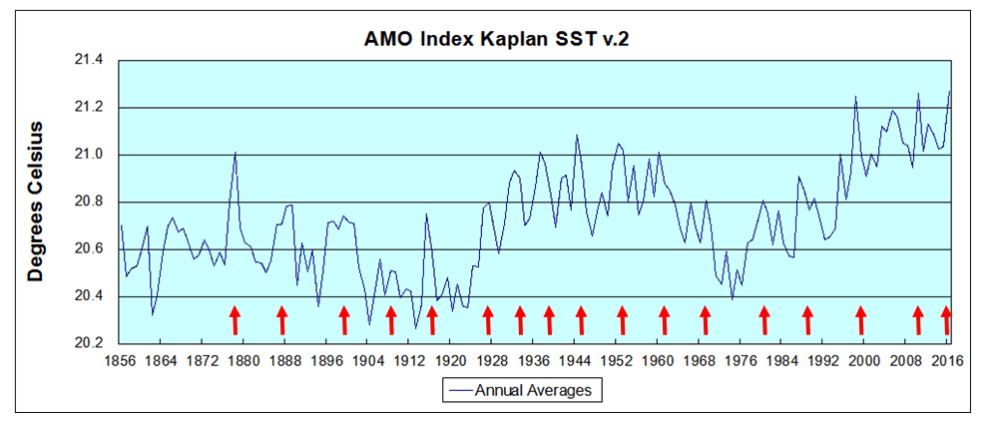
The globally-averaged annual combined land and ocean surface temperature (GST) anomaly change features a slowdown in the rate of global warming in the mid-twentieth century and the beginning of the twenty-first century. Here, it is shown that the hiatus in the rate of global warming typically occurs when the internally generated cooling associated with the cool phase of the multi-decadal variability overcomes the secular warming from human-induced forcing.

We provide compelling evidence that the global warming hiatus is a natural product of the interplays between a secular warming tendency due in a large part to the buildup of anthropogenic greenhouse gas concentrations, in particular CO2 concentration, and internally generated cooling by a cool phase of a quasi-60-year oscillatory variability that is closely associated with the Atlantic multi-decadal oscillation (AMO) and the Pacific decadal oscillation (PDO). We further illuminate that the AMO can be considered as a useful indicator and the PDO can be implicated as a harbinger of variations in global annual average surface temperature on multi-decadal timescales.

Our results suggest that the recent observed hiatus in the rate of global warming will very likely extend for several more years due to the cooling phase of the quasi-60-year oscillatory variability superimposed on the secular warming trend.

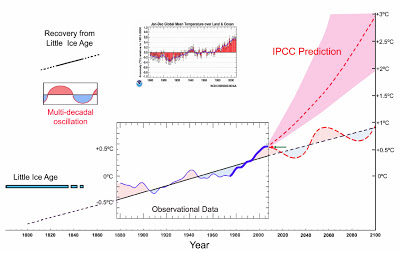
CO2 sceptics have proposed similar explanations for the global temperature pattern, but were ignored heretofore. For example Syun-Ichi Akasofu,
Two Natural Components of the Recent Climate Change:
(1) The Recovery from the Little Ice Age  (A Possible Cause of Global Warming) and
(2) The Multi-decadal Oscillation  (The Recent Halting of the Warming):

Note that the hypothesis is virtually the same, except for the leap of faith to attribute the secular background rise to CO2, rather than to a steady recovery from the Little Ice Age (LIA).  Finally climate modelers are admitting that natural variability is strong enough to offset warming from any other means.  And by extension the rise in temperatures late last century was due in large measure to a warming natural phase.

(Aside: “Secular” has two main meanings:
a : of or relating to the worldly or temporal secular concerns, not overtly or specifically religious
b : of or relating to a long term of indefinite duration, existing or continuing through ages or centuries
How ironic that some climate scientists use the term “secular” while applying a faith-based attribution.)

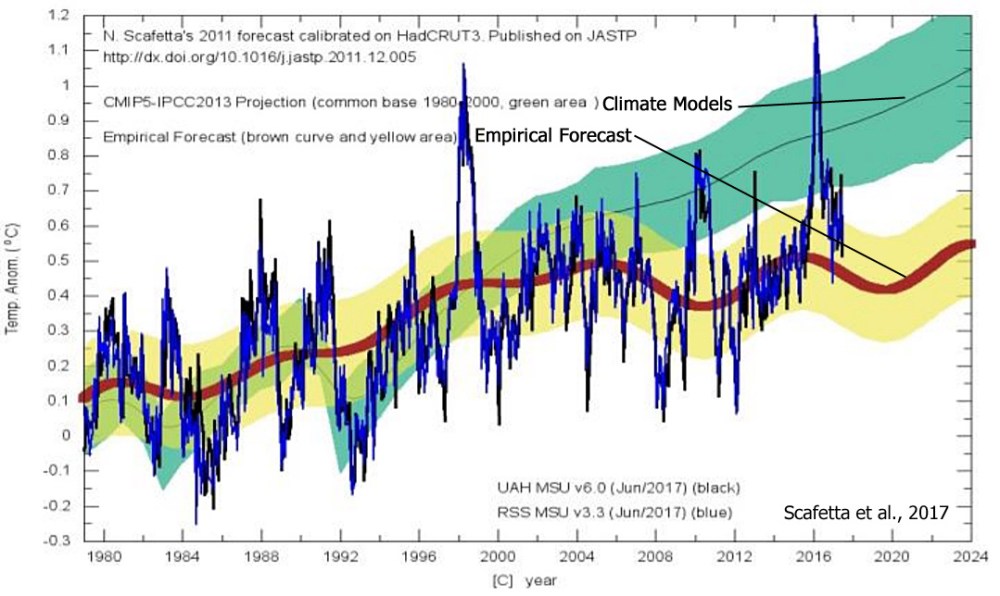
Nicola Scafetta is another scientist asserting a solar-lunar cyclical climate pattern based on oscillations within the solar system. More at Scaffetta vs. IPCC: Dueling Climate Theories

cooling-vs-warming-forecasts-scafetta-2017

The Thrill of Riding the Climate Roller Coaster

The original amusement park roller coasters had a single ratcheting up an incline to the top, with gravity pulling the train down to the bottom through a series of curving sine wave peaks and valleys. Newer rides like the one at Wonderland have more than one ratcheting upward to start a new decline. A recent paper explains how this additional excitement operates in our climate system.

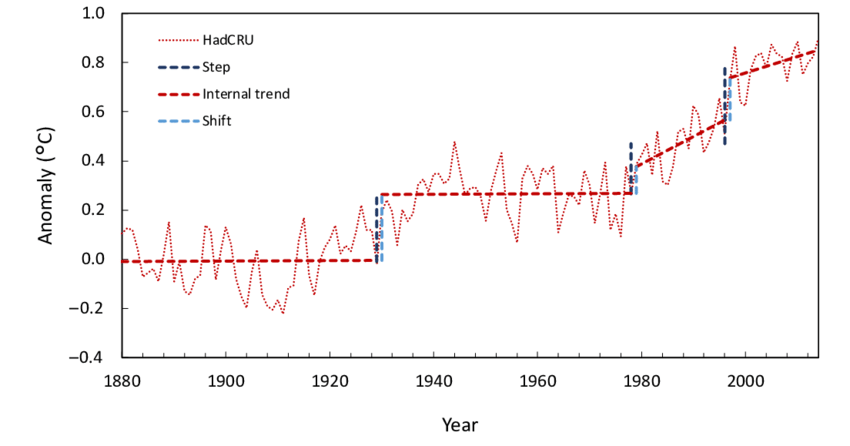
Reconciling the signal and noise of atmospheric warming on decadal timescales by Roger N. Jones and James H. Ricketts Victoria University, Melbourne, Australia was published March 16, 2017 in Earth System Dynamics. From the abstract:

Interactions between externally forced and internally generated climate variations on decadal timescales is a major determinant of changing climate risk. Severe testing is applied to observed global and regional surface and satellite temperatures and modelled surface temperatures to determine whether these interactions are independent, as in the traditional signal-to-noise model, or whether they interact, resulting in step-like warming. The multistep bivariate test is used to detect step changes in temperature data. The resulting data are then subject to six tests designed to distinguish between the two statistical hypotheses, hstep and htrend.

record-of-mean-annual-surface-temperature-anomalies-1880-2014-from-the-hadley-centre-and

Figure 1. Record of mean annual surface temperature anomalies 1880–2014 from the Hadley Centre and Climate Research Unit (HadCRU), showing step changes (p < 0.01) and internal trends and shifts taken from the end of one internal trend to the start of the next across a step.

Test 1: since the mid-20th century, most observed warming has taken place in four events: in 1979/80 and 1997/98 at the global scale, 1988/89 in the Northern Hemisphere and 1968–70 in the Southern Hemisphere. Temperature is more step-like than trend-like on a regional basis. Satellite temperature is more step-like than surface temperature. Warming from internal trends is less than 40 % of the total for four of five global records tested (1880–2013/14).

Test 2: correlations between step-change frequency in observations and models (1880–2005) are 0.32 (CMIP3) and 0.34 (CMIP5). For the period 1950–2005, grouping selected events (1963/64, 1968–70, 1976/77, 1979/80, 1987/88 and 1996–98), the correlation increases to 0.78.

Test 3: steps and shifts (steps minus internal trends) from a 107-member climate model ensemble (2006–2095) explain total warming and equilibrium climate sensitivity better than internal trends.

Test 4: in three regions tested, the change between stationary and non-stationary temperatures is step-like and attributable to external forcing.

Test 5: step-like changes are also present in tide gauge observations, rainfall, ocean heat content and related variables.

Test 6: across a selection of tests, a simple stepladder model better represents the internal structures of warming than a simple trend, providing strong evidence that the climate system is exhibiting complex system behaviour on decadal timescales.

This model indicates that in situ warming of the atmosphere does not occur; instead, a store-and-release mechanism from the ocean to the atmosphere is proposed. It is physically plausible and theoretically sound. The presence of step-like – rather than gradual – warming is important information for characterising and managing future climate risk. (my bold)

Summary

The climate roller coaster is thrilling because we can’t see the track ahead for certain. Are we coming off a major peak and heading down into a deep valley? (Scafetta) Or is this a small dip before heading up again? (Yao et al.) Or are we hitting the top of the recovery from 1850 and starting into the next (hopefully little) ice age as signaled by the quiet sun (Akasofu, Abdussamatov)?

Daily sun June 27, 2017 with sunspot 2664.

See Also: Wave Drowns CO2 Warming

Climate Reductionism


Reductionists are those who take one theory or phenomenon to be reducible to some other theory or phenomenon. For example, a reductionist regarding mathematics might take any given mathematical theory to be reducible to logic or set theory. Or, a reductionist about biological entities like cells might take such entities to be reducible to collections of physico-chemical entities like atoms and molecules.
Definition from The Internet Encyclopedia of Philosophy

Some of you may have seen this recent article: Divided Colorado: A Sister And Brother Disagree On Climate Change

The reporter describes a familiar story to many of us.  A single skeptic (the brother) is holding out against his sister and rest of the family who accept global warming/climate change. And of course, after putting some of their interchanges into the text, the reporter then sides against the brother by taking the word of a climate expert. From the article:

“CO2 absorbs infrared heat in certain wavelengths and those measurements were made first time — published — when Abraham Lincoln was president of the United States,” says Scott Denning, a professor of atmospheric science at Colorado State University. “Since that time, those measurements have been repeated by better and better instruments around the world.”

CO2, or carbon dioxide, has increased over time, scientists say, because of human activity. It’s a greenhouse gas that’s contributing to global warming.

“We know precisely how the molecule wiggles and waggles, and what the quantum interactions between the electrons are that cause everyone one of these little absorption lines,” he says. “And there’s just no wiggle room around it — CO2 absorbs heat, heat warms things up, so adding CO2 to the atmosphere will warm the climate.”

Denning says that most of the CO2 we see added to the atmosphere comes from humans — mostly through burning coal, oil and gas, which, as he puts it, is “indirectly caused by us.”

When looking at the scientific community, Denning says it’s united, as far as he knows.
earth-science-climatic-change-Climate-System-3-114-g001

A Case Study of Climate Reductionism

Denning’s comments, supported by several presentations at his website demonstrate how some scientists (all those known to Denning) engage in a classic form of reductionism.

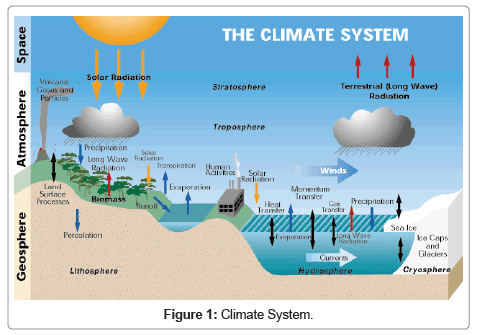
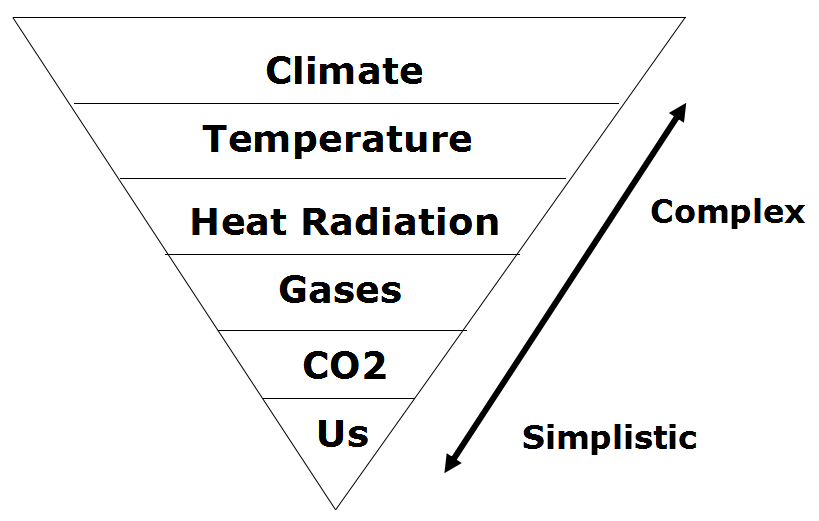
The full complexity of earth’s climate includes many processes, some poorly understood, but known to have effects orders of magnitude greater than the potential of CO2 warming. The case for global warming alarm rests on simplifying away everything but the predetermined notion that humans are warming the planet. It goes like this:
Our Complex Climate

Earth’s climate is probably the most complicated natural phenomenon ever studied. Not only are there many processes, but they also interact and influence each other over various timescales, causing lagged effects and multiple cycling. This diagram illustrates some of the climate elements and interactions between them.
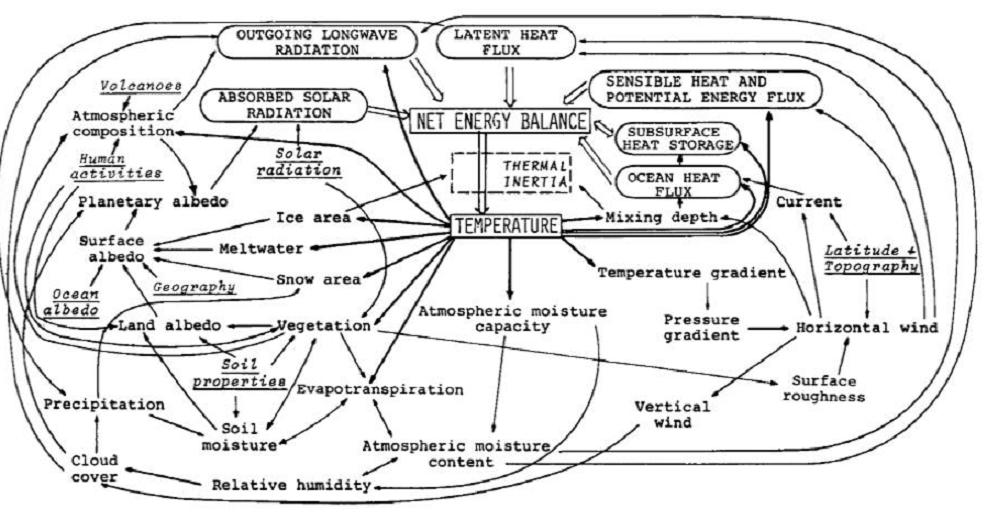
Flows and Feedbacks for Climate Models

The Many Climate Dimensions

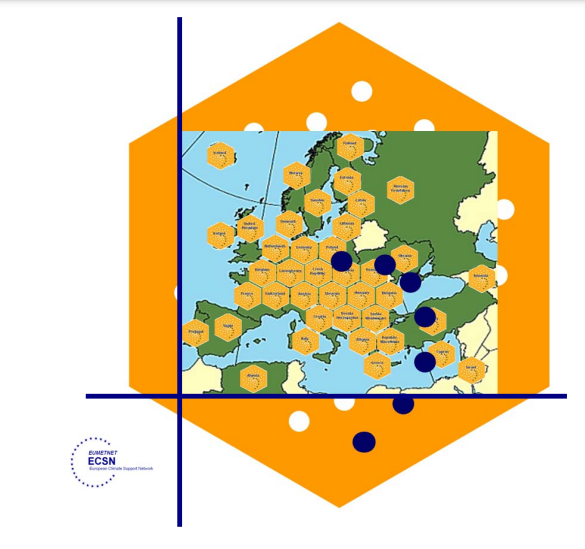
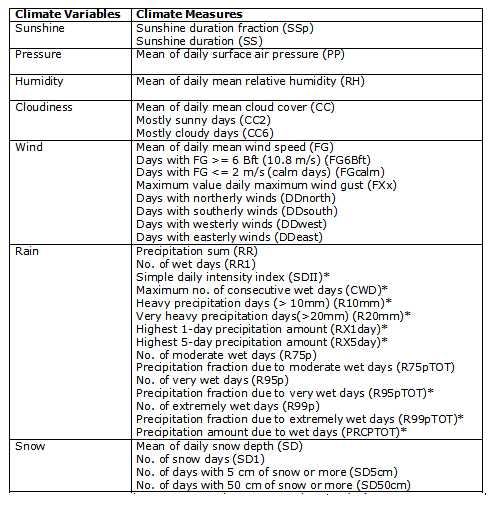
Further, measuring changes in the climate goes far beyond temperature as a metric. Global climate indices, like the European dataset include 12 climate dimensions with 74 tracking measures. The set of climate dimensions include:

  • Sunshine
  • Pressure
  • Humidity
  • Cloudiness
  • Wind
  • Rain
  • Snow
  • Drought
  • Temperature
  • Heat
  • Cold

And in addition there are compound measures combining temperature and precipitation. While temperature is important, climate is much more than that.  With this reduction, all other dimensions are swept aside, and climate change is simplified down to global warming as seen in temperature measurements.

Climate Thermodynamics: Weather is the Climate System at work.

Another distortion is the notion that weather is bad or good, depending on humans finding it favorable. In fact, all that we call weather are the ocean and atmosphere acting to resolve differences in temperatures, humidities and pressures. It is the natural result of a rotating, irregular planetary surface mostly covered with water and illuminated mostly at its equator.

The sun warms the surface, but the heat escapes very quickly by convection so the build-up of heat near the surface is limited. In an incompressible atmosphere, it would *all* escape, and you’d get no surface warming. But because air is compressible, and because gases warm up when they’re compressed and cool down when allowed to expand, air circulating vertically by convection will warm and cool at a certain rate due to the changing atmospheric pressure.

Climate science has been obsessed with only a part of the system, namely the atmosphere and radiation, in order to focus attention on the non-condensing IR active gases. The climate is framed as a 3D atmosphere above a 2D surface. That narrow scope leaves out the powerful non-radiative heat transfer mechanisms that dominate the lower troposphere, and the vast reservoir of thermal energy deep in the oceans.

As Dr. Robert E Stevenson writes, it could have been different:

“As an oceanographer, I’d been around the world, once or twice, and I was rather convinced that I knew the factors that influenced the Earth’s climate. The oceans, by virtue of their enormous density and heat-storage capacity, are the dominant influence on our climate. It is the heat budget and the energy that flows into and out of the oceans that basically determines the mean temperature of the global atmosphere. These interactions, plus evaporation, are quite capable of canceling the slight effect of man-produced CO2.”

The troposphere is dominated by powerful heat transfer mechanisms: conduction, convection and evaporation, as well as physical kinetic movements.  All this is ignored in order to focus on radiative heat transfer, a bit player except at the top of the atmosphere.

There’s More than the Atmosphere

Once the world of climate is greatly reduced down to radiation of infrared frequencies, yet another set of blinders is applied. The most important source of radiation is of course the sun. Solar radiation in the short wave (SW) range is what we see and what heats up the earth’s surface, particularly the oceans. In addition solar radiation includes infrared, some absorbed in the atmosphere and some at the surface. The ocean is also a major source of heat into the atmosphere since its thermal capacity is 1000 times what the air can hold. The heat transfer from ocean to air is both by way of evaporation (latent heat) and also by direct contact at the sea surface (conduction).

Yet conventional climate science dismisses the sun as a climate factor saying that its climate input is unvarying. That ignores significant fluctuations in parts of the light range, for example ultraviolet, and also solar effects such as magnetic fields and cosmic rays. Also disregarded is solar energy varying due to cloud fluctuations. The ocean is also dismissed as a source of climate change despite obvious ocean warming and cooling cycles ranging from weeks to centuries. The problem is such oscillations are not well understood or predictable, so can not be easily modeled.

With the sun and the earth’s surface and ocean dismissed, the only consideration left is the atmosphere.

The Gorilla Greenhouse Gas

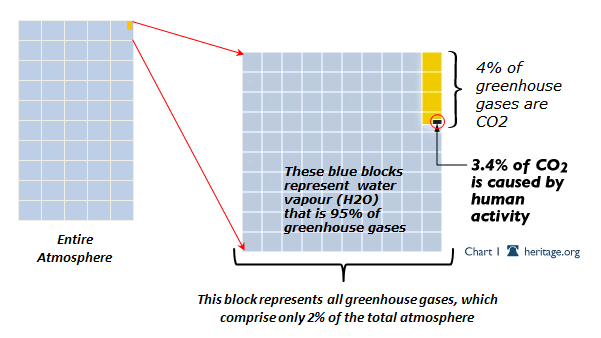
Thus climate has been reduced down to heat radiation passing through the atmosphere comprised of gases. One of the biggest reductions then comes from focusing on CO2 rather than H20. Of all the gases that are IR-active, water is the most prevalent and covers more of the spectrum.

The diagram below gives you the sense of proportion.
The Role of CO2

We come now to the role of CO2 in “trapping heat” and making the world warmer. The theory is that CO2 acts like a blanket by absorbing and re-radiating heat that would otherwise escape into space. By delaying the cooling while solar energy comes in constantly, CO2 is presumed to cause a buildup of heat resulting in warmer temperatures.

How the Atmosphere Processes Heat

There are 3 ways that heat (Infrared or IR radiation) passes from the surface to space.

1) A small amount of the radiation leaves directly, because all gases in our air are transparent to IR of 10-14 microns (sometimes called the “atmospheric window.” This pathway moves at the speed of light, so no delay of cooling occurs.

2) Some radiation is absorbed and re-emitted by IR active gases up to the tropopause. Calculations of the free mean path for CO2 show that energy passes from surface to tropopause in less than 5 milliseconds. This is almost speed of light, so delay is negligible. H2O is so variable across the globe that its total effects are not measurable. In arid places, like deserts, we see that CO2 by itself does not prevent the loss of the day’s heat after sundown.

3) The bulk gases of the atmosphere, O2 and N2, are warmed by conduction and convection from the surface. They also gain energy by collisions with IR active gases, some of that IR coming from the surface, and some absorbed directly from the sun. Latent heat from water is also added to the bulk gases. O2 and N2 are slow to shed this heat, and indeed must pass it back to IR active gases at the top of the troposphere for radiation into space.

In a parcel of air each molecule of CO2 is surrounded by 2500 other molecules, mostly O2 and N2. In the lower atmosphere, the air is dense and CO2 molecules energized by IR lose it to surrounding gases, slightly warming the entire parcel. Higher in the atmosphere, the air is thinner, and CO2 molecules can emit IR into space. Surrounding gases resupply CO2 with the energy it lost, which leads to further heat loss into space.

This third pathway has a significant delay of cooling, and is the reason for our mild surface temperature, averaging about 15C. Yes, earth’s atmosphere produces a buildup of heat at the surface. The bulk gases, O2 and N2, trap heat near the surface, while IR active gases, mainly H20 and CO2, provide the radiative cooling at the top of the atmosphere. Near the top of the atmosphere you will find the -18C temperature.

Sources of CO2
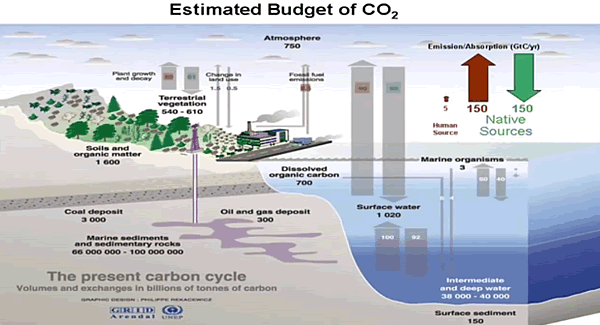
Note the size of the human emissions next to the red arrow.

A final reduction comes down to how much of the CO2 in the atmosphere is there because of us. Alarmists/activists say any increase in CO2 is 100% man-made, and would be more were it not for natural CO2 sinks, namely the ocean and biosphere. The claim overlooks the fact that those sinks are also sources of CO2 and the flux from the land and sea is an order of magnitude higher than estimates of human emissions. In fact, our few Gigatons of carbon are lost within the error range of estimating natural emissions. Insects produce far more CO2 than humans do by all our activity, including domestic animals.

Why Climate Reductionism is Dangerous

Reducing the climate in this fashion reaches its logical conclusion in the Activist notion of the “450 Scenario.”  Since Cancun, IPCC is asserting that global warming is capped at 2C by keeping CO2 concentration below 450 ppm. From Summary for Policymakers (SPM) AR5

Emissions scenarios leading to CO2-equivalent concentrations in 2100 of about 450 ppm or lower are likely to maintain warming below 2°C over the 21st century relative to pre-industrial levels. These scenarios are characterized by 40 to 70% global anthropogenic GHG emissions reductions by 2050 compared to 2010, and emissions levels near zero or below in 2100.

Thus is born the “450 Scenario” by which governments can be focused upon reducing human emissions without any reference to temperature measurements, which are troublesome and inconvenient. Almost everything in the climate world has been erased, and “Fighting Climate Change” is now code to mean accounting for fossil fuel emissions.

Conclusion

All propagandists begin with a kernel of truth, in this case the fact everything acting in the world has an effect on everything else. Edward Lorenz brought this insight to bear on the climate system in a ground breaking paper he presented in 1972 entitled: “Predictability: Does the Flap of a Butterfly’s Wings in Brazil Set Off a Tornado in Texas?”  Everything does matter and has an effect. Obviously humans impact on the climate in places where we build cities and dams, clear forests and operate farms. And obviously we add some CO2 when we burn fossil fuels.

But it is wrong to ignore the major dominant climate realities in order to exaggerate a small peripheral factor for the sake of an agenda. It is wrong to claim that IR active gases somehow “trap” heat in the air when they immediately emit any energy absorbed, if not already lost colliding with another molecule. No, it is the bulk gases, N2 and O2, making up the mass of the atmosphere, together with the ocean delaying the cooling and giving us the mild and remarkably stable temperatures that we enjoy. And CO2 does its job by radiating the heat into space.

Since we do little to cause it, we can’t fix it by changing what we do. The climate will not stop changing because we put a price on carbon. And the sun will rise despite the cock going on strike to protest global warming.
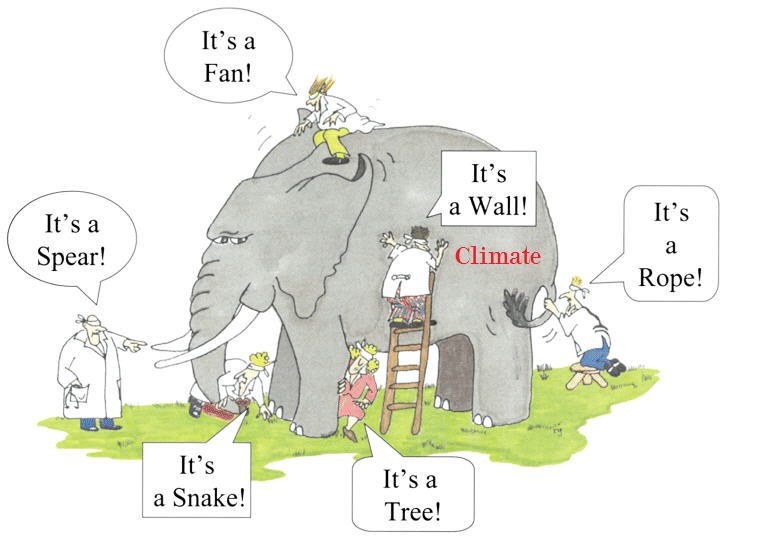
Footnote: For a deeper understanding of the atmospheric physics relating to CO2 and climate, I have done a guide and synopsis of Murry Salby’s latest textbook on the subject:  Fearless Physics from Dr. Salby

Climate Confusion and Clarity

Christelle Lagace-Babim, left, and Elise Lagace walk along Rue Jacques-Cartier Friday, after checking out their home in Gatineau, Que., as significant rainfall continues to cause flooding. (Justin Tang/Canadian Press)

A lot of verbage about global warming/climate change is worse than useless because the parties are using terms whose meaning is vague or equivocal, and thus no meaningful interaction occurs. Alarmists/activists claim climate change is real, man-made, and dangerous (Obama tweet). Skeptics/doubters respond that climate is always changing, has been both warmer and cooler in the past, long before humans did anything.

In addition, climate confusion causes statements like this one recently in the CBC: Gatineau flooding ‘tip of the iceberg,’ climate scientist warns

Swollen rivers and streams have threatened hundreds of homes in the Outaouais thanks to recent heavy rainfall — three times the normal amount since April 1.

University of Ottawa climate scientist Paul Beckwith says that’s due to a changing climate, and says we’re seeing its effects “on a day-to-day basis” in weather patterns.

Beckwith points to an increase in extreme weather events across North America as proof. “We’ve changed the chemistry of the atmosphere and the oceans with our greenhouse gases, so we’re seeing the consequences of this now,” he added. “It’s only the tip of the iceberg, so to speak.”

Such reports mislead people to think of the climate acting like some kind of agent causing the weather to change in ways unfavorable to us. That confuses the relation between climate and weather, as we shall see below.

What is “Weather”?

Fortunately in science things get defined not theoretically but by observations and measurements. In science, weather is defined as the behavior we measure on a daily basis. In fact today’s automated weather equipment monitors the weather constantly. Let us consider an operational definition of weather to be the variables for which data is reported into global databases.


Each National Weather Service has its own additional particulars they track, but the common global definition of weather can be seen in the defined elements from the ECA&D weather data dictionary (European Climate Assessment & Dataset)

Weather Measurement Elements

What is weather: Eight variables are measured globally–Sunshine, Sea Level Pressure, Humidity, Cloud cover, Wind, Precipitation, Snow Depth, Temperature. With multiple measures of some variables, weather datasets consist of 13 common elements.

Sunshine (SS) in units of 0.1 hour. Total daily SS plus measures of hours for intervals during the day.

Sea Level Pressure (PP) in units of 0.1hPa Daily average PP plus measures for specific times and parts of the day.

Humidity (HU) in units of 1% of relative humidity. Daily average HU plus measures for specific times and parts of the day.

Cloud Cover (CC) in oktas (0 being clear sky, 8 being completely overcast). Daily average CC plus measures for specific times and parts of the day.

Wind Direction (DD) in degrees azimuth for the wind source (that is, a southerly wind comes from 180 degrees.) Daily average DD plus measures for different times of day, and the direction of maximum gust.

Wind Speed (FG) in units of 0.1 m/s. Daily average FG plus measures for speeds at different times and parts of the day.

Wind Gust (FX) in units of 0.1m/s.  Daily average FX (24 hourly gusts) plus measures for maximums of different durations. (2 to 15 minutes).

Precipitation Amount (RR) in units of 0.1 mm. Daily total RR plus measures of amounts for intervals during the day.

Maximum Hourly Precipitation (MXR) in units of 0.1 mm. MXR for the day plus measures of amounts for intervals during the day.

Snow Depth (SD) in units of 1 cm. Mean daily SD plus measures of depths for intervals during the day.

Mean Temperature (TG) in units of 0.1C. Daily TG plus measures of various ways of calculating TG.

Minimum Temperature (TN) in units of 0.1C. Daily TN plus measures for different times and parts of the day.

Maximum Temperature (TX) in units of 0.1C. Daily TX plus measures for different times and parts of the day.

What is “Climate”?

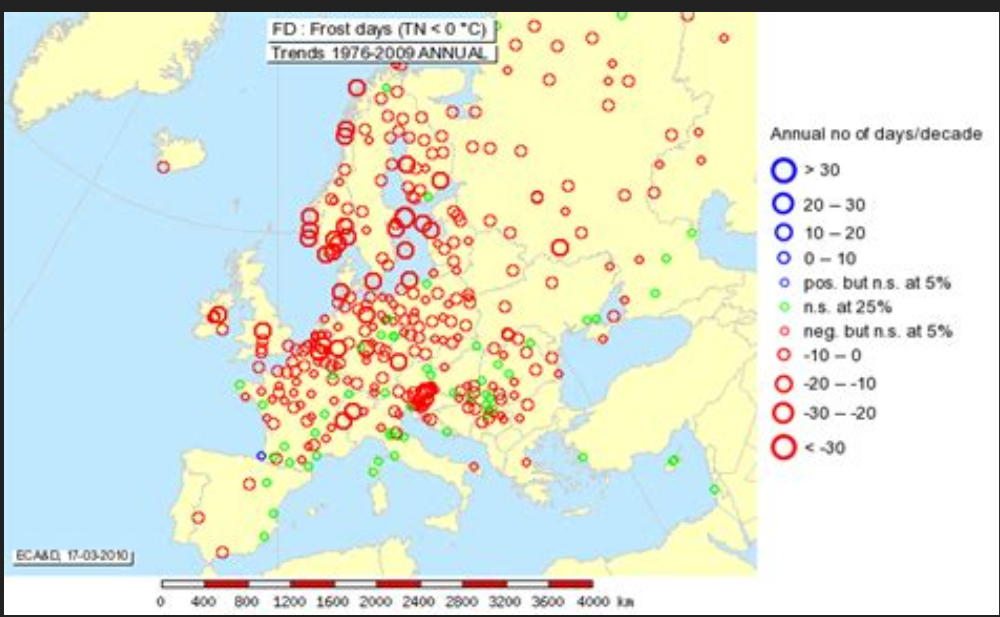
Change in Frequency of Frost Days in Europe in the Period 1976-2006

To sort out the confusion between “weather” and “climate”, we can also look at how climate is measured and thereby defined. From the same ECA&D source is a climate indices database which is termed Indices of Extremes.

There is one datafile for each index. Each datafile gives information for all available stations in the ECA&D database. The indices are aggregated over the year, the winter-half (ONDJFM), the summer-half (AMJJAS), winter (DJF), spring (MAM), summer (JJA), autumn (SON) and each of the calendar months.

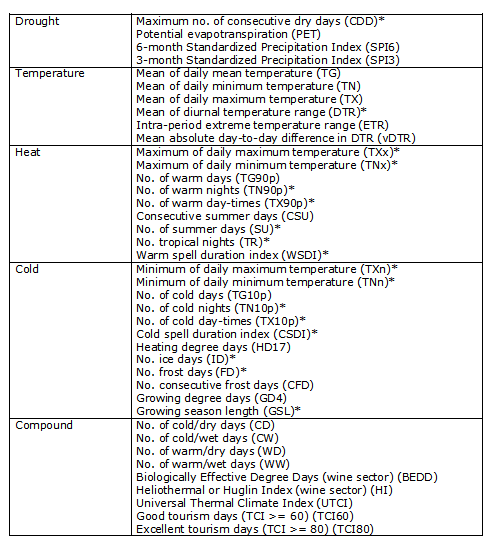
There are 74 indices grouped into twelve categories corresponding with different aspects of climate change. Some categories come directly from weather elements, while others are derivations.

The 74 indices are statistics built upon weather data, adding patterns of interest to humans. For example, temperature is greatly emphasized by adding various concerns with heat and cold on top of temperature records. Also, a compound category focuses on temperature and precipitation combinations and their favorability to humans.

What is Climate: Categories and Indices

Note that climate is operationally defined as statistical patterns of weather data. Some indices are simply averages of daily weather over long term periods. By convention, a 30-year average is used to define a climate baseline for a location.

Other climate indices are based on value judgments according to human interests. For example, heat and cold include many examples like growing days, good tourism days, heating degree days. In fact, a feature of climate is the imposition of human expectations upon nature, other examples being the sunshine indices Mostly Sunny and Mostly Cloudy days.

Andrew John Herbertson, a British geographer and Professor at Oxford, wrote in a textbook from 1901:

By climate we mean the average weather as ascertained by many years’ observations. Climate also takes into account the extreme weather experienced during that period. Climate is what on an average we may expect, weather is what we actually get.

Mark Twain, who is often credited with that last sentence, actually said:

Climate lasts all the time and weather only a few days.

The point is, weather consists of events occurring in real time, while climate is a statistical artifact. Weather is like a baseball player swinging in the batter’s box, climate is his batting average, RBIs, bases on balls, etc.

What is “Climate Change”?

The usefulness of climate indices is suggested by the last category called compound, where temperature and precipitation patterns are combined. In fact those two factors are sufficient to define distinctive local climate zones..

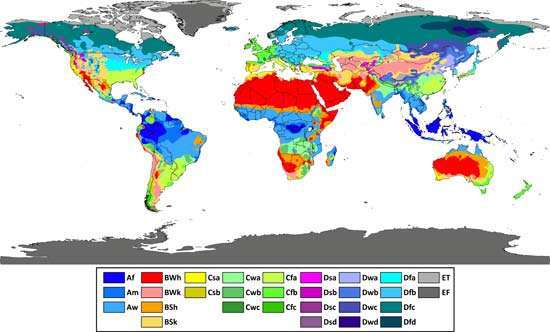
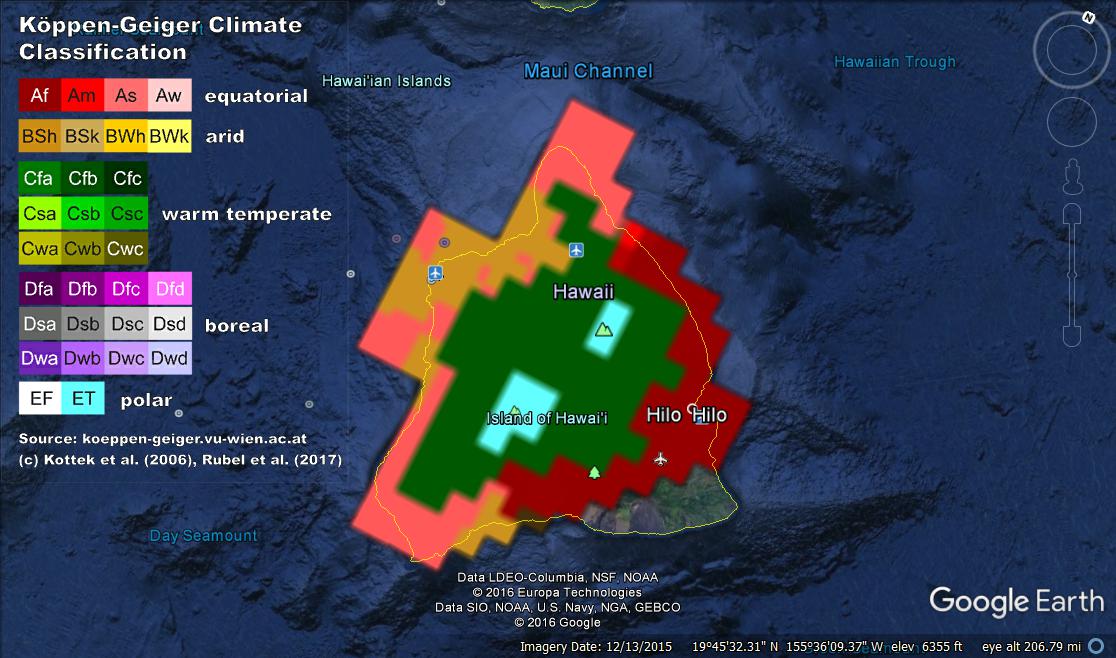
Based on empirical observations, Köppen (1900) established a climate classification system which uses monthly temperature and precipitation to define boundaries of different climate types around the world. Since its inception, this system has been further developed (e.g. Köppen and Geiger, 1930; Stern et al., 2000) and widely used by geographers and climatologists around the world.

188767-004-6bde1150

Köppen climate zones as they appear in the 21st Century.

As an example, consider how the island of Hawaii looks with its climate zones indicated:

Note: This image comes from an interactive tool and uses a different color scheme than the global map above.  The table below shows the thresholds by which zones are defined.

Zones Zones Description Thresholds
A Tropical climates Tmin ≥ +18 °C
Af Tropical rain forest Pmin ≥ 60 mm
Am Tropical monsoon Pann ≥ 25(100 – Pmin) mm
As Tropical savannah with dry summer Pmin < 60 mm in summer
Aw Tropical savannah with dry winter Pmin < 60 mm in winter
B Dry climates Pann < 10 Pth
BW Desert (arid) Pann ≤ 5 Pth
BS Steppe (semi-arid) Pann > 5 Pth
C Mild temperate -3 °C < Tmin < +18 °C
Cs Mild temperate with dry summer Psmin < Pwmin, Pwmax > 3 Psmin, Psmin < 40 mm
Cw Mild temperate with dry winter Psmax > 10 Pwmin, Pwmin < Psmin
Cf Mild temperate, fully humid Not Cs or Cw
D Snow Tmin ≤ -3 °C
Ds Snow with dry summer Psmin < Pwmin, Pwmax > 3 Psmin, Psmin < 40 mm
Dw Snow with dry winter Psmax > 10 Pwmin, Pwmin < Psmin
Df Snow, fully humid Not Ds or Dw
E Polar Tmax < +10 °C
ET Tundra Tmax ≥ 0 °C
EF Frost Tmax < 0 °C

Köppen and Climate Change

The focus is on differentiating vegetation regimes, which result primarily from variations in temperature and precipitation over the seasons of the year. Now we have an interesting study that considers shifts in Köppen climate zones over time in order to identify changes in climate as practical and local/regional realities.  The paper is: Using the Köppen classification to quantify climate variation and change: An example for 1901–2010 By Deliang Chen and Hans Weiteng Chen Department of Earth Sciences, University of Gothenburg, Sweden

Hans Chen has built an excellent interactive website (here): The purpose of this website is to share information about the Köppen climate classification, and provide data and high-resolution figures from the paper Chen and Chen, 2013:  For more details on Chen and Chen see the post: Data vs. Models 4: Climates Changing

Summary:  Climate Change Defined

Chen and Chen provide a data-based definition of “climate change”. Climate zones are defined by past temperature and precipitation ranges observed by humans. The weather datasets and climate indices inform us whether or not the patterns in a place are moving outside the norm for that location. Climate change appears as a shift in zonal boundaries so that one place starts to resemble a neighboring zone with a different classification.  The table above shows the defined zones and thresholds.

The Chen and Chen analysis shows that almost half of climates around the world will get a year of weather outside of their normal ranges. Getting a decade of abnormal weather is much rarer. True climate change would be a shift enduring over a 30 year period which has been observed in less than 10% of all climate zones.

Summary: The Myth of “Global” Climate Change

Climate is a term to describe a local or regional pattern of weather. There is a widely accepted system of classifying climates, based largely on distinctive seasonal variations in temperature and precipitation. Depending on how precisely you apply the criteria, there can be from 6 to 13 distinct zones just in South Africa, or 8 to 11 zones only in Hawaii.

Each climate over time experiences shifts toward warming or cooling, and wetter or drier periods. One example: Fully a third of US stations showed cooling since 1950 while the others warmed. It is nonsense to average all of that and call it “Global Warming” because the net is slightly positive. Only in the fevered imaginations of CO2 activists do all of these diverse places move together in a single march toward global warming.

For more on measurements and science see Data, Facts and Information

Footnote:

weather10seylanbax_2079151i

This post was focused on the distinction between weather and climate, so extreme weather events were not discussed, since by definition such events are weather. Still the quote at the beginning shows that activists are working hard to attribute attention-grabbing events as proof of global warming/climate change.

Mike Hulme wrote a series of articles describing the unsuccessful effort to link extreme weather to climate change and said this:
In recent decades the meaning of climate change in popular western discourse has changed from being a descriptive index of a change in climate (as in ‘evidence that a climatic change has occurred’) to becoming an independent causative agent (as in ‘climate change caused this event to happen’). Rather than being a descriptive outcome of a chain of causal events affecting how weather is generated, climate change has been granted power to change worlds: political and social worlds as much as physical and ecological ones.

More at X-Weathermen are Back 

Climate Chaos


Foucault’s pendulum in the Panthéon, Paris

h/t tom0mason for inspiring this post, including his comment below

The Pendulum is Settled Science

I attended North Phoenix High School (Go Mustangs!) where students took their required physics class from a wild and crazy guy. Decades later alumni who don’t remember his name still reminisce about “the crazy science teacher with the bowling ball.”

To demonstrate the law of conservation of energy, he required each and every student to stand on a ladder in one corner of the classroom. Attached to a hook in the center of the rather high ceiling was a rope with a bowling ball on the other end. The student held the ball to his/her nose and then released it, being careful to hold still afterwards.

The 16 pound ball traveled majestically diagonally across the room and equally impressively returned along the same path. The proof of concept was established when the ball stopped before hitting your nose (though not by much).  In those days we learned to trust science and didn’t need to go out marching to signal some abstract virtue.

The equations for pendulums are centuries old and can predict the position of the ball at any point in time based on the mass of the object, length of the rope and starting position.

Pictured above is the currently operating Foucault pendulum that exactly follows these equations. While it had long been known that the Earth rotates, the introduction of the Foucault pendulum in 1851 was the first simple proof of the rotation in an easy-to-see experiment. Today, Foucault pendulums are popular displays in science museums and universities.

What About the Double Pendulum?

Trajectories of a double pendulum

Just today a comment by tom0mason at alerted me to the science demonstrated by the double compound pendulum, that is, a second pendulum attached to the ball of the first one. It consists entirely of two simple objects functioning as pendulums, only now each is influenced by the behavior of the other.

Lo and behold, you observe that a double pendulum in motion produces chaotic behavior. In a remarkable achievement, complex equations have been developed that can and do predict the positions of the two balls over time, so in fact the movements are not truly chaotic, but with considerable effort can be determined. The equations and descriptions are at Wikipedia Double Pendulum

Long exposure of double pendulum exhibiting chaotic motion (tracked with an LED)

But here is the kicker, as described in tomomason’s comment:

If you arrive to observe the double pendulum at an arbitrary time after the motion has started from an unknown condition (unknown height, initial force, etc) you will be very taxed mathematically to predict where in space the pendulum will move to next, on a second to second basis. Indeed it would take considerable time and many iterative calculations (preferably on a super-computer) to be able to perform this feat. And all this on a very basic system of known elementary mechanics.

And What about the Climate?

This is a simple example of chaotic motion and its unpredictability. How predictable is our climate with so many variables and feedbacks, some known some unknown? Consider that this planet’s weather/climate system is chaotic in nature with many thousands (millions?) of loosely coupled variables and dependencies, and many of these variables have very complex feedback features within them.

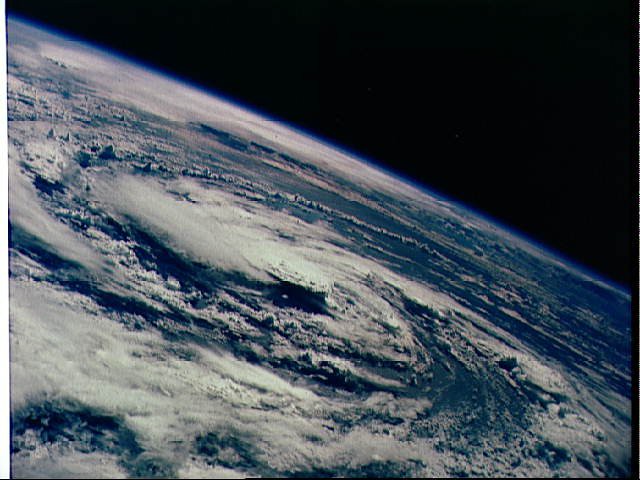
Hurricane Gladys, photographed from orbit by Apollo 7 in 1968 (Photo: NASA)

Summary

To quote the IPCC:

The climate system is a coupled non-linear chaotic system, and therefore the long-term prediction of future climate states is not possible. Rather the focus must be upon the prediction of the probability distribution of the system’s future possible states by the generation of ensembles of model solutions.

A recent National Review article draws the implications:
The range of predicted future warming is enormous — apocalyptism is unwarranted.

But as the IPCC emphasizes, the range for future projections remains enormous. The central question is “climate sensitivity” — the amount of warming that accompanies a doubling of carbon dioxide in the atmosphere. As of its Fifth Assessment Report in 2013, the IPCC could estimate only that this sensitivity is somewhere between 1.5 and 4.5°C. Nor is science narrowing that range. The 2013 assessment actually widened it on the low end, from a 2.0–4.5°C range in the prior assessment. And remember, for any specific level of warming, forecasts vary widely on the subsequent environmental and economic implications.

For now, though, navigating the climate debate will require translating the phrase “climate denier” to mean “anyone unsympathetic to the most aggressive activists’ claims.” This apparently includes anyone who acknowledges meaningful uncertainty in climate models, adopts a less-than-catastrophic outlook about the consequences of future warming, or opposes any facet of the activist policy agenda. The activists will be identifiable as the small group continuing to shout “Denier!” The “deniers” will be identifiable as everyone else.

Update May 2

Esteemed climate scientist Richard Lindzen ends a very fine recent presentation (here) with this description of the climate system:

I haven’t spent much time on the details of the science, but there is one thing that should spark skepticism in any intelligent reader. The system we are looking at consists in two turbulent fluids interacting with each other. They are on a rotating planet that is differentially heated by the sun. A vital constituent of the atmospheric component is water in the liquid, solid and vapor phases, and the changes in phase have vast energetic ramifications. The energy budget of this system involves the absorption and reemission of about 200 watts per square meter. Doubling CO2 involves a 2% perturbation to this budget. So do minor changes in clouds and other features, and such changes are common. In this complex multifactor system, what is the likelihood of the climate (which, itself, consists in many variables and not just globally averaged temperature anomaly) is controlled by this 2% perturbation in a single variable? Believing this is pretty close to believing in magic. Instead, you are told that it is believing in ‘science.’ Such a claim should be a tip-off that something is amiss. After all, science is a mode of inquiry rather than a belief structure.

Flow Diagram for Climate Modeling, Showing Feedback Loops

Michelle Dispels CO2 Hysteria


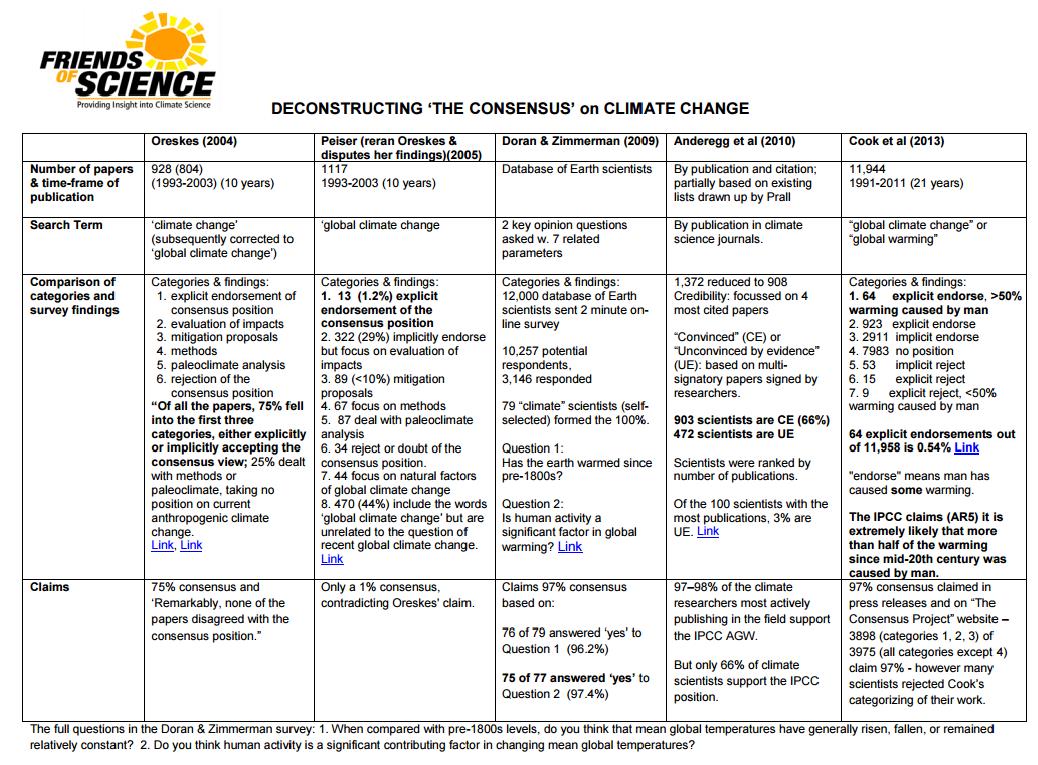
Thanks to a post at Friends of Science, I was alerted to an important declaration by Michelle. On March 17, 2017, Michelle Stirling presented “The Myth of the 97% Consensus” to the FreedomTalk.ca Annual Conference in Calgary, Alberta.

Because it’s not Michelle Obama speaking out, no one knows about it and few even care. Which tells you all you need to know about global warming/climate change.  It’s a social phenomenon, now completely detached from reason and science. It is not what you know, it’s how many friends know you that gives you impact regarding the climate. Celebrity and popularity are convincing, detailed facts and knowledge not so much.

At the end of this post is a synopsis and link showing how thoroughly Stirling debunks the “97% consensus”. Much of that will be familiar to readers, so the excerpts here will emphasize the way Michelle puts the whole climatism movement into socio-economic context.

Why Claim 97%? – Ultimate Social Proof

One feature that stands out in most of the claimed consensus studies, no matter how small the relevant sample, is the repeated figure of 97%. Many of the 97% consensus studies are co-authored or supported by social psychologists

The groundbreaking work of Cialdini (2007) demonstrated that humans are significantly motivated to comply according to ‘social proof’ – in other words, “if everyone agrees, that is proof enough so get on the bandwagon.” Just as social media ‘trending’ leads to more people following the story, social proofs work on the inherently gregarious nature of humans and our herd mentality. The 97% figure delivers two powerful psychological messages in one – i) ‘everyone’ agrees, and ii) you will be left out.

To compound the psychological impact upon the dissenting 3% of the population, climate bullying terms like ‘denier,’ and more recently various high-profile ‘witch hunts,’ even at the Presidential level, have been employed by activists. These actions activate physical and emotional pain centers in the victims, as found by Williams (2001), Kross et al (2011) on ostracism, making most people reluctant to speak up with any questions regarding the science, policy, cost or impact on industry. In practical terms, many dissidents have lost their jobs for daring to challenge ‘the consensus.’ Williams (2007) found that being ostracized was the ‘kiss of social death.’

A more nuanced study with clear definitions done by PBL Netherlands Environmental Assessment Agency reveals that out of 1,868 respondents, only 43% agreed with the IPCC definition: “It is extremely likely {95%+ certainty} that more than half of [global warming] from 1951 to 2010 was caused by [human activity].”

Clearly, van der Linden et al (2015), Ding et al (2011) Dunlap & McCright (2011) are correct in stating that consensus is an important tool and a gateway belief for acceptance of public policy on climate change. However, the question is, should we be making policy based on statistically manipulated consensus studies that lack clearly defined empirical parameters, or should public policy be based on actual scientific evidence?

The Cost of Delusion

Despite several surveys claiming that ‘consensus’ is a valuable driver of public acceptance of climate change, and expressions of dismay that a large percent of the public continue to reject the alleged ‘consensus’ and to question human-caused climate change claims in general, the foregoing demonstrates that ‘belief’ and ‘consensus’ are not grounds for action on climate change. If anything, such thinking is more likely to lead to extraordinary mass delusions, such as the Mississippi Scheme, the South-Sea Bubble, and Tulipomania, all three of which nearly bankrupted national economies of France, England and the Netherlands, respectively (Mackay 2008).

There has been a concerted effort to push the climate catastrophe perspective by well-funded foundations, philanthropies and institutional investors which are bound by the UN Principles for Responsible Investment to invest in renewables and clean-tech, despite clean-tech having been found to be a ‘noble way to lose money’ after several patient years of investment, according to past CIO of CalPERS in a Wall Street Journal interview of 2013. (my bold)

Indeed, a review of the performance of renewable energy companies is concerning – particularly the level of expectation and investment versus scope of real or possible failure. The electric vehicle company “A Better Place” cars was valued at some $2 billion in the fall of 2012, by the spring of 2013 it had gone bankrupt, valued only at $12 million, despite having had a raft of experienced Wall Street investors. More recently, Spain’s Abengoa began spectacular bankruptcy proceedings, also putting some 27,000 employees world-wide at risk of unemployment. (my bold)

Unusual new market instruments like the ‘yieldco’ has led to catastrophic financial outcomes, as in the case of SunEdison’s $16.1 billion bankruptcy filing.  Devonshire Research (Part II-May 2016)41 is claiming that the much-vaunted Tesla is reliant on subsidies: “Tesla is not a car, battery, or tech company; it is an experimental financial services company and should be regulated as such” and that “Tesla has engaged in aggressive accounting that calls to mind the experiences of Enron and WorldCom; its future is highly uncertain.” (my bold)

Recent research by Cambridge engineering professor Michael J. Kelly (2016) shows that wind and solar do not provide sufficient Energy Return on Energy Invested (EROI) to maintain even basic society, and that: “all the actions taken together until now to reduce our emissions of carbon dioxide will not achieve a serious reduction, and in some cases, they will actually make matters worse.”

Thus, there is an evident divide between evidence and ideologies when the concepts of ‘renewable’ and ‘sustainable’ are applied in the field, as well.

The Ethics of CO2 Hysteria

Climate change is often framed as a moral and ethical concern, thus one must question the ethics of those participating in peer-reviewed research who are psychology professionals but who employ such tactics, especially when the scientific evidence of global temperature rise does not support the Catastrophic Anthropogenic Global Warming theory. This discrepancy between the surveyed ‘beliefs’ and the physical evidence demonstrates that opinion-based ‘consensus’ surveys are scientifically worthless and are an improper and potentially dangerous basis for making climate change policy.

To date, much of the world’s diverse climate policy has been predicated upon public acceptance that there is an urgent crisis of human-caused global warming, but this claim is not supported by the temperature records. As noted by Tol in a response to the Grantham Research Institute: “The twenty-two studies cited above all agree that the impact of climate change is small relative to economic growth. This was found in studies by Professor William Nordhaus and Professor Samuel Fankhauser. It was confirmed by the Intergovernmental Panel on Climate Change from its Second Assessment Report, in a chapter led by the late Professor David Pearce, to its Fifth Assessment Report, in a chapter led by me. Even the highest estimate, the 20% upper bound by Lord Professor Nicholas Stern of Brentford, has that a century of climate change is not worse than losing a decade of economic growth.” [bold emphasis added]

Thus, even economic evidence does not support the ‘belief’ in human caused global warming; actual temperature data certainly does not support the claims of impending catastrophic climate change.


The evidence shows that the world runs on three cubic miles of oil equivalent energy every year, of which one cubic mile is oil. All renewable devices such as wind turbines and solar panels are manufactured using vast amounts of oil, natural gas and coal. As Vaclav Smil notes, ‘to get wind you need oil.’

Conclusion

Science is not a democratic undertaking. It is unfortunate that respected scientific journals continue to publish such papers without critical vetting as to whether the ‘consensus’ claims equate to the empirical evidence. Public policy on climate change should be evidence-based and carefully thought through in the context of longer time-scales, historical evidence and paleoclimatology.

There is no consideration that the study of 4 billion years of climate change, written in the strata of the earth, might make those scientists working with fossil fuel industries question the claims of Anthropogenic Global Warming proponents whose evidence relies on spotty temperature records of some 100 years, climate models and unproven theories.

While much good came of the original impetus of the “Law of the Atmosphere” in terms of reducing noxious pollutants, much economic and social harm is being done by the current hysteria focussed solely on carbon dioxide. France has learned that lesson the hard way, having incentivized diesel cars and trucks in order to reduce carbon dioxide, only to find its gem – the City of Lights – Paris – blackened with the worst air quality in the world thanks to a significant rise in soot and nitrogen oxide.

Consensus = nonsensus. We must look at the evidence over ideology.


Climate Lemmings

The excerpts above come from Michelle Stirling’s paper Consensus Nonsensus on 97%: Science is not a Democracy

Stirling’s presentation dissects the 97% consensus, powerpoint slides are here: The Myth of the 97% consensus

Fear Not for Permafrosty


The Permafrost Bogeyman is Back!

The Climate Scare of this Week is apparently melting permafrost.The Met Office warning on April 10:

Increased climate change risk to permafrost. Global warming will thaw about 20% more permafrost than previously thought, scientists have warned – potentially releasing significant amounts of greenhouse gases into the Earth’s atmosphere.

The researchers, from Sweden and Norway as well as the UK, suggest that the huge permafrost losses could be averted if ambitious global climate targets are met.

Lead-author Dr Sarah Chadburn of the University of Leeds said: “A lower stabilisation target of 1.5ºC would save approximately two million square kilometres of permafrost.

“Achieving the ambitious Paris Agreement climate targets could limit permafrost loss. For the first time we have calculated how much could be saved.”

The permafrost bogeyman has been reported before, been debunked, but will likely return again like a zombie that never dies. I have likened the climate false alarm system to a Climate Whack-A-Mole game because the scary notions keep popping up no matter how often you beat them down with reason and facts. So once again into the breach, this time on the subject of Permafrost.

Permafrost basics

I Travelled to the Arctic to Plunge a Probe Into the Melting Permafrost is a Motherboard article that aims to alarm but also provides some useful information.

The ground above the permafrost that freezes and thaws on an annual cycle is called the active layer. The uppermost segment is organic soil, because it contains all the roots and decomposing vegetation from the surface. Beneath the organic layer is the moist, clay-like mineral soil, which sits directly on top of the permafrost. The types of vegetation will influence the contents of the soil—but in return, the soil determines what can grow there.

Kholodov inserted probes into the layers of soil and the permafrost to measure its temperature, moisture content, and thermal conductivity. The air-filled organic layer is a much better insulator than the waterlogged mineral soil. So an ecosystem with a thicker organic layer, where there’s more vegetation, should provide better protection for the permafrost below.

On a warm morning in the boreal forests around Fairbanks, Loranty squeezed between two black spruce trees and motioned to all the woody debris scattered on the ground. “Here, where we have more trees and denser forests, we have shallower permafrost thaw depths.”

He grabbed a T-shaped depth probe and shoved it into the ground. It only sank about a handspan before it struck permafrost. “When you have trees, they provide shade,” he said, “and that prevents the ground from getting too warm in the summer.” So here, the permafrost is shallow, right beneath the surface.

Other vegetation, like moss, can also protect permafrost. “It’s fluffy, with lots of airspace, like a down coat,” Loranty explained, “and heat can’t move through it well, so it’s a good insulator.”

But 800km north on the tundra, close to the Arctic Ocean, there are no trees. It’s a less productive ecosystem than the forest and provides little insulation to the frozen ground. Here, low-lying shrubs, grasses, and lichens dominate underfoot. When I grabbed the depth probe and pushed it in, it sunk down a meter before it bottomed out because the permafrost was much deeper.

Permafrost Nittty Gritty

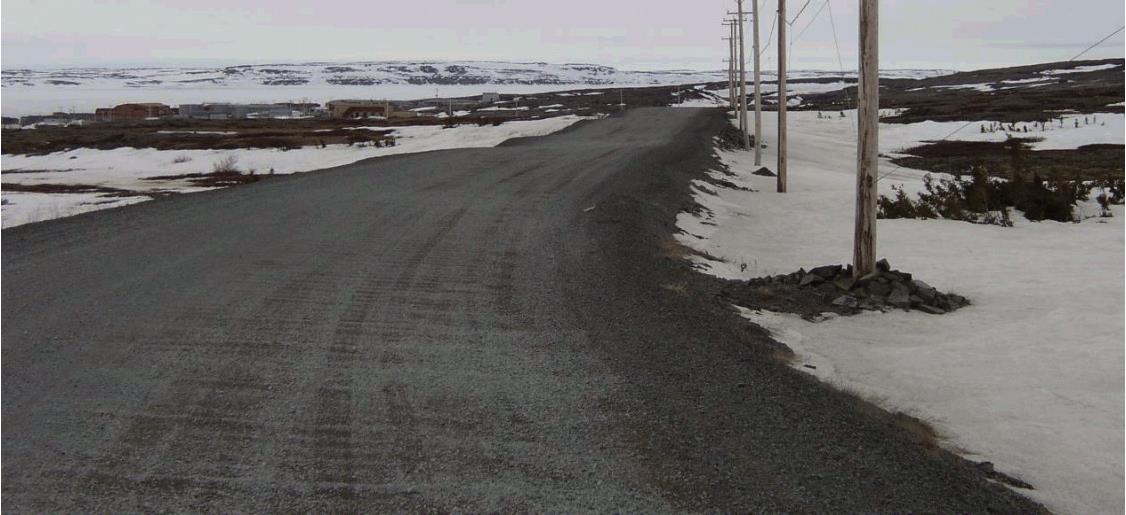
To really understand permafrost, it helps to listen to people dealing with Arctic infrastructure like roads. A thorough discussion and analysis is presented in Impacts of permafrost degradation on a road embankment at Umiujaq in Nunavik (Quebec), Canada By Richard Fortier, Anne-Marie LeBlanc, and Wenbing Yu

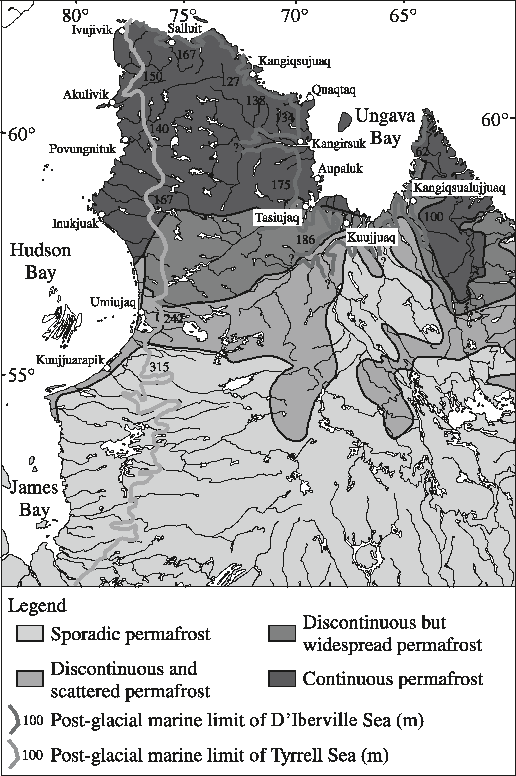
Fig. 1. Permafrost distribution and marine transgression in Nunavik (modified after Allard and Seguin 1987). Location of the 14 Inuit communities in Nunavik.

Following the retreat of the Wisconsin Ice Sheet about 7600–7300 years B.P. on the east coast of Hudson Bay (Hillaire–Marcel 1976; Allard and Seguin 1985) and about 7500– 7000 years B.P. in Ungava (Gray et al. 1980; Allard et al. 1989), the sea flooded a large band of coastline in Nunavik (Fig. 1). Glaciomarine sediments were then deposited in deep water in the Tyrrell and D’Iberville Seas (Fig. 1). Due to the isostatic rebound, once exposed to the cold atmosphere, the raised marine deposits were subsequently eroded and colonized by vegetation, and permafrost aggraded from sporadic permafrost to continuous permafrost with increasing latitude (Fig. 1).

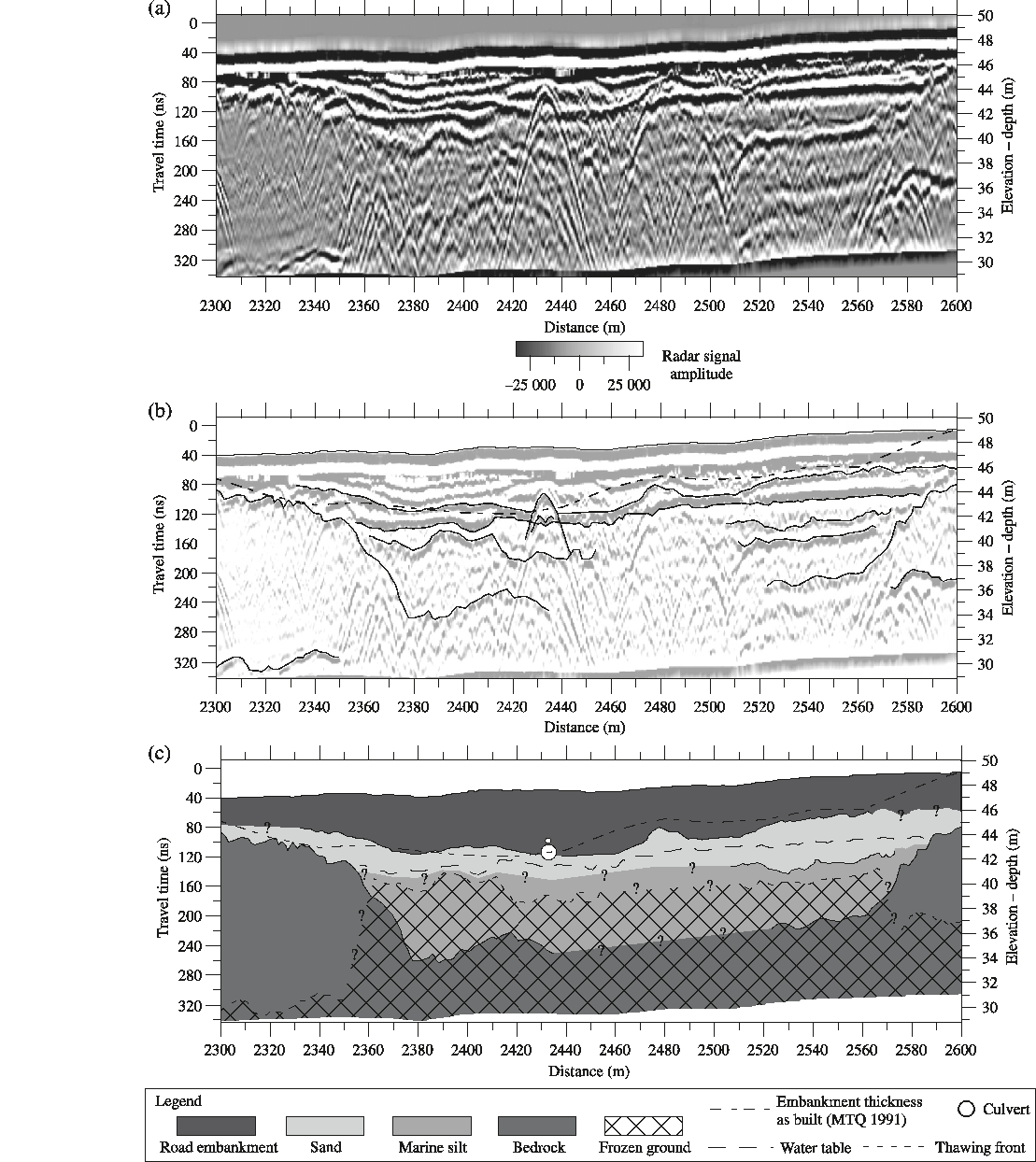
A case study is presented herein on recent thaw subsidence observed along the access road to the Umiujaq Airport in Nunavik (Quebec). In addition to the measurement of the subsidence, a geotechnical and geophysical investigation including a piezocone test, ground-penetrating radar (GPR) profiling, and electrical resistivity tomography (ERT) was carried out to characterize the underlying stratigraphy and permafrost conditions. In the absence of available ground temperature data for assessing the causes of permafrost degradation, numerical modeling of the thermal regime of the road embankment and subgrade was also undertaken to simulate the impacts of (i) an increase in air temperature observed recently in Nunavik and (ii) the thermal insulation effect of snow accumulating on the embankment shoulders and toes. The causes and effects of permafrost degradation on the road embankment are also discussed.

Fig. 11. (a) GPR reflection profile carried out on 14 July 2006 in the field with the 100 MHz antennas at a fixed offset of 1 m. (b) Major reflectors identified on the GPR reflection profile. (c) Cross section of the ground based on the combined interpretation of the GPR reflection profile and model of electrical resistivity (Fig. 12c). Note the vertical exaggeration (1:5).

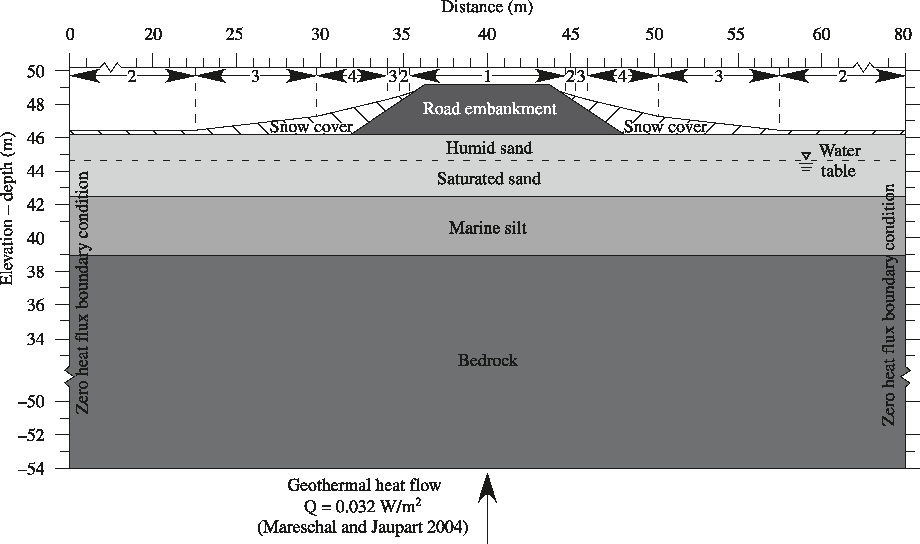
Values of thawing and freezing n-factors according to the surface conditions (Figs. 4 and 13) are given in Table 1. The gray road surface absorbs solar radiation in summer, inducing a higher surface temperature than air temperature and a higher thawing n-factor than the ones for the natural ground surface. The thawing n-factor is close to unity and the surface temperature is close to the air temperature in summer for the natural ground surface (ground surface boundaries Nos. 2, 3, and 4). Due to the absence of snow cover on the road surface, the freezing n-factor is close to unity. However, an increase in snow thickness leads to a decrease in the freezing n-factor (Fig. 13 and Table 1). We make the assumption that from one year to another there is no change in surface conditions due to climate variability and the thawing and freezing n-factors are constant.

Fig. 13. Cross section of the road embankment and subgrade showing the stratigraphy and boundary conditions used for the numerical modeling. The numbers between arrows refer to the ground surface boundaries (Table 1)

Only the governing equation of heat transfer by conduction taking into account the phase change problem was considered to simulate the permafrost warming and thawing underneath the road embankment. However, complex processes of heat transfer, groundwater flow, and thaw consolidation can take place in degrading permafrost. The development of a two dimensional numerical model of these coupled processes is needed to accurately predict the thaw subsidence based on the thaw consolidation properties of permafrost and to compare this prediction with the performance of the access road to Umiujaq Airport.

As expected from the design of thick road embankments in cold regions,the permafrost table has moved upward 0.9 m underneath the road embankment, preventing permafrost degradation (Fig. 14a). However, the permafrost is slightly warmer by a few tenths of degree Celsius underneath the road embankment than away from the road (Fig. 15). This increase in permafrost temperature due to the thermal effect of the road embankment makes the permafrost more vulnerable to any potential climate warming. The permafrost base in the bedrock has also moved upward 3.9 m for a permafrost thinning of 3 m (Fig. 15). This thawing taking place at the permafrost base does not induce any thaw settlement because the bedrock is thaw stable.

The subsidence is due to thaw consolidation taking place in a layer of ice-rich silt underneath a superficial sand layer. While the seasonal freeze–thaw cycles were initially restricted to the sand layer, the thawing front has now reached the thaw-unstable ice-rich silt layer. According to our numerical modeling, the increase in air temperature recently observed in Nunavik cannot be the sole cause of the observed subsidence affecting this engineering structure. The thick embankment also acts as a snow fence favoring the accumulation of snow on the embankment shoulders. The permafrost degradation is also due to the thermal insulation of the snow cover reducing heat loss in the embankment shoulders and toes.

Permafrost in Russia

Yakutsk Permafrost Institute Underground Lab

The Russians are seasoned permafrost scientists with Siberia as their preserve, and their observations are balanced by their long experience. The latest Russia report is from 2010.

We conclude the following based on initial analysis and interpretation of the data obtained in this project:

  • Most of the permafrost observatories in Russia show substantial warming of permafrost during the last 20 to 30 years. The magnitude of warming varied with location, but was typically from 0.5C to 2C at the depth of zero annual amplitude. This warming occurred predominantly between the 1970s and 1990s. There was no significant observed warming in permafrost temperatures in the 2000s in most of the research areas; some sites even show a slight cooling during the late 1990s and early 2000s.
  • Warming has resumed during the last two to three years at many locations predominantly near the coasts of the Arctic Ocean. Much less or no warming was observed during the 1980s and 1990s in the north of East Siberia. However, the last three years show significant permafrost warming in the eastern part of this region.
  • Permafrost is thawing in specific landscape settings within the southern part of the permafrost domain in the European North and in northwest Siberia. Formation of new closed taliks and an increase in the depth of preexisting taliks have been observed in this area during the last 20 to 30 years.

Methane Realism

An article in Scientific American raises several concerns about permafrost, but does add some realism:

First, while most of the methane is believed to be buried roughly 200 meters below the sea bed, only the top 25 meters or so of sea-bed are currently thawed, and thawing seems to have only progressed by about one meter in the last 25 years – a pace that suggests that the large bulk of the buried methane will stay in place for centuries to come.

Second, several thousand years ago, when orbital mechanics maximized Arctic warmth, the area around the North Pole is believed to have been roughly 4 degrees Celsius warmer than it is today and covered in less sea ice than today. Yet there’s no evidence of a massive amount of methane release in this time.

Third, the last time methane was released in vast quantities into the atmosphere – during the Paleocene-Eocene Thermal Maximum 56 million years ago – the process didn’t happen overnight. It took thousands of years.

Put those facts together, and we are probably not in danger of a methane time bomb going off any time soon.

Summary

The active layer of permafrost does vary from time to time and place to place. There was warming and some permafrost melting end of last century, but lately not so much. Any specific permafrost layer is influenced by many factors, including air temperatures, snow cover and vegetation, as well as the structure of the land, combining fill, sand, silt, ice and salinity mixtures on top of bedrock.

And nature includes negative feedbacks to permafrost melt. Any vegetation, even moss, growing in unfrozen soil provides insulation limiting further melting, as well as absorbing additional CO2. Reduced snowcover aids freezing and constrains later melting.

Rather than a permafrost bogeyman, we need a more people-friendly mascot. Consider our traditional nature friends loved by children and adults.

For example, Smokey the Bear

Rudolph the Reindeer

And the ever-popular Cola Bear

Introducing Permafrosty


Permafrosty is here!  Love him tender, and he’ll never let you down.

Additional Background on Permafrost in an earlier post The Permafrost Bogeyman


Fossil Fuels ≠ Global Warming

Previous posts addressed the claim that fossil fuels are driving global warming. This post updates that analysis with the latest numbers from BP Statistics and compares World Fossil Fuel Consumption (WFFC) with three estimates of Global Mean Temperature (GMT). More on both these variables below.

WFFC

2015 statistics are now available from BP for international consumption of Primary Energy sources. Statistical Review of World Energy.  H/T  Euan Mearns

The reporting categories are:
Oil
Natural Gas
Coal
Nuclear
Hydro
Renewables (other than hydro)

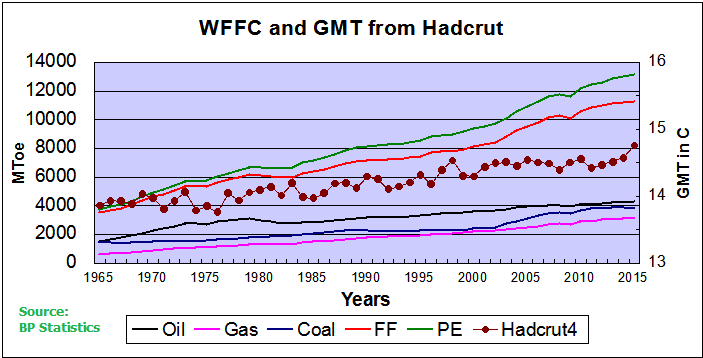
This analysis combines the first three, Oil, Gas, and Coal for total fossil fuel consumption world wide. The chart below shows the patterns for WFFC compared to world consumption of Primary Energy from 1965 through 2015.

The graph shows that Primary Energy consumption has grown continuously for 5 decades. Over that period oil, gas and coal (sometimes termed “Thermal”) averaged 90% of PE consumed, ranging from 94% in 1965 to 86% in 2015.  MToe is millions of tons of oil equivalents.

Global Mean Temperatures

Everyone acknowledges that GMT is a fiction since temperature is an intrinsic property of objects, and varies dramatically over time and over the surface of the earth. No place on earth determines “average” temperature for the globe. Yet for the purpose of detecting change in temperature, major climate data sets estimate GMT and report anomalies from it.

UAH record consists of satellite era global temperature estimates for the lower troposphere, a layer of air from 0 to 4km above the surface. HadSST estimates sea surface temperatures from oceans covering 71% of the planet. HADCRUT combines HadSST estimates with records from land stations whose elevations range up to 6km above sea level.

Both GISS LOTI (land and ocean) and HADCRUT4 (land and ocean) use 14.0 Celsius as the climate normal, so I will add that number back into the anomalies. This is done not claiming any validity other than to achieve a reasonable measure of magnitude regarding the observed fluctuations.

No doubt global sea surface temperatures are typically higher than 14C, more like 17 or 18C, and of course warmer in the tropics and colder at higher latitudes. Likewise, the lapse rate in the atmosphere means that air temperatures both from satellites and elevated land stations will range colder than 14C. Still, that climate normal is a generally accepted indicator of GMT.

Correlations of GMT and WFFC

The first graph compares to GMT estimates over the five decades from 1965 to 2015 from HADCRUT4, which includes HadSST3.

Over the last five decades the increase in fossil fuel consumption is dramatic and monotonic, steadily increasing by 220% from 3.5B to 11.3 B oil equivalent tons.  Meanwhile the GMT record from Hadcrut shows multiple ups and downs with an accumulated rise of 0.9C over 50 years, 6% of the starting value.

The second graph compares to GMT estimates from UAH6, and HadSST3 for the satellite era from 1979 to 2015, a period of 36 years.

In the satellite era WFFC has increased at a compounded rate of nearly 2% per year, for a total increase of 84% since 1979. At the same time, SSTs and  lower troposphere warming amounted to 0.5C, or 3.4% of the starting value.  The temperature rate of change is 0.1% per year, an order of magnitude less.  Even more obvious is the 1998 El Nino peak and flat GMT since.

Summary

The climate alarmist/activist claim is straight forward: Burning fossil fuels makes measured temperatures warmer. The Paris Accord further asserts that by reducing human use of fossil fuels, further warming can be prevented.  Those claims do not bear up under scrutiny.

It is enough for simple minds to see that two time series are both rising and to think that one must be causing the other. But both scientific and legal methods assert causation only when the two variables are both strongly and consistently aligned. The above shows a weak and inconsistent linkage between WFFC and GMT.

In legal terms, as long as there is another equally or more likely explanation for the set of facts, the claimed causation is unproven. The more likely explanation is that global temperatures vary due to oceanic and solar cycles. The proof is clearly and thoroughly set forward in the post Quantifying Natural Climate Change.

Background context for today’s post is at Claim: Fossil Fuels Cause Global Warming.

March Air and Sea Temps

The Pause that Refreshes!

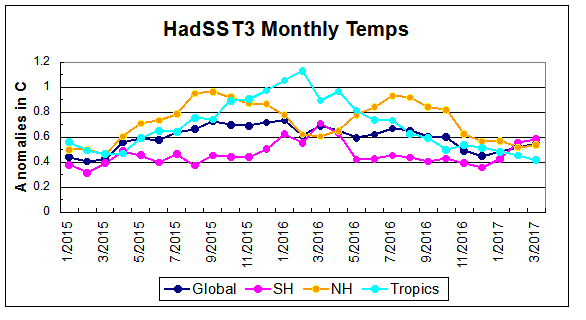
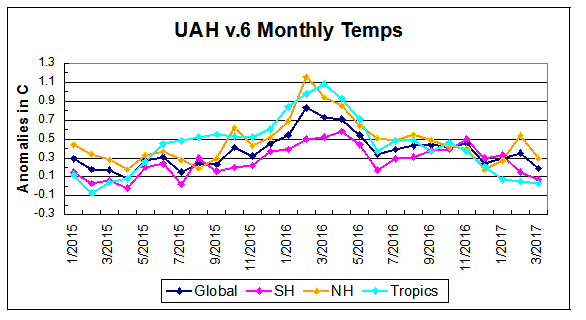
The recent El Nino is cooling down as shown clearly in both sea surface temperatures and lower troposphere air temperatures. The two relevant data sets are UAH v.6 and HadSST v3.1, both now providing averages for the month of March 2017.

The cooling pattern continues in the tropical seas while ocean temperatures in the Northern Hemisphere (NH) are  flat.  Southern Hemisphere (SH) oceans appear to be peaking and pulled the Global SST up a bit, but both are slightly below last March.

Air temperatures in the lower troposphere tell much the same story.  The greater volatility of air temperatures is evident, and we also see that the tropics (20N to 20S) and the NH (0 to 90N) are more closely aligned than are the comparable SSTs.  The downward trajectory of air temps is clear after an upward blip in the NH in February.

Enjoy the pause in warmer temperatures while we watch to see how cool it will get.

Mann-made Global Cooling

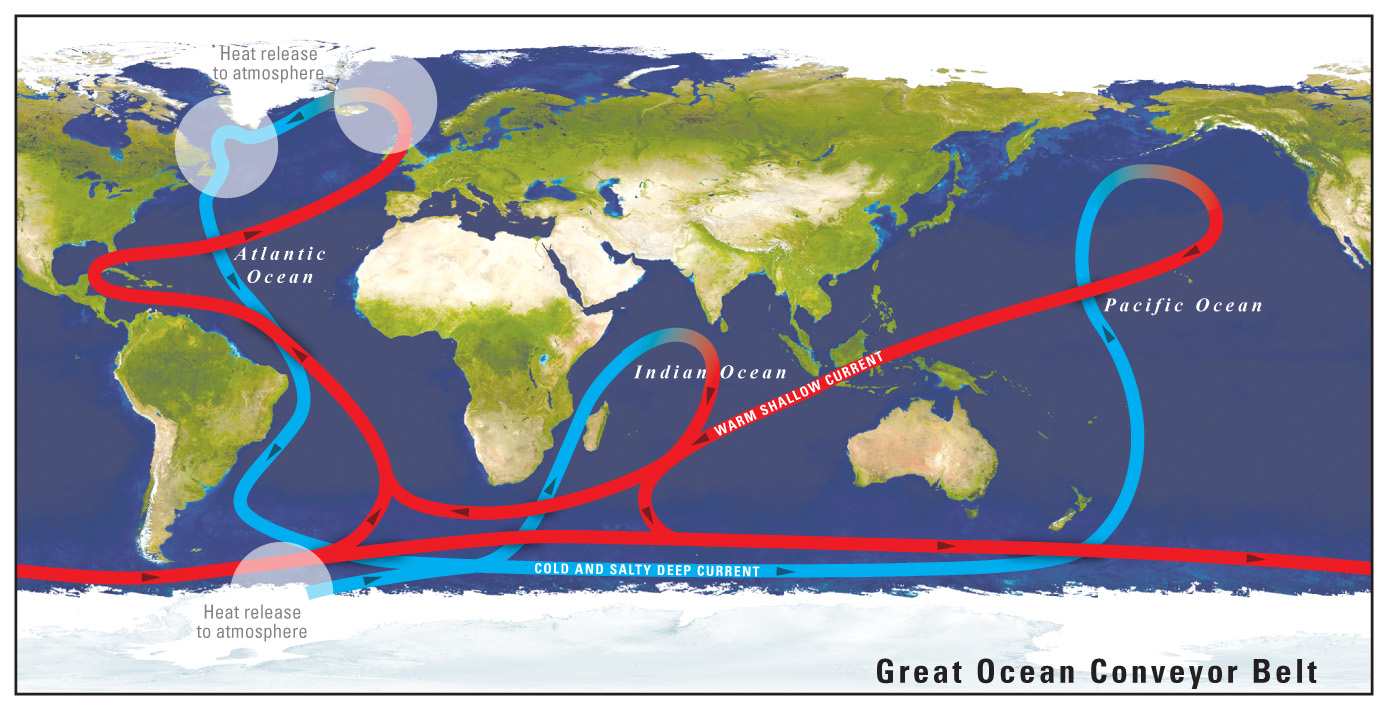
The usual suspects are sounding alarms about the ocean “conveyor belt” AMOC slowing down, and predicting that global warming will result in global cooling.

The Ocean’s Conveyor Belt Is Slowing Down: What You Need to Know About AMOC, Greenland and ‘Unprecedented’ Sea Level Rise

Using data gathered from ice cores, tree rings and coral samples, the research team (led by the Potsdam Institute for Climate Impact Research in Germany) posits that weakness in the AMOC after 1975 “is an unprecedented event in the past millennium.”

Planet Expert Michael Mann co-authored the study and told ClimateCentral that a “full-on collapse” of the AMOC could be possible in the coming decades.

The exact consequences will be difficult to predict, but it will definitely have an impact on marine life, which benefits from the nutrients the AMOC delivers up from the ocean depths. “The most productive region, in terms of availability of nutrients, is the high latitudes of the North Atlantic,” said Mann. “If we lose that, that’s a fundamental threat to our ability to continue to fish.”

Hurricanes and nor’easters like the recent Winter Storm Juno that brought Snowmageddon to the East Coast could also become more common, he warned.

“If you shut down this mode of ocean circulation, you’re denying the climate system one of its modes of heat transport,” said Mann. “if you deny it one mode of transport, it’s often the case that you will see other modes of transport increase.”

The published paper is Exceptional twentieth-century slowdown in Atlantic Ocean overturning circulation by Stefan Rahmstorf, Jason E. Box, Georg Feulner, Michael E. Mann, Alexander Robinson, Scott Rutherford & Erik J. Schaffernicht 23 March 2015 (Three of the first four names are the most outspoken climatists of our time.)  The Abstract is not as alarming as Mann’s interview.

Possible changes in Atlantic meridional overturning circulation (AMOC) provide a key source of uncertainty regarding future climate change. Maps of temperature trends over the twentieth century show a conspicuous region of cooling in the northern Atlantic. Here we present multiple lines of evidence suggesting that this cooling may be due to a reduction in the AMOC over the twentieth century and particularly after 1970. Since 1990 the AMOC seems to have partly recovered. This time evolution is consistently suggested by an AMOC index based on sea surface temperatures, by the hemispheric temperature difference, by coral-based proxies and by oceanic measurements. We discuss a possible contribution of the melting of the Greenland Ice Sheet to the slowdown. Using a multi-proxy temperature reconstruction for the AMOC index suggests that the AMOC weakness after 1975 is an unprecedented event in the past millennium (p > 0.99). Further melting of Greenland in the coming decades could contribute to further weakening of the AMOC. (wiggle words in bold)

Recent Observations of AMOC Trends

Activists pushing global warming/climate change are trying to get ahead of the likely coming cooling phase following the recent warming phase of the natural climate cycle. The kernal of truth in their hand waving resides in the initial report from the RAPID project.

The RAPID moorings being deployed. Credit: National Oceanography Centre

The RAPID project report is Observed decline of the Atlantic meridional overturning circulation 2004–2012 by D. A. Smeed, G. D. McCarthy et al.

10-year time series of the strength of AMOC, measured as water transported in Sverdrups (millions of cubic metres of water per second). Graph shows 10-day average measurements (grey line) and 180-day average (red line). Source: Srokosz & Bryden ( 2015)

“We have shown that there was a slowdown in the AMOC transport between 2004 and 2012 amounting to an average of −0.54 Sv yr−1 (95 % c.i. −0.08 to −0.99 Sv yr−1) at 26◦ N, and that this was primarily due to a strengthening of the southward flow in the upper 1100 m and a reduction of the southward transport of NADW below 3000 m. This trend is an order of magnitude larger than that predicted by climate models associated with global climate change scenarios, suggesting that this decrease represents decadal variability in the AMOC system rather than a response to climate change. (lower North Atlantic deep water (LNADW) upper (UNADW) . . .our observations show no significant change in the Gulf Stream transport over the 2004–2012 period when the AMOC is decreasing.”

AMOC Observations in Historical Context

Oceanographers are not alarmed, unlike activists Ramsdorf, Mann and Box.  For example these recent papers: Recent slowing of Atlantic overturning circulation as a recovery from earlier strengthening by Laura C. Jackson, K. Andrew Peterson, Chris D. Roberts & Richard A. Wood 23 May 2016.   Abstract:

The Atlantic meridional overturning circulation (AMOC) has weakened substantially over the past decade. Some weakening may already have occurred over the past century, and global climate models project further weakening in response to anthropogenic climate change. Such a weakening could have significant impacts on the surface climate.

However, ocean model simulations based on historical conditions have often found an increase in overturning up to the mid-1990s, followed by a decrease. It is therefore not clear whether the observed weakening over the past decade is part of decadal variability or a persistent weakening. Here we examine a state-of-the-art global-ocean reanalysis product, GloSea5, which covers the years 1989 to 2015 and closely matches observations of the AMOC at 26.5° N, capturing the interannual variability and decadal trend with unprecedented accuracy.

The reanalysis data place the ten years of observations—April 2004 to February 2014—into a longer-term context and suggest that the observed decrease in the overturning circulation is consistent with a recovery following a previous increase. We find that density anomalies that propagate southwards from the Labrador Sea are the most likely cause of these variations. We conclude that decadal variability probably played a key role in the decline of the AMOC observed over the past decade. (my bolds)

And this paper: A reversal of climatic trends in the North Atlantic since 2005
by Jon Robson, Pablo Ortega & Rowan Sutton 06 June 2016. Abstract:

In the mid-1990s the North Atlantic subpolar gyre warmed rapidly, which had important climate impacts such as increased hurricane numbers and changes to rainfall over Africa, Europe and North America. Evidence suggests that the warming was largely due to a strengthening of the ocean circulation, particularly the Atlantic Meridional Overturning Circulation. Since the mid-1990s direct and indirect measurements have suggested a decline in the strength of the ocean circulation, which is expected to lead to a reduction in northward heat transport.

Here we show that since 2005 a large volume of the upper North Atlantic Ocean has cooled significantly by approximately 0.45 °C or 1.5 × 10²² J, reversing the previous warming trend. By analysing observations and a state-of-the-art climate model, we show that this cooling is consistent with a reduction in the strength of the ocean circulation and heat transport, linked to record low densities in the deep Labrador Sea. The low density in the deep Labrador Sea is primarily due to deep ocean warming since 1995, but a long-term freshening also played a role. The observed upper ocean cooling since 2005 is not consistent with the hypothesis that anthropogenic aerosols directly drive Atlantic temperatures.

Summary

Once again climatists exaggerate and ignore ocean oscillations in favor of their CO2 hysteria.  In the details of the AMOC report are observations that the heat transports slowed in part, increased in another part, and the warm gulf stream flow remained the same.

The AMO index supports this latter point, showing the continuing pulses of warm Atlantic water into the Arctic.

The next phase of the AMO will be cooler than the present, and will not be caused by human activity.

Background on AMOC is at Climate Pacemaker: The AMOC