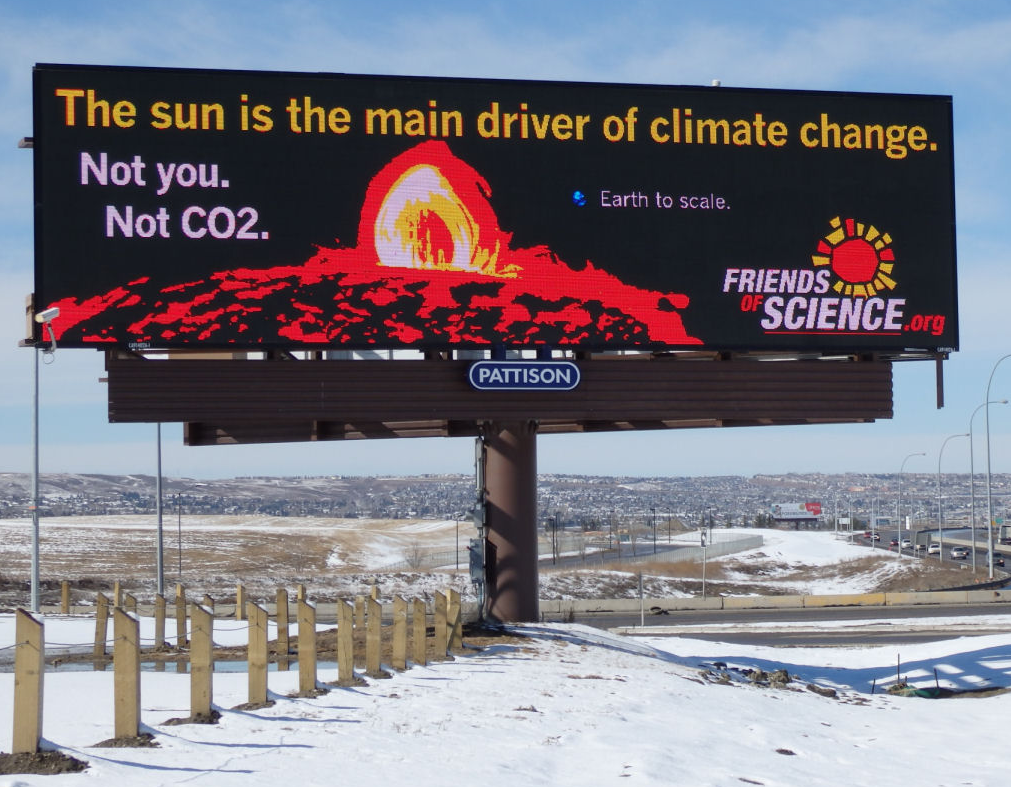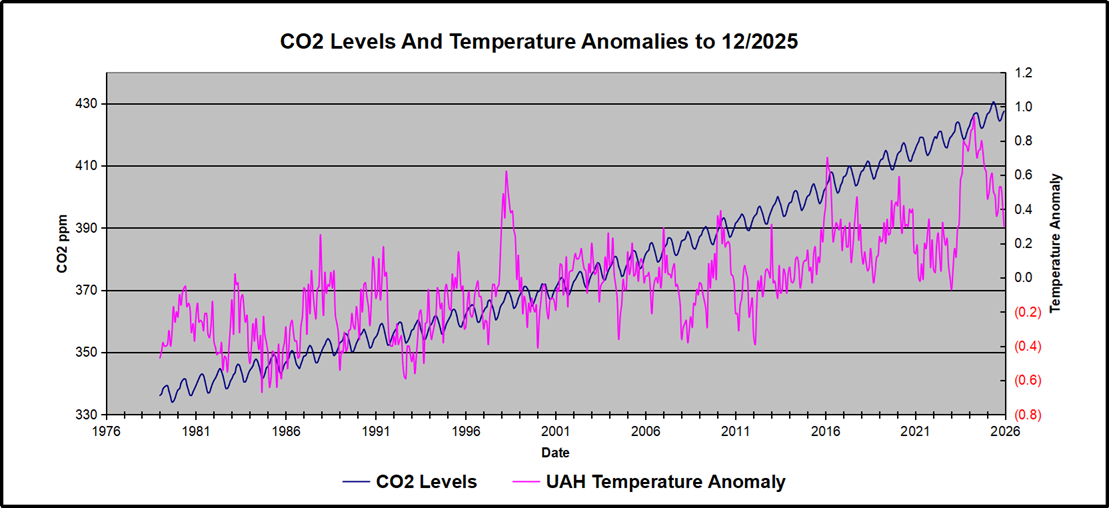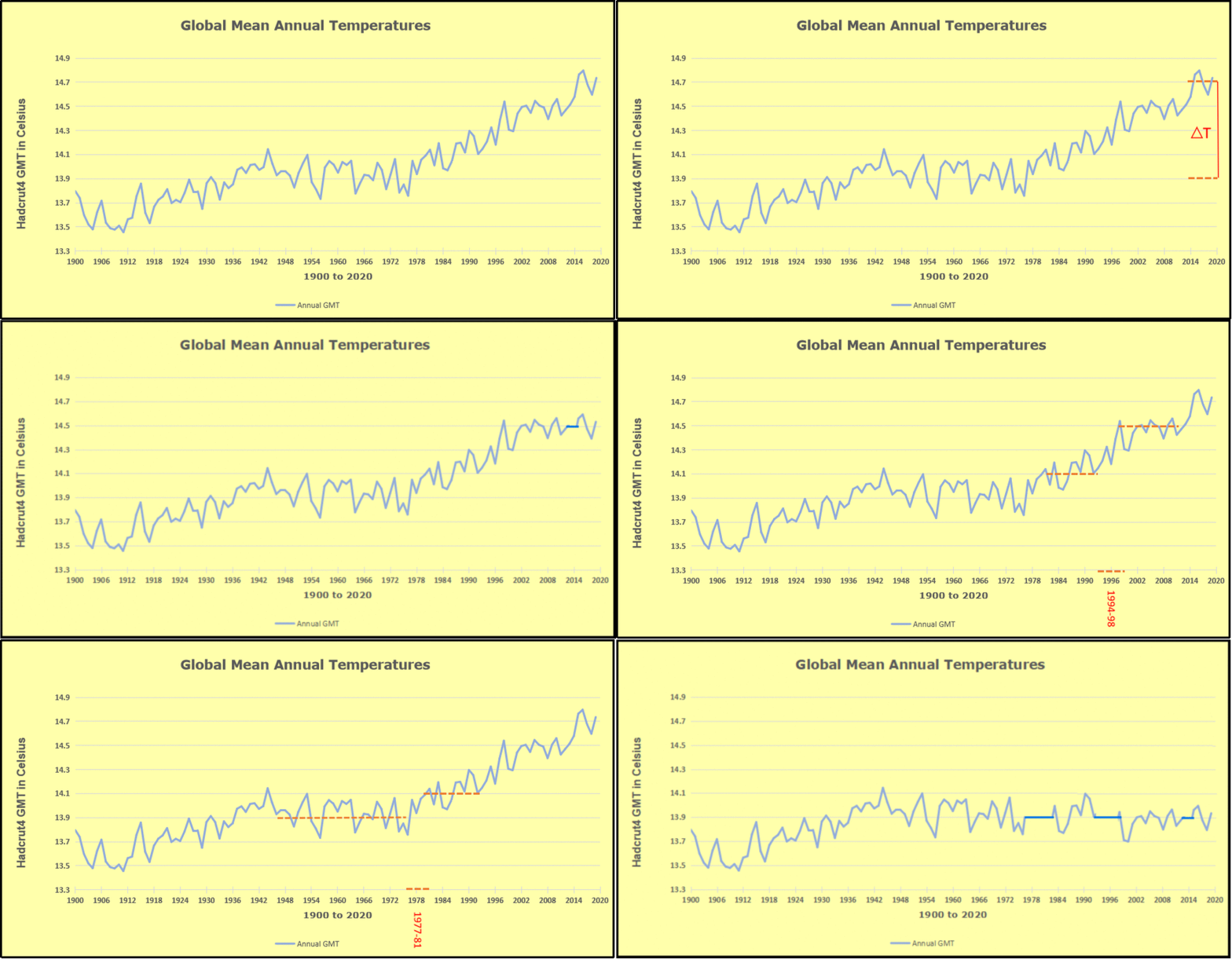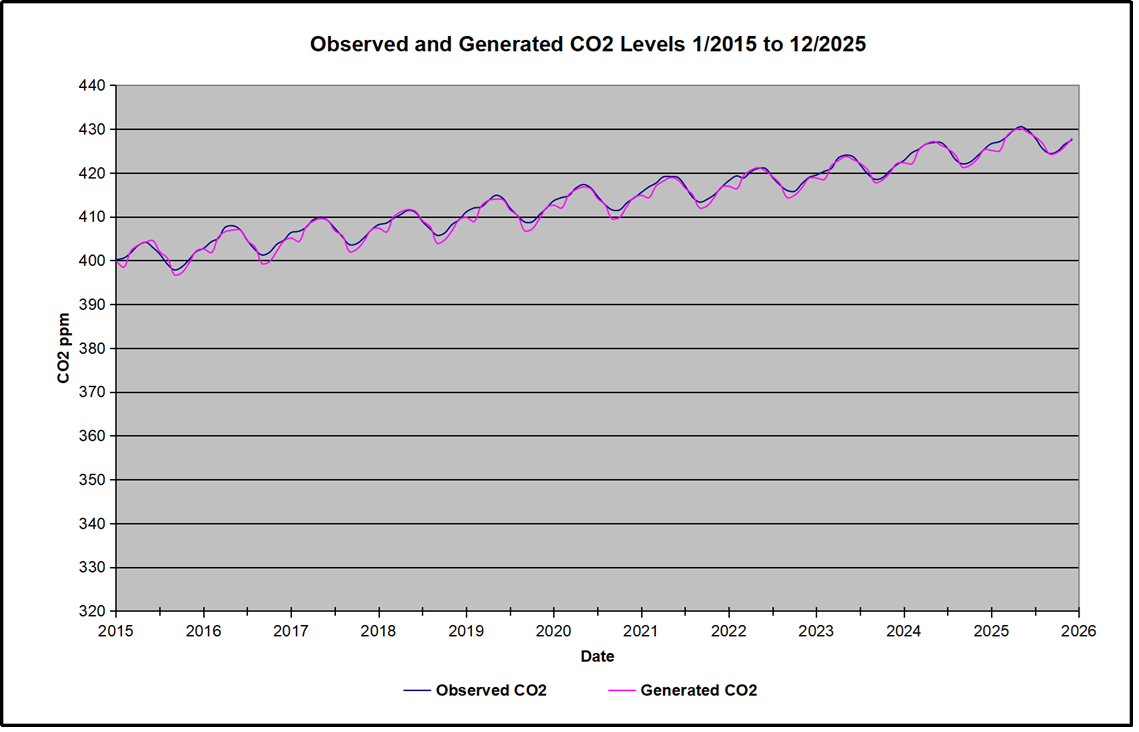
The Cooling Also Not Our Fault 2025

With the lack of global warming and the steep decline of SSTs the last 2 years, climatists are pivoting to the notion invented by the infamous M. Mann, AKA Mr. Hockey Stick (aiming to erase the Medieval warming period).  The reasoning is convoluted, as you might expect given the intent to blame cold weather on global warming.  The claim is that burning fossil fuels causes the North Atlantic Current to slow down and bring cold temperatures to the Northern Hemisphere.  The video below is an excellent PR piece promoting this science fiction as though it were fact.

Science Facts to Counter Science Fiction

Natural variability has dominated Atlantic Meridional Overturning Circulation since 1900
Mojib Latif et al. published April 2022 Nature Climate Change.  Excerpts in italics with my bolds.

Abstract

There is debate about slowing of the Atlantic Meridional Overturning Circulation (AMOC), a key component of the global climate system. Some focus is on the sea surface temperature (SST) slightly cooling in parts of the subpolar North Atlantic despite widespread ocean warming. Atlantic SST is influenced by the AMOC, especially on decadal timescales and beyond. The local cooling could thus reflect AMOC slowing and diminishing heat transport, consistent with climate model responses to rising atmospheric greenhouse gas concentrations.

Here we show from Atlantic SST the prevalence of natural AMOC variability since 1900. This is consistent with historical climate model simulations for 1900–2014 predicting on average AMOC slowing of about 1 Sv at 30° N after 1980, which is within the range of internal multidecadal variability derived from the models’ preindustrial control runs. These results highlight the importance of systematic and sustained in-situ monitoring systems that can detect and attribute with high confidence an anthropogenic AMOC signal.

Main

Global surface warming (global warming hereafter) since the beginning of the twentieth century is unequivocal, and humans are the main cause through the emission of vast amounts of greenhouse gases (GHGs), especially carbon dioxide (CO2)1,2,3. The oceans have stored more than 90% of the heat trapped in the climate system caused by the accumulation of GHGs in the atmosphere, thereby contributing to sea-level rise and leading to more frequent and longer lasting marine heat waves4. Moreover, the oceans have taken up about one third of the total anthropogenic CO2 emissions since the start of industrialization, causing ocean acidification5. Both ocean warming and acidification already have adverse consequences for marine ecosystems6. Some of the global warming impacts, however, unfold slowly in the ocean due to its large thermal and dynamical inertia. Examples are sea-level rise and the response of the Atlantic Meridional Overturning Circulation (AMOC), a three-dimensional system of currents in the Atlantic Ocean with global climatic relevance7,8,9,10.

[Comment: The paragraph above is the obligatory statement of fidelity to the Climatist Creed. All the foundational claims are affirmed with references to prove the authors above reproach, and not to be dismissed as denialists.  As further evidence of their embrace of IPCC consensus science, consider the diagrams below.

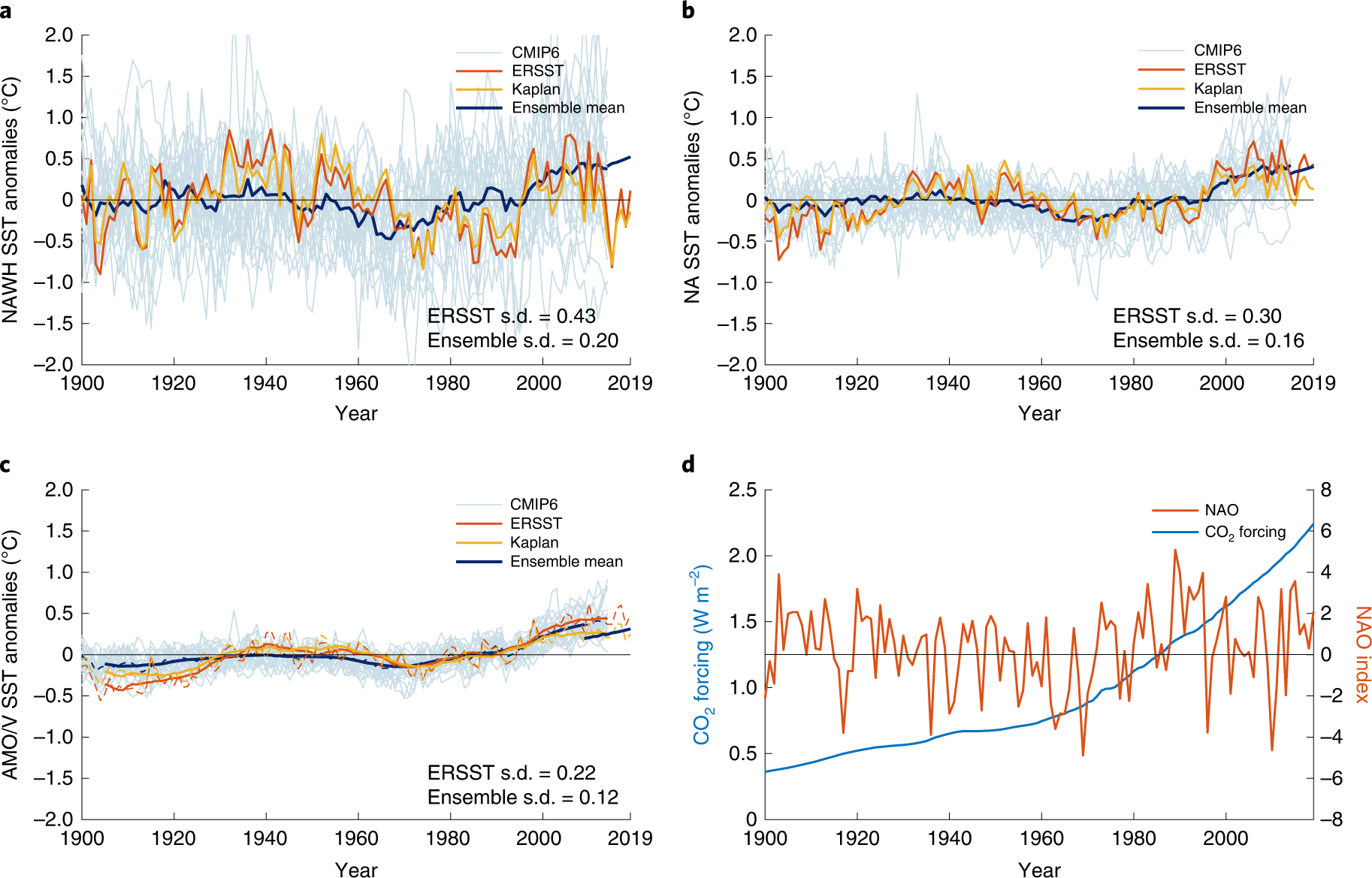
a, The NAWH SST index (°C), defined as the annual SST anomalies averaged over the region 46° N–62° N and 46° W–20° W. Observations for 1900–2019 from ERSSTv.5 (orange) and Kaplan SST v.2 (yellow), and ensemble-mean SST for 1900–2014 (dark blue line) from the historical simulations with the CMIP6 models and the individual historical simulations (thin grey lines) are shown. b, Same as a but for the NA-SST index (°C), defined as the annual SST anomalies averaged over the region 40° N–60° N and 80° W–0° E. c, Same as a but for the AMO/V (°C) index, defined as the 11-year running mean of the annual SST anomalies averaged over the region 0° N–65° N and 80° W–0° E. The SST indices in a–c are calculated as area-weighted means. d, NAO index (dimensionless) for 1900–2019 (red), defined as the difference in the normalized winter (December–March) sea-level pressure between Lisbon (Portugal) and Stykkisholmur/Reykjavik (Iceland). The blue curve indicates the equivalent CO2 radiative forcing (W m−2) for 1900–2019, which is taken from the Representative Concentration Pathway (RCP) SSP5-8.5 after 2014.

Chart d shows the NAO fluxes compared to a CO2 forcing curve based upon the much criticized RCP 8.5 scenario, which is not “business-as-usual” but rather “business-impossible.” Using it shows the authors bending over backwards to give every chance for confirming the alarming slowdown narrative.  The next paragraph gives the entire game away]

Climate models predict substantial AMOC slowing if atmospheric GHG concentrations continue to rise unabatedly1,11,12,13,14. Substantial AMOC slowing would drive major climatic impacts such as shifting rainfall patterns on land15, accelerating regional sea-level rise16,17 and reducing oceanic CO2 uptake. However, it is still unclear as to whether sustained AMOC slowing is underway18,19,20,21,22. Direct ocean-circulation observation in the North Atlantic (NA) is limited9,23,24,25,26,27. Inferences drawn about the AMOC’s history from proxy data28 or indices derived from other variables, which may provide information about the circulation’s variability (for example, sea surface temperature (SST)21,29,30, salinity31 or Labrador Sea convection32), are subject to large uncertainties.

Discussion

Observed SSTs and a large ensemble of historical simulations with state-of-the-art climate models suggest the prevalence of internal AMOC variability since the beginning of the twentieth century. Observations and individual model runs show comparable SST variability in the NAWH region. However, the models’ ensemble-mean signal is much smaller, indicative of the prevalence of internal variability. Further, most of the SST cooling in the subpolar NA, which has been attributed to anthropogenic AMOC slowing21, occurred during 1930–1970, when the radiative forcing did not exhibit a major upward trend. We conclude that the anthropogenic signal in the AMOC cannot be reliably estimated from observed SST. A linear and direct relationship between radiative forcing and AMOC may not exist. Further, the relevant physical processes could be shared across EOF modes, or a mode could represent more than one process.

A relatively stable AMOC and associated northward heat transport during the past decades is also supported by ocean syntheses combining ocean general circulation models and data76,77, hindcasts with ocean general circulation models forced by observed atmospheric boundary conditions78 and instrumental measurements of key AMOC components9,22,79,80,81.

Neither of these datasets suggest major AMOC slowing since 1980, and neither of the AMOC indices from Rahmstorf et al.20 or Caesar et al.21 show an overall AMOC decline since 1980.

Contextual Background

From the Energy MIx Changes in Atlantic Current May Fall Within Natural Variability.  

In the February, 2022, edition of the journal Nature Geoscience, researchers at the University of Maryland Center for Environmental Science urged more detailed study of the notoriously complex Atlantic Meridional Overturning Circulation (AMOC). Now, oceanographer Mojib Latif and his team from the GEOMAR Helmholtz Centre for Ocean Research in Kiel, Germany are repeating that call in a paper just published in the journal Nature Climate Change.

The latest study describes the AMOC as a “three-dimensional system of current in the Atlantic Ocean with global climatic relevance.”

The February study responded to an August 2021 warning from the Potsdam Institute
that the AMOC has become wildly unstable and dangerously weak
due to global warming caused by human activity.

The authors of the latest study affirm that the Earth’s oceans have taken up more than 90% of the accumulated heat and roughly a third of all CO2 emissions since the dawn of the industrial age, leading to clearly measurable and devastating impacts like marine heat waves, sea level rise, and ocean acidification.

But it isn’t easy to confirm that the Atlantic circulation is actually slowing, partly because the ocean possesses such “large thermal and dynamical inertia.”

It is also extremely difficult to directly observe ocean circulation patterns in the North Atlantic, and proxies like sea surface temperature are “subject to large uncertainties,” the scientists say. Based on the available data, the GEOMAR study attributes localized sea surface cooling in the North Atlantic since 1900 to natural AMOC variability—not, as had been hypothesized, to a global heating-induced breakdown in the AMOC’s capacity to transfer heat.

Footnote:

See also from Science Norway Researchers and the media need to stop crying ‘wolf’ about the Gulf Stream


IPCC Global Warming Claims Not Only Wrong, But Impossible

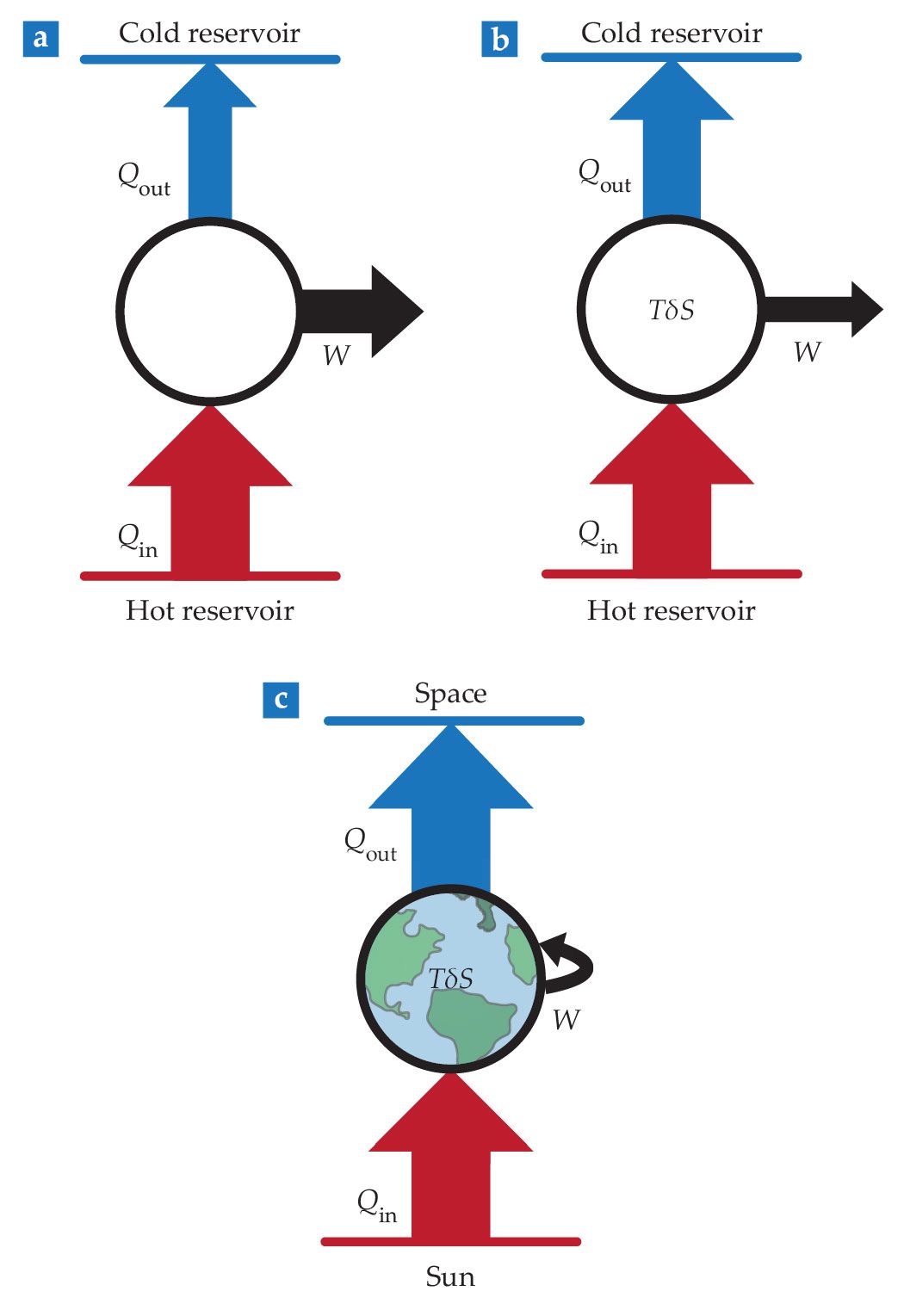
Climate as heat engine. A heat engine produces mechanical energy in the form of work W by absorbing an amount of heat Qin from a hot reservoir (the source) and depositing a smaller amount Qout into a cold reservoir (the sink). (a) An ideal Carnot heat engine does the job with the maximum possible efficiency. (b) Real heat engines are irreversible, and some work is lost via irreversible entropy production TδS. (c) For the climate system, the ultimate source is the Sun, with outer space acting as the sink. The work is performed internally and produces winds and ocean currents. As a result, Qin = Qout.

Ad Huijser recently published a paper explaining why IPCC claims about global warming are contradicted by observations of our Earth thermal system including a number of internal and external subsytems. The title Global Warming and the “impossible” Radiation Imbalance links to the pdf. This post is a synopsis to present the elements of his research findings, based on the rich detail, math and references found in the document. Excerpts in italics with my bolds and added images. H/T Kenneth Richard and No Tricks Zone.

Abstract

Any perturbation in the radiative balance at the top of the atmosphere (TOA) that induces a net energy flux into- or out of Earth’s thermal system will result in a surface temperature response until a new equilibrium is reached. According to the Anthropogenic Global Warming (AGW) hypothesis which attributes global warming solely to rising concentrations of Greenhouse gases (GHGs), the observed increase in Earth’s radiative imbalance is entirely driven by anthropogenic GHG-emissions.

However, a comparison of the observed TOA radiation imbalance with the assumed GHG forcing trend reveals that the latter is insufficient to account for the former. This discrepancy persists even when using the relatively high radiative forcing values for CO2 adopted by the Intergovernmental Panel on Climate Change (IPCC), thereby challenging the validity of attributing recent global warming exclusively to human-caused GHG emissions.

In this paper, Earth’s climate system is analyzed as a subsystem of the broader Earth Thermal System, allowing for the application of a “virtual balance” approach to distinguish between anthropogenic and other, natural contributions to global warming. Satellite-based TOA radiation data from the CERES program (since 2000), in conjunction with Ocean Heat Content (OHC) data from the ARGO float program (since 2004), indicate that natural forcings must also play a significant role. Specifically, the observed warming aligns with the net increase in incoming shortwave solar radiation (SWIN), likely due to changes in cloud cover and surface albedo. Arguments suggesting that the SWIN trend is merely a feedback response to GHG-induced warming are shown to be quantitatively insufficient.

This analysis concludes that approximately two-thirds of the observed global warming must be attributed to natural factors that increase incoming solar radiation, with only one-third attributable to rising GHG-concentrations. Taken together, these findings imply a much lower climate sensitivity than suggested by IPCC-endorsed Global Circulation Models (GCMs).

Introduction

On a global scale and over longer periods of time, the average surface temperature of our climate system reacts similarly to that of a thermal system such as a pot of water on a stove: when the incoming heat is steady and below boiling, the system stabilizes when the heat loss (via radiation and convection) equals the input. Analogously, Earth’s surface-atmosphere interface is the main absorber and emitter of heat. Reducing the “flame” (solar input) leads to cooling, regardless of the total heat already stored in the system. The system’s average temperature will drop as well, as soon as the heating stops. So, no sign of any “warming in the pipeline” for such a simple system.

The two transport mechanisms, air and ocean, operate on different timescales. Air has a low specific heat capacity, but high wind speeds make it a fast medium for heat transfer. Oceans, by contrast, have a high specific heat capacity but move more slowly. The Atlantic Meridional Overturning Circulation (AMOC) with the well-known Gulf Stream carrying warm water from south to north, can reach speeds up to about 3 m/s. But its warm current remains largely confined to surface layers due to limited solar radiation penetration and gravity-induced stratification. With a path-lengths of up to 8,000 km and an average speed of 1.5 m/s, ocean heat takes approximately 2 months to travel from the Gulf of Mexico to the Arctic. This is comparable to the 1 to 2 months delay between solar input and temperature response in the annual cycle, suggesting that oceanic heat transport is part of the climate system’s normal operation. Climate adaptation times from anthropogenic influences are estimated at 3 to 5 years. If “warming in the pipeline” exists, it must be buried in the much colder, deeper ocean layers.

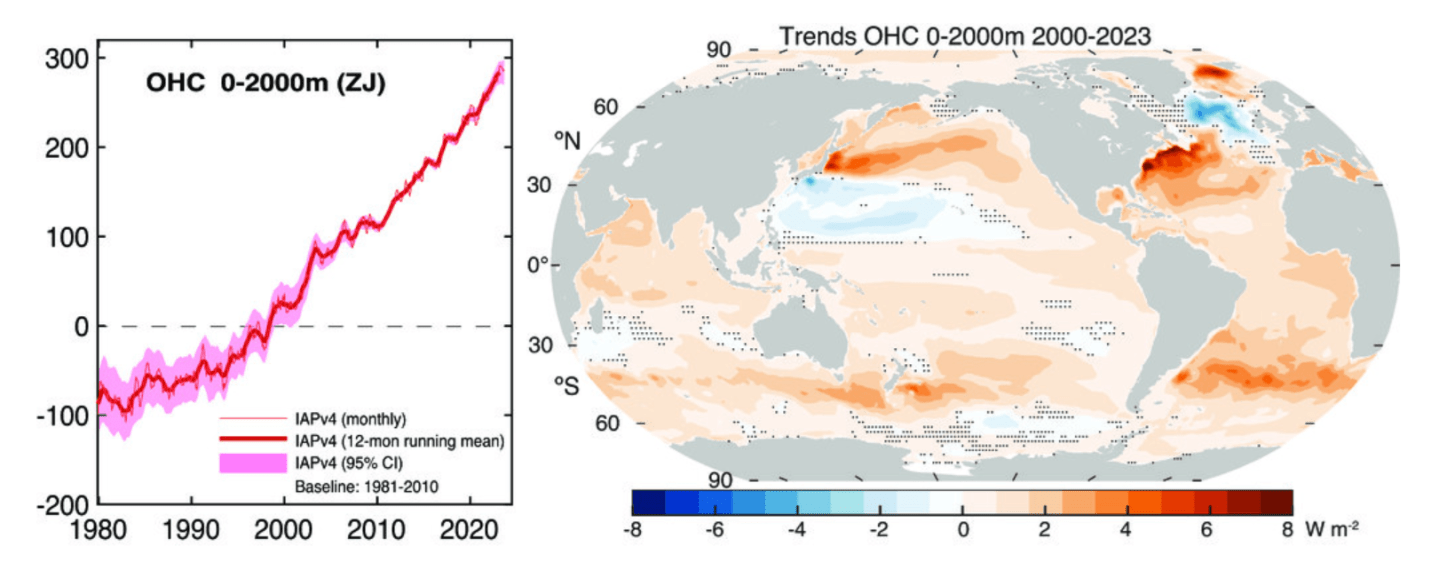
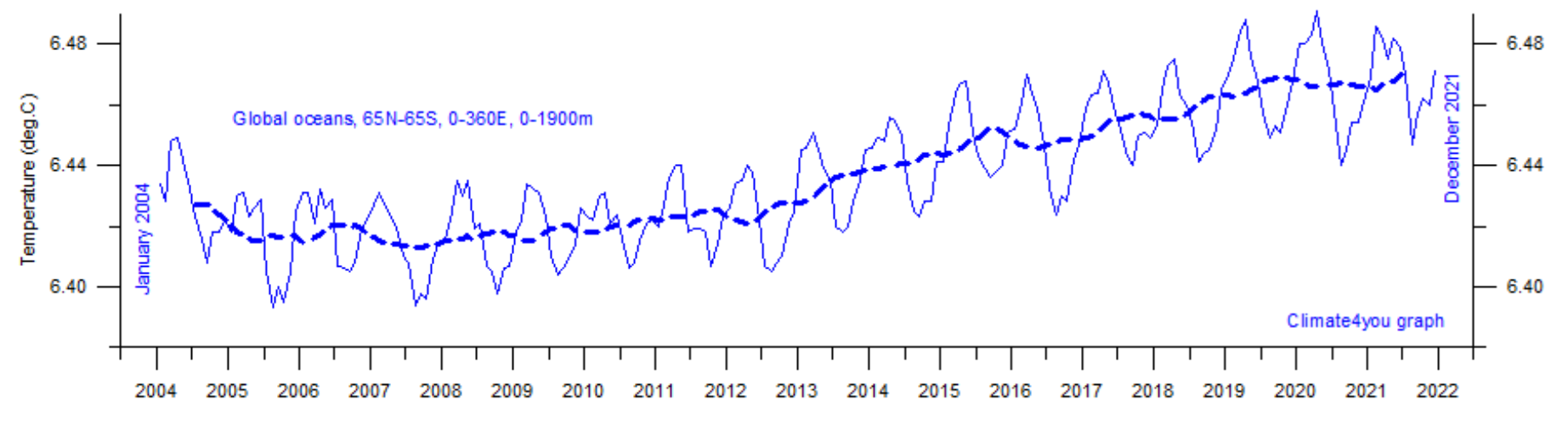
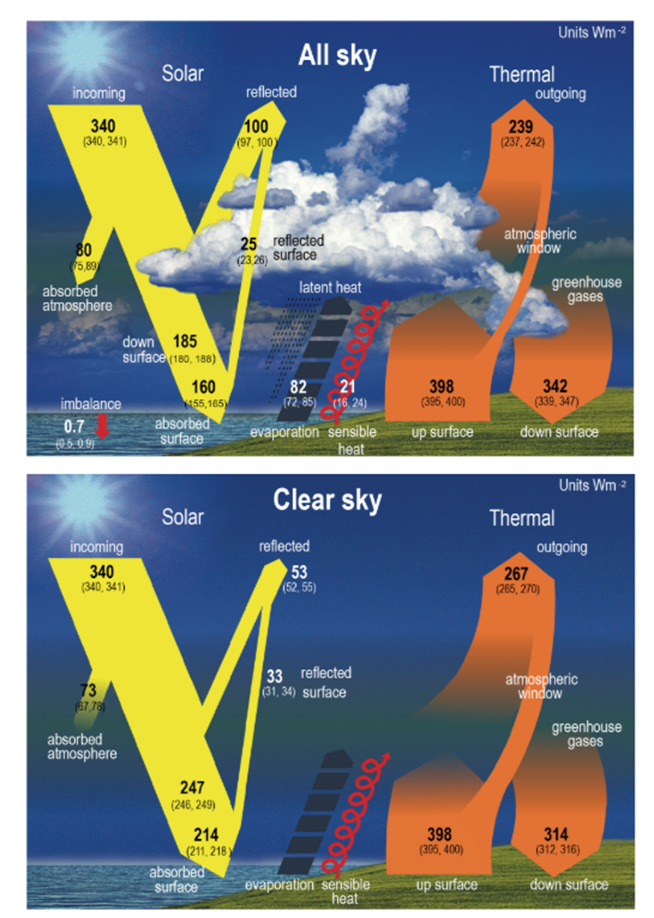
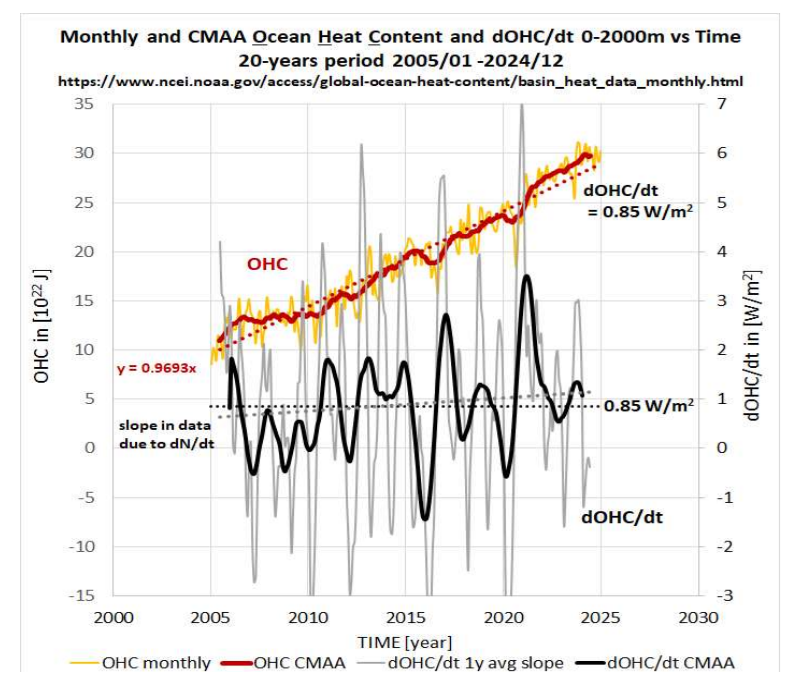
ARGO float data since 2004 show substantial annual increases in Ocean Heat Content (OHC), sometimes expressed in mind-boggling terms such as 10²² joules per year (see Fig.1). While this may sound alarming [1,2], when converted to flux, it represents less than 1 W/m², a mere 0.6% of the average 160 W/m² of absorbed solar energy at the surface. All the rest is via evaporation, convection and ultimately by radiation sent back to space after globally being redistributed by wind and currents.

Fig. 1. Ocean Heat Content (OHC) anomaly from 0–2000 meters over time, shown as 3-month and annual moving averages (CMAA), along with their time derivatives. Notable are the relatively large variations, likely reflecting the influence of El Niño events. The average radiative imbalance at the top of the atmosphere (TOA), estimated at 0.85 W/m², corresponds approximately to the midpoint of the time series (around 2015). Data: https://www.ncei.noaa.gov/access/global-ocean-heat-content/basin_heat_data.html [7].

This raises the question: Why would extra GHGs that have only a limited effect on the 99.4% of the outgoing flux, have affected this 0.6% residue during a couple of decennia in such a way that we should be scared about all that “warming in the pipeline” as Hansen et al. [2] are warning us for? In the following sections, we examine data showing that observed trends in the radiation imbalance and OHC are better explained by the internal dynamics of the Earth’s thermal system and natural forcings such as from increasing solar radiation, rather than solely by GHG emissions.

Estimating our climate’s thermal capacity CCL

The rather fast responses of our climate indicates that the thermal capacity of our climate must be much less than the capacity of the entire Earth thermal system. This climate heat capacity CCL depends on how sunlight is being absorbed, how that heat is transferred to the atmosphere and which part of it is being stored in either land or ocean.

At continental land-area, sunlight is absorbed only at the very surface where the generated heat is also in direct contact with the atmosphere. Seasonal temperature variations don’t penetrate more than 1 to 2 meters deep in average and as a consequence, storage of heat is relatively small. Sunlight can penetrate pure water to several hundred meters deep, but in practice, penetration in the oceans is limited by scattering and absorption of organic and inorganic material. A good indication is the depth of the euphotic zone where algae and phytoplankton live, which need light to grow. In clear tropical waters where most of the sunlight hits our planet, this zone is 80 to 100 m deep [12].

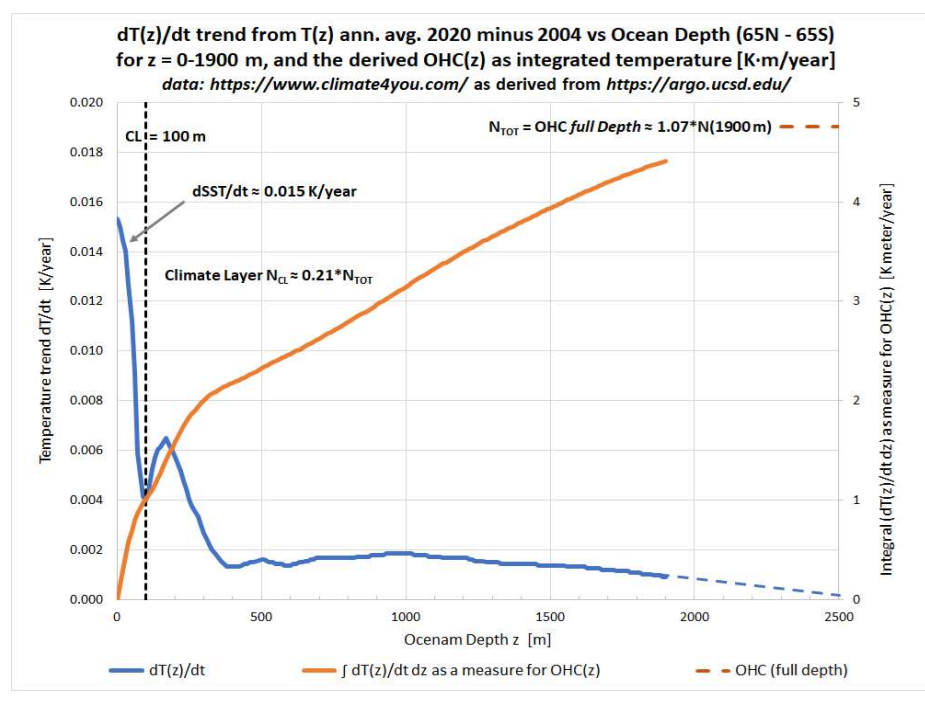
Another important factor in our climate’s heat capacity is how this ocean layer of absorbed heat is in contact with the atmosphere. Tides, wind, waves and convection continuously mix the top layer of our oceans, by which heat is easily exchanged with the atmosphere. This mixed-layer is typically in the order of 25 – 100 m, dependent on season, latitude and on the definition of “well mixed” [13]. Below this ~100 m thick top-layer, where hardly any light is being absorbed and the mixing process has stopped, ocean temperatures drop quickly with depth. As the oceans’ vertical temperature gradient at that depth doesn’t support conductive nor convective heat flows going upward, climate processes at the surface will thus become isolated from the rest of the Earth’ thermal system.

Figure 4 with the Change in Ocean Heat Content vs. Depth over the period 2004 – 2020 obtained via the ARGO-floats [6,14], offers a good indication for the average climate capacity CCL. It shows the top layer with a high surface temperature change according to the observed global warming rate of about 0.015 K/year, and a steep cut off at about 100 m depth in line with the explanation above. Below the top layer, temperature effects are small and difficult to interpret, probably due to averaging over all kinds of temperature/depth profiles in the various oceans ranging from Tropical- to Polar regions.

In case of a “perfect” equilibrium (N = 0, dTS/dt = 0), all of the absorbed sunlight up to about 100 m deep, has to leave on the ocean-atmosphere interface again. However, deep oceans are still very cold with a stable, negative temperature gradient towards the bottom. This gradient will anyhow push some of the absorbed heat downwards. Therefore, even at a climate equilibrium with dTS/dt= 0, we will observe N > 0. With the large heat capacity of the total ocean volume, that situation will not change easily, as it takes about 500 years with today’s N ≈ +1 W/m2 to raise its average temperature just 1°C.

The Earth’s climate system can thus be regarded as a subset of the total Earth’s thermal system (ETS) responding to different relaxation times. The climate relaxes to a new equilibrium within 3–5 years, while the deeper oceans operate on multidecadal or even longer timescales, related to their respective thermal capacities C for the ETS, and CCL for the climate system.

The (near) “steady state” character of current climate change

Despite the ongoing changes in climate, the current state can be considered a “near” steady-state. The GHG forcing trend has been pretty constant for decades. Other forcings, primarily in the SW channel, are also likely to change slowly and can be approximated as having constant trends over decadal timescales. Similarly, despite yearly fluctuations, the surface temperature trend has remained fairly stable since 2000.

This analysis strengthens the conclusion that the increase in both N(t) and N0(t) are not a direct consequence of greenhouse gas emissions, but rather of enhanced forcing in the SW-channel.

The preceding analysis highlights how the IPCC’s assumptions diverge significantly from observed reality. While the IPCC model components may collectively reproduce the observed warming trend, they fail to individually align with key observational data, in particular the Ocean Heat Content.

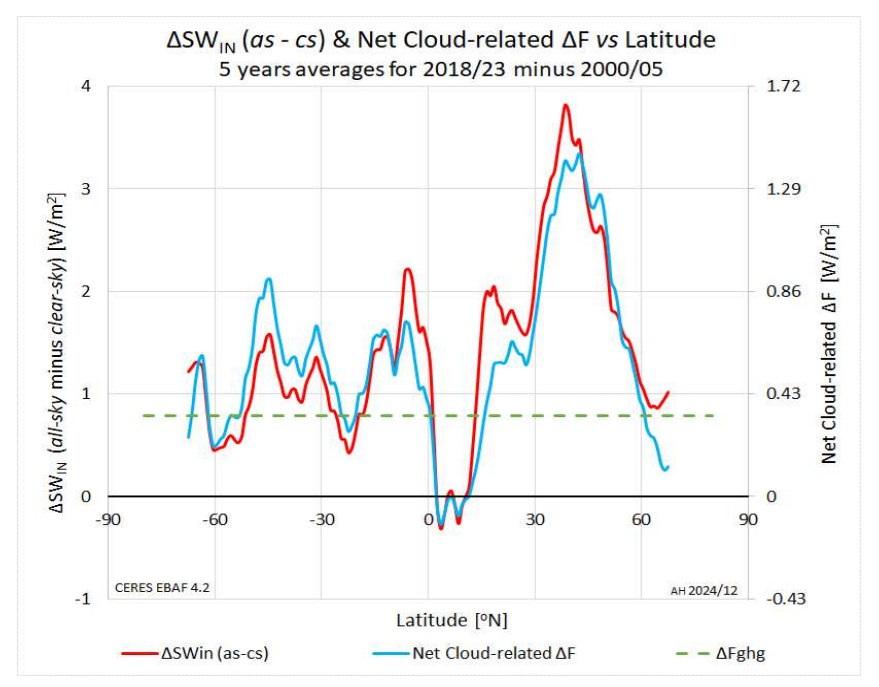
Figure 6 also illustrates that changes in cloudiness are more pronounced on the Northern Hemisphere, especially at mid-latitudes and over Western Europe. For example, the Dutch KNMI weather-station at Cabauw (51.87°N, 4.93oE), where all ground-level radiation components are monitored every 10 minutes, recorded an increase in solar radiation of almost +0.5 W/m²/year since 2000 [26]. Applying the 0.43 net-CRE factor (conservative for this latitude), we estimate a local forcing trend dFSW/dt ≈ 0.2 W/m²/year. This is an order of magnitude larger than the GHG forcing (0.019–0.037 W/m²/year). Even with the IPCC values, GHGs can just account for about 16% of the warming at this station. The average temperature trend for this rural station located in a polder largely covered by grassland, is with ~ +0.043 K/year almost 3x the global average. This, nor the other trends mentioned above can be adequately explained by the IPCC’s GHG-only model.

The IPCC places strong emphasis on the role of climate feedbacks in amplifying the warming effect of greenhouse gases (GHGs) [8]. These feedbacks are considered secondary consequences of Anthropogenic Global Warming, driven by the initial temperature increase from GHGs. Among them, Water-Vapor feedback is the most significant. A warmer atmosphere holds more water vapor (approximately +7%/K) and since water vapor is a potent GHG, even a small warming from CO2 can amplify itself through enhanced evaporation.

Other feedbacks recognized by the IPCC include Lapse Rate, Surface Albedo, and Cloud feedbacks [8], all of which are inherently tied to the presence and behavior of water in its various phases. Therefore, these feedbacks are natural responses to temperature changes, regardless of the original cause of warming, be it GHGs, incoming solar variability, or internal effects. They are not additive components to natural climate sensitivity, as treated by the IPCC, but rather integral parts of it [4].

This analysis reinforces a fundamental point: climate feedbacks are not external modifiers of climate sensitivity; rather, they are inherent to the system. Their combined effect is already embedded in the climate response function. The IPCC’s treatment of feedbacks as additive components used to “explain” high sensitivities in GCMs is conceptually flawed. Physically, Earth’s climate is governed by the mass balance of water in all its phases: ice, snow, liquid, vapor, and clouds. The dynamics between these phases are temperature-sensitive, and they constitute the feedback processes. Feedbacks aren’t just add-ons to the climate system, they are our climate.

Ocean Heat Content increase

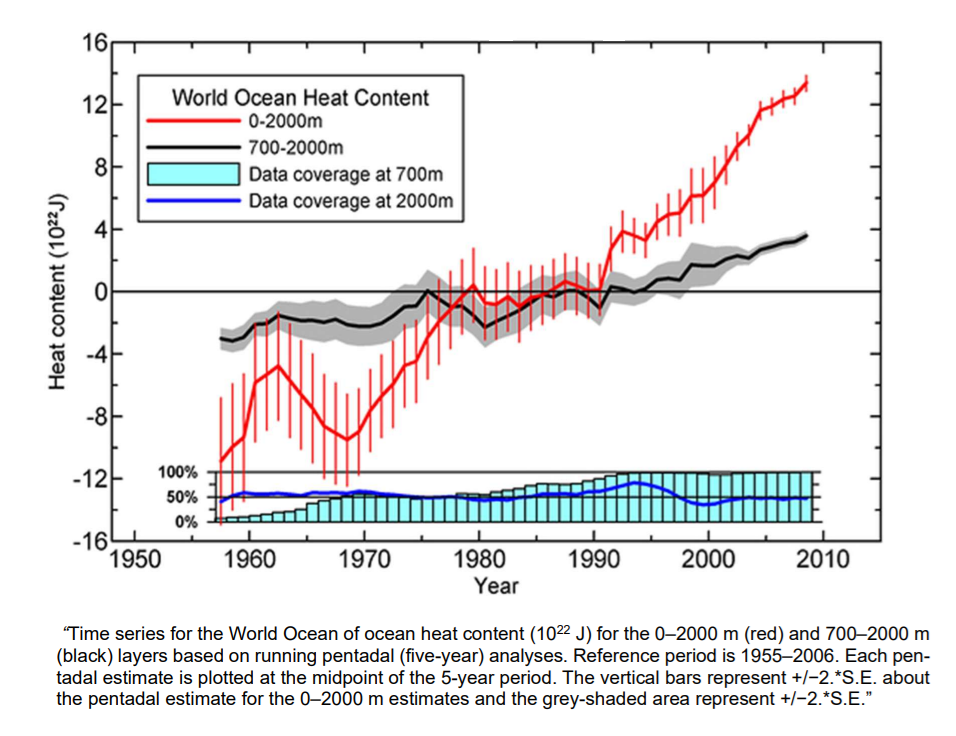
In the introduction, the “heat in the pipeline” concept: the idea that heat stored in the deep, cold ocean layers could later resurface to significantly influence surface temperatures, was challenged. Without a substantial decrease in surface temperatures to reverse ocean stratification, this seems highly unlikely. Large and rapid temperature fluctuations during the pre-industrial era with rates up to plus, but also minus 0.05 K/year over several decennia as recorded in the Central England Temperature (CET) series [27], more than three times the rate observed today, further undermine the notion of a slow-release heat mechanism dominating surface temperature trends.

Ocean Heat Content must be related to solar energy. It is the prime source of energy heating the Earth thermal system. Almost 1 W/m2 of that 240 W/m2 solar flux that is in average entering the system, is presently remaining in the oceans. This is an order of magnitude larger than the estimated 0.1 W/m2 of geothermal heat upwelling from the Earth inner core [11]. Extra greenhouse gasses don’t add energy to the system, but just obstruct cooling. As shown in Section 5.3, this accounts for a radiation imbalance offset τ dFGHG/dt, or equivalent to a contribution to dOHC/dt of only about 0.08 W/m2.
.
As redistribution of “heat in the pipeline” will not change the total OHC, roughly 3/4 of the observed positive trend in OHC must at least be attributed to rising solar input. The oceans act in this way as our climate system’s thermal buffer. It will mitigate warming during periods of increased solar input and dampen cooling when solar input declines, underscoring its critical role in Earth’s climate stability.

The strong downwards slope in the OHC before 1970 confirms the observation in Section 5.4 and expressed by (12) that around the turning point t = ζ, the forcing trend in the SW-channel had to be negative. Moreover, the rather slowly increasing 700-2000m OHC data in Fig.7 indicate that most of the fluctuations have occurred relatively close to the surface. Heat from e.g. seafloor volcanism as “warming from below”, is expected to show up more pronounced in this 700-2000m OHC-profile. Although we cannot rule out geothermal influences [29], this observation makes them less likely.

ERBE measurements of radiative imbalance.

As the OHC seems to be primarily coupled to SWIN, the most plausible cause would involve rapid changes in SW-forcing. A sudden drop in cloud-cover might explain such changes, but no convincing observations could be found for the 1960-1980 period. Alternatively, changes in the latitudinal distribution of cloud-cover as illustrated by Fig.6, can result in similar radiative impacts due to the stark contrast between a positive radiation imbalance in the Tropics and a very negative imbalance at the Poles. The ENSO-oscillations in the Pacific Ocean around the equator are a typical example for such influences, as also illustrated in Fig.3 [10]. Shifts in cloud distribution are linked to changes in wind patterns and/or ocean currents, reinforcing the idea as indicated in Section 1, that even minor disruptions in horizontal heat transport can trigger major shifts in our climate’s equilibrium [29, 30]. Sharp shifts in Earth’s radiation imbalance like the one around 1970 as inferred from Fig.7, may even represent one of those alleged tipping points. But in this case, certainly not one triggered by GHGs. Ironically, some climate scientists in the early 1970s predicted an impending (Little) Ice Age [31].

While additional data (e.g. radiation measurements) are needed to draw firm conclusions, the available evidence already challenges the prevailing GHG-centric narrative again. GHG emissions, with their near constant forcing rate, cannot account for the timing nor the magnitude of historical OHC trends, as NOAA explicitly suggests [32]. Similarly, claims by KNMI that “accelerations” in radiation imbalance trends are GHG-driven [1], are not supported by data. And finally, the alarms around “heat in the pipeline” must be exaggerated if not totally misplaced. Given the similarities in radiation imbalance and GHG forcing rates around 1970 with today’s situation, we must conclude that this assumed heat manifested itself at that time apparently as “cooling in the pipeline”.

However, warnings for continued warming even if we immediately stop now with emitting GHGs are nevertheless, absolutely justified. Only, it isn’t warming then from that heat in the pipeline due to historical emissions that will boost our temperatures. Warming will continue to go on as long as natural forcings will be acting. These are already today’s dominant drivers behind global temperature trends. And unfortunately, they will not be affected by the illusion of stopping global warming as created by implementing Net-Zero policies.

Summary and conclusions

This analysis demonstrates that a global warming scenario driven solely by greenhouse gases (GHGs) is inconsistent with more than 20 years of observations from space and of Ocean Heat Content. The standard anthropogenic global warming (AGW) hypothesis, which attributes all observed warming to rising GHG concentrations, particularly CO2, cannot explain the observed trends. Instead, natural factors, especially long-term increase in incoming solar radiation, appear to play a significant and likely dominant role in global warming since the mid-1970s.

The observed increase in incoming solar radiation cannot be accounted for by the possible anthropogenic side effects of Albedo- and Cloud-feedback. All evidence points to the conclusion that this “natural” forcing with a trend of about 0.035 W/m2/year is equal to, or even exceeds the greenhouse gas related forcing of about 0.019 W/m2/year. Based on these values, only 1/3rd of the observed temperature trend can be of anthropogenic origin. The remaining 2/3rd must stem from natural changes in our climate system, or more broadly, in our entire Earth’ thermal system.

Moreover, the observed increase in Earth’s radiation imbalance appears to be largely unrelated to GHGs. Instead, it correlates strongly with natural processes driving increased incoming solar radiation. Claims of “acceleration” in the radiation imbalance due to GHG emissions are not supported by the trend in accurately measured GHG concentrations. If any acceleration in global warming is occurring, it is almost certainly driven by the increasing flux of solar energy—an inherently natural phenomenon not induced by greenhouse gases.

In summary, this analysis challenges the notion that GHGs are the primary drivers of recent climate change. It underscores the importance of accounting for natural variability, especially in solar input, when interpreting warming trends and evaluating climate models.

Note: Dr. Ad Huijser, physicist and former CTO of Philips and director of the Philips Laboratories, describes himself as “amateur climatologist”. However his approach to climate physics is quite professional, I think.

See Also: 

Our Atmospheric Heat Engine


About Sea Surface Temperatures

Background from NOAA Climate.gov

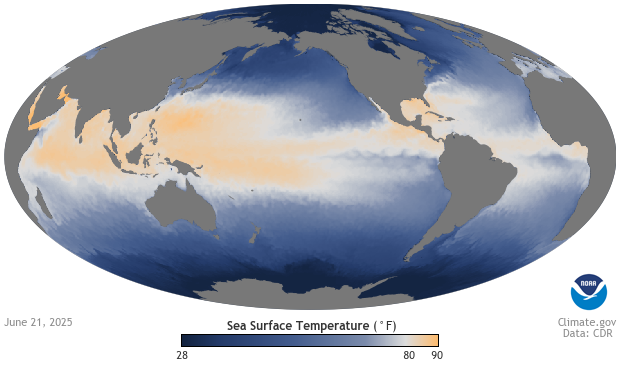
Q:  What’s the temperature of water at the ocean’s surface?
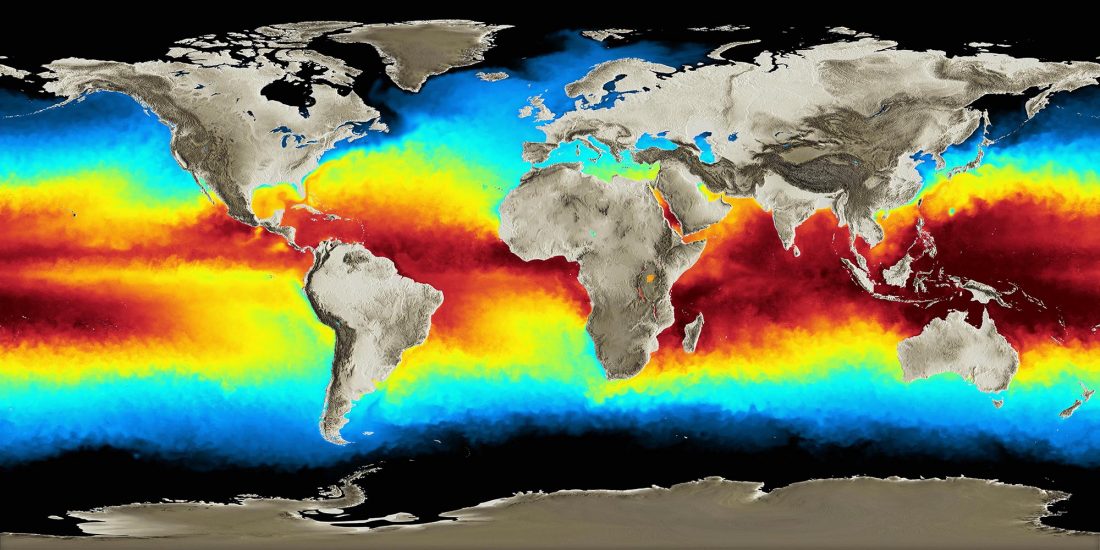
A:  Colors on the map show the temperature of water right at the ocean’s surface. The darkest blue shows the coldest water: floating sea ice is usually present in these areas. Lighter shades of blue show temperatures of up to 80°F. White and orange areas show where surface temperatures are higher than 80°F, warm enough to fuel tropical cyclones or hurricanes.

Q:  Where do these measurements come from?
A:  Satellite instruments measure sea surface temperature—often abbreviated as SST—by checking how much energy comes off the ocean at different wavelengths. Computer programs merge sea surface temperatures from ships and buoys with the satellite data, and incorporate information from maps of sea ice. To produce the daily maps, programs invoke mathematical filters to combine and smooth data from all three sources.

Q:  Why do these data matter?
A:  While heat energy is stored and mixed throughout the depth of the ocean, the temperature of water right at the sea’s surface—where the ocean is in direct contact with the atmosphere—plays a significant role in weather and short-term climate. Where sea surface temperatures are high, relatively large amounts of heat energy and moisture enter the atmosphere, sometimes producing powerful, drenching storms downwind. Conversely, lower sea surface temperatures mean less evaporation. Global patterns of sea surface temperatures are an important factor for weather forecasts and climate outlooks.

Q:  How did you produce these snapshots?
A:  Data Snapshots are derivatives of existing data products: to meet the needs of a broad audience, we present the source data in a simplified visual style. NOAA’s Climate Data Records Program produces the Opitimum Interpolated Sea Surface Temperature files. To produce our images, we run a set of scripts that access the source files, re-project them into desired projections at various sizes, and output them with a custom color bar.

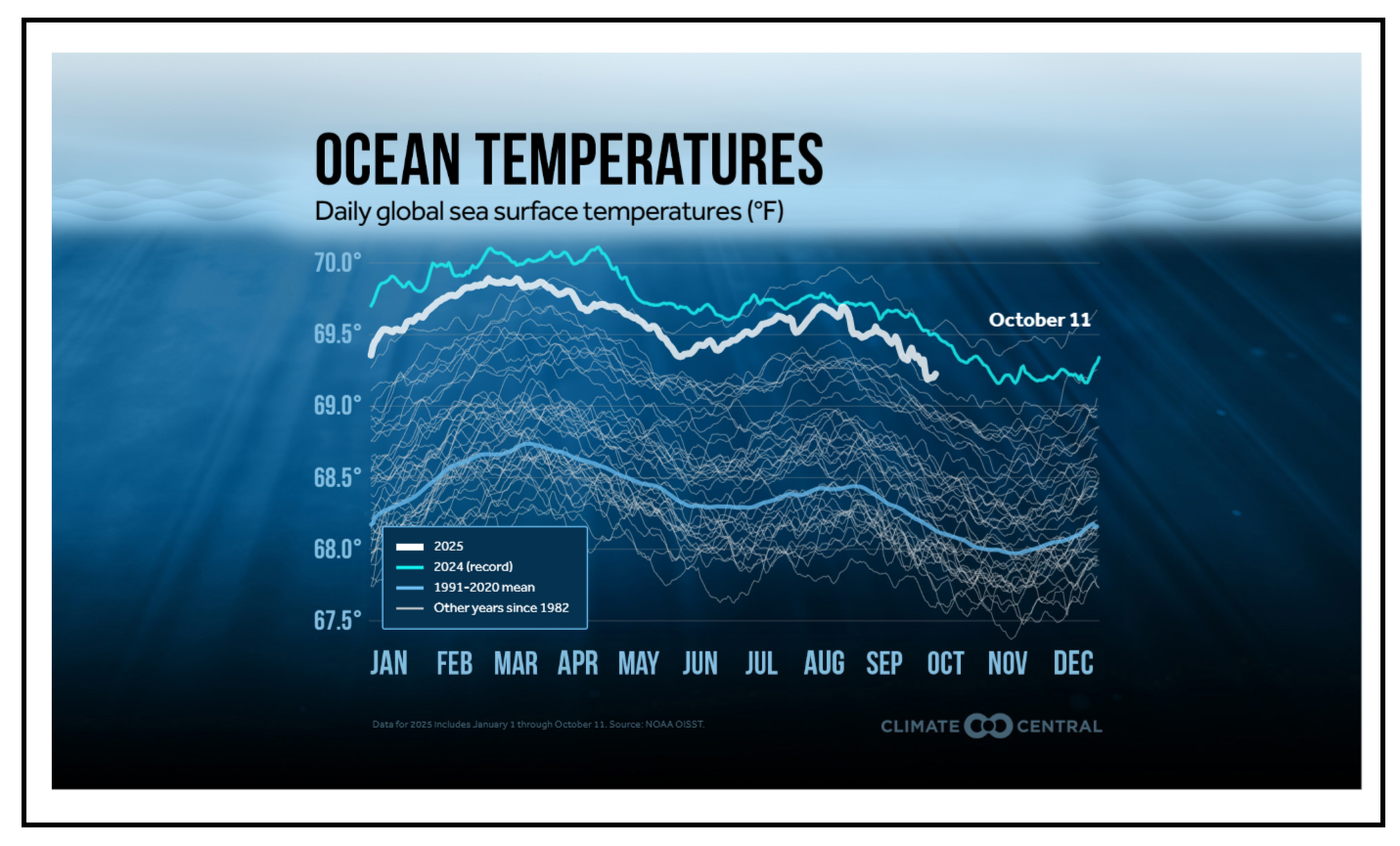
With the federal government shutdown, dataset updates are uncertain, but OISST is current and shows how presently the ocean is cooling down from it’s 2024 high temperatures.

Note: Daily SST Ocean Temperature Graphic, 1982-2025

Use the options below to generate graphics of daily sea surface temperatures since 1982 using data from NOAA’s Optimum Interpolation Sea Surface Temperature (OISST) v2.1 dataset. [The chart above defines Global as 60°N to 60°S.]  These graphics will update daily, or as data becomes available on the Climate Reanalyzer website. Note the most recent two weeks of data are considered preliminary. Specific information about the data can be found here.

My Comment:

The chart shows how 2025 is tracking ~half a degree F cooler than 2024. That may not seem significant, except that the ocean covers 71% of the Earth’s surface, and any SST warming is reported in numbers of zettajoules.  This is explained at the EPA website Climate Change Indicators: Ocean Heat:

The top 700 meters of the ocean contain 63% of the ocean’s heat content. The data shows that ocean layer has warmed about a zettajoule (1×10^22 joules) yearly since 1990.

For reference, an increase of 1 unit on this graph (1 × 10^22 joules) is equal to approximately 17 times the total amount of energy used by all the people on Earth in a year (based on a total global energy supply of 606 exajoules in the year 2019, which equates to 6.06 × 10^20 joules).

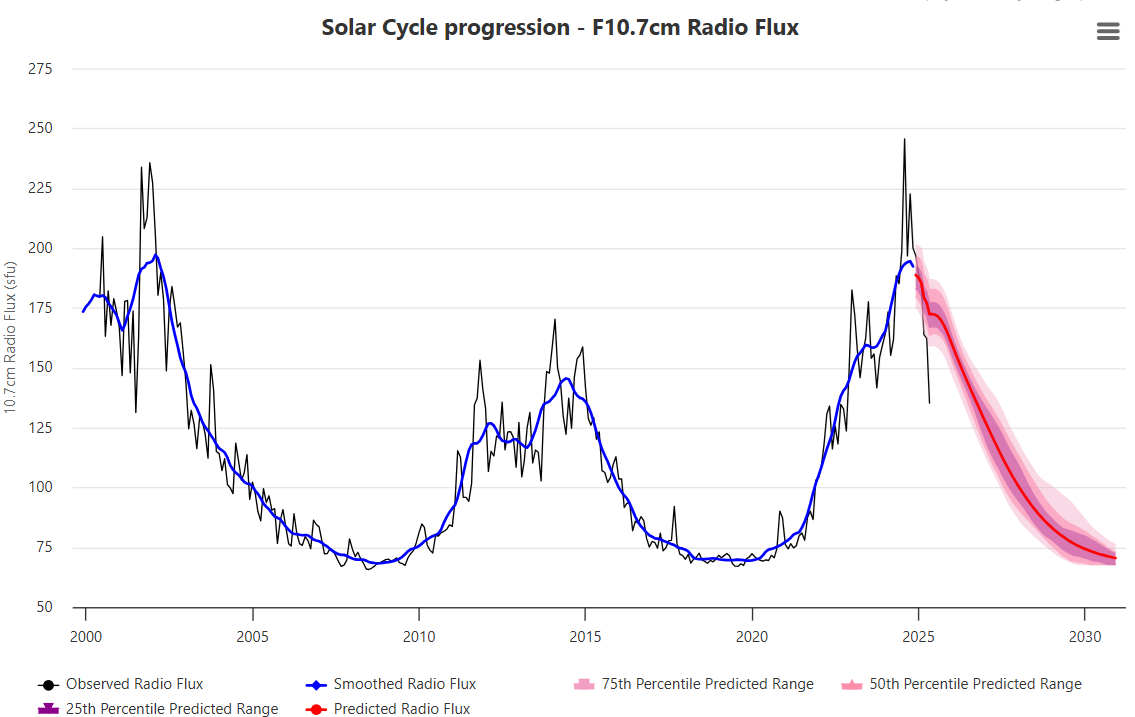
It appears that presently we may be about to lose that amount of energy through oceanic cooling.  And  the sun could be to blame:

Scare du jour Marine Heat Waves

If you watch legacy media, you must also be wondering after seeing all the current headlines about Marine Heat Waves raising the ocean to its boiling point.

Ocean heatwaves are breaking Earth’s hidden climate engine, Science Daily

The Pacific Ocean is overheated, making fall feel like summer, CBC

The ‘blob’ is back — except this time it stretches across the entire north Pacific, CNN

Record marine heatwaves may signal a permanent shift in the oceans, New Scientist

Global warming drives a threefold increase in persistence and 1 °C rise in intensity of marine heatwaves, PNAS

Etc., etc. etc.

The last one is the paper driving this recent clamor over Ocean SSTs Marcos et al. 2025 From the abstract:

We determine that global warming is responsible for nearly half of these extreme events and that, on a global average, it has led to a three-fold increase in the number of days per year that the oceans experience extreme surface heat conditions. We also show that global warming is responsible for an increase of 1 °C in the maximum intensity of the events. Our findings highlight the detrimental role that human-induced global warming plays on marine heatwaves. This study supports the need for mitigation and adaptation strategies to address these threats to marine ecosystems.

The coordinated media reports are exposed by all of them containing virtually the same claim:

As climate change causes our planet to warm, marine heatwaves are
becoming more frequent, more intense, and longer lasting. 
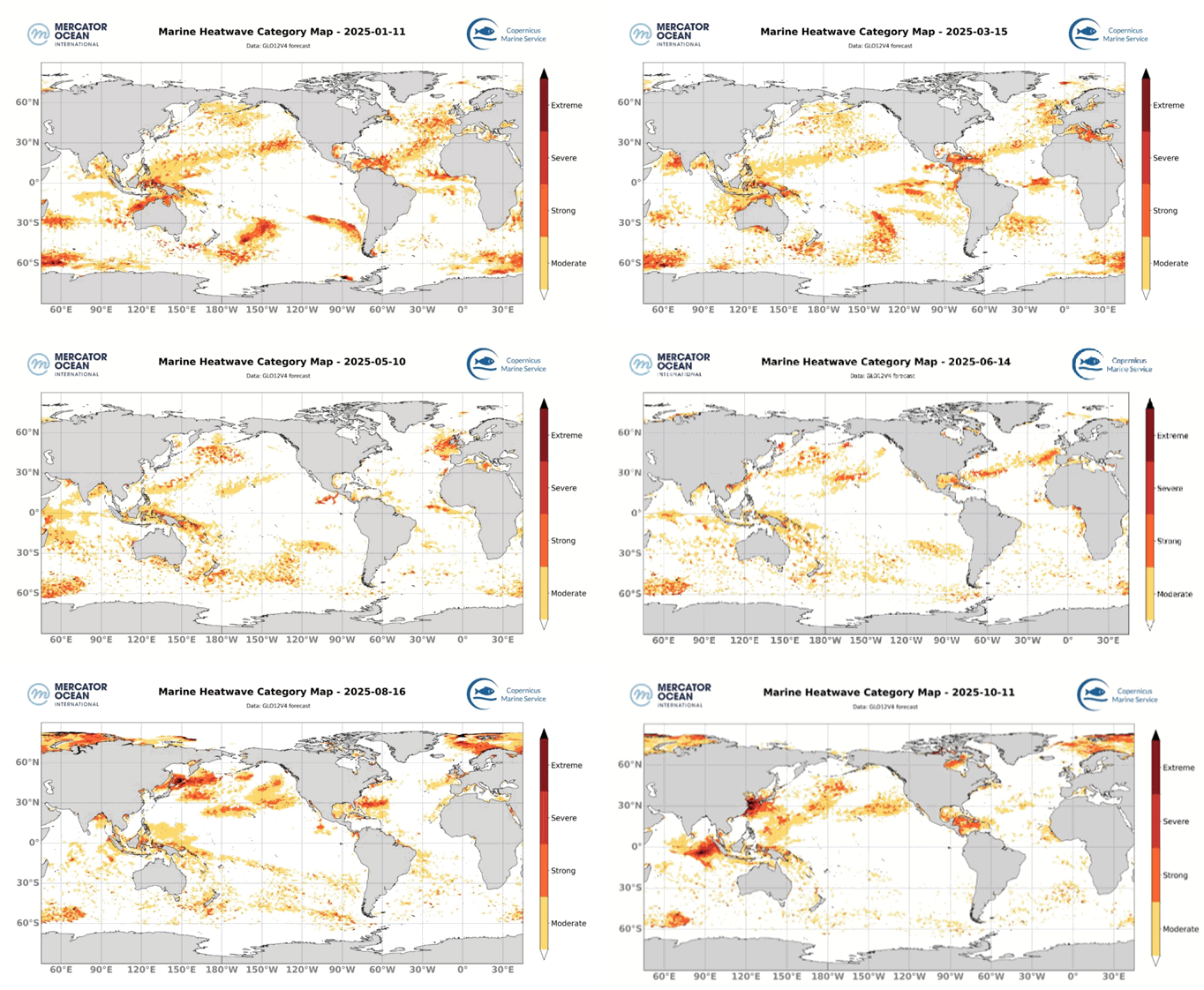
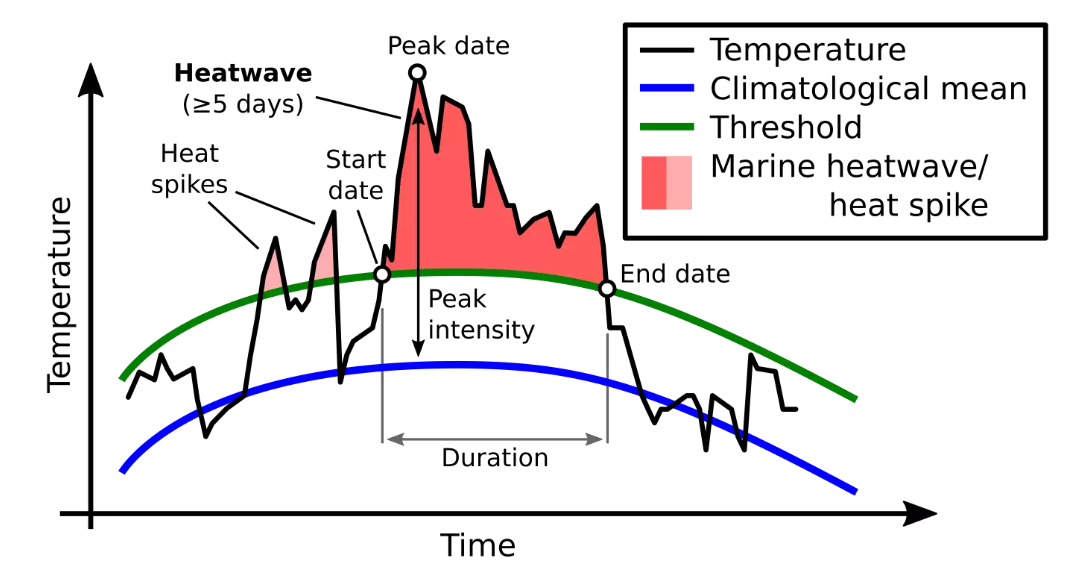
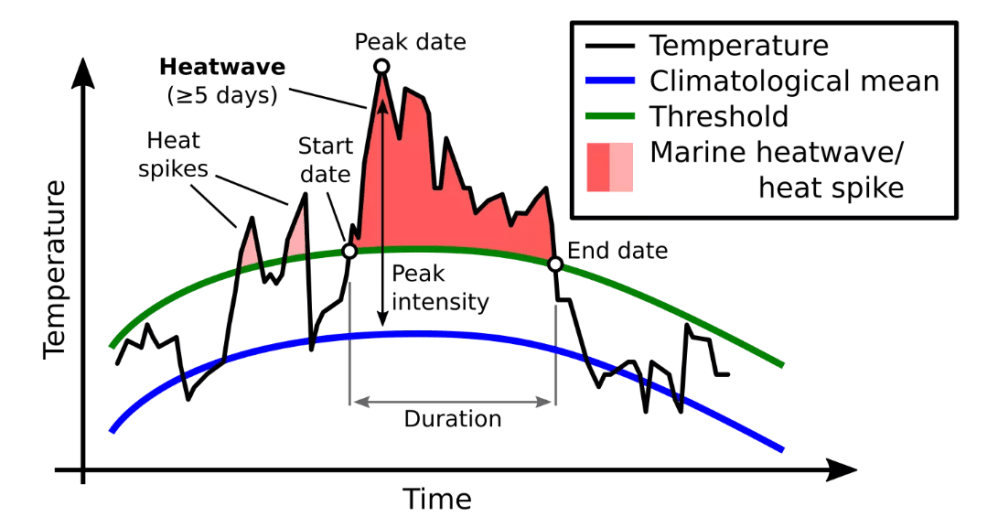
Animation shows locations of moderate to severe MHWs mid-month 2025 January to October. A marine heatwave is defined as one where the measured temperature is within 10% of the maximum values observed (i.e., above the Threshold (90th quantile) , for at least 5 consecutive days. For this, the intensity is compared to the difference between the climatological mean and the 90th percentile value (threshold). A marine heatwave intensity between 1 and 2 times this difference corresponds to a heatwave of moderate category; between 2 and 3 times, to a strong category; between 3 and 4 times, to a severe category; and a difference greater than 4 times corresponds to an extreme category.

First some background context on the phenomena (in italics with my bolds).
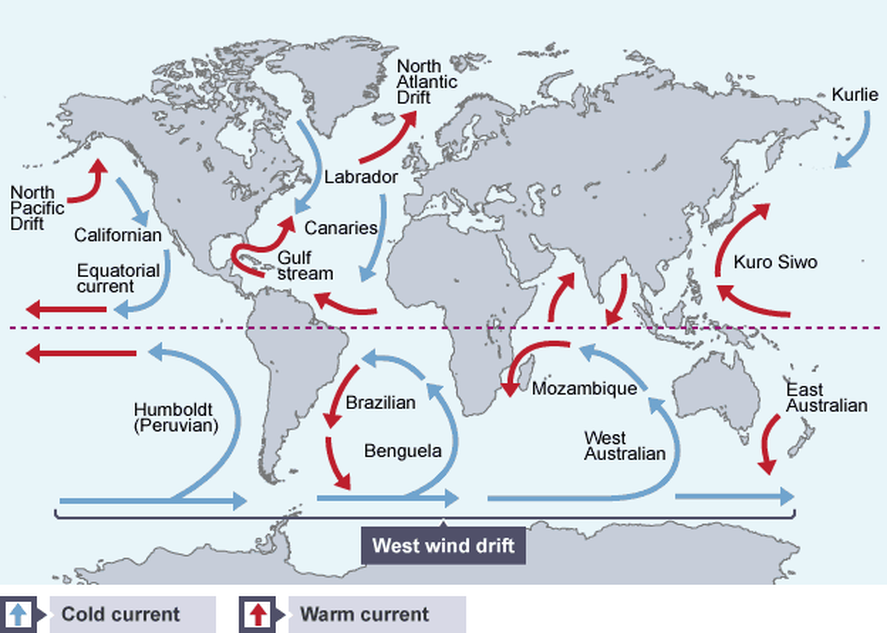
Background from perplexity.ai How Do Warm and Cool Ocean Blobs Circulate?

Warm and cool ocean blobs circulate through distinct oceanic and atmospheric processes, often linked to major currents and atmospheric patterns.

Warm ocean blobs, such as the “warm blob” in the northeast Pacific, form due to atmospheric circulation changes triggered by factors like Arctic warming. This leads to a high-pressure system over the region, weakening westerly winds and reducing ocean heat loss, causing surface waters to warm and creating persistent warm anomalies. The formation of these warm blobs involves a feedback loop between weakened winds, reduced ocean-atmosphere heat exchange, and ocean circulation, which retains heat in the mixed layer of the ocean.

Cool ocean blobs, like the North Atlantic “cold blob,” are influenced by weakening of the Atlantic Meridional Overturning Circulation (AMOC). This circulation moves warm, salty water northward, which cools, sinks, and then the cooler deep water travels southward in a conveyor-belt style flow. The cold blob forms when excess freshwater from ice melt dilutes the salty water, reducing its density and sinking ability, weakening this circulation and causing cooler surface water to persist. This cooling also affects the atmosphere by reducing water vapor, which decreases greenhouse effect locally and amplifies the cold anomaly, creating a coupled ocean-atmosphere feedback loop.

In summary, warm and cool ocean blobs circulate through a combination of ocean current dynamics and atmospheric interactions. Warm blobs form where atmospheric changes reduce ocean heat loss and circulation shifts retain heat, while cool blobs occur where circulation weakens, allowing cooler, less dense waters to persist and affect atmospheric conditions as well.
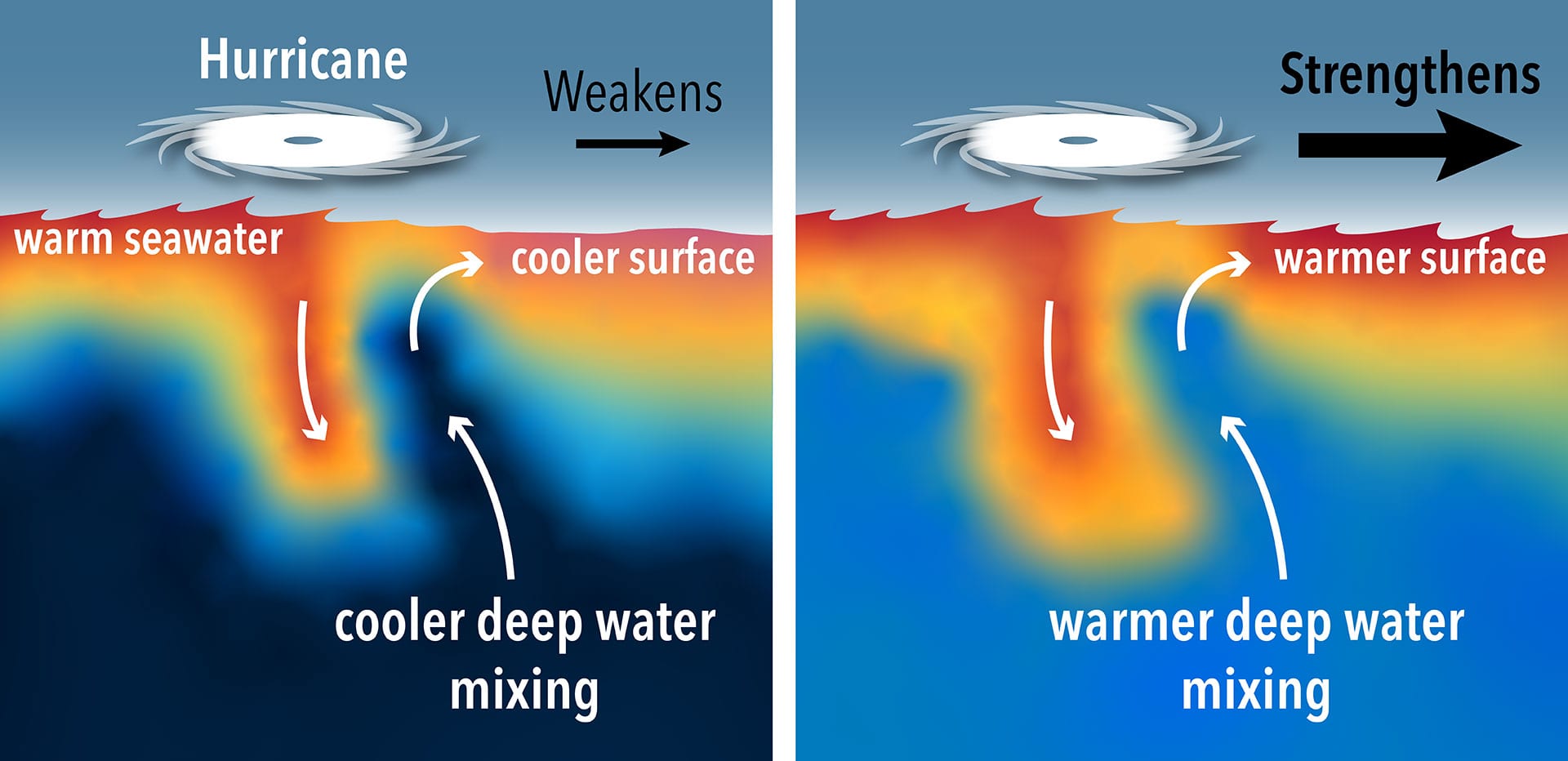
Then a summary of the issues undermining the alarmists’ claim.

From perplexity.ai What are reasons to doubt climate change is increasing marine heatwaves?

There are several reasons to doubt that climate change is definitively increasing the frequency, intensity, duration, and spatial extent of marine heatwaves, based on some ongoing scientific debates and uncertainties.

Natural Variability and Other Factors

♦  Marine heatwaves are influenced by natural climate variability, such as El Niño, Pacific Decadal Oscillation (PDO), and other oceanic and atmospheric processes. These phenomena can cause fluctuations in sea surface temperatures independent of long-term climate change, leading to periods of warmer ocean conditions that may be mistaken for climate-driven trends.

♦  Some studies emphasize the role of internal ocean variability, which can cause significant short-term temperature anomalies without requiring a direct link to anthropogenic climate change.

Complexity of Attribution

♦  The attribution of marine heatwave trends specifically to climate change involves complex modeling and statistical analysis, which can have uncertainties. Certain models suggest that long-term temperature increases are the primary driver, but the contribution of natural variability remains significant and sometimes difficult to separate clearly from climate signals.

♦  Regional differences and localized oceanic processes can obscure the global patterns, leading some scientists to argue that not all observed phenomena are directly attributable to climate change, particularly in areas with strong natural variability.

Limitations of Climate Models

♦  Climate models predicting future marine heatwave conditions depend heavily on assumptions about greenhouse gas emissions and other factors. These models often have limitations in resolution and in capturing small-scale processes, which could lead to overestimations or underestimations of climate change impacts.

Data Gaps and Uncertainties

♦  Although current observations show increasing trends in marine heatwaves, data gaps exist, especially in remote or deep-sea regions, making comprehensive global assessments challenging. These gaps contribute to uncertainty regarding the full extent and causality of observed changes.

♦  The precise long-term ecological impacts and possible adaptation or resilience mechanisms of marine ecosystems also remain uncertain, complicating the understanding of climate change’s role versus natural variability.

Summary

While a considerable body of evidence supports the role of climate change in increasing marine heatwaves, skepticism persists due to the influence of natural variability, model limitations, regional differences, and data gaps. These factors suggest that attribution is complex, and ongoing research continues to refine our understanding of the relative contributions of human influences and natural climate fluctuations.
Finally, a discussion of a specific example revealing flawed methods supposedly connecting CO2 emissions to marine heatwaves.

Much Ado About Marine Heat Waves

The promotion of this scare was published in 2022 at Nature by Barkhordarian et al. Recent marine heatwaves in the North Pacific warming pool can be attributed to rising atmospheric levels of greenhouse gases.  This post will unpack the reasons to distrust this paper and its claims.  First the Abstract of the subject and their declared findings in italics with my bolds.

Abstract

Over the last decade, the northeast Pacific experienced marine heatwaves that caused devastating marine ecological impacts with socioeconomic implications. Here we use two different attribution methods and show that forcing by elevated greenhouse gases levels has virtually certainly caused the multi-year persistent 2019–2021 marine heatwave. There is less than 1% chance that the 2019–2021 event with ~3 years duration and 1.6 ∘C intensity could have happened in the absence of greenhouse gases forcing. We further discover that the recent marine heatwaves are co-located with a systematically-forced outstanding warming pool, which we attribute to forcing by elevated greenhouse gases levels and the recent industrial aerosol-load decrease. The here-detected Pacific long-term warming pool is associated with a strengthening ridge of high-pressure system, which has recently emerged from the natural variability of climate system, indicating that they will provide favorable conditions over the northeast Pacific for even more severe marine heatwave events in the future.
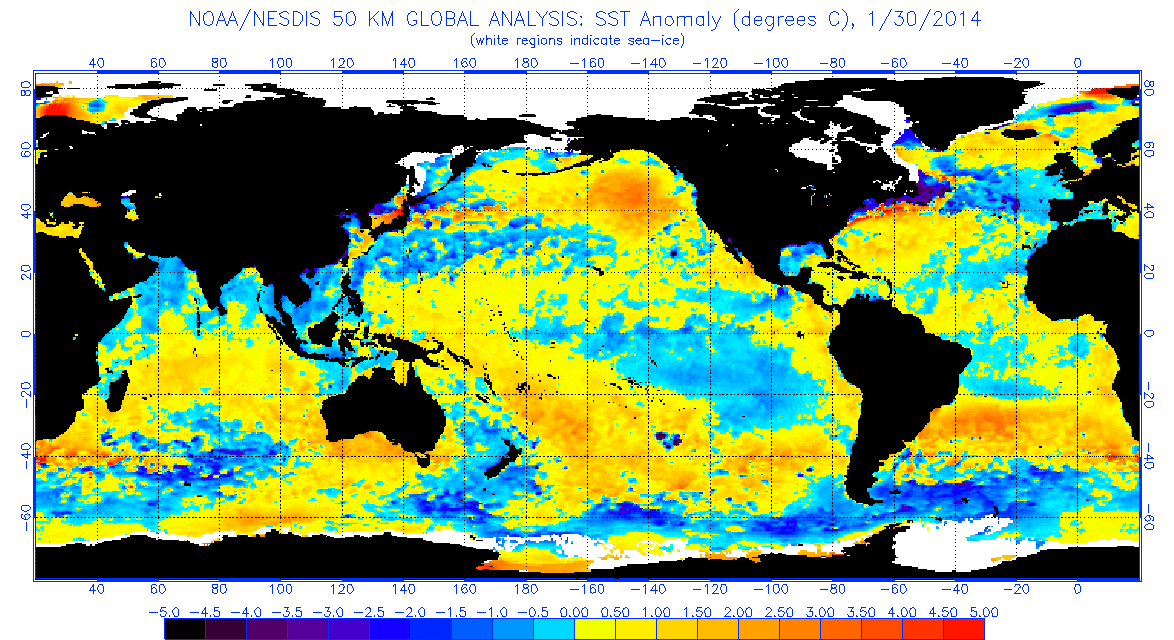
Background on Ocean Warm Pools

Wang and Enfield study is The Tropical Western Hemisphere Warm Pool Abstract in italics with my bolds.

Abstract

The Western Hemisphere warm pool (WHWP) of water warmer than 28.5°C extends from the eastern North Pacific to the Gulf of Mexico and the Caribbean, and at its peak, overlaps with the tropical North Atlantic. It has a large seasonal cycle and its interannual fluctuations of area and intensity are significant. Surface heat fluxes warm the WHWP through the boreal spring to an annual maximum of SST and areal extent in the late summer/early fall, associated with eastern North Pacific and Atlantic hurricane activities and rainfall from northern South America to the southern tier of the United States. SST and area anomalies occur at high temperatures where small changes can have a large impact on tropical convection. Observations suggest that a positive ocean-atmosphere feedback operating through longwave radiation and associated cloudiness is responsible for the WHWP SST anomalies. Associated with an increase in SST anomalies is a decrease in atmospheric sea level pressure.

Chou and Chou published On the Regulation of the Pacific Warm Pool Temperature:

Abstract

Analyses of data on clouds, winds, and surface heat fluxes show that the transient behavior of basin-wide large-scale circulation has a significant influence on the warm pool sea surface temperature (SST). Trade winds converge to regions of the highest SST in the equatorial western Pacific. The reduced evaporative cooling due to weakened winds exceeds the reduced solar heating due to enhanced cloudiness. The result is a maximum surface heating in the strong convective and high SST regions. The maximum surface heating in strong convective regions is interrupted by transient atmospheric and oceanic circulation. Regions of high SST and low-level convergence follow the Sun. As the Sun moves away from a convective region, the strong trade winds set in, and the evaporative cooling enhances, resulting in a net cooling of the surface. We conclude that the evaporative cooling associated with the seasonal and interannual variations of trade winds is one of the major factors that modulate the SST distribution of the Pacific warm pool.
Comment:

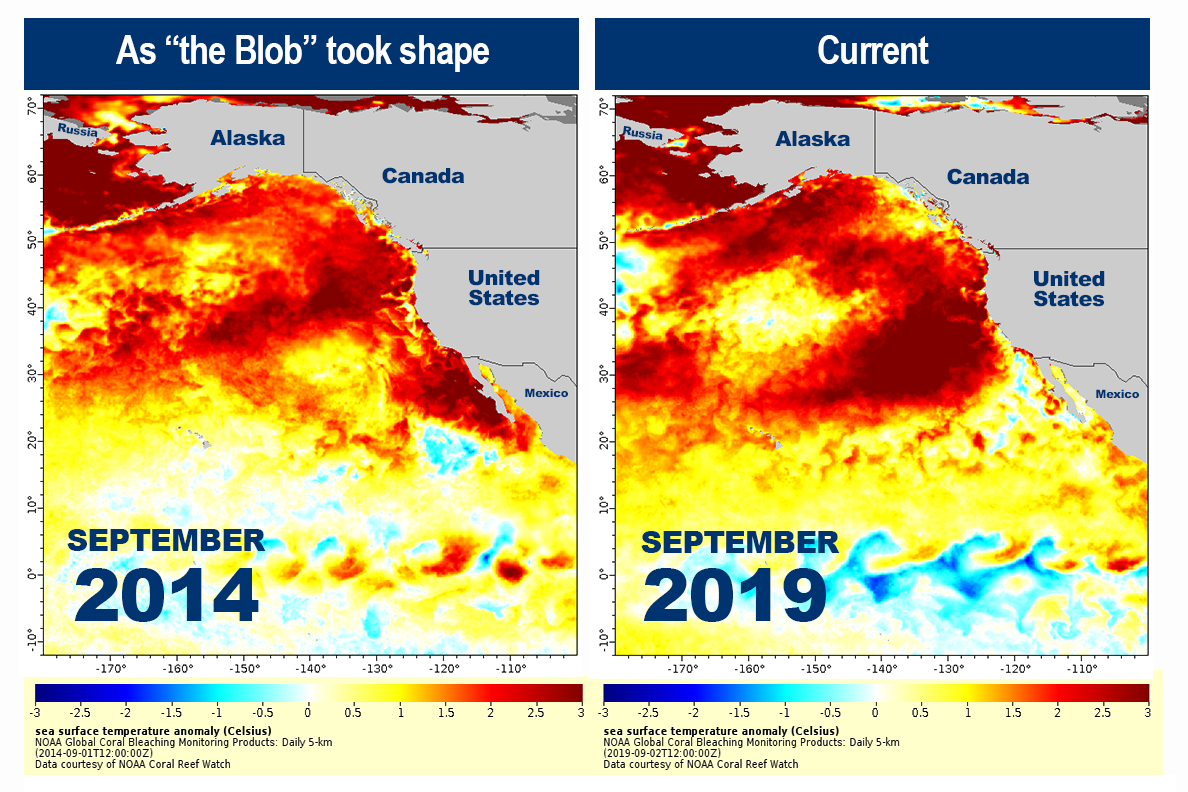
So these are but two examples of oceanographic studies describing natural factors driving the rise and fall of Pacific warm pools.  Yet the Nature paper claims rising CO2 from fossil fuels is the causal factor, waving away natural processes.  Skeptical responses were already lodged upon the first incidence of the North Pacific marine heat wave, the “Blob” much discussed by west coast US meteorologists.  One of the most outspoken against the global warming attributionists has been Cliff Mass of Seattle and University of Washington.  Writing in 2014 and 2015, he observed the rise and fall of the warming blob and then posted a critique of attribution attempts at his blog.  For example, Media Miscommunication about the Blob.  Excerpts in italics with my bolds.

Blob Media Misinformation

One of the most depressing things for scientists is to see the media misinform the public about an important issue.

During the past few days, an unfortunate example occurred regarding the warm water pool that formed over a year ago in the middle of the north Pacific, a.k.a., the blob. Let me show how this communication failure occurred, with various media outlets messed things up in various ways.

The stimulant for the nationwide coverage of the Blob was a very nice paper published by Nick Bond (UW scientist and State Climatologist), Meghan Cronin, Howard Freeland, and Nathan Mantua in Geophysical Research Letters.

This publication described the origin of the Blob, showing that it was the result of persistent ridging (high pressure) over the Pacific. The high pressure, and associated light winds, resulted in less vertical mixing of the upper layer of the ocean; with less mixing of subsurface cold water to the surface. Furthermore, the high pressure reduced horizontal movement of colder water from the north. Straightforward and convincing work.
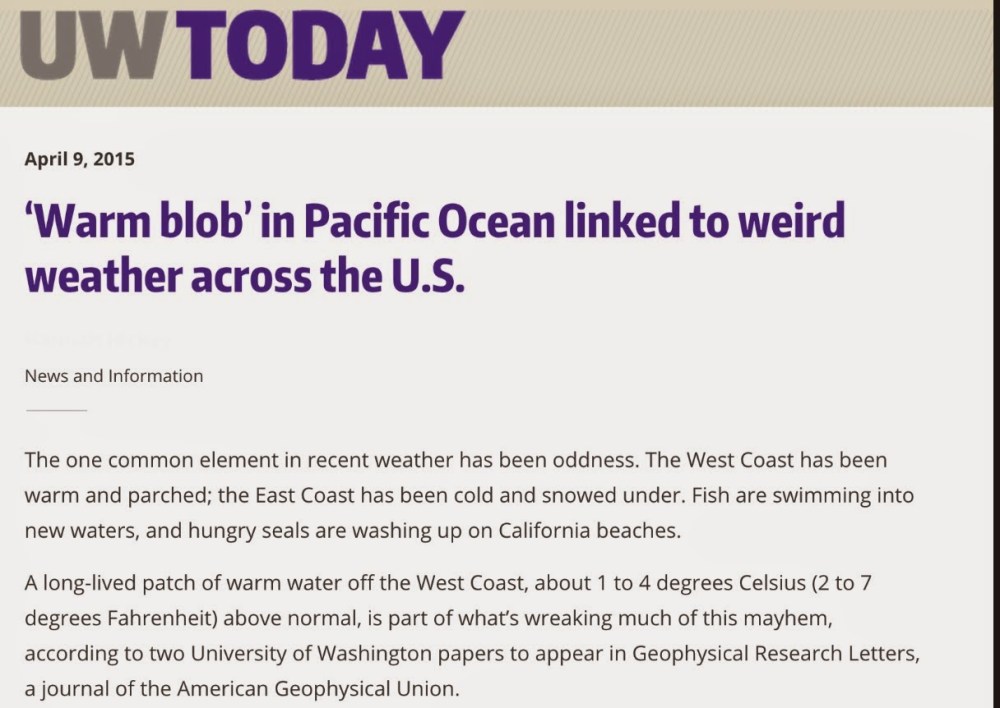
The inaccurate press release then led to a media frenzy, with the story going viral. And unfortunately, many of the media got it wrong.

There were two failure modes. In one, the headline was wrong, but the internal story was correct. . . In the second failure mode, the story itself was essentially flawed, with most claiming that the Blob off of western North America was the cause of the anomalous circulation (big ridge over West Coast, trough over the eastern U.S.). (The truth: the Blob was the RESULT of the anomalous circulations.) That the Blob CAUSED the California drought or the cold wave in the eastern U.S. These deceptive stories were found in major outlets around the country, including the Washington Post, NBC News, and others.

Blob Returns,  Attribution Misinformation

When the Blob returned 2020-2021, Cliff Mass had cause to again lament how the public is misled.  This time misdirection instigated by activist scientists using flawed methods.  His post Miscommunication in Recent Climate Attribution Studies.  Excerpts in italics with my bolds.

This attribution report, and most media stories that covered it, suggested a central role for global warming for the heatwave. As demonstrated in my previous blog, their narrative simply does not hold up to careful examination.

This blog will explain why their basic framing and approach is problematic, leading readers (and most of the media) to incorrect conclusions.

For the heatwave, the attribution folks only examine the statistics of temperatures hitting the record highs (108F in Seattle), but avoid looking at the statistics of temperature exceeding 100F, or even the record highs (like 103F in Seattle). There is a reason they don’t do that. It would tell a dramatically different (and less persuasive) story.

In the attribution studies, the main technology for determining changed odds of extreme weather is to use global climate models. First, they run the models with greenhouse gas forcing (which produces more extreme precipitation and temperature), and then they run the models again without increased greenhouse gases concentrations. By comparing the statistics of the two sets of simulations, they attempt to determine how the odds of extreme precipitation or temperature change.

Unfortunately, there are serious flaws in their approach: climate models fail to produce sufficient natural variability (they underplay the black swans) and their global climate models don’t have enough resolution to correctly simulate critical intense, local precipitation features (from mountain enhancement to thunderstorms). On top of that, they generally use unrealistic greenhouse gas emissions in their models (too much, often using the RCP8.5 extreme emissions scenario) And there is more, but you get the message. ( I am weather/climate modeler, by the way, and know the model deficiencies intimately.)

Vaunted Fingerprinting Attribution Is Statistically Unsound

From Barkhordarian et al.

Unlike previous studies which have focused on linking the SST patterns in the North Pacific to changes in the oceanic circulation and the extratropical/tropical teleconnections2,12,17,18,20,24,26, we here perform two different statistical attribution methodologies in order to identify the human fingerprint in Northeast Pacific SST changes both on multidecadal timescale (changes of mean SST) and on extreme SST events on daily timescale (Marine Heatwaves). Evidence that anthropogenic forcing has altered the base state (long-term changes of mean SST) over the northeast Pacific, which is characterized by strong low-frequency SST fluctuations, would increase confidence in the attribution of MHWs27, since rising mean SST is the dominant driver of increasing MHW frequency and intensity, outweighing changes due to temperature variability1,2.

In this study, we provide a quantitative assessment of whether GHG forcing, the main component of anthropogenic forcings, was necessary for the North Pacific high-impact MHWs (the Blob-like SST anomalies) to occur, and whether it is a sufficient cause for such events to continue to repeatedly occur in the future. With these purposes, we use two high-resolution observed SST datasets, along with harnessing two initial-condition large ensembles of coupled general circulation models (CESM1-LE28,29 with 35 members, and MPI-GE30 with 100 members). These large ensembles can provide better estimates of an individual model’s internal variability and response to external forcing31,32, and facilitate the explicit consideration of stochastic uncertainty in attribution results33. We also use multiple single-forcing experiments from the Detection and Attribution Model Intercomparision Project (DAMIP34) component of Coupled Model Intercomparison Project phase 6 (CMIP635).
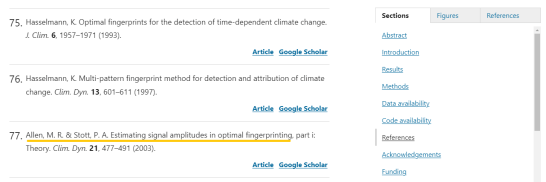
From Barkhordarian et al. References


The IPCC’s attribution methodology is fundamentally flawed

The central paper underpinning the attribution analysis was assessed and found unreliable by statistician Ross McKitrick’s published evaluation. Excerpts in italics with my bolds.

One day after the IPCC released the AR6 I published a paper in Climate Dynamics showing that their “Optimal Fingerprinting” methodology on which they have long relied for attributing climate change to greenhouse gases is seriously flawed and its results are unreliable and largely meaningless. Some of the errors would be obvious to anyone trained in regression analysis, and the fact that they went unnoticed for 20 years despite the method being so heavily used does not reflect well on climatology as an empirical discipline.

My paper is a critique of “Checking for model consistency in optimal fingerprinting” by Myles Allen and Simon Tett, which was published in Climate Dynamics in 1999 and to which I refer as AT99. Their attribution methodology was instantly embraced and promoted by the IPCC in the 2001 Third Assessment Report (coincident with their embrace and promotion of the Mann hockey stick). The IPCC promotion continues today: see AR6 Section 3.2.1. It has been used in dozens and possibly hundreds of studies over the years. Wherever you begin in the Optimal Fingerprinting literature (example), all paths lead back to AT99, often via Allen and Stott (2003). So its errors and deficiencies matter acutely.

Abstract

Allen and Tett (1999, herein AT99) introduced a Generalized Least Squares (GLS) regression methodology for decomposing patterns of climate change for attribution purposes and proposed the “Residual Consistency Test” (RCT) to check the GLS specification. Their methodology has been widely used and highly influential ever since, in part because subsequent authors have relied upon their claim that their GLS model satisfies the conditions of the Gauss-Markov (GM) Theorem, thereby yielding unbiased and efficient estimators.

But AT99:

  • stated the GM Theorem incorrectly, omitting a critical condition altogether,
  • their GLS method cannot satisfy the GM conditions, and
  • their variance estimator is inconsistent by construction.
  • Additionally, they did not formally state the null hypothesis of the RCT nor
  • identify which of the GM conditions it tests, nor
  • did they prove its distribution and critical values, rendering it uninformative as a specification test.

The continuing influence of AT99 two decades later means these issues should be corrected. I identify 6 conditions needing to be shown for the AT99 method to be valid.

In Conclusion,  McKitrick:

One point I make is that the assumption that an estimator of C provides a valid estimate of the error covariances means the AT99 method cannot be used to test a null hypothesis that greenhouse gases have no effect on the climate. Why not? Because an elementary principle of hypothesis testing is that the distribution of a test statistic under the assumption that the null hypothesis is true cannot be conditional on the null hypothesis being false. The use of a climate model to generate the homoscedasticity weights requires the researcher to assume the weights are a true representation of climate processes and dynamics.

The climate model embeds the assumption that
greenhouse gases have a significant climate impact.

Or, equivalently, that natural processes alone cannot generate a large class of observed events in the climate, whereas greenhouse gases can. It is therefore not possible to use the climate model-generated weights to construct a test of the assumption that natural processes alone could generate the class of observed events in the climate.
More Evidence Temperatures Drive CO2 Levels, Not the Reverse

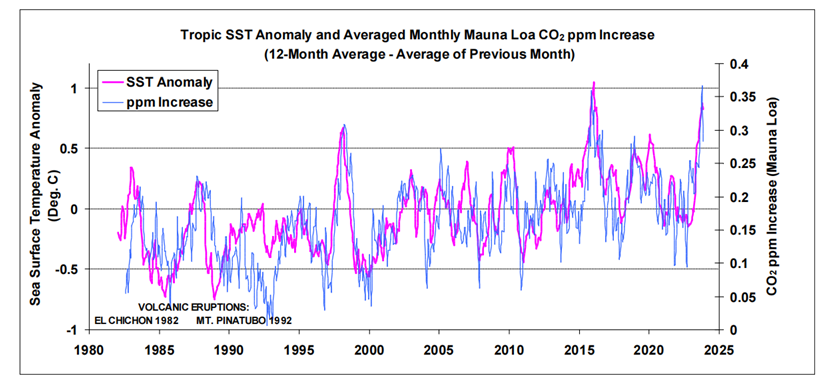
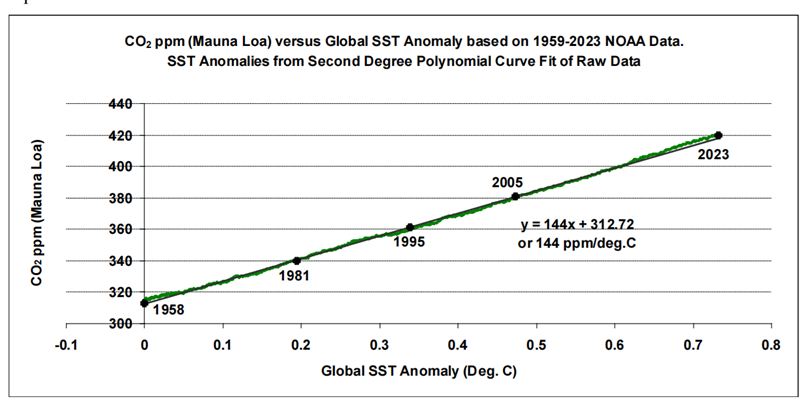
Robbins, 2025 Figure 2: Global tropic SSTs overlaid onto monthly atmospheric CO2 increases (Mauna Loa)

Kenneth Richard posted a No Tricks Zone article: Another New Study Suggests Most – 80% – Of The Modern CO2 Increase Has Been Natural.  Excerpts in italics with my bolds and added images.

CO2 concentration increases are not the cause of rising temperature,
but an effect of rising temperature.

The 2025 paper by Bernard Robbins is Atmospheric CO2: Exploring the Role of Sea Surface Temperatures and the Influence of Anthropogenic CO2.  Excerpts in italics with my bolds and added images.

Abstract

Close examination of the small perturbations within the atmospheric CO2 trend, as measured at Mauna Loa, reveals a strong correlation with variations in sea surface temperatures (SSTs), most notably with those in the tropics. The temperature-dependent process of CO2 degassing and absorption via sea surfaces is well-documented, and changes in SSTs will also coincide with changes in terrestrial temperatures, and temperature-dependent changes in the marine and terrestrial biospheres with their associated carbon cycles.

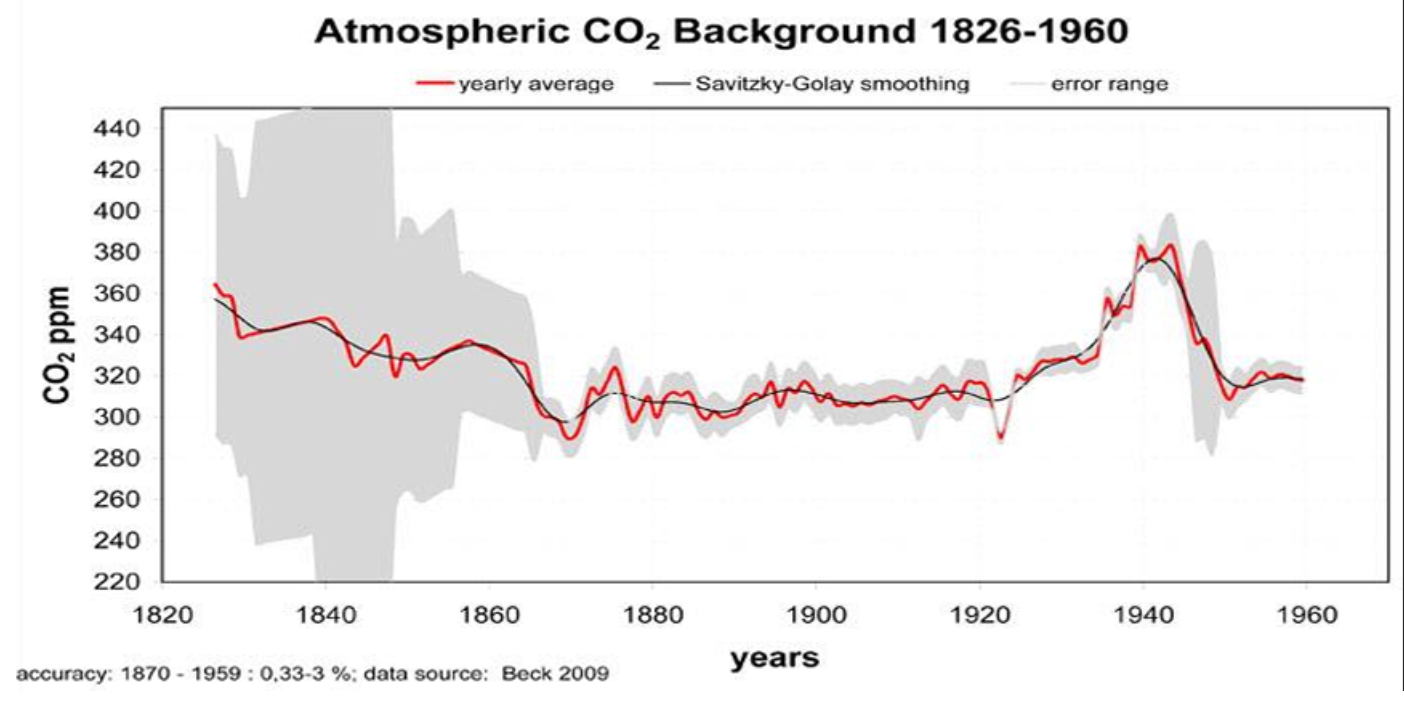
Using SST and Mauna Loa datasets, three methods of analysis are presented that seek to identify and estimate the anthropogenic and, by default, natural components of recent increases in atmospheric CO2, an assumption being that changes in SSTs coincide with changes in nature’s influence, as a whole, on atmospheric CO2 levels. The findings of the analyses suggest that an anthropogenic component is likely to be around 20 %, or less, of the total increase since the start of the industrial revolution.

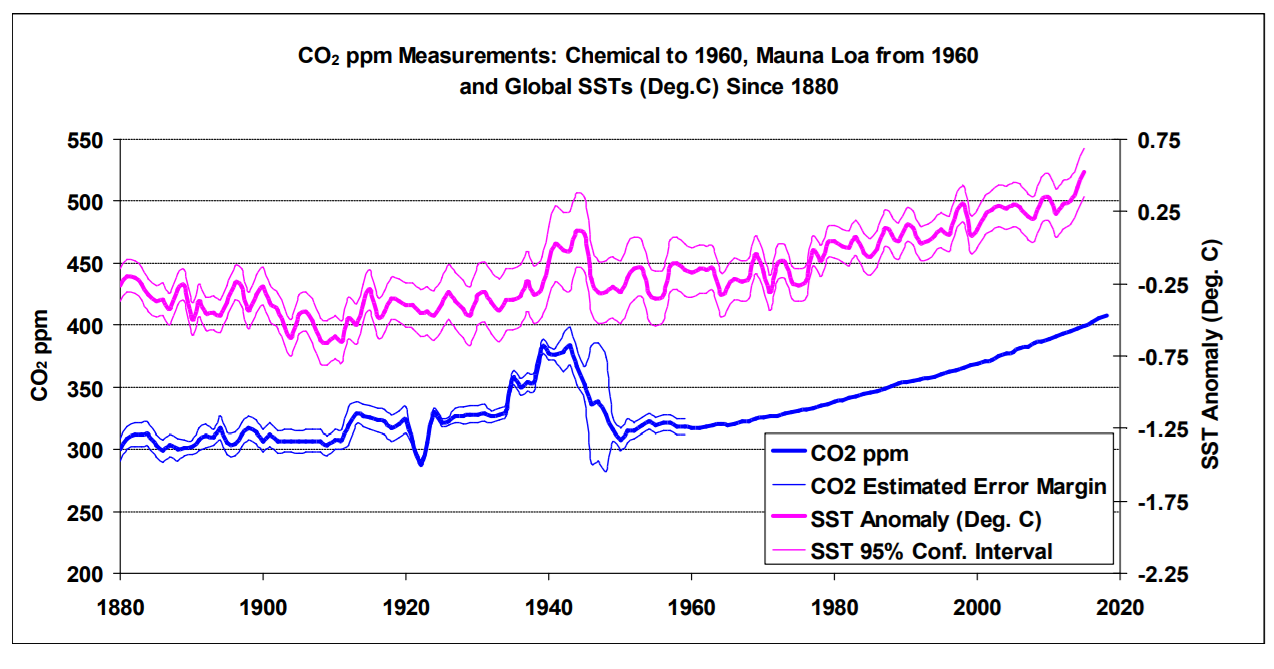
The inference is that around 80 % or more of those increases are of natural origin, and indeed the findings suggest that nature is continually working to maintain an atmospheric/surface CO2 balance, which is itself dependent on temperature. A further pointer to this balance may come from chemical measurements that indicate a brief peak in atmospheric CO2 levels centred around the 1940s, and that coincided with a peak in global SSTs.

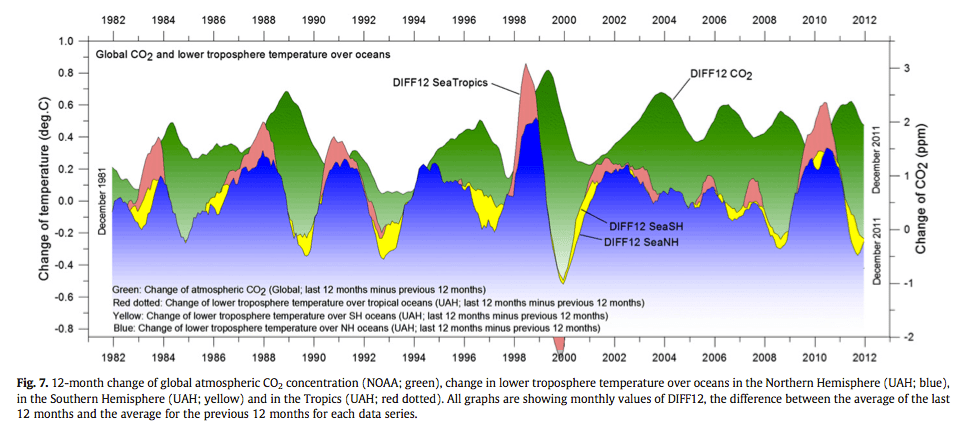
Source: The phase relation between atmospheric carbon dioxide and global temperature OleHumlum, KjellStordahl, Jan-ErikSolheim.

Introduction

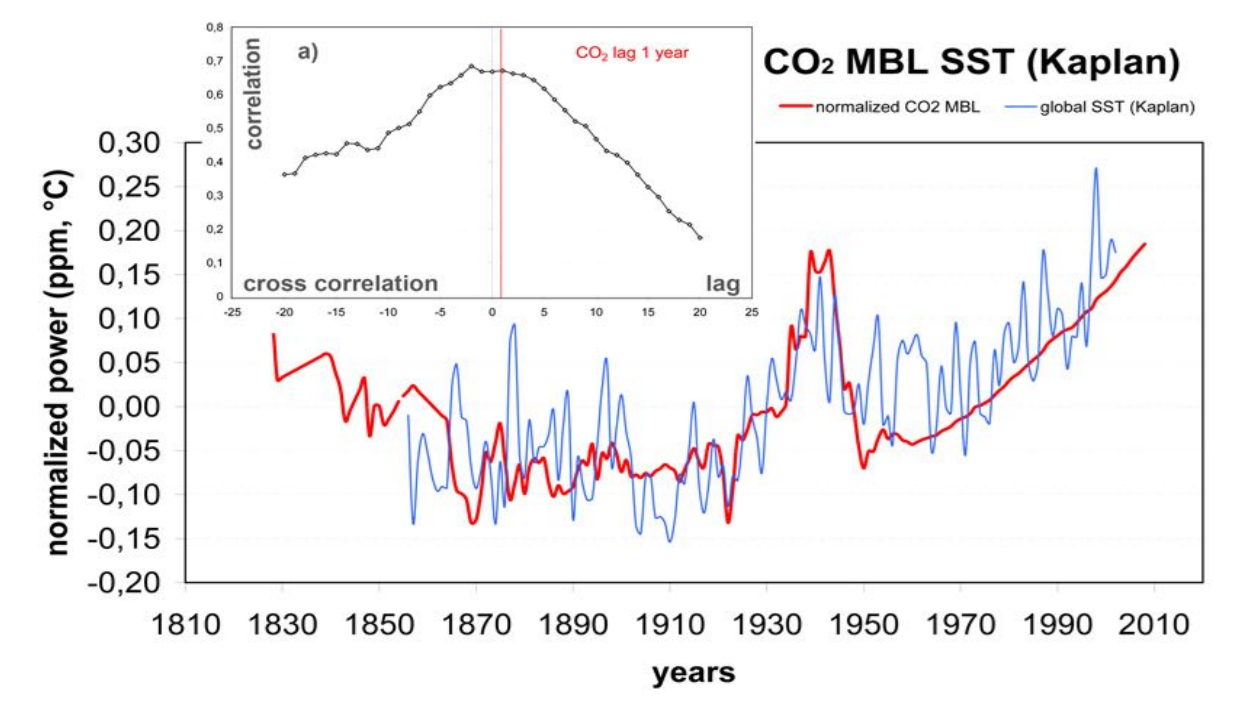
Research into the influence SSTs have on changes in atmospheric CO2 includes the work by Humlum et al. (2013). When examining phase relationships, they found a maximum correlation for changes in atmospheric CO2 lagging 11-12 months behind those of global SSTs [1]. A paper by the late Fred Goldberg (2008) noted their correlation by examining El Niño events [2]. He also considered Henry’s law [3] in relation to SSTs, i.e. a temperature-dependent equilibrium between atmospheric CO2 and its solubility in seawater. Spencer (2008) also noted similarities between surface temperature variations with changes in atmospheric CO2 [4].

For the oceans specifically, areas of surface CO2 absorption and degassing are shown in maps provided by NOAA [5] and ESA [6] for example. These maps show that colder sea surfaces towards the poles are net absorbers of CO2 whilst the warmer surface waters of the tropics are net emitters. An analogy often cited is the greater ability of carbonated drinks to retain CO2 at cooler temperatures; this ability drops as the drinks get warmer.

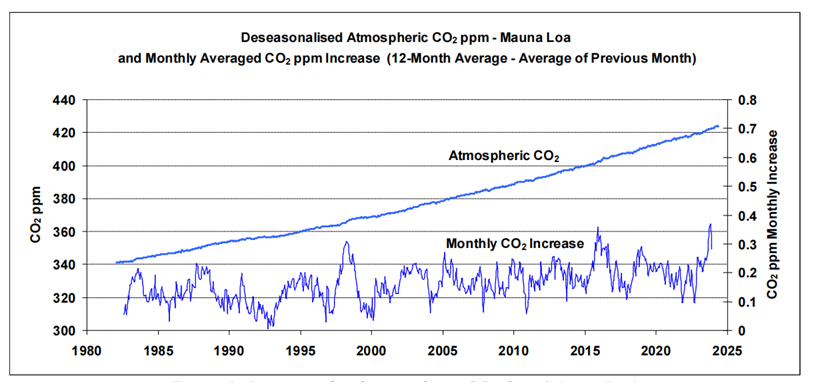
Figure 1: Deseasonalised atmospheric CO2 data (Mauna Loa).

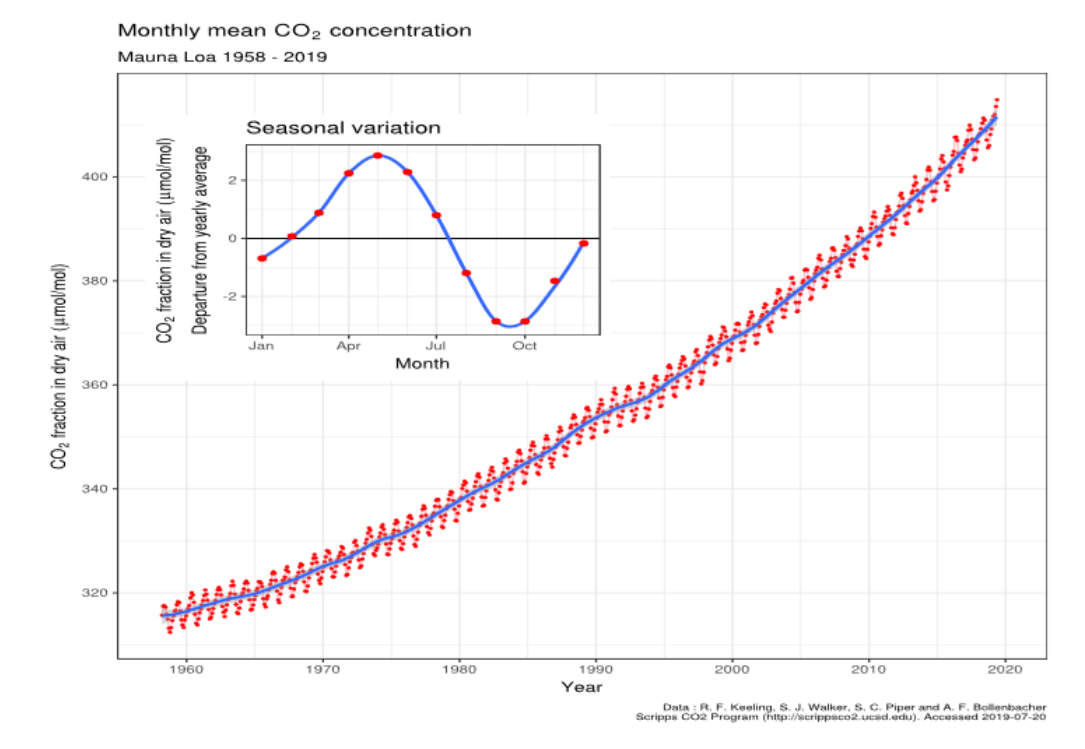
A strong correlation between changes in atmospheric CO2 and SSTs can be readily discerned from the relevant datasets. To illustrate, the upper graph in Fig. 1 plots atmospheric CO2 in parts per million (ppm) as measured at Mauna Loa, Hawaii, since 1982. The data [7] has been ‘deseason-alised’ by NOAA to remove natural annual CO2 cycles.

The similarity between the two traces is striking: short-term fluctuations in CO2 readings at Mauna Loa appear particularly sensitive to tropic conditions (if tropic SSTs are substituted for global SSTs in Fig. 2, the correlation is less strong). Warm tropical seas, with surface temperatures typically around 25-30 oC, cover almost one third of the earth’s surface. The most prominent peaks in the figure coincide with strong El Niño events. Taken at face value, and ignoring any influence from anthropogenic emissions, Fig. 2  suggests that if the tropic SST anomaly dropped to around -1 oC (with related drops globally) then the concentration of CO2 in the atmosphere, as measured at Mauna Loa, would level off.

Robbins, 2025 Figure 2: Global tropic SSTs overlaid onto monthly atmospheric CO2 increases (Mauna Loa)

An important point is that changes in SSTs will coincide with those of terrestrial temperatures, temperature-dependent changes to both terrestrial and marine carbon cycles and, taking into consideration the research by Humlum et al. (2013) who found that changes in atmospheric CO2 followed changes in SSTs, an assumption in the work presented here is that nature’s influence on atmospheric CO2 levels, as a whole, follows on from changes in SSTs.

Discussion

The techniques used in Analyses 1 and 2, aimed at discerning and estimating the human contribution to recent increases in atmospheric CO2, are based on processing of monthly data from both SST and atmospheric CO2 datasets. Using the technique described in Analysis 1, no contribution from human emissions to the measured increases in atmospheric CO2, since 1995, was discerned. Given an approximate 60 % increase in annual human emissions since 1995 this suggests, by itself, that any human contribution to the measured increases is likely to be relatively small compared to nature’s contribution.

For the technique described in Analysis 2, a figure of ~27 ppm was estimated for a possible human contribution out of a total increase of 143 ppm since 1850, equating to around 19 % of the total increase in atmospheric CO2 since the start of the industrial revolution. Thus the results of these two analyses, taken together, suggest that nature appears to account for around 80 % or more of increases in atmospheric CO2 since 1995.

The technique described in Analysis 3 examines the relationship between longer-term trends in SST datasets and atmospheric CO2 measurements. This data analysis goes as far back as the late 1950s, when the ongoing acquisition of atmospheric CO2 measurements began at Mauna Loa. The resulting three graphs show an apparent almost-linear long-term relationship between SSTs and atmospheric CO2. Linear trend lines fitted to these graphs produce gradients of between ~120 and ~145 ppm/ 0C for the three SST datasets examined.

Figure 15: Atmospheric CO2 as a function of global SST trend since 1958

As for anthropogenic CO2, published figures (e.g. GCB data) suggest a roughly linear relationship between cumulative anthropogenic emissions as a function of time, and atmospheric CO2 measurements from Mauna Loa. If it’s reasoned that this mostly accounts for the linear trends as calculated in Analysis 3, this reasoning would not fit with the findings of the first two analysis methods that suggest 80 % or more of recent atmospheric CO2 increases are of natural origin.

Conclusions

Analyses of SST and atmospheric CO2 data, acquired since 1995, produce an estimated atmospheric CO2 increase, possibly attributed to human emissions, of around 20 %, or less, of the total increase since the industrial revolution, thus inferring that around 80 % or more of the increase is of natural origin.

Further data examination points to an almost linear longer-term relationship between SSTs and atmospheric CO2 since at least the late 1950s, and is suggestive of nature working to maintain a temperature-dependent atmosphere/surface CO2 balance. Recent historical evidence of such a balance may come from chemical measurements that indicate a brief peak in atmospheric CO2 levels centred around the 1940s, and that coincided with a peak in global SSTs.

Human emissions of CO2 are about 1/20-th of the natural turnover, and the findings of the analyses presented here suggest that this relatively-small human contribution is being readily incorporated into nature’s carbon cycles as they continually adjust to our constantly-changing climate.
As for surface temperatures, the research by Humlum et al. concluded that changes in atmospheric temperature are an ‘effect’ of changes in SSTs and not a ‘cause’ as some might advocate. And Humlum’s ‘take home’ message from a recent presentation was:

‘What controls the ocean surface temperature, controls the global climate’ [33]. He suggests the sun would be a good candidate, modulated with the cloud cover.

See Also

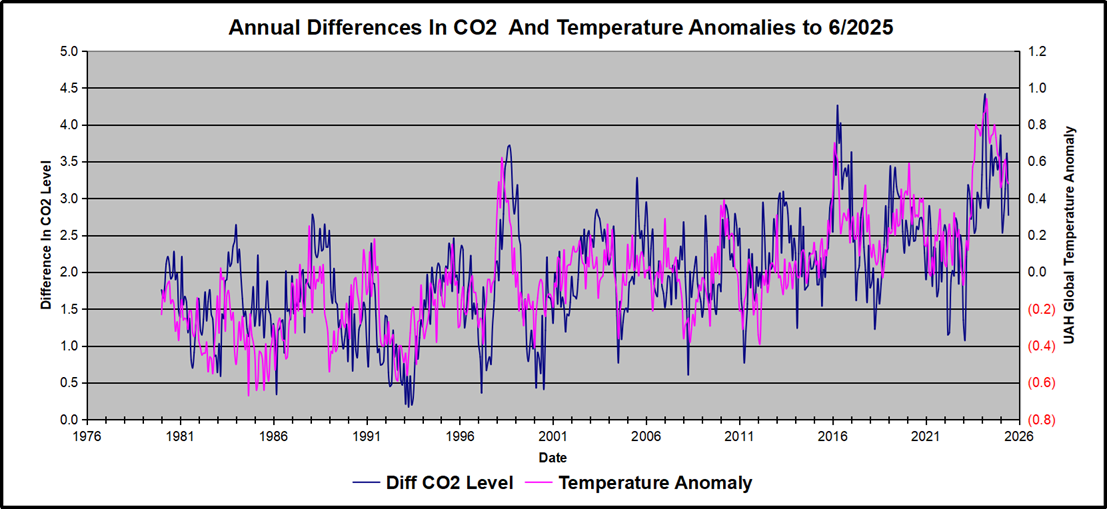
June 2025 Update–Temperature Falls, CO2 Follows

Wind And Solar Power Both Capricious and Costly

Bill Ponton reminds us that in addition to being fickle, renewables are also costly, in his American Thinker article What are the merits of renewables?  Excerpts in italics with my bolds and added images.

The Spanish blackout made us all aware of how unstable the grid can get when renewables are in the driver’s seat, but one should also not forget that they don’t come cheaply. The idea of getting free energy from wind and solar is inaccurate. Man must build machines to extract energy from nature and those machines, windmills and solar panels, are expensive.

Usually, proponents of renewables point to the fact that once the windmills and solar panels are installed, there is no added cost for fuel. That’s true, but there is more to the story. The capital cost of capacity for onshore wind, solar, and natural gas is $1.7 /MW, $1.3/MW, and $1.2/MW, respectively, a difference, but maybe not what one would call significant.

However, there is a gross disparity between capacity factors for each with 31% for wind, 20% for solar, and 60% for natural gas, as evidenced by the figures from Texas grid operator, ERCOT, in 2023. The capacity factor is a measure of how effectively a power plant or energy-producing system is operating compared to its maximum potential output over a specific period (Capacity Factor = Actual Output / Maximum Possible Output).

It should be said that a capacity factor of 60% for natural gas is what one would expect if the operator were only dependent upon natural gas. The current situation where natural gas generation is used to backup solar and wind generation drives the capacity factor for natural gas generation down to 36%.

With these lower capacity factors, one gets a cost multiple
of over 1.5 times greater to operate a mixed energy system
versus a system with just natural gas.

My calculations are here for all to examine. Another way to look at it is that the price of natural gas would have to go up by a factor of five (x5) to make the combined system with wind, solar, and natural gas cost competitive against a system with natural gas alone. Although Texas has a lot to brag about, its use of multiple energy sources to power its grid is not one of them. Why would one expect any other result from a scheme that requires massive subsidies, mandates, and tax breaks to even exist?

So, if renewables are unreliable and expensive, who finds them appealing? The answer is folks that are so guilt-ridden about their role in a supposed climate catastrophe that they will grab on to any scheme that offers them absolution, whether it has merit or not.


Mann’s AMOC Collapse Hoax

Dr. Kevin E. Trenberth, a distinguished scholar at the National Center for Atmospheric Research, commented on this movie: “I don’t recall a lot except that the whole science was incredibly wrong,”, “one does not get an ice age out of global warming.”

Likely you’ve heard the recent and previous warnings from Mann and friends about the ocean conveyor belt (including the Gulf Stream) slowing down and freezing us all.  With the COP gathering next month, something scary must be proclaimed, and Global Freezing is it, replacing Global Boiling earlier this year. The declaration signed by Mann and 43 other scientists was Open Letter by Climate Scientists to the Nordic Council of Ministers, Reykjavik, October 2024. Preface:

“We, the undersigned, are scientists working in the field of climate research and feel it is urgent to draw the attention of the Nordic Council of Ministers to the serious risk of a major ocean circulation change in the Atlantic. A string of scientific studies in the past few years suggests that this risk has so far been greatly underestimated. Such an ocean circulation change would have devastating and irreversible impacts especially for Nordic countries, but also for other parts of the world.”


“Given the increasing evidence for a higher risk of an AMOC collapse, we believe it is of critical importance that Arctic tipping point risks, in particular the AMOC risk, are taken seriously in governance and policy. Even with a medium likelihood of occurrence, given that the outcome would be catastrophic and impacting the entire world for centuries to come, we believe more needs to be done to minimize this risk.”

The Warning is based on Fear, not Facts

1.  The AMOC has been stable for the last four decades.

Florida Current transport observations reveal four decades of steady state Volkov et al 2024

Abstract

The potential weakening of the Atlantic Meridional Overturning Circulation (AMOC) in response to anthropogenic forcing, suggested by climate models, is at the forefront of scientific debate. A key AMOC component, the Florida Current (FC), has been measured using submarine cables between Florida and the Bahamas at 27°N nearly continuously since 1982. A decrease in the FC strength could be indicative of the AMOC weakening. Here, we reassess motion-induced voltages measured on a submarine cable and reevaluate the overall trend in the inferred FC transport. We find that the cable record beginning in 2000 requires a correction for the secular change in the geomagnetic field. This correction removes a spurious trend in the record, revealing that the FC has remained remarkably stable. The recomputed AMOC estimates at ~26.5°N result in a significantly weaker negative trend than that which is apparent in the AMOC time series obtained with the uncorrected FC transports.

Fig. 1: The Western Boundary Time Series
observing network in the Straits of Florida.

The network consists of the submarine telecommunications cable between West Palm Beach and Grand Bahama Island (cyan curve), ship sections across the Florida Current (FC) at 27°N with in situ measurements at nine stations (white circles), two bottom pressure gauges on both sides of the FC at 27°N (yellow stars), and along-track satellite altimetry measurements (magenta dotted line). CTD Conductivity-Temperature-Depth, LADCP Lowered Acoustic Doppler Current Profiler, XBT expendable bathythermograph.

Fig. 6: Florida Current (FC) volume transports corrected for
the secular change in the Earth’s Magnetic Field (EMF).

a The time series of the daily FC volume transport: (blue) not corrected for the secular change in the EMF, (red) corrected for the secular change in the EMF. The linear trends of the FC transport not corrected and corrected for the EMF are shown by the blue and red lines, respectively. b The differences between the cable and ship section transport for the cable data (blue squares) not corrected for the EMF and (red circles) corrected for the EMF. The linear trends of the differences (ΔT) not corrected and corrected for the EMF are shown by the blue and red lines, respectively.

Fig. 2: The Florida Current volume transport.

Daily transport estimates from the cable record (black; prior to corrections applied in this study); estimates from the Pegasus (orange diamonds) and Pegasus in dropsonde mode (Pegasus-DM; light blue circles) sections; estimates from the dropsonde sections (blue circles); and estimates from the Lowered Acoustic Doppler Current Profiler (LADCP) sections (red circles). The linear trends for 1982–2023, 1982–1998, and 2000–2023 periods are shown by the orange, cyan, and magenta lines, respectively.

2.  Paleo records show past AMOC changes due to seafloor shifts not climate change.

Controlling factors for the global meridional overturning circulation: A lesson from the Paleozoic, Yuan et al. 2024.

Abstract

The global meridional overturning circulation (GMOC) is important for redistributing heat and, thus, determining global climate, but what determines its strength over Earth’s history remains unclear. On the basis of two sets of climate simulations for the Paleozoic characterized by a stable GMOC direction, our research reveals that GMOC strength primarily depends on continental configuration while climate variations have a minor impact. In the mid- to high latitudes, the volume of continents largely dictates the speed of westerly winds, which in turn controls upwelling and the strength of the GMOC. At low latitudes, open seaways also play an important role in the strength of the GMOC. An open seaway in one hemisphere allows stronger westward ocean currents, which support higher sea surface heights (SSH) in this hemisphere than that in the other. The meridional SSH gradient drives a stronger cross-equatorial flow in the upper ocean, resulting in a stronger GMOC. This latter finding enriches the current theory for GMOC.

On the basis of a series of simulations for the Paleozoic, we find that the GMOC is primarily controlled by:

  • freshwater input into ocean;
  • wind-driven Ekman pumping in the midlatitudes, and
  • SH anomaly in low latitudes.

The latter two factors are especially important for the strength of the GMOC and are highly related to continental configuration. Our major conclusions find validation through Paleozoic climate simulations using the HadCM3 model by Valdes et al. (53, 67) and a non-IPCC class model, FOAM, by Pohl et al. (52) (figs. S17 and S18). This last study by Pohl et al. (52) also pointed out the unfortunate absence of proxy data for validating the direction and magnitude of the Paleozoic GMOC.

Controlling factors for the global
meridional overturning
circulation

Fig. 5. Schematic of controlling factors for the GMOC during the Paleozoic. The schematic is based on the situation for 400 Ma. Three main factors are shown, the less net precipitation in the south SH; the strong westerlies, ocean surface current, and Ekman upwelling in the midlatitude region in NH; the SSH anomaly and associated pressure anomaly in the low-latitude region.

Although there has been tremendous interest in understanding the mechanisms that govern the MOC, surface topography in the westerlies region and the presence of an open seaway in the low-latitude region were previously largely overlooked. Our study thus draws attention to how the evolution of continents in these two regions affects the strength of MOC. Our study indicates that the traditional theory for MOC misses an important element, that is, the influence of a low-latitude seaway. Previous studies either did not have such a seaway (1, 34, 43) or had a partial seaway that connected the present-day Atlantic Ocean and Pacific Ocean only (32–34). Their focus was mostly on the strength of the AMOC and mechanism invoked generally involved freshwater and salinity only (32, 33, 68), while as demonstrated above, a fully open low-latitude seaway affects the MOC in a fundamentally different way.

3.  AMOC alarm presupposes Arctic “Amplification” of Global Warming

Activist scientists claim the Arctic is warming up to five times faster than lower latitudes.  This is based on models projecting scarce temperature records great distances over the Arctic ocean drift sea ice.  There are three flaws in the arctic warming claim (from Arctic “Amplification” Not What You Think)

a. Arctic Amplification is an artifact of Temperature Anomalies

Clive Best provides this animation of recent monthly temperature anomalies which demonstrates how most variability in anomalies occur over northern continents.

b. Arctic Surface Stations Records Show Ordinary Warming

Locations of 118 arctic stations examined in this study and compared to observations at 50 European stations whose records averaged 200 years and in a few cases extend to the early 1700s.

The paper is: Arctic temperature trends from the early nineteenth century to the present W. A. van Wijngaarden, Theoretical & Applied Climatology (2015).  My synopsis: Arctic Warming Unalarming

c. Arctic Warmth Comes from Meridional Heat Transport, not CO2

4.  Hypothesis that rising CO2 will collapse the AMOC is flawed.

The “AMOC is collapsing” narrative goes like this:

Ocean circulation is driven by density differences, which depend on the salinity and the temperature of the water. Cold, salty water is heavier than warm, fresh water. When flowing water reaches Greenland, it becomes very cold and salty, causing it to sink and flow south, where the water warms and rises closer to the surface again. Some compare the process to a conveyor belt going around and around.

This graphic shows a highly simplified schematic of the Atlantic Meridional Overturning Circulation (AMOC) against a backdrop of the sea surface temperature trend since 1993 from the Copernicus Climate Change Service (https://climate.copernicus.eu/). Image credit: Ruijian Gou. > High res figure.

Changing the salinity of the water messes up the way the water flows. That’s why the melting of the Greenland ice sheets is a big problem: It’s injecting a ton of freshwater into the ocean far north, where the water is usually very salty. The more freshwater, the weaker the circulation—not to mention that atmospheric temperatures are also increasing, which also makes water lighter. The new study shows that if the density dynamics change enough, the conveyor belt will eventually stop moving, aka “collapse.” That means it won’t transport any water, saline, or heat across the globe.

So the scenario is that supposed amplified Arctic warming will cause iceberg calving and glacial melting, and the freshwater will slow and eventually stop the AMOC.  Firstly, the above study shows seafloor configuration has greater impact than salinity changing.  Secondly, the spread of freshwater is not so simple.

Role of the Labrador Current in the Atlantic Meridional Overturning Circulation response to greenhouse warming, Shan et al. 2024

Abstract

Anthropogenic warming is projected to enhance Arctic freshwater exportation into the Labrador Sea. This extra freshwater may weaken deep convection and contribute to the Atlantic Meridional Overturning Circulation (AMOC) decline. Here, by analyzing an unprecedented high-resolution climate model simulation for the 21st century, we show that the Labrador Current strongly restricts the lateral spread of freshwater from the Arctic Ocean into the open ocean such that the freshwater input has a limited role in weakening the overturning circulation. In contrast, in the absence of a strong Labrador Current in a climate model with lower resolution, the extra freshwater is allowed to spread into the interior region and eventually shut down deep convection in the Labrador Sea. Given that the Labrador Sea overturning makes a significant contribution to the AMOC in many climate models, our results suggest that the AMOC decline during the 21st century could be overestimated in these models due to the poorly resolved Labrador Current.

5.  The “Tipping Point” scare is unscientific.

Uncertainties too large to predict tipping times of major Earth system components from historical data, Ben-Yami et al. 2024

Abstract

One way to warn of forthcoming critical transitions in Earth system components is using observations to detect declining system stability. It has also been suggested to extrapolate such stability changes into the future and predict tipping times. Here, we argue that the involved uncertainties are too high to robustly predict tipping times. We raise concerns regarding

(i) the modeling assumptions underlying any extrapolation of historical results into the future,

(ii) the representativeness of individual Earth system component time series, and

(iii) the impact of uncertainties and preprocessing of used observational datasets, with focus on nonstationary observational coverage and gap filling.

We explore these uncertainties in general and specifically for the example of the Atlantic Meridional Overturning Circulation. We argue that even under the assumption that a given Earth system component has an approaching tipping point, the uncertainties are too large to reliably estimate tipping times by extrapolating historical information.

“The conclusions of this study are certainly in line with my understanding of the current state of the art,” says Gavin Schmidt, a climate scientist and professor at Columbia University and the director of NASA’s Goddard Institute for Space Studies (GISS). Schmidt was not involved in the new work, but has extensively researched climate variability and systems like AMOC.

I have not been impressed by previous or recent efforts to predict upcoming tipping points in either AMOC or ice sheets — there is more going on than just patterns in time series and we still don’t have sufficiently complex and calibrated models to have a robust idea of what will happen,” says Gavin Schmidt, director of NASA’s GISS.

Footnote

In researching for this post I discovered an informative website Ocean to Climate  Science news & articles on topics related to ocean and climate by oceanographer Sang-Ki Lee.  Some additional examples of studies for further reading on this issue are below.

Gulf Stream’s fate to be decided by climate ‘tug-of-war’

A stable Atlantic Meridional Overturning Circulation in a changing North Atlantic Ocean since the 1990s

Detectability of an AMOC Decline in Current and Projected Climate Changes

Global surface warming enhanced by weak Atlantic overturning circulation

Nonstationarity of the Atlantic Meridional Overturning Circulation’s Fingerprint on Sea Surface Temperature


2024 El Nino Collapsing

Meteorologist Cliff Mass explains at his blog El Nino’s Collapse Has Begun.  Excerpts in italics with my bolds, added images and ending comment.

The entire character of this winter has been characterized by a strong El Nino.

El Nino impacts have included low snowpack over Washington State, huge snowpack and heavy precipitation over California, and warm temperatures over the Upper Plains states.

However, El Nino’s days are numbered and
its decline is proceeding rapidly right now.

First, consider the critical measure of El Nino: the sea surface temperatures in the central tropical Pacific (see graph above showing the Nino 3.4 area). The warmth of this El Nino peaked in late November (about 2.1°C above normal) and is now declining fairly rapidly (currently at roughly 1.3°C above normal).

But the cooling is really more dramatic than that:
a LOT of cooling has been happening beneath the surface!

To demonstrate this, take a look at subsurface temperatures (the difference from normal) for the lowest 300 m under the surface for a vertical cross-section across the Pacific (below).

On 8 January, there was a substantial warm layer extending about 100 m beneath the surface.

But look at the same cross-section on 27 February.

Wow–what a difference! The warm water has dramatically cooled, with only a thin veneer of warmth evident for much of the Pacific. Rapidly cooling has occurred beneath the surface and this cool water is about to spread to the surface.

If you really want to appreciate the profound cooling take a look at the amount of heat in the upper ocean for the western tropical Pacific (below, the difference from normal is being shown).

A very, very dramatic change has occurred. The heat content of the upper ocean peaked in late November and then plummeted. Declined so much that the water below the surface is now COOLER than normal.

El Nino fans will be further dismayed to learn that models are going for a continuous decline….so much so that they predict a La Nina next year!

My Comment: Why this shift from El Nino to La Nina matters

Global temperatures typically increase during an El Niño episode, and fall during La Niña.  El Niño means warmer water spreads further, and stays closer to the surface. This releases more heat into the atmosphere, creating wetter and warmer air.

Air temperatures typically peak a few months after El Niño hits maximum strength, as heat escapes from the sea surface to the atmosphere.

In 2021, the UN’s climate scientists, the IPCC, said the ENSO events which have occurred since 1950 are stronger than those observed between 1850 and 1950.  But it also said that tree rings and other historical evidence show there have been variations in the frequency and strength of these episodes since the 1400s.

The IPCC concluded there is no clear evidence that Climate Change™ has affected these events.

Barrier Reef Great Again

Last night I watched an extraordinary netflix documentary which took us on a journey discovering the rich variety of reef life, including microscopic creatures not shown in videos before. It was highly educational and thoroughly delightful . . . until suddenly it wasn’t.  Spoiler Alert:  Puff returns as an adult to the reef where he was born after leaving it to mature in a mangrove marsh.  Alas, he finds the coral dead and blackened, and the narrator warns us:  Warming oceans kiiled the reef and we must change the way we live for the sake of Puff and the other reef creatures.  There may have been more to the fire and brimstone ending, but I was so turned off that I turned it off.

Why must nature documentaries resort to doomsday guilt trips to destroy any good feelings about our world?  Chris Morrison provides the antidote in his Daily Sceptic article Coral at the Great Barrier Reef Holds on to Recent Record Gains, Defying All Doomsday Predictions.  Excerpts in italics with my bolds.

Coral at the Great Barrier Reef (GBR) faces another year of exile from the climate scare headlines with news that the record levels reported in 2021-22 have been sustained in the latest annual period to May 2023. A small drop in the three main areas of the reef was well within margin of error territory, with the Australian Institute of Marine Science (AIMS) reporting that regional average hard coral cover in 2022-2023 was similar to last year at 35.7%. Most reefs underwent little change during the year.

Coral at the reef has been bouncing back sharply for a number of years, with a record 36-year high reported in 2022. But the news of this spectacular recovery has been largely ignored in most media since it had previously been a go-to poster scare story for collectivist Net Zero promoters. But connecting the fate of tropical corals to global warming was always a difficult ask since they grow in waters between 24-32°C. Short boosts in local temperatures can cause temporary bleaching, but it is scientifically impossible to pin it on human-caused climate change, although pseudoscientific ‘attribution’ computer models try very hard.

In the latest year, there was a short local temperature rise,
but little bleaching was reported during the 2023 summer.

No cyclones hit the reef and crown-of thorns starfish attacks were limited. Nevertheless, natural stresses will always affect the eco-system and AIMS states that these paused the growth of hard coral on some of the reefs.

Like most state-funded scientific bodies, The Australian Institute of Marine Science (AIMS) is fully signed up to climate extremism and delivering politically correct messages to promote the Net Zero solution. Despite reporting what is now a substantial multi-year recovery, it notes that the future is predicted to bring more frequent, intense and enduring marine heatwaves, alongside the persistent threat of crown-of thorns starfish outbreaks and tropical cyclones. More frequent mass coral bleaching is a sign that the GBR is experiencing the consequences of climate change, it claims. However, in a different part of its latest report, AIMS accepts that the recent substantial recovery occurred despite two mass coral bleaching events in 2020 and 2022.

There is an acceptance that this underlines that “widespread coral bleaching
does not necessarily lead to extensive coral mortality”.

But pockets of extremist catastrophism remain in the mainstream media, notably in the Guardian, fighting to keep the coral destruction story going. A year ago, the newspaper reported that the GBR still had “some capacity” for recovery, but the window was closing fast as the climate continued to warm. Of course the Guardian has form as long as your arm on this score. Back in 1999, George Monbiot told its readers that the “imminent total destruction of the world’s coral reefs is not a scare story but a fact”.

Coral reefs have been around in one form or another for hundreds of millions of years. Current global temperatures are towards the lower end of the paleoclimatic record. One might wonder how corals manage to survive temperatures up to 10°C higher in the past?

Back in the real world, we can see how the recent solid recovery
was sustained across the three main areas of the GBR.

The recovery in the northern GBR actually started around 2017. Last year the coral declined slightly from 36.5% to 35.7%, and was easily within the margin of error calculated by the AIMS. Typhoon Tiffany passed through at the end of the previous reporting season, and could have been responsible for some loss.

In the centre of the reef, the strong recovery of hard coral cover to 32.6% last year eased slightly, but again, as the AIMS noted, it was within the margin of error.

The southern end of the GBR has generally had higher coral cover than elsewhere, but has shown greater variability over the observed record. Last year’s cover was 33.8%, compared with 33.9% the year before. Some coral was reported to have been lost due to starfish predations.

The GBR is the largest reef system on Earth and runs for
over 1,400 miles down the eastern side of Australia.

It is also the most surveyed reef in the world and the results of scientific endeavour are widely distributed. While this work is often politicised, it is clear that recent evidence shows that temporary spikes in temperature, which occur naturally in the oceans, can cause bleaching. However, this bleaching process can rapidly go into reverse when local conditions stabilise. These findings have been confirmed elsewhere, notably in the remote Palmyra Atoll, 1,200 kms south of Hawaii. A 10-year survey recently observed sudden changes in temperature up to 3°C on two occasions, leading to substantial damage to the coral. A 2015-16 spike led to 90% of the coral bleaching, but the researchers found that within a year only 10% of the coral had died. Within two years, the corals had returned to pre-bleached levels.

The researchers concluded that the coral structures
“show evidence of long-term stability”
– but don’t expect to see that on the front page.

Palmyra Atoll, 1,200 kms south of Hawaii.

Ocean Climate Flywheel Science (Updated)

A continuing theme at this blog has been our planetary fact that Oceans Make Climate.  The initial inspiration came from Dr. Arnd Bernaerts’ insightful phrase:  “Climate is the continuation of ocean by other means.”

Posts on this topic can be accessed by the category link Ocean Climate Science.
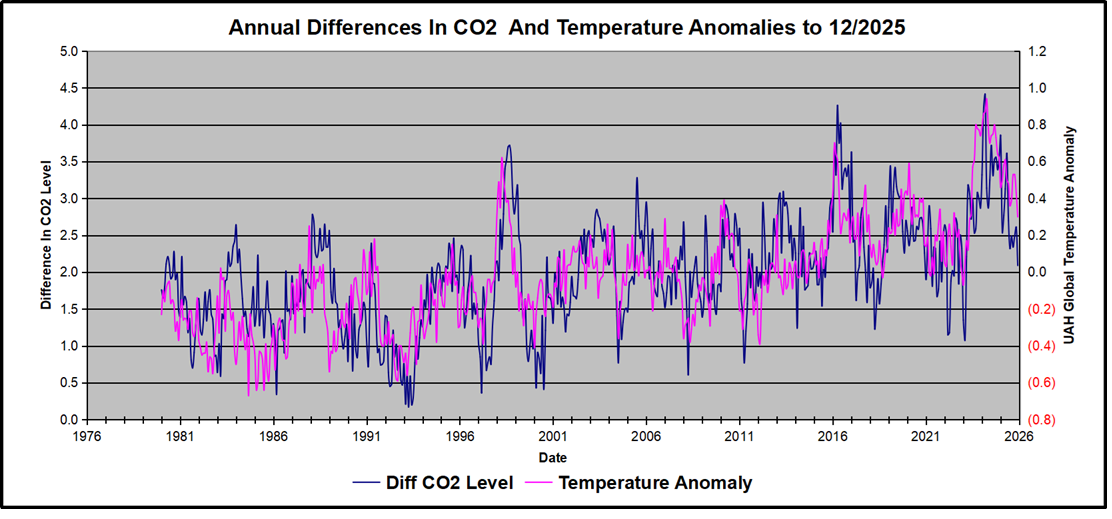
An early post provides relevant background to today’s discussion:  The Climate Water Wheel

6m (20ft) flywheel, weighs 15 tonnes. Used at Gepps Cross, Adelaide, South Australia Meatworks
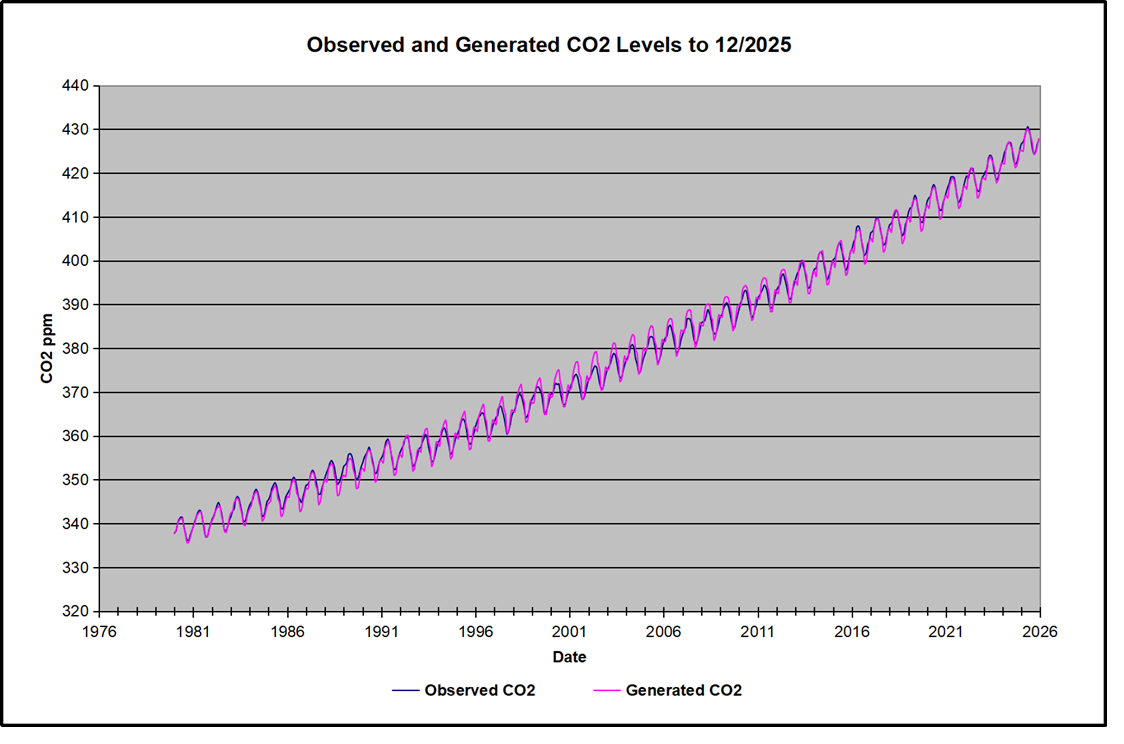
The image at the top is the cover of a fresh presentation of the ocean flywheel paradigm written by William Kininmonth, and posted at GWPF Rethinking the Greenhouse Effect.

Dr. Ralph Alexander summarized the paper in his article Ocean Currents More Important than the Greenhouse Effect.   Excerpts in italics with my bolds and added images.

A rather different challenge to the CO2 global warming hypothesis from the challenges discussed in my previous posts postulates that human emissions of CO2 into the atmosphere have only a minimal impact on the earth’s temperature. Instead, it is proposed that current global warming comes from a slowdown in ocean currents.

The daring challenge has been made in a recent paper by retired Australian meteorologist William Kininmonth, who was head of his country’s National Climate Centre from 1986 to 1998. Kininmonth rejects the claim of the IPCC (Intergovernmental Panel on Climate Change) that greenhouse gases have caused the bulk of modern global warming. The IPCC’s claim is based on the hypothesis that the intensity of cooling longwave radiation to space has been considerably reduced by the increased atmospheric concentration of gases such as CO2.

But, he says, the IPCC glosses over the fact that the earth is spherical,
so what happens near the equator is very different from what happens at the poles.

Most absorption of incoming shortwave solar radiation occurs over the tropics, where the incident radiation is nearly perpendicular to the surface. Yet the emission of outgoing longwave radiation takes place mostly at higher latitudes. Nowhere is there local radiation balance.

ERBE measurements of radiative imbalance.

In an effort by the climate system to achieve balance, atmospheric winds and ocean currents constantly transport heat from the tropics toward the poles. Kininmonth argues, however, that radiation balance can’t exist globally, simply because the earth’s average surface temperature is not constant, with an annual range exceeding 2.5 degrees Celsius (4.5 degrees Fahrenheit). This shows that the global emission of longwave radiation to space varies seasonally, so radiation to space can’t define Earth’s temperature, either locally or globally.

In warm tropical oceans, the temperature is governed by absorption of solar shortwave radiation, together with absorption of longwave radiation radiated downward by greenhouse gases; heat carried away by ocean currents; and heat (including latent heat) lost to the atmosphere. Over the last 40 years, the tropical ocean surface has warmed by about 0.4 degrees Celsius (0.7 degrees Fahrenheit).

But the warming can’t be explained by rising CO2 that went up from 341 ppm in 1982 to 417 ppm in 2022. This rise boosts the absorption of longwave radiation at the tropical surface by only 0.3 watts per square meter, according to the University of Chicago’s MODTRAN model, which simulates the emission and absorption of infrared radiation in the atmosphere. The calculation assumes clear sky conditions and tropical atmosphere profiles of temperature and relative humidity.

The 0.3 watts per square meter is too little to account for the increase in ocean surface temperature of 0.4 degrees Celsius (0.7 degrees Fahrenheit), which in turn increases the loss of latent and “sensible” (conductive) heat from the surface by about 3.5 watts per square meter, as estimated by Kininmonth.

So twelve times as much heat escapes from the tropical ocean to the atmosphere as the amount of heat entering the ocean due to the increase in CO2 level. The absorption of additional radiation energy due to extra CO2 is not enough to compensate for the loss of latent and sensible heat from the increase in ocean temperature.

The minimal contribution of CO2 is evident from the following table, which shows how the amount of longwave radiation from greenhouse gases absorbed at the tropical surface goes up only marginally as the CO2 concentration increases. The dominant greenhouse gas is water vapor, which produces 361.4 watts per square meter of radiation at the surface in the absence of CO2; its value in the table (surface radiation) is the average global tropical value.

You can see that the increase in greenhouse gas absorption from preindustrial times to the present, corresponding roughly to the CO2 increase from 300 ppm to 400 ppm, is 0.62 watts per square meter. According to the MODTRAN model, this is almost the same as the increase of 0.63 watts per square meter that occurred as the CO2 level rose from 200 ppm to 280 ppm at the end of the last ice age – but which resulted in tropical warming of about 6 degrees Celsius (11 degrees Fahrenheit), compared with warming of only 0.4 degrees Celsius (0.7 degrees Fahrenheit) during the past 40 years.

Therefore, says Kininmonth, the only plausible explanation left for warming of the tropical ocean is a slowdown in ocean currents, those unseen arteries carrying the earth’s lifeblood of warmth away from the tropics. His suggested slowing mechanism is natural oscillations of the oceans, which he describes as the inertial and thermal flywheels of the climate system.

Kininmonth observes that the overturning time of the deep-ocean thermohaline circulation is about 1,000 years. Oscillations of the thermohaline circulation would cause a periodic variation in the upwelling of cold seawater to the tropical surface layer warmed by solar absorption; reduced upwelling would lead to further heating of the tropical ocean, while enhanced upwelling would result in cooling.

Such a pattern is consistent with the approximately 1,000-year interval between the Roman and Medieval Warm Periods, and again to current global warming.

See also About Meridional Cooling and Climate Change

Arctic “Amplification” Not What You Think