Gender Ideology and Science

A fresh report from the front lines comes from (who else) Jordan Peterson: The gender scandal – in Scandinavia and Canada   Excerpts in italics with my bolds.

Men and women are similar. But importantly different. No matter what Sweden’s feminist foreign minister says.

Part One (Scandinavia)

Over the past few weeks, I have been in Oslo, twice; Helsinki, twice; Stockholm, twice; and Copenhagen, once. One of the trips to Stockholm was only for press interviews and television. The other six trips were part of my 12 Rules for Life tour, which has now covered 100 cities. The reason for the dual visits? We arranged relatively smaller venues for the lectures in those Scandinavian towns and they sold out immediately. Scandinavians are interested in what I am saying. They are radically over-represented among those who view my YouTube lectures.

In the last lecture, in Helsinki, it was Finland’s Father’s Day, so I talked about masculine virtue. In Stockholm, I concentrated more on what has come to be known as the “gender paradox.” Here is the paradox in a nutshell: as societies become more gender equal in their social and political policies, men and women become more different in certain aspects, rather than more similar.

Had you asked any group of social scientists — left-wing, centrist, conservative (if you could find them) — 30 years ago “Will egalitarian social policies in wealthy countries produce men and women who are more similar or more different?” the majority would have certainly said, “more similar.” And, to some degree, that has happened. Women have entered the workforce en masse, and are participating at levels approaching or exceeding equality in many of the domains that were male majority prior to the 1960s. But …

And this is a major but. We seem to have reached the point of diminishing, or even reversing returns. Over the last five decades or so, psychologists have aggregated great numbers of descriptions of personality traits, using adjectives, phrases and sentences, throwing virtually every descriptor contained in human language into the mix, in a remarkably atheoretical manner. The method? Describe people every which way imaginable, and then use large samples and powerful statistics to sort out the resulting mess. The results? Something approaching a consensus among psychologists expert in measurement, known as psychometricians (or, less technically, personality psychologists). The latter happens to be my field, in addition to clinical psychology. When you ask thousands of people hundreds of questions (or ask them to rate themselves using descriptive adjectives such as “kind,” “competitive,” “happy,” “anxious,” “creative,” “diligent,” etc.) powerful statistics can identify patterns. People who describe themselves as “kind” tend not to consider themselves “competitive,” for example, but are likely to accept “cooperative” and “caring.” Likewise, creative types might regard themselves as “curious” and “inventive,” while the diligent types are also “dutiful” and “orderly.”

Once a relatively standard model had been agreed upon, and been deemed reliable and valid, then differences, such as those between the sexes, could be investigated. What emerged? First, men and women are more similar than they are different. Even when men and women are most different — in those cultures where they differ most, and along those trait dimensions where they differ most — they are more similar than different. However, the differences that do exist are large enough so that they play an important role in determining or at least affecting important life outcomes, such as occupational choice.

Where are the largest differences? Men are less agreeable (more competitive, harsher, tough-minded, skeptical, unsympathetic, critically-minded, independent, stubborn). This is in keeping with their proclivity, also documented cross-culturally, to manifest higher rates of violence and antisocial or criminal behavior, such that incarceration rates for men vs women approximate 10:1. Women are higher in negative emotion, or neuroticism. They experience more anxiety, emotional pain, frustration, grief, self-conscious doubt and disappointment. This seems to emerge at puberty.

There are other sex differences as well, but they aren’t as large, excepting that of interest: men are comparatively more interested in things and women in people. This is the largest psychological difference between men and women yet identified. And these differences drive occupational choice, particularly at the extremes. Engineers, for example, tend to be those who are not only interested in things, but who are more interested in things than most people, men or women.

It’s very important to remember that many choices are made at the extreme, and not the average. It’s not the average more aggressive/less agreeable male that’s in prison. In fact, if you draw a random man and a random woman from the population, and you bet that the woman is more aggressive/less agreeable, you’d be correct about 40% of the time. But if you walked into a roomful of people everyone of whom had been selected to be the most aggressive person out of a 100, almost every one of them would be male.

So even though men and women are more the same than they are different, the differences can matter.

What happens if you look at sex differences in personality and interest by country? Are the differences bigger in some countries and smaller in others? Would the differences between men and women be larger or smaller in wealthier countries? In more egalitarian countries? The answer: the more egalitarian and wealthier the country, the larger the differences between men and women in temperament and in interest. And the relationship is not small. The most recent study, published in Science (by researchers at Berkeley, hardly a hotbed of conservatism and patriarchy) showed a relationship between a wealth/egalitarian composite measure and sex differences that was larger than that reported in 99% of published social science studies. These are not small-scale studies. Tens of thousands of people have participated in them. And many different groups of scientists have come to the same conclusions, and published those results in very good journals.

Given that differences in temperament and interest help determine occupational choice, and that differences in occupational choice drives variability in such things as income, this indicates that political doctrines that promote equality of opportunity also drive inequality of outcome.

This is a big problem — particularly if the goal of such egalitarian policies was to minimize the differences between men and women. It’s actually a fatal problem for a particular political view. The facts can be denied, but only at the cost of throwing out social science in its entirety and a good bit of biology as well. That is simply not a reasonable solution.

The best explanation, so far, for the fact of the growing differences is that there are two reasons for the differences between men and women: biology and culture. If you minimize the cultural differences (as you do with egalitarian social policies) then you allow the biological differences to manifest themselves fully. I have seen social scientists struggle to offer a cultural explanation, but I haven’t heard any such hypothesis that is the least bit credible, and have been unable to formulate one myself.

There are also those who insist that we just haven’t gone far enough in our egalitarian attempts — that even Scandinavia and The Netherlands, arguably the world’s most egalitarian societies, are still rampantly patriarchal — but that doesn’t explain why the sex differences have grown, rather than shrunk, as those cultures have become demonstrably more equal in social policy.

Those who adopt this viewpoint, despite its apparent logical impossibility, maintain that we must redouble our efforts to socialize little boys and girls in exactly the same manner — rendering all toys gender-neutral, questioning even the idea of gender identity itself — and believe that such maneuvering will finally bring us to the ideal utopia, where every occupation and every strata of authority within every occupation is manned (so to speak) by 50% men and 50% women. Why should we launch large-scale experiments aimed at transforming the socialization of children when we have no idea what the outcome might be? And why should we presume that we know how to eliminate gender identity among young children? Finally, why exactly is it a problem if men and women, freed to make the choices they would make when confronted with egalitarian opportunities, happen to make different choices?

So, this is the Scandinavian conundrum — one that also affects the broader Western world (and the rest of the world, soon enough). Policies that maximize equality of opportunity make equality of outcome increasingly impossible. The doctrine, ever more radically and loudly insisted upon by the politically correct, that sex differences are only socially constructed is wrong. Get it? Wrong.

It’s no wonder that when I came bearing this news the Swedish Foreign Minister (a proud member of the world’s only self-proclaimed feminist government) suggested publicly that I crawl back under my rock, and that one of Sweden’s leading female politicians objected on prime time TV that her daughter could be raised to be anything she wants to be. But facts is facts, I’m afraid, and no amount of neo-Marxist leftist postmodern suggestion that social science is a patriarchal construction is going to make the ugly truth disappear: Men and women are similar. But they are importantly different.

The differences matter, particularly at the extremes, particularly with regard to occupational choice and its concomitants. There are going to be more male criminals, and more male engineers, and more females with diagnoses of depression and anxiety, and more female nurses. And there are going to be differences in economic outcome associated with this variance.

Game over, utopians.

And that’s why the information I shared during my visit to Scandinavia caused a scandal that continues to reverberate.

Part Two (Canada)

Justin Trudeau’s new cabinet awaits the new Prime Minister at Rideau Hall on Wednesday, Nov. 4, 2015. Tony Caldwell/ Postmedia Network

We all remember that our current Prime Minister, the Right Honorable Justin Trudeau, decided early on when he formed his government to make his cabinet 50% women, because “it was 2015.” He got a hall pass for this, no doubt because of his boyish charm and modern mien. But it was a mistake of unforgivable magnitude and here are some of the reasons why:

The job of the federal government is important, necessary and difficult.

• To make important, difficult decisions properly, competence is necessary.

• There is no relationship between sex and competence. Men and women are essentially equal in their intelligence, and they differ very little in conscientiousness (which is the second-best predictor of success, after intelligence). Thus, selection for competence should optimally be sex-blind, if competence is the most important factor.

• The possibility of identifying a competent person increases as the pool of available candidates increases.

• Only 26% of the elected MPs in Trudeau’s government were women.

• By selecting 50% of his cabinet from 26% of the pool of available candidates, Prime Minister Trudeau abdicated his responsibility to rank-order all of his elected officials by competence (which could have been done by blind, multi-person rating of their resumes, including education and accomplishments) and staffing his cabinet from the most qualified person downward.

Given that only 26% of the elected MPs were women, the selection of half the cabinet from this pool means that it is a statistical certainty that the cabinet members chosen were not the most competent available.

It might also be pointed out that such a move is particularly appalling given its source. Let’s assume (which I don’t) that there is patriarchy, and with it, generally undeserved privilege. Let’s even assume (which I don’t) that much of this is accrued unfairly by straight white men, as the identity politics players, such as our Prime Minister, self-righteously and vociferously insist.

Is it truly unreasonable to point out that the absolute poster boy for such privilege is none other than our Prime Minister, Justin Trudeau — a man who dared run for the highest office in the land despite his utter lack of credentials (other than good looks, charm and a certain ability to behave properly in public) merely because his father, Pierre, turned the Trudeau name into the very epitome of status unearned by his sons?

Is it also unreasonable to point out that the women who accepted those positions, granted to them unfairly, in a prejudiced and discriminatory manner, took that as their due, despite the unlikelihood, statistically, of their suitability for the positions in question, and thus betrayed themselves, men and women everywhere striving fairly for advancement, and their country? All in the name of redress for some hypothetical prejudice, a consequence of the patriarchal tyranny, experienced in large measure by vaguely apprehended women of the past and definitely other than themselves.

Appalling. All of it. Appalling.

Jordan B. Peterson is a professor of psychology at the University of Toronto, a clinical psychologist and the author of the multi-million copy bestseller 12 Rules for Life: An Antidote to Chaos. His blog and podcasts can be found at jordanbpeterson.com
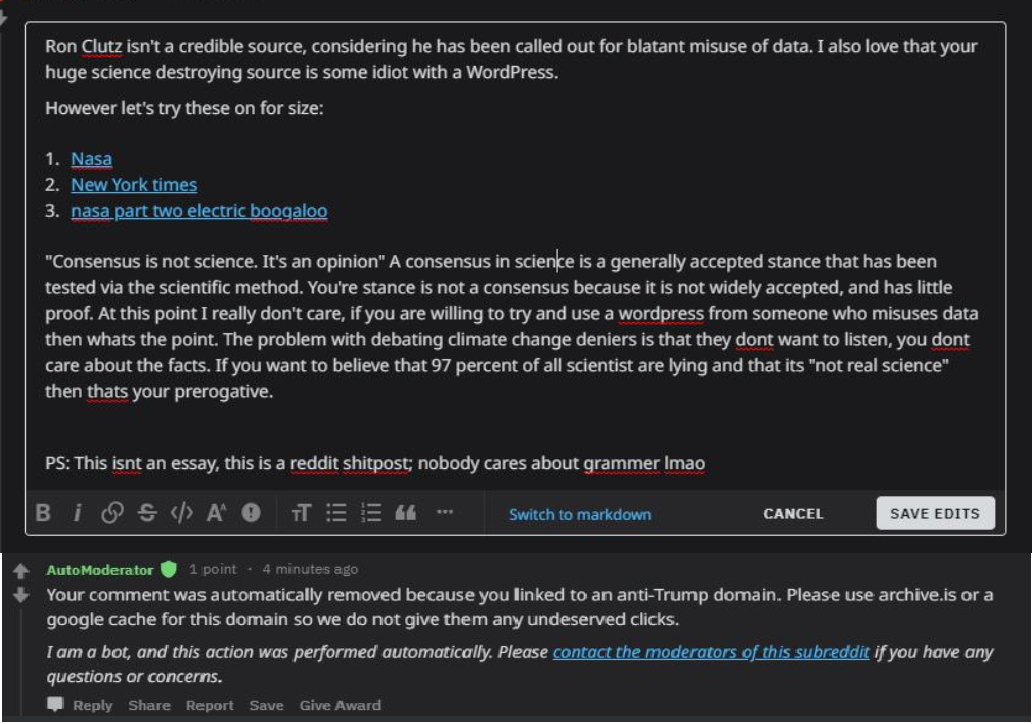
Whoa! I’ve been Bot-censored.

Today someone linked to one of my posts on a thread at reddit:

slinkydink2 14 hours ago
·
More grammatical errors and an emoji face. Am I talking to a 9 year old? Consensus is not science. It’s an opinion. The scientific theory has not been and cannot be applied to your global warning bullshit.

Spez: Even though I know you won’t read it (or understand it if you do) here’s an article from last month saying the models are bullshit and that Solar activity is the largest factor.

https://rclutz.wordpress.com/2018/10/22/2018-update-best-climate-model-inmcm5/

That was followed by:

13 hours ago
Your comment was automatically removed because you linked to an anti-Trump domain. Please use archive.is or a google cache for this domain so we do not give them any undeserved clicks.

I am a bot, and this action was performed automatically. Please contact the moderators of this subreddit if you have any questions or concerns.

The censorship statement was presented this way:

Wow! So much for free speech on the internet.  And the irony for being censored as an anti-Trump domain, which itself seems like a spoof.  The content referring to climate sources does ring true as climatist suppression of alternate information and views.  Apparently, you are an idiot if you know too much and see through the alarmist house of cards.

Historic Revision of Weights and Measures

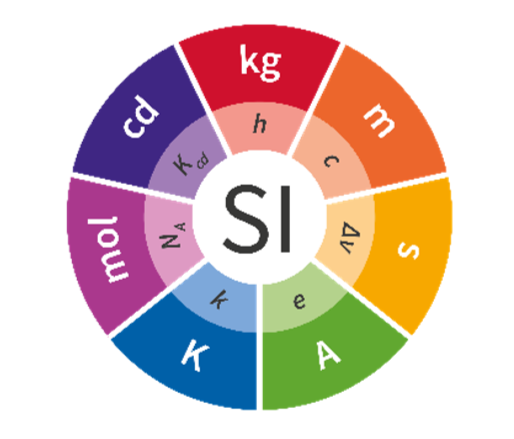
Today 16 November 2018, representatives from 60 nations agreed unanimously to an historic revision of the International System of Units (SI). The press kit for the 26th General Conference on Weights and Measures (CGPM) provides the details and implications. Excerpts in italics with my bolds.

Why is the SI important?  The name International System of Units, with the abbreviation SI, was given to the system in 1960. The SI units form a foundation for measurement across the world to ensure consistency and reliability. They are the basis of trading, manufacturing, innovation and scientific discovery around the world.

SI units can provide new opportunities for innovation. Some examples where greater accuracy is supporting better methods and understanding with a positive impact on society include:  The accurate measurement of temperature: This will support the ability to identify and measure reliably very small changes across large time periods with greater accuracy. Therefore, it will allow for precise monitoring and better predictions for climate change.  The accurate administration of drugs: The pharmaceutical industry needs to use a standard for very small amounts of mass in order to make dosages of medication even more appropriate for patients.

SI units can help us support innovation into the future. As our ability to measure properties improves, the standards we have for measurement will need to keep up. The accuracy of services like the Global Positioning System (GPS) are limited by our ability to use standard units, in this case the second to measure time. We can track our locations effectively because we can establish time using the SI definition of a second, which can be realized by an atomic clock. This advancement was made possible because society had defined the second more accurately well before we had even discovered what it could be used for. The atomic clock was made before computing really took off. Now, accurate timing is a fundamental part of the industry; without it, the internet, mobile phones and other technologies could not work reliably.

How are the units of measurement defined? Originally, measurement units were defined by physical objects or properties of materials. For example, the metre was originally defined by a metal bar exactly one metre in length.

However, these physical representations can change over time or in different environments, and are no longer accurate enough for today’s research and technological applications. Over the last century, scientists measured natural constants of nature, such as the speed of light in a vacuum and the Planck constant, with increasing accuracy. They discovered that these are more stable than physical objects, and fixed numerical values to the constants. These natural constants do not vary, so are at least one million times more stable.

This revision of the SI will, for the first time, see all base units in the SI defined by the constants of physical science that we use to describe nature. Using the constants we have found in nature as our universal basis for measurement allows not only scientists, but also industry and society, to have a measurement system that is more reliable, consistent, and scalable across quantities, from very large to very small.

There are two key ways the SI will change to create a more stable and future-proof basis for measurement:

It will take physical artifacts out of the equation: the kilogram is still defined by a physical object equal to the mass of the International Prototype of the Kilogram (IPK), an artifact stored at the International Bureau of Weights and Measures (BIPM) in France. This revision will finally remove the need for this last artifact.

For over a century, a kilogram has been defined by a lump of metal held securely in a Paris vault (AP)

For the first time, all the definitions will be separate from their realizations: instead of definitions becoming outdated as we find better ways to realize units, definitions will remain constant and future-proof. For example, the ampere is currently defined as “the magnetic force between two wires at a certain distance apart”, which means that it uses the realization of a measurement to define it. However, advancements like the advent of the Josephson and quantum Hall effects, have revealed better ways of realizing the ampere, making the original approach obsolete.

Which are changing?
The kilogram (kg), ampere (A), kelvin (K), and mole (mol) will have new definitions.
The new definitions affect four of the base units:
The kilogram in terms of the Planck constant (h)
The ampere in terms of the elementary charge (e)
The kelvin in terms of the Boltzmann constant (k)
The mole in terms of the Avogadro constant (NA)

Defining the kilogram in terms of fundamental physical constants will ensure its long-term stability, and hence its reliability, which is at present in doubt.

What about the definitions of the other units? The definitions of the second (s), metre (m), and candela (cd), will not change, but the way the definitions are written will be revised to make them consistent in form with the new definitions for the kilogram (kg), ampere (A), kelvin (K), and mole (mol). These new wordings are also expected to be approved at the 26th CGPM in November 2018 and to come into force on 20 May 2019.

What impact does the redefinition have on the realization of the kilogram? The kilogram will be defined in terms of the Planck constant, guaranteeing long-term stability of the SI mass scale. The kilogram can then be realized by any suitable method (for example the Kibble (watt) balance or the Avogadro (X-ray crystal density) method). Users will be able to obtain traceability to the SI from the same sources used at present (the BIPM, national metrology institutes and accredited laboratories). International comparisons will ensure their consistency.

The value of the Planck constant will be chosen to ensure that there will be no change in the SI kilogram at the time of redefinition. The uncertainties offered by NMIs to their calibration customers will also be broadly unaffected.

What impact does the redefinition have on the realization of the ampere? The ampere and other electrical units, as practically realized at the highest metrological level, will become fully consistent with the definitions of these units. The transition from the 1990 convention to the revised SI will result in small changes to all disseminated electrical units.

For the vast majority of measurement users, no action need be taken as the volt will change by about 0.1 parts per million and the ohm will change by even less. Practitioners working at the highest level of accuracy may need to adjust the values of their standards and review their measurement uncertainty budgets.

What impact does the redefinition have on the realization of the kelvin? The kelvin will be redefined with no immediate effect on temperature measurement practice or on the traceability of temperature measurements, and for most users, it will pass unnoticed. The redefinition lays the foundation for future improvements. A definition free of material and technological constraints enables the development of new and more accurate techniques for making temperature measurements traceable to the SI, especially at extremes of temperature.

After the redefinition, the guidance on the practical realization of the kelvin will support its worldwide dissemination by describing primary methods for measurement of thermodynamic temperature and equally through the defined scales ITS-90 and PLTS-2000.

What impact does the redefinition have on the realization of the mole? The mole will be redefined with respect to a specified number of entities (typically atoms or molecules) and will no longer depend on the unit of mass, the kilogram. Traceability to the mole can still be established via all previously employed approaches including, but not limited to, the use of mass measurements along with tables of atomic weights and the molar mass constant Mu.

Atomic weights will be unaffected by this change in definition and Mu will still be 1 g/mol, although now with a measurement uncertainty. This uncertainty will be so small that the revised definition of the mole will not require any change to common practice.

Will there be any change to the realization of the second, the metre and the candela? No.
The second will continue to be defined in terms of the hyperfine transition frequency of the caesium 133 atom. The traceability chain to the second will not be affected. Time and frequency metrology will not be impacted.
The metre in the revised SI will continue to be defined in terms of the speed of light, one of the fundamental constants of physics. Dimensional metrology practice will not need to be modified in any way and will benefit from the improved long-term stability of the system.
The candela will continue to be defined in terms of Kcd, a technical constant for photometry and will therefore continue to be linked to the watt. Traceability to the candela will still be established with the same measurement uncertainty via radiometric methods using absolutely-calibrated detectors.

Summary

The new definitions will use ‘the rules of nature to create the rules of measurement’ linking measurements at the atomic and quantum scales to those at the macroscopic level. As science and technology progress, the demands for measurements to underpin new products and services will increase. Metrology is a dynamic branch of science and the steps taken by the BIPM and the wider metrology community to advance the SI in 2018 will underpin these requirements ensuring that scientists can study it and engineers can improve it. And, since science and engineering play an important role in our lives, measurement matters for everyone.

Background:  

For an informative and also a whimsical look at measuring units see Origins of Science

Is “Emotional Intelligence” an Oxymoron?

Warning: This post will express sincere thoughts that are politically incorrect, for example accepting that males and females have differing predominant behaviors and traits.

The title refers to a notion that came up in the fields of management science and industrial psychology, coincidental with increasing numbers of women practicing in those disciplines. I am prompted to write about this upon realizing that our present social divide is more fundamental than many think. This century, we see increasing numbers of people choosing to operate from emotions rather than intelligence. This pattern is in contradiction to the trajectory of Western civilization placing reason as primary and individual rights and freedoms as essential.

In a recent article thread (to be excerpted below) a comment caught my attention. “It has been said men rank, women exclude, and that is very true imo. All-female groups are very exclusionary to anyone who does not fit in.” That expression of Ranking vs. Excluding was new to me, and it may be changing this century, what with women competing with other women in sports, and with men as well in the workplace. Still, it points to our present social struggle whereby “diversity” is employed to divide a nation into identity groups to protest prejudice and claim reparations against grievances. The US as usual is the leading example of this culture war. Ironically, tribalism is rearing its ugly head in precisely the nation-state that so successfully created an American tribe that included any and all ethnic and religious groups.

Ranking vs. Excluding also explains such recent events as the Senate hearings on Judge Kavanaugh. Clearly his opponents sought to exclude him not only from the Judiciary, but to banish him from the human race. Their fierce and unrelenting animus to this day is frightening for the republic. Ironically, Kavanaugh prevailed in the process only by an emotional outburst, his outrage finally waking others up to the enormously evil beheading underway. This was out of character for a man by all accounts extremely reasonable and unprejudiced, and even in this testimony his intelligence was evident and in control.

It also shows up in the warfare between Trump and the leftist media. From the moment of Trump declaring candidacy, the left has been focused on excluding Trump from legitimacy, not only as President, but as an human being. Meanwhile, he is focused on the ranking: Winning is what matters, coming in first place. And despite the media’s attempts to paint him racist and sexist, I see no evidence that he excludes losers in a contest. On the contrary, he and Senator Rubio are on the same side pushing back against election fraud in Florida. The media can not recognize Trump is driven by intelligence despite his determined actions pursuing rational policy goals, and unbowed by social pressure and disapproval.

This modern tribalism emerges from the academic world and is now spreading into the wider society as graduates gain employment in private and public sector institutions. However, many of them carry a virus along with whatever knowledge and skills they have been able to acquire in their studies. A recent interview with Camille Paglia offers insight into the conversion of normal Americans into social dissenters. The article in Quillette is Camille Paglia: It’s Time for a New Map of the Gender World written by Claire Lehmann. Excerpts below in italics with my bolds.

Post-structuralism, along with identity politics, made huge gains in the 1970s, as the old guard professors proved helpless against a rising tide of rapid add-on programs and departments like women’s studies and African-American studies. The tenured professoriate seemed not to realize that change of some kind was necessary, and thus they failed to provide an alternative vision of a remodeled university of the future.

Most established professors in the 1970s probably believed that the new theory trend was a fad that would blow away like autumn leaves. The greatness of the complex and continuous Western tradition seemed self-evident: the canon would surely stand, even if supplemented by new names. Well, guess what? Helped along by a swelling horde of officious, overpaid administrators, North American universities became, decade by decade, political correctness camps. Out went half the classics, as well as pedagogically useful survey courses demonstrating sequential patterns in history (now dismissed as a “false narrative” by callow theorists). Bookish, introverted old-school professors were not prepared for guerrilla warfare to defend basic scholarly principles or to withstand waves of defamation and harassment.

The poisons of post-structuralism have now spread throughout academe and have done enormous damage to basic scholarly standards and disastrously undermined belief even in the possibility of knowledge. I suspect history will not be kind to the leading professors who appear to have put loyalty to friends and colleagues above defending scholarly values during a chaotic era of overt vandalism that has deprived several generations of students of a profound education in the humanities. The steady decline in humanities majors is an unmistakable signal that this once noble field has become a wasteland.

As an atheist, I have argued that if religion is erased, something must be put in its place. Belief systems are intrinsic to human intelligence and survival. They “frame” the flux of primary experience, which would otherwise flood the mind. Another persistent proposal of mine has been for comparative religion to become the undergraduate core curriculum, an authentically global multiculturalism.

My substitute for religion is art, which I have expanded to include all of popular culture. But when art is reduced to politics, as has been programmatically done in academe for 40 years, its spiritual dimension is gone. It is coarsely reductive to claim that value in the history of art is always determined by the power plays of a self-referential social elite. I take Marxist social analysis seriously: Arnold Hauser’s Marxist, multi-volume A Social History of Art (1951) was a major influence on me in graduate school. However, Hauser honored art and never condescended to it. A society that respects neither religion nor art cannot be called a civilization.

But politics cannot fill the gap. Society, with which Marxism is obsessed, is only a fragment of the totality of life. As I have written, Marxism has no metaphysics: it cannot even detect, much less comprehend, the enormity of the universe and the operations of nature. Those who invest all of their spiritual energies in politics will reap the whirlwind. The evidence is all around us—the paroxysms of inchoate, infantile rage suffered by those who have turned fallible politicians into saviors and devils, godlike avatars of Good versus Evil.

The headlong rush to judgment by so many well-educated, middle-class women in the #MeToo movement has been startling and dismaying. Their elevation of emotion and group solidarity over fact and logic has resurrected damaging stereotypes of women’s irrationality that were once used to deny us the vote. I found the blanket credulity given to women accusers during the recent U.S. Senate confirmation hearings for Brett Kavanaugh positively unnerving: it was the first time since college that I truly understood the sexist design of Aeschylus’s Oresteia, whose mob of vengeful Furies is superseded by formal courts of law, where evidence is weighed.

What I see in both the Women’s March and #MeToo is an atavistic rediscovery by Western women of the joy of their own mutually nurturing solidarity—a primary feature of daily life during 10,000 years of the agrarian era that has been lost over the past two centuries of industrialization. As I have often noted, the sexes throughout human history actually had very little to do with each other. There was the world of men and the world of women, each with its own spheres of influence and activity. Women didn’t take men that seriously, and vice versa. I know this because I am the product of an immigrant family (my mother and all four grandparents were born in Italy), and it wasn’t that long ago that we were tilling the stony soil of the earthquake-prone motherland.

Second, the nuclear family as a standard unit of social life is a relatively new and isolating phenomenon. Wives returning from work to an apartment or house are expecting their husbands to fulfill all the emotional and conversational needs that were once fulfilled by other women of multiple generations throughout the agrarian workday in the fields or at home (where the burdens of childcare and eldercare were group shared).

What I see spreading among professional middle-class women is a bitter resentment toward men that is in many cases unjust and misplaced. With divorce so easy since the sexual revolution, women find themselves competing with younger women in new and cruel ways. Agrarian women gained power as they aged: young women were brainless pawns whose marriages, pregnancies, childcare, cooking, and other chores were acerbically supervised and controlled by the dictatorial crones (forces of nature whom I fondly remember from childhood).

In short, #MeToo from a historical perspective is a cri de coeur from women who are realizing that the sexual revolution that many of us had once ecstatically embraced has in key ways devalued women, confused their private relationships, and complicated their smooth functioning in the workplace. It’s time for a new map of the gender world.

Camille Paglia is the University Professor of Humanities and Media Studies at the University of the Arts in Philadelphia. Her eighth book, Provocations: Collected Essays, was released by Pantheon in Oct. 2018.

Footnote:

A previous post quoted an historian saying that the US civil war erupted because of two mutually exclusive definitions of justice.  One side said all people had equal rights and freedoms, while the other side said all people except slaves had equal rights and freedoms.  That war was fought and won to defeat the exclusionary principle.  Yes, the practice has not always lived up to the principle of inclusion.  But there is progress, and social justice warriors’ demands for racist examples exceeds the supply of such behavior.

Present day Americans are torn over the primacy of patriotism or multiculturalism
Details at Patriotism vs. Multiculturalism

Postcript:

Tom Wolfe wrote a book in which he skillfully dissected the descent of rationality and objectivity at the hands of modern academia. And I began to see the connection to climate change hysteria. The ruling force is “political correctness”, which translates into going along to get along in your tribe. And in the extreme, it means subordinating science and rationality to instincts of the herd, their fears, disappointments and desires ruling the day. My synopsis with links is Warmists and Rococo Marxists.

See Also:  Head, Heart and Science

Campus Thought Control

Timeline Of Human Activity In Antarctica

Antarctica, Earth’s southernmost continent, faces numerous threats from climate change, but many people don’t know very much about the isolated area. The Onion looks back at a history of exploration, scientific study, and human activity in Antarctica.

1490:
Lost European explorers perplexed by how cold India is.

1820:
Discovery of Antarctica sends world ice prices plummeting.

1911:
Norwegian explorer Roald Amundsen beats British explorer Robert Falcon Scott in the race to the South Pole after Scott falters during the critical Ross Ice Shelf sprint stage.

1917:
Ernest Shackleton completes the first successful mission to get a boat stuck in Antarctic pack ice and be forced to live miserably on a floe for months.

1935:
Caroline Mikkelsen becomes the first person to experience sexism on Antarctica.

1959:
The Antarctic Treaty is signed in Washington, placing a moratorium on natural resource exploitation and preventing penguins from industrializing the continent and entering the 20th-century global economy.

1991:
The ratification of the Madrid Protocol declares Antarctica to be a “natural reserve, devoted to peace and science” for the remaining 50 years of its existence.

2005:
The film March Of The Penguins documents Antarctica’s disturbing descent into fascism.

2018:
OK, earthquakes under the Antarctic peninsula have caused it to droop a bit, but erectile dysfunction is common and treatable.

Story comes from the Onion (here) with my improving their final observation.

Minnesota Valve Turners Case Dismissed Without Necessity Defense

“Stunning”: State Court Silences Climate Experts Set to Testify in Valve Turners’ Necessity Defense Trial  “Four days before trial, for no apparent reason, the court eviscerated our defense, and essentially overruled itself.” Excerpts below in italics with my bolds.

Minneapolis October 8, 2018 In an eleventh hour decision, a Minnesota court “eviscerated” the defense of three activists—whose landmark trial began Monday for their 2016 multi-state #ShutItDown action that temporarily disabled tar sands pipelines crossing the U.S.-Canada border—by barring experts from testifying that their civil disobedience was necessary because fossil fuels are driving the global climate crisis.

While all charges against Steve Liptay, who filmed the Minnesota action, have been dropped, valve turners Emily Nesbitt Johnston and Annette Klapstein, along with their support person, Benjamin Joldersma, are still facing felony charges under Minnesota state law. Their legal team will now have to present their “necessity defense” without the slate of experts who had agreed to explain the climate crisis and the impact of civil disobedience to the jury.

This “stunning” reversal came after an appeals court ruled in April that they could present a necessity defense, a decision upheld by the Minnesota Supreme Court in June. The rulings were celebrated by climate activists and experts nationwide as courts in Washington, North Dakota, and Montana blocked requests from fellow valve turners’ on trial for the 2016 action to present such a defense.

“We were looking forward to entrusting this case to a Minnesota jury of our peers to decide after hearing expert scientists and social scientists discuss the facts of climate change and public policy,” said Klapstein, a retired attorney.

“By requiring us to establish the necessity defense, without allowing us to use our planned expert testimony to do so, the court has placed an overwhelming burden on us,” she added. “I’m baffled by the surreal nature of this court’s decision and timing.”

“Four days before trial, for no apparent reason, the court eviscerated our defense, and essentially overruled itself,” said Johnston. “It is impossible for us to properly defend ourselves without expert testimony.”

Experts that had planned to testify include climate scientists Dr. Jim Hansen, Dr. Mark Seeley, and Dr. Peter Reich; public health expert Dr. Bruce Synder; Princeton professor Dr. Martin Gilens; Harvard Law professor Lawrence Lessig; nonviolent direct action historian and Albert Einstein Institution executive director Jamila Raqib; 350.org co-founder Bill McKibben; and oil infrastructure expert Dr. Anthony Ingraffea.

Minnesota District Court Judge Robert Tiffany claimed their testimonies would be confusing to the jury, Climate Direct Action said in a statement on Monday.

“The irony is that the judge may be proving our point—we acted as we did because we know that the paralysis and myopia of the executive and legislative branches with regard to climate change mean that the political system itself must be shaken up if there is to be any hope for all of us,” Johnston noted. “We were hoping that the judiciary might show the way.”

Minnesota judge tosses charges midtrial against 3 activists 
Excerpts in italics with my bolds.

MINNEAPOLIS (AP) October 9, 2018 A Minnesota judge abruptly dismissed charges against three climate change activists during their trial on Tuesday, saying prosecutors failed to prove that the protesters’ attempt to shut down two Enbridge Energy oil pipelines caused any damage.

Clearwater County District Judge Robert Tiffany threw the case out after prosecutors rested their case and before the protesters could use their defense: that the threat of climate change from using crude oil drilled from Canadian tar sands was so imminent that the activists’ actions were not only morally right, but necessary.

The attorneys had long fought to use a “necessity defense” during the trial of the three Seattle-area residents, two of whom admitted turning the emergency shut-off valves on the northwest Minnesota pipelines in 2016 as part of a coordinated action in four states. Such a defense has been used by other activists protesting pipelines.

Their attorney, Lauren Regan, acknowledged outside the courthouse in Bagley that she and her clients were surprised that the judge granted their motion to dismiss the case. The three defendants faced felony charges involving criminal damage to critical public service facilities. They could have faced up to a year in jail, according to prosecutors.

“I’m very relieved the state of Minnesota acknowledged that we did no damage and intended to do no damage,” defendant Emily Johnston said. “I also admit that I am disappointed that we did not get to put on the trial that we hoped for.”

Clearwater County Attorney Alan Rogalla declined to comment afterward.

Climate change activists have increasingly turned to direct actions against oil and gas pipelines, with mixed legal success . Valve-turner cases in other states resulted in convictions that are under appeal. A Massachusetts judge in March cleared 13 gas pipeline protesters who used a necessity defense. While the cases generally have not set binding legal precedents, activists are hoping they help legitimize direct action as a tactic against climate change.

In the Minnesota case, Johnston and Annette Klapstein readily acknowledged turning the emergency shut-off valves on two Enbridge Energy pipelines on Oct. 11, 2016, near Leonard, about 210 miles (338 kilometers) northwest of Minneapolis. A third defendant, Ben Joldersma, called in a warning to Enbridge. Charges were earlier dropped against a fourth defendant.

They did it as part of a coordinated action by Climate Direct Action activists to shut down five Canadian tar sands crude pipelines in Minnesota, North Dakota, Montana and Washington state. A total of 11 activists were charged in the four states.

Calgary, Alberta-based Enbridge temporarily shut down the two pipelines as a precaution before any damage occurred. The company issued a statement Tuesday saying the protest was “reckless and dangerous.”

“The individuals involved in these activities claimed to be protecting the environment, but they did the opposite and put the environment and the safety of people at risk — including themselves, first responders and neighboring communities and landowners,” the company said.

The defendants insisted there was never any danger.

“We did everything in our power to make sure this was a safe action, and we did this to protect our children and all of your children from the devastating effects of climate change,” Klaptstein said at the activists’ news conference afterward.

While the judge took the unusual step of allowing allowed the necessity defense in a ruling last October, he said the defendants had to clear a high legal bar to succeed. He said the defense applies “only in emergency situations where the peril is instant, overwhelming, and leaves no alternative but the conduct in question.”

The valve turners had hoped to put climate change itself on trial by presenting expert witnesses who would have backed up their claims that climate change was making natural disasters worse, and that the threat of climate change from Canadian tar sands crude — which generates more climate-damaging carbon dioxide than other forms of oil — was so imminent that they had no legal alternatives. But they never got the chance.

Summary

I am not sure what to make of this.  The rejection of expert climatists is encouraging since the courts are in no position to judge scientific positions.  The dismissal of the charges in a way avoided a messy situation for the court.  If no damage was done, it was the easy way out to dismiss the charges before going through a show trial before a jury, and as an additional benefit preventing grandstanding by professional activists.

How to Test an Accusation

The Senate Judiciary committee is meeting today and the written testimonies of Dr. Ford and Judge Kavanaugh are available. The challenge for senators and everyone else is how to judge the validity of the sexual assault claim. Normally an accusation is supported by evidence such as other witnesses before it is given legal consideration. But this is a he said, she said situation.

We know from scientific studies that our memories are untrustworthy the further in the past are the events being recalled. Cognitive experts say that a core remembrance, usually laden with emotion, is elaborated with details invented by our brains to fill in the gaps for a complete story.  An accuser can bear truthful witness to a false memory, and thereby belie the facts. So how to sort out how much is what happened and how much is imagination?

Adam Mill is an employment lawyer who has experience with many such cases and writes in the Federalist 10 Red Flags About Sexual Assault Claims, From An Employment Lawyer

It’s not nice or politically correct to say, but people do sometimes lie to get money, revenge, power, attention, or political advantage. False allegations of assault have been documented.

I know it’s a very unfashionable to advocate on behalf of the presumption of innocence, and I am often reminded of how insensitive and outdated the principle is in today’s climate.

Of course, courtesy to the alleged victim is absolutely essential to be effective. To do otherwise is completely counterproductive and quickly turns the focus from the facts to the conduct within the inquiry. So I go to great pains to make my questions respectful.

When the complaint is “he said/she said,” we should not helplessly acquiesce to coin-flip justice that picks winners and losers based upon the identity politics profile of the accused and accuser. Experience with a career’s worth of complaints in hearings, depositions, and negotiations has taught me some tells, red flags that warn that an innocent person stands accused.

Without naming any particular accusation, I offer these factors for consideration to the fair-minded who remain open to the possibility that guilt or innocence is not simply a question of politics. I also remind the reader that politicizing these accusations have allowed men like Harvey Weinstein, Al Franken, Matt Lauer, Les Moonves, Bill Clinton, and Keith Ellison to escape accountability. Nobody seems to care if they walk the walk so long as they talk the talk.

1. The accuser uses the press instead of the process.
Every company has a slightly different process for harassment and assault complaints. Often it begins with a neutral investigator being assigned to interview the accuser first, then potential corroborating witnesses. When an accuser is eager to share with the media but reluctant to meet with an investigator, it’s a flag.

2. The accuser times releasing the accusation for an advantage.
For example, when the accuser holds the allegation until an adverse performance rating of the accuser is imminent, or serious misconduct by the accuser is suddenly discovered, or the accused is a rival for a promotion or a raise, or the accused’s success will block an accuser’s political objective. It’s a flag when the accusation is held like a trump card until an opportunity arises to leverage the accusation.

3. The accuser attacks the process instead of participating.
The few times I’ve been attacked for “harassing” the victim, it has always followed an otherwise innocuous question about the accusation, such as: Where, when, how, why, what happened? I don’t argue with accusers, I just ask them to explain the allegation. If I’m attacked for otherwise neutral questions, it’s a red flag.

4. When the accused’s opportunity to mount a defense is delegitimized.
The Duke Lacrosse coach was fired just for saying his players were innocent. When the players dared to protest their innocence, the prosecutor painted their stories in the press as “uncooperative.” If either the accused or the accused’s supporters are attacked for just for failing to agree with the accusation, it’s a red flag.

5. The accuser seeks to force the accused to defend himself or herself before committing to a final version.
Unfortunately, this has become the preferred approach of the kangaroo courts on college campuses. It’s completely unfair because it deprives the accused of the opportunity to mount an effective defense. When the accuser demands the accused speak first, it is a strong indication that the accuser wants the opportunity to fill in the details of the accusation to counter any defense or alibi the accused might offer. It’s a red flag.

6. The accused makes a strong and unequivocal denial.
In most cases, there’s some kernel of truth to even the most exaggerated claims. When the accused reacts with a dissembling explanation full of alternatives and rationalizations, I tend to find the accuser more credible. Rarely, however, the accused reacts with a full-throated and adamant denial. When it happens, it’s a red flag that the accusation might have problems.

7. The accuser makes unusual demands to modify or control the process.
It’s a flag when the accuser demands a new investigator or judge without having a substantial basis for challenging the impartiality of the process that’s already in place.

8. When the accuser’s ability to identify the accused has not been properly explained.
In the Duke lacrosse case, the accuser was shown a lineup of photos of potential attackers. Every photo was of a member of the team. None were of people known to be innocent. It’s a red flag when an identification is made only after the accused appears in media and the accuser has not seen the accused for a number of years or was otherwise in regular contact with the accused.

9. When witnesses don’t corroborate.
10. When corroborating witnesses simply repeat the accusation of the accuser but don’t have fresh information.
It is now clear that accusations of sexual misconduct will forever be a tool to change results in elections and Supreme Court nominations. It’s disappointing to see so many abandon the accused to join the stampede of a mob that punishes any who ask legitimate questions about accusations.

These accusations destroy the lives of the accused, often men, and bring devastation to the women who love and support them. Some of the falsely accused commit suicide. When the mob attacks legitimate inquiry into the accusation, it’s a sure sign that the mob isn’t confident about the truth of the allegation. Rather than shrink in fear when attacked, we should take it as a sign that there is a risk that the accused is innocent, and the questions need to keep coming.

Adam Mill works in Kansas City, Missouri as an attorney specializing in labor and employment and public administration law. He frequently posts to millstreetgazette.blogspot.com. Adam graduated from the University of Kansas and has been admitted to practice in Kansas and Missouri.

Dr. Elizabeth Loftus concluded in one TED talk:

If I’ve learned anything from my decades working on these problems, it’s this: Just because somebody tells you something and they say it with lots of confidence, detail, and emotion does not mean that it really happened. We can’t reliably distinguish true memories from false memories; we need independent corroboration. Such a discovery has made me more tolerant of friends and family who misremember. Such a discovery might have saved Steve Titus. We should all keep in mind that memory, like liberty, is a fragile thing.


Outbreak of Fake Hurricane Reports

Inspired by the Weather Channel’s reporter faking the strength of winds, social media is going viral with numerous videos expanding on the theme.  A compilation can be viewed above.

The watershed video from Weather Channel (pun intended) inadvertently showing people walking around normally in the background.


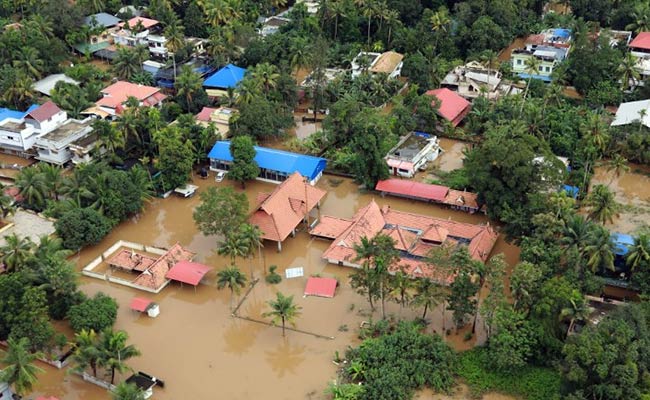
X-Weather is Back! Kerala edition

nt5kfrp8_kerala-floods-afp_625x300_20_august_18

2018 Kerala India Flooding and Rainfall Event

Because of obsession with CO2,  flooding in Kerala S. India is the latest example of the desire to pin the blame on “climate change”. Jonathan Eden wrote a balanced article in WION Why it’s so hard to detect the fingerprints of global warming on monsoon rains  Excerpts in italics with my bolds.

Unlike temperature, rainfall varies hugely in space and time. Even the most sophisticated climate models struggle to simulate physical processes such as convection and evaporation that drive rainfall activity. On top of that, global warming is not expected to change the frequency and intensity of rainfall extremes in the same way in all parts of the world.

The choice to focus solely on the rainfall itself is particularly relevant for flooding events. Though accusations of poor decision-making and mismanagement of water resources are beginning to appear in the Kerala aftermath, the floods simply would not have occurred without a significant amount of rain. Few of those suffering lost homes and livelihoods are likely to care much about where the rain came from or the intricacies of the weather conditions that led to it.

Disentangling these contributory factors takes time. In comparison to droughts and heatwaves, short-term hazards such as floods do not usually give us much chance to report concrete findings while the media and general public are still engaged in the event. In-depth studies may not publish their results for many months, sometimes even years after the event in question.

Many of these issues are not exclusive to extreme rainfall. The excellent US National Academies report on Attribution of Extreme Weather Events in the Context of Climate Change describes the shortcomings in our efforts to attribute a variety of extremes. But for rainfall in particular there is a discrepancy between what we understand about the general effect of global warming and our rather lesser ability to quantify the climate change fingerprint on specific events.

2017 Hurricane Harvey X-Weathermen Event

With Hurricane Harvey making landfall in Texas as a Cat 4, the storm drought is over and claims of linkage to climate change can be expected.  So far (mercifully) articles in Time and Washington Post have been more circumspect than in the past.  Has it become more respectable to look at the proof supporting wild claims?  This post provides background on X-Weathermen working hard to claim extreme weather as proof of climate change.

In the past the media has been awash with claims of “human footprints” in extreme weather events, with headlines like these:

“Global warming is making hot days hotter, rainfall and flooding heavier, hurricanes stronger and droughts more severe.”

“Global climate change is making weather worse over time”

“Climate change link to extreme weather easier to gauge”– U.S. Report

“Heat Waves, Droughts and Heavy Rain Have Clear Links to Climate Change, Says National Academies”

That last one refers to a paper released by the National Academy of Sciences Press: Attribution of Extreme Weather Events in the Context of Climate Change (2016)

And as usual, the headline claims are unsupported by the actual text. From the NAS report (here): (my bolds)

Attribution studies of individual events should not be used to draw general conclusions about the impact of climate change on extreme events as a whole. Events that have been selected for attribution studies to date are not a representative sample (e.g., events affecting areas with high population and extensive infrastructure will attract the greatest demand for information from stakeholders) P 107

Systematic criteria for selecting events to be analyzed would minimize selection bias and permit systematic evaluation of event attribution performance, which is important for enhancing confidence in attribution results. Studies of a representative sample of extreme events would allow stakeholders to use such studies as a tool for understanding how individual events fit into the broader picture of climate change. P 110

Correctly done, attribution of extreme weather events can provide an additional line of evidence that demonstrates the changing climate, and its impacts and consequences. An accurate scientific understanding of extreme weather event attribution can be an additional piece of evidence needed to inform decisions on climate change related actions. P. 112

The Indicative Without the Imperative

extreme-weather-events

The antidote to such feverish reporting is provided by Mike Hulme in a publication: Attributing Weather Extremes to ‘Climate Change’: a Review (here).

He has an insider’s perspective on this issue, and is certainly among the committed on global warming (color him concerned). Yet here he writes objectively to inform us on X-weather, without advocacy: real science journalism and a public service, really. Excerpts below with my bolds.

Overview

In this third and final review I survey the nascent science of extreme weather event attribution. The article proceeds by examining the field in four stages: motivations for extreme weather attribution, methods of attribution, some example case studies and the politics of weather event Attribution.

The X-Weather Issue

As many climate scientists can attest, following the latest meteorological extreme one of the most frequent questions asked by media journalists and other interested parties is: ‘Was this weather event caused by climate change?’

In recent decades the meaning of climate change in popular western discourse has changed from being a descriptive index of a change in climate (as in ‘evidence that a climatic change has occurred’) to becoming an independent causative agent (as in ‘climate change caused this event to happen’). Rather than being a descriptive outcome of a chain of causal events affecting how weather is generated, climate change has been granted power to change worlds: political and social worlds as much as physical and ecological ones.

To be more precise then, what people mean when they ask the ‘extreme weather blame’ question is: ‘Was this particular weather event caused by greenhouse gases emitted from human activities and/or by other human perturbations to the environment?’ In other words, can this meteorological event be attributed to human agency as opposed to some other form of agency?

The Motivations

Hulme shows what drives scientists to pursue the “extreme weather blame” question, noting four motivational factors.

Why have climate scientists over the last ten years embarked upon research to provide an answer beyond the stock phrase ‘no individual weather event can directly be attributed to greenhouse gas emissions’?  There seem to be four possible motives.

1.Curiosity
The first is because the question piques the scientific mind; it acts as a spur to develop new rational understanding of physical processes and new analytic methods for studying them.

2.Adaptation
A second argument, put forward by some, is that it is important to know whether or not specific instances of extreme weather are human-caused in order to improve the justification, planning and execution of climate adaptation.

3.Liability
A third argument for pursuing an answer to the ‘extreme weather blame’ question is inspired by the possibility of pursuing legal liability for damages caused. . . If specific loss and damage from extreme weather can be attributed to greenhouse gas emissions – even if expressed in terms of increased risk rather than deterministically – then lawyers might get interested.

The liability motivation for research into weather event attribution also bisects the new international political agenda of ‘loss and damage’ which has emerged in the last two years. . . The basic idea is to give recognition that loss and damage caused by climate change is legitimate ground for less developed countries to gain access to new international climate adaptation funds.

4. Persuasion
A final reason for scientists to be investing in this area of climate science – a reason stated explicitly less often than the ones above and yet one which underlies much of the public interest in the ‘extreme weather blame’ question – is frustration with and argument about the invisibility of climate change. . . If this is believed to be true – that only scientists can make climate change visible and real –then there is extra onus on scientists to answer the ‘extreme weather blame’ question as part of an effort to convince citizens of the reality of human-caused climate change.

Attribution Methods

Attributing extreme weather events to human influences requires different approaches, of which four broad categories can be identified.

1. Physical Reasoning
The first and most general approach to attributing extreme weather phenomena to rising greenhouse gas concentrations is to use simple physical reasoning.

General physical reasoning can only lead to broad qualitative statements such as ‘this extreme weather is consistent with’ what is known about the human-enhanced greenhouse effect. Such statements offer neither deterministic nor stochastic answers and clearly underdetermine the ‘weather blame question.’ It has given rise to a number of analogies to try to communicate the non-deterministic nature of extreme event attribution. The three most widely used ones concern a loaded die (the chance of rolling a ‘6’ has increased, but no single ‘6’ can be attributed to the biased die), the baseball player on steroids (the number of home runs hit increases, but no single home run can be attributed to the steroids) and the speeding car-driver (the chance of an accident increases in dangerous conditions, but no specific accident can be attributed to the fast-driving).

2. Classical Statistical Analysis
A second approach is to use classical statistical analysis of meteorological time series data to determine whether a particular weather (or climatic) extreme falls outside the range of what a ‘normal’ unperturbed climate might have delivered.

All such extreme event analyses of meteorological time series are at best able to detect outliers, but can never be decisive about possible cause(s). A different time series approach therefore combines observational data with model simulations and seeks to determine whether trends in extreme weather predicted by climate models have been observed in meteorological statistics (e.g. Zwiers et al., 2011, for temperature extremes and Min et al., 2011, for precipitation extremes). This approach is able to attribute statistically a trend in extreme weather to human influence, but not a specific weather event. Again, the ‘weather blame question’ remains underdetermined.

slide20

3. Fractional Attributable Risk (FAR)
Taking inspiration from the field of epidemiology, this method seeks to establish the Fractional Attributable Risk (FAR) of an extreme weather (or short-term climate) event. It asks the counterfactual question, ‘How might the risk of a weather event be different in the presence of a specific causal agent in the climate system?’

The single observational record available to us, and which is analysed in the statistical methods described above, is inadequate for this task. The solution is to use multiple model simulations of the climate system, first of all without the forcing agent(s) accused of ‘causing’ the weather event and then again with that external forcing introduced into the model.

The credibility of this method of weather attribution can be no greater than the overall credibility of the climate model(s) used – and may be less, depending on the ability of the model in question to simulate accurately the precise weather event under consideration at a given scale (e.g. a heatwave in continental Europe, a rain event in northern Thailand) (see Christidis et al., 2013a).

4. Eco-systems Philosophy
A fourth, more philosophical, approach to weather event attribution should also be mentioned. This is the argument that since human influences on the climate system as a whole are now clearly established – through changing atmospheric composition, altered land surface characteristics, and so on – there can no longer be such a thing as a purely natural weather event. All weather — whether it be a raging tempest or a still summer afternoon — is now attributable to human influence, at least to some extent. Weather is the local and momentary expression of a complex system whose functioning as a system is now different to what it would otherwise have been had humans not been active.

Results from Weather Attribution Studies

Hulme provides a table of numerous such studies using various methods, along with his view of the findings.

It is likely that attribution of temperature-related extremes using FAR methods will always be more attainable than for other meteorological extremes such as rainfall and wind, which climate models generally find harder to simulate faithfully at the spatial scales involved. As discussed below, this limitation on which weather events and in which regions attribution studies can be conducted will place important constraints on any operational extreme weather attribution system.

Political Dimensions of Weather Attribution

Hulme concludes by discussing the political hunger for scientific proof in support of policy actions.

But Hulme et al. (2011) show why such ambitious claims are unlikely to be realised. Investment in climate adaptation, they claim, is most needed “… where vulnerability to meteorological hazard is high, not where meteorological hazards are most attributable to human influence” (p.765). Extreme weather attribution says nothing about how damages are attributable to meteorological hazard as opposed to exposure to risk; it says nothing about the complex political, social and economic structures which mediate physical hazards.

And separating weather into two categories — ‘human-caused’ weather and ‘tough-luck’ weather – raises practical and ethical concerns about any subsequent investment allocation guidelines which excluded the victims of ‘tough-luck weather’ from benefiting from adaptation funds.

Contrary to the claims of some weather attribution scientists, the loss and damage agenda of the UNFCCC, as it is currently emerging, makes no distinction between ‘human-caused’ and ‘tough-luck’ weather. “Loss and damage impacts fall along a continuum, ranging from ‘events’ associated with variability around current climatic norms (e.g., weather-related natural hazards) to [slow-onset] ‘processes’ associated with future anticipated changes in climatic norms” (Warner et al., 2012:21). Although definitions and protocols have not yet been formally ratified, it seems unlikely that there will be a role for the sort of forensic science being offered by extreme weather attribution science.

Conclusion

Thank you Mike Hulme for a sane, balanced and expert analysis. It strikes me as being another element in a “Quiet Storm of Lucidity”.

Is that light the end of the tunnel or an oncoming train?

Attesting Environmental Scares

Attesting refers to a process evaluating the truth of a claim. In metallurgy, a laboratory will perform attestation procedures to measure the purity and quality of an ore sample or an alloy material. In legal terms, a witness provides evidence or proof attesting to a version of events.

Francis Menton, the Manhattan Contrarian, raises an important question in his recent post How to Approach a Scientific Issue in the Public Arena.

So how can you, as a reasonably informed citizen, hope to come to a rational view as to which scary scientific claims to credit and which to dismiss? Unfortunately, most people’s default approach to dealing with scientific issues as to which they have no personal expertise is to defer to the asserted authority of a “consensus” of experts.

I have a proposed framework for you to apply. It’s a little more complicated than either the “follow the consensus” or “reject them all” approaches. But the good news is that it’s not all that much more complicated. And the even better news is that I think you will get the right answer in nearly every case; with, however, the proviso that that “right” answer may be ambiguity in many cases.

The Manhattan Contrarian Guide To Evaluating Environmental Scares can be summarized in four words: Follow The Scientific Method. Unfortunately, almost no journalist knows the basics of the Scientific Method (even though probably all of them were exposed to it somewhere in high school or even junior high school); and therefore, almost everything you read about environmental scares claiming the mantle of science is at the minimum misleading, if not downright wrong. Following the Scientific Method really directs you to looking at only three key questions to lead you to the right answer: 

1. What is the falsifiable hypothesis? The Scientific Method requires a falsifiable hypothesis. A falsifiable hypothesis requires a statement of the proposition at issue that by its nature can be falsified and thereby invalidated by some evidence that it is possible to acquire, and also a recognition by the proponents of the hypothesis as to what evidence, if it emerged, would be sufficient to falsify and invalidate the hypothesis. Without a statement of a falsifiable hypothesis, it is not science, no matter what the proponents may say, and therefore any claims of “scientific” consensus or “scientific” validity are an obvious fallacy.

2.What is the most damning adverse evidence against the falsifiable hypothesis? The Scientific Method provides that no hypothesis can ever be definitively proved, although accumulation of evidence consistent with the hypothesis can give increasing confidence over time of its correctness. However, one piece of adverse evidence can disprove a scientific hypothesis; and indeed, if an advocate of a scientific hypothesis does not concede that proposition, then you know that this is not real science. In any event, it is always much more important to look to adverse evidence challenging a hypothesis, no matter how little of it there may be, than to whatever reams and reams of evidence there may be allegedly consistent with the hypothesis. That stuff can regularly be used by advocates to mislead and misdirect you.

3.How do advocates of the hypothesis respond to the most damning adverse evidence? If they have an answer to it, let’s see it! It is particularly telling if advocates just refuse to address the best points of their opponents. If that is going on, you are completely justified in concluding that they have no answers, and that their proposition is false.

Now, let us apply these three questions to the cases of glyphosate and climate change.

Glyphosate.

What is the falsifiable hypothesis? I would say that it is this: “High levels of exposure to glyphosate are associated with increased risk of developing blood cancers, particularly non-Hodgkins lymphoma.” It’s easy and clear. And clearly falsifiable.

What is the most damning adverse evidence against the falsifiable hypothesis? Well, there is this from the statement of Monsanto VP Scott Partridge after the jury verdict: “More than 800 scientific studies and reviews—and conclusions by the U.S. Environmental Protection Agency, the U.S. National Institutes of Health and regulatory authorities around the world—support the fact that glyphosate does not cause cancer.” That’s a start. To pick just one of the 800, in my November 2017 post I cited the U.S. Agricultural Health Study, which followed 89,000 farmers and their wives for 23 years from 1993 to 2016, and found “no association between glyphosate exposure and all cancer incidence or most of the specific cancer subtypes we evaluated, including NHL [non-Hodgkins lymphoma]. . . .”

How do the advocates respond to the most damning evidence? In this case, the answer is, basically, they have little in response. My understanding is that, rather than addressing the mountain of adverse studies (mostly done by people having no association with Monsanto), they principally relied on one outlier UN report, produced by a guy who promptly became a consultant to the plaintiffs’ lawsuit industry, and which reached its ambiguous conclusion in significant part by altering the conclusions of the underlying work that it cited. For more details, read my November 2017 post. But the most significant point is that, under the Scientific Method, the adverse evidence is far more important than any evidence that might be cited as consistent with the hypothesis, even if extensive. In this case, a falsifiable hypothesis has been quite definitively invalidated.

As you can see, if you just follow the Scientific Method, you quickly find that those on the side that glyphosate does not cause cancer have far the better side of the argument. Perhaps it is not 100% definitive, but it is close.

Climate Change

What is the falsifiable hypothesis? There isn’t one! And good luck trying to find a statement of the official falsifiable hypothesis from any advocate of climate alarmism. I have previously invited readers and commenters on this blog to give me a statement of the falsifiable hypothesis on which climate alarmists claim there is a “consensus,” and I have never gotten even an attempt of any kind. I hereby make the invitation again. To get an idea of the shell game you are dealing with, try going to this NASA web page titled “Global Climate Change/Facts.” (What is that page still doing there over a year and a half into a Trump presidency??!!) Here’s the leading headline: “Scientific Consensus: Earth’s climate is warming.” Is that a falsifiable hypothesis? Absolutely not! It’s a trivial non-falsifiable statement whose result can be manipulated by whoever gets to pick the start date of the analysis. See my post of August 9 here. And then they provide a list of some dozens of pooh-bah “scientific” organizations that supposedly subscribe to this non-falsifiable non-scientific proposition, everything from AAAS, to ACS, to AGU, to AMA, to AMS, to APS, to NAS, and on and on and on. It’s embarrassing! How stupid do they think you are? (Another question is, how stupid are they? Do our scientific leaders even understand what the Scientific Method is?) Any other candidates for the falsifiable hypothesis? Now this is me trying to help these guys out, rather than them speaking for themselves, but how about “the climate is warming and we are the cause”? Or maybe, “accumulating greenhouse gases from human sources are causing catastrophic warming of the atmosphere”? OK then, what is the evidence that, if it emerged, would be conceded to invalidate whichever of these hypothesis (or some other one) that you pick? You will never get that out of them.

What is the most damning adverse evidence against the falsifiable hypothesis? This is a little tough to deal with when no one will tell you the falsifiable hypothesis, but let’s assume it is the last one there (“accumulating greenhouse gases from human sources are causing catastrophic warming of the atmosphere”). Well, there is the clear demonstration that natural factors such as solar effects, ocean currents (El Niño/La Niña), and volcanoes are more than sufficient to explain all global temperature variations since reasonably accurate data are available (the 1950s) without the need to take into account any effects from human greenhouse gas emission. And then there is the demonstration that the so-called “tropical hot spot” (decreased lapse rate of temperatures with increasing altitude in the tropics that would necessarily accompany any hypothesized greenhouse warming caused by human emissions) does not exist in the data. And then there is the demonstration that the earth’s temperatures were warmer in early years (Medieval Warm Period, Roman Warm Period, Holocene Climate Optimum, etc.) — when human greenhouse gas influences could not have played a part — than they are today. And then there is the demonstration of alteration of the global temperature record by the advocates of alarmism to remove the peak of temperatures that previously existed in the early 1940s. I could go on.

How do the advocates respond to the most damning evidence against the hypothesis? And here the answer is, they don’t and they won’t. Go to anything resembling an official defense of the “global warming consensus” and see if you can find any kind of answer to any of these damning points. For example, try NASA’s Global Climate Change site, under the heading “Evidence.” You will just find point after point of evidence supposedly consistent with the hypothesis (stated here as “warming of the climate system is unequivocal” — again, obviously non-falsifiable). Temperatures have risen! The oceans have warmed! Ice sheets have shrunk! Less snow! Sea levels have risen! OK, guys, but how do you know that slightly higher temperatures underlying all of these things have not been caused by something natural like increasing solar activity, shifting ocean currents, or temporarily low volcanic activity? They just won’t address these things! Why not? Really, it’s embarrassing.

If you arm your brain with the basics of the Scientific Method, it is immediately obvious that this whole thing is a charade.

Comment

Menton’s approach resembles “evidence-based” medicine and law, as I have discussed in the article Objection: Asserting Facts Not in Evidence! There as here, the deliberation starts with an “answerable question”, meaning a conclusion of yes or no, based upon all relevant evidence.

With respect to global warming/climate change, I have posed the question this way: Are rising fossil fuel emissions causing rising global temperatures? When a claim involves correlation between two variables, asserting that one causes the other, the legal profession applies the Bradford Hill protocol to assess causation factors. The deliberation requires evidence concerning the strength and certainty of the correlation. That discussion is in the article Claim: Fossil Fuels Cause Global Warming

For the history of environmental scares see Progressively Scaring the World (Lewin book synopsis)