Amazingly, it has become possible to do satire of political climate change activism. CBC has always promoted climate alarm and has been for many years a platform for alarmist environmentalist David Suzuki. Just recently however, 22 minutes and CBC comedy have been unleashed, demonstrated by the video above and the fake news release below.
Canada announces new climate change goal: increase meetings by 88% by the year 2019 (here)
“There are many ways we can take concrete action to fight the reality that we have to fight global warming,” Trudeau explained to reporters Friday. “Meetings, for example. Summits. Conventions. Assemblies. Commissions. Oh, and talks.”
“It’s not going to be easy, but Canada really has to be a leader on this,” he continued. “We as a nation have to challenge ourselves to nearly double the number of climate change meetings we’re currently having, and truly commit ourselves to leaving it at that. I have faith that this government has what it takes to meet endlessly and never actually take any meaningful action to mitigate the inevitable and impending disaster we all know is looming.”
Trudeau went on to explain that other nations are surpassing Canada in the number of meetings they’re having – and that that is unacceptable.
“Look at the Chinese leaders – they meet like every week,” he said. “American leaders used to meet every day, though that’s definitely about to change. I heard their new targets involve reducing climate meetings by 100% by the year 2017.”
Trudeau concluded his remarks by emphasizing the undeniable reality that time is quickly running out.
“The glaciers are melting. Our winters are getting warmer every year. Smog is out of control. We can’t afford to just sit around and do nothing. We need to sit around and talk about how we’ll do nothing.”
Welcome to the new world of free speech on climate change.
Footnote for those not familiar with the Canadian scene:
Characters in the video are
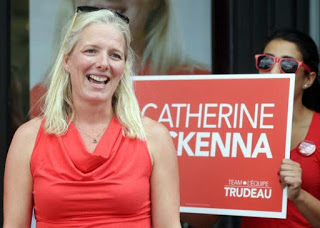
Catherine McKenna, Minister of Environment and Climate Change
This blog is devoted to discussion of science, especially climate science. But in the run up to US Presidential election, along with the drive to enforce the Paris Accord (not a treaty), most of what is appearing in the media has zero scientific content. The discourse now consists almost entirely of climate folklore.
What is Folklore?
Folklore is the traditional art, literature, knowledge, and practice that is disseminated largely through oral communication and behavioral example. Every group with a sense of its own identity shares, as a central part of that identity, folk traditions–the things that people traditionally believe (planting practices, family traditions, and other elements of worldview), do (dance, make music, sew clothing), know (how to build an irrigation dam, how to nurse an ailment, how to prepare barbecue), make (architecture, art, craft), and say (personal experience stories, riddles, song lyrics). (From American Folklore Society)
From the above, it is clear that folklore expresses a community’s understanding of the way things are, and how things work. Each society passes along its wisdom, most pointedly in proverbs or fables. It thus includes scientific principles of the day as they pertain to an average person’s life experience.
Some weather examples include:
“Red sky in the morning sailors (farmers) take warning.”
“Red sky at night, sailors’ (farmers’) delight.”
“If the groundhog sees its shadow on February 2nd, there will be 6 more weeks of winter.”
“When the clouds look like horsetails, rain or snow will come in 3 days.”
“A ring around the sun or moon means a storm is coming. Count the stars within the ring and rain will come in that many days.”
Climate Change Folklore and Empirical Science
The intersection of folk and scientific wisdom is demonstrated in a case regarding an Arizona Navajo reservation.
Government officials in the 1950’s proposed to get rid of prairie dogs on some parts of the reservation in order to protect the roots of the sparse desert grass and thereby maintain at least marginal grazing for sheep.
Navajos objected strongly, insisting, “If you kill off all the prairie dogs, there will be no one to cry for the rain.” Of course they were assured by the amused government men that there was no conceivable connection between rain and prairie dogs, a fact that could be proven easily by a simple scientific experiment: a specific area would be set aside and all the burrowing animals there would be exterminated.
The experiment was carried out, over the continued objections of the Navajos, and its outcome was surprising only to the white scientists. Today, the area […] has become a virtual wasteland with very little grass. Apparently, without the ground-turning processes of the little burrowing animals, the sand in the area becomes solidly packed, causing a fierce runoff whenever it rains.
It would be incautious to suggest in this instance that the Navajos were possessed of a clear, conscious objective theory about water retention and absorption in packed sand. On the other hand, it would be difficult to ignore the fact that the Navajo myth system, which insists on delicate reciprocal responsibilities among elements of nature, dramatized more accurately than our science the results of an imbalance between principals in the rain process. (Barre Toelken here p. 21)
But folk wisdom is an unreliable, inconsistent kind of wisdom. For one thing, most proverbs coexist with their exact opposites, or at least with proverbs that give somewhat different advice. Now that climate change has passed into social discourse, proverbs and unsubstantiated claims are voiced among like-minded people, thereby reinforcing shared beliefs without any critical analysis to verify an objective reality to the sayings.
Playing the Climate Change Game
Dr. Eric Berne was the author of Games People Play, the 1960s groundbreaking book in which he introduced Games and Transactional Analysis to the world. According to Dr. Berne, games are ritualistic transactions or behavior patterns between individuals that can indicate hidden feelings or emotions. A runaway success, Games People Play spent more than two years on the New York Times bestseller list in the mid 1960s – longer than any non-fiction book over the preceding decade.
Dr. Berne explained (here) numerous games in several categories. Life games are those where someone exhibits life-long behaviors to play out a theme such as:
Kick Me, Now I’ve Got You, You Son of a Bitch, or See What You Made Me Do.
He also describes other types of games (underworld, sexual, marital games, etc.). But for this post it is obvious that most of the discourse on Climate Change fits into a party game called Ain’t It Awful.
Party games are pastimes where participants chat among themselves, filling the social time by recounting stories and experiences following a theme, in this case how awful things are. It doesn’t take much exposure to mass media, social or face-to-face conversations to recognize that climate is now usually raised in the context of Ain’t It Awful:
Storms are getting worse;
Arctic ice is melting;
Sea Levels are rising;
We keep on polluting the air with carbon;
Etc. Etc. Etc.
Celebrity alarmist Leonardo DiCaprio exemplifies playing this game in his recently released documentary Before the Flood. This trailer clip shows DiCaprio engaged in Ain’t Climate Change Awful
Summary
Lubos Motl reviewed the movie (here) and rates it “the most superficial movie on the climate issue so far.” A perfect contribution to climate folklore. Modern folklore must sound “sciencey” to be taken seriously. In this folklore you hear the refrain, “scientists tell us . . . “, much as in a previous age “thus spake the prophet . . .” As the Navajo example shows, sciencey beliefs have no guarantee of validity.
As Dr. Berne observes: In the pastimes there is no denouement or payoff, but much unworthy feeling. Of course, if climatists go beyond talking and succeed enacting ruinous energy policies, we will all suffer from economic declines, lower standards of living, along with associated social frictions. Bad feelings will be widespread, albeit from real self-inflicted calamities rather than imaginary ones.
From The World’s Biggest Gamble by Johan Rockstöm et al. (here)
The scale of the decarbonisation challenge to meet the Paris Agreement is underplayed in the public arena. It will require precipitous emission reductions and a new carbon sink on the scale of the ocean sink within 40 years. Even then, the world is extremely likely to overshoot. A catastrophic failure of policy, for example waiting another decade for transformative policy and full commitments to fossil-free economies, will have irreversible and deleterious repercussions for humanity’s remaining time on Earth. Only a global zero carbon roadmap will put the world on a course to phase-out greenhouse gas emissions and create the essential carbon sinks for Earth-system stability, without which, world prosperity is not possible.
The 450 Scenario
Background for this and other such climate alarms is an activist assumption not often openly proclaimed because it is so clearly a leap of faith, not science.
Now we come to an interesting bait and switch. Since Cancun, IPCC is asserting that global warming is capped at 2°C by keeping CO2 concentration below 450 ppm. From Summary for Policymakers (SPM) AR5
Emissions scenarios leading to CO2-equivalent concentrations in 2100 of about 450 ppm or lower are likely to maintain warming below 2°C over the 21st century relative to pre-industrial levels. These scenarios are characterized by 40 to 70% global anthropogenic GHG emissions reductions by 2050 compared to 2010, and emissions levels near zero or below in 2100.
Thus is born the “450 Scenario” by which governments can be focused upon reducing emissions without any reference to temperature measurements, which are stubbornly failing to rise alarmingly.
Within the international expert community, “2 degrees” is generally used as shorthand for a low carbon scenario under which CO2 concentrations in the earth’s atmosphere are stabilized at a level of 450 parts per million (ppm) or lower, representing approximately an 80% reduction in greenhouse gas emissions from current levels, which according to certain computer simulations would be likely to limit warming to 2 degrees Celsius above pre-industrial levels and is considered by some to reduce the likelihood of significant adverse impacts based on analyses of historical climate variability.
Clever as it is to substitute a 450 ppm target for 2°C, the mathematics are daunting. Joe Romm: We’re at 30 billion tons of carbon dioxide emissions a year — rising 3.3% per year — and we have to average below 18 billion tons a year for the entire century if we’re going to stabilize at 450 ppm. We need to peak around 2015 to 2020 at the latest, then drop at least 60% by 2050 to 15 billion tons (4 billion tons of carbon), and then go to near zero net carbon emissions by 2100.
And the presumed climate sensitivity to CO2 is hypothetical and unsupported by observations:
Calvin Beisner at CFACT (here) provides a full rebuttal of the alarmist logic embodied in the above “Gamble” paper.
Synopsis
First, predictions of rapid warming from enhanced atmospheric greenhouse gas concentration are based on computer climate models that “run hot,” two to three times the warming actually observed over relevant periods, and therefore provide no rational basis for predicting future GAT.
Second, nobody—but nobody—has demonstrated scientifically that global average temperature (GAT) is optimal up to 2°C above the pre-industrial average (the limit aimed for by the Paris agreement) , or that GAT higher than that will even be net harmful, let alone catastrophic.
Third, the aim of “Earth-system stability” is scientifically absurd—undefined, unnatural, and unachievable. Natural systems—especially coupled non-linear chaotic fluid-dynamic systems like Earth’s climate—are not, never have been, and never will be stable.
Fourth, it is sheer fear-mongering without a shred of scientific evidence to say that “waiting another decade for transformative policy and full commitments to fossil-free economies” would be a “catastrophic failure of policy” with “irreversible and deleterious repercussions for humanity’s remaining time on Earth”.
Fifth, even if real scientific investigation (which doesn’t stop with modeling but tests models by empirical observation) could tell us what future temperatures will be and the positive and negative impacts, that wouldn’t tell us how we ought to respond, i.e. what policies to pursue. While science can inform policymakers, it can’t determine policy.
Summary
Even assuming the IPCC’s exaggerated estimates of CO2’s warming effect and assuming full implementation of all nations’ commitments under the Paris agreement, at a cost of $1 to $2 trillion annually from 2030 onward, Björn Lomborg calculates it would reduce GAT in 2100 by just 0.17° C, an amount too little to be noticed or have significant impact.
Climate activists like to put their banner up and take credit for opposition demonstrations against development projects involving energy. But the truth is, climate change is the last thing on the minds of those objecting to the projects. This report gets at the realities:
Safety, water, economics come before climate for foes of local energy projects (here)
OTTAWA — New research suggests that polarizing debates over the impacts of climate change are not the driving force behind local opposition to major energy projects.
And that’s something governments and regulators need to consider as they push the transition to clean energy infrastructure such as tidal power, wind farms and hydro electricity.
A report to be released Thursday at an industry-sponsored energy conference looks at six controversial case studies across Canada, ranging from the Northern Gateway pipeline proposal in northern British Columbia to a gas-fired electricity plant in Oakville, Ont., and shale gas exploration in rural New Brunswick.
The joint project of the University of Ottawa and the Canada West foundation found that local communities are demanding a greater role in major infrastructure, whether it be wind farms, hydroelectric dams or pipelines.
The study concludes that “the world of elite, centralized decision-making is a thing of the past.”
Notwithstanding the pitched public battles over climate science and environment policy, the researchers found that in the cases they studied, global warming was not a principal driver of most local opposition.
“Climate change bore hardly at all on the local community attitudes in any of the cases,” writes lead author Michael Cleland.
Using public opinion research and interviews with project opponents, proponents and local authorities, the report found a “far more important” list of concerns: safety; the need or rationale for the project; economics; local environmental impacts such as water contamination; poor consultation and communication; and local involvement in decision-making.
The findings have implications that go far beyond today’s headlines over stalled oil pipeline applications.
As the study’s authors write, “the vast majority of future decisions will focus on new ‘clean’ energy infrastructure to underpin a very low GHG economy.
“As the case studies show, clean energy may be as controversial as hydrocarbon energy at the local community level.”
Those pesky Australian alarmists sure do like to exaggerate. First they sold everyone that the “Science is Settled. Fossil fuels are warming the planet dangerously.” The government said: “We accept your report, thank you for your service,” and followed up with a plan to downsize the climate research unit (CSIRO).
Then came their loud public outcry: “You can’t do that. There is so much we don’t know and have to study. We need those jobs.” So the government walked back that plan.
Now Australian scientists figure to build on their success by writing an open letter to the Prime Minister urging action to “fight climate change.” And, no surprise, Exhibit A is the threat to the Great Barrier Reef. Trouble is, once again they are exaggerating and hoping no one will notice. The bluff is being called by people who visit and dive the reefs every day.
April 2016 Observations
New research found about 68 per cent of reefs from Cairns to Lizard Island had varying levels of coral bleaching, but most of it likened to sunburn on a human body where the coral glows pink before fully recovering.
Latest findings by the Reef and Rainforest Research Centre give hope about the resilience of the living wonder after scientists this week revealed 93 per cent of the 2300km-long reef system was in the grip of a mass bleaching event.
Great Barrier Reef as seen by Activists. (Later Greenpeace admitted the image is a storm-damaged reef in the Philippines).
“It’s the Great White Lie,” said Col McKenzie, chief executive of the Association of Marine Park Tourism Operators. “It’s not dead, white and dying. It’s under stress but it will bounce back.’’
Coral bleaching is linked to high water temperatures of the latest El Niño weather system, where stressed coral polyps eject their photosynthetic zooxanthellae and, in extreme cases, the living colony will appear totally white. Skeletons are covered in algae.
The RRRC report found on the 126 key tourists sites there was, on average, 35 per cent coral cover – about one-third unbleached – and, on average, only 2.5 per cent of the coral had died because of bleaching. “We think there is a much lower level of severely bleached corals. To say 80 per cent of the reef will die is catastrophising the situation,’’ RRRC director Sheriden Morris said. Source: Great Barrier Reef: Signs of recovery despite major coral bleaching, The Courier-Mail, Brisbane
That was in April. In June Alarmists doubled down on their deceit by excommunicating one of their own for calling them out on their exaggerations (here):
An Australian university recently censured marine scientist Paul Ridd for “failing to act in a collegial way and in the academic spirit of the institution,” because he questioned popular claims among environmentalists about coral reefs and global warming. Background post Circling the Climate Wagons
Great Barrier Reef photographed by Ronald Hanko June 16, 2016.
Updated Observations of Great Barrier Reef
In April 2016 the reef bleaching from El Nino was at its peak and occasioned widespread alarms. Now this week we have an observational update
Great Barrier Reef tourist operators found less than 5 percent of the natural wonder has died off from “bleaching,” despite claims from scientists that most of the reef had been killed off by the effects of global warming. “Scientists had written off that entire northern section as a complete white-out,’’ Chris Eade, owner of the diving boat Spirit Of Freedom, told The Courier-Mail in an interview.
“We expected the worst,” Eade said. “But it is in tremendous condition, most of it is pristine, the rest is in full recovery. It shows the resilience of the reef.”
“It wasn’t until we got underwater that we could get a true picture of what percentage of reef was bleached,’’ Craig Stephens, who manages Mike Ball Dive Expeditions, told The Courier-Mail.
Stephens has surveyed the reef and compared his findings to a similar survey he did 20 years ago. He found almost no change between what he saw back then and today.
“Coral mortality in the outer shelf reefs north of Lizard Island was between one and five per cent,” according to findings exclusively obtained by The Courier-Mail. This stands in sharp contrast to reports from April of 50 percent bleaching in the northern section of the reef.
“The discrepancy is phenomenal. It is so wrong. Everywhere we have been we have found healthy reefs,” Stephens said.
Conclusion
Down under the alarmist icon is the Great Barrier Reef. In the North of course, it is the Arctic Polar Bear.
A humorous look at why the global warming campaign and the triumphal Paris COP make sense.
Yes Minister explains it all in an episode from 2013.
h/t to Peter S.
This is an all-too-realistic portrayal of political climatism today.
Update Aug. 26, 2016
Yesterday I realized that BBC had blocked the viewing of the video. So I sought and found the subtitles for Yes Prime Minister 2013, Episode 6, “A Tsar is Born”. That final episode for the series began with the dialogue in yesterday’s post Climate Alarms LOL.
Today I provide the dialogue that formed the episode conclusion, and which was the content of the blocked video.
The Characters are:
Sir Humphrey Appleby
Cabinet Secretary
Jim Hacker
Prime Minister
Claire Sutton
Special Policy Adviser
Bernard Woolley
Principal Private Secretary to the Prime Minister
(Dialogue beginning at 20:16 of “A Tsar is Born”)
Humphrey I have returned with the answer to all your problems. Global warming.
Jim I thought you were against it?
Humphrey Everybody’s against it, Prime Minister. I suddenly realised that is the beauty of it. We can get a unanimous agreement with all of our European partners
to do something about it.
Jim But how can we do something about something that isn’t happening?
Humphrey It’s much easier to solve an imaginary problem than a real one.
Jim You believe it’s real?
Humphrey Do you? I don’t know.
Jim Neither do I. Haven’t got the faintest idea!
Humphrey But it doesn’t matter what we think. If everyone else thinks it’s real, they’ll all want to stop it. So long as it doesn’t cost too much. So the question now is, what are we going to do about it?
Jim But if it isn’t happening, what can we do about it?
Humphrey Oh, there’s so much we can do, Prime Minister. We can impose taxes, we can stiffen European rules about
carbon emissions, rubbish disposal. We can make massive investments in wind turbines. We can, in fact, Prime Minister, under your leadership, agree to save the world.
Jim Well, I like that! But Russia, India, China, Brazil, they’ll never cooperate.
Humphrey They don’t have to. We simply ask them to review their emissions policy.
Jim And will they?
Humphrey Yes. And then they’ll decide not to change it. So we’ll set up a series of international conferences. Meanwhile, Prime Minister, you can talk about the future of the planet.
Jim Yes.
Humphrey You can look statesmanlike. And it’ll be 50 years before anybody can possibly prove you’re wrong. And you can explain away anything you said before by saying the computer models were flawed.
Jim The voters will love me!
Humphrey You’ll have more government expenditure.
Jim Yes. How will we pay for it? We’re broke.
Humphrey We impose a special global warming tax on fuel now, but we phase in the actual expenditure gradually. Say, over 50 years? That will get us out of the hole for now.
Bernard The Germans will be pleased. They have a big green movement.
Claire And we can even get the progs on board!
Bernard As long as they get more benefits than everyone else.
Jim My broadcast is on Sunday morning.
Humphrey You have a day to get the conference to agree.
Jim That’s not a problem. The delegates will be desperate for something to announce when they get home. There is one problem. Nothing will have actually been achieved.
Humphrey It will sound as though it has. So people will think it has. That’s all that matters!
(Later following the BBC interview, beginning 27:34)
Bernard Oh, magnificent, Prime Minister!
Humphrey I think you got away with it, Jim, but the cabinet will have been pretty surprised. We’ll have to square them fast.
Jim Bubbles!
Humphrey We’re not there yet. After that interview, you’ll need to announce some pretty impressive action.
Jim An initiative.
Humphrey Yes.
Claire A working party?
Humphrey Bit lightweight.
Bernard A taskforce?
Humphrey Not sure.
Jim Do we have enough in the kitty?
Claire It could be one of those initiatives that you announce but never actually spend the money.
Jim Great. Like the one on child poverty.
Bernard Maybe it should be a government committee?
Jim Well what about a Royal Commission?
Humphrey Yes! It won’t report for three years, and if we put the right people on it, they’ll never agree about anything important.
Jim Right! A Royal Commission! No, wait a minute, that makes it sound as if we think it’s important but not urgent.
Claire Well, what about a Global Warming Tsar?
Jim Fine! Would that do it?
Humphrey No, I think it might need a bit more than that, Prime Minister. It’ll mean announcing quite a big unit, and an impressive salary for that Tsar, to show how much importance you place upon him.
Jim No problem. Who would it be?
Humphrey Ah, well, it can’t be a political figure. That would be too divisive. It has to be somebody impartial.
Jim You mean a judge?
Humphrey No, somebody from the real world. Somebody who knows how to operate the levers of power, to engage the gears of the Whitehall machine, to drive the engine of government.
Jim That’s quite a tall order. Anybody got any ideas?
Humphrey… Could you?
Bernard Oh!
Humphrey Yes, Prime Minister.
The End.
Footnote
CO2 hysteria is addictive. Here’s what it does to your brain:
It’s a trifecta for media alarms with can’t-miss top lines like these in just the last two days:
Russian officials are blaming global warming for a recent Anthrax outbreak in the far north region of Yamal that hospitalized dozens of nomadic tribesmen and killed one 12-year-old boy.
Thawing Russian Arctic Permafrost Leads to Anthrax Outbreak
(that one adds in the permafrost bogeyman)
Climate Change Blamed for the Anthrax Outbreak in Russia
Etc., Etc., Etc
Sputnik News tells what you need to know (and said so back in May)
Global warming can uncover and expose anthrax cattle burial sites in the Arctic and cause the spread of dangerous infections, Russia’s Emergencies Ministry warned on Wednesday.
“Climatic anomaly impacts on permafrost zones, enhances the danger of exposing anthrax cattle burial grounds,” a ministry spokesman said.
There are more than 100,000 anthrax cattle burial sites in Russia, about 400 of which are located in the Arctic region, he said. (My bold)
Anthrax is an acute disease caused by Bacillus anthracis and affects both humans and animals. It can form dormant spores that are able to survive in harsh conditions for decades or even centuries, the spokesman warned.
Some Russian ministries and other government agencies are known for their tendency to issue dire warnings to ensure more federal funding, especially ahead of each new fiscal year. (My bold)
MOSCOW, May 25 (RIA Novosti)
The Facts of the outbreak: 90 hospitalized, 20 cases confirmed. One Died.
Footnote:
The Sputnik News article is dated in 2011 (h/t manic) and provides a context for this recent news. The Tass story on August 1, 2016, tells of those infected and an investigation into the one death. No mention of global warming. That was added by BBC and others, based on a comment by a Russian WWF employee.
Breakthrough in Math Literacy could have implications for understanding climate science.
WASHINGTON—In what experts are describing as the most marked improvement in American academic performance in decades, a study released Friday by the U.S. Department of Education has found that the majority of the nation’s students have attained the skills necessary to recognize math.
“We were encouraged to find that when presented with a series of numbers, mathematical symbols, or even fairly complex equations, more than half of our young people were able to correctly identify math as the academic subject before them,” said Undersecretary of Education Ted Mitchell, who noted that for the first time on record, over 50 percent of the country’s first- through 12th-grade students are readily able to distinguish math from other areas of study when it appeared alongside English, social studies, foreign languages, or history on a standardized test.
“While our schools should feel proud of this accomplishment, let’s remember that we must keep striving to do better. Too many Americans still graduate high school without learning to recognize any math beyond basic arithmetic, and our nation’s children still lag far behind students in other developed nations in their ability to identify geometry, algebra, and calculus as math.”
A related Education Department study found that a majority of American eighth-graders are now able to look at a map of the earth and point to where the world is.
It is a wickedly satirical look into the future of the climate debate by Brad Keyes (here). The comic relief is welcome as a refreshment from pushing back against the relentless fictional claims and alarms. Lots of inside jokes and sceptics’ wish dreams concerning future misfortunes of leading alarmist figures.
The post covers a lot of ground as Keyes looks into his crystal ball and reports on happenings he sees from 2017 up to 2052. Everyone’s funny bone is different, but these were especially entertaining, IMO:
2017 – Michael Mann’s courtroom loss decried as “a death knell for free speech.”
2018 – ECHR agrees “Holocaust denier” is an intentionally demeaning reference to climate denial.
2018 – James Hansen blames eclipse on global warming, but others hesitate to attribute any specific EAE (extreme astronomical event) to carbon emissions.
2019 – The Trenberth Travesty is captured by satellite imagery.
2020 – Psychiatric Manual of Mental Disorders updated to deal with Weather control delusional disorder, Munchhausen’s by proxy and Medieval global warming denial.
2023 – Weary of the emotive, polarizing nature of the debate, scientists will now refer to global warming as “climate 9/11.”
2024 – Drawing heavily on the principles of the Delphi Technique, Naomi Oreskes changes the scientific method to the Delphi Technique.
2025 – In simultaneous media releases around the globe, every scientific body of international or national standing announces that the only safe atmospheric CO2 concentration is zero ppm. They explain: “Lowballing” is the only way to achieve 300-400 ppm.
2027 – The first climatically-correct chemistry textbooks appear in Australian high schools. The dioxide anion has been renamed ‘pollution’; chemical symbol C now stands for ‘cancer.’
2028 – It’s official: reputable science website SkepticalScience quietly removes “Consensus levels have plateaued” from its list of myths.
2031 – A Climateball stadium becomes the scene of ugly rioting today after a supporter of the denier (pro-cancer-pollutionist) side is overheard using the hate term “w_rmist.”
2034 – Spring is silent this year after a wind turbine kills the last American bald eagle.
2037 – As sea level rise continues to defy expectations, tracking almost 1m (3ft.) below ensemble model projections, science’s newest fear is that the Earth’s surface will be completely dry by the year 51000.
2038 – An attempt to replicate the Doran and Zimmermann [2009] consensus survey instead finds most of the scientists now deny the science, with almost 85% endorsing the statement that “According to the weight of the data, the evidence is wrong.”
Paul Pfleiderer has done a public service in calling attention to
The Misuse of Theoretical Models in Finance and Economics (here)
h/t to William Briggs for noticing and linking
He coins the term “Chameleon” for the abuse of models, and explains in the abstract of his article:
In this essay I discuss how theoretical models in finance and economics are used in ways that make them “chameleons” and how chameleons devalue the intellectual currency and muddy policy debates. A model becomes a chameleon when it is built on assumptions with dubious connections to the real world but nevertheless has conclusions that are uncritically (or not critically enough) applied to understanding our economy. I discuss how chameleons are created and nurtured by the mistaken notion that one should not judge a model by its assumptions, by the unfounded argument that models should have equal standing until definitive empirical tests are conducted, and by misplaced appeals to “as-if” arguments, mathematical elegance, subtlety, references to assumptions that are “standard in the literature,” and the need for tractability.
Chameleon Climate Models
Pfleiderer is writing about his specialty, financial models, and even more particularly banking systems, and gives several examples of how dysfunctional is the problem. As we shall see below, climate models are an order of magnitude more complicated, and abused in the same way, only more flagrantly.
As the analogy suggests, a chameleon model changes color when it is moved to a different context. When politicians and activists refer to climate models, they assert the model outputs as “Predictions”. The media is rife with examples, but here is one from Climate Concern UK
Some predicted Future Effects of Climate Change
Increased average temperatures: the IPCC (International Panel for Climate Change) predict a global rise of between 1.1ºC and 6.4ºC by 2100 depending on some scientific uncertainties and the extent to which the world decreases or increases greenhouse gas emissions.
50% less rainfall in the tropics. Severe water shortages within 25 years – potentially affecting 5 billion people. Widespread crop failures.
50% more river volume by 2100 in northern countries.
Desertification and burning down of vast areas of agricultural land and forests.
Continuing spread of malaria and other diseases, including from a much increased insect population in UK. Respiratory illnesses due to poor air quality with higher temperatures.
Extinction of large numbers of animal and plant species.
Sea level rise: due to both warmer water (greater volume) and melting ice. The IPCC predicts between 28cm and 43cm by 2100, with consequent high storm wave heights, threatening to displace up to 200 million people. At worst, if emissions this century were to set in place future melting of both the Greenland and West Antarctic ice caps, sea level would eventually rise approx 12m.
Now that alarming list of predictions is a claim to forecast what will be the future of the actual world as we know it.
Now for the switcheroo. When climate models are referenced by scientists or agencies likely to be held legally accountable for making claims, the model output is transformed into “Projections.” The difference is more than semantics:
Prediction: What will actually happen in the future.
Projection: What will possibly happen in the future.
In other words, the climate model has gone from the bookshelf world (possibilities) to the world of actualities and of policy decision-making. The step of applying reality filters to the climate models (verification) is skipped in order to score political and public relations points.
The ultimate proof of this is the existence of legal disclaimers exempting the modellers from accountability. One example is from ClimateData.US
Disclaimer NASA NEX-DCP30 Terms of Use
The maps are based on NASA’s NEX-DCP30 dataset that are provided to assist the science community in conducting studies of climate change impacts at local to regional scales, and to enhance public understanding of possible future climate patterns and climate impacts at the scale of individual neighborhoods and communities. The maps presented here are visual representations only and are not to be used for decision-making. The NEX-DCP30 dataset upon which these maps are derived is intended for use in scientific research only, and use of this dataset or visualizations for other purposes, such as commercial applications, and engineering or design studies is not recommended without consultation with a qualified expert. (my bold)
Conclusion:
Whereas some theoretical models can be immensely useful in developing intuitions, in essence a theoretical model is nothing more than an argument that a set of conclusions follows from a given set of assumptions. Being logically correct may earn a place for a theoretical model on the bookshelf, but when a theoretical model is taken off the shelf and applied to the real world, it is important to question whether the model’s assumptions are in accord with what we know about the world. Is the story behind the model one that captures what is important or is it a fiction that has little connection to what we see in practice? Have important factors been omitted? Are economic agents assumed to be doing things that we have serious doubts they are able to do? These questions and others like them allow us to filter out models that are ill suited to give us genuine insights. To be taken seriously models should pass through the real world filter.
Chameleons are models that are offered up as saying something significant about the real world even though they do not pass through the filter. When the assumptions of a chameleon are challenged, various defenses are made (e.g., one shouldn’t judge a model by its assumptions, any model has equal standing with all other models until the proper empirical tests have been run, etc.). In many cases the chameleon will change colors as necessary, taking on the colors of a bookshelf model when challenged, but reverting back to the colors of a model that claims to apply the real world when not challenged.
A model becomes a chameleon when it is built on assumptions with dubious connections to the real world but nevertheless has conclusions that are uncritically (or not critically enough) applied to understanding our economy. Chameleons are not just mischievous they can be harmful − especially when used to inform policy and other decision making − and they devalue the intellectual currency.
Thank you Dr. Pfleiderer for showing us how the sleight-of-hand occurs in economic considerations. The same abuse prevails in the world of climate science.
Paul Pfleiderer, Stanford University Faculty
C.O.G. Miller Distinguished Professor of Finance
Senior Associate Dean for Academic Affairs
Professor of Law (by courtesy), School of Law
Footnote:
There are a series of posts here which apply reality filters to attest climate models. The first was Temperatures According to Climate Models where both hindcasting and forecasting were seen to be flawed.











 Science Matters