Gamechanger: DC Appeals Court Denies EPA Climate Rules

A major clarification came today from the DC Court of Appeals ordering EPA (and thus the Executive Branch Bureaucracy) to defer to Congress regarding regulation of substances claimed to cause climate change.  While the issue and arguments are somewhat obscure, the clarity of the ruling is welcome.  Basically, the EPA under Obama attempted to use ozone-depleting authority to regulate HFCs, claiming them as greenhouse gases.  The judges decided that was a stretch too far.

The Court Decision August 8, 2017

The EPA enacted the rule in question in 2015, responding to research showing hydroflourocarbons, or HFCs, contribute to climate change.

The D.C. Circuit Court of Appeals’ 2-1 decision said EPA does not have the authority to enact a 2015 rule-making ending the use of hydrofluorocarbons commonly found in spray cans, automobile air conditioners and refrigerators. The three-judge panel said that because HFCs are not ozone-depleting substances, the EPA could not use a section of the Clean Air Act targeting those chemicals to ban HFCs.

“Indeed, before 2015, EPA itself maintained that Section 612 did not grant authority to require replacement of non ozone-depleting substances such as HFCs,” the court wrote.

“EPA’s novel reading of Section 612 is inconsistent with the statute as written. Section 612 does not require (or give EPA authority to require) manufacturers to replace non ozone-depleting substances such as HFCs,” said the opinion, written by Judge Brett Kavanaugh.

Contextual Background from the Court Document On Petitions for Review of Final Action by the United States Environmental Protection Agency  Excerpts below (my bolds)

In 1987, the United States signed the Montreal Protocol. The Montreal Protocol is an international agreement that has been ratified by every nation that is a member of the United Nations. The Protocol requires nations to regulate the production and use of certain ozone-depleting substances.

As a result, in the 1990s and 2000s, many businesses stopped using ozone-depleting substances in their products. Many businesses replaced those ozone-depleting substances with HFCs. HFCs became prevalent in many products. HFCs have served as propellants in aerosol spray cans, as refrigerants in air conditioners and refrigerators, and as blowing agents that create bubbles in foams.

In 2013, President Obama announced that EPA would seek to reduce emissions of HFCs because HFCs contribute to climate change.

Consistent with the Climate Action Plan, EPA promulgated a Final Rule in 2015 that moved certain HFCs from the list of safe substitutes to the list of prohibited substitutes. . .In doing so, EPA prohibited the use of certain HFCs in aerosols, motor vehicle air conditioners, commercial refrigerators, and foams – even if manufacturers of those products had long since replaced ozonedepleting substances with HFCs. Id. at 42,872-73.

Therefore, under the 2015 Rule, manufacturers that used those HFCs in their products are no longer allowed to do so. Those manufacturers must replace the HFCs with other substances that are on the revised list of safe substitutes.

In the 2015 Rule, EPA relied on Section 612 of the Clean Air Act as its source of statutory authority. EPA said that Section 612 allows EPA to “change the listing status of a particular substitute” based on “new information.” Id. at 42,876. EPA indicated that it had new information about HFCs: Emerging research demonstrated that HFCs were greenhouse gases that contribute to climate change. See id. at 42,879. EPA therefore concluded that it had statutory authority to move HFCs from the list of safe substitutes to the list of prohibited substitutes. Because HFCs are now prohibited substitutes, EPA claimed that it could also require the replacement of HFCs under Section 612(c) of the Clean Air Act even though HFCs are not ozone-depleting substances.

EPA’s current reading stretches the word “replace”  beyond its ordinary meaning. . .
Under EPA’s current interpretation of the word “replace,” manufacturers would continue to “replace” an ozone-depleting substance with a substitute even 100 years or more from now. EPA would thereby have indefinite authority to regulate a manufacturer’s use of that substitute. That boundless interpretation of EPA’s authority under Section 612(c) borders on the absurd.

In any event, the legislative history strongly supports our conclusion that Section 612(c) does not grant EPA continuing authority to require replacement of non-ozone-depleting substitutes.. . In short, although Congress contemplated giving EPA broad authority under Title VI to regulate the replacement of substances that contribute to climate change, Congress ultimately declined.

However, EPA’s authority to regulate ozone-depleting substances under Section 612 and other statutes does not give EPA authority to order the replacement of substances that are not ozone depleting but that contribute to climate change. Congress has not yet enacted general climate change legislation. Although we understand and respect EPA’s overarching effort to fill that legislative void and regulate HFCs, EPA may act only as authorized by Congress. Here, EPA has tried to jam a square peg (regulating non-ozone depleting substances that may contribute to climate change) into a round hole (the existing statutory landscape).

The Supreme Court cases that have dealt with EPA’s efforts to address climate change have taught us two lessons that are worth repeating here. See, e.g., Utility Air Regulatory Group v. EPA, 134 S. Ct. 2427 (2014). First, EPA’s well intentioned policy objectives with respect to climate change do not on their own authorize the agency to regulate. The agency must have statutory authority for the regulations it wants to issue. Second, Congress’s failure to enact general climate change legislation does not authorize EPA to act. Under the Constitution, congressional inaction does not license an agency to take matters into its own hands, even to solve a pressing policy issue such as climate change.

Footnote:  Looks like some judges found their big boy pants and applied US constitutional separation of powers against runaway executive climate actions.  Would such a decision have come without a skeptical President?

Could this be the first breach in the wall of unproven, unwarranted, federally funded climate activism?

Water rushes over damaged primary spillway at Oroville Dam in Northern California


Ideological Faultlines


Some interesting comments came in response to a recent post (Inside the Snowflake Academy) on postmodern attitudes regarding science and truth. Geoff Chambers gave some perspectives on European socialism. Caleb provided an interesting analogy to China’s cultural revolution and aftermath. Caleb:

The Evergreen craziness reminds me a lot of China’s “Cultural Revolution.” The Chinese teachers failed to understand that they themselves would be the target, if they taught students to reject “tradition”, for all the knowledge of the past can be seen as a “tradition”, and that makes teachers and textbooks “counter revolutionary.” In the end the madness resulted in not one teacher being made into a scapegoat, but nearly every teacher China had. China was reduced to a state of ignorance and poverty, and the only way back was to copy the west. They “stole our secrets”, but the joke is that most of what they copied was never a secret. It simply was Truth, which they had deemed “counter revolutionary.”

That use of the term “tradition” prompts this post inspired by another insightful article, Evergreen State and the Battle for Modernity By Michael Aaron. After providing samples of the conflict playing out at Evergreen State College, Aaron puts the event in context in the excerpts below.

evergreen-college-777x397


It is this dichotomy between postmodern and modern that is the most important takeaway from this entire affair. In many ways, the old left/right dichotomy no longer applies. Instead we are faced with a three-part distinction between postmodern/modern/traditional. Let’s take a look at each of these in turn, and discuss why they are particularly important today.

Starting with the most right-leaning, the traditionalists. These folks do not like the direction in which modernity is headed, and so are looking to go back to an earlier time when they believe society was better. They may disagree with same-sex marriage, label sexual promiscuity as “deviance,” and feel threatened by racial and demographic changes in Western society. These folks include typical status-quo conservatives, Evangelical Christians as well as more nefarious types such as white nationalists and the “alt right”. Even though there is much furor in the media about the threat that these groups represent, I would argue that they have largely been pushed to the fringes in terms of their social influence, not withstanding the election of Trump who was actually opposed by many traditionalists such as the Never Trumpers.

Indeed, it is between the modernists and postmodernists where the future of society is being fought. Modernists are those who believe in human progress within a classical Western tradition. They believe that the world can continuously be improved through science, technology, and rationality. Unlike traditionalists, they seek progress rather than reversal, but what they share in common is an interest in preserving the basic structures of Western society. Most modernists could be classified as centrists (either left or right-leaning), classical liberals and libertarians.

Postmodernists, on the other hand, eschew any notion of objectivity, perceiving knowledge as a construct of power differentials rather than anything that could possibly be mutually agreed upon. Informed by such thinkers as Foucault and Derrida, science therefore becomes an instrument of Western oppression; indeed, all discourse is a power struggle between oppressors and oppressed. In this scheme, there is no Western civilization to preserve—as the more powerful force in the world, it automatically takes on the role of oppressor and therefore any form of equity must consequently then involve the overthrow of Western “hegemony.” These folks form the current Far Left, including those who would be described as communists, socialists, anarchists, Antifa, as well as social justice warriors (SJWs). These are all very different groups, but they all share a postmodernist ethos.

All of this matters because, whether people are overtly aware of it or not, their beliefs and actions are implicitly guided by one of these three world-views. A person may have never attended an Ivy League gender studies class, but if they belong to and agree with the ideas of a typical urban, liberal, hipster milieu, they are very likely subscribing to a postmodernist ideology, even if they’ve never cracked open Lyotard. (my bold)

Much of the confusion between liberal and centrist groups comes down to this modern/postmodernist distinction. As another example, since modernists believe in science and its utility, they are aware that obese individuals are at higher health risks. For postmodernists, however, the concept of health is just another oppressive force of Western colonial hegemony (since objective truth doesn’t exist and is merely manufactured as a tool of oppression), and so an entire cadre of “fat” activists mobilize themselves on social media, emboldened with postmodern concepts. Modernists recognize that nobody should be shamed or discriminated against for their appearance and believe that everyone has the right to make their own lifestyle choices, but are also concerned that distributing scientifically inaccurate information about health poses considerable risk to those who might believe it.

In the end, the Weinstein/Evergreen State affair poses a significant crossroads to modern society, extending well beyond the conflict occurring on campus. Evergreen State represents the natural culmination of postmodern thought—roving mobs attempting to silence dissenting thought merely based on race, informed by far left theories that weaponize a victim status drawn solely from immutable, innate traits. Unfortunately, I cannot place full blame on the students either, as they have been indoctrinated with these ideas on the very campus that is now serving as the petri dish for applied postmodernism. (my bold)

It is no coincidence that, while society outside the walls of campus looks on with disbelief, administrators to this point have been siding with the students. For if they were to repudiate the actions of the students, they would also need to repudiate the ideology with which they have been brainwashing them. In other words, taking a stand against the students would require administrators and professors to re-evaluate the meaning and value of the entire raison d’etre of their adult professional careers. Holding on to madness is a way of forestalling dealing with the grief that comes with the realization that one’s higher purpose has been a fraud. I am not sure of the final outcome, as this kind of process is long, difficult, and very, very painful. (my bold)

But this internal struggle serves as a microcosm for the larger battle occurring in society between the ideas behind modernism and postmodernism. And the stakes are extremely high. As Weinstein articulated in his Rogan appearance, “Let’s put it this way, I believe at the moment coalitions are unholy alliances between two things. In this case you have the real equity movement, which are people who wish to end oppression, and then you have another movement that wishes to reverse oppression, and they don’t know that they are different because until you reach equity, they are pointing in the same direction.” For the sake of basic humanity and decency, let’s all hope that the Evergreen State affair has finally exposed this vital distinction.

Summary

I appreciate that Aaron acknowledges the third faction of traditionalists that have been shunted to the sidelines. I think he is missing the fact that recently the “silent majority” is finding its voice: Many of them supported Trump (way more than were Never Trumpers, who were mostly apparatchiks); and it was trads voting for Le Pen in France, and making the difference in the Brexit vote. Now that it is no longer taboo to speak of Islamic terrorism, trads will feel even more emboldened.

Aaron is correct that among intellectuals, the battle is between moderns and postmoderns, but I think he needs to look beyond the ivory tower.

Footnote: More on academic ideology from Nicholas Kristoff NYT (here):

In a column a few weeks ago, I offered a “confession of liberal intolerance,” criticizing my fellow progressives for promoting all kinds of diversity on campuses — except ideological. I argued that universities risk becoming liberal echo chambers and hostile environments for conservatives, and especially for evangelical Christians.

As I see it, we are hypocritical: We welcome people who don’t look like us, as long as they think like us.

Inside the Snowflake Academy


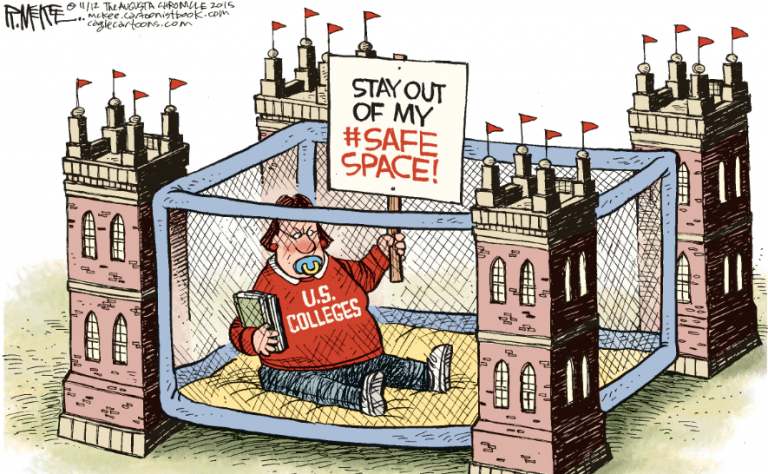
Snowflakes: Overly sensitive persons, incapable of dealing with any opinions differing from their own. Snowflakes are light-weight and suffer meltdown when exposed to the light or heat of complex ideas in conflict. They can often be seen congregating in “safe zones” on college campuses.

A previous post (Retreat from Reason) provided a look into the mentality of today’s college professors teaching humanities and social sciences. The dominant mindset is termed “postmodern” to distinguish this perspective from the “modern” viewpoint born of the age of reason or enlightenment.

That text came from Professor Jordan Peterson who recommended reading a book by Stephen Hicks called Explaining Postmodernism. This post provides some descriptions (lightly edited) from Hicks regarding the education of today’s students and the liberal arts attitude toward science.

Hicks presents two hypotheses regarding the world-view embraced by postmoderns, which they pass on to their students.

Hypothesis 1: Postmodernism is the first ruthlessly consistent statement of the consequences of rejecting reason, those consequences being necessary given the study of knowledge since Kant.

Thomas Kuhn published in 1962 his landmark book, The Structure of Scientific Revolutions, signifying the result of four decades of analytic philosophy and the dead end it had reached. If science’s tools are perception, logic, and language, then science, one of the Enlightenment’s prized children, is merely an evolving, socially objective enterprise with no more claim to objectivity than any other belief system. The idea that science speaks of reality or truth is an illusion. There is no Truth; there are only truths, and truths change.

Consequently, by the 1960s, the pro-objectivity, pro-science spirit had collapsed in the Anglo-American philosophical tradition.

Hypothesis 2: Postmodernism is the academic far Left’s stance in response to the crisis caused by the failures of socialism in theory and practice.

Postmodern thinkers inherit an intellectual tradition that has seen the defeat of all of its major hopes.

While the neo-Enlightenment thinkers have come to terms with the modern world, from the postmodern perspective the universe has been intellectually shattered. We can not turn to God or to nature, and we cannot trust reason or mankind.

The failure of Left politics to achieve the vision of a beautiful collectivist society was merely the last straw. To the postmodern mind, the cruel lessons of the modern world are that reality is inaccessible, that nothing can be known, that human potential is nothing, and that ethical and political ideals have come to nothing. The psychological response to the loss of everything is anger and despair.

But the postmodern thinkers also find themselves surrounded by an Enlightenment world that does not understand. Postmoderns confront a world dominated by liberalism and capitalism, by science and technology, by people who still believe in reality, in reason, and in the greatness of human potential. The world that they said was impossible and destructive has both come to be and is flourishing. The heirs of the Enlightenment are running the world, and they have marginalized the post-modernists to the academy. Resentment is then added on top of anger and despair.

The Enlightenment world is proud, confident, and knows it is the wave of the future. This is unbearable to someone invested totally in an opposed and failed outlook. That pride is what such a person wants to destroy. The best target to attack is the Enlightenment’s sense of its own moral worth. Attack it as sexist and racist, intolerantly dogmatic, and cruelly exploitative. Undermine its confidence in its reason, its science and technology. The words do not even have to be true or consistent to do the necessary damage.

The College as Snowflake Academy

In education, postmodernism rejects the notion that the purpose of education is primarily to train a child’s cognitive capacity for reason in order to produce an adult capable of functioning independently in the world. That view of education is replaced with the view that education is to take an essentially indeterminate being and give it social identity. Education’s method of molding is linguistic, and so the language to be used is that which will create a human being sensitive to its racial, sexual, and class identity.

Our current social context, however, is characterized by oppression that benefits whites, males, and the rich at the expense of everyone else. That oppression in turn leads to an educational system that reflects only or primarily the interests of those in positions of power. To counteract that bias, educational practice must be recast totally. Postmodern education should emphasize works not in the canon; it should focus on the achievements of non-whites, females, and the poor; it should highlight the historical crimes of whites, males, and the rich; and it should teach students that science’s method has no better claim to yielding truth than any other method and, accordingly, that students should be equally receptive to alternative ways of knowing.

Moderns thought science and technology are good for all, extending our knowledge of the universe and making the world healthier, cleaner, and more productive. Postmoderns say science betrays its elitism, sexism and destructiveness by making the speed of light the fastest phenomenon, thereby unfairly privileging it over other speeds–by having chosen the phallic symbol i to represent the square root of negative one–by asserting its desire to “conquer” nature and “penetrate” her secrets–and, having done so, by having its technology consummate the rape by building bigger and longer missiles to blow things up.

And previously it had been generally thought liberalism, free markets, technology, and cosmopolitanism are social achievements that can be enjoyed by all cultures. On the contrary, Postmoderns think non-Western cultures are superior, since they live simply and in harmony with nature. They find the West is arrogantly blind, elitist and imperialistic, and imposes its capitalism, its science and technology, and its ideology upon other cultures and an increasingly fragile ecosystem.

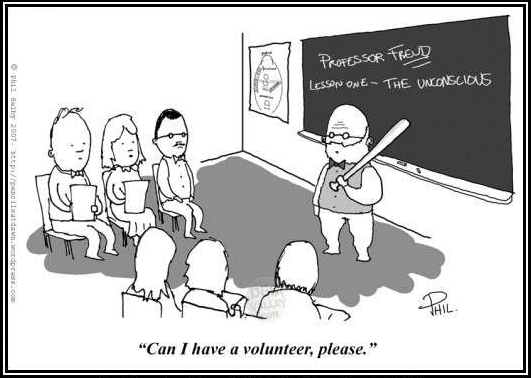
funny-baseball-teacher

Conclusion

And thus graduates are fully equipped and predetermined to believe in climate change.


safespace-768x474


Perverse Postmodern Climate: Retreat from Reason

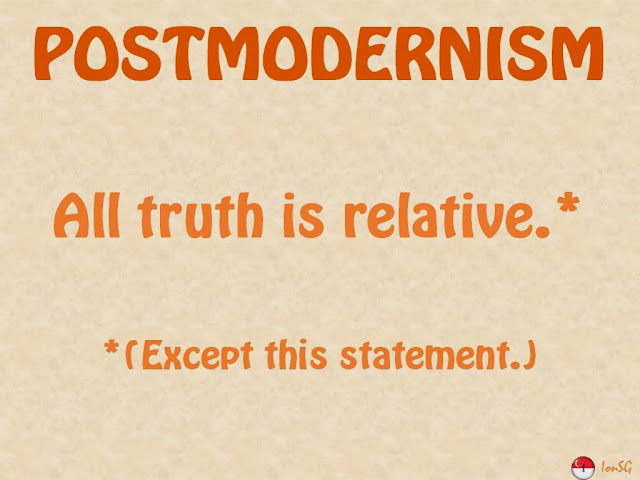
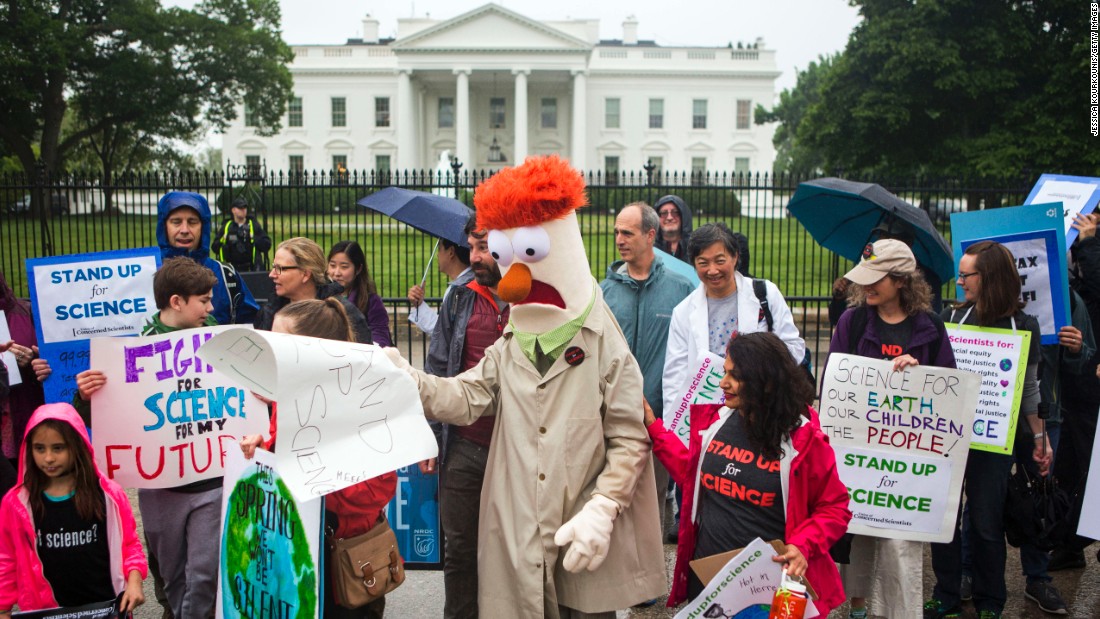
The recent marches for science were an amazing irony: People actually think that science is a matter of protesting in the streets. It was a demonstration all right, a full-throated display of postmodern contempt for reason, especially as embodied in the scientific method.

This virus has already taken over many universities, the most extreme case being Evergreen State College in Eastern Washington. Black students decided there should be a No White day on campus to protest the history of blacks mistreatment. One professor refused and tried to hold his class, arguing that free speech was not a matter of race, creed, gender or anything else. A riot erupted against him and his students, shutting down the class.

evergreen

Afterward, the Evergreen State Faculty Turned on the Professor, Saying He ‘Endangered’ Students

This post is to call attention to a war correspondent issuing a recent report on the state of this cultural conflict. Professor Jordan Peterson of the University of Toronto writes from the front lines where higher education institutions and students are in upheaval.

War Correspondent

Jordan Peterson: Why You Have To Fight Postmodernism
explains why young people need to organize and rise up against nihilistic postmodernism. The full transcript is worth reading, and a video presentation is also available. Some excerpts below present some of his key points.

JORDAN PETERSON: I want to recommend a book first to everyone here: It is called Explaining Postmodernism by Stephen Hicks. You need to understand postmodernism, because that’s what you’re up against. You’re up against it far more than you know or think, and it’s a much more well-developed and pervasive, pernicious, nihilistic, intellectually attractive doctrine than has yet come to public realization. It absolutely dominates the humanities and increasingly the social sciences in the universities.

It’s not like any given person is absolutely possessed by the spirit of postmodernism, because often they’re not educated enough to know all the details about what it is that has them in their grip, but if you get 20 of them together and they’re all 5% influenced by the postmodernist ethos, you basically have the spirit of the mob. It’s a mouthpiece for that particular philosophical doctrine.

See the postmodernists completely reject the structure of Western civilization. And I mean completely, so I can give you an example, in one term — Jacques Derrida. He is head trickster for the postmodernist movement, and he regarded Western culture — let’s call it the patriarchy — as phallogocentric. Phallo comes from phallus, and so that’s the insistence that what you see in Western culture is the consequence of the male-dominated oppressive self-serving society.

So the first thing that you might want to know about Postmodernism is that it doesn’t have a shred of gratitude — and there’s something pathologically wrong with a person that doesn’t have any gratitude, especially when they live in what so far is the best of all possible worlds. So if you’re not grateful, you’re driven by resentment, and resentment is the worst emotion that you can possibly experience, apart from arrogance. Arrogance, resentment, and deceit. There is an evil triad for you.

So you have to educate yourself about postmodernism.

So here’s what the postmodernists believe: They don’t believe in the individual. That’s the logos. Remember, Western culture is Phallogocentric. Logo is logos. That’s partly the Christian word, but is also partly the root word of logic.

They believe that logic is part of the process by which the patriarchal institutions of the West continue to dominate and to justify their dominance. They don’t believe in dialogue. The root word of dialogue is logos — again, they don’t believe that people of good will can come to consensus through the exchange of ideas. They believe that that notion is part of the philosophical substructure and practices of the dominant culture.

So the reason they don’t let people who they don’t agree with speak on campus, is because they don’t agree with letting people speak.

You see it’s not part of the ethos.

They believe that since you don’t have an individual identity, your fundamental identity is group fostered, and that means that you’re basically an exemplar of your race.

And so the postmodernist Marxists just basically pulled a sleight-of-hand, and said, ‘Okay if it’s not the poor against the rich than it’s the oppressed against the oppressor.’ We’ll just re-divide the sub-populations in ways that make our bloodied philosophy continue in its movement forward, and that’s where we are now.

So for the postmodernists, the world is a Hobbesian battleground of identity groups. They do not communicate with one another, because they can’t. All there is, is a struggle for power, and if you’re in the predator group, which means you’re an oppressor, than you better look out, because you’re not exactly welcome. Not exactly welcome, and neither are your ideas. So that’s what you’re up against.

You young people out there who are university students, you need to take over the student unions, you need to take them back, because they are absolute snake pits, and have been since the 1990s.

Our society needs to figure out how to stop shunting public tax money to radical left-wing activists. If we were doing that for the radical right-wing activists, there would be an absolute storm, but it’s happened incrementally since the 1960s and needs to stop.

So that’s what conservatives and also liberals –true liberals in the English sense– are up against. What’s happened also as a consequence of this postmodern neo-Marxist intellectual invasion, is the center keeps moving way to the right now, so if you’re a classical liberal, you’ve become a conservative.

Conclusion

And then finally with regards to talking to young people. You finally have something to sell to them. It is not easy to sell conservatism to young people, because they want to change things. That’s not what conservatives want to do, they want to maintain things. Well now you got something to sell — you can sell them freedom of speech, and you can tell sell them responsibility.

The left is selling them rights, you can sell them responsibility.

I can tell you, because I received many letters of this sort … young people are absolutely starving for someone to provide them with a sense of responsibility, and say look here, here’s something worth living for.

We’ve got this beacon of freedom and wealth in the West, which works, although it doesn’t work perfectly. And one of one of the responsibilities of young people is to find out what’s at the core of that, the great core of that. The paramount importance of the individual, and the divinity of speech. That’s something to sell, its what our whole culture is predicated on.

Footnote:

Tom Wolfe first opened my eyes to this assault on reason.  I posted on his essay along with the obvious connection to climate change/global warming.  See Warmists and Rococo Marxists

Clexit Gloom and Doom

The above cartoon is from Josh who is always on target, and reminded me of this one:

Joe Btfsplk was a character in the satirical comic strip Li’l Abner by cartoonist Al Capp. He is well-meaning, but is the world’s worst jinx, bringing disastrous misfortune to everyone around him.

Robert Tracinski puts all of this into context in his June 2 Federalist article Paris Climate Withdrawal Re-Triggers Global Warming Doomsday Cult  So what are the consequences of Donald Trump pulling America out of the Paris Agreement on global warming? Bad news: the planet is going to die.
The article first displays a sample of the many extreme, fantastical reactions to POTUS declaring the Paris Accord null and void. I especially liked the proposed Headline:  “World to End, Women and Minorities Hardest Hit.  Then Tracinski gets down to the heart of the matter.

This is certainly out of proportion to President Trump’s actual announcement. Pulling out of the Paris Agreement was the right thing because no one has actually proven that human emissions of carbon dioxide are warming the globe or that this is driving us toward a global catastrophe. But that’s not why Trump did it. He drew us out because he thinks the agreement is “unfair” to America, imposing too great a burden on us rather than other countries, and he specifically left open the idea that he might work with the international community to come up with a better deal. So he’s okay with an international climate agreement, he just thinks—as usual—that he could do a better job of negotiating it.

But the hysterical overreaction is instructive, because somehow the backers of the global warming cause can’t manage to remember the scientific substance of their own claims—or much of anything else about the science and history of the climate. If they did, they might know that there is absolutely no reason to think the very viability of life on Earth is at stake. Anyone with even a cursory knowledge of the geological record knows that the atmosphere has previously had far higher levels of carbon dioxide, particularly during the years when life originated. The Earth has also been far warmer during periods when life was even more abundant. That’s where all the vegetation came from to support giants like the dinosaurs.

The actual claims for global warming in the foreseeable future involve an increase in average global temperatures of 2.6 to 6.4 degrees Celsius and a rise in sea levels of 26 to 50 centimeters. (So far this century, temperatures have remained below the low range of those predictions.) To put this in perspective, at the end of the last ice age about 10,000 years ago, global temperatures rose 10 degrees Celsius, and ocean levels rose by nearly 100 meters. Yet this previous episode of massive natural warming was good for humans, and I doubt it’s an accident that our current period of warm weather coincides with the rise of civilization itself.

As for the planet, it doesn’t really care what temperature it is, and life will adapt to warmer or colder temperatures. The good news is that the historical record also shows that we humans have adapted and survived through significant variations in climate, even before we had modern science and technology. That’s good news, because we’re eventually headed back into another ice age.

Given the assumption that long-term global warming is actually happening and is caused by human activity, which is itself dubious, you could reasonably claim that it will lead to some significant costs: flooding in some areas, drought in others, the loss of coastal land to rising seas, or the cost of rebuilding cities to protect them from rising waters. Maybe there will even be an increase in big deadly storms like hurricanes—though the last time somebody predicted this, hurricane activity immediately fell to historic lows. Those costs may be significant, but they would have to be counterbalanced against the costs of global warming regulations.

Maybe that’s why the global warming alarmists have to crank it up to eleven. If we can point to billions of dollars drained from the U.S. government and diverted through an international bureaucracy, or trillions of dollars in lost production and regulatory costs imposed on the world economy over decades, the global warming alarmists have to be able to claim negative consequences so great that they dwarf these massive costs. There’s nothing bigger than the planet dying. It’s a claim that automatically wins the argument—or so they think.

But it’s so comically exaggerated, so over the top, that it actually has the opposite effect. It convinces a lot of us that claims about global warming have become a hype machine stuck at its maximum setting. This looks less like science than like a crackpot doomsday cult perpetually claiming that the end is nigh.

Identity Culture and Politics: Triumph of Style over Substance

Since the US election “identity politics” have been on full display.  It actually goes beyond politics in the sense that social media has brought us a global culture where who you are matters while what you accomplish does not.  We have had many celebrities like Paris Hilton who are famous for being famous.

In the political realm, this takes the form of identity politics, defined as (dictionary.com):
Political activity or movements based on or catering to the cultural, ethnic, gender, racial, religious, or social interests that characterize a group identity.

Thus in the last US election, Hillary’s slogan was “I’m with her.”  And when she lost, women took to the streets in protest, believing that their gender lost.  And in their shock and dismay, cyberspace is overwhelmed with messages reminding people that Trump is not “one of us.” Sadly, that refusal to identify with the victor and now President extends to his wife and children as well.

Unsurprisingly, for two months before taking office, Trump was criticized for things people imagined he would do once in power.  And that goes to the core of identity politics.  A subgroup, be they Hispanic, or LGBT, expects that one of their own should be in office, ensuring protection of their group’s interests.  The reality is, elected officials do not become competent due to an identity. Moreover, people belong to many groups, and each person has their own mix of opinions and interests.

The US used to be a merit-based society, where people were recognized and rewarded for their achievements, not simply for their style.  But recently it is more about style, not substance.  Thus the Nobel Peace Prize was awarded to Obama, not for achieving peace, but for getting elected US President while being black/white, Christian/Muslim.

I liked Obama, and thought he kept his cool guiding the US out of the 2008 financial crisis. He was re-elected not so much on identity as on achievements, referred to in his 2012 campaign slogan:  “Bin Laden is dead, General Motors is alive.”  Unfortunately, in his second term, he went off the rails on climate change, seeking to be a hero in the eyes of environmentalists, a key liberal identity group.

Hillary promised more of the same, and that is why people voted against her or abstained.

The Onion takes a humorous look at identity politics (here):

onion-march


Trump as Whisperer

There’s an old joke about a donkey trainer known far and wide for training donkeys in a gentle way, a “donkey whisperer.” One day, a man who had a defiant donkey brought him to the donkey whisperer for training. The donkey trainer immediately pulled out a two-by-four and whacked the donkey right between the eyes. The man was taken aback. “Why would you do that?, he asked. Your’re supposed to be the donkey whisperer!” he cried. “Well,” said the donkey whisperer, “before you whisper, you need to get their attention.”

After watching President Trump’s inauguration speech, I am guessing he is already thinking beyond draining the swamp. The federal bureaucracy is immense and set in its ways. Like a donkey, it digs in its heels and refuses to cooperate. Trump knows his presidency is an hostile takeover, not the first one in his business experience.

We see lots of push back from climate alarmist senators in the confirmation hearings, a torrent of trashtalking posts from Podesta’s blogs, internet sales of “Resist” T-shirts, scaremongering by journalists, along with street protests, defiant celebrities and fearful outbursts from government employees.  He seems to be getting their attention.

Let’s see how well Trump follows the advice of Teddy Roosevelt.

Damages Averted by Hillary’s Loss


Since the US election there has been much consternation and hand-wringing over what Trump may or may not do as President. Little has been said about what Hillary was promising and the ruinous effects directly upon the US and indirectly Canada, whose economic prospects would have suffered collateral damages. Kevin Libin corrects that omission in his National Post article: Cheer up, Canada — President Donald Trump just might be good for you (here)

It’s still impossible to tell which of Trump’s often-wild promises he will actually keep, given how unpredictable he has demonstrated himself to be. But the risk with Clinton was always the opposite. It was her political determination. Had she been allowed to govern as she was resolved to, Canada would have paid the price for as long as eight more difficult years — probably more than they will under even a loose-cannon amateur like Trump. A president Hillary Clinton would have implemented policies that would have been sure to drag down the economic growth of an economy upon which Canada overwhelmingly relies for its own.

She has been unapologetic about her plan to increase taxes, promising to raise the estate tax and capital gains taxes (where she planned to hike the top rate from 23.8 to 43.4 per cent) and she had proposed to tax high-frequency stock-market trades. She had said she was open even to new payroll taxes, which would have injured American competitiveness yet further. And her campaign said she would “take a look at” a carbon tax, if Congress had proposed one. Congress, still firmly in the hands of the Republicans, will now entertain no such thing.

Throughout her campaign, Clinton also distinguished herself as the candidate of multiplying regulations to rein in Wall Street, and more spending on entitlements: Where Trump said only he would not cut social security, Clinton went further and said she would “expand it.” She showed no interest in tax relief for corporations or personal incomes, focusing instead on raising tax revenues, $1.4 trillion over 10 years, another trillion dollars the following decade, in an attempt to reduce inequality through redistributionist schemes.

All of these were growth-killing policies overlooked by Canadian pundits who prioritized their distaste for Trump’s vulgarity and jingoism over the prospect of a robust American economy that could help Canada enhance its own prosperity. The U.S. GDP has been growing at not much more than two per cent a year for over a decade, much to Canada’s economic detriment; under Clinton, that seemed bound to continue.

The U.S. economy is nearly six years into its current economic expansion cycle and overall economic numbers continue to disappoint. From the US Money Reserve 

Summary

Will a Trump administration, as unhinged as some might fear it will be, prove more propitious for Canada? There is at least now some reason for optimism.

A Republican House and Senate are even more apt to stand firm for continued free trade with Canada than a Democratic Congress would have. And in the most probable scenario, if our exporters can maintain open trade with the U.S., Trump’s preference for economic growth looks far more likely to benefit Canada than Clinton’s preference for an expanded welfare state ever would have. It is too early yet to be certain whether these promising economic changes come to pass under Trump. But on Tuesday night, Canadians at least won some hope of finally escaping from the last 11 years of more muddling along, with our largest export market politically fated to remain underperforming and torpid.

blob:http://business.financialpost.com/d6df2d9f-72ba-491b-9e0a-507ede0c385e

Trump Revolution World Outlook


Lots of scorn, slurs and insults directed at Trump’s appointment of his chief advisor, Steve Bannon. The invective is so pervasive and intense, it exemplifies a new phenomenon in the global village: the Lie Swarm.  From the Streetwise Professor (here)

Bannon, and especially Trump, are primary targets of the Lie Swarm, especially since Trump had the temerity to actually prevail in the election. Don’t get me wrong–there is much about Trump to criticize. But there has been a kind of Gresham’s Law at work here: the bad criticism has driven out the good. Screeching “racist!” “Anti-Semite!” “Fascist!” on the basis of the most twisted and biased interpretation of the flimsiest evidence has overwhelmed substantive argument.

And the Swarm really hasn’t figured out that their attack will do little to get Trump supporters to change their minds. If anything, it will do the opposite, because the “deplorables” know that they are being attacked and smeared as much as Bannon and Trump. Furthermore, the Swarm seems hell-bent on living out Einstein’s definition of insanity: doing the same thing over and over, and expecting different results. Hillary’s whole campaign was based on personal attacks on Trump and his supporters, and she enlisted the Swarm in this endeavor.

Bannon in his own words

Martin Luther King said people should be judged by the quality of their character, not superficial identifiers like race, gender or religion. So someone like Steve Bannon should be evaluated by what he himself says and thinks, not by the words of others. And in fact if you listen with a mind to understand him, you discover why Trump values his advice on world realities and strategies to move America forward.

This Is How Steve Bannon Sees The Entire World is a transcript of an extended presentation by Steve Bannon from 2014, published at Buzzfeed (here). Some excerpts that struck me as particularly insightful.

Inclusive Capitalism Saved Us

That war (WWI) triggered a century of barbaric — unparalleled in mankind’s history — virtually 180 to 200 million people were killed in the 20th century, and I believe that, you know, hundreds of years from now when they look back, we’re children of that: We’re children of that barbarity. This will be looked at almost as a new Dark Age.

But the thing that got us out of it, the organizing principle that met this, was not just the heroism of our people. . . The underlying principle is an enlightened form of capitalism, that capitalism really gave us the wherewithal. It kind of organized and built the materials needed to support, whether it’s the Soviet Union, England, the United States, and eventually to take back continental Europe and to beat back a barbaric empire in the Far East.

That capitalism really generated tremendous wealth. And that wealth was really distributed among a middle class, a rising middle class, people who come from really working-class environments and created what we really call a Pax Americana. It was many, many years and decades of peace. And I believe we’ve come partly offtrack in the years since the fall of the Soviet Union and we’re starting now in the 21st century, which I believe, strongly, is a crisis both of our church, a crisis of our faith, a crisis of the West, a crisis of capitalism.

Modern Perversions of Capitalism

But there’s a strand of capitalism today — two strands of it, that are very disturbing.

One is state-sponsored capitalism. And that’s the capitalism you see in China and Russia. I believe it’s what Holy Father [Pope Francis] has seen for most of his life in places like Argentina, where you have this kind of crony capitalism of people that are involved with these military powers-that-be in the government, and it forms a brutal form of capitalism that is really about creating wealth and creating value for a very small subset of people. And it doesn’t spread the tremendous value creation throughout broader distribution patterns that were seen really in the 20th century.

The second form of capitalism that I feel is almost as disturbing, is what I call the Ayn Rand or the Objectivist School of libertarian capitalism. And, look, I’m a big believer in a lot of libertarianism. I have many many friends that’s a very big part of the conservative movement — whether it’s the UKIP movement in England, it’s many of the underpinnings of the populist movement in Europe, and particularly in the United States.

However, that form of capitalism is quite different when you really look at it to what I call the “enlightened capitalism” of the Judeo-Christian West. It is a capitalism that really looks to make people commodities, and to objectify people, and to use them almost — as many of the precepts of Marx — and that is a form of capitalism, particularly to a younger generation [that] they’re really finding quite attractive. And if they don’t see another alternative, it’s going to be an alternative that they gravitate to under this kind of rubric of “personal freedom.”

Crony Capitalism Gives Rise to a Populist Revolt

General Electric and these major corporations that are in bed with the federal government are not what we’d consider free-enterprise capitalists. We’re backers of entrepreneurial capitalists. They’re not. They’re what we call corporatist. They want to have more and more monopolistic power and they’re doing that kind of convergence with big government. And so the fight here — and that’s why the media’s been very late to this party — but the fight you’re seeing is between entrepreneur capitalism, and the Acton Institute is a tremendous supporter of, and the people like the corporatists that are closer to the people like we think in Beijing and Moscow than they are to the entrepreneurial capitalist spirit of the United States.

The underpinning of this populist revolt is the financial crisis of 2008. That revolt, the way that it was dealt with, the way that the people who ran the banks and ran the hedge funds have never really been held accountable for what they did, has fueled much of the anger in the tea party movement in the United States. . . In addition, I think you really need to go back and make banks do what they do: Commercial banks lend money, and investment banks invest in entrepreneurs and to get away from this trading — you know, the hedge fund securitization, which they’ve all become basically trading operations and securitizations and not put capital back and really grow businesses and to grow the economy.

I think it’s particularly more advanced in Europe than it is in the United States, but in the United States it’s getting pretty advanced — is that when you have this kind of crony capitalism, you have a different set of rules for the people that make the rules. It’s this partnership of big government and corporatists. I think it starts to fuel, particularly as you start to see negative job creation. If you go back, in fact, and look at the United States’ GDP, you look at a bunch of Europe. If you take out government spending, you know, we’ve had negative growth on a real basis for over a decade.

And that all trickles down to the man in the street. If you look at people’s lives, and particularly millennials, look at people under 30 — people under 30, there’s 50% really under employment of people in the United States, which is probably the most advanced economy in the West, and it gets worse in Europe.

So you can understand why middle class people having a tough go of it making $50 or $60 thousand a year and see their taxes go up, and they see that their taxes are going to pay for government sponsored bailouts, what you’ve created is really a free option. You say to this investment banking, create a free option for bad behavior. In otherwise all the upside goes to the hedge funds and the investment bank, and to the crony capitalist with stock increases and bonus increases. And their downside is limited, because middle class people are going to come and bail them out with tax dollars.

And that’s what I think is fueling this populist revolt. Whether that revolt is in the midlands of England, or whether it’s in Middle America. And I think people are fed up with it.

Secularization and the Rise of Islamic Fascism

The other (worrying) tendency is an immense secularization of the West. And I know we’ve talked about secularization for a long time, but if you look at younger people, especially millennials under 30, the overwhelming drive of popular culture is to absolutely secularize this rising iteration.

Now that call converges with something we have to face, and it’s a very unpleasant topic, but we are in an outright war against jihadist Islamic fascism. . .That war is expanding and it’s metastasizing to sub-Saharan Africa. We have Boko Haram and other groups that will eventually partner with ISIS in this global war, and it is, unfortunately, something that we’re going to have to face, and we’re going to have to face very quickly.

Because it is a crisis, and it’s not going away. You don’t have to take my word for it. All you have to do is read the news every day, see what’s coming up, see what they’re putting on Twitter, what they’re putting on Facebook, see what’s on CNN, what’s on BBC. See what’s happening, and you will see we’re in a war of immense proportions. It’s very easy to play to our baser instincts, and we can’t do that. But our forefathers didn’t do it either. And they were able to stave this off, and they were able to defeat it, and they were able to bequeath to us a church and a civilization that really is the flower of mankind, so I think it’s incumbent on all of us to do what I call a gut check, to really think about what our role is in this battle that’s before us.

I’m not justifying Vladimir Putin and the kleptocracy that he represents, because he eventually is the state capitalist of kleptocracy. However, we the Judeo-Christian West really have to look at what he’s talking about as far as traditionalism goes — particularly the sense of where it supports the underpinnings of nationalism — and I happen to think that the individual sovereignty of a country is a good thing and a strong thing. I think strong countries and strong nationalist movements in countries make strong neighbors, and that is really the building blocks that built Western Europe and the United States, and I think it’s what can see us forward.

Global Center-Right Populist Movement

Look, we believe — strongly — that there is a global tea party movement. We’ve seen that. We were the first group to get in and start reporting on things like UKIP and Front National and other center right. With all the baggage that those groups bring — and trust me, a lot of them bring a lot of baggage, both ethnically and racially — but we think that will all be worked through with time.

The central thing that binds that all together is a center-right populist movement of really the middle class, the working men and women in the world who are just tired of being dictated to by what we call the party of Davos. A group of kind of — we’re not conspiracy-theory guys, but there’s certainly — and I could see this when I worked at Goldman Sachs — there are people in New York that feel closer to people in London and in Berlin than they do to people in Kansas and in Colorado, and they have more of this elite mentality that they’re going to dictate to everybody how the world’s going to be run.

I will tell you that the working men and women of Europe and Asia and the United States and Latin America don’t believe that. They believe they know what’s best for how they will comport their lives. They think they know best about how to raise their families and how to educate their families. So I think you’re seeing a global reaction to centralized government, whether that government is in Beijing or that government is in Washington, DC, or that government is in Brussels.

And that center-right revolt is really a global revolt. I think you’re going to see it in Latin America, I think you’re going to see it in Asia, I think you’ve already seen it in India. Modi’s great victory was very much based on these Reaganesque principles, so I think this is a global revolt, and we are very fortunate and proud to be the news site that is reporting that throughout the world.