Good Things Trump Could Do (A Canadian View)

As liberals and Hillary supporters come to terms with Trump’s election, a few are realizing some improvements are more likely with Trump as President. Even those who thought him appalling saw changes needed, which did not fit under Hillary’s pledge of “More of the Same.”

Case in point is Margaret Wente, columnist for the Globe and Mail, whose recent article (here) was entitled:

A Trump presidency: It might not be all bad. Don’t get me wrong. I think the election of Donald Trump is a disaster. But he might actually do a few good things.

Faint praise, anyone? But I am reblogging the essay in its entirety because she makes many very good points. And I thought her comment on climate change was lucid and balanced (below with my bolds).

I was in the Y the other day, in the women’s locker room. Everybody was in mourning. Some people had begun to prepare for the worst. “We could set up abortion clinics right across the border,” I overheard one woman say. The others nodded in agreement.

Their anxiety was understandable, but perhaps premature. I honestly don’t think President Donald Trump will order a wholesale rollback of women’s rights. (If the abortion issue ever is kicked back to the states, it wouldn’t be the worst thing in the world.)

Nor do I think he’s Hitler, an analogy that’s been casually invoked by folks who are obviously clueless about history. (Apart from anything else, daughter Ivanka is an Orthodox Jew.) He’s not even a third-rate fascist. He’s more like Silvio Berlusconi – with infinitely more power to make mischief.

Mr. Trump might even do a few good things. Here are some.

He’ll boost the economy in the short run. Tax cuts and massive infrastructure spending will guarantee it. Even The New York Times columnist Paul Krugman – an implacable Trump foe – says so. “An accidental, badly designed stimulus would still, in the short run, be better than no stimulus at all,” he admitted grudgingly.

American infrastructure is in awful shape. Better airports, highways and major upgrades to the electricity grid are long overdue. Besides, infrastructure spending is exactly what our Prime Minister wants to do. So how can it possibly be bad?

He’ll approve the Keystone XL pipeline. Hey! Didn’t Justin Trudeau want Barack Obama to do that?

He’ll get rid of a lot of stupid regulations that make it hard for small businesses to get off the ground – and he’ll inspire the states to do the same. Do you really need a cosmetology licence (1,600 hours of training at an accredited school, plus a state exam) to do hair braiding? Maybe not.

He’ll get rid of the social-justice crusaders in Washington who dictate bathroom policies to local schools. And he’ll stop going after religious groups like Little Sisters of the Poor that don’t want to hand out free birth control.

He’ll roll back the Department of Education’s Office of Civil Rights, which made preventing campus sexual assault a key issue for the Obama administration. The result was the creation of kangaroo courts without due process, as well as a vast administrative apparatus to deal with matters that rightly belong in the criminal courts. This is not a setback for women’s rights. It’s a setback for the rape-crisis hysteria that’s swept across our schools of higher learning. It’s a setback for the notion that campus bureaucrats are equipped to deal with the sexual and emotional lives of their adult students.

He’ll keep Washington out of the business of micromanaging local schools. The No Child Left Behind Act, introduced in 2002 by the Bush administration, had the noblest of intentions but was a disaster for everyone concerned. It introduced an era of test craziness and much gaming of the system, without any meaningful improvement in student achievement. A sweeping rewrite of the law has shifted power back to the states. Mr. Trump will keep it there. He’s a fan of charter schools – a much better idea.

He’ll stop the flow of U.S. funds to Palestinian terrorists, via aid money that goes to the Palestinian government and Hamas. Not everyone believes that would be a good thing, but I do.

Mr. Trump will essentially repeal everything that Mr. Obama did on climate change. This may make less difference than you think – and it may inspire a much-needed dose of climate realism. The non-enforceable Paris accord is basically no more than a statement of good intentions. The coal mines aren’t coming back anyway. Climate realists (who aren’t the same as climate deniers – see Bjorn Lomborg and the Breakthrough Institute, for example) acknowledge the man-made influence on the climate, but also correctly point out that only extraordinary technological breakthroughs will significantly reduce our dependence on fossil fuels. In the meantime, we’d better think harder about adaptation – unless you think China and India will be content to forgo all hope of a decent living standard for their 2.5 billion-plus populations.

He won’t repeal gay marriage. He said so.

Don’t get me wrong. I think the election of Mr. Trump is a disaster. But there’s enough to catastrophize about without adding to the list. Breathe deeply, and think happy thoughts!

Margaret Wente is one of Canada’s leading columnists. As a writer for The Globe and Mail, she provokes heated debate with her views on health care, education, and social issues. She is a winner of the National Newspaper Award for column-writing.

Ms. Wente has had a diverse career in Canadian journalism as both a writer and an editor. She has edited two leading business magazines, Canadian Business and ROB Magazine. She has also been editor of the Globe’s business section, the ROB, and managing editor of the paper. Her columns have appeared in the Globe since 1992. She now writes full-time for the paper, and she is a frequent commentator on television and radio.

Ms. Wente was born in Chicago and moved to Toronto with her family when she was in her teens. She has won numerous journalism awards. She holds a BA from the University of Michigan, and an MA in English from the University of Toronto. She is married to Ian McLeod, a television producer.

Shy Voters Revenge on Media Bullies

Under the theme of “Suspicions Confirmed” we have a report from the few polling firms who predicted a Trump victory in the US election.

Some intriguing comments from the pollsters are excerpted from the full article Trade Secrets From the Predictors Who Called a Trump Victory at Politico (here).  From their results, we can understand the election swung on shy voters who were silent and discounted in the face of social and mass media bullying.

A handful of predictors bucked the crowd and told us something else was going on. One is Helmut Norpoth, a Stony Brook political science professor whose model suggested, all the way back in March, that Donald Trump had between an 87 and 99 percent chance at the presidency. Another is the team behind the USC-Dornsife/LA Times Daybreak poll, which followed a fixed pool of 3,200 respondents every week over the course of the campaign; their final forecast on Election Day had Trump leading 46.8 percent to 43.6 percent. Another was the Trafalgar Group, a Republican consulting firm that conducted surveys using automated phone calls to landline numbers in battleground states. They got Pennsylvania, Michigan, Wisconsin, Florida and North Carolina right—an achievement few others can claim.

We seem to see in our data that among the people that didn’t vote four years ago, there was definitely more support for Trump than among others. And even these people told us that their likelihood of voting, their self-reported likelihood of voting was lower than for those people who voted four years ago. So, you have this group that’s sort of underrepresented in many polls, and then they go to the polls a little more than expected, and then they’re also more Trump-leaning than expected.

When we went back and looked, we noticed a vast difference between those who voted in the Republican primary this year and those who voted in primaries historically. And it was one-sided [only on the Republican side].

We took that universe of those who have participated in 2006 or previous—we’re talking about people who voted for the last time in the ‘70s, in the ‘80s, in the ‘90s, and earlier 2000s, and we created the term Trump surge voters, and we added them into our call database as well as the newly registered, because in our experience, when people register to vote for the first time, the election that follows is the one that they’re most likely to participate in. So we had a good mix of newly registered voters as well as what we call our Trump surge voters.

So the big difference was the people they were surveying; and second is the fact that taking people on their face for what they were answering was not a smart move, because people were not being forthright as to who they were supporting.

There is some indication that the Trump voters were a little more uncomfortable with telling someone, but there were groups within the Trump voter camp that felt particularly uncomfortable. And one of those groups was women who planned to vote for Trump. And I think the other one—there was another paper that was done recently, it’s also college-educated Trump voters. So, there were just groups that—and I guess Latinos—groups that in the popular press, you know, people would sort of say, “Well, these groups are all going to vote for Clinton.” And, of course, within this group, you have big groups that actually wanted to vote for Trump, but they were the ones that were a little less comfortable with telling someone else.

I grew up in the South and everybody is very polite down here, and if you want to find out the truth on a hot topic, you can’t just ask the question directly. So, the neighbor is part of the mechanism to get that real answer. In the 11 battle ground states, and 3 non-battleground, there was a significant drop-off between the ballot test question [which candidate you support] and the neighbors’ question [which candidate you believe most of your neighbors support]. The neighbors question result showed a similar result in each state: Hillary dropped [relative to the ballot test question] and Trump comes up across every demographic, every geography. Hillary’s drop was between 3 and 11 percent while Trump’s increase was between 3 and 7 percent. This pattern existed everywhere from Pennsylvania to Nevada to Utah to Georgia, and it was a constant.

And so, I don’t accept that there were “shy Hillary voters.” And what we discovered is what he just said about a lot of minorities were shy voters and women were shy voters.

If you ask people that were in the field, that were out there visiting folks, they will tell you this was one of those elections where, yes, there were tons of Trump signs and Hillary signs in yards, but there were many, many millions of people who would have never put a Trump sticker on their car or a sign in their yard that literally could not wait to vote for him.

if you read something like the New York Times or you watch some of the major news shows and network shows, there was sort of a fixed notion that Hillary had this race in hand, that there was just a very difficult path for Trump to get to victory. From what I recall, there was never any notion that something like Pennsylvania or Michigan or Wisconsin would be in play. It was just going to be impossibly close for Trump to pull it off with the states Romney had and the battleground states—and I think that became such a fixed idea about this campaign and they didn’t consider an alternative.

So, I think this was sort of poll-driven, but it probably fed into a notion that Donald Trump was just unpalatable and unimaginable as a candidate. So I mean, this “it shouldn’t happen,” “couldn’t happen” sort of reinforced each other in the coverage on the New York Times and CNN and MSNBC.

We were surprised at how many people thought it was not going to be a Trump win. It was shocking to us the ridicule we were getting. I mean, you look at our Twitter as the election night unfolded, people saying, “You guys weren’t crazy,” just as much as they’ve been saying we were crazy for the three weeks before. There was one guy who simply tweeted us “bullocks” and that night he said, “May I withdraw my bullocks?”

Summary

Polling the electorate is a science, as is generating predictions of future climate. In the last US election, pollsters got it wrong as badly as have climatologists in their failed forecasts this century. However, election surveys get immediate and direct feedback from the real world when the votes are counted. Reputations take a hit when you are wrong, and you face reality, change your assumptions and methods, or go out of business. Climate alarmists have yet to see and admit the error of their ways.

Election in US Flyover Country

Many American jet set businessmen are bi-coastal, commuting between New York and LA. This week most of the people in their bubble voted heavily for Clinton and woke up shocked and distraught.

All of the states in between California and the Northeast are called “fly over country.” Here’s how elections look in the US:

County by county voting 2012 Presidential Election.

This map shows how the nation voted county by county in the 2012 Presidential election, Blue is Democrat and Red is Republican. Do you notice something of a split between rural and urban settlements? This is not new, the folks in those red counties have been in the minority culturally and nationally for decades. (2016 map at the bottom of this post)

Some journalists in those tiny blue spots (major cities like Chicago) are saying Trump is not their President because he hasn’t won the popular vote. How maniacal is that? Firstly, he may yet get more votes, Hillary is only 200,000 ahead with several states undeclared. Secondly, California gave Hillary a margin of 2,500,000 votes. By Chicago logic, none of the other states matter, just wait for California’s choice.  It is not a direct democracy; states elect the President, weighted by the number of congressmen, get over it.

The chickens have come home to roost. And it is a good thing. The disparity between urban dwellers and those in the hinterland is disgraceful, and dare I say, unsustainable. If you want to hear how life and the world looks when you live in the rust belt, or small-town America, hit the link below for an eye-opener from David Wong who came from there (here).  h/t Ivan

I was born and raised in Trump country. My family are Trump people. If I hadn’t moved away and gotten this ridiculous job, I’d be voting for him. I know I would.

That map makes it look like Obama’s blue party is some kind of fringe political faction that struggles to get 20 percent of the vote. The blue parts, however, are more densely populated — they’re the cities. In the upper left, you see the blue Seattle/Tacoma area, lower down is San Francisco and then L.A. The blue around the dick-shaped Lake Michigan is made of cities like Minneapolis, Milwaukee, and Chicago. In the northeast is, of course, New York and Boston, leading down into Philadelphia, which leads into a blue band which connects a bunch of southern cities like Charlotte and Atlanta.

Blue islands in an ocean of red. The cities are less than 4 percent of the land mass, but 62 percent of the population and easily 99 percent of the popular culture. Our movies, shows, songs, and news all radiate out from those blue islands.

And if you live in the red, that f**cking sucks.

“Nothing that happens outside the city matters!” they say at their cocktail parties, blissfully unaware of where their food is grown. Hey, remember when Hurricane Katrina hit New Orleans? Kind of weird that a big hurricane hundreds of miles across managed to snipe one specific city and avoid everything else. To watch the news (or the multiple movies and TV shows about it), you’d barely hear about how the storm utterly steamrolled rural Mississippi, killing 238 people and doing an astounding $125 billion in damage.

The Rural Areas Have Been Beaten To Shit. I know, I was there. Step outside of the city, and the suicide rate among young people f**cking doubles. The recession pounded rural communities, but all the recovery went to the cities. The rate of new businesses opening in rural areas has utterly collapsed.

See, rural jobs used to be based around one big local business — a factory, a coal mine, etc. When it dies, the town dies. Where I grew up, it was an oil refinery closing that did us in. I was raised in the hollowed-out shell of what the town had once been. The roof of our high school leaked when it rained. Cities can make up for the loss of manufacturing jobs with service jobs — small towns cannot. That model doesn’t work below a certain population density.

If you don’t live in one of these small towns, you can’t understand the hopelessness. The vast majority of possible careers involve moving to the city, and around every city is now a hundred-foot wall called “Cost of Living.”

And if you dare complain, some liberal elite will pull out their iPad and type up a rant about your racist white privilege. Already, someone has replied to this with a comment saying, “You should try living in a ghetto as a minority!” Exactly. To them, it seems like the plight of poor minorities is only used as a club to bat away white cries for help. Meanwhile, the rate of rural white suicides and overdoses skyrockets. Shit, at least politicians act like they care about the inner cities.

The rural folk with the Trump signs in their yards say their way of life is dying, and you smirk and say what they really mean is that blacks and gays are finally getting equal rights and they hate it. But I’m telling you, they say their way of life is dying because their way of life is dying. It’s not their imagination. No movie about the future portrays it as being full of traditional families, hunters, and coal mines. Well, except for Hunger Games, and that was depicted as an apocalypse.

Hillary, meet the Deplorables.

More from David Wong at Cracked (here)

Trump Appreciation: The Wisdom of Dilbert

The insightful blog of Scott Adams (creator of Dilbert cartoons like the one above) was just referred to me by John Hultquist (many thanks). Scott has blogged for more than a year on the Trump phenomenon, and his posts provide needed perspective for those who succumbed to the media brainwashing during the campaign to defeat him.

Now that Trump will be President, many people (both those pleased Hillary lost and those wanting her to win) need to step back and take a more reasoned look at the man. Think of it as a course in Trump Appreciation.  Think of the studies in Art or Music Appreciation we took as youngsters needing a context to understand what we were hearing or seeing.

The directory of Scott’s posts (here) is very informative, as suggested by these insightful observations popping up here and there:

The Two Candidates

But something is different this year. This year we don’t have an election between two candidates that offer roughly the same outcome. This time we have a swamp-draining outsider looking to institute term limits. And this outsider has been successfully branded by his opponent as the second-coming of Hitler.

Ironically, we have the two “worst” candidates of all time, according to their favorability ratings. But those two worst candidates have given us two of the best (clearest) choices we have ever had as a country.

Sure, both candidates are flawed, but both have the capability to deliver on their main propositions. Clinton probably can give you a third term of Obama(ish) and Trump probably can drain at least some of the swamp. If you step back from the negativity of the election for a moment, you can be grateful that our Republic served up these two options. That’s how it is supposed to work.

Contrasting Leadership Styles

Clinton’s message is that we are “stronger together.” That’s true, but the message is not about you. It’s about the power of a group. And in this context, unfortunately, the “stronger together” theme has mostly served to embolden Clinton’s supporters to bully Trump supporters because there is safety in numbers. Clinton also talks about her place in history as perhaps the first woman president. But that is more about Clinton, and history, than you.

Yes, Trump is a bully, but he’s offering to provide that service on behalf of the country. When leaders do it, we call it leadership. (Think LBJ or Steve Jobs.) Trump isn’t encouraging his supporters to bully Clinton supporters. But Clinton has painted Trump and his supporters as Nazi-like deplorables, and that creates moral cover for the bullying you see all over the country against Trump supporters. It wouldn’t be a bad thing to bully a Nazi, would it? That’s the dangerous situation Clinton has created.

While Obama is out talking about his legacy, and Clinton is out talking about making history as the first woman president, Trump (the narcissist) asks for the American people’s help in draining the swamp and making America great again. That’s one heckuva contrast to end on.

Why Trump Surprised

The social bullying coming from Clinton’s supporters guaranteed that lots of Trump supporters were in hiding. That created the potential for a surprise result, so long as the race was close.

The business model of the news industry guarantees lots of “scandals” on a regular schedule. Small things get inflated to big things, and I assumed there would be plenty of them. Trump has the skill to overcome medium-sized scandals and bumps in the road.

Last year, when many observers were saying Trump was a stupid, under-informed clown, I was saying he was a Master Persuader. Pundits said he ignored facts because he didn’t know them or because he was a liar. I said he ignored facts because facts are useless for persuasion. Trump could learn lots of facts if he wanted to do so. But he knew it was a waste of time.

Readers of this blog might recall that months ago I predicted that Trump would soften his immigration proposals. That’s because I saw him from the start as a Master Persuader, not a crazy person, and not a common flip-flopper.

In my opinion, Trump might be the safest president we have ever had. He can lead the dark parts of his base toward the light (as Nixon went to China) and he has no incentive for war. Claims about his “temperament” are mostly about his penchant for insults, and that isn’t a mortal danger to anyone.

The Presidential Trump

Economies are driven by psychology. If you expect things to go well tomorrow, you invest today, which causes things to go well tomorrow, as long as others are doing the same. The best kind of president for managing the psychology of citizens – and therefore the economy – is a trained persuader. You can call that persuader a con man, a snake oil salesman, a carnival barker, or full of shit. It’s all persuasion. And Trump simply does it better than I have ever seen anyone do it.

Most of the job of president is persuasion. Presidents don’t need to understand policy minutia. They need to listen to experts and then help sell the best expert solutions to the public. Trump sells better than anyone you have ever seen, even if you haven’t personally bought into him yet. You can’t deny his persuasion talents that have gotten him this far.

Clinton’s team of cognitive scientists and professional persuaders did a terrific job of framing Trump as scary. The illusion will wear off – albeit slowly – as you observe Trump going about the job of President and taking it seriously. You can expect him to adjust his tone and language going forward. You can expect foreign leaders to say they can work with him. You can expect him to focus on unifying an exhausted and nervous country. And you can expect him to succeed in doing so. (He’s persuasive.) Watch as Trump turns to healing. You’re going to be surprised how well he does it. But give it time.

Great America

Amusement park in California.

Finally, a new day and a new beginning beyond politics as usual. For the first time in decades, the “deplorables” get their turn to ride on the carousel powered by tax dollars.  As we all know, Trump’s slogan was “Make America Great Again”, while Hillary’s boiled down to “More of the Same.”

People are going to be surprised by Trump’s presidency. The US campaign is a full-contact, blood sport. Trump showed he can get down and dirty in the trenches and duke it out. But he is a man with several personas, and we will get to watch the transformation into elected leader, statesman, national governor, and commander-in-chief.  If politics is making deals in order to get things done, then let’s see in action a man who built his wealth and reputation on “The Art of The Deal.”

No doubt there will be missteps since he has never done any of this before. But for the first time in modern US history, the presidency will be re-invented by someone not schooled in the system, and little beholden to vested political interests.

One excited millennial womon in Times Square last night (before the result): “He’s not in this because he is a politician, and not because he needs the money. He’s in it because he loves this country.”

The voting pattern will be dissected and analyzed in the days ahead. So far we know that Hillary mostly matched her poll projections while Trump surpassed his by about 4%. It may turn out that advance polls based on “likely” voters missed a constituency of angry, fed-up middle-class white males who were expected to stay home as usual, but turned out in large numbers to determine Trump’s victory. I will also be curious to see what millennials did.

US politics will be fun again. No more politicians (“adults in the room”) lecturing to us what we should think, how we should talk, who we should like and dislike, and what we should care about (e.g. “climate change is a bigger threat than radical Islam”)

Fasten your seat belts for the roller coaster ride is about to begin.

Brexit and the Great Divide

Was the UK voting for Brexit a surprise? If so, it’s because we were oblivious to what has been going on with people for some time now.  Lord Ashcroft’s survey shows us the UK electorate is deeply divided, but it is not primarily related to gender, generation or geography (Scotland and N. Ireland notwithstanding).

There is a cultural great divide in the UK, and elsewhere in the world that is revealed in the responses below:

By large majorities, voters who saw multiculturalism, feminism, the Green movement, globalisation and immigration as forces for good voted to remain in the EU; those who saw them as a force for ill voted by even larger majorities to leave. How the United Kingdom Voted and Why

So it is fair to say Brexit is also a repudiation of EU climate and energy policies, as explained here.

As for this phenomenon elsewhere, you must have also noticed a striking resemblance:

And the similarities extend to statements and soundbites:

There may be all kinds of reasons why I was sweating at ping-pong – but they don’t include global warming.

It is fantastic news that the world has agreed to cut pollution and help people save money, but I am sure that those global leaders were driven by a primitive fear that the present ambient warm weather is somehow caused by humanity; and that fear – as far as I understand the science – is equally without foundation.  Boris Johnson (here)

We’re going to cancel the Paris agreement and stop all payment of U.S. tax dollars to global warming programs.”

“We’re going to deal with real environmental challenges, not the phony ones we’ve been hearing about. . .My priorities are very simple: clean air and clean water.  Donald Trump (here)

Make no mistake: Both these gentlemen are unconventional and disruptive characters.  Boris will face much resistance to his replacing Cameron.  And Donald cannot be trusted to be a reliable Republican conservative, as Paul Ryan well knows.

Both are and will be denounced as “populists”, even “rabble-rousers”.  Those and other such terms are always used by the elite whenever someone not in their club gains a following, becoming a political threat to those in power.

Reminder: Marx defined ideology as the set of ideas by which the ruling class maintains their power over the population.  In an insightful essay (here), William Briggs sees the Brexit result as reminding us that democratic voting is inherently destablilizing.   Because the hoi polloi can not be trusted to think as the establishment wants.

To the Republicans’ chagrin Trump is the one who consolidates the widespread resentment against the leftist, politically correct, authoritarian elite personified by Hilliary Clinton.  In the same way Johnson was the face of the Brexit campaign victorious against the faceless EU bureaucracy.

Update June 28

Julie Burchill writes at the Spectator about the UK cultural divide, and describes the two sides as Ponces (Remainers) and Non-Ponces (Leavers). Apparently Brits use the verb “ponce” in two senses:
1.  ponce around
British informal. Behave in an affected or ineffectual way:
‘I ponced around in front of the mirror’
2.  ponce something up
British informal. Make overly elaborate and unnecessary changes to something in an attempt to improve it:
‘They would not let the food alone, they had to ponce it up in some way or other.’

The article is hilarious: http://blogs.spectator.co.uk/2016/06/brexit-divide-wasnt-young-old-ponces-non-ponces/

eu-cabbage-regulations-copy

h/t American Elephants


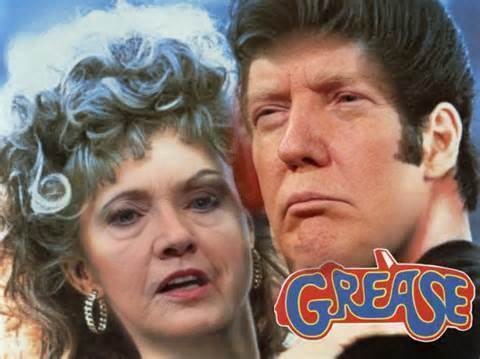
Donald and Hilliary in Grease!


Grease3

Opening this summer, the new production of the classic American musical Grease.  Features Donald Trump and Hilliary Clinton in the entertaining match between the prim and proper cheerleader and the rebel hot rodder from New Jersey.

Judith Curry had good one featuring the leads from Harry Potter: