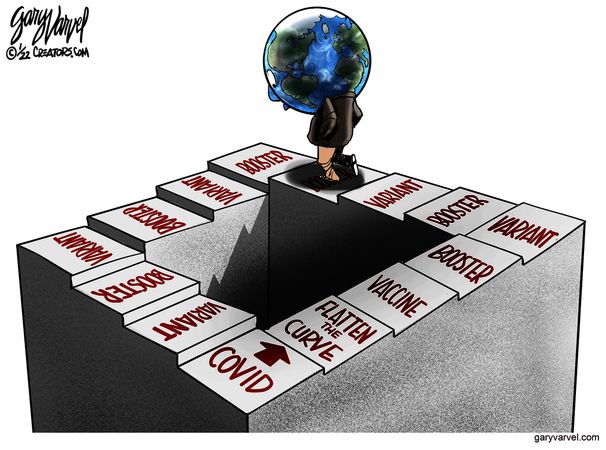
The Forever Health “Emergency”

Ryan McMaken writes at Mises Institute Why They Want to Keep the “Health Emergency” Going Forever. Excerpts in italics with my bolds and added images.

Last month, Colorado governor Jared Polis ended statewide mask mandates and social-distancing provisions, stating that “the emergency is over.“ This, of course, does not mean Colorado is now laissez-faire in terms of covid. Public higher education institutions—thanks to Polis’ tacit approval—still have free rein in terms of imposing vaccine and mask mandates, and in forcing classes to “go online” whenever the college bureaucrats grow sufficiently alarmed about covid. Moreover, local officials were quick to react to the governor’s nonemergency by imposing a variety of mandates of their own.

More than 80 percent of the state’s population still lives in counties with mask mandates.

For even this extremely mild and timid move in the direction of personal freedom, Polis was raked over the coals by the state’s left-of-center activists. Within days, The Sentinel, a newspaper out of Aurora, Colorado, issued an unsigned editorial declaring “No, Gov. Polis, the pandemic emergency is not over.” The column excoriated the governor for daring to end mask mandates and for categorically refusing the idea of future lockdowns.

Polis was also forced to walk back comments he made about how it’s not the job of health officials to “tell people what to wear“ in an apparent reference to mask mandates. Polis rather unconvincingly “clarified” that what he really meant was this was not the proper role of state health officials; it’s fine for local officials to tell people what to wear.

The fact that Polis himself had earlier claimed this was, in fact, the role of health officials is now beside the point. Incoherence and inconsistency from politicians is a given. The point now is that when a governor—even a Democratic one—tries to slightly scale back covid mandates, he or she is likely to meet furious opposition from the Left.

The lesson here is that no matter what the policy is, there will be no shortage of covid-obsessed college professors, politicians, and activists who will vehemently demand that more draconian policies be imposed immediately and everywhere.

No moderation of any kind is to be tolerated.

Indeed, so many bureaucrats, politicians, and technocrats have doubled down on covid mandate maximalism, it’s difficult to see them ever letting go. We should expect them to search out new ways to extend current “health emergencies“ indefinitely into the future by forever moving the goal posts and finding new diseases that justify continued mask mandates and social distancing rules.

Moving the Goal Posts

Back in January of 2021, Karol Markowicz at the New York Post warned that there are many out there who want the covid emergency state “to go on forever.“ Nearly a year after the initial covid panic, when it was clear covid was not a civilization-ending disease and hardly “the plague of the century,“ these technocrats were pushing for more masks and more isolation for children.

Much of this strategy has long been pushed through constant movement of the goal posts. While vaccines were initially being sold to the public as a cure-all that would allow everything to go back to “normal“ this soon evolved into a series of explanations as to why vaccines actually changed nothing. Rather, vaccines might do some good, but the public should nonetheless be prepared to wear masks forever. Then they decided their “uniquely effective” vaccines were so effective that it was necessary to “protect the vaccinated from the unvaccinated.” Even lockdowns were still on the table into late 2021. The story was then changed to a narrative in which so long as every single child is not vaccinated, schools must remain closed, and everyone must remain masked.

These mandates might also come in handy whenever some new bird flu or swine flu crops up. Yes, earlier flu-based “emergencies” had failed to command widespread hysteria as with the swine flu scares of 1976 and 2009. But now the health bureaucrats finally had seized the authority they always wanted: keep emergency “pandemic powers” in place forever so that if the CDC or the World Health Organization identifies a new “threat,” lockdowns, mask mandates, and vaccine passports can be forced upon the population until the “danger” is past.

Institute a Warning System

Another key challenge will be to keep the public always on the edge of alarm. On this, the mandate enthusiasts could take a page from the War on Terror propaganda employed in the wake of 9/11. In March 2002, the Bush administration instituted a color-coded terrorism threat advisory scale designed to indicate the terrorism “threat level.” This presumably allowed the public to gauge just how much they should be living in fear of terrorism at any given time. As propaganda it was helpful as a means of constantly reminding the public that the government keeps them safe, and that an all-powerful national security state is a necessity.

A similar scheme could easily be used to address health “threats.” Naturally, the scale would never be moved to “low” because if some actual epidemic did break out, that would make the “experts” look like they were asleep at the switch. So, naturally, the scale would always be at “guarded”—perhaps in the summertime—but would reliably be raised to “elevated” in the wintertime as hospital beds filled up with flu and pneumonia sufferers. Then, if any muttering of some new bird flu out of Asia hit the headlines, the technocrats could raise the threat level to “high.” This could then be used to justify the imposition of new mask mandates, vaccine requirements, or even lockdowns.

Then when summer weather returned and the hospital beds emptied, the experts would insist they had prevented disaster by imposing new mandates.

The only way these health experts will stop with their perpetual emergency is if they’re forced to. Health bureaucrats must be stripped of their far-too-expansive “emergency powers” and their agencies reined in. Their “scientific” opinions should be treated as the thinly veiled political statements they so frequently are. As I wrote in 2020, the pandemic only ends when the public decides it is over.

Some politicians have figured out that it’s dangerous to keep pushing the same old covid mandates into election season this fall. This is surely why Polis now appears uninterested in haranguing the public about covid on a daily basis as he was doing back in 2020.

But the academics and technocrats who can afford to live in their echo chamber—thanks to taxpayer money—are unlikely to relent. They’ll be singing the same tune twenty years from now and calling for new mandates—for the disease du jour—every year. Let’s just hope that the world will have finally stopped listening.


BMJ Calls for Vax Raw Data Now!

The BMJ editorial by Peter Doshi is Covid-19 vaccines and treatments: we must have raw data, now.  Excerpts in italics with my bolds and added images.

Data should be fully and immediately available for public scrutiny

In the pages of The BMJ a decade ago, in the middle of a different pandemic, it came to light that governments around the world had spent billions stockpiling antivirals for influenza that had not been shown to reduce the risk of complications, hospital admissions, or death. The majority of trials that underpinned regulatory approval and government stockpiling of oseltamivir (Tamiflu) were sponsored by the manufacturer; most were unpublished, those that were published were ghostwritten by writers paid by the manufacturer, the people listed as principal authors lacked access to the raw data, and academics who requested access to the data for independent analysis were denied.

The Tamiflu saga heralded a decade of unprecedented attention to the importance of sharing clinical trial data.

Public battles for drug company data, transparency campaigns with thousands of signatures, strengthened journal data sharing requirements, explicit commitments from companies to share data, new data access website portals, and landmark transparency policies from medicines regulators all promised a new era in data transparency.

Progress was made, but clearly not enough.
The errors of the last pandemic are being repeated.

Memories are short. Today, despite the global rollout of covid-19 vaccines and treatments, the anonymised participant level data underlying the trials for these new products remain inaccessible to doctors, researchers, and the public—and are likely to remain that way for years to come. This is morally indefensible for all trials, but especially for those involving major public health interventions.

Unacceptable delay

Pfizer’s pivotal covid vaccine trial was funded by the company and designed, run, analysed, and authored by Pfizer employees. The company and the contract research organisations that carried out the trial hold all the data.  And Pfizer has indicated that it will not begin entertaining requests for trial data until May 2025, 24 months after the primary study completion date, which is listed on ClinicalTrials.gov as 15 May 2023 (NCT04368728).

The lack of access to data is consistent across vaccine manufacturers. Moderna says data “may be available … with publication of the final study results in 2022.” Datasets will be available “upon request and subject to review once the trial is complete,” which has an estimated primary completion date of 27 October 2022 (NCT04470427).

As of 31 December 2021, AstraZeneca may be ready to entertain requests for data from several of its large phase III trials. But actually obtaining data could be slow going. As its website explains, “timelines vary per request and can take up to a year upon full submission of the request.”

Underlying data for covid-19 therapeutics are similarly hard to find. Published reports of Regeneron’s phase III trial of its monoclonal antibody therapy REGEN-COV flatly state that participant level data will not be made available to others. Should the drug be approved (and not just emergency authorised), sharing “will be considered.” For remdesivir, the US National Institutes of Health, which funded the trial, created a new portal to share data,  but the dataset on offer is limited. An accompanying document explains: “The longitudinal data set only contains a small subset of the protocol and statistical analysis plan objectives.”

We are left with publications but no access to the underlying data on reasonable request. This is worrying for trial participants, researchers, clinicians, journal editors, policy makers, and the public. The journals that have published these primary studies may argue that they faced an awkward dilemma, caught between making the summary findings available quickly and upholding the best ethical values that support timely access to underlying data.

In our view, there is no dilemma; the anonymised individual participant data from clinical trials must be made available for independent scrutiny.

Journal editors, systematic reviewers, and the writers of clinical practice guideline generally obtain little beyond a journal publication, but regulatory agencies receive far more granular data as part of the regulatory review process. In the words of the European Medicine Agency’s former executive director and senior medical officer, “relying solely on the publications of clinical trials in scientific journals as the basis of healthcare decisions is not a good idea … Drug regulators have been aware of this limitation for a long time and routinely obtain and assess the full documentation (rather than just publications).”22

Among regulators, the US Food and Drug Administration is believed to receive the most raw data but does not proactively release them. After a freedom of information request to the agency for Pfizer’s vaccine data, the FDA offered to release 500 pages a month, a process that would take decades to complete, arguing in court that publicly releasing data was slow owing to the need to first redact sensitive information. This month, however, a judge rejected the FDA’s offer and ordered the data be released at a rate of 55 000 pages a month. The data are to be made available on the requesting organisation’s website (phmpt.org).

In releasing thousands of pages of clinical trial documents, Health Canada and the EMA have also provided a degree of transparency that deserves acknowledgment. Until recently, however, the data remained of limited utility, with copious redactions aimed at protecting trial blinding. But study reports with fewer redactions have been available since September 2021, and missing appendices may be accessible through freedom of information requests.

Even so, anyone looking for participant level datasets may be disappointed because Health Canada and the EMA do not receive or analyse these data, and it remains to be seen how the FDA responds to the court order. Moreover, the FDA is producing data only for Pfizer’s vaccine; other manufacturers’ data cannot be requested until the vaccines are approved, which the Moderna and Johnson & Johnson vaccines are not. Industry, which holds the raw data, is not legally required to honour requests for access from independent researchers.

Like the FDA, and unlike its Canadian and European counterparts, the UK’s regulator—the Medicines and Healthcare Products Regulatory Agency—does not proactively release clinical trial documents, and it has also stopped posting information released in response to freedom of information requests on its website.

Transparency and trust

As well as access to the underlying data, transparent decision making is essential. Regulators and public health bodies could release details such as why vaccine trials were not designed to test efficacy against infection and spread of SARS-CoV-2. Had regulators insisted on this outcome, countries would have learnt sooner about the effect of vaccines on transmission and been able to plan accordingly.

Big pharma is the least trusted industry. At least three of the many companies making covid-19 vaccines have past criminal and civil settlements costing them billions of dollars. One pleaded guilty to fraud. Other companies have no pre-covid track record. Now the covid pandemic has minted many new pharma billionaires, and vaccine manufacturers have reported tens of billions in revenue.

The BMJ supports vaccination policies based on sound evidence. As the global vaccine rollout continues, it cannot be justifiable or in the best interests of patients and the public that we are left to just trust “in the system,” with the distant hope that the underlying data may become available for independent scrutiny at some point in the future. The same applies to treatments for covid-19. Transparency is the key to building trust and an important route to answering people’s legitimate questions about the efficacy and safety of vaccines and treatments and the clinical and public health policies established for their use.

Twelve years ago we called for the immediate release of raw data from clinical trials.1 We reiterate that call now. Data must be available when trial results are announced, published, or used to justify regulatory decisions. There is no place for wholesale exemptions from good practice during a pandemic. The public has paid for covid-19 vaccines through vast public funding of research, and it is the public that takes on the balance of benefits and harms that accompany vaccination.

The public, therefore, has a right and entitlement to those data, as well as to the interrogation of those data by experts.

Pharmaceutical companies are reaping vast profits without adequate independent scrutiny of their scientific claims. The purpose of regulators is not to dance to the tune of rich global corporations and enrich them further; it is to protect the health of their populations. We need complete data transparency for all studies, we need it in the public interest, and we need it now.

Global Warming Nudge Question

Selwyn Duke explains at American Thinker The global warming question that can change people’s minds.  Excerpts in italics with my bolds and added images.

Late last year, I got into a discussion with a fellow who was quite sold on the idea that man’s activities were warming the Earth. While not a hardcore ideologue, it was apparent the gentleman had accepted the climate change narrative presented by mainstream media and believed we truly were imperiling the planet. I didn’t say much to him initially, as we were engaged in some recreation, but later on I resurrected the topic and told him I just wanted to pose one question.

“What is the ideal average temperature of the Earth”? I asked.

It was clear he was without an answer, so I explained my rationale. “If we don’t know what the Earth’s ideal average temperature is,” I stated, “how can we know if a given type of climate change — whether naturally occurring or induced by man — is good or bad? After all, we can’t then know whether it’s bringing us closer to or moving us further away from that ideal temperature.”

It was as if a little light bulb had lit up in his head, and he said, “You know, that’s a good question!”

I haven’t seen the man since, as we were just two ships passing in the night, and I don’t know how his thinking has evolved (or regressed) between then and now. I do know, however, that someone who’d seemed so confident and perhaps even unbending in his position had his mind opened with one simple question and a 20-second explanation.

Of course, part of the question’s beauty is that no one can answer it. There is no “ideal” average Earth temperature, only a range within which it must remain for life as we know it to exist. At the spectrum’s lower end, polar creatures proliferate; at its higher end, tropical animals do (though warmer temperatures do breed more life, which is why the tropics boast 10 times as many species as does the Arctic. Moreover, crop yields increase when CO2 levels are higher).

This brings us to another important point: Apocalyptic warmist dogma is buttressed by the virtually unchallenged assumption that if man changes something “natural,” it is by definition bad. But this is prejudice. Most of us certainly don’t believe this, for instance, when humans cure disease and use science to preserve and extend human life (or that of our pets).

As for climate, there have been at least five major ice ages, and “the most recent one began approximately 3 million years ago and continues today (yes, we live in an ice age!),” informs the Utah Geological Survey. Then there was the Cryogenian period, during which the Earth was completely, or almost completely, covered with snow and ice.

If man had existed during that time, would it have been bad if his activities had raised the temperature a couple of degrees?

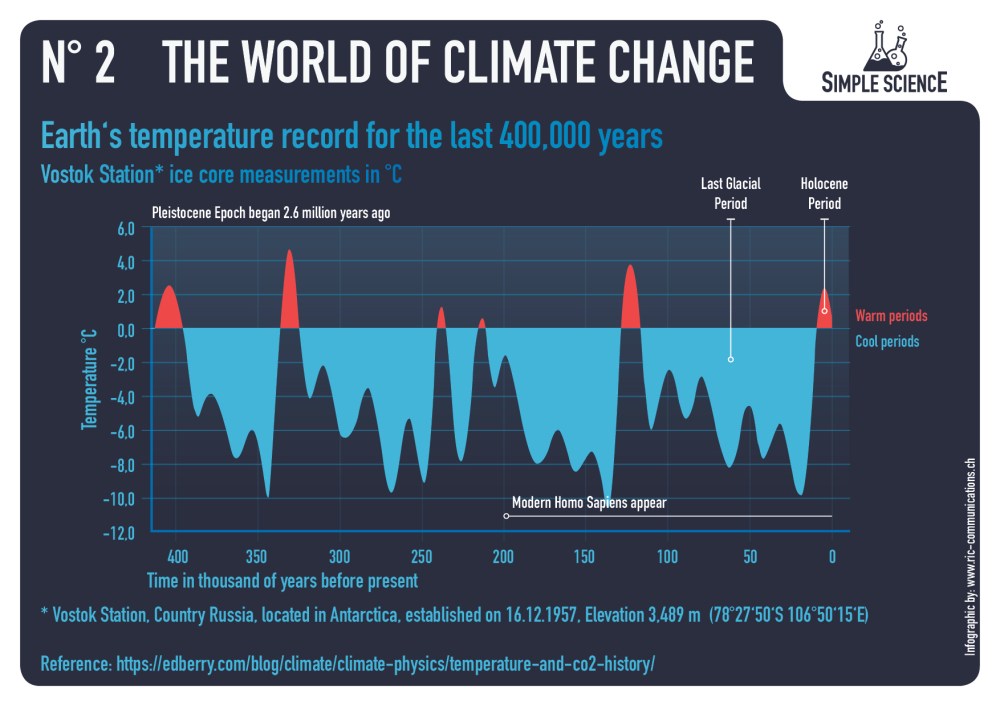
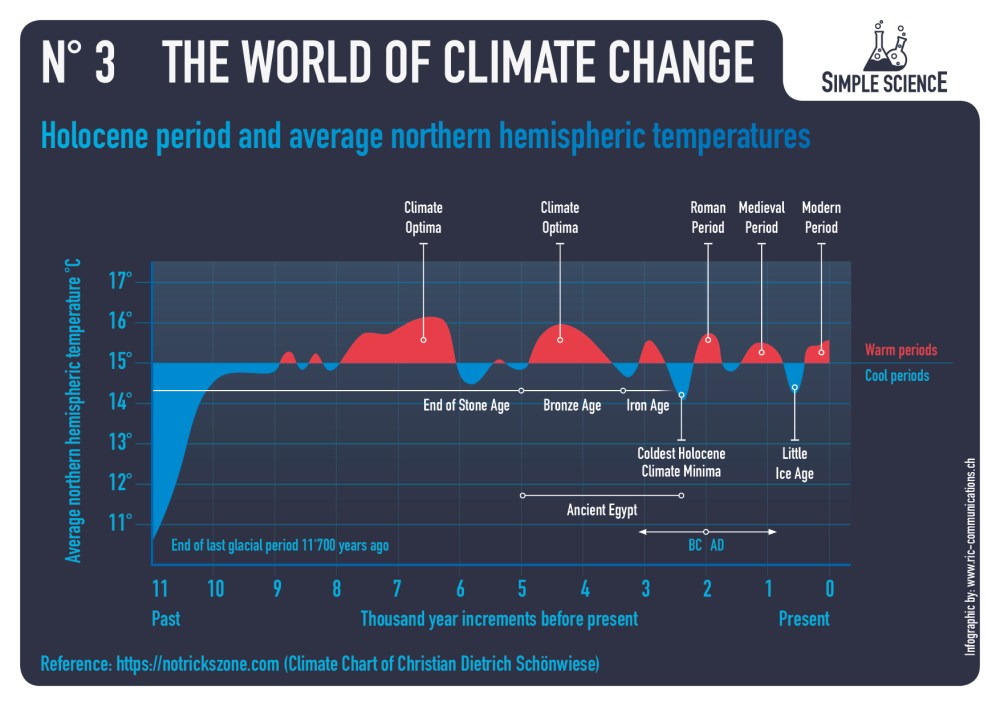
Within ice ages are shorter term cycles known as glacials (colder periods) and interglacials (warmer ones); glacials last approximately 100,000 years while interglacials last about 10,000 to 30,000 years. We’re currently in an interglacial called the Holocene Epoch, which began 11,500 to 12,000 years ago. This means that we could, conceivably, be poised to soon enter another more frigid glacial period.

Now, again, were this mitigated by a couple of degrees via man’s activities, would this be a bad thing?

In point of fact, warmists suggest this is the case. For example, citing research, science news magazine Eos wrote in 2016 that our Holocene Epoch “may last much longer because of the increased levels of atmospheric greenhouse gases resulting from human activity.”

Once more, would this be bad? Why? What’s that ideal average Earth temperature that this climate change would supposedly be moving us further away from? If you’re a member of one of the vast majority of Earth’s species, those prospering in (relative) warmth, it sounds like good news.

The question in question won’t cut any ice (pun intended) with those emotionally invested in the doom-and-gloom global warming thesis. After all, “You cannot reason a man out of a position he has not reasoned himself into,” to paraphrase Anglo-Irish satirist Jonathan Swift. But with the more open-minded majority, the question can turn down the heat on the fear.

See also World of Climate Change Infographics


Omicron is Pooping Out

Tyler Durden reports at Zero Hedge Sewage Surveillance Reveals Omicron Arrived In US Even Earlier Than Believed (And Is Disappearing Fast).  Excerpts in italics with my bolds.

Shortly after the start of the COVID pandemic, scientists at Yale University started testing wastewater collected from the sewers of New Haven for any insights it might convey about the spread of COVID among the local population. It didn’t take long for researchers in other parts of the country (and the world) to follow suit by testing their own wastewater.

More than a year later, wastewater testing has caught the attention the of the national media, as scientists and journalists search for more comprehensive ways to measure the prevalence of COVID infection within a population now that the emergence of home testing has made it more difficult for the authorities to track the number of positive tests.

But even before that, we assumed that the number of infections would always outpace the official numbers, since plenty of people with asymptomatic infections never get tested.

Earlier this month, data out of Boston suggested that the prevalence of COVID was actually much higher than the official numbers reflected.

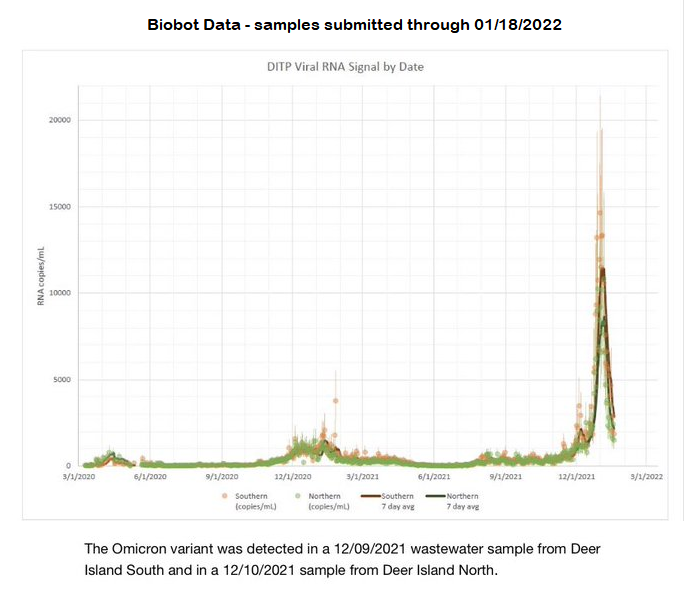
Now, data gleaned from wastewater is being used by the CDC to help determine when the omicron variant may have arrived in the US. As Bloomberg reports, evidence of omicron appeared in US sewage samples collected as early as Nov. 21, according to data collected by state and local health officials from California, Colorado, Houston and NYC. That data was later shared with the CDC.

Wastewater can also provide advanced warning of a COVID surge. Dutch researchers reported in March 2020 that they were able to find genetic material from the virus in wastewater before COVID cases were reported in the population.

Like one BBG source said: “everybody poops”.

The technique “gives you a heads-up because people may not want to pick up the phone for surveys, but everybody poops,” said Gigi Gronvall, an immunologist at the John Hopkins Center for Health Security. “And it’s so unbiased because everybody uses the same sewer system.”

The CDC now funds 43 health departments that participate in the National Wastewater Surveillance System, which provides data on COVID’s presence and trends in water systems.

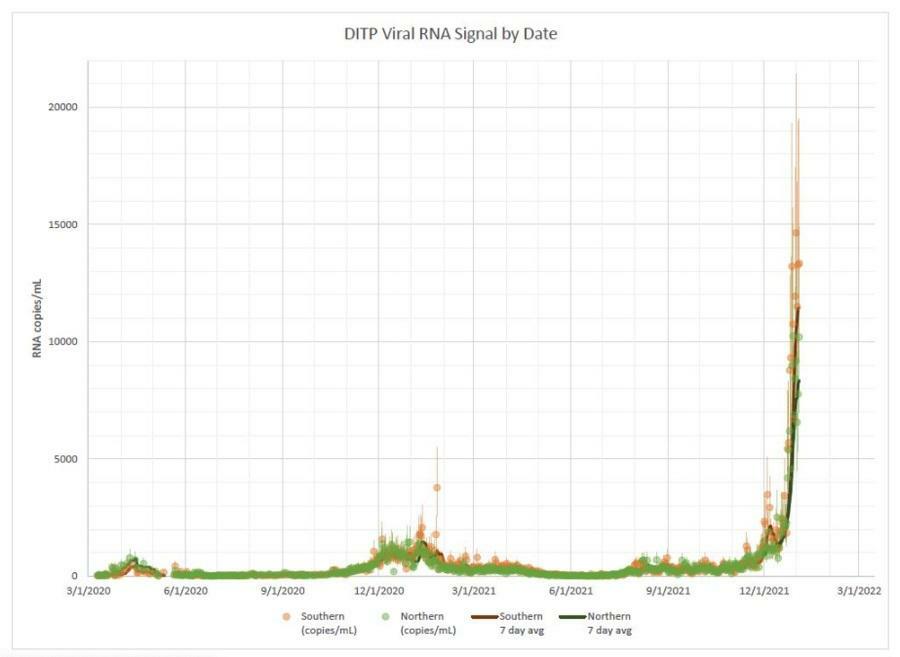
The great news is that the last week or so has seen the Boston wastewater RNA data plunge…

The end of omicron is imminent… because everybody poops.


Net Zero Makes Zero Sense

A pumpjack works just south of Cutbank Lake, near Wembley, Alta. Canada should withdraw from all international agreements on global warming, writes Rex Murphy. PHOTO BY RANDY VANDERVEEN/POSTMEDIA NEWS

Rex Murphy writes at National Post: Why is it Canada’s ‘duty’ to destroy its economy and Confederation in the pursuit of net zero? Excerpts in italics with my bolds and added images.

The Liberals’ obsession with global warming is the most absurd fixation of any government since Sir John A. set us up as a country

Sometimes the best questions are the ones not being asked.  In the Canadian political arena there are a couple or more in that category.

I’ll go to the biggest one right off the bat: Why and how has the “goal” of getting to net-zero emissions become such a doctrine?

Another way of phrasing the same question is: What’s so wrong, what’s so defective in our current energy system that the Liberal government has pledged, as its absolute priority, to replace it?

Having a secure and tested energy system is a very big deal for any nation, but having a secure and tested energy supply is the quintessential necessity for a vast northern country — really vast — that is also the home of a wealthy, modern economy.

A subsidiary question is: Does the government of a Confederation have the right, the legislative competence to declare the central industry of one of the provinces within that Confederation outmoded? And on that premise make it a national policy to destroy the economic well-being of that province?

And on that question, if one steps back just a minute, is it not amazing, incredible even, that shutting down the industrial base of an entire province is declared as the Number one priority, one laden with moral as well as political content by those in Ottawa who have elevated it to national policy — and this is accepted as normal or acceptable or yes, even noble in the context of “our fight against global warming?”

Is it really acceptable in our Confederation to single out one province to bear the majority weight and economic devastation of this “fight?”

The real and overriding question, however, is why does Canada, or more accurately, why does the government of Canada profess we have a “duty” to the world to work towards eradicating the energy supply and system that we already have, that has mostly served us well, that has brought fortune and security to the nation?

Why is the energy future of Canada under the ethos and edicts of the United Nations’ IPCC?

What is this world we have a “duty” towards? Should we ransack our current energy platform because we have a duty to — say, Russia? Or, more tellingly, does Canada have a moral obligation to shut down the oilsands, antagonize all of Alberta (and jeopardize the national economy with its futuristic visions of a “great transition”), because we have a “duty” towards China? Were we to ask the leaders of the great country of India, who are very much not on side with this same IPCC, whether Canada has an obligation, a “duty” to Delhi to shut down Fort McMurray, they would probably throw up their hands in astonishment that the question is even being put to them.

This “duty” that I insist on keeping in quotation marks, as far as I can tell is one self-declared and self-imposed by Prime Minister Justin Trudeau, and flows from his obsessive conviction that he — along with previous adviser Gerry Butts, climate crusader/previous environment minister Catherine McKenna, and previous Greenpeace activist/current environment minister Steven Guilbeault — must be a “leader” in the holy war against global warming.

On substance, Canada can do nothing substantial about global warming. Cancelling the economy of Calgary will not stop the disappearance of the glaciers, lower the sea levels off the Maldives, or rescue one skinny polar bear off a well-photographed ice-floe.

You may have noticed Canada has stalled its economy for over two years and has likely seen the immiseration of thousands of small businesses, restaurants and services. We have also piled on gargantuan deficits and debt — they are both at historic levels. We are seeing wealth-destroying inflation at levels unseen since the early ’90s.

We’re still in this mismanaged and liberty-choking COVID crisis playing havoc with the economy.

So there is another not-much-asked question: Is the current state of Canada one in which the government, by fiat, with the assent of every political party, should conduct the greatest re-engineering of the fundamentals of the nation’s most essential and fundamental industry?

The summary question is: Why are we on this useless, damaging crusade?

I know it’s very much in opposition to the current liturgy to put the question, but why does Canada have any special or even routine obligation to the “world” — or more precisely the mandarins who gather in Paris and Rio and Glasgow — to wreck our working economy in pursuit of some wild notion that this country can function on a forest of windmills (parts from China) and glazed hectares of solar panels?

The global-warming obsession of this current government is the most absurd and senseless fixation of any government since Sir John A. set us up as a country.

The greatest part of that absurdity is how easily all bend to it, all speak the pious words of “net zero” as if they were summoning a genie, as our deluded leaders prate in foreign capitals about the brave new world they are about to call into being.

The same leaders who can’t manage a payroll system, dig a few wells and provide clean water, who shut down Parliament but party abroad with maskless faces laughing at jokes — of which I suspect we are the butt.

They do not have the intellectual competence to engineer this “transition.” As a minority government they do not have the mandate either.

Yet witness the ease with which the press, academia and all who might be regarded as “thought leaders” — a dubious category at the best of times, but dismal at the present — are all abundantly, fervidly on board.

Canada has no “duty” to the world in this farcical pursuit of “net zero” and we will gravely injure our county if we don’t desist. And, once again I caution, we will drive a wedge in Confederation if a policy that treats Alberta as a scapegoat and forces it to carry the burden of an Ottawa obsession, is not abandoned.

Conclusion: Canada should take itself out of all international agreements on global warming.


Jordan Peterson Fed Up with DIE Ideology

Jordan Peterson writes at National Post Why I am no longer a tenured professor at the University of Toronto.  Excerpts in italics with my bolds and added images.

The appalling ideology of diversity, inclusion and equity is demolishing education and business

I recently resigned from my position as full tenured professor at the University of Toronto. I am now professor emeritus, and before I turned sixty. Emeritus is generally a designation reserved for superannuated faculty, albeit those who had served their term with some distinction. I had envisioned teaching and researching at the U of T, full time, until they had to haul my skeleton out of my office. I loved my job. And my students, undergraduates and graduates alike, were positively predisposed toward me. But that career path was not meant to be. There were many reasons, including the fact that I can now teach many more people and with less interference online. But here’s a few more:

First, my qualified and supremely trained heterosexual white male graduate students (and I’ve had many others, by the way) face a negligible chance of being offered university research positions, despite stellar scientific dossiers. This is partly because of Diversity, Inclusivity and Equity mandates (my preferred acronym: DIE). These have been imposed universally in academia, despite the fact that university hiring committees had already done everything reasonable for all the years of my career, and then some, to ensure that no qualified “minority” candidates were ever overlooked. My students are also partly unacceptable precisely because they are my students. I am academic persona non grata, because of my unacceptable philosophical positions. And this isn’t just some inconvenience. These facts rendered my job morally untenable. How can I accept prospective researchers and train them in good conscience knowing their employment prospects to be minimal?

Second reason: This is one of many issues of appalling ideology currently demolishing the universities and, downstream, the general culture. Not least because there simply is not enough qualified BIPOC people in the pipeline to meet diversity targets quickly enough (BIPOC: black, indigenous and people of colour, for those of you not in the knowing woke). This has been common knowledge among any remotely truthful academic who has served on a hiring committee for the last three decades. This means we’re out to produce a generation of researchers utterly unqualified for the job. And we’ve seen what that means already in the horrible grievance studies “disciplines.” That, combined with the death of objective testing, has compromised the universities so badly that it can hardly be overstated. And what happens in the universities eventually colours everything. As we have discovered.

All my craven colleagues must craft DIE statements to obtain a research grant. They all lie (excepting the minority of true believers) and they teach their students to do the same. And they do it constantly, with various rationalizations and justifications, further corrupting what is already a stunningly corrupt enterprise. Some of my colleagues even allow themselves to undergo so-called anti-bias training, conducted by supremely unqualified Human Resources personnel, lecturing inanely and blithely and in an accusatory manner about theoretically all-pervasive racist/sexist/heterosexist attitudes. Such training is now often a precondition to occupy a faculty position on a hiring committee.

Need I point out that implicit attitudes cannot — by the definitions generated by those who have made them a central point of our culture — be transformed by short-term explicit training? Assuming that those biases exist in the manner claimed, and that is a very weak claim, and I’m speaking scientifically here. The Implicit Association test — the much-vaunted IAT, which purports to objectively diagnose implicit bias (that’s automatic racism and the like) is by no means powerful enough — valid and reliable enough — to do what it purports to do. Two of the original designers of that test, Anthony Greenwald and Brian Nosek, have said as much, publicly. The third, Professor Mahzarin Banaji of Harvard, remains recalcitrant. Much of this can be attributed to her overtly leftist political agenda, as well as to her embeddedness within a sub-discipline of psychology, social psychology, so corrupt that it denied the existence of left-wing authoritarianism for six decades after World War II. The same social psychologists, broadly speaking, also casually regard conservatism (in the guise of “system justification”) as a form of psychopathology.

Banaji’s continued countenancing of the misuse of her research instrument, combined with the status of her position at Harvard, is a prime reason we still suffer under the DIE yoke, with its baleful effect on what was once the closest we had ever come to truly meritorious selection. A close friend and one of the few colleagues that remain friendly to me (and someone clearly liberal left, by the way) told me flat out that the new crop of his university’s psychology graduate students, selected without the objective Graduate Record Examination (GRE), cannot handle the first-year statistics class. The result: bubbling innuendo that the content is racist.

By the way: everything in the social sciences (and medicine, for that matter) stands or falls with honest and competent statistics.

Furthermore, the accrediting boards for graduate clinical psychology training programs in Canada are now planning to refuse to accredit university clinical programs unless they have a “social justice” orientation. That, combined with some recent legislative changes in Canada, claiming to outlaw so-called “conversion therapy” (but really making it exceedingly risky for clinicians to do anything ever but agree always and about everything with their clients) have likely doomed the practice of clinical psychology, which always depended entirely on trust and privacy. Similar moves are afoot in other professional disciplines, such as medicine and law. And if you don’t think that psychologists, lawyers and other professionals are anything but terrified of their now woke governing professional colleges, much to everyone’s extreme detriment, you simply don’t understand how far this has all gone.
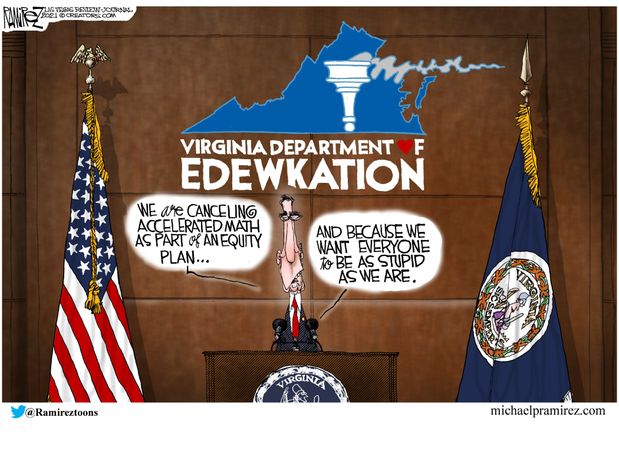
Just exactly what am I supposed to do when I meet a graduate student or young professor, hired on DIE grounds? Manifest instant skepticism regarding their professional ability? What a slap in the face to a truly meritorious young outsider. And perhaps that’s the point. The DIE ideology is not friend to peace and tolerance. It is absolutely and completely the enemy of competence and justice.

And for those of you who think that I am overstating the case, or that this is something limited in some trivial sense to the universities, consider some other examples: This report from Hollywood, cliched hotbed of “liberal” sentiment, for example, indicates just how far this has gone. In 2020, the Academy of Motion Picture Arts and Sciences (the Oscar people) embarked on a five-year plan (does that ring any historical bells?) “to diversify our organization and expand our definition of the best,” They did so in an attempt which included developing “new representation and inclusion standards for Oscars,” to, hypothetically, “better reflect the diversity of the movie-going audience.” What fruit has this initiative, offspring of the DIE ideology, borne? According to a recent article, penned by Peter Kiefer and Peter Savodnik, but posted on former NY Times’ journalist Bari Weiss’s Common Sense website (and Weiss left the Times, because of the intrusion of radical left ideology into that newspaper, just as Tara Henley did recently, vis a vis the CBC): “We spoke to more than 25 writers, directors, and producers — all of whom identify as liberal, and all of whom described a pervasive fear of running afoul of the new dogma. … How to survive the revolution? By becoming its most ardent supporter. … Suddenly, every conversation with every agent or head of content started with: Is anyone BIPOC attached to this?”

And this is everywhere — and if you don’t see it, your head is either in the sand or shoved somewhere far more unmentionable. CBS, for example, has literally mandated that every writers’ room be at least 40 per cent BIPOC in 2021 (50 per cent in 2022).

We are now at the point where race, ethnicity, “gender,” or sexual preference is first, accepted as the fundamental characteristic defining each person (just as the radical leftists were hoping) and second, is now treated as the most important qualification for study, research and employment.
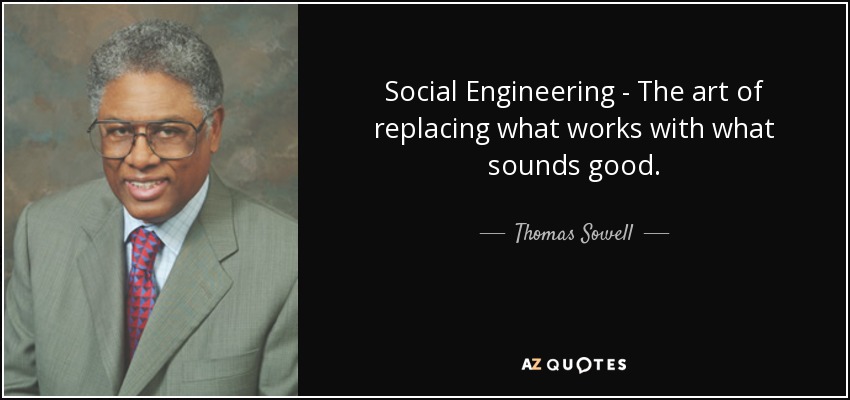
Need I point out that this is insane ? Even the benighted New York Times has its doubts. A headline from August 11, 2021: Are Workplace Diversity Programs Doing More Harm than Good? In a word, yes. How can accusing your employees of racism etc. sufficient to require re-training (particularly in relationship to those who are working in good faith to overcome whatever bias they might still, in these modern, liberal times, manifest) be anything other than insulting, annoying, invasive, high-handed, moralizing, inappropriate, ill-considered, counterproductive, and otherwise unjustifiable?

And if you think DIE is bad, wait until you get a load of Environmental, Social and Governance (ESG) scores . Purporting to assess corporate moral responsibility, these scores, which can dramatically affect an enterprise’s financial viability, are nothing less than the equivalent of China’s damnable social credit system, applied to the entrepreneurial and financial world. CEOs: what in the world is wrong with you? Can’t you see that the ideologues who push such appalling nonsense are driven by an agenda that is not only absolutely antithetical to your free-market enterprise, as such, but precisely targeted at the freedoms that made your success possible? Can’t you see that by going along, sheep-like (just as the professors are doing; just as the artists and writers are doing) that you are generating a veritable fifth column within your businesses? Are you really so blind, cowed and cowardly? With all your so-called privilege?

And it’s not just the universities. And the professional colleges. And Hollywood. And the corporate world. Diversity, Inclusivity and Equity — that radical leftist Trinity — is destroying us. Wondering about the divisiveness that is currently besetting us? Look no farther than DIE. Wondering — more specifically — about the attractiveness of Trump? Look no farther than DIE. When does the left go too far? When they worship at the altar of DIE, and insist that the rest of us, who mostly want to be left alone, do so as well. Enough already. Enough. Enough.

Finally, do you know that Vladimir Putin himself is capitalizing on this woke madness? Anna Mahjar-Barducci at MEMRI.org covered his recent speech. I quote from the article’s translation:

“The advocates of so-called ‘social progress’ believe they are introducing humanity to some kind of a new and better consciousness. Godspeed, hoist the flags, as we say, go right ahead. The only thing that I want to say now is that their prescriptions are not new at all. It may come as a surprise to some people, but Russia has been there already. After the 1917 revolution, the Bolsheviks, relying on the dogmas of Marx and Engels, also said that they would change existing ways and customs, and not just political and economic ones, but the very notion of human morality and the foundations of a healthy society. The destruction of age-old values, religion, and relations between people, up to and including the total rejection of family (we had that, too), encouragement to inform on loved ones — all this was proclaimed progress and, by the way, was widely supported around the world back then and was quite fashionable, same as today. By the way, the Bolsheviks were absolutely intolerant of opinions other than theirs.

“This, I believe, should call to mind some of what we are witnessing now. Looking at what is happening in a number of Western countries, we are amazed to see the domestic practices — which we, fortunately, have left, I hope — in the distant past. The fight for equality and against discrimination has turned into aggressive dogmatism bordering on absurdity, when the works of the great authors of the past — such as Shakespeare — are no longer taught at schools or universities, because their ideas are believed to be backward. The classics are declared backward and ignorant of the importance of gender or race. In Hollywood, memos are distributed about proper storytelling and how many characters of what color or gender should be in a movie. This is even worse than the agitprop department of the Central Committee of the Communist Party of the Soviet Union.”

This, from the head of the former totalitarian enterprise, against whom we fought a five decades’ long Cold War, risking the entire planet (in a very real manner). This, from the head of a country riven in a literally genocidal manner by ideas that Putin himself attributes to the progressives in the West, to the generally accepting audience of his once-burned (once (!)) twice-shy listeners.

And all of you going along with the DIE activists, whatever your reasons: this is on you. Professors. Cowering cravenly in pretence and silence. Teaching your students to dissimulate and lie. To get along. As the walls crumble. For shame. CEOs: signalling a virtue you don’t possess and shouldn’t want to please a minority who literally live their lives by displeasure. You’re evil capitalists, after all, and should be proud of it. At the moment, I can’t tell if you’re more reprehensibly timid even than the professors. Why the hell don’t you banish the human resource DIE upstarts back to the more-appropriately-named Personnel departments, stop them from interfering with the psyches of you and your employees, and be done with it? Musicians, artists, writers: stop bending your sacred and meritorious art to the demands of the propagandists before you fatally betray the spirit of your own intuition. Stop censoring your thought. Stop saying you will hire for your orchestral and theatrical productions for any reason other than talent and excellence. That’s all you have. That’s all any of us have.

He who sows the wind will reap the whirlwind. And the wind is rising.

On CO2 Sources and Isotopes

A recent rigorous analysis was published, creating discussion among those concerned with global warming/climate change science.  The paper is World Atmospheric CO2, Its 14C Specific Activity, Non-fossil Component, Anthropogenic Fossil Component, and Emissions (1750–2018) by Kenneth Skrable, George Chabot, and Clayton French at University of Massachusetts Lowell.
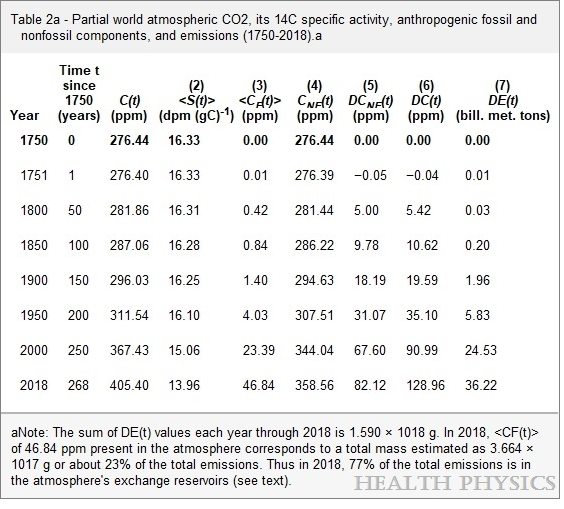
The analysis employs ratios of carbon isotopes to calculate the relative proportions of atmospheric CO2 from natural sources and from fossil fuel emissions. The results are welcomed by skeptics and repulsed by warmists. Excerpts in italics with my bolds.

The specific activity of 14C in the atmosphere gets reduced by a dilution effect when fossil CO2, which is devoid of 14C, enters the atmosphere. We have used the results of this effect to quantify the two components: the anthropogenic fossil component and the non-fossil component.  All results covering the period from 1750 through 2018 are listed in a table and plotted in figures.

These results negate claims that the increase in total atmospheric CO2 concentration C(t) since 1800 has been dominated by the increase of the anthropogenic fossil component. We determined that in 2018, atmospheric anthropogenic fossil CO2 represented 23% of the total emissions since 1750 with the remaining 77% in the exchange reservoirs. Our results show that the percentage of the total CO2 due to the use of fossil fuels from 1750 to 2018 increased from 0% in 1750 to 12% in 2018, much too low to be the cause of global warming.

Synopsis of Analytics

Readers will find in the the linked paper a complete description of the assumptions, definitions, data sources and equations leading to the above findings.  This post attempts to explain the logic of the analysis for a general audience, with excerpts in italics with my bolds.

Carbon-14 is a radioactive isotope of carbon having a half-life of 5,730 y. Carbon-14 atoms are produced in the atmosphere by interactions of cosmic rays, and they have reached an essentially constant steady state activity, i.e., disintegration rate, in the total world environment (Eisenbud and Gesell 1997). The age of fossil fuels is much longer than the 5,730 y half-life of the 14C radioactive isotope; consequently, fossil fuels are devoid of the 14C isotope. The units used in this paper are disintegrations per minute per gram of carbon abbreviated as dpm (gC)−1, the common units used in 14C dating.

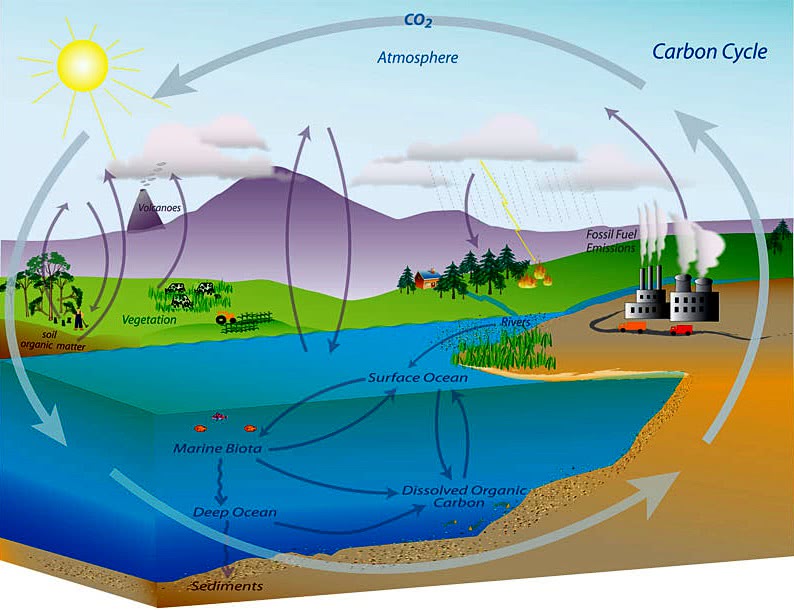
The global carbon cycle for CO2 is described by the Energy Information Administration (EIA 2020). Natural, two-way exchanges of CO2 occur between the atmosphere and its two exchange reservoirs, the oceans and terrestrial biosphere. Two-way exchanges with the atmosphere also occur from changes in land use. The ocean is the largest reservoir of CO2, and it contains 50 times that for the atmosphere and 19 times that for the terrestrial biosphere (Water Encyclopedia 2005). All of the two way exchanges are considered in this paper to be comprised of both the non-fossil component and the anthropogenic fossil component. Annual changes, DCNF(t) in CNF(t), in the atmosphere relative to the 1750 initial value, C(0), can be positive or negative depending on the net flow of CO2 between the atmosphere and its exchange reservoirs as well as on land use changes.

A one-way pathway of anthropogenic fossil CO2 into the atmosphere from fossil fuel combustion and industrial fuel processes since 1750 is represented by annual emissions,  DE(t), of anthropogenic fossil CO2 to the atmosphere, which have been increasing each year since 1750. These emissions over time t result in increasing annual mean anthropogenic fossil concentrations, CF(t), that result in values of 14C in C(t) that are increasingly lower than the initial value.

During the last long glacial period, the oceans absorbed a large amount of CO2 from the atmosphere. It appears in the figure that Earth is still in the Holocene interglacial period that started 11,500 y ago. Its peak temperature change over the 11,500 years, thus far in 1950, appears to be significantly less than those over the three previous interglacial periods. Its peak CO2 appears less than 300 ppm and less than the peak value in the previous interglacial period. Thus, the increase in CO2 that Earth has been experiencing since 1800 appears to have started more than 5,000 years ago.

A Wikipedia link for14C describes the increase in the concentration of 14CO2 in the atmosphere that resulted from high altitude nuclear bomb tests, circa 1955–1963. Based on the figure in the Wikipedia link, 14CO2 from the atmospheric bomb tests during this period would be significant in 1955 to about 2005. For the purpose of estimating the anthropogenic fossil and non-fossil components of CO2, measurements of 14C specific activities of atmospheric CO2 during this period should be corrected for the contribution from bomb tests. Outside of this period, no correction would be required.

The methodology used to calculate fossil concentrations CF(t) and non-fossil CNF(t) relies on two accepted facts:

(1) the initial total mole fraction C(0) of (280 ± 10) ppm before 1750 has been essentially constant for several thousand years (Prentice et al. 2018) and

(2) the production rate of 14C atoms in the atmosphere has been essentially constant for at least 15,000 years (Eisenbud 1997).

Therefore, the steady-state activity of 14C per unit volume of the atmosphere also would have been constant except for the redistribution of CO2 in the atmosphere in each year with its exchange reservoirs. The product is proportional to the activity per unit volume of the atmosphere, which varies each year depending on whether there is a net input or output, DCNF(t), of non-anthropogenic fossil CO2 in the atmosphere. The change in the product each year is independent of the value of CF(t) in the atmosphere because it contains no activity of 14C . Also, except for the dilution of S(0) by the anthropogenic fossil component, C(t), present in the atmosphere each year, the 14C would have remained constant at our chosen initial value, S(0), of 16.33 dpm (gC)−1 in 1750.

Based on a molecular weight of 44.01 g mole−1 for CO, the total mass of anthropogenic fossil CO2 present in the atmosphere in 2018 is calculated as 3.664 × 10¹⁷ g. The Table 2 value of 1,589.86 billion metric tons of anthropogenic fossil-derived CO2 emitted into the atmosphere in 1751 through 2018 (EIA 2020a and 2020b) represents 1.590 × 10¹⁸  g. The inference is that the quantity of anthropogenic fossil CO2 in the atmosphere in 2018 represents about 23% of the total amount of anthropogenic fossil-derived CO2 that had been released to the atmosphere since 1750.

Therefore, 77% of the total anthropogenic fossil emissions of CO2 then would be present in the atmosphere’s exchange reservoirs in 2018. These results differ significantly from those reported by others:

The assumption that the increase in CO2 since 1800 is dominated by or equal to the increase in the anthropogenic component is not settled science. Unsupported conclusions of the dominance of the anthropogenic fossil component of CO2 and concerns of its effect on climate change and global warming have severe potential societal implications that press the need for very costly remedial actions that may be misdirected, presently unnecessary, and ineffective in curbing global warming.

Footnote On Elements and Isodopes

The study above, along with the foibles of the current US administration, reminds me of this announcement of a newly discovered element.

The new element is Governmentium (Gv). It has one neutron, 25 assistant neutrons, 88 deputy neutrons and 198 assistant deputy neutrons, giving it an atomic mass of 312, the heaviest of all.  These 312 particles are held together by forces called morons, which are surrounded by vast quantities of lefton-like particles called peons.

Since Governmentium has no electrons or protons, it is inert. However, it can be detected, because it impedes every reaction with which it comes into contact. A tiny amount of Governmentium can cause a reaction normally taking less than a second to take from four days to four years to complete.

Governmentium has a normal half-life of 3-6 years. It does not decay but instead undergoes a reorganization in which a portion of the assistant neutrons and deputy neutrons exchange places.  In fact, Governmentium’s mass will actually increase over time, since each reorganization will cause more morons to become neutrons, forming isodopes.

This characteristic of moron promotion leads some scientists to believe that Governmentium is formed whenever morons reach a critical concentration. This hypothetical quantity is referred to as critical morass.

When catalyzed with money, Governmentium becomes Administratium, an element that radiates just as much energy as Governmentium since it has half as many peons but twice as many morons. All of the money is consumed in the exchange, and no other byproducts are produced. It tends to concentrate at certain points such as government agencies, large corporations, and universities. Usually it can be found in the newest, best appointed, and best maintained buildings.

Scientists point out that administratium is known to be toxic at any level of concentration and can easily destroy any productive reaction where it is allowed to accumulate. Attempts are being made to determine how administratium can be controlled to prevent irreversible damage, but results to date are not promising.

Credit: William DeBuvitz, Heaviest Element Discovered

Legal Challenge to Quebec Taxing Unvaccinated

Andrew Chen reports at Epoch Times Constitutional Rights Group to Take Legal Action Against Quebec’s Tax on the Unvaccinated.  Excerpts in italics with my bolds.

A Calgary-based charter rights advocacy group says it will launch a legal challenge against the government of Quebec regarding its plan to impose a “health tax” on residents who refuse to be vaccinated against COVID-19.

On Jan. 11, Quebec Premier Francois Legault said a “significant” financial penalty will be imposed as a tax for those who refuse the vaccine. He didn’t reveal how much the penalty will be or when it will be implemented, but said later in the week that a bill to impose the measure will be put forth to the province’s legislature in February for a vote.

The Justice Centre for Constitutional Freedoms announced that it will take legal action against the province in a statement issued Thursday.

“The proposed Quebec ‘health tax’ is an egregious violation of the Charter rights of Quebecers and an affront to equality which Canada was, in times past, known for,” the Justice Centre’s president John Carpay said.

“This is a blatant attack on a minority of society. Historically, persecution of a minority through taxation has paved the way for further and worse measures. We will fight this discriminatory and unscientific tax in court and defend the right to bodily autonomy of Quebecers and all Canadians. This injustice has no place in Canada.”

In May 2021, Legault said he would gradually lift restrictions and return to normalcy if 75 percent of adult Quebecers were vaccinated.

Currently, the province has exceeded that goal, with 85 percent of eligible residents receiving at least one shot, and 78 percent fully vaccinated with two required doses.

Quebec has implemented some of the strictest public health measures in North America. On Dec. 31, 2021, the province reintroduced a nightly curfew from 10:00 p.m. to 5:00 a.m., which will be lifted on Jan. 17. Quebec had previously imposed a similar curfew for five months from January to May 2021.

On Jan. 13, Legault said the province will extend its “vaccine passport” requirement to large indoor retail settings of more than 1,500 square metres, including big box stores like Canadian Tire, Wal-Mart, and Costco. Grocery stores and pharmacies are some of the exceptions, which are deemed essential.

“The announcement of a tax on those who decline the COVID injections, like the ‘vaccine passport,’ is discrimination and wrong,” Carpay said.

“Vaccines do not stop people from contracting or spreading COVID, so there is no medical or scientific justification for the financial persecution and discrimination against vaccine-free citizens.”

The Justice Centre noted that the Charter of Rights and Freedoms states that every individual has the right to “bodily autonomy,” which means a person has the “right to control his/her own bodily integrity.”

Another civil rights group, the Canadian Civil Liberties Association (CCLA), criticized Quebec’s proposal in a statement released Wednesday, saying it raises “significant equity concerns.”

“We know that some of those who remain unvaccinated are individuals who face serious barriers to accessing health care, and many have a low level of trust in the system because of negative experiences in the past,” said Cara Zwibel, director of Fundamental Freedoms and acting general counsel for the CCLA.

“This is a divisive measure that will end up punishing and alienating those who may be most in need of public health supports and services.”

A number of European countries have imposed some kind of financial burden on unvaccinated citizens. In Austria, the first nation in Europe to create such a tax, a fine of up to 3,600 euros (roughly C$5,100) will be levied on people aged 14 and over who refused to receive a vaccine every three months.

In Greece, individuals over 60 years old will incur a fine of 100 euros (C$143) if they still haven’t received a shot by Jan. 16.

Best Covid Rx

Background from pioneering family Dr. Vladimir Zelenko:

Dr. Zelenko: You know, the Omicron variant or the Delta variant or any other of the variants – they’re all the same to me. The reason why I say that is: the difference in those variants is in the shape of the spike protein and its ability to get it into the cell. My focus has never been the virus getting into the cell — my focus has been to stop the virus from making copies of its genetic material — or viral replication. And that is the same pathway for all the variants.

By blocking the common pathway — the common denominator — called RNA-dependent RNA-polymerase — you actually inhibit all the variants simultaneously.

That’s why zinc, together with a zinc ionophore, is absolutely crucial. Because zinc blocks that enzyme. And the zinc ionophore allows for zinc to get into the cell. The most common zinc ionophores are hydroxychloroquine and ivermectin. But those are prescription. Due to governmental tyranny, they’re difficult to get.

And so there are over-the-counter options such as quercetin, which is a derivative of apple peels — it’s a bioflavonoid — together with Vitamin C that is an effective zinc ionophore or zinc delivery system or zinc “gun.” Proven by peer-reviewed papers on the NIH server. As well as EGCG, which is an extract from green tea, which does the same thing.

So my formulation of Z-Stack is based on quercetin, together with Vitamin C which delivers the zinc into the cell. And it also has Vitamin D. Vitamin D is important to upregulate your immune system so you’re healthy and robust and the virus won’t cause complications in most cases.

NIH (National Institutes of Health) Red wine: A drink to your heart

Red Wine: A Potent Antioxidant

For many years, the emphasis has been on the relationship between serum total cholesterol levels and the risk of CVD (Cardio-Vascular Disease). However, the focus has recently shifted to oxidative stress induced by reactive oxygen species (ROS) and nitrogen-reactive species as important key players in the etiology and pathogenesis of various chronic diseases, including CVD.[12] Antioxidant nutrients are believed to slow down the progression of atherosclerosis due to their ability to inhibit the damaging oxidative processes.[13,14] Epidemiological and prospective studies have shown that consumption of antioxidant vitamins such as vitamin E and ß-carotene could reduce the risk of CVD.[15] Clinical trials also suggest a reduced risk of CVD with vitamin E supplementation.[16] The protective effect of vitamin E can be ascribed to its antioxidant properties. Observations that men and women with CVD show lower levels of circulating antioxidants have led scientists to support the proposed protective role of antioxidants in the prevention and management of CVD.[13] Red wine-active principles like red wine polyphenols, resveratrol and quercetin have experimental cardioprotective properties[17] and may counter one of the mechanisms underlying its antioxidant potential. The cardioprotective properties of individual red wine components are discussed below.

Quercetin

Quercetin is one of the most important flavonoids present in red wine. The antioxidant and protective mechanisms in various ischemic conditions were proved by many researches. It has been reported that quercetin inhibited thrombocyte aggregation[53] and had an antihypertensive effect through vasodilator action on the vascular smooth muscles.[54] The studies that focused on the antioxidant efficiency of flavonoids against ischemia/reperfusion (I/R) injury have demonstrated that quercetin possesses robust protective effects in renal, cerebral and hepatic I/R models.[55–57] Quercetin was also demonstrated to improve the contractile function of the left ventricle in experimental myocardial infarction with subsequent 24-h reperfusion.[58] Ikizer et al. reported that quercetin has the capacity to protect the myocardial tissue against global ischemia and reperfusion injury. In instances where the molecule is administered for the purpose of acute therapy, this cardioprotective effect of a significant degree can be observed, and the protective action might be due to its antioxidant and cytoprotective actions.

Red wine alcohol promotes quercetin absorption and directs its metabolism

Tissue preparations were incubated in whole or dealcoholised red wine, diluted 1 : 1 with Krebs buffer for 20 min at 37°C, after which the mucosa was removed and processed for HPLC analysis. Tissues exposed to red wine had significantly higher amounts of both quercetin (× 3; P<0.001) and quercetin-3-O-glucoside (× 1.5; P<0.01) associated with them, compared with sacs incubated in the dealcoholised equivalent. In addition, both tamarixetin (T) and isorhamnetin (I), in the mucosal tissue from sacs exposed to the whole wine, were significantly elevated approximately two fold (P<0.05; P<0.01, respectively).

It is therefore plausible that the moderate alcohol content of red wine contributes to its beneficial health effects in humans by both increasing the absorption of quercetin and quercetin-3-O-glucoside and by channelling their metabolism towards O-methylation to yield compounds (T and I), which have potential protective effects against cancer and cardiovascular diseases.

My Comment

Even without this evidence I can attest to the benefits of daily red wine intake along with daily supplements of Zinc, Vitamins C and D. No viral symptoms yet, only occasional runny nose and sore throat easily resolved with saline sinus rinses, mouthwashes. lozenges and cough syrup.  And as I reported recently my serum test last month showed the highest rating for antibodies against the spike protein.  Anecdotal, but consistent with above scientific studies.

What Are You Waiting For?

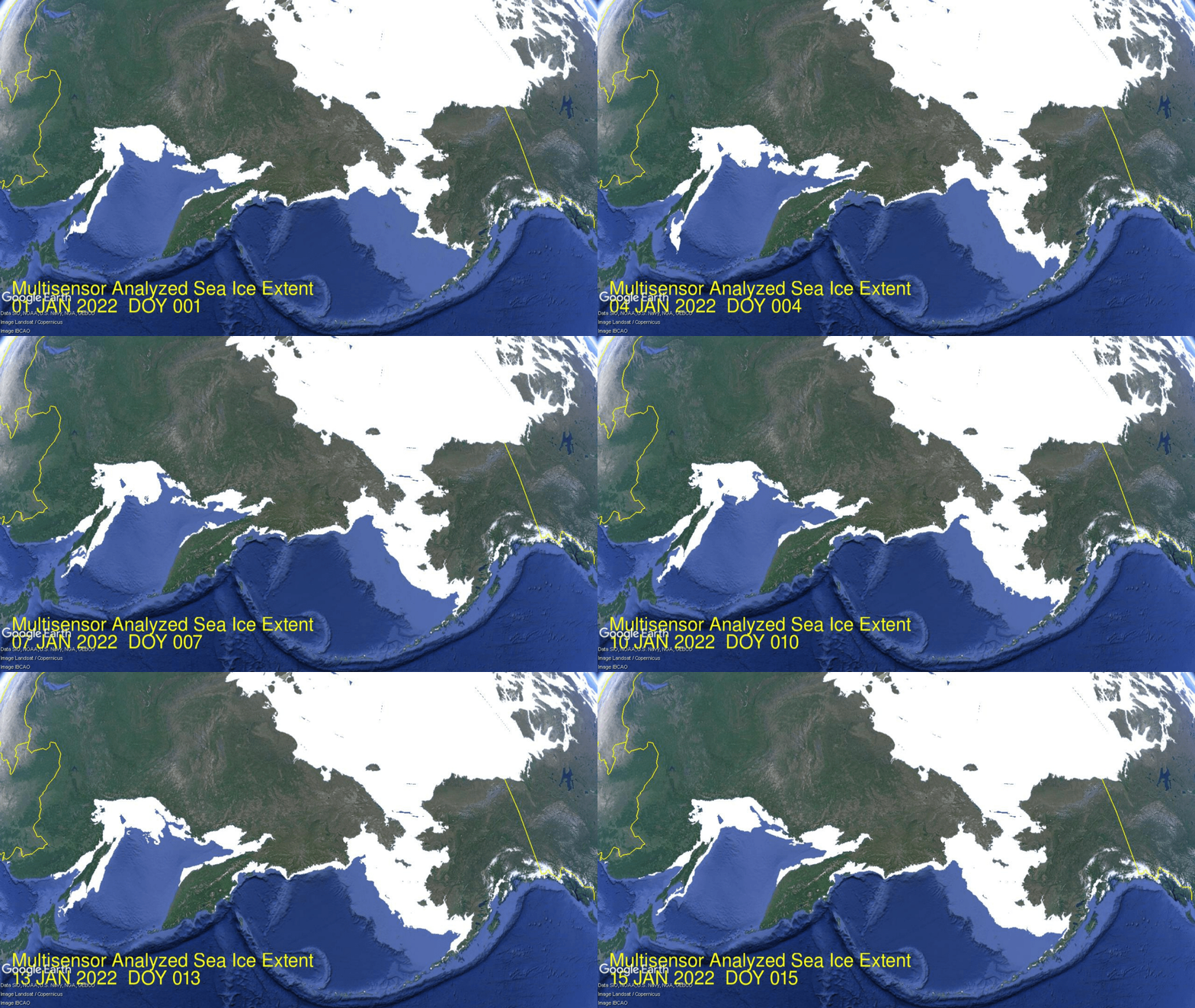
Arctic Ice Surplus Despite Bering/Okhotsk Seesaw Mid January


The animation focuses on the two Pacific basins since most of the ice action is seen there.  The seesaw refers to a frequent observation that Bering and Okhotsk Seas often alternate growing and receding ice extents during both melting and freezing seasons.  This month Bering on the right is seen adding ice steadily from 387k km2 to 664k km2, now at 104% of its last March maximum. Meanwhile Okhotsk on the left starts at 466k km2, waffles back and forth, growing to 554k km2 before retreating to match the beginning.

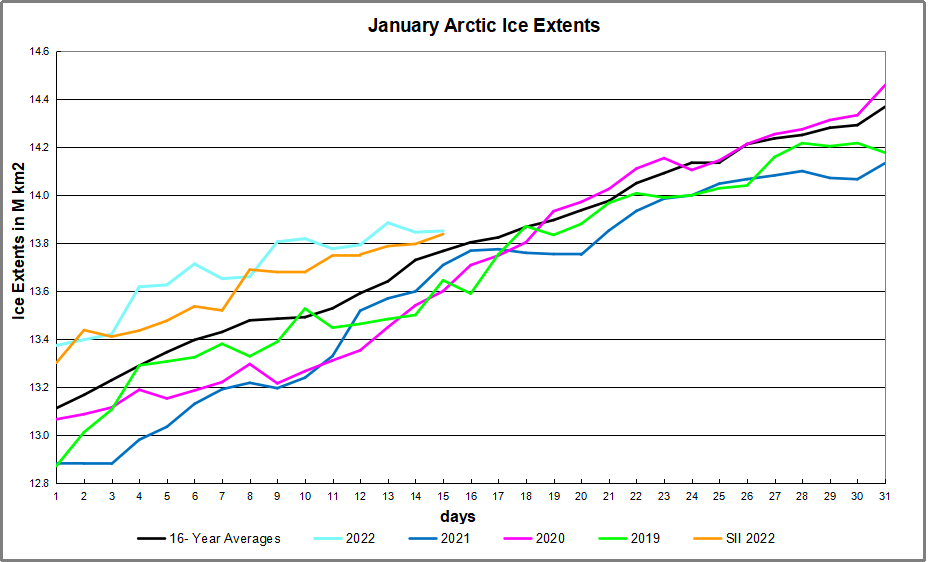
The graph below shows daily ice extents for January 2022 compared to 16 year averages, and some years of note.

The black line shows during January on average (2006 to 2021 inc.) Arctic ice extents increased ~1.3M km2 from ~13.1M km2 up to ~13.4M km2.  The 2022 cyan MASIE line started the year 261k km2 above average and on day 15 retained a surplus of 84k km2.  The Sea Ice Index in orange (SII from NOAA) started with the same deficit, then lagged behind in the first two weeks, before ending yesterday the same as MASIE. 2021 and 2020 started below average but made up most of the difference by mid month.

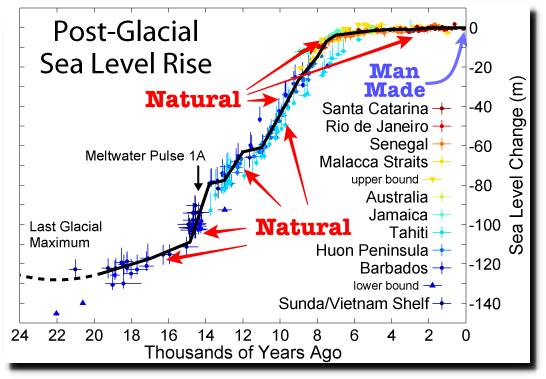
Why is this important?  All the claims of global climate emergency depend on dangerously higher temperatures, lower sea ice, and rising sea levels.  The lack of additional warming is documented in a post UAH Confirms Global Warming Gone End of 2021.

The lack of acceleration in sea levels along coastlines has been discussed also.  See Inside the Sea Level Scare Machine

Also, a longer term perspective is informative:

post-glacial_sea_levelThe table below shows the distribution of Sea Ice on day 015 across the Arctic Regions, on average, this year and 2021.

Region 2022015 Day 15 Average 2022-Ave. 2021015 2022-2021
 (0) Northern_Hemisphere 13851226 13767662 83564 13709295 141931
 (1) Beaufort_Sea 1070776 1070247 529 1070689 87
 (2) Chukchi_Sea 966006 965889 117 966006 0
 (3) East_Siberian_Sea 1087137 1087131 6 1087120 17
 (4) Laptev_Sea 897827 897837 -10 897827 0
 (5) Kara_Sea 935023 908782 26242 860326 74697
 (6) Barents_Sea 710507 509307 201200 479880 230628
 (7) Greenland_Sea 584670 600334 -15664 649983 -65313
 (8) Baffin_Bay_Gulf_of_St._Lawrence 1084523 1158194 -73671 1060873 23650
 (9) Canadian_Archipelago 854685 853209 1476 854597 88
 (10) Hudson_Bay 1260903 1254880 6024 1260471 432
 (11) Central_Arctic 3199791 3209964 -10173 3183652 16140
 (12) Bering_Sea 664148 535155 128993 503676 160473
 (13) Baltic_Sea 44692 42101 2591 31534 13157
 (14) Sea_of_Okhotsk 466605 629910 -163305 765767 -299162

The overall surplus to average is 84k km2, (0.6%).  Note large surpluses of ice in Barents and Bering Seas. The main deficit to average is in Sea of Okhotsk, as noted at the top.

bathymetric_map_arctic_ocean

Illustration by Eleanor Lutz shows Earth’s seasonal climate changes. If played in full screen, the four corners present views from top, bottom and sides. It is a visual representation of scientific datasets measuring Arctic ice extents.