Clueless Covid Policies

In recent months, some demonstrators in Quebec have denounced what they consider government fear campaigns over COVID-19. The new measures included a mandatory rule on wearing masks during demonstrations. (Graham Hughes/The Canadian Press)

A previous post discussed how policymakers are imposing draconian restrictions on their citizens in a misguided attempt to stop viral infections.  The basic fallacy is this:

It seems that certain disease experts genuinely believe that they can game the reproduction rate of the virus to get it below 1, and thereby create a mathematical result that will make the virus go away.

This seems to be their goal and the metric by which they measure whether and to what extent they have achieved it. The problem is that the reproduction rate (very difficult to discern precisely) is an effect – a measurement of an evolved condition – not a cause.

Previous Post Covid Coercion in Quebec
Update:  Quebec is one example of a world wide problem:  See COVID-19 Is Also a Crisis for Democracy and Human Rights

The coronavirus pandemic began as a global health crisis. It spawned an economic crisis. Now COVID-19 is also fueling a crisis for democracy and human rights.

Leaders around the world are using the virus as cover to reduce transparency, increase surveillance, arrest dissidents, repress marginalized populations, embezzle public resources, restrict media, and undermine fair elections.

 

What is the Emergency Requiring Virtual Quarantine of Healthy People?

Each Friday the Quebec health research institute (INESSS) provides a statistical update of the Covid19 situation with projections regarding the key concern:  Capacity of the system to care for actual Covid cases requiring in-hospital treatment. Here is the latest information from October 28, 2020.
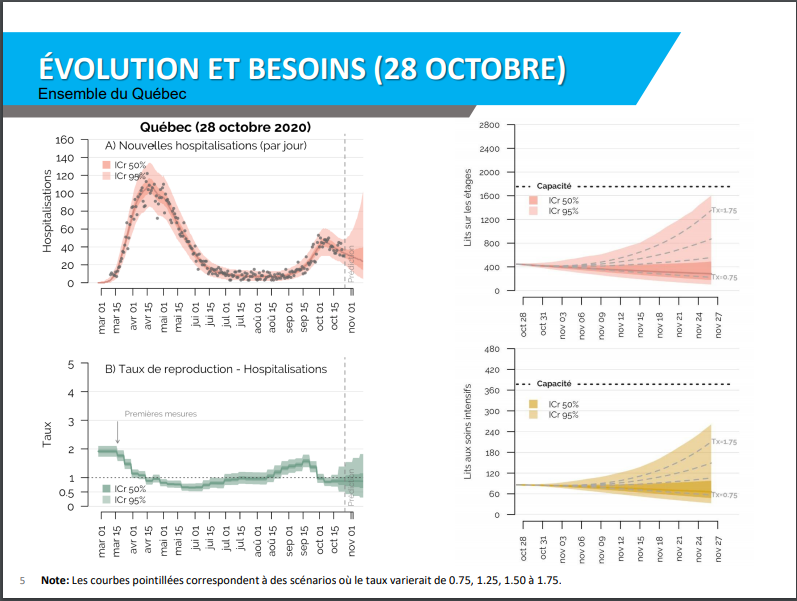
On the left is the history of Covid hospitalizations in Quebec to end of September.  Note admissions peaked in April around 120 per day, then dropped to 20 a day June to September.  A “second wave” was feared but the graph shows only a bump up to 50 mid October falling already.  As of Oct. 28, Quebec reported 439 people in hospital out of covid bed capacity of 1750.  In addition 88 were in ICUs out of a capacity of 380. At a 30/day new admissions rate, and assuming an average length of stay of 12 days, the net of covid beds occupied should not increase and more likely would go down.  So the projections on the right side have a wide range, but show declining numbers of Covid patients in hospital.  And as the lower right shows, demand for ICU capacity is is also expected to diminish.

On September 24, INESSS authorities said (here):

In Quebec, the hospitalization rate for COVID-19 patients has dropped sharply since the beginning of the pandemic. During the first wave, about 13 per cent of cases ended up in hospital. From Aug. 10 to Sept. 6, the rate was just 5 per cent. At a technical briefing on Wednesday, researchers and officials from Quebec’s institute of excellence in health and social services (INESSS) projected that the rate for COVID-19 patients in early September would fall again to 3.8 per cent.

The drop can be explained by the relative youth of Quebeckers contracting the virus in its second wave and their relative lack of comorbidities. By contrast, in the spring, the virus tore through long-term care homes in the province, killing 4,914 elderly residents.

As a result of this shift, Quebec will not exceed its hospital capacity of about 2,000 beds in the next four weeks, according to the INESSS projections. But officials warned that a faster spread of the virus caused by careless behaviour could still put pressure on the health care system.
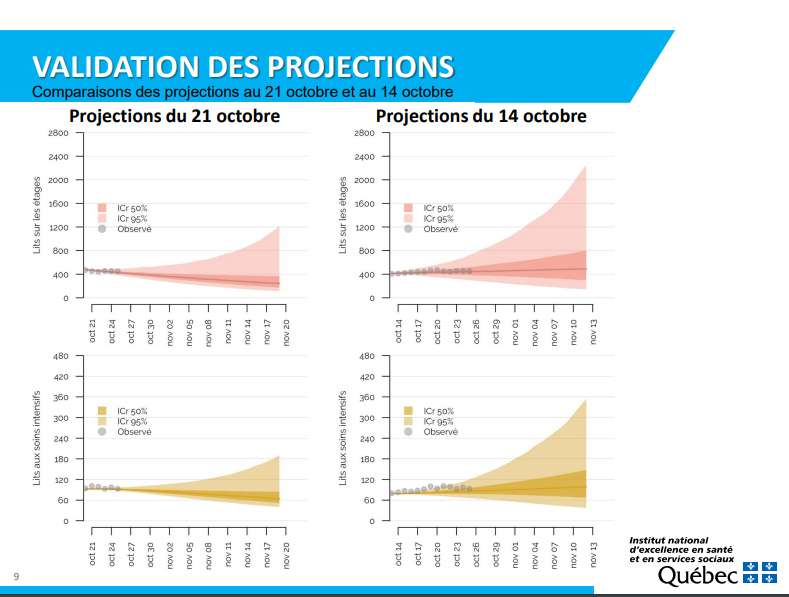
Above is the outlook for October from INESSS.  For both ICU and covid hospital beds observations are tracking a forecast showing slight increases.  It appears that the precautionary principle is being applied without regard for the costs of locking down: social, economic and personal well-being seem not to be part of the equation.

Quebec Situation Update October 1, 2020
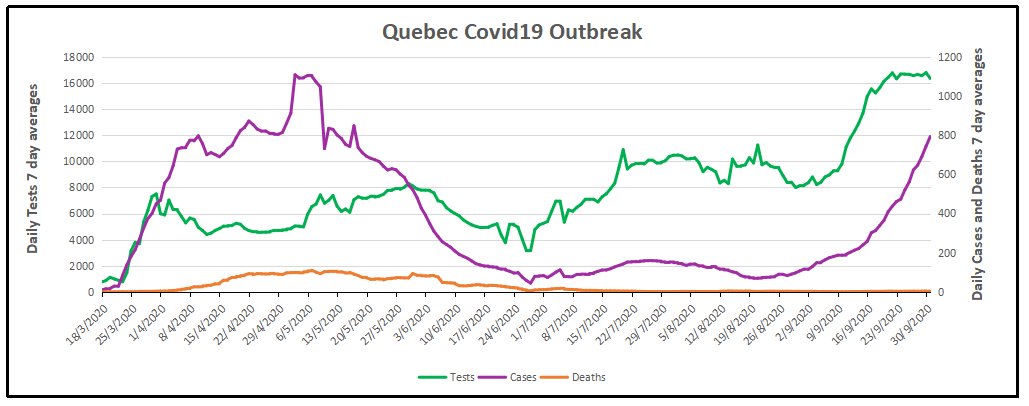
Note that testing has quadrupled since July and the number of new cases followed, especially in the last month.  Meanwhile daily deaths are unchanged at less than five a day, compared to Quebec losing 186 lives every day from all causes..  Recoveries are not reported to the public, perhaps due to the large number of people testing positive but without symptoms or only mild illness and no professional treatment.  The graph below estimates recoveries assuming that people not dying 28 days after a positive test can be counted as cured or in recovery.
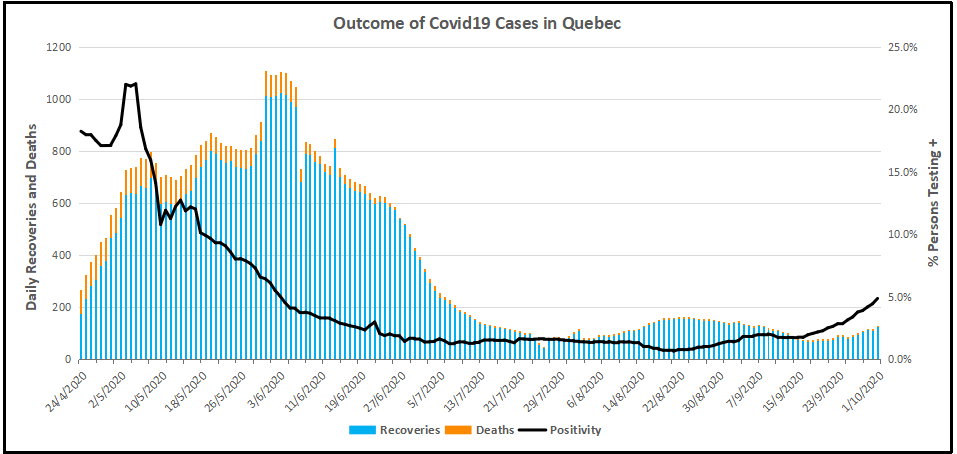
Recoveries are the number of people testing positive (misleadingly termed “cases”) minus deaths 28 days later.  Obviously, the death rate was high early on, and now is barely visible.  Meanwhile the Positivity rate (% of people testing positive out of all subjects) went down to 1% for several months before rising recently.  Since there is a lag of 28 days, we don’t yet see the outcome of the rise in positives along with the increased testing.

Summary

Premier Legault and his medical advisors had done well up to now. The first goal was to prevent deaths, and that has been achieved. 186 Quebecers die every day from all causes, and now about 5 are dying having tested positive for SARS CV2. The other goal was to prevent overwhelming the health care system with Covid cases. This too is under control. On October 1, there were 276 patients hospitalized with covid, plus 46 in ICUs. The capacity is 1750 beds and 370 ICU beds. Since July there have been about 20 new admissions daily, offset by recoveries released from hospital.

Unfortunately, now the authorities have spooked themselves and applied a lockdown at the wrong time. Their goal has shifted to stopping new positives, which have increased because testing has quadrupled and positivity rates gone up from 1% to 5%. These are younger people who are not getting sick and certainly not dying from the virus. As many epidemiologists have said, you won’t get rid of this virus, you live with it by getting herd immunity, which leaves too few susceptible people for the virus to spread. If you kill off all the PME businesses and put people out of work, poverty and social decay will kill people, not to mention the interruption of medical treatments which save those with the real deadly diseases: cancers, heart, arteries, lungs, and so on.

Arctic October Pent-up Ice Recovery

Some years ago reading a thread on global warming at WUWT, I was struck by one person’s comment: “I’m an actuary with limited knowledge of climate metrics, but it seems to me if you want to understand temperature changes, you should analyze the changes, not the temperatures.” That rang bells for me, and I applied that insight in a series of Temperature Trend Analysis studies of surface station temperature records. Those posts are available under this heading. Climate Compilation Part I Temperatures

This post seeks to understand Arctic Sea Ice fluctuations using a similar approach: Focusing on the rates of extent changes rather than the usual study of the ice extents themselves. Fortunately, Sea Ice Index (SII) from NOAA provides a suitable dataset for this project. As many know, SII relies on satellite passive microwave sensors to produce charts of Arctic Ice extents going back to 1979.  The current Version 3 has become more closely aligned with MASIE, the modern form of Naval ice charting in support of Arctic navigation. The SII User Guide is here.

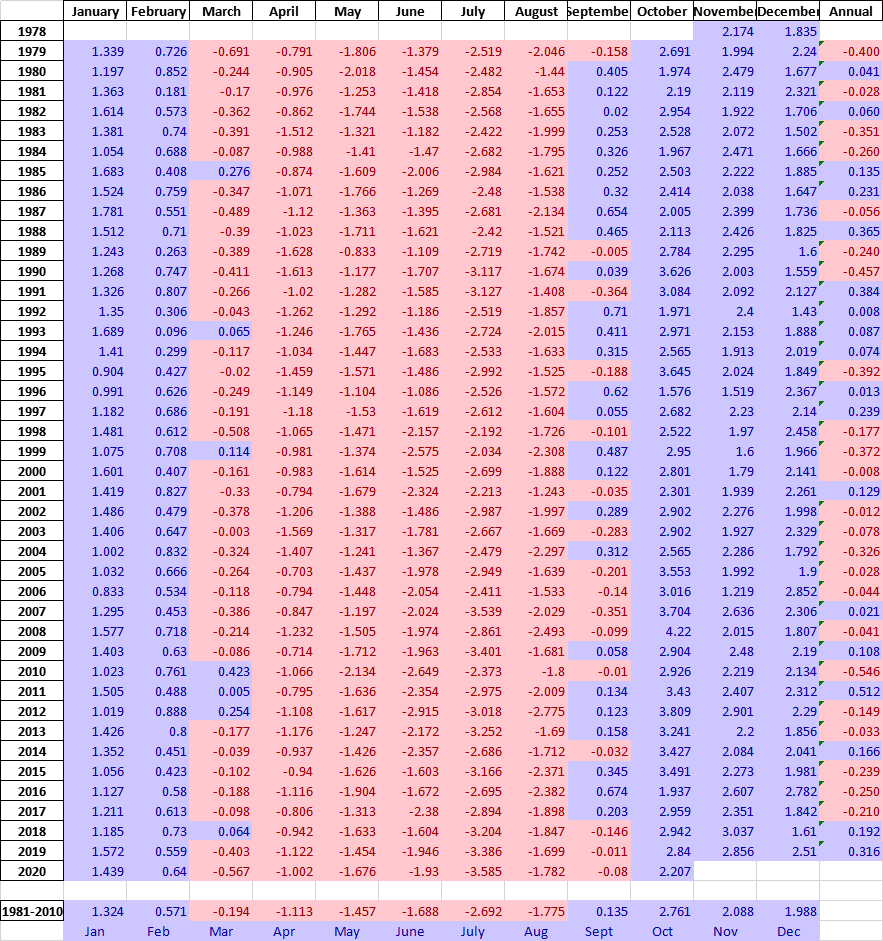
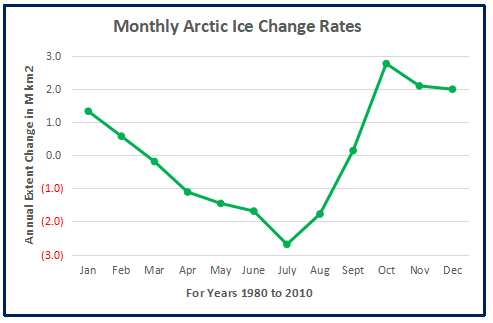
There are statistical analyses available, and the one of interest (table below) is called Sea Ice Index Rates of Change (here). As indicated by the title, this spreadsheet consists not of monthly extents, but changes of extents from the previous month. Specifically, a monthly value is calculated by subtracting the average of the last five days of the previous month from this month’s average of final five days. So the value presents the amount of ice gained or lost during the present month.

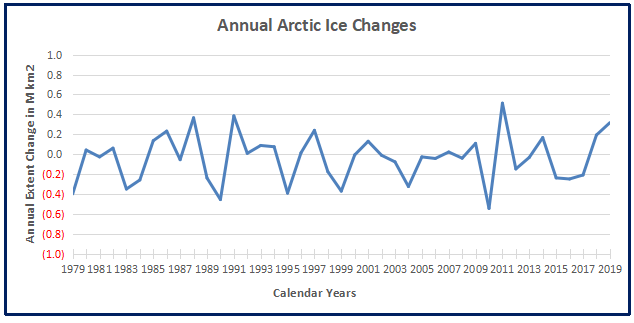
These monthly rates of change have been compiled into a baseline for the period 1980 to 2010, which shows the fluctuations of Arctic ice extents over the course of a calendar year. Below is a graph of those averages of monthly changes during the baseline period. Those familiar with Arctic Ice studies will not be surprised at the sine wave form. December end is a relatively neutral point in the cycle, midway between the September Minimum and March Maximum.

The graph makes evident the six spring/summer months of melting and the six autumn/winter months of freezing.  Note that June-August produce the bulk of losses, while October-December show the bulk of gains. Also the peak and valley months of March and September show very little change in extent from beginning to end.

The table of monthly data reveals the variability of ice extents over the last 4 decades.

Table 1 Monthly Arctic Ice rates of Extent Changes in M km2. Months with losses in pink, months with gains in blue.

The values in January show changes from the end of the previous December, and by summing twelve consecutive months we can calculate an annual rate of change for the years 1979 to 2019.

As many know, there has been a decline of Arctic ice extent over these 40 years, averaging 40k km2 per year. But year over year, the changes shift constantly between gains and losses.

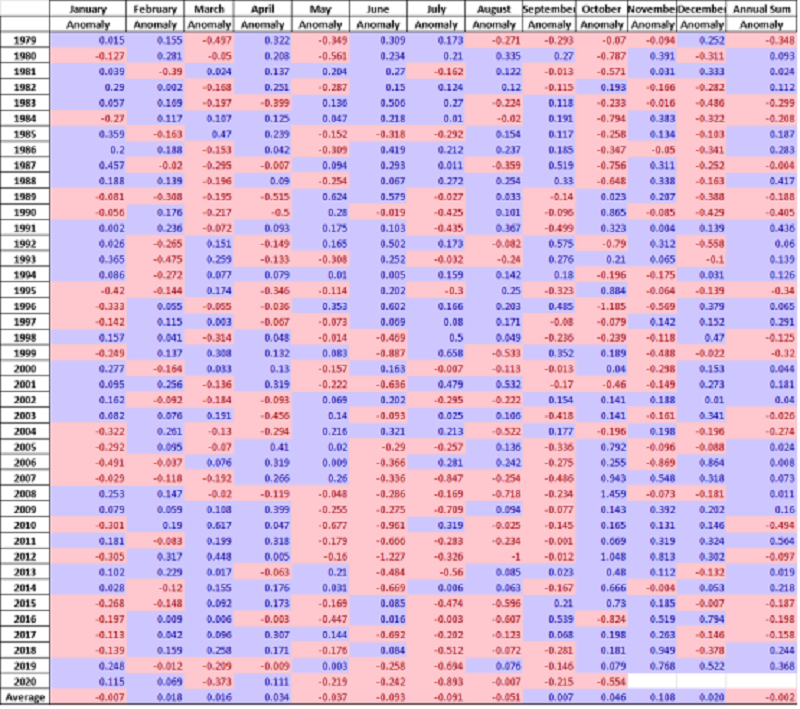
Moreover, it seems random as to which months are determinative for a given year. For example, much ado has been printed about October 2020 being slower than expected to refreeze and add ice extents. As it happens in this dataset, October has the highest rate of adding ice. The table below shows the variety of monthly rates in the record as anomalies from the 1980-2010 baseline. In this exhibit a red cell is a negative anomaly (less than baseline for that month) and blue is positive (higher than baseline).

Note that the  +/ –  rate anomalies are distributed all across the grid, sequences of different months in different years, with gains and losses offsetting one another.  Yes, October 2020 recorded a lower than average gain, but higher than 2016. The loss in July 2020 was the largest of the year, during the hot Siberian summer.  The bottom line presents the average anomalies for each month over the period 1979-2020.  Note the rates of gains and losses mostly offset, and the average of all months in the bottom right cell is virtually zero.

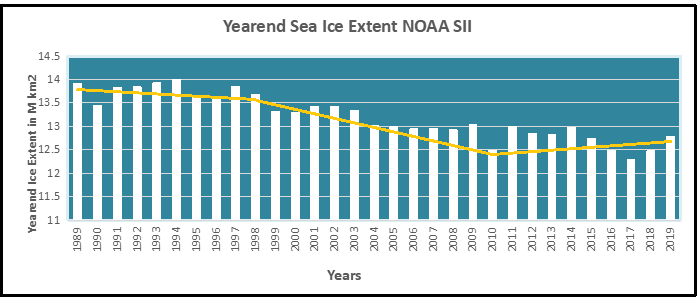
A final observation: The graph below shows the Yearend Arctic Ice Extents for the last 30 years.

Note: SII daily extents file does not provide complete values prior to 1988.

Year-end Arctic ice extents (last 5 days of December) show three distinct regimes: 1989-1998, 1998-2010, 2010-2019. The average year-end extent 1989-2010 is 13.4M km2. In the last decade, 2009 was 13.0M km2, and ten years later, 2019 was 12.8M km2. So for all the the fluctuations, the net loss was 200k km2, or 1.5%. Talk of an Arctic ice death spiral is fanciful.

These data show a noisy, highly variable natural phenomenon. Clearly, unpredictable factors are in play, principally water structure and circulation, atmospheric circulation regimes, and also incursions and storms. And in the longer view, today’s extents are not unusual.


Illustration by Eleanor Lutz shows Earth’s seasonal climate changes. If played in full screen, the four corners present views from top, bottom and sides. It is a visual representation of scientific datasets measuring Arctic ice extents.

Doctors of the World Unite Against Covid Tyranny

Doctors Uniting Around the World with Integrity and Right Action

More than 30,000 doctors and health care professionals have co-signed an Open letter published at the above website. Excerpts below in italics with my bolds. H/T Stephen Bird.  World Doctors Alliance:

An independent non-profit alliance of doctors, nurses, healthcare professionals and staff around the world who have united in the wake of the Covid-19 response chapter to share experiences with a view to ending all lockdowns and related damaging measures and to re-establish universal health determinance of psychological and physical wellbeing for all humanity. 

Open letter to the UK Government, Governments of the World and the Citizens of the World

We the undersigned call upon the UK government, governments of the World and the Citizens of the World, to stop all lockdown measures immediately.

Introduction

We were told initially that the premise for lockdown was to ‘flatten the curve’ and therefore protect the NHS from being overwhelmed.

It is clear that at no point was the National Health Service (NHS) in any danger of being overwhelmed, and since May 2020 covid wards have been largely empty; and crucially the death toll from covid has remained extremely low.

We now have hundreds of thousands of so-called ‘cases’, ‘infections’ and ‘positive tests’ but hardly any sick people. Recall that four fifths (80%) of ‘infections’ are asymptomatic (1) Covid wards have been by and large empty throughout June, July, August and September 2020. Most importantly covid deaths are at an all-time low. It is clear that these ‘cases’ are in fact not ‘cases’ but rather they are normal healthy people.

So-called asymptomatic cases have never in the history of respiratory disease been the driver for spread of infection. Rather it is symptomatic people who spread respiratory infections – not asymptomatic people.(2)

It is also abundantly clear that the ‘pandemic’ is basically over and has been since June 2020. (3)

We have very highly likely reached herd immunity and therefore have no need for a vaccine.

We have safe and very effective treatments and preventative treatments for covid, we therefore call for an immediate end to all lockdown measures, social distancing, mask wearing, testing of healthy individuals, track and trace, immunity passports, the vaccination program and so on.

There has been a catalogue of unscientific, non-sensical policies enacted which infringe our inalienable rights, such as – freedom of movement, freedom of speech and freedom of assembly. These draconian totalitarian measures must never be repeated.

Lockdown

Covid has proved less deadly than previous influenza seasons – There were 50,100 flu deaths from December 2017 to March 2018 in England and Wales. There were 80,000 flu deaths in 1969. To date we have circa 42,000 covid related deaths in the UK.

We have never locked down society for a respiratory virus before.

The basis for lockdown was a mathematical model by Professor Neil Ferguson. His modelling which predicted half a million deaths in the UK has been roundly condemned as being not fit for purpose. His estimated death figures were clearly wrong by a factor of 10 or 12 times. (1)

Professor Ferguson’s modelling was not even peer reviewed before being acted upon by several nations. Eminent epidemiologists such as Professor Gupta from Oxford University were ignored, they estimated the death count would be far lower in the UK.

Professor Ferguson has a long track record of woeful modelling he was entirely wrong about sars, mers, mad cow’s disease (CJD), and swine flu. Why did the world listen to him again? (2)

Countries which did not lock down Sweden, Japan, Taiwan, South Korea and Belarus have all done significantly better than us in terms of percentage of population deaths. They also have herd immunity and intact economies.

Lockdown did not save lives, and this has been published in the Lancet ‘….in our analysis, full lockdowns and wide-spread COVID-19 testing were not associated with reductions in the number of critical cases or overall mortality.’ (3)

The vast majority of deaths occurred in elderly and very elderly people

The vast majority of deaths occurred in people with pre-existing serious health issues such as cancer, cardiovascular disease, Alzheimer’s, diabetes etc

Covid poses virtually zero risk to the under 45’s who have more chance of being struck by lightning than dying from covid.

Covid poses a very small risk for healthy under 60 year olds who have a greater chance of accidental drowning than dying from covid.

The entire nation was essentially placed under house arrest. We have never isolated the healthy before.

Isolating the sick and those who are immunocompromised makes sense. Isolating the healthy has hampered the establishment of herd immunity and makes no sense.

To put it into perspective we had 115,000 smoking related deaths in the UK in 2015 compared to the 42,000 deaths from covid.

We usually have around 600,000 deaths every year in the UK, roughly 1600 deaths per day.

Collateral Damage: The Cure is Worse than the Virus

Placing the public under virtual house arrest has caused untold damage to both physical and mental health.(1)

Ventilating patients instead of oxygenating patients proved to be a deadly policy and an unwarranted failure. Ventilation resulted in many unnecessary deaths. (2)

Sending infected people from hospitals to care homes placed the elderly and frail under unnecessary risk and resulted in many unnecessary deaths. (3)

Blanket Do Not Resuscitate (DNR) orders were imposed on thousands of people without their consent nor the consent of their families – this is both unlawful and immoral and lead to unnecessary deaths in care homes. (4)

Hospitals became essentially ‘covid only’ centres vast numbers of patients were wilfully neglected, resulting in many thousands of unnecessary deaths. (5)

The government’s own report estimates that some two hundred thousand (200,000) people will die as a direct result of lockdown – not the virus. Hospitals being closed, suicide and poverty will result in more deaths than the virus. (6)

The cure is worse than the disease!

[Other Topics covered in the declaration include:

  • Death Certificates
  • Economic Ruin
  • Censorship
  • Testing–False Positives
  • Hydroxychloroquine
  • Prevention
  • Vaccine
  • Conflicts of Interest
  • Cui Bono?  Who Benefits?
Conclusion

We have effective and safe treatments and preventative medications for covid, therefore there is no need for any lockdown restrictions and associated measures. The pandemic is essentially over as can be seen by the consistent low death rate and hospital admissions over the past four months.

We demand the immediate and permanent ceasing of all lockdown measures.

Lockdowns do not save lives, that is why they have never been used before. Civil liberties and fundamental freedoms have been unnecessarily removed from the public and this must never happen again.

Preventative measures such as Hydroxychloroquine, vitamin C, Vitamin D and zinc must be made readily available to the public.

Isolation must be voluntary. People are perfectly capable of making their own assessment of the risks and must be free to go about their lives as they so choose. People must have the right to choose whether to isolate or not.

Likewise, businesses must have the right to remain open if they so choose.

We demand that doctors, nurses, scientists and healthcare professionals must be permitted free speech and never be censored again.

Professor Mark Woolhouse epidemiologist and specialist in infectious diseases, Edinburgh University Member of the Scientific Pandemic Influenza Group on Behaviours, that advises the Government stated that –

‘…Lockdown was a monumental disaster on a global scale. The cure was worse than the disease.’

‘I never want to see national lockdown again. It was always a temporary measure that simply delayed the stage of the epidemic we see now. It was never going to change anything fundamentally, however low we drove down the number of cases,’

‘We absolutely should never return to a position where children cannot play or go to school.’

I believe the harm lockdown is doing to our education, health care access, and broader aspects of our economy and society will turn out to be at least as great as the harm done by Covid-19.’(1)

The World Doctors Alliance agree fully with Prof Woolhouse’s assertions, he is right! We must never lockdown again!


Florida Covid Winding Down

H/T Tom Woods

Virus hysterics smashed in 3 charts (thanks, Scott Atlas)

Many were wishing the worst upon Florida for opening up to normal life on September 26, but the charts below show how wise were Governor DeSantis and Floridians and how foolish are the lockdown fanatics.

First, here are COVID-19 hospitalization rates by age and month. The first section is for ages 0-44, the second for 45-64, and the third for 65+. The percentages for each group come down pretty consistently, as you can see:

Second, here are hospitalizations over time. Notice that the blue section, which represents COVID hospitalizations, is smaller or stable as you move into the future:

And finally, here’s Florida deaths with Covid by date of death:

Yes, there was a wave in July and August and a few weeks where daily deaths exceeded 200.  But the loss of life has declined steadily to the present.  For context, note that in 2019, there were 567 recorded deaths daily in Florida from all causes.


Covid Cause/Effect Fallacy

Jeffrey A. Tucker writes at AIER American Institute for Economic Research Do the Disease Eradicators Make an Elementary Logical Mistake? Excerpts in italics with my bolds.

I’ve rarely seen it put so bluntly as I have in a recent BBC interview with epidemiologist Paul Elliott. However, I have begun to suspect that this error has crept into the thinking of the lockdowners over the course of the summer.

It seems that certain disease experts genuinely believe that they can game the reproduction rate of the virus to get it below 1, and thereby create a mathematical result that will make the virus go away.

This seems to be their goal and the metric by which they measure whether and to what extent they have achieved it. The problem is that the reproduction rate (very difficult to discern precisely) is an effect – a measurement of an evolved condition – not a cause.

At first it seems crazy that such an elementary logical fallacy could be at the heart of the lockdown ideology. This faulty presumption puts public health officials in the position of being central planners for the whole population, governing how close we get to each other, who we meet and when, where we go, taking control of the whole of our interactions and the whole of our bodies as well, as if they are our owners.

They speak as if they have every confidence that this can happen, and then, like magic, the virus, lacking hosts, goes into deep retirement and leaves everyone alone.  If this sounds like common sense, it is not. So far as I know, this is the first time in the history of the world that anything like this has been attempted.

Is there any virus epidemic in the history of the world in which public health officials successfully manipulated the human population in a way that drives down the infection rate and thereby deletes the pathogen from its presence among us? If it did not entirely go away – and it will not and cannot – wouldn’t the central planners have to lock down every generation in the future too?

The way the infection rate has traditionally been reduced in history is the only way it can be reduced, namely through the achievement of herd immunity, whether through acquired natural immunity or a vaccine (one can learn about this in Cell Biology for Dummies). The virus does not disappear. It becomes endemic; that is, predictable and manageable in every generation.

I asked an old-school epidemiologist about whether there is a simple logical error connected with whether coercive reduction of the R naught is even possible. He confirmed what I had come to suspect: it’s all based on a fallacy that mixes up cause and effect.

Yes, when herd immunity is reached, the R value can eventually be measured to observe that each person infects fewer than 1 other person and it falls and falls until the bug becomes endemic. But you can’t game it in the other direction, forcing an effect to bring about the cause.

Similarly, you can’t scatter leaves on the ground to cause the fall to arrive, or put up sun lamps on snow to speed up the summer.  Can the whole error here really be that simple? Perhaps so. [Note:  Nor can you remove CO2 to lower air temperatures, or raise CO2 to heat the oceans.]

A seemingly simple mistake can have astonishingly radical implications. If you really believe that experts can bludgeon the R naught to determine the fate of a pathogen, all bets are off. There can be no more freedom or rights for anyone.

We see this in economics all the time. During recessions, aggregate demand falls; if we boost aggregate demand, the recession ends: this is the core claim of Keynesian countercyclical policy. We saw this happen in 2008. The fall in real estate prices was regarded as a cause rather than an effect; therefore the goal of policy became to raise them and make the downturn go away.

It’s the same with price controls. People believe that if we can only suppress price levels we make the results of monetary expansion vanish.

Trying to bludgeon effects into existence in order to blot out causes is a conventional mistake within the social sciences, and, apparently among certain naive disease suppressors too.

Is it possible that the same mistake has gone viral in the epidemiological profession?

Footnote: 

In an email sent to Newsweek, one of the petitions co-authors, Dr. Martin Kulldorff wrote, “We are very pleased with the reception that the Great Barrington Declaration has received, with over 75,000 co-signers in less than two days, including over 3,000 Medical and Public Health Scientists and over 4,000 Medical Practitioners.”

“We are not advocating a ‘herd immunity strategy.’ Herd immunity is not a strategy, but a scientifically proven phenomena, just like gravity.

And you would not say that an airplane pilot is using a ‘gravity strategy’ to land a plane. No matter what strategy is used, we will reach herd immunity sooner or later, just as an airplane will reach the ground one way or another,” Kulldorff’s email said. “The key is to minimize the number of deaths until we reach herd immunity and that is what the Great Barrington Declaration is about.”

Footnote from John Tamny:

Along these lines, Holman Jenkins at the Wall Street Journal has reported that the CDC’s website has long indicated that everyone would eventually be infected. AIER’s researchers are merely acknowledging this known. Let people live freely so that the inevitable can be moved up on the way to immunity. If so, broad immunity will reduce the risk for the old who are seen as most at risk.

Crucial about this is that no one is forced to join the “herd.” Those fearful of coming into contact with the infected should be free to isolate themselves accordingly. This includes Paul Krugman.

Freedom is always the answer, including freedom to not join the herd. That’s the view of the great people at AIER. Unknown is why this bothers so many on the left, not to mention why what’s timeless bothers them. It seems they enjoy forcing their values on others, and more than that, they positively revel in being told what to do.

See also: Herd Immunity: Not If But When

Jimbob Does Coronavirus

Covid-19, the Perfect Hobgoblin

Donald J. Boudreaux writes at AIER, American Institute of Economic Research Why So Gullible About Government in the Face of Covid-19? Excerpts in italics with my bolds and images.

Unwarranted Faith

Among the most frustrating features of the pro-lockdown argument is the blind faith that those who make it place in the politicians who issue the orders and oversee the enforcement. This frustration is hyper-charged when such faith is displayed by classical liberals and libertarians, who normally understand that politicians and their hirelings have neither the knowledge nor the incentives to be trusted with much power. Yet in the face of Covid, executive-branch government officials are assumed somehow to become sufficiently informed and trustworthy to exercise the unbounded discretionary power – that is, the arbitrary power – required to prohibit vast swathes of normal human interaction ranging from the commercial through the educational to the personal (such as prohibiting family gatherings above a certain size).

Why this faith? The proffered answer, of course, is that Covid-19 is unusually dangerous and, therefore, we have no choice but to put faith in government officials. This answer is bizarre, for it insists that we must now trust with unprecedented power people who regularly act in ways that prove them to be unworthy to hold lesser amounts of power. My head explodes….

Moving on, and without pausing to explore just what is meant here by “unusually,” let’s grant that Covid-19 is indeed unusually dangerous. But also unusually dangerous is arbitrary government power. Is it unreasonable for those of us who fear this power to require that proponents of lockdowns meet a higher standard of persuasion before we accede to the exercise of such power? Given that the initial spark for the lockdowns, at least in the United Kingdom and the United States, was Neil Ferguson’s suspect and widely criticized Imperial Model – a model, recall, offered by a man with an awful record of dramatically exaggerating the likely mortality rates of diseases – is it unreasonable to demand that much stronger evidence be offered before we turn silent as governments continue massively to interrupt normal life?

If you’re tempted to answer these questions in the affirmative, recognize that there’s at least one important difference between pathogens and power – a difference that should be, but isn’t, taken into consideration by pro-lockdowners. The difference is this: Population immunity, either through a pathogen’s natural spread or through a vaccine, will at some point significantly reduce that pathogen’s danger;

In contrast, for protection against government power there is no population immunity or vaccine.

When such power expands, the ratchet effect documented by Robert Higgs ensures that that power remains more elevated and widespread than before.  Unlike pathogens, government power continues to nourish itself as it grows into an ever-greater danger. Quaking at the very thought of Covid while discounting the danger that lurks in the immense expansions of government power done in the name of fighting Covid is wholly unreasonable.

Where’s the Perspective?

Several of Café Hayek’s commenters and my email correspondents push back against anti-lockdown arguments by observing that ordinary people support lockdowns because they don’t wish to die, to become severely ill, or to have their loved ones stricken with Covid. This observation is accurate – as is an accompanying observation that Covid is spread from person to person. But as an argument for lockdowns it’s without merit, for it begs several questions.

How many lives are actually saved, on net, by the lockdowns? Obviously, the Covid-induced expansions of government power are not justified if the net number of lives saved is small. And remember, against the lives saved by lockdowns must be counted the lives lost because of the lockdowns – lives lost to suicide, to the reduced health and safety that comes from lower income, and from the failure to diagnose and treat non-Covid illnesses.

Yet those who insist that the desire not to be killed by Covid justifies the lockdowns largely ignore these questions and trade-offs.

It would be as if a sincerely expressed desire not to be killed as a pedestrian by an automobile were taken as justification to prohibit automobiles. Such a prohibition would result in approximately 6,000 fewer pedestrians in America being killed annually by automobiles – itself alone an undeniably happy result. Yet would such a prohibition be justified by this objective fact? Would your answer change if someone with a superficial familiarity with economics declares that the danger posed to pedestrians by automobile traffic is a “negative externality”?

And whose lives are being saved by the lockdowns and for how long? I’m baffled by the ongoing failure in the public discussion to recognize that Covid kills mostly very old or sick people, and is practically of no danger to people under the age of 50. This reality alone should utterly discredit the case for locking down entire economies and life events. (Note, by the way, that I write this essay as a 62-year-old.) Not only does Covid pose no real – and much less no unusual – danger to most people, the group of persons to whom Covid does pose an unusual danger is easily identified.

As the Great Barrington Declaration sensibly argues, preventive efforts should be focused on helping this (relatively small) group of vulnerable persons.

Keeping them isolated or otherwise protected from the coronavirus simply does not require the vast majority of the population to be locked down, “socially distanced” from each other, or saddled with other restrictions. In fact, as the Declaration’s authors note, by delaying population immunity, lockdowns likely increase the long-term threat to old and sick people.

Public Panic

It’s no good response to note that the general public is panicked by Covid. This panic is indeed real. It explains why the public isn’t more resistant to the lockdowns. But this panic does not justify the lockdowns.

Consider: The risk in America of being killed by terrorism is, as Bryan Caplan describes it, “microscopic.” Between 1970 and 2012 the chance that an American would, in any one year, be done in by terrorism was 1 in 4 million – much less than half the chance of being killed by a home appliance. Yet the 9/11-sparked panic over terrorism has resulted in a permanent increase in efforts to protect Americans from this virtual non-threat.

How much prosperity – including increased health and safety – are we failing to produce because we now waste billions of dollars worth of resources on protection from this minuscule risk? Too much.

And don’t forget that government’s response to 9/11 also includes America’s seemingly permanent war stance in the Middle East and a scaling up of government’s violation of our privacy. How much of our freedom has been permanently lost because of excessive fear of terrorism? Much too much.

Rather than accept as given the public’s irrational fear of terrorism, the far better course is to stop stoking this fear and, instead, to calm it by broadcasting accurate information about terrorism’s relative risks. (Aren’t we constantly told that one of the core functions of government is to produce and spread accurate information as a “public good?”) The spread of better information would prompt the public to demand better policies.

The same must be said about Covid. Tamping down the Covid hysteria by making available accurate information about this disease is what well-informed and public-spirited governments would do. Yet such governments are largely mythical. Real-world governments behave quite differently. Most governments, in the U.S. and elsewhere, chose – and continue to choose – a course precisely the opposite of what ‘good’ governments would choose. The reason, alas, isn’t mysterious:

As H.L. Mencken observed, “The whole aim of practical politics is to keep the populace alarmed (and hence clamorous to be led to safety) by menacing it with an endless series of hobgoblins, all of them imaginary.”

Covid-19 is the perfect hobgoblin. And while its dangers are not imaginary, their degree and impact certainly are. Governments’ failure to ensure that their citizens are accurately informed about Covid is itself sufficient reason to distrust governments with the powers they’ve seized over the course of this hellish year.

Climate Hysteria Not Grounded in Science

The iconic Metronome clock in New York City was repurposed as an 80-foot-wide climate clock that shows our remaining time to take urgent action on climate change. (photo credit: BEN WOLF)

Glenn T. Stanton writes at The Federalist New Data Shows Climate Change Hysteria Isn’t Grounded In Science.  Excerpts in italics with my bolds.

While we must steward the planet God has gifted to us, there is no empirical basis for apocalyptic predictions of impending doom.

The “Climate Clock” looms ten stories above Manhattan’s Union Square so all passersby can track the precise moment the world passes its supposed tipping-point toward irreversible, apocalyptic environmental demise. This clock has that moment of doom pegged at a little more than seven years from today. One of the men who created the clock, artist Gan Golan, said his motivation for the project was the birth of his daughter two years ago.

“This is arguably the most important number in the world,” the team explained to The New York Times, adding, “You can’t argue with science, you just have to reckon with it.” And that is where the problem lies with the environmental doom and gloom — you can absolutely argue with science. That is precisely what the scientific method is: the careful, relentless discipline of skepticism and discovery. It’s testing and questioning what others claim is beyond debate.

How many times was Doomsday predicted but failed to happen at midnight.

Nine leading climate scientists from Germany, France, Finland, and Ireland have, indeed, questioned whether anyone can reliably determine how much time remains between now and an irreversible trajectory toward environmental ruin.

Drawing from 36 different meta-analyses on the question, involving more than 4,600 individual studies spanning the last 45 years, their findings were recently published in the journal Nature Ecology and Evolution. They conclude that the empirical data doesn’t allow scientists to establish ecological thresholds or tipping points. As natural bio-systems are dynamic, ever-evolving, and adapting over the long-term, determining longevity timeframes is currently impossible.

These scholars write that frankly, “we lack systematic quantitative evidence as to whether empirical data allow definitions of such thresholds” and “our results thus question the pervasive presence of threshold concepts” in environmental politics and policy. Their findings also reinforced the contention that “global change biology needs to abandon the general expectation that system properties allow defining thresholds as a way to manage nature under global change.”

Professor José M. Montoya, one of the nine authors and an ecologist at the Theoretical and Experimental Ecology Station in France, told the French National Center for Scientific Research “many ecologists have long had this intuition” that setting reliable, empirically situated tipping-points “was difficult to verify until now for lack of sufficient computing power to carry out a wide-ranging analysis.” But that has now changed.

So no, there is no reliable science behind the new seven-years-to-the-point-of-no-return countdown of the Climate Clock in Union Square, nor for Rep. Alexandria Ocasio-Cortez’s infamous “The world is going to end in 12 years if we don’t act now” scare, or Thunberg’s just-10-years-til-inevitable-doom drum pounding. Such claims simply do not — and cannot — be firmly grounded in any scientific knowledge we currently possess.

Evidence for this conclusion, however, goes beyond the aforementioned conclusive new study. 2020 saw the publication of two extremely important books from leading, mainstream environmental-climate scholars on what science says about the earth’s future.

The first is Michael Shellenberger, a Time magazine “Hero of the environment” who explains in his book “Apocalypse Never: Why Environmental Alarmism Hurts Us All” that nearly every piece of scare data presented by the likes of AOC, Leonardo DiCaprio, and Thunberg is not only incorrect but tells a story that is the opposite of the scientific truth. Not only is the world not going to end due to climate change, but in many important ways, the environment is getting markedly better.

Another major environmentalist voice challenging hysteria is Bjorn Lomborg of the Copenhagen Consensus Center think tank, listed by the UK’s liberal Guardian newspaper as one of the 50 people who could save the planet. In his book “False Alarm,” he explains how “climate change panic” is not only unfounded, it’s also wasting trillions of dollars globally, hurting the poor, and failing to fix the very problems it warns us about.

So, what science genuinely telling us? “Science shows us that fears of a climate apocalypse are unfounded.” Lomborg explains, admitting that while “global warming is real … it is not the end of the world.” “It is a manageable problem” he adds. He is dismayed that we live in a world “where almost half the population believes climate change will extinguish humanity” and do so under the mistaken assumption that science concludes this. It doesn’t, and he is vexed this mantra parades under the banner of enlightenment.

It’s imperative we properly steward this beautiful planet God has gifted to us. It was the second command He gave to humanity, after the charge to populate it with generation after generation of new people. But hysteria is not what is called for in this work. Shellenberger, Lomborg, and these nine other international ecologists tell us that not only is there no empirical basis for the apocalyptic prognostications so needlessly disturbing the dreams of the world’s young people.

See also:  Tipping Points Confuse Social and Earth Science

  This is your brain on CO2 hysteria. Just say no!


Arctic Sea Ice Linked to Little Ice Age

The Dutch artist Hendrick Avercamp painted winter activity on the ice during the first half of the 17th century, when it was quite cold in Central and Northern Europe. (Image: Henrik Avercamp / Wikimedia Commons)

Elise Kjørstad writes at Science Norway What actually started the Little Ice Age? Excerpts in italics with my bolds.

It all may have started with sea ice, and the changes may have happened all by themselves without the influence of volcanoes or the Sun, researchers behind a new study say.


The ninth century seems to have experienced a warmer climate, which has been called the Medieval Warm Period.

But from the 14th century things were different. It rained “without stopping” in 1315, and grain didn’t ripen. The situation was much the same the following year. Later in the 14th century there were several episodes of wild weather and cold periods.

The Little Ice Age can be divided into two phases, according to an article in The New Yorker. It began with a cooling period in 1300 – 1400. The coldest period was from the end of the 1500s to 1850.

This cooling caused glaciers to expand in Scandinavia, the Alps, in Iceland, Alaska, China, in the southern Andes and in New Zealand.

Generally speaking, the Little Ice Age is said to have begun because of an increase in volcanism and reduced activity of the Sun.

“The timing agrees quite well with the great eruptions from the 13th century. So there is good empirical evidence that this could be true,” said Martin Miles, a researcher at NORCE Norwegian Research Centre, and the Bjerknes Centre for Climate Research in Bergen, and at the University of Colorado at Boulder in the USA.

But in a new study, Miles and his colleagues have looked at another possibility.

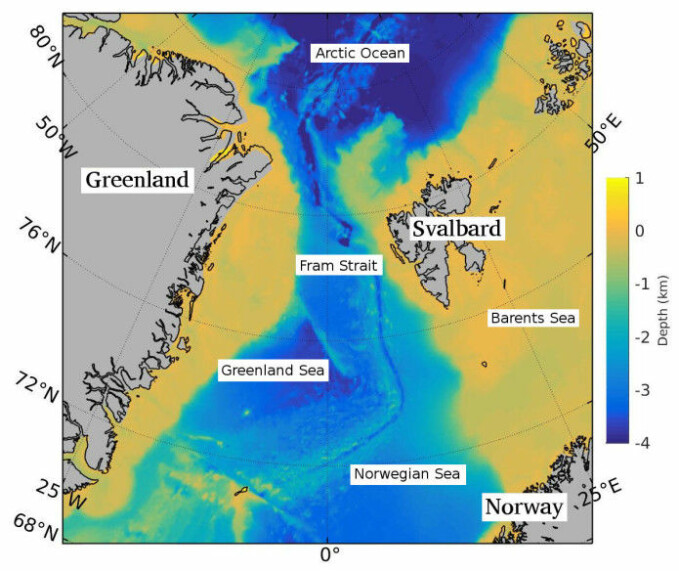
The strait between Greenland and Svalbard is the only deep connection between the Arctic Ocean and the world’s oceans. (Image: Bdushaw / CC BY-SA 3.0 / Wikimedia Commons)

Lots of ice on the go

In their new study, Miles and his colleagues looked at the transport of sea ice from the Arctic over a 1400 year period.

They compiled data from seabed samples from areas outside Greenland, the eastern part of the Fram Strait, the Greenland Sea and off Iceland. The samples contained small fossils that give researchers information about sea temperatures and loose material that sea ice had carried with it.

In several of these areas, ice will only be found if there is an especially large amount flowing out of the Arctic Ocean. This is particularly true during cold periods and when there is also a lot of sea ice formation.

“We discovered that an unusually large amount of sea ice flowed out of the Arctic Ocean from the beginning of the 14th century. It is very interesting, and the biggest event we found during the last 1400 years,” says Miles.

Can’t explain everything

Miles says sea ice may have affected the climate in Europe in the 14th century in this way.

The ice that melts and turns into fresh water can affect ocean currents, which in turn affect the atmosphere and climate, he says.

“Ocean currents are very important for transporting heat to Europe. If the currents weaken a little, it will be much colder than usual,” he said.

Sea ice is not only a reaction to climate change, but can also trigger climate change, Miles says.

The paper is Evidence for extreme export of Arctic sea ice leading the abrupt onset of the Little Ice Age  Martin W. Miles et. al. (2020).

Abstract

Arctic sea ice affects climate on seasonal to decadal time scales, and models suggest that sea ice is essential for longer anomalies such as the Little Ice Age. However, empirical evidence is fragmentary. Here, we reconstruct sea ice exported from the Arctic Ocean over the past 1400 years, using a spatial network of proxy records. We find robust evidence for extreme export of sea ice commencing abruptly around 1300 CE and terminating in the late 1300s. The exceptional magnitude and duration of this “Great Sea-Ice Anomaly” was previously unknown. The pulse of ice along East Greenland resulted in downstream increases in polar waters and ocean stratification, culminating ~1400 CE and sustained during subsequent centuries. While consistent with external forcing theories, the onset and development are notably similar to modeled spontaneous abrupt cooling enhanced by sea-ice feedbacks. These results provide evidence that marked climate changes may not require an external trigger.

Background Post with Supporting Information
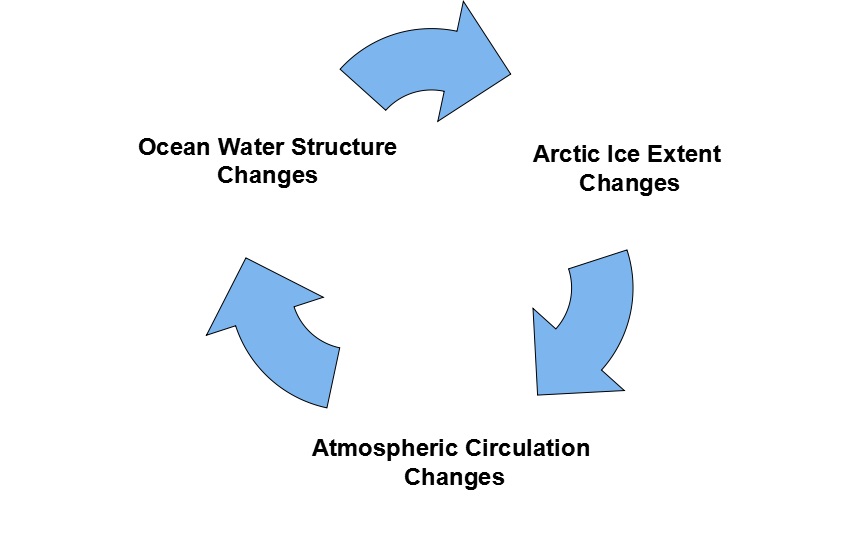
The Climate System is Self-Oscillating: Sea Ice Proves It.

Scientists have studied the Arctic for a long time at the prestigious AARI: Arctic and Antarctic Research Institute St. Petersburg, Russia. V. F. Zakharov has published a complete description supported by research findings under this title: Sea Ice In the Climate System A Russian View (here)

Below I provide excerpts from this extensive analysis to form a synopsis of their view: Component parts of the climate system interact so that Arctic Sea Ice varies within a range constrained by those internal forces.

Self-Oscillating Sea Ice System

Self-Oscillating Sea Ice System

The most probable regulator of the physical geographical process can be found from analysis of the relationships between the components of the climate system. It is not necessary to investigate the cause-effect relationships between all these components in succession. It is sufficient to choose one of them, let us say sea ice, and consider its direct interaction with the atmosphere and the ocean – in the climate system and the significance of internal mechanisms in the natural process. Pg 1

The idea that the ice area growth at present can be achieved by changes in only the haline structure of the upper ocean layer, as a result of surface Arctic water overflowing onto warmer but more saline water, is supported both by calculations and empirical data. Pg. 46

First of all, it should be noted that the signs of temperature and salinity anomalies coincide in most cases: a decreased salinity corresponds to enhanced temperature and vice versa. Such similarity in the change of these parameters is impossible to explain from the point of view of the governing role of thermal conditions in the atmosphere with regard to the ocean, as the air temperature increase and decrease can result only in the change of the thermal state of sea surface layer not its salinity. Pgs. 48-49

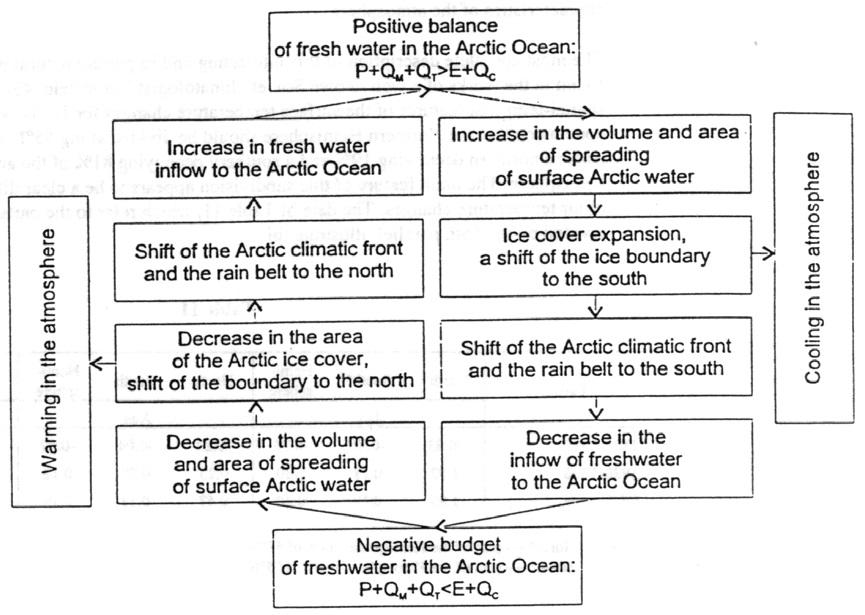
Thus, the presented facts suggest that the most significant cause of changes in the ice cover extent are the changes in the vertical water structure in the upper ocean layer, rather than the changes of thermal conditions in the atmosphere. These changes are induced by fluctuations in the horizontal dimensions of the halocline, which are governed in turn by the expansion or reduction of the surface Arctic water mass. Pg. 49

It follows from the above that, under present day conditions, the changes in the area of the Arctic sea ice during the colder period of the year can be induced only by the change in the haline structure of the upper ocean layer. Indirectly, this change will also affect the thermal state of the atmosphere. Pg. 56

It is important to note that the ice effect on the atmosphere is not limited to the thermal effect. That it can produce a significant effect on atmospheric circulation is already evident from the fact that the Arctic anticyclone, considered by Viese [13] as a regulator of atmospheric processes in the Northern polar region, could form as a pressure formation only in the conditions of the ice regime in the Arctic. Pg. 56


Zacharov fig.24

Zakharov fig.24

An analysis of cause-effect relationships does not leave any doubt in what direction and in what order the climate signal propagates in the atmosphere-ocean-polar ice system. This is not the direction and order usually assumed to cause present climate change. When it has become clear that the changes in the ocean, caused by disturbances of its freshwater balance, precede changes in the extent of sea ice, and the latter the changes in the atmosphere, then there was nothing left but for us to acknowledge self oscillation to be the most probable explanation for the development of the natural process. Pg. 58

Maybe the most convincing evidence of the Arctic sea ice stability is its preservation during the last 700,000 years despite vast glacial- interglacial fluctuations. The surface air temperature in the Arctic during the interglacial periods was higher by several degrees than present day temperatures. Pg. 44

Conclusion:

The remarkable stability of our planetary climate system derives from feedbacks between internal parts of the system, providing the oscillations we observe as natural variability. Arctic Sea Ice is a prime example. Bottom line:  A bit less ice in the Arctic indicates that we are not yet slipping into an ice age, little or otherwise. 

See also The Great Arctic Ice Exchange

Figure 4.12. Mean resulting ice-drift pattern for summer (a) and winter (b) during the warm epoch and the difference between ice-drift vectors during the warm and cold epochs for summer (c) and winter (d).

HCQ is effective for COVID-19 when used early (118 studies)

Article is HCQ is effective for COVID-19 when used early: analysis of 118 studies.  Excerpts in italics with my bolds.

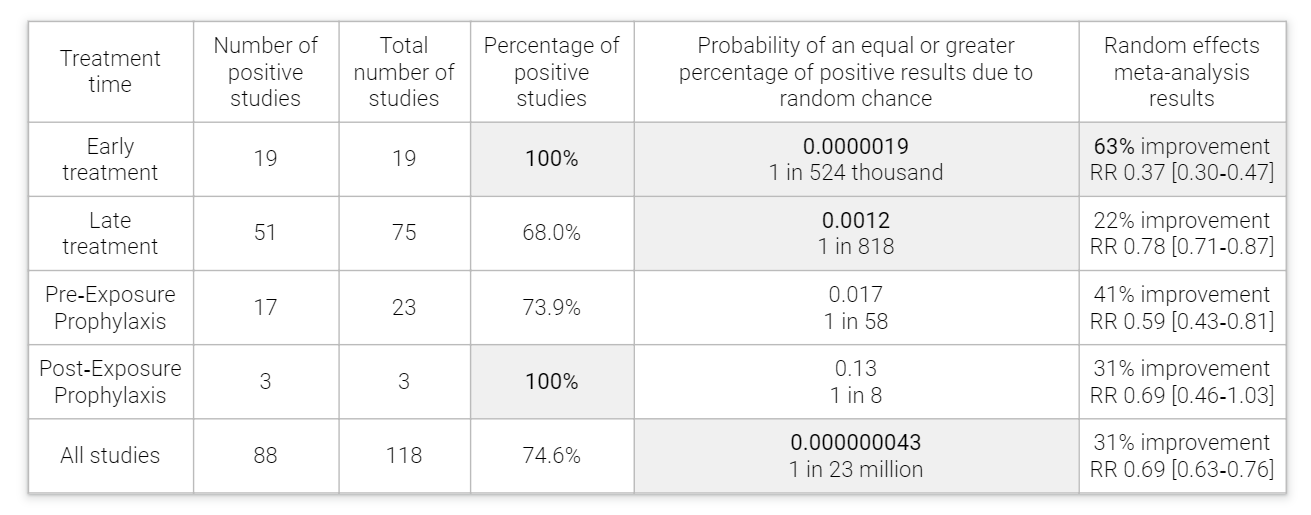
HCQ is an effective treatment for COVID-19. The probability that an ineffective treatment generated results as positive as the 118 studies to date is estimated to be 1 in 23 million (p = 0.000000043).

Early treatment is most successful, with 100% of studies reporting a positive effect and an estimated reduction of 63% in the effect measured (death, hospitalization, etc.) using a random effects meta-analysis, RR 0.37 [0.30-0.47].
100% of Randomized Controlled Trials (RCTs) for early, PrEP, or PEP treatment report positive effects, the probability of this happening for an ineffective treatment is 0.002.
•There is evidence of bias towards publishing negative results. Significantly more retrospective studies report negative results compared to prospective studies, p = 0.04.
•Significantly more studies in North America report negative results compared to the rest of the world, p = 0.002.

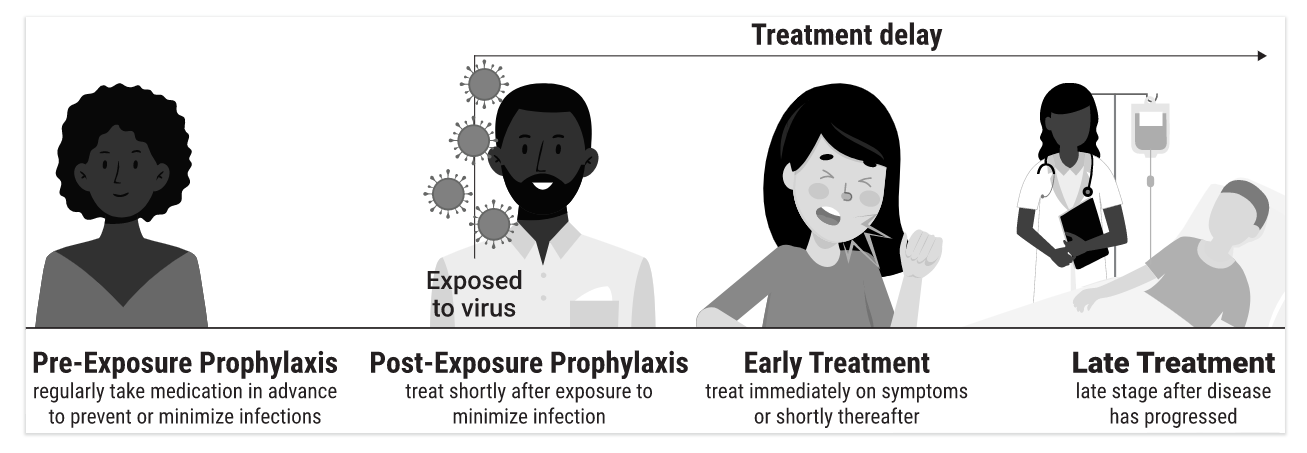
Figure 2: Treatment stages.

Figure 2 shows stages of possible treatment for COVID-19. Pre-Exposure Prophylaxis (PrEP) refers to regularly taking medication before being infected, in order to prevent or minimize infection. In Post-Exposure Prophylaxis (PEP), medication is taken after exposure but before symptoms appear. Early Treatment refers to treatment immediately or soon after symptoms appear, while Late Treatment refers to more delayed treatment.

Table 1. Results by treatment stage. 2 studies report results for a subset with early treatment, these are not included in the overall results.

Publication bias. Publishing is often biased towards positive results, which we would need to adjust for when analyzing the percentage of positive results. Studies that require less effort are considered to be more susceptible to publication bias. Prospective trials that involve significant effort are likely to be published regardless of the result, while retrospective studies are more likely to exhibit bias. For example, researchers may perform preliminary analysis with minimal effort and the results may influence their decision to continue. Retrospective studies also provide more opportunities for the specifics of data extraction and adjustments to influence results.

For HCQ, 87.5% of prospective studies report positive effects, compared to 69.8% of retrospective studies, two-tailed z test 2.07, p = 0.04, indicating a bias toward publishing negative results.

The lack of bias towards positive results is not very surprising. Both negative and positive results are very important given the current use of HCQ for COVID-19 around the world, evidence of which can be found in the studies analyzed here, government protocols, and news reports, for example [AFP, AfricaFeeds, Africanews, Afrik.com, Al Arabia, Al-bab, Anadolu Agency, Anadolu Agency (B), Archyde, Barron’s, Barron’s (B), BBC, Belayneh, A., CBS News, Challenge, Dr. Goldin, Efecto Cocuyo, Expats.cz, Face 2 Face Africa, France 24, France 24 (B), Franceinfo, Global Times, Government of China, Government of India, GulfInsider, Le Nouvel Afrik, LifeSiteNews, Medical World Nigeria, Medical Xpress, Medical Xpress (B), Middle East Eye, Ministerstva Zdravotnictví, Morocco World News, Mosaique Guinee, Nigeria News World, NPR News, Oneindia, Pan African Medical Journal, Parola, Pilot News, Pleno.News, Q Costa Rica, Rathi, Russian Government, Teller Report, The Africa Report, The Australian, The BL, The East African, The Guardian, The Indian Express, The Moscow Times, The North Africa Post, The Tico Times, Ukraine Ministry of Health Care, Ukrinform, Vanguard, Voice of America].

We also note a bias towards publishing negative results by certain journals and press organizations, with scientists reporting difficulty publishing positive results [Boulware, Meneguesso]. Although 88 studies show positive results, The New York Times, for example, has only written articles for studies that claim HCQ is not effective [The New York Times, The New York Times (B), The New York Times (C)]. As of September 10, 2020, The New York Times still claims that there is clear evidence that HCQ is not effective for COVID-19 [The New York Times (D)]. As of October 9, 2020, the United States National Institutes of Health still recommends against HCQ for both hospitalized and non-hospitalized patients [United States National Institutes of Health].

Treatment details. We focus here on the question of whether HCQ is effective or not for COVID-19. Significant differences exist based on treatment stage, with early treatment showing the greatest effectiveness. 100% of early treatment studies report a positive effect, with an estimated reduction of 63% in the effect measured (death, hospitalization, etc.) in the random effects meta-analysis, RR 0.37 [0.30-0.47]. Many factors are likely to influence the degree of effectiveness, including the dosing regimen, concomitant medications such as zinc or azithromycin, precise treatment delay, the initial viral load of patients, and current patient conditions.

News website Panorama.it has launched a petition to get the drug hydroxychloroquine officially reinstated so that Italian doctors can once again use it with patients. If not, some of them will go ahead and use it anyway. The retracted Lancet study and trials using lethal doses(!) of HCQ were enough to get it officially banned in Italy as in other countries. Except the Italian Medicines Agency (AIFA) has not yet reapproved it, despite studies showing its effectiveness. Here are excerpts of the Change.org petition translated from Italian:

At the moment there are no treatments of proven effectiveness to be administered at home. Because the only therapy that AIFA (Italy’s Medicines Agency) had authorized at home, the one based on hydroxychloroquine, has been blocked. It happened on May 26, after the publication of a study in The Lancet, which was withdrawn 13 days later.

Meanwhile, German GPs, who had administered 1,060,000 doses of hydroxychloroquine in March, continued to prescribe it. In the United States, three states lifted the ban on the drug in early August. In China, on August 19, the National Health Commission’s guidelines continued to recommend the active ingredient for Covid 19 patients. And on September 21, The Lancet itself retraced its steps, with a study claiming that hydroxychloroquine reduces mortality.

In order to save lives, we ask AIFA to restore the use of hydroxychloroquine for home patients in the very early stages of the disease, possibly even with an emergency procedure. Otherwise, we invite the Agency to provide shared protocols of treatment practicable in the territory.


Truth and Lies about HCQ Covid Regimen


Dr. Vladimir (Zev) Zelenko writes at The Internet Protocol Choose Truth and Choose Life.  Excerpts in italics with my bolds.

Before Twitter bans it, let me say that we DO NOT need to wait for a vaccine to begin safely and effectively treating Americans. Hydroxychloroquine and other medicines are cheap, safe, and available NOW.

Truth stands the test of time. We are currently engaged in World War III with over 210 countries fighting the same invisible enemy. Regardless of the root causes of the Covid-19 pandemic, the world’s response to this crisis is killing more people than the actual virus. In this response, I see powerful and methodical groups colluding to obstruct the flow of life-saving information and medication. Let me explain.

In early March, I was forced by circumstance to treat my patients with Covid-19 in the out-patient setting. With divine providence, research and a battlefield medicine approach of trial and error, I developed a highly-effective out-patient treatment now referred to as “The Zelenko Protocol.” There are three key components to this protocol: First, risk stratify patients. That is, identify high-risk patients who have a 5%-10% chance of dying from Covid-19. Second, start treatment within the first five days of the onset of symptoms based on clinical suspicion. Yes, perform PCR testing, but don’t withhold treatment pending results. Third, use a three-drug regimen of Zinc, Hydroxychlorochine (HCQ) and Azithromycin. This out-patient, pre-hospital treatment protocol shows an 84% reduction in hospitalization and death if properly followed.

The rationale for risk stratification is because the Covid-19 virus disproportionately harms and kills patients older than 60, and younger patients who have comorbidities such as diabetes, high blood pressure, cancer, heart disease, etc.

The rationale for immediate treatment is because the viral load in a patient remains relatively constant during the first few days of the infection. This is when a patient has mild-flu like symptoms. After five days of having symptoms, however, the Covid-19 virus begins to replicate at an exponential rate. Based on my team’s and my treatment of thousands of patients, it is clear that after five days of symptoms most high-risk patients begin to develop devastating complications such as catastrophic lung injury and blood clots. Therefore, high-risk patients must be treated immediately based on clinical suspicion of Covid-19. Waiting to go to the doctor, or waiting for the results of confirmatory testing before starting treatment, is the very essence of the problem and leads to many unnecessary hospital admissions and deaths.

Therefore, all the studies related to the efficacy of HCQ that were performed on hospitalized and critically-ill patients either missed the boat or were intentionally designed to fail.

The rationale for the three-drug regimen turns out to be elegant and simple. Covid-19 is an RNA virus that enters the cell and hijacks the cell’s resources to replicate itself. Zinc blocks RNA viral replication by inhibiting the function of RNA Dependent RNA Polymerase (RDRP). However, Zinc is a positive cation in solution, it therefore has difficulty crossing through the cell membrane’s phospholipid bilayer to get into the cytoplasm and to inhibit the virus’ replication.

HCQ is a Zinc ionophore, which opens a channel in the cell membrane’s phospholipid bilayer and transports the Zinc into the cell’s cytoplasm where it is able to attack the virus. In other words, both Zinc and HCQ are required in order to kill the virus.

Therefore, all the studies that were performed with HCQ but without Zinc either missed the boat or were intentionally designed to fail.

Azithromycin is a well known and safe antibiotic and most likely prevents the patient from developing secondary opportunistic pneumonia. It has recently been reported that Azithromycin may have antiviral properties as well.

The three drug regimen included in “The Zelenko Protocol” may be administered orally, at home, and costs approximately $20 for the entire treatment. Since April, I have continued to adjust certain aspects of this treatment protocol based on real-world results because I believe that the sanctity of life and the art of medicine requires constant tailoring to find the right treatment for each individual. Please see the comprehensive guide to “The Zelenko Protocol.”

The negative propaganda regarding HCQ and “The Zelenko Protocol” and the fraudulent or poorly designed studies released since this pandemic began have resulted in thousands of unnecessary global deaths from Covid-19. As of 7:50 PM EST on October 15, 2020 there are 1,094,979 recorded deaths from Covid-19. (Source: WHO, CDC, ECDC, NHC) A vast majority of these could have been easily avoided with timely treatment with this three-drug regimen.

The false narrative regarding HCQ has nefariously demonized this life-saving medication. The false safety concerns regarding HCQ have created global panic among patients, physicians, and governments. The truth is that HCQ is one of the safest medications in the world. It has been used by millions of patients for 65 years in the treatment of malaria, malaria prophylaxis, and several rheumatological diseases. It is also given to pregnant women, nursing mothers, and children.

According to Dr. Harvey Risch M.D. PHD, from the Yale School of Medicine, studies from around the world overwhelmingly and statistically prove that early treatment of high-risk patients with HCQ and Zinc works. However, the studies that are used to demonize HCQ, The Zelenko Protocol and other treatment regimens, are seriously flawed and were designed to fail. For example: the Lancet study was retracted for fraud. The Recovery Trial sponsored by Oxford used lethal doses of HCQ. The Veterans Administration study from Virginia used only critically ill and hospitalized patients on respirators. This is just to mention a few.

As everyone knows, the lockdown response to the Covid-19 pandemic has been catastrophic on many levels. The collateral damage of societal closure has resulted in a drastic increase in suicide rates, and a pandemic of child and spousal abuse. Many chronic illnesses and general patient care have been neglected due to people’s lack of access to routine care. The worldwide economic devastation has psychologically traumatized our societies and has sent thousands of families into poverty and businesses into bankruptcy. And the long term consequences of these lockdowns are not yet fully apparent.

My interest is to save lives and end the pandemic, right now. This may easily be accomplished if governments act in the best interests of their people. This means encouraging doctors and patients to treat Covid-19 immediately, making the medications readily available, and removing any governmental obstacles to the use of these medications.

The forces that oppose HCQ and “The Zelenko Protocol” are powerful and numerous: some politicians seeking power for their party if the economy continues into a tailspin; big-pharma executives seeking profit from their expensive medications and vaccines; the WHO pushing its agenda in line with the interests of its funding sources; anarchists seeking anarchy; just to mention a few.

But truth will stand the test of time. In the meanwhile, perhaps if the politicians, big-pharma executives and everyone else were to remember that each of us, including the old and those with comorbidities, are made in the image of God and that life has sanctity, then perhaps thousands more won’t needlessly have to die while the truth struggles to set itself free.

See also HCQ Hit Job by Big Pharma Data Miners