Arctic Ice Exceeds 10 Wadhams Mid. Nov. 2021
 

Arctic Ice Extent reaching 10 million km2 is a milestone marking recovery of half the ice lost last spring and summer.  Each year the max extent is ~15M km2 and the mid-September min is ~5M km2.  This year in just two months the ice gained back half the ice lost in the six months prior to mid September.  The metric 1 Wadham = 1Mkm2 ice extent is in recognition of the professor who declared the Arctic would be ice-free before 2011, by which he meant less than 1M km2 extent.

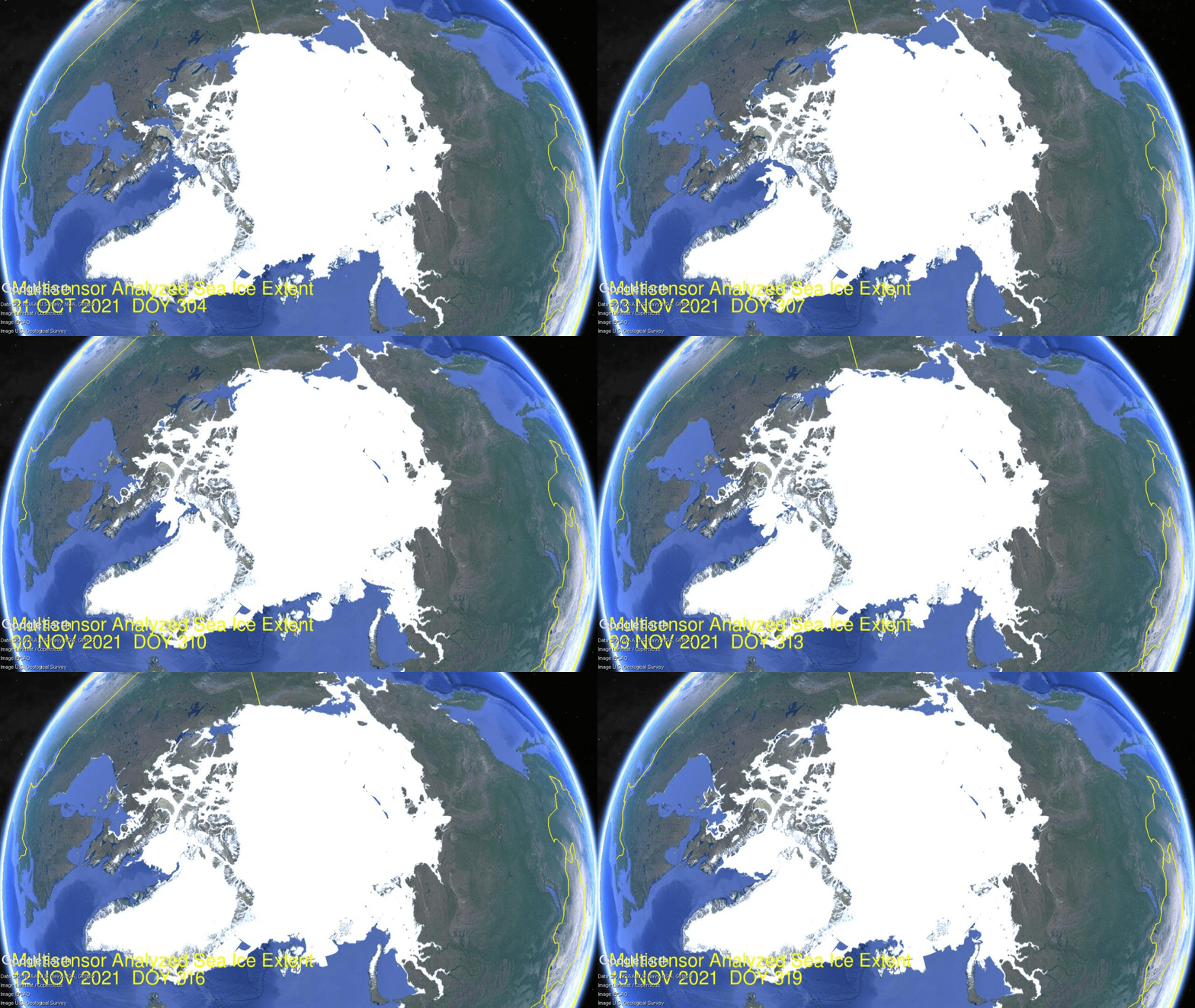
The animation shows Arctic ice extents this year for the last two weeks, from day 304 (Oct. 31) to day 319 (Nov. 15). Note on the right side, the Russian shelf seas (from top:  East Siberian, Laptev, Kara) were already ice covered.  At top center, Chukchi adds 200k km2 to reach 90% of max last March. Top left, Beaufort sea fills in to 98% of its March max. Center left is Canadian Arctic Archipelago adding 267k km2 to reach 96% of its max. Lower left shows Baffin Bay and Gulf of St. Lawrence adding 400k km2 up to 67% of its max. .At the bottom center Barents Sea grows 231k km2 to reach 63% of its max.

The graph below shows Oct./Nov. daily ice extents for 2021 compared to 14 year averages, and some years of note:

The black line shows during this period on average Arctic ice extents increase ~3.5M km2 from ~6.3M km2 up to ~9.8M km2.  The 2021 cyan MASIE line started the period ~400k km2 above average and on day 319 retained a surplus of ~380k km2.  The Sea Ice Index in orange (SII from NOAA) started with the same deficit, then lagged behind in the first two weeks, before ending ~200k km2 lower than MASIE (no data yet for yesterday). 2019 and 2020 were well below average at this stage of the ice recovery.

Why is this important?  All the claims of global climate emergency depend on dangerously higher temperatures, lower sea ice, and rising sea levels.  The lack of additional warming is documented in a post Adios, Global Warming

The lack of acceleration in sea levels along coastlines has been discussed also.  See USCS Warnings of Coastal Flooding

Also, a longer term perspective is informative:
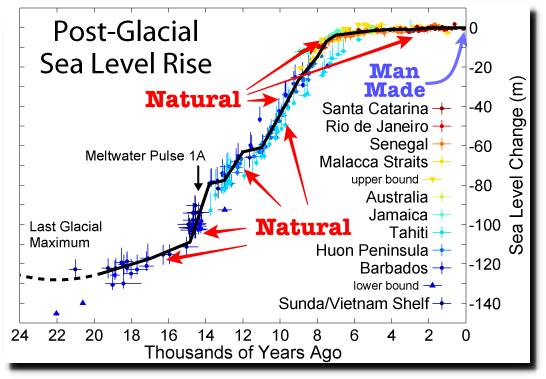
post-glacial_sea_levelThe table below shows the distribution of Sea Ice on day 304 across the Arctic Regions, on average, this year and 2020.

Region 2021319 Day 319 Average 2021-Ave. 2020319 2021-2020
 (0) Northern_Hemisphere 10136298 9754986 381313 9171330 964968
 (1) Beaufort_Sea 1052365 1064248 -11883 1068490 -16125
 (2) Chukchi_Sea 868672 614315 254357 539677 328995
 (3) East_Siberian_Sea 1087137 1073635 13503 1078789 8349
 (4) Laptev_Sea 897827 897084 743 889358 8468
 (5) Kara_Sea 711109 637483 73626 450888 260220
 (6) Barents_Sea 286732 145188 141544 15590 271142
 (7) Greenland_Sea 404108 466229 -62120 502768 -98659
 (8) Baffin_Bay_Gulf_of_St._Lawrence 511295 532632 -21337 446719 64575
 (9) Canadian_Archipelago 824385 852284 -27899 854597 -30212
 (10) Hudson_Bay 155801 248736 -92935 256849 -101047
 (11) Central_Arctic 3216117 3168700 47417 3046118 169999

The overall surplus to average is 381k km2, (4%).  Note large surpluses of ice in Chukchi, Barents and Kara Seas, as well as Central Arctic. The main deficits to average are in Greenland Sea and Hudson Bay, the latter being a shallow basin that will freeze over quickly once it starts.  Note that 2021 ice extent exceeds that of 2020 by nearly a full Wadham,  most of the difference being in Chukchi, Kara, Barents and Central Arctic.

bathymetric_map_arctic_ocean

Illustration by Eleanor Lutz shows Earth’s seasonal climate changes. If played in full screen, the four corners present views from top, bottom and sides. It is a visual representation of scientific datasets measuring Arctic ice extents.
Arctic Ice Abounds October 2021


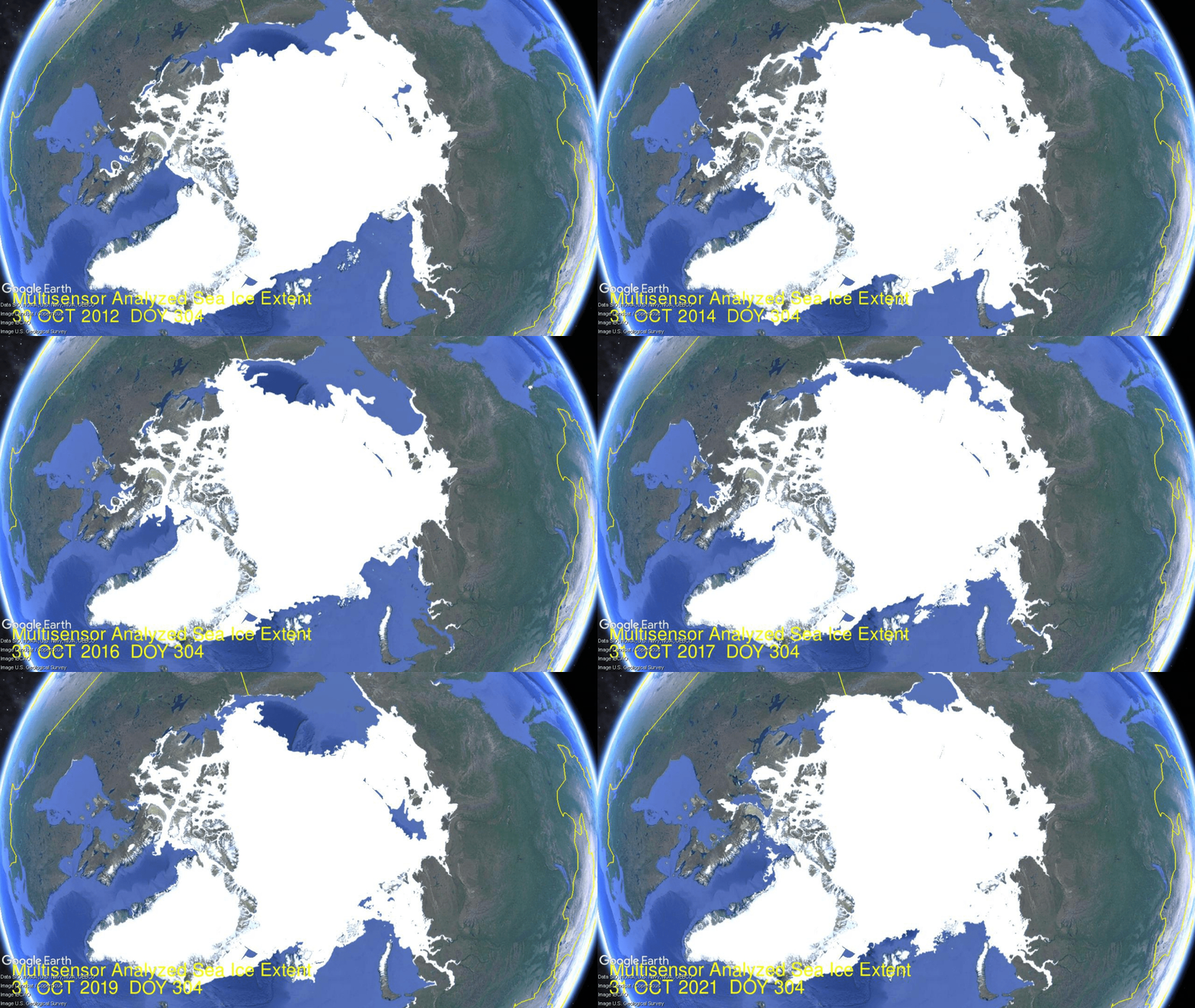
The animation shows Arctic ice extents on day 304 (end of October) for the years 2012 through yesterday 2021.  Note the variability from year to year on the CanAm (left side) with the Beaufort Sea at the top, Canadian Archipelago center left, and Baffin Bay, lower left between Greenland and Newfoundland. More noticeable are the Russian shelf seas fluctuations on the right side.  Some years, like 2020, there is still open water, but this year those seas are frozen over, including from the top Chukchi, East Siberian, Laptev, and Kara Seas down to bottom right.

The graph below shows October daily ice extents for 2021 compared to 14 year averages, and some years of note.

The black line shows during October on average Arctic ice extents increase ~3.4M km2 from ~4.9M km2 up to ~8.3M km2.  The 2021 cyan MASIE line started the month ~500k km2 above average and on day 304 retained a surplus of ~160k km2.  The Sea Ice Index in orange (SII from NOAA) started with the same deficit, then lagged behind in the last two weeks, before ending ~100k km2 lower than MASIE. 2019 and 2020 were well below average at this stage of the ice recovery.

Why is this important?  All the claims of global climate emergency depend on dangerously higher temperatures, lower sea ice, and rising sea levels.  The lack of additional warming is documented in a post Adios, Global Warming

The lack of acceleration in sea levels along coastlines has been discussed also.  See USCS Warnings of Coastal Flooding

Also, a longer term perspective is informative:

post-glacial_sea_levelThe table below shows the distribution of Sea Ice on day 304 across the Arctic Regions, on average, this year and 2020.

Region 2021304 Day 304 Average 2021-Ave. 2020304 2021-2020
 (0) Northern_Hemisphere 8528046 8369146 158900 6954249 1573797
 (1) Beaufort_Sea 982244 946489 35755 1044967 -62723
 (2) Chukchi_Sea 659384 436299 223085 369981 289403
 (3) East_Siberian_Sea 1086959 909416 177543 373761 713197
 (4) Laptev_Sea 894716 831110 63606 283776 610940
 (5) Kara_Sea 626536 444754 181781 269583 356952
 (6) Barents_Sea 55711 77133 -21422 14206 41505
 (7) Greenland_Sea 360759 415579 -54820 463525 -102766
 (8) Baffin_Bay_Gulf_of_St._Lawrence 107176 269121 -161945 232788 -125611
 (9) Canadian_Archipelago 557042 788762 -231720 802238 -245196
 (10) Hudson_Bay 5061 82352 -77292 73773 -68712
 (11) Central_Arctic 3160959 3158164 2794 3023876 137083

The overall surplus to average is 159k km2, (2%).  Note large surpluses of ice in BCE (Beaufort, Chukchi and East Siberian seas).  as well as in Laptev and Kara on the Russian coast. The main deficits to average are in Baffin Bay and CAA, more than offset by surpluses elsewhere. Note that 2021 ice extent exceeds that of 2020 by 1.6M km2, most of the difference being in East Siberian, Laptev and Kara Seas.

bathymetric_map_arctic_ocean

Illustration by Eleanor Lutz shows Earth’s seasonal climate changes. If played in full screen, the four corners present views from top, bottom and sides. It is a visual representation of scientific datasets measuring Arctic ice extents.

Arctic Ice Already Exceeds Six Wadhams

The images above come from MASIE showing ice extents starting day 266, the lowest daily extent in 2021. Over the last 18 days, Arctic ice has grown by 1 Wadham (1M km2) to now exceed 6 Wadhams, about 276k km2 greater than the 14-year average for day 284. At the bottom center Barents Sea ice reaches out to Iceland.  Svalbard bottom right becomes encircled by ice.  East Siberian Sea top right has ice connecting to the shore. Top center Beaufort and Chukchi seas are also adding ice rapidly.

The ice recovery since September minimum is shown in the graph below.

Day 260 was the 14 year average annual daily minimum at 4.39m km2. MASIE 2021 was 776k km2 above average, and SII was 427k km2 lower than MASIE.  Note that 2007, 2019 and 2020 weere much lower than average throughout the period. SII is again tracking MASIE since day 274.

Region 2021284 Day 284 Average 2021-Ave. 2007284 2021-2007
 (0) Northern_Hemisphere 6010191 5733557 276634 5134886 875305
 (1) Beaufort_Sea 787643 662884 124759 718210 69433
 (2) Chukchi_Sea 547815 242829 304986 60352 487463
 (3) East_Siberian_Sea 571575 434918 136657 311 571265
 (4) Laptev_Sea 164089 298559 -134470 409211 -245122
 (5) Kara_Sea 110917 80208 30710 128294 -17377
 (6) Barents_Sea 18 26816 -26797 14013 -13995
 (7) Greenland_Sea 221491 318518 -97027 423939 -202449
 (8) Baffin_Bay_Gulf_of_St._Lawrence 53199 77124 -23925 84058 -30859
 (9) Canadian_Archipelago 474565 531008 -56443 444876 29689
 (10) Hudson_Bay 119 9213 -9093 1936 -1817
 (11) Central_Arctic 3077617 3050338 27279 2848411 229206

The main deficits to average are in Laptev and Greenland Seas, and CA, offset by surpluses elsewhere, especially in BCE (Beaufort, Chukchi, East Siberian seas).

The Bigger Picture 

We have passed the annual Arctic ice extent minimum, which typically occurs on or about day 260 (mid September). Some take any year’s slightly lower minimum as proof that Arctic ice is dying, but the image above shows the Arctic heart is beating clear and strong.

Over this decade, the Arctic ice minimum has not declined, but since 2007 looks like fluctuations around a plateau. By mid-September, all the peripheral seas have turned to water, and the residual ice shows up in a few places. The table below indicates where ice is found in September. Numbers are area units of Mkm2 (millions of square kilometers).

Day 260 14 year
Arctic Regions 2007 2010 2012 2014 2015 2017 2018 2019 2020 2021 Average
Central Arctic Sea 2.67 3.16 2.64 2.98 2.93 3.07 2.91 2.97 2.50 2.95 2.90
BCE 0.50 1.08 0.31 1.38 0.89 0.84 1.16 0.46 0.65 1.55 0.89
LKB 0.29 0.24 0.02 0.19 0.05 0.26 0.02 0.11 0.01 0.13 0.16
Greenland & CAA 0.56 0.41 0.41 0.55 0.46 0.52 0.41 0.36 0.59 0.50 0.46
B&H Bays 0.03 0.03 0.02 0.02 0.10 0.07 0.05 0.01 0.02 0.04 0.04
NH Total 4.05 4.91 3.40 5.13 4.44 4.76 4.56 3.91 3.77 5.17 4.48

The table includes some early years of note along with the last 5 years compared to the 14 year average for five contiguous arctic regions. BCE (Beaufort, Chukchi and East Siberian) on the Asian side are quite variable as the largest source of ice other than the Central Arctic itself.   Greenland Sea and CAA (Canadian Arctic Archipelago) together hold almost 0.5M km2 of ice at annual minimum, fairly consistently.  LKB are the European seas of Laptev, Kara and Barents, a smaller source of ice, but a difference maker some years, as Laptev was in 2016.  Baffin and Hudson Bays are inconsequential as of day 260.

2021 stands out from lower ice years by the higher extents in Central Arctic, BCE and LKB, especially Kara Sea this year.

Resources:  Climate Compilation II Arctic Sea Ice

Arctic Ice In Perspective 2021

With Arctic ice melting season winding down, warmists will again stoke fears about ice disappearing in the North. In fact, the pattern of Arctic ice seen in historical perspective is not alarming. People are over-thinking and over-analyzing Arctic Ice extents, and getting wrapped around the axle (or should I say axis).  So let’s keep it simple and we can all readily understand what is happening up North.

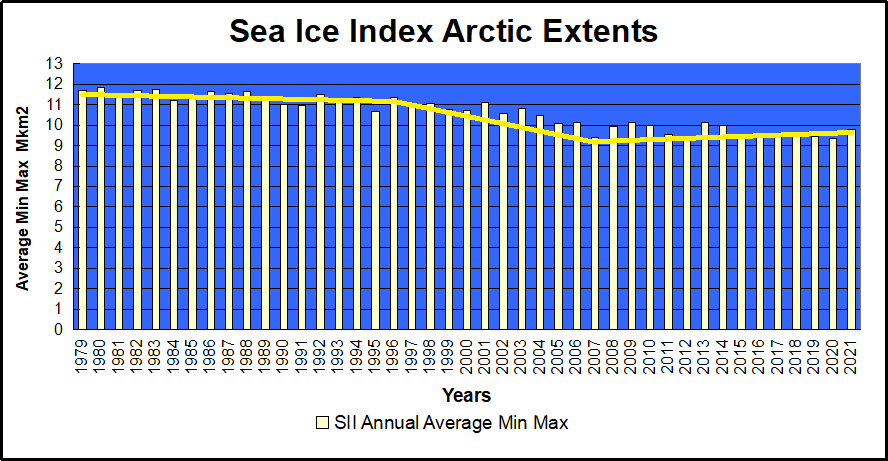
I have noticed at some other blogs people complain about my monthly Arctic ice updates focusing on extents starting in 2007. This post will show why that time period is entirely reasonable as a subject for analysis. I will use the ever popular NOAA dataset derived from satellite passive microwave sensors.  It sometimes understates the ice extents, but everyone refers to it and it is complete from 1979 to present.  Here’s what NOAA reports (in M km2):

We are frequently told that only the March maximums and the September minimums matter, since the other months are only transitional between the two.  So the graph above shows the mean ice extent, averaging the two months March and September. We have 8 more days to go in September 2021, so that number is a low-ball estimate (4.9M km2) that will likely go higher.

If I were adding this to the Ice House of Mirrors, the name would be The X-Ray Ice Mirror, because it looks into the structure of the time series.   For even more clarity and simplicity, here is the table:

NOAA NH Annual Average Ice Extents (in M km2).  Sea Ice Index v3.0 (here)

Year Average Change Rate of Change
1979 11.697
1996 11.353 -0.344 -0.020 per year
2007 9.405 -1.949 -0.177 per year
2021 9.773  +0.368 +0.026 per year

The satellites involve rocket science, but this does not.  There was a small loss of ice extent over the first 17 years, then a dramatic downturn for 11 years, 9 times the rate as before. That was followed by the current 14-year plateau with a slight gain comparable to the beginning loss.  All the fuss is over that middle period, and we know what caused it.  A lot of multi-year ice was flushed out through the Fram Strait, leaving behind more easily melted younger ice. The effects from that natural occurrence bottomed out in 2007.

Kwok et al say this about the Variability of Fram Strait ice flux:

The average winter area flux over the 18-year record (1978–1996) is 670,000 km2, ;7% of the area of the Arctic Ocean. The winter area flux ranges from a minimum of 450,000 km2 in 1984 to a maximum of 906,000 km2 in 1995. . .The average winter volume flux over the winters of October 1990 through May 1995 is 1745 km3 ranging from a low of 1375 km3 in the 1990 flux to a high of 2791 km3 in 1994.

https://www.researchgate.net/publication/261010602/download

Conclusion:

Some complain it is too soon to say Arctic Ice is recovering, or that 2007 is a true change point.  The same people were quick to jump on a declining period after 1996 as evidence of a “Death Spiral.”

Footnote:

No one knows what will happen to Arctic ice.

Except maybe the polar bears.

And they are not talking.

Except, of course, to the admen from Coca-Cola

Arctic Ice Abounds at 2021 Minimum


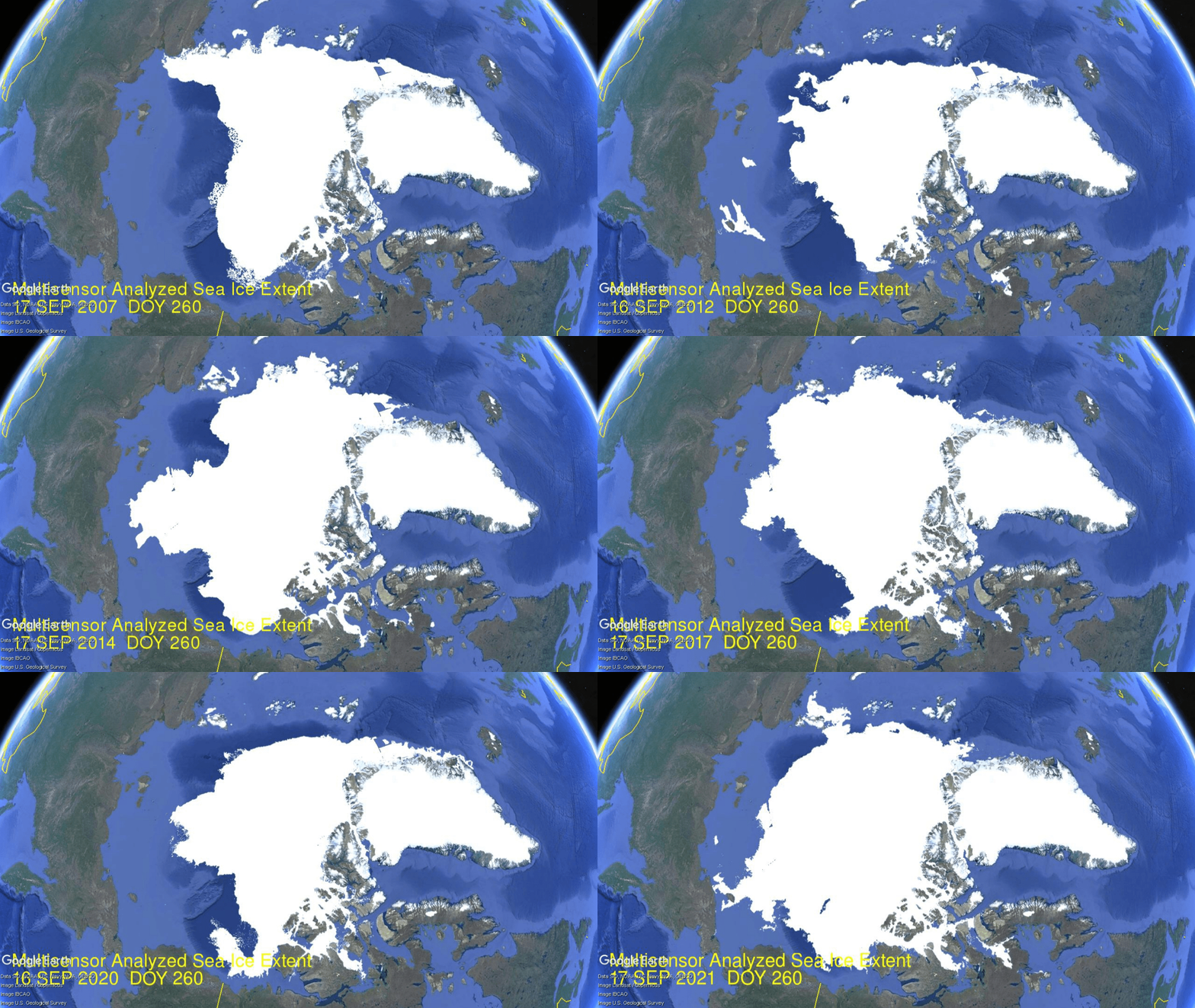
The images above come from MASIE showing ice extents on day 260, the lowest daily extent on average the last 14 years.  Note that 2012 was the lowest in this period and 2021 is now the highest, surpassing 2014. The abundance of ice this year contrasts with both 2007 and 2020. Clearly, the location of remaining ice in September varies greatly from year to year.  The marginal seas are open water, including the Pacific basins, Canadian Bays (Hudson and Baffin), and the Atlantic basins for the most part.  As discussed later on, other regions retain considerable ice at the annual minimum, with differences year to year.

The annual competition between ice and water in the Arctic ocean is now at the maximum for water, which typically occurs mid September.  After that, diminishing energy from the slowly setting sun allows oceanic cooling causing ice to regenerate. Those interested in the dynamics of Arctic sea ice can read numerous posts here.  This post provides a look at September from 2007 to yesterday as a context for understanding this year’s annual minimum.  Note that for climate purposes the annual minimum is measured by the September monthly average ice extent, since the daily extents vary and will go briefly lowest on or about day 260. In a typical year the overall ice extent will end September slightly higher than at the beginning.

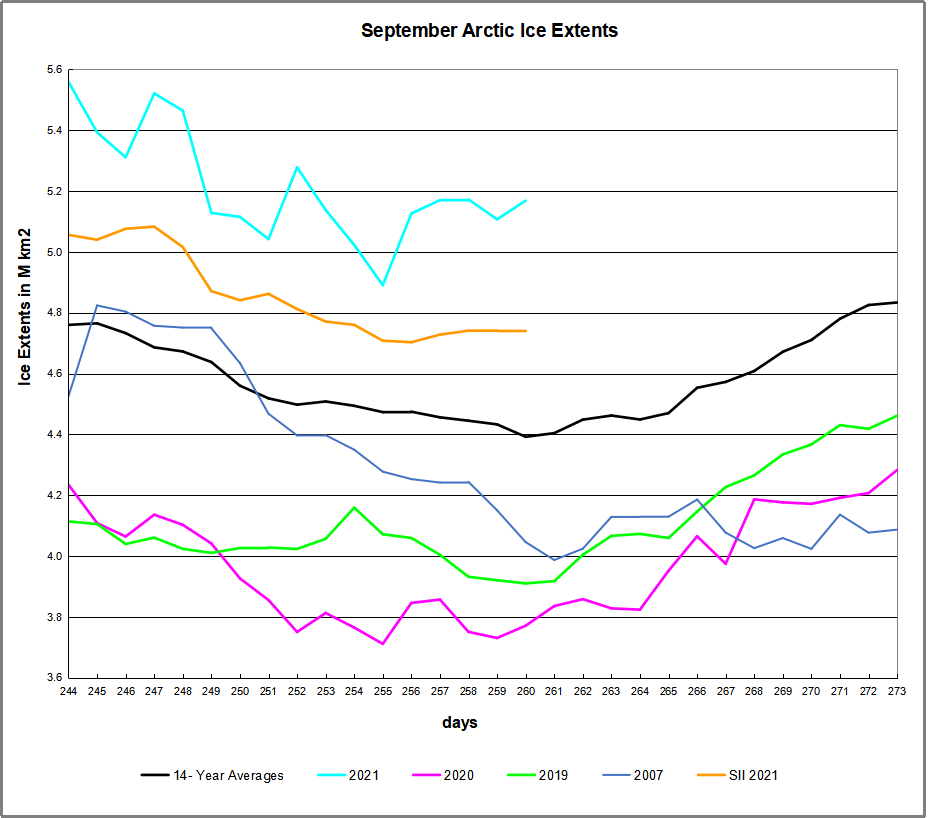
The melting season in September up to yesterday shows 2021 melted much less than average and so day 260 extents are much higher than average.

2021 ice extents begin September 800k km2 above the 14-year average and on day 260 remained 776k km2 higher.  SII was lower than MASIE by 427k km2.  The table for day 260 shows how large are the 2021 surpluses and how the ice is distributed across the various seas comprising the Arctic Ocean. The surplus this year over 2007 is more than 1 Wadham (1M km2).

Region 2021260 Day 260 Average 2021-Ave. 2007260 2021-2007
 (0) Northern_Hemisphere 5168253 4392025 776228 4045776 1122477
 (1) Beaufort_Sea 715340 463613 251727 481384 233956
 (2) Chukchi_Sea 493208 132989 360219 22527 470681
 (3) East_Siberian_Sea 338189 248694 89495 311 337878
 (4) Laptev_Sea 32974 114492 -81518 235869 -202895
 (5) Kara_Sea 95956 17336 78619 44067 51888
 (6) Barents_Sea 18 18201 -18183 7420 -7402
 (7) Greenland_Sea 50718 192388 -141670 333181 -282463
 (8) Baffin_Bay_Gulf_of_St._Lawrence 35493 28885 6609 26703 8791
 (9) Canadian_Archipelago 452857 270948 181909 225526 227331
 (10) Hudson_Bay 4504 5318 -814 2270 2233
 (11) Central_Arctic 2948362 2898150 50213 2665244 283118

The main deficits to average are in Laptev and Greenland Seas, overwhelmed by surpluses almost everywhere, especially in BCE (Beaufort, Chukchi, East Siberian seas), Kara and Canadian Archipelago.  And as discussed below, the marginal basins have little ice left to lose.

The Bigger Picture 

We are close to the annual Arctic ice extent minimum, which typically occurs on or about day 260 (mid September). Some take any year’s slightly lower minimum as proof that Arctic ice is dying, but the image above shows the Arctic heart is beating clear and strong.

Over this decade, the Arctic ice minimum has not declined, but since 2007 looks like fluctuations around a plateau. By mid-September, all the peripheral seas have turned to water, and the residual ice shows up in a few places. The table below indicates where ice is found in September. Numbers are area units of Mkm2 (millions of square kilometers).

Day 260 14 year
Arctic Regions 2007 2010 2012 2014 2015 2017 2018 2019 2020 2021 Average
Central Arctic Sea 2.67 3.16 2.64 2.98 2.93 3.07 2.91 2.97 2.50 2.95 2.90
BCE 0.50 1.08 0.31 1.38 0.89 0.84 1.16 0.46 0.65 1.55 0.89
LKB 0.29 0.24 0.02 0.19 0.05 0.26 0.02 0.11 0.01 0.13 0.16
Greenland & CAA 0.56 0.41 0.41 0.55 0.46 0.52 0.41 0.36 0.59 0.50 0.46
B&H Bays 0.03 0.03 0.02 0.02 0.10 0.07 0.05 0.01 0.02 0.04 0.04
NH Total 4.05 4.91 3.40 5.13 4.44 4.76 4.56 3.91 3.77 5.17 4.48

The table includes some early years of note along with the last 5 years compared to the 14 year average for five contiguous arctic regions. BCE (Beaufort, Chukchi and East Siberian) on the Asian side are quite variable as the largest source of ice other than the Central Arctic itself.   Greenland Sea and CAA (Canadian Arctic Archipelago) together hold almost 0.5M km2 of ice at annual minimum, fairly consistently.  LKB are the European seas of Laptev, Kara and Barents, a smaller source of ice, but a difference maker some years, as Laptev was in 2016.  Baffin and Hudson Bays are inconsequential as of day 260.

2021 stands out from lower ice years by the higher extents in Central Arctic, BCE and LKB, especially Kara Sea this year.

Resources:  Climate Compilation II Arctic Sea Ice

Resilient Arctic Ice September 2021

The animation shows Arctic ice extents on day 248 in 2007 (matching 14 year average), then the same day in 2019, 2020, and yesterday in 2021.  Note that Hudson Bay upper left is open water, and below that Baffin Bay next to Greenland is also ice-free.  In the center Canadian Archipelago holds a lot of ice, especially this year.  Also unusual in 2021 is ice covering Svalbard lower right all the way to Europe mainland.  Also upper right 2021 shows ice in Chukchi touching Russian coastline.

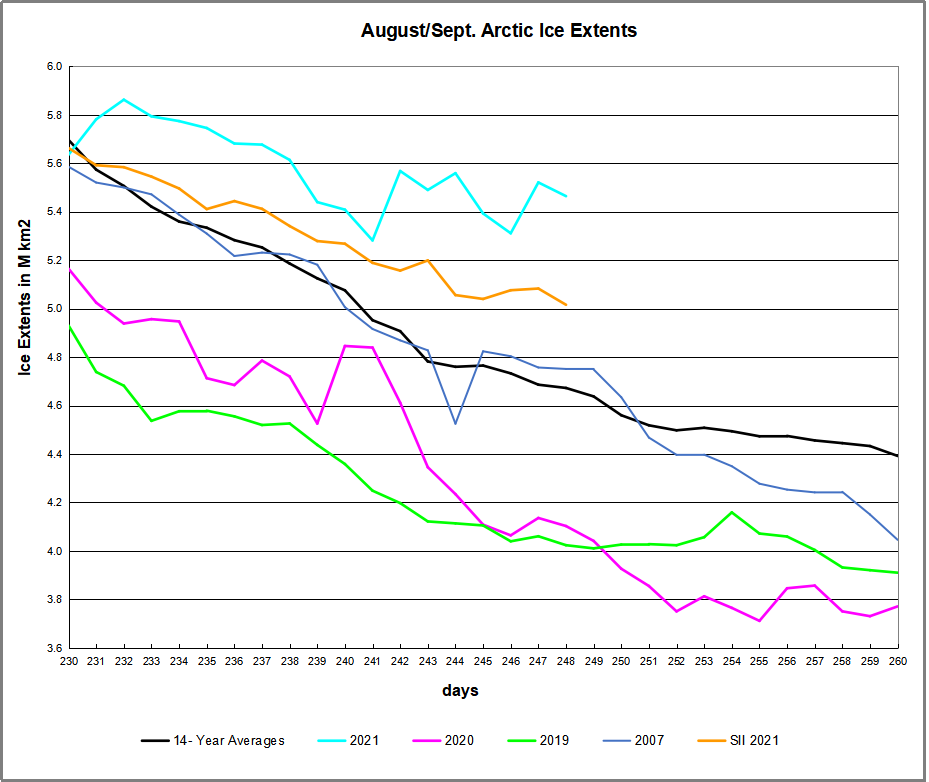
The graph above shows mid-August to mid-Sept daily ice extents for 2021 compared to 14 year averages, and some years of note.  During the 17 days from August 18 to yesterday, the black  line shows Arctic Ice extent declined on average by 1M km2 (1 Wadham).  Meanwhile the cyan line shows MASIE 2021 ice extents lost only 171k km2, and Sea Ice Index (SII) in orange lost 317k km2. Note on day 230 all three lines started at the same value.

Why is this important?  All the claims of global climate emergency depend on dangerously higher temperatures, lower sea ice, and rising sea levels.  The lack of additional warming is documented in a post Adios, Global Warming

The lack of acceleration in sea levels along coastlines has been discussed also.  See USCS Warnings of Coastal Flooding

Also, a longer term perspective is informative:

post-glacial_sea_levelThe table below shows the distribution of Sea Ice across the Arctic Regions, on average, this year and 2007.

Region 2021248 Day 248 Average 2021-Ave. 2007248 2021-2020
 (0) Northern_Hemisphere 5464375 4672631 791744 4751076 713299
 (1) Beaufort_Sea 798213 522472 275741 665051 133162
 (2) Chukchi_Sea 524060 202259 321800 116358 407702
 (3) East_Siberian_Sea 408523 310662 97862 6329 402195
 (4) Laptev_Sea 51574 143286 -91712 280600 -229026
 (5) Kara_Sea 122087 30192 91896 103072 19015
 (6) Barents_Sea 18 15631 -15612 10766 -10748
 (7) Greenland_Sea 98270 176374 -78104 334524 -236254
 (8) Baffin_Bay_Gulf_of_St._Lawrence 16983 23131 -6148 31787 -14804
 (9) Canadian_Archipelago 440366 288302 152064 270755 169612
 (10) Hudson_Bay 39285 15338 23947 29961 9324
 (11) Central_Arctic 2963852 2944150 19702 2900617 63235

The overall surplus to average is 792k km2, (+17%).  Note large surpluses of ice in BCE (Beaufort, Chukchi and East Siberian seas).  Meanwhile Laptev on the Russian coast melted out early, as has Greenland Sea.  Kara and CAA (Canadian Arctic Archipelago) are holding considerable ice.  We are about 12 days away from the annual minimum mid September, but at this point it appears that extents will be much greater than the last two years.

See also Abundant August Arctic Ice with 2021 Minimum Outlook

bathymetric_map_arctic_ocean


Illustration by Eleanor Lutz shows Earth’s seasonal climate changes. If played in full screen, the four corners present views from top, bottom and sides. It is a visual representation of scientific datasets measuring Arctic ice extents.

Abundant August Arctic Ice with 2021 Minimum Outlook

The images above come from AARI (Arctic and Antarctic Research Institute) St. Petersburg, Russia. Note how the location of remaining ice at end of August varies greatly from year to year.  The marginal seas are open water, including the Pacific basins, Canadian Bays (Hudson and Baffin), and the Atlantic basins for the most part.  As discussed later on, other regions retain considerable ice at the annual minimum, with differences year to year.

The annual competition between ice and water in the Arctic ocean is approaching the maximum for water, which typically occurs mid September.  After that, diminishing energy from the slowly setting sun allows oceanic cooling causing ice to regenerate. Those interested in the dynamics of Arctic sea ice can read numerous posts here.  This post provides a look at end of August from 2007 to yesterday as a context for anticipating this year’s annual minimum.  Note that for climate purposes the annual minimum is measured by the September monthly average ice extent, since the daily extents vary and will go briefly lowest on or about day 260. In a typical year the overall ice extent will end September slightly higher than at the beginning.

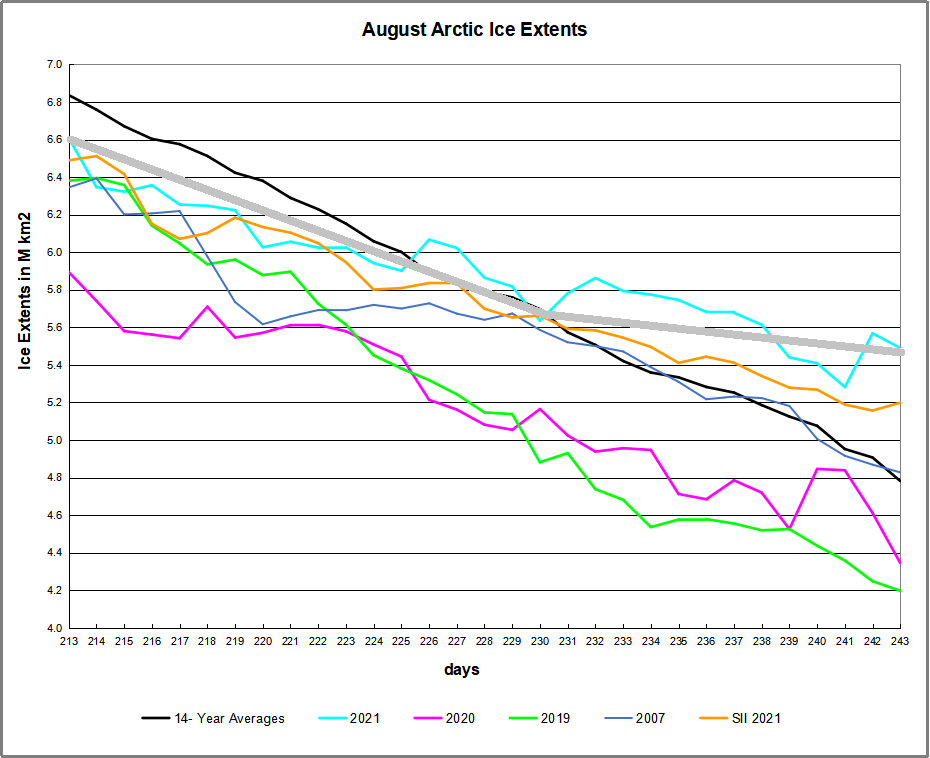
The melting season in August up to yesterday shows 2021 melted slower than average and the month end extents were much higher than average.  I have added a hockey stick to dramatize the abundance of August Arctic ice this year.


Firstly note that on average August ice declines 205k km2 but in 2021 only 112k km2 was lost. The decline in Sea Ice Index in orange  was only slightly more, 130k km2.  The table for day 243 show how large are the 2021 surpluses and how the ice is distributed across the various seas comprising the Arctic Ocean. Since 2007 was the same as average, 2020 day 243 is shown for comparison.  The surplus this year over last is more than 1 Wadham.

Region 2021243 Day 243 Average 2021-Ave. 2020243 2021-2020
 (0) Northern_Hemisphere 5489976 4823907 666069 4345398 1144577
 (1) Beaufort_Sea 855409 543972 311437 763281 92128
 (2) Chukchi_Sea 573897 221139 352758 212438 361459
 (3) East_Siberian_Sea 454688 337359 117328 176996 277692
 (4) Laptev_Sea 24500 164608 -140107 1029 23471
 (5) Kara_Sea 120346 41181 79165 23958 96387
 (6) Barents_Sea 598 20645 -20047 0 598
 (7) Greenland_Sea 63956 172538 -108583 192361 -128406
 (8) Baffin_Bay_Gulf_of_St._Lawrence 16313 26222 -9909 5016 11297
 (9) Canadian_Archipelago 431968 300878 131089 273116 158852
 (10) Hudson_Bay 44909 23291 21618 23611 21298
 (11) Central_Arctic 2902324 2971236 -68912 2672904 229421

The main deficits to average are in Laptev and Greenland Seas, overcome by surpluses almost everywhere, especially in BCE (Beaufort, Chukchi, East Siberian seas), Kara and Canadian Archipelago.  And as discussed below, the marginal basins have little ice left to lose.

The Bigger Picture 

We are close to the annual Arctic ice extent minimum, which typically occurs on or about day 260 (mid September). Some take any year’s slightly lower minimum as proof that Arctic ice is dying, but the image above shows the Arctic heart is beating clear and strong.

Over this decade, the Arctic ice minimum has not declined, but since 2007 looks like fluctuations around a plateau. By mid-September, all the peripheral seas have turned to water, and the residual ice shows up in a few places. The table below indicates where we can expect to find ice this September. Numbers are area units of Mkm2 (millions of square kilometers).

Day 260 14 year
Arctic Regions 2007 2010 2014 2015 2016 2017 2018 2019 2020 Average
Central Arctic Sea 2.67 3.16 2.98 2.93 2.92 3.07 2.91 2.97 2.50 2.90
BCE 0.50 1.08 1.38 0.89 0.52 0.84 1.16 0.46 0.65 0.89
LKB 0.29 0.24 0.19 0.05 0.28 0.26 0.02 0.11 0.01 0.16
Greenland & CAA 0.56 0.41 0.55 0.46 0.45 0.52 0.41 0.36 0.59 0.46
B&H Bays 0.03 0.03 0.02 0.10 0.03 0.07 0.05 0.01 0.02 0.04
NH Total 4.05 4.91 5.13 4.44 4.20 4.76 4.56 3.91 3.77 4.39

The table includes two early years of note along with the last 7 years compared to the 14 year average for five contiguous arctic regions. BCE (Beaufort, Chukchi and East Siberian) on the Asian side are quite variable as the largest source of ice other than the Central Arctic itself.   Greenland Sea and CAA (Canadian Arctic Archipelago) together hold almost 0.5M km2 of ice at annual minimum, fairly consistently.  LKB are the European seas of Laptev, Kara and Barents, a smaller source of ice, but a difference maker some years, as Laptev was in 2016.  Baffin and Hudson Bays are inconsequential as of day 260.

For context, note that the average maximum has been 15M, so on average the extent shrinks to 30% of the March high before growing back the following winter.  In this context, it is foolhardy to project any summer minimum forward to proclaim the end of Arctic ice.

Resources:  Climate Compilation II Arctic Sea Ice

Arctic Ice Hockey Stick August 2021

Arctic2021235 w HS

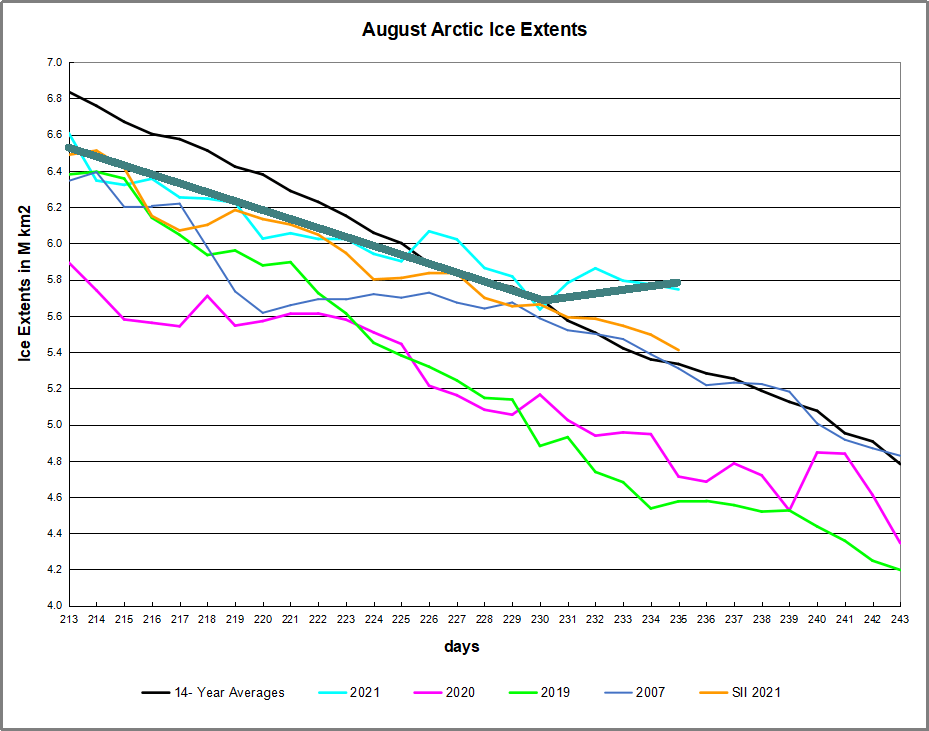
The graph above shows August daily ice extents for 2021 compared to 14 year averages, and some years of note.

The black line shows during this period on average Arctic ice extents decline ~2M km2 from ~6.8M km2 down to ~4.8M km2.  The Hockey Stick shape refers to the 2021 cyan MASIE line starting ~227k km2 below average but matching average by day 230, and in the last five days produced a surplus of 414k km2.  The Sea Ice Index in orange (SII from NOAA) started with the same deficit and also matched MASIE average day 230, but tracking the downward average since.  2019 and 2020 were well below average at this stage of the summer melt.

Why is this important?  All the claims of global climate emergency depend on dangerously higher temperatures, lower sea ice, and rising sea levels.  The lack of additional warming is documented in a post Adios, Global Warming

The lack of acceleration in sea levels along coastlines has been discussed also.  See USCS Warnings of Coastal Flooding

Also, a longer term perspective is informative:

post-glacial_sea_levelThe table below shows the distribution of Sea Ice across the Arctic Regions, on average, this year and 2007.

Region 2021235 Day 235 Average 2021-Ave. 2007235 2021-2007
 (0) Northern_Hemisphere 5745634 5331499 414135 5309870 435765
 (1) Beaufort_Sea 872981 605537 267444 730813 142168
 (2) Chukchi_Sea 539676 329819 209856 178493 361182
 (3) East_Siberian_Sea 508990 445221 63769 63523 445468
 (4) Laptev_Sea 61548 205077 -143529 295384 -233836
 (5) Kara_Sea 136181 58898 77283 155754 -19573
 (6) Barents_Sea 6047 24071 -18025 17998 -11951
 (7) Greenland_Sea 84815 202922 -118108 334622 -249808
 (8) Baffin_Bay_Gulf_of_St._Lawrence 40877 33602 7275 50303 -9426
 (9) Canadian_Archipelago 465781 354257 111524 323329 142452
 (10) Hudson_Bay 64148 35761 28387 61078 3070
 (11) Central_Arctic 2964500 3035379 -70879 3097316 -132816

The overall surplus to average is 414k km2, (8%).  Note large surpluses of ice in BCE (Beaufort, Chukchi and East Siberian seas).  Meanwhile Laptev on the Russian coast melted out early, as has Greenland Sea.  Kara and CAA (Canadian Arctic Archipelago) are holding considerable ice.  We are about a month away from the annual minimum mid September, but at this point it appears that extents will be greater than the last two years.

bathymetric_map_arctic_ocean


Illustration by Eleanor Lutz shows Earth’s seasonal climate changes. If played in full screen, the four corners present views from top, bottom and sides. It is a visual representation of scientific datasets measuring Arctic ice extents.

Fear Not for Arctic Ice Mid August 2021

Arctic2021226

The graph above shows mid July to mid August daily ice extents for 2021 compared to 14 year averages, and some years of note.

The black line shows during this period on average Arctic ice extents decline from ~8.3M km2 down to ~5.9M km2.  The 2021 cyan MASIE line started ~400k km2 below average but as of yesterday was slightly surplus.  The Sea Ice Index in orange (SII from NOAA) started with a deficit to MASIE (in cyan) of ~300M km2.  August 14 saw the two indices mid August close together, close to average and surplus to 2007.

Why is this important?  All the claims of global climate emergency depend on dangerously higher temperatures, lower sea ice, and rising sea levels.  The lack of additional warming is documented in a post Adios, Global Warming

The lack of acceleration in sea levels along coastlines has been discussed also.  See USCS Warnings of Coastal Flooding

Also, a longer term perspective is informative:

post-glacial_sea_levelThe table below shows the distribution of Sea Ice across the Arctic Regions, on average, this year and 2007.

Region 2021226 Day 226 Average 2021-Ave. 2007226 2021-2007
 (0) Northern_Hemisphere 6066634 5889687 176947 5727937 338697
 (1) Beaufort_Sea 915133 688804 226329 777766 137366
 (2) Chukchi_Sea 572339 404505 167834 260048 312290
 (3) East_Siberian_Sea 624917 556990 67927 196982 427934
 (4) Laptev_Sea 52213 252434 -200221 316363 -264150
 (5) Kara_Sea 173342 88626 84716 201115 -27772
 (6) Barents_Sea 5256 29027 -23771 17324 -12068
 (7) Greenland_Sea 118995 224977 -105982 316155 -197160
 (8) Baffin_Bay_Gulf_of_St._Lawrence 23528 59670 -36142 86165 -62637
 (9) Canadian_Archipelago 465880 420722 45157 375241 90638
 (10) Hudson_Bay 83051 74370 8681 91653 -8603
 (11) Central_Arctic 3031058 3088557 -57499 3087868 -56810

The overall surplus to average is 177k km2, (3%).  Note large surpluses of ice in BCE (Beaufort, Chukchi and East Siberian seas).  Meanwhile Laptev on the Russian coast melted out early, as has Greenland Sea.  Kara and CAA (Canadian Arctic Archipelago) are holding considerable ice.  We are about a month away from the annual minimum mid September, but at this point it does not appear it will be out of the ordinary.

bathymetric_map_arctic_ocean


Illustration by Eleanor Lutz shows Earth’s seasonal climate changes. If played in full screen, the four corners present views from top, bottom and sides. It is a visual representation of scientific datasets measuring Arctic ice extents.
Routine Melting of Arctic Ice in July

The animation shows Arctic ice extents on Day 212 (end of July) for the years 2007 to 2021 (yesterday).  Evidently, there is considerable variation year over year both on the total amount and where the ice is to be found.  The images are from MASIE (Multisensor Analyzed Sea Ice Extent) platform operated by the US National Ice Center (NIC).  More on MASIE can be read at previous post NOAA Loses 1M km2 of Arctic Ice in July

Note that in all years, some regions are open water by day 212:  Sea of Okhotsk (lower left), Bering Sea (lower center). Mostly ice free are Hudson Bay (lower right) and Barents Sea (top left).  Center left along the Russian coastline runs the Northern Sea Route for summertime shipping from Kara Sea (top left) down through the Bering Strait.  As you can see, some years the ice is still plentiful along this route, and other years are almost ice free.  This year, Laptev is largely open water, while Kara (above) and Chukchi (below) still have much ice to challenge the ice breakers.

Of interest also is the Canadian Arctic Archipelago (center right, below Greenland).  Here is found the Northwest Passage by which intrepid sailors seek transit from the Atlantic (right) through to the Pacific by way of Bering Sea.  Again, some years it is open and simple, and other years closed completely.  On day 212, 2021, CAA has more ice than average, so this year could be more challenging than in other recent years.

The graph below shows July daily ice extents for 2021 compared to 14 year averages, and some years of note.

On average, July Arctic ice declines from ~9.7M km2 down to 6.9M km2.  This year Sea Ice Index in orange (SII from NOAA) lost ice rapidly and opened up a deficit to MASIE (in cyan) of ~700M km2.  The last three weeks saw the two indices ending the month close together, slightly below average and matching 2007.  Note that both 2019 and 2020 had much lower extents at end of July.

Why is this important?  All the claims of global climate emergency depend on dangerously higher temperatures, lower sea ice, and rising sea levels.  The lack of additional warming is documented in a post Adios, Global Warming

The lack of acceleration in sea levels along coastlines has been discussed also.  See USCS Warnings of Coastal Flooding

Also, a longer term perspective is informative:

post-glacial_sea_levelThe table below shows the distribution of Sea Ice across the Arctic Regions, on average, this year and 2007.


Region 2021212 Day 212 Average 2021-Ave. 2007212 2021-2007
 (0) Northern_Hemisphere 6621487 6903677  -282190  6344860 276627 
 (1) Beaufort_Sea 899718 776180  123539  760576 139143 
 (2) Chukchi_Sea 563418 526326  37091  382350 181068 
 (3) East_Siberian_Sea 652192 745174  -92982  445385 206807 
 (4) Laptev_Sea 97962 389632  -291669  314382 -216420 
 (5) Kara_Sea 230155 159737  70418  239232 -9077 
 (6) Barents_Sea 37818 32484  5334  23703 14115 
 (7) Greenland_Sea 149142 298586  -149444  324737 -175595 
 (8) Baffin_Bay_Gulf_of_St._Lawrence 143110 136724  6387  94179 48931 
 (9) Canadian_Archipelago 594031 547883  46148  510063 83968 
 (10) Hudson_Bay 113973 151424  -37452  93655 20318 
 (11) Central_Arctic 3139007 3137899  1108  3154837 -15830 

The overall deficit to average is 282k km2, (4%) which matches the deficit in Laptev.  Other places with less than average extents are East Siberian, Greenland Sea and Hudson Bay.  Offsetting these are surpluses in Beaufort, Chukchi, Kara and CAA.