Arctic Ice Usual Suspects

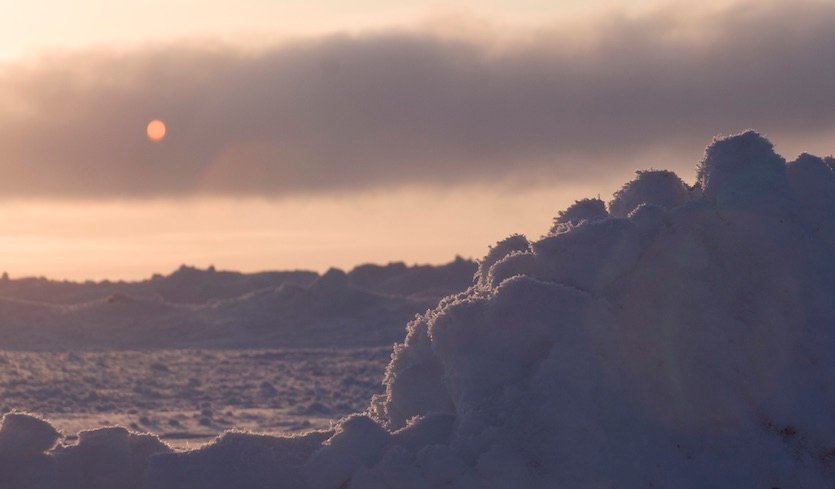
Drift ice in Okhotsk Sea at sunrise.

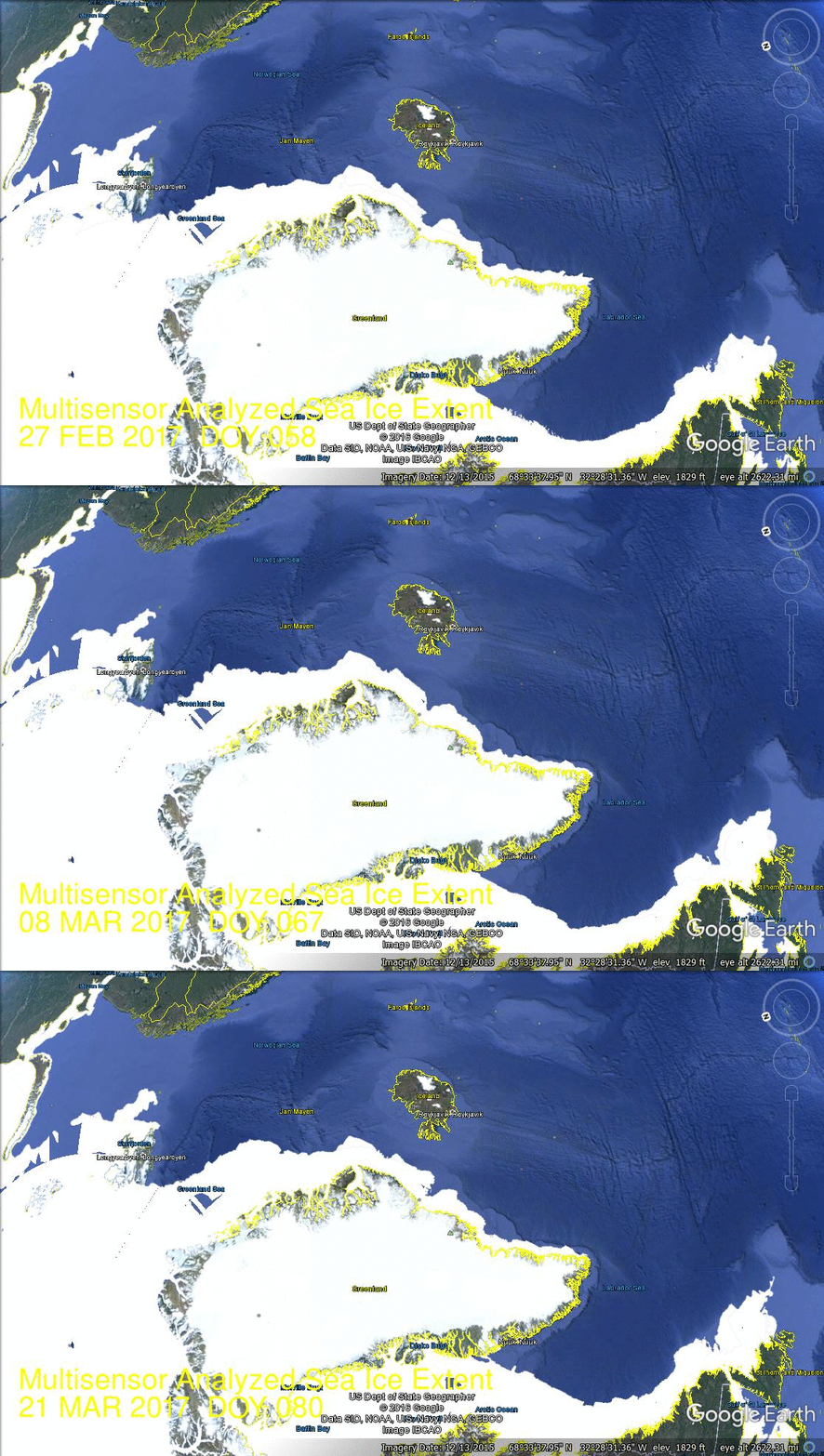
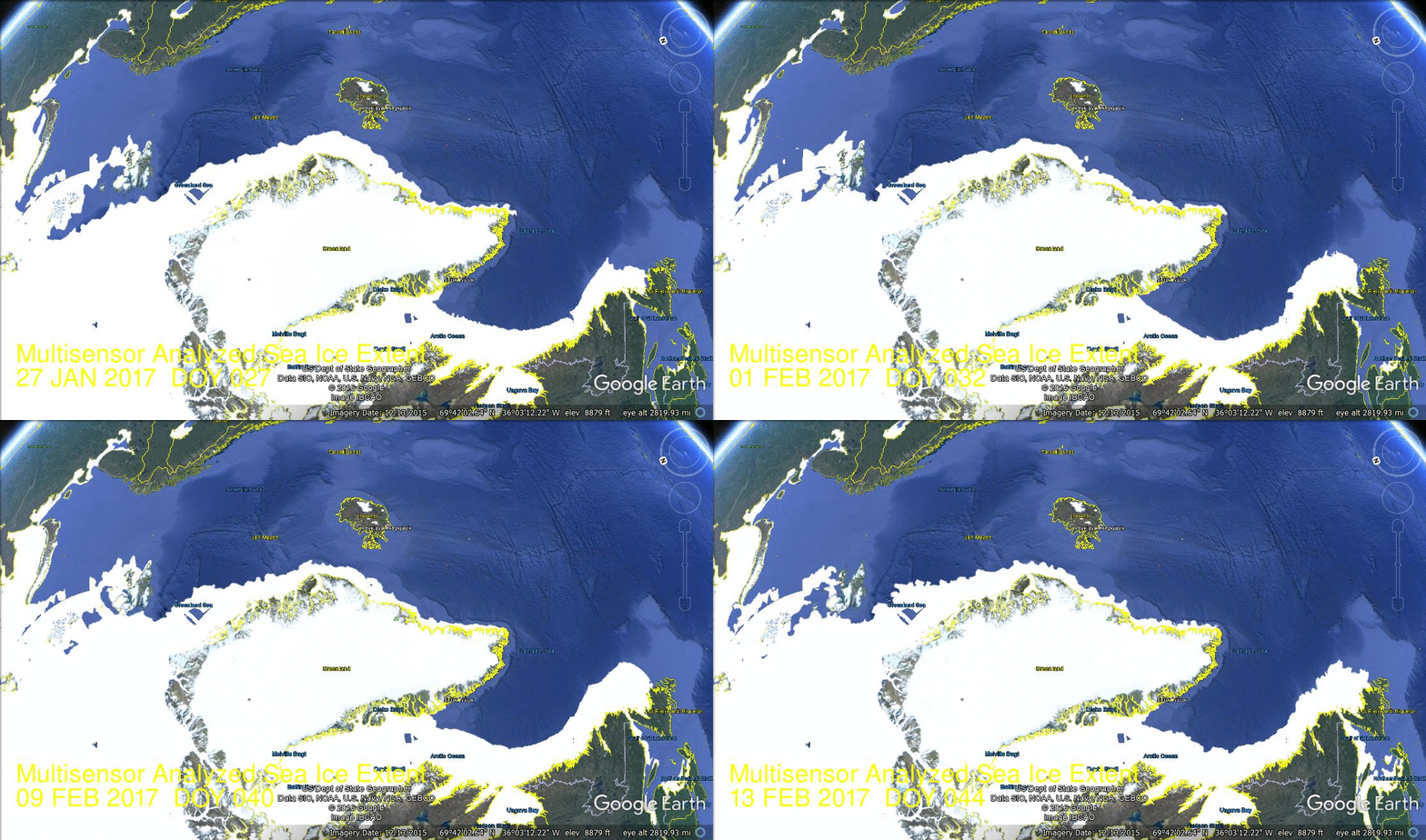
Previous posts have noted that in March, all the Arctic seas are locked in ice, the exceptions being Bering and Okhotsk in the Pacific, and Barents and Baffin Bay in the Atlantic. And the seesaw continues, shown in the images below.  Firstly on the Atlantic side, featuring Baffin Bay and Kara, Barents, Greenland Seas.

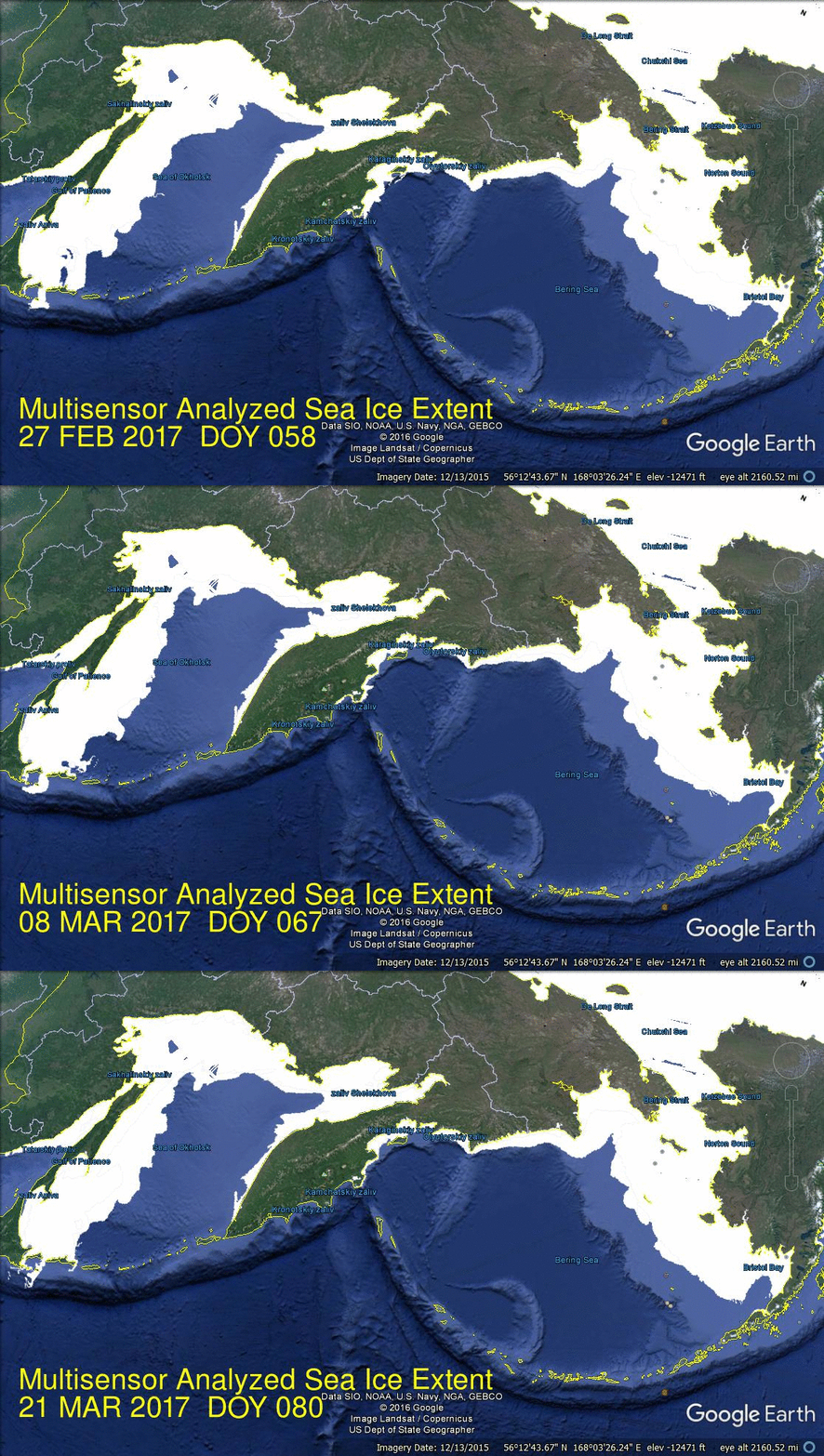
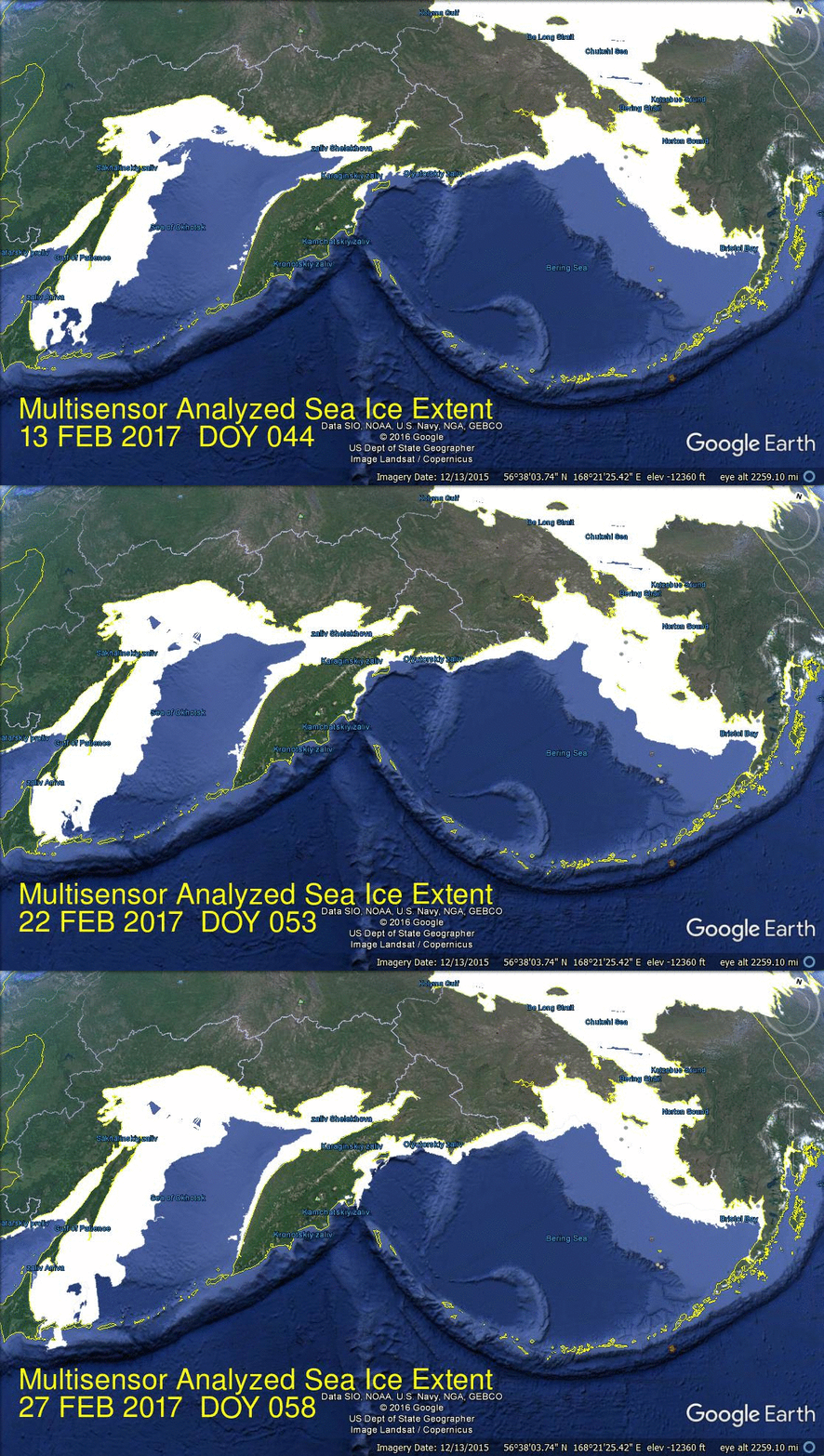
And on the Pacific side, the only action is in Bering and Okhotsk Seas.

The overall NH extents are down from the 11-year average, and it is mostly due to deficits in the usual places: Barents, Bering and Okhotsk, somewhat offset by a surplus in Baffin. All of them melt out in September, and Bering and Okhotsk basins are effectively outside of the Arctic ocean per se.

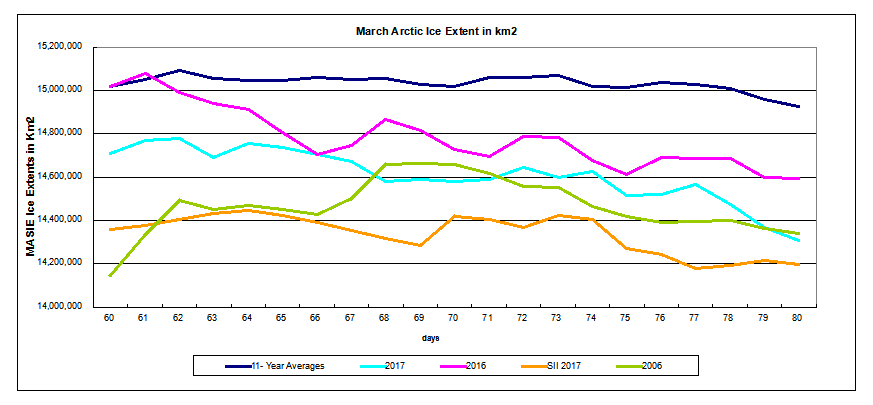
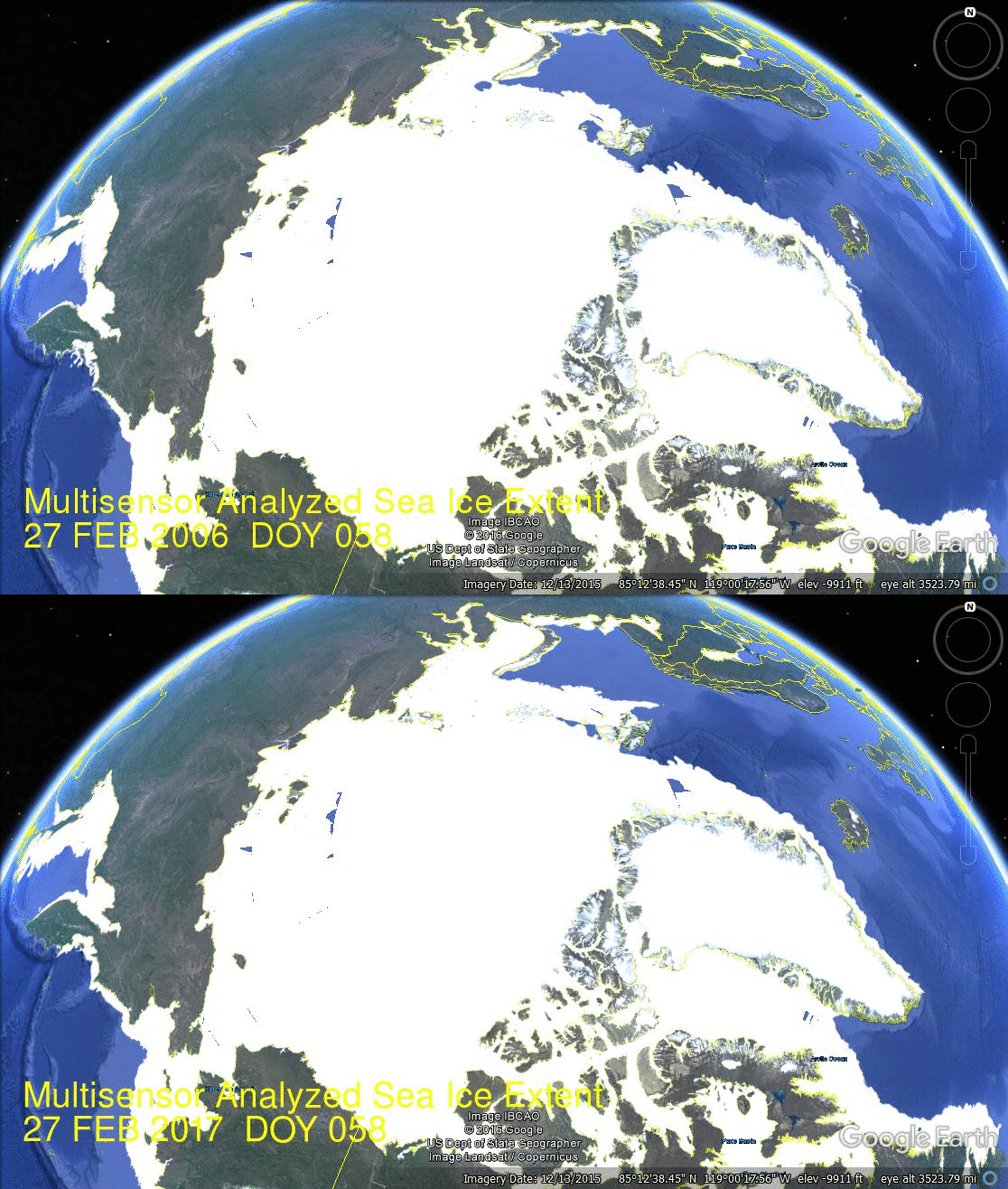
As reported previously, 2017 peaked early, rising close to the average on day 53 in February, then losing extent and never achieving the 15M km2 threshold.  14.8 M km2 proved to be the 2017 peak daily ice extent.  2016 also lost extent throughout March, though higher than the current year, and will likely end with a higher monthly average.  2006 and 2017 are virtually tied at this point, though 2017 will likely end up higher on the month.  SII shows about 300km2 less extent for the month, but drawing closer lately.

The Table below presents the ice extents reported by MASIE for day 80 in the years 2017, 2006 and the 11-year average (2006 through 2016).

Region 2017080 Day 080
Average
2017-Ave. 2006080 2017-2006
 (0) Northern_Hemisphere 14306702 14928081 -621379 14340618 -33916
 (1) Beaufort_Sea 1070445 1069983 462 1068295 2150
 (2) Chukchi_Sea 966006 965416 590 962459 3547
 (3) East_Siberian_Sea 1087137 1086906 231 1084627 2510
 (4) Laptev_Sea 897845 897785 60 897773 71
 (5) Kara_Sea 845743 923038 -77295 933929 -88185
 (6) Barents_Sea 512177 624900 -112723 707363 -195187
 (7) Greenland_Sea 666783 636333 30449 635643 31139
 (8) Baffin_Bay_Gulf_of_St._Lawrence 1567538 1514854 52684 1099497 468041
 (9) Canadian_Archipelago 853214 852858 356 852715 499
 (10) Hudson_Bay 1260903 1258471 2432 1238627 22276
 (11) Central_Arctic 3246109 3229176 16933 3246726 -617
 (12) Bering_Sea 629171 819540 -190369 603351 25820
 (13) Baltic_Sea 43534 89187 -45653 153837 -110304
 (14) Sea_of_Okhotsk 647215 940291 -293076 819326 -172111
 (15) Yellow_Sea 0 158 -158 1067 -1067
 (16) Cook_Inlet 9489 7555 1934 7101 2388

The 2017 deficit to average is largely due to Okhotsk and Bering declining early, along with Barents and Kara.  A surplus in Baffin somewhat offsets these, especially in comparison with 2006.

To summarize, central Arctic seas are locked in ice, while extents have started to decline in the peripheral basins.  As of day 80, extents in 2017 are 4% below average and tied with 2006.


Honey, I Shrunk the Arctic Ice! Not.

Image is from Honey, I Shrunk the Kids, a 1989 American science fiction family film produced by Walt Disney Pictures.

The notion that man-made global warming causes Arctic ice to melt took a major hit with a recent publication.  The article is Influence of high-latitude atmospheric circulation changes on summertime Arctic sea ice by Qinghua Ding, Axel Schweiger, Michelle L’Heureux, David S. Battisti, Stephen Po-Chedley, Nathaniel C. Johnson, Eduardo Blanchard-Wrigglesworth, Kirstin Harnos, Qin Zhang, Ryan Eastman & Eric J. Steig.  (Warning: Reliability of published papers diminishes as numbers of co-authors increases.)

The paper was published online by Nature Climate Change on 13 March 2017. It is behind a paywall, but the reactions to it are revealing.  The abstract says:

The Arctic has seen rapid sea-ice decline in the past three decades, whilst warming at about twice the global average rate. Yet the relationship between Arctic warming and sea-ice loss is not well understood. Here, we present evidence that trends in summertime atmospheric circulation may have contributed as much as 60% to the September sea-ice extent decline since 1979. A tendency towards a stronger anticyclonic circulation over Greenland and the Arctic Ocean with a barotropic structure in the troposphere increased the downwelling longwave radiation above the ice by warming and moistening the lower troposphere. Model experiments, with reanalysis data constraining atmospheric circulation, replicate the observed thermodynamic response and indicate that the near-surface changes are dominated by circulation changes rather than feedbacks from the changing sea-ice cover. Internal variability dominates the Arctic summer circulation trend and may be responsible for about 30–50% of the overall decline in September sea ice since 1979. (my bolds)

Announcements of the finding were welcomed by skeptics and lukewarmists as an indication that climatologists were taking off their CO2 blinders and at last admitting to natural forces internal to the climate system.  Some responses were:

Arctic Ice Loss Driven by Natural Swings

Arctic ice loss driven by natural swings, not just mankind

Study in journal Nature: HALF of Arctic ice loss driven by natural swings — not ‘global warming’

Arctic Ice Alarmists are finding themselves skating on thin ice, as evidenced by their articles attempting to control the damage.  Some of these titles are:

We Deserve Half the Blame for Declining Arctic Sea Ice (Discover)

Humans to blame for bulk of Arctic sea ice loss: study (Phys.org)

Human activity is driving retreat of Arctic sea ice (from the misnamed Skeptical Science blog)

Why Alarmists are Twisting in the Wind

The full paper is behind a paywall, but we have description of the method and content by the lead author in an article at Popular Science Up to half of the Arctic’s melt might be totally natural–But climate change is still responsible for the rest.  He begins with his profession of faith:

“Anthropogenic forcing is still dominant — it’s still the key player,” said first author Qinghua Ding, a climate scientist at the University of California Santa Barbara. . .”But we found that natural variability has helped to accelerate this melting, especially over the past 20 years.”  A colleague adds:  “The results of Ding et al. do not call into question whether human-induced warming has led to Arctic sea-ice decline – a wide range of evidence shows that it has”.

This is the shibboleth demanded from any and all scientists who do not wish to be called “deniers” and cast into the outer darkness.

Note: A shibboleth is an old belief or saying that is repetitively cited but untrue.  This meaning evolved from its earlier significance as a word or custom whose variations in pronunciation or style are used to distinguish members of ingroups from those of outgroups, with an implicit value judgment based on familiarity with the shibboleth.(Wikipedia)


“The tribe has spoken.  Time for you to go!”

What Ding et al. Studied

Ding goes on to describe the nature of their analysis. (From Popular Science)

“There is a mismatch between the model’s output and the observation,” said lead author Qinghua Ding, a professor in the Geography Department at the University of California Santa Barbara. “Observation shows very fast, very abrupt sea ice melting, whereas the climate model cannot capture the fast melting.”

To understand why, Ding and his team focused on the connection between September sea-ice extent (or how much of the Arctic sea had at least 15 percent sea ice) and the preceding summer’s (June-August) atmospheric circulation. Ding knew from earlier work that tropical circulation can affect seasonal variability of sea ice in the Arctic.

“In the model we turned off all CO2 forcing,” said Ding, or all climate changes that were “forced” by the addition of carbon dioxide into the atmosphere. “And we still got some sea ice melting, that was very similar to the observation.”

“If the circulation changes are caused by anthropogenic greenhouse warming (or other human or natural external forcings such as ozone depletion, aerosol emissions, or solar activity) this pattern of atmospheric change should emerge as a clear signature when averaging together many climate model simulations of this period,” Neil Swart, a Research Scientist with Environment and Climate Change Canada who wasn’t involved in the new study, wrote in an accompanying article.

But when Ding averaged the climate models together, the air circulation changes cancelled each other out—like a balanced equation. They only data that remained in the models was responding to external forcings, like greenhouse gas emissions. In other words, Ding found that between 30-50 percent of the arctic melting is due to these unforced, or non-climate change caused variations—and that with this factored in, the climate models were generally accurate. The increased rapidity of Arctic melting was due to natural variations outside of the scope of the climate change models.

What Can Be Learned from Ding et al.

First note that they are climate modelers studying the behavior of models when parameters are manipulated.  It is encouraging that they notice the incompleteness of their models leads to discrepancies from reality.  This is a step in the right direction.

Second, note that the CO2 forcing is actually their term for all external forcings, including solar, aerosols etc.  They seem to be blind to oceanic multi-decadal and multi-centennial oscillations.  They make a leap of faith when they attribute every factor outside of atmospheric circulation to CO2.

Others more comprehensive in their research have concluded that fluctuations in the ocean water structure drive both ice extent changes and atmospheric circulations. See Arctic Sea Ice: Self-Oscillating System featuring the work of V. F. Zakharov and others at the Arctic and Antarctic Research Institute in St. Petersburg.

Summary

Some climate modelers are undermining core beliefs even while using a flawed methodology based on studying models rather than nature itself. Alarmists are forced into scrambling to continue blaming humans for declining Arctic Sea Ice. When the effects of oceanic circulations are added to atmospheric effects, there is little influence left for CO2.

Spinning the papers to keep the narrative alive.

Footnote:

The abstract mentions downwelling longwave radiation, a theoretical effect that in practice is overwhelmed by massive heat transfers upward into space.

In the Arctic (and also at the South Pole), the air is in direct contact with an infinite heat sink: outer space. The tropopause (where radiative loss upward is optimized) is only 7 km above the surface at the poles in winter, compared to 20 km at the equator. There is no door to open or close; the air is constantly convecting any and all energy away from the surface for radiation into space.

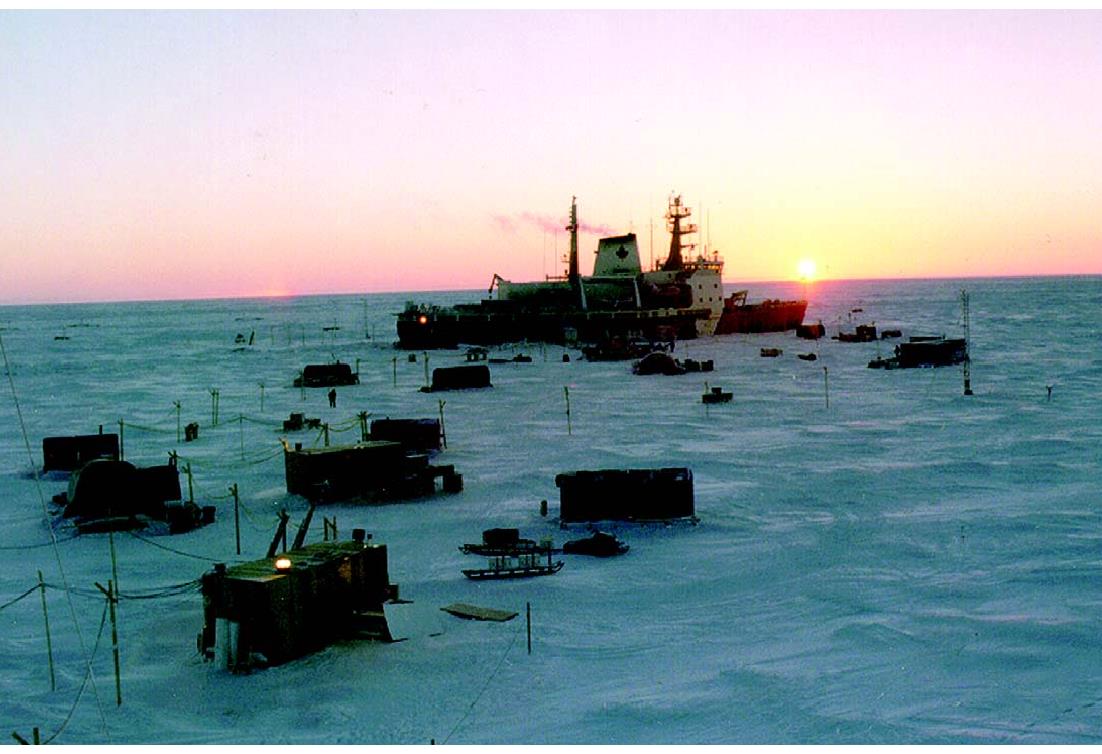
Instead of an open door, Arctic ice melts when the sun climbs over the horizon. Both the water and air are warmed, and the ice cover retreats until sundown in Autumn.

Most people fail to appreciate the huge heat losses at the Arctic pole. Mark Brandon has an excellent post on this at his wonderful blog, Mallemaroking.

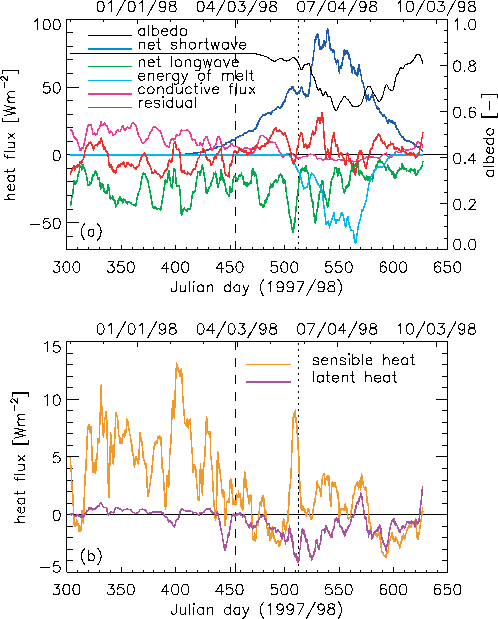
By his calculations the sensible heat loss in Arctic winter ranges 200-400 Wm2.

The annual cycle of sensible heat flux from the ocean to the atmosphere for 4 different wind speeds

As the diagram clearly shows, except for a short time in high summer, the energy flow is from the water heating the air.

“Then the heat loss over the 2×10^9 m2 of open water in that image is a massive 600 GW – yes that is Giga Watts – 600 x 10^9 Watts.

If you want to be really inappropriate then in 2 hours, that part of the ocean lost more energy than it takes to run the London Underground for one year.

Remember that is just one component and not the full heat budget – which is partially why it is inappropriate. For the full budget we have to include latent heat flux, long wave radiation, short wave radiation, energy changes through state changes when ice grows and decays, and so on. Also large heat fluxes lead to rapid sea ice growth which then insulates the ocean from further heat loss.”


Arctic Ice High Jump

For ice extent in the Arctic, the bar is set at 15M km2. The average in the last 11 years occurs on day 73 at 15.07M before descending. Most years are able to clear 15M, except for 2006, 2007 and 2015 who topped out below that height.

Yesterday, March 2, 2016 cleared 15M, but will not reach that level again. 2016 will now drop down to 14.6M, rise to day 84 average of 14.9M, then start the descent into spring and summer. Typically, Arctic ice extent loses 67 to 70% of the March maximum by mid September, before recovering the ice in building toward the next March.

arctic-ice-2017061

As reported previously, 2017 rose to the average in February, then lost extent for two days and is now increasing again.  The next two weeks will be interesting. The average year in the last eleven gained about 20k km2 from now to mid March. But the variability ranged from 2015 losing 350K while 2010 gained 300k km2. What will the ice do this year?  Where will 2017 rank in the annual Arctic Ice High Jump competition?

Drift ice in Okhotsk Sea at sunrise.

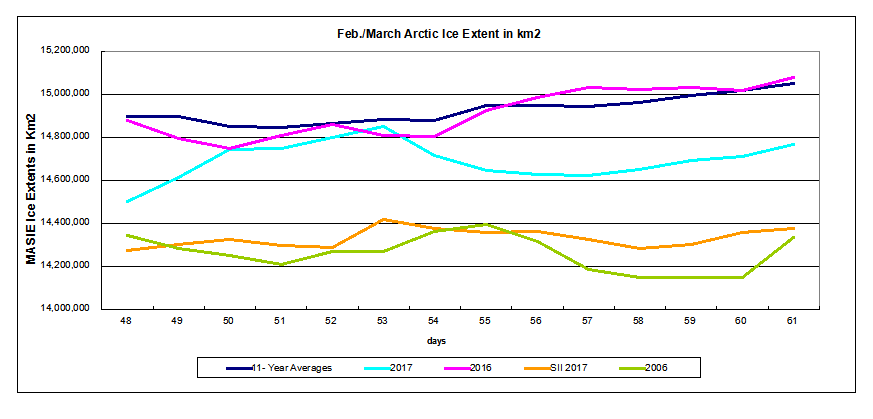
As reported previously, Arctic ice extents are solid in most seas, but continue to fluctuate at the margins. In the latter part of February 2017 there was a great leap upward for nine days, nearly reaching average and surpassing 2016, before falling back after day 53. The surplus over 2006 is now 500k km2. SII reports about 360k km2 less extent than MASIE.

arctic-ice-2017058

The Atlantic upward leap and back in Barents and Baffin.

output_fxzrvq

Note both Barents and Baffin pulled back slightly.

The Pacific shifting up and down in Bering and Okhotsk.

output_xhr2x3Note that Okhotsk continued to gain while Bering pulled back since day 53.

While the seesaws are tilting back and forth on the margins, the bulk of the Arctic is frozen solid. And with limited places where more extent can be added, the pace of overall growth has slowed.

The table below shows ice extents in the seas comprising the Arctic, comparing 2017 day 058 with the same day average over the last 11 years and with 2006.

Region 2017058 Day 058
Average
2017-Ave. 2006058 2017-2006
 (0) Northern_Hemisphere 14652502 14960594 -308093 14148072 504430
 (1) Beaufort_Sea 1070445 1070111 334 1069711 734
 (2) Chukchi_Sea 966006 965342 664 961796 4210
 (3) East_Siberian_Sea 1087137 1087095 43 1086702 435
 (4) Laptev_Sea 897845 897835 10 897773 71
 (5) Kara_Sea 933720 927244 6476 899871 33849
 (6) Barents_Sea 550872 612576 -61704 466622 84251
 (7) Greenland_Sea 595616 638641 -43025 575532 20084
 (8) Baffin_Bay_Gulf_of_St._Lawrence 1496540 1472634 23906 1290424 206116
 (9) Canadian_Archipelago 853214 852984 230 852715 499
 (10) Hudson_Bay 1260903 1260333 571 1257077 3827
 (11) Central_Arctic 3218090 3221265 -3176 3181409 36681
 (12) Bering_Sea 547532 742754 -195222 549141 -1609
 (13) Baltic_Sea 70844 117633 -46789 111391 -40547
 (14) Sea_of_Okhotsk 1048295 1043395 4900 877854 170441
 (15) Yellow_Sea 1420 13921 -12501 8431 -7011
 (16) Cook_Inlet 9940 9665 275 4686 5254

The table shows that 2017 ice extent exceeds 2006 by about 500k km2 at this date. Surpluses are sizeable in Barents, Baffin and Okhotsk, with only the Baltic showing a deficit.  Baffin and Okhotsk are now average, and the 300k km2 deficit to average comes from Bering in the Pacific, and Barents and Greenland Seas on the Atlantic side

The big picture compares this day in 2017 with 2006.  Not much change overall, but a slight increase of 500k km2.

output_4fhczm


Arctic Ice Cresting at Feb. End

Drift ice in Okhotsk Sea at sunrise.

As reported previously, Arctic ice extents are solid in most seas, but continue to fluctuate at the margins. In the latter part of February 2017 there was a great leap upward for nine days, nearly reaching average and surpassing 2016, before falling back after day 53. The surplus over 2006 is now 500k km2. SII reports about 360k km2 less extent than MASIE.

arctic-ice-2017058

The Atlantic upward leap and back in Barents and Baffin.

output_fxzrvq

Note both Barents and Baffin pulled back slightly.

The Pacific shifting up and down in Bering and Okhotsk.

output_xhr2x3Note that Okhotsk continued to gain while Bering pulled back since day 53.

While the seesaws are tilting back and forth on the margins, the bulk of the Arctic is frozen solid. And with limited places where more extent can be added, the pace of overall growth has slowed.

The table below shows ice extents in the seas comprising the Arctic, comparing 2017 day 058 with the same day average over the last 11 years and with 2006.

Region 2017058 Day 058
Average
2017-Ave. 2006058 2017-2006
 (0) Northern_Hemisphere 14652502 14960594 -308093 14148072 504430
 (1) Beaufort_Sea 1070445 1070111 334 1069711 734
 (2) Chukchi_Sea 966006 965342 664 961796 4210
 (3) East_Siberian_Sea 1087137 1087095 43 1086702 435
 (4) Laptev_Sea 897845 897835 10 897773 71
 (5) Kara_Sea 933720 927244 6476 899871 33849
 (6) Barents_Sea 550872 612576 -61704 466622 84251
 (7) Greenland_Sea 595616 638641 -43025 575532 20084
 (8) Baffin_Bay_Gulf_of_St._Lawrence 1496540 1472634 23906 1290424 206116
 (9) Canadian_Archipelago 853214 852984 230 852715 499
 (10) Hudson_Bay 1260903 1260333 571 1257077 3827
 (11) Central_Arctic 3218090 3221265 -3176 3181409 36681
 (12) Bering_Sea 547532 742754 -195222 549141 -1609
 (13) Baltic_Sea 70844 117633 -46789 111391 -40547
 (14) Sea_of_Okhotsk 1048295 1043395 4900 877854 170441
 (15) Yellow_Sea 1420 13921 -12501 8431 -7011
 (16) Cook_Inlet 9940 9665 275 4686 5254

The table shows that 2017 ice extent exceeds 2006 by about 500k km2 at this date. Surpluses are sizeable in Barents, Baffin and Okhotsk, with only the Baltic showing a deficit.  Baffin and Okhotsk are now average, and the 300k km2 deficit to average comes from Bering in the Pacific, and Barents and Greenland Seas on the Atlantic side

The next two weeks will be interesting. The average year in the last eleven gained about 100k km2 from now to mid March. But the variability ranged from 2015 losing 300K while other years gained 400k km2. What will the ice do this year?

The big picture compares this day in 2017 with 2006.  Not much change overall, but a slight increase of 500k km2.

output_4fhczm

Arctic Ice Seesaw

Mid February is about a month away from the annual maximum Arctic ice extent, and measurements continue to seesaw in the two dynamic places where freezing and drifting cause gains and losses in sea ice. In each region, the gains and losses teeter-totter between two basins.

Here is the Atlantic seesaw with Barents and Baffin.

output_vbs7wb

And here is the Pacific seesaw with Bering and Okhotsk.

output_jbavnc
While the seesaws are tilting back and forth on the margins, the bulk of the Arctic is frozen solid. And with limited places where more extent can be added, the pace of overall growth has slowed.

arctic-ice-2017044
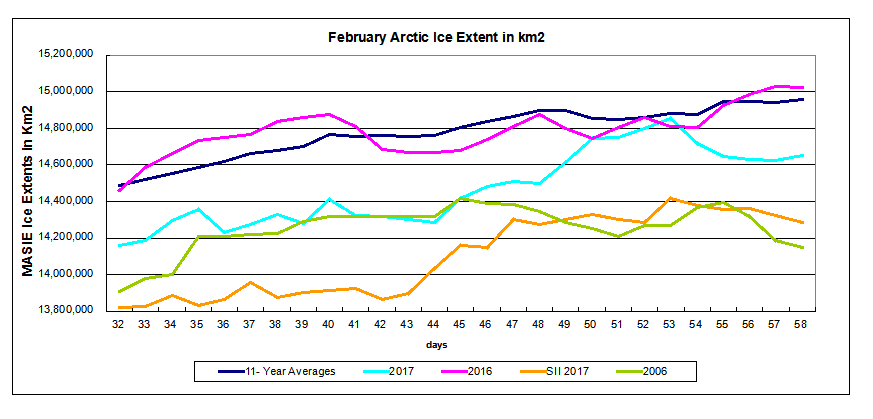
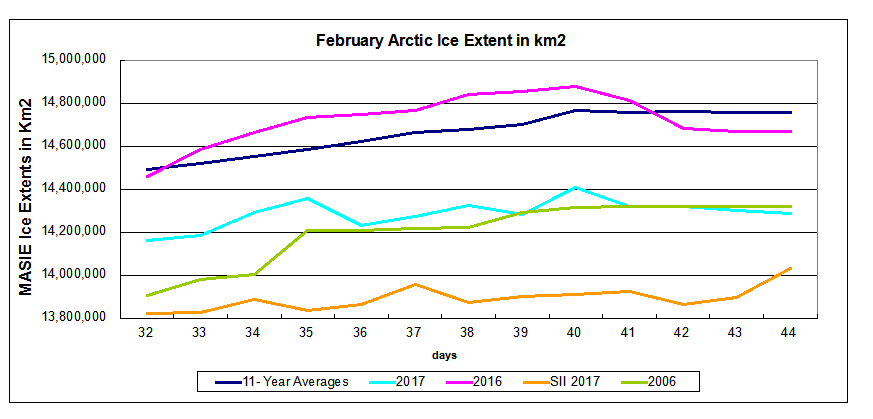
The graph shows that 2017 and 2006 are virtually tied at this date. It shows both years are below average by about 450k km2, and SII adds a further deficit by showing 2017 averaging in February ~400k km2 lower than MASIE.

The table below shows ice extents in the seas comprising the Arctic, comparing day 044 2017 with the same day average over the last 11 years and with 2006.

Region 2017044 Day 044
Average
2017-Ave. 2006044 2017-2006
 (0) Northern_Hemisphere 14287848 14759423 -471575 14318694 -30846
 (1) Beaufort_Sea 1070445 1070111 334 1069711 734
 (2) Chukchi_Sea 966006 965614 392 966006 0
 (3) East_Siberian_Sea 1087137 1087131 6 1087103 35
 (4) Laptev_Sea 897845 897835 10 897773 71
 (5) Kara_Sea 908380 908367 12 932924 -24545
 (6) Barents_Sea 363927 581052 -217125 507771 -143844
 (7) Greenland_Sea 565090 633257 -68167 592221 -27131
 (8) Baffin_Bay_Gulf_of_St._Lawrence 1564353 1451561 112792 1209203 355150
 (9) Canadian_Archipelago 853214 852984 230 852715 499
 (10) Hudson_Bay 1260903 1260476 427 1257433 3470
 (11) Central_Arctic 3209792 3215238 -5446 3178718 31074
 (12) Bering_Sea 564241 759583 -195342 889465 -325224
 (13) Baltic_Sea 59994 105815 -45822 68543 -8549
 (14) Sea_of_Okhotsk 834828 895634 -60806 720201 114628
 (15) Yellow_Sea 17654 31061 -13407 20909 -3255
 (16) Cook_Inlet 9131 12083 -2952 9530 -399

The table indicates some differences in locations of ice surpluses and deficits. Bering Sea has been the largest deficit this year, while Barents is now matching it by losing ~100k in the last week. Greenland Sea is also down slightly compared to average and to 2006. Baffin Bay is the largest surplus to average and to 2006. Okhotsk lost more than 200k km2 in recent days, but still exceeds 2006 by 115k.

The second half of February will be interesting. The average year in the last eleven gained about 200k km2 from now to month end. But the variability ranged from 2006 losing 170K to 2012 gaining 590k km2. What will the ice do this year?

The polar bears have a Valentine Day’s wish for Arctic Ice.

welovearcticicefinal

And Arctic Ice loves them back, returning every year so the bears can roam and hunt for seals.

Footnote:

Seesaw accurately describes Arctic ice in another sense:  The ice we see now is not the same ice we saw previously.  It is better to think of the Arctic as an ice blender than as an ice cap, explained in the post The Great Arctic Ice Exchange.

Ice Taking Hold in Barents Sea

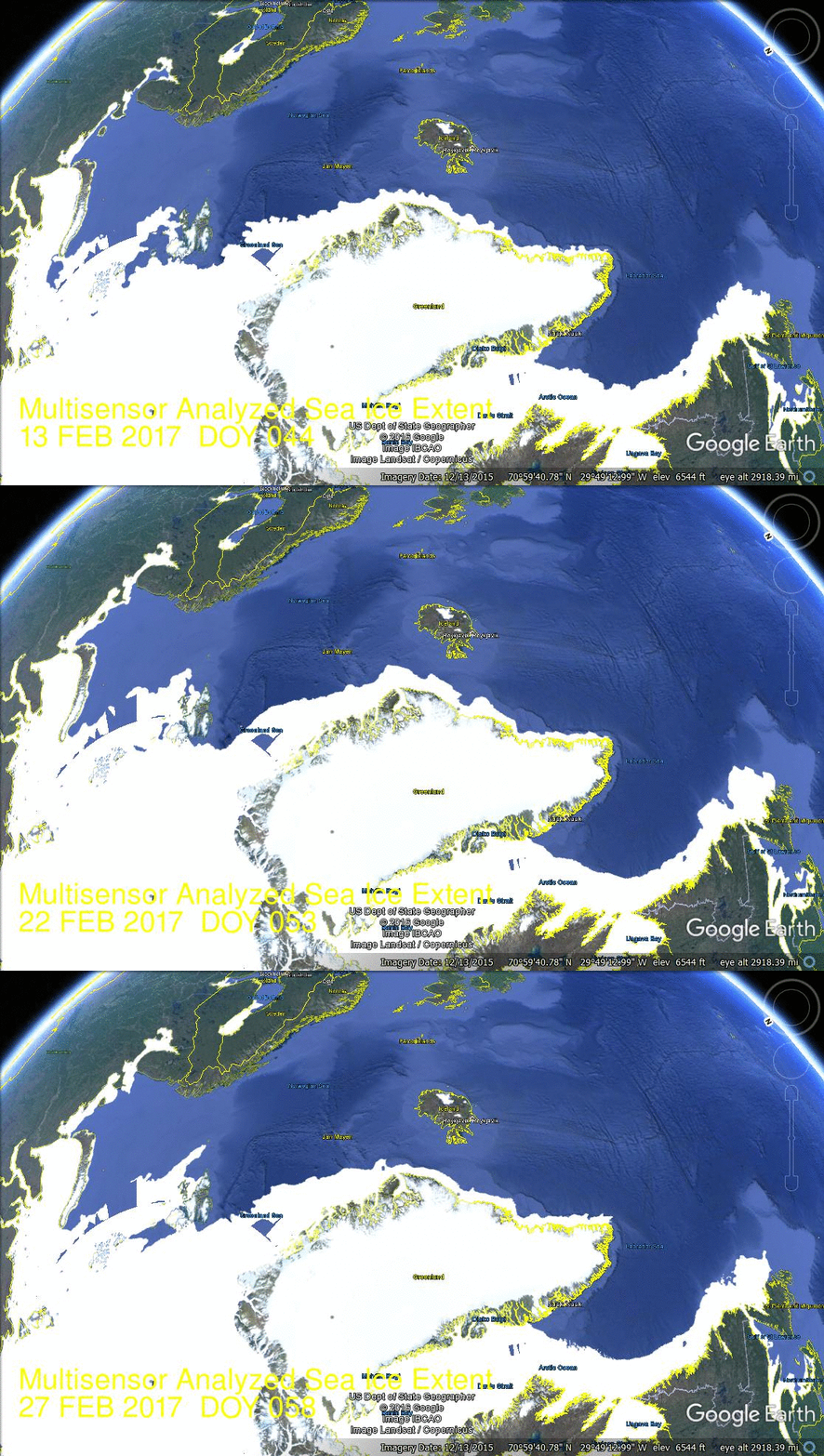
In just the last week, the progression of ice extents in Barents Sea is impressive.  The first image from MASIE is January 27, 2017.  h/t Pethefin

google-ice-day-27

Then a week later on February 3 we see that Svalbard is almost enclosed.

google-ice-day-34

In that one week Arctic ice gained 240k km2 up to 14.3 M km2, including Barents Sea adding 145k km2.  Thanks to MASIE we can see Arctic ice growing before our eyes.

One Week in Barents Sea shows Svalbard under siege.

output_sym66e


Support MASIE Arctic Ice Dataset

MASIE: “high-resolution, accurate charts of ice conditions”
Walt Meier, NSIDC, October 2015 article in Annals of Glaciology.

Update February 4, 2017 Below

The home page for MASIE (here) invites visitors to show their interest in the dataset and analysis tools since continued funding is not assured. The page says:
NSIDC has received support to develop MASIE but not to maintain MASIE. We are actively seeking support to maintain the Web site and products over the long term. If you find MASIE helpful, please let us know with a quick message to NSIDC User Services.

For the reasons below, I hope people will go there and express their support.

1. MASIE is Rigorous.

Note on Sea Ice Resolution:

Northern Hemisphere Spatial Coverage (left) SH Spatial Coverage (right)

Sea Ice Index (SII) from NOAA is based on 25 km cells and 15% ice coverage. That means if a grid cell 25X25, or 625 km2 is estimated to have at least 15% ice, then 625 km2 is added to the total extent. In the mapping details, grid cells vary between 382 to 664 km2 with latitudes.  And the satellites’ Field of View (FOV) is actually an ellipsoid ranging from 486 to 3330 km2 depending on the channel and frequency.  More info is here.

MASIE is based on 4 km cells and 40% ice coverage. Thus, for MASIE estimates, if a grid cell is deemed to have at least 40% ice, then 16 km2 is added to the total extent.

The significantly higher resolution in MASIE means that any error in detecting ice cover at the threshold level affects only 16 km2 in the MASIE total, compared to at least 600 km2 variation in SII.  A few dozen SII cells falling below the 15% threshold is reported as a sizable loss of ice in the Arctic.

2. MASIE is Reliable.

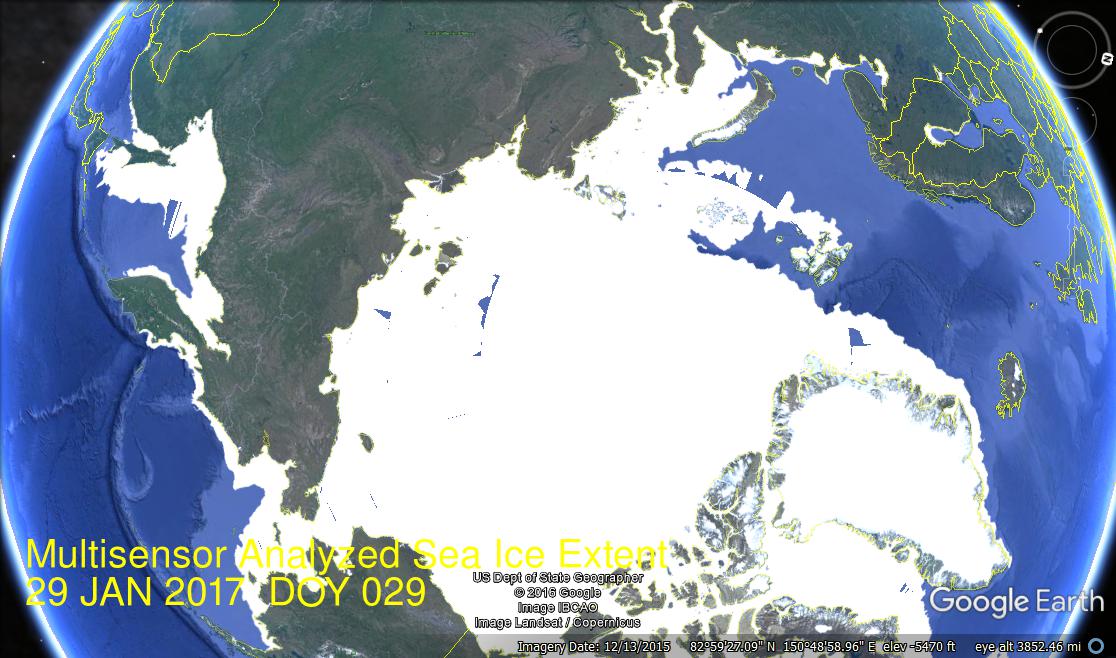
2017029google

MASIE is an operational ice product developed from multiple sources to provide the most accurate possible description of Arctic ice for the sake of ships operating in the region.

Operational analyses combine a variety of remote-sensing inputs and other sources via manual integration to create high-resolution, accurate charts of ice conditions in support of navigation and operational forecast models. One such product is the daily Multisensor Analyzed Sea Ice Extent (MASIE). The higher spatial resolution along with multiple input data and manual analysis potentially provide more precise mapping of the ice edge than passive microwave estimates.  From Meier et al., link below.

Some people have latched onto a line from the NSIDC background page:
Use the Sea Ice Index when comparing trends in sea ice over time or when consistency is important. Even then, the monthly, not the daily, Sea Ice Index views should be used to look at trends in sea ice. The Sea Ice Index documentation explains how linear regression is used to say something about trends in ice extent, and what the limitations of that method are. Use MASIE when you want the most accurate view possible of Arctic-wide ice on a given day or through the week.

That statement was not updated to reflect recent developments:
“In June 2014, we decided to make the MASIE product available back to 2006. This was done in response to user requests, and because the IMS product output, upon which MASIE is based, appeared to be reasonably consistent.”

The fact that MASIE employs human judgment is discomforting to climatologists as a potential source of error, so Meier and others prefer that the analysis be done by computer algorithms. Yet, as we shall see, the computer programs are themselves human inventions and when applied uncritically by machines produce errors of their own.

3. MASIE serves as Calibration for satellite products.

The NSIDC Background cites as support a study by Partington et al (2003).  Reading that study, one finds that the authors preferred the MASIE data and said this:

“Passive microwave sensors from the U.S. Defense Meteorological Satellite Program have long provided a key source of information on Arctic-wide sea ice conditions, but suffer from some known deficiencies, notably a tendency to underestimate ice concentrations in summer. With the recent release of digital and quality controlled ice charts extending back to 1972 from the U.S. National Ice Center (NIC), there is now an alternative record of late twentieth century Northern Hemisphere sea ice conditions to compare with the valuable, but imperfect, passive microwave sea ice record.”

“This analysis has been based on ice chart data rather than the more commonly analyzed passive microwave derived ice concentrations. Differences between the NIC ice chart sea ice record and the passive microwave sea ice record are highly significant despite the fact that the NIC charts are semi-dependent on the passive microwave data, and it is worth noting these differences. . .In summer, the difference between the two sources of data rises to a maximum of 23% peaking in early August, equivalent to ice coverage the size of Greenland. (my bold)  For clarity: the ice chart data show higher extents than passive microwave data.

The differences are even greater for Canadian regions.

“More than 1380 regional Canadian weekly sea-ice charts for four Canadian regions and 839 hemispheric U.S. weekly sea-ice charts from 1979 to 1996 are compared with passive microwave sea-ice concentration estimates using the National Aeronautics and Space Administration (NASA) Team algorithm. Compared with the Canadian regional ice charts, the NASA Team algorithm underestimates the total ice-covered area by 20.4% to 33.5% during ice melt in the summer and by 7.6% to 43.5% during ice growth in the late fall.”

From: The Use of Operational Ice Charts for Evaluating Passive Microwave Ice Concentration Data, Agnew and Howell  http://www.tandfonline.com/doi/pdf/10.3137/ao.410405

More recently Walter Meier, who is in charge of SII, and several colleagues compared SII and MASIE and published their findings October 2015 (here).  The purpose of the analysis was stated thus:
Our comparison is not meant to be an extensive validation of either product, but to illustrate as guidance for future use how the two products behave in different regimes.

The abstract concludes:
Comparisons indicate that MASIE shows higher Arctic-wide extent values throughout most of the year, largely because of the limitations of passive microwave sensors in some conditions (e.g. surface melt). However, during some parts of the year, MASIE tends to indicate less ice than estimated by passive microwave sensors. These comparisons yield a better understanding of operational and research sea-ice data products; this in turn has important implications for their use in climate and weather models.

A more extensive comparison of MASIE from NIC and SII from NOAA is here.

4. MASIE continues a long history of Arctic Ice Charts.

Naval authorities have for centuries prepared ice charts for the safety of ships operating in the Arctic.  There are Russian, Danish, Norwegian, and Canadian charts, in addition to MASIE, the US version.  These estimates rely on multiple sources of data, including the NASA reports.  Charts are made with no climate ax to grind, only to get accurate locations and extents of Arctic ice each day.

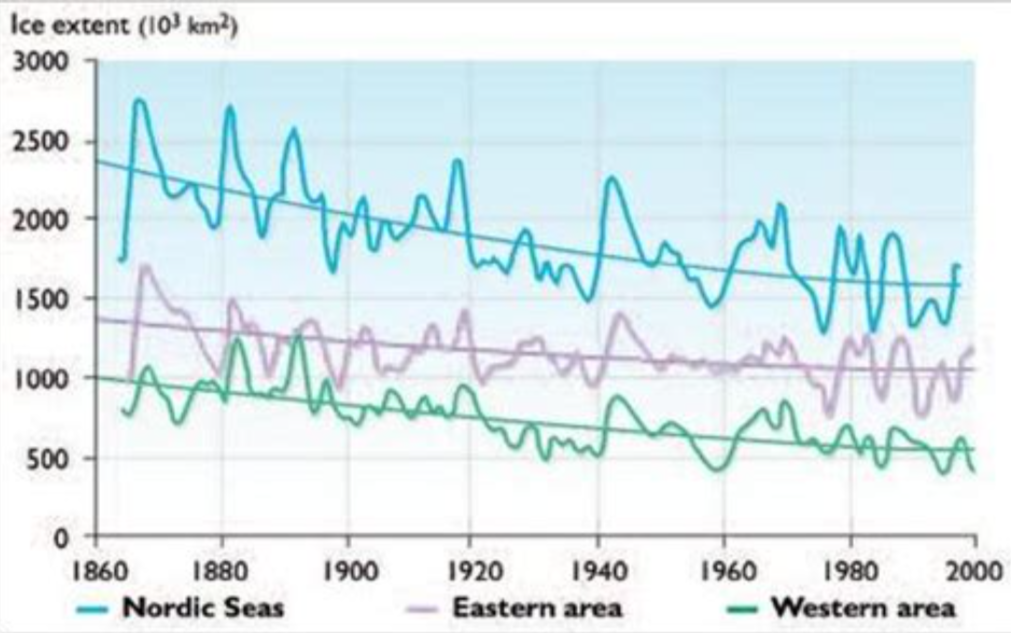
Figure 16-3: Time series of April sea-ice extent in Nordic Sea (1864-1998) given by 2-year running mean and second-order polynomial curves. Top: Nordic Sea; middle: eastern area; bottom: western area (after Vinje, 2000). IPCC Third Assessment Report

Since these long-term records show a quasi-60 year cycle in ice extents, it is vital to have a modern dataset based on the same methodology, albeit with sophisticated modern tools.

Summary

Measuring anything in the Arctic is difficult, and especially sea ice that is constantly moving around.  It is a good thing to have independent measures using different methodologies, since any estimate is prone to error.

Please take the time to express your appreciation for NIC’s contribution and your support for their products at MASIE  home page.

Update February 4, 2017

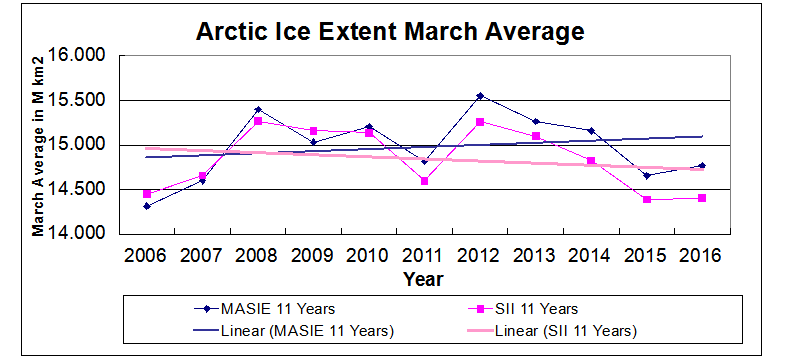
In the comments Neven said MASIE was unusable because it was biased low before 2010 and high afterward.  I have looked into that and he is mistaken.  Below is the pattern that is observed most months.  March is the annual maximum and coming up soon.

march-masie-sii

As the graph shows, the two datasets were aligned through 2010, and then SII began underestimating ice extent, resulting in a negative 11-year trend.  MASIE shows the same fluctuations, but with higher extents and a slightly positive trend for March extents.  The satellite sensors have a hard time with mixed ice/water conditions (well-documented).

More on the two datasets NOAA has been Losing Arctic Ice

Arctic Ice Takes Revenge

Vessels Kapitan Dranitsyn and Admiral Makarov ‘marooned’ in east for the rest of winter after getting trapped off Chukotka.

Russian Convoy Takes Advantage of Reduced Arctic Ice Extent

In the first such crossing since Soviet times, the convoy had earlier delivered supplies for the world’s first floating heat and power plant to be assembled in Chukotka, Russia’s most easternmost region, after a successful journey from Arkhangelsk to Pevek lasting from 14 December to 7 January.

The ease of the sailing was seen as a sign that climate warming in the Arctic can open up shipping lanes even in midwinter.  From the Siberian Times, Blow to Northern Sea Route as voyages of two icebreakers are… broken by ice

Reports of Arctic Ice Demise Prove Premature

But, despite significant temperature rises across the northern latitudes in recent years, the vessels became quickly stuck in thick, compressed ice on their return journey.

Initially there were hopes that the icebreakers could force their way out and continue their voyage within a week, and aerial reconnaissance was deployed in a search routes from the ice clog.

They are currently trapped by sudden thick ice around Chukotka’s northernmost cape Shelagsky, some 24 nautical miles from Pevek, in some of Russia’s most exposed waters.

Ruslan Nazarov, chief of Chukotka’s emergencies service, said: ‘The ice around Cape Shelagsky is at 10 points. The ice fields are more than one metre thick. The ice compression is strong and hummocks are higher than 2.5 metres.

Embarrassing But Not Life-threatening

The situation is not critical, Nazarov said, stressing that the regional ministry of emergencies and Chukotka government keep a close eye on it. ‘All the ships have enough fuel, food and all other necessities.’

A spokesman for Rosmorport has announced the icebreakers will delay a return until probably May or early June. ‘The vessels will remain for the winter because of the very heavy severe ice conditions,’ he said.

All the vessel got out of the ice, and three of them – Captain Dranitsyn and the two cargo ships – returned to Pevek. The Admiral Makarov moved further east to continue working for Rosmorport in clearing sea routes.

Officials said the icebreakers could have gone further through the ice but there was ‘a very high risk of significant damage’ to the supply ships, and it was decided to postpone the return to Archangelsk.

Arctic Ice Picks Up the Pace Everywhere

After a slow recovery in October and December, ice extent has picked considerably in recent weeks.

arctic-ice-2017025

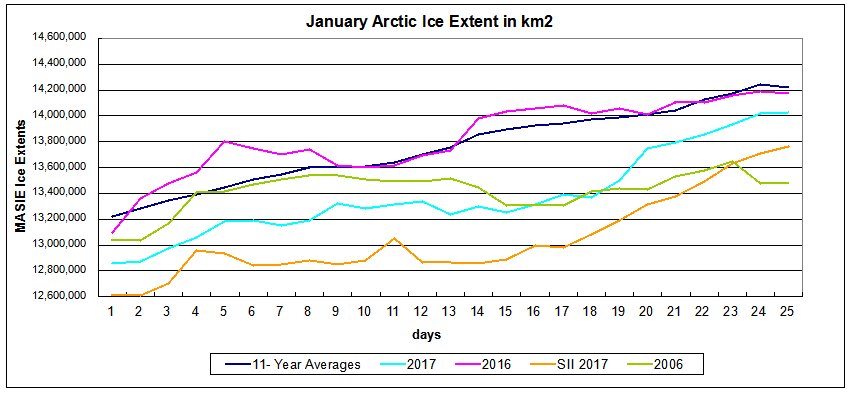
The graph shows how 2017 has surged to approach 2016 and the 11-year average, while exceeding 2006 (the decadal low year) by almost 500k km2.  Sea Ice Index (SII satellite product) lags behind by more than 300k km2, as it has throughout January.

The table shows ice extents across the seas within the Arctic area.

Region 2017025 Day 025
Average
2017
-Ave.
2006025 2016-2006
 (0) Northern_Hemisphere 14023232 14217519 -194287 13473190 550042
 (1) Beaufort_Sea 1070445 1070111 334 1069711 734
 (2) Chukchi_Sea 966006 966001 5 966006 0
 (3) East_Siberian_Sea 1087137 1087131 6 1087103 35
 (4) Laptev_Sea 897845 897835 10 897773 71
 (5) Kara_Sea 914838 918784 -3946 897490 17348
 (6) Barents_Sea 390190 547198 -157007 310539 79651
 (7) Greenland_Sea 646404 589533 56871 516605 129799
 (8) Baffin_Bay_Gulf_of_St._Lawrence 1328099 1275341 52758 1087283 240815
 (9) Canadian_Archipelago 853214 852982 232 852715 499
 (10) Hudson_Bay 1260887 1260842 45 1260779 108
 (11) Central_Arctic 3138059 3210975 -72916 3109874 28185
 (12) Bering_Sea 488459 689158 -200699 817517 -329058
 (13) Baltic_Sea 32910 78733 -45822 53850 -20939
 (14) Sea_of_Okhotsk 908522 712635 195887 470477 438045
 (15) Yellow_Sea 20850 26566 -5716 11722 9128
 (16) Cook_Inlet 7952 11204 -3252 8941 -989

On the Russsian side, Chukchi through Laptev are all at maximums, as evidenced in the reports from the Siberian Times.  Kara is also now average and well ahead of 2006.  Barents continues to be in deficit to average, but in surplus to 2006.  On the Canadian side, all seas are above average, with Greenland and Baffin well into surpluses.

The main difference between 2017 and the average is Bering Sea down by 200k km2.  Bering Sea is the only place with less 2017 ice than 2006.  On the other hand, Okhotsk is 200k km2 above average and 400k km2 above 2006.

Summary

Just when they thought it was safe to go back in the winter water, the ice returns.  As Siberian Times concluded:

But the saga shows that despite all the talk of climate change and warming in the Arctic, thick ice can prevent convoys from crossing the Northern Sea Route in deep winter.


Happy Arctic New Year

With the end of December, Arctic ice is rebuilding in the dark up to its annual maximum before the beginning of dawn in March.  Since many of the seas are already at their maximum extents, the coming months will only add about 2M km2 to the approximately 13M km2 of ice in place.

The regrowth of Arctic ice extent was slower than usual until recently. After showing resilience in September, ending higher than 2007, ice growth lagged in October, but has been ramping up toward the averages.  The map above shows the deficit of ice is mainly in two marginal seas: Bering in the Pacific and Barents in the Atlantic.

arctic-ice-2016365

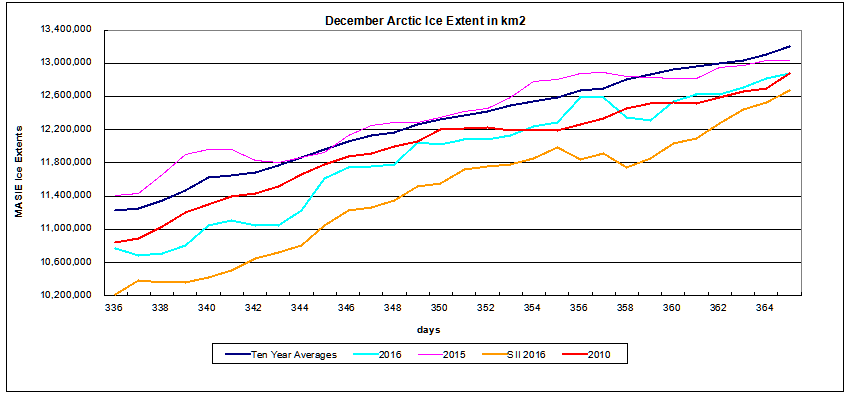
In December, 2016 ice extent has grown by 85k km2 per day, compared to the 10-year average 66k km2 per day.  As of Dec. 31, 2016 ice extent is ~3% less than average (2006 to 2015).  The chart also shows the variability of ice extent over the years during this month. (Note: Dec. 31, 2016 result is actually day 366, but the 31 days of December are compared properly.)

2015 did have the highest ice recovery rate in the last decade, but ended up just below average.  2010 had the lowest year end extent in the last decade, matched by 2016. 2011 March extent was about average at 14.819 and higher than both 2015 and 2016.

The chart also shows 2016 Sea Ice Index (SII) from NOAA has been lagging behind by  ~300k km2, but closing the gap lately.

The table below shows this year compared to average and to 2011 for day 001.  Since several years in the dataset were missing day 365, I am making the comparison a day later.

Region 2017001 Day 001
Average
2016-Ave. 2007001 2016-2006
 (0) Northern_Hemisphere 12857418 13223710 -366293 12991512 -134094
 (1) Beaufort_Sea 1070445 1070111 334 1069711 734
 (2) Chukchi_Sea 966006 966001 5 966006 0
 (3) East_Siberian_Sea 1087137 1087131 6 1087137 0
 (4) Laptev_Sea 897845 897835 10 897845 0
 (5) Kara_Sea 875975 898092 -22118 928941 -52966
 (6) Barents_Sea 199976 469542 -269566 340349 -140373
 (7) Greenland_Sea 464142 592432 -128290 545210 -81068
 (8) Baffin_Bay_Gulf_of_St._Lawrence 1153387 997051 156336 863809 289578
 (9) Canadian_Archipelago 853214 852979 235 852731 483
 (10) Hudson_Bay 1260887 1231119 29768 1217437 43450
 (11) Central_Arctic 3085289 3216691 -131403 3214432 -129143
 (12) Bering_Sea 228020 506683 -278663 512000 -283980
 (13) Baltic_Sea 14808 31992 -17184 16 14793
 (14) Sea_of_Okhotsk 674769 376649 298120 478831 195938
 (15) Yellow_Sea 5761 12180 -6419 0 5761
 (16) Cook_Inlet 5283 9040 -3758 15902 -10619

The main deficit to average is in Barents and Greenland Seas on the Atlantic side, and in Bering Sea on Pacific side.  The Canadian and Siberian sides are locked in ice, with sizable surpluses in Baffin Bay and Okhotsk Sea.

The Arctic Ice Extent Plateau Continues

arctic-ice-2016-ten-years

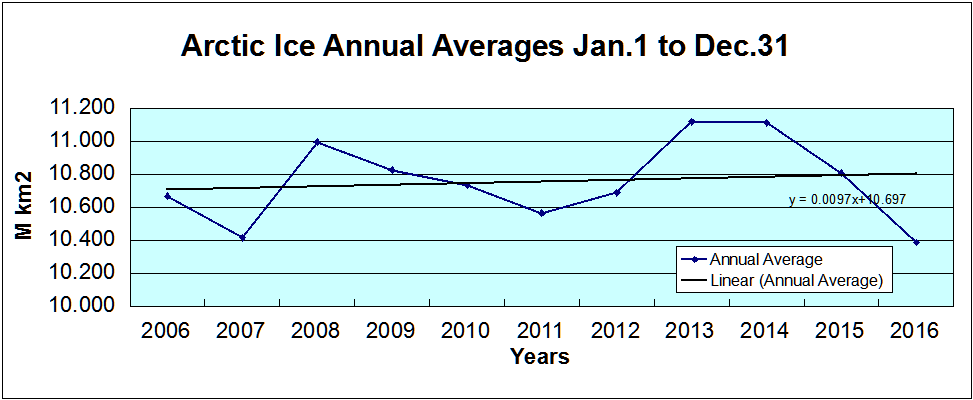
As I have pointed out before, the annual average ice extent is a better indicator of climate variation, since the seasonal changes are so sizable and extents vary with weather activity.  By averaging all daily extents over the calendar year, 2016 came in at 10.389M km2 compared to 10.414M in 2007, a virtual tie.  And the trendline remains slightly positive, though again, virtually flat.

The data above comes from MASIE, the most accurate Arctic ice dataset with unparalleled resolution at 4km, compared to SII which uses 25km cells.  Alarmists are unhappy with MASIE because it shows more ice, and it has been certified as “reasonably consistent” since 2006.

Alarmists are making much ado about 2016 being lower than 2007, and hoping for no future bounces as happened in 2008 and 2013.  Will the long-predicted decline finally ensue in 2017, or will the ice make a comeback as before?

No one knows what will happen to Arctic ice.

Except maybe the polar bears.

And they are not talking.

Except, of course, to the admen from Coca-Cola

Summary

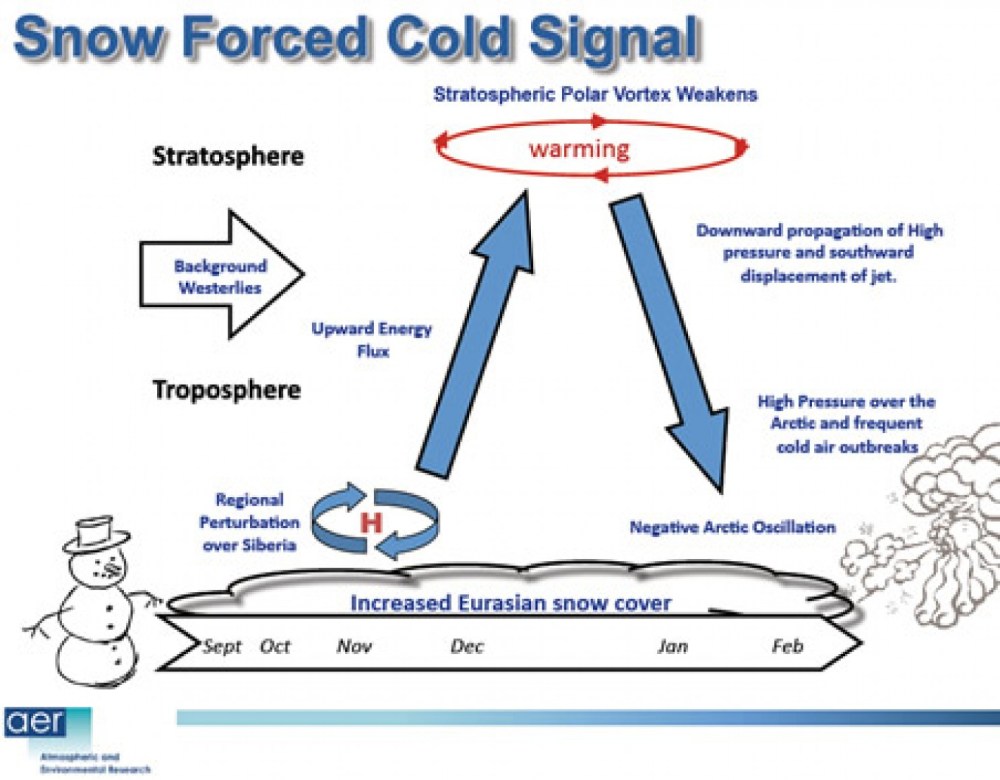
There is no need to panic over Arctic ice this year, or any year.  It fluctuates according to its own ocean-ice-atmospheric processes and we can only watch and be surprised since we know so little about how it all works.  Judah Cohen at AER thinks the much greater snowfall in October and since will make for a very cold winter.  We shall see.  It is already adding more mass to the Greenland ice sheet than in previous years.

cohen-schematic

https://rclutz.wordpress.com/2016/07/06/warm-is-cold-and-down-is-up/


Arctic Solstice 2016

The darkest time of year at the North Pole is the Winter Solstice, this year on December 21. There has been no sunlight or even twilight since early October. The darkness lasts until the beginning of dawn in early March.

The regrowth of Arctic ice extent was slower than usual until recently. After showing resilience in September, ending higher than 2007, ice growth lagged in October, but is now rapidly ramping up toward the averages.  The map above shows the lack of ice is mainly in marginal seas close to the Atlantic and Pacific oceans.

arctic-ice-2016355

In the last 19 days, 2016 ice extent has grown by 100k km2 per day, compared to the 10-year average 70k km2 per day.  As of day 355, 2016 ice extent is ~3% less than average (2006 to 2015).  The chart also shows the variability of ice extent over the years during this month.  2015 was the highest ice recovery rate in the last decade, while 2006 ended up the lowest.  The chart also shows 2016 Sea Ice Index (SII) from NOAA has been lagging behind by  ~300k km2.

The table below shows this year compared to average and to 2006 for day 355.

Region 2016355 Day 355
Average
2016-Ave. 2006355 2016-2006
 (0) Northern_Hemisphere 12239317 12586206 -346889 12148183 91133
 (1) Beaufort_Sea 1070445 1070151 294 1069711 734
 (2) Chukchi_Sea 855058 964292 -109234 966006 -110948
 (3) East_Siberian_Sea 1087137 1087134 3 1087137 0
 (4) Laptev_Sea 897845 897841 4 897845 0
 (5) Kara_Sea 851317 865798 -14482 909296 -57979
 (6) Barents_Sea 169752 380779 -211027 225917 -56165
 (7) Greenland_Sea 487544 584147 -96603 564913 -77369
 (8) Baffin_Bay_Gulf_of_St._Lawrence 952305 886295 66010 733978 218328
 (9) Canadian_Archipelago 853214 853009 205 852767 447
 (10) Hudson_Bay 1241127 1152343 88784 1029530 211596
 (11) Central_Arctic 3148299 3215124 -66825 3206257 -57957
 (12) Bering_Sea 118989 329544 -210555 246957 -127968
 (13) Baltic_Sea 15543 19208 -3665 16 15528
 (14) Sea_of_Okhotsk 477365 266483 210882 344508 132857
 (15) Yellow_Sea 0 4017 -4017 0 0
 (16) Cook_Inlet 5555 7180 -1624 12191 -6635

The main deficit to average is in Barents and Greenland Seas on the Atlantic side, and in Bering and Chukchi Seas on Pacific side.  The Canadian and Siberian sides are locked in ice, with sizable surpluses in Baffin and Hudson Bays, along with Okhotsk.  The differences with 2006 are similar, though resulting in a surplus.

The land of the Midnight Sun at Summer Solstice.

The land of the Midnight Sun at Summer Solstice.

Summary

There is no need to panic over Arctic ice this year, or any year.  It fluctuates according to its own ocean-ice-atmospheric processes and we can only watch and be surprised since we know so little about how it all works.  Judah Cohen at AER thinks the much greater snowfall in October will make for a very cold winter.  We shall see.

cohen-schematic

https://rclutz.wordpress.com/2016/07/06/warm-is-cold-and-down-is-up/