Arctic Ice Takes Revenge

Vessels Kapitan Dranitsyn and Admiral Makarov ‘marooned’ in east for the rest of winter after getting trapped off Chukotka.

Russian Convoy Takes Advantage of Reduced Arctic Ice Extent

In the first such crossing since Soviet times, the convoy had earlier delivered supplies for the world’s first floating heat and power plant to be assembled in Chukotka, Russia’s most easternmost region, after a successful journey from Arkhangelsk to Pevek lasting from 14 December to 7 January.

The ease of the sailing was seen as a sign that climate warming in the Arctic can open up shipping lanes even in midwinter.  From the Siberian Times, Blow to Northern Sea Route as voyages of two icebreakers are… broken by ice

Reports of Arctic Ice Demise Prove Premature

But, despite significant temperature rises across the northern latitudes in recent years, the vessels became quickly stuck in thick, compressed ice on their return journey.

Initially there were hopes that the icebreakers could force their way out and continue their voyage within a week, and aerial reconnaissance was deployed in a search routes from the ice clog.

They are currently trapped by sudden thick ice around Chukotka’s northernmost cape Shelagsky, some 24 nautical miles from Pevek, in some of Russia’s most exposed waters.

Ruslan Nazarov, chief of Chukotka’s emergencies service, said: ‘The ice around Cape Shelagsky is at 10 points. The ice fields are more than one metre thick. The ice compression is strong and hummocks are higher than 2.5 metres.

Embarrassing But Not Life-threatening

The situation is not critical, Nazarov said, stressing that the regional ministry of emergencies and Chukotka government keep a close eye on it. ‘All the ships have enough fuel, food and all other necessities.’

A spokesman for Rosmorport has announced the icebreakers will delay a return until probably May or early June. ‘The vessels will remain for the winter because of the very heavy severe ice conditions,’ he said.

All the vessel got out of the ice, and three of them – Captain Dranitsyn and the two cargo ships – returned to Pevek. The Admiral Makarov moved further east to continue working for Rosmorport in clearing sea routes.

Officials said the icebreakers could have gone further through the ice but there was ‘a very high risk of significant damage’ to the supply ships, and it was decided to postpone the return to Archangelsk.

Arctic Ice Picks Up the Pace Everywhere

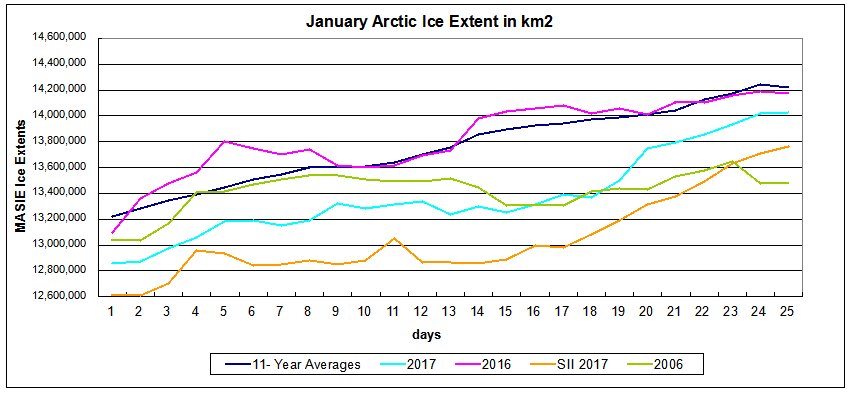
After a slow recovery in October and December, ice extent has picked considerably in recent weeks.
arctic-ice-2017025

The graph shows how 2017 has surged to approach 2016 and the 11-year average, while exceeding 2006 (the decadal low year) by almost 500k km2.  Sea Ice Index (SII satellite product) lags behind by more than 300k km2, as it has throughout January.

The table shows ice extents across the seas within the Arctic area.

Region 2017025 Day 025
Average
2017
-Ave.
2006025 2016-2006
 (0) Northern_Hemisphere 14023232 14217519 -194287 13473190 550042
 (1) Beaufort_Sea 1070445 1070111 334 1069711 734
 (2) Chukchi_Sea 966006 966001 5 966006 0
 (3) East_Siberian_Sea 1087137 1087131 6 1087103 35
 (4) Laptev_Sea 897845 897835 10 897773 71
 (5) Kara_Sea 914838 918784 -3946 897490 17348
 (6) Barents_Sea 390190 547198 -157007 310539 79651
 (7) Greenland_Sea 646404 589533 56871 516605 129799
 (8) Baffin_Bay_Gulf_of_St._Lawrence 1328099 1275341 52758 1087283 240815
 (9) Canadian_Archipelago 853214 852982 232 852715 499
 (10) Hudson_Bay 1260887 1260842 45 1260779 108
 (11) Central_Arctic 3138059 3210975 -72916 3109874 28185
 (12) Bering_Sea 488459 689158 -200699 817517 -329058
 (13) Baltic_Sea 32910 78733 -45822 53850 -20939
 (14) Sea_of_Okhotsk 908522 712635 195887 470477 438045
 (15) Yellow_Sea 20850 26566 -5716 11722 9128
 (16) Cook_Inlet 7952 11204 -3252 8941 -989

On the Russsian side, Chukchi through Laptev are all at maximums, as evidenced in the reports from the Siberian Times.  Kara is also now average and well ahead of 2006.  Barents continues to be in deficit to average, but in surplus to 2006.  On the Canadian side, all seas are above average, with Greenland and Baffin well into surpluses.

The main difference between 2017 and the average is Bering Sea down by 200k km2.  Bering Sea is the only place with less 2017 ice than 2006.  On the other hand, Okhotsk is 200k km2 above average and 400k km2 above 2006.

Summary

Just when they thought it was safe to go back in the winter water, the ice returns.  As Siberian Times concluded:

But the saga shows that despite all the talk of climate change and warming in the Arctic, thick ice can prevent convoys from crossing the Northern Sea Route in deep winter.


Happy Arctic New Year

With the end of December, Arctic ice is rebuilding in the dark up to its annual maximum before the beginning of dawn in March.  Since many of the seas are already at their maximum extents, the coming months will only add about 2M km2 to the approximately 13M km2 of ice in place.

The regrowth of Arctic ice extent was slower than usual until recently. After showing resilience in September, ending higher than 2007, ice growth lagged in October, but has been ramping up toward the averages.  The map above shows the deficit of ice is mainly in two marginal seas: Bering in the Pacific and Barents in the Atlantic.

arctic-ice-2016365

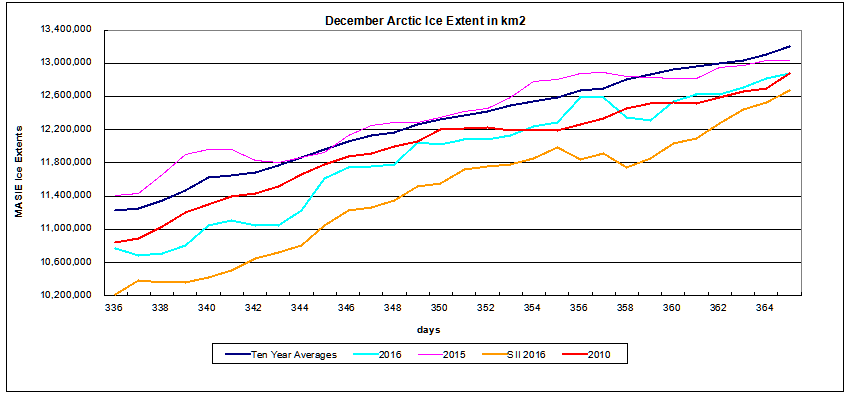
In December, 2016 ice extent has grown by 85k km2 per day, compared to the 10-year average 66k km2 per day.  As of Dec. 31, 2016 ice extent is ~3% less than average (2006 to 2015).  The chart also shows the variability of ice extent over the years during this month. (Note: Dec. 31, 2016 result is actually day 366, but the 31 days of December are compared properly.)

2015 did have the highest ice recovery rate in the last decade, but ended up just below average.  2010 had the lowest year end extent in the last decade, matched by 2016. 2011 March extent was about average at 14.819 and higher than both 2015 and 2016.

The chart also shows 2016 Sea Ice Index (SII) from NOAA has been lagging behind by  ~300k km2, but closing the gap lately.

The table below shows this year compared to average and to 2011 for day 001.  Since several years in the dataset were missing day 365, I am making the comparison a day later.

Region 2017001 Day 001
Average
2016-Ave. 2007001 2016-2006
 (0) Northern_Hemisphere 12857418 13223710 -366293 12991512 -134094
 (1) Beaufort_Sea 1070445 1070111 334 1069711 734
 (2) Chukchi_Sea 966006 966001 5 966006 0
 (3) East_Siberian_Sea 1087137 1087131 6 1087137 0
 (4) Laptev_Sea 897845 897835 10 897845 0
 (5) Kara_Sea 875975 898092 -22118 928941 -52966
 (6) Barents_Sea 199976 469542 -269566 340349 -140373
 (7) Greenland_Sea 464142 592432 -128290 545210 -81068
 (8) Baffin_Bay_Gulf_of_St._Lawrence 1153387 997051 156336 863809 289578
 (9) Canadian_Archipelago 853214 852979 235 852731 483
 (10) Hudson_Bay 1260887 1231119 29768 1217437 43450
 (11) Central_Arctic 3085289 3216691 -131403 3214432 -129143
 (12) Bering_Sea 228020 506683 -278663 512000 -283980
 (13) Baltic_Sea 14808 31992 -17184 16 14793
 (14) Sea_of_Okhotsk 674769 376649 298120 478831 195938
 (15) Yellow_Sea 5761 12180 -6419 0 5761
 (16) Cook_Inlet 5283 9040 -3758 15902 -10619

The main deficit to average is in Barents and Greenland Seas on the Atlantic side, and in Bering Sea on Pacific side.  The Canadian and Siberian sides are locked in ice, with sizable surpluses in Baffin Bay and Okhotsk Sea.

The Arctic Ice Extent Plateau Continues

arctic-ice-2016-ten-years

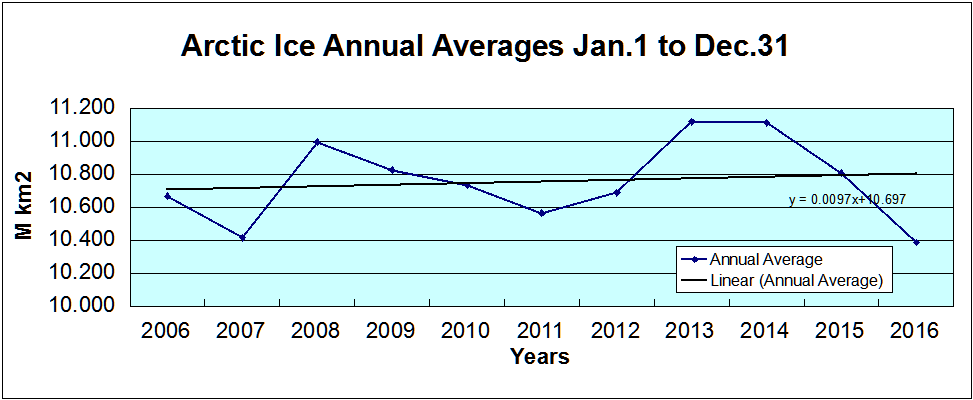
As I have pointed out before, the annual average ice extent is a better indicator of climate variation, since the seasonal changes are so sizable and extents vary with weather activity.  By averaging all daily extents over the calendar year, 2016 came in at 10.389M km2 compared to 10.414M in 2007, a virtual tie.  And the trendline remains slightly positive, though again, virtually flat.

The data above comes from MASIE, the most accurate Arctic ice dataset with unparalleled resolution at 4km, compared to SII which uses 25km cells.  Alarmists are unhappy with MASIE because it shows more ice, and it has been certified as “reasonably consistent” since 2006.

Alarmists are making much ado about 2016 being lower than 2007, and hoping for no future bounces as happened in 2008 and 2013.  Will the long-predicted decline finally ensue in 2017, or will the ice make a comeback as before?

No one knows what will happen to Arctic ice.

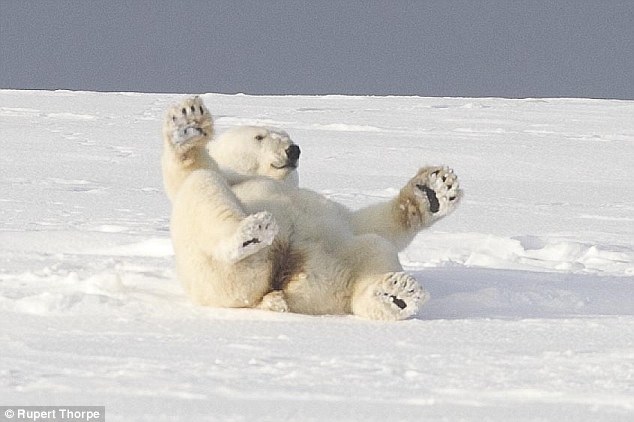
Except maybe the polar bears.

And they are not talking.

Except, of course, to the admen from Coca-Cola

Summary

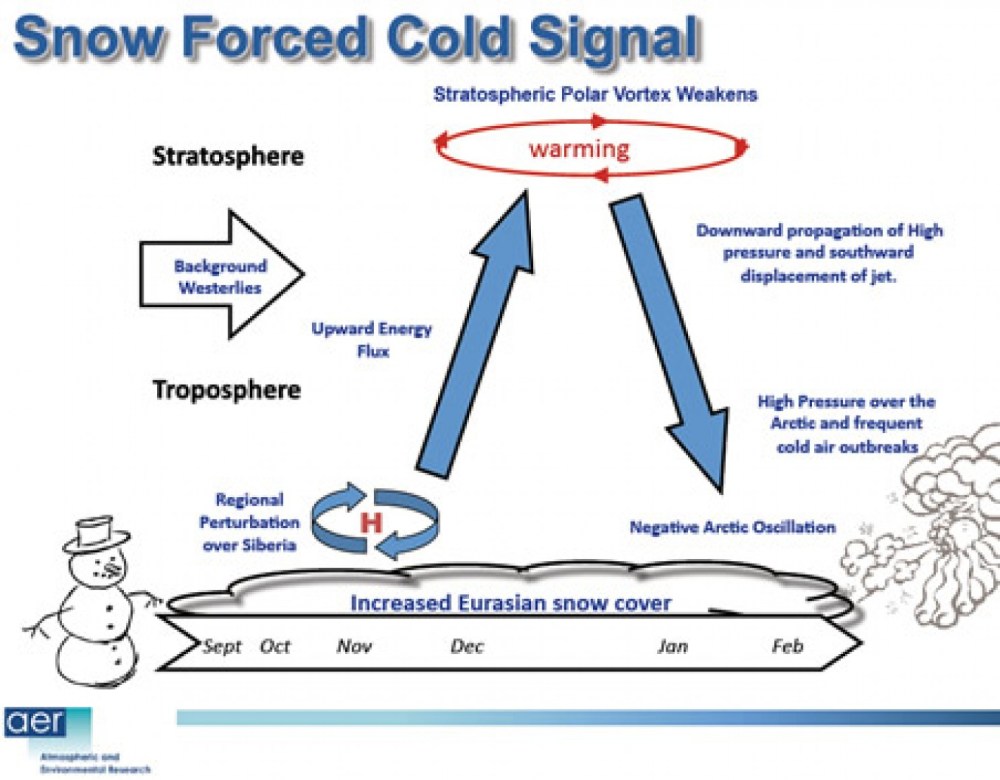
There is no need to panic over Arctic ice this year, or any year.  It fluctuates according to its own ocean-ice-atmospheric processes and we can only watch and be surprised since we know so little about how it all works.  Judah Cohen at AER thinks the much greater snowfall in October and since will make for a very cold winter.  We shall see.  It is already adding more mass to the Greenland ice sheet than in previous years.
cohen-schematic

https://rclutz.wordpress.com/2016/07/06/warm-is-cold-and-down-is-up/


Arctic Solstice 2016

The darkest time of year at the North Pole is the Winter Solstice, this year on December 21. There has been no sunlight or even twilight since early October. The darkness lasts until the beginning of dawn in early March.

The regrowth of Arctic ice extent was slower than usual until recently. After showing resilience in September, ending higher than 2007, ice growth lagged in October, but is now rapidly ramping up toward the averages.  The map above shows the lack of ice is mainly in marginal seas close to the Atlantic and Pacific oceans.

arctic-ice-2016355

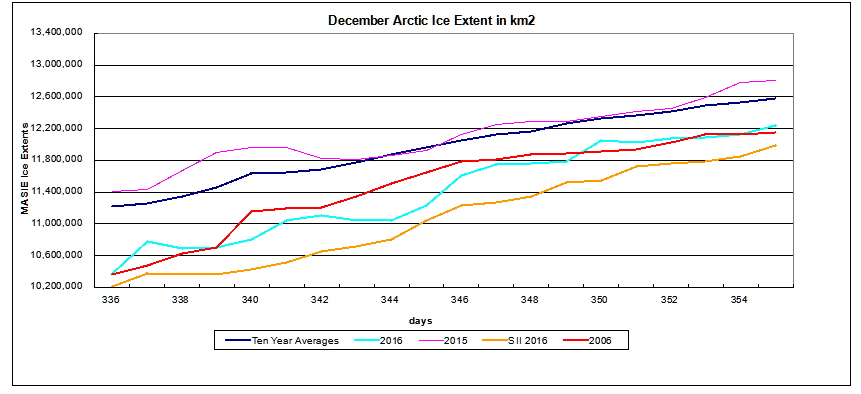
In the last 19 days, 2016 ice extent has grown by 100k km2 per day, compared to the 10-year average 70k km2 per day.  As of day 355, 2016 ice extent is ~3% less than average (2006 to 2015).  The chart also shows the variability of ice extent over the years during this month.  2015 was the highest ice recovery rate in the last decade, while 2006 ended up the lowest.  The chart also shows 2016 Sea Ice Index (SII) from NOAA has been lagging behind by  ~300k km2.

The table below shows this year compared to average and to 2006 for day 355.

Region 2016355 Day 355
Average
2016-Ave. 2006355 2016-2006
 (0) Northern_Hemisphere 12239317 12586206 -346889 12148183 91133
 (1) Beaufort_Sea 1070445 1070151 294 1069711 734
 (2) Chukchi_Sea 855058 964292 -109234 966006 -110948
 (3) East_Siberian_Sea 1087137 1087134 3 1087137 0
 (4) Laptev_Sea 897845 897841 4 897845 0
 (5) Kara_Sea 851317 865798 -14482 909296 -57979
 (6) Barents_Sea 169752 380779 -211027 225917 -56165
 (7) Greenland_Sea 487544 584147 -96603 564913 -77369
 (8) Baffin_Bay_Gulf_of_St._Lawrence 952305 886295 66010 733978 218328
 (9) Canadian_Archipelago 853214 853009 205 852767 447
 (10) Hudson_Bay 1241127 1152343 88784 1029530 211596
 (11) Central_Arctic 3148299 3215124 -66825 3206257 -57957
 (12) Bering_Sea 118989 329544 -210555 246957 -127968
 (13) Baltic_Sea 15543 19208 -3665 16 15528
 (14) Sea_of_Okhotsk 477365 266483 210882 344508 132857
 (15) Yellow_Sea 0 4017 -4017 0 0
 (16) Cook_Inlet 5555 7180 -1624 12191 -6635

The main deficit to average is in Barents and Greenland Seas on the Atlantic side, and in Bering and Chukchi Seas on Pacific side.  The Canadian and Siberian sides are locked in ice, with sizable surpluses in Baffin and Hudson Bays, along with Okhotsk.  The differences with 2006 are similar, though resulting in a surplus.

The land of the Midnight Sun at Summer Solstice.

The land of the Midnight Sun at Summer Solstice.

Summary

There is no need to panic over Arctic ice this year, or any year.  It fluctuates according to its own ocean-ice-atmospheric processes and we can only watch and be surprised since we know so little about how it all works.  Judah Cohen at AER thinks the much greater snowfall in October will make for a very cold winter.  We shall see.

cohen-schematic

https://rclutz.wordpress.com/2016/07/06/warm-is-cold-and-down-is-up/


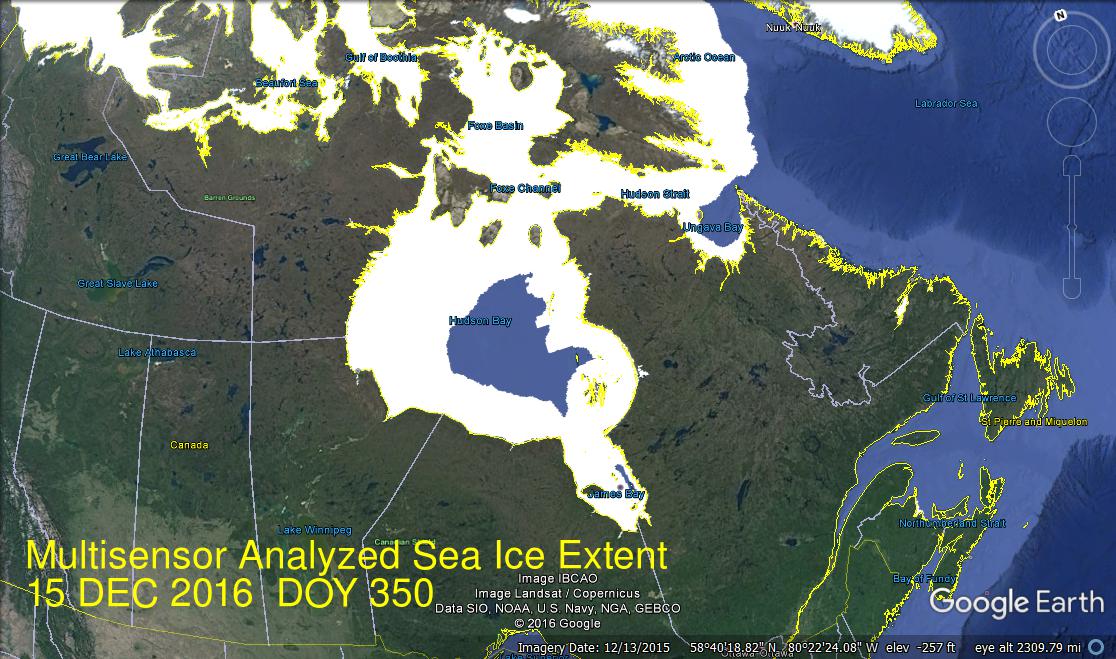
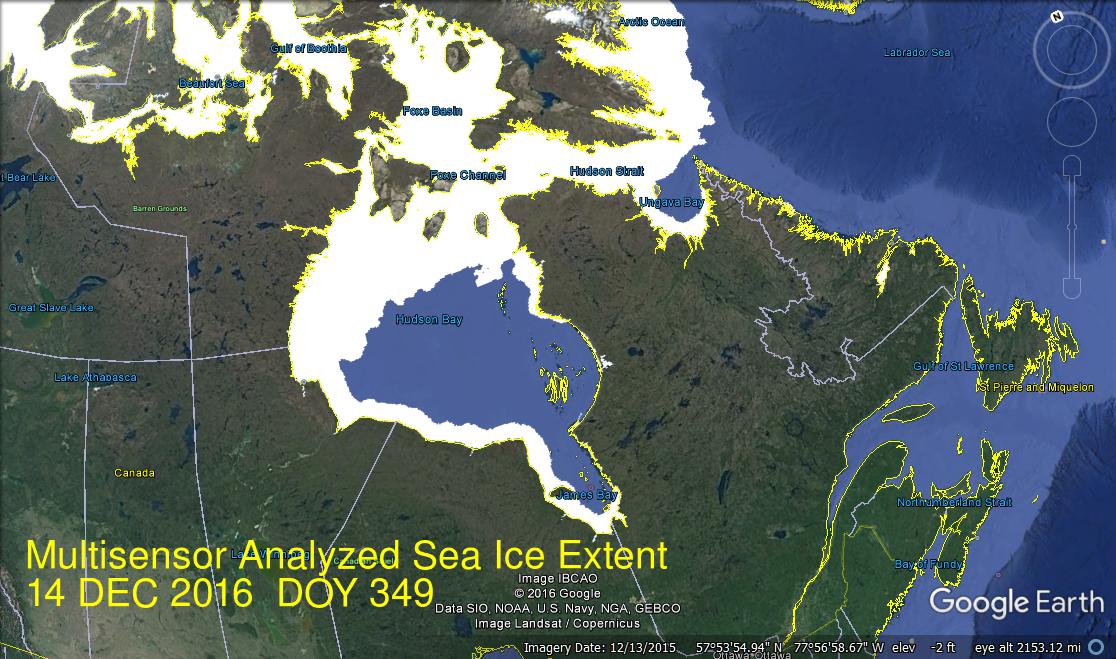
One Day in Hudson Bay

Two days ago I posted on Resurging Arctic Ice, and noted that most of the deficit to average was in Barents Sea and Hudson Bay.  Look what happened yesterday in Hudson Bay.

google-earth-day-350

Now compare to the day before

google-earth-day-349

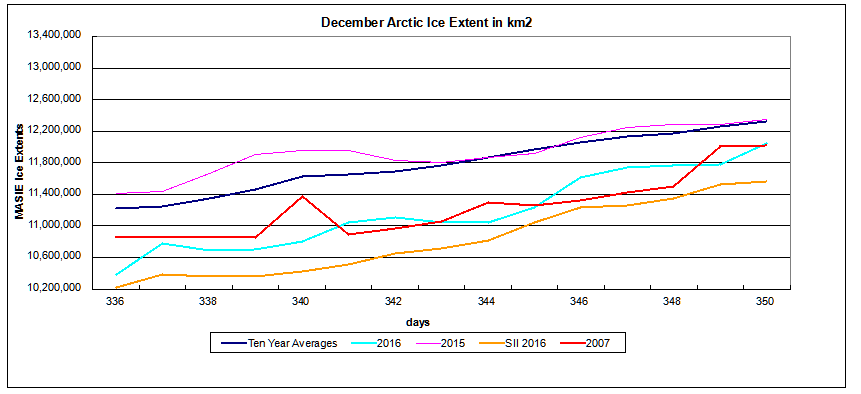
2016 Arctic ice extent has now topped 12M km2, and continues to close in on the average for the last decade.

arctic-ice-2016350

Sea Ice Index from NOAA is running more than 400k km2 behind. But the polar bears know the truth, and it has set them free.


Resurging Arctic Ice Dec. 14

The regrowth of Arctic ice extent was slower than usual until recently. After showing resilience in September, ending higher than 2007, ice growth lagged in October, but is now rapidly ramping up toward the averages.  The map above shows the lack of ice is mainly in Hudson Bay and Barents Sea.  Kara, Bering and Chukchi seas have all rebounded and everything else is locked in ice.

arctic-ice-dec-13-2016

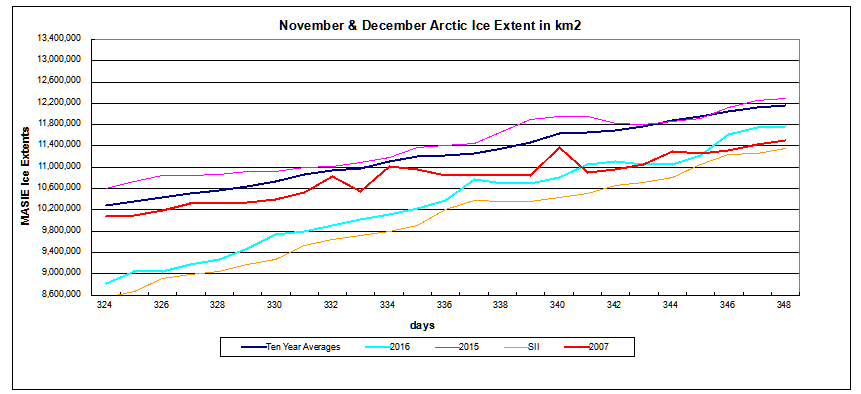
In the last 24 days, 2016 ice extent has grown by 123k km2 per day, compared to the 10-year average 79k km2 per day.  As of day 348, 2016 ice extent is ~3% less than average (2006 to 2015).  The chart also shows the variability of ice extent over the years during this season.  2015 was the highest ice recovery rate in the last decade, while 2007 was the slowest.  The chart also shows 2016 Sea Ice Index (SII) from NOAA has been lagging behind by more than 300k km2.

The table below shows this year compared to average and to 2007 for day 348.

Region 2016348 Day 348
Average
2016-Ave. 2007348 2016-2007
 (0) Northern_Hemisphere 11762663 12168943 -406279 11501915 260748
 (1) Beaufort_Sea 1070445 1069448 997 1062676 7769
 (2) Chukchi_Sea 937738 937789 -51 725062 212676
 (3) East_Siberian_Sea 1087137 1083777 3361 1053584 33553
 (4) Laptev_Sea 897845 897832 12 897845 0
 (5) Kara_Sea 742906 866952 -124046 800920 -58014
 (6) Barents_Sea 271463 352281 -80818 236964 34499
 (7) Greenland_Sea 494089 559862 -65773 488595 5494
 (8) Baffin_Bay_Gulf_of_St._Lawrence 846064 813794 32270 793616 52448
 (9) Canadian_Archipelago 853214 853007 207 852556 658
 (10) Hudson_Bay 820629 1085867 -265238 1217263 -396634
 (11) Central_Arctic 3200307 3211105 -10799 3186190 14116
 (12) Bering_Sea 227611 250748 -23137 54836 172775
 (13) Baltic_Sea 11782 10418 1364 2898 8884
 (14) Sea_of_Okhotsk 297235 166142 131093 127576 169659
 (15) Yellow_Sea 0 1278 -1278 0 0
 (16) Cook_Inlet 3055 6601 -3546 48 3007

Most of the deficit to average is in Kara, Barents, Greenland Sea and Hudson Bay.  Central Arctic, CAA, Bering Sea and BCE are all average, while Okhotsk and Baffin Bay are showing surpluses.  Presently 2016 ice extent is 260k km2 greater than 2007 with large surpluses in BCE, Baffin, Bering and Okhotsk Seas.  Only Hudson Bay and Kara were larger in 2007.

There is no need to panic over Arctic ice this year, or any year.  It fluctuates according to its own ocean-ice-atmospheric processes and we can only watch and be surprised since we know so little about how it all works.  Judah Cohen at AER thinks the much greater snowfall in October will make for a very cold winter.  We shall see.

cohen-schematic

https://rclutz.wordpress.com/2016/07/06/warm-is-cold-and-down-is-up/


Surging Arctic Ice Nov. 30

The growth of Arctic ice extent has been slower than usual this year.  After showing resilience in September, ending higher than 2007, ice growth lagged in October, and is only now ramping up toward the averages.  The map above shows the lack of ice is mainly in Hudson Bay, and the slow freezing of Kara and Barents Seas.  Everything else is locked in ice, except for some open water in Bering and Chukchi.

arctic-ice-nov-30-2016

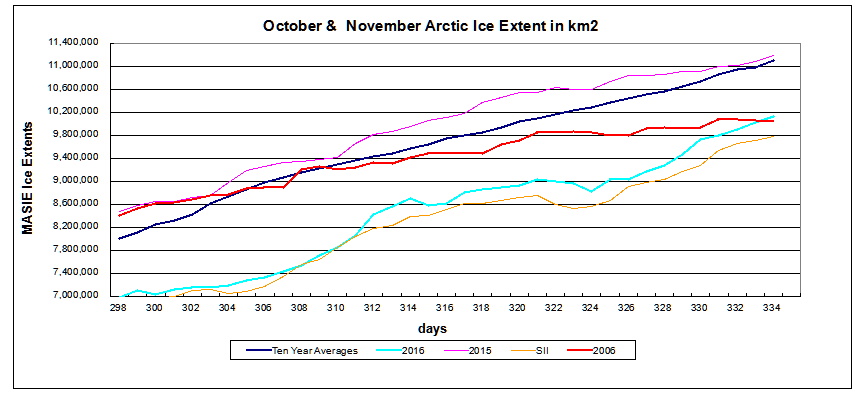
In the last five weeks, 2016 ice growth has surged twice, firstly from day 303 to 314, and then the current surge the last 10 days starting day 325.  The chart also shows the variability of ice extent over the years during this season.  2015 was the highest ice recovery rate in the last decade, while 2006 was the lowest.  The chart also shows Sea Ice Index (SII) from NOAA is lagging over 300k km2 behind.

There is no need to panic over Arctic ice this year, or any year.  It fluctuates according to its own ocean-ice-atmospheric processes and we can only watch and be surprised since we know so little about how it all works.  Judah Cohen at AER thinks the much greater snowfall in October will make for a very cold winter.  We shall see.

cohen-schematic

https://rclutz.wordpress.com/2016/07/06/warm-is-cold-and-down-is-up/


Today’s Arctic Compares with 150 years ago

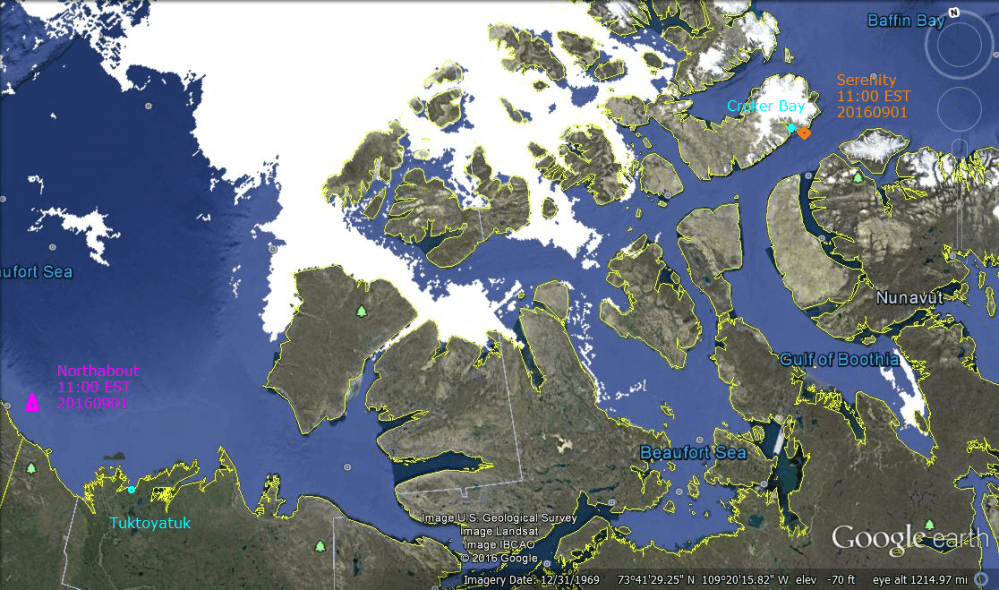
Imagery date refers to Google Earth capture of land forms. Ice extent is for August 31, 2016 from MASIE. Serenity is docked at Devon Island. Click to zoom in.

Imagery date refers to Google Earth capture of land forms. Ice extent is for August 31, 2016 from MASIE. Serenity is docked at Devon Island. Click to zoom in.

Researchers found that ice conditions in the 19th century were remarkably similar to today’s, observations falling within normal variability. The study is Accounts from 19th-century Canadian Arctic Explorers’ Logs Reflect Present Climate Conditions (here) by James E. Overland, Pacific Marine Environmental Laboratory/NOAA, Seattle,Wash., and Kevin Wood, Arctic Research Office/NOAA, Silver Spring, Md.   H/t GWPF

Overview

This article demonstrates the use of historical instrument and descriptive records to assess the hypothesis that environmental conditions observed by 19th-century explorers in the Canadian archipelago were consistent with a Little Ice Age as evident in proxy records.  We find little evidence for extreme cold conditions.

It is clear that the first-hand observations of 19th-century explorers are not consistent with the hypothesized severe conditions of a multi-decadal Little Ice Age. Explorers encountered both warm and cool seasons, and generally typical ice conditions, in comparison to 20th-century norms.

Analysis

There were more than seventy expeditions or scientific enterprises of various types dispatched to the Canadian Arctic in the period between 1818 and 1910. From this number, we analyzed 44 original scientific reports and related narratives; many from expeditions spanning several years. The majority of the data come from large naval expeditions that wintered over in the Arctic and had the capacity to support an intensive scientific effort. A table listing the expeditions and data types is located at http://www.pmel.noaa.gov/arctic/history. The data cover about one-third of the possible number of years depending on data type, and every decade is represented.

Our analysis focuses on four indicators of climatic change: summer sea ice extent, annual sea ice thickness, monthly mean temperature, and the onset of melt and freeze as estimated from daily mean temperature. Historical observations in these four categories were compared with modern reference data; the reference period varied, depending on data availability.  Both sea ice extent and the onset of melt and freeze were compared to the 30- year reference period 1971–2000; monthly means are compared to the 50-year period 1951–2000. Modern sea ice thickness records are less continuous, and some terminate in the 1980s; the reference period is therefore based on 19 to 26 years of homogeneous record.

arctic-explorers-fig1

Fig.1.

(a) Proxy record of standardized summer air temperature variation derived from ice cores taken on Devon Island. This proxy record suggests that a significantly colder climate prevailed in the 19th century. Shading indicates temperatures one standard deviation warmer or colder than average for the reference period 1901–1960 [Overpeck,1998].

(b) Historical monthly mean temperature observations compared to the 20th-century reference period 1951–2000. Sixty-three percent of 343 monthly mean temperatures recorded on 19th-century expeditions between 1819 and 1854 fall within one standard deviation of the reference mean at nearby stations (reference data from Meteorological Service of Canada,2002; and National Climatic Data Center,2002).

(c) Onset of melt observed by expeditions between 1820 and 1906 expressed as departures from the mean for the reference period 1971–2000. The period of melt transition observed by 19th century explorers is not inconsistent with modern values.

(d) Onset of freeze observed between 1819 and 1905 compared to the reference period 1971–2000. The onset of freeze transition is frequently consistent with modern values,but in some cases occurred earlier than usual. The incidence of an early onset of freeze represents the largest departure from present conditions evident in the historical records examined in this study. Melt and freeze transition dates for the reference period 1971–2000 were calculated from temperature data extracted from the Global Daily Climatology Network data base (National Climate Data Center, 2002).

arctic-explorers-fig2

Fig.2. The ship tracks and winter-over locations of Arctic discovery expeditions from 1818 to 1859 are surprisingly consistent with present sea ice climatology (contours represented by shades of blue). The climatology shown reflects percent frequency of sea ice presence on 10 September which is the usual date of annual ice minimum for the reference period 1971–2000 (Canadian Ice Service,2002). On a number of occasions,expeditions came within 150 km of completing the Northwest Passage, but even in years with unfavorable ice conditions, most ships were still able to reach comparatively advanced positions within the Canadian archipelago. By 1859, all possible routes comprising the Northwest Passage had been discovered.

Summary

As stated here before, Arctic ice is part of a self-oscillating system with extents expanding and retreating according to processes internal to the ocean-ice-atmosphere components. We don’t know exactly why 19th century ice extent was less than previously or less than the 1970s, but we can be sure it wasn’t due to fossil fuel emissions.

arctic-explorers-fig3rev

Explorers encountered both favorable and unfavorable ice conditions. This drawing from the vicinity of Beechey Island illustrates the situation of the H.M.S.Resolute and the steam-tender Pioneer on 5 September 1850 [from Facsimile of the Illustrated Arctic News,courtesy of Elmer E.Rasmuson Library,Univ.of AlaskaFairbanks].

October Arctic Ice Report and Outlook

google-2016305

Imagery date refers to Google Earth capture of land forms. MASIE ice extent for October 31, 2016 is displayed. Click to zoom in.

After showing resilience in September, Arctic ice growth faltered in October. The graph shows MASIE ice extents in 2016 in comparison with other years and with SII.

masie-2016-day305

Last year was above average recovery, while both SII and MASIE showed October 2016 well below average, and dropping down to 2007 levels.  Interestingly, MASIE and SII show virtually the same October average extent at 6.1M km2. This amount is 10% below the MASIE Oct. ten-year average, but that figure is 21% below SII ten-year average for Oct.

6.1M km2 is still higher than 2007 by 260k km2 despite the slower recovery this year. There is an anomaly in the 2007 record: a leap of almost 800k km2 on day 303, including E. Siberian Sea adding 460k km2 to more than double its ice extent on that day. Kara also jumped up 50% adding 100k km2. More about those two seas below.

The table shows by region the differences from ten-year MASIE averages for day 305, October 31.

Region 2016305 Day 305 Average 2016-Ave.
 (0) Northern_Hemisphere 7283405 8865912 -1582506
 (1) Beaufort_Sea 769445 998163 -228718
 (2) Chukchi_Sea 276157 506472 -230315
 (3) East_Siberian_Sea 600113 1001404 -401291
 (4) Laptev_Sea 897773 897591 182
 (5) Kara_Sea 162641 559477 -396837
 (6) Barents_Sea 24522 120163 -95641
 (7) Greenland_Sea 319983 446472 -126489
 (8) Baffin_Bay_Gulf_of_St._Lawrence 262586 260072 2514
 (9) Canadian_Archipelago 728911 782867 -53956
 (10) Hudson_Bay 76561 90864 -14303
 (11) Central_Arctic 3155443 3190140 -34696

Clearly in the table and in the image at the top, ice is missing mostly in the BCE region on the Asian side (Beaufort, Chukchi, E. Siberian) and in Kara and Barents on the European side.

What’s Up with Arctic Ice

For some answers let’s turn first to Dr. Judah Cohen of AER.  His analysis is thorough and interesting (here).  Excerpts:

Arctic sea ice reached its annual minimum on September 10th. Despite an initial spurt of ice growth, overall Arctic sea ice has been expanding at an anemic rate. One area to note on the North Atlantic side is in the Barents-Kara Seas, where negative sea ice anomalies have been growing (Figure 13). Recent research has shown that regional anomalies are important and the sea ice region most highly correlated with the winter AO is the Barents-Kara seas region where low Arctic sea ice favors a negative winter AO. Given that sea ice is running well below normal, this currently favors further expansion Eurasian snow cover in the coming weeks, followed by a strengthened Siberian high and a weakened polar vortex/negative AO this upcoming winter.

Sea ice anomalies also remain well below normal in the East Siberian, Chukchi and Beaufort seas. This could favor positive geopotential height anomalies near Alaska forcing downstream troughing and cold weather across eastern North America.

Additional context is provided by Ted Scambos in an article at Discover Magazine (here).  Excerpts below.

An animation of satellite images shows differences in sea ice in the Beaufort Sea off Alaska’s coast between Oct. 14, 2014 and Oct. 12, 2016. The first image, captured by the Terra satellite in 2014, shows extensive snow cover around Alaska’s Brooks Range (to the left), and sea ice forming offshore. The second image, from the Aqua satellite in 2016, shows the same region — mostly snow- and ice-free. (Images: NASA Worldview. Animation: Tom Yulsman)

An animation of satellite images shows differences in sea ice in the Beaufort Sea off Alaska’s coast between Oct. 14, 2014 and Oct. 12, 2016. The first image, captured by the Terra satellite in 2014, shows extensive snow cover around Alaska’s Brooks Range (to the left), and sea ice forming offshore. The second image, from the Aqua satellite in 2016, shows the same region — mostly snow- and ice-free. (Images: NASA Worldview. Animation: Tom Yulsman)

Arctic sea ice has been been growing much more slowly than average during October. Its geographic extent is now in a rough tie with 2007 and 2012 for the lowest in the satellite record for this point in the year.

According to Ted Scambos, a senior research scientist at the National Snow and Ice Data Center, two big Arctic storms in August contributed significantly to the very low minimum extent in September. They probably did this by “breaking up the ice and stirring a trace of warmth up from deeper levels (5-10 meters below the surface),” Scambos says.

Not too long after the storminess subsided, the surface water refroze fairly quickly, accounting for the rapid expansion of sea ice after the low point in September sea ice

That rapid freeze-up happened in the heart of the Arctic Ocean, where temperatures would normally be coldest. Meanwhile, more at the periphery — particularly in the Barents, Kara and Laptev seas — “the ice edge has barely changed,” says Julienne Stroeve, who also serves as a senior research scientist at NSIDC.

Sea ice has expanded somewhat in the Beaufort Sea, off Alaska’s north coast. But the edge is still far short of the long term average in the region.

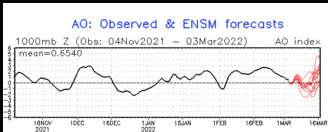
Arctic Oscillation Index (relative air pressures) hovered around neutral before dropping strongly negative mid Oct., about when ice growth stalled.

Why has Arctic sea ice been growing so slowly in the past couple of weeks? Once again, Scambos thinks the warm sea surface temperatures that have been retarding ice growth also have been warming the air directly above the water. 

“It is not surprising that it is extremely warm in the weeks following near-record minimums [in sea ice extent], because open water beneath the atmosphere buffers the air temperature at near the freezing point for several weeks until several centimeters of ice are formed,” Scambos says. “In this case, I would say that the high air temperature anomaly is an effect, not a cause, of slow sea ice growth, and that the leading cause is ocean temperature.”

What’s the Winter Outlook

Dr. Judah Cohen provides his seasonal forecast here.

Snow cover advance across Eurasia continued consistently above normal for the entire month of October. Also because much of the advance has occurred at latitudes south of 60°N, the snow advance index is also well above normal. Above normal snow cover extent, especially south of 60°N, favors a strengthened Siberian high and a weakened polar vortex/negative AO this upcoming winter with cold temperatures across the continents of the NH.

Predicted winter surface temperature anomalies for the United States Dec-Jan-Feb 2016/17 in degrees Fahrenheit. The model is forecasting colder than normal temperatures for much of the Eastern United States, with warmer than normal temperatures for the Western United States. The model uses October Siberian snow cover, sea level pressure anomalies, predicted El Niño/Southern Oscillation anomalies, and observed September Arctic sea ice anomalies. October Siberian snow cover has so far this month advanced at an above normal rate. This is an indication of an increased probability of a weakened polar vortex or a sudden stratospheric warming, and a predominantly negative Arctic Oscillation during the winter and cold temperatures – especially east of the Mississippi. This is a preliminary forecast and not the official winter forecast as the model requires full monthly values for snow cover and sea level pressure anomalies. The forecast will be updated next month. Current forecast produced on October 19, 2016.

Summary

Both Cohen and Scambos explanations are consistent with the lack of ice both in BCE on the Asian side (Beaufort, Chukchi, E. Siberian), and in Kara and Barents on the European side.

Warm ocean water reduces ice extents, the air is warmed and moistened, and then snowfall increases. The conditions for winter ice formation are shaping up, though somewhat later than usual, perhaps because of August storm activity.

Lastly, it’s important to realize that two weeks is a short period of time, and Arctic sea ice could start forming up at a more normal rate for this time of year. In fact, that’s what Scambos predicts: “Now I expect that sea ice growth will take a more typical path (typical for the past 5-8 years, at least).”

One more time: Remember the 3 Ws when it comes to Arctic ice extents.  Firstly it’s the Water, and then the Wind circulation, and the Weather.  Air temperatures are an effect not the cause.

For more on this see:

Arctic Sea Ice: Self-Oscillating System

Arctic Not a Refrigerator

Sept. Arctic Ice Beats Expectations

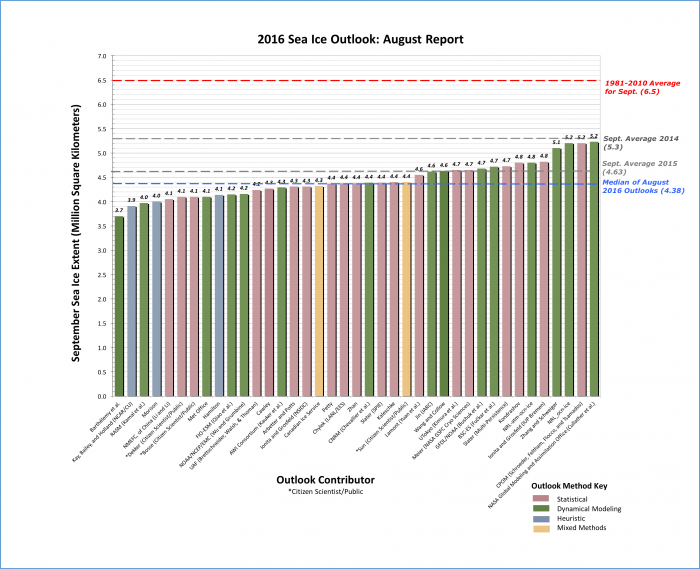
August 2016 was the final report of the Sea Ice Prediction Network (SIPN) before the actual September monthly extent is reported by NOAA Sea Ice Index (SII). The report (here) gave this overview:

This month the median pan-Arctic extent Outlook for September 2016 sea ice extent is 4.4 million square kilometers (km2) with quartiles of 4.2 and 4.7 million km2, which is slightly higher than July’s value (4.3 million km2) (See Figure 1 in the full report, below). If the median Outlook should agree with the observed estimate come September, this year would be the third lowest September in the satellite record. The spread in the Outlook contributions narrowed slightly from July to August, with an overall range this month of 3.7 to 5.2 million km2.

arctic-ice-sept-2016

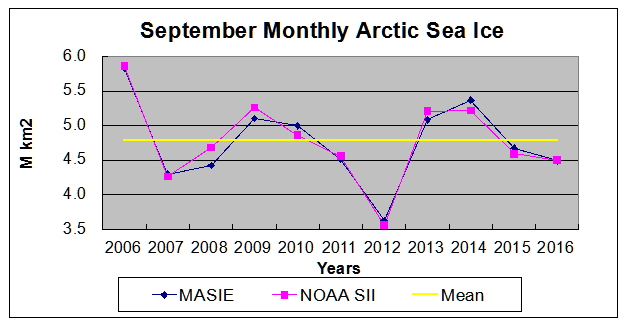
The chart shows the September monthly sea ice extents from NOAA and MASIE. Both datasets show 4.5 M km2, above what was predicted, about 200k km2 higher than 2007.

In MASIE, September 2016 finished as the fourth lowest, ahead of 2012, 2007 and 2008, slightly behind 2011.

Some had anticipated a late Arctic cyclone might again produce a lower number, as it did in 2012. But as the chart shows, 2012 is looking increasingly like an outlier, interrupting a steady recovery of ice extents since 2007.

Arctic Ice on the Up and Up


Despite what you may be hearing, Arctic ice is not presently declining, a big disappointment to fear mongers. Something happened to cause a rapid decline in the decade 1998 to 2007, but since then the ice has been stable or slightly rising.

The analysis below comes from the MASIE dataset, whose managers have no stated position on global warming, climate change, or the future of Arctic ice. They simply report daily ice conditions for the safety of ships operating in Arctic seas. It is the highest resolution, most accurate report of daily ice conditions. MASIE historical records became available once NSIDC confirmed that the records have reasonable consistency starting with 2006.

Big Picture Shows Recovery from 2007 Low

Arctic ice extents are cyclical with maximums occurring in March and the annual minimums in September. Autumn snowfall and winter weather affect the March ice, and September varies with warm and salty water circulations, cloudiness affecting brightness, and stormy weather breaking and compressing ice. The annual average of ice extent factors in fluctuations over the entire cycle.

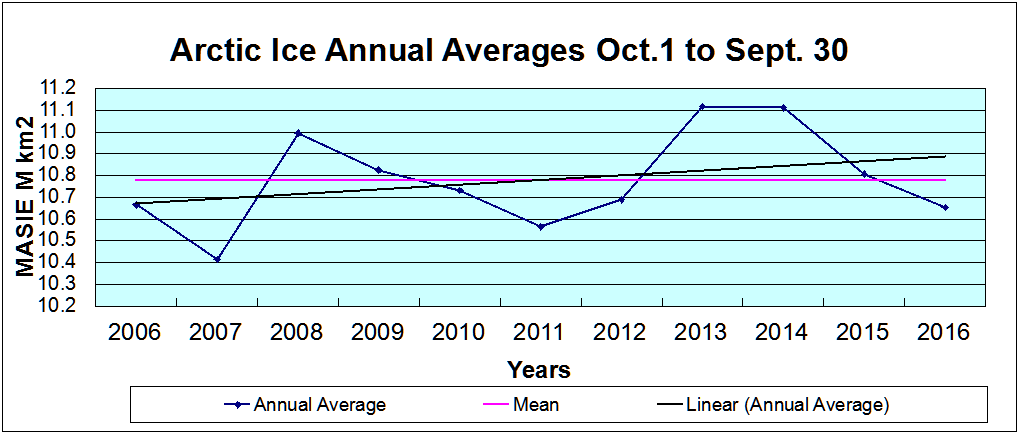
Since we are at the end of the melt season, the chart below takes 12 month averages starting Oct. 1 to display average annual ice extents for the last 11 years.

arctic-annual-sept-2016

The minimum occurred in 2007 at ~10.4 M km2 and all years have been higher than that, including 2006, 2012 and 2016 virtually tied at ~10.7 M km2. The trendline is descriptive, not predictive; that is, the line serves only to show the pattern in this brief history, the future could go higher or lower with equal uncertainty.

It should be noted that the variability is quite constrained within +/- 0.4 M km2, or +/- 3% of the annual average. Also 5 years are above average, and 6 years are below.

September Ice Minimums

The chart below shows comparative measures of September ice extents.

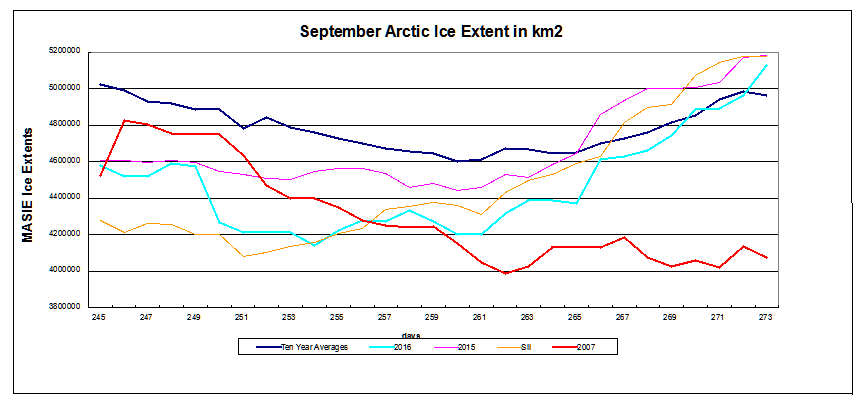
masie-2016-day273

The red line is September 2007, which was the lowest in the last 10 years, except for 2012 which was hit by the great Arctic Cyclone.  More importantly, 2007 had the smallest annual average ice extent in the MASIE record (since 2006).  The blue line is the ten-year average for days in September (2006 to 2015 inclusive).  MASIE 2015 is in purple, MASIE 2016 in green, and 2016 NOAA SII (Sea Ice Index) is in yellow.

While the minimums all occurred days 260 to 262, 2007 extents were already trending lower, and presently the other measures are converging above average.  With SII virtually tied with MASIE, that index will also be showing a September average ~ 4.5 M km2.

2016 is now slightly above average, having gone below the average annual minimum (4.6 M km2 on Sept. 16) for 17 days before regaining the lost ice.

The table below shows the locations of ice among the various seas making up the Arctic Ocean. Day 273 is Sept. 30 most years; 2016 being a leap year is one day later. So the official 2016 results will benefit from an additional day of ice extent exceeding 5M km2.

Region 2016273 Day 273 Average 2016-Ave. 2015273 2016-2015
 (0) Northern_Hemisphere 5128960 5014059 114901 5183385 -54426
 (1) Beaufort_Sea 376071 574043 -197972 530396 -154325
 (2) Chukchi_Sea 427460 212714 214746 329362 98098
 (3) East_Siberian_Sea 323001 329489 -6488 265744 57257
 (4) Laptev_Sea 295732 162254 133477 165663 130069
 (5) Kara_Sea 163 43464 -43301 45328 -45166
 (6) Barents_Sea 271 24142 -23871 1445 -1174
 (7) Greenland_Sea 194462 256519 -62057 256733 -62271
 (8) Baffin_Bay_Gulf_of_St._Lawrence 50141 49107 1034 71775 -21635
 (9) Canadian_Archipelago 347668 356314 -8646 352788 -5120
 (10) Hudson_Bay 0 4953 -4953 15485 -15485
 (11) Central_Arctic 3112850 2999948 112902 3147524 -34674

2016 is above average with deficits mainly in Beaufort, Kara, and Greenland seas, offset by surpluses in Chukchi, Laptev and Central Arctic.

Summary

Those claiming global warming is proved by declining Arctic ice are losing that line of evidence. Not only has it stopped declining, the evidence is growing that it varies over quasi-60 year cycles because of changes in water circulations, wind and weather. And some researchers think that the ice may continue to grow up and up in the near future.

For more on Arctic Ice Datasets:

A Tale of Two Indices

Ice House of Mirrors

Footnote:

Crystal Serenity is planning for more future Arctic cruises, while Russia is planning for more icebreakers.