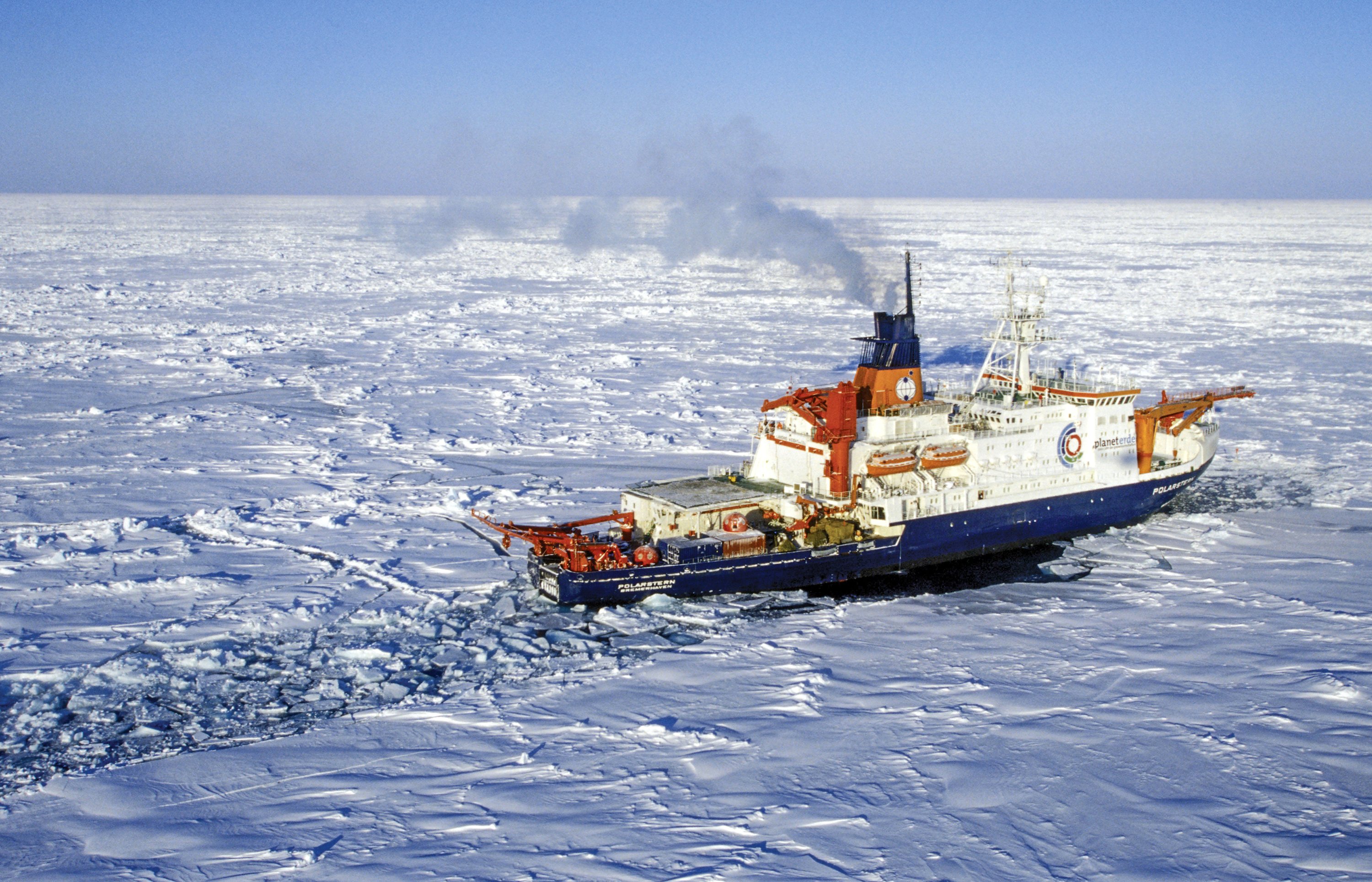
Research ship drifting along with Arctic ice, May 2019 US Naval Institute
In May, most of the Arctic ocean basins are still frozen over, while the melting of ice extent is underway in the marginal regions. During the last 30 days, on average according to MASIE, Arctic ice extents lose 1.4M km2. The few basins where open water appears this time of year tend to fluctuate and alternate waxing and waning.
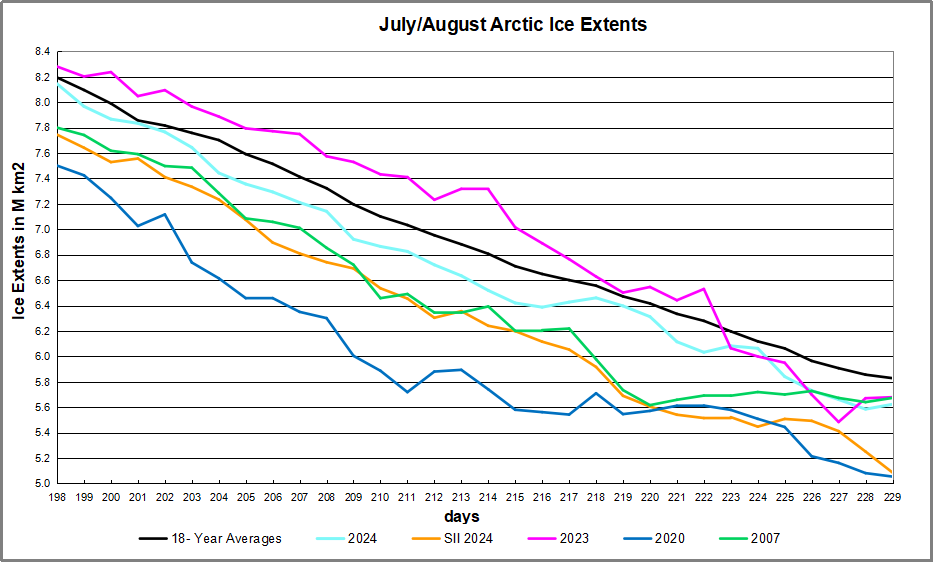
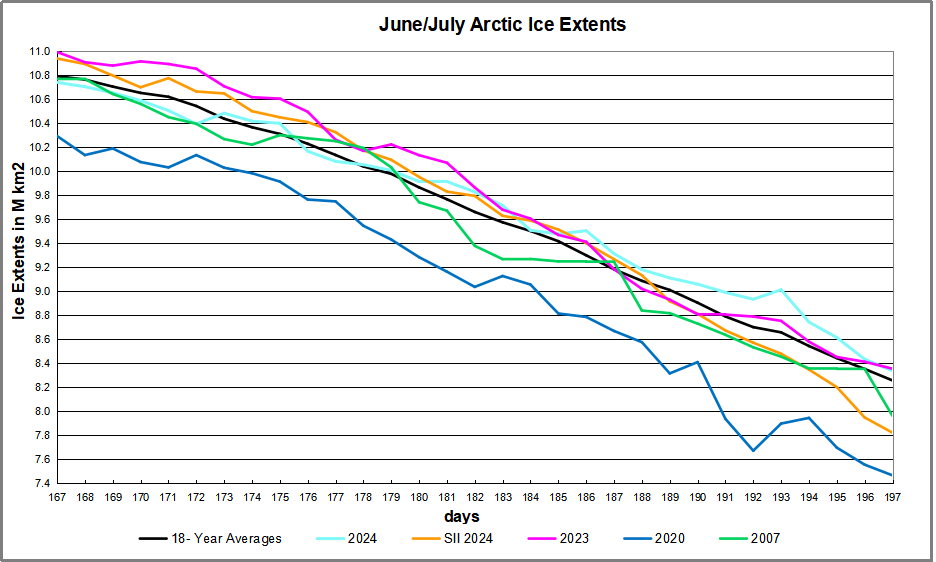
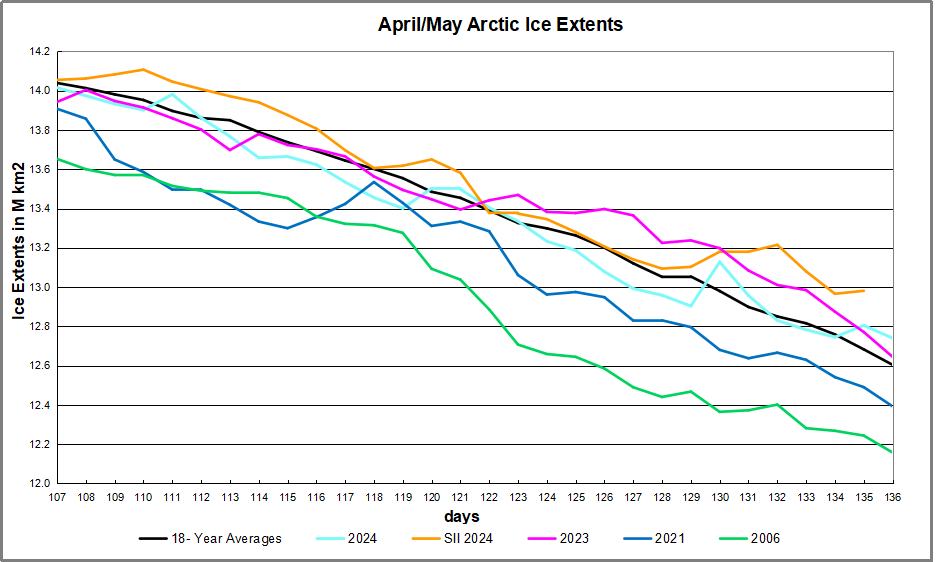
The graph below shows the mid April to mid May patterns for ice extents on average, this year and some other years of note.
The graph shows the 18-year average loss for April is 1.4M km2. 2024 started this period with a slight deficit and ended 136k km2 above average. SII showed higher throughout, and much greater extents in May (still awaiting the number for Day 136). Other recent years have been nearly average, while 2006 ended with a large defict of ~400k km2.
Region
2024136
Day 136 Ave
2024-Ave.
2006136
2024-2006
(0) Northern_Hemisphere
12740271
12604358
135913
12157814
582457
(1) Beaufort_Sea
1059379
1045092
14287
1066139
-6760
(2) Chukchi_Sea
962124
924541
37582
956734
5389
(3) East_Siberian_Sea
1081877
1081548
330
1074876
7001
(4) Laptev_Sea
892100
879228
12872
889990
2109
(5) Kara_Sea
875173
876506
-1333
839569
35603
(6) Barents_Sea
562240
406857
155382
182554
379686
(7) Greenland_Sea
666605
613812
52793
519337
147268
(8) Baffin_Bay_Gulf_of_St._Lawrence
984569
1059633
-75065
892335
92234
(9) Canadian_Archipelago
838357
841188
-2831
828806
9550
(10) Hudson_Bay
1117021
1177260
-60239
1071342
45679
(11) Central_Arctic
3216321
3225072
-8750
3169225
47096
(12) Bering_Sea
370480
285787
84693
478464
-107984
(13) Baltic_Sea
14356
5552
8804
15239
-883
(14) Sea_of_Okhotsk
98529
179953
-81424
168615
-70086
The table shows regional ice extents in km2. Note that Hudson and Baffin Bays have started melting, and Hudson will likely go to open water in a few weeks. Sea of Okhotsk on the Pacific side is down 81k, offset by a similar surplus in Bering sea. Note the huge surplus in Barents sea on the European side. Everywhere else is mostly in surplus, especially the seas of Barents, Greenland and Bering. 2006 had 582k km2 less ice extent than 2024 (more than half a Wadham).
The polar bears had a Valentine Day’s wish for Arctic Ice.
And Arctic Ice loves them back, returning every year so the bears can roam and hunt for seals.
Footnote:
Seesaw accurately describes Arctic ice in another sense: The ice we see now is not the same ice we saw previously. It is better to think of the Arctic as an ice blender than as an ice cap, explained in the post The Great Arctic Ice Exchange.
In April, most of the Arctic ocean basins are still frozen over, and so the melting of ice extent begins in the marginal regions. According to MASIE, April on average loses 1.1M km2, and this month it was 1.4M. However, April 2024 started well above average, slipped into deficit and ended up above normal. The few basins where open water appears this time of year tend to fluctuate and alternate waxing and waning, which appears as a see saw pattern in these images.
On the left is the Pacific seesaw with Bering below and Okhotsk above. This year Okhotsk melted out rapidly, and at the end held only 181k km2, 14% of its March maximum. Meanwhile Bering waffled up and down and retained ~60% (444k km2) of its max ice at the end. The Atlantic seesaw is Barents top center and Baffin on the right below Greenland. Barents also waffled but lost no ice extent until the last week, ending up with 666k km2 (76% of its max). Baffin fluctuated before ending down to 1.06M (72% of its. max.).
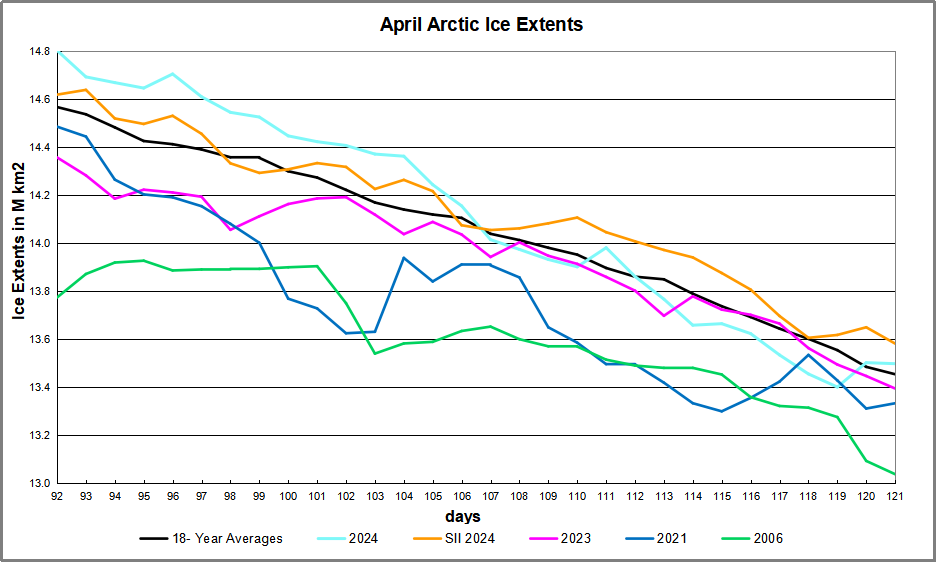
While the bulk of the Arctic is frozen solid, the melting has started with the seesaws tilting back and forth in the four regions noted above. The graph below shows the April patterns for ice extents on average, this year and some other years of note.
The graph shows the 18-year average loss for April is 1.1M km2. 2024 started with 236k km2 surplus ice extent and ended 44k km2 above average. SII showed lower extents the first half, and greater extents the latter half, ending with a small surplus to MASIE. Other recent years have been nearly average, while 2006 ended with a large deficit.
Region
2024121
Day 121 Ave
2024-Ave.
2006121
2024-2006
(0) Northern_Hemisphere
13498263
13454328
43935
13037927
460336
(1) Beaufort_Sea
1070983
1068053
2931
1067609
3374
(2) Chukchi_Sea
965784
956102
9682
965302
483
(3) East_Siberian_Sea
1087137
1085711
1426
1083591
3546
(4) Laptev_Sea
897845
890453
7392
896455
1390
(5) Kara_Sea
930744
909660
21084
911941
18803
(6) Barents_Sea
666436
539906
126530
366229
300207
(7) Greenland_Sea
790758
648904
141854
533678
257079
(8) Baffin_Bay_Gulf_of_St._Lawrence
1060935
1195567
-134633
1037524
23411
(9) Canadian_Archipelago
854860
849541
5320
843395
11465
(10) Hudson_Bay
1242383
1236594
5789
1178518
63865
(11) Central_Arctic
3232686
3231036
1651
3098989
133698
(12) Bering_Sea
495771
459644
36127
639162
-143391
(13) Baltic_Sea
19703
44493
-24791
29017
-9314
(14) Sea_of_Okhotsk
180662
610735
-430073
381798
-201136
The table shows regional ice extents in km2. Note the huge deficit in Okhotsk and a smaller deficit in Baffin. Everywhere else is in surplus, especially the seas of Barents, Greenland and Bering. 2006 had 460k km2 less ice extent (nearly half a Wadham) than 2024.
The polar bears had a Valentine Day’s wish for Arctic Ice.
And Arctic Ice loves them back, returning every year so the bears can roam and hunt for seals.
Footnote:
Seesaw accurately describes Arctic ice in another sense: The ice we see now is not the same ice we saw previously. It is better to think of the Arctic as an ice blender than as an ice cap, explained in the post The Great Arctic Ice Exchange.
The animation shows Arctic ice melting season picking up first half of April 2024. Typically, the Pacific side goes to water first, this year Okhotsk (top left) is ahead of schedule. Also Baffin Bay (bottom right) is opening up early. Elsewhere Arctic drift ice remains, and Barents Sea ice (top center) is well above average for mid April.
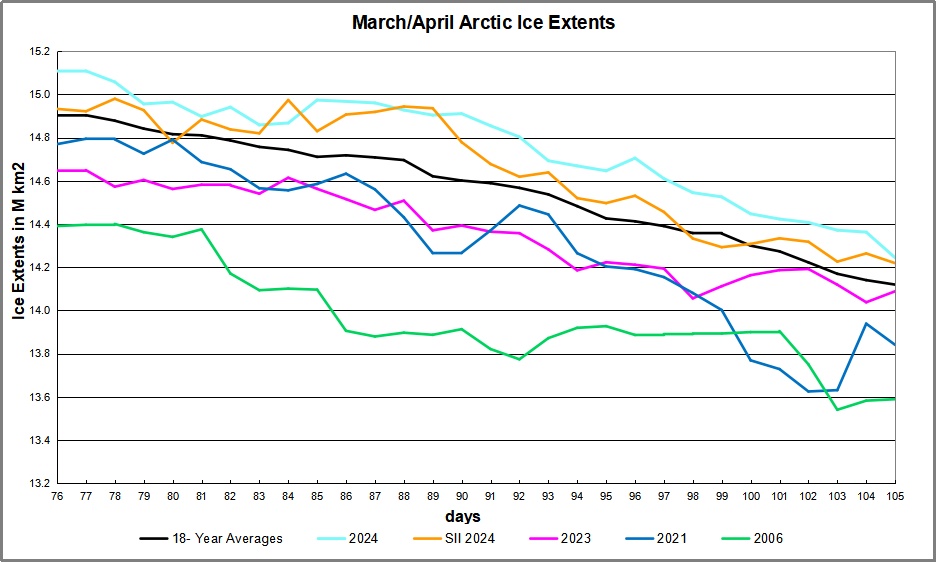
The graph below shows mid-March to mid-April daily ice extents for 2024 compared to 18 year averages, and some years of note.
The black line shows on average Arctic ice extents decline from a maximum near 14.9M km2 on day 76 down to ~14.1M Km2 by day 105. Exceptionally 2024 started with 15.1M km2 and exceeded the 18-year average throughout. SII was somewhat lower than MASIE in most of April until ending nearly the same. Both 2021 melted faster than average, while 2006 ice started and ended much in deficit.
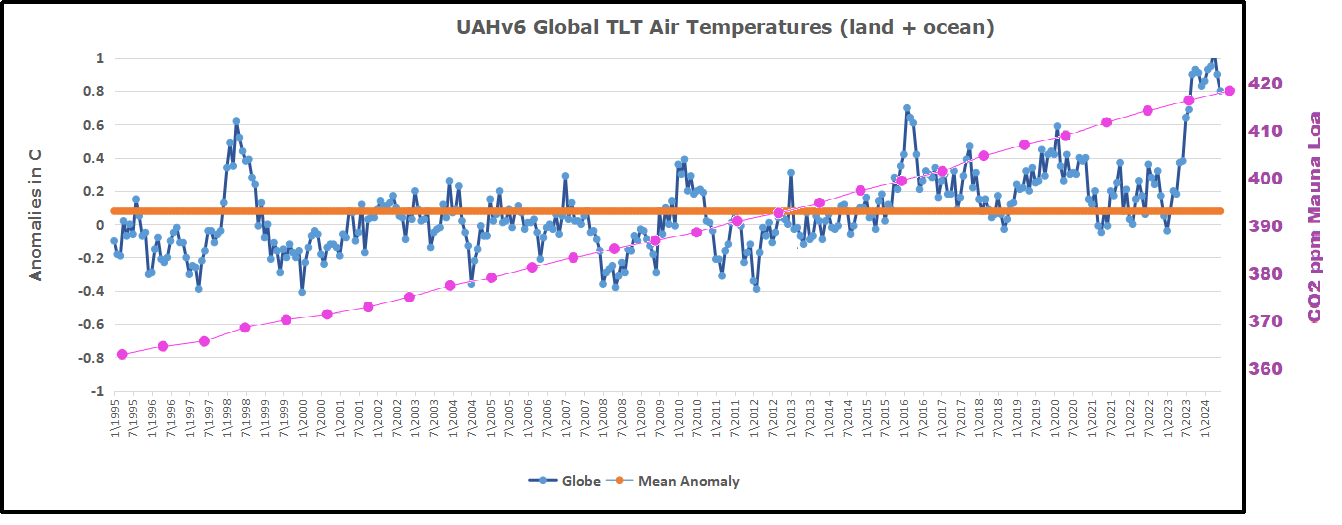
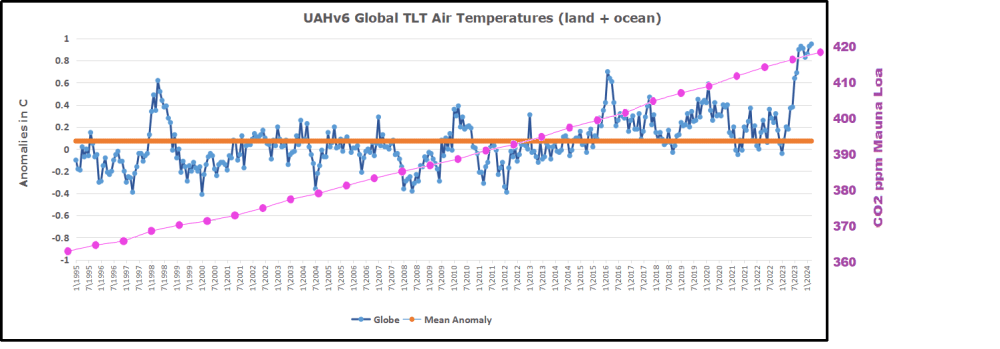
Why is this important? All the claims of global climate emergency depend on dangerously higher temperatures, lower sea ice, and rising sea levels. The lack of additional warming prior to 2023 El Nino is documented in a post UAH February 2024: SH Saves Global Warming.
The table below shows the distribution of Sea Ice on day 105 across the Arctic Regions, on average, this year and 2006.
Region
2024105
Day 105 Ave
2024-Ave.
2006105
2024-2006
(0) Northern_Hemisphere
14244041
14119733
124309
13589226
654815
(1) Beaufort_Sea
1070983
1069820
1163
1068683
2301
(2) Chukchi_Sea
966006
964681
1325
965591
415
(3) East_Siberian_Sea
1087137
1085571
1567
1083591
3546
(4) Laptev_Sea
897845
893528
4316
896528
1317
(5) Kara_Sea
935023
922957
12066
912379
22645
(6) Barents_Sea
856908
608844
248064
495112
361796
(7) Greenland_Sea
802111
653203
148908
599062
203049
(8) Baffin_Bay_Gulf_of_St._Lawrence
1179443
1279861
-100418
1042266
137178
(9) Canadian_Archipelago
854860
852951
1909
851056
3804
(10) Hudson_Bay
1231701
1247129
-15428
1235951
-4250
(11) Central_Arctic
3247180
3233303
13877
3168930
78250
(12) Bering_Sea
639179
647219
-8040
667951
-28772
(13) Baltic_Sea
31107
44493
-13386
84568
-53461
(14) Sea_of_Okhotsk
442660
610735
-168075
507143
-64483
The overall surplus to average is 124k km2, (1%). The only major deficits are in Baffin Bay and in Sea of Okhotsk, the latter going to open water quite early. Those are more than offset by surpluses everywhere, especially in Barents and Greenland seas. In fact, Barents is 120% of its 2023 maximum.
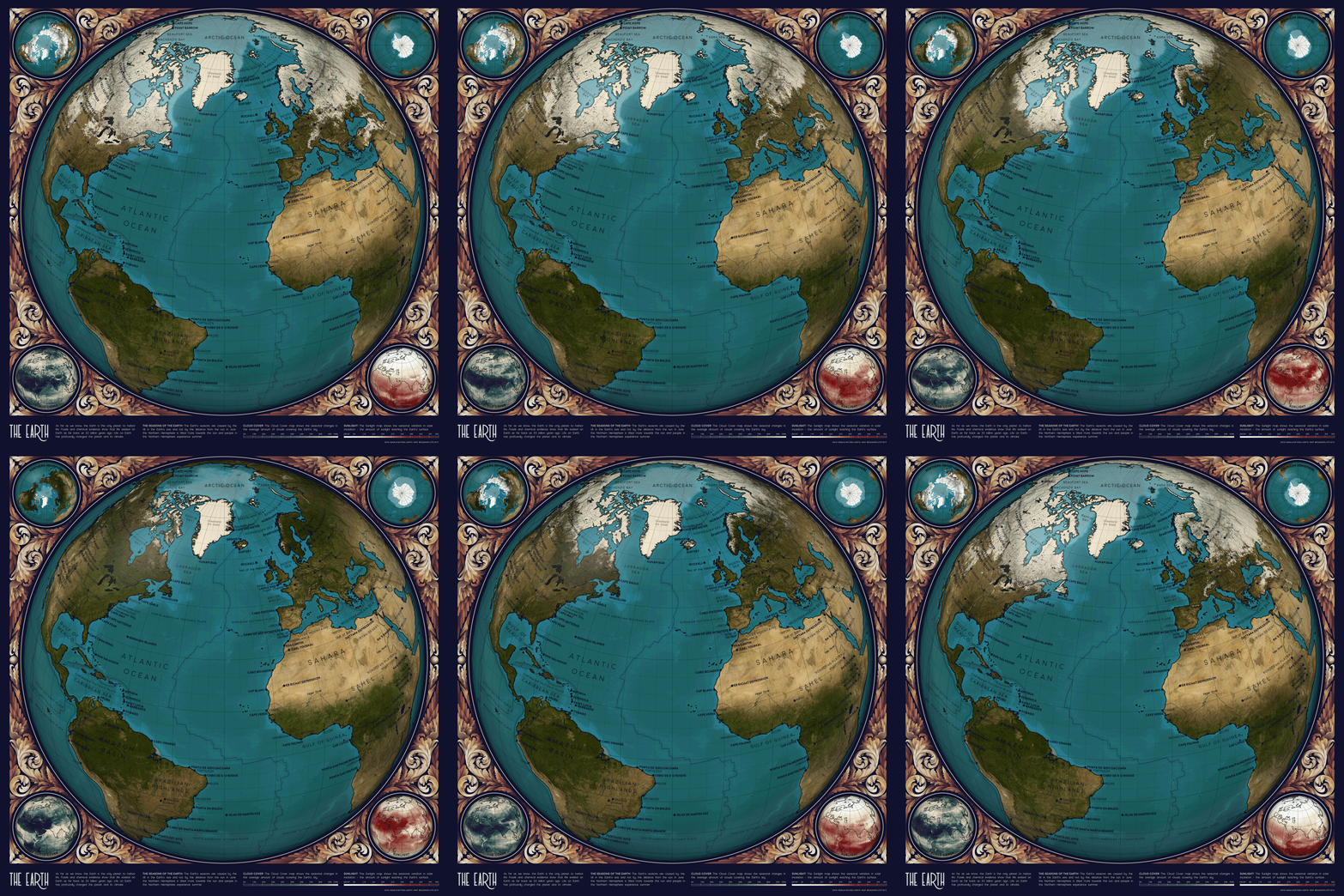
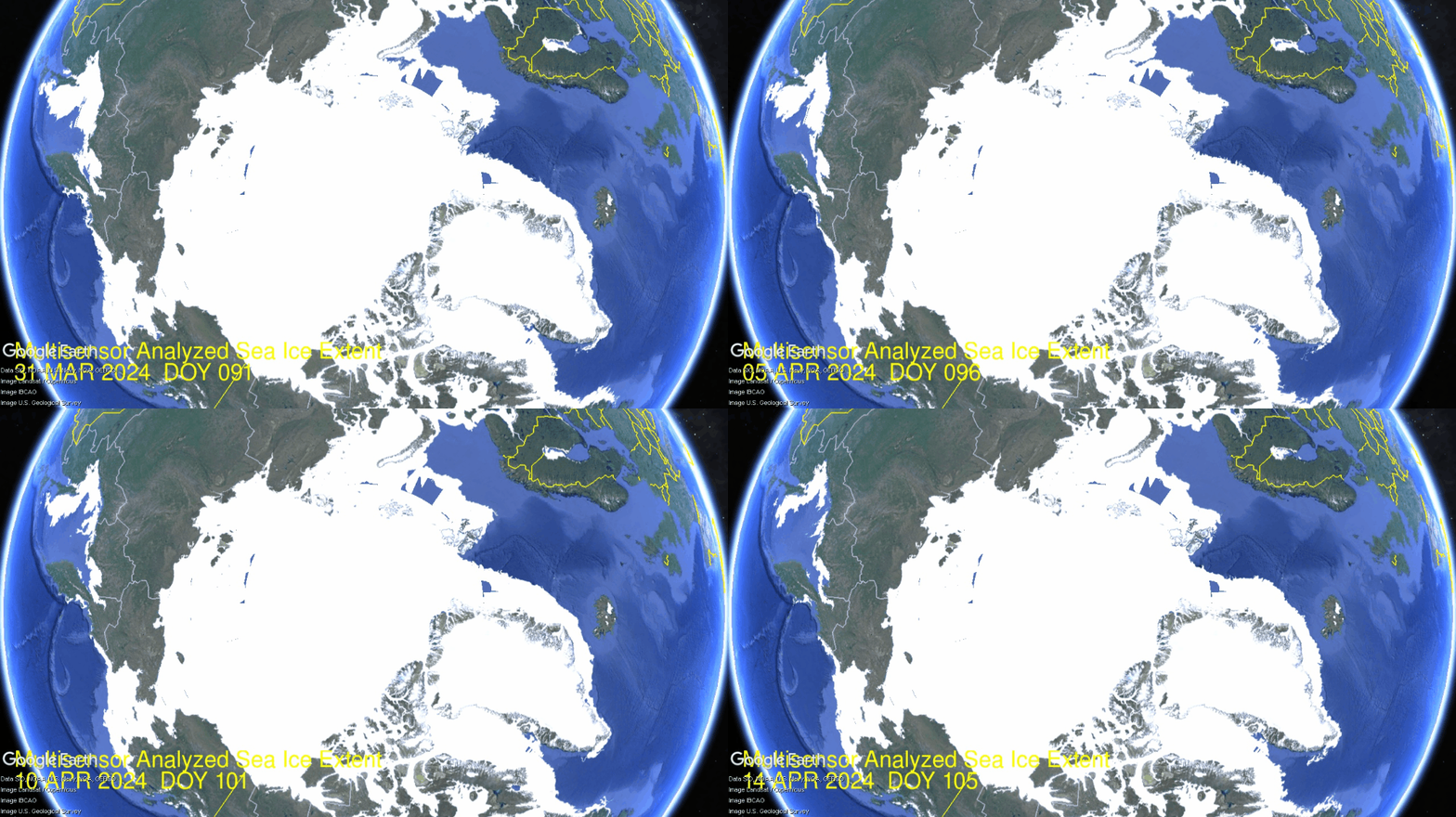
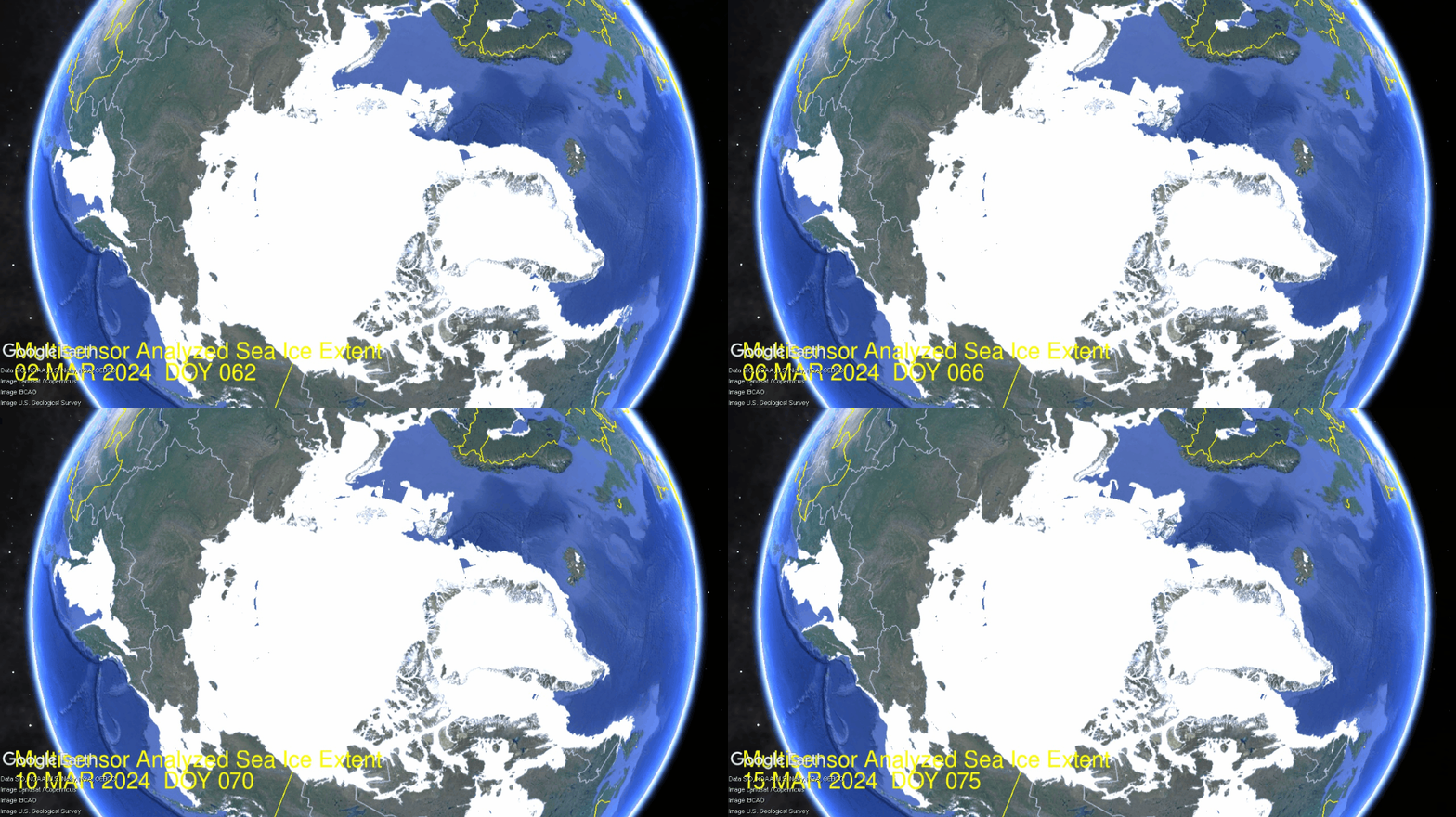
Illustration by Eleanor Lutz shows Earth’s seasonal climate changes. If played in full screen, the four corners present views from top, bottom and sides. It is a visual representation of scientific datasets measuring Arctic ice extents.
There is no charge for content on this site, nor for subscribers to receive email notifications of postings.
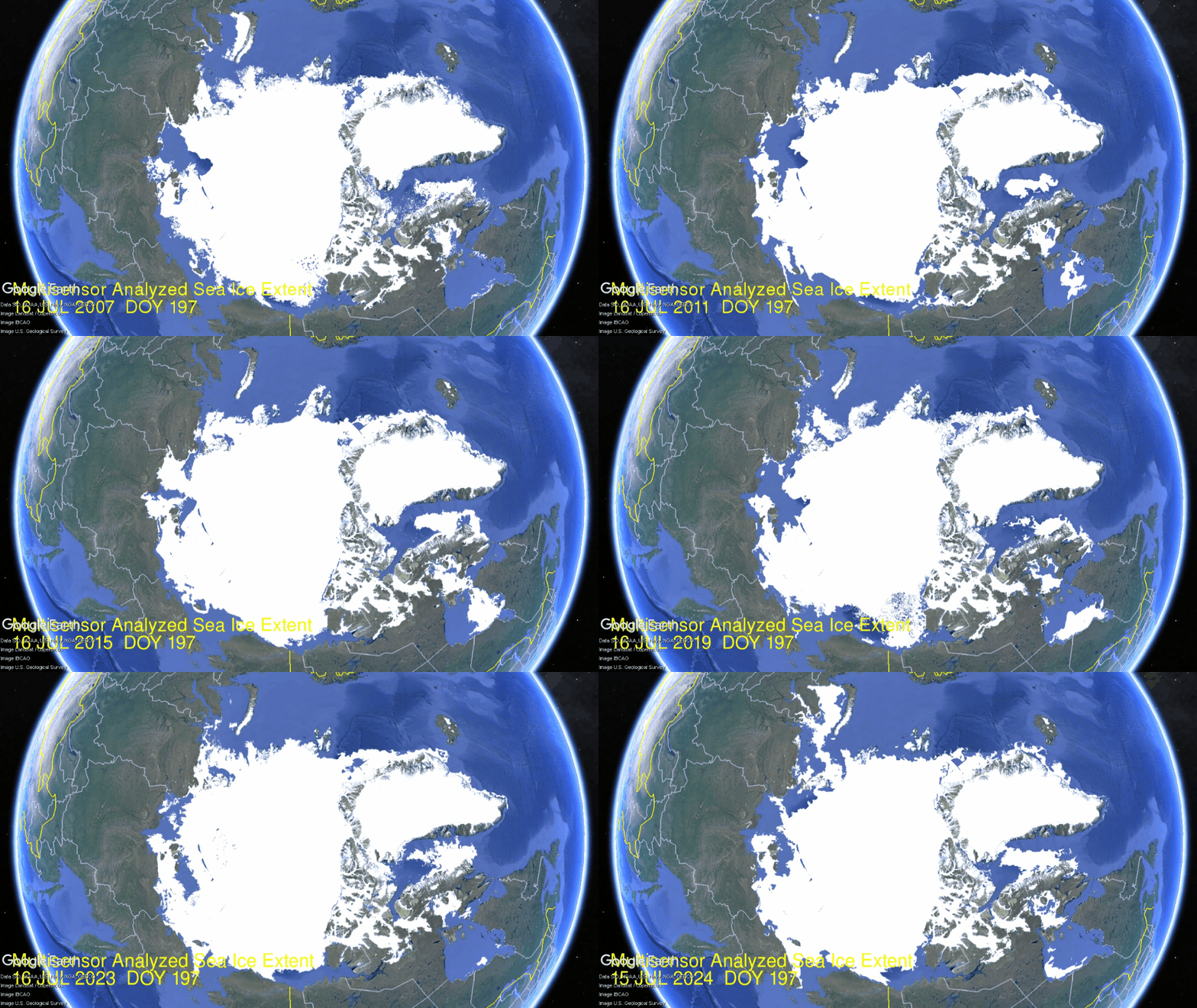
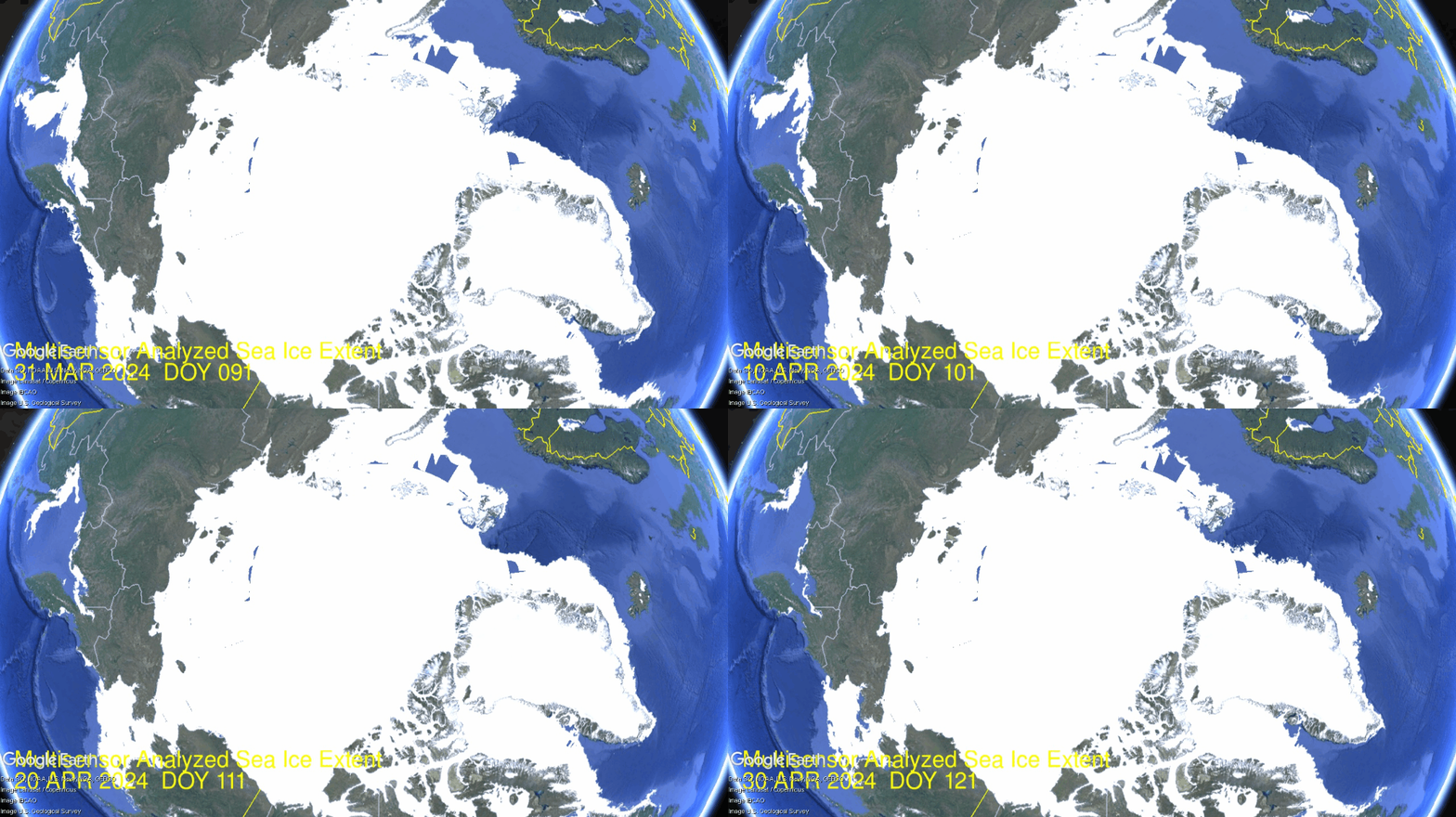
The animation shows end of March Arctic ice extents on day 91 over the last 19 years (length of MASIE dataset). Of course central Arctic basins are frozen solid, and the fluctuations are visible on the marginal basins both the Atlantic side (right) and the Pacific (left). Note the higher extents in 2012, followed by lesser ice, now overcome by 2024.
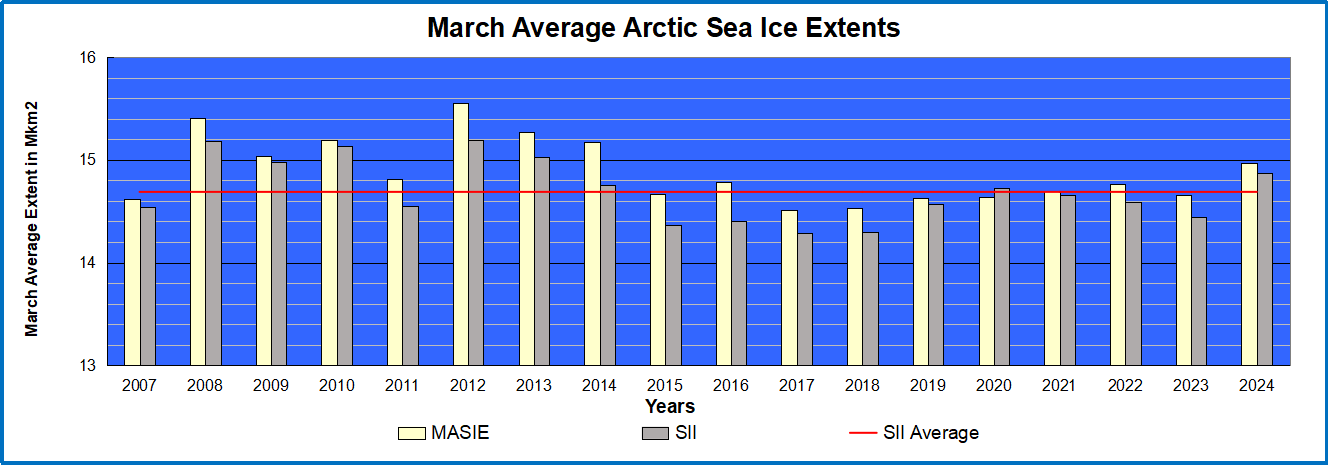
The graph below shows Monthly averages for March since 2007. March is the maximum month in the annual cycle in contrast to September being the minimum Arctic ice extents. Note the low 2007 extents followed by several years over15M km2, then lesser extents 2015 to 2018, and increasing extents up to 2024 nearly averaging 15M for the month.
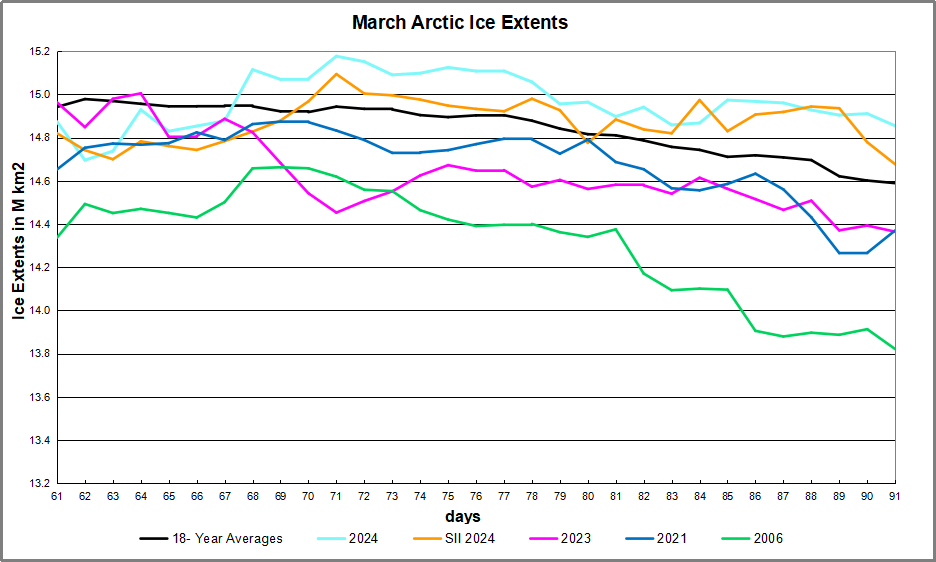
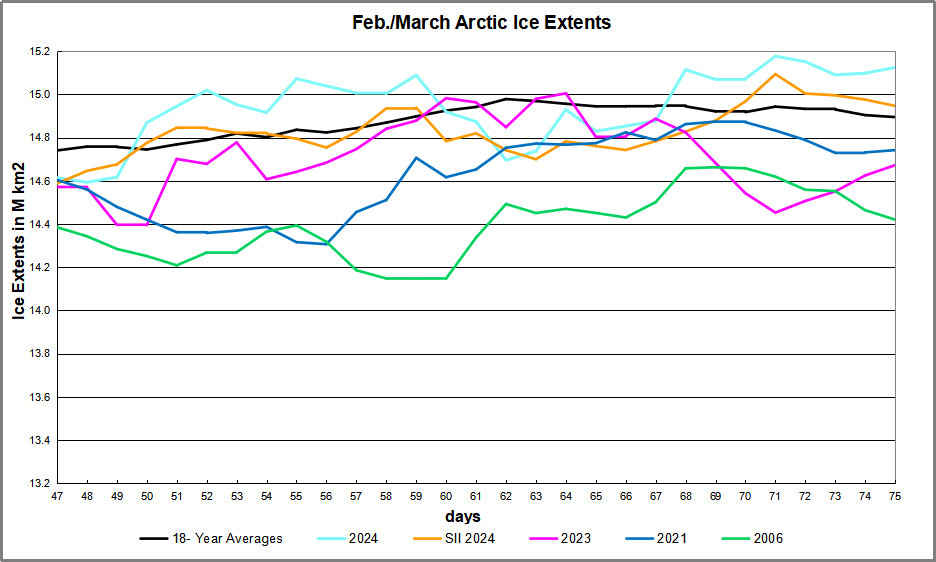
The graph below shows March daily ice extents for 2024 compared to 18 year averages, and some years of note.
The black line shows during March on average Arctic ice extents nearly reach 15 Wadhams (15M km2) on Day 62, March 2. A slow decline is normal until Day 91, March 31. However, that period in 2024 saw Arctic ice go over 15M on day 68 and remain there until day 79. Afterward both MASIE and SII show above average extents to month end. 2006 was the first year in this dataset and ended March ~800k km2 in deficit to average. 2021 and 2023 were ~200k below average on Day 91 while 2024 ended 266k km2 surplus ice. As usual in transitional months like March and September, SII (Sea Ice Index) shows a similar pattern with generally lower extents.
Why is this important? All the claims of global climate emergency depend on dangerously higher temperatures, lower sea ice, and rising sea levels. The lack of additional warming prior to 2023 El Nino is documented in a post UAH February 2024: SH Saves Global Warming.
The table below shows the distribution of Sea Ice on day 91 across the Arctic Regions, on average, this year and 2006.
Region
2024091
Day 91 ave
2024-Ave.
2006091
2024-2006
(0) Northern_Hemisphere
14854967
14589377
265590
13821470
1033497
(1) Beaufort_Sea
1070983
1070226
758
1068683
2301
(2) Chukchi_Sea
966006
963401
2606
959091
6915
(3) East_Siberian_Sea
1087137
1086151
987
1084120
3017
(4) Laptev_Sea
897845
896053
1792
896510
1335
(5) Kara_Sea
935023
919656
15367
910487
24536
(6) Barents_Sea
845789
657875
187914
622588
223201
(7) Greenland_Sea
771533
661909
109624
601310
170223
(8) Baffin_Bay_Gulf_of_St._Lawrence
1238205
1384413
-146208
1003875
234330
(9) Canadian_Archipelago
854860
853089
1772
851691
3169
(10) Hudson_Bay
1260903
1255353
5551
1240389
20514
(11) Central_Arctic
3248013
3235452
12561
3239349
8664
(12) Bering_Sea
724493
703487
21006
658979
65514
(13) Baltic_Sea
50165
61636
-11471
114622
-64457
(14) Sea_of_Okhotsk
900660
831057
69602
558027
342633
The overall surplus to average is 266k km2, (2%). The only major deficit is in Baffin Bay, more than offset by surpluses everywhere, especially in Okhotsk, Barents and Greenland seas. Note Arctic ice yesterday was more than a Wadham greater than the same day in 2006.
Illustration by Eleanor Lutz shows Earth’s seasonal climate changes. If played in full screen, the four corners present views from top, bottom and sides. It is a visual representation of scientific datasets measuring Arctic ice extents.
The animation shows growing Arctic ice extents over the last two weeks. Of course central Arctic basins are frozen solid, and the additions are visible on both the Atlantic side (right) and the Pacific (left).
The graph below shows March daily ice extents for 2024 compared to 18 year averages, and some years of note.
The black line shows during March on average Arctic ice extents nearly reach 15 Wadhams (15M km2) on Day 62, March 2. A slow decline is normal until Day 75, March 15. However, that period in 2024 saw Arctic ice increase 430k km2, nearly half a Wadham. Note also that this year ice extents rose above 15M already in February, and now in March ice has been well above that threshold for the last week. 2006 was the first year in this dataset and on Day 75 was 704k km2 less than yesterday. As usual in transitional months like March and September SII (Sea Ice Index) shows a similar pattern with generally lower extents.
Why is this important? All the claims of global climate emergency depend on dangerously higher temperatures, lower sea ice, and rising sea levels. The lack of additional warming prior to 2023 El Nino is documented in a post UAH January 2024: Ocean Warm, Land Cooling.
The table below shows the distribution of Sea Ice on day 75 across the Arctic Regions, on average, this year and 2006.
Region
2024075
Day 75 Ave
2024-Ave.
2006075
2024-2006
(0) Northern_Hemisphere
15124987
14895040
229947
14420679
704309
(1) Beaufort_Sea
1070983
1070317
667
1069711
1273
(2) Chukchi_Sea
966006
965891
115
964227
1779
(3) East_Siberian_Sea
1087137
1087110
27
1086702
435
(4) Laptev_Sea
897845
897837
8
897773
71
(5) Kara_Sea
935023
920555
14469
921428
13595
(6) Barents_Sea
671826
643180
28646
646196
25630
(7) Greenland_Sea
771468
621747
149721
613161
158308
(8) Baffin_Bay_Gulf_of_St._Lawrence
1336897
1529678
-192781
1134817
202080
(9) Canadian_Archipelago
854860
853214
1646
852715
2145
(10) Hudson_Bay
1260903
1258048
2855
1251360
9543
(11) Central_Arctic
3243865
3222218
21647
3244243
-378
(12) Bering_Sea
723227
735481
-12254
635252
87975
(13) Baltic_Sea
78741
80321
-1580
175063
-96322
(14) Sea_of_Okhotsk
1215262
990338
224924
874372
340890
The overall surplus to average is 230k km2, (2%). The only major deficit is in Baffin Bay, more than offset by surpluses in Okhotsk and Greenland seas. Everywhere else is maxed out.
Illustration by Eleanor Lutz shows Earth’s seasonal climate changes. If played in full screen, the four corners present views from top, bottom and sides. It is a visual representation of scientific datasets measuring Arctic ice extents.
For ice extent in the Arctic, the bar is set at 15M km2. The highest daily average in the last 18 years occurs on day 61 at 15.08M before descending. Most years are able to clear 15M, but in recent previous years, 2017, 2018, 2019 and 2021 ice extents failed to clear the bar at 15M km2. On February 11, 2024 (day 42) Arctic ice extent already leaped over that bar 20 days early. Then extent dropped for several days, but has again topped 15 Wadhams with ice in Asian basins contributing greatly.
The animation shows Pacific ice growth in the last week. Bering Sea on the right changed little, while Okhotsk in the center added ice down to N. Japan, and now well above 2023 March maximum. The ice patch in far left is the harbor close to Beijing where the Yellow Sea added 20K km2 ice extent in two days.
The graph shows the rapid rise in Arctic ice reaching 15 M km2 extent already on Feb. 11 (day 42) Then the extent dropped down to 14.6M before rising again to reach a new high of 15.07M. Yesterday Arctic ice was 215k km2 above average, with nearly all the surplus appearing in Okhotsk. SII showed neither the first peak or the current one in February.
The table shows the distribution of ice compared to day 56 averages and other years on that day.
Region
2024056
Day 56 Ave
2024-Ave.
2006056
2024-2006
(0) Northern_Hemisphere
15039168
14823967
215201
14318117
721051
(1) Beaufort_Sea
1070983
1070317
667
1069711
1273
(2) Chukchi_Sea
966006
964499
1507
961796
4210
(3) East_Siberian_Sea
1087137
1087109
28
1086702
435
(4) Laptev_Sea
897845
897837
8
897773
71
(5) Kara_Sea
925734
916917
8818
899871
25864
(6) Barents_Sea
598915
606693
-7778
484567
114348
(7) Greenland_Sea
742472
612727
129745
577357
165115
(8) Baffin_Bay_Gulf_of_St._Lawrence
1391601
1508331
-116730
1365491
26110
(9) Canadian_Archipelago
854860
853163
1697
852715
2145
(10) Hudson_Bay
1260903
1260462
441
1257077
3827
(11) Central_Arctic
3220834
3210037
10797
3214577
6257
(12) Bering_Sea
619130
665856
-46727
629210
-10080
(13) Baltic_Sea
85666
98767
-13101
101029
-15363
(14) Sea_of_Okhotsk
1282477
1028678
253799
853467
429010
Note that moderate deficits in Bering Sea and Baffin Bay are more than offset by a large 254k km2 surplus in Okhotsk along with 130k km2 in Greenland Sea.
These results fly in the face of those claiming for years that Arctic ice is in a “death spiral.” More sober and clear-eyed observers have called out the alarmists for their exaggerations. A recent example comes from Allan Alsup Jensen at Nordic Institute of Product Sustainability, Environmental Chemistry and Toxicology, Denmark. His December 2023 paper is Time Trend of the Arctic Sea Ice Extent. Excerpts in italics with my bolds and added images.
Since 2007 no significant decline has been observed
Abstract
The NSIDC website, IPCC’s reports and some scientific papers have announced that the Arctic Sea ice extent, when it is lowest in September month, in recent years has declined dramatically, and in few decades the sea ice is supposed to disappear completely in the summer. In that way new and shorter ships routes will open up north of the continents.
The facts are, that the Arctic Sea ice extent measured by satellites since 1978 expresses annual variations and it has declined considerably from 1997 to 2007. However, before that time period, from 1978 to 1996, the downward trend was minimal, and in the last 17 years from 2007 to 2023 the downward trend has also been about zero. Therefore, there is no indication that we should expect the Arctic Sea summer ice to disappear completely, as predicted, in one or two decades.
Regarding the extent of the summer (February) sea ice at the Antarctic, the downward trend during the years 1979-2021 was very small but in 2022 and 2023 a considerable decline was observed, and a decline was also clearly observed for the whole period of 2007- 2023. That was in contradiction to what happened in the Arctic. The pattern of the annual levels was not the same for the Arctic and Antarctic, indicating different drivers in the North and the South.
Figure 4: The minimum extent of the sea ice at Antarctic
in February month 1979-2023 (data from NSIDC.org)
These data show that there is no apparent correlation between the variable extent of the Arctic and the Antarctic Sea ice and the gradually increasing CO2-concentrations in the atmosphere as proposed by NSIDC, IPCC and others, also for these areas of cold climate.
Postscript Feb. 14
Some seek to deny the current plateau in Arctic Sea Ice by saying that extent measure is only surface, while volume would be a truer metric. That is true in theory, but in practice obtaining accurate and consistent data on sea ice thickness is a challenge yet to be reached. As you can imagine, detecting a depth dimension from satellites is fraught with errors, especially with drift ice not land anchored, moving around, sometimes piling up from winds. The scientific effort to measure volume has a short history and several uncertainties to ovecome before it can be trusted.
Unfortunately for those wanting an ice free Arctic (well, no more than 1 Wadham they say), the volume record so far shows the same plateau:
“Satellite derived sea ice thickness (CryoSat 2, AWI algorithm v2.6) shows an anomaly thickness pattern very similar to that from PIOMAS, but CS2 shows negative anomalies propagating north of the Canadian Archipelago into the central Arctic while PIOMAS has neutral conditions there. A positive thickness anomaly around Wrangle Island is spatially more extensive in CS2. January 2024 adds another month to the record of CS2 data which now spans 13 years. Neither CS2 nor PIOMAS show any discernible trend over that time period underlining the importance of internal variability at decadal timescales.” Source: Polar Science Center
For ice extent in the Arctic, the bar is set at 15M km2. The highest daily average in the last 18 years occurs on day 61 at 15.08M before descending. Most years are able to clear 15M, but in recent previous years, 2017, 2018, 2019 and 2021 ice extents failed to clear the bar at 15M km2. Now on February 11, 2024 (day 42) Arctic ice extent has already leaped over that bar 20 days early.
All years including averages are from MASIE, except for SII 2024.
The graph shows how rapidly the Arctic froze this year, reaching 14.4M km2 extent already on January 24. Then the extent waffled around that level, until suddenly a Hockey Stick shape appeared when 600k km2 of ice was added in just the last four days. That is 400k km2 above average, and well above many other years, including 2006. SII is also lagging at 400k km2 lower.
The table shows the distribution of ice compared to day 45 averages and other years on that day.
Region
2024042
Day 45 Ave.
2024-Ave.
2006045
2024-2006
(0) Northern_Hemisphere
15040629
14687838
352791
14419407
621223
(1) Beaufort_Sea
1070983
1070317
667
1069711
1273
(2) Chukchi_Sea
966006
965761
245
966006
0
(3) East_Siberian_Sea
1087137
1087131
6
1087103
35
(4) Laptev_Sea
897845
897837
8
897773
71
(5) Kara_Sea
934647
908486
26161
932726
1920
(6) Barents_Sea
662793
582078
80715
530801
131992
(7) Greenland_Sea
825638
622774
202864
579677
245961
(8) Baffin_Bay_Gulf_of_St._Lawrence
1340370
1456370
-115999
1227497
112873
(9) Canadian_Archipelago
854860
853383
1478
852715
2145
(10) Hudson_Bay
1260903
1260579
325
1257433
3470
(11) Central_Arctic
3233243
3208074
25168
3198987
34255
(12) Bering_Sea
631508
700745
-69237
889518
-258010
(13) Baltic_Sea
136308
90991
45317
79904
56404
(14) Sea_of_Okhotsk
1101713
923694
178019
759197
342516
The Pacific basins show a moderate deficit in Bering Sea offset by a large 178k km2 surplus in Okhotsk. Baffin Bay is down 120k km2, offset by Greenland Sea over 200k km2 and Barents up 81k km2.
These results fly in the face of those claiming for years that Arctic ice is in a “death spiral.” More sober and clear-eyed observers have called out the alarmists for their exaggerations. A recent example comes from Allan Alsup Jensen at Nordic Institute of Product Sustainability, Environmental Chemistry and Toxicology, Denmark. His December 2023 paper is Time Trend of the Arctic Sea Ice Extent. Excerpts in italics with my bolds and added images.
Since 2007 no significant decline has been observed
Abstract
The NSIDC website, IPCC’s reports and some scientific papers have announced that the Arctic Sea ice extent, when it is lowest in September month, in recent years has declined dramatically, and in few decades the sea ice is supposed to disappear completely in the summer. In that way new and shorter ships routes will open up north of the continents.
The facts are, that the Arctic Sea ice extent measured by satellites since 1978 expresses annual variations and it has declined considerably from 1997 to 2007. However, before that time period, from 1978 to 1996, the downward trend was minimal, and in the last 17 years from 2007 to 2023 the downward trend has also been about zero. Therefore, there is no indication that we should expect the Arctic Sea summer ice to disappear completely, as predicted, in one or two decades.
Regarding the extent of the summer (February) sea ice at the Antarctic, the downward trend during the years 1979-2021 was very small but in 2022 and 2023 a considerable decline was observed, and a decline was also clearly observed for the whole period of 2007- 2023. That was in contradiction to what happened in the Arctic. The pattern of the annual levels was not the same for the Arctic and Antarctic, indicating different drivers in the North and the South.
Figure 4: The minimum extent of the sea ice at Antarctic
in February month 1979-2023 (data from NSIDC.org)
These data show that there is no apparent correlation between the variable extent of the Arctic and the Antarctic Sea ice and the gradually increasing CO2-concentrations in the atmosphere as proposed by NSIDC, IPCC and others, also for these areas of cold climate.
Postscript Feb. 14
Some seek to deny the current plateau in Arctic Sea Ice by saying that extent measure is only surface, while volume would be a truer metric. That is true in theory, but in practice obtaining accurate and consistent data on sea ice thickness is a challenge yet to be reached. As you can imagine, detecting a depth dimension from satellites is fraught with errors, especially with drift ice not land anchored, moving around, sometimes piling up from winds. The scientific effort to measure volume has a short history and several uncertainties to ovecome before it can be trusted.
Unfortunately for those wanting an ice free Arctic (well, no more than 1 Wadham they say), the volume record so far shows the same plateau:
“Satellite derived sea ice thickness (CryoSat 2, AWI algorithm v2.6) shows an anomaly thickness pattern very similar to that from PIOMAS, but CS2 shows negative anomalies propagating north of the Canadian Archipelago into the central Arctic while PIOMAS has neutral conditions there. A positive thickness anomaly around Wrangle Island is spatially more extensive in CS2. January 2024 adds another month to the record of CS2 data which now spans 13 years. Neither CS2 nor PIOMAS show any discernible trend over that time period underlining the importance of internal variability at decadal timescales.” Source: Polar Science Center
In January, most of the Arctic ocean basins are frozen over, and so the growth of ice extent slows down. According to MASIE January on average adds 1.2M km2, and this month it was 1.1M. However, 2024 started above average and quickly grew to 14M km2 (14 Wadhams), before slowing down and ending January slightly above the 18 year average. The few basins that can grow ice this time of year tend to fluctuate and alternate waxing and waning, which appears as a see saw pattern in these images.
On the left is the Pacific seesaw with Bering below and Okhotsk above. This year Okotsk added ice steadily, and slowed at the end, while Bering waffled up and down mid month before gaining ice at the end. The Atlantic seesaw is Barents top center and Baffin on the right below Greenland. Barents grew ice steadily until mid January, then gave almost all of it back by the end. Baffin added ice slowly all month, then accelerated the last two weeks.
While the seesaws are tilting back and forth on the margins, the bulk of the Arctic is frozen solid. And with limited places where more extent can be added, the pace of overall growth has slowed. Note that at 14.4M km2 Arctic ice extent now has about six weeks to break the 15M km2 annual ceiling mid March.
The graph shows the 18-year average gain for January is 1.2M km2. 2024 started with 275k km2 surplus ice extent and ended slightly above average, while and other recent years were lower. SII showed lower extents most of the month with a 253k km2 deficit to MASIE at the end.
Region
2024031
Day 31
2024-Ave.
2018031
2024-2018
(0) Northern_Hemisphere
14396470
14360118
36352
13792271
604199
(1) Beaufort_Sea
1070983
1070351
632
1070445
538
(2) Chukchi_Sea
966006
965973
34
965971
35
(3) East_Siberian_Sea
1087137
1087059
78
1087120
18
(4) Laptev_Sea
897845
897823
22
897845
0
(5) Kara_Sea
894933
918701
-23769
895363
-430
(6) Barents_Sea
473076
569199
-96123
481947
-8872
(7) Greenland_Sea
711708
607586
104122
501411
210297
(8) Baffin_Bay_Gulf_of_St._Lawrence
1272213
1331684
-59471
1406903
-134690
(9) Canadian_Archipelago
854860
853430
1430
853109
1752
(10) Hudson_Bay
1260903
1260770
133
1260838
66
(11) Central_Arctic
3214505
3210272
4233
3184817
29688
(12) Bering_Sea
665225
647841
17384
382207
283018
(13) Baltic_Sea
71817
62350
9467
41714
30103
(14) Sea_of_Okhotsk
910937
818756
92181
704398
206539
The table shows regional ice extents in km2. The few deficits are in Baffin Bay and Barents, offset by sizeable surpluses in Greenland and Okhotsk seas. Everywhere else is close to maximum for the year.
The polar bears have a Valentine Day’s wish for Arctic Ice.
And Arctic Ice loves them back, returning every year so the bears can roam and hunt for seals.
Footnote:
Seesaw accurately describes Arctic ice in another sense: The ice we see now is not the same ice we saw previously. It is better to think of the Arctic as an ice blender than as an ice cap, explained in the post The Great Arctic Ice Exchange.
Impressive Arctic ice recovery continued in January, growing a month’s worth in just three weeks, as seen in the animation below:
In three weeks of January 2024, the Arctic added nearly a full Wadham of ice (1M km2). The animation shows Hudson Bay (lower right) freezing completely. Just above Hudson, you can see the Gulf of St. Lawrence icing over, and Baffin Bay adding ice, extending fast ice all the way to Newfoundland, now up to 64% of its annual maximum.
At the extreme and lower left, Okhotsk and Bering Seas also grow rapidly. Okhotsk grew ice extent up to 914k, 81% of its max last March. Bering grew up to 514k km2, 68% of its max. At the top Kara freezes over and Barents and Greenland Seas add ice to their margins.The graph below shows the January ice recovery.
Note the average January ends at 14.36 km2 while 2024 has already reached 14.33 km2, up from 13.39 km2 at the start, and presently 288k km2 above average. SII started slightly lower than MASIE and tracked quite closely since. Note that other recent years have varied below the 18-year average at month end.
The table below shows year-end ice extents in the various Arctic basins compared to the 18-year averages and some recent years.
Region
2024022
Day 22
2024-Ave.
2018022
2024-2018
(0) Northern_Hemisphere
14333601
14045488
288112
13505957
827644
(1) Beaufort_Sea
1070983
1070317
667
1070445
538
(2) Chukchi_Sea
966006
965999
7
965971
35
(3) East_Siberian_Sea
1087137
1087131
6
1087120
18
(4) Laptev_Sea
897845
897837
8
897845
0
(5) Kara_Sea
932571
910022
22549
891776
40795
(6) Barents_Sea
712531
530554
181977
322465
390067
(7) Greenland_Sea
703581
601855
101726
465828
237753
(8) Baffin_Bay_Gulf_of_St._Lawrence
1050488
1239519
-189031
1330666
-280179
(9) Canadian_Archipelago
854860
853382
1479
853109
1752
(10) Hudson_Bay
1260903
1260695
209
1260838
66
(11) Central_Arctic
3230107
3203377
26730
3165195
64912
(12) Bering_Sea
513853
600796
-86943
343164
170689
(13) Baltic_Sea
93892
56072
37820
44364
49528
(14) Sea_of_Okhotsk
914275
720482
193793
782100
132175
This year’s ice extent is 288k km2 or 2.1% above average. Only Baffin Bay and Bering have deficits to average, more than offset by surpluses elsewhere, espcially Greenland, Barents and Okhotsk seas. Many of the others are already maxed out.
Illustration by Eleanor Lutz shows Earth’s seasonal climate changes. If played in full screen, the four corners present views from top, bottom and sides. It is a visual representation of scientific datasets measuring Arctic ice extents and NH snow cover.
Many noticed the Gore effect during COP28 when Arctic ice extents grew rapidly to catch up and exceed normal. Now in the first 10 days of January Arctic ice is growing way faster than normal. On the left, both Bering and Okhotsk seas are now ~65% of their maxes. Kara at top is 100% of max and Barents next to Kara is 83% of max. Overall, the Arctic has already reached 93% of last year’s Mid March maximum.
A Lufthansa aircraft at the snow-covered Munich airport on Saturday. Photograph: Karl-Josef Hildenbrand/AP
Coincidently, COP28 also triggered heavy snow bringing chaos to southern Germany causing Munich to suspend flights to anywhere, including Dubai. Now January is breaking the glazed ceiling outstriping past conditions.
The graph below shows the gains in ice extent the first 10 days of January 2024, the 18 year average and some other recent years, as well as SII (Sea Ice Index).
MASIE and SII are both well above the 18 year average, and almost 10 days ahead of it. 2024 is on the verge of breaking 14M km2, just 400k km2 short of normal extents at end of January.
The table below shows the distribution of ice in the Arctic Ocean basins.
Region
2024010
Day 10
2024-Ave.
2007010
2024-2007
(0) Northern_Hemisphere
13940138
13508235
431903
13334598
605540
(1) Beaufort_Sea
1070966
1070352
614
1069711
1255
(2) Chukchi_Sea
966006
965221
785
966006
0
(3) East_Siberian_Sea
1087137
1087131
6
1087137
0
(4) Laptev_Sea
897845
897836
8
897845
0
(5) Kara_Sea
934227
914139
20088
909703
24524
(6) Barents_Sea
593194
463310
129884
363027
230166
(7) Greenland_Sea
722914
577267
145647
576959
145955
(8) Baffin_Bay_Gulf_of_St._Lawrence
941219
1088951
-147732
934564
6655
(9) Canadian_Archipelago
854860
853418
1442
852767
2094
(10) Hudson_Bay
1260903
1249501
11402
1260839
65
(11) Central_Arctic
3233482
3202675
30807
3204750
28732
(12) Bering_Sea
492428
503203
-10775
606863
-114435
(13) Baltic_Sea
128886
33634
95252
3303
125582
(14) Sea_of_Okhotsk
729537
565328
164209
585350
144187
Note that Arctic ice now nearly 14M km2 and 432k km2 above average, or 3.2%. As shown in the table above, the only deficit to average is in Baffin Bay, Offsetting are surpluses elsewhere, especially in Greenland sea, along with Barents and Okhotsk seas. Really, the only regions left to grow much up to max are Baffin Bay, Bering and Okhotsk seas.