May 31 Arctic Ocean Frozen Solid

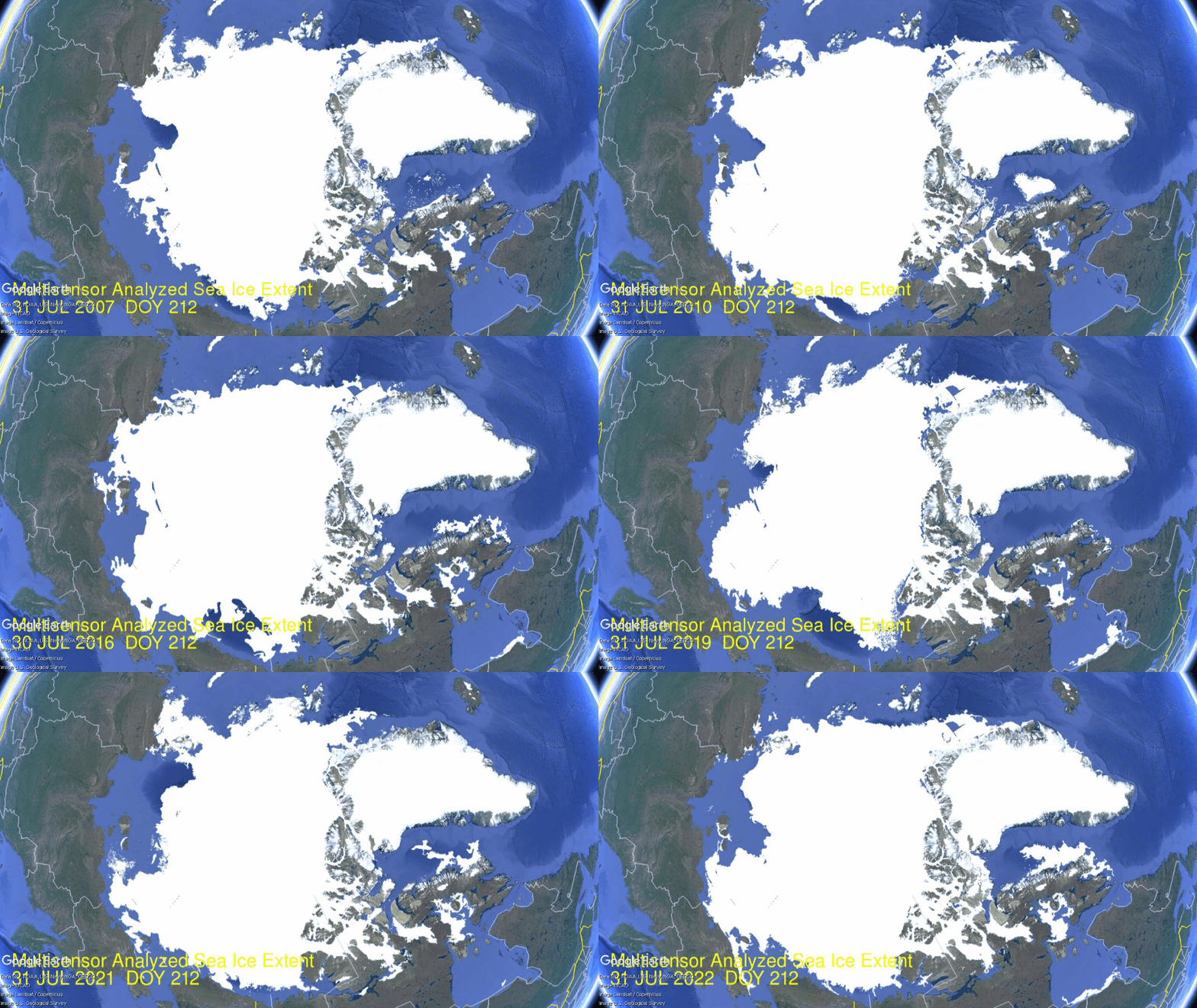
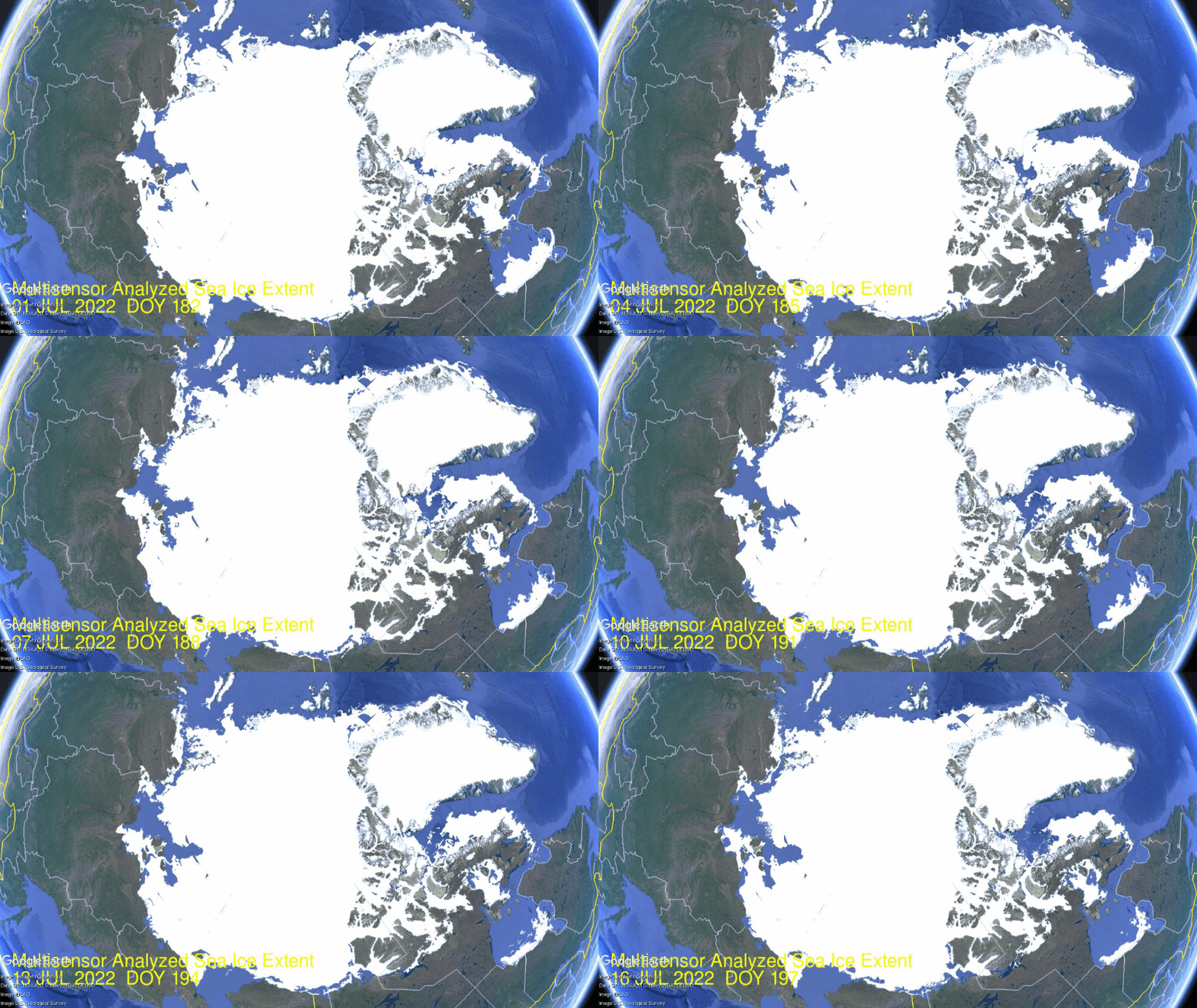
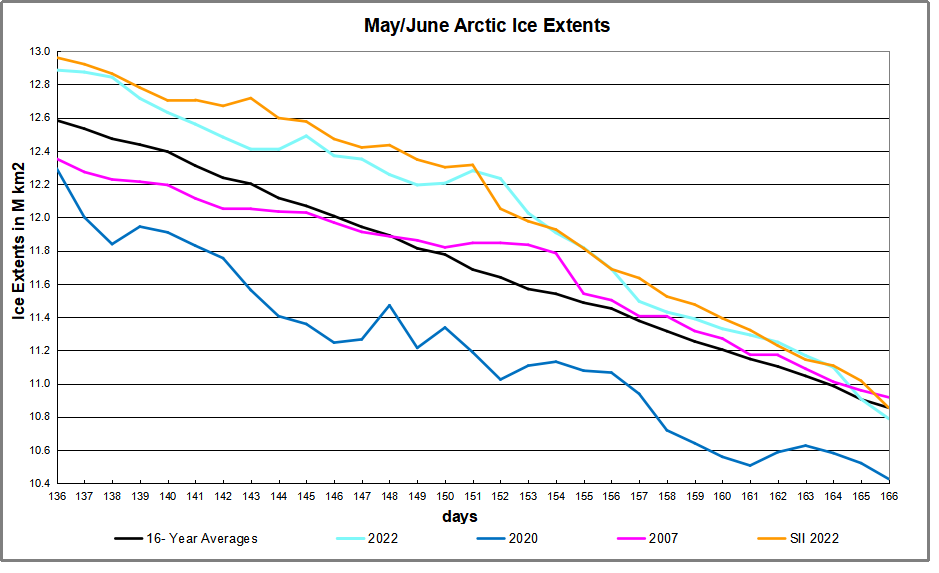
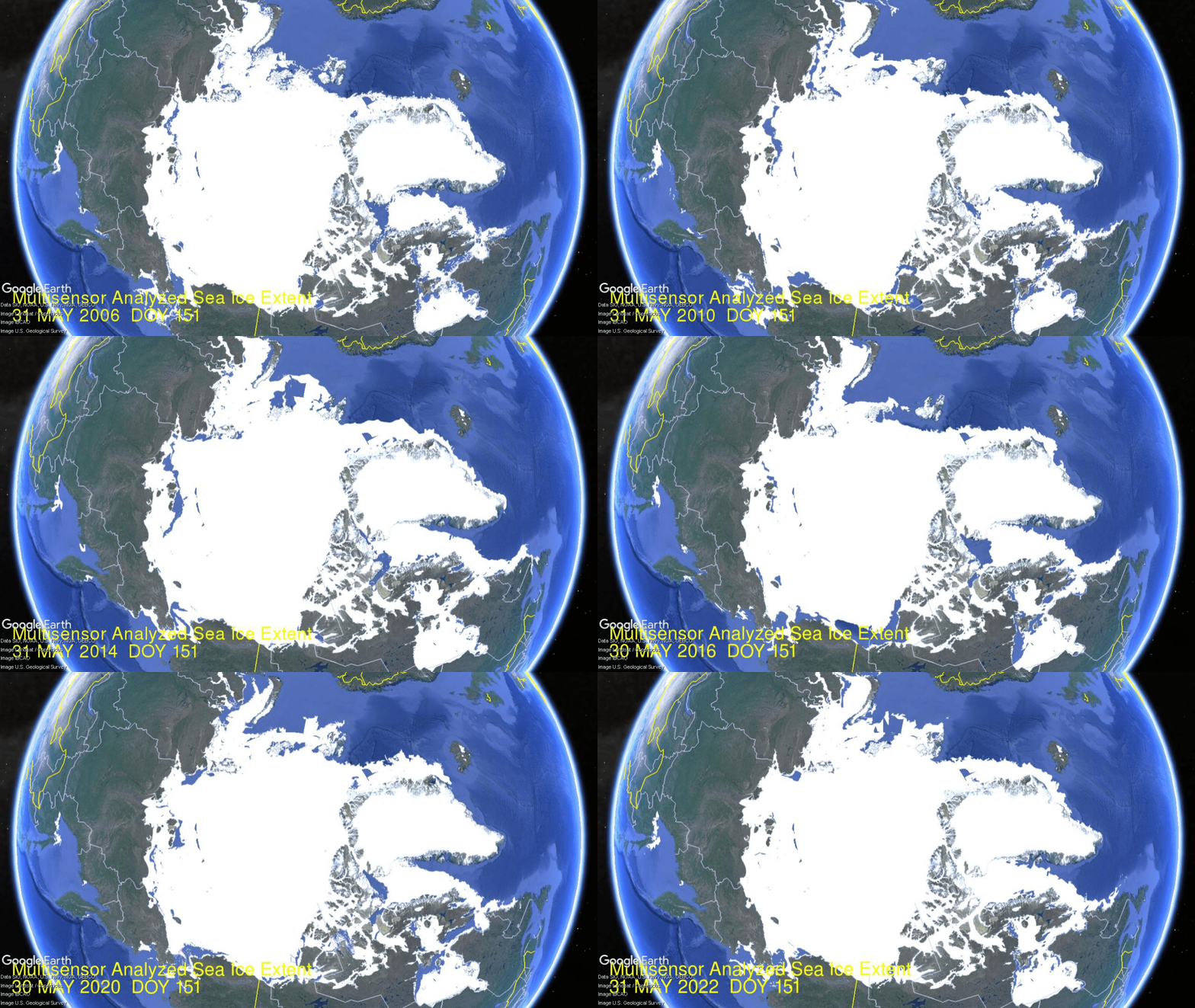
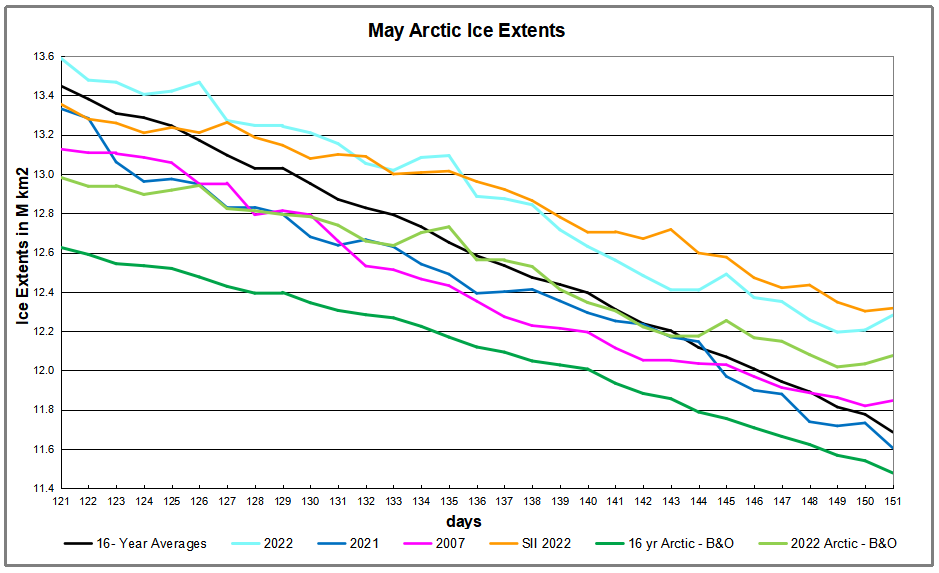
The animation shows Arctic ice extents on day 151 (end of May) from 2006 to yesterday 2022. It is evident that typically there are some regional seas starting to melt by this date, whereas 2022 remains frozen solid.  More detailed analysis is below, but note the 2022 surplus is 600k km2, or 5% above the 16 year average for day 151.  That extra ice extent amounts to 0.6 Wadhams, or 6826 Manhattan Islands, whichever index you prefer.  The graph below shows May 2022 daily ice extents compared to the 16-year average and some other years of note.

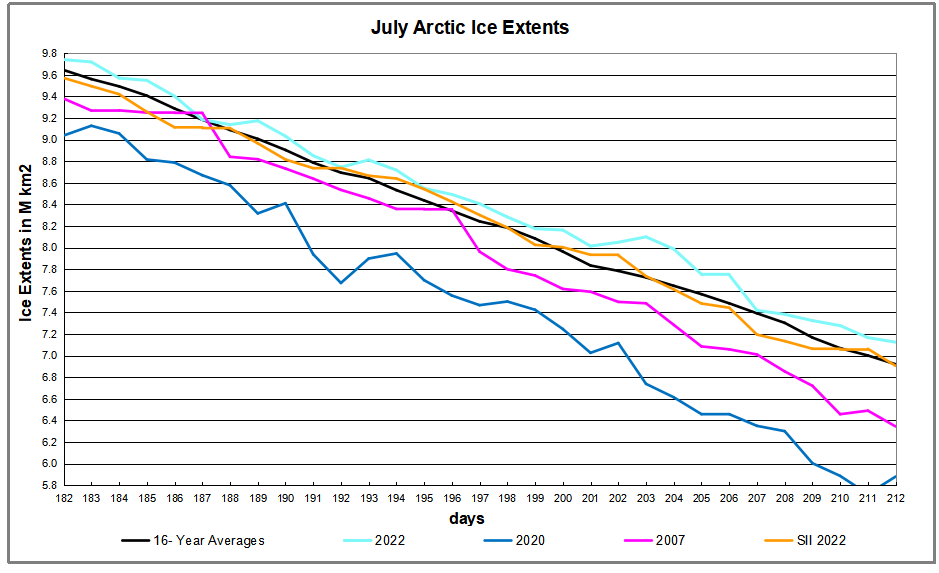
The black line shows during May on average Arctic ice extents decline ~1.8M km2 down to 11.7M km2.  The 2022 cyan MASIE line only lost 1.3M km2, starting the month 141k km2 above average and on day 151 showed a surplus of  598k km2.  The Sea Ice Index in orange (SII from NOAA) starter lower than MASIE, then ran over in later weeks, ending May nearly the same. The dark green line is average Arctic ice, excluding Bering and Okhotsk (B&O), which started melting early in 2022. The light green line is 2022 without B&O.  As of day 151, the 2022 B&O extent matches the average B&O, so the ~600k km2 surplus is entirely in the core Arctic ocean.

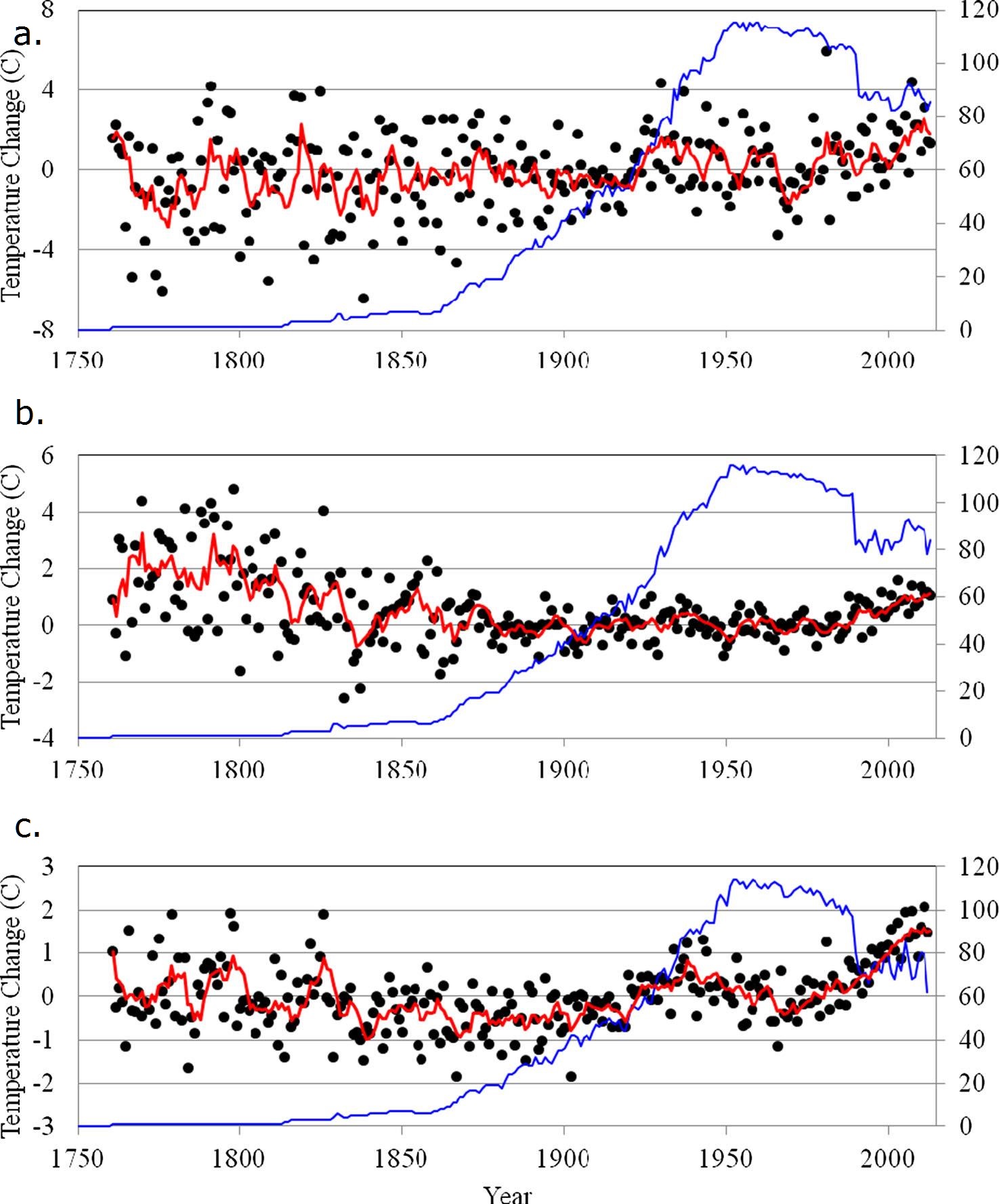
Why is this important?  All the claims of global climate emergency depend on dangerously higher temperatures, lower sea ice, and rising sea levels.  The lack of additional warming is documented in a post Adios, Global Warming

The lack of acceleration in sea levels along coastlines has been discussed also.  See USCS Warnings of Coastal Flooding

Also, a longer term perspective is informative:

post-glacial_sea_levelThe table below shows the distribution of Sea Ice on day 151 across the Arctic Regions, on average, this year and 2020.

Region 2022151 Day 151 Average 2022-Ave. 2021151 2022-2021
 (0) Northern_Hemisphere 12281289 11682840 598449 11605537 675752
 (1) Beaufort_Sea 1060171 1003588 56582 1034779 25392
 (2) Chukchi_Sea 894077 865036 29040 900868 -6792
 (3) East_Siberian_Sea 1085478 1064424 21054 1051959 33520
 (4) Laptev_Sea 877340 824419 52921 738294 139047
 (5) Kara_Sea 870898 829705 41193 824068 46831
 (6) Barents_Sea 421071 305918 115153 325745 95326
 (7) Greenland_Sea 665639 562229 103411 615174 50465
 (8) Baffin_Bay_Gulf_of_St._Lawrence 976116 897470 78647 812548 163568
 (9) Canadian_Archipelago 854703 810848 43855 811040 43663
 (10) Hudson_Bay 1122388 1088994 33395 1084892 37496
 (11) Central_Arctic 3245183 3216568 28615 3232324 12859
 (12) Bering_Sea 116552 115657 895 89124 27428
 (13) Baltic_Sea 915 199 717 0 915
 (14) Sea_of_Okhotsk 89260 96309 -7049 83572 5688

The overall surplus to average is 598k km2, (5%).  The surplus is found in every region, except for a slight deficit in Okhotsk

bathymetric_map_arctic_ocean

Illustration by Eleanor Lutz shows Earth’s seasonal climate changes. If played in full screen, the four corners present views from top, bottom and sides. It is a visual representation of scientific datasets measuring Arctic ice extents.

Mid May Arctic Ice Persistent

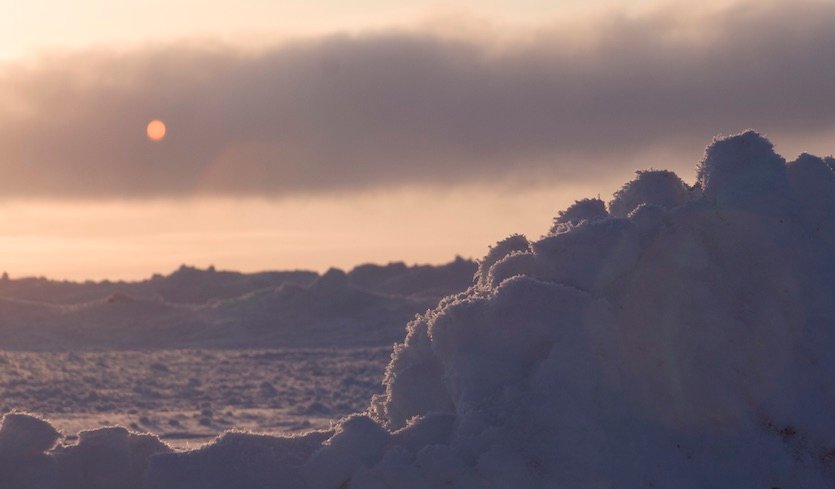
An early-spring sunset over the icy Chukchi Sea near Barrow (Utqiaġvik), Alaska, documented during the OASIS field project (Ocean_Atmosphere_Sea Ice_Snowpack) on March 22, 2009. Image credit: UCAR, photo by Carlye Calvin.

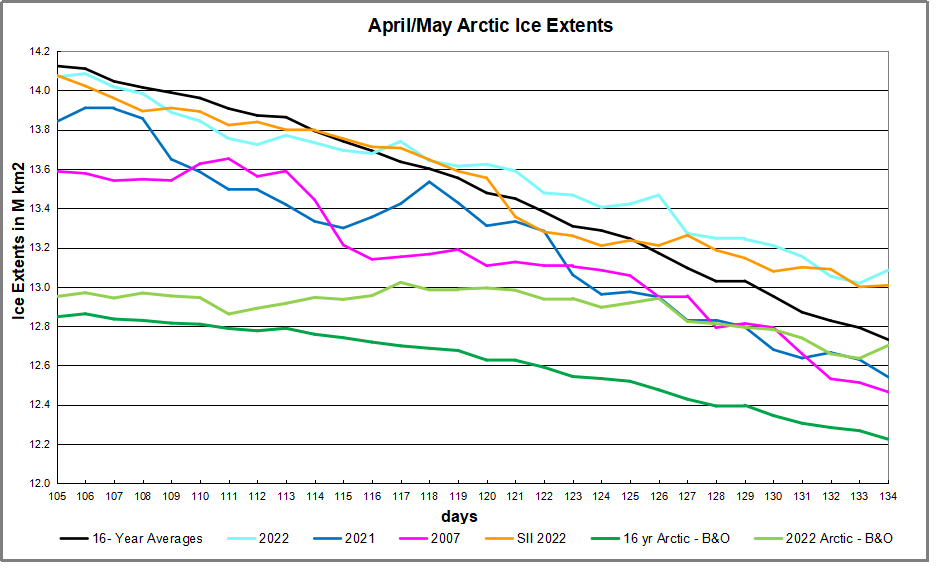
Previous posts showed 2022 Arctic Ice broke the 15M km2 ceiling in February, staying above that level the first week of March, then followed by typical melting in March and April.  Now in May,  Arctic sea ice is not retreating as fast as usual.  The chart below shows by day 134 (May 14), the overall ice extent in cyan  was 353k km2 above the 16 year average in black.

Note the much higher ice extents in 2022 compared to 2021 (+543k) or 2007 (+619k).  The green lines show that the above normal ice this year is despite low extents in Bering and Okhotsk (B&O) seas.  The averages in dark green (excluding B&O) are below 2022 in light green (excluding B&O) by 477k km2.  IOW everywhere in the Arctic except Okhotsk ice extents are almost 1/2 Wadham above average, nearly matching day 134 Arctic including Bering and Okhotsk.  Remember also that B&O are outside the Arctic circle, have no Polar bears, and are among the first to melt out every spring.

The table below shows ice extents in the seas comprising the Arctic, comparing 2022 day 134 with the same day average over the last 16 years and with 2007.

Region 2022134 Day 134 Average 2022-Ave. 2007134 2022-2007
 (0) Northern_Hemisphere 13084542 12731703 352839 12465425 619117
 (1) Beaufort_Sea 1042530 1048465 -5934 1057649 -15119
 (2) Chukchi_Sea 958909 927455 31454 952925 5984
 (3) East_Siberian_Sea 1087137 1081479 5659 1080156 6981
 (4) Laptev_Sea 897845 881321 16524 850822 47022
 (5) Kara_Sea 894992 886185 8807 876053 18939
 (6) Barents_Sea 612751 417074 195677 351553 261198
 (7) Greenland_Sea 674248 623405 50843 560102 114147
 (8) Baffin_Bay_Gulf_of_St._Lawrence 1206195 1080371 125824 1029612 176583
 (9) Canadian_Archipelago 854685 840361 14324 830604 24081
 (10) Hudson_Bay 1213151 1190185 22966 1161738 51413
 (11) Central_Arctic 3248013 3224787 23226 3234305 13708
 (12) Bering_Sea 257260 319952 -62692 309846 -52586
 (13) Baltic_Sea 9044 8179 865 6368 2675
 (14) Sea_of_Okhotsk 125465 200107 -74641 159942 -34476

The table shows that 2022 ice extent is above average by 353k km2, or 2.8%, and exceeding 2007 by 619k km2 at this date. The two deficits to average are Bering and Okhotsk, more than offset by surpluses elsewhere,  especially in Barents and Baffin Bay.

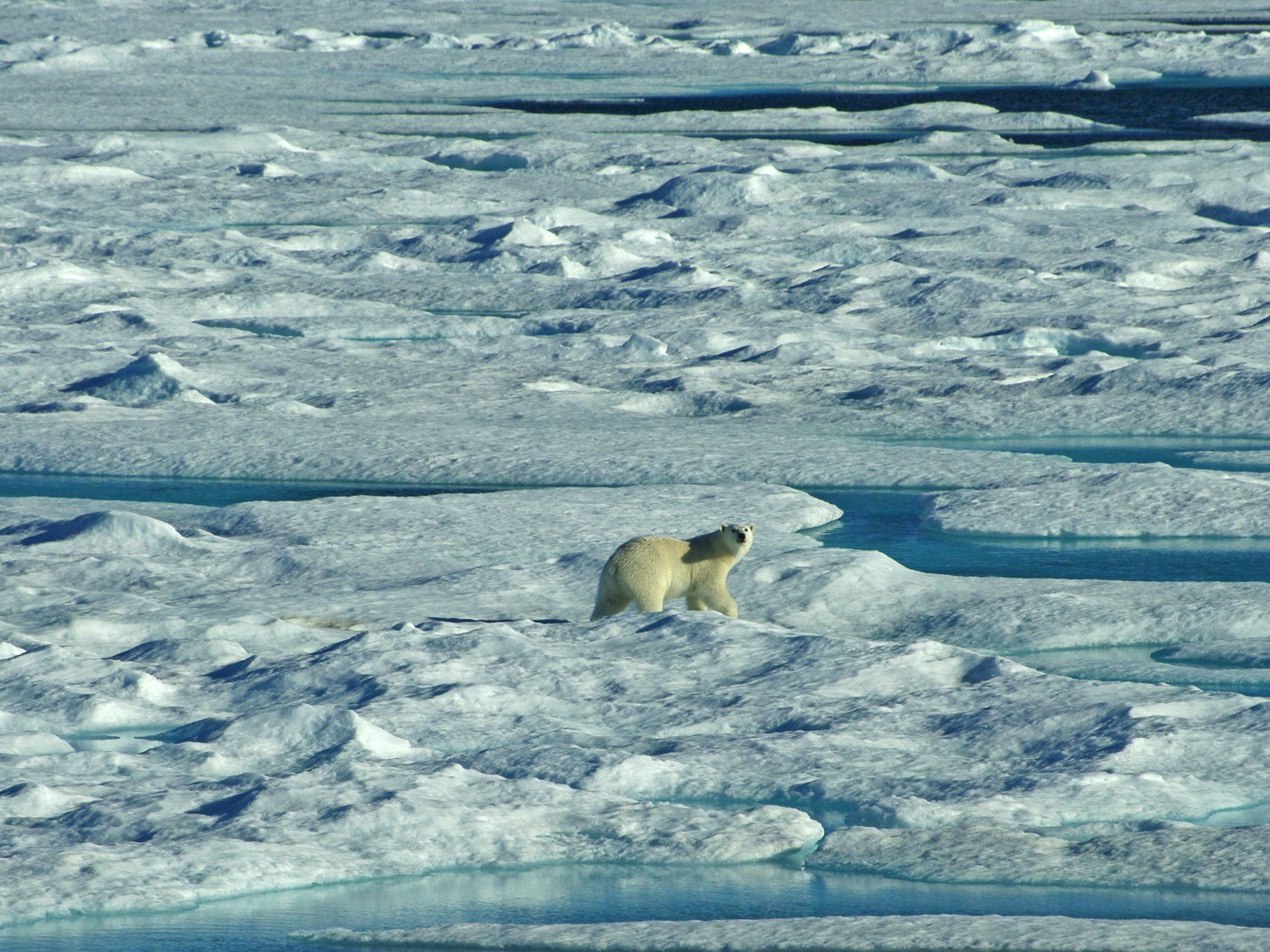
Polar Bear on Ice in Baffin Bay Between Baffin Island and Greenland


May 8 Arctic Ice A-OK

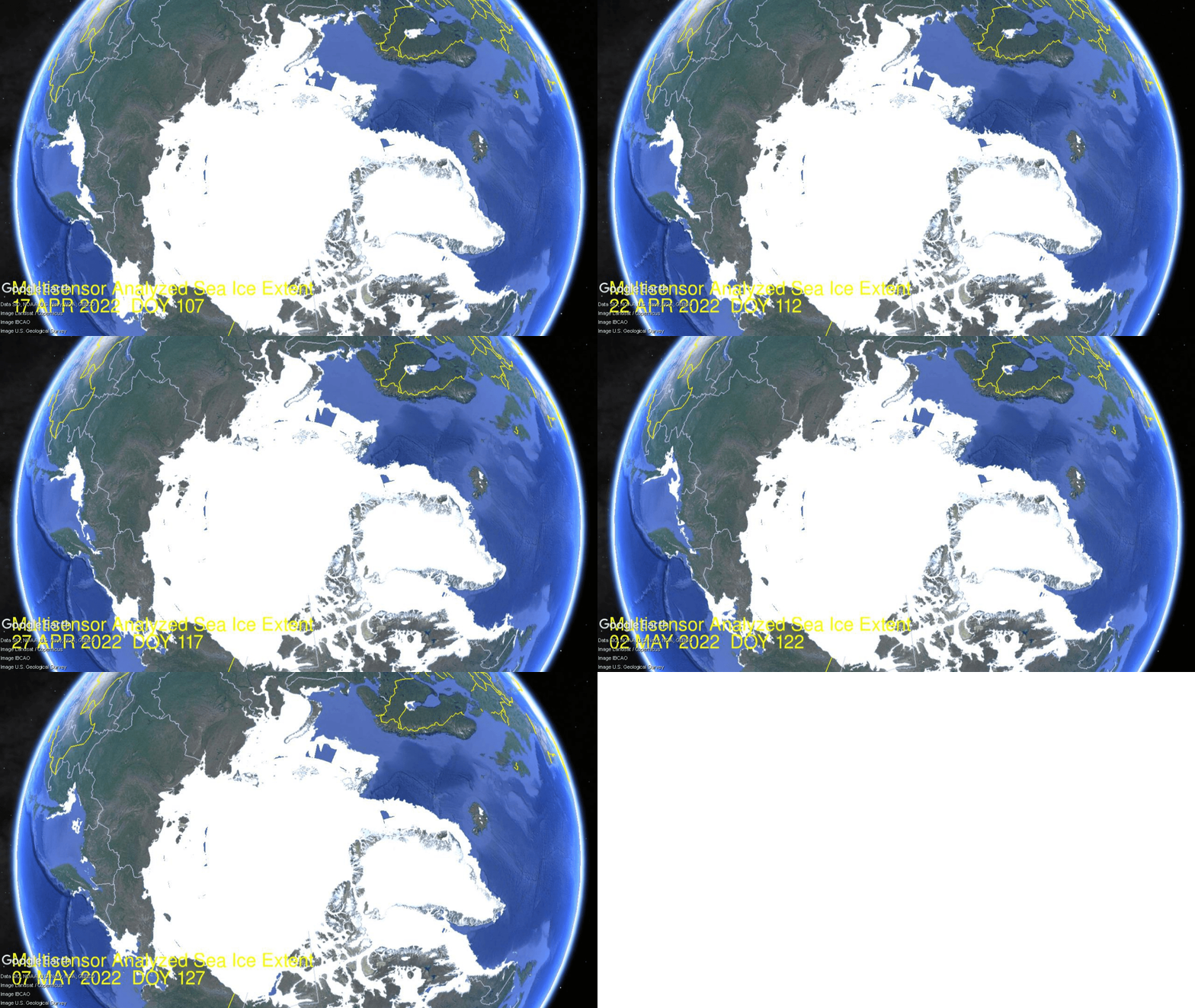
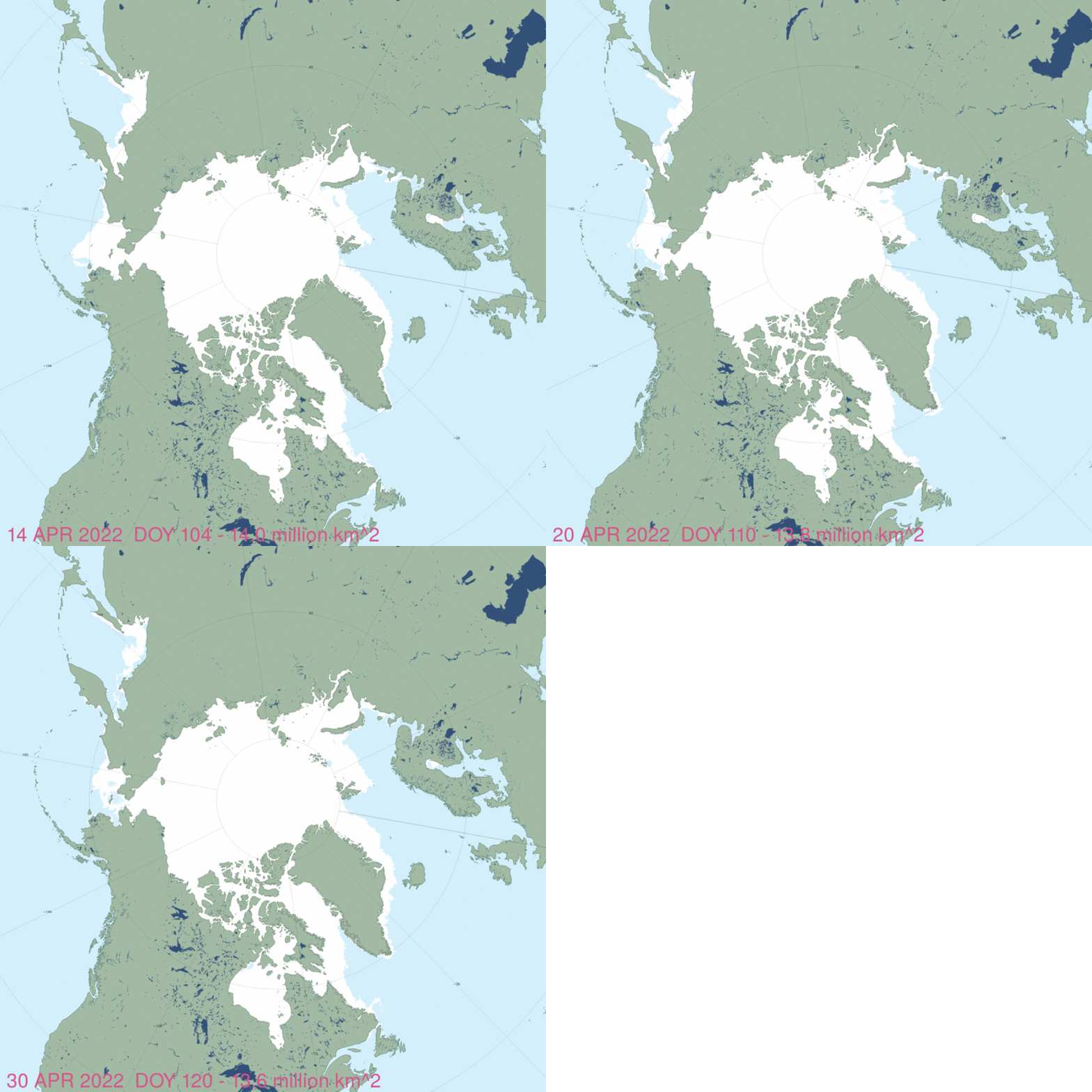
My previous Arctic ice report was limited by technical difficulties, now resolved as shown by the animation above.  So this update comes a week into May, with the animation covering the last three weeks from mid April.   The dramatic melting in the Pacific basins of Bering and Okhotsk (left) sets them apart from the rest of Arctic sea ice. As noted before, those two basins are outside the Arctic circle, have no polar bears and are the first places to become open water in the Spring. Elsewhere sea ice persisted, actually growing in Barents and Greenland seas.

[The staff at National Ice Center were extremely helpful, as usual.  Their work is distinctive, valuable and deserving of your appreciation.  See Support MASIE Arctic Ice Dataset]

The melting effect on NH total ice extents during this period is presented in the graph below.

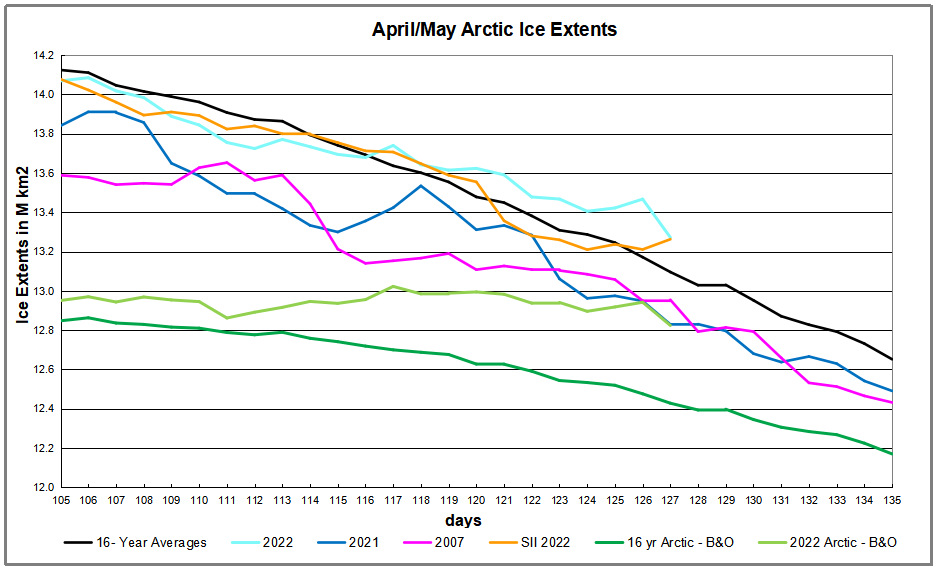
The graph above shows ice extent mid-April through May 7 comparing 2022 MASIE reports with the 16-year average, other recent years and with SII.  2022 ice extents have tracked the average, going surplus for the last 10 days. .Both 2021 and 2007 are well below average, on day 127 lower than 2022 by 318k km2 and 443k km2 respectively. The two green lines at the bottom show average and 2022 extents when Bering and Okhotsk ice are excluded.  On this basis 2022 Arctic ice was nearly 400k km2 in surplus on May 7, and prior to yesterday, the horizontal line shows little loss of ice extent elsewhere than in the Pacific.

Region 2022127 Day 127 Average 2022-Ave. 2007127 2022-2007
 (0) Northern_Hemisphere 13272388 13096082  176306  12954671 317717 
 (1) Beaufort_Sea 1053640 1059642  -6001  1056022 -2382 
 (2) Chukchi_Sea 959821 949409  10412  955497 4324 
 (3) East_Siberian_Sea 1087137 1085912  1225  1081248 5889 
 (4) Laptev_Sea 897845 892770  5075  870216 27628 
 (5) Kara_Sea 928813 897443  31370  883059 45754 
 (6) Barents_Sea 642899 476820  166079  430155 212745 
 (7) Greenland_Sea 732835 616488  116347  639861 92974 
 (8) Baffin_Bay_Gulf_of_St._Lawrence 1185073 1140285  44787  1076913 108159 
 (9) Canadian_Archipelago 854685 845807  8879  845091 9594 
 (10) Hudson_Bay 1216867 1212411  4456  1192270 24597 
 (11) Central_Arctic 3248013 3223344  24669  3241053 6960 
 (12) Bering_Sea 275935 401584 -125649  398914 -122980 
 (13) Baltic_Sea 14465 13264  1201  10416 4050 
 (14) Sea_of_Okhotsk 172221 278245  -106023  269684 -97463 

The only deficits to average are in Bering and Okhotsk, more than offset by surpluses everywhere else, especially in Barents and Greenland seas, along with Kara and Baffin Bay.  At this point, overall NH sea ice is 88% of last March maximum (15.1M kim2).  All regions are well above 90% of their maxes, except for Barents (81%), Baffin Bay (66%), Bering (33%) and Okhotsk (20%).


April 1st Footnote:

It has been a long hard winter, requiring overtime efforts by Norwegian icebreakers like this one:

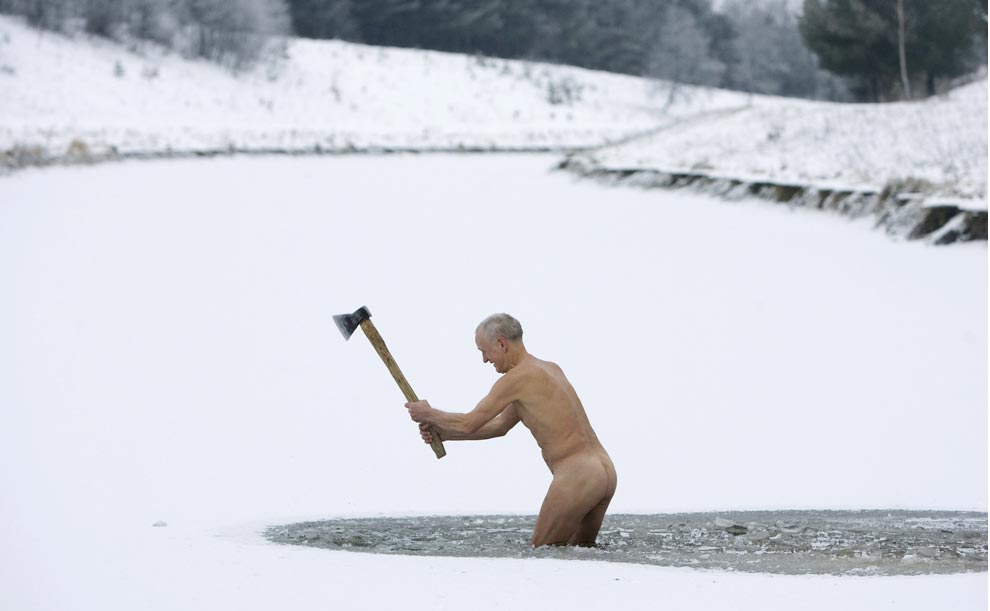
In addition, cold Spring temperatures led to unusual sightings of Northern creatures:

Not only Polar bears are flourishing!


May 1 Arctic Ice Persists Strangely

Double-click to enlarge image.

Arctic ice extent changes for the last two weeks are shown in the MASIE animation above. Note that the Pacific basins of Bering and Okhotsk (upper left) melted dramatically.  Meanwhile on the Atlantic side ice persisted, actually growing in Barents and Greenland seas.

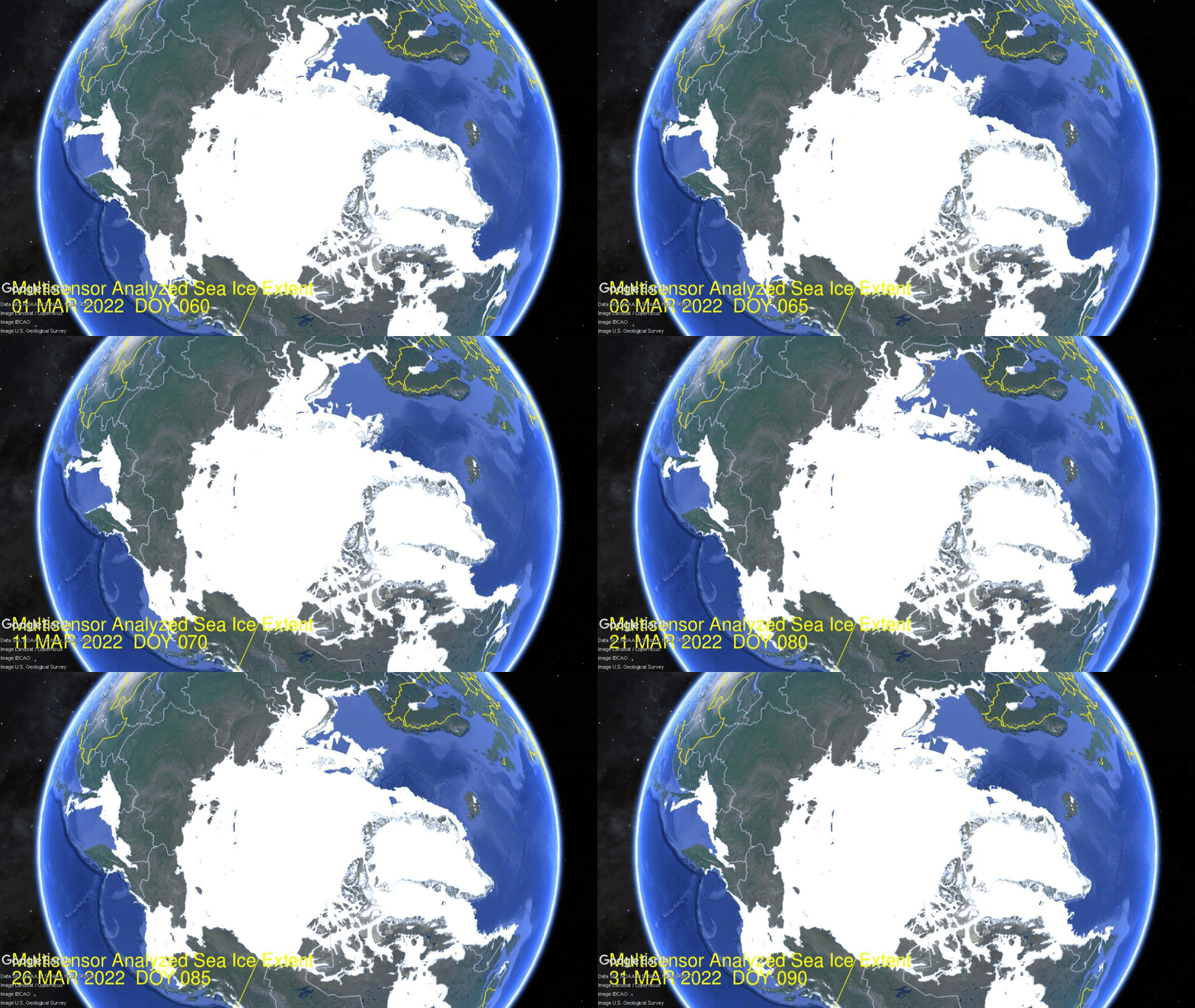
The strangeness concerns weirdness in Google Earth Pro treatment of kmz files from MASIE.  Previous I have used these to produce animations like the one below for the month of March.

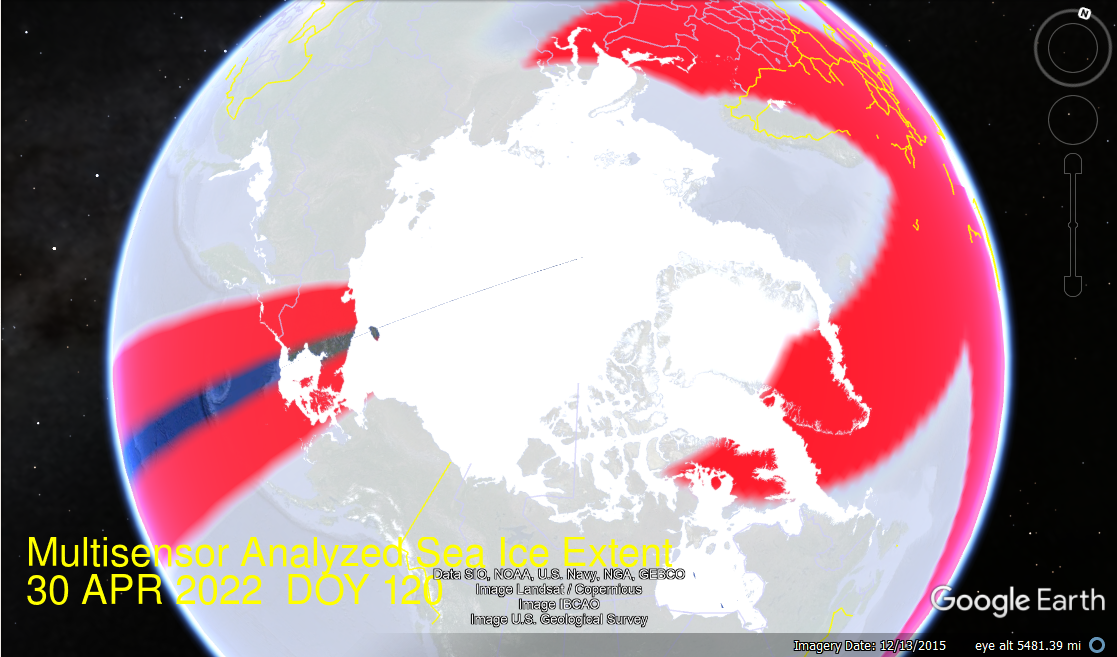
Today when attempting to do the same for April, this is what was shown.

That is a screen capture since Google Earth could not render an image.  I hope it is just a temporary technical difficulty.  But I can’t help but imagine this depicting some kind of military map with a two-pronged attack by red forces with a single resisting force in red and blue. Is it more virtuous canceling of all things Russian at the expense of scientific inquiry? (The mask with colors was only imposed on the Northern Hemisphere)

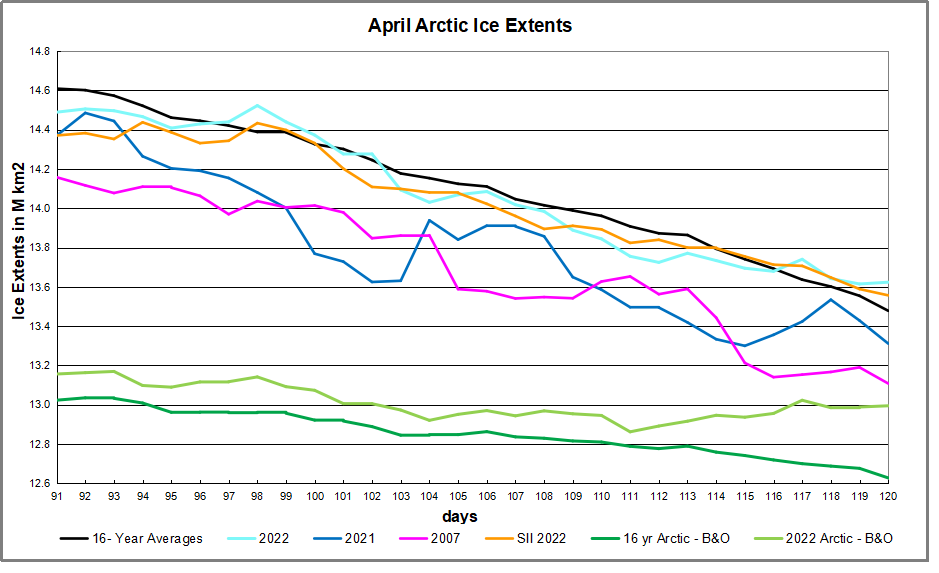
The melting effect on NH total ice extents during April is presented in the graph below.

The graph above shows ice extent through April comparing 2022 MASIE reports with the 16-year average, other recent years and with SII.  On average ice extents lost 1.1M km2 during April.  2022 ice extents started slightly lower, then tracked average, ending slightly above average. Both 2021 and 2007 ended  below average, by 200k km2 and 400k km2 respectively. The two green lines at the bottom show average and 2022 extents when Bering and Okhotsk ice are excluded.  On this basis 2022 Arctic was nearly 400k km2 in surplus at end of April.

Region 2022120 Day 120 Average 2022-Ave. 2007120 2022-2007
 (0) Northern_Hemisphere 13623874 13507670  116204  13108068 515806 
 (1) Beaufort_Sea 1070776 1067739  3036  1059189 11587 
 (2) Chukchi_Sea 963424 955654  7770  949246 14178 
 (3) East_Siberian_Sea 1087137 1085485  1652  1080176 6961 
 (4) Laptev_Sea 897845 889961  7884  875661 22184 
 (5) Kara_Sea 932842 911757  21084  864664 68178 
 (6) Barents_Sea 654813 547685  107129  396544 258270 
 (7) Greenland_Sea 777073 640123  136950  644438 132635 
 (8) Baffin_Bay_Gulf_of_St._Lawrence 1243689 1205315  38374  1147115 96574 
 (9) Canadian_Archipelago 854685 848564  6121  838032 16653 
 (10) Hudson_Bay 1240262 1238267  1995  1222074 18188 
 (11) Central_Arctic 3247307 3229654  17652  3241034 6272 
 (12) Bering_Sea 334929 482018 -147089  475489 -140560 
 (13) Baltic_Sea 22696 20622  2074  14684 8012 
 (14) Sea_of_Okhotsk 294259 381697  -87438  295743 -1484 

The only deficits to average are in Bering and Okhotsk, more than offset by surpluses everywhere else, especially in Barents and Greenland seas. 2007 extents were lower by 516k km2 (half a Wadham)


April 1st Footnote:

It has been a long hard winter, requiring overtime efforts by Norwegian icebreakers like this one:

In addition, cold Spring temperatures led to unusual sightings of Northern creatures:

Not only Polar bears are flourishing!


Mid April Arctic Ice Above Average

Drift ice in Okhotsk Sea at sunrise.

Previous posts showed 2022 Arctic Ice broke the 15M km2 ceiling in February, staying above that level the first week of March, then followed by typical melting in March. As the chart below shows, mid March the overall ice extent was ~400k km2 below the 16 year average, before returning to the mean day 89 and tracking the average since then.

Note the much higher ice extents in 2022 compared to 2021 or 2007.  The green lines show that the above normal ice this year is despite low extents in Sea of Okhotsk.  The averages in dark green (excluding Okhotsk) are below 2022 in light green (excluding Okhotsk) by nearly 200k km2.  IOW everywhere in the Arctic except Okhotsk ice extents are well above average.  Remember also that Okhotsk basin is outside the Arctic circle, has no Polar bears, and is among the first to melt out every spring.

The table below shows ice extents in the seas comprising the Arctic, comparing 2022 day 102 with the same day average over the last 16 years and with 2021.

Region 2022102 Day 102 Average 2022-Ave. 2021102 2022-2021
 (0) Northern_Hemisphere 14276734 14220846 55888 13625046 651688
 (1) Beaufort_Sea 1070776 1069263 1513 1070689 87
 (2) Chukchi_Sea 966006 963080 2926 966006 0
 (3) East_Siberian_Sea 1087137 1085847 1290 1087137 0
 (4) Laptev_Sea 897845 895064 2781 897827 18
 (5) Kara_Sea 935023 922556 12467 900979 34045
 (6) Barents_Sea 708728 615602 93126 349338 359390
 (7) Greenland_Sea 646204 655532 -9329 671290 -25086
 (8) Baffin_Bay_Gulf_of_St._Lawrence 1281551 1286670 -5119 1132374 149177
 (9) Canadian_Archipelago 854685 852712 1973 854597 88
 (10) Hudson_Bay 1260903 1246035 14868 1249891 11012
 (11) Central_Arctic 3238576 3230459 8117 3167541 71035
 (12) Bering_Sea 765331 658850 106481 545689 219642
 (13) Baltic_Sea 51751 47121 4630 21897 29854
 (14) Sea_of_Okhotsk 506073 685897 -179824 704441 -198368

The table shows that 2022 ice extent is slightly above average and exceeding 2021 by 652k km2 at this date. Surpluses are sizeable in Bering and Barents, more than offsetting the major Okhotsk deficit. All other regions are showing as typically frozen basins.

Polar Bear on Ice in Baffin Bay Between Baffin Island and Greenland


April 1 Resilient Arctic Ice (No Fooling)

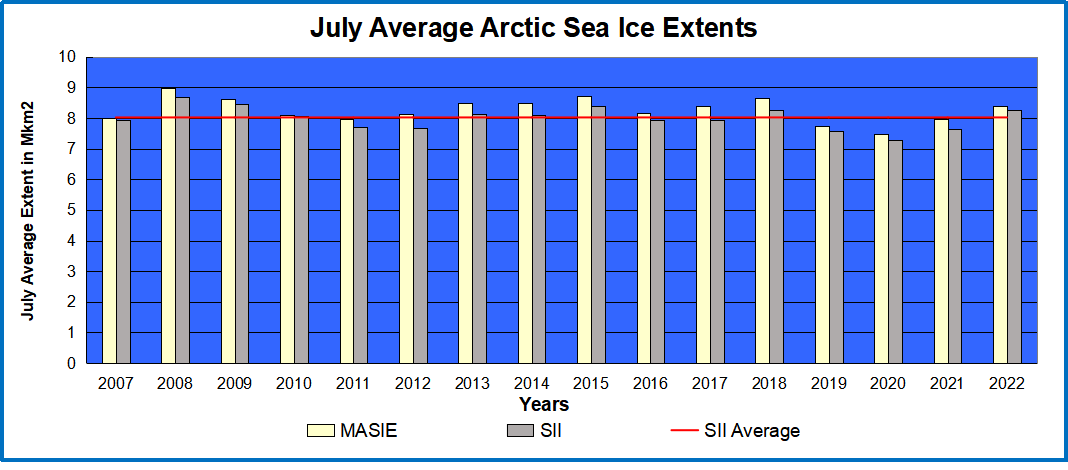
Previous posts showed 2022 Arctic Ice broke the 15M km2 ceiling in February, followed by a typical small melt in March.  Climatology refers to the March monthly average ice extent as indicative of the annual maximum Arctic ice extent.  The graph above shows that the March monthly average has varied little since 2007, typically around the SII average of 14.7 M km2.  Of course there are regional differences as described later on.

The animation shows ice extent fluctuations during March 2022. Bering Sea (lower left) gained ice over the month, while ice in Okhotsk (higher left) retreated. At the top Kara and Barents seas lost and then gained ice.  Baffin Bay lower right lost ice during March.  The main changes were Baffin losing ~360k km2 of extent and Okhotsk losing ~260k km2.

The effect on NH total ice extents is presented in the graph below.

The graph above shows ice extent through March comparing 2022 MASIE reports with the 16-year average, other recent years and with SII.  Hovering around 15M km2 the first week, 2022 ice extents dropped sharply mid month, then stabilized and at March end matched the average. Both 2020 and 2021 ended nearly 400k km2 below average. The two green lines at the bottom show average and 2022 extents when Okhotsk ice is excluded.  On this basis 2022 Arctic was nearly 400k km2 in surplus, then declined mid month before ending nearly 200k km2 in surplus to average, except for the ice shortage in Okhotsk.

Region 2022090 Day 90 Average 2022-Ave. 2021090 2022-2021
 (0) Northern_Hemisphere 14563095 14616765  -53670  14266634 296461 
 (1) Beaufort_Sea 1070776 1070116  660  1070689 87 
 (2) Chukchi_Sea 966006 963906  2100  966006
 (3) East_Siberian_Sea 1087137 1086102  1035  1087137
 (4) Laptev_Sea 897845 896958  887  897827 18 
 (5) Kara_Sea 935023 918083  16941  935023
 (6) Barents_Sea 748326 645014  103311  602392 145934 
 (7) Greenland_Sea 616239 652388  -36148  620574 -4334 
 (8) Baffin_Bay_Gulf_of_St._Lawrence 1441014 1400528  40486  1243739 197275 
 (9) Canadian_Archipelago 854685 852982  1703  854597 88 
 (10) Hudson_Bay 1260903 1254217  6687  1260903
 (11) Central_Arctic 3245216 3232275  12941  3192844 52373 
 (12) Bering_Sea 785874 720525 65348  549939 235935 
 (13) Baltic_Sea 52068 63446  -11377  33543 18525 
 (14) Sea_of_Okhotsk 596190 849221  -253031  942085 -345895 

The table shows that the large deficit in Okhotsk is only partially offset by surpluses in Bering and Barents Seas.  All other regions show typical extents at end of March


April 1st Footnote:

It has been a long hard winter, requiring overtime efforts by Norwegian icebreakers like this one:

In addition, cold March temperatures led to unusual sightings of Northern creatures:

Not only Polar bears are flourishing!


Where Did Okhotsk Sea Ice Go?

A post last month noted that Arctic ice extent in February unusually exceeded 15M km2 (15 Wadhams).  This was despite slower than usual recovery of ice in Sea of Okhotsk.  That early 2022 peak ice extent has passed and will now stand as 2022 annual maximum. One wonders why the large ice deficit in that basin.  The graph below shows the anomaly.

The 2022 cyan line started March above 15M km2, then declined to day 76 (March 17), ~300k km2 lower than the 16 yr. average.  The dark green line shows Arctic ice extent average after Okhotsk is excluded, while the light green is 2022 Arctic extent without Okhotsk. The table below shows that Okhotsk deficit to average on day 76 is 260k km2, almost the entire Arctic deficit.

Region 2022076 Day 76 Average 2022-Ave. 2021076 2022-2021
 (0) Northern_Hemisphere 14641084 14935497 -294413 14769906 -128822
 (1) Beaufort_Sea 1070776 1070247 529 1070689 87
 (2) Chukchi_Sea 966006 965877 129 966006 0
 (3) East_Siberian_Sea 1087137 1087107 30 1087120 17
 (4) Laptev_Sea 897845 897837 8 897827 18
 (5) Kara_Sea 905846 923576 -17730 935006 -29160
 (6) Barents_Sea 554036 648194 -94158 849221 -295185
 (7) Greenland_Sea 572046 618979 -46934 601423 -29377
 (8) Baffin_Bay_Gulf_of_St._Lawrence 1784542 1534462 250080 1288815 495727
 (9) Canadian_Archipelago 854685 853020 1665 854597 88
 (10) Hudson_Bay 1260691 1258149 2542 1260471 220
 (11) Central_Arctic 3153037 3223013 -69976 3222708 -69671
 (12) Bering_Sea 729277 755358 -26081 547775 181502
 (13) Baltic_Sea 59785 81419 -21634 62626 -2841
 (14) Sea_of_Okhotsk 739183 998164 -258981 1117615 -378432

Most places are close to average, with a large surplus in Baffin Bay offsetting small deficits elsewhere.  The exception is Okhotsk making up most of the total deficit to average, and even a larger deficit to last year

IOW, had Okhotsk extent been average on day 60 (1.08M km2) instead of 852k km2, the surplus would have been even higher.  So why was ice missing in Okhotsk this year?

Firstly, the animation above shows that Okhotsk (and also Bering) sea ice is quite variable year over year. The MASIE record for day 60 shows Okhotsk at 880k km2 in 2006, up to 1230k km2 in 2012, down to 770k km2 in 2015, up to 1080k km2 in 2018, down to  850k km2 in 2022. Notice Okhotsk 2022 is quite similar to 2015, while Bering is about average this year.  What causes these fluctuations on annual, decadal and longer time scales?

The answer illustrates the complexity of natural factors interacting to produce climatic patterns we observe and measure. In Okhotsk in particular, and in the Arctic generally, changes in ice extents are a function of the 3 Ws: Water, Wind and Weather. More specifically, water changes in temperature (SST) and salinity (SSS); wind changes with changes in sea level pressures (SLP); and stormy weather varies between cyclonic and anticyclonic regimes. Below is discussion of these natural mechanisms.

Background on Okhotsk Sea

NASA describes Okhotsk as a Sea and Ice Factory. Excerpts in italics with my bolds.

The Sea of Okhotsk is what oceanographers call a marginal sea: a region of a larger ocean basin that is partly enclosed by islands and peninsulas hugging a continental coast. With the Kamchatka Peninsula, the Kuril Islands, and Sakhalin Island partly sheltering the sea from the Pacific Ocean, and with prevailing, frigid northwesterly winds blowing out from Siberia, the sea is a winter ice factory and a year-round cloud factory.

The region is the lowest latitude (45 degrees at the southern end) where sea ice regularly forms. Ice cover varies from 50 to 90 percent each winter depending on the weather. Ice often persists for nearly six months, typically from October to March. Aside from the cold winds from the Russian interior, the prodigious flow of fresh water from the Amur River freshens the sea, making the surface less saline and more likely to freeze than other seas and bays.


Map of the Sea of Okhotsk with bottom topography. The 200- and 3000-m isobars are indicated by thin and thick solid lines, respectively. A box denotes the enlarged portion in Figure 5. White shading indicates sea-ice area (ice concentration ⩾30%) in February averaged for 2003–11; blue shading indicates open ocean area. Ice concentration from AMSR-E is used. Color shadings indicate cumulative ice production in coastal polynyas during winter (December–March) averaged from the 2002/03 to 2009/10 seasons (modified from Nihashi and others, 2012, 2017). The amount is indicated by the bar scale. Source: Cambridge Core

Basics of Weather and Ice Dynamics

Wind directions are named by which point on the compass the prevailing wind hits you in the face.  Thus, a southerly wind comes from the south toward the north, typically bringing warmer air north, and displacing colder northern air.

Winds arise from differences in surface pressures. Above every square inch on the surface of the Earth is 14.7 pounds of air. That means air exerts 14.7 pounds per square inch (psi) of pressure at Earth’s surface. High in the atmosphere, air pressure decreases.

Pressure varies from day to day at the Earth’s surface – the bottom of the atmosphere. This is, in part, because the Earth is not equally heated by the Sun. Areas where the air is warmed often have lower pressure because the warm air rises. These areas are called low pressure systems. Places where the air pressure is high, are called high pressure systems.

A low pressure system has lower pressure at its center than the areas around it. Winds blow towards the low pressure, and the air rises in the atmosphere where they meet. As the air rises, the water vapor within it condenses, forming clouds and often precipitation. Because of Earth’s spin and the Coriolis effect, winds of a low pressure system swirl counterclockwise north of the equator and clockwise south of the equator. This is called cyclonic flow. On weather maps, a low pressure system is labeled with red L.

A high pressure system has higher pressure at its center than the areas around it. Winds blow away from high pressure. Swirling in the opposite direction from a low pressure system, the winds of a high pressure system rotate clockwise north of the equator and counterclockwise south of the equator. This is called anticyclonic flow. Air from higher in the atmosphere sinks down to fill the space left as air is blown outward. On a weather map, you may notice a blue H, denoting the location of a high pressure system.

High and low pressure indicated by lines of equal pressure called isobars.

When the suns shines on land the air is warmed and rises. And because the earth is rotating, an upward spiral forms. Additionally, over wetlands and the oceans there is evaporation, which also rises, H2O being lighter than N2 or O2. When the water is warmer, the rising air intensifies and resulting in a lower pressure than surrounding areas.  Arctic cyclones disrupt drift ice, creating more open water, and impede freezing.  Arctic anticyclones (HP cells) facilitate cooling and freezing.

The vertical direction of wind motion is typically very small (except in thunderstorm updrafts) compared to the horizontal component, but is very important for determining the day to day weather. Rising air will cool, often to saturation, and can lead to clouds and precipitation. Sinking air warms causing evaporation of clouds and thus fair weather.

The closer the isobars are drawn together the quicker the air pressure changes. This change in air pressure is called the “pressure gradient”. Pressure gradient is just the difference in pressure between high- and low-pressure areas.

The Okhotsk Sea Ice Connection

Toyoda et al. (2022) explain in their paper Sea ice variability along the Okhotsk coast of Hokkaido based on long-term JMA meteorological observatory data.  Excerpts in italics with  my bolds.

Abstract

Long-term sea ice observation data at the Japan Meteorological Agency observatories along the
Okhotsk coast of Hokkaido were analyzed. The observations at the Abashiri Local Meteorological
Observatory largely explained the variations at other sites along much of the Okhotsk coast on a time scale longer than a few days. Interannually, variations of the maximum sea ice areas in the whole and southern Sea of Okhotsk were largely reflected in the yearly accumulated sea ice concentration (SIC) and sea ice duration variations at the observatories.

NPI time series The bars represent five-month mean ( November – March ) NPI values. The green line represents five-year running means of five-month mean NPI values. Positive (negative) NPI values indicate that the Aleutian Low is weaker (stronger) than its normal. For comparison with the PDO index, the period of the graph is adjusted to that of the PDO index.

A comparison with several indices for the North Pacific climate variability suggested that the North Pacific Index (NPI) is a robust indicator of the recent (after the 1980s) sea ice variations in the Sea of Okhotsk on a decadal time scale. Specifically:

♦  variations in the first sea ice appearance date at the observatories resulted from variations in the Aleutian Low with meridional wind anomalies over the Sea of Okhotsk and the air temperature around Japan in January;

♦  variations in the final disappearance date resulted from the Aleutian Low variations, and,

♦  the resulting sea ice cover variations in the Sea of Okhotsk except for the Siberian coast affected the air temperatures in April. These factors influenced the sea ice duration.

A strong linkage was found between variations in the local sea ice (along the Hokkaido coast) and large-scale fields, which will help improve our understanding of the sea ice extent and retreat variability over the Sea of Okhotsk and its linkage to the North Pacific climate variability.

Fig. 1 (a) Monthly sea ice extent (contours of grid SIC = 0.3) averaged over 1977–2019. (b) Locations of JMA observatories and distribution of dailybasis correlation coefficients between the Abashiri and grid SICs. (N = 700–800 approximately).

Fig. 2 (a) Yearly maximum sea ice areas in the Sea of Okhotsk from the grid SIC data for the whole (black; left axis), northern (>50°N; green; left axis), and southern (<50°N; red; right axis) areas.

Among several climate indices, the NPI is a robust indicator of recent (after the 1980s) sea ice
variations in the Sea of Okhotsk. We also examined the differences between the start and end date variations, which determine the durations. Variations in the start date at the Okhotsk coast sites resulted from the variations in the Aleutian Low strength, the air temperature around Japan in January, and partly the SST along the Soya warm current in December. Variations in the end date resulted from the Aleutian Low variations; the sea ice cover variations affected the air temperatures over the Sea of Okhotsk in April, in contrast to the sea ice cover variations in January resulting from the air temperature variations.

Sea Ice Tourism from Hokkaido, Japan

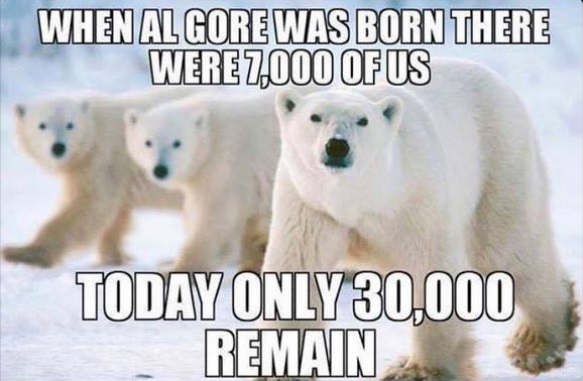
Taking a boat trip from Hokkaido Island to see Okhotsk drift ice is a big tourist attraction, as seen in the short video below.  Al Gore had them worried back then, but hopefully not now.

Drift ice in Okhotsk Sea at sunrise.

Arctic Ice Breaks 15M km2 Ceiling at Feb. End

Drift ice in Okhotsk Sea at sunrise.

As reported previously, Arctic ice extents are solid in most seas, but continue to fluctuate at the margins.  Notably in 2022, ice extents broke the 15M km2 threshold on Feb. 28, whereas the 16-year average falls short of that even in March. It also exceeds the 2021 annual March maximum by 175k km2.

Note the much higher extent this year:  160k km2 greater than the average, and 342k km2 more than 2021.  Somehow SII (Sea Ice Index) lost 200k km2 in the last 3 days.

The table below shows ice extents in the seas comprising the Arctic, comparing 2022 day 059 with the same day average over the last 16 years and with 2021.

Region 2022059 Day 59 Average 2022-Ave. 2021059 2022-2021
 (0) Northern_Hemisphere 15048826 14889681 159145 14706367 342459
 (1) Beaufort_Sea 1070776 1070283 493 1070689 87
 (2) Chukchi_Sea 966006 965332 674 966006 0
 (3) East_Siberian_Sea 1087137 1087104 34 1087120 17
 (4) Laptev_Sea 897827 897836 -10 897827 0
 (5) Kara_Sea 927636 926141 1495 935006 -7370
 (6) Barents_Sea 742200 624652 117548 743724 -1524
 (7) Greenland_Sea 623943 610430 13513 607006 16937
 (8) Baffin_Bay_Gulf_of_St._Lawrence 1807904 1499912 307991 1286025 521879
 (9) Canadian_Archipelago 854685 853241 1444 854597 88
 (10) Hudson_Bay 1260903 1260384 519 1260471 432
 (11) Central_Arctic 3247959 3211583 36376 3191259 56699
 (12) Bering_Sea 649668 664978 -15310 605478 44189
 (13) Baltic_Sea 62334 100387 -38053 100347 -38013
 (14) Sea_of_Okhotsk 824154 1074030 -249876 1080692 -256538

The table shows that 2022 ice extent exceeds 2021 by 342k km2 at this date. Surpluses are sizeable in Baffin and Barents, more than offsetting an Okhotsk deficit.

Polar Bear on Ice in Baffin Bay Between Baffin Island and Greenland

The next two weeks will be interesting. The average year in the last sixteen gained about 100k km2 from now to mid March. But the variability ranged from 2015 losing 300K while some other years gained 400k km2. And since 2016, only 2020 broke the 15M km2 ceiling.  What will the ice do this year?

Feb. 2022 Arctic Ice Pauses For Average Catchup

In January, most of the Arctic ocean basins are frozen over, and so the growth of ice extent slows down.  According to SII (Sea Ice Index) January on average adds 1.326M km2, and this year it was 1.235M.  (background is at Arctic Ice New Year 2022).  Still February started with a surplus of ~200k km2 over the 16 year average.  The few basins that can grow ice this time of year tend to fluctuate and alternate waxing and waning, which appears as a see saw pattern in these images.

Two weeks into February 2022 Arctic ice extents waffled with little growth, resulting in a drop down to match the mean ice extent mid month. The graph below shows the ice recovery since mid-January for 2022, the 16-year average and several recent years.

The graph shows end of January 2022 a 200k km2 surplus to average, then little accumulation in February 2022 until a leap upward yesterday.  SII dropped below MASIE this month and did not yet report its estimate of ice extent on day 45

February Ice Growth Despite See Saws in Atlantic and Pacific

As noted above, this time of year the Arctic adds ice on the fringes since the central basins are already frozen over.  The animation above shows Barents and Greenland Seas on upper right (Atlantic side) retreating and growing with little change the last two weeks. Baffin Bay lower right waffled some but added 200k km2 and reached 117% of maximum last March.

Meanwhile the most dramatic see saw appears on the left (Pacific side)  Both Bering below and Okhotsk above wax and wane over this period. Okhotsk waffles up and down ending sightly lower in the end, only 60% of its last max.  Bering is seen losing, then growing to add 100k km2 by the end, reaching 132% of last March maximum.

The table below presents ice extents in the Arctic regions for day 45 (Feb. 14) compared to the 16 year average and 2021.

Region 2022045 Day 45 Average 2022-Ave. 2021045 2022-2021
 (0) Northern_Hemisphere 14771764 14696037 75727 14570648 201117
 (1) Beaufort_Sea 1070776 1070247 529 1070689 87
 (2) Chukchi_Sea 966006 965730 276 966006 0
 (3) East_Siberian_Sea 1087137 1087131 6 1087120 17
 (4) Laptev_Sea 897827 897837 -10 897827 0
 (5) Kara_Sea 871231 909595 -38364 934988 -63757
 (6) Barents_Sea 670586 585796 84790 837700 -167114
 (7) Greenland_Sea 711157 617734 93423 637304 73853
 (8) Baffin_Bay_Gulf_of_St._Lawrence 1521206 1454881 66326 1103099 418107
 (9) Canadian_Archipelago 854685 853210 1475 854597 88
 (10) Hudson_Bay 1260903 1260538 365 1260471 432
 (11) Central_Arctic 3222483 3210904 11580 3204694 17790
 (12) Bering_Sea 841781 692225 149557 545267 296515
 (13) Baltic_Sea 64799 96258 -31459 116339 -51540
 (14) Sea_of_Okhotsk 706456 930957 -224501 1030304 -323848

The table shows that Okhotsk deficit to average is offset by surpluses in Bering, Barents, Greenland and  Baffin Bay.

The polar bears have a Valentine Day’s wish for Arctic Ice.

welovearcticicefinal

And Arctic Ice loves them back, returning every year so the bears can roam and hunt for seals.

Footnote:

Seesaw accurately describes Arctic ice in another sense:  The ice we see now is not the same ice we saw previously.  It is better to think of the Arctic as an ice blender than as an ice cap, explained in the post The Great Arctic Ice Exchange.

Arctic Ice Maxing in January

Previous posts reported how Arctic ice was growing faster than average as well as last year.  Remarkably, several regions have already exceeded their maximum ice extents last March, and overall, Arctic ice is 98% of 2021 maximum with six weeks of freezing season remaining.

The animation shows ice growing the second half of January, notably reaching 1.32M km2 in Baffin Bay, right center, exceeding 2021 max.  Greenland Sea, center top, added 144k km2 to reach 710k km2, also greater than last year’s max.  And at bottom left Bering Sea reached 741k km2, 116% of last years max.

This year began with a surplus and ended January still 230k km2 higher.  The gap over 2021 is 465k km2, nearly half a Wadham. SII dipped and then rose to match MASIE before a drop yesterday.

Region 2022031 Day 31 Average 2022-Ave. 2021031 2022-2021
 (0) Northern_Hemisphere 14599079 14368396 230683 14133494 465586
 (1) Beaufort_Sea 1070776 1070282 494 1070689 87
 (2) Chukchi_Sea 966006 965968 38 966006 0
 (3) East_Siberian_Sea 1087137 1087049 89 1087120 17
 (4) Laptev_Sea 897827 897821 6 897827 0
 (5) Kara_Sea 934844 917081 17763 934952 -108
 (6) Barents_Sea 695583 572672 122910 690363 5220
 (7) Greenland_Sea 724418 594443 129976 621098 103321
 (8) Baffin_Bay_Gulf_of_St._Lawrence 1322799 1336538 -13738 1008582 314217
 (9) Canadian_Archipelago 854685 853253 1433 854597 88
 (10) Hudson_Bay 1260903 1260753 151 1260471 432
 (11) Central_Arctic 3226420 3210376 16045 3203312 23108
 (12) Bering_Sea 741202 650072 91130 545486 195717
 (13) Baltic_Sea 62895 64264 -1369 52787 10108
 (14) Sea_of_Okhotsk 720277 826161 -105884 900121 -179843

The table shows that surpluses in Barents, Greenland and Bering seas more than offset a deficit to average in Okhotsk.  In the latter case, ice has finally begun to build up toward a normal extent for this period. With an overall extent of 14.6M km2, prospects are good for maxing higher than 15M km2 by mid March.