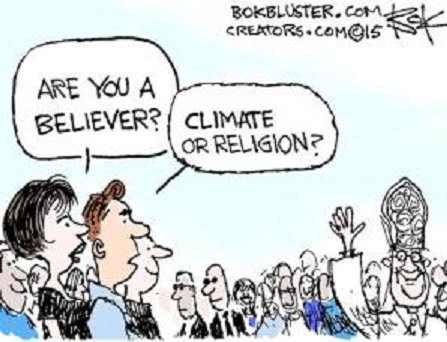
Can Institutions Impose Climate Beliefs on Stakeholders?
Update July 31, 2019 at end

Stanley Kurtz writes at New Republic Fossil Fuel Divestment versus Institutional Neutrality: A North Carolina Test Case. Excerpts in italics with my bolds.

An important test of “institutional neutrality” — a pillar of campus free speech — is now playing out in North Carolina, where the University of North Carolina Asheville (UNCA) recently chose to divest a portion of its endowment from companies selling “fossil fuels” (coal, oil, and natural gas).

Institutional neutrality means that universities should avoid taking official political stands at the institutional level, such as divestment from fossil fuels, since such actions tend to pressure faculty and students holding contrary views into silence. This is particularly true for public universities such as UNCA, for they belong to every citizen of the state.

What makes the UNCA test case especially important is that two years ago North Carolina passed HB 527, one of the first comprehensive campus free-speech laws in the country. HB 527 not only affirms institutional neutrality as a foundational principle of campus free speech at UNC schools, it mandates that an annual report by a committee of the UNC Board of Governors (which oversees the entire state university system) weigh in on any “difficulties, controversies, or successes in maintaining a posture of administrative and institutional neutrality with regard to political or social issues.”

The question now is how the annual report, due in September, will handle this decision by a public university to throw in its lot with the fossil-fuel-divestment movement. More broadly, the question is whether the UNC Board of Governors will act to halt and reverse this clear violation of institutional neutrality by UNC Asheville. Students and administrators at UNCA intend their move to pressure the entire UNC system to divest. That means the UNC Board of Governors’ response to UNCA’s divestment bandwagon will have an enormous impact on the survival of institutional neutrality at every public campus in the state.

Students and faculty at public universities have every right to take whatever stand they like on issues like fossil-fuel divestment, climate change, and the Green New Deal. It is precisely the neutrality of public universities at the official institutional level that supports and guarantees the ability of individual faculty and students to freely speak their minds on these issues. Public universities shouldn’t have an official political line. We wouldn’t tolerate a public university endorsing Bernie Sanders, Kamala Harris, or Donald Trump for president. Nor should a public university throw its official institutional weight behind a thoroughly political movement whose aims are the subject of active, widespread, and unresolved public debate, particularly when state law cites the principle of institutional neutrality as an essential component of campus free speech.

True, UNC Asheville is known to lean heavily to the left, but that does not matter. After all, there are conservative students there as well; there is no political litmus test required and UNCA must remain open to all points of view. An institutional decision to divest from fossil fuels is like a neon sign flashing: “Conservatives need not apply.” Divestment purports to settle a political argument that students ought to be having with each other.

Determining whether a particular policy stand violates institutional neutrality always entails a degree of judgement. HB527 doesn’t ban institutional policy stands outright, because complete neutrality is impossible. Universities have to be able to advocate for a tuition increase, for example. That’s why North Carolina’s campus free speech law leaves it up to the system’s Board of Governors to weigh in on potential violations of neutrality. Nonetheless, it’s tough to see how a state that has enshrined the principle of institutional neutrality in law can fail to condemn fossil fuel divestment by a public university.

HB 527 begins by citing the University of Chicago’s famous 1967 Kalven Report as the classic articulation of the neutrality principle. While the Kalven Report acknowledges that there may be rare exceptions, it establishes a “heavy presumption against the university taking collective action or expressing opinions on the political and social issues of the day.” Such a stand, the report says, comes “at the price of censuring any minority who do not agree with the view adopted.” The Kalven Report emphasizes that the university “is not a lobby,” but instead must “maintain an independence from political fashions, passions, and pressures.” And universities do this precisely because they are obligated “to provide a forum for the most searching and candid discussion of political issues.” In other words, neutrality at the official institutional level encourages and makes possible free debate by members of the campus community. Or, as the Kalven Report puts it, “the instrument of dissent and criticism” is not the university but “the individual faculty member or the individual student.”
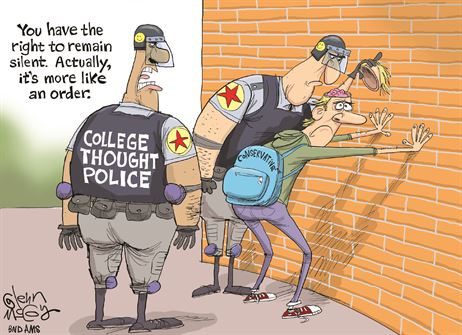
In 2015, President Robert Zimmer of the University of Chicago, renowned for his support of campus free speech, invoked the Kalven Report to explain why his school would not divest from fossil fuels. When student advocates of divestment pointed out that even the Kalven Report allows for exceptions in certain circumstances, Zimmer said fossil fuel divestment was not such a case.

“We should … be very wary of steps intended to instrumentalize our endowment in ways that would appear to position the University as a political actor rather than an academic institution. Conceiving of the endowment not as an economic resource, but as a tool to inject the University into the political process or as a lever to exert economic pressure for social purposes, can entail serious risks to the independence of the academic enterprise. The endowment is a resource, not an instrument to impel social or political change.”

UNC Asheville, in contrast, touts its decision to divest from fossil fuels as a “groundbreaking” move designed to lend “momentum” to a “movement” that it hopes will sweep the entire UNC system. UNCA Chancellor Nancy J. Cable called the decision “a defining moment” for the university. That’s the problem. Fossil-fuel divestment sends out a message that identifies the university on the official institutional level with a political movement that excludes — and is even directly at odds with — roughly half the taxpayers and potential students in North Carolina.

UNC Asheville is open about the fact that its decision was a direct response to student pressure for divestment.

And the political nature of the UNCA student fossil fuel divestment movement is evident. An opinion piece by leaders of UNCA Divest three months before the school’s final divestment decision, for example, positioned divestment as a repudiation of President Trump. Meanwhile, the UNCA school paper reports that many conservatives “feel like outcasts on campus.” How can UNC Asheville’s divestment decision fail to intensify and confirm that feeling, further chilling conservative speech? If anything, the school ought to be making of point of welcoming a wide range of student views on political issues.

Has UNC Asheville even thought about how its divestment decision might endanger free speech by creating an official university ideological line? Has it contemplated its decision in light of the new state law? Is the very concept of institutional neutrality and its importance for free speech even on the UNCA administration’s radar? Apparently not. In an excellent account of the UNCA neutrality controversy, Jay Schalin of North Carolina’s James G. Martin Center for Academic Renewal reports that when asked whether divestment was at odds with the principle of institutional neutrality, UNCA issued a bland statement that failed even to address the question.

It’s evident that UNC Asheville’s decision to divest from fossil fuels was taken without any regard for the neutrality issue in general, or for the new state law in particular.

At this point, it’s tough to see how the forthcoming annual report mandated by HB 527 can fail to condemn UNC Asheville’s decision to divest from fossil fuels. The committee of the UNC Board of Governors charged with issuing the report is legally obligated to address controversies over institutional neutrality, and this is certainly such a controversy. On the face of it, fossil fuel divestment violates the principles of neutrality set forth in the University of Chicago’s Kalven Report, which is cited as authoritative by the new law. After all, the University of Chicago itself currently cites the Kalven Report to explain why it won’t divest from fossil fuels, and Harvard has made effectively the same argument. How much more is it vital for a public university to uphold institutional neutrality, given that the UNC system serves citizens in a state where the full range of American political views is robustly represented? Why should the taxpayers of North Carolina support institutions that turn themselves into political actors? It’s also perfectly clear that UNCA’s divestment decision was taken without any serious regard to the neutrality issue, much less the new law. In short, to allow UNC Asheville’s divestment decision to pass without condemnation in the annual oversight report would be to violate the fundamental intent of HB 527.

North Carolina must prevent the thoroughgoing politicization of an important state university system by upholding institutional neutrality — one of the central pillars of campus free speech and a principle now enshrined in North Carolina state law. If UNC Asheville’s fossil fuel divestment decision holds — or worse, spreads as planned through the entire UNC system — the clear intent of HB 527 will have been violated, and the system’s Board of Governors will have failed to protect the state’s students from unwanted, unneeded, and thoroughly inappropriate ideological pressure. If, on the other hand, the UNC system reverses Asheville’s divestment decision and literally lays down the law on institutional neutrality, it will confirm North Carolina’s reputation as a leader of the movement to restore free speech at America’s public colleges and universities. We should know more by September, when the Board of Governors’ committee report is due.

Footnote Update July 31, 2019

Reuters provides additional evidence that climate opinions are divided along political lines.  H/T GWPF

Climate Discussion Nexus explains: (in italics with my bolds)

Reuters reports that a poll it did with Ipsos shows “Democrats are far more likely to believe droughts, floods, wildfires, hurricanes and tropical storms have become more frequent or intense where they live in the last decade”. And of course polls are likely to show wide disagreement on all manner of subjects, especially among political partisans. But even in these broad-minded times, there’s one thing we should all agree on: If two people argue about whether, say, hurricanes have become more frequent or intense where they live, they can’t both be right and it is possible to check.

Reuters agrees, rejecting fashionable relativism on this topic at least. Nevertheless you can guess which side it thinks is right: it sides with the Democrats. “U.S. government researchers have concluded that tropical cyclone activity, rainfall, and the frequency of intense single-day storms have been on the rise, according to data compiled by the Environmental Protection Agency.”

Really? Where? When? We have pretty good data on tropical cyclones in particular and they aren’t increasing.

Neither are US floods.  Well, what about the other stuff including droughts?

People who bother to check will thereafter doubt claims that these things are all increasing, so if Republicans are doubters, maybe it just means they looked up the numbers. And you don’t win the argument by appealing to the speculative future. “’We do expect to see more intense storms,’ said David Easterling, a spokesman for the National Oceanographic and Atmospheric Administration’s National Centers for Environmental Information.” Expect to see? Wasn’t the topic what we’d already seen?

Silly Republicans. “An overwhelming majority of scientists believe human consumption of fossil fuels is driving sweeping changes in the global climate by ramping up the concentration of heat-trapping gases in the atmosphere. But it is impossible to draw a direct link between the changes in U.S. weather in the recent past to the larger trend of warming.” Whereas an innuendo about the indirect links, followed by a snide reference to Donald Trump, should do the trick. “President Donald Trump has cast doubt on the science of climate change… Still, a majority of Republicans believe the United States should take “aggressive action” to combat global warming, Reuters polling shows.”

Good old Reuters polling. The story goes on to note that “Liberals are more likely to expose themselves to news outlets and people who believe climate change is an urgent threat that affects current weather patterns.” Like Reuters, for instance.
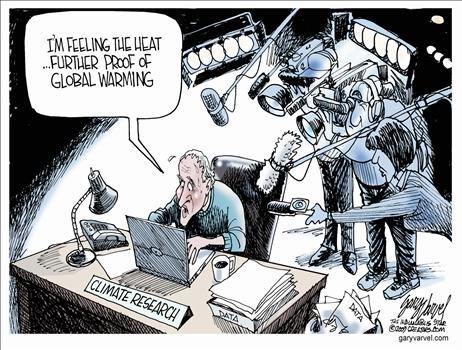
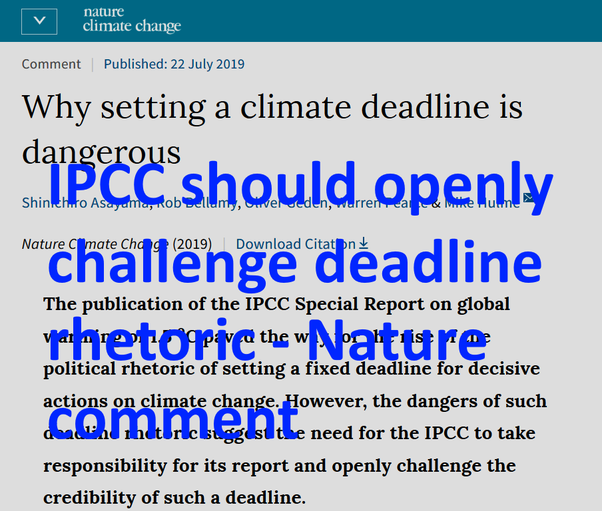
 

IPCC Scientists: Setting a Climate Deadline is Dangerous

Recently published in Nature is a comment article Why setting a climate deadline is dangerous by
Shinichiro Asayama, Rob Bellamy, Oliver Geden, Warren Pearce & Mike Hulme.

H/T Robert Walker, who explains in his post at Science 2.0 Should IPCC Openly Challenge ‘Only 12 Years To Save Planet’ Deadline Rhetoric? Excerpts in italics with my bolds.

Ever since the IPCC report in 2018, there’s been an increasing surge of doomist reporting, to the point that it is no surprise that there are many of our youngsters are naturally depressed and suicidal, thinking there is little point in life, and that they won’t live to be adults. Others are leading the way with politically unrealistic demands that we decarbonize completely within 12 years. These new requirements they are making are not supported at all by science, rather they are a result of emotional rhetoric, journalistic exaggerations, and junk science that they do not know how to evaluate correctly. The situation is indeed urgent. We are already doing much, we need to ramp up quickly, but we do not have only 12 years to do it. Also, the future does not risk collapse of civilization or human extinction on any scenario.

The paper is called Why setting a climate deadline is dangerous and it says in its subtitle / short abstract:

The publication of the IPCC Special Report on global warming of 1.5°C paved the way for the rise of the political rhetoric of setting a fixed deadline for decisive actions on climate change. However, the dangers of such deadline rhetoric suggest the need for the IPCC to take responsibility for its report and openly challenge the credibility of such a deadline.

Journalists have been saying that we have twelve years to act to save the planet. Now many are “upping the ante” and saying we have only 18 months, with the implication that if we don’t do very drastic action by 2020, then civilization will collapse and humans likely go extinct. They use very emotive words such as that this action is needed for our very survival. Many of our youngsters, and adults too, take this quite literally, they think that by the time they reach adulthood, in a little over a decade, the world will no longer have any humans in it, that our civilization and species will be gone. This is why I think it is a responsibility for science bloggers like myself and journalists to speak up against this.

But the authors say the situation has got so out of hand that the IPCC should say something to make it clear how badly they have been misrepresented in the media. They argue, basically, that to stay silent in this situation is the more political thing to do. It is to give tacit report to this doomist framing. This also is an important and valid point. I hear that a lot – if the journalists are wrong, scared people ask, why don’t the IPCC say?

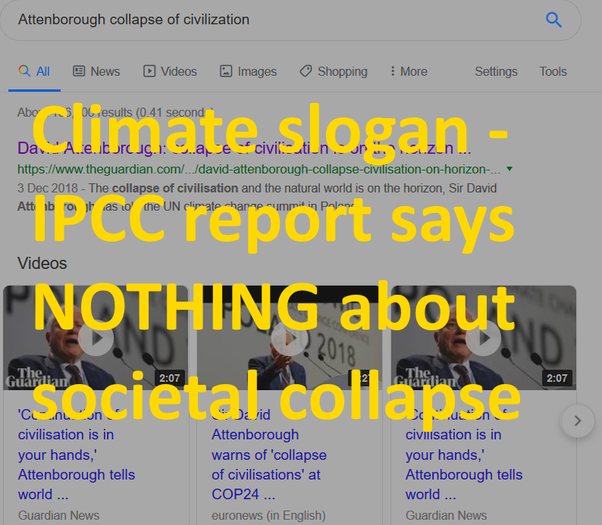
If you listen to what the IPCC themselves say, they do not talk about a risk of human extinction or collapse of civilization. There is no mention of such ideas anywhere in the report, or the press conference the journalists attended, their response to questions or the short summaries by the co-chairs. That is all JOURNALISTIC INVENTION, HYPERBOLE, SIMPLIFIED CLIMATE SLOGANS, AND JUNK SCIENCE.

Dutch Climate Wisdom Gets Warning Label

Donna Laframboise writes at Big Picture News About Marcel Crok’s Climate Adventures. Marcel himself explains at this blog My flagged Tedx talk about climate change. Excerpts in italics with my bolds

Recently I gave my first Tedx talk during Tedx Roermond. Roermond is a city in the south of The Netherlands. The experience was quite interesting. The motto of Ted is “ideas worth spreading”. Apparently not all ideas are worth spreading, because soon after the organisation of Tedx Roermond sent my name and a short description of my ideas to the TED headquarters they received a rather threatening email back that the ultimate consequence could be that they would lose their Tedx license. Kudos to the organisation of Tedx Roermond that they persisted in scheduling my talk and also in uploading it.

The talk is online, however with the following note from TED:

“NOTE FROM TED: We’ve flagged this talk, which was filmed at a TEDx event, because it appears to fall outside TEDx’s curatorial guidelines.The sweeping claims and assertions made in this talk regarding climate change only represent the views of the speaker and are not corroborated by scientific evidence.”

This – “The sweeping claims” – is all rather amusing.

In preparing my talk I wrote down what I wanted to say. That version (not a transcript) differs of course from the final talk I gave in Roermond. The talk is meant to be understandable for a broad audience. Below is the written version of my talk.

Tedx speakers are not allowed to be given a speaking fee, so you have to do all the preparation in your own time. If people appreciate the talk they might consider using the donation button. Thanks!

Marcel Crok, Amsterdam, The Netherlands

I encourage you to go read the whole presentation. Some of his key points are excerpted below.

I am going to talk about two different worlds today, the world of history and the world of the future. In the world of the past we can measure, observe, count, archive etc. The world of the future we can explore by guessing, by extrapolation and by modelling.

I studied chemistry, I then decided to become a science journalist. Late 2004 the editor in chief of the popular science magazine I worked for asked me to look into the famous hockey stick graph.

I did what science journalists do in such a case, I delved into the story. Two Canadians, both ‘outsiders’, had done a lot of audit work on the graph and I decided to contact them. Their story was fascinating and after two years of struggling they found out what was wrong with the graph. They discovered there was a crucial error in the statistics. As a result, even if you used computer generated noise, the hockey stick curve would appear.

They published this in a scientific paper and I had the scoop of their work in the media. We translated the article and published it both in our own magazine Natuurwetenschap & Techniek as in the Canadian newspaper the Financial Post.

It was my first article on climate change ever and right away I was in the middle of not only the Dutch climate debate but even the international debate. The article won an award, but I was also criticized, by KNMI for example, who said publicly my article was “nonsense”. I was also immediately branded as a “climate sceptic”, even by fellow science journalists.

The arguments of the critics were not difficult to refute and the work of the two Canadians stands firmly to this day. I was intrigued by the quite aggressive and also defensive reaction of the climate scientists. Up to this day the criticism of the Canadians has never been fully addressed by the climate science community or the IPCC. Wasn’t this about the progress of science?

I think if climate scientists in The Netherlands and abroad had accepted the criticism of the two Canadians and had corrected their graph, I would have moved on to other topics. But now I became really fascinated and also persistent. If climate change is supposed to be so important, but the science seems to lack self-correction, what about other claims in the climate debate? I decided to quit my job and work fulltime on the climate issue and I have done so ever since.

A broken hockey stick graph doesn’t mean that global warming can’t be a problem. So, let’s look at the evidence.

Now comes the hard part. Correlation doesn’t prove causation. How do we know that the increase in CO2 caused the recent warming? Well, we don’t know. It’s fair to say that the IPCC claims it is most likely that all the warming is caused by greenhouse gases. But there is no way to prove this in a way you prove Newton’s law for example.

The IPCC feels pretty certain – they call it extremely likely – that most of the warming since 1950 is caused by CO2 and other greenhouse gases. The evidence for this claim comes mainly from simulations with climate models. Climate models are huge computer programs that try to simulate the whole climate. It’s quite an accomplishment of the science community, and IPCC nowadays uses the results of around 30 models. These model simulations show that if you don’t use greenhouse gases, the models can’t replicate the warming since the mid seventies till now.

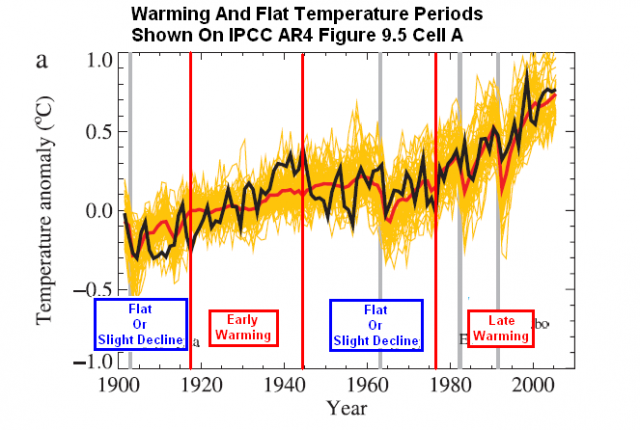
The models, represented by the thick red line, are not able to replicate this early warming that was of about the same magnitude as the warming between 1975 and 2000. So the same models that are used to ‘prove’ that humans caused the recent warming fail to reproduce a warming period earlier in the century. This of course weakens the evidence.

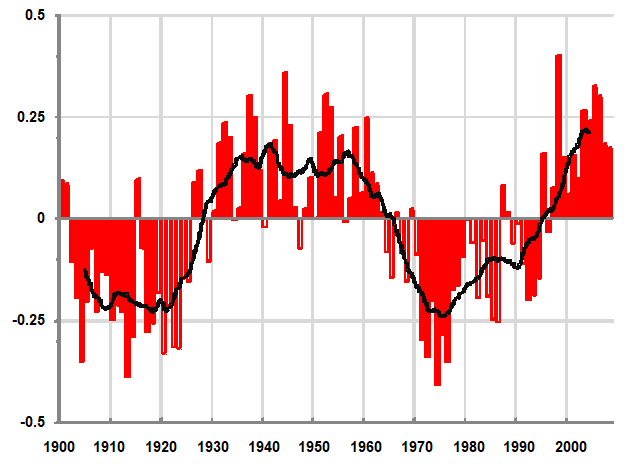
What is going on here? There still is no clear explanation for the early warming period and IPCC reports say very little about it. A logical candidate is what scientists call the Atlantic Multidecadal Oscillation , the AMO.

It’s a quasi-periodic warming and cooling phase of the Atlantic Ocean that influences global temperature. The AMO’s influence is evident in the pattern of global temperature changes. So, it contributes to the warming in both the early and the late warming periods. However, climate models are unable to capture this behaviour. And scientists are still uncertain what causes the AMO.

Now here is what according to me has happened. The climate modellers of course try to replicate historical changes in the Earth’s global temperature because this has become the main indicator for global warming and is a key measure used to judge their models. They manage to simulate both the recent warming and the lack of warming in the middle of last century with a combination of greenhouse gases and aerosols, which are air pollutants. However, both the mid-century flat temperature and the late century warming were partly caused by natural oscillations of the climate system. So, the models more or less replicated the post-1950 global temperature record, but for the wrong reasons.

Over the last few years the evidence for models being oversensitive has been piling up. Only in this decade has the increase in temperature and greenhouse gases since about 1850 become large enough, and the understanding of the influence of aerosols sufficiently good, to estimate with any confidence the sensitivity of the climate based on observations.

Now if we have to summarize the global climate debate in one graph, it could be this one. Mainstream climate scientists don’t like it and try to explain away the differences it shows. Sceptics see it as evidence the models are ‘oversensitive’, that means, overestimating the warming effect of CO2.

The main conclusion from these so-called observational estimates, and I share those, is that observations indicate a much less sensitive climate than the climate models. This is really good news. It means we will get considerably less warming in the future even if CO2 emissions will continue to rise, which is to be expected, since large parts of the world are still developing their economies and cannot do that without fossil fuels.

Extremes
Another topic of great societal importance is the occurrence of extremes. That the climate is getting more extreme, is a message we hear almost on a daily basis in the media. But is this so? It might surprise you but for the most consequential extremes in terms of damage and victims, the answer is a clear no. Hurricanes, floods and droughts have not gotten worse because of climate change.

Sea level
For us in Holland, sea level has always been a huge topic. We have experienced terrible floods in the past, for example in 1421, when the Saint Elisabeth floods killed an estimated 10,000 people. More recently of course we all remember the floods in Sealand in 1953 which killed almost 2,000 people. The sea level has been rising for the last 150 years or so, both globally and along our coast, but the rise has been remarkably steady throughout this period.

Greening
The last thing I want to mention is the greening of the earth. . What are you saying? Yes, the earth is getting greener and indeed, CO2 is causing this. After all, as you all know, CO2 is plant food, so more CO2 in the air means plants are growing faster and better. This also applies to food production. Last week Dutch climate economist Richard Tol said in newspaper De Telegraaf that for this reason climate change so far has probably been beneficial.

Society
Now what does this all mean for our personal life? People might be surprised to learn that I live as “green” as one could possibly live. I never had a car, I do everything by bike in Amsterdam. I came here by train. My daughter is the first junior bicycle mayor in the world. But is this because of climate change? No. This is just the lifestyle I like given my circumstances, I live in the centre of Amsterdam.

But there is no need to feel guilty if one owns a car.

Unfortunately, the positive view on the climate issue that I told you today is totally absent in government circles. You could say that climate negotiators live in a parallel universe that is built on the climate models. Perhaps this is the key element for fathoming the discrepancy between the virtual world of unrealistic models and the world you and I live in.

We as human beings should take care of our world in a meaningful way. This is a daily process that we need to figure out here and now, one step at a time. The envisioned grand and utopian future as modelled for us, not with us, spawns a dystopian threat we all know too well from the 20th century.

Politicians often think they can engineer society. Our current political leaders now even believe they can manage the climate. This is a dangerous utopian vision for which the bill is handed over to the citizens.

Thank you
Marcel Crok, science writer

Footnote:

Marcel Crok’s story is compelling because he did the work to investigate and apply his critical intelligence.  Presumably all TED presenters are expressing their own conclusions supported by the evidence they have found.  So why does TED think it necessary to warn people away from his findings, and claim that his supporting evidence is somehow invalid?  It can only be that that a narrative of “climate emergency” is favored by that organization, and contrary views are unacceptable.  Marcel Crok has bravely followed the evidence and his conscience and must be heard.

See Also: Going Dutch: How Not to Cut Emissions

Spaceship Earth Ideology Officers

Rise and Fall of the Modern Warming Spike

Spaceship Earth Ideology Officers

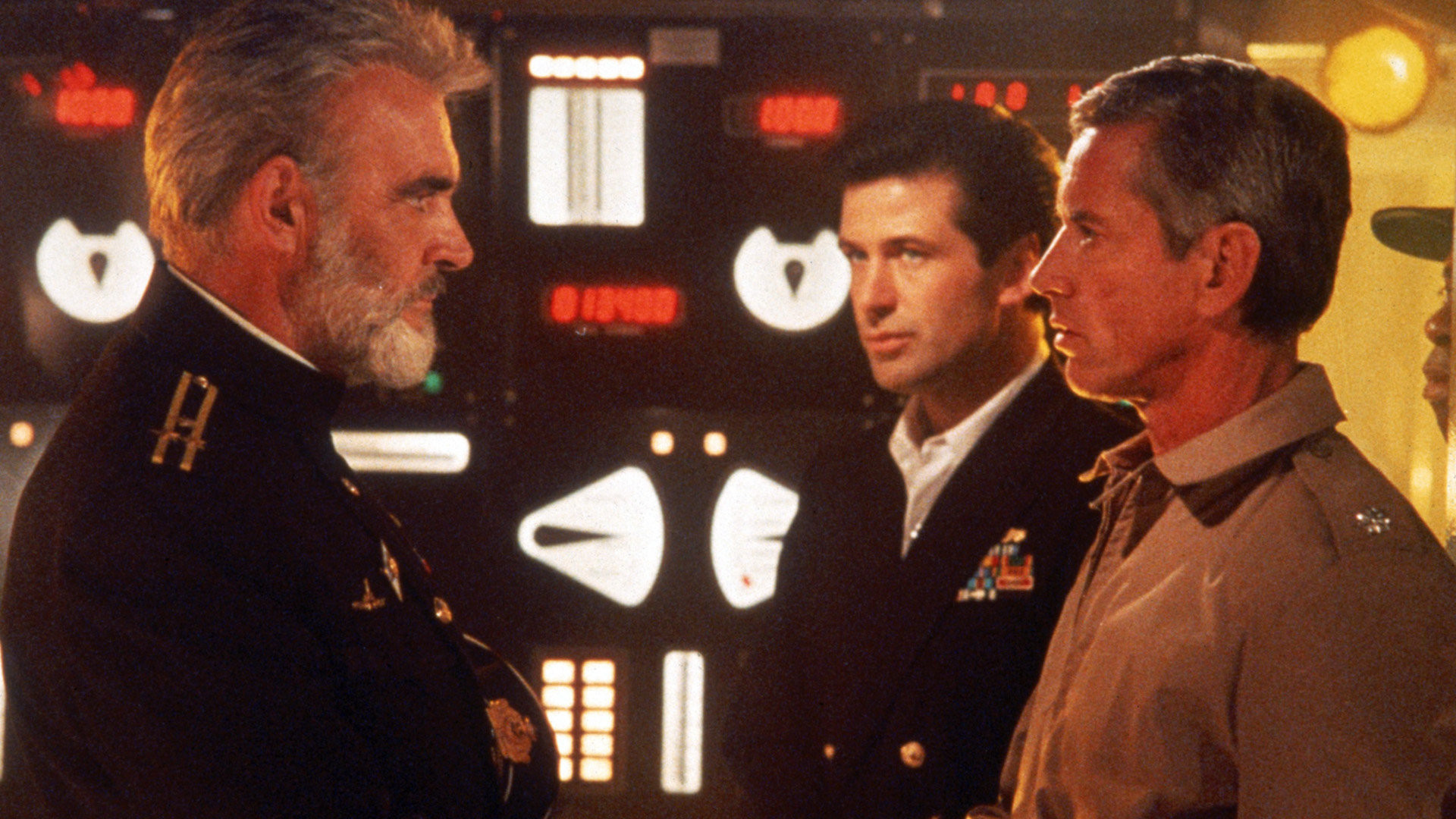
The image above is from the Hunt for Red October (1990). Sean Connery played Marko Alexandrovich Ramius, a Soviet submarine captain, here in a confrontation with the on board Political Officer Ivan Putin, responsible to ensure the crew conforms to the Communist Party Line and Directives.
The real life parallel to the submarine drama is reported at New Scientist Journal criticised for study claiming sun is causing global warming. Excerpts in italics with my bolds. (H/T GWPF)

A high profile scientific journal is investigating how it came to publish a study suggesting that global warming is down to natural solar cycles. The paper was criticised by scientists for containing “very basic errors” about how Earth moves around the sun.

The study was published online on 24 June by Scientific Reports, an open access journal run by Nature Research, which also lists the prestigious Nature journal among its titles. A spokesperson told New Scientist that it is aware of concerns raised over the paper, which was authored by four academics based at Northumbria University, the University of Bradford and the University of Hull, all in the UK, plus the Nasir al-Din al-Tusi Shamakhi Astrophysical Observatory in Azerbaijan.

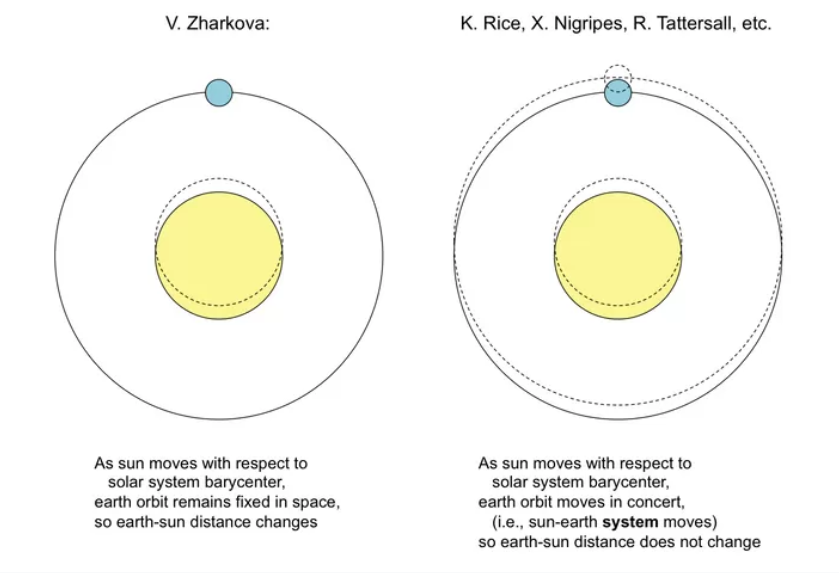
The authors suggest that Earth’s 1°C temperature rise over the past two centuries could largely be explained by the distance between Earth and the sun changing over time as the sun orbits around our solar system’s barycentre, its centre of mass. The phenomenon would see temperatures rise a further 3°C by 2600, they say.

Ken Rice of the University of Edinburgh, UK, criticised the paper for an “elementary” mistake about celestial mechanics. “It’s well known that the sun moves around the barycentre of the solar system due to the influence of the other solar system bodies, mainly Jupiter,” he says. “This does not mean, as the paper is claiming, that this then leads to changes in the distance between the sun and the Earth.”

“The claim that we will see warming in the coming centuries because the sun will move closer to the Earth as it moves around the solar system barycentre is very simply wrong,” adds Rice. He is urging the journal to withdraw the paper, and says it is embarrassing it was published.

Gavin Schmidt of the NASA Goddard Institute for Space Studies says the paper contains egregious errors. “The sun-Earth distance does not vary with the motion of the sun-Earth system around the barycentre of the sun-Jupiter system, nor the sun-galactic centre system or any other purely mathematical reference point,” he says. He says the journal must retract the paper if it wants to retain any credibility.

The Dispute

Michael Brown of Monash University in Australia lamented uncritical media coverage of the paper in Australia.

Following criticism of the paper, lead author Valentina Zharkova, of Northumbria University, described Rice as a “climate alarmist” in an online discussion.

“The close links between oscillations of solar baseline magnetic field, solar irradiance and temperature are established in our paper without any involvement of solar inertial motion,” Zharkova told New Scientist.

Scientific Reports says it has begun an “established process” to investigate the paper it has published. “This process is ongoing and we cannot comment further at this stage,” a spokesperson said.

Ken Rice has form as a Climate Ideology Officer having led a successful take down of Hermann Harde’s paper showing human CO2 emissions are only 4% of atmospheric CO2, which is only 0.04% of the air. Rice declared at the outset: “Any paper concluding that humans are not causing the rise in CO2 is obviously wrong.” He and fellow ideology officers quickly cobbled together an attack paper which was immediately published in the journal. Harde wrote a paper describing the errors and misconstructions in the attack paper, but his response was denied publication, sealing the issue in favor of the party line. This saga of censorship can be read at No Tricks Zone article AGW Gatekeepers Censor The CO2-Climate Debate By Refusing To Publish Author’s Response To Criticism

Now Rice and his gang are at it again, this time targeting lead author Valentina Zharkova. The tactics are familiar, starting with outrage against findings deviating from their beliefs, in this case the notion that the sun could in any way influence the climate. The comment thread shows the intensity and venom applied to digging up any mistake, no matter how trivial or peripheral to the central argument. These are declared “egregious” and justification to ignore and censor the contrary understanding of nature.

The comment thread started 9 days ago: Oscillations of the baseline of solar magnetic field and solar irradiance on a millennial timescale

Zharkova stands her ground, though always on the defensive and surrounded by a pack of attackers. Rice, as usual, displays his mastery of the English language to demean and undermine while appearing to be reasonable. His Russian opponent is clearly at a disadvantage when it comes to putdowns.

I don’t know enough to judge the substance of the claims, or the pertinence of the details, but can observe that the intensity shows how much is at stake for the attackers. A major irony is that Zharkova forecasts significant warming in the future, which would seem to confirm the warmists’ expectations. However, since she puts the sun as the cause, the finding pulls the rug from under anti-fossil fuel activists, hence the outrage. This also shows the dispute is not about climate or temperature, but about politics.

Footnote:

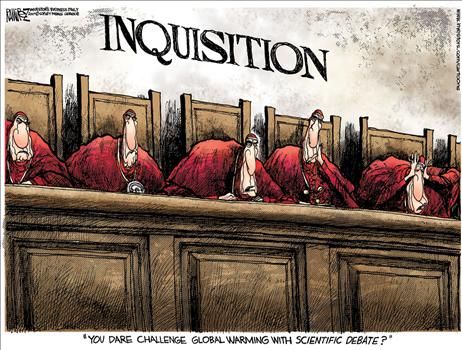
Michael Mann has been the most aggressive Inquisitor against climate heretics. In his book, “The Hockey Stick and the Climate Wars,” he presented an analogy to explain why he and other researchers have become the objects of such fierce public scrutiny and vilification, which he terms “the Serengeti strategy.” Likening climate scientists to zebras, he writes, “The climate change deniers isolate individual scientists just as predators on the Serengeti Plain of Africa hunt their prey: picking off vulnerable individuals from the rest of the herd.” He asserts that he and others have become targets because their findings challenge the entrenched fossil-fuel industries, which have tried to discredit them.

No one has more chutzpah than M. Mann, he and his pack applying the Serengeti strategy repeatedly against scientists finding other factors than CO2 driving climate changes, all the while claiming to be a victim rather than a predator.

Science 101: Null Test All Claims

Francis Menton provides some essential advice for non-scientists in his recent essay at Manhattan Contrarian You Don’t Need To Be A Scientist To Know That The Global Warming Alarm “Science” Is Fake. Excerpts in italics with my bolds.

When confronted with a claim that a scientific proposition has been definitively proven, ask the question: What was the null hypothesis, and on what basis has it been rejected?

As Menton explains, you don’t need the skills to perform yourself the null test, just the boldness to check how they dismissed the null hypothesis.

Consider first a simple example, the question of whether aspirin cures headaches. Make that our scientific proposition: aspirin cures headaches. How would this proposition be established? You yourself have taken aspirin many times, and your headache always went away. Doesn’t that prove that the aspirin worked? Absolutely not. The fact that you took aspirin 100 times and the headache went away 100 times proves nothing. Why? Because there is a null hypothesis that must first be rejected. Here the null hypothesis is that headaches will go away just as quickly on their own. How do you reject that? The standard method is to take some substantial number of people with headaches, say 2000, and give half of them the aspirin and the other half a placebo. Two hours later, of the 1000 who took the aspirin, 950 feel better and only 50 still have the headache; and of the 1000 who took the placebo, 500 still have the headache. Now you have very, very good proof that aspirin cured the headaches.

The point to focus on is that the most important evidence — the only evidence that really proves causation — is the evidence that requires rejection of the null hypothesis.

Over to climate science. Here you are subject to a constant barrage of information designed to convince you of the definitive relationship between human carbon emissions and global warming. The world temperature graph is shooting up in hockey stick formation! Arctic sea ice is disappearing! The rate of sea level rise is accelerating! Hurricanes are intensifying! June was the warmest month EVER! And on and on and on. All of this is alleged to be “consistent” with the hypothesis of human-caused global warming.

But, what is the null hypothesis, and on what basis has it been rejected? Here the null hypothesis is that some other factor, or combination of factors, rather than human carbon emissions, was the dominant cause of the observed warming.

Once you pose the null hypothesis, you immediately realize that all of the scary climate information with which you are constantly barraged does not even meaningfully address the relevant question. All of that information is just the analog of your 100 headaches that went away after you took aspirin. How do you know that those headaches wouldn’t have gone away without the aspirin? You don’t know unless someone presents data that are sufficient to reject the null hypothesis. Proof of causation can only come from disproof of the null hypothesis or hypotheses, that is, disproof of other proposed alternative causes. This precept is fundamental to the scientific method, and therefore fully applies to “climate science” to the extent that that field wishes to be real science versus fake science.

Now, start applying this simple check to every piece you read about climate science. Start looking for the null hypothesis and how it was supposedly rejected. In mainstream climate literature — and I’m including here both the highbrow media like the New York Times and also the so-called “peer reviewed” scientific journals like Nature and Scienceyou won’t find that. It seems that people calling themselves “climate scientists” today have convinced themselves that their field is such “settled science” that they no longer need to bother with tacky questions like worrying about the null hypothesis.

When climate scientists start addressing the alternative hypotheses seriously, then it will be real science. In the meantime, it’s fake science.

Summary

The null test can be applied to any scientific claim.  If there is no null hypothesis considered, then you can add the report  to the file “Unproven Claims,” or “Unfounded Suppositions.”  Some researchers call them SWAGs: Scientific Wild Ass Guesses.  These are not useless, since any discovery starts with a SWAG.  But you should avoid believing that they describe the way the world works until alternative explanations have been tested and dismissed.

See Also: No “Gold Standard” Climate Science

No GHG Warming Fingerprints in the Sky

Class Zero Grad Speeches: Fail

Once upon a time at secondary school graduation ceremonies students who finished with the best grades (Valedictorians and Salutatorians) took to the podium to deliver a speech each one wrote expressing his or her personal thoughts on that life passage. Not any more. In progressive, post-modern places, these speeches are now a canned performance: Now apparently accomplished scholars choose not to express themselves, not to speak out as individuals having earned the right to heard. Instead they read out words written by others to proselytize for a cause.

This Spring We’re Taking Over Commencements Everywhere to Demand a Zero Emissions Future

According to Class of 0000: Starting in may, hundreds of Valedictorians and Salutatorians will deliver the same message in their commencement speeches.  The Speech in italics with my bolds:

Today, we celebrate our achievements from the last 4 years. But I want to focus on what we need to achieve in the next 11.

That’s how long climate scientists have given us; 11 years to avoid catastrophic climate change. It’s already damaging our homes, our health, our safety and our happiness. We won’t let it take our futures too.

Our diplomas may say Class of 2019, but marked in history, we are the Class of Zero.
Zero emissions.
Zero excuses.
Zero time to waste.

Across the country, our class stands 7.5 million strong.

And in unity, we’re giving 2020 political candidates a choice:

Have a plan to get to zero emissions, or get zero of our votes.

Together, we have the power to solve the climate crisis.

Every student. Every parent. Every teacher. Every leader.

The future is in our hands.

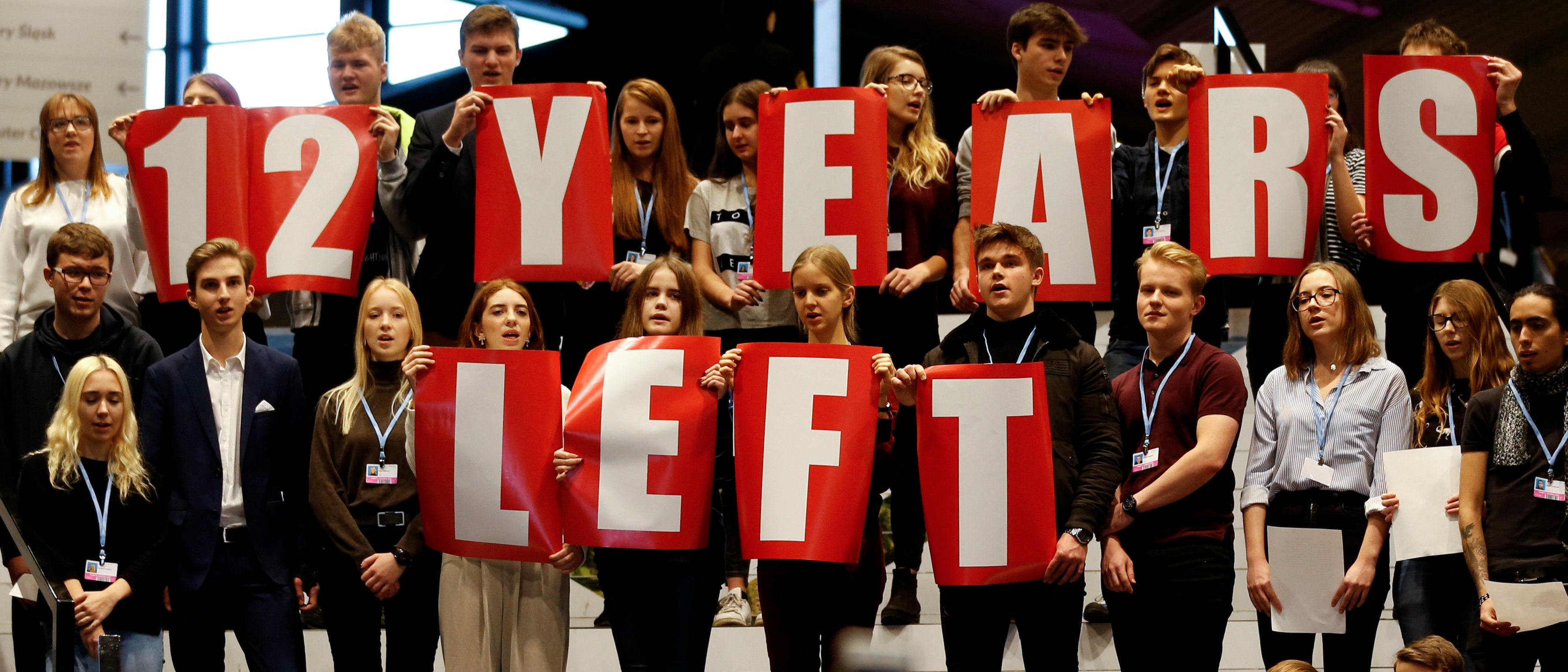
Local school children join Greta Thunberg's initiative on climate strike during the COP24 UN Climate Change Conference 2018 in Katowice

But it didn’t go off everywhere as planned by the movement.

As Lathan Watts reported at Town Hall, many of these performances were stopped by educators.

Kriya Naidu was the valedictorian of her Florida high school, but she was recently prohibited by school officials from giving her graduation speech because of its content.

Cait Christenson was one of six valedictorians at her Wisconsin high school, but again, school administrators found the content of her graduation speech too controversial and prohibited her from addressing her fellow graduates.

Lulabel Seitz was the valedictorian at her California high school. And, you guessed it, her graduation speech was also censored by school administrators – in fact, her mic was turned off in the midst of her address.

For Lathan Watts, this is a problem. I would agree if they were expressing something other than a call for political and social action. This is the most striking example yet of young people subsuming into an social group and losing individual identity. I don’t know whether to call this Artificial Intelligence or Artificial Stupidity; but it is certainly not genuine, not authentic. Maybe this is what we have to endure in the Age of Greta.

The graduates would have been better served if Robert Curry were at the podium:

As we all know, acquiring common sense can be a matter of life and death. I’m thinking, for example, of the teenage boy who swallowed a garden slug on a dare, became paralyzed, and died recently. Because children lack common sense, parents must do what they have always done, trying to instill common sense in their children while at the same time using their own common sense to encompass the growing child.

Becoming a person of common sense has always been a life-defining challenge, but acquiring common sense has gotten a lot more difficult for young people in our time, especially if they have spent some time in our institutions of higher learning. My witty friend Robert Godwin has this to say about that: “Say what you want about the liberal arts, but they’ve found a cure for common sense.”

When I headed off to college, my high school teacher who was my mentor offered me two commonsense rules to follow“Take care to stay well, and choose professors, not courses.” Because of my high regard for him, I took his words to heart. Later, when I saw the problems my fellow students brought on themselves by not getting enough sleep and generally being careless about their health, I understood the practical wisdom of what he had told me. And the second rule helped me more quickly understand the value of navigating my way through college by who was teaching the course rather than by the course title.

For years, I handed on the same commonsense wisdom to young folks I knew when they headed off to college. But I have not offered that advice for some years now. Here is what I tell them now: “They are going to try to knock common sense out of you; don’t let them.”

Say what you want about the liberal arts, but they’ve found a cure for common sense.

By Robert Curry writes at American Thinker Making Sense of Common Sense. Excerpts in italics with my bolds.

Climate Faith ≠ Climate Works

Protestors march to raise awareness of climate change and ecological issues on the second day of the Glastonbury Festival at Worthy Farm, Somerset, England, Thursday, June 27, 2019. (Photo by Grant Pollard/Invision/AP) GRANT POLLARD/INVISION/AP

Michael Lynch writes at Forbes Is The Climate Change Debate A Replay Of The Reformation? Excerpts in italics with my bolds.

During the Reformation, there was an intense debate over whether Christians could enter paradise by doing good works, or whether faith alone allowed such a benefit. (See Fatal Discord: Erasmus, Luther and the Fight for the Western Mind by Michael Massing) This reminds me of the current attitude many have towards climate change policy, where some appear to think that faith alone is sufficient to solve the problem.

In the early days of the global warming debate, I read an English writer praising his country’s example of recognizing climate change compared to American skepticism, although he did admit the British hadn’t actually taken steps to address the problem. Similarly, the U.S. has reduced greenhouse gas emissions more than most countries in the past few years, but incidentally, mostly due to cheap natural gas, and it remains the climate villain in the eyes of many because the president is a denier.

Additionally, a lot of energy, well, effort, goes into demonizing actors or actions that have no practical impact on climate. For example, opposing the construction of oil and gas pipelines does not reduce consumption of oil and gas, and usually increases emissions. Suing the oil or auto industries for blocking climate policies or misleading the public about climate science appeals to many, but with no measurable environmental impact. The same with demanding divestment in fossil fuel company stocks.

Some of the new proposals to address climate change put me mind of the debate between faith and works, especially when they seem more for demonstration purpose than actually reducing emissions. Numerous governments have suggested phasing out all carbon-based electricity generation or all petroleum-fueled vehicles by a point decades into the future, and these tend to be hailed by activists as representing, if not solutions, then great strides forward. New York state, for example, just proposed phasing out carbon-based electricity by 2050; France wants to ban conventional vehicles by 2040, the U.K. by 2050. But as Michael Coren notes, “So far, it’s just words.”

Which reminds me of comedian Billy West who, in the persona of a radio personality, bragged to someone about his fund-raising, adding, “…but mostly it’s just pledges.” Governments have been great at setting goals, but implementation has been seriously lacking. The setting of goals seems more an act of faith than a carrying out of works.

And we have been here before. Many other national and sub-national environmental programs were later abandoned; the 1990s saw California enact mandates for electric vehicle sales—requiring 10% of sales in 2003 be zero emission vehicles—which was adopted by a number of other states, primarily in New England. Ultimately, it was abandoned after wasting billions of dollars. Numerous locales in the U.S. signed on to requirements for oxygenated gasoline, only to back out at the last minute when the cost became apparent.

Technology mandates are a mix of demonizing the producers and demonstrations of faith: telling utilities to buy a certain portion of carbon-free electricity is calling on someone else to act, while hiding the cost of the action. Those who believe in works would do better to buy their own renewable power, either producing it directly or from an independent power producer.

Automobile efficiency standards arguably fall into this category as well, that is, making it seem as if the manufacturers are to blame for consumers’ desire to purchase large, powerful vehicles. There are very fuel-efficient vehicles for sale in the United States, and they are much cheaper than the sauropods dominating American highways, so addressing manufacturer behavior is not the issue. Mandating vehicle efficiency is rather like demanding that a portion of butchers’ sales be veggie burgers; Beyond Meat has shown that success for veggie burgers comes from satisfying consumers, not lecturing them on environmental ethics.

This is where a carbon tax comes in: it is designed to change consumer preferences, reducing carbon emissions in favor of other consumables. It would also motivate producers to meet the demand for products that require less carbon emissions, either in their production or operation. Although the impact would grow over time, it would begin immediately upon implementation, and while it could theoretically be reversed, taxes on consumption tend to be extremely persistent.

Comment:

I like the author’s comparing of the climate faithful marching in processions to the religious faithful marching on Holy Days. He is right to point out the hypocrisy of of those obsessed over CO2 demonstrating their belief, while still enjoying fossil fuel benefits. And he ridicules the symbolic but ineffectual policies proposed, noting they are merely another form of showing faith rather than taking action that works.

But he ends up accepting the warmist unproven premise: We are sinners because we burn fossil fuels. Moreover, he seems to suggest that imposing a carbon indulgence tax overcomes the moral shortcoming. In fact Reformers strongly opposed the Catholic Church practice of taking money for future promises they could not deliver. Now this scam returns with governments taking the opportunity to fill their coffers. Further, as Bill Gates explained, the tax has a faulty premise: There is presently no substitute for fossil fuels powering modern societies.

The good news is, today’s weather and climate are within ordinary bounds.  The bad news:  If they actually turn climate faith into works, it is the end of life as you know it.

Climate Models on Fire!

They are at it again: Our future will be filled with death and destruction according to climate models. The latest doomsday scenario is that every summer in the future will be hotter than the one before, brought to you by CNN: “All the Fear All the Time.”

Future summers will ‘smash’ temperature records every year says CNN. Excerpts in italics with my bolds.

If you think it’s hot now, you haven’t seen anything yet. A new study predicts that parts of the world will “smash” temperature records every year in the coming century due to climate change, “pushing ecosystems and communities beyond their ability to cope.”

The scientists who authored the study, published in the journal Nature Climate Change on Monday, used 22 climate models to game out exactly how hot these summer temperatures would be. They determined that by the end of the 21st century, future temperature events “will be so extreme that they will not have been experienced previously.”

The temperature increase is directly tied to rising global greenhouse gas emissions, the authors say.

The world is already seeing record setting temperatures and while warming hasn’t been uniform, earlier studies have shown that the planet has been in a warming trend, generally.

Heat waves will be deadly. Heat stroke, breathing issues, heart attacks, asthma attacks, kidney problems are all a big concern for people when the temperatures increase, according to the US Centers for Disease Control and Prevention.

Higher temperatures can also make air pollution worse, make water scarce and cause crops to fail, leading to malnutrition and starvation.

In 2014, the World Health Organization predicted 250,000 more people will die annually between 2030 and 2050 due to climate change. More recent studies predict that this is a “conservative estimate.”

If, however, countries meet goals of limiting global temperature rise less than 2 degrees Celsius, as set out in the Paris agreement, that scenario would be much less likely.

Footnote: A second separate heat wave alarm study was published and trumpeted in the Seattle Times. (H/T kakatoa, comment below) Cliff Mass does his usual thorough review pointing out problems both in the estimating of future temperatures and in calculating projected deaths from heat waves.

The article by Mass is The Seattle Times Story on Massive Heat Wave Deaths in Seattle: Does it Make Sense?


Trudeau’s Empty Plastic Gesture

Bjorn Lomborg writes in the Globe and Mail about Canadian PM Justin Treudeau showing off by proposing to ban single-use plastics. Sorry, banning plastic bags won’t save our planet. Excerpts in italics with my bolds.

Last week, Prime Minister Justin Trudeau announced a plan to reduce plastic pollution, which will include a ban on single-use plastics as early as 2021. This is laudable: plastics clog drains and cause floods, litter nature and kill animals and birds.

Of course, plastic also makes our lives better in a myriad of ways. In just four decades, plastic packaging has become ubiquitous because it keeps everything from cereals to juice fresher and reduces transportation losses, while one-use plastics in the medical sector have made syringes, pill bottles and diagnostic equipment more safe.

Going without disposable plastic entirely would leave us worse off, so we need to tackle the problems without losing all of the benefits.

The simplest action for consumers is to ensure that plastic is collected and used, so a grocery bag, for example, has a second life as a trash bag, and is then used for energy.

But we need to be honest about how much consumers can achieve. As with other environmental issues, instead of tackling the big-picture problems to actually reduce the plastic load going into oceans, we focus on relatively minor changes involving consumers, meaning we only ever tinker at the margins.

More than 20 countries have taken the showy action of banning plastic bags, including even an al-Qaeda-backed terrorist group which said plastic bags pose “a serious threat to the well-being of humans and animals alike.”

But even if every country banned plastic bags it would not make much of a difference, since plastic bags make up less than 0.8 per cent of the mass of plastic currently afloat on the world’s oceans.

Rather than trying to save the oceans with such bans in rich countries, we need to focus on tackling the inferior waste management and poor environmental policies in developing regions.

Research from 2015 shows that less than 5 per cent of land-based plastic waste going into the ocean comes from OECD countries, with half coming from just four countries: China, Indonesia, Philippines and Vietnam. While China already in 2008 banned thin plastic bags and put a tax on thicker ones, it is estimated to contribute more than 27 per cent of all marine plastic pollution originating from land.

Moreover, banning plastic bags can have unexpected, inconvenient results. A new study shows California’s ban eliminates 40 million pounds of plastic annually. However, many banned bags would have been reused for trash, so consumption of trash bags went up by 12 million pounds, reducing the benefit. It also increased consumption of paper bags by twice the saved amount of plastic – 83 million pounds. This will lead to much larger emissions of CO₂.

When Kenya banned plastic bags, people predictably shifted to thicker bags made of synthetic fabric – which now may be banned. But Kenya had to relent and exempt plastics used to wrap fresh foods such as meat and other products.

We also need to consider the wider environmental impact of our bag choices. A 2018 study by the Danish Ministry of Environment and Food looked not just at plastic waste, but also at climate-change damage, ozone depletion, human toxicity and other indicators. It found you must reuse an organic cotton shopping bag 20,000 times before it will have less climate damage than a plastic bag.

If we use the same shopping bag every single time we go to the store, twice every week, it will still take 191 years before the overall environmental effect of using the cotton bag is less than if we had just used plastic.

Even a simple paper bag requires 43 reuses to be better for the environment – far beyond the point at which the bag will be fit for the purpose.

The study clearly shows that a simple plastic bag, reused as a trash bag, has the smallest environmental impact of any of the choices.

If we want to reduce the impact of plastic bags while still allowing for their efficient use, a tax seems like a much better idea. A 2002 levy in Ireland reduced plastic bag use from 328 bags a person per year to just 21 bags.

And if we really want to make a meaningful impact on ocean plastics coming from land, we should focus on the biggest polluters such as China, Indonesia, Philippines and Vietnam, and emphasize the most effective ways to cut the plastic load, namely better waste management in the developing world.

We should also recognize that more than 70 per cent of all plastics floating on oceans today – about 190,000 tonnes – come from fisheries, with buoys and lines making up the majority. That tells us clearly that concerted action is needed to clean up the fishing industry.

If our goal is to get a cleaner ocean, we should by all means think about actions we can take as consumers in rich countries to reduce our use of unnecessary plastic bags. But we need to keep a sense of proportion and, if we’re serious, focus on change where it’s really needed.

Bjorn Lomborg is president of the Copenhagen Consensus Center.

See Also Plastic Trash Talking

Waste Management Saves the Ocean

Kerry’s Blarney and Murphy’s Law

Recently former unsuccessful Presidential candidate and US Secretary of State John Kerry spoke at the Our Ocean Wealth Summit in Cork, Ireland. He missed seeing the boomerang on the accusation of his own lying, unless of course he no longer considers himself a world leader.  As we shall see, Kerry would have been better served by using the cork to shut up with his fear-mongering. The article is in Irish Examiner. Excerpts in italics with my bolds.

World leaders are lying to the public about the climate crisis and dismissing scientific evidence.

That was the stark warning from former US Secretary of State John Kerry who said the truth is not just being ignored but altered.

“Today we have public leaders who not only try to avoid the truth, but who try to alter it, through thousands of lies,” he said.

Mr Kerry was speaking after addressing a global oceans summit in Cork where he said the world and its climate do not have the time or space to deal with “presidents and prime ministers” who deny the truth about climate change.

However, he told delegates at the Our Ocean Wealth summit that the tide can be turned if governments face up to the truth and act faster.

Mr Kerry is leading a global effort to deliver more Marine Protected Areas but warned that humans are changing the chemistry of that oceans faster than it has been changed in the last 50m years.

“We can’t protect oceans without solving the problem of climate change and we can’t solve that without protecting the oceans — they go hand in hand,” he said.

“I believe we can do this. My frustration is that we are not doing what we know we can do. And time is not on our side.

“We know the enemy — the enemy is man-made. If it’s man-made it can be ‘man-solved’.

While Kerry was talking Blarney in Ireland, Robert Murphy was laying down the Law in Connecticut.  Zero Hedge reported his remarks in an article What Universities Won’t Teach College Students About The Economics Of Climate Change. Excerpts in italics with my bolds.

[Authored by Robert Murphy via The Institute for Energy Research]

I recently gave a talk to a student group at Connecticut College on the economics of climate change. (The video is broken up into three parts on my YouTube channel: one, two, and three.) In this post I’ll summarize three of my main points:

(1) There is a huge disconnect between what the published economics research actually says about government policies to limit global warming, and how the media is reporting it.

(2) President Trump taking the U.S. out of the Paris Agreement doesn’t really affect anything on the margin, even if we stipulate the alarmist position on climate change. And

(3) If I’m wrong, and human-caused climate change really does pose a dire threat to humanity in the next few decades, then scientists are currently working on several lines of research of practical ways to actually deal with the problem.

The “Consensus Research” Does Not Justify Radical Political Intervention

To demonstrate just how wide the chasm is between the actual economics research and the media treatment of these issues, I described to the students the spectacle I observed back in the fall of 2018, when on the same weekend news came out that William Nordhaus had won the Nobel Prize for his pioneering work on the economics of climate change and that the UN released a “Special Report” advising governments to try to limit global warming to 1.5 degrees Celsius.

The media treatment (sometimes in the same story) presented these events with no sense of conflict or irony, leading regular citizens to assume that Nordhaus’ Nobel-winning work supported the UN’s goals for policymakers.

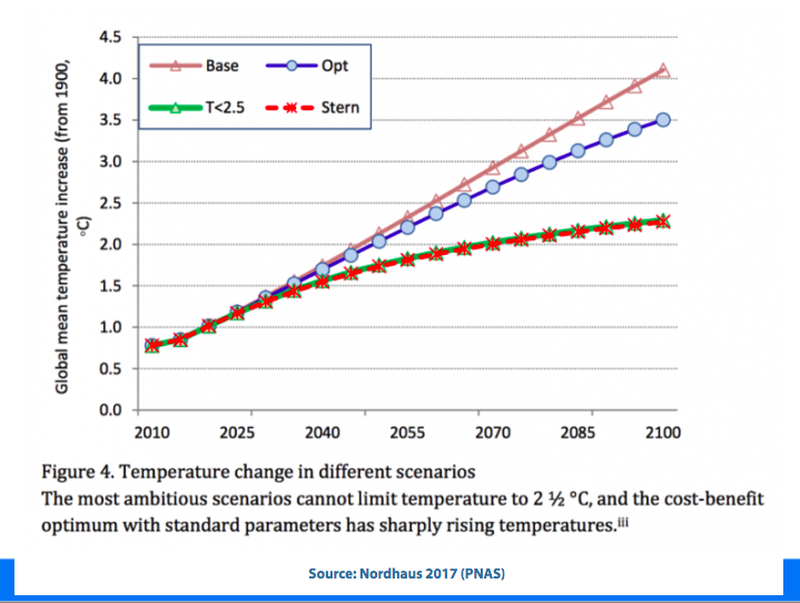
But that is not true at all. Here’s a graph from a 2017 Nordhaus publication that I included in my presentation:
As the figure shows, Nordhaus’ model—and again, this isn’t cooked up by the Heritage Foundation, but instead was one selected by the Obama Administration’s EPA and was the reason he won the Nobel Prize—projects that if governments “did nothing,” total global warming would reach about 4.1 degrees Celsius. In contrast, if governments implemented the “optimal carbon tax,” as Nordhaus would recommend in a perfect world, then total warming would be about 3.5 degrees Celsius.
Anyone remotely familiar with the climate change policy debate knows that such an amount of warming would terrify the prominent activists and groups advocating for a political solution. They would quite confidently tell the public that warming of this amount would spell absolute catastrophe for future generations.

My point here isn’t to endorse Nordhaus’ model. My point is simply that Americans never heard anything about this when the media simultaneously covered Nordhaus’ award and the UN’s document calling for a 1.5°C limit. And yet, Nordhaus’ own work—not shown in the figure above, but I spell it out here—clearly concludes that such an aggressive target would cause far more damage to humans in the form of reduced economic output, that it would be better for governments to “do nothing” about climate change at all.

With or Without the United States, the Paris Agreement Was Going to “Fail”

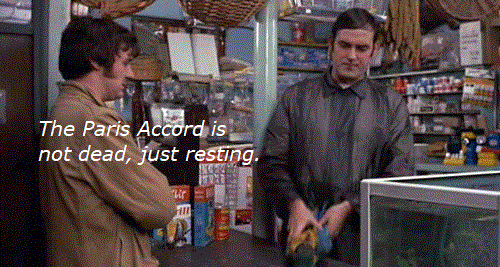
To continue with the theme of how they’ve been misinformed, I reminded the students of the media’s apoplexy when Trump announced his intention to remove the United States from the Paris Climate Agreement (or treaty, in lay terms). I showed them a headline in which famed physicist Stephen Hawking said Trump was pushing the planet “over the brink.”

I then asked the students rhetorically, “You would think that the Paris Agreement was going to ‘work’ to contain the threat of climate change, except for Trump pulling out and wrecking it, right?

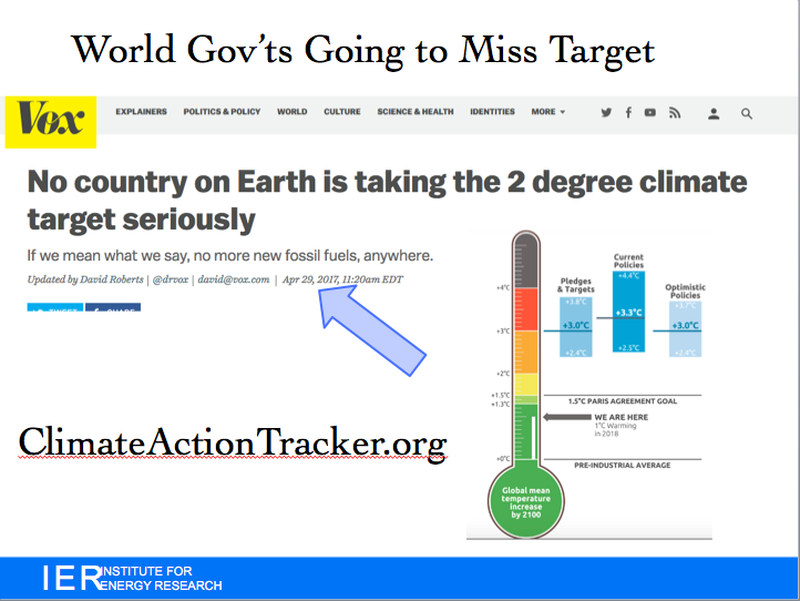
And yet, the pro-intervention group ClimateActionTracker.org nicely illustrates that even if all countries met their pledges (including the U.S.), it wouldn’t come close to limiting warming to the weaker benchmark of 2°C, let alone the newer, more chic target of 1.5°C. Things were even worse if we evaluated the actual policies of governments (as opposed to what they stated they intended to do, about limiting their emissions).

Technological Solutions

After spending so much time showing that the political “solutions” were failing even on their own terms, I summarized a few avenues of research (see this article for details) where scientists are exploring techniques to either remove carbon dioxide from the atmosphere or reflect some incoming sunlight. Although I personally do not think human-caused climate change is a crisis, and do think that adaptation coming from normal economic growth will be more than sufficient to deal with any problems along the way, nonetheless scientists do have these other techniques in their back pocket, should they become necessary to “buy humanity a few decades of breathing room” while technology advances in the transportation and energy sectors.

Conclusion

Americans, especially students, are being whipped into a panic over the allegedly existential threat of climate change. Yet the actual research, summarized in the UN’s own periodic reports and in the research of a Nobel laureate in the field, shows that at best only a modest “leaning against the wind” could be justified according to standard economic science.

By their own criteria, the alarmist activists are admitting that political measures are nowhere near achieving their goals. Their own rhetoric says that these activists are wasting everyone’s time pushing solutions that will end in catastrophe. Occasionally they slip up, as for example when Alexandria Ocasio-Cortez admits that her “we have 12 years left” was not to be taken literally.

In order to bring light to the climate change debate, at this point one just needs to actually screenshot and explain the evidence from the establishment sources. The rhetorical framing of the issue is so far removed from the underlying research that this alone is heretical.

See Also:  Economists as “Useful Idiots” for Green Socialists