Meet Richard Muller, Lukewarmist

Richard Muller, head of the Berkeley Earth project, makes a fair and balanced response to a question regarding the “97% consensus.”  Are any of the US Senators listening?  Full text below from Forbes 97%: An Inconvenient Truth About The Oft-Cited Polling Of Climate Scientists including a reference to Will Happer, potentially Trump’s science advisor.

Read it and see that he sounds a lot like Richard Lindzen.

What are some widely cited studies in the news that are false?

Answer by Richard Muller, Professor of Physics at UC Berkeley, on Quora:

That 97% of all climate scientists accept that climate change is real, large, and a threat to the future of humanity. That 97% basically concur with the vast majority of claims made by Vice President Al Gore in his Nobel Peace Prize winning film, An Inconvenient Truth.

The question asked in typical surveys is neither of those. It is this: “Do you believe that humans are affecting climate?” My answer would be yes. Humans are responsible for about a 1 degree Celsius rise in the average temperature in the last 100 years. So I would be included as one of the 97% who believe.

Yet the observed changes that are scientifically established, in my vast survey of the science, are confined to temperature rise and the resulting small (4-inch) rise in sea level. (The huge “sea level rise” seen in Florida is actually subsidence of the land mass, and is not related to global warming.) There is no significant change in the rate of storms, or of violent storms, including hurricanes and volcanoes. The temperature variability is not increasing. There is no scientifically significant increase in floods or droughts. Even the widely reported warming of Alaska (“the canary in the mine”) doesn’t match the pattern of carbon dioxide increase–it may have an explanation in terms of changes in the northern Pacific and Atlantic currents. Moreover, the standard climate models have done a very poor job of predicting the temperature rise in Antarctica, so we must be cautious about the danger of confirmation bias.

My friend Will Happer believes that humans do affect the climate, particularly in cities where concrete and energy use cause what is called the “urban heat island effect.” So he would be included in the 97% who believe that humans affect climate, even though he is usually included among the more intense skeptics of the IPCC. He also feels that humans cause a small amount of global warming (he isn’t convinced it is as large as 1 degree), but he does not think it is heading towards a disaster; he has concluded that the increase in carbon dioxide is good for food production, and has helped mitigate global hunger. Yet he would be included in the 97%.

The problem is not with the survey, which asked a very general question. The problem is that many writers (and scientists!) look at that number and mischaracterize it. The 97% number is typically interpreted to mean that 97% accept the conclusions presented in An Inconvenient Truth by former Vice President Al Gore. That’s certainly not true; even many scientists who are deeply concerned by the small global warming (such as me) reject over 70% of the claims made by Mr. Gore in that movie (as did a judge in the UK; see the following link: Gore climate film’s nine ‘errors‘).
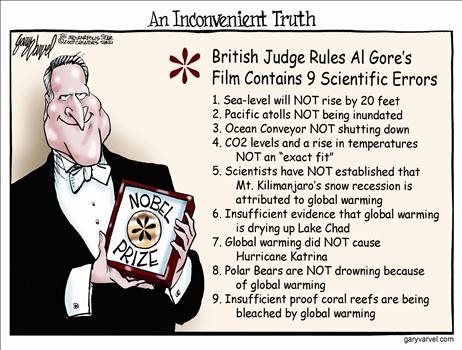
varv101407a

The pollsters aren’t to blame. Well, some of them are; they too can do a good poll and then misrepresent what it means. The real problem is that many people who fear global warming (include me) feel that it is necessary to exaggerate the meaning of the polls in order to get action from the public (don’t include me).

There is another way to misrepresent the results of the polls. Yes, 97% of those polled believe that there is human caused climate change. How did they reach that decision? Was it based on a careful reading of the IPCC report? Was it based on their knowledge of the potential systematic uncertainties inherent in the data? Or was it based on their fear that opponents to action are anti-science, so we scientists have to get together and support each other. There is a real danger in people with Ph.D.s joining a consensus that they haven’t vetted professionally.

I like to ask scientists who “believe” in global warming what they think of the data. Do they believe hurricanes are increasing? Almost never do I get the answer “Yes, I looked at that, and they are.” Of course they don’t say that, because if they did I would show them the actual data! Do they say, “I’ve looked at the temperature record, and I agree that the variability is going up”? No. Sometimes they will say, “There was a paper by Jim Hansen that showed the variability was increasing.” To which I reply, “I’ve written to Jim Hansen about that paper, and he agrees with me that it shows no such thing. He even expressed surprise that his paper has been so misinterpreted.”

A really good question would be: “Have you studied climate change enough that you would put your scientific credentials on the line that most of what is said in An Inconvenient Truth is based on accurate scientific results? My guess is that a large majority of the climate scientists would answer no to that question, and the true percentage of scientists who support the statement I made in the opening paragraph of this comment, that true percentage would be under 30%. That is an unscientific guestimate, based on my experience in asking many scientists about the claims of Al Gore.

This question originally appeared on Quora. the place to gain and share knowledge, empowering people to learn from others and better understand the world.

Compare Muller’s statement with a short video by Lindzen.


Yellow Climate Journalism


Definition of “Fake News”:  When reporters state their own opinions instead of bearing witness to observed events.

We are now fully entrenched in an age of “yellow” journalism, especially regarding the issue of global warming/climate change. Below I will deconstruct a recent egregious example, but first we need a background from renowned philosopher Mortimer Adler.

On the Difference Between Knowledge and Opinion

Knowledge refers to knowing the truth, that is understanding reality independent of the person and his/her ideas. By definition, there is no such thing as “false knowledge.”

When I show you two marbles then add two more marbles and ask you how many marbles there are, the answer is not a matter of opinion. You have no freedom to assert any opinion other than the answer “four”.  By the axioms of mathematics we know the true answer to this question.

A great many other issues in human society, politics and culture are matters of opinion, and each is free to hold an opinion different from others. In such cases, the right opinion is usually determined by counting noses with the majority view ruling.

Note that school children are taught right opinions. That is, they are told what their elders and betters have concluded are the right answers to many questions about life and the world. Those children do not yet possess knowledge, because as Socrates well demonstrated, you have knowledge when you have both the right opinion and also know why it is right. Only when you have consulted the evidence and done your own analysis does your opinion serve as knowledge for you, rather than submission to an authority.

John R. Christy is a professor of Atmospheric Science and Director of the Earth System Science Center of the University of Alabama in Huntsville.

On Climate Knowledge, Dr. John Christy (here)

Climate science is a murky science. When dealing with temperature variations and trends, we do not have an instrument that tells us how much change is due to humans and how much to Mother Nature. Measuring the temperature change over long time periods is difficult enough, but we do not have a thermometer that says why these changes occur.

We cannot appeal to direct evidence for the cause of change, so we argue.

The real climate system is so massively complex we do not have the ability to test global-size theories in a laboratory. Without this ability, we tend to travel all sorts of other avenues to confirm what are essentially our unprovable views about climate. These avenues tend to comfort our souls because we crave certainty over ambiguity.

Without direct evidence and with poor model predictability, what other avenues are available to us? This is where things get messy because we are humans, and humans tend to select those avenues that confirm their biases. (It seems to me that the less direct evidence there is for a position, the more passion is applied and the more certainty is claimed.)

One avenue many folks tend to latch onto is the self-selected “authority.” Once selected, this “authority” does the thinking for them, not realizing that this “authority” doesn’t have any more direct evidence than they do.

Other avenues follow a different path: Without direct evidence, folks start with their core beliefs (be they political, social or religious) and extrapolate an answer to climate change from there. That’s scary.

Exhibit A of Yellow Climate Journalism

Unfortunately we see that climate journalists often distort their articles by confusing factual reporting of events with their own opinions.

“In the conduct of trials before judges in our courts there is a famous rule called the opinion rule. The opinion rule says that a witness giving testimony must report what he saw or what he heard. He must not report what he thinks happened, because that would be giving an opinion, not knowledge by observation.”
~ Mortimer J. Adler

One of many typical articles on climate is this one from Wired: Tillerson’s Hearing Seals It: the US Won’t Lead on Climate Change 

See how the author forces his own opinions to subvert what he observed.

After more than six hours of testimony, Tillerson backtracked even further, telling senator Jeff Merkley (D-OR) that though the evidence of a changing climate was clear, the cause wasn’t. “The science behind the clear connection (to human activity) is not conclusive,” Tillerson said, an assertion as false as the scientific consensus is clear. (my bold)

Tillerson said that he and the president elect would do a “fulsome review” of US climate change policies. “I also know that the president, as part of his priority in campaigning, was ‘America First,’ so there is important considerations as we commit to such accords, and as those accords are executed over time: are there any elements of that that put America at a disadvantage?” he said. The negative effects of climate change, of course, don’t discriminate on the basis of national borders(my bold)

Senator John Barrasso (R-WY), who believes government money currently spent fighting climate change could be “better spent” elsewhere, pushed Tillerson to commit to abandoning US funding for anti-climate change initiatives. Specifically, Barrasso opposes support for the Green Climate Fund, an international program set up to help developing nations deal with the effects of climate change. The US under Obama has pledged $3 billion.

“In consultation with the president, my expectation is that we are going to look at these things from the bottom up in terms of funds we’ve committed toward this effort,” Tillerson said.

Even in his non-answer, it’s clear Tillerson was open to dropping such funding. Instead, he opined on the power of electricity to lift people out of poverty. A noble aspiration, perhaps, but one that would provide little consolation to communities ravaged by climate change now and in the future. (my bold)

Summary, Five criteria for distinguishing between knowledge and opinion:

1. Whether or not everyone must agree.
2. Doubt and belief are relative only to opinion, never to knowledge;
3. We can have freedom of thought only about matters of opinion, never knowledge.
4. Consensus differentiates between knowledge and opinion; only with respect to opinion do we talk about consensus.
5. Matters of opinion are subject to conflict, knowledge is not.

By all criteria, global warming/climate change is a matter of opinion, not knowledge.

Any teacher will tell you it is much easier to teach a student who is ignorant than one who is in error, because the student who is in error on a given point thinks that he knows whereas in fact he does not know. . .It is almost necessary to take the student who is in error and first correct the error before you can teach him. . .The path from ignorance to knowledge is shorter than the path from error to knowledge.
Mortimer Adler

Mortimer J. Adler, Founder of the Center for the Study of the Great Ideas

Climate Progress on a Rant

There is a torrent of Anti-Trump posts from “Climate Progress”, part of the “Think Progress” set of websites directed by John Podesta and funded by George Soros and Tom Steyer.  The ranting is over the top and could crash the internet before the inauguration.  Maybe that’s the objective.  Look at today’s output of “progressive thinking.”

Climate Progress : Trump is assem­bling the most anti-Iran team
Today: 16:03

@Climate Progress : No Senator Cruz, Jeff Sessions didn’t lead the bankru­pting of the Alabama Klan
Today: 15:56

@Climate Progress : Exxon CEO Rex Tillerson didn’t mention energy, climate, or Exxon in his opening remarks
Today: 15:52

@Climate Progress : Jeff Sessions may soon get to decide whether 63 people live or die
Today: 15:41

@Climate Progress : Six critical questions about conflicts of interest that Donald Trump must answer
Today: 15:37

@Climate Progress : Trump claims he has ‘nothing to do with Russia.’ His son said the opposite.
Today: 15:08

@Climate Progress : 15 things Trump said about Russia that seem even weirder now
Today: 14:51

@Climate Progress : The abortion providers who will see us through a Trump presidency
Today: 14:18

@Google: Trump Nominee Rex Tillerson to Face Questions About Russia, Climate, Rights Wall Street Journal
Today: 13:02

Trump Nominee Rex Tillerson to Face Questions About Russia, Climate , RightsWall Street Journal WASHING­TON—Pre­sident-elect Donald Trump’s pick for secretary of state, Rex Tille­rson, went before senators for a confir­mation hearing Wedne­sday, and planned to tell lawmakers that Russia poses a danger and that North Atlantic Treaty Organi­zation …
Today: 14:43

DeSmogBlog: Fake News You Can’t Use, They’ll Abuse, We All Lose. Except Putin. Putin Wins.
Today: 14:19

@Google: What senators should ask Rex Tillerson about climate change Vox
This is a guest post by ClimateD­enierRou­ndup   Vox What senators should ask Rex Tillerson about climate change Vox One of those questions is about climate change, and it’s worth focusing on that subject for a moment, because this is a very strange and uncertain moment in climate politics. Normally a presid­ential candidate would have taken some kind of position on a … Time to Grill Rex Tillerson on Climate Change New York Times Trump Nominee…
Today: 14:18

Climate Progress : Coretta Scott King: Jeff Sessions would ‘irrep­arably damage’ my husband’s work
Today: 01:19

@Climate Progress : Al Franken lays into Trump for attacking Minnes­ota’s Somali-American community
Today: 01:04

@Google: Republ­icans want to fight climate change, but fossil-fuel bullies won’t let them Washi­ngton Post
Forbes Crazy Carbon Crystals Could Combat Climate Change Forbes In other words the solution could be used to grab CO2, which contri­butes to climate change, direct from the atmos­phere and store it tempor­arily into crystals that form as a result. The resear­chers envision using the process as a way to boost the … and more » Washi­ngton Post Republ­icans want to fightclimate change, but fossil-fuel bullies won’t let them Washi­ngton Post Talking to my Senate Repub­lican colle­agues about climate change is like talking to prisoners about escaping. The convers­ations are often private, even furtive. One told me, “Let’s keep talking, but you can’t let my staff know.” The dirty secret is that … and more »
Today: 01:02

@DeSmogBlog: How Jeff Sessions Profited from Introd­ucing a Fracking Exemption for Drinking Water Rules @The Carbon Brief: Double threat to UK’s birds and butter­flies from climate change and land use
With U.S. Sen. Jeff Sessions (R-AL) in the midst of Senate confir­mation hearings, watchdog group Food and Water Watch has raised new questions about how Sessio­ns and his family p­rofited from a fracking loophole provision he intro­duced in the Se­nate. In the UK, rising temper­atures are making life increa­singly uncomfo­rtable for species of wildlife better…
The group has unveiled new documentsshowing that Sessions­’ family owned stock in Energen, a Birmin­gham, Alabama-based oil and gas company,… The post Double threat to UK’s birds and butter­flies from climate change and land use appeared first on Carbon Brief .
Today: 00:02


Truth in Climate Advertising

Friends of the Earth have been censured for their erroneous and misleading promotional flyer. The UK Advertising Standards Authority (ASA) said Friends of the Earth “agreed not to repeat the claims, or claims that had the same meaning.”

Friends of the Earth spent more than a year trying to defend its claims, which were made in a fundraising leaflet, but has been forced to withdraw them.

The authority found that Friends of the Earth (FoE) failed to substantiate claims that fracking could cause cancer, contaminate water supplies, increase asthma rates and send house prices plummeting.

The group’s capitulation is a victory for a retired vicar and a retired physics teacher who have been working for years to expose what they believe is scaremongering about a safe technique for extracting shale gas. (More about them in the footnote)

Truth in Climate Advertising!  What a Concept!!

Who’s next?  What about Greenpeace:

Greenpeace have been accused of employing deceptive techniques after it was revealed the environmental group had been using images of a storm damaged coral reef in The Philippines as a part of its campaign to have the Great Barrier Reef declared at risk.

On the left is a picture of bright, vibrant and thriving coral, while the image on the right features a pile of damaged, bone-white coral with a warning: ‘Don’t let them turn this, into this.’

Upon completing further research, it was discovered the image of the damaged reef was taken at Apo Island’s marine sanctuary in The Philippines, which was severely damaged by two typhoons in the past four years. From the Daily Mail article
Greenpeace slammed for using photo of storm-ravaged Philippines coral in new ad claiming government is putting Great Barrier Reef under threat.

How about the Natural Resources Defense Council (NRDC):

Shouldn’t they be forced to add this disclaimer:

Summary

climate-alarmists-wheres-the-beef

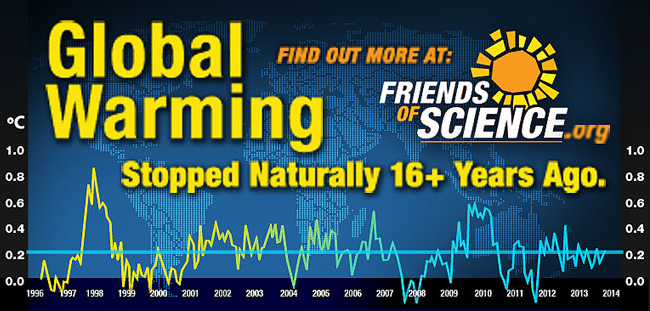
Friends of the Earth are making up stuff.  Friends of Science give you the Beef:

global-warming-stopped

Footnote

The UK Advertising Standards Authority did not have the brass to do their job protecting the public against deceptions.  It took significant prodding from two determined people: a vicar and a retired school teacher.

They had previously complained to the Charity commission, who found a way to stand down rather than stand up.

The Charity Commission is considering closing a loophole in charity law that allowed a green group to raise money by making allegedly false claims in a political campaign against fracking.

Friends of the Earth, a registered charity, avoided restrictions on political activity by claiming that its antifracking campaign was being carried out by a non-charitable company called Friends of the Earth Limited.

The commission said the use of such similar names could confuse the public and damage public trust in charities.

Mr Wilkinson, who said that he had no connection with the fracking industry and was acting purely to ensure the public received accurate information, welcomed the ASA ruling. “It is outrageous that FoE used false information to raise money,” he said. “We need a frank debate about fracking and its potential impacts but it should be based on facts, not scaremongering.”

The Rev. Michael Roberts tells the full story in his article How Fiendish is Friends of the Earth which includes this amusing rebuttal:


Climatism and Virtual Virtues


Following an alert posted by Lubos Motl, I upgraded my windows operating system from #7 to #10, since the grace period is ending August 1. And it went quite smoothly in retrospect, but with much anxiety in the process. It seems that Windows Defender latest version doesn’t play as nice with other anti-malware programs. Also some head-scratching as to the usage of cpu by strangely named programs that may or may not be malware. And there are the inevitable hiccups and tweaks needed to restore operations as before.

It occurred to me in this process that the internet and the associated tools have become for us a kind of utility, like electricity. When we flip the light switch, the room should light up. And when we boot up our home computers, we expect to be on line and wired in. Any upgrade introduces uncertainty into that dependency, and is uncomfortable.

It also reflects on how much we modern urban dwellers exist within a cocoon of man-made structures, both physical and cyberspace. Extrapolating from our daily experience, it is a small step to thinking that the larger environment beyond our cocoons, if not entirely man-made, is at least hugely subject to human influence. And from that premise comes the climatism faith: the belief that mother Nature is being ruined by humans burning fossil fuels, that the planet will burn up, glaciers will melt, cities and islands will submerge, etc. etc. etc.

For centuries those who farm or otherwise make a living from the land or ocean have accepted and adapted to the uncertainties of weather and variable harvests. They are among the most skeptical concerning man-made climate change.

But the majority of university educated urban dwellers are converts to climatism, and participate more or less in a range of Virtual Virtues; i.e. Supporting abstract causes to protect Nature from humans. Some examples:
Save the Arctic: Support Greenpeace.:
Stop Rising CO2: Support 350.org.
Save Animals from extinction: Support WWF.
Etc.

These and other variations of “fighting Climate Change” give the illusion of “making a difference”, and thus feeling good about doing good. It is truly not about Science any more, it is about being Virtually Virtuous.

Footnote: In his lifetime, Marshall McLuhan foresaw the rise of the Global Village along with the return of tribalism, pre-conditions for the present obsession with climatism. Quotations:

“All media are extensions of some human faculty-psychic or physical.”

“The new electronic interdependence recreates the world in the image of a global village.”

“The world is now like a continually sounding tribal drum, where everybody gets the message…. all the time.”

“Our technology forces us to live mythically.”

“Politics will eventually be replaced by imagery.  The politician will be only too happy to abdicate in favor of his image, because the image will be much more powerful than he could ever be.”

“The more you create village conditions, the more discontinuity and division and diversity. The global village absolutely insures maximal disagreement on all points. It never occurred to me that uniformity and tranquility were the properties of the global village. It has more spite and envy. The spaces and times are pulled out from between people. A world in which people encounter each other in depth all the time. The tribal-global village is far more divisive — full of fighting — than any nationalism ever was. Village is fission, not fusion, in depth all the time.” (McLuhan “The Hot and Cool Interview” 57–58)

That full interview is the best summary of McLuhan’s views and is here.

Climate Lemmings (h/t Beth)


Climate Crisis Inc. Update


cov_en_1Five years ago Jo Nova provided a graphic displaying the workings of the Climate Scare Machine.  The figures are out-dated and this post is to update the growth of the Climate Crisis Industry and its outlook.

From Jo Nova (here) in 2010 dollars:
Climate Change Scare Machine Cycle: see how your tax dollars are converted into alarming messages

The money, power, and influence is vastly larger on the side that benefits from the alarm
On the skeptical side, Exxon chipped in all of $23 million over ten years, but it’s chump-change. The fossil fuel industry doesn’t like carbon legislation, but it’s not life or death, unlike the situation for wind and solar, which would be virtually wiped out without the subsidies provided by the scare.

The US government has poured in $79 billion and then some. But the pro-scare funding is pervasive: for example — the Australian government spent $14 million on a single Ad campaign, and another $90 million every year on a Department of Climate Change. The UK government paid for lobbyists to lobby it, and the BBC “partners” with the lobby groups. The EU doesn’t just subsidize renewables, it also pays them to push for more subsidies. Even the dastardly Exxon paid more than 20 times as much for a single renewables research project than it did to skeptics.

Last year in carbon markets $142 billion dollars turned over, and $243 billion was invested in renewables. If the carbon market idea went global it was projected to reach $2 trillion a year. Every banker and his dog has a bone in this game. Why wouldn’t they?

Industry 2015 Update from Climate Change Business Journal

(reported in Insurance Journal here).

Interest in climate change is becoming an increasingly powerful economic driver, so much so that some see it as an industry in itself whose growth is driven in large part by policymaking.

The $1.5 trillion global “climate change industry” grew at between 17 and 24 percent annually from 2005-2008, slowing to between 4 and 6 percent following the recession with the exception of 2011’s inexplicable 15 percent growth, according to Climate Change Business Journal.

The San Diego, Calif.-based publication includes within that industry nine segments and 38 sub-segments. This encompasses sectors like renewables, green building and hybrid vehicles.

That also includes the climate change consulting market, which a recent report by the journal estimates at $1.9 billion worldwide and $890 million in the U.S.

Included in this sub-segment, which the report shows is one of the fastest growing areas of the climate change industry, are environmental consultants and engineers, risk managers, assurance, as well as legal and other professional services.

Figures for the climate change consulting market are expected to more than double in the next five years, and the report’s authors believe the climate change industry as a whole will have an even steeper and faster growth trajectory than the environmental consulting industry – an industry that in 1976 had billings of $600 million and today generates $27 billion.

Paul Driessen puts the numbers in context (here).

The answer is simple. The annual revenue of the Climate Crisis & Renewable Energy Industry has become a $1.5-trillion-a-year business! That’s equal to the annual economic activity generated by the entire US nonprofit sector, or all savings over the past ten years from consumers switching to generic drugs. By comparison, revenue for the much-vilified Koch Industries are about $115 billion, for ExxonMobil around $365 billion.

According to a 200-page analysis by the Climate Change Business Journal, this Climate Industrial Complex can be divided into nine segments:

  • low carbon and renewable power;
  • carbon capture and storage;
  • energy storage, such as batteries;
  • energy efficiency;
  • green buildings;
  • transportation;
  • carbon trading;
  • climate change adaptation; and
  • consulting and research.

Consulting alone is a $27-billion-per-year industry that handles “reputation management” for companies and tries to link weather events, food shortages and other problems to climate change. Research includes engineering R&D and climate studies.

In other words, the current amount of annual spending is $1.5-trillion in the two boxes of Jo Nova’s diagram: Industrials and Financial Houses.  There’s additional money sloshing around in other boxes of the scare machine.

The $1.5-trillion price tag appears to exclude most of the Big Green environmentalism industry, a $13.4-billion-per-year business in the USA alone. The MacArthur Foundation just gave another $50 million to global warming alarmist groups. Ex-NY Mayor Michael Bloomberg and Chesapeake Energy gave the Sierra Club $105 million to wage war on coal (shortly before the Club began waging war on natural gas and Chesapeake Energy, in what some see as poetic justice). Warren Buffett, numerous “progressive” foundations, Vladimir Putin cronies and countless companies also give endless millions to Big Green.

Our hard-earned tax dollars are likewise only partially included in the CCBJ tally. As professor, author and columnist Larry Bell notes in his new book, Scared Witless: Prophets and profits of climate doom, the U.S. government spent over $185 billion between 2003 and 2010 on climate change items – and this wild spending spree has gotten even worse in the ensuing Obama years. We are paying for questionable to fraudulent global warming studies, climate-related technology research, loans and tax breaks for Solyndra and other companies that go bankrupt, and “climate adaptation” foreign aid to poor countries.

Also not included: the salaries and pensions of thousands of EPA, NOAA, Interior, Energy and other federal bureaucrats who devote endless hours to devising and imposing regulations for Clean Power Plans, drilling and mining bans, renewable energy installations, and countless Climate Crisis, Inc. handouts. A significant part of the $1.9 trillion per year that American businesses and families pay to comply with mountains of federal regulations is also based on climate chaos claims.

Add in the state and local equivalents of these federal programs, bureaucrats, regulations and restrictions, and we’re talking serious money. There are also consumer costs, including the far higher electricity prices families and businesses must pay, especially in states that want to prove their climate credentials.

Summary

Looking into the future, IEA expects additional spending just in the energy sector to meet climate change targets on the order of $35-trillion over the period 2015 to 2030.  All this remarkable growth comes in a market for non-solutions to the non-problem of global warming.  (Note to Lewandowsky:  It is not a conspiracy, it’s a monopoly.)

There also may be a limit to how much can be extracted.

Climate cashCow

Footnotes:

  1.  The Climate Change Business Journal produced the report of 2015 industry revenues and sectors, referenced by the Insurance Journal article.  More recent reports likely show much higher revenues, but I am unwilling to buy a report from CCBJ.

2.  A recent example of the dash for climate cash is the rise of Climate Medicine.


Climategate Redux?

The AAAS (American Association for the Advancement of Science) sent a letter on June 28, 2016 urging the US congress to act on climate change:

There is strong evidence that ongoing climate change is having broad negative impacts on society, including the global economy, natural resources, and human health. For the United States, climate change impacts include greater threats of extreme weather events, sea level rise, and increased risk of regional water scarcity, heat waves, wildfires, and the disturbance of biological systems. The severity of climate change impacts is increasing and is expected to increase substantially in the coming decades.

Those of us with short memories need to be reminded that the Climategate emails were triggered by an appeal to congress in 2009 by the AAAS. Dr. Arnd Bernaerts provides the background and the historical context.

On October 21, 2009 the AAAS letter included this:

Moreover, there is strong evidence that ongoing climate change will have broad impacts on society, including the global economy and on the environment. For the United States, climate change impacts include sea level rise for coastal states, greater threats of extreme weather events, and increased risk of regional water scarcity, urban heat waves, western wildfires, and the disturbance of biological systems throughout the country. The severity of climate change impacts is expected to increase substantially in the coming decades.
Full text provided by Dr. Bernaerts here, along with his response.

The Climategate Emails

2011 Report here
More than 5,000 documents have been leaked online purporting to be the correspondence of climate scientists at the University of East Anglia who were previously accused of ‘massaging’ evidence of man-made climate change.

Following on from the original ‘climategate’ emails of 2009, the new package appears to show systematic suppression of evidence, and even publication of reports that scientists knew to to be based on flawed approaches. 

The leaker of the emails “FOIA” said this in a comment at the time, Nov. 17, 2009:
We feel that climate science is, in the current situation, too important to be kept under wraps.
We hereby release a random selection of correspondence, code, and documents.
Hopefully it will give some insight into the science and the people behind it.

Dr. Bernaerts comments on the current situation:

I had hoped that the “endorsement” by “FOIA said” would give a helpful impulse to my complaint about a science which is not able to define what they are talking about, namely CLIMATE. Those not happy with the AGW discussion should have pressured WMO, IPCC and consorts to demonstrate that they are capable to do what every academic is trained to do, to provide reasonable and workable definitions. Unfortunately that did not materialize. The definition matter remains neglected by AGW supporters and sceptics alike. A great pity. A further conference paper from January 2010, available at: http://www.whatisclimate.com/ explains this in more detail.

What has changed in the world of AAAS and in the field of supporting and opposing views: Much too little. A pity that we cannot ask FOIA what would be his view today.

The Climate Lemmings
h/t Beth


Daily Doom and Gloom

joe-btfsplk

Today doom-saying dominates. Remember when Science Fiction combined possibility and danger, with more on the upside? Contemporary pessimism about the future is part of a larger and deeper malaise in societies, and one that differs across the globe. It’s the West (US and Europe) driven by Fear, while in the East Hope is more abundant, and the Middle East is acting out its sense of historical humiliation.

From Geopolitical analyst Dominique Moïsi:

Moïsi contends that both the United States and Europe have been dominated by fears of the “other” and of their loss of a national identity and purpose. Instead of being united by their fears, the twin pillars of the West are more often divided by them—or, rather, by bitter debates over how best to confront or transcend them. For Muslims and Arabs, the combination of historical grievances, exclusion from the economic boon of globalization, and civil and religious conflicts extending from their homelands to the Muslim diaspora have created a culture of humiliation that is quickly devolving into a culture of hatred. Meanwhile, Asia has been able to concentrate on building a better future and seizing the economic initiative from the American-dominated West and so creating a new culture of hope.

The European culture of fear is dominated by the interrogation “Who are we?” Unlike Europeans, Americans are not preoccupied by the ghost of their past. America has always seen itself as a future, a project more than a history. Three key questions contribute to the current American identity crisis. Have we lost our soul – that is, our ethical superiority? Have we lost our purpose – that is, our sense of a unique national mission? Finally, have we lost our place in the world – that is, are we in decline? In other words, if Europeans are asking, “Who are we?” Americans are wondering, “What have we done to ourselves?”

https://www.goodreads.com/book/show/2575587-the-geopolitics-of-emotion

An extended review of Moïsi’s book is here.  Interview with Moïsi here.


ignorance

The purveyors of climate doom are part of a larger culture in the West, and their prophecies fall on people already primed to believe the worst.  Their only power comes from the weakness of listening and failing to add lots of salt to the pronouncements.

Just say No!

And remember this:

If you can keep your wits about you while all others are losing theirs, and blaming you. The world will be yours and everything in it, what’s more, you’ll be a man, my son.
Rudyard Kipling


LEAVE A REPLY