Climate Hype Running Amok

The climate hype machine has switched into overdrive with the release of a draft US climate assessment report.  Read about it with caution, as explained in recent post Impaired Climate Vision.

Meanwhile a good synopsis of wrong-headed thinking about climate is provided by John Stossel in a review of Al Gore’s science fictions (here).  (Excerpts below with my bolds)

John Stossel: Al Gore and me — Don’t believe the hype

I was surprised to discover that Al Gore’s new movie begins with words from me!

While icebergs melt dramatically, Gore plays a clip of me saying, “‘An Inconvenient Truth’ won him an Oscar, yet much of the movie is nonsense. ‘Sea levels may rise 20 feet’ — absurd.” He used this comment from one of my TV shows.

The “20 feet” claim is absurd — one of many hyped claims in his movie.

His second film, “An Inconvenient Sequel,” shows lower Manhattan underwater while Gore intones: “This is global warming!”

My goodness! Stossel doubts Al Gore’s claim, but pictures don’t lie: The 9/11 Memorial is underwater! Gore is right! Stossel is an ignorant fool!

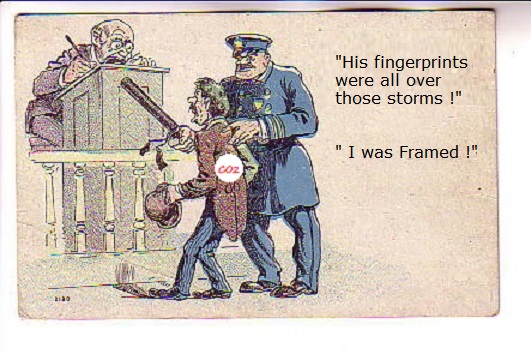
But wait. The pictures were from Superstorm Sandy. Water is pushed ashore during storms, especially “super” storms. But average sea levels haven’t risen much.

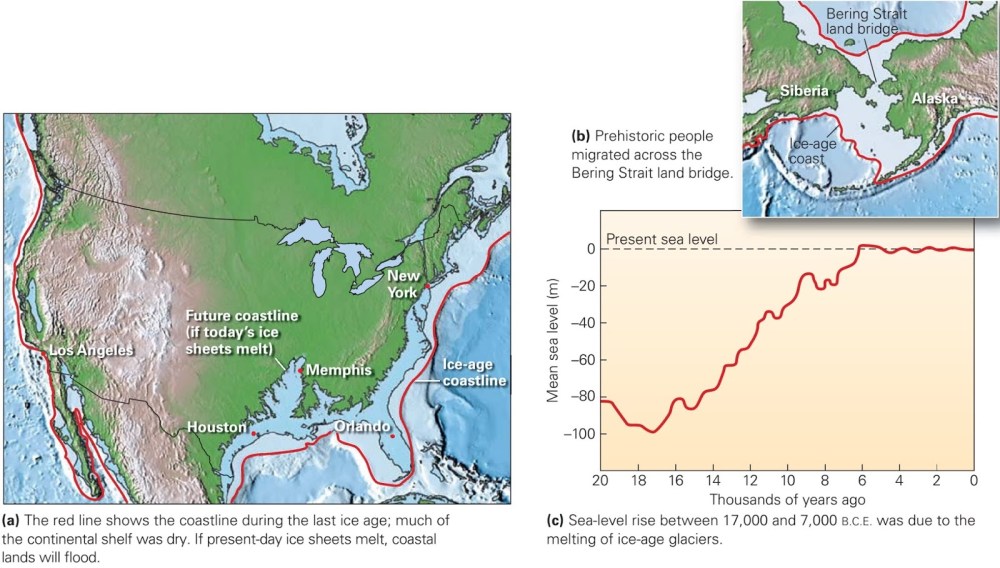
Over the past decade, they have risen about 1 inch. But this is not because we burn fossil fuels. Sea levels were rising long before we burned anything. They’ve been rising about an inch per decade for a thousand years.

In his new movie, Gore visits Miami Beach. No storm, but streets are flooded! Proof of catastrophe!

But in a new e-book responding to Gore’s film, climate scientist Roy Spencer points out that flooding in “Miami Beach occurs during high tides called ‘king tides,’ due to the alignment of the Earth, sun and moon. For decades they have been getting worse in low-lying areas of Miami Beach where buildings were being built on reclaimed swampland.”

It’s typical Al Gore scaremongering: Pick a place that floods every year and portray it as evidence of calamity.

Spencer, a former NASA scientist who co-developed the first ways of monitoring global temperatures with satellites, is no climate change “denier.” Neither am I. Climate changes.

Man probably plays a part. But today’s warming is almost certainly not a “crisis.” It’s less of a threat than real crises like malaria, terrorism, America’s coming bankruptcy, etc. Even if increasing carbon dioxide warming the atmosphere were a serious threat, nothing Al Gore and his followers now advocate would make a difference.

“What I am opposed to is misleading people with false climate science claims and alarming them into diverting vast sums of the public’s wealth into expensive energy schemes,” writes Spencer.

Gore does exactly that. He portrays just about every dramatic weather event as proof that humans have changed weather. Watching his films, you’d think that big storms and odd weather never occurred before and that glaciers never melted.

In his first movie, Gore predicted that tornadoes and hurricanes would get worse. They haven’t. Tornado activity is down.

What about those dramatic pictures of collapsing ice shelves?

“As long as snow continues to fall on Antarctica,” writes Spencer, “glaciers and ice shelves will continue to slowly flow downhill to the sea and dramatically break off into the ocean. That is what happens naturally, just as rivers flow naturally to the ocean. It has nothing to do with human activities.”

Gore said summer sea ice in the Arctic would disappear as early as 2014. Nothing like that is close to happening.

Gore’s movie hypes solar power and electric cars but doesn’t mention that taxpayers are forced to subsidize them. Despite the subsidies, electric cars still make up less than 1 percent of the market.

If electric cars do become more popular, Spencer asks, “Where will all of the extra electricity come from? The Brits are already rebelling against existing wind farms.”

I bet most Gore fans have no idea that most American electricity comes from natural gas (33 percent), coal (30 percent) and nuclear reactors (20 percent).

Gore probably doesn’t know that.

I’d like to ask him, but he won’t talk to me. He won’t debate anyone.

Critics liked “An Inconvenient Sequel.” An NPR reviewer called it “a hugely effective lecture.” But viewers were less enthusiastic. On Rotten Tomatoes, my favorite movie guide, they give “Sequel” a “tipped over popcorn bucket” score of 48 percent. Sample reviews: “Dull as can be.” “Faulty info, conflated and exaggerated.”

Clearly, Nobel Prize judges and media critics are bigger fans of big government and scaremongering than the rest of us.

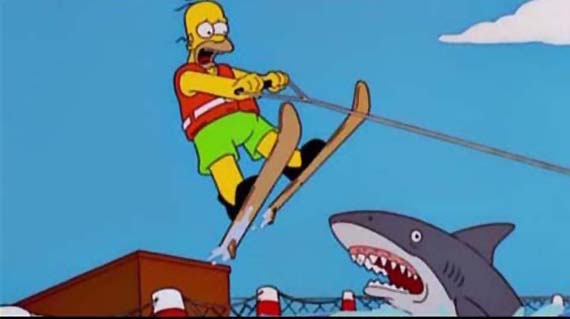
Summary:  Al Gore is Jumping the Shark

“Jumping the shark” is attempting to draw attention to or create publicity for something that is perceived as not warranting the attention, especially something that is believed to be past its peak in quality or relevance. The phrase originated with the TV series “Happy Days” when an episode had Fonzie doing a water ski jump over a shark. The stunt was intended to perk up the ratings, but it marked the show’s low point ahead of its demise.

Big Al’s Sequel: Flawed at its Core


maxresdefaultFortunately, box offices show few other than die-hard Gore fans are subjecting themselves to the Inconvenient Sequel. When people go to see cli-sci-fi (Climate Science Fiction) movies like Water World or Day After Tomorrow, they know in advance it will be someone’s imaginary portrayal of an undesirable future. The difference with Al Gore, and also with the writers of the draft US Climate Assessment is their claim that their imaginings are “the Truth.”

Despite the low box office numbers, the media will inundate us with flawed messages from the film, so this post is required for protection around the office water cooler or the kitchen table. Text below in italics are excerpts from Alex Epstein’s article in the Financial Post Al Gore can’t deny that his climate crusade involves great suffering  Alex Epstein: Gore has to make the case that climate dangers warrant so much human misery

Good Reasons to reject Al Gore’s alarms.

The running theme throughout An Inconvenient Sequel is that Gore’s first film was even more right than he expected. The movie begins with defenders of fossil fuels mocking or ignoring the dramatic predictions of An Inconvenient Truth. Leaving aside a heroic (and highly disputed) portrayal of Gore rescuing the Paris climate accord, the rest of the movie focuses on vindicating Gore’s two chief predictions: 1) That we could replace fossil fuels with cheap solar- and wind-powered “renewables”; and 2) that continued use of fossil fuels would lead to catastrophic temperature rises, catastrophic sea-level rises, catastrophic flooding, catastrophic drought, catastrophic storms, and catastrophic disease proliferation.

Let’s deal first with Gore’s second supposition.

Alarmists Substitute Models for Observations and Data

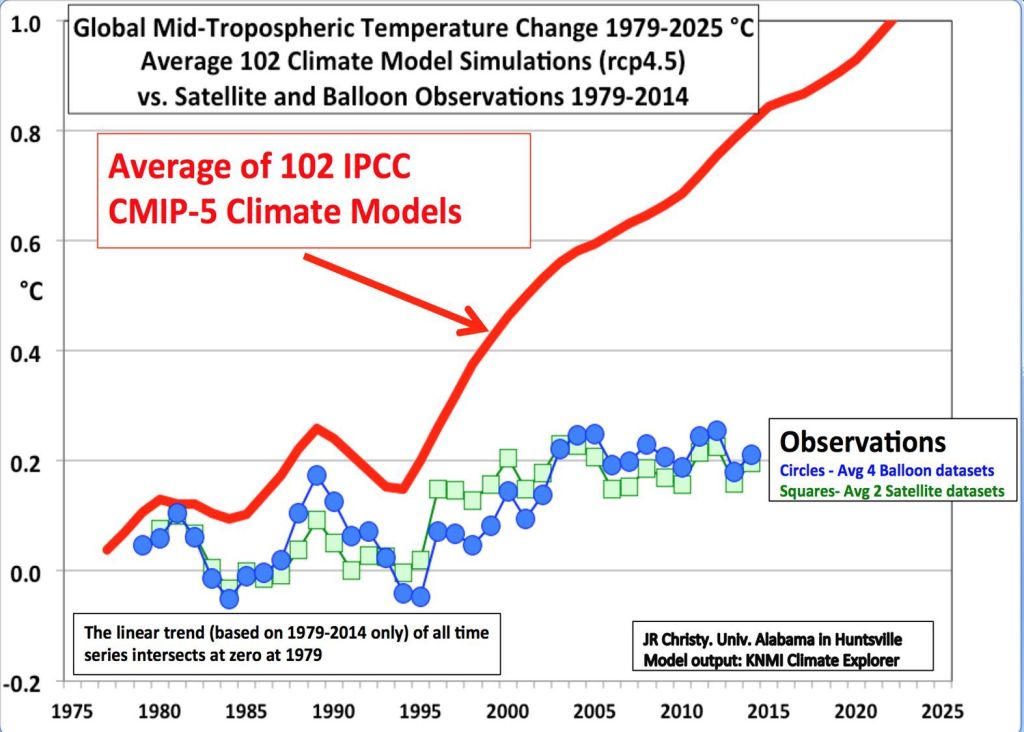
Since the last IPCC report (AR5), activists no longer respect what consensus scientists say. Observations and data are set aside, and only alarming projections from models count. As we know, computer simulations of the climate system are flawed, and running hotter than even adjusted global datasets. And we also know, since model outputs can only project modeler’s assumptions into the future, the models cannot prove the validity of those assumptions.

Berkeley physicist Richard Muller gives a mainstream scientist view of Gore’s claims.

“The problem is not with the survey, which asked a very general question. The problem is that many writers (and scientists!) look at that number and mis-characterize it. The 97% number is typically interpreted to mean that 97% accept the conclusions presented in An Inconvenient Truth by former Vice President Al Gore. That’s certainly not true; even many scientists who are deeply concerned by the small global warming (such as me) reject over 70% of the claims made by Mr. Gore in that movie (as did a judge in the UK; see footnote below).”

“I like to ask scientists who “believe” in global warming what they think of the data. Do they believe hurricanes are increasing? Almost never do I get the answer “Yes, I looked at that, and they are.” Of course they don’t say that, because if they did I would show them the actual data! Do they say, “I’ve looked at the temperature record, and I agree that the variability is going up”? No. Sometimes they will say, “There was a paper by Jim Hansen that showed the variability was increasing.” To which I reply, “I’ve written to Jim Hansen about that paper, and he agrees with me that it shows no such thing. He even expressed surprise that his paper has been so misinterpreted.”

“A really good question would be: “Have you studied climate change enough that you would put your scientific credentials on the line that most of what is said in An Inconvenient Truth is based on accurate scientific results? My guess is that a large majority of the climate scientists would answer no to that question, and the true percentage of scientists who support the statement I made in the opening paragraph of this comment, that true percentage would be under 30%. That is an unscientific guestimate, based on my experience in asking many scientists about the claims of Al Gore.”  Full text at Meet Richard Muller, Lukewarmist

Our Actual Climate is Mild and Not Dangerous

Nothing out of the ordinary is happening to our weather and climate, despite lots of claims otherwise. Gore’s sequel is long on anecdotes and fears, but lacks any references to the statistics contradicting him. Recent decades have been remarkably benign and agriculture is booming. IPCC scientists wrote that no evidence yet exists to connect extreme weather with human activities.  Alex Epstein:

Gore and others should be free to make the case that the danger of greenhouse gases is so serious as to warrant that scale of human misery. But they should have to quantify and justify the magnitude of climate danger. And that brings us to the truth about climate.

The overall trend in climate danger is that it is at an all-time low. The Emergency Events Database (EM-DAT) shows 6,114 climate-related deaths in 2016. In other recent years the numbers have maxed out in the tens of thousands. Compare this to the 1930s when, adjusted for population, climate-related deaths hit the 10-million mark several times.

The most significant cause of our radically reduced climate danger is industrial development, which takes a naturally dangerous climate and makes it unnaturally safe. And industrial development is driven by cheap, plentiful, reliable energy — which, today, overwhelmingly means fossil fuels. Climate will always be dangerous so priority number one is to have the energy and development to tame it. Modern irrigation, residential heating and air conditioning have made once uninhabitable places perfectly comfortable.

Controlling Human CO2 Emissions Will Not Change the Weather

The really inconvenient truth is that governments are not able to ensure favorable weather for humans. Nothing yet attempted, from corrupt carbon markets, to biofuels, to renewable electrical power, to carbon taxes has done anything beyond enriching cronies and filling government coffers.

Alex Epstein details Gore’s misdirecting us to renewables as our salvation.

Some of his anecdotes are meant to prove that cheap solar and wind are, as 2006 Gore prophesied, quickly dominating the world’s energy supply and, as 2006 Gore also warned us, that our rapidly warming climate is killing more and more people each year. But he has not given us the whole picture.

Take the rising dominance of solar and wind, which is used to paint supporters of fossil fuels as troglodytes, fools, and shills for Big Oil. The combined share of world energy consumption from renewables is all of two per cent. And it’s an expensive, unreliable, and therefore difficult-to-scale two per cent.

Because solar and wind are “unreliables,” they need to be backed up by reliable sources of power, usually fossil fuels, or sometimes non-carbon sources including nuclear and large-scale hydro power (all of which Gore and other environmentalists refuse to support). This is why every grid that incorporates significant solar and wind has more expensive electricity. Germans, on the hook for Chancellor Angela Merkel’s self-righteous anti-carbon commitments, are already paying three times the rates for electricity that Americans do.

Stories about “100-per-cent renewable” locations like Georgetown, Tex. are not just anecdotal evidence, they are lies. The Texas grid from which Georgetown draws its electricity is comprised of 43.7 per cent natural gas, 28.8 per cent coal, 12 per cent nuclear, and only 15.6 per cent renewable. Using a virtue-signalling gimmick pioneered by Apple, Facebook, and Google, Georgetown pays its state utility to label its grid electricity “renewable” — even though it draws its power from that fossil-fuel heavy Texas grid — while tarring others on the grid as “non-renewable.”

If we look at the overall trends instead of engaging in anecdotal manipulation we see that fossil fuel energy is the fastest-growing energy source in the world — still. Fossil fuels have never been more vital to human flourishing. There are 1,600 coal plants planned for the near future, which could increase international coal capacity 43 per cent. Advances in technology are making fossil fuels cleaner, safer, and more efficient than ever. To reduce their growth let alone to radically restrict their use — which is what Gore advocates — means forcing energy poverty on billions of people.

Conclusion

Gore’s Inconvenient Sequel gives a biased, self-serving, and convenient picture of fossil fuels and climate — convenient for Gore’s legacy, that is, but inconvenient for the billions his energy poverty policies will harm. As citizens, we must start demanding responsible thought leaders who will give us the whole picture that life-and-death energy and climate decisions require.

Note the contrast between Al Gore’s propaganda and Richard Lindzen’s short video:

Footnote:

Errors in “An Inconvenient Truth” Highlighted by UK High Court Judge Michael Burton:

1.) The sea level will rise up to 20 feet because of the melting of either West Antarctica or Greenland in the near future. (This “Armageddon scenario” would only take place over thousands of years, the judge wrote.)

2.) Some low-lying Pacific islands have been so inundated with water that their citizens have all had to evacuate to New Zealand. (“There is no evidence of any such evacuation having yet happened.”)

3.) Global warming will shut down the “ocean conveyor,” by which the Gulf Stream moves across the North Atlantic to Western Europe. (According to the Intergovernmental Panel on Climate Change, “it is very unlikely that the Ocean Conveyor will shut down in the future…”)

4.) There is a direct coincidence between the rise in carbon dioxide in the atmosphere and the rise in temperature over the last 650,000 years. (“Although there is general scientific agreement that there is a connection, the two graphs do not establish what Mr. Gore asserts.”)

5.) The disappearance of the snows on Mount Kilimanjaro is expressly attributable to global warming. (“However, it is common ground that, the scientific consensus is that it cannot be established that the recession of snows on Mount. Kilimanjaro is mainly attributable to human-induced climate change.”)

6.) The drying up of Lake Chad is a prime example of a catastrophic result of global warming. (“It is generally accepted that the evidence remains insufficient to establish such an attribution” and may be more likely the effect of population increase, overgrazing and regional climate variability.)

7.) Hurricane Katrina and the consequent devastation in New Orleans is because of global warming. (“It is common ground that there is insufficient evidence to show that.”)

8.) Polar bears are drowning because they have to swim long distances to find ice. (“The only scientific study that either side before me can find is one, which indicates that four polar bears have recently been found drowned because of a storm.”)

9.) Coral reefs all over the world are bleaching because of global warming and other factors. (“Separating the impacts of stresses due to climate change from other stresses, such as overfishing and pollution, was difficult.”)


Decoding Climate News


Definition of “Fake News”: When reporters state their own opinions instead of bearing witness to observed events.

Journalism professor David Blackall provides a professional context for investigative reporting I’ve been doing on this blog, along with other bloggers interested in science and climate change/global warming. His peer reviewed paper is Environmental Reporting in a Post Truth World. The excerpts below show his advice is good not only for journalists but for readers.  h/t GWPF, Pierre Gosselin

Overview: The Grand Transnational Narrative

The dominance of a ‘grand transnational narrative’ in environmental discourse (Mittal, 2012) over other human impacts, like deforestation, is problematic and is partly due to the complexities and overspecialization of climate modelling. A strategy for learning, therefore, is to instead focus on the news media: it is easily researched and it tends to act ‘as one driving force’, providing citizens with ‘piecemeal information’, making it impossible to arrive at an informed position about science, society and politics (Marisa Dispensa et al., 2003). After locating problematic news narratives, Google Scholar can then be employed to locate recent scientific papers that examine, verify or refute news media discourse.

The science publication Nature Climate Change this year, published a study demonstrating Earth this century warmed substantially less than computer-generated climate models predict.

Unfortunately for public knowledge, such findings don’t appear in the news. Sea levels too have not been obeying the ‘grand transnational narrative’ of catastrophic global warming. Sea levels around Australia 2011–2012 were measured with the most significant drops in sea levels since measurements began. . .The 2015–2016 El-Niño, a natural phenomenon, drove sea levels around Indonesia to low levels such that coral reefs were bleaching. The echo chamber of news repeatedly fails to report such phenomena and yet many studies continue to contradict mainstream news discourse.

facebook2bnew2blike2bbuttons2bfinal-970-80I will be arguing that a number of narratives need correction, and while I accept that the views I am about to express are not universally held, I believe that the scientific evidence does support them.

The Global Warming/Climate Change Narrative

The primary narrative in need of correction is that global warming alone (Lewis, 2016), which induces climate change (climate disruption), is due to the increase in global surface temperatures caused by atmospheric greenhouse gases. Instead, there are many factors arising from human land use (Pielke et al., 2016), which it could be argued are responsible for climate change, and some of these practices can be mitigated through direct public action.

Global warming is calculated by measuring average surface temperatures over time. While it is easy to argue that temperatures are increasing, it cannot be argued, as some models contend, that the increases are uniform throughout the global surface and atmosphere. Climate science is further problematized by its own scientists, in that computer modelling, as one component of this multi-faceted science, is privileged over other disciplines, like geology.

Scientific uncertainty arises from ‘simulations’ of climate because computer models are failing to match the actual climate. This means that computer models are unreliable in making predictions.

Published in the eminent journal Nature (Ma, et. al., 2017), ‘Theory of chaotic orbital variations confirmed by Cretaceous geological evidence’, provides excellent stimulus material for student news writing. The paper discusses the severe wobbles in planetary orbits, and these affect climate. The wobbles are reflected in geological records and show that the theoretical climate models are not rigorously confirmed by these radioisotopically calibrated and anchored geological data sets. Yet popular discourse presents Earth as harmonious: temperatures, sea levels and orbital patterns all naturally balanced until global warming affects them, a mythical construct. Instead, the reality is natural variability, the interactions of which are yet to be measured or discovered (Berger, 2013).

In such a (media) climate, it is difficult for the assertion to be made that there might be other sources, than a nontoxic greenhouse gas called carbon dioxide (CO2), that could be responsible for ‘climate disruption’. A healthy scientific process would allow such a proposition. Contrary to warming theory, CO2 levels have increased, but global average temperatures remain steady. The global average temperature increased from 1983 to 1998; then, it flat-lined for nearly 20 years. James Hansen’s Hockey Stick graph, with soaring and catastrophic temperatures, simply did not materialize.

As Keenan et al. (2016) found through using global carbon budget estimates, ground, atmospheric and satellite observations, and multiple global vegetation models that there is also now a pause in the growth rate of atmospheric CO2. They attribute this to increases in terrestrial sinks over the last decade, where forests consume the rising atmospheric CO2 and rapidly grow—the net effect being a slowing in the rate of warming from global respiration.

Contrary to public understanding, higher temperatures in cities are due to a phenomenon known as the ‘urban heat effect’ (Taha, 1997; Yuan & Bauer, 2007). Engines, air conditioners, heaters and heat absorbing surfaces like bitumen radiate heat energy in urban areas, but this is not due to the greenhouse effect. Problematic too are data sets like ocean heat temperatures, sea-ice thickness and glaciers: all of which are varied, some have not been measured or there are insignificant measurement time spans for the data to be reliable.

Contrary to news media reports, some glaciers throughout the world (Norway [Chinn et al., 2005] and New Zealand [Purdie et al., 2008]) are growing, while others shrink (Paul et al., 2007).

Conclusion

This is clearly a contentious topic. There are many agendas at play, with careers at stake. My view represents one side of the debate: it is one I strongly believe in, and is, I contend, supported by the science around deforestation, on the ground, rather than focusing almost entirely on atmosphere. However, as a journalism educator, I also recognize that my view, along with others, must be open to challenge, both within the scientific community and in the court of public opinion.

As a journalism educator, it is my responsibility to provide my students with the research skills they need to question—and test—the arguments put forward by the key players in any debate. Given the complexity of the climate warming debate, and the contested nature of the science that underpins both sides, this will provide challenges well into the future. It is a challenge our students should relish, particularly in an era when they are constantly being bombarded with ‘fake news’ and so-called ‘alternative facts’.

To do so, they need to understand the science. If they don’t, they need to at least understand the key players in the debate and what is motivating them. They need to be prepared to question these people and to look beyond their arguments to the agendas that may be driving them. If they don’t, we must be reconciled to a future in which ‘fake news’ becomes the norm.

Examples of my investigative reports are in Data Vs. Models posts listed at Climate Whack-a-Mole

See also Yellow Climate Journalism

Climate Risky Business

A new theme emerging out of the IPCC Fifth Report was the emphasis on selling the risk of man-made climate change. The idea is that scientists should not advocate policy, but do have a responsibility to convince the public of the risks resulting from burning fossil fuels.

An article illustrates how this approach shapes recent public communications in support of actions on global warming/climate change.  Treading the Fine Line Between Climate Talk and Alarmism (Op-Ed)  By Sarah E. Myhre, Ph.D. | June 23, 2017.  Excerpts:

What is our role in public leadership as scientists? I would suggest a few action items: Work to reduce risk and cost for the public; steward the public’s interest in evidence; and be steady and committed to the scientific process of dissent, revision and discovery. This means communicating risk when necessary. We would never fault an oncologist for informing patients about the cancer risks that come with smoking. Why would we expect Earth scientists to be any different, when we’re just as certain?

As a public scholar with expertise in paleoclimate science, I communicate alarming, difficult information about the consequences to Earth and ocean systems that have come with past events of abrupt climate warming. As the saying goes, the past is the key to the future. 

We are living through a crisis of trust between the American public and climate scientists, and we must extend ourselves, as scientists and public servants, to rebuild transparency and trust with the public. I will start: I want the global community to mitigate the extreme risk of the warmest future climate scenarios. And, I want my kid to eat salmon and ski with his grandkids in the future. I am invested in that cooler, safer, more sustainable future — for your kids and for mine. Just don’t call me an alarmist.

This provides a teachable moment concerning the rhetorical maneuver to present climate as a risky business. The technique typically starts with a particular instance of actual risk and then makes a gross generalization so that the risk is exaggerated beyond reason.  From the article above:

Climate scientists are just as certain as oncologists are.

Herein lies the moral of this tale. The particular risk is the convincing epidemiological evidence linking lung cancer to smokers. The leap was claiming second-hand smoke puts non-smokers at risk of cancer. The statistical case was never conclusive, but the public was scared into enacting all kinds of smoke-free spaces.

Very few passive smoking/lung cancer studies are published these days compared to the glut of the 1980s and 1990s, but the handful that have appeared in recent years continue to support the null hypothesis. For all the campaigners’ talk of “overwhelming evidence”, the link between secondhand smoke and lung cancer has always been very shaky. It tends to be the smaller, case-control studies which find the associations while the larger, cohort studies do not (and, as the JNCI report notes, case-control studies “can suffer from recall bias: People who develop a disease that might be related to passive smoking are more likely to recall being exposed to passive smoking.”)

Gerard Silvestri, MD, of the Medical University of South Carolina, a member of NCI’s PDQ Screening and Prevention Editorial Board said (here):

“We’ve gotten smoking out of bars and restaurants on the basis of the fact that you and I and other nonsmokers don’t want to die,” said Silvestri. “The reality is, we probably won’t.”

To be clear, I don’t want smokers fouling my space in restaurants, and the policies are beneficial to me esthetically. But there was never any certainty about my risk of cancer, just the spoiling of clean air around me.  What was a matter of opinion and personal preference was settled politically by asserting scientific certainty of my health risk.

To draw the point finely, secondhand smoke shows how science is used by one group (anti-smoking activists) against another group (smokers) by mobilizing support for regulations on the basis of a generalized risk, raising concerns among the silent majority who otherwise were not particularly interested in the issue.

Climate as a Risky Business

Environmentalists have often employed risk exaggeration, beginning with Rachel Carson’s Silent Spring full of innuendo about DDT without any actual epidemiological proof. Currently Junk Science provides a list of EPA exaggerations about environmental pollution, for example The scientific fraud that claims air pollution is killing people

In the climate field, any flat Polynesian island is of course at risk of flooding, and thus by extension they produce images of Manhattan under water. Global risk is trumpeted, ignoring all the local particularities of land subsidence, tidal gauge records, terrain drainage features, infrastructure, precipitation patterns, etc.

Any storm, drought, flood, or unusual weather likewise presents a particular risk in the locale where it occurs. The gross exaggeration is to claim that we are increasing the risk of all these events, and by stopping burning fossil fuels we can prevent them from happening.

Sarah Myhre’s research focuses on ocean dead zones (oxygen-depleted waters), which is a real and long-studied risk. Then comes her leap into the fearful future:

The surface and deep ocean will continue to absorb heat and CO2 from the atmosphere. The heating of the ocean will increase the stratification of water (i.e. ocean mixing will be reduced, as will the strength of thermohaline circulation). Ocean heating will also drive the thermal expansion of the interior of the ocean – this is one of the primary contributors to sea level rise.

The absorption of CO2 from the atmosphere will drive changes in the chemistry of surface and deep waters – there are significant biological consequences to acidifying the global surface ocean. Basically, we are looking at the fundamental reorganization of biological communities and ecological provinces in the ocean. These physical drivers (warming, stratification, acidification) all area associated with significant biological consequences.

This is a continuation of a scare called Climate Change Is Suffocating The Oceans.  Once again climate alarmists/activists have seized upon an actual environmental issue, but misdirect the public toward their CO2 obsession, and away from practical efforts to address a real concern. Some excerpts from scientific studies serve to put things in perspective.  See Ocean Oxygen Misdirection

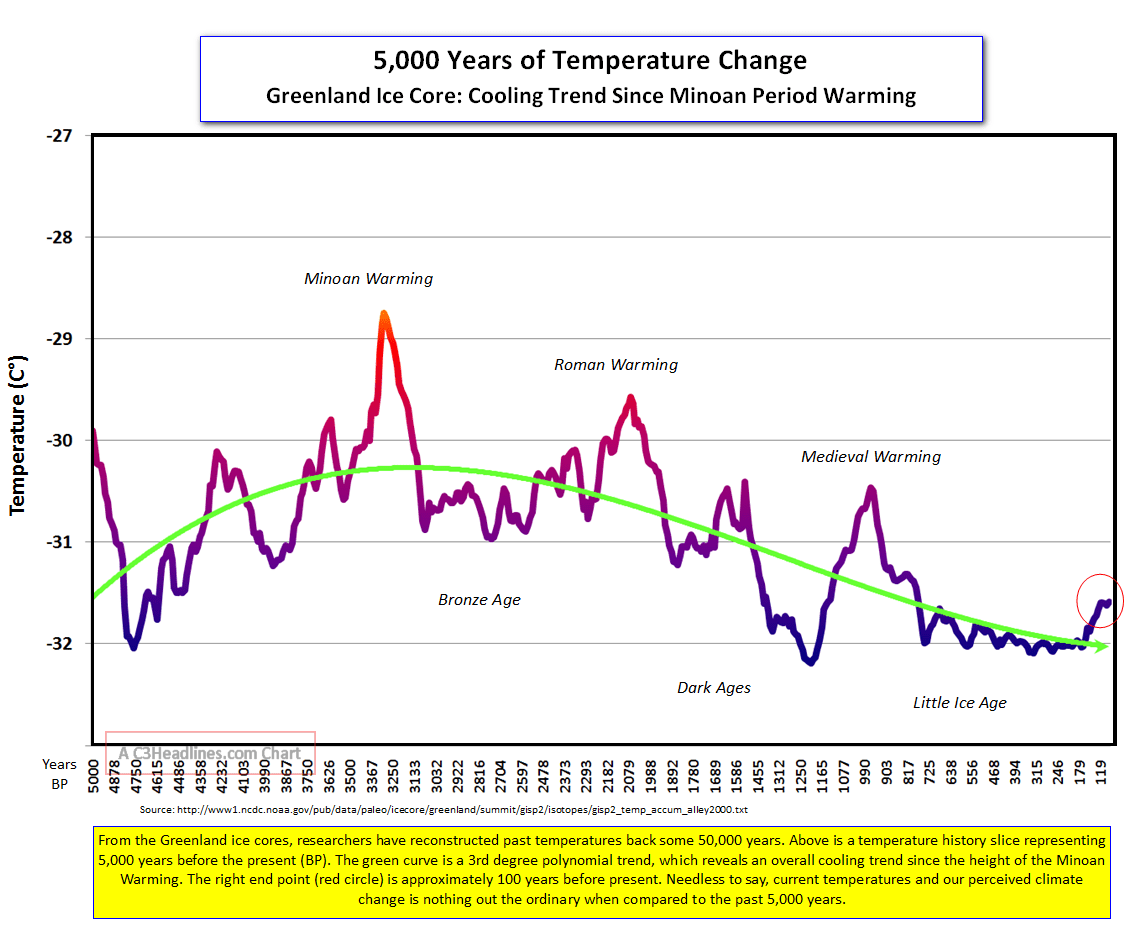
As a paleoclimate expert the author knows the climate and sea levels have changed many times in the past, and often shifted quickly in geological terms.

And yet the evidence shows clearly that CO2 follows as an effect of changing temperatures, not the cause.

Summary

Warmists are of the opinion that because of burning fossil fuels, our modern climate no longer compares to paleoclimates, a claim in fact that humans are overriding natural forces. But the message from the ice cores is clear: Through the ages, CO2 responds to temperatures and not the other way around.

The other message is also clear: Climates change between warm and cool, and warm has always been good for humans and the biosphere. We should concern ourselves with Adaptation, preparing for the cold times with robust infrastructure and reliable, affordable energy.

See also CO2 and Climate Change for the Ages

See also Claim: Fossil Fuels Cause Global Warming
Updated 2017  Fossil Fuels ≠ Global Warming

Footnote:

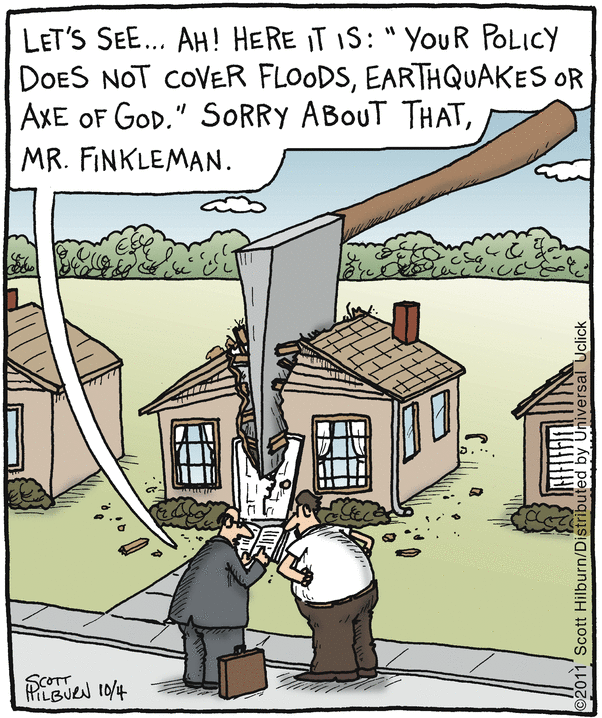
Actuaries are accountants specialized in risk statistics like morbidity and mortality, usually working in the insurance industry.

Question:  What is the difference between an Actuary and an Auditor?
Answer:  The Auditor is the one with a sense of humor.
(Old joke from days working at KPMG)


NYT Opens Climate Can of Worms


Fishermen often discovered how easy it was to open a can of bait worms, and how difficult it was to close them. Once the worms discovered an opportunity to escape, it became nearly impossible to keep them contained. Some experts say the metaphor is a modern extension of Pandora’s Box.

In a previous post NYT Readers Face Diversity I provided a background for New York Times newest columnist Bret Stephens, with emphasis on his climate change commentary.

Now his first column published in NYT appears Climate of Complete Certainty, an invitation to examine the facts about climate change. Excerpts below.

We live in a world in which data convey authority. But authority has a way of descending to certitude, and certitude begets hubris. From Robert McNamara to Lehman Brothers to Stronger Together, cautionary tales abound.

We ought to know this by now, but we don’t. Instead, we respond to the inherent uncertainties of data by adding more data without revisiting our assumptions, creating an impression of certainty that can be lulling, misleading and often dangerous. Ask Clinton.

With me so far? Good. Let’s turn to climate change.

Last October, the Pew Research Center published a survey on the politics of climate change. Among its findings: Just 36 percent of Americans care “a great deal” about the subject. Despite 30 years of efforts by scientists, politicians and activists to raise the alarm, nearly two-thirds of Americans are either indifferent to or only somewhat bothered by the prospect of planetary calamity.

Why? The science is settled. The threat is clear. Isn’t this one instance, at least, where 100 percent of the truth resides on one side of the argument?

Well, not entirely. As Andrew Revkin wrote last year about his storied career as an environmental reporter at The Times, “I saw a widening gap between what scientists had been learning about global warming and what advocates were claiming as they pushed ever harder to pass climate legislation.” The science was generally scrupulous. The boosters who claimed its authority weren’t.

Anyone who has read the 2014 report of the Intergovernmental Panel on Climate Change knows that, while the modest (0.85 degrees Celsius, or about 1.5 degrees Fahrenheit) warming of the Northern Hemisphere since 1880 is indisputable, as is the human influence on that warming, much else that passes as accepted fact is really a matter of probabilities. That’s especially true of the sophisticated but fallible models and simulations by which scientists attempt to peer into the climate future. To say this isn’t to deny science. It’s to acknowledge it honestly.

By now I can almost hear the heads exploding. They shouldn’t, because there’s another lesson here — this one for anyone who wants to advance the cause of good climate policy. As Revkin wisely noted, hyperbole about climate “not only didn’t fit the science at the time but could even be counterproductive if the hope was to engage a distracted public.”

Let me put it another way. Claiming total certainty about the science traduces the spirit of science and creates openings for doubt whenever a climate claim proves wrong. Demanding abrupt and expensive changes in public policy raises fair questions about ideological intentions. Censoriously asserting one’s moral superiority and treating skeptics as imbeciles and deplorables wins few converts.

None of this is to deny climate change or the possible severity of its consequences. But ordinary citizens also have a right to be skeptical of an overweening scientism. They know — as all environmentalists should — that history is littered with the human wreckage of scientific errors married to political power.

Conclusion

I’ve taken the epigraph for this column from the Polish poet Czeslaw Milosz, who knew something about the evils of certitude. Perhaps if there had been less certitude and more second-guessing in Clinton’s campaign, she’d be president. Perhaps if there were less certitude about our climate future, more Americans would be interested in having a reasoned conversation about it.

New York Post (here) covers the nastiness of responses to Stephens’ first column. Stephens compares the blowback to what he got from Trump fans: “After 20 months of being harangued by bullying Trump supporters, I’m reminded that the nasty left is no different. Perhaps worse,” Stephens tweeted Friday afternoon, as the hateful messages kept rolling in.  New York Times used to be a “safe space”, maybe now not so much.

Bret Stephens

Update April 30

A response to Stephens article at Slate  Inside a True Believer’s Mind

Footnote:

Whenever I see those graphs of climate models projections, it reminds me of worms escaping.

Climate Evangelists Are Taking Over Your Local Weather Forecast

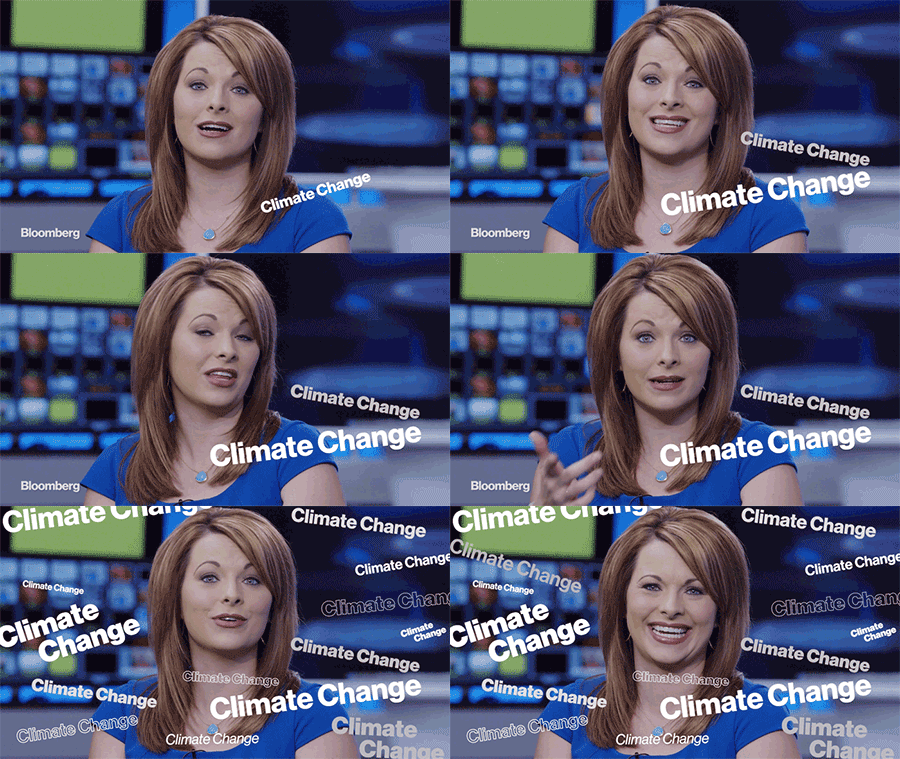
The battle by alarmists for hearts and minds is extending to many fronts, including recruiting family doctors, and in the case of this post, media weather reporters. Surveys have shown the meteorologists are not more convinced of global warming/climate change than is the American public (a slight majority). But efforts have been underway to convert them and use their telecasts and columns to promote climatism.

A balanced and analytical report appears in Bloomberg (an interesting place for such independent thinking).  Climate Evangelists Are Taking Over Your Local Weather Forecast Excerpts below.

Amber Sullins gets a minute or two to tell up to two million people about some extremely complicated science, using the tools of her trade: a pleasant voice, a green screen, and small icons denoting sun, clouds, rain, and wind. She is the chief meteorologist at ABC15 News in Phoenix, so her forecasts mostly call for sunshine. Within this brief window, however, Sullins sometimes manages to go beyond the next five days. Far beyond.

Amber Sullins, weather reporter at ABC15 News in Phoenix.

“We know climate change could affect everything about the way we live in the future, from agriculture and tourism to productivity and local business,” she once noted. “But at what cost?”

It was a 35-second segment in a nightly newscast, a mundane moment preceding reports about three fallen firefighters in Washington state and a dangerous development for air travelers. But that climate-focused scene, and hundreds of others like it playing out at local news stations across the country, marks a major shift in the way Americans hear about climate change. The safe and familiar on-air meteorologist, with little notice by viewers, has become a public diplomat for global warming.

There are about 500 broadcasters like Sullins and Morales, who each receive regular data dumps and ready-to-use graphics from Climate Matters, an organization whose mission is to turn TV meteorologists into local climate educators. The program was founded in 2010 by Climate Central, a research-and-journalism nonprofit, with help from George Mason University, the American Meteorological Society, and others. Newscasters who participate are sent possible topics for climate-related segments every week, with TV-ready data and graphics pegged to large-scale meteorological events, such as unusually high heat or precipitation, local trends, or seasonal themes.

Two-thirds of 18- to 64-year-olds in the U.S. watch a news broadcast, either on TV or a digital device, at least once a week, according to 2015 research by the market research company SmithGeiger LLC. Nearly 40 percent of people within this wide age group watch broadcast news on daily basis, and the reliable presence of an on-air meteorologist is a huge part of the draw.

“Local TV news wouldn’t exist any more if it weren’t for the weathercasts,” says Ed Maibach, director of George Mason University’s Center for Climate Change Communication.

Part of meteorologists’ reluctance to talk about the climate stems from the treacherous tools of their trade. Meteorologists learn very quickly that weather models are messy. Some no doubt sour on finicky climate models because of this experience. If short-term weather models make mistakes, it may seem reasonable to assume that a model projecting into the next century is ridiculous.

“Meteorologists are used to looking at models and being burned,” says Paul Douglas, a former TV weatherman-turned-serial entrepreneur, who recently published a book on climate change and faith.

Sullins, 34, knows there’s tension in telling her viewers about conditions in the 22nd century when she is reluctant to commit to a two-week forecast. “I can’t tell you what the high temperature is going to be on July 4 of this year, today,” Sullins says. “I can’t possibly tell you that. But I can tell you, based on climate, that in July, here in Phoenix, it’s going to be over 100 degrees. That’s easy.”

Her point is that weather and climate are “two entirely different beasts.” It’s like the difference between someone’s mood and disposition, Sullins says. She wants viewers of the nightly news to spend more time thinking about the planet’s disposition.

Summary

The PR campaign continues and intensifies with simplistic soundbites to persuade people to fear the future, in order to advance the anti-fossil fuel agenda. It is a Chinese water torture program well-funded and essential to the climate crisis industry.

But note the logical fallacy in Sullins’ statement above. She says: “I can tell you, based on climate, that in July, here in Phoenix, it’s going to be over 100 degrees.” That’s not climate change, that’s climate stability, something we depend on despite the fear-mongering.

How will viewers respond to this?  Will ratings improve by watching weather people jumping the shark? (It didn’t work for “Happy Days” TV show).  Or will people resent the attempted brainwashing and switch channels?

Footnote:

The hottest temperatures ever reported in Phoenix came in January 2015, when Fox 10 weatherman Cory McCloskey faced a malfunctioning temperature map on live television. “Wow, 750 degrees in Gila Bend right now,” he said, without breaking a sweat. “And 1,270 in Ahwatukee. Now, I’m not authorized to evacuate, but this temperature seems pretty high.” More than 6 million people have watched the blooper on YouTube.


NYT Readers Face Diversity


Imaginary Enemies

A lot of fuss is in the media about the New York Times hiring Bret Stephens from the Washington Post. Stephens won the 2013 Pulitzer Prize for commentary, is regarded as a conservative, and has written critically about Trump, as well as liberals. In particular he has poked fun repeatedly at the climatism hysteria. For this latter point, the climate faithful are up in arms about the prospect of Stephens columns appearing on pages of NYT (a kind of bible for liberals and environmentalists).

For sure Bret Stephens is as outspoken as Mark Steyn, but with his own preoccupations and style. To see what might be in store for NYT readers, let’s look at some excerpts of his commentary regarding global warming/climate change. Note: Washington Post has a paywall, so links to these articles go to blogsites where the full text is available.

In 2014 Stephens published Climate Prophets and Profiteers, which gives an idea where he is coming from.

It is now the dogma of the left that any hint of doubt when it comes to predictions of climate doom is evidence of greed, stupidity, moral turpitude or psychological derangement. “Climate denial” is intended to be the equivalent of Holocaust denial. And yet the only people who’ve predicted anything right so far are those who foresaw that the Kyoto Protocol would fail, that renewable energies didn’t really work, and that climate bureaucrats accountable to nobody but their own sense of virtue and taste for profit were a danger to everyone.

Rereading Mr. Kerry’s speech, I have to say he really does come across as a true believer. That it begins by citing Maurice Strong, the ultimate cynic, tells you what you need to know about where this strain of true belief leads.

On Climate Religion

In a November 2011 column The great global warming fizzle, Stephens described ‘the case of global warming’ as a ‘system of doomsaying prophecy and faith in things unseen’ that, like religion, ‘is susceptible to the earthly temptations of money, power, politics, arrogance and deceit.’

Consider the case of global warming, another system of doomsaying prophecy and faith in things unseen.

As with religion, it is presided over by a caste of spectacularly unattractive people pretending to an obscure form of knowledge that promises to make the seas retreat and the winds abate. As with religion, it comes with an elaborate list of virtues, vices and indulgences. As with religion, its claims are often non-falsifiable, hence the convenience of the term “climate change” when thermometers don’t oblige the expected trend lines. As with religion, it is harsh toward skeptics, heretics and other “deniers.” And as with religion, it is susceptible to the earthly temptations of money, power, politics, arrogance and deceit.

This week, the conclave of global warming’s cardinals are meeting in Durban, South Africa, for their 17th conference in as many years. The idea is to come up with a successor to the Kyoto Protocol, which is set to expire next year, and to require rich countries to pony up $100 billion a year to help poor countries cope with the alleged effects of climate change. This is said to be essential because in 2017 global warming becomes “catastrophic and irreversible,” according to a recent report by the International Energy Agency. (my bold)

Yet a funny thing happened on the way to the climate apocalypse. Namely, the financial apocalypse.

All this has been enough to put the Durban political agenda on hold for the time being. But religions don’t die, and often thrive, when put to the political sidelines. A religion, when not physically extinguished, only dies when it loses faith in itself.

On Climategate Emails

That’s where the Climategate emails come in. First released on the eve of the Copenhagen climate summit two years ago and recently updated by a fresh batch, the “hide the decline” emails were an endless source of fun and lurid fascination for those of us who had never been convinced by the global-warming thesis in the first place.

But the real reason they mattered is that they introduced a note of caution into an enterprise whose motivating appeal resided in its increasingly frantic forecasts of catastrophe. Papers were withdrawn; source material re-examined. The Himalayan glaciers, it turned out, weren’t going to melt in 30 years. Nobody can say for sure how high the seas are likely to rise—if much at all. Greenland isn’t turning green. Florida isn’t going anywhere.

The reply global warming alarmists have made to these dislosures is that they did nothing to change the underlying science, and only improved it in particulars. So what to make of the U.N.’s latest supposedly authoritative report on extreme weather events, which is tinged with admissions of doubt and uncertainty? Oddly, the report has left climate activists stuttering with rage at what they call its “watered down” predictions. If nothing else, they understand that any belief system, particularly ones as young as global warming, cannot easily survive more than a few ounces of self-doubt.

Meanwhile, the world marches on. On Sunday, 2,232 days will have elapsed since a category 3 hurricane made landfall in the U.S., the longest period in more than a century that the U.S. has been spared a devastating storm. Great religions are wise enough to avoid marking down the exact date when the world comes to an end. Not so for the foolish religions. Expect Mayan cosmology to take a hit to its reputation when the world doesn’t end on Dec. 21, 2012. Expect likewise when global warming turns out to be neither catastrophic nor irreversible come 2017.

And there is this: Religions are sustained in the long run by the consolations of their teachings and the charisma of their leaders. With global warming, we have a religion whose leaders are prone to spasms of anger and whose followers are beginning to twitch with boredom. Perhaps that’s another way religions die.

Climate Crisis as a Liberal Imaginary Enemy

Stephens fully disclosed his views at the time of Paris COP in Liberalism’s Imaginary Enemies In Paris, it’s easier to battle a climate crisis than confront jihadists on the streets.

Little children have imaginary friends. Modern liberalism has imaginary enemies.

Hunger in America is an imaginary enemy. Liberal advocacy groups routinely claim that one in seven Americans is hungry—in a country where the poorest counties have the highest rates of obesity. The statistic is a preposterous extrapolation from a dubious Agriculture Department measure of “food insecurity.” But the line gives those advocacy groups a reason to exist while feeding the liberal narrative of America as a savage society of haves and have nots.

The campus-rape epidemic—in which one in five female college students is said to be the victim of sexual assault—is an imaginary enemy. Never mind the debunked rape scandals at Duke and the University of Virginia, or the soon-to-be-debunked case at the heart of “The Hunting Ground,” a documentary about an alleged sexual assault at Harvard Law School. The real question is: If modern campuses were really zones of mass predation—Congo on the quad—why would intelligent young women even think of attending a coeducational school? They do because there is no epidemic. But the campus-rape narrative sustains liberal fictions of a never-ending war on women.

Institutionalized racism is an imaginary enemy. Somehow we’re supposed to believe that the same college administrators who have made a religion of diversity are really the second coming of Strom Thurmond. Somehow we’re supposed to believe that twice electing a black president is evidence of our racial incorrigibility. We’re supposed to believe this anyway because the future of liberal racialism—from affirmative action to diversity quotas to slavery reparations—requires periodic sightings of the ghosts of a racist past.

I mention these examples by way of preface to the climate-change summit that began this week in Paris. But first notice a pattern.

Dramatic crises—for which evidence tends to be anecdotal, subjective, invisible, tendentious and sometimes fabricated—are trumpeted on the basis of incompetently designed studies, poorly understood statistics, or semantic legerdemain. Food insecurity is not remotely the same as hunger. An abusive cop does not equal a bigoted police department. An unwanted kiss or touch is not the same as sexual assault, at least if the word assault is to mean anything.

Yet bogus studies and statistics survive because the cottage industries of compassion need them to be believed, and because mindless repetition has a way of making things nearly true, and because dramatic crises require drastic and all-encompassing solutions. Besides, the thinking goes, falsehood and exaggeration can serve a purpose if it induces virtuous behavior. The more afraid we are of the shadow of racism, the more conscious we might become of our own unsuspected biases.

And so to Paris.

I’m not the first to notice the incongruity of this huge gathering of world leaders meeting to combat a notional enemy in the same place where a real enemy just inflicted so much mortal damage.

Then again, it’s also appropriate, since reality-substitution is how modern liberalism conducts political business. What is the central liberal project of the 21st century, if not to persuade people that climate change represents an infinitely greater threat to human civilization than the barbarians—sorry, violent extremists—of Mosul and Molenbeek? Why overreact to a few hundred deaths today when hundreds of thousands will be dead in a century or two if we fail to act now?

Here again the same dishonest pattern is at work. The semantic trick in the phrase “climate change”—allowing every climate anomaly to serve as further proof of the overall theory. The hysteria generated by an imperceptible temperature rise of 1.7 degrees Fahrenheit since 1880—as if the trend is bound to continue forever, or is not a product of natural variation, or cannot be mitigated except by drastic policy interventions. The hyping of flimsy studies—melting Himalayan glaciers; vanishing polar ice—to press the political point. The job security and air of self-importance this provides the tens of thousands of people—EPA bureaucrats, wind-turbine manufacturers, litigious climate scientists, NGO gnomes—whose livelihoods depend on a climate crisis. The belief that even if the crisis isn’t quite what it’s cracked up to be, it does us all good to be more mindful about the environment.

And, of course, the chance to switch the subject. If your enemy is global jihad, then to defeat it you need military wherewithal, martial talents and political will. If your enemy is the structure of an energy-intensive global economy, then you need a compelling justification to change it. Climate dystopia can work wonders, provided the jihadists don’t interrupt too often.

Here’s a climate prediction for the year 2115: Liberals will still be organizing campaigns against yet another mooted social or environmental crisis. Temperatures will be about the same.

Bret Louis Stephens is an American journalist who won a Pulitzer Prize for commentary in 2013. He works for The Wall Street Journal as the foreign-affairs columnist and the deputy editorial page editor and is responsible for the editorial pages of its European and Asian editions.

Summary

Wow! A full-throated, articulate conservative and climate unbeliever writing columns for the New York Times. His views both on liberalism and on climatism will be repulsive to many of the readers, who profess to be “liberal thinkers” but who are closed to all but “our kind of people”. What will they allow Stephens to write about? Will he last longer than lukewarmist Roger Pielke Jr. did at 538 blog (one column)?

Stay tuned.

For Further Reading

In 2008 column Al Gore’s Doomsday Clock, Stephens wrote:

What manner the catastrophe might take isn’t yet clear, but the scenarios are grim: The climate crisis is getting worse faster than anticipated; global warming will cause refugee crises and destabilize entire nations…. And so on.

In 2009 Climategate: Follow the Money Stephens gave the subheading:

Climate change researchers must believe in the reality of global warming just as a priest must believe in the existence of God.

A week later in 2009 came Global warming and the psychology of true belief. This time Stephens wrote: ‘

Last week, I suggested that funding flows had much to do with climate alarmism. But deeper things are at work as well. One of those things, I suspect, is what I would call the totalitarian impulse.

In April 2010 came What’s the Next ‘Global Warming’? Herewith I propose a contest to invent the next panic.

Stephens declared that ‘global warming is dead, nailed into its coffin one devastating disclosure, defection and re-evaluation at a time.’ He predicted that this meant ‘that pretty soon we’re going to need another apocalyptic scare to take its place.’ He offered the wager that ‘within a few years ‘climate change’ will exercise global nerves about as much as overpopulation, toxic tampons, nuclear winters, ozone holes, killer bees, low sperm counts, genetically modified foods and mad cows do today.’
 

Skeptical Journalist Spotted, Species Feared Extinct

Just spotted this article:

A Skeptic’s View on Climate Models
By Ross Pomeroy January 23, 2017 in Real Clear Science

I like to think that I’m a good skeptic. I’ve read every word of Carl Sagan’s timeless Demon Haunted World. I almost always ask for evidence. I employ the scientific method to guide my actions. I try to think critically. I’m willing to admit when “I don’t know”. I question bold and crazy claims. And most importantly, I try not to let my ideology sway which claims I question. That’s why, as a skeptic, and as a firm advocate of science, I simply cannot accept the following claims without some level of incredulity:

“The next few decades offer a brief window of opportunity to minimize large-scale and potentially catastrophic climate change that will extend longer than the entire history of human civilization thus far.”

“The forest as we know it would effectively be gone.”

“We will have very few humans on the planet because of lack of habitat.”

Each of the preceding statements are bold, apocalyptic claims concerning climate change, and there are many more like them littered across the Internet. But just because they are widespread and originate from respectable, legitimate scientists, that does not mean I can simply switch off my skepticism. I must subject these claims to the same scrutiny that I would acupuncture, chiropractic, or demons. And when I do, I can only conclude that most claims of catastrophic, apocalyptic climate change are bogus.

But when it comes to portending doom and gloom, the tools scientists use — namely atmosphere and oceanic general circulation models — are woefully insufficient to render specific predictions about the future. The Earth is big, with so many moving parts it would make your head spin. Modeling its climate is a monumental task, and frankly, it’s impossible to do so with complete and total accuracy. Climate scientists try their best, taking into account variables such as cloud cover, albedo, water movement, radiation, and surface pressure. Unfortunately, as climate scientists alter their models to take into account more variables, some of which are poorly understood or difficult to measure, they introduce more sources of uncertainty.

To see if their models work, climatologists validate them against past data, figuring that if they match the past, they can predict the future. But there probably has never been a situation in the history of our planet where carbon dioxide has been the primary culprit of climate change. In other situations (most commonly volcanic eruptions) numerous other greenhouse gases also greatly increased the rate of heating. It’s really hard to build a model for a situation for which there is little historical precedent.

What does all of this mean? It means that anyone who says they know that climate change will result in (insert apocalyptic scenario here) is not making claims based on solid evidence.

Summary

The whole article is worth a read. He comes out at the end a lukewarmist while skeptical of climate models and dismissive of alarmist claims.


Steven “Ross” Pomeroy is Chief Editor of RealClearScience. A zoologist and conservation biologist by training, Ross has nurtured a passion for journalism and writing his entire life. Ross weaves his insatiable curiosity and passion for science into regular posts and articles on RealClearScience’s Newton Blog. Additionally, his work has appeared in Science Now and Scientific American.

For more on how climate models work see Climate Models Explained, an extended comment by Dr. R.G. Brown of Duke University.


Meet Richard Muller, Lukewarmist

Richard Muller, head of the Berkeley Earth project, makes a fair and balanced response to a question regarding the “97% consensus.”  Are any of the US Senators listening?  Full text below from Forbes 97%: An Inconvenient Truth About The Oft-Cited Polling Of Climate Scientists including a reference to Will Happer, potentially Trump’s science advisor.

Read it and see that he sounds a lot like Richard Lindzen.

What are some widely cited studies in the news that are false?

Answer by Richard Muller, Professor of Physics at UC Berkeley, on Quora:

That 97% of all climate scientists accept that climate change is real, large, and a threat to the future of humanity. That 97% basically concur with the vast majority of claims made by Vice President Al Gore in his Nobel Peace Prize winning film, An Inconvenient Truth.

The question asked in typical surveys is neither of those. It is this: “Do you believe that humans are affecting climate?” My answer would be yes. Humans are responsible for about a 1 degree Celsius rise in the average temperature in the last 100 years. So I would be included as one of the 97% who believe.

Yet the observed changes that are scientifically established, in my vast survey of the science, are confined to temperature rise and the resulting small (4-inch) rise in sea level. (The huge “sea level rise” seen in Florida is actually subsidence of the land mass, and is not related to global warming.) There is no significant change in the rate of storms, or of violent storms, including hurricanes and volcanoes. The temperature variability is not increasing. There is no scientifically significant increase in floods or droughts. Even the widely reported warming of Alaska (“the canary in the mine”) doesn’t match the pattern of carbon dioxide increase–it may have an explanation in terms of changes in the northern Pacific and Atlantic currents. Moreover, the standard climate models have done a very poor job of predicting the temperature rise in Antarctica, so we must be cautious about the danger of confirmation bias.

My friend Will Happer believes that humans do affect the climate, particularly in cities where concrete and energy use cause what is called the “urban heat island effect.” So he would be included in the 97% who believe that humans affect climate, even though he is usually included among the more intense skeptics of the IPCC. He also feels that humans cause a small amount of global warming (he isn’t convinced it is as large as 1 degree), but he does not think it is heading towards a disaster; he has concluded that the increase in carbon dioxide is good for food production, and has helped mitigate global hunger. Yet he would be included in the 97%.

The problem is not with the survey, which asked a very general question. The problem is that many writers (and scientists!) look at that number and mischaracterize it. The 97% number is typically interpreted to mean that 97% accept the conclusions presented in An Inconvenient Truth by former Vice President Al Gore. That’s certainly not true; even many scientists who are deeply concerned by the small global warming (such as me) reject over 70% of the claims made by Mr. Gore in that movie (as did a judge in the UK; see the following link: Gore climate film’s nine ‘errors‘).

varv101407a

The pollsters aren’t to blame. Well, some of them are; they too can do a good poll and then misrepresent what it means. The real problem is that many people who fear global warming (include me) feel that it is necessary to exaggerate the meaning of the polls in order to get action from the public (don’t include me).

There is another way to misrepresent the results of the polls. Yes, 97% of those polled believe that there is human caused climate change. How did they reach that decision? Was it based on a careful reading of the IPCC report? Was it based on their knowledge of the potential systematic uncertainties inherent in the data? Or was it based on their fear that opponents to action are anti-science, so we scientists have to get together and support each other. There is a real danger in people with Ph.D.s joining a consensus that they haven’t vetted professionally.

I like to ask scientists who “believe” in global warming what they think of the data. Do they believe hurricanes are increasing? Almost never do I get the answer “Yes, I looked at that, and they are.” Of course they don’t say that, because if they did I would show them the actual data! Do they say, “I’ve looked at the temperature record, and I agree that the variability is going up”? No. Sometimes they will say, “There was a paper by Jim Hansen that showed the variability was increasing.” To which I reply, “I’ve written to Jim Hansen about that paper, and he agrees with me that it shows no such thing. He even expressed surprise that his paper has been so misinterpreted.”

A really good question would be: “Have you studied climate change enough that you would put your scientific credentials on the line that most of what is said in An Inconvenient Truth is based on accurate scientific results? My guess is that a large majority of the climate scientists would answer no to that question, and the true percentage of scientists who support the statement I made in the opening paragraph of this comment, that true percentage would be under 30%. That is an unscientific guestimate, based on my experience in asking many scientists about the claims of Al Gore.

This question originally appeared on Quora. the place to gain and share knowledge, empowering people to learn from others and better understand the world.

Compare Muller’s statement with a short video by Lindzen.


Yellow Climate Journalism


Definition of “Fake News”:  When reporters state their own opinions instead of bearing witness to observed events.

We are now fully entrenched in an age of “yellow” journalism, especially regarding the issue of global warming/climate change. Below I will deconstruct a recent egregious example, but first we need a background from renowned philosopher Mortimer Adler.

On the Difference Between Knowledge and Opinion

Knowledge refers to knowing the truth, that is understanding reality independent of the person and his/her ideas. By definition, there is no such thing as “false knowledge.”

When I show you two marbles then add two more marbles and ask you how many marbles there are, the answer is not a matter of opinion. You have no freedom to assert any opinion other than the answer “four”.  By the axioms of mathematics we know the true answer to this question.

A great many other issues in human society, politics and culture are matters of opinion, and each is free to hold an opinion different from others. In such cases, the right opinion is usually determined by counting noses with the majority view ruling.

Note that school children are taught right opinions. That is, they are told what their elders and betters have concluded are the right answers to many questions about life and the world. Those children do not yet possess knowledge, because as Socrates well demonstrated, you have knowledge when you have both the right opinion and also know why it is right. Only when you have consulted the evidence and done your own analysis does your opinion serve as knowledge for you, rather than submission to an authority.

John R. Christy is a professor of Atmospheric Science and Director of the Earth System Science Center of the University of Alabama in Huntsville.

On Climate Knowledge, Dr. John Christy (here)

Climate science is a murky science. When dealing with temperature variations and trends, we do not have an instrument that tells us how much change is due to humans and how much to Mother Nature. Measuring the temperature change over long time periods is difficult enough, but we do not have a thermometer that says why these changes occur.

We cannot appeal to direct evidence for the cause of change, so we argue.

The real climate system is so massively complex we do not have the ability to test global-size theories in a laboratory. Without this ability, we tend to travel all sorts of other avenues to confirm what are essentially our unprovable views about climate. These avenues tend to comfort our souls because we crave certainty over ambiguity.

Without direct evidence and with poor model predictability, what other avenues are available to us? This is where things get messy because we are humans, and humans tend to select those avenues that confirm their biases. (It seems to me that the less direct evidence there is for a position, the more passion is applied and the more certainty is claimed.)

One avenue many folks tend to latch onto is the self-selected “authority.” Once selected, this “authority” does the thinking for them, not realizing that this “authority” doesn’t have any more direct evidence than they do.

Other avenues follow a different path: Without direct evidence, folks start with their core beliefs (be they political, social or religious) and extrapolate an answer to climate change from there. That’s scary.

Exhibit A of Yellow Climate Journalism

Unfortunately we see that climate journalists often distort their articles by confusing factual reporting of events with their own opinions.

“In the conduct of trials before judges in our courts there is a famous rule called the opinion rule. The opinion rule says that a witness giving testimony must report what he saw or what he heard. He must not report what he thinks happened, because that would be giving an opinion, not knowledge by observation.”
~ Mortimer J. Adler

One of many typical articles on climate is this one from Wired: Tillerson’s Hearing Seals It: the US Won’t Lead on Climate Change 

See how the author forces his own opinions to subvert what he observed.

After more than six hours of testimony, Tillerson backtracked even further, telling senator Jeff Merkley (D-OR) that though the evidence of a changing climate was clear, the cause wasn’t. “The science behind the clear connection (to human activity) is not conclusive,” Tillerson said, an assertion as false as the scientific consensus is clear. (my bold)

Tillerson said that he and the president elect would do a “fulsome review” of US climate change policies. “I also know that the president, as part of his priority in campaigning, was ‘America First,’ so there is important considerations as we commit to such accords, and as those accords are executed over time: are there any elements of that that put America at a disadvantage?” he said. The negative effects of climate change, of course, don’t discriminate on the basis of national borders(my bold)

Senator John Barrasso (R-WY), who believes government money currently spent fighting climate change could be “better spent” elsewhere, pushed Tillerson to commit to abandoning US funding for anti-climate change initiatives. Specifically, Barrasso opposes support for the Green Climate Fund, an international program set up to help developing nations deal with the effects of climate change. The US under Obama has pledged $3 billion.

“In consultation with the president, my expectation is that we are going to look at these things from the bottom up in terms of funds we’ve committed toward this effort,” Tillerson said.

Even in his non-answer, it’s clear Tillerson was open to dropping such funding. Instead, he opined on the power of electricity to lift people out of poverty. A noble aspiration, perhaps, but one that would provide little consolation to communities ravaged by climate change now and in the future. (my bold)

Summary, Five criteria for distinguishing between knowledge and opinion:

1. Whether or not everyone must agree.
2. Doubt and belief are relative only to opinion, never to knowledge;
3. We can have freedom of thought only about matters of opinion, never knowledge.
4. Consensus differentiates between knowledge and opinion; only with respect to opinion do we talk about consensus.
5. Matters of opinion are subject to conflict, knowledge is not.

By all criteria, global warming/climate change is a matter of opinion, not knowledge.

Any teacher will tell you it is much easier to teach a student who is ignorant than one who is in error, because the student who is in error on a given point thinks that he knows whereas in fact he does not know. . .It is almost necessary to take the student who is in error and first correct the error before you can teach him. . .The path from ignorance to knowledge is shorter than the path from error to knowledge.
Mortimer Adler

Mortimer J. Adler, Founder of the Center for the Study of the Great Ideas