Civil Climate Discourse

The issue of global warming/climate change has been used to polarize populations for political leverage. People like myself who are skeptical of alarmist claims find it difficult to engage with others whose minds are made up with or without a factual basis. In a recent email Alex Epstein gives some good advice how to talk about energy and climate. At the end I provide links to other material from Alex supporting his principle message regarding human benefits from using fossil fuels. Text below is his email with my bolds.

Two simple-but-powerful tactics

1. Opinion Stories

Unless I have some specific reason for wanting to have a long conversation I like to keep my conversations short, with the end goal of getting the other person to consume some high-impact resource.

One way to make this even more effective is to offer to email/mail the person a resource. Then you’ll have their contact info and can follow up in a few weeks.

The last paragraph of your message is really important. You’re telling the story of how you came to your opinion. I call this device “the opinion story.”

Here’s how it works.

Imagine you’re trying to persuade someone to read your favorite book. My favorite book is Atlas Shrugged, by Ayn Rand.

I used to say: “Atlas Shrugged is the best book you’ll ever read. You have to read it.”

That’s an opinion statement. If you haven’t read the book I’ll bet that statement makes you resistant. “Oh really? You’re telling me what the best book I’ll ever read is? You’re telling me what I have to read?”

Opinion statements often breed resistance and reflexive counter-arguments. So now I try to persuade people differently.

I might say: “My favorite book is Atlas Shrugged by Ayn Rand. I read it when I was 18 and the way the characters thought and approached life motivated me to pursue a career I love and give it everything I have.”

How do you react to that statement?

Probably better. You’re probably not resistant. You may well be intrigued. And you can’t disagree with me–because I didn’t tell you what to think, I told you my opinion story. I respected your independence.

While statements breed resistance and counter-argument, stories often breed interest and requests for more.

You can use opinion stories for anything, no matter how controversial.

For example, if someone asks me about my book, The Moral Case for Fossil Fuels, I don’t need to say “I prove that we should be using more fossil fuels, not less.” I can just say “I researched the pros and cons of different forms of energy and was surprised to come to the conclusion that we should be using more fossil fuels, not less.”

I like to have an opinion story for every controversial opinion I hold.

2. Introducing Surprising Facts

Reader Comment: “The problem I always run into is that they really believe Germany is a success.”

I’ve had the same experience, too! On many issues.

Often in conversation the phenomenon of conflicting factual claims on an issue—such as the impact of solar and wind on Germany’s economy—leads to an impasse.

One way to deal with this is to focus on establishing an explicit framework, with human flourishing (not minimum impact) as the goal and full context analysis (not bias and sloppiness) as the process. Most disputes stem from conflicting frameworks, not conflicting facts. And if you offer a compelling framework you’ll be more trustworthy on the facts.

That said, here’s a tactic I discovered a few years ago to make certain factual points much more persuasive in the moment..

I’ll start with how I discovered it.

I was walking through the Irvine Spectrum mall with a good friend when we ran into two young women working to promote Greenpeace.

My friend found one of the women attractive and said he wanted to talk to her. I thought, given my experiences with (paid) Greenpeace activists, that this was unlikely to be an edifying experience, and encouraged him to instead record a conversation between me and one of the women. Unfortunately for posterity, I was unpersuasive and what follows was never recorded.

I decided to talk to the other Greenpeace woman. She quickly started “educating” me on how Germany was successfully running on solar and wind.

Me: “Really? I’m curious where you’re getting that because I research energy for a living–and Germany is actually building a lot of new coal plants right now.”

Greenpeace: “No, that can’t be true.”

Me: “Okay, how about this? I’ll email you a news article about Germany building new coal plants. If I do, will you reconsider your position?” [Note: This is an example of the technique I recommended above.]

Greenpeace: Hesitates.

Me: “Actually, wait, we have smartphones. I’m going to Google Germany and coal. Let’s see what comes up.”

Displaying on my iPhone is a recent news story whose headline is something very close to: “Germany to build 12 new coal plants, government announces.”

Me: “So what do you think?”

Greenpeace: “I don’t know,” followed by—very rare for a Greenpeace activist—having nothing to say.

Had this been a normal person I am confident the live confirmation of the surprising fact would have made a lasting impression.

I think this tactic works best for news stories about surprising facts. Vs. an opinion story about some issue of analysis, like what Germany’s GDP is.

Summary

Alex Epstein is among those who demonstrate from public information sources comparisons between societies who use carbon fuels extensively and those who do not. The contrast is remarkable: Societies with fossil fuels have citizens who are healthier, live longer, have higher standards of living, and enjoy cleaner air and drinking water, to boot. Not only do healthier, more mobile people create social wealth and prosperity, carbon-based energy is heavily taxed by every society that uses it. Those added government revenues go (at least some of it) into the social welfare of the citizenry. By almost any measure, carbon-based energy makes the difference between developed and underdeveloped populations.

A previous post Social Benefits of Carbon referenced facts and figures from Alex’s book which can be accessed here

Other Resources:
Two Page Overview of The Moral Case for Fossil Fuels — What it is and why it matters 
main points are:
How to think about our energy future
Fossil fuels & human flourishing: the benefits
Fossil fuels & human flourishing: environmental concerns

11 page Introduction to The Moral Case for Fossil Fuels

Maslow’s hierarchy of human needs updated.

How’s Your CCIQ?


H/T David Wojick and CFACT

Doctors for Disaster Preparedness are concerned to be ready for real disasters and not be distracted by irrational fears like global warming/climate change. They have provided a useful resource for people to test and deepen their knowledge of an issue distorted for many people by loads of misinformation and exaggerations.

From David Wojick:

A new lesson set called the Climate Change IQ (CCIQ) provides a good skeptical critique of ten top alarmist claims. The format is succinct and non-technical. Each alarmist claim is posed as a question, followed by a short skeptical answer, which is highlighted with a single telling graphic.

Then there is a link to a somewhat longer answer, which in turn includes links to a few online sources of more information. Each lesson is also available in a printable PDF version, suitable for classroom use. This compact format is potentially very useful.

CCIQ comes from a long-standing skeptical group called the Doctors for Disaster Preparedness (DDP). Despite the name, DDP gives attention to pointing out scares that are not disasters waiting to happen. Not surprisingly climate alarmism gets a lot of this attention.

The ten topic questions are wide ranging, including the following. Each speaks to a popular pro-alarmist news hook.

Is climate change the most urgent global health threat?

Are government-sponsored climate scientists the only credible sources of information relating to climate-change policy?

Is the increase in atmospheric CO2 making wildfires worse?

Why can’t all States emulate California’s proposed “clean” energy standards?

What would happen if atmospheric CO2 concentration dropped by half, say to less than 200 ppm?

Are human CO2 emissions acidifying the oceans and endangering shell-making animals?

Will Manhattan and Florida soon be under water if humans do not curtail use of “fossil fuels”?

Do 97% of climate scientists agree that catastrophic climate change will result if humans do not curtail use of “fossil fuels”? (This one includes the dynamite John Christy graph showing the rapidly growing divergence of climate model global temperature forecasts with real world observations.)

Is Arctic ice disappearing?

And the number 1 CCIQ question: Would lowering atmospheric CO2 prevent or mitigate hurricanes?

Check it out. Inquiring minds want to know.


Alarmists Anonymous

The latest example of arctic hysteria comes from the usual suspects published at the usual venue, Inside Climate News. Polar Ice Is Disappearing, Setting Off Climate Alarms

Excerpts below with my bolds: The short-term consequences of Arctic (and Antarctic) warming may already be felt in other latitudes. The long-term threat to coastlines is becoming even more dire.

“When you’re taking out 30, 40, almost 50 percent of the ice cover, that’s a big change in the environment,” Meier said. “Whether we’re seeing it yet, there’s still some debate, but whether there will be an effect as we continue to lose ice, I think that’s pretty obvious.”

“There’s no evidence that anything is recovering here,” said Mark Serreze, the director of the NSIDC. “What we’ve seen historically is a downward trend in ice extent in all months. Superimposed on that are the ups and downs of natural variability. We’re going to continue to head downward.

“We are looking at an ice-free Arctic Ocean sometime in the 2040s,” said Serreze. “There’s no evidence that we’ve seen anything like this before.”

Ted Scambos, lead scientist with the National Snow and Ice Data Center, said that while the current pace of melting is not alarming, a series of papers “has led to a realization that the West Antarctic Ice Sheet may already be in an irreversible retreat.

Greenland is melting, too—for now, it’s the biggest threat. “Greenland has become Loserville,” said Jason Box, who tracks ice for the Geological Survey of Denmark and Greenland.

“New observations from many different sources confirm that ice-sheet loss is accelerating,” the United States Global Change Research Program said in its comprehensive special report on climate science. “Up to 8.5 feet of global sea level rise is possible by 2100” in a worst-case emissions scenario. That’s almost 2 feet more than scientists expected just a few years ago.

“So we’re guaranteed significant sea level rise no matter what we do, even under the optimistic Paris scenario,” Box said. “We had better prepare.”

These warnings of wolves are starting to sound the same: “It never happened before, is not happening now, but it will surely destroy us in the future if we don’t do something.”

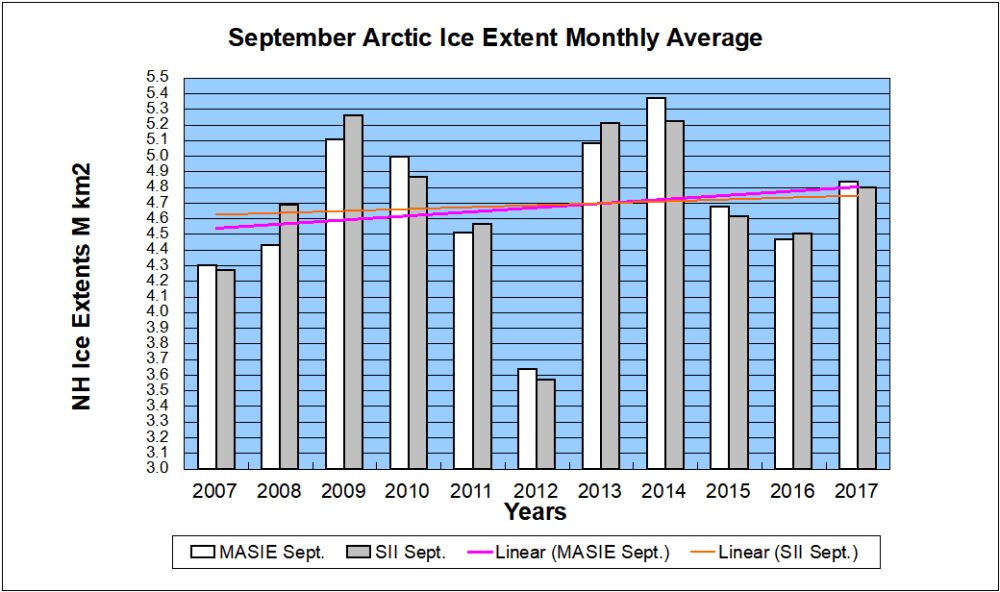
Meanwhile the facts on the ground are not alarming: For example September minimums:
More details at Overachieving September Arctic ice

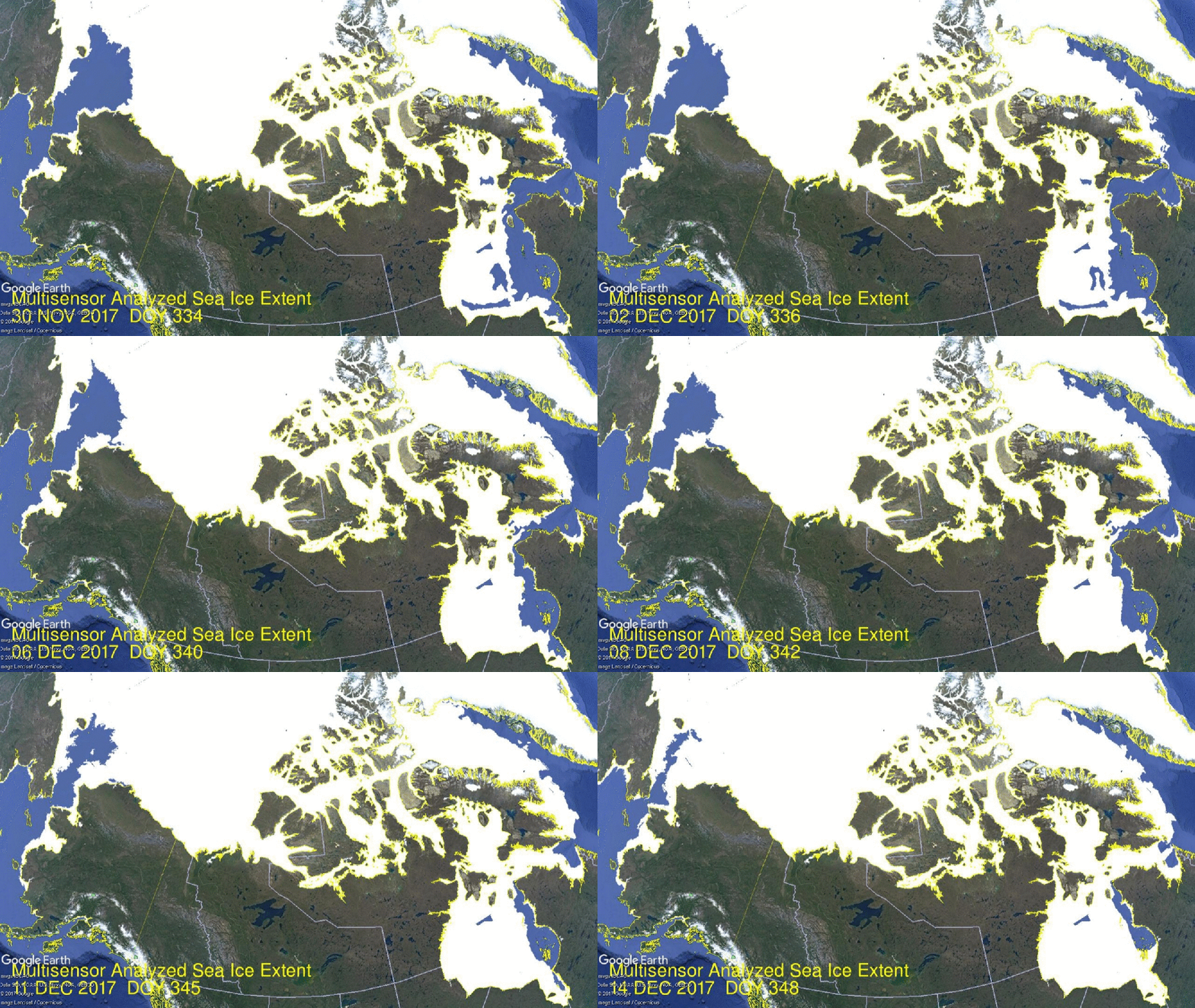
And the refreezing is not at all unusual:
The AAs (Arctic Alarmists) are putting their faith in the BBs (Barents and Bering), the only two basins below average this year. Both are marginal to the Arctic Ocean and both are heavily affected by human marine activities, including shipping, navies, fishing, tourism and sea floor extraction.


These outrageous appeals by alarmists in the face of contrary facts remind me of the story defining the term “chutzpuh.” A young man is convicted of killing his parents, and later appears before the judge for sentencing. Asked to give any last words, he replies: “Go easy on me, your Honor, I’m an orphan.”
alcoholics-anonymous-logo-e1497443623248

Fortunately, there is help for climate alarmists. They can join or start a chapter of Alarmists Anonymous. By following the Twelve Step Program, it is possible to recover and unite in service to the real world and humanity.

Step One: Fully concede (admit) to our innermost selves that we were addicted to climate fear mongering.

Step Two: Come to believe that a Power greater than ourselves causes weather and climate, restoring us to sanity.

Step Three: Make a decision to study and understand how the natural world works.

Step Four: Make a searching and fearless moral inventory of ourselves, our need to frighten others and how we have personally benefited by expressing alarms about the climate.

Step Five: Admit to God, to ourselves, and to another human being the exact nature of our exaggerations and false claims.

Step Six: Become ready to set aside these notions and actions we now recognize as objectionable and groundless.

Step Seven: Seek help to remove every single defect of character that produced fear in us and led us to make others afraid.

Step Eight: Make a list of all persons we have harmed and called “deniers”, and become willing to make amends to them all.

Step Nine: Apologize to people we have frightened or denigrated and explain the errors of our ways.

Step Ten: Continue to take personal inventory and when new illusions creep into our thinking, promptly renounce them.

Step Eleven: Dedicate ourselves to gain knowledge of natural climate factors and to deepen our understanding of nature’s powers and ways of working.

Step Twelve: Having awakened to our delusion of climate alarm, we try to carry this message to other addicts, and to practice these principles in all our affairs.

Summary:

With a New Year close at hand, let us hope that many climate alarmists take the opportunity to turn the page by resolving a return to sanity. It is not too late to get right with reality before the cooling comes in earnest.

This is your brain on climate alarm.  Just say No!

Suicidal Climatist Narrative

Micheal Walsh published The Suicidal Narrative of the Modern Environmental Left, November 16, 2017.

Walsh presents two recent experiences showing how environmental concerns are embedded everywhere including plane trips and merchandising, then gets into the implications. His text with my bolds and images.

It’s all just advertising, of course, and thus harmless enough. It also goes to reinforcing the narrative: that selfish man is the cause of species endangerment, that primitive societies are superior to developed ones (but then who would buy the locally sourced cocoa beans and moringa leaves?), and that traditional medicine—which is to say, no medicine at all—is somehow superior to what those pill-pushing quacks foist on you before they climb in their BMWs and head out to the links for a round or two of golf. Were that true, the ancient Greeks and Romans might all have lived into their 80s, instead of dying in their 20s and 30s, as unsustainable folks tended to do back then.

Which brings us, ineluctably, to “climate change” and this piece in the Times: “The More Education Republicans Have, the Less They Tend to Believe in Climate Change.” Yes, you read that right:

“Climate change divides Americans, but in an unlikely way: The more education that Democrats and Republicans have, the more their beliefs in climate change diverge.  About one in four Republicans with only a high school education said they worried about climate change a great deal. But among college-educated Republicans, that figure decreases, sharply, to 8 percent.”

The author’s underlying assumption is that the more you know about “man-made climate change,” the more eager you should be to chow down on Endangered Species Chocolate or shovel some women’s-collective moringa into your smoothie before you leave your ant-farm apartment to hop on the mass-transit system on your way to a day job that somehow involves you, personally, saving the planet—not so much by what you do, but by what you don’t do.

But that’s not a future we on the Right want to embrace. I take this poll as a heartening sign that the more you educate yourself about the transparent fraud of “man-made climate change,” the less you’re likely to believe in their genteel fictions of peaceful, happy villages in Liberia or their apocalyptic notions of the End of the World as We Know It, just about any day now. As we’ve learned time and again, mountebanks and charlatans are always promising that the end of days is just around the corner, if only we will repent; find Jesus; join their cult; give away all our possessions; or at least sign up for a lifetime supply of snake oil, delivered by Amazon drones right to our doorsteps.

We’ve seen this movie before, of course. In April, Mark J. Perry of the American Enterprise Institute detailed 18 different instances when “[t]he prophets of doom were not simply wrong, but spectacularly wrong.”

Never mind that the Earth’s climate is always changing; we wouldn’t be here at all if it hadn’t. Never mind that there’s little humans can do to interfere with planetary processes, most of which are beyond our ken. Never mind that we flatter ourselves if we think so. Never mind that to characterize carbon dioxide—which we exhale so that the Amazon rain forest and those West African moringa plants might inhale—as a dangerous “greenhouse gas” is profoundly anti-human.

It’s what you’d expect from a political philosophy that denies God and sees itself as its own worst enemy: a narrative that must end in suicide, and all in the name of the greater good. All we ask our friends on the Left is not to take us with you.

Climate lemmings on the move.

Suppressing Climate

The above video is how I first heard of PragerU.  Now the nonprofit organization is suing Google and Youtube for their ideological bias in suppressing Prager’s videos.

PragerU Sues YouTube For Discriminating Against Conservative Videos
is an article by Ben Weingarten at The Federalist.  Excerpts below with my bolds.

Those blackballed from social media platforms for sharing views dissenting from prevailing progressive Silicon Valley orthodoxy have to date had little recourse against the tech speech police. That is why PragerU’s newly filed suit against Google and Google-owned YouTube alleging unlawful censorship and free speech discrimination based on the educational video purveyor’s conservative political viewpoint has the potential to be groundbreaking.

The lawsuit, filed in federal court in California, details upwards of 50 PragerU educational videos that YouTube has, in PragerU’s view, unjustifiably slapped with “restricted mode” or “demonetization” filters, violating its First Amendment right to free speech. These filters limit or otherwise prevent viewers, based on characteristics like age, from consuming content deemed “inappropriate.”

More arguably provocative videos touch on topics such as Islamic terrorism, campus rape, and gender identity. According the suit, “The videos do not contain any profanity, nudity, or otherwise inappropriate ‘mature’ content. The censored videos fully comply with the letter of YouTube’s Terms of Use and Community Guidelines.” Moreover, PragerU illustrates that comparable videos from non-conservative sources like BuzzFeedVideo, CNN, and “Real Time with Bill Maher” have not been subjected to such filters.

Leaving aside the inherent subjectivity for a moment, if PragerU’s content is “appropriate,” and other publishers are able to upload similar content without being penalized, then what better explanation is there for YouTube’s censorship than viewpoint discrimination? PragerU’s dealings with YouTube over its content restrictions only strengthen the validity of this question.

As PragerU summarizes it:

Google/YouTube seek to justify…[its] animus and bias [towards PragerU’s political identity and viewpoint] not by claiming that PragerU has violated YouTube’s restricted content guidelines or criteria, but by arguing that they retain unfettered discretion to censor any video content that they deem “inappropriate,” no matter how subjective, baseless, or arbitrary that decision is…For over one year, PragerU has worked patiently and cooperatively to try to resolve the censorship issues that comprise this Lawsuit. In response, Google/YouTube have provided vague, misleading, confusing, and often contradictory information that not only has prevented resolution of the issues, but constitutes further evidence and indicia that their restricted mode filtering applied to PragerU is based on Defendants’ [Google/YouTube’s] intentional discrimination and animus

That as unimpeachable a source as the video-producing nonprofit PragerU is challenging YouTube should serve as a powerful signal that conservatives and others whose views social media companies deem unworthy will no longer permit their rights to be trampled upon. This is significant regardless of the case’s outcome.

PragerU’s efforts are essential, and may serve as the vanguard of a successful lawfare effort. But while legal action is necessary, it is by no means a sufficient and sure safeguard of our rights. As we have seen time and time again, judges routinely permit our liberties to erode, and sometimes actively assist. Preserving free speech, like all of our cherished freedoms, requires constant vigilance and persistent defense.

More on biased public and social media:

Media Duping Scandal

Ideological Fault Lines

Yellow Climate Journalism


PBS Goes Full Climatist

Last evening I watched a Frontline program on PBS: How the War on EPA was Waged.  Below is the trailer, the full hour program is War on the EPA.

At the PBS website are numerous articles lamenting the change in the EPA under the Trump administration. The Frontline themes were already being aired by Democrat senators in the confirmation hearings.

Supposition: EPA exists as a branch of the Environmental Movement.

As is well documented, the EPA since its formation has many achievements in projects addressing pollution of the air and water in the US. Over decades, the agency staffed up with people dedicated to cleaning up and protecting the environment.

But with most of the successes behind them, environmentalists bought into the global warming notion and anti-fossil fuel activism. EPA personnel were predisposed to join in and help lead the charge.

The Frontline documentary described how the skeptical Trump administration confronted the EPA swamp, densely populated by warmists. Of course, the producers show no awareness that the opinions are relative and not absolute, or that fears concerning CO2 emissions are uncertain and debatable.

The video does show Pruitt exposing the false environmentalist dichotomy: “It is not true that if you are for development, you are against the environment, or that if you are for the environment, you are against development.” Then Frontline extensively quotes journalists and former employees, including Pruitt’s predecessor, all of whom take exactly that antagonistic position.

Supposition: Deniers are paid shills for energy capitalists.

Early on, Gina McCarthy talks about all the pushback from industry when she began work on the Clean Power Plan. To illustrate this, the video includes some totally insipid commercials (parodies really) claimed to be industry-sponsored promotion against the EPA agenda.

The presentation seeks continually to link denial of a climate crisis to funding from businessmen promoting their enterprises. In one telling interview, an industrialist says that Sierra Club is lobbying for their agenda, so we have to do the same. Other than that slip, Frontline ignores how Big Green slush funds and NGOs drove EPA actions in the past, even while showing comments from them, for example NRDC (National Resources Defense Council).

Supposition: EPA now pursues only industrial interests.

Overriding all is the notion that Scott Pruitt has engineered an hostile takeover of the agency, and that only industrial interests matter to him. This provides the explanation why employees and scientific advisors (all committed to “fight climate change”) are not consulted, not appreciated, and uninformed of agency plans. Of course they are unhappy and disgusted, and speak out about the betrayal of their cause.

Tonight’s new FRONTLINE documentary, War on the EPA, tells the inside story of how this and other environmental policy rollbacks happened; how Scott Pruitt went from suing the Environmental Protection Agency 14 times, to now running it; and how the anti-regulatory and anti-climate change science movements in America reached this moment of triumph.

“It was eight years of pure hell under the democrat party and Obama,” Bob Murray, CEO of Murray Energy Corp., tells FRONTLINE in the above excerpt from War on the EPA. “But we won! It’s a wonderful victory.”

So it goes with draining the swamp.


Entitled bureaucrats rise up to defend their nest.

Footnote 1:

In Ottawa, the problem is somewhat different. There we have an infestation of bureaucrabs. The term refers to a creature that appears to be making progress, but on closer inspection is moving sideways.

There is also a rumor that increasingly in Ottawa lawyers are being used for scientific experiments instead of rats.  There appear to be three reasons for this:

  1.  There are more lawyers than rats in Ottawa.
  2. People sometimes get emotionally attached to a rat.
  3. There are some things the rats won’t do.

Footnote 2:

For a scientific analysis of how government works, we have a paper reprinted below:

New chemical Element Discovered

The new element is Governmentium (Gv). It has one neutron, 25 assistant neutrons, 88 deputy neutrons and 198 assistant deputy neutrons, giving it an atomic mass of 312, the heaviest of all. These 312 particles are held together by forces called morons, which are surrounded by vast quantities of lefton-like particles called peons.

Since Governmentium has no electrons or protons, it is inert. However, it can be detected, because it impedes every reaction with which it comes into contact. A tiny amount of Governmentium can cause a reaction normally taking less than a second to take from four days to four years to complete.

Governmentium has a normal half-life of 3-6 years. It does not decay but instead undergoes a reorganization in which a portion of the assistant neutrons and deputy neutrons exchange places. In fact, Governmentium’s mass will actually increase over time, since each reorganization will cause more morons to become neutrons, forming isodopes.

This characteristic of moron promotion leads some scientists to believe that Governmentium is formed whenever morons reach a critical concentration. This hypothetical quantity is referred to as critical morass.

When catalyzed with money, Governmentium becomes Administratium, an element that radiates just as much energy as Governmentium since it has half as many peons but twice as many morons. All of the money is consumed in the exchange, and no other byproducts are produced. It tends to concentrate at certain points such as government agencies, large corporations, and universities. Usually it can be found in the newest, best appointed, and best maintained buildings.

Scientists point out that administratium is known to be toxic at any level of concentration and can easily destroy any productive reaction where it is allowed to accumulate. Attempts are being made to determine how administratium can be controlled to prevent irreversible damage, but results to date are not promising.

Credit: William DeBuvitz, http://www.lhup.edu/~dsimanek/administ.htm

Footnote 3:

Many know the Yes Minister classic British tv series, but readers may not be aware that the last season of the show, Yes Prime Minister ended with an hilarious send up of the global warming scare. BBC blocked the video outside of UK, but the link below works internationally. Transcripts can be read at Climate Alarms LOL and Laughing at Climate Change

Another Climate Push Poll

University of Chicago News headline says Most Americans want government to combat climate change, poll finds

The report is summarized in this graphic:
climate20poll202_1012

It should be obvious that for decades, opinion polls have been deployed as a marketing tool. Information is gathered, but more importantly public awareness and concern is raised according to the interests of the survey sponsors. The industry calls these “push polls” and conduct them annually, or even more frequently, intending to mold public opinion in the direction of climate alarmism, and to claim support for policies favored by sponsors.

Interpreting Poll Results

In order to take meaning from a poll, you have to know the context and specifically what questions were asked, what responses were allowed and in what sequence (i.e. the methodology).

Some contextual facts were suppressed in the above report. To discuss them, let us consider the first question put to participants:

Q31. How important are the following issues to you personally?

The grid shows results from two surveys, the last one 8/17-21/2017, and the previous one 6/8-11/2017. First column includes six issues and the number of participants in the August survey. The June survey only had five issues.  Numbers in the grid are % of responses.

8//2017 8//2017 8//2017 6//2017 6//2017 6//2017
AP-NORC/EPIC 8/17-21/2017 Not at all
/slightly
important
Moderately
important
Very/
extremely
important
Not at all
/slightly
important
Moderately
important
Very/
extremely
important
The economy (n=992) 5 18 77 4 14 81
Immigration (n=1,038) 17 32 50 21 32 47
Health care (n=992) 5 11 84 3 14 82
Climate change (n=1,038) 25 26 48 25 21 53
Terrorism (n=992) 10 22 68 8 14 77
Energy policy (n=1,038) 16 29 54 NA NA NA

Regarding Participation: We have responses from 1038 Americans, which was a completion rate of 27%. Thus these results come from a subset of people who chose to respond, and unsurprisingly they express concerns. Of course, we don’t know about what the others care.

In that context, all the issues rate as important, with climate change coming in last place in August, and next to last in June.

Regarding Survey Frame:

The Survey is entitled Public Opinion on Energy Policy under the Trump Administration, and sure enough, the second question is:
Q32. Overall, do you approve or disapprove of the way Donald Trump is handling his job as president? (with follow ups to get whether strongly or only somewhat).

Since the pollsters know more people disapprove of Trump than approve, putting this question early creates a central tendency to respond in negation to perceived Trump positions. Further, it signals that this is about politics not science.

Regarding the Survey Subject:

Now to the meat (or rather the lack of it). Next Question:
Q33. Do you think climate change is happening, do you think climate change is not happening, or aren’t you sure?

Here people are asked about an undefined buzzword “climate change” and whether it is happening or not, in their opinion. Could any question be more vacuous?
(Synonyms for “Vacuous”: silly, inane, unintelligent, insipid, foolish, stupid, fatuous, idiotic, brainless, witless, vapid, vacant, empty-headed.)

The responses tell us only about badges that people like or dislike. And since “climate change” has been a political football, used by the left as a wedge issue, this will be a positive buzzword for Democrats and a negative one for Republicans. And since the population has more Dems, and since the survey sample is 36% Democrats and 23% Republicans, the desired response is assured.

Survey Says:  Happening 72%, Not Happening 9%, Not sure 19%.

BTW in 2017 Happening is down 5% from 2016, while Not Sure is up 6%, so you can read the tea leaves any way you like.

Then, for those who think climate change is happening (Lord only knows what that actually means for any of the individuals), they then get to tell us about causation:

If climate change is happening in Q33
Q34. Do you think climate change is caused entirely by human activities, caused mostly by human activities, caused about equally by human activities and natural changes in the environment, caused mostly by natural changes in the environment, or caused entirely by natural changes in the environment?

Since this question is only put to the 72%, who said yes in Q33, the responses to Q34 are:
55% out of 774 say Caused entirely/mostly by human activities
32% out ot 774 say Caused equally by human activities and natural changes in the environment
12% out of 774 say Caused mostly/entirely by natural changes in the environment

Pollsters will be tempted to add the 32% to 55%, but that is misleading. The equally caused response is a mixed bag. Some knowledgeable people (like Dr. Curry) know that human and natural factors of global warming (if that is what we are talking about) have not yet been separated, and 50-50 can be an educated guess.

But from experience I can say that the equal causation includes many people who didn’t want to say “Don’t know.” Often these climate push polls ask people: “How much do you feel you know about global warming?” Typically about 25% say they know a lot, 60% say they know a little, and the rest less than a little. As we know from other researchers, more climate knowledge increases skepticism for many, so it is likely the soft number includes many who feel they really don’t know.

The only firm number out of this is that 41% of respondents feel that climate change is happening and that humans are mostly the cause. (426 out of 1038). Not surprisingly that finding does not appear anywhere.

Regarding Polling Bias

The poll was funded by EPIC ( Energy Policy Institute at the University of Chicago). In presenting their climate research, EPIC says this:

Climate change is considered by many to be the most urgent, global challenge. The impacts of climate change are already emerging in more damaging and frequent storms, extreme temperature changes, agricultural changes, and depleting water supplies. Efforts to address climate change, however, have proceeded slowly.

I think we can guess how EPIC personnel would answer the questionnaire.

There are many additional questions in the poll results (here)

For example, consider several questions raised regarding fracking. Included were these:

Q44B. One recent study found babies in the womb experience negative health effects from close exposure to a hydraulic fracturing site. The effects were strongest within a half mile of the site, with babies 25% more likely to have a low birth weight. Birth weights were not different for pregnant mothers living more than 2 miles from the site. Would you say you favor, oppose, or neither favor nor oppose the use of hydraulic fracturing in the United States?

Q44D. One recent study found that hydraulic fracturing triggered earthquakes in Oklahoma. The study found that the injection of wastewater, part of the hydraulic fracturing process, triggered the earthquakes. Would you say you favor, oppose, or neither favor nor oppose the use of hydraulic fracturing in the United States?

And this one tests how you feel about being an outsider.

Q40. As you may know, nearly 200 countries recently signed an international agreement in Paris to reduce greenhouse gas emissions. Do you support, oppose, or neither support nor oppose the United States withdrawing from this international agreement?

Summary

Climate change is now totally a socio-political movement in support of a $1.5 trillion industry, and the only thing that matters is winning hearts and minds (well minds maybe not). A similar survey was done in Canada, specifically to claim public support for what Trudeau wanted to do all along: Impose a carbon tax. This was done despite what that survey showed behind the smoke and mirrors.

Note that Canadians may be more picky than Americans, and so they got a question with more substance:
1. “From what you’ve read and heard, is there solid evidence that the average temperature on earth has been getting warmer over the past four decades?”
2. [If yes, solid evidence] “Is the earth getting warmer mostly because of human activity such as burning fossil fuels or mostly because of natural patterns in the earth’s environment?”
For more see Uncensored: Canadians View Global Warming

This blog has as a slogan: Reading between the lines and underneath the hype. It doesn’t look like the job is getting any lighter.  When you see or hear anything climate-related in the media, start by assuming the report is myopic, lop-sided, or both, until proven otherwise.  How to go about proving otherwise is demonstrated with several examples in the post Impaired Climate Vision.

Media Duping Scandal


Being “framed” is slang when someone is blamed for something they did not do, i.e. being set up by means of false evidence and witnesses.  For example, this is current news:

Majority of Americans now say climate change makes hurricanes more intense, poll finds
A majority of Americans say that global climate change contributed to the severity of recent hurricanes in Florida and Texas, according to a new Washington Post-ABC News poll. That marks a significant shift of opinion from a dozen years ago, when a majority of the public dismissed the role of global warming and said such severe weather events just happen from time to time.

In a 2005 Post-ABC poll, taken a month after Hurricane Katrina ravaged the Gulf Coast and devastated New Orleans, 39 percent of Americans said they believed climate change helped to fuel the intensity of hurricanes. Today, 55 percent believe that.

Gee, do you think that all the mass media reports connecting the storms with climate change had anything to do with that polling result?  Here is just today’s sample from Google News of mainstream press articles pushing the linkage.

Hurricanes spur Schneider action on climate change Chicago Tribune

Hurricanes: A perfect storm of chance and climate change? BBC News

Like hurricanes, climate change is dangerous, but smart storm fixes won’t help climate USA TODAY

Next-generation models revealing climate change effect on hurricanes Phys.Org

After hurricanes, climate change resurfaces in Washington Houston Chronicle

Scientific models saved lives from Harvey and Irma. They can from climate change too The Guardian

National Guard chief cites ‘bigger, larger, more violent’ hurricanes as possible evidence of climate change Washington Post

Paradise lost? Caribbean leaders want action on climate change and help rebuilding Miami Herald

Yes, climate change made Harvey and Irma worse CNN

In addition, there are dozens of articles from climate advocacy sites like Greenpeace, Huffpost, Insideclimatenews, etc.

An exception to the onslaught appeared to be this one from The Stranger Why Connecting Climate Change with Powerful Hurricanes Is Doing More Damage Than Good

But it turns out to be another extreme hit piece by Sarah Myhre, who is no stranger to alarmism. (Background at Again Falsely Linking Smoking and Climate Science)

This time she attacks the media reporting on hurricanes and climate change, because they seem to allow for doubt (tsk, tsk). (Below her text with my bolds)

We need to poke a hole in this toxic narrative and news cycle around climate attribution. When I say attribution, what I am referring to are the ongoing arguments of attributing specific weather events to climate change: Was Hurricane Harvey caused by climate change? Was the low snow year of 2015, up and down the Cascadian mountains, caused by climate change? These questions—individually—are interesting and important to answer. But the science of Earth system change is not altered by the relative statistical significance of our attribution certainty. Far from it.

What’s more, this framing of attribution uncertainty is continually used to support climate action obstruction and denialist voices in our culture. When you hear pandering equivocation about climate and weather events, alarm bells should start ringing in your head. This news cycle is absolutely toxic and we together need to get our broad cultural conversation off this hamster wheel.

One closing point: When we use uncertainty around attributing individual weather events to climate change to call for “more data” or “better climate science” (think of Cliff Mass) we are driving a wedge between public health and public safety. We mislead the public because the message we send is: We don’t know what’s happening. This simply isn’t true; we do know what is happening. However, in some cases, we lack high-quality time series data to statistically detect the signal of climate from the noise of weather.

Summary

The last line in Myhre’s article says it all: We know what’s going on, we just don’t have the facts yet.

Despite all of the levelheaded statements by hurricane experts cautioning against jumping to these conclusions, and despite the IPCC SREX reports saying the linkage is not proven, the media and activists went on a rant proclaiming climate change makes hurricanes worse. They trumpeted these claims, and now take pride in a survey showing they succeeded in duping the public. That is a duping scandal and the mass media is at fault.  Shame on them.

Background from Previous Post:

Climate Thought Control explains the deliberate media strategy to mold public opinion in support of climate change activism.

Jennifer Good is a communications professor explaining how the media is expected to mold public opinion in favor of climate activism. Her article in the Toronto Star Putting hurricanes and climate change into the same frame is revealing, especially the subtitle A study shows network Hurricane coverage this month did not link an increase in extreme weather to global warming. 

The prof is disappointed that climate change was not even more frequently mentioned in stories about the recent hurricanes. She considers it an opportunity missed.  (Update: Since her article was published, the media took up the cause big time.) Some excerpts below with my bolds.

I have analyzed two weeks of broadcast news stories that appeared on America’s seven largest TV networks as well as Canada’s CTV network. In just over 1,500 stories about hurricanes, “Trump” was discussed in 907 of those stories (or about 60 per cent), while “business” was discussed in 572 of those stories (or about 38 per cent).

“Climate change” was discussed in just 79 of the hurricane stories — or about five per cent.

What’s Wrong with Professional, Objective Reporting?

The fundamental answer is that climate change and extreme weather (i.e., hurricanes) need to be framed together more often. As scientists have pointed out, while climate change is not causing the weather, it is definitely exacerbating the weather. But increasingly adding climate change to the extreme weather frame is only the tip of the (yes, melting) iceberg. Alternatives to “business as usual” need to be part of the media’s, and our, extreme weather frames.

Of those 1,500 broadcast news stories involving hurricanes, only four also mentioned “fossil fuels,” and not a single news broadcast discussed “alternative energy.”

Similarly, while “economy” is discussed in 187 of the hurricane news stories, only 18 stories discussed hurricanes, the economy and climate change together; and not one story explored the links between an economic model based on endless growth, and the implications of this endless growth for the planet and climate change.

The Purpose of Media is to Manipulate Public Opinion

In his seminal 2010 paper “Why It Matters How We Frame the Environment,” published in the journal Environmental Communication, the American linguist and philosopher George Lakoff offered that the world is made up of frames. “Framing” is how our neural system defines a concept by grouping together what goes with — or gets framed with — that concept. Our brains are wired this way.

For example, when you read “climate change,” your brain immediately frames the concept of climate change with certain words and concepts. Everyone cognitively frames “climate change” somewhat differently, but there might also be large overlaps. Terms like “fossil fuels” and “human activity” might be in many people’s climate change frames, although frames can differ widely. (Think, for example, of climate change skeptics.)

Not surprisingly, the news media plays a significant role in how our brains frame concepts. The more the media frames a story by associating it with certain words and concepts, the more likely we are to use those same words and concepts in our own framing.

And conversely, if the news media never framed a story using certain concepts, there is “hypocognition,” or as Lakoff proposed, a “lack of ideas we need.”

In times of crisis, there are many immediate and urgent stories that need to be told about lives and loss, bravery and struggle. But crisis also provides an opportunity for change — an opportunity to shift our frames and include the ideas we desperately need.

So far, that opportunity seems to have been missed. Meanwhile, the oceans get warmer.

The Other Side of the Story

While the prof is totally convinced she knows what the public needs to know about weather and climate, actual weather scientists disagree with her.  In fact, the efforts to link storms and fossil fuels were present way too often and hindered the public from understanding these events.

For instance, Hurricane scientist Dr. Ryan Maue ripped climate ‘hype’ on Irma & Harvey in his WSJ article Climate Change Hype Doesn’t Help.

As soon as Hurricanes Harvey and Irma made landfall in the U.S., scientists, politicians and journalists began to discuss the role of climate change in natural disasters. Although a clear scientific consensus has emerged over the past decade that climate change influences hurricanes in the long run, its effect upon any individual storm is unclear. Anyone trying to score political points after a natural disaster should take a deep breath and review the science first.

As a meteorologist with access to the best weather-forecast model data available, I watched each hurricane’s landfall with particular interest. Harvey and Irma broke the record 12-year major hurricane landfall drought on the U.S. coastline. Since Wilma in October 2005, 31 major hurricanes had swirled in the North Atlantic but all failed to reach the U.S. with a Category 3 or higher intensity.

Even as we worked to divine exactly where the hurricanes would land, a media narrative began to form linking the devastating storms to climate change. Some found it ironic that states represented by “climate deniers” were being pummeled by hurricanes. Alarmists reveled in the irony that Houston, home to petrochemical plants, was flooded by Harvey, while others gleefully reported that President Trump’s Mar-a-Lago might be inundated by Irma.

By focusing on whether climate change caused a hurricane, journalists fail to appreciate the complexity of extreme weather events. While most details are still hazy with the best climate modeling tools, the bigger issue than global warming is that more people are choosing to live in coastal areas, where hurricanes certainly will be most destructive.

Summary

Actual scientists are calling for less, not more manipulative journalism.

And as for the oceans getting warmer, Prof. Good, that is due to the oceans storing and releasing solar energy, nothing to do with burning fossil fuels.  The oceans heat the atmosphere, and not the other way around.  See Empirical Evidence: Oceans Make Climate

Footnote:  If Framing doesn’t work, what’s next?

Climate Thought Control

Being “framed” is slang when someone is blamed for something they did not do, i.e. being set up by means of false evidence and witnesses.

Jennifer Good is a communications professor explaining how the media is expected to mold public opinion in favor of climate activism. Her article in the Toronto Star Putting hurricanes and climate change into the same frame is revealing, especially the subtitle A study shows network Hurricane coverage this month did not link an increase in extreme weather to global warming.

The prof is disappointed that climate change was not more frequently mentioned in stories about the recent hurricanes. She considers it an opportunity missed.  Some excerpts below with my bolds.

I have analyzed two weeks of broadcast news stories that appeared on America’s seven largest TV networks as well as Canada’s CTV network. In just over 1,500 stories about hurricanes, “Trump” was discussed in 907 of those stories (or about 60 per cent), while “business” was discussed in 572 of those stories (or about 38 per cent).

“Climate change” was discussed in just 79 of the hurricane stories — or about five per cent.

What’s Wrong with Professional, Objective Reporting?

The fundamental answer is that climate change and extreme weather (i.e., hurricanes) need to be framed together more often. As scientists have pointed out, while climate change is not causing the weather, it is definitely exacerbating the weather. But increasingly adding climate change to the extreme weather frame is only the tip of the (yes, melting) iceberg. Alternatives to “business as usual” need to be part of the media’s, and our, extreme weather frames.

Of those 1,500 broadcast news stories involving hurricanes, only four also mentioned “fossil fuels,” and not a single news broadcast discussed “alternative energy.”

Similarly, while “economy” is discussed in 187 of the hurricane news stories, only 18 stories discussed hurricanes, the economy and climate change together; and not one story explored the links between an economic model based on endless growth, and the implications of this endless growth for the planet and climate change.

The Purpose of Media is to Manipulate Public Opinion

In his seminal 2010 paper “Why It Matters How We Frame the Environment,” published in the journal Environmental Communication, the American linguist and philosopher George Lakoff offered that the world is made up of frames. “Framing” is how our neural system defines a concept by grouping together what goes with — or gets framed with — that concept. Our brains are wired this way.

For example, when you read “climate change,” your brain immediately frames the concept of climate change with certain words and concepts. Everyone cognitively frames “climate change” somewhat differently, but there might also be large overlaps. Terms like “fossil fuels” and “human activity” might be in many people’s climate change frames, although frames can differ widely. (Think, for example, of climate change skeptics.)

Not surprisingly, the news media plays a significant role in how our brains frame concepts. The more the media frames a story by associating it with certain words and concepts, the more likely we are to use those same words and concepts in our own framing.

And conversely, if the news media never framed a story using certain concepts, there is “hypocognition,” or as Lakoff proposed, a “lack of ideas we need.”

In times of crisis, there are many immediate and urgent stories that need to be told about lives and loss, bravery and struggle. But crisis also provides an opportunity for change — an opportunity to shift our frames and include the ideas we desperately need.

So far, that opportunity seems to have been missed. Meanwhile, the oceans get warmer.

The Other Side of the Story

While the prof is totally convinced she knows what the public needs to know about weather and climate, actual weather scientists disagree with her.  In fact, the efforts to link storms and fossil fuels were present way too often and hindered the public from understanding these events.

For instance, Hurricane scientist Dr. Ryan Maue ripped climate ‘hype’ on Irma & Harvey in his WSJ article Climate Change Hype Doesn’t Help.

As soon as Hurricanes Harvey and Irma made landfall in the U.S., scientists, politicians and journalists began to discuss the role of climate change in natural disasters. Although a clear scientific consensus has emerged over the past decade that climate change influences hurricanes in the long run, its effect upon any individual storm is unclear. Anyone trying to score political points after a natural disaster should take a deep breath and review the science first.

As a meteorologist with access to the best weather-forecast model data available, I watched each hurricane’s landfall with particular interest. Harvey and Irma broke the record 12-year major hurricane landfall drought on the U.S. coastline. Since Wilma in October 2005, 31 major hurricanes had swirled in the North Atlantic but all failed to reach the U.S. with a Category 3 or higher intensity.

Even as we worked to divine exactly where the hurricanes would land, a media narrative began to form linking the devastating storms to climate change. Some found it ironic that states represented by “climate deniers” were being pummeled by hurricanes. Alarmists reveled in the irony that Houston, home to petrochemical plants, was flooded by Harvey, while others gleefully reported that President Trump’s Mar-a-Lago might be inundated by Irma.

By focusing on whether climate change caused a hurricane, journalists fail to appreciate the complexity of extreme weather events. While most details are still hazy with the best climate modeling tools, the bigger issue than global warming is that more people are choosing to live in coastal areas, where hurricanes certainly will be most destructive.

Summary

Actual scientists are calling for less, not more manipulative journalism.

And as for the oceans getting warmer, Prof. Good, that is due to the oceans storing and releasing solar energy, nothing to do with burning fossil fuels.  The oceans heat the atmosphere, and not the other way around.  See Empirical Evidence: Oceans Make Climate

Footnote:  If Framing doesn’t work, what’s next?

an-order

TV Monetizes Hurricane Irma

Weather reporters do a stand-up as the force of the winds caused by Hurricane Irma hit Miami. (Marcus Yam / Los Angeles Times)

Chicago Tribune on Sept. 11 published Swept away by TV coverage of Hurricane Irma by Dahleen Glanton, Contact Reporter.

It is a fine reflection piece by a media insider on how commercial media covers extreme weather events. She recounts her journey of discovery becoming critical and eventually repelled by the coverage from her own media colleagues. Excerpts below with my bolds.

I didn’t leave the house on Sunday. The hurricane story unfolding on my television set was too gripping to walk away for even a few minutes.

Television anchors kept warning us that much of Florida could be washed away by gigantic surges of ocean water in the aftermath of Hurricane Irma. The pictures coming out of Cuba and the Caribbean already had proved how devastating this storm could be. I was terrified for everyone in its path.

But that wasn’t the only reason I, and so many others, sat glued to the TV all day. Cable news television gave us a virtual front row seat to the developing storm, providing a riveting performance that was full of adventure, suspense and drama.

The show presented on the TV news was designed to be entertaining. It was meant to keep us captivated for hours, mesmerized by the “heroic” sacrifices of journalists who risked their lives to show us what it is like to stand outside in the midst of a deadly storm.

They described the predicted surge as “a killer water event” and the reporters vowed to run to safety before it occurred. But if we just kept watching — even through commercial breaks — they promised, we would see it for ourselves.

For many of us, this was an uneasy proposition. No one was excited about the possibility of people losing their homes and businesses, perhaps even lives, but the prospect of seeing a hurricane dance up close was too tempting to turn down.

Reporters went up to people who had ventured outside, including one man walking his three-legged dog, and warned them to go back inside before it was too late. The camera panned in on a bird as the reporter surmised that perhaps it had flown with the hurricane from as far away as Cuba. Birds follow hurricanes, he told us. These birds know when it’s safe to come out.

The reporters in their plastic rain slickers with the network’s logo on the back kept explaining that they were doing all this for us. Regardless of what the critics said about their reckless behavior, “We’re here so you don’t have to be,” they insisted.

The surge never happened Sunday, and we should be grateful for that. What we saw on TV was typical of a hurricane — howling winds, swaying trees and metal stop signs shaking in the distance. The anti-climatic ending left us confused.

How could a 10- to 15-foot surge hyped all day long for Florida’s west coast suddenly turn into one of about 3 feet? How could TV meteorologists presented on air as experts and reporters billed as experienced storm chasers get it so wrong?

I still don’t know the answers. But it didn’t take long to figure out that the cable news coverage from Florida on Sunday wasn’t about us at all. It was all about their ratings.

This was a new experience for me. For more than a decade, I covered hurricanes in the South for the Tribune. Hunkered down in Mississippi during Hurricane Katrina, I never had the chance to see how a big storm was covered on national TV.

What I saw on Sunday was both shocking and intriguing.

As a journalist who has covered many hurricanes and tornadoes, I know what it takes to tell a story. Standing in front of a water-splashed camera holding a limb from a fallen tree is not necessary to show the strength of a storm.

I understand that television relies on the power of optics. It is true that a TV camera can paint a picture much more vividly than I could by writing about it on a computer.

While I’m sure some people who have relatives and friends in Florida were grateful for the in-depth coverage, too much of what we saw on Sunday was manufactured drama. Networks took advantage of a heartbreaking situation and made a mockery of it.

Surfing through the channels, the visuals were all the same. Reporters, wobbling in the bristling wind, their words barely audible as they attempted to convince us that it was OK for them to do what they were warning others not to do.

In one scene, a reporter tried to convince us that the concrete wall he was standing in front of would protect him from the surge. He demonstrated how he could bend down and take refuge from the wind if he needed to.

In the same breath, he warned of flying debris — roof shingles and street signage that could transform into projectiles so fierce that they could knock you out.

On another channel, a well-known meteorologist swayed and stumbled on a sidewalk while the eye of the hurricane went through Naples, Fla. The wind nearly took his breath away and viewers could barely understand what he was saying.

When we did manage to hear a thing or two, it was nothing of importance.

“This is a mid-level Category 3. Imagine if it was a Category 4 or 5?” he boasted. “This is a story you can tell your children and grandchildren.”

The anchor watching from the studio in New York seemed somewhat embarrassed. He offered this explanation for the perilous acts.

“So we can see what this does to our natural bodies and our world,” he said.

There were no surprises, though. We saw exactly what we expected to see when someone is standing outside in a hurricane.

The irony is that the people who would perhaps benefit from such a display didn’t get to see it at all. Millions of people across Florida were without electricity during the height of the storm.

It’s probably safe to bet they weren’t using up their limited cell phone access watching a news anchor in New York explaining what was going on in their back yards.

This show wasn’t meant for them at all. It was for people like you and me who were sitting in our nice dry homes with a bag of popcorn in one hand and the TV remote control in the other.

All of us should be honest about that.

dglanton@chicagotribune.com

Conclusion:

This could be a tipping point.  We may be witnessing the dawning of skeptical awareness at the Chicago Tribune, bastion of political correctness regarding all things climate related. One of their own catches them “Jumping the Shark.”

“Jumping the shark” is attempting to draw attention to or create publicity for something that is perceived as not warranting the attention, especially something that is believed to be past its peak in quality or relevance. The phrase originated with the TV series “Happy Days” when an episode had Fonzie doing a water ski jump over a shark. The stunt was intended to perk up the ratings, but it marked the show’s low point ahead of its demise.