“Hottest Year” Misdirection

Once again Joe Public comes out smarter than politically correct opinion surveyors, fact checkers and journalists.  The latest evidence of elite blindness comes from a smart-alecky reporter writing at GlobalNews Survey says Canadians think Earth beat its heat record in only 10 of the last 18 years. They’re wrong Excerpts in italics with my bolds.

Ipsos polling agency released “Perils of Perception” on Wednesday.

It’s an annual international survey conducted in 37 countries that looks at whether respondents have accurate, or inaccurate ideas about major issues.

This one ranked Canada 11th out of 37 countries when it came to accurate understandings of major issues.

One area of misunderstanding — climate change.

The survey found that Canadians are underestimating the number of years that the planet Earth has set heat records over the last two decades.  Canadians estimated that Earth set heat records in 10 out of the last 18 years.

It also found that Canadians are overestimating the share of energy that they consume from renewable resources.

I’ll save the renewables issue for another day. (See Exaggerating  Green Energy Supply) This post will show the reporter’s dog ate his homework, because there are large holes in his information.  He didn’t do professional due diligence so I will investigate to put the record straight for him and anyone else misled by the press.

What Ipsos Asked and Thought Was the Right Answer

Q. The World Meteorological Organization collects annual global temperatures, to see whether they are rising or falling across the world. How many of the last 18 years have been the hottest for the world as a whole since they began collecting data in 1961?

A.  17 of the past 18 years have been the hottest since records began. However, every country in the study underestimates the global temperature rise over the past 18 years. The average estimate across the study was 9 years.

Misdirection #1  Framing the Question to Exclude Undesired Data

Note the question context:  The World Meteorological Organization collects annual global temperatures (. . . began collecting data in 1961), to see whether they are rising or falling across the world. When you go looking for the data, WMO directs you to three datasets produced by others:  Hadcrut (UK Met Office), NOAA (US agency) and Gistemp (NASA, US agency).  So the frame serves to exclude satellite-based datasets, and limit the expected answer to three land+ocean products.  And as many will know, those records go back to late 1800s, far earlier than 1961.  Apparently, the surveyors wanted to put anyone off from thinking temperatures were warmer in the 1930s or 40s.

Misdirection #2  Failing to Do the Math

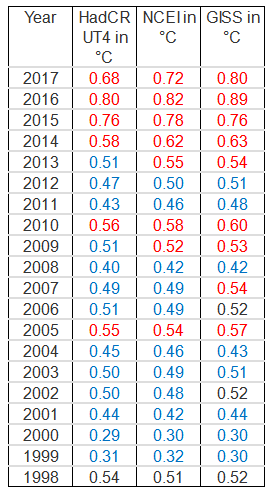
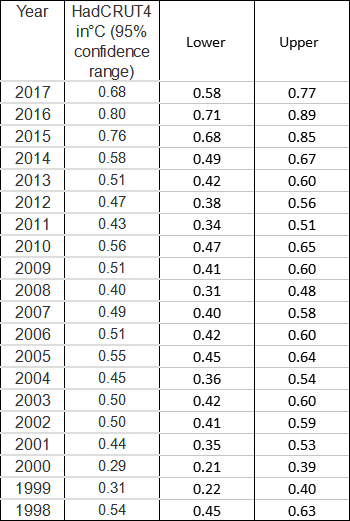
Getting data right now out of US federal agencies is problematic since websites are shut down.  It seems many federal employees are taking leave in order to help reduce the government deficit.  Fortunately, the Met Office has a site ( here) providing the relevant annual global temperature anomalies from the three sources. I compiled a table which makes the asked for comparisons.

The table shows 1998 was the hottest of all preceding years in the record, with slightly different values in the three datasets.  Years in blue were cooler than 1998, while years in red were reported hotter than 1998.  The math says in the last two decades, compared to the previous record year 1998, there were 6 hotter years in Hadcrut4, 8 hotter years in NOAA (NCEI), and 9 hotter years in GISS. Considering “hottest” to mean hotter than all previous years, the table shows exactly 5 hottest years in the last 18 years, with 2016 setting the record.

Ipsos says 17 of the last 18 were the hottest. Really?  Epic Fail: That so-called “correct” answer is three times too high!  Around the world people said 9, and that’s much closer to the truth. Canadians said 10, perhaps biased higher by all the fake news around.

Misdirection #3  Failing to Do the Statistics

Now it may have occurred to you that some of the hotter years were not much warmer.  When you consider the 95% confidence intervals, some years fall out of the list.  For example, Hadcrut also provides each year a calculation of the upper and lower bounds on the error range, combining bias, measurement uncertainty and coverage uncertainty.

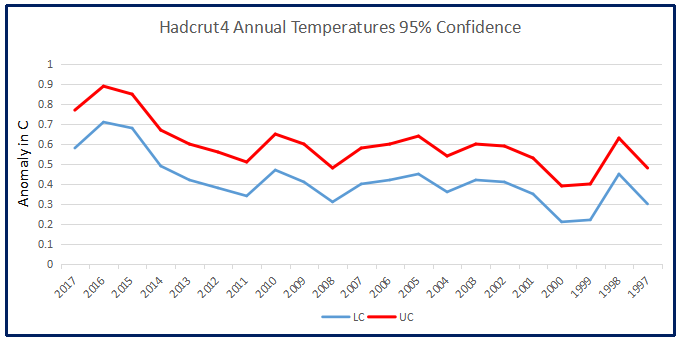
As the table shows, they estimate about +/- 0.09 for a typical year.  So for  1998, they say with 95% confidence the true anomaly lies between 0.45C and 0.63C.  Graphically the error range looks like this:

The chart shows that after considering the estimated uncertainty, it is actually the last three years that were hotter than 1998 in Hadcrut4.  The other land+ocean datasets have similar uncertainties and results (five hotter years in NOAA and GISS).

When it comes to UAH satellite dataset, we have this analysis:
University of Alabama Huntsville  Summary:
Globally, 2016 edged out 1998 by +0.02 C to become the warmest year in the 38-year satellite temperature record, according to scientists. Because the margin of error is about 0.10 C, this would technically be a statistical tie, with a higher probability that 2016 was warmer than 1998. The main difference was the extra warmth in the Northern Hemisphere in 2016 compared to 1998. Source: https://www.sciencedaily.com/releases/2017/01/170104130257.htm

No wonder they wanted UAH excluded.  And others say the confidence ranges are much larger than these estimates, which consider processing uncertainties not including errors of the instruments themselves.

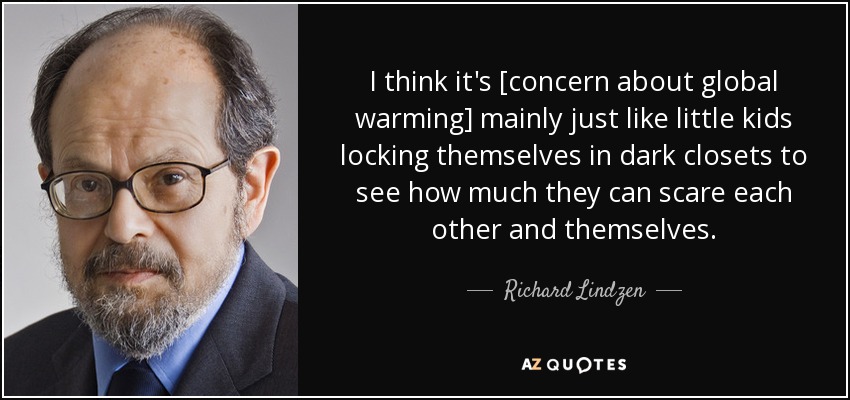
Such characterizations are absurd, according to Richard Lindzen, a meteorology professor at MIT and one of the world’s foremost skeptics that global warming represents an existential threat.

“It’s typical misleading nonsense,” Lindzen said in an e-mail. “We’re talking about less than a tenth of degree with an uncertainty of about a quarter of a degree. Moreover, such small fluctuations – even if real – don’t change the fact that the trend for the past 20 years has been much less than models have predicted.”


Climate Change Chumps

Definition “chump”: A foolish or easily deceived person.

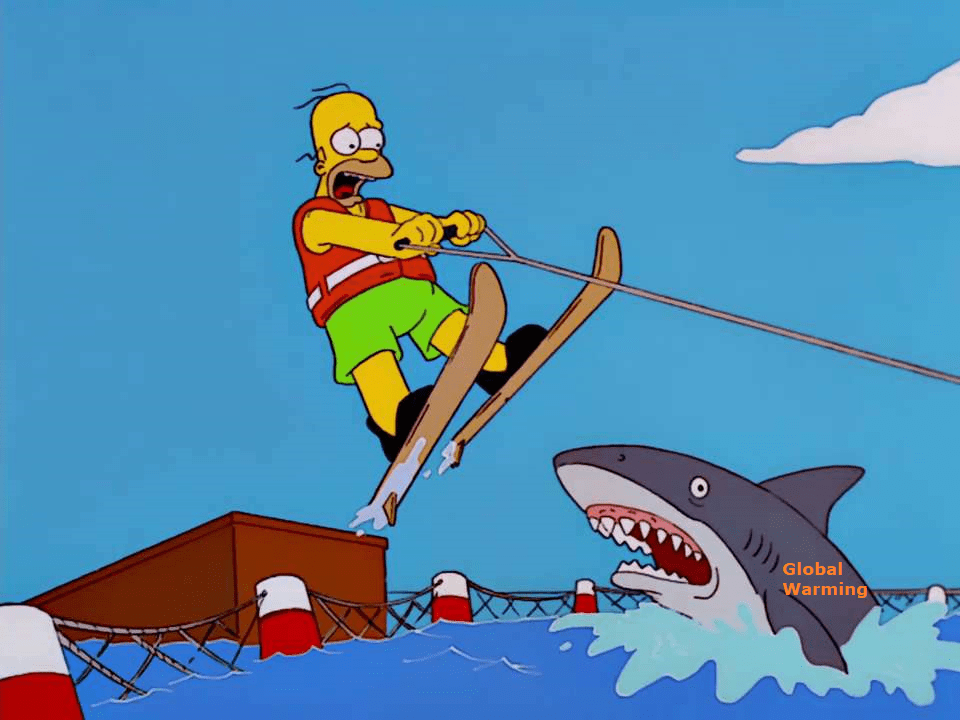
Why are so many people taken in by climate alarms? The question is often on my mind, especially when tens of thousands attend UN conferences like Katowice, or when hearing the caterwauling in the media over the climate scare of the week. Last night while watching a football game, my escape from the issue was interrupted by a commercial break that included a flaming earth on the screen for a few seconds. It was an ad for Discovery Channel including the image above.

[Old joke:  I don’t know if they are using subliminal advertising, but yesterday I went and bought a tractor.]

And in a flash I realized how several factors are driving warming suckers into a fearful frenzy.

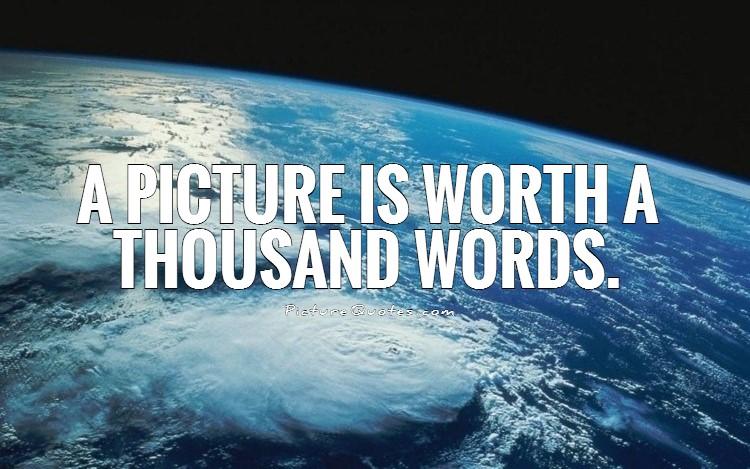
Firstly, The power of images over words and thinking.
A picture is worth a thousand words. (Sometimes attributed to Chinese)
The Asian attribution is doubtful, but Confucius did say something similar:
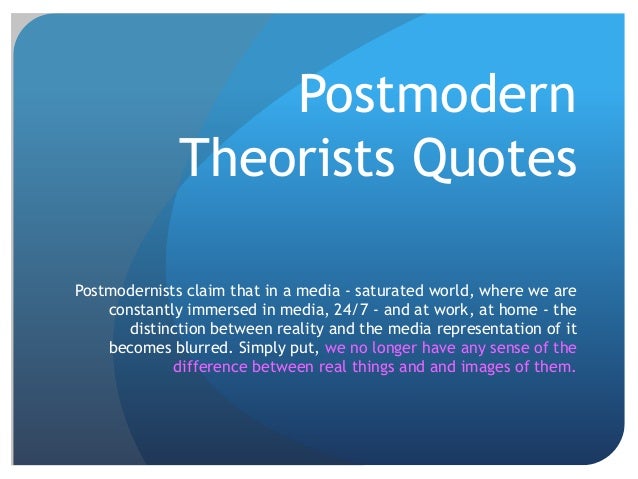
Second, We are immersed in imaging technology, entrancing the public. I have no interest in post modern philosophers, but in this sense they are onto something perverse: We are mistaking images for realities.

Third, Pied Pipers are using the media to put us under their spell.
A key point in the fable is the piper’s ability to put a spell on the children, and thereby rob the village of their future.  And he did this to get leverage over the council when they refused to pay for exterminating the rats. Our children have been brainwashed with environmental activism since preschool, and educators have taken Confucius to heart:  The process goes beyond preaching, to videos, posters and projects.

Fourth, Our embrace of mass and social media makes us suckers for fake news, including climate claims.

Note that the majority are not confident to discern fake from real news.  Even worse, today’s “fact checkers” operate out of spin rooms.

Fifth, Social proof is now all that matters.

Climate lemmings rushing over the cliff.

Finally, the drumbeat of climate alarms imprints ever more deeply a false assumption.

It doesn’t matter if any particular climate claim is false or exaggerated, the communications continuously reinforce the underlying myth of the Garden of Eden:  Nature is perfect and eternal so long as humans don’t mess it up.

The reality is more subtle and complex.  Humans are also a force of nature, and with our self-awareness we have the ability and responsibility to add order and purpose to the rest of nature.  Go to Kyoto and watch the landscapers labor for hours to fashion an exquisite Japanese garden, the fruition of collaboration between humans, plants, water and rocks.  Humans can and do improve on nature by taming destructive natural forces to preserve and enhance living structures.

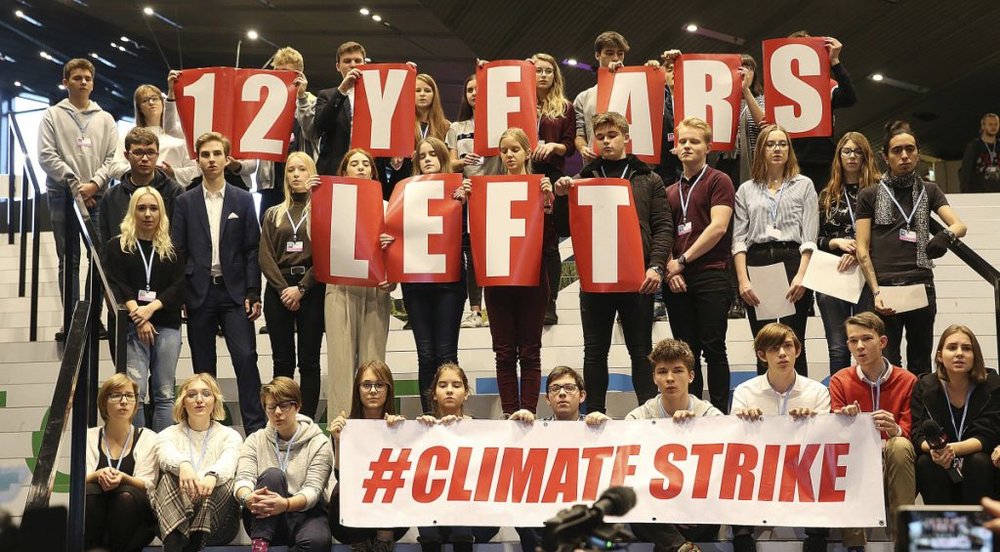
The UN IPCC process is a blind alley, a path to nowhere.  It plays upon fears and guilt feelings.  Worse, it distracts from rational programs of actual environmental stewardship.  I fear it will only get worse in the next 12 years:


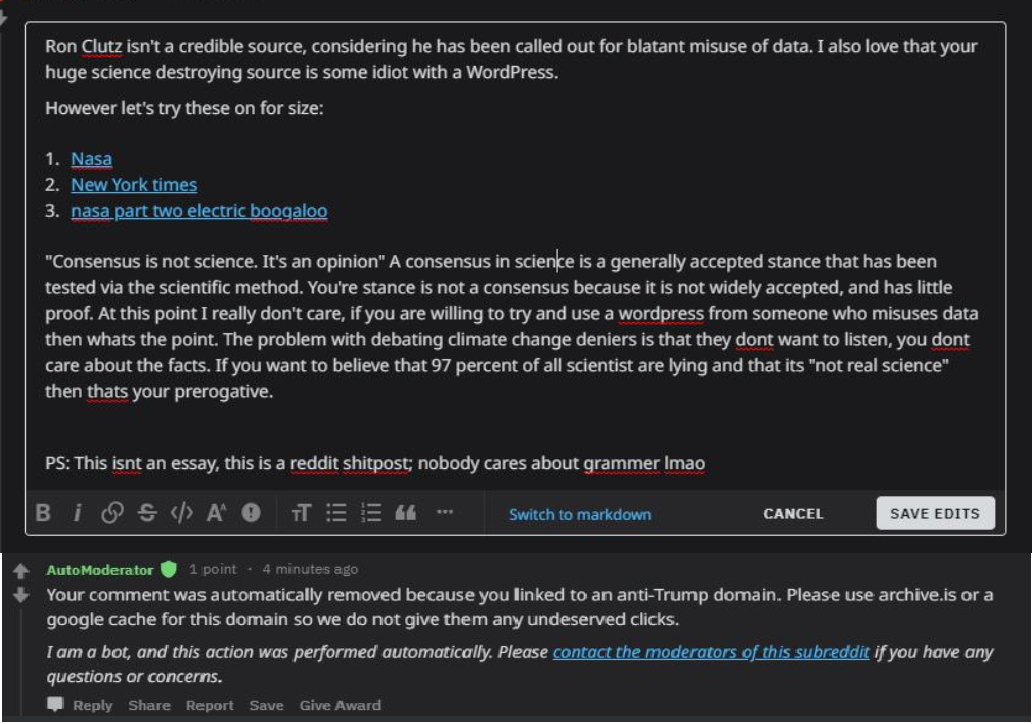
Whoa! I’ve been Bot-censored.

Today someone linked to one of my posts on a thread at reddit:

slinkydink2 14 hours ago
·
More grammatical errors and an emoji face. Am I talking to a 9 year old? Consensus is not science. It’s an opinion. The scientific theory has not been and cannot be applied to your global warning bullshit.

Spez: Even though I know you won’t read it (or understand it if you do) here’s an article from last month saying the models are bullshit and that Solar activity is the largest factor.

https://rclutz.wordpress.com/2018/10/22/2018-update-best-climate-model-inmcm5/

That was followed by:

13 hours ago
Your comment was automatically removed because you linked to an anti-Trump domain. Please use archive.is or a google cache for this domain so we do not give them any undeserved clicks.

I am a bot, and this action was performed automatically. Please contact the moderators of this subreddit if you have any questions or concerns.

The censorship statement was presented this way:

Wow! So much for free speech on the internet.  And the irony for being censored as an anti-Trump domain, which itself seems like a spoof.  The content referring to climate sources does ring true as climatist suppression of alternate information and views.  Apparently, you are an idiot if you know too much and see through the alarmist house of cards.

Wavering Public Belief in Global Warming

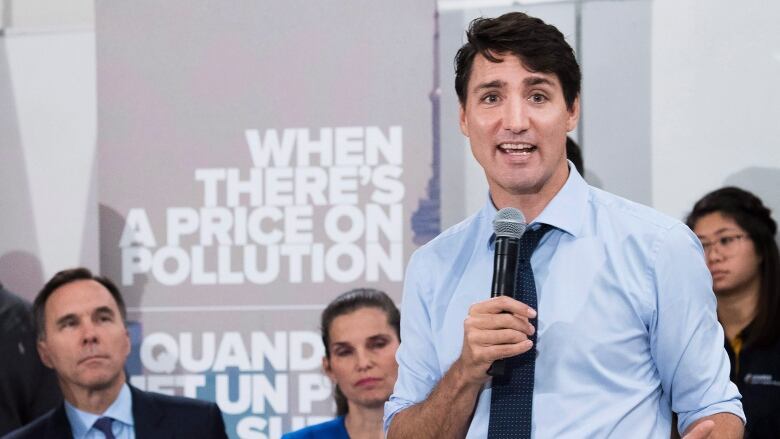
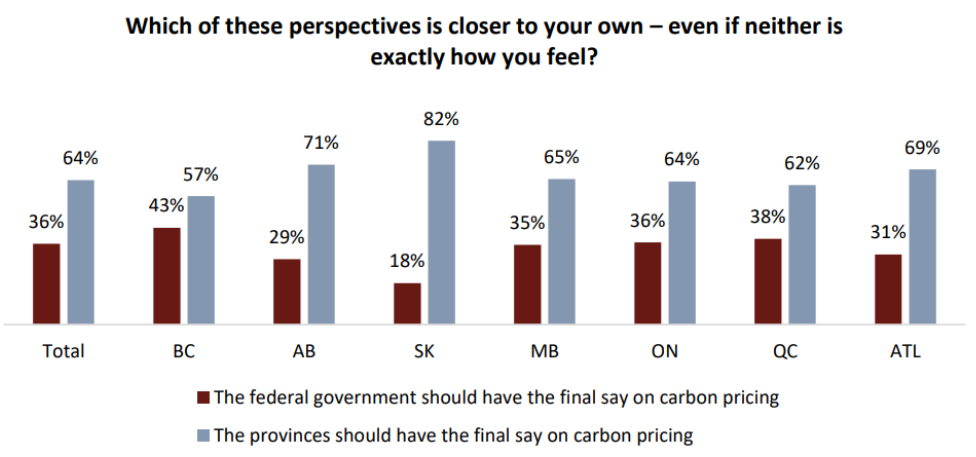
Canadian Prime Minister Justin Trudeau is announcing his national carbon tax even while the Canadian public is having second and third thoughts about global warming and human causation. An Angus Reid poll this summer shows how belief in the need for such a policy is wavering. The report is Carbon conflict: two-thirds of Canadians say provinces should have the final say on pricing

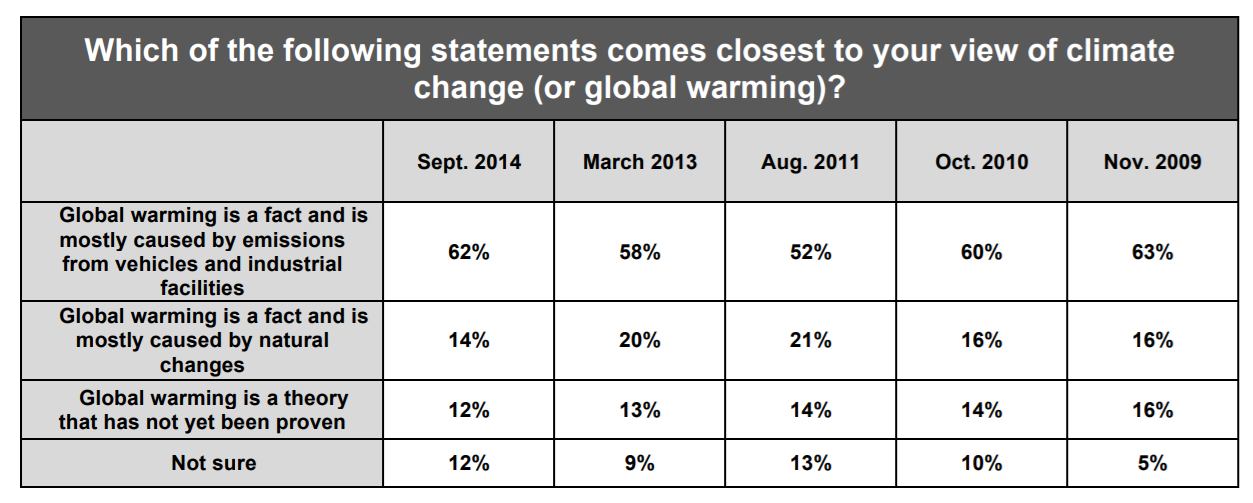
Before getting into the federal/provincial tug of war, let’s consider the basic belief. Angus Reid has been asking Canadians the same question since 2009, with these responses.

Open image in new tab to enlarge.

Note in 2009 63% believed that “global warming is a fact and mostly caused by humans”. That dropped down to 52%, then came back to 62% in 2014 when the Obama administration was beating the climate change drum for all it was worth. In Canada Trudeau’s Liberal party led in the polls on the way to winning power in October 2015.

Now let’s consider the polling in July of 2018.
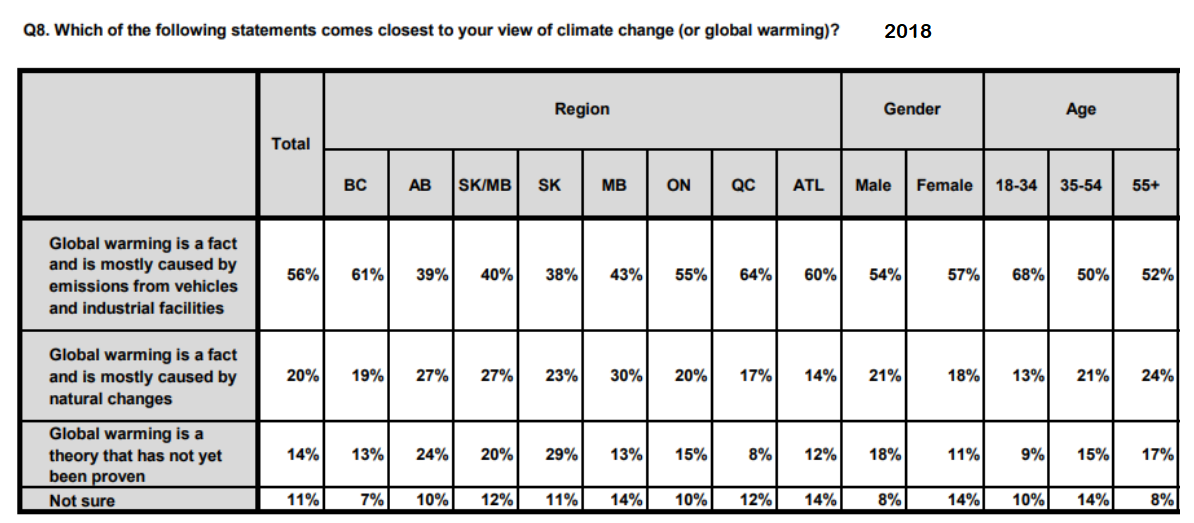
Belief in man-made global warming is back down to 56% in the context of Trump’s skepticism and the Paris Accord proving ineffectual. This first 2018 chart includes regional and age distributions showing that younger people (<35 yrs old) are much more often believers, becoming more skeptical (50/50) with age. Ironically, that young cohort has not witnessed any actual warming in their adult lives.

The three largest cities in Canada are Vancouver, Toronto and Montreal.  Not surprisingly, belief is strongest in the provinces of B.C., Ontario and Quebec, along with Atlantic region. The prairie provinces are definitely not on side.
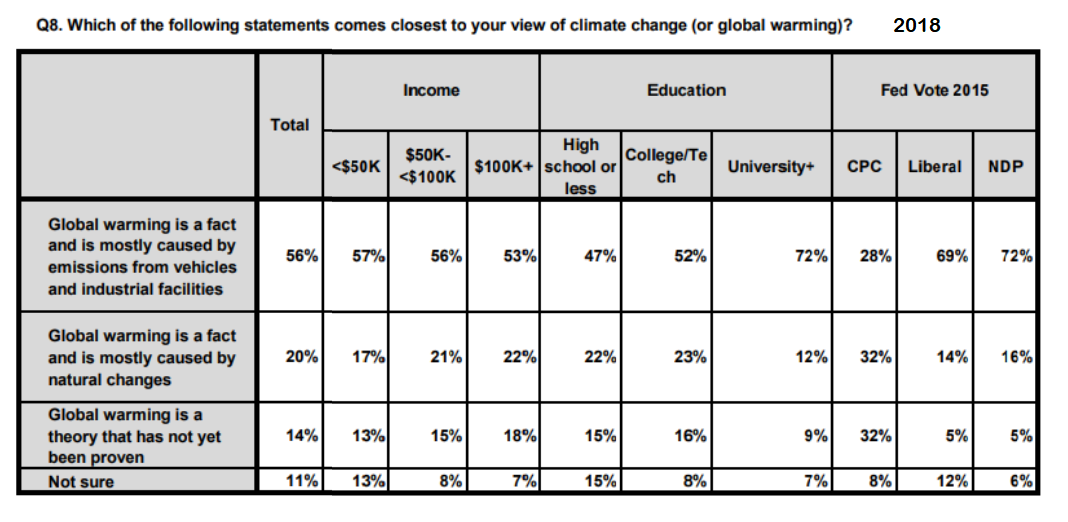
Another table shows that income level is not a driver, except for the more wealthy being somewhat surer of their opinions. However, global warming belief is strongly associated with university education, and with voting for left-wing parties (in Canada Liberal and NDP). It seems the educational system is aligned with left wing views on many things, including the climate.

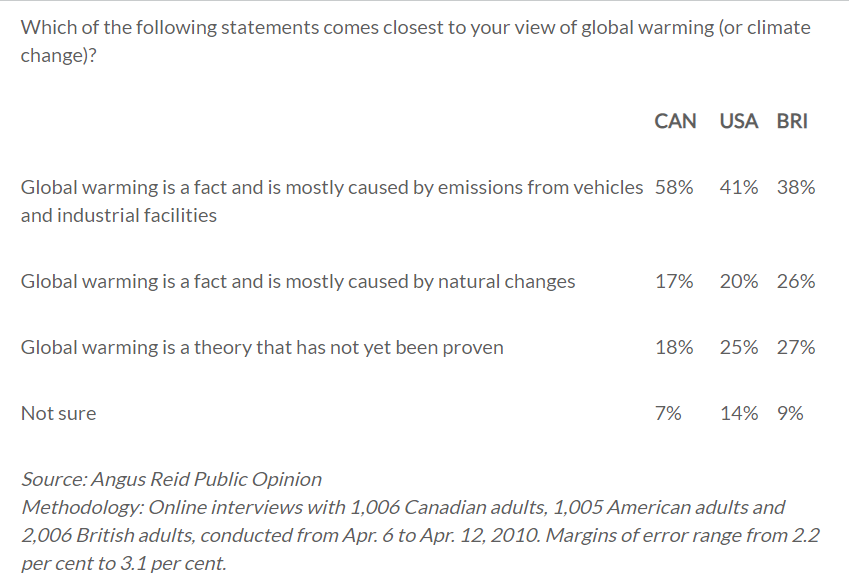
Angus Reid asked the same questions of Canadian, British and American citizens in 2010, with these results in the context of Obama mania and the Copenhagen COP drama.
In 2010 the majority of Americans and Brits were not global warming believers, compared to Canadians.  Note that Americans and Brits are more likely to say global warming is either natural or an unproven theory. More recent polls in those two countries continue to show the same pattern.

Political Implications

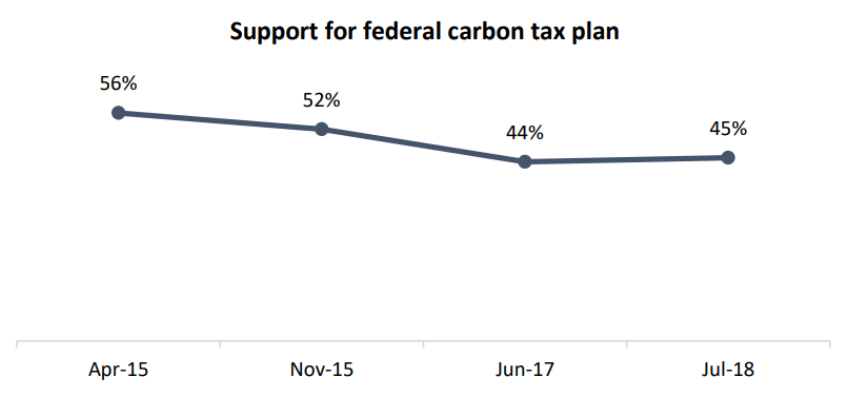
As the article title suggested, the landscape is not favorable for the Liberal’s tax plan.  For example
Moreover, both Ontario and Quebec have recently elected business-oriented provincial premiers, with Alberta likely to follow suit in the next election on or before May 31, 2019.  That may explain this result. Angus Reid observed that those who want no tax at all opted for provincial jurisdiction.

EU Sub Committee Aims to Open Closed Climate Minds

It wasn’t supposed to be this way.  The EU bureaucratic wheels were turning and needed a routine submission from the Committee on Agriculture and Rural Development as input for the Committee on the Environment, Public Health and Food Safety regarding a programme rule change.

The Rapporteur for opinion happened to be UKIP member John Stuart Agnew, who actually knows something about climate matters and agriculture, and drafted a submission accordingly.  The full document is here,( H/T WUWT)  and his case is put admirably.  Excerpts below in italics with my bolds.

The LIFE program is due for renewal in 2020. It has hitherto used its funding to act as a test bed for small projects which are expected to improve the environment. Examples have included management techniques to improve numbers of wild species or maintenance of wetlands. The success of such innovations can be quantified and demonstrated. The funding comes direct from Brussels.

If such projects are successful, they become popular with farmers who then make these investments using the Pillar 2 grants from their member states. The addition of the words ‘Climate Action’ in the present LIFE regime has added an entirely new concept to the way that taxpayer’s money should be used. The term has also occurred in the latest proposal from Commissioner Hogan on CAP reform. The addition of the term ‘Climate Action’ coincides with a 60% increase to the budget of the LIFE Programme. What is conspicuously missing are definitions of the actions required and the outcomes that are desired.

If the words ‘Climate Action’ had been substituted with the words ‘Pollution Action’, then it would be possible to measure air, soil and water pollution and measure the effectiveness of strategies to alleviate these problems, against a target figure for each of the three elements. A war to reduce pollution can be won, using the weapons of technology and legislation. A war against the world’s weather will never end, because ‘victory’ cannot be defined.

The Rapporteur has met the team of four from the Commission who between them have had varying levels of input into this proposal. The Rapporteur asked them what outcome would be considered desirable, as a consequence of financial investment. The answer was – ‘a reduction in CO2 emissions’.

By mentioning the concept that reducing CO2 levels will serve to take action against an unsatisfactory climate, the Commission is ignoring the factors that really do change our climate.
1. The galaxy: in the form of Cosmic Ray fluctuations. Can induce changes of 10 o C over millions of years.
2. The solar system: Gravitational pulls can induce changes of 2-3 o C.
3. The sun: Its variations of orbit and tilt along with its five separate documented cycles can the cause earth’s temperature to vary by up to 5o C.
4. Ocean Currents.
5. The ‘Greenhouse’ gas: Water Vapour, in the form of cloud cover.

The other Greenhouse gases, CO2, Methane and Nitrous Oxide have a negligible effect on our climate. CO2 is, however, an irreplaceable plant food. Methane degrades into CO2 and H2O; NOx gases eventually change into Nitrates.

If the effect of CO2 levels on our climate is negligible, the effect of human activity on changing those CO2 levels is also negligible.

The two world maps below perfectly demonstrate this.

Calculated areas of higher CO2 concentrations due to human emissions

– Actual areas of higher CO2 concentration
– SCIAMACHY observations on the ENVISAT satellite (agree with Japan’s IBUKU data)

The predictions of the experts and the measurements by satellite are contradictory. The total absence of CO2 hotspots over Europe indicates there is no problem for the Commission to solve. The only potential risk of a major CO2 event in Europe is an erupting volcano.

The naturally high concentrations of CO2 above our natural rainforests create an interesting dilemma for those who want one without the other. This is not made any easier when it is realised that rainforests are also major emitters of methane and water vapour.

Ever since the Rapporteur joined the Parliament in 2009, it has been fashionable for MEPs in AGRI and ENVI to work the phrase “tackling Climate Change” into their speeches. It sounds worthy and virtuous. It is based on predictions made in the 1980s of rapidly rising world temperatures and sea levels that never ultimately occurred. The Commission has listened to these speeches as opposed to observing the reality. At some stage somebody has to say “The king isn’t wearing an invisible suit, he’s just not wearing any clothes!” The Rapporteur is presenting this opportunity to his colleagues.

Some MEPs have been elected solely because of their antipathy to CO2. They will not change their views.

The Rapporteur urges other colleagues though to reflect on the fact that the precedent of ‘Climate Action’ in the LIFE Programme is setting the stage for ‘Climate Action’ in agriculture, where 40% of future budgets is destined to be spent fighting CO2, one of agriculture’s greatest friends.

The Rapporteur has amended the proposal to delete all references to “clean energy” as this implies “CO2 free” energy, as well as the references to ‘climate change mitigation’ but incorporated the term ‘climate change adaptation’ into the text of the legislative proposal. There is a big difference. We need to prepare for the next ‘Maunder Minimum’ or mini ice age – which might last 200-300 years. Some solar physicists believe this cycle has technically already started.

Footnote Regarding Future Cooling

Both the Pacific (PDO) and the Atlantic (AMO) are due for a cooling phase. If that happens coincidental with diminished solar input (indicated by the lower sunspot proxy), we are looking at planetary cooling as suggested by some solar physicists.

The situation reminds of governmental failure in North America to manage the educational system to match demographic shifts. The bureaucratic response comes too late to cope with the current reality. After WWII came the baby boom, and many schools became overcrowded and new ones built. Then the sexual revolution and female liberation produced a baby bust due to smaller families, so schools emptied with surplus capacity. Just as the government got serious about closing schools came the baby echo, unanticipated by the authorities. Despite smaller families, there were many more of them, these being the married adult boomers. Echo babies were a new pulse of children hitting a school system undergoing downsizing in response to the previous baby bust.

Similarly, the climatists would have us assume endless warming and require cessation of reliable affordable energy just as we enter a mini ice age.

Heat Wave AGW Hysteria Not So Much. Why?

An editorial at Investor’s Business Daily poses the question: Why Hasn’t The California Heat Wave Sparked The Usual Global Warming Hysteria?  Excerpts in italics with my bolds.
It wasn’t long ago when the mainstream press took every opportunity, no matter how weak the connection, to blame bad things on global warming. So far, at least, we haven’t found one major story using the heat wave gripping the southwest to sound the alarm about global warming.

This lack of alarmism has not gone unnoticed.

Writing at the New Republic this week, Emily Atkin complained that despite record-breaking heat and a wildfire season that, she says, is already worse than usual, “there’s no climate connection to be found in much news coverage, even in historically climate-conscious outlets like NPR and The New York Times.”

When Atkin contacted NPR for an explanation, the network’s science editor said “You don’t just want to be throwing around, ‘This is due to climate change, that is due to climate change.‘”

Wow.

Also this week, Chris Hayes of the uber-liberal MSNBC responded to a complaint on Twitter that his network wasn’t clanging the global warming alarm bells loudly enough or regularly enough with this tweet:

“every single time we’ve covered it’s been a palpable ratings killer. so the incentives are not great.”

So why this sudden outburst of common sense among the mainstream press?

Perhaps they’ve come to the realization that after decades of end-of-the-world predictions and oversaturation coverage, during which time global temperatures have barely budged, the public has stopped paying attention. You can only predict the end of the world so many times, after all, before people start to get skeptical.

The attempts by scientists and environmental activists to blame everything on global warming has probably increased public skepticism as well. Case in point is a video running on the Weather Channel app about a study that claims to have found a link between suicides and climate change. Even an uninformed public will start to question the validity of all these wild claims.

The public may also have noticed that the most vocal preachers of climate change doom — Al Gore, Leonardo DiCaprio, etc. — don’t act like there’s any crisis whatsoever. They still own huge energy sucking mansions and party on massive gas guzzling yachts.

They aren’t the only global warming hypocrites. A survey earlier this year by researchers at the University of Michigan and Cornell University found that those who said they were “highly concerned” about global warming were the least likely to take individual action. Skeptics were more likely to do the things the alarmist demand: recycle, use public transportation and so forth.

How big a crisis can climate change be if those who scream the loudest about it can’t be bothered to change their own behavior?

Whatever the cause of the climate ennui, it’s clear that years of proselytizing about the “existential threat” posed by a warmer planet has failed to win many converts.

In fact, a recent Gallup survey asked people to name the most important problems facing the country today. Neither “climate change” nor “global warming” even showed up on the list of more than 45 items. Just 2% named “environment/pollution.”

We’d say the public has it right. But don’t be surprised if the media returns to its climate change obsession, if only to take a break from its Trump obsession.

Update July 28:

As if on cue the mainstream media is now awash with headlines claiming AGW is causing heat waves and forest fires.

Summary

The editors are referring to major mainstream media not rising to the bait as usual.  Of course, the activist alarmist websites and blogs have been going crazy with this momentary weather situation.  I noticed, however, on one of the twitter threads comments from a few climate researchers confiding that they don’t speak out lest they be branded as Alarmists.

Now that is progress if scientists are taking to heart the need to be balanced and objective conveying information.  Fame and fortune may still await a breakthrough scary climate finding, but now responses will include skeptical voices. The public is not as naive and gullible as before, having been spoofed too often.

See Also:  On climate polling trickery The Art of Rigging Climate Polls

And why climate and suicides do not mix Stanford Jumps Suicide Climate Shark

Preschool Alarmist Brainwashing


Review from Newsbusters New Magic School Bus to Kids: Use Clean Energy or Monsters Will Eat You Excerpts in italics with my bolds.

The Magic School Bus is back in the new Netflix series The Magic School Bus Rides Again! Overall, it’s still a nice, fun 13-episode series like we remember from when we were kids, but with some left turns. There is a pretty predictable take on climate change propaganda for little kids, but that wasn’t the worst. That dubious honor goes to the episode that teaches kids that a monster will eat them if they don’t use alternative clean energy sources.

Of course, conserving energy is a good thing and we should be kind to the earth, but this climate change hysteria is taking over. Usually, somebody will say that 97 percent of climate scientists agree that humans are causing global warming, and I was surprised that figure didn’t come up in this episode. Could it be that they know how easily debunked that number is? Given the way Dorothy Ann presented man-made climate change as fact, I doubt it.

This issue tends to play incredibly well in the mainstream media, as they use climate change as the universal bad-guy, so I’m sure there were plenty of parents who actually thought this episode was a good idea. I find it hard to believe any parents were happy about this next one, though.

Espisode 12: Monster Power. Click on link below to play short excerpt video.

https://www.mrctv.org/embed/518271

Episode 12, “Monster Power,” teaches kids that a monster will eat them if they don’t use alternative clean energy sources. Albert, one of the students, has seen a movie in which the evil monster loves pollution and is “coming for us next for what we’ve done to this planet!” With the class camping in the woods, Miss Frizzle and the other students help him come up with clean energy alternatives (wind, water, etc) so they won’t be eaten. Instead, Miss Frizzle could tell him that monsters aren’t real, but I guess that didn’t occur to her.

While it makes sense to teach kids the science of pollution and about all kinds of energy (I wouldn’t have minded some talk about oil in the dinosaur episode, to be honest), why would they tell kids that a monster will eat them for using the wrong energy source? I may not have the teaching credentials of Miss Frizzle, but I’m pretty sure that’s not scientifically accurate. They must really hate fossil fuels as much as their friends on the left. Keeping in mind that the TV-Y rating for this series means it’s for kids 2-6, I’m sure there are going to be some parents pretty irked at bedtime when kids are scared of the blot monster.

Overall, this is a cute series and fun bit of nostalgia for those of us who enjoyed the original books (or TV series) as kids, but I could have done without the climate change propaganda, and telling kids that traditional energy sources attract monsters is way over the top. Can’t kids just learn without an anti-scientific social agenda?


The Art of Rigging Climate Polls

Marketing and social influence makers have used opinion surveys extensively to promote awareness, interest and motivation to engage with their products or preferred policies. I have written before on how this ploy is used regarding global warming/climate change (links at bottom). This post is prompted by a fresh round of climate polls and some further insight into how results are created to support a socio-political agenda.

Of course, any opinion poll on climate as a public policy matter is indicating how much of the blather in the media has penetrated public consciousness, and softened them up for political pitches and financial support. And the continuing samplings and reports need to show progress to keep activist hopes alive.

Just yesterday we had an announcement along these lines. Poll shows consensus for climate policy remains strong is published at Phys.org from Stanford U. (where else, home of the belated Stephen Schneider, among many other leading alarmists). Stanford also happens to be my alma mater, but when I was studying organic chemistry there, we knew life on earth was carbon-based and did not think CO2 was a pollutant.

Climate Public Opinion is a Program of Research by the Stanford Political Psychology Research Group (website link) and has done frequent surveys on the question: What do the residents of the United States believe about global warming?

From psy.org article (excerpts in italics with my bolds):

While the United States is deeply divided on many issues, climate change stands out as one where there is remarkable consensus, according to Stanford research.

“But the American people are vastly underestimating how green the country wants to be,” said Jon Krosnick, a professor of communication and of political science at Stanford, about new findings from a poll he led on American attitudes about climate change.

The study was conducted with ABC News and Resources for the Future, a Washington, D.C.-based research organization. A representative sample of 1,000 American adults nationwide were polled from May 7 to June 11, 2018. The margin of error is +/- 3.5 percentage points.

The poll showed that Americans don’t realize how much they agree about global warming: Despite 74 percent of Americans believing the world’s temperature has been rising, respondents wrongly guessed 57 percent.

“The majority doesn’t realize how many people agree with them,” said Krosnick. “And this may have important implications for politics: If people knew how prevalent green views are in the country, they might be more inclined to demand more government action on the issue.”

Public belief in the existence and threat of global warming has been strikingly consistent over the last 20 years, even in the face of a current administration skeptical about climate change,” said Krosnick, who has been tracking public opinion about global warming since 1995.

Krosnick has learned from his 20 year experience with this topic, and shares with us some of the tricks of the trade. For example, one paper provides their finding regarding the wording of questions.

1. “What do you think is the most important problem facing the country today?”

In this traditional MIP question, about 49 percent answered the economy or unemployment, while only 1 percent mentioned the environment or global warming.

2. “What do you think is the most important problem facing the world today?”

Substituting the word “country” with “world” produced a significant change: 7 percent mentioned environmental issues, while 32 percent named the economy or unemployment.

3. “What do you think will be the most important problem facing the world in the future?”

When asked to consider the future of the planet, 14 percent chose the environment or global warming, while economic issues slipped to 21 percent.

4. “What do you think will be the most serious problem facing the world in the future if nothing is done to stop it?”

This time, 25 percent said the environment or global warming, and only 10 percent picked the economy or unemployment.

“Thus, when asked to name the most serious problem facing the world in the future if nothing is done to stop it, one-quarter of all Americans mentioned either global warming or the environment,” Krosnick said. “In fact, environmental issues were cited more often in response to question 4 than any other category, including terrorism, which was only mentioned by 10 percent of respondents.”

Thus it is that survey results are influenced greatly by the design of the questioning process. Helpfully, the Stanford program provides this history of the questions put to participants over the years. Below are the result categories, some showing the evolving form of questioning, and others just the most recent form for brevity. I will comment on the first few, and leave the others for your reflection (my bolds)

1. Global warming is happening. 2012-2013: What is your personal opinion? Do you think that the world’s temperature probably has been going up over the past 100 years, or do you think this probably has not been happening? 2012: What is your personal opinion? Do you think that the world’s temperature probably has been going up slowly over the past 100 years, or do you think this probably has not been happening? 1997-2011: You may have heard about the idea that the world’s temperature may have been going up slowly over the past 100 years. What is your personal opinion on this? Do you think this has probably been happening, or do you think it probably has not been happening?

Fair question with both responses equally acceptable. The earlier form referred to what they may have heard, but wisely dropped that later on. One does wonder what evidence people use for 100 years of reference.

In a separate study Krosnick tested the effect of asking about “global warming” or “climate change” and concluded:
In the full sample, global warming, climate change, and global climate change were all perceived to be equally serious on average. These findings seem to be inconsistent with the claim that people view climate change or global climate change as less serious than global warming. In addition, the distribution of seriousness ratings were equivalent for global warming, climate change, and global climate change.

IMO it is to his credit that he asks about global warming rather than the vacuous “climate change”.

2.Warming will continue in the future. 2012: If nothing is done to prevent it, do you think the world’s temperature probably will go up slowly over the next 100 years, or do you think the world’s temperature probably will not go up slowly over the next 100 years?

Here comes the phrase:  If nothing is done to prevent it . . . The participant gets the suggestion that rising temperatures have human agency, that we can do something to prevent them. As Krosnick explained above, this phrase will help respondents identify the issue as “environmental” and tap their instinct to protect nature. Implanting this subliminal suggestion sets them up for the next question.

3. Past warming has been caused by humans. 2012: Do you think a rise in the world’s temperature is being caused mostly by things people do, mostly by natural causes, or about equally by things people do and by natural causes? 2012: Assuming it’s happening, do you think a rise in the world’s temperature would be caused mostly by things people do, mostly by natural causes, or about equally by things people do and by natural causes?

Now we have some serious distortions inserted into the findings. The end results will reported as “The % of Americans that believe past warming has been caused by humans.” Note that participants have been primed to think warming is preventable by humans, so obviously humans have caused it (logical connection). Moreover, there are the 50-50 responses that will be counted as human causation. The problem is, people who are mostly uncertain and unwilling to say “don’t know” will fall back to the “equally human, equally nature” response.  It is a soft, not affirmative response.

And a further perversion: Those who have said temperatures are not rising are now told to “Assume it is happening.” What? This is no longer an opinion, it is out-and-out speculation. It appears that “Don’t know” and “Not Happening” are disallowed to force a choice with a 67% chance of getting the right answer: “Caused by Humans.”

4.Warming will be a serious problem for the U.S. 2012: If nothing is done to reduce global warming in the future, how serious of a problem do you think it will be for THE UNITED STATES – very serious, somewhat serious, not so serious, or not serious at all? 2012: Assuming it’s happening, if nothing is done to reduce global warming in the future, how serious of a problem do you think it would be for THE UNITED STATES – very serious, somewhat serious, not so serious, or not serious at all?

Again the phrase “If nothing is done to reduce global warming. . .” signaling participants that this is a serious issue, so don’t come with “not so serious” or (God forbid) “not serious at all.” And again, global warming must be assumed to be happening by anyone still unconvinced of it.

5. Warming will be a serious problem for the world. 2012: If nothing is done to reduce global warming in the future, how serious of a problem do you think it will be for THE WORLD – very serious, somewhat serious, not so serious, or not serious at all? 2012: Assuming it’s happening, if nothing is done to reduce global warming in the future, how serious of a problem do you think it would be for THE WORLD – very serious, somewhat serious, not so serious, or not serious at all?

Same comments regarding #4 apply here, only as Krosnick explained, elevating the issue to a “world problem” triggers even more seriousness in responses.

6. Five degrees of warming in 75 years will be bad. 2011-2012: If the world’s average temperature is about five degrees Fahrenheit higher 75 years from now than it is now, overall, would you say that would be good, bad, or neither good nor bad? 1997-2010: Scientists use the term “global warming” to refer to the idea that the world’s average temperature may be about five degrees Fahrenheit higher in 75 years than it is now. Overall, would you say that if the world’s average temperature is five degrees Fahrenheit higher in 75 years than it is now, would that be good, bad, or neither good nor bad?

In the past, interviewers told participants that global warming is defined as 5 degrees warmer, which triggered “bad” as a response. Fortunately, that obvious bias was dropped, and now people are free to say good, bad or neither. Interestingly, this question is not emphasized in the reports, perhaps because it only gets around 50% “Bad”, even in alarmist places like New York and California.

7. The government should limit greenhouse gas emissions. 2012: As you may have heard, greenhouse gasses are thought to cause global warming. In your opinion, do you think the government should or should not limit the amount of greenhouse gasses that U.S. businesses put out? 2008-2011: Some people believe that the United States government should limit the amount of air pollution that U.S. businesses can produce. Other people believe that the government should not limit air pollution from U.S. businesses. What about you? Do you think the government should or should not limit air pollution from U.S. businesses?

Here the older form of the question was more balanced: Some people believe X, some people believe Y, what do you believe? However, the older question was about air pollution which confuses CO2 (natural plant food) with artificial chemicals. The recent question targets “greenhouse gases”, a term nowhere defined. Now the biased question: Greenhouse gases cause global warming, should the government reduce them? Duh!

8.U.S. federal government should do more to address global warming. 2012: How much do you think the U.S. government should do about global warming? A great deal, quite a bit, some, a little, or nothing? 2009-2011: How much do you think the U.S. government is doing now to deal with global warming? A great deal, quite a bit, some, a little, or nothing? 2008: Do you think the federal government should do more than it’s doing now to try to deal with global warming, should do less than it’s doing now, or is it doing about the right amount?

Note the shift from asking about Whether government should do more than now, to How much is government doing now, to present form: How much more should government do.  Compares with: “Have you stopped beating your wife?”

9. U. S. should take action regardless what other countries do. Do you think the United States should take action on global warming only if other major industrial countries such as China and India agree to do equally effective things, that the United States should take action even if these other countries do less, or that the United States should not take action on this at all?

IOW, Should the US wait for others and be a follower, not a leader? Duh!

Series of Government Policy Questions

The real reason for the survey is to develop support for government officials to impose climate policies upon the population. The flavor of these is below with few comments from me until the end.

10. For the next items, please tell me for each one whether it’s something the government should require by law, encourage with tax breaks but not require, or stay out of entirely. Each of these changes would increase the amount of money that you pay for things you buy.

Reduce greenhouse gas emissions by power plants. Favor lowering the amount of greenhouse gases that power plants are allowed to release into the air?

Favor a national cap and trade program. There’s a proposed system called “cap and trade.” The government would issue permits limiting the amount of greenhouse gases companies can put out. Companies that did not use all their permits could sell them to other companies. Companies that need more permits can buy them, or these companies can pay money to reduce the amount of greenhouse gases that other people or organizations put out. This will cause companies to figure out the cheapest way to reduce greenhouse gas emissions. This type of permit system has worked successfully in the past to reduce the air pollution that companies put out. For example, in 1990, the federal government passed a law like this, called the Clean Air Act, which caused companies to put out a lot less of the air pollution that causes acid rain. Would you favor or oppose a cap and trade system to reduce the amount of greenhouse gases that companies put out?

Tax breaks to produce renewable energy. Do you favor or oppose the federal government giving companies tax breaks to produce more electricity from water, wind, and solar power?

Tax breaks to reduce air pollution from coal. Do you favor or oppose the federal government giving tax breaks to companies that burn coal to make electricity if they use new methods to reduce the air pollution being released from their smokestacks?

Increase CAFE standards for cars. Favor building cars that use less gasoline?
Build electric vehicles. 2012: Building cars that run completely on electricity?

Build appliances that use less electricity. Favor building air conditioners, refrigerators, and other appliances that use less electricity?

Build more energy-efficient buildings. Favor building new homes and offices that use less energy for heating and cooling?

Tax breaks to build nuclear power plants. Do you favor or oppose the federal government giving companies tax breaks to build nuclear power plants?

Who Pays for all this? It is time for the turkeys to face the pilgrim with the hatchet. How willing are you to pay increased taxes to “fight global warming?”

Increase consumption taxes on electricity. Do you favor or oppose the federal government increasing taxes on electricity so people use less of it?

Most places, majorities of respondents were favorable, up to 80% in some states. Perhaps a tribute to relatively cheap electricity in the U. S.  They are blissfully unaware of what can happen to electricity rates, having been spared so far the “Ontario Experience.”

Increase consumption taxes on gasoline. Do you favor or oppose the federal government increasing taxes on gasoline so people either drive less, or buy cars that use less gas?

Nowhere does this get a majority favorable response. It ranges from 15% to 40%, with most places around 30% in favor of higher gasoline taxes.

And finally, how much do you care and how much do you know?

Warming is extremely important personally (and is likely to influence voting). How important is the issue of global warming to you personally – extremely important, very important, somewhat important, not too important, or not at all important?

Less than 17% of people say global warming is personally extremely important, and most places are under 10%

Highly knowledgeable about global warming. How much do you feel you know about global warming – a lot, a moderate amount, a little, or nothing?
Americans rate their global warming knowledge higher than other countries, going up to 60-70% claiming “Highly Knowledgeable.” Other country surveys would report 25% more typically.

Conclusion

An opinion poll is a mirror claiming to show us ourselves. All polls have error margins, and some are purposely bent to a desired distorted outcome.

In modern social democracies, polls and media are used to shape and report public opinions required by ruling elites to impose laws and policies unwanted by the people. A recent example was the distorted Canadian survey on carbon pricing used by Trudeau government to justify a carbon tax. That poll is deconstructed in a post Uncensored: Canadians View Global Warming.

Krosnick said that people taking his climate poll were surprised that the responses were not more skeptical of global warming claims. After seeing how the survey is put together, I am inclined to believe that participants and their neighbors are actually more skeptical than depicted in the results.  This showed up in the low numbers saying global warming is an important personal issue.  Despite agreeing with alarmist talking points, people seem to know this is about virtue signaling and tribal politics.  It is an “everywhere elsewhere” problem.

Finally, in the survey, Americans rate themselves as highly knowledgeable about global warming, up to 60-70% in some states. Other countries doing such climate surveys typically get about 25% of people saying that. For so many to be taken in by such a survey suggests that Americans’ actual knowledge of global warming is highly overrated.

Background:  Another Climate Push Poll

Climate Is a State of Mind

Sloppy Science + Bad Reporting = Fake Scare


Abusing science to incite fear is not confined to global warming/climate change. Medical science has also been debased by taking up the appeal to public alarm. The current example being exploitation of ovarian cancer, as explained by Warren Kindzierski writing in Financial Post How weaselly science and bad reporting consistently find cancer links that don’t exist  (Weaselly: Stretching facts with the use of such words as ‘this could,’ ‘can,’ ‘may,’ ‘might,’ ‘probably,’ ‘likely’ cause cancer)

Last month, the Quebec court authorized a class-action suit against two brands of baby powder that alleges that regular use of talc powder by women in their genital area is linked to a higher risk of ovarian cancer. Part of the allegations relate to claims that an ovarian cancer risk from powdered talc use is demonstrated by nearly four decades of scientific studies. Cosmetic talc has certainly been the subject of much scientific debate, study and, increasingly, legal challenge.

However, the cosmetic talc-ovarian cancer link is commonly misunderstood. Published biomedical studies cover both sides, suggesting a talc-ovarian cancer link and showing no link. Even today in prominent journals, letters to the editor — penned by scientists — rage back and forth, defending their studies or attacking the other side’s studies.

Now this is civilized, real science.

This bouncing back and forth of positive versus negative effects between talc and ovarian cancer is referred to as “vibration of effects” by John Iaonnidis, a professor of medicine and of health research and policy at Stanford University. Studies vary depending on how they are done. Why is this? Well, getting scientists to agree on important things like methods, what data to use and how to analyze and interpret effects from subtle human exposures is next to impossible. It would be no problem if one were studying cancer risks in populations receiving large exposures over long durations; but such situations are non-existent.

The truth is that the ability of any biomedical method, epidemiology included, to discriminate cancer risks in people from small exposures to a physical or chemical agent does not exist.

Most cancers are caused by a number of factors. As a result, establishing cancer causation is complex — unless a particular risk factor is overwhelming. Epidemiology studies cannot and do not realistically replicate this complexity, at least not very well. That is why the U.S. National Institutes of Health and the National Cancer Institute lists a number of key risk factors for ovarian cancer and talc is not one of them.

The institute states that it is not clear whether talc affects ovarian cancer risk. An expert U.S. cosmetic-ingredient review panel assessed the safety of cosmetic talc in 2015. It thoroughly analyzed numerous studies investigating whether or not a relationship exists between cosmetic use of talc in the perineal area and ovarian cancer. The panel determined that these studies do not support a causal link. They also agreed that there is no known physiological mechanism by which talc can plausibly migrate from the perineum to the ovaries. The news coverage of the lawsuit has been silent on that evidence.

Part of the public’s misunderstanding about talc comes from scientists offering opinions about cancer from small exposures. Too many scientists use weasel words to stretch facts: “This could,” “can,” “may,” “might,” “probably,” “likely” cause cancer. Flimsy so-called evidence from their studies that suffer from vibration of effects and their speculations are voraciously inhaled by naïve journalists. Stretched facts miraculously get reported as facts to the public — or worse, misused for litigation purposes.

The woman’s bathroom is a chemical exposure chamber with literally dozens of cosmetic products used at various times. Both skin contact and inhalation regularly occur with grooming products. However, repeated uses of small amounts of cosmetic talc or any other cosmetic product do not amount to overwhelming exposures despite the claims of some scientists and media. Overwhelming exposures — the ones that cause effects — are those that occur with laboratory rats and mice. Underwhelming exposures are what occur to people in the real world.

It is highly speculative that repeated use of small amounts of cosmetic talc is a definitive cause of ovarian cancer. It is not a definitive cause; it is only suggestive. Prominent organizations such as the U.S. National Cancer Institute and expert panels should make clear statements about such cancer risks, but they do not. Selective methods in epidemiology studies, speculation by scientists and inaccurate reporting by news media are ingredients used to transform weak suggestive evidence from underwhelming cosmetic talc exposure into something that is mistakenly claimed to be harmful for the public.

And that is why we end up with class action suits against cosmetic companies.

Warren Kindzierski is an associate professor in The School of Public Health at the University of Alberta.

More Civil Climate Discourse

As discussed in Coercive PC Discourse, there is a lot of insulting and shouting when it comes to climate change.  As the summary of the post said:

But there is a way to reduce needless division over the countless disagreements that are inevitable in a pluralistic democracy: get better at accurately characterizing the views of folks with differing opinions, rather than egging them on to offer more extreme statements in interviews; or even worse, distorting their words so that existing divisions seem more intractable or impossible to tolerate than they are. That sort of exaggeration or hyperbolic misrepresentation is epidemic—and addressing it for everyone’s sake is long overdue.

In the interest of demonstrating how climate realists can deal in a civil manner with disagreeable others, I provide some further helpful examples from Alex Epstein, author of The Moral Case for Fossil Fuels. Excerpts from his recent emails with my bolds.

1. Promoting Dialectic rather than Debate

Late last week I got this email from reader Peter Conley. I hope you find it as motivating I do. Peter is proof that with enough study and practice it’s possible to get amazing results in your energy conversations. At the end I’ll tell you a new technique I learned from Peter’s email.

***READER COMMENT***

Hello Alex,

I use [your framework] to discuss the issue of energy every opportunity I get and it is highly effective at promoting dialectic rather than debate. I had an experience with a schoolteacher on a Southwest flight recently that illustrates its effectiveness:

Teacher: “Do you believe in climate change?”

Me: “That is a very interesting and complex topic. It’s obviously very important to you. What are your thoughts on the subject?”

Teacher: “We need to stop it!”

Me: “And why is that?”

Teacher: “Because the ice caps are melting!!”

Me: “And why do you care about that?”

Teacher: “Because sea levels will rise!”

Me: “And why is that alarming?”

Teacher: “Because coastal cities and entire countries will be underwater!!”

Me: “So, you’re concerned about the negative impacts it will have on people?”

Teacher: “Of course, I don’t want to leave such a dangerous world to my grandkids.”

Me: “Of course not, neither do I. Would you agree then that when we think about this issue, we should use human flourishing as our standard of value?”

Teacher: “Yes, definitely!”

Me: “Do you know, then, if human deaths because of climate-related factors such as extreme hot, extreme cold, and drought are increasing annually or decreasing?

Teacher: “Well, I’d imagine they are increasing.”

Me: “What if I told you that the number of such deaths worldwide have decreased from over 3 million one year in the early 30s, to under 30,000 in this decade?”

Teacher: “Wow! Why is that?”

Me: “Because of technology. Because we are so much better at protecting ourselves from the naturally dangerous environment than our ancestors were. So, what would you say the most basic human need is?

Teacher: “Food, shelter, water, security.”

Me: “Those are all actually products of fulfilling one basic need, one basic necessity; the most basic human need is energy.”

He agreed, and further agreed that we must look at all costs and benefits and had a two-hour discussion about those. He was able to understand my thinking and said “I didn’t know that” far more times than he said “I don’t know about that.”

I like your point that the energy industry is the industry that powers all other industries. I have found it highly effective to explain that point after first asking “What is the most basic human need?” Most of the time I get answers like the teacher gave, or references to Maslow’s Hierarchy of Needs. Helping the person conclude that energy is the most basic human need helps to frame the conversation in terms of human flourishing . . .
I appreciate all the work that you do, and you have inspired me to do what I can to correct the conversations people are having.

Sincerely,

Peter

>>>MY COMMENTS

As I said at the outset, you’re doing an amazing job.

Here are two tactics I want to experiment with myself after reading your note.

Getting agreement on a pro-human standard by asking “Why” to their value statements. I usually get another person to agree on a common, pro-human standard by asking something like “Would you agree that the best decision is the one that most advances human life?” But your way is intriguing. When they say they care about something, you keep asking “Why” until you get down to the level of an ultimate standard—and then you offer “human flourishing” as your view. One reason this is effective is because it quickly introduces the idea that there need to be reasons (standards) for caring about things. Another reason it’s effective is that you’re challenging the idea that environmental change—ice caps melting—is inherently bad. I imagine that you need to strike a careful tone while asking these questions. If you come across as completely indifferent to the thing they claim to care about it could backfire. But if you ask the question earnestly, indicating that you’re looking to clarify not contradict, I can see how it would work well.

How you explain that energy is a fundamental need. The question “What do you think the most basic human need is?” Is an engaging question to ask. By getting the other person to state what they think are the most important needs you’re connecting them very concretely to the requirements of human flourishing. And then you show how energy is fundamental to those needs, connecting energy to human flourishing. This ensures that access to energy doesn’t become anything resembling optional or derivative—it stands as fundamental.

2. What to do when someone calls you the devil

***READER COMMENT***

I’ve been listening to some of your interviews on YouTube and I sincerely appreciate your effort to make the case for fossil fuels. I am about to graduate with a degree in chemical engineering and I have a job lined up to work for a major oil company at their largest US refinery.

On my college campus I encounter people that seem to be so clueless as to the benefits of fossil fuels that I don’t even know where to begin to try to convince them. I talked to one young freshman girl and when I told her that I want to go work in oil and gas, she responded with “you mean Satan?” I was so stunned at her hostility that I didn’t know how to respond. I just said “yeah sure,” so that I didn’t have to engage in a combative conversation. What do you think I should have done in this situation?

Best regards,

Zachery Baker

>>>MY COMMENTS

Great question, Zachary.

Imagine that you had told the freshman not “I want to go work in oil and gas,” but “I want to go work for a hospital.” And she had responded “You mean Satan?”

How would you react?

Here’s my guess:

  1. You would find her response hypocritical; you would be sure she and certainly those she cares about have taken advantage of the life-and-death benefits of hospitals.
  2. You would find her response offensive; she is assuming you would work for an evil enterprise.

I think the exact same reaction is warranted in the case of fossil fuels. Fossil fuels, like hospitals, have risks (hospitals have more) but are indispensable to human flourishing. If someone condemns us for pursuing a career providing energy that billions of people need and request, they are being hypocritical and offensive.

In my experience you can profitably point out either of these if you do so politely and calmly.

Express curiosity about hypocrisy

In the case of hypocrisy, I like to take a tone of curiosity and/or confusion, not condemnation.

F: “You mean Satan?”

You: “I’m curious why you think they’re Satan. Just looking at you right now you appear to be a major user of their products…”

She’ll either acknowledge that she’s a user or not—either way you can transition into why we all use products of the oil industry.

Be offended (but calm)

You: I’m curious, would you ever work for an industry you believed was evil?

F: No, of course not.

You (gravely): Neither would I. (Don’t break eye contact.) And I find it offensive that you think I would without asking me why I chose to work in this industry.

This will give the other person the opportunity to apologize and express sincere interest in your thought process—or to be rude and prove unworthy of your time.

Let me know how it goes!

Bravo Alex for engaging people constructively in the battle for hearts and minds as we perhaps enter a cooling period where our energy needs will be even more pronounced.

Previous Post with different examples: Civil Climate Discourse

Footnote:  For more on how green zealots are poisoning the social environment, read the poignant story of Tisha Schuller, an environmentally responsible energy consultant writing in the Breakthrough Institute Journal:  Reclaiming Environmentalism  How I Changed My Mind Without Changing My Values

Schuller on where she is today:

For several years, I stopped calling myself an environmentalist. After five years of threats, extremism, and misinformation from a community I’d once considered myself a part of, I simply couldn’t use the term anymore.

It’s easier, now, to unwind my complex relationship with environmentalism and environmentalists. I’m no longer a target of constant criticism and threats, for one, and I have the mental leisure to dissect my own experiences and prejudices. With the benefit of hindsight, I’ve become passionate about reclaiming the term. I am an environmentalist.

But I can no longer embrace many of the totems that have come to define environmentalism for many people.