NPR Defends Pseudo-Science

This morning in the car doing some errands I listened to an NPR broadcast regarding a NYT article claiming the Trump administration is attacking the fundamentals of climate science. Two journalists involved in the NYT article made two revealing defenses of IPCC climate ideology.

First they objected to the Geological Survey decision to limit consideration (required by US law) of climate change to impacts foreseen between now and 2040, setting aside projections out to 2100. Their reasoning: We won’t see any significant effects from our reducing (or not) CO2 emissions until the second half of this century. All of the forecasted temperature rise of 8F, along with sea level rise, storms, droughts, floods, etc. is only seen to occur after 2040. How do they know this? It is certain because it comes directly from the Oracle of Delphi the Climate Models, which have so accurately forecast the climate in the past (sic).  All the pressure to unplug industrial civilization now, with results to appear many decades later.

Then they expressed shock that a Presidential Commission may be set up to review and questions climate assumptions put into agency planning. They said everyone agrees on the science of global warming, and this is not the way climate science is done. The two journalists, without a single bit of self-awareness, proceeded to discredit the possible chairman William Happer by saying he was not a “climate scientist.” Like, how would they know? He is a world expert on atmospheric gases responses to infrared radiation, which is the supposed mechanism of man made global warming, and something about which they  are  clueless.

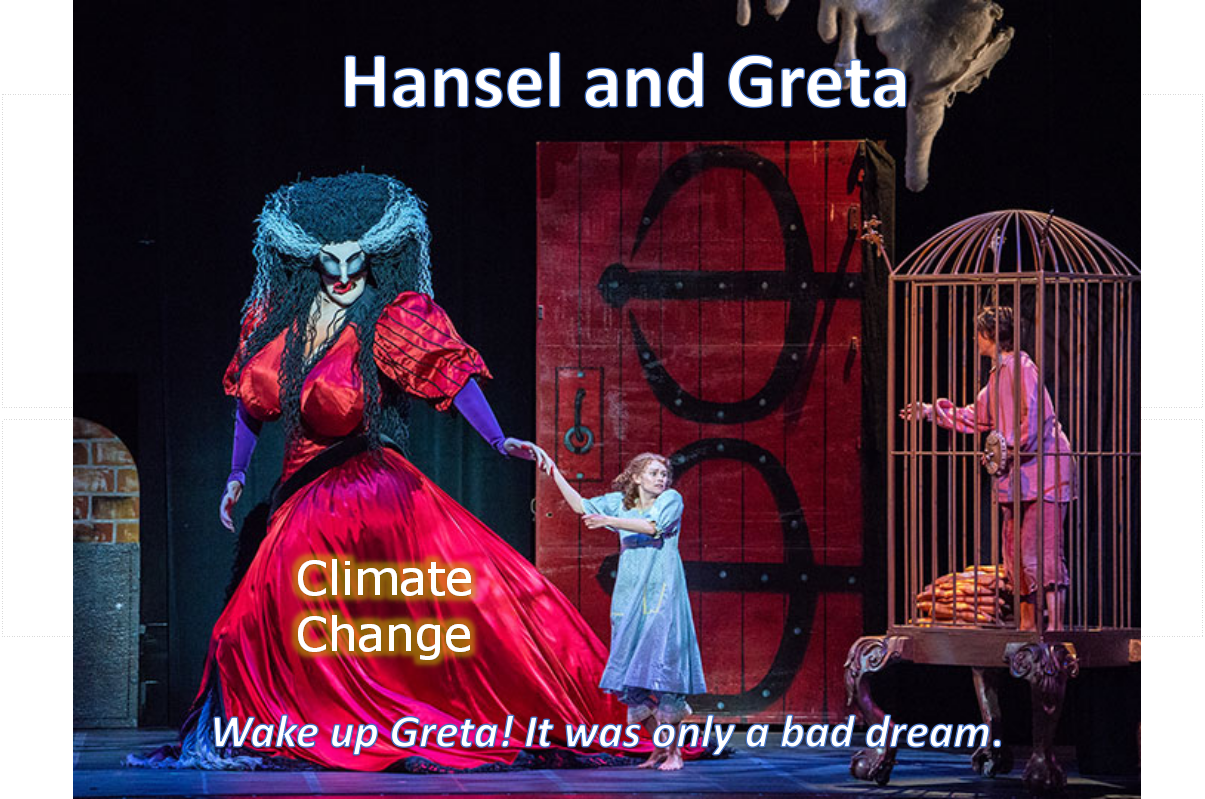
In other news today, Arnold Swartzenegger was “starstruck” to meet with teen climate activist Greta Thunberg. How bad will this nightmare get before people wake up?

See Also Stop Fake Science. Approve the PCCS!

Get a Second Opinion Before Climate Surgery

US News is Skewed Up and Dumbed Down

Under the Suspicions Confirmed file, we have quantitative proof that US news is increasingly skewed according to the values of the media outlet. Rand corporation is publishing studies on the theme Truth Decay, based on analyzing 15 prominent and popular media platforms. The latest report is at phys.org entitled US journalism has become more subjective. Excerpts in italics with my bolds.

U.S.-based journalism has gradually shifted away from objective news and offers more opinion-based content that appeals to emotion and relies heavily on argumentation and advocacy, according to a new RAND Corporation report.

In a unique analysis on news discourse and presentation, researchers found that the changes occurred over a 28-year-period (1989 to 2017) as journalism expanded beyond traditional media, such as newspapers and broadcast networks, to newer media, such as 24-hour cable channels and digital outlets. Notably, these measurable changes vary in extent and nature for different news platforms.

“Our research provides quantitative evidence for what we all can see in the media landscape: Journalism in the U.S. has become more subjective and consists less of the detailed event- or context-based reporting that used to characterize news coverage,” said Jennifer Kavanagh, a senior political scientist and lead author of the report, which is second in a series of research into the phenomenon of “Truth Decay,” the declining role of facts and analysis in civil discourse and its effect on American life.

News consumers can now see how the news has changed over the years and keep that in mind when making choices about which media outlets to rely on for news,” she added.

The analysis, enabled by a RAND text analytics tool previously used to analyze support and opposition to Islamic terrorists on social media, offers a detailed assessment of how news has shifted over time and across platforms. The RAND-Lex tool scanned millions of lines of text in print, broadcast and online journalism from 1989 (the first year such data was available via Lexis Nexis) to 2017 to identify usage patterns in words and phrases. Researchers were then able to measure these differences not only within one outlet or type of media (e.g. print) but also comparatively with other forms of journalism (e.g. print vs. digital).

Researchers analyzed content from 15 outlets representing print (The New York Times, Washington Post and St. Louis Post-Dispatch), television (CBS, NBC, ABC, CNN, Fox and MSNBC) and digital journalism (Politico, The Blaze, Breitbart News Network, Buzzfeed Politics, The Daily Caller and The Huffington Post).

The findings point to a gradual and subtle shift over time and between old and new media toward a more subjective form of journalism that is grounded in personal perspective.

Consider broadcast news. Before 2000, broadcast news segments were more likely to include relatively complex academic and precise language, as well as complex reasoning. After 2000, broadcast news becomes less pre-planned as on-air personalities and guests engaged in conversations about news. (That year, 2000, is significant in the evolution of the media landscape, as viewership of all three major cable networks began to increase dramatically.)

Comparing broadcast news to cable programming, differences become more stark, with cable segments dedicating more time to opinion coverage and using argumentative language. The size and scope of these changes is substantial, but researchers also noted that these differences may be in part a result of their different audiences, with cable news focusing on specialized audiences.

When comparing newspapers to digital outlets, researchers were able to identify significant differences. Newspapers have changed the least over time, with content slightly shifting from a more academic style to one that is more narrative. As for digital journalism, the report found that online content is more personal and direct, narrating key social and policy issues through personal points of view and subjective references.

“Our analysis illustrates that news sources are not interchangeable but each provides mostly unique content, even when reporting on related issues,” said Bill Marcellino, a behaviorial and social scientist and co-author of the report. “Given our findings that different types of media present news in different ways, it makes sense that people turn to multiple platforms.”

The report is one in a series of RAND-funded reports into the triggers and consequences of Truth Decay. The first report, written by Kavanagh and RAND President and CEO Michael D. Rich, examined how Truth Decay is a set of four interrelated trends:

    • increasing disagreement about facts;
    • a blurring between opinion and fact; 
    • an increase in the relative volume of opinion and personal experience over fact; and
    • declining trust in formerly respected sources of factual information.

That report identified how changes in the media have contributed to Truth Decay by increasing the volume of opinion over fact. Forthcoming reports will examine issues such online civic engagement and use of social media for political activities, public trust in institutions and how to evaluate media literacy programs.

“RAND has always been an institution where facts matter,” Rich said. “This new stream of research sheds additional light on the drivers and implications of Truth Decay and is part of our continuing efforts to use analysis to improve civil discourse and public policymaking.”

Footnote

See also How Mass Media Became One-Sided

For discussion of media impact on global warming/climate change see Climate Is a State of Mind

Bill Nye, Bad Science Guy

Bill Nye has a history of pushing bad science, including but not limited to climate change/global warming. Alex Berezow explains at American Council on Science and Health Bill Nye Is A Terrible Spokesman For Science.  Excerpts in italics with my bolds

When I was a kid, Bill Nye the Science Guy was a thing. I never watched his show (as I was too busy keeping up with Ren & Stimpy), but he seemed fun enough. If I could go back in time, I’d probably watch.

Some years later, Bill Nye experienced a resurgence in popularity. But instead of the old, nerdy-but-lovable Bill Nye, we got Bill Nye 2.0, a somewhat cantankerous scold who clearly knows less about science than he leads on.

It was clear that something was amiss a few years ago when, amid Nye’s renewed celebrity status, it came to light that he aired an episode of Eyes of Nye that perpetuated anti-GMO propaganda. Nye was subsequently criticized by the scientific and (especially) science writing communities. Not long thereafter, Nye had a change of heart.

Good! Better late than never. But was this “conversion” based on a new understanding of biotechnology or simply a calculated marketing move? Evidence points toward the latter. As late as 2015, Nye was still pushing anti-GMO nonsense. That year, he published a book called Undeniable, which promoted evolution over creationism. The book entirely lacked references (quite bizarre for a science book), and despite GMO technology itself being “undeniable,” Nye wrote this:

“But there is something weird and unnatural about putting fish genes in fruit, in tomatoes. Nobody wanted it, so that research was abandoned.

I’ll grant you, this could be a visceral reaction from ignorant consumers. Emotional responses do not necessarily reflect scientific reality, as is evident in everything from creationism to the anti-vaccine movement. In this case, though, I think science and emotion are on the same side. There are very valid scientific reasons to approach GMOs with caution, and those turn out to dovetail with economic reasons. So far, it’s not clear that investment in GMOs pays off. It is certainly not clear that GMO research should be funded with tax dollars.”

By 2016, however, he was singing a different tune. Call me jaded and curmudgeonly, but his newfound faith in GMOs doesn’t seem authentic.

Bill Nye, Prophet of Doom

In his latest appearance, Bill Nye had a cameo on John Oliver’s show, in which he lit a globe on fire and dropped a few F-bombs. (I guess that passes as comedy.) He also said that Earth’s temperature could rise by 4 to 8 degrees, presumably Fahrenheit, since Nye didn’t indicate which scale he was using. His projection is within the range predicted by the IPCC, so at least he got that right.

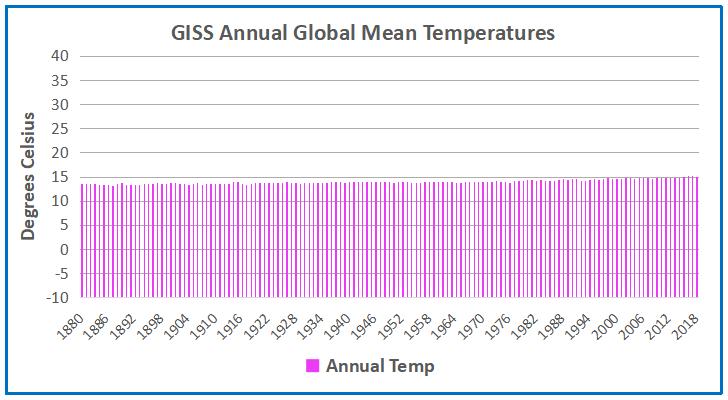
But is setting a globe on fire an appropriate analogy to get the message across? Earth’s temperature has gone up 1.4 degrees F since 1880. Undoubtedly, another 4 to 8 degrees is quite a lot in a short period of time. It doesn’t take a master prognosticator to conclude that might cause some problems. But Earth is not — nor will it ever be — a flaming ball of fire. Earth isn’t Venus.

Bill Nye 2.0

Ultimately, it seems that Bill Nye just panders to whatever he thinks the audience wants to hear. He thought (incorrectly) that they wanted to hear why GMOs were bad, so he altered his message when he got pushback. He won’t get pushback for exaggerating climate change, so it’s likely he’ll keep this up for a while.

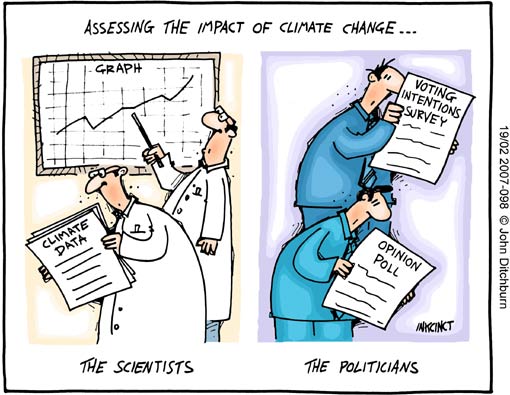
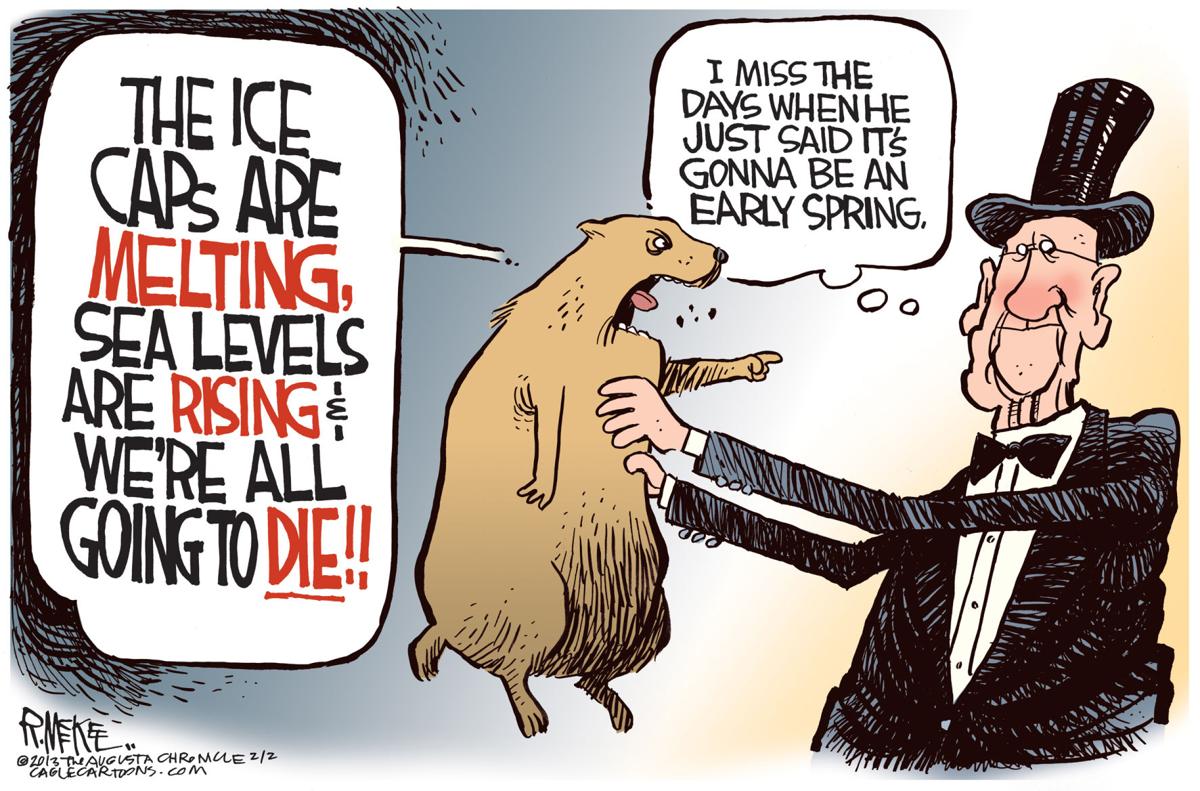
climate-change-science-v-politics-cartoon

I don’t think Nye actually believes the climate hysteria. Because if he did, Nye would support whatever means necessary to stop it, like nuclear power. After all, he’s a mechanical engineer. But lo and behold, Nye is opposed to nuclear power. Big surprise. Audiences don’t like nuclear power.

Evolutionary biologist Jerry Coyne once wrote of Bill Nye, “I’m not a fan of the new Science Guy, and see him as a self-aggrandizing person trying to capture his lost limelight more eagerly than he wants to promulgate science.”

Unfortunately, I think that assessment is accurate. Bring back the old Bill Nye. Version 1.0 was better.

NYT Maple Syrup Story Not Fit to Print

Journalists are finally exposing the rot inside the news mass media. Sharyl Attkisson resigned as an investigative corespondent from CBS News and wrote at Epoch Times How Media Narratives Became More Important Than Facts. Excerpt in italics with my bolds.

I was among the first to really pay attention to the increasingly effective operations to shape and censor news—the movements to establish narratives rather than follow facts—and to see the growing influence of smear operations, political interests, and corporate interests on the news.

We agree there is terrific journalism being committed on a daily basis at organizations from The New York Times to local news stations. However, we agree that national media has also largely become co-opted by powerful interests who understand how to direct the news landscape in a way that services certain narratives and agendas.

Case in Point Global Warming vs. Maple Syrup

Eric Felten describes how this works in his article at Real Clear Investigations Why This NY Times Maple Syrup Story Tastes Odd. His exquisite takedown of a recent NYT essay linking AGW to maple syrup should be gracing a page in the NY Times, except for narrative being the mission, not truth. Excerpt below in italics with my bolds.

Climate change is at it again, ruining everything good. This time around it’s maple syrup that is at risk, according to the New York Times, which on Saturday had the alarming headline, “Warming Climate May Slow the Flow of Maple.” Or at least it would be alarming if it weren’t for the tell-tale word “may.” If a warming climate were actually slowing the flow of the sap that makes for syrup, you can be sure the Times would declare it clearly. To say it “may” slow the flow suggests that it isn’t actually happening, at least not yet.

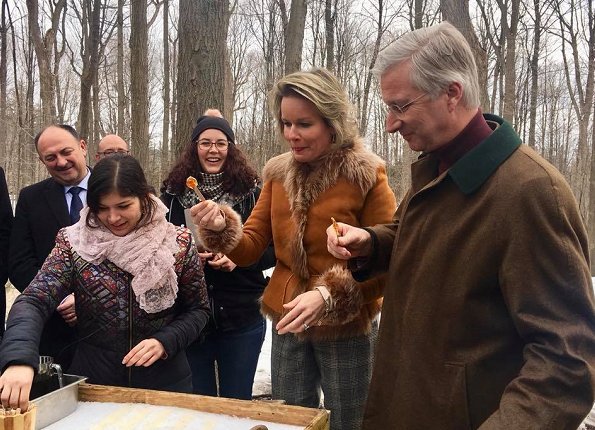
King Philippe and Queen Mathilde of Belgium sample maple syrup in Ottawa last year.

But one would hate to be unfair to Kendra Pierre-Louis, the reporter who typed up the doom and gloom for the Times. Perhaps she has evidence supporting her warning of dire syrup consequences—statistics, even. Let’s see how she marshals her facts and makes her case.

“In fact, climate change is already making things more volatile for syrup producers,” Pierre-Louis laments in her front-page article. “[M]aple production fell by 54 percent in Ontario and by 12.5 percent in Canada over all.” The cause was “an unusually warm spring.” Well that’s some pretty compelling data, or would be if it were from 2018, or perhaps 2017 or even 2016. But no, that’s not even close. To find a year in which there was unseasonably warm weather that affected the maple crop, Pierre-Louis had to go all the way back to 2012, which is the year the Times cites as the “fact” for climate change’s impact on syrup producers. The Times finds room to return to that year again later in the article.

Isn’t it a bit odd that the New York Times cites 2012 for its evidence of climate change? After all, were the paper looking for a bad production year, the most recent one would be a perfect example: 2018 was an off year for maple syrup production in Quebec, the province that produces the vast majority of Canadian syrup. In 2016 Canada produced a record 12.16 million gallons of maple products; 2017 was another banner year, with Canada delivering a new record of 12.51 million gallons. But last year was a relatively bad one, with maple production falling in Canada to 9.8 million gallons, a significant drop — indeed, a drop more substantial than that in 2012. And yet for some perplexing reason, the Times fails to mention the drop in 2018, let alone the statistics showing record production in the previous years.

If we’re worried about maple syrup production, wouldn’t you think that the recent decline would be more newsworthy, or at the very least worth including in the article, if not making it the lede?

It doesn’t take much digging to find what’s wrong with 2018 as an example of climate change hobbling the syrup trade. Yes, weather was to blame for 2018’s bad results. It just wasn’t the right sort of weather. Here’s how Halifax Today reported on last year’s maple results: “Quebec — which produces about 72 per cent of the world’s maple syrup — produced 40.4 million litres, down 22.4 percent from 2017 due to unusually late snow and cold.”

Unusual cold? That’s right. As the official government Statistics Canada explains in its report on “Maple products, 2018,” in “Quebec, production was hurt by unusually late snow and cold, while the decrease in New Brunswick was the result of a long and severe winter followed by a short spring.” This year could prove to be another disappointment for Canadian maple farmers. In late February Canada’s CBC reported, “Local syrup farms say the recent cold temperatures are leaving taps dry.” Could it be that the New York Times neglected to mention the maple syrup decline of 2018 and the slow start to 2019 because the reductions were caused by abnormal cold rather than warming?

One should find that hard to believe. Because for that to be true, one would have to believe that the Times is willing to cherry-pick data in an effort to mislead its readers. Surely the newspaper of record has more respect for itself than to play such a cheap trick on its customers. RealClearInvestigations reached out to the Times’s reporter via her website for comment but received no response.

The evidence piles up that the Times is playing fast and loose with the facts. Take the suggestion by the Times that climate change is limiting the number of days when maple trees can be successfully tapped. “More Narrow Window for Syrup Production,” reads the newspaper’s sub-headline. The weather determines the sap flow, after all, and University of Vermont “sugar maple expert” Mark Isselhardt told the Times that “[e]very day that you don’t get sap flow has the potential to really impact the total yield for that operation.”

But is the production window actually narrowing?

Surely the sugar maple expert at the University of Vermont, in telling the Times about the window when sap is ripe for collecting, had at his fingertips the latest data, which are readily available. The USDA’s National Agricultural Statistics Service keeps figures — helpfully broken down by state — on maple syrup production in the United States. Among the information collected are data on the “Maple Syrup Season,” that elusive window. The figures for the last four years are readily available. In 2015, the season for the U.S. as a whole was 26 days. In 2016 it was 33 days. In 2017 it was 37 days and in 2018 the window expanded again, this time to 42 days. The figures for Vermont — which we can assume our University of Vermont maple expert is particularly familiar with — show the state’s maple syrup season widening: 26 days in 2015; 44 days in 2016; 46 days in 2017; and 52 days in 2018.

What about the suggestion in the New York Times that the production window is not only shrinking, but moving, as climate change causes “season creep”? The newspaper quotes the executive director of the New York Maple Producers Association, who says that when she was a kid, 50 years ago, the start of the tapping season was mid-March. “This year,” according to the Times, “they were tapping in late January.”

Were they really? In upstate New York, the last week in January this year was marked by brutally cold temperatures. A normal high temperature for late January in Buffalo is 31 degrees. Though there were days in that ballpark during the month — and one mid-month day actually made it to 47 degrees — late January was for the most part frigid. The high temperature in Buffalo Jan. 30 was 11 degrees. On the 31st the thermometer peaked at 7 degrees.

This last winter’s extreme cold persisted well into February in Canada, where the deep freeze kept the maple sap from flowing. It wasn’t until the middle of March that sap started to trickle from the trees north of the border.

How did the New York Times get things so wrong? Is it carelessness? Or is there an ideological agenda at play, one that requires the reporting and writing to lead to a preestablished conclusion? On Twitter, the NYT reporter calls herself Kendra “Gloom is My Beat” Pierre-Louis. That is no doubt a gesture at self-aware humor. But it also suggests that her reporting is skewed: If you see gloom as your beat, by definition you ignore information that doesn’t advance the narrative of impending doom. And then there is the larger institutional bias. Pierre-Louis is officially a “climate reporter” for the Times; she leads NYT-branded “student journeys” to places such as Iceland (cost: $8,190 per high-schooler for 15 days) to teach the risks of a warming planet. In other words, the Times has a business built in part around Pierre-Louis that depends on her being a warning voice on warming.

Those sounding the alarm about climate change do a lot of fretting over what may happen 50 to 100 years from now. Fair enough — or at least it would be if those delivering the warnings were in more of a habit of playing it straight. It would be much easier to credit their predictions of future catastrophes if they were more honest about what is actually, observably, happening right now.

Footnote:

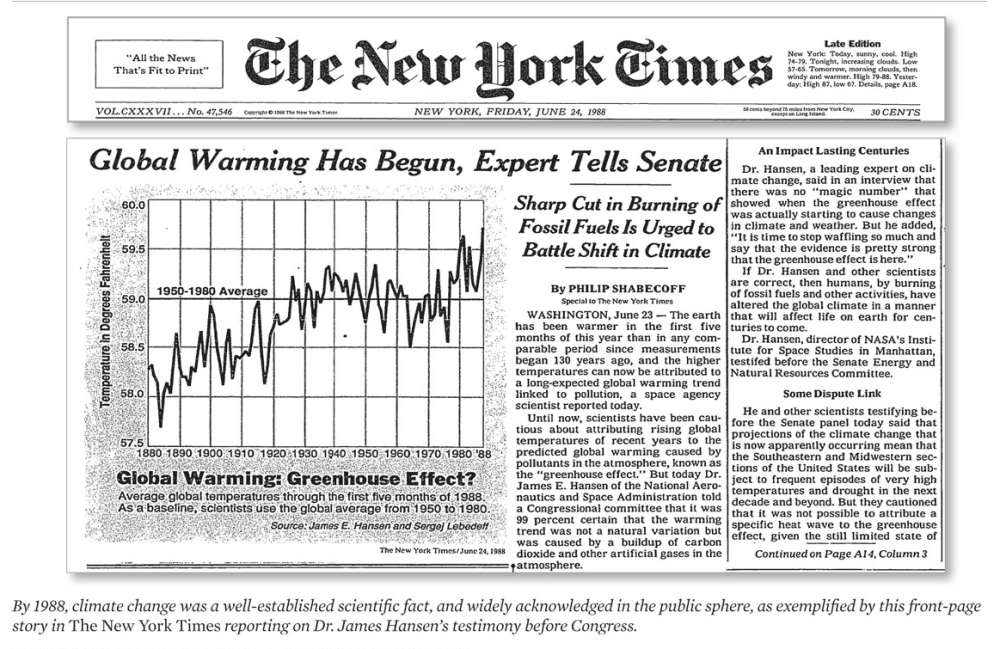
It should be noted that the NY Times has a long history of botching science stories, including but not limited to climate change. Bernie Lewin gives several examples in his book on environmental scares, and of course it was NYT who headlined the global warming claims of Jim Hansen.  When objective historians look back on these fear-mongering days, NY Times will be seen as a leading traitor against the public interest.

See Progressively Scaring the World (Lewin book synopsis)

Rise and Fall of CAGW


Climate Boogeyman

As You Sow, So Shall You Reap.

This proverb from the bible draws an analogy from farming: The seeds you choose to put in the soil lead to different crops. Humans are responsible for the effects of their actions. If the action is based on goodness, it will churn out only goodness in the long run. If the action has been evil, the outcome also tends to be evil. The Holy Gita and Koran also emphasize the same. Goodness is the child of good deeds and misfortune and calamities are the children of evil.

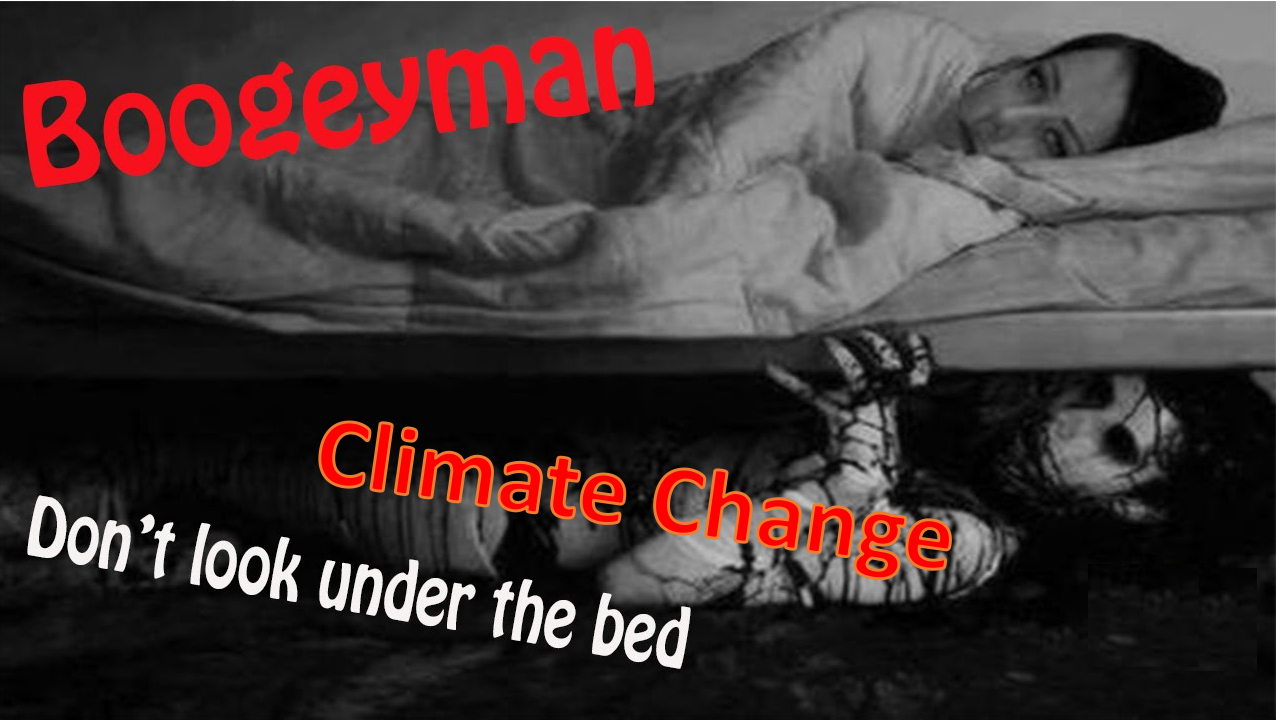
Bringing this into the present, we are seeing the effects of environmental evangelists sowing seeds of fear into generations of children. The climate change movement has morphed into a doomsday cult, with those who have been duped taking to the streets like so many zombies with minds totally captured by fear. Could it be that the alarmists are ramping up fears of the climate boogyman just now, when indications of a cooler future are gaining strength?

We Have Nothing to Fear But Fear Itself.

Parents know that small children at some point become afraid of the boogeyman under the bed. Each child must confront the fear in order to go beyond it. Hank Aaron, #2 all-time home run hitter, said he was cured after his father pulled Hank’s mattress off the bed, putting it directly on the floor. In some way, every child must come to recognize the difference between figments of a fearful imagination, and realities to be faced and overcome. Sometimes people are consumed with doubt and fear as were Americans following the Great Depression. In 1932 Franklin D Roosevelt famously said upon taking office, “We have nothing to fear but fear itself.” He went on to say: “Nameless, unreasoning, unjustified terror paralyzes needed efforts to convert retreat into advance.”  Where, oh where is there such leadership today?
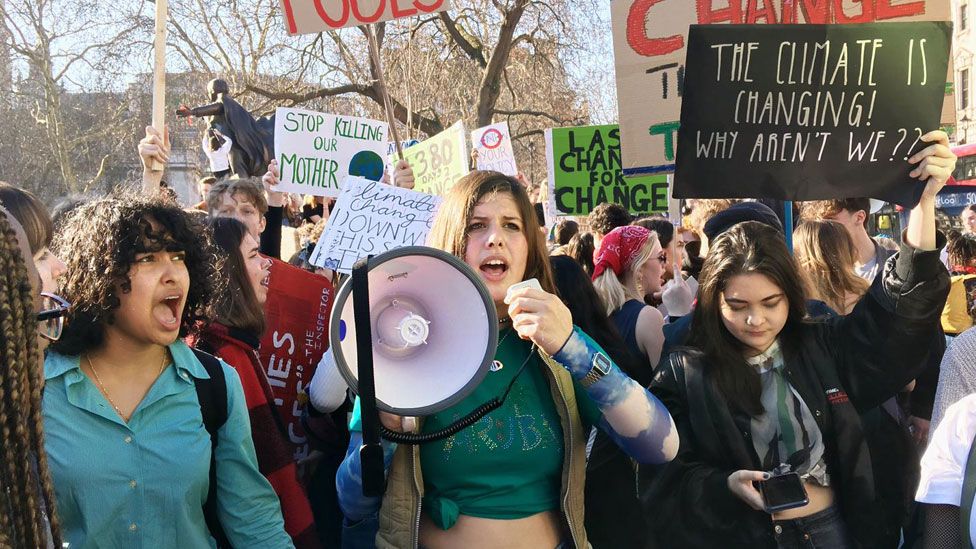
Bjørn Lomborg wrote about the overheated discourse that has children taking to the streets on the advice of adults who should know better.  Overheating About Global Warming was published at Project Syndicate.  Excerpts in italics with my bolds and images.

Decades of climate-change exaggeration in the West have produced frightened children, febrile headlines, and unrealistic political promises. The world needs a cooler approach that addresses climate change smartly without scaring us needlessly and that pays heed to the many other challenges facing the planet.

Across the rich world, school students have walked out of classrooms and taken to the streets to call for action against climate change. They are inspired by 16-year-old Swedish activist Greta Thunberg, who blasts the media and political leaders for ignoring global warming and wants us to “panic.” A global day of action is planned for March 15.
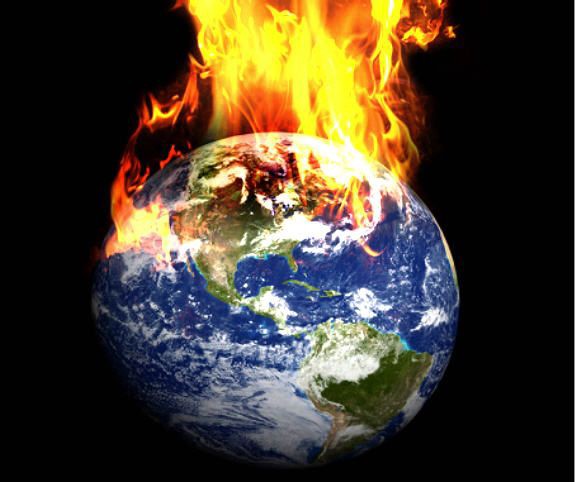
Although the students’ passion is admirable, their focus is misguided. This is largely the fault of adults, who must take responsibility for frightening children unnecessarily about climate change. It is little wonder that kids are scared when grown-ups paint such a horrific picture of global warming.

For starters, leading politicians and much of the media have prioritized climate change over other issues facing the planet. Last September, United Nations Secretary-General António Guterres described climate change as a “direct existential threat” that may become a “runaway” problem. Just last month, The New York Times ran a front-page commentary on the issue with the headline “Time to Panic.” And some prominent politicians, as well as many activists, have taken the latest report from the United Nations Intergovernmental Panel on Climate Change (IPCC) to suggest the world will come to an end in just 12 years.

This normalization of extreme language reflects decades of climate-change alarmism. The most famous clip from Al Gore’s 2006 film An Inconvenient Truth showed how a 20-foot rise in sea level would flood Florida, New York, the Netherlands, Bangladesh, and Shanghai – omitting the fact that this was seven times worse than the worst-case scenario.

A separate report that year described how such alarmism “might even become secretly thrilling – effectively a form of ‘climate porn.’” And in 2007, The Washington Post reported that “for many children and young adults, global warming is the atomic bomb of today.”

When the language stops being scary, it gets ramped up again. British environmental campaigner George Monbiot, for example, has suggested that the term “climate change” is no longer adequate and should be replaced by “catastrophic climate breakdown.”

Educational materials often don’t help, either. One officially endorsed geography textbook in the United Kingdom suggests that global warming will be worse than famine, plague, or nuclear war, while Education Scotland has recommended The Day After Tomorrow as suitable for climate-change education. This is the film, remember, in which climate change leads to a global freeze and a 50-foot wall of water flooding New York, man-eating wolves escape from the zoo, and – spoiler alert – Queen Elizabeth II’s frozen helicopter falls from the sky.
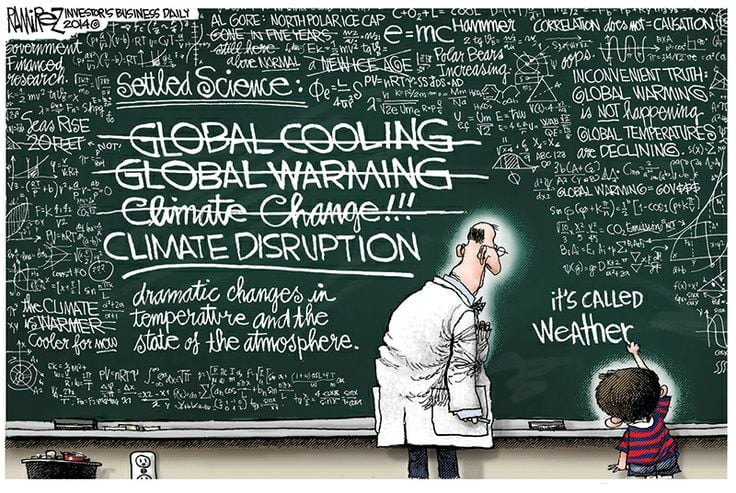
Reality would sell far fewer newspapers. Yes, global warming is a problem, but it is nowhere near a catastrophe. The IPCC estimates that the total impact of global warming by the 2070s will be equivalent to an average loss of income of 0.2-2% – similar to one recession over the next half-century. The panel also says that climate change will have a “small” economic impact compared to changes in population, age, income, technology, relative prices, lifestyle, regulation, and governance.

And while media showcase the terrifying impacts of every hurricane, the IPCC finds that “globally, there is low confidence in attribution of changes in [hurricanes] to human influence.” What’s more, the number of hurricanes that make landfall in the United States has decreased, as has the number of strong hurricanes. Adjusted for population and wealth, hurricane costs show “no trend,” according to a new study published in Nature.

Another Nature study shows that although climate change will increase hurricane damage, greater wealth will make us even more resilient. Today, hurricanes cost the world 0.04% of GDP, but in 2100, even with global warming, they will cost half as much, or 0.02% of GDP. And, contrary to breathless media reports, the relative global cost of all extreme weather since 1990 has been declining, not increasing.

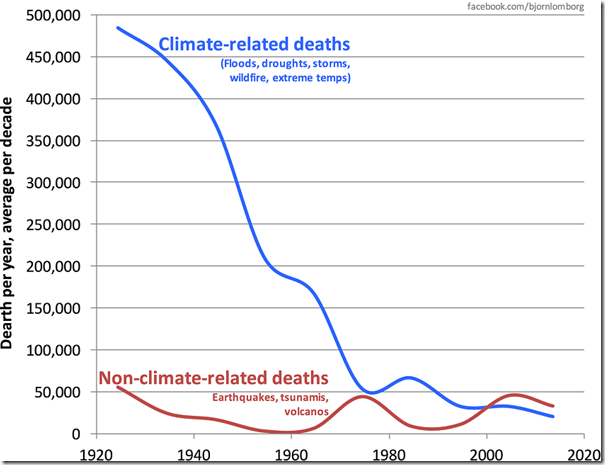
Perhaps even more astoundingly, the number of people dying each year from weather-related catastrophes has plummeted 95% over the past century, from almost a half-million to under 20,000 today – while the world’s population has quadrupled.

Meanwhile, decades of fearmongering have gotten us almost nowhere. What they have done is prompt grand political gestures, such as the unrealistic cuts in carbon dioxide emissions that almost every country has promised under the 2015 Paris climate agreement. In total, these cuts will cost $1-2 trillion per year. But the sum total of all these promises is less than 1% of what is needed, and recent analysis shows that very few countries are actually meeting their commitments.

In this regard, the young protesters have a point: the world is failing to solve climate change. But the policy being pushed – even bigger promises of faster carbon cuts – will also fail, because green energy still isn’t ready. Solar and wind currently provide less than 1% of the world’s energy, and already require subsidies of $129 billion per year. The world must invest more in green-energy research and development eventually to bring the prices of renewables below those of fossil fuels, so that everyone will switch.

And although media reports describe the youth climate protests as “global,” they have taken place almost exclusively in wealthy countries that have overcome more pressing issues of survival. A truly global poll shows that climate change is people’s lowest priority, far behind health, education, and jobs.

In the Western world, decades of climate-change exaggeration have produced frightened children, febrile headlines, and grand political promises that aren’t being delivered. We need a calmer approach that addresses climate change without scaring us needlessly and that pays heed to the many other challenges facing the planet.

Bjørn Lomborg, a visiting professor at the Copenhagen Business School, is Director of the Copenhagen Consensus Center. His books include The Skeptical Environmentalist, Cool It, How to Spend $75 Billion to Make the World a Better Place, The Nobel Laureates’ Guide to the Smartest Targets for the World, and, most recently, Prioritizing Development. In 2004, he was named one of Time magazine’s 100 most influential people for his research on the smartest ways to help the world.

See also:  GHGs Endangerment? Evidence?


Climate Hearsay

global-warming

In a legal proceeding, a witness can only testify to what he or she personally experienced. Anything reported to them by others is dismissed as “hearsay”, not evidence by direct observation, but rather an opinion offered by someone else.

In the current public commotion over global warming, almost all the discourse is composed of hearsay.  Ross McKitrick explains that the alleged changes in temperatures are so small that no one can possibly notice. Thus, their concern over global warming can only come from repeating hearsay in the form of charts and graphs published by people with an axe to grind. His article in the Financial Post is Hold the panic: Canada just warmed 1.7 degrees and … thrived. Excerpts below in italics with my bolds.

A recent report, commissioned by Environment and Climate Change Canada (also known as the federal Department of the Environment), sparked a feverish bout of media coverage. Much of it keyed off the headline statement that Canada warmed “twice as fast” as the entire planet since 1948. If that is self-evidently a bad thing, what to make of the finding that the Canada’s Atlantic region warmed twice as fast as the Prairies? Or that Canadian winters warmed twice as fast as summers?

Saying Canada warmed twice as fast as the whole planet doesn’t prove anything

I’ll bet you didn’t know that the Maritimes warmed twice as fast as the Prairies. But now that I’ve told you, you might tell yourself it makes sense based on what you’ve seen or heard — that’s called confirmation bias. In fact, I was lying. It’s the other way around. The Prairies warmed almost three times faster than the Maritimes.

Would you have known either way? One of the psychological effects of a report like this, and the attendant media hype, is that it puts ideas in peoples’ heads. Tell everyone over and over that the climate is changing, and soon they will see proof of change everywhere. Rain, snow, wind, floods or dry spells; it will all seem to eerily confirm the theory, even though we have always had these things.

Most of what people are noticing, of course, are just natural weather events. Underneath, there are slow trends, both natural and (likely) human-caused. But they are small and hard to separate out without careful statistical analysis. A few years ago, climatologist Lennart Bengtsson remarked:

The warming we have had over the last 100 years is so small that if we didn’t have meteorologists and climatologists to measure it we wouldn’t have noticed it at all.

And so we get reports with charts and graphs to tell us about the changes we didn’t notice. Remember last summer when the media hyped a report from the Intergovernmental Panel on Climate Change warning that warming 1.5 degrees Celsius (compared to preindustrial times) was a disaster threshold we must avoid crossing at all costs? Now we learn that Canada warmed 1.7 degrees Celsius since 1948. Far from leaving the country a smoking ruin, we got wealthier and healthier, our population soared, and life improved by almost any measure of welfare you can imagine. If only every so-called catastrophe was like this.

We deal with lots of changes over time. Go back to Bengtsson’s thought experiment. Today’s 80-year-olds entered their teens in 1950. Ask them what changes they experienced over their lives and they will have plenty to say. Then ask if, where they live, the fall warmed more than spring did. Without peeking at the answer, most will have no idea. Yet, according to the federal government’s latest report, depending on the province, one likely warmed twice as fast as the other. Which one?

If you can’t tell without looking it up, that’s the point.

Alarming news headlines are always part of the ritual (though you’d have thought journalists would be a bit jaded by now, after all the hyperventilating Only-Ten-Years-Left blockbuster claims over the past 30 years). Saying Canada warmed twice as fast as the whole planet doesn’t prove anything. Pretty much any large country warmed faster than the global average, because countries are on land. Oceans cover 70 per cent of the Earth, and the way the system works, during a warming trend the land warms faster than the oceans. So the scary headline only confirms that we are on land.

The best antidote, if you find yourself alarmed by the press coverage, is to turn to chapter four of the Department of the Environment’s report and start reading. The section on the observed changes in 1948 is factual, data-focused and decidedly non-alarmist. But there are some points I would quibble about: 2016 was a strong El Niño year, so the end point of the data is artificially high.

Some of the report’s bright-red heat maps would probably look different if they stopped in, say, 2014. And most of the report’s comparisons start in 1948 to maximize data availability, but this boosts the warming rate compared to starting in the 1930s, which was a hot decade. When the authors talk about attributing changes to greenhouse gases versus natural variability, they don’t explain the deep uncertainties in such calculations. And they make projections about the century ahead without discussing how well — or how poorly — their models can long-term forecast.

If you want to learn about changes to the Canadian climate, read the report. But if you need to look at the report to know what changes you lived through, that tells you how much — or rather, how little — they mattered to you at the time.

Ross McKitrick is a professor of economics at the University of Guelph and senior fellow at the Fraser Institute.

Postscript:  No one under 20 years old has experienced a trend of warming temperatures.  Yet they are in the streets instead of classrooms demanding action (anything) to stop something they have never known.  Think about it.

Nudging a Climate Illiterate

Mark Hendrickson writes at The Epoch Times March 28, 2019 Open Letter to a Journalist About His Paper’s Position on Climate Change Mark patiently lays out information and context for someone to think more deeply about superficial opinions on global warming/climate change. Excerpts in italics with my bolds and added images.
Commentary

Mark Trumbull, Staff Reporter
The Christian Science Monitor
Boston, MA 02115

Dear Mr. Trumbull,

Last month, in your introductory remarks to The Christian Science Monitor Daily online news stories, you addressed the issue of the Monitor’s coverage of climate change. Your challenge is how to report when you and your Monitor colleagues believe that “human emissions of CO2 are triggering dangerous climatic conditions” while some of your readers do not.

You wrote, “Part of good journalism is to seek out a range of viewpoints rather than just present a story through one lens. But a corollary journalistic responsibility is to weigh the credibility and relevance of viewpoints.” I agree wholeheartedly, and I hope you will follow through in fairly reporting opinions with which you may personally disagree.

Climate change science does not lend itself to facile conclusions. The science itself is complex, many relationships are imperfectly understood, and then there is the daunting challenge of predicting the future. As I have written elsewhere, in fields like economics and climate change, there is no such thing as expertise about the future. In the words of a report from the Inter-governmental Panel on Climate Change (IPCC)—which your paper accepts as arguably the most credible authority that espouses the catastrophist position—“The climate system is a coupled nonlinear chaotic system, and therefore the long-term prediction of future climate states is not possible.”

Your statement that there is a “strong consensus within the climate science profession that human emissions are now the leading factor affecting changes in Earth’s climate” is almost correct, but not quite. Some climate skeptics object to the use of the word “consensus.” They state (correctly, I believe) that “consensus” is more appropriate in politics, where majorities shape reality, than in science, where what a majority may believe to be true today may be disproven tomorrow. You, however, used the word “consensus” correctly, because your supporting hyperlink takes the reader to a story about the political consensus that has been forged at the U.N. through the reports of the IPCC.

It is important to understand that the IPCC is a political organization (after all, it is the Inter-governmental Panel), not a scientific body. I can cite a number of quotes from scientists who have done work for the IPCC, but disagreed with the published “consensus.” The political nature of the IPCC and its reports is underscored by Appendix A of the Principles Governing IPCC work. It authorizes the few dozen political appointees who actually write the Summary for Policymakers to alter what scientists have written in order to conform to what the Summary states.

Hundreds of peer-reviewed articles every year differ from the official pronouncements of the IPCC. There is not so much a “strong consensus within the climate science profession” in general that human activity is causing a dangerous climate as there is a “strong consensus” within the extensive but not all-encompassing government-employed climate science clique.

Journalists often ask those who dissent from the official position of the IPCC if they receive or have received remuneration from fossil fuel companies. The ugly insinuation, of course, is that a person receiving compensation from a conventional energy company is automatically suspected of being a paid propagandist. Is it not equally as plausible that a scientist funded by government grants might tailor his findings so as not to risk losing a valuable source of income? There should be symmetry here, treating people on both sides of the issue with equal respect, instead of proceeding from the unfounded assumption that those receiving money from nongovernmental sources are not trustworthy while those receiving government funds are.

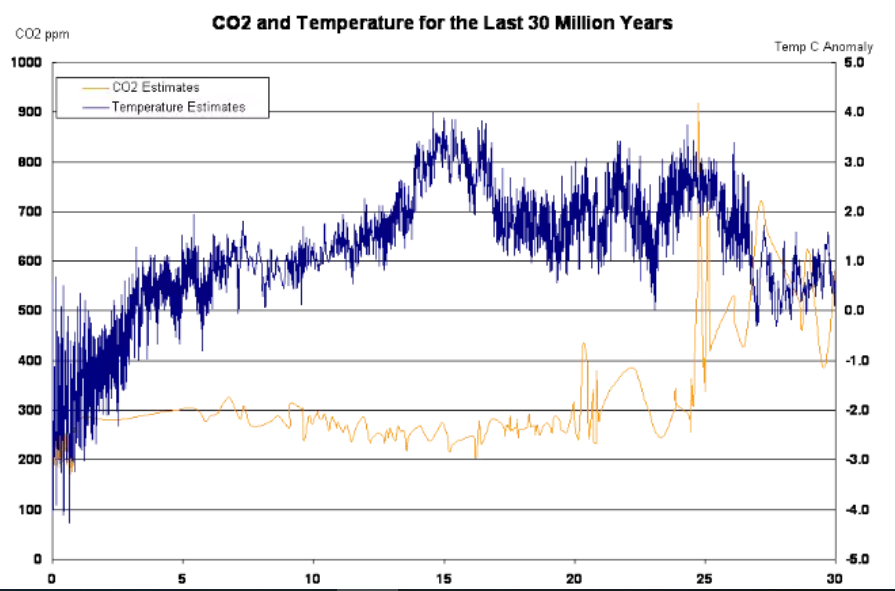
Regarding your assertion that “human emissions are now the leading factor affecting changes in Earth’s climate.” That assertion would have more credibility if it were proven that carbon dioxide is, in fact, the principal driver of global temperatures. However, when one looks at the historical record, one encounters a couple of inconvenient facts: 1) over hundreds of millions of years, graphs plotting global temperatures and atmospheric CO2 show no fixed relation or meaningful correlation; 2) the Vostok ice core graph shows the two variables following similar paths over the past several hundred thousand years, but with changes in CO2 lagging behind changes in temperature by 800 to 1,000 years, and effect cannot precede cause in a temporal universe.

Space prevents me from discussing other unresolved issues—the numerous measuring limitations and errors; the logarithmic scale of how much heat CO2 can “trap”; the fact that CO2 concentrations before the modern increase were dangerously low (plant life would cease to exist if the concentration fell much below 150–170 ppm, whereas it will flourish optimally nearer 1,000 ppm); whether warmer temperatures, on the whole, are better or worse for humans than cold.

I would urge the Monitor’s reporters to not rely so heavily on the scientists employed by the IPCC. Very subtly, the dangerous perception has set in that these are “the best scientists in the world.” I am not saying that there aren’t many fine scientists employed by Uncle Sam and contracted for by the IPCC, but to assume that if the government employs them, that stamps them as the best is unfounded. Politicians have no special power to identify which scientists’ output comes closest to the truth, but they are shrewd enough to pick scientists whose work can be used in support of pre-determined political agendas.

I hope none of your reporters is allied with the Society of Environmental Journalists—a group dedicated to censoring dissent. It does appear that your principal environmental reporter has become over-reliant on the eminently quotable Dr. Katherine Hayhoe, director of the Climate Science Center at Texas Tech University, and a lead author for the IPCC.

Dr. Hayhoe is very, very skilled at verbal manipulation. Take, for example, this cleverly constructed straw man: “[Climate] science is so old and so basic that to deny that science, we would have to be denying basic thermodynamics … and basic fluid dynamics that explains how airplanes fly. And there’s not a lot of politicians and pundits claiming that airplanes don’t fly.”

Brilliant! Unfortunately, it is also disingenuous. Skeptics about the catastrophist scenario aren’t rejecting the basic laws of physics; they don’t deny that Earth’s climate is volatile; they don’t deny that CO2 is a greenhouse gas or that human consumption of fossil fuels is increasing its concentration in the atmosphere.

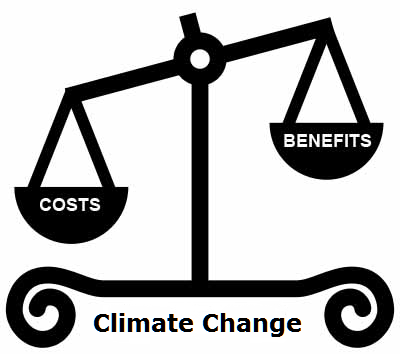
There remain important disagreements about the degree of climate change, the impact those changes will have, whether any benefits that can be gained by retooling our lives would exceed the costs of making those changes, and other issues with public policy implications that need to be studied and discussed. I hope that the Monitor will contribute to these needed discussions by reporting today’s minority positions as well as the most popular ones.

Mark Hendrickson is an adjunct professor of economics and sociology at Grove City College. He is the author of several books, including “The Big Picture: The Science, Politics, and Economics of Climate Change.”

See Also:  Climate Reductionism

Media Dumbing Down Truth

And he said that even before Twitter.

The phrase “Survey Says!” comes from the popular TV game show Family Feud, which has aired continuously since 1976 and spawned multiple regional adaptations in 50 international markets.  The program ranks among the top five most popular syndicated television shows in the US. In 2013, TV Guide ranked Family Feud third in its list of the 60 greatest game shows of all time.

What’s the fuss all about? Everyone knows that contestants compete to see who can correctly guess the answers to questions given by a random sample of the public. Consider the import of that: Points are awarded not according to the factual answer, but according to your estimate of what others think is the factual answer. To succeed, you must set aside any of your factual knowledge on the topic, and instead guess what ordinary people guessed when questioned.

Could there be any more striking display of social proof? Winners of the game are the ones who are most tuned in to the common denominator of public awareness on a range of topics active in social discourse. And to the degree that issues might be controversial, you can imagine a future game show like this:

OK, that cartoon cuts too close to the Progressive bone, so would never be aired on mainstream TV. But it does point to the emotional undertow of all of this. A strong sense of public acceptability, or political correctness is key to guessing what the survey says.

Turning to the scientific issue of the day, let’s consider how to interpret results of an ongoing survey regarding global warming/climate change. First a digression.

Global Warming Vs. Climate Change

A recent article in Grist was entitled: Move over, polar bears: Climate change has a new symbol. Excerpts in italics with my bolds.

Climate change has a new symbol, and it’s not melting ice floes or charismatic megafauna. Last week, researchers at Yale University and the University of Westminster published an analysis showing that Americans increasingly connect climate change with real-life, actually-happening weather. And, given the crazy heat waves, wild hurricanes, and downright bizarre disasters 2018 has already brought us, people are probably thinking about climate change a lot more.

Researchers asked survey respondents what their knee-jerk, top of mind associations were with the phrases “climate change” and “global warming.” In 2003, when the survey began, many people pictured melting polar ice and glaciers.

That was all well and good, Anthony Leiserowitz, coauthor of the analysis and director of the Yale Program on Climate Change Communication, tells Grist. “But for all of the millions of Americans who have that image come to mind, none of them live on the shores of the Arctic Ocean, in Antarctica, or next to a glacier,” he says. “It reinforces the sense that this is far away.

But that’s beginning to change. In the past decade, the analysis shows, the number of associations of climate change with weather has quadrupled. “It’s now one of the highest or most likely first associations that people have,” Leiserowitz says.

He attributes this change in part to the development of projects like Climate Matters, a program run by nonprofit Climate Central, which trains TV meteorologists to incorporate climate change data into their forecasts. The program landed in the news recently when a group of Republican senators — including notorious climate denier James Inhofe — called it a form of “propagandizing” and called for an investigation of its grants from the National Science Foundation.

Big extreme weather disasters are one of those times where Americans all collectively focus on an issue or set of events that have a direct connection to climate change,” Leiserowitz says. “They’re teachable moments.”

As for polar bears? “As a communications icon, it’s pretty much tapped,” Leiserowitz says. “We’ve got to expand the tent — and that means helping people connect to this issue for reasons that might be quite different from yours.”

The Grist article is biased toward alarm and obscures the actual rationale. Yes, the Arctic is far away and extreme weather events are closer and more personally threatening. But the real problem was the Polar bears represented victims of warming.  Inconveniently, Arctic ice failed to melt away in the last 12 years, making a joke of the Polar bear balancing on an ice cube.  For “climate change” something else was required: nearer, scarier and more reliable.  There will never be a complete lack of extreme weather to fill the media time and space with alarms, though we were in the doldrums prior to Hurricane Harvey.

Global Warming. And the Survey Says What?

Click on image to enlarge.

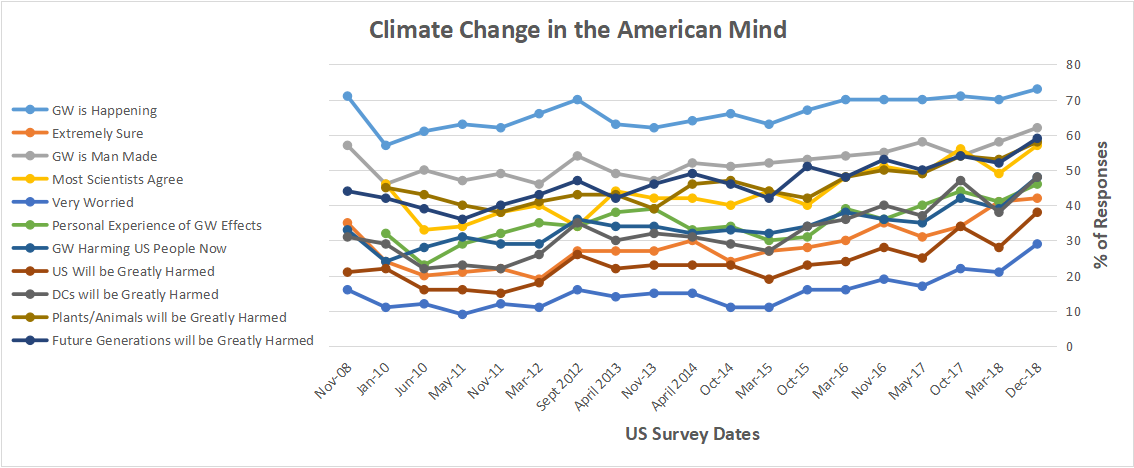
A previous post went into details on the Yale/George Mason survey Climate Change in the American Mind. See: Climate is a State of Mind.  I will only do an overview here to make the link to dumbing America down on this topic. Above is a graph showing the core questions and patterns of responses over the years.

First, I commend the surveyors for keeping the questions on the topic “Global Warming” rather than switching to the totally vacuous “Climate Change.” At least, GW has some content, I.e. expecting temperatures to rise in the future.

But the whole exercise is like a game show. Here is the introduction given to participants:
Recently, you may have noticed that global warming has been getting some attention in the news. Global warming refers to the idea that the world’s average temperature has been increasing over the past 150 years, may be increasing more in the future, and that the world’s climate may change as a result.

So we have a news buzzword, “Global Warming” and people are asked what they think, but really they are giving reactions based on what they have seen and heard in the media. And to remove the matter even further from intelligence, many of the questions are about emotions.

How worried are you about global warming?

How strongly do you feel each of the following emotions when you think about the issue of global warming?
Interested
Disgusted
Helpless
Hopeful
Afraid
Angry
Outraged

To summarize, Survey Says:

What He Said:   “Ninety-seven percent of scientists agree: climate change is real, man-made and dangerous.” (Obama tweet).  The survey could be reduced to one question:  Do you agree with this tweet?

Summary

Opinion polling is a media tactic to raise public concern about an issue: conduct a survey, then publicize the results, further raising attention to the topic. Rinse, repeat, and keep repeating so that the public alarm rises with every iteration. Except with global warming, it hasn’t gone up that much. Maybe the battle for hearts and minds is not totally mindless.

Footnote Re Cortez and the End of the World

Statistician Bjorn Lomborg: Ocasio-Cortez was ‘wildly wrong’ on climate ‘doomsday’.  Yet AOC was just saying what many people believe. Shallow, apocalyptic reporting on global warming has made us all panicky, more likely to embrace poor climate policies and less likely to think about the price tag. The truth is comparatively boring: According to the United Nations climate-science panel’s latest major report, if we do absolutely nothing to stop climate change, the impact will be the equivalent to a reduction in our ­incomes of between 0.2 percent and 2 percent five decades from now. Yet by the 2070s, personal incomes will be some 300 percent to 500 percent higher than they are today. Far from the “end of the world,” the impact of warming is what we’d expect from roughly a single economic recession taking place over the next half century…

By 2100, even if hurricanes were to get twice as bad as they are now, increased prosperity and ­resilience mean the cost will have halved to 0.02 percent of GDP. What’s more, the UN panel finds there is no observable increase in hurricane frequency. Likewise, extreme weather is killing fewer people now than at any point in the last 100 years: In the 1920s, extreme weather killed about half a million people annually. Now, despite there being four times as many people, it kills fewer than 20,000 each year. If the world isn’t ending, and the impact of global warming by 2030 is much less than 0.2 percent to 2 percent of GDP, then we need to start comparing costs with benefits

Green fretting about Armageddon is nothing new, of course. In the 1960s, mainstream environmentalists worried that the world was running out of food. In the 1980s, acid rain was going to ­destroy the planet’s forests. There were good reasons for concern, but a panicked response led to a poor, overly expensive response…We need to make sure our solution doesn’t cost more than the problem. If we look at the science and stop believing the end of the world is nigh, our decisions will be much smarter.

Climate Is a State of Mind

A recent survey by Yale and George Mason activists is another reminder that “climate change” is actually a branch of environmental psychology. Consider that “climate” is an human construct, defined as the pattern of weather we remember in our living space over seasons and years. And “climate change” is therefore an added belief that our expectations about future weather are uncertain and unreliable. And so, attitude surveys are a suitable way to explore an issue that is wholly a matter of public opinion, IOW a state of mind rather than a state of nature.

The survey is appropriately entitled: Climate Change in the American Mind. Title is link to the website for the 2018 edition, with earlier results back to 2008.

The resources there are informative, including articles expressing both satisfactions and disappointments with the levels of belief and concern expressed by survey participants. The compliant mass media cherry pick various findings, giving headlines like these.

“We’ve entered a new era” of climate concern, survey finds CBS

Americans Believe in Climate Change, But Not Climate Action NYmag

Yale Poll: Climate Change ‘Personally Important’ to Record Number of Americans EcoWatch

Most Americans Don’t Know Vast Majority Of Scientists Agree On Climate Change CleanTechnica

Most Americans now worry about climate change—and want to fix it National Geographic

Poll Shows Most People Believe ‘Global Warming is Happening’ necn

Survey reveals 70% of Americans favour the environment over economic growth ClimateAction

promotional-product-facts-brain

What is the American Mindset according to the Survey?

So beyond details of particular responses, what can we learn from this series of polls about the American state of mind regarding global warming/climate change?

The specific questions and response patterns are at Appendix I: Data Tables & Sample Demographics

There are a lot of questions asked and answered, including exploring a complete range of feelings people have on the issue. I will summarize the central questions and the pattern of responses over the last decade.

Click on image to enlarge.

The core set of global warming beliefs are listed on the left.  The marked lines show the % of responses each one achieved over the years.  For example, over 50% agreed to four of them in 2018: GW is happening, GW is man made, Future generations will be greatly harmed and Most scientists agree.  Other patterns are also of interest.  Personal experience of GW effects is reported by almost 50%, while only 30% are very worried.  Indeed, people are less concerned about harm to themselves or even the US, then they are fearful for Developing Countries (DCs) and for Future Generations.

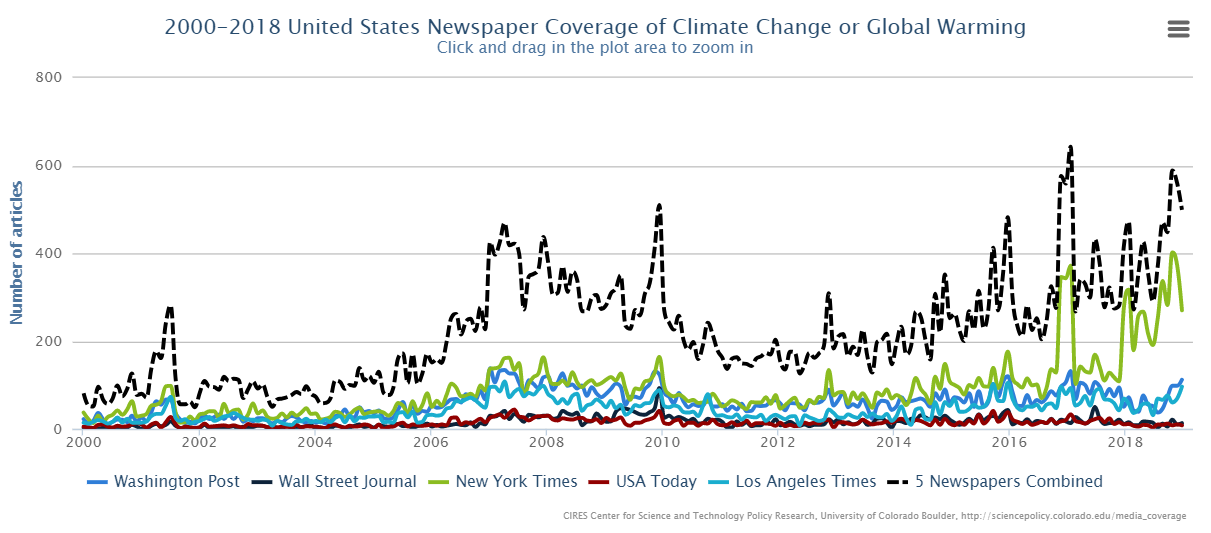
Notice there is a general curve to most of the answer time series.  Beliefs are only slightly higher in 2018 than they were in 2008.  In general, the %s were flat or declining in this decade until starting to rise again around 2014.  This points to the linkage between the opinions held by the public and the emphasis promoted in the mass media.  Compare the curvature in the above graph with this chart of climate change coverage in leading US newpapers.

The chart and research and research come from International Collective on Environment, Culture & Politics, AKA ICECaP.  Note the peaks in 2007-8 at the time of IPCC AR4 and Al Gore’s Inconvenient Truth flick, and in 2009-10 around the time of the Copenhagen COP.  The Climategate emails were also in the news in 2010, but for some reason newspapers were less interested in that aspect, the topic dropped in coverage.

The spike in 2013 coincides with Obama’s SOTU speech featuring climate change as the “defining issue of our time.”  The rise in climate change coverage in recent years is a more complex matter.

Climate journalists (like most all journalists) have been obsessed with trashing Donald Trump, and climate change is mentioned often as a subset of Trump complaints.  Consider this chart from Media Matters.

See that huge spike in the middle? That’s from June 1, 2017, when President Donald Trump announced that he intended to pull the U.S. out of the Paris climate agreement. No other day in the last three years saw anywhere near that much coverage. When Trump stages an event related to climate change, the media snap to attention. The rest of the time it’s like, “Climate what?”

That aligns with what Media Matters found when we looked at climate coverage on broadcast TV news programs in 2017: Trump dominated the news segments about climate change. Researchers at the University of Colorado Boulder, in the International Collective on Environment, Culture & Politics, reached a similar conclusion when they analyzed TV news coverage from November of this year: “In US television coverage of climate change or global warming in November 2018, ‘Trump’ was explicitly invoked over fourteen times more frequently than the words ‘science’ or ‘scientists’ together and nearly four times more frequently than the word ‘climate’ itself.”

A research group at the University of Colorado-Boulder, the International Collective on Environment, Culture and Politics (ICE CaPs), produced the findings that illustrate how much climate coverage has been driven by President Donald Trump. It examined coverage last year in five major American newspapers: The Washington Post, The Wall Street Journal, The New York Times, USA Today, and the Los Angeles Times. In the 4,117 stories in those papers that mentioned “climate change” or “global warming,” the word “Trump” appeared 19,184 times — an average of nearly 4.7 times per article.

mle190506c20190506011552

Summary

To summarize, Survey Says:

What He Said:   “Ninety-seven percent of scientists agree: climate change is real, man-made and dangerous.” (Obama tweet).  The survey could be reduced to one question:  Do you agree with this tweet?

There is not much upward movement in public belief in global warming/climate change.  There is increased attention from the left-leaning media as part of their general dislike of the Trump administration. One more time, who made global warming into a political rather than a scientific issue?

Your Climate Beliefs Are About to be Nudged

Social psychologists are coming to the fore as the mad scientists of our age. Case in point is a recently published guide for intervening in public discourse regarding global warming/climate change. The title is a link to the paper Leveraging cognitive consistency to nudge conservative climate change beliefs by Gehlbach et al. December 12, 2018. Excerpts below with my bolds, followed by my modest suggestion for improvement.

The Rationale (Abstract)

People feel motivated to maintain consistency across many domains in life. When it comes to climate change, many find themselves motivated to maintain consistency with others, e.g., by doubting climate change to cohere with friends’ and neighbors’ beliefs. The resulting climate skepticism has derailed discussions to address the issue collectively in the United States. To counteract these social consistency pressures, we developed a cognitive consistency intervention for climate skeptics. We first demonstrated that most people share substantial faith in a variety of scientific findings, across disciplines ranging from medicine to astronomy. Next, we show that conservative participants who first acknowledge several general contributions of science subsequently report significantly stronger beliefs in climate science (as compared to conservatives who are asked only about their climate science beliefs). These findings provide an encouraging proof-of-concept for how an inclusive climate conversation might be initiated across the political divide.

The Methodology

Below are the two sets of questions put to participants, firstly on mainstream fields of science, and secondly on assertions from climate scientists.

Instructions: Please give us your opinions and thoughts about the contributions of different branches of science. (Responses on a scale of 1 to 7: 1 meaning Not at all, 7 meaning Extremely or Completely)

To what degree do you think the science of astronomy has helped us identify what other planets exist in our solar system?

How helpful do you think medical science is in advancing society’s understanding of what makes people sick?

How confident are you that the field of engineering is advanced enough to keep you safe when traveling on bridges?

How certain are you that physicists‘ theory of gravity accurately explains why objects fall when dropped?

How useful is neuroscience in helping understand the role of different areas of the brain?

To what degree do you agree with public health experts that smoking causes cancer?

How credible is the medical data that germs are a primary cause of disease?

Instructions: Please give us your opinions regarding different aspects of what scientists have concluded about climate change and global warming. (Responses on a scale of 1 to 7: 1 meaning Not at all, 7 meaning Extremely or Completely)

With how much precision has the science of climate change been able to identify the causes behind rising sea levels?

How helpful do you think climate science is in advancing society’s understanding of why the earth is getting hotter?

How confident are you that climate science is right in their theory of how greenhouse gases
trap heat?

How certain are you that global warming explains many of the new weather patterns we are seeing today?

To what extent do you agree with climate experts that humans burning fossil fuels is the major cause of our changing climate?

How useful are climate models in helping to predict how many species are likely to go extinct in the coming years?

How accurately do you think climate scientists will predict the exact number of degrees the average global temperature will change between now and the year 2050?*

How credible is the climate science data that ocean temperatures are rising?

(*Note. Questioners put the next to last question as a trap. They expected people answering honestly to be skeptical on that one.)

Results

For science in general, researchers found that regardless of social attitudes and self-identifying along a liberal/conservative axis, people of all stripes averaged about 6 on the 7 point scale. In other words, generally people expressed “very much” or “a great deal” of confidence or certainty in the assertions from various fields of science. When people were presented only the questions on global warming/climate change, the responses differed accordingly to social/political leanings:

A spotlight analysis (Spiller, Fitzsimons, Lynch, & McClelland, 2013)—with 95% confidence intervals—examining each possible political orientation shows that the treatment had a small effect on politically moderate participants’ climate science beliefs; the impact was larger formore conservative participants.

They found that liberals were accepting of global warming assertions at the same level as other scientific fields, 6 out of 7, meaning “very much” or “a great deal” of conviction. While conservatives averaged 4 out of 7, a so-so response meaning “somewhat” credible or helpful.

The big news was that conservatives could be nudged toward greater acceptance of climate assertions if they were first questioned about other science fields (where they accept at a 6 level), followed by the climate questions. In that treatment, they become more certain about climate, the theory being cognitive dissonance arises when accepting in many fields, but skeptical in one.

Nudging is a Two-Way Street

Armed with these insights, let’s see if we can nudge people toward using their critical intelligence on scientific matters. All we need are some slight improvements in the questions. Below are my proposed questionnaires to help the public with these issues.

Instructions: Please give us your opinions and thoughts about the contributions of different branches of science. (Responses on a scale of 1 to 7: 1 meaning Not at all, 7 meaning Extremely or Completely)

To what degree do you think that astrology has helped us identify how other planets affect our lives?

How helpful do you think nutritional science is in advancing society’s understanding of what are healthy and unhealthy foods?

How confident are you that the field of engineering is advanced enough to keep you safe riding in a driverless car?

How certain are you that physicists’ big bang theory accurately explains the origins of the universe?

How useful is neuroscience in helping understand human consciousness and autonomy?

To what degree do you agree with public health experts that smoking causes cancer in non-smokers?

How credible is the medical data that genes are a primary cause of disease?

(*Note. Questioners put the first question as a trap. They expect honest responders to know the difference between astrology and astronomy.)

Instructions: Please give us your opinions regarding different aspects of what scientists have concluded about climate change and global warming. (Responses on a scale of 1 to 7: 1 meaning Not at all, 7 meaning Extremely or Completely)

With how much precision has the science of climate change been able to identify the causes behind rising sea levels?

How helpful do you think climate science is in advancing society’s understanding of why the earth got hotter for awhile and then stopped?

How confident are you that climate science is right in their theory of how greenhouse gases
trap heat?

How certain are you that global warming explains many of the new weather patterns we are seeing today?

To what extent do you agree with climate experts that humans burning fossil fuels is the major cause of our changing climate?

How useful are climate models in helping to predict how many species are likely to go extinct in the coming years?

How accurately do you think climate scientists have measured the degrees of warming since 1850, the end of the Little Ice Age?*

How credible is the climate science data that ocean temperatures are rising?

(*Note. Questioners put the next to last question as a trap. They expect people to be fairly certain on that one.)

Summary

Note that none of this is about scientific reasoning. It is all about adding climate assertions into a broader set of beliefs engendered by scientists. In other words, this is not an attempt to factually prove global warming/climate change, but rather an exercise in social manipulation. As I have remarked before, Leonard Cohen explains poetically why social proof is an uncertain guide to the truth.

Lyrics:

Everybody knows that the dice are loaded
Everybody rolls with their fingers crossed
Everybody knows that the war is over
Everybody knows the good guys lost
Everybody knows the fight was fixed
The poor stay poor, the rich get rich
Thats how it goes
Everybody knows

Everybody knows that the boat is leaking
Everybody knows that the captain lied
Everybody got this broken feeling
Like their father or their dog just died
Everybody talking to their pockets
Everybody wants a box of chocolates
And a long stem rose
Everybody knows

Everybody knows that you love me baby
Everybody knows that you really do
Everybody knows that you’ve been faithful
Ah give or take a night or two
Everybody knows you’ve been discreet
But there were so many people you just had to meet
Without your clothes
And everybody knows

Everybody knows, everybody knows
Thats how it goes
Everybody knows

And everybody knows that its now or never
Everybody knows that its me or you
And everybody knows that you live forever
Ah when you’ve done a line or two
Everybody knows the deal is rotten
Old black joe’s still pickin’ cotton
For your ribbons and bows
And everybody knows

And everybody knows that the plague is coming
Everybody knows that its moving fast
Everybody knows that the naked man and woman
Are just a shining artifact of the past
Everybody knows the scene is dead
But there’s gonna be a meter on your bed
That will disclose
What everybody knows

And everybody knows that you’re in trouble
Everybody knows what you’ve been through
From the bloody cross on top of calvary
To the beach of Malibu
Everybody knows its coming apart
Take one last look at this sacred heart
Before it blows
And everybody knows

Everybody knows, everybody knows
Thats how it goes
Everybody knows

Footnote:

I doubt Leonard Cohen had climate change in mind when he wrote this masterpiece. But he did have a pertinent poetic insight; namely, that social proof is an unreliable guide to the truth.