No CNN, Gulf Stream is Not Collapsing
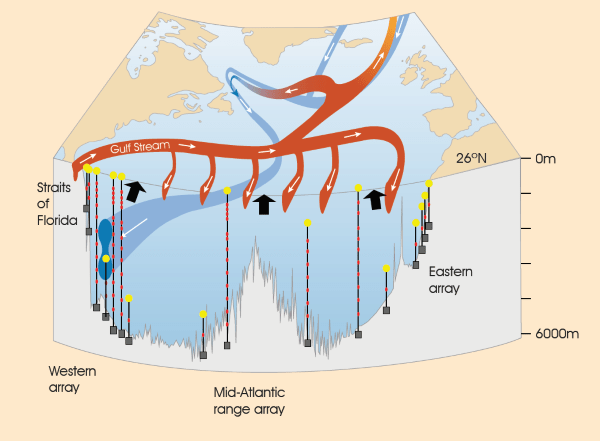
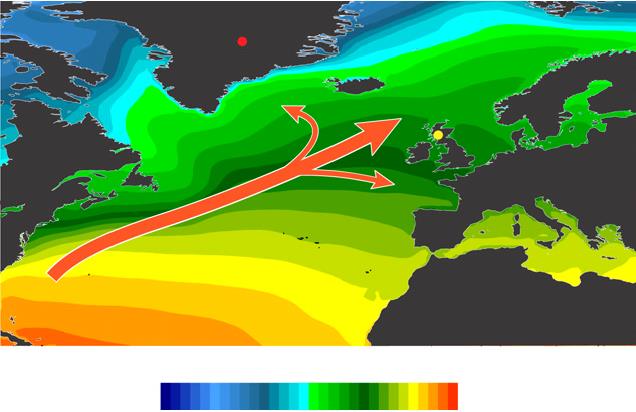
Atlantic Meridional Overturning Circulation (AMOC). Red colours indicate warm, shallow currents and blue colours indicate cold, deep return flows. Modified from Church, 2007, A change in circulation? Science, 317(5840), 908–909. doi:10.1126/science.1147796


Leave it to CNN to jump the shark with scary claims Excerpts in italics with my bolds.

A crucial system of ocean currents is heading for a collapse that ‘would affect every person on the planet’

A new study published Tuesday in the journal Nature, found that the Atlantic Meridional Overturning Current – of which the Gulf Stream is a part – could collapse around the middle of the century, or even as early as 2025.

Scientists uninvolved with this study told CNN the exact tipping point for the critical system is uncertain, and that measurements of the currents have so far showed little trend or change. But they agreed these results are alarming and provide new evidence that the tipping point could occur sooner than previously thought.

Yikes!  Shades of Day After Tomorrow

Scientists Admonish Against Going Over the Top

Fortunately knowledgable experts in the area have weighed with context and perspective at Science Media Centre Expert reaction to paper warning of a collapse of the Atlantic meridional overturning circulation. 

Of course some commented as cheerleaders, but many cautioned against exaggeration and speculation. The RAPID programme (see diagram at top) measures daily flows of water at several depths between the North Atlantic and Arctic oceans, and its scientific coordinator, Prof Meric Srokosz, National Oceanography Centre, University of Southampton, said:

While the possible collapse of the AMOC with significant climatic impacts is a concern, providing a warning of its collapse is problematic as a long set of observations is required. In this paper the warning depends on using proxy AMOC data (here based on sea surface temperature, SST) as direct continuous AMOC measurements are only available since 2004. The warning comes from applying statistical techniques to a long time series (over a century) of proxy AMOC data, but the warning is only as good as the proxy data are in representing the true AMOC. So, this warning needs to be treated with caution as there is no consensus as to which proxies can accurately capture the behaviour of the AMOC over the long term.”
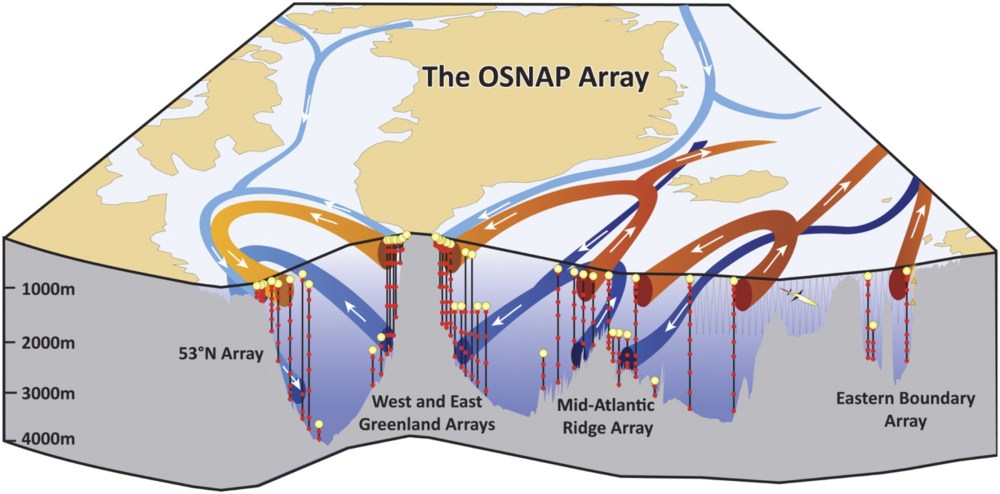
Prof Penny Holliday, Head of Marine Physics and Ocean Circulation at the National Oceanography Centre, and Principal Investigator for OSNAP, an international programme researching AMOC processes, variability and impacts, said:

“Confidence in the validity of the conclusions are undermined by our knowledge that sea surface temperature of the North Atlantic subpolar gyre is not a clear indicator of the state of the AMOC, and that there is no evidence that the AMOC has dramatically weakened in the past 50-75 years. A collapse of the AMOC would profoundly impact every person on Earth but this study overstates the certainly in the likelihood of it taking place within the next few years.”

Does the press release accurately reflect the science?

“On the whole it does – the title of the paper is more sensational than the actual statements within it, and the press release does make that clear. However there are two statements that are not accurate as follows:

‘The strength of the AMOC has only been monitored continuously since 2004 and these observations have shown AMOC to be weakening’

“This is stated in the paper but it is not correct information. The observations since 2004 show that the AMOC goes through fluctuations of being in a stronger or weaker state that last for about 10 years. The observations since 2004 show the subtropical AMOC getting slower from 2004 to 2012, but gradually becoming stronger since then. The only data from AMOC observations shown in the paper are from 5 sparse ship surveys and are used out of context – the authors use them to argue for a severe decline in the AMOC, but that interpretation has long been discredited in the scientific literature (including in the reference they cite for it).

‘The authors found early warning signals of a critical transition of the AMOC system and suggest that it could shut down or collapse as early as 2025 and no later than 2095.’

“This is not quite as the paper states. In the paper the time period of potential collapse depends on choices they have made in how they construct the time series of sea surface temperature which they use as evidence for change. They present three versions of the temperature records, and the three resulting model predictions suggests a collapse is ‘likely’ at any time from 2024 to 2180. The 2025-2095 is the period of time their statistical model predicts that a full or partial collapse is most likely.

How does this work fit with the existing evidence?

“The conclusions are different to the consensus derived from climate projections as described by the IPCC AR6 assessment. The averaged AMOC projections from climate models under all the IPCC emissions scenarios all show an AMOC decline, but not a collapse (a “high confidence” conclusion). Some individual climate model runs do show a future collapse in the AMOC, so the possibility cannot be entirely ruled out.

Are there any important limitations to be aware of?

“There are some questionable assertions and decisions in the methods as follows. The authors state confidently that the sea surface temperature (SST) of the North Atlantic subpolar gyre can be used as a proxy for the strength of the AMOC. The validity of an SST proxy for AMOC strength is a matter of ongoing scientific debate however, because it is based on model behaviour and is not proven using real-world data.

There is solid evidence that there is no such clear relationship,
especially on timescales of less than 30 years.

“I believe the authors have overstated the pattern of subpolar North Atlantic SST change by subtracting two (and three) times the global mean surface temperature trend. This is not the usual approach for highlighting North Atlantic regional temperature trend (instead it is more usual to subtract just 1 x the global trend). The choice means that some of the SST data they use in the statistical model has exaggerated decline since the 1970s when the global SST began to sharply rise. In the version of the statistical model for which the global mean SST trend is removed, the predicted likely time of a partial or complete collapse becomes later and over a wider window of time.

“As mentioned above, the actual observations of AMOC since 2004 have long-since discredited the evidence that the authors are using to validate their modified SST temperature record. The 5 data points they show in the paper were collected several years apart by ship surveys, and it is well known and well established that they give a highly misleading impression of AMOC decline. All the observational evidence we have shows no evidence of dramatic decline in the AMOC over the past 50-75 years.

How uncertain are the uncertainties?

“The authors say that the model’s 95% confidence interval is 2025-2095. This is a measure of statistical uncertainty and they state in the discussion that they cannot rule out slowing rather than a collapse, as well as listing other reservations and caveats. Because of the limitations of their use of modified SST as a proxy for AMOC, the uncertainty in the stated message in the title and abstract is high.

What are the implications in the real world?

“The potential for the AMOC system of currents to collapse under global warming is a high impact, low likelihood scenario, and policymakers and planners do need to be aware of it. NOC and international partners are investing in ongoing observations of the AMOC in order to determine how closely changes in AMOC contribute to changes in SST and consequential climate and social and economic impacts on people. The strength of the out-of-sight ocean currents of the AMOC has surprisingly direct impacts on food, water and energy security, infrastructure risk, biodiversity, and human health. The paper demonstrates that decades of observations are needed to be able to detect a major tipping point in the AMOC, and the authors call for continued measurements of these great Atlantic ocean currents for long enough to do so.

Prof. Dr. Jochem Marotzke, Director of the Department Ocean in the Earth System, Max-Planck-Institute for Meteorology, Hamburg, Germany, said:

“The work provides no reason to change the assessment of the 6th IPCC Assessment Report: ‘There is medium confidence that there will be no abrupt collapse before 2100′. The statement so confidently made in this paper that collapse will occur in the 21st century has feet of clay. The maths are solid, but the starting point is highly dubious: the essential equation – marked with (1) in the paper – relies on the simplified models representing bifurcation – i.e. AMOC collapse – also being correct. But the more comprehensive models do not show this very bifurcation. In this respect, the paper does not live up to its self-imposed claim: ‘The strategy is to infer the evolution of the AMOC solely on observed changes in mean, variance and autocorrelation.’

The interpretation relies to an enormous extent on the authors’ theoretical
understanding being correct, and there are huge doubts about that.

“It must be added that there is considerable doubt as to whether surface temperature measurements are a valid proxy for the AMOC. Again, the paper addresses these uncertainties inadequately.

“When reporting about this study, it is important to include the key aspects in which this paper fails to include the scientific uncertainties.

Prof Niklas Boers, Professor of Earth System Modelling at the Technical University of Munich, said:

“I do not agree with the outcome of this study. While the qualitative statement that the AMOC has been losing stability in the course of the last century is true and supported by the data, uncertainties are too high to reliably estimate a time of tipping. In particular, the uncertainties in the heavily oversimplified model assumptions by the authors are too high. Moreover, the uncertainties in the underlying datasets are huge and would make the extrapolation carried out by the authors far too uncertain to actually report a year or even a decade for the AMOC tipping.”

Background Post 2019 AMOC Update: Oceans Moderate Climate Threat
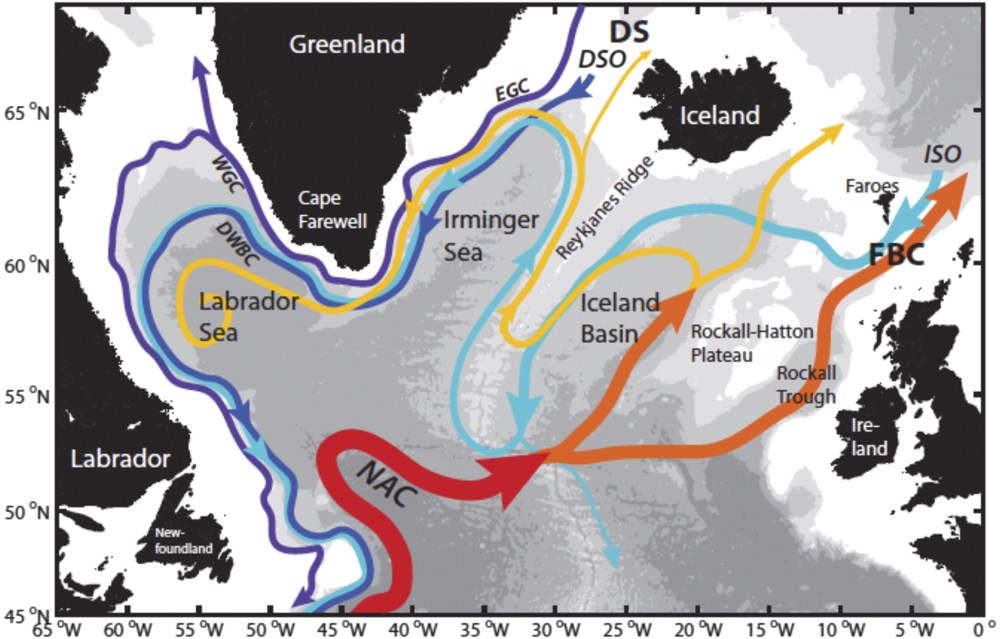
Fig. 1. Schematic of the major warm (red to yellow) and cold (blue to purple) water pathways in the NASPG (North Atlantic subpolar gyre ) credit: H. Furey, Woods Hole Oceanographic Institution): Denmark Strait (DS), Faroe Bank Channel (FBC), East and West Greenland Currents (EGC and WGC, respectively), NAC, DSO, and ISO.
Antarctica Heat Hype

Jennifer Marohasy throws cold water on heat hype in her Spectator Australia article Warming in Antarctica? Only using ‘creative’ statistics.  Excerpts in italics with my bolds and added images.

Much has been written in the tabloids, and repeated by the fashionable, about it being very hot through June – even in Antarctica. Really, I wondered. Is Antarctica melting?

The Australian Bureau of Meteorology has measured air temperatures at the Mawson weather station in Antarctica since early 1954 – this is one of the longest continuous surface temperature records for that part of the world. The Russians did not establish the more famous and isolated Vostok weather station until 1957. The satellite temperature record doesn’t begin until 1979.

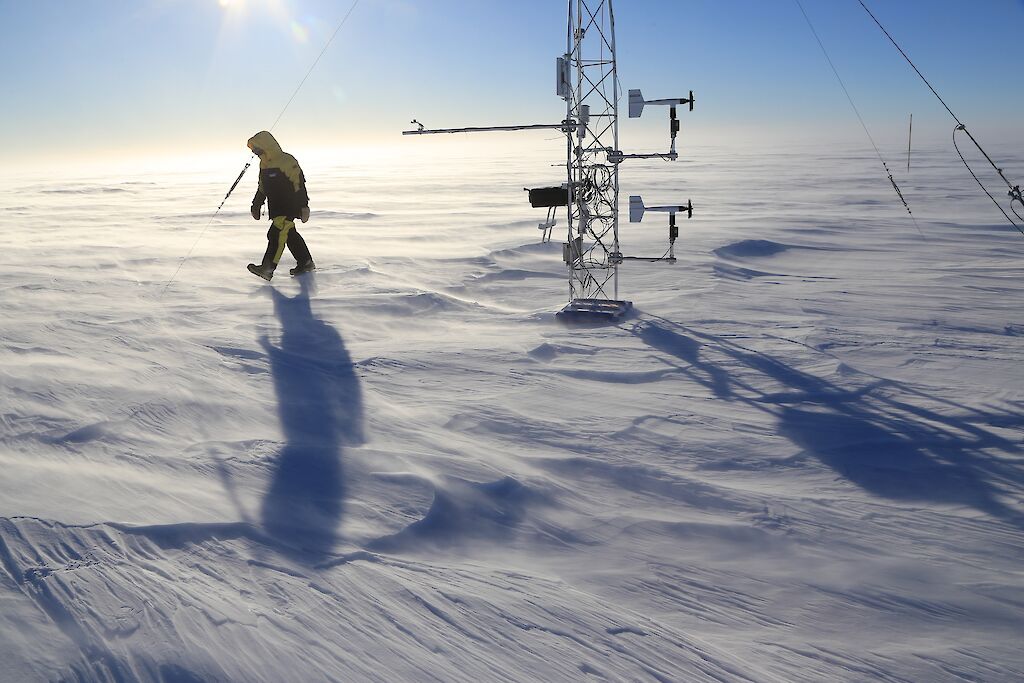
Automatic weather station (AWS) near Mawson. Photo: John Burgess

The Bureau makes very few adjustments to the temperatures as measured at Mawson that oscillate within a band of some few degrees – mostly below freezing. These same temperatures show no statistically significant long-term warming trend, at least not since 1954. There are longer proxy temperature series, based on ice core records, and they show an overall cooling trend, considering the last 1,900 years. Here, again, I am referring to data from published studies, for example, the temperatures of East and West Antarctica were reconstructed by a team led by Barbara Stenni including scientists from the Australian Antarctic Division, British Antarctic Survey, and Russian Antarctic Research Institute. It is only remodelled proxy series that show warming over this same period.

Last month (June 2023), Antarctica was reported as ‘hot’ in various publications including Vox.com. It’s even hot in Antarctica, where it’s winter.  Yet the average maximum temperature for Mawson was minus 12.6 degrees Celsius, which is not quite as cold as the long-term June average for all years since 1954 which is minus 13.5 C. When the June maximum temperatures for Mawson are ranked highest to lowest, June 2023 comes in as the 29th hottest, and 42nd coldest – suggesting temperatures in Antarctica were not particularly newsworthy and rather cold.

Yet the tabloids, and fashionable, are claiming June 2023 as hot – even in Antarctica. It is all nonsense.

Some of these claims have their origin in the University of Maine’s Climate Reanalyzer, a tool that uses satellite data and computer simulations. So, they represent a remodelled average. Indeed, there is not a single place where anyone, can measure the average temperature of the Earth – or Antarctica. Rather, when it is announced that it is the hottest it has ever been, reference is made to a statistic.

This average temperature is necessarily a number
that has been derived from other numbers.

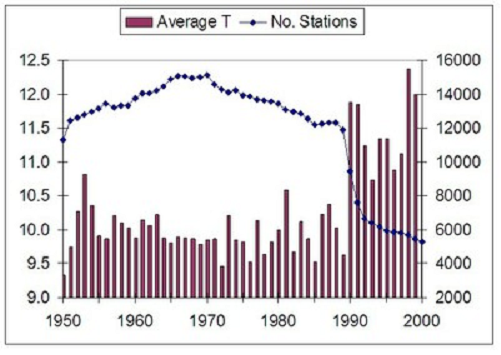
There will perhaps have been some measuring done here and there, and then some adjusting, and then some adding up and some adjusting again. This is how it is with the calculation of regional and global average temperatures – whether from satellites, tree rings, ice cores, or thermometers. To be sure, every year we are told it is getting hotter, and back in the late 1980s, this was achieved for the globally averaged thermometer record by dropping out some of the colder weather stations. This had the effect of increasing the overall average global temperature, at a time when temperatures at many individual sites were dipping somewhat.

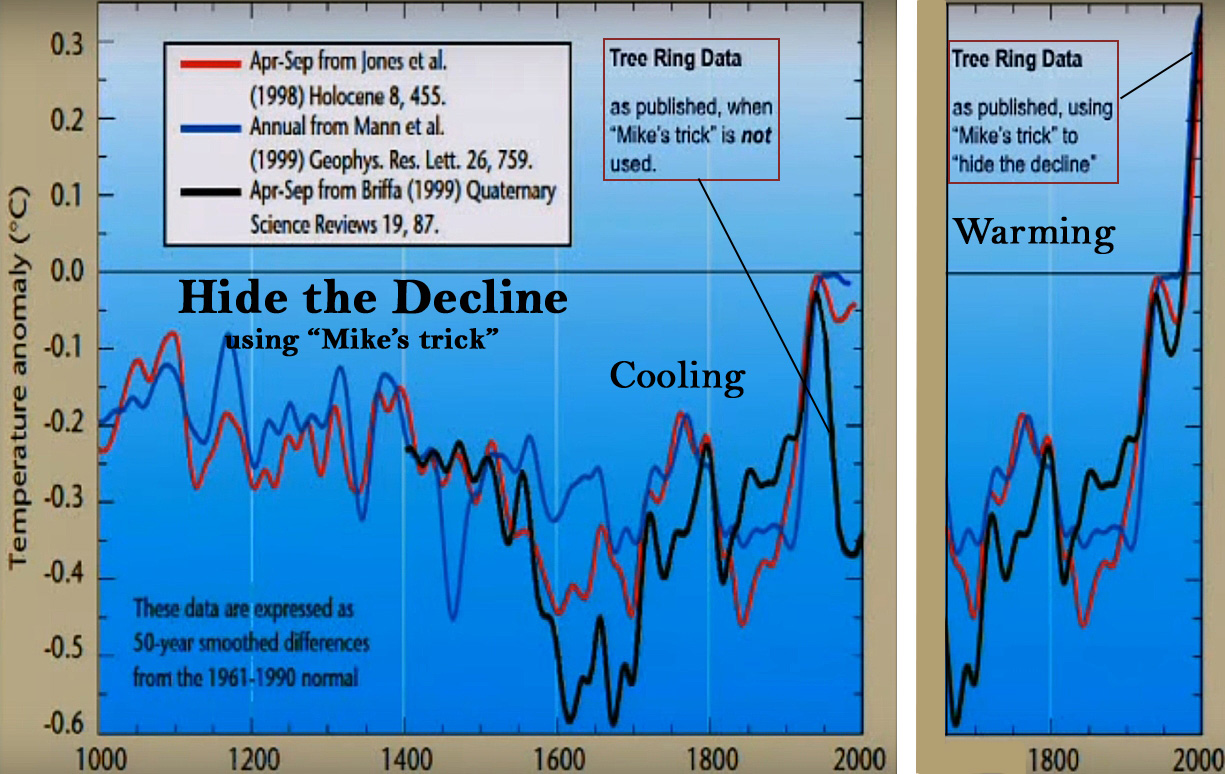
Those who have followed the politics of measuring temperatures may also remember the infamous line in the Climategate emails, whereby the globally averaged temperatures based on tree rings, which also show a decline after 1980, are ‘corrected’ by substituting the globally averaged temperature from thermometer records – never mind that the dip in that record had already been ‘corrected’ by removing data from a great many high latitude Canadian and Russian weather stations.

Drawing from this sordid history of calculating global and regional temperatures, I can think of a large number of ways that the University of Maine’s Climate Reanalyzer could possibly generate a higher-than-average temperature for Antarctica and especially the Earth. Indeed, the larger the geographic area covered, the more opportunity for creative accounting, for which corporates using similar techniques would go to jail, while climate scientists are more usually promoted.

The solution is to perhaps give up on believing the nonsense news headlines, especially when there is no reference to a specific weather station, like Mawson. Or do away with a random selection of weather stations and focus instead on a simple index based on a good sample of well-sited weather stations with long histories, like Mawson.

Such a concept could be based on the Dow Jones Averages or the S&P 500. No one ever tries establishing an impossible-to-define ‘average stock price’ — including many stocks of doubtful provenance — and nobody cares. Rather the solution is to have a pre-selected index of certain representative stocks, that are then followed over a long-time span. So why not have an index of agreed weather stations?

The only problem is, the tabloids and the fashionable, might then have nothing to talk about – should they limit reporting to the same weather stations and with temperatures reliably measured, which will require some modification to current methods and of course, no subsequent adjusting.

There may be no catastrophe to report at least not when it comes to weather as a measure of climate, for which the lack of reliable measures, and the great number of potentially creative solutions, are currently being exploited over and over to justify rather large expenditures on all manner of things.


Google Screens Your Climate Info

Jimmy Dore reports in the above video on collusion between UN and Google to control public access to climate information .  Below is a transcript from the closed captions.  JD is the host with some asides from Kurt Metzger (KM)  The UN spokesperson is Melissa Fleming (MF), United Nations Under-Secretary-General for Global Communications. Text in italics with my bolds and added images.

JD: It turns out Google is the richest company in the history of humanity–did you know that Google gets more money than Exxon, more money than Apple. They have more money than Tesla, they have a lot of money.   “Google teams up with the UN for verified climate information.” So this is an article from the United Nations, This is from April 22nd of last year.

KM: Well I hope they fight nitrogen deniers.

JD:  So I don’t know if we covered this, which is why I want to cover it now. Did you know that if you Google climate change, Google has now rigged it. It’s not just, well whatever the most popular websites are that talk about climate change come up; the order of the 10 most popular articles.

That’s not what they’re doing. They’re making sure that the popular articles don’t show up and they’re trying to control the narrative. They only want certain ones, only articles the United Nations approves of. That’s what Google’s doing.

KM  Look, millions of people around the world go to Google to get information about climate change and sustainability.  Nobody is going: What about sustainability? What about that word you just invented a couple years ago? Sustainability, sustainability.

JD:  In addition to organic search results, Google is surfacing short and easy to understand information panels and visuals on the causes and effects of climate change as well as individual actions that people can take to help tackle the climate crisis

KM  Should I glue my head to a painting?

JD:  So here is the under Secretary General for Global Communications at the UN;  ready.

MF: Served with Google for example. If you Google climate change, at the top of your search you will get all kinds of UN resources. We started this partnership when we were shocked to see that when we googled , climate change we were getting incredibly distorted information right at the top.

JD: So when she Googled climate change, she was getting a lot of articles that she didn’t agree with. They would come up because what Google is supposedly doing is just showing you what’s the most popular articles, without an editorial input. She’s saying we didn’t like that people were getting to see those articles that were popular that we disagree with. So we went to Google and we told them artificially manufacture your Google results when people Google climate change. And have these special articles that we like come up, those that push a specific agenda about climate change. And they say it right out in public, she’s saying it on camera.

KM  I’m relieved.  It was about time they started doing this, so I was happy to hear it

MF:  So we’re becoming much more proactive. You know, we own the science and we think that the world should know.

JD:  Like the Vatican, we own the science. You mean like Tony fauci did. And then he had to admit that he was lying constantly during covid because he was. We Own the science, we own the science: Nobody owns the science, science doesn’t work like that, there’s no such thing. It’s always: Question science. Science always needs to be questioned and tested, always. That’s why Einstein didn’t trust what Newton said about gravity, he had his own ideas. And now we know about E equals m c squared.

MF: And the platforms themselves also do, but again it’s a huge, huge challenge, that I think all sectors of society need to be very active in. We need total control.

JD:  We own the science sounds about right. So if you thought when you Google something you’re getting organic natural results, no you’re getting propaganda selected by people like her, articles they want you to have. They want to control your thoughts, and they are. And that’s what propaganda is. They’re all propaganda and they just brag about doing propaganda right in the open.

KM:  I’ve heard we own the Sciences, the second time I heard it that sounds like a catchphrase or something.

JD:  Someone says we own the science, we own the science. No what you own is the Google results on the science. So that means you own the conversation and the narrative in the culture. But you don’t own the science. Own the science, what kind of a thing is that to say I don’t know.


NYT Makes 12 out of 12 False Claims Against Lomborg’s Book

Bjorn Lomborg set the record straight at LinkedIn The New York Times’ stunningly false and deceptive hit piece to preserve climate alarmism.  Excerpts in italics with my bolds.

The piece consists of Stiglitz enumerating four specific and compounding mistakes that I apparently make, and then another six separate observations. I will go through all of them below, starting with the four mistakes.

My first “mistake”

My first mistake is that I draw “heavily on the work of William Nordhaus of Yale University, who came up with an estimate of the economic cost to limiting climate change to 1.5 to 2 degrees Celsius above preindustrial levels.” Instead the High-Level Commission on Carbon Prices, which Stiglitz co-authored, showed that 1.5°C-2°C goals “could be achieved at a moderate price.”

This is triply wrong. I don’t rely on Nordhaus for the cost on limiting temperature rise for 1.5°C to 2°C, simply because Nordhaus does not make that estimate. Nordhaus explicitly writes, as Stiglitz would know had he read Nordhaus or my book: “A limit of 2°C appears to be infeasible with reasonably accessible technologies even with very ambitious abatement strategies.”

Secondly, Stiglitz claims that his report estimates “a moderate price” for reaching the Paris agreement. This is false. There is no estimate of the total economic cost of a 2°C or 1.5°C target in his High-Level Commission on Carbon Prices.

Compounding Stiglitz’ error is the fact that the background report for his high-level commission does indeed list the UN Climate Panel cost estimate for reaching 1.5-2°C at more than 4% of GDP by 2100 (p2), which makes Nordhaus’ 1.38% GDP economic cost at the lowest temperature scenario of 2.35°C by 2100 substantially smaller (not larger, as Stiglitz claims).

Stiglitz throughout his piece neglects to inform the reader that Nordhaus is not just any old economist, but actually the only climate economist to get the Nobel prize for his work on climate economics. For reference, Stiglitz got his Nobel prize in economics for analyses of markets with asymmetric information like the selling and buying of used cars.

For the first mistake, Stiglitz makes two false claims and no correct, relevant claims.

My second “mistake”

My second mistake is “Nordhaus’s and Lomborg’s underestimation of the damage associated with climate change.” Stiglitz is in reality informing us that he knows much better than the world’s only climate Nobel economist.

But curiously, Stiglitz never tells us what the right cost is. As such, Stiglitz makes an absurd claim, essentially asserting he knows better than the best peer-reviewed evidence — but just couldn’t be bothered to share that knowledge publicly.

Stiglitz gives one indication of his knowledge on this matter. He claims that a significant part of the cost of climate change “includes more extreme weather events — more intense hurricanes, more droughts, more floods, with all the devastation to life, livelihood and property that accompanies them. Yet, again, he seems to have forgotten to actually acquaint himself with the best evidence on the science and economics of extreme weather events. As the leading researcher on economic impacts of extreme weather events says, Stiglitz is “just wrong.

But more importantly, Stiglitz is just cherry-picking and ignoring the actual data. He picked the costliest recent data point and he neglects that the trend for the US (and similarly for the world) is declining.
Stiglitz is simply doubly wrong on his only indication of how Nobel Laureate Nordhaus and I should be wrong, so for the second mistake, Stiglitz makes two false, one unsubstantiated and no correct, relevant claims.

My third “mistake”

Stiglitz suggests that “A third critical mistake, compounding the second, is not taking due account of risk.”  Ah, if only the world’s only actual Nobel laureate in climate economics had thought of incorporating risks.

Of course, Stiglitz could still have quibbled about a different way to model risk, and added his own take on this. But he does not. He simply — and falsely — suggests that Nordhaus or I have not taken this obvious point into consideration.

Specifically, Stiglitz assuredly tells us that the best damage estimates are underestimates because “as we learn more about climate change these best estimates keep getting revised, and, typically, in only one direction — more damage and sooner than had been expected.”   No, they do not. This is the kind of claim one makes if one gets most of one’s climate information from news media.

For the third mistake, Stiglitz makes two false, one unsubstantiated and no correct, relevant claims.
My fourth “mistake”

Stiglitz seems to claim that Nordhaus and I use a discount parameter that is too low for his liking. I cite the whole paragraph, because it is unclear what his actual point is except a rant against the Trump administration:

Stiglitz apparently suggests that Nordhaus and I use a 7 percent discount rate to spew out the numbers that are in my book. This is demonstrably false. Perhaps Stiglitz knows he’s fibbing, given that he settles for criticizing Trump and then conflating the 7% with the “models Lomborg loves.”

Instead, Nordhaus’ discount rate is calibrated to the real interest rates, meaning a 4.8% discount rate in 2015, declining to 3.5% in 2100.

As he would know, having been World Bank chief economist, it is one thing what rich, liberals in Manhattan want for a discount rate. Most of the rest of the world has much higher discount rates. When we worked with the government of Haiti, the central bank decided on 12% (even contemplating 20%), while Ghana decided 8%.

For the fourth mistake, Stiglitz makes one false and no correct, relevant claims.
Other claims

Media drives alarmism

He seems to brush off my points that the hyperventilating media is one of the main causes of alarmism simply by saying “fake news”: 

For example, I outline how New York Times claims that South Vietnam by 2050 will “all but disappear” because it will be “underwater at high tide.”  While the story was reported in almost all media, it was clearly incorrect. Because almost all of South Vietnam is already under the high tide mark today, and almost all of South Vietnam is already well-protected today:

Regulation

Stiglitz claim that I miss discussing good regulations as a way to tackle climate.  

More importantly, Stiglitz seems to have missed at least the last third of my book. Here I talk about

1. Innovation: how we should invest $100 billion per year in green R&D (regulation, not taxation)

2. Adaptation: regulation like zoning, building regulation and more pervious city surfaces (to ensure less flooding)

3. Geoengineering: which will be almost entirely a regulatory approach

4. Prosperity: mostly about better policies including regulatory policies

Stiglitz’ claim that I ignore regulation is blatantly false.

Wall Street underwater

Almost bizarrely, Stiglitz chides me for not including in my book that Wall Street could be underwater by 2100:

The research very clearly shows that at least when an area has sufficient value (as Wall St and surrounding areas certainly have) all will be safeguarded through adaptive policies (like sea walls etc.).  I even show this in a graph in the book, based on this paper. We only see significant flooding when we disregard adaptation:

So when Stiglitz chides me for not including that Wall Street might be underwater in my book, it is because such a claim would be false. His is a good example of bad information from hyperventilating media.

Copenhagen Consensus

Stiglitz writes a slyly derogatory paragraph about the think tank I work for, Copenhagen Consensus:

The paragraph doesn’t seem to say anything but that the experts are conservative and that we didn’t include any “true experts” on climate science.

On his first claim, we have worked with more than 300 of the world’s top economists and seven Nobel Laureates. Our main focus is all the world’s problems, not just climate change, so many are experts in the economics of malaria, infrastructure, water, education etc.   We certainly don’t have a ‘conservative’ bias — we’ve actually invited Stiglitz to be a member of several eminent panels together with his Nobel colleagues. But it also shows that Stiglitz seems to be suggesting that only liberal economists such as himself can be trusted to help set priorities for the world.

On his second claim, we have worked with many climate economists, and when we did our big climate consensus, we worked with 27 of the world’s top climate economists, publishing the results as a book with Cambridge University Press, which even got a favorable quote from the IPCC’s chairman (“This book provides not only a reservoir of information on the reality of human induced climate change, but raises vital questions and examines viable options on what can be done to meet the challenge.”).

Stiglitz’ derogatory two claims are simply incorrect.

Lack of prioritization

One of the key points of my book (and the Copenhagen Consensus’ work) is that we have to prioritize. No matter the amount of resources available, there is never enough to do everything, and hence we have to make sure we spend resources where they can do the most good first.  The allocation of scarce resources with alternative uses, of course, is the key definition of economics.

Obviously, money from a tax can be used on many things (some of which I’m sure Stiglitz wouldn’t like), but they can still only be used once. And the point is, that with more stringent climate policies, GDP will be slightly lower, hence there will be less in total to spend.

The new IPCC report shows end-of-world

Stiglitz finally claims that because I cite the UN Climate Panel so often, one could believe I might be right. But, he comforts his readers, “nothing could be further from the truth”:

What I say in the book is also what is in the IPCC 2018 1.5°C report.

Then Stiglitz goes on to make the exact scare scenario in which the media excels and that I have criticized. The 60 feet sea level rise is from a world in an entirely different part of the state space. He knows very well that such statistics are only meant to scare but not informative for what will happen for us, in this part of the state space. That, of course, is exactly what the IPCC reports are about. They talk about a high outcome of 3 feet of sea level rise by 2100. The only reason to throw out 60 feet is to scare people silly.

Summary

Making 12 substantial criticisms of my book and that they are all false, is quite an achievement. It is hard not to conclude that Stiglitz’ review of my book is a deceptive and false hit piece. It is perhaps not surprising that Stiglitz actually said that he was going to give the book a bad review even before he read it. In many ways, it seems like he still hasn’t read it.

I have asked New York Times to rectify this terrible article. 


Enforcing Climate Correctness (Fact Checking)

Serfs attacking Climate Establishment

Phys.org sounds the alarm: Meteorologists targeted in climate misinfo surge.  Excerpts in italics with my bolds and added images.

Once trusted faces on the news, meteorologists now brave threats, insults and slander online from conspiracy theorists and climate change deniers who accuse them of faking or even fixing the weather.

Users on Twitter and other social media falsely accused Spain’s weather agency of engineering a drought, Australia’s of doctoring its thermometers and France’s of exaggerating global warming through misplaced weather stations.

“The coronavirus is no longer a trend. Conspiracy theorists and deniers who used to talk about that are now spreading disinformation about climate change,” Alexandre Lopez-Borrull, lecturer in Information and Communication Sciences at the Open University of Catalonia, told AFP.

“These scientific bodies are seen as part of the establishment, so anything they say may get disputed on social networks.

“They are providing evidence against what the climate deniers claim, so the latter try to discredit them.”

Maybe if they stuck to weather reporting? See Climate Evangelists Are Taking Over Your Local Weather Forecast

Australian thermometers

In a case investigated by AFP Fact Check, conservative media and Facebook users shared unfounded claims that Australia’s Bureau of Meteorology (BOM) doctored its temperature readings.

In an analysis of data obtained via a freedom of information request, prominent climate skeptic Jennifer Marohasy said BOM’s electronic probes returned readings up to 0.7 degrees Celsius warmer than those of its older mercury thermometers.

Experts who analyzed the data said the claims were inaccurate.

Monash University emeritus environment professor Neville Nicholls said the difference between most readings on the electronic probes and the mercury thermometers was negligible—between zero and 0.1C (0.18 degrees Fahrenheit).

The World Meteorological Organization told AFP that the BOM’s measurements were in line with its standards, contrary to Marohasy’s allegation.

Marohasy makes her case in video below.

Several examples in the article shows they are relying on fact checking by AFP (Agence France Presse).  So the AFP Fact Check follows the usual procedure:  get quotes from establishment supporters in order to isolate and cancel a finding contrary to “consensus” climate science.

More from AFP to See How the Enforcement Works

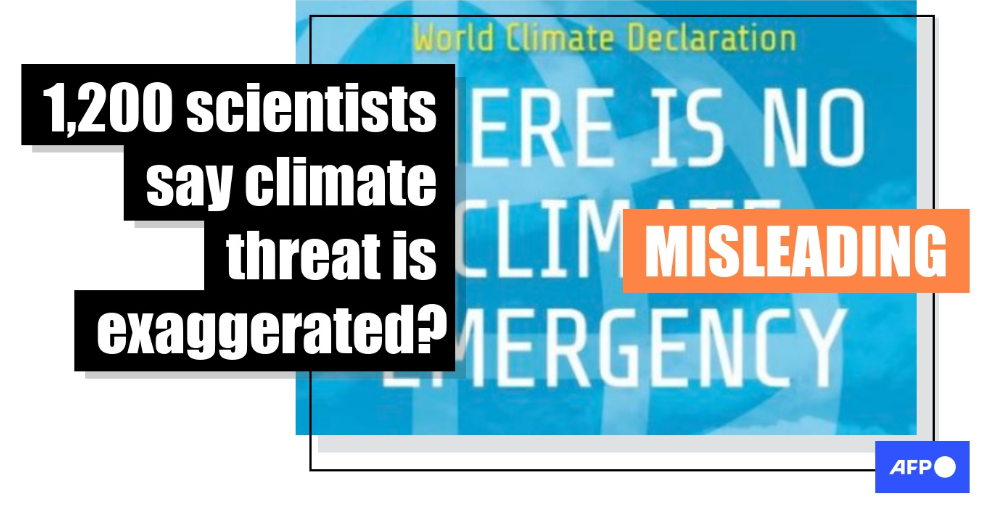
Climate ‘declaration’ recirculates debunked claims.Excerpt in italics with my bolds

First Attack:   Big Oil Funds Them, So They Lie

However seven of the signatories to the declaration were identified on the list as having worked for Shell and eight others as having worked in the oil industry. Crok confirmed to AFP that Berkhout himself worked for the firm “about 40 years ago.” Besides these, there were 13 petroleum engineers and petroleum geologists, plus several mining specialists.

Several signatories had links, either mentioned on the list or documented elsewhere, to US climate-skeptic free-market groups with ties to the oil industry: the Heartland Institute, the Competitive Enterprise Institute and the Cato Institute.

These groups each received money from oil giant ExxonMobil, according to donor and tax documents published by Greenpeace (here, here and here). The company has been accused of undermining science to protect its fossil fuel business — a charge it denies.

Second Attack:  Only Some Signatories are Climatologists

According to an AFP count of the declaration’s signatories, about 10 explicitly described themselves as climatologists or climate scientists, fewer than one percent of the total. A few others described themselves as specialists in paleoclimatology and atmospheric sciences.

There were approximately 40 geophysicists, 130 geologists and 200 engineers of various kinds, plus several mathematicians, medical doctors and agricultural scientists.

Thirdly:  IPCC is the Final Authority

Documents accrediting the mainstream scientific view on climate change are more comprehensive than the World Climate Declaration. The Intergovernmental Panel on Climate Change invited 721 experts from 90 countries to be authors and editors of its three-part Sixth Assessment Report, released between August 2021 and April 2022.

The report constitutes the most comprehensive assessment of scientific knowledge on climate change. Each part was some 3,000 pages long. The authors reviewed hundreds of studies that were listed in the reference sections. It says there is “unequivocal” evidence that humans are warming the climate by burning fossil fuels.

Finally, Refer to Insider Supporters to Refute Claims

Examples in the AFP fact check include Carbon Brief and World Weather Attribution.

Why Should We Believe A Bunch of Journalists like AFP?

Well, because they pass the media bias test;

Who is behind Media Bias Fact Checks and what is their POV?

From Climate Change Dispatch ‘Media Bias/Fact Check’ Site Served With Cease And Desist, Gets Fact-Checked.  Excerpts in italics with my bolds.

Today, PSI has issued Media Bias/Fact Check (MBFC) site owner, Dave Van Zandt with a pre-action legal notice to take down the defamatory and false smear.

Ironically, the self-styled ‘MEDIA BIAS/FACT CHECK‘ (MB/FC) which negatively fact-checked PSI admits it relies on the subjective bias to decide how biased others are. In other words, MB/FC is a pseudoscientific fact checker!

Apart from unlawfully smearing PSI, Mr. Van Zandt has smeared other websites that publish scientific articles critical of man-made global warming claims. Among the unfairly smeared are:

  • Climate Change Dispatch
  • CFACT
  • WUWT

Below we help readers to fact-check the pseudo-fact-checker. We put Dave Van Zandt the faceless fact-checker under the microscope and discovered the following:

♦  Van Zandt Cites No Scientific Qualifications At All
♦  Van Zandt Was Exposed By WND As A Fraud And A Liar
♦  Van Zandt’s Website (MBFC) Does Not Apply Any Objective Scientific Method
♦  MBFC Relies On Unverifiable Subjectivity (Own Bias) To Make Judgments

Climate Enforcers Appeal to Membership in IFCN

Both AFP and MBFC stake their credibility on belonging to the International Fact-Checking Network (IFCN).  Who’s behind that authority?  WND discussed them in their article The 9 fakest fake-news checkers.  Excerpts in italics with my bolds.

In the past Facebook announced it would use the International Fact-Checking Network, or IFCN, to check on the legitimacy of news articles posted to the social media site.

IFCN is hosted by the Poynter Institute for Media Studies and funded, in part, by Google and foundations of leftist billionaires George Soros and Bill Gates. Soros donated $25 million to Hillary Clinton’s presidential campaign. The Daily Mail reported that Clinton super-donor and eBay founder Pierre Omidyar is also backing the project.

The website reveals: “Poynter’s IFCN has received funding from the Arthur M. Blank Family Foundation, the Duke Reporters’ Lab, the Bill & Melinda Gates Foundation, Google, the National Endowment for Democracy, the Omidyar Network, the Open Society Foundations and the Park Foundation.”

Summary:  

There’s a well-funded industry dedicated to curating the news for the sake of “right-thinking” public opinion. It’s a closed loop of self-appointed authorities who validate each other, and excommunicate unbelievers.  Woe to those who outsource their critical intelligence to such.


Claim: Now Heat Extremes Are “Statistically Impossible.”

There’s a lot of buzz about a current article:  ‘Statistically Impossible’ Heat Extremes Are Here.   The authors state: 

Looking at historical data from 1959 to 2021, we found that 31% of Earth’s land surface has already experienced such statistically implausible heat (though the Pacific Northwest heatwave is exceptional even among these events). These regions are spread all across the globe with no clear spatial pattern.

In the summer of 2021, Canada’s all-time temperature record was smashed by almost 5℃. Its new record of 49.6℃ is hotter than anything ever recorded in Spain, Turkey or indeed anywhere in Europe.  The record was set in Lytton, a small village a few hours’ drive from Vancouver, in a part of the world that doesn’t really look like it should experience such temperatures. Lytton was the peak of a heatwave that hit the Pacific Northwest of the US and Canada that summer and left many scientists shocked. From a purely statistical point of view, it should have been impossible.   Overall, our work raises two important points:

The first is that statistically implausible heatwaves can occur anywhere on the Earth, and we must be very cautious about using the historical record in isolation to estimate the “maximum” heatwave possible. Policymakers across the globe should prepare for exceptional heatwaves that would be deemed implausible based on current records.

The second is that there are a number of regions whose historical record is not exceptional, and therefore is more likely to be broken. These regions have been lucky so far, but as a result, are likely to be less well prepared for an unprecedented heatwave in the near future. It is especially important that these regions prepare for more intense heatwaves than they have already experienced.

My Comment:

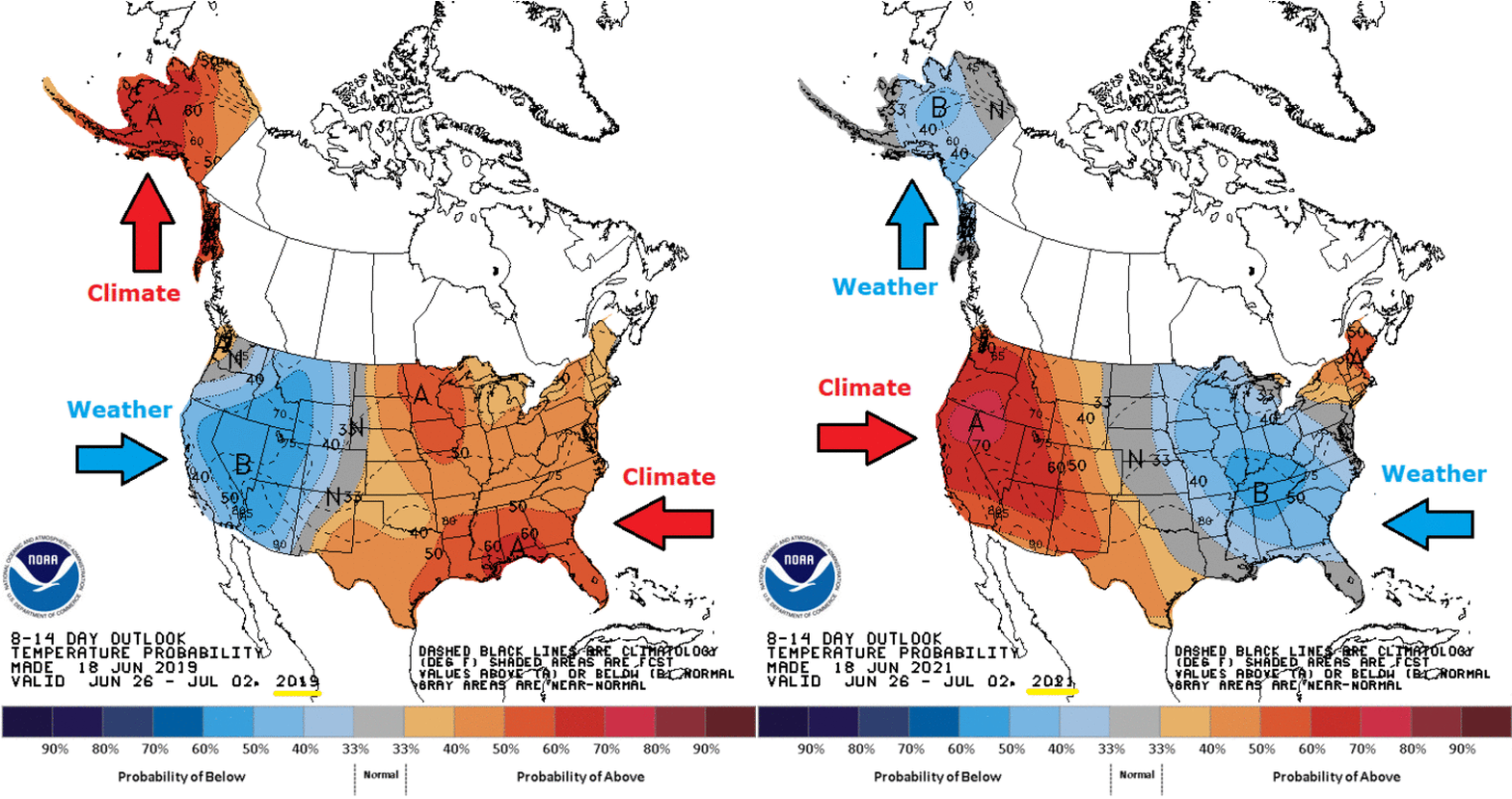
So the conclusion is a familar alamist meme:  If you’ve had a heat extreme, there will be more; If not you’d best get ready for them.  What is left out are the simple lessons in the image at the top. The 2021 Pacifc Northwest heat wave happened all right, but it was a cold spot in 2019, when the East coast was hot.  Since the overall average temperatures change very little, hot spots in some places will be offset by cold spots in others. But by obsessing on the heat and ignoring the cold, the narrative of a burning planet is proclaimed.  

Furthermore, as a previous post below explains, average temperatures hide a particular Northern Hemisphere pattern, namely the concurrence of warm summers and cold winters in the same year.

Rannoch Moor, Scotland

Previous Post: Heat Waves: Historical, not Hysterical Context

Alarms are being sounded about heat waves in the Northern Hemisphere, noting heat waves in Eastern Canada and US, wildfires in N. Sweden and Siberia.  The recent (2018) UK lawsuit featured the advocate claiming the Arctic is burning, so global warming is no longer in doubt.  Thus UK needs to up its carbon reduction targets.

The High Court disagreed.  And for good reasons not cited by the judge.  The hot dry weather this summer in Siberia was preceded by extreme cold and massive snowfall, unusual winter conditions even for that climate zone.  Similarly, there have been cold winters across Eurasia, while Northern Europe enjoys a BBQ summer.  BTW, I recall seeing on TV May and June tennis matches in Spain where spectators were wearing jackets and head covering against the cold.

What is going on?  Fact: Concurrent warm summers and cold winters are a feature of the North Atlantic climate system.  It has gone on periodically throughout history, and long before humans burned fossil fuels.  Below is evidence providing insight into our present experience of 2018 weather.

Concurrent Warming and Cooling

This post highlights recent interesting findings regarding past climate change in NH, Scotland in particular. The purpose of the research was to better understand how glaciers could be retreating during the Younger Dryas Stadia (YDS), one of the coldest periods in our Holocene epoch.

The lead researcher is Gordon Bromley, and the field work was done on site of the last ice fields on the highlands of Scotland. 14C dating was used to estimate time of glacial events such as vegetation colonizing these places. Bromely explains in article Shells found in Scotland rewrite our understanding of climate change at siliconrepublic. Excerpts in italics with my bolds.

By analysing ancient shells found in Scotland, the team’s data challenges the idea that the period was an abrupt return to an ice age climate in the North Atlantic, by showing that the last glaciers there were actually decaying rapidly during that period.

The shells were found in glacial deposits, and one in particular was dated as being the first organic matter to colonise the newly ice-free landscape, helping to provide a minimum age for the glacial advance. While all of these shell species are still in existence in the North Atlantic, many are extinct in Scotland, where ocean temperatures are too warm.

This means that although winters in Britain and Ireland were extremely cold, summers were a lot warmer than previously thought, more in line with the seasonal climates of central Europe.

“There’s a lot of geologic evidence of these former glaciers, including deposits of rubble bulldozed up by the ice, but their age has not been well established,” said Dr Gordon Bromley, lead author of the study, from NUI Galway’s School of Geography and Archaeology.

“It has largely been assumed that these glaciers existed during the cold Younger Dryas period, since other climate records give the impression that it was a cold time.”

He continued: “This finding is controversial and, if we are correct, it helps rewrite our understanding of how abrupt climate change impacts our maritime region, both in the past and potentially into the future.”

The recent report is Interstadial Rise and Younger Dryas Demise of Scotland’s Last Ice Fields
G. Bromley A. Putnam H. Borns Jr T. Lowell T. Sandford D. Barrell  First published: 26 April 2018.(my bolds)

Abstract

Establishing the atmospheric expression of abrupt climate change during the last glacial termination is key to understanding driving mechanisms. In this paper, we present a new 14C chronology of glacier behavior during late‐glacial time from the Scottish Highlands, located close to the overturning region of the North Atlantic Ocean. Our results indicate that the last pulse of glaciation culminated between ~12.8 and ~12.6 ka, during the earliest part of the Younger Dryas stadial and as much as a millennium earlier than several recent estimates. Comparison of our results with existing minimum‐limiting 14C data also suggests that the subsequent deglaciation of Scotland was rapid and occurred during full stadial conditions in the North Atlantic. We attribute this pattern of ice recession to enhanced summertime melting, despite severely cool winters, and propose that relatively warm summers are a fundamental characteristic of North Atlantic stadials.

Plain Language Summary

Geologic data reveal that Earth is capable of abrupt, high‐magnitude changes in both temperature and precipitation that can occur well within a human lifespan. Exactly what causes these potentially catastrophic climate‐change events, however, and their likelihood in the near future, remains frustratingly unclear due to uncertainty about how they are manifested on land and in the oceans. Our study sheds new light on the terrestrial impact of so‐called “stadial” events in the North Atlantic region, a key area in abrupt climate change. We reconstructed the behavior of Scotland’s last glaciers, which served as natural thermometers, to explore past changes in summertime temperature. Stadials have long been associated with extreme cooling of the North Atlantic and adjacent Europe and the most recent, the Younger Dryas stadial, is commonly invoked as an example of what might happen due to anthropogenic global warming. In contrast, our new glacial chronology suggests that the Younger Dryas was instead characterized by glacier retreat, which is indicative of climate warming. This finding is important because, rather than being defined by severe year‐round cooling, it indicates that abrupt climate change is instead characterized by extreme seasonality in the North Atlantic region, with cold winters yet anomalously warm summers.

The complete report is behind a paywall, but a 2014 paper by Bromley discusses the evidence and analysis in reaching these conclusions. Younger Dryas deglaciation of Scotland driven by warming summers  Excerpts with my bolds.

Significance: As a principal component of global heat transport, the North Atlantic Ocean also is susceptible to rapid disruptions of meridional overturning circulation and thus widely invoked as a cause of abrupt climate variability in the Northern Hemisphere. We assess the impact of one such North Atlantic cold event—the Younger Dryas Stadial—on an adjacent ice mass and show that, rather than instigating a return to glacial conditions, this abrupt climate event was characterized by deglaciation. We suggest this pattern indicates summertime warming during the Younger Dryas, potentially as a function of enhanced seasonality in the North Atlantic.

Surface temperatures range from -30C to +30C

Fig. 1. Surface temperature and heat transport in the North Atlantic Ocean.  The relatively mild European climate is sustained by warm sea-surface temperatures and prevailing southwesterly airflow in the North Atlantic Ocean (NAO), with this ameliorating effect being strongest in maritime regions such as Scotland. Mean annual temperature (1979 to present) at 2 m above surface (image obtained using University of Maine Climate Reanalyzer, http://www.cci-reanalyzer.org). Locations of Rannoch Moor and the GISP2 ice core are indicated.

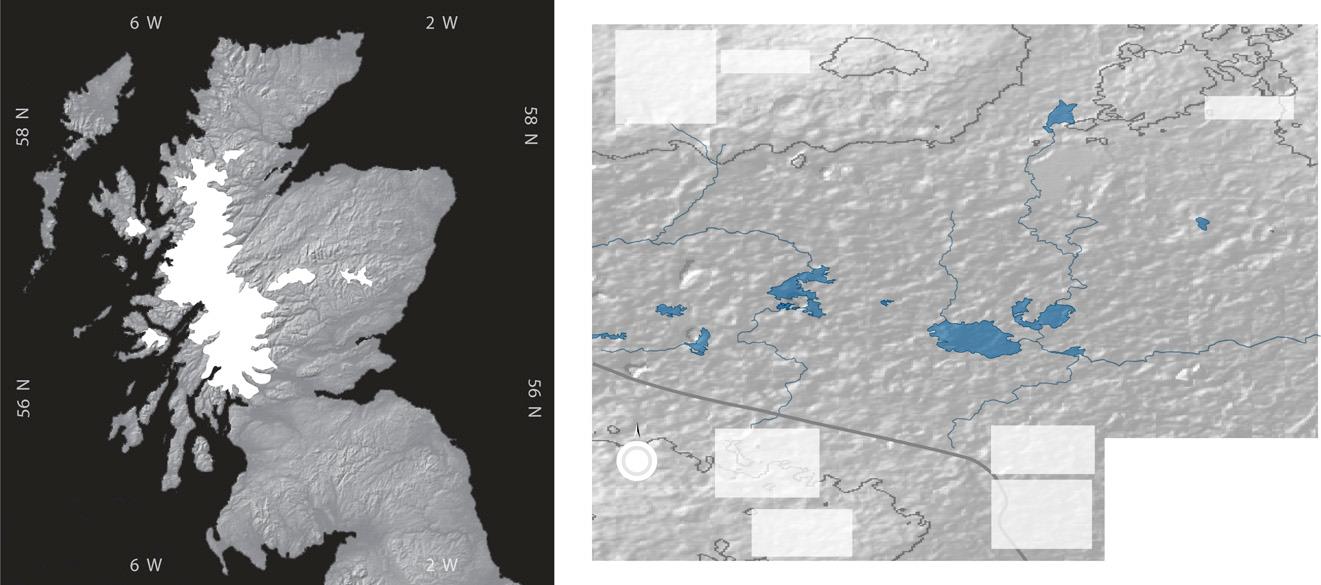
Thus the Scottish glacial record is ideal for reconstructing late glacial variability in North Atlantic temperature (Fig. 1). The last glacier resurgence in Scotland—the “Loch Lomond Advance” (LLA)—culminated in a ∼9,500-km2 ice cap centered over Rannoch Moor (Fig. 2A) and surrounded by smaller ice fields and cirque glaciers.

Fig. 2. Extent of the LLA ice cap in Scotland and glacial geomorphology of western Rannoch Moor. (A) Maximum extent of the ∼9,500 km2 LLA ice cap and larger satellite ice masses, indicating the central location of Rannoch Moor. Nunataks are not shown. (B) Glacial-geomorphic map of western Rannoch Moor. Distinct moraine ridges mark the northward active retreat of the glacier margin (indicated by arrow) across this sector of the moor, whereas chaotic moraines near Lochan Meall a’ Phuill (LMP) mark final stagnation of ice. Core sites are shown, including those (K1–K3) of previous investigations (14, 15).

When did the LLA itself occur? We consider two possible resolutions to the paradox of deglaciation during the YDS. First, declining precipitation over Scotland due to gradually increasing North Atlantic sea-ice extent has been invoked to explain the reported shrinkage of glaciers in the latter half of the YDS (18). However, this course of events conflicts with recent data depicting rapid, widespread imposition of winter sea-ice cover at the onset of the YDS (9), rather than progressive expansion throughout the stadial.

Loch Lomond

Furthermore, considering the gradual active retreat of LLA glaciers indicated by the geomorphic record, our chronology suggests that deglaciation began considerably earlier than the mid-YDS, when precipitation reportedly began to decline (18). Finally, our cores contain lacustrine sediments deposited throughout the latter part of the YDS, indicating that the water table was not substantially different from that of today. Indeed, some reconstructions suggest enhanced YDS precipitation in Scotland (24, 25), which is inconsistent with the explanation that precipitation starvation drove deglaciation (26).

We prefer an alternative scenario in which glacier recession was driven by summertime warming and snowline rise. We suggest that amplified seasonality, driven by greatly expanded winter sea ice, resulted in a relatively continental YDS climate for western Europe, both in winter and in summer. Although sea-ice formation prevented ocean–atmosphere heat transfer during the winter months (10), summertime melting of sea ice would have imposed an extensive freshwater cap on the ocean surface (27), resulting in a buoyancy-stratified North Atlantic. In the absence of deep vertical mixing, summertime heating would be concentrated at the ocean surface, thereby increasing both North Atlantic summer sea-surface temperatures (SSTs) and downwind air temperatures. Such a scenario is analogous to modern conditions in the Sea of Okhotsk (28) and the North Pacific Ocean (29), where buoyancy stratification maintains considerable seasonal contrasts in SSTs. Indeed, Haug et al. (30) reported higher summer SSTs in the North Pacific following the onset of stratification than previously under destratified conditions, despite the growing presence of northern ice sheets and an overall reduction in annual SST. A similar pattern is evident in a new SST record from the northeastern North Atlantic, which shows higher summer temperatures during stadial periods (e.g., Heinrich stadials 1 and 2) than during interstadials on account of amplified seasonality (30).

Our interpretation of the Rannoch Moor data, involving the summer (winter) heating (cooling) effects of a shallow North Atlantic mixed layer, reconciles full stadial conditions in the North Atlantic with YDS deglaciation in Scotland. This scenario might also account for the absence of YDS-age moraines at several higher-latitude locations (12, 36–38) and for evidence of mild summer temperatures in southern Greenland (11). Crucially, our chronology challenges the traditional view of renewed glaciation in the Northern Hemisphere during the YDS, particularly in the circum-North Atlantic, and highlights our as yet incomplete understanding of abrupt climate change.

Summary

Several things are illuminated by this study. For one thing, glaciers grow or recede because of multiple factors, not just air temperature. The study noted that glaciers require precipitation (snow) in order to grow, but also melt under warmer conditions. For background on the complexities of glacier dynamics see Glaciermania

Also, paleoclimatology relies on temperature proxies who respond to changes over multicentennial scales at best. C14 brings higher resolution to the table.

Finally, it is interesting to consider climate changing with respect to seasonality.  Bromley et al. observe that during Younger Dryas, Scotland shifted from a moderate maritime climate to one with more seasonal extremes like that of inland continental regions. In that light, what should we expect from cooler SSTs in the North Atlantic?

Note also that our modern warming period has been marked by the opposite pattern. Many NH temperature records show slight summer cooling along with somewhat stronger warming in winter, the net being the modest (fearful?) warming in estimates of global annual temperatures.  Then of course there are anomalous years like this one where cold winters combine with warm summer periods.


Official Censors Misinform on Covid, Climate

Ross McKitrick writes at Financial Post Policing misinformation from the misinformation police.  Excerpt in italics with my bolds and added images.

State-sponsored ‘experts’ on ‘misinformation’ are typically the worst offenders

As citizens of a liberal democracy Canadians have long believed that only the free contest of differing points of view can produce genuine intellectual progress. But now we are told we face a crisis of “misinformation” that calls for vigorous censorship of heretical opinion. On all of today’s major public controversies, we are asked to believe, all of us would enthusiastically assent to the one obviously correct view (which happens to be the view promulgated by the governing class) were it not for the pernicious influence of a shadowy conspiracy of social-media traffickers in misinformation — voices that must be suppressed for the good of society.

In his 1859 essay On Liberty, John Stuart Mill decisively rebutted this argument. “Complete liberty of contradicting and disproving our opinion,” he wrote, “is the very condition which justifies us in assuming its truth for purposes of action; and on no other terms can a being with human faculties have any rational assurance of being right.” It is one thing, Mill argues, if the holders of received opinion conclude their view is correct because, though challenged, it has not been refuted; but another thing altogether if it’s simply assumed true and challenge is therefore forbidden.

Yet that’s precisely the position of today’s would-be “misinformation” police.

In reality, state-sponsored “experts” on “misinformation” are typically the worst offenders. Presuming themselves infallible, they call for new laws to shut everyone else up.

In the climate domain, a group called the Institute for Strategic Dialogue (ISD) boasts a Climate Disinformation Team consisting of five staff members, all trained in arts or political science (none in economics or physical sciences) who have put out a long report (and follow-up) supposedly documenting these networks of online misinformation and calling for new legislation and stricter rules for social media companies to combat it.

The reports feature screenshots of social media posts that critique
alarmist climate claims or the high costs of climate policy.

The ISD does not rebut but simply displays these posts — as if their mere existence is proof censorship is needed. For instance, they say “Calling into question the viability and effectiveness of renewable energy sources is a common practice among climate sceptics and delayist actors,” and then show a series of social media posts pointing out problems associated with wind and solar power systems. But wind and solar power systems do have problems, including intermittency and the need for costly fossil-fuel backups. To suggest otherwise is itself misinformation.

Closer to home, an organization called the Council of Canadian Academies (CCA), which purports to draw on top experts in Canada to give guidance to policy-makers, recently issued a report on “science and health misinformation” that concludes society would benefit from more vigorous efforts to suppress debate and ban more people from social media.

Much of the report consists of finger-wagging against anyone
who questioned anti-COVID public health measures.

For instance: “(O)ngoing claims that mask wearing is ineffective or even harmful have shifted firmly into the realm of misinformation.” Meanwhile, back in science, a newly-published, peer-reviewed meta-analysis summarizing 10 randomized control trials involving nearly 277,000 people concludes that “Wearing masks in the community probably makes little or no difference to the outcome of influenza-like illness (ILI)/COVID-19 like illness compared to not wearing masks.” So who’s spreading misinformation?

The CCA report also has much to say about supposed climate misinformation. But again none of the authors is an economist or climate scientist. The closest they come to an “expert” is a psychologist who has spent years studying, or more precisely denigrating, skeptical climate blogs and their contributors. In several places, the CCA report relies on his 2012 article asserting that climate skepticism is correlated with a wide set of dubious conspiracies, such as believing the moon landing was a hoax. But it fails to mention a 2015 statistical critique published in the same journal that showed its conclusions “are not supported by the data.”

CCA brags about its peer review process, saying reviewers were selected for their “diverse perspectives and areas of expertise.” But again the reviewers did not include climate scientists or economists; nor is there any evidence of diversity of perspectives. As a rule, one-sided and unimpressive polemicists constitute the CCA’s “expert team.”

And yet CCA complains (at length) about the public’s declining trust in scientific institutions.

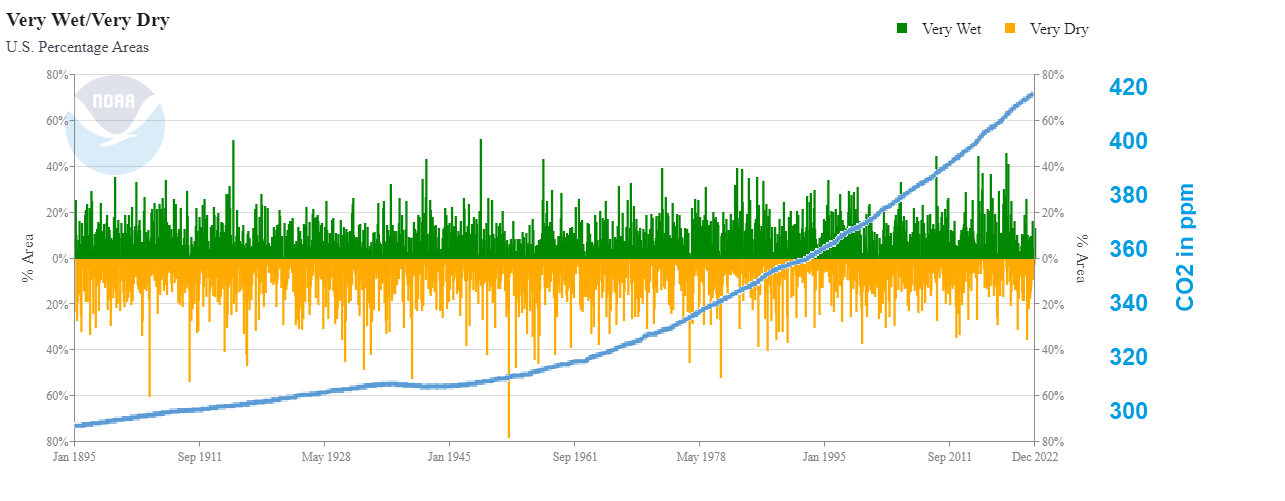
To the extent the CCA report offers any factual assertions about climate change, it points to “catastrophic events” such as “droughts, floods, and wildfires exacerbated by climate change.” It fails to mention, however, that Chapter 11 of the most recent Intergovernmental Panel on Climate Change report says, concerning droughts, that “Global studies generally show no significant trends” and that in most places around the world there’s “inconclusive evidence” tying droughts to human-induced climate change. In North America in particular there’s “low confidence in the attribution of long-term changes in meteorological drought.”

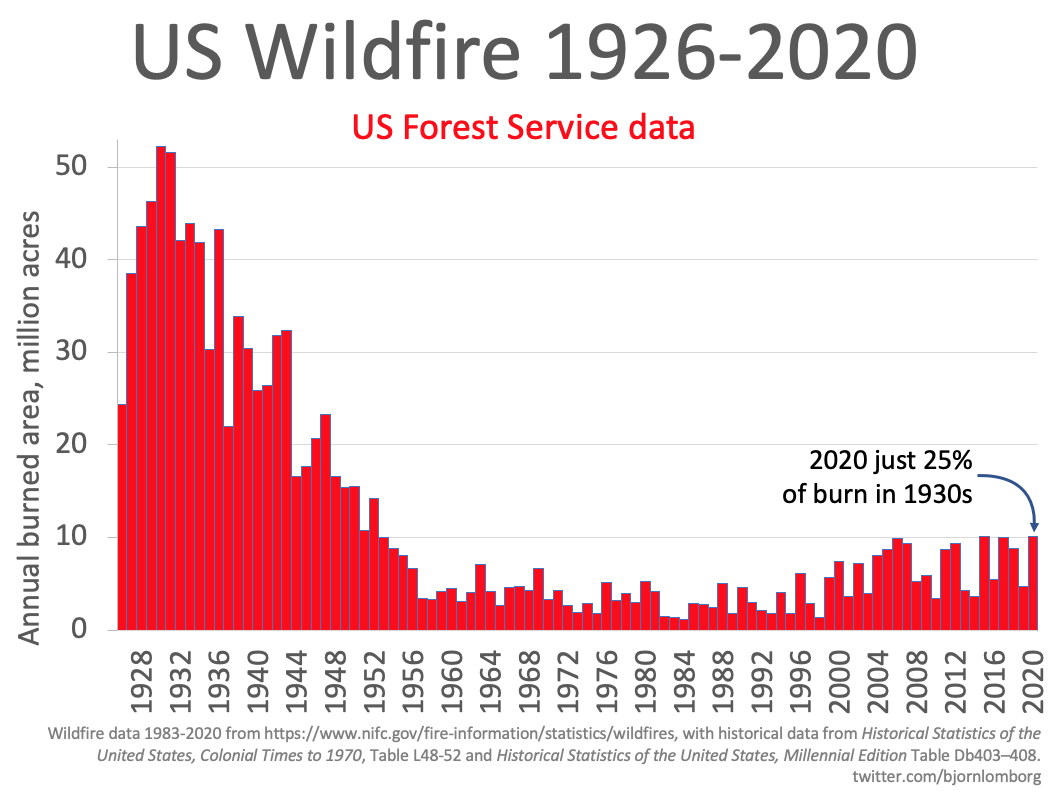
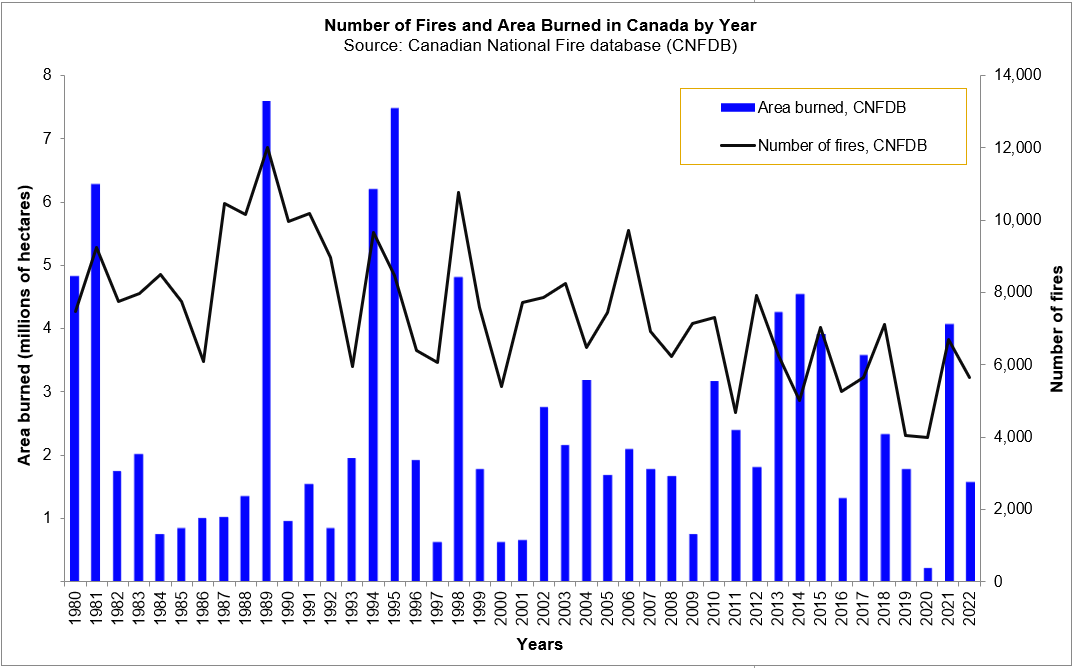
Regarding floods, “In general, there is low confidence in attributing changes in the probability or magnitude of flood events to human influence because of a limited number of studies, differences in the results of these studies and large modelling uncertainties.” As for wildfires, they have been trending down globally for the past decade. In Canada, according to the Canadian National Fire Database, both the number of forest fires and total area burned peaked in the late 1980s and has been declining ever since. Yet again the CCA offers misinformation to support its case for more censorship.

Here’s a better idea. Ignore the CCA and the ISD
and all the other would-be enforcers of orthodoxy.

Drop the fixation on “misinformation,” which is just the latest iteration of the same old desire of governments to censor their opponents. Allow the public the freedom, as Mill counselled, to hear arguments “from persons who actually believe them; who defend them in earnest, and do their very utmost for them.” A dangerous thought in 1859, and judging by the current misinformation craze, an utter heresy today; yet true nonetheless.

Ross McKitrick is a professor of economics at the University of Guelph and senior fellow of the Fraser Institute.


Save the Children and Us All from Climate Grooming

Conclusion from Ben Pile’s Climate Resistance Video above:

Experts have used the authority of institutional science and medicine to convince people that a climate crisis is happening despite there being no scientific observational evidence for it. And this misuse of institutional authority has in turn been used to close down public democratic debate about far-reaching policy and to silence critics of the Green agenda. But computer simulations and hypothetical worlds are not reality and not evidence. They are science fiction and they are used to mislead people into believing that there is a climate crisis so that they may support radical climate policies.

(Question to then IPCC chairman Rajendra Pachauri) “What do you see as the next tools you could utilize to create change?
(Pachuri Response) “Children. I think we have to sensitize the young and tell them how their future is going to be affected if we don’t take action today. I think if we can get them to understand the seriousness of the problem they would probably shame adults into taking the right steps.”

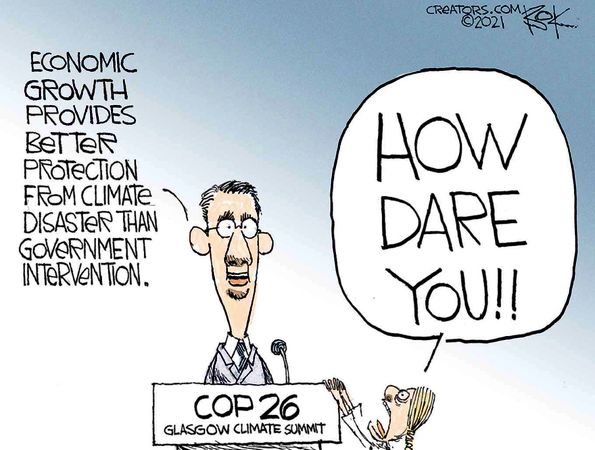
Global warming and climate change are real, but climate policy is the far more real and more dangerous threat than climate change. The world has seen unprecedented progress in recent decades and much more needs to be done to eliminate problems such as poverty and disease. But by failing to confront green scare mongering, Global agencies, world leaders, politicians, scientists and the media have allowed a dark and dangerous ideology to fester. By causing a widespread ignorance of this progress which it now threatens to reverse, green scare mongering will turn the clock back for Humanity and civilization.

Ben Pile exposes how climate radicals are using media messaging to advance the climate crisis mass delusion in his substack article Behind the ‘climate crisis’ myth: green ideology.  Excerpts in italics with my bolds and added images.

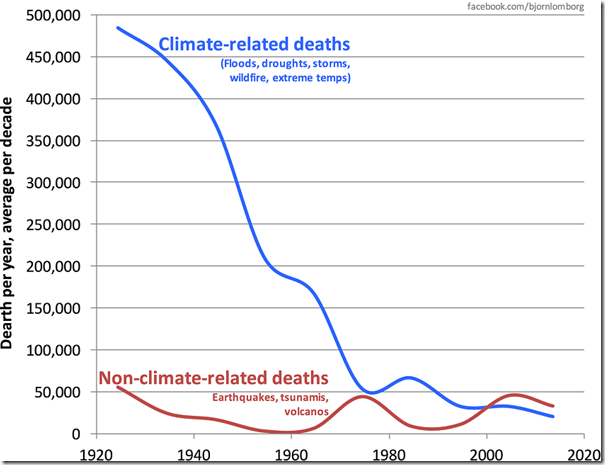
The world is healthier, wealthier, and safer than it ever has been.
And most of this progress has been achieved in the era of global warming.
The green story does not add up.

In the eighties and nineties, Adherents of the precautionary principle argued that a hypothesis of a potentially civilisation-ending catastrophe merely needs to be plausible to be sufficient to compel action, and that the world cannot afford to wait for scientific knowledge to verify the threat with any certainty. This urgency was the basis of the Montreal Protocol on limiting ozone-depleting substances, and it was the hope of many greens that the same formulation could be used again to drive global agreements on climate change.

The problem for adherents of the precautionary principle is that, as is the case with all green ideologues’ prognostications, too much time passed without the events they were sure would befall us, undermining the original hypothesis. In the 1970s, before global warming had been invented, environmentalists proclaimed that civilisation stood on the brink of collapse. Limits to Growth and The Population Bomb were global best sellers, putting green politics at the top of the global political agenda, and cementing the end of post-war optimism with a terminally negative outlook that the West has not shaken off, despite the books’ manifest failures.

The precautionary principle (and many $billions of ersatz ‘philanthropic’ generosity) saved the greens and their ideological project the humiliation they deserved by adding an unending not-if-but-when caveat to their soothsaying. . . The precautionary principle is an article of faith, and work both ways when fully considered. Progress towards a global climate lockdown agreement has been slow in significant part because many countries have been unwilling to undermine the certain benefits of economic growth on the basis of uncertain speculation. The precautionary principle, has thus been of decreasing value towards advancing the climate agenda as time has passed.

There are only so many times even the most faithful are willing to climb the mountain
to wait for salvation from doom before doubt creeps in.

The new claim, intended to overcome the global climate policy agendas’ inertia, is that certainty has been achieved by science, and that scientists have shown that the world is in the grip of the very catastrophe that environmentalists had predicted: people are starving, diseases are rampant, storms, floods, wildfires and heatwaves kill thousands by the day, forcing millions from their homes and into poverty.

The problem, of course, is that it is not true. In every region of the world, and at every level of economic development, people are living healthier, wealthier, longer, and safer lives. In the few places where this trend of continued progress does not hold, other reasons better account for the failure than slightly different weather: failed states, corruption and conflict.

The problem for the green narrative then, as now, is that deaths from these diseases of poverty were falling, and have continued to fall, radically.

Between 2000 and 2019, the number of deaths from malaria in the world fell from 900 thousand to 560 thousand – given the world’s population increase, this is equivalent to a halving of the mortality rate. Over the same time, the number of deaths caused by diarrheal diseases fell from 2.4 million to 1.5 million. And deaths from malnutrition fell from 506 thousand to 212 thousand. What this means is not merely that there is no evidence of a climate crisis, there extremely good evidence of the opposite: humanity is thriving.

Many other metrics of human welfare bear out the same picture of reality. But try to explain this indubitable progress to the protestors who, on the words of UN chiefs, nonagenarian BBC voice-over artists and degenerate green ideologues of the Guardian and green blob, block roads and demand nothing less than the cancellation of industry and the economy and the immiseration of the entire world, to make certain that all of humanity’s development is undone. The good news provokes an angry and uncomprehending rage in green activists.

To compare the story of the climate crisis with the facts is
to betray one’s own children, country and world,
and to condemn future generations to an ‘unliveable planet’.

The facts and stats of the world are in contradiction to the ideological conception of nature held by the global green Great and Good and by the street-level environmentalists, but not the broader public. So what is this ideology, and how does it overwhelm its victims’ capacity for reason and facts?

As David Attenborough explains, it,

Our economies and political systems are unconsciously predicated on the belief that nature will continue to be a benign and regular provider of the conditions we need to thrive. […] Our stable and reliable planet no longer exists. The impacts of this destabilisation will profoundly impact every country on Earth.

We can know that this is a false belief, because it is a myth that nature has ever been anything but extremely hostile, rather than a benign ‘provider’. Hence, until the end of the 1880s, a quarter of all British children died before reaching their fifth birthday. In Germany, half of children did not survive that long. Globally, infant mortality was 22.4 per cent in 1950. In 2021, it was 3.7 per cent. The ‘planet’ is manifestly far less hostile to humanity than it was just a lifetime ago. And this is thanks to industries, to expanding access to markets, and to technological and scientific development – sheer artifice – not to Natural Providence. David Attenborough is as misled and misleading as he is a ‘national treasure’.

My Mind is Made Up, Don’t Confuse Me with the Facts. H/T Bjorn Lomborg, WUWT

“There’s only one world”, a girl explains to the interviewer. “If we destroy it all, then we have no other place to live”. “Right now, we are not acting”, adds her little friend. “We should act now.”

If the words of global climate technocrats, so earnestly spoken by such innocent faces
is not an abomination, then nothing is.

Tiny children’s view of the world and their own futures have been poisoned by an ideology that has no care for facts, much less the children and their prosperity. Their heads have been deliberately filled by the false idea of a ‘climate crisis’ in order to make them instruments of a political agenda, against their own interests, far before they are equipped to understand the claims they reproduce.

Society needs to confront green ideology urgently.
It is the greatest threat to our safety and prosperity.

Please watch and share our film: Why There Is No Climate Crisis (and why people believe that there is)

Reuters Editor Comes Clean About CO2 Hysteria

Neil Winton disavows his uncritically adopting global warming belief in his Daily Skeptic article:  Covering Climate Change for Reuters, I Thought CO2 to Blame for Rising Temperatures. I Was Wrong. Excerpts in italics with my bolds and added images.

If you wonder why much of the mainstream media seem united in accepting that the world will soon die unless humans don hair shirts, freeze in winter and walk instead of driving, you need to know about websites like Covering Climate Now (CCN).

Reuters and some of the biggest names in the news like Bloomberg, Agence France Presse, CBS News, and ABC News have signed up to support CCN, which brags that it is an unbiased seeker after the truth. But this claim won’t last long if you peer behind the façade. CCN may claim to be fair and balanced, but it not only won’t tolerate criticism, it brandishes the unethical ‘denier’ weapon with its nasty holocaust denier echoes. This seeks to demonise those who disagree with it by savaging personalities and denying a hearing, rather than using debate to establish its case.

CCN advises journalists to routinely add to stories about bad weather and flooding to suggest climate change is making these events more intense.

This is not an established fact, as a simple routine check would show.

I have a particular interest in Reuters’ attitude because I spent 32 years there as a reporter and editor. The global news agency’s traditional insistence on high standards in reporting makes this liaison with CCN seem questionable.

When Reuters announced its tie-up with CCN in 2019 it said this, among other things.

The (CCN) coalition, which includes more than 350 organisations [there are many more now] has no agenda beyond embracing science and fair coverage and publishing more climate change content.

That is clearly not true. It has a partisan agenda and encourages reporters
to dismiss those with contrary opinions as ‘deniers’.   

The involvement of Reuters in CCN seems to me to be in direct contradiction to three of its 10 Hallmarks of Reuters Journalism – Hold Accuracy Sacrosanct, Seek Fair Comment, Strive For Balance and Freedom From Bias.

When I became Reuters global Science and Technology Correspondent in the mid-1990s, the global warming story was top of my agenda. Already by then the BBC was scaring us saying we would all die unless humankind mended its selfish ways.

Carbon dioxide (CO2) was the culprit and had to be tamed, then eliminated.
I had no reason to think this wasn’t established fact. I was wrong.

My Reuters credentials meant that I had easy access to the world’s finest climate scientists. To my amazement, none of these would say categorically that the link between CO2 and global warming, now known as climate change, was a proven scientific fact. Some said human production of CO2 was a probable cause, others that it might make some contribution; some said CO2 had no role at all. Everybody agreed that the climate had warmed over the last 10,000 years as the ice age retreated, but most weren’t really sure why. The sun’s radiation, which changes over time, was a favoured culprit.

My reporting reflected the wide range of views, with Reuters typical “on the one hand this, on the other, that” style. But even then, the mainstream media seem to have run out of the energy required, and often lazily went along with the BBC’s faulty, opinionated thesis. It was too much trouble to make the point that the BBC’s conclusion was challenged by many impressive scientists.

Fast forward 20 years and firm proof CO2 was warming the climate still hasn’t been established, but politics has taken over. Sure, there are plenty of computer models with their hidden assumptions ‘proving’ man is guilty as charged, and the assumption that we had the power and knowledge to change the climate became embedded.

The Left had lost all of the economic arguments by the 1990s, and its activists eagerly grabbed the chance to say free markets and small government couldn’t save us from climate change; only government intervention could do that. Letting capitalism run free was a certain way to ensure the end of the planet; smart Lefties should take charge and save us from ourselves.

The debate about climate change is far from over. I’m not a scientist so I don’t know enough to say it’s all man-made or not. But politicians and lobbyists have decided that we are all guilty.

They are in the process of dismantling our way of life, ordering us to comply because it’s all for the future and our children. If we are going to give up our civilization, at the very least we ought to have an open debate. Journalists need to stand up and be counted. The trouble is that requires bravery and energy, and an urge to question conventional wisdom.

Reuters should be leading this movement. All it has to do is stand by its 10 Hallmarks. And maybe tell CCN thanks but no thanks; it needs to apply Reuters principles to its climate reporting.

See Also Global Warming Theory and the Tests It Fails

Climate Critical Intelligence Q & A


H/T David Wojick and CFACT

Doctors for Disaster Preparedness are concerned to be ready for real disasters and not be distracted by irrational fears like global warming/climate change. They have provided a useful resource for people to test and deepen their knowledge of an issue distorted for many people by loads of misinformation and exaggerations.

From David Wojick:

A new lesson set called the Climate Change IQ (CCIQ) provides a good skeptical critique of ten top alarmist claims. The format is succinct and non-technical. Each alarmist claim is posed as a question, followed by a short skeptical answer, which is highlighted with a single telling graphic.

Then there is a link to a somewhat longer answer, which in turn includes links to a few online sources of more information. Each lesson is also available in a printable PDF version, suitable for classroom use. This compact format is potentially very useful.

CCIQ comes from a long-standing skeptical group called the Doctors for Disaster Preparedness (DDP). Despite the name, DDP gives attention to pointing out scares that are not disasters waiting to happen. Not surprisingly climate alarmism gets a lot of this attention.

The ten topic questions are wide ranging, including the following. Each speaks to a popular pro-alarmist news hook.

Is climate change the most urgent global health threat?

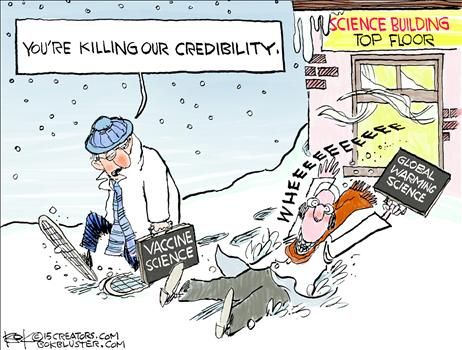
Are government-sponsored climate scientists the only credible sources of information relating to climate-change policy?

Is the increase in atmospheric CO2 making wildfires worse?

Why can’t all States emulate California’s proposed “clean” energy standards?

What would happen if atmospheric CO2 concentration dropped by half, say to less than 200 ppm?

Are human CO2 emissions acidifying the oceans and endangering shell-making animals?

Will Manhattan and Florida soon be under water if humans do not curtail use of “fossil fuels”?

Do 97% of climate scientists agree that catastrophic climate change will result if humans do not curtail use of “fossil fuels”? (This one includes the dynamite John Christy graph showing the rapidly growing divergence of climate model global temperature forecasts with real world observations.)

Is Arctic ice disappearing?

And the number 1 CCIQ question: Would lowering atmospheric CO2 prevent or mitigate hurricanes?

Note:  Each question title links to a pdf with a longer answer and references. Question 1 link is in red above as an example.  See the CCIQ questionnaire for links to all 10 pdfs

Check it out. Inquiring minds want to know.

Footnote:

“The reason some of us are skeptical about man-made global warming, or climate change, isn’t that we’re in “denial” or the pay of Big Oil. It’s the alarmists’ long run of lurid failed predictions. The models “run hot.” Arctic ice hasn’t vanished. The coral hasn’t died. We haven’t been overrun by rats and super-itchy poison ivy.”  John Robson National Post Canada