Estimating Cost of Trudeau’s Carbon Tax

We’re finally told what the carbon tax will cost us. Are you sitting down?
Kenneth Green writes in Financial Post.  Excerpts below in italics with my bolds.
Households in Alberta, Saskatchewan and Nova Scotia will be hit with more than $1,000 of carbon tax per year, while those in British Columbia, Quebec and Manitoba will pay around $650

It took some poking and prodding and (finally) committee testimony, but now we know what the bill will be for a $50-per-tonne carbon tax, similar to one the federal Liberals plan to impose. In a report to the Senate Standing Committee on Energy, the Environment and Natural Resources, University of Calgary economics professor Jennifer Winter revealed the bottom line of a $50-per-tonne carbon price.

Tax advocates say it is a small % of GDP. But it is still $10 Billion extracted from Canadian households.

Using energy-consumption data from Statistics Canada, and imputing prices from average household expenditure on transportation fuels and provincial gasoline prices, Winter calculated the impact of a a $50-per-tonne model of a carbon tax on a typical Canadian household across different provinces. Far from being painless as advertised, the costs to households will be significant.

Three provinces — Alberta, Saskatchewan and Nova Scotia — will be hit with more than $1,000 of carbon tax per year to comply with the $50-per-tonne carbon tax Ottawa has mandated for 2022. Nova Scotia ($1,120) and Alberta ($1,111) will have the highest bills, followed by Saskatchewan ($1,032), New Brunswick ($963), Newfoundland ($859) and Prince Edward Island ($788). The average household in Ontario will pay $707 a year to comply with the carbon tax once its fully implemented.

Who gets the lowest bill? British Columbia ($603 per year), Quebec ($662) and Manitoba ($683). Simply put, households in provinces with the lowest bills will pay just a bit more than half compared to households in the hardest-hit provinces.

But it gets worse, since most experts say carbon prices must continue to increase sharply to effectively lower emissions. At $100 a tonne, for example, households in Alberta will pony up $2,223, in Saskatchewan they’ll pay $2,065 and in Nova Scotia, $2,240. In fact, at $100 a tonne, the average price for households in all provinces is well north of $1,000 per year.

Already across Canada, particularly in the Maritimes, a significant number of households fit the definition of “energy poverty” — that is, 10 per cent or more of household expenditures are spent simply procuring the energy needed to live (to power the home and transportation). In 2016, the Fraser Institute measured energy poverty in Canada and found that when you add up the costs to power the home and cars, 19.4 per cent of Canadian households devoted at least 10 per cent or more of their expenditures to energy.


UK Farmers Foot Climate Bill

The Farmer’s Weekly advises UK farmers: Don’t miss out on climate change tax discounts Excerpts below with my bolds.


The NFU has warned farmers they face rises in climate change taxes unless they register for a discount scheme before the 31 July deadline.

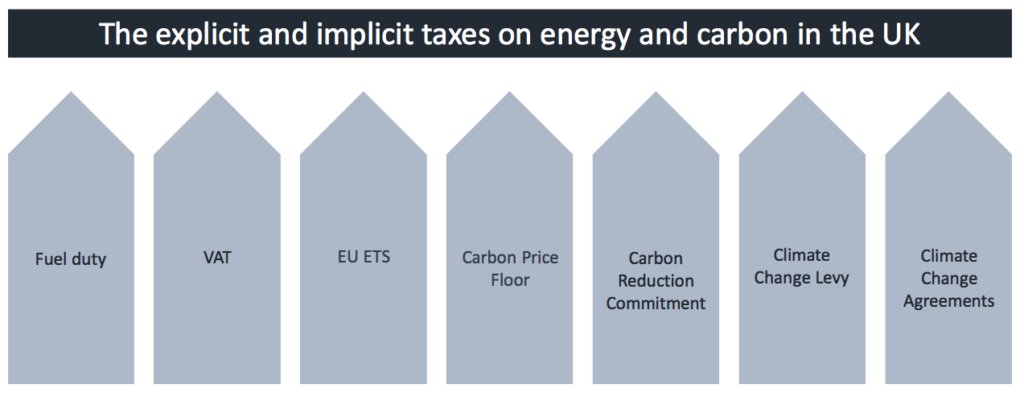
The Climate Change Levy (CCL) is a tax charged on gas, electricity, LPG, coal and coke used by UK businesses.

In April 2019, CCL rates levied on energy bills will increase by about 3% for electricity and 7% for gas for any businesses that do not register for a discounted rate under an NFU scheme.

Under the CCL scheme, eligible businesses can receive a discount in return for meeting energy-efficiency or carbon-saving targets. Achieving these targets will enable the business to receive a discount until March 2023, the NFU says.

The NFU CCL scheme gives up to 93% levy reductions on electricity and 78% on gas to qualifying businesses in the pig, poultry and protected horticulture sectors. It is therefore imperative to sign up to the scheme before the deadline of 31 July, the union warns.

Example of annual CCL savings for poultry farm using 350,000 kWh of import electricity and 45,000 litres of LPG

Year Non-member pays CCL member pays Member saving
2012-13 £3,615.50 £1,265.43 £2,350.08
2017-18 £4,608.10 £605.71 £4,002.39
2019-20 £6,907.75 £630.36 £6,277.40

More Good News: Ontario Reversing Carbon Tokenism

The story comes from Bloomberg, where they regard the event as lamentable: Ontario Scraps Carbon-Reduction Plan as It Expands Elsewhere.  Excerpts below with my bolds.

Ontario will scrap the province’s cap-and-trade program and pull out of the carbon-trading market with Quebec and California even as pollution pricing expands in other regions of the world.

Ontario’s Progressive Conservatives will follow through on a campaign promise to withdraw from the environmental program that required companies to buy credits to offset pollution blamed for global warming. Premier-designate Doug Ford also said he will challenge Prime Minister Justin Trudeau’s authority to make local governments put a price on greenhouse-gas emissions.

The move comes as carbon-pricing programs are expanding in the U.S. even as President Donald Trump seeks to ease restrictions on coal companies. Europe already has a large regional cap-and-trade system while China, the world’s biggest polluter, has committed to a national pollution program that could open by 2020.

Ontario’s election results were largely priced into California’s carbon market. Despite Friday’s announcement, emitters in Ontario remain obligated to manage their carbon pollution until the province formally withdraws from the system, said John Battaglia, head of carbon markets at BGC Environmental Brokerage Services LP.

“The market is stable here,” Battaglia said in an interview. “We expect a bit of short-term volatility, but long term, the show will go on.” (Comment:  It is all about the show, isn’t it?)

Ontario’s PCs will be sworn in June 29 after defeating the Liberals in an election earlier this month. Ending what Ford called a job-killing carbon tax was one of his major commitments during the campaign. Ontario will also quit the Western Climate Initiative, Ford said Friday from Toronto.

Trudeau Plan

Eliminating the carbon tax and cap-and-trade is the right thing to do and is a key component in our plan to bring your gas prices down by 10 cents per liter,” Ford said in a statement.

But the move may not spare Ontario from a carbon price. Trudeau’s government is bringing in carbon pricing rules to cover all provinces and a “backstop” for local governments that don’t come up with their own plans this year.

“Ontario is going to still have an obligation under the federal architecture and the cost of meeting that obligation could be higher,” said Dallas Burtraw, a senior fellow at Resources for the Future. “The costs of the cap-and-trade program are small on retail gasoline rates.”

Another wheel comes off the Ontario Green Energy bus.

US House Votes Down Social Cost of Carbon


The House GOP on Friday took a step forward in reining in the Obama administration’s method of assessing the cost of carbon dioxide pollution when developing regulations.

The House voted 212-201, along party lines, to include a rider blocking the use of the climate change cost metric to an energy and water spending bill.

The amendment offered by Texas Republican Rep. Louie Gohmert bars any and all funds from being used under the bill to “prepare, propose, or promulgate any regulation that relies on the Social Carbon analysis” devised under the Obama administration on how to value the cost of carbon. (Source Washington Examiner, here)

To clarify: the amendment in question defunds any regulation or guidance from the federal government concerning the social costs of carbon.

Background: 
The Obama administration created and increased its estimates of the “Social Cost of Carbon,” invented by Michael Greenstone, who commented on the EPA Proposed Repeal of CO2 emissions regulations.  A Washington Post article, October 11, 2017, included this:

“My read is that the political decision to repeal the Clean Power Plan was made and then they did whatever was necessary to make the numbers work,” added Michael Greenstone, a professor of economics at the University of Chicago who worked on climate policy during the Obama years.

Activists are frightened about the Clean Power Plan under serious attack along three lines:
1. No federal law governs CO2 emissions.
2. EPA regulates sites, not the Energy Sector.
3. CPP costs are huge, while benefits are marginal.

Complete discussion at CPP has Three Fatal Flaws.

Read below how Greenstone and a colleague did exactly what he now complains about.

Social Cost of Carbon: Origins and Prospects

The Obama administration has been fighting climate change with a rogue wave of regulations whose legality comes from a very small base: The Social Cost of Carbon.

The purpose of the “social cost of carbon” (SCC) estimates presented here is to allow agencies to incorporate the social benefits of reducing carbon dioxide (CO2) emissions into cost-benefit analyses of regulatory actions that impact cumulative global emissions. The SCC is an estimate of the monetized damages associated with an incremental increase in carbon emissions in a given year. It is intended to include (but is not limited to) changes in net agricultural productivity, human health, property damages from increased flood risk, and the value of ecosystem services due to climate change. From the Technical Support Document: -Technical Update of the Social Cost of Carbon for Regulatory Impact Analysis -Under Executive Order 12866

A recent Bloomberg article informs on how the SCC notion was invented, its importance and how it might change under the Trump administration.
How Climate Rules Might Fade Away; Obama used an arcane number to craft his regulations. Trump could use it to undo them. (here). Excerpts below with my bolds.

scc-working-group

In February 2009, a month after Barack Obama took office, two academics sat across from each other in the White House mess hall. Over a club sandwich, Michael Greenstone, a White House economist, and Cass Sunstein, Obama’s top regulatory officer, decided that the executive branch needed to figure out how to estimate the economic damage from climate change. With the recession in full swing, they were rightly skeptical about the chances that Congress would pass a nationwide cap-and-trade bill. Greenstone and Sunstein knew they needed a Plan B: a way to regulate carbon emissions without going through Congress.

Over the next year, a team of economists, scientists, and lawyers from across the federal government convened to come up with a dollar amount for the economic cost of carbon emissions. Whatever value they hit upon would be used to determine the scope of regulations aimed at reducing the damage from climate change. The bigger the estimate, the more costly the rules meant to address it could be. After a year of modeling different scenarios, the team came up with a central estimate of $21 per metric ton, which is to say that by their calculations, every ton of carbon emitted into the atmosphere imposed $21 of economic cost. It has since been raised to around $40 a ton.

Trump can’t undo the SCC by fiat. There is established case law requiring the government to account for the impact of carbon, and if he just repealed it, environmentalists would almost certainly sue.

There are other ways for Trump to undercut the SCC. By tweaking some of the assumptions and calculations that are baked into its model, the Trump administration could pretty much render it irrelevant, or even skew it to the point that carbon emissions come out as a benefit instead of a cost.

The SCC models rely on a “discount rate” to state the harm from global warming in today’s dollars. The higher the discount rate, the lower the estimate of harm. That’s because the costs incurred by burning carbon lie mostly in the distant future, while the benefits (heat, electricity, etc.) are enjoyed today. A high discount rate shrinks the estimates of future costs but doesn’t affect present-day benefits. The team put together by Greenstone and Sunstein used a discount rate of 3 percent to come up with its central estimate of $21 a ton for damage inflicted by carbon. But changing that discount just slightly produces big swings in the overall cost of carbon, turning a number that’s pushing broad changes in everything from appliances to coal leasing decisions into one that would have little or no impact on policy.

According to a 2013 government update on the SCC, by applying a discount rate of 5 percent, the cost of carbon in 2020 comes out to $12 a ton; using a 2.5 percent rate, it’s $65. A 7 percent discount rate, which has been used by the EPA for other regulatory analysis, could actually lead to a negative carbon cost, which would seem to imply that carbon emissions are beneficial. “Once you start to dig into how the numbers are constructed, I cannot fathom how anyone could think it has any basis in reality,” says Daniel Simmons, vice president for policy at the American Energy Alliance and a member of the Trump transition team focusing on the Energy Department.

David Kreutzer, a senior research fellow in energy economics and climate change at Heritage and a member of Trump’s EPA transition team, laid out one of the primary arguments against the SCC. “Believe it or not, these models look out to the year 2300. That’s like effectively asking, ‘If you turn your light switch on today, how much damage will that do in 2300?’ That’s way beyond when any macroeconomic model can be trusted.”

Another issue for those who question the Obama administration’s SCC: It estimates the global costs and benefits of carbon emissions, rather than just focusing on the impact to the U.S. Critics argue that this pushes the cost of carbon much higher and that the calculation should instead be limited to the U.S.; that would lower the cost by more than 70 percent, says the CEI’s Mario Lewis.

Still, by narrowing the calculation to the U.S., Trump could certainly produce a lower cost of carbon. Asked in an e-mail whether the new administration would raise the discount rate or narrow the scope of the SCC to the U.S., one person shaping Trump energy and environmental policy replied, “What prevents us from doing both?”

See Also:

Six Reasons to Rescind Social Cost of Carbon

SBC: Social Benefits of Carbon

drain-the-swamp

Regulatory Backfire

Update Nov. 22, 2018

With the Democrats taking control of the US House of Representatives, we can expect attempts to again “fight climate change” by means of counter productive regulations.  This post explains why such policies are ineffective and produce unintended consequences, with results worse than doing nothing.

Background:  Heisenberg Uncertainty

In the sub-atomic domain of quantum mechanics, Werner Heisenberg, a German physicist, determined that our observations have an effect on the behavior of quanta (quantum particles).

The Heisenberg uncertainty principle states that it is impossible to know simultaneously the exact position and momentum of a particle. That is, the more exactly the position is determined, the less known the momentum, and vice versa. This principle is not a statement about the limits of technology, but a fundamental limit on what can be known about a particle at any given moment. This uncertainty arises because the act of measuring affects the object being measured. The only way to measure the position of something is using light, but, on the sub-atomic scale, the interaction of the light with the object inevitably changes the object’s position and its direction of travel.

Now skip to the world of governance and the effects of regulation. A similar finding shows that the act of regulating produces reactive behavior and unintended consequences contrary to the desired outcomes.

An article at Financial Times explains about Energy Regulations Unintended Consequences  Excerpts below with my bolds.

Goodhart’s Law holds that “any observed statistical regularity will tend to collapse once pressure is placed upon it for control purposes”. Originally coined by the economist Charles Goodhart as a critique of the use of money supply measures to guide monetary policy, it has been adopted as a useful concept in many other fields. The general principle is that when any measure is used as a target for policy, it becomes unreliable. It is an observable phenomenon in healthcare, in financial regulation and, it seems, in energy efficiency standards.

When governments set efficiency regulations such as the US Corporate Average Fuel Economy standards for vehicles, they are often what is called “attribute-based”, meaning that the rules take other characteristics into consideration when determining compliance. The Cafe standards, for example, vary according to the “footprint” of the vehicle: the area enclosed by its wheels. In Japan, fuel economy standards are weight-based. Like all regulations, fuel economy standards create incentives to game the system, and where attributes are important, that can mean finding ways to exploit the variations in requirements. There have long been suspicions that the footprint-based Cafe standards would encourage manufacturers to make larger cars for the US market, but a paper this week from Koichiro Ito of the University of Chicago and James Sallee of the University of California Berkeley provided the strongest evidence yet that those fears are likely to be justified.
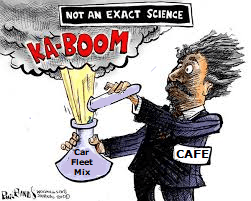
Mr Ito and Mr Sallee looked at Japan’s experience with weight-based fuel economy standards, which changed in 2009, and concluded that “the Japanese car market has experienced a notable increase in weight in response to attribute-based regulation”. In the US, the Cafe standards create a similar pressure, but expressed in terms of size rather than weight. Mr Ito suggested that in Ford’s decision to end almost all car production in North America to focus on SUVs and trucks, “policy plays a substantial role”. It is not just that manufacturers are focusing on larger models; specific models are also getting bigger. Ford’s move, Mr Ito wrote, should be seen as an “alarm bell” warning of the flaws in the Cafe system. He suggests an alternative framework with a uniform standard and tradeable credits, as a more effective and lower-cost option. With the Trump administration now reviewing fuel economy and emissions standards, and facing challenges from California and many other states, the vehicle manufacturers appear to be in a state of confusion. An elegant idea for preserving plans for improving fuel economy while reducing the cost of compliance could be very welcome.

The paper is The Economics of Attribute-Based Regulation: Theory and Evidence from Fuel-Economy Standards Koichiro Ito, James M. Sallee NBER Working Paper No. 20500.  The authors explain:

An attribute-based regulation is a regulation that aims to change one characteristic of a product related to the externality (the “targeted characteristic”), but which takes some other characteristic (the “secondary attribute”) into consideration when determining compliance. For example, Corporate Average Fuel Economy (CAFE) standards in the United States recently adopted attribute-basing. Figure 1 shows that the new policy mandates a fuel-economy target that is a downward-sloping function of vehicle “footprint”—the square area trapped by a rectangle drawn to connect the vehicle’s tires.  Under this schedule, firms that make larger vehicles are allowed to have lower fuel economy. This has the potential benefit of harmonizing marginal costs of regulatory compliance across firms, but it also creates a distortionary incentive for automakers to manipulate vehicle footprint.

Attribute-basing is used in a variety of important economic policies. Fuel-economy regulations are attribute-based in China, Europe, Japan and the United States, which are the world’s four largest car markets. Energy efficiency standards for appliances, which allow larger products to consume more energy, are attribute-based all over the world. Regulations such as the Clean Air Act, the Family Medical Leave Act, and the Affordable Care Act are attribute-based because they exempt some firms based on size. In all of these examples, attribute-basing is designed to provide a weaker regulation for products or firms that will find compliance more difficult.

Summary from Heritage Foundation study Fuel Economy Standards Are a Costly Mistake Excerpt with my bolds.

The CAFE standards are not only an extremely inefficient way to reduce carbon dioxide emission but will also have a variety of unintended consequences.

For example, the post-2010 standards apply lower mileage requirements to vehicles with larger footprints. Thus, Whitefoot and Skerlos argued that there is an incentive to increase the size of vehicles.

Data from the first few years under the new standard confirm that the average footprint, weight, and horsepower of cars and trucks have indeed all increased since 2008, even as carbon emissions fell, reflecting the distorted incentives.

Manufacturers have found work-arounds to thwart the intent of the regulations. For example, the standards raised the price of large cars, such as station wagons, relative to light trucks. As a result, automakers created a new type of light truck—the sport utility vehicle (SUV)—which was covered by the lower standard and had low gas mileage but met consumers’ needs. Other automakers have simply chosen to miss the thresholds and pay fines on a sliding scale.

Another well-known flaw in CAFE standards is the “rebound effect.” When consumers are forced to buy more fuel-efficient vehicles, the cost per mile falls (since their cars use less gas) and they drive more. This offsets part of the fuel economy gain and adds congestion and road repair costs. Similarly, the rising price of new vehicles causes consumers to delay upgrades, leaving older vehicles on the road longer.

In addition, the higher purchase price of cars under a stricter CAFE standard is likely to force millions of households out of the new-car market altogether. Many households face credit constraints when borrowing money to purchase a car. David Wagner, Paulina Nusinovich, and Esteban Plaza-Jennings used Bureau of Labor Statistics data and typical finance industry debt-service-to-income ratios and estimated that 3.1 million to 14.9 million households would not have enough credit to purchase a new car under the 2025 CAFE standards.[34] This impact would fall disproportionately on poorer households and force the use of older cars with higher maintenance costs and with fuel economy that is generally lower than that of new cars.

CAFE standards may also have redistributed corporate profits to foreign automakers and away from Ford, General Motors (GM), and Chrysler (the Big Three), because foreign-headquartered firms tend to specialize in vehicles that are favored under the new standards.[35] 

Conclusion

CAFE standards are costly, inefficient, and ineffective regulations. They severely limit consumers’ ability to make their own choices concerning safety, comfort, affordability, and efficiency. Originally based on the belief that consumers undervalued fuel economy, the standards have morphed into climate control mandates. Under any justification, regulation gives the desires of government regulators precedence over those of the Americans who actually pay for the cars. Since the regulators undervalue the well-being of American consumers, the policy outcomes are predictably harmful.

Update Nov. 22, 2018

With the Democrats taking control of the US House of Representatives, we we will likely see them attempting again to “fight climate change” by means of counterproductive regulations and rules.  This post explains why such policies are ineffective, create unintended consequences that can make matters worse than doing nothing.

Background:  Hiesenberg Uncertainty

In the sub-atomic domain of quantum mechanics, Werner Heisenberg, a German physicist, determined that our observations have an effect on the behavior of quanta (quantum particles).

The Heisenberg uncertainty principle states that it is impossible to know simultaneously the exact position and momentum of a particle. That is, the more exactly the position is determined, the less known the momentum, and vice versa. This principle is not a statement about the limits of technology, but a fundamental limit on what can be known about a particle at any given moment. This uncertainty arises because the act of measuring affects the object being measured. The only way to measure the position of something is using light, but, on the sub-atomic scale, the interaction of the light with the object inevitably changes the object’s position and its direction of travel.

Now skip to the world of governance and the effects of regulation. A similar finding shows that the act of regulating produces reactive behavior and unintended consequences contrary to the desired outcomes.

An article at Financial Times explains about Energy Regulations Unintended Consequences  Excerpts below with my bolds.

Goodhart’s Law holds that “any observed statistical regularity will tend to collapse once pressure is placed upon it for control purposes”. Originally coined by the economist Charles Goodhart as a critique of the use of money supply measures to guide monetary policy, it has been adopted as a useful concept in many other fields. The general principle is that when any measure is used as a target for policy, it becomes unreliable. It is an observable phenomenon in healthcare, in financial regulation and, it seems, in energy efficiency standards.

When governments set efficiency regulations such as the US Corporate Average Fuel Economy standards for vehicles, they are often what is called “attribute-based”, meaning that the rules take other characteristics into consideration when determining compliance. The Cafe standards, for example, vary according to the “footprint” of the vehicle: the area enclosed by its wheels. In Japan, fuel economy standards are weight-based. Like all regulations, fuel economy standards create incentives to game the system, and where attributes are important, that can mean finding ways to exploit the variations in requirements. There have long been suspicions that the footprint-based Cafe standards would encourage manufacturers to make larger cars for the US market, but a paper this week from Koichiro Ito of the University of Chicago and James Sallee of the University of California Berkeley provided the strongest evidence yet that those fears are likely to be justified.

Mr Ito and Mr Sallee looked at Japan’s experience with weight-based fuel economy standards, which changed in 2009, and concluded that “the Japanese car market has experienced a notable increase in weight in response to attribute-based regulation”. In the US, the Cafe standards create a similar pressure, but expressed in terms of size rather than weight. Mr Ito suggested that in Ford’s decision to end almost all car production in North America to focus on SUVs and trucks, “policy plays a substantial role”. It is not just that manufacturers are focusing on larger models; specific models are also getting bigger. Ford’s move, Mr Ito wrote, should be seen as an “alarm bell” warning of the flaws in the Cafe system. He suggests an alternative framework with a uniform standard and tradeable credits, as a more effective and lower-cost option. With the Trump administration now reviewing fuel economy and emissions standards, and facing challenges from California and many other states, the vehicle manufacturers appear to be in a state of confusion. An elegant idea for preserving plans for improving fuel economy while reducing the cost of compliance could be very welcome.

The paper is The Economics of Attribute-Based Regulation: Theory and Evidence from Fuel-Economy Standards Koichiro Ito, James M. Sallee NBER Working Paper No. 20500.  The authors explain:

An attribute-based regulation is a regulation that aims to change one characteristic of a product related to the externality (the “targeted characteristic”), but which takes some other characteristic (the “secondary attribute”) into consideration when determining compliance. For example, Corporate Average Fuel Economy (CAFE) standards in the United States recently adopted attribute-basing. Figure 1 shows that the new policy mandates a fuel-economy target that is a downward-sloping function of vehicle “footprint”—the square area trapped by a rectangle drawn to connect the vehicle’s tires.  Under this schedule, firms that make larger vehicles are allowed to have lower fuel economy. This has the potential benefit of harmonizing marginal costs of regulatory compliance across firms, but it also creates a distortionary incentive for automakers to manipulate vehicle footprint.

Attribute-basing is used in a variety of important economic policies. Fuel-economy regulations are attribute-based in China, Europe, Japan and the United States, which are the world’s four largest car markets. Energy efficiency standards for appliances, which allow larger products to consume more energy, are attribute-based all over the world. Regulations such as the Clean Air Act, the Family Medical Leave Act, and the Affordable Care Act are attribute-based because they exempt some firms based on size. In all of these examples, attribute-basing is designed to provide a weaker regulation for products or firms that will find compliance more difficult.

Summary from Heritage Foundation study Fuel Economy Standards Are a Costly Mistake Excerpt with my bolds.

The CAFE standards are not only an extremely inefficient way to reduce carbon dioxide emission but will also have a variety of unintended consequences.

For example, the post-2010 standards apply lower mileage requirements to vehicles with larger footprints. Thus, Whitefoot and Skerlos argued that there is an incentive to increase the size of vehicles.

Data from the first few years under the new standard confirm that the average footprint, weight, and horsepower of cars and trucks have indeed all increased since 2008, even as carbon emissions fell, reflecting the distorted incentives.

Manufacturers have found work-arounds to thwart the intent of the regulations. For example, the standards raised the price of large cars, such as station wagons, relative to light trucks. As a result, automakers created a new type of light truck—the sport utility vehicle (SUV)—which was covered by the lower standard and had low gas mileage but met consumers’ needs. Other automakers have simply chosen to miss the thresholds and pay fines on a sliding scale.

Another well-known flaw in CAFE standards is the “rebound effect.” When consumers are forced to buy more fuel-efficient vehicles, the cost per mile falls (since their cars use less gas) and they drive more. This offsets part of the fuel economy gain and adds congestion and road repair costs. Similarly, the rising price of new vehicles causes consumers to delay upgrades, leaving older vehicles on the road longer.

In addition, the higher purchase price of cars under a stricter CAFE standard is likely to force millions of households out of the new-car market altogether. Many households face credit constraints when borrowing money to purchase a car. David Wagner, Paulina Nusinovich, and Esteban Plaza-Jennings used Bureau of Labor Statistics data and typical finance industry debt-service-to-income ratios and estimated that 3.1 million to 14.9 million households would not have enough credit to purchase a new car under the 2025 CAFE standards.[34] This impact would fall disproportionately on poorer households and force the use of older cars with higher maintenance costs and with fuel economy that is generally lower than that of new cars.

CAFE standards may also have redistributed corporate profits to foreign automakers and away from Ford, General Motors (GM), and Chrysler (the Big Three), because foreign-headquartered firms tend to specialize in vehicles that are favored under the new standards.[35] 

Conclusion

CAFE standards are costly, inefficient, and ineffective regulations. They severely limit consumers’ ability to make their own choices concerning safety, comfort, affordability, and efficiency. Originally based on the belief that consumers undervalued fuel economy, the standards have morphed into climate control mandates. Under any justification, regulation gives the desires of government regulators precedence over those of the Americans who actually pay for the cars. Since the regulators undervalue the well-being of American consumers, the policy outcomes are predictably harmful.

Carbon Tax Hypocrisy, BC for example

BC Carbon Tax had little effect on emissions.

The Carbon Tax experiment in British Columbia is summarized by Kris Sims, the B.C. director of the Canadian Taxpayers Federation.  He writes in the Financial Post
B.C. tricked Canadian politicians into believing its carbon tax policy works. It doesn’t.  Excerpts below in italics with my bolds.

While Prime Minister Justin Trudeau’s government gets set to force a federal carbon tax on all of Canada’s provinces and territories, taxpayers across the country deserve to know what happened in the country’s carbon-tax test case, British Columbia.

The Trojan horse of the carbon tax was wheeled into the B.C. public square in 2008 with the government’s promise that it would somehow cost average people nothing and would be “revenue neutral.” But, that turned out to be a cautionary tale for the ages.

Revenue Neutral? Hah.

For years, the carbon-tax cheerleaders continued to laud the fee that’s been tacked on to carbon-emitting goods and services, urging the rest of the country to follow suit. It was touted as a magical formula that would somehow protect the environment and lower taxes all at once. Visions of hydrogen-powered buses and solar cars danced in the heads of the green bean counters. “Revenue neutral” they all sang.

Before the charade was abandoned entirely, this is what “revenue neutral” meant for the B.C. carbon tax: In 2016–17 the provincial government raked in $1.2 billion in the carbon tax from taxpayers. The amount is listed on page 68 in the budget document as a frame entitled: “Revenue Neutral Carbon Tax Plan.” Then, the government scraped together 17 sundry tax credits and stuffed them into the carbon-tax frame, making the tax sum balance out to zero. Abracadabra: “revenue neutral.” That’s all it meant.

It was a crass puppet show. Every provincial and federal budget includes tax credits for things like home renovations, children’s fitness programs, film incentives, and business training tax credits. In B.C., however, there is an uncommon carbon tax taken from people, so these very common credits were just repackaged to make the tax appear neutral on paper. As a senior B.C. government official admitted during last year’s budget lockup, “this was always just an accounting exercise.”

Raising the Cost of Living

The carbon tax is not an accounting exercise for B.C. families. It’s an expensive reality for any Canadian subjected to it.

Under the federal formula at $35 per tonne, the carbon tax costs a lot of money at the gas station, approximately 8.55 cents per litre of gasoline with the GST tacked onto it, and 10.06 cents per litre for diesel with the GST. To fill up an average Toyota Camry with a 70-litre fuel tank costs $6 in carbon tax. A Dodge Ram pick-up truck costs more than $10 in carbon tax and a Ford Super Duty Diesel costs more than $17 per fill up. For tractor-trailer trucks, it costs $45 in carbon taxes to fill up just one of those cylinder tanks with diesel. Canadians bought more than 40 billion litres of gasoline and more than 16 billion litres of diesel fuel in 2016. Multiply that volume by the carbon tax per litre and the government haul is crystal clear.

(Note: My spreadsheet shows 5 Billion dollars in tax for 2016, had those rates been in effect across Canada.  In the years 2008 to 2014, BC alone took in 5 Billion $ in carbon tax revenues.  At the current (since 2012) $30/ton rate, BC carbon tax revenues are projected to be $1.2 Billion per year.)

BC Emissions Higher Than Ever

It gets worse, though, because even with the carbon tax costing Canadians billions of dollars, it’s still not reducing emissions, according to environmentalists leading the carbon-tax charge. In January, the Sierra Club reported on the B.C. experiment: “emissions were higher in 2015 than in 2010 and have risen in four of the last five years. B.C.’s latest emissions data mark years of failure to reduce emissions by more than a token amount.” If taking billions of dollars away from Canadians doesn’t reduce emissions, then, what is the point of this forced carbon tax?

Carbon Tax Not Stopping Emissions? Raise the Ante.

When the forced federal carbon tax is set at $50 per tonne in 2022, that means that gasoline will have a carbon tax of 11.63 cents per litre. Will that be enough? Not according to the Environment Canada bureaucrats who told Environment Minister Catherine McKenna that the country needs a carbon tax of $100 per tonne by 2020 and a tax of $300 per tonne by 2050 to meet the government’s promises under the Paris climate agreement. That would be 23 cents per litre on gas in 2020 and then 70 cents per litre by 2050 — about $50 extra in today’s money to fill up the family sedan.

A Tax Against Life As We Know It

People need to use oil and gas. The carbon tax doesn’t make people “reduce their use” of this modern lifeblood, it just costs them a lot of money while not stopping the emissions. Our economy and our modern way of life depend on oil and gas. We use them to run our power stations, till our soil, plant our food, mine our minerals, mill our wood, heat our greenhouses, manufacture all of our goods and haul those goods and food to market.

We use oil and gas products to travel to school, work and the beach. Planes, automobiles and transit buses all use oil and gas, and they were manufactured and shipped to us using oil and gas. All of these actions of everyday life depend upon the miracle of hydrocarbons, so, the carbon tax is a tax on everything.

Carbon taxes don’t just make gasoline more expensive, they make life much more expensive.

Green Electrical Shocks

On Sunday Feb.4, a weekly news program aired in the Netherlands on the titled subject. H/T Climate Scepticism. The video clip is below with English subtitles. For those who prefer reading, I provide the substantial excerpts from the program with my bolds.

How many of you have Green Electricity? I will estimate 69%
And how much nationally? Oh, 69%!
So we are very average, and in a good way, because the climate is very important.

Let me ask: Green electricity comes from . . .?
Yes, electricity produced from windmills and solar panels.
Nearly 2/3 of the Dutch are using it. That’s the image.

Well I have green news and bad news.
The green news: Well done!
The bad news: It is all one big lie.
Time for the Green Electrical Shocks.

Shock #1: The green electricity from your socket is not green.
When I switched to green electricity I was very proud.
I thought, Yes, well done! The climate is getting warmer, but not any more thanks to me.

Well, that turned out to be untrue.
All producers deliver to one communal grid. Green and grey electricity all mix.
The electricity you use is always a mix of various sources.
OK. It actually makes sense not to have separate green and grey cables for every house.
So it means that of all electricity, 69% is produced in a sustainable way. But then:


Shock #2: Green Electricity is mostly fake.
Most of the green electricity we think we use comes from abroad.
You may think: So what. Green is green.

But that electricity doesn’t come from abroad, it stays abroad.
If you have green electricity at home, it may mean nothing more than that your supplier has bought “green electricity certificates”.

In Europe green electricity gets an official certificate,
Instead of selling on the electricity, they sell on those certificates.
Norway, with its hydro power, has a surplus of certificates.
Dutch suppliers buy them on a massive scale, while the electricity stays in Norway.


The idea was: if countries can sell those certificates, they can make money by producing more green electricity.
But the Norwegians don’t produce more green electricity.
But they do sell certificates.

The Dutch suppliers wave with those certificates, and say Look! Our grey electricity is green.
Only one country has produced green electricity: Norway.
But two countries take the credit.
Norway, because they produce green electricity, and the Netherlands because, on paper, we have green electricity. Get it? That’s a nice deal.

More and more countries sell those certificates. Italy is now the top supplier.
We buy fake green electricity from Italy, like some kind of Karma ham.

Now, let’s look again at the green electricity we all think we use.
So the real picture isn’t 69%. If you cancel the certificates, only 21% of electricity is really green.
Nowadays you can even order it separately if you don’t want to be part of that Norway certificates scam.
You may think: 21% green is still quite a lot. But it is time for:


Shock #3: Not all energy is electricity.
If you talk about the climate, you shouldn’t just consider electricity but all energy.
When you look at all energy, like factories, cars, trains, gas fires, then the share of consumer electricity is virtually nothing.
If you include everything in your calculation, it turns out that only 6% of all the energy we use in the Netherlands is green. It is a comedy, but wait:

Trees converted into pellets by means of petroleum powered machinery.

Shock #4: Most green energy doesn’t come from sun or wind, like you might think.
Even the 6%, our last green hope, is fake. According to the CBS we are using more sun and wind energy, but most of the green energy is produced by the burning of biomass.
Ah, more than half of the 6% green energy is biomass.

Ridiculous. What is biomass really? It is organic materials that we encounter every day.
Like the content of a compost heap. How about maize leaves or hay?
The idea behind burning organic materials is that it will grow up again.
So CO2 is released when you burn it, but it will be absorbed again by new trees.

However, there is one problem. The forest grows very slowly and our power plants burn very fast.
This is the fatal flaw in the thinking about biomass. Power plants burn trees too fast, so my solution: slow fire. Disadvantage: it doesn’t exist. So this is our next shock.

Shock#5: Biomass isn’t all that sustainable.
It’s getting worse. There aren’t enough trees in the Netherlands for biomass.
We can’t do it on our own. We don’t have enough wood, so we get it from America.

In the USA forests are cut at a high rate, Trees are shredded and compressed into pellets.
These are shipped to the Netherlands and end up in the ovens of the coal plants.
It’s a disaster for the American forests, according to environmental groups.

So we transport American forests on diesel ships to Europe.
Then throw them in the oven because it officially counts as green energy.
Only because the CO2 released this way doesn’t count for our total emissions.

In reality biomass emits more CO2 than natural gas and coal.
These are laws of nature, no matter what European laws say.
At the bottom line, how much sustainable energy do we really have in the Netherlands?
Well, the only real green energy from windmills, solar panels etc. Is only 2.2%. of all the energy we use.

In Conclusion
So the fact that 2/3 of the audience and of all Dutch people use green electricity means absolutely nothing. It’s only 2.2%, and crazier still, the government says it should be at 14% by 2020.
They promised: to us, to Europe, to planet Earth: 14 instead of 2.2.

Instead of making a serious attempt to save the climate, they are only working on accounting tricks, like buying pieces of paper in Norway and burning American forests.
They are only saving the climate on paper.

Summary Comment

As the stool above shows, the climate change package sits on three premises. The first is the science bit, consisting of an unproven claim that observed warming is caused by humans burning fossil fuels. The second part rests on impact studies from billions of research dollars spent uncovering any and all possible negatives from warming. And the third leg is climate policies showing how governments can “fight climate change.”

It is refreshing to see more and more articles by people reasoning about climate change/global warming and expressing rational positions. Increasingly, analysts are unbundling the package and questioning not only the science, but also pointing out positives from CO2 and warming.  And as the Dutch telecast shows, ineffective government policies are also fair game.

More on flawed climate policies at Reasoning About Climate

Climate Change No Longer a US Security Threat


The news was reported by the Federalist Trump Admin To Remove Climate Change From List Of National Security Threats. Excerpts below with my bolds.

The Trump administration will reverse course from previous Obama administration policy, eliminating climate change from a list of national security threats. The National Security Strategy to be released on Monday will emphasize the importance of balancing energy security with economic development and environmental protection, according to a source who has seen the document and shared excerpts of a late draft.

“Climate policies will continue to shape the global energy system,” a draft of the National Security Strategy slated to be released on Monday said. “U.S. leadership is indispensable to countering an anti-growth, energy agenda that is detrimental to U.S. economic and energy security interests. Given future global energy demand, much of the developing world will require fossil fuels, as well as other forms of energy, to power their economies and lift their people out of poverty.”

President Obama made climate change, and the burdensome regulations that accompany its focus, a primary focus of his administration, including in his National Security Strategy released in 2015. “[W]e are working toward an ambitious new global climate change agreement to shape standards for prevention, preparedness, and response over the next decade,” that report said.

“In some ways, [climate change] is akin to the problem of terrorism and ISIL,” Obama said at climate talks in Paris in 2015. During a weekly address, Obama said “Today, there is no greater threat to our planet than climate change.”

In September 2016, President Obama released a memorandum requiring federal agencies to consider the effects of climate change in the development of national security-related doctrine, policies, and plans. All of this alarmed critics concerned with more pressing security risks.

By contrast, President Trump’s National Security Strategy will focus on conventional and immediate national security risks. The draft says, in part:

North Korea seeks the capability to kill millions of Americans with nuclear weapons. Iran supports terrorist groups and openly calls for our destruction. Jihadist terrorist organizations such as ISIS and al Qaeda are determined to attack the United States and radicalize Americans with their hateful ideology. States and non-state actors undermine social order with drug and human trafficking networks, which drive violent crimes and cause thousands of American deaths each year…. Strengthening control over our borders and immigration system is central to national security, economic prosperity, and the rule of law. Terrorists, drug traffickers, and criminal cartels exploit porous borders and threaten U.S. security and public safety. These actors adapt quickly to outpace our defenses.

As for climate change, the draft report says “The United States will remain a global leader in reducing traditional pollution, as well as greenhouse gases, while growing its economy. This achievement, which can serve as model to other countries, flows from innovation, technology breakthroughs, and energy efficiency gains –not from onerous regulation.”

See also: Climates Don’t Start Wars, People Do

Climate Policies: Real Economic Damage Fighting Imaginary Problem


Sir Ian Byatt describes the self-induced plight of the UK, the nation perhaps most dangerously undermined by ill-advised energy policies supposedly to control future weather. Climate change is not the problem, but policies to fight it are. This blog has noted reports from Australia, Canada, France, Germany, the Netherlands, and the US (links below), with UK now added. H\T to Climate Scepticism for providing the text of his presentation UK Economy mired in Green Aspirations. Excerpts below with my bolds and images.

Successive British governments embrace the official policy consensus. Pressure groups, the environmental NGOs, and the science lobby, including the Royal Society (nullius in verba?) have persuaded the establishment, including the current Prince of Wales, that the UK should be an international example of virtuous behaviour.

The UK is unique in setting targets for reduction in CO2 emissions in legislation, with government claims to be on target to meet them.

Parliament, with cross-party support, passed a Climate Change Act in 2008 stipulating a 60% reduction in CO2 emissions from 1990 levels by 2050. This was increased to 80% during the passage of the Bill. An independent Parliamentary Committee was established to recommend five-yearly carbon budgets designed to achieve these objectives; this committee has recommended a reduction of 57% in CO2 emissions by 2030.

January 2017 actual low carbon generation and demand (top) . Note that the Y-axis scale is daily markers. There are two key observations. The first is that low carbon generation does not yet get close to satisfying 100% of UK demand. Any wind curtailment must therefore be down to local grid congestion, especially in Scotland. The second is that the residual is dominated by the diurnal demand cycle which means that high carbon dispatchable power is not yet adversely challenged by the current level of renewable penetration.

From Energy Matters: Centrally Planned UK Generation Scenarios for 2030

The cost of meeting these targets, in the form of levies, taxes and subsidies, has been estimated by Peter Lilley, one of the handful of MPs who voted against the Bill. He calculates a cumulative cost of over £10,000 per household between 2014 and 2030.[ Peter Lilley £300 Billion: the cost of the Climate Change Act Global Warming Policy Foundation 2016. Already £327 per household, rising to £1390 in 2050.]

These costs, estimated before the shale revolution, and excluding the costs of the EU renewable energy directive, would bear particularly heavily on vulnerable companies and poorer households, while benefitting landowners who rent out their land to suppliers of renewable energy.

Policies are also highly interventionist. Ministers have killed the competitive wholesale market in electricity supply, which, following privatisation, had reduced electricity prices. The choice of electric power generation is now made by ministers not the market; the additional costs being loaded on to customers via higher prices.

Environmental pressure groups provide both the inspiration for the virtuous and the votes for the aspiring politician. They emphasise “the tragedy of the commons”, not the power of innovation. They stress the consensus in science, not its challenges and its search for new information.  With virtue comes certainty; rules crowd out compromises, negating the value of cost-benefit analysis, which has become a tool to convince rather than to question.

We need to change the whole storyline, making environmental and climate policy consistent with the pursuit of higher productivity and higher income for the people. Unhappily, economists are failing to do this.

Such a shift should be supported by a focus on incentives and constraints, particularly institutional incentives and constraints, closely linked to the resolution of political and social conflicts.

This should include more honest calculations of the incremental costs of expanding electrical power networks, fully allowing for all system costs, including back-up power, not just costs of types of generator, and incorporating the incremental costs of transmission and unpredictable intermittency.
Getting economic analysis back into political, social and decision making will involve incorporating the particularities of human behaviour at both the individual and collective levels. This is not an easy task; but a convincing intellectual victory must respect the conflicts and confusions of our fractured world.

Resources:

Killing the Energy Goose

Climate Policies Failure, the Movie

Climate Policies Gouge the Masses

Bonn COP23 Briefing for Realists

Climate Costs in Context

Speaking Truth About Power

Germany’s Green Energy Meltdown


CPP has Three Fatal Flaws


Captains of industry contending with a sea of Obama era regulations.

Thanks to Rich Lowry’s article at National Review and some other sources, we can see clearly the three fatal flaws bringing down the Clean Power Plan in its entirety. Lowry wrote The Great Regulatory Rollback. Excerpts below with my bolds and images.

1. No federal law governs CO2 emissions.

Lowry: The Clean Power Plan, which sought to reduce U.S. carbon emissions by 32 percent below 2005 levels by 2030, was government by the administrative state on a scale that has never been attempted before. The EPA took a dubious reading of a portion of the Clean Air Act (Section 111, which arguably prevented the EPA from taking this action rather than empowered it to do so) and used it to mandate that the states adopt far-reaching plans to reduce carbon emissions, under threat of the loss of federal highway funds.

In an August ruling of the DC Court of Appeals, the justices put it in writing:

However, EPA’s authority to regulate ozone-depleting substances under Section 612 and other statutes does not give EPA authority to order the replacement of substances that are not ozone depleting but that contribute to climate change. Congress has not yet enacted general climate change legislation. Although we understand and respect EPA’s overarching effort to fill that legislative void and regulate HFCs, EPA may act only as authorized by Congress. Here, EPA has tried to jam a square peg (regulating non-ozone depleting substances that may contribute to climate change) into a round hole (the existing statutory landscape).

The Supreme Court cases that have dealt with EPA’s efforts to address climate change have taught us two lessons that are worth repeating here. See, e.g., Utility Air Regulatory Group v. EPA, 134 S. Ct. 2427 (2014). First, EPA’s well intentioned policy objectives with respect to climate change do not on their own authorize the agency to regulate. The agency must have statutory authority for the regulations it wants to issue. Second, Congress’s failure to enact general climate change legislation does not authorize EPA to act. Under the Constitution, congressional inaction does not license an agency to take matters into its own hands, even to solve a pressing policy issue such as climate change.
From the Court Document On Petitions for Review of Final Action by the United States Environmental Protection Agency. Additional discussion at DC Appeals Court Denies EPA Climate Rules

2. EPA regulates sites, not the Energy Sector.

Lowry: The presumption of the plan was jaw-dropping. The EPA usually targets pollutants; carbon dioxide isn’t one (although the Supreme Court erroneously said that it meets the definition in the case of Massachusetts v. EPA). The EPA has always regulated specific power plants; in this scheme, it went “outside the fence” to mandate broader actions by the states, e.g., the adoption of quotas for renewable energy. The EPA once considered its mandate to be protecting clear air and water for Americans; with the Clean Power Plan, it sought to adjust the global thermostat for the good of all of humanity.

From the EPA document Repeal of Carbon Pollution Emission Guidelines

That the CPP depends on the employment of measures that cannot be applied at and to an individual source is evident from its treatment of coal-fired power plants. The rule established performance standards for coal-fired plants assuming a uniform emissions rate well below that which could be met by existing units through any retrofit technology of reasonable cost available at the time. This means that, in order to comply, many owners or operators of existing coal-fired units were expected to shift generation from such units to gas-fired units or to renewable generation. Similarly, the rule contemplated that gas-fired units would shift generation to renewable generation. The rule therefore is formulated in reliance on and anticipation of actions taken across the electric grid, rather than actions taken at and applied to individual units. Pp 8-9

The EPA is proposing to repeal the CPP in its entirety. The EPA proposes to take this action because it proposes to determine that the rule exceeds its authority under the statute, that those portions of the rule which arguably do not exceed its authority are not severable and separately implementable, and that it is not appropriate for a rule that exceeds statutory authority—especially a rule of this magnitude and with this level of impact on areas of traditional state regulatory authority—to remain in existence pending a potential, successive rulemaking process.Pg 12

After reconsidering the statutory text, context, and legislative history, and in consideration of the EPA’s historical practice under CAA section 111 as reflected in its other existing CAA section 111 regulations, the Agency proposes to return to a reading of CAA section 111(a)(1) (and its constituent term, “best system of emission reduction”) as being limited to emission-reduction measures that can be applied to or at an individual stationary source. That is, such measures must be based on a physical or operational change to a building, structure, facility, or installation at that source, rather than measures that the source’s owner or operator can implement on behalf of the source at another location. The EPA believes that this is the best construction of CAA section 111(a)(1), as explained in detail below, for several reasons.pg 14

Therefore, the EPA proposes that the BSER be limited to measures that physically or operationally can be applied to or at the source itself to reduce its emissions. Generation shifting—which accounts for a significant percentage of the emissions reductions projected in the CPP and without which individual sources could not meet the CPP’s requirements—fails to comply with this limitation. Accordingly, the EPA proposes to repeal the CPP.pg25-26

In addition, while the EPA is authorized to regulate emissions from sources in the power sector and to consider the impact of its standards on the generation mix in setting standards to avoid negative energy impacts, regulation of the nation’s generation mix itself is not within the Agency’s authority. Regulation of the energy sector qua energy sector is generally undertaken by the Federal Energy Regulatory Commission (FERC) and States, depending on which markets are being regulated. Pg.27

3. CPP costs are huge, while benefits are marginal.

Lowry: The last gets to the absurdity of the Clean Power Plan on its own terms — it did virtually nothing to affect global warming. As Benjamin Zycher of the American Enterprise Institute points out, the Obama administration’s Climate Action Plan (which includes the Clean Power Plan) would reduce the global temperature by 15 one-thousandths of a degree by 2100. The point wasn’t to fight climate change per se, but to signal our climate virtue in the hopes of catalyzing action by other nations and, not incidentally, hobble the U.S. coal industry in favor of more politically palatable sources of energy, namely wind and solar.

An irony emerges on this third point. In order to propose a regulatory change, the EPA must present calculations pertaining to the “Social Cost of Carbon (SCC)”, now renamed “Social Cost of CO2 (SC-CO2)”. In the document released by EPA, this Regulatory Impact Analysis (RIA), begins on page 30 with several tables.

Methodology Considerations:

In addition to presenting results from the 2015 CPP RIA, this RIA uses two additional quantitative approaches to analyze the effects of the CPP in order to present information on the potential effects of the proposed repeal of the CPP. The first approach involves a modest reworking of the 2015 CPP RIA to increase transparency and illuminate the uncertainties associated with assessing benefits and costs of the CPP, as reflected in the 2015 analysis, as well as analyzing the potential effects of the CPP repeal. More specifically, this analysis increases transparency of the 2015 CPP analysis by presenting the energy efficiency cost savings as a benefit rather than a cost reduction and provides a bridge to future analyses that the agency is committed to performing. The current analysis also provides alternative approaches for examining the foregone benefits, including more clearly distinguishing the direct benefits from the co-benefits and exploring alternative ways to illustrate the impacts on the total net benefits of the uncertainty in health co-benefits at various PM2.5 cutpoints. This approach shifts the focus to the domestic (rather than global) social cost of carbon, and employs both 3 percent and 7 percent discount rates. Finally, we consider that how changing market conditions and technologies may have affected future actions that may have been undertaken by states to comply with the CPP and how these changes may affect the potential benefits and costs of the CPP repeal. Pg. 30

As the RIA analyzes costs and benefits applying a variety of different methods and discount rates, there is a relatively large number of results. We present the full suite of avoided compliance cost, forgone benefit, and net benefit results discussed in the RIA in Tables 1 through 3. Pg 33

Therefore, in Tables 4 and 5 we offer another perspective on the costs and benefits of this rule by presenting a comparison of the forgone benefits from the targeted pollutant – CO2 – (the costs of this proposed rule) with the avoided compliance cost (the benefits of this proposed rule). Excluded from this comparison are the forgone benefits from the SO2 and NOX emission reductions that were also projected to accompany the CO2 reductions. However, had those SO2 and NOX reductions been achieved through other means, then they would have been represented in the baseline for this proposed repeal (as well as for the 2015 Final CPP), which would have affected the estimated costs and benefits of controlling CO2 emissions alone. Pg.37

Table 5 Gives the Bottom Line (in billions of US$)

Year Discount 
Rate
Compliance Costs 
Avoided
Forgone Domestic 
Climate Benefits
2020 3% ($0.30) $0.10
7% ($0.30) $0.00
2025 3% $14.50 $1.30
7% $14.50 $0.20
2030 3% $14.40 $2.50
7% $14.40 $0.40


Summary

There will be lots of pushback on these numbers since they show billions of compliance cost against miniscule benefits.

Lowry: If Congress had authorized the EPA to remake the nation’s energy economy, we would presumably be aware of it and recall an impassioned congressional debate over this radical and costly change. In fact, the opposite is true. Congress has declined to enact laws limiting carbon emissions, including when Democrats held both houses of Congress under President Obama. If the future of the planet is at stake and it requires a generational effort to save it, surely it is not too much to ask that a statute or two be enacted by Congress explicitly committing the country to the task. Yes, this requires winning elections and gaining democratic assent, but such are the challenges of living in a republic and a nation of laws.


For background on SCC, now termed SC-CO2:

Social Cost of Carbon: Origins and Prospects

Six Reasons to Rescind Social Cost of Carbon

SBC: Social Benefits of Carbon