Reasoning About Climate
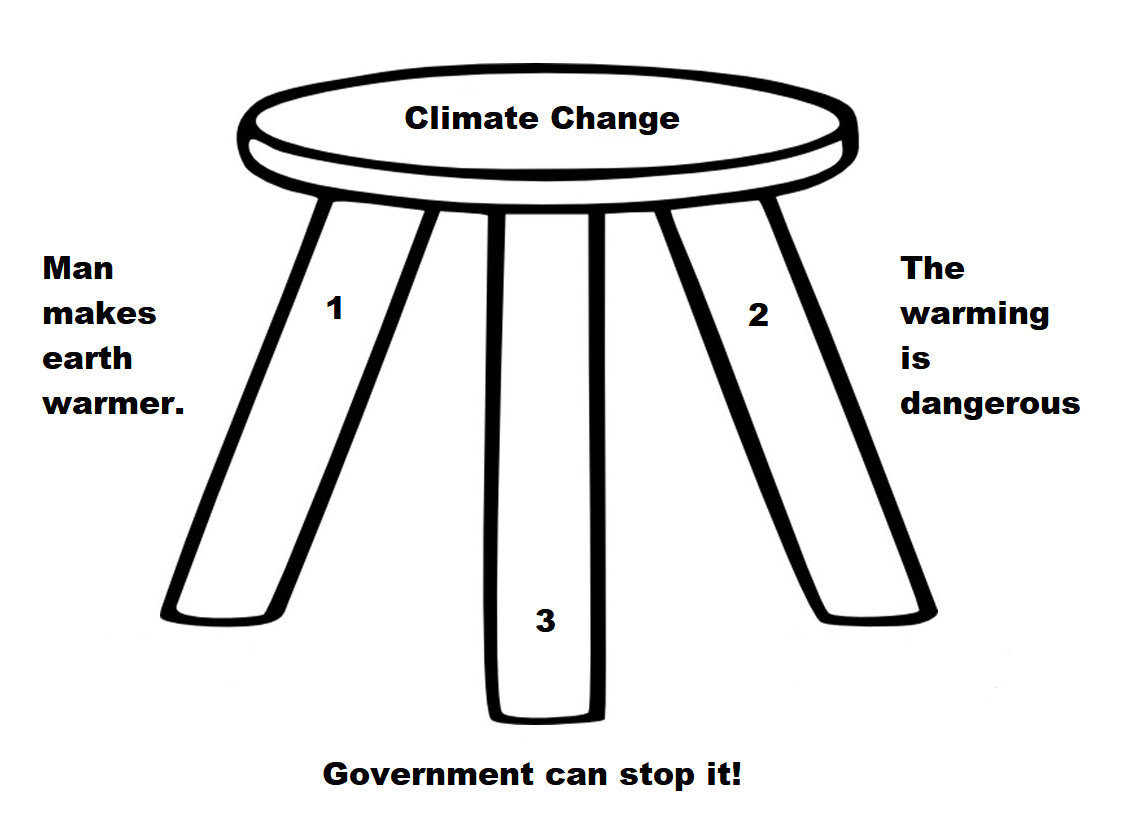
As the stool above shows, the climate change package sits on three premises. The first is the science bit, consisting of an unproven claim that observed warming is caused by humans burning fossil fuels. The second part rests on impact studies from billions of research dollars spent uncovering any and all possible negatives from warming. And the third leg is climate policies showing how governments can “fight climate change.”

It is refreshing to see more and more articles by people reasoning about climate change/global warming and expressing rational positions. Increasingly, analysts are unbundling the package and questioning not only the science, but also pointing out positives from CO2 and warming. And as this post shows, essays are challenging the policy proposals advanced by climate activists. David R. Henderson and John H. Cochrane published at WSJ on July 30, 2017 Climate Change Isn’t the End of the World  Even if world temperatures rise, the appropriate policy response is still an open question.  Complete text below (my Bolds)

Climate change is often misunderstood as a package deal: If global warming is “real,” both sides of the debate seem to assume, the climate lobby’s policy agenda follows inexorably.

It does not. Climate policy advocates need to do a much better job of quantitatively analyzing economic costs and the actual, rather than symbolic, benefits of their policies. Skeptics would also do well to focus more attention on economic and policy analysis.

To arrive at a wise policy response, we first need to consider how much economic damage climate change will do. Current models struggle to come up with economic costs consummate with apocalyptic political rhetoric. Typical costs are well below 10% of gross domestic product in the year 2100 and beyond.

That’s a lot of money—but it’s a lot of years, too. Even 10% less GDP in 100 years corresponds to 0.1 percentage point less annual GDP growth. Climate change therefore does not justify policies that cost more than 0.1 percentage point of growth. If the goal is 10% more GDP in 100 years, pro-growth tax, regulatory and entitlement reforms would be far more effective.

Yes, the costs are not evenly spread. Some places will do better and some will do worse. The American South might be a worse place to grow wheat; Southern Canada might be a better one. In a century, Miami might find itself in approximately the same situation as the Dutch city of Rotterdam today.

Rotterdam–Ninety years thriving behind dikes and dams.

But spread over a century, the costs of moving and adapting are not as imposing as they seem. Rotterdam’s dikes are expensive, but not prohibitively so. Most buildings are rebuilt about every 50 years. If we simply stopped building in flood-prone areas and started building on higher ground, even the costs of moving cities would be bearable. Migration is costly. But much of the world’s population moved from farms to cities in the 20th century. Allowing people to move to better climates in the 21st will be equally possible. Such investments in climate adaptation are small compared with the investments we will regularly make in houses, businesses, infrastructure and education.

And economics is the central question—unlike with other environmental problems such as chemical pollution. Carbon dioxide hurts nobody’s health. It’s good for plants. Climate change need not endanger anyone. If it did—and you do hear such claims—then living in hot Arizona rather than cool Maine, or living with Louisiana’s frequent floods, would be considered a health catastrophe today.

Global warming is not the only risk our society faces. Even if science tells us that climate change is real and man-made, it does not tell us, as President Obama asserted, that climate change is the greatest threat to humanity. Really? Greater than nuclear explosions, a world war, global pandemics, crop failures and civil chaos?

No. Healthy societies do not fall apart over slow, widely predicted, relatively small economic adjustments of the sort painted by climate analysis. Societies do fall apart from war, disease or chaos. Climate policy must compete with other long-term threats for always-scarce resources.

Facing this reality, some advocate that we buy some “insurance.” Sure, they argue, the projected economic cost seems small, but it could turn out to be a lot worse. But the same argument applies to any possible risk. If you buy overpriced insurance against every potential danger, you soon run out of money. You can sensibly insure only when the premium is in line with the risk—which brings us back where we started, to the need for quantifying probabilities, costs, benefits and alternatives. And uncertainty goes both ways. Nobody forecast fracking, or that it would make the U.S. the world’s carbon-reduction leader. Strategic waiting is a rational response to a slow-moving uncertain peril with fast-changing technology.

Global warming is not even the obvious top environmental threat. Dirty water, dirty air and insect-borne diseases are a far greater problem today for most people world-wide. Habitat loss and human predation are a far greater problem for most animals. Elephants won’t make it to see a warmer climate. Ask them how they would prefer to spend $1 trillion—subsidizing high-speed trains or a human-free park the size of Montana.

Then, we need to know what effect proposed policies have and at what cost. Scientific, quantifiable or even vaguely plausible cause-and-effect thinking are missing from much advocacy for policies to reduce carbon emissions. The Intergovernmental Panel on Climate Change’s “scientific” recommendations, for example, include “reduced gender inequality & marginalization in other forms,” “provisioning of adequate housing,” “cash transfers” and “awareness raising & integrating into education.” Even if some of these are worthy goals, they are not scientifically valid, cost-benefit-tested policies to cool the planet.

Climate policy advocates’ apocalyptic vision demands serious analysis, and mushy thinking undermines their case. If carbon emissions pose the greatest threat to humanity, it follows that the costs of nuclear power—waste disposal and the occasional meltdown—might be bearable. It follows that the costs of genetically modified foods and modern pesticides, which can feed us with less land and lower carbon emissions, might be bearable. It follows that if the future of civilization is really at stake, adaptation or geo-engineering should not be unmentionable. And it follows that symbolic, ineffective, political grab-bag policies should be intolerable.

Climate science, impacts and policies also appear as a house of cards.

Mr. Henderson is a research fellow with the Hoover Institution and an economics professor at the Naval Postgraduate School. Mr. Cochrane is a senior fellow of the Hoover Institution and an adjunct scholar of the Cato Institute.

More about Climate Policy Failures

Speaking Climate Truth to Policymakers

Climate Policies Failure, the Movie

Climatists Wrong-Footed

Another wheel flies off Ontario’s green energy bus

Updating Ontario’s energy debacle shows that Toronto and Ottawa have now achieved the highest electricity rates in Canada.  And a new wheel falling off the bus has crushed 340 jobs.  Kelly McFarland reports the news in Another wheel flies off Ontario’s green energy bus, and lands on 340 workers.

When former premier Dalton McGuinty visited the new Siemens Canada plant in Tillsonburg in 2011, he brushed aside protesters and boasted that the plant was part of the Liberal alternative energy plan that would “put us at the forefront in North America.”

The plant made windmill blades. Windmills were the future. Clean energy was what McGuinty’s two-year-old Green Energy Act was all about. It would free the province of old, dirty manufacturing and introduce new, cutting-edge jobs that would make Ontario the envy of the world.

Just six years later the plant is closing. Management says big changes in the wind industry make it no longer viable. The cutting edge plant that was to help lead Ontario into the Valhalla of a clean energy future can’t survive in a market that wants bigger blades.

Siemens Wind Power chief executive David Hickey was careful not to blame the Liberal change in plans for the Tillsonburg closing, but plenty of others were happy to. Companies like Siemens come for the subsidies, and when the subsidies disappear, so do they, said independent industry analyst Tom Adams. Ontario has poured so much into its green energy dream the market is saturated, he said. Hickey said the market is shifting west: Alberta and Saskatchewan are “the key opportunities of the future.”

The impact of all this virtue signaling falls on ratepayers. The detailed accounting is presented in It’s official: Toronto and Ottawa are now the most expensive cities for electricity

Ontario’s electricity price increases were more than double the national average.
Postmedia News

To get a sense of how much more Ontarians pay compared to the rest of the country, consider a comparison of monthly electricity bills between Toronto and Montreal, Canada’s two largest cities. In 2016, the estimated average monthly electricity bill (including taxes) for Torontonians was $201, or roughly $2,400 for the year. Residents of Montreal only paid an estimated $83 per month, or just under $1,000 per year. That’s an extra $1,400 a year that Montrealers can spend on other priorities because of lower electricity prices.

A large part of the blame rests on poor policy choices at Queen’s Park. One such policy has been the government’s poorly structured long-term contracts for renewable energy generation, like wind and solar. These contracts place ever-increasing costs on consumers, despite the fact that renewables accounted for only 6.8 per cent of electricity generation in 2016.

The province’s phase-out of coal-fired electricity has also proved costly and unnecessary. Indeed, noted environmental economist Ross McKitrick found that Ontario could have achieved the same environmental benefits of the phase-out (at one-tenth the cost) by simply completing the retrofitting of Ontario’s coal-fired plants.

Another issue is the imbalance between the supply and demand of electricity in the province. When the province’s energy generation exceeds demand, it must be exported — quite often at a loss — leaving Ontario ratepayers to cover the difference.

Summary

Does anyone remember the last time anything positive emerged from Ontario’s electricity industry, battered and bruised from 13 years of Liberal government manhandling? Hydro rates so punitive the Liberals have applied layer on layer of subsidies, borrowing the money or pushing debt onto future generations to do so. An estimated $45 billion extra in future costs so the government can reduce consumer bills now, as it campaigns for re-election. Billions lost selling power at a loss to the U.S., which will now be made easier by approval of a power line under Lake Erie.

Liberal energy strategy was always predicated on the belief that politicians could dictate to the market and control the outcome. Despite overwhelming evidence that governments do badly when they try to remove the freedom from free enterprise, Wynne and McGuinty ploughed ahead in their determination to impose their vision on Canada’s biggest province and most important economy. The result has been a catalogue of disasters. The $2 billion smart meter program that proved a bust at reducing demand; the gas plant construction projects halted in mid-campaign to protect a few Liberal seats; the doubling of consumer electricity bills; the army of windmills marching across vast expanses of rural Ontario, defacing the landscape while producing pricey, unneeded power.

Climate Policies Failure, the Movie


H/T GWPF for pointing (here) to this documentary film on how climate change policies are threatening modern civilization.  Trailer can be viewed above.  My recent post on this subject is below.

The Failure of Climate Policies

Primum non nocere” means “First, Do No Harm.”

Medical practitioners know this principle, the closest approximation in the Hippocratic corpus coming from Epidemics: “The physician must be able to tell the antecedents, know the present, and foretell the future – must mediate these things, and have two special objects in view with regard to disease, namely, to do good or to do no harm.”

Every intervention has consequences by which its success is measured. Effectiveness regards the quality of outcomes: Good things happened, Nothing happened, or Bad things happened. Of course, it may be a mixed bag in which the net must be weighed.

In addition, efficiency is considered (“evidence-based” in today’s jargon): It was worth it, It was not worth it, or It was worse than doing nothing. Both attainment of intended consequences, and collateral, unintended damages bear on the judgment.

More and more in the nations “leading on climate change” people are starting to question the actions of policymakers. Recently Robert Lyman, Ottawa Energy policy analyst presented on the theme: Can Canada Survive Climate Change Policy? From Friends of Science

It must indeed seem strange that someone would wonder about the effects of the policies now proposed to reduce greenhouse gas emissions as though the policies themselves are the threat. And yet they are.

I am not here to address the issue of how much human-related greenhouse gas emissions are contributing to increased concentrations of carbon dioxide in the atmosphere nor on the sensitivity of global temperatures and climate to the increases in those concentrations over time. There are others here far more qualified than I to discuss that.

Instead, I want to discuss the policy and program measures that the people of Canada and other countries, especially in the industrialized world, are being urged to adopt and what will be the implications of those policies and programs.

Edmonton one winter night.

Canada is the second largest country in the world, sparsely populated,
with vast transportation needs. We withstand long, cold winters featuring
short days, extremely low temperatures and lots of snow. Our energy and
resource industries would be penalized for providing the 
valuable materials
the rest of the world demands and uses.

The article goes into the history of how we all, including Canada got to this point. Then comes this.

Ladies and gentlemen, these commitments are just the beginning, the mere “foot in the door” for the more radical demands that lie ahead. We are still bound in principle to reduce Canadian GHG emissions by 50% from 2005 levels by 2050. The U.N still wants us to “show leadership” by reducing emissions by 80% from 2010 levels by 2050. A number of environmental groups in Canada and other countries have recently endorsed the Wind, Water and Sunlight, or WWS, vision. This vision seeks completely to eliminate the use of all fossils fuels – coal, oil, and natural gas – in the world by 2050. The New Democratic Party’s LEAP Manifesto endorses this vision, as does the Green Party and most of Canada’s influential environmental organizations. The government of Ontario also has formally committed the province to this vision. So have a number of large Canadian municipal governments.

In practice, consumers pay twice, once for the (expensive) renewable
generation and then for the capital costs of the backup thermal plants.

How can we even begin to understand the magnitude of the changes being proposed? One way is to look at the sources of energy consumption and related emissions today. In 2005, Canadian emissions were 738 megatonnes of carbon dioxide equivalent. In 2014, after six years of the worst recession since the Great Depression, Canadians emitted less, 722 megatonnes. Twenty-six per cent of those emissions were from oil and gas production, 23 per cent were from transportation, and roughly equal portions of around 10 per cent were from electricity generation, buildings, industry and agriculture, with waste and other sources making up a residual 7 per cent. Assuming that emissions do not grow one bit over the next 32 years as a result of increased economic activity or increased population, achieving a 50 per cent emissions reduction from 2005 levels would mean reducing emissions to 369 megatonnes CO2 equivalent. That is comparable to completely eliminating the current emissions from oil and gas production, electricity generation, and all emissions-intensive industries like mining, petrochemicals, auto and parts manufacturing, iron, steel and cement. Gone. Achieving the aspirational goal of 80 per cent reduction recommended by the IPCC would mean reducing emissions to 147 megatonnes CO2 equivalent. That would be comparable to reducing Canada’s per capita emissions and our energy economy to the current levels of Bolivia, Sudan or Iraq. (original bold)

Which benefits would be achieved by incurring such costs?

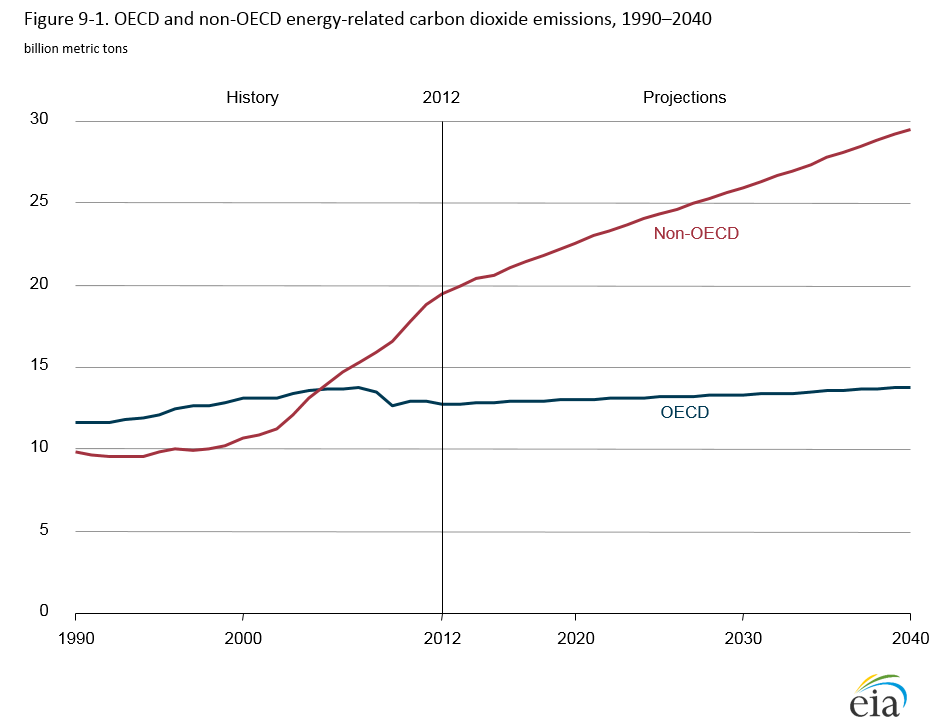
Despite all the rhetoric about reducing world carbon dioxide emissions from fuel combustion and gas flaring, according to the U.S. Carbon dioxide information analysis center, they rose steadily from 16.6 Gigatonnes carbon dioxide equivalent in 1973 to 34.1 Gigatonnes in 2014. So, they more than doubled over that timeframe. Importantly, though, the origins of the emissions changed significantly. In 1973, the countries of the organization for economic cooperation and development, or OECD, accounted for two-thirds of global CO2 emissions from fuel combustion; by 2014, the OECD share had declined to just over a third. So all, or almost all, of the emissions growth occurred outside of the OECD.

So, we have two sharply different perspectives of the future, the EIA’s projections of what probably will happen and the aspirations of the U.N. and many environmental groups as to what in their view should happen. Reducing emissions by 50% by 2050 to meet the U.N.’s vision would mean a global total of about 16 Gigatonnes, in contrast to the EIA’s projection of 43 Gigatonnes (Gt). The OECD countries – the United States, Canada, most of Europe, Japan, Australia and others – could eliminate 100% of their projected emissions of 14 Gt, and the world would still be over its target by 13 Gt.

A Tangled Pile of Wasteful Climate Programs

There is not in Canada a comprehensive list of the measures that have been implemented by all orders of government to reduce greenhouse gas emissions. They have been increasing in number, reach and cost since 1988. I counted 37 different generic types of measures now in use. Large bureaucracies exist to design, implement, and (less frequently) evaluate these measures. They stretch like the tentacles of some vast octopus across every aspect of the Canadian economy and touch everyone’s life. As no one has ever established an inventory of the measures now in place or of those under consideration, no one knows how much these measures already cost Canadians. Two things are certain – they cost billions of dollars annually, and they are not going away soon, regardless of the taxes imposed on carbon. I might add a third certainty, which is that the government will continue to develop and implement more and more programs and regulations as time goes on.

Let me remind you of the conclusions reached by the federal government’s own monitor of program effectiveness, the Commissioner of the Environment and Sustainable Development.  Starting in 1998, the commissioner began to critique the government’s approach to managing emission reduction measures. In the seven reports that followed, there were five consistent themes.

  • First, the government has not created effective governance structures for managing climate change activities. In fact, there have been weaknesses in horizontal governance across departments, accountability and coordination.
  • Second, there has been, and remains, no overall implementation plan. The government has produced no estimate of the emission reductions expected from each sector. Without an implementation plan, industry, consumers and other levels of government lack a solid basis for knowing how to apply technology or make investment decisions.
  • Third, as a result, Canada cannot determine whether the targets for emissions reduction already announced will be met or how much it will cost to do so.
  • Fourth, there are few mechanisms in place to measure the performance of the emission-reduction measures that have been implemented so far.
  • Fifth, the federal and provincial governments do poorly in coordinating their approaches to emissions reduction.

I agree that we need an honest dialogue about climate change mitigation. It should start with the recognition that governments to date have publicly embraced emission reduction targets that are unachievable with present technology and at acceptable economic costs. We should acknowledge that we as a society have multiple goals of which environmental quality, however important one might think it is, represents only one. If we value our prosperity and unity as a federal, geographically diverse country, we must approach the climate change issue with a respect for all our collective goals.

Much of Canada’s current political elite favours the pursuit of international goals over the steadfast promotion of the Canadian interest, whether on issues of trade, security or the environment. Never before, however, have we faced a situation in which commitment to an international objective may well impose enormous and divisive costs on Canada for no discernable global environmental benefit. Climate change thus offers a clear dichotomy between the Canadian national interest and the global environmental agenda.

See also Trump Did the Right Thing in the Right Way

Climate Policies Failure

Primum non nocere” means “First, Do No Harm.”

Medical practitioners know this principle, the closest approximation in the Hippocratic corpus coming from Epidemics: “The physician must be able to tell the antecedents, know the present, and foretell the future – must mediate these things, and have two special objects in view with regard to disease, namely, to do good or to do no harm.”

Every intervention has consequences by which its success is measured. Effectiveness regards the quality of outcomes: Good things happened, Nothing happened, or Bad things happened. Of course, it may be a mixed bag in which the net must be weighed.

In addition, efficiency is considered (“evidence-based” in today’s jargon): It was worth it, It was not worth it, or It was worse than doing nothing. Both attainment of intended consequences, and collateral, unintended damages bear on the judgment.

More and more in the nations “leading on climate change” people are starting to question the actions of policymakers. Recently Robert Lyman, Ottawa Energy policy analyst presented on the theme: Can Canada Survive Climate Change Policy? From Friends of Science

It must indeed seem strange that someone would wonder about the effects of the policies now proposed to reduce greenhouse gas emissions as though the policies themselves are the threat. And yet they are.

I am not here to address the issue of how much human-related greenhouse gas emissions are contributing to increased concentrations of carbon dioxide in the atmosphere nor on the sensitivity of global temperatures and climate to the increases in those concentrations over time. There are others here far more qualified than I to discuss that.

Instead, I want to discuss the policy and program measures that the people of Canada and other countries, especially in the industrialized world, are being urged to adopt and what will be the implications of those policies and programs.

Edmonton one winter night.

Canada is the second largest country in the world, sparsely populated,
with vast transportation needs. We withstand long, cold winters featuring
short days, extremely low temperatures and lots of snow. Our energy and
resource industries would be penalized for providing the 
valuable materials
the rest of the world demands and uses.

The article goes into the history of how we all, including Canada got to this point. Then comes this.

Ladies and gentlemen, these commitments are just the beginning, the mere “foot in the door” for the more radical demands that lie ahead. We are still bound in principle to reduce Canadian GHG emissions by 50% from 2005 levels by 2050. The U.N still wants us to “show leadership” by reducing emissions by 80% from 2010 levels by 2050. A number of environmental groups in Canada and other countries have recently endorsed the Wind, Water and Sunlight, or WWS, vision. This vision seeks completely to eliminate the use of all fossils fuels – coal, oil, and natural gas – in the world by 2050. The New Democratic Party’s LEAP Manifesto endorses this vision, as does the Green Party and most of Canada’s influential environmental organizations. The government of Ontario also has formally committed the province to this vision. So have a number of large Canadian municipal governments.

In practice, consumers pay twice, once for the (expensive) renewable
generation and then for the capital costs of the backup thermal plants.

How can we even begin to understand the magnitude of the changes being proposed? One way is to look at the sources of energy consumption and related emissions today. In 2005, Canadian emissions were 738 megatonnes of carbon dioxide equivalent. In 2014, after six years of the worst recession since the Great Depression, Canadians emitted less, 722 megatonnes. Twenty-six per cent of those emissions were from oil and gas production, 23 per cent were from transportation, and roughly equal portions of around 10 per cent were from electricity generation, buildings, industry and agriculture, with waste and other sources making up a residual 7 per cent. Assuming that emissions do not grow one bit over the next 32 years as a result of increased economic activity or increased population, achieving a 50 per cent emissions reduction from 2005 levels would mean reducing emissions to 369 megatonnes CO2 equivalent. That is comparable to completely eliminating the current emissions from oil and gas production, electricity generation, and all emissions-intensive industries like mining, petrochemicals, auto and parts manufacturing, iron, steel and cement. Gone. Achieving the aspirational goal of 80 per cent reduction recommended by the IPCC would mean reducing emissions to 147 megatonnes CO2 equivalent. That would be comparable to reducing Canada’s per capita emissions and our energy economy to the current levels of Bolivia, Sudan or Iraq. (original bold)

Which benefits would be achieved by incurring such costs?

Despite all the rhetoric about reducing world carbon dioxide emissions from fuel combustion and gas flaring, according to the U.S. Carbon dioxide information analysis center, they rose steadily from 16.6 Gigatonnes carbon dioxide equivalent in 1973 to 34.1 Gigatonnes in 2014. So, they more than doubled over that timeframe. Importantly, though, the origins of the emissions changed significantly. In 1973, the countries of the organization for economic cooperation and development, or OECD, accounted for two-thirds of global CO2 emissions from fuel combustion; by 2014, the OECD share had declined to just over a third. So all, or almost all, of the emissions growth occurred outside of the OECD.

So, we have two sharply different perspectives of the future, the EIA’s projections of what probably will happen and the aspirations of the U.N. and many environmental groups as to what in their view should happen. Reducing emissions by 50% by 2050 to meet the U.N.’s vision would mean a global total of about 16 Gigatonnes, in contrast to the EIA’s projection of 43 Gigatonnes (Gt). The OECD countries – the United States, Canada, most of Europe, Japan, Australia and others – could eliminate 100% of their projected emissions of 14 Gt, and the world would still be over its target by 13 Gt.

A Tangled Pile of Wasteful Climate Programs

There is not in Canada a comprehensive list of the measures that have been implemented by all orders of government to reduce greenhouse gas emissions. They have been increasing in number, reach and cost since 1988. I counted 37 different generic types of measures now in use. Large bureaucracies exist to design, implement, and (less frequently) evaluate these measures. They stretch like the tentacles of some vast octopus across every aspect of the Canadian economy and touch everyone’s life. As no one has ever established an inventory of the measures now in place or of those under consideration, no one knows how much these measures already cost Canadians. Two things are certain – they cost billions of dollars annually, and they are not going away soon, regardless of the taxes imposed on carbon. I might add a third certainty, which is that the government will continue to develop and implement more and more programs and regulations as time goes on.

Let me remind you of the conclusions reached by the federal government’s own monitor of program effectiveness, the Commissioner of the Environment and Sustainable Development.  Starting in 1998, the commissioner began to critique the government’s approach to managing emission reduction measures. In the seven reports that followed, there were five consistent themes.

  • First, the government has not created effective governance structures for managing climate change activities. In fact, there have been weaknesses in horizontal governance across departments, accountability and coordination.
  • Second, there has been, and remains, no overall implementation plan. The government has produced no estimate of the emission reductions expected from each sector. Without an implementation plan, industry, consumers and other levels of government lack a solid basis for knowing how to apply technology or make investment decisions.
  • Third, as a result, Canada cannot determine whether the targets for emissions reduction already announced will be met or how much it will cost to do so.
  • Fourth, there are few mechanisms in place to measure the performance of the emission-reduction measures that have been implemented so far.
  • Fifth, the federal and provincial governments do poorly in coordinating their approaches to emissions reduction.

I agree that we need an honest dialogue about climate change mitigation. It should start with the recognition that governments to date have publicly embraced emission reduction targets that are unachievable with present technology and at acceptable economic costs. We should acknowledge that we as a society have multiple goals of which environmental quality, however important one might think it is, represents only one. If we value our prosperity and unity as a federal, geographically diverse country, we must approach the climate change issue with a respect for all our collective goals.

Much of Canada’s current political elite favours the pursuit of international goals over the steadfast promotion of the Canadian interest, whether on issues of trade, security or the environment. Never before, however, have we faced a situation in which commitment to an international objective may well impose enormous and divisive costs on Canada for no discernable global environmental benefit. Climate change thus offers a clear dichotomy between the Canadian national interest and the global environmental agenda.

Carbon Taxes Pound Canada Economy


Canadian Inflation Jumps As Carbon Taxes Come Into Force

Globe and Mail:
Canadian inflation spiked to its highest rate in more than two years in January, as new carbon taxes in Alberta and Ontario fuelled a surge in gasoline prices.

Statistics Canada reported that the consumer price index was up 2.1 per cent year over year in January, the fastest pace since October, 2014, and up sharply from 1.5 per cent in December. It said gasoline prices were up 20.6 per cent from a year earlier, the biggest increase since September, 2011. The increase reflected the introduction of a carbon tax in Alberta and a cap-and-trade carbon pricing system in Ontario, both of which came into effect on Jan. 1, as well as higher crude-oil prices, which lifted fuel costs nationwide.

From StatsCan April Report:

Transportation costs rose 4.2% over the 12-month period ending in April, after increasing 4.6% in March. This deceleration was led by the purchase of passenger vehicles index, which rose less on a year-over-year basis in April than in March. Gasoline prices posted a 15.9% year-over-year increase in April, slightly larger than the 15.2% rise registered in March.

Losses persist in oil and gas

The oil and gas extraction industry reported an operating loss of $2.2 billion in the fourth quarter, down from the $3.3 billion loss in the third quarter. This was the eighth consecutive quarterly loss for the oil and gas extraction industry.

And that is just for starters.

Get ready for Trudeau’s carbon tax on everything

Toronto Sun, May 19, 2017:
The Trudeau Liberals are moving forward with their national carbon tax scheme, or, what Saskatchewan Premier Brad Wall calls “one of the largest tax increases in Canadian history.”

In typical governing fashion, the Liberals are trying to downplay the devastating economic consequences of the tax. They’re trying to disguise the very fact that this is a tax hike.

It’s not a carbon tax, it’s a “behaviour-changing measure,” said one government official.

His plan will force the provinces to tax each tonne of carbon emitted, as well as to hike taxes on gasoline by at least 11 cents per litre. Keep in mind that taxes on gasoline already make up 36% of the existing price at the pump.

That isn’t enough for our tax-hungry government, so they want to impose a 25% tax hike on fuel.

The whole scheme is designed to subsidize so-called clean energy.

But compared to the world’s largest sources of carbon emissions, places that coincidentally have the lowest environmental standards – China, Russia, India – Canada’s entire economy would be considered “clean energy.”

Next to the world’s biggest emitters, we’re an environmental marvel.

Despite being an advanced and developed country, and having some of the world’s largest proven oil reserves, Canada only makes up 1.6% of global emissions.

Any reductions in Canadian emissions caused by the Trudeau tax grab will immediately be erased by China’s booming coal industry and its refusal to impose the kind of job-killing carbon tax schemes being sold by the Trudeau Liberals.

There will be no positive impact on the environment, but the effect on our pocketbook will be concrete and measurable.

Figures vary by household and province, but by 2022, it’s estimated the average Canadian family will face a carbon tax bill of about $2,500 per year.

There’s a reason a carbon tax is called ‘a tax on everything.’

Climatists Wrong-Footed

Trolling: The art of deliberately, cleverly, and secretly pissing people off, usually via the internet, using dialogue.

Update May 4 at the end

People may not have noticed that subtly, without fanfare, the climate battleground has shifted from the science to the policy. Like everyone else climatists were caught unawares by the election of US policymakers skeptical of the need to “fight climate change.”

But the surprising development is how activist tactics are still geared mainly to push on the claim of “settled science”, when that is not any more the focal point for the opposition. I don’t know who created the strategy for nominees, but in confirmation hearings, to a man and woman they all refrained from denying the science. Sanders and the other true-believing senators pressed hard to get heretical statements, but failed.

Now the activists have turned up the heat with science marches every weekend. Activists keep pushing on the science because their policy agenda is even less believable.

The marchers’ signs show they depend on three suppositions, like a three-legged stool:

  • Humans are making the planet warmer.
  • The warming is dangerous.
  • Government can stop it.

The first point is what alarmists claim is settled science, and where others have doubts about the data, the models and the theories. Expressing those doubts gets you labeled a denier. After years of alarmists refusing to debate that first point, they now want to talk about nothing else.  Apparently they think that only the first point matters; once that is admitted, everything else follows.

To their surprise, policymakers, and now even some journalists are shifting the ground to the other two wobbly legs, where the assertions have even less support.

A perceptive journalist writing for the LA Times sees how the game is changing.  Jonah Goldberg wrote yet another piece of independent thought coming from a previous uncritically warmist newsroom. Bret Stephens just trolled the left with his supposed climate change denialism. Excerpts below.

The most amusing show over the weekend was the collective case of the vapors across the liberal left establishment over Bret Stephens’ first column at the New York Times on the perils of certainty, particularly on the topic of climate change.

When someone says that he is not denying climate change and concedes that it is real, that is “classic climate change denialism”? Huh. What words do we have left for people who call the whole thing a “hoax”? In civil debates, when someone concedes much of your premise, the proper reaction is not to scream “liar!” or “heretic!”

And that brings me to the second, and more amusing, thing about all of this. You’ve been trolled, people.

As a fellow columnist, I doff my cap to you, sir.

It wasn’t hard to trick liberals into going off-sides. In the past, Stephens was a more acid-tongued critic of climate change research. But the column in question was a model of restraint that, when read by non-ideologues and non-combatants, must seem utterly reasonable, even a tad banal. Stefan Rahmstorf, a prominent German climate scientist, wrote a lengthy, sanctimonious letter explaining why he was cancelling his subscription to the New York Times. Nothing in the letter addressed anything Stephens wrote in his column.

The Washington Post’s Eric Wemple found it hard to constrain his dismay. “May it suffice to say, however, that the many, many people who care passionately for the planet found it an exercise in climate-change denialism.”

Wemple’s a clever fellow. I’m sure he understands Stephens’ point about the dangers of certainty, particularly based on sophisticated mathematical models that have been proven wrong in the past.

What I think sailed past Wemple and so “many, many people” was Stephens’ subtler point about the sanctimonious condescension of people who claim to be motivated solely by their passionate care for the planet.

Stephens’ heresy here isn’t in denying climate change; it’s in refusing to concede that one group of people has a total monopoly on defining not just the problem but the acceptable responses to it. Such dissent is not a crime against science; it’s a threat to a guild. And the guild took the bait.

Update May 4

Bret Stephens published a new post today that digs into the policy failures, specifically biofuels with references to other shortcomings, such as emissions trading. Climate of Unintended Consequences

In other words, the three central claims made in the Department of Energy paper quoted at the top of this column were misleading or wrong. Factually wrong. Wrong for the environment. Wrong for taxpayers. Wrong for the allocation of government funding and scientific research. Wrong for our energy mix. Wrong politically: Whatever else we conclude about ethanol, the one thing that won’t soon go away is the biofuel lobby in Washington.

And wrong for the reputation of climate science.

In recent years, some climate activists — Al Gore notably among them — have owned up to their biofuels mistake. More recently, we’ve seen some acknowledgment of other errors, having more to do with policy than science.

Thus, today there’s a keener appreciation that cap-and-trade regimes such as Europe’s ambitious Emissions Trading System have been costly failures, with one study suggesting the E.T.S. had “limited benefits and embarrassing consequences” in terms of emissions — at an estimated cost to consumers of some $280 billion.

There’s also been some acknowledgment that Germany’s Energiewende — the uber-ambitious “energy turn” embarked upon by Angela Merkel in 2010 — has been less than a model for others. The country is producing record levels of energy from wind and solar power, but emissions are almost exactly what they were in 2009. Meanwhile, German households pay nearly the highest electricity bills in Europe, all for what amounts to an illusion of ecological virtue.

Still, what acknowledgment there’s been has generally been belated, grudging and rarely self-reflective. What’s missing is an understanding of the harm that can be done when do-something impulses and eco-cure boosterism become turbocharged by government power and subsidized business.

The lessons are legion but, more often than not, unlearned. We need to make policy choices based less on moral self-regard and more on attention to real-world results.

Six Reasons to Rescind Social Cost of Carbon

A consise summary is provided by Paul Driessen and Roger Bezdek
in this article Anti-fossil fuel SCC relies on garbage models, ignores carbon benefits and hurts the poor. Excerpts below.

The UN Development Program also calls energy “central to poverty reduction.” And International Energy Agency Executive Director Dr. Fatih Birol notes that “coal is raising living standards and lifting hundreds of millions of people out of poverty.” In fact, all fossil fuels are doing so.

Indeed, fossil fuels created the modern world and the housing, transportation, other technologies and living standards so many of us take for granted. They are essential for electricity and life, and over the past 250 years they more than doubled average life expectancy in countries that took advantage of them.

But the Obama Administration and radical environmentalists despise fossil fuels and used every tactic they could devise to eliminate them. One of their most important schemes was the “social cost of carbon.”

Six Things Wrong with Social Cost of Carbon

1. Each ton of U.S. emissions averted would initially have prevented a hypothetical $25/ton in global societal costs allegedly resulting from dangerous manmade climate change: less coastal flooding and tropical disease, fewer droughts and extreme weather events, for example. But within three years regulators arbitrarily increased the SCC to around $40/ton.

That made it easier to justify the Clean Power Plan, Paris climate agreement, and countless Obama Era actions on electricity generation, fracking, methane, pipelines, vehicle mileage and appliance efficiency standards, livestock operations, carbon taxes, and wind, solar and biofuel mandates and subsidies.

2. The supposed bedrock for the concept is the now rapidly shifting sands of climate chaos theory. New questions are arising almost daily about data quality and manipulation, the degree to which carbon dioxide affects global temperatures, the complex interplay of solar, cosmic ray, oceanic and other natural forces, and the inability of computer models to predict temperatures, sea level rise or hurricanes.

3. The SCC scheme blames American emissions for supposed costs worldwide (even though U.S. CO2 emissions are actually declining). It incorporates almost every conceivable cost of oil, gas and coal use on crops, forests, coastal cities, property damage, “forced migration,” and human health, nutrition and disease. However, it utterly fails to mention, much less analyze, tremendous and obvious carbon benefits.

4. CC schemes likewise impute only costs to carbon dioxide emissions. However, as thousands of scientific studies verify, rising levels of this miracle molecule are “greening” the Earth – reducing deserts and improving forests, grasslands, drought resistance, crop yields and human nutrition. No matter which government report or discount rate is used, asserted social costs of more CO2 in Earth’s atmosphere are infinitesimal compared to its estimated benefits.

5.  Government officials claim they can accurately forecast damages to the world’s climate, economies, civilizations, populations and ecosystems from U.S. carbon dioxide emissions over the next three centuries. They say we must base today’s energy policies, laws, and regulations on those forecasts. The notion is delusional and dangerous.

6. Finally, the most fundamental issue isn’t even the social cost of carbon. It is the costs inflicted on society by anti-carbon regulations. Those rules replace fossil fuel revenues with renewable energy subsidies; reliable, affordable electricity with unreliable power that costs two to three times as much; and mines, drill holes, cropland and wildlife habitats with tens of millions of acres of wind, solar and biofuel “farms.”

Summary

Anti-carbon rules are designed to drive energy de-carbonization and modern nation de-industrialization. Perhaps worst, their impacts fall hardest on poor, minority and blue-collar families. . . Worldwide, billions of people still do not have electricity – and the SCC would keep them deprived of its benefits.

It’s time to rescind and defund the SCC – and replace it with honest, objective cost-benefit analyses.

shredding-864x540-1Roger Bezdek is an internationally recognized energy analyst and president of Management Information Services, Inc. Paul Driessen is senior policy analyst for the Committee For A Constructive Tomorrow and author of books and articles on energy, climate change and human rights.


Additional posts:

Social Cost of Carbon: Origin and Prospects

The Social Benefits of Carbon

Ontario Coal Phase-out: All Pain, No Gain


Thanks to Dr. Ross McKitrick for telling the story: It’s official—Ontario’s coal phase-out was all for nothing which appeared in the Financial Post, January 17, 2017.  Excerpts below.

The federal Liberal government plans to impose a national coal phase-out, based on the same faulty arguments used in Ontario, namely that such a move will yield significant environmental benefits and reduce health-care costs. One problem—those arguments never made sense, and now with the Ontario phase-out complete, we can verify not only that they were invalid but that the Ontario government knew it.

First, ample data at the time showed that coal use had little effect on Ontario air quality. Environment Canada’s emissions inventories showed that the Ontario power generation sector was responsible for only a tiny fraction (about one per cent) of provincial particulate emissions, a common measure of air pollution.

Taken together these reports provided a credible basis for predicting that a coal phase-out would only have a small effect on our air quality. They also showed, based on the results of retrofits then underway at the power plants, that the same air quality improvements could be obtained at a fraction of the cost by installing scrubbers on the smokestacks, rather than shutting the coal-fired plants down.

Second, the government’s claims about the health effects of phasing out coal were highly implausible. It stated (and continues to assert) that coal plant emissions cost the province more than $3 billion annually in health-care costs. But this was at a time when the total provincial health-care budget was only about $35 billion annually. In other words, they claimed that nearly one-tenth of all health-care spending was due to illnesses and mortality arising from power plants that, again, were responsible for only about one per cent of annual particulate emissions.

Dr. Aliakbari and I analysed data for the cities of Hamilton, Toronto and Ottawa over the 2002-2014 interval. Our statistical model allowed us to isolate the effects of declining Ontario coal use compared to changing emissions from other Canadian and U.S. sources and effects due to weather. In line with our expectations and the prior evidence, we found that phasing out coal was responsible for only very small changes in Ontario air pollution levels.

We did not look at greenhouse gases because they are not local air pollutants, only matter on a global level, and emissions could be offset by purchasing credits anywhere in the world. The climate issue was, and remains, a red herring in the discussion about the costs and benefits of eliminating coal.

Summary

Ontario is suffering a crisis of high and rising electricity costs that’s causing real, long-lasting damage to households and businesses. The province insists the pain is worth it because of the environmental improvements. The numbers show otherwise. Phasing out coal had almost no effect on Ontario’s air pollution levels—and the government at Queen’s Park knew this was likely to be the case. It has all been for nothing.


Ross McKitrick
Professor of Economics, University of Guelph

Two additional points

Firstly, in both the US and Canada, the real motivation is virtue-signalling, posing as fighters of climate change.  The US EPA is also infamous for bogus estimates of public health and air quality benefits to justify costly and onerous energy regulations.

When Ontario government rejected the anti-pollution scrubbers mentioned in the article above, Energy Minister Dwight Duncan said: “We’re not going to spend $1.6 billion on technology that doesn’t help climate change. That’s just dumb.”

Secondly, the result was worse than nothing. Ontario’s electricity rates are the fastest rising and among the highest in North America. Ratepayers are being mugged by the once friendly Reddy Kilowatt.

Ontario’s Hall of Pain

Ontario Climate Policy Refugees

Ontario Jammed by Rent-seekers and Ratepayers

Electrical Madness in Green Ontario


SBC: Social Benefits of Carbon


Recently I posted on the Social Cost of Carbon: Origin and Prospects, which has become a focus for the Trump transition team. An article from Bloomberg provided a good historical context and overview of that policy instrument. The discussion noted major issues with how the damages are estimated and focused on how the calculation depends greatly upon the arbitrary choice of discount rate.

Several commenters raised a quite separate problem, namely that SCC is biased by addressing only estimated damages from CO2 and not the social benefits. That is not surprising since the entire purpose of the SCC is to get a large enough dollar figure to justify imposing expensive regulations, supposedly to avoid the damages by reductions in CO2 emissions. The framers had no interest or incentive to reduce damage estimates by considering benefits.

However a normal cost/benefit analysis would only project damages net of the expected benefits, which is clearly not the case here. Let’s consider three categories of Social Benefits of Carbon which properly must be included, rather than ignored.

Social Benefits from the Energy

Climate advocates assume that burning fossil fuels provide immediate benefits, such as electrical power or horsepower, which are paid for in the purchase of the fuels and realized by the consumers. Thus the social costs pertain only to future damages not covered by the fuel market prices. This view is achieved by wearing blinders to many obvious future social benefits attributable to the reliable and affordable energy from fossil fuels.

Alex Epstein (here) is among those who demonstrate from public information sources comparisons between societies who use carbon fuels extensively and those who do not. The contrast is remarkable: Societies with fossil fuels have citizens who are healthier, live longer, have higher standards of living, and enjoy cleaner air and drinking water, to boot. Not only do healthier, more mobile people create social wealth and prosperity, carbon-based energy is heavily taxed by every society that uses it.  Those added government revenues go (at least some of it) into the social welfare of the citizenry. By almost any measure, carbon-based energy makes the difference between developed and underdeveloped populations.

Social Benefits from CO2 Fertilization

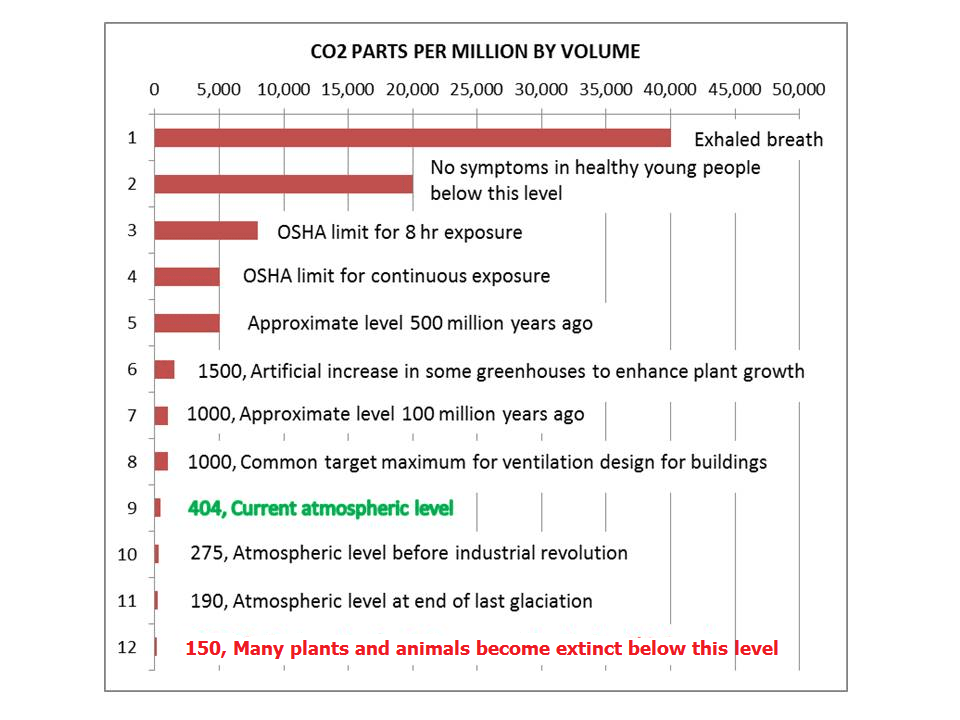
SCC excludes any consideration of the positive effects upon the biosphere from higher concentrations of CO2 in the atmosphere. It has been proven by numerous studies that plants thrive when more than 400ppm of CO2 are in the air, and greenhouse operators routinely add CO2 to double or triple the amount inside their facilities.

Yet climatists are at pains to discredit the benefits of more CO2.

A few years ago a scientist analyzed satellite imagery and discovered that the planet is greening (adding plant coverage) at a higher rate most likely due to more CO2 in the air. Climate activists are putting pressure upon these researchers to recant their findings.

A recent post Researchers Against CO2 revealed how activist scientists are trying to overturn the extensive biological evidence that plants love CO2. Field experiments are conducted claiming that plants don’t always grow bigger and faster with more CO2 when there are other limiting factors such as moisture, sunlight or soil nutrients. Their logic fails since more CO2 doesn’t cause the lack of other growth factors, and reducing CO2 will not improve those circumstances.

Another attack on CO2 benefits is the claim of ocean acidification, and I would not be surprised if SCC includes damage estimates from this source. Facts on the ground (or in this case, the oceans) do not support the claims, as reported in this post on Basics of Ocean Acidification.

Even crabs love CO2.

Social Benefits from Global Warming

Here we face the full force of billions of dollars of research studies on the damaging impacts from a few degrees of temperature increase. Over the years, everything has been shown to suffer from global warming, from A to Z. From Acne to Zika virus, and every letter in between: Bees, Civil wars, Diseases, Extinctions, Fish, etc.

Here’s the thing: Social Cost of Carbon is actually an attempt to estimate the benefits of preventing all those A to Z damages. But where are the estimates of benefits by preventing damages from global cooling?

A few researchers such as Richard Tol have looked objectively at warming scenarios, and identified clear social benefits. One study (here) concluded that an additional degree Celsius of warming by 2040 would likely result in 800,000 fewer deaths each year. Is that not a benefit to be reckoned?  Reasonable people conclude that the last 1°C of warming was a boon to civilization, and the next 1°C is likely to also be a blessing.

There are problems with this category. How do you put dollar values on saving human lives, or projected reductions in crops due to colder weather? These are the same problems bedeviling the SCC calculations.

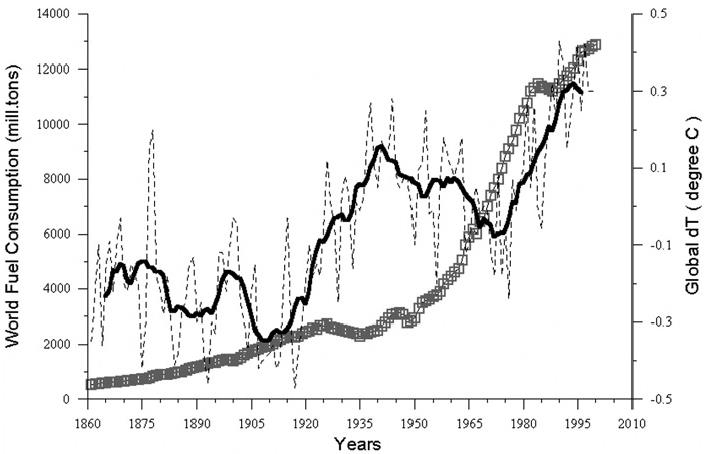
Further, many are wary of accepting the premise that carbon-based fuels do in fact cause temperatures to rise. Certainly the poor correlation between fuel consumption and global mean temperatures (GMT) does not convince (more here). Still, the argument can be made that even if you believe in man made global warming, policy analysis must also consider the benefits from a warmer world.

Summary

Calculating future costs and benefits from using carbon-based fuels is much like going down Alice’s rabbit hole.  Things get distorted, turned upside down and sideways.  Or to change the metaphor:  Beware: this swamp has alligators.

Ontario Climate Policy Refugees

It is not climate change forcing migrations, but rather misguided climate policies like those in Ontario. Employers pushed to the wall by energy cost increases have to plan for growth in other jurisdictions where energy is reliable and affordable. In effect, Ontario businessmen who are succeeding against world competitors from the US, China and India, will be creating jobs elsewhere, a migration of employees directly resulting from CO2 hysteria.

Ontario manufacturers fighting Queen’s Park’s energy policy Toronto Sun

Byron Nelson has spent over three decades growing his manufacturing company in Ontario, only now to regret his choice.

As he tours a group of reporters around his Leland Industries Scarborough plant where they build nuts and bolts for export to the United States and Europe, he explains he’s losing a battle with the province. His hydro bills have soared over the past year and with Ontario’s new cap-and-trade system coming into effect next month, electricity and natural gas costs will likely spike by another 20%.

That’s why Nelson — and other manufacturers in the province — are choosing to expand their businesses in the U.S. instead of at home.

“By 1995 to 2000, China had moved in and we fought China on the world trade and won,” Nelson said Tuesday during a press conference of the newly formed Coalition of Concerned Manufacturers in Ontario.

“Now our bigger problem is we’ve got to fight the province on controlling some of our hydro costs, which have totally skyrocketed. Our electricity bill has already increased 42% over the past few years. I’ve done the math and I’m looking at a cost increase that is going to take it to over $800,000 a year and with cap-and-trade, it’ll be near $1 million.”

Leland Industries plant, Scarborough Ontario

Leland Industries plant, Scarborough Ontario

Ontario’s new cap-and-trade system will cause electricity and natural gas costs to rise even higher. Toronto Star

Jocelyn Williams Bamford — vice president of Automatic Coating Limited and spokeswoman for the Coalition of Concerned Manufacturers in Ontario — said Leland is one of many smaller and medium-sized Ontario-based manufacturers that are looking to grow and seriously considering investing outside of Ontario.

“Ontario’s energy costs are rising so quickly many manufacturers are reassessing whether it makes sense to expand production in this province,” she said Tuesday in a statement.
Bamford said manufacturers have become more competitive and have been able to reduce emissions at the same time because they have invested in new technologies.

“Higher energy costs leave us less money for investment. And, if manufacturers can’t invest in Ontario, it’s not good for the economy or for jobs in this province. Ultimately, it’s not good for the environment either,” she said.

CEO of Leland Industries Byron Nelson says the company will not invest in Ontario any more because ‘the costs are just out of sight.’ Nelson said Ontario has already lost a lot of manufacturers and will lose more because those in government “just do not understand.”

Summary

Virtue signaling is not free. Ontario politicians want to look good to UN leaders, but the result is forcing employers to migrate jobs elsewhere. Until now politicians have naively bought into alarms from the Union of Concerned Scientists. Maybe they should pay attention instead to the Coalition of Concerned Manufacturers.