Alarmists Attack IPCC Not Linking Disasters to CO2


Chris Morrison reports on the flap over Climate Crisis™ media tactics in his Daily Sceptic article Climate Activists Frustrated by IPCC’s Refusal to Link Extreme Weather With Carbon Emissions.  Excerpts in italics with my bolds and added images.

Last June, the state-reliant BBC reported that human-caused climate change had made U.S. and Mexico heatwaves “35 times more likely”. Nothing out of the ordinary here in mainstream media with everyone from climate comedy turn ‘Jim’ Dale to UN chief Antonio ‘Boiling’ Guterres making these types of bizarre attributions. But for those who closely follow climate science and the assessments of the Intergovernmental Panel on Climate Change (IPCC), “such headlines can be difficult to make sense of”, observes the distinguished science writer Roger Pielke. In a hard-hitting attack on the pseudo-scientific industry of weather attribution, he states:

“neither the IPCC nor the underlying scientific literature comes anywhere close to making such strong and“ certain claims of attribution”.

Pielke argues that the extreme position of attributing individual bad weather events is “roughly aligned” with the far Left. “Climate science is not, or at least should not serve as a proxy for political tribes,” he cautions. But of course it is. The Net Zero fantasy is a collectivist national and supra-national agenda that increasingly relies on demonising bad weather. With global temperatures rising at most only 0.1°C a decade, laughter can only be general and side-splitting when IPCC boss Jim Skea claims that British summers will be 6°C hotter in less than 50 years. Two extended temperature pauses since 2000 have not helped the cause of global boiling. In addition there are increasing doubts about the reliability of temperature recordings by many meteorological organisations that seem unable to properly account for massive urban heat corruptions.

The big problem for ‘far Left’ climate extremists is that event attribution is a form, in Pielke’s words, of “tactical science”. Such science serves legal and political ends and is not always subject to peer review. As the BBC and other media outlets can attest, the work is “generally promoted via press release”. It has been developed in response to the failure of the IPCC to detect and attribute most types of extreme weather including drought, flooding, storms and wildfires to human involvement, notes Pielke. Worse, the IPCC can find little sign of human involvement going forward to 2100.

Scientists cannot answer directly whether particular events are
caused by climate change since extremes occur naturally.

Meanwhile the IPCC is somewhat dismissive about weather attribution, or as Pielke terms it, “weather attribution alchemy”. It notes: “The usefulness or applicability of available extreme event attribution methods for assessing climate-related risks remains subject to debate.” The IPCC is a biased body full of climate alarmists, but its inability to attribute single events to humans is obviously highly irritating and somewhat inconvenient for activists and their media counterparts.

Dr. Friederike Otto speaking with reporter at Oxford.

Dr. Friederike Otto runs World Weather Attribution (WWA) out of Imperial College London and is a frequent presence on the BBC. WWA is behind many of the immediate attributions of bad weather to human causes and its motives are clear. As Dr. Otto has noted: “Unlike every other branch of climate science or science in general, event attribution was actually originally suggested with the courts in mind.” Otto is clear that the main function of such studies, part-funded by Net Zero-supporting billionaires and heavily pushed by aligned mainstream media, is to support lawsuits against fossil fuel companies. She explains this strategy in detail in the interview, ‘From Extreme Event Attribution to Climate Litigation‘.

The inability of the IPCC to attribute bad weather to humans has been viewed by climate advocates as “politically problematic”, continues Pielke. He notes the work of climate activists Elizabeth Lloyd and Naomi Oreskes who are worried that the lack of attribution “conveys the impression that we just do not know, which feeds into uncertainty, doubt or incompleteness, and the general tendency of humans to discount threats that are not imminent”.

Perish the thought that there should be uncertainty, doubt
or incompleteness in the settled world of climate science.

It is of course different from all other branches of science in that all its opinions are right and consequently there is no need for the unhelpful process of constant inquiry and experiment. It need hardly be added that no doubt exists at the BBC, where former Radio 4 Today Editor Sarah Sands wrote the foreword to a WWA guide for journalists. Recalling when the late Nigel Lawson suggested there had been no increase in extreme weather, Sands noted: “I wish we had this guide for journalists to help us mount a more effective challenge to his claim.” These days, Sands enthused, attribution studies have given us “significant insight into the horsemen of the climate apocalypse”.

For her part, Otto is keen to crack down on the heretics. She was at the forefront of the recent notorious retraction of a paper in a Springer Nature journal that stated there was no evidence that the climate was breaking down. Written by four Italian scientists and led by Professor Gianluca Alimonti, they argued that a climate emergency was not supported by the data. Otto, who had previously worked in the Oxford School of Geography for 10 years, claimed the scientists were not writing in good faith. “If the journal cares about science they should withdraw it loudly and publicly saying it should never have been published,” she demanded.

A recent scientific study has confirmed that natural and climate-related disasters are declining during the 21st century. Getty Images/iStcokphoto

Declining Weather Disasters Prove Doomsters Wrong (Alimonti et al.)

Benny Peiser makes the case in his NY Post article Despite climate-change hysterics, weather disasters have decreased.  Excerpts in italics with my bolds and added images.

A recent scientific study has confirmed what climate realists have been highlighting for some time: Natural and climate-related disasters have been declining rather than increasing during the 21st century.

In a paper published this year in one of the world’s leading journals on environmental hazards, Italian scientists Gianluca Alimonti and Luigi Mariani analyzed the number and temporal trends of natural disasters reported since 1900.

A 2015 study by 22 scientists from around the world found that cold kills over 17 times more people than heat. Thus the planet’s recent modest warming has been saving millions of lives.

Based on the best available data, the two scientists concluded the 21st century has seen “a decreasing trend [of natural disasters] to 2022” which is “characterized by a significant decline in number of events.”

The researchers emphasized that their conclusion “sits in marked contradiction to earlier analyses by UN bodies which predict an increasing number of natural disasters and impacts in concert with global warming.”

“Our analyses strongly refute this assertion,” they wrote.

For years, international agencies such as the UN Office for Disaster Risk Reduction, the Food and Agriculture Organization of the United Nations, the World Meteorological Organization and the International Red Cross have claimed that climate-related disasters are escalating.
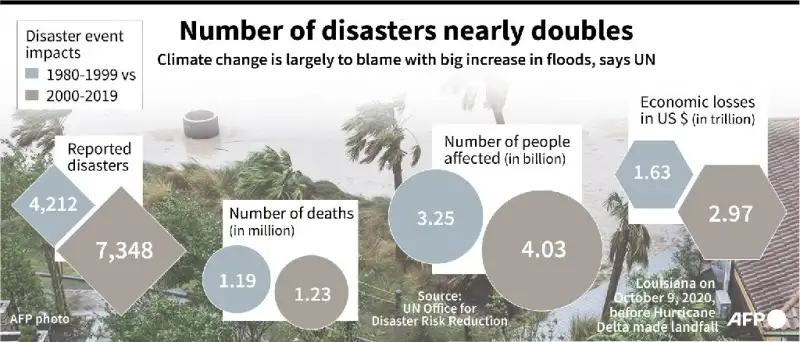
Floods lead a near doubling of disaster events from 1980 to 1999 compared to 2000 to 2019, according to a report by the UN Office for Disaster Risk Reduction.

“Weather disasters are striking the world four to five times more often and causing seven times more damage than in the 1970s,” the WMO reported in 2021.

Disaster and weather officials affiliated with the UN claim this dramatic rise is due to global warming: The changing climate, they say, is making weather disasters stronger and more frequent.
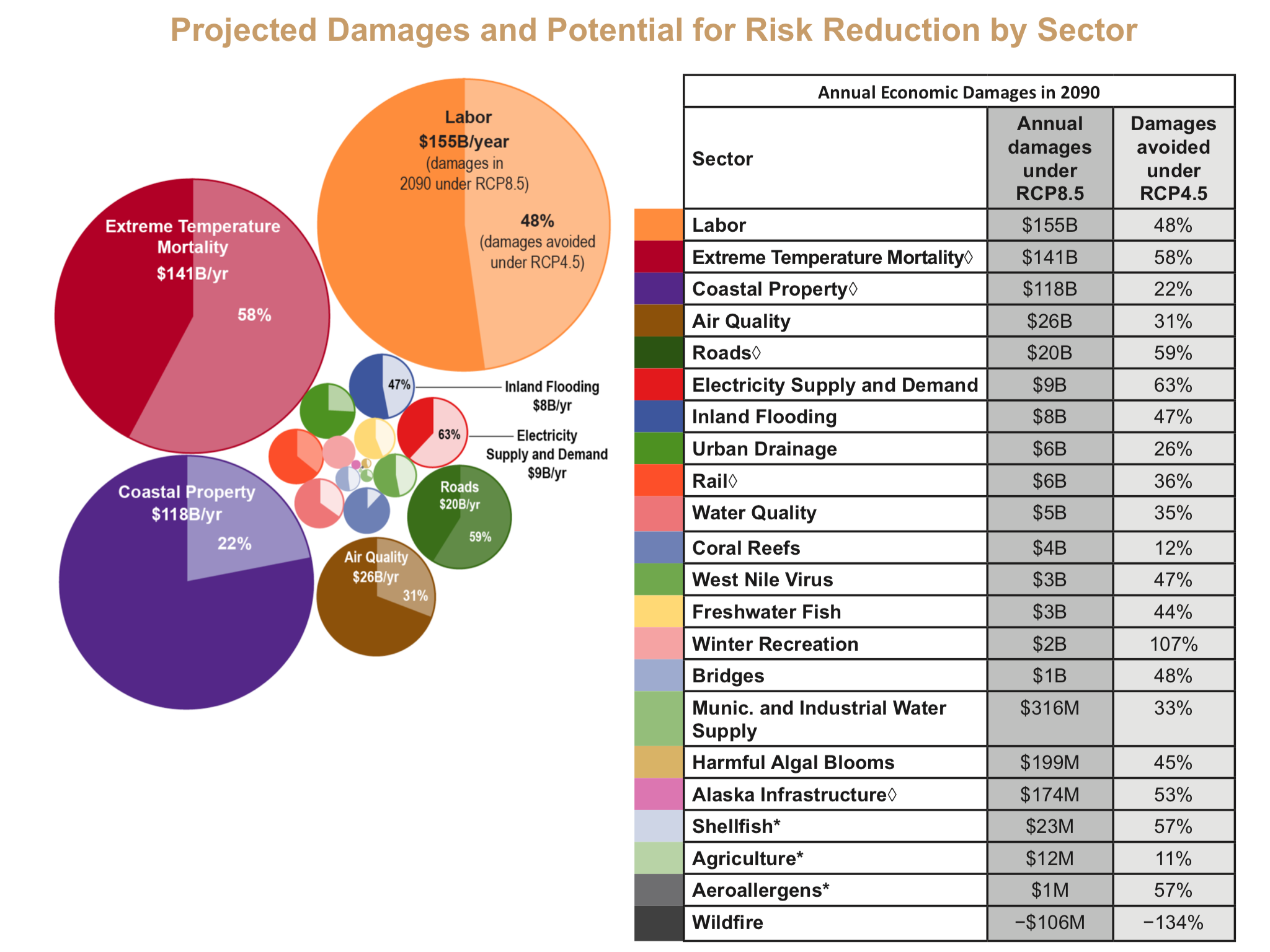
Fourth National Climate Assessment, Volume II: Impacts, Risks, and Adaptation in the United States.

The increased frequency of heat waves, droughts, flooding, winter storms, hurricanes, wildfires and other extreme weather events prove the negative impact of a warming world, according to various UN agencies and nongovernmental organizations.

Yet, as the actual data used by these organizations reveals, the last 20 years have in fact seen a significant decline in such events.

It turns out that climate alarmists have based their claims on a highly misleading comparison of disaster data of the late 20th and the early 21st centuries.

By their tally, the period from 1980 to 2000 saw about 4,200 natural disasters —with the number increasing sharply, to more than 8,000, during the first 20 years of this century.

This conclusion, however, is fatally flawed: It fails to take into account the huge increase in the global reporting of disasters engendered by the invention and rapid global dissemination of new communication technologies since the 1980s.

The arrival of the internet and other new communication tools has undoubtedly accelerated the reporting of disasters from all corners of the world — events that were significantly underreported in earlier decades.

As well, the number of people killed by natural and climate-related disasters has fallen steadily over the past 120 years — from 500,000 deaths per decade in the early 20th century down to less than 50,000 per decade in the last ten years.
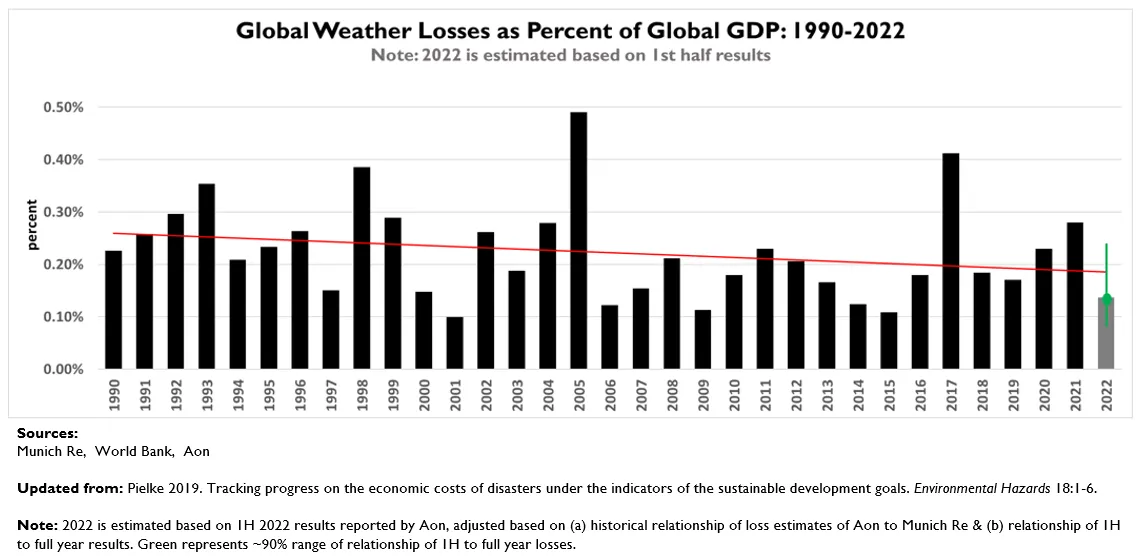
And, contrary to claims by NGOs and government officials, climate-related disaster losses have also declined as a percentage of global GDP during the last 30 years — from about 0.25% of GDP in 1990 to less than 0.20% in 2023.

The study by Alimonti and Mariani vindicates what we at the Global Warming Policy Foundation have been pointing out for a long time: Climate-related disasters are not on the rise, despite warming temperatures.

International agencies and the news media have hyped climate disasters for far too long, while ignoring the factual downward trend.

”First they ignore you, then they laugh at you, then they fight you, then you win,” as the saying goes.  UN agencies and NGOs have been misleading the public for years. It’s past time for the truth to win out.

Benny Peiser is the director of the London-based Global Warming Policy Foundation.

See also

Our Weather Extremes Are Customary in History

Figure27: Annual count of EF3 and above tornadoes in the US, 1950–2021. Source: Source: NOAA/NCEI.106, 107
 

Declining Weather Disasters Prove Doomsters Wrong

A recent scientific study has confirmed that natural and climate-related disasters are declining during the 21st century. Getty Images/iStcokphoto

Benny Peiser makes the case in his NY Post article Despite climate-change hysterics, weather disasters have decreased.  Excerpts in italics with my bolds and added images.

A recent scientific study has confirmed what climate realists have been highlighting for some time: Natural and climate-related disasters have been declining rather than increasing during the 21st century.

In a paper published this year in one of the world’s leading journals on environmental hazards, Italian scientists Gianluca Alimonti and Luigi Mariani analyzed the number and temporal trends of natural disasters reported since 1900.

A 2015 study by 22 scientists from around the world found that cold kills over 17 times more people than heat. Thus the planet’s recent modest warming has been saving millions of lives.

Based on the best available data, the two scientists concluded the 21st century has seen “a decreasing trend [of natural disasters] to 2022” which is “characterized by a significant decline in number of events.”

The researchers emphasized that their conclusion “sits in marked contradiction to earlier analyses by UN bodies which predict an increasing number of natural disasters and impacts in concert with global warming.”

“Our analyses strongly refute this assertion,” they wrote.

For years, international agencies such as the UN Office for Disaster Risk Reduction, the Food and Agriculture Organization of the United Nations, the World Meteorological Organization and the International Red Cross have claimed that climate-related disasters are escalating.

Floods lead a near doubling of disaster events from 1980 to 1999 compared to 2000 to 2019, according to a report by the UN Office for Disaster Risk Reduction.

“Weather disasters are striking the world four to five times more often and causing seven times more damage than in the 1970s,” the WMO reported in 2021.

Disaster and weather officials affiliated with the UN claim this dramatic rise is due to global warming: The changing climate, they say, is making weather disasters stronger and more frequent.

Fourth National Climate Assessment, Volume II: Impacts, Risks, and Adaptation in the United States.

The increased frequency of heat waves, droughts, flooding, winter storms, hurricanes, wildfires and other extreme weather events prove the negative impact of a warming world, according to various UN agencies and nongovernmental organizations.

Yet, as the actual data used by these organizations reveals, the last 20 years have in fact seen a significant decline in such events.

It turns out that climate alarmists have based their claims on a highly misleading comparison of disaster data of the late 20th and the early 21st centuries.

By their tally, the period from 1980 to 2000 saw about 4,200 natural disasters —with the number increasing sharply, to more than 8,000, during the first 20 years of this century.

This conclusion, however, is fatally flawed: It fails to take into account the huge increase in the global reporting of disasters engendered by the invention and rapid global dissemination of new communication technologies since the 1980s.

The arrival of the internet and other new communication tools has undoubtedly accelerated the reporting of disasters from all corners of the world — events that were significantly underreported in earlier decades.

As well, the number of people killed by natural and climate-related disasters has fallen steadily over the past 120 years — from 500,000 deaths per decade in the early 20th century down to less than 50,000 per decade in the last ten years.

And, contrary to claims by NGOs and government officials, climate-related disaster losses have also declined as a percentage of global GDP during the last 30 years — from about 0.25% of GDP in 1990 to less than 0.20% in 2023.

The study by Alimonti and Mariani vindicates what we at the Global Warming Policy Foundation have been pointing out for a long time: Climate-related disasters are not on the rise, despite warming temperatures.

International agencies and the news media have hyped climate disasters for far too long, while ignoring the factual downward trend.

”First they ignore you, then they laugh at you, then they fight you, then you win,” as the saying goes.  UN agencies and NGOs have been misleading the public for years. It’s past time for the truth to win out.

Benny Peiser is the director of the London-based Global Warming Policy Foundation.

See also

Our Weather Extremes Are Customary in History

Figure27: Annual count of EF3 and above tornadoes in the US, 1950–2021. Source: Source: NOAA/NCEI.106, 107
 

Claim: Now Heat Extremes Are “Statistically Impossible.”

There’s a lot of buzz about a current article:  ‘Statistically Impossible’ Heat Extremes Are Here.   The authors state: 

Looking at historical data from 1959 to 2021, we found that 31% of Earth’s land surface has already experienced such statistically implausible heat (though the Pacific Northwest heatwave is exceptional even among these events). These regions are spread all across the globe with no clear spatial pattern.

In the summer of 2021, Canada’s all-time temperature record was smashed by almost 5℃. Its new record of 49.6℃ is hotter than anything ever recorded in Spain, Turkey or indeed anywhere in Europe.  The record was set in Lytton, a small village a few hours’ drive from Vancouver, in a part of the world that doesn’t really look like it should experience such temperatures. Lytton was the peak of a heatwave that hit the Pacific Northwest of the US and Canada that summer and left many scientists shocked. From a purely statistical point of view, it should have been impossible.   Overall, our work raises two important points:

The first is that statistically implausible heatwaves can occur anywhere on the Earth, and we must be very cautious about using the historical record in isolation to estimate the “maximum” heatwave possible. Policymakers across the globe should prepare for exceptional heatwaves that would be deemed implausible based on current records.

The second is that there are a number of regions whose historical record is not exceptional, and therefore is more likely to be broken. These regions have been lucky so far, but as a result, are likely to be less well prepared for an unprecedented heatwave in the near future. It is especially important that these regions prepare for more intense heatwaves than they have already experienced.

My Comment:

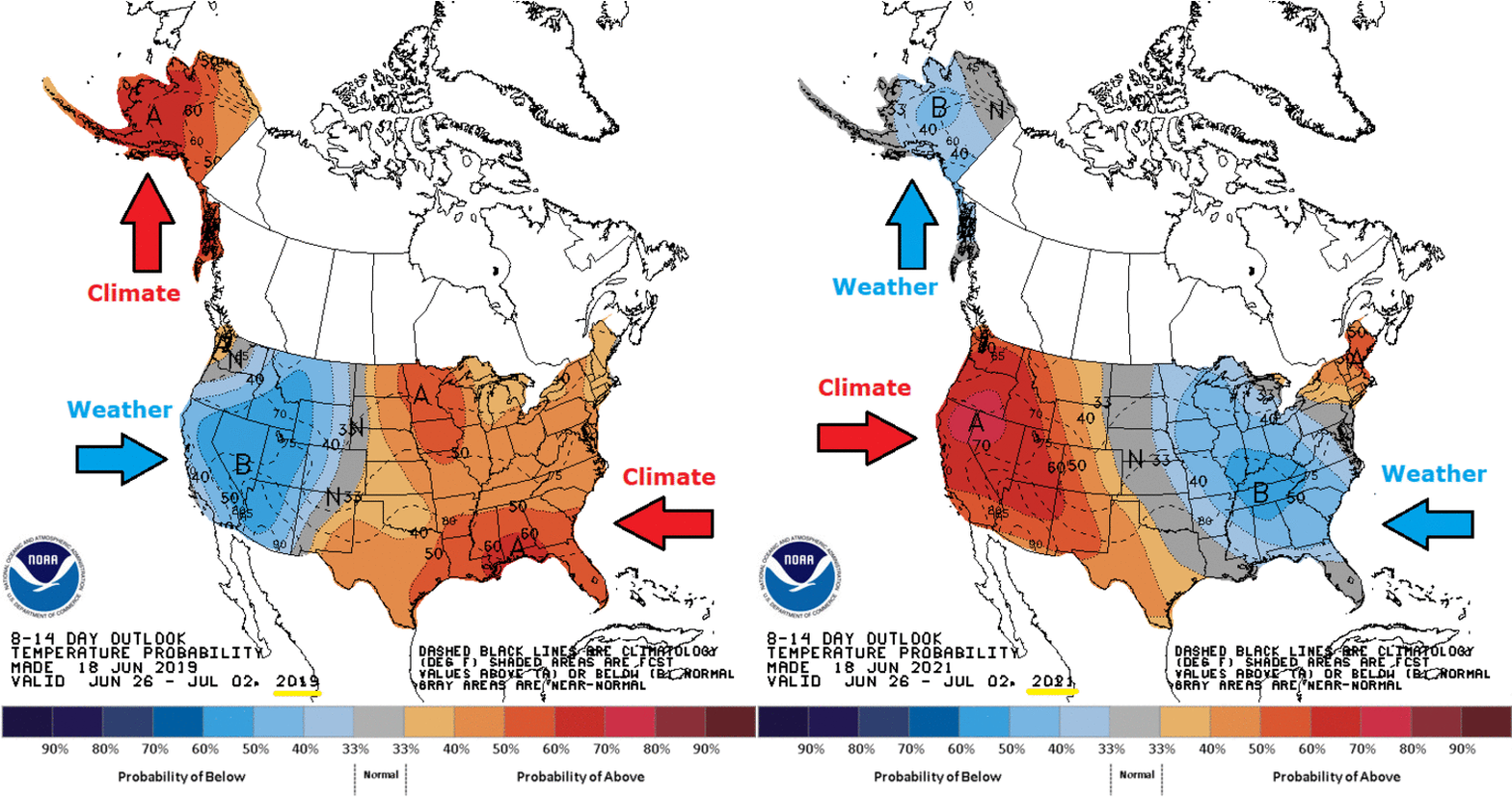
So the conclusion is a familar alamist meme:  If you’ve had a heat extreme, there will be more; If not you’d best get ready for them.  What is left out are the simple lessons in the image at the top. The 2021 Pacifc Northwest heat wave happened all right, but it was a cold spot in 2019, when the East coast was hot.  Since the overall average temperatures change very little, hot spots in some places will be offset by cold spots in others. But by obsessing on the heat and ignoring the cold, the narrative of a burning planet is proclaimed.  

Furthermore, as a previous post below explains, average temperatures hide a particular Northern Hemisphere pattern, namely the concurrence of warm summers and cold winters in the same year.

Rannoch Moor, Scotland

Previous Post: Heat Waves: Historical, not Hysterical Context

Alarms are being sounded about heat waves in the Northern Hemisphere, noting heat waves in Eastern Canada and US, wildfires in N. Sweden and Siberia.  The recent (2018) UK lawsuit featured the advocate claiming the Arctic is burning, so global warming is no longer in doubt.  Thus UK needs to up its carbon reduction targets.

The High Court disagreed.  And for good reasons not cited by the judge.  The hot dry weather this summer in Siberia was preceded by extreme cold and massive snowfall, unusual winter conditions even for that climate zone.  Similarly, there have been cold winters across Eurasia, while Northern Europe enjoys a BBQ summer.  BTW, I recall seeing on TV May and June tennis matches in Spain where spectators were wearing jackets and head covering against the cold.

What is going on?  Fact: Concurrent warm summers and cold winters are a feature of the North Atlantic climate system.  It has gone on periodically throughout history, and long before humans burned fossil fuels.  Below is evidence providing insight into our present experience of 2018 weather.

Concurrent Warming and Cooling

This post highlights recent interesting findings regarding past climate change in NH, Scotland in particular. The purpose of the research was to better understand how glaciers could be retreating during the Younger Dryas Stadia (YDS), one of the coldest periods in our Holocene epoch.

The lead researcher is Gordon Bromley, and the field work was done on site of the last ice fields on the highlands of Scotland. 14C dating was used to estimate time of glacial events such as vegetation colonizing these places. Bromely explains in article Shells found in Scotland rewrite our understanding of climate change at siliconrepublic. Excerpts in italics with my bolds.

By analysing ancient shells found in Scotland, the team’s data challenges the idea that the period was an abrupt return to an ice age climate in the North Atlantic, by showing that the last glaciers there were actually decaying rapidly during that period.

The shells were found in glacial deposits, and one in particular was dated as being the first organic matter to colonise the newly ice-free landscape, helping to provide a minimum age for the glacial advance. While all of these shell species are still in existence in the North Atlantic, many are extinct in Scotland, where ocean temperatures are too warm.

This means that although winters in Britain and Ireland were extremely cold, summers were a lot warmer than previously thought, more in line with the seasonal climates of central Europe.

“There’s a lot of geologic evidence of these former glaciers, including deposits of rubble bulldozed up by the ice, but their age has not been well established,” said Dr Gordon Bromley, lead author of the study, from NUI Galway’s School of Geography and Archaeology.

“It has largely been assumed that these glaciers existed during the cold Younger Dryas period, since other climate records give the impression that it was a cold time.”

He continued: “This finding is controversial and, if we are correct, it helps rewrite our understanding of how abrupt climate change impacts our maritime region, both in the past and potentially into the future.”

The recent report is Interstadial Rise and Younger Dryas Demise of Scotland’s Last Ice Fields
G. Bromley A. Putnam H. Borns Jr T. Lowell T. Sandford D. Barrell  First published: 26 April 2018.(my bolds)

Abstract

Establishing the atmospheric expression of abrupt climate change during the last glacial termination is key to understanding driving mechanisms. In this paper, we present a new 14C chronology of glacier behavior during late‐glacial time from the Scottish Highlands, located close to the overturning region of the North Atlantic Ocean. Our results indicate that the last pulse of glaciation culminated between ~12.8 and ~12.6 ka, during the earliest part of the Younger Dryas stadial and as much as a millennium earlier than several recent estimates. Comparison of our results with existing minimum‐limiting 14C data also suggests that the subsequent deglaciation of Scotland was rapid and occurred during full stadial conditions in the North Atlantic. We attribute this pattern of ice recession to enhanced summertime melting, despite severely cool winters, and propose that relatively warm summers are a fundamental characteristic of North Atlantic stadials.

Plain Language Summary

Geologic data reveal that Earth is capable of abrupt, high‐magnitude changes in both temperature and precipitation that can occur well within a human lifespan. Exactly what causes these potentially catastrophic climate‐change events, however, and their likelihood in the near future, remains frustratingly unclear due to uncertainty about how they are manifested on land and in the oceans. Our study sheds new light on the terrestrial impact of so‐called “stadial” events in the North Atlantic region, a key area in abrupt climate change. We reconstructed the behavior of Scotland’s last glaciers, which served as natural thermometers, to explore past changes in summertime temperature. Stadials have long been associated with extreme cooling of the North Atlantic and adjacent Europe and the most recent, the Younger Dryas stadial, is commonly invoked as an example of what might happen due to anthropogenic global warming. In contrast, our new glacial chronology suggests that the Younger Dryas was instead characterized by glacier retreat, which is indicative of climate warming. This finding is important because, rather than being defined by severe year‐round cooling, it indicates that abrupt climate change is instead characterized by extreme seasonality in the North Atlantic region, with cold winters yet anomalously warm summers.

The complete report is behind a paywall, but a 2014 paper by Bromley discusses the evidence and analysis in reaching these conclusions. Younger Dryas deglaciation of Scotland driven by warming summers  Excerpts with my bolds.

Significance: As a principal component of global heat transport, the North Atlantic Ocean also is susceptible to rapid disruptions of meridional overturning circulation and thus widely invoked as a cause of abrupt climate variability in the Northern Hemisphere. We assess the impact of one such North Atlantic cold event—the Younger Dryas Stadial—on an adjacent ice mass and show that, rather than instigating a return to glacial conditions, this abrupt climate event was characterized by deglaciation. We suggest this pattern indicates summertime warming during the Younger Dryas, potentially as a function of enhanced seasonality in the North Atlantic.

Surface temperatures range from -30C to +30C

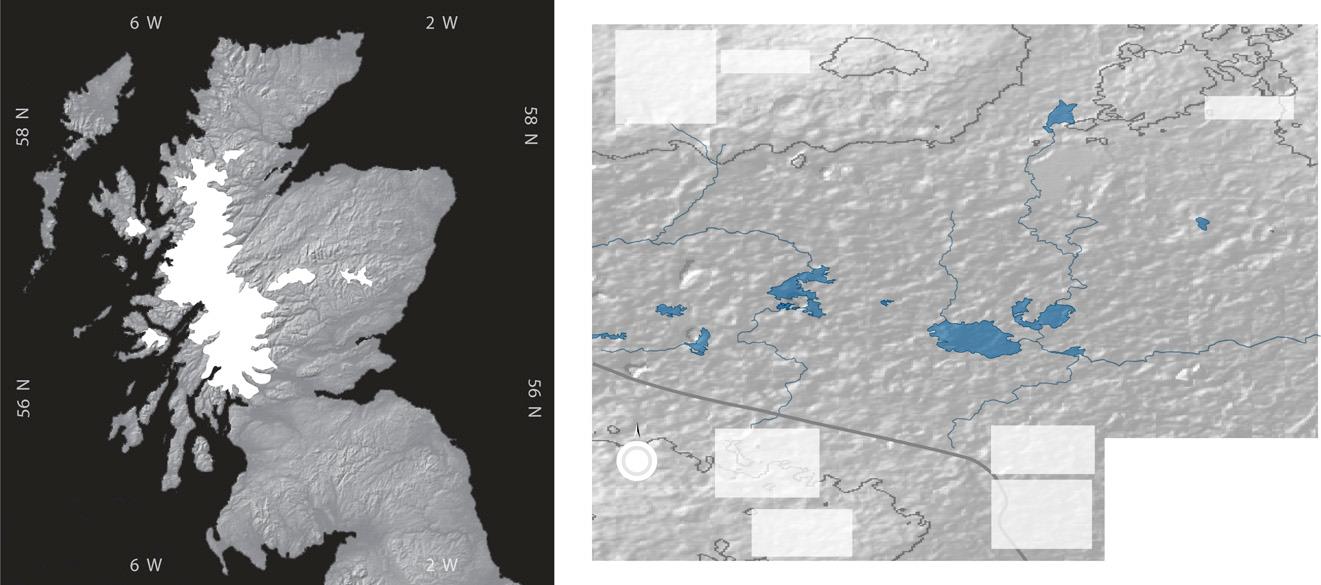
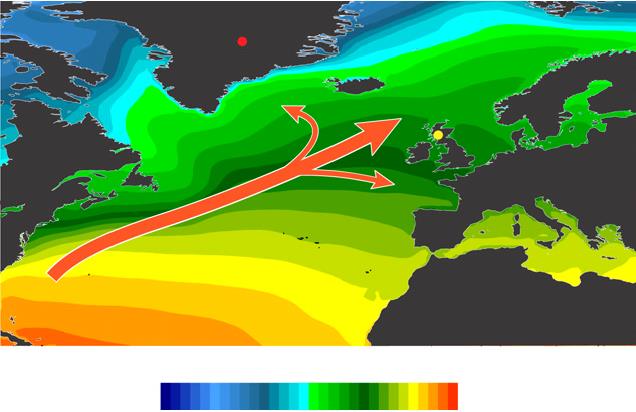
Fig. 1. Surface temperature and heat transport in the North Atlantic Ocean.  The relatively mild European climate is sustained by warm sea-surface temperatures and prevailing southwesterly airflow in the North Atlantic Ocean (NAO), with this ameliorating effect being strongest in maritime regions such as Scotland. Mean annual temperature (1979 to present) at 2 m above surface (image obtained using University of Maine Climate Reanalyzer, http://www.cci-reanalyzer.org). Locations of Rannoch Moor and the GISP2 ice core are indicated.

Thus the Scottish glacial record is ideal for reconstructing late glacial variability in North Atlantic temperature (Fig. 1). The last glacier resurgence in Scotland—the “Loch Lomond Advance” (LLA)—culminated in a ∼9,500-km2 ice cap centered over Rannoch Moor (Fig. 2A) and surrounded by smaller ice fields and cirque glaciers.

Fig. 2. Extent of the LLA ice cap in Scotland and glacial geomorphology of western Rannoch Moor. (A) Maximum extent of the ∼9,500 km2 LLA ice cap and larger satellite ice masses, indicating the central location of Rannoch Moor. Nunataks are not shown. (B) Glacial-geomorphic map of western Rannoch Moor. Distinct moraine ridges mark the northward active retreat of the glacier margin (indicated by arrow) across this sector of the moor, whereas chaotic moraines near Lochan Meall a’ Phuill (LMP) mark final stagnation of ice. Core sites are shown, including those (K1–K3) of previous investigations (14, 15).

When did the LLA itself occur? We consider two possible resolutions to the paradox of deglaciation during the YDS. First, declining precipitation over Scotland due to gradually increasing North Atlantic sea-ice extent has been invoked to explain the reported shrinkage of glaciers in the latter half of the YDS (18). However, this course of events conflicts with recent data depicting rapid, widespread imposition of winter sea-ice cover at the onset of the YDS (9), rather than progressive expansion throughout the stadial.

Loch Lomond

Furthermore, considering the gradual active retreat of LLA glaciers indicated by the geomorphic record, our chronology suggests that deglaciation began considerably earlier than the mid-YDS, when precipitation reportedly began to decline (18). Finally, our cores contain lacustrine sediments deposited throughout the latter part of the YDS, indicating that the water table was not substantially different from that of today. Indeed, some reconstructions suggest enhanced YDS precipitation in Scotland (24, 25), which is inconsistent with the explanation that precipitation starvation drove deglaciation (26).

We prefer an alternative scenario in which glacier recession was driven by summertime warming and snowline rise. We suggest that amplified seasonality, driven by greatly expanded winter sea ice, resulted in a relatively continental YDS climate for western Europe, both in winter and in summer. Although sea-ice formation prevented ocean–atmosphere heat transfer during the winter months (10), summertime melting of sea ice would have imposed an extensive freshwater cap on the ocean surface (27), resulting in a buoyancy-stratified North Atlantic. In the absence of deep vertical mixing, summertime heating would be concentrated at the ocean surface, thereby increasing both North Atlantic summer sea-surface temperatures (SSTs) and downwind air temperatures. Such a scenario is analogous to modern conditions in the Sea of Okhotsk (28) and the North Pacific Ocean (29), where buoyancy stratification maintains considerable seasonal contrasts in SSTs. Indeed, Haug et al. (30) reported higher summer SSTs in the North Pacific following the onset of stratification than previously under destratified conditions, despite the growing presence of northern ice sheets and an overall reduction in annual SST. A similar pattern is evident in a new SST record from the northeastern North Atlantic, which shows higher summer temperatures during stadial periods (e.g., Heinrich stadials 1 and 2) than during interstadials on account of amplified seasonality (30).

Our interpretation of the Rannoch Moor data, involving the summer (winter) heating (cooling) effects of a shallow North Atlantic mixed layer, reconciles full stadial conditions in the North Atlantic with YDS deglaciation in Scotland. This scenario might also account for the absence of YDS-age moraines at several higher-latitude locations (12, 36–38) and for evidence of mild summer temperatures in southern Greenland (11). Crucially, our chronology challenges the traditional view of renewed glaciation in the Northern Hemisphere during the YDS, particularly in the circum-North Atlantic, and highlights our as yet incomplete understanding of abrupt climate change.

Summary

Several things are illuminated by this study. For one thing, glaciers grow or recede because of multiple factors, not just air temperature. The study noted that glaciers require precipitation (snow) in order to grow, but also melt under warmer conditions. For background on the complexities of glacier dynamics see Glaciermania

Also, paleoclimatology relies on temperature proxies who respond to changes over multicentennial scales at best. C14 brings higher resolution to the table.

Finally, it is interesting to consider climate changing with respect to seasonality.  Bromley et al. observe that during Younger Dryas, Scotland shifted from a moderate maritime climate to one with more seasonal extremes like that of inland continental regions. In that light, what should we expect from cooler SSTs in the North Atlantic?

Note also that our modern warming period has been marked by the opposite pattern. Many NH temperature records show slight summer cooling along with somewhat stronger warming in winter, the net being the modest (fearful?) warming in estimates of global annual temperatures.  Then of course there are anomalous years like this one where cold winters combine with warm summer periods.


Notes on Florida Torrential Rainfall and Ft. Lauderdale

Concerning reports that 25 inches of rain fell in one day on Fort Lauderdale, some historical context is provided by the Florida Climate Center article Anticipating Heavy Rain in Florida.  Excerpts in italics with my bolds.

Abstract

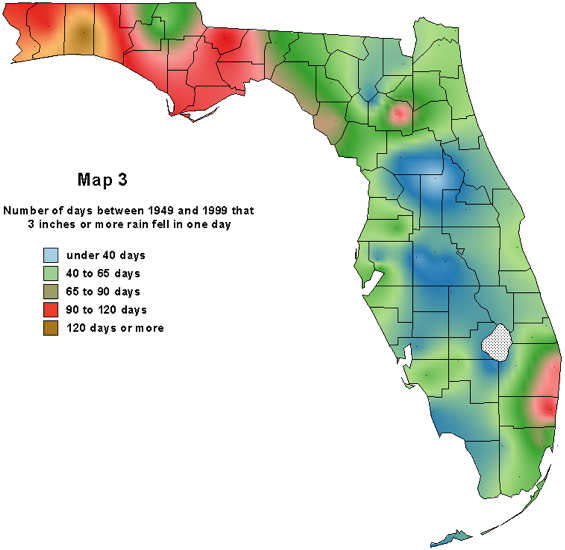
Florida is situated within a part of the United States where torrential rain is a common occurrence. Torrential rain is here defined as at least 3 inches in a single day. Rain of at least this magnitude is far more frequent along Florida’s coasts than in its interior. The Panhandle and the Gold Coast experience such weather events more than elsewhere in the state. Except for North Florida, rainstorms are heavily concentrated in the warm months. Mid- latitude low pressure systems, that pass over or near North Florida in the winter, often produce heavy rain. As a consequence that part of the state has no seasonal concentration.

The distribution of torrential rain throughout the state is much more uneven during years when they are most frequent than when few such storms occur. During the 51 years of daily observations for 48 weather stations no cyclical pattern of torrential rain was discerned. However, when data were organized by Enso phase it was shown that during the La Niña phase torrential rainfall, especially of 5 inches or more in a day, was more frequent than during the phase named El Niño. This was most true of South Florida stations.

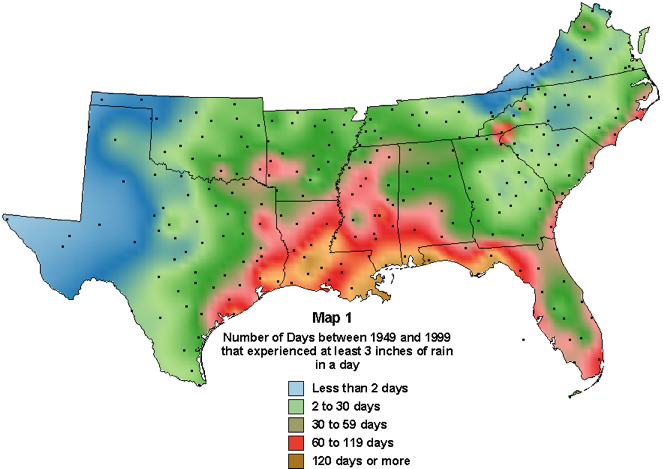
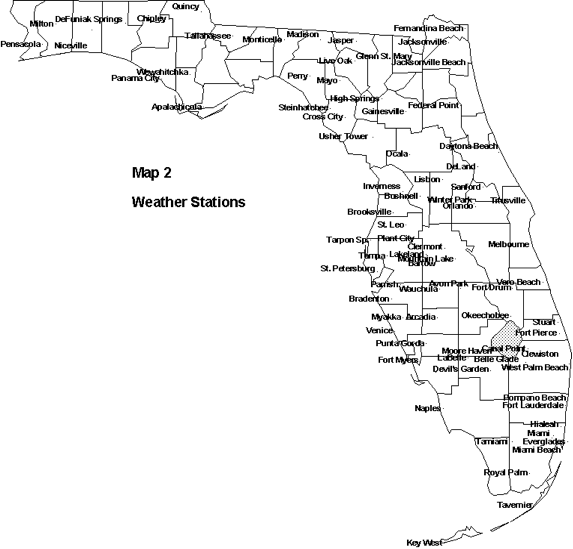
Florida lies within a broad region along the Gulf and Atlantic coastal plains of the southeastern U.S. that experiences frequent episodes of torrential rain (Map 1). Torrential rain in Florida is here defined as three inches or more in one calendar day. Rain of this magnitude contributes approximately ten percent of the total precipitation that falls on the state, more in some parts of it, less in others. Along the coasts of both northwestern and southeastern Florida torrential rain makes the heaviest contribution, while in the interior of the peninsula it contributes the least. For several decades a Florida weather station held the nations record for the most rain to fall in a 24-hour period. Yankeetown, a small fishing port on the northwestern side of the peninsula, during September 5th, 1950 was swamped by 38.7 inches of rain. The village retained the national record until July 25th-26th, 1979 when 43 inches fell on Alvin, Texas, situated between Houston and Galveston. This record still stands.

Torrential rain, since it is usually accompanied by intense atmospheric turbulence, has the potential of causing much property damage, as well as the destruction of agricultural crops and livestock. Florida is especially vulnerable to flooding because it is both low and flat. Although the sandy soils of the Peninsula are capable of absorbing water rapidly, their ability to absorb large amounts is limited because the water table is normally very close to the surface. Most of the state’s densely populated areas are situated on the shore of either the Atlantic Ocean or the Gulf of Mexico, and are especially vulnerable to rainstorms. Not only are such storms more frequent than in the interior of the state, but a large share of the urban area is covered by pavement and roofs, which concentrate runoff into low areas. Most of Florida’s cities today have adequate storm drainage systems to meet the demands of a sudden intense downpour, but flooding, sometimes on a major scale, does occur.

The reader should be aware that the amount of daily precipitation, especially from the cooperative weather stations, which constitute the majority, is not necessarily that which fell between one midnight and another. Cooperative weather stations usually depend heavily on non-professional volunteers who read the gauges when it is convenient, hopefully each day at a time agreed upon. Few are read at or near midnight. Only a small number of Florida stations record hourly precipitation. Consequently, a rainstorm may begin during one calendar day and end in another. The total rainfall of the storm would then be shared by two days, and although it may be higher than three inches, if no calendar day had a total of three inches it would not be counted.

It should be noted that the monthly frequencies of torrential rain, if graphed, do not conform to a bell shaped curve, increasing to a peak in the hottest month of the year. Instead, the curve is bi-modal, there being two peaks, one in June and the other in September. It is presumed that the June peak is the result of the state then coming strongly under the influence of the intertropical convergence zone, and the September peak is due to the greater frequency in that month of tropical low pressure systems such as tropical storms reaching the state.

Note Fort Lauderdale is in a torrential rain hotspot just north of Miami.

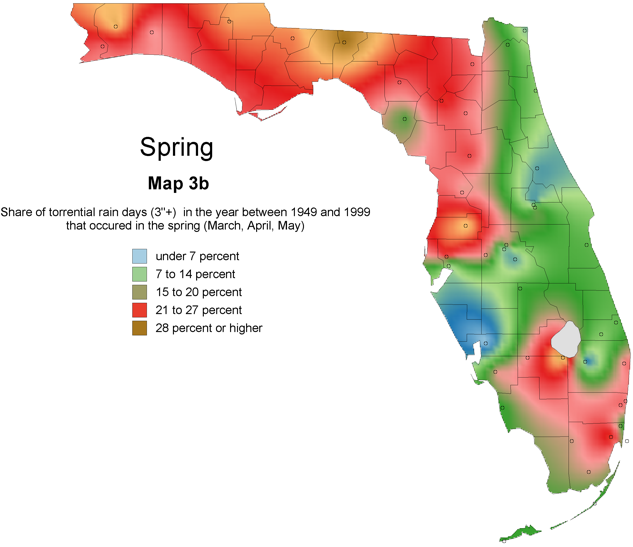
South Florida gets a significant part of its torrential rain during Springtime.

The ENSO (El Niño Southern Oscillation) phenomenon, which has been given much justified attention in recent years, is now generally regarded as being able to influence climate over a huge area of the world. It would be irresponsible to ignore the possibility that it could influence the frequency of Florida rainstorms. To ascertain if there is a relationship the three phases of Enso (El Niño, La Niña, and the neutral phase) the frequency of rainstorms were calculated by ENSO phase (Table 4). There does appear to be a relationship, and it doesn’t seem to be spurious. The share of the 48 Florida weather stations that reported no torrential rainstorms during a year is somewhat higher during the El Niño phase than the other two. The share of stations that reported only one storm during the years of the El Niño phase also was higher than the share of those that were reported in the La Niña phase. Thereafter, except for the shares of the ‘four storm’ category, the La Niña phase produced more torrential storms than the El Niño phase. In South Florida, It has become generally accepted that in La Niña years precipitation is generally wetter than during the El Niño phase. From the data we might conclude that weather controls that become important during this phase also promote a higher frequency of torrential rain. The neutral phase of Enso has little to no effect upon the frequency of Florida’s rainstorms, some neutral years producing many more episodes of torrential rain than others.

In conclusion it would be derelict not to address the issue of the relationship between the frequency of torrential rain in Florida and global warming. In studies of the consequence of global warming on climate the possibility of greater climatic extremes has been predicted, including storms that could produce large amounts of precipitation. This is usually based on the assumption among other factors, that the temperature of the water of the oceans would rise, heating the air above them, increasing evaporation and the air’s ability to hold water vapor and consequently its ability to produce more powerful rainstorms.

Table 5: Number of times 48 Florida weather stations
experienced at least 3″ of rainfall for
five decades between 1950 and 1999.

To ascertain if Florida has been experiencing an increase in the number of storms that produce torrential rain the torrential storm data for the 48 stations within the state which became the primary data source for this study were divided into the five decades between 1950 and 1999 (Table 5). When the average for the 50-year period is compared to the frequency by decade no trend is discovered. When the frequency in earlier decades is compared with the later ones there also appears to be no trend. For example, between 1950 and 1969, during that 20-year period there were 684 episodes at the 48 Florida weather stations in which 3 inches or more rain fell in one day, while in the 20-year period between 1980 and 1999 there were 695 episodes, a difference of only eleven episodes. The frequency of episodes during the year was also examined. An examination reveals, for example, that there were 23 stations between 1950 and 1969 that reported five episodes during the 20-year period, and between 1980 and 1999 the number fell to 20. Such a small drop does not suggest an increase in torrential rain over time.


2022 Hurricane Season Winding Down

The Atlantic hurricane season runs from June 1 through Nov. 30.  The official peak of the season was Sept. 10; Hurricane Ian made landfall on September 27. The season ends November 30 and in the past 172 years, only 13 tropical storms and 7 hurricane landfalls have occurred in the continental U.S. on or after October 27.

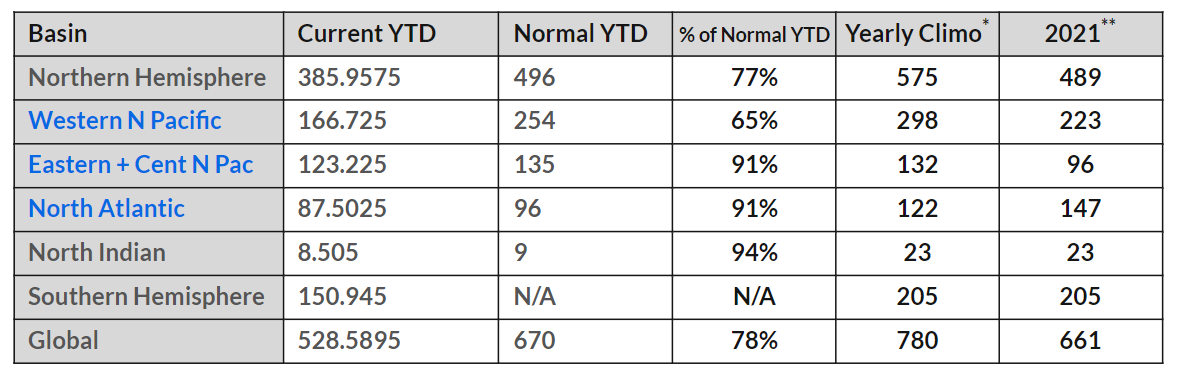
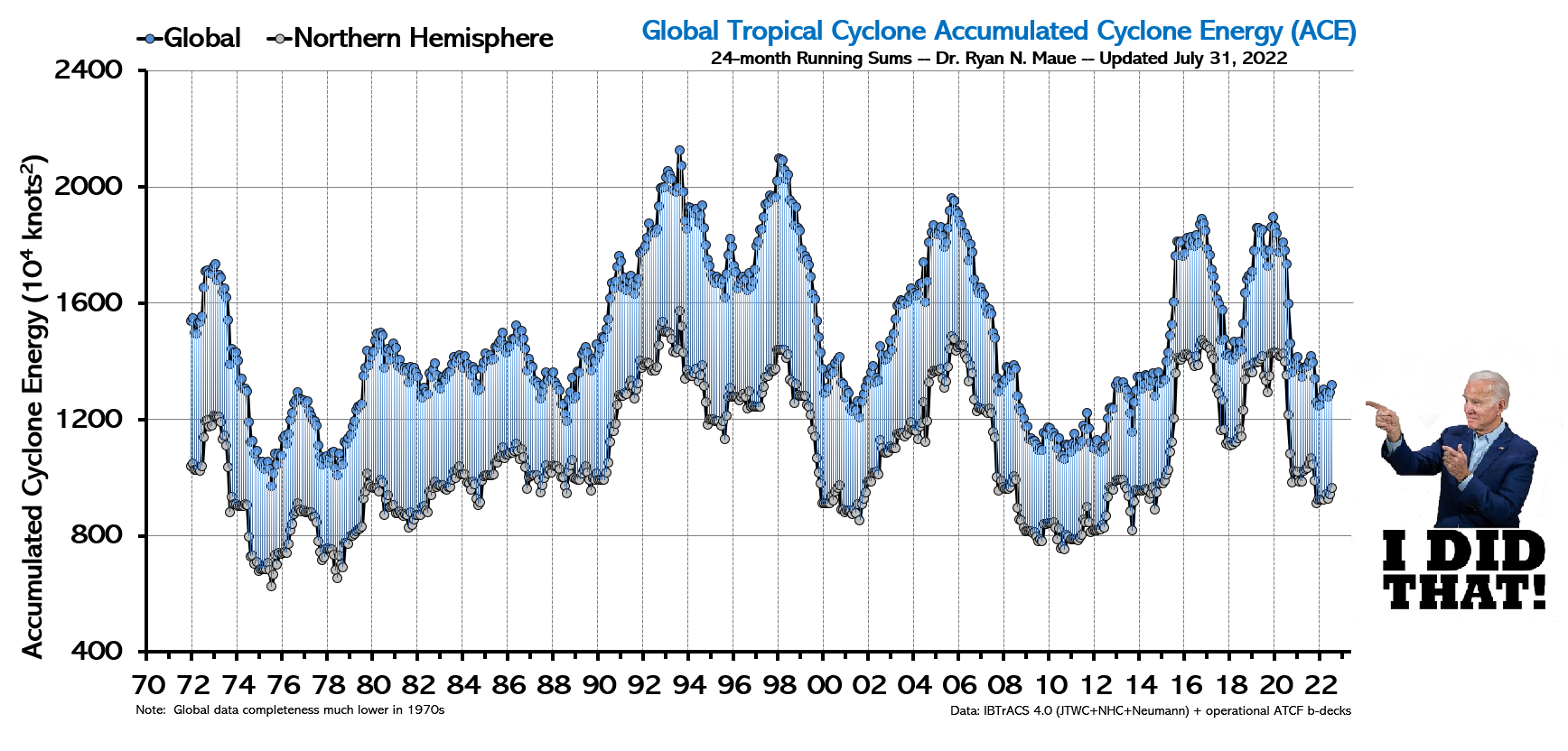
2022 Accumulated Cyclone Energy [ACE], updated October 31, 2022 by Dr. Ryan Maue *Yearly climatology from historical 1991-2020 Tropical cyclone best track datasets  Source: Global Tropical Cyclone Activity 

The chart shows NH is below a normal YTD, the difference being an unusually quiet Western Pacific.  Elsewhere, the activity is around 90% YTD.

The North Atlantic 2022 year to date (YTD) update by Dr. Maue includes 13 storms, 11 named, with three in October.

Alex 01L (60, ACE= 2.8325, June)
Bonnie 02L (50, ACE= 2.6525, June)
Colin 03L (35, ACE= 0.49, July)
PTC Four 04L (30, ACE= 0.0, July)
Danielle 05L (80, ACE= 12.545, Sep)
Earl 06L (90, ACE= 14.2225, Sep)
Fiona 07L (115, ACE= 26.2825, Sep)
Gaston 08L (55, ACE= 5.205, Sep)
Hermine 10L (35, ACE= 0.6125, Sep)
Ian 09L (135, ACE= 17.425, Sep)
TD 12L (30, ACE= 0.0, Oct)
Julia 13L (75, ACE= 2.87, Oct)
Karl 14L (50, ACE= 2.12, Oct)

Fiona and Ian were the two major hurricanes over 100 knots with the highest ACE, followed by Earl and Danielle. Julia was the fifth hurricane, > 64 knots. Nine storms were 5 ACE or less.

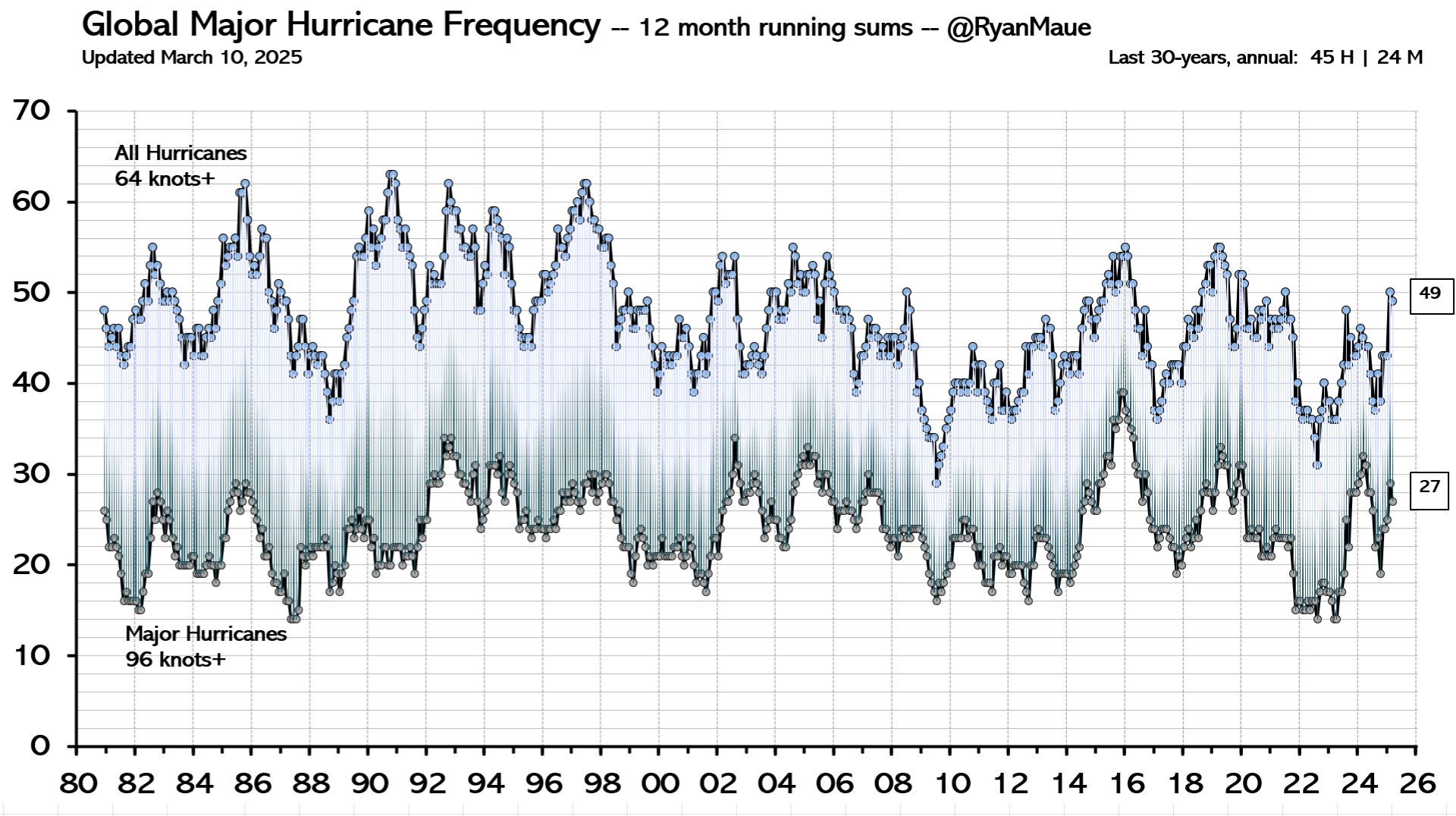
Figure: Global Hurricane Frequency (all & major) — 12-month running sums. The top time series is the number of global tropical cyclones that reached at least hurricane-force (maximum lifetime wind speed exceeds 64-knots). The bottom time series is the number of global tropical cyclones that reached major hurricane strength (96-knots+). Adapted from Maue (2011) GRL.

Background Post How Terrifying will be 2022 Hurricanes?

Jeffrey Folks wrote August 25, 2022, at American Thinker How Terrified Should We Be of Hurricane Season This Year?.  Excerpts in italics with my bolds and added images.

Once again, as nearly every year, officials at NOAA and other agencies called for 2022 to be a “very active” hurricane season. In its May 24 release, NOAA predicted “an “above-average hurricane activity this year — which would make it the seventh consecutive above-average hurricane season.” It’s like the old joke that everyone’s grandkid is “above average”: for some reason, every hurricane season, the risk is now “above average.”

I don’t know how every year can be “above average,” something that defies the laws of statistics. I suspect that it has to do with the strong bias of climate scientists rather than the strength of hurricanes. And in fact, hurricanes have been “fewer than average” this year and for many years recently.

So far, halfway through the hurricane season, no Atlantic storms have made landfall on U.S. soil.

This lack of severe storms defies the dire predictions of global warming alarmists: that rising temperatures will cause catastrophic storms. In reality, one reason why there are fewer and less severe storms this year is that the Atlantic waters have been cooler than usual. That, combined with drier air over the Atlantic, caused by the atmospheric drift of Saharan dust, has caused potential tropical storms to dissipate.

Predictions of “very active” storm seasons are widely publicized each spring, but the reality of fewer and less severe storms never makes its way into the media.

The truth is that some hurricane seasons are more active and some less so. The same is true of tornadoes, droughts, floods, and other natural phenomena. But only the extreme events get publicized and treated as confirmation of climate change. If the media were honest, they would report the truth that the weather has not changed a great deal, at least not since the end of the Little Ice Age in 1850 — and the warmer temperatures since then have been a blessing.

Global temperatures have risen one degree Celsius since the low point of 1850, so severe storms may be somewhat more common than in the distant past. But death rates have dropped precipitously. The worst hurricane in American history was the Great Galveston hurricane of September 8, 1900, which killed some 8,000 people. The worst tornado recorded in U.S. history was the Tri-State Tornado of March 18, 1925, which killed 751 people. Both of these storms occurred long before the period in which alarmists like Al Gore predicted that global warming would cause catastrophic storms — and clearly, they were not “man-made.”

We are safer now because of technology. With advance warning, populations can take shelter or evacuate, and a smartphone or weather radio is all that is necessary to receive warnings. As warning systems become more sophisticated, fewer people will die or be injured by severe weather events. But the development of those systems depends on the ability of individuals to pay for them, and recent government spending will make that less likely — just as it will affect medical research, transportation safety, and police protection.

In addition to the “regular” budget of $5 trillion, this year, Biden has appropriated $7 trillion in emergency spending, much of it for climate change. But that money is not intended to protect us from severe storms. It is being spent on green energy boondoggles that enrich connected insiders but impoverish average citizens. And that impoverishment is the heart of the problem.

With less wealth, it is more difficult to protect oneself against severe weather. Even in years like 2022, which have so far been less active than normal, homeowners must be vigilant if they live along the Atlantic Coast, especially in Florida and other hurricane-prone states. Three months of the hurricane season remain. The odds are that an Atlantic hurricane will strike the East Coast. If a hurricane does make landfall, the media will tout it as proof of the catastrophic effects of global warming. In reality, it will just prove that the climate hasn’t changed much.

Since the destructive 2004 hurricane season, Florida has required all new construction to incorporate tie-down roofing and storm-resistant glass, measures that have made life safer for residents. And since taking office, Gov. Ron DeSantis has maintained storm preparedness and worked to protect citizens of Florida.

But Biden’s ludicrously entitled “Inflation Reduction Act” does nothing to strengthen homes and businesses. Its primary aim is to reward Democrat donors, including unions and green energy corporations. How does the mandate of a “union wage” included in the bill help protect Americans against severe storms?

But prosperity really is the solution to global warming. There may or may not be more severe storms this year or the next. Human beings have no control over that. But they can control how well prepared they are for the events — that is, if government leaves them with enough money to do so.

See also Hurricanes Unrelated to CO2

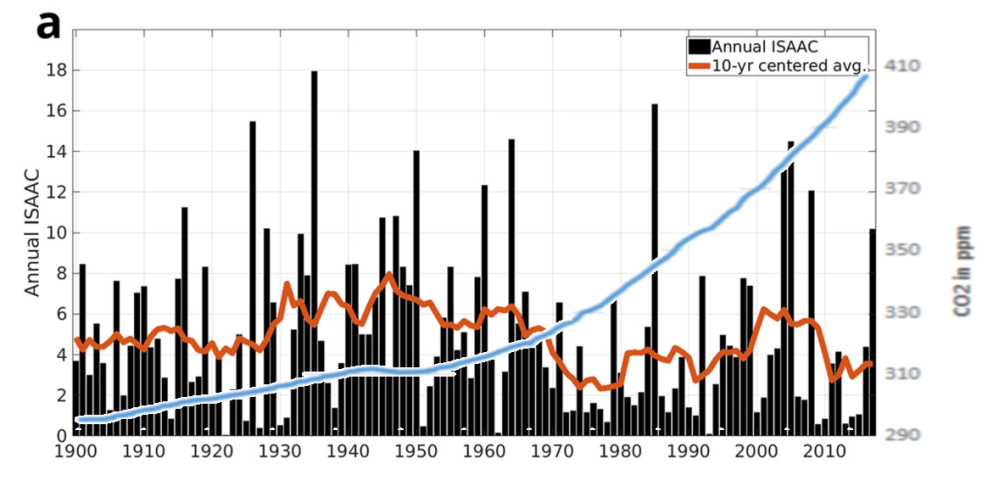
Integrated Storm Activity Annually over the Continental U.S. (ISAAC)

How Terrifying will be 2022 Hurricanes?

Jeffrey Folks writes at American Thinker How Terrified Should We Be of Hurricane Season This Year?.  Excerpts in italics with my bolds and added images.

Once again, as nearly every year, officials at NOAA and other agencies called for 2022 to be a “very active” hurricane season. In its May 24 release, NOAA predicted “an “above-average hurricane activity this year — which would make it the seventh consecutive above-average hurricane season.” It’s like the old joke that everyone’s grandkid is “above average”: for some reason, every hurricane season, the risk is now “above average.”

I don’t know how every year can be “above average,” something that defies the laws of statistics. I suspect that it has to do with the strong bias of climate scientists rather than the strength of hurricanes. And in fact, hurricanes have been “fewer than average” this year and for many years recently.

So far, halfway through the hurricane season, no Atlantic storms have made landfall on U.S. soil.

This lack of severe storms defies the dire predictions of global warming alarmists: that rising temperatures will cause catastrophic storms. In reality, one reason why there are fewer and less severe storms this year is that the Atlantic waters have been cooler than usual. That, combined with drier air over the Atlantic, caused by the atmospheric drift of Saharan dust, has caused potential tropical storms to dissipate.

Predictions of “very active” storm seasons are widely publicized each spring, but the reality of fewer and less severe storms never makes its way into the media.

The truth is that some hurricane seasons are more active and some less so. The same is true of tornadoes, droughts, floods, and other natural phenomena. But only the extreme events get publicized and treated as confirmation of climate change. If the media were honest, they would report the truth that the weather has not changed a great deal, at least not since the end of the Little Ice Age in 1850 — and the warmer temperatures since then have been a blessing.

Global temperatures have risen one degree Celsius since the low point of 1850, so severe storms may be somewhat more common than in the distant past. But death rates have dropped precipitously. The worst hurricane in American history was the Great Galveston hurricane of September 8, 1900, which killed some 8,000 people. The worst tornado recorded in U.S. history was the Tri-State Tornado of March 18, 1925, which killed 751 people. Both of these storms occurred long before the period in which alarmists like Al Gore predicted that global warming would cause catastrophic storms — and clearly, they were not “man-made.”

We are safer now because of technology. With advance warning, populations can take shelter or evacuate, and a smartphone or weather radio is all that is necessary to receive warnings. As warning systems become more sophisticated, fewer people will die or be injured by severe weather events. But the development of those systems depends on the ability of individuals to pay for them, and recent government spending will make that less likely — just as it will affect medical research, transportation safety, and police protection.

In addition to the “regular” budget of $5 trillion, this year, Biden has appropriated $7 trillion in emergency spending, much of it for climate change. But that money is not intended to protect us from severe storms. It is being spent on green energy boondoggles that enrich connected insiders but impoverish average citizens. And that impoverishment is the heart of the problem.

With less wealth, it is more difficult to protect oneself against severe weather. Even in years like 2022, which have so far been less active than normal, homeowners must be vigilant if they live along the Atlantic Coast, especially in Florida and other hurricane-prone states. Three months of the hurricane season remain. The odds are that an Atlantic hurricane will strike the East Coast. If a hurricane does make landfall, the media will tout it as proof of the catastrophic effects of global warming. In reality, it will just prove that the climate hasn’t changed much.

Since the destructive 2004 hurricane season, Florida has required all new construction to incorporate tie-down roofing and storm-resistant glass, measures that have made life safer for residents. And since taking office, Gov. Ron DeSantis has maintained storm preparedness and worked to protect citizens of Florida.

But Biden’s ludicrously entitled “Inflation Reduction Act” does nothing to strengthen homes and businesses. Its primary aim is to reward Democrat donors, including unions and green energy corporations. How does the mandate of a “union wage” included in the bill help protect Americans against severe storms?

But prosperity really is the solution to global warming. There may or may not be more severe storms this year or the next. Human beings have no control over that. But they can control how well prepared they are for the events — that is, if government leaves them with enough money to do so.


See also Hurricanes Unrelated to CO2

Integrated Storm Activity Annually over the Continental U.S. (ISAAC)


All About Hurricanes

And there is the University of Miami Hurricanes sports team logo:

But many are interested in what to make of the latest one, Hurricane Ida.  She did after all flood the US Open tennis venue one night, although matches resumed the next day.

And in Louisiana, the flooding was major, although the new dikes in New Orleans held.

Of course the media, always certain of their story and impervious to contrary facts and details, declared Ida proof positive of a climate “emergency.”

Some anonymous scribbler put the PC words in Biden’s mouth:

Scientists have warned about extreme weather “for decades” and the U.S. doesn’t have “any more time” to confront it, he said.  “Every part of the country is getting hit by extreme weather, and we’re now living in real time what the country’s going to look like,” Biden told reporters.  Hurricane Ida Is An ‘Opportunity’ to Act on ‘Global Warming’ – ‘We either act or we’re going to be in real, real trouble’.

So what to make of these storms and the threat of global warming climate change?

Firstly,these storms are dangerous.  As the joke goes:

Q: Why are storms named after women?
A: Because they come in hot and steamy, then they leave with your house and car.

Of course, this is now considered sexist, in spite of the traditional respect for women as forces of nature.  In fact, nowadays in the age of genderism, some parents name their newborns “Storm” in order to leave their kids’ options open.  But I digress.

This post is really about understanding tropical storms in their historical context.  And for that we have an excellent recent scientific study published in Nature Changes in Atlantic major hurricane frequency since the late-19th century. by Vecchi, Landsea et al. Excerpts in italics with my bolds.

Introduction

Tropical cyclones (TCs) are of intense scientific interest and are a major threat to human life and property across the globe. Of particular interest are multi-decadal changes in TC frequency arising from some combination of intrinsic variability in the weather and climate system, and the response to natural and anthropogenic climate forcing.  Even though the North Atlantic (NA) basin is a minor contributor to global TC frequency, Atlantic hurricanes (HUs) have been the topic of considerable research both because of the long-term records of their track and frequency that exist for this basin, and because of their impacts at landfall. It is convenient and common to consider Saffir-Simpson Categories 3–5 (peak sustained winds exceeding 50 ms−1) HUs separately from the overall frequency, and label them major hurricanes, or MHs. Historically, MHs have accounted for ~80% of hurricane-related damage in the United States of America (USA) despite only representing 34% of USA TC occurrences.

Globally, models and theoretical arguments indicate that in a warming world the HU peak intensity and intensification rate should increase, so that there is a tendency for the fraction of HU reaching high Saffir-Simpson Categories (3, 4, or 5) to increase in models in response to CO2 increases, yet model projections are more mixed regarding changes in the frequency of MHs in individual basins.

Has there been a century-scale change in the number of the most intense hurricanes in the North Atlantic?

Due to changes in observing practices, severe inhomogeneities exist in this database, complicating the assessment of long-term changes.  In particular, there has been a substantial increase in monitoring capacity over the past 170 years, so that the probability that a HU is observed is substantially higher in the present than early in the record; the recorded increase in both Atlantic TC and HU frequency in HURDAT2 since the late-19th century is consistent with the impact of known changes in observing practices. Major hurricane frequency estimates can also be impacted by changing observing systems

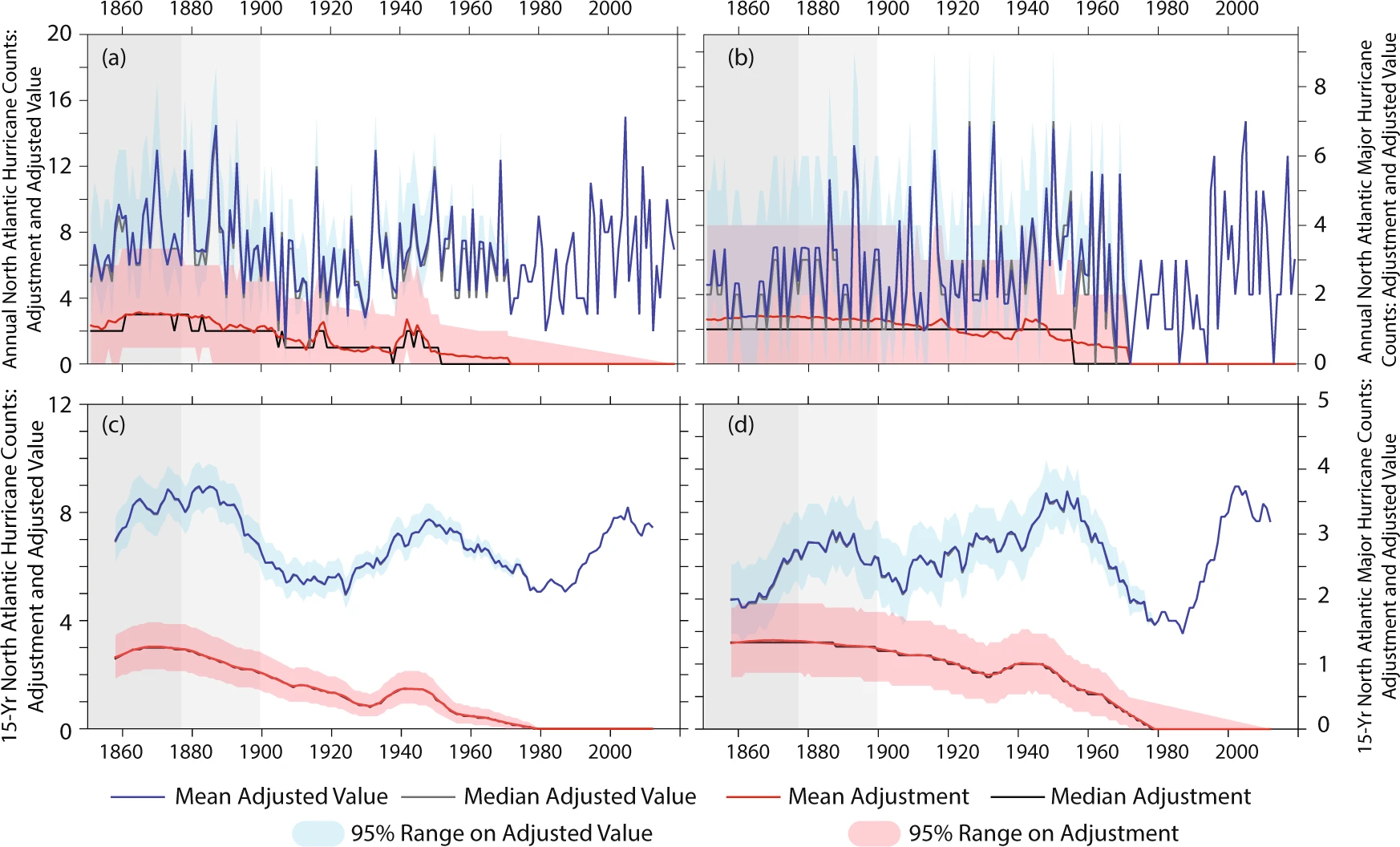
Hurricane and major hurricane frequency adjusted for missing storms

Previous work has led to the development of a number of methods to estimate the impact of changing observing capabilities on the recorded increase in basin-wide HU frequency between 1878 and 2008 (ref. 10). We here update the analysis of ref. 10 to build an adjustment to recorded HU counts over 1851–1971, based on the characteristics of observed HUs over 1972–2019. We then extend that methodology to build an adjustment to recorded MH counts over 1851–1971, based on MHs recorded over 1972–2019 (see “Methods”).

Once the adjustment is added to the recorded number of Atlantic HUs and MHs, substantial year-to-year and decade-to-decade variability is still present in the data, with the late-19th, mid-20th and early-21st centuries showing relative maxima, and the early 20th and late 20th centuries showing local minima (Fig. 2). However, after adjustment, the recent epoch (1995–2019) does not stand out as unprecedented in either basin-wide HU or MH frequency. There have been notable years since 2000 in terms of basin-wide HU frequency, but we cannot exclude at the 95% level that the most active years in terms of NA basin-wide HU or MH frequency occurred in either the 19th century or mid-20th century (blue lines and shading in Fig. 2a, b). Further, we cannot exclude that the most active epoch for NA HU frequency was in the late-19th century, with the mid-20th century comparable to the early-21st in terms of basin-wide HU frequency. The 19th century maximum in activity is more pronounced in overall frequency than in MH frequency, while the late-20th century multi-decadal temporary dip in MH frequency stands out relative to that in the early-20th century.

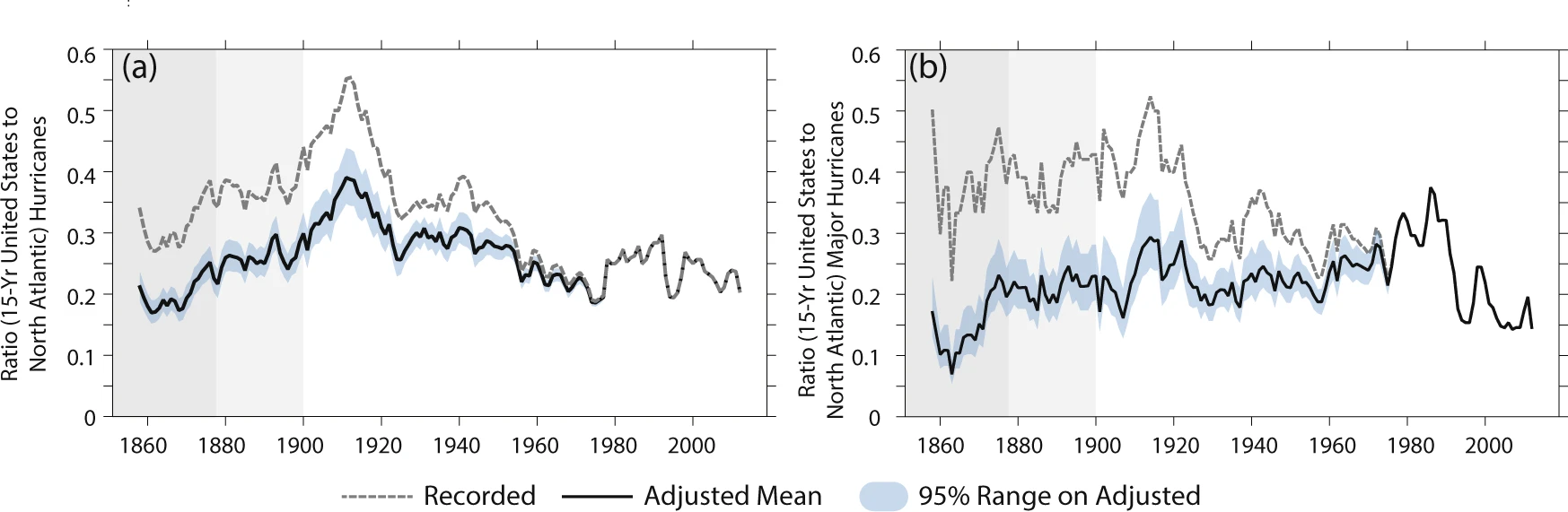
Ratio of the 15-year running count of United States of America (USA) strikes and 15-year running count of basin-wide frequency for hurricanes (a) and major hurricanes (b). Dotted gray line shows the values based on the recorded version 2 of the North Atlantic Hurricane Database (HURDAT2, ref. 33) frequency, while the thick solid line shows the value based on the HURDAT2 recorded USA strikes and the adjusted basin-wide frequencies; blue shading shows the 95% range on the ratio based on a Bootstrap sampling of the adjustment values. Gray background shading is as in Fig. 1, and highlights times where we have reduced confidence in the basin-wide and USA strike frequency estimates even after adjusting for likely missing storms.

Conclusion

Caution should be taken in connecting recent changes in Atlantic hurricane activity to the century-scale warming of our planet.

The adjusted records presented here provide a century-scale context with which to interpret recent studies indicating a significant recent increase in NA MH/HU ratio over 1980–2017 (ref. 14), or in the fraction of NA tropical storms that rapidly intensified over 1982–2009 (ref. 15). Our results indicate that the recent increase in NA basin-wide MH/HU ratio or MH frequency is not part of a century-scale increase. Rather it is a rebound from a deep local minimum in the 1960s–1980s.

We hypothesize that these recent increases contain a substantial, even dominant, contribution from internal climate variability, and/or late-20th century aerosol increases and subsequent decreases, in addition to any contributions from recent greenhouse gas-induced warming. It has been hypothesized, for example, that aerosol-induced reductions in surface insolation over the tropical Atlantic since between the mid-20th century and the 1980s may have resulted in an inhibition of tropical cyclone activity; the relative contributions of anthropogenic sulfate aerosols, dust, and volcanic aerosols to this signal (each of which would carry distinct implications for future hurricane evolution)—along with the magnitude and impact of aerosol-mediated cloud changes—remain a vigorous topic of scientific inquiry. It has also been suggested that multi-decadal climate variations connected to changes in meridional ocean overturning may have resulted in a minimum in northward heat transport in the Atlantic and a resulting reduction in Atlantic hurricane activity.

Given the uncertainties that presently exist in understanding multi-decadal climate variability, the climate response to aerosols and impact of greenhouse gas warming on NA TC activity, care must be exercised in not over-interpreting the implications of, and causes behind, these recent NA MH increases. Disentangling the relative impact of multiple climate drivers on NA MH activity is crucial to building a more confident assessment of the likely course of future HU activity in a world where the effects of greenhouse gas changes are expected to become increasingly important.


Footnote:

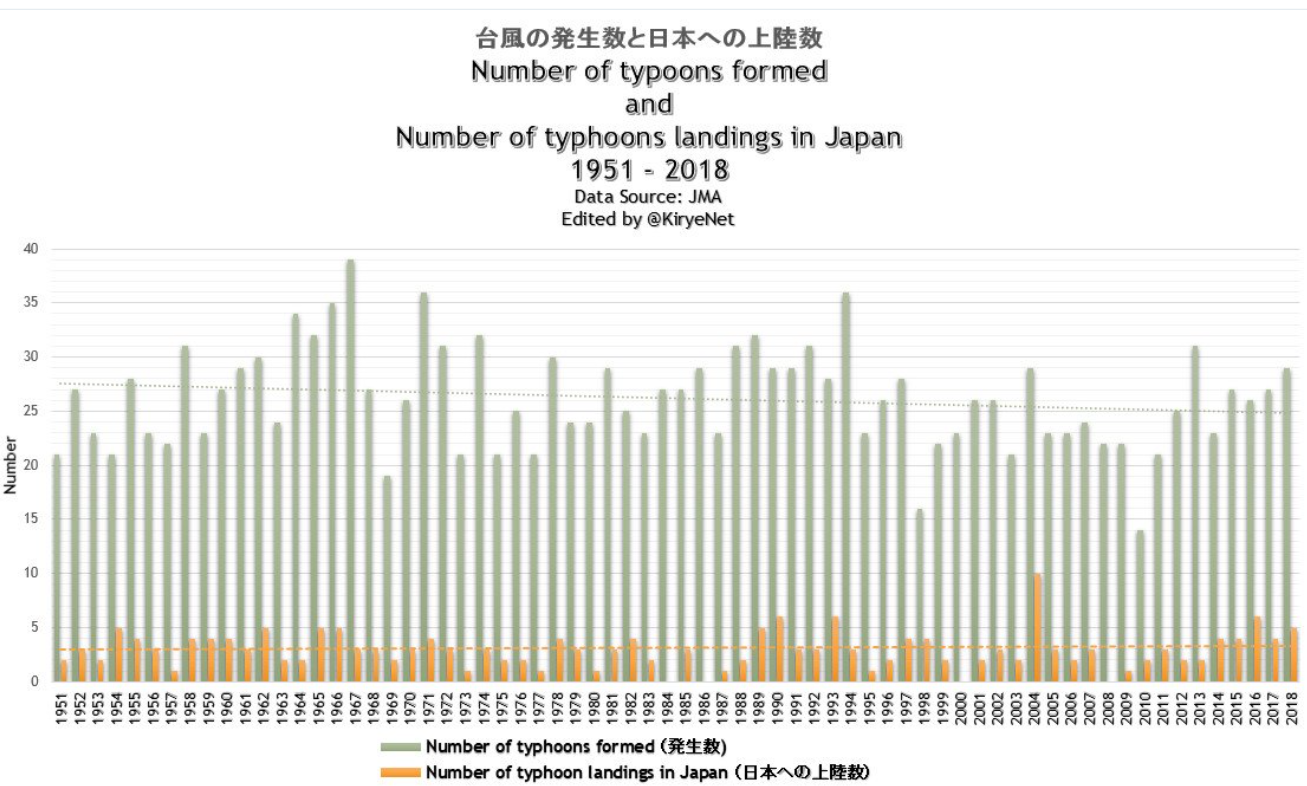
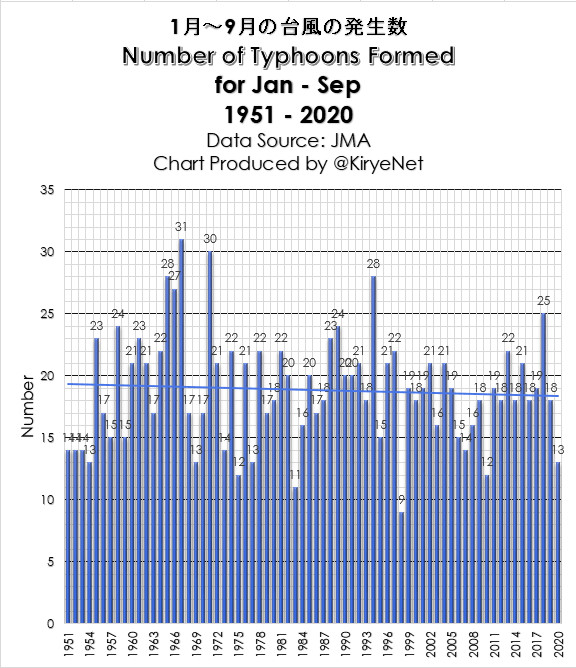
Pacific hurricanes (typhoons) also show no increase with global warming


Hurricane Season Overview Oct. 11

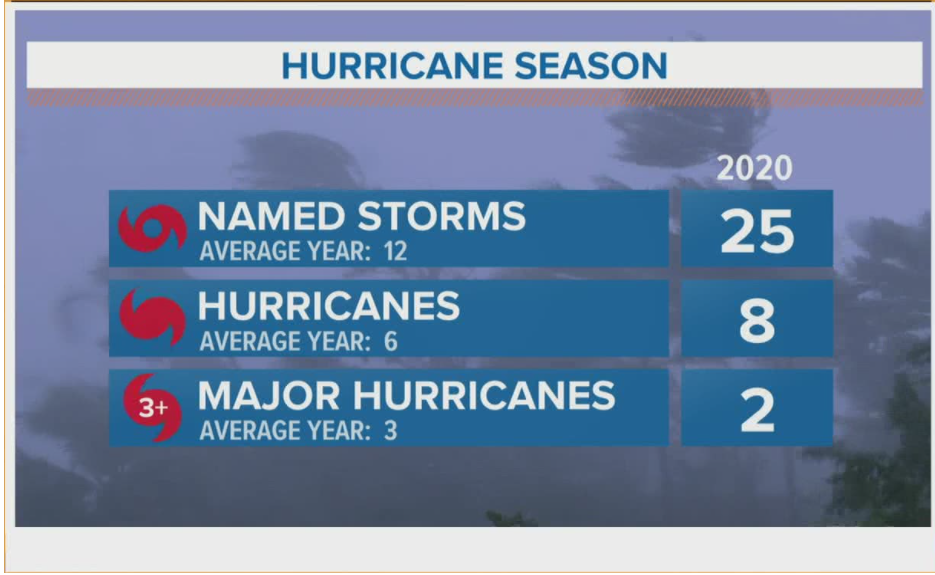
Your weather channel is airing charts like this to show how active is this year’s storm season impacting the Caribbean and US east coast.  So far, there have been many more named storms, two more hurricanes than average, and one less major hurricane at this point in the season.  Dr. Ryan Maue provides (here) a global context for understanding storm activity this year, updated October 11, 2020.

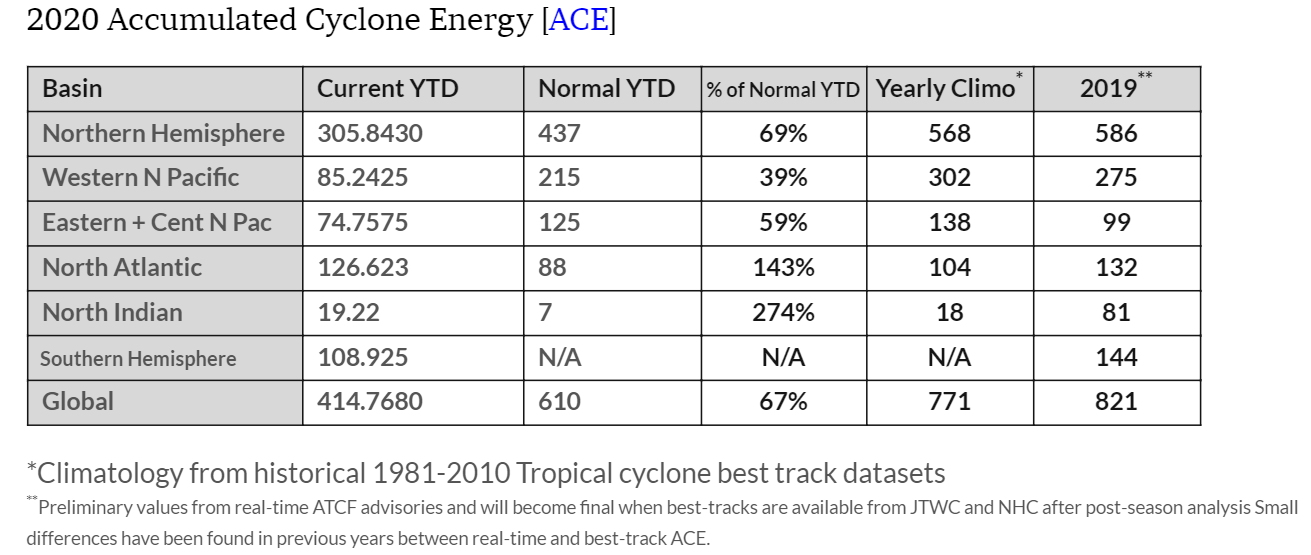
So globally, the ACE (Accumulated Cyclone Energy) is 2/3 of the average 1981-2010 at this point in the season.  ACE compiles the storm strengths as well the the number of storms.  Clearly the North Atlantic is 143% of average, but slightly behind 2019.  This indicates that many of the named storms were not that strong.

Meanwhile the Northern Hemisphere is running 69% of average and well behind last year.  This is due to North Pacific having a quiet season offsetting North Atlantic activity.  See the graph below from RealClimateScience

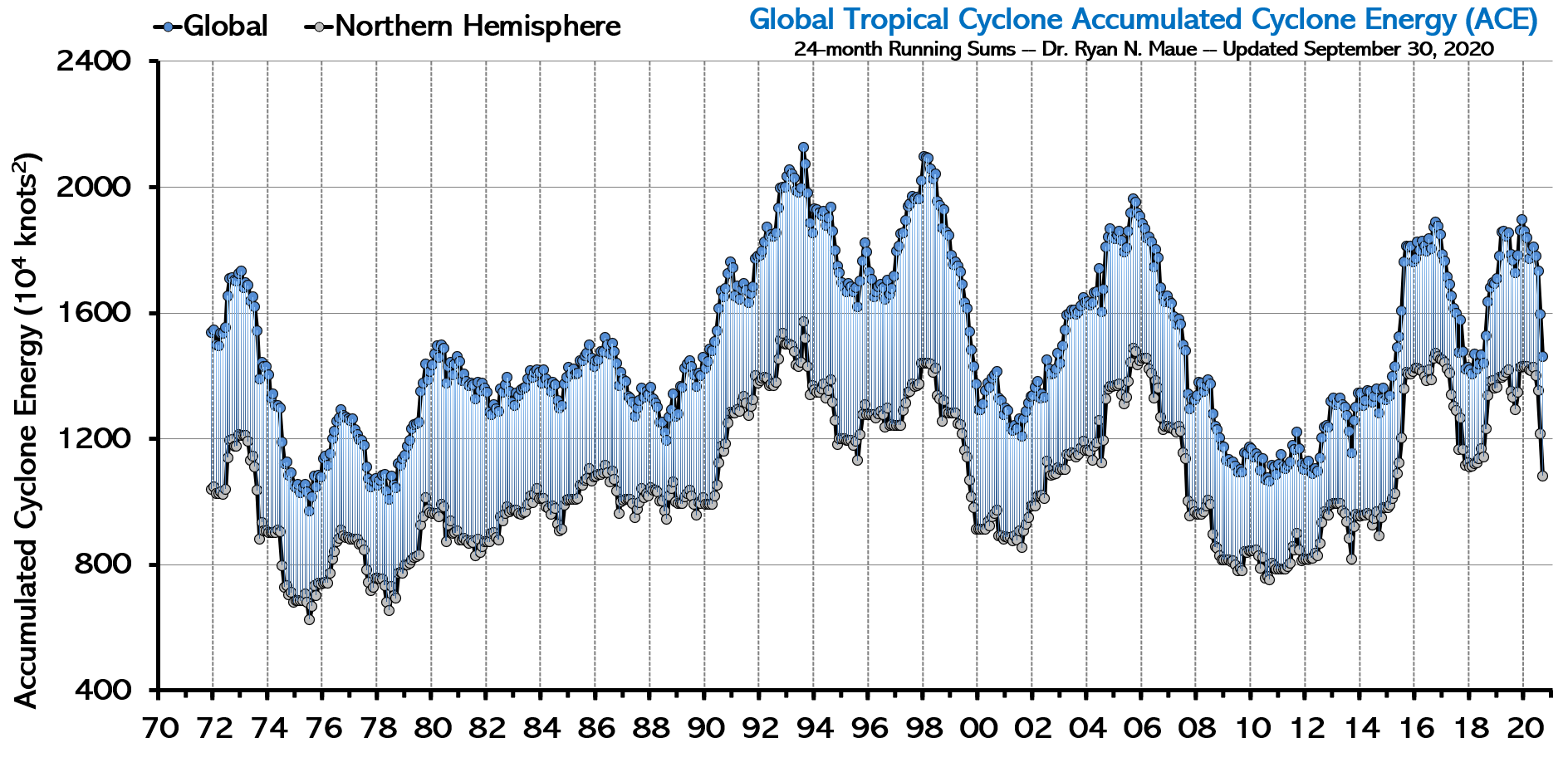
The historical summary of Tropical Hurricane ACE as of September 30, 2020:

Figure: Last 50-years+ of Global and Northern Hemisphere Accumulated Cyclone Energy: 24 month running sums. Note that the year indicated represents the value of ACE through the previous 24-months for the Northern Hemisphere (bottom line/gray boxes) and the entire global (top line/blue boxes). The area in between represents the Southern Hemisphere total ACE.

The hiatus of storms lasted a decade after 2006 (Thanks Global Warming).  Now seasons are more active (Your fault Global Warming), though somewhat less than previous peaks.   Maybe it’s Mother Nature after all.

Why the Left Coast is Still Burning

Update September 13, 2020:  This reprint of a post two years ago shows nothing has changed, except for the worse.

It is often said that truth is the first casualty in the fog of war. That is especially true of the war against fossil fuels and smoke from wildfires. The forests are burning in California, Oregon and Washington, all of them steeped in liberal, progressive and post-modern ideology. There are human reasons that fires are out of control in those places, and it is not due to CO2 emissions. As we shall see, Zinke is right and Brown is wrong. Some truths the media are not telling you in their drive to blame global warming/climate change. Text below is excerpted from sources linked at the end.

1. The World and the US are not burning.

The geographic extent of this summer’s forest fires won’t come close to the aggregate record for the U.S. Far from it. Yes, there are some terrible fires now burning in California, Oregon, and elsewhere, and the total burnt area this summer in the U.S. is likely to exceed the 2017 total. But as the chart above shows, the burnt area in 2017 was less than 20% of the record set way back in 1930. The same is true of the global burnt area, which has declined over many decades.

In fact, this 2006 paper reported the following:

“Analysis of charcoal records in sediments [31] and isotope-ratio records in ice cores [32] suggest that global biomass burning during the past century has been lower than at any time in the past 2000 years. Although the magnitude of the actual differences between pre-industrial and current biomass burning rates may not be as pronounced as suggested by those studies [33], modelling approaches agree with a general decrease of global fire activity at least in past centuries [34]. In spite of this, fire is often quoted as an increasing issue around the globe [11,26–29].”

People have a tendency to exaggerate the significance of current events. Perhaps the youthful can be forgiven for thinking hot summers are a new phenomenon. Incredibly, more “seasoned” folks are often subject to the same fallacies. The fires in California have so impressed climate alarmists that many of them truly believe global warming is the cause of forest fires in recent years, including the confused bureaucrats at Cal Fire, the state’s firefighting agency. Of course, the fires have given fresh fuel to self-interested climate activists and pressure groups, an opportunity for greater exaggeration of an ongoing scare story.

This year, however, and not for the first time, a high-pressure system has been parked over the West, bringing southern winds up the coast along with warmer waters from the south, keeping things warm and dry inland. It’s just weather, though a few arsonists and careless individuals always seem to contribute to the conflagrations. Beyond all that, the impact of a warmer climate on the tendency for biomass to burn is considered ambiguous for realistic climate scenarios.

2. Public forests are no longer managed due to litigation.

According to a 2014 white paper titled; ‘Twenty Years of Forest Service Land Management Litigation’, by Amanda M.A. Miner, Robert W. Malmsheimer, and Denise M. Keele: “This study provides a comprehensive analysis of USDA Forest Service litigation from 1989 to 2008. Using a census and improved analyses, we document the final outcome of the 1125 land management cases filed in federal court. The Forest Service won 53.8% of these cases, lost 23.3%, and settled 22.9%. It won 64.0% of the 669 cases decided by a judge based on cases’ merits. The agency was more likely to lose and settle cases during the last six years; the number of cases initiated during this time varied greatly. The Pacific Northwest region along with the Ninth Circuit Court of Appeals had the most frequent occurrence of cases. Litigants generally challenged vegetative management (e.g. logging) projects, most often by alleging violations of the National Environmental Policy Act and the National Forest Management Act. The results document the continued influence of the legal system on national forest management and describe the complexity of this litigation.”

There is abundant evidence to support the position that when any forest project posits vegetative management in forests as a pretense for a logging operation, salvage or otherwise, litigation is likely to ensue, and in addition to NEPA, the USFS uses the Property Clause to address any potential removal of ‘forest products’. Nevertheless, the USFS currently spends more than 50% of its total budget on wildfire suppression alone; about $1.8 billion annually, while there is scant spending for wildfire prevention.

3. Mega fires are the unnatural result of fire suppression.

And what of the “mega-fires” burning in the West, like the huge Mendocino Complex Fire and last year’s Thomas Fire? Unfortunately, many decades of fire suppression measures — prohibitions on logging, grazing, and controlled burns — have left the forests with too much dead wood and debris, especially on public lands. From the last link:

“Oregon, like much of the western U.S., was ravaged by massive wildfires in the 1930s during the Dust Bowl drought. Megafires were largely contained due to logging and policies to actively manage forests, but there’s been an increasing trend since the 1980s of larger fires.

Active management of the forests and logging kept fires at bay for decades, but that largely ended in the 1980s over concerns too many old growth trees and the northern spotted owl. Lawsuits from environmental groups hamstrung logging and government planners cut back on thinning trees and road maintenance.

[Bob] Zybach [a forester] said Native Americans used controlled burns to manage the landscape in Oregon, Washington and northern California for thousands of years. Tribes would burn up to 1 million acres a year on the west coast to prime the land for hunting and grazing, Zybach’s research has shown.

‘The Indians had lots of big fires, but they were controlled,’ Zybach said. ‘It’s the lack of Indian burning, the lack of grazing’ and other active management techniques that caused fires to become more destructive in the 19th and early 20th centuries before logging operations and forest management techniques got fires under control in the mid-20th Century.”

4. Bad federal forest administration started in 1990s.

Bob Zybach feels like a broken record. Decades ago he warned government officials allowing Oregon’s forests to grow unchecked by proper management would result in catastrophic wildfires.

While some want to blame global warming for the uptick in catastrophic wildfires, Zybach said a change in forest management policies is the main reason Americans are seeing a return to more intense fires, particularly in the Pacific Northwest and California where millions of acres of protected forests stand.

“We knew exactly what would happen if we just walked away,” Zybach, an experienced forester with a PhD in environmental science, told The Daily Caller News Foundation.

Zybach spent two decades as a reforestation contractor before heading to graduate school in the 1990s. Then the Clinton administration in 1994 introduced its plan to protect old growth trees and spotted owls by strictly limiting logging.  Less logging also meant government foresters weren’t doing as much active management of forests — thinnings, prescribed burns and other activities to reduce wildfire risk.

Zybach told Evergreen magazine that year the Clinton administration’s plan for “naturally functioning ecosystems” free of human interference ignored history and would fuel “wildfires reminiscent of the Tillamook burn, the 1910 fires and the Yellowstone fire.”

Between 1952 and 1987, western Oregon saw only one major fire above 10,000 acres. The region’s relatively fire-free streak ended with the Silver Complex Fire of 1987 that burned more than 100,000 acres in the Kalmiopsis Wilderness area, torching rare plants and trees the federal government set aside to protect from human activities. The area has burned several more times since the 1980s.

“Mostly fuels were removed through logging, active management — which they stopped — and grazing,” Zybach said in an interview. “You take away logging, grazing and maintenance, and you get firebombs.”

Now, Oregonians are dealing with 13 wildfires engulfing 185,000 acres. California is battling nine fires scorching more than 577,000 acres, mostly in the northern forested parts of the state managed by federal agencies.

The Mendocino Complex Fire quickly spread to become the largest wildfire in California since the 1930s, engulfing more than 283,000 acres. The previous wildfire record was set by 2017’s Thomas Fire that scorched 281,893 acres in Southern California.

While bad fires still happen on state and private lands, most of the massive blazes happen on or around lands managed by the U.S. Forest Service and other federal agencies, Zybach said. Poor management has turned western forests into “slow-motion time bombs,” he said.

A feller buncher removing small trees that act as fuel ladders and transmit fire into the forest canopy.

5. True environmentalism is not nature love, but nature management.

While wildfires do happen across the country, poor management by western states has served to turn entire regions into tinderboxes. By letting nature play out its course so close to civilization, this is the course California and Oregon have taken.

Many in heartland America and along the Eastern Seaboard often see logging and firelines if they travel to a rural area. This is part and parcel of life outside of the city, where everyone knows that because of a few minor eyesores their houses and communities are safer from the primal fury of wildfires.

In other words, leaving the forests to “nature,” and protecting the endangered Spotted Owl created denser forests––300-400 trees per acre rather than 50-80–– with more fuel from the 129 million diseased and dead trees that create more intense and destructive fires. Yet California spends more than ten times as much money on electric vehicle subsidies ($335 million) than on reducing fuel in a mere 60,000 of 33 million acres of forests ($30 million).

Rancher Ross Frank worries that funding to fight fires in Western communities like Chumstick, Wash., has crowded out important land management work. Rowan Moore Gerety/Northwest Public Radio

Once again, global warming “science” is a camouflage for political ideology and gratifying myths about nature and human interactions with it. On the one hand, progressives seek “crises” that justify more government regulation and intrusion that limit citizen autonomy and increase government power. On the other, well-nourished moderns protected by technology from nature’s cruel indifference to all life can afford to indulge myths that give them psychic gratification at little cost to their daily lives.

As usual, bad cultural ideas lie behind these policies and attitudes. Most important is the modern fantasy that before civilization human beings lived in harmony and balance with nature. The rise of cities and agriculture began the rupture with the environment, “disenchanting” nature and reducing it to mere resources to be exploited for profit. In the early 19thcentury, the growth of science that led to the industrial revolution inspired the Romantic movement to contrast industrialism’s “Satanic mills” and the “shades of the prison-house,” with a superior natural world and its “beauteous forms.” In an increasingly secular age, nature now became the Garden of Eden, and technology and science the signs of the fall that has banished us from the paradise enjoyed by humanity before civilization.

The untouched nature glorified by romantic environmentalism, then, is not our home. Ever since the cave men, humans have altered nature to make it more conducive to human survival and flourishing. After the retreat of the ice sheets changed the environment and animal species on which people had depended for food, humans in at least four different regions of the world independently invented agriculture to better manage the food supply. Nor did the American Indians, for example, live “lightly on the land” in a pristine “forest primeval.” They used fire to shape their environment for their own benefit. They burned forests to clear land for cultivation, to create pathways to control the migration of bison and other game, and to promote the growth of trees more useful for them.

Remaining trees and vegetation on the forest floor are more vigorous after removal of small trees for fuels reduction.

And today we continue to improve cultivation techniques and foods to make them more reliable, abundant, and nutritious, not to mention more various and safe. We have been so successful at managing our food supply that today one person out of ten provides food that used to require nine out of ten, obesity has become the plague of poverty, and famines result from political dysfunction rather than nature.

That’s why untouched nature, the wild forests filled with predators, has not been our home. The cultivated nature improved by our creative minds has. True environmentalism is not nature love, but nature management: applying skill and technique to make nature more useful for humans, at the same time conserving resources so that those who come after us will be able to survive. Managing resources and exploiting them for our benefit without destroying them is how we should approach the natural world. We should not squander resources or degrade them, not because of nature, but because when we do so, we are endangering the well-being of ourselves and future generations.

Conclusion

The annual burnt area from wildfires has declined over the past ninety years both in the U.S. and globally. Even this year’s wildfires are unlikely to come close to the average burn extent of the 1930s. The large wildfires this year are due to a combination of decades of poor forest management along with a weather pattern that has trapped warm, dry air over the West. The contention that global warming has played a causal role in the pattern is balderdash, but apparently that explanation seems plausible to the uninformed, and it is typical of the propaganda put forward by climate change interests.

Sources: 

https://www.frontpagemag.com/fpm/271044/junk-science-and-leftist-folklore-have-set-bruce-thornton

https://www.4baseball.com/westernjournal.com/after-libs-blame-west-coast-fires-on-global-warming-forester-speaks-out/

https://sacredcowchips.net/tag/bob-zybach/

https://www.horsetalk.co.nz/2017/10/13/ecological-imbalance-wildfires-us-rangelands/

http://dailycaller.com/2018/08/08/mismanagement-forests-time-bombs/

Footnote:  So how do you want your forest fires, some small ones now or mega fires later?

Hurricane Hype (Again)

James Taylor explains at climaterealism Miami Herald Misleads Readers About Reassuring NOAA Hurricane Study.  A study finding calmer recent storm seasons was flipped into alarms about global warming/climate change.  Excerpts in italics with my bolds.

Among the top Google News search results this morning for “climate change,” the Miami Herald published an article asserting a new study shows global warming is causing more Atlantic hurricanes. In reality, the new study shows there is a declining trend in hurricanes in many parts of the world and concludes there will likely be a declining trend globally during the 21st century. Moreover, objective data show the number of Atlantic hurricanes is declining, just like the forecast global trend.

The National Oceanic and Atmospheric Administration (NOAA) study referenced by the Herald reports, “our climate models project decreases in the number of global TCs [tropical cyclones] toward the end of the 21st century due to the dominant effect of greenhouse gases on decreasing TC occurrence in most of the tropics, consistent with many previous studies.”

The NOAA study reported a trend of “substantial decreases” in Indian Ocean and North Pacific hurricanes is already detected in the record. The study asserts there has been an increase in Atlantic hurricanes since 1980, which “anthropogenic aerosols could have also influenced.”

The major takeaway from the NOAA study is there will be fewer hurricanes as the world continues its modest warming. That is good news. Rather than reporting good climate news, however, the Herald goes to great lengths to try to pull some bad news from a good-news study.

The only reason the authors of the NOAA study could report an increase in Atlantic hurricanes since 1980 is because the decade ending in 1980 was an abnormally low year, with the fewest number of Atlantic hurricanes on record. So, any trend line starting at the record-low point of 1980 will show more frequent hurricanes. However, a more complete and representative record shows a long-term and ongoing decline in Atlantic hurricanes. The graph below illustrates that point.

Located in Florida, the Miami Herald surprisingly did not mention two very important facts about hurricanes and Florida. As documented in Climate at a Glance: Hurricanes, Florida recently concluded an 11-year period (2005 through 2016) without a landfalling hurricane of any size—the longest such period in recorded history. The Gulf of Mexico also recently benefited from its longest hurricane-free period in recorded history (2013 through 2016).

For completely misleading its readers about the recent NOAA study, and for asserting the exact opposite of the truth regarding hurricane frequency and Atlantic hurricane frequency, the Miami Herald earns a gigantic Pinocchio award.

Footnote:  The 2020 consensus forecast for the coming hurricane season is for an active season (H/T trackthetropics)

GWO’s prediction calls for 16 named storms, 7 hurricanes and 3 to 4 major hurricanes. They note the United States can expect 5 named storms to make landfall, with 2 or 3 hurricane landfalls – one of which will likely be a major category 3 hurricane. Professor David Dilley – senior research scientist for GWO, says several favorable meteorological and climatological factors are in place to produce another above average hurricane season this year. Some of the factors include a 72-year ClimatePulse Hurricane Landfall Enhancement Cycle – coupled with the continuance of above normal warm Atlantic Ocean and Gulf of Mexico water temperatures – and the lack of either a moderate or strong El Niño to subdue the hurricane seasons. Entire forecast: https://www.globalweatheroscillations.com/

Of course, any storm making US landfall is big weather news, and the media is ready.