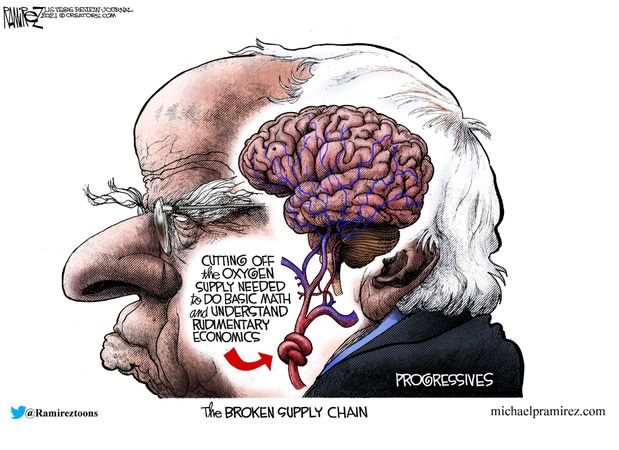
CV19 Lockdowns: High Pain/Gain Ratio

Douglas W. Allen published a study Covid-19 Lockdown Cost/Benefits: A Critical Assessment of the Literature in the International Journal of the Economics of Business. September 29, 2021. H/T Raymond  Excerpts in italics with my bolds and some added images

Abstract

An examination of over 100 Covid-19 studies reveals that many relied on false assumptions that over-estimated the benefits and under-estimated the costs of lockdown. The most recent research has shown that lockdowns have had, at best, a marginal effect on the number of Covid-19 deaths. Generally speaking, the ineffectiveness stemmed from individual changes in behavior: either non-compliance or behavior that mimicked lockdowns. The limited effectiveness of lockdowns explains why, after more than one year, the unconditional cumulative Covid-19 deaths per million is not negatively correlated with the stringency of lockdown across countries. Using a method proposed by Professor Bryan Caplan along with estimates of lockdown benefits based on the econometric evidence, I calculate a number of cost/benefit ratios of lockdowns in terms of life-years saved. Using a mid-point estimate for costs and benefits, the reasonable estimate for Canada is a cost/benefit ratio of 141. It is possible that lockdown will go down as one of the greatest peacetime policy failures in modern history.

Overview

The term ‘lockdown’ is used to generically refer to state actions that imposed various forms of non-pharmaceutical interventions. That is, it is used to include mandatory state-enforced closing of non-essential business, education, recreation, and spiritual facilities; mask and social distancing orders; stay-in-place orders; and restrictions on private social gatherings.

‘Lockdown’ does not refer to cases of ‘isolation,’ where a country was able to engage in an early and sufficient border closure that prevented trans-border transmission, followed by a mandated lockdown that eliminated the virus in the domestic population, which was then followed by perpetual isolation until the population is fully vaccinated. This strategy was adopted by a number of island countries like New Zealand.1 Here I will only consider lockdown as it took place in most of the world; that is, within a country where the virus became established.

The report begins with an examination of four critical assumptions often made within the context of estimating benefits and costs. Understanding these assumptions explains why early studies claimed that the benefits of lockdown were so high, and also explains why the predictions of those studies turned out to be false. Then I examine the major cost/benefit studies in roughly chronological order, and focus on the critical factor in these studies: distinguishing between mandated and voluntary changes in behavior. Preliminary work on the costs of lockdown is reviewed, and finally a simple cost/benefit methodology is used to generate several cost/benefit ratios of lockdown for my home country of Canada.

In no scenario does lockdown pass a cost/benefit test; indeed, the most reasonable estimates suggest that lockdown is a great policy disaster.

Discussion

Over the course of the Covid-19 pandemic, there has been no public evidence that governments around the world have considered both the benefit and cost sides of their policy decisions. To my knowledge, no government has provided any formal cost/benefit analysis of their actions. Indeed, the steady press conferences and news releases almost entirely focus on one single feature of the disease. Although the focus of government announcements has changed over the year, from ‘flattening the curve’, number of Covid-19 deaths, number of Covid19 cases, hospital capacity, and variant transmissions (especially the delta variant), there has seldom been any official mention of the costs of the actions taken to address these concerns.

The counterfactual number of cases/deaths

If lockdown reduces the transmission of the virus, the natural question to ask is ‘by how much?’ In other words, ‘but for the lockdown’ what would the level of infection/transmission/deaths be? What is the counterfactual to lockdowns?

Early in the pandemic the Neil Ferguson et al. (2020) model appeared to drive many lockdown decisions and was widely covered in the media. Figure 1 reproduces a key figure of that paper (Table 2, p. 8), and shows the results of various types of lockdown on occupied ICU beds. The symmetry, smoothness, and orderly appearance of the functions is a result of the mechanical nature of the model. This type of figure is found, in one form or another, in most papers based on a SIR model.

Figure 1 ICU projections from ICL model.

In Figure 1 the black ‘do nothing’ line is the counterfactual, while the other lines are various types of lockdowns. The harsher the lockdown, the ‘flatter’ the case load, with the blue line being the strongest lockdown. The difference between the black line and another line is the benefit of that particular lockdown in terms of cases delayed. Clearly the exponential growth of the ‘do nothing’ counterfactual leads to enormous differences, and makes lockdown look better.

Given the prediction that lockdowns would lower deaths by one-half, the authors made a dramatic recommendation: ‘We therefore conclude that epidemic suppression is the only viable strategy at the current time. The social and economic effects of the measures which are needed to achieve this policy goal will be profound.’ (Ferguson et al. 2020, p. 16). In retrospect it is remarkable that such a conclusion was drawn. The authors recognized that the ‘social and economic effects’ would be ‘profound,’ and that the predictions were based on the ‘unlikely’ behavioral assumption that there would be no change to individual reactions to the virus. However, given the large counterfactual numbers, presumably they felt no lockdown cost could justify remaining open.
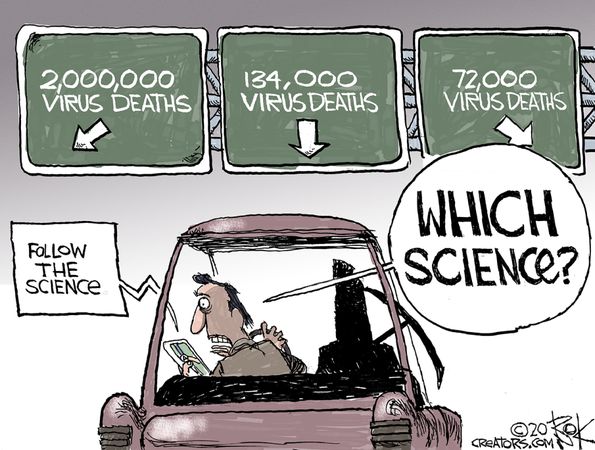
Problems with the ICL model were pointed out immediately:

i) the reproduction number (Rt) of 2.4 was too high;
ii) the assumed infection fatality rate (IFR) of 0.9% was too high and not age dependent;
iii) hospital capacity was assumed fixed and unchangeable; and
iv) individuals in the model were assumed to not change behavior in the face of a new virus.

All of these assumptions have the effect of over-estimating the counterfactual number of cases, transmissions, and deaths.

The exogenous behavior assumption

A major reason for the failure of SIR models to predict actual cases and deaths is because they assume no individual in the model ever changes behavior.9 The implication of ignoring individual responses to a viral threat are dramatic. Atkeson (2021) used a standard SIR model (with exogenous behavior) that included seasonal effects and the introduction of a more contagious variant in December 2020 to forecast daily U.S. deaths out to July 2023. The results of this standard model were typical: the model made apocalyptic predictions on deaths that were off by a factor of twelve by the summer of 2020. However, he then used the same model with a simple behavioral adjustment that allowed individuals to change behavior in light of the value of Rt. The new forecast of daily deaths based on this single addition completely changed the model’s predictive power. The model now tracked the actual progression of the daily deaths very closely.

The fact that individuals privately and voluntarily respond to risks has two important implications. First, it influences how any counterfactual outcome is understood with respect to the lockdown. When no voluntary response is assumed, models predict exponential caseloads and deaths without lockdowns. If lockdowns are imposed and cases coincidently fall, the actual number of cases is then compared to a counterfactual that never would have happened.11 Therefore, not accounting for rational, voluntary individual responses within a SIR model drastically over-states any benefit from lockdown.12

Second, any empirical work that considers only the total change in outcomes and does not attempt to separate the mandated effect from the voluntary effect, will necessarily attribute all of the change in outcome to the mandated lockdown. Once again, this will over-estimate the effect, and quite likely by an order of magnitude.

The assumed value of life

Economic value is based on the idea of maximum sacrifice. Thus, when it comes to the value of an individual’s life, this value is determined by the actual individual. In practice, what is measured is the marginal value to extend one’s life a little bit by reducing some type of harm, and then use this to determine a total value of life.

One problem with using the VSL for estimating the benefits of saving lives through lockdown is that it measures the total value of life based on a marginal value. Thus, using a VSL (which is based on observing ordinary people not at the point of death) as a measure of the value of a life of someone about to die, is likely to provide an over-estimate of the value of the life.

In many Covid-19 cost/benefit studies, however, there is another more serious problem with how the VSL is used. Namely, it is often assumed that

i) the VSL is independent of age, and
ii) that the VSL is equal to around $10,000,000.

Both of these claims are not true.

Figure 2. Age related estimates of VSL

To assume that the VSL is constant implies that individuals are indifferent between living one more day or eighty more years. Figure 2 shows more reasonable estimates, with the value of a child being seven times the value of an 85 year old. The VSL of $2,000,000 for an 85 year old is based on the assumption that life expectancy is still ten years. For someone who is 85, in poor health with multiple serious illnesses, the VSL would be much lower.

An issue with lockdown costs

It is common in cost/benefit studies to only use lost GDP as the measure for the cost of lockdown. That is, the reduced value of goods and services caused by lockdown is the only cost of the lockdown considered. For example, US GDP over 2020 fell by 3.5%. If 100% of the fall in GDP (approximately $770 billion) is attributed to the lockdown (that is, the virus directly had no effect on production), then compared to the presumed ‘22 trillion’ dollar savings in lives, lockdown seems like an excellent policy.

This type of comparison, however, is entirely inappropriate.

The VSL is based on the utility of life, and therefore, the costs of lockdown must also be based on the lost utility of lockdown. It has been understood from the very beginning of the pandemic that lockdown caused a broad range of costs through lost civil liberty, lost social contact, lost educational opportunities, lost medical preventions and procedures, increased domestic violence, increased anxiety and mental suffering, and increased deaths due to despair and inability to receive medical attention. If the value of lockdown is measured in utility, then the costs of lockdown must be measured in the same fashion. Excluding the value of lost non-market goods (goods not measured by GDP) grossly under-estimates the cost of lockdown.

Other Costs

Lost educational opportunities. Lost, delayed, or poor education leads to reduced human capital that has life long negative consequences.

Additional effects of school closures. Closing schools creates isolation for children, which is known to increase the risk of mental health conditions.

Increased deaths expected from unemployment. Life expectancy depends on wealth levels. McIntyre and Lee (2020) predict between 418–2114 excess suicides in Canada based on increased unemployment over the pandemic year. 

Increased deaths from overdoses and other deaths of despair. Lockdowns disrupt illegal drug channels, often resulting in a more contaminated drug supply. Lockdowns also increase human isolation, leading to increased depression and suicides.

Increased domestic violence. Chalfin et al. (2021) found that much of the increased domestic violence is related to increased alcohol which increased during lockdown.

Lost non-Covid-19 medical service. In the spring lockdown hospitals cancelled scheduled appointments for screenings and treatments (e.g. London et al. 2020; Garcia et al. 2020), this created fear among individuals who required emergency treatments. Woolf et al. (2020) estimate that in the U.S. about 1/3 of the excess deaths over 2020 are not Covid-19 deaths. 

The opportunity costs of lockdown are widespread across societies, and everyone has faced some type of lockdown consequence. These costs are often non-market and in the future, making them difficult for third parties to measure. They are also unevenly distributed onto the young and the poor who have been unable to mitigate the consequences of lockdown.

These characteristics contribute to the lack of attention given to them, and stand in sharp contrast to Covid-19 case loads and deaths that are measured, highly concentrated, and widely reported.

In light of the nature and measurement problems associated with the costs of lockdown, as of July 2021 no true, standard, cost benefit study has been conducted. All efforts have rested on assumptions and guesses of things not yet known. It will still take time for a systematic, ground-up, attempt to determine the total lost quality of life brought about by lockdown. Even though such studies do not exist, there is still weight to the economic logic that, with negligible benefits and obvious high costs, lockdown is an inefficient policy.

Four stylized facts about covid-19

Atkeson et al.’s (2020) paper ‘Four Stylized Facts About Covid-19’ was a watershed result that appeared six months into the pandemic. Using data from 23 countries and all U.S. states that had experienced at least 1000 cumulative deaths up to July 2020, it discovered important features of the progression of the virus across countries that cast serious doubt that any forms of lockdown had a significant large impact on transmission and death rates.

In particular, they found that across all of the jurisdictions there was an initial high variance in the daily death and transmission rates, but that this ended very rapidly. After 20–30 days of the 25th death the growth rate in deaths fell to close to zero, and the transmission rate hovered around one. Not only did Atkeson et al. find a dramatic drop and stability of the death and transmission rates, but the spread in these rates across jurisdictions was very narrow. That is, across all jurisdictions, after 20–30 days the virus reached a steady state where each infected person transmitted the virus to one other person, and the number of daily deaths from the virus became constant over time.

Atkeson et al. speculated on three reasons for their findings. First, unlike the assumptions made in the SIR models, individuals do not ignore risks, and when a virus enters a population people take mitigating or risky actions based on their own assessments of that risk. Second, again in contrast to the classic SIR model where individuals uniformly interact with each other, actual human networks are limited and this can limit the spread of the virus after a short period. Finally, like other pandemics, there may be natural forces associated with Covid-19 that explain the rapid move to a steady state death and transmission rate.

Voluntary versus mandated lockdown channels

There are, by my count, over twenty studies that distinguish between voluntary and mandated lockdown effects. Although they vary in terms of data, locations, methods, and authors, all of them find that mandated lockdowns have only marginal effects and that voluntary changes in behavior explain large parts of the changes in cases, transmissions, and deaths.

A reasonable conclusion to draw from the sum of lockdown findings on mortality is that a small reduction (benefit) cannot be ruled out for early and light levels of lockdown restrictions. There is almost no consistent evidence that strong levels of lockdown have a beneficial effect, and given the large levels of statistical noise in most studies, a zero (or even negative) effect cannot be ruled out. Maybe lockdowns have a marginal effect, but maybe they do not; a reasonable range of the decline in Covid-19 mortality is 0–20%.

An alternative cost/benefit methodology

Professor Caplan (2020) has suggested a thought experiment that provides a solution for the cost measurement issue. Rather than attempt to measure a long list of costs and add them up, Caplan proposes a method that exploits our willingness to pay to avoid the harms of lockdown. If lockdown imposed net costs of $1000 on a person, then that person would be willing to pay up to $1000 to avoid lockdown. Caplan, however, poses the matter in terms of time rather than dollars.

Professor Caplan’s thought experiment addresses the total costs of all covid prevention as perceived by each person living under it, and therefore is an appropriate utility based cost measure to hold up against the value of lives saved through lockdown: X is the number of months a person is willing to pay to avoid lockdowns, other things equal.

For any random individual, X could take on a wide range of values. For some this past year has been horrific, and perhaps they would have preferred it never happened. Perhaps they suffered violence or abuse that was fueled by frustration and alcohol while locked down during a long stay-at-home order. Or perhaps they lost a business, a major career opportunity, or struggled over a long period of unemployment and induced depression. For these people, X equals 12 — they would have paid 12 months of their life to have avoided this past year. Others might have been willing to pay even more.

For the vast majority of populations, Covid-19 was not a serious health risk. Lockdowns provided no benefits and only costs. Thus, for the vast majority, X likely takes on a value in the order of a few months.

As of March 2021 the pandemic had lasted one year, and by assumption the average Canadian had lost two months of normal life due to lockdown. The population of Canada is 37.7 million people, which means that 6,283,333 years of life were lost due to Canada’s lockdown policy. This number of years can be converted into ‘lives’ using average life expectancy.

The average age of reported Covid-19 deaths in Canada over the first year of the pandemic was 80. In Canada an average 80 year old has a life expectancy of 9.79 years. This means that the 6,283,333 million years of lost life is equivalent to the deaths of 643,513 80 year olds. As of March 22, 2021 Canada had a total of 22,716 deaths due to Covid-19 (or 222,389 lost years of life).

Conclusion

After more than a year of gathering aggregate data, a puzzle has emerged. Lockdowns were brought on with claims that they were effective and the only means of dealing with the pandemic. However, across many different jurisdictions this relationship does not hold when looking at the raw data.

A casual examination of lockdown intensity and the number of cumulative deaths attributed to Covid-19 across jurisdictions shows no obvious relationship. Indeed, often the least intensive locations had equal or better performance. For example, using the OurWorldInData stringency index (SI) as a measure of lockdown, Pakistan (SI: 50), Finland (SI: 52), and Bulgaria (SI: 50) had similar degrees of lockdown, but the cumulative deaths per million were 61, 141, and 1023. Peru (SI: 83) and the U.K. (SI: 78) had some of the most stringent lockdowns, but also experienced some of the largest cumulative deaths per million: 1475 and 1868.

These unconditional observation puzzles are resolved by the research done over the past year. The preconceived success of lockdowns was driven by theoretical models that were based on assumptions that were unrealistic and often false.

The lack of any clear and large lockdown effect is because there isn’t one to be found.
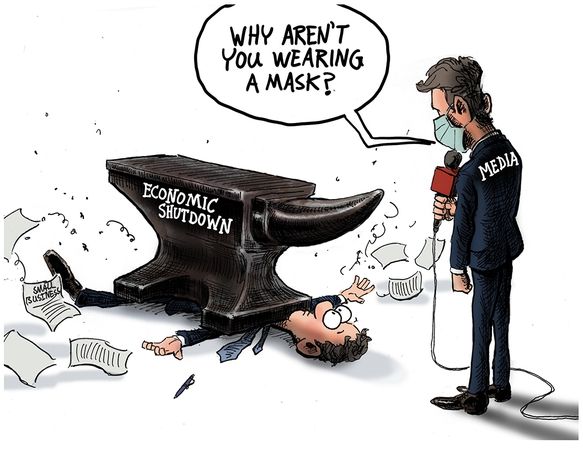
 

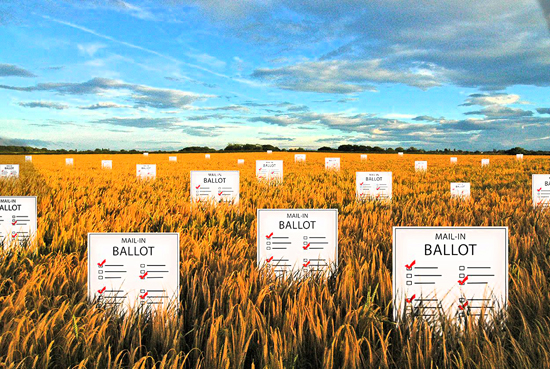
How Voter Fraud Is Revealed in 35 US States

Jay Valentine reports on the behind-the-scenes canvassing organizations documenting widespread fraud in the 2020 elections.  Surprisingly, even in states carried handily by Trump, there were large numbers of illegal ballots counted in state and local races.  His article at American Thinker is Meet the Technology That’s Uncovering 2020’s Voter Fraud.  Excerpts in italics with my bolds and images.

Were You a Phantom Voter?  Now You Can Find Out.

The search for phantom voters is over. Phantom voters are sitting next to you at the restaurant or standing next to you at the bank. They are your friend and neighbor. You may be a phantom and not know it.

Phantom voters, the definition, is morphing from fake voters hiding in UPS boxes to people who advanced computer models predict will not vote.

Don’t get me wrong — there are thousands of phantom voters living in churches, R.V. parks, cemeteries, homeless shelters, hotels, and virtual mailboxes. It’s just that there are as many, perhaps more, who live active, healthy, honest lives on voter rolls. They just don’t know they voted.

You’ve heard the stories, denied by the mainstream press and almost every secretary of state: “there is no significant voter fraud.” Why not say that? There is no way you can check.

Now there is.

After the 2020 election results stopped in the middle of night and vote trajectories magically changed when they fired up again, thousands of people, just like you, didn’t buy it. They formed armies of canvassers in 35 or more states. They did something that has not been done at scale in the history of the country: they started checking voter rolls.

They did more. They filed Freedom of Information Act (FOIA) requests at unprecedented levels. Secretary of state offices, once a murky sinecure, had to answer real questions about what was going on.

Here’s what popped out.

Leftists are different from you and me. Unlike us, they care that every vote is cast, and if you do not cast your vote, they will do it for you. And they did. At scale.

In one midwestern state, voter rolls costing tens of thousands of dollars were bought by a billionaire leftist every month for over a year. Why would someone buy a list that doesn’t change much?

Voter lists show people who move. They show people who never or seldom vote.

The white hat canvassing team built a query for one state: “voters who voted in 2020 who never voted before.” Guess what! 265,000.

In the same state, thousands of people came forward with stories that when they showed up to vote, they were told someone had voted for them. Get the picture?

In a southwestern state, in its second largest city, there was a 21-day daily tabulation of cast ballots. Once a ballot is cast, it should not be changed. Not here.

When the millions of cast votes across over 21 snapshots were compared, thousands of ballots had been altered. Some were minor alterations, like a slight name change. Others were more interesting — like when someone voted in person, but his vote was later changed by an absentee ballot.

It gets better.

Those FOIA requests are mining gold. Our midwestern state has documents showing that the state election organization gave online access to a leftist group for weeks during the voting. Citizens had to pay over $20,000 for one shapshot of the voter roll. Leftists could, and did, access it online throughout the process. For free.

And access it they did. Witness statements are being gathered, lots of them, that in the largest city, election officials were trading cell calls about how many votes were needed, and someone was then providing the phantoms to meet the quota.

They knew the names of the phantoms — they had direct access to who voted, who didn’t, and who was likely to never show up.

This is not exclusively a blue-state phenomenon.

In a deep red state, canvassers found more traditional phantoms.

There were the 21 people at the fraternity house. Nothing to see here — until they sorted them by age. All these kids were active voters, many voted, and their age range was from 115 to 57. Some frat house.

These red-state canvassers went deeper. They showed that the phantoms did not vote en masse in the 2020 presidential election. Phew! Feeling better. But wait. They vote in droves in state, county, municipal elections.

Aha — here was another interesting pattern, never seen before.

This deep red state that voted for Trump by double-digit margins did not call out its phantom army when it could not move the needle. When local, state elections were up, well, those people voted — even the 21 at the county jail and the 41 registered at the Recreation Commission.

In earlier American Thinker articles, we created the phrase “sovereign fraud.” That means your government is in on it.

As more than 35 state citizen organization now are using the most advanced search and big data technology to look into voter rolls, and cross-check them with churches, R.V. parks, fictitious street locations, they are concluding the office of secretary of state is corrupt, incompetent, or often both.

Let’s take incompetent.

In about every state, there are voters old enough to have fought in the Civil War, and they still vote. In one state, there are voters — a bunch of them older than Julius Caesar — the Roman guy.

States have voter rolls with multiple people using the same voter ID. When pressed, they have some screwy excuse that it’s a sequencing anomaly. At least one state adds every new voter to the end of its voter ID sequence, as one would expect. Except when it doesn’t. These people have numbers that skip by two and later ten, and they insert voters there, not at the end.

There are hundreds I have personally seen, thus thousands in every state — examples of 16 people, with different last names, living in that one-bedroom, 876-square-foot house. Really?

Let’s go to corrupt.

Secretaries of state, when pressed to cough up those voter rolls, after the confiscatory price is paid, change the data in such a way that it cannot be searched with traditional technology. Tough luck for them; our canvassing friends have search technology five generations ahead, so it gets done.

Canvassers in 35 or more states are digging, and the more they find, the more relentless they become. We are pleased to provide technology that runs a thousand times faster than anything available to any secretary of state or leftist voter fraud group.

These canvassing organizations are the Minutemen of this generation. They come from every background, organize with no central leadership. They blindly figured out how phantom voting was happening, and they are forcing states to audit their voter rolls.

They aren’t blind anymore. They are organized. They have resources and technology, and things are about to change in a big way for phantoms.


Economics of Infrastructure Investment

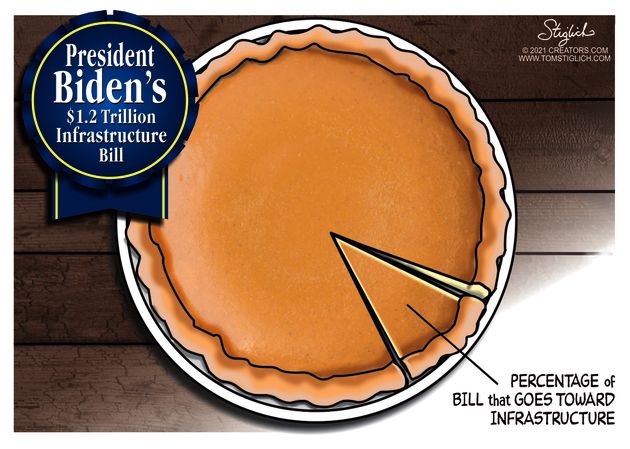
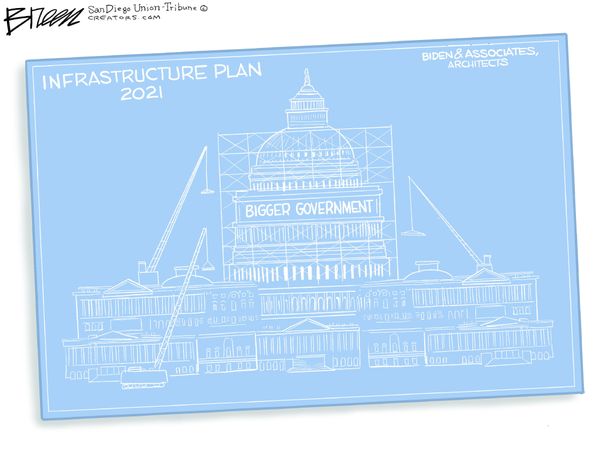
Mathew Kahn discusses the ramifications of the major transportation spending recently passed by the US Congress. Of course, as the pie chart shows, infrastructure as many people think of it—construction or improvement of bridges, highways, roads, rail and subways, ports, waterways, and airports—accounts for only $157 billion, or 7%, of the plan’s estimated cost.  Still that is a lot of money (“A billion here, a billion there, and soon it adds up to real money”–US Senator), and Kahn provides a list of concerns in his article What Insights Does Economics Offer About the Nascent Biden Administration Transport Infrastructure Investment Program?   Excerpts in italics with my bolds and images.
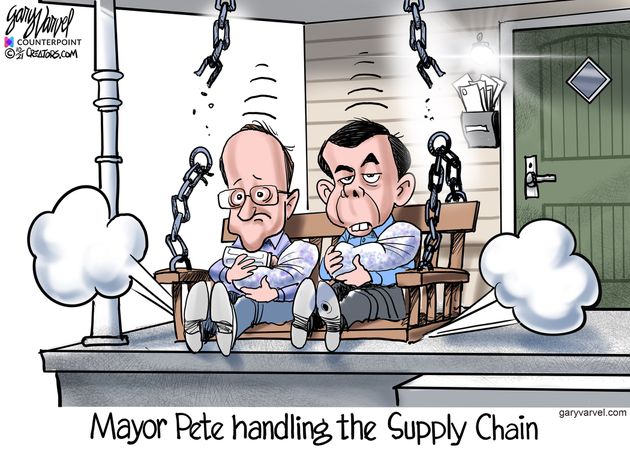
The Washington Post has published a piece stating that the Secretary of Transportation, Peter Buttigieg, is the big winner of the Biden Infrastructure Bill as he will be attending many ribbon cutting ceremonies as grateful local mayors shake his hand.

Economic research offers many insights here about the efficiency and equity effects of this multi-billion dollar investment.

Point #1: This is an irreversible investment. When a city builds a new subway line, this billion dollar project cannot be later sold on Ebay and use the $ to do something else. In contrast to light rail and subway lines, dedicated buses feature more option value because they can be sold off or redeployed on different routes in the same city. Given that we don’t know how cities will develop over time, this real option has value.

Point #2; Past expansions of public transit have not significantly increased ridership with the exception of Washington DC. In the case of Los Angeles, improves in rail service (such as the Light Rail on Exposition that I ride) has taken bus riders away from the bus. See our 2005 paper. If crime rates continue to be a concern in cities then the middle class will be even less likely to use the “shiny new” infrastructure. The poor do rely on public transit to move around cities and an expansion will improve their quality of life. An economist would ask whether they value this benefit more than the cash equivalent?

Point #3: The older infrastructure in the nation is located in older cities, where the population is barely growing (or shrinking) and where the voters are mainly Democrats.

Point #4: The highways tend to be built in the suburbs where the voting base leans Republican. My 2011 Brookings piece with David offers several constructive ideas for how to “build back better” here.

Point #5: If progressive cities gain better infrastructure due to the Biden Investment AND if they don’t build much housing (the progressive city NIMBYism is well documented) , then housing prices will rise and the poor and middle class will be further squeezed by this new investment.

Point #6: There are many economics consulting firms that intentionally offer extremely optimistic ridership estimates ex-ante and this helps ambitious government officials to justify projects (i.e to say that it passes a cost/benefit test) when in reality — ex-post evaluations show low usage of the new infrastructure. See Pickrell 1992.

Point #7: Given that unions are powerful in progressive cities, what is the marginal cost of infrastructure creation in these cities? Is the Department of Transportation seeking to build a new capital stock or to enrich a special interest group that supports the Democrats? How many middle class new construction jobs will be created? Will the expansion of the public capital stock crowd out the expansion of the private capital stock as construction crews work on transport infrastructure rather than building private sector projects? What is the shape of the construction supply curve?

Point #8, once the new infrastructure is completed — will this greatly improve urban quality of life in cities such as Baltimore that have been shrinking? How will the Mayor and local civic leaders and private sector stakeholders change their investments and policy decisions? What positive synergies might emerge? Our 2021 Unlocking Book explores some of these themes of investment co-ordination between the private and the public sector.

The Inflationary Road to Serfdom (Great Reset)

Tyler Durden posted at zerohedge This Is How They Intend To Get Us To “You Will Own Nothing And Be Happy”.  Excerpts in italics with my bolds.

The pieces of the puzzle may fit together in ways that you do not expect. For years, the global elite have been openly telling us that one day we will all own nothing, we will have no privacy, and we will be extremely happy with our new socialist utopia. But exactly how do they intend to transition to such a society? Are they going to come and take all of your stuff? Needless to say, there are millions upon millions of very angry people out there that aren’t just going to hand over their stuff to a bunch of socialists. So how are they going to overcome that obstacle?

Well, the truth is that they don’t need to take your stuff to implement their goals.  All they need to do is to destroy the value of your money.

If your money becomes worthless, you will start descending into poverty and it won’t be too long before you become totally dependent on the government.

And as the stuff that you have right now wears out, you won’t be able to replace it with the worthless money that you are now holding.

Eventually, you will own virtually nothing, but you probably won’t be very happy about it.

So high inflation is actually a tool that the global elite can use to further their goals.

The good news is that I do not believe that the global elite will ever be able to achieve their utopia.

The bad news is that they won’t be able to achieve their utopia because western society is going to completely and utterly collapse during the times that are ahead.

But as I demonstrated last week, the truth is that inflation is rising much faster than our paychecks are, and that means that our standard of living is going down.

And inflation is one of the big reasons why the University of Michigan Consumer Sentiment Index just hit the lowest level since 2011.

The Federal Reserve has lost control, and 2022 is going to be a very “interesting” year from an economic standpoint.

On Sunday, we learned that the average price of a gallon of gasoline in California has almost reached five dollars…Gasoline prices are going to continue to move higher, and that is really bad news.

Just about everything that we buy has to be transported, and so higher gasoline prices are going to fuel even more inflation.

Sadly, those that are on the bottom of the economic food chain are the ones that are being hurt the most. At this point, many food banks are really struggling to purchase enough food because price hikes have become so severe…

So many problems have converged all at once.  Some have used the term “a perfect storm” to describe what we are facing, and I think that is definitely quite appropriate.

If you are waiting for life to “get back to normal”, you are going to be waiting for a very long time. As MN Gordon has noted, pre-2020 prices are now gone forever…

But sooner or later, this is what socialist regimes always do.  They tell us to study hard, get a good job and work as hard as we can.  And then they give our money to people that haven’t done any of those things.

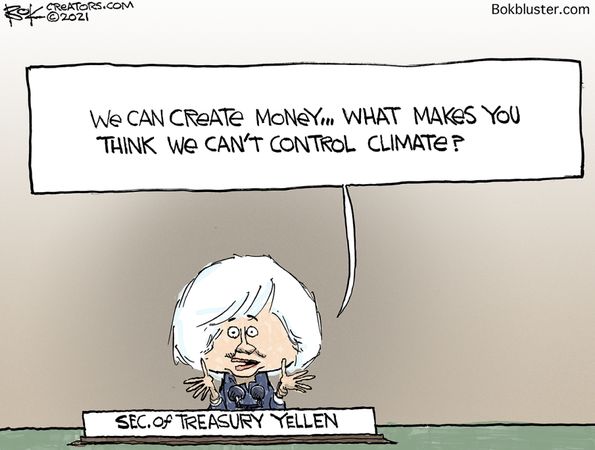
Eventually they run out of other people’s money, and so then they just start wildly creating more.

Unfortunately, every time that this has been tried throughout history it has always ended in disaster, and now it is our turn.

More from Jeff Greenfield at Politico Joe Biden’s Empty Inflation Toolbox

Presidents have little power to bring down rising prices.
History shows the public doesn’t care.

Left unspoken was a chilling reminder from history: Inflation has a unique power to kneecap a presidency. Incumbent presidents and their parties do not do well at all when inflation (and attempts to cure it) are on voters’ minds come election time. The gas pump, the supermarket check-out counter, the heating bill, the sticker on the windshield, provide — or seem to provide — powerful indictments against the party in charge.

If that’s not enough to unsettle the White House and its allies, consider this: Presidents have almost no power to ease the pain of inflation, and the voting public cuts presidents no slack at all because of that impotence. Look into the toolbox of our country’s chief executive and you’ll find it empty of effective tools, filled instead with devices now obsolete or laughable or meaningless or politically destructive.

But if you’re looking for a president who did in fact do something to tame inflation — albeit indirectly — it was Jimmy Carter. When he appointed Paul Volcker as chair of the Federal Reserve Board, he put someone in a position of real power who was determined to fully exercise that power, no matter the consequences.

With an inflation rate in 1980 of more than 13 percent — “It was the biggest inflation and the most sustained inflation that the United States had ever had,” Volcker recalled — he led the Fed to a historic tightening of the money supply. Interest rates rose vertiginously; at one point the prime rate hit 21 percent. The consequences were dramatic and ugly — a recession more severe than any since the Great Depression. Four million workers lost their jobs.

The “stagflation” — a toxic combination of inflation and unemployment — helped send Carter down to a landslide defeat in 1980. By 1982, the unemployment rate hit 10 percent, a number high enough to cost Republicans 27 seats in the House. By 1984, however, unemployment was moving in the right direction, dropping to just over 7 percent. Economic growth was over 7 percent, inflation had dropped to under 4 percentand Ronald Reagan won a 49-state re-election.

The United Sates has not faced a genuinely worrisome inflation rate since, and that’s another source of pain for Biden and his party. Americans have had no experience in decades with prices rising across the board; a 6 or 7 percent inflation rate is nothing compared to the Carter era, but it looks particularly worrisome compared with the recent past.

If Biden’s advisors are right, 2022 will see the lessening of inflation, as goods flow into the stores and automobile lots where cash-flushed customers will no longer bid up the costs of scarce items. But that’s more of a hope than a certainty; the White House description last summer of the “transitory” nature of this inflation seems a lot less convincing now, and the prospect of Christmas season with high priced or unavailable goods and sharply higher fuel costs does not bode well for the president’s already-sinking approval numbers.

Footnote:  Road to Serfdom

In ‘The Road to Serfdom’ F. A. Hayek set out the danger posed to freedom by attempts to apply the principles of wartime economic and social planning to the problems of peacetime. Mises Institute provides a text in pdf format here


Cobra Theory of Biden Governance


Previously in August Victor Davis Hanson suggested several theories that might explain how Biden’s administration has destroyed everything they touch.  A summary of that essay is reprinted later on, but this post presents another possible explanation.  James Lewis writes at American Thinker Biden’s cobra presidency.  Excerpts in italics with my bolds.

Have you noticed how Joe Biden says he wants to lower gas prices, so he cancels the Keystone pipeline?

He wants to lower unemployment, so he pays people not to work?

He wants to beat inflation, so the Fed prints more money?

Biden is President Perverse.

The Cobra Effect is economics slang for “perverse incentives.” If you give your kid money every time the kid misbehaves, that’s a perverse incentive. Every parent knows that mandates are perverse. You don’t give your teenager money to buy cocaine. (Or maybe Joe does.)

Conservatives wonder if Joe’s brain is beyond its sell-by date, but that isn’t quite right.

The resident of 1600 Pennsylvania Ave isn’t just failing; he does the opposite of a competent president. He’s perverse.

The Cobra Effect is a sort of an economics joke based on the story that New Delhi had too many cobras at one time, so the city paid a bounty for dead cobras. Then smart Indian people started to raise more cobras to get the bounty, the opposite of the intended outcome.  Economists use that story to explain economic stupidity.

But Joe Biden has topped stupid and is now the most deliberately perverse POTUS in history.
It’s the only explanation I can think of.

Do you want to stop racism? Teach people how to hate white folks. Are you laughing yet, America?

These are angry, bitter, hateful people with more than a little sadistic glee in their makeup.

You say you love America, and you do your worst?

This is the twisted face of hatred.

It’s Joe Biden’s Cobra presidency.

Background from previous post Biden Has the Destructive Touch

Almost everything Joe Biden has touched since entering office has turned to dross. None of his blame-gaming, none of his distortions, none of his fantasies and unreality can mask that truth.  [For details on the listed failures see the article linked in red.]

The Afghan Catastrophe
The Inflation Fiasco
The Border Disaster
Energy Insufficiency
The Race Calamity
The Crime Explosion

So why does Biden so willfully exercise this destructive touch that blows up anything he taps?

There are several possible theories:

1) Biden is non compos mentis. He has no idea of what he is doing. But to the degree he is alert, Biden listens—sort of—only to the last person with whom he talks. And then he takes a nap. When Afghanistan blows up or inflation roars or the border becomes an entry door, his eyes open, and he becomes bewildered and snarly—like an irritable and snappy Bruce Dern waking up in “Once Upon a Time in Hollywood.”

Biden has no clue about the actual destructive implementation of his toxic policies, and no concern upon whom these destructive agendas fall. He vaguely assumes a lapdog left-wing media will repackage every Biden incoherence as Periclean, and every daily “lid” as Biden’s escape for presidential research, deep reading, and intensive deliberation. Biden appears to be about where Woodrow Wilson was in November 1919.

2) Or is Biden a rank opportunist and thinking he will ride woke leftism as the country’s new trajectory? He resents his prior subservience to Obama, and now feels he can trump past signature leftist administrations as the one true and only socialist evolutionary. He is not so much the manipulated as the manipulator.

Biden fantasizes himself as a hands-on dynamic leader who bites at reporters, snaps from the podium, and issues his customary interjections. He is therefore “in command” for four or five hours a day. He enjoys acting more radical than Elizabeth Warren, Kamala Harris, Bernie Sanders, or “the squad.”—and especially being far more leftwing than his old and now passé boss Barack Obama. Joe is in control and that explains the dross touch. For the first time in his life, such an incompetent has complete freedom—to be powerfully incompetent. Biden is then not demented as much as delusionally running things.

3) Biden is unfortunately what he always was: a rather mean-spirited plagiarist, liar, and nihilist, from his Clarence Thomas character assassination infamy and Tara Reade groping to his foul racist talk and his monumental habitual grifting. His disasters are the same old, same old Biden trademark, performance-art screw-ups.

Biden likes the idea of conservative outrage, of chaos, of barking at everyone all the time. Biden accepts that no omelets can be made without broken eggs, and sort of enjoys screwing up things, as Robert Gates and Barack Obama both warned. “Wokening” the Joint Chiefs of Staff, encouraging hundreds of thousands to pour across the border, and abandoning our NATO allies in Afghanistan—who cares when tough guy, brash-talking Joe on the move jumbles stuff up? The disasters in the economy, foreign policy, crime, energy, and racial relations? Biden is just shaking things up, stirring the pot, baiting people to watch Mr. “Come On, Man” in action, as he blusters and preens and leaves a trail of destruction in his wake.

4) Biden is nothing much at all. He’s just a cardboard-cut out, a garden-variety Democratic Party hack, who is against anything conservatives are for. He assumes he will undo all that Trump did, on the theory it is simple and easy for him in his lazy, senior moments. And he is tired anyway of thinking much beyond such Pavlovian rejectionism. A closed border is bad; presto, open borders are good. Improving race relations is bad; deteriorating relations must be good. Energy independence bad; dependency good. Biden works on autopilot in his minimalist day job: just cancel anything that Trump did and worry nothing about the effects on the American people

5) Biden is a hostage of both the Left and Hunter Biden. His task is to ram down a hard Left agenda, in the fashion of a torpedo that itself blows up when it hits the target. The Left ensured the base would not bolt in 2020. So, he owes them. Biden, more or less, signed his presidency over to the squad, Nancy Pelosi, Bernie Sanders, and the Obama holdovers. They hand him a script; he tries to read it; and they follow up with the details. He is the old “Star Trek’s” tottering John Gill.

The Left may hope their own nihilist agenda sort of works. When it inevitably does not, then Joe, the delivery man, is blamed: so much more quickly, then, will be Biden’s necessary exit. They kept their part of the bargain by getting the basement denizen elected. Now he keeps the deal by handing over the presidency. Biden’s utility had about a six-month shelf life.

Now ever so slowly the leaks, the West Wing backstabbing, the furrowed anchor brows, and the unnamed sources will gently ease him out with 25th Amendment worries (e.g., “Perhaps President Biden might find taking the Montreal Cognitive Assessment of some value after all, for his own benefit, of course.”) Kamala Harris is not so inert as we are led to believe.

A cognitively challenged Biden then is pulled in every direction, by his own senility, by left-wing politicos collecting their debts, by his own spite, by his trademark narcissism, and by his neanderthal hatred of everything Trump was and did.

The problem for America is that theories one through five are not always mutually exclusive, but more likely force multipliers of the present insanity. At some point, some brave congressional representative or Senator will finally have to say to Biden, in the spirit of Oliver Cromwell and Leo Amery:

“You have sat too long here for any good you have been doing. Depart, I say, and let us have done with you. In the name of God, go!”

My Comment

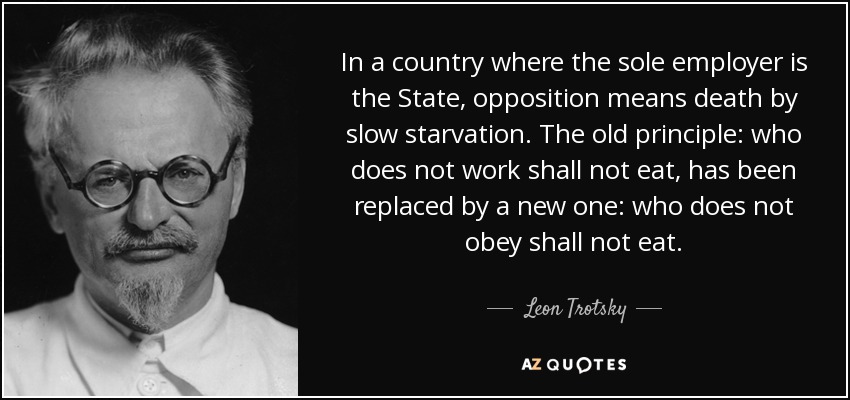
It should also be noted that Biden governance follows the classical pattern for leftist autocracies.  The massive spending programs already enacted and proposed serve not only to greatly expand the federal bureaucracy but also to perversely make the population financially dependent on government largess.  Down the line such dependency ensures compliance with diktats constraining citizen’s rights and freedoms.  Trotsky explained how the Soviets got there by nationalizing the means of production.

Trudeau: Let’s Limit How Far You can Drive

Brad Salzberg writes Trudeau Considers Restricting Distance of Vehicle Travel For Canadian Citizens.  Excerpts in italics with my bolds.

During the recent COP26 summit, Justin Trudeau hosted a carbon pricing conference showcasing Canada’s carbon policy. He referred to it as “one of the most stringent and ambitious in the world.”

In terms of a domestic carbon program, no emission reduction mandates had thus far been established beyond an agreement between Alberta and Ottawa to limit output at 100 megatonnes per year. Canada emits roughly 730 megatonnes of CO2 equivalent annually. The Trudeau government has now mandated a specific 100-megatonne reduction for our oil and gas sector by the year 2030.

This in itself is not a surprise. What should make the ears of Canadians perk up is one of the proposed restrictions to accomplish the goal. Among other current considerations in the Liberal government’s proposal, we discover the following, as reported by the Calgary Sun this week:

“Limit personal consumption of hydrocarbons by individual Canadians, in terms of allowable miles travelled by motor vehicle, train or air.”

My, my– Canada is certainly filled with surprises these days. Last week delivered another zinger:
“Deliberately coughing at someone during the COVID-19 pandemic constitutes a criminal assault.”

Applying our math skills, that’s two examples of unprecedented forms of draconian social measures in the past two weeks. Not that mainstream media will present it as such. In both cases, the information was ever-so-casually tucked into news articles on a larger theme.Let us understand the potential what is being proposed. There may come a time when the distance Canadians can travel in their vehicles includes a hard cap on mileage. Not only would this apply to their personal vehicle, but also to the time they spend idly reading a newspaper while riding a bus.

All of which conjures up a collective yawn from legacy media. As a result, they will likely never juxtapose this “progressive” policy with what Canada’s Charter of Rights and Freedoms has to say about the matter.

6. (1) Every citizen of Canada has the right to enter, remain in and leave Canada.

(2) Every citizen of Canada and every person who has the status of a permanent resident of Canada has the right:

to move to and take up residence in any province; and
to pursue the gaining of a livelihood in any province.

What would occur in a case where Charter-based mobility rights were violated by Trudeau’s restriction on distance of travel?

A simple question it is. The answer, of course, is nothing at all. Just as it applies to current Charter breaches that result from Covid mandates.

Result: a loss of personal freedom. Predicted extend of exposure from establishment media? Nothing.

Witness as Canada continues to morph into a reasonable facsimile of authoritarian nations of the world.

Footnote:  See also Uh Oh Canada


Election Fraud Evidence Mounting

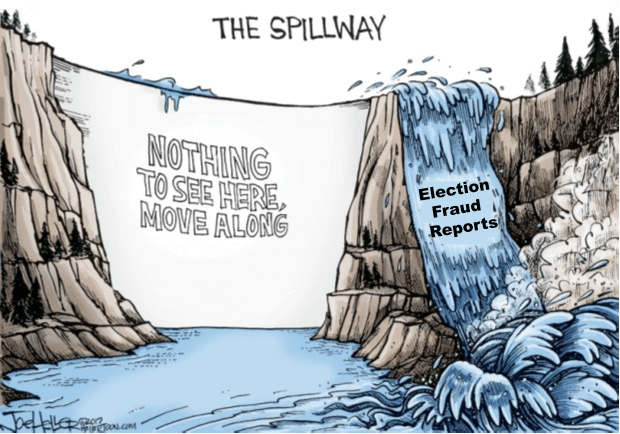
How long will the “Free and Fair 2020 Election” Dam hold up under the pressure of election fraud reports?   John Solomon summarizes the numerous cracks appearing in his Just The News article Narrative of a perfect 2020 election eroding as Wisconsin becomes investigative ground zero.  Excerpts in italics with my bolds.

Evidence grows of election mismanagement, illegal acts and some fraud in several states.

Cognitively impaired nursing home residents in Wisconsin and Michigan cynically exploited for votes. Election mismanagement in Atlanta. Unlawful election instructions in Wisconsin. And 50,000 questionable ballots in Arizona, plus several criminal cases for illegal ballot harvesting and inmate voting.

Eleven months after Donald Trump was ousted from office, the narrative that the 2020 election was clean and secure has frayed like a well-worn shoelace. The challenges of the COVID pandemic, the aggressive new tactics of voting activists and the desire of Democrats to make the collection and delivery of ballots by third parties legal in states where harvesting is expressly forbidden has muddied the establishment portrait and awakened the nation to the painful reality its election system — particularly in big urban areas — is far from perfection.

Nowhere has that story become more clear than the battleground state of Wisconsin, where a local sheriff on Thursday dramatically held a nationally televised news conference alleging he had found evidence of felony crimes involving ballots sent to nursing home residents.

Racine County Sheriff Christopher Schmaling said his investigators have secured evidence that eight out of 42 residents at a local nursing home had been recorded as casting absentee ballots that their families said was not possible because the residents didn’t possess the cognitive ability to vote.

The probe was prompted by one family who discovered their loved one had voted in the November 2020 election despite having died a month earlier after a long period of mental decline, authorities said.

Schmaling dramatically accused the Wisconsin Elections Commission, the state’s election bureaucracy, of creating the conditions for such voting by mailing absentee ballots to nursing home residents who didn’t request them and empowering nursing home staff to fill out ballots on behalf of the residents.

The “election statute was in fact not just broken, but shattered,” he said.

The nursing home scheme alleged by Schmaling was also found in neighboring Michigan, where Democratic Attorney General Dana Nessel earlier this month announced three women were charged with voting fraud, including one who fraudulently filled out ballots in the names of nursing home residents without their permission.

But the nursing home case is far from the only concern that has rocked Wisconsin, where Joe Biden was certified the winner over Trump with a razor-thin margin of about 20,000 votes. The non-partisan Legislative Audit Bureau released a sweeping report last month that accused election officials of engaging in “inconsistent administration” of election laws, troublesome management of new drop boxes used to collect ballots during the pandemic, ineffective investigation of fraud complaints, and other problems.

While it did not offer evidence of systemic fraud, it flagged more than 30 problems as well as many more issues that lawmakers should resolve for future elections. The report prompted the GOP leader of the Wisconsin Senate to launch an investigation into the November election, augmenting a separate probe already authorized by the Wisconsin Assembly that is being led by former state Supreme Court Justice Michael Gableman.

And those developments follow a ruling by the Wisconsin Supreme Court that concluded state election officials wrongly allowed tens of thousands of Wisconsin voters to skip voter ID requirements and file absentee ballots by declaring their concerns about COVID made them “indefinitely confined.” While the court ruled the advice was illegal, it noted there was no penalty and said it was up to voters to decide if they had an infirmity or disability that made them confined. Lawmakers are now looking to change the weaknesses in that law.

Sen. Ron Johnson (R-Wisc.) the former chairman of the Senate Homeland Security Committee, which oversees elections, said the dizzying revelations coming from his own state were a clear sign that lawmakers have far more work ahead of them to improve election administration and ensure voters are treated more evenly.

“Following the LAB report, what Sheriff Schmaling has uncovered + disclosed might only be tip of the iceberg of fraud in the 2020 election,” Johnson tweeted. “The Legislature must be given the time, resources, and cooperation of election officials to conduct a complete investigation of allegations.”

Similarly, state officials in Georgia, where Trump lost by a slim margin, have found evidence that its major urban voting center of Fulton County had significant problems administering the November election, so much so that state officials have begun the process of taking the county’s election management into receivership, removing local control for the 2022 election and beyond.

That dramatic move came after Just the News unearthed a 29-page memo from a state observer that found officials in Futon County engaged in all sorts of misconduct and mistakes, including insecure transport of ballots, double scanning of ballots and possible invasions of voter privacy.

And earlier this month, two Fulton County workers were fired for allegedly shredding ballot applications in violation of state law. Secretary of State Brad Raffensperger even asked the U.S. Justice Department to assist in the investigation.

And in nearby DeKalb County, Raffensperger has initiated a separate probe into whether ballots cast in “drop boxes” were properly handled and logged.

Meanwhile, the fallout from the Arizona Senate’s audit continues to be felt, as more than 50,000 ballots have been called into question and several matters referred to Attorney General Mark Brnovich for possible prosecution. Even before those referrals, Brnovich’s office has brought several criminal prosecutions, including prison inmates who illegally voted as well as some people accused of harvesting ballots from third parties.

The harvesting cases in Arizona as well as the nursing home cases in the Midwest are opening up a new line of inquiry that could drive the election integrity debate well into 2022. The emerging question: Is it possible that residents legally allowed to vote had their votes illegally gathered and delivered by third parties?

It’s a question several state officials told Just the News they have begun investigating, meaning the term “ballot harvesting” may become more familiar to Americans in the weeks and months ahead.

Meanwhile, the news media and state officials may have to grapple with a more difficulty reality: It doesn’t require widespread fraud for Americans to lose faith in the election system. Mismanagement, uneven application of the laws and plain old carelessness can sow deep distrust.

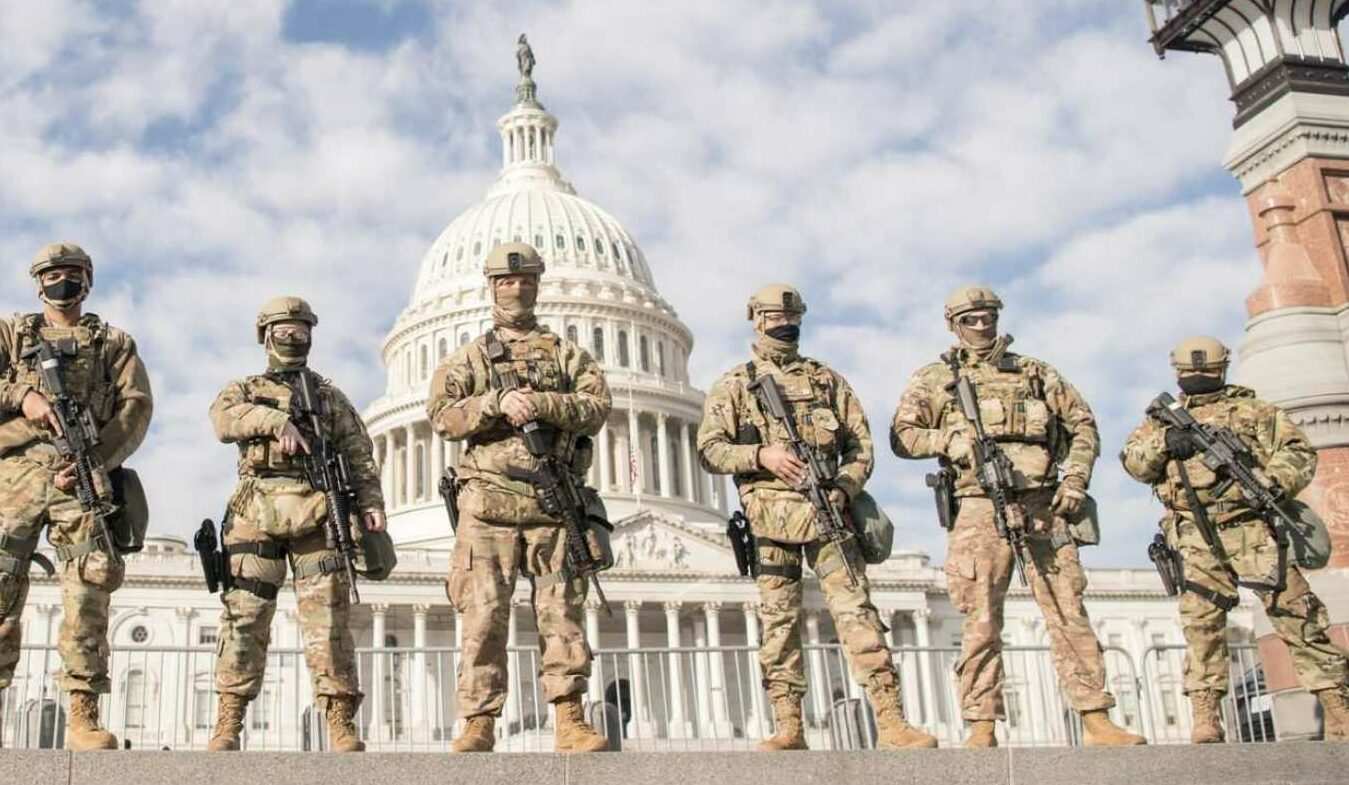
Washington Capital Overthrowing the United States

More than 25,000 troops from across the country were dispatched to the US capital on January 13, 2021.

How to make sense of the chaos in Washington, DC? What analogy or metaphor would lend insight?

♦  Is it the sacking of an Imperial Capital, as was the case with Rome and the barbarians?

♦  Is it a hostile takeover by a more wealthy cabal who bought out a weaker organization in order to install its own values and culture?

♦  Is it an internal coup by which insiders seize power and purge the palace of those loyal to another leader?

There are elements of all of these, with China as the external infiltrator in the first case, aligned with insiders having keys to the treasury. A network of billionaires collaborated to plunder the 2020 covid election in the second case, empowering the deep state to throw out the Trumpist rascals. The kinetic action to force submission in the third case came firstly from violent street riots across the US, culminating with military occupation to “protect” the Washington capital.

Some insights can be gleaned from three forward observers of the battle for regime change in process. The first one is Joshua Mitchell writing at City Journal The Politics of Innocence. Excerpts in italics with my bolds.

Yes, the USA is now undergoing regime change.

Joe Biden’s administration ushers in a destructive new version of the American regime.

What do the Biden administration’s three spectacular failings—the sudden and purportedly unpredictable collapse of Afghanistan, the deliberate effort to undermine U.S. energy independence with the sabotage of the Keystone XL Pipeline, and the unconscionable national border crisis—have in common? More is at work here than normal political shifts, of the sort expected when one administration succeeds another. We are witnessing, instead, a change in the very purpose of politics.

The American regime, founded on the idea of limited government, presumed that citizens were competent and largely capable of taking care of themselves.

Our competence was developed, Alexis de Tocqueville wrote in Democracy in America, through the mediating institutions of family, church, civic associations, and municipal government. No citizen competence, no limited government. That was Tocqueville’s formula—the American formula.

The first phase of the American regime, characterized by citizen competence, lasted for more than a century. Supplanting it was the second, progressive, phase of the American regime, in which expert competence purportedly replaced citizen competence. The Biden administration came to power claiming the mantle of expert competence. “The adults are back in charge,” our legacy media jubilantly proclaimed.

The failings of the so-called adults in the Biden administration are a consequence of a shift to a third phase of the American regime, a shift so large that it would be more accurate to say it is the end of one type of regime and its replacement by another. The American fixation on the politics of competence, whether citizen or expert, is being replaced by the politics of innocence.

In this new politics, what matters most is your standing as an innocent victim. If you are not an innocent victim, you are anonymous or, more likely, a threat.

Secretary of State Antony Blinken gives the order to fly the LGBTQ+ pride flag at all U.S. embassies, including Afghanistan, signaling that innocent victimhood is the singular policy orientation of the United States government. Much of the rest of the world is incredulous, and the effort to shape Afghanistan in our own image collapses within days of our military withdrawal.

The Biden administration shuts down the Keystone Pipeline because we are all innocent victims of fossil fuels who must be saved by green energy and the crony capitalism that will usher in a new age of cleanliness.

The United States border should not, in the eyes of the Biden administration, protect us from illegal aliens. It should instead serve as the porous pass-through for “undocumented migrants,” who, along with an ever-growing list of legally protected identity groups, are also innocent victims.

More recently, Attorney General Merrick Garland has led us to believe that parents repulsed that their children are being taught critical race theory, not to mention Orwellian assertions about the fluidity of “gender,” may be investigated as domestic terrorists under the Patriot Act. Our children, the administration insists, must be taught that they are transgressors whose doltish and deplorable thoughts conspire against innocent victims everywhere. These innocent victims must now be the singular focus of the efforts of our government—not excluding the military—which must purge its ranks of the guilty to make room for the innocent victims soon to fill the vacancies.

The Biden administration is pulling the United States into a third phase of politics. We are witnessing the birth of the politics of innocence. From this we can only expect an ongoing sequence of failures.

[Comment:  Jordan Peterson describes how the politics of innocence played out in Soviet ideology of the innocent “workers” oppressed by the “bourgeoisie” :

Another problem that comes up is that Marx also assumes that you can think about history as a binary class struggle with clear divisions between say the proletariat and the bourgeoisie. That’s actually a problem because it’s not so easy to make a firm division between who is exploiter and who is exploitee. Because it’s not obvious, for example, in the case of small shareholders, whether or not they happen to be part of the oppressed or part of the oppressor.

This actually turned out to be a big problem in the Russian revolution, a tremendously big problem because it turned out that you could fragment people into multiple identities. That’s a fairly easy thing to do, and you could usually find some aspect by which they were part of the oppressor class; it might have been a consequence of their education or because of the wealth that they strived to accumulate during their life. Or it might be the fact that they had parents or grandparents who are educated or rich or that they’re a member of the priesthood or that they were socialists, and so on.

Anyways the listing of how it was possible for you to be bourgeois instead of proletariat grew immensely and that was one of the reasons that the red terror claimed all the victims that it did. So that was a huge problem, probably most exemplified by the demolition of the kulaks, who were basically peasant farmers although effective ones in the soviet union. They had managed to raise themselves out of serfdom over a period of about 40 years and to gather some some degree of material security about them. And about 1.8 million of them were exiled, about 400 000 were killed and the net consequence of that was the removal of their private property because of their bourgeois status. There was also the death of six million Ukrainians in the famines of the 1930s showing that the binary class struggle idea led to bad outcomes for many people.  See Why Marxism Always Fails ]

Breaking Eggs Hoping For an Omelet

Victor Davis Hanson’s article at Daily Signal is The Ideology Behind Biden’s Disastrous First 9 Months. In it he explains that the changes imposed in 2021 by this new federal government have brought destructive consequences by intention. Excerpts in italics with my bolds.

Sheer chaos and anarchy on the border? Afghanistan—the most humiliating defeat in recent U.S. military history? A labor-starved supply chain in shambles and holiday shelves emptying out? The worst inflation in 30 years that seems soon ready to match Carter-era levels? Gas hitting $5 a gallon with winter heating fuels soaring? Free-for-all looting in the major cities without consequences? Joe Biden’s policies and Biden himself diving in the polls?

Never in recent American history has any administration birthed such disasters in its first nine months.

Yet most Americans are arguing not over the sheer chaos and disasters of the Biden administration, but rather how could such sheer pre-civilizational calamity occur in modern America? Were these disasters a result of historic incompetency? Or mean-spirited nihilism? Or a deliberate effort to create the necessary turbulence to birth a new American revolution? Or a bit of all three?

Start instead with the idea that what most Americans see as sheer ruin is not what the left-wing puppeteers (who are pulling the strings of the Biden marionette) see. Our catastrophes are their minor glitches. For them bad polling is mostly a public relations problem of an occasional uncooperative media. Otherwise, a few broken eggs are always necessary to create the perfect socialist omelet.

The Left now controlling Washington believes that the U.S. border is a mere construct. Every impoverished person has a birthright to cross into America illegally. The 2 million who are scheduled to enter this fiscal year alone is a wonderful, if occasionally sloppy, event.

Our border calamity is their celebration of humanity and a long-overdue recalibration of ossified American demography, one that will properly warp the Electoral College to provide the necessary election result.

If you believe that a culturally imperialistic America needs to be taken down a notch overseas, then the flight from Afghanistan is “impressive” and a “success”— by how quickly and efficiently we skedaddled.  Why worry about a lost $1 billion embassy, a $300 million refit of the Bagram airbase, or $80 billion lost in military hardware and training? Empty shelves? Boohoo.

Grasping, upper-middle-class consumers are angry that the working classes are not willing to risk COVID infection to supply them with their accustomed holiday trinkets.  So, Transportation Secretary Pete Buttigieg intoned that the shortages mean only that the consumer class has to wait a wee bit—until Christmas Eve—to splurge on gifts.

Who worries about a little inflation? Under new monetary theory, printing dollars brings prosperity. Or as White House Chief of Staff Ron Klain put it in a retweet, inflation is a mere “high class problem” of the Peloton elite.

Only those with money worry their ill-begotten pile shrinks. But the majority without money will eventually rejoice that it is everywhere now”—finally and properly “spread,” as former president and now multimillionaire Barack Obama once promised.

As Rep. Alexandria Ocasio-Cortez swore, gas and oil are going to be gone anyway in 10 years. So, if Joe Biden slashes over 2 million barrels a day in U.S. oil production, what’s wrong with that?

Didn’t Steven Chu, Obama’s energy secretary, long ago brag that when we hit $8 to $10 a gallon, we’d approach European levels of proper fuel usage? Why whine about paying over $100 to fill up, when the planet more quickly cools?

Did not Americans learn “critical legal theory” and “critical race theory”? Or as the architect of the “1619 Project” reminded us, destroying or taking someone’s property is no big deal. Minneapolis Mayor Jacob Frey shrugged off torched downtown buildings; such torched stuff, he said, is mere “bricks and mortar.”

It is only a crime to “steal” over $500 of needed merchandise from a Walgreens in San Francisco, because the rich who make such absurd laws never have to steal goods from a pharmacy shelf.

If racists wish to point out that African American male youths are disproportionately represented in the latest crime wave, then maybe America should be learning not to create the conditions that force them to break the law.

In sum, we are on a left-wing roller coaster headed to a socialist nirvana.

Most Americans believe it is instead an out-of-control “Mr. Toad’s Wild Ride” nightmare with incompetents at the wheel. But the architects of such “hope and change” shrug that the occasional disturbing news that the media sometimes accidentally leaks out is merely the cost of an equitable America. One man’s anarchy is another’s road to justice.

Keep that mentality in mind and the absurdities that are mouthed by Biden, Klain, press secretary Jen Psaki, Homeland “Security” Secretary Alejandro Mayorkas, Pete Buttigieg, or the ravings of the Squad make perfect sense.

They are merely trying to explain to us dummies that what we think is purgatory is actually the new paradise—a promised land that, once we are properly programmed and educated, we too will welcome and thank them for our deliverance.

Social Upheaval as Theater of the Absurd: Technocracy Replaces Democracy

Matthew Crawford describes how strange for ordinary people is the everyday experience of this transformation (revolution?) in his UnHerd essay The new public health despotism. Excerpts in italics with my bolds. (The title is link to his full text which includes much more than these extractions)

Draconian rules are suppressing our humanity

I live in the Bay Area, in a county where the vaccination rate is in the mid-80s. In late July, I was dropping my younger daughter off for a soccer day camp each morning. It was 10 kids running around an open field. They wore masks for six hours each day, and it was about 85° that week. Telling my fully vaccinated daughter to put that thing on, I felt compromised for participating in the charade. The old Scots Irish belligerence started welling up.

Rules are meant to codify some bit of rational truth and make it effective. These days, we find ourselves in situations where to do the genuinely rational thing might require breaking the rules of some institution. But to do so is to invite confrontation. You may go through an internal struggle, deciding how much resistance to put up. To insist on reasons is to be ornery, and you want to be sociable. You tell yourself, there is no point in being confrontational with staff at the YMCA who are themselves simply carrying out orders. There is nobody visible to whom you can address your reasons, nobody of whom you can demand an account.

After a year and a half of this, going along with it starts to become habitual. If you defy the mask order, and are challenged by somebody doing their job as instructed, chances are you’re going to back down and comply, which is worse than if you had complied to begin with. Even if you strongly suspect fear of the virus has been stoked out of proportion to serve bureaucratic and political interests, or as an artefact of the scaremongering business model of media, you may subtly adjust your view of the reality of Covid to bring it more into line with your actual behaviour. You can reduce the dissonance­ that way. The alternative is to be confronted every day with fresh examples of your own slavishness.

In the Hobbesian formula, the Leviathan relies upon fear to suppress pride. It is pride that makes men difficult to govern. It may be illuminating to view our Covid moment through this lens and consider how small moments of humiliation may be put in the service of a long-standing political project, or find their meaning and normative force in it.

Specifically, to play one’s part in Covid theatre, as in security theatre at the airport, is to suffer the unique humiliation of a rational being who submits to moments of social control that he knows to be founded upon untruths. That these are expressed in the language of science is especially grating.

We need to consider the good faith intellectual positions that greased the skids for our slide into an illiberal form of governance. For, in addition to the political opportunism surrounding Covid, there were also well-meaning efforts to control the pandemic by altering people’s behaviour. The question is: what were the means employed for doing this, and what was the view of human beings that made such means attractive? What we got, in the end, without anyone really intending it, may fairly be called a propaganda state that seeks to manipulate without persuading.

Here, “science” may be plainly anti-scientific, according to the circumstances. The word does not name a mode of inquiry, rather it is invoked to legitimise the transfer of sovereignty from democratic to technocratic bodies, and as a device for insulating such transfers from the realm of political contest. Can this be squared with the idea of representative government?

The Columbia law professor Philip Hamburger writes about the administrative state. It consists of a vast array of executive agencies that empower themselves to place people under binding obligations without recourse to legislation, sidestepping the Constitution’s separation of powers. In theory, only Congress can make laws. Its members are subject to the democratic process, so they must persuade their constituents, and one another. But as the administrative state has metastasised, supplanting the lawmaking power of the legislature, unelected bureaucrats increasingly set the contours of modern life with little accountability. They stake their legitimacy on claims of expertise rather than alignment with popular preferences. This trajectory began a century ago in the Progressive era, and took large strides forward during the New Deal and Great Society.

The “restless desire to escape” the inconvenience of law is one that progressives are especially prone to in their aspiration to transform society: merely extant majorities of opinion, and the legislative possibilities that are circumscribed by them, typically inspire not deference but impatience.

It is as beings capable of reason that the legislature is supposed to “represent” us. The judicial branch regards us in the same light.

When a court issues a decision, the judge writes an opinion in which he explains his reasoning. He grounds the decision in law, precedent, common sense, and principles that he feels obliged to articulate and defend. This is what transforms the decision from mere fiat into something that is politically legitimate under the premises of republican government, capable of securing the assent of a free people. It constitutes the difference between simple power and authority.

The Nineties saw the rise of new currents in the social sciences that emphasised the cognitive incompetence of human beings. The “rational actor” model of human behaviour (a simplistic premise that had underwritten the party of the market for the previous half century) was deposed by the more psychologically informed school of behavioural economics, which teaches that our actions are largely guided by pre-reflective cognitive biases and heuristics. These biases tend to be functional, both in the sense that they reflect general patterns of reality, and because they offer “fast and frugal” substitutes for deliberation, which is a slow and costly activity.

While economics was getting psychologised in the 1990s, a parallel development was happening in political science. Before getting into this, consider the larger frame. The Soviet Union had just collapsed. This placed “liberal – democracy” in a new situation, or rather returned it to a situation that had obtained in the mid-19th century.

Liberalism and democracy are two distinct things, not entirely at ease with one another. Their differences were submerged during the Cold War when they had a common enemy in Soviet communism, just as they had been submerged previously when they had a common enemy in monarchy.

As Adrian Vermeule puts it, liberalism fears that its dependence on and fundamental difference from democracy will be exposed if a sustained course of non-liberal popular opinion comes to light. The solution is to offer an idealised concept of democracy, sharply distinguished from “mere majoritarianism.” By this device, the liberal may get to preserve his self-understanding as a democrat. This can become quite strained, as in the reflex to call the popularly elected governments of Poland and Hungary “antidemocratic”. When Pew did opinion polling in Afghanistan a decade ago and found that something like 95% of respondents expressed a preference that sharia law should be the law of the land, this was not allowed to interrupt the conviction that making Afghanistan “democratic” would require a feminist social transformation. That is, an explicitly anti-majoritarian revolution.

Obviously, the prospect of populism was already causing some anxiety. Propping up “liberal-democracy” as a conceptual unity would require a cadre of subtle dia­lecticians working at a meta-level on the formal conditions of thought, nudging the populace through a cognitive framing operation to be conducted beneath the threshold of explicit argument. I remember there was one grad student in my department who was running experiments on focus groups, seeing if he could get them to think the right thoughts.

As it turns out, the best way to secure the discursive conditions for “deliberative democracy”, and install a proper choice architecture that will nudge the demos in the right direction, is to curate information. Soon, the Internet would both enable and undermine these aspirations.

One of the central tenets of progressives’ self-understanding is that they are pro-fact and pro-science, while their opponents (often the majority) are said to have an unaccountable aversion to these good things: they cling to fond illusions and irrational anxieties. It follows that good governance means giving people informed choices. This is not the same as giving people what they think they want, according to their untutored preferences. Informed choices are the ones that make sense within a well-curated informational context.

Speaking at Google’s headquarters in 2007, Obama said he would use “the bully pulpit to give them good information.” The bully pulpit has previously been understood as a perch from which to attempt persuasion. Persuasion is what you do if you are engaged in democratic politics.

Curating information, on the other hand, is what you do if you believe dissent from your outlook can only be due to a failure to properly process the relevant information. A cognitive failure, that is.

The absurdities of COVID theatre could be taken as a tacit recognition of this state of affairs, much as security theater pointed to a new political accommodation after 9/11. In this accommodation, we have accepted the impossibility of grounding our practices in reality. We submit to ossified bureaucracies such as the TSA that have become self-protective interest groups. They can expand but never contract, and we must pretend reality is such as to justify their existence. Covid is likely to do for public health what 9/11 did for the security state. Going through an airport, we still take off our shoes – because twenty years ago, some clown tried to light his shoe on fire. We submit to being irradiated and groped, often as not. One tries to put out of mind facts such as this: in independent audits of airport security, about 80-90% of weapons pass through undetected. The microwave machine presents an imposing image of science that helps us bury such knowledge. We have a duty to carry out an ascetic introspection, searching out any remaining tendencies toward rational pride and regard for the truth, submitting them to analysis.

Similarly, the irrationality of the Covid rules we comply with has perhaps become their main point. In complying, we enact the new terms of citizenship.


What’s Obstructing the Supply Flow, How to Unblock It

A wholistic analysis comes from an interview by Doug Blair with Joel Griffith at Daily Signal What Is the Root Cause of Our Supply Chain Problems? Excerpts in italics with my bolds and added images.

Blair: So Joel, if there is one thing that is dominating the news cycle right now, it is that there are massive supply chain issues. Americans are seeing images of empty store shelves and prices for things like electronics and gasoline have just completely shot through the roof. With all of this in mind, what exactly is the problem with the supply chain right now?

Griffith: Well, we have unprecedented demands placed on that supply chain. We talk about that chain—when we go to our grocery store, fill up our cars, we’re often not thinking of that process by which we actually get that merchandise. But in our interconnected global economy, which gives us a lot of benefits, we have a much higher standard of living now than we did a few generations ago, but we also really rely immensely on the ability to transport goods from point A to point B. And actually, in between point A and point B, you have a multitude of destination points.

You could be importing a suit from, let’s say, Vietnam. And from Vietnam, you have to go ahead, load it on a ship, get it to LA, to get it from LA all across the country. And if just one part of that process goes awry, you can be talking about delays for months on end. Because even prior to getting that finished product, you have a whole manufacturing product that also has its own supply chain. So one weak link in that chain can mean we don’t see the merchandise that we are in demand of.

Blair: So a lot of different explanations have been given for what the supply chain root cause is, what the root cause of these issues with the supply chain is. Are these basically COVID problems left over from the pandemic? Is this government policy? Is it both? Where are we seeing the root causes of this problem?

Griffith: Well, there’s a multitude of root causes to this problem. Going back the past 18 months, on the manufacturing side, we have many restrictions that were put in place that impacted even the ability to run a factory—distancing restrictions, shutdowns on occasion. And then to get that merchandise transported, there were a lot of restrictions that were placed on not just the cargo shipping sector, but also in the trucking sector as well.

If you back up a year ago, year and a half ago, truckers, especially in places like California, faced so much difficulty in even operating their profession—from not being able to get a shower, not being able to get food. You had instances in which those that wanted to get CDL licenses to drive couldn’t because those facilities were closed. And during that downtime, you had a lot of truckers retire. So we’re paying for those repercussions now.

But in the immediate term, even though the United States has largely reopened from COVID, that’s not the case across the entire world. You see, even in China, most recently in August, you had the world’s third-largest port that was in effect shut down for two weeks because of one single COVID case. And you multiply that across all of China and across Southeast Asia where you’ve had these ports that were shut down on occasion or you had capacity restrictions in place, well, that really compounded that, really made it difficult to ship the same number of items as we did just a year ago prior to the pandemic.

And even here in the United States, in the port of New Jersey, New York, New Jersey ports, we had a lot of COVID restrictions in terms of social distancing guidelines that were in place even throughout much of the summer. And we’re still dealing with the consequences of that.

So that’s just the COVID aspects of these shutdowns. But we can get into the detail about some of the other government actions that have really exacerbated this problem.

Blair: You’ve mentioned a little bit about the COVID issues and that there were other root causes. I’d like to go in-depth a little bit more on the specific government policies that are to blame for this issue. Obviously, the government does have a role to play in the supply chain crisis. What are some of the policies that have been exacerbating this problem?

Griffith: Oh, well, on the COVID front itself, social distancing restrictions that were put in place both in California but also across New Jersey, that really impacted the number of workers that could be on-site at any one time. And then restrictions too in terms of the testing, the quarantine impact on number of workers that you would have on-site. And now, of course, we’re facing a possible vaccine mandate, which is discouraging quite a few, possibly upwards of 10%, of that workforce from participating.

But if you go back to during the shutdown component of this, for quite a time, up until late this summer, you had the federal government that was providing massive unemployment bonuses to individuals. And a lot of warehouse workers, a lot of dockhands, a lot of truck drivers found that when you’re dealing with all of these hassles to actually earning a living, for them it was more personally worthwhile to just be unemployed and take those unemployment benefits, which might have been personally the right decision for them but, of course, that created a further backlog because you have to be able to transport that merchandise once you actually get it into the shipping, the dock facility. So that was a big issue.

On top of that, we had government putting in policies that were suppressing the supply of goods, but that were increasing massively the demand for goods.

If you look at the retail sales numbers right now, we see that our retail sales are at all-time highs. Our retail sales are actually around 15% higher now than they were prior to the pandemic. So we have immense demand for goods, and that is contributing to that backlog.

But that immense demand for goods isn’t really spurred by the free market at this point, that’s spurred in large part by the federal government borrowing and printing hundreds of billions of dollars and juicing up demand. So we see this artificial pressure put on that supply chain as well, which, once again, … the government [is] responsible for.

Blair: Do labor unions in any way, shape, or form have anything to do with this? I know we’ve talked a little bit about how labor and employment shortages are affecting these supply chain issues like dockhands and retail workers. Do unions have any part in this problem as well?

Griffith: Well, organized labor has played a significant role in the delays in relation to the ports in California in particular. Now, usually you have a maximum of one or two cargo ships that are stranded off the Port of Los Angeles. And I say stranded, waiting, waiting to unload the merchandise. And we saw those numbers increase to over 70 just several weeks ago. And that was due in large part to the organized labor groups refusing to expand their work hours and work on weekends.

Container ships off Los Angeles/Long Beach on Wednesday. Map: MarineTraffic The time ships are stuck waiting offshore continues to lengthen. There are simply too many vessels arriving with too much cargo for terminals, trucks, trains and warehouses to handle. There were 103 container ships at Los Angeles/Long Beach terminals or waiting offshore on Wednesday, an all-time high.  This suggests that the cargo currently waiting off the ports of Los Angeles and Long Beach is worth around $22 billion, roughly the equivalent of the annual revenues of McDonald’s or the GDP of Iceland.

So this delay was growing and growing. And about last week, the ports in Florida, they offered to jump in and start taking in some of that excess shipping demand. And I think that’s why you saw those labor leaders finally bend just a few days ago and say, “OK,” they’re going to agree to run those ports 24/7 for the time being in order to catch up.

Blair: We’ve discussed some of the implications of the supply chain issues in terms of massive hikes in common consumer goods and services, price hikes on those certain things as well. What are some of the other implications of the supply chain issues that you see if this isn’t tamped down on?

Griffith: Yeah, well, you mentioned that price. I think it is important to underscore just how much those prices have risen for the shipping side. You’ve seen cargo costs to ship a big container have increased from around $1,500 back in 2017, it’s gone up 1,000%, to about $25,000 today. And those cargo ships, even though most of us have never visited a port in LA or New Jersey, [account] for over 10% of all global trade, just the container ships themselves. So there’s a lot riding on this.

So if these supply chain disruptions continue, that’s going to have a real impact on us as a country, both in terms of the price of goods continuing to rise, which we’ve all noticed, also, just the very ability to gain access to these goods, which I think too we’ve noticed. It’s harder to get shipments in on time with Amazon Prime. You go to Costco, go to your grocery store, oftentimes items are out of stock. So that’s another repercussion.

But something that might not be as evident is the fact that we have a number of manufactured goods that are relying on shipments, on components to finish those processes. And when you see a delay in that, well, that can cause an entire assembly plant to close, which can result in labor disruptions and layoffs.

Those are all big economic concerns, but there’s also a national security component as well. Our military relies on a lot of shipments as well from across the world, just-in-time inventory, lean inventory standards, where they don’t want to have a lot of stockpile on hand, it’s more efficient to ship these items in and have them just in the nick of time.

So I think this is going to really be something the military will have to focus on and ultimately have to reassure Congress that our national security interests aren’t being threatened by the possibility of continued disruptions.

Blair: In order to maybe tamp down on some of these problems, recently, President Joe Biden announced that he was going to be keeping the Port of LA open 24/7. Do you find that this is going to be maybe an effective government response? And if this is something that we should be doing, what else should the government be doing to maybe fix this problem?

Griffith: Sure. Well, the ports being open 24/7, that’s a commonsense measure. This should have been something that was really dealt with months ago. And I think it’s important to note that our secretary of transportation, Pete Buttigieg, has been pretty much off the job for two months. He is a new father and has taken paternity leave. But two months off the job in the midst of the biggest transportation crisis of most of our lifetimes and generations, that’s something we should not be applauding.

So I’m glad they’re open 24/7, but longer term, other measures are going to have to be taken because in California, where we rely on a lot of the shipping, there are a number of issues that are going to threaten our supply chains going forward.

One of these is an outright ban the state has proposed through Assembly Bill 5, an outright ban on independent owner-operators of trucks. And these are business owners. People work hard to be able to buy a truck and earn a living off that. And there’s a lot of special interests involved that want to deny the right of these independent truckers to operate.

The Legislature in California has already passed that bill, it’s hung up in court right now. But if the court decides that that doesn’t violate the California Constitution, you’re going to see a crisis in the trucking sector nationwide, because a lot of folks won’t be able to operate in California. Second of all, you have California moving to outright ban diesel trucks in the coming years, that too is going to impact supply chains, going to impact our prices.

So my hope is that, if California doesn’t wake up and stop passing such absurd legislation, my hope is that places such as Alabama, in Mobile; Savannah, Georgia; Texas; and Florida, which have far more sane policies, my hope is that the ports there over the coming years will be able to pick up the slack. But that is going to take time. You can’t just dredge a bigger harbor and build a new railway system overnight. That takes time.

And we are going to be dealing, I think, with the consequences of a lot of this California legislation in the coming years, separate and apart from the pandemic.

Blair: I do want to follow up on that. Switching gears slightly, I read a report in ABC News that says we probably won’t be seeing the end of these supply chain issues for a while. In your opinion, how long do you think this could last? And to maybe quote a phrase from the vice president, do parents need to start buying Christmas gifts for their kids now?
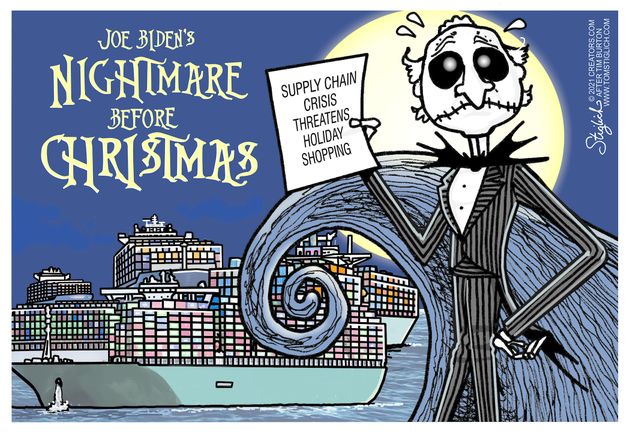
Griffith: It’s tough to prognosticate, but there is a substantial backlog and we still see these disruptions continuing across parts of the world, particularly in China with these rolling COVID shutdowns. So this is going to be something that’s going to take months to resolve.

But on the bright side, I’ve heard a number of retailers, including Best Buy today, talk about how they were working in advance to stock the shelves in time for Christmas. And Best Buy was saying that they’re actually running ahead of prior years in terms of the merchandise that they have stockpiled ready for Christmas. So that’s a positive.

On the negative side … there’s a real important ratio called inventory to sales that measures how much inventory you have on hand relative to your average monthly sales. And those numbers are still near all-time lows or at least generational lows, suggesting we’re not quite out of the woods yet.

Blair: I want to focus on something that I’ve been curious about about these issues. It seems like we’ve been talking about this in the U.S. for quite a while now. Are these issues something that the rest of the world is experiencing as badly as we are? I know you mentioned the ports in China that got closed down due to one case of COVID. But are other countries experiencing supply chain issues just as badly as we are?

Griffith: Yes, we are not alone in this. I don’t know if that should give us comfort. But other parts of the world are struggling with this as well. And in fact, other parts of the world are still struggling with lockdown measures, which are an absolute affront to human liberty. So in that respect, at least we are outperforming because we do have, in most of the country, a greater respect for human dignity and basic of human rights.

Also … with some of these other countries that rely more on the export side, their economies are really being hammered on that because they are much more reliant on manufacturing for the employment of their populace.

Blair: Now, moving back to the domestic side, is this supply chain issue something that affects rural and urban Americans equally, or is this affecting one segment of the population more than another segment of the population?

Griffith: That is a great question, Doug, that I don’t know that I have an answer to. I do know this, that regardless of where you are living, if you are looking to buy a new washer, dryer, vehicle, clothing, so much of that is reliant on imports. Even if it’s manufactured here, it’s reliant on components that come from overseas. And you’re facing some either mild inconvenience—for instance, if your washer machine goes out, you might have to wait a week or two, maybe that’s a modest inconvenience. But let’s say you need a new vehicle, spending 30% more, 40% more for a car compared to a year ago, that’s a major problem, especially for a middle-class family.

So these issues, they really do impact rural areas, urban areas as well. If you’re looking to buy food, all of us, whether we live in the countryside or whether we live in a big city, unless we’re growing our own food, and 98% of us aren’t, well, a lot of that food comes from across the border as well, whether Mexico, Canada, or even overseas for a lot of our vegetables, and those have been increasing double digits, too. So that’s impacting all of us. We are, not to use that phrase, but we are all in this together.

Blair: In a way it’s kind of refreshing that this is something that Americans are going to have to deal with together. So on that topic, what can the American government do, if anything, to help end the supply chain crisis? I know we talked briefly about you were in favor of President Biden’s announcement that he was going to be keeping the Port of LA open 24/7. You mentioned it was a commonsense measure. What are some of the other things that the government can be doing to help end the supply chain crisis?

Griffith: Yeah, and to be clear, with those ports, President Biden can’t just flip the on/off switch on that, but he did encourage them to do that. And I think that should be applauded.

But something that government could do is roll back some of these remaining onerous COVID restrictions that aren’t really grounded in science. And No. 2, this is a real big one, the Biden administration has proposed a vaccine mandate for employees at companies larger than 100. That’s 80 million people that are impacted by that. And there are possibly 5%, 10%, maybe even more, of individuals that have indicated they would rather not work than be subjected to those vaccine mandates.
Now, 10% of the workforce might not sound like a lot, but that’s millions of individuals. And many of them do work in the transportation sectors, whether they are truck drivers or they work at docks. Well, that’s going to not just be a burden on their families if they find themselves required to no longer work because of this mandate, that’s going to impact all of us. Even if a few percentage points of people decide to sit at home, that work in these vital sectors, that’s going to impact all of us.

So the administration could also forego it’s unconstitutional, unlawful vaccine mandate.

Thirdly, and this is a big one, the federal government should stop juicing demand artificially. We have a supply problem. We need to have more items produced, need to have more items shipped. The last thing we need right now, and really ever, is for the government to be printing and borrowing more money and artificially simulating demand at a time especially when supply just simply is constricted because of all these delays and restrictions.

So that’s three things right there the federal government could do to alleviate this problem.

And I want to add one more thing going forward, states have a role to play here longer term. With California looking to impose even more onerous restrictions on people in the shipping industry and in the trucking industry and diesel requirements, well, this gives opportunities for other states—we mentioned Alabama, Florida, Georgia, Texas in particular—to go ahead and pick up the slack. It’ll benefit their state economies. It’ll also benefit the country as well.


Japan Urges WHO Change Name to Chinese Health Org.

Report from Gateway Pundit Japanese Vice President Says WHO Should Be Renamed the CHO or the “Chinese Health Organization” .  Excerpts in italics with my bolds.

Japanese Deputy Vice President Aso Taro told reporters the World Health Organization should change its name to the Chinese Health Organization.

So far 500,000 people have signed the petition for the name switch.

Pro-Taiwan Japanese politician Aso Taro blasted the World Health Organization for bowing to China and excluding Taiwan as a member state. Speaking to Japanese lawmakers, Aso Taro, the deputy prime minister, said the WHO should change its name to the “CHO,” or China Health Organization.

Taro said being excluded from the global health body, Taiwan was driven to become a world leader in combating the coronavirus. The coronavirus pandemic has led to the postponement of the 2020 Olympics in Japan.

Speaking in Japan’s parliament, the country’s deputy prime minister leveled fresh criticism against China. Although the details are murky, the WHO’s previous director-general was a Chinese national and at the time, there were complaints all around. The current petition has gathered 500,000 signatures. People think the World Health Organization should change its name. It shouldn’t be called the WHO. It should be renamed the CHO. This appeal is truly resonating with the people.