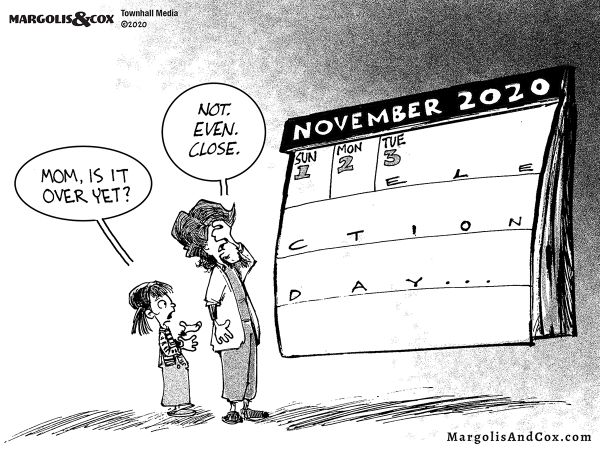
We are finishing only the second of four stages in an election for president. After the voting stage, states began the tabulation stage. We will soon enter the canvass stage, in which local districts confirm their counts and face challenges or recounts. Finally, there is the certification stage, in which final challenges can be raised. In other words, Trump is not deceased yet. Biden has reason to claim his lead as the odds are heavily against Trump. One or two states could flip on a “Hail Mary” challenge. But Trump needs four of those to win in a feat that would hyperventilate Aaron Rogers.
[My Comment: Most of the mass media and all of social media actively campaigned for the Biden-Harris ticket so their declarations of victory are the same as those from the candidates themselves. With so many states heading for recounts and scrutiny of irregularities, the outcome is not yet determined. After four years of fake news burying and hiding real news, we now have the challenge to sort between fake votes and real votes.
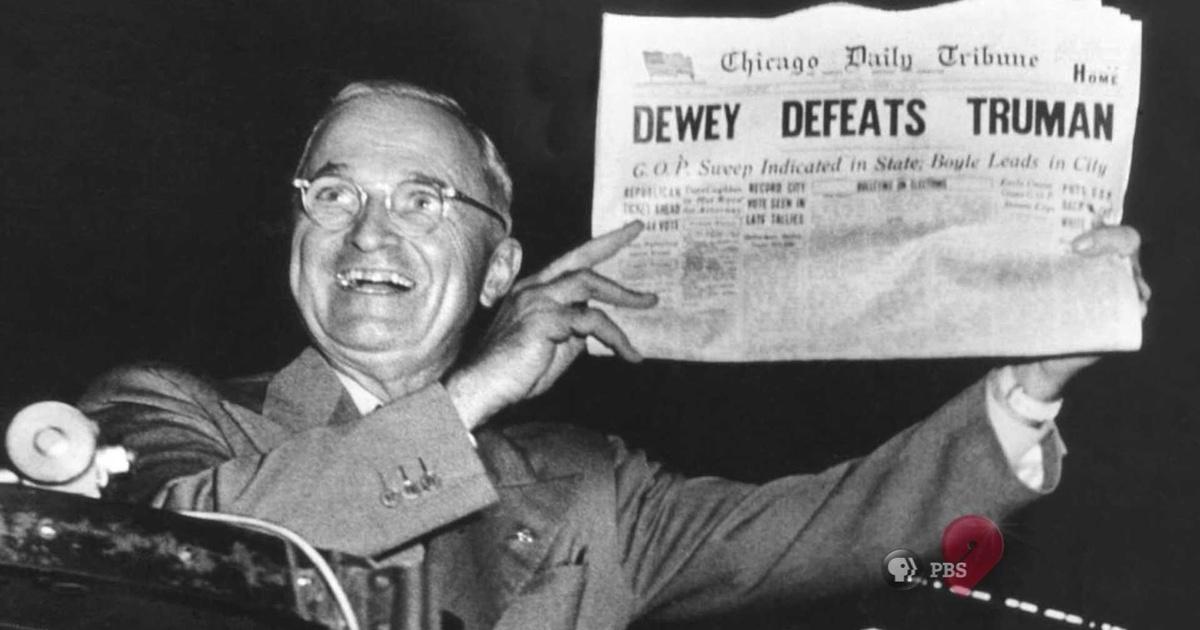
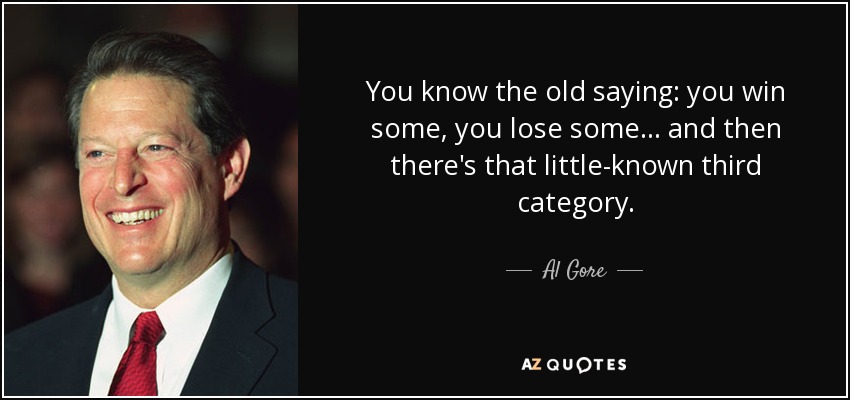
Nor is Trump “unclassy” for not conceding at this point. Democrats and all Americans were surprised the newspapers of record got it wrong in 1948 when Truman prevailed after all four stages of the election. Nor did Al Gore give up in 2000. It took 36 days and went all the way to the Supreme Court. He lost when a crooked election supervisor in Palm Beach county of Florida was found guilty of favoring the Democrat by voiding Bush votes. As well thousands of military ballots, which favored Bush by a roughly 2-1 margin, were arbitrarily excluded.]
I think he’s referring to “DQ”, meaning DisQualified.
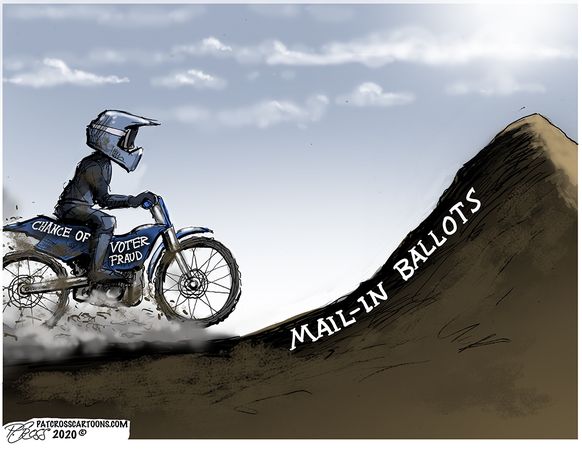
Yet the public should welcome close scrutiny of these swing states. There are valid reasons to examine the figures based on the many unknowns in a new kind of election. The outcome will be determined by millions of mailed ballots in various states, some of which have never used such mailed ballots to this magnitude, and legitimate concerns were raised before the election.
States used rolls that are notoriously out of date and inaccurate. Some changed rules governing signature authentication or are accused of reducing the discrimination levels for machine authentication. In Nevada, the Trump campaign alleged that thousands of votes were cast from out of state and ballots were sent to dead voters. We cannot judge the merits of these claims until we see the evidence. It is difficult to see any problems without greater access to the ballots and the records of tabulation.
Just as some of us remain skeptical of such claims of fraud, it seems as implausible that this untested form of voting was used across the country without major glitches. Officials in cities like Detroit and Philadelphia with histories of election violations said the counts of mailed ballots were almost flawless, a claim difficult to rebut without review.
We need a review of counts in critical states to resolve a crisis of faith. A recent survey found that almost half of Americans lack confidence their ballots will be counted fairly. A Harvard study also found that only half of young black voters believe their ballots are even counted.
This lack of faith in the electoral process has been fueled by the shift to mailed ballots but builds on growing distrust of our political system.
Seeking some comic relief from the US election fiasco, I turned to Babylon Bee and found this satirical piece skewering leftist fears about the US Supreme Court with ACB confirmed. (Just this week Pelosi declared that ACB is an “illegitimate” justice”.) Give the BB writers credit for flipping leftist control-freak behavior into rulings constraining personal rights and freedoms, but in the opposite direction.
Since Amy Coney Barrett was confirmed to the Supreme Court, she and the other judges have wasted no time in remaking America in their image. This is what we were warned about. In only two days, 23 landmark cases have been decided by the new conservative Supreme Court. God help us all.
United States v. Trump, 6-3 ruling — Determined that Trump has already won reelection
Walsh v. Dweedlestein, 5-4 ruling — We are to be a theocracy under God
United States v. Trump, 5-4 ruling — Trump is now the Galactic Emperor Of Man
Acosta v. Elisha, 9-0 ruling — All journalists shall be thrown into a pit with a she-bear
Gorka v. Kagan, 5-4 ruling — All justices must now wear MAGA hats
Subway v. Hebrew National, 6-3 ruling — A hotdog is now legally classified as a sandwich
Amazon v. Smith, 6-3 ruling — Die Hard is now legally classified as a Christmas movie
Gates v. Cook, 7-2 ruling — .GIF must now be pronounced with a hard “G”
American Airlines v. Moore, 6-3 ruling — The person in the middle seat of an airplane gets both armrests
Casey v. Brown, 6-3 ruling — Washing your feet in the shower is unconstitutional
United States v. West, 5-4 ruling — The dress is blue and black
United States v. Barrett, 6-3 ruling — All women must have at least 7 children
Papa Johns v. Tony’s, 5-4 ruling — All pizzas must now have pineapple on top
United States v. Silverman, 9-0 ruling — Annoying celebrity videos telling you to vote are now illegal
Bartolli v. Xanderatrix, 5-4 ruling — Single women are now limited to only 3 cats
Taco Bell v. Chad, 9-0 ruling — All Taco Bells must put the Crunchwrap back on the dollar menu
United States v. Trump, 5-4 ruling — Everyone must have a Christopher Columbus Statue in their yard
LaPierre v. Morgan, 6-3 ruling — Gun ownership is now mandatory
United States v. Crystal Marina, 9-0 ruling — Grants McConnell Protected Status as an endangered turtle
United States v. Trump, 6-3 ruling — All faces on Mt. Rushmore must now be replaced by Trump
Babylon Bee v. Facebook, 9-0 ruling — Babylon Bee no longer allowed to tell jokes about AOC
Burger King v. Carson, 5-4 ruling — “Impossible Meat” now illegal
Thomas v. Breyer, 8-1 ruling — In favor of stealing Justice Breyer’s milk money and shutting him in a locker
Amazing. Let’s see what they come up with next week!
In the three Midwest battleground states, vote counting irregularities persist in an election that will be decided on razor-thin margins.
As of this writing, it appears that Democratic Party machines in Michigan, Wisconsin, and Pennsylvania are trying to steal the election.
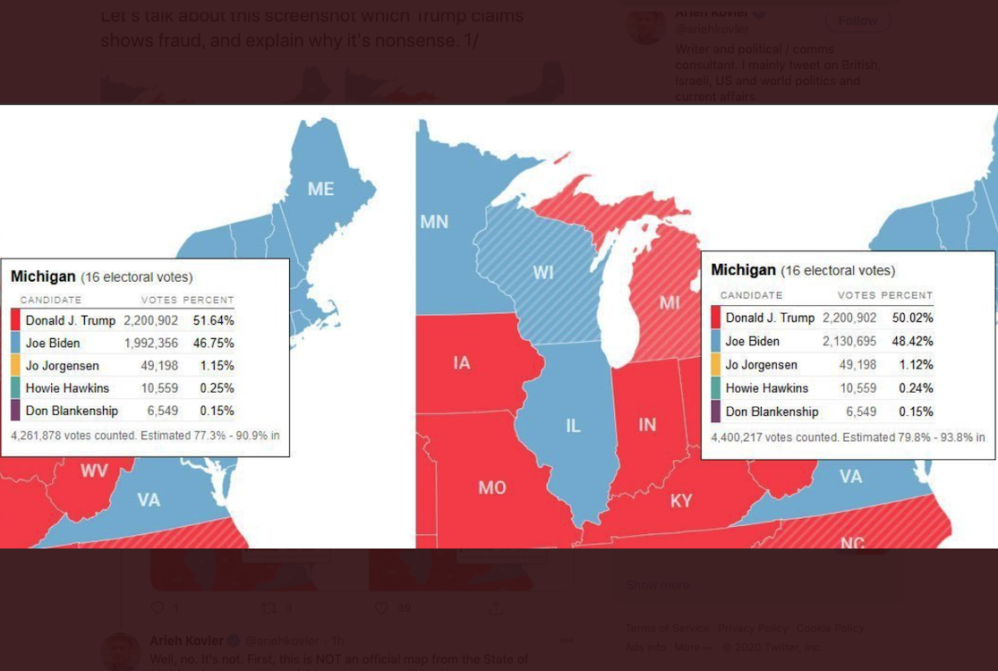
Something strange happened in the dead of the night. In both Michigan and Wisconsin, vote dumps early Wednesday morning showed 100 percent of the votes going for Biden and zero percent—that’s zero, so not even one vote—for Trump.
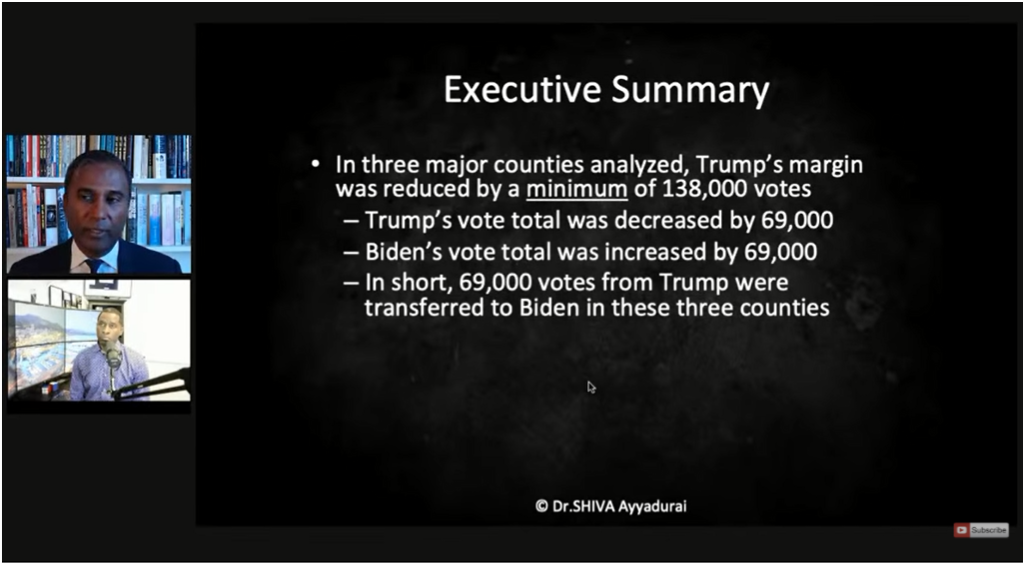
In Michigan, Biden somehow got 138,339 votes and Trump got none, zero, in an overnight vote-dump.
When my Federalist colleague Sean Davis noted this, Twitter was quick to censor his tweet, even though all he had done was compare two sets of vote totals on the New York Times website. And he wasn’t the only one who noticed—although on Wednesday it appeared that anyone who noted the Biden vote dump in Michigan was getting censored by Twitter.
It turns out, the vote dump was the result of an alleged typo, an extra zero that had been tacked onto Biden’s vote total in Shiawassee County, Michigan. It seems the error was discovered only because Davis and other Twitter users noted how insane and suspicious the vote totals looked, and demanded an investigation that uncovered what was either a typo or an incredibly clumsy attempt to boost Biden’s vote count.
There was also something suspicious about the vote reporting in Antrim County, Michigan, where Trump beat Hillary Clinton by 30 points in 2016. Initial vote totals there showed Biden ahead of Trump by 29 points, a result that can’t possibly be accurate, as plenty of journalists noted.
Then another mysterious all-Biden vote dump happened in Wisconsin. Biden miraculously overcame a 4.1-point Trump lead in the middle of the night thanks to vote dumps in which he got—you guessed it—100 percent of the votes and Trump got zero.
Unless election officials in Michigan and Wisconsin can explain the overnight vote-dumps and, in Michigan, the “typo” that appeared to benefit Biden, and Pennsylvania officials can explain their rationale for counting ballots with no postmark, the only possible conclusion one can come to right now is that Democrats are trying to steal the election in the Midwest.
President Donald Trump has been infected by the COVID-19 virus, and no doubt there are thousands out there saying it serves him right, that he has shrugged his shoulders at the pandemic, even refused to wear face masks and has caused thousands of deaths.
I would say something different, that this is still another event marking 2020 as one of the strangest years in American history, one that signals good reasons to shake and shiver, and not only because of a frightful pandemic and an ultra-bizarre president.
Have you noticed principle-shattering leftists, bureaucratic rot, a racial justice movement overtaken by unjust riots, the war on law enforcement, congressional extremism, media degeneration, social media mayhem, and that some of the science deniers about climate change are the totalitarian alarmists?
Yes, Trump has been a helter-skelter messenger on the pandemic, an occasional absurdity promoter and a misleading dueler with a gotcha press. In the early going, he seemed almost as unconcerned as Gov. Andrew Cuomo of New York, Joe Biden and half of everyone else. But the administration was up to all kinds of meaningful, media-neglected actions early on, with some of the goofs actually coming from the CDC.
Trump was definitively instructed by critics that he had no authority over the states. That is correct, and it is the states that have made the mistakes in resolving this deadly medical mystery, not him.
The Washington Free Beacon recently ran a list of Biden’s phony campaign assertions about Trump and the virus, and keep them in mind in assessing how miswrought his own leadership could be. He said Trump silenced a CDC expert when he didn’t, that he called the virus a “hoax” when he was referring to Democratic shenanigans, that he eliminated a pandemic office that had instead been reconstituted, that he put no pressure on China when he did, that he reduced our CDC scientists in China when he didn’t and that he refused virus test kits from the World Health Organization that never said we could have them.
I know, only Trump “lies” are important, but he is not lying when he says it is crucial to get the economy started again. If you think that doesn’t matter as much as virus dangers, look at the white working class in which 150,000 people have long been dying of alcohol, drugs and suicide each year at least partly in reaction to economic shifts taking away jobs. We could have years of struggle if we don’t get started while at least being as careful as Sweden that has handled the virus pretty well without a shutdown.
Trump helped put together an outstanding economy before the virus while Biden wants debt more than Trump does and taxes and more regulations that would in effect be another shutdown that he says he might call for anyway.
Biden also says he might favor packing of the Supreme Court, an extreme leftist position that could lead to parties rearranging the court and thereby destroying it whenever they resumed control of the White House and Senate. This is the Democrats today, the party that worked with the FBI to indulge in a farcical investigation of the Trump campaign coordinating with the Russians in illegal means of winning in 2016. Information is mounting about the connivance in all of this.
It’s no small thing to try to unseat a president illegitimately and intimidate governance for more than two years, and the current treatment of Biden’s conflicts of interest as nothing much shows a morally twisted prejudice.
My point in all of this is that the election-year issues aren’t as straightforward as some pretend, that, while Trump is scary, the other side is in some ways far scarier, that preserving Republican control of the Senate is imperative and that the public should consider varied points of view. Meanwhile, I wish Trump, his wife and other virus victims the best while hoping he may return for another debate with a touch of humility.
At least for now, the debate strategies seem clear. On one side, let’s troll Trump with fake news and then pretend he is a clown when he objects. On the other side, let’s bait Biden and see if he loses control and goes off the script beamed into his ears.
Biden came in for some rough treatment in the first presidential debate
One of the most interesting and telling exchanges came about an hour into the debate. In some ways each man showed himself in his purest form. Joe Biden delivered what was very obviously a well-rehearsed, set-piece attack on President Trump. You could see the windup, like a boxer pulling his arm way back, fist clenched, preparing to deliver the knockout blow. Biden started by repeating the accusation that Trump disrespectfully criticises the military, calling them losers and suckers. The story has been debunked repeatedly by multiple sources including those hostile to the president like John Bolton. But it’s part of the Biden campaign’s strategy. So he levels the accusations and then begins to eulogise his son, Beau Biden, who served in Iraq, and later died of brain cancer. This makes it all personal to Joe, you see. He’s defending his dead son against a mythical slander from the bad orange man. Biden even points a finger at Trump, “My son is not a loser!”
Trauma mining to score points in a debate is a desperately cynical piece of political theatre. But, I suppose they calculate that if it works you get to be president. (I’ll pass, thanks.) It was pure Biden: scripted, saccharine, playing by the rules of a game that has long since ended. In case you think I’m too cynical, that surely this couldn’t have been orchestrated, Joe Biden’s official Twitter account posted a photo of Joe and Beau with the caption, “Beau was not a loser” just as the debate ended.
And just so, Trump. He looked at his podium and quietly, respectfully, asked, which son Biden was talking about. Of course, he knew, but he played the game forcing Biden to respond, Beau. “Oh, I don’t know him. I know Hunter.”
And then listed the accusations against Hunter: he took a $1.5 billion investment from China into the fledgling investment company he ran with John Kerry’s son while his father was Vice President and en route to China. He received $3.5 million from the mayor of Moscow. He had a sinecure from a Ukranian energy company while his father was Obama’s pointman on Ukraine policy. (NB: Hunter had no experience in business let along the energy business.) It was as sweet a move as I’ve ever seen. The knockout punch was coming with all the force Joe Biden could muster and Trump simply sidestepped it and counterpunched.
It was an impressive display of natural animal cunning. And it could make the difference in the election. Trump was agile, aggressive, and vigorous, taking what he wanted when he wanted it. This offends some people’s sensibilities. He’s transgressive.
He doesn’t play according to the rules. But for others, that’s part of the appeal.
It’s no secret that the ruling class in America despises the country class. If you’re one of those people who don’t live in coastal cities and subscribe to the same worldview as the elite aspirants hoping for a job at a billionaire-backed NGO or an internship that might lead to a job at McKinsey then you’re a deplorable, a CHUD, and definitely racist and whatever bad things are happening to you, your family, and your inland town are your just deserts.
One of Trump’s main functions and biggest appeals is that he exposes the occupational elites that are credentialed but not expert in much of anything.
Everyone knows it. Imposter syndrome is rampant. And Trump preys on their insecurities which is what provokes such outrageous reactions from his enemies. But a lot of Americans who live in interior America and get unglamorous jobs at slowly declining wages, raise their families want nothing more than to be left alone by the credentialed but unaccomplished strivers who hate them.
For those people, Trump is their champion.
They probably don’t aspire to be like Trump, but they like the fact that he exposes the bankruptcy of the undeserving ruling class. And for them, Trump’s debate tonight was a tour de force. It was aggressive, it was funny, he said the quiet part out loud, he broke the rules in public that are normally only broken in private. That won him the election in 2016. It won him the debate last night. And it might just get him re-elected in November.
Note: The debate began with Trump and Biden each making one uninterrupted comment. Biden then talked over Trump’s second comment without intervention by the moderator. And so the game was on.
At least for now, the debate strategies seem clear. On one side, let’s troll Trump with fake news and then pretend he is a clown when he objects. On the other side, let’s bait Biden and see if he loses control and goes off the script beamed into his ears.
Outlets claiming to have “confirmed” Jeffrey Goldberg’s story about Trump’s troops comments are again abusing that vital term.
The same misleading tactic is now driving the supremely dumb but all-consuming news cycle centered on whether President Trump, as first reported by the Atlantic’s editor-in-chief Jeffrey Goldberg, made disparaging comments about The Troops. Goldberg claims that “four people with firsthand knowledge of the discussion that day” — whom the magazine refuses to name because they fear “angry tweets” — told him that Trump made these comments. Trump, as well as former aides who were present that day (including Sarah Huckabee Sanders and John Bolton), deny that the report is accurate.
So we have anonymous sources making claims on one side, and Trump and former aides (including Bolton, now a harsh Trump critic) insisting that the story is inaccurate. Beyond deciding whether or not to believe Goldberg’s story based on what best advances one’s political interests, how can one resolve the factual dispute? If other media outlets could confirm the original claims from Goldberg, that would obviously be a significant advancement of the story. Other media outlets — including Associated Press and Fox News — now claim that they did exactly that: “confirmed” the Atlantic story.
But if one looks at what they actually did, at what this “confirmation” consists of, it is the opposite of what that word would mean, or should mean, in any minimally responsible sense.
AP, for instance, merely claims that “a senior Defense Department official with firsthand knowledge of events and a senior U.S. Marine Corps officer who was told about Trump’s comments confirmed some of the remarks to The Associated Press,” while Fox merely said “a former senior Trump administration official who was in France traveling with the president in November 2018 did confirm other details surrounding that trip.”
In other words, all that likely happened is that the same sources who claimed to Jeffrey Goldberg, with no evidence, that Trump said this went to other outlets and repeated the same claims — the same tactic that enabled MSNBC and CBS to claim they had “confirmed” the fundamentally false CNN story about Trump Jr. receiving advanced access to the WikiLeaks archive. Or perhaps it was different sources aligned with those original sources and sharing their agenda who repeated these claims. Given that none of the sources making these claims have the courage to identify themselves, due to their fear of mean tweets, it is impossible to know.
But whatever happened, neither AP nor Fox obtained anything resembling “confirmation.”
They just heard the same assertions that Goldberg heard, likely from the same circles if not the same people, and are now abusing the term “confirmation” to mean “unproven assertions” or “unverifiable claims” (indeed, Fox now says that “two sources who were on the trip in question with Trump refuted the main thesis of The Atlantic’s reporting”).
It should go without saying that none of this means that Trump did not utter these remarks or ones similar to them. He has made public statements in the past that are at least in the same universe as the ones reported by the Atlantic, and it is quite believable that he would have said something like this (though the absolute last person who should be trusted with anything, particularly interpreting claims from anonymous sources, is Jeffrey Goldberg, who has risen to one of the most important perches in journalism despite (or, more accurately because of) one of the most disgraceful and damaging records of spreading disinformation in service of the Pentagon and intelligence community’s agenda).
But journalism is not supposed to be grounded in whether something is “believable” or “seems like it could be true.” Its core purpose, the only thing that really makes it matter or have worth, is reporting what is true, or at least what evidence reveals. And that function is completely subverted when news outlets claim that they “confirmed” a previous report when they did nothing more than just talked to the same people who anonymously whispered the same things to them as were whispered to the original outlet.
Quite aside from this specific story about whether Trump loves The Troops, conflating the crucial journalistic concept of “confirmation” with “hearing the same idle gossip” or “unproven assertions” is a huge disservice. It is an instrument of propaganda, not reporting. And its use has repeatedly deceived rather than informed the public. Anyone who doubts that should review how it is that MSNBC and CBS both claimed to have “confirmed” a CNN report which turned out to be ludicrously and laughably false. Clearly, the term “confirmation” has lost its meaning in journalism.
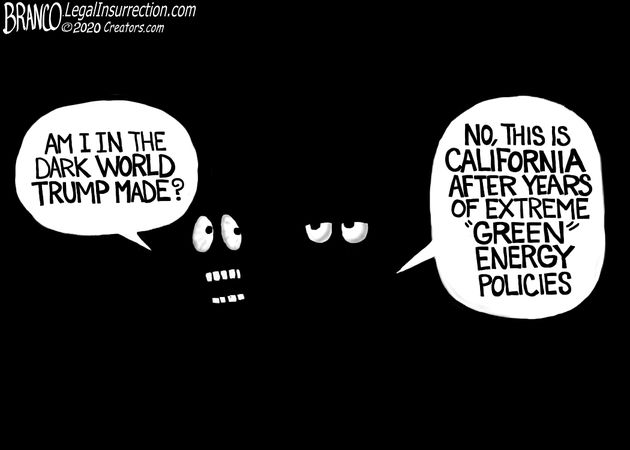
The heatwaves and the fires are natural – the electricity blackouts are not.
Events leading up to today’s power cuts follow a bizarre history. The fact that advanced economies need a continuous supply of power is well understood. Yet for three decades, the political agenda, dominated by self-proclaimed ‘progressives’, has put lofty green idealism before security of supply and before the consumer’s interest in reasonable prices. Even if the heatwaves experienced by California were caused by climate change, are their direct effects worse than the loss of electricity supply?
California’s green and tech billionaires, and its business and political elites, certainly seem to think so. But they are largely protected from reality by vast wealth, private security, gated estates, and battery banks. The high cost of property in the state of California means that, despite being the fifth largest economy in the world, and with the sixth highest per capita income in the US, it is the worst US state for poverty. According to the US Census Bureau, around 18 per cent of Californians, some seven million people, lived in poverty between 2016 and 2018 – more than five per cent above the US average.
As well as being the greenest (and most poverty-stricken) state, California can also boast that it is the No1 state for homelessness.
According to the US Interagency Council on Homelessness, there are more than 151,000 homeless people in California – a rise of 28,000 since 2010. That figure is shocking enough, but it masks the reality of many thousands more moving in and out of homelessness. The same agency reports that more than a quarter of a million schoolchildren experienced homelessness over the 2017/18 school year.
It is degenerate politics, not climate change, that presses hardest on the millions of Californians who live in poverty, and the many millions more who live just above the poverty line. The problems of this degenerate politics are visible, on the street, chronic and desperate, whereas climate change, if it is a problem at all, is only detectable through questionable statistical techniques. Yet California’s charismatic governors, since Arnold Schwarzenegger, have made their mark on the global stage as environmental champions.
At the 2017 COP23 UNFCCC conference in Bonn, Germany, then governor Jerry Brown shared a platform with the green billionaire and former New York mayor, Mike Bloomberg, to announce ‘America’s Pledge on Climate’ – a commitment of states and cities to combat climate change – despite President Trump’s decision to withdraw the US from the Paris Agreement earlier that year.
But why not a pledge on homelessness? Why not a pledge to address the problem of property prices? Why not a pledge to tackle poverty? Why not a pledge to secure a supply of energy? The only conceivable answer is that environmentalism is a form of politics that is entirely disinterested in the lives of ordinary people, despite progressive politicians’ claims that environmental and social issues are linked. Clearly they are not in the slightest bit linked.
California was the experiment, and now it is the proof: environmentalism is worse for ‘social justice’ than any degree of climate change is.
What about the wildfires? Aren’t they proof of climate change? It is a constant motif of green histrionics that more warming means more fires. But as has been pointed out before on spiked and elsewhere, places like California have long suffered from huge fires; fire is a part of many types of forests’ natural lifecycle.
What California’s rolling blackouts and its uncontrolled fires tell us is that green politics is completely divorced from any kind of reality. Environmentalism is the indulgent fantasy of remote political elites and their self-serving business backers. If California doesn’t prove this, what would?
But that makes it even more important that those of us talking about global warming and its policy responses are responsible about statistics and data. It’s not good enough to swagger around saying, “I think I’m right and I’m going to ignore the haters.” Schwarzenegger loses me when he declares, “every day, 19,000 people die from pollution from fossil fuels. Do you accept those deaths?”
It’s emotive, but it’s wrong to say that 19,000 people are killed by fossil fuels every day. About 11,000 of these people are killed by burning renewable energy – wood and cow dung mainly – inside their own homes. The actual number of people killed by fossil fuels each day is about 3,900.
This matters for two reasons.First, it is disingenuous to link the world’s biggest environmental problem of air pollution to climate. It is a question of poverty (most indoor air pollution) and lack of technology (scrubbing pollution from smokestacks and catalytic converters) – not about global warming and CO₂.Second, costs and benefits matter.[vi] Tackling indoor air pollution turns out to be very cheap and effective, whereas tackling outdoor air pollution is more expensive and less effective. Your favorite policy of cutting CO₂ is of course even more costly and has a tiny effect even in a hundred years.
Lomborg failed to change Schwarzenegger’s mind since Arnie was so enamored of being a global environmental star as a sequel to his Hollywood movie celebrity.
In the sub-atomic domain of quantum mechanics, Werner Heisenberg, a German physicist, determined that our observations have an effect on the behavior of quanta (quantum particles).
The Heisenberg uncertainty principle states that it is impossible to know simultaneously the exact position and momentum of a particle. That is, the more exactly the position is determined, the less known the momentum, and vice versa. This principle is not a statement about the limits of technology, but a fundamental limit on what can be known about a particle at any given moment. This uncertainty arises because the act of measuring affects the object being measured. The only way to measure the position of something is using light, but, on the sub-atomic scale, the interaction of the light with the object inevitably changes the object’s position and its direction of travel.
Now skip to the world of governance and the effects of regulation. A similar finding shows that the act of regulating produces reactive behavior and unintended consequences contrary to the desired outcomes. More on that later on from a previous post.
This article looks at political and social research attempts to describe the electorate’s preoccupations and preferences ahead of 2020 US Presidential voting in November.
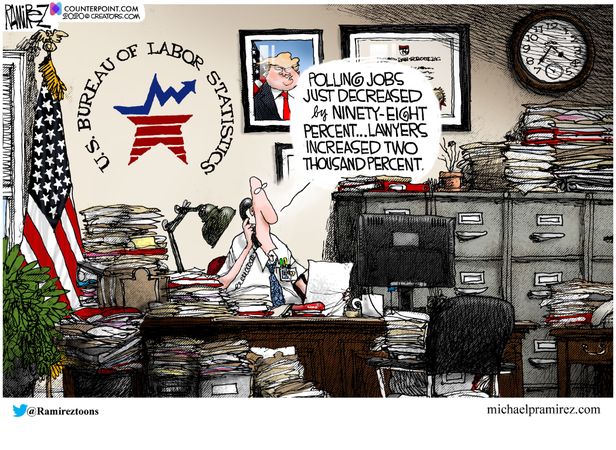
McLaughlin noted among the 220 million eligible voters in the U.S., only around 139 million voted in 2016, which is considered the most all-time.
“Even if it goes up to 140-150 million, the polls of adults are going to be skewed against Republicans,” McLaughlin told Monday’s “Greg Kelly Reports,” especially “since President Trump gets over 90% support from Republicans.”
McLaughlin noted CNN’s poll among adults featured just 25% registered Republicans, where as around one-third of the electorate that voted in 2016 were Republicans.
He added to host Greg Kelly, it costs more to run focused polls of likely voters from actual voter registration lists.
“It’s cheaper for them to do,” in addition to being advantageous to the Democratic candidate, McLaughlin told Kelly. “They don’t have to buy a sample of voters, that campaign pollsters – whether Republican or Democrat – are going to have to do.”
Also, per McLaughlin, reporting a blowout lead ultimately can cause voter suppression, a frequent rally cry of Democrats against Republicans in election.
Politico notes that there is nothing nefarious going on to skew these polls toward Biden. But they do have the same issue the 2016 polls had: They’re not reaching all of the Trump supporters.
At the center of the issue are white voters without college degrees; in 2016, Trump earned 67% of this demographic’s support, while Democrat Hillary Clinton got just 28%. Current polls, according to Politico, are not capturing enough of this voting bloc, which unintentionally skews the results toward Biden.
My Comment: This post was inspired by a Flynnville Train song that captures the sentiment of working class Americans alienated from the political process. Disrespected as “deplorables” they turned out for Trump and made the difference in 2016. Now with arbitrary pandemic restrictions and random urban rioting, these folks are even more incensed about the political elite. Lest anyone think them inconsequential, remember that many of them get up and go to watch the most popular US spectator sport. I refer to stock car racing, not the kneeling football or basketball athletes.
Lyrics:
IF YOU’RE HANDS ARE HURTIN’ FROM A WEEK OF WORKIN’
AND HOLDING YOUR WOMAN IS THE ONLY THING THEY’RE GOOD FOR
YOU’RE PREACHING TO THE CHOIR
IF THE PRICE OF GAS IS BREAKIN’ YOUR BACK
AND THAT DRIVE TO WORK IS KILLIN’ YOUR PAYCHECK
YOU’RE PREACHING TO THE CHOIR
IF YOU’RE WORRIED ‘BOUT WHERE THIS COUNTRY’S HEADED
AND YOU DON’T BELIEVE ONE POLITICIAN GETS IT
CHORUS
YOURE PREACHIN’ TO THE CHOIR
A FELLOW WORKIN’ MAN
THERE’S A WHOLE LOT OF STUFF MESSED UP
CAN I GETTA AMEN
SOMETHING’S GOTTA GIVE
CAUSE WE’RE ALL GETTING TIRED
SO GO ON BITCH AND MOAN
YOU’RE PREACHING TO THE CHOIR
IF THE GOOD BOOK SITS BESIDE YOUR BED
AND UNDER YOUR ROOF WE’RE STILL ONE NATION UNDER GOD
YOU’RE PREACHING TO THE CHOIR
IF YOU LIKE THE CHANCE TO WRAP YOUR HANDS
ROUND THAT S.O.B. THAT HURT THAT KID ON THE EVENIN’ NEWS
YOU’RE PREACHING TO THE CHOIR
IF YOU KNOW THERE AIN’T NO HERO LIKE A SOLDIER
BUT YOU HATE TO EVER HAVE TO SEND ‘EM OVER
CHORUS
IF THE GOLDEN RULE STILL MEANS SOMETHING TO YA
WELL HALLELUJAH
Goodhart’s Law holds that “any observed statistical regularity will tend to collapse once pressure is placed upon it for control purposes”. Originally coined by the economist Charles Goodhart as a critique of the use of money supply measures to guide monetary policy, it has been adopted as a useful concept in many other fields. The general principle is that when any measure is used as a target for policy, it becomes unreliable. It is an observable phenomenon in healthcare, in financial regulation and, it seems, in energy efficiency standards.
When governments set efficiency regulations such as the US Corporate Average Fuel Economy standards for vehicles, they are often what is called “attribute-based”, meaning that the rules take other characteristics into consideration when determining compliance. The Cafe standards, for example, vary according to the “footprint” of the vehicle: the area enclosed by its wheels. In Japan, fuel economy standards are weight-based. Like all regulations, fuel economy standards create incentives to game the system, and where attributes are important, that can mean finding ways to exploit the variations in requirements. There have long been suspicions that the footprint-based Cafe standards would encourage manufacturers to make larger cars for the US market, but a paper this week from Koichiro Ito of the University of Chicago and James Sallee of the University of California Berkeley provided the strongest evidence yet that those fears are likely to be justified.
Mr Ito and Mr Sallee looked at Japan’s experience with weight-based fuel economy standards, which changed in 2009, and concluded that “the Japanese car market has experienced a notable increase in weight in response to attribute-based regulation”. In the US, the Cafe standards create a similar pressure, but expressed in terms of size rather than weight. Mr Ito suggested that in Ford’s decision to end almost all car production in North America to focus on SUVs and trucks, “policy plays a substantial role”. It is not just that manufacturers are focusing on larger models; specific models are also getting bigger. Ford’s move, Mr Ito wrote, should be seen as an “alarm bell” warning of the flaws in the Cafe system. He suggests an alternative framework with a uniform standard and tradeable credits, as a more effective and lower-cost option. With the Trump administration now reviewing fuel economy and emissions standards, and facing challenges from California and many other states, the vehicle manufacturers appear to be in a state of confusion. An elegant idea for preserving plans for improving fuel economy while reducing the cost of compliance could be very welcome.
An attribute-based regulation is a regulation that aims to change one characteristic of a product related to the externality (the “targeted characteristic”), but which takes some other characteristic (the “secondary attribute”) into consideration when determining compliance. For example, Corporate Average Fuel Economy (CAFE) standards in the United States recently adopted attribute-basing. Figure 1 shows that the new policy mandates a fuel-economy target that is a downward-sloping function of vehicle “footprint”—the square area trapped by a rectangle drawn to connect the vehicle’s tires. Under this schedule, firms that make larger vehicles are allowed to have lower fuel economy. This has the potential benefit of harmonizing marginal costs of regulatory compliance across firms, but it also creates a distortionary incentive for automakers to manipulate vehicle footprint.
Attribute-basing is used in a variety of important economic policies.Fuel-economy regulations are attribute-based in China, Europe, Japan and the United States, which are the world’s four largest car markets. Energy efficiency standards for appliances, which allow larger products to consume more energy, are attribute-based all over the world. Regulations such as the Clean Air Act, the Family Medical Leave Act, and the Affordable Care Act are attribute-based because they exempt some firms based on size. In all of these examples, attribute-basing is designed to provide a weaker regulation for products or firms that will find compliance more difficult.
The CAFE standards are not only an extremely inefficient way to reduce carbon dioxide emission but will also have a variety of unintended consequences.
For example, the post-2010 standards apply lower mileage requirements to vehicles with larger footprints. Thus, Whitefoot and Skerlos argued that there is an incentive to increase the size of vehicles.
Data from the first few years under the new standard confirm that the average footprint, weight, and horsepower of cars and trucks have indeed all increased since 2008, even as carbon emissions fell, reflecting the distorted incentives.
Manufacturers have found work-arounds to thwart the intent of the regulations. For example, the standards raised the price of large cars, such as station wagons, relative to light trucks. As a result, automakers created a new type of light truck—the sport utility vehicle (SUV)—which was covered by the lower standard and had low gas mileage but met consumers’ needs. Other automakers have simply chosen to miss the thresholds and pay fines on a sliding scale.
Another well-known flaw in CAFE standards is the “rebound effect.” When consumers are forced to buy more fuel-efficient vehicles, the cost per mile falls (since their cars use less gas) and they drive more. This offsets part of the fuel economy gain and adds congestion and road repair costs. Similarly, the rising price of new vehicles causes consumers to delay upgrades, leaving older vehicles on the road longer.
In addition, the higher purchase price of cars under a stricter CAFE standard is likely to force millions of households out of the new-car market altogether. Many households face credit constraints when borrowing money to purchase a car. David Wagner, Paulina Nusinovich, and Esteban Plaza-Jennings used Bureau of Labor Statistics data and typical finance industry debt-service-to-income ratios and estimated that 3.1 million to 14.9 million households would not have enough credit to purchase a new car under the 2025 CAFE standards.[34] This impact would fall disproportionately on poorer households and force the use of older cars with higher maintenance costs and with fuel economy that is generally lower than that of new cars.
CAFE standards may also have redistributed corporate profits to foreign automakers and away from Ford, General Motors (GM), and Chrysler (the Big Three), because foreign-headquartered firms tend to specialize in vehicles that are favored under the new standards.[35]
Conclusion
CAFE standards are costly, inefficient, and ineffective regulations. They severely limit consumers’ ability to make their own choices concerning safety, comfort, affordability, and efficiency. Originally based on the belief that consumers undervalued fuel economy, the standards have morphed into climate control mandates. Under any justification, regulation gives the desires of government regulators precedence over those of the Americans who actually pay for the cars. Since the regulators undervalue the well-being of American consumers, the policy outcomes are predictably harmful.
Taking an opinion “under advisement” means seriously considering it but retaining the independence to weigh it against other considerations. Charles Lipson explains the importance of not bowing to expert recommendations in his article Reopening Schools and the Limits of Expertise. Excerpts in italics with my bolds.
The last thing you want to hear from your brain surgeon (aside from “Oops”) is “Wow, I’ve always wanted to do one of these.” You’ll feel a lot better hearing, “I’ve done 30 operations like this over the past month and published several articles about them.”
Expertise like that is essential for brain surgery, building rockets, constructing skyscrapers, and much, much more. Our modern world is built upon it. We need such expert advice as we decide whether to open schools this fall, and we should turn to educators, physicians, and economists to get it. But ultimately we, as citizens and the local officials we elect, should make the choices. These are not technical decisions but political ones that incorporate technical issues and projections.
We should hold our representatives, not the experts, responsible for the choices they make.
When we listen to experts, we should remember Clint Eastwood’s comment in “Magnum Force”: “A man’s got to know his limitations.” Even the best authorities have them, and one, ironically, is that they seldom admit them, even to themselves. It is important for us both to appreciate expert advice and to recognize its limits every time we’re told to “be quiet and do what they say.” We should listen, think it over, and then make our own decisions as citizens, parents, teachers, business owners, workers, retirees — and voters.
The best way to understand why we need experts but also why we need to weigh their advice, not swallow it whole and uncooked, is to consider this illustration: Should we build a hydroelectric dam in a beautiful valley? If we construct it, we certainly need the best engineers and construction workers. We need engineering firms to project the cost and economists to project the price of its energy and potable water. Their expertise is essential.
But they cannot tell us whether it is wise to destroy California’s Hetch Hetchy Valley to build that dam. The world’s top experts on wildlife conservation and regional economic growth cannot give us the definitive answer, either. They would give us, at best, different answers, reflecting their different expertise. The conservationist would tell us it is a terrible idea to destroy such beautiful, irreplaceable habitat and kill endangered species. The economist would tell us we need the energy and fresh water if Northern California is to grow. What no economist could have predicted, decades ago, is that the entire world’s income would vastly increase because of technological advances from Silicon Valley, which had the resources needed to grow.
The hydroelectric example illustrates a more general point: complex questions involve experts in multiple fields, but there is no supra-expert to aggregate their differing advice. Even if we assume all experts within a field give similar advice, who can aggregate it across fields? No one. There is no “expert of experts.” In the example of the hydroelectric dam, the policy decision depends on how much we weigh conservation versus growth and how well we can predict future options and alternatives, such as the price of solar power or prospective growth from Palo Alto to San Jose.
Sorting out the answers is ultimately a question for voters and their representatives, not for experts in hydroelectric engineering, wildlife conservation, or regional economics. We need the best advice, but only we, as citizens, can weigh it and make a final decision. In a representative democracy, we elect officials to make those decisions. If democracy is to work, we must hold them accountable. One criticism of the growing regulatory state is that it is impossible to hold the decision makers accountable. Some of that criticism should be directed at legislators, who avoid responsibility by writing vague laws and then off-loading hard decisions onto bureaucrats and judges.
We should be especially skeptical when experts predict distant outcomes.
Their record is none too impressive. We should be skeptical, too, when laws and regulations set one definitive criterion, such as preserving the endangered snail darter, at the expense of all other considerations. That might be the best decision, or it might not, but it is ultimately a political choice. Right now, federal judges have awarded themselves extensive — and unilateral — power to make it.
These problems, which combine technical expertise and political judgment, are essential to understanding our dilemmas about reopening K-12 schools during the COVID-19 pandemic. Epidemiologists are saying, “Resuming in-person instruction too soon could spread the disease. Although children are at low risk, they will bring it home to parents and grandparents.” Pediatricians, by contrast, say it is important for children’s overall health to get them back in school. Online learning is not very effective, they say, and losing a year’s classroom instruction and socialization will be extremely harmful. Economists focus on different issues, such as parents who cannot return to full-time employment because they must care for children at home. That constraint is especially harmful to one-parent households and low-income, hourly workers, whose children also have less access to computers and fast internet connections. Notice that these experts are not the self-interested voices of interest groups such as teachers’ unions or small businesses. They are specialists in economics, education, and public health. Each has its own “silo of expertise.” Each silo produces a different answer because its experts focus on their own subset of issues and weigh them most heavily.
As we listen to these experts, we need to remember that even the best, most disinterested advice has its limitations. Reopening schools, like other big policy questions, involves multiple silos and hundreds of moving parts. It is impossible to predict what all those parts will do, how much weight to give each one, or what effects they might have, now and in the distant future. It was only from trial-and-error that we learned how inadequate online instruction really is. We entered this massive national experiment with some optimism and trudge forward with pessimism.
We should be humble about what we still don’t know.
Our success in reopening schools and businesses depends on things we cannot know with certainty. How quickly will our biotechnology companies discover effective therapeutics and vaccines? How quickly will the American population develop “herd immunity?” How soon will customers return, en masse, to shopping malls, indoor dining, and cross-country travel?
Predicting the secondary and tertiary effects of policy choices is especially hard.
Keeping businesses closed, for instance, sharply reduces local tax revenues, which probably means reducing essential services such as garbage collection and local policing. Those cuts harm public health and safety. But how much? No expert is smart enough to predict all these knock-on effects, much less aggregate them and give an overall conclusion. As it happens, experts are no better at predicting these effects than well-informed laymen. The main difference, according to studies, is that experts are more confident in their (often-wrong) predictions.
The point here is not that experts are irrelevant. We need them, and we need to pay attention to their data, logic, and conclusions. But we also need to remember that
Even the best current knowledge has its limits, and
There are no “supra-experts” to weigh the best advice from different fields and aggregate them to reach the “definitive” answer.
Sorting out this expert advice is not a technological question. It is a political one. Mayors, governors, and school boards across the country understand that crucial point as they decide whether to open schools this fall for in-person instruction. The voters understand it, too. They should listen to the experts, see what other jurisdictions decide, and check out their varied results. Then, they should walk into the voting booth and hold their representatives to account.
Charles Lipson is the Peter B. Ritzma Professor of Political Science Emeritus at the University of Chicago, where he founded the Program on International Politics, Economics, and Security.