Unhinged Climate Celebs: Krugman and Cusack

David Simon writes at Real Clear Markets Paul Krugman Is a Global Warming Alarmist. Don’t Be Like Him. Excerpts in italics with my bolds

In 2004, TheGuardian.com reported a secret Pentagon warning about global warming: “major European cities will be sunk beneath rising seas as Britain is plunged into a ‘Siberian’ climate by 2020. Nuclear conflict, mega-droughts, famine and widespread rioting will erupt across the world.”

In 2008, Al Gore announced that “the entire North ‘polarized’ cap will disappear in five years.”

In 2009, U.N. Secretary General Ban Ki-Moon declared that “[t]he world has less than 10 years to halt the global rise in greenhouse gas emissions if we are to avoid catastrophic consequences for people and the planet.”

All wrong.

Yet the supposedly authoritative statements of global warming doom continue. In a January 3, 2020 column titled “Apocalypse becomes normal”, Paul Krugman in his usual understated way told us that “[o]n our current trajectory, Florida as a whole will eventually be swallowed by the sea” and “[m]uch of India will eventually become uninhabitable.”
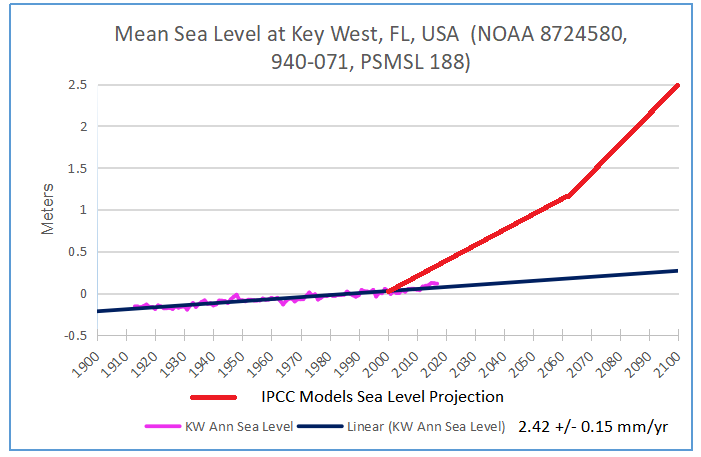
Krugman makes the same mistake as other false prophets of global warming doom. His and their predictions are works of science fiction because, contrary to scientific principles, they ignore the facts about global warming’s actual impact.

The facts instead show that global warming is a non-problem that warrants no action.

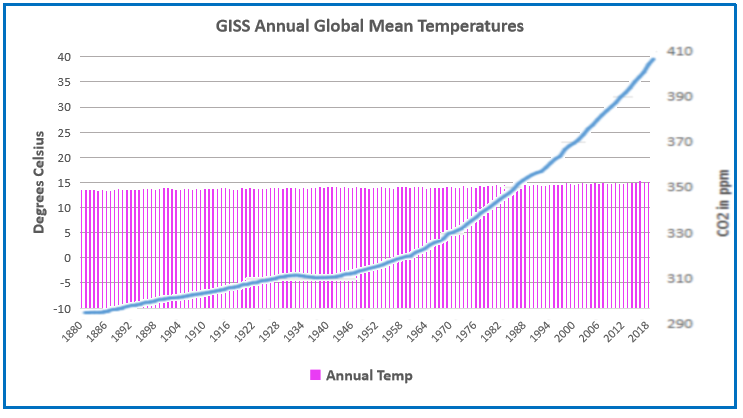
First, the earth’s temperature has been rising at a microscopically slow pace. NASA’s data set for global temperatures goes back to 1880 and shows that since that year, the earth’s temperature has risen by only 1.14° C. An increase of 1.14° C over 139 years translates to an average increase of only 0.008° C per year.
Second, a warmer earth saves lives. In 2015, the prestigious medical journal The Lancet reported that worldwide, cold kills over 17 times more people than heat. A group of 22 scientists examined over 74 million deaths in the United States, China, Brazil, and ten other countries in 1985-2012. They found that cold caused 7.29 percent of these deaths, while heat caused only 0.42 percent. And of these temperature-related deaths, “moderately hot and cold temperatures” caused 88.85 percent of the deaths, while “extreme” temperatures caused only 11.15 percent.

Third, while the earth’s temperature has risen, the number of natural disaster deaths has been sharply declining. In 2019, EMDAT, The International Disaster Database, reported that since the 1920s, the number of people killed annually by natural disasters has declined by over 80 percent. And this happened as the world’s population quadrupled from less than two billion to over seven and half billion.
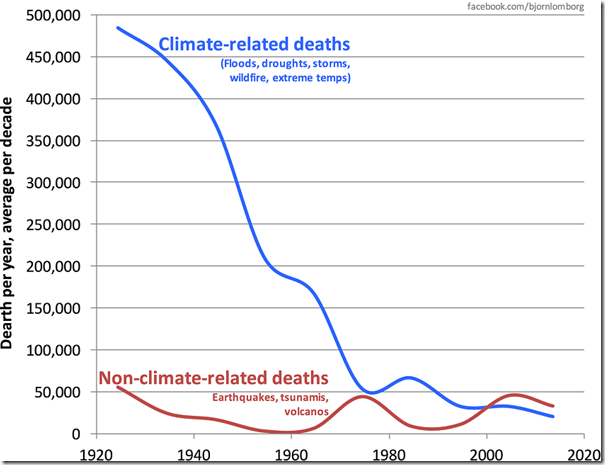
My Mind is Made Up, Don’t Confuse Me with the Facts. H/T Bjorn Lomborg, WUWT

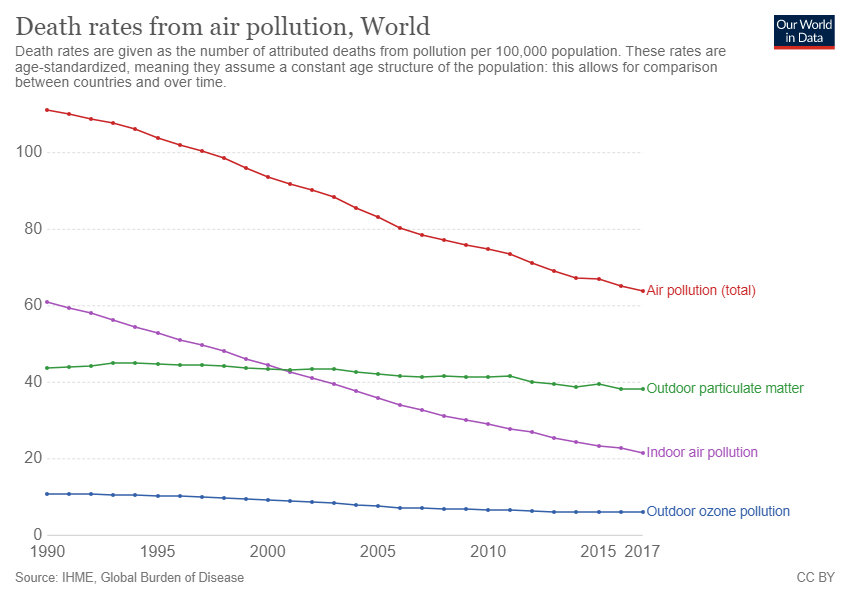
Fourth, the global air pollution death rate has fallen by almost 50 percent since 1990. In 2019, University of Oxford economist Max Roser and researcher Hannah Ritchie reported in Our World in Data that “since 1990 the number of deaths per 100,000 people have nearly halved.”
Fifth, any impact on the economy is likely to be minimal. In 2019, the National Bureau of Economic Research estimated that if the earth’s temperature rises by 0.01° C per year through 2100 – 25 percent faster than it actually has since 1880 – total U.S. GDP in 2100 will be 1.88 percent lower in 2100 than it would otherwise be.

But the Congressional Budget Office in 2019 projected that in 2100, GDP per person will be about 180 percent higher (based on its projection of a 1.3 percent annual real long-term potential labor force productivity growth rate). So even if the reduction that NBER estimates pans out, GDP per person will still be about 178 percent higher.

In other words, per person income in 2100 will be almost triple today’s level, regardless of global warming.

Finally, restricting carbon emissions to attempt to stop global warming is the wrong path – even the most severe restrictions will have almost zero impact on the earth’s temperature. Climatologist Patrick J. Michaels calculated that if the United States eliminated all carbon emissions – which would not only require Americans to give up fossil fuels, but also to stop breathing (to cease exhaling carbon dioxide) – it would only reduce global warming by a negligible 0.052° C by 2050.

Don’t make the same mistake as Krugman and other false prophets of global warming doom. Check the facts. Global warming has not been harmful and presents no danger to future generations.

And then there’s John Cusack.  Zachary Leeman writes at RT:  Cusack, Bernie’s prophet of doom: Only 10-12 years to stop climate change & ‘predatory capitalism’.  Excerpts is italics with my bolds.

It appears actor John Cusack took the climate change messages in his film ‘2012’ really, really seriously, because he says Earth only has a handful of years left — unless Vermont Senator Bernie Sanders is elected US President.

payn_c16807820190906120100

Introducing Sanders in Exeter, New Hampshire, on Saturday, the 53-year-old actor threw out a doomsday scenario where the world only has a “10 to 12 year window” to reverse the effects of climate change and combat the “predatory capitalism” that is supposedly fueling it.

“The billionaires are getting nervous and all the corporate media is — they hate us, they don’t hate us, they’re confused. And it seems like every conceivable power structure on Earth is trying to kill or derail our movement, but we’re still here,” Cusack announced to the assembled Sanders supporters.

“We know this form of capitalism takes and takes; it takes whatever, whenever, however it wants. It’ll take our lives, it’ll take our labor, our spirit, our air and water, even our earth.”

Cusack’s climate change fear-mongering may have played to the crowd of Bernie supporters, but he isn’t flipping many votes, judging by the wider reaction on social media.

“The self-awareness of @johncusack is undetectable with an electron microscope,” actor and director Nick Searcy tweeted in response to Cusack’s speech.

‘Full Metal Jacket’ actor Adam Baldwin questioned whether Cusack is suggesting war with China with his doomsday prediction, considering the country leads the United States in CO2 emissions.

Others criticized Cusack, who endorsed Sanders for president in February of last year, for his focus on criticizing capitalism and the “one percent of the one percent,” when he has himself become wealthy from his work in capitalist Hollywood.

Tom Elliott tweet: 

Actor John Cusack lecturing those in the bottom 99%

Gosh advice from Hollywood is always welcomed

Footnote:  If you want to talk about predatory capitalism, consider the billions raked in by Big Wind and Big Solar moguls.  See The End of Wind and Solar Parasites

wind-energy-myth


Jan. 19 Arctic Ice Returns to Mean

A previous post noted the Pacific ice see saw had returned, with Bering Sea slow to recover.  The image above shows recovery of Arctic sea ice extent over the month of January 2020. As supported by the table later, the pace of refreezing was slow to begin but has now allowed 2020 to match the 13 year average (2007 to 2019 inclusive). Okohotsk Sea on the left has grown ice extent steadily to be currently at 66% of last March maximum.  Bering on the right waffled back and forth but gained strongly the last few days.

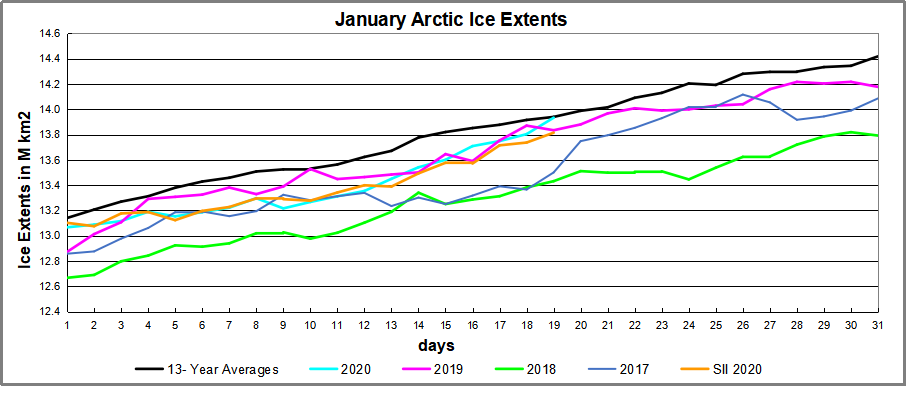
The graph below shows the ice extent growing during January compared to some other years and the 13 year average (2007 to 2019 inclusive).

Note that the  NH ice extent 13 year average increases about 1.2M km2 during January, up to 14.4M km2. MASIE 2020 stated with a slower icing rate, dropping 300k km2 lower than average before catching up to reaching the average on January 19.  Both 2018 and 2017 were lower at this point, while MASIE and SII are tracking closely together.

The table shows where the ice is distributed compared to average.  Deficits in Greenland Sea and Baffin Bay are offset by surpluses in Kara and Barents Seas.  At this point the surplus in Okhotsk exceeds the Bering deficit. Going forward, most of the additional ice extent will in the Pacific Seas.

Region 2020019 Day 019 Average 2020-Ave. 2018019 2020-2018
 (0) Northern_Hemisphere 13933540 13939872  -6332  13431421 502118 
 (1) Beaufort_Sea 1070655 1070223  432  1070445 210 
 (2) Chukchi_Sea 965972 965999  -27  965971
 (3) East_Siberian_Sea 1087137 1087133  1087120 18 
 (4) Laptev_Sea 897845 897842  897845
 (5) Kara_Sea 933810 911944  21867  902003 31807 
 (6) Barents_Sea 646750 502965  143784  286684 360065 
 (7) Greenland_Sea 525324 600387  -75063  453112 72212 
 (8) Baffin_Bay_Gulf_of_St._Lawrence 1155618 1245934  -90317  1355009 -199391 
 (9) Canadian_Archipelago 854282 853058  1225  853109 1174 
 (10) Hudson_Bay 1260192 1257480  2712  1260838 -646 
 (11) Central_Arctic 3239662 3203861  35801  3161866 77796 
 (12) Bering_Sea 443027 570321  -127294  309601 133425 
 (13) Baltic_Sea 9625 52416  -42791  24115 -14491 
 (14) Sea_of_Okhotsk 817160 669235  147925  782693 34467 

Footnote:  Interesting comments on January 13 by Dr. Judah Cohen at his blog regarding the Arctic fluctuations. Excerpts in italics with my bolds.

Arctic sea ice extent

The positive AO is conducive to sea ice growth and Arctic sea ice growth rate continues to grow slowly and remains well below normal but higher than recent winters; the weather pattern remains favorable for further sea ice growth. Negative sea ice anomalies exist in three regions: the Bering Sea, around Greenland-Canadian Archipelagos and Barents-Kara Seas. The anomalies in the North Pacific sector have shrunk (Figure 16), and based on model forecasts negative sea ice anomalies in the Bering Sea can shrink further in the next two weeks. Below normal sea ice in and around Greenland and the Canadian Archipelagos may favor a negative winter NAO, though there are no signs of such a scenario. Based on recent research low sea ice anomalies in the Chukchi and Bering seas favors cold temperatures in central and eastern North America while low sea ice in the Barents-Kara seas favor cold temperatures in Central and East Asia, however this topic remains controversial. Recent research has shown that regional anomalies that are most highly correlated with the strength of the stratospheric PV are across the Barents-Kara seas region where low Arctic sea ice favors a weaker winter PV.

Northern Hemisphere Snow Cover

Despite a strongly postive AO snow cover has advanced across Eurasia and is now near decadal means. And if the snowfall forecasts for Europe ever verify it could advance further. Above normal snow cover extent in October, favors a strengthened Siberian high, cold temperatures across northern Eurasia and a weakened polar vortex/negative AO this upcoming winter followed by cold temperatures across the continents of the NH.

Illustration by Eleanor Lutz shows Earth’s seasonal climate changes. If played in full screen, the four corners present views from top, bottom and sides. It is a visual representation of scientific datasets measuring Arctic ice extents and snow cover.

Things You Don’t Hear from Slanted Media

Cora Mandy explains at Real Politics Impeachment Crusade Blinds Media to Trump’s Accomplishments. Excerpts in italics with my bolds and images.

For Americans across the country, Democrats’ and the media’s fixation on impeachment has engulfed the news the public has consumed for nearly four months. Democrats have worked tirelessly to convince the public that President Trump committed an impeachable offense. Unfortunately for them, these attempts have proved to be futile. Recent polling has shown a drop in support for impeachment. Where our country was previously evenly divided, Americans now oppose impeachment 50%-47% and Trump’s job approval rating has remained steady.

Americans see beyond spin and media narratives, but ascertaining what has been going on in Washington behind the sea of impeachment headlines can be difficult. A new Media Research Center analysis found that from the time that Democrats’ impeachment push began on Sept. 24, the evening newscasts on CNN, ABC, and NBC gave the president’s historic economy and trade developments just nine minutes of coverage, combined, out of 1,098 total minutes. Conversely, impeachment efforts and Ukraine received 849 minutes of airtime. That means news on Trump’s economy made up far less than 1% of the coverage.

Devoid of fair and balanced news sources, Americans do not realize just how much President Trump and his administration have accomplished in the face of the Democrats’ baseless impeachment efforts.

For starters, it was recently announced that nation’s average unemployment rate since Trump took office is the lowest recorded in history: 3.9%. The administration has created opportunities for Americans to rejoin the workforce, and as result we have seen a decline of over 7 million Americans no longer dependent on food stamps.

President Trump continues to break his own records: As of January 2020, more than 158,000,000 Americans are employed, the stock market is reaching new highs, and consumer confidence is at the highest in decades.

It’s impossible to refute the strength of the Trump economy. The media knows this and that is why coverage of it is lackluster; but that’s not the only victory by the administration that has been brushed over in the last few months.

Last December, President Trump signed The Debbie Smith Reauthorization Act. This bill appropriates funding for rape kit testing, DNA training programs, and the sexual assault forensic grant program. The backlog of rape kits in this country soars well over the tens of thousands. The funds granted in this bill ensure that these kits can be tested before the statues of limitations run out and that victims have a better chance of seeing justice.

President Trump took measures in November of 2019 to outlaw animal cruelty and make the prosecution of offenders easier when he signed The Preventing Animal Cruelty and Torture Act into law. This measure provides more comprehensive protections for animals against abuse, torture, and the making or sharing of videos that depict animal abuse. A prior loophole made it difficult to prosecute cruelty cases that crossed multiple jurisdictions, but PACT eliminates this.

President Trump also is keeping America’s youth safer. The development of e-cigarettes and vaping saw a resurgence of tobacco use among children and teens, with one in four high school seniors admitting to vaping. Vaping-related illnesses such as lung disease are on the rise, affecting thousands of Americans. In December of 2019, the administration took decisive action to prevent American children’s accessibility to these life-threatening products by raising the legal age to purchase tobacco to 21.

The Trump administration is keeping its promise to take care of our military and veterans and to secure our nation’s border. The spending deal passed in December delivered a 3.1% pay raise to military personnel, the largest pay increase in over a decade. Further, it provided over $1 billion in funding to continue wall construction on our southern border.

The spending bill also included paid family leave for federal workers, a measure that will bring the American government into the 21st century. Previously, the United States was one of just two countries out of 170 that did not provide financial compensation during family leave. The Trump administration is leading by example, encouraging private sector companies to follow in its footsteps to make paid family leave a possibility for all Americans.

The media will be in hysterics once more this week as Senate lawmakers set the rules and procedures for the impeachment hearings. While Democrats continue on their unfounded quest to remove a duly-elected president from office, Donald Trump will be busy delivering real results for the American people, despite what you may hear in the media.

Looking forward to 2020


Court Thwarts Seattle Climate Power Play

News today that the Washington state supreme court has blocked a scheme by Governor (and erstwhile candidate for climate President) Inslee from taking over the energy industry.  Washington state is a place where leftist progressives live in large numbers in and around Seattle and impose their virtue signalling ideas on the rest of the population who are more skeptical.

This story is also of interest since the maneuver follows the practice of weaponizing environmental law to overthrow society’s dependence on energy from fossil fuels.  For example, NGO lawyers have attacked permits for infrastructure like pipelines by demanding that the assessment also include emissions from end users burning the gas or oil after it has left the pipeline.  In the Washington state case, Inslee tried to put the Department of Ecology in charge of taxing energy used by the transportation industry under the auspices of a Clean Air Act. This was in fact an end run around the defeat of a state carbon tax in the last election.

The story from the Seattle Times is State Supreme Court limits Gov. Inslee’s rule cutting greenhouse-gas emissions  Excerpts in italics with my bolds.

The Washington State Supreme Court has invalidated key portions of a rule imposed by the administration of Gov. Jay Inslee capping greenhouse-gas emissions by fuel distributors, natural-gas companies and other industries.

In a 5-4 ruling Thursday, the court upheld a 2017 lower-court decision that the state Department of Ecology had exceeded its legal authority in trying to apply clean-air standards to “indirect emitters” that don’t directly burn fossil fuels.

“The issue is not whether man-made climate change is real — it is,” wrote Chief Justice Debra Stephens in the majority opinion. However, Stephens wrote, the department’s efforts to enforce the state Clean Air Act went beyond what had been authorized by the law.
[That is a social opinion not a legal one since IPCC suppositions have not yet been litigated.]

“We are confident that if the State of Washington wishes to expand the definition of emission standards to encompass ‘indirect emitters,’ the Legislature will say so. In the meantime. Ecology may not claim more authority than the Legislature has granted in the Act,” Stephens wrote.

The state had projected the rule would reduce emissions by 20 million metric tons by 2035 — about two-thirds of the target established by the Legislature in 2008. But three-quarters of that reduction would have come from applying the regulation to indirect emitters, according to the court ruling.

[The hypocrisy is striking; people who burn gasoline in their cars and trucks are directly responsible for those emissions, not their suppliers.  Energy products are provided in a free society to those who want and can afford to pay for them.  Those who want to live without such energy are also free to make that choice.  But beware, in modern nations like the G20 nearly 90% of energy comes from burning fossil fuels. CO2 zealots want to shut off the supply for everyone else instead of themselves.  Socialism is another name for shared misery]

Figure 12: Figure 9 with Y-scale expanded to 100% and thermal generation included, illustrating the magnitude of the problem the G20 countries still face in decarbonizing their energy sectors.

During a news conference, Inslee said he disagreed with the court majority’s central conclusion but hasn’t yet decided whether to ask lawmakers to amend the Clean Air Act to include indirect emitters.

State Sen. Doug Ericksen, R-Ferndale, praised the court ruling in a statement calling the clean-air rule “a classic example of government arrogance and overreach.”

A longtime opponent of Inslee’s climate agenda, Ericksen, the ranking Republican member of the state Senate’s environment committee, said the rule would have imposed “onerous new regulations on oil refiners and distributors of natural gas” and passed potentially billions of dollars in costs on to consumers.

Ericksen added he hoped the decision would “quell the enthusiasm of other agencies” to push legal boundaries, citing the Puget Sound Clean Air Agency’s decision to develop a low-carbon fuel regulation.

Frustrated by legislative inaction, Inslee had directed Ecology in 2015 to use executive authority under the Clean Air Act to regulate carbon emissions.

After a lengthy rule-making process, the state issued regulations in 2016 which would have targeted dozens of top emitters, from Skagit County oil refineries to Boeing’s Everett plant and Eastern Washington food processors. The rule required such facilities to cut their carbon footprint by an average of 1.7% a year — either by cleaning up their own facilities or paying for carbon-reduction projects off-site.

But the rule was quickly challenged in a lawsuit by business groups led by the Association of Washington Business. The association’s president, Kris Johnson, said in a statement he welcomed the court’s ruling and intends to work with lawmakers “to find a bipartisan solution” to reduce the state’s carbon emissions.

A trade association for paper mills said its members remain concerned about the effects of even a more limited version of the clean-air rule.

Kid’s Climate Lawsuit Dismissed on Appeal

Juliana et al. Vs US Federal Government is Dismissed.

A federal appeals court on Friday threw out a lawsuit by children and young adults who claimed U.S. government climate policy put their future in jeopardy, a major blow to the high-profile case after a string of failed similar bids.

In a 2-1 decision, the 9th U.S. Circuit Court of Appeals said the plaintiffs, who were ages 8 to 19 when the lawsuit began, lacked legal standing to pursue their case, and that the issues they raised should be decided by other branches of the federal government.

The decision derails the potentially far-reaching case, one of more than half a dozen similar cases filed in state courts, from Washington to Alaska, by an Oregon-based youth advocacy non-profit called Our Children’s Trust.

The lawsuit had first been filed in an Oregon federal court in 2015, charging that the U.S. government’s environmental and energy policies violated the children and young adults’ constitutional rights to thrive in a liveable atmosphere. (Reporting by Sebastien Malo Editing by Franklin Paul and Frances Kerry) Source: National Post

Full PDF of Ruling is here: Climate Change / Standing  Excerpts of Summary in italics with my bolds

The panel reversed the district court’s interlocutory orders in an action brought by an environmental organization and individual plaintiffs against the federal government, alleging climate-change related injuries to the plaintiffs caused by the federal government continuing to “permit, authorize, and subsidize” fossil fuel; and remanded to the district court with instructions to dismiss for lack of Article III standing.

Some plaintiffs claimed psychological harms, others impairment to recreational interests, others exacerbated medical conditions, and others damage to property. Plaintiffs alleged violations of their constitutional rights, and sought declaratory relief and an injunction ordering the government to implement a plan to “phase out fossil fuel emissions and draw down excess atmospheric [carbon dioxide].”

The panel held that: the record left little basis for denying that climate change was occurring at an increasingly rapid pace; copious expert evidence established that the unprecedented rise in atmospheric carbon dioxide levels stemmed from fossil fuel combustion and will wreak havoc on the Earth’s climate if unchecked; the record conclusively established that the federal government has long understood the risks of fossil fuel use and increasing carbon dioxide emissions; and the record established that the government’s contribution to climate change was not simply a result of inaction.

The panel rejected the government’s argument that plaintiffs’ claims must proceed, if at all, under the Administrative Procedure Act (“APA”). The panel held that because the APA only allows challenges to discrete agency decisions, the plaintiffs could not effectively pursue their constitutional claims – whatever their merits – under that statute.

The panel considered the three requirements for whether plaintiffs had Article III standing to pursue their constitutional claims. First, the panel held that the district court correctly found that plaintiffs claimed concrete and particularized injuries. Second, the panel held that the district court properly found the Article III causation requirement satisfied for purposes of summary judgment because there was at least a genuine factual dispute as to whether a host of federal policies were a “substantial factor” in causing the plaintiffs’ injuries.

Third, the panel held that plaintiffs’ claimed injuries were not redressable by an Article III court.

Specifically, the panel held that it was beyond the power of an Article III court to order, design, supervise, or implement the plaintiffs’ requested remedial plan where any effective plan would necessarily require a host of complex policy decisions entrusted to the wisdom and discretion of the executive and legislative branches.

The panel reluctantly concluded that the plaintiffs’ case must be made to the political branches or to the electorate at large.

District Judge Staton dissented, and would affirm the district court. Judge Staton wrote that plaintiffs brought suit to enforce the most basic structural principal embedded in our system of liberty: that the Constitution does not condone the Nation’s willful destruction. She would hold that plaintiffs have standing to challenge the government’s conduct, have articulated claims under the Constitution, and have presented sufficient evidence to press those claims at trial.

Several posts here on this legal initiative: For example:

Climate Kids Spurious Lawsuit Claims

Facts Omitted by Climatists (The record to which the panel refers, uncontested by litigants)

Climate War Human Shields (Background on Our Children’s Trust)


CO2, SO2, O3: A journey of Discovery

A previous post Light Bulbs Disprove Global Warming presented an article by Dr. Peter Ward along with some scientific discussion from his website. This post presents an excerpt from Chapter One of his book which helpfully explains his journey of discovery from his field of volcanism to the larger question of global warming.

The Chapter is How I Came to Wonder about Climate Change. Excerpts in italics with my bolds.

Discovering a More Likely Cause of Global Warming

The evidence for volcanism in the ice layers under Summit, Greenland, consists of sulfate
deposits. Sulfate comes from sulfur dioxide, megatons of which are emitted during each
volcanic eruption. At first, I thought that the warming was caused by the sulfur dioxide,
which is observed to absorb solar energy passing through the atmosphere.17 My thinking
was influenced by greenhouse warming theory, which assumes that carbon dioxide causes
global warming because it is observed to absorb infrared energy radiated by Earth as it
passes upward through the atmosphere and is then thought to re-radiate it back down to
the surface, thus causing warming. The sulfur dioxide story, however, just wasn’t adding
up quantitatively.

Figure 1.9 Average temperatures per century (black) increased at the same time as the amount of volcanic sulfate per century (red). The greatest warming occurred when volcanism was more continuous from year to year, as shown by the blue circles surrounding the number of contiguous layers (7 or more) containing volcanic sulfate. It was this continuity over two millennia that finally warmed the world out of the last ice age. Data are from the GISP2 drill hole under Summit, Greenland. Periods of major warming are labeled in black. Periods of major cooling are labeled in blue.

Eventually, after publishing two papers that developed this story, I came to realize
that sulfur dioxide was actually just the “footprint” of volcanism—a measure of how
active volcanoes were at any given time. The real breakthrough came when I came across
a paper reporting that the lowest concentrations of stratospheric ozone ever recorded were for the two years after the 1991 eruption of Mt. Pinatubo, the largest volcanic eruption since the 1912 eruption of Mt. Katmai. As I dug deeper, analyzing ozone records from Arosa, Switzerland18—the longest running observations of ozone in the world, begun in 1927 (Figure 8.15 on page 119)—I found that ozone spiked in the years of most volcanic eruptions but dropped dramatically and precipitously in the year following each eruption. There seemed to be a close relationship between volcanism and ozone. What could that relationship be?

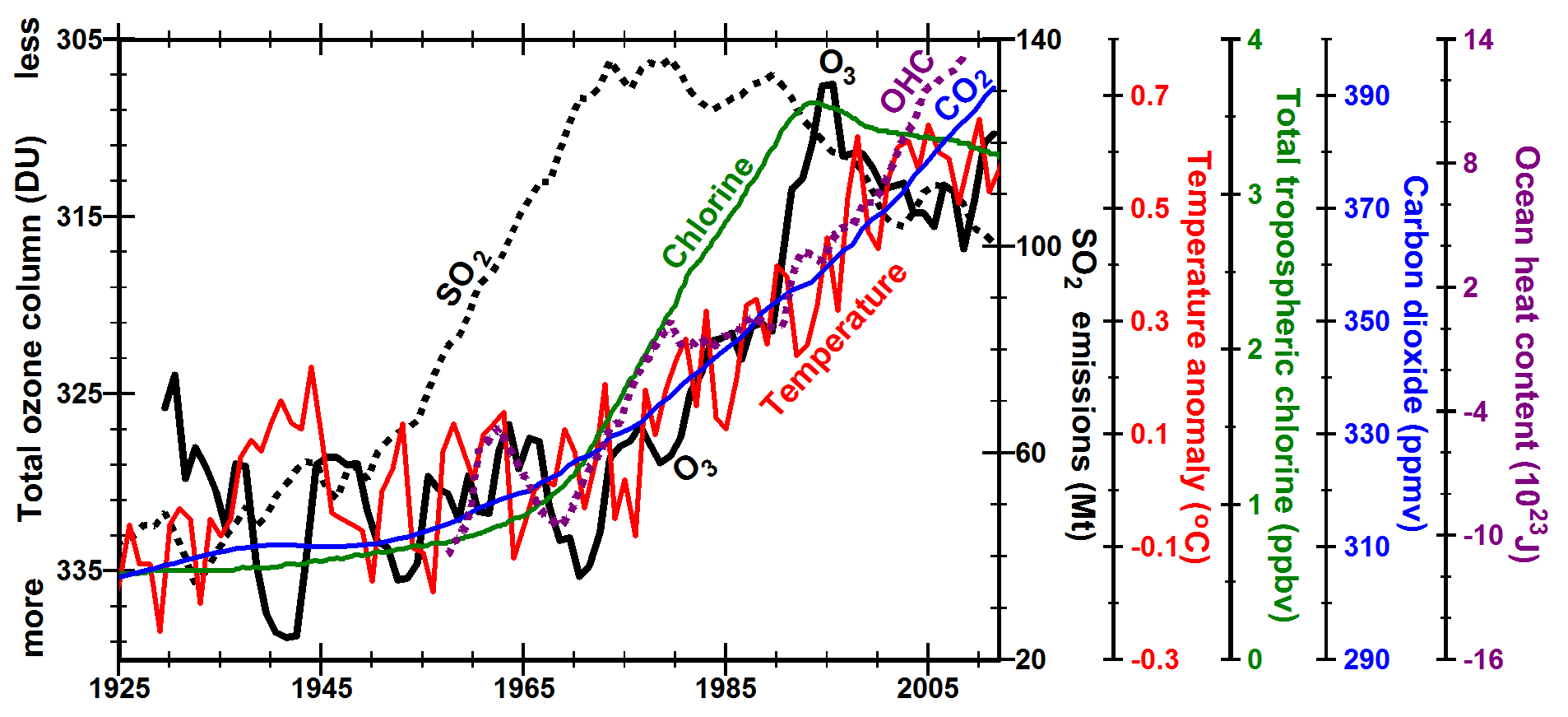
Increased SO2 pollution (dotted black line) does not appear to contribute to substantial global warming (red line) until total column ozone decreased (black line, y-axis inverted), most likely due to increasing tropospheric chlorine (green line). Mean annual temperature anomaly in the Northern Hemisphere (red line) and ozone (black line) are smoothed with a centered 5 point running mean. OHC is ocean heat content (dotted purple line).

The answer was not long in coming. I knew that all volcanoes release hydrogen chloride
when they erupt, and I also knew that chlorine from man-made chlorofluorocarbon
compounds had been identified in the 1970s as a potent agent of stratospheric ozone
depletion. From these two facts, and a third one, I deduced that it must be the depletion of
ozone by chlorine in volcanic hydrogen chloride—and not the absorption of solar radiation
by sulfur dioxide—that was driving the warming events that followed volcanic eruptions.
The third fact in the equation was the well-known interaction of stratospheric ozone with
solar radiation.

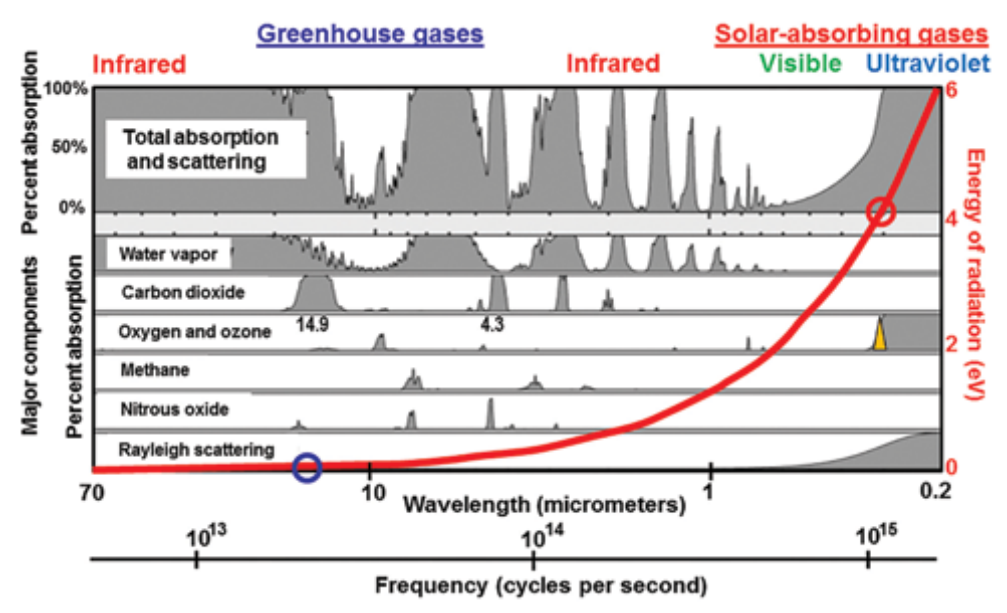
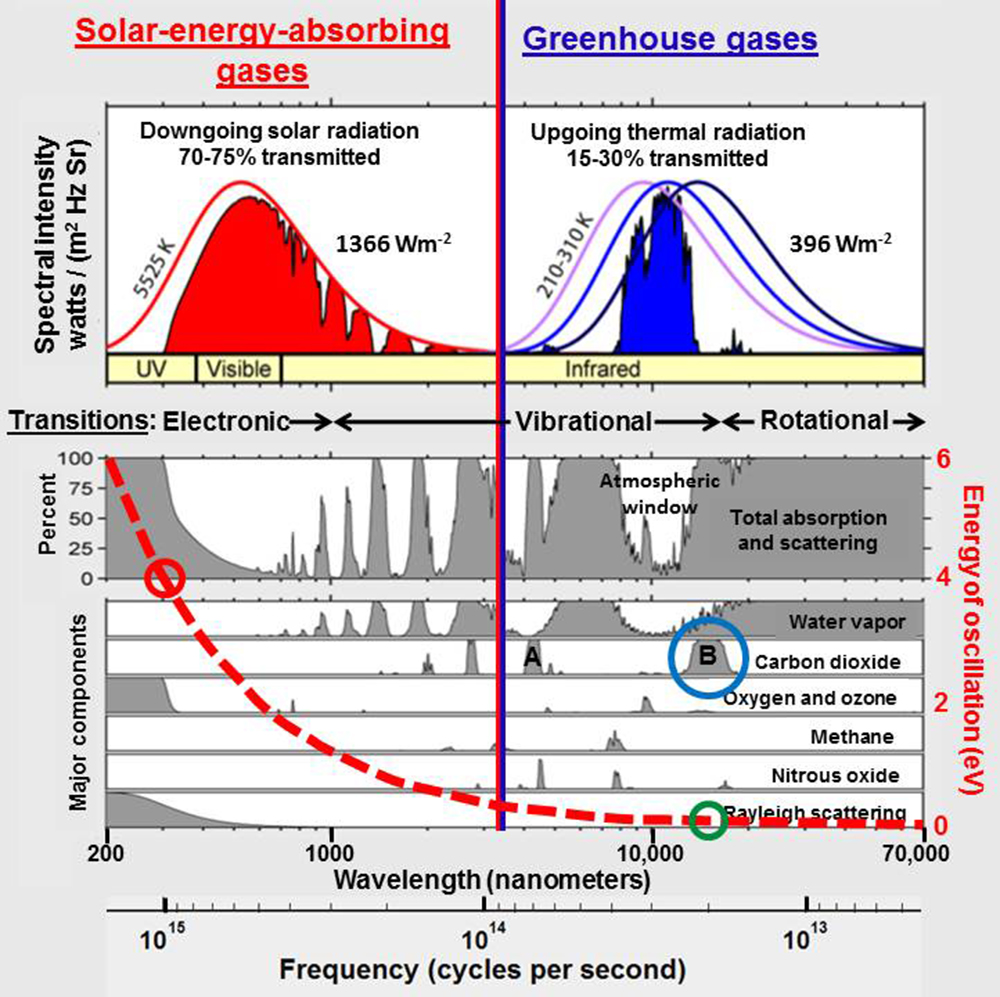
Figure 1.10 When ozone is depleted, a narrow sliver of solar ultraviolet-B radiation with wavelengths close to 0.31 µm (yellow triangle) reaches Earth. The red circle shows that the energy of this ultraviolet radiation is around 4 electron volts (eV) on the red scale on the right, 48 times the energy absorbed most strongly by carbon dioxide (blue circle, 0.083 eV at 14.9 micrometers (µm) wavelength. Shaded grey areas show the bandwidths of absorption by different greenhouse gases. Current computer models calculate radiative forcing by adding up the areas under the broadened spectral lines that make up these bandwidths. Net radiative energy, however, is proportional to frequency only (red line), not to amplitude, bandwidth, or amount.

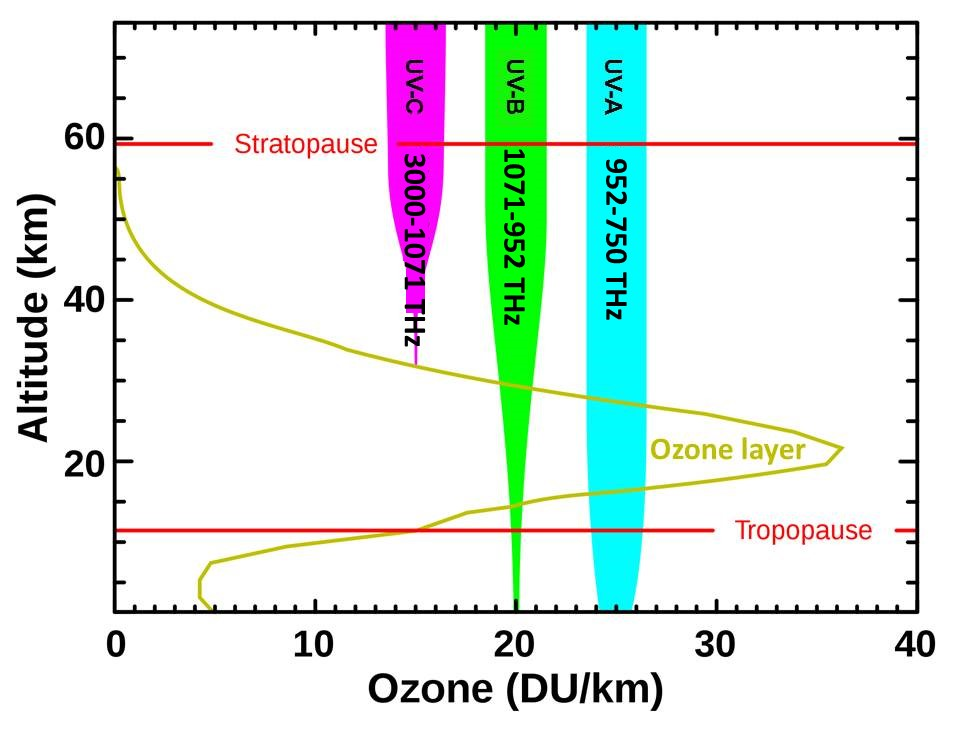
The ozone layer, at altitudes of 12 to 19 miles (20 to 30 km) up in the lower
stratosphere, absorbs very energetic solar ultraviolet radiation, thereby protecting life on
Earth from this very “hot,” DNA-destroying radiation. When the concentration of ozone is
reduced, more ultraviolet radiation is observed to reach Earth’s surface, increasing the risk
of sunburn and skin cancer. There is no disagreement among climate scientists about this,
but I went one step further by deducing that this increased influx of “super-hot” ultraviolet
radiation also actually warms Earth.

All ultraviolet UV-C is absorbed in the upper atmosphere. Most UV-B is absorbed in the stratosphere. The wavelengths of UV are shown in nanometers.

All current climate models assume that radiation travels through space as waves and
that energy in radiation is proportional to the square of the amplitude of these waves
and to the bandwidth of the radiation, i.e. to the range of wavelengths or frequencies
involved. Figure 1.10 shows the percent absorption for different greenhouse-gases as a
function of wavelength or frequency. It is generally assumed that the energy absorbed
by greenhouse-gases is proportional to the areas shaded in gray. From this perspective,
absorption by carbon dioxide of wavelengths around 14.9 and 4.3 micrometers in
the infrared looks much more important than absorption by ozone of ultraviolet-B
radiation around 0.31 micrometers. Climate models thus calculate that ultraviolet
radiation is relatively unimportant for global warming because it occupies a rather
narrow bandwidth in the solar spectrum compared to Earth’s much lower frequency,
infrared radiation.

The models neglect the fact, shown by the red line in Figure 1.10 and explained in
Chapter 4, that due to its higher frequency, ultraviolet radiation (red circle) is
48 times more energy-rich, 48 times “hotter,” than infrared absorbed by
carbon dioxide (blue circle), which means that there is a great deal more energy packed
into that narrow sliver of ultraviolet (yellow triangle) than there is in the broad band
of infrared. This actually makes very good intuitive sense. From personal experience,
we all know that we get very hot and are easily sunburned when standing in ultraviolet
sunlight during the day, but that we have trouble keeping warm at night when standing
in infrared energy rising from Earth.

These flawed assumptions in the climate models are based on equations that were
written in 1865 by James Clerk Maxwell and have been used very successfully to design
every piece of electronics that we depend on today, including our electric grid. Maxwell
assumed that electromagnetic energy travels as waves through matter, air, and space.
His wave equations seem to work well in matter, but not in space. Even though Albert
Michelson and Edward Morley demonstrated experimentally in 1887 that there is no
medium in space, no so-called luminiferous aether, through which waves could travel,
most physicists and climatologists today still assume that electromagnetic radiation does
in fact travel through space at least partially in the form of waves.

They also erroneously assume that energy in these imagined waves is proportional to
the square of their amplitude, which is true in matter, but cannot be true in space. They
calculate that there is more energy in the broad band of low-frequency infrared radiation
emitted by Earth and absorbed by greenhouse gases than there is in the narrow sliver of
additional high-frequency ultraviolet solar radiation that reaches Earth when ozone is
depleted (Figure 1.10). Nothing could be further from the truth.

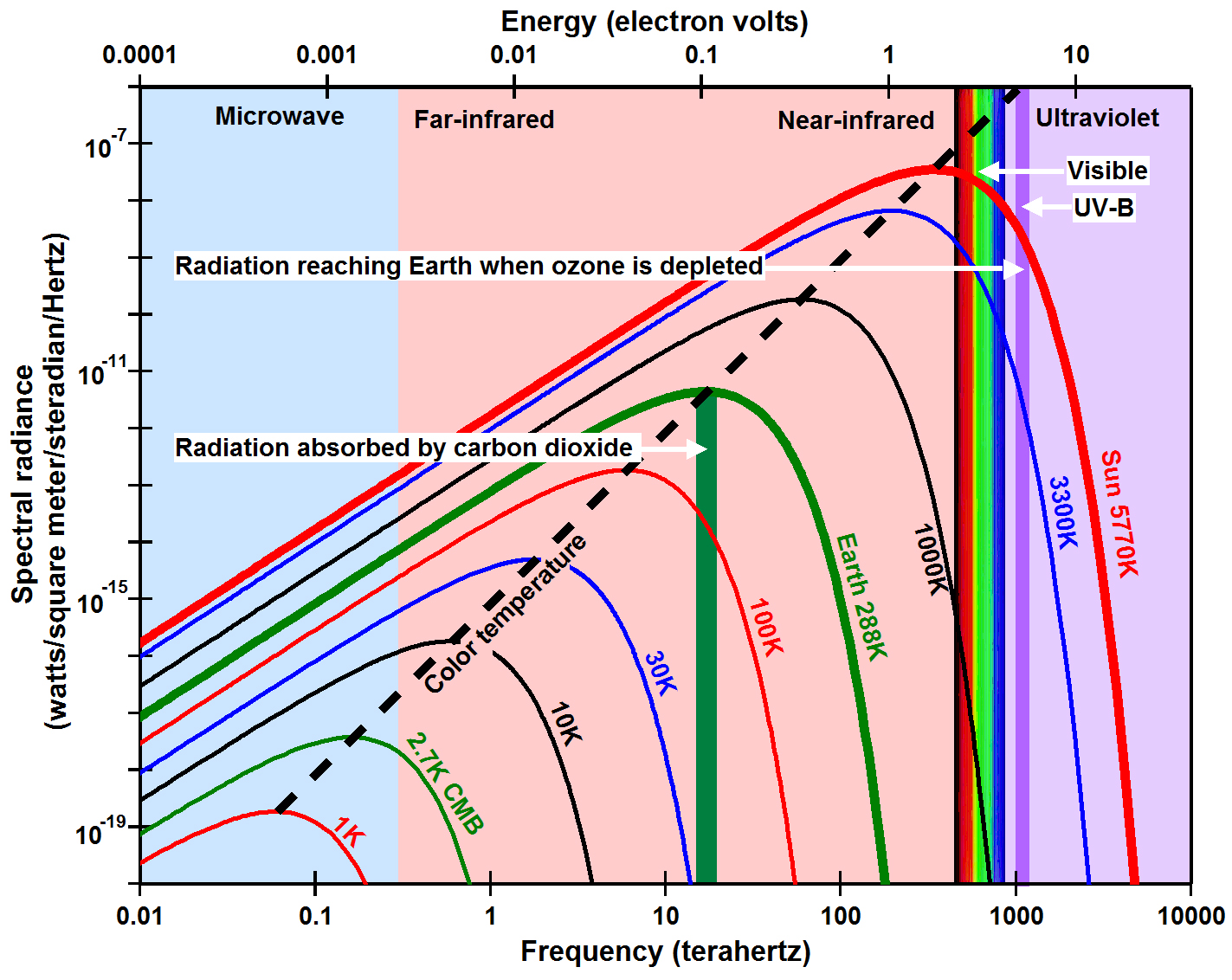
The energy of radiation absorbed by carbon dioxide around 14,900 nanometers (blue circle) is near 0.08 electron volts (green circle) while the energy that reaches Earth when the ozone layer is depleted around 310 nanometers (red circle) is near 4 electron volts, 48 times larger.

The story got even more convoluted by the rise of quantum mechanics at the dawn
of the 20th century when Max Planck and Albert Einstein introduced the idea that energy
in light is quantized. These quanta of light ultimately became known as photons. In order
to explain the photoelectric effect, Einstein proposed that radiation travels as particles, a
concept that scientists and natural philosophers had debated for 2500 years before him.
I will explain in Chapter 4 why photons traveling from Sun cannot physically exist, even
though they provide a very useful mathematical shorthand.

Max Planck postulated, in 1900, that the energy in radiation is equal to vibrational
frequency times a constant, as is true of an atomic oscillator, in which a bond holding two
atoms together is oscillating in some way. He needed this postulate in order to derive an
equation by trial and error that could account for and calculate the observed properties of
radiation. Planck’s postulate led to Albert Einstein’s light quanta and to modern physics,
dominated by quantum mechanics and quantum electrodynamics. Curiously, however,
Planck didn’t fully appreciate the far-reaching implications of his simple postulate, which
states that the energy in radiation is equal to frequency times a constant. He simply saw it as a useful mathematical trick.

Energy is a function of frequency and should therefore be plotted on the x-axis (top of this figure) and units of watts should not be included on the y-axis. The colored lines show the spectral radiance predicted by Planck’s law for black bodies with different absolute temperatures.

As I dug deeper, it took me several years to become comfortable with those implications.
It was not the way we were trained to think. It was not the way most physicists think, even
today. Being retired turned out to be very useful because I could give my brain time to mull
this over. Gradually, it began to make sense. The take-away message for me was that the
energy in the kind of ultraviolet radiation that reaches Earth when ozone is depleted is 48 times “hotter” than infrared energy absorbed by greenhouse gases. In sufficient quantities, it should be correspondingly 48 times more effective in raising Earth’s surface temperature than the weak infrared radiation from Earth’s surface that is absorbed by carbon dioxide in the atmosphere and supposedly re-radiated back to the ground.

There simply is not enough energy involved with greenhouse gases to have a significant
effect on global warming. Reducing emissions of greenhouse gases will therefore not be
effective in reducing global warming. This conclusion is critical right now because most of
the world’s nations are planning to meet in Paris, France, in late November 2015, to agree
on legally binding limits to greenhouse-gas emissions. Such limits would be very expensive
as well as socioeconomically disruptive. We depend on large amounts of affordable energy to support our lifestyles, and developing countries also depend on large amounts of affordable energy to improve their lifestyles. Increasing the cost of energy by even a few percent would have major negative financial and societal repercussions.

This book is your chance to join my odyssey. You do not need to have majored in
science or even to be familiar with physics, chemistry, mathematics, or climatology. You
just need to be curious and be willing to work. You also need to be willing to think critically
about observations, and you may need to reevaluate some of your own ideas about climate.
You will learn that there was a slight misunderstanding in science made back in the 1860s
that has had profound implications for understanding climate change and physics today. It took me many years of hard work to gain this insight, and I will discuss that in Chapter 4. First, however, we need to look at some fundamental observations that cause us to wonder: Could the greenhouse warming theory of climate change actually be mistaken?

Footnote:

I welcome this analysis and assessment that explain why rising CO2 concentrations in the satellite era have no discernable impact on the radiative profile of the atmosphere.  See Global Warming Theory and the Tests It Fails

And Justice Wept

Environmentalist judge gives free pass to climate activists.  Where will this lead?

CGTN reports approvingly Climate activists win landmark case over Federer demo at Credit Suisse.  Excerpts in italics with my bolds.

Swiss climate protesters have won a landmark legal battle against investment bank Credit Suisse, which could transform the way that climate activism is prosecuted in Switzerland in future.

A judge ruled on Monday that the danger posed by climate change means activists from the climate group Breakfree were not guilty of trespassing when they occupied a branch of the Swiss investment bank two years ago to demonstrate against the financiers’ funding of fossil fuel projects.

In November 2019, a group of young people wearing tennis kits and wigs staged a tennis-themed sit-in at a Credit Suisse branch in Lausanne. Their goal was to convince Swiss tennis player Roger Federer to end his sponsorship deal with the investment bank and highlight what they said was Credit Suisse’s investments in industries which are seen as adding to climate change.

The group was charged with trespassing and slapped with a 21,600 Swiss franc fine ($22,200), but during their appeal hearing on Monday, Judge Philippe Colelough stated that the activists had acted proportionately and ruled that they did not have to pay the fine.

The judge agreed with the protesters that they had entered the bank in the face of an “imminent danger” from climate change.

Because of the insufficient measures taken to date in Switzerland, whether they be economic or political, the average warming will not diminish nor even stabilize, it will increase,” he said. Adding that: “In view of this, the tribunal considers that the imminence of danger is established.

“The act for which they were incriminated was a necessary and proportional means to achieve the goal they sought.”

The ruling, given in the Lausanne municipality of Renens, was greeted with cheers from the crowded court room. The Swiss state will cover the cost of the fine instead.

“I didn’t think it was possible,” said Beate Thalmann, one of those accused in the trial. “If Switzerland did this, then maybe we have a chance.”

Credit Suisse said last week that, while it respected the protesters’ cause, it considered the occupation of the bank’s property unacceptable.

“Combating global warming is important,” the financier said in a statement. “Credit Suisse respects freedom of expression as a fundamental democratic right. [However,] to protect its clients, employees and branches, it does not tolerate unlawful attacks on its branches, irrespective of the perpetrators and their motives.”

Since the decision from the court, there has been fresh Swiss climate activism.

On Tuesday, protesters dumped coal inside a branch of bank UBS in the same city of Lausanne, while carrying a banner reading: “We will leave when you quit fossil fuels.”

Bullying in the name of Climate is now sanctioned by the courts  How many more times will CO2 Hystericals be allowed to overthrow others’ rights? Thanks a lot Judge Colelough.

Footnote:

Given how much Switzerland depends on the financial industry, this is looking like the barbarians attacking the main gate.  That didn’t work out so well for Rome in 410:

2020 Pacific Ice See Saw Returns

By January there are not many places where Arctic ice extent can grow.  All the Eurasian shelf seas are full, as is the case on the CanAm side: Beaufort, CAA, Hudson Bay covered completely.  Barents  and Greenland Seas have some room to grow, as does Baffin Bay.  But mainly the variability is on the Pacific side, where the usual Bering/Okhotsk see saw is reappearing.
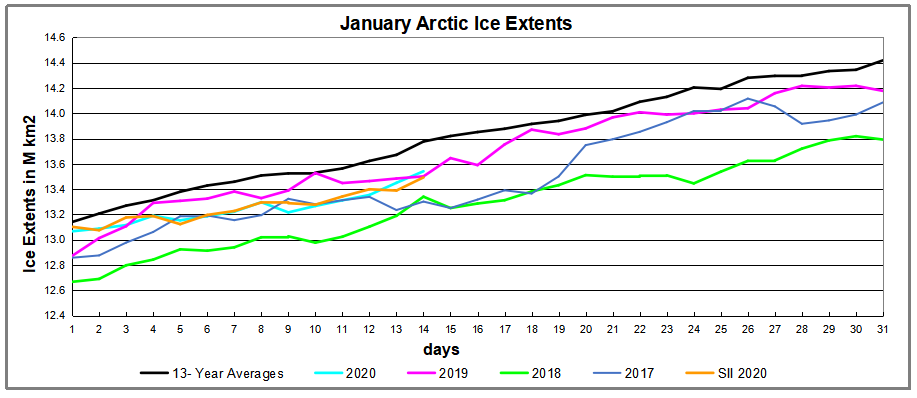
As we have seen in past winters, ice in the Pacific Arctic tends to grow in fits and spurts, often alternating between Bering and Okhotsk Seas.  The above image of the first two weeks of 2020 shows Okhotsk on the left growing ice steadily while Bering waffled back and forth ending with almost the same extent.  Combined the two seas ice extents are slightly below the 13 year average at this time, due to Bering’s slow recovery.

The January graph shows MASIE and SII reporting the same pace of ice recovery and matching 2019.  This is somewhat below the 13 year average (2007 to 2019 inclusive) and higher than 2017 and 2018. The table below shows the distribution of ice extent among the Arctic regions on January 14.

Region 2020014 Day 014 Average 2020-Ave. 2018014 2020-2018
 (0) Northern_Hemisphere 13541376 13776703 -235327 13340428 200948
 (1) Beaufort_Sea 1070655 1070223 432 1070445 210
 (2) Chukchi_Sea 965972 965812 160 965971 1
 (3) East_Siberian_Sea 1087137 1087133 4 1087120 18
 (4) Laptev_Sea 897845 897842 3 897845 0
 (5) Kara_Sea 932936 909656 23280 925247 7689
 (6) Barents_Sea 619526 508236 111290 393026 226500
 (7) Greenland_Sea 483377 610574 -127197 521896 -38519
 (8) Baffin_Bay_Gulf_of_St._Lawrence 1039079 1172487 -133408 1173039 -133960
 (9) Canadian_Archipelago 854282 853058 1225 853109 1174
 (10) Hudson_Bay 1260192 1251600 8592 1260838 -646
 (11) Central_Arctic 3233354 3210543 22811 3194383 38971
 (12) Bering_Sea 414963 521989 -107026 241830 173133
 (13) Baltic_Sea 8863 43903 -35040 24486 -15623
 (14) Sea_of_Okhotsk 651004 626433 24571 696684 -45681

2019 NH ice is 235k km2 below the 13-year average, or 1.7%, and 200k km2 more than 2018 on that date.  The deficits are in Bering, Greenland Sea and Baffin Bay, partly offset by surpluses in Barents, Kara and Okhotsk.

cg524a47d218458

The next month or so will show how the Pacific ice shapes up.

seesaw


Recycling Climate Trash Papers

There they go again with the ocean heating claims. Media alarms are rampant triggered by a new publication Record-Setting Ocean Warmth Continued in 2019 in Advances in Atmospheric Sciences
Authors: Lijing Cheng, John Abraham, Jiang Zhu, Kevin E. Trenberth, John Fasullo, Tim Boyer, Ricardo Locarnini, Bin Zhang, Fujiang Yu, Liying Wan, Xingrong Chen, Xiangzhou Song, Yulong Liu, Michael E. Mann.

Reasons for doubting the paper and its claims go well beyond the listing of so many names, including several of the usual suspects. No, this publication is tarnished by its implausible provenance. It rests upon and repeats analytical mistakes that have been pointed out but true believers carry on without batting an eye.

It started with Resplandy et al in 2018 who became an overnight sensation with their paper Quantification of ocean heat uptake from changes in atmospheric O2 and CO2 composition in Nature October 2018, leading to media reports of extreme ocean heating. Nic Lewis published a series of articles at his own site and at Climate Etc. in November 2018, leading to the paper being withdrawn and eventually retracted. Those authors acknowledged the errors and did the honorable thing

Then in 2019 Cheng et al. published the same claim in their Science paper January 2019 drawing on Resplandy et al. as a reference. That publication was featured in the IPCC Special Report on the Ocean and Cryosphere in a Changing Climate (SROCC).

Benny Peiser of GWPF objected in writing to IPCC, saying inter alia:

Your report (SROCC, p. 5-14) concludes that
” The rate of heat uptake in the upper ocean (0-700m) is very likely higher in the 1993-2017 (or .2005-2017) period compared with the 1969-1993 period (see Table 5.1).”

We would like to point out that this conclusion is based to a significant degree on a paper
by Cheng et al. (2019) which itself relies on a flawed estimate by Resplandy et al. (2018).
An authors’ correction to this paper and its ocean heat uptake (OHU) estimate was under
review for nearly a year, but in the end Nature requested that the paper be retracted
(Retraction Note, 2019).

That was not the only objection. Nic Lewis examined Cheng et al. 2019 and found it wanting. That discussion is also at Climate Etc. Is ocean warming accelerating faster than thought? The authors replied to Lewis’ critique but did not refute or correct the identified errors.

A year later in January 2020 the same people have processed another year of data in the same manner and then proclaim the same result. The only differences are the addition of several high profile alarmists and the subtraction of Resplandy et al. from the References.  It looks like the group is emulating MIchael Mann’s blueprint:  The Show Must Go On.  The Noble cause justifies any and all means.  Show no weaknesses, admit no mistakes, correct nothing, sue if you have to.


Greta’s Sock Puppeteers Revealed

Greta, Greta and Greta? On the left, Svante Thunberg, on the right, Adarsh Prathap Photo: DR. Wikimedia Commons. Facebook

Facebook Glitch Reveals Greta Thunburg’s Father Posting As Teenage Climate Activist
by Tyler Durden at Zero Hedge Excerpt in italics with my bolds.

A Thursday evening software update at Facebook accidentally allowed anyone to view exactly who is posting under the accounts of public figures, businesses and other entities, according to Wired.

The result? For starters, some 3 million followers of teenage climate activist Greta Thunberg have been reading posts written by her father, Svante Thunberg, and a climate activist in India who serves as a delegate at the UN’s Climate Change organization, Adarsh Prathap. Thunberg, Inc. claims Greta is still the one writing the content.

Greta, Inc. explained this in a Saturday Facebook post purporting to be the young climate activist.

“Some people have been asking who manages this page. First of all, since last spring I only use Facebook to repost what I write on my Twitter and Instagram accounts,” reads the post, in which ‘she’ says she tried Facebook “early on,” but didn’t like it, so she uses “my father Svantes account to repost content.”

“The rest that is shared on Facebook is reposted from Twitter and Instagram by the guy who founded the Greta Thunberg Facebook page long before I knew it existed. His name is Adarsh Prathap and he lives in India. Since a lot of people thought it was my official page in the beginning I asked if I could co-manage it and he said yes.”

Greta claims to have written all the content posted by her father and Prathap.

In other words, “of course it’s not me silly – you should have known I just ‘co-manage’ the fan page.”

Except – by all outward appearances it appeared to be her page alone.

Facebook’s ‘page transparency’ shows Greta as the confirmed owner – with the only clue suggesting she might have help being a page manager located in India.

See also Update: Children’s Climate Crusade

Includes Bablyon Bee post:  Marionette Strings Clearly Visible During Greta Thunberg Testimony