UN “Stretches” CO2 Goals

Several articles are in the media discussing UN meetings in progress to move the climate change goal posts from preventing 2C of warming to a goal of 1.5C additional warming. The US have questioned the plausibility of such an ambition, and this post goes into some of the reasons why. At the bottom I shall raise several skeptical points about this whole enterprise, but first we should look at the data UN uses as a trampoline for leaps of faith.

Data on Annual CO2 Concentrations

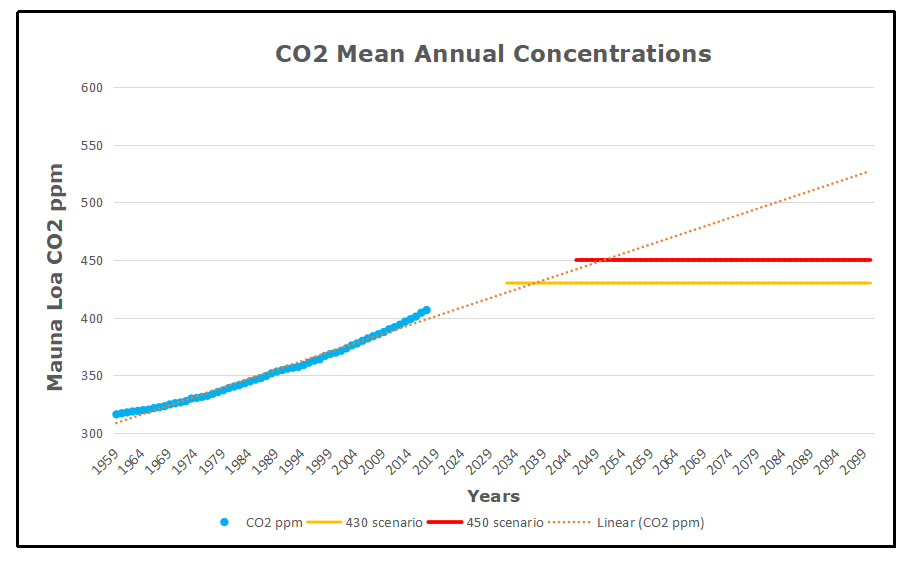
The annual average concentrations of atmospheric CO2 are reported from Mauna Loa in a dataset accessed from NOAA here. The graph below shows the record.
Note that in 1959 there was 316 ppm of CO2 according to this dataset, and in 2017 the annual average CO2 was 407 ppm. So the rise of 91 ppm over 59 years is a rate of 1.53 ppm per year. Of course the actual interannual differences vary from that average rate, and as we shall see, many recent years have exceeded 2 ppm per year additional CO2. The table below shows all years in the record that added more than 2 ppm of CO2.

Year Added ppm
1973 2.23
1988 2.38
1998 2.97
2003 2.52
2005 2.28
2006 2.1
2010 2.47
2012 2.2
2013 2.67
2014 2.13
2015 2.18
2016 3.38
2017 2.32

Note that as warming increased so also did CO2 in ppm. You can pick out El Nino years in the list, suggesting that ocean outgassing has a large impact on atmospheric CO2.

The larger point is that, for whatever reasons, the annual addition of CO2 has increased this century to a rate of 2.14 over the last 20 years.

UN Aspirational Goalposts

UN insiders have been making a simple case for some years preceding the Paris 2015 accord. IPCC has claimed that in their judgement keeping atmospheric CO2 less than 450 ppm ensures future warming will not exceed 2C. I don’t buy it, but that has been sold to Paris signatories. Now comes increasing the ambition to limit warming to 1.5C, and the same authorities translate that into a limit of 430 ppm of CO2.

These numbers and their logic can be seen in a document from Climate Analytics: Timetables for Zero emissions and 2050 emissions reductions  Excerpts in italics with my bolds.

This briefing note outlines suggested time frames for reaching zero global CO2 and total greenhouse gas emissions for the ‘below 2 °C’ and ‘below 1.5 °C by 2100’ limits based on the findings of the Fifth Assessment Report of the Intergovernmental Panel on Climate Change (IPCC AR5) and the 2014 UNEP Emissions Gap Report.

Emissions scenarios leading to GHG concentrations in 2100 of about 450 ppm CO2eq or lower are likely to maintain warming below 2 °C over the 21st century relative to pre-industrial levels. These scenarios are characterized by 40% to 70% global anthropogenic GHG emissions reductions by 2050 compared to 2010, and emissions levels near zero or below in 2100.” (IPCC AR5 SYR) Information in Table SPM.1 of the IPCC AR5 SYR

“A limited number of studies provide scenarios that are more likely than not to limit warming to 1.5 °C by 2100; these scenarios are characterized by concentrations below 430 ppm CO2eq by 2100 and 2050 emission reduction between 70% and 95% below 2010.” (IPCC AR5 SYR)

UN Goals Stretch Beyond Credibility

So let’s look at these two scenarios in relation to observed CO2 in the atmosphere.

The blue line is CO2 in ppm observed at Mauna Loa.  The linear regression line shows the continuation of the 1.53 ppm per year rate projected to the end of this century.  As noted above the blue line is already exceeding the earlier rate.  The orange line shows CO2 hitting 430 ppm in 2032 at the 1.53 rate, or earlier if more recent rates continue.  For example, if the 2.14 ppm per year rate continues, 430 ppm is reached by 2028. The red 450 scenario is reached in 2045. Both scenarios presume zero additional CO2 after those dates.

UN Piles Supposition on Top of Supposition

Previous posts here have taken issue with UN IPCC assertions that rising CO2 causes temperatures to rise and that human fossil fuel emissions cause CO2 to rise.

See: Who to Blame for Rising CO2

CO2 Fluxes, Sources and Sinks

How Climate Law Relies on Paris

Ontario has to Launder $1B in cap-and-trade money

CBC has the story: Ford government sitting on $1B in cap-and-trade money
Excerpts in italics with my bolds.

Environmental commissioner says by law it can only be spent on reducing greenhouse gases

Context: No one is talking about the reason Ford canceled cap and trade the first day on the job. It was to eliminate the 4.3 cents/liter gasoline tax. At the same time, spending on schemes to “fight climate change” was stopped.  By skimming a few cents off every liter sold, pretty soon you have billions of dollars in the pot. The law ending cap and trade did not reimburse gasoline retailers who had bought carbon allowances in the past, because they already passed on the cost to customers. Those who bought in advance to avoid higher carbon prices later are now caught and want the government to reimburse them, since they lost the opportunity to stick it to their customers. What a great idea is cap and trade: A market to sell a non-good at arbitrary prices paid by other people’s money. What could go wrong?

As much as $1 billion in Ontario’s cap-and-trade fund is sitting unspent, and questions are swirling about what Premier Doug Ford’s government will do with it.

The money was brought into provincial coffers under a law that says it can only be spent on measures that reduce greenhouse gas emissions. However, Ford has dismissed the money as a “slush fund,” and his government is pushing forward legislation to use some of it to cover the costs of cancelling the cap-and-trade program.

The dedicated fund for reducing greenhouse gases had a balance of $553 million at the end of March, when the last fiscal year ended, according to the province’s newly released public accounts. Another $476 million was added in May from the final cap-and-trade auction of carbon allowances, before Ford’s PCs won the election and quickly scrapped the Liberals’ climate-change plan.

That would put the account at more than $1 billion. What remains unclear is how much of that has been spent in the past six months, and how much will be used to wind up cap-and-trade.

CBC News asked the Environment Ministry for the current balance of the greenhouse gas fund, but officials did not provide an answer.

Ontario’s environmental commissioner Dianne Saxe believes there’s still $1 billion in the account because she has seen no evidence that money has been dispersed since the end of March.

Saxe — an independent officer of the Legislature like the auditor general and ombudsman — says the costs of winding up cap-and-trade ought to be small enough that the bulk of the $1 billion will remain.

“They will have quite a bit of money left,” said Saxe in an interview. “That can be money they can use to invest in [climate-change] solutions.”

She is warning the government that it cannot spend the money however it wishes, but only on initiatives to reduce carbon emissions. “That was the legal basis on which the money was collected, and that remains the law,” she said.

Liberal MPP Nathalie Des Rosiers said Monday she fears the government will not spend the money on cutting greenhouse gases but on lawsuits arising from cancelling cap-and-trade.

That fear is unfounded, said Environment Minister Rod Phillips.

“The money will be used for the purpose it was collected,” said Phillips in an interview Monday at Queen’s Park.

He declined to estimate how much of the $1 billion will remain in the fund once the cap-and-trade program is wound up. Nor did he agree that the figure will be in the hundreds of millions of dollars.

“I don’t think it would be fair to speculate at this point,” said Phillips. “We will make it clear how much money was spent and where it was spent.”

Ford made cancelling the cap-and-trade program a central election promise, calling it the “cap-and-trade carbon tax” during and after the campaign. Within days of taking power, his government shut down rebates to homeowners for making energy efficiency improvements, such as installing new windows, and ended rebates for buying electric cars. Those rebates came from the greenhouse gas reduction fund.

The government won’t be able to say how much remains in the greenhouse gas fund until all the programs wind up, said Phillips. He also said the government is allocating $5 million to compensate companies that bought cap-and-trade allowances, which are now worthless.

Phillips is promising a plan to tackle climate change this fall, including an “emissions-reductions fund” but says it will not come from a carbon-tax model.

The province is challenging Ottawa in court over the Trudeau government’s plan to impose a carbon tax on Ontario in the absence of a provincial carbon-pricing program.

Meanwhile, environmental groups led by Greenpeace are suing the province over cancelling cap-and-trade, alleging that the Ford government broke the law by failing to consult Ontarians on the move.

No Mention of climate or warming in New NA Trade Accord 

Hats off to all for arriving at an agreement for economic transactions unburdened by obsessions with CO2 and unfounded claims of humans controlling the weather. A survey of the text shows the terms “climate” and “warming” do not appear even once. Good job!

Of course, greens are up in arms. Imagine signing a trade agreement that does nothing to destroy our economies in order to save the planet from CO2.

The deal does have a chapter on the environment, but critics such as the Council of Canadians call it weak and unenforceable.

It mentions pollution, marine traffic, endangered animals and ozone, but ignores what many call the world’s largest environmental challenge.

“The deal doesn’t even mention climate change,” Stewart said.

What has been thrown out is a provision in the old North American Free Trade Agreement that allowed corporations to sue governments for lost profits if they were injured by public-interest regulations such as environmental laws. The Council of Canadians pointed out that Canada was sued 37 times, mostly by American companies, under the old clause.

Update October 2, 2018

The new NA trade accord also strengthens energy security and trade. From offshore-technology.com:

The US oil and gas industry has urged Congress to approve the Trump administration’s renegotiated North American Free Trade Agreement (NAFTA), saying that the deal will support US oil and gas exports across North and South America.

American Petroleum Institute president and CEO Mike Sommers said: “We urge Congress to approve the United States-Mexico-Canada-Agreement (USMCA). Having Canada as a trading partner and a party to this agreement is critical for North American energy security and US consumers. Retaining a trade agreement for North America will help ensure the US energy revolution continues into the future.”

There were concerns in the industry that Trump would scrap the NAFTA, which was pivotal in making Mexico the largest exporter of US oil, transportation fuel, and natural gas.

Meanwhile, with support from the trade agreement, Canada is the largest supplier of foreign oil and a significant exporter of electricity to the US.

The deal also makes Canada’s heavier crude oil more attractive to refiners in the Mexican Gulf, especially at a time when Venezuela’s production has reduced amid political and financial worries. Fracked US crude oil is lighter, and refineries in the Gulf, which traditionally deal with heavier crude, are still adjusting their processing practices.

The new NAFTA deal ensures a ‘zero-tariff’ on energy products traded between the US, Mexico and Canada.


Try to Remember: There’s Ice in September

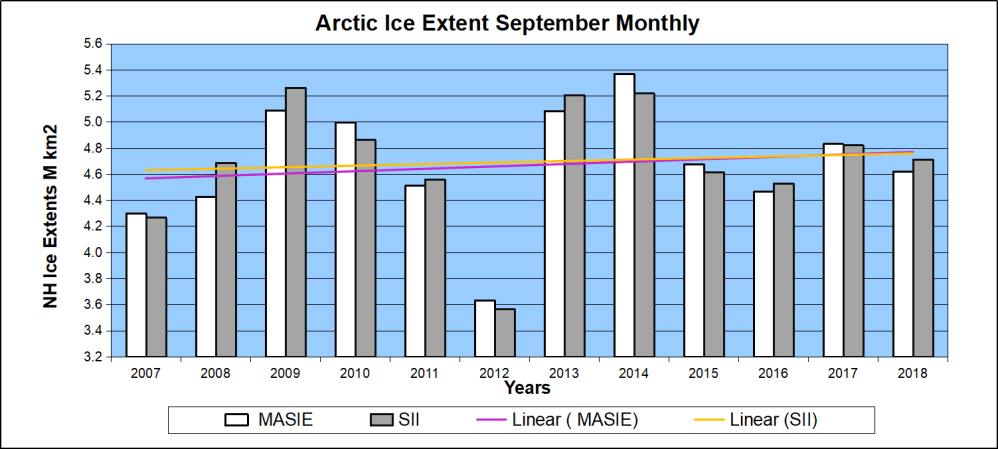
Arctic Sept 2007 to 2018

With ten years of hyped claims about Arctic sea ice declining, it takes effort to remember that ice in the Northern Hemisphere isn’t going away.  This year’s monthly average for September (the annual minimum) is slightly lower than 2017, but still well above 2007.  MASIE shows a surplus of 300k km2 and SII shows 450k km2.  As a result, both linear trends are slightly positive, though I would call it a “plateau, ” as opposed to a “death spiral.”

CA2018261to273

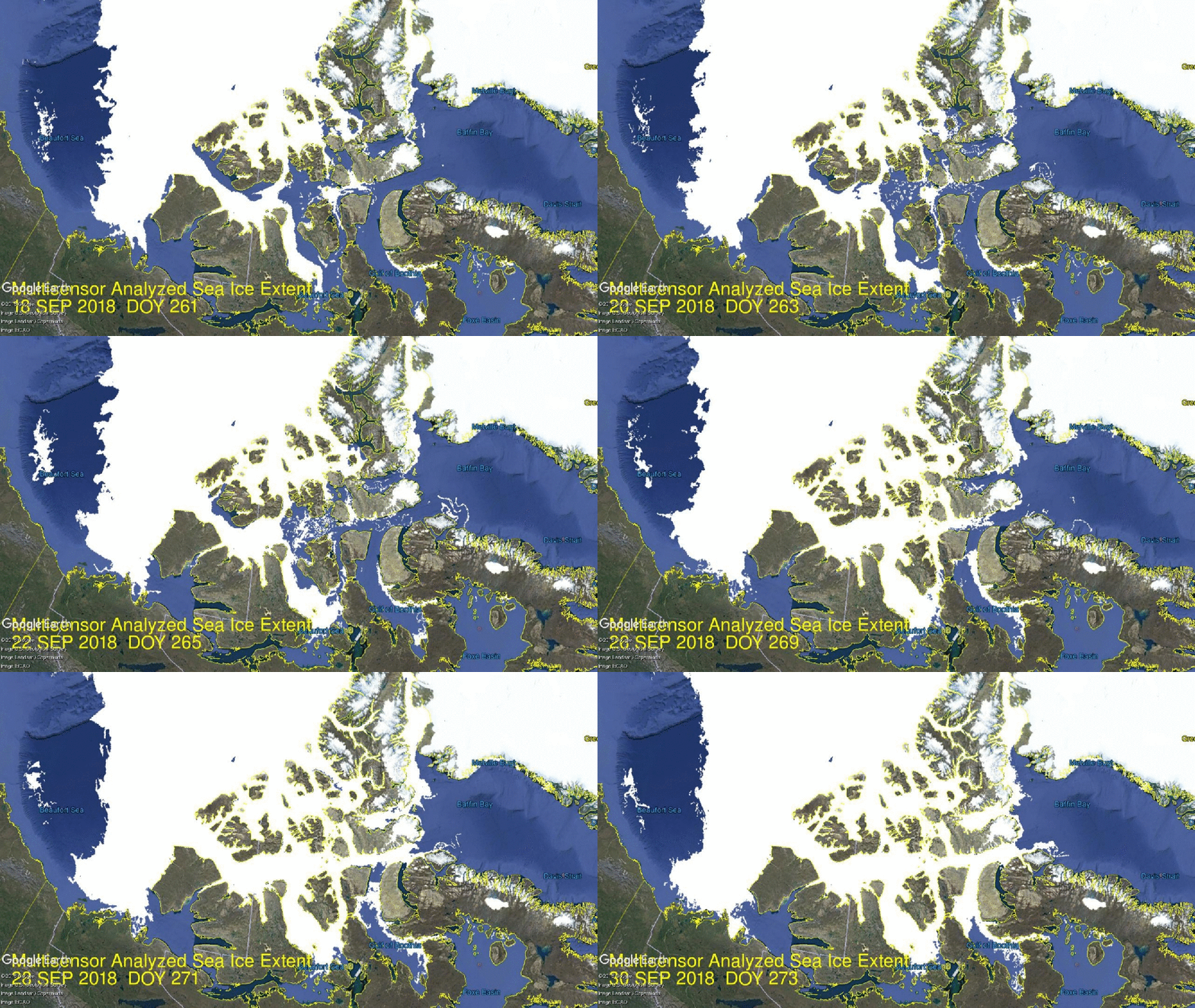
Twelve Days in Nunavut

Previous posts described how the Northwest Passage was treacherously laden with ice this year.  The image above shows the flash freezing in this region over the last twelve days.  Sept. 18 the CAA ice extent (Canadian Arctic Archipelago) was 321k km2, close to its annual minimum.  Yesterday MASIE showed 606k km2,  a increase of 90% in that region.

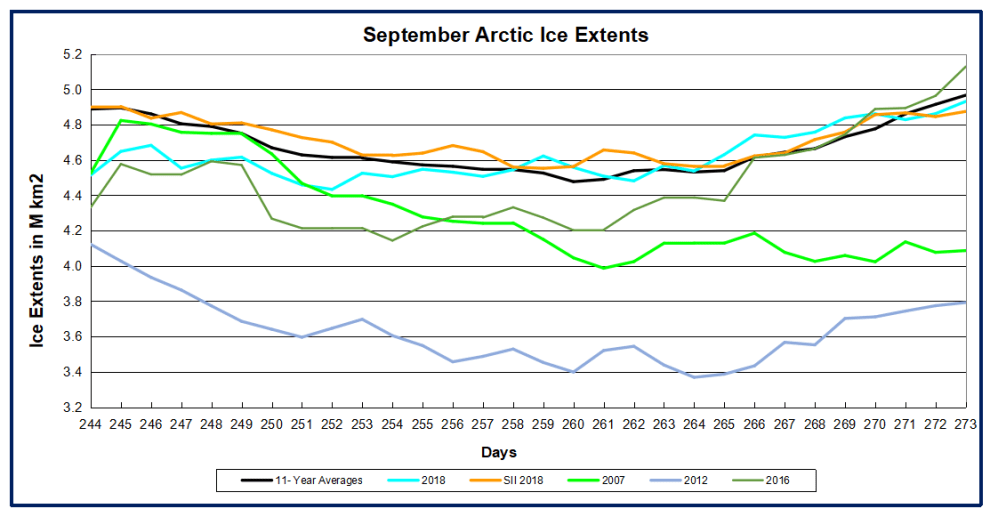
Arctic2018273

The graph shows MASIE reporting Arctic ice extents totalling 4.93M km2 yesterday,  35k km2 below the 11 year average (2007 to 2017 inclusive).  NOAA’s Sea Ice Index is the same as MASIE, 2007 was 845k km2 lower, and 2012 1.1M km2 less ice extent.  A dip on day 252 to  4.43M km2 was an early daily minimum for the year.  As shown in the first graph, the September monthly average exceeded 2007 by 300k in MASIE and  400k km2 in SII.

The table below shows ice extents in the regions comprising the Arctic in September.

Region 2018273 Day 273 
Average
2018-Ave. 2007273 2018-2007
 (0) Northern_Hemisphere 4931836 4966893 -35057 4086883 844953
 (1) Beaufort_Sea 622520 527098 95422 498743 123777
 (2) Chukchi_Sea 134120 210769 -76649 51 134069
 (3) East_Siberian_Sea 378263 329380 48884 311 377952
 (4) Laptev_Sea 19790 186004 -166214 235245 -215455
 (5) Kara_Sea 235 30387 -30152 15367 -15132
 (6) Barents_Sea 0 18890 -18890 4851 -4851
 (7) Greenland_Sea 242190 235559 6631 353210 -111020
 (8) Baffin_Bay_Gulf_of_St._Lawrence 70138 51991 18148 42247 27891
 (9) Canadian_Archipelago 606394 367879 238515 307135 299259
 (10) Hudson_Bay 4611 4458 153 1936 2674
 (11) Central_Arctic 2852432 3003376 -150944 2626511 225921

The total extent is down 35k km2 (less than 1%) below the 11 year average.  The deficit in Chuckchi is more than offset by surpluses in Beaufort and East Siberian.  On the European side are deficits in Laptev, Kara and Central Arctic, almost covered by the huge surplus in Canadian Arctic Archipelago (CAA).

It’s all good.  It’s natural.

Try To Remember lyrics by Tom Jones from “The Fantasticks”  1960

algore_ice_gone_by_2013


On the Motion of the Ocean

The image shows what is known about how ocean currents flow under the influence of the earth’s rotation. A recent article adds another level of complexity and insight by examining smaller scale effects. From the American Institute of Physics Researchers challenge our assumptions on the effects of planetary rotation Excerpts in italics with my bolds.

Coriolis effect can influence eddies in wakes as small as 10 meters

The Coriolis effect impacts global patterns and currents, and its magnitude, relative to the magnitude of inertial forces, is expressed by the Rossby number. For over 100 years, scientists have believed that the higher this number, the less likely Coriolis effect influences oceanic or atmospheric events. Recently, however, researchers found that smaller ocean disturbances with high Rossby numbers are influenced by the Coriolis effect. Their discovery challenges assumptions of theoretical oceanography and geophysical fluid dynamics.

A 2-D image of the velocity in an internal jet with the Rossby number of 100 that shows how planetary rotation leads to the destabilization and dispersion of an initially coherent flow pattern. Credit: Timour Radko and David Lorfeld

Earth’s rotation causes the Coriolis effect, which deflects massive air and water flows toward the right in the Northern Hemisphere and toward the left in the Southern Hemisphere. This phenomenon greatly impacts global wind patterns and ocean currents, and is only significant for large-scale and long-duration geophysical phenomena such as hurricanes. The magnitude of the Coriolis effect, relative to the magnitude of inertial forces, is expressed by the Rossby number. For over 100 years, scientists have believed that the higher this number, the less likely Coriolis effect influences oceanic or atmospheric events.

Recently, researchers at the Naval Postgraduate School in California found that even smaller ocean disturbances with high Rossby numbers, like vortices within submarine wakes, are influenced by the Coriolis effect. Their discovery challenges assumptions at the very foundation of theoretical oceanography and geophysical fluid dynamics. The team reports their findings in Physics of Fluids, from AIP Publishing.

“We have discovered some major — and largely overlooked — phenomena in fundamental fluid dynamics that pertain to the way the Earth’s rotation influences various geophysical flows,” Timour Radko, an oceanography professor and author on the paper, said.

Radko and Lt. Cmdr. David Lorfeld originally focused on developing novel submarine detection systems. They approached this issue by investigating pancake vortices, or flattened, elongated mini-eddies located in the wakes of submerged vehicles. Eddies are caused by swirling water and a reverse current from waterflow turbulence.

Last year, a team led by Radko published a paper in the same AIP journal on the rotational control of pancake vortices, the first paper that challenged the famous “Rossby rule.” In this most recent paper, the researchers showed, through numerical simulations, that internal jets of the wake can be directly controlled by rotation. They also demonstrated that the evolution of a disorganized fine-scale eddy field is determined by planetary rotation.

“Here is where our discovery could be critical,” Radko said. “We find that cyclones persist, but that anticyclones unravel relatively quickly. If the anticyclones in the wake are as strong as the cyclones, this means that the wake is fresh — the enemy passed through not too long ago. If the cyclones are much stronger than the anticyclones, then the sub is probably long gone.”

The algorithm that the researchers developed is based on the dissimilar evolution of cyclones and anticyclones, which is a consequence of planetary rotation. “Therefore,” Radko concluded, “such effects must be considered in the numerical and theoretical models of finescale oceanic processes in the range of 10-100 meters.”

The computer model is detailed enough to resolve eddies that are important for ocean circulation. The triangle-shaped island of Newfoundland, center, is at the eastern edge of the study area, the mouth of the Gulf of St. Lawrence. This graphic shows oxygen at the surface, where red shows more oxygen. Credit: Mariona Claret/University of Washington

Background:  Ocean Physics in a Cup of Coffee


How to Test an Accusation

The Senate Judiciary committee is meeting today and the written testimonies of Dr. Ford and Judge Kavanaugh are available. The challenge for senators and everyone else is how to judge the validity of the sexual assault claim. Normally an accusation is supported by evidence such as other witnesses before it is given legal consideration. But this is a he said, she said situation.

We know from scientific studies that our memories are untrustworthy the further in the past are the events being recalled. Cognitive experts say that a core remembrance, usually laden with emotion, is elaborated with details invented by our brains to fill in the gaps for a complete story.  An accuser can bear truthful witness to a false memory, and thereby belie the facts. So how to sort out how much is what happened and how much is imagination?

Adam Mill is an employment lawyer who has experience with many such cases and writes in the Federalist 10 Red Flags About Sexual Assault Claims, From An Employment Lawyer

It’s not nice or politically correct to say, but people do sometimes lie to get money, revenge, power, attention, or political advantage. False allegations of assault have been documented.

I know it’s a very unfashionable to advocate on behalf of the presumption of innocence, and I am often reminded of how insensitive and outdated the principle is in today’s climate.

Of course, courtesy to the alleged victim is absolutely essential to be effective. To do otherwise is completely counterproductive and quickly turns the focus from the facts to the conduct within the inquiry. So I go to great pains to make my questions respectful.

When the complaint is “he said/she said,” we should not helplessly acquiesce to coin-flip justice that picks winners and losers based upon the identity politics profile of the accused and accuser. Experience with a career’s worth of complaints in hearings, depositions, and negotiations has taught me some tells, red flags that warn that an innocent person stands accused.

Without naming any particular accusation, I offer these factors for consideration to the fair-minded who remain open to the possibility that guilt or innocence is not simply a question of politics. I also remind the reader that politicizing these accusations have allowed men like Harvey Weinstein, Al Franken, Matt Lauer, Les Moonves, Bill Clinton, and Keith Ellison to escape accountability. Nobody seems to care if they walk the walk so long as they talk the talk.

1. The accuser uses the press instead of the process.
Every company has a slightly different process for harassment and assault complaints. Often it begins with a neutral investigator being assigned to interview the accuser first, then potential corroborating witnesses. When an accuser is eager to share with the media but reluctant to meet with an investigator, it’s a flag.

2. The accuser times releasing the accusation for an advantage.
For example, when the accuser holds the allegation until an adverse performance rating of the accuser is imminent, or serious misconduct by the accuser is suddenly discovered, or the accused is a rival for a promotion or a raise, or the accused’s success will block an accuser’s political objective. It’s a flag when the accusation is held like a trump card until an opportunity arises to leverage the accusation.

3. The accuser attacks the process instead of participating.
The few times I’ve been attacked for “harassing” the victim, it has always followed an otherwise innocuous question about the accusation, such as: Where, when, how, why, what happened? I don’t argue with accusers, I just ask them to explain the allegation. If I’m attacked for otherwise neutral questions, it’s a red flag.

4. When the accused’s opportunity to mount a defense is delegitimized.
The Duke Lacrosse coach was fired just for saying his players were innocent. When the players dared to protest their innocence, the prosecutor painted their stories in the press as “uncooperative.” If either the accused or the accused’s supporters are attacked for just for failing to agree with the accusation, it’s a red flag.

5. The accuser seeks to force the accused to defend himself or herself before committing to a final version.
Unfortunately, this has become the preferred approach of the kangaroo courts on college campuses. It’s completely unfair because it deprives the accused of the opportunity to mount an effective defense. When the accuser demands the accused speak first, it is a strong indication that the accuser wants the opportunity to fill in the details of the accusation to counter any defense or alibi the accused might offer. It’s a red flag.

6. The accused makes a strong and unequivocal denial.
In most cases, there’s some kernel of truth to even the most exaggerated claims. When the accused reacts with a dissembling explanation full of alternatives and rationalizations, I tend to find the accuser more credible. Rarely, however, the accused reacts with a full-throated and adamant denial. When it happens, it’s a red flag that the accusation might have problems.

7. The accuser makes unusual demands to modify or control the process.
It’s a flag when the accuser demands a new investigator or judge without having a substantial basis for challenging the impartiality of the process that’s already in place.

8. When the accuser’s ability to identify the accused has not been properly explained.
In the Duke lacrosse case, the accuser was shown a lineup of photos of potential attackers. Every photo was of a member of the team. None were of people known to be innocent. It’s a red flag when an identification is made only after the accused appears in media and the accuser has not seen the accused for a number of years or was otherwise in regular contact with the accused.

9. When witnesses don’t corroborate.
10. When corroborating witnesses simply repeat the accusation of the accuser but don’t have fresh information.
It is now clear that accusations of sexual misconduct will forever be a tool to change results in elections and Supreme Court nominations. It’s disappointing to see so many abandon the accused to join the stampede of a mob that punishes any who ask legitimate questions about accusations.

These accusations destroy the lives of the accused, often men, and bring devastation to the women who love and support them. Some of the falsely accused commit suicide. When the mob attacks legitimate inquiry into the accusation, it’s a sure sign that the mob isn’t confident about the truth of the allegation. Rather than shrink in fear when attacked, we should take it as a sign that there is a risk that the accused is innocent, and the questions need to keep coming.

Adam Mill works in Kansas City, Missouri as an attorney specializing in labor and employment and public administration law. He frequently posts to millstreetgazette.blogspot.com. Adam graduated from the University of Kansas and has been admitted to practice in Kansas and Missouri.

Dr. Elizabeth Loftus concluded in one TED talk:

If I’ve learned anything from my decades working on these problems, it’s this: Just because somebody tells you something and they say it with lots of confidence, detail, and emotion does not mean that it really happened. We can’t reliably distinguish true memories from false memories; we need independent corroboration. Such a discovery has made me more tolerant of friends and family who misremember. Such a discovery might have saved Steve Titus. We should all keep in mind that memory, like liberty, is a fragile thing.


Honey, I Made the Earth Wobble! Not.


Image is from Honey, I Shrunk the Kids, a 1989 American science fiction family film produced by Walt Disney Pictures.

Repeated robotically by alarmist websites, this week’s climate scare says that burning fossil fuels is causing the earth to wobble in its spin.

Earth is Wobbling and Climate Change is to Blame Newsweek

Humans Are Causing Earth to Wobble Popular Mechanics

Human-Driven Climate Change Is Literally Making Earth ‘Wobble’ Motherboard

Earth’s rotation wobbles. NASA says humans partly to blame. Big Think

Earth’s Axis Is Drifting Inches Every Year In Part Because Of Human-Driven Climate Change IFLScience

Planet Earth Wobbles As It Spins, and Now Scientists Know Why Live Science  The case as made in the Live Science article,

Since 1899, the Earth’s axis of spin has shifted about 34 feet (10.5 meters). Now, research quantifies the reasons why and finds that a third is due to melting ice and rising sea levels, particularly in Greenland — placing the blame on the doorstep of anthropogenic climate change.

Another third of the wobble is due to land masses expanding upward as the glaciers retreat and lighten their load. The final portion is the fault of the slow churn of the mantle, the viscous middle layer of the planet.

Earth wobbles irregularly over time, which means it does not always spin on an axis running through its poles. Its axis has been drifting towards North America during most of the last century (green arrow). That direction has changed dramatically due to changes in water mass on Earth. (Image: NASA/JPS-Caltech)

After a little investigation, there are several reasons not to be alarmed about this finding.

1.The Wobble is ancient.

Scientists have long known that the distribution of mass around the Earth determines its spin, much like how the shape and weight distribution of a spinning top determines how it moves. Also, Earth’s spin isn’t perfectly even, as scientists know thanks to slight wiggles in the movements of the stars across the night sky that have been recorded for thousands of years, said Erik Ivins, a study co-author and a senior research scientist at JPL. Since the 1990s, space-based measurements have also confirmed that the Earth’s axis of rotation drifts by a few centimeters a year, generally toward Hudson Bay in northeastern Canada.

Researchers knew that a proportion of this wobble was caused by glacial isostatic adjustment, an ongoing process since the end of the last ice age 16,000 years ago. As the glaciers retreat, they relieve the land underneath of their mass. Gradually, over thousands of years, the land responds to this relief by rising like bread dough. (In some places on the edges of the ancient ice sheets, the land might also collapse because the ice had forced it to bulge upward.)

2. Wobbling results from multiple causes.

“We have provided evidence for more than one single process that is the key driver” for altering the Earth’s axis, said Surendra Adhikari, an Earth system scientist at NASA’s Jet Propulsion Laboratory in Pasadena, California, and a lead researcher on the new study.

But in the new research, published in the November issue of the journal Earth and Planetary Science Letters, Adhikari and his colleagues found that glacial isostatic adjustment was only responsible for about 1.3 inches (3.5 centimeters) of axis wobble per year. That was only about a third of the wobble — 4 inches (10.5 cm) — observed each year over the 20th century.

To fill in the gap, the research team built a computer model of the physics of Earth’s spin, feeding in data about changes in the balance of land-based ice and ocean waters over the 20th century. The researchers also accounted for other shifts in land and water, such as groundwater depletion and the building of artificial reservoirs, all part of humanity’s terraforming of the planet.

The results revealed that these environmental processes cause another 1.7 inches (4.3 cm) of wobble each year. The melting of the Greenland ice sheet was a particularly important contributor, the researchers found. That’s because Greenland has released a large amount of water that was once locked up on land into the oceans, where its mass has been redistributed, Ivins told Live Science. Mountain glaciers and small ice caps elsewhere have also contributed to sea-level rise, he said; but they aren’t as concentrated, and their effects on the Earth’s rotation often cancel each other out.

3. The mantle itself is always moving.

The glaciers and the ice melt still left a third of the wobble unaccounted for, so Adhikari and his team looked inward. The Earth’s mantle is not static, he said, but moves by the process of convection: Hotter material from closer to the core rises and cooler material sinks in a cycle of vertical motion. By including convection in the model of Earth’s wobble, the researchers had accounted for the last third of the changes in the spin over the 20th century.

4. The Wobble is not menacing.

It’s important to realize that this wobble isn’t the prelude to any sort of environmental calamity, Ivins and Adhikari said. It doesn’t affect agriculture or climate in and of itself, and any small impact on navigational equipment is easy to correct for.

“The amount [of drift] is not a huge amount,” Adhikari said.

5. Greenland ice sheet is affected by many natural factors.

A recent paper looked into unusually extensive melting in 2012. The implication of nonradiative energy fluxes dominating Greenland ice sheet exceptional ablation area surface melt in 2012 by Robert S. Fausto et al. Excerpts in italics with my bolds.

The surface energy budget consists of nonradiative (sensible, latent, rain, and subsurface) and radiative (shortwave and longwave) energy fluxes. Distinguishing the contribution of nonradiative and radiative energy fluxes in melt over the Greenland ice sheet is important to understand ice sheet surface climate sensitivity, especially in the ablation area, where the majority of melt occurs [e.g., Fausto et al., 2012a].

Ablation varies with elevation, but there are also considerable latitudinal differences as the Greenland ice sheet stretches from the upper midlatitudes (~60°N) to the high Arctic (~82°N). The largest total observed ice ablation in 2012 was 8.5 m ice eq. at QAS_L, which was 9% less than the 2010 value. This interannual variability may be attributed to larger winter snow accumulation in 2012, which maintained high surface albedo by delaying bare ice exposure during the melt season.

Given that absorbed solar radiation is the primary energy source of melt on an annual basis, the influence of intra‐annual and interannual variability in air temperature and other variables on ablation is of secondary importance [Van den Broeke et al., 2011]. Yet during the two melt episodes we focus on, which together resulted in ~14% of annual ice ablation (Table 1), the nonradiative (sensible, latent, rain, and subsurface) energy fluxes were the primary control of melt with a contribution of 53 ± 16% and 66 ± 8%, respectively, averaged for the eight western AWSs for episodes E1 and E2, respectively (Tables 1).

During the two episodes, the large longitudinal contrast in nonradiative energy fluxes contribution to surface melt stem from anomalously warm and moist southern air flow being transferred onto the western ice sheet by atmospheric flow (Figure 2b) [Neff et al., 2014; Bonne et al., 2015], while east Greenland was dominated by stable weather with relatively low cloud cover and high solar radiation (Figure 2c) [Fettweis et al., 2013; Tedesco et al., 2013].

More broadly, data from the two episodes presented here demonstrate that exceptional melt can occur during periods characterized by cloudy skies and transient atmospheric flow, with melt being dominated by nonradiative, rather than radiative fluxes in the ablation area.

Conclusions

We find that year 2012 Greenland ice sheet melt was marked not only by widespread interior surface melting [Nghiem et al., 2012] but also by an increased nonradiative (sensible, latent, and rain) energy flux contributing to melt in the ablation area of the southern and western ice sheet. Latent and sensible energy advection governed two exceptional melt episodes in July 2012 [Neff et al., 2014]. The two episodes which lasted just ~6% of the ablation period in June–August were responsible for ~14% of the annual 2012 ablation average for all PROMICE measurement sites (Table 1). At all PROMICE sites during the two exceptional melt episodes the combined sensible, latent, rain, and subsurface energy fluxes (i.e., nonradiative energy fluxes) comprised 60% of the melt energy on average (Figure 1 and Table S1).

Summary

Earth has wobbled a bit in its rotation since the beginning, and continues to do so. The movement is not large or menacing. The three causes appear to be shifting material in the mantle, land rebounding when glaciers retreat, and changes in Greenland ice sheet balance.

The latter is attributed to human activity, even though major melting events result primarily from nonradiative factors: sensible, latent, rain and subsurface energy fluxes. If you buy the notion that burning fossil fuels causes Greenland ice sheet to melt, then please contact me about my bridge in Brooklyn that I am selling.

Ethane is Transforming World Energy

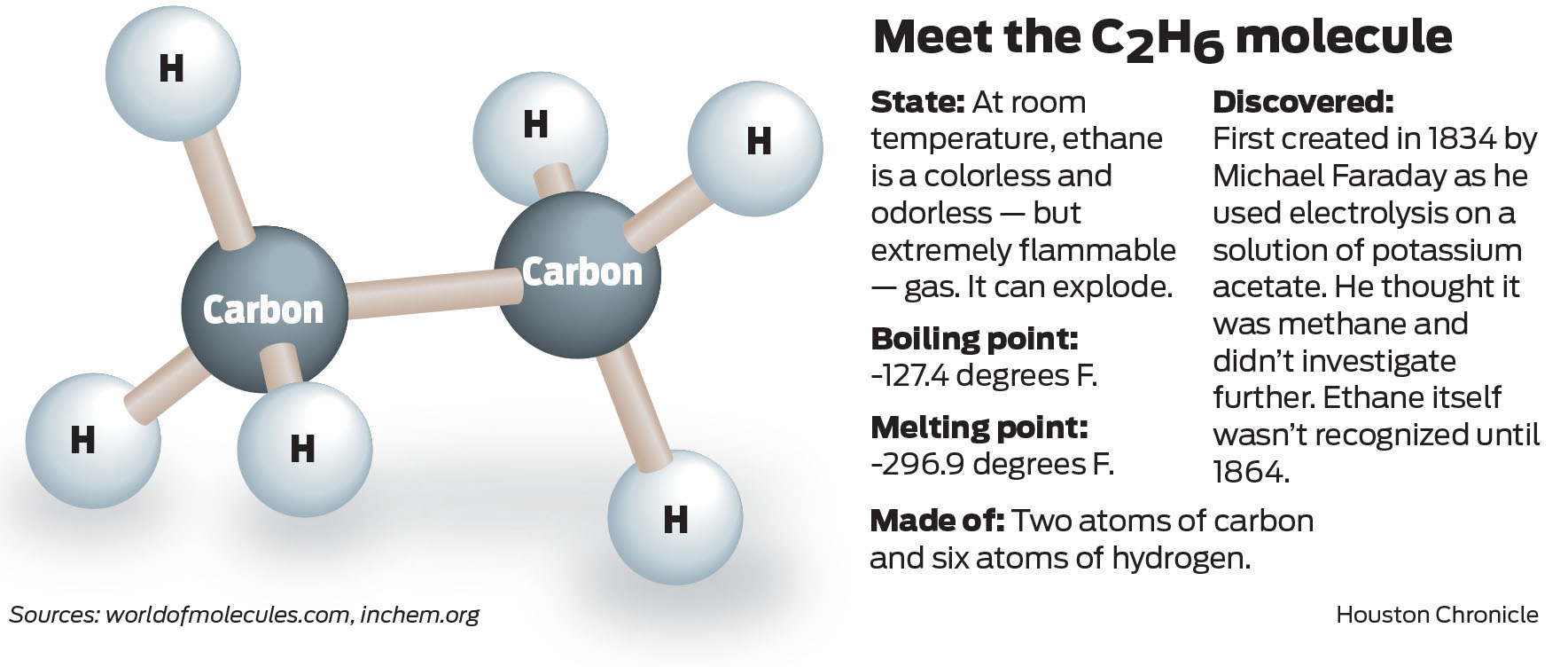
Many of us know of methane (CH4, AKA natural gas), but overlooked in the current drilling revolution is ethane (C2H6) which is quietly transforming the world of energy. The story comes appropriately from the Houston Chronicle (H/T Master Resource). Jordan Blum writes How the ethane molecule changed the Gulf Coast — and the world Excerpts in italics with my bolds.

Overview

Ethane is simply described as C2H6. But that molecule, a byproduct of natural gas, has triggered a petrochemical boom that is reshaping the Gulf Coast, the energy industry that lives here, and global markets for plastics, resins and other petrochemicals.

We followed that molecule from a Texas shale field where it is found, to the petrochemical plant where it is transformed into ethylene, the basic building block of most plastics, and to the Port of Houston, where it is shipped to Asia and other emerging consumer markets.

The impact of ethane is perhaps the most remarkable development in the remarkable story of the shale revolution. Less than three years ago, ethane was a largely unwanted byproduct of oil and gas drilling, much of it burned away in the natural gas stream flowing to power plants, businesses and homes, or flared off at well sites.

But today, ethane is feedstock for nearly half of U.S. plastics production and a valuable export to chemical companies around the world. As ethane flows from Texas shale fields, chemical and energy companies are building and expanding plants to take advantage of the cheap, plentiful raw material, plowing more than $140 billion into the Gulf Coast alone.

“It’s absolutely extraordinary this is happening in the United States,” said Neil Chapman, Exxon Mobil senior vice president. “I can assure you nobody predicted this in 2000 or even 2005.”

U.S. ethane production is projected to reach 2 million barrels a day by 2020, double the output at the height of the last drilling boom in 2014. On the journey from wellhead to market, ethane molecules will change forms several times as they are separated from natural gas, heated to become ethylene, processed into polyethylene, and ultimately extruded and molded into packaging and products that will appear on shelves in stores from Houston to Mumbai and Ho Chi Minh City.

The shale revolution is widely credited to the innovation and determination of one man, the late George P. Mitchell, son of a Greek immigrant and founder of The Woodlands. Mitchell, after striking it rich in oil, spent 35 years stubbornly focused on developing the Barnett Shale near Dallas, a play known for years as the “Wildcatters Graveyard.”

Mitchell, however, persisted, eventually combining hydraulic fracturing with horizontal drilling to unlock the complex shale rock. Mitchell didn’t frack his first profitable well until 1998, but with that success, he sold his company four years later for more than $3 billion to Devon Energy of Oklahoma City.

The shale boom was soon underway, producing oil and gas from Texas to North Dakota to the Northeast. It placed the United States among the world’s biggest energy producers, roiling global markets and upending more than 40 years of geopolitics.

And along with oil and gas came large volumes of another petroleum product known as natural gas liquids.

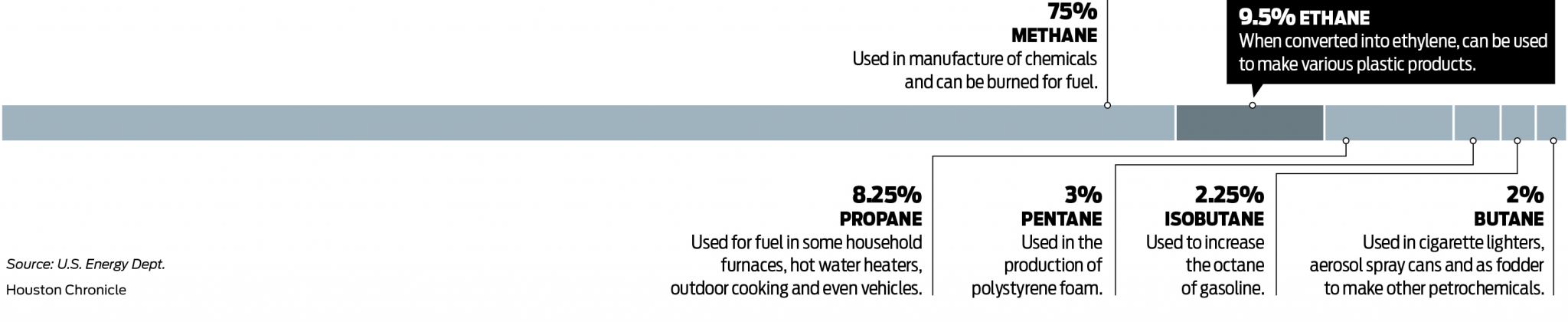
Three primary components can come out any successful well: crude oil, natural gas, which is essentially methane, and natural gas liquids, primarily ethane, butane and propane. Ethane is the most prevalent natural gas liquid, or NGL, and used solely as a feedstock for petrochemicals.

Mont Belvieu is built atop a salt dome formed more than 100 million years ago from deposits likely left by an ancient inland sea that cut across the North American continent. For more than 60 years, energy companies have used it as a natural storage tank, carving out salt caverns some 3,000 feet deep to hold millions of barrels of petroleum products.

Today, those caverns are increasingly filled with ethane and other natural gas liquids that feed the plastics and chemical industries, making Mont Belvieu and its neighbor to the south, Baytown, the focal point of the Gulf Coast petrochemical boom. Here, where rice fields once stretched as far as the eye could see, Exxon Mobil alone has invested some $6 billion to dramatically expand its 36-year-old plastics plant as well as its sprawling refining and chemicals complex in Baytown.

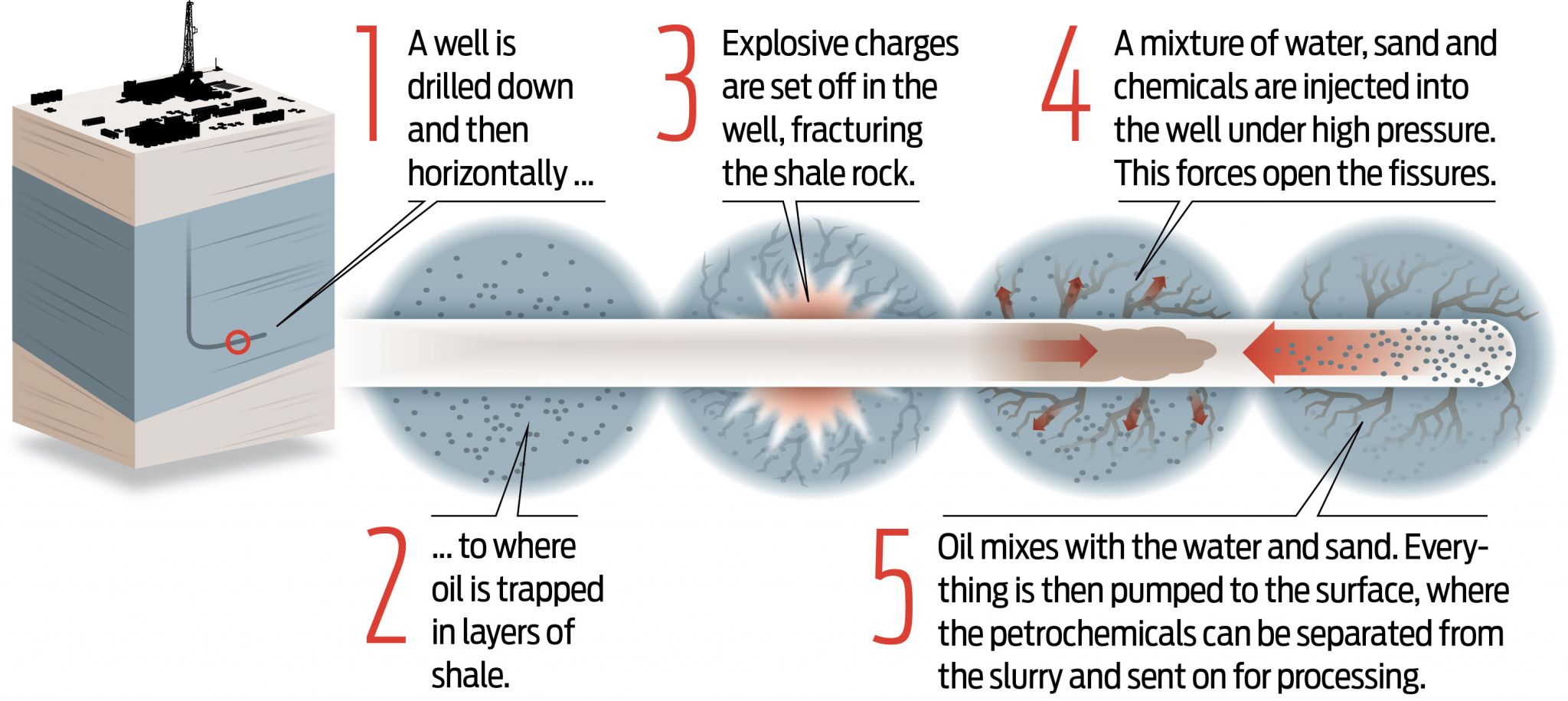
At these plants, the ethane molecules that squeezed through fissures in shale rock, flowed up a Texas well and traveled more than 150 miles by pipeline, will undergo chemical changes to transform them from once-overlooked byproducts of oil and gas drilling into one of most ubiquitous materials on earth. Hundreds of other pipelines stretching across Texas and beyond will carry millions more barrels of natural gas liquids from U.S. shale fields, converging near the salt dome under Mont Belvieu’s Barbers Hill.

This is the next stop for the natural gas liquids produced by Exxon’s subsidiary XTO Energy. Here, processing plants known as fractionators use varying pressures and temperatures to break the natural gas liquids into components, each with a slightly different combination of carbon and hydrogen, including butane (C4H10), propane (C3H8), pentane (C5H12) and, of course, ethane (C2H6).

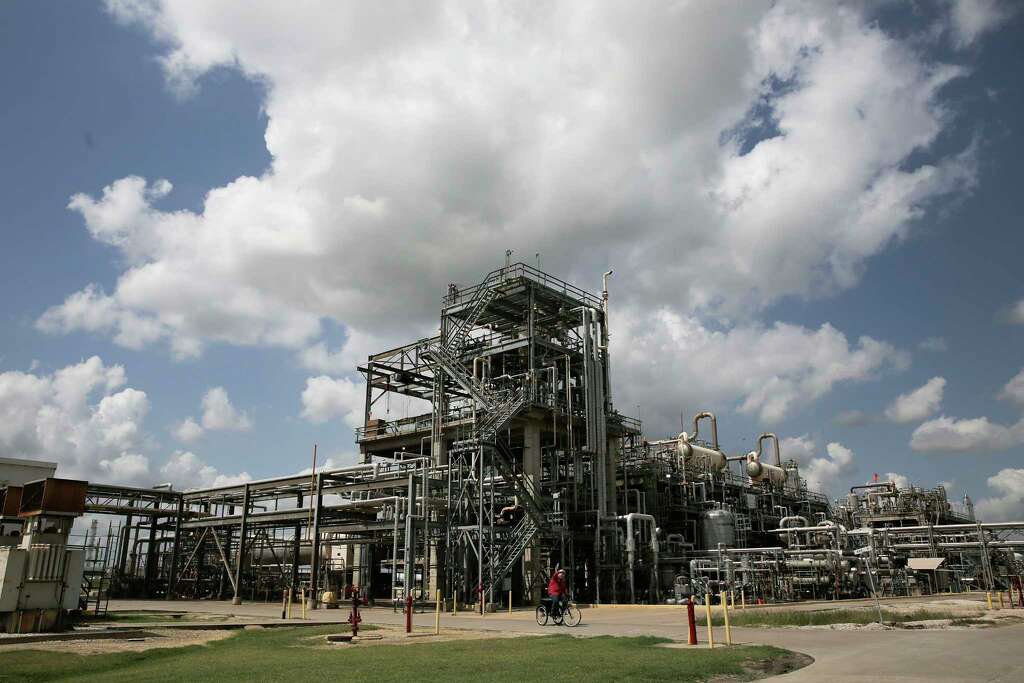
The ethane is piped 10 miles to Exxon Mobil’s Baytown complex, which is simultaneously one of the nation’s oldest and most modern plants. The refinery was built nearly a century ago by one of Exxon Mobil’s predecessor companies, Humble Oil. A chemical plant was added in 1979 and expanded in 1997.

The focus of the Baytown expansion was eight furnaces, each costing more than $100 million and standing 23 stories tall — nearly the height of NRG Stadium. The furnaces, built in Thailand, are the heart of a plant known as a cracker, which gets its name from the process that uses extreme heat to crack ethane molecules in half and trigger chemical reactions that form ethylene.

The ethylene is piped back to Mont Belvieu, where some will be stored in the salt caverns, but most will feed another process that will change the hydrocarbons liberated from Texas shale once again.

Where the Baytown complex used heat and pressure to crack ethane into ethylene, Exxon Mobil’s Mont Belvieu plant relies on chemical reactions to fuse trillions of ethylene molecules into polyethylene.

The Mont Belvieu plant opened in 1982, producing mainly low-grade, flexible polyethylene used in plastic wrap and food packaging, and expanded nine years later to produce plastic for more rigid products, such as milk bottles. The most recent expansion, completed late last year, is dedicated to high-performance polyethylene that is light, flexible and strong.

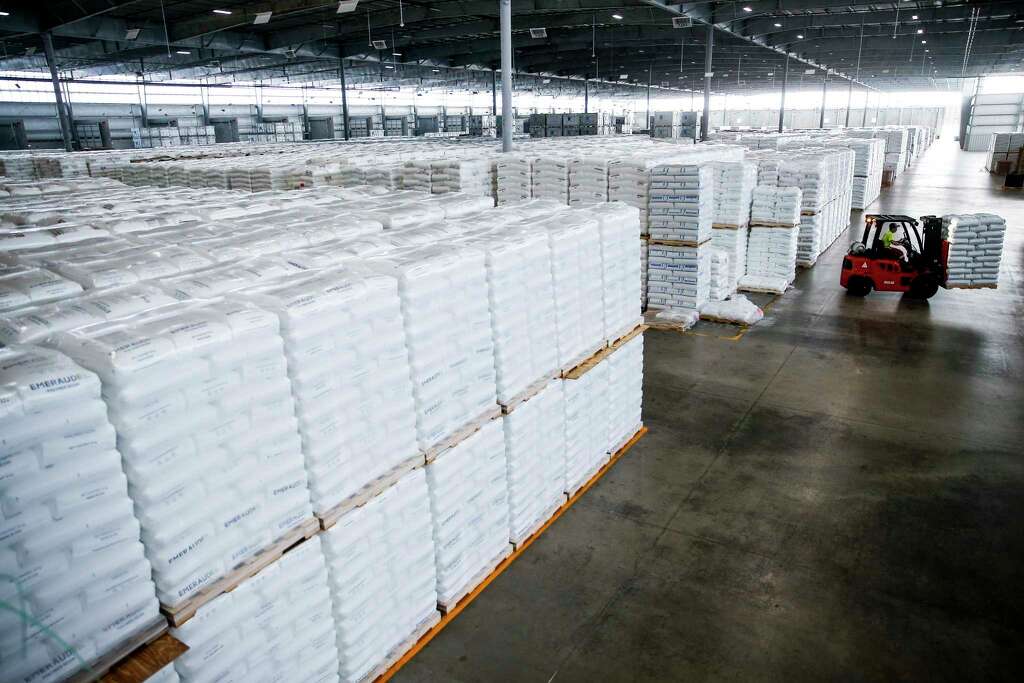
After quality testing, the plastic is loaded into as many as 35 rail cars, each holding about 200,000 pounds of polyethylene pellets, and shipped throughout the country to customers who shape the polyethylene pellets into finished plastics products. About 40 percent of the polyethylene is made for the domestic market.

Polyethylene pellets marked for export are mechanically packaged in 55-pound bags, each holding about 1 million pellets. Every hour, the plant fills about 10,000 bags, which are loaded onto pallets, each holding 55 bags, and trucked to a 70-acre storage yard. As many as 100,000 pallets are kept for up to 45 days until they can be loaded into containers and shipped out of the Port of Houston.

The Baytown and Mount Belvieu plants together employ 7,500 people, and Exxon Mobil estimates that the number doubles to 15,000 when counting contractors and jobs at local suppliers, restaurants and other businesses that support the plant. Exxon pays more than $150 million a year in local taxes and fees.

The plants also have contributed to a surge in exports that has made Houston one of few regions in the country that exports more than it imports. That brings new money into the area — tens of billions of dollars that can be used to expand business, hire workers and increase wealth.

“We’re going to have things that are made in America again and getting shipped overseas,” Fritsch said. “That’s what’s exciting about shale gas. It’s the explosion of industry again in the U.S.”

Tweak the Sun’s Rotation, and We’re Not Here

Watch the Sun rotate for over a month brought to you by SDO. Since the Sun rotates once every 27 days on average, this movie presents more than an entire solar rotation. From March 30 through Apr. 29, 2011, the Sun sported quite a few active regions and magnetic loops. The movie shows the Sun in the 171 Angstrom wavelength of extreme ultraviolet light (capturing ionized iron heated to about 600,000 degrees), color coded to appear gold. The movie is based on a frame taken every 15 minutes being shown at 24 frames per second, with very few data gaps in this almost two-minute movie. Source Solar Dynamics Observatory

Another fresh reminder we owe our existence to the sun along with the climate in which we evolved and adapted. The Forbes article is Early Sun’s ‘Goldilocks’ Rotation Rate May Be Why We’re Here  Excerpts in italics with my bolds.

Our early Sun’s rate of rotation may be one reason we’re here to talk about it, astrobiologists now say. The key likely lies in the fact that between the first hundred million to the first billion years of its life, our G-dwarf star likely had a ‘Goldilocks’ rotation rate; neither too slow nor too fast.

Instead, its hypothetical ‘intermediate’ few days rate of rotation guaranteed our Sun was active enough to rid our newly-formed Earth of its inhospitable, hydrogen-rich primary atmosphere. This would have enabled a more habitable, secondary atmosphere composed of nitrogen, carbon dioxide, hydrogen and oxygen to eventually form.

If it had been a ‘fast’ (less than one day rotator), our Sun might have continually stripped our young planet of its secondary atmosphere as well. However, if it took more than 10 days to rotate, it might not have been active enough to strip Earth of its hypothetical primary atmosphere.

Such ideas were recently bandied about in oral presentations at last month’s the General Assembly of the International Astronomical Union (IAU) in Vienna.

Earth’s very first atmosphere would have been too hot and too thick, more like Venus’ present-day atmosphere, Theresa Luftinger, an astrophysicist at the University of Vienna, told me. No known organisms could have evolved under such an atmosphere.  A secondary atmosphere cannot evolve in the presence of a primordial atmosphere , says Luftinger.

It’s the star’s magnetic dynamo that drives its magnetic fields. And these magnetic fields, in turn, interact with the star itself, creating an interplay of extreme stellar activity.

“So, the quicker the star rotates, the higher the interaction between the magnetic field and the stellar body ,” said Luftinger.

Faster rotation means higher extreme ultra-violet and x-ray activity, Helmut Lammer, an astrophysicist at Austria’s Space Science Institute in Graz, told me. This would lead to atmospheric stripping and water loss on earthlike planets around an active young star, he says. 

Our Sun is now a very slow rotator at 27 days. But that wasn’t always the case. As for why some stars seem to inherently rotate faster than others?

Astrophysicists suspect that initial conditions within star-forming clouds cause newborn stars to have different rotation rates.

Researchers are able to roughly pinpoint the Sun’s early rotation rates by studying the isotopic ratios of neon, argon, potassium, and uranium here in Earth’s crust. That is, elements which have atoms that have the same numbers of protons in their atomic nucleus, but different numbers of neutrons. The researchers also considered such isotopic ratios from decades’-old Venus surface samples taken by Soviet Venus lander missions.


Arctic Ice Flash Freezing

CAA2018262to266

Four Days in Nunavut

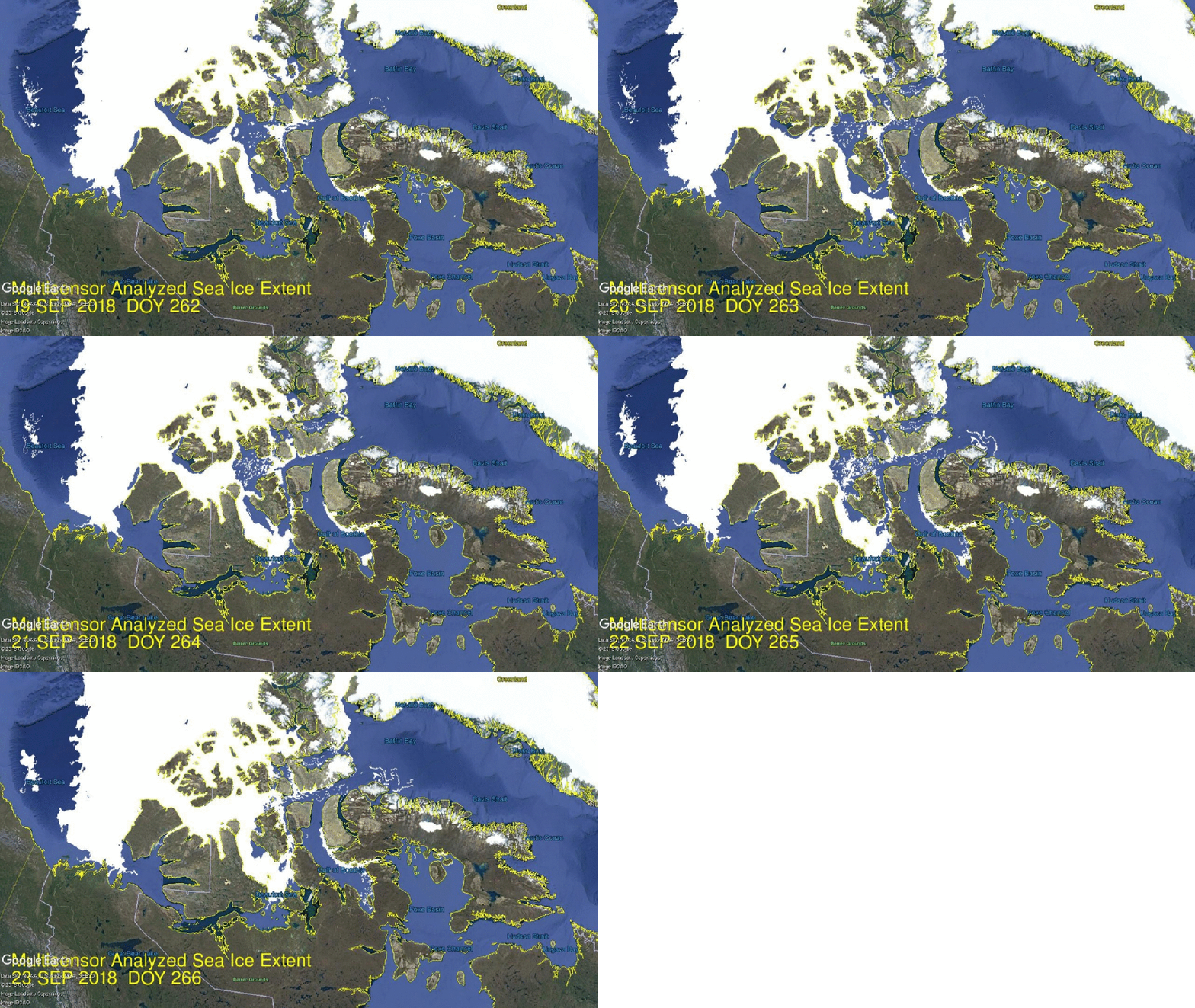
Previous posts described how the Northwest Passage was treacherously laden with ice this year.  The image above shows the flash freezing in this region over the last four days.  Sept. 19 the CAA ice extent (Canadian Arctic Archipelago) was 320k km2, close to its annual minimum.  Yesterday MASIE showed 450k km2,  a 40% increase.

ArcticIce20180923

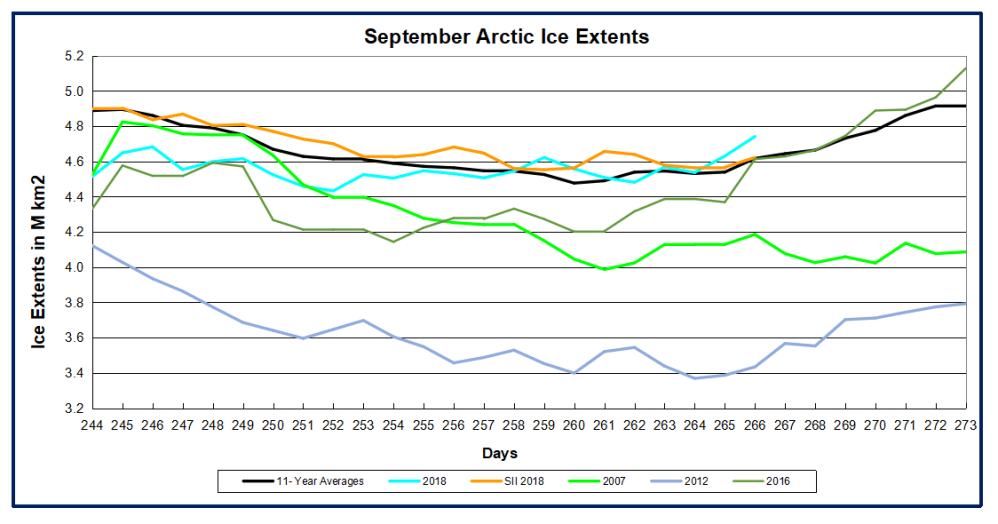
The graph shows MASIE reporting ice extents totalling 4.74M km2 yesterday,  124k km2 above the 11 year average (2007 to 2017 inclusive).  NOAA’s Sea Ice Index is 119 k km2 lower, 2007 was 462k km2 lower, and 2012 1.2M km2 less ice extent.  A dip on day 252 to  4.43M km2 will certainly be the daily minimum for the year.  With typical refreezing to month end, we can expect the September monthly average will exceed 2007 by at least 300k to 400k km2.


algore_ice_gone_by_2013