Reuters Misleads on Investor Support for AGW

Reuters published today 2017 tables listing sovereign investors in two categories: Leaders and Laggards. I noticed that the laggard table included the assets size of funds, while the leader table did not. So I went to the report itself by the Asset Owners Disclosure Project (AODP) which is leading the effort to blame and shame investors away from fossil fuel companies.

There you find in fact they apply five categories according to how enthusiastically a fund complies with climate change doctrine.  From the AODP Report:

The AODP Global Climate 500 Index rates the world’s 500 biggest asset owners – pension funds, insurers, sovereign wealth funds, foundations and endowments – on their success at managing climate risk within their portfolios, based on direct disclosures and publicly available information.

This year also sees the launch of the first AODP Global Climate Index for Asset Managers, rating the world’s 50 largest asset managers on their success at managing the financial risks of climate change for their clients.

It follows the same methodology. Asset owners and managers are scored on three key capabilities which align with the four key areas highlighted by the FSB Task Force on Climate-related Financial Disclosures: Governance & Strategy, Portfolio Carbon Risk Management and Metrics & Targets. They are graded from AAA to D while those with no evidence of action are rated X.

GOVERNANCE & STRATEGY – Organisation structure and approach it uses to oversee climate risk objectives. – Degree of integration of climate risk principles in the organisation’s policies and processes

PORTFOLIO RISK MANAGEMENT – Variety and effectiveness of tools and approaches used to evaluate and manage climate change related financial risks and opportunities. This includes engagement, voting practices, and portfolio management tools.

METRICS & TARGETS – Key metrics used to measure, monitor and compare portfolio climate risk management performance, including the value asset owners have invested in low carbon assets.

The AODP Report applies a lot of lipstick to the numbers in the interest of boosterism for their project and their cause. But a different story is evident from the numbers, according to their own analysis. For example, here are the 2017 results for the world’s top 500 Asset Owners (AUM=Assets Under Management)

2017 Asset Owners by Rating # Asset
Owners
    AUM
US$ Billion
% AUM
Leaders Top 7% 34 $4,163 10%
Challengers 7% – 14% 34 $3,103 8%
Learners 14% – 22% 44 $3,395 9%
Bystanders 22% – 60% 187 $16,556 42%
Laggards, Zero X Bottom 40% 201 $12,508 31%
Total 500 $39,725 100%

Unreported anywhere is the fact 73% of the wealth in these funds is in the bottom two compliance categories.  In fact the laggard funds are six times as numerous and have 3 times the assets of the leaders.  Below is the table of 2017 results for the top 50 Asset Managers (Firms investing on behalf of clients).

2017 Asset Managers by Rating # Asset
Managers
AUM US$ Billion % AUM
Leaders Top 4% 2 $1,582 4%
Challengers 4-20% 8 $4,649 11%
Learners 20-46% 13 $13,451 31%
Bystanders 46-94% 24 $20,557 47%
Laggards, Zero X Bottom 6% 3 $3,199 7%
Total 50 $43,437 100%

The report on the top 50 Asset Managers shows them more responsive to social pressure. This was also evident in the recent Exxon shareholder climate resolution where two large asset managers made the difference. Even so, more than half of the firms and half of the assets got the bottom two ratings.

Conclusion

Despite some progress in converting capital managers to seek climate virtue rather than capital gains, most of the wealth is still focused on investment return.

Background on the climate financial strategy and Exxon is at How Climate Law Depends on Paris

ROI = Creating Value

Climate Geopolitics

A recent interview by Drieu Godefridi was translated and full text provided by Friends of Science under the title Outcome of the Paris Accord: a re-founding act of American democracy?

This post shares Dr. Godefridi’s views of the geopolitical frame built upon the climate change issue shifting due to US withdrawal from the Paris accord. Later on are excerpts from an article by Jon Huntsman sketching a future world shaped by global trade rather than global government.
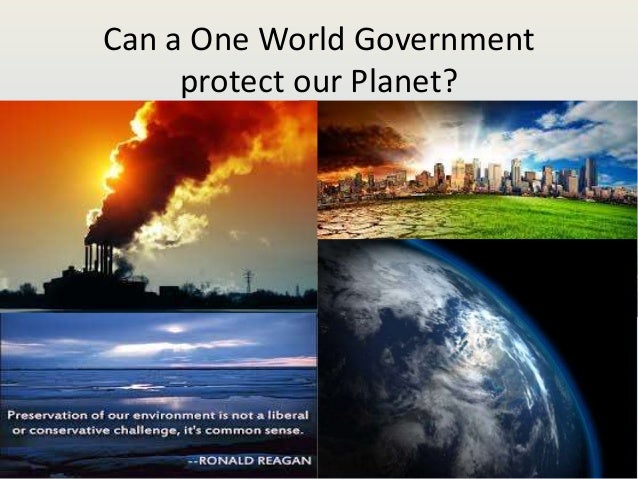
Modern Condition of Globalization

We live in a reality that we know that has become strongly globalized economically. There has been much less attention to the other globalization that has taken place before our eyes, that of an extremely dense network of international organizations and institutions that has increasingly been given the power to create standards by right.

The difficulty is that these global organizations are not subject to the same democratic requirements – election and accountability – as well as separation of powers, as are our democratic national institutions. We have denounced so much the “democratic deficit” of the European institutions! Indeed, it is wrong that the faceless and very ideological judges – here I point at the European Court of Human Rights and the Court of Justice of the EU – decide on the future of Europe in such major areas as immigration or terrorism. They do so, completely apart from the wishes of European citizenry.

But this deficit is nothing compared to that of the other international organizations, which generally have only a vague idea of democracy (and often appoint despots to human rights commissions, for instance)! One notes here, above all, the United Nations, whose umbrella organization in the field of climate, the UNFCCC, is just one manifestation.

What we have been seeing for the past two decades, in the areas of climate, gender theory, immigration and terrorism, and so on, is that activist minority ideologues have confiscated democratic debate. By acting at the international level, they have an enormous advantage. As soon as such an unaccountable international body has seized a cause, its standards prevail over national parliaments!

When gender theory was enshrined in its most radical version in 2011 by a Council of Europe Convention, it became virtually impossible to dislodge it. When, in cases such as HIRSI (2012), the European Courts devoted the “no border” ideology, it became almost impossible for the national ministers who wished to defend their own borders to do so. Examples that come to mind are Francken in Belgium, his British and Austrian counterpart, or the countries of the Visegrád group – a handful able to oppose it effectively.

But it is in the domain of climate that this confiscation of democratic debate is the most masterful, reaching a kind of virtuosity. Why? By the effect of science! The theory of gender is meant to be scientific, but it does not deceive anyone: it is an ideology, assumed as such by authors like Judith Butler. The ideology of the “no border” is moral, it does not claim to be scientific.

Climate is something else! Every time since its birth in the fold of the IPCC, the ideology of the climate has claimed science as its foundational authority – and science in its most precise version! Physics! The politicized IPCC has never stopped claiming it is presenting science since. So, it is this second globalization, a prelude to a world government that is openly called for by the elites of internationalist socialism, which is threatened today by the American exit of the Paris Agreement.

The Paris Accord

The Paris Accord marks the apotheosis, not of “globalism,” but of a particular version of globalism, which one should rather qualify as socialist. Indeed, let us recall the actual content of the Paris Agreement! What does it foresee? Essentially, two things: the drastic reduction of CO2 emissions in the West, right away, with the possibility for states such as China – the world’s largest CO2 emitter – to continue to increase emissions to 2030, with no requirement whatsoever to reduce emissions. The second essential component of “Paris” is the Green Fund, which provides for the transfer of $ 100 billion a year from the West to the rest of the world. “Paris” is therefore, first and foremost, the triumph of what was called “support for the Third World” in the 70s and 80s, that is to say, a massive and permanent transfer of wealth from the West to the rest of the world.

“Paris” is doubly globalist: first, because the transfer of wealth will be done through a clever network of international institutions, such as the United Nations Framework Convention on Climate Change (UNFCCC), the Green Fund — an institution, with a secretariat, directors, exotic meeting places, etc. —and all the intermediate institutions created by the Paris Agreement.

Secondly, “Paris” is driven by “morality” with the IPCC itself employing the services of moral philosophers to help them make their political case. The founding moral intuition which presides over the Paris Agreement is internationalist socialism. International socialism has always considered that the differential of wealth that benefits the West results from the pillage of the rest of the planet. This is described in terms of imperialism, colonization, exploitation of weaker partners. In that world view, the only “just” solution (aka “climate justice”) to this is the immediate and unconditional transfer of a substantial portion of these wealth to the rest of the world. Thus, the Paris Accord discloses itself clearly as a matter of globalism, but of a very particular vision of it – internationalist socialism.

The founding thesis of universalist socialism is that the wealth of the West is born of the plunder of the rest of the world. This is obviously false, and this has been demonstrated time and time again. The West owes its surplus of wealth to the preference given over five centuries to a particular economic system, capitalism! [1] The West has rejected the alternatives, socialism or subsistence. Moreover, the falsehood about the capitalist West as simple global robber barons is so well entrenched in leftist/socialist/globalists that even the concessions and foreign aid made to date by the West on are never enough to satisfy the transfer of wealth desired by the Third Worldists.

With the Paris Accord, which is not born from nothing, we enter a completely different dimension. This time, it is no longer morality, generosity or compassion (i.e. disaster relief) that requires the transfer of the wealth of the West. It’s science! It is the idea that because the Western industrial world has polluted the world for so many years should mean that the West must transfer its wealth to the rest of the world, which can continue to pollute. Further, this guilt money must be paid into the Green Fund which puts unaccountable, unelected green groups and green rent-seekers an opportunity to exploit this ultimate global subsidy for renewable-intermittent energies! Admire the finesse of the process: it employs the very strength of the West — capitalism — to show that the West has sinned. How naive and amateur are the Third Worldists of the past, with their moral arguments, faced with the omnipotence of the scientific argument!

However, you likely will have noticed, like me, that the climate debate does not deserve to be described as scientific in any way, anymore. What is the matrix of climate science? That is the IPCC, the UN Intergovernmental Panel on Climate Change. As early as 2010, I demonstrated in the book “Le GIEC est mort, vive la science”/ “The IPCC: A Scientific Body?” that by its composition, competences and functioning, the IPCC is a totally political organization, and not a scientific one as it claims. I do not have the competence to pronounce on the science of climate as such, nor do I need it: for it is easy to understand that a political organization can only produce political reports. The current “science” of climate is that of a scholar steeped in science… and politics – with a dominant political gene.

The Future of Paris Accord

In my humble opinion, two things will happen: first, “Paris” is dead. We are going to witness a form of hysterical “debate” in Europe. It is clear that France, Belgium and Germany will compete as to who is more virtuous, climate-wise, and that they are supported by the gigantic economic sector of the $1.5 trillion/year sector of “Big Climate” – that of industries and investors in Renewable-intermittent energies, and by high finance helped by ‘green’ groups, which would have had control over the massive transfers of the Green Fund. Of course, economically, the European position is not tenable. The Paris Accord would have been the bank heist of the millennium had Americans complied, is not possible with only the funds of European states such as France, Belgium or the countries of the Southern Europe. These are completely drained financially. These countries are over-indebted, have historically unprecedented levels of taxation, they owe a large amount of money to NATO, how could they finance the Green Fund? Through the EU climate policies, they are increasing the price of their energy every day while the rest of the world – beginning with the Americans – will now lower the price of theirs? Simply stating it this way exposes the lack of serious intent.

As for the science of climate, we are going to experience interesting developments. For example, the head of the American environmental agency, Scott Pruitt, announced the setting up of working groups to disentangle the Science from the Ideology in climate science.

What Future for the Global Economy

The Future of Global Trade: Jon Huntsman on the Radical Change Ahead was published at Wall Street Journal

Thirty years from now, world trade will be in the midst of another radical transformation—one no less critical to America’s 21st century leadership or to the expansion of global growth prospects.

For millennia, international commerce has focused on the exchange of physical goods (including people when there was slavery). More recently, services have become an ever-increasing component of advanced economies and world trade. This trend will continue and bring with it greater complexity for those setting the rules and negotiating the deals.

In general, manufacturing will be more localized; services, especially health and retail, more personalized; today’s ubiquitous shipping containers will be replaced by 3-D and 4-D printers, and the designs for making physical goods locally will move at the speed of light over airwaves just as financial flows do today. As urban farming gets going, food will be produced closer to the market, cutting transportation costs and reducing trade in agriculture.

Urbanization will produce a shift in populations and create more global centers of excellence for innovation. Whereas today we have a handful, 30 years from now there will be dozens of cities that serve as hubs of global trade in ideas. This proliferation of empowered megacities and centers of creative innovation will challenge geographic borders, making it hard for capitals to call the shots.

Trade flows will reflect the realities of global power as well as demographics. The Pacific will no longer be the dominant trade hub. Instead, the focus will shift to the Indian Ocean region, which upward of eight billion people—mainly in China, India and Africa—will call home. The U.S. may not be in a position to influence trade the way it did. For the past 200 years, Britain, after the Industrial Revolution, and the U.S. after the two world wars, fought for an open trading system to promote growth. None of the emerging countries have thus far shown that same commitment, even though they—particularly China—are increasingly setting the pace in world trade. China eclipsed the U.S. as the biggest trading country in 2013.

While mostly positive, the transformation of global trade will also create challenges. For one, how will a country attract and retain the world’s best and brightest talent? There will be no guarantee that people will stay if your country isn’t moving toward competitive best practices.

Combined with other future trends, our prospects are bright. There is good news for the environment. . . People will also live longer. There will be less disease. Consumers will benefit enormously from the changes in world trade that will deliver, among other things, personalized medicine and greater access to life-changing science and pharmaceuticals. Choices will be expanded, distances shortened, and manufacturing will be cheaper and tailored to specific needs.

Summary

What a contrast between the doomsayers lamenting the collapse of global climatism and the visionaries seeing the world developing through free and mutually beneficial trade.

Drieu Godefridi born in 1972 is a liberal Belgian writer, founder of the Hayek Institute in Brussels. He holds a doctorate in Philosophy from Paris Sorbonne.

Jon Huntsman, chairman of the Atlantic Council, has served as governor of Utah, U.S. ambassador to China and Singapore, and deputy U.S. trade representative.


Mid-June Arctic Ice Persisting

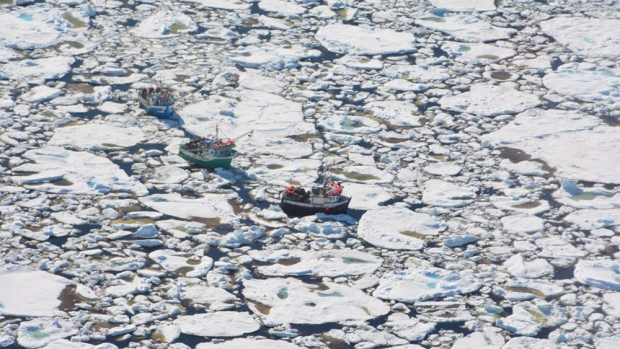
Environment Canada photo shows ice on the water near Newfoundland.

Icebreaker CCGS Amundsen diverted from science mission, continues search and rescue work

CBC June 12, 2017
Environment and Climate Change Canada said ice conditions improved slightly on Monday in the Strait of Belle Isle but continue to be troubling off the northeast coast of Newfoundland, which is seeing a higher than normal concentration of ice.

“Typically there would be very little or no ice left in either of these areas at this time of year, let alone the thick ice pack we are currently seeing off the northeast coast of Newfoundland,” a spokesperson for the federal department said in an email.

PolarBearScience described how the ice situation was not a matter of climate change but developed this spring caused by winds, cold temperatures and icebergs.

The tour (record of reports) is illuminating because it shows the development of the thick ice over time and shows how strong winds from a May storm combined with an extensive iceberg field contributed to the current situation. . .By 11 June the ice charts show little ice off southern Labrador but thick first year ice but lots of “old ice” in many places around northern Newfoundland. These must be crushed or compressed icebergs incorporated into the thick first year pack ice.

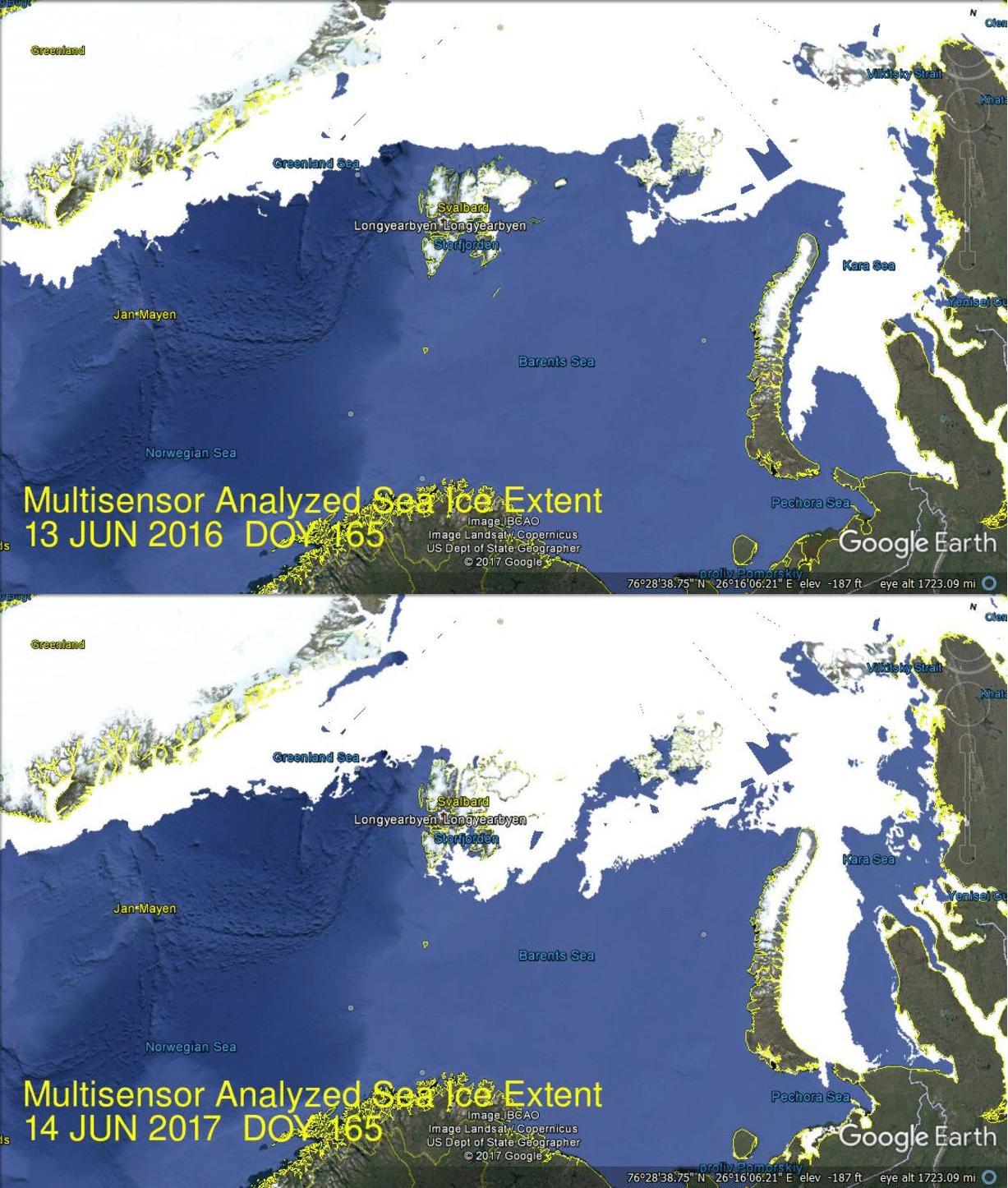
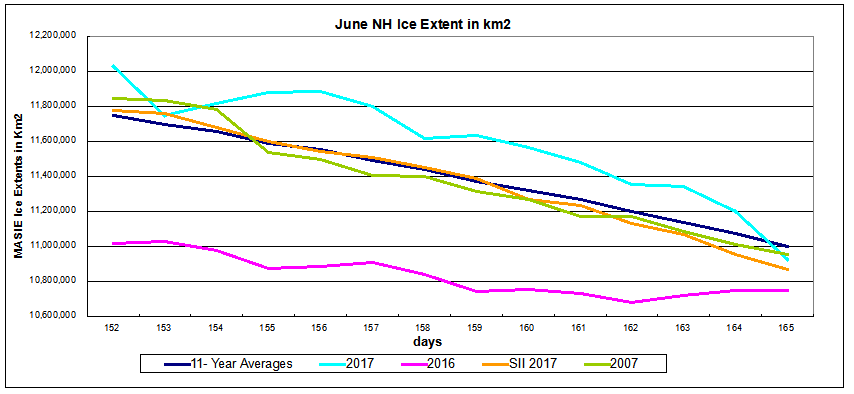
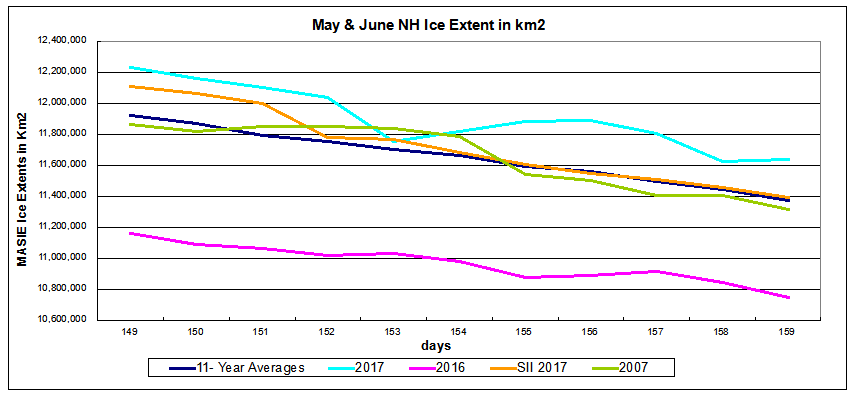
The image above shows the icing pattern on the European side. beyond Canada.  Compared to 2016, Svalbard  and Franz Joseph Land coastlines are much more enclosed.  Along the Russian coast of Kara, the water is opening up sooner. The graph below shows the first 14 days of June.  2017 was holding a lead of  200k km2 above average and 2007, and much greater than 2016.  Yesterday 2017 extent dropped 270k km2 to erase the lead at this time.

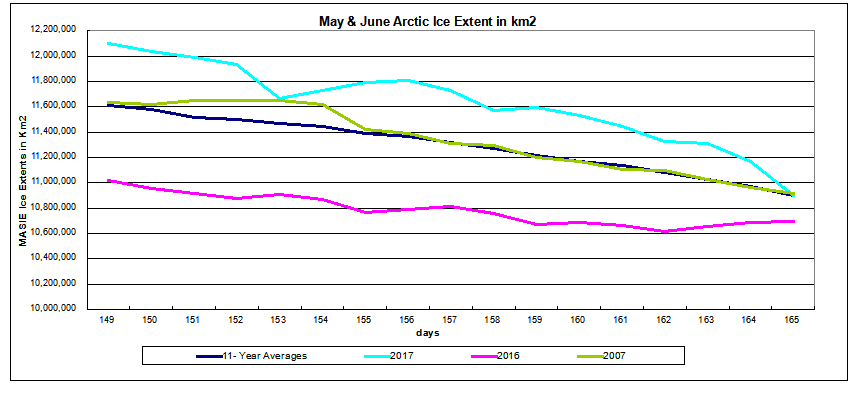
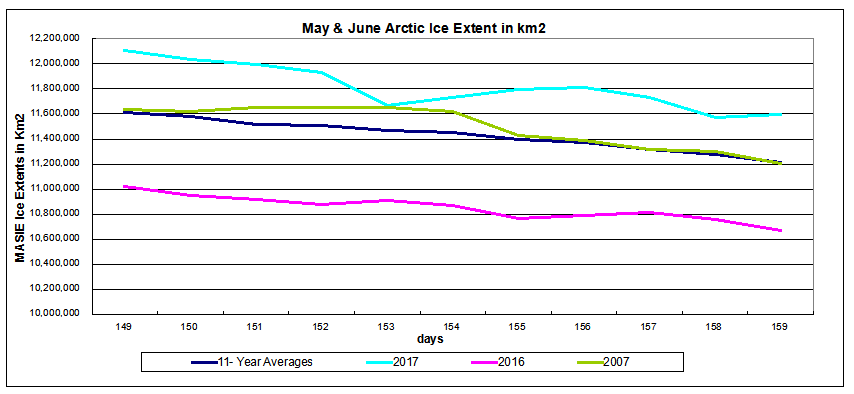
The graph below excludes the Pacific seas of Okhotsk and Barents, which are melting early (~70k km2 below average as of yesterday) somewhat obscuring what is happening in central and Atlantic Arctic seas.

On this basis, 2017 is matching both average and 2007, and about 200k km2 more than 2016.

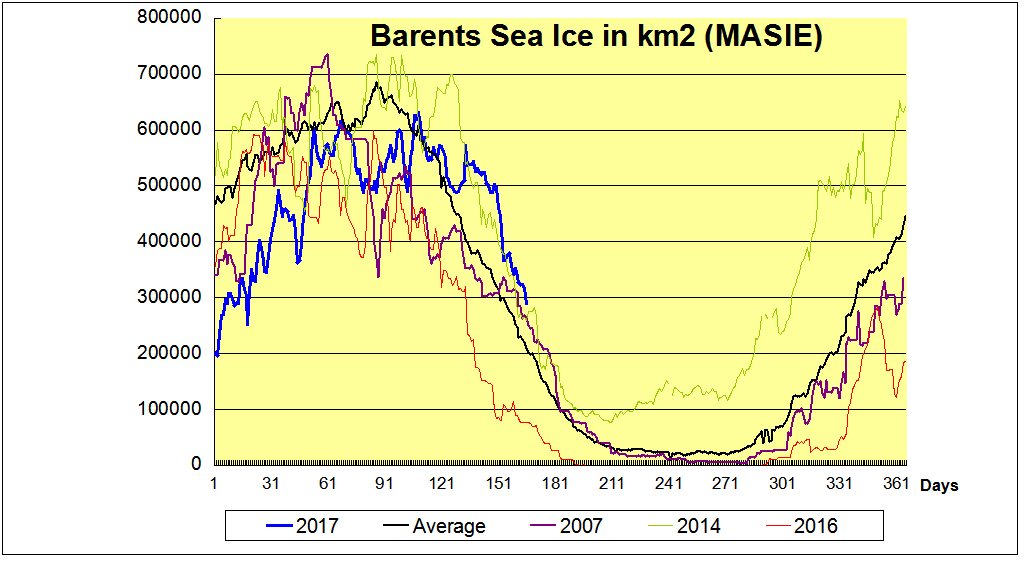
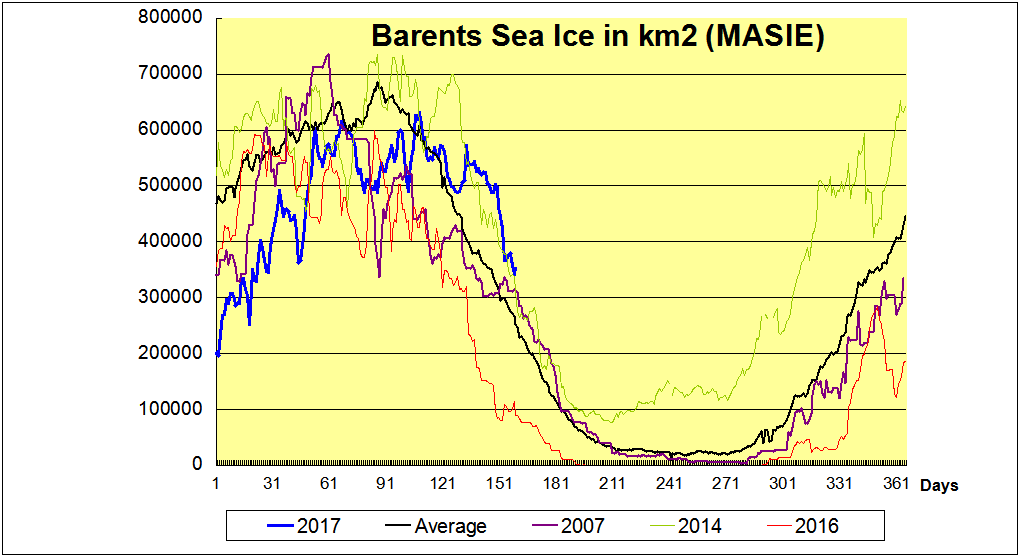
Barents Sea shows how unusual are 2017 sea ice extents inside the Arctic Circle.  The graph below shows Barents this year compared to average and other years.

The black line is average for the last 11 years.  2007 in purple appears as an average year.  2014 had the highest annual extent in Barents Sea, due to higher and later maximums, holding onto ice during the summer, and recovering quickly.  In contrast, 2016 was the lowest annual extent, melting out early and recovering later.  2017 in blue started out way behind, but grew rapidly to reach average, and is still persisting to exceed even 2014.

The table below shows extents on day 165 in the various Northern seas where ice is found.

Region 2017165 Day 165
Average
2017-Ave. 2007165 2017-2007
 (0) Northern_Hemisphere 10928458 11000746 -72289 10959202 -30745
 (1) Beaufort_Sea 935191 975491 -40301 952869 -17678
 (2) Chukchi_Sea 682164 821629 -139465 770182 -88018
 (3) East_Siberian_Sea 999972 1058898 -58926 1040890 -40918
 (4) Laptev_Sea 823309 788892 34417 755629 67680
 (5) Kara_Sea 656401 731264 -74864 770755 -114355
 (6) Barents_Sea 289358 208784 80574 264253 25105
 (7) Greenland_Sea 586915 577208 9707 574726 12189
 (8) Baffin_Bay_Gulf_of_St._Lawrence 826222 728139 98083 778469 47753
 (9) Canadian_Archipelago 810834 796994 13841 781578 29256
 (10) Hudson_Bay 1053785 995845 57940 997061 56724
 (11) Central_Arctic 3232751 3219736 13015 3224700 8051
 (12) Bering_Sea 13160 51203 -38043 15285 -2126
 (13) Baltic_Sea 0 9 -9 0 0
 (14) Sea_of_Okhotsk 17207 45161 -27955 31131 -13924

The difference between 2017 and average is matched by the early losses in Bering and Okhotsk.  Otherwise, there are some early meltings in BCE (Beaufort, Chukchi, East Siberian) and Kara, offset by surpluses everywhere else.

For more on why Barents Sea matters see Barents Icicles


Ocean Cooling Resumes

May Sea Surface Temperatures (SSTs) are now available, and we can see ocean cooling resuming after a short pause from the downward trajectory during the previous 12 months.

HadSST is generally regarded as the best of the global SST data sets, and so the temperature story here comes from that source, the latest version being HadSST3.

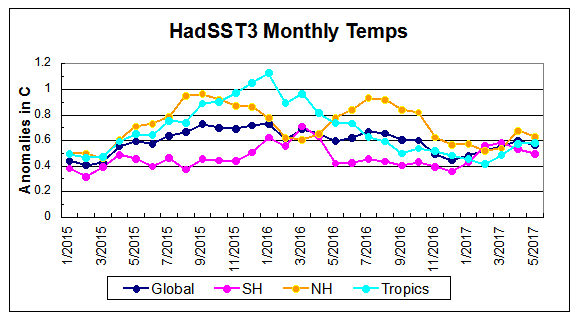
The chart below shows the last two years of SST monthly anomalies as reported in HadSST3 including May 2017.


After an upward bump in April 2017 due to the Tropics and NH, the May SSTs show the average declining slightly.  Note the Tropics recorded a rise, but not enough to offset declines in both hemispheres and globally.  SH is now two months into a cooling phase. The present readings compare closely with April 2015, but currently with no indication of an El Nino event any time soon.

Note that higher temps in 2015 and 2016 were first of all due to a sharp rise in Tropical SST, beginning in March 2015, peaking in January 2016, and steadily declining back to its beginning level. Secondly, the Northern Hemisphere added two bumps on the shoulders of Tropical warming, with peaks in August of each year. Also, note that the global release of heat was not dramatic, due to the Southern Hemisphere offsetting the Northern one.

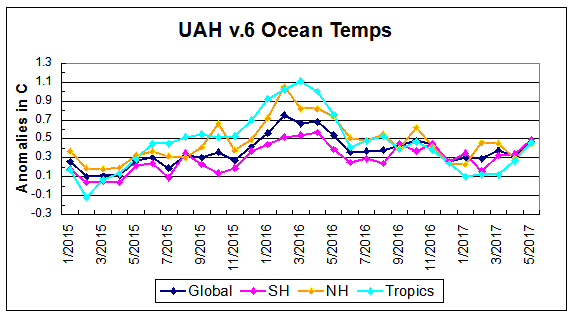
Satellite measures of the air over the oceans give a slightly different result.  The graph below provides UAH vs.6 TLT (lower troposphere temps) over the oceans confirming the general impression from SSTs.

In contrast with SST measurements, air temps in the TLT over the oceans upticked in May with all areas participating in the rise of almost 0.2C.  In the satellite dataset, it is quite noticeable that land air temps rose quite strongly and may have caused air temps in the May TLT over oceans to show higher anomalies than the SSTs.

We have seen lots of claims about the temperature records for 2016 and 2015 proving dangerous man made warming.  At least one senator stated that in a confirmation hearing.  Yet HadSST3 data for the last two years show how obvious is the ocean’s governing of global average temperatures.

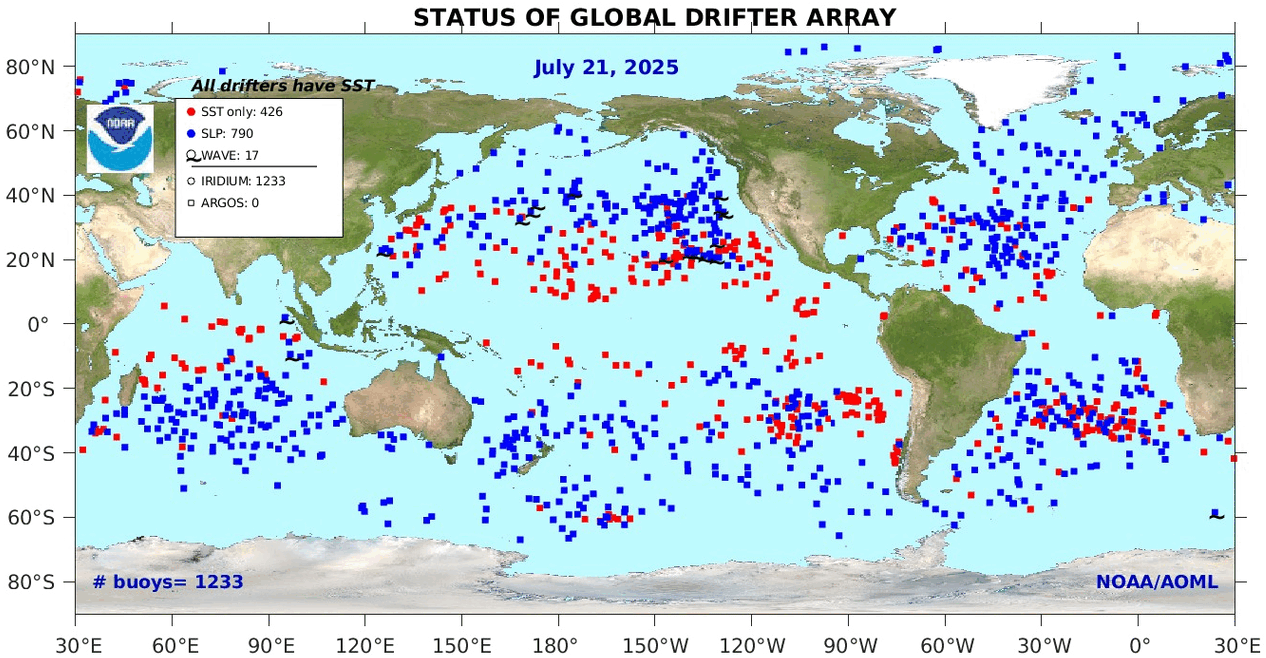
USS Pearl Harbor deploys Global Drifter Buoys in Pacific Ocean

The best context for understanding these two years comes from the world’s sea surface temperatures (SST), for several reasons:

  • The ocean covers 71% of the globe and drives average temperatures;
  • SSTs have a constant water content, (unlike air temperatures), so give a better reading of heat content variations;
  • A major El Nino was the dominant climate feature these years.

Solar energy accumulates massively in the ocean and is variably released during circulation events.


How Science Is Losing Its Humanity


The Closing of the Scientific Mind is a plea for scientists to celebrate and enhance humanity rather than belittle human life.  Author David Gelernter is a professor of computer science at Yale. His book Subjectivism: The Mind from Inside will be published by Norton later this year.  Excerpts below.

The huge cultural authority science has acquired over the past century imposes large duties on every scientist. Scientists have acquired the power to impress and intimidate every time they open their mouths, and it is their responsibility to keep this power in mind no matter what they say or do. Too many have forgotten their obligation to approach with due respect the scholarly, artistic, religious, humanistic work that has always been mankind’s main spiritual support. Scientists are (on average) no more likely to understand this work than the man in the street is to understand quantum physics. But science used to know enough to approach cautiously and admire from outside, and to build its own work on a deep belief in human dignity. No longer.

Belittling Humanity.

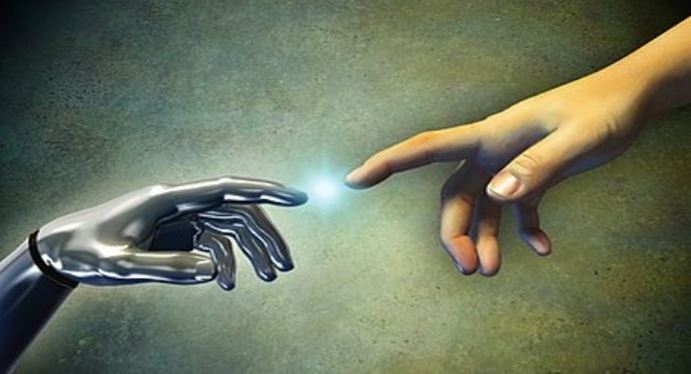
Today science and the “philosophy of mind”—its thoughtful assistant, which is sometimes smarter than the boss—are threatening Western culture with the exact opposite of humanism. Call it roboticism. Man is the measure of all things, Protagoras said. Today we add, and computers are the measure of all men.

Many scientists are proud of having booted man off his throne at the center of the universe and reduced him to just one more creature—an especially annoying one—in the great intergalactic zoo. That is their right. But when scientists use this locker-room braggadocio to belittle the human viewpoint, to belittle human life and values and virtues and civilization and moral, spiritual, and religious discoveries, which is all we human beings possess or ever will, they have outrun their own empiricism. They are abusing their cultural standing. Science has become an international bully.

The Closing of the Scientific Mind.

That science should face crises in the early 21st century is inevitable. Power corrupts, and science today is the Catholic Church around the start of the 16th century: used to having its own way and dealing with heretics by excommunication, not argument.

Science is caught up, also, in the same educational breakdown that has brought so many other proud fields low. Science needs reasoned argument and constant skepticism and open-mindedness. But our leading universities have dedicated themselves to stamping them out—at least in all political areas. We routinely provide superb technical educations in science, mathematics, and technology to brilliant undergraduates and doctoral students. But if those same students have been taught since kindergarten that you are not permitted to question the doctrine of man-made global warming, or the line that men and women are interchangeable, or the multiculturalist idea that all cultures and nations are equally good (except for Western nations and cultures, which are worse), how will they ever become reasonable, skeptical scientists? They’ve been reared on the idea that questioning official doctrine is wrong, gauche, just unacceptable in polite society. (And if you are president of Harvard, it can get you fired.)

Beset by all this mold and fungus and corruption, science has continued to produce deep and brilliant work. Most scientists are skeptical about their own fields and hold their colleagues to rigorous standards. Recent years have seen remarkable advances in experimental and applied physics, planetary exploration and astronomy, genetics, physiology, synthetic materials, computing, and all sorts of other areas.

But we do have problems, and the struggle of subjective humanism against roboticism is one of the most important.

The moral claims urged on man by Judeo-Christian principles and his other religious and philosophical traditions have nothing to do with Earth’s being the center of the solar system or having been created in six days, or with the real or imagined absence of rational life elsewhere in the universe. The best and deepest moral laws we know tell us to revere human life and, above all, to be human: to treat all creatures, our fellow humans and the world at large, humanely. To behave like a human being (Yiddish: mensch) is to realize our best selves.

No other creature has a best self.

This is the real danger of anti-subjectivism, in an age where the collapse of religious education among Western elites has already made a whole generation morally wobbly. When scientists casually toss our human-centered worldview in the trash with the used coffee cups, they are re-smashing the sacred tablets, not in blind rage as Moses did, but in casual, ignorant indifference to the fate of mankind.

A world that is intimidated by science and bored sick with cynical, empty “postmodernism” desperately needs a new subjectivist, humanist, individualist worldview. We need science and scholarship and art and spiritual life to be fully human. The last three are withering, and almost no one understands the first.

At first, roboticism was just an intellectual school. Today it is a social disease. Some young people want to be robots (I’m serious); they eagerly await electronic chips to be implanted in their brains so they will be smarter and better informed than anyone else (except for all their friends who have had the same chips implanted). Or they want to see the world through computer glasses that superimpose messages on poor naked nature. They are terrorist hostages in love with the terrorists.

All our striving for what is good and just and beautiful and sacred, for what gives meaning to human life and makes us (as Scripture says) “just a little lower than the angels,” and a little better than rats and cats, is invisible to the roboticist worldview. In the roboticist future, we will become what we believe ourselves to be: dogs with iPhones. The world needs a new subjectivist humanism now—not just scattered protests but a growing movement, a cry from the heart.

Footnote:  A related post provides additional background:  Head, Heart and Science

Ideological Faultlines


Some interesting comments came in response to a recent post (Inside the Snowflake Academy) on postmodern attitudes regarding science and truth. Geoff Chambers gave some perspectives on European socialism. Caleb provided an interesting analogy to China’s cultural revolution and aftermath. Caleb:

The Evergreen craziness reminds me a lot of China’s “Cultural Revolution.” The Chinese teachers failed to understand that they themselves would be the target, if they taught students to reject “tradition”, for all the knowledge of the past can be seen as a “tradition”, and that makes teachers and textbooks “counter revolutionary.” In the end the madness resulted in not one teacher being made into a scapegoat, but nearly every teacher China had. China was reduced to a state of ignorance and poverty, and the only way back was to copy the west. They “stole our secrets”, but the joke is that most of what they copied was never a secret. It simply was Truth, which they had deemed “counter revolutionary.”

That use of the term “tradition” prompts this post inspired by another insightful article, Evergreen State and the Battle for Modernity By Michael Aaron. After providing samples of the conflict playing out at Evergreen State College, Aaron puts the event in context in the excerpts below.

evergreen-college-777x397


It is this dichotomy between postmodern and modern that is the most important takeaway from this entire affair. In many ways, the old left/right dichotomy no longer applies. Instead we are faced with a three-part distinction between postmodern/modern/traditional. Let’s take a look at each of these in turn, and discuss why they are particularly important today.

Starting with the most right-leaning, the traditionalists. These folks do not like the direction in which modernity is headed, and so are looking to go back to an earlier time when they believe society was better. They may disagree with same-sex marriage, label sexual promiscuity as “deviance,” and feel threatened by racial and demographic changes in Western society. These folks include typical status-quo conservatives, Evangelical Christians as well as more nefarious types such as white nationalists and the “alt right”. Even though there is much furor in the media about the threat that these groups represent, I would argue that they have largely been pushed to the fringes in terms of their social influence, not withstanding the election of Trump who was actually opposed by many traditionalists such as the Never Trumpers.

Indeed, it is between the modernists and postmodernists where the future of society is being fought. Modernists are those who believe in human progress within a classical Western tradition. They believe that the world can continuously be improved through science, technology, and rationality. Unlike traditionalists, they seek progress rather than reversal, but what they share in common is an interest in preserving the basic structures of Western society. Most modernists could be classified as centrists (either left or right-leaning), classical liberals and libertarians.

Postmodernists, on the other hand, eschew any notion of objectivity, perceiving knowledge as a construct of power differentials rather than anything that could possibly be mutually agreed upon. Informed by such thinkers as Foucault and Derrida, science therefore becomes an instrument of Western oppression; indeed, all discourse is a power struggle between oppressors and oppressed. In this scheme, there is no Western civilization to preserve—as the more powerful force in the world, it automatically takes on the role of oppressor and therefore any form of equity must consequently then involve the overthrow of Western “hegemony.” These folks form the current Far Left, including those who would be described as communists, socialists, anarchists, Antifa, as well as social justice warriors (SJWs). These are all very different groups, but they all share a postmodernist ethos.

All of this matters because, whether people are overtly aware of it or not, their beliefs and actions are implicitly guided by one of these three world-views. A person may have never attended an Ivy League gender studies class, but if they belong to and agree with the ideas of a typical urban, liberal, hipster milieu, they are very likely subscribing to a postmodernist ideology, even if they’ve never cracked open Lyotard. (my bold)

Much of the confusion between liberal and centrist groups comes down to this modern/postmodernist distinction. As another example, since modernists believe in science and its utility, they are aware that obese individuals are at higher health risks. For postmodernists, however, the concept of health is just another oppressive force of Western colonial hegemony (since objective truth doesn’t exist and is merely manufactured as a tool of oppression), and so an entire cadre of “fat” activists mobilize themselves on social media, emboldened with postmodern concepts. Modernists recognize that nobody should be shamed or discriminated against for their appearance and believe that everyone has the right to make their own lifestyle choices, but are also concerned that distributing scientifically inaccurate information about health poses considerable risk to those who might believe it.

In the end, the Weinstein/Evergreen State affair poses a significant crossroads to modern society, extending well beyond the conflict occurring on campus. Evergreen State represents the natural culmination of postmodern thought—roving mobs attempting to silence dissenting thought merely based on race, informed by far left theories that weaponize a victim status drawn solely from immutable, innate traits. Unfortunately, I cannot place full blame on the students either, as they have been indoctrinated with these ideas on the very campus that is now serving as the petri dish for applied postmodernism. (my bold)

It is no coincidence that, while society outside the walls of campus looks on with disbelief, administrators to this point have been siding with the students. For if they were to repudiate the actions of the students, they would also need to repudiate the ideology with which they have been brainwashing them. In other words, taking a stand against the students would require administrators and professors to re-evaluate the meaning and value of the entire raison d’etre of their adult professional careers. Holding on to madness is a way of forestalling dealing with the grief that comes with the realization that one’s higher purpose has been a fraud. I am not sure of the final outcome, as this kind of process is long, difficult, and very, very painful. (my bold)

But this internal struggle serves as a microcosm for the larger battle occurring in society between the ideas behind modernism and postmodernism. And the stakes are extremely high. As Weinstein articulated in his Rogan appearance, “Let’s put it this way, I believe at the moment coalitions are unholy alliances between two things. In this case you have the real equity movement, which are people who wish to end oppression, and then you have another movement that wishes to reverse oppression, and they don’t know that they are different because until you reach equity, they are pointing in the same direction.” For the sake of basic humanity and decency, let’s all hope that the Evergreen State affair has finally exposed this vital distinction.

Summary

I appreciate that Aaron acknowledges the third faction of traditionalists that have been shunted to the sidelines. I think he is missing the fact that recently the “silent majority” is finding its voice: Many of them supported Trump (way more than were Never Trumpers, who were mostly apparatchiks); and it was trads voting for Le Pen in France, and making the difference in the Brexit vote. Now that it is no longer taboo to speak of Islamic terrorism, trads will feel even more emboldened.

Aaron is correct that among intellectuals, the battle is between moderns and postmoderns, but I think he needs to look beyond the ivory tower.

Footnote: More on academic ideology from Nicholas Kristoff NYT (here):

In a column a few weeks ago, I offered a “confession of liberal intolerance,” criticizing my fellow progressives for promoting all kinds of diversity on campuses — except ideological. I argued that universities risk becoming liberal echo chambers and hostile environments for conservatives, and especially for evangelical Christians.

As I see it, we are hypocritical: We welcome people who don’t look like us, as long as they think like us.

June Arctic Ice Still Strong

June 8, 2017. Boats are shown trapped in heavy ice off La Scie, Newfoundland in a handout photo from the Department of Fisheries and Ocean. Thick Arctic pack ice has trapped multiple vessels and triggered a high-stakes rescue operation from a sinking ship off Newfoundland. (THE CANADIAN PRESS/HO-Department of Fisheires and Oceans)

Thick Arctic ice pack traps boats, triggers rescue operation off Newfoundland

Unusually heavy Arctic pack ice has trapped multiple vessels, stymied the fishing season and triggered a high-stakes rescue operation from a sinking ship off Newfoundland.

Trevor Hodgson, the Canadian Coast Guard’s superintendent of ice operations for the Atlantic region, said the heavy ice is more than two metres thick in some areas off the province’s northeast coast.

What’s unusual this year, Hodgson said, is the way the winds have pushed the thick pack ice towards land rather than out to sea.

He said ice conditions are so bad the Coast Guard has been unable to free trapped vessels with its icebreaker Amundsen. Three fishing vessels remain trapped in ice off northeastern Newfoundland.

The image above shows Arctic Atlantic sea ice continues to hold most of the coastline in its grip.  Svalbard is still mostly enclosed and Newfoundland upper left with packed ice as in the photo. The graph below shows the last 10 days with 2017 holding a lead of  260k km2 above average, 320k km2 more than 2007 and 900k km2 greater than 2016.

The graph below excludes the Pacific seas of Okhotsk and Barents, which are melting early (~100k km2 below average as of yesterday) obscuring what is happening in central and Atlantic Arctic seas.

On this basis, 2017 is running 400k km2 higher than both average and 2007, and the same 900k km2 more than 2016.

Barents Sea shows how unusual are 2017 sea ice extents inside the Arctic Circle.  The graph below shows Barents this year compared to average and other years.

The black line is average for the last 11 years.  2007 in purple appears as an average year.  2014 had the highest annual extent in Barents Sea, due to higher and later maximums, holding onto ice during the summer, and recovering quickly.  In contrast, 2016 was the lowest annual extent, melting out early and recovering later.  2017 in blue started out way behind, but grew rapidly to reach average, and then persisted longer to exceed even 2014.

For more on why Barents Sea matters see Barents Icicles

The Iceberg Festival wraps up this weekend.

Inside the Snowflake Academy


Snowflakes: Overly sensitive persons, incapable of dealing with any opinions differing from their own. Snowflakes are light-weight and suffer meltdown when exposed to the light or heat of complex ideas in conflict. They can often be seen congregating in “safe zones” on college campuses.

A previous post (Retreat from Reason) provided a look into the mentality of today’s college professors teaching humanities and social sciences. The dominant mindset is termed “postmodern” to distinguish this perspective from the “modern” viewpoint born of the age of reason or enlightenment.

That text came from Professor Jordan Peterson who recommended reading a book by Stephen Hicks called Explaining Postmodernism. This post provides some descriptions (lightly edited) from Hicks regarding the education of today’s students and the liberal arts attitude toward science.

Hicks presents two hypotheses regarding the world-view embraced by postmoderns, which they pass on to their students.

Hypothesis 1: Postmodernism is the first ruthlessly consistent statement of the consequences of rejecting reason, those consequences being necessary given the study of knowledge since Kant.

Thomas Kuhn published in 1962 his landmark book, The Structure of Scientific Revolutions, signifying the result of four decades of analytic philosophy and the dead end it had reached. If science’s tools are perception, logic, and language, then science, one of the Enlightenment’s prized children, is merely an evolving, socially objective enterprise with no more claim to objectivity than any other belief system. The idea that science speaks of reality or truth is an illusion. There is no Truth; there are only truths, and truths change.

Consequently, by the 1960s, the pro-objectivity, pro-science spirit had collapsed in the Anglo-American philosophical tradition.

Hypothesis 2: Postmodernism is the academic far Left’s stance in response to the crisis caused by the failures of socialism in theory and practice.

Postmodern thinkers inherit an intellectual tradition that has seen the defeat of all of its major hopes.

While the neo-Enlightenment thinkers have come to terms with the modern world, from the postmodern perspective the universe has been intellectually shattered. We can not turn to God or to nature, and we cannot trust reason or mankind.

The failure of Left politics to achieve the vision of a beautiful collectivist society was merely the last straw. To the postmodern mind, the cruel lessons of the modern world are that reality is inaccessible, that nothing can be known, that human potential is nothing, and that ethical and political ideals have come to nothing. The psychological response to the loss of everything is anger and despair.

But the postmodern thinkers also find themselves surrounded by an Enlightenment world that does not understand. Postmoderns confront a world dominated by liberalism and capitalism, by science and technology, by people who still believe in reality, in reason, and in the greatness of human potential. The world that they said was impossible and destructive has both come to be and is flourishing. The heirs of the Enlightenment are running the world, and they have marginalized the post-modernists to the academy. Resentment is then added on top of anger and despair.

The Enlightenment world is proud, confident, and knows it is the wave of the future. This is unbearable to someone invested totally in an opposed and failed outlook. That pride is what such a person wants to destroy. The best target to attack is the Enlightenment’s sense of its own moral worth. Attack it as sexist and racist, intolerantly dogmatic, and cruelly exploitative. Undermine its confidence in its reason, its science and technology. The words do not even have to be true or consistent to do the necessary damage.
The College as Snowflake Academy

In education, postmodernism rejects the notion that the purpose of education is primarily to train a child’s cognitive capacity for reason in order to produce an adult capable of functioning independently in the world. That view of education is replaced with the view that education is to take an essentially indeterminate being and give it social identity. Education’s method of molding is linguistic, and so the language to be used is that which will create a human being sensitive to its racial, sexual, and class identity.

Our current social context, however, is characterized by oppression that benefits whites, males, and the rich at the expense of everyone else. That oppression in turn leads to an educational system that reflects only or primarily the interests of those in positions of power. To counteract that bias, educational practice must be recast totally. Postmodern education should emphasize works not in the canon; it should focus on the achievements of non-whites, females, and the poor; it should highlight the historical crimes of whites, males, and the rich; and it should teach students that science’s method has no better claim to yielding truth than any other method and, accordingly, that students should be equally receptive to alternative ways of knowing.

Moderns thought science and technology are good for all, extending our knowledge of the universe and making the world healthier, cleaner, and more productive. Postmoderns say science betrays its elitism, sexism and destructiveness by making the speed of light the fastest phenomenon, thereby unfairly privileging it over other speeds–by having chosen the phallic symbol i to represent the square root of negative one–by asserting its desire to “conquer” nature and “penetrate” her secrets–and, having done so, by having its technology consummate the rape by building bigger and longer missiles to blow things up.

And previously it had been generally thought liberalism, free markets, technology, and cosmopolitanism are social achievements that can be enjoyed by all cultures. On the contrary, Postmoderns think non-Western cultures are superior, since they live simply and in harmony with nature. They find the West is arrogantly blind, elitist and imperialistic, and imposes its capitalism, its science and technology, and its ideology upon other cultures and an increasingly fragile ecosystem.

funny-baseball-teacher

Conclusion

And thus graduates are fully equipped and predetermined to believe in climate change.


safespace-768x474


Perverse Postmodern Climate: Retreat from Reason

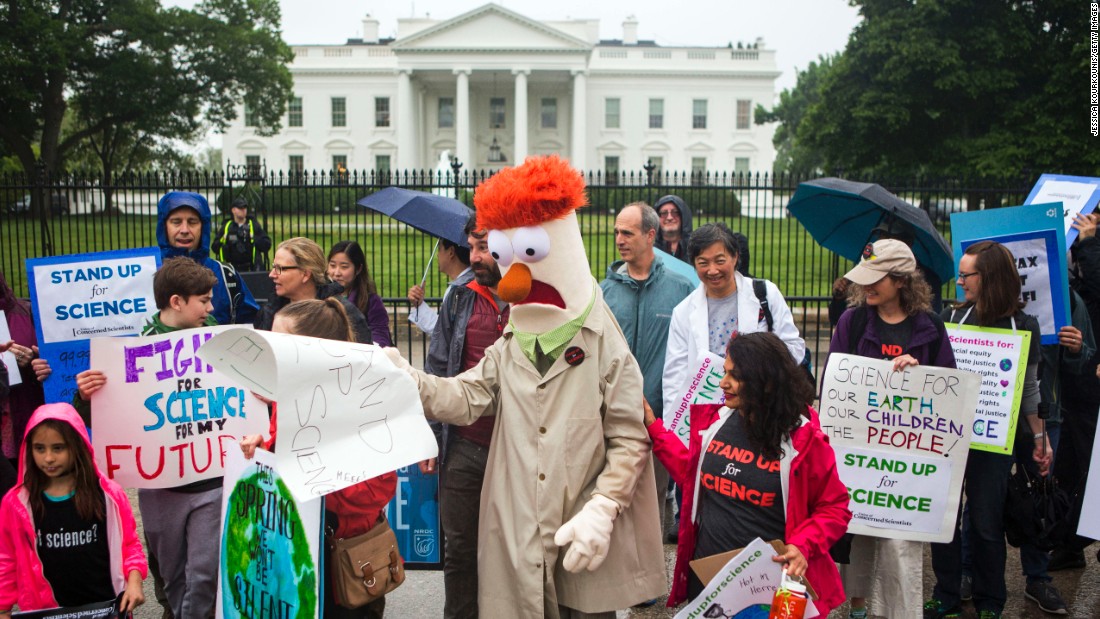
The recent marches for science were an amazing irony: People actually think that science is a matter of protesting in the streets. It was a demonstration all right, a full-throated display of postmodern contempt for reason, especially as embodied in the scientific method.

This virus has already taken over many universities, the most extreme case being Evergreen State College in Eastern Washington. Black students decided there should be a No White day on campus to protest the history of blacks mistreatment. One professor refused and tried to hold his class, arguing that free speech was not a matter of race, creed, gender or anything else. A riot erupted against him and his students, shutting down the class.

evergreen

Afterward, the Evergreen State Faculty Turned on the Professor, Saying He ‘Endangered’ Students

This post is to call attention to a war correspondent issuing a recent report on the state of this cultural conflict. Professor Jordan Peterson of the University of Toronto writes from the front lines where higher education institutions and students are in upheaval.

War Correspondent

Jordan Peterson: Why You Have To Fight Postmodernism
explains why young people need to organize and rise up against nihilistic postmodernism. The full transcript is worth reading, and a video presentation is also available. Some excerpts below present some of his key points.

JORDAN PETERSON: I want to recommend a book first to everyone here: It is called Explaining Postmodernism by Stephen Hicks. You need to understand postmodernism, because that’s what you’re up against. You’re up against it far more than you know or think, and it’s a much more well-developed and pervasive, pernicious, nihilistic, intellectually attractive doctrine than has yet come to public realization. It absolutely dominates the humanities and increasingly the social sciences in the universities.

It’s not like any given person is absolutely possessed by the spirit of postmodernism, because often they’re not educated enough to know all the details about what it is that has them in their grip, but if you get 20 of them together and they’re all 5% influenced by the postmodernist ethos, you basically have the spirit of the mob. It’s a mouthpiece for that particular philosophical doctrine.

See the postmodernists completely reject the structure of Western civilization. And I mean completely, so I can give you an example, in one term — Jacques Derrida. He is head trickster for the postmodernist movement, and he regarded Western culture — let’s call it the patriarchy — as phallogocentric. Phallo comes from phallus, and so that’s the insistence that what you see in Western culture is the consequence of the male-dominated oppressive self-serving society.

So the first thing that you might want to know about Postmodernism is that it doesn’t have a shred of gratitude — and there’s something pathologically wrong with a person that doesn’t have any gratitude, especially when they live in what so far is the best of all possible worlds. So if you’re not grateful, you’re driven by resentment, and resentment is the worst emotion that you can possibly experience, apart from arrogance. Arrogance, resentment, and deceit. There is an evil triad for you.

So you have to educate yourself about postmodernism.

So here’s what the postmodernists believe: They don’t believe in the individual. That’s the logos. Remember, Western culture is Phallogocentric. Logo is logos. That’s partly the Christian word, but is also partly the root word of logic.

They believe that logic is part of the process by which the patriarchal institutions of the West continue to dominate and to justify their dominance. They don’t believe in dialogue. The root word of dialogue is logos — again, they don’t believe that people of good will can come to consensus through the exchange of ideas. They believe that that notion is part of the philosophical substructure and practices of the dominant culture.

So the reason they don’t let people who they don’t agree with speak on campus, is because they don’t agree with letting people speak.

You see it’s not part of the ethos.

They believe that since you don’t have an individual identity, your fundamental identity is group fostered, and that means that you’re basically an exemplar of your race.

And so the postmodernist Marxists just basically pulled a sleight-of-hand, and said, ‘Okay if it’s not the poor against the rich than it’s the oppressed against the oppressor.’ We’ll just re-divide the sub-populations in ways that make our bloodied philosophy continue in its movement forward, and that’s where we are now.

So for the postmodernists, the world is a Hobbesian battleground of identity groups. They do not communicate with one another, because they can’t. All there is, is a struggle for power, and if you’re in the predator group, which means you’re an oppressor, than you better look out, because you’re not exactly welcome. Not exactly welcome, and neither are your ideas. So that’s what you’re up against.

You young people out there who are university students, you need to take over the student unions, you need to take them back, because they are absolute snake pits, and have been since the 1990s.

Our society needs to figure out how to stop shunting public tax money to radical left-wing activists. If we were doing that for the radical right-wing activists, there would be an absolute storm, but it’s happened incrementally since the 1960s and needs to stop.

So that’s what conservatives and also liberals –true liberals in the English sense– are up against. What’s happened also as a consequence of this postmodern neo-Marxist intellectual invasion, is the center keeps moving way to the right now, so if you’re a classical liberal, you’ve become a conservative.

Conclusion

And then finally with regards to talking to young people. You finally have something to sell to them. It is not easy to sell conservatism to young people, because they want to change things. That’s not what conservatives want to do, they want to maintain things. Well now you got something to sell — you can sell them freedom of speech, and you can tell sell them responsibility.

The left is selling them rights, you can sell them responsibility.

I can tell you, because I received many letters of this sort … young people are absolutely starving for someone to provide them with a sense of responsibility, and say look here, here’s something worth living for.

We’ve got this beacon of freedom and wealth in the West, which works, although it doesn’t work perfectly. And one of one of the responsibilities of young people is to find out what’s at the core of that, the great core of that. The paramount importance of the individual, and the divinity of speech. That’s something to sell, its what our whole culture is predicated on.

Footnote:

Tom Wolfe first opened my eyes to this assault on reason.  I posted on his essay along with the obvious connection to climate change/global warming.  See Warmists and Rococo Marxists

Paris, Meet New Hampshire

New Hampshire is famous for people who are direct, to the point and tolerate no BS. Thus, I was not surprised to see this editorial printed in the Union Leader, one of the state’s leading newspapers based in Manchester, largest city in NH.

Paris freak-out: Hysteria over do-nothing deal

The Paris Climate Agreement signed last year by President Barack Obama was not a treaty, and thus American commitment to it expired when Obama left office.

  • Had Obama submitted the Paris agreement to the Senate, it would not have received the votes necessary to ratify it.
  • Had the Senate ratified the Paris agreement, targets for reductions in future CO2 emissions from power plants would have been voluntary and amendable.
  • Had the U.S. failed to meet its voluntary emissions targets, there would have been no penalty imposed.
  • Had the United States and every other country on Earth met their emissions targets from the Paris deal, the climate models used by its advocates predicted a reduction in the increase of global temperatures of just 0.2 degrees by 2100.

These climate models have largely overestimated the marginal impact of atmospheric carbon dioxide on climate.

There is no credible evidence that American withdrawal from the Paris deal will have any impact on future global temperatures at all.

The entire Paris agreement was a largely meaningless piece of public relations stagecraft, designed for world leaders to give the illusion that they are doing something about climate change.

It would have billed U.S. taxpayers for the lion’s share of payments to other countries, and locked in onerous Obama-era regulations on power plants that drive up electricity prices.

President Trump was right to remove the United States from this non-treaty.

Tracking the howls of outrage over this decision has been useful. It was an elegant way for people to reveal their ignorance of climate science.

If and when the people arguing that climate change is too important to ignore come forward with a plan that actually does something about climate change, we will start paying attention to their portents of doom.