How Climate Law Relies on Paris
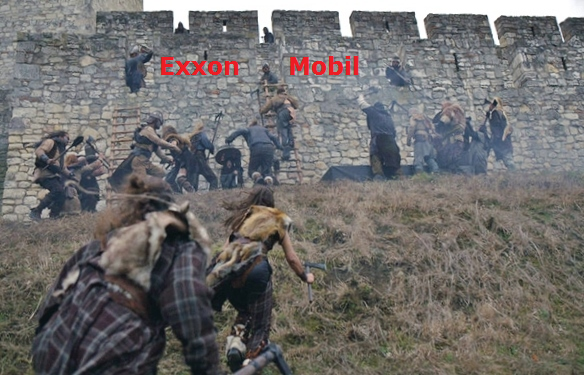
 

Climate Activists storm the bastion of Exxon Mobil, here seen without their shareholder disguises.

On the same day POTUS announced US withdrawal from Paris accord, a majority of Exxon Mobil shareholders approved a resolution asking management to assess the value of corporate assets considering a global move toward a low-carbon future. Here is the resolution, filed by the New York State Comptroller:

RESOLVED: Shareholders request that, beginning in 2018, ExxonMobil publish an annual assessment of the long-term portfolio impacts of technological advances and global climate change policies, at reasonable cost and omitting proprietary information. The assessment can be incorporated into existing reporting and should analyze the impacts on ExxonMobil’s oil and gas reserves and resources under a scenario in which reduction in demand results from carbon restrictions and related rules or commitments adopted by governments consistent with the globally agreed upon 2 degree target. This reporting should assess the resilience of the company’s full portfolio of reserves and resources through 2040 and beyond, and address the financial risks associated with such a scenario.

Background:

This century climatists woke up to their losing the battle for public opinion for onerous and costly reductions to fossil fuel usage. They turned toward the legal system to achieve their agenda, and the field of Climate Law has become another profession corrupted by climate cash, along side of Climate Medicine.

In addition to numerous court lawsuits, and also civil disobedience cases, there has been a concerted, well-funded and organized divestment move against companies supplying fossil fuels to consumers. The intention is to at least tie up in red tape Big Oil, indeed Small Oil as well. The real hope is to weaken energy producers by depriving them of investors to the point that reserves are left in the ground, as desired by such activists as 350.org.

In 2016 virtually the same resolution was dismissed by shareholders with only 38% approving. The difference this year was the switch by BlackRock Inc. and Vanguard Group, two of the world’s largest asset managers. As reported by Fox News (here):

Investment products such as exchange-traded funds that track the performance of indexes often come at a lower cost than traditional mutual funds and have gathered assets at a clip in recent years. That growth has given firms like BlackRock and Vanguard increasing sway on shareholder votes. But the firms in turn have come under activist pressure to take stances on issues such as climate disclosure.

When BlackRock sided with Exxon and against a similar proposal at the company’s annual meeting a year ago, it faced backlash from investors and environmental activists. This year BlackRock said the disclosure of climate risks would be among its key engagement priorities with senior executives.

Exxon Mobil board must now show they are taking this proposal seriously, and activists will be looking for company assets to be “stress tested” with the hope that the shares become more risky. At the very least, management will have to put more time and energy into opining on various scenarios of uncertain content and probabilities relating to the wish dreams of climatists.

Balancing on a cascade of suppositions.

We can look into the climate activist mental frame thanks to documents supporting the current strategy using the legal system to implement actions against fossil fuel consumption.

For example, there is this recent text explaining the shareholder proposal tabled at ExxonMobil annual meeting. From Attorney Sanford Lewis:

The Proposal states:

“RESOLVED: Shareholders request that by 2017 ExxonMobil publish an annual assessment of long term portfolio impacts of public climate change policies, at reasonable cost and omitting proprietary information. The assessment can be incorporated into existing reporting and should analyze the impacts on ExxonMobil’s oil and gas reserves and resources under a scenario in which reduction in demand results from carbon restrictions and related rules or commitments adopted by governments consistent with the globally agreed upon 2 degree target. The reporting should assess the resilience of the company’s full portfolio of reserves and resources through 2040 and beyond and address the financial risks associated with such a scenario.

Now let’s unbundle the chain of suppositions that comprise this proposal.

  • Supposition 1: A 2C global warming target is internationally agreed.
  • Supposition 2: Carbon Restrictions are enacted by governments to comply with the target.
  • Supposition 3: Demand for oil and gas products is reduced due to restrictions
  • Supposition 4: Oil and gas assets become uneconomic for lack of demand.
  • Supposition 5: Company net worth declines by depressed assets and investors lose value.

1.Suppose an International Agreement to limit global warming to 2C.

From the supporting statement to the above proposal, Sanford Lewis provides these assertions:

Recognizing the severe and pervasive economic and societal risks associated with a warming climate, global governments have agreed that increases in global temperature should be held below 2 degrees Celsius from pre-industrial levels (Cancun Agreement).

Failing to meet the 2 degree goal means, according to scientists, that the world will face massive coastal flooding, increasingly severe weather events, and deepening climate disruption. It will impose billions of dollars in damage on the global economy, and generate an increasing number of climate refugees worldwide.

Climate change and the risks it is generating for companies have become major concerns for investors. These concerns have been magnified by the 21st Session of the Conference of the Parties (COP 21) in Paris, where 195 global governments agreed to restrict greenhouse gas (GHG) emissions to no more than 2 degrees Celsius from pre-industrial levels and submitted plans to begin achieving the necessary GHG emission reductions. In the agreement, signatories also acknowledged the need to strive to keep global warming to 1.5 degrees, recognizing current and projected harms to low lying islands.

Yet a careful reading of UN agreements shows commitment is exaggerated:
David Campbell (here):

Neither 2°C nor any other specific target has ever been agreed at the UN climate change negotiations.

Article 2 of the Paris Agreement in fact provides only that it ‘aims to strengthen the global response to the threat of climate change … including by the holding the increase to well below 2°C’. This is an expression, not of setting a concrete limit, but merely of an aspiration to set such a limit. It is true that Article 2 is expressed in a deplorably equivocatory and convoluted language which fails to convey this vital point, indeed it obscures it. But nevertheless that is what Article 2 means.

Dieter Helm (here):

Nothing of substance has been achieved in the last quarter of a century despite all the efforts and political capital that has been applied. The Paris Agreement follows on from Kyoto. The pledges – in the unlikely event they are met – will not meet the 2C target, shipping and aviation are excluded, and the key developing countries (China and India) are not committed to capping their emission for at least another decade and a half (or longer in India’s case)

None of the pledges is, in any event, legally binding. For this reason, the Paris Agreement can be regarded as the point at which the UN negotiating approach turned effectively away from a top down approach, and instead started to rely on a more country driven and hence bottom up one.

Paul Spedding:

The international community is unlikely to agree any time soon on a global mechanism for putting a price on carbon emissions.

2: Suppose Governments enact restrictions that limit use of fossil fuels.

Despite the wishful thinking in the first supposition, the activists proceed on the basis of aspirations and reporting accountability. Sanford Lewis:

Although the reduction goals are not set forth in an enforceable agreement, the parties put mechanisms in place for transparent reporting by countries and a ratcheting mechanism every five years to create accountability for achieving these goals. U.N. Secretary General Ban Ki-moon summarized the Paris Agreement as follows: “The once Unthinkable [global action on climate change] has become the Unstoppable.”

Now we come to an interesting bait and switch. Since Cancun, IPCC is asserting that global warming is capped at 2C by keeping CO2 concentration below 450 ppm. From Summary for Policymakers (SPM) AR5

Emissions scenarios leading to CO2-equivalent concentrations in 2100 of about 450 ppm or lower are likely to maintain warming below 2°C over the 21st century relative to pre-industrial levels. These scenarios are characterized by 40 to 70% global anthropogenic GHG emissions reductions by 2050 compared to 2010, and emissions levels near zero or below in 2100.

Thus is born the “450 Scenario” by which governments can be focused upon reducing emissions without any reference to temperature measurements, which are troublesome and inconvenient.

Sanford Lewis:

Within the international expert community, “2 degree” is generally used as shorthand for a low carbon scenario under which CO2 concentrations in the earth’s atmosphere are stabilized at a level of 450 parts per million (ppm) or lower, representing approximately an 80% reduction in greenhouse gas emissions from current levels, which according to certain computer simulations would be likely to limit warming to 2 degrees Celsius above pre-industrial levels and is considered by some to reduce the likelihood of significant adverse impacts based on analyses of historical climate variability. Company Letter, page 4.

Clever as it is to substitute a 450 ppm target for 2C, the mathematics are daunting. Joe Romm:

We’re at 30 billion tons of carbon dioxide emissions a year — rising 3.3% per year — and we have to average below 18 billion tons a year for the entire century if we’re going to stabilize at 450 ppm. We need to peak around 2015 to 2020 at the latest, then drop at least 60% by 2050 to 15 billion tons (4 billion tons of carbon), and then go to near zero net carbon emissions by 2100.

And the presumed climate sensitivity to CO2 is hypothetical and unsupported by observations:

3.Suppose that demand for oil and gas products is reduced by the high costs imposed on such fuels.

Sanford Lewis:

ExxonMobil recognized in its 2014 10-K that “a number of countries have adopted, or are considering adoption of, regulatory frameworks to reduce greenhouse gas emissions,” and that such policies, regulations, and actions could make its “products more expensive, lengthen project implementation timelines and reduce demand for hydrocarbons,” but ExxonMobil has not presented any analysis of how its portfolio performs under a 2 degree scenario.

Moreover, the Company’s current use of a carbon proxy price, which it asserts as its means of calculating climate policy impacts, merely amplifies and reflects its optimistic assessments of national and global climate policies. The Company Letter notes that ExxonMobil is setting an internal price as high as $80 per ton; in contrast, the 2014 Report notes a carbon price of $1000 per ton to achieve the 450 ppm (2 degree scenario) and the Company reportedly stated during the recent Paris climate talks that a 1.5 degree scenario would require a carbon price as high as $2000 per ton within the next hundred years.

Peter Trelenberg, manager of environmental policy and planning at Exxon Mobil reportedly told the Houston Chronicle editorial board: Trimming carbon emissions to the point that average temperatures would rise roughly 1.6 degrees Celsius – enabling the planet to avoid dangerous symptoms of carbon pollution – would bring costs up to $2,000 a ton of CO2. That translates to a $20 a gallon boost to pump prices by the end of this century… .

Even those who think emissions should be capped somehow see through the wishful thinking in these numbers. Dieter Helm:

The combination of the shale revolution and the ending of the commodity super cycle probably point to a period of low prices for sometime to come. This is unfortunate timing for current decarbonisation policies, many of which are predicated on precisely the opposite happening – high and rising prices, rendering current renewables economic. Low oil prices, cheap coal, and falling gas prices, and their impacts on driving down wholesale electricity prices, are the new baseline against which to consider policy interventions.

With existing technologies, it is a matter of political will, and the ability to bring the main polluters on board, as to whether the envelope will be breached. There are good reasons to doubt that any top down agreement will work sufficiently well to achieve it.

The end of fossil fuels is not about to happen anytime soon, and will not be caused by running out of any of them. There is more than enough to fry the planet several times over, and technological progress in the extraction of fossil fuels has recently been at least as fast as for renewables. We live in an age of fossil fuel abundance.

We also live in a world where fossil fuel prices have fallen, and where the common assumption that prices will bounce back, and that the cycle of fossil fuel prices will not only reassert itself but also continue on a rising trend, may be seriously misguided. It is plausible to at least argue that the oil price may never regain its peaks in 1979 and 2008 again.

A world with stable or falling fossil fuel prices turns the policy assumptions of the last decade or so on their heads. Instead of assuming that rising prices would ease the transition to low carbon alternatives, many of the existing technologies will probably need permanent subsidies. Once the full system costs are incorporated, current generation wind (especially offshore) and current generation solar may be out of the market except in special locations for the foreseeable future. In any event, neither can do much to address the sheer scale of global emissions.

Primary Energy Demand Projection

4.Suppose oil and gas reserves are stranded for lack of demand.

Sanford Lewis:

Achievement of even a 2 degree goal requires net zero global emissions to be attained by 2100. Achieving net zero emissions this century means that the vast majority of fossil fuel reserves cannot be burned. As noted by Mark Carney, the President of the Bank of England, the carbon budget associated with meeting the 2 degree goal will “render the vast majority of reserves ‘stranded’ – oil, gas, and coal that will be literally unburnable without expensive carbon capture technology, which itself alters fossil fuel economics.”

A concern expressed by some of our stakeholders is whether such a “low carbon scenario” could impact ExxonMobil’s reserves and operations – i.e., whether this would result in unburnable proved reserves of oil and natural gas.

Decisions to abandon reserves are not as simple or have the effects as desired by activists.

Financial Post (here):

The 450 Scenario is not the IEA’s central scenario. At this point, government policies to limit GHG emissions are not stringent enough to stimulate this level of change. However, for discussion purposes let’s use the IEA’s 450 Scenario to examine the question of stranded assets in crude oil investing. Would some oil reserves be “stranded” under the IEA’s scenario of demand reversal?

A considerable amount of new oil projects must be developed to offset the almost 80 per cent loss in legacy production by 2040. This continued need for new oil projects for the next few decades and beyond means that the majority of the value of oil reserves on the books of public companies must be realized, and will not be “stranded”.

While most of these reserves will be developed, could any portion be stranded in this scenario? The answer is surely “yes.” In any industry a subset of the inventory that is comprised of inferior products will be susceptible to being marginalized when there is declining demand for goods. In a 450 ppm world, inferior products in the oil business will be defined by higher cost and higher carbon intensity.

5.Suppose shareholders fear declining company net worth.

Now we come to the underlying rationale for this initiative.

Paul Spedding:

Commodity markets have repeatedly proved vulnerable to expectations that prices will fall. Given the political pressure to mitigate the impact of climate change, smart investors will be watching closely for indications of policies that will lead to a drop in demand and the possibility that their assets will become financially stranded.

Equity markets are famously irrational, and if energy company shareholders can be spooked into selling off, a death spiral can be instigated. So far though, investors are smarter than they are given credit.

Bloomberg:

Fossil-fuel divestment has been a popular issue in recent years among college students, who have protested at campuses around the country. Yet even with the movement spreading to more than 1,000 campuses, only a few dozen schools have placed some restrictions on their commitments to the energy sector. Cornell University, Massachusetts Institute of Technology and Harvard University are among the largest endowments to reject demands to divest.

Stanford Board of Trustees even said:

As trustees, we are convinced that the global community must develop effective alternatives to fossil fuels at sufficient scale, so that fossil fuels will not continue to be extracted and used at the present rate. Stanford is deeply engaged in finding alternatives through its research. However, despite the progress being made, at the present moment oil and gas remain integral components of the global economy, essential to the daily lives of billions of people in both developed and emerging economies. Moreover, some oil and gas companies are themselves working to advance alternative energy sources and develop other solutions to climate change. The complexity of this picture does not allow us to conclude that the conditions for divestment outlined in the Statement on Investment Responsibility have been met.

Update:  Universities are not the exception in finding the alarmist case unconvincing, according to a survey:

Almost half of the world’s top 500 investors are failing to act on climate change — an increase of 6 percent from 236 in 2014, according to a report Monday by the Asset Owners Disclosure Project, which surveys global companies on their climate change risk and management.

The Abu Dhabi Investment Authority, Japan Post Insurance Co Ltd., Kuwait Investment Authority and China’s SAFE Investment Company, are the four biggest funds that scored zero in the survey. The 246 “laggards” identified as not acting hold $14 trillion in assets, the report said.

Summary

Alarmists have failed to achieve their goals through political persuasion and elections. So they are turning to legal and financial tactics. Their wishful thinking appears as an improbable chain of events built upon a Paris agreement without substance.

Last word to David Campbell:

International policy has so far been based on the premise that mitigation is the wisest course, but it is time for those committed to environmental intervention to abandon the idea of mitigation in favour of adaptation to climate change’s effects.

For more on adapting vs. mitigating, see Adapting Works, Mitigating Fails
EventChain

Clexit Gloom and Doom

The above cartoon is from Josh who is always on target, and reminded me of this one:

Joe Btfsplk was a character in the satirical comic strip Li’l Abner by cartoonist Al Capp. He is well-meaning, but is the world’s worst jinx, bringing disastrous misfortune to everyone around him.

Robert Tracinski puts all of this into context in his June 2 Federalist article Paris Climate Withdrawal Re-Triggers Global Warming Doomsday Cult  So what are the consequences of Donald Trump pulling America out of the Paris Agreement on global warming? Bad news: the planet is going to die.
The article first displays a sample of the many extreme, fantastical reactions to POTUS declaring the Paris Accord null and void. I especially liked the proposed Headline:  “World to End, Women and Minorities Hardest Hit.  Then Tracinski gets down to the heart of the matter.

This is certainly out of proportion to President Trump’s actual announcement. Pulling out of the Paris Agreement was the right thing because no one has actually proven that human emissions of carbon dioxide are warming the globe or that this is driving us toward a global catastrophe. But that’s not why Trump did it. He drew us out because he thinks the agreement is “unfair” to America, imposing too great a burden on us rather than other countries, and he specifically left open the idea that he might work with the international community to come up with a better deal. So he’s okay with an international climate agreement, he just thinks—as usual—that he could do a better job of negotiating it.

But the hysterical overreaction is instructive, because somehow the backers of the global warming cause can’t manage to remember the scientific substance of their own claims—or much of anything else about the science and history of the climate. If they did, they might know that there is absolutely no reason to think the very viability of life on Earth is at stake. Anyone with even a cursory knowledge of the geological record knows that the atmosphere has previously had far higher levels of carbon dioxide, particularly during the years when life originated. The Earth has also been far warmer during periods when life was even more abundant. That’s where all the vegetation came from to support giants like the dinosaurs.

The actual claims for global warming in the foreseeable future involve an increase in average global temperatures of 2.6 to 6.4 degrees Celsius and a rise in sea levels of 26 to 50 centimeters. (So far this century, temperatures have remained below the low range of those predictions.) To put this in perspective, at the end of the last ice age about 10,000 years ago, global temperatures rose 10 degrees Celsius, and ocean levels rose by nearly 100 meters. Yet this previous episode of massive natural warming was good for humans, and I doubt it’s an accident that our current period of warm weather coincides with the rise of civilization itself.

As for the planet, it doesn’t really care what temperature it is, and life will adapt to warmer or colder temperatures. The good news is that the historical record also shows that we humans have adapted and survived through significant variations in climate, even before we had modern science and technology. That’s good news, because we’re eventually headed back into another ice age.

Given the assumption that long-term global warming is actually happening and is caused by human activity, which is itself dubious, you could reasonably claim that it will lead to some significant costs: flooding in some areas, drought in others, the loss of coastal land to rising seas, or the cost of rebuilding cities to protect them from rising waters. Maybe there will even be an increase in big deadly storms like hurricanes—though the last time somebody predicted this, hurricane activity immediately fell to historic lows. Those costs may be significant, but they would have to be counterbalanced against the costs of global warming regulations.

Maybe that’s why the global warming alarmists have to crank it up to eleven. If we can point to billions of dollars drained from the U.S. government and diverted through an international bureaucracy, or trillions of dollars in lost production and regulatory costs imposed on the world economy over decades, the global warming alarmists have to be able to claim negative consequences so great that they dwarf these massive costs. There’s nothing bigger than the planet dying. It’s a claim that automatically wins the argument—or so they think.

But it’s so comically exaggerated, so over the top, that it actually has the opposite effect. It convinces a lot of us that claims about global warming have become a hype machine stuck at its maximum setting. This looks less like science than like a crackpot doomsday cult perpetually claiming that the end is nigh.

Arctic Ice Song: Hey June, Don’t Let Me Down

The Iceberg Festival takes place every June on the Great Northern Peninsula, Newfoundland, now underway.

Weather Canada Iceberg Bulletin
Issued 11:00 AM EDT 2 June 2017

Special ice warning in effect.
Bergy water except 7 tenths of first-year ice including a trace of
old ice in the northern section. Unusual presence of sea ice.

Iceberg Count
More than 100 icebergs

East Coast Newfoundland Sea Ice 2016 and 2017.

Arctic ice had a remarkable May. The April NH ice extent in April was a 343k km2 deficit below the decadal average, and May ended with a monthly average surplus of 131k km2. The graph below shows in recent weeks how 2017 took a lead of ~300k km2 above average and is holding it entering June.

On June 1, this year’s ice extent is running 280k km2 above average, and a full 1M higher than 2016. Out of the last twelve years, only 2013 and 2014 had more ice on this day than 2017.

The graph below excludes the Pacific seas of Okhotsk and Barents, which are melting early (~150k km2 below average) and distort what is happening in central and Atlantic Arctic seas.

On this basis, 2017 is running 280k km2 higher than 2007, 430k km2 above average, and 910k km2 more than 2016.

Good news for the Iceberg Festival, for the Fishermen not so much.

Twillingate fishery stuck in ice, shrimp plant future uncertain
CBC June 1, 2017:  No boats coming and going through ice-filled harbour

Ice has started to break up near the wharf in Twillingate, but it could take another couple of weeks before boats could come and go freely. (Garrett Barry/CBC)

The town hasn’t seen ice last this long for decades, according to Gord Noseworthy, mayor and harbour master. It means many boats can’t get out of Twillingate, and those that do aren’t coming back to the wharf.


Trump Did the Right Thing in the Right Way

So yesterday President Trump announced that the US will withdraw from the Paris crusade against fossil fuels.  Effective immediately his administration will cease implementation of any aspects of the Accord and suspend compliance with any of its regulations or obligations.

His speech did not take issue with the scientific claims of global warming.  Rather Trump’s position is based on the small projected benefits from the hugely expensive program, and the unfair burden placed on the US compared with other nations.  As noted here before, the climatist case is a three-legged stool:

  • Humans are warming the climate.
  • The warming is dangerous.
  • Government can stop it.

The third point is about climate policy and is even weaker than the science beneath the first two.  The programs currently advocated are woefully inadequate even if you believe the scientific house of cards.  After the US announcement yesterday, Mike Hulme weighed in (here) with a balanced reaction from his POV as one who thinks global warming could become a future problem.

Overstating the significance of Trump’s announcement also mis-reads the nature of the Paris Agreement and its efficacy in ‘governing’ the world’s climate. The Paris Agreement is already a voluntary arrangement of self-determined and self-policed intentions to reduce greenhouses gas emissions from different national jurisdictions. There are no penalties, no sanctions for states which fail to meet their Intended Nationally Determined Contribution (INDC).

Even if, following Trump’s announcement, the USA now fails to secure its own INDC – and this if far from certain for reasons below – the projections of how this might alter the average global temperature by 2100 reveal the sleight of hand. Projections suggest a warming of about 3.6°C (without the USA in Paris) rather than 3.3°C (with the USA in Paris), a reduction of just 0.3°C and well-within the random noise in the system. The fact is, all the INDCs declared by nations leave the world well short of the declared goal of 2 degrees of warming, let alone the aspirational target of 1.5°C.

We should not fall for the hype of defenders of the Paris Agreement and its own self-pronounced historic status. Neither therefore should we despairingly denounce Trump for declaring he will remove the USA from the Agreement. Such reactions give too much weight to the actions of one man to shape the world and they place too much faith in the Paris Agreement to effect change in societies around the world.

This is not a defeatist position to hold. And I am certainly no defender of Donald Trump. It is rather a position that recognises the limited powers that Trump holds over his own economy and the limited effectiveness of any single global treaty to “govern” the world’s climate. What matters far more are the thousand and one sites around the world where change is taking place, the thousands of different political actors, social movements and loci of innovation and change which are shaping the trajectory of future world development.

Footnote:
Building the climate science house of cards is described in the post  Climate Reductionism

Background from Yesterday’s Post:

The rational for rejecting the UNFCCC and the Paris Accord is expressed clearly and concisely by the French Mathematical Modelling Company following their exhaustive study.  Title is link to their document, the executive summary is presented below.

The battle against global warming is an absurd, costly and pointless crusade.

The crusade is absurd

There is not a single fact, figure or observation that leads us to conclude that the world‘s climate is in any way “disturbed”. It is variable, as it has always been, but rather less so now than during certain periods or geological eras. Modern methods are far from being able to accurately measure the planet‘s global temperature even today, so measurements made 50 or 100 years ago are even less reliable.

Concentrations of CO2 vary, as they always have done; the figures that are being released are biased and dishonest. Rising sea levels are a normal phenomenon linked to upthrust buoyancy; they are nothing to do with so-called global warming. As for extreme weather events – they are no more frequent now than they have been in the past. We ourselves have processed the raw data on hurricanes.

We are being told that “a temperature increase of more than 2ºC by comparison with the beginning of the industrial age would have dramatic consequences, and absolutely has to be prevented”. When they hear this, people worry: hasn‘t there already been an increase of 1.9ºC? Actually, no: the figures for the period 1995-2015 show an upward trend of about 1ºC every hundred years! Of course, these figures, which contradict public policies, are never brought to public attention.

The crusade is costly

Direct aid for industries that are completely unviable (such as photovoltaics and wind turbines) but presented as “virtuous” runs into billions of euros, according to recent reports published by the Cour des Comptes (French Audit Office) in 2013. But the highest cost lies in the principle of “energy saving”, which is presented as especially virtuous. Since no civilization can develop when it is saving energy, ours has stopped developing: France now has more than three million people unemployed – it is the price we have to pay for our virtue.

We want to cut our CO2 emissions at any cost: it is a way of displaying our virtue for all to see. To achieve these reductions, we have significantly cut industrial activity and lost jobs. But at least we have achieved our aim of cutting CO2 emissions, haven‘t we? The answer is laughable: apparently not. Global emissions of CO2 have continued to rise, including those generated by France in designing and manufacturing its own products, as the Cour des Comptes clearly states. Quite simply, manufacturing that is held to be environmentally damaging has been relocated. So the same products are now being manufactured in countries that are far less respectful of the environment, and we have lost all the associated jobs. As Baudelaire says, “Nature‘s irony combines with our insanity”.

The crusade is pointless

Human beings cannot, in any event, change the climate. If we in France were to stop all industrial activity (let‘s not talk about our intellectual activity, which ceased long ago), if we were to eradicate all trace of animal life, the composition of the atmosphere would not alter in any measurable, perceptible way. To explain this, let us make a comparison with the rotation of the planet: it is slowing down. To address that, we might be tempted to ask the entire population of China to run in an easterly direction. But, no matter how big China and its population are, this would have no measurable impact on the Earth‘s rotation.

French policy on CO2 emissions is particularly stupid, since we are one of the countries with the cleanest industrial sector.

This just goes to show the truth of the matter: we are fighting for a cause (reducing CO2 emissions) that serves absolutely no purpose, in which we alone believe, and which we can do nothing about. You would probably have to go quite a long way back in human history to find such a mad obsession.

Gouda tulip bulb prices in guilders. In the background- The Viceroy- one of the most expensive specimens depicted in a Dutch catalogue from 1637. A single bulb reached 3.000-4.200 guilders. A yearly salary of a skilled craftsman equalled approximately 300 guilders.


Will Trump Do the Right Thing?

The rational for rejecting the UNFCCC and the Paris Accord is expressed clearly and concisely by the French Mathematical Modelling Company following their exhaustive study.  Title is link to their document, the executive summary is presented below.

The battle against global warming is an absurd, costly and pointless crusade.

The crusade is absurd

There is not a single fact, figure or observation that leads us to conclude that the world‘s climate is in any way “disturbed”. It is variable, as it has always been, but rather less so now than during certain periods or geological eras. Modern methods are far from being able to accurately measure the planet‘s global temperature even today, so measurements made 50 or 100 years ago are even less reliable.

Concentrations of CO2 vary, as they always have done; the figures that are being released are biased and dishonest. Rising sea levels are a normal phenomenon linked to upthrust buoyancy; they are nothing to do with so-called global warming. As for extreme weather events – they are no more frequent now than they have been in the past. We ourselves have processed the raw data on hurricanes.

We are being told that “a temperature increase of more than 2ºC by comparison with the beginning of the industrial age would have dramatic consequences, and absolutely has to be prevented”. When they hear this, people worry: hasn‘t there already been an increase of 1.9ºC? Actually, no: the figures for the period 1995-2015 show an upward trend of about 1ºC every hundred years! Of course, these figures, which contradict public policies, are never brought to public attention.

The crusade is costly

Direct aid for industries that are completely unviable (such as photovoltaics and wind turbines) but presented as “virtuous” runs into billions of euros, according to recent reports published by the Cour des Comptes (French Audit Office) in 2013. But the highest cost lies in the principle of “energy saving”, which is presented as especially virtuous. Since no civilization can develop when it is saving energy, ours has stopped developing: France now has more than three million people unemployed – it is the price we have to pay for our virtue.

We want to cut our CO2 emissions at any cost: it is a way of displaying our virtue for all to see. To achieve these reductions, we have significantly cut industrial activity and lost jobs. But at least we have achieved our aim of cutting CO2 emissions, haven‘t we? The answer is laughable: apparently not. Global emissions of CO2 have continued to rise, including those generated by France in designing and manufacturing its own products, as the Cour des Comptes clearly states. Quite simply, manufacturing that is held to be environmentally damaging has been relocated. So the same products are now being manufactured in countries that are far less respectful of the environment, and we have lost all the associated jobs. As Baudelaire says, “Nature‘s irony combines with our insanity”.

The crusade is pointless

Human beings cannot, in any event, change the climate. If we in France were to stop all industrial activity (let‘s not talk about our intellectual activity, which ceased long ago), if we were to eradicate all trace of animal life, the composition of the atmosphere would not alter in any measurable, perceptible way. To explain this, let us make a comparison with the rotation of the planet: it is slowing down. To address that, we might be tempted to ask the entire population of China to run in an easterly direction. But, no matter how big China and its population are, this would have no measurable impact on the Earth‘s rotation.

French policy on CO2 emissions is particularly stupid, since we are one of the countries with the cleanest industrial sector.

This just goes to show the truth of the matter: we are fighting for a cause (reducing CO2 emissions) that serves absolutely no purpose, in which we alone believe, and which we can do nothing about. You would probably have to go quite a long way back in human history to find such a mad obsession.

Gouda tulip bulb prices in guilders. In the background- The Viceroy- one of the most expensive specimens depicted in a Dutch catalogue from 1637. A single bulb reached 3.000-4.200 guilders. A yearly salary of a skilled craftsman equalled approximately 300 guilders.


Arctic Springtime Postponed

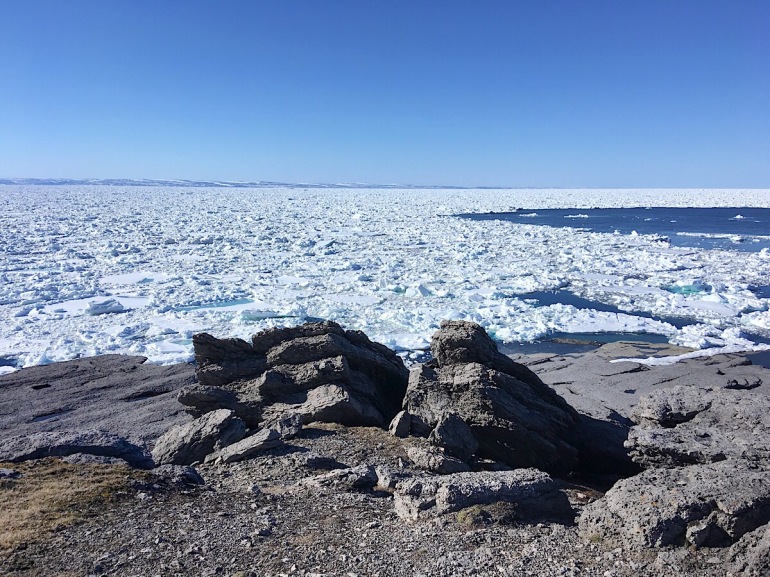
May 27, 2017 Sea ice all the way to Labrador – Cape Norman Northern Peninsula Newfoundland h/t Newfoundsander

Too dangerous to go fishing due to ice, Coast Guard warns

Weather Canada Marine Forecast
East Coast – north of Cape St. Francis

Issued 10:00 AM EDT 28 May 2017
Today Tonight and Monday
Special ice warning in effect.
1 tenth of first-year ice including a trace of old ice except 9 tenths of first-year ice including a trace of old ice near parts of the mouth of Bonavista Bay and the mouth of Trinity Bay. Unusual presence of sea ice in the western section.
Iceberg Count
More than 100 icebergs.

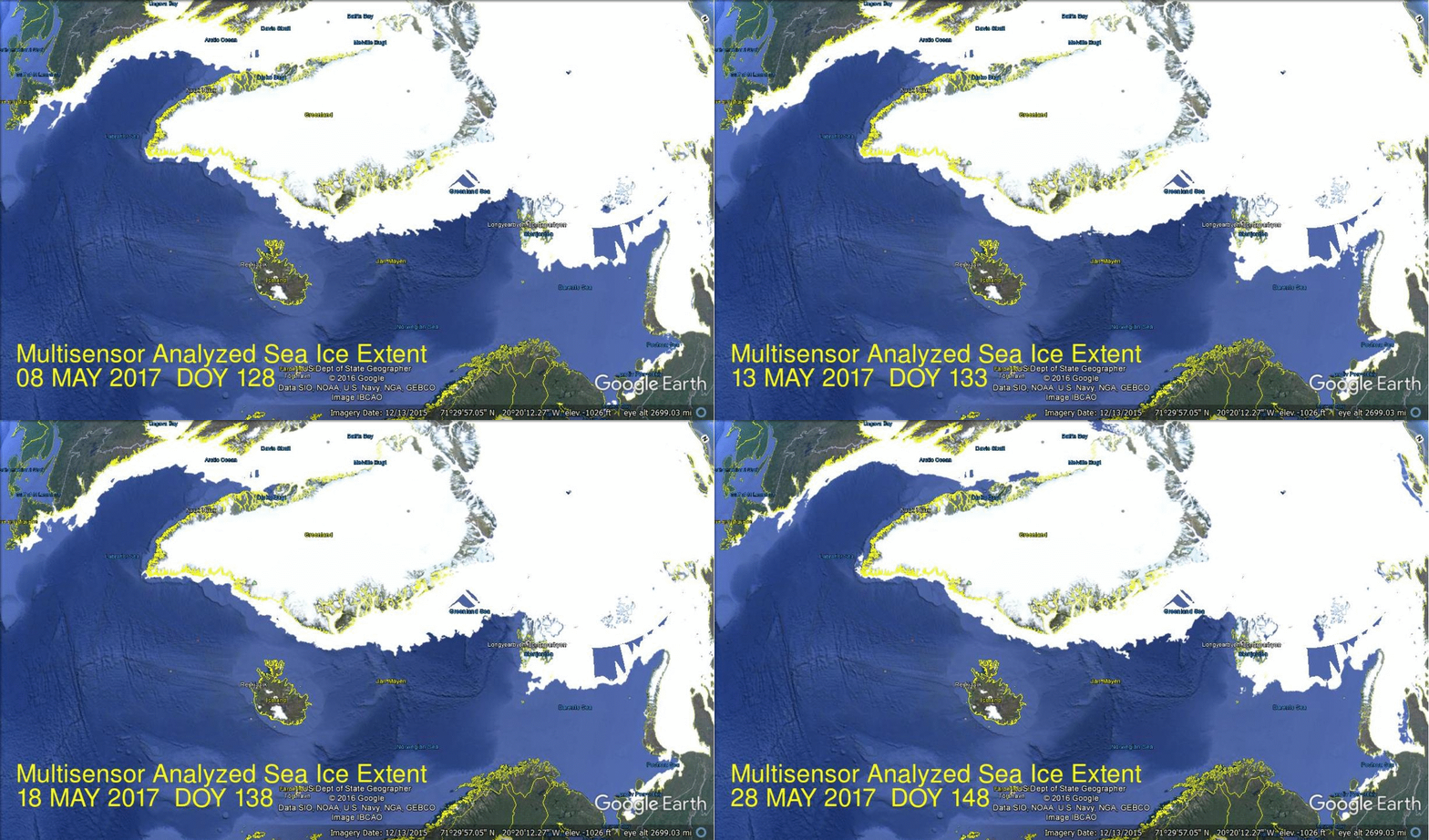
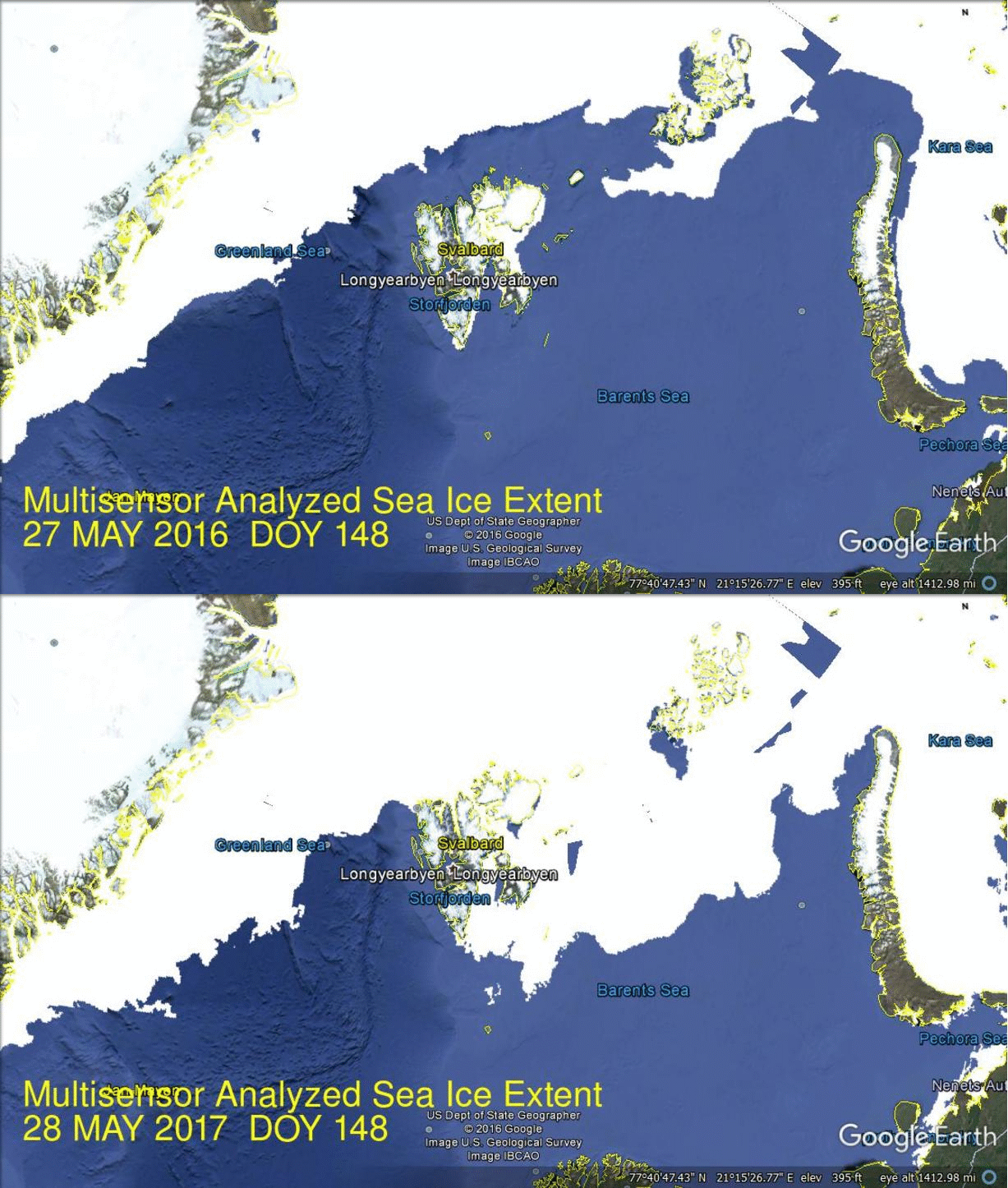
The Atlantic ice extents show little retreat during May.  Newfoundland coast on the upper left is still locked in ice though less now than 10 days ago.  In Barents not much has changed.

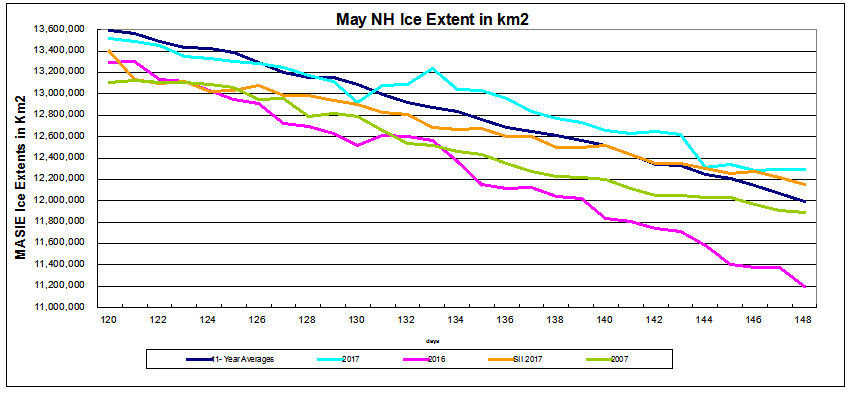
The graph below shows May extent through yesterday, May 28.

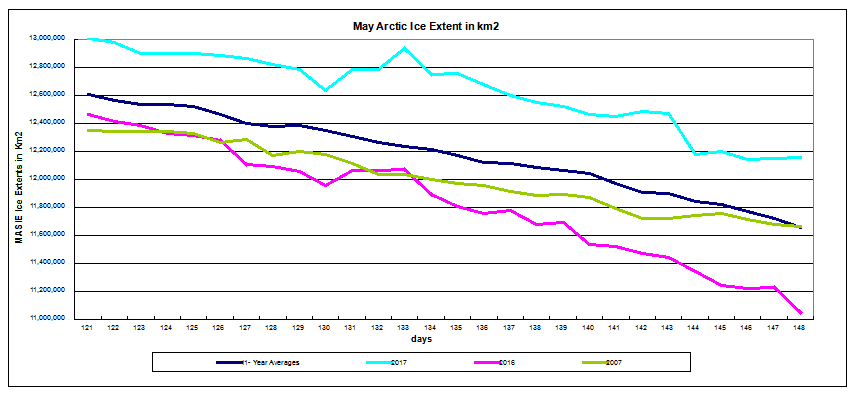
For the first time the decadal average dropped below 12M km2.  2017 is 300k km2 above average, 400k km2 above 2007 and 1.1M km2 higher than 2016.  The graph below shows the Arctic ice extents, excluding the Pacific basins of Bering and Okhotsk.

Note how persistent is 2017 ice extent, currently 500k km2 above both 2007 and the decadal average, and 1M km2 above last year at this date.

The table below shows regional extents for 2017 compared to decadal average and to 2007 on day 148.

Region 2017148 Day 148
Average
2017-Ave. 2007148 2017-2007
 (0) Northern_Hemisphere 12294150 11990991 303159 11886249 407901
 (1) Beaufort_Sea 1009369 1008031 1338 1059461 -50092
 (2) Chukchi_Sea 818347 904706 -86359 905098 -86750
 (3) East_Siberian_Sea 1037744 1073527 -35783 1069198 -31454
 (4) Laptev_Sea 871872 847487 24384 774503 97369
 (5) Kara_Sea 901704 845784 55920 879973 21731
 (6) Barents_Sea 502369 328055 174314 307955 194414
 (7) Greenland_Sea 635773 574248 61526 559480 76293
 (8) Baffin_Bay_Gulf_of_St._Lawrence 1122564 928837 193727 960512 162052
 (9) Canadian_Archipelago 820170 818658 1511 819338 831
 (10) Hudson_Bay 1184050 1102567 81483 1093176 90874
 (11) Central_Arctic 3247685 3221113 26572 3228660 19025
 (12) Bering_Sea 34151 212595 -178444 137425 -103274
 (13) Baltic_Sea 4542 319 4223 0 4542
 (14) Sea_of_Okhotsk 101998 123254 -21255 89730 12269

Note the strong surpluses of ice in Kara, Barents, Greenland Sea and Baffin Bay.  Note also that Bering is nearly ice free, and is having some influence on nearby Chukchi.  The two Pacific basins of Bering and Okhotsk now have 136k km2 combined at day 148, which matches where the decadal average will be in 13 days on day 161.

Finally, the image below shows Svalbard comparing 2017 with last year on day 148.

AER provides some insight into these developments along with a forecast in the May 22 posting.

Dr. Judah Cohen:
As I discussed in my previous blog, one constant over the past decade has been the collapse of NH snow cover extent in spring, especially late spring. The rapid disappearance of snow cover across northern Eurasia and northern North America contributes to drying of the soil and warmer temperatures. The resultant warmer temperatures also likely contribute to Arctic sea ice loss.

Snow cover this spring has been more resilient to melt than in previous recent springs. More snow cover results in moister soils. Moister soils result in cooler temperatures. Snow cover and snow mass continue to be relatively high across the NH helped by in part by below normal temperatures in key regions. However the snow cover has been more resilient in Eurasia relative to North America and snow cover across North America experienced a rapid decline over the past week. And with more warm temperatures predicted across Northern Canada, the rapid decline in snow cover will likely continue.

The AO is currently neutral (Figure 1), reflective of mixed geopotential height anomalies across the Arctic and mixed geopotential height anomalies across the mid-latitudes of the NH (Figure 2). Geopotential height anomalies are positive near Greenland and Iceland (Figure 2), and therefore the NAO is negative.

The AO is predicted to remain neutral to positive next week as neutral to negative geopotential height anomalies dominate much of the Arctic (Figure 5a). And with neutral to negative geopotential height anomalies stretching from Greenland to Iceland, the NAO will likely trend positive back into positive territory as well.

Beware the Ides of May

Triumphal Caesar Returns to Rome

OK, I know the saying was Ides of March, and it was a warning to Julius Caesar, forecasting his betrayal in the midst of Roman senators. The phrase came to mind as Trump the American Caesar returned to his capital pondering what to do about the Trojan Horse offered from Paris. Will his senators have his back or are they packing knives? A declaration from 40 of them makes it seem that they are prepared to confront the Paris Treaty and end its and everyone’s misery.

Paris COP Goes From Silver Bullet to Poison Pill for the Environment

Lost in all the politics, posturing and shaming is any awareness that this decades-long effort to mitigate warming by reducing fossil fuel emissions is itself a problem. The Société de Calcul Mathématique said in 2015: The battle against global warming: an absurd, costly and pointless crusade. The title is a link to the data, facts and information supporting their conclusion.

Beyond being costly and useless, the IPCC policies are directed at increasing energy poverty by eliminating the very sources that have raised the modern standard of living. And as numerous studies have shown, poverty and environmental degradation go hand in hand. When people can cook and heat themselves with fossil fuels, they don’t turn forests into firewood. Wealthier societies take much better care of their natural surroundings.

The UN Environmental program bet the farm on the global warming issue, thinking it to be a silver bullet to unplug industrial society and bring back pristine nature. The whole thing wastes time, talent and resources leaving real pressing environmental concerns unaddressed. It is the wrong path, the wrong program, and it will make matters worse if it isn’t stopped here and now.

Not Worried About CO2


Update May 25 below.

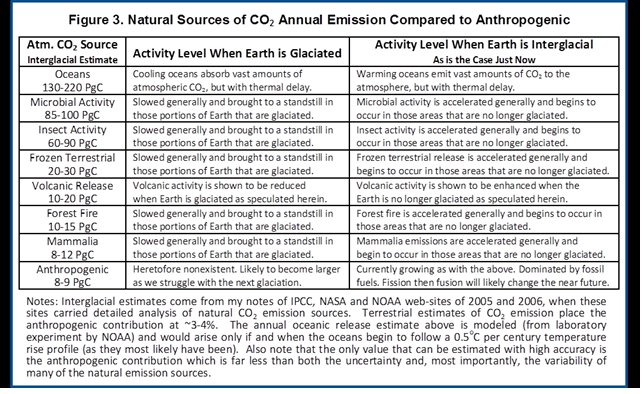
We should all know what Alfred E. Neuman knows, namely: Where does all that CO2 come from? Here is the answer from engineer Ronald Voisin.


Excerpts below are from An Engineer’s Take On Major Climate Change

Figure 3 outlines the primary sources of natural CO2 release in decreasing order of quantity of carbon emitted: oceanic release, microbial decay, insect activity, frozen terrestrial release; volcanic release; forest fire and then mammalia exhalations and emissions – summing to a total of ~325-485 petagrams (PgC). Then there is our ~2.0% anthropogenic release at ~8-9 petagrams. (Based on terrestrial sources alone, without oceans, anthropogenic release is ~3-4% of the natural flux. Some argue that the oceans are net absorbers and ignore the oceanic release estimate below. However, according to the hypothesis presented herein the oceans are net emitters as indicated below when warmed by ~0.5C per century).

These natural sources all correlate to global temperature (including, at the least, terrestrial volcanism, as recently verified). When the Earth gets warm, for whatever reason, these natural sources all kick-in together to contribute vast quantities of CO2; and to produce the observed habitual atmospheric CO2 spikes upward. Conversely, when the Earth gets cold, for whatever reason, they all go into remission together; naturally and (generally) coherently to produce a consequential reduction in atmospheric CO2. Each spike or dip in CO2 follows temperature with a lag time averaging 800 years, but proportional to the level and magnitude at which the temperature swings take place.

It is extraordinarily difficult to imagine that these natural sources are not at play during this current period of warming. They most likely are the primary cause of the currently observed CO2 spike. And yes, we humans, as co-inhabitants of this Earth, are emitting CO2. But so are microbes and insects emitting. And each of them is emitting with ~10 times our current anthropogenic emission. In both cases (microbes and insects) there is every reason to believe that their populations are geometrically exploding in this current highly favorable environment to their existence. The recently warming oceans are most likely the largest emitter of all.

Atmospheric CO2 is spiking just now. And we have good reason to believe that it is largely, essentially entirely doing so for all the same reasons it has done so within each and every prior warming period of the past. All natural sources of CO2 emission are currently revved-up and in high gear during this extended interglacial. Approximately 98% of the current spike is natural while we add our anthropogenic 2%.

We also have reason to believe that the current spike would be as large, or larger, than now observed, if we humans were never here at all. Why? Because those organisms that would otherwise be here in our stead would most likely emit much more CO2 than we are. i.e. We humans have chosen to systematically limit the proliferation of micro-organisms and insects in the land we use for cultivation and occupation – which represents about 1/3rd of all land. And in the other 2/3rds of all land, microbes and insects are each estimated to emit ~10 times our anthropogenic emission (insects alone outnumber humans >>10,000,000,000:1 – enough to fill several large dumpsters per person).

The relative contribution from microbe and insect emissions would have gone up significantly if we were never here (by a very rough factor of up to 1.5*). They would have filled our void geometrically; unlike our anthropogenic contribution. When we humans get rich, we uniquely self-limit our proliferation, by deciding to have fewer children. And our human emission pales in comparison to the emission from these astronomically vast numbers of other organisms. So if we were never here, greatly enhanced populations of microbes and insects would be emitting many times our anthropogenic emission from the very land that we systematically exclude them from. This situation most likely characterizes the events within prior interglacials.

Summary

1. Climate science is very complicated and very far from being settled.

2. Earth’s climate is overwhelmingly dominated by negative-feedbacks that are currently poorly represented in our Modeling efforts and not sufficiently part of ongoing investigations.

3. Climate warming drives atmospheric CO2 upward as it stimulates all natural sources of CO2 emission. Climate cooling drives atmospheric CO2 downward.

4. Massive yet delayed thermal modulations to the dissolved CO2 content of the oceans is what ultimately drives and dominates the modulations to atmospheric CO2.

5. The current spike in atmospheric CO2 is largely natural (~98%). i.e. Of the 100ppm increase we have seen recently (going from 280 to 380ppm), the move from 280 to 378ppm is natural while the last bit from 378 to 380ppm is rightfully anthropogenic.

6. The current spike in atmospheric CO2 would most likely be larger than now observed if human beings had never evolved. The additional CO2 contribution from insects and microbes (and mammalia for that matter) would most likely have produced a greater current spike in atmospheric CO2.

7. Atmospheric CO2 has a tertiary to non-existent impact on the instigation and amplification of climate change. CO2 is not pivotal. Modulations to atmospheric CO2 are the effect of climate change and not the cause.

Ronald D Voisin is a retired engineer. He spent 27 years in the Semiconductor Lithography Equipment industry mostly in California’s Silicon Valley. Since retiring, he has made a hobby of studying climate change for the last 7 years. Ron received a BSEE degree from the Univ. of Michigan – Ann Arbor in 1978 and has held various management positions at both established equipment companies and start-ups he helped initiate. Ron has authored/co-authored 55 patent applications, 24 of which have issued.

Footnote:  Voisin’s article was published in 2013, the facts still overlooked and ignored.

Update May 25

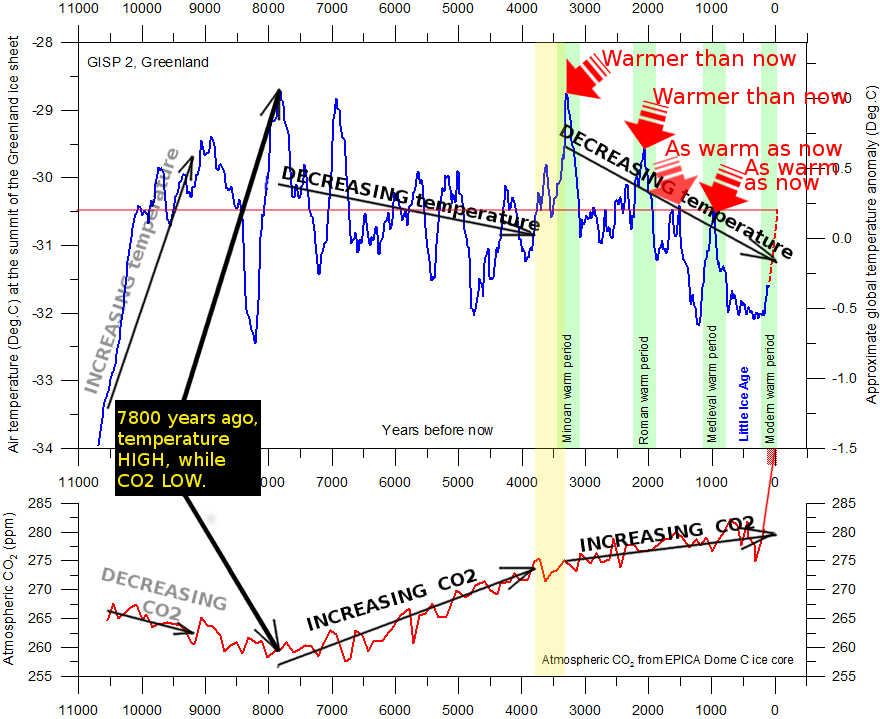
Robert Kernodle provided this chart recently in a separate comment thread.

Those patterns indicate that over millennial time scales, atmospheric CO2 appears as a natural negative feedback to planetary warmer periods.  As warming stimulates natural sources, CO2 rises, and after many centuries of delay, temperatures cool down.  Ironically, scientists in the 1950s and 60s who raised concerns about a coming ice age maybe had a truer sense of how CO2 is related to climate.  Of course, even then they exaggerated the effect of humanity’s 2% contribution, overemphasized decadal fluctuations and mistook CO2 as the cause rather than the effect of warming periods.

April Pause in Ocean Cooling


Ocean temperature measurements come from a global array of 3,500 Argo floats and other ocean sensors. Credits: Argo Program, Germany/Ifremer

April Sea Surface Temperatures are now available, and we can see a pause in the downward trajectory over the previous 13 months.

HadSST is generally regarded as the best of the global SST data sets, and so the temperature story here comes from that source, the latest version being HadSST3.

The chart below shows the last two years of SST monthly anomalies as reported in HadSST3 including April 2017.

In April 2017, the SH appears to be entering its cooler phase, while both the tropics and NH ticked upward from March, causing the Global anomaly to rise for the fourth month in a row.  The downward momentum has stopped, except now the SH (mostly ocean) has started down from a lower peak than a year ago.  It was the SH that was pulling up the Global average the previous three months.   The Tropics and NH may or may not start a new warming cycle, depending upon the appearance of El Nino.

Note that higher temps in 2015 and 2016 were first of all due to a sharp rise in Tropical SST, beginning in March 2015, peaking in January 2016, and steadily declining back to its beginning level. Secondly, the Northern Hemisphere added two bumps on the shoulders of Tropical warming, with peaks in August of each year. Also, note that the global release of heat was not dramatic, due to the Southern Hemisphere offsetting the Northern one.

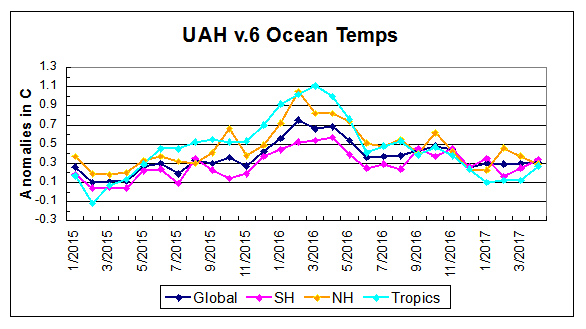
Satellite measures of the air over the oceans give a similar result.  The graph below provides UAH vs.6 TLT (lower troposphere temps) over the oceans confirming the impression from SSTs.

Once again it is the Tropical and NH oceans that drove the warming that peaked a year ago.  SH  moderated the Global averages, though the air temps over the oceans are more synchronized than is the case with SSTs. Note how in April all anomalies converged on 0.3C.

We have seen lots of claims about the temperature records for 2016 and 2015 proving dangerous man made warming.  At least one senator stated that in a confirmation hearing.  Yet HadSST3 data for the last two years show how obvious is the ocean’s governing of global average temperatures.

The best context for understanding these two years comes from the world’s sea surface temperatures (SST), for several reasons:

  • The ocean covers 71% of the globe and drives average temperatures;
  • SSTs have a constant water content, (unlike air temperatures), so give a better reading of heat content variations;
  • A major El Nino was the dominant climate feature these years.

Solar energy accumulates massively in the ocean and is variably released during circulation events.


Climate Policies Failure

Primum non nocere” means “First, Do No Harm.”

Medical practitioners know this principle, the closest approximation in the Hippocratic corpus coming from Epidemics: “The physician must be able to tell the antecedents, know the present, and foretell the future – must mediate these things, and have two special objects in view with regard to disease, namely, to do good or to do no harm.”

Every intervention has consequences by which its success is measured. Effectiveness regards the quality of outcomes: Good things happened, Nothing happened, or Bad things happened. Of course, it may be a mixed bag in which the net must be weighed.

In addition, efficiency is considered (“evidence-based” in today’s jargon): It was worth it, It was not worth it, or It was worse than doing nothing. Both attainment of intended consequences, and collateral, unintended damages bear on the judgment.

More and more in the nations “leading on climate change” people are starting to question the actions of policymakers. Recently Robert Lyman, Ottawa Energy policy analyst presented on the theme: Can Canada Survive Climate Change Policy? From Friends of Science

It must indeed seem strange that someone would wonder about the effects of the policies now proposed to reduce greenhouse gas emissions as though the policies themselves are the threat. And yet they are.

I am not here to address the issue of how much human-related greenhouse gas emissions are contributing to increased concentrations of carbon dioxide in the atmosphere nor on the sensitivity of global temperatures and climate to the increases in those concentrations over time. There are others here far more qualified than I to discuss that.

Instead, I want to discuss the policy and program measures that the people of Canada and other countries, especially in the industrialized world, are being urged to adopt and what will be the implications of those policies and programs.

Edmonton one winter night.

Canada is the second largest country in the world, sparsely populated,
with vast transportation needs. We withstand long, cold winters featuring
short days, extremely low temperatures and lots of snow. Our energy and
resource industries would be penalized for providing the 
valuable materials
the rest of the world demands and uses.

The article goes into the history of how we all, including Canada got to this point. Then comes this.

Ladies and gentlemen, these commitments are just the beginning, the mere “foot in the door” for the more radical demands that lie ahead. We are still bound in principle to reduce Canadian GHG emissions by 50% from 2005 levels by 2050. The U.N still wants us to “show leadership” by reducing emissions by 80% from 2010 levels by 2050. A number of environmental groups in Canada and other countries have recently endorsed the Wind, Water and Sunlight, or WWS, vision. This vision seeks completely to eliminate the use of all fossils fuels – coal, oil, and natural gas – in the world by 2050. The New Democratic Party’s LEAP Manifesto endorses this vision, as does the Green Party and most of Canada’s influential environmental organizations. The government of Ontario also has formally committed the province to this vision. So have a number of large Canadian municipal governments.

In practice, consumers pay twice, once for the (expensive) renewable
generation and then for the capital costs of the backup thermal plants.

How can we even begin to understand the magnitude of the changes being proposed? One way is to look at the sources of energy consumption and related emissions today. In 2005, Canadian emissions were 738 megatonnes of carbon dioxide equivalent. In 2014, after six years of the worst recession since the Great Depression, Canadians emitted less, 722 megatonnes. Twenty-six per cent of those emissions were from oil and gas production, 23 per cent were from transportation, and roughly equal portions of around 10 per cent were from electricity generation, buildings, industry and agriculture, with waste and other sources making up a residual 7 per cent. Assuming that emissions do not grow one bit over the next 32 years as a result of increased economic activity or increased population, achieving a 50 per cent emissions reduction from 2005 levels would mean reducing emissions to 369 megatonnes CO2 equivalent. That is comparable to completely eliminating the current emissions from oil and gas production, electricity generation, and all emissions-intensive industries like mining, petrochemicals, auto and parts manufacturing, iron, steel and cement. Gone. Achieving the aspirational goal of 80 per cent reduction recommended by the IPCC would mean reducing emissions to 147 megatonnes CO2 equivalent. That would be comparable to reducing Canada’s per capita emissions and our energy economy to the current levels of Bolivia, Sudan or Iraq. (original bold)

Which benefits would be achieved by incurring such costs?

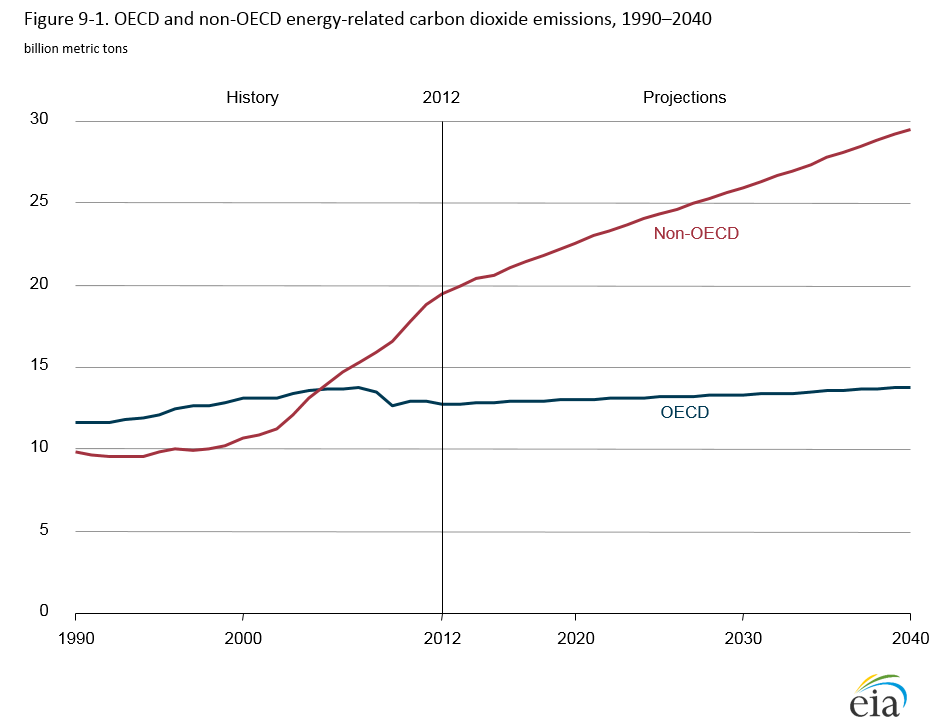
Despite all the rhetoric about reducing world carbon dioxide emissions from fuel combustion and gas flaring, according to the U.S. Carbon dioxide information analysis center, they rose steadily from 16.6 Gigatonnes carbon dioxide equivalent in 1973 to 34.1 Gigatonnes in 2014. So, they more than doubled over that timeframe. Importantly, though, the origins of the emissions changed significantly. In 1973, the countries of the organization for economic cooperation and development, or OECD, accounted for two-thirds of global CO2 emissions from fuel combustion; by 2014, the OECD share had declined to just over a third. So all, or almost all, of the emissions growth occurred outside of the OECD.

So, we have two sharply different perspectives of the future, the EIA’s projections of what probably will happen and the aspirations of the U.N. and many environmental groups as to what in their view should happen. Reducing emissions by 50% by 2050 to meet the U.N.’s vision would mean a global total of about 16 Gigatonnes, in contrast to the EIA’s projection of 43 Gigatonnes (Gt). The OECD countries – the United States, Canada, most of Europe, Japan, Australia and others – could eliminate 100% of their projected emissions of 14 Gt, and the world would still be over its target by 13 Gt.

A Tangled Pile of Wasteful Climate Programs

There is not in Canada a comprehensive list of the measures that have been implemented by all orders of government to reduce greenhouse gas emissions. They have been increasing in number, reach and cost since 1988. I counted 37 different generic types of measures now in use. Large bureaucracies exist to design, implement, and (less frequently) evaluate these measures. They stretch like the tentacles of some vast octopus across every aspect of the Canadian economy and touch everyone’s life. As no one has ever established an inventory of the measures now in place or of those under consideration, no one knows how much these measures already cost Canadians. Two things are certain – they cost billions of dollars annually, and they are not going away soon, regardless of the taxes imposed on carbon. I might add a third certainty, which is that the government will continue to develop and implement more and more programs and regulations as time goes on.

Let me remind you of the conclusions reached by the federal government’s own monitor of program effectiveness, the Commissioner of the Environment and Sustainable Development.  Starting in 1998, the commissioner began to critique the government’s approach to managing emission reduction measures. In the seven reports that followed, there were five consistent themes.

  • First, the government has not created effective governance structures for managing climate change activities. In fact, there have been weaknesses in horizontal governance across departments, accountability and coordination.
  • Second, there has been, and remains, no overall implementation plan. The government has produced no estimate of the emission reductions expected from each sector. Without an implementation plan, industry, consumers and other levels of government lack a solid basis for knowing how to apply technology or make investment decisions.
  • Third, as a result, Canada cannot determine whether the targets for emissions reduction already announced will be met or how much it will cost to do so.
  • Fourth, there are few mechanisms in place to measure the performance of the emission-reduction measures that have been implemented so far.
  • Fifth, the federal and provincial governments do poorly in coordinating their approaches to emissions reduction.

I agree that we need an honest dialogue about climate change mitigation. It should start with the recognition that governments to date have publicly embraced emission reduction targets that are unachievable with present technology and at acceptable economic costs. We should acknowledge that we as a society have multiple goals of which environmental quality, however important one might think it is, represents only one. If we value our prosperity and unity as a federal, geographically diverse country, we must approach the climate change issue with a respect for all our collective goals.

Much of Canada’s current political elite favours the pursuit of international goals over the steadfast promotion of the Canadian interest, whether on issues of trade, security or the environment. Never before, however, have we faced a situation in which commitment to an international objective may well impose enormous and divisive costs on Canada for no discernable global environmental benefit. Climate change thus offers a clear dichotomy between the Canadian national interest and the global environmental agenda.