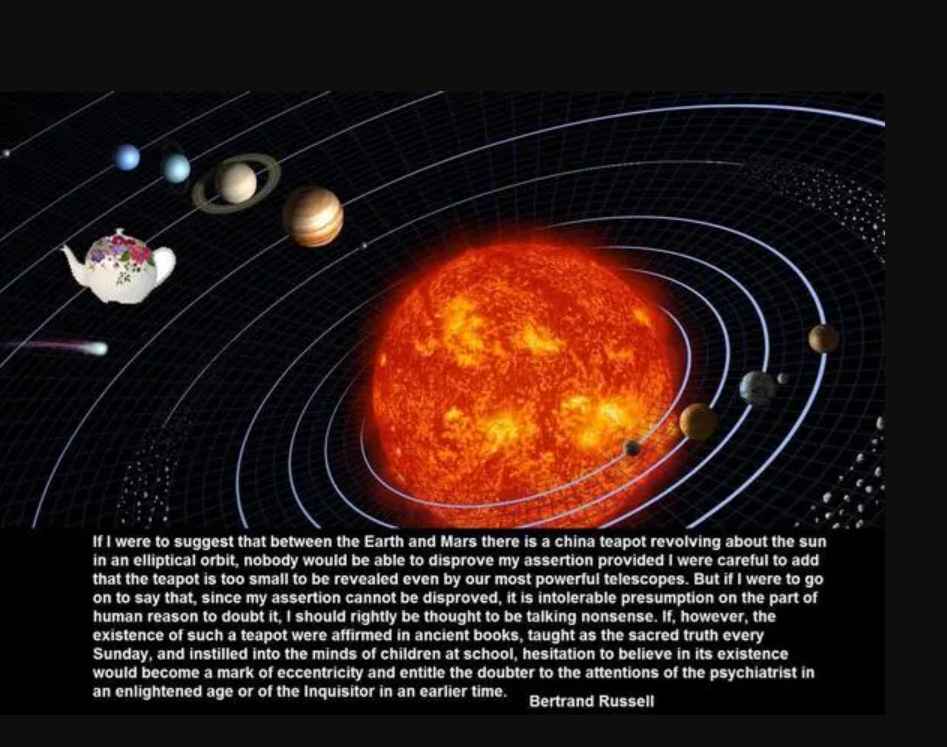
The confirmation hearings with questions from global warming zealots reminded me of Bertrand Russell’s teapot analogy.
The notion of global warming/climate change resembles closely that mythical teapot. People like Lewandowsky and Oreskes psychoanalyze unbelievers. And public hearings are conducted to uncover unseemly heresy inside political appointees. At least when religion is recognized as such, and not confused with science, modern societies understand it is a matter of opinion and freedom of thought and expression is accepted.
Ocean temperature measurements come from a global array of 3,500 Argo floats and other ocean sensors. Credits: Argo Program, Germany/Ifremer
We are seeing lots of claims about the temperature records for 2016 and 2015 proving dangerous man made warming. At least one senator stated that in a confirmation hearing. Now that HadSST3 data is complete for last year, let’s see how obvious is the ocean’s governing of global average temperatures.
The best context for understanding these two years comes from the world’s sea surface temperatures (SST), for several reasons:
The ocean covers 71% of the globe and drives average temperatures;
SSTs have a constant water content, (unlike air temperatures), so give a better reading of heat content variations;
A major El Nino was the dominant climate feature these years.
HadSST is generally regarded as the best of the global SST data sets, and so the temperature story here comes from that source, the latest version being HadSST3.
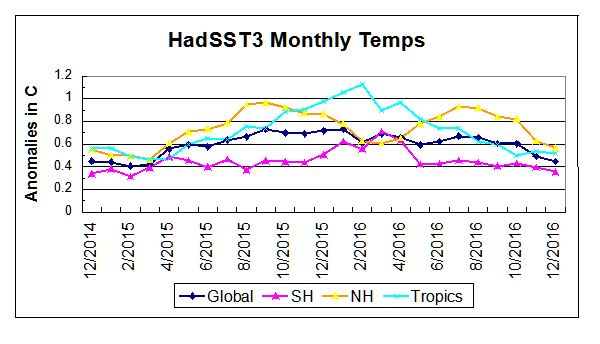
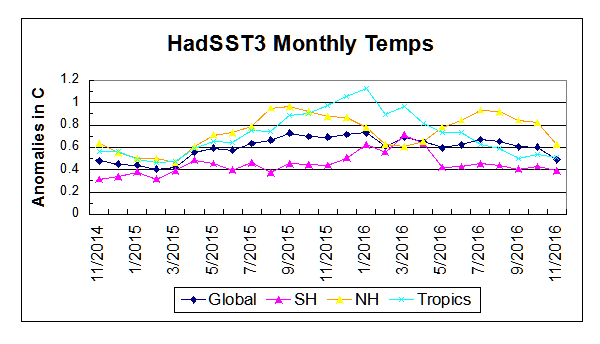
The chart below shows the last two years of SST monthly anomalies as reported in HadSST3.
Note that higher temps in 2015 and 2016 are first of all due to a sharp rise in Tropical SST, beginning in March 2015, peaking in January 2016, and steadily declining back to its beginning level. Secondly, the Northern Hemisphere added two bumps on the shoulders of Tropical warming, with peaks in August of each year. Also, note that the global release of heat was not dramatic, due to the Southern Hemisphere offsetting the Northern one.
Finally, the oceans are entering 2017 at the same temperature level as 2015, only now with downward momentum.
Much ado will be made of this warming, including claims of human causation, despite the obvious oceanic origin. However, it is unreasonable to claim CO2 functions as a global warming agent, yet the two hemispheres respond so differently. Moreover, CO2 warming theory expects greater warming in the higher latitudes, while this event was driven by heating in the Tropics, contradicting alarmist warming theory.
Solar energy accumulates massively in the ocean and is variably released during circulation events.
More from true believers in climatism during today’s Senate confirmation hearings, featuring Bernie Sanders and Ed Markey.
Ryan Zinke, nominee for Secretary of the Interior appeared before the Senate Energy and Natural Resources Committee for his confirmation hearing Tuesday.
Senator Bernie Sanders of Vermont:
Is President Elect Trump right? Is climate change a hoax?
Secretary of the Interior Nominee Ryan Zinke:
First of all, the climate is changing. That’s indisputable. Secondly, man is having an influence. I think the debate is about what is that influence, and what can we do about it.
If confirmed I will inherit the USGS, where there are a lot of great scientists. I am not a climate scientist, but I will become a lot more familiar with it, and it will be based on objective science. I don’t believe it is a hoax.
I believe we should be prudent, I don’t know definitively. There is a lot of debate on both sides of the aisle.
Senator Sanders:
Actually, there is not a whole lot of debate now, the scientific community is virtually unanimous that climate change is real and causing devastating problems. There is a debate within this committee, but not in the scientific community.
If climate change is already causing devastating problems, should we be drilling for fossil fuels on public lands?
Nominee Zinke:
We need an economy and jobs too. I support an “all of the above” approach to energy sources. I think that is the better way forward.
Scott Pruitt Nominee for Director of EPA appeared before the Senate Committee on Environment and Public Works.
Senator Ed Markey, Massachusetts:
NOAA, NASA have declared that 2016 is the hottest year in the 137 year record that has been kept. Donald Trump has said that global warming is a hoax caused by the Chinese. Do you agree that global warming is a hoax?
Nominee Scott Pruitt: I do not, Senator.
Senator Markey: So, Donald Trump is wrong.
Nominee Pruitt: I do not believe climate change is a hoax.
Senator Markey: OK, I think that is important for the President to hear.
Senator Bernie Sanders:
As you may know, some 97% of scientists who have written articles for peer-reviewed journals have concluded that climate change is real, it is caused by human activity, and it is already causing devastating problems in the US and around the world. Do you believe that climate change is caused by carbon emissions from human activity?
Nominee Scott Pruitt
As I said in my opening statement, the climate is changing and human activity contributes to that in some manner.
Senator Sanders:
97% of the scientists who publish in this field believe that human activity is the fundamental reason we see climate change. Do you disagree with that?
Nominee Pruitt:
I believe that the ability to measure with precision the degree of human activity to impact the climate is subject to more debate on whether the climate is changing and whether the human activity contributes to it.
Senator Sanders:
While you are uncertain, the vast majority of scientists are telling us, if we do not get our act together, and transform our energy system away from fossil fuel, there is a real question as to the quality of the planet we will be leaving to our children and our grandchildren.
The overwhelming majority of scientists say we have to act boldly, and you are saying more debate is needed on this issue, and we should not be acting boldly.
Nominee Pruitt:
No Senator, as I said the climate is changing.
Senator Sanders:
Why do you think the climate is changing?
Nominee Pruitt:
In response to the CO2 issue, the EPA administrator is constrained by statutes passed by this body.
Senator Sanders:
I am asking for your personal opinion.
Nominee Pruitt:
My personal opinion is immaterial.
Senator Sanders:
Really. You’re going to be the head of the agency to protect the environment, and your personal feelings about whether climate change is caused by human activity and carbon emissions is immaterial?
Nominee Pruitt:
Senator, I have acknowledged to you that human activity impacts on the climate.
Senator Sanders:
The scientific community doesn’t tell us that it impacts, they say human activity is the cause of climate change and we have to transform our energy system. Do you believe we have to transform our energy system in order to protect the planet for future generations?
Nominee Pruitt:
I believe the EPA has a very important role in regulating emissions.
Senator Sanders:
You haven’t answered my question.
Summary
Again the 97%, though Sanders is more circumspect in linking that to scientists publishing in the climate field. He doesn’t let on that it originated from 75 out 77 respondents, culled from more than 3000. Furthermore, he greatly exaggerates their views when he says climate change is already causing “devastating problems.”
From these interrogations, we see that Senators are seeking personal opinions on a subject not of knowledge but of belief. That is actually an unconstitutional basis for qualifying a federal appointee. (Article Six)
The whole emphasis on 97%, vast, or overwhelming majority is to distract you from the fact that these are opinions. Neither scientists nor senators know the future, since we lack sufficient knowledge of the climate system to predict its behavior.
Global warming/climate change is a matter of opinion in several respects:
No one knows as a matter of fact whether additional CO2 will result in warmer or cooler temperatures, or make any noticeable difference at all.
It is also anyone’s guess what we can do today to ensure desirable temperatures in the future.
If we had the power to determine future temperatures, opinions vary as to what temperature level would be ideal for everyone living around the world at different latitudes.
It is hubris to think that government can control the weather and climate. (King Canute, where are you when you are so needed?) Wise political leaders would realize that there will likely be future periods both colder and warmer than the present. They would also recognize that cold is the greater threat to human health and prosperity. Planning for future climates focuses resources on two priorities: Robust infrastructures and reliable affordable energy.
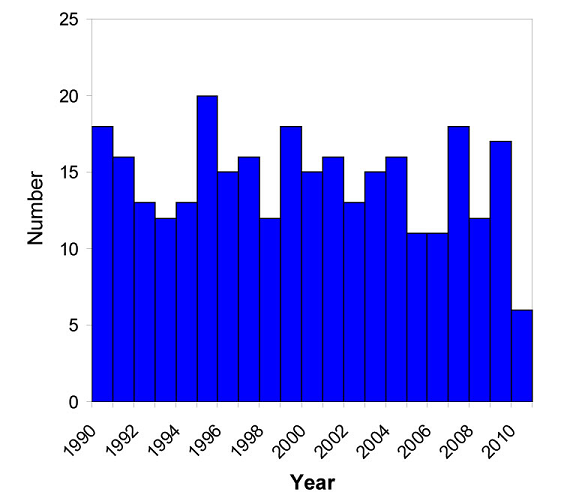
Number of worldwide earthquakes with a magnitude of 7 or greater over the last two decades. British Geological Survey
From the “Headlines Claim, Details Deny” department comes this whopper regarding climate effects on seismic activity in Canada.
Natural disasters are expected to increase as climate change pushes global temperatures higher, and some scientists believe earthquakes will also become more frequent. Global News (here)
The alarm is sounded by one scientist, Bill McGuire, writing in the Guardian last fall:
“An earthquake fault that is primed and ready to go is like a coiled spring … all that is needed to set it off is – quite literally – the pressure of a handshake,” writes scientist Bill McGuire, author of Waking the Giant: How a changing climate triggers earthquakes, tsunamis, and volcanoes.
As usual with these alarmist pieces, if you bother to read the details in the text, you discover the headline is misleading or totally false. (“Fake News,” anyone?).
After quoting that scary claim, the article goes on to make numerous statements of fact contradicting Mr. McGuire.
While many parts of the country are prone to seismic activity, experts say Canadians shouldn’t worry about their city or town suddenly becoming a earthquake hot spot due to a warmer atmosphere.
Earthquakes rattle Canada thousands of times every year — there are an estimated 2,500 annually in Western Canada alone. Thanks to the Internet, social media and apps, we’re now more aware of the activity that has always commonly occurred.
“Climate change is not something that just started,” noted Christie Rowe, assistant professor in earth and planetary sciences at McGill University.
“All the earthquake patterns that we know of are basically [from] the last century. So the patterns that we know of are already happening in the climate changing world.”
“A lot of people think there’s suddenly an increase but it’s just that they’re getting a lot more coverage than they used to,” said Alison Bird, earthquake seismologist with the Geological Survey of Canada.
Climate change, “won’t generally cause more earthquakes to happen,” Bird said.
“No, climate change will not result in increased earthquake activity,” agreed Gail Atkinson, professor of earth sciences at Western University, in an email to Global News.
“The glaciers receded from the last ice age, which was considerable time ago — we’re talking about thousands of years,” said Bird. “Because the weight of those glaciers receding has been lifted, the ground is slowly moving up after having that weight removed from it, and you can have earthquakes because of that sort of thing. They tend to be quite small.”
While there may be more small events, Canada’s sparsely-populated Arctic is unlikely to suddenly see massive seismic activity.
Summary
Note the flip-flopping (equivocation) around the term “climate change”. When geologists and seismologists are speaking within their discipline, they are referring to natural changes over thousands of years. With activists “climate change” serves as code for CO2 causing global warming.
Reading the article again, it actually serves to debunk McGuire’s claims, except for the first paragraph or two. The journalist actually sought the views of level-headed experts and printed them for readers to have as context. The gruel is getting pretty thin for desperate alarmists.
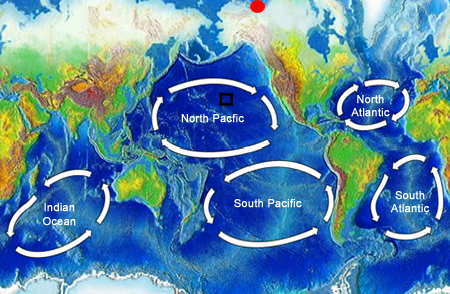
This image shows the five major ocean gyres. It shows that gyres rotate in a clockwise direction in the Northern hemisphere and a counter-clockwise direction in the Southern hemisphere. The black square shows the approximate location of the Great Pacific Garbage Patch and the red circle shows the position of the Beaufort gyre in the Arctic Ocean.
Professional hydrologist Rob Ellison has for years been thinking and writing to connect the dots between the sun, ocean and climate. Recently he wrote this post at his excellent blog Terra et Aqua, An Earnest Discovery of Climate Causality (link in red)
Below I provide some excerpts from his discussion about an ocean mechanism which would be much better understood, were it not for the CO2 obsession sucking up most of the research funding.
Overview
It is hypothesized that upwelling in the Pacific Ocean is modulated by solar activity over periods of decades to millennia – with profound impacts on communities and ecosystems globally. The great resonant systems of the Pacific respond at variable periods – the tempo increased last century for instance – of La Niña and El Niño alternation. . .The mechanism proposed is a spinning up of the Pacific gyres as a result of colder and denser polar air. Low solar activity spins up the gyres producing more frequent La Niña (more equatorial upwelling) – and vice versa.
Pacific Oscillations Global Impact
The Pacific has a globally influential role in climate variability at scales of months to millennia. The variability in atmospheric temperature, rainfall and biology has its origin in the volume of cold water rising off California and in the equatorial Pacific. It is an ever changing anomaly.
The principle of atmospheric heating and cooling by ENSO is very simple. Cold, nutrient rich currents cascade through the deep oceans over a millennia or more. These turbulent currents don’t generally emerge through a sun warmed surface layer. By far the most significant deep ocean upwelling is in the eastern and central Pacific. Cold water in contact with the atmosphere absorbs heat and warms as the atmosphere cools. At times there is less upwelling and warm water spreads eastward across the Pacific – warming the atmosphere. It is simple enough to see in temperature data.
I have a preference for near global coverage and depth integrated satellite temperature records – it doesn’t miss energy in latent heat at the surface for one thing. 21st century instrumentation is much to be preferred going forward. Over the past century the 20 to 30 year influence of the Pacific Decadal Oscillation (PDO) anomaly can be seen in the surface records. Warming to the mid 1940’s, cooling to 1976, warming to 1998 and little change since. The PDO and ENSO are, moreover, in lockstep. A cooler PDO anomaly and more frequent and intense La Niña – and vice versa.
Pacific Gyres Spinning Up Climate Change
The atmospheric/ocean system of triggers and feedbacks varies – usually abruptly with triggers. The trigger for more upwelling I can only imagine is the great ocean gyres. Ocean gyres spin up on the surface through winds and planetary rotation. Pressure systems shift polar winds and storms into lower latitudes. High polar atmospheric pressures spin up the gyres pushing cold polar water into the Californian and Peruvian currents. Roiling cold water upwelling sets up wind and current feedback across the Pacific.
More polar cold water at the surface facilitates upwelling in critical regions. Trade winds spin up as a feedback and piles warm water against Australia and Indonesia. Sometimes the winds falter and warm water flows back eastward suppressing cold upwelling. The whole is a complex and dynamic system triggered by changes in atmospheric pressure zones in the north and south Pacific. Great movements of atmospheric mass driven by a marginal change in solar activity. A large reaction from a small jolt as expected with technically chaotic systems.
Tessa Vance and colleagues from the Antarctic Climate and Ecosystems CRC found a proxy of eastern Pacific upwelling in an ice core at the Law Dome Antarctica. A higher salt content – from polar westerlies – is a proxy for solar activity. But also results in changes in the great Pacific gyres and the intensity of upwelling. More upwelling brings rain and cyclones to Indonesia and northern and eastern Australia, drought in the United States of and South America, cooler global temperatures and biological abundance. Less in El Niña conditions and we – in Australia – get drought. The absolute volume of rainfall is roughly constant but where it falls on the planet changes.
The record captures in high resolution the 20 to 30 year Pacific beat, the change in the ENSO tempo last century and has at least a resemblance to the solar signal over a 1000 years. But even with a millennial high El Niño anomaly last century – conditions have been far more extreme at other times in the past 12,000 years.
Conclusion
Will there be more La Niña over the next centuries? Can we expect more El Niño in a thousand years? Might we see great herds return to the Sahel? The future remains unpredictable. Still – a return to the mean scenario does suggest better odds on a cooler sun and a little more upwelling in the Pacific Ocean – a cooling influence on the atmosphere and the inevitable regional variabilities in rainfall.
Oceans Make Climate is a major theme at this blog, since I fortunately made the acquaintance of Dr. Arnd Bernaerts. Rob Ellison adds another important dimension with his consideration of the gyres.
Footnote:
Recently I noticed how sea surface temperatures drove the 2015-2016 global warming, as shown in the HadSST3 record:
Note that higher temps in 2015 and 2016 are first of all due to a sharp rise in Tropical SST, beginning in March 2015, peaking in January 2016, and steadily declining back to its beginning level. Secondly, the Northern Hemisphere added two bumps on the shoulders of Tropical warming, with peaks in August of each year. Finally, note that the global release of heat was not dramatic, due to the Southern Hemisphere offsetting the Northern one.
Much ado will be made of this warming, including claims of human causation, despite the obvious oceanic origin. Further, it is curious that CO2 functions as a warming agent so unevenly around the world, and that the Tropics drove this event, contradicting CO2 warming theory.
No religious Test shall ever be required as a Qualification to any Office or public Trust under the United States.
In that context, what do we make of questions being put to federal government appointees at their confirmation hearings?
Mike Pampeo, CIA Director nominee at the Senate Intelligence Committee
California Senator, Kamala Harris In the past you have questioned the scientific consensus on change. Nevertheless, according to NASA, multiple studies published in peer reviewed scientific journals, showed 97% or more of actively published, um, climate scientists agree that climate warning trends over the past century are extremely likely due to human activities. In addition, most of the leading scientific organizations worldwide have issued public statements endorsing this position. Do you have any reason to doubt NASA’s findings?
CIA Director Nominee, Mike Pompeo: Senator, I’ve actually spoken to this in my political life some. My commentary, most all has been directed to ensuring the policies that America put in place, uh, actually achieve the objective of ensuring we didn’t have catastrophic harm that resulted from changing climate. I continue to hold that view.
Senator Harris Do you believe that NASA’s findings are debatable?
Nominee Pompeo: I have not looked at NASA’s findings in particular. I can’t give you any judgment on that today.
Rex Tillerson, Secretary of State nominee at the Senate Foreign Relations Committee
Senator Bob Corker, Committee Chair: Would you state your personal position as it relates to climate change?
Secretary of State nominee Rex Tillerson: I came to the position over about 20 years as an engineer and a scientist. I came to the conclusion a few years ago that the risk of climate change does exist and the consequences could be large enough that action should be taken.
Senator Corker: Do you believe that human activity, based on your belief in science, is contributing to climate change?
Nominee Tillerson: The increase in the greenhouse gas concentrations in the atmosphere are having an effect. Our ability to predict that effect is very limited.
Senator Tim Kaine: Exxon-Mobil had a history of funding and promoting climate science denial, despite its internal awareness of the reality of climate change, during your tenure with the company, true or false?
Nominee Tillerson: Since I am no longer with Exxon-Mobil, I am in no position to speak on their behalf. The question would have to be put to them.
Senator Kaine: The allegations are about Exxon’s knowledge of climate science and decision to fund and promote a view contrary to its awareness of the science, are those allegations true or false?
Nominee Tillerson: That question will have to be put to Exxon.
Senator Kaine: Do you lack the knowledge to answer my question, or do you refuse to answer?
Nominee Tillerson: A little of both.
Senator Jeff Merkley: Do you agree with the viewpoint that the odds of dramatic events occurring, whether more forest fires, or more hurricanes with more power, is a rational observation from the scientific literature?
Nominee Tillerson: As you indicated, there is some literature out there that suggests that. Other literature says that it is inconclusive.
Senator Jeff Merkley: I am sorry to hear that viewpoint. Overwhelmingly, the scales are on one side of this argument.
Senator Tom Udall: Do you plan or would you support any efforts to persecute, sideline, or otherwise retaliate against career state department employees who have worked on climate change in the past?
Nominee Tillerson: No sir, that would be a pretty unhelpful way to get started.
Summary
The climate dogma is captured in a famous tweet: Ninety-seven percent of scientists agree: climate change is real, man-made and dangerous. Barack Obama
Since that is not what the scientists said, nor what say many other scientists (who were not asked), this is clearly a creed of some kind of religion, call it climatism.
Asking nominees whether they subscribe to a creed or not violates Article Six of the Constitution. Inquisitors can claim there’s no formal religious organization, but they are still looking to disqualify based on dissent in a matter of belief.
Definition of “Fake News”: When reporters state their own opinions instead of bearing witness to observed events.
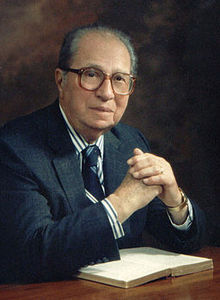
We are now fully entrenched in an age of “yellow” journalism, especially regarding the issue of global warming/climate change. Below I will deconstruct a recent egregious example, but first we need a background from renowned philosopher Mortimer Adler.
On the Difference Between Knowledge and Opinion
Knowledge refers to knowing the truth, that is understanding reality independent of the person and his/her ideas. By definition, there is no such thing as “false knowledge.”
When I show you two marbles then add two more marbles and ask you how many marbles there are, the answer is not a matter of opinion. You have no freedom to assert any opinion other than the answer “four”. By the axioms of mathematics we know the true answer to this question.
A great many other issues in human society, politics and culture are matters of opinion, and each is free to hold an opinion different from others. In such cases, the right opinion is usually determined by counting noses with the majority view ruling.
Note that school children are taught right opinions. That is, they are told what their elders and betters have concluded are the right answers to many questions about life and the world. Those children do not yet possess knowledge, because as Socrates well demonstrated, you have knowledge when you have both the right opinion and also know why it is right. Only when you have consulted the evidence and done your own analysis does your opinion serve as knowledge for you, rather than submission to an authority.
John R. Christy is a professor of Atmospheric Science and Director of the Earth System Science Center of the University of Alabama in Huntsville.
Climate science is a murky science. When dealing with temperature variations and trends, we do not have an instrument that tells us how much change is due to humans and how much to Mother Nature. Measuring the temperature change over long time periods is difficult enough, but we do not have a thermometer that says why these changes occur.
We cannot appeal to direct evidence for the cause of change, so we argue.
The real climate system is so massively complex we do not have the ability to test global-size theories in a laboratory. Without this ability, we tend to travel all sorts of other avenues to confirm what are essentially our unprovable views about climate. These avenues tend to comfort our souls because we crave certainty over ambiguity.
Without direct evidence and with poor model predictability, what other avenues are available to us? This is where things get messy because we are humans, and humans tend to select those avenues that confirm their biases. (It seems to me that the less direct evidence there is for a position, the more passion is applied and the more certainty is claimed.)
One avenue many folks tend to latch onto is the self-selected “authority.” Once selected, this “authority” does the thinking for them, not realizing that this “authority” doesn’t have any more direct evidence than they do.
Other avenues follow a different path: Without direct evidence, folks start with their core beliefs (be they political, social or religious) and extrapolate an answer to climate change from there. That’s scary.
Exhibit A of Yellow Climate Journalism
Unfortunately we see that climate journalists often distort their articles by confusing factual reporting of events with their own opinions.
“In the conduct of trials before judges in our courts there is a famous rule called the opinion rule. The opinion rule says that a witness giving testimony must report what he saw or what he heard. He must not report what he thinks happened, because that would be giving an opinion, not knowledge by observation.”
~ Mortimer J. Adler
See how the author forces his own opinions to subvert what he observed.
After more than six hours of testimony, Tillerson backtracked even further, telling senator Jeff Merkley (D-OR) that though the evidence of a changing climate was clear, the cause wasn’t. “The science behind the clear connection (to human activity) is not conclusive,” Tillerson said, an assertionas false as the scientific consensus is clear. (my bold)
Tillerson said that he and the president elect would do a “fulsome review” of US climate change policies. “I also know that the president, as part of his priority in campaigning, was ‘America First,’ so there is important considerations as we commit to such accords, and as those accords are executed over time: are there any elements of that that put America at a disadvantage?” he said. The negative effects of climate change, of course, don’t discriminate on the basis of national borders. (my bold)
Senator John Barrasso (R-WY), who believes government money currently spent fighting climate change could be “better spent” elsewhere, pushed Tillerson to commit to abandoning US funding for anti-climate change initiatives. Specifically, Barrasso opposes support for the Green Climate Fund, an international program set up to help developing nations deal with the effects of climate change. The US under Obama has pledged $3 billion.
“In consultation with the president, my expectation is that we are going to look at these things from the bottom up in terms of funds we’ve committed toward this effort,” Tillerson said.
Even in his non-answer, it’s clear Tillerson was open to dropping such funding. Instead, he opined on the power of electricity to lift people out of poverty. A noble aspiration, perhaps, but one that would provide little consolation to communities ravaged by climate change now and in the future. (my bold)
Summary, Five criteria for distinguishing between knowledge and opinion:
1. Whether or not everyone must agree.
2. Doubt and belief are relative only to opinion, never to knowledge;
3. We can have freedom of thought only about matters of opinion, never knowledge.
4. Consensus differentiates between knowledge and opinion; only with respect to opinion do we talk about consensus.
5. Matters of opinion are subject to conflict, knowledge is not.
By all criteria, global warming/climate change is a matter of opinion, not knowledge.
Any teacher will tell you it is much easier to teach a student who is ignorant than one who is in error, because the student who is in error on a given point thinks that he knows whereas in fact he does not know. . .It is almost necessary to take the student who is in error and first correct the error before you can teach him. . .The path from ignorance to knowledge is shorter than the path from error to knowledge.
Mortimer Adler
There is a torrent of Anti-Trump posts from “Climate Progress”, part of the “Think Progress” set of websites directed by John Podesta and funded by George Soros and Tom Steyer. The ranting is over the top and could crash the internet before the inauguration. Maybe that’s the objective. Look at today’s output of “progressive thinking.”
Climate Progress : Trump is assembling the most anti-Iran team
Today: 16:03
@Climate Progress : No Senator Cruz, Jeff Sessions didn’t lead the bankrupting of the Alabama Klan
Today: 15:56
@Climate Progress : Exxon CEO Rex Tillerson didn’t mention energy, climate, or Exxon in his opening remarks
Today: 15:52
@Climate Progress : Jeff Sessions may soon get to decide whether 63 people live or die
Today: 15:41
@Climate Progress : Six critical questions about conflicts of interest that Donald Trump must answer
Today: 15:37
@Climate Progress : Trump claims he has ‘nothing to do with Russia.’ His son said the opposite.
Today: 15:08
@Climate Progress : 15 things Trump said about Russia that seem even weirder now
Today: 14:51
@Climate Progress : The abortion providers who will see us through a Trump presidency
Today: 14:18
@Google: Trump Nominee Rex Tillerson to Face Questions About Russia, Climate, Rights Wall Street Journal
Today: 13:02
Trump Nominee Rex Tillerson to Face Questions About Russia, Climate , RightsWall Street Journal WASHINGTON—President-elect Donald Trump’s pick for secretary of state, Rex Tillerson, went before senators for a confirmation hearing Wednesday, and planned to tell lawmakers that Russia poses a danger and that North Atlantic Treaty Organization …
Today: 14:43
DeSmogBlog: Fake News You Can’t Use, They’ll Abuse, We All Lose. Except Putin. Putin Wins.
Today: 14:19
@Google: What senators should ask Rex Tillerson about climate change Vox
This is a guest post by ClimateDenierRoundup Vox What senators should ask Rex Tillerson about climate change Vox One of those questions is about climate change, and it’s worth focusing on that subject for a moment, because this is a very strange and uncertain moment in climate politics. Normally a presidential candidate would have taken some kind of position on a … Time to Grill Rex Tillerson on Climate Change New York Times Trump Nominee…
Today: 14:18
Climate Progress : Coretta Scott King: Jeff Sessions would ‘irreparably damage’ my husband’s work
Today: 01:19
@Climate Progress : Al Franken lays into Trump for attacking Minnesota’s Somali-American community
Today: 01:04
@Google: Republicans want to fight climate change, but fossil-fuel bullies won’t let them Washington Post
Forbes Crazy Carbon Crystals Could Combat Climate Change Forbes In other words the solution could be used to grab CO2, which contributes to climate change, direct from the atmosphere and store it temporarily into crystals that form as a result. The researchers envision using the process as a way to boost the … and more » Washington Post Republicans want to fightclimate change, but fossil-fuel bullies won’t let them Washington Post Talking to my Senate Republican colleagues about climate change is like talking to prisoners about escaping. The conversations are often private, even furtive. One told me, “Let’s keep talking, but you can’t let my staff know.” The dirty secret is that … and more »
Today: 01:02
@DeSmogBlog: How Jeff Sessions Profited from Introducing a Fracking Exemption for Drinking Water Rules @The Carbon Brief: Double threat to UK’s birds and butterflies from climate change and land use
With U.S. Sen. Jeff Sessions (R-AL) in the midst of Senate confirmation hearings, watchdog group Food and Water Watch has raised new questions about how Sessions and his family profited from a fracking loophole provision he introduced in the Senate. In the UK, rising temperatures are making life increasingly uncomfortable for species of wildlife better…
The group has unveiled new documentsshowing that Sessions’ family owned stock in Energen, a Birmingham, Alabama-based oil and gas company,… The post Double threat to UK’s birds and butterflies from climate change and land use appeared first on Carbon Brief .
Today: 00:02
In a recently published video, John Christy explains clearly the limits of scientists’ understanding of earth’s climate system. It is well worth anyone’s time to view.
Dr. Christy makes the important point that all science is based upon objective measurements of the world. Feelings, intuitions, anecdotes and shared opinions do not provide proof for a scientific understanding of something. Science requires data, numerical records of observed measurements.
This post is about how much we owe to ancestors who invented standardized units of weights and measures without which we would have no science at all.
Background
It happened last week that my home north of Montreal was without electrical power for 3 nights and 2 days. The whole experience drove home how much our lives depend on reliable, affordable electricity. Yes, our home heating system is electrical.
My e-readers’ batteries ran out, leaving me to read real paper books by the light of our hurricane lamp. Thus, I revisited a book from many years ago that provides much interesting information on this subject: Charles Panati’s Browser’s Book of Beginnings: Origins of Everything Under, and Including the Sun.
CHARLES PANATI, a former physicist and for six years a science editor for Newsweek, is the author of many non-fiction and fiction books, including six works on “origins.” The text below comes from Panati, the images from various internet sources.
Length Measures
To measure lengths, the Egyptians turned to parts of the human body. We know many of these measurements by terms later derived from Latin. A cubit, the oldest enduring standard measure, devised about 3000 B.C. was the length of a grown man’s arm from the elbow to the tip of the outstretched middle finger–about 20.5 inches in modern units. The cubit’s basic sub-unit was a digit, which was the breadth, not the length of a finger. Twenty-eight digits equaled 1 cubit.
The palm, not surprisingly, was another unit. One palm equaled 4 digits. (Measure it yourself, by holding the four fingers of one hand against the other hand’s palm.) A palm plus a digit, totaled 5 digits, or a hand. Palms were combined to make several larger units, and a digit was elaborately subdivided, resulting in a complex, but amazingly accurate system of measurement.
The Great Pyramid of Giza, built by thousands of workers with minimal architectural knowledge, boasts sides that vary no more than 0.05 percent from the mean length–that is, a deviation of only 4.5 inches over a span of 755 feet.
The ancient Greeks borrowed from Egyptian and Babylonian systems and made their own refinements; they also preferred terms related to the human body. 16 fingers combined to make 1 foot, and 24 fingers made an “Olympic cubit.” The Romans copied from the Greeks, but subdivided the foot into 12 inches. They also used the mile, the yard and, for weight, the pound.
Weight Measures
A system of standard weights based on the human body was unfeasible, since there were too many natural variations to rely on an average man. Instead, the Babylonians devised a system based on metal objects, or trinkets, of various sizes and shapes.
The earliest unit of weight was the mina. Minas often took the shape of a duck, and each of several unearthed at a archaeological dig weigh roughly 640 grams. Also discovered was a swan weighing 30 minas. The Babylonians also used standard size “coins” from which the Hebrews adopted their unit of weight, the “shekel”, about half an ounce, and also a silver coin weighing that amount, frequently mentioned in the Bible.
The Metric Revolution
Colbert Presenting the Members of the Royal Academy of Sciences to Louis XIV by Henry Testelin
Almost all of the ancient and medieval weights and measures fell into disuse, to be replaced by the metric system. The French Revolution was not only political, but overturned many previously sacrosanct institutions. With the fall of the Bastille July 4, 1789, King Louis XVI had to give way to a constituent National Assembly, who proceeded to make many changes. Prominent among them was the adoption in June 1799 of the metric system.
Members of the French Academy of Sciences had taken on the task of devising a metric system. They decided that the length of the meridian passing through Paris from the North Pole to the Equator should serve as a fixed distance, and that one ten-millionth of that distance should be called a meter. The unit of weight, the gram, was to be related to the weight of a cubic meter of water. Sub-units such as centimeter and millimeter were also proposed, as well as such super-units as the kilometer.
The metric system was adopted under the motto “For all people, all the time”, a sentiment in accord with the revolutionary tenor of the time.
Time Measures
Our 7-Day Week Can Be Traced To Babylonians Who Started Using It 4,000 Years Ago
Many are aware that the earliest reckoning of time referred to moons (or months), but as civilizations became more complex, shorter periods proved more convenient as measurements of time. For a long while, the idea of a week was different from place to place: West Africans had a four day week, central Asians opted for five days, Assyrians adopted a six-day weeks, being the period between market days.
It was the Babylonians who preferred to measure a month by its natural phase of 28 days (more accurately the moon’s waxing and waning takes approximately 29.5 days. For convenience in business transactions–and also because of their belief in the sacredness of the number seven–they grouped the days into four seven-day weeks, the origin of our present system.
Temperature Measures
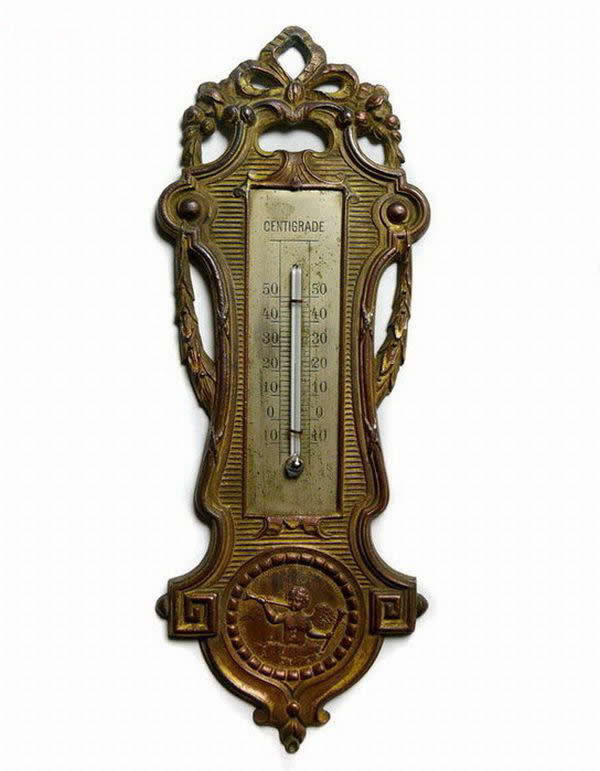
The ancient Greeks could have invented the thermometer, since they were well aquainted with the behavior of certain liquids and gases under conditions of changing temperature. Several scientists attempted to measure quantitative differences between hot and cold, but success came only late in the 16th century to the Italian astronomer Galileo.
Galileo’s device was actually a thermoscope, which had no degree scale, and measured only gross changes in temperature. A large glass bulb with a long, narrow, open-mouthed neck rested inverted over a vessel of colored water or alcohol. When air was forced from the bulb, the liquid rose up a short distance into the neck. When the bulb’s temperature changed, the air in it either expanded or contracted, and the level of liquid in the tube changed accordingly.
In 1611, the first scale was introduced by Sanctorius, a contemporary of Galileo. He gauged the low point by noting the level of the liquid when the thermoscope was surrounded by melting snow. Then he held a candle beneath it to mark the high point. From his observations, he arrived at a scale of 110 equal parts, or degrees. Thus, the thermo-scope, for “seeing” temperature changes, became a thermo-meter, for measuring those changes.
Early thermometers were inaccurate due to changes in barometric pressures causing liquid levels to change when temperatures did not. This problem was solved in 1644 when Grand Duke Ferdinand II of Tuscany introduced the hermetically sealed thermometer. He also founded in 1657 an academy for experimentation to improve temperature devices. They did not use mercury as modern models do (though academy members experimented with that liquid metal), but red wine instead, since it expanded faster when heated.
Summary
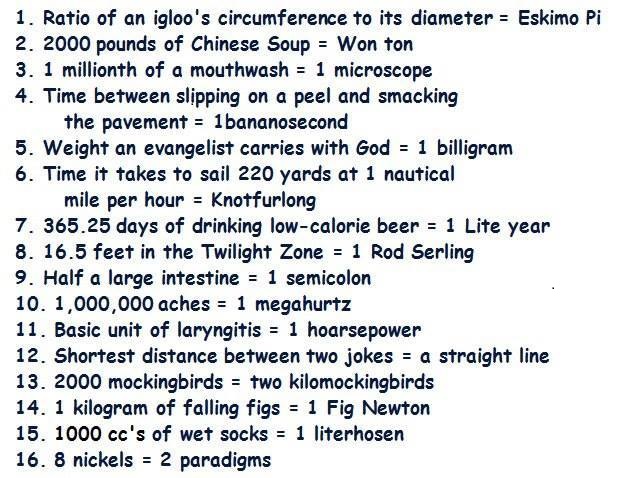
These are but a few, mostly ancient, examples of human inventions contributing to the rich scientific framework we have inherited. Many more have been added in modern times, and who knows what the future will bring. Below is a whimsical look at some possibilities.
Since science depends on measuring things, you need to know the correct units for what you are studying. Below are some obscure measures for special situations.
Friends of the Earth have been censured for their erroneous and misleading promotional flyer. The UK Advertising Standards Authority (ASA) said Friends of the Earth “agreed not to repeat the claims, or claims that had the same meaning.”
Friends of the Earth spent more than a year trying to defend its claims, which were made in a fundraising leaflet, but has been forced to withdraw them.
The authority found that Friends of the Earth (FoE) failed to substantiate claims that fracking could cause cancer, contaminate water supplies, increase asthma rates and send house prices plummeting.
The group’s capitulation is a victory for a retired vicar and a retired physics teacher who have been working for years to expose what they believe is scaremongering about a safe technique for extracting shale gas. (More about them in the footnote)
Truth in Climate Advertising! What a Concept!!
Who’s next? What about Greenpeace:
Greenpeace have been accused of employing deceptive techniques after it was revealed the environmental group had been using images of a storm damaged coral reef in The Philippines as a part of its campaign to have the Great Barrier Reef declared at risk.
On the left is a picture of bright, vibrant and thriving coral, while the image on the right features a pile of damaged, bone-white coral with a warning: ‘Don’t let them turn this, into this.’
How about the Natural Resources Defense Council (NRDC):
Shouldn’t they be forced to add this disclaimer:
Summary
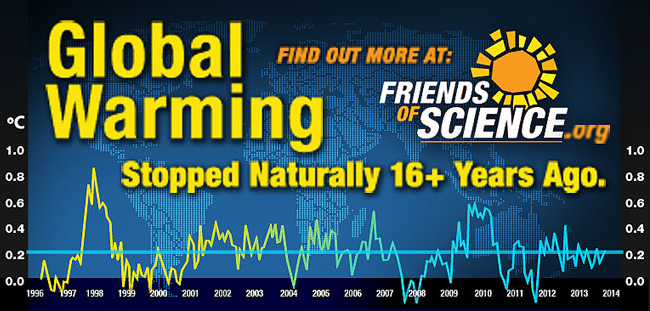
Friends of the Earth are making up stuff. Friends of Science give you the Beef:
Footnote
The UK Advertising Standards Authority did not have the brass to do their job protecting the public against deceptions. It took significant prodding from two determined people: a vicar and a retired school teacher.
They had previously complained to the Charity commission, who found a way to stand down rather than stand up.
The Charity Commission is considering closing a loophole in charity law that allowed a green group to raise money by making allegedly false claims in a political campaign against fracking.
Friends of the Earth, a registered charity, avoided restrictions on political activity by claiming that its antifracking campaign was being carried out by a non-charitable company called Friends of the Earth Limited.
The commission said the use of such similar names could confuse the public and damage public trust in charities.
Mr Wilkinson, who said that he had no connection with the fracking industry and was acting purely to ensure the public received accurate information, welcomed the ASA ruling. “It is outrageous that FoE used false information to raise money,” he said. “We need a frank debate about fracking and its potential impacts but it should be based on facts, not scaremongering.”








_th.jpg)














 Science Matters