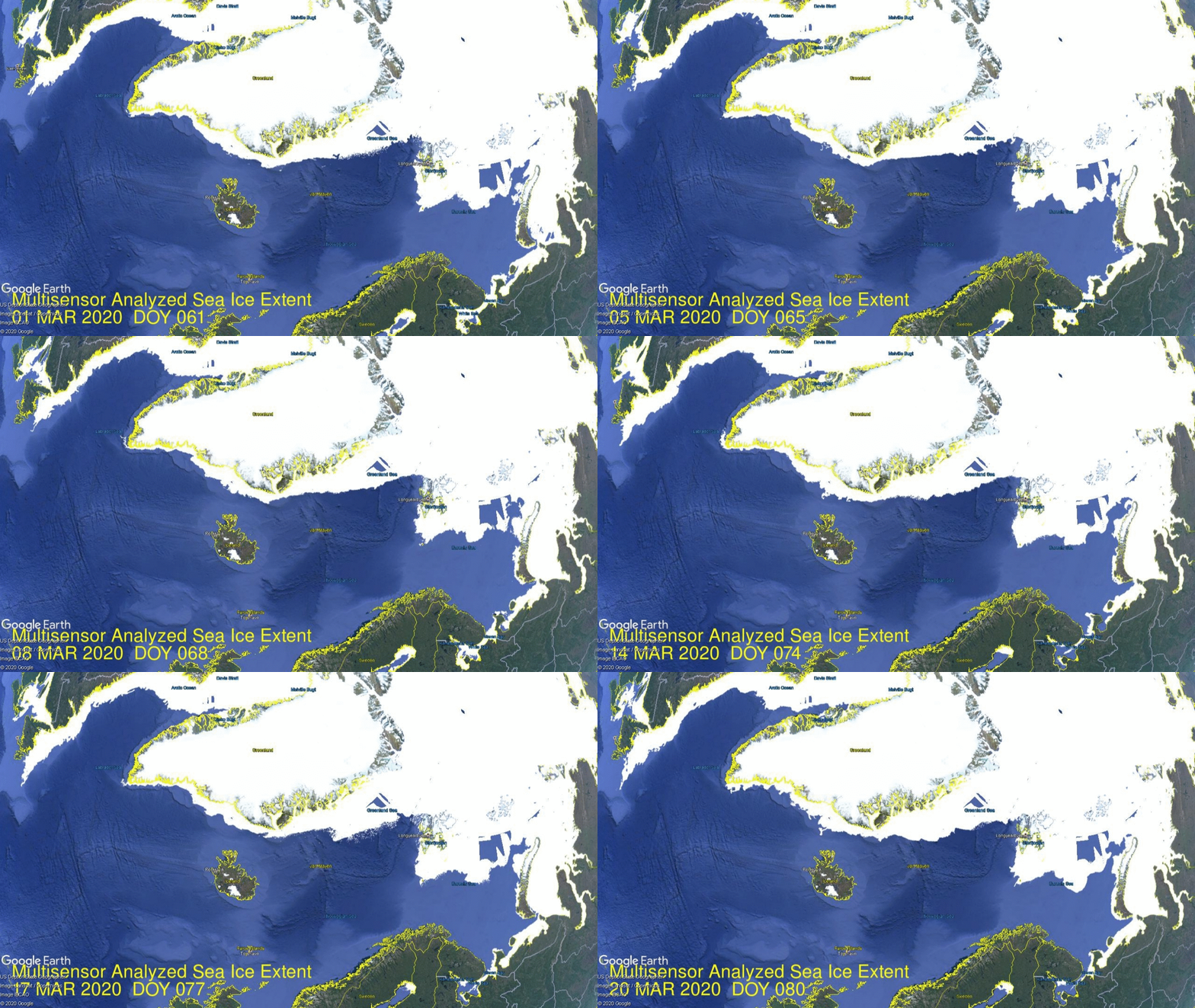
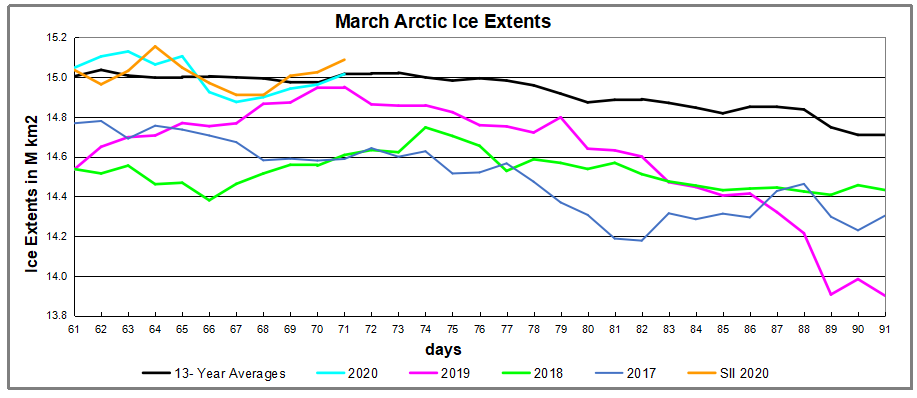
Previous posts showed 2020 Arctic Ice breaking the 15M km2 ceiling, while wondering whether the ice will have staying power. “Yes” is the answer, at least through the first third of March.
By end of February, ice extent this year was well above the 13- year average, then dipped lower before growing again surplus to average and other recent years. This is important since March monthly average is considered the ice extent maximum for the year. Note also the SII is matching and currently exceeding the MASIE estimates.
The chart below shows the distribution of ice across the various regions comprising the Arctic zone.
Region
2020071
Day 071 Average
2020-Ave.
2018071
2020-2018
(0) Northern_Hemisphere
15015552
15016528
-976
14608334
407218
(1) Beaufort_Sea
1070655
1070115
540
1070445
210
(2) Chukchi_Sea
966006
965984
22
966006
0
(3) East_Siberian_Sea
1087137
1087135
3
1087137
0
(4) Laptev_Sea
897845
897645
200
897845
0
(5) Kara_Sea
930542
923821
6721
933916
-3374
(6) Barents_Sea
658816
625730
33086
679863
-21047
(7) Greenland_Sea
617321
624974
-7654
526061
91259
(8) Baffin_Bay_Gulf_of_St._Lawrence
1516513
1597523
-81010
1488350
28163
(9) Canadian_Archipelago
854282
852766
1517
853109
1174
(10) Hudson_Bay
1260903
1259848
1055
1260838
66
(11) Central_Arctic
3248013
3215629
32384
3172178
75835
(12) Bering_Sea
818900
738395
80505
401469
417431
(13) Baltic_Sea
14681
87191
-72510
130767
-116086
(14) Sea_of_Okhotsk
1062110
1048073
14037
1120721
-58611
As of yesterday, Day 2020071 matches the NH 13-year average and also most regions. Two deficits to average are in Baffin Bay and Baltic Sea, offset by surpluses in Bering and Okhotsk, as well as Central Arctic and Barents Sea. Note current Bering Sea ice is twice the extent in 2018.
Update on Large Arctic Ice Extents as of March 5, 2020
After crashing through the 15M km2 ceiling, both MASIE and SII show the extents holding over that amount.
In addition to surpluses in Bering and Okhotsk Seas in the Pacific, Barents Sea is now growing significant ice on the European side. At 823k km2, Bering is 145% of 2019 maximum, while Barents is 94% of 2019 max.
Background from Previous Posts
As noted in a previous February post, March marks the moment of truth regarding the Arctic maximum extent. Ten days later 2020 met the challenge.
For ice extent in the Arctic, the bar is set at 15M km2. The average in the last 13 years occurs on day 62 at 15.04M before descending. Six of the last 13 years were able to clear 15M, but recently only 2014 and 2016 ice extents cleared the bar at 15M km2; the others came up short.
As of yesterday, 2020 cleared 15M km2 as recorded both by MASIE and SII.
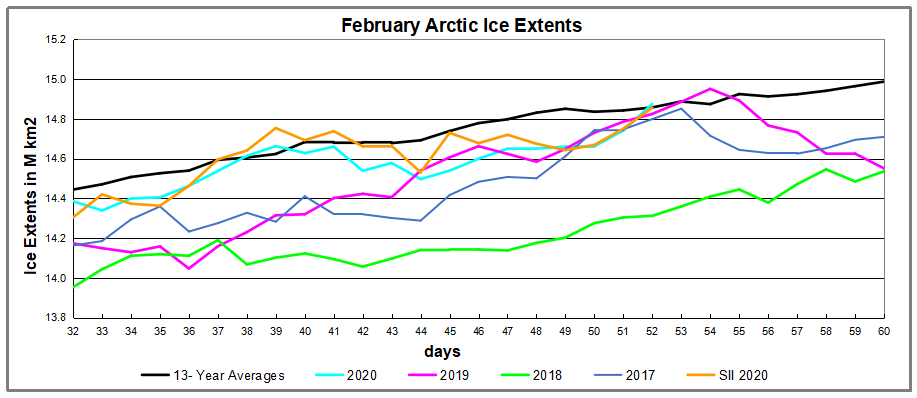
During February MASIE and SII both show ice extent hovering around the 13 year average, matching it exactly on day 52 at 14.85M km2. Then the ice cover shrank before growing strongly the last five days to overtake the 13 year average on day 61 at 15.05M km2.
Region
2020060
Day 060 Average
2020-Ave.
2018060
2020-2018
(0) Northern_Hemisphere
14999007
14987840
11167
14535979
463028
(1) Beaufort_Sea
1070655
1070222
433
1070445
210
(2) Chukchi_Sea
965972
963804
2168
965971
1
(3) East_Siberian_Sea
1087137
1087039
98
1087120
18
(4) Laptev_Sea
897845
897824
21
897845
0
(5) Kara_Sea
919052
928455
-9403
921526
-2474
(6) Barents_Sea
735450
634497
100953
512601
222848
(7) Greenland_Sea
596926
621572
-24646
518130
78796
(8) Baffin_Bay_Gulf_of_St._Lawrence
1464407
1544205
-79798
1783076
-318669
(9) Canadian_Archipelago
854282
853074
1209
853109
1174
(10) Hudson_Bay
1260887
1260890
-2
1260838
49
(11) Central_Arctic
3247904
3211522
36382
3087802
160103
(12) Bering_Sea
746111
674028
72083
340789
405322
(13) Baltic_Sea
30173
103770
-73598
134750
-104577
(14) Sea_of_Okhotsk
1110709
1097753
12956
1079823
30886
As reported previously, Pacific sea ice is a big part of the story this year. Out of the last 13 years, on day 52 only two years had Okhotsk ice extent higher than 2020, and only four years had higher Bering ice. Those surpluses offset a small deficit in Greenland Sea ice. And on day 61, the last push came from Bering and Okhotsk.
Typically, Arctic ice extent loses 67 to 70% of the March maximum by mid September, before recovering the ice in building toward the next March.
What will the ice do this year? Where will 2020 rank in the annual Arctic Ice High Jump competition?
As noted in a previous post ten days ago, March marks the moment of truth regarding the Arctic maximum extent. Now ten days later 2020 met the challenge.
For ice extent in the Arctic, the bar is set at 15M km2. The average in the last 13 years occurs on day 62 at 15.04M before descending. Six of the last 13 years were able to clear 15M, but recently only 2014 and 2016 ice extents cleared the bar at 15M km2; the others came up short.
As of yesterday, 2020 cleared 15M km2 as recorded both by MASIE and SII.
During February MASIE and SII both show ice extent hovering around the 13 year average, matching it exactly on day 52 at 14.85M km2. Then the ice cover shrank before growing strongly the last five days to overtake the 13 year average on day 61 at 15.05M km2.
Region
2020060
Day 060 Average
2020-Ave.
2018060
2020-2018
(0) Northern_Hemisphere
14999007
14987840
11167
14535979
463028
(1) Beaufort_Sea
1070655
1070222
433
1070445
210
(2) Chukchi_Sea
965972
963804
2168
965971
1
(3) East_Siberian_Sea
1087137
1087039
98
1087120
18
(4) Laptev_Sea
897845
897824
21
897845
0
(5) Kara_Sea
919052
928455
-9403
921526
-2474
(6) Barents_Sea
735450
634497
100953
512601
222848
(7) Greenland_Sea
596926
621572
-24646
518130
78796
(8) Baffin_Bay_Gulf_of_St._Lawrence
1464407
1544205
-79798
1783076
-318669
(9) Canadian_Archipelago
854282
853074
1209
853109
1174
(10) Hudson_Bay
1260887
1260890
-2
1260838
49
(11) Central_Arctic
3247904
3211522
36382
3087802
160103
(12) Bering_Sea
746111
674028
72083
340789
405322
(13) Baltic_Sea
30173
103770
-73598
134750
-104577
(14) Sea_of_Okhotsk
1110709
1097753
12956
1079823
30886
As reported previously, Pacific sea ice is a big part of the story this year. Out of the last 13 years, on day 52 only two years had Okhotsk ice extent higher than 2020, and only four years had higher Bering ice. Those surpluses offset a small deficit in Greenland Sea ice. And on day 61, the last push came from Bering and Okhotsk.
Typically, Arctic ice extent loses 67 to 70% of the March maximum by mid September, before recovering the ice in building toward the next March.
What will the ice do this year? Where will 2020 rank in the annual Arctic Ice High Jump competition?
For ice extent in the Arctic, the bar is set at 15M km2. The average in the last 13 years occurs on day 62 at 15.04M before descending. Six of the last 13 years were able to clear 15M, but recently only 2014 and 2016 ice extents cleared the bar at 15M km2; the others came up short.
During February MASIE and SII both show ice extent hovering around the 13 year average, matching it exactly on day 52 at 14.85M km2. Other recent years were lower until 2019 caught up, before dropping off in the final week of the month. We shall see what this year does with only 10 to 14 days left before the March maximum is recorded.
Region
2020052
Day 052 Average
2020-Ave.
2018052
2020-2018
(0) Northern_Hemisphere
14875470
14857903
17567
14312247
563223
(1) Beaufort_Sea
1070655
1070222
433
1070445
210
(2) Chukchi_Sea
965972
964814
1158
955104
10868
(3) East_Siberian_Sea
1087137
1087039
98
1087120
18
(4) Laptev_Sea
897845
897824
21
897845
0
(5) Kara_Sea
906378
917433
-11055
917969
-11591
(6) Barents_Sea
648148
613817
34332
552077
96071
(7) Greenland_Sea
538698
613963
-75264
428606
110092
(8) Baffin_Bay_Gulf_of_St._Lawrence
1502218
1495888
6330
1757430
-255211
(9) Canadian_Archipelago
854282
853074
1209
853109
1174
(10) Hudson_Bay
1259931
1260881
-950
1260838
-907
(11) Central_Arctic
3246709
3213870
32839
3150241
96468
(12) Bering_Sea
731776
685013
46763
194708
537067
(13) Baltic_Sea
25524
104858
-79334
94201
-68677
(14) Sea_of_Okhotsk
1117881
1022253
95628
1060733
57148
As reported previously, Pacific sea ice is a big part of the story this year. Out of the last 13 years, on day 52 only two years had Okhotsk ice extent higher than 2020, and only four years had higher Bering ice. Those surpluses offset a small deficit in Greenland Sea ice.
Typically, Arctic ice extent loses 67 to 70% of the March maximum by mid September, before recovering the ice in building toward the next March.
What will the ice do this year? Where will 2020 rank in the annual Arctic Ice High Jump competition?
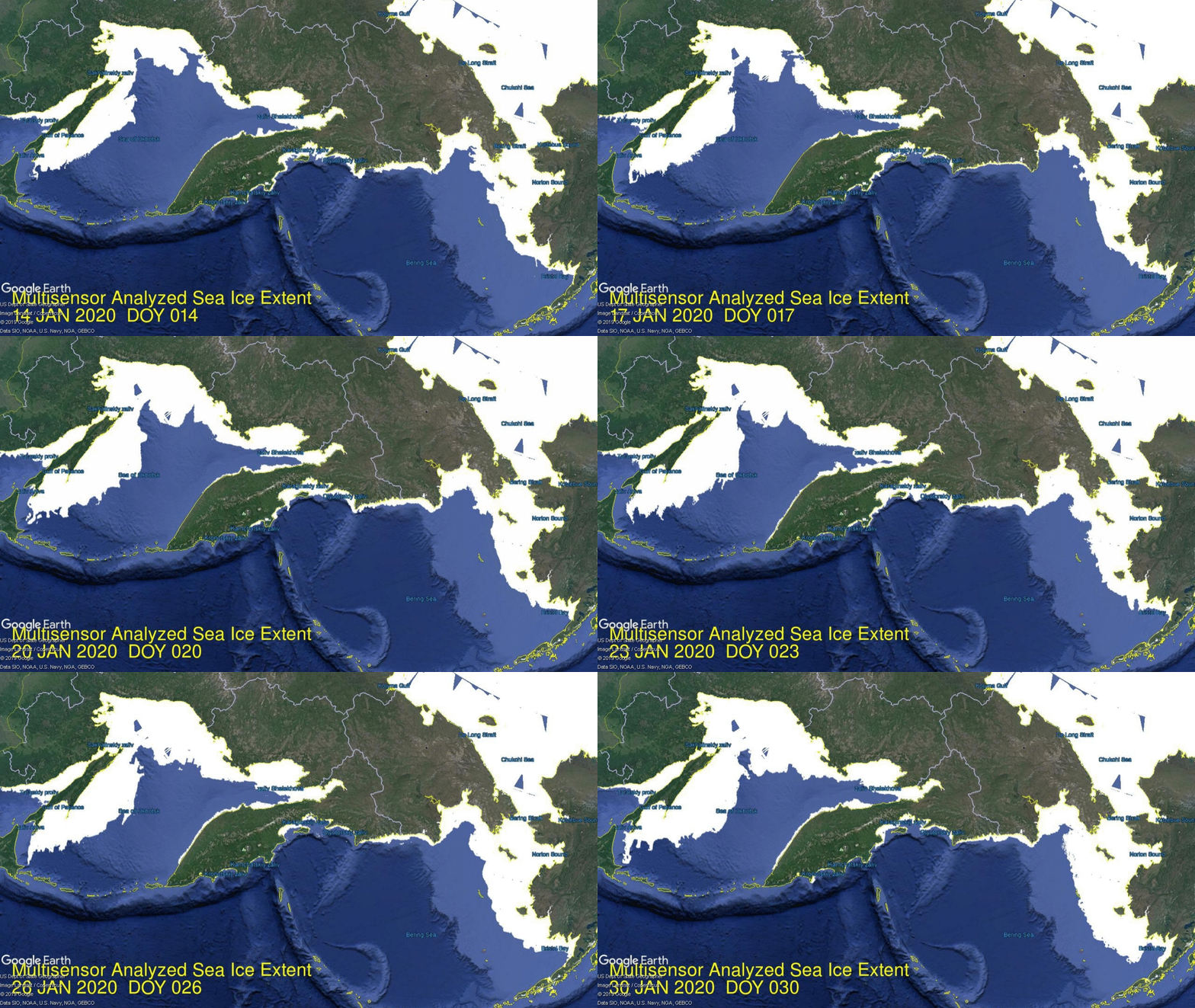
A previous post noted the Pacific ice see saw had returned, with Bering Sea slow to recover. The image above shows that now both Pacific seas are recovering ice strongly in the second half of January 2020. As supported by the table later, the pace of refreezing was slow to begin but 2020 extents are now quite ordinary and tracking the 13 year average (2007 to 2019 inclusive). Okhotsk Sea on the left has steadily grown 250k km2 ice extent to be currently at 68% of last March maximum. Bering on the right added 170k km2 and now exceeds last March max by 3%.
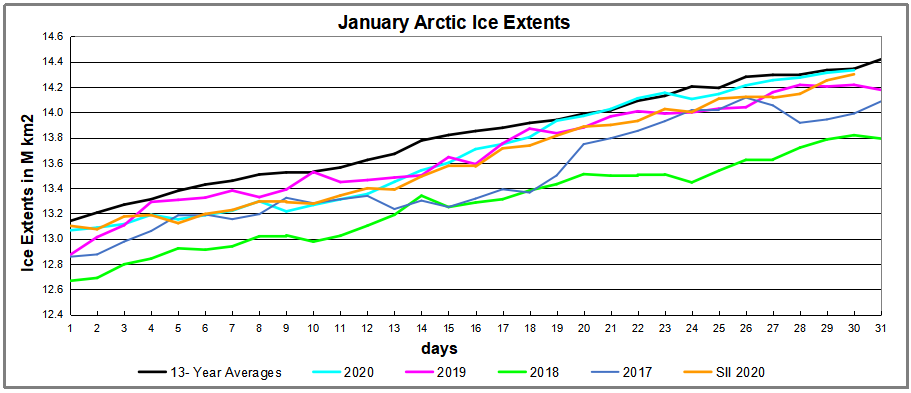
On the Atlantic side there has also been some ice growth on the margins. Notably Barents Sea on the right has added 160k km2 to exceed its average by 40%, and is now 95% of last March max. Also visible on the upper left is ice forming in the Gulf of St. Lawrence and Baffin Bay ice slowly extending south. The graph below shows the ice extent growing during January compared to some other years and the 13 year average (2007 to 2019 inclusive).
Note that the NH ice extent 13 year average increases about 1.2M km2 during January, up to 14.4M km2. MASIE 2020 stated with a slower icing rate, dropping 300k km2 lower than average before catching up to reaching the average on January 19 and tracking closely since. Other years were lower at this point, while MASIE and SII 2020 are showing nearly the same extents.
The table shows where the ice is distributed compared to average. Deficits in Greenland Sea and Baffin Bay are offset by a 230k km2 surplus of Barents Sea ice. At this point the surplus in Okhotsk exceeds the Bering deficit.
Region
2020030
Day 030 Average
2020-Ave.
2018030
2020-2018
(0) Northern_Hemisphere
14333538
14344185
-10647
13819038
514500
(1) Beaufort_Sea
1070655
1070223
432
1070445
210
(2) Chukchi_Sea
965972
965999
-27
965971
1
(3) East_Siberian_Sea
1087137
1087133
4
1087120
18
(4) Laptev_Sea
897845
897842
3
897845
0
(5) Kara_Sea
934901
914385
20515
880656
54245
(6) Barents_Sea
783310
553930
229380
471973
311337
(7) Greenland_Sea
482444
588685
-106241
506539
-24094
(8) Baffin_Bay_Gulf_of_St._Lawrence
1260581
1347235
-86653
1384973
-124392
(9) Canadian_Archipelago
854282
853059
1223
853109
1174
(10) Hudson_Bay
1260192
1260815
-623
1260838
-646
(11) Central_Arctic
3212864
3207580
5284
3176620
36244
(12) Bering_Sea
584617
645329
-60712
402199
182419
(13) Baltic_Sea
12939
80631
-67693
37943
-25004
(14) Sea_of_Okhotsk
894008
807371
86637
763761
130247
Footnote: Interesting comments on January 13 by Dr. Judah Cohen at his blogregarding the Arctic fluctuations. Excerpts in italics with my bolds.
Arctic sea ice extent
The positive AO is conducive to sea ice growth and Arctic sea ice growth rate continues to grow slowly and remains well below normal but higher than recent winters; the weather pattern remains favorable for further sea ice growth. Negative sea ice anomalies exist in three regions: the Bering Sea, around Greenland-Canadian Archipelagos and Barents-Kara Seas. The anomalies in the North Pacific sector have shrunk (Figure 16), and based on model forecasts negative sea ice anomalies in the Bering Sea can shrink further in the next two weeks. Below normal sea ice in and around Greenland and the Canadian Archipelagos may favor a negative winter NAO, though there are no signs of such a scenario. Based on recent research low sea ice anomalies in the Chukchi and Bering seas favors cold temperatures in central and eastern North America while low sea ice in the Barents-Kara seas favor cold temperatures in Central and East Asia, however this topic remains controversial. Recent research has shown that regional anomalies that are most highly correlated with the strength of the stratospheric PV are across the Barents-Kara seas region where low Arctic sea ice favors a weaker winter PV.
Northern Hemisphere Snow Cover
Despite a strongly postive AO snow cover has advanced across Eurasia and is now near decadal means. And if the snowfall forecasts for Europe ever verify it could advance further. Above normal snow cover extent in October, favors a strengthened Siberian high, cold temperatures across northern Eurasia and a weakened polar vortex/negative AO this upcoming winter followed by cold temperatures across the continents of the NH.
Illustration by Eleanor Lutz shows Earth’s seasonal climate changes. If played in full screen, the four corners present views from top, bottom and sides. It is a visual representation of scientific datasets measuring Arctic ice extents and snow cover.
A previous post reprinted below pointed out how Pacific ice recovers in fits and starts, often see sawing between Bering and Okhotsk Seas. Now both of them are growing faster than the 13 year average (2007 to 2019 inclusive). The image above shows how much colder is Alaska this year versus 2019, probably related to Bering icing over. In the last 9 days, Bering added 100k km2, now up to 85% of last March max. Okhotsk added 150k km2 up to 67% of last March max.
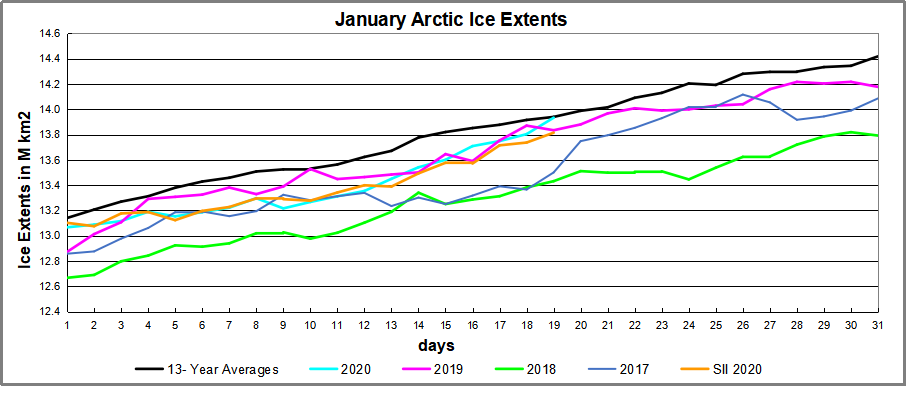
The graph shows how January 2020 compared to 13 year average and some other years of interest.
This year’s recovery is matching and slightly exceeding average, and ahead of other recent years. MASIE shows extents slightly higher than SII.
By January there are not many places where Arctic ice extent can grow. All the Eurasian shelf seas are full, as is the case on the CanAm side: Beaufort, CAA, Hudson Bay covered completely. Barents and Greenland Seas have some room to grow, as does Baffin Bay. But mainly the variability is on the Pacific side, where the usual Bering/Okhotsk see saw is reappearing.
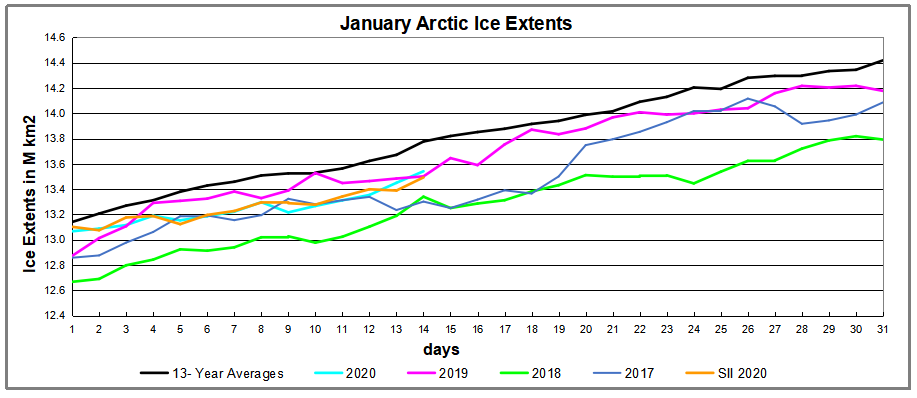
As we have seen in past winters, ice in the Pacific Arctic tends to grow in fits and spurts, often alternating between Bering and Okhotsk Seas. The above image of the first two weeks of 2020 shows Okhotsk on the left growing ice steadily while Bering waffled back and forth ending with almost the same extent. Combined the two seas ice extents are slightly below the 13 year average at this time, due to Bering’s slow recovery.
The January graph shows MASIE and SII reporting the same pace of ice recovery and matching 2019. This is somewhat below the 13 year average (2007 to 2019 inclusive) and higher than 2017 and 2018. The table below shows the distribution of ice extent among the Arctic regions on January 14.
Region
2020014
Day 014 Average
2020-Ave.
2018014
2020-2018
(0) Northern_Hemisphere
13541376
13776703
-235327
13340428
200948
(1) Beaufort_Sea
1070655
1070223
432
1070445
210
(2) Chukchi_Sea
965972
965812
160
965971
1
(3) East_Siberian_Sea
1087137
1087133
4
1087120
18
(4) Laptev_Sea
897845
897842
3
897845
0
(5) Kara_Sea
932936
909656
23280
925247
7689
(6) Barents_Sea
619526
508236
111290
393026
226500
(7) Greenland_Sea
483377
610574
-127197
521896
-38519
(8) Baffin_Bay_Gulf_of_St._Lawrence
1039079
1172487
-133408
1173039
-133960
(9) Canadian_Archipelago
854282
853058
1225
853109
1174
(10) Hudson_Bay
1260192
1251600
8592
1260838
-646
(11) Central_Arctic
3233354
3210543
22811
3194383
38971
(12) Bering_Sea
414963
521989
-107026
241830
173133
(13) Baltic_Sea
8863
43903
-35040
24486
-15623
(14) Sea_of_Okhotsk
651004
626433
24571
696684
-45681
2019 NH ice is 235k km2 below the 13-year average, or 1.7%, and 200k km2 more than 2018 on that date. The deficits are in Bering, Greenland Sea and Baffin Bay, partly offset by surpluses in Barents, Kara and Okhotsk.
The next month or so will show how the Pacific ice shapes up.
A previous post noted the Pacific ice see saw had returned, with Bering Sea slow to recover. The image above shows recovery of Arctic sea ice extent over the month of January 2020. As supported by the table later, the pace of refreezing was slow to begin but has now allowed 2020 to match the 13 year average (2007 to 2019 inclusive). Okohotsk Sea on the left has grown ice extent steadily to be currently at 66% of last March maximum. Bering on the right waffled back and forth but gained strongly the last few days.
The graph below shows the ice extent growing during January compared to some other years and the 13 year average (2007 to 2019 inclusive).
Note that the NH ice extent 13 year average increases about 1.2M km2 during January, up to 14.4M km2. MASIE 2020 stated with a slower icing rate, dropping 300k km2 lower than average before catching up to reaching the average on January 19. Both 2018 and 2017 were lower at this point, while MASIE and SII are tracking closely together.
The table shows where the ice is distributed compared to average. Deficits in Greenland Sea and Baffin Bay are offset by surpluses in Kara and Barents Seas. At this point the surplus in Okhotsk exceeds the Bering deficit. Going forward, most of the additional ice extent will in the Pacific Seas.
Region
2020019
Day 019 Average
2020-Ave.
2018019
2020-2018
(0) Northern_Hemisphere
13933540
13939872
-6332
13431421
502118
(1) Beaufort_Sea
1070655
1070223
432
1070445
210
(2) Chukchi_Sea
965972
965999
-27
965971
1
(3) East_Siberian_Sea
1087137
1087133
4
1087120
18
(4) Laptev_Sea
897845
897842
3
897845
0
(5) Kara_Sea
933810
911944
21867
902003
31807
(6) Barents_Sea
646750
502965
143784
286684
360065
(7) Greenland_Sea
525324
600387
-75063
453112
72212
(8) Baffin_Bay_Gulf_of_St._Lawrence
1155618
1245934
-90317
1355009
-199391
(9) Canadian_Archipelago
854282
853058
1225
853109
1174
(10) Hudson_Bay
1260192
1257480
2712
1260838
-646
(11) Central_Arctic
3239662
3203861
35801
3161866
77796
(12) Bering_Sea
443027
570321
-127294
309601
133425
(13) Baltic_Sea
9625
52416
-42791
24115
-14491
(14) Sea_of_Okhotsk
817160
669235
147925
782693
34467
Footnote: Interesting comments on January 13 by Dr. Judah Cohen at his blogregarding the Arctic fluctuations. Excerpts in italics with my bolds.
Arctic sea ice extent
The positive AO is conducive to sea ice growth and Arctic sea ice growth rate continues to grow slowly and remains well below normal but higher than recent winters; the weather pattern remains favorable for further sea ice growth. Negative sea ice anomalies exist in three regions: the Bering Sea, around Greenland-Canadian Archipelagos and Barents-Kara Seas. The anomalies in the North Pacific sector have shrunk (Figure 16), and based on model forecasts negative sea ice anomalies in the Bering Sea can shrink further in the next two weeks. Below normal sea ice in and around Greenland and the Canadian Archipelagos may favor a negative winter NAO, though there are no signs of such a scenario. Based on recent research low sea ice anomalies in the Chukchi and Bering seas favors cold temperatures in central and eastern North America while low sea ice in the Barents-Kara seas favor cold temperatures in Central and East Asia, however this topic remains controversial. Recent research has shown that regional anomalies that are most highly correlated with the strength of the stratospheric PV are across the Barents-Kara seas region where low Arctic sea ice favors a weaker winter PV.
Northern Hemisphere Snow Cover
Despite a strongly postive AO snow cover has advanced across Eurasia and is now near decadal means. And if the snowfall forecasts for Europe ever verify it could advance further. Above normal snow cover extent in October, favors a strengthened Siberian high, cold temperatures across northern Eurasia and a weakened polar vortex/negative AO this upcoming winter followed by cold temperatures across the continents of the NH.
Illustration by Eleanor Lutz shows Earth’s seasonal climate changes. If played in full screen, the four corners present views from top, bottom and sides. It is a visual representation of scientific datasets measuring Arctic ice extents and snow cover.
By January there are not many places where Arctic ice extent can grow. All the Eurasian shelf seas are full, as is the case on the CanAm side: Beaufort, CAA, Hudson Bay covered completely. Barents and Greenland Seas have some room to grow, as does Baffin Bay. But mainly the variability is on the Pacific side, where the usual Bering/Okhotsk see saw is reappearing.
As we have seen in past winters, ice in the Pacific Arctic tends to grow in fits and spurts, often alternating between Bering and Okhotsk Seas. The above image of the first two weeks of 2020 shows Okhotsk on the left growing ice steadily while Bering waffled back and forth ending with almost the same extent. Combined the two seas ice extents are slightly below the 13 year average at this time, due to Bering’s slow recovery.
The January graph shows MASIE and SII reporting the same pace of ice recovery and matching 2019. This is somewhat below the 13 year average (2007 to 2019 inclusive) and higher than 2017 and 2018. The table below shows the distribution of ice extent among the Arctic regions on January 14.
Region
2020014
Day 014 Average
2020-Ave.
2018014
2020-2018
(0) Northern_Hemisphere
13541376
13776703
-235327
13340428
200948
(1) Beaufort_Sea
1070655
1070223
432
1070445
210
(2) Chukchi_Sea
965972
965812
160
965971
1
(3) East_Siberian_Sea
1087137
1087133
4
1087120
18
(4) Laptev_Sea
897845
897842
3
897845
0
(5) Kara_Sea
932936
909656
23280
925247
7689
(6) Barents_Sea
619526
508236
111290
393026
226500
(7) Greenland_Sea
483377
610574
-127197
521896
-38519
(8) Baffin_Bay_Gulf_of_St._Lawrence
1039079
1172487
-133408
1173039
-133960
(9) Canadian_Archipelago
854282
853058
1225
853109
1174
(10) Hudson_Bay
1260192
1251600
8592
1260838
-646
(11) Central_Arctic
3233354
3210543
22811
3194383
38971
(12) Bering_Sea
414963
521989
-107026
241830
173133
(13) Baltic_Sea
8863
43903
-35040
24486
-15623
(14) Sea_of_Okhotsk
651004
626433
24571
696684
-45681
2019 NH ice is 235k km2 below the 13-year average, or 1.7%, and 200k km2 more than 2018 on that date. The deficits are in Bering, Greenland Sea and Baffin Bay, partly offset by surpluses in Barents, Kara and Okhotsk.
The next month or so will show how the Pacific ice shapes up.
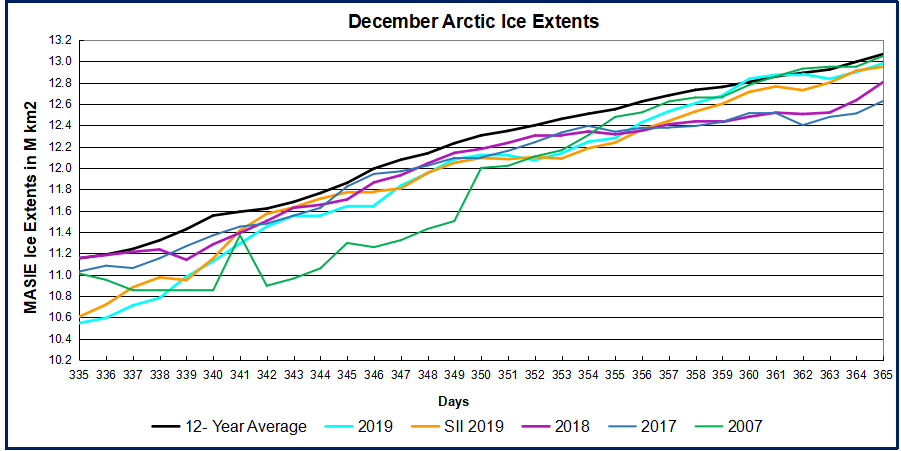
The image above shows recovery of Arctic sea ice extent over the month of December 2019. As supported by the table later, the pace of refreezing allowed 2019 to match and exceed for a few days the 12 year average (2007 to 2018 inclusive).
The month began with seas on the Eurasian side (left) already ice-covered, so no additional extent came from there. OTOH Hudson Bay (right) filled in completely, gaining from 445k km2 to 1255k km2, virtually to its max. Most of the action now is on the Pacific side (bottom) where Chukchi iced over, and Bering (center) and Okhotsk (left) have started to freeze in ernest.
The graph below shows the ice extent growing during December compared to some other years and the 12 year average (2007 to 2018 inclusive).
Note that the NH ice extent 12 year average increases almost 2M km2 during December, up to 13.1M km2. MASIE 2019 shows a faster icing rate, starting 600k km2 lower than average before reaching and surpassing the average, ending December in a virtual tie with average. Both 2018 and 2017 were lower at this point, while MASIE and SII are tracking closely together.
Region
2019365
Day 365 Average
2019-Ave.
2017365
2019-2007
(0) Northern_Hemisphere
12980000
13070435
-90436
12628187
351813
(1) Beaufort_Sea
1070655
1070266
389
1070445
210
(2) Chukchi_Sea
965972
964161
1811
943883
22090
(3) East_Siberian_Sea
1087137
1087134
3
1087120
18
(4) Laptev_Sea
897845
897842
3
897845
0
(5) Kara_Sea
929682
880747
48935
892689
36993
(6) Barents_Sea
479642
424886
54756
331819
147823
(7) Greenland_Sea
590098
568883
21215
555757
34341
(8) Baffin_Bay_Gulf_of_St._Lawrence
851131
1016132
-165001
978074
-126943
(9) Canadian_Archipelago
854282
853098
1185
853109
1174
(10) Hudson_Bay
1254576
1231781
22795
1260838
-6262
(11) Central_Arctic
3228672
3206086
22586
3191526
37147
(12) Bering_Sea
362317
439846
-77529
194350
167967
(13) Baltic_Sea
8738
32177
-23439
13345
-4607
(14) Sea_of_Okhotsk
390113
376320
13793
336595
53518
The table shows where the ice is distributed compared to average. Bering Sea and Baffin Bay have the only deficits to average, while other regions are at or above average; Kara and Barents Seas are in surplus.
Footnote: Interesting comments recently by Dr. Judah Cohen at his blogregarding the Arctic fluctuations. Excerpts with my bolds.
I have said many times the first thing that you learn as a seasonal forecaster is humility and these are one of those times. What is humbling me at the moment is that I have expected a weakening of the stratospheric polar vortex (PV) based on fall Arctic predictors – extensive Siberian snow cover, more limited Arctic sea ice extent and a relatively warm Arctic. Following the PV weakening or disruption, severe winter weather would be more frequent at least regionally across the mid-latitudes of the Northern Hemisphere (NH). But to be honest it is hard to see from today’s viewpoint how this verifies. And as I have shared on Twitter the new operational GFS, the FV3, has been especially bullish on a strong PV.
The biggest challenge that I see right now is the center of low mid-tropospheric heights currently just north of Alaska and is expected to expand in breadth over the next two weeks enough so to fill the entire Arctic basin. This a fairly class pattern of low heights in the Arctic and high heights in the mid-latitudes resulting in a cold Arctic/warm continents pattern, all consistent with a positive AO. It seems a bit ironic (at least to me) that with the record low sea ice in the Chukchi-Bering seas this fall, the incredibly warm year Alaska just experienced both in part due to persistent ridging in the region, this same region is predicted to now experience an extended period of low heights and below normal temperatures. As an aside, this is something that I had a hard time anticipating even just a few weeks ago.
So, for now I remain steadfast in the winter forecast that based on high fall snow cover/low Arctic sea ice that they will in tandem perturb the PV. Given the westerly quasi-biennial oscillation (QBO) I expect a scenario somewhere between winter 2016/17 and winter 2017/18. Both of those winters were westerly QBO winters and the most significant disruption of the stratospheric PV took place in February.
Illustration by Eleanor Lutz shows Earth’s seasonal climate changes. If played in full screen, the four corners present views from top, bottom and sides. It is a visual representation of scientific datasets measuring Arctic ice extents.
The image above, supported by the table later on shows that in December ice has recovered in the central Arctic with open water found only on the margins, as is typical this time of year. The animation shows progression of ice extent from Dec. 1 to Dec. 22, 2019.
Most dramatic is Hudson Bay on the left filling in over these 3 weeks, from 445k km2 up to 1214k km2, 96% of maximum. At the top, Chukchi Sea also ices over, from 589k km2 to 933k km2, 97% of max. Above Chukchi is Bering Sea just starting with fast ice, and Okhotsk upper right growing ice as usual. The two places lagging behind in ice recovery are Bering Sea and Baffin Bay.
The graph below shows the ice extent growing during December compared to some other years and the 12 year average (2007 to 2018 inclusive).
Note that the NH ice extent 12 year average increases almost 2M km2 during December, up to 13.1M km2. MASIE 2019 shows a faster icing rate, starting 600k km2 lower than average and now down 200k km2, or 1.5%. MASIE and SII are tracking quite closely this month. By month end all years appear to be converging on the 12-year average.
Region
2019356
Day 356 Average
2019-Ave.
2010356
2019-2010
(0) Northern_Hemisphere
12428357
12623541
-195184
12257118
171239
(1) Beaufort_Sea
1070223
1070266
-42
1070445
-222
(2) Chukchi_Sea
933276
953650
-20374
964317
-31041
(3) East_Siberian_Sea
1087137
1087133
4
1087137
0
(4) Laptev_Sea
897845
897842
3
897845
0
(5) Kara_Sea
929742
864955
64786
934937
-5195
(6) Barents_Sea
447093
358194
88899
607130
-160037
(7) Greenland_Sea
533666
562497
-28831
579647
-45980
(8) Baffin_Bay_Gulf_of_St._Lawrence
751185
924722
-173536
630041
121144
(9) Canadian_Archipelago
854282
853082
1201
853214
1068
(10) Hudson_Bay
1213848
1199010
14839
767479
446370
(11) Central_Arctic
3225391
3199892
25499
3244808
-19417
(12) Bering_Sea
147493
312873
-165379
219969
-72475
(13) Baltic_Sea
11462
20025
-8564
100363
-88902
(14) Sea_of_Okhotsk
324167
306066
18101
283712
40455
The table shows where the ice is distributed compared to average. Bering Sea and Baffin Bay have the only large deficits to average, while Kara and Barents Seas are in surplus.
Footnote: Interesting comments today by Dr. Judah Cohen at his blogregarding the Arctic fluctuations. Excerpts with my bolds.
I have said many times the first thing that you learn as a seasonal forecaster is humility and these are one of those times. What is humbling me at the moment is that I have expected a weakening of the stratospheric polar vortex (PV) based on fall Arctic predictors – extensive Siberian snow cover, more limited Arctic sea ice extent and a relatively warm Arctic. Following the PV weakening or disruption, severe winter weather would be more frequent at least regionally across the mid-latitudes of the Northern Hemisphere (NH). But to be honest it is hard to see from today’s viewpoint how this verifies. And as I have shared on Twitter the new operational GFS, the FV3, has been especially bullish on a strong PV.
The biggest challenge that I see right now is the center of low mid-tropospheric heights currently just north of Alaska and is expected to expand in breadth over the next two weeks enough so to fill the entire Arctic basin. This a fairly class pattern of low heights in the Arctic and high heights in the mid-latitudes resulting in a cold Arctic/warm continents pattern, all consistent with a positive AO. It seems a bit ironic (at least to me) that with the record low sea ice in the Chukchi-Bering seas this fall, the incredibly warm year Alaska just experienced both in part due to persistent ridging in the region, this same region is predicted to now experience an extended period of low heights and below normal temperatures. As an aside, this is something that I had a hard time anticipating even just a few weeks ago.
So, for now I remain steadfast in the winter forecast that based on high fall snow cover/low Arctic sea ice that they will in tandem perturb the PV. Given the westerly quasi-biennial oscillation (QBO) I expect a scenario somewhere between winter 2016/17 and winter 2017/18. Both of those winters were westerly QBO winters and the most significant disruption of the stratospheric PV took place in February.
Illustration by Eleanor Lutz shows Earth’s seasonal climate changes. If played in full screen, the four corners present views from top, bottom and sides.