Curing Radiation Myopia Regarding Climate

E.M. Smith provides an helpful critique of a recent incomplete theory of earth’s climate functioning in his Chiefio blog post So Close–Missing Convection and Homeostasis. Excerpts in italics with my bolds and added images.

It is Soooo easy to get things just a little bit off and miss reality. Especially in complex systems and even more so when folks raking in $Millions are interested in misleading for profit. Sigh.

Sabine Hosenfelder does a wonderful series of videos ‘explaining’ all sorts of interesting things in and about actual science and how the universe works. She is quite smart and generally “knows her stuff”. But… It looks like she has gotten trapped into the Radiative Model of Globull Warming.

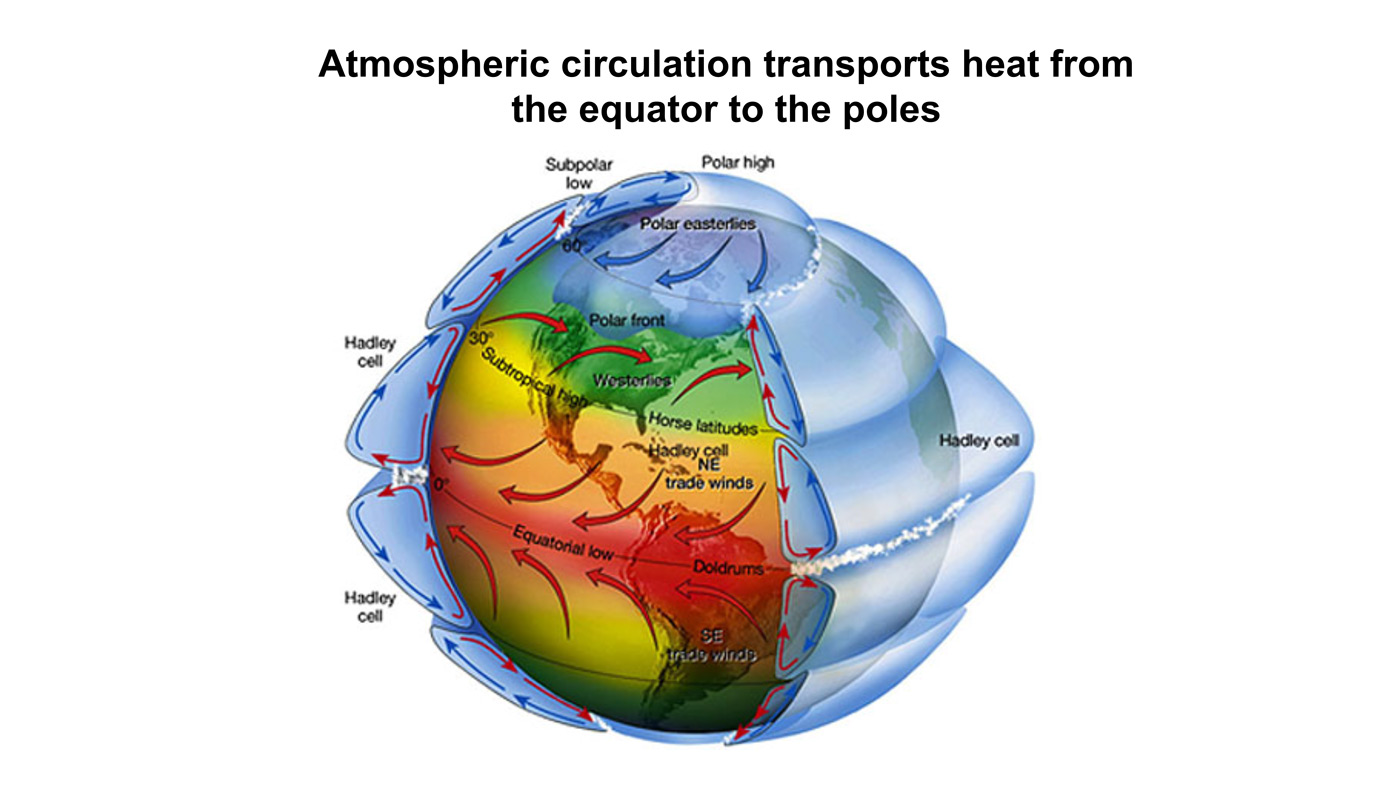
The whole mythology of Global Warming depends on having you NOT think about anything but radiative processes and physics. To trap you into the Radiative Model. But the Earth is more complex than that. Much more complex. Then there’s the fact that you DO have some essential Radiative Physics to deal with, so the bait is there.   However…

It is absolutely essential to pay attention to convection in the lower atmosphere
and to the “feedback loops” or homeostasis in the system.

The system acts to restore its original state. There is NO “runaway greenhouse” or we would have never evolved into being since the early earth had astoundingly high levels of CO2 and we would have baked to death before getting out of our slime beds as microbes.

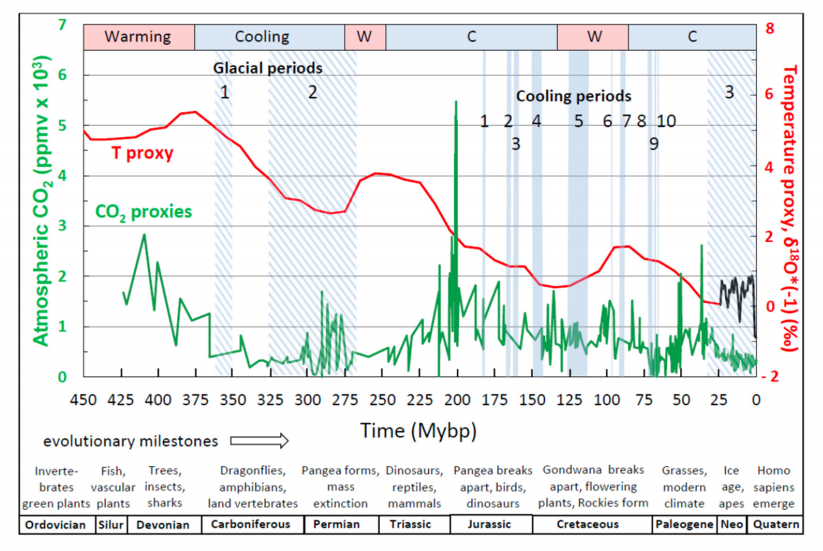
Figure 16. The geological history of CO2 level and temperature proxy for the past 400 million years. CO2 levels now are ~ 400ppm. Source: Davis, W. J. (2017).

OK, I’ll show you her video. It is quite good even with the “swing and a miss” at the end. She does 3 levels of The Greenhouse Gas Mythology so you can see the process evolving from grammar school to high school to college level of mythology. But then she doesn’t quite make it to Post-Doc Reality.

Where’s she wrong? (Well, not really wrong, but lacking…)

I see 2 major issues. First off, she talks about the “lower atmosphere warming”. Well, yes and no. It doesn’t “warm” in the sense of getting hotter, but it does speed up convection to move the added heat flow.

In English “heating” has 2 different meanings. Increasing temperature.
Increasing heat flow at a temperature.

We see this in “warm up the TV dinner in the microwave” meaning to heat it up from frozen to edible; and in the part where the frozen dinner is defrosting at a constant temperature as it absorbs heat but turns it into the heat of fusion of water. So you can “warm it up” by melting at a constant temperature of frozen water (but adding a LOT of thermal energy – “heat”) then later as increasing temperature once the ice is melted. It is very important to keep in mind that there are 2 kinds of “heating”. NOT just “increasing temperature”.

In the lower atmosphere, the CO2 window / Infrared Window is already firmly slammed shut. Sabine “gets that”. Yay! One BIG point for her! No amount of “greenhouse gas” is going to shut that IR window any more. As she points out, you get about 20 meters of transmission and then it is back to molecular vibrations (aka “heat”).

So what’s an atmosphere to do? It has heat to move! Well, it convects. It evaporates water.

Those 2 things dominate by orders of magnitude any sort of Radiative Model Physics. Yes, you have radiation of light bringing energy in, but then it goes into the ocean and into the dirt and the plants and even warms your skin on a sunny day. And it sits there. It does NOT re-radiate to any significant degree. Once “warmed” by absorption, heat trying to leave as IR hits a slammed shut window.

The hydrological cycle. Estimates of the observed main water reservoirs (black numbers in 10^3 km3 ) and the flow of moisture through the system (red numbers, in 10^3 km3 yr À1 ). Adjusted from Trenberth et al. [2007a] for the period 2002-2008 as in Trenberth et al. [2011].

So what does happen? Look around, what do you see? Clouds. Rain. Snow. (sleet hail fog etc. etc.)

Our planet is a Water Planet. It moves that energy (vibrations of atoms, NOT radiation) by having water evaporate into the atmosphere. (Yes, there are a few very dry deserts where you get some radiative effects and can get quite cold at night via radiation through very dry air, but our planet is 70% or so oceans, so those areas are minor side bars on the dominant processes). This water vapor makes the IR window even more closed (less distance to absorption). It isn’t CO2 that matters, it is the global water vapor.

What happens next?

Well, water holds a LOT of heat (vibration of atoms and NOT “temperature”) as the heat of vaporization. About 540 calories per gram (compared to 80 for melting “heat of fusion” and 1 for specific heat of a gram of water). Compare those numbers again. 1 for a gram of water. 80 for melting a gram of ice. 540 for evaporating a gram of water. It’s dramatically the case that evaporation of water matters a lot more than melting ice, and both of them make “warming water” look like an irrelevant thing.

Warming water is 1/80 as important as melting ice, and it is 1/540 th as important as evaporation of the surface of the water. Warming air is another order of magnitude less important to heat content.

So to have clue, one MUST look at the evaporation of water from the oceans as everything else is in the small change.

Look at any photo of the Earth from space. The Blue Marble covered in clouds. Water and clouds. The product of evaporation, convection, and condensation. Physical flows carrying all that heat (“vibration of atoms” and NOT temperature, remember). IF you add more heat energy, you can speed up the flows, but it will not cause a huge increase in temperature (and mostly none at all). It is mass flow that changes. The number of vibrating molecules at a temperature, not the temperature of each.

In the end, a lot of mass flow happens, lofting all that water vapor with all that heat of vaporization way up toward the Stratosphere. This is why we have a troposphere, a tropopause (where it runs out of steam… literally…) and a stratosphere.

What happens when it gets to the stratosphere boundary? Well, along the way that water vapor turns into water liquid very tiny drops (clouds) and eventually condenses to big drops of water (rain) and some of it even freezes (hail, snow, etc.). Now think about that for a minute. That’s 540 calories per gram of heat (molecular vibration NOT temperature, remember) being “dumped” way up high in the top of the troposphere as it condenses, and another 80 / gram if if freezes. 620 total. That’s just huge.

This is WHY we have a globe covered with rain, snow, hail, etc. etc. THAT is all that heat moving. NOT any IR Radiation from the surface. Let that sink in a minute. Fix it in your mind. WATER and ICE and Water Vapor are what moves the heat, not radiation. We ski on it, swim in it, have it water our crops and flood the land. That’s huge and it is ALL evidence of heat flows via heat of vaporization and fusion of water.

It is all those giga-tons of water cycling to snow, ice and rain, then falling back to be lofted again as evaporation in the next cycle. That’s what moves the heat to the stratosphere where CO2 then radiates it to space (after all, radiation toward the surface hits that closed IR window and stops.) At most, more CO2 can let the Stratosphere radiate (and “cool”) better. It can not make the Troposphere any less convective and non-radiative.

Then any more energy “trapped” at the surface would just run the mass transport water cycle faster. It would not increase the temperature.

More molecules would move, but at a limit on temperature. Homeostasis wins. We can see this already in the Sub-Tropics. As the seasons move to fall and winter, water flows slow dramatically. I have to water my Florida lawn and garden. As the seasons move to spring and summer, the mass flow picks up dramatically. Eventually reaching hurricane size. Dumping up to FEET of condensed water (that all started as warm water vapor evaporating from the ocean). It is presently headed for about 72 F today (and no rain). At the peak of hurricane season, we get to about 84 or 85 F ocean surface temperature as the water vapor cycle is running full blast and we get “frog strangler” levels of rain. That’s the difference. Slow water cycle or fast.

IF (and it is only an “if”, not a when) you could manage to increase the heat at the surface of the planet in, say, Alaska: At most you would get a bit more rain in summer, a bit more snow in winter, and MAYBE only a slight possible, of one or two days that are rain which could have been snow or sleet.

Then there’s the fact that natural cycles swamp all of that CO2 fantasy anyway. The Sun, as just one example, had a large change of IR / UV levels with both the Great Pacific Climate Shift (about 1975) and then back again in about 2000. Planetary tilt, wobble, eccentricity of the orbit and more put us in ice ages (as we ARE right now, but in an “interglacial” in this ice age… a nice period of warmth that WILL end) and pulls us out of them. Glacials and interglacials come and go on various cycles (100,000 years, 40,000 years, and 12,000 year interglacials – ours ending now, but slowly). The simple fact is that Nature Dominates, and we are just not relevant. To think we are is hubris of the highest order.

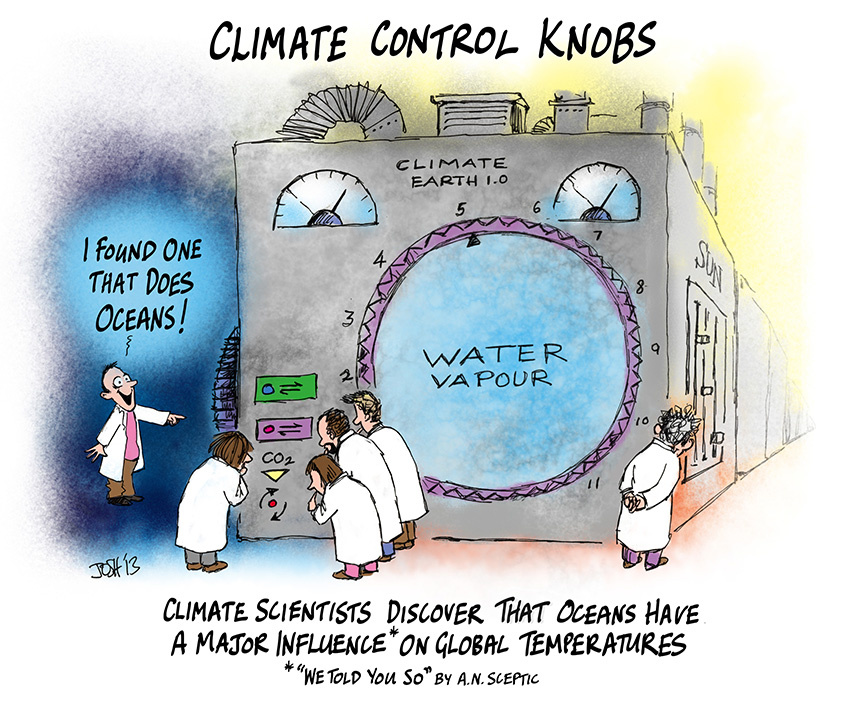
See Also  Bill Gray: H20 is Climate Control Knob, not CO2

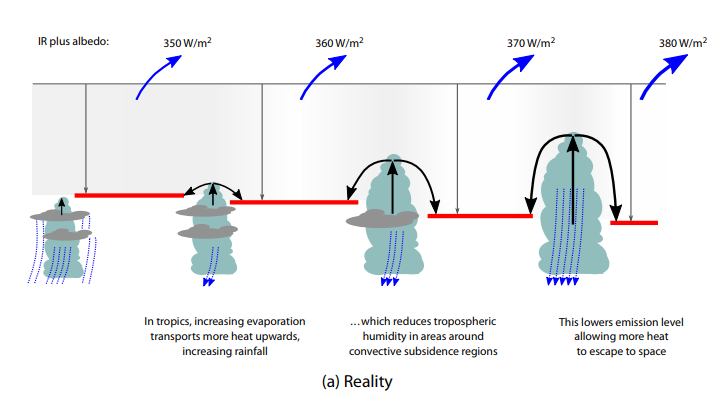
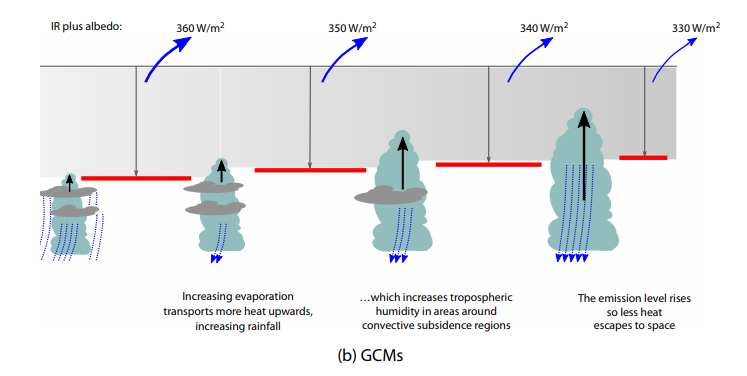
Figure 9: Two contrasting views of the effects of how the continuous intensification of deep cumulus convection would act to alter radiation flux to space. The top (bottom) diagram represents a net increase (decrease) in radiation to space

Footnote

There are two main reasons why investigators are skeptical of AGW (anthropogenic global warming) alarm. This post intends to be an antidote to myopic and lop-sided understandings of our climate system.

  1. CO2 Alarm is Myopic: Claiming CO2 causes dangerous global warming is too simplistic. CO2 is but one factor among many other forces and processes interacting to make weather and climate.

Myopia is a failure of perception by focusing on one near thing to the exclusion of the other realities present, thus missing the big picture. For example: “Not seeing the forest for the trees.”  AKA “tunnel vision.”

2. CO2 Alarm is Lopsided: CO2 forcing is too small to have the overblown effect claimed for it. Other factors are orders of magnitude larger than the potential of CO2 to influence the climate system.

Lopsided

Lop-sided refers to a failure in judging values, whereby someone lacking in sense of proportion, places great weight on a factor which actually has a minor influence compared to other forces. For example: “Making a mountain out of a mole hill.”


Cognitive Climate Games

Robert Bradley at Master Resource reports on how cognitive dissonance can be pushed below the level of awareness in his article “Cognitive Dissonance” and Climate Change: A Takedown.  Excerpts in italics with my bolds and added images.

Sometimes a rebuttal on social media is just too good to not memorialize. This one concerns a post about “Cognitive Dissonance” in reference to a 49-minute Apple Podcast, “Hidden Brain: When You Need It to Be True.” Its synopsis states:

When we want something very badly, it can be hard to see warning signs that might be obvious to other people. This week, we revisit a favorite episode from 2021, bringing you two stories about how easy it can be to believe in a false reality — even when the facts don’t back us up.

The upshot (see below) is that since we know climate science is settled and the verdict is a crisis (ahem), psychological explanations are necessary to understand why so many of us (the silent majority?) are not in anguish and demanding a transformation of modern life (like crying Peter Kalmus).

Susan Krumdieck, Research Director, Islands Centre for Net Zero, interpreted “When You Need It to Be True” as follows:

Cognitive Dissonance is a phenomena those of us in Energy Transition need to understand and develop ways to deal with in ourselves and others.

The first big dissonance was 40 years ago when the belief that scientific observations warning of environmental damage would cause the necessary change. I still want it to be true. But I look at data and evidence to determine what is most likely. And then I investigate how changes can work and how different people play a part.

Purposeful questions about assumptions is necessary. Questioning widely held assumptions about what can and can’t be done in what timeframe by whom means you are awake to facts.

This story about people believing alien guardians were going to come save them from the destruction of the earth should be of interest.

To which I commented:

I see ‘Cognitive Dissonance’ as the problem with climate alarmism and forced energy transformation. Waste, futile –and a mindset geared toward unnecessary ‘climate anxiety’.

But a comment before mine was the real takedown. Stated Richard Lyon of Lyon Energy Futures Ltd.:

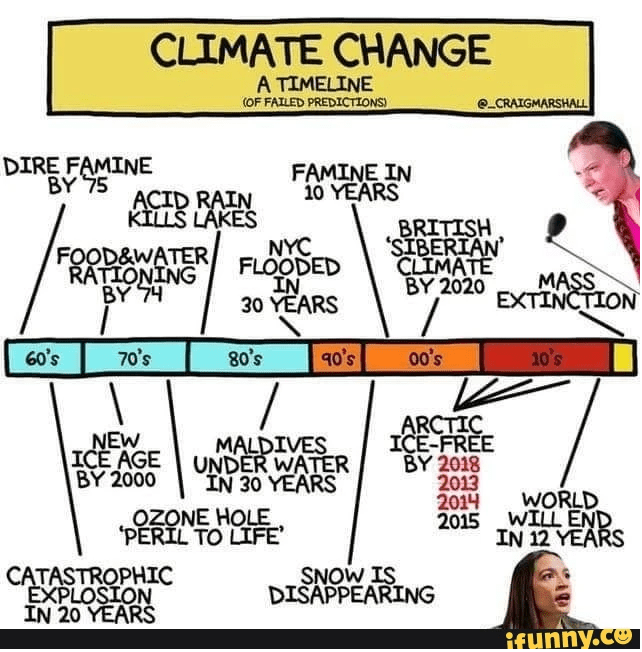
Thanks, Susan. One of the first warnings 40 years ago was from prominent climate catastrophist Paul Ehrlich that “everyone will disappear in a cloud of blue steam by 1989”.

Since then, we’ve thrilled to warnings that the oceans would be “As dead as Lake Erie by 1980” (Ehrlich, 1970), that there would be a new Ice Age in 10 years (NASA, 1971), that England would cease to exist by 2000 (Ehrlich, 1971), that there was “no end in sight of the cooling trend” (New York Times, 1978), that the Maldives would be “completely underwater in 30 years (1989), that UK snowfalls were a thing of the past (University of East Anglia, 2000), that Britain would be “Siberian” by 2025 (Pentagon, 2004), that the Arctic would be ice free by 2013/2014/2016/2018 (Gore, US Navy, NASA), etc.

What you note as “warnings” 40 years ago are more accurately labelled as falsified speculations produced by climate models observably unfit for duty.

That is producing severe Cognitive Dissonance in an industry that depends on the hypothesis being true that there is a climate crisis, and is manifesting itself most visibly in the proliferation of what Lakatos proposes as “Auxiliary Theory” in his account of pseudoscience – “theory to explain the failure of the theory”

Bravo … And here we are where Richard Lyons (et al.) are arguing and winning the intellectual debate, while the alarmist believers of a Cognitive Dissonance are stuck in their own … cognitive dissonance. Message to Susan Krumdieck, who has bought into the climate alarm. Check your premises rather than try to find psychological explanations for the world not heeding the climate alarm.

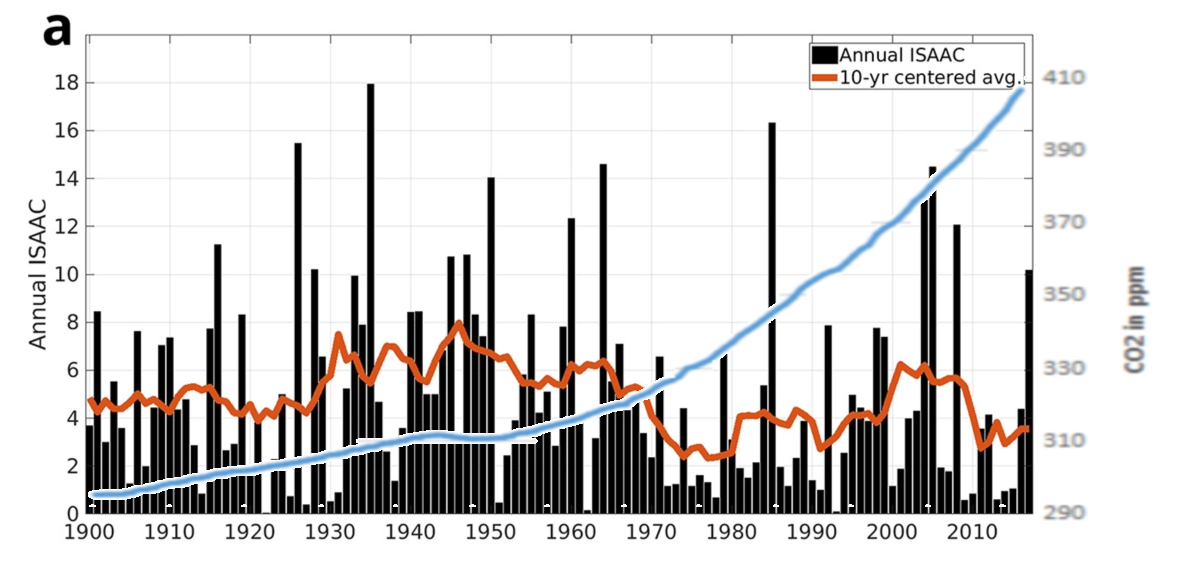
Start with the time series data with each weather extreme,
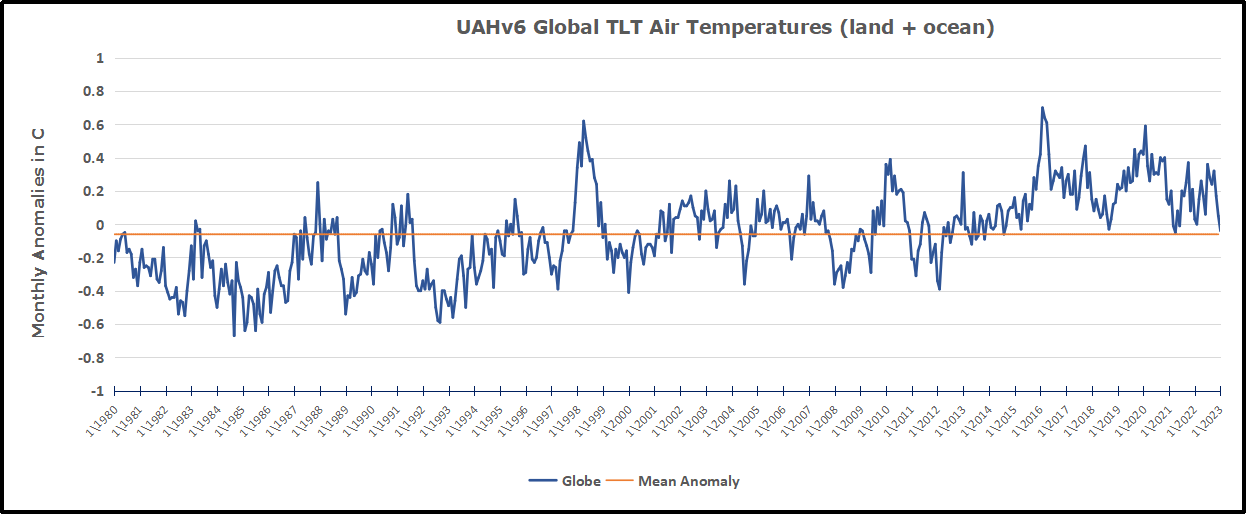
as well as the satellite data on global warming.


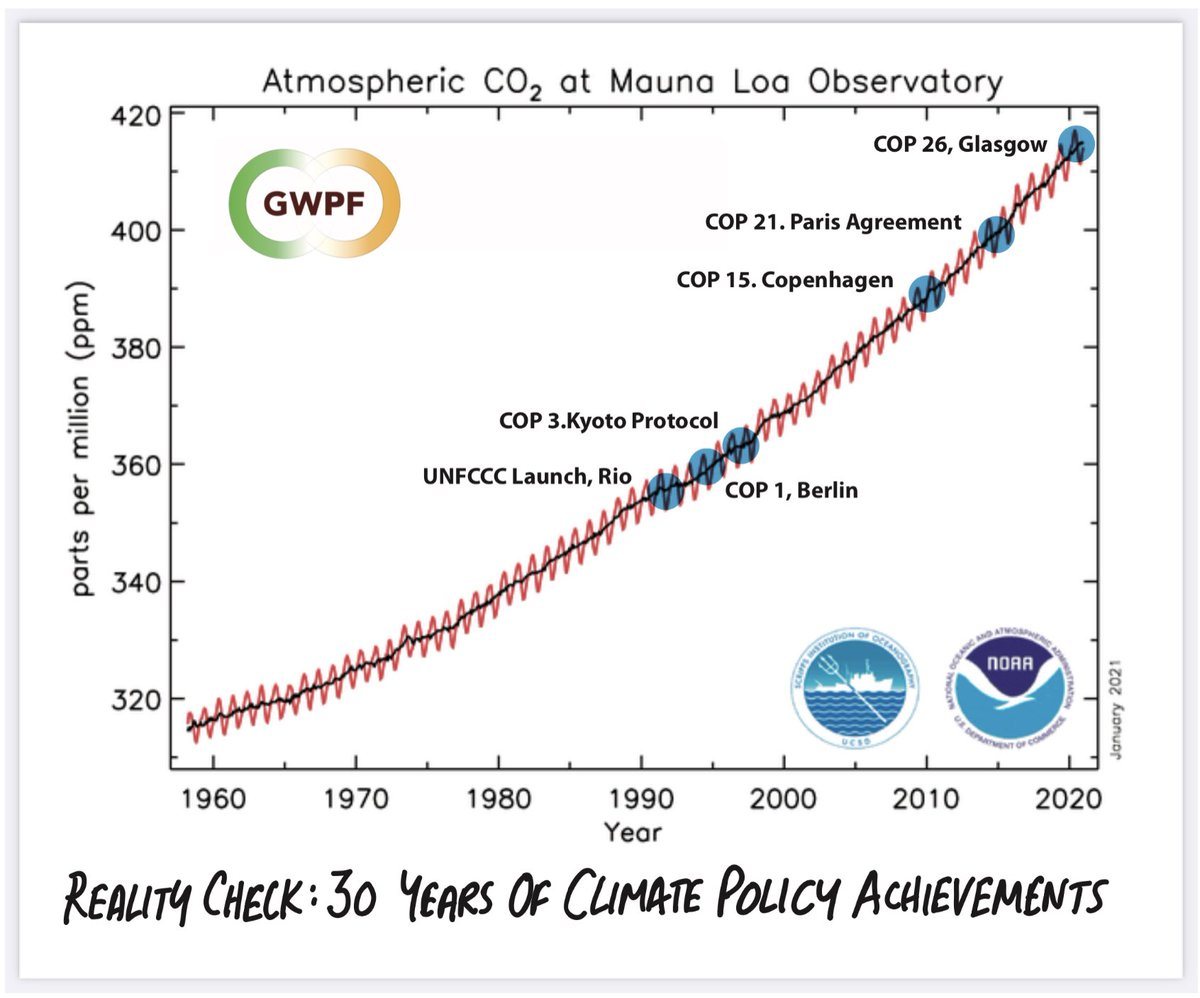
[The graph above shows exhibit 2a from Truchelut and Staehling overlaid with the record of atmospheric CO2 concentrations.  From NOAA combining Mauna Loa with earlier datasets.]
To determine Integrated Storm Activity Annually over the Continental U.S. (ISAAC) from 1900 through 2017, we summed this landfall ACE spatially over the entire continental U.S. and temporally over each hour of each hurricane season. We used the same methodology to calculate integrated annual landfall ACE for five additional geographic subsets of the continental U.S.

Climate optimism, anyone?

Climate Truth Science Soundbites

The climate realists at Creative Society have put together a short video with pithy statements skewering the CO2 theory of climate change.  Above is the video and below a transcript with exhibits and the speakers’ identities.

Dr. Harold Burnett
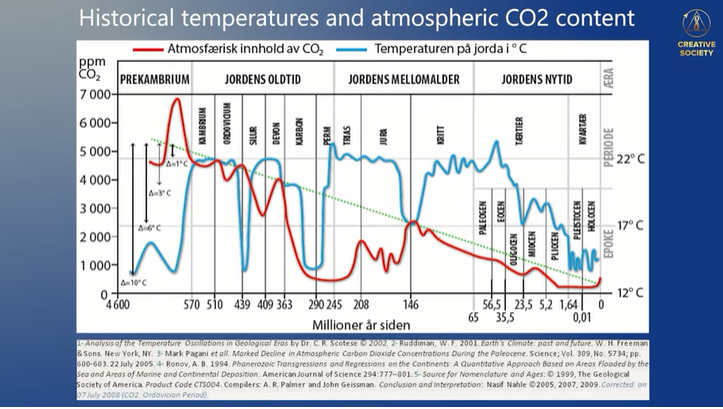
Over time the atmospheric levels of carbon dioxide have radically fluctuated throughout the earth’s geologic history. They have been in the past as much as 5000 parts per million. Currently they are about 420 parts per million. So over long periods of time they have fluctuated, but in general they have fallen.

Gregory Wrightstone
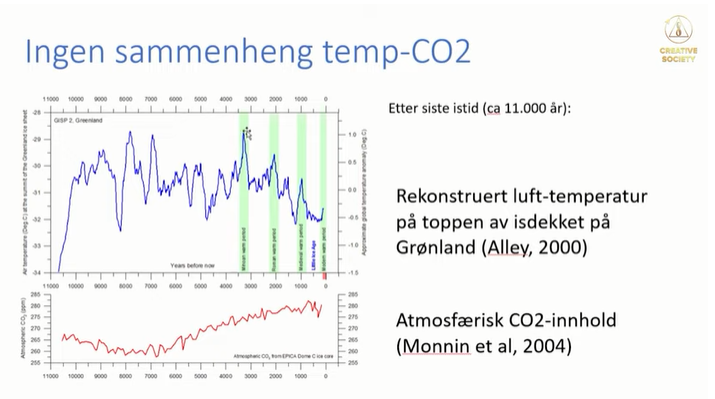
There doesn’t seem to be any correlation whatsoever with increasing CO2 and temperature. And in fact one of the things we’re being asked to believe is that our modern temperatures are unusual and unprecedented, as thought we’ve never seen temperatures like this in thousands of years. That’s just not the case.

Prof. Ole Ellestad
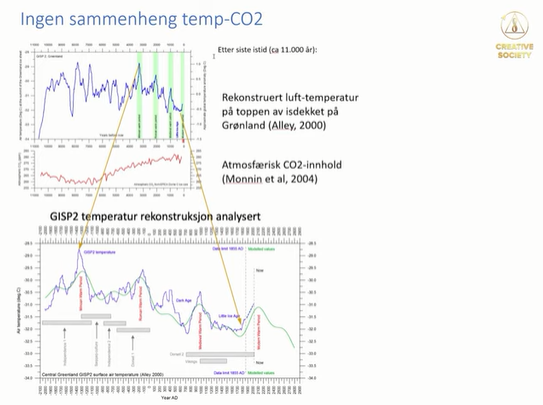
We have a map showing temperature changes over the last 11,000 years. These are Greenland ice cores and we can see a thousand years ago, about 2000 years ago and about 3000 years ago we had warm periods. And everything indicates that these were periods of global warming.

Hans Borge
It was long before man-made CO2 emissions had any considerable volume. Therefore we know that the natural variability can be large.

Jan-Eric Solheim
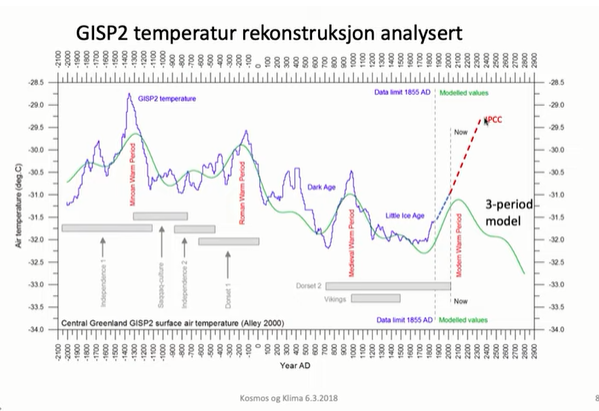
In this graph we also show what the IPCC does. It prolongs more or less this curve going to infinite.  So it becomes warmer and warmer because of the CO2 release or climate. And that’s what we think is wrong. Our prediction is that it will soon start Cooling and we have to be prepared for that.

Gregory Wrightstone
The warming trend we’re in right now though started more than 300 years ago. But again 250 years of warming took place before we started adding CO2. But we’re asked to believe that those natural forces that have been driving temperatures since the dawn of time suddenly ceased in the 20th century.

Hans Borge
CO2 is a gas that has very little effect on the climate. The IPCC models assume that the higher the CO2 level, the higher the water vapor level, and water vapor is a gas with the greatest impact on the climate. But the assumption that the more CO2, the more water vapor, has never been proved.

Jan-Eric Solheim
With some colleagues I have done experiments to see if CO2 can heat or carry heat. So we have built small greenhouses and tried to heat it by the sun outside or inside with artificial heating. We were able to show that carbon dioxide stops radiation, but we were not able to show any heating. So it’s a mystery how CO2 cannot heat, but what can heat is the water.

Gregory Wrightstone
The water vapor temperature changes first and then CO2 levels follow that. It’s not the other way around. If man increasing CO2 is going to drive temperature, CO2 should change first and then temperature should change.

Jan-Eric Solheim
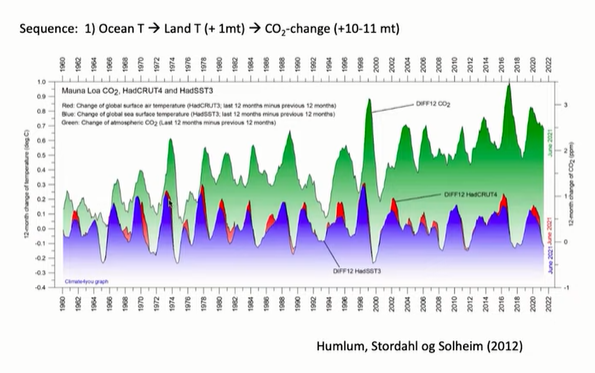
The blue curve is the temperature of the sea that is the ocean surface temperatures. The red is the land temperature which we get in this case from HadCRUT, which is an official temperature series. First comes the change in the sea temperature, a little bit later the land temperature (red) and then about one year, 10 or 11 months the carbon dioxide changes. And when temperature at the sea surface goes down, the carbon dioxide goes down 10 or 11 months later.

Hans Borge
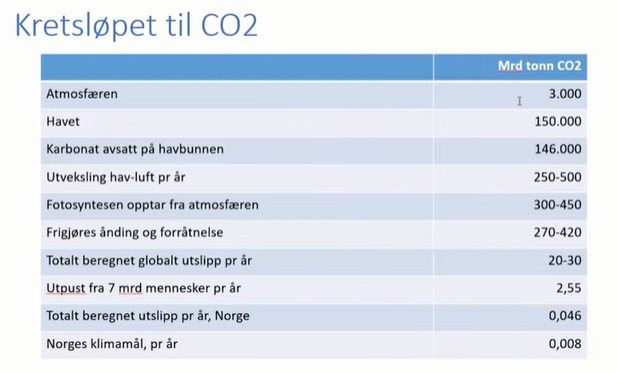
Well let me show you another table that might tell you a little bit about the CO2 content. Take a look:  there are 3 000 billion tons of CO2 in the atmosphere and the total man-made emissions per year are 20 to 30 billion tons. But if you look at the ocean, it has far more CO2. So the exchange of CO2 between the ocean and the atmosphere totally overshadows human activity.

Jan-Eric Solheim
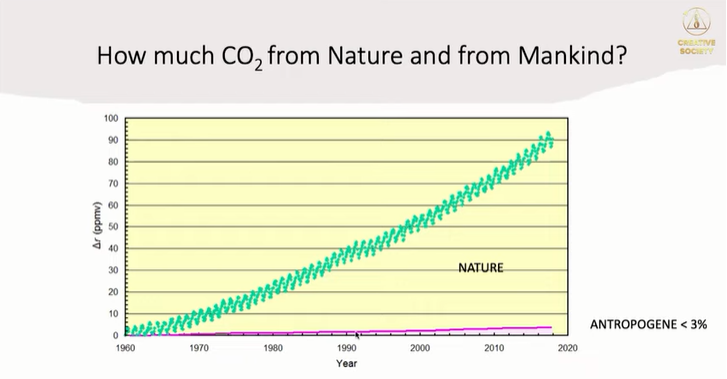
So a more detailed analysis telling that this red part here is apparently what anthropogenic yes or mankind produced carbon dioxide, which is about three percent of the increase from 1960. But nature produces the rest, this variable curve here. So 97 percent of the increase comes from nature, according to these scientists.

Prof. Ole Ellestad
The IPCC also claims that the sun has no effect on us. It’s a great paradox; not clear how they arrive at that. Moreover today we see that the warming is happening not only on our planet but also on other planets and on the moon too, where there’s a completely different atmosphere that has nothing to do with CO2. So clearly there is a sun factor which is missing in their model.

Gregory Wrightstone
Well, the iIPCC if you look back on their charter it was formed to present the data that supports warming. They weren’t tasked to provide all the data. They started with an assumption and went from there. So if that’s their task, they’re doing a darn good job at it. You better have some good science behind you, and it’s just not there.

Dr. Harold Burnett
The world’s governments through the UN formed the UN Framework Convention on Climate Change. Now you would think that would be studying climate change, but they specified that you study the human causes of climate change. So they ruled out all natural factors. They said no no: we’re not going to study whether the sun plays a role; we’re not going to study whether volcanoes play a role; we’re not going to study whether ocean current shifts play a role. And we really don’t understand clouds, so we’re not going to count them much. What we’re going to study is human CO2 emissions because that’s what we can get a handle on.

That’s not the way science is supposed to work. If you make faulty or incomplete assumptions, your models are going to be weak, because they’re only as good as the accuracy of the stuff that’s put in them. Now climate models have failed to accurately reflect past temperatures; they fail to accurately represent present temperatures; but we’re told we can trust their projections of future temperatures.  That doesn’t seem reasonable to me.

Gregory Wrightstone
If on the other hand, you like the scientific process, we’re not getting much data out there. Dr Will Happer is our chairman here at the CO2 coalition and he’s got a paper that he and Dr. Van Wijngaarden have done on climate sensitivities. They’re not able to get it in any prestigious journals, yet it’s a landmark study. They need to shut people like me down: I was just banned on linkedin, which should be a professional network, a social media network. I don’t talk those things that are controversial; I post scientific facts, and they were being removed. And they came back and said: No, you’re done. We don’t allow that kind of information on linkedin.

Prof. Ole Ellestad
This debate is so violent that if you go to the media you can express your opinion, but you will be strongly criticized, and then you won’t really have an opportunity to defend yourself. But most importantly, you won’t get into the media with your first articles.

Hans Borge
This is what we see now in the academic world, for example at universities. Academic freedom is so endangered. I have to say that many people who joined the ranks of climate realists do so when they retire; because until retirement they just don’t dare. Researchers who claim something different don’t get grants; they don’t have their say in either published media or in edited journals.

Dr. Harold Burnett
First off you’re having a difficult time getting published because journals won’t hear it. Well, that affects your tenure track position and your colleagues are frowning at you. And you’re not getting government grants because government doesn’t give grants to study natural factors for climate change or to study things that prove humans aren’t causing climate change. Because government has a motive: expanding its its reach. I know researchers who’ve left the field because they feel like they can’t give their honest assessment and get it either published or get tenure.

Prof. Ole Ellestad
Climate and environment are often lumped together. But being against climate doesn’t mean being against the environment. That is, we are not against climate, but we are skeptical of CO2, which is not the same as being skeptical of the environment. So important environmental issues should be discussed and resolved.

Dr. Harold Burnett
That subsurface volcanic activity in Antarctica and even in parts of Greenland and Iceland are contributing to the melting of the glaciers there. That is not controlled by CO2. We don’t control the ocean currents; we don’t control the magnetism of the earth’s magnetic poles and how it shifts or can shift over time. We don’t control our orbit.

We don’t control those things and they’re really what’s driving things. That’s why we should study them, because they’re really what’s driving climate change. And if we think it’s bad, we should know that too.

I want an adaptable society. An adaptable society is one that does not lock us into solving the wrong problem.


Ian Plimer Asks, “What Climate Crisis?”

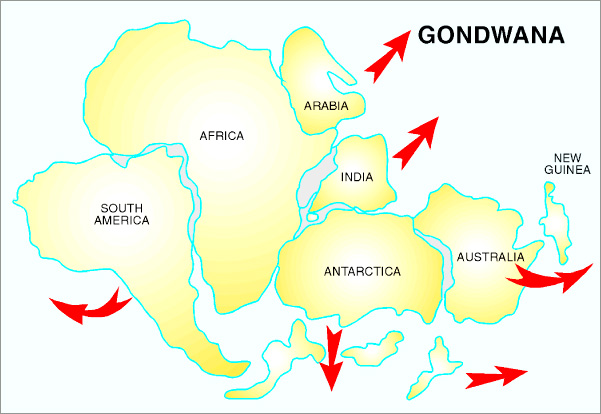
The supercontinent Gondwana hundreds of million years ago at its primary stages, and the directions pieces drifted away

That question is the title of Ian Plimer’s Spectator Australia article What Climate Crisis? Excerpts in italics with my bolds and added images.

For more than 80 per cent of time, Earth has been a warm wet greenhouse planet with no ice. We live in unusual times, when ice occurs on continents. This did not happen overnight. The great southern continent, Gondwanaland, formed about 550 million years ago. It occupied 20 per cent of the area of our planet and included Antarctica, South America, Australia, South Africa and the Indian subcontinent.

Gondwanaland was covered by ice when it drifted across the South Pole 360-255 million years ago. Evidence for this ice age is in the black coal districts of Australia, South Africa and India.

If Antarctica is to lose its ice sheets to end the current ice age, plate tectonics must move the continent northwards or fragment Antarctica into smaller land masses. Parts of Antarctica are currently being fragmented which is why there are more than 150 hot spots and volcanoes in rift valleys beneath Antarctic ice. Plate tectonics must also widen the Bering Strait to allow more warm Pacific Ocean water to enter and warm the Arctic.

Arctic ice formed 2.5 million years ago when plate tectonic-driven volcanoes in central America joined North America to South America and stopped Pacific and Atlantic Ocean waters from mixing. This was exacerbated by a supernova explosion that bombarded Earth with cosmic particles to produce cloudiness and cooling.

Figure 16. The geological history of CO2 level and temperature proxy for the past 400 million years. CO2 levels now are ~ 400ppm. Source: Davis, W. J. (2017).

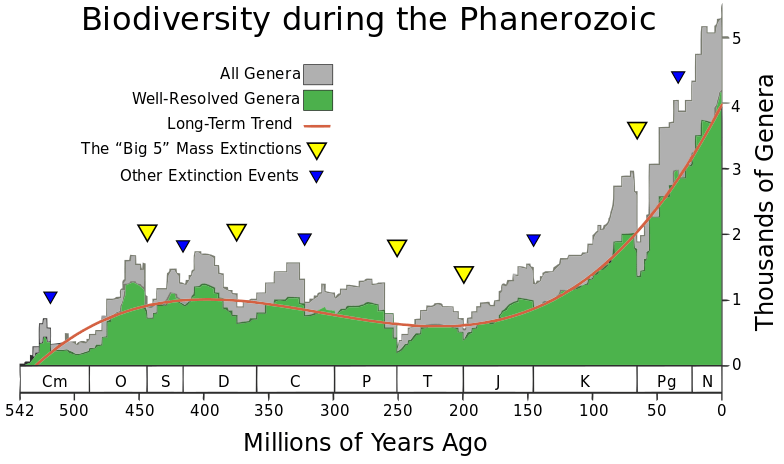
The Earth has been slowly cooling for the last 50 million years from times when life thrived and rapidly diversified. In these warmer times, there were no mass extinctions due to natural warming and, if the planet is warming today, the past shows us that life will thrive and diversify even more.

Source: Phanerozoic_Biodiversity.png Author: SVG version by Albert Mestre

Once the Antarctic ice formed, ice sheets waxed and waned depending on whether Earth was closer or more distant from the Sun. Within these cycles there were smaller cycles driven by variations in energy emitted from the Sun producing many short warm spikes during long glaciations and very short cold spikes during short interglacials with average temperature rises and falls of more than 10°C a decade.

    • On a scale of tens of millions of years or more, the Earth’s climate is driven by plate tectonics.
    • On a scale of hundreds of thousands of years, the Earth’s climate is driven by orbital cycles which bring Earth closer to or more distant from the Sun.
    • On a scale of thousands of years to decades, the Earth’s climate is driven by variations in energy emitted from the Sun.

If governments, the UN or climate activists want to stop the normal planetary process
of climate change, then they need to stop plate tectonics,
stop variations in the Earth’s orbit and stop variations in solar output.

Even the omnipotent, omnipresent Kevin Rudd couldn’t manage this!

No past warming events have been driven by an increase in carbon dioxide in the atmosphere. No past cooling events were driven by a decrease in atmospheric carbon dioxide.

Six of the six most recent ice ages were initiated when the Earth’s atmospheric carbon dioxide was far higher than at present. Atmospheric temperature rise occurs before the carbon dioxide content of the atmosphere rises. It has never been proven that human emissions of carbon dioxide drive global warming despite numerous requests to climate activist scientists for the published evidence. Trillion-dollar bankrupting decisions on energy policy are being made using invalid science.

The peak of the last orbitally-driven interglacial was 7,000 to 4,000 years ago and for the last 4,000 years the Earth has been cooling as the climate changes from an interglacial into glaciation. There were solar-driven warm spikes such as the Minoan Warming, Roman Warming, Medieval Warming and the Modern Warming and cold spikes (e.g. Dark Ages, Little Ice Age) during this 4,000-year cooling trend.

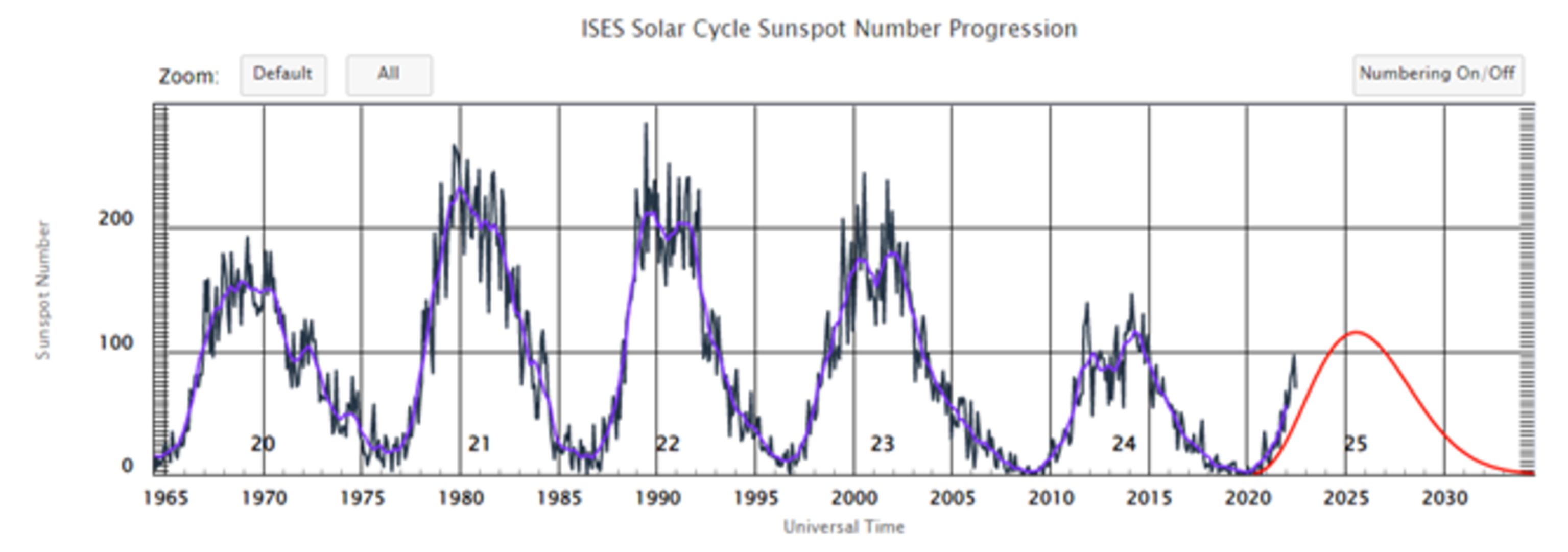
Solar cycle 25 prediction, NOAA, July 2022

In 2020, we entered the Grand Solar Minimum which is calculated to end in 2053. Whether there will be a solar-driven cooling, similar to the Little Ice Age (1300-1850 AD), or a full-blown orbitally-driven glaciation, such as the last glaciation from 116,000-14,400 years ago, is unknown. The former cooling could last for hundreds of years whereas the latter would last for at least 90,000 years. If there was another period of sustained subaerial volcanism, cooling would be accelerated.

During the last glaciation, Europe was covered with ice north of the Alps, as was Russia; Canada and northern and alpine USA were covered by ice; southern South America and the Andes were covered by ice; Himalayan ice expanded to lower altitudes; and alpine Australia, Tasmania and the South Island of NZ were covered by ice as were the southern and elevated portions of Africa.

In the last glaciation, vegetation contracted and tropical areas such as the Amazon Basin only had copses of trees occupying some ten per cent of the area of the current Amazonian rainforests; large areas of inland Australia, China, India, USA and Africa were covered by sand deposited from cold dry cyclonic winds; inland lakes evaporated; sea level was 130 metres lower than at present; there was no Great Barrier Reef; sea ice isolated Greenland, Iceland, northern Russia and northern Canada; Antarctic sea ice extended hundreds of kilometres north and there was a reduction in rainfall and plant and animal species. Areas that now support pastoral and grain-growing activities were sandy wastelands during the last glaciation.

Humans struggled as hunter-gatherers around the edge of ice sheets and at lower latitudes.

We are putting all our efforts and wasting trillions of taxpayers’ dollars into trying to prevent mythical human-induced global warming, yet we still don’t prepare for the inevitable annual floods, droughts and bushfires, let alone longer-term solar – and orbitally – driven global cooling.

We have a crisis of single-minded stupidity exacerbated by a dumbed-down education system supported by incessant propaganda, driven by financial interests and political activist authoritarianism.

Manheimer Steamrolls Net Zero Claims

Accomplished and distinguished physicist Wallace Manheimer published a crushing argument against the rationale for Net Zero claims and policies.  His paper is While the Climate Always Has and Always Will Change, There Is no Climate Crisis. published in the Journal of Sustainable Development.  In italics with my bolds.

Abstract

The emphasis on a false climate crisis is becoming a tragedy for modern civilization, which depends on relible, economic, and environmentally viable energy. The windmills, solar panels and backup batteries have none if these qualities.

This falsehood is pushed by a powerful lobby which Bjorn Lomborg has called a climate industrial complex, comprising some scientists, most media, industrialists, and legislators. It has somehow managed to convince many that CO2 in the atmosphere, a gas necessary for life on earth, one which we exhale with every breath, is an environmental poison.

Multiple scientific theories and measurements show that there is no climate crisis. Radiation forcing calculations by both skeptics and believers show that the carbon dioxide radiation forcicng is about 0.3% of the incident radiation, far less than other effects on climate. Over the period of human civilization, the temperature has oscillated between quite a few warm and cold periods, with many of the warm periods being warmer than today. During geological times, it and the carbon dioxide level have been all over the place with no correlation between them.

A useful synopsis is written by Chris Morrison at the Daily Sceptic  Net Zero Will Lead to the End of Modern Civilisation, Says Top Scientist.  Excerpts in italics with my bolds and added images.

A damning indictment of the Net Zero political project has been made by one of the world’s leading nuclear physicists. In a recently published science paper, Dr. Wallace Manheimer said it would be the end of modern civilisation. Writing about wind and solar power he argued it would be especially tragic “when not only will this new infrastructure fail, but will cost trillions, trash large portions of the environment, and be entirely unnecessary”. The stakes, he added, “are enormous”.

Dr. Manheimer holds a physics PhD from MIT and has had a 50-year career in nuclear research, including work at the Plasma Physics Division at the U.S. Naval Research Laboratory. He has published over 150 science papers. In his view, there is “certainly no scientific basis” for expecting a climate crisis from too much carbon dioxide in the atmosphere in the next century or so. He argues that there is no reason why civilisation cannot advance using both fossil fuel power and nuclear power, gradually shifting to more nuclear power.

There is of course a growing body of opinion that points out that the Emperor has no clothes when it comes to all the fashionable green technologies. Electric cars, wind and solar power, hydrogen, battery storage, heat pumps – all have massive disadvantages, and are incapable of replacing existing systems without devastating consequences.

Manheimer points out that before fossil fuel became widely used, energy was provided by people and animals. Because so little energy was produced, “civilisation was a thin veneer atop a vast mountain of human squalor and misery, a veneer maintained by such institutions as slavery, colonialism and tyranny”.

This argument hints at why so many rich, virtue-signalling celebrities argue not just for Net Zero but ‘Real’ Zero, with the banning of all fossil fuel use.

King Charles said in 2009 that the age of consumerism and convenience was over, although the multi-mansion owning monarch presumably doesn’t think such desperate restrictions apply to himself. Manheimer notes that fossil fuel has extended the benefits of civilisation to billions, but its job is not yet complete. “To spread the benefits of modern civilisation to the entire human family would require much more energy, as well as newer sources,” he adds.

In Manheimer’s view, the partnership among self-interested businesses, grandstanding politicians and alarmist campaigners, “truly is an unholy alliance”. The climate industrial complex does not promote discussion on how to overcome this challenge in a way that will be best for everyone. “We should not be surprised or impressed that those who stand to make a profit are among the loudest calling for politicians to act,” he added.

Perhaps one of the best voices to cast doubt on an approaching climate crisis, suggests the author, is Professor Emeritus Richard Lindzen of MIT, one of the world’s leading authorities on geological fluid motions:

“What historians will definitely wonder about in future centuries is how deeply flawed logic, obscured by shrewd and unrelenting propaganda, actually enabled a coalition of powerful special interests to convince nearly everyone in the world that CO2 from human industry was a dangerous planet-destroying toxin. It will be remembered as the greatest mass delusion in the history of the world – that CO2, the life of plants, was considered for a time to be a deadly poison.”

Figure 16. The geological history of CO2 level and temperature proxy for the past 400 million years. CO2 levels now are ~ 400ppm

Much of Dr. Manheimer’s interesting paper debunks many of the fashionable nostrums surrounding politicised ‘settled’ climate science. It is an excellent read. Discussing some of the contrary opinions that debunk obviously false claims, he says it is “particularly disheartening” to see learned societies make definitive claims when so much contrary information is readily available. He points out that over the last 10,000 years, the Earth has almost certainly been warmer. There have been warmer and colder periods, just like today.

To find the off-narrative information, even Google can be used, Manheimer says – though he does note that the company warns it will not provide information on “claims denying that long-term trends show that the global climate is warming”.

Figure 18. Per capita food production in kcal/(per-capita per day) from 1961 to 2009. Notice that there is a steadily increasing production, with no sign of any ‘slowly escalating but long-enduring global threat to food supplies.’


Hey Princeton, On climate change, as on all else, hear both sides

Masthead of the student newspaper at Princeton University.

Lord Monckton has written a reply to the juveniles at the Princetonian.  H/T John Ray

On climate change, as on all else, hear both sides

By Christopher Monckton of Brenchley, special to The Daily Princetonian.  Excerpts in italics with my bolds.

The English-speaking jurisdictions recognize just two principles of natural law. One of these is audiatur et altera pars: let both sides be heard. On the climate question, though, the promoters of the official narrative are strikingly – and revealingly – intolerant of dissent.

Recently, in this column, two climate campaigners were allowed to attack three eminent Princeton-bred professors, the late Fred Singer, the late Fred Seitz and Professor Will Happer. I had the honor to know Professor Fred Singer, an exceptional rocket scientist and founder of the U.S. Satellite Weather Service. I had the further honor of working with him on a paper discussing the intersection between chaos theory and climate prediction. It was one of the last papers he wrote.

And I have the honor to know Will Happer, a formidable radiation physicist, exceptionally well qualified to write about the influence of heteroatomic molecules on global temperature. Will has published a string of distinguished papers on the subject in recent years.

The climate fanatics described the three professors as having used Princeton’s “name and prestige” to “open doors, grab headlines, mislead the public and grant legitimacy to their climate-denial claims … helping put us on the pathway to today’s existential global crisis”. Oh, pur-leaze!

The editors of this journal should in future eschew such hate-speech terms
as “climate denial” or “denier” or “denialist”.

None of the three professors denies that there is a climate, or even that we are capable of influencing it. Fred Singer’s paper on chaos theory pointed out that, precisely because the climate behaves as a mathematically-chaotic system, even a small perturbation, whether natural or anthropogenic, might cause unforeseeable effects. But it is the property of a chaotic object that, unless the initial conditions are known to a precision that is and will aye be unattainable in climate, the long-term prediction of future climate states is not possible. In this, Professor Singer swam in the mainstream: IPCC says the same.

Will Happer’s recent detailed paper studying the radiative effects of greenhouse-gas enrichment, far from “climate denial”, powerfully endorsed the conclusion that that enrichment – beneficial though it is for the net primary productivity of plants (their total global green biomass has increased by 15-30% in recent decades thanks to CO2 fertilization detectable from space as chlorophyll fluorescence) – will cause about 2 degrees’ global warming per doubling of concentration, a value within the official uncertainty interval.

All three professors were and are right to point out that the mildly warmer worldwide weather that is occurring does not and will not pose any “global existential threat”.

Such childish, anti-scientific slogans, bandied about by the extremist classes, are devoid of meaning and should be forsworn forthwith and for aye. The OFDA/CRED international disaster database shows that, despite a tripling of global population, weather-related deaths have plummeted throughout the past 100 years. And a string of learned papers in the medical journal The Lancet establishes that in all regions deaths from cold outstrip deaths from heat tenfold.

Finally, let us hear no more nonsense about such towering professors as these “preventing climate action”. For such action would expensively do far more harm than good. Since 1990 our influence on climate has increased linearly at 1 unit per decade, driving 0.4 degrees’ warming.

Even if the whole world were to move linearly to net zero emissions by 2050, only half the next unit would be abated by then, preventing just 0.2 degrees’ warming.

The cost of global net zero, according to McKinsey Consulting, will be $275 trillion in capex alone. Even ignoring opex, typically at least twice capex, and even allowing for no price increases in the desperately scarce techno-metals needed to reach net zero (one would need 67,000 years’ worth of the entire 2019 global annual production of vanadium, for instance, so good luck with that), each $1 billion spent on attempted mitigation would prevent less than a millionth of a degree of future warming. Value for money it isn’t. And the climate won’t notice either way.

Like it or not, it is legitimate for men of learning gently to correct the moralizing screechers by drawing their attention to elementary, verifiable facts such as these. As it is, only the West is making any attempt to attain net zero. But the net effect of our supererogatory sacrifice of our own workers’ jobs is to price our energy-intensive manufacturing industries out to far Eastern nations whose emissions per unit of production are considerably above ours. Climate campaigners, then, are adding to the very non-problem they are clamoring to solve. Making things in China rather than Chattanooga is good for Communism but bad for the planet.

So let the skeptical scientists be fairly heard, and let us cease to turn
universities like Princeton into mere pietistic indoctrinators.

Learning advances not by cloying “consensus”, roundly and rightly rejected by Aristotle 4500 years ago, but by diligent research, free publication and open debate. It is only those who know they would lose a debate who seek to silence their opponents. The hysterical malevolence of the screaming campaigners shows the world they know full well that they would lose. Indeed, they have already lost.

Christopher Monckton of Brenchley, a Cambridge alumnus and former adviser to Margaret Thatcher, is the author of two dozen learned papers on climate sensitivity and mitigation economics.

Footnote:  The writers of the article critiqued by Christopher Monckton should attend to this presentation by William Happer Climate Change Thinking for Open or Locked-Down Minds


Canada Budget Officer Quashes Climate Alarm


Ross McKitrick reports at Financial Post The Parliamentary Budget Officer just debunked climate alarmism, This is the opposite of an ’emergency’ or ‘crisis’.  Excerpts in italics with my bolds and added images.

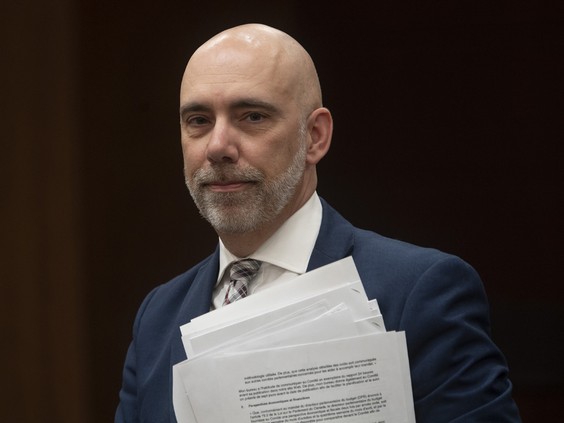
Parliamentary Budget Officer Yves Giroux on Parliament Hill in Ottawa in 2020. PHOTO BY ADRIAN WYLD/THE CANADIAN PRESS FILES

The Parliamentary Budget Officer (PBO) recently released a report on the effects of greenhouse gas emissions on Canadian GDP growth over the next 80 years. I’ve written previously about the recent economics literature investigating the link (or lack thereof) between global warming and economic growth. It’s a fascinating topic and I’ve been actively working with on it one of our PhD students for several years. While I would quibble with some aspects of the PBO report, the overall conclusions are not out of line with mainstream thinking on the topic.

Which is why the findings are so astonishing and radical compared
to what the government has been saying.

The PBO estimated what would happen to the Canadian economy between now and 2100 if temperatures and precipitation change as expected due to greenhouse gases. The report’s authors consider two scenarios — first, if emission-reduction policies stall at today’s levels and nobody complies with their Paris commitments and, second, if countries comply with all their Paris commitments in full and on time. Under the first scenario Canada’s GDP in 2100 will be 6.6 per cent smaller than it otherwise would be.

Let’s pause there for a moment: 6.6 per cent after 80 years is a very small number. Canada has set out ambitious economic growth plans based on high levels of immigration and continued efforts to boost productivity and income. Suppose this results in two per cent real GDP growth from 2021 to 2100. That would mean Canada’s economy will grow by 388 per cent over those 80 years.

According to the PBO, if we do nothing about global warming,
it will instead grow by about 381 per cent.

In other words, the PBO projects that the impact of climate change will be small relative to other drivers, including population change, technology and many other aspects of socioeconomic development. Where have I heard that before?

In the UN Intergovernmental Panel on Climate Change’s 5th Assessment Report, released in 2013, that’s where. In the Working Group II volume, Chapter 10, the report concluded: “For most economic sectors the impact of climate change will be small relative to the impacts of other drivers. Changes in population, age, income, technology, relative prices, lifestyle, regulation, governance, and many other aspects of socioeconomic development will have an impact on the supply and demand of economic goods and services that is large relative to the impact of climate change.”

Yes, you read that right. The IPCC concluded, not very long ago, that while greenhouse gases have warmed the climate and will continue to do so, the effects will be small compared to pretty much every other driver of change in the century ahead. This is the opposite of an “emergency” or “crisis.”

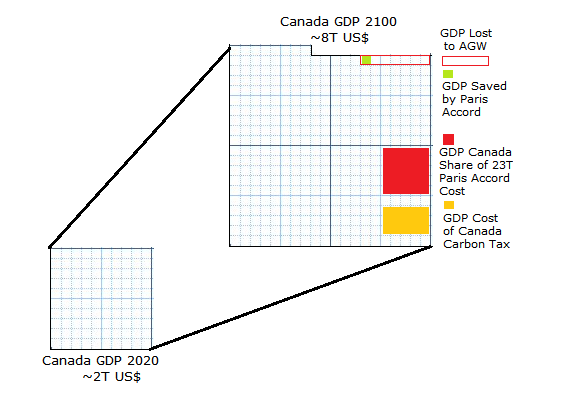
Then the PBO asked what would change if everyone meets their Paris targets. Instead of being 6.6 per cent smaller in 2100, it estimates the economy will be 5.8 per cent smaller. In other words, the benefit attributable to the Paris agenda is that the economy will be 0.8 per cent larger 80 years from now. This is a minuscule difference.

And we have to ask: what if the policies cost more than 0.8 per cent of GDP? We can be absolutely certain that they will. In a study Elmira Aliakbari and I coauthored last year for the Fraser Institute, we showed that just the carbon tax alone, which won’t suffice to get us to the Paris target, will cause GDP to shrink by at least twice that amount by 2030. Our GDP loss estimates were in line with many other studies done inside and outside of government for comparable-size emission cuts under the Kyoto Protocol 20 years ago.

Projection Parameters:
Canada GDP grows at 2% yearly compounded to 2100 = 388%
Effects of AGW reduce 2100 GDP by 7%
Fulfilling Paris Accord raises 2100 GDP by 1%
Canada share of $21T Paris Accord cost, est. $500B
Cost of Canada Carbon Tax est.1.8% GDP by 2030, 14% by 2100

The PBO, based on advice from Environment and Climate Change Canada, the federal department in charge, worked on the assumption that Canada will warm (on average) by 2.5 degrees Celsius compared to today. I think that’s an overestimate but, as before, let’s assume it’s true. Its analysis says that the result will be that Canada’s economy grows (on average) not by 2.0 per cent a year but by 1.983 per cent per year, a difference less than a rounding error in the national economic accounts. And if we incur the enormous costs of complying with Paris, the economic benefit will be that we grow on average by 1.986 per cent instead, three one-thousands of a per cent more. At the cost of policies that will take orders of magnitude more off our growth rate.

One of the annoying bits of jargon that goes around climate policy circles is the phrase “the cost of inaction.” As in, “we have to do something, doing nothing is not an option, the cost of inaction is too large.” The cost of inaction is the foregone benefit of the action, and according to the PBO, it’s not large at all. In fact, it’s tiny. Because compared to everything else we’ll deal with this century, the impacts of climate change will be small.

That is the radical but correct conclusion of experts at both the IPCC and the PBO.
It’s time government leaders started paying attention.

Ross McKitrick is a professor of economics at the University of Guelph and senior fellow of the Fraser Institute.


Climate and CO2 Hysteria Is Optional

This is your brain on climate alarm.  Just say No!

David Simon shines a light of sanity in his Real Clear Markets article To End Climate Lunacy, Stop Treating Warming & C02 Hysterically.  Excerpts in italics with my bolds and added images.

Those who oppose economically destructive “climate” policies – like those promoted by the Biden administration and at the recent United Nations COP27 conference – will continue to fail to stop the advance of these policies so long as they continue to accept the false claim that warming of the planet and carbon dioxide emissions are harmful.

They are not. On balance, global warming and CO2 emission are beneficial.

Before getting to why that is, however, it is crucial to understand why accepting the false climate claim is so harmful.

When the destructiveness of climate policies is shown, the response is that the policies nevertheless are necessary to address what President Biden refers to as the “existential threat” of global warming and increased CO2 emissions.

When it is noted that these climate policies will at most microscopically and insignificantly reduce temperatures and CO2 emissions, climate policy mandarins push for even more draconian policies.

The result has been that since the 1990s, climate policies have become increasingly destructive and wasteful. Even worse, their continued intensification appears unlikely to be stopped until the public and policymakers are persuaded that global warming and CO2 emissions are not harmful. As Margaret Thatcher famously said: First you win the argument, then you win the vote.”

To win this argument, it is necessary to focus on the scientific facts.

A warming planet saves lives. 

Analyses of millions of deaths in recent decades in numerous countries, published in the British medical journal The Lancet, show that cooler temperatures killed nine times (July 2021 study) to seventeen times (In May 2015 study) more people than warmer temperatures. The planet’s recent modest warming (by 1.00 degree Celsius on average since 1880, as calculated by NASA) thus has been saving millions of lives.

A 2015 study by 22 scientists from around the world found that cold kills over 17 times more people than heat.

CO2 emissions do not pollute and instead are environmentally beneficial. 

In 2017, over 300 scientists, including Richard Lindzen of MIT and William Happer of Princeton, signed a statement that made this point: “carbon dioxide is not a pollutant. To the contrary, there is clear evidence that increased atmospheric carbon dioxide is environmentally helpful to food crops and other plants that nourish all life. It is plant food, not poison.” Every one of us, indeed, also exhales carbon dioxide with every breath.

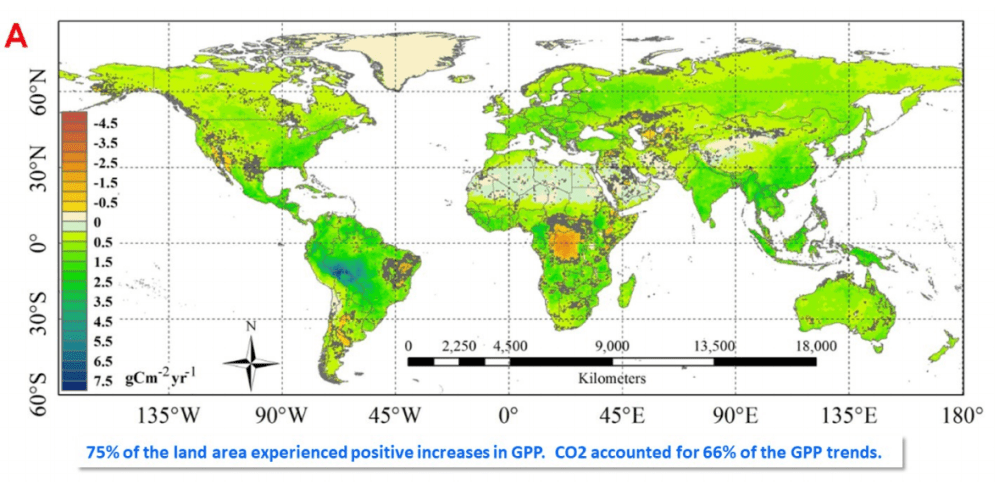
Spatial pattern of trends in Gross Primary Production (1982- 2015). Source: Sun et al. 2018.

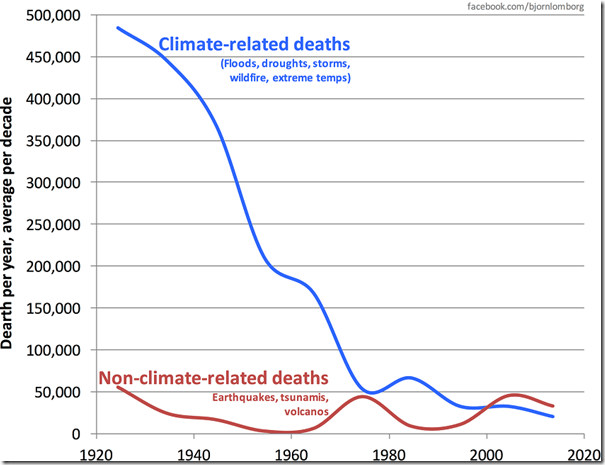
Since 1920, deaths each year from natural disasters have decreased by over 90 percent. 

And this happened, data from EM-DAT – The International Disaster Database presented by The University of Oxford show, not only as the planet has warmed, but as world population has quadrupled.

Global warming has not increased hurricanes.

 A NOAA report, updated on November 28, 2022, states that “there is essentially no long-term trend in hurricane counts. The evidence for an upward trend is even weaker if we look at U.S. landfalling hurricanes, which even show a slight negative trend beginning from 1900 or from the late 1800s.”

The same report sums it up in bold: “We conclude that the historical Atlantic hurricane data at this stage do not provide compelling evidence for a substantial greenhouse warming-induced century-scale increase in: frequency of tropical storms, hurricanes, or major hurricanes, or in the proportion of hurricanes that become major hurricanes.”

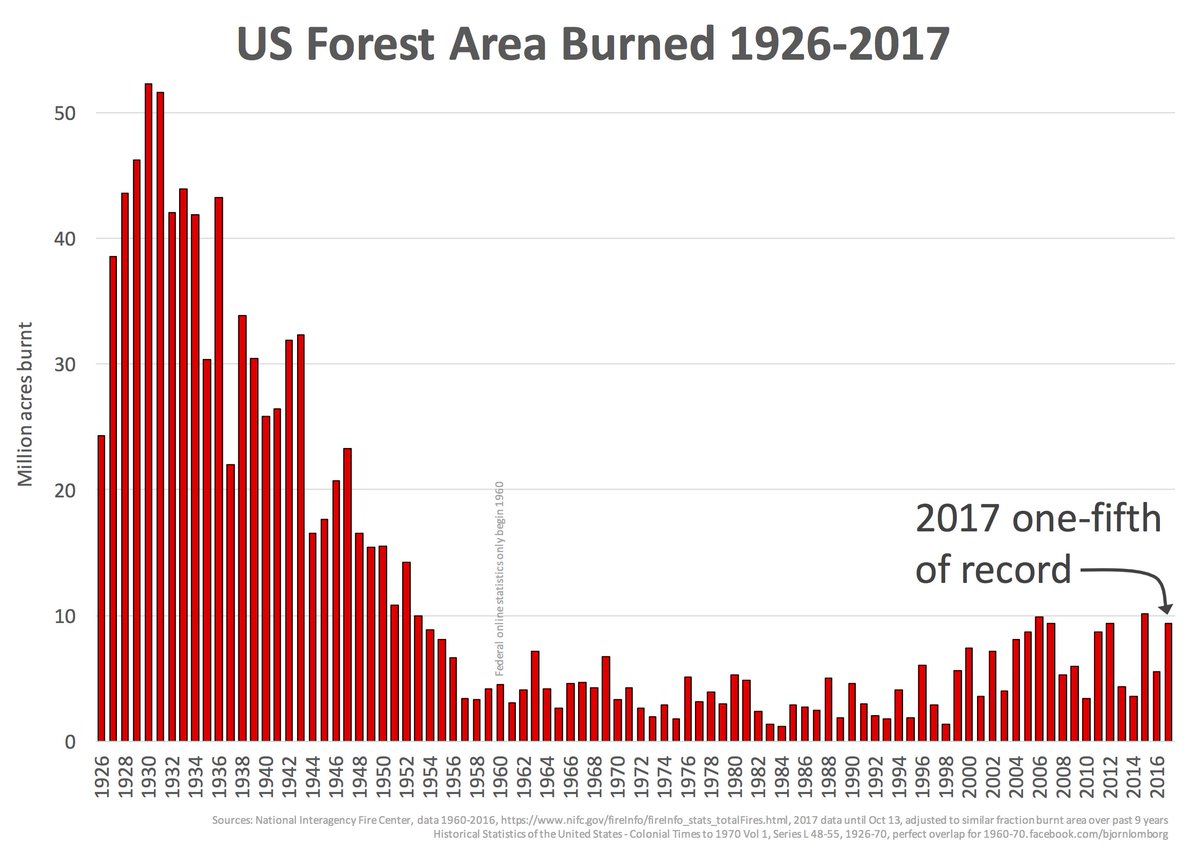
Global warming also does not increase land burned by fires. 

As environmental statistician Bjorn Lomberg has shown using data from the Journal of Geophysical Research: Biogeosciences, Remote Sensing of Environment, and Earth’s Future, the percentage of global land burned per year in 1905-2021 has been declining.

Sea levels are rising – but only by a small fraction of an inch each year. 

An EPA report updated on August 1, 2022, states: “When averaged over all of the world’s oceans, absolute sea level has risen at an average rate of 0.06 inches per year from 1880 to 2013,” including a slightly increased rate since 1993 of “0.12 to 0.14 inches per year.”

The UN climate models that President Biden, John Kerry, and other climate doomsters use to predict future global temperatures are so speculative and unreliable that they have been unable even to reproduce the 20th century’s temperature changes. This is a key point in the must-read book by Obama Department of Energy Under Secretary for Science Steven Koonin, Unsettled: What Climate Science Tells Us, What It Doesn’t, and Why It Matters.

These kinds of facts should persuade the public and policymakers to stop accepting the false claim that global warming and CO2 emissions are harmful.

When this false claim is no longer widely accepted, policymakers will stop imposing climate policies that particularly impoverish the world’s poor.

They will stop holding international boondoggles like COP27 and that demand vast climate-related foreign aid programs.

They will stop spending hundreds of billions of dollars on domestic climate sinkholes.

And they will stop using purported “social cost of carbon” factors (even though the true social cost of carbon is zero) to regulatorily restrict domestic fossil fuel production, transportation, and use.

For additional climate science facts see Climate Problem? Data say no.

.

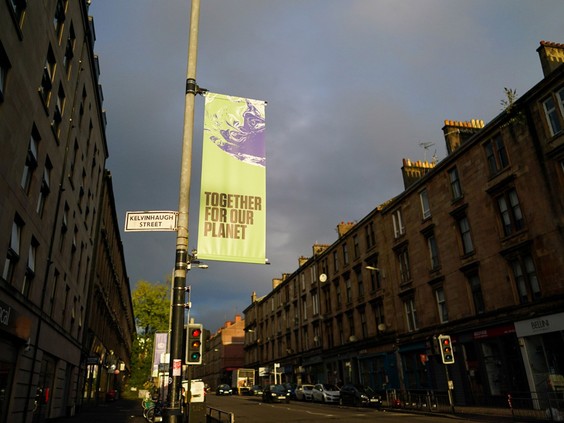
UN’s Imaginary Planet

A banner advertising the COP26 climate talks in Glasgow, U.K., on Oct. 20, 2021. PHOTO BY IAN FORSYTH/BLOOMBERG FILES

William Watson writes at Financial Post What planet do UN carbon-fighters live on? Excerpts in italics with my bolds and added images.

If current trends continue, the chance of the world hitting the UN’s goals are slim to none

One of the biggest news stories in Quebec this week is the partial closing of the Louis Hippolyte-Lafontaine tunnel, a major commuting artery under the St. Lawrence River, for what are termed “urgent” repairs. Half the tunnel’s lanes will be closed for three years — though that’s probably optimistic. Montreal’s brand-spanking-new light rail system, which for some reason the people who run the public pension plan think will be a big money-maker for them, recently had its opening delayed until next spring. In Quebec, big projects delays are like winter snow: simply assumed.

Though big for the affected commuters, these are tiny projects for the world. Yet they’ll take three years. Slowly, very slowly, does seem to be the way things work in many parts of the world these days. (Is there, by the way, a more aptly named figure than former Ottawa police chief Peter Sloly, whose approach to the truckers’ incursion seems to have been the opposite of speedy — and therefore of course very, very Ottawa?)

The tunnel, the bridge and the Réseau express métropolitain LRT came to mind as I scrolled through the latest edition of the United Nation Environment Programme’s (UNEP) update on the progress — or, in its view, shameful lack of progress — the world has made decarbonizing itself.

Judging by the 2½ pages of acknowledgements, this annual “Emissions Gap Report” is an immense undertaking by all sorts of committed people from universities, the UNEP itself and organizations such as the Bezos Earth Fund, the International Council on Clean Transportation, the ClimateWorks Foundation and so on. IKEA itself gets a shout-out for contributions from its foundation.

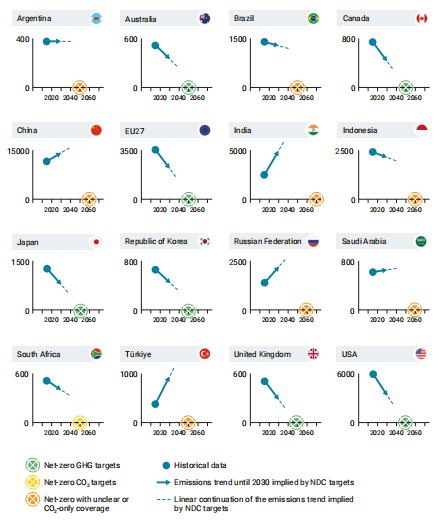
Not all the carbon news is bad. In a lovely set of graphs — production values, as always at the UN, are world-class — the team reports on how each G20 country is doing on its 2050 target (or NDC: nationally determined contribution). The arrow emerging from Canada’s trend points downward and to the right, heading for what looks like an exact bull’s eye with our commitment. If we do what we’ve said we’ll do — though that’s obviously a big if — we’ll get there. The EU27, the United Kingdom, the United States and Australia (though its aim is off by a few years) are in essentially the same situation.

But other countries are not, including five that already account for a quarter of greenhouse gas emissions. Thus the arrows for China, India, Russia, Brazil and Indonesia are headed skyward, soaring to levels far above their 2060 (not 2050) commitments. Maybe a decade or two of rapid economic growth will persuade them they’re now rich enough to go after carbon. But if current trends continue, the chance of the world hitting the UN’s goals are slim to none.

Which leads to a lot of foot-stamping scolding on the part of the emissions-gap team. Watching 20th-century international hockey, we Canadians were always shocked that Soviet coaches evidently thought they could get more out of their players by haranguing them on the bench after a lousy play. For some reason, the UN folk don’t seem to understand that being harangued puts most people off.

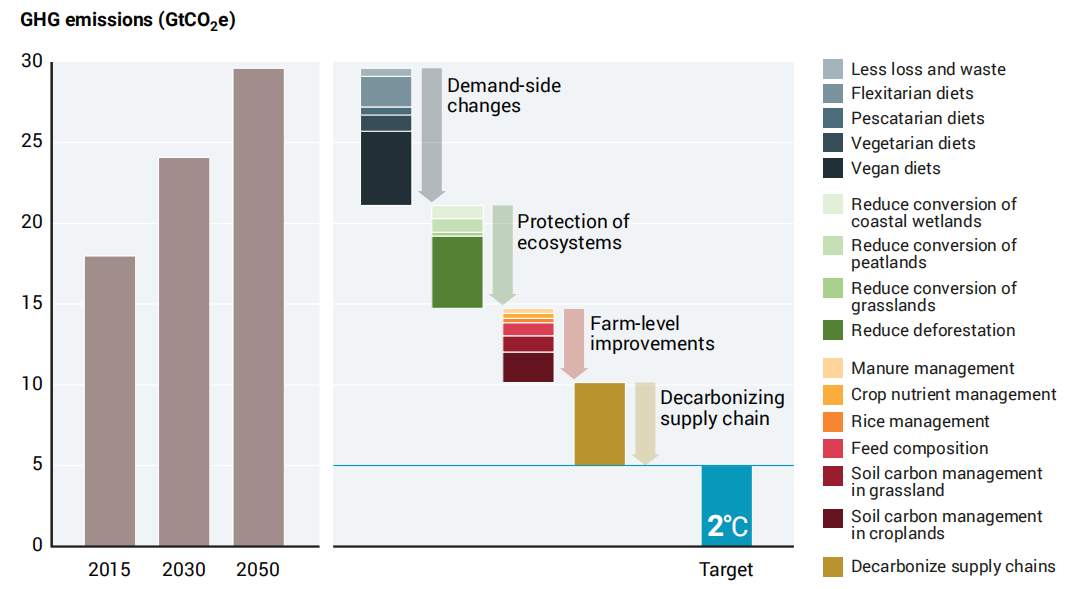
LULUCF refers to emissions from land use and forestry, which can be in addition or subtraction.

Yet the report argues what we need is “wide-ranging, large-scale, rapid and systemic transformation” in order to reach the goal of a two-degree, let alone 1.5-degree, increase in average global temperatures. “Is it a tall order to transform our systems in just eight years?” asks the executive director of UNEP, apparently with a straight face. “Yes,” she concedes, “but we must try.” And so the report goes on to provide a long list of imperatives for governments, industry and (they get their own chapter) bankers.

We all understand that ardent environmentalists are driven by their love for the planet. But which planet exactly do they live on? In the part of planet earth I live on (and love, too, in my own conservative way), it takes three years to perform “urgent” repairs on an important tunnel — and it probably took at least as many to clear the decision to go ahead. Yet here are apparently intelligent and certainly well-educated people saying the world must turn its agricultural sector upside down, or at least get a good start on doing so, in just eight years.

Figure 6.2 Food systems emissions trajectory and mitigation potentials by transformation domain

Societies do undergo radical transformations. The other day I found myself talking to a speaker, telling it which radio station to play. We of a certain age are living quite differently than we did as children. But people only make these big transformations voluntarily, when new technologies or ideas come along that are self-evidently desirable and appear worth spending money on.

That would not be the case with a precipitate, top-down overhaul
of our agricultural and industrial systems.

We’ve only just figured out how to feed eight-billion people. What happens to a billion or two of them if the grand agricultural experiment the UN wants us all to try doesn’t work out? Environmentalists always say this is the only planet we’ve got. It is indeed. But that means there’s nowhere else to import food from if global experiments go wrong.

Shallow Warmists Strike Again

John Tamny exposes the vapid scientism of global warmists in his Real Clear Markets article With Their Attacks On David Malpass, Global Warming Hysterics Reveal Their Shallow Ways.  Excerpts in italics with my bolds and added images.

In 2008 Nigel Lawson published An Appeal To Reason: A Cool Look at Global Warming. The Tory radical who served as Margaret Thatcher’s Chancellor of the Exchequer was promptly attacked for having the temerity to write about the theory of global warming absent scientific credentials.

Lawson thankfully didn’t cower amid the arrows directed his way. Instead, Lawson responded that he would cease talking about global warming as soon as other non-scientists like Al Gore, Tony Blair, and other self-serious hysterics did the same. Brilliant!

As readers surely know, the Al Gores of the world never took Lawson up on his offer. The non-scientist  Gore continues to express alarm about “global warming,” and he continues to attack those who disagree with him.

Indeed, Gore recently went after David Malpass, president of the World Bank. Gore described Malpass as a “climate denier,” only for the World Bank head to be asked his views on whether or not human progress is the cause of a warming planet. Malpass’s response was, “I’m not a scientist.”

Please think about Malpass’s response, along with the vitriol directed at Lawson fourteen years ago. For writing a book about so-called “global warming” without scientific credentials, Lawson was demonized.

In which case, Malpass’s response to the question was seemingly the correct one
for the warming nail-biters in our midst.

Not a scientist, Malpass would leave the question of warming to the scientists. Gore et al should have been thrilled, except that Malpass’s response actually brought on more frothing at the mouth from warming’s religionists.

Applied to Lawson, it’s all a reminder that warmists really don’t care about one’s scientific credentials so long as the individual being asked about a warming planet is answering the questions the right way. Translated, you can be a dog-catcher and comment about global warming so long as you conclude that human progress born of fossil fuel consumption is the cause.
It’s all a reminder of how very surface is the embrace of “science” by warmists.

Survey in 2009 first to claim “97% of scientists agree”. Participation excluded private sector and skeptical disciplines (engineering, astrophysicists, etc.), then counted only 77 published climate specialists.

Call “science” their shield. In contending that “97% of scientists believe” life defined by much greater health and exponentially greater living standards has a “warming” downside, the warmists in their delusional minds feel as though they have immunity from reasonable discussion. They’re twice incorrect.

For one, arguably the surest sign you’re in the presence of “scientists” is if they’re arguing. In which case this laughable notion that scientists near monolithically believe as warming mouth breathers do near totally ignores just how much scientists debate everything. The previous truth further reminds us that it’s not science without the doubt.

From there, we just have to be reasonable. We have to stop and think about what life was like before the discovery that planet earth had immense and seemingly endless amounts of oil, coal and surely other commodities that provide us with power. Life before uses were discovered for the earth’s plenty was nothing short of brutal.

As Alex Epstein reminds us in Fossil Future, death from extreme cold was the annual norm, and actually much greater than deaths that resulted from extreme heat. There was also the problem of highly limited drinking water that was actually potable. After which, much of life was defined by an endless pursuit of food in quantities never sufficient to feed us. An “extra mouth to feed” used to be a very real worry, versus today when eating is taken for granted.

How did we get here? Fossil fuels, plain and simple. That’s the case because the fuels powered the various machines that freed us humans to increasingly specialize our work. Thanks to the mechanization of so much that was formerly done by human hands, the human beings that populate the world were more and more able to fulfill their specialized potential. In other words, a local and eventually global division of labor revealed itself on the way to staggering abundance that those who lived in a pre-fossil fuel past could never imagine.

In the words of Epstein, “climate mastery” born of incredibly sophisticated global symmetry meant that people had the means to heat their surroundings when it was bitterly cold, and cool their surroundings when it was brutally hot. Clean water was plentiful such that the world’s population could – yes – greatly reduce consumption of liquids with alcohol in it. And then houses and buildings could be built in rapid fashion that would similarly protect us from an “environment” that wasn’t always kind.

Crucial about these advances that were and are a direct consequence of machines, the ever-widening global division of labor that I write about in my new book The Money Confusion has given the world both the means to care about planet earth along with more and more specialized, Will tomorrow’s energy replace oil and coal? It’s impossible to say. But what can be said with certainty is that without an advanced society that’s a direct consequence of fossil-fuel consumption, we would never have the means to pursue oil’s replacement; assuming there is one.

Back to Malpass, it’s not just that his knuckle-dragging critics want it both ways in criticizing his true admission that he’s not a scientist. That’s just politics. What’s really sad is that global warming fanatics can’t see that the very human progress they disdain (and that they couldn’t live happily without) is what sets the stage for even better care of the planet they claim to want to save.

And it doesn’t take a scientist to understand what the warmists do not.