Climate Change Thinking for Open or Locked-Down Minds

William Happer provides a framework for thinking about climate, based on his expertise regarding atmospheric radiation (the “greenhouse” mechanism).  But he uses plain language accessible to all.  The Independent Institute published the transcript for those like myself who prefer reading for full comprehension.  Source: How to Think about Climate Change  Some excerpted highlights in italics with my bolds,

clouds_from_space_1200x650

This presentation by Dr. William Happer was delivered at the Hillsdale College National Leadership Seminar in Phoenix, Arizona, that was held on February 19, 2021. The Cyrus Fogg Brackett Professor Emeritus of Physics at Princeton University, Dr. Happer is the author of the foreword to the Revised and Expanded Third Edition of the Independent Institute book, Hot Talk, Cold Science: Global Warming’s Unfinished Debate, by S. Fred Singer, David R. Legates and Anthony R. Lupo.

2021_03_11_happer_02_1400x787

The Climate Crusade for a False Alarm

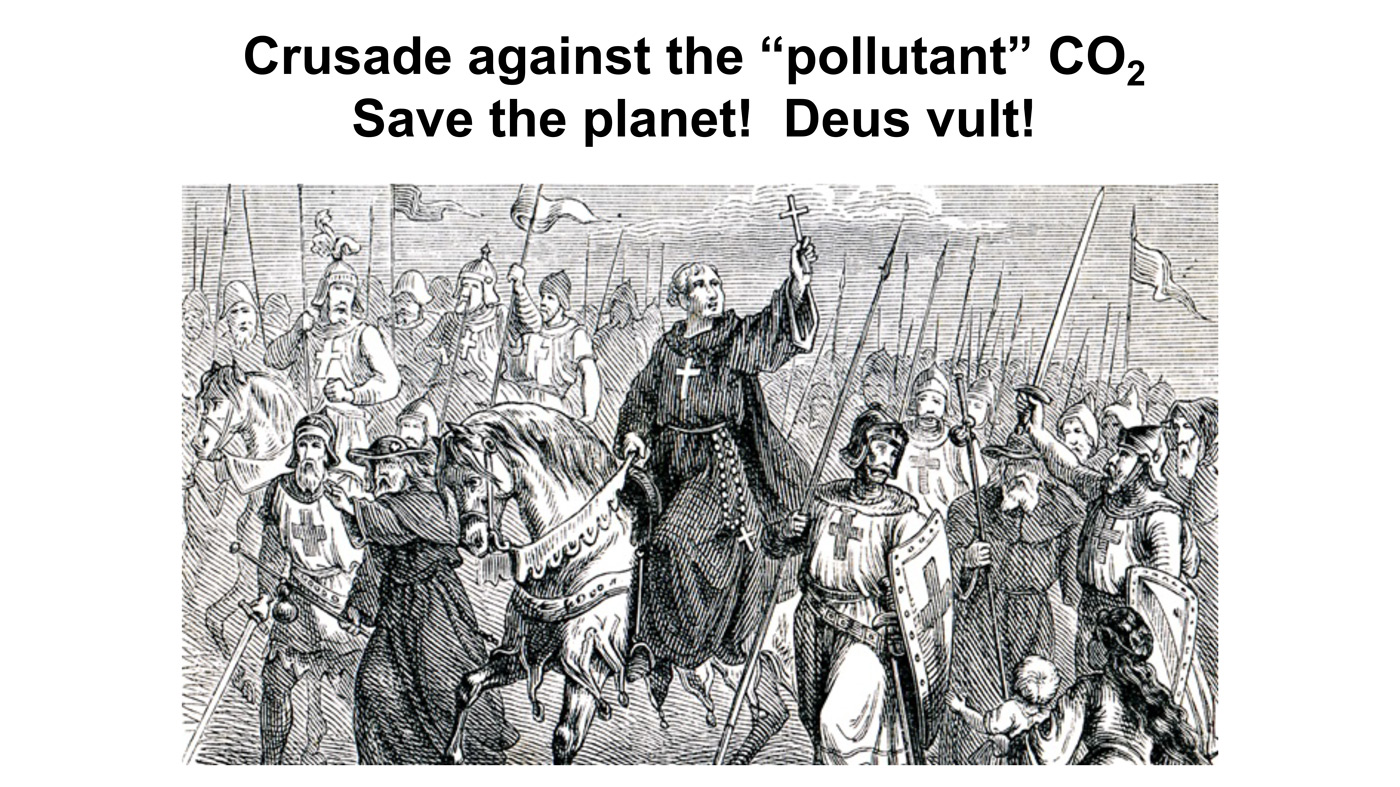
The best way to think about the frenzy over climate is to consider it a modern version of the medieval Crusades. You may remember that the motto of the crusaders was “Deus vult!”, “God wills it!” It is hard to pick a better virtue-signaling slogan than that. Most climate enthusiasts have not gone so far, but some actually claim that they are doing God’s work. After decades of propaganda, many Americans, perhaps including some of you here today, think there really is a climate emergency. Those who think that way, in many cases, mean very well. But they have been misled. As a scientist who actually knows a lot about climate (and I set up many of our climate research centers when I was at the Department of Energy in the early 1990s) I can assure you that there is no climate emergency. There will not be a climate emergency. Crusades have always ended badly. They have brought discredit to the supposed righteous cause. They have brought hardship and death to multitudes. Policies to address this phony climate emergency will cause great damage to American citizens and to their environment.

Part of the medieval crusades was against the supposed threat to the holy sites in Jerusalem. But a lot of it was against local enemies. The medieval Inquisition really did a job on the poor Cathars, on the Waldensians of southern France, and on the Bogomils in the Balkans. Climate fanatics don’t know or care any more about the science of climate than those medieval Inquisitors knew or cared about the teachings of Christ.

2021_03_11_happer_05_1400x787

Don’t Confuse CO2 with Air Pollution

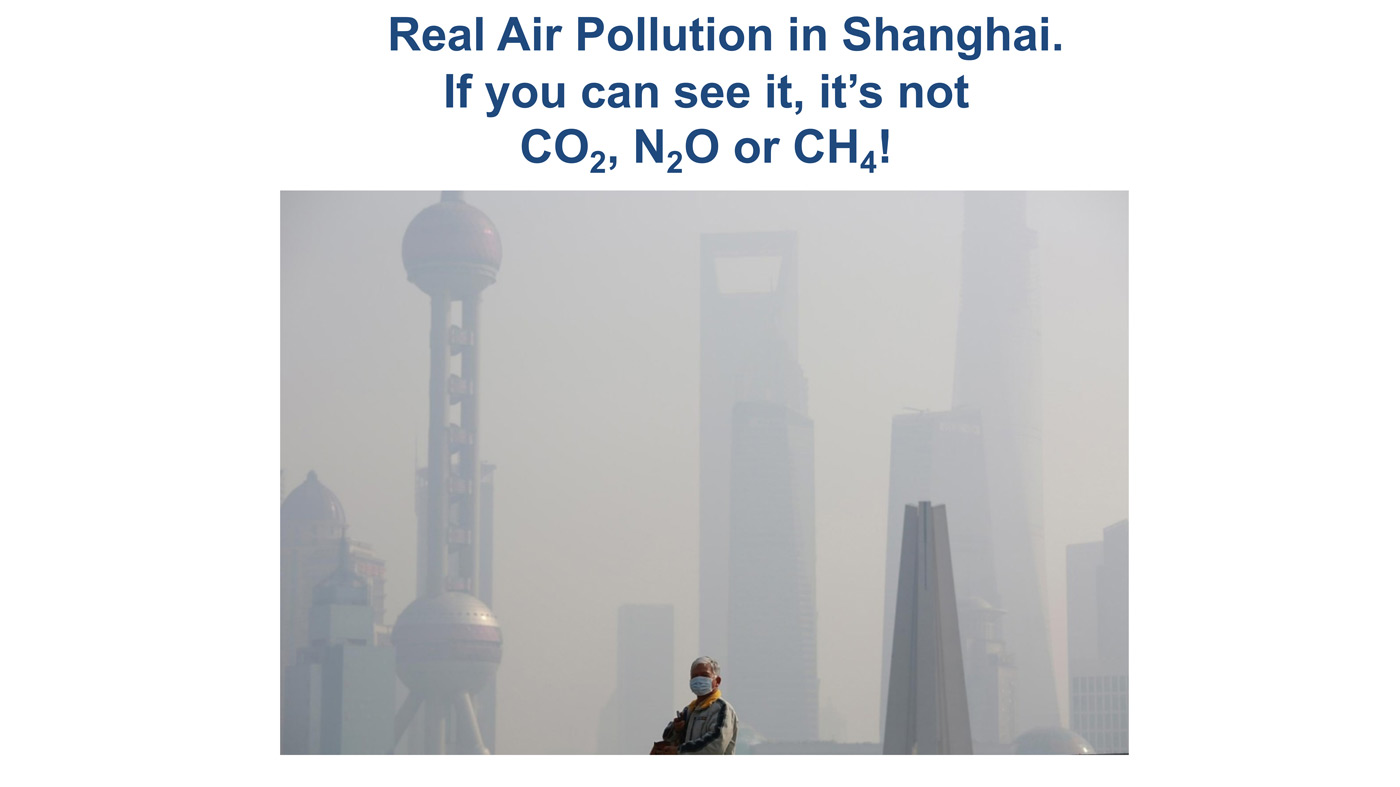
Just about everyone wants to live in a clean environment. I do, and I am sure everyone here does. This is a photograph of Shanghai, and that’s real air pollution. You can just barely see the Bottle Opener Building in the back through all the haze. Some of this is due to burning coal. But a bigger fraction is due to dust from the Gobi Desert. They have had this type of pollution in Shanghai since the days of Marco Polo and long before. Part of it is burning stubble of the rice fields, which is traditionally done before planting next year’s crop. This is real pollution. I would not want to live in a city like that. If there is anything to do that would make it better, I would certainly support that.

But, none of this has anything to do with CO2. CO2 is a gas you cannot see, smell or taste. So, hare-brained schemes to limit emissions of CO2, which is actually beneficial, as I will explain a little bit later, will only make it harder to get rid of real pollutants like what I just showed you in Shanghai.

2021_03_11_happer_08_1400x810

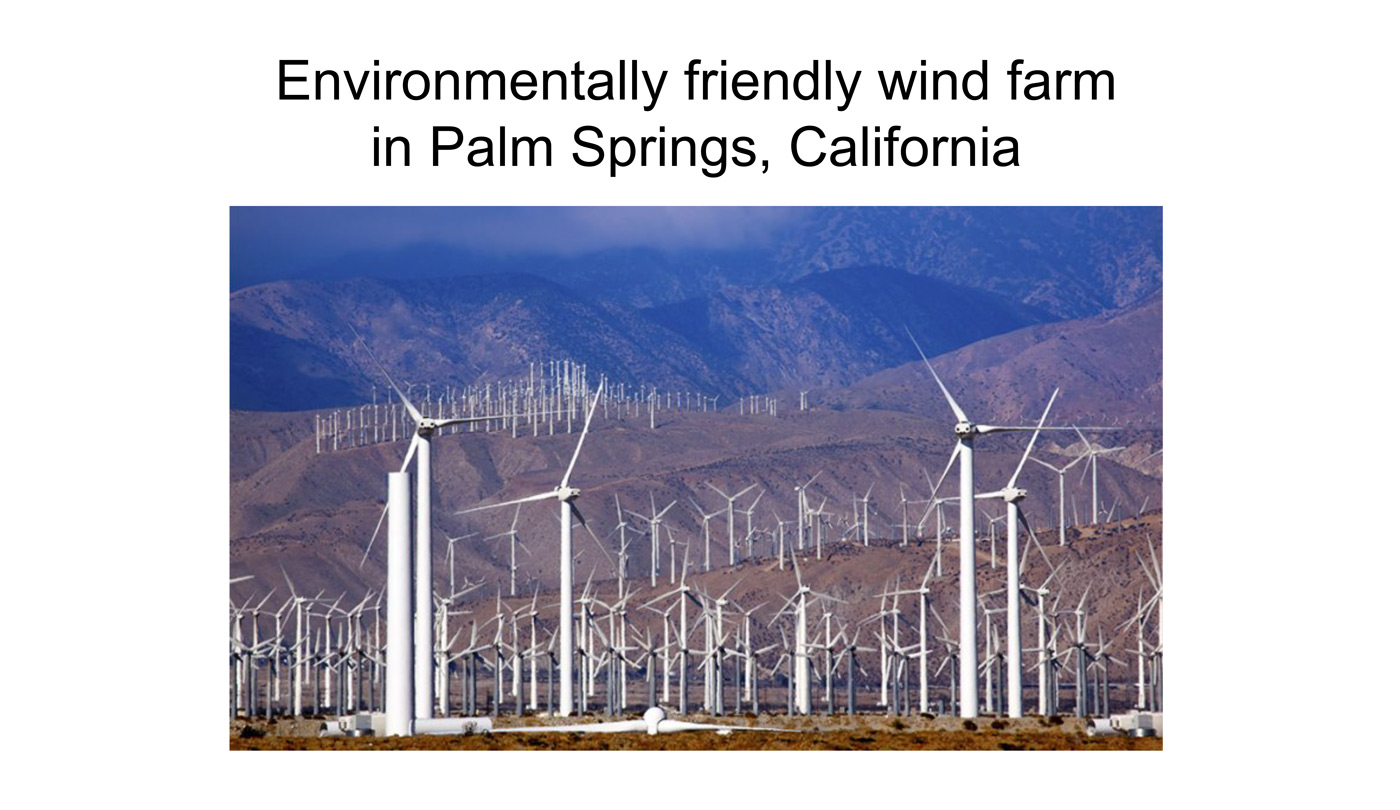
Like all wind farms it is now falling to pieces we can’t dispose of.

Renewable energy is what I would call the inverse Robin Hood strategy—you rob from the poor to give to the rich. Utilities are permitted to raise rates because of their capital investments in inefficient, unreliable renewables. They junk fully depreciated coal, gas and nuclear plants, all of which are working beautifully, and producing inexpensive, reliable energy. But regulated profits are much less. Taxpayers subsidize the rich, who can afford to lease land for wind and solar farms. Tax incentives pander to the upper class who live in gated communities and can afford to buy Tesla electric cars. They get subsidies from the state and federal government. They even get subsidized electrical power to charge up their toys. The common people have little spare income for virtue signaling. They pay more and more for the necessities of life in order to subsidize their betters.

Climate Facts to Replace Hysteria

You cannot spend a lifetime as a professor and not relapse from time to time into giving a classroom lecture. So, you will have to expect to be lectured for a few minutes. The good news is that there will be no quiz. But for those of you who share my view that this climate hysteria is serious nonsense, it helps to know what the facts are. I hope I can arm some of you with the real scientific facts.

2021_03_11_happer_09_1400x787

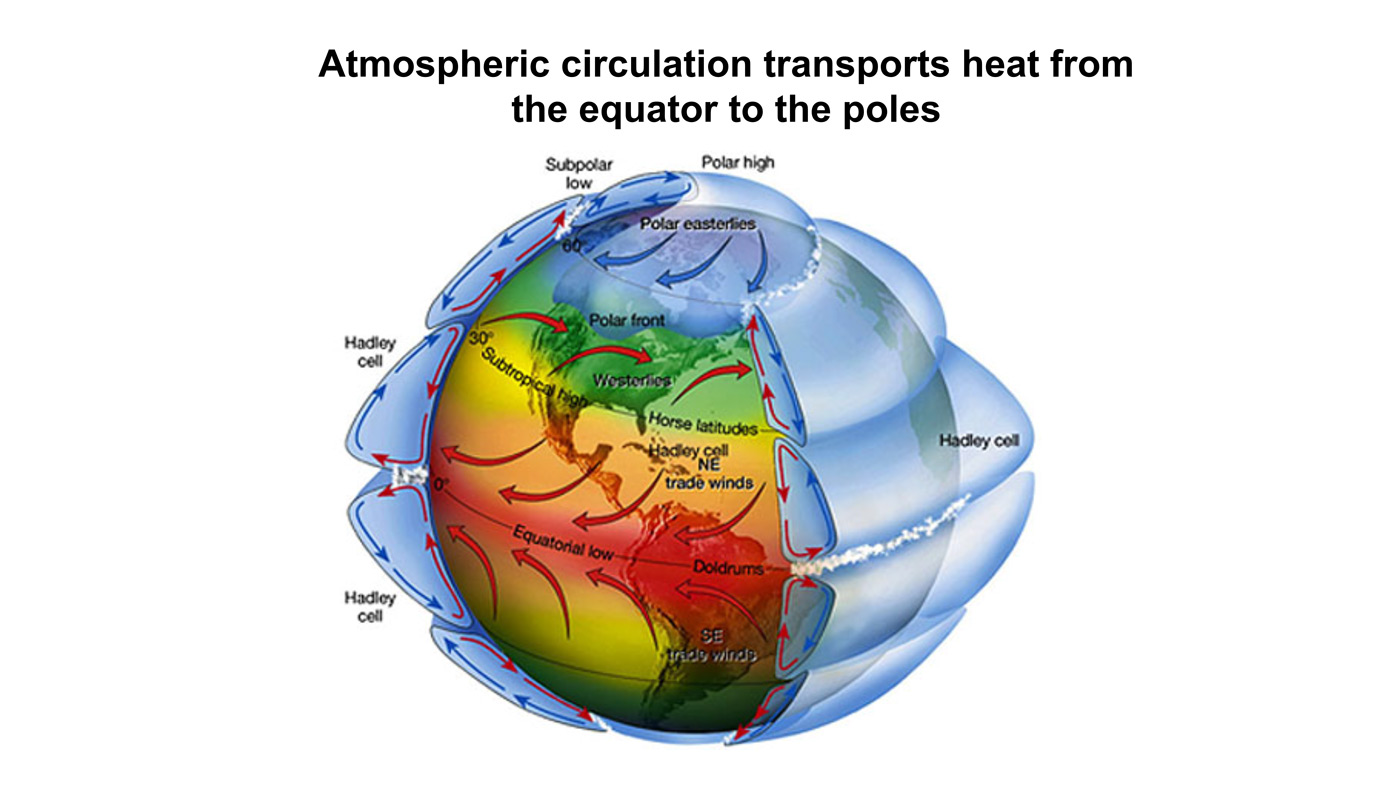
Climate involves a complicated interplay of the sunlight that warms us, and thermal infra-radiation that escapes to space. Heat is transported from the tropics to the poles by the motion of warm air and ocean water. We all know about the Gulf Stream that carries huge amounts of heat to northern Europe, even to Russia. Movements of air in the atmosphere also carry a lot of heat, as we know from regular cold spells and hot spells.

2021_03_11_happer_10_1400x787

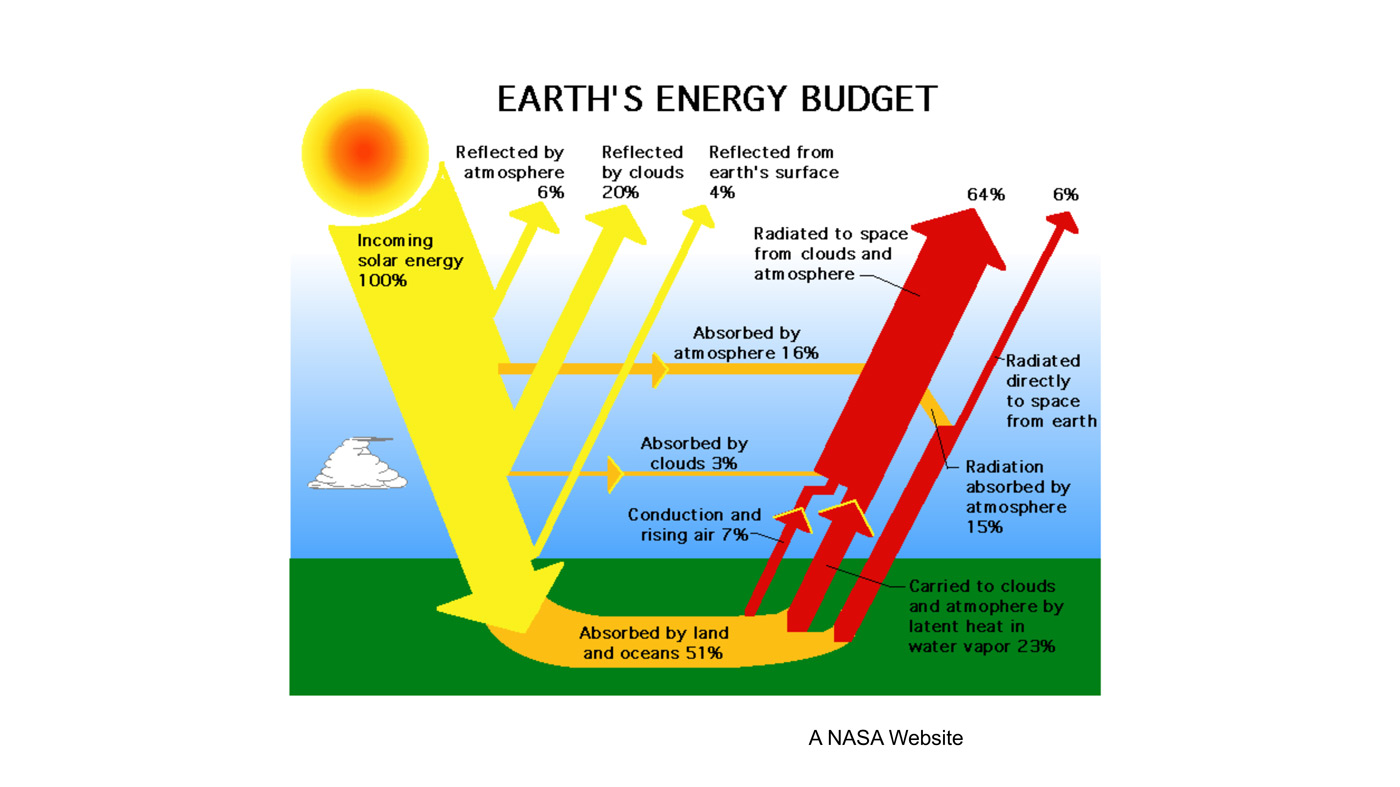
Here is a picture of Earth’s energy budget. I mentioned we are warmed by the Sun. About half of the sunlight eventually gets to the surface. What prevents it all from reaching the surface are clouds and a small amount of scattering and absorption by the atmosphere. Other parts of America, like New Jersey, now are covered with clouds. Those areas do not get any sunlight directly. But the half of sunlight that does reach the ground heats it. You can notice that in the afternoon, if you go outside. If you are a gardener like me, you can put your hands in the soil and it is nice and warm. It makes the corn grow. But that heat has to be released. If you keep adding heat to the ground, it gets hotter and hotter. So, the heat is eventually released by radiation into space which is that red arrow going up on the viewgraph. But for the first few kilometers of altitude, a good fraction of that heat is not carried by radiation, but by convection of warm, moist air. CO2 has no direct effect on convection near the surface. But once you get up to 10 kilometers or so, most of the heat is transported by radiation.

By the way, I have the meter running now. Remember that the outside air is 400 parts per million CO2. I am not sure you can see the meter but I will read it for you. It is 580 in here. It is not a whole lot higher than the 400 outside. It was at 1,000 parts per million where we were having lunch. CO2 levels are never stable near Earth’s surface. People are panicking about one or two parts per million of CO2. Now, the meter reads 608 parts per million—that is probably because I breathed on it. Hot air sets it off. I sometimes take the meter out onto my back porch. At the end of a summer day the CO2 levels on my back porch drop to maybe 300 parts per million, way below the average for outside air. That is because the trees and grass in my backyard have sucked most of the CO2 out of the local air during the day. If I get up early the next morning and I look at the meter, it is up to 600 parts per million. So just from morning to night CO2 doubles in the air of my back yard. Doubles and halves, doubles and halves. At least during the growing season that is quite common. And we have these hysterics about CO2 increasing by 30 or 40 percent. It is amazing.

2021_03_11_happer_11_1400x787

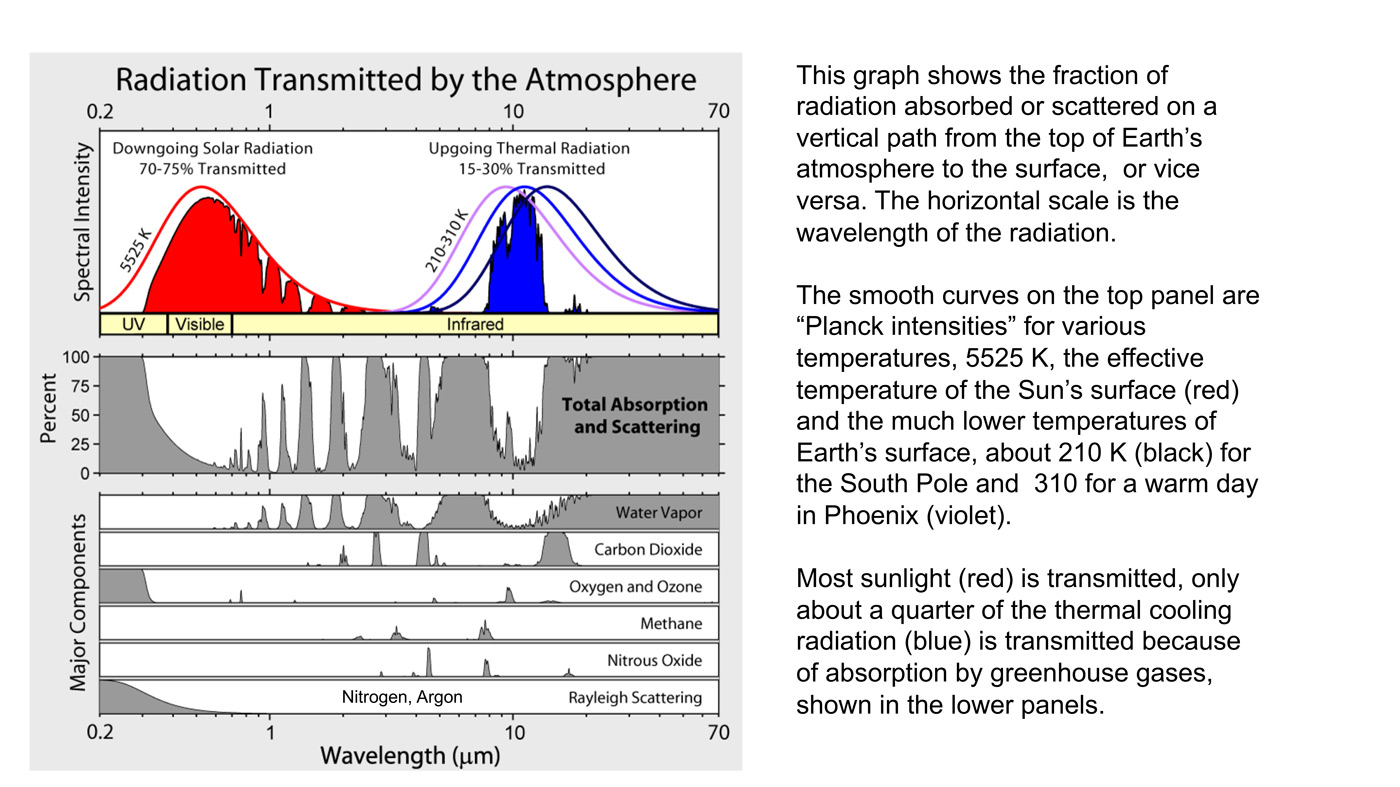
So, why the frenzy over CO2? It is because it is a greenhouse gas. That is true. This is a somewhat deceptive picture. What it shows in red is sunlight, and the horizontal scale on the top panel is the wavelength of the sunlight. Radiation wavelengths for sunlight are typically about a half a micron (half a millionth of a meter). That is green light, the color of green leaves. The thermal radiation that cools the Earth is that blue curve to the right of the upper panel, and that is a much longer wavelength, typically around 10 microns. So, the wavelength of thermal radiation is 10 to 20 times longer than the wavelengths of sunlight. It turns out that the sun’s energy can get through the Earth’s atmosphere very easily. So essentially all sunlight or at least 90 percent, if there are no clouds, gets to the surface and warms it. But radiation cooling of the surface is less efficient because various greenhouse gases (most importantly water vapor, which is shown as the third panel down, and CO2, which is the fourth panel down) intercept a lot of that radiation and keep it from freely escaping to space. This keeps Earth’s surface temperature warmer than it would be (by about 20 or 30 degrees). The Earth would be an ice cube if it were not for water vapor and CO2; and when I say water vapor, you should understand that I really mean water vapor and clouds, the condensed form of water. Clouds are at least as important as greenhouse gases and they are very poorly understood to this day.

2021_03_11_happer_13_1400x787

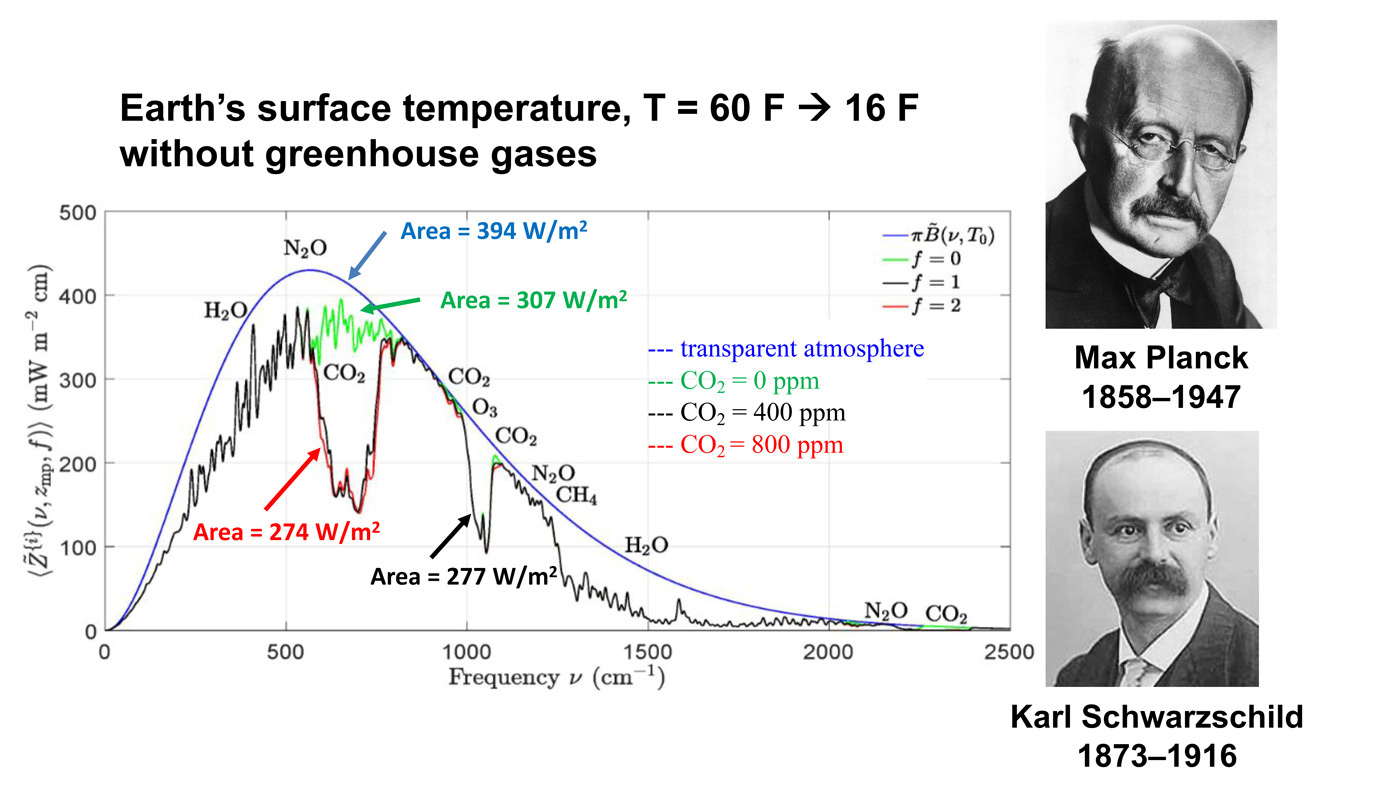
This is an important slide. There is a lot of history here and so there are two historical pictures. The top picture is Max Planck, the great German physicist who discovered quantum mechanics. Amazingly, quantum mechanics got its start from greenhouse gas-physics and thermal radiation, just what we are talking about today. Most climate fanatics do not understand the basic physics. But Planck understood it very well and he was the first to show why the spectrum of radiation from warm bodies has the shape shown on this picture, to the left of Planck. Below is a smooth blue curve. The horizontal scale, left to right is the “spatial frequency” (wave peaks per cm) of thermal radiation. The vertical scale is the thermal power that is going out to space. If there were no greenhouse gases, the radiation going to space would be the area under the blue Planck curve. This would be the thermal radiation that balances the heating of Earth by sunlight.

In fact, you never observe the Planck curve if you look down from a satellite. We have lots of satellite measurements now. What you see is something that looks a lot like the black curve, with lots of jags and wiggles in it. That curve was first calculated by Karl Schwarzschild, whose picture is below Planck’s picture. Schwarzschild was an officer in the German army in World War I, and he did some of his most creative work in the trenches on the eastern front facing Russia. He found one of the first analytic solutions to Einstein’s general theory of relativity while he was there on the front lines. Alas, he died before he got home. The cause of death was not Russian bullets but an autoimmune disease. This was a real tragedy for science. Schwarzschild was the theorist who first figured out how the real Earth, including the greenhouse gases in its atmosphere, radiates to space. That is described by the jagged black line. The important point here is the red line. This is what Earth would radiate to space if you were to double the CO2 concentration from today’s value. Right in the middle of these curves, you can see a gap in spectrum. The gap is caused by CO2 absorbing radiation that would otherwise cool the Earth. If you double the amount of CO2, you don’t double the size of that gap. You just go from the black curve to the red curve, and you can barely see the difference. The gap hardly changes.

The message I want you to understand, which practically no one really understands, is that doubling CO2 makes almost no difference.

Doubling would replace the black curve by the red curve. On the basis of this, we are supposed to give up our liberties. We are supposed to give up the gasoline engines of our automobiles. We are supposed to accept dictatorial power by Bernie Sanders and Ocasio-Cortez, because of the difference between the red and the black curve. Do not let anyone convince you that that is a good bargain. It is a terrible bargain. The doubling actually does make a little difference. It decreases the radiation to space by about three watts per square meters. In comparison, the total radiation to space is about 300 watts per square meter.

So, it is a one percent effect—it is actually a little less than that, because that is with no clouds. Clouds make everything even less threatening.

Finally, let me point out that there is a green curve. That is what happens if you take all the CO2 out of the atmosphere. No one knows how to do that, thanks goodness, because plants would all die if you took all the CO2 out of the atmosphere. But what this curve is telling you is that the greenhouse effect of CO2 is already saturated. Saturation is a jargon term that means CO2 has done all the greenhouse warming it can easily do. Doubling CO2 does not make much difference. You could triple or quadruple CO2 concentrations, and it also would make little difference. The CO2 effects are strongly saturated.

2021_03_11_happer_14_1400x787

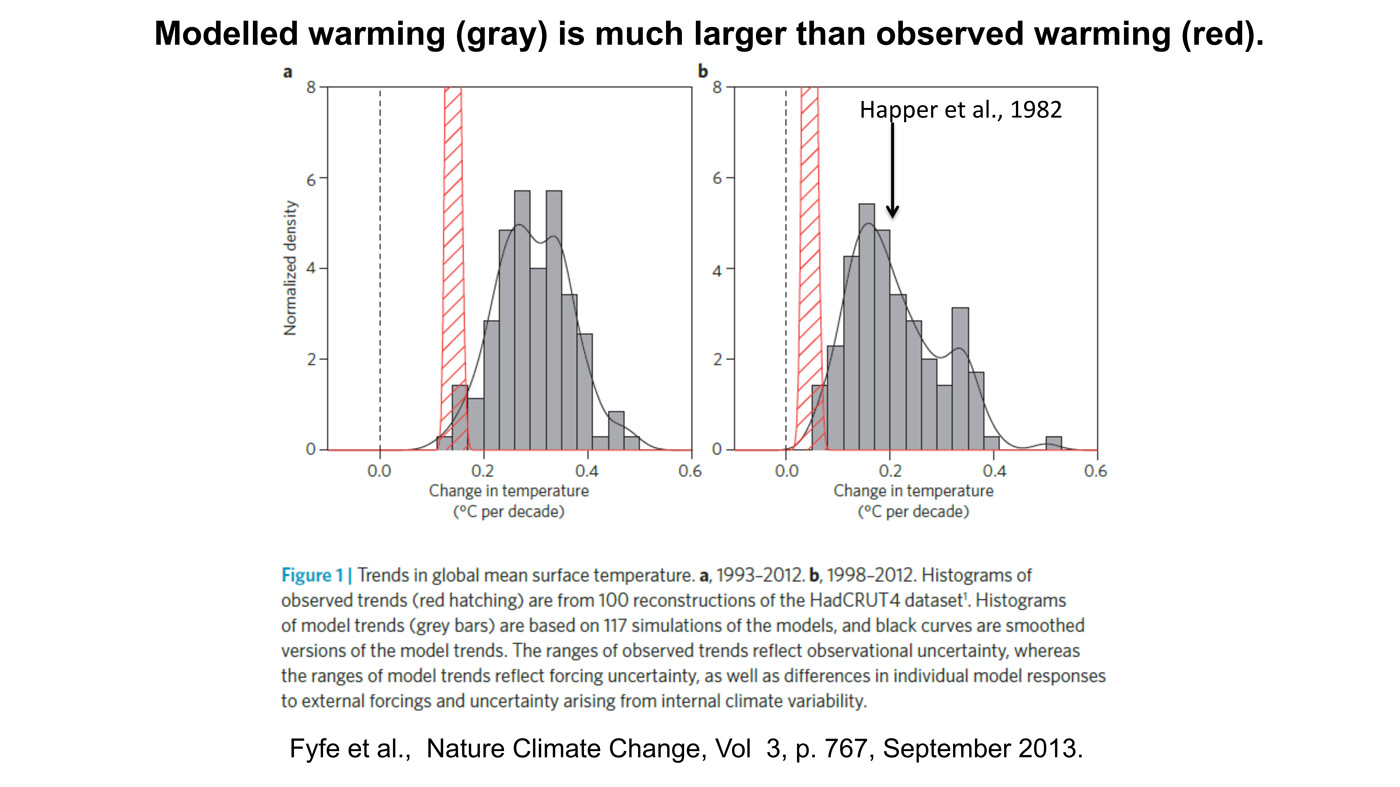
You can take that tiny difference between those curves that I showed you, the red and the black curves, and calculate the warming that should happen. I was one of the first to do this: in 1982 I was a co-author of one of the first books on radiative effects of CO2. On the right panel is my calculation and lots of other people’s calculations since. It is a bar graph of the warming per decade that people have calculated. The red bar is what has actually been observed. On the right is warming per decade over 10 years, and on the left, over 20 years. In both cases the takeaway message is that predicted warmings, which so many people are frantic about, are all grossly larger than the observed warming, which is shown by the red bars. So, the observed warmings have been extremely small compared to computer calculations over any interval that you consider. Our policies are based on the models that you see here, models that do not work.

I believe we know why they do not work, but no one is willing to admit it.

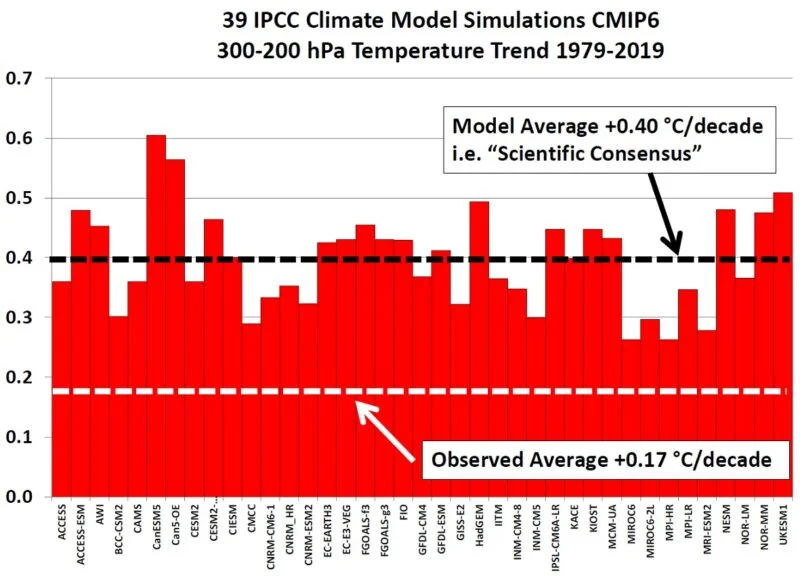
Nobody knows how much of the warming observed over the past 50 years is due to CO2. There is good reason to that think much of it, perhaps most of it, would be there even without an increase in CO2 because we are coming out of the Little Ice Age. We have been coming out of that since the early 1800s, before which the weather was much colder than now. The green curve is measurements from satellites, very much like the measurements of a temporal scanning thermometer. You can look down from a satellite and measure the temperature of the atmosphere. The satellites and balloons agree with each other, and they do not agree with the computer models. This is very nice work by John Christie at the University of Alabama-Huntsville.

The alleged harm from CO2 is from warming, and the warming observed is much, much less than predictions. In fact, warming as small as we are observing is almost certainly beneficial. It gives slightly longer growing seasons. You can ripen crops a little bit further north than you could before. So, there is completely good news in terms of the temperature directly. But there is even better news. By standards of geological history, plants have been living in a CO2 famine during our current geological period.

2021_03_11_happer_17_1400x787

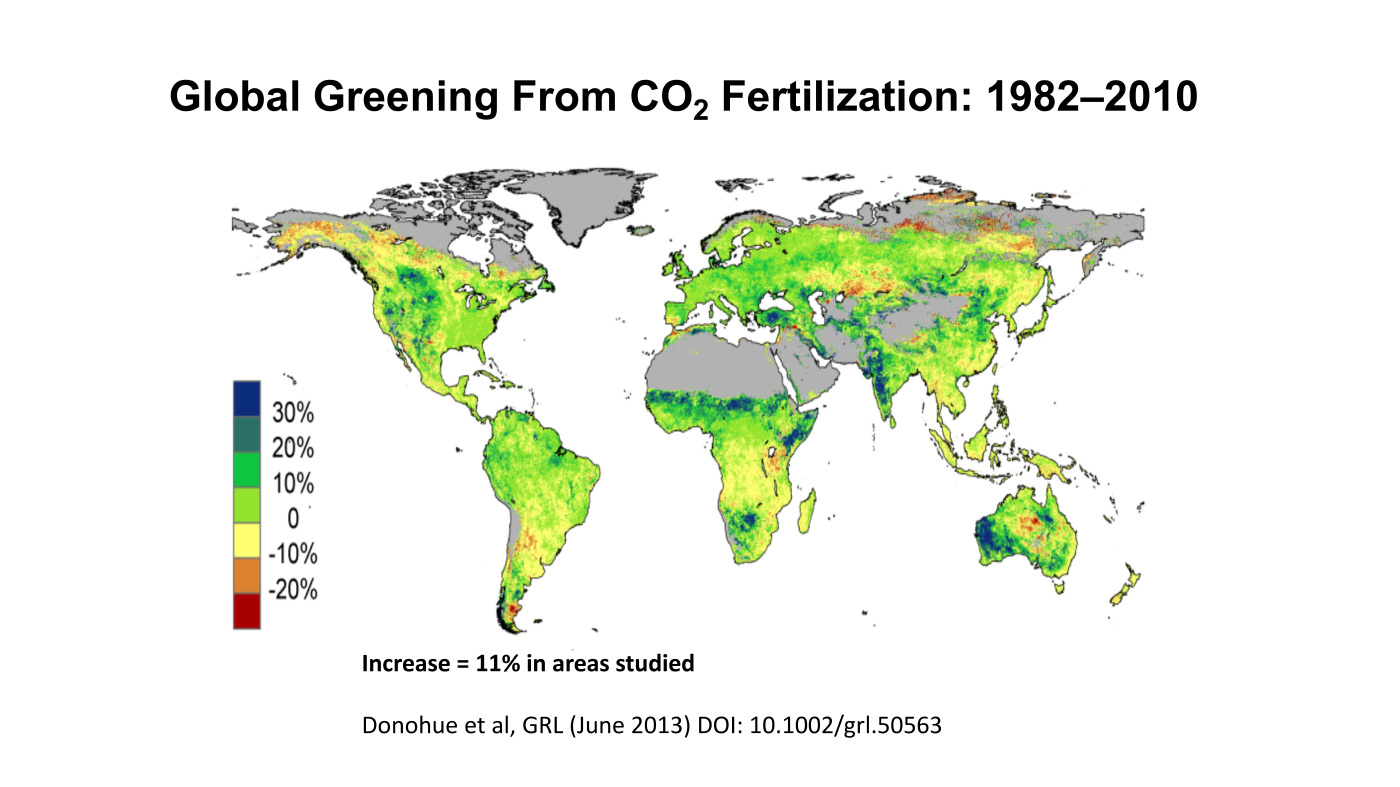
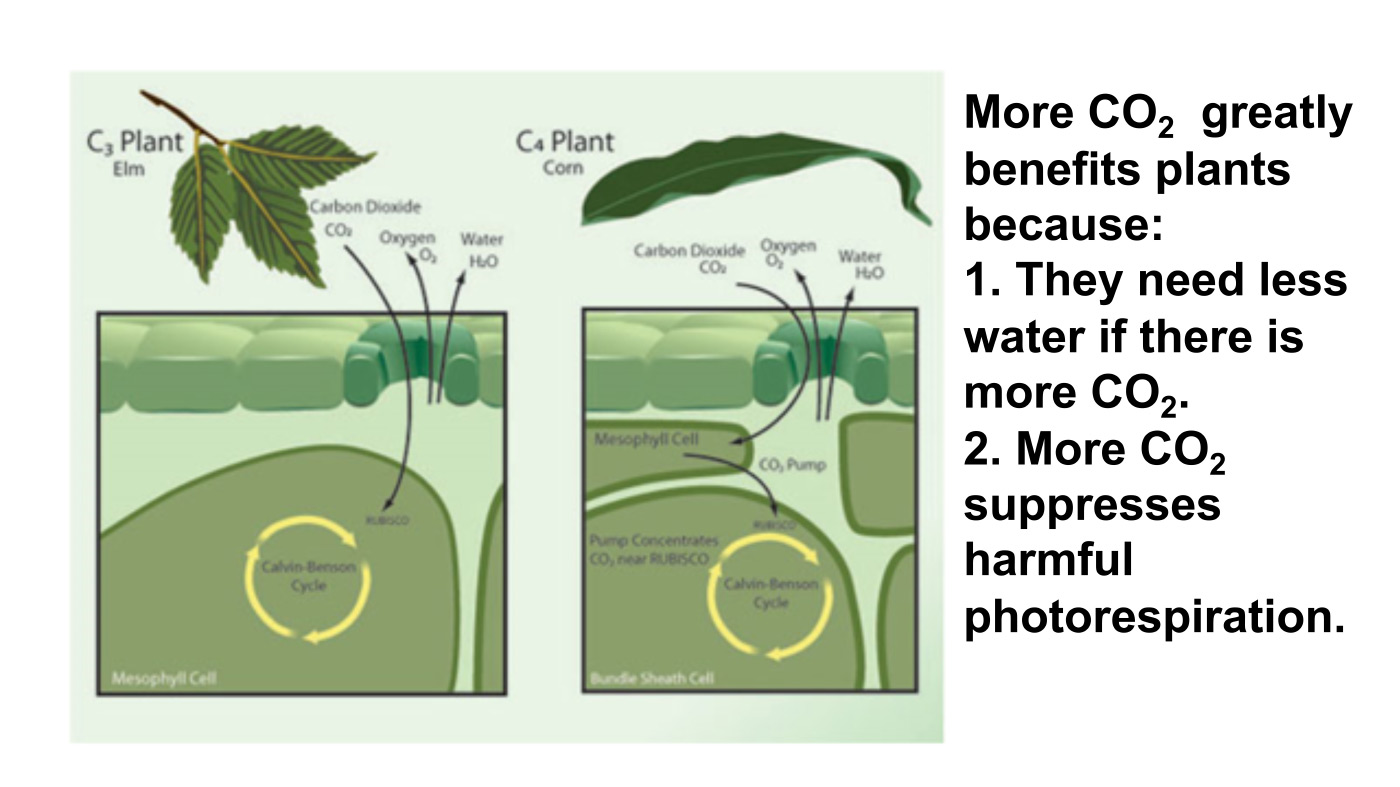
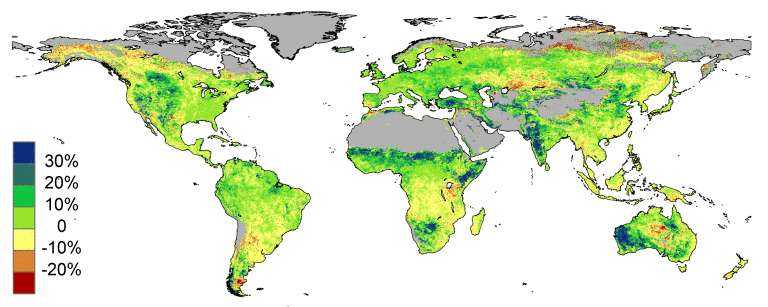
This is the greening of the Earth measured from satellites. This picture shows areas of the Earth that are getting greener over the 20-year period. What you notice is that everywhere, especially in arid areas of Sahel (you can see that just south of the Sahara) it is greening dramatically. The western United States is greening, western Australia is greening, western India is greening. This is almost certainly due to CO2, and the reason this happens is that CO2 allows plants to grow where 50 years ago it was too dry. Plants are now needing less water to grow than they did 50 or 100 years before.

2021_03_11_happer_19_1400x787

When you raise all these hard, scientific issues with the climate alarmists, the response is “how can you say that? 97 percent of scientists agree that there’s a terrible emergency here that we have to cope with.”

Here there are several things you should say. First of all, in science truth is not voted on. It is not like voting on a law. It is determined by how well your theory agrees with the observations and experiments. I just showed you that the theories of warming are grossly wrong. They are not even close and yet we are making our policy decisions based on computer models that do not work. It does not matter how many people say there is an emergency. If it does not agree with experiments and observations, the supposed scientific basis for the emergency is wrong. The claim of a climate emergency is definitely wrong.

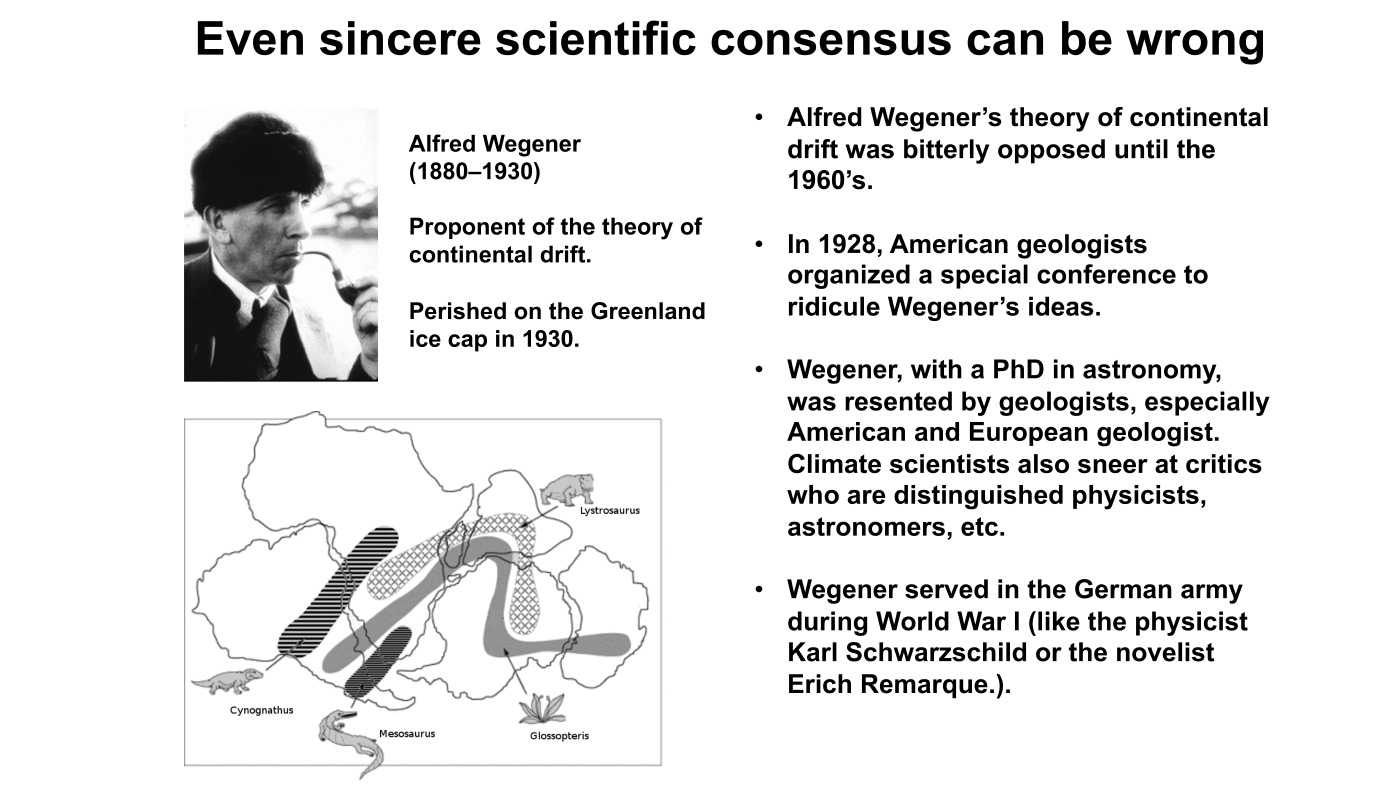
Secondly, even when scientists agree, what they agree on can be wrong. People think of scientists as incorruptible, priestly people. They are not that at all. They have the same faults as everybody else, and they are frequently wrong.

2021_03_11_happer_20_1400x787

The clincher actually came when the USA finally declassified the World War II North Atlantic Magnetic Anomaly data which we had been sitting on for 10 years. The data showed mirror-image conveyor belts of newly-formed oceanic crust, starting at the mid-Atlantic ridge and going out left and right toward America, and toward Europe. So, there was absolutely no question that the seafloor was spreading. That is the one bit of evidence that Wegner did not have, but he had lots of other evidence that should have persuaded people.

This is just one example. I could tell you about many other scientific consensuses that made no sense. This one is interesting because it had no political background. It was pure science, but it does illustrate the fallibility of scientists, and the group-think that goes on in science. If you wanted to advance as a young geologist you could write a paper scorning Wegner in 1950 and get promoted right away, even though your paper was completely wrong. And, once you get tenure, you are there for good.

So, the takeaway message is that policies that slow CO2 emissions are based on flawed computer models which exaggerate warming by factors of two or three, probably more. That is message number one. So, why do we give up our freedoms, why do we give up our automobiles, why do we give up a beefsteak because of this model that does not work?

Takeaway message number two is that if you really look into it, more CO2 actually benefits the world. So, why are we demonizing this beneficial molecule that is making plants grow better, that is giving us slightly less harsh winters, a slightly longer growing season? Why is that a pollutant? It is not a pollutant at all, and we should have the courage to do nothing about CO2 emissions. Nothing needs to be done.

Growing Gap: Rhetoric vs. Reality

asylum-lunatics

From ancient days of village idiots, communities recognized that some people get caught up into thinking and talking crazy stuff detached from the real world.  And if the behavior resulting from being unhinged endangers other people, it becomes necessary to hold the crazies in an asylum apart from the general population.  So what to make of Biden’s first 100 days?  Systemic Delusion, full of sound and fury, in defiance of the real world.  Later on I will go into some depth on the climate fantasies, but the unhinged rhetoric is generalized and administration-wide.  No one knows whether the principals (Biden, Harris, etc.) actually understand what they are saying.  I am inclined to believe they are only posturing, since those in power behind the throne are emboldened by the advantage of escaping accountability for the results of bad rhetoric and policies.

Examples include calling illegal aliens, not simply “undocumented”, but according to Biden “already Americans.”  Legislation expanding voting access to documented citizens is called “voter suppression.”  Adding four more Supreme Justices is called “unpacking the court.”  A brave policeman who saves two black teenagers from being stabbed by a third is called a “racist.”  Biden and his appointees claim the nation is guilty of “systemic racism” without any apology for their own roles for decades in government.  But the grandest fantasy and hypocrisy are wrapped in the call for climate action.

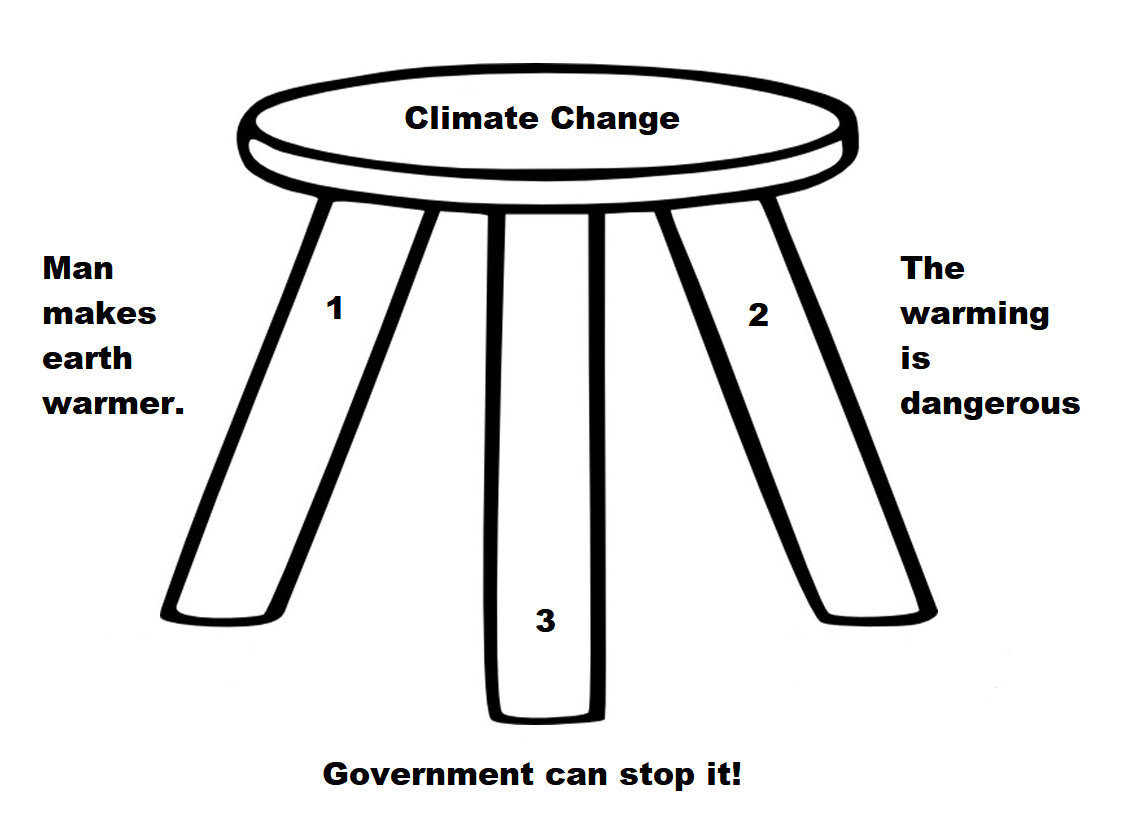
Climate stool

Climate Rhetoric is a stool composed of three assertions, all of which must stand for the appeal to be compelling. Of course, the topic itself has been shifted from “global warming” (not scary enough) to “climate change” (not urgent enough) to “climate crisis, or chaos or emergency.”  The consensus label is not yet settled, with “global weirding” still in the running.  But we know the issue is the same one posted on Obama’s twitter account, back when POTUS was permitted to tweet: “Ninety-seven percent of scientists agree: climate change is real, man-made and dangerous.”

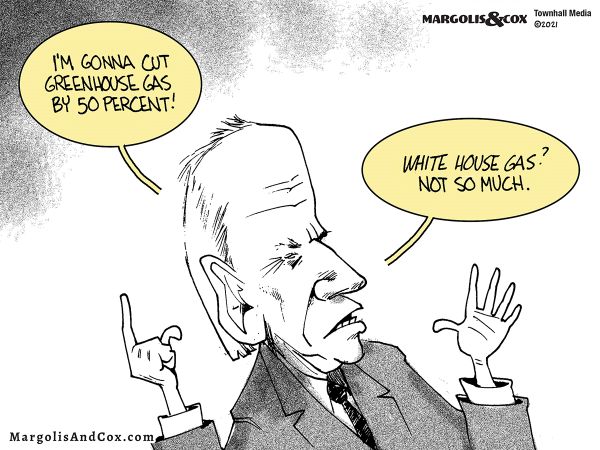
mc_wh_gas_web20210423124932

The Science Leg:  Man Makes Earth Warmer.

Many people commenting both for and against reducing emissions from burning fossil fuels assume it has been proven that rising GHGs including CO2 cause higher atmospheric temperatures. That premise has been tested and found wanting, as this post describes:  Global Warming Theory and the Tests It Fails.  At least five rigorous analyses of relevant datasets failed to discern surface warming due to rising CO2 concentrations.  While it is true in the laboratory that CO2 is able to absorb and emit infrared radiation (IR), the effect upon the actual planetary climate system has not proven to be substantial rather than negligible.

The temperature records show warming from time to time, but do not distinguish between natural and man-made warming.  For example, consider that all the surface warming since the 1940s can be attributed to three oceanic events.

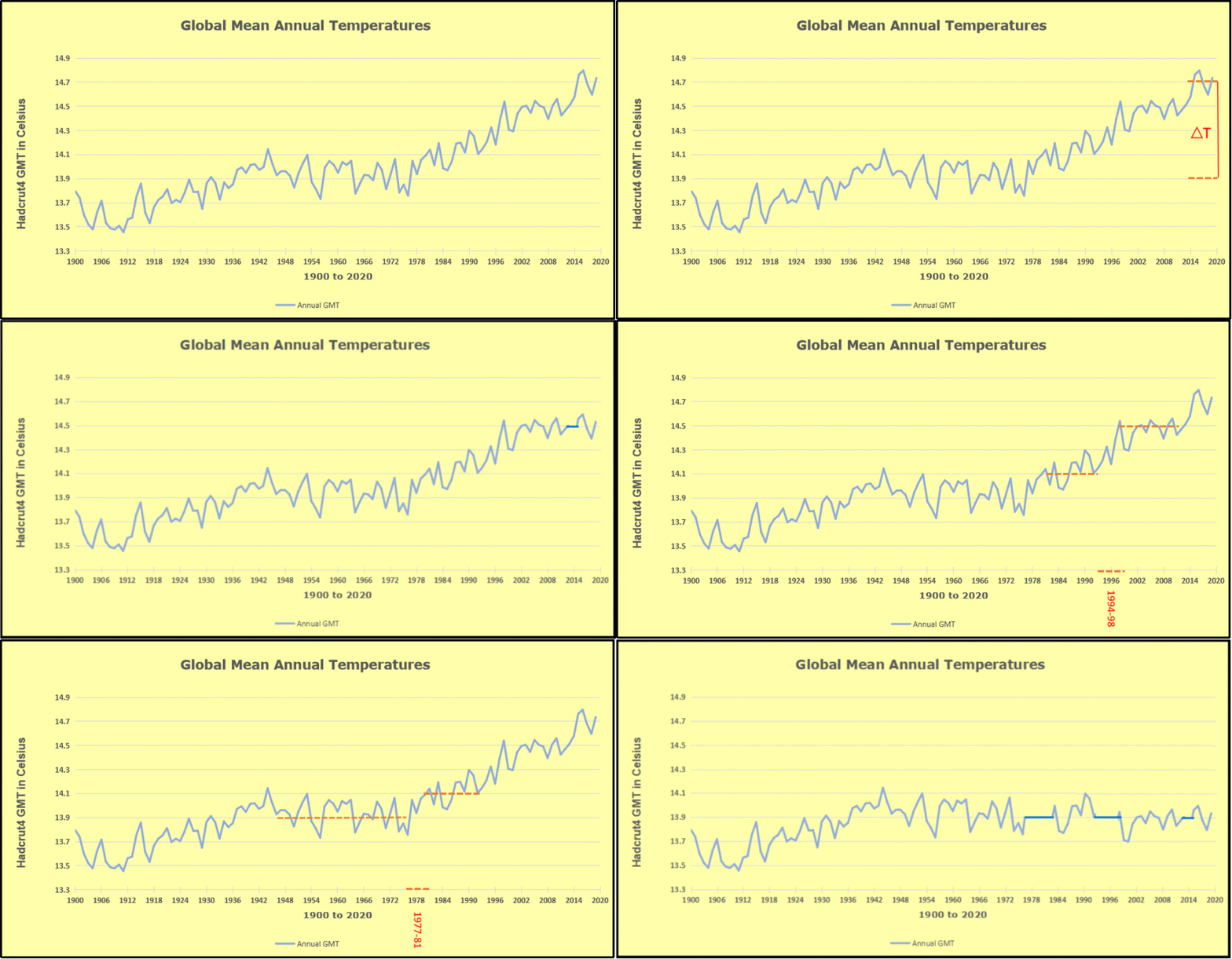
GMT warming events

The animation is an update of a previous analysis from Dr. Murry Salby. These graphs use Hadcrut4 and include the 2016 El Nino warming event. The exhibit shows since 1947 GMT warmed by 0.8 C, from 13.9 to 14.7, as estimated by Hadcrut4. This resulted from three natural warming events involving ocean cycles. The most recent rise 2013-16 lifted temperatures by 0.2C. Previously the 1997-98 El Nino produced a plateau increase of 0.4C. Before that, a rise from 1977-81 added 0.2C to start the warming since 1947. 

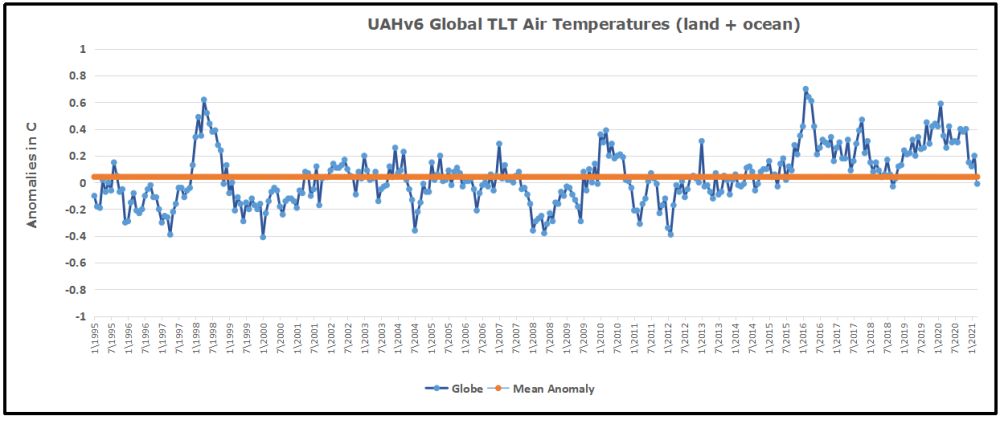
Importantly, the theory of human-caused global warming asserts that increasing CO2 in the atmosphere changes the baseline and causes systemic warming in our climate. On the contrary, all of the warming since 1947 was episodic, coming from three brief events associated with oceanic cycles. Moreover, the UAH record shows that the effects of the last one are now gone as of January 2021. Updated to March 2021 (UAH baseline is now 1990-2020)

uah-global-1995to202103-1

 Professor Richard Lindzen ended a recent lecture with these words:

I haven’t spent much time on the details of the science, but there is one thing that should spark skepticism in any intelligent reader. The system we are looking at consists in two turbulent fluids interacting with each other. They are on a rotating planet that is differentially heated by the sun. A vital constituent of the atmospheric component is water in the liquid, solid and vapor phases, and the changes in phase have vast energetic ramifications. The energy budget of this system involves the absorption and reemission of about 200 watts per square meterDoubling CO2 involves a 2% perturbation to this budget. So do minor changes in clouds and other features, and such changes are common. In this complex multifactor system, what is the likelihood of the climate (which, itself, consists in many variables and not just globally averaged temperature anomaly) is controlled by this 2% perturbation in a single variable? Believing this is pretty close to believing in magic. Instead, you are told that it is believing in ‘science.’ Such a claim should be a tip-off that something is amiss. After all, science is a mode of inquiry rather than a belief structure.

The Impacts Leg: The Warming is Dangerous

The second leg consists of impact studies from billions of research dollars spent uncovering any and all possible negatives from warming, everything from risk of Acne to Zika Virus.  The delusion is double:  Natural fluctuations when increasing are presumed to be negative, and the positive benefits of CO2 concentrations are ignored. 

A recent Climate Report repeats the usual litany of calamities to be feared and avoided by submitting to IPCC demands. The evidence does not support these claims. An example:

It is scientifically established that human activities produce GHG emissions, which accumulate in the atmosphere and the oceans, resulting in warming of Earth’s surface and the oceans, acidification of the oceans, increased variability of climate, with a higher incidence of extreme weather events, and other changes in the climate.

Moreover, leading experts believe that there is already more than enough excess heat in the climate system to do severe damage and that 2C of warming would have very significant adverse effects, including resulting in multi-meter sea level rise.

Experts have observed an increased incidence of climate-related extreme weather events, including increased frequency and intensity of extreme heat and heavy precipitation events and more severe droughts and associated heatwaves. Experts have also observed an increased incidence of large forest fires; and reduced snowpack affecting water resources in the western U.S. The most recent National Climate Assessment projects these climate impacts will continue to worsen in the future as global temperatures increase.

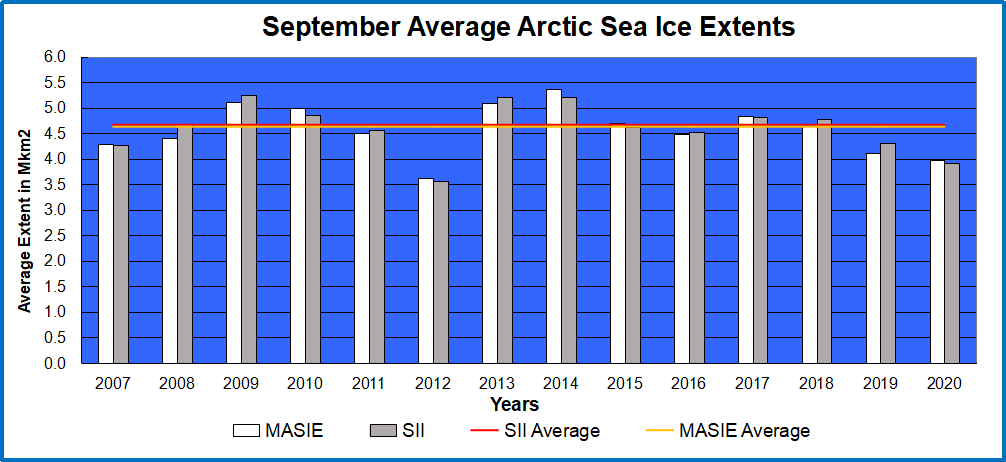
But: Arctic Ice has not declined since 2007.

Arctic ice Sept Ave 2020

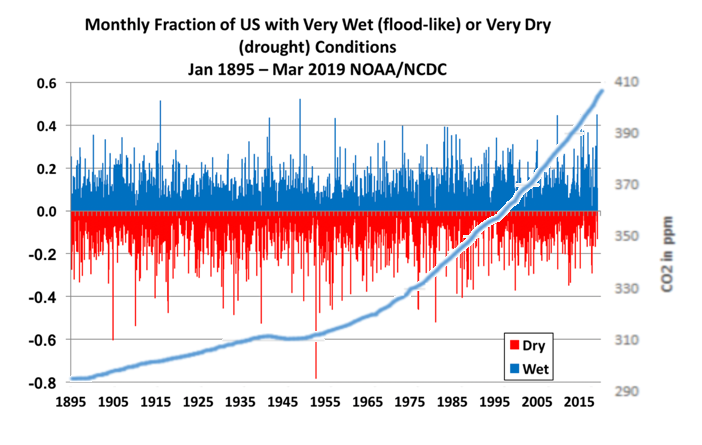
But: All of these are within the range of past variability.

us-wet-dry-co2rev-1

But: Weather is not more extreme.

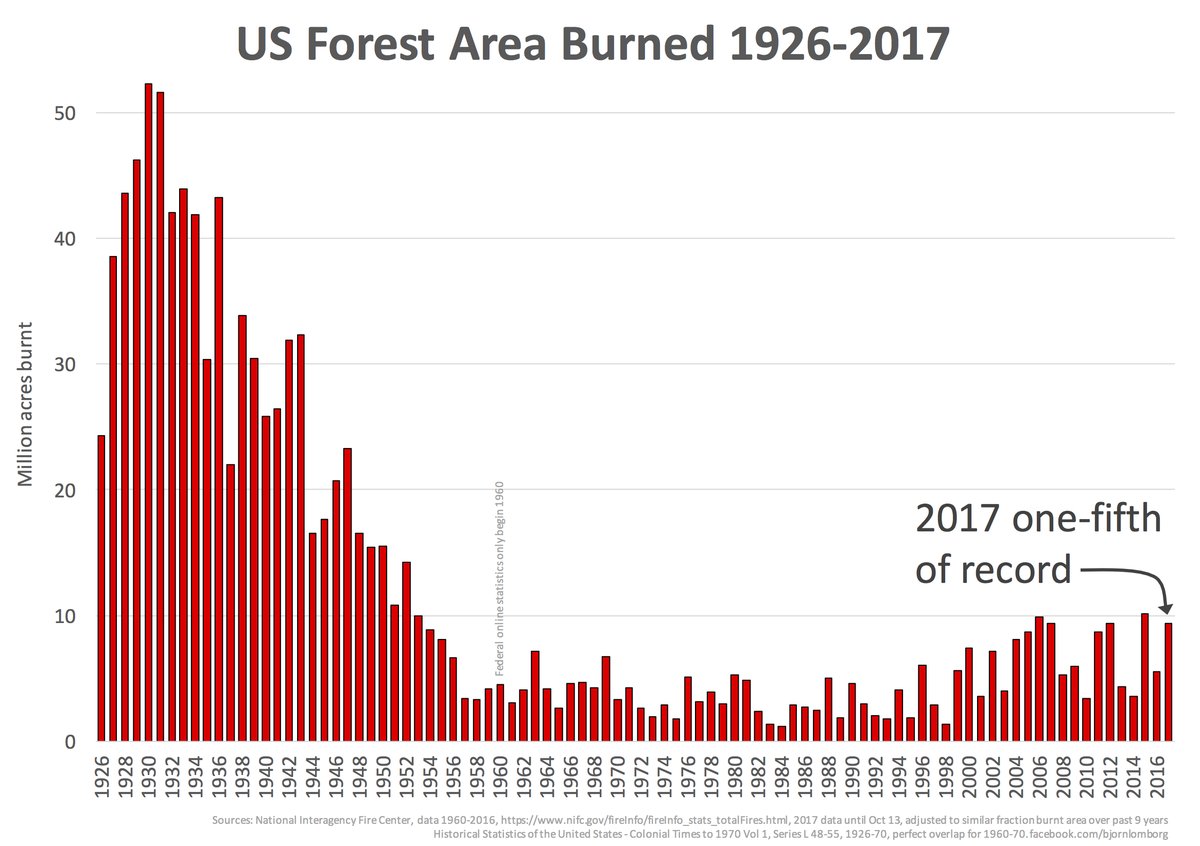
But:Wildfires were worse in the past

us-acres-burned-1926-2017

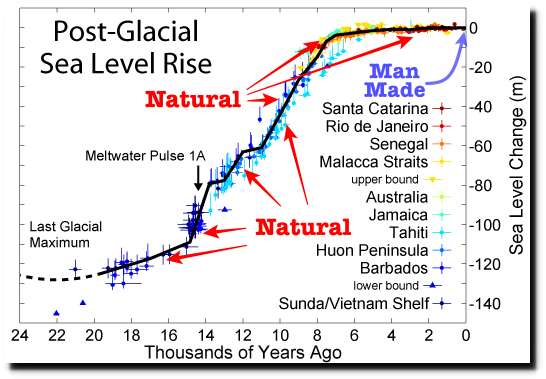
But: Sea Level Rise is not accelerating.

post-glacial_sea_level

But: The planet is greener because of rising CO2.

high_resolution1


The Policy Leg:  Government Can Stop It.

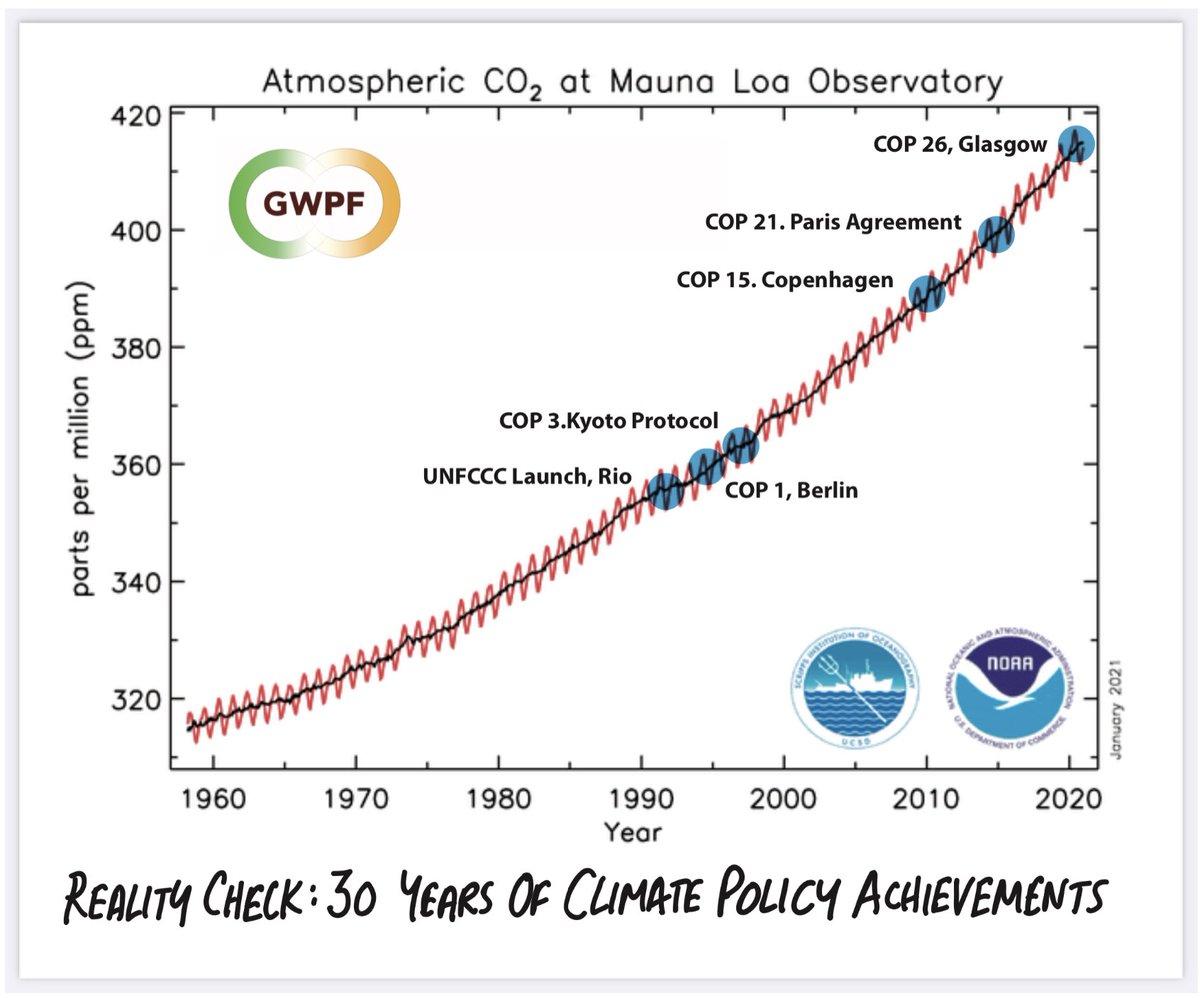
Reality Check 30 yrs. of climate policy

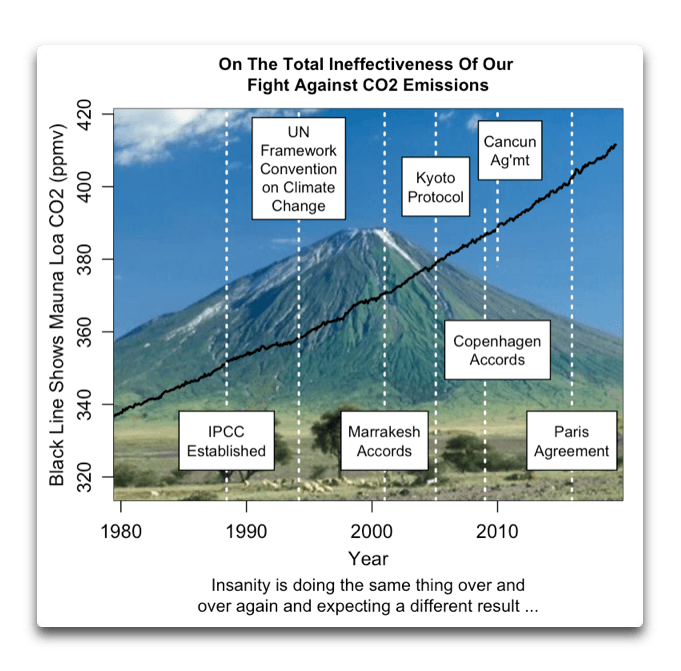
And the third leg is climate initiatives (policies) showing how governments can “fight climate change.”  Some discussion on the wildly improbable notion of powering modern societies with so-called “renewable energy” is provided by Kent Lassman writing at the Washington Examiner Our conversation about the environment is broken. What is the way forward? Excerpts in italics with my bolds.

Our government relies on predictive scientific models that are periodically tweaked. With decades of actual data, it is clear the models have consistently over-predicted warming. Yet, these problems are rarely given any cautionary weight in policy deliberations.

We have a half-century of dire environmental predictions that are usually wrong in the same direction. That raises the question of how much science is being undermined by a political agenda. Is the problem models that do not perform or our attachment to the terror of environmental apocalypse?

This fear is the second major problem we must overcome to improve the quality of our policy debate. Fear of carbon dioxide obscures the near-term and very real consequences of radical climate policies that could have consequences worse than those of a warming atmosphere.

Consider the poorest among us. According to the International Energy Agency, Africa will be the most populous region on Earth by 2023. Today there are 600 million Africans without access to electricity and 900 million who lack clean water. Achieving a reliable electricity supply for this population will require a huge investment, about four times pre-pandemic trends, of $120 billion a year, every year through 2040.

That gargantuan figure assumes access to the most readily available forms of energy: fossil fuels. Without such access, lower-income nations will not enjoy improving standards of living, education, and health. Instead, disease and war are their future. Ironically, depriving these people of a carbon economy likely leads to the very apocalyptic conditions we all want to avoid.

Renewable energy can be a crucial piece of a greener energy future, but we need to be realistic about its limits, the costs of production and disposal, and the secondary effects for the communities producing the raw materials necessary, often with child labor.

Last year a Dutch government-sponsored study concluded that the Netherlands’s renewable energy ambitions ALONE would consume a major share of global minerals. Considering that the U.S. consumes 30 times more energy than the Netherlands, the study concluded: “Exponential growth in [global] renewable energy production capacity is not possible with present-day technologies and annual metal production.” The report also determined that meeting the goals of the Paris climate agreement would require the global production of some metals to grow at least 12-fold by 2050.

An effective climate strategy must be itself sustainable. That requires some measure of humility and an honest evaluation of real-world trade-offs, the linkage between energy use and human welfare, the technological vulnerabilities of alternatives to fossil fuels, and how little we know about the future of something as complex as climate.

That uncertainty demands honesty about the confidence we have, and ought to have, in what we know and can predict. It is a feature, not a bug, of sound climate policy. It should inform understanding of both benefits and costs that flow from any policy choice.

The lives and livelihoods of real people are at stake. We have a responsibility to be clear-eyed and humble about real-world consequences. That means admitting when we are wrong and, equally important, when someone with a different view has a valid point.

ineffective-fight-against-co2-emissions-2


Unmasking Biden’s Climate Shakedown
kn121419dapc20191213114523

At Spectator, Real Jean Isaac explains How to End Biden’s Fake Climate Apocalypse.  Excerpts in italics with my bolds and images.

If there’s no pushback against the Left, we’ll see a dramatic drop in our standard of living.

With the wave of executive orders and legislation coming from the Biden administration, and the cultural antics of his woke supporters, Biden’s war on fossil fuels has received insufficient attention. Yet energy is the lifeblood of our economy, and making traditional energy sources vastly more expensive is the single most destructive aspect of Biden’s policies. If this country does not successfully mobilize against these policies, the vast majority will experience a dramatic drop in their standard of living.

mrz012921dbp20210129124515Supposedly the assault on fossil fuels — via regulation; cancellation of pipelines; concocting a huge, wholly imaginary “social cost of carbon”; taxes; and solar and wind mandates — is necessary to save the planet from imminent catastrophe produced by man-made global warming.

But genuine climate scientists, as we know from those who dare to speak up, are amazed and horrified. Richard Lindzen, long at the top of the field as a former professor of atmospheric sciences at MIT, laments that the situation gets sillier and sillier. He told the recent CPAC conference (his message was read by the Heartland Institute’s James Taylor):

“One problem with conveying our message is the difficulty people have in recognizing the absurdity of the alarmist climate message. They can’t believe that something so absurd could gain such universal acceptance. Consider the following situation. Your physician declares that your complete physical will consist in simply taking your temperature. This would immediately suggest something wrong with your physician. He further claims that if your temperature is 98.7F rather than 98.6F you must be put on life support. Now you know he is certifiably insane. The same situation for climate is considered “settled science.”

So how did an absurd message gain such widespread acceptance? The answer is something people find it hard to wrap their heads around: we aren’t dealing with science at all. We confront an apocalyptic movement, the kind of movement, recurring across time and space, that Richard Landes describes in Heaven on Earth: Varieties of the Millennial Experience. Its scientific veneer makes it credible to a modern audience. If today a charismatic leader cried, “Repent. Sacrifice your goods. The end of the earth is nigh,” at best he might attract a few dozen oddball followers. But when essentially the same message is clothed in the language of science, it sweeps the world.

In Roosters of the Apocalypse I point out the uncomfortable similarities between the global warming apocalypse and the apocalypse that led the Xhosa tribe (in today’s South Africa) in 1856 to destroy their economy, which was based on cattle as ours is on energy. Relying on the vision of a 15-year-old orphan girl, the Xhosa killed an estimated half million of their cattle, ceased planting crops, and destroyed their grain stores. In return the girl promised the Xhosa’s ancestors would drive out the British and bring an even greater abundance of cattle and grain. By the end of 1857 a third to a half of the population — between 30,000 and 50,000 souls — had starved to death.

cg5d8c4e469b40d

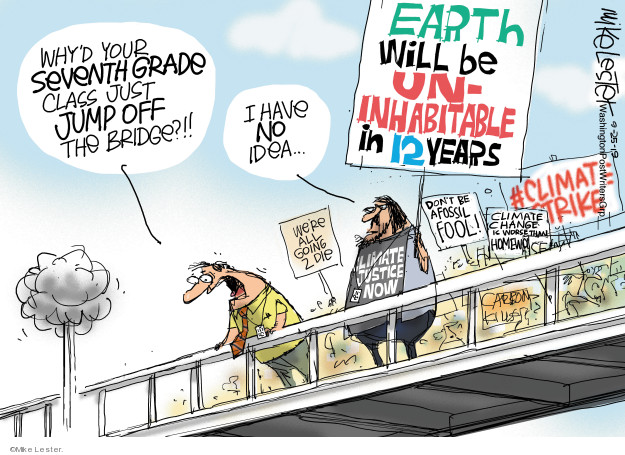
Even the age of the “prophetic” girl suggests a modern parallel. Greta Thunberg didn’t start the global warming apocalypse, but she was 15 when she began spending her school days in front of the Swedish Parliament carrying a sign reading “School Strike for Climate,” heralding the international children’s crusade against global warming she would lead a year later.

In some ways the current apocalypse is surprising. Landes reports that to be successful, an apocalypse needs to bring elites on board, and elites tend to be a hard sell, especially when prophecies demand a society self-mutilate. But in this case not only have elites been won over with breathtaking ease, but they have proved more susceptible over time than the man in the street. A recent Gallup poll found only 3 percent of the public citing climate as a key concern.

gv020921dapr20210209064505

If people understand the menace that global warming policies pose to their way of life, there should be a huge pool of followers.

Dissent is drowned out as educational, political, media, cultural, and business elites speak with one voice. Even fossil fuel companies have thrown in the towel. The American Petroleum Institute, the oil industry’s top lobbying group, is set to propose setting a price on carbon emissions. Children are being indoctrinated in global warming doctrine from kindergarten on, in humanities as well as science classes. My granddaughter, in sixth grade in a Manhattan public school, has a class in “Clifi” (Climate Fiction), where the children read stories on the dreadful aftermath of a climate apocalypse. Politicians at the state and local level pass mandates for expensive (and unreliable) renewables to replace fossil fuels at ever earlier dates. Even conservatives are caught up in the fever. At the most recent CPAC a group urged Republicans to “get in front” on the issue and outflank the Democrats.

What can be done to prevent the global warming locomotive from steamrolling over our economy?

Thus far efforts have focused on countering global warming science with better science. The Chicago-based Heartland Institute has organized 13 international conferences since 2008. The media has all but blacked out coverage, so neither the conferences nor the steady stream of climate research the Institute publishes receive any notice. The CO2 Coalition, which emphasizes that CO2, far from being a pollutant, is a nutrient vital for life, is given similar short shrift. For example, although the coalition includes distinguished scientists, Wikipedia defines it as “a climate change alarmist denial advocacy organization,” whose claims “are disputed by the vast majority of climate scientists.”

There are also excellent websites, such as Climate Depot, offering space to scientific research casting doubt on apocalyptic claims. Marc Morano, who runs the site, had the distinction in 2009 of being chosen by news outlet Grist as one of only five “criminals against humanity, against planet Earth itself” and in 2012 of being named “Climate Change Misinformer” of the Year by Media Matters.

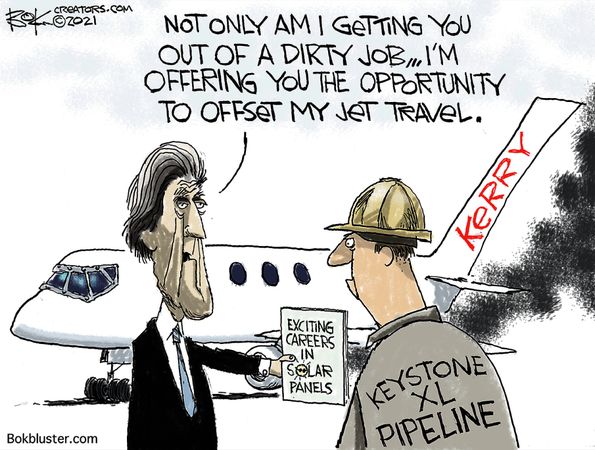
Pitting one scientific study against another hasn’t worked. That’s because most climate scientists are on the global warming grant gravy train, the public can’t follow the abstruse language of academic studies of climate, and the apocalypse is only superficially about climate anyway. Under the circumstances, a mass movement against this folly would seem to be the only way to get through to a larger public. If people understand the menace that global warming policies pose to their way of life, there should be a huge pool of followers. Texas might be a good place to start, given its recent unexpected stay in the freezing dark, and the stark failure of its wind turbines. One advantage of such a movement is that it would cross party lines. Democratic-voting union members stand to lose their well-paid jobs in fossil fuel industries, with workers in China cornering much lower-paid jobs in solar and wind (despite pie-in-the-sky promises by President Biden and newly appointed climateer-in-chief John Kerry).

gv012621dapr20210126094504

The new movement could be titled “Lights On.” Participants should have fun. There was never a claim of “settled science” more ripe for ridicule. How about contests for college students rewarding those who can document the largest number of disproven prophecies of global warming doom (for example, the end of snow, no more Arctic glaciers, U.S. coasts under water, all with specified dates now long past)? In Breitbart, John Nolte recently claimed to have found 44 of them. There can be no shortage of candidates for an award of “False Prophet of the Year.” Or “Global Warming Hypocrite of the Year,” for which John Kerry would be an outstanding candidate with his private jet, yachts, multiple mansions, and cars. And what about an award to a prominent media figure for the most absurd claim for global warming causation? One of Lindzen’s favorites is the Syrian civil war.

And how about reviving the chronicle of Climategate, which almost wiped out faith in the apocalypse before the media buried the scandal? In 2009, a hacker downloaded candid emails among top climate scientists in England and the United States that bemoaned recalcitrant data, described the “tricks” (their term) used to coax the data, reported efforts to keep the views of dissenters out of reputable journals and UN reports, and boasted of deletion of data to make it unavailable to other researchers. “If science is on your side, why do you need to make it up?” would make a good bumper sticker or t-shirt slogan.

cb030221dapr20210302094524

There could be a bumper sticker with comedian George Carlin’s line: “The Planet has been through a lot worse than us.” There could be t-shirts that proclaim, “Wind Is for Sailboats.” There should be songs and cartoons (many of these can already be found on the website WattsUpWithThat.com).

The movement can have fun, but it must also be serious: members will only back politicians prepared to fight to maintain our access to cheap, reliable energy. To the extent solar and wind can someday compete on an even playing field, without subsidies and mandates, they are welcome to the energy mix.

For the current apocalypse to come to an end, the notion that man-made global warming poses an existential threat must come to be seen as ridiculous. Otherwise the policies of shutting down our traditional energy supplies to stave off this absurd end of days will themselves become an existential threat.

Gang Green

Green Cotton Candy Climate Science

With Biden replacing the skeptical Trump presidency, we are seeing how extensive is the mass addiction to climate pseudoscience.  As children, many of us experienced cotton candy at a county fair, circus midway or amusement park.  This science is like that:  a sugar high from a fluffy, vaporous cloud lacking any calories of substance.  How strange now to see elite adults addicted to this green stuff; people like politicians, financiers, judges and captains of industry, added to children and teachers who swallowed green junk science for decades.

Richard Schulman explains in his Founders Broadsheet article The false science behind the Biden green program.  Excerpts in italics with my bolds and some added images.

Little further warming will occur at present levels of atmospheric CO2, even if present levels were to double from 400 ppm to 800 ppm.

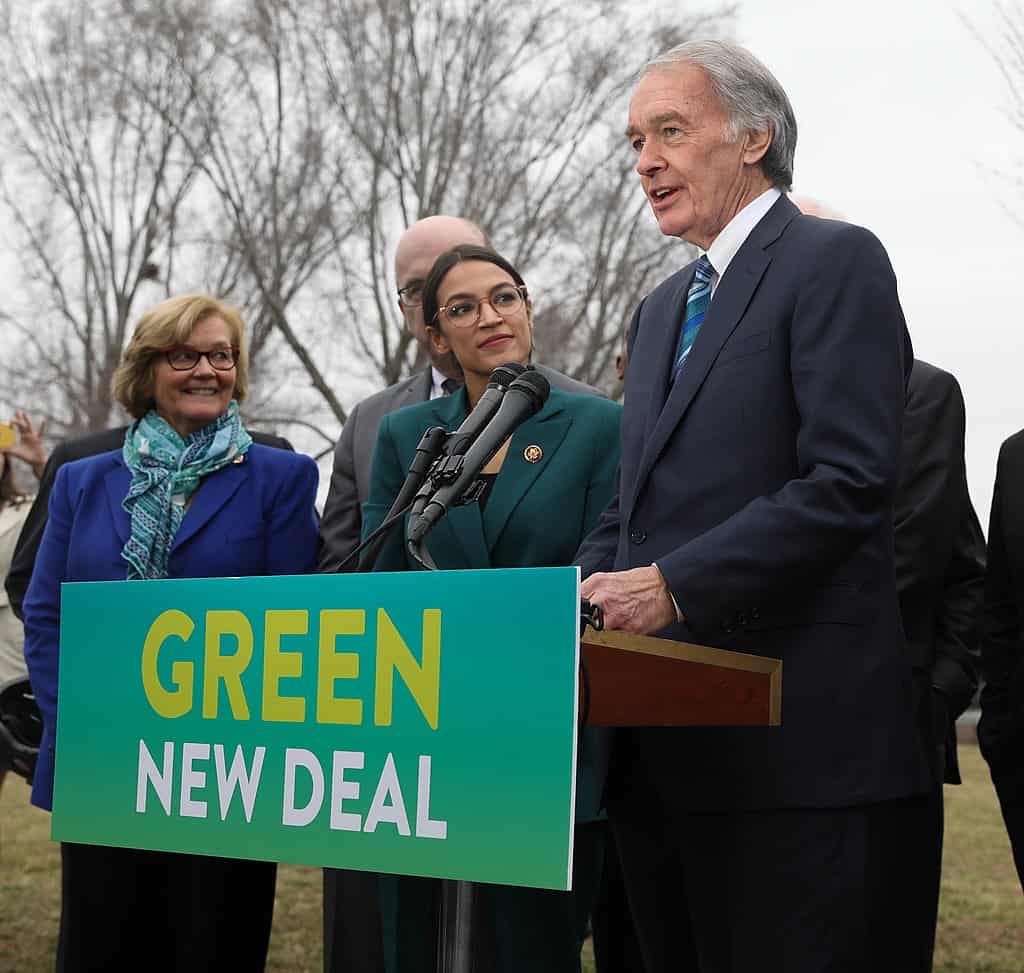
Senator Ed Markey (D-MA) and Congresswoman Alexandria Ocasio-Cortez (D-NY) in 2019. Markey is the Senate author of the Green New Deal, the inspiration behind the Biden administration’s present green climate initiatives. (GreenNewDeal Presser)

The green program behind President Biden’s post-inaugural flood of executive orders is unscientific and deficient in economic and geostrategic common sense. The major media have endeavored to conceal that truth by means of three decades of spurious climate scare stories.

The claim that humanity faces an imminent global warming catastrophe because of its use of fossil fuels is junk science.

The central lie pushed by major media and the UN’s Intergovernmental Panel on Climate Change (IPCC) is that increases in atmospheric CO2 from fossil-fuel use will keep boosting global temperatures. This supposedly will be further multiplied catastrophically by positive feedback: as oceans warm, atmospheric water vapor, another greenhouse gas, will increase. This will foster more warming, which will further warm the oceans, generating more atmospheric water vapor, and so on. The result of these alleged positive feedback mechanisms for CO2 and H2O, the narratives claim, will be that Earth ends up being a hot lifeless planet like Venus.

The feedbacks are negative

If such positive feedbacks existed, Earth already would have turned into another Venus. The reason this hasn’t happened is because negative feedback mechanisms operate for both CO2 and H2O. These the IPCC and media have studiously avoided discussing before the public:

The truth of the matter is that increases in atmospheric CO2 have rapidly diminishing power as a greenhouse gas. Little further warming will occur at present levels of atmospheric CO2, even if present levels were to double from 400 ppm to 800 ppm.

This has been explained recently in papers by W. A. van Wijngaarden and W. Happer (“Dependence of Earth’s Thermal Radiation on Five Most Abundant Greenhouse Gases”), William Happer “Radiation Transfer,” and Howard Hayden (“CO2 and Climate: A Tutorial”).

William Happer is Professor Emeritus in Physics at Princeton University. The Happer paper, “Radiation Transfer,” was issued as one of nine “Red Team” type papers by the Executive Office of the President of the United States during the last days of the Trump administration. They were subsequently denied that White House imprimatur by Trump Science Advisor, Kelvin Droegemeier. Climate scientist Roy Spencer, another of the “Red Team” authors, believes Droegemeier did this “for political purposes and professional gain.” Droegemeier served on the National Science Board for 12 years during the George W. Bush and Obama administrations. From 2012 to 2016, he served as Obama’s Vice Chairman of the NSB.

Fears of CO2 Are Overblown

Present atmospheric CO2 levels are around 410 parts per million. The global warming catastrophists animating the Biden administration believe that further increases will doom the planet. Biden’s climate envoy John Kerry, the latest in a long line of failed prophets of doom, gives the planet just nine more years unless drastic action is taken against fossil fuel consumption.

Hayden writes that: “[T]he warming that would be caused by the next 400 ppmv (parts per million by volume) of CO2 would be about one-tenth as much as caused by the first 400 ppmv. Again, this is likely an overestimate.”

In “Radiation Transfer,” Happer writes:

At the mean distance of Earth from the Sun, sunlight carries an energy flux of about 1,360 Watts per square meter (Wm-2) …. [F]or cloud-free temperate latitudes, doubling the concentration of carbon dioxide would decrease thermal radiation to space by about 3 Wm-2.

Seasonal warming much greater than doubled CO2 warming

By way of comparison, Happer writes, because of the Earth’s elliptical orbit, which modestly modifies the distance between Sun and Earth during its annual orbit, “there is 91 Wm-2 change [in] flux from summer to winter.” In other words, the extra heating of Earth by a doubling of CO2 from present values would produce just 3.3% of the heat difference regularly observed on Earth between January vs. July. “Great efforts are needed to concoct a ‘scientific’ argument that 3 Wm-2 is worth worrying about,” Happer concludes, adding that

Any doubling of carbon dioxide concentrations will produce the same 3 Wm-2 decrease of flux to space whether we consider doubling the pre-industrial value of 280 parts per million (ppm) to 560 ppm, which could happen by about the year 2100 at the current rate of increase around 2 ppm/year. Doubling the current 410 ppm atmospheric concentration to 820 ppm would take about two centuries.

The physics of diminishing CO2 greenhouse behavior

The reason that CO2 exhibited diminishing returns as a greenhouse gas (GHG) — even before present atmospheric levels were reached — is that to be a GHG, an atmospheric gas must prevent infrared radiation from escaping into space. CO2 does this only in a very narrow band of infrared frequencies (the 14 to 16 micrometer band). This band quickly, at much lower atmospheric levels of CO2 than at present, tends towards saturation. But meanwhile, radiation across the rest of the much larger spectrum of infrared frequencies escapes into space, thereby maintaining Earth at an equilibrium temperature.

This is one of the important negative feedback mechanisms that prevents Earth from becoming a Venus.

Why isn’t this obvious to the climate catastrophists backing the UN’s IPCC? There are two approaches to this question: one, scientific; the other sociological. The scientific rationale, if there is a respectable rationale to be made, is described by Hayden as follows:

[W]e know from satellite measurements that the temperature rise since about 1979 has been almost 0.6º C, far above that caused directly by CO2. Climate scientists are fully aware of these numbers. They know that increasing CO2 concentration—by itself—has little effect on temperature even if the amount doubles. The claim is that the warming is amplified by the increase in the H2O greenhouse effect.

If this claim is wrong, any warming beyond the little that can be attributed to increased CO2 must be of natural origin (or changes in land use, not fossil fuels).

H2O greenhouse behavior also diminishes, Hayden adds:

In case you are wondering why the earth did not bootstrap itself into boiling temperatures during the Eemian Interglacial, the Holocene Climate Optimum, the Minoan Warm Period, the Roman Warm Period, the Medieval Warm Period, or thousands of other warmings, the answer is that the climate is not controlled by positive feedback—where hot weather begets even hotter weather—but by negative feedback—where, as things get hotter, they shed more heat. For the last half-billion years, this negative feedback system has kept the temperature of the surface of the earth within a few percent of its present 288 K.

Water vapor also is subject to negative feedback. Increased atmospheric levels of it condense as clouds, rain, snow, or ice. Nor does it escape the same saturation effect to which CO2 is subject. Wijngaarden and Happer write:

[A]t current concentrations, the forcings [greenhouse gas behaviors] from all greenhouse gases are saturated. The saturations of the abundant greenhouse gases H2O and CO2 are so extreme that the per-molecule forcing is attenuated by four orders of magnitude with respect to the optically thin values [values at lower concentrations]. Saturation also suppresses the forcing power per molecule for the less abundant greenhouse gases O3 , N2O and CH4 from their optically thin values, but far less than for H2O and CO2.

The cheapening of climate science programs

A compelling sociological explanation for the perspectives of the CO2 catastrophists is provided by climate scientist Judith Curry. In an interview with Christopher Balkaran of the Strong and Free podcast channel, she explains what happened to the field of climate studies between when she began to study climate at graduate school in the late seventies and early eighties and the present.

Curry: Climate change wasn’t a really big issue at that point. At the time, it was all about geophysical fluid dynamics, trying to understand the circulations of atmosphere and the ocean, radiative transfer, cloud physics. It was, it was very physics based. I would hear in the media about people talking about, Oh, the ice age is coming , or doom and gloom from CO2 emissions, but nobody was really paying attention to all that very much in terms of what I would say the mainstream field until the late 1980s, really.

[D]efenders of the IPCC started pushing the idea that anybody who doubts us or challenges us, they are in the pay of big oil. After that, it became much more difficult to really challenge all that. And certainly by the turn of the century, anybody who was questioning the hockey stick or any of these other things were slammed as deniers and ostracized. And then after Climategate in 2010, the consensus enforcers became very militant. So it’s a combination of politics, and some mediocre scientists trying to protect their careers. [T]hey saw this whole thing as a way for career advancement, and it gives them a seat at the big table and political power….

I was old school at the University of Chicago with geophysical fluid dynamics and all this really hard stuff…. There’s very few universities that have good programs in climate dynamics at this point…. Climate dynamics is still there, but it’s far from dominant…. [T]here are all these new degree programs spinning up in climate, that are far away from the geo-physical roots. These new programs combine policy with a little bit of science and economics and whatever… [T]he science part of it basically gets minimized. And that’s where all the students are running to… leaving a talent dearth of people with the good mathematical physical mindset and wanting to enter into the more challenging fields.

Conclusion: Retribution in 2022?

In conclusion, the Biden administration is basing its entire economic and geopolitical policies on bad CO2 science.

The policies are harmful to working people here and abroad. The policies abandon US fossil fuel strengths to the benefit of a hostile China, Russia, and Iran. They damage the US economy. As Sen. John Barasso (R-Wyo) pointed out in a USA Today op-ed,

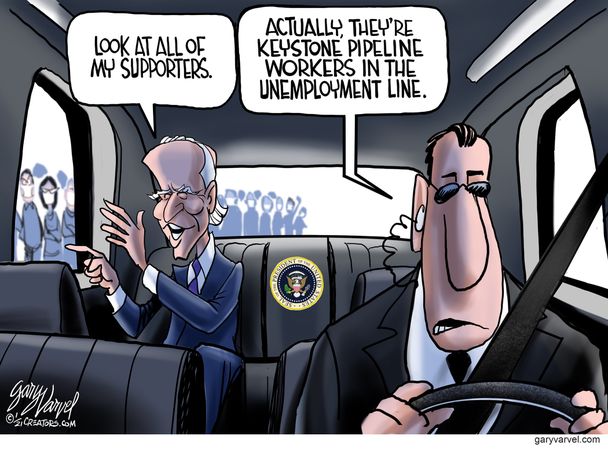
A federal leasing ban would kill an estimated 62,000 jobs in New Mexico, nearly 120,000 in Texas and more than 33,000 in my home state of Wyoming next year alone, according to the American Petroleum Institute. It will also eliminate hundreds of millions of dollars in revenue that these states depend on for public schools, roads, water projects and other essential services. In response to the Keystone cancellation, TC Energy has announced 1,000 layoffs, and the potential union jobs lost could be 10 times higher.

If there’s something approximating a fair election in 2022, Democrats will pay a price for their unscientific climate policy, so contrary to the national interest, in the House of Representatives and Senate.

Latest Court Ruling re EPA and CO2

There is the story of the court’s decision, and the back story told by one judge dissenting partly from the other two on the panel.  The overview comes from courthousenews DC Circuit Rejects Trump Rollback of Power Plant Emission Rules.  Excerpts in italics with my bolds.

Overview of Ruling on Affordable Clean Energy Rule

The federal appeals court’s 182-page opinion released Tuesday was unsigned, written by a mostly unanimous three-judge panel. U.S. Circuit Judge Justin Walker, a Trump appointee who joined the court just a month before the case was heard, penned only a partial dissent.

The panel found the outgoing president’s Affordable Clean Energy rule, adopted in 2019 as part of Trump’s effort to roll back what he considered anti-business regulations, is based on an “erroneous legal premise.” The ACE rule dropped all statewide emissions caps, giving state regulators greater autonomy and more time to reduce pollution.

The court held Tuesday that there is “no basis—grammatical, contextual, or otherwise—for the EPA’s assertion” about source-specific language in federal law that it claims limits its oversight of fossil fuel power sources.

While the ruling was welcomed by health and environmental groups, it only returns things to the status quo.  Litigation tied up Obama’s Clean Power Plan shortly after it was passed and it never took effect thanks to a Supreme Court stay in 2016.

The Trump effort to roll it back started in 2017 before culminating with the ACE rule in 2019. Now the ACE rule too will be bound up in legal purgatory, if not scrapped entirely by the incoming Biden administration.

Walker was joined on the panel by U.S. Circuit Judges Cornelia Pillard and Patricia Millett, both Obama appointees.  While the Trump appointee mostly concurred with his colleagues, Walker filed a partial dissent saying he took issue with both Obama and Trump’s regulatory efforts.

The Back Story–How We Got Here

Judge Walker wrote an interesting essay on the twists and turns with climate change, the EPA and CO2 emissions.  His statement is at the end of the court document (here).  Excerpts in italics with my bolds.

WALKER, Circuit Judge, concurring in part, concurring in the judgment in part, and dissenting in part: This case concerns two rules related to climate change. The EPA promulgated both rules under § 111 of the Clean Air Act.1

A major milestone in climate regulation, the first rule set caps for carbon emissions. Those caps would have likely forced shifts in power generation from higher-polluting energy sources (such as coal-fired power plants) to lower-emitting sources (such as natural gas or renewable energy sources). 2 That policy is called generation shifting.

Hardly any party in this case makes a serious and sustained argument that § 111 includes a clear statement unambiguously authorizing the EPA to consider off-site solutions like generation shifting. And because the rule implicates “decisions of vast economic and political significance,” Congress’s failure to clearly authorize the rule means the EPA lacked the authority to promulgate it.

The second rule repealed the first and partially replaced it with different regulations of coal-fired power plants. Dozens of parties have challenged both the repeal and the provisions replacing it.

In my view, the EPA was required to repeal the first rule and wrong to replace it with provisions promulgated under § 111. That’s because coal-fired power plants are already regulated under § 112, and § 111 excludes from its scope any power plants regulated under § 112. Thus, the EPA has no authority to regulate coal-fired power plants under§ 111.

Background Concerning EPA and Carbon Dioxide

In its clearest provisions, the Clean Air Act evinces a political consensus. For example, according to Massachusetts v. EPA, carbon dioxide is clearly a pollutant, and the Act’s § 202 unambiguously directs the EPA to curb pollution from new cars.

But for every carbon question answered in that case, many more were not even presented. For example, does the Clean Air Act force the electric-power industry to shift from fossil fuels to renewable resources? If so, by how much? And who will pay for it? Even if Congress could delegate those decisions, Massachusetts v. EPA does not say where in the Clean Air Act Congress clearly did so.

In 2009, Congress tried to supply that clarity through new legislation.

The House succeeded.
The President supported it.
But that effort stalled in the Senate.

Since climate change is real, man-made, and important, Congress’s failure to act was, to many, a disappointment. But the process worked as it was designed. In general, Senators from small states blocked legislation they viewed as adverse to their voters. And because small states have outsized influence in the Senate, no bill arrived on the President’s desk.

Nor have dozens of other climate-related bills introduced since then. So President Obama ordered the EPA to do what Congress wouldn’t. In 2015, after “years of unprecedented outreach and public engagement” — including 4.3 million public comments (about 4.25 million more than in Massachusetts v.EPA) — the EPA promulgated a rule aimed at “leading global efforts to address climate change.”

Entitled the Clean Power Plan, the EPA’s rule used the Clean Air Act’s § 111 to set limits for carbon emissions that would likely be impossible to achieve at individual coal-fired power plants because of costs, unavailable technologies, or a need to severely reduce usage. In that sense, the limits required generation shifting: shifting production from coal-fired power plants to facilities that use natural gas or renewable resources.

To be clear, the 2015 Rule did not expressly say, “Power plants must adopt off-site solutions.” But it did set strict emission limits in part by considering off-site solutions. And those emission limits would likely have been unachievable or too costly to meet if off-site solutions were off the table.

A political faction opposed generation shifting. It challenged the 2015 Rule in this Court, arguing that § 111 does not allow the EPA to consider off-site solutions when determining the best system of emission reduction. The faction included about twenty-four states, represented by many Senators who opposed the 2009 legislation. Conversely, a political faction of about eighteen states defended the rule. Many of their Senators had supported the stymied legislation.

At that litigation’s outset, our Court refused to stay the rule’s implementation. But in an unprecedented intervention, the Supreme Court did what this Court would not. And through its stay, the Supreme Court implied that the challengers would likely succeed on the case’s merits.

Taking the Supreme Court’s not-so-subtle hint, in 2019 President Trump’s EPA repealed the 2015 Rule and issued the Affordable Clean Energy Rule.

Like the rule it replaced, the 2019 Rule relies on the Clean Air Act’s § 111 to reduce carbon emissions. But unlike its predecessor, the 2019 Rule did not include generation shifting in its final determination of the best system of emission reduction.

A new faction then challenged the 2019 Rule. It looked a lot like the faction that had defended the 2015 Rule. Arrayed against that faction were many states and groups that had opposed the old rule. And so once again, politically diverse states and politically adverse special interest groups brought their political brawl into a judiciary designed to be apolitical.

In this latest round, the briefing’s word count exceeded a quarter of a million words. The oral argument lasted roughly nine hours. The case’s caption alone runs beyond a dozen pages. And yet, in all that analysis, hardly any of the dozens of petitioners or intervenors defending the 2015 Rule make a serious and sustained argument that § 111 includes a clear statement unambiguously authorizing the EPA to consider a system of emission reduction that includes off-site solutions or that § 111 otherwise satisfies the major-rules doctrine’s clear statement requirement. Neither does the EPA.

In light of that, I doubt § 111 authorizes the 2015 Rule — arguably one of the most consequential rules ever proposed by an administrative agency:
• It required a “more aggressive transformation in the domestic energy industry,” marking for President Obama a “major milestone for his presidency.”
• It aspired to reduce that industry’s carbon emissions by 32 percent — “equal to the annual emissions from more than 166 million cars.”
• Leaders of the environmental movement considered the rule “groundbreaking,” called its announcement “historic,” and labeled it a “critically important catalyst.”

The potential costs and benefits of the 2015 Rule are almost unfathomable. Industry analysts expected wholesale electricity’s cost to rise by $214 billion. The cost to replace shuttered capacity? Another $64 billion. (“A billion here, a billion there, and pretty soon you’re talking real money.”)

True, you can dismiss that research as industry-funded. But the EPA itself predicted its rule would cost billions of dollars and eliminate thousands of jobs.

On the benefits side of the ledger, the White House labeled the 2015 Rule a “Landmark,” and the President called it “the single most important step America has ever taken in the fight against global climate change.” With that in mind, calculating the rule’s benefits requires a sober appraisal of that fight’s high stakes. According to the rule’s advocates, victory over climate change will:

  • lower ocean levels;
  • preserve glaciers;
  • reduce asthma;
  • make hearts healthier;
  • slow tropical diseases;
  • abate hurricanes;
  • temper wildfires;
  • reduce droughts;
  • stop many floods;
  • rescue whole ecosystems; and
  • save from extinction up to “half the species on earth.”

These are, to put it mildly, serious issues. Lives are at stake. And even though it’s hard to put a dollar figure on the net value on what many understandably consider invaluable, the EPA tried: $36 billion, it said, give or take about a $10- billion margin of error.

So say what you will about the cost-benefit analysis behind generation shifting, it’s hardly a minor question.

Minor questions do not forestall consequences comparable to “the extinction event that wiped out the dinosaurs 65 million years ago.” Minor questions are not analogous to “Thermopylae, Agincourt, Trafalgar, Lexington and Concord, Dunkirk, Pearl Harbor, the Battle of the Bulge, Midway and Sept. 11.” Minor rules do not inspire “years of unprecedented outreach and public engagement.” Minor rules are not “the single most important step America has ever taken in the fight against global climate change.” Minor rules do not put thousands of men and women out of work. And minor rules do not calculate $10 billion in net benefits as their margin of error.

Rather, the question of how to make this “the moment when the rise of the oceans began to slow and our planet began to heal” — and who should pay for it — requires a “decision[] of vast economic and political significance.” That standard is not mine. It is the Supreme Court’s. And no cocktail of factors informing the major-rules doctrine can obscure its ultimate inquiry: Does the rule implicate a “decision[] of vast economic and political significance”?

Proponents of the 2015 Rule say it doesn’t. They have to. If it did, it’s invalid — because a clear statement is missing. And according to the Supreme Court, that is exactly what a major rule requires.

To be sure, if we frame a question broadly enough, Congress will have always answered it. Does the Clean Air Act direct the EPA to make our air cleaner? Clearly yes. Does it require at least some carbon reduction? According to Massachusetts v. EPA, again yes.

But how should the EPA reduce carbon emissions from power plants? And who should pay for it? To those major questions, the Clean Air Act’s answers are far from clear.

I admit the Supreme Court has proceeded with baby steps toward a standard for its major-rules doctrine. But “big things have small beginnings.” And even though its guidance has been neither sweeping nor precise, the Supreme Court has at least drawn this line in the sand: Either a statute clearly endorses a major rule, or there can be no major rule.

Moreover, if Congress merely allowed generation shifting (it didn’t), but did not clearly require it, I doubt doing so was constitutional. For example, imagine a Congress that says, “The EPA may choose to consider off-site solutions for its best system of emission reduction, but the EPA may choose not to consider off-site solutions.” In that instance, Congress has clearly delegated to the EPA its legislative power to determine whether generation shifting should be part of the best system of emission reduction — a “decision[] of vast economic and political significance.”

Such delegation might pass muster under a constitution amended by “moments” rather than the “reflection and choice” prescribed by Article V. But if ever there was an era when an agency’s good sense was alone enough to make its rules good law, that era is over.

Congress decides what major rules make good sense. The Constitution’s First Article begins, “All legislative Powers herein granted shall be vested in a Congress of the United States, which shall consist of a Senate and House of Representatives.” And every “law” must “pass[] the House of Representatives and the Senate” and “be presented to the President.” Thus, whatever multi-billion-dollar regulatory power the federal government might enjoy, it’s found on the open floor of an accountable Congress, not in the impenetrable halls of an administrative agency — even if that agency is an overflowing font of good sense.

Over time, the Supreme Court will further illuminate the nature of major questions and the limits of delegation. And under that case law, federal regulation will undoubtedly endure. So will federal regulators. Administrative agencies are constitutional, and they’re here to stay.

Beyond that, I leave it for others to predict what the Supreme Court’s emerging jurisprudence may imply for those agencies’ profiles. Here, regardless of deference and delegation doctrines, the regulation of coal-fired power plants under § 111 is invalid for a more mundane reason: A 1990 amendment to the Clean Air Act forbids it.

The Clean Air Act Amendments of 1990 prohibit the EPA from subjecting power plants to regulation under § 111 if they are already regulated under § 112. The 2015 Rule and the 2019 Rule rely on § 111 for the authority to regulate coal-fired power plants. Because the EPA already regulates those coal-fired power plants under § 112, the rules are invalid.

This case touches on some of administrative law’s most consequential, unresolved issues. What is the reach of Massachusetts v. EPA? What is the meaning of a major question? What are the limits of congressional delegation?

My comment:  I much appreciate Judge Walker’s reprise of the historical journey.  After earning my degree in organic chemistry, I am still offended that a bunch of  lawyers refer to CO2 as a “pollutant” as though it were an artificial chemical rather than the stuff of life.  And it annoys me that the American Lung Association fronted this legal attack, as though CO2 was causing breathing problems in addition to a bit of warming during our present ice age. And that list of ailments solved by reducing CO2 emissions rivals any snake oil poster ever printed.

Observers noted that this ruling produces a kind of limbo: Obama’s Clean Power Plan is out of order, and now Trumps Affordable Clean Energy program is shot down.  Likely Biden will try to return to CPP as though Trump never happened, but the same objections will still be raised.  Clearly Judge Walker sees the issue headed for the Supreme Court as the stakes are too high for anyone else.  After their lack of courage on the 2020 election scandal, who knows what the Supremes will do.

Footnote: See post The Poisonous Tree of Climate Change

The roots of this poisonous tree are found in citing the famous Massachusetts v. E.P.A. (2007) case decided by a 5-4 opinion of Supreme Court justices (consensus rate: 56%). But let’s see in what context lies that reference and whether it is a quotation from a source or an issue addressed by the court. The majority opinion was written by Justice Stevens, with dissenting opinions from Chief Justice Roberts and Justice Scalia. All these documents are available at sureme.justia.com Massachusetts v. EPA, 549 U.S. 497 (2007).  The linked post summarized the twisted logic that was applied.


Setting the Global Temperature Record Straight

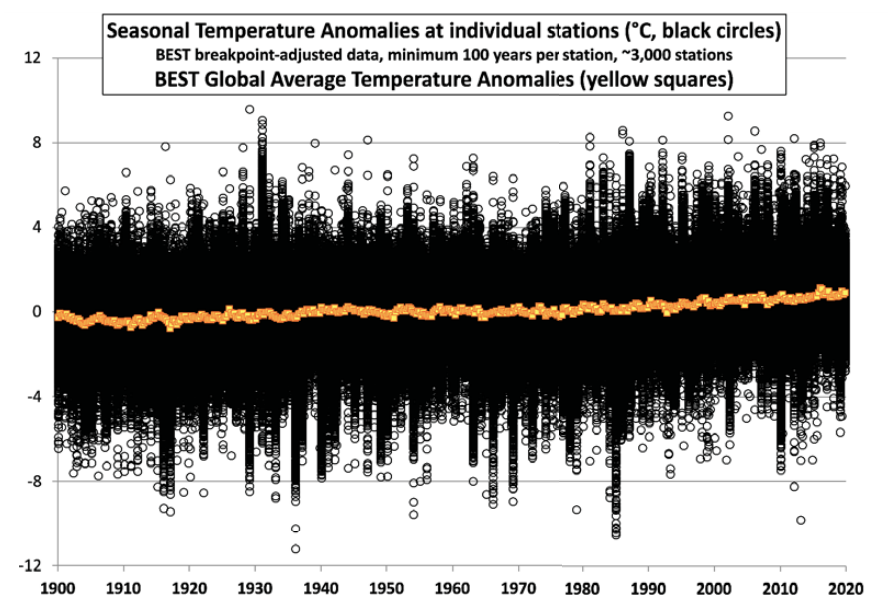
Figure 4. As in Fig. 3 except for seasonal station and global anomalies. As noted in the text, the inhabitants of the Earth experience the anomalies as noted by the black circles, not the yellow squares.

The CO2 Coalition does the world a service by publishing a brief public information about the temperature claims trumpeted in the media to stir up climate alarms.  The pdf pamphlet is The Global Mean Temperature Anomaly Record  How it works and why it is misleading by Richard S. Lindzen and John R. Christy.  H/T John Ray.  Excerpts in italics with my bolds.

Overview

At the center of most discussions of global warming is the record of the global mean surface temperature anomaly—often somewhat misleadingly referred to as the global mean temperature record. This paper addresses two aspects of this record. First, we note that this record is only one link in a fairly long chain of inference leading to the claimed need for worldwide reduction in CO2 emissions. Second, we explore the implications of the way the record is constructed and presented, and show why the record is misleading.

This is because the record is often treated as a kind of single, direct instrumental measurement. However, as the late Stan Grotch of the Laurence Livermore Laboratory pointed out 30 years ago, it is really the average of widely scattered station data, where the actual data points are almost evenly spread between large positive and negative values.

The average is simply the small difference of these positive and negative excursions, with the usual problem associated with small differences of large numbers: at least thus far, the approximately one degree Celsius increase in the global mean since 1900 is swamped by the normal variations at individual stations, and so bears little relation to what is actually going on at a particular one.

The changes at the stations are distributed around the one-degree global average increase. Even if a single station had recorded this increase itself, this would take a typical annual range of temperature there, for example, from -10 to 40 degrees in 1900, and replace it with a range today from -9 to 41. People, crops, and weather at that station would find it hard to tell this difference. However, the increase looks significant on the charts used in almost all presentations, because they omit the range of the original data points and expand the scale in order to make the mean change look large.

The record does display certain consistent trends, but it is also quite noisy, and fluctuations of a tenth or two of a degree are unlikely to be significant. In the public discourse, little attention is paid to magnitudes; the focus is rather on whether this anomaly is increasing or decreasing. Given the noise and sampling errors, it is rather easy to “adjust” such averaging, and even change the sign of a trend from positive to negative.

The Global Temperature Record and its Role

The earth’s climate system is notoriously complex. We know, for example, that this system undergoes multiyear variations without any external forcing at all other than the steady component of the sun’s radiation (for example, the El Niño Southern Oscillation and the Quasibiennial Oscillation of the tropical stratosphere). We know, moreover, that these changes are hardly describable simply by some global measure of temperature. Indeed, what is presented is actually something else. You may have noticed that it is referred to as the global mean temperature anomaly.

What is being averaged is the deviation of the surface temperature from some 30-year mean at stations non-randomly scattered around the globe. As we will soon see, this average bears rather little relation to the changes at the individual stations. Moreover, as noted by Christy and McNider (2017), the temperature anomaly of the lower troposphere (measured by satellites) relative to the surface temperature is much better sampled and represents the “more climate-relevant quantity of heat content, a change in which is a [theorized] consequence of enhanced GHG forcing.”

However imprecise and lightly-relevant the surface temperature is to the physics of the issue, the narrative of a global warming disaster uses the record as the first in a sequence of often comparably questionable assumptions. The narrative first claims that changes in this dubious metric are almost entirely due to variations in CO2, even though there are quite a few other factors whose common variations are as large as or larger than the impact of changes in CO2 (for example, modest changes in the area of upper and lower level clouds or changes in the height of upper level clouds).

Then the narrative asserts that changes in CO2 were primarily due to man’s activities. There is indeed evidence that this link is likely true for changes over the past two hundred years. However, over Earth’s history, there were radical changes in CO2 levels, and these changes were largely uncorrelated with changes in temperature.

Presentations of the Global Mean Temperature Anomaly Record

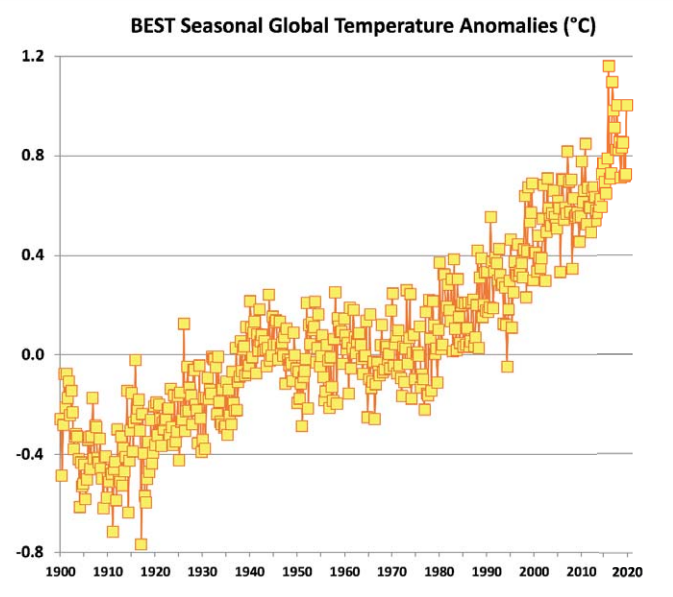
In order to obscure the fact that the global means are small residues of large numbers whose precision is questionable, the common presentations plot the global mean anomalies without the scattered points and expand the scale so as to make the changes look large. These expanded graphs of global means are shown in Figures 5 and 6.

Figure 6. Global seasonal anomalies of temperature from Fig. 4 without station anomalies. Note
the range here is -0.8 to +1.2 °C, or 9 times less than Figs. 2 and 4.

The frequently cited trends are evident in these graphs–most notably, the pre-CO2 warming from 1920-1940 and the warming that has been attributed to man from 1978-1998. We also see a reduced rate from 1998 (best seen in Fig. 6) until the major El Niño of 2016 occurred. Even if one could attribute all the 1978-1998 warming to the increases in CO2 , the slowdown clearly shows that there is something going on that is at least as large as the response to CO2 . This contradicts the IPCC attribution studies that assume, based on model results, that other sources of variability since 1950 are negligible.

Note that the results in Figures 5 and 6 are quite noisy, with large interseasonal and interannual fluctuations. This noise contributes to the uncertainty of the values, in addition to the usual sampling errors. The graphs one usually sees are a lot smoother looking than what we see in Figures 5 and 6; these have resulted from taking running means over 5 or more years. The results of such smoothing are shown in Figure 7 (smoothed over 11 years) and 8 (smoothed over 21 seasons, or about 5 years). They look much cleaner and presumably more authoritative than the unsmoothed results or the scatter diagrams, but this tends to disguise the uncertainty, which is likely on the order of 0.1-0.2 degrees. (For example, Figure 7 substantially disguises the pause following 1998; Figure 8 does this less because it is averaged over only about 5 years.)

Obviously, warmings or coolings of a tenth or two of a degree are without significance since possible adjustments can easily lead to changes of sign from positive to negative, yet in the popular literature much is made of such small changes. Like with sausage, you might not want to know what went into these graphs, but, in this case, it is important that you do.

Some Concluding Remarks

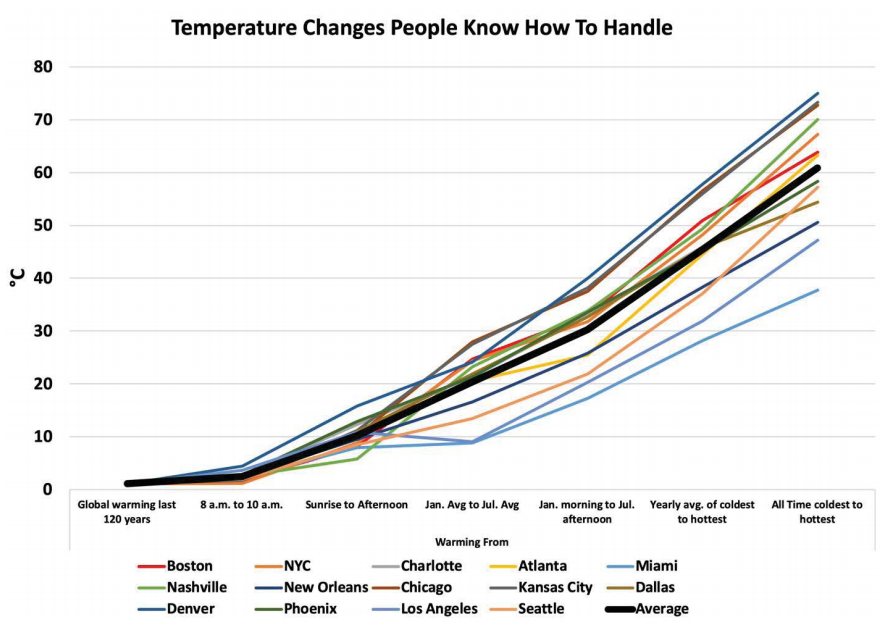
An examination of the data that goes into calculating the global mean temperature anomaly clearly shows that any place on earth is almost as likely, at any given time, to be warmer or cooler than average. The anomaly is the small residue of the generally larger excursions we saw in Figures 1 and 2. This residue (which is popularly held to represent “climate”) is also much smaller than the temperature variations that all life on Earth regularly experiences. Figure 9 illustrates this for 14 major cities in the United States.

Indeed, the 1.2 degree Celsius global temperature change in the past 120 years, depicted as alarming in Figure 7, is only equivalent to the thickness of the “Average” line in Figure 9. As the figure shows, the difference in average temperature from January to July in these major cities ranges from just under ten degrees in Los Angeles to nearly 30 degrees in Chicago. And the average difference between the coldest and warmest moments each year ranges from about 25 degrees in Miami (a 45 degree Fahrenheit change) to 55 degrees in Denver (a 99 degree Fahrenheit change)

Figure 9. Temperature Changes People Know How to Handle

At the very least, we should keep the large natural changes in Figure 9 in mind, and not attribute them to the small residue, the global mean temperature anomaly, or obsess over its small changes.

See Also  Temperature Misunderstandings

Clive Best provides this animation of recent monthly temperature anomalies which demonstrates how most variability in anomalies occur over northern continents.


John Christy Rebuts Climatist Fake Smear Job

The cancel culture is driven by fears that a contrary point of view might be truer than one’s own way of thinking.  Dissing the messenger, and deplatforming if possible, is easier than reflection and self-examination.  Thus has John Christy been attacked and recently responded in his quiet and reasonable manner.  The article at AL.com is John Christy: We don’t ‘attack science’.  Excerpts in italics with my bolds.

On Nov 2nd 2020 InsideClimate News (ICN) and AL.com published a fairly long (5,000 words!) profile on the climate research that Dr. Roy Spencer and I perform at The University of Alabama in Huntsville. They spent a good bit of time criticizing our satellite data as well as my personal life. The article seems schizophrenic at times, bouncing from highly critical assertions to a depiction of me as a sort of nice, hardworking, churchgoing Alabama scientist.

A major problem here is the technique of quoting antagonists of our work, without giving us a chance to respond. This is the modus operandi of advocacy-journalism. Add to that the numerous editorialized opinions such as, “… Christy’s data have been corrected repeatedly and his conclusions contradicted time and again …” A look at the record indicates this is not so.

But with all of the misleading claims, I’m able to forgive the reporters because they also say, “… he looks 69 going on 50 …” Awesome. How could a 69-year-old not love that?

Unfortunately, ICN ran the story as part of series called “The Anti-Scientists” that explores “the Trump Administration’s attacks on the science underlying environmental protections.” However, kudos to AL.com for including a link to my congressional testimony so the reader could hear my on-the-record story.

It should be clear to all that this agendized “hit-piece” (as we call it), is designed to discredit me, but the truth is, we don’t “attack science,” we “employ science.” Now, I’ve always been told, never pick a fight with someone who buys ink (cloud-storage) by the barrel (terabyte), but here it goes.

In 1990, Roy and I created and today still publish monthly values of the global temperature of three atmospheric layers from satellite measurements. A 1997 paper suggested our dataset had abrupt “downward” jumps. In response, we demonstrated the purported jumps were found in the sea water temperatures they used, not in the deep atmosphere we measured – so they were mixing apples and oranges. The next claim stating there are gaps in the satellite record is just false as every new satellite is directly calibrated to a satellite already in orbit. Later, scientists in Washington State misled the community with papers that (1) allegedly discovered “contamination” of one of our products by stratospheric influence, and (2) that our correction to account for the satellite’s east-west drift over time was wrong.

Neither complaint applied to our datasets. We had always published accurate representations of what our products measured including the stratospheric impact.

In fact, 12 years earlier we created one without the stratospheric influence to deal with this issue directly. The second complaint was moot because we had already adopted an advanced, observations-based adjustment for the east-west drift, while their proposed model-based correction had serious problems.

Early on, though, the very clever scientists at Remote Sensing Systems in California discovered two issues with our dataset, both of which were immediately remedied 15 and 20 years ago respectively with only very small impacts.

While we recognize no dataset is perfect, a detailed evaluation of our temperature products was published in 2018, demonstrating that ours outperforms other satellite products when compared against independent data. Why was this not mentioned?

Another scientist appears to refute our explicit conclusion that climate models are unrealistically aggressive in depicting the atmosphere’s warming rate. This is important because regulatory policies advocated in the media which include price-hikes for all our energy, are based on fears engendered by these models.

Again, our conclusion has stood the test of time, (that scientist published a similar result later). Even this year, more published studies continue to show climate models are poor tools for policy decision—they can’t reproduce the climate that has already happened, and they don’t agree with each other about the future.

Then, the clumsy attempt to connect me with an anti-evolution movement was misguided. The reporters would be chagrined to learn that I had testified before the Alabama State Board of Education advocating the removal of the “Evolution Disclaimer” from biology textbooks. Even the NY Times, of all places, took note and quoted me on the issue (Feb. 1, 2005.) So again, doing a little fact-checking rather than following today’s “jump-to-(my-biased)-conclusion” reporting style, would have saved us all some trouble.

Finally, a broader question to ask is this, “Why was so much effort and expense proffered to try to discredit a scientist like me?”

By the way, the title, “When Trump’s EPA needed a climate scientist, they called on Alabama’s John Christy” misinforms. I saw a federal notice asking for applications for the EPA Science Advisory Board and sent mine in, just like the others. I was eventually selected, based on my credentials, to be one of its 45 members.

But, the line that still carries the day for me is, ” … he looks 69 going on 50.”

Footnote:  Christy quote:

“The reason there is so much contention regarding “global warming” is relatively simple to understand: In climate change science we basically cannot prove anything about how the climate will change as a result of adding extra greenhouse gases to the atmosphere.

So we are left to argue about unprovable claims.”

John R. Christy | Climate science isn’t necessarily ‘settled’

See also: Christy’s Common Sense about Climate

Note: John Christy of the University of Alabama at Huntsville testified before the House of Representatives Natural Resources Committee on May 13, 2015, but his opening statement has been purged from the committee’s website.  In addition to the video above, his statement that day is available here.

Climate Hysteria Not Grounded in Science

The iconic Metronome clock in New York City was repurposed as an 80-foot-wide climate clock that shows our remaining time to take urgent action on climate change. (photo credit: BEN WOLF)

Glenn T. Stanton writes at The Federalist New Data Shows Climate Change Hysteria Isn’t Grounded In Science.  Excerpts in italics with my bolds.

While we must steward the planet God has gifted to us, there is no empirical basis for apocalyptic predictions of impending doom.

The “Climate Clock” looms ten stories above Manhattan’s Union Square so all passersby can track the precise moment the world passes its supposed tipping-point toward irreversible, apocalyptic environmental demise. This clock has that moment of doom pegged at a little more than seven years from today. One of the men who created the clock, artist Gan Golan, said his motivation for the project was the birth of his daughter two years ago.

“This is arguably the most important number in the world,” the team explained to The New York Times, adding, “You can’t argue with science, you just have to reckon with it.” And that is where the problem lies with the environmental doom and gloom — you can absolutely argue with science. That is precisely what the scientific method is: the careful, relentless discipline of skepticism and discovery. It’s testing and questioning what others claim is beyond debate.

How many times was Doomsday predicted but failed to happen at midnight.

Nine leading climate scientists from Germany, France, Finland, and Ireland have, indeed, questioned whether anyone can reliably determine how much time remains between now and an irreversible trajectory toward environmental ruin.

Drawing from 36 different meta-analyses on the question, involving more than 4,600 individual studies spanning the last 45 years, their findings were recently published in the journal Nature Ecology and Evolution. They conclude that the empirical data doesn’t allow scientists to establish ecological thresholds or tipping points. As natural bio-systems are dynamic, ever-evolving, and adapting over the long-term, determining longevity timeframes is currently impossible.

These scholars write that frankly, “we lack systematic quantitative evidence as to whether empirical data allow definitions of such thresholds” and “our results thus question the pervasive presence of threshold concepts” in environmental politics and policy. Their findings also reinforced the contention that “global change biology needs to abandon the general expectation that system properties allow defining thresholds as a way to manage nature under global change.”

Professor José M. Montoya, one of the nine authors and an ecologist at the Theoretical and Experimental Ecology Station in France, told the French National Center for Scientific Research “many ecologists have long had this intuition” that setting reliable, empirically situated tipping-points “was difficult to verify until now for lack of sufficient computing power to carry out a wide-ranging analysis.” But that has now changed.

So no, there is no reliable science behind the new seven-years-to-the-point-of-no-return countdown of the Climate Clock in Union Square, nor for Rep. Alexandria Ocasio-Cortez’s infamous “The world is going to end in 12 years if we don’t act now” scare, or Thunberg’s just-10-years-til-inevitable-doom drum pounding. Such claims simply do not — and cannot — be firmly grounded in any scientific knowledge we currently possess.

Evidence for this conclusion, however, goes beyond the aforementioned conclusive new study. 2020 saw the publication of two extremely important books from leading, mainstream environmental-climate scholars on what science says about the earth’s future.

The first is Michael Shellenberger, a Time magazine “Hero of the environment” who explains in his book “Apocalypse Never: Why Environmental Alarmism Hurts Us All” that nearly every piece of scare data presented by the likes of AOC, Leonardo DiCaprio, and Thunberg is not only incorrect but tells a story that is the opposite of the scientific truth. Not only is the world not going to end due to climate change, but in many important ways, the environment is getting markedly better.

Another major environmentalist voice challenging hysteria is Bjorn Lomborg of the Copenhagen Consensus Center think tank, listed by the UK’s liberal Guardian newspaper as one of the 50 people who could save the planet. In his book “False Alarm,” he explains how “climate change panic” is not only unfounded, it’s also wasting trillions of dollars globally, hurting the poor, and failing to fix the very problems it warns us about.

So, what science genuinely telling us? “Science shows us that fears of a climate apocalypse are unfounded.” Lomborg explains, admitting that while “global warming is real … it is not the end of the world.” “It is a manageable problem” he adds. He is dismayed that we live in a world “where almost half the population believes climate change will extinguish humanity” and do so under the mistaken assumption that science concludes this. It doesn’t, and he is vexed this mantra parades under the banner of enlightenment.

It’s imperative we properly steward this beautiful planet God has gifted to us. It was the second command He gave to humanity, after the charge to populate it with generation after generation of new people. But hysteria is not what is called for in this work. Shellenberger, Lomborg, and these nine other international ecologists tell us that not only is there no empirical basis for the apocalyptic prognostications so needlessly disturbing the dreams of the world’s young people.

See also:  Tipping Points Confuse Social and Earth Science

  This is your brain on CO2 hysteria. Just say no!


Potsdam Does a New Hockey Stick Trick

The paper is Setting the tree-ring record straight by Josef Ludescher, Armin Bunde, Ulf Büntgen & Hans Joachim Schellnhuber.  The title is extremely informative, since the trick is to flatten the tree-ring proxies, removing any warm periods to compare with the present.  Excerpts below with my bolds.

Abstract

Tree-ring chronologies are the main source for annually resolved and absolutely dated temperature reconstructions of the last millennia and thus for studying the intriguing problem of climate impacts. Here we focus on central Europe and compare the tree-ring based temperature reconstruction with reconstructions from harvest dates, long meteorological measurements, and historical model data. We find that all data are long-term persistent, but in the tree-ring based reconstruction the strength of the persistence quantified by the Hurst exponent is remarkably larger (h≅1.02) than in the other data (h= 0.52–0.69), indicating an unrealistic exaggeration of the historical temperature variations. We show how to correct the tree-ring based reconstruction by a mathematical transformation that adjusts the persistence and leads to reduced amplitudes of the warm and cold periods. The new transformed record agrees well with both the observational data and the harvest dates-based reconstructions and allows more realistic studies of climate impacts. It confirms that the present warming is unprecedented.

Discussion

Figure 1a shows the tree-ring based reconstruction (TRBR) of central European summer temperatures (Büntgen et al. 2011), together with its 30 year moving average that reveals the long-term temperature variations in the record. Particularly large temperature increases occurred between 1340 and 1410 and between 1820 and 1870 that even are comparable in amplitude with the recent warming trend since 1970, indicating that the recent (anthropogenic) warming may not be unprecedented.

Tree ring-based reconstruction of the central European temperatures in the last millennium. a The reconstructed June-August temperatures in units of the records standard deviation. The red line depicts the moving average over 30 years. b, c The DFA2 fluctuation functions F(s) and the WT2 fluctuation functions G(s), respectively, for the reconstructed data from a, for monthly observational data (Swiss temperatures from Berkeley Earth, station data from Prague) and the MPI-ESM-P-past1000 model output for central European summer temperatures, from top to bottom. For the TRBR and model data, the time scale s is in years, while for the two observational records, it is in months. Note that in the double logarithmic presentation, the asymptotic slopes (Hurst exponents h) for the reconstruction data (h≅1) and the observational and model data (h≅0.6) differ strongly

To correct the enhanced long-term persistence in the TRBR, we are interested in a mathematical transformation of the data, which lowers the natural long-term persistence while leaving the gross features of the record, the positions of the warm and cold periods, unchanged. We performed the following mathematical transformation to change the original TRBR Hurst exponent h0=1.03 to h1=0.60 and thus to be in line with the observational, harvest and model data. Since this transformation is only suitable for altering a record’s natural long-term persistence, i.e., in the absence of external trends, we transformed the TRBR data between 1000 and 1990, before the current anthropogenic trend became relevant.

Figure 4a compares the transformed TRBR data (blue) with h1=0.6 with the original TRBR data (black). The bold lines are the 30-year moving averages. The figure shows that by the transformation the structure of the original TRBR data is conserved, but the climate variations characterized by the depths of the minima and the heights of the maxima are reduced.

Original and transformed tree-ring proxy temperature record. a Compares the original TRBR record for the period 1000–1990, where the Hurst exponent h is 1.03 (black), with the transformed TRBR record, where h≡h1=0.6 (blue). For better visibility, the transformed TRBR record has been shifted downward by 5 units of its standard deviation. b How the magnitudes of the cold periods in the transformed TRBR record decrease with decreasing Hurst exponent h1. The magnitudes are quantified by the differences of the 30 year moving averages between the beginning and the end of the respective periods. c Compares the 30-year moving averages of the original and the transformed TRBR record (h=0.6) with the 30-year moving average of the observational temperatures from Switzerland. The comparison shows that the transformed TRBR record fits quite nicely with the observational data

To see how the strength of the long-term variations in the transformed TRBR data depends on their Hurst exponent h1h1, we have determined, in the 30-year moving average, the temperature differences in 4 periods (1415–1465, 1515–1536, 1562–1595, 1793–1824) where the greatest changes between 1350 and 1950 occur. The result is shown in Fig. 4b. The figure shows that the temperature difference between the beginning and the end of each period decreases continuously with decreasing h. For h around 0.6, the temperature differences are roughly halved.

Conclusion

Since tree ring-based reconstructions play an important role in the understanding of past temperature variability, we suggest the use of the Hurst exponent as a standard practice to assess the reconstructions’ low-frequency properties and to compare the determined values with the Hurst exponents of other respective time series (observational, harvest dates, models). If deviations from the expected values are detected, the data should be transformed to adjust the Hurst exponent. This will lead to a more realistic reconstruction of the record’s low-frequency signal and thus to a better understanding of the climate variations of the past.

My Comment

Wow!  Just Wow!  The Mann-made Hockey Stick was found bogus because it was produced by grafting a high-resolution instrumental temperature record on top of a low-resolution tree ring proxy record.  Now climatists want to erase four bumps in the Medieval period lest they appear comparable to contemporary temperatures sampled minute by minute.  A simple tweaking of a formula achieves the desired result.  Fluctuations which were decadal are now smoothed and cannot compete with modern annual and monthly extremes.  Well done! (extreme snark on)

Background:  See Return of the Hockey Stick

Damn the Climate Facts! Full Speed Ahead.

David Farragut was an officer in the Union navy in the Civil War. Warned of mines, called torpedoes, in the water ahead, Farragut said, “Damn the torpedoes! Captain Drayton, go ahead! Jouett, full speed!”  This is a reasonable comparison to what we hear from climatists these days.  The hype is amped up, heedless of immutable, immovable facts sitting in the way of their green pathway. Some recent examples below.

Stop Making Sense

Stop making sense: why it’s time to get emotional about climate change is an article at (where else?) The Guardian by Rebecca Huntley, an Australian social researcher. Excerpts in italics with my bolds.

What I am saying is that now the climate science has been proven to be true to the highest degree possible, we have to stop being reasonable and start being emotional.

t took me much longer than it should have to realise that educating people about climate change science was not enough. Due perhaps to my personality type (highly rational, don’t talk to me about horoscopes, please) and my background (the well-educated daughter of a high school teacher and an academic), I have grown up accepting the idea that facts persuade and emotions detract from a good argument.

For environmental activists in these less-polarised countries – often countries already feeling serious impacts from climate change but emitting negligible amounts of CO2 –the endless debate about the truth of the climate science in the big western countries is gobsmacking. Activists have expressed their frustration and disbelief, and it’s contributed not a little to their despair about progress at an international level.

When social researchers like me try to analyse how a person responds to climate change messages the way they do, we’re measuring much, much more than just their comprehension (or not) of the climate science. We’re analysing the way they see the world, their politics, values, cultural identity, even their gender identity. It wouldn’t be a stretch to say we’re measuring their psyche, their innermost self.

Given that climate change is such a discomforting topic, I see this cognitive dissonance all the time in focus groups, where people try to find reasons other than climate change for the events happening around them, even when faced with a strong scientific explanation. They pick it apart because of Dunning-Kruger and then, because of confirmation bias, try to find a blog that states something other than what the scientific evidence shows.

I’m not saying facts don’t matter or the scientific method should be watered down or we should communicate without facts. What I am saying is that now the climate science has been proven to be true to the highest degree possible, we have to stop being reasonable and start being emotional.

More science isn’t the solution. People are the solution.

Comment:  Note that climate is no longer an earth science, but a branch of environmental sociology.  This is the logical endpoint of “Climate Change” existing as a double abstraction.  Consider that “climate” is an human construct, defined as the pattern of weather we remember in our living space over seasons and years. And “climate change” is therefore an added belief that our expectations about future weather are uncertain and unreliable. Objective realism is overturned in favor of majority opinion.  Everyone believes as Obama tweeted: “Ninety-seven percent of scientists agree: climate change is real, man-made and dangerous.”  So the effort is to find out what is wrong with the dissenters and fix them, so we can get on with the program.

Silence the Infidels

Facebook Must Stop the Spread of Climate Misinformation is a letter sent to the Facebook Oversight Board by a number of climatists.  Excerpts in italics with my bolds.

Facebook is allowing the spread of climate misinformation to flourish, unchecked, across the globe. Instead of heeding the advice of independent scientists and approved fact-checkers from Climate Feedback, Facebook sided with fossil fuel lobbyists by allowing the CO2 Coalition to take advantage of a giant loophole for “opinion” content. The loophole has allowed climate denial to fester by labeling it “opinion,” and thus, avoiding the platform’s fact-checking processes.

Facebook knows how to take action against misinformation. When COVID-19 denial took hold on the platform, it was forcibly shut down because Facebook understood that the spread of COVID-19 misinformation could cause imminent physical harm to the health and well-being of Facebook users. Climate denial and misinformation are also deadly. By allowing climate misinformation to go unchecked,

Facebook is actively putting the health and well-being of our nation’s most vulnerable low-income communities and communities of color at risk.

You and the Oversight Board must step in and enact the same standard for the denial of climate change as you did for COVID-19 misinformation.

The integrity of the Oversight Board is at risk. Mark Zuckerberg has refused to recognize that he must get the facts right on climate, and refused to acknowledge that climate denial on his platform is as dangerous a threat to future generations as any.

Signatories include:

Stacey Abrams, Democrat who lost the Georgia Governorship, and POTUS nomination;

Carol Browner, Biden’s pick as climate advisor;

Michael Brune, Executive Director, Sierra Club;

Ken Kimmell, President, Union of Concerned Scientists;

Gina McCarthy, President and CEO, NRDC Action Fund;

Erich Pica, President, Friends of the Earth

John Podesta, Founder, Center for American Progress

Tom Steyer, Founder, NextGen America; Climate Activist

Response of the CO2 Coalition to calls for Facebook censorship

Statement by CO2 Coalition Chair Patrick Moore and Executive Director Caleb Stewart Rossiter on the Abrams-Steyer letter asking Facebook to shut down the Coalition’s page and censor its articles on other pages.  Excerpts in italics with my bolds

Climate Power 2020 recently published a letter signed by former gubernatorial candidate Stacey Abrams, former presidential candidate Tom Steyer, and 13 leaders of groups working to ban the fossil fuels that are the source of over 80 percent of U.S. and world energy.

The letter calls on Facebook to shut down the page of the CO2 Coalition of 55 climate scientists and energy economists, and to censor posts of its members studies and articles on other users’ pages.

The CO2 Coalition is proud to be the target of this letter, whose signatories represent alarmist organizations that routinely publish scientific and economic misinformation about climate change and energy options. The letter, like Facebook’s efforts to censor our posts and articles, is a badge of honor for our atmospheric physicists, climatologists, and statisticians’ recent publications about how computerized climate models that project future temperatures work – and don’t work.

As E & E News recently wrote in its coverage of Facebook’s censoring of our opinions on climate models, these mathematical models “are the foundation used to craft many carbon regulations.” The 2009 EPA Greenhouse Gas Endangerment finding that has led to increased energy prices for businesses and households is entirely based on computerized temperature models that have since proven incorrect. The CO2 Coalition publishes studies and articles explaining that these models are adjustable projections rather than oracles. When tested after a few years against actual temperatures, the UN model projections have proved to run three times too hot. It is these publications that Facebook has been censoring.

The UN IPCC and U.S. government scientific agencies agree that their data show no statistically significant increases in rates of sea-level rise, hurricanes, floods, wildfires, and other dangerous or damaging weather in the 70 years since carbon dioxide emissions became a factor in global temperature.

The failure of the alarmists’ predictions in these areas – and in this letter they simply ignore the UN consensus – has increased the importance of modeled projections of future temperatures in justifying calls to end the use of the fossil fuels. Hence, these recent attacks on our explanations of why those modeled projections are by their nature too unlikely and uncertain to use as a basis for policies that will make energy around the world far less reliable and far more costly.

The movement of heat in the atmosphere and oceans is complex, with major contributions from both chaos and poorly-understood, decades-long cycles. As a result, the models require the input of thousands of guesses about mathematical values for key processes. As Oxford physicist Fred Taylor says in his textbook, Elementary Climate Physics, the models are “opaque” and “in their infancy.”

As with stock market and COVID models, climate models are “back-fit” with estimates that make them line up with the temperature record to date, and then run forward with the same estimates. As with stock market and COVID models, betting on climate models’ projections is a good way to lose your shirt – and your economy and your health.

The letter labels our members as “climate deniers.” We ask each of the 15 signatories to Climate Power 2020’s letter to identify a single denial of a scientific or economic fact in our publications or public statements. Surely some of the answers will involve climate models. Even though model projections are more opinion than fact, more mathematical art than physical science, we look forward to such a debate.

And since we are asking for the signatories’ critiques, we will provide one ourselves. One of the letter’s signers is the president of the Union of Concerned Scientists. For 15 years the Union of Concerned Scientists has refused to discuss or publicly debate the science of its alarmist narrative and the economics of its subsidy-rich calls for transportation and electricity powered by what it calls “renewable” wind and solar energy. Mining, shipping, refining, construction, transmission, and disposal of the infrastructure of these intermittent sources of power is almost entirely fossil-fueled and so hardly renewable. Wind and solar are also four times more expensive than natural gas-fired electricity and gasoline transportation.

We invite this group, or any of the others involved in the Abrams-Steyer letter, to join us in debate at one of our upcoming congressional presentations of our research.

For the history of alarmists losing in formal public debates, see We are Ignored, then Dissed, then Debated, then We Win.

When they say, climate change/global warming is not up for debate, they mean proponents have stopped debating.