Social Cost of Carbon Game

Ross McKitrick writes at Financial Post Junk Science Week —The Social Cost of Carbon game.  H/T John Ray Excerpts in italics with my bolds.

Estimates of the SCC championed by Guilbeault are not science

Environment Minister Steven Guilbeault recently announced that the Social Cost of Carbon (SCC), or the dollar value of supposed damages associated with each tonne of carbon dioxide emissions, is about $247, nearly five times higher than the old estimate of $54. He made it sound like a discovery, as if a bunch of experts had finally been able to measure something they previously only guessed at.

Like when scientists were finally able to measure the mass of an electron or the age
of the Earth, now finally we can measure the SCC.

But in reality there has been no breakthrough in economics comparable to those physics breakthroughs. Countless SCC estimates already exist ranging from small negative amounts (i.e. carbon dioxide emissions are beneficial) to many thousands of dollars per tonne. Every such estimate is like a complex “if-then” statement: if the following assumptions hold, then the SCC is $X. Yale economist William Nordhaus won the 2018 Nobel Memorial Prize in economics for developing some of the first methods for combining all the “if” statements into systems called Integrated Assessment Models or IAMs. And using conventional economic and climate modelling methods, he tended to get pretty low SCC values over the years, which has long been a sore point among climate activists and the politicians who share their agenda.

But economists are on the case. The $247 figure referenced by Guilbeault comes from a new report from the Biden administration that tossed out all the previous models, including Nordhaus’s, and instead cobbled together a set of new models that when run together yield much higher SCC values.

In many ways the new models are just like the old ones.

For example they persist in using an Equilibrium Climate Sensitivity of 3 degrees C. This refers to the warming expected from doubling the amount of CO2 in the atmosphere. The authors cite the Sixth Assessment Report of the Intergovernmental Panel on Climate Change as the basis for this decision, apparently unaware that that estimate has already been shown in the climate literature to be flawed. Using the IPCC’s own method on updated data yields a sensitivity estimate of about 2.2 C or less, and as I have shown in a recent publication this is enough to cause the SCC estimate in a standard model to drop to nearly zero.

The biggest boosts to the new SCC figure hailed by Guilbeault come from revisions to agricultural productivity impacts and mortality costs from climate warming. The evidence for large negative agricultural impacts comes from a 2017 article by Frances Moore and co-authors that looked at the combined effects of CO2 fertilization and warming, concluding the net effect would harm global agriculture. Oddly, they used the same data as a 2014 study by Andrew Challinor and co-authors who had found the opposite: the combination of increased CO2 and warming would have much more benign, and in some cases even beneficial, results.

How did Moore et al. get different results from the same data? They used a different statistical model but unfortunately didn’t provide evidence showing it is better than the one Challinor used, so it’s unclear whose results are stronger. But we know whose are more popular. The Biden administration team referred only to the Moore study and left out any mention of the Challinor one, and it is a safe assumption that the reviewers didn’t notice the omission. See how the game is played?

Regarding the mortality effect, the report relies on evidence innew study that apparently shows that warming will mean fewer deaths from cold and more from heat, and the combined effect globally is a much larger overall death toll than previously thought. The study is by an impressive team led by economist Tamma Carleton and 15 co-authors. In their preface they thank 17 research assistants, four project managers, 13 reviewers and seminar participants at 20 prestigious academic institutions around the world. It’s a high-quality piece of work, but like tens of thousands of other splashy climate impacts studies it relies for its headline conclusions on the discredited RCP8.5 emissions scenario.

How did all those prestigious researchers and reviewers miss this flaw?

The authors compiled mortality data from selected countries around the world and matched them to temperature records, then built a statistical model to extrapolate over the entire world. They used some clever economic modelling to estimate the beneficial effects of adaptive behaviour (like installing air conditioning) as well as the costs. Then they estimated a “mortality function” that spits out the number of additional deaths between now and the year 2300 attributable to each additional tonne of emissions, both from warming itself and the costs of adaptation. To compute this number the authors needed emissions and income projections out to 2300.
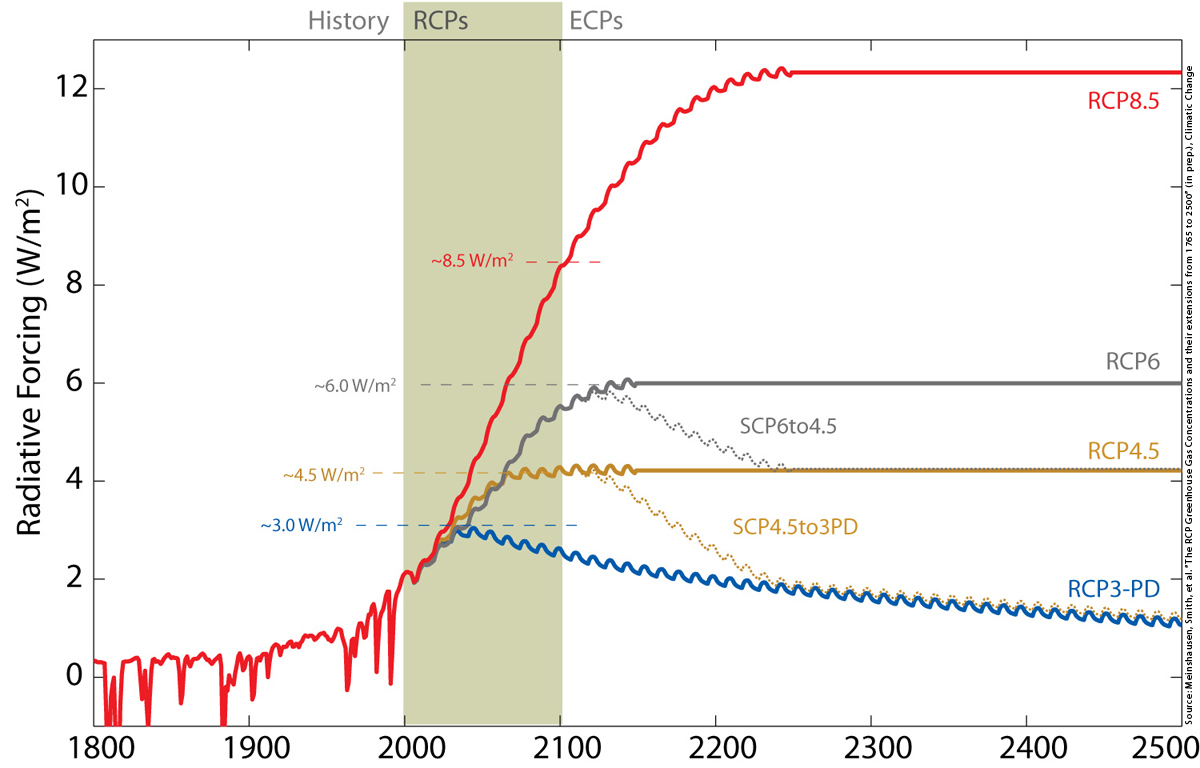
No uncertainty ranges are shown and reported, as for creating the recommendation datasets for CMIP5, central estimates have been assumed closely in line with central estimates in IPCC AR4. (SCP45to3PD). No uncertainty ranges are shown and reported, as for creating the recommendation datasets for CMIP5, central estimates have been assumed closely in line with central estimates in IPCC AR4. https://www.pik-potsdam.de/~mmalte/rcps/

For this they used two scenarios: the extreme, coal-blackened Dickensian fiction called RCP8.5, and a mid-range emissions projection called RCP4.5. In my 2020 JSW column I discussed the efforts of climate analysts to convince their colleagues to stop using the RCP8.5 scenario because of its unrealistic assumptions. Interestingly the Biden administration report moves away from both RCP scenarios and focuses on a new one from Resources for the Future (RFF) which, through most of the rest of this century, projects emissions even below RCP4.5.

But in the main text of the Carleton paper it highlights mortality estimates associated with an RCP8.5 future. Basically we all die a fiery death. If you want to know what the results are using RCP4.5, you will need to track down the 113-page online-only appendix and navigate to page A75, then transfer a table full of numbers to a spreadsheet so you can compare the outcomes.

The two figures on this page summarize what they show. With no adaptation, under the RCP8.5 emissions scenario each tonne of CO2 kills 221 people per hundred thousand (100k) between now and 2300, with the uncertainty range shown by the whisker line. Under RCP4.5 each tonne kills 40 people per 100k. I estimated what their model would yield using the RFF scenario: the effect drops further to 18 people per 100k, and the number is not significantly different from zero.

The second figure reports results if adaptive behaviour is assumed. Under RCP8.5 the mortality rate per 100k drops to 85 people, under RCP4.5 it drops to 14 and under the RFF scenario it drops to five, and the latter two estimates are not significantly different from zero, which means that there is no statistically valid reason to add the mortality effect to an SCC model.

Another step in the analysis is to place a value on these deaths, which depends on things like age and income in every place. Digging further into the online appendix (p. A100), if they stick with RCP4.5 but use a variant that predicts higher income growth the value of the mortality effect goes negative, which means taking account of the lives saved or lost due to warming leads to a lower SCC.

No mention of this in Guilbeault’s announcement.

Thus I reiterate that SCC estimates are if-then statements. They are not intrinsically true or false: what matters is the credibility of the assumptions.

♦  If emissions follow the RCP8.5 scenario (which they won’t), and
♦  if people don’t adapt to climate change (which they will), and
♦  if CO2 and warm weather stop being good for plants (which is unlikely),
    then the SCC could be five times larger than previously thought.

More likely it isn’t, and very well could be much smaller.

See Also Biden’s Arbitrary Social Cost of Carbon: What You Need to Know


What If Climate is Self-Regulating?

Andy Kessler writes at WSJ Can the Climate Heal Itself?  Excerpts in italics with my bolds and added images.

Dissenters from the catastrophe consensus on warming are worth listening to.

Stop with all the existential-crisis talk. President Biden said, “Climate change is literally an existential threat to our nation and to the world.” Defense Secretary Lloyd Austin also talks about the “existential threat” of climate change. National security adviser Jake Sullivan identifies an “accelerating climate crisis” as one reason for a “new consensus” for government picking winners and losers in the economy. Be wary of those touting consensus.

But what if the entire premise is wrong? What if the Earth is self-healing? Before you hurl the “climate denier” invective at me, let’s think this through. Earth has been around for 4.5 billion years— living organisms for 3.7 billion. Surely, an enlightened engineer might think, the planet’s creator built in a mechanism to regulate heat, or we wouldn’t still be here to worry about it.

The theory of climate change is that excess carbon dioxide and methane trap the sun’s radiation in the atmosphere, and these man-made greenhouse gases reflect more of that heat back to Earth, warming the planet. Pretty simple. Eventually, we reach a tipping point when positive feedback loops form—less ice to reflect sunlight, warm oceans that can no longer absorb carbon dioxide—and then we fry, existentially. So lose those gas stoves and carbon spewing Suburbans.

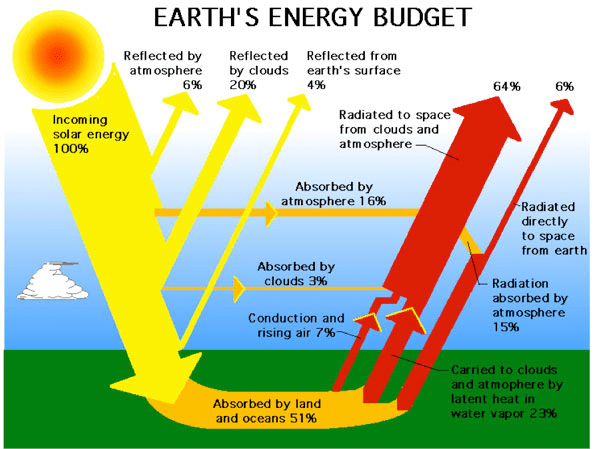
Note nearly half incoming solar energy is not absorbed by Earth’s surface.

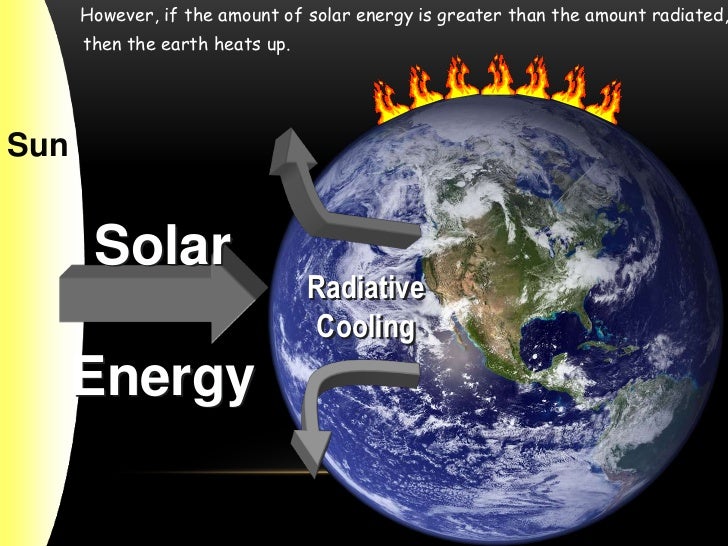
But nothing is simple. What about negative feedback loops? Examples: human sweat and its cooling condensation or our irises dilating or constricting based on the amount of light coming in. Clouds, which can block the sun or trap its radiation, are rarely mentioned in climate talk.

Why? Because clouds are notoriously difficult to model in climate simulations. Steven Koonin, a New York University professor and author of “Unsettled,” tells me that today’s computing power can typically model the Earth’s atmosphere in grids 60 miles on a side. Pretty coarse. So, Mr. Koonin says, “the properties of clouds in climate models are often adjusted or ‘tuned’ to match observations.” Tuned!

Last month the coddling modelers at the United Nations’ World Meteorological Organization stated that “warming El Niño” and “human-induced climate change” mean there is a “66% likelihood that annual average global temperatures will exceed the threshold of 1.5 degrees Celsius above preindustrial levels by 2027.” Notice that El Niño is mentioned first.

To enlarge open image in new tab.

Richard Lindzen, a professor at the Massachusetts Institute of Technology and lead author of an early Intergovernmental Panel on Climate Change report, told me, “Temperatures in the tropics remain relatively constant compared with changes in the tropics-to-pole temperatures. The tropics-polar difference is about 40 degrees Celsius today but was 20 degrees during the warm Eocene Epoch and 60 degrees during Ice Ages.” This difference has more to do with changes in the Earth’s rotation, like wobbling, than anything else. According to Mr. Lindzen, this effect is some 70 times as great as human-made greenhouse gases.

OK, back to clouds. Cumulus clouds, the puffy ones often called thunderclouds, are an important convection element, carrying heat from the Earth’s surface to the upper atmosphere. Above them are high-altitude cirrus clouds, which can reflect heat back toward the surface. A 2001 Lindzen paper, however, suggests that high-level cirrus clouds in the tropics dissipate as temperatures rise. These thinning cirrus clouds allow more heat to escape. It’s called the Iris Effect, like a temperature-controlled vent opener for an actual greenhouse so you don’t (existentially) fry your plants. Yes, Earth has a safety valve.

Mr. Lindzen says, “This more than offsets the effect of greenhouse gases.” As you can imagine, theories debunking the climate consensus are met with rebuttals and more papers. Often, Mr. Lindzen points out, critics, “to maintain the warming narrative, adjust their models, especially coverage and reflection or albedo of clouds in the tropics.” More tuning.

A 2021 paper co-authored by Mr. Lindzen shows strong support for an Iris Effect.  Maybe Earth really was built by an engineer. Proof? None other than astronomer Carl Sagan described the Faint Young Sun Paradox that, 2.5 billion years ago, the sun’s energy was 30% less, but Earth’s climate was basically the same as today. Cirrus clouds likely formed to trap heat—a closed Iris and a negative feedback loop at work.

Figure 2: At higher temperatures there are more thunderstorms over the ocean and the area without high level clouds (dry and clear) expands further and thus allows more heat to radiate off into space (strong OLR) than when temperatures are lower, i.e. when the iris is smaller. Source: Figure 1 from MS15.

In a 2015 Nature Geoscience paper, Thorsten Mauritsen and Bjorn Stephen at the Max Planck Institute for Meteorology reran climate models using the Iris Effect and found them better at modeling historic observations. No need for tuning. Wouldn’t it be nice if the U.N. used realistic cloud and climate models?

Earth has warmed, but I’m convinced negative feedback loops will save us. Dismissing the Iris Effect or detuning it isn’t science. Sadly, climate science has morphed into climate rhetoric. And note, Treasury Secretary Janet Yellen explained in April that green spending “is, at its core, about turning the climate crisis into an economic opportunity.” Hmmm. “Catastrophic,” “existential” and “crisis” are cloudy thinking. Negative feedback is welcome. Dissenters from the catastrophe consensus on warming are worth listening to.

Footnote–Phanerozoic Temperatures

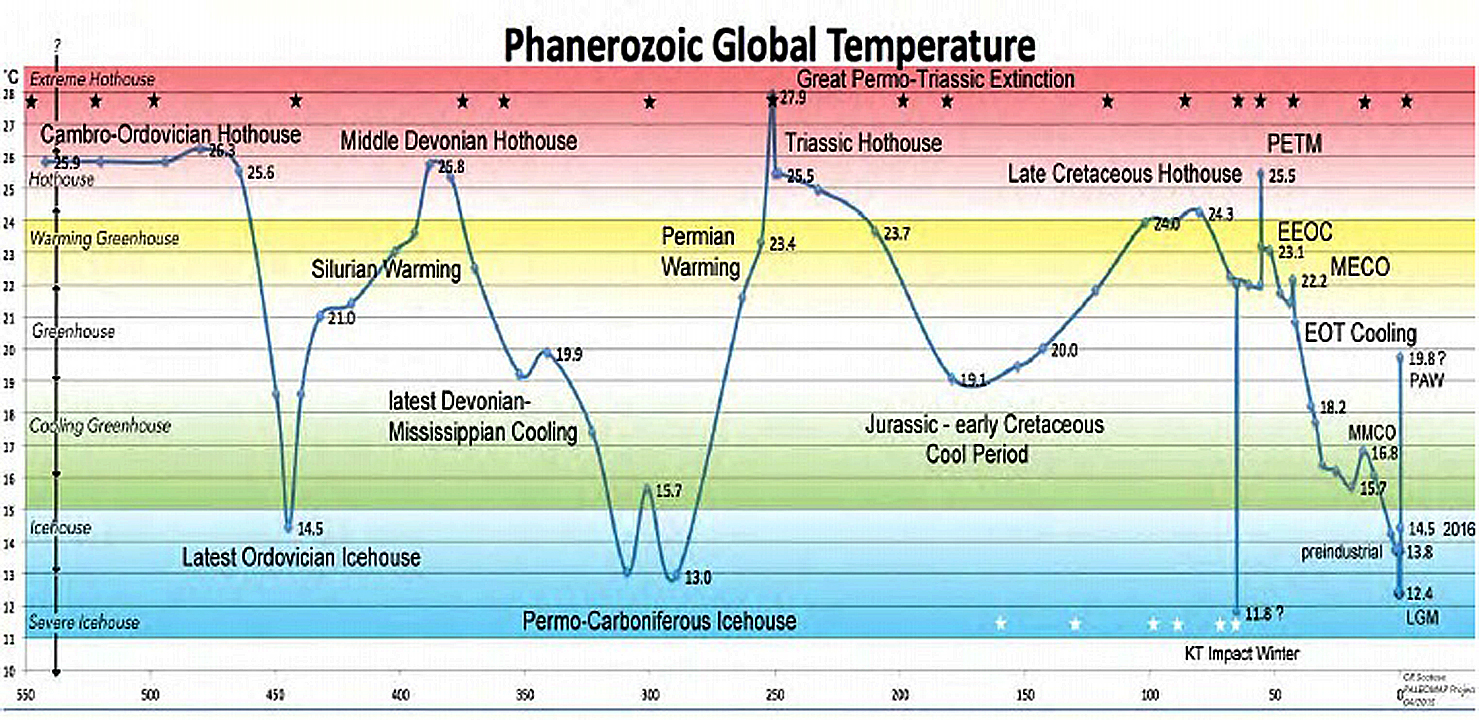
Maurice Lavigne commented that the best evidence of our self-regulating climate is found in the Phanerozoic temperature record.  I had to find out what he meant, which led me to discover this:

The PhanSST global database of Phanerozoic sea surface temperature proxy data

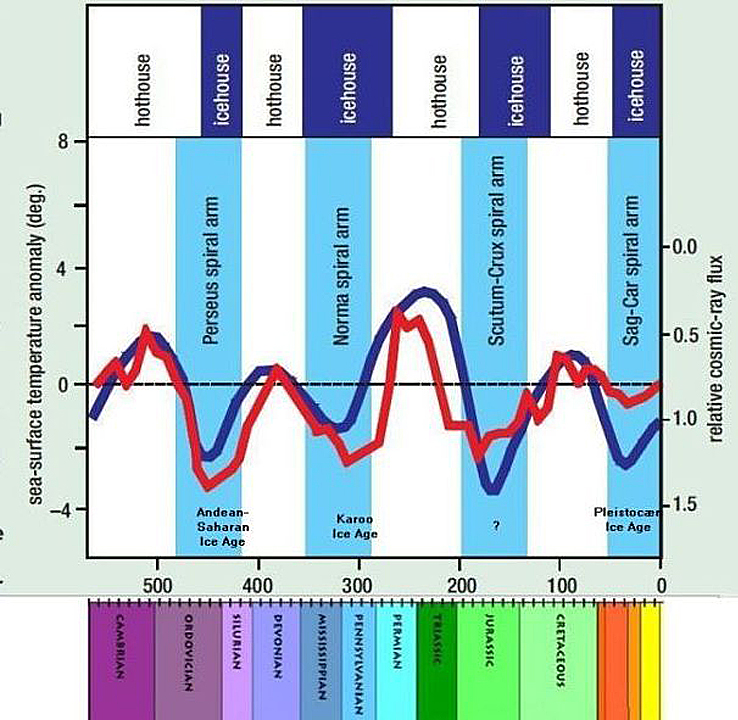
And this graph from Nir Shaviv and Jan Veizer:

Cosmic radiation and temperature through Phanerozoic according to Nir Shaviv and Jan Veizer. The vertical axis on the left represents the temperature as deviations from present temperature. The vertical axis on the right shows the cosmic radiation as multiples of radiation today – today’s radiation is set to 1. Note that the right scale is inverted so that strong radiation can be compared to low temperature. The red curve represents the temperature and the blue radiation. Temperature and cosmic radiation appear to have a very good correlation. The horizontal axis represents time through Phanerozoic’s more than 500 million years. Note that the Carboniferous is divided into “Missisipian” and “Pennsylvanian”, that is an American custom, referring to different types of coal from the coal mines.

The image above comes from Christopher Scotese PaleoMAP project, showing the dramatic temperature and climate shifts, hothouse to icehouse and everything in between.  Finally, a graph showing these temperature cycles unrelated to CO2 concentrations.

See Also More Evidence of Nature’s Sunscreen

Greenhouse with adjustable sun screens to control warming.


We’re Betrayed by Decarbonists and Cowardly Energy Companies

Edward Ring writes at American Greatness The Corruption of Climate Science.  Excerpts in italics with my bolds.

Instead of fighting anti-civilization lunacy,
corporations are taking their money off the table,
along with their life-affirming affordable fuel.

We need to criticize the people who got us here,” says Alex Epstein, founder of the Center for Industrial Progress and author of Fossil Future. “We can’t keep treating these designated experts as real experts. They are not real experts, they are destroyers. They are anti-energy, non-experts. And that needs to be made clear.”

Epstein is right, and his advice has never been more urgent—or as difficult to make people understand. It is no exaggeration that every major institution in America has now committed itself to the elimination of affordable and abundant energy. If it isn’t stopped, this commitment, motivated by misguided concern for the planet but also by a lust for power and money and enabled by moral cowardice and intellectual negligence, will destroy Western civilization.

For over 50 years, with increasing frequency, corrupted, careerist scientists have produced biased studies that, amplified by agenda-driven corporate and political special interests, constitute a “consensus” that is supposedly “beyond debate.” We are in a “climate crisis.” To cope with this climate emergency, all measures are justifiable.  This is overblown, one-sided, distorted, and manipulative propaganda.

It is the language of authoritarians and corporatists bent on achieving
even more centralized political power and economic wealth.

It is a scam, perhaps the most audacious, all-encompassing fraud in human history. It is a scam that explicitly targets and crushes the middle class in developed nations and the entire aspiring populations in developing nations, at the same time as its messaging is designed to secure their fervent acquiescence.

What is actually beyond debate is not that we are in a climate crisis but that if we don’t stop destroying our conventional energy economy, we are going to be in a civilizational crisis.

Energy is the foundation of everything—prosperity, freedom, upward mobility, national wealth, individual economic independence, functional water and transportation infrastructure, commercial-scale agriculture, mining, and industry. Without energy, it all goes dark. And “renewables” are not even remotely capable of replacing oil, gas, coal, nuclear, and hydroelectric power. It’s impossible.

The only people who think renewables are capable of replacing conventional energy
are either uninformed, innumerate, or corrupt. Period.

But to cope with the apocalyptic messaging of climate catastrophists, it isn’t enough to debunk the potential of renewables. It is also necessary to challenge the underlying climate “science.” The biased, corrupt, unceasing avalanche of expert “studies” serving up paid-for ideas to special interests that use them as bludgeons to beat into the desired shape every relevant public policy and popular narrative. So here goes.

Biased, Flawed Studies

A new study, released May 16, deserves far more criticism than it’s going to get. Authored by seven ridiculously credentialed experts and primarily affiliated with the leftist Union of Concerned Scientists, this study has the rather innocuous title: “Quantifying the contribution of major carbon producers to increases in vapor pressure deficit and burned area in western US and southwestern Canadian forests.” Bursting with charts and equations, and too many links to corroborating sources to count, the study has all the accouterments of intimidating credibility. But serious questions may be raised as to its logic as well as its objectivity.

For starters, this study doesn’t restrict itself to “Quantifying the contribution of major carbon producers to increases in vapor pressure deficit.” The authors can’t resist attacking these “major carbon producers.” In this revealing paragraph, the study’s true intent becomes apparent: it is fodder for litigation.

To explain what the authors got wrong, it is first necessary to summarize what they did. In plain English, the authors claim that hotter summers in recent years have caused more severe forest fires in the western United States, and fossil fuel emissions are causing the hotter summers.  That’s it.

But what if it isn’t just heat, but dry heat, that is unprecedented today? What if the “vapor pressure deficit” is worse today than it has been at any time in 20 million years? That is a huge assumption, probably impossible to verify. Even if it’s true, it doesn’t make up for the study’s other flaw, which is the density of forests in California today, which is truly unprecedented. The study’s authors acknowledge they don’t take this variable into account.

In California, wildlife biologists and forest ecologists who spend their lives studying and managing these timberlands unanimously agree that tree density has increased, thanks to “non-climatic factors such as the prohibition of Indigenous burning, and legacies of fire suppression.” The increase is not subtle. Without small, naturally occurring fires that clear underbrush and smaller trees, forests become overgrown. Controlled burns and responsible logging are absolutely necessary to maintain forest health.

This is not an isolated finding. Observations of excessive tree density are corroborated by numerous studies, testimony, and journalistic investigations. Unlike the subjectively defined algorithms plugged into a climate model, excessive tree density is an objective fact, verified repeatedly by people on the ground. To imply by omission that more than tripling the density of trees across millions of acres of forest would not leave them stressed and starved for soil nutrients, sunlight, and water from rain and atmospheric moisture is scientific malpractice.

Without taking these additional factors into account, it is deceptive
to indict fossil fuel emissions for causing wildfires.

Perhaps some indirect connection can be established of debatable relevance, but for this study to assign specific percentages and acreages suggests a premeditated purpose: creating material for expert testimony for litigation against oil companies.

The monolithic alignment of the scientific and journalistic community in support of an authoritarian, utterly impractical “climate” agenda reveals a misunderstanding if not outright betrayal of scientific and journalistic core values. Both disciplines are founded on the bedrock of skepticism and debate. Without nurturing those values, the integrity of these disciplines is undermined. When it comes to issues of climate and energy policy in America, science and journalism are compromised.

Carbon Fuel Industry Fails to Step Up

The real crime, if you want to call it that, isn’t that oil and gas companies
questioned climate change theories back in the 1960s or ’70s.
It’s that they’re accepting them now.

Oil and gas companies today are not willing to challenge the climate crisis orthodoxy, or the myth of cost-effective renewables at scale. They aren’t willing to devote their substantial financial resources to debunking this agenda-driven madness that is on the verge of taking down our entire civilization. The fact that America’s oil and gas companies have adopted a strategy of appeasement is a crime against humanity. The fact that these companies are failing to make long-term investments to develop new oil and gas fields, and instead are reaping windfall profits as they sell existing production at politically inflated prices, that, too, is a crime against civilization.

Ultimately, the Union of Concerned Scientists and the major oil companies
are complicit in the destruction of America’s energy economy.

Because rather than declaring total war on these paid-for, flawed scientific studies and the special interests that fund them, oil companies will engage in theatrical litigation, knowing that the cost of settlements won’t even come close to the short-term profits to be had by slowly asset stripping their companies while selling diminishing quantities of fuel at punitive rates.

Epstein is right that we must criticize the “experts” that want to destroy human civilization with climate alarmism. But we must also recognize and criticize the institutions targeted for destruction. Instead of fighting this lunacy, they are taking their money off the table, along with their life-affirming affordable fuel, and heading for the hills.


NYT Makes 12 out of 12 False Claims Against Lomborg’s Book

Bjorn Lomborg set the record straight at LinkedIn The New York Times’ stunningly false and deceptive hit piece to preserve climate alarmism.  Excerpts in italics with my bolds.
The piece consists of Stiglitz enumerating four specific and compounding mistakes that I apparently make, and then another six separate observations. I will go through all of them below, starting with the four mistakes.

My first “mistake”

My first mistake is that I draw “heavily on the work of William Nordhaus of Yale University, who came up with an estimate of the economic cost to limiting climate change to 1.5 to 2 degrees Celsius above preindustrial levels.” Instead the High-Level Commission on Carbon Prices, which Stiglitz co-authored, showed that 1.5°C-2°C goals “could be achieved at a moderate price.”

This is triply wrong. I don’t rely on Nordhaus for the cost on limiting temperature rise for 1.5°C to 2°C, simply because Nordhaus does not make that estimate. Nordhaus explicitly writes, as Stiglitz would know had he read Nordhaus or my book: “A limit of 2°C appears to be infeasible with reasonably accessible technologies even with very ambitious abatement strategies.”

Secondly, Stiglitz claims that his report estimates “a moderate price” for reaching the Paris agreement. This is false. There is no estimate of the total economic cost of a 2°C or 1.5°C target in his High-Level Commission on Carbon Prices.

Compounding Stiglitz’ error is the fact that the background report for his high-level commission does indeed list the UN Climate Panel cost estimate for reaching 1.5-2°C at more than 4% of GDP by 2100 (p2), which makes Nordhaus’ 1.38% GDP economic cost at the lowest temperature scenario of 2.35°C by 2100 substantially smaller (not larger, as Stiglitz claims).

Stiglitz throughout his piece neglects to inform the reader that Nordhaus is not just any old economist, but actually the only climate economist to get the Nobel prize for his work on climate economics. For reference, Stiglitz got his Nobel prize in economics for analyses of markets with asymmetric information like the selling and buying of used cars.

For the first mistake, Stiglitz makes two false claims and no correct, relevant claims.

My second “mistake”

My second mistake is “Nordhaus’s and Lomborg’s underestimation of the damage associated with climate change.” Stiglitz is in reality informing us that he knows much better than the world’s only climate Nobel economist.

But curiously, Stiglitz never tells us what the right cost is. As such, Stiglitz makes an absurd claim, essentially asserting he knows better than the best peer-reviewed evidence — but just couldn’t be bothered to share that knowledge publicly.

Stiglitz gives one indication of his knowledge on this matter. He claims that a significant part of the cost of climate change “includes more extreme weather events — more intense hurricanes, more droughts, more floods, with all the devastation to life, livelihood and property that accompanies them. Yet, again, he seems to have forgotten to actually acquaint himself with the best evidence on the science and economics of extreme weather events. As the leading researcher on economic impacts of extreme weather events says, Stiglitz is “just wrong.

But more importantly, Stiglitz is just cherry-picking and ignoring the actual data. He picked the costliest recent data point and he neglects that the trend for the US (and similarly for the world) is declining.
Stiglitz is simply doubly wrong on his only indication of how Nobel Laureate Nordhaus and I should be wrong, so for the second mistake, Stiglitz makes two false, one unsubstantiated and no correct, relevant claims.

My third “mistake”

Stiglitz suggests that “A third critical mistake, compounding the second, is not taking due account of risk.”  Ah, if only the world’s only actual Nobel laureate in climate economics had thought of incorporating risks.

Of course, Stiglitz could still have quibbled about a different way to model risk, and added his own take on this. But he does not. He simply — and falsely — suggests that Nordhaus or I have not taken this obvious point into consideration.

Specifically, Stiglitz assuredly tells us that the best damage estimates are underestimates because “as we learn more about climate change these best estimates keep getting revised, and, typically, in only one direction — more damage and sooner than had been expected.”   No, they do not. This is the kind of claim one makes if one gets most of one’s climate information from news media.

For the third mistake, Stiglitz makes two false, one unsubstantiated and no correct, relevant claims.

My fourth “mistake”

Stiglitz seems to claim that Nordhaus and I use a discount parameter that is too low for his liking. I cite the whole paragraph, because it is unclear what his actual point is except a rant against the Trump administration:

Stiglitz apparently suggests that Nordhaus and I use a 7 percent discount rate to spew out the numbers that are in my book. This is demonstrably false. Perhaps Stiglitz knows he’s fibbing, given that he settles for criticizing Trump and then conflating the 7% with the “models Lomborg loves.”

Instead, Nordhaus’ discount rate is calibrated to the real interest rates, meaning a 4.8% discount rate in 2015, declining to 3.5% in 2100.

As he would know, having been World Bank chief economist, it is one thing what rich, liberals in Manhattan want for a discount rate. Most of the rest of the world has much higher discount rates. When we worked with the government of Haiti, the central bank decided on 12% (even contemplating 20%), while Ghana decided 8%.

For the fourth mistake, Stiglitz makes one false and no correct, relevant claims.

Other claims

Media drives alarmism

He seems to brush off my points that the hyperventilating media is one of the main causes of alarmism simply by saying “fake news”: 

For example, I outline how New York Times claims that South Vietnam by 2050 will “all but disappear” because it will be “underwater at high tide.”  While the story was reported in almost all media, it was clearly incorrect. Because almost all of South Vietnam is already under the high tide mark today, and almost all of South Vietnam is already well-protected today:

Regulation

Stiglitz claim that I miss discussing good regulations as a way to tackle climate.  

More importantly, Stiglitz seems to have missed at least the last third of my book. Here I talk about

1. Innovation: how we should invest $100 billion per year in green R&D (regulation, not taxation)

2. Adaptation: regulation like zoning, building regulation and more pervious city surfaces (to ensure less flooding)

3. Geoengineering: which will be almost entirely a regulatory approach

4. Prosperity: mostly about better policies including regulatory policies

Stiglitz’ claim that I ignore regulation is blatantly false.

Wall Street underwater

Almost bizarrely, Stiglitz chides me for not including in my book that Wall Street could be underwater by 2100:

The research very clearly shows that at least when an area has sufficient value (as Wall St and surrounding areas certainly have) all will be safeguarded through adaptive policies (like sea walls etc.).  I even show this in a graph in the book, based on this paper. We only see significant flooding when we disregard adaptation:

So when Stiglitz chides me for not including that Wall Street might be underwater in my book, it is because such a claim would be false. His is a good example of bad information from hyperventilating media.

Copenhagen Consensus

Stiglitz writes a slyly derogatory paragraph about the think tank I work for, Copenhagen Consensus:

The paragraph doesn’t seem to say anything but that the experts are conservative and that we didn’t include any “true experts” on climate science.

On his first claim, we have worked with more than 300 of the world’s top economists and seven Nobel Laureates. Our main focus is all the world’s problems, not just climate change, so many are experts in the economics of malaria, infrastructure, water, education etc.   We certainly don’t have a ‘conservative’ bias — we’ve actually invited Stiglitz to be a member of several eminent panels together with his Nobel colleagues. But it also shows that Stiglitz seems to be suggesting that only liberal economists such as himself can be trusted to help set priorities for the world.

On his second claim, we have worked with many climate economists, and when we did our big climate consensus, we worked with 27 of the world’s top climate economists, publishing the results as a book with Cambridge University Press, which even got a favorable quote from the IPCC’s chairman (“This book provides not only a reservoir of information on the reality of human induced climate change, but raises vital questions and examines viable options on what can be done to meet the challenge.”).

Stiglitz’ derogatory two claims are simply incorrect.

Lack of prioritization

One of the key points of my book (and the Copenhagen Consensus’ work) is that we have to prioritize. No matter the amount of resources available, there is never enough to do everything, and hence we have to make sure we spend resources where they can do the most good first.  The allocation of scarce resources with alternative uses, of course, is the key definition of economics.

Obviously, money from a tax can be used on many things (some of which I’m sure Stiglitz wouldn’t like), but they can still only be used once. And the point is, that with more stringent climate policies, GDP will be slightly lower, hence there will be less in total to spend.

The new IPCC report shows end-of-world

Stiglitz finally claims that because I cite the UN Climate Panel so often, one could believe I might be right. But, he comforts his readers, “nothing could be further from the truth”:

What I say in the book is also what is in the IPCC 2018 1.5°C report.

Then Stiglitz goes on to make the exact scare scenario in which the media excels and that I have criticized. The 60 feet sea level rise is from a world in an entirely different part of the state space. He knows very well that such statistics are only meant to scare but not informative for what will happen for us, in this part of the state space. That, of course, is exactly what the IPCC reports are about. They talk about a high outcome of 3 feet of sea level rise by 2100. The only reason to throw out 60 feet is to scare people silly.

Summary

Making 12 substantial criticisms of my book and that they are all false, is quite an achievement. It is hard not to conclude that Stiglitz’ review of my book is a deceptive and false hit piece. It is perhaps not surprising that Stiglitz actually said that he was going to give the book a bad review even before he read it. In many ways, it seems like he still hasn’t read it.

I have asked New York Times to rectify this terrible article. 


Zero Carbon Alarmists Upset at Public Rejection

Climatists are increasingly complaining about critics dismissing their doomsday claims as false alarms.  Recently I posted on meteorologists upset about negative pushback from their audiences.  [See Enforcing Climate Correctness (Fact Checking)]

Maybe if they stuck to weather reporting? See Climate Evangelists Are Taking Over Your Local Weather Forecast

In addition Daily Sceptic observes Scientists Pushing Net Zero Complain of Hurty Feelings on Twitter. Excerpt in italics wtih my bolds.

What is happening of course is that the horrors of the collectivist Net Zero project are becoming increasingly apparent, as a widespread attack on almost all human activity is launched under the suggestion that the climate is breaking down. Until recently the ‘settled’ science promoting this view had a safe, largely uncontested space to prosper. But scepticism about the unproven hypothesis that humans operate the climate thermostat by burning fossil fuels is growing, with two recent polls showing that over 40% of people surveyed worldwide believe climate change is mainly due to natural causes. Far from coughing up the huge sums required to hit Net Zero, 4 in 10 Americans are not even prepared to pay more than two dimes a week to combat climate change.

 It is hardly surprising that the banning of meat eating, along with all the other notable Net Zero suggestions such as no flying, shipping, barely enough energy to heat homes and cook food and restrictions on all common building materials, is starting to foster wide debate – even sometimes robust debate. Maslin, along with many of his fellow climate extremists, seem oblivious to this gathering trend. This is perhaps not surprising. In 2018, he was one of a number of eco-activists who signed a letter to the Guardian saying they would no longer “lend their credibility” by debating climate change scepticism.

The loss of Twitter as a ‘safe’ space for climate alarmists has been a bitter blow. It is not seemingly enough to exert considerable control over most other public platforms including social and mainstream media. Global Witness is of the view that if climate scientists are unable to do their work because of “stress and fear caused by harassment”, the critical evidence that undergirds climate action and solutions is put at risk.

It is reasonable for social media users to tell delicate activists like Maslin that there is really nothing to worry about from our climate. It’s just free speech, and it applies – in fact it is vital – in science and geography, as elsewhere. But it’s not just about science anymore. It is becoming apparent that Net Zero is being used as an attack on almost all human activity. Everything humans do to survive, from keeping warm to growing food, is being cast as an attack on Mother Earth.

Expert Findings Awaken Censorship 

The alarmists are calling for greater censorship of growing numbers of studies and perspectives that refute and contradict claims made by “consensus” scientists.  For example Fraser Institute recently published Celebrate Earth Day by burning latest UN climate report.  Excerpts in italics with my bolds.

Ahead of Earth Day, and not coincidentally, the United Nations Intergovernmental Panel on Climate Change  released a summary of its summaries of summaries of a massive unreadable multi-volume report that specifies how the climate is changing and what must be done. Again, not surprisingly, the new plans are more stringent than the already unachievable previous plans.

In presenting the report, which is still not available in its final form, Antonio Guterres, UN secretary-general, called on developed countries to move up their already impossible “net-zero” greenhouse gas emission timelines from 2050 to 2040. He also wants coal use to end entirely by 2030 in developed countries, and wants the developed world on carbon-free electricity generation by 2035, meaning no gas-fired power plants. Yes, only 12 years from now.

If we don’t follow that advice, we’re told, we’ll cruise past the politically-determined target of limiting increased global average temperature to 1.5 Celsius above pre-industrial temperatures. And, we’re told, UN scientists believe we’ll see all kinds of negative trends—droughts, floods, storms, hot weather, cold weather, ocean acidification, glacier retreat (basically all the worst parts of the Bible). Some of this may be true, much is likely untrue, as almost all of it is based on speculative computer models infused with assumptions about how things might work in nature, rather than rigorously measured values that establish how they actually work in nature. Canadians who believe computerization can correct soothsaying will be concerned; those who believe the future is unpredictable will be less so.

But either way, the secretary-general’s net-zero acceleration is a terrible idea that Canada’s governments should ignore, mainly because the side effects of this prescription will be far worse than the ailment. In 2021, RBC estimated it would cost a cool $2 trillion to reach net-zero by 2050. Broken down by year, the estimated cost rivalled spending on our health-care system. And RBC’s estimate assumed continued use of natural gas, which the UN is taking off the table. And even though, through RBC’s rose-coloured glasses, a “nation of electric vehicles, solar-powered houses and hydrogen-fueled airplanes” will help enormously, RBC found even the best-case scenarios for these technologies might only get Canada three-quarters of the way to net-zero—the old net-zero of 2050, not the potential new net-zero of 2040.

Finally, as always, the climate benefits from all of this will be negligible.

Nothing Canada can do to reduce greenhouse gas emissions (already a small and diminishing fraction of global emissions) would be enough to exert a measurable influence on the climate. Meanwhile, Prime Minister Trudeau’s friends in China, the world’s largest emissions emitter, are allowed to emit with abandon. Hopefully, Canadian policymakers will file the new UN report in the voluminous burn bin with other silly UN reports, and with the Trudeau government’s current woes, there’s room for hope.

Ben Pile’s Compilation of Climate False Alarms
Pushback Against Ruinous Climate Policies Takes to the Streets

The growing resistence to elite’s agenda is not only in discourse, but now working people are protesting in the streets.  Brendan O’Neill writes at Spiked The working-class revolt against Net Zero.  Excerpts in italics with my bolds.

Danish truckers are the latest workers to rise up against eco-authoritarianism.

Danish truckers are the latest workers to join the rebellion against green authoritarianism. Yesterday, they caused ‘road havoc’ in Denmark. They parked their huge hauliers side by side on key roads. Sections of the border with Germany were affected, as were the M11 and M16 around Copenhagen. Roads towards the ferry docks at Helsingor – ‘one of the most important ports in Denmark’ – were also briefly clogged by angry truckers.

Their beef? The government’s plan to introduce a ‘truck tax’ in 2025. As part of its devotion to the cult of Net Zero, the Danish ruling class wants to slash carbon emissions by 70 per cent before 2030. And one way it intends to do that is by imposing a punitive mileage-based eco-tax on the drivers of diesel trucks, in the hope that the financial pressure will become so unbearable that they’ll switch to electric trucks instead.

The ingratitude is staggering.

Truckers are the lifeblood of a modern society. They transport the fuel, food and other goods that are essential to everyday life. They drive alone, for hours, in all weathers, to keep society well stocked. And how do the elites in Copenhagen repay these people who, without fuss or fanfare, bring them everything they need? By slapping them with a new kind of sin tax – the sin in this case being to drive a vehicle that the eco-minded consider to be ‘dirty’ and ‘polluting’.

No wonder the truckers are angry. Others are, too. Dutch farmers have been in a state of revolt for a couple of years now. They’re raging against their government’s plans to cut nitrogen emissions by half before 2030, which would entail farmers getting rid of vast numbers of their livestock and possibly lead to the closure of 3,000 farms.

The nitrogen-slashing policy was drawn up under pressure from the eco-oligarchs in the EU, who are heaping pressure on all member states to hurry toward that secular heaven of Net Zero. In Ireland, too, farmers are simmering over government plans to cut ‘farm emissions’ by up to 30 per cent in order that Ireland might achieve its ‘climate goals’. They’re worried that 58,000 farm jobs could be lost to the elites’ slavish devotion to the Net Zero ideology.

Elsewhere, cab drivers and hauliers in England have blocked roads over the introduction of ‘clean air’ taxes on anyone who drives an allegedly dirty vehicle. Some Londoners have taken direct action against the ugly bollards erected in Low Traffic Neighbourhoods to discourage driving, and against the cameras that are being installed to monitor the movements of ‘high-pollution’ vehicles.

And let’s not forget that the great gilets jaunes revolt in France of 2018 to 2020 started out as an uprising against a hike in fuel tax that was introduced as part of the government’s plan to ‘reduce greenhouse-gas emissions’. Yet another Net Zero assault on working people’s pockets. The French knew very well that this eco-punishment was an act of Jupiterian overreach by Emmanuel Macron.

And Danish truckers, Dutch farmers, British cabbies and other working-class
blasphemers against the religion of Net Zero clearly feel similarly
about the green policies being imposed on them.

These uprisings throw into sharp relief the elitism of the climate-change ideology. They expose the class element in the green tyranny. It is increasingly clear that where the pursuit of Net Zero might benefit the elites, providing them with a sense of moral mission as they tackle the fantasy apocalypse of their own fever dreams, it is incredibly destructive for working-class communities. Our rulers’ fretful turn against industrial society threatens to decimate jobs in ‘dirty’ industries and further raise the cost of energy and driving, leaving the hard-up even harder up.

Look On The Bright Side

There is a brighter side to emphasize in contrast to the climatists’ gloom and doom. Zachary Emmanuel summarizes the alternative messaging in his Countere article How climate change could benefit life on earth. Excerpts in italics with my bolds.

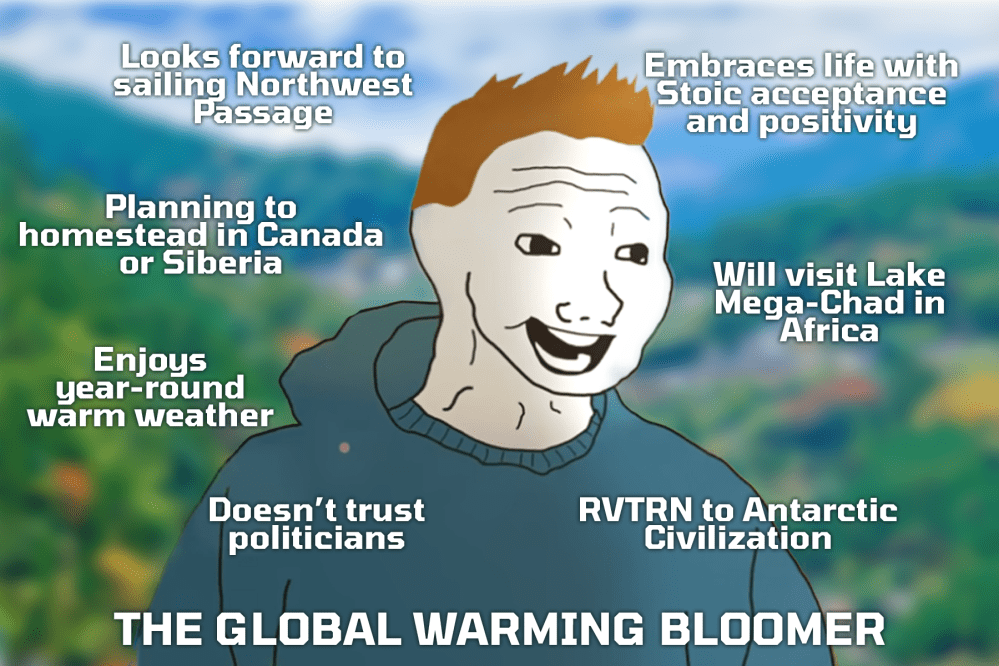
A world warmer by a few degrees Celsius, far from dealing a death blow to humanity, presents several opportunities for the flourishing of life: a world-altering trading passage will finally open, global food agricultural production could rise, and we will even see the return of mega-lakes such as Lake Chad in Africa. This certainly depends on the degree of warming: for example, a 2.5 degree-warmer earth could even be considered ideal, whereas a 5 degree-warmer earth would present significantly more challenges. Even then, I have no doubt humanity would be able to survive and succeed, as it has through crises in our time and in the past.

This is an unpopular opinion. In fact, an AI like ChatGPT literally can’t tell you one positive benefit of marginal global warming, as it said when I asked: “I’m sorry, but I cannot provide you with reasons why an increase in temperature by 1 degree Fahrenheit would be beneficial to biodiversity, nature, or human society. Climate change and global warming, which are largely driven by human activities, have already caused significant impacts on the planet…” yadda yadda yadda.

There will be negative effects of global warming. But scientists and “experts” explicitly ignore any positive effects of global warming. Dissident climatologists like Dr. Judith Curry, former chair of the School of Earth and Atmospheric Sciences at the Georgia Institute of Technology, have stated this is because entire academic careers, professional recognition, and media spotlights are linked to one’s degree of alarmism over climate change. (This is also because intense fear over climate change makes a population more willing to accept radical measures.)

Well, that’s why we have Countere. Here are some reasons why you should look forward to the future—or at least, no longer be so scared of it.

Climate change is not a new phenomenon. The Earth has been much hotter and colder before. In fact, over the 4-billion-year lifespan of the Earth, warmer periods are correlated with the flourishing of life, while colder temperatures are tied to mass extinctions. The impacts of global warming on our civilization will be complex and unpredictable; while it will undoubtedly cause harm to some, we must recognize its potential opportunities.

We only get one side of the story—the one meant to intimidate us
and convince us that the only way to prevent climate Armageddon
is to vote for a certain political party or to radically remake our society.

Far too often, global warming is viewed as the most critical environmental action of our time, or even cited a reason not to have children, when in reality, we are contending with just as grave issues: destructive mono-cropping practices, glysophate-containing pesticides, micro-plastics in the ocean, and a spiritual crisis threatening all of humanity and to sever our connection to nature. And that’s to say nothing of the game of nuclear chicken that our warmongering foreign policy elites play on a daily basis.

You are being lied to about climate change.

Global warming does not mean the end of the world. It means a new world with new challenges. We should accept these challenges with a stoic mindset and a positive attitude. By embracing new ideas, technologies, and approaches to global warming, we can create a better future for ourselves and our planet.

Claim: Now Heat Extremes Are “Statistically Impossible.”

There’s a lot of buzz about a current article:  ‘Statistically Impossible’ Heat Extremes Are Here.   The authors state: 

Looking at historical data from 1959 to 2021, we found that 31% of Earth’s land surface has already experienced such statistically implausible heat (though the Pacific Northwest heatwave is exceptional even among these events). These regions are spread all across the globe with no clear spatial pattern.

In the summer of 2021, Canada’s all-time temperature record was smashed by almost 5℃. Its new record of 49.6℃ is hotter than anything ever recorded in Spain, Turkey or indeed anywhere in Europe.  The record was set in Lytton, a small village a few hours’ drive from Vancouver, in a part of the world that doesn’t really look like it should experience such temperatures. Lytton was the peak of a heatwave that hit the Pacific Northwest of the US and Canada that summer and left many scientists shocked. From a purely statistical point of view, it should have been impossible.   Overall, our work raises two important points:

The first is that statistically implausible heatwaves can occur anywhere on the Earth, and we must be very cautious about using the historical record in isolation to estimate the “maximum” heatwave possible. Policymakers across the globe should prepare for exceptional heatwaves that would be deemed implausible based on current records.

The second is that there are a number of regions whose historical record is not exceptional, and therefore is more likely to be broken. These regions have been lucky so far, but as a result, are likely to be less well prepared for an unprecedented heatwave in the near future. It is especially important that these regions prepare for more intense heatwaves than they have already experienced.

My Comment:

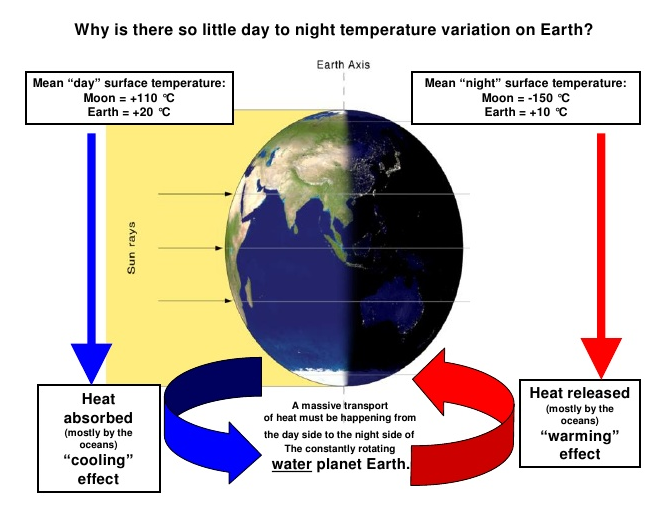
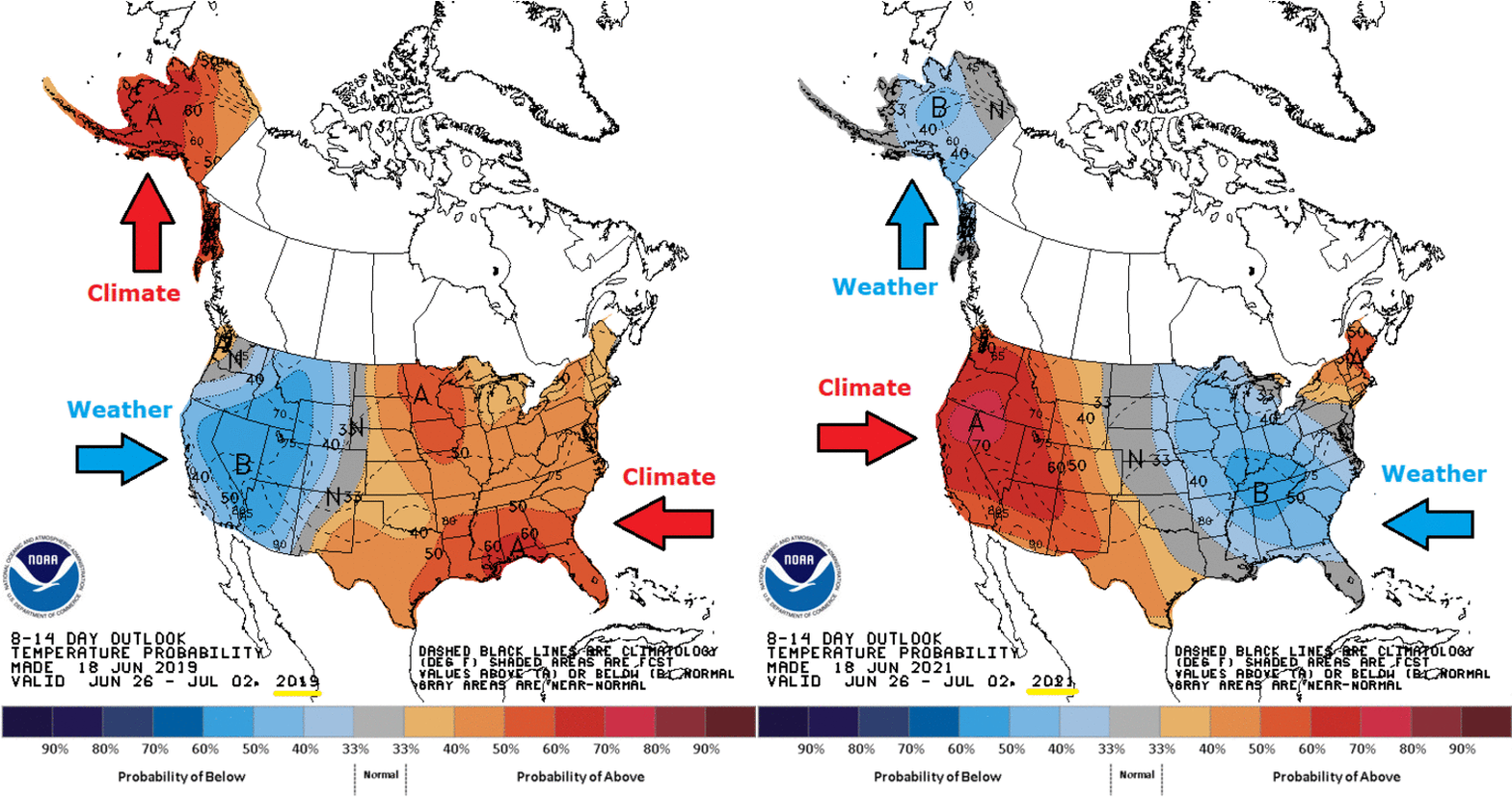
So the conclusion is a familar alamist meme:  If you’ve had a heat extreme, there will be more; If not you’d best get ready for them.  What is left out are the simple lessons in the image at the top. The 2021 Pacifc Northwest heat wave happened all right, but it was a cold spot in 2019, when the East coast was hot.  Since the overall average temperatures change very little, hot spots in some places will be offset by cold spots in others. But by obsessing on the heat and ignoring the cold, the narrative of a burning planet is proclaimed.  

Furthermore, as a previous post below explains, average temperatures hide a particular Northern Hemisphere pattern, namely the concurrence of warm summers and cold winters in the same year.

Rannoch Moor, Scotland

Previous Post: Heat Waves: Historical, not Hysterical Context

Alarms are being sounded about heat waves in the Northern Hemisphere, noting heat waves in Eastern Canada and US, wildfires in N. Sweden and Siberia.  The recent (2018) UK lawsuit featured the advocate claiming the Arctic is burning, so global warming is no longer in doubt.  Thus UK needs to up its carbon reduction targets.

The High Court disagreed.  And for good reasons not cited by the judge.  The hot dry weather this summer in Siberia was preceded by extreme cold and massive snowfall, unusual winter conditions even for that climate zone.  Similarly, there have been cold winters across Eurasia, while Northern Europe enjoys a BBQ summer.  BTW, I recall seeing on TV May and June tennis matches in Spain where spectators were wearing jackets and head covering against the cold.

What is going on?  Fact: Concurrent warm summers and cold winters are a feature of the North Atlantic climate system.  It has gone on periodically throughout history, and long before humans burned fossil fuels.  Below is evidence providing insight into our present experience of 2018 weather.

Concurrent Warming and Cooling

This post highlights recent interesting findings regarding past climate change in NH, Scotland in particular. The purpose of the research was to better understand how glaciers could be retreating during the Younger Dryas Stadia (YDS), one of the coldest periods in our Holocene epoch.

The lead researcher is Gordon Bromley, and the field work was done on site of the last ice fields on the highlands of Scotland. 14C dating was used to estimate time of glacial events such as vegetation colonizing these places. Bromely explains in article Shells found in Scotland rewrite our understanding of climate change at siliconrepublic. Excerpts in italics with my bolds.

By analysing ancient shells found in Scotland, the team’s data challenges the idea that the period was an abrupt return to an ice age climate in the North Atlantic, by showing that the last glaciers there were actually decaying rapidly during that period.

The shells were found in glacial deposits, and one in particular was dated as being the first organic matter to colonise the newly ice-free landscape, helping to provide a minimum age for the glacial advance. While all of these shell species are still in existence in the North Atlantic, many are extinct in Scotland, where ocean temperatures are too warm.

This means that although winters in Britain and Ireland were extremely cold, summers were a lot warmer than previously thought, more in line with the seasonal climates of central Europe.

“There’s a lot of geologic evidence of these former glaciers, including deposits of rubble bulldozed up by the ice, but their age has not been well established,” said Dr Gordon Bromley, lead author of the study, from NUI Galway’s School of Geography and Archaeology.

“It has largely been assumed that these glaciers existed during the cold Younger Dryas period, since other climate records give the impression that it was a cold time.”

He continued: “This finding is controversial and, if we are correct, it helps rewrite our understanding of how abrupt climate change impacts our maritime region, both in the past and potentially into the future.”

The recent report is Interstadial Rise and Younger Dryas Demise of Scotland’s Last Ice Fields
G. Bromley A. Putnam H. Borns Jr T. Lowell T. Sandford D. Barrell  First published: 26 April 2018.(my bolds)

Abstract

Establishing the atmospheric expression of abrupt climate change during the last glacial termination is key to understanding driving mechanisms. In this paper, we present a new 14C chronology of glacier behavior during late‐glacial time from the Scottish Highlands, located close to the overturning region of the North Atlantic Ocean. Our results indicate that the last pulse of glaciation culminated between ~12.8 and ~12.6 ka, during the earliest part of the Younger Dryas stadial and as much as a millennium earlier than several recent estimates. Comparison of our results with existing minimum‐limiting 14C data also suggests that the subsequent deglaciation of Scotland was rapid and occurred during full stadial conditions in the North Atlantic. We attribute this pattern of ice recession to enhanced summertime melting, despite severely cool winters, and propose that relatively warm summers are a fundamental characteristic of North Atlantic stadials.

Plain Language Summary

Geologic data reveal that Earth is capable of abrupt, high‐magnitude changes in both temperature and precipitation that can occur well within a human lifespan. Exactly what causes these potentially catastrophic climate‐change events, however, and their likelihood in the near future, remains frustratingly unclear due to uncertainty about how they are manifested on land and in the oceans. Our study sheds new light on the terrestrial impact of so‐called “stadial” events in the North Atlantic region, a key area in abrupt climate change. We reconstructed the behavior of Scotland’s last glaciers, which served as natural thermometers, to explore past changes in summertime temperature. Stadials have long been associated with extreme cooling of the North Atlantic and adjacent Europe and the most recent, the Younger Dryas stadial, is commonly invoked as an example of what might happen due to anthropogenic global warming. In contrast, our new glacial chronology suggests that the Younger Dryas was instead characterized by glacier retreat, which is indicative of climate warming. This finding is important because, rather than being defined by severe year‐round cooling, it indicates that abrupt climate change is instead characterized by extreme seasonality in the North Atlantic region, with cold winters yet anomalously warm summers.

The complete report is behind a paywall, but a 2014 paper by Bromley discusses the evidence and analysis in reaching these conclusions. Younger Dryas deglaciation of Scotland driven by warming summers  Excerpts with my bolds.

Significance: As a principal component of global heat transport, the North Atlantic Ocean also is susceptible to rapid disruptions of meridional overturning circulation and thus widely invoked as a cause of abrupt climate variability in the Northern Hemisphere. We assess the impact of one such North Atlantic cold event—the Younger Dryas Stadial—on an adjacent ice mass and show that, rather than instigating a return to glacial conditions, this abrupt climate event was characterized by deglaciation. We suggest this pattern indicates summertime warming during the Younger Dryas, potentially as a function of enhanced seasonality in the North Atlantic.

Surface temperatures range from -30C to +30C

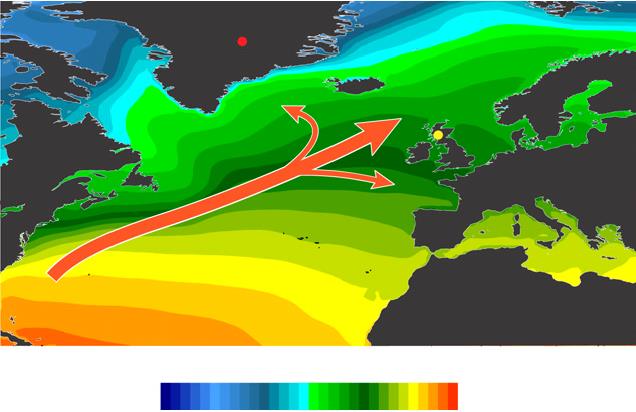
Fig. 1. Surface temperature and heat transport in the North Atlantic Ocean.  The relatively mild European climate is sustained by warm sea-surface temperatures and prevailing southwesterly airflow in the North Atlantic Ocean (NAO), with this ameliorating effect being strongest in maritime regions such as Scotland. Mean annual temperature (1979 to present) at 2 m above surface (image obtained using University of Maine Climate Reanalyzer, http://www.cci-reanalyzer.org). Locations of Rannoch Moor and the GISP2 ice core are indicated.

Thus the Scottish glacial record is ideal for reconstructing late glacial variability in North Atlantic temperature (Fig. 1). The last glacier resurgence in Scotland—the “Loch Lomond Advance” (LLA)—culminated in a ∼9,500-km2 ice cap centered over Rannoch Moor (Fig. 2A) and surrounded by smaller ice fields and cirque glaciers.

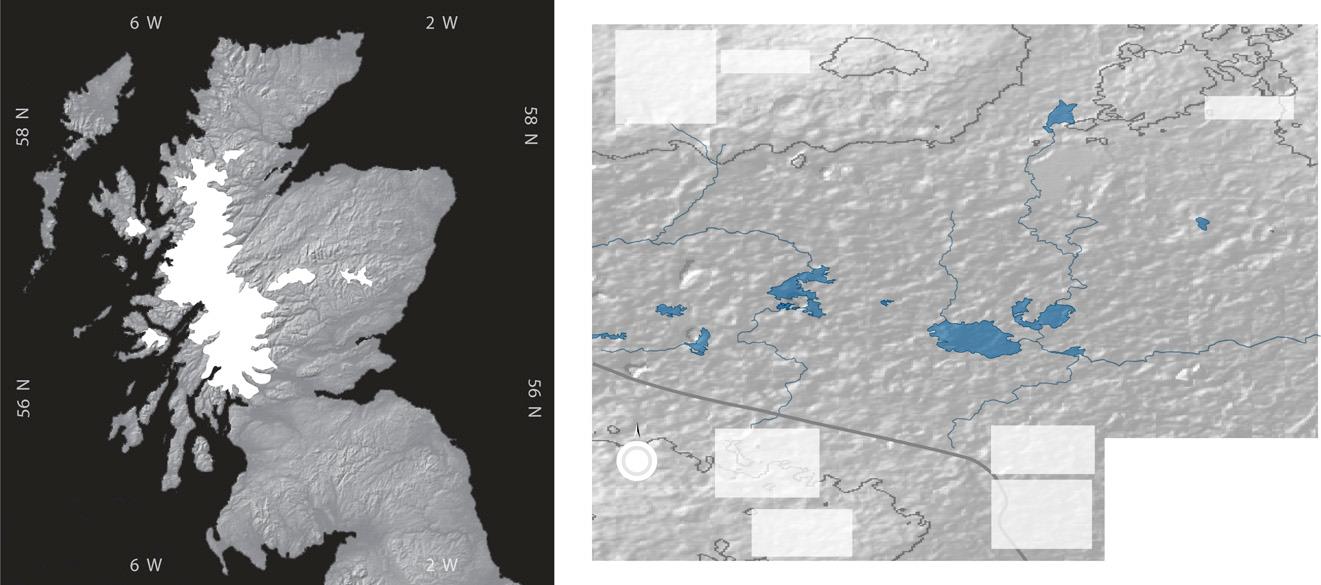
Fig. 2. Extent of the LLA ice cap in Scotland and glacial geomorphology of western Rannoch Moor. (A) Maximum extent of the ∼9,500 km2 LLA ice cap and larger satellite ice masses, indicating the central location of Rannoch Moor. Nunataks are not shown. (B) Glacial-geomorphic map of western Rannoch Moor. Distinct moraine ridges mark the northward active retreat of the glacier margin (indicated by arrow) across this sector of the moor, whereas chaotic moraines near Lochan Meall a’ Phuill (LMP) mark final stagnation of ice. Core sites are shown, including those (K1–K3) of previous investigations (14, 15).

When did the LLA itself occur? We consider two possible resolutions to the paradox of deglaciation during the YDS. First, declining precipitation over Scotland due to gradually increasing North Atlantic sea-ice extent has been invoked to explain the reported shrinkage of glaciers in the latter half of the YDS (18). However, this course of events conflicts with recent data depicting rapid, widespread imposition of winter sea-ice cover at the onset of the YDS (9), rather than progressive expansion throughout the stadial.

Loch Lomond

Furthermore, considering the gradual active retreat of LLA glaciers indicated by the geomorphic record, our chronology suggests that deglaciation began considerably earlier than the mid-YDS, when precipitation reportedly began to decline (18). Finally, our cores contain lacustrine sediments deposited throughout the latter part of the YDS, indicating that the water table was not substantially different from that of today. Indeed, some reconstructions suggest enhanced YDS precipitation in Scotland (24, 25), which is inconsistent with the explanation that precipitation starvation drove deglaciation (26).

We prefer an alternative scenario in which glacier recession was driven by summertime warming and snowline rise. We suggest that amplified seasonality, driven by greatly expanded winter sea ice, resulted in a relatively continental YDS climate for western Europe, both in winter and in summer. Although sea-ice formation prevented ocean–atmosphere heat transfer during the winter months (10), summertime melting of sea ice would have imposed an extensive freshwater cap on the ocean surface (27), resulting in a buoyancy-stratified North Atlantic. In the absence of deep vertical mixing, summertime heating would be concentrated at the ocean surface, thereby increasing both North Atlantic summer sea-surface temperatures (SSTs) and downwind air temperatures. Such a scenario is analogous to modern conditions in the Sea of Okhotsk (28) and the North Pacific Ocean (29), where buoyancy stratification maintains considerable seasonal contrasts in SSTs. Indeed, Haug et al. (30) reported higher summer SSTs in the North Pacific following the onset of stratification than previously under destratified conditions, despite the growing presence of northern ice sheets and an overall reduction in annual SST. A similar pattern is evident in a new SST record from the northeastern North Atlantic, which shows higher summer temperatures during stadial periods (e.g., Heinrich stadials 1 and 2) than during interstadials on account of amplified seasonality (30).

Our interpretation of the Rannoch Moor data, involving the summer (winter) heating (cooling) effects of a shallow North Atlantic mixed layer, reconciles full stadial conditions in the North Atlantic with YDS deglaciation in Scotland. This scenario might also account for the absence of YDS-age moraines at several higher-latitude locations (12, 36–38) and for evidence of mild summer temperatures in southern Greenland (11). Crucially, our chronology challenges the traditional view of renewed glaciation in the Northern Hemisphere during the YDS, particularly in the circum-North Atlantic, and highlights our as yet incomplete understanding of abrupt climate change.

Summary

Several things are illuminated by this study. For one thing, glaciers grow or recede because of multiple factors, not just air temperature. The study noted that glaciers require precipitation (snow) in order to grow, but also melt under warmer conditions. For background on the complexities of glacier dynamics see Glaciermania

Also, paleoclimatology relies on temperature proxies who respond to changes over multicentennial scales at best. C14 brings higher resolution to the table.

Finally, it is interesting to consider climate changing with respect to seasonality.  Bromley et al. observe that during Younger Dryas, Scotland shifted from a moderate maritime climate to one with more seasonal extremes like that of inland continental regions. In that light, what should we expect from cooler SSTs in the North Atlantic?

Note also that our modern warming period has been marked by the opposite pattern. Many NH temperature records show slight summer cooling along with somewhat stronger warming in winter, the net being the modest (fearful?) warming in estimates of global annual temperatures.  Then of course there are anomalous years like this one where cold winters combine with warm summer periods.


2023 April Arctic Ice Melt Abates

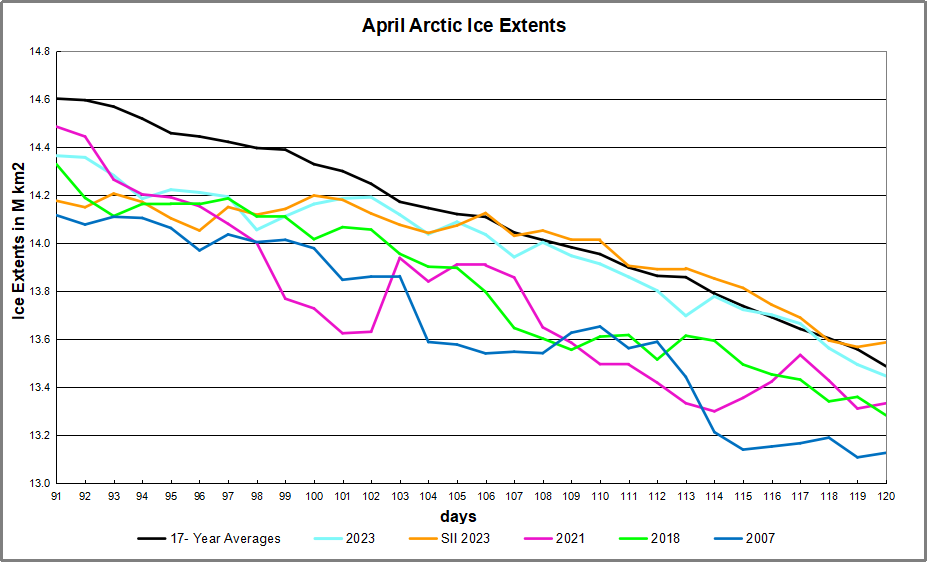
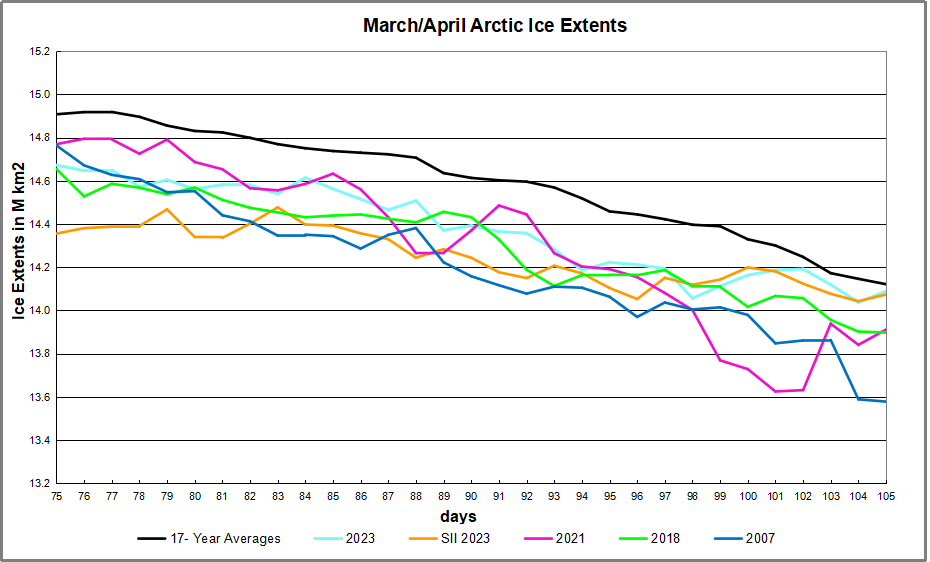
The graph shows that coming out of the annual March maximum, April 2023 began 238k km2 lower than the 17 year average.  SII even showed extents ~200k km2 lower than MASIE on April 1.  However, after two weeks both indices tracked with the average until month end.  According to MASIE, the typical April loses 1100 km2, but this year lost only 918k km2.  SII shows a loss of only 590k km2 during April. Meanwhile, other years, especially 2007 were losing ice much more rapidly than average.  

Why is this important?  All the claims of global climate emergency depend on dangerously higher temperatures, lower sea ice, and rising sea levels.  The lack of additional warming is documented in a post Satellite Temps Hit Bottom: February 2023.

The lack of acceleration in sea levels along coastlines has been discussed also.  See USCS Warnings of Coastal Floodings

Also, a longer term perspective is informative:

post-glacial_sea_level
The table below shows the distribution of Sea Ice across the Arctic Regions, on average, this year and 2007.

Region 2023120 Day 120 Average 2023-Ave. 2007120 2023-2007
 (0) Northern_Hemisphere 13446987 13514506  -67519  13108068 338919 
 (1) Beaufort_Sea 1070966 1067918  3048  1059189 11777 
 (2) Chukchi_Sea 966006 956111  9895  949246 16760 
 (3) East_Siberian_Sea 1087137 1085582  1555  1080176 6961 
 (4) Laptev_Sea 897845 890425  7420  875661 22184 
 (5) Kara_Sea 933170 912998  20172  864664 68506 
 (6) Barents_Sea 415992 553986  -137994  396544 19449 
 (7) Greenland_Sea 761413 648178  113235  644438 116975 
 (8) Baffin_Bay_Gulf_of_St._Lawrence 1123308 1207572  -84264  1147115 -23807 
 (9) Canadian_Archipelago 854843 848924  5918  838032 16810 
 (10) Hudson_Bay 1249469 1238384  11085  1222074 27396 
 (11) Central_Arctic 3239670 3230693  8977  3241034 -1364 
 (12) Bering_Sea 491550 473366  18184  475489 16061 
 (13) Baltic_Sea 32086 20744  11342  14684 17402 
(14) Sea_of_Okhotsk 321714 376553  -54840  295743 25971 

Overall, the extent is slightly below average by 68k km2, or 0.5%.  The main deficits are in Barents, Baffin and Okhotsk, partly offset by a surplus in Greenland Sea.


Mid April Arctic Ice Recovery


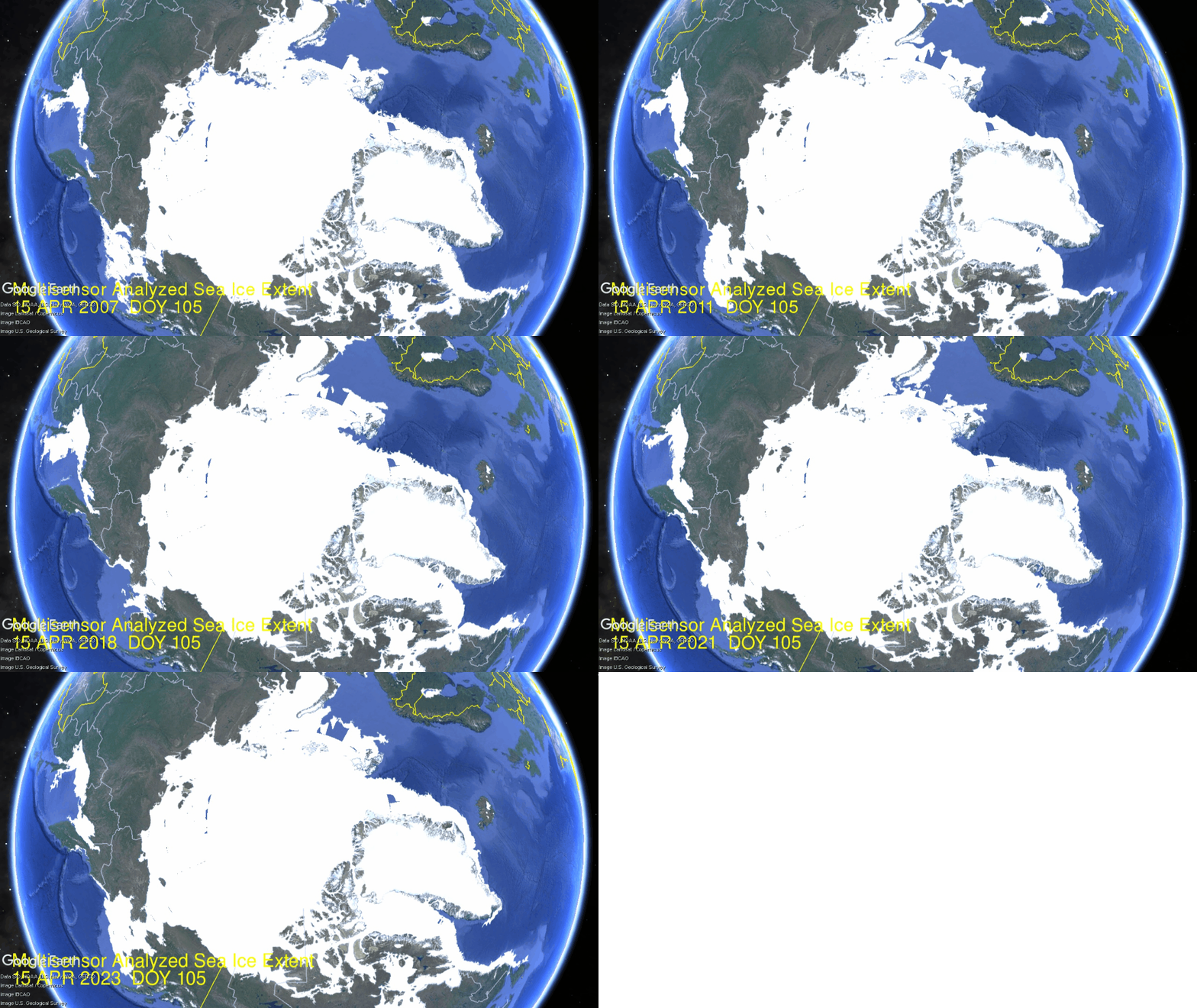
The animation compares Arctic ice extents for day 105 for some years between 2007 and 2023.  2011 was close to the 17-year average, while 2007 was one of the lowest in the record.  The images show extensive variation in the Pacific (left) basins of Bering and Okhotsk, where typically the most open water appears. There are also fluctuations on the Atlantic side, Barents (top right) as well as Greenland Sea and Baffin Bay.  Overall there was recovery from 2007 to 2011, then some years of lesser extents before 2023 returns to the 17 year average, as shown in the table later below.

Over the last 30 days, there were gains and then losses, mostly in the Pacific basins.  The effect on NH total ice extents is presented in the graph below.  

The average ice loss is 787k km2 for this period.  While 2023 started 235k km2 in deficit, yesterday it nearly matched the 17-year average. SII showed even lower ice extents in mid March, before matching MASIE at the end.

The table below shows the distribution of sea ice across the Arctic regions.

Region 2023105 Day 105 Average 2023-Ave. 2007105 2023-2007
 (0) Northern_Hemisphere 14088856 14121549  -32693  13588722 500134 
 (1) Beaufort_Sea 1070966 1069753  1214  1068692 2274 
 (2) Chukchi_Sea 966006 964603  1403  961638 4369 
 (3) East_Siberian_Sea 1087137 1085478  1659  1078666 8471 
 (4) Laptev_Sea 897845 893275  4570  843501 54344 
 (5) Kara_Sea 933845 922316  11529  890594 43251 
 (6) Barents_Sea 609466 608807  659  439904 169562 
 (7) Greenland_Sea 716828 649460  67368  673585 43243 
 (8) Baffin_Bay_Gulf_of_St._Lawrence 1212523 1283822  -71300  1215526 -3003 
 (9) Canadian_Archipelago 854843 852840  2002  848812 6031 
 (10) Hudson_Bay 1260903 1246319  14585  1208588 52315 
 (11) Central_Arctic 3247017 3232496  14521  3235648 11369 
 (12) Bering_Sea 642984 647468  -4484  600281 42703 
 (13) Baltic_Sea 35258 45036  -9779  23534 11723 
(14) Sea_of_Okhotsk 550081 614303  -64222  491121 58960 

Overall NH extent March 31 was below average by 33k km2, or 0.2%.  The two largest deficits are Sea of Okhotsk and Baffin Bay, partly offset by a surplus in Greenland Sea.  The onset of spring melt is as usual in most regions, with slight surpluses nearly everywhere.


Notes on Florida Torrential Rainfall and Ft. Lauderdale

Concerning reports that 25 inches of rain fell in one day on Fort Lauderdale, some historical context is provided by the Florida Climate Center article Anticipating Heavy Rain in Florida.  Excerpts in italics with my bolds.

Abstract

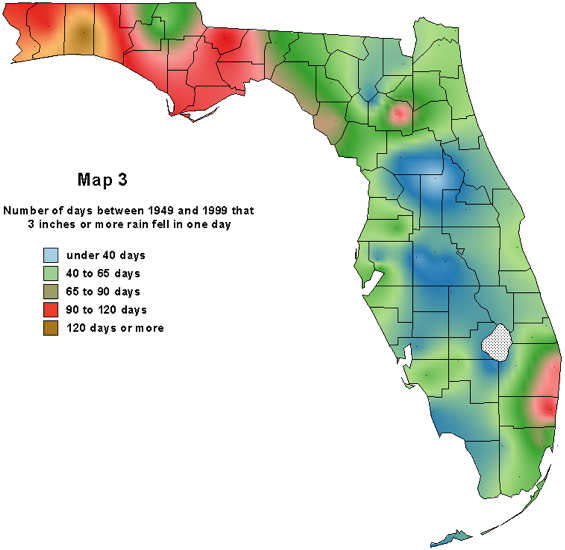
Florida is situated within a part of the United States where torrential rain is a common occurrence. Torrential rain is here defined as at least 3 inches in a single day. Rain of at least this magnitude is far more frequent along Florida’s coasts than in its interior. The Panhandle and the Gold Coast experience such weather events more than elsewhere in the state. Except for North Florida, rainstorms are heavily concentrated in the warm months. Mid- latitude low pressure systems, that pass over or near North Florida in the winter, often produce heavy rain. As a consequence that part of the state has no seasonal concentration.

The distribution of torrential rain throughout the state is much more uneven during years when they are most frequent than when few such storms occur. During the 51 years of daily observations for 48 weather stations no cyclical pattern of torrential rain was discerned. However, when data were organized by Enso phase it was shown that during the La Niña phase torrential rainfall, especially of 5 inches or more in a day, was more frequent than during the phase named El Niño. This was most true of South Florida stations.

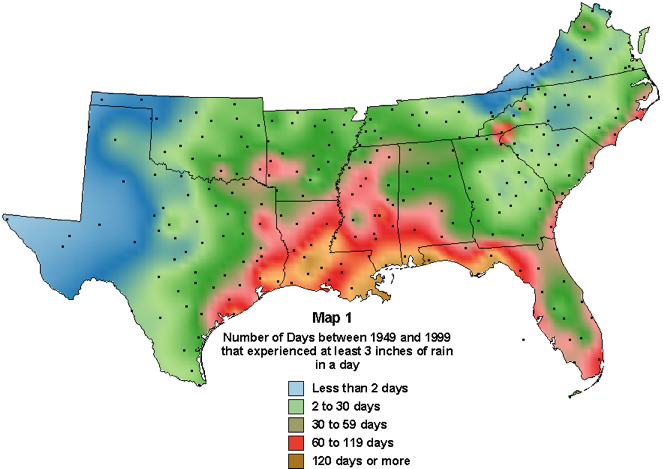
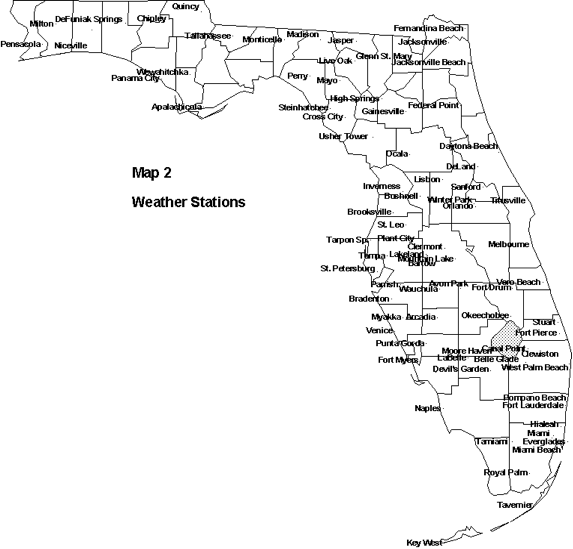
Florida lies within a broad region along the Gulf and Atlantic coastal plains of the southeastern U.S. that experiences frequent episodes of torrential rain (Map 1). Torrential rain in Florida is here defined as three inches or more in one calendar day. Rain of this magnitude contributes approximately ten percent of the total precipitation that falls on the state, more in some parts of it, less in others. Along the coasts of both northwestern and southeastern Florida torrential rain makes the heaviest contribution, while in the interior of the peninsula it contributes the least. For several decades a Florida weather station held the nations record for the most rain to fall in a 24-hour period. Yankeetown, a small fishing port on the northwestern side of the peninsula, during September 5th, 1950 was swamped by 38.7 inches of rain. The village retained the national record until July 25th-26th, 1979 when 43 inches fell on Alvin, Texas, situated between Houston and Galveston. This record still stands.

Torrential rain, since it is usually accompanied by intense atmospheric turbulence, has the potential of causing much property damage, as well as the destruction of agricultural crops and livestock. Florida is especially vulnerable to flooding because it is both low and flat. Although the sandy soils of the Peninsula are capable of absorbing water rapidly, their ability to absorb large amounts is limited because the water table is normally very close to the surface. Most of the state’s densely populated areas are situated on the shore of either the Atlantic Ocean or the Gulf of Mexico, and are especially vulnerable to rainstorms. Not only are such storms more frequent than in the interior of the state, but a large share of the urban area is covered by pavement and roofs, which concentrate runoff into low areas. Most of Florida’s cities today have adequate storm drainage systems to meet the demands of a sudden intense downpour, but flooding, sometimes on a major scale, does occur.

The reader should be aware that the amount of daily precipitation, especially from the cooperative weather stations, which constitute the majority, is not necessarily that which fell between one midnight and another. Cooperative weather stations usually depend heavily on non-professional volunteers who read the gauges when it is convenient, hopefully each day at a time agreed upon. Few are read at or near midnight. Only a small number of Florida stations record hourly precipitation. Consequently, a rainstorm may begin during one calendar day and end in another. The total rainfall of the storm would then be shared by two days, and although it may be higher than three inches, if no calendar day had a total of three inches it would not be counted.

It should be noted that the monthly frequencies of torrential rain, if graphed, do not conform to a bell shaped curve, increasing to a peak in the hottest month of the year. Instead, the curve is bi-modal, there being two peaks, one in June and the other in September. It is presumed that the June peak is the result of the state then coming strongly under the influence of the intertropical convergence zone, and the September peak is due to the greater frequency in that month of tropical low pressure systems such as tropical storms reaching the state.

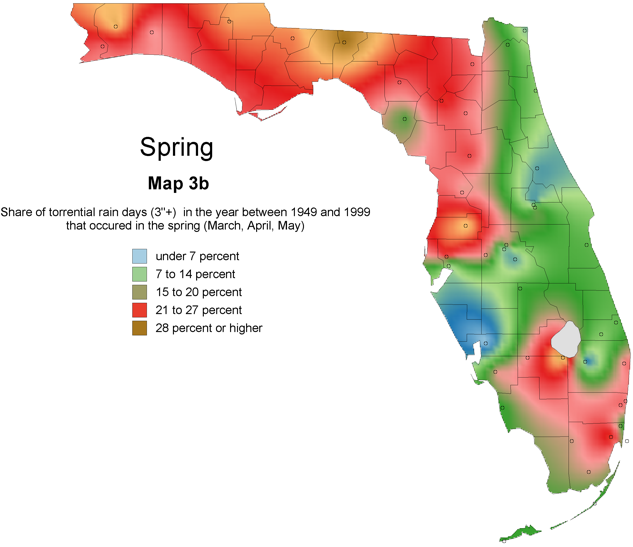
Note Fort Lauderdale is in a torrential rain hotspot just north of Miami.

South Florida gets a significant part of its torrential rain during Springtime.

The ENSO (El Niño Southern Oscillation) phenomenon, which has been given much justified attention in recent years, is now generally regarded as being able to influence climate over a huge area of the world. It would be irresponsible to ignore the possibility that it could influence the frequency of Florida rainstorms. To ascertain if there is a relationship the three phases of Enso (El Niño, La Niña, and the neutral phase) the frequency of rainstorms were calculated by ENSO phase (Table 4). There does appear to be a relationship, and it doesn’t seem to be spurious. The share of the 48 Florida weather stations that reported no torrential rainstorms during a year is somewhat higher during the El Niño phase than the other two. The share of stations that reported only one storm during the years of the El Niño phase also was higher than the share of those that were reported in the La Niña phase. Thereafter, except for the shares of the ‘four storm’ category, the La Niña phase produced more torrential storms than the El Niño phase. In South Florida, It has become generally accepted that in La Niña years precipitation is generally wetter than during the El Niño phase. From the data we might conclude that weather controls that become important during this phase also promote a higher frequency of torrential rain. The neutral phase of Enso has little to no effect upon the frequency of Florida’s rainstorms, some neutral years producing many more episodes of torrential rain than others.

In conclusion it would be derelict not to address the issue of the relationship between the frequency of torrential rain in Florida and global warming. In studies of the consequence of global warming on climate the possibility of greater climatic extremes has been predicted, including storms that could produce large amounts of precipitation. This is usually based on the assumption among other factors, that the temperature of the water of the oceans would rise, heating the air above them, increasing evaporation and the air’s ability to hold water vapor and consequently its ability to produce more powerful rainstorms.

Table 5: Number of times 48 Florida weather stations
experienced at least 3″ of rainfall for
five decades between 1950 and 1999.

To ascertain if Florida has been experiencing an increase in the number of storms that produce torrential rain the torrential storm data for the 48 stations within the state which became the primary data source for this study were divided into the five decades between 1950 and 1999 (Table 5). When the average for the 50-year period is compared to the frequency by decade no trend is discovered. When the frequency in earlier decades is compared with the later ones there also appears to be no trend. For example, between 1950 and 1969, during that 20-year period there were 684 episodes at the 48 Florida weather stations in which 3 inches or more rain fell in one day, while in the 20-year period between 1980 and 1999 there were 695 episodes, a difference of only eleven episodes. The frequency of episodes during the year was also examined. An examination reveals, for example, that there were 23 stations between 1950 and 1969 that reported five episodes during the 20-year period, and between 1980 and 1999 the number fell to 20. Such a small drop does not suggest an increase in torrential rain over time.


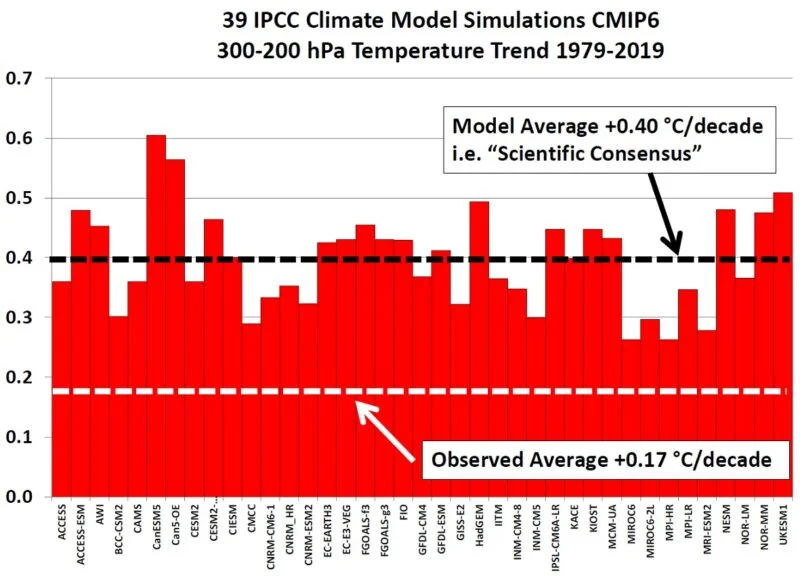
Confirmed: Climate Models Too Hot to Trust

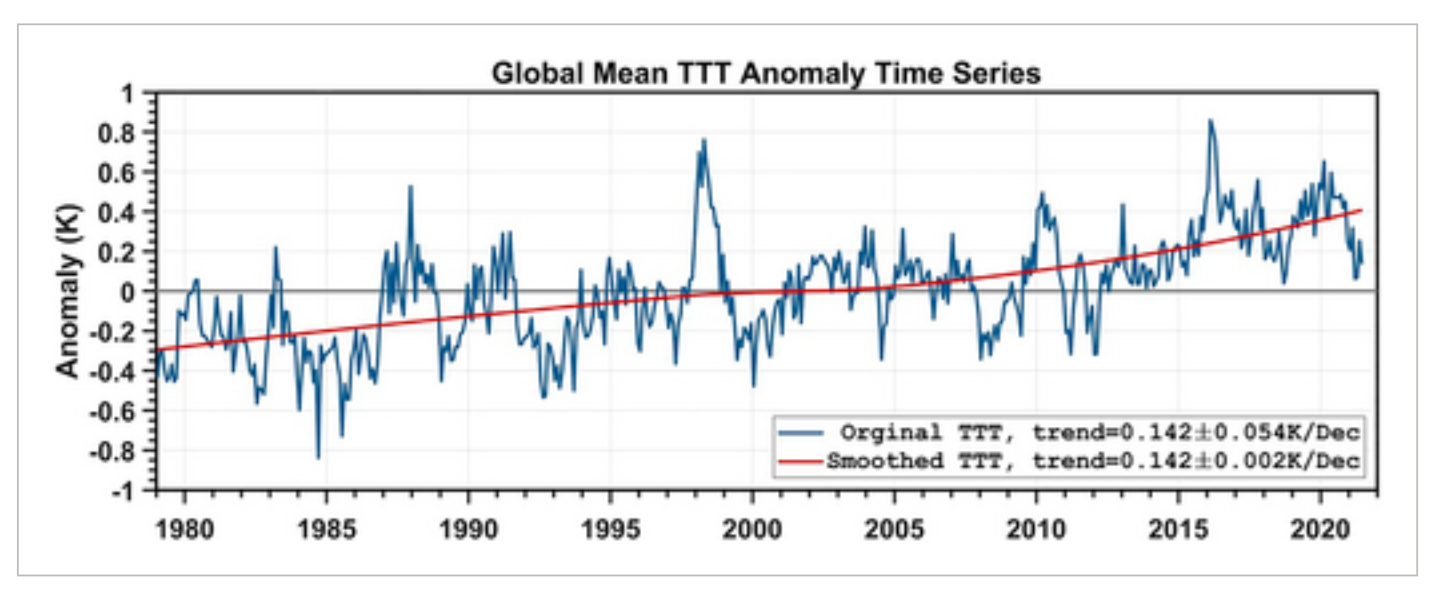
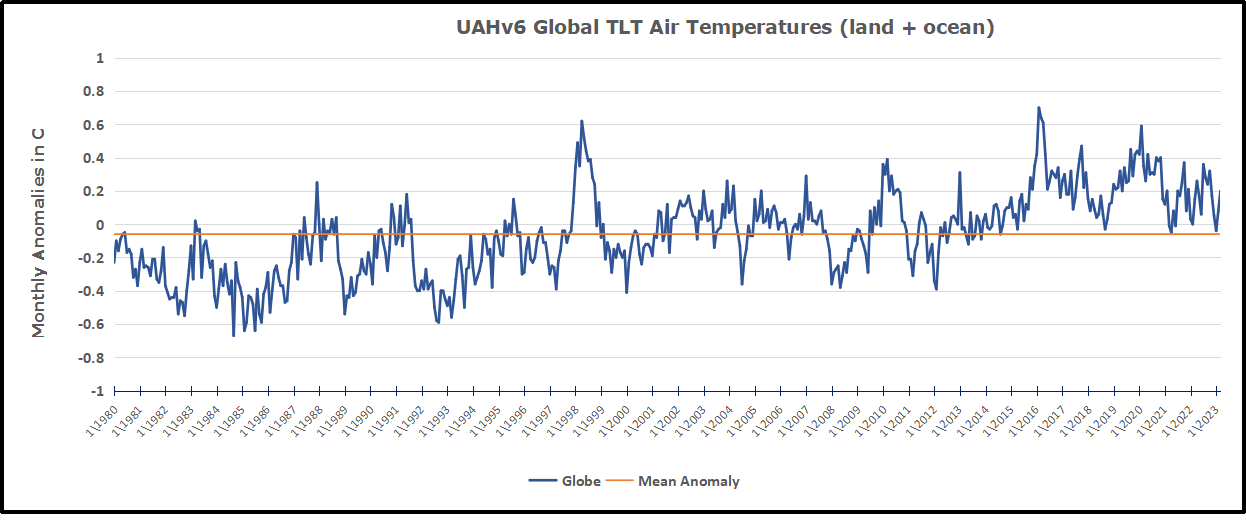
Ross McKitrick reports on a new study confirming the chart above.  His Financial Post article is The important climate study you won’t hear about.  Excerpts in italics with my bolds and added images

The study is Mid-Tropospheric Layer Temperature Record Derived From Satellite Microwave Sounder Observations With Backward Merging Approach by Cheng-Zhi Zou at JGR Atmospheres.

The Significance

Ross McKitrick: 

In the end the two (satellite) series were similar but RSS has consistently exhibited more warming than UAH. Then a little more than a decade ago, the group at NOAA headed by Zou produced a new data product called STAR (Satellite Applications and Research). They used the same underlying microwave retrievals but produced a temperature record showing much more warming than either UAH or RSS, as well as all the weather balloon records. It came close to validating the climate models, although in my paper with Christy we included the STAR data in the satellite average and the models still ran too hot. Nonetheless it was possible to point to the coolest of the models and compare them to the STAR data and find a match, which was a lifeline for those arguing that climate models are within the uncertainty range of the data.

Until now. In their new paper Zou and his co-authors rebuilt the STAR series based on a new empirical method for removing time-of-day observation drift and a more stable method of merging satellite records. Now STAR agrees with the UAH series very closely — in fact it has a slightly smaller warming trend. The old STAR series had a mid-troposphere warming trend of 0.16 degrees Celsius per decade, but it’s now 0.09 degrees per decade, compared to 0.1 in UAH and 0.14 in RSS. For the troposphere as a whole they estimate a warming trend of 0.14 C/decade.

Figure 14 Global mean Temperature Total Troposphere (TTT, TMT adjusted by TLS) time series (blue lines) and its smoothed time series (red lines). The locally weighted regression method (Cleveland, 1979) is used for the smoothing. Both TMT and TLS for TTT generation are from STAR V5.0.