Making a box of Cocoa Puffs is a complicated global affair. It could start with cocoa farms in Africa, corn fields in the U.S. or sugar plantations in Latin America. Then thousands of processors, transporters, packagers, distributors, office workers and retailers join the supply chain before a kid in Minnesota, where General Mills is based, pours the cereal into a bowl.
Now imagine the challenge that General Mills faces in counting the greenhouse gas emissions from all of these people, machines, vehicles, buildings and other products involved in this Cocoa Puff supply chain – then multiply that by the 100-plus brands belonging to the food giant.
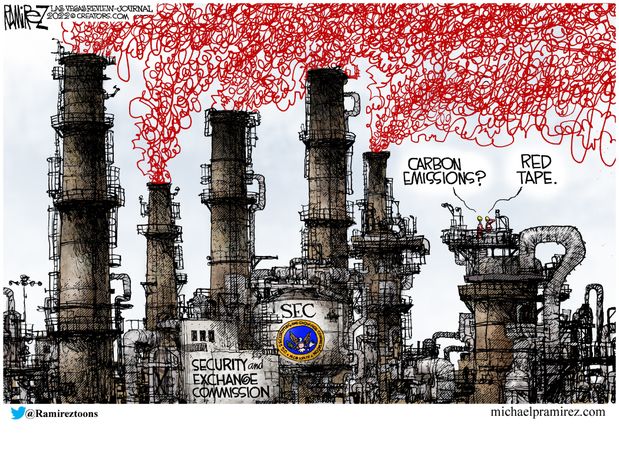
Thousands of public companies may soon have such a daunting task to comply with a new set of climate rules proposed by the Securities and Exchange Commission.
Hailed by prominent environmental groups as a long sought victory, the sweeping plan released in late March would force companies to grapple with the unpredictable impact of climate change by disclosing reams of new information to investors. What are your company’s climate risks, such as severe weather, and the possible financial impacts? How have the threats affected your business strategies and what’s the plan to avoid the dangers? The most consequential and controversial piece of the SEC’s proposed regulations would require corporations to calculate their total greenhouse gas footprint, including from the supply chain.
The regulations also carry political weight for Democrats in the runup to the midterms in November. The Biden administration and centrist Sen. Joe Manchin of West Virginia are trying once again to breathe life into clean energy legislation that died earlier this year amid a feud between them. If this latest effort at compromise fails – with Manchin reportedly looking for federal support for fossil fuels as well as renewable energy – then much of President Biden’s ambitious climate agenda will be left riding on the SEC proposal.
SEC head Gary Gensler says shareholders are demanding climate risk disclosures to make smarter investment decisions and hold companies accountable for “greenwashing” their operations. The regulations will also provide investors in the Environmental, Social, Governance (ESG) movement more leverage in their ongoing campaigns to pressure companies to reduce their carbon footprints.
While many companies like Walmart and business groups like the Chamber of Commerce generally support the idea of required climate disclosures, they object to what they see as the SEC’s heavy-handedness in standardizing rules across the economy. The Chamber is calling for flexibility so companies can customize their climate disclosures based on what’s relevant to their businesses and investors.
Measuring the global supply chain is a tall order — “mind-boggling and certainly unprecedented.” Pixabay
The biggest beef from companies is the rule that would require them to calculate and disclose supply chain emissions, called Scope 3.
Big companies have thousands of suppliers operating in hundreds of countries, making the task of coming up with a reasonable accounting enormously complicated. First of all, many suppliers of products and services are private companies not under the control of the SEC. They may refuse to cooperate in a count because of the costs and the implications that they might have to change their business practices to reduce emissions, said Professor Gerald Patchell, who has analyzed the problems of supply chain reporting.
Another obstacle is that many smaller suppliers, like General Mills’ cocoa farmers in Africa, don’t have the capacity to measure the emissions from their own fertilizers, tractors and farming practices. So companies will have to rely on broad country or industry averages that likely don’t reflect the actual emissions created by the suppliers, according to researchers.
“The data that companies will be asked to collect from thousands of suppliers is mind-boggling and certainly unprecedented,” said Patchell, who researches environmental policy and business. “It’s an idealized concept of what can actually be done by a company.”
The upshot is that regulations meant to bring clarity to investors on climate risk may end up providing highly unreliable emissions disclosures, leaving them “worse off,” wrote SEC Commissioner Hester Peirce, a Trump appointee who voted against the 500-page proposal. It “forces investors to view companies through the eyes of a vocal set of stakeholders, for whom a company’s climate reputation is of equal or greater importance than a company’s financial performance.”
“Government’s view of the economy could be summed up in a few short phrases: If it moves, tax it. If it keeps moving, regulate it. And if it stops moving, subsidize it.” — Ronald Reagan
Rep. Alexandria Ocasio-Cortez (left) admits, “We’re in Trouble,” as President Joe Biden (center) struggles to respond to the worst energy crisis in 50 years, and as California Gov. Gavin Newsom (right) makes homelessness worse.
The good news is that everything is changing — and fast
In the three decades since the collapse of the Soviet Union, liberals in the West have denounced their political opponents as deniers of climate change, science, and reality in general. Progressives and neoliberals alike argued that they alone could see the shape of the new world being born. It would be increasingly globalized, democratic, and focused on new threats, like climate change.
It’s now clear that all of that was a delusion.
Neither China nor Russia is democratizing and both have become more autocratic and totalitarian. Neither nation views climate change as a major threat. On the contrary. Russia views climate change as an opportunity to expand agriculture and shipping through its newly ice-free waters. Where both Putin and Chinese Premier Xi used to give lip service to climate change, neither even bothered to attend last fall’s United Nations climate talks.
It’s true that the West has imposed sanctions on Russia, and the Ukranian people are battling the Russians fiercely and admirably. A few days ago, Russians retreated from the capital city of Kyiv. Western nations froze bank accounts of Russian oligarchs, hammering the ruble. And European governments are calling on their citizens to reduce energy consumption.
But those are hiccups on the way to a rapidly changed world. Consider that:
♦ China aided Russia’s invasion of Ukraine through a massive cyberattack on Ukraine’s military and nuclear facilities, according to intelligence memos obtained by The Times of London.
♦ Europe continues to import Russian energy while China and India are buying Russian oil at a steep discount. There is little reason to believe conservation measures by Western consumers will make much of a dent in energy consumption.
♦ And Russia’s retreat from Kyiv appears to be temporary and strategic.
Russia’s invasion of Ukraine comes at the very same time as: the collapse of the West’s climate and renewables agenda; an energy crisis triggered by climate activists; and a worsening drug, crime, and homeless crisis in America’s cities.
What do all these events have in common?
They all point to the grave dangers of irrational liberal optimism.
Western Leftists Soft in Defending Civil Freedoms
When it comes to the West’s failure to deter an increasingly totalitarian and violent Russia and China, the growing scarcity and unreliability of energy, and the destruction of America’s cities by open air drug scenes, the fault lies squarely with people on the Left end of the political spectrum.
Western leaders, including President Joe Biden, French President Emanuel Macron, and former German Chancellor Angela Merkel, all denied to themselves, and to others, what was plainly obvious to many analysts for years: Putin intended to invade Ukraine.
Even as Russian forces prepared for war games last fall, Biden’s national security adviser Jake Sullivan wondered “why Russia would take such a military action at that time,” according to a reconstruction of the events leading up to Putin’s invasion by the Wall Street Journal.
Western Leftists Indulged in Renewables Delusion
On climate change, center-Left parties around the world deluded themselves into thinking their high-energy economies could be powered by renewables, which energy historians have known for centuries had to be abandoned for fossil fuels in order for the industrial revolution to happen. And around the world it was liberals not conservatives who fought to shut down nuclear plants and block natural gas pipelines and infrastructure.
Liberals and progressives could have embraced a climate and energy strategy focused on domestically-produced natural gas and nuclear, as I have urged them to do for over a decade, and which Putin did, allowing him to gain a stranglehold over Europe’s energy supplies.
Such a strategy was the only one that ever made any sense from an environmental point of view. Nuclear and natural gas are the two technologies that are most responsible for declining emissions by the US and Europe since the 1970s.
Instead, the Left in Europe opted for importing fossil fuels from Russia and the Left in the US for importing solar panels made by enslaved Muslims in China.
Leftist Cities Governed into Ruin
On crime, liberal cities have gradually reduced consequences for breaking laws, whether from addiction or malevolence, resulting in rising homicides, burglaries, and open air drug scenes. Relatedly, on homelessness, progressives have funneled hundreds of billions into “Housing First,” which gives away apartments to homeless drug addicts without requiring sobriety.
The result is that, today, well over 50 percent of the people on the streets of San Francisco and Los Angeles are from out of town, according to expert insiders, homeless outreach workers, and the homeless themselves.
Why do liberals keep making the same mistake over and over again?
Leftists Projecting Own Mindset, Ignoring Reality
In part, it’s because of what cognitive psychologists call “theory of mind.” Liberals tend to think that other people think like they do. Western liberal leaders thought Putin was one of them, a liberal democrat committed to rule of law, even though he repeatedly said he wanted to reconstruct the Soviet empire.
Similarly, leading liberal leaders think homeless drug addicts are seeking a better life, and just need their own apartment to quit drugs, get a job, and re-connect with family and friends. In truth, many if not most homeless addicts maintain their addiction until they are forced to quit.
On energy and climate change, progressives indulged in the fantasy that we could power the world with energy sources that have no negative consequences. They convinced themselves that renewables were better in every way than either fossil fuels and nuclear, even as they demanded massive subsidies for, and the right to kill endangered species in, their deployment.
And liberals engaged in wishful thinking that high standards of living can be maintained with much lower levels of energy consumption, and that poor and working people will accept low standards of living.
There were financial rewards for such wishful thinking. Politicians like Newsom can raise much more money from homeless housing developers than from homeless shelter providers. Center Left parties take money from renewable energy companies all over the world. And it’s now clear that climate activists in Europe, and perhaps the United States, took, took money from the Russian government to fight fracking and natural gas production.
Stunning Failure of Leftist Governance
The good news is that the failure of elites to govern at local, national, and international levels points to a coming change of leadership, triggered by covid, but ultimately resulting from the exhaustion of post-Cold War ideologies and institutions.
It will gradually become clear that the West must defend itself more vigorously against resurgent illiberal regimes, particularly Russia and China, which could well invade Taiwan, or even attempt to take a Japanese island, in the coming months or years.
And major political changes are afoot. Republicans will likely take one or more house of Congress, and President Joe Biden is unlikely to run again in 2024. The result will be major changes within both parties. California, long a leader of change, for good or ill, will likely see the recall of district attorneys in San Francisco and Los Angeles, the election of a new attorney general, and the election of a new, more moderate, governor.
In this context, it becomes clear that the claims of reality denial by progressives were a kind of psychological projection. It was progressives who denied the realities of climate change and energy, the intentions of Vladimir Putin, and homelessness. The good news is that people are waking up, and quickly.
The trend toward the dismantling of civilization could soon reverse itself.
But, ultimately, what happens next is up to us.
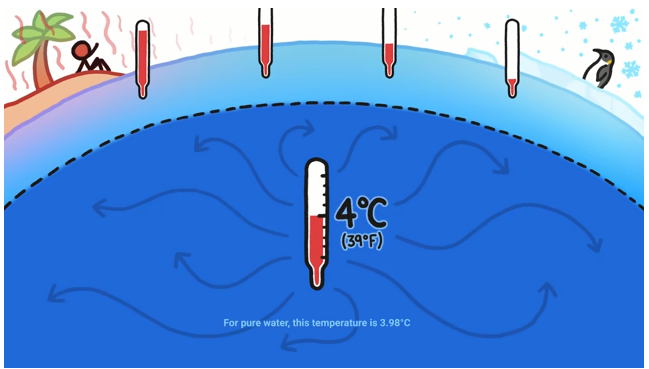
Water (H2O) has magical properties that make our planet suitable for us. The video explains why most of the ocean water is about 4 degrees Celsius. A transcript from another presentation draws the implications. Excerpts in italics with my bolds.
At the surface, ocean water can vary wildly in temperature – the water at the equator is around 30 degrees Celsius and the water at the poles is, well, freezing. But surface waters are only a small fraction of the total water in the ocean. Dive a little deeper, and you’ll find that a whopping 75 percent of the ocean’s water is all at the same temperature…and we’re not talking averages or anything – the vast majority of ocean water is 4 degrees Celsius. And that’s not just a coincidence – it’s because water is weird.
As a liquid cools, its molecules slow down and the liquid generally gets denser and denser. That’s how molten metals, wax, nacho cheese, and basically everything else behaves – except water. Water does become denser as it cools though, but only up to a point. Then it reverses course and actually gets less dense.
This happens because once water molecules slow down enough, intermolecular forces due to the water molecule’s unique shape start pushing the molecules apart until – at zero degrees and below – they form a lattice-like structure. That’s why ice is less dense than water.
But the magic temperature where water is actually densest is 4 degrees Celsius. This weird maximum density is what causes the vast majority of the ocean to be stuck at the same temperature.
By about 1000 meters down, water has cooled to around four degrees. Any water here, or below, that happens to warm up – say, via heat from a hydrothermal vent or underwater volcano – will get a little less dense and float upwards, as less-dense things tend to do – out of this 4-degree zone. Strangely, water cooler than 4 degrees will behave the same way; any water that loses a little bit of heat will also become a little less dense and balloon upwards.
As a result, all the ocean water below 1000 meters or so is about 4 degrees. Well, almost all the water.
The very deepest parts of the ocean can get just a tiny bit colder, because of salt. When salt ions are stuck to water molecules, they weigh them down, making saltier water a little denser than less salty water. So when polar ice forms, salt gets pushed into the surrounding water, making it super-salty. This super-salty water is most dense slightly below 4 degrees, in addition to being a little denser than less salty water, so, it has the tendency to plummet straight to the seafloor.
This heavier, colder water makes the deepest depths of the ocean slightly colder and denser than the water above. Expeditions to the deepest parts of the ocean, like the Challenger Deep of Mariana’s Trench have recorded temperatures of 1 degree. However, the same rules apply down there as they do in the rest of the water column – any water that warms or cools, even a bit, will become less dense and float away into the higher, less dense layers above.
If these weird water density rules didn’t apply – if water behaved like, say, nacho cheese – ocean water would just solidify from the bottom up as it’s cooled, and we wouldn’t have liquid oceans at all.
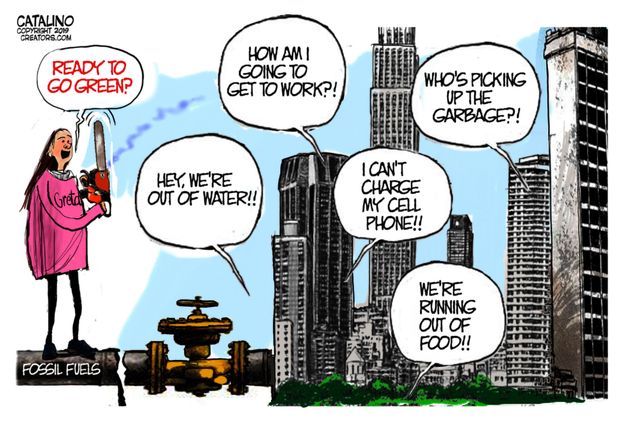
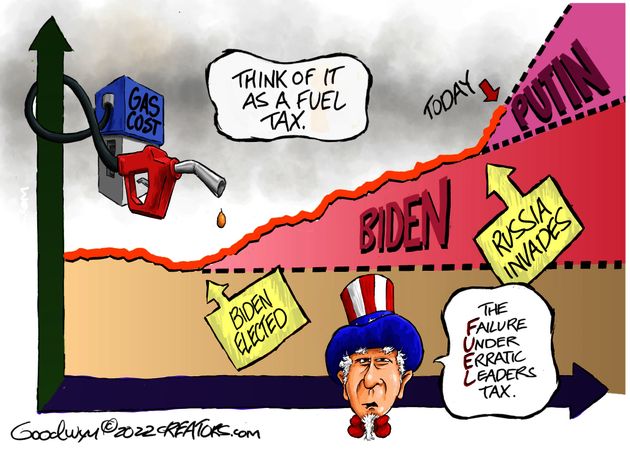
Philip Dick’s insight has a corollary: Reality is also that which doesn’t happen no matter how much you want it to. Chris Wright explains the contradictions with energy fantasies in his Denver Gazette article Inconvenient truths about energy. Excerpts in italics with my bolds and added images.
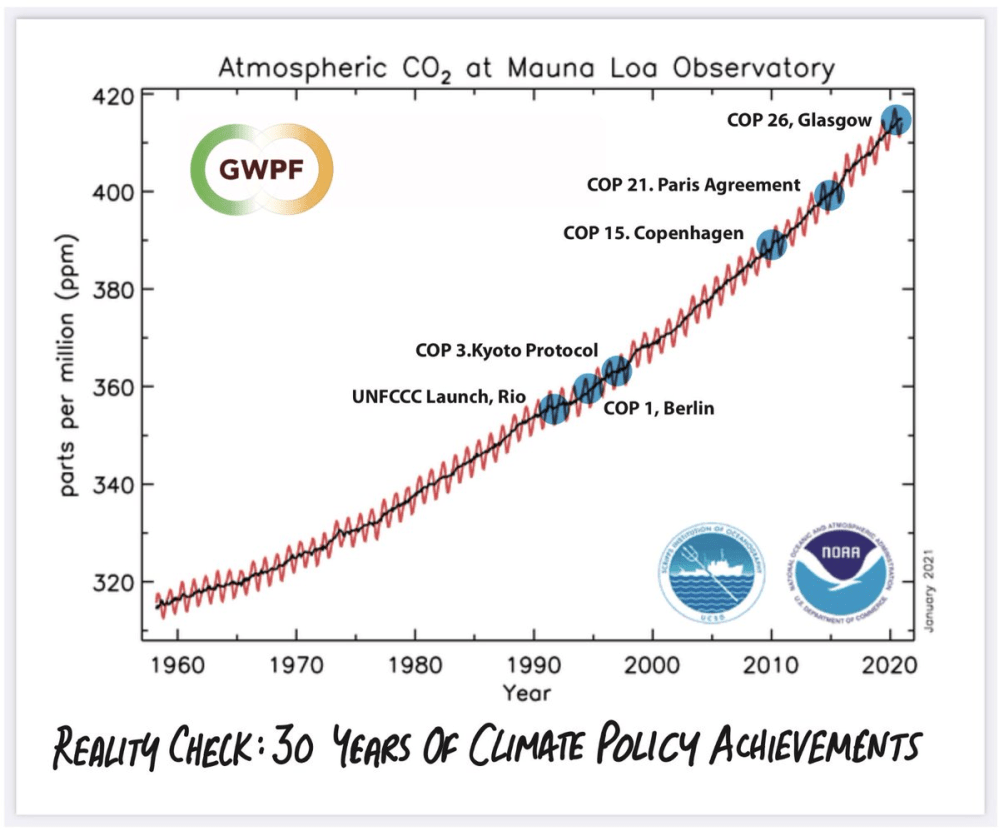
The energy transition is not happening. Or not nearly at the pace that everyone believes or wishes. At current rates the “transition” is set to finish in the mid-2600s. The U.N. Rio Convention and subsequent Kyoto Protocol launched the energy transition drive in 1992. Global energy consumption from hydrocarbons has grown massively since then, with market share only declining by four percentage points over the last 30 years from 87% in 1992 to 83% today. I am not celebrating this fact as I have spent years working on energy transition technologies.
The energy transition isn’t failing for lack of earnest effort. It is failing because energy is hard, and 3 billion people living in energy poverty are desperate for reliable and scalable energy sources. Meanwhile, 1 billion energy-rich people are resistant to diminishing their standard of living with higher cost and an increasingly unreliable energy diet.
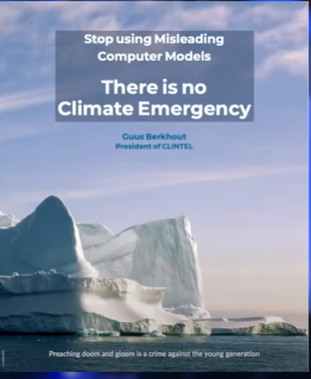
There is no “climate crisis” either. If there is a term more at odds with the exhaustive literature surveys of the Intergovernmental Panel on Climate Change (IPCC) than “climate crisis,” I have not heard it.
Climate change is a real global challenge that is extensively studied. Unfortunately, the facts and rational dialogue about the myriad tradeoffs aren’t reaching policy makers, the media, or activist groups. Or are they are simply ignoring these inconvenient truths?
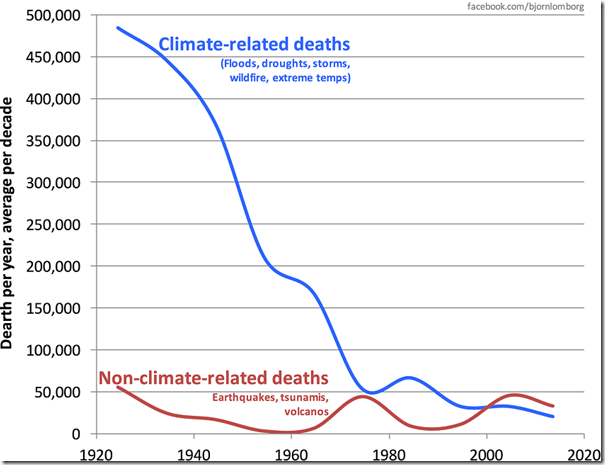
For example, we hear endlessly about the rise in frequency and intensity of extreme weather. This narrative is highly effective at scaring people and driving political action. It is also false. The reality is detailed in countless publications and summarized in the IPCC reports. Deaths from extreme weather have plunged over the last century, reaching new all-time lows last year, an outcome to be celebrated. This is not because extreme weather has declined. In fact, extreme weather shows no meaningful trend at all.
Deaths from extreme weather events have declined because highly energized, wealthier societies are much better prepared to survive nature’s wrath.
My Mind is Made Up, Don’t Confuse Me with the Facts. H/T Bjorn Lomborg, WUWT
Recognizing reality
You are not supposed to say out loud that there is no climate crisis or that the energy transition is proceeding at a glacial pace. These are unfashionable and, to many, offensive facts. But let’s be honest. Energy transition ambitions must recognize reality. Otherwise, poor investment decisions and regulatory frameworks will lead to surging global-energy and food prices. This is exactly what is happening. We are here today in large part because energy transition efforts that previously encompassed solely aggressive support of alternative energy policies, economics be damned, have recently supplemented this strategy with growing efforts to obstruct fossil fuel development.
Fossil fuels make the modern world possible.
The real crisis today is an energy crisis. It began to reveal itself last fall with a severe shortage in globally traded Liquified Natural Gas (LNG). The LNG crisis has not abated and it gives Russia’s Vladimir Putin tremendous leverage over Europe. Without Russian gas, the lights in Europe go out. Amid war, public outrage, and intense sanctions, Russian gas flows to Europe remain unchanged. Russian oil exports have continued with minimal interruption. The world can talk tough about sanctioning Russian energy exports, but those exports are vitally needed; hence they continue. Energy security equals national security.
The world energy system, critical to human wellbeing, requires meaningful spare capacity to handle inevitable bumps in the road. In the electricity sector, which represents only 20% of global energy but 40% in wealthy countries, this is called reserve capacity. In the oil market, spare production capacity today is shrinking and concentrated in OPEC nations like Saudi Arabia and the United Arab Emirates. Also, there is a massive global storage network in both surface tanks and underground caverns. In natural gas markets, there are both extensive underground storage reservoirs and typically spare export capacity through pipelines and large industrial LNG export and import facilities.
The last several years have seen this spare capacity whittled away due partly to lower commodity prices and poor corporate returns shrinking the appetite to invest.
Excess capacity has also shrunk due to regulatory blockage of critical energy infrastructure like pipelines and export terminals. Roadblocks for well permitting and leasing on federal lands, together with a mass public miseducation campaign on energy and climate alarmism, are also stymieing hydrocarbon development. Investment capital is further constrained by a corporate Environment, Social and Governance (ESG) movement, and divestment campaigns. These factors are shrinking hydrocarbon investment below what it otherwise would be in response to price signals and outlook for supply and demand.
The net result is a constrained supply of oil, natural gas, and coal, which means higher prices and greater risk of market dislocations like the one unfolding today.
High energy and food price inflation is the cruelest form of tax on the poor. After a few specific examples, I’ll return to what we should do now to reverse these damaging and deeply inequitable trends.
In denial about demand
Why does the world today suffer from a severe shortage of LNG? Demand for natural gas has been growing strongly for decades. It provides a much cleaner substitute for coal in electricity production, home heating, and a myriad of industrial and petrochemical uses. Rising displacement of coal by natural gas has been the largest source of GHG emission reductions. Unfortunately, the aforementioned factors have prevented supply from keeping pace with rising demand. Energy shortages drive rapid prices rises and have cascading impacts on everything else. Energy is foundational to everything humans do. Everything.
Perhaps the most critical use of natural gas is nitrogen fertilizer production. Roughly a century ago, two German chemists, both subsequently awarded Nobel Prizes, developed a process to produce nitrogen fertilizer on an industrial scale. Before the Haber-Bosch process innovation, nitrogen content in soil was a major constraint on crop productivity. Existing nitrogen sources from bird guano, manure, and rotating cultivation of pea crops were limited. Today, elimination of natural gas-synthesized nitrogen fertilizer would cut global food production in half.
The now six-months-long LNG crisis translates into a worldwide food crisis as skyrocketing fertilizer prices are cascading into much higher food prices. Wheat prices are already at a record high and will likely head higher as spring plantings suffer from under fertilization.
Global LNG markets are tight because rising demand has outrun the growth in LNG export capacity in the United States, now the largest LNG exporter. We have an abundance of natural gas in the United States. Unfortunately, we have a shortage of pipelines to transport this gas and LNG export terminals, preventing us from relieving the energy crisis in Europe and around the world. These pipeline and export terminal shortages are due in large part to regulatory blockage. The result is that natural gas prices in the United States and Canada are five to ten times lower than in Asia and Europe. This deeply disadvantages consumers and factories (like fertilizer factories) in Europe and Asia that rely on LNG imports to fulfill their needs.
Failed energy policies
Russia’s invasion of Ukraine did not cause today’s energy crisis. Quite the reverse. Today’s energy crisis is likely an important factor in why Russia chose to invade Ukraine now. Europe’s energy situation is both tenuous and highly dependent on Russian imports. Russia is the second-largest oil and natural gas producer after the United States. Russia is the largest exporter of natural gas, supplying over 40% of Europe’s total demand. Additionally, Russia is the largest source of imported oil and coal to Europe. Europe put itself in this unenviable position by pursuing unrealistic, politically-driven policies attempting to rapidly transition its energy sources to combat climate change.
Europe’s energy pivot has been a massive failure on all fronts: higher energy costs, grave energy insecurity, and negligible climate impacts.
Germany is the poster child of this failure. In 2000, Germany set out to decarbonize its energy system, spending hundreds of billions of dollars on this effort over the last 20 years. Germany only marginally reduced its dependence on hydrocarbons from 84% in 2000 to 78% today. The United States matched this 6% decline in hydrocarbon market share from 86% in 2000 to 80% today. Unlike in the US, Germany more than doubled its electricity prices — before the recent massive additional price increases — by creating a second electric grid. This second grid is comprised of massive wind and solar electric generating sources that only deliver 20% of nameplate capacity on average, and often less than 5% for days at a time. The sun doesn’t always shine and the wind doesn’t always blow. Hence, Germany could only shrink legacy coal, gas and nuclear capacity by 15%. It now must pay to maintain both grids. The legacy grid must always be flexing up and down in a wildly inefficient manner to keep the lights on, hospitals functioning, homes heated, and factories powered. Outside of the electricity sector, Germany’s energy system is largely unchanged. It has long had high taxes on gasoline and diesel for transportation, and lower energy taxes on industry. Germany subsidizes industrial energy prices attempting to avoid the near-complete deindustrialization that the UK has suffered due to expensive energy policies across the board.
Over the last 20 years, the United States has seen two shale revolutions, first in natural gas and then in oil.
The net result has been the U.S. producing greater total energy than consumed in 2019 and 2020 for the first time since the 1950s. The U.S. went from the largest importer of natural gas to the second-largest exporter in less than fifteen years, all with private capital and innovation. The shale revolution lowered domestic and global energy prices due to surging growth in U.S. production. Surging US propane exports are reducing the cost and raising the availability of clean cooking and heating fuels for those in dire energy poverty still burning wood, dung, and agricultural waste to cook their daily meals. U.S. GHG emissions also plunged to the lowest level on a per capita basis since 1960. Imagine the world’s energy situation today with the American shale revolution.
We are starting to hamstring and squander the enormous benefits of the shale revolution. The same misinformed anti-hydrocarbon crusade that impoverished Europe and made it heavily dependent on Russia is now sweeping the US. California and New England had already adopted European-style energy policies driving up electricity prices, reducing grid reliability, and driving manufacturing and other energy-intensive, blue-collar jobs out of their states. Colorado is not far behind.
California, a state with a plentitude of blessings, managed to create the highest adjusted poverty rate in the nation with an expensive, unstable power grid increasingly reliant on coal-powered electricity imports from Nevada and Utah.
New England’s proximity to Pennsylvania’s clean low-cost natural gas resources was a stroke of luck. But it refused to expand the natural gas pipelines running from Pennsylvania, leaving it chronically short of natural gas, its largest source of electricity and cleanest option for home heating. Instead, it remains heavily reliant on fuel oil for home heating and occasionally imports LNG from Russia to keep the lights on. Last winter New England burned copious amounts of fuel oil to produce electricity which went out of fashion in the 1970s elsewhere in the US.
Texas has not been immune from energy illiteracy and collateral damage. Texas’ poorly designed electric grid, structured to encourage investment in renewables, led to hundreds dying last year in the Uri cold spell. No one would pay the same price for an Uber that showed up whenever convenient for the driver and dropped you off wherever they desired. But that is what Texas does with electricity: paying the same price for reliable electricity that balances the grid as they do for unreliable, unpredictable electricity. No wonder the reliability of the Texas grid has declined and is headed for more trouble.
Misplaced faith
The common thread in these cases is unrealistic beliefs in how rapidly new energy systems can replace demand for hydrocarbons, currently at all-time highs. Political intervention and miscalculation have led to over-investment in unreliable energy sources and, far worse, under-investment in reliable energy sources and infrastructure. The full costs of this colossal malinvestment have been somewhat hidden from view as spare capacity in the global energy network has mostly kept the train on the tracks. Now that excess capacity has shrunk to a critically low level, more impacts are hitting home.
Like the disease itself, the cure takes years to run its course. But that longer time frame is no excuse not to act now in a thoughtful fashion to begin rectifying historical blunders.
Steel, cement, plastics and fertilizer are the four building blocks of the modern world and all are highly reliant on hydrocarbons.
Most critically this means removing the growing myriad obstacles to hydrocarbon development, justified in the name of fighting climate change. This is nonsense. Overly cumbersome hurdles to hydrocarbon development in the U.S. do nothing to change oil and gas demand. They simply displace U.S. production overseas where production practices are less stringent and less ethical. Resulting in increased GHG emissions and other air pollutants, reduced economic opportunities for Americans, and increased geopolitical leverage of Russia and OPEC — see the invasion of Ukraine.
Climate change is a long-term problem best addressed with technologies cost-effective today like natural gas, energy efficiency, and nuclear. The solution requires combining today’s commercial low-carbon energy sources with research and technology development in carbon sequestration, next-generation geothermal, and economical energy storage to make solar and wind more viable.
Today the price mechanism must destroy energy demand to bring it in line with short-term supply. This reduces the quality of living, especially for low-income families. The price mechanism will also incent new supply to the extent possible in the face of growing regulatory hurdles, infrastructure shortages, and capital starvation. A revaluation of all three of these factors is urgently needed.
♦ Is the overarching goal “energy transition” at all costs? ♦ Or is it humane policies that better human lives and expand opportunities for all?
We need to replace the former mindset with the latter.
Chris Wright is chairman and CEO of Liberty Energy, a Denver-based hydraulic fracturing company. Read “Bettering Human Lives”,a report released last year for more information on the above issues.
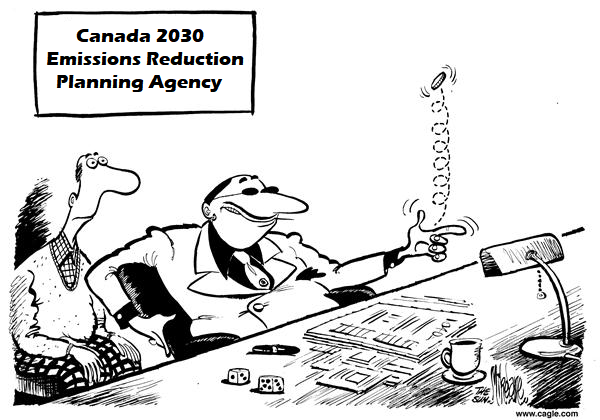
Tough question: If you think central planning is disastrous for economies, and it is, do you want your central planners to be competent and efficient or do you want them to be jokers, engaged in barely concealed fraud?
The projections included in the government’s “2030 emissions reduction plan” released this week show that in the 14 years between 2005 and 2019 total Canadian emissions of carbon dioxide equivalents fell by just nine megatonnes (Mt), from 739 to 730. Yet from 2019 to 2030, the plan would have us believe, they will fall by 287 Mt — more than 30 times the 2005-19 change.
Take buildings. From 2005 to 2019 emissions from buildings actually rose by six Mt, from 84 to 91. But “where we could be in 2030,” according to Ottawa’s chart, is 53 Mt. The chart explains: “A whole-of-government and whole-of-economy effort focusing on regulatory, policy, investment and innovation levers is needed to drive decarbonization of the buildings sector. To this end, the Government will develop a national strategy for net-zero and resilient buildings …”
That load of yet-to-be-delivered national strategy supposedly will eliminate 38 Mt of emissions when all the housing efficiency programs from 2005-19, and there have been lots, enabled an “improvement” of minus seven Mt? You’ve got to know a “whole-of-government” effort to operate the “investment and innovation levers” will not be speedy or efficient.
And even more impressive 2020s miracles apparently are on order.
In the electricity sector, emissions fell 61 Mt from 2005-2019, thanks largely to the elimination of coal. From 2019-2030 they supposedly will fall another 47 Mt, even though coal can’t be eliminated again. In heavy industry, the reduction was 10 Mt; it’s now going to be another 25 Mt. In transportation, emissions actually rose 26 Mt over the last 14 years but by 2030 they supposedly will fall 43 Mt.
This page has no sympathy for central planners. Central planning does not work, whether of the Soviet or the Trudeau-Guilbeault kind. And it wouldn’t be a good idea even if it did. On the other hand, we have immense sympathy for central plan-ees — the people who are subject to central plans. Elsewhere on this page is a plea from Francis Bradley of Electricity Canada, an association of the people who run the country’s electricity grids. All net-zero plans involve a big expansion of electricity use: all those electric vehicles, including electric trucks not yet invented, have to be charged somehow. But, Bradley warns, the clock is ticking. If the government is serious, it needs to make critical decisions now about such things as whether it will allow generation with natural gas, how much financial assistance it will provide for re-fitting and new building of transmission lines and whether it will override burdensome and lengthy approvals processes.
What does this week’s “plan” provide in the way of detail?
Aspiration, aspiration, aspiration.
It is, as Elizabeth May noted, a lovely document, with attractively coloured charts and diagrams. But if you assumed an emissions reduction plan would provide a detailed checklist of policy actions the government would be taking, you assumed wrong.
Each of a series of chapters, one per major sector of the economy, is structured the same way: a few paragraphs outlining “Current sector emissions”; another few on “(Industry X) in context: key drivers”; even more on “What have we done so far?”; a word or two about “What was heard from the 2030 engagement process”; and, then, finally, “What’s next?” Apart from “What’s next?” it’s all filler.
I copied and pasted all the “What’s next?” passages into a single file. They total a little over 8,600 words, about 10 times the length of this column. Google tells me 8,600 words would take an average adult roughly half an hour to read. Yet this is a document that purports to plan major changes in how a 40-million person, $2.5-trillion economy operates.
The “What’s next?” section for electricity is just 482 words, which I doubt will satisfy Bradley’s plea for detail. And much of it is filler — for instance, 182 words describing the “clean electricity standard” consultations processes: “Establishing a net-zero-emitting electricity sector will require substantial effort from provinces and territories, and a CES will provide the regulatory signal to support decision-making at all levels of government to achieve this goal.” No doubt that’s all true. But tell us something that’s not obvious — like what the regulatory signal actually is going to be, not just that there will be one.
Apart from filler, the detailed actions are that the feds will provide $25 million for planning “regional strategic initiatives,” will “lead engagement” on the Atlantic electric loop, and will “support de-risking and accelerating the development of transformational nation-building inter-provincial transmission lines.” All clear now? I doubt the grid people will think so.
An institution — the federal government — that has struggled for 15 years to replace just a few dozen obsolete fighter jets supposedly is going to oversee the radical transformation of a modern economy in just eight years.
It would be laughable if it weren’t also so frightening.
There is a big opening and an urgent need for a political party that would impose a meaningful carbon tax, use the revenues to reduce other taxes and then retire from the emissions business and let markets figure out what happens next.
My own fear is that such policies will hammer Canada’s biggest energy sector
and hobble our most promising one.
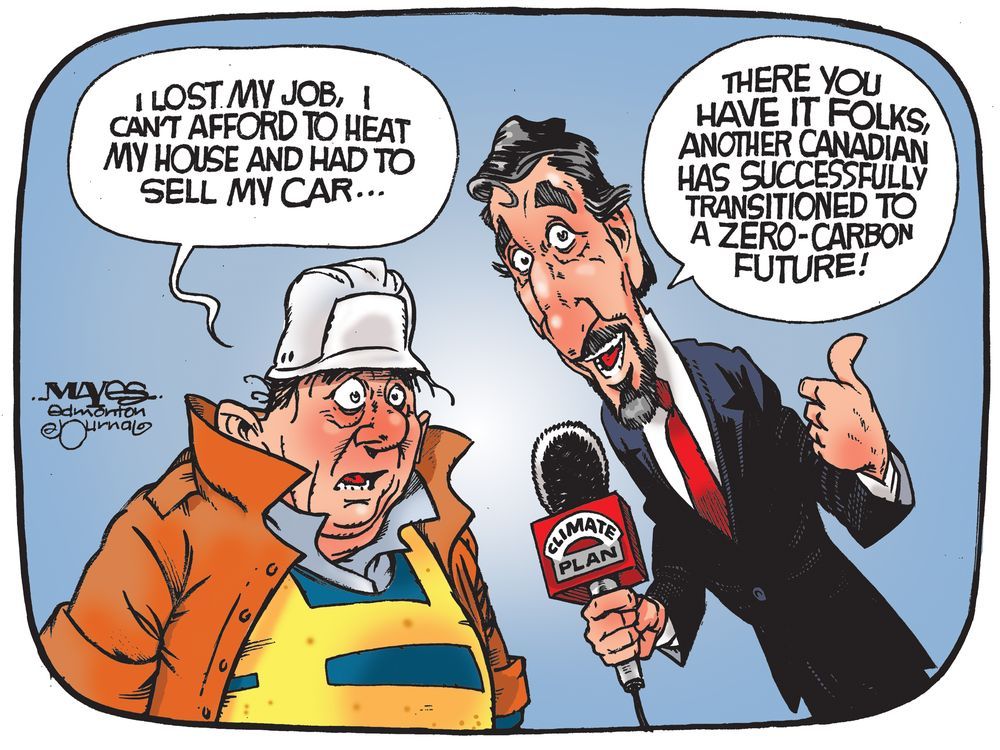
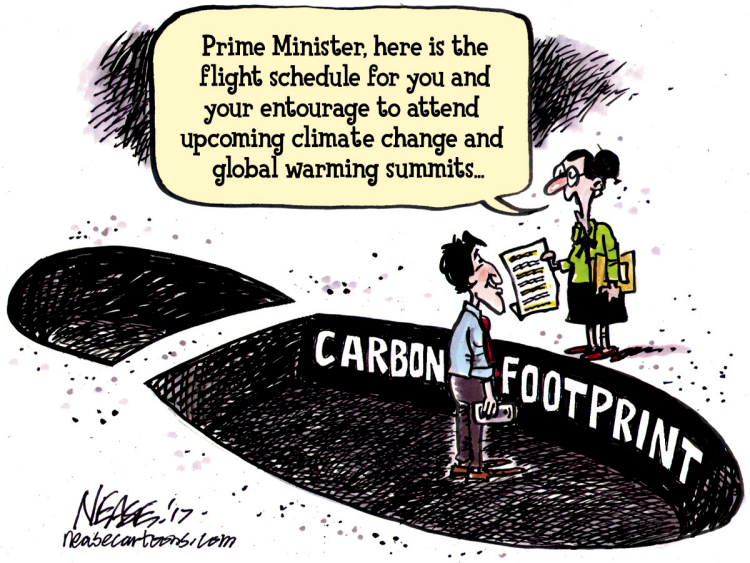
The prime minister has now proposed a new direction on energy policy. Of particular concern is his government’s call for a 42 per cent emissions cut for Canada’s oil and gas sector by 2030 and its growing opposition to nuclear power.
But watching Trudeau in Vancouver on Tuesday promoting his new emissions policy, I also can’t help but fear the worst. Of course, feel free to write off my critique as a fear of change or as partisan blather. Even I question myself. I acknowledge I could be wrong. Things could turn out fine for all kinds of reasons I don’t now comprehend. Who can predict the future?
But I’m not the only Albertan with major reservations today. NDP Leader Rachel Notley (Alberta Premier 2015-2019) just gave a persuasive critique of Trudeau’s plan.
“Based on what we are hearing from folks in the oil and gas sector, the 42 per cent (emissions cut) by 2030 is not just ambitious, it’s beyond ambitious,” Notley said. “It’s a fantasy.”
Notley isn’t in the habit of calling out Trudeau every day of the week. In the past, when she was Alberta premier, she worked well with Trudeau, coming together to push for carbon taxes, the phasing out of coal, and the federal government’s purchase of the TMX pipeline project.
But now comes this 42 per cent non-solution.
It’s clear that the Trudeau Liberals failed to listen to the oil and gas sector, Notley said, because this reductions plan simply can’t be done in just seven years. As she put it, “There are practical, physical limits on how quickly facilities can be constructed or upgraded, or projects even approved.” .
Notley also pointed out of the unfairness of Trudeau’s scheme, that while the oil and gas sector produces 26 per cent of emissions and the transportation sector produces 25 per cent, oil and gas have been hit with a 42 per cent cut while it’s just 11 per cent for transportation. “This is manifestly unfair and it will have serious economic consequences for Alberta and for Canada.”
In his own speech, Trudeau appeared to be gunning hard for oil and gas. It was the first thing out of his mouth that needed cutting. He then went on to say things that raised far more questions than they answered, such as: “Other elements of our plan include our plan to create jobs and keep air clean by making life more easier and affordable for the middle class.”
How are those things at all related? If we move away from oil and gas and nuclear — which create all kinds of well-paying jobs in Canada — how will importing solar panels from China and wind turbines from Europe and elsewhere create a windfall of great jobs in Canada?
And how does adding an ever-escalating carbon tax make life more affordable?
Does it not drive inflation? Does it not make us less competitive compared to countries without a carbon tax, like our neighbours in the United States?
Trudeau also talked about “mandatory” sales targets for zero-emission vehicles, 20 per cent fo 2026 and 60 per cent by 2030. But do we have the grid in place to power a nation of electric vehicles? And if we fail to get behind natural gas and nuclear, will we have a reliable supply of low carbon power? And do we really want to force car dealers to sell us a product that may or may not work well for our needs?
Trudeau took a “not to worry” stance. “Canadians,” he said with his customary wild-eyed certainty, “are united in knowing this is where the future is going and that we can get there together.”
But we’re not united. I say that with certainty. Trudeau has lost even Notley this time.
Once the high cost, economic hardship and heavy-handed government overreach of his new climate plan sinks in, I suspect he’ll lose many more.
Russia’s war on Ukraine continues to expose uncomfortable realities for environmental, social and governance-focused (ESG) investments, prompting calls for the asset management industry to rethink the loosely-defined term as analysts point to “shocking” holdings within some funds.
A new report from CIBC Capital Markets shows many of the 10 largest energy holdings across ESG funds have pared down or exited investments in Canada’s oil sands, while half stayed invested in Russia. At the end of 2021, the bank found ESG funds owned twice as much Russian oil and gas as Canadian oil and gas.
“Perhaps most shockingly, the ratio of dollars held in Gazprom (a Russian state-owned energy firm) was six times that of Suncor,” the CIBC analysts wrote in research published on Monday.
According to the report, the big four Russian energy companies, NK Lukoil, Novatek, Gazprom and NK Rosneft, accounted for about 0.2 per cent of the global ESG holdings. That’s double the size of investments in Canada’s TC Energy (TRP.TO)(TRP), Suncor Energy (SU.TO)(SU) and Canadian Natural Resources (CNQ.TO)(CNQ), the bank said.
“Russia and Saudi Arabia may well emit less CO2 per produced barrel of oil equivalent than some North American firms, but they also invariably have less robust social and governance oversight,” the CIBC analysts wrote.
“This says nothing of the reality many of their energy entities are de-facto state controlled and often aligned (read: weaponized) with foreign policy objectives – many of which will be an affront to mainstream ESG investors.”
Several of the world’s largest companies and institutional investors have moved to cut ties to Russia in recent weeks, amid increasingly violent attacks on Ukraine’s population. ESG funds held at least US$8.3 billion in Russian assets before Russia invaded Ukraine, according to data compiled by Bloomberg.
Those include the country’s financial firms. Bloomberg News recently reported that Vanguard Group and Northern Trust upped their stakes in Russia’s leading bank through their respective index-based ESG funds in January, as Vladimir Putin’s forces amassed on Ukraine’s borders.
Vlad Tasevski, chief operating officer and head of product at Purpose Investments, says these examples show the need to rebalance the trio of ESG priorities. He says the environmental “E” in ESG is being over-emphasized, likely due to the greater challenge of measuring the social and governance variables, compared to hard carbon emissions data.
Tasevski isn’t overly surprised by the lack of enthusiasm for Canadian fossil fuel producers across ESG funds. He says Canadian producers have been “overwhelmingly negatively impacted by the ESG movement,” even as the industry has worked to shrink its carbon footprint, and invested in technology like carbon capture and storage.
CIBC says global flows into ESG funds were down more than 50 per cent through the first two months of this year, after setting records in 2020 and 2021. The bank says flows out of ESG funds have outpaced net outflows from other asset classes.
United Arab Emirates’ Minister of Energy and Infrastructure Suhail Mohamed Al Mazrouei attends a session of the Russian Energy Week International Forum in Moscow, Russia October 14, 2021. REUTERS/Maxim Shemetov
Speaking at the Global Energy Forum by the Atlantic Council in Dubai on Monday, United Arab Emirates (UAE) Energy Minister Suhail al-Mazrouei urged the public and global policymakers to make up their collective mind about whether they want more oil production, as quoted by Reuters.
“I think in COP 26 all the producers felt they were uninvited and unwanted but now we are again superheroes, it’s not going to work like that,” he said in reference to last year’s UN-sponsored COP 26 global climate conference, at which representatives from the oil and gas industry were disinvited to attend. Obviously, a short-sighted decision by the organizers, given recent developments.
Al-Mazrouei emphasized the need for long-term planning related to energy needs, and pointed to the reality that the recent pattern of governments and investors alternatively forcing under-investment in finding new oil resources and then demanding more oil production whenever prices rise is not sustainable. He pointed out that the OPEC+ cartel as a group must invest the capital needed to replace 5 to 8 million barrels of oil per day of production each year just to maintain a steady level of global supply.
“We as a country are trying to do our best. We are investing and raising our capacity to 5 million barrels,” he said. “But that does not mean that we will leave OPEC+ or do something unilateral. We will work with this group to ensure that the market is stable.“
Oil company leaders who have seen their industry derided for years by the climate change lobby and globalist politicians in the U.S. and other Western democracies who have pumped the energy transition narrative can be excused for seeing more than a little irony in the suddenly urgent calls from the same policymakers for them to now rapidly raise their production levels. Indeed, expecting a major supply response from the U.S. industry in the current economic environment seems not just ironic, but unrealistic.
The point is that the days of the U.S. industry being able to increase production by an amazing 2 million barrels per day, as it did across one 12-month period during 2018-19, are no longer with us. The industry simply lacks the investor capital support and supply chain efficiency to run the 1,000+ active drilling rigs required to accomplish that in the current environment.
That doesn’t mean, however, that U.S. domestic production will not rise during 2022. In fact, the Dallas Federal Reserve Office recently reported results of a survey that indicate that the corporate U.S. producers plan to increase their year-over-year production by 6% in the current year, while privately held companies plan a more robust 15% increase. If those plans combine to produce, say, an 8% increase overall, it would mean an increase in U.S. daily production of almost 1 million barrels per day during the 2022 calendar year.
Given the successful efforts by both government and ESG investors to limit the domestic industry in recent years, that would be a pretty extraordinary achievement. So, Minister al-Mazrouei is right in saying that oil producers shouldn’t be treated as superheroes, but their companies are still capable of doing some big things despite the best efforts of their opposition.
Jay Clayton and Patrick McHenry explain in their Wall Street Journal article The SEC’s Climate-Change Overreach. Excerpts in italics with my bolds and added images.
The Securities and Exchange Commission will propose sweeping new rules this week requiring publicly traded, and perhaps even private, companies to disclose extensive climate-related data and additional “climate risks.”
Setting climate policy is the job of lawmakers, not the SEC, whose role is to facilitate the investment decision-making process.
Companies choose how best to comply and thrive under those polices, and investors decide which business strategies to back. That approach addresses many societal issues—think vaccines—and enhances global welfare. Taking a new, activist approach to climate policy—an area far outside the SEC’s authority, jurisdiction and expertise—will deservedly draw legal challenges.
What’s worse, it puts our time-tested approach to capital allocation, as well as the agency’s independence and credibility, at risk.
Understanding and addressing global climate change is one of the most complex and significant issues of our time. Some predict we face inevitable catastrophe, while others say the costs of the transition to a “net-zero world” outweigh the benefits We know four things for sure.
♦ First, implementing an economywide emissions-reduction policy will have a profound impact on the domestic energy, labor, transportation and housing markets, among others. Many jobs will be destroyed while others are created. Some businesses will close while others will flourish. Even if the long-term benefits outweigh the costs, near-term stresses on working Americans are inevitable and will be distributed unequally.
♦ Second, leaving policy decisions this significant to a single regulator—or even a patchwork of regulators—has failed time and again. Tellingly, there is no indication that the SEC has meaningfully coordinated with any of the other relevant federal agencies and departments on the policy choices embedded in its proposed rules.
♦ Third, Russia’s war against Ukraine demonstrates again the clear and longstanding links between energy policy, global stability and competing national interests. America’s ability to lead on the global stage depends on our economic and military strength, and energy policy is a key to both. These issues are far outside a financial regulator’s depth and mandate.
♦ Fourth, the body that the Constitution prescribes for weighing the relevant trade-offs in this area is Congress. Congress, duly elected by and responsible to the people, is precisely where climate policy, in all its complexities and consequences, should be resolved. Yet over decades, elected leaders have pushed hard policy questions to federal agencies staffed by unelected bureaucrats, whose decisions are reviewed only by unelected judges.
This is at best bad for democracy and at worst unconstitutional.
Demanding that the SEC “act on climate change” allows politicians to say that they are working on their constituents’ behalf without accepting responsibility for the hard choices involved in crafting policy.
Executive branch and independent agencies, including the Environmental Protection Agency; the Transportation, Labor, State and Treasury departments; and other financial regulators, have a role to play. They should work to inform Congress during the policy-making process and then implement legislative mandates in their respective areas of expertise.
Unfortunately, because the SEC has decided to move forward unilaterally, the debate will shift not to Congress, where it belongs, but to the courts. The commission’s chosen path will allow the political buck-passing to continue and delay thoughtful, appropriate and democratically accountable policy.
If and until Congress acts on climate policy, the message to regulators must be clear: Stay in your lane.
Mr. Clayton served as SEC chairman, 2017-20. Mr. McHenry, a North Carolina Republican, is ranking member of the House Financial Services Committee.
How did Biden’s policies impact the lower production of oil and gas?
By 2019, due primarily to fracking, the US became the number one producer of oil and gas in the world. In fact, we became a net exporter of oil and gas.
Prior to Biden entering office, oil production of oil shales reached over 12 million B/D. but fell more than 1 million B/D during 2021. During this time, Russia became the world’s largest exporter of oil which helped fund their war effort in the Ukraine.
Social Cost of Carbon
Under Obama, the government came up with a dollar value called the social cost of carbon. It is supposedly an estimate by the government as to the environmental damage from everything from rising sea level to wildfires and floods from the release of one ton of carbon dioxide via fossil fuel burning. But scientists are still completely uncertain about the direct impact the burning of fossils fuels may have on the environment. I hope this causes you to suspect the number may be related to magic.
But that never stopped the Obama administration from coming up with a solid amount of $57. Trump reduced the number to $7, but Biden revised the number to $51. The number is important because it gave the Biden administration the leverage to restrict oil and gas production based on supposed environmental and economic threats from greenhouse gasses (i.e., reduce permitting on federal lands).
As might be expected, gas-producing states fought back by challenging the social cost of carbon in court, and a judge issued an injunction preventing the administration from using the metric. But rather than submit to the judge’s ruling, the Biden administration simply decided to stop new permits on federal lands blaming the judge for the action – sigh. But Biden has been slow-walking permitting since he became President. He is the only President in 20 years not to have an onshore lease sale in a given year (2021).
Intentional Destruction of American Energy Production
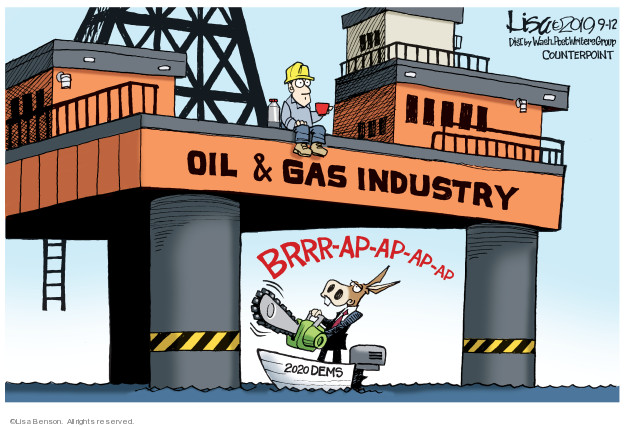
We should not be surprised by Biden’s actions. During his campaign he promised to end drilling on federal lands to fight climate change. As much as 25% of oil and gas production comes from federal lands.
Finally in November of last year, the Department of the Interior, which is required by law to have quarterly lease sales, opened its first Gulf of Mexico oil lease auction which generated $190 million from oil companies. But alas, a green Obama-appointed judge vacated the auction after [environmentalists] Earthjustice out of San Francisco sued.
The ruling effectively ended new drilling in the Gulf, where some of the world’s environmentally friendly oil resides.
There are some state representatives that claim the Biden administration went ahead with the auction knowing full well it would be vacated. As you might imagine, the Department of the Interiorwill need a great deal of timeto review the environmental impact of drilling in the Gulf (wink wink).
Bloomberg reported that an oil executive mused:
“Biden is signaling that his environmental goals trump energy security and consumer prices… that’s not lost on public companies or banks they rely on.”
Ultimately, investment in the oil industry increases when roadblocks to making a return on investment are removed. Biden’s actions have scared off many potential investors further reducing oil production. Press Secretary Jen Psaki’s oft repeated statement that 9.000 leases have been permitted is at the very least disingenuous considering the impediments to drilling the Biden administration has created.
Intentional Constriction of American Energy Supply
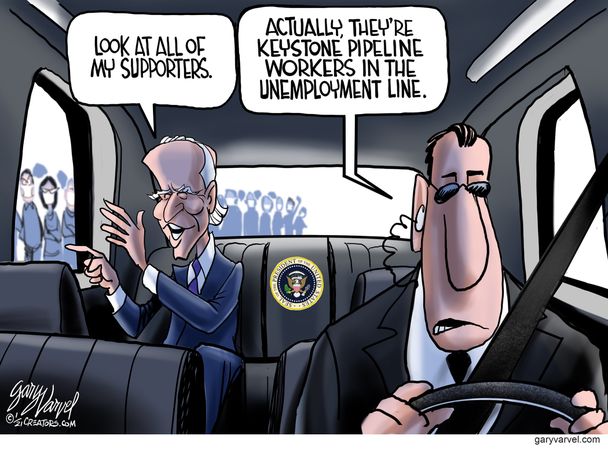
Psaki frequently claims that the Keystone XL Pipeline has no impact on oil prices because it will take two years to complete (only one year now if they had not shut it down). But Psaki is undermining (purposely in my opinion) the importance of the supply chain.
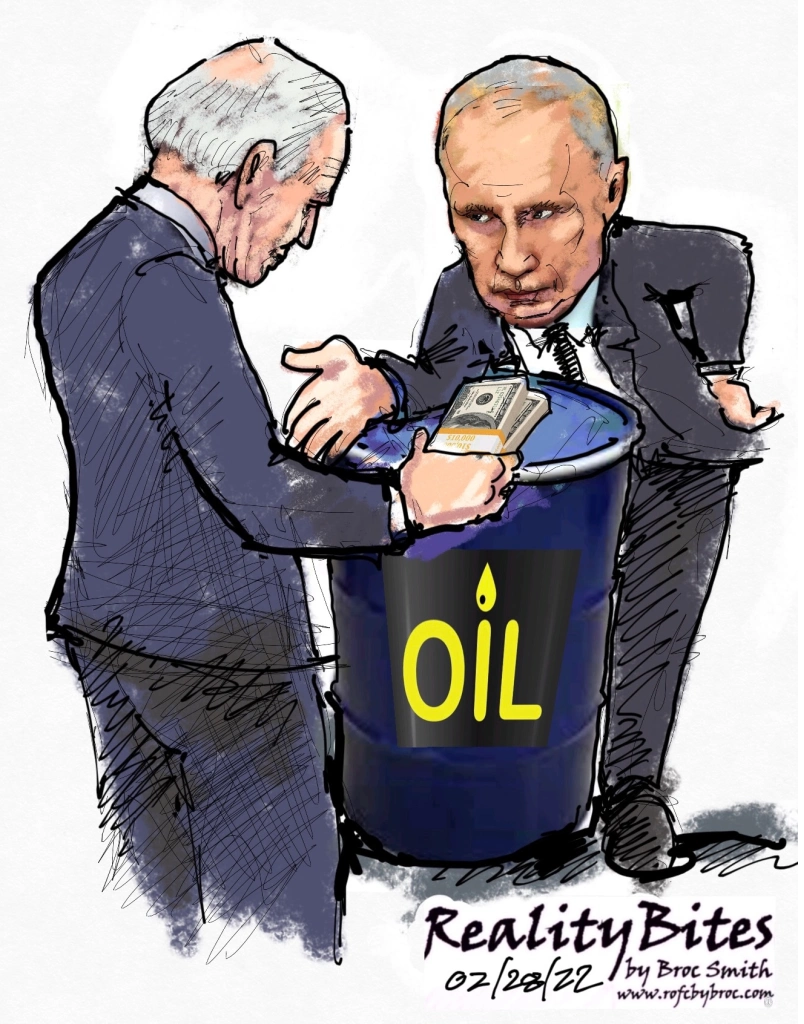
For example, the oil that would come through the pipeline has to be shipped by train. Recent train crashes demonstrate the danger of transporting oil via this method. And it obviously costs a lot more to ship via rail. But in a real head scratcher, Biden waved sanctions on the Nord Stream 2 pipeline from Russia to Germany. Why is this acceptable, but the XL is not? Russian oil is notoriously dirty (high sulfur content).
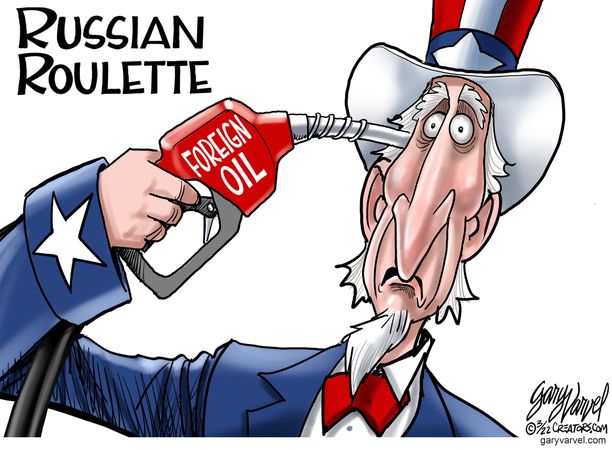
One would think Biden would be doing everything he could to send American oil and gas to Europe rather than making them more dependent on Russian oil.
Ultimately, the Biden administration has intentionally raised significant barriers in permitting supply of oil to the US. Infrastructure is extremely important to the supply of cheap and clean oil to the American economy.
The production of oil and gas in America is highly regulated – it’s the cleanest in the world both in lack of contaminants like sulfur which pollute and the way the industry protects against leaks.
The invasion of Ukraine by Russia created fears about the future of oil supplies which, in turn, pushed oil prices to record highs. And although the US buys less than 10 percent of its oil from Russia, Biden’s decision to stop buying oil from Russia, created more turmoil in the markets.
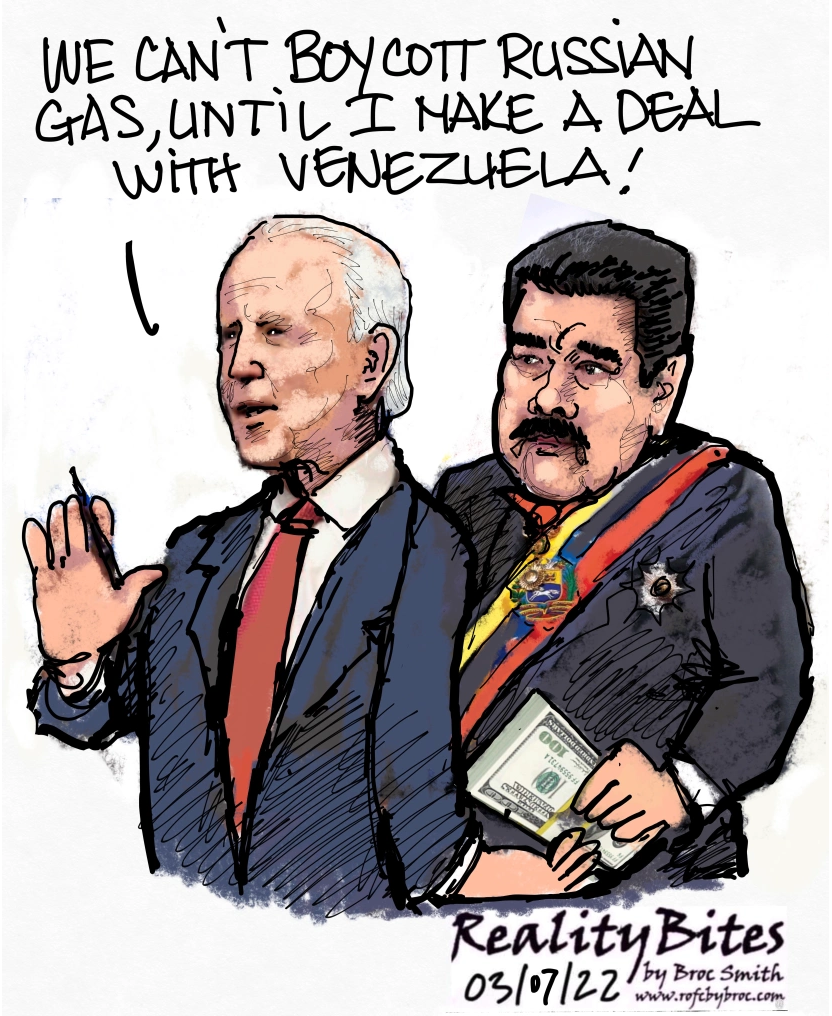
But perhaps the most irrational decision ever made by a President is Biden’s pursuit of [the] Iranian (and Venezuelan) nuclear deal to get access to Iran’s oil. They are the foremost sponsor of terrorism in the world and yet we are willing to sign a very one-sided treaty with them to gain oil which is extremely dirty (high sulfur).
We will pay them just as Obama did, with the helicopter carrying billions of dollars. And those payments will make it easier to develop delivery systems once they finally develop a nuclear bomb. On top of this, we are helping them build an nuclear power plant that will give them clean energy but not us.
Finally, I ask you to remember, gasoline prices were rising quickly way before the war in Ukraine broke out not only due to Biden’s interference in our oil production but also the inflation caused by his huge spending bills. Now we are going to buy oil from Iran instead of enabling our own industry to supply America’s needs. It is the very definition of “bat-shit crazy.”
Dr. Marc J. Defant is a professor of geology/geochemistry at the University of South Florida. He worked for Schlumberger Well Services and Shell Oil for three years, with two years at Shell working as an exploration geologist. He has also been Editor of Geology and an Associate Editor of the Journal of Geophysical Research. Dr. Defant was also invited by the Chinese Government to be a keynote speaker at a symposium on the continental crust and has given invited talks at Massachusetts Institute of Technology, Columbia University, Universitè de Bretagne (Brest, France), University of California at Los Angeles, University of Georgia and Tennessee, and Woods Hole Oceanographic Institution, as well as many others.
 Vince Bielski explains how proposed SEC accounting for CO2 emissions will grind product supply chains to a halt. His Real Clear Investigations article is The Green U.S. Supply-Chain Rules Set to Unspool and Rattle the Global Economy. Excerpts in italics with my bolds and added images.










 Germany is the poster child of this failure. In 2000, Germany set out to decarbonize its energy system, spending hundreds of billions of dollars on this effort over the last 20 years. Germany only marginally reduced its dependence on hydrocarbons from 84% in 2000 to 78% today. The United States matched this 6% decline in hydrocarbon market share from 86% in 2000 to 80% today. Unlike in the US, Germany more than doubled its electricity prices — before the recent massive additional price increases — by creating a second electric grid. This second grid is comprised of massive wind and solar electric generating sources that only deliver 20% of nameplate capacity on average, and often less than 5% for days at a time. The sun doesn’t always shine and the wind doesn’t always blow. Hence, Germany could only shrink legacy coal, gas and nuclear capacity by 15%. It now must pay to maintain both grids. The legacy grid must always be flexing up and down in a wildly inefficient manner to keep the lights on, hospitals functioning, homes heated, and factories powered. Outside of the electricity sector, Germany’s energy system is largely unchanged. It has long had high taxes on gasoline and diesel for transportation, and lower energy taxes on industry. Germany subsidizes industrial energy prices attempting to avoid the near-complete deindustrialization that the UK has suffered due to expensive energy policies across the board.






/cloudfront-us-east-2.images.arcpublishing.com/reuters/MQFECDEES5KCDAK6DN2NX7USSI.jpg)






 Science Matters