Economists as “Useful Idiots” for Green Socialists

Robert P. Murphy writes at Mises Wire Economists Have Been “Useful Idiots” for the Green Socialists. Excerpts in italics with my bolds.

In the old Soviet Union, the Communists allegedly used the term “useful idiot” to describe Westerners whose naïve political views furthered the Soviet agenda, even though these Westerners didn’t realize that they were being exploited in such fashion. It is in this context that I confidently declare that American economists have been useful idiots for the green socialists pushing extreme climate change policies. The radical environmentalists were quite happy to embrace the economic concepts of “Pigovian negative externalities” and a carbon tax in the past, but now that it is impossible for economic science to endorse their desired agenda, the activists have discarded the entire field as hopelessly out of touch. Economists who still support a carbon tax and other climate “mitigation policies” should be aware of the bigger picture.

Using the UN’s Own Document to Defeat the Climate Change Agenda

I have been making this case for years. For example, back in 2014 I used the latest (and still most recent) UN Intergovernmental Panel on Climate Change (IPCC) report to show that the then-popular climate change target of 2 degrees Celsius of warming could not be justified by the research summarized in the report. In other words, I used the UN’s own report to show that the popular climate change “cures” would be worse than the disease.

Yet even though they had spent years berating the critics of government action as “climate deniers” who rejected the “consensus science,” in this case — once they realized that the economic models of climate change wouldn’t support aggressive intervention—the environmental activists all of a sudden began pointing out all the things that the UN-endorsed studies left out. Rather than summarizing the cutting edge knowledge on climate science and mitigation policies, the IPCC document turned into a bunch of misleading nonsense that would give ammunition to deniers.

Nobel Laureate Inconveniently Blows Up the Paris Agreement

Last fall, we had another demonstration of the chasm between the actual research and the media/political treatment: William Nordhaus won the Nobel Prize for his pioneering work on climate change, on the same weekend that the UN released a “special report” advising governments on how to try to limit global warming to as little as 1.5 degrees Celsius.

There was just one little problem: Nordhaus’ Nobel-winning work clearly showed that the UN’s goal was insane. According to his model, it would literally be better for governments around the world to do nothing about climate change, rather than enact policies limiting warming to 1.5°C. Rather than aiming for a 1.5°C target, Nordhaus’ most recent model runs indicated that the “optimal” amount of warming to allow was closer to 3.5°C. (To an outsider this might not seem like a huge discrepancy, but it is absolutely gigantic in the context of the climate change policy debate. Many activists would confidently predict that even 2.5°C of warming would spell disaster for our grandchildren.)

The Guardian’s Slam Dunk

Ah, but I got the best confirmation of my quixotic position just this month, when the Guardian ran an editorial with this subtitle (my highlighting):

Does everybody see that? The people at the Guardian already know what the policy answers are, without needing any help from the economists.

Conclusion

My economist colleagues who continue to urge for a “carbon tax swap deal” in order to get rid of “onerous top-down regulations” and enact a simple “price on carbon” are fooling themselves. Whether it’s in a ballot initiative in Washington State—literally designed by an environmental economist, or in the wonky columns of Vox’s climate expert, in the political calculus of Nobel laureate Paul Krugman, or in the FAQ on the Green New Deal itself, the environmental activists in US politics are making it quite clear that they will not settle for such half-measures.

Market-friendly economists chiming in on the American political scene should stop being useful idiots for the green socialists. Whatever the possible merits of a theoretical carbon tax package—in which a regressive hike in energy prices is matched dollar-for-dollar with corporate income tax cuts, and decades of special-interest favoring regulations are thrown out the window in the zeal for efficiency—this is all a moot point. If market-friendly economists succeed in getting their readers to hold their noses and support a carbon tax, they will all learn quite quickly that the deal has been altered.

From Climate Change, Holy Government Deliver us!

The nearly religious appeal to government to fix the “climate problem” is childlike, even in the mouths of progressive politicians.  James L. Payne writes at the The Foundation for Economic Education How to Talk to Children about Climate Change.  Excerpts in italics with my bolds.

If in coming years we hope to curb the naive governmental interventions that bring so much ruin to the world, we need to address this belief in the efficacy of government.

We smile at seeing those young faces waving placards out in the rain, urging action on the problem of climate change. But our smile is tinged with frustration, with the feeling that the youngsters live in another dimension and that we don’t know how to reach them intellectually.

How They See It

The natural impulse is to want to explain how crushingly complicated is this issue. First, we point out, there is the uncertainty about the connection between human-released CO2 and storms, floods and fires, and all the other bad things that might happen. Then we want to explain that cutting down on CO2 is not easy, that everyone will have to make great sacrifices.

One has to weigh the different possible benefits that might come from stopping (or slowing) global warming against the costs of trying to counter it. This cost-benefit analysis involves a bundle of economic and moral questions. (For a good overview of the complexities of the climate change issue, read former NASA scientist Roy W. Spencer’s 2008 book Climate Confusion.) For example, would saving butterfly X from extinction (assuming we could guarantee it) counterbalance the harm done to the working poor by taking $1,000 a year from each of them in a carbon tax? And so on.

However, I think this impulse to debate the complexities of the issue is misguided. The activists do not base their position on reasoning and calculations. The Climate Kids don’t come to their demonstrations pushing wheelbarrows full of cost-benefit analyses. Most of them don’t even know what cost-benefit analysis is. More importantly, they don’t think they need to know about it.

This is because, in their way of looking at the world, it is not their responsibility to fix society’s problems. That task belongs to a higher power, to government. Their mission is simply to beseech this higher power to act. Once it decides to act, they believe, government has all the expertise needed to make the correct calculations and the ability to craft policies that solve the problem without significantly hurting anybody—well, anybody except the very rich.

We should not be all that surprised by their deep, instinctive trust of government. It is a social predisposition, one that affects all of us to some degree. The belief in government’s wisdom and power is imparted to children very early in life as an article of faith, like the belief in Santa Claus. As children grow up, they begin to notice that government has flaws and that political leaders are not as wise as originally supposed. As a result, their faith in government declines somewhat, so that by age 30, as traditional wisdom has it, most people grow somewhat skeptical about government’s ability to cure the world’s problems.

But not everyone, and especially not today’s climate activists. Faced with a staggeringly complex cost-benefit analysis that has most of us (older) folks scratching our heads, they are brimming with certainty that catastrophe is coming, and government can fix whatever is wrong.

Government Can’t Save the Planet

We were given a telling illustration of this simplistic faith earlier this year when 29-year-old US Representative Alexandria Ocasio-Cortez presented her “Green New Deal” proposal. This House resolution mentions dozens of dangers and problems that she believes to be connected with climate change, from mass migrations, wildfires, and the loss of coral reefs to declining life expectancy, wage stagnation, and the racial wealth divide.

How are these all problems to be solved? Ms. Ocasio-Cortez does not propose any specific law or regulation. She does not advocate, let’s say, a 16 percent carbon tax and assure us that, according to her calculations, this measure will save 61 percent of the coral reefs, and prevent 53 percent of wildfires while reducing the income of the poor by only 8.2 percent.

Like the schoolchildren demonstrating in the street, she leaves the task of figuring out the specific answers to a higher power. Indeed, her resolution begins with this appeal to the higher power: “It is the duty of the Federal Government to create a Green New Deal.” Thus runs the thoughtless faith in government, a faith so deep that even an activist who literally is the government herself looks to “government” to solve problems she can’t begin to analyze.

testers-will-become-extinct-600x330

If in coming years we hope to curb the naive governmental interventions that bring so much ruin to the world, we need to address this belief in the efficacy of government. We need to urge our young idealists to remember that government is not a god with magical powers to fix any problem we notice but an imperfect agency composed of fallible human beings. One way to begin this conversation is to pose this question: “Given what you know about the people who have been in charge of government, is it reasonable to expect, in the future, a high level of rationality and responsibility from government?”

Dr. James L. Payne is a research fellow at the Independent Institute and author. He earned his PhD in political science from the University of California at Berkeley, and he has taught political science at a number of universities including Yale University.

Summary

As the stool above shows, the climate change package sits on three premises. The first is the science bit, consisting of an unproven claim that observed warming is caused by humans burning fossil fuels. The second part rests on impact studies from billions of research dollars spent uncovering any and all possible negatives from warming. And the third leg is climate policies showing how governments can “fight climate change.”

It has warmed since the Little Ice Age with many factors involved, most of which are orders of magnitude more powerful than CO2.  Secondly, the last 1.5C of warming was a boon to humans and nature, and the next 1.5C will likely also benefit the world.  Finally it is naive to believe in government fixing the climate to prevent further warming.  Expensive, intermittent wind and solar power is the proposed solution, which accounts for just 2% of global energy consumed, and has proven disastrous anywhere it has been tried.  In the meantime the children are appeased by declaring a “climate emergency.”  Wake up and get real.

CO2 Unbound

On May 28, 2019 the US Department of Energy announced that CO2 has been unleashed to bring Freedom to the World.

Department of Energy Authorizes Additional LNG Exports from Freeport LNG

Advances commitment to U.S. jobs, economic growth, clean energy

WASHINGTON, D.C. – Today, the U.S. Department of Energy (DOE) advanced its commitment to promoting clean energy, job creation, and economic growth by approving additional exports of domestically produced natural gas from the Freeport LNG Terminal located on Quintana Island, Texas. The announcement was made at the Tenth Clean Energy Ministerial (CEM10) in Vancouver, Canada where DOE is highlighting its efforts to advance clean energy. The expansion of the Freeport LNG facility is estimated to support up to 3,000 engineering and construction jobs and hundreds of indirect jobs associated with the project.

“Increasing export capacity from the Freeport LNG project is critical to spreading freedom gas throughout the world by giving America’s allies a diverse and affordable source of clean energy. Further, more exports of U.S. LNG to the world means more U.S. jobs and more domestic economic growth and cleaner air here at home and around the globe,” said U.S. Under Secretary of Energy Mark W. Menezes, who highlighted the approval at the Clean Energy Ministerial in Vancouver, Canada. “There’s no doubt today’s announcement furthers this Administration’s commitment to promoting energy security and diversity worldwide.”

“Approval of additional LNG exports from Freeport LNG furthers this Administration’s commitment to promoting American energy, American jobs, and the American economy. Further, increased supplies of U.S. natural gas on the world market are critical to advancing clean energy and the energy security of our allies around the globe. With the U.S. in another year of record-setting natural gas production, I am pleased that the Department of Energy is doing what it can to promote an efficient regulatory system that allows for molecules of U.S. freedom to be exported to the world,” said Assistant Secretary for Fossil Energy Steven Winberg, who signed the export order and was also in attendance at the Clean Energy Ministerial.

Update May 31, 2019 Shale Gas Chemistry (Response to Genghis question)

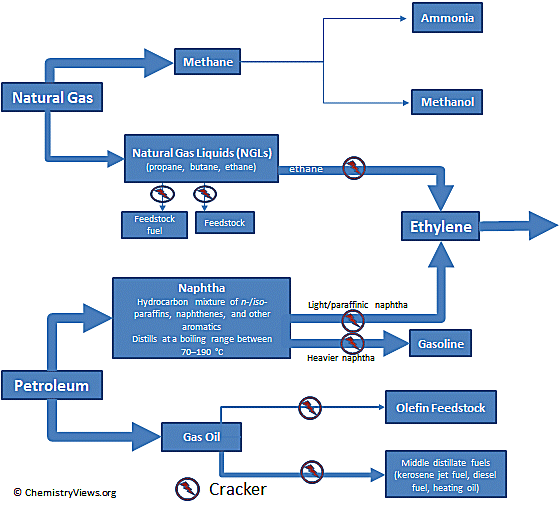
Shale gas is natural gas trapped within tiny pore spaces in shale formations. It is a hydrocarbon gas mixture. It consists mainly of methane. Other hydrocarbons are natural gas liquids (NGLs) like ethane, propane, and butane, and it also contains carbon dioxide, nitrogen, and hydrogen sulfide.

Shale gas composition in the USA

What is done with Shale Gas?

Warmists obsessed with GHG theory are concerned a little about the bit of CO2 escaping during fracking, but much more about the methane (CH4) lost in the process.  Industry is continually reducing such losses with a high economic incentive for efficiency.  Of course, the atmosphere is a methane sink which soon converts any escaping CH4 to CO2 and H20, two life-giving gases.

In sum, the Freedom to emit CO2 covers both pathways.

See Also CO2 Exonerated

Footnote:  This is not a joke!  (OK, I did invent the CO2 superhero image.)

P.S. Anti-fossil fuel activists are not amused.


Greens Killing Electricity, Nuclear In Decline

Green energy initiatives are steadily undermining the electrical grid essential to modern society. Coal-fired power is often termed “Climate Enemy #1”, but the War on Nuclear Energy started much earlier and has been more successful. This century is seeing many NPP closures, and almost none constructed.

The problem is that Nuclear plants produce neither dispatchable nor nondispatachable power. Capital costs are high while variable costs of nuclear electricity are very low, and plants have long 30 to 40 year lifetimes. Nuclear is economic as a base load producer of reliable electricity 24/7. It is not intermittent like wind and solar, and not very flexible like coal, gas or hydro to ramp up or down to meet changing demand. As we shall see, public policies as well as markets are now skewed in favor of wind and solar. The deck is stacked against Nuclear, and base load supply to electrical grids is threatened, not to mention dreams of zero carbon power production.

Update June 5, 2019 Ohio House passes bill to save nuclear power plants with Democrats Support Reuters

Update May 31, 2019 at bottom Democrats’ Curious Disdain for Nuclear Power

Background: War on Nuclear Power

From Environmental Progress, excerpts in italics with my bolds.

Nuclear has declined as a share of global electricity since 1995, and in absolute terms since 2006.

Nuclear’s underlying problem has to do with the well-funded and well-organized war against it that began in the 1960s.

Anti-nuclear groups opposed nuclear for being abundant and cheap and sought to make it expensive and scarce.

Anti-nuclear groups and individuals have consistently advocated coal and natural gas instead of nuclear for 40 years, and often accept contributions from fossil and other energy companies.

Even though nuclear is the safest way to make reliable electricity, it is regulated as though it is the most dangerous.

Opponents of nuclear have won large federal subsidies for wind and solar that have been in place for a quarter-century, and state clean energy mandates that explicitly exclude nuclear.

While it is tempting to blame low natural gas prices and misplaced post-Fukushima jitters, nuclear’s troubles are rooted in regulatory capture — a capture that finds its genesis in the origins of the U.S. environmental movement. This capture is now threatening to bring this climate-friendly energy source to the brink.

Everywhere the underlying reason is the same: anti-nuclear forces, in tandem with rent-seeking economic interests, have captured government policies. On one extreme lies Germany, which decided to speed up the closure of its nuclear plants following Fukushima. In Sweden the government imposed a special tax on nuclear. In the U.S., solar and wind are far more heavily subsidized than nuclear. And states across the nation have enacted Renewable Portfolio Standards, RPS, that mandate rising wind and solar, and that exclude nuclear.

In flat contradiction of their stated views that climate change represents an imminent catastrophic threat, anti-nuclear environmentalists from Germany to Illinois to California bless the burning of fossil fuels if it means they can force the closure of a nuclear power plant.

“We don’t need nuclear power,” environmental activist Bill McKibben told an audience at Middlebury in 2014, after a showing of the pro-nuclear documentary “Pandora’s Promise.” The world, he has repeatedly insisted, can be powered entirely on wind, water and solar energies. At the same time, Vermont Senator Bernie Sanders, whom McKibben endorsed early in the Democratic presidential nomination process, and national environmental groups, were quietly blessing the replacement of Vermont Yankee with natural gas.

The problem with nuclear is that it is unpopular, a victim of a 50 year-long concerted effort by fossil fuel, renewable energy, anti-nuclear weapons campaigners, and misanthropic environmentalists to ban the technology.

The Current Battle to Save Ohio’s Electrical Grid

Jessie Balmert writes in the Cincinnati Enquirer with an obvious bias against nuclear energy and in favor of wind and solar. Energy overhaul: ‘Clean Air Program’ just for nuclear plants, not wind or solar. Excerpts in italics with my bolds.

FirstEnergy Solutions, owner and operator of the Davis-Besse Nuclear Power Station, has cleared a hurdle in its bankruptcy proceedings after U.S. Bankruptcy Court Judge Alan Koschik on Monday approved FES’ amended reorganization plan. It was the fifth revised plan filed in bankruptcy court by FES. (Photo: File)

COLUMBUS – Ohio Republicans’ energy overhaul started as a thinly veiled attempt to rescue two northern Ohio nuclear plants with new fees on everyone’s electric bills.

Now, the veil is off.

Changes made to House Bill 6 last week would direct most of the $197.6 million collected from new fees on Ohioans’ electric bills to Akron-based FirstEnergy Solutions, which operates two nuclear plants outside Toledo and Cleveland.

Renewable energy companies from wind to solar would not get a cut of this “Ohio Clean Air Program.”

In a double blow, lawmakers also axed current programs that encourage electricity providers to purchase renewable energy and help customers become more energy efficient.

And lawmakers ensured utilities could charge customers a fee for two coal plants operated by Piketon-based Ohio Valley Electric Corporation through 2030. The plants are located in Gallipolis and Madison, Indiana.

The cost of a bailout

The latest version of House Bill 6 would charge Ohioans a $1 fee each month starting in 2021 for nuclear energy. The fee is higher for businesses ($15) and industrial customers ($250 to $2,500). Those fees end after 2026.

The proposal also allows electric companies to charge residents up to $2.50 each month for the two coal plants. This isn’t a new charge for many electricity customers, who are billed between $0.51 and $1.64 a month for these plants thanks to an Ohio Supreme Court decision. (An average Duke Energy Ohio residential customer pays $0.97 a month.)

But the proposed changes would lock that fee in until 2030.

At the same time, the bill eliminates current green energy and energy efficiency requirements, which cost the average customer about $4.39 each month.

Republican lawmakers argued the state shouldn’t be picking winners and losers in the energy market. Meanwhile, the bill has clear winners: nuclear and coal.

“My goal would be we should eventually get rid of all of this stuff and just let everybody compete as best as we can,” said Rep. Nino Vitale, R-Urbana, who leads the committee where the energy bill is being debated.

But the federal government already offers tax credits and benefits to renewable energy, creating an uneven playing field, Vitale said.

“Part of this bill is to correct the distortion – not bail someone out,” Vitale said.

At the heart of the debate is whether Ohio taxpayers should save FirstEnergy Solutions.

The company, which was spun off from parent FirstEnergy Corp., filed for bankruptcy in March 2018 with more than $2.8 billion in debt.

Without help from taxpayers, FirstEnergy Solutions says the company will close its two nuclear plants in Ohio: Davis-Besse, east of Toledo, in May 2020 and Perry, east of Cleveland, in May 2021.

The two plants employ more than 1,300 skilled workers who pay taxes and raise children in northern Ohio.

“We like to produce power in Ohio and use Ohio power,” said Larry Tscherne, business manager for International Brotherhood of Electrical Workers Local 245, which represents Davis-Besse workers.

But opponents of the bailout say FirstEnergy made poor business decisions by investing in coal and nuclear plants rather than diversifying its energy portfolio. The company’s financial situation is not Ohio ratepayers’ problem.

Nuclear energy is costly compared to natural gas, coal and some renewable energy. Nuclear plants require security, disaster plans and maintenance that other plants do not. That has made nuclear energy dependent on subsidies to survive nationwide.

“Clean air is obviously good,” testified Michael Haugh with the Ohio Consumers’ Counsel. “But having state government choose outcomes in the competitive marketplace is not good.”

The Case for Nuclear Power from Steffen Henne, head of research for the Center for Industrial Progress.

Q: The Ohio General Assembly is debating a new bill that would subsidize our two nuclear plants to keep them open. Apparently, the plants produce 14 percent of the state’s power. Would shutting them down (as seems likely if the bill fails) almost certainly raise carbon emissions, at least in the short term?

HENNE: This depends on many factors, including how much electricity from other states will be imported and how much new natural gas capacity will replace Ohio’s coal fleet in the coming years to fill the gap. Ohio’s power generation is dominated by natural gas (34 percent) and coal (47 percent) right now. Taking out 14-15 percent of zero-CO2 generation immediately would definitely lead to higher CO2 emissions compared to keeping these power plants alive, even if the absolute emissions might decline over time.

It’s noteworthy that the problems of nuclear and coal power plants to turn a profit are in some significant way rooted in the presence of unreliable solar and wind. Both technologies are able to produce very cheap baseload electricity but in an environment where solar and wind can just produce when the weather is right and every other generator has to adapt to the gluts and shortfalls, the cost this creates are high for nuclear and coal plants, which have been built to run at high capacity constantly. The current nuclear reactors are usually inefficient at what’s called load following because they were not designed to do that. Although solar and wind create the problem, they don’t have to pay for the cost in the current regulatory framework.

To the extent natural gas outcompetes nuclear on fair terms, that’s a different story, but it rarely makes sense to build a new natural gas power plant if the existing nuclear capacity could still do the job. And natural gas still emits more CO2 than existing nuclear power plants in any assessment I have ever seen.

Q: Does nuclear power offer the best hope as a power source that produces energy without carbon emissions and is available 24-7? Are the Generation IV nuclear power plants as promising as their proponents claim?

HENNE: There are really only two major countries that have created affordable, abundant power with low CO2 emissions, France and Sweden, and both have done it by using nuclear technology. You can use wind and solar to some extent and at a high cost, as Denmark has done, but this is not really scalable. Denmark now has the highest electricity prices in Europe together with Germany, in large part because of their focus on wind, and they are dependent on the constant imports and exports of power to stabilize their power grid. Without the availability of large conventional power fleets in their neighborhood, the wind experiment would already be over and Danes would sit in the dark. Germany doesn’t even meet its short-term goals in CO2 emission reductions because their costly scaling of solar and wind is completely insufficient.

Yes, nuclear energy right now is the only way to reduce CO2 by significant margins without ruining the economy, grid reliability, and energy security. That is because of the inherent properties in nuclear technology, which turns an abundantly available raw material into a concentrated energy source that does not emit CO2 from a chemical combustion process.

Generation IV is an umbrella term that applies to a variety of different technologies. It is difficult to judge at this stage which of these technologies will be successful or most successful at delivering the most abundant, affordable, and reliable energy. But some of the concepts are really promising. There are, for example, fast spectrum reactors, which promise to be able to use the “waste” of other nuclear fission reactors as fuel and overall increase efficiency of the fuel. Today’s typical reactors only use a tiny fraction of the energy content in the uranium or other fuels, which means there is huge potential for efficiency increase with innovation. Other innovative approaches seek to circumvent the cost escalations in the current American regulatory and anti-nuclear social framework, which for the industry means large reactors will be delayed for years or even decades, increasing the upfront cost. Small modular reactors, which can be built in a factory instead of requiring extensive on-site work, might be a good option to reduce cost.

All that innovation potential should be exciting news for everyone concerned about CO2 emissions and the availability of affordable energy to advance human flourishing.

Q: What do you make of the fact that green organizations generally oppose nuclear power, and also insist that climate change is an emergency that must be addressed immediately?

HENNE: I think we have to recognize that for organizations like Greenpeace it doesn’t make sense to actually solve a problem. The more abstract and diffuse the doomsday narrative, the better for their business model. Both climate change catastrophism and nuclear catastrophism are really great for them.

There is also an esoteric religious component to it. The reason why wind and solar are the preferred green “solution” is that they are supposedly natural versus the “artificial” splitting of the atom. Facts don’t matter in that narrative. Although nuclear is the safest technology to generate power it is still vilified as poisonous and dangerous.

Solar and wind are not proposed because they are real solutions but because they fit into that religious thinking.

The most immoral part of it is the absolute disregard for human flourishing. If you cannot afford energy, you have no energy. If you don’t have reliable energy, you have no energy. But affordable and reliable energy is probably the most central aspect of our survival and safety, including safety from climate. Over the last 100 years, climate-related deaths plummeted. Not because the climate suddenly became so much better for us, although the mild warming and increasing CO2 over recent decades was certainly beneficial to us, but because we were able to use technology to protect us from a naturally dangerous environment. And that required the caliber of energy that so far only fossil fuels, nuclear technology, and to some extent large-scale hydropower were able to deliver on a scale of billions.

Summation from Michael Schellenberger at Quillette Why Renewables Can’t Save the Planet

The problem with nuclear is that it is unpopular, a victim of a 50 year-long concerted effort by fossil fuel, renewable energy, anti-nuclear weapons campaigners, and misanthropic environmentalists to ban the technology.

In response, the nuclear industry suffers battered wife syndrome, and constantly apologizes for its best attributes, from its waste to its safety.

Lately, the nuclear industry has promoted the idea that, in order to deal with climate change, “we need a mix of clean energy sources,” including solar, wind and nuclear. It was something I used to believe, and say, in part because it’s what people want to hear. The problem is that it’s not true.

France shows that moving from mostly nuclear electricity to a mix of nuclear and renewables results in more carbon emissions, due to using more natural gas, and higher prices, to the unreliability of solar and wind.

Oil and gas investors know this, which is why they made a political alliance with renewables companies, and why oil and gas companies have been spending millions of dollars on advertisements promoting solar, and funneling millions of dollars to said environmental groups to provide public relations cover.

What is to be done? The most important thing is for scientists and conservationists to start telling the truth about renewables and nuclear, and the relationship between energy density and environmental impact.

“Nuclear power is one of the chief long-term hopes for conservation … Cheap energy in unlimited quantities is one of the chief factors in allowing a large rapidly growing population to preserve wildlands, open space, and lands of high scenic value … With energy we can afford the luxury of setting aside lands from productive uses.”

Fifty years of empirical research show that Siri was right and the anti-growth anti-people extremists who started the anti- nuclear movement were wrong. More energy is good for people, and it’s good for nature.

Energy allows cities and agricultural intensification, which frees the countryside for return of forests and wildlife. Moving to nuclear frees us from air pollution, including carbon emissions.

Update May 31, 2019 Democrats’ Curious Disdain for Nuclear Power

Just published at National Review:  Until they embrace nuclear energy as a key to reducing emissions, the party’s many presidential candidates will be hard to take seriously on climate change.  Excerpts in italics with my bolds.

The Democrats’ disdain for nuclear energy deserves attention, because there is no credible pathway toward large-scale decarbonization that doesn’t include lots of it. That fact was reinforced Tuesday, when the International Energy Agency published a report declaring that without more nuclear energy, global carbon dioxide emissions will surge and “efforts to transition to a cleaner energy system will become drastically harder and more costly.”

At the same time that an increasing number of rural communities are fighting the encroachment of large-scale renewable projects, the U.S. is facing a wave of nuclear-reactor retirements. Nine reactors in the U.S. are slated to be retired over the next three years, and the IEA estimates that domestic nuclear capacity could shrink by more than half in the next 20 years. The agency points to the many challenges facing the nuclear sector, including increased regulations, low-cost natural gas, and competition from subsidized renewables.

This is, frankly, one of the biggest and longest-running disconnects in American politics: The leaders of the Democratic party insist that the U.S. must make big cuts in greenhouse-gas emissions because of the threat posed by climate change, but for nearly five decades, they have either ignored or professed outright opposition to nuclear energy. The last time the party’s platform contained a positive statement about nuclear power was way back in 1972.

America’s top Democrats repeatedly tout the need for “clean” energy and massive deployments of wind and solar power, but by denying the role that nuclear energy must play in any successful decarbonization efforts, they are ignoring the scientific consensus. If they truly care about the dangers posed by climate change, they should stand up and tell the truth about the need for nuclear energy. Until that happens, their various plans to address the issue will be impossible to take seriously.

Footnote:

Many do not realize how intermittent power from wind and solar farms cannibalize the electricity supply.  Since wind and solar capacity is subsidized, any actual power they produce gets top priority for consumption, since it has little or no marginal cost to the grid.  So on days when solar power is abundant in the afternoon, it absorbs the high price demand, while base load and dispatchable plants are denied that revenue.  That pattern will drive those plants into bankruptcy, leaving the grid without backup power, unless more subsidies are added to keep them open.

Cutting Through the Fog of Renewable Power Costs


Most every day there are media reports saying solar and wind power plants are now cheaper than coal. Recently UCS expressed outrage that some coal plants remain viable because industrial customers are able to commit purchasing of the reliable coal-fired supply.

Joe Daniel writes at Forbes The Billion-Dollar Coal Bailout Nobody Is Talking About: Self-Committing In Power Markets. A typical companion piece at Forbes claims The Coal Cost Crossover: 74% Of US Coal Plants Now More Expensive Than New Renewables, 86% By 2025.

Having acquired some knowledge of this issue, I wondered how these cost comparisons dealt with the intermittency problem of wind and solar, and the requirement for backup dispatchable power to balance the grid.

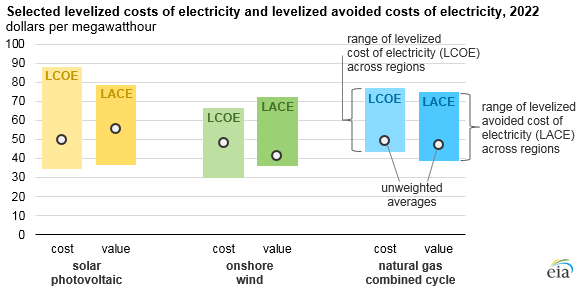
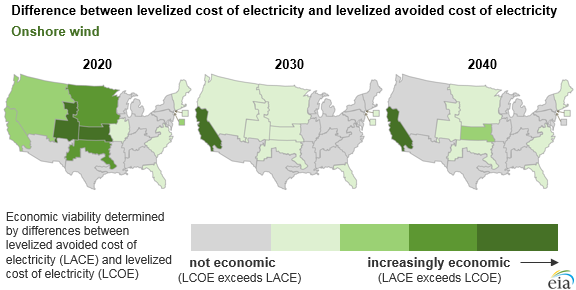
EIA has developed a dual assessment of power plants using both Levelized Cost and Levelized Avoided Costs of Electricity power provision. The first metric estimates output costs from building and operating power plants, and the second estimates the value of the electricity to the grid. Source: EIA uses two simplified metrics to show future power plants’ relative economics Excerpts in italics with my bolds.

EIA calculates two measures that, when used together, largely explain the economic competitiveness of electricity generating technologies.

The levelized cost of electricity (LCOE) represents the installed capital costs and ongoing operating costs of a power plant, converted to a level stream of payments over the plant’s assumed financial lifetime. Installed capital costs include construction costs, financing costs, tax credits, and other plant-related subsidies or taxes. Ongoing costs include the cost of the generating fuel (for power plants that consume fuel), expected maintenance costs, and other related taxes or subsidies based on the operation of the plant.

The levelized avoided cost of electricity (LACE) represents that power plant’s value to the grid. A generator’s avoided cost reflects the costs that would be incurred to provide the electricity displaced by a new generation project as an estimate of the revenue available to the plant. As with LCOE, these revenues are converted to a level stream of payments over the plant’s assumed financial lifetime.

Power plants are considered economically attractive when their projected LACE (value) exceeds their projected LCOE (cost). Both LCOE and LACE are levelized over the expected electricity generation during the lifetime of the plant, resulting in values presented in dollars per megawatthour. These values range across geography, as resource availability, fuel costs, and other factors often differ by market. LCOE and LACE values also change over time as technology improves, tax credits and other taxes or subsidies expire, and fuel costs change.

The relative difference between LCOE and LACE is a better indicator of economic competitiveness than either metric alone. A comparison of only LCOE across technology types fails to capture the differences in value provided by different types of generators to the grid.

Some power plants can be dispatched, while some—such as those powered by the wind or solar—operate only when resources are available. Some power plants provide electricity during parts of the day or year when power prices are higher, while others may produce electricity during times of relatively low power prices.

Solar PV’s economic competitiveness is relatively high through 2022 as federal tax credits reduce PV’s LCOE. As those tax credits are phased out, technology costs are expected to have declined to the point where solar PV remains economically competitive in most parts of the country. Because solar PV provides electricity during the middle of the day, when electricity prices are relatively high, solar PV’s value to the grid (i.e., LACE) tends to be higher than other technologies.

Onshore wind also sees higher economic competiveness in the earlier part of the projection, prior to the expiration of federal tax credits in 2020. Over time, wind remains competitive in the Plains states, where wind resources are highest. Wind’s LACE is relatively low in most areas, as wind output tends to be highest at times when power prices are low.

[Note: The video Can We Rely on Wind and Solar?  was banned by Youtube after 2 miilion views some years ago.  It can still be viewed on Facebook

To get the coal comparison to renewables, there is a study Benchmark Levelized Cost of Electricity Estimates from National Academies Press. Excerpts in italics with my bolds.

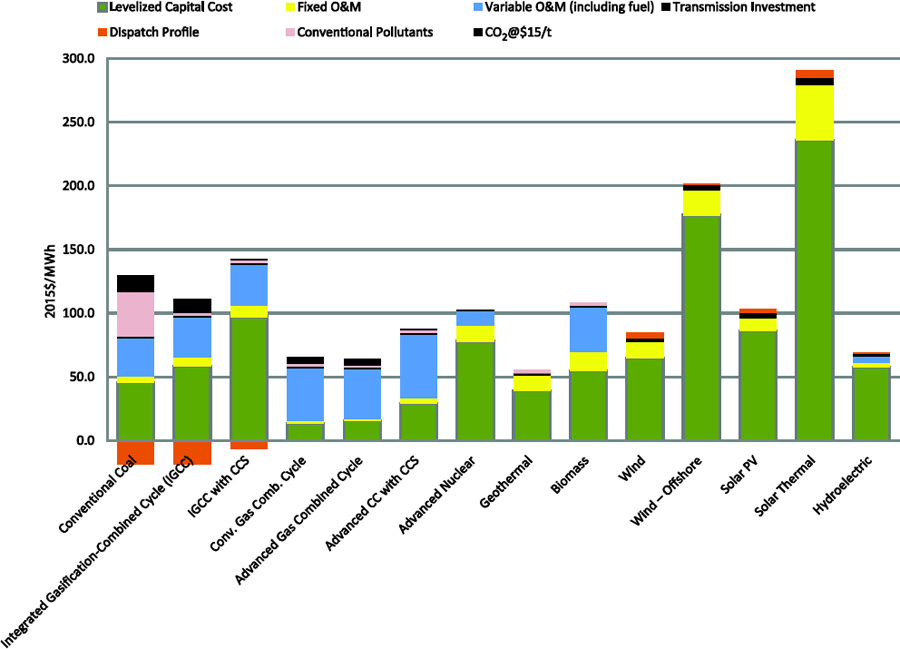
The EIA Annual Energy Outlook supporting information identifies the methodology and assumptions that affect the reported estimates of LCOE for utility-scale generation technologies. The reported estimates are for the years 2022 and 2040. The focus here is on the 2022 estimates as the benchmark for the “current” costs. The assumptions include choices regarding the effects of learning, capital costs, transmission investment, operating characteristics, and externalities. These choices are both important and appropriate for the benchmark comparison (e.g., learning rates), are important and require some adjustment (e.g., capital costs), or are supplemental to the EIA assumptions (e.g., externality costs).

Note:  For the externality of CO2 emissions, the chart below shows a $15/ton “Social Cost of Carbon.”

EIA separates electricity generation technologies into categories of dispatchable and nondispatchable (EIA, 2015f, p. 6). The former include conventional fossil fuel plants that have a fairly consistent available capacity and can follow dispatch instructions to increase or decrease production. The latter consist of intermittent plants such as wind and solar, which depend on the availability of the wind and sunlight and typically cannot follow dispatch instructions easily or at all. It is generally recognized that the different operating profiles create different values for the technologies (Borenstein, 2012; Joskow, 2011). Empirical estimates for existing technologies show that the value of wind, which blows more at night when prices are low, can be 12 percent below the unweighted average price of electricity; and the value of solar, with the sun tending to shine when prices are higher, can be 16 percent greater than the unweighted average (Schmalensee, 2013).

One procedure utilized for putting nondispatchable technologies on an equivalent basis is to pair them with appropriately scaled dispatchable peaking technologies to produce an output that is like that of a conventional fossil fuel plant (Greenstone and Looney, 2012). Another approach, used by Schmalensee (2013), is to calculate the value of nondispatchable technologies based on spot prices. EIA provides a similar estimate based on its projected simulations, which is known as the levelized avoided cost estimate (LACE).

For purposes of equivalent comparison of the LCOE, the approach here combines these adjustments to provide an estimate of the net difference between the LACEs for the technology and for a conventional combined-cycle natural gas plant. The net differences are added to (e.g., for wind) or subtracted from (e.g., for solar) the other components of the LCOE.

With the above assumptions and adjustments to obtain an approximation of equivalent LCOE, the results appear in Figure B-1 and Table B-1.


FIGURE B-1 Levelized cost of electricity for plants entering service in 2022 (2015 $/MWh).
SOURCE: EIA, 2015f, 2016g. Because Annual Energy Outlook 2016 does not assess conventional coal and IGCC technologies, their values (in 2013 dollars) were sourced from Annual Energy Outlook 2015 and then converted to 2015 dollars using the Bureau of Economic Analysis’ gross domestic product (GDP) implicit price deflator.

It is clear from Figure B-1 that new natural gas plants are the dominant technology. And without accounting for the costs of externalities, new IGCC coal plants are more competitive than even the best of the wind and solar. Onshore wind is the closest to being competitive. But the relative cost estimates shown here are similar to those in Greenstone and Looney (2012). The primary renewable technologies are not cost-competitive, and the differences are significant. This is for entry year 2022. Looking ahead to 2040, with some additional cost reductions for renewables and more substantial increased fuel costs for natural gas, the situation changes for wind but not for solar.

CONCLUSION

Equivalent estimates of the LCOE are available from the supporting analyses of AEO2016. The data without the effect of selective policies indicate that existing technologies for clean energy are not competitive with new natural gas. And without accounting for the costs of externalities, the principal renewable technologies of wind and solar are not cost-competitive with new coal plants.

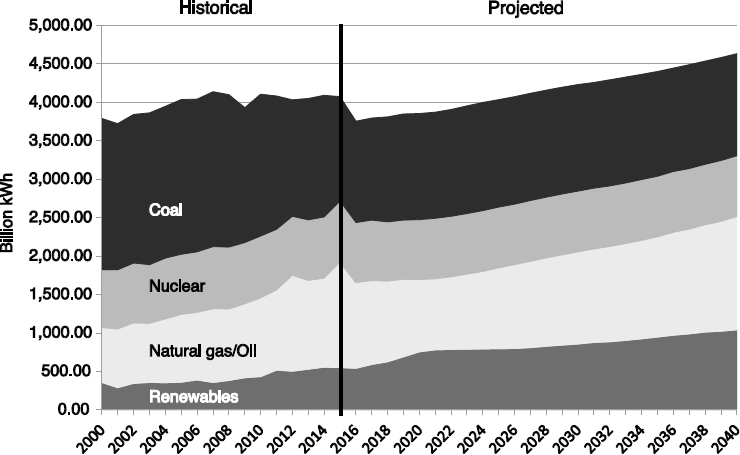
FIGURE B-2 Electric power generation by fuel (billions of kilowatt hours [kWh]) assuming No Clean Power Plan, 2000-2040. SOURCE: EIA, 2016f, Figure IF3-6.

[Note:  Again Youtube banned the video “Bill Gates Slams Unreliable Wind and Solar Power Energy.” It can still be viewed on Facebook:

Footnote: The above analyses do not adequately consider the effect of cheap subsidized solar and wind power driving dispatchable power plants into bankruptcy.  For more on electricity economics see Climateers Tilting at Windmills

New Low in Climate Posturing

At least Madonna posing was entertaining, and children get to feel good about skipping school in order to stop the climate from changing.  But some posturing is both vapid and damaging.

The New York Post Editorial Board explains: A new low in posturing over climate change. Excerpts in italics with my bolds.

Of all New York politicians’ efforts to posture on climate change, the drive to divest public pension funds from fossil fuels may be the most deranged.

The bill from state Sen. Liz Krueger (D-Manhattan) and Assemblyman Felix Ortiz (D-B’klyn) would force state Comptroller Tom DiNapoli to sell off all the fund’s holdings in the 200 largest oil, gas and coal companies within five years.

The unions whose members’ retirements depend on the funds are against it. A union-funded report found that the fossil-fuel holdings outperform their green-energy counterparts in the long term.

Also in opposition is DiNapoli, who notes that “manipulation by legislative fiat has hurt pension funds in other states.”

The pension fund pays more than $1 billion a month in benefits. With an unaudited value of $210.2 billion, it now has about $6 billion in fossil-fuel stocks. Diversification of investments is central to fiscal prudence: Let politicians start banning any given stock, and you’re well on the road to requiring a massive taxpayer bailout — and/or huge cuts to the pensions of some classes of retirees.

Thankfully, New York courts have struck down past legislative efforts to mandate specific investment decisions: The state Constitution protects the comptroller’s discretion.

But that’s no guarantee that the principle will survive the climate-change zealots. After all, Gov. Andrew Cuomo has called on the state authorities he controls (the MTA, the New York Power Authority, the Thruway Authority) to divest from fossil fuels.

All that magical thinking about fighting climate change just might persuade state judges. And DiNapoli is surely worried that, if he goes to court over the issue, he’ll face a challenger in the next election who’ll promise to do as the green extremists demand.

Sensible lawmakers need to quash this nonsense before it goes any further.

Are you wealthy enough to believe in Climate Change?

Some insights from an article by Adam Brickley in the Daily Signal Australia’s Election Shock Shows the Perils of Moralizing Climate Change. Excerpts in italics with my bolds.

One post-mortem on the election from the Australian Broadcasting Corporation pointed out the wealth issue thusly:

In [Warringah’s] case and in other inner-city seats, support for climate action looks broadly consistent with a “post-materialist” sensibility. … Here the emphasis on quality of life over immediate economic and physical needs encourages a focus on issues like climate change. But this is a sensibility that speaks to those in higher socio-economic brackets, and principally with higher levels of education.

Put more bluntly, climate-based politics appeal primarily to those insulated from the potential economic consequences of climate policies by their high incomes, and shielded from even seeing those effects by their urbanized lifestyles.

Those not materially blessed enough to live as “post-materialists,” however, still make their decisions based on what it takes to put food on the table, pay the rent, and provide for their families.

This sort of growing rich-poor political divide is not unique to Australia. In Israel, working-class Israelis have solidified behind Prime Minister Benjamin Netanyahu while wealthy areas swing strongly against him.

In the United States, Donald Trump won states like Michigan and Wisconsin while some of Brooklyn’s trendiest neighborhoods elected Alexandria Ocasio-Cortez to the House.

It’s not just that the working class is drifting right. The upper classes, especially in gentrifying inner cities, are gravitating hard to a left that is increasingly focused on perceived moral issues and less interested in bread-and-butter economics.

However, there is one key difference that makes Australia unique. Perhaps more than any other nation, Australia has seen climate change loom over its politics for over a decade.

Former Labor Prime Minister Kevin Rudd made it the signature issue of his premiership from 2007-2010, with at least one costly program literally going up in flames. Rudd’s plan to re-insulate Australian homes for energy efficiency failed to account for the flammability of the new insulation and led to the deaths of four workers.

In 2009, Rudd’s cap-and-trade proposal caused a massive split in the Liberal Party when then-party leader Malcolm Turnbull tried to force the party to support Rudd on the issue—leading the party’s legislators to remove him and replace him with anti-cap-and-trade leader Tony Abbott.

Australia has been through “climate change elections” before, and experimented with environmental policy as much as any nation on Earth. The results illustrate what happens when politics becomes centered on creating a “better world” by making life harder in the real world.

Such ideas may gain traction among those who know they can afford to weather the storm, and the rich can condemn the poor for their “materialism” in rejecting the new order, but working people (rightly) prioritize feeding their children as a higher moral goal.

Given that Australia’s ever-shifting politics has sometimes drawn comparisons to “Game of Thrones,” perhaps it’s worth noting that Australian Labor and Daenerys Targaryen learned the same lesson in their big finales this weekend: No matter how lofty your aims, there’s little morality in burning the world down in the name of building a better one.

Don’t Miss the Memo on Climate Change


Marlo Lewis, Jr. provides a web memo entitled A Policy Maker’s Guide to Climate Change Excerpts in italics with my bolds.

Here are five things you need to know:

1. Climate change is not a “planetary emergency.”

2. The climate catastrophe narrative is concocted out of overheated climate models, inflated emission scenarios, political hype, and unmerited pessimism about human adaptive capabilities.

3. All metrics of human well-being show the state of the world is improving; sustaining such progress requires greater access to affordable energy.

4. The very real costs of climate “solutions” hugely exceed their hypothetical benefits.

5. Citizens have more to fear from the climate policy agenda than from climate change itself.

This memo provides supporting evidence for those conclusions.For example,

Models vs. Data. Much of what passes for climate science today is model-based speculation about future climate impacts. The United Nations Intergovernmental Panel on Climate Change (IPCC) runs an ensemble of 32 model groups called CMIP5.[1] The models on average projected twice as much warming over the past 40 years as actually occurred in the lower global atmosphere.[2]

A reasonable explanation for the models’ lack of realism is that they overestimate climate sensitivity—the long-term change in average global temperature after a doubling of atmospheric carbon dioxide concentration. The average climate sensitivity estimated in two dozen recent studies is 40 percent lower than the average estimated by the U.N. models.[3]

Only one model in the CMIP ensemble has accurately tracked temperature trends in the bulk atmosphere over the past 40 years—the Russian INM-CM4. When INM-CM4 is run with a realistic emission scenario in which natural gas increasingly displaces coal as an electricity fuel, the world achieves the Paris climate treaty’s 1.5°C warming limit with no new climate policies.[7]

Improving State of the World. If climate change were a global ecological crisis, we would expect to find evidence of declining human health and well-being. Instead, we find dramatic improvement in life expectancy, per capita income, food security, and various health related metrics.[8]

Conclusion. Perceptions of a “planetary emergency” arise from overheated climate models, inflated emission scenarios, disregard of basic data on human health and well-being, and relentless exaggeration by political interests claiming to speak for “the science.” The very real costs of coercive de-carbonization outweigh the hypothetical benefits. The more “ambitious” the climate policy, the more likely it is to damage economic growth, consumer welfare, and our institutions of self-government.[42]

Link to WebMemo in pdf format A Policy Maker’s Guide to Climate Change


Cyber Solutions Can’t Fix the Climate

This post is dedicated to Silicon Valley nouveau rich and their Cyber-Space Cadets now in the streets demanding that adults fix the climate, and fix it now!  Their thinking is fatally flawed by the simplistic transfer of tactics from cyber world to the real physical world.

Mark P. Mills writes at City Journal Want an Energy Revolution?  It won’t come from renewables—which can never supply all the power we need—but from foundational scientific discoveries. Excerpts in italics with my bolds.

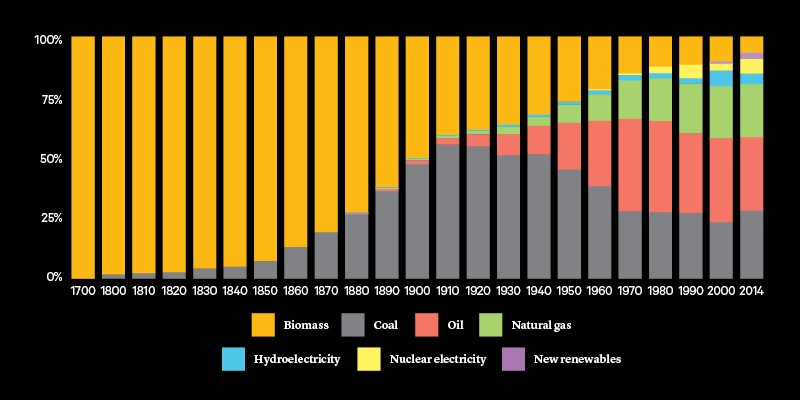
Throughout history, some 60 percent to 90 percent of every nation’s economy has been consumed by food and fuel costs. Hydrocarbons changed the way that humans organize their productive capacity. The coal age, followed by the oil age, and now by the ascendant age of natural gas, has (at least for developed nations) driven the share of GDP devoted to acquiring food and fuel down to around 10 percent. That transformation constitutes one of the great pivots for civilization.

Many analysts claim that yet another such consequential energy revolution is upon us: “clean energy,” in the form of wind turbines, solar arrays, and batteries, they say, is about to become incredibly cheap, making it possible to create a “new energy economy.” Polls show that nearly 80 percent of voters believe that America is “capable of creating a new electricity system.”

We can thank Silicon Valley for popularizing “exponential change” and “disruptive innovations.” The computing and communications revolutions that have transformed many industries have also shaped both expectations and rhetoric about how other technologies evolve. We hear claims, as one Stanford professor put it, that clean tech will follow digital technology in a “10x exponential process which will wipe fossil fuels off the market in about a decade.” Or, as the International Monetary Fund recently summarized, “smartphone substitution seemed no more imminent in the early 2000s than large-scale energy substitution seems today.” The mavens at Singularity University tell us that with clean tech, we’re “on the verge of a new, radically different point in history.” Solar, wind, and batteries are “on a path to disrupt” the old order dominated by fossil fuels.

Never mind that wind and solar—the focus of all “new energy economy” aspirations, including its latest incarnation in the Green New Deal—supply just 2 percent of global energy, despite hundreds of billions of dollars in subsidies. After all, it wasn’t long ago that only 2 percent of the world owned a pocket-sized computer. “New energy economy” visionaries believe that a digital-like energy disruption is not just possible, but imminent. One professor predicts that we will see an “Apple of clean energy.”

A similar transformation in how energy is produced or stored isn’t just unlikely: it’s impossible. Drawing an analogy between information production and energy production is a fundamental category error. They entail different laws of physics. Logic engines don’t produce physical action or energy; they manipulate the idea of the numbers one and zero. Silicon logic is rooted in simply knowing and storing the position of a binary switch—on or off.

But the energy needed to move a ton of people, heat a ton of steel or silicon, or grow a ton of food is determined by properties of nature, whose boundaries are set by laws of gravity, inertia, friction, and thermodynamics—not clever software or marketing. Indeed, the differences between the physical and virtual are best illustrated by the fact that, using mathematical magic, one can do things like “compress” information to reduce the energy needed to transport that information. But in the world of humans and objects with mass, comparable “compression” options exist only in Star Trek.

Spending $1 million on wind or solar hardware in order to capture nature’s diffuse wind and sunlight will yield about 50 million kilowatt-hours of electricity over a 30-year period. Meantime, the same money spent on a shale well yields enough natural gas over 30 years to produce 300 million kilowatt-hours. That difference is anchored in the far higher, physics-based energy density of hydrocarbons. Subsidies can’t change that fact.

And then batteries are needed, and widely promoted, as the way to convert wind or solar into useable on-demand power. While the physical chemistry of batteries is indeed nearly magical in storing tiny quantities of energy, it doesn’t scale up efficiently. When it comes to storing energy at country scales, or for cargo ships, cars and aircraft, engineers start with a simple fact: the maximum potential energy contained in hydrocarbon molecules is about 1,500 percent greater, pound for pound, than the maximum theoretical lithium chemistries. That’s why the cost to store a unit of energy in a battery is 200 times more than storing the same amount of energy as natural gas. And why, today, it would take $60 million worth of Tesla batteries—weighing five times as much as the entire aircraft—to hold the same energy as is held in a transatlantic plane’s onboard fuel tanks.

For a practical example of the physics-anchored gap between aspiration and reality, consider Florida Power & Light’s (FPL) recently announced plan to replace an old gas-fired power station with the world’s biggest battery project—promised to be four times bigger than the current number one, a system Tesla installed, to much fanfare, last year in South Australia. The monster FPL battery “farm” will be able to store just two minutes of Florida’s electricity needs. That’s not going to change the world, or even Florida.

Moreover, it takes the energy equivalent of about 100 barrels of oil to manufacture a battery that can store the energy equal to one oil barrel. That means that batteries fabricated in China (most already are) by its predominantly coal-powered grid result in more carbon-dioxide emissions than those batteries, coupled with wind/solar, can eliminate. It’s true that wind turbines, solar cells, and batteries will get better, but so, too, will drilling rigs and combustion engines. The idea that “old” hydrocarbon technologies are about to be displaced wholesale by a digital-like, clean-tech energy revolution is a fantasy.

If we want a disruption to the energy status quo, we will need new, foundational discoveries in the sciences. As Bill Gates has put it, the challenge calls for scientific “miracles.” Any hoped-for technological breakthroughs won’t emerge from subsidizing yesterday’s technologies, including wind and solar. The Internet didn’t emerge from subsidizing the dial-up phone, or the transistor from subsidizing vacuum tubes, or the automobile from subsidizing railroads. If policymakers were serious about the pursuit of the next energy revolution, they’d be talking a lot more about reinvigorating support for basic science.

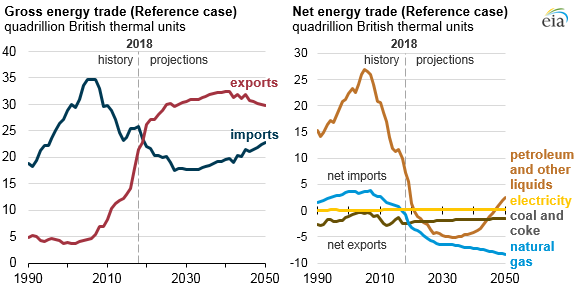
It bears noting that over the past decade, U.S. production of oil and natural gas has increased by 2,000 percent more than the combined growth of (subsidized) wind and solar. Shale technology has utterly transformed the global energy landscape. After a half-century of hand-wringing about import dependencies, America is now a major exporter. Now that’s a revolution.

See also Energy Changes Society: Transition Stories

Cynical Climate Politics

Lots of politicians in the US are grinding the climate ax, but the most cynical play of the climate card is on display in Canada. At Financial Post Gwyn Morgan describes how PM Trudeau is relying on global warming to escape electoral disaster in upcoming federal elections. His article: In choosing to mislead Canadians on climate change, the Liberals are basing their election campaign on a known lie. After describing a list of Trudeau missteps and failures widely criticized in the media, Morgan gets into the climate ploy. Excerpts intalics with my bolds.

So how does a government that can’t campaign on its record go about gaining re-election? By building its campaign around an issue where voters can see them as heroes fighting to save the planet against uncaring opponents. That issue is climate change and their weapon to fight it is carbon taxation. Winning re-election with this strategy requires convincing voters there’s a “climate emergency.” And so on April 1, the day the federal carbon tax kicked in on provinces unwilling to impose a tax that met the Liberals’ requirements, the federal Department of Environment and Climate Change released a supposedly independent report claiming “Canada is warming twice as fast as the rest of the world.”

[Note: Friends of Science deconstructed that report in post Climate Change NOT as Advertised, and Ross McKitrick dispelled the logic in Climate Hearsay ]

From now until the election, Canadians will hear Trudeau and his cabinet members blame every weather event, wet, dry, cold or warm on climate change. And the urgent need for a carbon tax to stop it. When the prime minister recently visited flood-ravaged areas in Quebec, he called the floods “the new reality of climate change.” But experts attribute the recent flooding to one of the longest, coldest, highest-snowfall winters on record. Isn’t climate change supposed to be about global warming?

Convincing Canadians of the need for carbon taxation is just the first element of the Liberals’ re-election strategy. Their most powerful — and cynical — tactic is their promise to give most taxpayers a bigger carbon-tax refund than what they will supposedly pay in carbon taxes. How is that possible? The answer is that individuals will get the refunds, while businesses bear the full cost. In other words, tax the job creators and use that money to bribe the voters.

The principal gladiators leading the Liberal carbon-tax forces are Trudeau and his eco-passionate environment minister, Catherine McKenna. The defenders opposing them in the carbon-tax coliseum are the premiers of Alberta, Saskatchewan, Manitoba, Ontario and New Brunswick, along with federal Conservative leader Andrew Scheer. Scheer will have most of the spears trained on him. McKenna recently accused him of “having no climate plan.” But unlike the Liberals, Scheer’s climate plan needs to be based on the fundamental fact that Canadians could all move to Mars tomorrow and it would have virtually zero impact on global climate change. Here’s why.

Many Canadians have been led to believe (with the help of Liberal misinformation) that oil is a sunset industry. But the consensus of authoritative forecasts sees growth in developing countries pushing world oil demand from the current 100 million barrels per day to at least 110 million by 2030. Here’s the question Canadians should be asking: If world oil demand is going up anyway, why should Canada cede the market for our most important export to Russia, Iran, Nigeria and Saudi Arabia — countries that don’t care about the environment and have horrendous human rights records? At the same time, hundreds of coal-fired power plants are under construction in China, India and Southeast Asia. (Vietnam, one of the smallest countries in that region, has new coal plants under construction that could end up producing more carbon dioxide emissions than all of Canada.)

As good little scout Canada struggles mightily to meet its commitments under the Paris climate accord, the vast majority of nations on the planet have already given up on the pact. Last year, global greenhouse gas emissions grew by an estimated 2.7 per cent. So if Canada’s economy had simply ceased to exist, our 1.6 per cent of global emissions would have been replaced in just seven months.

These are irrefutable facts. So the decision by the Trudeau Liberals to base their election campaign on the assertion that reducing our country’s relatively tiny emissions will help fight climate change can only be explained in one of two ways. First, Trudeau and his team are breathtakingly unaware of facts anyone can learn through an afternoon of Googling. Second, they choose to mislead Canadians in a desperate bid for re-election. That would mean they choose to base their election campaign on a known lie.

So what should Canada actually do about climate change? The clearest answer was recently offered by a man in hip waders, who was filling sandbags to help with the flooding in Central Canada. When he was asked by a reporter what should be done to prevent the floods, he said this: “Well, there’s all this talk about climate change, but I don’t see what Canada can do about that when China and other countries keep burning more. If that’s going to cause more floods, we’d better figure out how we can be ready for them.”

That’s the most common-sense analysis I’ve heard. Instead of throwing away billions of dollars subsidizing costly and impractical “green power” and handing taxpayer money to buyers of electric cars, let’s redirect those billions to risk mitigation and homeowner compensation. In the case of floods, dikes and dams need to be improved where practical. Homeowners in unprotected flood plains should also be offered the full replacement cost to move, as Alberta did after the floods of 2013. After all, it’s flawed government zoning that put people in the flood plain and created the problem; it’s only fair to homeowners that government make things right. Forest-fire risk can be mitigated by underbrush removal, regulatory setback distances and fire-resistant building materials.

A Conservative climate-change mitigation strategy based on the common-sense words of that flood worker would make Canadians much better prepared for climate change. And it has the added benefit of actually telling Canadians the truth about the climate-change challenge. That would be Andrew Scheer’s most important difference from Justin Trudeau.

Gwyn Morgan is the retired founding CEO of Encana Corp.

Footnote:

A master class in exploiting global warming for political gain was portrayed in the British comedy series Yes Prime Minister

Transcript of video is at Yes PM Pokes Fun at Climatism