Pipeline Facts vs. Fears

This week Canadian PM Justin Trudeau announced federal approval for 2 pipeline projects:  Trans Mountain and Line 3 expansions.  From a press report (here):

Kinder Morgan’s Trans Mountain expansion has become a lightning rod for climate protests from coast to coast, with opponents from among Trudeau’s own caucus of Liberal MPs and his political ally, Vancouver Mayor Gregor Robertson.

Climate campaigners and indigenous groups immediately attacked the government decision as a betrayal, while B.C. Environment Minister Mary Polak issued an anodyne statement noting the province’s own environmental assessment of Trans Mountain continues.

The fight overshadowed quieter deliberations about Enbridge’s proposed replacement of Line 3, a half-century-old pipeline from Alberta to the United States that Trudeau approved Tuesday, effectively doubling its current working capacity.

Between the Trans Mountain and Line 3 expansions, the Liberals have approved the export of almost a million additional barrels of oil per day — and the production of between 23 and 28 million tonnes of additional greenhouse gases annually. Line 3 can actually handle another 155 million barrels per day, but Enbridge would have to apply for a new permit.

Trans Mountain Pipeline
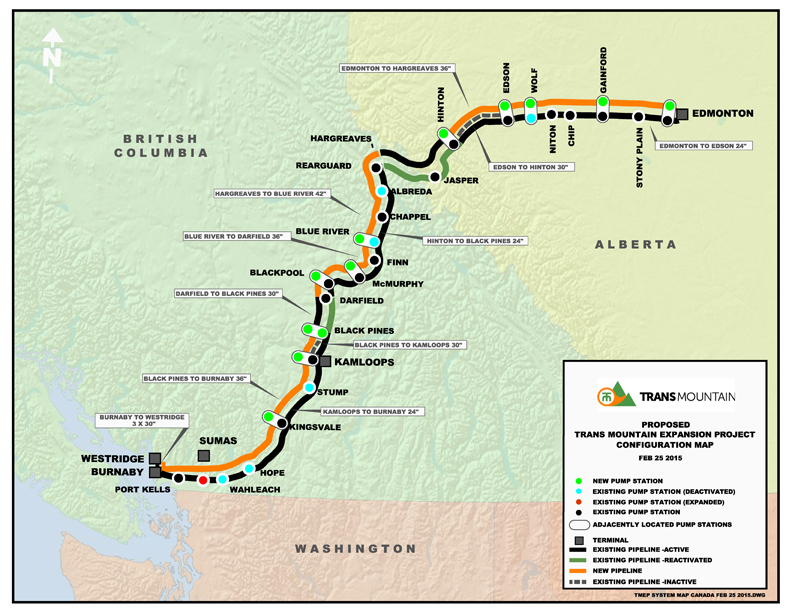
Description of Trans Mountain project is from NEB (National Energy Board) here

The Trans Mountain Expansion Project (TMX) is a proposal to expand the existing Trans Mountain pipeline system between Edmonton, AB and Burnaby, BC. It would include approximately 987 km of new pipeline, new and modified facilities, such as pump stations and tanks, and the reactivation of 193 km of existing pipeline.

The Westridge Marine Terminal would also be expanded. New pipeline segments would be added between Edmonton and Hinton, AB, Hargreaves, BC and Darfield, BC and Black Pines, BC and Burnaby, BC.

Some existing, but currently deactivated pipeline segments between Hinton, AB and Hargreaves, BC and Darfield and Black Pines, BC would be reactivated.

Line 3 pipeline
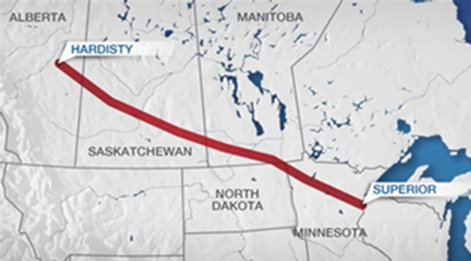
Line 3 would replace a decades-old conduit that runs from Hardisty, Alta., to Superior, Wisc., and double its capacity. (BNN Graphics)

What you need to know about Enbridge’s Line 3 pipeline project

From BNN news (here):
The Line 3 crude oil pipeline replacement project proposed by Calgary-based Enbridge Inc. has attracted little attention despite its potential to increase Canadian exports to the United States. Here are some facts about the plan:

— The $7.5-billion, 1,660-kilometre pipeline replacement project would be the most expensive in Enbridge history.
— The line is almost half a century old and its regulated maximum throughput has been reduced through pressure restrictions to about 390,000 barrels of oil per day.
— The replacement of the aging 34-inch diameter pipe with new 36-inch pipe will restore the original regulated capacity of 760,000 barrels per day, nearly doubling oil shipping potential.
— In April, the National Energy Board recommended approval of the Canadian part of the project with 89 conditions.
— Line 3 already has a U.S. presidential permit, unlike the higher-profile Keystone XL pipeline project which was rejected by the Obama administration a year ago. Line 3 still requires state regulator approvals.
— On the Canadian side of the border, Enbridge intends to spend $4.9 billion to replace Line 3 between Hardisty, Alta., and the Canada-U.S. border at Gretna, Man.
— On the U.S. side, it will spend US$2.6-billion to replace pipe between Neche, N.D., and its terminal in Superior, Wis., from which crude can be transported to refinery markets in Chicago, the U.S. Gulf Coast and the eastern U.S. and Canada.
— Decommissioning of the existing Line 3 pipe will begin after the replacement pipeline is in service. Product will be removed and the line will be cleaned but the pipe itself is to be left in the ground.

[Enbridge expected its full-year average volume on the Mainline network to exceed three million barrels per day in 2024, not much different than the 3.1 million barrels per day it achieved in 2023 prior to the Trans Mountain expansion project’s start-up.]

Pipelines Are Environmentally Friendly
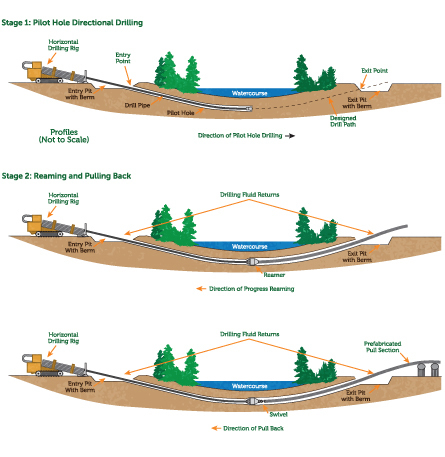
Going under: New trenchless technology means pipelines are installed without construction activity in the watercourse.

In both Canada and the United States, the oil pipeline industry has a remarkably good record of avoiding spills. Of the total volume of oil moved annually on federally regulated pipelines in Canada in 2015, 99.999% of the oil was delivered safely with no spills. Of the 1.4 billion barrels of oil transported, less than 400 were spilled. In the United States, the same 99.999% record of safe delivery applies. The number of accidents and incidents on crude oil pipelines has been declining for many years. Similarly, in Alberta, where most of the intra-provincial oil pipeline capacity is located, the number of pipeline incidents and spills has been stable or declining for at least 20 years.

Of course, it is not possible to entirely eliminate the risk of a spill, any more than it is possible in every other aspect of life to reduce risks to zero. This paper describes the consequences of a major spill near Marshall, Michigan in 2010. In one of the worst cases in twenty years, there were no injuries to people. The use of surface waters affected by the spill for drinking, irrigation and watering of livestock was interrupted for one month. 52 birds, 40 muskrats, 106 turtles and snakes and 42 fish died. The company responsible was required to pay almost $900 million in fines and other expenses to ensure that this does not happen again. From Friends of Science (here)

Pipeline Economics
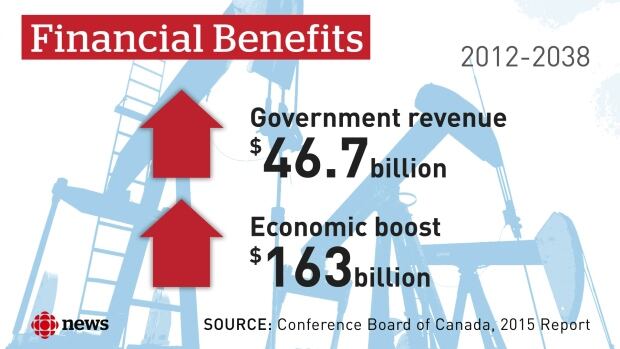
The financial benefits to governments and the economy of the Trans Mountain expansion include the development and planning of the project and the anticipated first 20 years of operation from 2018-38. The figures also include calculations such as the construction and operations of the pipeline, economic benefits of increased tanker activity, and oil company reinvestment.

The financial benefits to governments and the economy of the Trans Mountain expansion include the development and planning of the project and the anticipated first 20 years of operation from 2018-38. The figures also include calculations such as the construction and operations of the pipeline, economic benefits of increased tanker activity, and oil company reinvestment.

The vast majority of oil from Alberta and Saskatchewan is exported to the United States, instead of being transported to a coast and exported to other countries at world prices.

“We produce a very valuable resource and we don’t get full value for that resource,” he said. “It’s absolutely unconscionable that we don’t take the actions we need to move it so that Canadians receive the full value for the product.” – David Dodge former Bank of Canada Governor

‘We may like to think we can survive off making solar panels and medical devices, but we can’t.’- John Manley, Business Council of Canada

Millions of people depend upon the supply of refined oil products for transportation, industrial production, petrochemicals and the thousands of products and services that people use in our modern industrialized society. Further, hundreds of thousands of people work very hard to ensure that the transportation of crude oil and refined oil products moves across our lands with the utmost care given to oil spill prevention, preparedness and response. Comprehensive liability, compensation and governance regimes are in place to make sure that companies have a strong financial incentive to avoid spills and to clean them up as soon as possible if they do occur. Decisions about the permitting or construction of pipelines should be based on facts, not fear.

Anti-Pipeline Activism

None of these facts matter to unhinged people who fear fossil fuels must be left in the ground. And US funders are largely responsible for their activity. From National Post: The cash pipeline opposing Canadian oil pipelines

In 2015, Tides paid $4 million to 50 anti-pipeline groups. Of that, $750,000 went to U.S. organizations while $3.3 million was paid out in Canada. A total of $615,000 went to the four environmental groups involved in the development of the Notley government’s climate plan: STAND, formerly Forest Ethics; The Pembina Institute; Environmental Defence; and Equiterre. The largest single grant from Tides to a Canadian environmental organization was US$700,000 paid to The Sisu Institute, a low-profile non-profit based in Sointula, B.C. That was for an initiative called “Canada’s Road To Paris: Changing The Narrative.”

If the activists marching in protests and storming NEB hearings make the anti-pipeline campaign look like an amateur, grassroots movement, the reality is it’s anything but. Anti-pipeline activists say they’re protesting pipelines to “keep oil in the ground.” And yet, against Texas, where oil production has doubled, there’s no multi-million-dollar campaign.


Climate Costs in Context

400px-unbalanced_scales-svg-climate

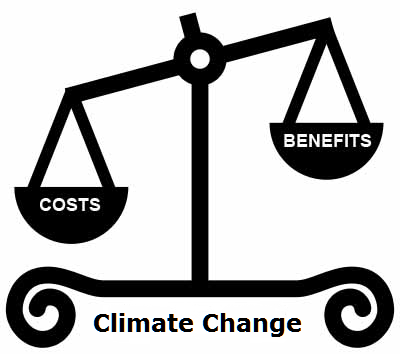
A recent publication by the Manhattan Institute looks at the costs of proposed climate change policies versus the estimated benefits.  Note that positive effects from warming are not included, only the benefits of reduced damages from assumed future warming.  Even on that narrow basis, the costs of “fighting” climate change are vastly greater than simply adapting to a changing climate.  The paper is entitled: Climate Costs in Context (here).  Excerpts below

Uncertain Greenhouse Effects

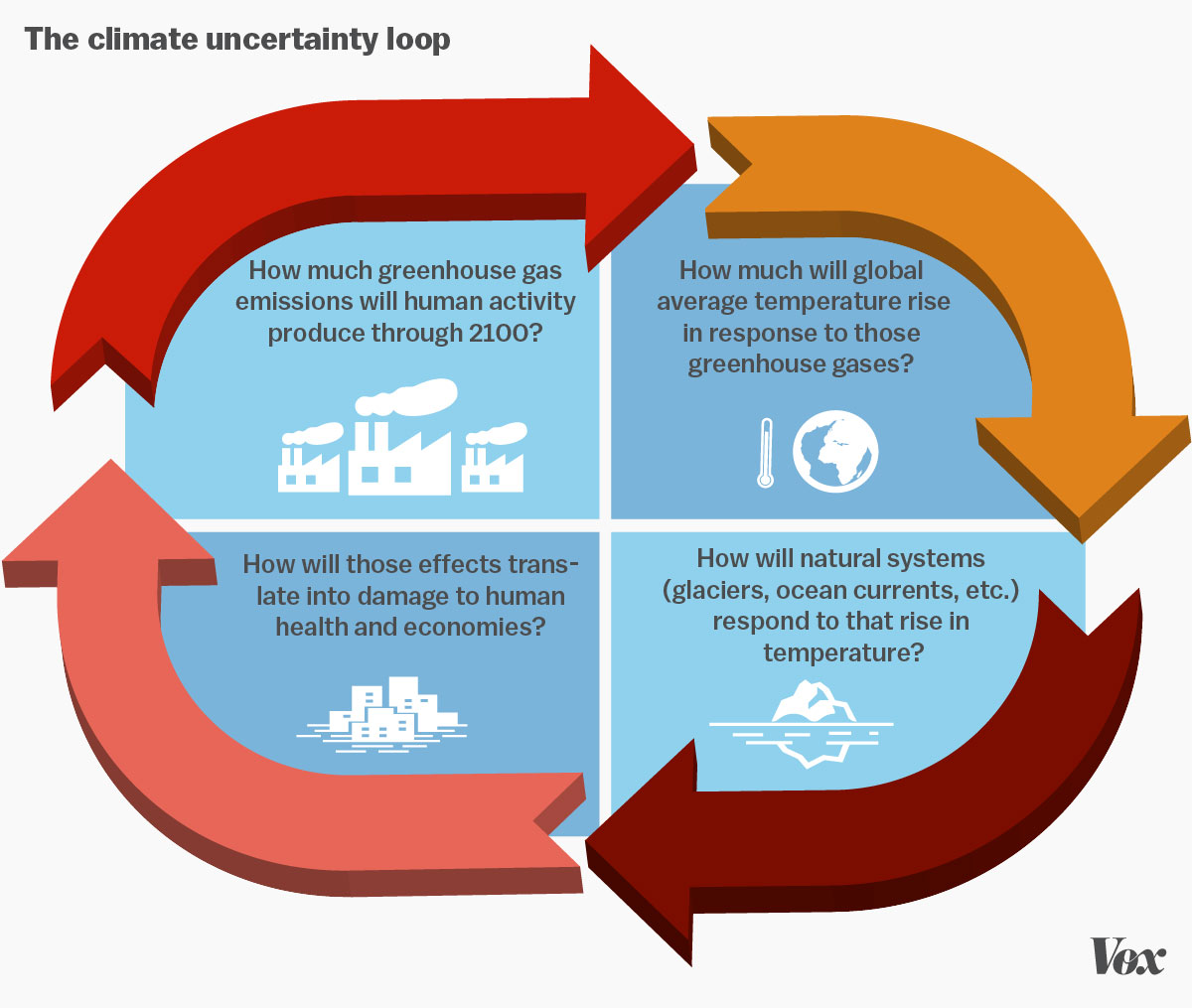
.The chain of causation from greenhouse gas emissions to human impacts is lengthy: economic growth, the energy intensity of economic activity, and the emissions profile of energy use all combine to determine emissions levels. Those emissions then produce a concentration of greenhouse gases in the atmosphere, from which climate models can offer projections of temperature increase. Other models must translate any given temperature increase into estimates of natural-world effects, such as sea-level rise, drought, or ecosystem disruption. And another set of models and qualitative analyses must try to estimate how those changes in the natural world will affect the society that emitted the greenhouse gases in the first place.

Scientific assessments vary widely at each of these steps. However, climate researchers have settled broadly on an expected temperature increase of 3 to 4 degrees Celsius by the year 2100 if efforts are not made to reduce emissions.

Climate Costs According to IPCC

To estimate the economic cost of warming, researchers use “Integrated Assessment Models” (IAMs), which translate a given level of warming into estimates of natural-world impacts and then economic costs. Such analysis requires as much art as science, and, especially for larger temperature increases, the results are highly speculative. Still, they offer the best available estimates and should indicate at least the relative magnitude of the threat.

These models indicate that for 3°–4°C of warming, global GDP in the year 2100 will be 1%–4% lower than in a world with no warming.

These are large costs—all three models estimate that global GDP will have grown to at least $500 trillion by 2100 versus a 2015 total of approximately $75 trillion. So if climate change reduces GDP in 2100 by 3%, that would represent $15 trillion—nearly the size of the entire American economy today. But by the standards of 2100, the cost is manageable.

Exaggerated Popular Notions of Climate Impacts

Such modest economic estimates seem incompatible with the severe disruptions popularly assumed to accompany climate change. However, it is generally the popular assumption rather than the detailed economic research that is in error. For instance, while descriptions of sea-level rise often depict large scale melting in Greenland and Antarctica producing several meters of sea-level rise, such scenarios are forecast to play out only over the course of several centuries or even millennia.

The IPCC itself offered an estimate of what this might cost: “Some low-lying developing countries and small island states are expected to face very high impacts that, in some cases, could have associated damage and adaptation costs of several percentage points of GDP.”In other words, even for those poorest and most vulnerable countries, damage still amounts to only the small share of future wealth forecast in the economic models.

The pattern repeats itself across other potential effects of climate change. For instance, researchers call attention to the prospect of widespread ecosystem disruption and species extinction. The IPCC emphasizes: “With 4°C warming, climate change is projected to become an increasingly important driver of impacts on ecosystems.” But the actual magnitude of these impacts will only “becom[e] comparable with land-use change”—the disruption the world is already experiencing from human development. That disruption has not been costless—in either economic or less tangible terms—but neither has it produced widespread or insurmountable challenges to continued growth and prosperity.

Conclusion: Adapt Rather than Fight

Analyses consistently show that the costs of climate change are real but manageable. For instance, the prosperity that the world might achieve in 2100 without climate change may instead be delayed until 2102.

All these costs—both economic and noneconomic—are substantial and have the potential to cause significant damage and disruption. Policymakers should take them seriously and seek to reduce or prepare for them when the expected benefit of action exceeds the cost. However, none are outside the range of other challenges facing society, and none support the apocalyptic rhetoric of many politicians and activists.

Footnote:

The world is currently spending a lot fighting climate change:

  • UN and governmental agencies and conferences;
  • Research funding to claim alarming impacts;
  • Advocacy by foundations and NGOs;
  • Subsidies for renewable energy and low carbon technologies.

This climate alarm industry, Climate Crisis Inc., is estimated to cost at least 1.5 trillion US$ each year.  That is 2% of present global GDP, and alarmist leaders say it isn’t making a difference.

Looking into the future, IEA expects additional spending just in the energy sector to meet climate change targets on the order of $35-trillion over the period 2015 to 2030. All this remarkable growth comes in a market for non-solutions to the non-problem of global warming.

For more on Uncertainties of Integrated Assessment Models:
https://rclutz.wordpress.com/2015/10/31/quiet-storm-of-lucidity/

Further comments by Oren Cass, author of the Mannhatton paper:

http://www.nationalreview.com/corner/442685/climate-costs-context

Speaking Truth About Power

Recent Headlines have reported the Canadian federal government intends to eliminate coal for electrical production, replacing it with renewables. For example: Ottawa to phase out coal, aims for virtual elimination by 2030

Ontario is not part of this because they have already done it. How is that working out for Ontario? A cautionary tale follows.

Arrogant Ontario politicians thought they knew better than engineers how to manage the supply of electricity to the citizenry. Pursuing their dream of “green” energy, they enacted policies that have failed in every possible way: power costs are skyrocketing for businesses and residents, emissions reductions are outrageously expensive, and worst of all, more future renewables will increase CO2 emissions.

The Ontario Society of Professional Engineers (OSPE) are speaking the truth about power (not for the first time), and maybe finally the powers that be will wake up or be voted out of office. From OSPE presentation, Ontario’s Electricity Dilemma – Achieving Low Emissions at Reasonable Electricity Rates

The outline includes everything that a reasonable person needs to know.  Two of the most important sections are excerpted below

Why Are Electricity Rates Rising So Fast in Ontario?

The major drivers of rapidly rising rates in Ontario:

  • Incremental cost of wind/solar energy compared to displaced generation.
    Over 1 B$ in 2014, rising to over 3 B$ in 2021
  • Loses for curtailment and exporting at very low price.
  • Conservation and demand management programs have reduced financial value during periods of excess capacity (2013 Long Term Energy Plan predicts excess capacity will persist from 2009 to 2019).
  • Higher costs for refurbishment of older plants.
  • Higher costs for power system upgrades to accommodate renewables and Bruce A restart.

In the GTA (Greater Toronto Area) residential “energy” rates have risen about 70 to 90% in the 7 years since 2008 depending on when the utility switched you to TOU rates.

286fd-7_50286

Why Will Emissions Double as We Add Wind and Solar Plants?

Wind and Solar require flexible backup generation.

  • Nuclear is too inflexible to backup renewables without expensive engineering changes to the reactors.
  • Flexible electric storage is too expensive at the moment.
  • Consequently natural gas provides the backup for wind and solar in North America.
  • When you add wind and solar you are actually forced to reduce nuclear generation to make room for more natural gas generation to provide flexible backup.
  • Ontario currently produces electricity at less than 40 grams of CO2 emissions/kWh.
    Wind and solar with natural gas backup produces electricity at about 200 grams of CO2 emissions/kWh.
  • Therefore adding wind and solar to Ontario’s grid drives CO2 emissions higher.
    From 2016 to 2032 as Ontario phases out nuclear capacity to make room for wind and solar, CO2 emissions will double (2013 LTEP data).

In Ontario, with limited economic hydro and expensive storage, it is mathematically impossible to achieve low CO2 emissions and reasonable electricity prices without nuclear generation.

Truth about power falls on deaf ears

From Terence Corcoran at the Financial Post  Boondoggle: How Ontario’s pursuit of renewable energy broke the province’s electricity system

Paul Acchione, an OSPE engineer with long experience in the electricity industry, said the government was “hiring political scientists and environmentalists because they thought they were the experts.” As a result, the government has issued more than 100 ministerial directives that ignored the dramatic decline in demand and the realities of managing an electrical grid where new expensive supply was mushrooming all over the province.

Expensive wind and solar supply needs to be backed up by expensive new gas plants that in turn operate at a fraction of optimal capacity. The new capacity came at the wrong time of day or season, forcing curtailment in which producers were paid for electricity that wasn’t needed.

The result, Acchione said, is “everything costs more.”

Through the years, escalating government control was cheered on by a growing industrial complex of wind and solar promoters backed by a large contingent of financial firms, big name consultants, fee-collecting law firms and major corporations. All were anxious to play a lucrative role fulfilling renewable objectives.

The provincial auditor general last year delivered a devastating report on the Liberal green electricity campaign. The report estimated that by 2014, electricity consumers had “already paid a total of $37 billion, and they are expected to pay another $133 billion in Global Adjustment fees from 2015 to 2032.” That’s $170 billion over 30 years.

As for job creation, Rick Smith and company promised hundreds of thousands of new jobs. The government now claims 42,000, although it is widely conceded that job creation is minimal. The auditor general said the jobs appear to be mostly short-term subsidized jobs for workers installing wind turbines and solar panels.

Summary

The Ontario green electricity regime is a monumental failure. The costs to consumers are prohibitive and damaging the economy. The environmental and health benefits are debatable and likely non-existent. Worst of all, while the few jobs that have been created are mostly temporary, the high prices it foisted on consumers are permanent.

barrel-poison-7388531rev


Lomborg Lucidity

Lots of guessing and worrying about climate change policy since Trump’s election.  As usual, Bjorn Lomborg sees through the fog of confusion, and points to the way forward.  His recent article is entitled Trump’s climate plan might not be so bad after all in the Washington Post (here).  Synopsis:

What really matters is not rhetoric but policy. So far, we know that President Trump will drop the Paris climate change treaty. This is far from the world-ending event that some suggest and offers an opportunity for a smarter approach.

Even ardent supporters acknowledge that the Paris treaty by itself will do little to rein in global warming. The United Nations estimates that if every country were to make every single promised carbon cut between 2016 and 2030 to the fullest extent and there was no cheating, carbon dioxide emissions would still only be cut by one-hundredth of what is needed to keep temperature rises below 3.6 degrees Fahrenheit (2 degrees Celsius).

The Paris treaty’s 2016-2030 pledges would reduce temperature rises around 0.09 degrees Fahrenheit by the end of the century. If maintained throughout the rest of the century, temperature rises would be cut by 0.31 degrees Fahrenheit.

At the same time, these promises will be costly. Trying to cut carbon dioxide, even with an efficient tax, makes cheap energy more expensive — and this slows economic growth. My calculations using the best peer-reviewed economic models show the cost of the Paris promises – through slower gross domestic product growth from higher energy costs — would reach $1 trillion to $2 trillion every year from 2030.

So Trump’s promise to dump Paris will matter very little to temperature rises, and it will stop the pursuit of an expensive dead end.

Statements by Trump’s campaign also indicate that the next administration will create a global development and aid policy that recognizes that climate is one problem among many.

Asked about global warming, the campaign responded, “Perhaps the best use of our limited financial resources should be in dealing with making sure that every person in the world has clean water. Perhaps we should focus on eliminating lingering diseases around the world like malaria. Perhaps we should focus on efforts to increase food production to keep pace with an ever-growing world population.”

This would be a big change. The Organization for Economic Co-operation and Development analyzed almost all aid from the United States and other rich nations and found that about one-fourth is climate-related aid.

This is immoral when 2 billion people suffer from malnutrition, 700 million live in extreme poverty and 2.4 billion are without clean drinking water and sanitation. These problems can be tackled effectively today, helping many more people more dramatically than “climate aid” could.

Summary

But, surprisingly, there is now an opportunity. To seize it, the Trump administration needs to go beyond just dumping the ineffective Paris agreement, to an innovation-based green energy approach that will harness U.S. ingenuity. Far from being a disaster, such a policy could mean a real solution to climate change and help the world’s worst-off more effectively.

In sub-Saharan Africa, two out of every three people are without access to electricity, and it is this energy poverty that is handicapping the region’s economic development

Bjorn Lomborg is president and founder of the Copenhagen Consensus Center and a visiting professor at Copenhagen Business School.

Adapt, Don’t Fight Climate Change


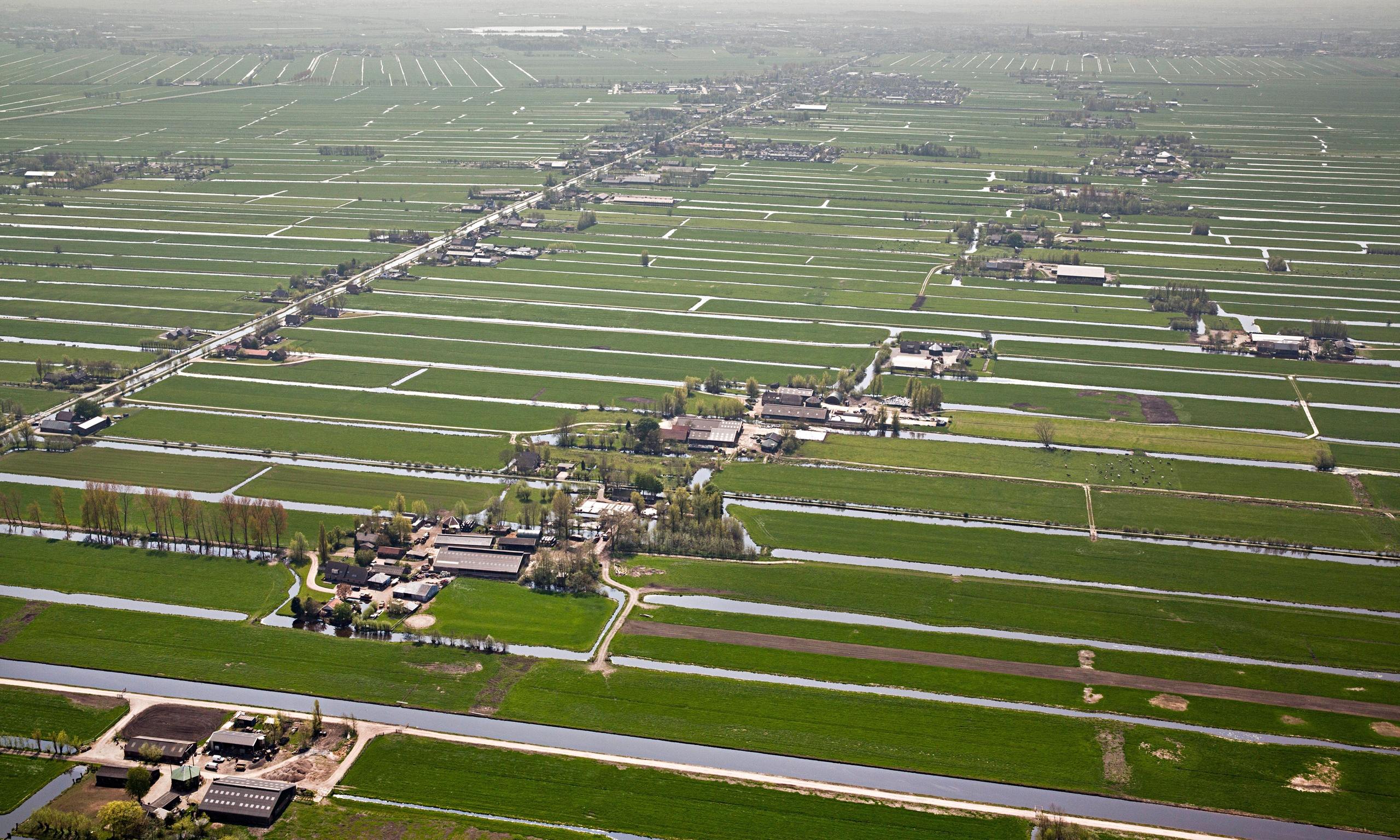
The Dutch solution to floods: live with water, don’t fight it. The same thing applies to climate change.

Recently visiting again in the Netherlands, I was reminded that adapting is the only way to contend with natural forces. Praying or paying indulgences like carbon taxes does not stop nature, so we humans must prepare for the most probable extremes that can come our way.

Top-down, global initiatives like the IPCC and the Paris Accord are called “Mitigation”, an attempt to prevent warming of temperatures by reducing fossil fuel emissions. In fact, the 1 degree Celsius warming over the past 150 years has been a blessing for human civilization, and a further 1 degree will also be beneficial.

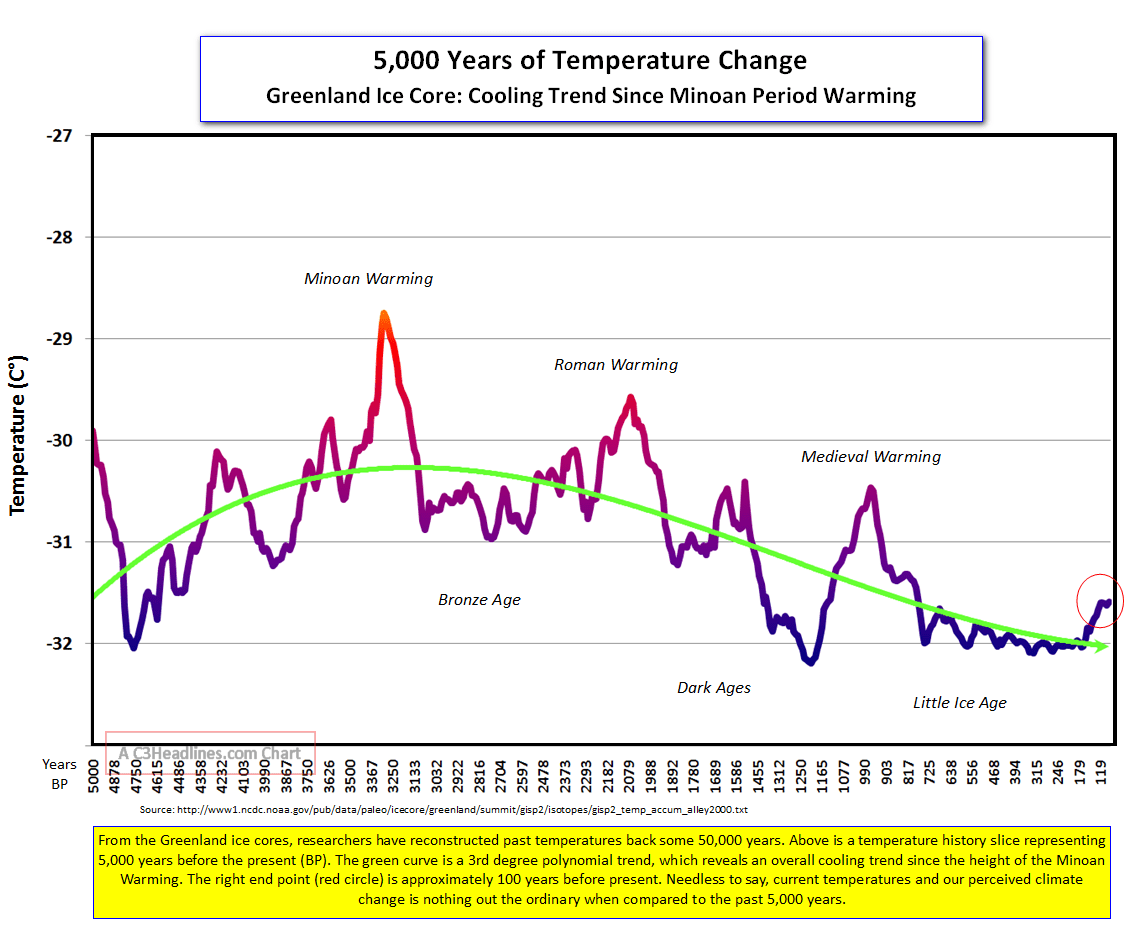
It was warmer than now in the Medieval Warm Period, warmer still in the Roman Warm Period, and warmest of all in the Minoan Warm Period.  Before that was the Holocene Optimum lasting many centuries with still higher temperatures.  Evidence indicates that 7000 years ago the Sahara desert was a savannah with several large lakes.  Human life and the biosphere prosper in warm ages, and we are presently sub-optimal. Cold is the greatest threat to the biosphere and the longer term trend is in that direction.

Even in the unlikely event that the Paris Accord results in lowering emissions, it is additionally uncertain how temperatures will be affected. It is rational to argue that we should burn more fossil fuels if we are sure that warming will result.

In any case, leaders and alarmists have in the past repeatedly declared deadlines for stopping climate change (oh, what hubris). With Trump’s election there is now the opportunity for rational climate policy. History shows us that there will be future periods both warmer and colder than the present, and prudent policy makers should prepare for both.

Trump and his advisers should not cede the high ground to climatists. Instead this administration should announce that it is serious about protecting the American people against future climate extremes, especially the cold.

The US has been blessed recently with tranquility instead of typical levels of hurricanes and tornadoes. That can not be expected to continue, and the first priority is to rebuild a robust infrastructure, suitable to at least confront a return of 1950’s weather. I am pleased to see PE Trump already talking about this.

The second key to adapting is ensuring reliable and affordable energy. It is now obvious that electrical power grids are crippled by shackling them with intermittent, expensive feed-ins from windmills and solar panels. Rational energy policy will rely on clean coal, nuclear and hydro for electricity, oil and gas for transportation, with various other energy sources added on when and where they make economic sense. It appears Trump’s advisers are also on top of this priority.

Let them not say they will do nothing about climate change;  they will do the only thing that makes sense.  Trump has the potential to become the real environmental president, who makes the EPA get results on its real mission: Clean Air and Clean Water without actual pollutants.

More on Dutch Adaptation:

“The Dutch are extremely proud of their water management and we have eight million people [almost half the population] living below sea level who depend on it. We have learned a lot from floods in the past, especially from 1953, the big flood which Britain also had, when we had a lot of damage and 1,800 casualties. We started the delta programme then and put a lot of flood protection in place.

“Our organisation is very important. We have regional water boards with their own tax system who are in charge of dredging and of the programmes of dyke maintenance. We have adapted climate change into urban planning, and development on flood plains has not been allowed since the 80s. More and more we are working with nature – on the coast, management is about building up the sand dunes and beaches.

More evidence that Adapting Works, Mitigating Fails


Petroleum Age Just Beginning

Activists often say to stop burning fossil fuels now because we will run out soon anyway. In fact, we are only starting to tap into such fuel resources. From the Scientific American blog (here):

The Age of Cheap Oil and Natural Gas Is Just Beginning

We believe the period of excessively high oil prices has come to an end. The international spread of two revolutions will assure much ampler oil supplies, and will deliver prices far below the highs that reigned between the end of 2010 and mid-2014.

Beginning less than a decade ago, the shale revolution – a result of technological breakthroughs in horizontal drilling and fracking – has turned the long run declining oil production trends in the US into rises of 88% from 2008 to 2015. Despite current low prices and the damage done to profits, an exceedingly high rate of productivity improvements in this relatively new industry promises to strengthen the competitiveness of shale output even further.

A series of environmental problems related to shale exploitation have been identified, most of which are likely to be successfully handled as the infant, “wild west” industry matures and as environmental regulation is introduced and sharpened.

Geologically, the US does not stand out in terms of shale resources. A very incomplete global mapping suggests a US shale oil share of no more than 17% of a huge geological wealth, widely geographically spread. Given the mainly non-proprietary shale technology and the many advantages accruing to the producing nations, it is inevitable that the revolution will spread beyond the US.

We have assessed the prospects of non-US shale oil output in 2035, positing that the rest of the world will by then exploit its shale resources as successfully as the US has done in the revolution’s first ten years. This would yield rest of world output of 20 million barrels per day in 2035, which is similar to the global rise of all oil production in the preceding 20 years – a stunning increase with far-reaching implications in many fields.

Another related revolution is beginning to see the light of the day, but news about it has barely reached the media. It is being gradually realized that advancements in horizontal drilling and fracking, technologies normally associated with shale, can also be applied to fuller extraction from conventional, but old and tired, oil fields. If the rest of the world applies these techniques to conventional oil, as the US has done in recent years, this would yield a further addition of conventional oil amounting to 20 million barrels per day by 2035.

By Marian Radetzki, Roberto F. Aguilera on May 3, 2016
“The views expressed are those of the author(s) and are not necessarily those of Scientific American”  (Anyone surprised? At least they allowed publication)

Historical Background

Dr. David Deming provides the historical context (here)

Peak Oil is the theory that the production history of petroleum follows a symmetrical bell-shaped curve. Once the curve peaks, decline is inevitable. The theory is commonly invoked to justify the development of alternative energy sources that are allegedly renewable and sustainable.

It’s time to consign Peak Oil theory to the dust bin of history. The flaw of the theory is that it assumes the amount of a resource is a static number determined solely by geological factors. But the size of an exploitable resource also depends upon price and technology. These factors are difficult to predict.

The U.S. oil industry began in 1859 when Edwin Drake hired blacksmith Billy Smith to drill a 69-foot-deep well. Subsequent technological advances have opened up resources beyond the limits of our ancestors’ imaginations. We can drill offshore in water up to 8,000 feet deep. We have enhanced recovery techniques, horizontal drilling and four-dimensional seismic imaging. Oklahoma oilman Harold Hamm is turning North Dakota into Saudi Arabia by using hydraulic fracturing technology. U.S. oil production has reversed its 40-year decline. By the year 2020, it is anticipated that the U.S. will be the world’s top oil producer.

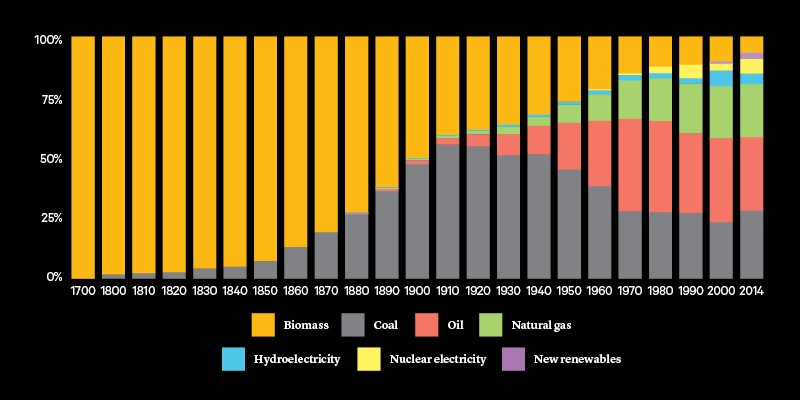
Share of Fuels in the Global Energy Mix Across Modern History

Nine years ago, I predicted that the age of petroleum has only just begun. I was right. The Peak Oil theorists, the malthusians and the environmentalists were all wrong. They’ve been proven wrong, over and over again, for decades. A tabulation of every failed prediction of resource exhaustion would fill a library.

Sustainability is a chimera. No energy source has been, or ever will be, sustainable. In the 11th century, Europeans anticipated the industrial revolution by transforming their society from dependence on human and animal power to water power. In the 18th century, water power was superseded by steam engines fired by burning wood. Coal replaced wood, and oil and gas have now largely supplanted coal. In the far distant future we’ll probably use some type of nuclear power. But for at least the next hundred years, oil will remain our primary energy source because it’s abundant, inexpensive and reliable.

Summary

Petroleum is the lifeblood of our industrial economy. The U.S. economy will remain stagnant and depressed until we begin to aggressively develop our native energy resources. As Hamm has said, “We can do this.” What’s stopping us isn’t geology. What’s stopping us is ignorance and bad public policy.

Deming is a geologist with a Ph.D in geophysics  and an associate professor of arts and sciences at the University of Oklahoma.

Updated Ontario Jammed by Rent-Seekers and Ratepayers

October 14, 2016 Update

Windstream Energy awarded damages after Ontario cancels wind farm project
from the Globe and Mail

Looking at the leaked news from the NAFTA tribunal, the damages of $25M plus $3M legal costs are much less than the $568M claimed by Windstream (US company) following a 2011 cancellation of a Lake Ontario wind farm. As has been discussed in a previous post Electrical Madness in Green Ontario, the long-term costs from these ill-advised renewable energy projects far exceed the costs of this judgment, if it stands as reported.

Post from Sept. 24, 2016

Green economics was on full display this week when the Ontario provincial government decided to cancel contracts for additional electrical power from renewables, such as those previously offered in March 2016.

Definition of Rent-Seeking, noun (economics):

the act or process of using one’s assets and resources to increase one’s share of existing wealth without creating new wealth.

(specifically) the act or process of exploiting the political process or manipulating the economic environment to increase one’s revenue or profits.

Definition of Ratepayer:

a person who pays a regular charge for the use of a public utility, as gas or electricity, usually based on the quantity consumed.

The background of this predicament is here Electrical Madness in Green Ontario.

Ratepayers are Fed Up

Feed-in tariffs for 20-year renewable power contracts have the ratepayers outraged, as voiced by the opposition (CBC):

“This government has plowed ahead for years signing contracts for energy we simply do not need,” said Opposition Leader Patrick Brown. “The premier has become the best minister of economic development that Pennsylvania and New York has ever seen.”

The Tories used virtually all their time in question period talking about individuals and business owners struggling with soaring electricity rates, and claimed Thibeault’s cancellation announcement was an admission by the Liberals that their green energy policies were misguided.

“It’s bad policy,” said Brown. “I just wish at this point, now that they’ve acknowledged that they’ve made a mistake, that they would apologize. They made a huge mistake on the energy file and everyone in Ontario is paying for it.”

Mr. Thibeault said contracts signed in an earlier green-energy procurement will be honoured. In March, the province reached 16 deals with 11 firms to build wind, solar and hydroelectric projects for a total of 455 megawatts of new capacity. The negotiated prices were much lower than earlier fixed-price contracts for renewables because of the competitive bidding.

Ontario already has more than 4,000 MW of wind capacity and 2,000 of solar power.

The Liberal government has been under pressure from the opposition and rural residents who oppose wind farms to scale back its renewable plans and to find a way to trim increases in electricity prices.

Rent-Seekers Push Back

Renewables lobbyists are defending their interests (Globe and Mail):

But the cancellation was a shock to the renewable-energy industry, which was counting on the new program, which would have awarded contracts for about 1,000 MW of projects in 2018.

John Gorman, president of the Canadian Solar Industries Association, said the decision could hurt manufacturers and installers of solar product in the province just as they are becoming significant global competitors.

Robert Hornung, president of the Canadian Wind Energy Association, said the wind industry is “shocked and extremely disappointed.”

Lobby group Environmental Defence called the cancellation “short-sighted” and said this is “exactly the wrong time to put the brakes on renewable energy.”

Etc., Etc.

Summary

Several rent-seekers as well as the Energy Minister said renewable prices were coming down, but didn’t say they are still several multiples of the $23/MWh Ontario wholesale price. Nor did anyone point out the cancellation is only avoiding a future rate increase, not bringing rates down.  The politics have forced the administration into promising an 8% cut in consumer electricity rates, and it can only come from reducing the subsidies. Hence the howling.

286fd-7_50286

For More on Wind Power problems:  Climateers Tilting at Windmills

Mad Hatters’ Energy Subsidies Abuse


The recent G20 summit took on the appearance of the Mad Hatter’s tea party (Alice in Wonderland) when the G7 produced a statement saying they are committed to ending “fossil fuel subsidies.” Terence Corcoran of Financial Post (here) on the fossil fuels subsidies folly.

In a sensational bit of reportorial distortion and ignorance, CBC News on Thursday reported that Canada and other G20 nations are “spending US$452-billion a year subsidizing their fossil fuel industries.”

The number comes from Oil Change International, one of scores of front organizations funded by an unholy cabal of activist U.S. foundations — Tides, Hewlitt, Oak, Rockefeller — whose billion-dollar cash pools are being mobilized to rid the world of fossil fuels and reduce the world’s population of messy people. The $452-billion was described as “shocking” by Oil Change activist Alex Doukas, especially since the objective of the Paris climate summit is to have most of the world’s oil and gas reserves “stay in the ground.”

Where Energy Subsidies Actually Go–The US Example

WHAT’S THE TRUE COST OF WIND POWER? by Randy Simmons at Newsweek

The high costs of federal subsidies and state mandates for wind power have not paid off for the American public. According to the Mercatus Center at George Mason University, wind energy receives a higher percentage of federal subsidies than any other type of energy while generating a very small percentage of the nation’s electricity.

In 2010 the wind energy sector received 42% of total federal subsidies while producing only 2% of the nation’s total electricity. By comparison, coal receives 10% of all subsidies and generates 45% and nuclear is about even at about 20%.

But policymakers at the federal and state level, unfortunately, have decided that the American people will have renewable energy, no matter how high the costs. As a result, taxpayers will be stuck paying the cost of subsidies to wealthy wind producers.

Meanwhile, electricity consumers will be forced to purchase the more expensive power that results from state-level mandates for renewable energy production. Although such policies may be well intended, the real results will be limited freedom, reduced prosperity and an increasingly unreliable power supply.

Back to Basic Terms

Climate activists and renewables lobbyists are acting like Mad Hatters, twisting language and logic to pursue their agendas. Let there be some common sense injected here.

A subsidy would be when the government takes money that has been taxed, borrowed, or printed, and pays it to some company like Solyndra to do something that the market does not support. Often these subsidies subsidize technologies that do not exist and may never exist (and they say WE ignore the laws of physics.)

In contrast, a tax reduction is NOT a subsidy. A tax credit says an industry gets to keep more of its own money that it has produced selling a product people want and need in the free market.

There is a huge difference between a law that lets you keep more of your own money; and another law that actually gives you someone else’s money. The two are not the same thing. Actually, the oil industry pays higher taxation rates than other industries and subsidizes the government with the billions it pays in taxes, not the other way around.

There are also billions more in economic benefit to the nation from the jobs they create and the increased mobility and productivity people enjoy by using our transportation system based on hydrocarbon fuels.

Summary

The Mad Hatters turn things upside down. Society is subsidized and made wealthy by fossil fuels, not the other way around. Some of that wealth is being diverted to renewable energy companies who do not create enough value to be in business without direct payments of tax dollars. They prove it by declaring bankruptcy when their subsidies are reduced.  Worse, hooking up wind and solar intermittent power to electrical grids adds more cost and unreliability than the renewable power is worth.

Read More about Energy Subsidies Abuse

The Appalling Truth About Energy Subsidies at Euan Mearns

Renewable Energy Cost Explosion: €25,000 euros for each German family of four  Daniel Wetzel, Die Welt (translation by GWPF)

What’s an Oil Subsidy? Heritage Foundation

Net Subsidy Analysis: A Better Way to Assess Government Energy Policy MasterResource

Why the Best Path to a Low-Carbon Future is Not Wind or Solar Power Brookings Institution

Killing the Energy Goose Science Matters

At its prime, the Carrizo Plain (S. California) was by far the largest photovoltaic array in the world, with 100,000 1′x 4′ photovoltaic arrays generating 5.2 megawatts at its peak. The plant was originally constructed by ARCO in 1983 and was dismantled in the late 1990s. The used panels are still being resold throughout the world.

At its prime, the Carrizo Plain (S. California) was by far the largest photovoltaic array in the world, with 100,000 1′x 4′ photovoltaic arrays generating 5.2 megawatts at its peak. The plant was originally constructed by ARCO in 1983 and was dismantled in the late 1990s. The used panels are still being resold throughout the world.


Pipeline Wake up Call

Rolling gas shortages could stymie Thanksgiving travel plans for Ontarians (link to CBC)
‘A lot of gas stations going forward are going to have to scramble to get their gasoline,’ fuel expert says

It’s one the busiest travel weekends of the year, but Ontario is running low on fuel thanks to repair work on major pipelines — and the shortage could last beyond Thanksgiving Monday. 

The shortage stems from repairs to the Trans-Northern Pipeline, ordered by the National Energy Board (NEB), which called for a further 10 per cent restriction to the pipeline’s total pressure. And that’s causing the pressure to build for drivers counting on gassing up at the pump for weekend travel.

What’s the Wakeup Call?

Pipelines remain the safest, most efficient and environmentally friendly way to transport fossil fuels. The regulatory body is doing their job and forcing a temporary restriction on the flow of gasoline to ensure long-term safety of pipeline operations. The scramble over 10% petrol shortages in metropolitan Toronto is just a hint of what can be expected if Greens have their way and ”Leave It in the Ground.” Be careful what they wish for, unless you also want to stop mobility for everyone and everything.

Quick Facts from the NEB Order (here)

The NEB has issued an Amending Safety Order to TNPI that consolidates three previous Safety Orders issued between 2009 and 2010.

  • None of the overpressure incidents posed an imminent public safety or environmental risk.
  • Operating a pipeline within its approved pressure range is an NEB regulatory requirement.
  • The NEB takes safety and environmental protection seriously and took action to ensure TNPI completes all requirements.

“Trans-Northern will continue to be vigilant in its monitoring and maintenance activities, including operating below approved pressure ranges until we are confident the pipeline can return to full capacity,” said Jackie Medeiros of Hill and Knowlton Strategies.

The company operates approximately of 915 kilometres of pipeline that supplies gasoline, jet fuel and fuel oil from refineries in Ontario and Quebec across Montreal and the Greater Toronto Area.

“A lot of gas stations going forward are going to have to scramble to get their gasoline…It won’t be everyone at the same time but this could go on for several weeks.”  In the meantime, fuel expert Dan McTeague of GasBuddy.com predicts rolling shortages from Ottawa to Sudbury to Hamilton.
Repair work on the pipeline is expected to last into 2017, meaning more shortages could be on the horizon.

Climate activist dream come true.

A number of Toronto gas stations are cordoned off with yellow tape as a gasoline shortage has forced them to temporarily shut down.  It is a Climate Activist’s dream come true.


Political Climate Action

The current world political climate is shame-and-blame in order to gain approvals for the Paris accord. Thus pressure is applied to political officials at every level to show their colors on acting to “fight climate change.”

For example, Hillary declared to great applause: “I believe in Science.” (I don’t know where to start on that.) This week Canada PM Trudeau announced he would impose a federal carbon tax of $10 a tonne starting in 2018, rising to $50 a tonne in 2022 on any province that did not enact its own equivalent carbon pricing. Several provincial premiers walked out at that point, disappointed that collaboration and consensus-building had only one predetermined outcome.

There is no place to hide these days, and politicians who have a rational position on climate science (in contrast to Hillary) had better legislate on the issue. A common sense legislative motion could read something like this (followed by supporting documentation and references).

Whereas, Extent of global sea ice is at or above historical averages;

Whereas, Populations of polar bears are generally growing;

Whereas, Sea levels have been slowly rising at the same rate since the Little Ice Age ended 150 years ago;

Whereas, Oceans will not become acidic due to buffering from extensive mineral deposits and marine life is well adapted to pH fluctuations that do occur;

Whereas, Extreme weather events have not increased in recent decades and such events are more associated to periods of cooling rather than warming;

Whereas, Cold spells, not heat waves, are the greater threat to human life and prosperity;

Therefore, This chamber agrees that climate is variable and prudent public officials should plan for future periods both colder and warmer than the present. Two principle objectives will be robust infrastructure and reliable, affordable energy.

Comment:

The underlying issue is the assumption that the future can only be warmer than the present. Once you accept the notion that CO2 makes the earth’s surface warmer (an unproven conjecture), then temperatures can only go higher since CO2 keeps rising. The present plateau in temperatures is inconvenient, but actual cooling would directly contradict the CO2 doctrine. Some excuses can be fabricated for a time, but an extended period of cooling undermines the whole global warming mantra.

It’s not a matter of fearing a new ice age. That will come eventually, according to our planet’s history, but the warning will come from increasing ice extent in the Northern Hemisphere. Presently infrastructures in many places are not ready to meet a return of 1950s weather, let alone something unprecedented.

Public policy must include preparations for cooling since that is the greater hazard. Cold harms the biosphere: plants, animals and humans. And it is expensive and energy intensive to protect life from the ravages of cold. Society can not afford to be in denial about the prospect of the current temperature plateau ending with cooling.

Footnote:

The Trudeau initiative is an example of the alternative to legislating a rational position. It is virtue-signalling by adopting a token carbon price, which will not lower CO2 concentrations, nor reduce temperatures. The tax will enrich government coffers, which is a key motivation for politicians hiding behind this noble cause.

In 2015, gasoline taxes in Canada represented on average 38.5 cents per litre, which is approximately 35% of the pump price. That includes 10¢/litre federal tax, provincial fuel taxes ranging from 6 to 19 ¢/litre, plus sales taxes. Taxing at $10 a tonne starting in 2018 would add a carbon tax on top as shown below:

Fuel Type UNITS FOR TAX 2018 Added Tax
Gasoline ¢/litre 2.22
Diesel (light fuel oil) ¢/litre 2.56
Jet Fuel ¢/litre 2.61
Natural Gas ¢/litre 1.90
Propane ¢/litre 1.54
Coal – high heat value $/tonne 20.77
Coal – low heat value $/tonne 17.77

These pennies added on top will not change behavior, but millions of consumers’ dollars will be skimmed in a hidden way, including rising transportation costs of everything.

If this was anything other than a tax grab, they would do one or both of two things:

  • Make the tax revenue neutral by paying the monies collected back to consumers; and
  • Make the increases in the carbon tax rate conditional upon rising temperatures as measured by satellites. (as proposed by economist Ross McKitrick)

fuel-tax