Time to Cross Examine Climatists

Kurt Schlichter explains at Town Hall Cross-Examining the Climate Change Cultists.  Excerpts in italics with my bolds and added images.

Well, I’m a lawyer. I question scientists for a living.

Now, I have no scientific training to speak of. I majored in communications and political science, so the only science I studied at UC San Diego had to do with the physics of foaming when I poured Coors into a glass, as well as the mechanics of human reproduction. Don’t expect me to discourse deeply on the heat retention coefficient of CO2 – I don’t even know if that is a thing, but it sure sounds sciency.

Instead, I hire scientists in most every case I try. Sometimes I hire several in different disciplines. The other side does too, and here’s the weird thing – at trial, the other side’s scientists always, always, disagree with my scientists.

A smart attorney wants a scientist who tells you what he really thinks and who has a solid, rational basis for his conclusions. You need to know if your case is strong or weak – if it is weak, you want to resolve it before trial.

But the fact is that two scientists with good credentials can look at the same set of facts and come to different conclusions. This happens all the time. So, how do you know which one is right?

Well, that’s where the lawyer magic comes in. See, our job is to punch some holes in what the other side’s scientists say. That’s what a lawyer does, and it is critical to the pursuit of truth. You have to test the testimony, because otherwise it is just a one-sided monologue. You know, like the cross-examination-free January 6th Kongressional Kangaroo Kommittee. Those amphibians made sure there was no cross-examination because they did not want their phony case questioned.

You want a lawyer who, besides making his own case,
takes the evidence from the other side and slices and dices it.

Cross-examination, it has been said, is the greatest engine for the discovery of the truth man has yet created. And when someone wants to prevent vigorous, even brutal cross-examination of his case, that’s a giveaway that it is weak.
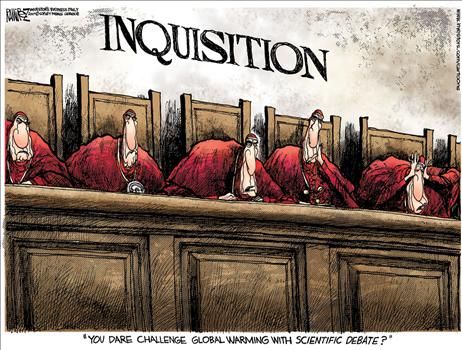
And I’m looking at the climate change hoax. The weather cultists even have a uniquely dumb and offensive slur for people who dare test their evidence, such as it is: “Denier.”

The art of cross-examination is designed to illuminate the reasons not to believe the other side.

Expose the Bias

The actual order you do a cross in varies, but let’s start with attacking bias. Bias is huge. Bias is any interest in the testimony outside of simply offering the truth for the truth’ sake. If a person has an interest in a particular answer, then his testimony in support of that answer is questionable. Is he getting paid by someone with an interest in his answer? That can show bias. In the climate arena, is he getting climate change grants? Remember, it’s not just getting hired but the potential for getting fired that can show bias. “Assistant Professor Warmingnut, in fact, if you were opposed to the idea of human-caused global warming being an existential threat, you would have zero chance of ever getting tenure as a full professor at the University of College, correct?”

An awful lot of these science folk have a huge personal interest in providing a pro-climate hysteria answer, whether from gaining cash to saving their careers. And that matters. But for some reason we are not supposed to point that out because scientists are these neutral monks without human drives like greed, fear, and pride. Hang around some scientists for a while and see if you buy that.

Bore into the Supporting Foundation

Then you would test the foundation that supports their conclusion. You might point out that we have only a human temperature record going back a few hundred years. You could also point out the “heat sink” issue – urban areas tend to retain more warmth than rural areas, and measurements are often closer to urban areas than out in the boonies. They would talk about tree rings and ice cores and such, but you would point out that these are not direct evidence of the temperature like directly measuring it is – we think we can extrapolate from them how hot it was in 2000 BC, but it is really only an educated guess. And then you might question the various adjustments to the raw data that they make before presenting it.
 

Challenge the Conclusions Directly

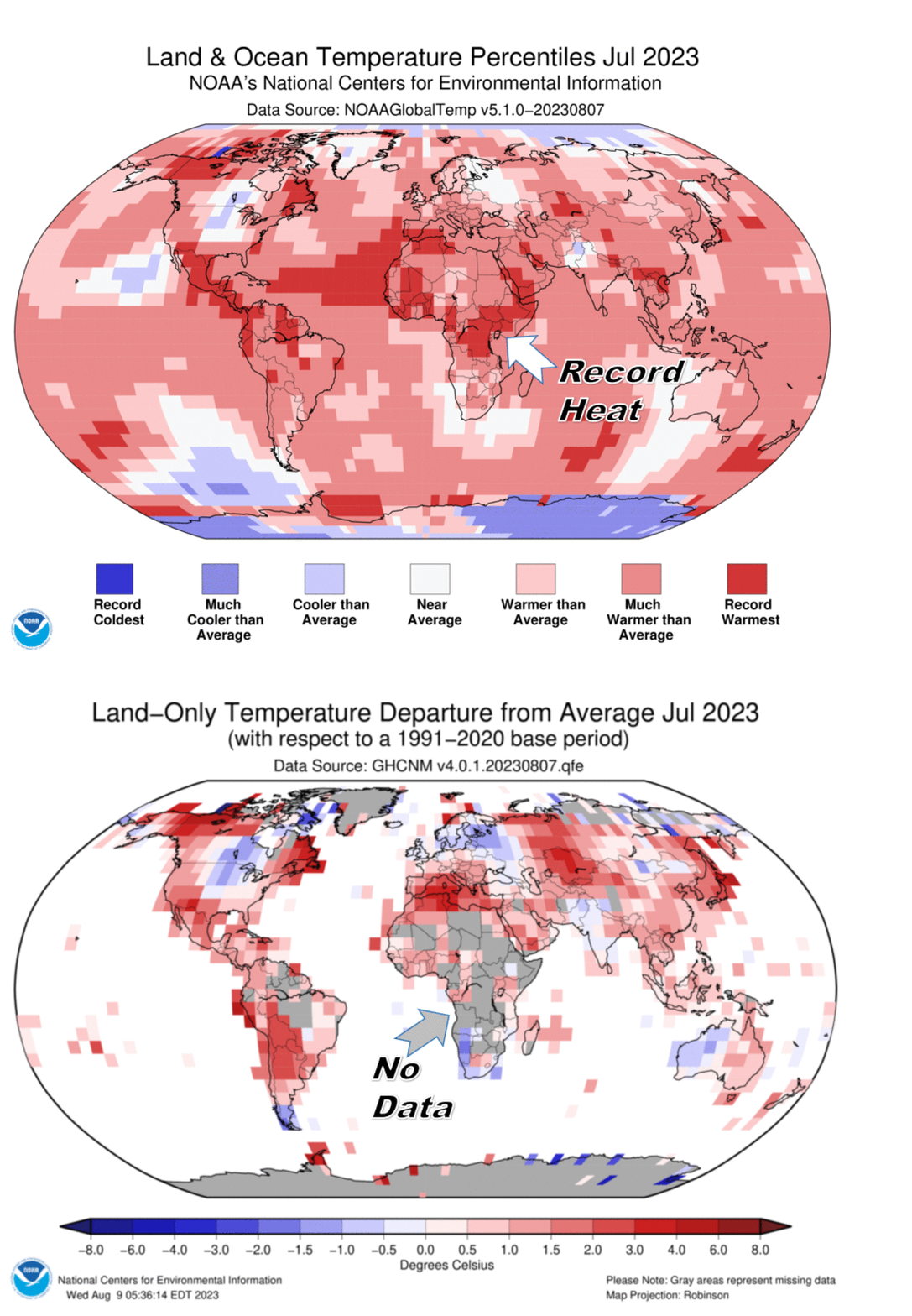
You would also want to cross-examine the conclusions themselves. It’s pretty popular to claim that the recent heatwave in Europe proves global warming. But then, why doesn’t a cold wave disprove it? In fact, what set of facts would disprove the climate change theory? Isn’t the scientific method about generating a theory for a phenomenon and then testing it by trying to find facts that disprove it? So, what would disprove global warming?

None, of course. Everything always proves it. How sciency!

And while we are at it, since “global warming” has been replaced by “climate change,” what, precisely, is the climate we need to maintain? What is the “correct” temperature? Is the goal to stop all climate change? Do we need to counteract natural climate change? You do agree that climate does change naturally, right? All those Americans with those SUVs and BBQs were thousands of years from coming into being when the ice age happened, so what caused that? And what caused the subsequent global warming after it? Are those same phenomena absent today? If not, how much are they causing now?

There are lots of nits to pick. How about the constantly retreating goalposts? What is the current climate apocalypse deadline? Didn’t Al Gore tell us in the 2000s that we would be suffering a climate catastrophe right now in 2022? Florida is still above water, right? So, the scientists Al listened to were wrong, weren’t they? So, Dr. Warmingnut, you concede that scientists have been wrong about climate? The ones in the seventies projecting another ice age in a decade were wrong, correct? So why are the scientists today right?

Object to Adverse Implications

And then cover the implications. So, you are recommending a pretty radical program of ending the use of fossil fuels and getting rid of cows because they tend to act like Eric Swalwell in order to treat global warming? So, what, exactly, will be the effect of America doing that on the global part of the warming issue? Will it matter what America and Europe do if India and China maintain their current carbon footprints? And how much, in dollars and disruption, will your remedies cost? How does that compare to the cost of ameliorating some climate change effects like higher ocean levels and hotter temperatures?

And then you need to point out some macro issues with questions on the real agenda. So, Dr Warmingnut, can you name a single major climate change remedial initiative, such as higher taxes and increased bureaucratic authority, that does not correspond to something the political left wants to do anyway? Can you name one climate remedial initiative that supports a conservative objective? Does it strike you as odd that the people supporting climate change wanted all the things they now demand because of climate change long before climate change became a thing?

And does it seem strange to you that climate advocates like John Kerry are zipping across the Atlantic to party in Davos and folks like Barack Obama are buying beachfront property if this is an existential crisis?

I know, I know, shut up, denier!

I’m not a scientist. But I am a lawyer. My job is to dig out the truth through cross-examination. And it seems very telling that the climate change hoaxers are desperate to avoid any examination of their ridiculous assertions at all.
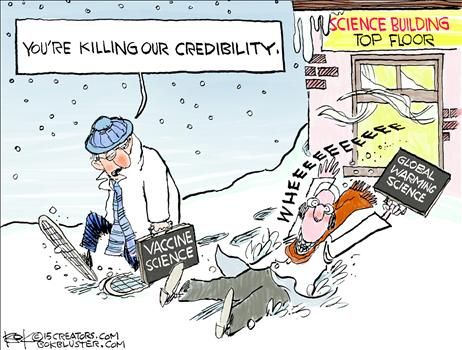
Footnote:  Jason Johnson wrote an extensive cross examination of global warming/climate change, pdf available here:   Global Warming Advocacy Science: A Cross Examination

Scientists who have been leaders in the process of producing these Assessment Reports (“AR’s”) argue that they provide a “balanced perspective” on the “state of the art” in climate science, with the IPCC acting as a rigorous and “objective assessor” of what is known and unknown in climate science. Legal scholars have accepted this characterization, trusting that the IPCC AR’s are the product of an “exhaustive review process” – involving hundreds of outside reviewers and thousands of comments. 

It is virtually impossible to find anywhere in the legal or the policy literature on global warming anything like a sustained discussion of the actual state of the scientific literature on ghg emissions and climate change. Instead, legal and policy scholars simply defer to a very general statement of the climate establishment’s opinion (except when it seems too conservative), generally failing even to mention work questioning the establishment climate story, unless to dismiss it with the ad hominem argument that such work is the product of untrustworthy, industry-funded “skeptics” and “deniers.”

This paper constitutes such a cross-examination. As anyone who has served as an expert witness in American litigation can attest, even though an opposing attorney may not have the expert’s scientific training, a well prepared and highly motivated trial attorney who has learned something about the technical literature can ask very tough questions, questions that force the expert to clarify the basis for his or her opinion, to explain her interpretation of the literature, and to account for any apparently conflicting literature that is not discussed in the expert report. My strategy in this paper is to adopt the approach that would be taken by a non-scientist attorney deposing global warming scientists serving as experts for the position that anthropogenic ghg emissions have caused recent global warming and must be halted if serious and seriously harmful future warming is to be prevented – what I have called above the established climate story.

See also Critical Climate Intelligence for Jurists (and others)
 

Ocean SSTs Stay Mild June 2022


The best context for understanding decadal temperature changes comes from the world’s sea surface temperatures (SST), for several reasons:

  • The ocean covers 71% of the globe and drives average temperatures;
  • SSTs have a constant water content, (unlike air temperatures), so give a better reading of heat content variations;
  • A major El Nino was the dominant climate feature in recent years.

HadSST is generally regarded as the best of the global SST data sets, and so the temperature story here comes from that source. Previously I used HadSST3 for these reports, but Hadley Centre has made HadSST4 the priority, and v.3 will no longer be updated.  HadSST4 is the same as v.3, except that the older data from ship water intake was re-estimated to be generally lower temperatures than shown in v.3.  The effect is that v.4 has lower average anomalies for the baseline period 1961-1990, thereby showing higher current anomalies than v.3. This analysis concerns more recent time periods and depends on very similar differentials as those from v.3 despite higher absolute anomaly values in v.4.  More on what distinguishes HadSST3 and 4 from other SST products at the end. The user guide for HadSST4 is here.

The Current Context

The 2021 year end report included below showed rapid cooling in all regions.  The anomalies then continued in 2022 to remain near the mean since 2015.  This Global Cooling was also evident in the UAH Land and Ocean air temperature ( Tropics Lead Remarkable Cooling June 2022 )

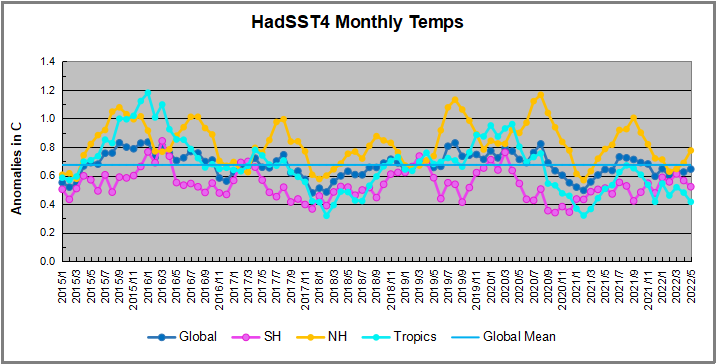
The chart below shows SST monthly anomalies as reported in HadSST4 starting in 2015 through June 2022.  A global cooling pattern is seen clearly in the Tropics since its peak in 2016, joined by NH and SH cycling downward since 2016. 

Note that higher temps in 2015 and 2016 were first of all due to a sharp rise in Tropical SST, beginning in March 2015, peaking in January 2016, and steadily declining back below its beginning level. Secondly, the Northern Hemisphere added three bumps on the shoulders of Tropical warming, with peaks in August of each year.  A fourth NH bump was lower and peaked in September 2018.  As noted above, a fifth peak in August 2019 and a sixth August 2020 exceeded the four previous upward bumps in NH. A smaller NH rise in 2021 peaked in September of that year.

After an upward bump in August, the 2021 yearend Global temp anomaly dropped below the mean, driven by sharp declines in the Tropics and NH. Now in 2022 all regions remain cool and the Global anomaly remains lower than the mean for this period. Despite an upward bump May and June in NH, other regions remained cool leaving the Global anomaly little changed. This year the summer NH upward bump is not joined by warming in the Tropics.

A longer view of SSTs

To enlarge, double click or open image in new tab.

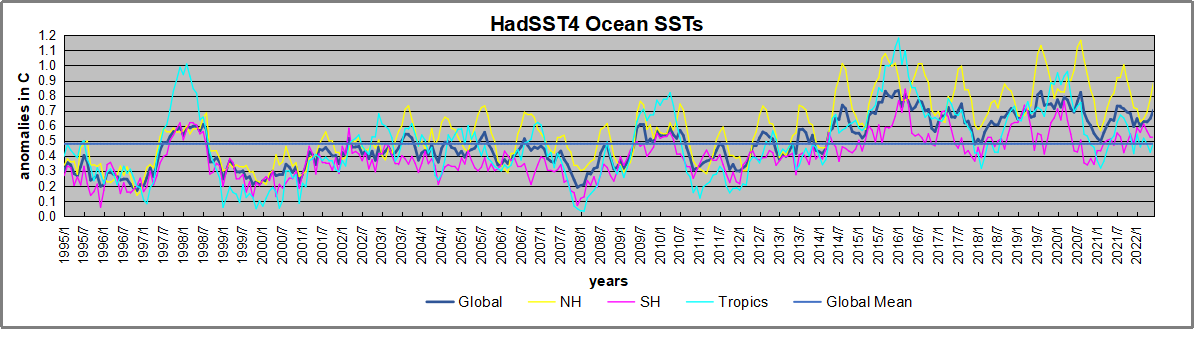
The graph above is noisy, but the density is needed to see the seasonal patterns in the oceanic fluctuations.  Previous posts focused on the rise and fall of the last El Nino starting in 2015.  This post adds a longer view, encompassing the significant 1998 El Nino and since.  The color schemes are retained for Global, Tropics, NH and SH anomalies.  Despite the longer time frame, I have kept the monthly data (rather than yearly averages) because of interesting shifts between January and July.1995 is a reasonable (ENSO neutral) starting point prior to the first El Nino.  The sharp Tropical rise peaking in 1998 is dominant in the record, starting Jan. ’97 to pull up SSTs uniformly before returning to the same level Jan. ’99.  For the next 2 years, the Tropics stayed down, and the world’s oceans held steady around 0.5C above 1961 to 1990 average.

Then comes a steady rise over two years to a lesser peak Jan. 2003, but again uniformly pulling all oceans up around 0.5C.  Something changes at this point, with more hemispheric divergence than before. Over the 4 years until Jan 2007, the Tropics go through ups and downs, NH a series of ups and SH mostly downs.  As a result the Global average fluctuates around that same 0.5C, which also turns out to be the average for the entire record since 1995.

2007 stands out with a sharp drop in temperatures so that Jan.08 matches the low in Jan. ’99, but starting from a lower high. The oceans all decline as well, until temps build peaking in 2010.

Now again a different pattern appears.  The Tropics cool sharply to Jan 11, then rise steadily for 4 years to Jan 15, at which point the most recent major El Nino takes off.  But this time in contrast to ’97-’99, the Northern Hemisphere produces peaks every summer pulling up the Global average.  In fact, these NH peaks appear every July starting in 2003, growing stronger to produce 3 massive highs in 2014, 15 and 16.  NH July 2017 was only slightly lower, and a fifth NH peak still lower in Sept. 2018.

The highest summer NH peaks came in 2019 and 2020, only this time the Tropics and SH are offsetting rather adding to the warming. (Note: these are high anomalies on top of the highest absolute temps in the NH.)  Since 2014 SH has played a moderating role, offsetting the NH warming pulses. After September 2020 temps dropped off down until February 2021, then all regions rose to bring the global anomaly above the mean since 1995  June 2021 backed down before warming again slightly in July and August 2021, then cooling slightly in September.  The present 2022 level compares with 2014 and also 2018.

What to make of all this? The patterns suggest that in addition to El Ninos in the Pacific driving the Tropic SSTs, something else is going on in the NH.  The obvious culprit is the North Atlantic, since I have seen this sort of pulsing before.  After reading some papers by David Dilley, I confirmed his observation of Atlantic pulses into the Arctic every 8 to 10 years.

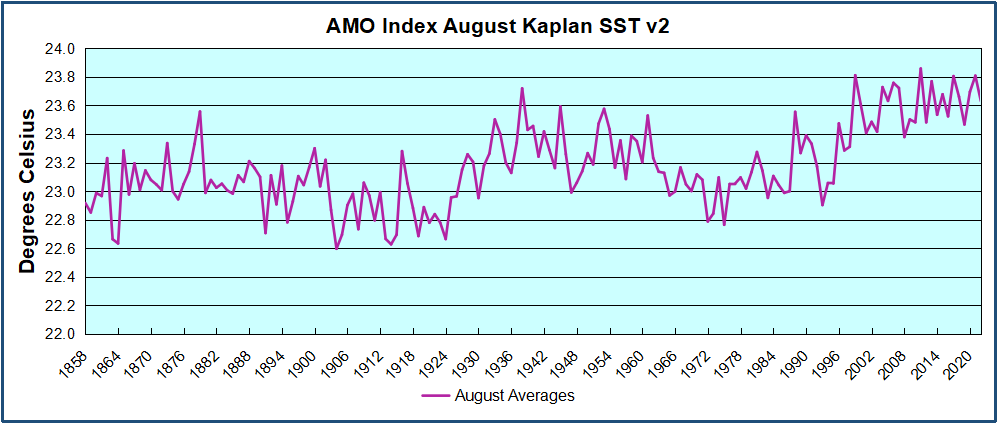
But the peaks coming nearly every summer in HadSST require a different picture.  Let’s look at August, the hottest month in the North Atlantic from the Kaplan dataset.

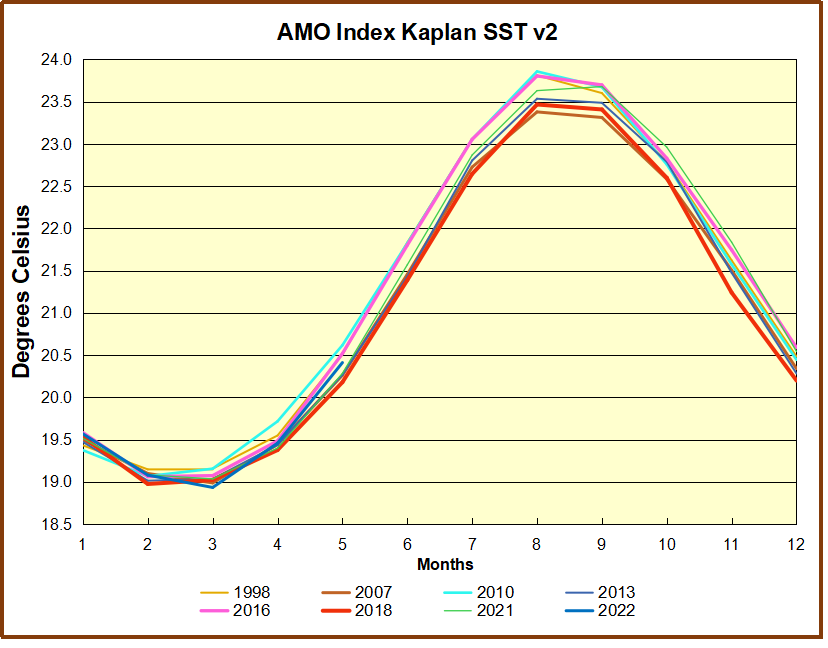
The AMO Index is from from Kaplan SST v2, the unaltered and not detrended dataset. By definition, the data are monthly average SSTs interpolated to a 5×5 grid over the North Atlantic basically 0 to 70N. The graph shows August warming began after 1992 up to 1998, with a series of matching years since, including 2020, dropping down in 2021.  Because the N. Atlantic has partnered with the Pacific ENSO recently, let’s take a closer look at some AMO years in the last 2 decades.

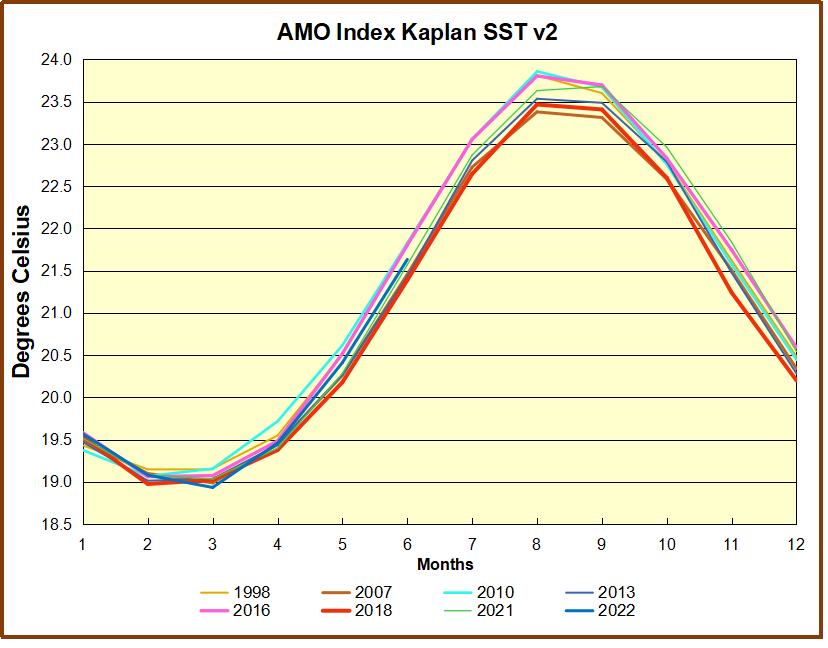
This graph shows monthly AMO temps for some important years. The Peak years were 1998, 2010 and 2016, with the latter emphasized as the most recent. The other years show lesser warming, with 2007 emphasized as the coolest in the last 20 years. Note the red 2018 line is at the bottom of all these tracks. The heavy blue line shows that 2022 started warm, dropped to the bottom and now is in the middle of all the tracks pictured.

Summary

The oceans are driving the warming this century.  SSTs took a step up with the 1998 El Nino and have stayed there with help from the North Atlantic, and more recently the Pacific northern “Blob.”  The ocean surfaces are releasing a lot of energy, warming the air, but eventually will have a cooling effect.  The decline after 1937 was rapid by comparison, so one wonders: How long can the oceans keep this up? If the pattern of recent years continues, NH SST anomalies may rise slightly in coming months, but once again, ENSO which has weakened will probably determine the outcome.

Footnote: Why Rely on HadSST4

HadSST is distinguished from other SST products because HadCRU (Hadley Climatic Research Unit) does not engage in SST interpolation, i.e. infilling estimated anomalies into grid cells lacking sufficient sampling in a given month. From reading the documentation and from queries to Met Office, this is their procedure.

HadSST4 imports data from gridcells containing ocean, excluding land cells. From past records, they have calculated daily and monthly average readings for each grid cell for the period 1961 to 1990. Those temperatures form the baseline from which anomalies are calculated.

In a given month, each gridcell with sufficient sampling is averaged for the month and then the baseline value for that cell and that month is subtracted, resulting in the monthly anomaly for that cell. All cells with monthly anomalies are averaged to produce global, hemispheric and tropical anomalies for the month, based on the cells in those locations. For example, Tropics averages include ocean grid cells lying between latitudes 20N and 20S.

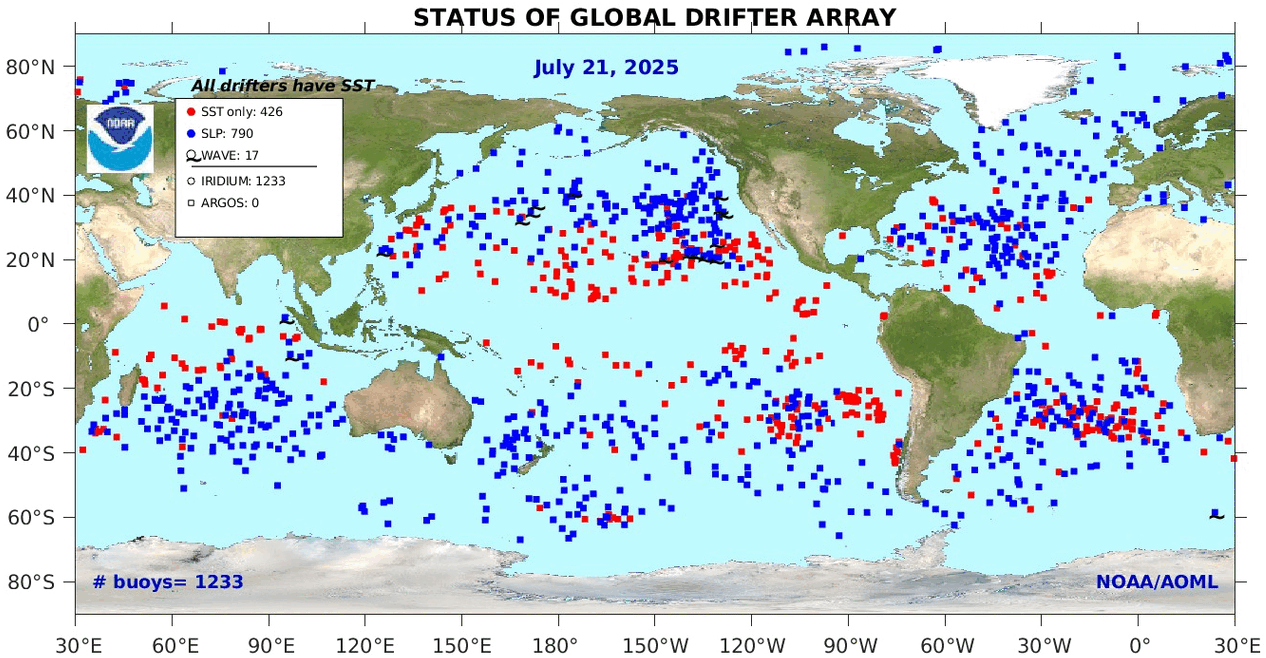
Gridcells lacking sufficient sampling that month are left out of the averaging, and the uncertainty from such missing data is estimated. IMO that is more reasonable than inventing data to infill. And it seems that the Global Drifter Array displayed in the top image is providing more uniform coverage of the oceans than in the past.

uss-pearl-harbor-deploys-global-drifter-buoys-in-pacific-ocean

USS Pearl Harbor deploys Global Drifter Buoys in Pacific Ocean


By the Numbers: CO2 Mostly Natural

This post compiles several independent proofs which refute those reasserting the “consensus” view attributing all additional atmospheric CO2 to humans burning fossil fuels.

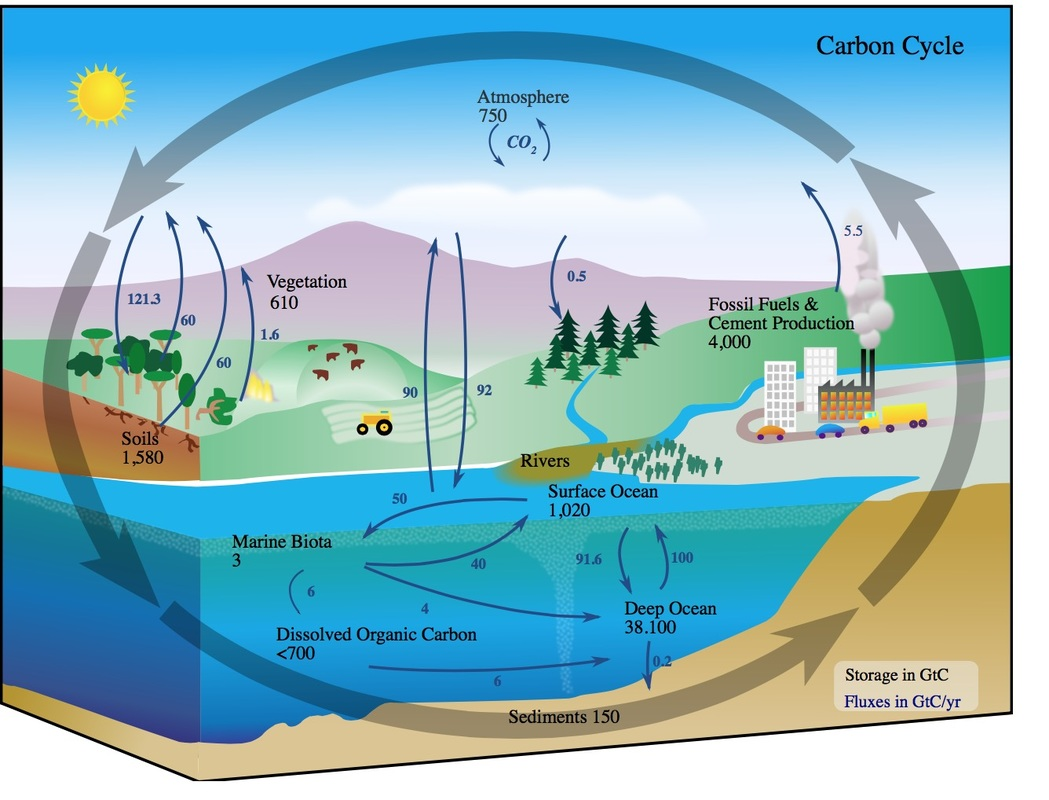
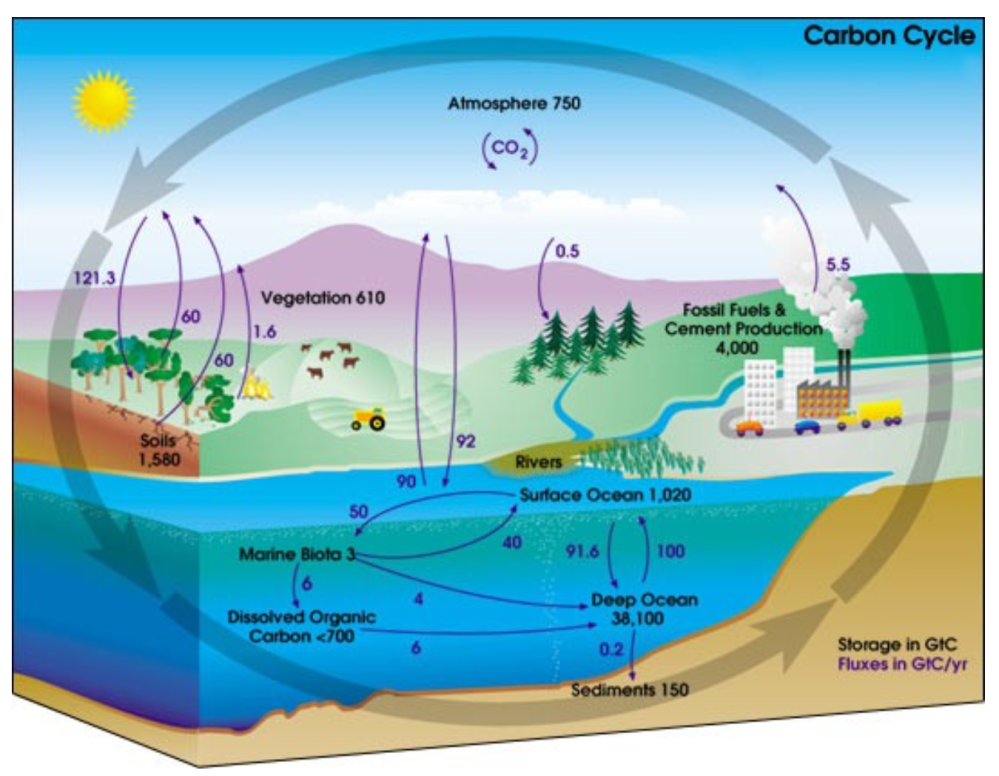
The IPCC doctrine which has long been promoted goes as follows. We have a number over here for monthly fossil fuel CO2 emissions, and a number over there for monthly atmospheric CO2. We don’t have good numbers for the rest of it-oceans, soils, biosphere–though rough estimates are orders of magnitude higher, dwarfing human CO2. So we ignore nature and assume it is always a sink, explaining the difference between the two numbers we do have. Easy peasy, science settled.

The non-IPCC paradigm is that atmospheric CO2 levels are a function of two very different fluxes. FF CO2 changes rapidly and increases steadily, while Natural CO2 changes slowly over time, and fluctuates up and down from temperature changes. The implications are that human CO2 is a simple addition, while natural CO2 comes from the integral of previous fluctuations.

1.  History of Atmospheric CO2 Mostly Natural

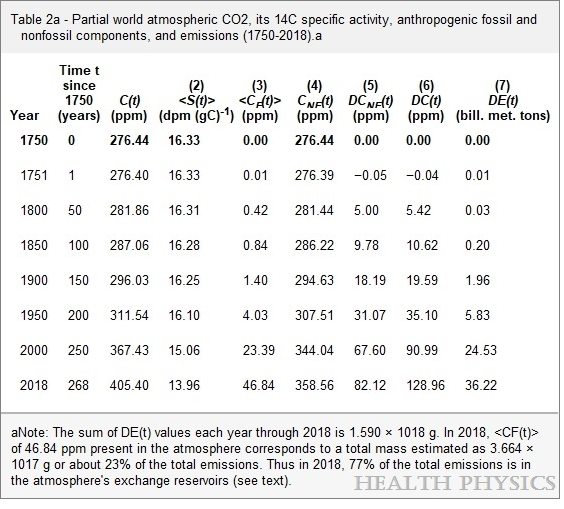
This proof is based on the 2021 paper World Atmospheric CO2, Its 14C Specific Activity, Non-fossil Component, Anthropogenic Fossil Component, and Emissions (1750–2018) by Kenneth Skrable, George Chabot, and Clayton French at University of Massachusetts Lowell.

The analysis employs ratios of carbon isotopes to calculate the relative proportions of atmospheric CO2 from natural sources and from fossil fuel emissions. 

The specific activity of 14C in the atmosphere gets reduced by a dilution effect when fossil CO2, which is devoid of 14C, enters the atmosphere. We have used the results of this effect to quantify the two components: the anthropogenic fossil component and the non-fossil component.  All results covering the period from 1750 through 2018 are listed in a table and plotted in figures.

These results negate claims that the increase in total atmospheric CO2 concentration C(t) since 1800 has been dominated by the increase of the anthropogenic fossil component. We determined that in 2018, atmospheric anthropogenic fossil COrepresented 23% of the total emissions since 1750 with the remaining 77% in the exchange reservoirs. Our results show that the percentage of the total CO2 due to the use of fossil fuels from 1750 to 2018 increased from 0% in 1750 to 12% in 2018, much too low to be the cause of global warming.

The graph above is produced from Skrable et al. dataset Table 2. World atmospheric CO2, its C‐14 specific activity, anthropogenic‐fossil component, non fossil component, and emissions (1750 ‐ 2018).  The purple line shows reported annual concentrations of atmospheric CO2 from Energy Information Administration (EIA)  The starting value in 1750 is 276 ppm and the final value in this study is 406 ppm in 2018, a gain of 130 ppm.

The red line is based on EIA estimates of human fossil fuel CO2 emissions starting from zero in 1750 and the sum slowly accumulating over the first 200 years.  The estimate of annual CO2 emitted from FF increases from 0.75 ppm in 1950 up to 4.69 ppm in 2018. The sum of all these annual emissions rises from 29.3 ppm in 1950 (from the previous 200 years) up to 204.9 ppm (from 268 years).  These are estimates of historical FF CO2 emitted into the atmosphere, not the amount of FF CO2 found in the air.

Atmospheric CO2 is constantly in two-way fluxes between multiple natural sinks/sources, principally the ocean, soil and biosphere. The annual dilution of carbon 14 proportion is used to calculate the fractions of atmospheric FF CO2 and Natural CO2 remaining in a given year. The blue line shows the FF CO2 fraction rising from 4.03 ppm in 1950 to 46.84 ppm in 2018.  The cyan line shows Natural CO2 fraction rising from 307.51 in 1950 to 358.56 in 2018.

The details of these calculations from observations are presented in the two links above, and the logic of the analysis is summarized in my previous post On CO2 Sources and Isotopes.  The table below illustrates the factors applied in the analysis.

C(t) is total atm CO2, S(t) is Seuss 14C effect, CF(t) is FF atm CO2, CNF(t) is atm non-FF CO2, DE(t) is FF CO2 emissions

Summary

Despite an estimated 205 ppm of FF CO2 emitted since 1750, only 46.84 ppm (23%) of FF CO2 remains, while the other 77% is distributed into natural sinks/sources. As of 2018 atmospheric CO2 was 405, of which 12% (47 ppm) originated from FF.   And the other 88% (358 ppm) came from natural sources: 276 prior to 1750, and 82 ppm since.  Natural CO2 sources/sinks continue to drive rising atmospheric CO2, presently at a rate of 2 to 1 over FF CO2.

2.  Analysis of CO2 Flows Confirms Natural Dominance

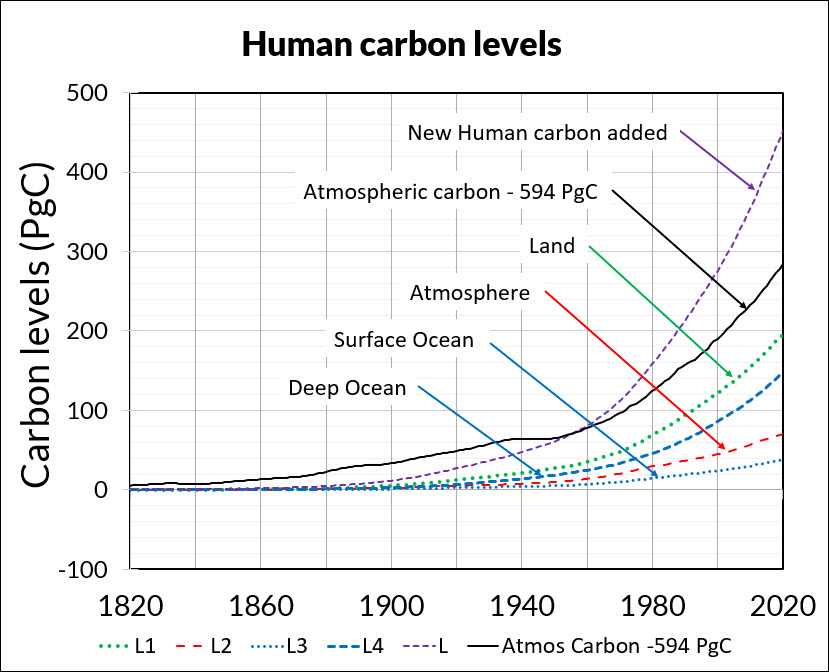
Figure 3. How human carbon levels change with time.

Independent research by Dr. Ed Berry focused on studying flows and level of CO2 sources and sinks.  The above summary chart from his published work presents a very similar result.

The graph above summarizes Dr. Berry’s findings. The lines represent CO2 added into the atmosphere since the 1750 level of 280 ppm. Based on IPCC data regarding CO2 natural sources and sinks, the black dots show the CO2 data. The small blue dots show the sum of all human CO2 emissions since they became measurable, irrespective of transfers of that CO2 from the atmosphere to land or to ocean.

Notice the CO2 data is greater than the sum of all human CO2 until 1960. That means nature caused the CO2 level to increase prior to 1960, with no reason to stop adding CO2 since. In fact, the analysis shows that in the year 2020, the human contribution to atmospheric CO2 level is 33 ppm, which means that from a 2020 total of 413 ppm, 280 is pre-industrial and 100 is added from land and ocean during the industrial era.

My synopsis of his work is IPCC Data: Rising CO2 is 75% Natural

A new carbon cycle model shows human emissions cause 25% and nature 75% of the CO2 increase is the title (and link) for Dr. Edwin Berry’s paper accepted in the journal Atmosphere August 12, 2021.

3. Nature Erases Pulses of Human CO2 Emissions  

Those committed to blaming humans for rising atmospheric CO2 sometimes admit that emitted CO2 (from any source) only stays in the air about 5 years (20% removed each year)  being absorbed into natural sinks.  But they then save their belief by theorizing that human emissions are “pulses” of additional CO2 which persist even when particular molecules are removed, resulting in higher CO2 concentrations.  The analogy would be a traffic jam on the freeway which persists long after the blockage is removed.

A recent study by Bud Bromley puts the fork in this theory.  His paper is A conservative calculation of specific impulse for CO2.  The title links to his text which goes through the math in detail.  Excerpts are in italics here with my bolds.

In the 2 years following the June 15, 1991 eruption of the Pinatubo volcano, the natural environment removed more CO2 than the entire increase in CO2 concentration due to all sources, human and natural, during the entire measured daily record of the Global Monitoring Laboratory of NOAA/Scripps Oceanographic Institute (MLO) May 17, 1974 to June 15, 1991. Then, in the 2 years after that, that CO2 was replaced plus an additional increment of CO2.

The data and graphs produced by MLO also show a reduction in slope of total CO2 concentration following the June 1991 eruption of Pinatubo, and also show the more rapid recovery of total CO2 concentration that began about 2 years after the 1991 eruption. This graph is the annual rate of change (i.e., velocity or slope) of total atmosphere CO2 concentration. This graph is not human CO2.

More recently is his study Scaling the size of the CO2 error in Friedlingstein et al.  Excerpts in italics with my bolds.

Since net human emissions would be a cumulative net of two fluxes, if there were a method to measure it, and since net global average CO2 concentration (i.e., NOAA Mauna Loa) is the net of two fluxes, then we should compare these data as integral areas. That is still an apples and oranges comparison because we only have the estimate of human emissions, not net human emissions. But at least the comparison would be in the right order of magnitude.

That comparison would look something like the above graphic. We would be comparing the entire area of the orange quadrangle to the entire blue area, understanding that the tiny blue area shown is much larger than actually is because the amount shown is human emissions only, not net human emissions. Human CO2 absorptions have not been subtracted. Nevertheless, it should be obvious that (1) B is not causing A, and (2) the orange area is enormously larger than the blue area.

Human emissions cannot be driving the growth rate (slope) observed in net global average CO2 concentration.

4.  Setting realistic proportions for the carbon cycle.

Hermann Harde applies a comparable perspective to consider the carbon cycle dynamics. His paper is Scrutinizing the carbon cycle and CO2 residence time in the atmosphere. Excerpts with my bolds.

Different to the IPCC we start with a rate equation for the emission and absorption processes, where the uptake is not assumed to be saturated but scales proportional with the actual CO2 concentration in the atmosphere (see also Essenhigh, 2009; Salby, 2016). This is justified by the observation of an exponential decay of 14C. A fractional saturation, as assumed by the IPCC, can directly be expressed by a larger residence time of CO2 in the atmosphere and makes a distinction between a turnover time and adjustment time needless.

Based on this approach and as solution of the rate equation we derive a concentration at steady state, which is only determined by the product of the total emission rate and the residence time. Under present conditions the natural emissions contribute 373 ppm and anthropogenic emissions 17 ppm to the total concentration of 390 ppm (2012). For the average residence time we only find 4 years.

The stronger increase of the concentration over the Industrial Era up to present times can be explained by introducing a temperature dependent natural emission rate as well as a temperature affected residence time. With this approach not only the exponential increase with the onset of the Industrial Era but also the concentrations at glacial and cooler interglacial times can well be reproduced in full agreement with all observations.

So, different to the IPCC’s interpretation the steep increase of the concentration since 1850 finds its natural explanation in the self accelerating processes on the one hand by stronger degassing of the oceans as well as a faster plant growth and decomposition, on the other hand by an increasing residence time at reduced solubility of CO2 in oceans. Together this results in a dominating temperature controlled natural gain, which contributes about 85% to the 110 ppm CO2 increase over the Industrial Era, whereas the actual anthropogenic emissions of 4.3% only donate 15%. These results indicate that almost all of the observed change of CO2 during the Industrial Era followed, not from anthropogenic emission, but from changes of natural emission. The results are consistent with the observed lag of CO2 changes behind temperature changes (Humlum et al., 2013; Salby, 2013), a signature of cause and effect. Our analysis of the carbon cycle, which exclusively uses data for the CO2 concentrations and fluxes as published in AR5, shows that also a completely different interpretation of these data is possible, this in complete conformity with all observations and natural causalities.

5.  More CO2 Is Not a Problem But a Blessing

William Happer provides a framework for thinking about climate, based on his expertise regarding atmospheric radiation (the “greenhouse” mechanism).  But he uses plain language accessible to all.  The Independent Institute published the transcript for those like myself who prefer reading for full comprehension.  Source: How to Think about Climate Change  

His presentation boils down to two main points:  More CO2 will result in very little additional global warming. But it will increase productivity of the biosphere.  My synopsis is: Climate Change and CO2 Not a Problem  Brief excerpts in italics with my bolds.

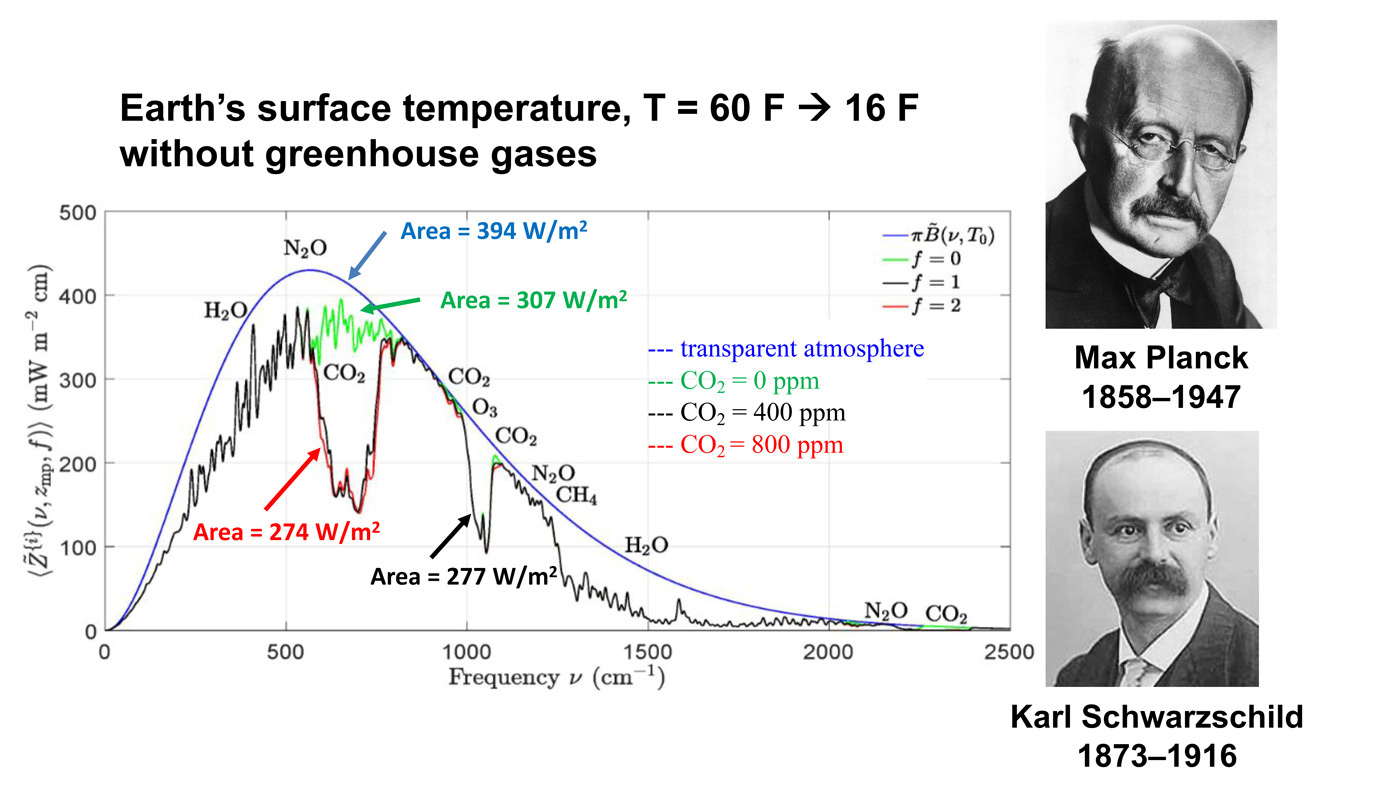
This is an important slide. There is a lot of history here and so there are two historical pictures. The top picture is Max Planck, the great German physicist who discovered quantum mechanics. Amazingly, quantum mechanics got its start from greenhouse gas-physics and thermal radiation, just what we are talking about today. Most climate fanatics do not understand the basic physics. But Planck understood it very well and he was the first to show why the spectrum of radiation from warm bodies has the shape shown on this picture, to the left of Planck. Below is a smooth blue curve. The horizontal scale, left to right is the “spatial frequency” (wave peaks per cm) of thermal radiation. The vertical scale is the thermal power that is going out to space. If there were no greenhouse gases, the radiation going to space would be the area under the blue Planck curve. This would be the thermal radiation that balances the heating of Earth by sunlight.

In fact, you never observe the Planck curve if you look down from a satellite. We have lots of satellite measurements now. What you see is something that looks a lot like the black curve, with lots of jags and wiggles in it. That curve was first calculated by Karl Schwarzschild, who first figured out how the real Earth, including the greenhouse gases in its atmosphere, radiates to space. That is described by the jagged black line. The important point here is the red line. This is what Earth would radiate to space if you were to double the CO2 concentration from today’s value. Right in the middle of these curves, you can see a gap in spectrum. The gap is caused by CO2 absorbing radiation that would otherwise cool the Earth. If you double the amount of CO2, you don’t double the size of that gap. You just go from the black curve to the red curve, and you can barely see the difference. The gap hardly changes.

The message I want you to understand, which practically no one really understands, is that doubling CO2 makes almost no difference.

The alleged harm from CO2 is from warming, and the warming observed is much, much less than predictions. In fact, warming as small as we are observing is almost certainly beneficial. It gives slightly longer growing seasons. You can ripen crops a little bit further north than you could before. So, there is completely good news in terms of the temperature directly. But there is even better news. By standards of geological history, plants have been living in a CO2 famine during our current geological period.

So, the takeaway message is that policies that slow CO2 emissions are based on flawed computer models which exaggerate warming by factors of two or three, probably more. That is message number one. So, why do we give up our freedoms, why do we give up our automobiles, why do we give up a beefsteak because of this model that does not work?

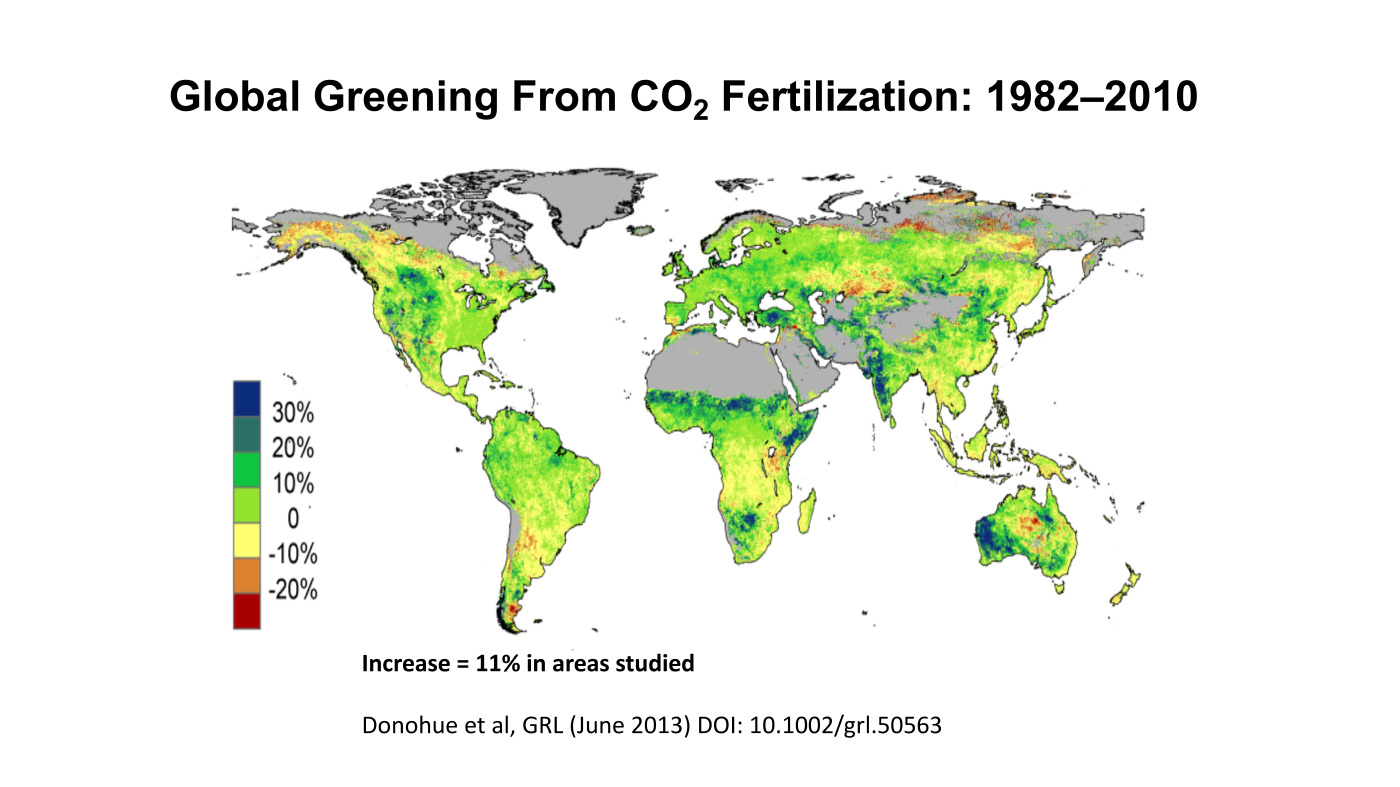
Takeaway message number two is that if you really look into it, more CO2 actually benefits the world. So, why are we demonizing this beneficial molecule that is making plants grow better, that is giving us slightly less harsh winters, a slightly longer growing season? Why is that a pollutant? It is not a pollutant at all, and we should have the courage to do nothing about CO2 emissions. Nothing needs to be done.

Footnote:  The Core of the CO2 Issue Update July 15

An adversarial comment below goes to the heart of the issue:

“The increase of the CO2 level since 1850   are more than accounted for by manmade emissions.
Nature remains a net CO2 sink, not a net emitter.”

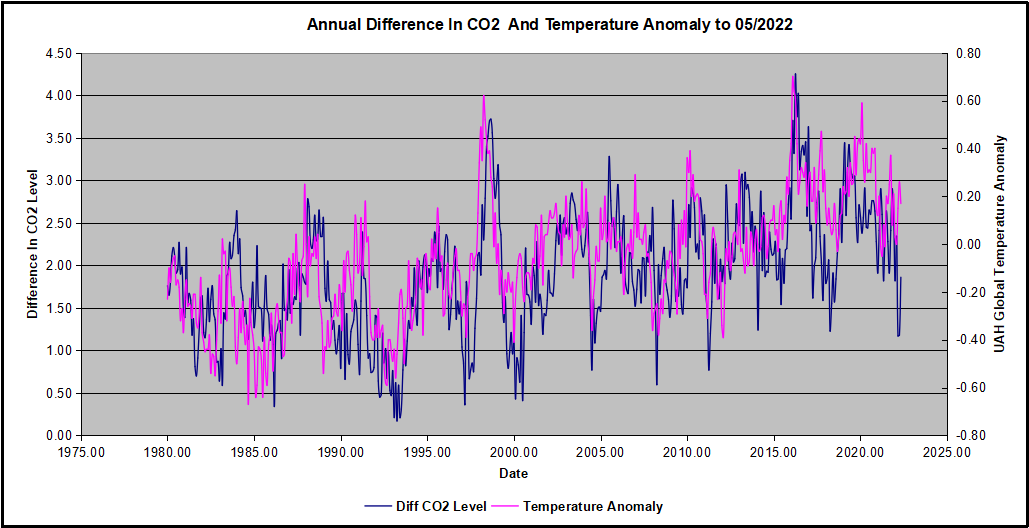
The data show otherwise.  Warming temperatures favor natural sources/sinks emitting more CO2 into the atmosphere, while previously captured CO2 shifts over time into long term storage as bicarbonates.  In fact, rising temperatures are predictive of rising CO2, as shown mathematically.

Temps Cause CO2 Changes, Not the Reverse. June 2022 Update

It is the ongoing natural contribution to atmospheric CO2 that is being denied.


Tropics Lead Remarkable Cooling June 2022

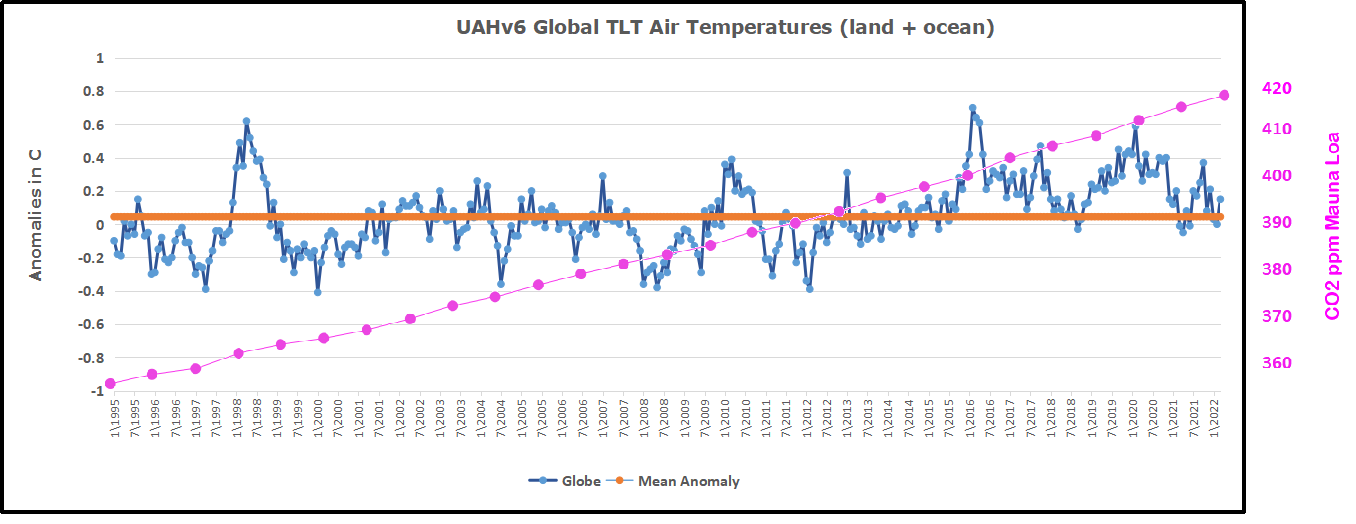
The post below updates the UAH record of air temperatures over land and ocean.  But as an overview consider how recent rapid cooling  completely overcame the warming from the last 3 El Ninos (1998, 2010 and 2016).  The UAH record shows that the effects of the last one were gone as of April 2021, again in November 2021, February 2022 and now in June (UAH baseline is now 1991-2020).

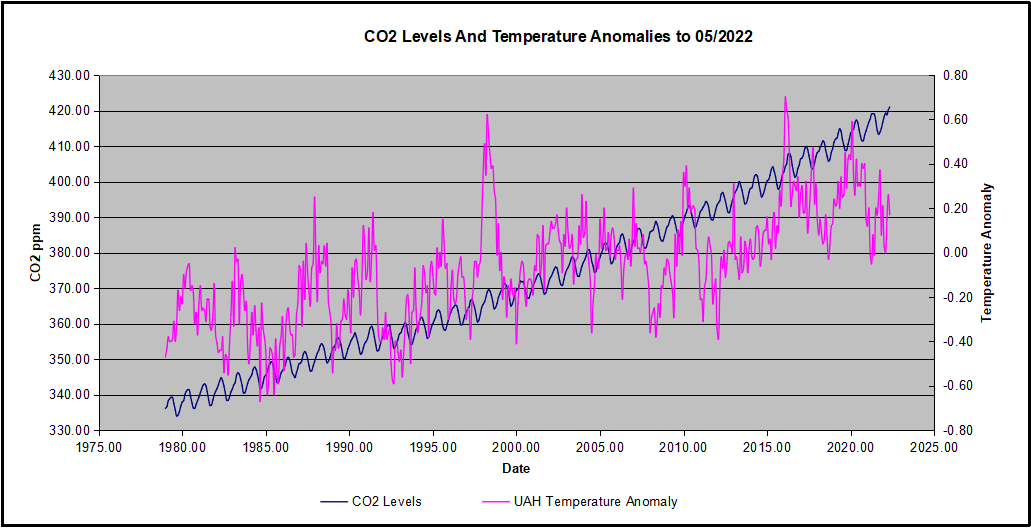
For reference I added an overlay of CO2 annual concentrations as measured at Mauna Loa.  While temperatures fluctuated up and down ending flat, CO2 went up steadily by ~55 ppm, a 15% increase.

Furthermore, going back to previous warmings prior to the satellite record shows that the entire rise of 0.8C since 1947 is due to oceanic, not human activity.

gmt-warming-events

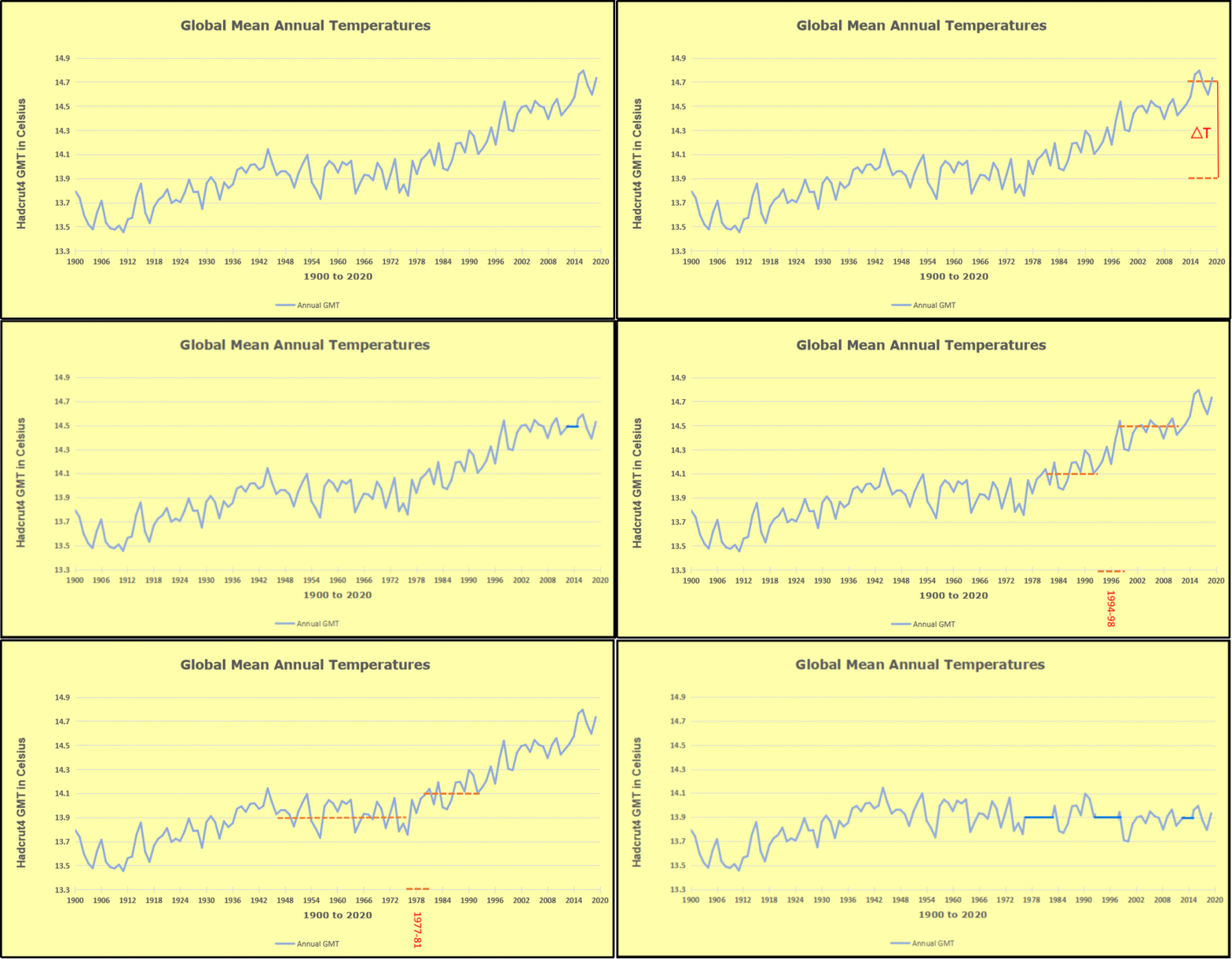
The animation is an update of a previous analysis from Dr. Murry Salby.  These graphs use Hadcrut4 and include the 2016 El Nino warming event.  The exhibit shows since 1947 GMT warmed by 0.8 C, from 13.9 to 14.7, as estimated by Hadcrut4.  This resulted from three natural warming events involving ocean cycles. The most recent rise 2013-16 lifted temperatures by 0.2C.  Previously the 1997-98 El Nino produced a plateau increase of 0.4C.  Before that, a rise from 1977-81 added 0.2C to start the warming since 1947.

Importantly, the theory of human-caused global warming asserts that increasing CO2 in the atmosphere changes the baseline and causes systemic warming in our climate.  On the contrary, all of the warming since 1947 was episodic, coming from three brief events associated with oceanic cycles. 

Update August 3, 2021

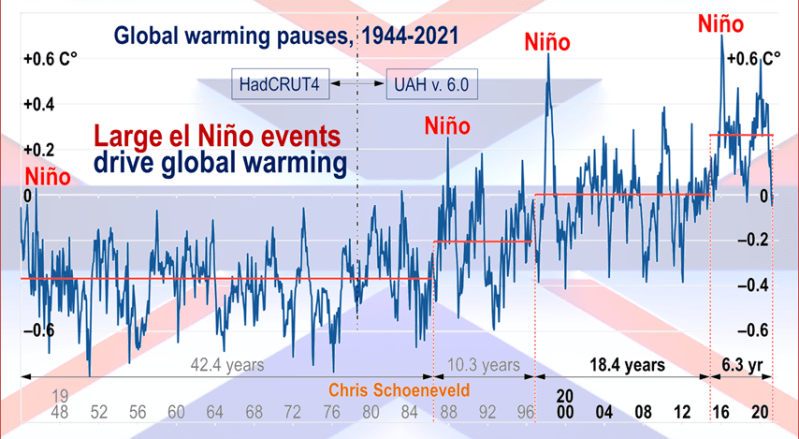
Chris Schoeneveld has produced a similar graph to the animation above, with a temperature series combining HadCRUT4 and UAH6. H/T WUWT

image-8


mc_wh_gas_web20210423124932

See Also Worst Threat: Greenhouse Gas or Quiet Sun?

June Update Tropics Lead Dramatic Ocean Cooling

banner-blog

With apologies to Paul Revere, this post is on the lookout for cooler weather with an eye on both the Land and the Sea.  While you will hear a lot about 2020-21 temperatures matching 2016 as the highest ever, that spin ignores how fast the cooling set in.  The UAH data analyzed below shows that warming from the last El Nino was fully dissipated with chilly temperatures in all regions. May NH land and SH ocean showed temps matching March, reversing an upward blip in April, and now June is virtually the mean since 1995.

UAH has updated their tlt (temperatures in lower troposphere) dataset for June 2022.  Previously I have done posts on their reading of ocean air temps as a prelude to updated records from HadSST3 (which is now discontinued). So I have separately posted on SSTs using HadSST4 Ocean SSTs Keep Cool May 2022.  This month also has a separate graph of land air temps because the comparisons and contrasts are interesting as we contemplate possible cooling in coming months and years. Sometimes air temps over land diverge from ocean air changes.  However, last month showed air temps over Tropical ocean cooled sharply, along with strong cooling over NH and SH, taking Global ocean temps down.  Tropical land also dropped, and NH less so, while SH land rose leaving Global land average little changed

Note:  UAH has shifted their baseline from 1981-2010 to 1991-2020 beginning with January 2021.  In the charts below, the trends and fluctuations remain the same but the anomaly values change with the baseline reference shift.

Presently sea surface temperatures (SST) are the best available indicator of heat content gained or lost from earth’s climate system.  Enthalpy is the thermodynamic term for total heat content in a system, and humidity differences in air parcels affect enthalpy.  Measuring water temperature directly avoids distorted impressions from air measurements.  In addition, ocean covers 71% of the planet surface and thus dominates surface temperature estimates.  Eventually we will likely have reliable means of recording water temperatures at depth.

Recently, Dr. Ole Humlum reported from his research that air temperatures lag 2-3 months behind changes in SST.  Thus the cooling oceans now portend cooling land air temperatures to follow.  He also observed that changes in CO2 atmospheric concentrations lag behind SST by 11-12 months.  This latter point is addressed in a previous post Who to Blame for Rising CO2?

After a change in priorities, updates are now exclusive to HadSST4.  For comparison we can also look at lower troposphere temperatures (TLT) from UAHv6 which are now posted for June.  The temperature record is derived from microwave sounding units (MSU) on board satellites like the one pictured above. Recently there was a change in UAH processing of satellite drift corrections, including dropping one platform which can no longer be corrected. The graphs below are taken from the revised and current dataset.

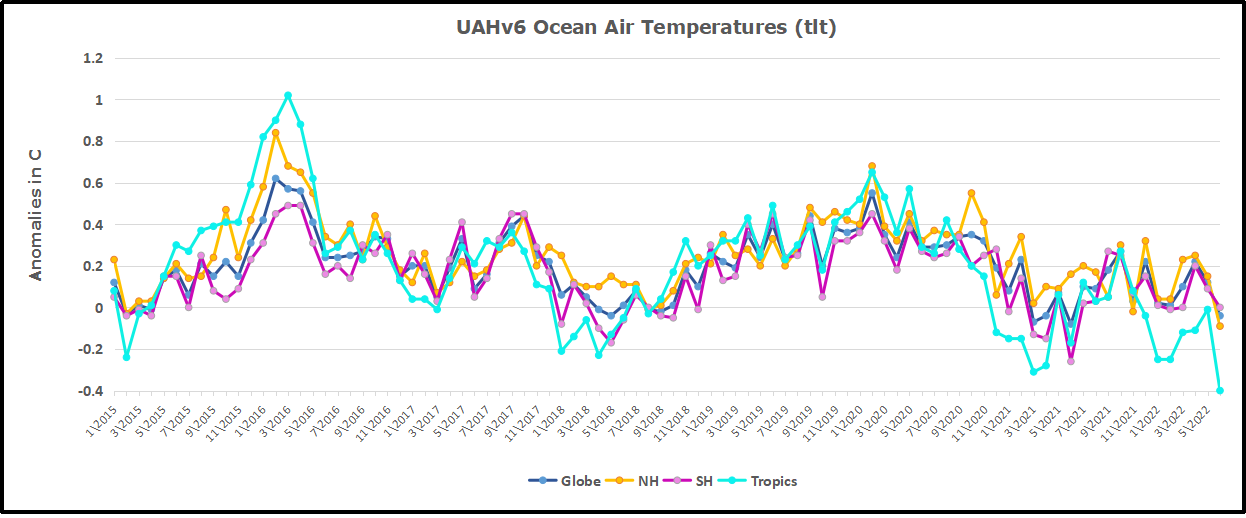
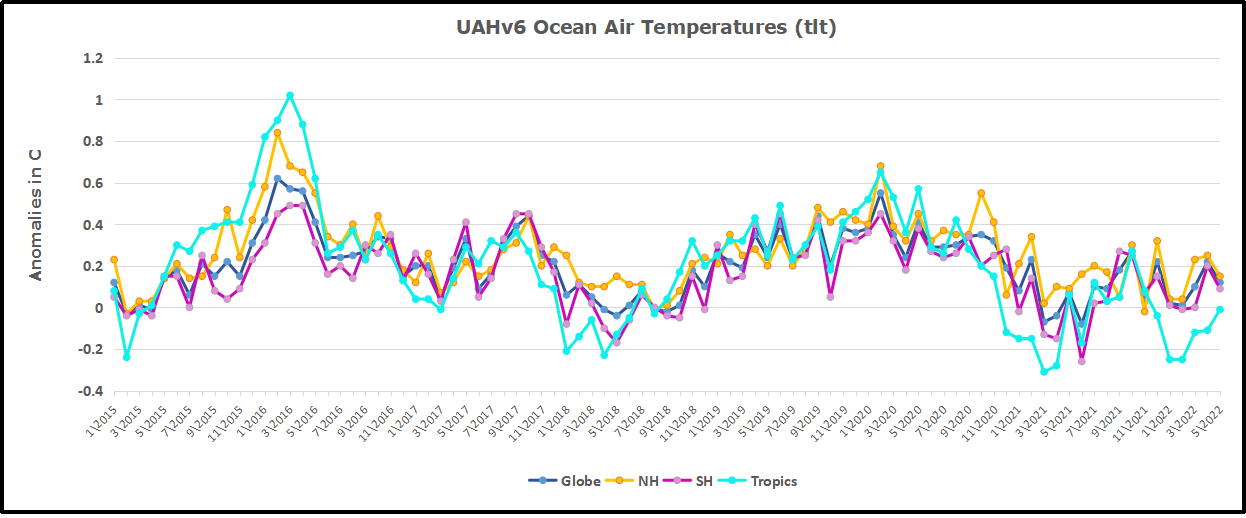
The UAH dataset includes temperature results for air above the oceans, and thus should be most comparable to the SSTs. There is the additional feature that ocean air temps avoid Urban Heat Islands (UHI).  The graph below shows monthly anomalies for ocean temps since January 2015.

Note 2020 was warmed mainly by a spike in February in all regions, and secondarily by an October spike in NH alone. In 2021, SH and the Tropics both pulled the Global anomaly down to a new low in April. Then SH and Tropics upward spikes, along with NH warming brought Global temps to a peak in October.  That warmth was gone as November 2021 ocean temps plummeted everywhere. After an upward bump 01/2022 temps have reversed and plunged downward in June.  Tropics ocean anomaly cooled 0.4C the lowest in this period.

Land Air Temperatures Tracking Downward in Seesaw Pattern

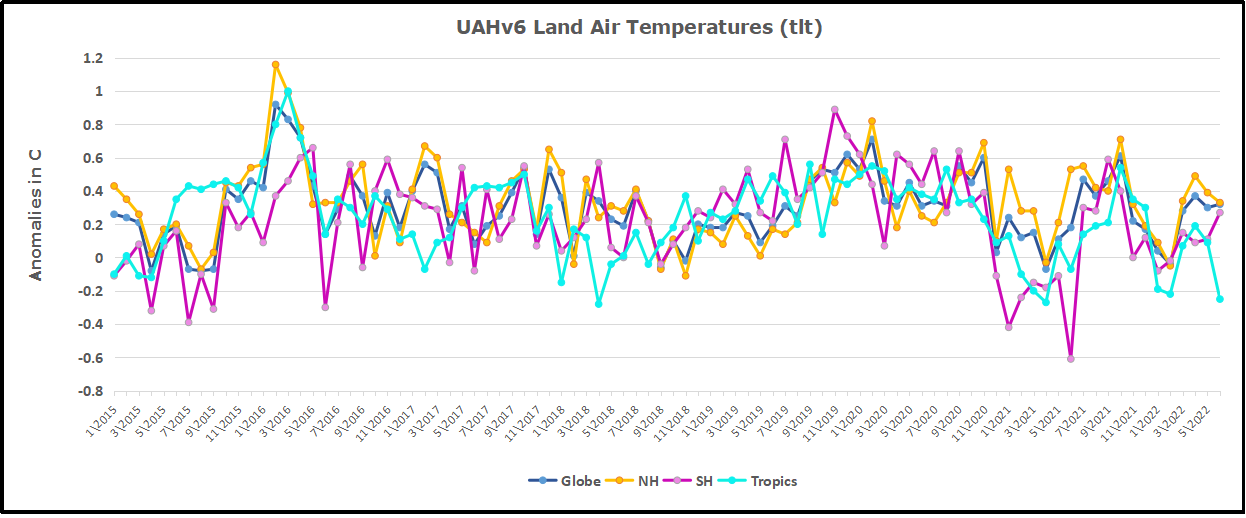
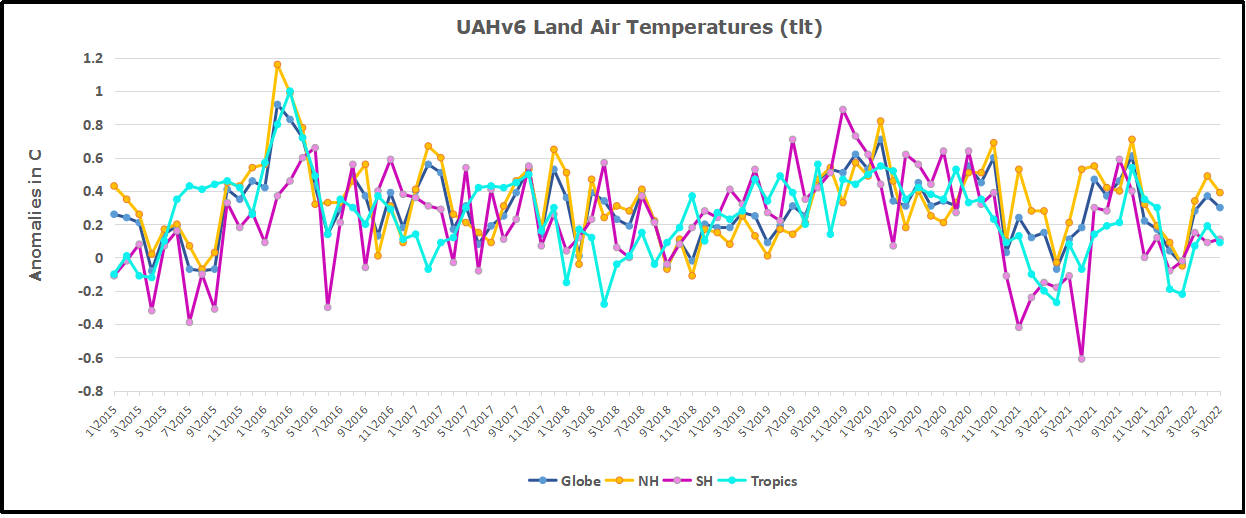
We sometimes overlook that in climate temperature records, while the oceans are measured directly with SSTs, land temps are measured only indirectly.  The land temperature records at surface stations sample air temps at 2 meters above ground.  UAH gives tlt anomalies for air over land separately from ocean air temps.  The graph updated for June is below.

Here we have fresh evidence of the greater volatility of the Land temperatures, along with extraordinary departures by SH land.  Land temps are dominated by NH with a 2021 spike in January,  then dropping before rising in the summer to peak in October 2021. As with the ocean air temps, all that was erased in November with a sharp cooling everywhere. Land temps dropped sharply for four months, even more than did the Oceans. March and April saw some warming, reversed In May when all land regions cooled pulling down the global anomaly. Now in June Tropics land dropped sharply while SH land rose, NH cooled slightly leaving the Global land anomaly little changed

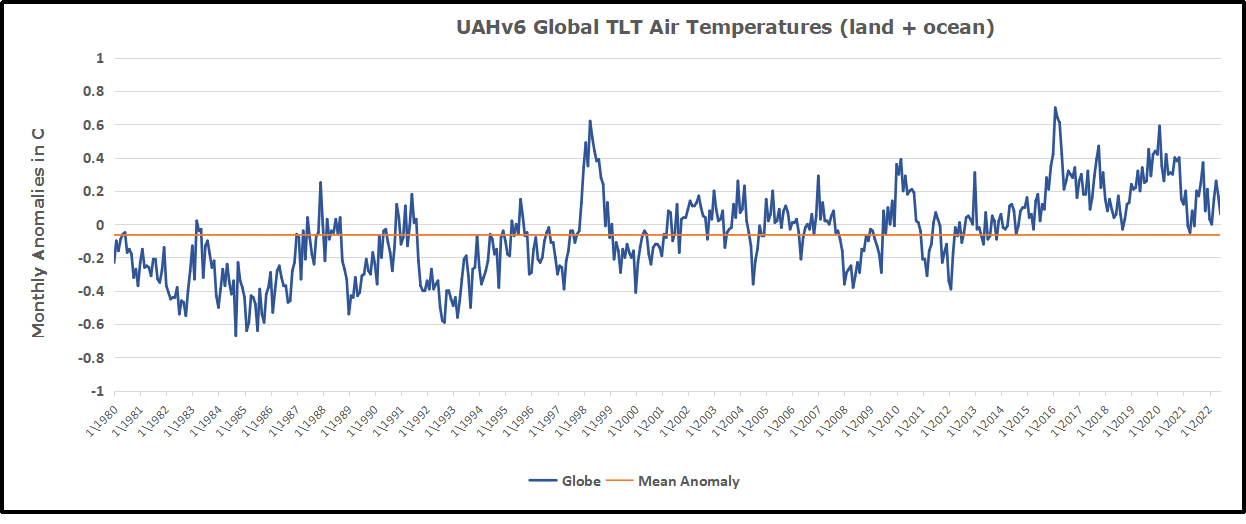
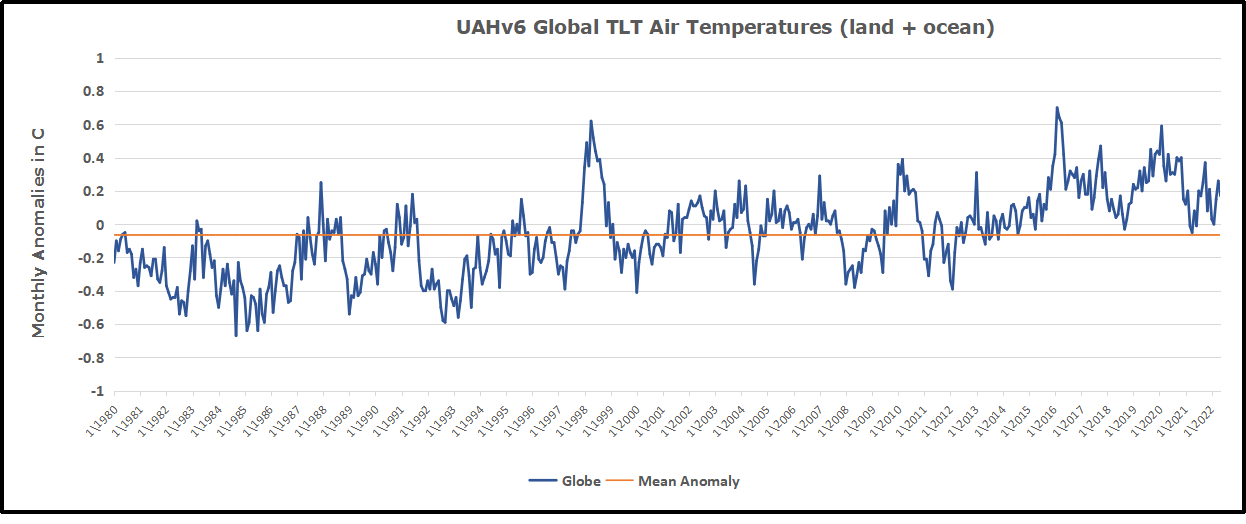
The Bigger Picture UAH Global Since 1980

The chart shows monthly Global anomalies starting 01/1980 to present.  The average monthly anomaly is -0.06, for this period of more than four decades.  The graph shows the 1998 El Nino after which the mean resumed, and again after the smaller 2010 event. The 2016 El Nino matched 1998 peak and in addition NH after effects lasted longer, followed by the NH warming 2019-20.   A small upward bump in 2021 has been reversed with temps having returned close to the mean as of 2/2022.  March and April brought warmer Global temps, reversed in May and now the June anomaly is almost zero.

TLTs include mixing above the oceans and probably some influence from nearby more volatile land temps.  Clearly NH and Global land temps have been dropping in a seesaw pattern, nearly 1C lower than the 2016 peak.  Since the ocean has 1000 times the heat capacity as the atmosphere, that cooling is a significant driving force.  TLT measures started the recent cooling later than SSTs from HadSST3, but are now showing the same pattern.  It seems obvious that despite the three El Ninos, their warming has not persisted, and without them it would probably have cooled since 1995.  Of course, the future has not yet been written.


Ocean SSTs Keep Cool May 2022


The best context for understanding decadal temperature changes comes from the world’s sea surface temperatures (SST), for several reasons:

  • The ocean covers 71% of the globe and drives average temperatures;
  • SSTs have a constant water content, (unlike air temperatures), so give a better reading of heat content variations;
  • A major El Nino was the dominant climate feature in recent years.

HadSST is generally regarded as the best of the global SST data sets, and so the temperature story here comes from that source. Previously I used HadSST3 for these reports, but Hadley Centre has made HadSST4 the priority, and v.3 will no longer be updated.  HadSST4 is the same as v.3, except that the older data from ship water intake was re-estimated to be generally lower temperatures than shown in v.3.  The effect is that v.4 has lower average anomalies for the baseline period 1961-1990, thereby showing higher current anomalies than v.3. This analysis concerns more recent time periods and depends on very similar differentials as those from v.3 despite higher absolute anomaly values in v.4.  More on what distinguishes HadSST3 and 4 from other SST products at the end. The user guide for HadSST4 is here.

The Current Context

The 2021 year end report below showed rapid cooling in all regions.  The anomalies then continued in 2022 to remain well below the mean since 2015.  This Global Cooling was also evident in the UAH Land and Ocean air temperatures (Still No Global Warming, Milder March Land and Sea).

The chart below shows SST monthly anomalies as reported in HadSST4 starting in 2015 through May 2022.  A global cooling pattern is seen clearly in the Tropics since its peak in 2016, joined by NH and SH cycling downward since 2016. 

Note that higher temps in 2015 and 2016 were first of all due to a sharp rise in Tropical SST, beginning in March 2015, peaking in January 2016, and steadily declining back below its beginning level. Secondly, the Northern Hemisphere added three bumps on the shoulders of Tropical warming, with peaks in August of each year.  A fourth NH bump was lower and peaked in September 2018.  As noted above, a fifth peak in August 2019 and a sixth August 2020 exceeded the four previous upward bumps in NH. A smaller NH rise in 2021 peaked in September of that year.

After three straight Spring 2020 months of cooling led by the tropics and SH, NH spiked in the summer, along with smaller bumps elsewhere.  Then temps everywhere dropped for six months, hitting bottom in February 2021.  All regions were well below the Global Mean since 2015, matching the cold of 2018, and lower than January 2015. Then the spring and summer brought more temperate waters and a July return to the mean anomaly since 2015.  After an upward bump in August, the 2021 yearend Global temp anomaly dropped below the mean, driven by sharp declines in the Tropics and NH. Now in 2022 all regions remain cool and the Global anomaly remains lower than the mean for this period. Despite an upward bump in NH, other regions cooled leaving the Global anomaly little changed.

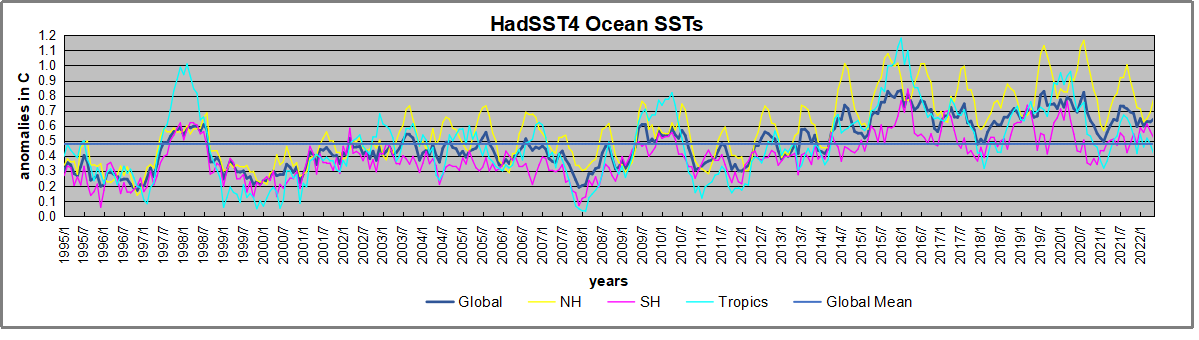
A longer view of SSTs


Open in new tab to enlarge image.

The graph above is noisy, but the density is needed to see the seasonal patterns in the oceanic fluctuations.  Previous posts focused on the rise and fall of the last El Nino starting in 2015.  This post adds a longer view, encompassing the significant 1998 El Nino and since.  The color schemes are retained for Global, Tropics, NH and SH anomalies.  Despite the longer time frame, I have kept the monthly data (rather than yearly averages) because of interesting shifts between January and July.1995 is a reasonable (ENSO neutral) starting point prior to the first El Nino.  The sharp Tropical rise peaking in 1998 is dominant in the record, starting Jan. ’97 to pull up SSTs uniformly before returning to the same level Jan. ’99.  For the next 2 years, the Tropics stayed down, and the world’s oceans held steady around 0.5C above 1961 to 1990 average.

Then comes a steady rise over two years to a lesser peak Jan. 2003, but again uniformly pulling all oceans up around 0.5C.  Something changes at this point, with more hemispheric divergence than before. Over the 4 years until Jan 2007, the Tropics go through ups and downs, NH a series of ups and SH mostly downs.  As a result the Global average fluctuates around that same 0.5C, which also turns out to be the average for the entire record since 1995.

2007 stands out with a sharp drop in temperatures so that Jan.08 matches the low in Jan. ’99, but starting from a lower high. The oceans all decline as well, until temps build peaking in 2010.

Now again a different pattern appears.  The Tropics cool sharply to Jan 11, then rise steadily for 4 years to Jan 15, at which point the most recent major El Nino takes off.  But this time in contrast to ’97-’99, the Northern Hemisphere produces peaks every summer pulling up the Global average.  In fact, these NH peaks appear every July starting in 2003, growing stronger to produce 3 massive highs in 2014, 15 and 16.  NH July 2017 was only slightly lower, and a fifth NH peak still lower in Sept. 2018.

The highest summer NH peaks came in 2019 and 2020, only this time the Tropics and SH are offsetting rather adding to the warming. (Note: these are high anomalies on top of the highest absolute temps in the NH.)  Since 2014 SH has played a moderating role, offsetting the NH warming pulses. After September 2020 temps dropped off down until February 2021, then all regions rose to bring the global anomaly above the mean since 1995  June 2021 backed down before warming again slightly in July and August 2021, then cooling slightly in September.  The present 2022 level compares with 2014.

What to make of all this? The patterns suggest that in addition to El Ninos in the Pacific driving the Tropic SSTs, something else is going on in the NH.  The obvious culprit is the North Atlantic, since I have seen this sort of pulsing before.  After reading some papers by David Dilley, I confirmed his observation of Atlantic pulses into the Arctic every 8 to 10 years.

But the peaks coming nearly every summer in HadSST require a different picture.  Let’s look at August, the hottest month in the North Atlantic from the Kaplan dataset.

The AMO Index is from from Kaplan SST v2, the unaltered and not detrended dataset. By definition, the data are monthly average SSTs interpolated to a 5×5 grid over the North Atlantic basically 0 to 70N. The graph shows August warming began after 1992 up to 1998, with a series of matching years since, including 2020, dropping down in 2021.  Because the N. Atlantic has partnered with the Pacific ENSO recently, let’s take a closer look at some AMO years in the last 2 decades.


This graph shows monthly AMO temps for some important years. The Peak years were 1998, 2010 and 2016, with the latter emphasized as the most recent. The other years show lesser warming, with 2007 emphasized as the coolest in the last 20 years. Note the red 2018 line is at the bottom of all these tracks. The heavy blue line shows that 2022 started warm, dropped to the bottom and now is in the middle of all the tracks pictured.

Summary

The oceans are driving the warming this century.  SSTs took a step up with the 1998 El Nino and have stayed there with help from the North Atlantic, and more recently the Pacific northern “Blob.”  The ocean surfaces are releasing a lot of energy, warming the air, but eventually will have a cooling effect.  The decline after 1937 was rapid by comparison, so one wonders: How long can the oceans keep this up? If the pattern of recent years continues, NH SST anomalies may rise slightly in coming months, but once again, ENSO which has weakened will probably determine the outcome.

Footnote: Why Rely on HadSST4

HadSST is distinguished from other SST products because HadCRU (Hadley Climatic Research Unit) does not engage in SST interpolation, i.e. infilling estimated anomalies into grid cells lacking sufficient sampling in a given month. From reading the documentation and from queries to Met Office, this is their procedure.

HadSST4 imports data from gridcells containing ocean, excluding land cells. From past records, they have calculated daily and monthly average readings for each grid cell for the period 1961 to 1990. Those temperatures form the baseline from which anomalies are calculated.

In a given month, each gridcell with sufficient sampling is averaged for the month and then the baseline value for that cell and that month is subtracted, resulting in the monthly anomaly for that cell. All cells with monthly anomalies are averaged to produce global, hemispheric and tropical anomalies for the month, based on the cells in those locations. For example, Tropics averages include ocean grid cells lying between latitudes 20N and 20S.

Gridcells lacking sufficient sampling that month are left out of the averaging, and the uncertainty from such missing data is estimated. IMO that is more reasonable than inventing data to infill. And it seems that the Global Drifter Array displayed in the top image is providing more uniform coverage of the oceans than in the past.

uss-pearl-harbor-deploys-global-drifter-buoys-in-pacific-ocean

USS Pearl Harbor deploys Global Drifter Buoys in Pacific Ocean


How to FLICC Off Climate Alarms

John Ridgway has provided an excellent framework for skeptics to examine and respond to claims from believers in global warming/climate change.  His essay at Climate Scepticism is Deconstructing Scepticism: The True FLICC.  Excerpts in italics with my bolds and added comments.

Overview

I have modified slightly the FLICC components to serve as a list of actions making up a skeptical approach to an alarmist claim.  IOW this is a checklist for applying critical intelligence to alarmist discourse in the public arena. The Summary can be stated thusly:

♦  Follow the Data
Find and follow the data and facts to where they lead

♦  Look for full risk profile
Look for a complete assessment of risks and costs from proposed policies

♦  Interrogate causal claims
Inquire into claimed cause-effect relationships

♦  Compile contrary explanations
Construct an organized view of contradictory evidence to the theory

♦  Confront cultural bias
Challenge attempts to promote consensus story with flimsy coincidence

A Case In Point

John Ridgway illustrates how this method works in a comment:

No sooner have I’ve pressed the publish button, and the BBC comes out with the perfect example of what I have been writing about:  Climate change: Rising sea levels threaten 200,000 England properties

It tells of a group of experts theorizing that 200,000 coastal properties are soon to be lost due to climate change. Indeed, it “is already happening” as far as Happisburg on the Norfolk coast is concerned. Coastal erosion is indeed a problem there.

But did the experts take into account that the data shows no acceleration of erosion over the last 2000 years? No.

Have they acknowledge the fact that erosion on the East coast is a legacy of glaciation? No.

[For the US example of this claim, see my post Sea Level Scare Machine]

The FLICC Framework

Below is Ridgway’s text regarding this thought process, followed by a synopsis of his discussion of the five elements. Text is in italics with my bolds.

As part of the anthropogenic climate change debate, and when discussing the proposed plans for transition to Net Zero, efforts have been made to analyse the thinking that underpins the typical sceptic’s position. These analyses have universally presupposed that such scepticism stubbornly persists in the face of overwhelming evidence, as reflected in the widespread use of the term ‘denier’. Consequently, they are based upon taxonomies of flawed reasoning and methods of deception and misinformation.1 

However, by taking such a prejudicial approach, the analyses have invariably failed to acknowledge the ideological, philosophical and psychological bases for sceptical thinking. The following taxonomy redresses that failing and, as a result, offers a more pertinent analysis that avoids the worst excesses of opinionated philippic. The taxonomy identifies a basic set of ideologies and attitudes that feature prominently in the typical climate change sceptic’s case. For my taxonomy I have chosen the acronym FLICC:2

  • Follow data but distrust judgement and speculation

     i.e. value empirical evidence over theory and conjecture.

  • Look for the full risk profile

      i.e. when considering the management of risks and uncertainties, demand that those associated        with mitigating and preventative measures are also taken into account.

  • Interrogate causal arguments

      i.e. demand that both necessity and sufficiency form the basis of a causal analysis.

  • Contrariness

      i.e. distrust consensus as an indicator of epistemological value.

  • Cultural awareness

       i.e. never underestimate the extent to which a society can fabricate a truth for its own purposes.

All of the above have a long and legitimate history outside the field of climate science. The suggestion that they are not being applied in good faith by climate change sceptics falls beyond the remit of taxonomical analysis and strays into the territory of propaganda and ad hominem.

The five ideologies and attitudes of climate change scepticism introduced above are now discussed in greater detail.

Following the data

Above all else, the sceptical approach is characterized by a reluctance to draw conclusions from a given body of evidence. When it comes to evidence supporting the idea of a ‘climate crisis’, such reluctance is judged by many to be pathological and indicative of motivated reasoning. Cognitive scientists use the term ‘conservative belief revision’ to refer to an undue reluctance to update beliefs in accordance with a new body of evidence. More precisely, when the individual retains the view that events have a random pattern, thereby downplaying the possibility of a causative factor, the term used is ‘slothful induction’. Either way, the presupposition is that the individual is committing a logical fallacy resulting from cognitive bias.

However, far from being a pathology of thinking, such reluctance has its legitimate foundations in Pyrrhonian philosophy and, when properly understood, it can be seen as an important thinking strategy.3 Conservative belief revision and slothful induction can indeed lead to false conclusions but, more importantly, the error most commonly encountered when making decisions under uncertainty (and the one with the greatest potential for damage) is to downplay unknown and possibly random factors and instead construct a narrative that overstates and prejudges causation. This tendency is central to the human condition and it lies at the heart of our failure to foresee the unexpected – this is the truly important cognitive bias that the sceptic seeks to avoid.

The empirical sceptic is cognisant of evidence and allows the formulation of theories but treats them with considerable caution due to the many ways in which such theories often entail unwarranted presupposition.

The drivers behind this problem are the propensity of the human mind to seek patterns, to construct narratives that hide complexities, to over-emphasise the causative role played by human agents and to under-emphasise the role played by external and possibly random factors. Ultimately, it is a problem regarding the comprehension of uncertainty — we comprehend in a manner that has served us well in evolutionary terms but has left us vulnerable to unprecedented, high consequence events.

It is often said that a true sceptic is one who is prepared to accept the prevailing theory once the evidence is ‘overwhelming’. The climate change sceptic’s reluctance to do so is taken as an indication that he or she is not a true sceptic. However, we see here that true scepticism lies in the willingness to challenge the idea that the evidence is overwhelming – it only seems overwhelming to those who fail to recognise the ‘theorizing disease’ and lack the resolve to resist it. Secondly, there cannot be a climate change sceptic alive who is not painfully aware of the humiliation handed out to those who resist the theorizing.

In practice, the theorizing and the narratives that trouble the empirical sceptic take many forms. It can be seen in:

♦  over-dependence upon mathematical models for which the tuning owes more to art than science.

♦  readiness to treat the output of such models as data resulting from experiment, rather than the hypotheses they are.

♦  lack of regard for ontological uncertainty (i.e. the unknown unknowns which, due to their very nature, the models do not address).

♦  emergence of story-telling as a primary weapon in the armoury of extreme weather event attribution.

♦  willingness to commit trillions of pounds to courses of action that are predicated upon Representative Concentration Pathways and economic models that are the ‘theorizing disease’ writ large.

♦  contributions of the myriad of activists who seek to portray the issues in a narrative form laden with social justice and other ethical considerations.

♦  imaginative but simplistic portrayals of climate change sceptics and their motives; portrayals that are drawing categorical conclusions that cannot possibly be justified given the ‘evidence’ offered. And;

♦  any narrative that turns out to be unfounded when one follows the data.

Climate change may have its basis in science and data, but this basis has long since been overtaken by a plethora of theorizing and causal narrative that sometimes appears to have taken on a life of its own. Is this what settled science is supposed to look like?

Looking for the full risk profile

Almost as fundamental as the sceptic’s resistance to theorizing and narrative is his or her appreciation that the management of anthropogenic warming (particularly the transition to Net Zero) is an undertaking beset with risk and uncertainty. This concern reflects a fundamental principle of risk management: proposed actions to tackle a risk are often in themselves problematic and so a full risk analysis is not complete until it can be confirmed that the net risk will decrease following the actions proposed.7

Firstly, the narrative of existential risk is rejected on the grounds of empirical scepticism (the evidence for an existential threat is not overwhelming, it is underwhelming).

Secondly, even if the narrative is accepted, it has not been reliably demonstrated that the proposal for Net Zero transition is free from existential or extreme risks.

Indeed, given the dominant role played by the ‘theorizing disease’ and how it lies behind our inability to envisage the unprecedented high consequence event, there is every reason to believe that the proposals for Net Zero transition should be equally subject to the precautionary principle. The fact that they are not is indicative of a double standard being applied. The argument seems to run as follows: There is no uncertainty regarding the physical risk posed by climate change, but if there were it would only add to the imperative for action. There is also no uncertainty regarding the transition risk, but if there were it could be ignored because one can only apply the precautionary principle once!

This is precisely the sort of inconsistency one encounters when uncertainties are rationalised away in order to support the favoured narrative.

The upshot of this double standard is that the activists appear to be proceeding with two very different risk management frameworks depending upon whether physical or transition risk is being considered. As a result, risks associated with renewable energy security, the environmental damage associated with proposals to reduce carbon emissions and the potentially catastrophic effects of the inevitable global economic shock are all played down or explained away.

Looking for the full risk profile is a basic of risk management practice. The fact that it is seen as a ploy used only by those wishing to oppose the management of anthropogenic climate change is both odd and worrying. It is indeed important to the sceptic, but it should be important to everyone.

Interrogating causal arguments

For many years we have been told that anthropogenic climate change will make bad things happen. These dire predictions were supposed to galvanize the world into action but that didn’t happen, no doubt partly due to the extent to which such predictions repeatedly failed to come true (as, for example, with the predictions of the disappearance of Arctic sea ice).  .  .This is one good reason for the empirical sceptic to distrust the narrative,8 but an even better one lies in the very concept of causation.

A major purpose of narrative is to reduce complexity so that the ‘truth’ can shine through. This is particularly the case with causal narratives. We all want executive summaries and sound bites such as ‘Y happened because of X’. But very few of us are interested in examining exactly what we mean by such statements – very few except, of course, for the empirical sceptics. In a messy world in which many factors may be at play, the more pertinent questions are:

♦  To what extent was X necessary for Y to happen?
♦  To what extent was X sufficient for Y to happen?

The vast majority of the extreme weather event attribution narrative is focused upon the first question and very little attention is paid to the second; at least not in the many press bulletins issued. Basically, we are told that the event was virtually impossible without climate change, but very little is said regarding whether climate change on its own was enough.

This problem of oversimplification is even more worrying once one starts to examine consequential damages whilst failing to take into account man-made failings such as those that exacerbate the impacts of floods and forest fires.9   The oversimplification of causal narrative is not restricted to weather-related events, of course. Climate change, we are told, is wreaking havoc with the flora and fauna and many species are dying out as a result. However, when such claims are examined more closely,10 it is invariably the case that climate change has been lumped in with a number of other factors that are destroying habitat.

When climate change sceptics point this out they are, of course, accused of cherry-picking. The truth, however, is that their insistence that the extended causal narrative of necessity and sufficiency should be respected is nothing more than the consequence of following the data and looking for the full risk profile.

Contrariness

The climate change debate is all about making decisions under uncertainty, so it is little surprise that gaining consensus is seen as centrally important. Uncertainty is reduced when the evidence is overwhelming and it is tempting to believe that the high level of consensus amongst climate scientists surely points towards there being overwhelming evidence. If one accepts this logic then the sceptic’s refusal to accept the consensus is just another manifestation of his or her denial.

Except, of course, an empirical sceptic would not accept this logic. Consensus does not result from a simple examination of concordant evidence, it is instead the fruit of the tendentious theorizing and simplifying narrative that the empirical sceptic intuitively distrusts. As explained above, there are a number of drivers that cause such theories and narratives to entail unwarranted presupposition, and it is naïve to believe that scientists are immune to such drivers.

However, the fact remains that consensus on beliefs is neither a sufficient nor a necessary condition for presuming that these beliefs constitute shared knowledge. It is only when a consensus on beliefs is uncoerced, uniquely heterogeneous and large, that a shared knowledge provides the best explanation of a given consensus.11 The notion that a scientific consensus can be trusted because scientists are permanently seeking to challenge accepted views is simplistic at best.

It is actually far from obvious that in climate science the conditions have been met for consensus to be a reliable indicator of shared knowledge.

Contrariness simply comes with the territory of being an empirical sceptic. The evidence of consensus is there to be seen, but the amount of theorizing and narrative required for its genesis, together with the social dimension to consensus generation, are enough for the empirical sceptic to treat the whole matter of consensus with a great deal of caution.

Cultural awareness

There has been a great deal said already regarding the culture wars surrounding issues such as the threat posed by anthropogenic climate change. Most of the concerns are directed at the sceptic, who for reasons never properly explained is deemed to be the instigator of the conflict. However, it is the sceptic who chooses to point out that the value-laden arguments offered by climate activists are best understood as part of a wider cultural movement in which rationality is subordinate to in-group versus outgroup dynamics.

Psychological, ethical and spiritual needs lie at the heart of the development of culture and so the adoption of the climate change phenomenon in service of these needs has to be seen as essentially a cultural power play. The dangers of uncritically accepting the fruits of theorizing and narrative are only the beginning of the empirical sceptic’s concerns. Beyond that is the concern that the direction the debate is taking is not even a matter of empiricism – data analysis has little to offer when so much depends upon whether the phenomenon is subsequently to be described as warming or heating. It is for this reason that much of the sceptic’s attention is directed towards the manner in which the science features in our culture rather than the science itself. Such are our psychological, ethical and spiritual needs, that we must not underestimate the extent to which ostensibly scientific output can be moulded in their service.

Conclusions

Taxonomies of thinking should not be treated too seriously. Whilst I hope that I have offered here a welcome antidote to the diatribe that often masquerades as a scholarly appraisal of climate change scepticism, it remains the case that the form that scepticism takes will be unique to the individual. I could not hope to cover all aspects of climate change scepticism in the limited space available to me, but it remains my belief that there are unifying principles that can be identified.

Central to these is the concept of the empirical sceptic and the need to understand that there are sound reasons to treat theorizing and simplifying narratives with extreme caution. The empirical sceptic resists the temptation to theorize, preferring instead to keep an open mind on the interpretation of the evidence. This is far from being self-serving denialism; it is instead a self-denying servitude to the data.

That said, I cannot believe that there would be any activist who, upon reading this account, would see a reason to modify their opinions regarding the bad faith and irrationality that lies behind scepticism. This, unfortunately, is only to be expected given that such opinions are themselves the result of theorizing and simplifying narrative.

Footnote:

While the above focuses on climate alarmism, there are many other social and political initiatives that are theory-driven, suffering from inadequate attention to analysis by empirical sceptics.  One has only to note corporate and governmental programs based on Critical Race or Gender theories.  In addition, COVID policies in advanced nations ignored the required full risk profiling, as well as overturning decades of epidemiological knowledge in favor of models and experimental gene therapies proposed by Big Pharma.


June 2022 Heat Records Silly Season Again

Photo illustration by Slate. Photos by Thinkstock.

A glance at the news aggregator shows the silly season is in full swing.  A partial listing of headlines recntly proclaiming the hottest whatever.

  • Temperatures hit 43C in Spain’s hottest spring heatwave in decades The Independent
  • How to sleep during a heatwave, according to experts The Independent
  • Climate crisis focus of NASA chief’s visit The University of Edinburgh
  • Video: US hit by floods, mudslides, wildfires resembling ‘an erupting volcano’ and a record heatwave in two days Sky News
  • Rising beaches suggest Antarctic glaciers are melting faster than ever New Atlas
  • Dangerous heat grips US through midweek as wildfires explode in West The Independent
  • In hottest city on Earth, mothers bear brunt of climate change Yahoo! UK & Ireland
  • ‘Earthworms on steroids’ are spreading like wild in Connecticut The Independent
  • The Guardian view on an Indian summer: human-made heatwaves are getting hotter The Guardian
  • UK weather: Britain could bask in warmest June day ever with 35C on Friday Mail Online
  • Climate Change Causes Melting Permafrost in Alaska Nature World News
  • Spain in grip of heatwave with temperatures forecast to hit 44C The Guardian

Time for some Clear Thinking about Heat Records (Previous Post)

Here is an analysis using critical intelligence to interpret media reports about temperature records this summer. Daniel Engber writes in Slate Crazy From the Heat

The subtitle is Climate change is real. Record-high temperatures everywhere are fake.  As we shall see from the excerpts below, The first sentence is a statement of faith, since as Engber demonstrates, the notion does not follow from the temperature evidence. Excerpts in italics with my bolds.

It’s been really, really hot this summer. How hot? Last Friday, the Washington Post put out a series of maps and charts to illustrate the “record-crushing heat.” All-time temperature highs have been measured in “scores of locations on every continent north of the equator,” the article said, while the lower 48 states endured the hottest-ever stretch of temperatures from May until July.

These were not the only records to be set in 2018. Historic heat waves have been crashing all around the world, with records getting shattered in Japan, broken on the eastern coast of Canada, smashed in California, and rewritten in the Upper Midwest. A city in Algeria suffered through the highest high temperature ever recorded in Africa. A village in Oman set a new world record for the highest-ever low temperature. At the end of July, the New York Times ran a feature on how this year’s “record heat wreaked havoc on four continents.” USA Today reported that more than 1,900 heat records had been tied or beaten in just the last few days of May.

While the odds that any given record will be broken may be very, very small, the total number of potential records is mind-blowingly enormous.

There were lots of other records, too, lots and lots and lots—but I think it’s best for me to stop right here. In fact, I think it’s best for all of us to stop reporting on these misleading, imbecilic stats. “Record-setting heat,” as it’s presented in news reports, isn’t really scientific, and it’s almost always insignificant. And yet, every summer seems to bring a flood of new superlatives that pump us full of dread about the changing climate. We’d all be better off without this phony grandiosity, which makes it seem like every hot and humid August is unparalleled in human history. It’s not. Reports that tell us otherwise should be banished from the news.

It’s true the Earth is warming overall, and the record-breaking heat that matters most—the kind we’d be crazy to ignore—is measured on a global scale. The average temperature across the surface of the planet in 2017 was 58.51 degrees, one-and-a-half degrees above the mean for the 20th century. These records matter: 17 of the 18 hottest years on planet Earth have occurred since 2001, and the four hottest-ever years were 2014, 2015, 2016, and 2017. It also matters that this changing climate will result in huge numbers of heat-related deaths. Please pay attention to these terrifying and important facts. Please ignore every other story about record-breaking heat.

You’ll often hear that these two phenomena are related, that local heat records reflect—and therefore illustrate—the global trend. Writing in Slate this past July, Irineo Cabreros explained that climate change does indeed increase the odds of extreme events, making record-breaking heat more likely. News reports often make this point, linking probabilities of rare events to the broader warming pattern. “Scientists say there’s little doubt that the ratcheting up of global greenhouse gases makes heat waves more frequent and more intense,” noted the Times in its piece on record temperatures in Algeria, Hong Kong, Pakistan, and Norway.

Yet this lesson is subtler than it seems. The rash of “record-crushing heat” reports suggest we’re living through a spreading plague of new extremes—that the rate at which we’re reaching highest highs and highest lows is speeding up. When the Post reports that heat records have been set “at scores of locations on every continent,” it makes us think this is unexpected. It suggests that as the Earth gets ever warmer, and the weather less predictable, such records will be broken far more often than they ever have before.

But that’s just not the case. In 2009, climatologist Gerald Meehl and several colleagues published an analysis of records drawn from roughly 2,000 weather stations in the U.S. between 1950 and 2006. There were tens of millions of data points in all—temperature highs and lows from every station, taken every day for more than a half-century. Meehl searched these numbers for the record-setting values—i.e., the days on which a given weather station saw its highest-ever high or lowest-ever low up until that point. When he plotted these by year, they fell along a downward-curving line. Around 50,000 new heat records were being set every year during the 1960s; then that number dropped to roughly 20,000 in the 1980s, and to 15,000 by the turn of the millennium.

From Meehl et al 2009.

This shouldn’t be surprising. As a rule, weather records will be set less frequently as time goes by. The first measurement of temperature that’s ever taken at a given weather station will be its highest (and lowest) of all time, by definition. There’s a good chance that the same station’s reading on Day 2 will be a record, too, since it only needs to beat the temperature recorded on Day 1. But as the weeks and months go by, this record-setting contest gets increasingly competitive: Each new daily temperature must now outdo every single one that came before. If the weather were completely random, we might peg the chances of a record being set at any time as 1/n, where n is the number of days recorded to that point. In other words, one week into your record-keeping, you’d have a 1 in 7 chance of landing on an all-time high. On the 100th day, your odds would have dropped to 1 percent. After 56 years, your chances would be very, very slim.

The weather isn’t random, though; we know it’s warming overall, from one decade to the next. That’s what Meehl et al. were looking at: They figured that a changing climate would tweak those probabilities, goosing the rate of record-breaking highs and tamping down the rate of record-breaking lows. This wouldn’t change the fundamental fact that records get broken much less often as the years go by. (Even though the world is warming, you’d still expect fewer heat records to be set in 2000 than in 1965.) Still, one might guess that climate change would affect the rate, so that more heat records would be set than we’d otherwise expect.

That’s not what Meehl found. Between 1950 and 2006, the rate of record-breaking heat seemed unaffected by large-scale changes to the climate: The number of new records set every year went down from one decade to the next, at a rate that matched up pretty well with what you’d see if the odds were always 1/n. The study did find something more important, though: Record-breaking lows were showing up much less often than expected. From one decade to the next, fewer records of any kind were being set, but the ratio of record lows to record highs was getting smaller over time. By the 2000s, it had fallen to about 0.5, meaning that the U.S. was seeing half as many record-breaking lows as record-breaking highs. (Meehl has since extended this analysis using data going back to 1930 and up through 2015. The results came out the same.)

What does all this mean? On one hand, it’s very good evidence that climate change has tweaked the odds for record-breaking weather, at least when it comes to record lows. (Other studies have come to the same conclusion.) On the other hand, it tells us that in the U.S., at least, we’re not hitting record highs more often than we were before, and that the rate isn’t higher than what you’d expect if there weren’t any global warming. In fact, just the opposite is true: As one might expect, heat records are getting broken less often over time, and it’s likely there will be fewer during the 2010s than at any point since people started keeping track.

This may be hard to fathom, given how much coverage has been devoted to the latest bouts of record-setting heat. These extreme events are more unusual, in absolute terms, than they’ve ever been before, yet they’re always in the news. How could that be happening?

While the odds that any given record will be broken may be very, very small, the total number of potential records that could be broken—and then reported in the newspaper—is mind-blowingly enormous. To get a sense of how big this number really is, consider that the National Oceanic and Atmospheric Administration keeps a database of daily records from every U.S. weather station with at least 30 years of data, and that its website lets you search for how many all-time records have been set in any given stretch of time. For instance, the database indicates that during the seven-day period ending on Aug. 17—the date when the Washington Post published its series of “record-crushing heat” infographics—154 heat records were broken.

That may sound like a lot—154 record-high temperatures in the span of just one week. But the NOAA website also indicates how many potential records could have been achieved during that time: 18,953. In actuality, less than one percent of these were broken. You can also pull data on daily maximum temperatures for an entire month: I tried that with August 2017, and then again for months of August at 10-year intervals going back to the 1950s. Each time the query returned at least about 130,000 potential records, of which one or two thousand seemed to be getting broken every year. (There was no apparent trend toward more records being broken over time.)

Now let’s say there are 130,000 high-temperature records to be broken every month in the U.S. That’s only half the pool of heat-related records, since the database also lets you search for all-time highest low temperatures. You can also check whether any given highest high or highest low happens to be a record for the entire month in that location, or whether it’s a record when compared across all the weather stations everywhere on that particular day.

Add all of these together and the pool of potential heat records tracked by NOAA appears to number in the millions annually, of which tens of thousands may be broken. Even this vastly underestimates the number of potential records available for media concern. As they’re reported in the news, all-time weather records aren’t limited to just the highest highs or highest lows for a given day in one location. Take, for example, the first heat record mentioned in this column, reported in the Post: The U.S. has just endured the hottest May, June, and July of all time. The existence of that record presupposes many others: What about the hottest April, May and June, or the hottest March, April, and May? What about all the other ways that one might subdivide the calendar?

Geography provides another endless well of flexibility. Remember that the all-time record for the hottest May, June, and July applied only to the lower 48 states. Might a different set of records have been broken if we’d considered Hawaii and Alaska? And what about the records spanning smaller portions of the country, like the Midwest, or the Upper Midwest, or just the state of Minnesota, or just the Twin Cities? And what about the all-time records overseas, describing unprecedented heat in other countries or on other continents?

Even if we did limit ourselves to weather records from a single place measured over a common timescale, it would still be possible to parse out record-breaking heat in a thousand different ways. News reports give separate records, as we’ve seen, for the highest daily high and the highest daily low, but they also tell us when we’ve hit the highest average temperature over several days or several weeks or several months. The Post describes a recent record-breaking streak of days in San Diego with highs of at least 83 degrees. (You’ll find stories touting streaks of daily highs above almost any arbitrary threshold: 90 degrees, 77 degrees, 60 degrees, et cetera.) Records also needn’t focus on the temperature at all: There’s been lots of news in recent weeks about the fact that the U.K. has just endured its driest-ever early summer.

“Record-breaking” summer weather, then, can apply to pretty much any geographical location, over pretty much any span of time. It doesn’t even have to be a record—there’s an endless stream of stories on “near-record heat” in one place or another, or the “fifth-hottest” whatever to happen in wherever, or the fact that it’s been “one of the hottest” yadda-yaddas that yadda-yadda has ever seen. In the most perverse, insane extension of this genre, news outlets sometimes even highlight when a given record isn’t being set.

Loose reports of “record-breaking heat” only serve to puff up muggy weather and make it seem important. (The sham inflations of the wind chill factor do the same for winter months.) So don’t be fooled or flattered by this record-setting hype. Your summer misery is nothing special.

Summary

This article helps people not to confuse weather events with climate.  My disappointment is with the phrase, “Climate Change is Real,” since it is subject to misdirection.  Engber uses that phrase referring to rising average world temperatures, without explaining that such estimates are computer processed reconstructions since the earth has no “average temperature.”  More importantly the undefined “climate change” is a blank slate to which a number of meanings can be attached.

Some take it to mean: It is real that rising CO2 concentrations cause rising global warming.  Yet that is not supported by temperature records.
Others think it means: It is real that using fossil fuels causes global warming.  This too lacks persuasive evidence.
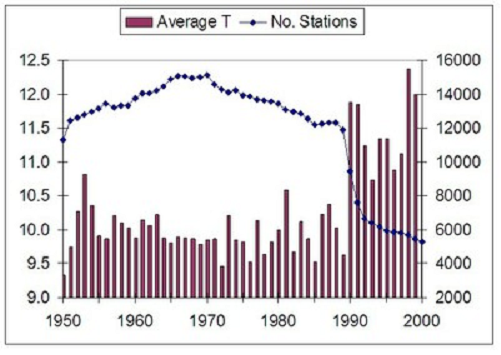
Since 1965 the increase in fossil fuel consumption is dramatic and monotonic (with 2020 an exception), steadily increasing by 218% from 146 to 463 exajoules. Meanwhile the GMT record from Hadcrut shows multiple ups and downs with an accumulated rise of 0.9C over 55 years, 7% of the starting value.

Others know that Global Mean Temperature is a slippery calculation subject to the selection of stations.

Graph showing the correlation between Global Mean Temperature (Average T) and the number of stations included in the global database. Source: Ross McKitrick, U of Guelph

Global warming estimates combine results from adjusted records.
Conclusion

The pattern of high and low records discussed above is consistent with natural variability rather than rising CO2 or fossil fuel consumption. Those of us not alarmed about the reported warming understand that “climate change” is something nature does all the time, and that the future is likely to include periods both cooler and warmer than now.

Background Reading:

The Climate Story (Illustrated)

2021 Update: Fossil Fuels ≠ Global Warming

Man Made Warming from Adjusting Data

What is Global Temperature? Is it warming or cooling?

NOAA US temp 2019 2021

Temps Cause CO2 Changes, Not the Reverse. June 2022 Update

Science is based on predictive power.  For example, astronomers demonstrate they know how the solar system works when they accurately predict eclipses of the sun and moon.

This post is about proving that CO2 changes in response to temperature changes, not the other way around, as is often claimed.  In order to do  that we need two datasets: one for measurements of changes in atmospheric CO2 concentrations over time and one for estimates of Global Mean Temperature changes over time.

For a possible explanation of natural warming and CO2 emissions see Little Ice Age Warming Recovery May be Over

Climate science is unsettling because past data are not fixed, but change later on.  I ran into this previously and now again in 2021 and 2022 when I set out to update an analysis done in 2014 by Jeremy Shiers (discussed in a previous post reprinted at the end).  Jeremy provided a spreadsheet in his essay Murray Salby Showed CO2 Follows Temperature Now You Can Too posted in January 2014. I downloaded his spreadsheet intending to bring the analysis up to the present to see if the results hold up.  The two sources of data were:

Temperature anomalies from RSS here:  http://www.remss.com/missions/amsu

CO2 monthly levels from NOAA (Mauna Loa): https://www.esrl.noaa.gov/gmd/ccgg/trends/data.html

Changes in CO2 (ΔCO2)

Uploading the CO2 dataset showed that many numbers had changed (why?).

The blue line shows annual observed differences in monthly values year over year, e.g. June 2020 minus June 2019 etc.  The first 12 months (1979) provide the observed starting values from which differentials are calculated.  The orange line shows those CO2 values changed slightly in the 2020 dataset vs. the 2014 dataset, on average +0.035 ppm.  But there is no pattern or trend added, and deviations vary randomly between + and -.  So last year I took the 2020 dataset to replace the older one for updating the analysis.

Now I find the NOAA dataset in 2021 has almost completely new values due to a method shift in February 2021, requiring a recalibration of all previous measurements.  The new picture of ΔCO2 is graphed below.

The method shift is reported at a NOAA Global Monitoring Laboratory webpage, Carbon Dioxide (CO2) WMO Scale, with a justification for the difference between X2007 results and the new results from X2019 now in force.  The orange line shows that the shift has resulted in higher values, especially early on and a general slightly increasing trend over time.  However, these are small variations at the decimal level on values 340 and above.  Further, the graph shows that yearly differentials month by month are virtually the same as before.  Thus I redid the analysis with the new values.

Again, note that these are annual differences by month, i.e. the value for May 2022 is the reported CO2 concentration in May 2022 minus the May 2021 CO2.  Note also how the differences have declined sharply the last two years.

Global Temperature Anomalies (ΔTemp)

The other time series was the record of global temperature anomalies according to RSS. The current RSS dataset is not at all the same as the past.

Here we see some seriously unsettling science at work.  The purple line is RSS in 2014, and the blue is RSS as of 2020.  Some further increases appear in the gold 2022 rss dataset. The red line shows alterations from the old to the new.  There is a slight cooling of the data in the beginning years, then the three versions mostly match until 1997, when systematic warming enters the record.  From 1997/5 to 2003/12 the average anomaly increases by 0.04C.  After 2004/1 to 2012/8 the average increase is 0.15C.  At the end from 2012/9 to 2013/12, the average anomaly was higher by 0.21. The 2022 version added slight warming over 2020 values.

RSS continues that accelerated warming to the present, but it cannot be trusted.  And who knows what the numbers will be a few years down the line?  As Dr. Ole Humlum said some years ago (regarding Gistemp): “It should however be noted, that a temperature record which keeps on changing the past hardly can qualify as being correct.”

Given the above manipulations, I went instead to the other satellite dataset UAH version 6. UAH has also made a shift by changing its baseline from 1981-2010 to 1991-2020.  This resulted in systematically reducing the anomaly values, but did not alter the pattern of variation over time.  For comparison, here are the two records with measurements through May 2022. UAH dataset for temperatures in the lower troposphere (TLT).

Comparing UAH temperature anomalies to NOAA CO2 changes.

Here are UAH temperature anomalies compared to CO2 monthly changes year over year.

Changes in monthly CO2 synchronize with temperature fluctuations, which for UAH are anomalies now referenced to the 1991-2020 period.  As stated above, CO2 differentials are calculated for the present month by subtracting the value for the same month in the previous year (for example May 2022 minus May 2021).   Temp anomalies are calculated by comparing the present month with the baseline month. Note the dropping temperatures over the last two years, slightly preceding CO2 descending.

The final proof that CO2 follows temperature due to stimulation of natural CO2 reservoirs is demonstrated by the ability to calculate CO2 levels since 1979 with a simple mathematical formula:

For each subsequent year, the co2 level for each month was generated

CO2  this month this year = a + b × Temp this month this year  + CO2 this month last year

Jeremy used Python to estimate a and b, but I used his spreadsheet to guess values that place for comparison the observed and calculated CO2 levels on top of each other.

In the chart calculated CO2 levels correlate with observed CO2 levels at 0.9985 out of 1.0000.  This mathematical generation of CO2 atmospheric levels is only possible if they are driven by temperature-dependent natural sources, and not by human emissions which are small in comparison, rise steadily and monotonically.

Previous Post:  What Causes Rising Atmospheric CO2?

nasa_carbon_cycle_2008-1

This post is prompted by a recent exchange with those reasserting the “consensus” view attributing all additional atmospheric CO2 to humans burning fossil fuels.

The IPCC doctrine which has long been promoted goes as follows. We have a number over here for monthly fossil fuel CO2 emissions, and a number over there for monthly atmospheric CO2. We don’t have good numbers for the rest of it-oceans, soils, biosphere–though rough estimates are orders of magnitude higher, dwarfing human CO2.  So we ignore nature and assume it is always a sink, explaining the difference between the two numbers we do have. Easy peasy, science settled.

What about the fact that nature continues to absorb about half of human emissions, even while FF CO2 increased by 60% over the last 2 decades? What about the fact that in 2020 FF CO2 declined significantly with no discernable impact on rising atmospheric CO2?

These and other issues are raised by Murray Salby and others who conclude that it is not that simple, and the science is not settled. And so these dissenters must be cancelled lest the narrative be weakened.

The non-IPCC paradigm is that atmospheric CO2 levels are a function of two very different fluxes. FF CO2 changes rapidly and increases steadily, while Natural CO2 changes slowly over time, and fluctuates up and down from temperature changes. The implications are that human CO2 is a simple addition, while natural CO2 comes from the integral of previous fluctuations.  Jeremy Shiers has a series of posts at his blog clarifying this paradigm. See Increasing CO2 Raises Global Temperature Or Does Increasing Temperature Raise CO2 Excerpts in italics with my bolds.

The following graph which shows the change in CO2 levels (rather than the levels directly) makes this much clearer.

Note the vertical scale refers to the first differential of the CO2 level not the level itself. The graph depicts that change rate in ppm per year.

There are big swings in the amount of CO2 emitted. Taking the mean as 1.6 ppmv/year (at a guess) there are +/- swings of around 1.2 nearly +/- 100%.

And, surprise surprise, the change in net emissions of CO2 is very strongly correlated with changes in global temperature.

This clearly indicates the net amount of CO2 emitted in any one year is directly linked to global mean temperature in that year.

For any given year the amount of CO2 in the atmosphere will be the sum of

  • all the net annual emissions of CO2
  • in all previous years.

For each year the net annual emission of CO2 is proportional to the annual global mean temperature.

This means the amount of CO2 in the atmosphere will be related to the sum of temperatures in previous years.

So CO2 levels are not directly related to the current temperature but the integral of temperature over previous years.

The following graph again shows observed levels of CO2 and global temperatures but also has calculated levels of CO2 based on sum of previous years temperatures (dotted blue line).

Summary:

The massive fluxes from natural sources dominate the flow of CO2 through the atmosphere.  Human CO2 from burning fossil fuels is around 4% of the annual addition from all sources. Even if rising CO2 could cause rising temperatures (no evidence, only claims), reducing our emissions would have little impact.

Resources:

CO2 Fluxes, Sources and Sinks

Who to Blame for Rising CO2?

Fearless Physics from Dr. Salby

In this video presentation, Dr. Salby provides the evidence, math and charts supporting the non-IPCC paradigm.

Footnote:  As CO2 concentrations rose, BP shows Fossil Fuel consumption slumped in 2020

See also 2022 Update: Fossil Fuels ≠ Global Warming

Zero Carbon False Pretenses

19170447-global_warming_1.530x298

Legal Definition of false pretenses: false representations concerning past or present facts that are made with the intent to defraud another.  Marriam-Webster.

As we will see below, the zero carbon campaign relies on a series of false representations, primarily from omitting realities contradictory to the CO2 scare narrative.

In the aftermath of Glasgow COP, many have noticed how incredible were the pronouncements and claims from UK hosts as well as other speakers intending to inflame public opinion in support of the UN agenda.  No one in the media applies any kind of critical intelligence examining the veracity of facts and conclusions trumpeted before, during and after the conference.  In the interest of presenting an alternate, unalarming paradigm of earth’s climate, I am reposting a previous discussion of how wrongheaded is the IPCC “consensus science.”

Background

With all the fuss about the “Green New Deal” and attempts to blame recent cold waves on rising CO2, it is wise to remember the logic of the alarmist argument.  It boils down to two suppositions:

Rising atmospheric CO2 makes the planet warmer.

Rising emissions from humans burning fossil fuels makes atmospheric CO2 higher.

The second assertion is challenged in a post: Who to Blame for Rising CO2?

This post addresses the first claim.  Remember also that all of the so-called “lines of evidence” for global warming do not distinguish between human and natural causes.  Typically the evidence cited falls into these categories:

Global temperature rise
Warming oceans
Shrinking ice sheets
Glacial retreat
Decreased snow cover
Sea level rise
Declining Arctic sea ice
Extreme events

However, all of these are equivocal, involving signal and noise issues. Note also that all of them are alleged impacts from the first one.  And in any case, the fact of any changes does not in itself prove human causation.  That attribution rests solely on unvalidated climate models.  Below is a discussion of the reductionist mental process by which climate complexity and natural forces are systematically excluded to reach the pre-determined conclusion.

Original Post:  Climate Reductionism


Reductionists are those who take one theory or phenomenon to be reducible to some other theory or phenomenon. For example, a reductionist regarding mathematics might take any given mathematical theory to be reducible to logic or set theory. Or, a reductionist about biological entities like cells might take such entities to be reducible to collections of physico-chemical entities like atoms and molecules.
Definition from The Internet Encyclopedia of Philosophy

Some of you may have seen this recent article: Divided Colorado: A Sister And Brother Disagree On Climate Change

The reporter describes a familiar story to many of us.  A single skeptic (the brother) is holding out against his sister and rest of the family who accept global warming/climate change. And of course, after putting some of their interchanges into the text, the reporter then sides against the brother by taking the word of a climate expert. From the article:

“CO2 absorbs infrared heat in certain wavelengths and those measurements were made first time — published — when Abraham Lincoln was president of the United States,” says Scott Denning, a professor of atmospheric science at Colorado State University. “Since that time, those measurements have been repeated by better and better instruments around the world.”

CO2, or carbon dioxide, has increased over time, scientists say, because of human activity. It’s a greenhouse gas that’s contributing to global warming.

“We know precisely how the molecule wiggles and waggles, and what the quantum interactions between the electrons are that cause everyone one of these little absorption lines,” he says. “And there’s just no wiggle room around it — CO2 absorbs heat, heat warms things up, so adding CO2 to the atmosphere will warm the climate.”

Denning says that most of the CO2 we see added to the atmosphere comes from humans — mostly through burning coal, oil and gas, which, as he puts it, is “indirectly caused by us.”

When looking at the scientific community, Denning says it’s united, as far as he knows.

earth-science-climatic-change-Climate-System-3-114-g001

A Case Study of Climate Reductionism

Denning’s comments, supported by several presentations at his website demonstrate how some scientists (all those known to Denning) engage in a classic form of reductionism.

The full complexity of earth’s climate includes many processes, some poorly understood, but known to have effects orders of magnitude greater than the potential of CO2 warming. The case for global warming alarm rests on simplifying away everything but the predetermined notion that humans are warming the planet. It goes like this:

Our Complex Climate

Earth’s climate is probably the most complicated natural phenomenon ever studied. Not only are there many processes, but they also interact and influence each other over various timescales, causing lagged effects and multiple cycling. This diagram illustrates some of the climate elements and interactions between them.

Flows and Feedbacks for Climate Models

The Many Climate Dimensions

Further, measuring changes in the climate goes far beyond temperature as a metric. Global climate indices, like the European dataset include 12 climate dimensions with 74 tracking measures. The set of climate dimensions include:

  • Sunshine
  • Pressure
  • Humidity
  • Cloudiness
  • Wind
  • Rain
  • Snow
  • Drought
  • Temperature
  • Heat
  • Cold

And in addition there are compound measures combining temperature and precipitation. While temperature is important, climate is much more than that.  With this reduction, all other dimensions are swept aside, and climate change is simplified down to global warming as seen in temperature measurements.

Climate Thermodynamics: Weather is the Climate System at work.

Another distortion is the notion that weather is bad or good, depending on humans finding it favorable. In fact, all that we call weather are the ocean and atmosphere acting to resolve differences in temperatures, humidities and pressures. It is the natural result of a rotating, irregular planetary surface mostly covered with water and illuminated mostly at its equator.

The sun warms the surface, but the heat escapes very quickly by convection so the build-up of heat near the surface is limited. In an incompressible atmosphere, it would *all* escape, and you’d get no surface warming. But because air is compressible, and because gases warm up when they’re compressed and cool down when allowed to expand, air circulating vertically by convection will warm and cool at a certain rate due to the changing atmospheric pressure.

Climate science has been obsessed with only a part of the system, namely the atmosphere and radiation, in order to focus attention on the non-condensing IR active gases. The climate is framed as a 3D atmosphere above a 2D surface. That narrow scope leaves out the powerful non-radiative heat transfer mechanisms that dominate the lower troposphere, and the vast reservoir of thermal energy deep in the oceans.

As Dr. Robert E Stevenson writes, it could have been different:

“As an oceanographer, I’d been around the world, once or twice, and I was rather convinced that I knew the factors that influenced the Earth’s climate. The oceans, by virtue of their enormous density and heat-storage capacity, are the dominant influence on our climate. It is the heat budget and the energy that flows into and out of the oceans that basically determines the mean temperature of the global atmosphere. These interactions, plus evaporation, are quite capable of canceling the slight effect of man-produced CO2.”

The troposphere is dominated by powerful heat transfer mechanisms: conduction, convection and evaporation, as well as physical kinetic movements.  All this is ignored in order to focus on radiative heat transfer, a bit player except at the top of the atmosphere.

There’s More than the Atmosphere

Once the world of climate is greatly reduced down to radiation of infrared frequencies, yet another set of blinders is applied. The most important source of radiation is of course the sun. Solar radiation in the short wave (SW) range is what we see and what heats up the earth’s surface, particularly the oceans. In addition solar radiation includes infrared, some absorbed in the atmosphere and some at the surface. The ocean is also a major source of heat into the atmosphere since its thermal capacity is 1000 times what the air can hold. The heat transfer from ocean to air is both by way of evaporation (latent heat) and also by direct contact at the sea surface (conduction).

Yet conventional climate science dismisses the sun as a climate factor saying that its climate input is unvarying. That ignores significant fluctuations in parts of the light range, for example ultraviolet, and also solar effects such as magnetic fields and cosmic rays. Also disregarded is solar energy varying due to cloud fluctuations. The ocean is also dismissed as a source of climate change despite obvious ocean warming and cooling cycles ranging from weeks to centuries. The problem is such oscillations are not well understood or predictable, so can not be easily modeled.

With the sun and the earth’s surface and ocean dismissed, the only consideration left is the atmosphere.

The Gorilla Greenhouse Gas

Thus climate has been reduced down to heat radiation passing through the atmosphere comprised of gases. One of the biggest reductions then comes from focusing on CO2 rather than H20. Of all the gases that are IR-active, water is the most prevalent and covers more of the spectrum.

The diagram below gives you the sense of proportion.

GHG blocks

The Role of CO2

We come now to the role of CO2 in “trapping heat” and making the world warmer. The theory is that CO2 acts like a blanket by absorbing and re-radiating heat that would otherwise escape into space. By delaying the cooling while solar energy comes in constantly, CO2 is presumed to cause a buildup of heat resulting in warmer temperatures.

How the Atmosphere Processes Heat

There are 3 ways that heat (Infrared or IR radiation) passes from the surface to space.

1) A small amount of the radiation leaves directly, because all gases in our air are transparent to IR of 10-14 microns (sometimes called the “atmospheric window.” This pathway moves at the speed of light, so no delay of cooling occurs.

2) Some radiation is absorbed and re-emitted by IR active gases up to the tropopause. Calculations of the free mean path for CO2 show that energy passes from surface to tropopause in less than 5 milliseconds. This is almost speed of light, so delay is negligible. H2O is so variable across the globe that its total effects are not measurable. In arid places, like deserts, we see that CO2 by itself does not prevent the loss of the day’s heat after sundown.

3) The bulk gases of the atmosphere, O2 and N2, are warmed by conduction and convection from the surface. They also gain energy by collisions with IR active gases, some of that IR coming from the surface, and some absorbed directly from the sun. Latent heat from water is also added to the bulk gases. O2 and N2 are slow to shed this heat, and indeed must pass it back to IR active gases at the top of the troposphere for radiation into space.

In a parcel of air each molecule of CO2 is surrounded by 2500 other molecules, mostly O2 and N2. In the lower atmosphere, the air is dense and CO2 molecules energized by IR lose it to surrounding gases, slightly warming the entire parcel. Higher in the atmosphere, the air is thinner, and CO2 molecules can emit IR into space. Surrounding gases resupply CO2 with the energy it lost, which leads to further heat loss into space.

This third pathway has a significant delay of cooling, and is the reason for our mild surface temperature, averaging about 15C. Yes, earth’s atmosphere produces a buildup of heat at the surface. The bulk gases, O2 and N2, trap heat near the surface, while IR active gases, mainly H20 and CO2, provide the radiative cooling at the top of the atmosphere. Near the top of the atmosphere you will find the -18C temperature.

Sources of CO2

Note the size of the human emissions next to the red arrow.

A final reduction comes down to how much of the CO2 in the atmosphere is there because of us. Alarmists/activists say any increase in CO2 is 100% man-made, and would be more were it not for natural CO2 sinks, namely the ocean and biosphere. The claim overlooks the fact that those sinks are also sources of CO2 and the flux from the land and sea is an order of magnitude higher than estimates of human emissions. In fact, our few Gigatons of carbon are lost within the error range of estimating natural emissions. Insects produce far more CO2 than humans do by all our activity, including domestic animals.

Why Climate Reductionism is Dangerous

Reducing the climate in this fashion reaches its logical conclusion in the Activist notion of the “450 Scenario.”  Since Cancun, IPCC is asserting that global warming is capped at 2C by keeping CO2 concentration below 450 ppm. From Summary for Policymakers (SPM) AR5

Emissions scenarios leading to CO2-equivalent concentrations in 2100 of about 450 ppm or lower are likely to maintain warming below 2°C over the 21st century relative to pre-industrial levels. These scenarios are characterized by 40 to 70% global anthropogenic GHG emissions reductions by 2050 compared to 2010, and emissions levels near zero or below in 2100.

Thus is born the “450 Scenario” by which governments can be focused upon reducing human emissions without any reference to temperature measurements, which are troublesome and inconvenient. Almost everything in the climate world has been erased, and “Fighting Climate Change” is now code to mean accounting for fossil fuel emissions.

Conclusion

All propagandists begin with a kernel of truth, in this case the fact everything acting in the world has an effect on everything else. Edward Lorenz brought this insight to bear on the climate system in a ground breaking paper he presented in 1972 entitled: “Predictability: Does the Flap of a Butterfly’s Wings in Brazil Set Off a Tornado in Texas?”  Everything does matter and has an effect. Obviously humans impact on the climate in places where we build cities and dams, clear forests and operate farms. And obviously we add some CO2 when we burn fossil fuels.

But it is wrong to ignore the major dominant climate realities in order to exaggerate a small peripheral factor for the sake of an agenda. It is wrong to claim that IR active gases somehow “trap” heat in the air when they immediately emit any energy absorbed, if not already lost colliding with another molecule. No, it is the bulk gases, N2 and O2, making up the mass of the atmosphere, together with the ocean delaying the cooling and giving us the mild and remarkably stable temperatures that we enjoy. And CO2 does its job by radiating the heat into space.

Since we do little to cause it, we can’t fix it by changing what we do. The climate will not stop changing because we put a price on carbon. And the sun will rise despite the cock going on strike to protest global warming.

Footnote: For a deeper understanding of the atmospheric physics relating to CO2 and climate, I have done a guide and synopsis of Murry Salby’s latest textbook on the subject:  Fearless Physics from Dr. Salby

UAH Shows May Reversed April Warming Blip

The post below updates the UAH record of air temperatures over land and ocean.  But as an overview consider how recent rapid cooling  completely overcame the warming from the last 3 El Ninos (1998, 2010 and 2016).  The UAH record shows that the effects of the last one were gone as of April 2021, again in November 2021 and February 2022. (UAH baseline is now 1991-2020).

For reference I added an overlay of CO2 annual concentrations as measured at Mauna Loa.  While temperatures fluctuated up and down ending flat, CO2 went up steadily by ~55 ppm, a 15% increase.

Furthermore, going back to previous warmings prior to the satellite record shows that the entire rise of 0.8C since 1947 is due to oceanic, not human activity.

gmt-warming-events

The animation is an update of a previous analysis from Dr. Murry Salby.  These graphs use Hadcrut4 and include the 2016 El Nino warming event.  The exhibit shows since 1947 GMT warmed by 0.8 C, from 13.9 to 14.7, as estimated by Hadcrut4.  This resulted from three natural warming events involving ocean cycles. The most recent rise 2013-16 lifted temperatures by 0.2C.  Previously the 1997-98 El Nino produced a plateau increase of 0.4C.  Before that, a rise from 1977-81 added 0.2C to start the warming since 1947.

Importantly, the theory of human-caused global warming asserts that increasing CO2 in the atmosphere changes the baseline and causes systemic warming in our climate.  On the contrary, all of the warming since 1947 was episodic, coming from three brief events associated with oceanic cycles. 

Update August 3, 2021

Chris Schoeneveld has produced a similar graph to the animation above, with a temperature series combining HadCRUT4 and UAH6. H/T WUWT

image-8


mc_wh_gas_web20210423124932

See Also Worst Threat: Greenhouse Gas or Quiet Sun?

May Update NH Land and SH Ocean Warming Reversed

banner-blog

With apologies to Paul Revere, this post is on the lookout for cooler weather with an eye on both the Land and the Sea.  While you will hear a lot about 2020-21 temperatures matching 2016 as the highest ever, that spin ignores how fast the cooling set in.  The UAH data analyzed below shows that warming from the last El Nino was fully dissipated with chilly temperatures in all regions.  Last month NH land and SH ocean showed temps matching March, reversing an upward blip in April.

UAH has updated their tlt (temperatures in lower troposphere) dataset for May 2022.  Previously I have done posts on their reading of ocean air temps as a prelude to updated records from HadSST3 (which is now discontinued). So I have separately posted on SSTs using HadSST4 April Cool Ocean Temps.  This month also has a separate graph of land air temps because the comparisons and contrasts are interesting as we contemplate possible cooling in coming months and years. Sometimes air temps over land diverge from ocean air changes.  However, last month showed that while air temps over Tropical ocean warmed slightly,  strong cooling over NH and SH, both land and sea, brought the Global anomaly down, back to March 2022 level. 

Note:  UAH has shifted their baseline from 1981-2010 to 1991-2020 beginning with January 2021.  In the charts below, the trends and fluctuations remain the same but the anomaly values change with the baseline reference shift.

Presently sea surface temperatures (SST) are the best available indicator of heat content gained or lost from earth’s climate system.  Enthalpy is the thermodynamic term for total heat content in a system, and humidity differences in air parcels affect enthalpy.  Measuring water temperature directly avoids distorted impressions from air measurements.  In addition, ocean covers 71% of the planet surface and thus dominates surface temperature estimates.  Eventually we will likely have reliable means of recording water temperatures at depth.

Recently, Dr. Ole Humlum reported from his research that air temperatures lag 2-3 months behind changes in SST.  Thus the cooling oceans now portend cooling land air temperatures to follow.  He also observed that changes in CO2 atmospheric concentrations lag behind SST by 11-12 months.  This latter point is addressed in a previous post Who to Blame for Rising CO2?

After a change in priorities, updates are now exclusive to HadSST4.  For comparison we can also look at lower troposphere temperatures (TLT) from UAHv6 which are now posted for May.  The temperature record is derived from microwave sounding units (MSU) on board satellites like the one pictured above. Recently there was a change in UAH processing of satellite drift corrections, including dropping one platform which can no longer be corrected. The graphs below are taken from the revised and current dataset.

The UAH dataset includes temperature results for air above the oceans, and thus should be most comparable to the SSTs. There is the additional feature that ocean air temps avoid Urban Heat Islands (UHI).  The graph below shows monthly anomalies for ocean temps since January 2015.

Note 2020 was warmed mainly by a spike in February in all regions, and secondarily by an October spike in NH alone. In 2021, SH and the Tropics both pulled the Global anomaly down to a new low in April. Then SH and Tropics upward spikes, along with NH warming brought Global temps to a peak in October.  That warmth was gone as November 2021 ocean temps plummeted everywhere. A upward bump 01/2022 was reversed in 02/2022 before temps rose again in 03/2022.  Last month ocean temps in both NH and SH dropped sharply, pulling down the Global anomaly, despite some Tropical warming.

Land Air Temperatures Tracking Downward in Seesaw Pattern

We sometimes overlook that in climate temperature records, while the oceans are measured directly with SSTs, land temps are measured only indirectly.  The land temperature records at surface stations sample air temps at 2 meters above ground.  UAH gives tlt anomalies for air over land separately from ocean air temps.  The graph updated for May is below.

Here we have fresh evidence of the greater volatility of the Land temperatures, along with extraordinary departures by SH land.  Land temps are dominated by NH with a 2021 spike in January,  then dropping before rising in the summer to peak in October 2021. As with the ocean air temps, all that was erased in November with a sharp cooling everywhere. Land temps dropped sharply for four months, even more than did the Oceans. March and April saw some warming, reversed In May when all land regions cooled pulling down the global anomaly.

The Bigger Picture UAH Global Since 1980

The chart shows monthly Global anomalies starting 01/1980 to present.  The average monthly anomaly is -0.06, for this period of more than four decades.  The graph shows the 1998 El Nino after which the mean resumed, and again after the smaller 2010 event. The 2016 El Nino matched 1998 peak and in addition NH after effects lasted longer, followed by the NH warming 2019-20.   A small upward bump in 2021 has been reversed with temps having returned close to the mean as of 2/2022.  March and April brought warmer Global temps, reversed in May and with little indication for another El Nino this summer.

TLTs include mixing above the oceans and probably some influence from nearby more volatile land temps.  Clearly NH and Global land temps have been dropping in a seesaw pattern, nearly 1C lower than the 2016 peak.  Since the ocean has 1000 times the heat capacity as the atmosphere, that cooling is a significant driving force.  TLT measures started the recent cooling later than SSTs from HadSST3, but are now showing the same pattern.  It seems obvious that despite the three El Ninos, their warming has not persisted, and without them it would probably have cooled since 1995.  Of course, the future has not yet been written.