Climate Changes Both Ways

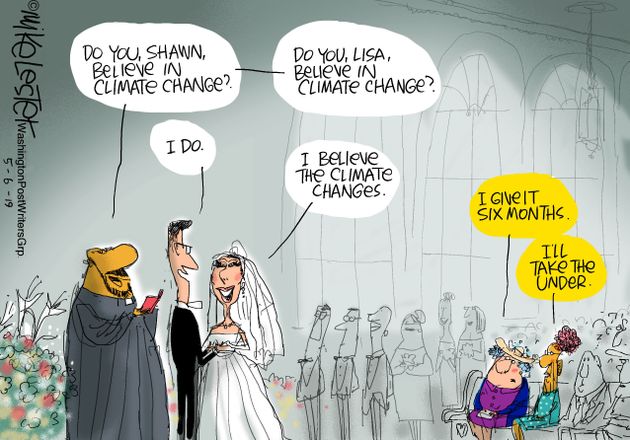
The title comes from a news event last week when President Trump reminded Prince Charles of a natural truism:  Climate change goes both ways.  A media freak out ensued, as shown by this example from Newsweek.  Excerpt in italics with my bolds.

President Donald Trump said Wednesday he believes there has been a change in the weather due to climate change, but that “it changes both ways.”

The president then explained his views on the climate. “Don’t forget, it used to be called global warming, that wasn’t working, then it was called climate change, now it’s actually called extreme weather because with extreme weather you can’t miss,” the president said.

Environmental watchdog groups now advocate calling the phenomenon “climate catastrophe.”

It seemed to me that Trump is learning from his briefings with William Happer, and is finding the weak spots in the alarmist house of cards.  It also reminded me of a previous post describing the complexity of tracking climate change.  That essay is reprinted below because it reminds us that not only does climate change both ways, but also the warming and cooling can happen concurrently in some times and places.

Concurrent Climate Warming and Cooling

This post highlights recent interesting findings regarding past climate change in NH, Scotland in particular. The purpose of the research was to better understand how glaciers could be retreating during the Younger Dryas Stadia (YDS), one of the coldest periods in our Holocene epoch.

The lead researcher is Gordon Bromley, and the field work was done on site of the last ice fields on the highlands of Scotland. 14C dating was used to estimate time of glacial events such as vegetation colonizing these places. Bromely explains in article Shells found in Scotland rewrite our understanding of climate change at siliconrepublic. Excerpts in italics with my bolds.

By analysing ancient shells found in Scotland, the team’s data challenges the idea that the period was an abrupt return to an ice age climate in the North Atlantic, by showing that the last glaciers there were actually decaying rapidly during that period.

The shells were found in glacial deposits, and one in particular was dated as being the first organic matter to colonise the newly ice-free landscape, helping to provide a minimum age for the glacial advance. While all of these shell species are still in existence in the North Atlantic, many are extinct in Scotland, where ocean temperatures are too warm.

This means that although winters in Britain and Ireland were extremely cold, summers were a lot warmer than previously thought, more in line with the seasonal climates of central Europe.

“There’s a lot of geologic evidence of these former glaciers, including deposits of rubble bulldozed up by the ice, but their age has not been well established,” said Dr Gordon Bromley, lead author of the study, from NUI Galway’s School of Geography and Archaeology.

“It has largely been assumed that these glaciers existed during the cold Younger Dryas period, since other climate records give the impression that it was a cold time.”

He continued: “This finding is controversial and, if we are correct, it helps rewrite our understanding of how abrupt climate change impacts our maritime region, both in the past and potentially into the future.”

The recent report is Interstadial Rise and Younger Dryas Demise of Scotland’s Last Ice Fields G. Bromley A. Putnam H. Borns Jr T. Lowell T. Sandford D. Barrell  First published: 26 April 2018.(my bolds)

Abstract

Establishing the atmospheric expression of abrupt climate change during the last glacial termination is key to understanding driving mechanisms. In this paper, we present a new 14C chronology of glacier behavior during late‐glacial time from the Scottish Highlands, located close to the overturning region of the North Atlantic Ocean. Our results indicate that the last pulse of glaciation culminated between ~12.8 and ~12.6 ka, during the earliest part of the Younger Dryas stadial and as much as a millennium earlier than several recent estimates. Comparison of our results with existing minimum‐limiting 14C data also suggests that the subsequent deglaciation of Scotland was rapid and occurred during full stadial conditions in the North Atlantic. We attribute this pattern of ice recession to enhanced summertime melting, despite severely cool winters, and propose that relatively warm summers are a fundamental characteristic of North Atlantic stadials.

Plain Language Summary

Geologic data reveal that Earth is capable of abrupt, high‐magnitude changes in both temperature and precipitation that can occur well within a human lifespan. Exactly what causes these potentially catastrophic climate‐change events, however, and their likelihood in the near future, remains frustratingly unclear due to uncertainty about how they are manifested on land and in the oceans. Our study sheds new light on the terrestrial impact of so‐called “stadial” events in the North Atlantic region, a key area in abrupt climate change. We reconstructed the behavior of Scotland’s last glaciers, which served as natural thermometers, to explore past changes in summertime temperature. Stadials have long been associated with extreme cooling of the North Atlantic and adjacent Europe and the most recent, the Younger Dryas stadial, is commonly invoked as an example of what might happen due to anthropogenic global warming. In contrast, our new glacial chronology suggests that the Younger Dryas was instead characterized by glacier retreat, which is indicative of climate warming. This finding is important because, rather than being defined by severe year‐round cooling, it indicates that abrupt climate change is instead characterized by extreme seasonality in the North Atlantic region, with cold winters yet anomalously warm summers.

The complete report is behind a paywall, but a 2014 paper by Bromley discusses the evidence and analysis in reaching these conclusions. Younger Dryas deglaciation of Scotland driven by warming summers  Excerpts with my bolds.

Significance: As a principal component of global heat transport, the North Atlantic Ocean also is susceptible to rapid disruptions of meridional overturning circulation and thus widely invoked as a cause of abrupt climate variability in the Northern Hemisphere. We assess the impact of one such North Atlantic cold event—the Younger Dryas Stadial—on an adjacent ice mass and show that, rather than instigating a return to glacial conditions, this abrupt climate event was characterized by deglaciation. We suggest this pattern indicates summertime warming during the Younger Dryas, potentially as a function of enhanced seasonality in the North Atlantic.
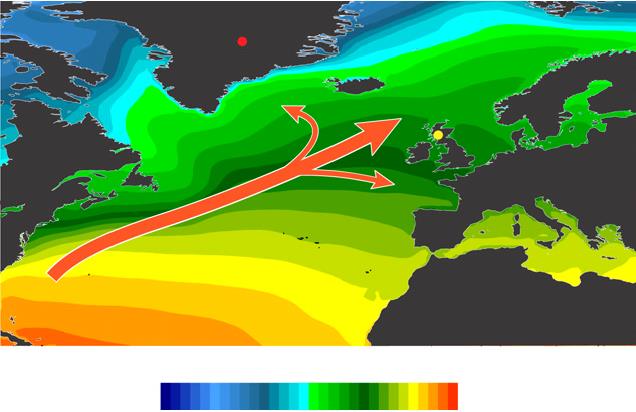
Surface temperatures range from -30C to +30C

Fig. 1. Surface temperature and heat transport in the North Atlantic Ocean.  The relatively mild European climate is sustained by warm sea-surface temperatures and prevailing southwesterly airflow in the North Atlantic Ocean (NAO), with this ameliorating effect being strongest in maritime regions such as Scotland. Mean annual temperature (1979 to present) at 2 m above surface (image obtained using University of Maine Climate Reanalyzer, http://www.cci-reanalyzer.org). Locations of Rannoch Moor and the GISP2 ice core are indicated (yellow and red dots).

Thus the Scottish glacial record is ideal for reconstructing late glacial variability in North Atlantic temperature (Fig. 1). The last glacier resurgence in Scotland—the “Loch Lomond Advance” (LLA)—culminated in a ∼9,500-km2 ice cap centered over Rannoch Moor (Fig. 2A) and surrounded by smaller ice fields and cirque glaciers.
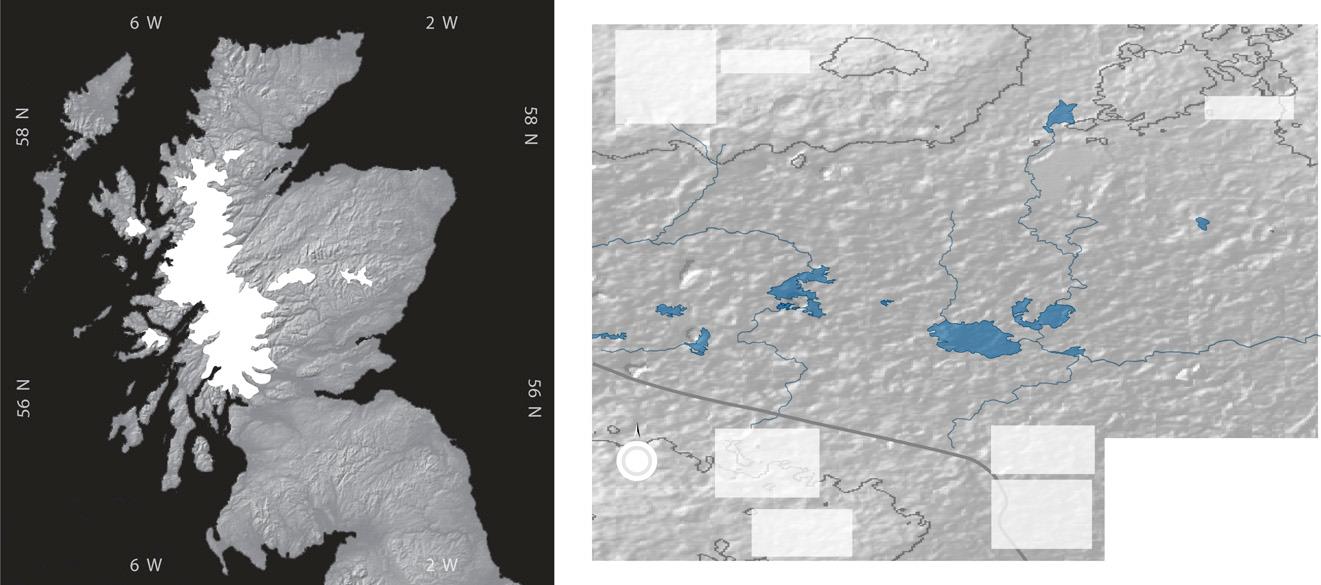
Fig. 2. Extent of the LLA ice cap in Scotland and glacial geomorphology of western Rannoch Moor. (A) Maximum extent of the ∼9,500 km2 LLA ice cap and larger satellite ice masses, indicating the central location of Rannoch Moor. Nunataks are not shown. (B) Glacial-geomorphic map of western Rannoch Moor. Distinct moraine ridges mark the northward active retreat of the glacier margin (indicated by arrow) across this sector of the moor, whereas chaotic moraines near Lochan Meall a’ Phuill (LMP) mark final stagnation of ice. Core sites are shown, including those (K1–K3) of previous investigations (14, 15).

When did the LLA itself occur? We consider two possible resolutions to the paradox of deglaciation during the YDS. First, declining precipitation over Scotland due to gradually increasing North Atlantic sea-ice extent has been invoked to explain the reported shrinkage of glaciers in the latter half of the YDS (18). However, this course of events conflicts with recent data depicting rapid, widespread imposition of winter sea-ice cover at the onset of the YDS (9), rather than progressive expansion throughout the stadial.

Loch Lomond

Furthermore, considering the gradual active retreat of LLA glaciers indicated by the geomorphic record, our chronology suggests that deglaciation began considerably earlier than the mid-YDS, when precipitation reportedly began to decline (18). Finally, our cores contain lacustrine sediments deposited throughout the latter part of the YDS, indicating that the water table was not substantially different from that of today. Indeed, some reconstructions suggest enhanced YDS precipitation in Scotland (24, 25), which is inconsistent with the explanation that precipitation starvation drove deglaciation (26).

We prefer an alternative scenario in which glacier recession was driven by summertime warming and snowline rise. We suggest that amplified seasonality, driven by greatly expanded winter sea ice, resulted in a relatively continental YDS climate for western Europe, both in winter and in summer. Although sea-ice formation prevented ocean–atmosphere heat transfer during the winter months (10), summertime melting of sea ice would have imposed an extensive freshwater cap on the ocean surface (27), resulting in a buoyancy-stratified North Atlantic. In the absence of deep vertical mixing, summertime heating would be concentrated at the ocean surface, thereby increasing both North Atlantic summer sea-surface temperatures (SSTs) and downwind air temperatures. Such a scenario is analogous to modern conditions in the Sea of Okhotsk (28) and the North Pacific Ocean (29), where buoyancy stratification maintains considerable seasonal contrasts in SSTs. Indeed, Haug et al. (30) reported higher summer SSTs in the North Pacific following the onset of stratification than previously under destratified conditions, despite the growing presence of northern ice sheets and an overall reduction in annual SST. A similar pattern is evident in a new SST record from the northeastern North Atlantic, which shows higher summer temperatures during stadial periods (e.g., Heinrich stadials 1 and 2) than during interstadials on account of amplified seasonality (30).

Our interpretation of the Rannoch Moor data, involving the summer (winter) heating (cooling) effects of a shallow North Atlantic mixed layer, reconciles full stadial conditions in the North Atlantic with YDS deglaciation in Scotland. This scenario might also account for the absence of YDS-age moraines at several higher-latitude locations (12, 36–38) and for evidence of mild summer temperatures in southern Greenland (11). Crucially, our chronology challenges the traditional view of renewed glaciation in the Northern Hemisphere during the YDS, particularly in the circum-North Atlantic, and highlights our as yet incomplete understanding of abrupt climate change.

Summary

Several things are illuminated by this study. For one thing, glaciers grow or recede because of multiple factors, not just air temperature. The study noted that glaciers require precipitation (snow) in order to grow, but also melt under warmer conditions. For background on the complexities of glacier dynamics see Glaciermania

Also, paleoclimatology relies on temperature proxies who respond to changes over multicentennial scales at best. C14 brings higher resolution to the table.

Finally, it is interesting to consider climate changing with respect to seasonality.  Bromley et al. observe that during Younger Dryas, Scotland shifted from a moderate maritime climate to one with more seasonal extremes like that of inland continental regions. In that light, what should we expect from cooler SSTs in the North Atlantic?

Note also that our modern warming period has been marked by the opposite pattern. Many NH temperature records show slight summer cooling along with somewhat stronger warming in winter, the net being the modest (fearful?) warming in estimates of global annual temperatures.

I’m with Trump on this one:  Climate shifts are not a matter of one-way warming, as we have been told.


Ocean SSTs Cooled in May

The best context for understanding decadal temperature changes comes from the world’s sea surface temperatures (SST), for several reasons:

  • The ocean covers 71% of the globe and drives average temperatures;
  • SSTs have a constant water content, (unlike air temperatures), so give a better reading of heat content variations;
  • A major El Nino was the dominant climate feature in recent years.

HadSST is generally regarded as the best of the global SST data sets, and so the temperature story here comes from that source, the latest version being HadSST3.  More on what distinguishes HadSST3 from other SST products at the end.

The Current Context

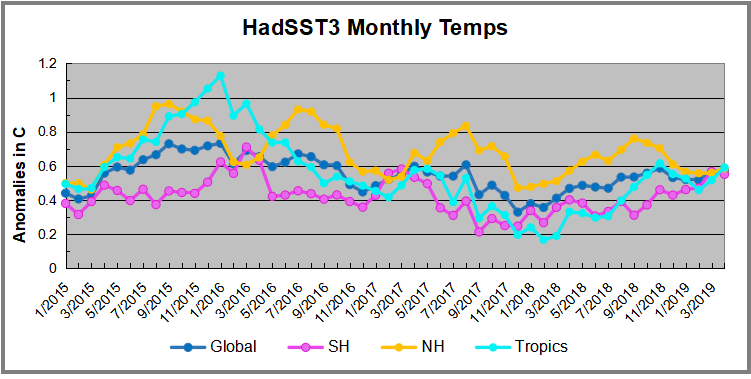
The chart below shows SST monthly anomalies as reported in HadSST3 starting in 2015 through May 2019.
A global cooling pattern is seen clearly in the Tropics since its peak in 2016, joined by NH and SH cycling downward since 2016.  2018 started with slow warming after the low point of December 2017, led by steadily rising NH, which peaked in September and cooled since.  The Tropics rose steadily until November, and are now cooling as well.

In 2019 all regions have been converging to reach nearly the same value in April.  Now in May, NH rose very slightly, while SH dropped 0.1C and the Tropics SSTs are down 0.07C. As a result the Global average anomaly in down 0.05 to an anomaly of 0.52C  All regions are about the same as 05/2017 which led to a cooling period despite NH warming at the time

Note that higher temps in 2015 and 2016 were first of all due to a sharp rise in Tropical SST, beginning in March 2015, peaking in January 2016, and steadily declining back below its beginning level. Secondly, the Northern Hemisphere added three bumps on the shoulders of Tropical warming, with peaks in August of each year.  A fourth NH bump was lower and peaked in September 2018.  Also, note that the global release of heat was not dramatic, due to the Southern Hemisphere offsetting the Northern one.

The annual SSTs for the last five years are as follows:

Annual SSTs Global NH SH  Tropics
2014 0.477 0.617 0.335 0.451
2015 0.592 0.737 0.425 0.717
2016 0.613 0.746 0.486 0.708
2017 0.505 0.650 0.385 0.424
2018 0.480 0.620 0.362 0.369

2018 annual average SSTs across the regions are close to 2014, slightly higher in SH and much lower in the Tropics.  The SST rise from the global ocean was remarkable, peaking in 2016, higher than 2011 by 0.32C.

A longer view of SSTs

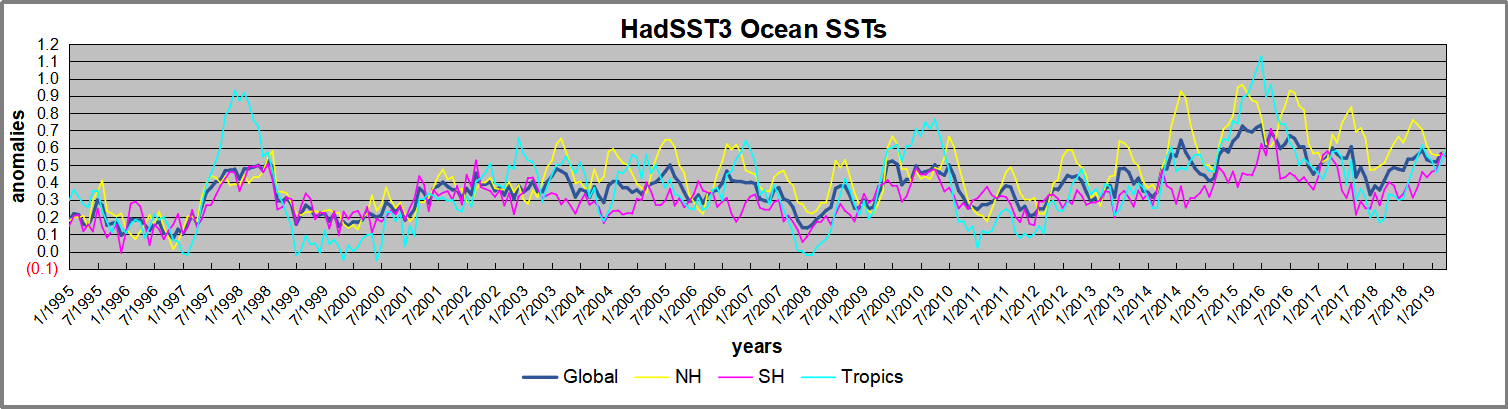
The graph below  is noisy, but the density is needed to see the seasonal patterns in the oceanic fluctuations.  Previous posts focused on the rise and fall of the last El Nino starting in 2015.  This post adds a longer view, encompassing the significant 1998 El Nino and since.  The color schemes are retained for Global, Tropics, NH and SH anomalies.  Despite the longer time frame, I have kept the monthly data (rather than yearly averages) because of interesting shifts between January and July.

Open image in new tab to enlarge.

1995 is a reasonable starting point prior to the first El Nino.  The sharp Tropical rise peaking in 1998 is dominant in the record, starting Jan. ’97 to pull up SSTs uniformly before returning to the same level Jan. ’99.  For the next 2 years, the Tropics stayed down, and the world’s oceans held steady around 0.2C above 1961 to 1990 average.

Then comes a steady rise over two years to a lesser peak Jan. 2003, but again uniformly pulling all oceans up around 0.4C.  Something changes at this point, with more hemispheric divergence than before. Over the 4 years until Jan 2007, the Tropics go through ups and downs, NH a series of ups and SH mostly downs.  As a result the Global average fluctuates around that same 0.4C, which also turns out to be the average for the entire record since 1995.

2007 stands out with a sharp drop in temperatures so that Jan.08 matches the low in Jan. ’99, but starting from a lower high. The oceans all decline as well, until temps build peaking in 2010.

Now again a different pattern appears.  The Tropics cool sharply to Jan 11, then rise steadily for 4 years to Jan 15, at which point the most recent major El Nino takes off.  But this time in contrast to ’97-’99, the Northern Hemisphere produces peaks every summer pulling up the Global average.  In fact, these NH peaks appear every July starting in 2003, growing stronger to produce 3 massive highs in 2014, 15 and 16.  NH July 2017 was only slightly lower, and a fifth NH peak still lower in Sept. 2018.  Note also that starting in 2014 SH plays a moderating role, offsetting the NH warming pulses. (Note: these are high anomalies on top of the highest absolute temps in the NH.)

What to make of all this? The patterns suggest that in addition to El Ninos in the Pacific driving the Tropic SSTs, something else is going on in the NH.  The obvious culprit is the North Atlantic, since I have seen this sort of pulsing before.  After reading some papers by David Dilley, I confirmed his observation of Atlantic pulses into the Arctic every 8 to 10 years.

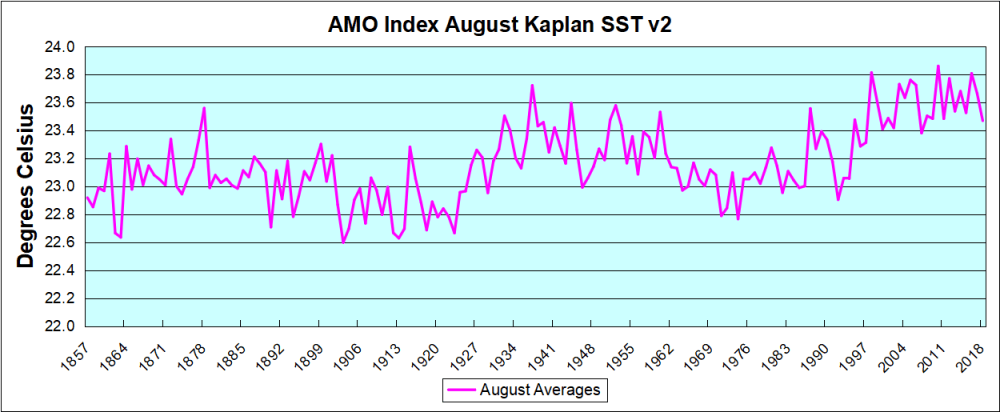
But the peaks coming nearly every summer in HadSST require a different picture.  Let’s look at August, the hottest month in the North Atlantic from the Kaplan dataset.
AMO August 2018

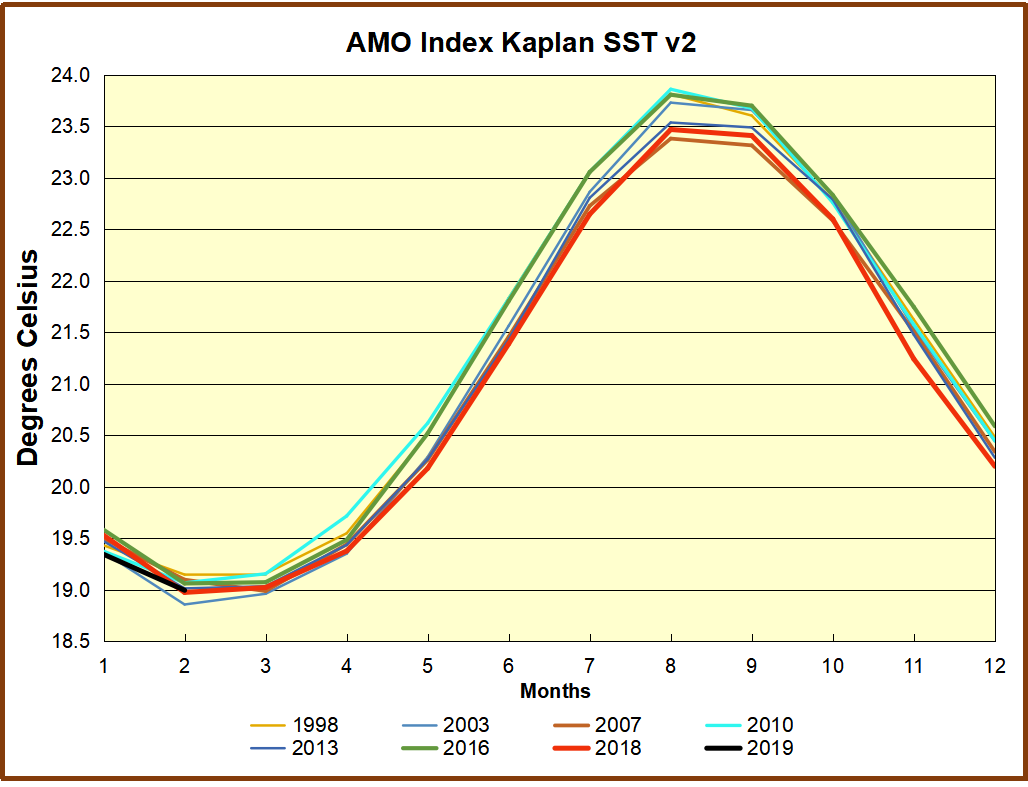
The AMO Index is from from Kaplan SST v2, the unaltered and not detrended dataset. By definition, the data are monthly average SSTs interpolated to a 5×5 grid over the North Atlantic basically 0 to 70N. The graph shows warming began after 1992 up to 1998, with a series of matching years since. Because the N. Atlantic has partnered with the Pacific ENSO recently, let’s take a closer look at some AMO years in the last 2 decades.
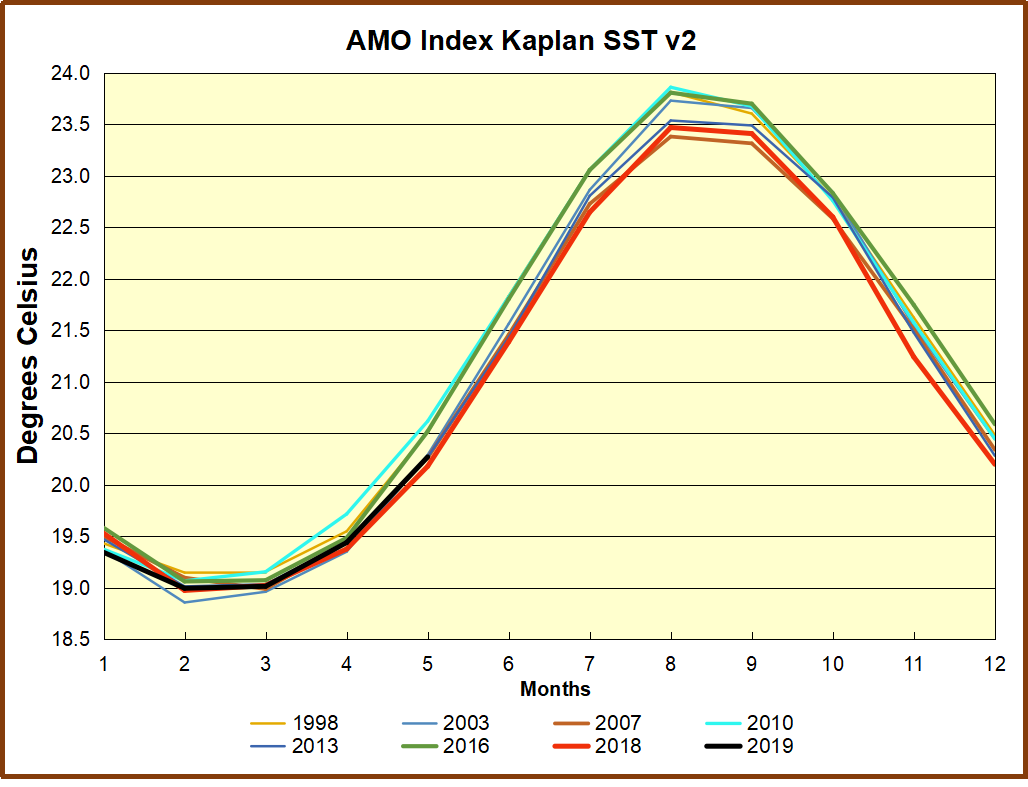
This graph shows monthly AMO temps for some important years. The Peak years were 1998, 2010 and 2016, with the latter emphasized as the most recent. The other years show lesser warming, with 2007 emphasized as the coolest in the last 20 years. Note the red 2018 line is at the bottom of all these tracks. The short black line shows that 2019 began slightly cooler and is now tracking last year closely.


Summary

The oceans are driving the warming this century.  SSTs took a step up with the 1998 El Nino and have stayed there with help from the North Atlantic, and more recently the Pacific northern “Blob.”  The ocean surfaces are releasing a lot of energy, warming the air, but eventually will have a cooling effect.  The decline after 1937 was rapid by comparison, so one wonders: How long can the oceans keep this up? If the pattern of recent years continues, NH SST anomalies may rise slightly in coming months, but once again, ENSO which has weakened will probably determine the outcome.

Postscript:

In the most recent GWPF 2017 State of the Climate report, Dr. Humlum made this observation:

“It is instructive to consider the variation of the annual change rate of atmospheric CO2 together with the annual change rates for the global air temperature and global sea surface temperature (Figure 16). All three change rates clearly vary in concert, but with sea surface temperature rates leading the global temperature rates by a few months and atmospheric CO2 rates lagging 11–12 months behind the sea surface temperature rates.”

Footnote: Why Rely on HadSST3

HadSST3 is distinguished from other SST products because HadCRU (Hadley Climatic Research Unit) does not engage in SST interpolation, i.e. infilling estimated anomalies into grid cells lacking sufficient sampling in a given month. From reading the documentation and from queries to Met Office, this is their procedure.

HadSST3 imports data from gridcells containing ocean, excluding land cells. From past records, they have calculated daily and monthly average readings for each grid cell for the period 1961 to 1990. Those temperatures form the baseline from which anomalies are calculated.

In a given month, each gridcell with sufficient sampling is averaged for the month and then the baseline value for that cell and that month is subtracted, resulting in the monthly anomaly for that cell. All cells with monthly anomalies are averaged to produce global, hemispheric and tropical anomalies for the month, based on the cells in those locations. For example, Tropics averages include ocean grid cells lying between latitudes 20N and 20S.

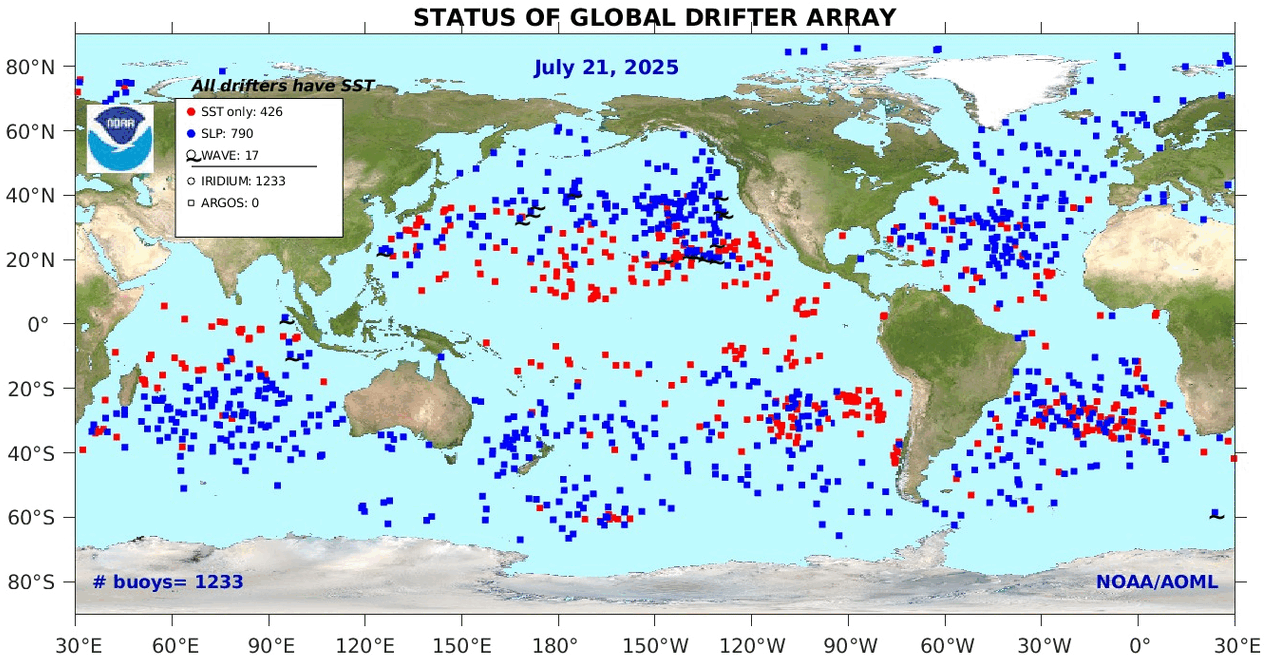
Gridcells lacking sufficient sampling that month are left out of the averaging, and the uncertainty from such missing data is estimated. IMO that is more reasonable than inventing data to infill. And it seems that the Global Drifter Array displayed in the top image is providing more uniform coverage of the oceans than in the past.

uss-pearl-harbor-deploys-global-drifter-buoys-in-pacific-ocean

USS Pearl Harbor deploys Global Drifter Buoys in Pacific Ocean


N. Atlantic Keeps Its Cool

RAPID Array measuring North Atlantic SSTs.

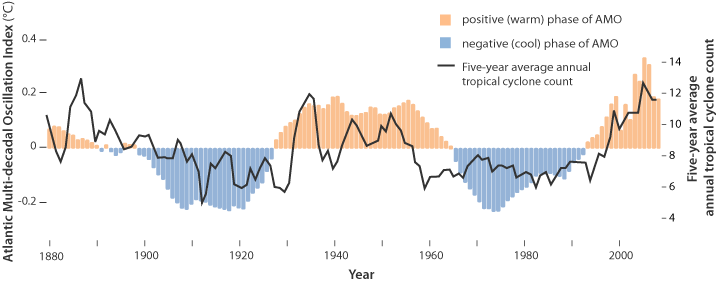
For the last few years, observers have been speculating about when the North Atlantic will start the next phase shift from warm to cold. Given the way 2018 went and 2019 is following, this may be the onset.  First some background.

. Source: Energy and Education Canada

An example is this report in May 2015 The Atlantic is entering a cool phase that will change the world’s weather by Gerald McCarthy and Evan Haigh of the RAPID Atlantic monitoring project. Excerpts in italics with my bolds.

This is known as the Atlantic Multidecadal Oscillation (AMO), and the transition between its positive and negative phases can be very rapid. For example, Atlantic temperatures declined by 0.1ºC per decade from the 1940s to the 1970s. By comparison, global surface warming is estimated at 0.5ºC per century – a rate twice as slow.

In many parts of the world, the AMO has been linked with decade-long temperature and rainfall trends. Certainly – and perhaps obviously – the mean temperature of islands downwind of the Atlantic such as Britain and Ireland show almost exactly the same temperature fluctuations as the AMO.

Atlantic oscillations are associated with the frequency of hurricanes and droughts. When the AMO is in the warm phase, there are more hurricanes in the Atlantic and droughts in the US Midwest tend to be more frequent and prolonged. In the Pacific Northwest, a positive AMO leads to more rainfall.

A negative AMO (cooler ocean) is associated with reduced rainfall in the vulnerable Sahel region of Africa. The prolonged negative AMO was associated with the infamous Ethiopian famine in the mid-1980s. In the UK it tends to mean reduced summer rainfall – the mythical “barbeque summer”.Our results show that ocean circulation responds to the first mode of Atlantic atmospheric forcing, the North Atlantic Oscillation, through circulation changes between the subtropical and subpolar gyres – the intergyre region. This a major influence on the wind patterns and the heat transferred between the atmosphere and ocean.

The observations that we do have of the Atlantic overturning circulation over the past ten years show that it is declining. As a result, we expect the AMO is moving to a negative (colder surface waters) phase. This is consistent with observations of temperature in the North Atlantic.

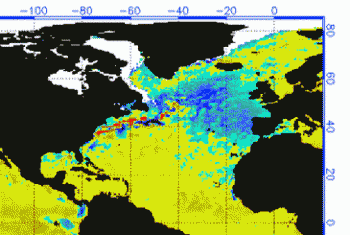
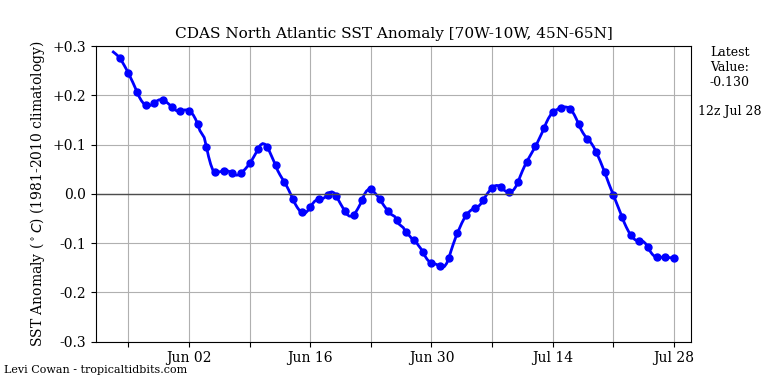
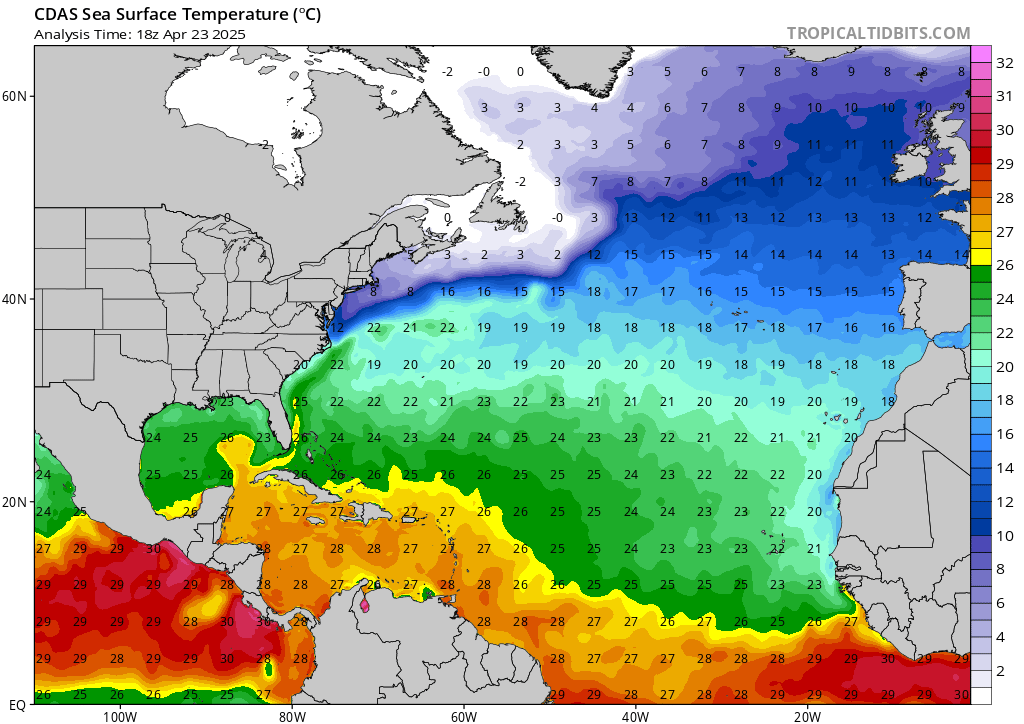
Cold “blobs” in North Atlantic have been reported, but they are usually winter phenomena. For example in April 2016, the sst anomalies looked like this

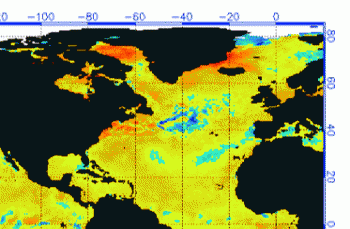
But by September, the picture changed to this

And we know from Kaplan AMO dataset, that 2016 summer SSTs were right up there with 1998 and 2010 as the highest recorded.

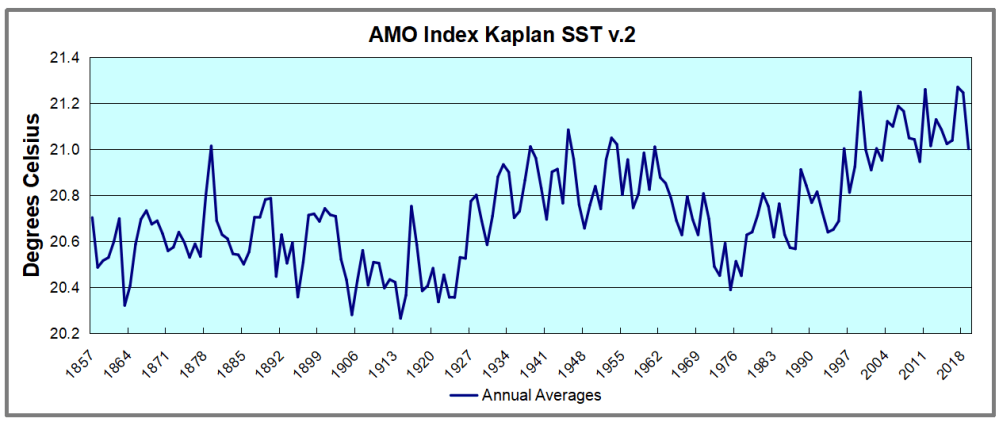
As the graph above suggests, this body of water is also important for tropical cyclones, since warmer water provides more energy.  But those are annual averages, and I am interested in the summer pulses of warm water into the Arctic. As I have noted in my monthly HadSST3 reports, most summers since 2003 there have been warm pulses in the north atlantic.
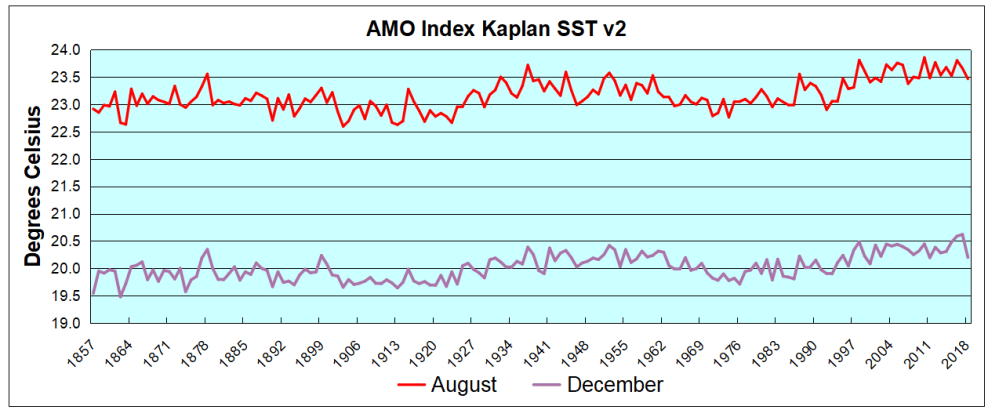
amo december 2018
The AMO Index is from from Kaplan SST v2, the unaltered and not detrended dataset. By definition, the data are monthly average SSTs interpolated to a 5×5 grid over the North Atlantic basically 0 to 70N.  The graph shows the warmest month August beginning to rise after 1993 up to 1998, with a series of matching years since.  December 2016 set a record at 20.6C, but note the plunge down to 20.2C for  December 2018, matching 2011 as the coldest years  since 2000.  Because McCarthy refers to hints of cooling to come in the N. Atlantic, let’s take a closer look at some AMO years in the last 2 decades.

May is a transitional month, and does serve to show the pattern of North Atlantic pulse related to the ENSO events. In the last two decades, there were four El Nino events peaking in 1998, 2005, 2010 and 2016.  All those years appear in the May AMO record as over 20.4C, a level not previously reached in the North Atlantic. Note the dropoff to 20.2C the last two years.

This graph shows monthly AMO temps for some important years. The Peak years were 1998, 2010 and 2016, with the latter emphasized as the most recent. The other years show lesser warming, with 2007 emphasized as the coolest in the last 20 years. Note the red 2018 line is at the bottom of all these tracks.  The short black line shows that 2019 began slightly cooler than January 2018, and tracking closely since.

With all the talk of AMOC slowing down and a phase shift in the North Atlantic, it seems the annual average for 2018 confirms that cooling has set in.  Through December the momentum is certainly heading downward, despite the band of warming ocean  that gave rise to European heat waves last summer.

amo annual122018


April Ocean SSTs Hold Steady

The best context for understanding decadal temperature changes comes from the world’s sea surface temperatures (SST), for several reasons:
  • The ocean covers 71% of the globe and drives average temperatures;
  • SSTs have a constant water content, (unlike air temperatures), so give a better reading of heat content variations;
  • A major El Nino was the dominant climate feature in recent years.

HadSST is generally regarded as the best of the global SST data sets, and so the temperature story here comes from that source, the latest version being HadSST3.  More on what distinguishes HadSST3 from other SST products at the end.

The Current Context

The chart below shows SST monthly anomalies as reported in HadSST3 starting in 2015 through April 2019. Hadley Centre did some technical upgrades and only now published results for March and April


A global cooling pattern is seen clearly in the Tropics since its peak in 2016, joined by NH and SH cycling downward since 2016.  2018 started with slow warming after the low point of December 2017, led by steadily rising NH, which peaked in September and cooled since.  The Tropics rose steadily until November, and are now cooling as well.

In 2019 we can see that NH is flat, the Tropics are up and down, and SH gently rising.  As a result, all regions are converging on the Global average anomaly of 0.57C  All regions are about the same as 2017 and 2015, but much cooler than 2016.

Note that higher temps in 2015 and 2016 were first of all due to a sharp rise in Tropical SST, beginning in March 2015, peaking in January 2016, and steadily declining back below its beginning level. Secondly, the Northern Hemisphere added three bumps on the shoulders of Tropical warming, with peaks in August of each year.  A fourth NH bump was lower and peaked in September 2018.  Also, note that the global release of heat was not dramatic, due to the Southern Hemisphere offsetting the Northern one.

The annual SSTs for the last five years are as follows:
Annual SSTs Global NH SH  Tropics
2014 0.477 0.617 0.335 0.451
2015 0.592 0.737 0.425 0.717
2016 0.613 0.746 0.486 0.708
2017 0.505 0.650 0.385 0.424
2018 0.480 0.620 0.362 0.369

2018 annual average SSTs across the regions are close to 2014, slightly higher in SH and much lower in the Tropics.  The SST rise from the global ocean was remarkable, peaking in 2016, higher than 2011 by 0.32C.

A longer view of SSTs

The graph below  is noisy, but the density is needed to see the seasonal patterns in the oceanic fluctuations.  Previous posts focused on the rise and fall of the last El Nino starting in 2015.  This post adds a longer view, encompassing the significant 1998 El Nino and since.  The color schemes are retained for Global, Tropics, NH and SH anomalies.  Despite the longer time frame, I have kept the monthly data (rather than yearly averages) because of interesting shifts between January and July.

Open image in new tab to enlarge.

1995 is a reasonable starting point prior to the first El Nino.  The sharp Tropical rise peaking in 1998 is dominant in the record, starting Jan. ’97 to pull up SSTs uniformly before returning to the same level Jan. ’99.  For the next 2 years, the Tropics stayed down, and the world’s oceans held steady around 0.2C above 1961 to 1990 average.

Then comes a steady rise over two years to a lesser peak Jan. 2003, but again uniformly pulling all oceans up around 0.4C.  Something changes at this point, with more hemispheric divergence than before. Over the 4 years until Jan 2007, the Tropics go through ups and downs, NH a series of ups and SH mostly downs.  As a result the Global average fluctuates around that same 0.4C, which also turns out to be the average for the entire record since 1995.

2007 stands out with a sharp drop in temperatures so that Jan.08 matches the low in Jan. ’99, but starting from a lower high. The oceans all decline as well, until temps build peaking in 2010.

Now again a different pattern appears.  The Tropics cool sharply to Jan 11, then rise steadily for 4 years to Jan 15, at which point the most recent major El Nino takes off.  But this time in contrast to ’97-’99, the Northern Hemisphere produces peaks every summer pulling up the Global average.  In fact, these NH peaks appear every July starting in 2003, growing stronger to produce 3 massive highs in 2014, 15 and 16.  NH July 2017 was only slightly lower, and a fifth NH peak still lower in Sept. 2018.  Note also that starting in 2014 SH plays a moderating role, offsetting the NH warming pulses. (Note: these are high anomalies on top of the highest absolute temps in the NH.)

What to make of all this? The patterns suggest that in addition to El Ninos in the Pacific driving the Tropic SSTs, something else is going on in the NH.  The obvious culprit is the North Atlantic, since I have seen this sort of pulsing before.  After reading some papers by David Dilley, I confirmed his observation of Atlantic pulses into the Arctic every 8 to 10 years.

But the peaks coming nearly every summer in HadSST require a different picture.  Let’s look at August, the hottest month in the North Atlantic from the Kaplan dataset.
AMO August 2018

The AMO Index is from from Kaplan SST v2, the unaltered and not detrended dataset. By definition, the data are monthly average SSTs interpolated to a 5×5 grid over the North Atlantic basically 0 to 70N. The graph shows warming began after 1992 up to 1998, with a series of matching years since. Because the N. Atlantic has partnered with the Pacific ENSO recently, let’s take a closer look at some AMO years in the last 2 decades.

This graph shows monthly AMO temps for some important years. The Peak years were 1998, 2010 and 2016, with the latter emphasized as the most recent. The other years show lesser warming, with 2007 emphasized as the coolest in the last 20 years. Note the red 2018 line is at the bottom of all these tracks. The short black line shows that 2019 began slightly cooler than January 2018,  and in February matched the low SST of the previous year.

Summary

The oceans are driving the warming this century.  SSTs took a step up with the 1998 El Nino and have stayed there with help from the North Atlantic, and more recently the Pacific northern “Blob.”  The ocean surfaces are releasing a lot of energy, warming the air, but eventually will have a cooling effect.  The decline after 1937 was rapid by comparison, so one wonders: How long can the oceans keep this up? If the pattern of recent years continues, NH SST anomalies will likely cool in coming months.  Once again, ENSO will probably determine the outcome.

Postscript:

In the most recent GWPF 2017 State of the Climate report, Dr. Humlum made this observation:

“It is instructive to consider the variation of the annual change rate of atmospheric CO2 together with the annual change rates for the global air temperature and global sea surface temperature (Figure 16). All three change rates clearly vary in concert, but with sea surface temperature rates leading the global temperature rates by a few months and atmospheric CO2 rates lagging 11–12 months behind the sea surface temperature rates.”

Footnote: Why Rely on HadSST3

HadSST3 is distinguished from other SST products because HadCRU (Hadley Climatic Research Unit) does not engage in SST interpolation, i.e. infilling estimated anomalies into grid cells lacking sufficient sampling in a given month. From reading the documentation and from queries to Met Office, this is their procedure.

HadSST3 imports data from gridcells containing ocean, excluding land cells. From past records, they have calculated daily and monthly average readings for each grid cell for the period 1961 to 1990. Those temperatures form the baseline from which anomalies are calculated.

In a given month, each gridcell with sufficient sampling is averaged for the month and then the baseline value for that cell and that month is subtracted, resulting in the monthly anomaly for that cell. All cells with monthly anomalies are averaged to produce global, hemispheric and tropical anomalies for the month, based on the cells in those locations. For example, Tropics averages include ocean grid cells lying between latitudes 20N and 20S.

Gridcells lacking sufficient sampling that month are left out of the averaging, and the uncertainty from such missing data is estimated. IMO that is more reasonable than inventing data to infill. And it seems that the Global Drifter Array displayed in the top image is providing more uniform coverage of the oceans than in the past.

uss-pearl-harbor-deploys-global-drifter-buoys-in-pacific-ocean

USS Pearl Harbor deploys Global Drifter Buoys in Pacific Ocean


CO2 Exonerated

Vijay Jayaraj makes the case for carbon emissions in relation to the question: Will My Carbon Footprint Benefit or Harm the Environment? May 28, 2019 at Cornwall Alliance. Excerpts in italics with my bolds and images. (Follow the title link to the article for many supporting reference links)

My cousin in California is excited about buying a Tesla. “It is environmentally friendly” he says. Maybe you agree. My friends in India, too, are excited about buying electric cars. They think doing so will help them prevent global warming.

But the evidence suggests otherwise.

Almost every environmental policy now makes reducing carbon dioxide (CO2) emissions, the only way to “go green.” Advocates have even persuaded school children to strike against fossil fuels.

But as a climate scientist, I’ve researched the pros and cons of CO2. What have I found? That our CO2 emissions will actually benefit the planet, not harm it.

Why? Here are four reasons.

Realism Not Denialism

To begin, climate change is real. The current warming trend began in the 18th century, after the Little Ice Age.

But forecasts of future warming based on faulty computer models aren’t credible. In addition, current global temperature is not unprecedented. It poses no imminent danger to ecosystems.

CO2 does contribute to warming. But the theory that it is the dominant cause is mistaken.

The scientific community is divided on how strongly CO2 can influence global temperature. But the sun and oceans play major roles. They probably far outweigh CO2.


So, call me a “climate realist,” not a “climate denier.” That is a misleading term, used to discredit those who question their hypothesis.

2.  No Damage So Far, and None Coming

CO2 emissions from human activity were almost nonexistent before the Industrial Revolution in the 18th century. If CO2 is the primary driver of warming, there should have been no comparable warming before then. But numerous warming events did occur.

Two happened in the past 2000 years—the Roman Warm Period (around the 1st century A.D.) and the Medieval Warm Period (around the 10th century). Neither significantly damaged human civilization. The only global-scale climate-related damage came from the Little Ice Age of the 17th century.

So we have no reason to believe rising temperatures will cause severe global-scale problems in the future.

3.  CO2 Emissions Have Benefited Us, Not Harmed Us

CO2 emissions haven’t caused global harm. Instead, they have benefited us, directly and indirectly.

The direct but smaller benefit is increased agricultural productivity. Plants grow better with more CO2. Hundreds of scientific studies demonstrate this. Greenhouse operators capitalize on it. They pump CO2 into greenhouses to make their plants grow faster and larger.

If anything, the increase in atmospheric CO2 concentration levels has helped our planet grow greener. Rising temperatures lengthen growing seasons. They enable plants to grow in places where previously it was too cold. Improved photosynthesis enables them to resist diseases and pests better and bear more fruit to feed animals and people.

The indirect but larger benefit of CO2 emissions came from the use of fossil fuels to raise billions of people out of abject poverty. CO2 emissions are the unavoidable byproduct of the combustion of fossil fuels, not pollution.

So think twice before you equate CO2 emission reduction with going green. That is the opposite of the truth.

4.  While CO2 Can’t Cause Dangerous Warming, It Might Help Save Us from Cooling

Even if you contest the benefits of CO2 emissions, they cannot cause dramatic global warming. Even climate alarmists admit this. Why? Because, despite exponential increase in atmospheric CO2, no significant increase in global temperature occurred in the past 19 years. If rapid warming occurs, it is unlikely to be from CO2 emissions.

cycle25-prediction

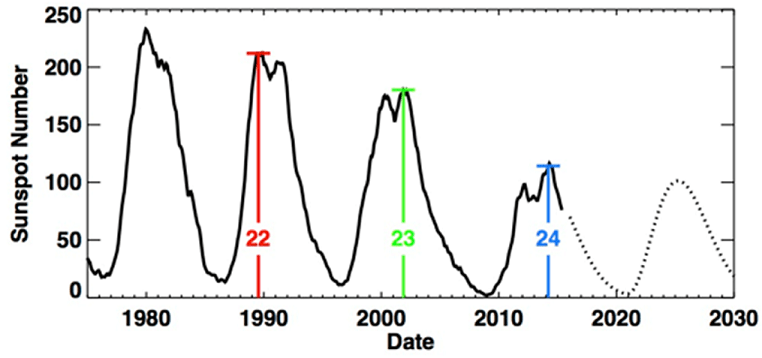
Dr. David Hathaway:  Solar Cycle 25 Prediction. We find that the polar fields indicate that Cycle 25 will be similar in size to (or slightly smaller than) the current small cycle, Cycle 24. Small cycles, like Cycle 24, start late and leave behind long cycles with deep extended minima. Therefore, we expect a similar deep, extended minimum for the Cycle 24/25 minimum in 2020.

In fact, we face a possible cooling because of low solar activity. If that kicks in, whatever warming effect CO2 emissions do have will reduce the risk of a repeat of the devastation the Little Ice Age triggered.

For plant growth today and in the future, I give a green “thumbs up” to CO2 emissions. They are the real way to “go green.” Moreover, fossil fuels have immense potential to reduce poverty in developing countries. That will be more beneficial than any reduction of global warming that might come from reduced CO2 emissions.

See also CO2 Unbound

It’s Models All the Way Down

In Rapanos v. United States, Justice Antonin Scalia offered a version of the traditional tale of how the Earth is carried on the backs of animals. In this version of the story, an Eastern guru affirms that the earth is supported on the back of a tiger. When asked what supports the tiger, he says it stands upon an elephant; and when asked what supports the elephant he says it is a giant turtle. When asked, finally, what supports the giant turtle, he is briefly taken aback, but quickly replies “Ah, after that it is turtles all the way down.”  By this analogy, Scalia was showing how other judges were substituting the “purpose” of a law for the actual text written by congress.

The moral of the story is that our perceptions of reality are built upon assumptions. The facts from our experience are organized by means of a framework that provides a worldview, a mental model or paradigm of the way things are. Through the history of science, various pieces of that paradigm have been challenged and have collapsed when contradicted by fresh observations and measurements from experience. Today a small group of scientists have declared themselves climate experts and claim their computer models predict a dangerous future for the planet because of our energy choices.

The Climate Alarmist paradigm is described and refuted in an essay by John Christy published by GWPF The Tropical Skies: Falsifying climate alarm. The content comes from his presentation 23 May 2019 to a meeting in the Palace of Westminster in London, England. Excerpts in italics with my bolds

At the global level a significant discrepancy has been confirmed between empirical measurements and computer predictions.

“The global warming trend for the last 40 years, starting in 1979 when satellite measurements began, is +0.13C per decade or about half of what climate models predicted.”

Figure 3: Updating the estimate.
Redrawn from Christy and McNider 2017.

The top line is the actual temperature of the global troposphere, with the range of original 1994 study shown as the shaded area. We were able to calculate and remove the El Niño effect, which accounts for a lot of the variance, but has no trend to it. Then there are these two dips in global temperature after the El Chichón and Mt Pinatubo eruptions. Volcanic eruptions send aerosols up into the stratophere, and these reflect sunlight, so fewer units of energy get in and the earth cools. I developed a mathematical function to simulate this, as shown in Figure 3d. 

After eliminating the effect of volcanoes, we were left with a line that was approximately straight, apart from some noise. The trend, the dark line in Figure 3e, was 0.095◦C per decade, almost exactly the same as in our earlier study, 25 years before.

Our result is that the transient climate response – the short-term warming – in the troposphere is 1.1◦C at the point in time when carbon dioxide levels double. This is not a very alarming number. If we perform the same calculation on the climate models, you get a figure of 2.31◦C, which is significantly different. The models’ response to carbon dioxide is twice what we see in the real world. So the evidence indicates the consensus range for climate sensitivity is incorrect.

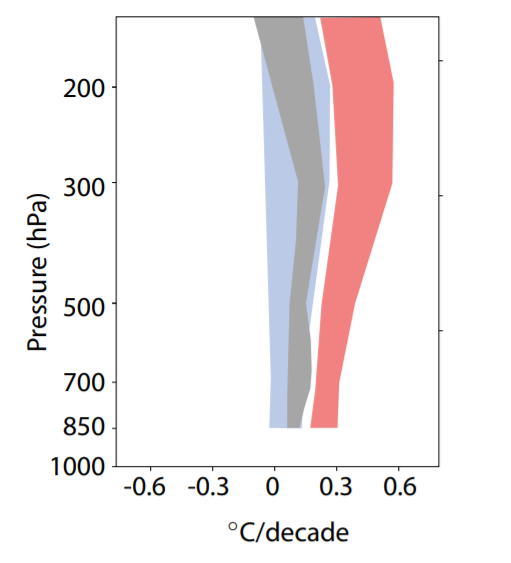
Almost all climate models have predicted rapid warming at high altitudes in the tropics due to greenhouse gas forcing.

They all have rapid warming above 30,000 feet in the tropics – it’s effectively a diagnostic signal of greenhouse warming. But in reality it’s just not happening. It’s warming up there, but at only about one third of the rate predicted by the models.”

Figure 5: The hot spot in the Canadian model.
The y-axis is denominated in units of pressure, but the scale makes it linear in altitude.

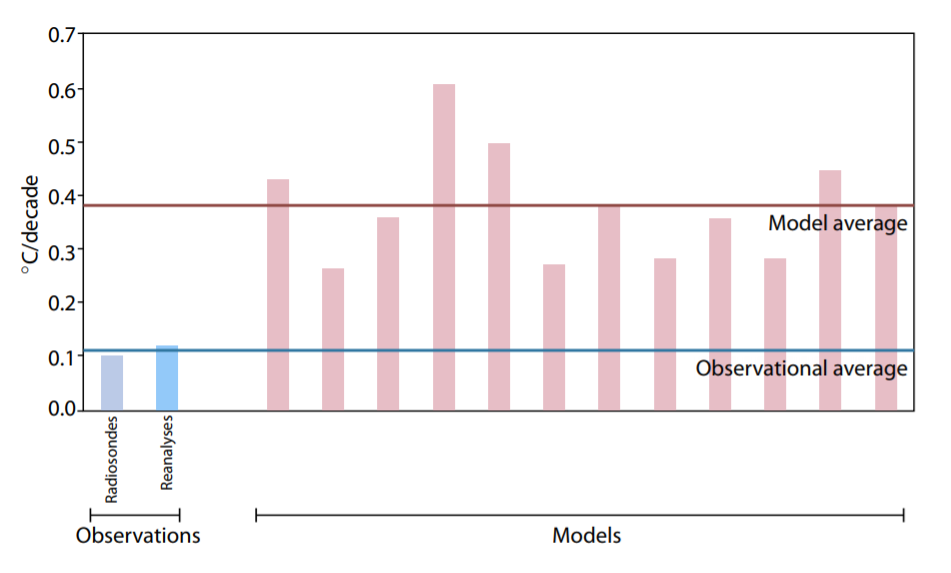
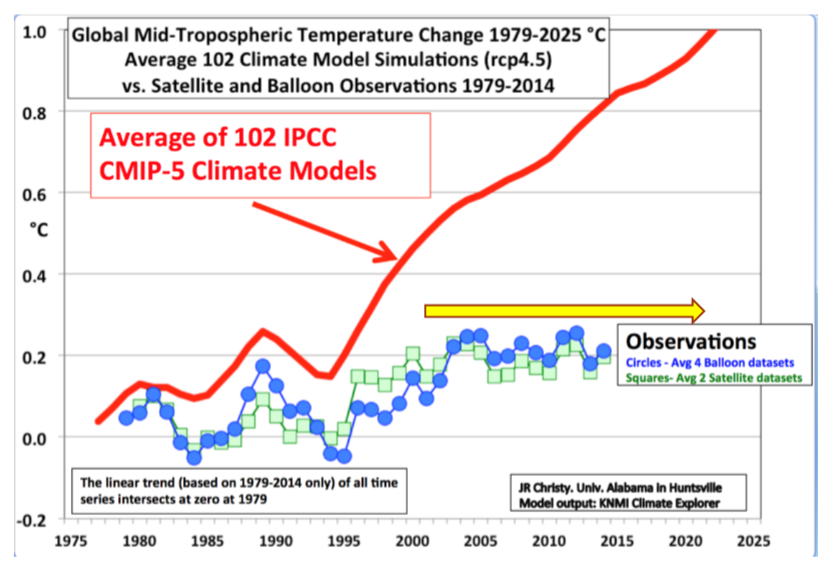
Almost all of the models show such a warming, and none show it when extra greenhouse gas forcing is not included. Figure 6 shows the warming trends from 102 climate models, and the average trend is 0.44◦C per decade. This is quite fast: over 40 years, it amounts to almost 2◦C, although some models have slower warming and some faster. However, the real-world warming is much lower; around one third of the model average.

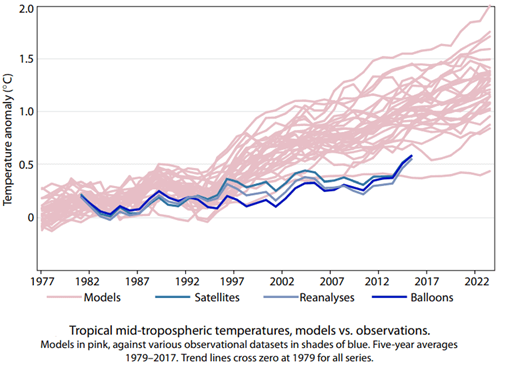
Figure 7 shows the model projections in pink and different observational datasets in shades of blue. You can also easily see the difference in warming rates: the models are warming too fast. The exception is the Russian model, which has much lower sensitivity to carbon dioxide, and therefore gives projections for the end of the century that are far from alarming. The rest of them are already falsified, and their predictions for 2100 can’t be trusted.

The next generation of climate models show that lessons are not being learned.

“An early look at some of the latest generation of climate models reveals they are predicting even faster warming. This is simply not credible.”

Figure 8: Warming in the tropical troposphere according to the CMIP6 models.
Trends 1979–2014 (except the rightmost model, which is to 2007), for 20°N–20°S, 300–200 hPa.

We are just starting to see the first of the next generation of climate models, known as CMIP6. These will be the basis of the IPCC assessment report, and of climate and energy policy for the next 10 years. Unfortunately, as Figure 8 shows, they don’t seem to be getting any better. The observations are in blue on the left. The CMIP6 models, in pink, are also warming faster than the real world. They actually have a higher sensitivity than the CMIP5 models; in other words, they’re apparently getting worse! This is a big problem.


Figure 9: (b) Enlargement and simplification of the tropical troposphere
The tropical troposphere in the Fifth Assessment Report.
The coloured bands represent the range of warming trends. Red is the model runs incorporating natural and anthropogenic forcings, blue is natural forcings only. The range of the observations is in grey

Conclusion

So the rate of accumulation of joules of energy in the tropical troposphere is significantly less than predicted by the CMIP5 climate models. Will the next IPCC report discuss this long running mismatch? There are three possible ways they could handle the problem:
• The observations are wrong, the models are right.
• The forcings used in the models were wrong.
• The models are failed hypotheses.

I predict that the ‘failed hypothesis’ option will not be chosen. Unfortunately, that’s exactly what you should do when you follow the scientific method.

Models Wrong About the Past Produce Unbelievable Futures

Models vs. Observations. Christy and McKitrick (2018) Figure 3

The title of this post is the theme driven home by Patrick J. Michaels in his critique of the most recent US National Climate Assessment (NA4). The failure of General Circulation Models (GCMs) is the focal point of his presentation February 14, 2018. Comments on the Fourth National Climate Assessment. Excerpts in italics with my bolds.

NA4 uses a flawed ensemble of models that dramatically overforecast warming of the lower troposphere, with even larger errors in the upper tropical troposphere. The model ensemble also could not accommodate the “pause” or “slowdown” in warming between the two large El Niños of 1997-8 and 2015-6. The distribution of warming rates within the CMIP5 ensemble is not a true indication of a statistical range of prospective warming, as it is a collection of systematic errors. Despite a glib statement about this Assessment fulfilling the terms of the federal Data Quality Act, that is fatuous. The use of systematically failing models does not fulfill the “maximizing the quality, objectivity, utility, and integrity of information” provision of the Act.

USGCRP should produce a reset Assessment, relying on a model or models that work in four dimensions for future guidance and ignoring the ones that don’t.

Why wasn’t this done to begin with? The model INM-CM4 is spot on, both at the surface and in the vertical, but using it would have largely meant the end of warming as a significant issue. Under a realistic emission scenario (which USGCRP also did not use), INM-CM4 strongly supports the “lukewarm” synthesis of global warming. Given the culture of alarmism that has infected the global change community since before the first (2000) Assessment, using this model would have been a complete turnaround with serious implications.

The new Assessment should employ best scientific practice, and one that weather forecasters use every day. In the climate sphere, billions of dollars are at stake, and reliable forecasts are also critical.

The theme is now picked up in the latest NIPCC report on Fossil Fuels. Chapter 2 is the Climate Science background and the statements below in italics with my bolds come from there.

Chapter 2 Climate Science Climate Change Reconsidered II: Fossil Fuels

Of the 102 model runs considered by Christy and McKitrick, only one comes close to accurately hindcasting temperatures since 1979: the INM-CM4 model produced by the Institute for Numerical Mathematics of the Russian Academy of Sciences (Volodin and Gritsun, 2018). That model projects only 1.4°C warming by the end of the century, similar to the forecast made by the Nongovernmental International Panel on Climate Change (NIPCC, 2013) and many scientists, a warming only one-third as much as the IPCC forecasts. Commenting on the success of the INM-CM model compared to the others (as shown in an earlier version of the Christy graphic), Clutz (2015) writes,

(1) INM-CM4 has the lowest CO2 forcing response at 4.1K for 4xCO2. That is 37% lower than multi-model mean.

(2) INM-CM4 has by far the highest climate system inertia: Deep ocean heat capacity in INM-CM4 is 317 W yr m-2 K -1 , 200% of the mean (which excluded INM-CM4 because it was such an outlier).

(3)INM-CM4 exactly matches observed atmospheric H2O content in lower troposphere (215 hPa), and is biased low above that. Most others are biased high.

So the model that most closely reproduces the temperature history has high inertia from ocean heat capacities, low forcing from CO2 and less water for feedback. Why aren’t the other models built like this one?

The outputs of GCMs are only as reliable as the data and theories “fed” into them, which scientists widely recognize as being seriously deficient (Bray and von Storch, 2016; Strengers, et al., 2015). The utility and skillfulness of computer models are dependent on how well the processes they model are understood, how faithfully those processes are simulated in the computer code, and whether the results can be repeatedly tested so the models can be refined (Loehle, 2018). To date, GCMs have failed to deliver on each of these counts.

The reference above is to a study published in July 2018 by John Christy and Ross McKitrick  A Test of the Tropical 200‐ to 300‐hPa Warming Rate in Climate Models. Excerpts in italics with my bolds.

Abstract

Overall climate sensitivity to CO2 doubling in a general circulation model results from a complex system of parameterizations in combination with the underlying model structure. We refer to this as the model’s major hypothesis, and we assume it to be testable. We explain four criteria that a valid test should meet: measurability, specificity, independence, and uniqueness. We argue that temperature change in the tropical 200‐ to 300‐hPa layer meets these criteria. Comparing modeled to observed trends over the past 60 years using a persistence‐robust variance estimator shows that all models warm more rapidly than observations and in the majority of individual cases the discrepancy is statistically significant. We argue that this provides informative evidence against the major hypothesis in most current climate models.

Discussion

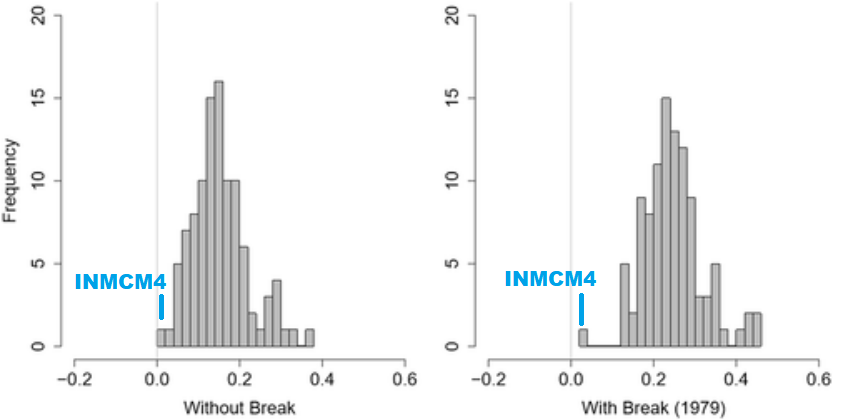
All series‐specific trends and confidence intervals are reported in the supporting information Table S1. The mean restricted trend (without a break term) is 0.325 ± 0.132°C per decade in the models and 0.173 ± 0.056°C per decade in the observations. With a break term included they are 0.389 ± 0.173°C per decade (models) and 0.142 ± 0.115°C per decade (observed). Figure 4 shows the individual trend magnitudes. The red circles and confidence interval whiskers are from models, and the blue are observed.  Trend magnitudes and 95% confidence intervals. Number in upper left corner indicates number of model trends (out of 102) that exceed observed average trend.

If models accurately represented the magnitude of 200‐ to 300‐hPa warming with only nonsystematic errors contributing noise, these distributions would be centered on zero. Clearly, they are centered above zero, in fact in both the restricted and general cases, the entire distribution is above zero.

Table S2 presents individual run test results. In the restricted case, 62 of the 102 divergence terms are significant, while in the general case, 87 of 102 are. The model‐observational discrepancy is not simple uncertainty or random noise but represents a structural bias shared across models.

Worst and Best Models (Table S2) No Break With Break
bcc‐csm1‐1 220.1 593.3
CanESM2 410.3 534.4
CCSM4 258.1 430.6
EC‐EARTH 296.0 222.5
FIO‐ESM 129.2 310.9
GISS‐E2‐H 157.3 444.8
GISS‐E2‐H‐CC 139.0 468.5
GISS‐E2‐R 382.4 237.7
HadGEM2‐ES 50.0 575.4
INMCM4 0.0 2.9

Note. First column: test score for restricted case (no break). Score is significant at 5% if it exceeds 41.53. Second column: test score for unrestricted case (with break at 1979). Score is significant at 5% if it exceeds 50.48.

Conclusion

Comparing observed trends to those predicted by models over the past 60 years reveals a clear and significant tendency on the part of models to overstate warming. All 102 CMIP5 model runs warm faster than observations, in most individual cases the discrepancy is significant, and on average the discrepancy is significant. The test of trend equivalence rejects whether or not we include a break at 1979 for the PCS, though the rejections are stronger when we control for its influence. Measures of series divergence are centered at a positive mean and the entire distribution is above zero. While the observed analogue exhibits a warming trend over the test interval it is significantly smaller than that shown in models, and the difference is large enough to reject the null hypothesis that models represent it correctly, within the bounds of random uncertainty.

Footnote:

The reference to Clutz (2015) is the post Temperatures According to Climate Models

See also: 2018 Update: Best Climate Model INMCM5

Climate Change NOT as Advertised

Just before the Trudeau government imposed its Carbon Tax, it did a PR release advertising all the bad things we are doing to the planet, changing the temperature and weather by burning fossil fuels. Several skeptics pushed back (see links at end). This post is a synopsis of a complete rebuttal from Friends of Science. The whole document is interestingly written and presented, with only a few of many telling points highlighted here.

Climate Change Your Mind. Responding to the Canadian government’s “Canada’s Changing Climate Report” CCCR2019  Excerpts in italics with my bolds and headers

Federal Government says: Both past and future warming in Canada is, on average, about double the magnitude of global warming.

Friends of Science say: CCCR2019 used a reference frame that began in a cooler solar minimum and ended in a higher temperature El Nino period.

The CCCR2019 report uses 1948 as a reference point, a time when temperatures dropped significantly. Referring to this low period as a starting point gives a skewed comparison. In addition the referenced period from 1986 to 2005 ends with an El Nino year, where naturally-caused high temperatures were recorded. This gives a false impression that Canada is ‘warming faster than the rest of the world.’

Moreover, in the above graph all five major datasets show that since 2002, temperatures have Flatlined. This is despite a significant rise in carbon dioxide (CO2), shown by the upper squiggly line in the graph. The squiggles represent the seasonal rise in carbon dioxide during winter, when the great plains and forests are covered by snow, and the uptake of carbon dioxide by plants through spring and summer.

Federal Government says: Canada’s climate has warmed and will warm further in the future, driven by human influence.

Friends of Science say: CO2 Influence is not Seen in Canadian Temperature Records.

Canada has a seasonal range from cold to warm temperatures of 50°Celsius in the near land surface air temperature record. Using the recorded daily temperature minimums (TMIN) and maximums (TMAX) from 1900 to 2013 results in the red and blue colored graph above. A black line in the middle range shows the global temperature anomaly, indicating a tiny rise. At the bottom of the scale in the blue, it is clear there is a reduction in minimum temperatures (meaning overall it is less cold during coldest periods) of about 5°Celsius, but this is at the coldest end of the scale. There is no corresponding rise in the temperature maximum (which would mean hotter during the hottest times), which one is led to believe from the CCCR2019 report.

If carbon dioxide (CO2) was causing warming, it should have been visible in an increasing daytime maximum high, but there is no evidence of it.

Federal Government says: The effects of widespread warming are evident in many parts of Canada and are projected to intensify in the future.

Friends of Science say: Climate Models do not Reflect Observations.

If we are to rely on climate models for setting policy, we should expect that the models closely match observations. As you can see above, based on 102 model runs for the IPCC, the models project significant warming; the reality is that both satellite data and thousands of weather balloon records show that global warming has flatlined despite a significant rise in carbon dioxide emissions from human industry. The models did not predict this ‘hiatus. The theory of Anthropogenic Global Warming says carbon dioxide from human emissions drives warming – that is the impetus for the efforts to implement carbon taxes or invent ways to restrict or mitigate carbon dioxide emissions. The theory is flawed, as you can see above.

Federal Government says: Because of climate change, Canadians must face a ‘new reality’ that events such as spring flooding will be happening more and more frequently.

Friends of Science say: No evidence supports claiming seasonal or urban flooding is unusual.

As Dr. Madhav Khandekar, former WMO regional expert, past Environment Canada research scientist of 40 years, past IPCC expert reviewer, peer-reviewer and author of more than 150 peer-reviewed papers says that seasonal flooding in Canada is typically a combination of early warm temperatures over heavy snowpack and ice jams on rivers. If there are warm temperatures while the snowpack is still firm, the water rapidly pools and there is no open land to absorb the run-off. The flood waters often back-up, exacerbated by ice jams on rivers. This is a common occurrence throughout history, and little seems to be done by residents or municipalities to prepare for this reality. Since so many homes are on potential flood plains in Canada, shouldn’t building standards reflect this fact and municipalities require that new homes be elevated to mitigate potential damage?

CCCR2019 highlights the catastrophic southern Alberta/City of Calgary flood of 2013 as ‘probably’ caused by Anthropogenic Global Warming. This claim ignores the evidence that Calgary had eight of its worst floods prior to 1933. Had the CCCR2019 panel looked at the Calgary Public Library website or visited the Glenbow Museum, they could have seen the evidence for themselves.

Federal Government says: Coastal flooding is expected to increase in many areas of Canada due to local sea level rise.

Friends of Science say: Canadian coastlines are challenged by subsidence or erosion, not related to human-caused global warming.

Natural Resources Canada map shows regional uplift or subsidence.

However much of Canada is quite stable. In fact, due to the melting of the ice age glaciers, much of Canada’s land is in the process of isostatic rebound – a subtle, slow rise as the earth rebounds from the tremendous pressure of the kilometers of ice that once overlay our country.

CCCR2019 presumes that sea level rise from melting Greenland or Antarctic ice sheets will cause sea level rise issues to certain coastal areas in Canada, but this is not a foregone conclusion. Even if large masses of Greenland were to melt, the interior of Greenland is shaped as a bowl that would retain much of the meltwater.

As CCCR2019 notes, many northern regions of Canada are facing challenges due to permafrost melt and some communities face eroding coastlines. This may be seen as sea level rise, but it is due to subsidence or erosion, neither of which are related to human-caused global warming. In previous generations, northern residents were nomads, their ancestors simply moved camp to the most advantageous place for fishing, hunting or seasonal camping. Rather than proposing greenhouse gas emission targets, perhaps a more practical thing would be to design housing for northern communities that can be relocated. As more and more permafrost melts, more carbon dioxide and more methane will be released, however, a carbon tax will not stop that from happening. These are natural cycles. We must adapt.

Summary

Who  are you going to trust: Federal Government or Friends of Science?  Consider the evidence.

Footnote:

See also Climate Hearsay

About Canadian Warming: Just the Facts


Land and Sea Temps: April Southern Exposure

banner-blog

With apologies to Paul Revere, this post is on the lookout for cooler weather with an eye on both the Land and the Sea.  UAH has updated their tlt (temperatures in lower troposphere) dataset for April.   Previously I have done posts on their reading of ocean air temps as a prelude to updated records from HADSST3. This month also has a separate graph of land air temps because the comparisons and contrasts are interesting as we contemplate possible cooling in coming months and years.

Presently sea surface temperatures (SST) are the best available indicator of heat content gained or lost from earth’s climate system.  Enthalpy is the thermodynamic term for total heat content in a system, and humidity differences in air parcels affect enthalpy.  Measuring water temperature directly avoids distorted impressions from air measurements.  In addition, ocean covers 71% of the planet surface and thus dominates surface temperature estimates.  Eventually we will likely have reliable means of recording water temperatures at depth.

Recently, Dr. Ole Humlum reported from his research that air temperatures lag 2-3 months behind changes in SST.  He also observed that changes in CO2 atmospheric concentrations lag behind SST by 11-12 months.  This latter point is addressed in a previous post Who to Blame for Rising CO2?

The April update to HadSST3 will hopefully appear later this month (March is yet to be posted).  In the meantime we can look at lower troposphere temperatures (TLT) from UAHv6 which are already posted for April. The temperature record is derived from microwave sounding units (MSU) on board satellites like the one pictured above. This month also involved a change in UAH processing of satellite drift corrections, including dropping one platform which can no longer be corrected. The graphs below are taken from the new and current dataset.

The UAH dataset includes temperature results for air above the oceans, and thus should be most comparable to the SSTs. There is the additional feature that ocean air temps avoid Urban Heat Islands (UHI).  The graph below shows monthly anomalies for ocean temps since January 2015.

Click on image to enlarge.

April ocean air temps rose in all regions, putting them back comparable with January 2019.  NH warming was slight, while stronger warming in SH and the Tropics pulled up the Global average.  The temps this April are warmer than 2018, nearly matching 2017, and of course much lower than 2016.

Land Air Temperatures Tracking Downward in Seesaw Pattern

We sometimes overlook that in climate temperature records, while the oceans are measured directly with SSTs, land temps are measured only indirectly.  The land temperature records at surface stations record air temps at 2 meters above ground.  UAH gives tlt anomalies for air over land separately from ocean air temps.  The graph updated for April is below.

The greater volatility of the Land temperatures was evident earlier, but has calmed down recently. Also the  NH dominates, having twice as much land area as SH.  Note how global peaks mirror NH peaks.  In January 2019 all Land air temps were close but have now diverged.  In April both SH and the Tropics warmed (comparable to ocean temps), but the much larger NH land surface cooled, pulling the Global anomaly down.  The Tropical land air temps could not be more different from a year ago, yet the Global is about the same.

TLTs include mixing above the oceans and probably some influence from nearby more volatile land temps.  Clearly NH and Global land temps have been dropping in a seesaw pattern, now more than 1C lower than the peak in 2016.  TLT measures started the recent cooling later than SSTs from HadSST3, but are now showing the same pattern.  It seems obvious that despite the three El Ninos, their warming has not persisted, and without them it would probably have cooled since 1995.  Of course, the future has not yet been written.


Climate Extrasensory Perception

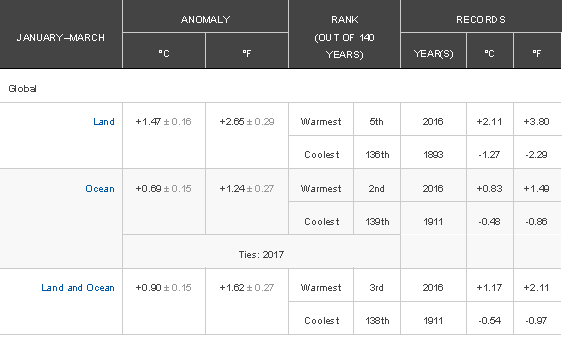
A recent post Climate Hearsay featured an article by Ross McKitrick noting how climatists rely on charts and graphs to alarm people about temperature changes too small for them to notice otherwise.  For example, NOAA each month presents temperature measurements globally and broken down in various ways.  To illustrate McKitrick’s point, let’s look at the results for Quarter 1 of 2019, January through March.  Source: Global Climate Report

So the chart informs us that for this 3 month period, the whole world had its third warmest year out of the last 140 years!  2016 was a full 0.27℃ hotter on average over those 90 days.  Well, maybe not, because the error range is given as +/- 0.15℃.  So the difference this year from the record year 2016 might have been only a few 0.01℃, and no way you could have noticed that.  In fact where I live in Montreal, it didn’t seem like a warm year at all.

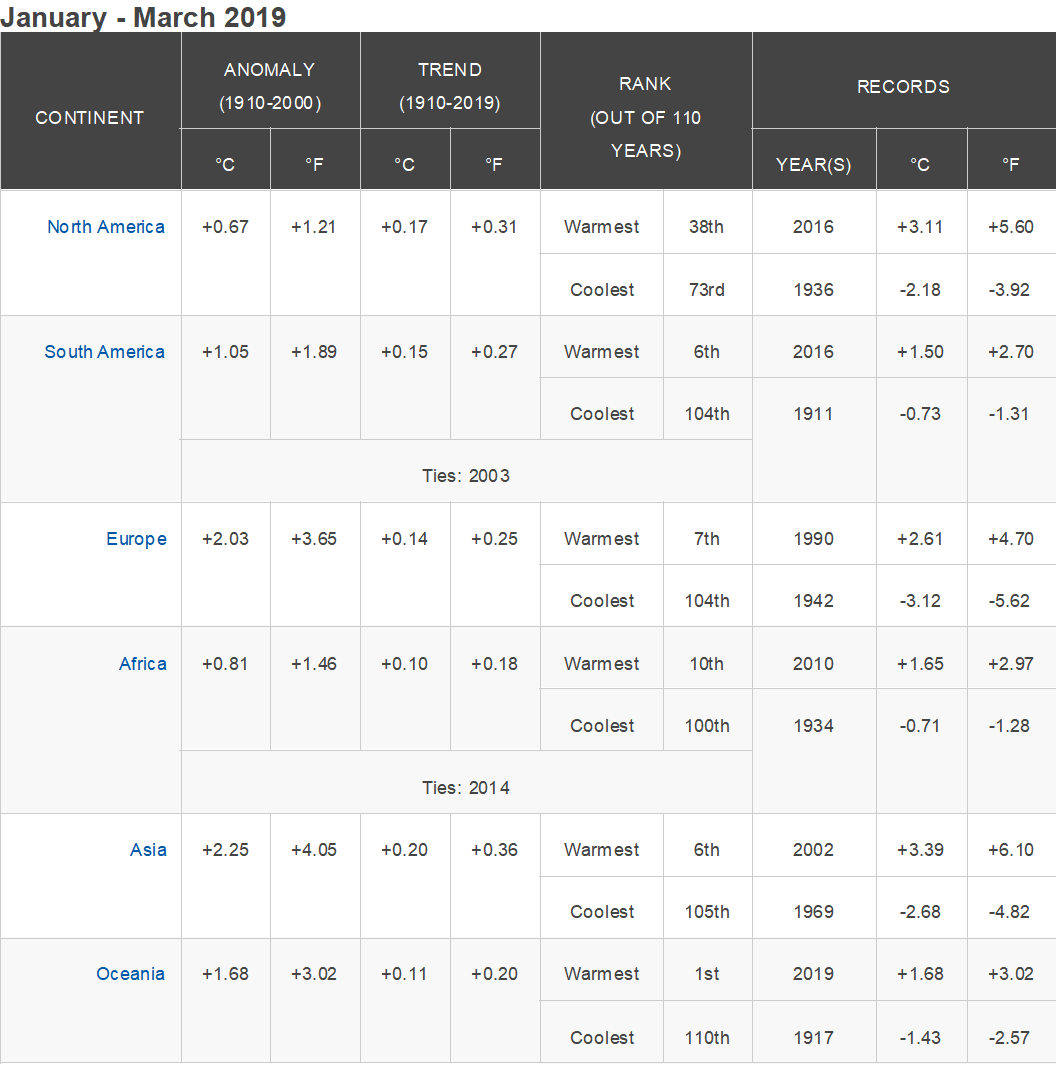
McKitrick also makes the point that claiming a country like Canada warmed more than twice the global average proves nothing.  In a cooling period, any place on land will cool faster than the global surface which is 71% ocean.  Same thing goes for warming: land temps change faster. For example, consider NOAA’s first quarter report on the major continents.

Surprise, surprise: North American temperatures ranked 38th out of 110 years, more than 2℃ cooler than 2016.  That’s more like what I experienced, though many days were much colder.  And browse the list of other land places: it was not that warm anywhere except for Oceania, with the land mass mostly in Australia.

Summary

Global warming/climate change is one of those everywhere, elsewhere phenomena.  Taking masses of temperatures and averaging them into a GMT (Global Mean Temperature Anomaly) is an abstraction, not anyone’s reality.  And in addition, minute changes in that abstraction are too small for anyone to sense.  Yet, modern civilization is presumed to be in crisis over 1.5℃ of additional warming, which we apparently already got in Canada and we are much better for it.

Some people worry Global Warming is changing how fast the Earth spins. Have you noticed?

Footnote:

Mike Hulme is a leading voice striking a rational balance between concern about the planet and careful deliberation over policy choices.  I have posted several of his articles, for example on extreme weather attribution and on attempts to link armed conflicts with climate change.  Pertinent to this post, Hulme has spoken out on the obsession with global temperature anomalies: See Obsessing Over Global Temperatures

Global temperature does not cause anything to happen. It has no material agency. It is an abstract proxy for the aggregated accumulation of heat in the surface boundary layer of the planet. It is far removed from revealing the physical realities of meteorological hazards occurring in particular places. And forecasts of global temperature threshold exceedance are even further removed from actionable early warning information upon which disaster risk management systems can work.

Global temperature offers the ultimate view of the planet—and of meteorological hazard—from nowhere.

And he has warned about the emergency rhetoric now on full display in the streets of major cities.  See Against Emergency Countdown

But as we argued a few years ago, declaring a climate emergency invokes a state of exception that carries many inherent risks: the suspension of normal governance, the use of coercive rhetoric, calls for ‘desperate measures’, shallow thinking and deliberation, and even militarization. To declare an emergency becomes an act of high moral and political significance, as it replaces the framework of ordinary politics with one of extraordinary politics.

In contrast, a little less rhetorical heat will allow for more cool-headed policy development. What is needed is clear-headed pragmatism, but without the Sword of Damocles hanging over these heads. Climate Pragmatism calls for accelerating technology innovation, including nuclear energy, for tightening local air quality standards, for sector-, regional- and local-level interventions to alter development trajectories and for major investments in improving female literacy. Not desperate measures called forth by the unstable politics of a state of emergency, but right and sensible things to do. And it is never too late to do the right thing.